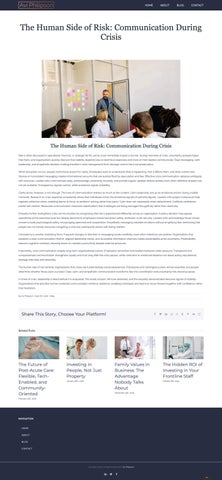
Risk is often discussed in operational, financial, or strategic terms, yet its most immediate impact is human. During moments of crisis, uncertainty spreads faster than facts, and organizations quickly discover that stability depends less on technical responses and more on how leaders communicate. Clear messaging, calm leadership, and empathetic decision-making transform crisis management from damage control into trust preservation.
When disruption occurs, people instinctively search for clarity. Employees want to understand what is happening, how it affects them, and what comes next. Silence or inconsistent messaging creates informational vacuums that are quickly filled by speculation and fear. Effective crisis communication replaces ambiguity with structure. Leaders who communicate early, acknowledge uncertainty honestly, and provide regular updates reduce anxiety even when definitive answers are not yet available. Transparency signals control, while avoidance signals instability.
Clarity alone, however, is