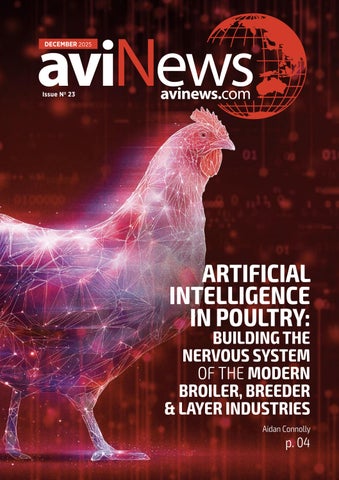
DECEMBER 2025
Issue Nº 23
ARTIFICIAL INTELLIGENCE IN POULTRY:
BUILDING THE NERVOUS SYSTEM OF THE MODERN BROILER, BREEDER & LAYER INDUSTRIES
Aidan Connolly
p. 04
THE NEW ERA OF POULTRY PRODUCTION
F
or this final edition of the year, Aidan Connolly presents an interesting article on the importance of Artificial Intelligence in poultry farming, and the distinguished doctors Michael Czarick and Brian Fairchild tell us in their article Is it Worth Installing an Additional Evaporative Panel in a Broiler Shed? that when designing a broiler shed with tunnel ventilation, it is important to install the appropriate number of evaporative cooling panels. Once again, we have an interesting article by Udaykumar Mudbakhe entitled Broiler Heat Management in Tropical Climates, in which he delves into the critical aspects of broiler heat loss, analyzes a real-world case study from Nepal, and explains why advanced ventilation systems like Combi-Tunnel are essential for consistent, efficient, and healthy growth in challenging environments. For this occasion, we have the valuable literary contribution of the famous doctor Mahaletchumy Arujanan, Executive Director of Malaysian Biotechnology Information Centre, with the article The Role of Gene Editing in Breeding Resilient Poultry for Planetary Health. Gene editing holds immense potential to transform poultry breeding into ways that align with the principles of planetary health.
Jess Ramanee, our contributor at aviNews Asia, enlightens us with the article Malaysia’s Cage-Free Evolution: Humane Eggs Gaining Ground, in which she states that Malaysia’s egg industry is undergoing a structural transformation. Long dominated by battery cage systems, the market is now pivoting toward more ethical and sustainable alternatives: cage-free egg production.
EDITOR
GRUPO DE COMUNICACIÓN AGRINEWS SL
ADVERTISING Luis Carrasco +34 605 09 05 13 lc@agrinews.es Miguel Martín Tamayo +34 664 660 603 sales@grupoagrinews.com
Avian parasites invade the December issue! Dr. Edgar Oviedo gives us a masterclass on general aspects, control, and prevention of the Red Mite (Dermanyssus gallinae) and Darkling Beetles (Alphitobious diaperinus).
Nicole Carletti Ramírez +57 312 391 9330 avinewslatam@grupoagrinews.com
Dr. Norma L. Calderón and Dr. Leopoldo H. Paasch, from Faculty of Veterinary Medicine and Zootechnics, UNAM, present us the second part of their article The importance of Marek’s Disease and Lymphoid Leukosis in family and backyard poultry farming – Part II. This second part delves into histopathology, diagnostic, prevention and control strategies.
EDITORIAL STAFF José Luis Valls María de los Angeles Gutiérrez Nicole Carletti Ramírez Héctor David Corredor Martínez
Closing the December edition, Dr. Juan Gabriel Espino, from Nutrihuevo, Guatemala, address some nutritional aspects to consider in a feeding program for laying hens in order to achieve 500 eggs per cycle in his article Nutritional Recommendations in the Feeding Program for Growing Laying Hens. Enjoy the reading!
CUSTOMER SUPPORT Mercé Soler
TECHNICAL DIRECTION Edgar Oviedo
COLLABORATORS
Eduardo Cervantes
info@grupoagrinews.com avinews.com grupoagrinews.com Free distribution magazine AIMED AT VETERINARIANS AND TECHNICIANS
Legal Deposit B15280-2024 ISSN PRINTED VERSION 2938-8899 ISSN DIGITAL VERSION 2938-8902 Subscription price 125$ Images: Noun Project / Freepik/Dreamstime
1 aviNews International December 2025
CONTENTS 04
Artificial Intelligence in Poultry: Building the Nervous System of the Modern Broiler, Breeder & Layer Industries
28
Udaykumar (Uday Patil) Mudbakhe
Aidan Connolly
Consultant & Subject Matter Expert in Poultry Ventilation, Mumbai, Maharashtra, India
Expert in Agricultural Innovation
16
Is it Worth Installing an Additional Evaporative Panel in a Broiler Shed?
36
The Role of Gene Editing in Breeding Resilient Poultry for Planetary Health Dr Mahaletchumy Arujanan
Michael Czarick1 and Brian Fairchild2
Executive Director of Malaysian Biotechnology Information Centre
UGA Extension Engineer UGA Extension Poultry Scientist
1 2
24
Broiler Heat Management in Tropical Climates: The Combi-Tunnel Solution
Broiler Meat and Carcass Quality: The Critical Role of Mineral Nutrition Kelen Zavarize
Technical Services Manager for Latin America South NOVUS
42
Effective Fumigation of Hatching Eggs to Improve Hatch Results Petersime Technical Team
2 aviNews International December 2025
Malaysia’s Cage-Free Evolution: Humane Eggs Gaining Ground
48
72
Jess Ramanee aviNews Asia
The Importance of Marek’s Disease and Lymphoid Leukosis in Family and Backyard Poultry Farming – Part II
Dr. Norma L. Calderón & Dr. Leopoldo H. Paasch Faculty of Veterinary Medicine and Zootechnics, UNAM
Accurate of Nonviable Egg: Removal - One Step Hatcheries Cannot Afford to Miss
52
80
Effective Control of Darkling Beetles (Alphitobious diaperinus)
Tarsicio Villalobos
Director of Veterinary Services and Global Technicians at Zoetis
Edgar O. Oviedo-Rondón
Prestage Department of Poultry Science, North Carolina State University. Raleigh, NC
58
Red Mite Control
88
Edgar O. Oviedo-Rondón
AviNews Latam Technical Team
Prestage Department of Poultry Science, North Carolina State University. Raleigh, NC na
T eseh tim mina e s era i la eneg .euss yllar Effects Of Cu Methionine-
94
66
ehT tsoc orp s a s cos oitcud eb etai n e iw d sessol itse n ht t h c d o u t n e e am poruE e t t r d o o l a r dna tim de 132€ t inU nae o se im vah p noill i gge n e re Disease Gumboro dn Control: y u e s t a yr A Perfect Between rof r nolaBalance e Safety .and Efficacy lg ehT o i lab fiingis c apm si tc dna tna retaerg d a e t s t e e n vr noitLopes Marco AurélioseElmer . Global Poultry Director, Libourne - France, Ceva Santé Animale
Cresta Group: Tradition, Innovation and Poultry Welfare Driven by Zucami
Hydroxy-Analogue H Sulfate on Chelate andwoCu e BroilererPerformance and ,rev idem c c ne ta la maPrevention Pododermatitis t er t o
itne p gn k trop ah s eud no yrtluo a nwon v e t g s w o a i o g i r ek den atsefn Kelen ama Davi a ,sr odiosZavarize1, it 1 sno itidnoc Torres sis 1, GabrielatnCardoso . evE u a no r ,yll s ecffio Café2 and Marcos eBarcellos s i d e ap anys 1 Novus, Indaiatuba/SP, ,secn nac secBrazil rhtn 2 psoh fniFederal eb o de poGoiás, i i t c Universidade Goiânia, GO a l s r e , s t a w i e dn yb d rib dl .sd
96
Nutritional Recommendations in the Feeding Program for Growing Laying Hens
Dr. Juan Gabriel Espino Nutrihuevo, Guatemala
3 aviNews International December 2025
POULTRY: ARTIFICIAL INTELLIGENCE IN
BUILDING THE NERVOUS SYSTEM OF
THE MODERN BROILER, BREEDER & LAYER INDUSTRIES Aidan Connolly Expert in Agricultural Innovation
Innovation
THE BULLET TRAIN MOMENT FOR POULTRY
A
rtificial Intelligence (AI) has been described as agriculture’s “bullet train moment”—a rapid acceleration
that changes not just tools but entire systems. In poultry, an industry producing over 145 million tons of broiler meat and 1.6 trillion eggs annually worldwide, this acceleration is no longer theoretical. AI is reshaping decisions from hatchery to processing plant, creating both profound opportunities and daunting risks.
4 aviNews International December 2025 | Artificial Intelligence in Poultry: Building the Nervous System of the Modern Broiler, Breeder & Layer Industries
The poultry sector, with its short production cycles, vast datasets, and vertically integrated value chains, is uniquely suited to AI adoption. Yet adoption is uneven, and leaders face hard choices: move early and shape the industry’s trajectory, or lag behind and cede advantage to competitors.
Innovation
FROM INSTINCT TO PREDICTION
Health monitoring
AI APPLICATIONS
IN POULTRY
Predictive analytics
Feeding optimization
Environmental control 5
aviNews International December 2025 | Artificial Intelligence in Poultry: Building the Nervous System of the Modern Broiler, Breeder & Layer Industries
For generations, poultry production relied on into prediction.
INTEGRATING THE POULTRY VALUE CHAIN
• Hatchery Management: Machine vision now
Poultry is the most vertically integrated
assesses egg fertility, embryo development,
animal protein industry. This integration
and chick quality with precision that
creates fertile ground for AI.
intuition and experience. Today, AI turns instinct
rivals human graders. Algorithms predict hatchability, reducing waste and improving flock uniformity. GENETICS: • Health Monitoring: AI-powered cameras
Breeding companies already use predictive
and microphones detect coughing, footpad
analytics to select traits such as feed
lameness, or abnormal feeding patterns long
efficiency, disease resistance, and carcass
before farmers notice. Early alerts mean
yield. AI accelerates these models, reducing
faster interventions and healthier flocks.
trial times.
Innovation
• Feed Optimization: Machine learning models balance diets in real time, factoring in ingredient availability, prices, and nutrient
FARMING OPERATIONS:
profiles. This reduces costs while meeting
Integrators combine feed mills, hatcheries,
performance targets.
farms, and processing plants. AI unites data streams—temperature, mortality, feed intake—into a central nervous system.
AI transforms poultry from reactive management to proactive control, improving profitability and animal welfare simultaneously.
6 aviNews International December 2025 | Artificial Intelligence in Poultry: Building the Nervous System of the Modern Broiler, Breeder & Layer Industries
WINNERS AND LAGGARDS PROCESSING PLANTS:
Not all poultry companies will benefit equally.
Machine vision grades carcasses at
Large integrators with rich datasets and digital
speeds beyond human capacity, ensuring
infrastructure are building “data moats.”
compliance with welfare and food
Smaller operators risk being excluded.
safety standards. • Early adopters: Companies in North America, Brazil, and Asia investing in AI-enabled hatcheries, barns, RETAIL FEEDBACK:
and processing.
Consumer demand data feeds upstream, • Laggards: Contract growers without
Retailers calling for more antibiotic-free
data access may become dependent on
or smaller birds can trigger adjustments
integrators’ systems, raising questions of
in breeding and nutrition programs.
data equity and ownership.
As Shail Khiyara noted: “This isn’t about
Damien McLoughlin’s warning applies directly
incremental gains—it’s about reimagining
here: “Benefits will accrue first to those with
how food is grown, moved, and consumed.”
data-rich operations, leaving others behind.”
JOBS IN TRANSITION Automation reshapes poultry employment: AT RISK: Manual grading of eggs and carcasses, routine data entry, basic logistics coordination. IN DEMAND: “Digital poultry managers” who oversee AI dashboards, data-savvy veterinarians, and As Charlebois
AI-enhanced nutritionists.
observed: Agriculture people “who can code”
ENHANCED ROLES:
will be the new generation
Trusted advisors such as veterinarians
of producers in the
and consultants can use AI as a co-pilot,
poultry industry.
expanding their reach and precision.
7 aviNews International December 2025 | Artificial Intelligence in Poultry: Building the Nervous System of the Modern Broiler, Breeder & Layer Industries
Innovation
adjusting supply and product mix.
LEADERSHIP IMPERATIVES FOR POULTRY EXECUTIVES AI is not an IT project—it’s a leadership challenge. CEOs in poultry companies must:
1 2
3 4
Own the strategy: Align AI with core goals such as reducing feed conversion ratios (FCR) or improving welfare. Pilot, then scale: Start with use cases like predicting coccidiosis outbreaks or optimizing breast meat yield. Build AI literacy: Ensure leadership and middle managers understand AI’s potential and limitations. Embed ethics: Protect data privacy, especially for contract growers, and ensure
Innovation
transparency in algorithmic decisions.
RISKS AND CONCERNS The opportunities are vast, but poultry must confront risks head-on: • Hype vs. reality: Some “AI” tools
• Overdependence: A hacked hatchery
are glorified statistics. Misaligned
or malfunctioning algorithm could
expectations erode trust.
cripple production.
• Data inequality: Integrators may monopolize value, widening the gap
• Cybersecurity: Processing plants and feed mills connected online become targets.
with smallholders. • Ethical risks: AI could prioritize efficiency over welfare unless checked.
As Shelman cautioned: “Responsible adoption is essential—build trust and protect equity.”
8 aviNews International December 2025 | Artificial Intelligence in Poultry: Building the Nervous System of the Modern Broiler, Breeder & Layer Industries
IMMEDIATE ACTIONS (NEXT 6–12 MONTHS) The consensus: speed matters. Poultry leaders should follow the acronym DRIVE.
D R
I
V E
Run pilots on high-value
Prefer hybrid industry talent
Engage senior management
Implement AI solutions
Get your data fixed and audit it. Digitize flock records, feed intakes, and processing yields.
Run purposeful pilots. Focus on high-value problems like salmonella risk prediction.
Insiders are preferred rather than a reliance on external consultants. Hire hybrid talent. Recruit data scientists who understand poultry and crosstrain veterinarians/ nutritionists with AI basics.
VIPs, especially senior management, need to be part of the program rather than oservers. They also need to set rules for ethics and data sharing.
Execute now. Test image classifiers in farms or ChatGPTstyle tools in reporting.
Innovation
Fix and digitize
HUMANS AND MACHINES: CO-CREATION, NOT REPLACEMENT
AGENTIC AI PANEL
40 HUMAN EXPERTS
A major lesson from both human experts and “Agentic AI” panels is clear: AI multiplies human expertise—it doesn’t replace it.
9 aviNews International December 2025 | Artificial Intelligence in Poultry: Building the Nervous System of the Modern Broiler, Breeder & Layer Industries
• Amplification: AI scales
• Feedback loops: Monthly
farmers’ judgment across
farmer feedback retrains
• Trust through governance: Clear explainability
millions of birds.
models, boosting accuracy.
dashboards (“Why Meters”) increase adoption.
As one virtual panelist put it: “If it doesn’t work on the farm, it doesn’t matter.”
Innovation
EXAMPLES OF DIGITAL TECHNOLOGIES ON THE FARM The poultry industry—spanning broilers,
From sensors in barns to AI-driven feed
egg layers, breeders, and turkeys—is
optimization, digital technologies are
rapidly adopting digital tools. With
creating a new era of predictive, efficient,
short production cycles, high biological
and welfare-friendly poultry production.
complexity, and tight margins, poultry
Here’s a look at the tools being used across
producers stand to benefit enormously
different poultry systems and the startups
from real-time data and automation.
driving innovation.
DIGITAL TECHNOLOGIES
ON THE FARM
Barn sensors
Automated egg collection
Environmental monitoring
Computer vision systems
AI based feed optimization 10 aviNews International December 2025 | Artificial Intelligence in Poultry: Building the Nervous System of the Modern Broiler, Breeder & Layer Industries
BROILERS: SMART BARNS AND PRECISION GROWTH
AI Health Monitoring: ○ Verax measures changes in blood
Broiler production thrives on efficiency—feed
metabolites. Backed by the leader in animal
conversion, growth rates, and uniformity are
nutrition, DSM Animal Nutrition, it uses
everything. Digital tools now allow producers to
AI to precisely predict changes in health
monitor and optimize every parameter.
and nutrition, analyzing biological metrics (saliva, digesta and excreta contents, feed and water consumption, and genetics) as
○ Birdoo from Knex, an MIT spinout, uses
part of the reports generated. ○ SoundTalks (Belgium, also acquired by
real-time camera imaging to digitize and
Merck Animal Health) deploys microphones
extract insights on broiler weights, health,
that “listen” for changes in flock respiratory
and disease—even in barns housing tens of
health, providing early warnings for diseases
thousands of birds.
such as bronchitis.
○ SenseHub Poultry (UK, acquired by Merck
○ OpticFlock (US startup) uses computer
Animal Health) provides wireless sensors
vision to monitor bird movement, detecting
to monitor barn temperature, humidity, CO₂,
lameness or abnormal behavior before it
and bird weight. These feed into dashboards
escalates.
that flag welfare issues and improve growth predictability.
○ GAI Ventures, based in North Carolina, is a futuristic AI company that is perfecting
○ BinSentry (Canada) uses IoT sensors to
a system to predict intestinal health in
monitor on-farm feed bins, reducing waste
real time using camera and video images
and ensuring timely deliveries. Another
combined with artificial intelligence. GAI
company active in this area, albeit at a lower
automates bird health and nutritional
price point, is Dystnct, a provider of farmer
imbalance evaluations in real time, more
connectivity and water monitoring.
accurately than traditional posting sessions.
11 aviNews International December 2025 | Artificial Intelligence in Poultry: Building the Nervous System of the Modern Broiler, Breeder & Layer Industries
Innovation
Precision Monitoring:
Feed & Nutrition: ○ Flockman was one of the first platforms
Robotics ○ Apelie Avisense, an Atlanta-based robotics
(1988) to offer precision nutrition systems
company, designs cost-effective robots
that adjust feed delivery in real time based
that roam chicken houses, moving birds to
on growth and flock performance.
improve feed and water intake, leg health, and overall welfare.
Management Systems:
○ Birdseye Robotics (Nebraska) automates tasks in commercial poultry barns, notably
○ M-Tech provides intelligent, AI informed systems to record poultry performance from
removing dead birds and improving bedding conditions.
the broiler barn to the processing plant, allowing producers to make better real time management decisions. M-Tech systems dominate global poultry data, used by 90% of
Innovation
the worlds largest integrated broiler companies. ○ Intelia designs and manufactures smart controls, farm data collection devices and software that enable the real-time data flow between the farm and every other function of the chicken value chain.
These tools mean broiler farms can move from reactive management to predictive control — reducing mortality, improving welfare, and tightening margins.
○ Automated Egg Counting & Grading:
EGG LAYERS: DIGITAL LAYERS OF EFFICIENCY Laying hen systems face unique challenges:
Ovotrack (Netherlands) uses barcoding and tracking software to follow eggs from collection to grading, ensuring traceability and compliance. Moba Group (Netherlands) integrates
monitoring thousands of birds, ensuring
AI into egg grading machines to detect
shell quality, and tracking productivity
shell cracks and internal defects.
per hen. Digital solutions are enabling greater transparency.
Orbem uses AI powered MRI to scan and classify eggs in a non-invasive way, for any poultry breeds.
12 aviNews International December 2025 | Artificial Intelligence in Poultry: Building the Nervous System of the Modern Broiler, Breeder & Layer Industries
○ Flock Monitoring: Big Dutchman (Germany) offers “BIRD Control,” a camera-based
BROILER-BREEDERS: GENETICS MEETS DATA
system that monitors flock movement,
Breeder flocks are the foundation of the
identifying welfare issues such as piling
poultry sector, and genetic companies are
or feather pecking.
rapidly digitizing to improve selection and
iChase uses cameras and AI to
management.
recognize threats from wild birds— potential disease carriers onto the farm or feedmill—and frightens them away
Precision Breeding Data:
using lasers. ○ Aviagen (Global) and Cobb-Vantress ○ Digital Traceability:
(US) now use genomic data combined
Noble Foods (UK) has piloted
with machine learning to select birds with
blockchain traceability for eggs, giving
optimal traits for feed conversion, health,
consumers confidence in sourcing and
and welfare.
production standards. ○ Hendrix Genetics (Netherlands) is investing
a focus on layers and broiler breeders,
in digital platforms that integrate on-farm
uses simple online forms to improve
performance data with genetic predictions.
feeding, forecasting, planning, and performance monitoring.
○ Hypereye uses hyperspectral imaging and artificial intelligence to sex layer chicks before they hatch, allowing for non-invasive identification of males and females from
For egg layers, the promise of digital
the fourth day of incubation. This “in-ovo”
tools is twofold: improved welfare
sexing technology addresses animal welfare
through early detection of issues,
concerns by eliminating the need to cull
and stronger consumer trust through
male chicks.
digital traceability.
13 aviNews International December 2025 | Artificial Intelligence in Poultry: Building the Nervous System of the Modern Broiler, Breeder & Layer Industries
Innovation
Unitas Poultry Manager software, with
Reproductive Monitoring: ○ Ceva Santé Animale (France) is piloting
○ Sensor-equipped nest boxes and AI-
digital vaccination monitoring systems that
powered image recognition track egg
track flock coverage and effectiveness.
production per breeder hen, reducing variability and can improve fertility outcomes.
For breeder operations, data integration is key. Digital tools allow managers to link genetic potential with real-world performance - shortening feedback loops and accelerating genetic progress.
Innovation
TURKEYS: CATCHING UP IN DIGITIZATION
Health Monitoring ○ Turkeys are prone to leg health issues.
The turkey sector has traditionally lagged
Computer vision startups like OpticFlock are
behind broilers in technology adoption due
expanding trials into turkey houses to spot
to smaller scale and complexity. That’s
locomotion problems earlier.
changing fast. Though still early days, digital adoption in Barn Sensors & IoT:
turkey farming is expected to accelerate as integrators seek cost savings and
○ AgriNerds (US) provides custom
welfare improvements.
dashboards for turkey barns, integrating temperature, feed, and water flow data into decision platforms ○ Faromatics (Spain) developed “ChickenBoy,” a robot originally designed for broilers that monitors CO₂, temperature, and welfare—now being trialed in turkey houses.
Processing Plant Tech: ○ Meyn (Netherlands) and Baader (Germany) have developed AI-driven turkey processing lines that optimize cutting and portioning based on carcass size and demand signals. 14 aviNews International December 2025 | Artificial Intelligence in Poultry: Building the Nervous System of the Modern Broiler, Breeder & Layer Industries
CROSS-SPECIES TRENDS: THE DIGITAL POULTRY FUTURE Across broilers, layers, breeders, and turkeys, several trends are shaping the digital future: ○ Integration of Data: Platforms that combine genetics, feed, farm, and processing data are creating “digital twins” of poultry systems. ○ AI & Machine Learning: Predictive analytics is reducing disease risk, improving feed efficiency, and smoothing supply chain volatility. ○ Robotics: From robotic litter
As one industry leader put it: “AI will not replace farmers. But farmers using AI will replace those who don’t.” The challenge now is scaling these tools responsibly—ensuring data is shared fairly with growers, that animal welfare is prioritized, and that technology serves the entire poultry ecosystem.
LOOKING AHEAD: TOWARD A SMARTER, FAIRER POULTRY SYSTEM The future of poultry won’t be determined by who has the largest barns, but by who adapts
management to egg collection,
fastest. AI offers a generational opportunity to
automation is reducing labor challenges.
make the sector:
is moving from niche to mainstream, particularly in premium markets. ○ Alveo Sense Poultry Avian Influenza test is powered by AI to detect avian influenza in real time. ○ Hygiena Solutions monitors process control and pathogen contamination at
• Smarter: Optimizing feed, health, and
Innovation
○ Blockchain & Traceability: Transparency
processing with data-driven precision. • More Resilient: Predicting disease, managing volatility, and responding to shocks faster. • Fairer: Empowering growers with tools—if governance ensures inclusivity.
every stage of processing poultry meat in the plant to ensure final product quality and safety.
CONCLUSION
Digital technologies are no longer optional
Poultry leaders should recognize that this is the
in poultry—they are becoming foundational.
bullet-train moment. The industry can either
Whether it’s broiler barns using AI microphones,
jump aboard—using AI to improve efficiency,
layer systems with automated grading, breeder
welfare, and resilience—or risk being left on the
genetics powered by machine learning, or turkey
platform. For AI to be effective it must have
barns catching up with sensors, the poultry
clean and accurate data. This will be key to using
industry is embracing data as its new currency.
technology and connecting it all up for holistic insights and accurate decision making. Success
Artificial Intelligence in Poultry DOWNLOAD PDF
depends not on technology alone, but on leadership, ethics, and a willingness to integrate human insight with machine intelligence. 15
aviNews International December 2025 | Artificial Intelligence in Poultry: Building the Nervous System of the Modern Broiler, Breeder & Layer Industries
IS IT WORTH INSTALLING AN ADDITIONAL EVAPORATIVE PANEL IN A BROILER SHED? Environmental Control
Michael Czarick1 and Brian Fairchild2 1 UGA Extension Engineer 2 UGA Extension Poultry Scientist
When designing a broiler shed with tunnel ventilation, it is important to install the appropriate number of evaporative cooling panels. An insufficient number of panels will cause excessive static pressure, which will reduce air velocity and, therefore, the cooling of the birds. An excess of panels will result in a higher initial cost, more panels to maintain or replace, and a larger area of reduced airflow near the wall at the tunnel entrance end.
16 aviNews International December 2025 | Is it Worth Installing an Additional Evaporative Panel in a Broiler Shed?
DESIGN STATIC PRESSURE AND ITS IMPACT RELATIONSHIP BETWEEN PANEL AREA AND FAN CAPACITY
The design static pressure represents the resistance faced by tunnel fans when all are operating. Although there are several factors that determine it, in general, a
of the shed, but on the air movement capacity of the tunnel fans in it.
shed with a higher design air velocity will have a higher static pressure than one with a lower velocity.
Environmental Control
The panel area is not based on the size
Traditionally, it has been recommended that a shed have 1 square foot2 of six-inch evaporative
For example, the static pressure in a
cooling panel (flute angles of 45°
typical broiler shed with:
x 15°) for every 350 cubic feet per minute (CFM) of tunnel fan capacity at the design static pressure (panel design velocity = 350 ft/min (107 m/min)).
Air velocity of 600 ft/min (182.9 m/ min) will be between 0.12 and 0.15", and Air velocity 800 ft/min (243.9 m/ min), between 0.17" and 0.20".
Therefore, in a modern broiler shed with The required panel surface does not
air velocities between 600 and 800 ft/
depend on the size of the shed, but
min (Table 1), the panel area should
on the capacity of the tunnel fans.
be determined by the total tunnel fan capacity at a static pressure between 0.15" and 0.20".
17 aviNews International December 2025 | Is it Worth Installing an Additional Evaporative Panel in a Broiler Shed?
Parameter
Example A
Example B
Shed dimensions
18.2 m x 182 m (60' X 600')
18.2 m x 182 m (60' X 600')
Design air velocity
600 ft/min (@0.15")
800 ft/min (@0.20")
Tunnel fan capacity
350,000 CFM(@0.15")
460,000 CFM(@0.15")
Height of the evaporative panel
5 ft (1.5 m)
5 ft (1.5 m)
Panel surface area
350,000 CFM/350 CFM per ft²
460,000 CFM/350 CFM per ft²
Total panel area
1,000 ft²
1,300 ft²
1,000 ft²/ 5 ft panel height = 200 ft, or 100
1,300 ft²/ 5 ft panel height = 260 ft, or 130
ft per side.
ft per side.
Total panel length
Environmental Control
Table 1. Comparison of surface area and dimensions of evaporative panels in broiler sheds.
CONSIDERATIONS REGARDING AIR VELOCITY IN THE PANEL Although a design velocity of 350 ft/min (107 m/min) has been widely used for decades, it is important to note that it is possible to use a slightly higher velocity without significantly affecting the cooling of the birds during hot periods. Thirty years ago, the panel area for a shed with a 6-inch (15 cm) evaporative cooling panel (flute angles of 45° x 15°) was determined using a design velocity of 400 ft/min (1 ft² for every 400 cfm of tunnel fan capacity).
The reduction in design velocity through the panels is due to the idea that a larger panel area reduces static pressure, increases air velocity, and improves the cooling of incoming air. But is this true?
18 aviNews International December 2025 | Is it Worth Installing an Additional Evaporative Panel in a Broiler Shed?
MagFan,
the best fan ever tested by Bess Labs
+45 75 77 19 22 | mail@dacs.dk | www.dacs.dk
Indirect air heater.
• 6 models available from 35 to 240 kW • Housing in pre-coated galvanized steel • Combustion chamber in stainless steel AISI430 - 5 years of warranty • Adaptable for GPL, diesel, and natural gas • Designed and produced in Italy
pericoli.com
COMPARISON BETWEEN PANEL VELOCITY AND PRESSURE m/min), the static pressure required to move air through a 6” (15 cm) panel is approximately 0.065” (1.65 mm). It is essential to keep in mind that this represents only a part of the static pressure against which the tunnel fans operate.
REAL EFFECT OF REDUCING PANEL VELOCITY Reducing the panel velocity to 350 ft/min (107 m/min) (increasing the panel area) decreases the panel
Environmental Control
At a panel velocity of 400 ft/min (121.92
static pressure between 0.25 and 1.40 mm (0.01 to 0.055 inches). As a
Work/pressure is also required to
result, the total static pressure would
move the air from the large area of the
theoretically decrease between 3.5
panel to the smaller cross-sectional
and 4.8 mm (0.14 and 0.19 inches)
area of the shed and along its length.
(shed air velocity between 600 and
Therefore, although the panel
800 ft (182 and 244 m/min).
pressure is only 0.065” (1.65 mm), the total pressure against which the tunnel fans in a modern broiler shed operate (shed air velocity between 600 and 800 ft/min (182.9 and 244 m/ min) will tend to range between 0.15” and 0.20” (3.81 mm and 5.08 mm).
A pressure change of 0.01 inch (0.25 mm) would have an insignificant effect on the shed air velocity.
21 aviNews International December 2025 | Is it Worth Installing an Additional Evaporative Panel in a Broiler Shed?
IS THERE A DIFFERENCE IN AIR COOLING? Interestingly, the cooling produced by a panel does not vary much with the air velocity passing through it. In fact, at 35°C (95°F), increasing the
The truth is that decreasing the air
air velocity through a panel from 350 to
velocity through a panel from 122 to
400 ft (106 to 122 m/min) would only
106 m/min (increasing the panel area
result in a decrease of half a degree or
by approximately 15%) will generally
less in the incoming air temperature
have an insignificant effect on the
(Figure 1).
producer's ability to keep their birds
Incoming air temperature °F
89 88 87 86 85 84 83 82 81
45
47
49
51
53
55
57
59
61
63
300
350
400
Figure 1. Incoming air temperature on a 95°F (35°C) day at various RH (Panel velocity 400 ft/min vs 350 ft/min).
Outdoor RH
Panel Static Pressure (“)
Environmental Control
cool during hot weather.
400 ft/min
0,26 0,24 0,22 0,2 0,18 0,16 0,14 0,12 0,1 0,08 0,06 0,04 0,02 0
0
50
100
150
350 ft/min
200
250
_ – Velocity (ft/min) Panel
New
Dirty
Figure 2. Static pressure vs panel velocity.
Very dirty
22 aviNews International December 2025 | Is it Worth Installing an Additional Evaporative Panel in a Broiler Shed?
IS THERE A DIFFERENCE IN AIR COOLING?
Loose belts and worn pulleys can also have a much more drastic effect on the shed air velocity and, therefore, on bird cooling, than relatively small changes in the panel.
What does affect the producer's ability to keep their birds cool is the maintenance of the panels and fans.
In fact, at a static pressure of 0.15
For example, while increasing the
of just 10% due to a loose belt
panel area by 10% to 15% may reduce
or a worn pulley can result in a
the pressure by approximately 0.01
reduction in a fan's air-moving
inch, the reality is that, as dirt and
capacity of up to 20%.
inches, a reduction in fan speed
minerals accumulate on the surface these can increase more than double (Figures 2 and 3).
Environmental Control
of the panels, the static pressure of It is unlikely that all tunnel fans in a shed would run 10% slower, but if only half of the fans had loose belts, it could result in a loss of shed air velocity between 50-100 ft/min (15 and 30 m/min).
CONCLUSION The key to keeping birds cool is not having more panels, but rather proper maintenance of the panels and fans.
Figure 3.Panel static pressure (dirty panel).
Proper maintenance has a greater impact on cooling than small changes in panel area.
Is it worth installing an additional evaporative panel in a broiler shed?
DOWNLOAD PDF
23 aviNews International December 2025 | Is it Worth Installing an Additional Evaporative Panel in a Broiler Shed?
BROILER MEAT AND CARCASS QUALITY: THE CRITICAL ROLE OF MINERAL NUTRITION
Nutrition
By Kelen Zavarize, Technical Services Manager for Latin America South
P
icture preparing dinner— chicken, once again. When
Because of the accelerated growth rate of today’s broilers, they are susceptible to several meat and carcass quality issues, including: •
Woody breast – It significantly impacts meat texture and taste, leading to reduced consumer acceptance.
•
White striping – Connective tissue creates white “stripes” of variable thickness across the breast muscle, affecting meat quality.
•
and it’s critical that the food system
Spaghetti meat – A term for a muscular abnormality affecting the integrity of the muscle, leaving a stringy, soft consistency due to the weak
provides that consistency.
cohesion of muscular fibers.
you open a package of
chicken breasts, you expect to see plump, pink meat that’s perfectly uniform. Any variation not only ruins the meal but can also have an impact on trust in the brand or retailer behind the product.
For consumers, a consistent experience each time they open that package is essential,
24 aviNews International December 2025 | Broiler Meat and Carcass Quality: The Critical Role of Mineral Nutrition
Each one of these abnormalities is scored
A hypothesis of why this occurs
in a rating system based on severity from
is that broilers with a higher rate
0-3 (none-severe).
of muscle growth have increased metabolic and circulatory requirements, leading to the accumulation of more metabolic waste products, such as oxidative free radicals: Increased oxidative stress damages the DNA, RNA, proteins, and lipids in muscle cells, and results in inflammation and
-
+
degeneration of the birds’ muscle fibers.
These meat and carcass quality
One strategy that poultry producers
issues can be caused at all
can implement to avoid these
stages of the bird’s life.
problems is to reduce broiler growth
of footpad dermatitis can require additional labor costs to maintain clean and dry bedding resulting in higher quality meat. In the case of slaughterhouses, the presence of these problems can call into question the yield carcass and breast, the integrity of the skin, the appearance
rate via dietary restrictions that decrease certain nutrients. Exogenous antioxidants have been successfully tested and shown to help reduce these myopathies. This approach supports the use of highly bioavailable trace elements such as copper, manganese, and zinc.
of bruising, or even broken bones in the
In their organic form, these trace
birds.
elements also contribute to the
Although meat quality issues may affect meat appearance, they do not pose any food safety risks to consumers. However, they can still significantly impact producers’ profitability.
Nutrition
At the farm level, the incidence
regeneration process in the event of damage. Several studies indicate that highly bioavailable trace elements in the form of bis-chelates can
Heavier, fast-growing birds
help reduce broiler breast tissue
seem to be more prone to these
problems by up to 50%.
meat and carcass quality issues.
25 aviNews International December 2025 | Broiler Meat and Carcass Quality: The Critical Role of Mineral Nutrition
A trial conducted at the University of Pretoria in South Africa2 revealed that a strategy of replacing inorganic mineral sources with reduced levels of organic trace minerals (as MINTREX® Bis-chelated trace minerals) helped support improved meat quality and footpad health, while allowing heavy broilers to maintain their growth and feed efficiency.
The results suggest that bis-chelated trace elements can be recommended for optimal tissue integrity, as well as for improving footpad health and intestinal strength. For more information on incorporating bis-chelated trace minerals into broiler diets, visit novusint.com.
ABOUT NOVUS Helping animals reach their full potential since 1991. We are a intelligent nutrition company. Intelligent nutrition is a novel combination of experienced people, insightful perspectives
Nutrition
and smarter solutions that allow us to put more into everything we create. •
More science.
•
More information.
In the study, birds fed bis-chelated
•
More inspiration.
copper, manganese, and zinc showed
•
More benefits that generate
•
More for producers.
significant improvement in footpad health, resulting in more saleable feet when compared to those fed inorganic mineral sources. The trial also showed the greatest final mean body weight at 35 days of age, while maintaining a similar feed conversion ratio. These results show that levels of inorganic copper, manganese, and zinc of 8 mg/kg,
That’s intelligent nutrition. And we are Novus International. We combine global scientific research with local knowledge to develop advanced and innovative technology that helps protein producers achieve better results.
insufficient to maintain high carcass yield
NOVUS is privately owned by Mitsui & Co., Ltd. and Nippon Soda Co., Ltd. Headquartered in Chesterfield, Missouri, USA, and serves the
and low carcass rejection rates in broiler
livestock industry worldwide.
32 mg/kg, and 32 mg/kg, respectively, are
production. Broiler Meat and Carcass Quality: The Critical Role of Mineral Nutrition
DOWNLOAD PDF
26 aviNews International December 2025 | Broiler Meat and Carcass Quality: The Critical Role of Mineral Nutrition
Built by Bis-Chelation.
ONLY MINTREX® BIS-CHELATED TRACE MINERALS DELIVER THE PROACTIVE ABSORPTION YOU NEED TO MAXIMIZE NUTRITION. novusint.com/ poultryminerals
Our authentic organic trace minerals are the only minerals proven to survive the digestive tract and reach the absorption site for greater tissue enrichment. With superior mineral bioavailability, MINTREX® bis-chelated trace minerals help reduce mortality and optimize growth for broilers with enhanced structural integrity to stay healthier and deliver stronger performance from start to finish. ® and MINTREX are trademarks of Novus International, Inc., and are registered in the United States and other countries. ©2025 Novus International, Inc. All rights reserved.
BROILER HEAT MANAGEMENT IN TROPICAL CLIMATES: THE COMBI-TUNNEL
SOLUTION
Broiler
Udaykumar (Uday Patil) Mudbakhe Consultant & Subject Matter Expert in Poultry Ventilation Mumbai, Maharashtra, India
Introduction Achieving optimal broiler performance in tropical climates presents significant challenges due to fluctuating temperatures and high humidity. While observed outcomes like broilers
This article delves into the critical aspects of broiler heat loss, analyzes a real-world case study from Nepal, and explains why advanced ventilation systems like Combi-Tunnel are essential for consistent, efficient, and healthy growth in challenging environments.
reaching market weight of 1.7-1.9 kg despite temperature swinging from 23°C to 35°C and a dew point of 17°C can seem successful, they raise crucial questions about the sustainability and consistency of performance in such unpredictable conditions.
My personal observations from a field visit to a broiler poultry farm in Nepal during the summer of 2025 revealed significant temperature fluctuations, yet the birds maintained an impressive average market weight of 1.7-1.9 kg.
28 aviNews International December 2025 | Broiler Heat Management in Tropical Climates: The Combi-Tunnel Solution
This seemingly successful outcome prompted a deeper analysis into why Combi-Tunnel Ventilation
SENSIBLE HEAT LOSS: This type of heat loss occurs when heat is transferred directly from the bird’s body to the cooler surrounding air.
Systems are particularly effective in
This process largely happens through the
such tropical microclimates. It also led me to critically analyze how such temperature and humidity swings impact flock health and performance, reinforcing the belief that a Combi-Tunnel Ventilation System offers the most adaptive
bird’s skin and comb. Sensible heat loss is most effective when the surrounding air is cooler than the bird’s body temperature and is moving, indicating the crucial role of effective ventilation in facilitating this process.
solution for these dynamic conditions. LATENT HEAT LOSS: This mechanism involves the loss of heat through evaporation.
Understanding How Broilers Lose Body Heat
For broilers, this primarily occurs during
Broilers continuously generate internal heat
away from the body. This method of heat
through their metabolism. A fully grown
dissipation is most effective when the
bird, for instance, produces about 13 BTU/lb/
surrounding air is dry, meaning it has low
hr of internal heat. This internally generated
humidity, allowing for greater evaporative
heat must be dissipated efficiently to
cooling.
panting, where moisture evaporates from
Broiler
their respiratory tracts, carrying heat
prevent the birds from overheating and suffering from heat stress.
60
They primarily rely on two fundamental
65 60 55 50 45 40 35 30 25 20 15 10 5 0
50 Heat lost (BTU/hr)
Btu’s/hr
mechanisms to lose body heat:
Total: 60BTU/hr
Total: 45BTU/hr
40 30 20
Total: 15BTU/hr
10
50% 55% 60% 65% 70% 75% 80% 85% 90% Relative Humidity sensible latent total
Figure 1. Heat loss from a five-pound-broiler at 77°F (from Gene and Portier).
0
77oF 50% RH
86oF 50% RH 86oF 90% RH Condition Sensible Latent Figure 2. Heat Loss at Different Conditions 29
aviNews International December 2025 | Broiler Heat Management in Tropical Climates: The Combi-Tunnel Solution
Understanding the interplay between
While they may attempt to compensate
these two mechanisms under varying
with a minimal increase in sensible heat
environmental conditions is vital. For
loss, this is often insufficient, leading to a
example, consider a 5-lb broiler under
significant drop in their total
different climate conditions:
cooling ability.
At 77°F and 50% Relative Humidity (RH), a bird loses a total of 60 BTU, with
This phenomenon underscores why
16 BTU via sensible heat and a dominant
high humidity is so detrimental to
44 BTU via latent heat.
broiler comfort and health, even if temperatures are not excessively high.
At 86°F and 50% RH, total heat loss drops to 45 BTU, comprising 9 BTU sensible and 36 BTU latent, still predominantly latent.
The importance of air movement in heat dissipation cannot be overstated. This graph
However, at 86°F and 90% RH, the situation changes dramatically. The bird
Broiler
can only lose a mere 15 BTU, entirely through sensible means, as latent cooling becomes completely ineffective (0 BTU). This highlights a crucial insight: in high humidity, latent cooling fails, and birds cannot shed enough heat, significantly risking heat stress.
demonstrates how increasing air speed can dramatically shift the dominant heat loss mechanism, thereby reducing a bird’s reliance on humidity-sensitive latent cooling. At an air speed of 100 ft/min, a bird loses 28% of heat through sensible means and a significant 72% through latent means (panting). However, when the air speed increases to 600 ft/min, the balance shifts: 52% of heat is lost sensibly, and 48% is lost latently.
This inability to dissipate heat effectively can lead to severe physiological stress and reduced performance.
This key insight shows that higher air speed shifts heat loss from panting (latent) to air cooling (sensible), thereby reducing the bird’s dependency on humidity-sensitive
The Figure 1 illustrates the critical impact of
latent cooling.
relative humidity on a bird’s cooling ability.
This is particularly vital in humid
As humidity increases, birds progressively
tropical environments where
lose less heat through evaporation
evaporative cooling is often
(latent heat).
compromised.
30 aviNews International December 2025 | Broiler Heat Management in Tropical Climates: The Combi-Tunnel Solution
100% 90% 80% 70% 60% 50% 40% 30% 20% 10% 0%
Sensible
Latent
Furthermore, the air speed within the houses was too low to adequately support sensible cooling, which would have been necessary to compensate for the failing latent heat loss.
This combination created a perfect storm for heat stress. 100
200 300 400 Air speed (ft/min)
500
600
Figure 3. Effect of Air Speed at 85°F
A detailed look at broiler house environmental parameters from a similar environmentally controlled house provides context for the scale
During a recent poultry farming project in
and complexity of the operation: A substantial bird population of 22,000 broilers at 28 days old.
Nepal’s lowland region, broilers housed in
Housed in a large structure with
environmentally controlled houses exhibited
dimensions of 400 ft × 36 ft × 7.5
clear signs of heat stress, such as:
ft, equating to a total volume of
panting, poor feed intake, and reduced
Broiler
Nepal Case Study: The Challenges of Heat Stress
approximately 3,058 m³.
growth, even though cooling systems like
The indoor target temperature for
evaporative cooling pads were in use.
the house was set at 24°C.
This observation prompted a deeper analysis into the underlying causes of heat stress in this challenging tropical environment. The critical issues identified in this specific
These foundational parameters are crucial for various technical calculations, including: the estimation of water vapor load inside
scenario were: The cooling pads, while lowering
the house,
temperature, inadvertently increased
determining the minimum air exchange
humidity inside the poultry house. This
needed to remove excess moisture,
created an environment where the air was already saturated with moisture. Consequently, the birds were unable to effectively evaporate moisture from their bodies, meaning their crucial latent cooling mechanism was blocked.
and evaluating the overall performance of the ventilation system under variable humidity conditions. Such calculations are vital for optimizing environmental control strategies. 31
aviNews aviNews International International September December 2025 2025 || Broiler Broil Heat Management in Tropical Climates: The Combi-Tunnel Solution
Relative humidity (%)
100
Lessons Learned for Tropical Poultry Management
Dew Point=17oC
80
The Nepal case study provides vital
60
lessons for effective poultry management
40
in humid, tropical regions, particularly when designing and operating
20 0
environmentally controlled houses: 20
25
30
Temperature (oC)
35
40
Figure 4. Relationship between Temperature and Relative Humidity when Dew Point is held constant at 17oC.
1
Beyond basic temperature and humidity, monitoring the dew point temperature is crucial for effective environmental management. The dew point temperature is the point at which relative humidity reaches 100%.
Broiler
From this, it’s possible to estimate the expected relative humidity at various temperatures within the poultry house, guiding the selection of the appropriate ventilation system mode. For optimal bird comfort and health, the goal is to consistently maintain the relative humidity (RH) between 40% and 60% in the poultry house. When the dew point temperature is below 10°C, managing relative humidity within this ideal range becomes significantly
2
Monitor both temperature and humidity diligently: Relying solely on temperature can be misleading in humid environments. Both parameters must be tracked continuously to get a complete picture of the birds’ comfort levels. In this case the temperature was in the range of 35°C to 23°C.
The ventilation system was operating in all mode i.e. minimum to tunnel mode in 24 hours. Mostly from 2am to 8 am it was in minimum ventilation mode. As the dew point was 17°C, calculated relative humidity at requested temperature 24°C was 65% but because of wet litter it was more than 65%. With high humidity, the air exchange rate during minimum ventilation stage was quite high. It was more than 110000 cfm according to humidity removal rate (water consumption of the flock per day was 5500+ litters).
more feasible, indicating better conditions for evaporative cooling and overall bird comfort. In this case it was 17°C was difficult to manage humidity at requested temperature of 24°C .
32 aviNews International December 2025 | Broiler Heat Management in Tropical Climates: The Combi-Tunnel Solution
When we compare this air exchange rate, the side fan requirement is much higher. Usually we design fan capacity for minimum ventilation is equal to the 3 minutes for whole house air exchange. Here it was more than the assumed one. So, in tropical region with high humidity and high temperature the required maximum air capacity for minimum ventilation mode is much higher and need extra fans to coup than another region.
What Defines a High-Performing Broiler House? In modern poultry farming, success is no longer measured by birds’ weight alone. It’s about achieving consistent, efficient, and healthy growth through optimized environmental control.
(KPIs) help benchmark how well an environmentally controlled (EC) broiler house is functioning, reflecting its overall efficiency and profitability:
Hourly temperature alignment with set points
Broiler
3
Several key performance indicators Utilize air speed to enhance sensible cooling: In situations where, latent cooling is compromised by high humidity, increasing air speed becomes critical. Proper airflow can significantly improve sensible heat loss, compensating for reduced evaporative cooling and helping to mitigate heat stress in the tunnel ventilation mode.
This KPI reveals the climate control
4
system’s ability to maintain environmental Avoid overusing cooling pads in environments already prone to high humidity: While cooling pads are effective at reducing air temperature,
stability within the broiler house. Even
their operation adds moisture to the air. In already humid climates, this can push the relative humidity too high, making it impossible for birds to cool themselves through panting. A careful balance or alternative cooling strategies might be needed.
feed intake, and slow down growth rates,
5
minor deviations from the set temperature can negatively impact bird comfort, reduce emphasizing the need for precise control.
Balanced air speed and humidity This is the hallmark of a truly reliable and effective ventilation system. Proper airflow, combined with
Aim to maintain relative humidity (RH) below 70% for effective bird cooling: Keeping the RH below this threshold is essential for allowing birds to effectively use their latent cooling mechanism. Exceeding 70% RH severely impairs evaporative heat loss, leading to increased heat stress even at moderate temperatures.
controlled humidity levels, is critical for reducing heat stress, controlling harmful ammonia levels, and maintaining dry litter. All these factors are essential for promoting optimal flock health and preventing respiratory issues or footpad lesions.
33 aviNews International December 2025 | Broiler Heat Management in Tropical Climates: The Combi-Tunnel Solution
Energy consumption per kg of live bird
These metrics are not just numbers; they are,
In an era of rising energy costs and
in essence, the pulse of a broiler operation,
environmental awareness, this is a
providing a comprehensive overview of its
critical sustainability metric. Efficient
health and efficiency. Strategic ventilation,
environmental control systems deliver
particularly advanced systems like Combi-
optimal performance with lower energy
Tunnel Ventilation, directly influence these KPIs
inputs, thereby maximizing profitability while simultaneously reducing the operation’s environmental impact.
They are especially crucial when facing the challenges posed by fluctuating conditions prevalent in tropical climates, ensuring that the farm remains productive and profitable.
Conclusion This case study from Nepal, combined with a detailed understanding of broiler heat loss mechanisms, underscores the paramount importance of precise environmental control
Broiler
in poultry farming, especially in humid tropical regions. Farmers must delicately balance ventilation strategies with humidity control to ensure bird comfort and optimize performance.
The physiological principles of sensible and latent heat loss, particularly their vulnerabilities in high- humidity conditions, dictate the need for robust ventilation solutions. Combi-Tunnel Ventilation Systems offer an adaptive and effective solution for dynamically managing environments characterized by temperature and humidity swings.
In India and Southeast Asia, most broiler farms still rely on pure tunnel ventilation systems. However, during the rainy season, the minimum ventilation mode often leads to excessively high air exchange rates. Because these houses generally lack side inlets and side fans, the result is an unintended chilling effect that stresses the flock and worsens feed conversion ratio (FCR).
I observed this firsthand during a recent visit to Nepal, where such a pure tunnel house clearly demonstrated these challenges. By providing the flexibility to shift between different ventilation modes, these systems can optimize air speed and air exchange rate in minimum ventilation mode with side inlets to enhance sensible cooling when latent cooling is compromised, directly influencing critical KPIs. Ultimately, implementing such advanced ventilation technologies is crucial for
Broiler Heat Management in Tropical Climates: The Combi-Tunnel Solution
promoting sustainable, consistent, and
DOWNLOAD PDF
challenging tropical climates.
high-performing broiler operations in
34 aviNews International December 2025 | Broiler Heat Management in Tropical Climates: The Combi-Tunnel Solution
Your Birds Don’t Take a Day Off. Good thing Chore-Time doesn’t either.
Visit us at IPPE to learn more Booth #B16021 choretime.com
THE ROLE OF GENE EDITING IN BREEDING
RESILIENT POULTRY FOR PLANETARY HEALTH
Technology
Dr Mahaletchumy Arujanan, Executive Director of Malaysian Biotechnology Information Centre
Poultry is one of the most important pillars of the global food system and food security. Chickens, ducks, turkeys, and other fowl provide affordable, readily available protein in the form of both meat and eggs. The industry is rapidly growing as the demand is increasing due to rising income, growing population and rapid urbanization. 36 aviNews International December 2025 | The Role of Gene Editing in Breeding Resilient Poultry for Planetary Health
Addressing these challenges calls According to USDA’s Economic
for a multi-pronged approach, from
Research Services (2024), Asia is the
automation and Artificial Intelligence
largest importer of chicken meat with
(AI) for real-time monitoring to better
3.4 million tons in 2022.
farm management practices. But at the heart of any long-term
environmentally efficient than livestock farming, requiring less feed and land to produce the same amount of protein. Yet the industry is far from free of challenges especially when it comes to environmental sustainability.
solution lies one fundamental requirement: an excellent breeding program. We need poultry breeds that are more resistant to diseases, have better feed conversion
Technology
Poultry production is also more
efficiency, and grow faster without compromising welfare or safety.
It faces recurring disease outbreaks, the threat of zoonotic diseases, pollution from farms and slaughterhouses, and the environmental footprint of feed production.
game-changer. By enabling precise, targeted changes to an animal’s
The unregulated use of antibiotics and growth promoters adds another layer of concern, fueling antibiotic resistance and contaminating waterways.
This is where gene editing can be a
genetic makeup, gene editing offers the possibility of developing poultry that are hardier, healthier, improved feed conversion rate and better suited for a changing climate and a resource-constrained planet.
This article explores how gene editing can play a pivotal role in this transformation and the current advancements pushing the field forward.
37 aviNews International December 2025 | The Role of Gene Editing in Breeding Resilient Poultry for Planetary Health
CURRENT CHALLENGES IN POULTRY INDUSTRY Environmental footprints: While the carbon emissions from poultry are lower than those from livestock, they still pose an environmental concern, with about 6.0kg CO2-equivalent released for every kilogram of meat. Waterways are also affected, polluted by nutrient runoffs and pathogens.
Diseases: Just like humans, chickens are vulnerable to both infectious and non-infectious diseases. Among the most common infectious threats are avian influenza and Newcastle disease. Highly pathogenic avian influenza can wipe out an entire flock, with
Technology
mortality reaching 100%. It can also There is also an indirect environmental
spill over to wild bird populations
cost linked to poultry through feed
and become a public health concern.
production, particularly from corn and soybean farming. Globally, about 42% of corn and 37% of soybean harvests are channeled into poultry feed.
Similarly, highly virulent Newcastle disease virus can cause up to 100%
Their cultivation brings its own
mortality in poultry. Even when not
environmental footprint in the form
fatal, it affects egg production and
of greenhouse gas emissions, water
reduces egg quality.
pollution, and land degradation.
Outbreaks of these diseases lead to significant economic losses, running into billions globally, due to culling,
Heavy use of fertilizers, pesticides,
trade restrictions, and reduced
herbicides, and fossil fuels are
productivity.
major contributing factors.
38 aviNews International December 2025 | The Role of Gene Editing in Breeding Resilient Poultry for Planetary Health
HOW CAN BIOTECHNOLOGY ADDRESS THESE CHALLENGES
GM corn and soybeans were first approved
Biotechnology offers powerful tools
according to the International Service for
to tackle the above challenges while
the Acquisition of Agribiotech Applications
supporting planetary health.
(ISAAA), these two crops became the most
for human consumption in the US in 1994, with cultivation beginning in 1996. Adoption expanded steadily, and by 2019,
widely adopted biotech crops in the world.
resistance and management, improve growth rates and feed efficiency through genetic improvement, and
Soybeans occupied 91.9 million hectares and corn 60.9 million hectares, accounting for 48% and 32% respectively of the global biotech crop area.
drive the development of vaccines and
The adoption rate for biotech soybeans
diagnostic kits.
reached 74% of the total global soybean
Technology
These innovations enhance disease
area, while for corn it was 31%.
They also help reduce the environmental footprint of feed crop production and boost nutrient digestibility and utilization in poultry.
An environmental study by Brookes and Barfoot (1996-2018) found that GM crops conserved biodiversity by saving 231 million hectares of land, prevented 776 million kg of pesticides from entering the environment, and reduced CO₂
This, in turn, lowers feed costs and
emissions by 23 billion kg, equivalent
waste through the use of genetically
to taking 15.3 million cars off the
modified (GM) and gene-edited (GEd)
road for one year.
corn and soybean.
39 aviNews International December 2025 | The Role of Gene Editing in Breeding Resilient Poultry for Planetary Health
THE NEXT WAVE OF BIOTECHNOLOGY: GENE EDITING Gene editing (GEd) is a form of genetic modification (GM), but it differs from conventional GM technology in a fundamental way. While GM typically involves inserting foreign DNA into an organism, resulting in more pronounced genetic changes, GEd makes precise, targeted alterations to the organism’s
industry and their benefits:
Environmentally sustainable feed production: Gene edited corn is already approved in China with herbicide and insectresistant traits with 5-year biosafety certificates.
existing genetic code, often mimicking
The varieties were developed by
natural mutations.
Origin Biotech and cultivation is
The most widely used GEd tool, CRISPRCas9, can accurately target and modify
Technology
Here are the applications of GEd in poultry
specific locations in the DNA.
Because gene editing can produce changes that closely resemble natural phenomena, its regulatory process has been eased in many countries, especially for those that do not involve insertion of foreign genes. The precision and predictability of technologies like CRISPR-Cas9 have led some nations to exempt certain applications from regulation altogether, while others are moving towards more relaxed frameworks. This has been a big advantage to scientists.
expected to begin in 1-2 years. Like GM crops, GEd crops are expected to lower environmental footprints.
Animal welfare In layer hen farming, male chicks are usually culled shortly after hatching as they do not lay eggs and are unsuitable for meat production, raising both ethical and environmental concerns. This practice wastes resources used in hatching and contributes to unnecessary environmental impact. Gene editing offers a potential solution by enabling sex determination before incubation, allowing only female chicks to be hatched, thereby reducing waste and eliminating the need for mass culling.
40 aviNews International December 2025 | The Role of Gene Editing in Breeding Resilient Poultry for Planetary Health
Allergen-free eggs In Japan, chicken egg allergy is the most common food allergy, triggered when the immune system’s IgE antibodies react to egg proteins. Of these allergens, ovomucoid (OVM) is particularly challenging as it remains stable even after heat treatment. Using gene editing, PtBio is developing OVM-free, allergyreduced eggs to offer a safer option for consumers.
CONCLUSION Gene editing holds immense potential to transform poultry breeding in ways that align with the principles of planetary health. By creating disease-resistant, environmentally efficient, and welfarefriendly poultry, these innovations address not only food security but also
Technology
the interconnected health of people, animals, and ecosystems.
Chicken resistant to bird flu: The Roslin Institute in the UK is exploring gene editing to develop influenza-resistant chickens. By altering chicken DNA to target a molecule the influenza virus needs for replication,
As the technology advances and regulatory landscapes evolve, gene editing could become a cornerstone of sustainable poultry production, helping to feed a growing population while safeguarding the planet’s resources for future generations.
scientists have produced birds with partial resistance to bird flu. While full resistance has yet to be achieved, this work points towards
The Role of Gene Editing in Breeding Resilient Poultry for Planetary Health
creating poultry less susceptible
DOWNLOAD PDF
to avian influenza, potentially reducing outbreak risks and their impact on both animal and human health.
41 aviNews International December 2025 | The Role of Gene Editing in Breeding Resilient Poultry for Planetary Health
EFFECTIVE FUMIGATION OF HATCHING EGGS TO IMPROVE HATCH RESULTS Petersime Technical Team
Hatchery
Microbial contamination of hatching eggs is a main concern of hatcheries as it causes decreased hatchability, poor chick quality, growth and performance.
I
t is evident that high standards of hygiene must be practised in all areas of the hatchery, but also the importance of
incoming egg disinfection is undoubtable. One of the most effective ways to disinfect incoming eggs is fumigation.
WHY IS HATCHING EGG DISINFECTION SO IMPORTANT? A critical control point in hatchery hygiene is the disinfection of incoming hatching eggs. Its aim is to reduce the entrance of pathogens into the hatchery and, as such, minimize the adverse effect of pathogens on the hatchery’s results.
42 aviNews International December 2025 | Effective Fumigation of Hatching Eggs to Improve Hatch Results
After being laid, hatching eggs are constantly exposed to contaminants such as bacteria, viruses, yeasts and moulds. It is crucial to destroy
Hatchery
these microorganisms while they are still on the eggshell.
Incoming hatching eggs can be a biosecurity hazard if they are not disinfected correctly.
Once the harmful organisms gain entry to the egg, they are protected from any disinfectant. Ideally, eggs are disinfected at the breeder farm soon after they are laid, and again on arrival at the hatchery.
43 aviNews A. International December 2025 | Effective Fumigation of Hatching Eggs to Improve Hatch Results
FUMIGATION: COMMON PRACTICES Proper egg disinfection is key to reaching good
Here is some key advice on fumigation
hatchability and producing high-quality chicks.
based on many visits in hatcheries around
Fumigation is one of the most effective ways to
the world:
disinfect hatching eggs.
It is recommended to fumigate as soon as possible after arrival at the hatchery. This way, you reduce the risk of carrying contaminants into the building.
Hatchery
Fumigation can be done by using different types of disinfectant. Fumigation products
Allow good airflow and make sure the
can be sprayed, fogged or turned into gas.
eggs are well separated so that the
Observe local legislation to know which
disinfectant can work its way through to
products are permitted. Be sure to follow
all the eggs.
the safety guidelines of the product and of the fumigation equipment. Take proper
Proper maintenance of the fumigation
precautions to protect hatchery staff.
equipment plays a crucial role in achieving an optimal and safe fumigation
Always follow the manufacturer’s
process.
recommendations to ensure the concentration of disinfectant is appropriate,
It is good to yearly evaluate fumigation
the working time is correct, and
efficacy: Microbial swabs can be taken
temperature and humidity are correct for
before and after the process so that the
maximum efficacy.
fumigation efficacy can be evaluated.
Do not try to fumigate eggs with dirty
Preferably the whole fumigation process
eggshells: The disinfectant will not sanitize
(from start to finish) can be automated
underneath the dirt.
so full control of product consumption, air extraction time and safety for personnel can be guaranteed.
44 aviNews International December 2025 | Effective Fumigation of Hatching Eggs to Improve Hatch Results
CONTROLLED FUMIGATION FOR MAXIMUM DISINFECTION RESULTS It is important only to use fumigation solutions labelled effective and safe for hatchery personnel. That’s why Petersime has developed a dedicated machine for the optimal disinfection of hatching eggs, the X-Streamer™ Fumi-Gateway.
The machine automatically delivers the different steps required for proper egg fumigation, guaranteeing a controlled
Hatchery
and traceable process.
The status lamp of the X-Streamer™ Fumi-Gateway indicates when the fumigation process is finished: When the machine status lamp switches from purple to green, it is safe for the staff to unload the machine.
The central air mixing system ensures a homogeneous air distribution through the egg mass, guaranteeing that the fumigation product is evenly spread inside the machine.
Egg trolleys are positioned inside the machine that is equipped with heating devices or stainlesssteel nozzles to safely heat or spray disinfectant. The cabinet is completely sealed and the pressure inside is lower than the pressure outside. This way, the fumigation product cannot escape from the machine. 45 aviNews A. International December 2025 | Effective Fumigation of Hatching Eggs to Improve Hatch Results
IN SUMMARY After fumigation is completed, the machine refreshes the air several times to ensure total venting
Hygiene plays a fundamental role in the
of disinfectant before the
production efficiency and food safety of
cabinet is opened.
the poultry value chain. Hatchery sanitation depends on three key pillars: a welldesigned hatchery, protocols to prevent pathogens from entering the hatchery, and protocols to reduce the spread of pathogens inside the hatchery (i.e. cleaning and disinfection).
Fumigation is an effective method
Hatchery
for hatching egg disinfection. It is however important to apply the process in a strict way, with utmost precautions for the safety of hatchery operators.
This optimal air refreshment is possible thanks to the compact machine size and the strong ventilation capacity. Hence, it is 100% safe for the staff when unloading the machine.
Effective Fumigation of Hatching Eggs to Improve Hatch Results DOWNLOAD PDF
What is more, the machine has front
Petersime is happy to help you in
and rear doors, enabling easy egg
learning more about fumigation and
unloading from the rear of the machine
other best practices in the hatchery. The
so truck drivers don’t have to enter the
topic is covered in our advanced training
hatchery, which creates an additional
programmes. Please don’t hesitate to
biosecurity barrier.
contact us for more information.
46 aviNews International December 2025 | Effective Fumigation of Hatching Eggs to Improve Hatch Results
© Petersime 2025 - All rights reserved.
The intelligent incubator ™ that turns data into maximum hatchery performance
X-Streamer
Petersime’s new X-Streamer™ brings incubator intelligence and performance to the next level. The X-Streamer™ is the first intelligent incubator that turns data into maximum hatchery performance. It knows which eggs are on board and uses this knowledge to help you maximise incubation performance, while minimising operational costs. This ensures you get the best economic return out of your hatchery; not just right now, but during its entire lifetime. Maximum profit for life is what we stand for.
Built-in intelligence
Unique Embryo-Response Incubation™ technology
Designed for minimum operational costs
Scan for more information:
Let’s keep in touch!
www.petersime.com
MALAYSIA’S CAGE-FREE EVOLUTION: HUMANE EGGS GAINING GROUND Welfare
Jess Ramanee, aviNews Asia
Malaysia’s egg industry is undergoing a structural transformation. Long dominated by battery cage systems, the market is now pivoting toward a more ethical and sustainable alternatives: cage-free egg production. This transformation is spearheaded by progressive producers and fueled by changing consumer expectations and
Major players like Huat Lai are scaling to house up to 200,000 hens in aviary systems by late 2025. Early adopters like TC Farm and Liang Kee are refining their operations with precision feed and climate-controlled infrastructure. What began as a niche movement is now gaining national relevance.
corporate sourcing standards.
48 aviNews International December 2025 | Malaysia’s Cage-Free Evolution: Humane Eggs Gaining Ground
PIONEERS SHAPING THE TRANSITION Image 1. Tiew Siew Sien, TC Farm General Manager. Two producers stand out for their early and innovative contributions to cage-free farming.
In the rural township of Temoh, Perak, another pioneer, Liang Kee stands out
TC Farm, based in the Klang Valley, is
as Malaysia’s only Certified Humane
Malaysia’s first large-scale cage-free egg
cage-free egg farm.
producer.
Owner and Managing Director Tan
Siew Sien, the company operates a hybrid model that combines cagefree and conventional systems. TC Farm currently produces 30,000 cage-free eggs daily, targeting upscale retailers and hotels, and
Leng Yee started modestly with 1000 hens and now manages 30,000 birds across five aviary, free-ranging barns. The farm follows Certified Humane’s stringent welfare criteria, including 1.5 square feet per hen indoors and 2
Welfare
Led by General Manager Tiew
square feet outdoors.
aims to ramp up to 45,000 daily by
Unlike farms that mimic cage-free
the yearend.
setups without outdoor access, Liang
The farm’s approach emphasizes precision and control. With technical support from livestock solutions provider Big Dutchman, TC Farm uses modern aviary systems that allow hens to perch, nest, and dust bathe, all
Kee offers pasture-style foraging areas. Mr Tan further enhances this commitment to animal welfare by using black soldier fly larvae (BSFL) as a sustainable feed ingredient, providing a high-protein, gut-friendly alternative to soymeal and fishmeal.
natural behaviors. Its vegetarian feed, developed in-house, avoids fish oil and uses yeast-based Omega-3 enrichment to ensure nutritional integrity.
Image 2. Tan Leng Yee, Liang Kee Managing Director. 49 aviNews International December 2025 | Malaysia’s Cage-Free Evolution: Humane Eggs Gaining Ground
TECHNICAL SYSTEMS DRIVING SUSTAINABILITY Modern cage-free systems demand precision in barn design, climate management, and feed logistics. Liang Kee’s collaboration with Big Dutchman exemplifies how farms are adapting foreign concepts to Malaysia’s tropical
CORPORATE CONSOLIDATION AND MARKET SCALE While pioneers established the foundation, scale is now coming from industry giants. Huat Lai Resources, one of Malaysia’s largest egg producers, targets to launch the country’s biggest cage-free operation in Q4 2025.
conditions. Dual-pressure ventilation—positive pressure when windows are open and negative pressure when closed— ensures consistent airflow and ambient temperature within the barns. This is crucial in preventing heat
Welfare
stress, one of the most significant welfare and productivity risks in tropical poultry operations. Liang Kee’s in-house BSFL production is equally innovative. The facility, built with input from local insect protein startup Bioloop, raises larvae on plant-based organic waste.
Its Malacca site will house 200,000 hens in multitier aviaries—more than quadrupling its current cage-free flock. Another 200,000 hens from 10 existing barns will be transitioned, pushing national cage-free capacity past 400,000 birds. Huat Lai’s expansion builds on its earlier venture via Singapore-based Chew’s Agriculture, initiated in 2012. Group Business Development Manager Edvin Lim notes a significant shift in corporate procurement. “Hotels, retailers, and food chains now expect 100% cage-free sourcing— covering shell, liquid, and powder eggs,” says Mr Lim.
About 80% of the larvae are roasted and incorporated into layer feed, while 20% are served fresh to hens
This demand is driven by internal
in outdoor zones, simulating natural
sustainability mandates and external
foraging and enriching hen behavior.
consumer pressure. A survey cited by Huat Lai,
This blend of advanced infrastructure
conducted by GMO Research,
with biologically aligned nutrition
revealed that 77% of Malaysian
sets a benchmark for sustainable
consumers believe restaurants and
egg production that balances ethics,
food brands should use cage-free
profitability, and food security.
eggs, and 62% are willing to pay more for them.
50 aviNews International December 2025 | Malaysia’s Cage-Free Evolution: Humane Eggs Gaining Ground
HOSPITALITY AND EXPORT OPPORTUNITIES Hotels and foodservice chains are the leading adopters of cage-free sourcing policies. TC Farm already supplies selected hotels, where high-volume purchasing
Eco-conscious urban consumers and expatriates are responsive, but mass-market adoption is hindered by price sensitivity and limited awareness of animal welfare standards.
supports price viability. Chains and health-focused grocers are
Seasonal demand volatility adds
exploring cage-free options, though
further pressure.
most implementation timelines stretch to 2028 and beyond. For now, many seaweed-enriched varieties. Export markets present another frontier. Avian influenza outbreaks have disrupted supply in Japan, Korea, Taiwan, and parts of the EU. Malaysia’s disease-free status gives it a competitive
During festive seasons like Eid, conventional producers often flood the market, driving prices down. This undercuts cage-free producers, who operate on thinner margins and longer production cycles.
Welfare
promote alternative premium eggs like
edge. TC Farm is eyeing Asian exports, however, high freight costs limit access to US and European markets.
Profitability remains elusive for some. Liang Kee, for instance, is still working
BARRIERS TO BROADER ADOPTION
toward full financial sustainability. However, its investment in BSFL and climate-smart design positions it for long-term resilience.
Despite growing momentum, cage-free production is not without challenges. Domestic market acceptance is still Malaysia’s Cage-Free Evolution: Humane Eggs Gaining Ground
evolving.
DOWNLOAD PDF
“Cage-free eggs are priced at a premium—ranging from USD 1.50 for six eggs (Liang Kee) to USD 3.35 for 10 eggs (TC Farm).”
51 aviNews International December 2025 | Malaysia’s Cage-Free Evolution: Humane Eggs Gaining Ground
ACCURATE NONVIABLE EGG REMOVAL - ONE STEP HATCHERIES CANNOT AFFORD TO MISS
Hatcheries
Tarsicio Villalobos Director of Veterinary Services and Global Technicians at Zoetis
H
atchery sanitation is crucial for the health ofday-old chicks. One often-overlooked but effective
process that can make a positive impact is removing clear and early dead eggs during in ovo vaccination and transfer. (Williams CJ, Radford AT, Shepherd LE, Richardson DR. The Effects on Hatchability of Automated Clear Egg Removal Prior to Transfer and In Ovo Vaccination. Technical Review, July 2002)
52 avi News International Diciembre 2025 | Accurate Nonviable Egg Removal — One Step Hatcheries Cannot Afford to Miss
By removing clear eggs and those with early embryonic mortality, environmental conditions are improved for viable embryonated eggs remaining in the hatcher trays, which may lead to improved hatching rates and reduced seven day mortality, which may result in better chick quality.
This process helps reduce the microbial load and minimize exposure to pathogens, which promotes healthier and more robust development of chicks from their first hours of life.
Williams CJ, Radford AT, Shepherd LE, Richardson DR. The Effects on Hatchability of Automated Clear Egg Removal Prior to Transfer and In Ovo Vaccination. Technical Review, July 2002 This practice also reduces egg waste in the trays, speeding up workflow and simplifying cleaning tasks.
Non-viable eggs pose a significant risk of contamination to developing chicks if left in the hatcher.
Air quality in hatcheries can be compromised by the presence
Hatcheries
WHY IS IT IMPORTANT TO REMOVENON-VIABLE EGGS
of pathogens such as the fungus Aspergillus which poses a threat to the health and performance of chicks. Timely removal of clear eggs and those with early embryonic death helps reduce the microbial load in the environment,
As they decompose, they release organic
promoting the production of healthier,
matter that encourages the growth of
stronger, and more viable chicks. (Williams
bacteria and mold.
CJ, Radford AT, Shepherd LE, Richardson
This exposure increases the likelihood of chicks contracting diseases, such as navel infections, compromising their health and survival. (Van Immerseel, F.
DR. The Effects on Hatchability of Automated Clear Egg Removal Prior to Transfer and In Ovo Vaccination. Technical Review, July 2002)
et al. (2004) ‘Intermittent Long-Term Shedding and Induction of Carrier
In a hatchery study, the prevalence of
Birds after Infection of Chickens Early
moldy eggsdecreased significantly in
Posthatch with a Low or High Dose of
the group processedwith the Embrex®
Salmonella Enteritidis’ Poultry Science
Egg Remover compared to eggs
(83) pages 1911–1916)
transferred without removing clear eggs and eggs with early embryonic mortality. Data on file, Study Report No. 02-02-1300, Zoetis Inc.
53 avi News International Diciembre 2025 | Accurate Nonviable Egg Removal — One Step Hatcheries Cannot Afford to Miss
TECHNOLOGY FOR EFFICIENCY Automated systems such as the Embrex Egg Remover , combined with in ovo vaccination and/or automated egg transfer, offer an effective solution. This technology is designed to accurately identify and remove clear eggs and eggs with early embryonic mortality, helping to reduce the risk of contamination and improve chick quality.
These non-viable eggs represent approximately 97% of the eggs removed during the transfer process.
Embrex Accusight® ovoscopy technology , a omponent ofZoetis' Hatcheries
Inovoject® NXTsystem , identifies clear eggs and eggs with early embryonic mortality with an accuracy of over 99%.
Viable embryos are also gently transferred using Haylo®technology, enabling a hygienicand efficient process.
Image 1. Accurately identifying and removing clear eggs and eggs with early embryonic death, while preserving viable embryos, can help improve hatchability, reduce mortality at seven days, and increase overall habitability.
54 avi News International Diciembre 2025 | Accurate Nonviable Egg Removal — One Step Hatcheries Cannot Afford to Miss
HIGHER HATCHING RATE ANDVIABILITY Field studies have demonstrated the benefits of removing nonviable eggs during the incubation process. On average, an increase in hatchability of up to 3% was observed, most notably in breeder flocks over 60 weeks of age.
REDUCING THE RISK OF DISEASES Reducing exposure to pathogenic microorganisms can significantly reduce the risk of infections in chicks, which can cause inflammation, fever, or lethargy, negatively affecting their early development.
reduced by 0.29% in flocks that used the Embrex Egg Remover device compared to those that didnot. (Figure 1).
Since chicks must gain four to five times their body weight during the first seven days of life, minimizing these risks is critical to ensuring optimal growth and good performance when housed on the farm.
3% hatchability on average across batches of all ages
0.29% mortality at 7 days
Figure 1. Studies have shown that removing non-viable eggs at the time of transfer can improve hatchability and seven-day mortality outcomes.
55 avi News International Diciembre 2025 | Accurate Nonviable Egg Removal — One Step Hatcheries Cannot Afford to Miss
Hatcheries
Furthermore, seven-day mortality was
SUPPORT TO OPTIMIZE PROCESSES AND RESULTS Implementing innovative technologies, such as automated non-viable egg removal, requires specialized technical support. Zoetis offers: A comprehensive service that includes microbial risk assessments, Operational audits, Training programs, and
Hatcheries
preventative maintenance, Aimed at helping hatcheries optimize their processes and maintain consistent results. Early identification and removal of non-viable eggs is a key step in reducing microbial load, improving chick health, and increasing hatchability. Zoetis' reliable technology helps ensure operational precision and contributes to hatchery successthrough comprehensive, personalized technical support.
To learn more about the benefits of non-viable egg removal and the reliable technology that can help you, contact your Zoetis representative.
All trademarks are the property of Zoetis Services LLC or a related company or a licensor unless otherwise noted. © 2025 Zoetis Services LLC. All rights reserved. MM-38317
References available upon request from the author Accurate Nonviable Egg Removal — One Step Hatcheries Cannot Afford to Miss
DOWNLOAD PDF
56 avi News International Diciembre 2025 | Accurate Nonviable Egg Removal — One Step Hatcheries Cannot Afford to Miss
RED MITE CONTROL
Parasite Control
Edgar O. Oviedo-Rondón Prestage Department of Poultry Science, North Carolina State University, Raleigh, NC.
T
he poultry red mite Dermanyssus
As the egg industry moves to free-cage
gallinae is one of the most common
systems, Dermanyssus gallinae can
poultry ectoparasites and occurs
become more abundant and difficult to
worldwide (Table 1). The prevalence of
control. Generally, farms with humidity
these arthropods varies depending on the
below 60% had a lower risk of infestation.
production system and humidity.
Conventional cage systems have a lower prevalence of mites than other housing systems. 58 aviNews International December 2025 | Red Mite Control
Global warming and higher relative humidity could be increasing its prevalence in some regions.
These mites are generally an animal issue.
The costs associated with control and production losses due to red mites have been estimated at €231 million per year for the European Union egg industry alone.
However, recent reports have gained medical attention due to infestations among poultry workers, a condition known as gamasoidosis. Eventually, residences, hospitals, and office spaces can be infested by synanthropic or wild birds.
The global impact is significant and deserves greater attention.
Table 1. Prevalence of Dermanyssus gallinae (red mite) across countries reported in various publications. Country
Production systems Cages
Houses
Free range
Organic
Denmark
32
50
68
36
France
72
50
56
80
Italy
74.4
Montenegro Holland
80 82
Serbia Europe
United Kingdom
83
8 - 87.5
32.5
100
100
Sweeden
4
21
Greece
66.7
90 100
100
China
36.8
64.1
Iran
11
Japan
85.2
Pakistan
14
Russia
55.7
Korea Tunisia
67 80.4
India
Morocco
60
95.8
Poland
Transylvania
Africa
78
90
Portugal
Asia
Parasite Control
Continent
90.5 55
90 34 59 aviNews International December 2025 | Red Mite Control
RED MITE BIOLOGY
The development cycle of Demanyssus
This mite only measures 1.5 mm, and its color varies from gray to brown or red depending on its feeding status. Their host generally is laying hens, but eventually infests broilers, broiler breeders, and other poultry categories. Reports indicate that red mites can infest more than 30 species of wild birds, horses, rodents, and humans.
gallinae from egg to adult, through the larval stage and two nymphal stages, typically takes two weeks but can be as short as one week under tropical conditions.
Infestations can occur year-round; however, they are generally more common during hot, humid seasons. Even after removing the birds, mites can persist in the environment for up to 8 months without feeding and can infest
The density of infestation per bird can
a new flock.
reach 50,000 mites per bird in caged systems, but it can be 10 times higher.
Parasite Control
Red mites exhibit high genetic variability, enabling them to adapt rapidly to selective pressures. Acaricide-driven selection has led to increased genetic variation in populations, making them more resistant and harder to control.
Dermanyssus gallinae spends most of its time off-host in the premises.
Red mites locate their hosts using a combination of temperature stimuli, chemical signals, and responses to vibration and carbon dioxide. Red female mites ingest blood from the host for a short period, usually an hour, and feed only every 2 to 4 days, mainly, but not exclusively, in the darkness.
Red male mites may have a more intermittent feeding behavior.
60 aviNews International December 2025 | Red Mite Control
Resistance to carbamates and pyrethroids is well documented across Europe and may exceed 60%.
INFESTATIONS AND THEIR IMPLICATIONS Mite infestations can originate from transport trucks, visitors, feed supplies, egg crates, wild birds or animals, and darkling beetles. Mites have a life cycle as short as 7 days under optimal environmental conditions, with relative humidity between 65 and 90% and temperatures between 25 and 35 °C.
Mites may harbor and potentially transmit pathogens like Salmonella gallinarum, Coxiella burnetiid, spirochetes, avian influenza virus, and fowl poxvirus.
Several studies have indicated that red mite infestation can increase hen mortality by up to 10-fold in severe infestations. Mortality mainly results from anemia and from stress that disrupts sleep, leading to increased preening, head scratching, and feather-pecking during the day. Mites also increase birds’ aggressive feather pecking and cannibalistic behavior. Red mites also increase feed and water intake, and decrease bird condition, growth rates, feed conversion, egg production, and eggshell quality.
There is no definitive confirmation of disease transmission. Then, red mites are only suspected to be vectors, because finding pathogens inside a mite does not necessarily imply that they can be spread further.
Red mites can reduce immunological responses, such as antibody titers, to some viral vaccines.
61 aviNews International December 2025 | Red Mite Control
Parasite Control
Salmonella enteritidis, Pasteurella multocida,
CONTROL AND TREATMENT Currently, a comprehensive integrated pest management approach is required for red
Mite control also involves monitoring pest
mite control. Conventional treatments with
populations by observing the birds and
chemical products are no longer effective.
their premises. Targeted trapping programs are necessary to track populations.
The integrated pest management includes constant hygiene,
Cardboard or plastic traps are the most
improved design and maintenance
common methods to trap mites.
of premises, the traditional use of synthetic acaricides, the use of novel
However, molecular diagnostic methods
acaricides, and physical treatments
such as PCR have recently been used to
such as dry heat and steam.
confirm infestations.
Parasite Control
Scientists are already considering biological control, use of pheromones, growth regulators, and vaccines.
Synthetic acaricides have been the primary treatment method. However, some countries have begun to restrict their use due to the emergence of acaricide resistance.
Regular hygiene, biosecurity, proper ventilation to maintain relative humidity
Over 35 compounds have been tested for
below 60%, and exposure of equipment
red mite control, including organochlorines,
and facilities to sunlight are vital to
organophosphates, pyrethrins, pyrethroids,
minimizing mite proliferation. Heating
carbamates, amitraz, and endectocides.
poultry houses to over 35 °C can help
Many are used without a license or even after they have been banned.
reduce mite populations.
Products approved for use in the European Union include Phoxim, abermectin, pyrethroids, and Cyfluthrin.
Some that are not specifically approved but are still widely used include Bendiocarb, Amitraz, permethrin, carbaryl, carbamates, organophosphates, Propoxur, dichlorvos, Metrifonate, and propoxur.
62 aviNews International December 2025 | Red Mite Control control
Products banned in the European Union since 2007 are fenitrothion, carbaryl, dichlorvos, and propoxur.
Conventional acaricide use includes lengthy post-spraying product withdrawal periods and restrictions on treatment while birds are laying to avoid egg residues. The novel acaricides include biopesticides and plant-derived products.
The biopesticides include:
1
Spinosad with 97% efficacy after a single dose, with residual efficacy of at least 28 days.
One novel product with high efficacy is Exzolt, a fluralaner oral solution for birds administered in drinking water at 0.5 mg/
Bacillus thuringiensis
kg BW per treatment day, repeated seven days later. This is a systemic parasiticide that works by antagonizing ligand-gated chloride channels in the arthropod
2
The current plant-derived products available are: Parasite Control
nervous system causing paralysis and death within four hours of feeding.
This product also impairs mite reproduction, helping with total eradication in the facilities.
Garlic-based acaricides
Geraniols and forms of cinnamaldehyde
Fluralaner is a member of the novel class of isoxazoline-substituted benzamide derivatives. It is rapidly absorbed into the chicken’s bloodstream and widely distributed throughout the body, including skin and fat. This product does not leave residues in eggs, but at withdrawal period of 14 days after last administration of Exzolt is required for human consumption of meat and offal.
Essential oils based on thyme (Thymus spp.), burdock (Arctium spp.), and tansy (Tanacetum vulgare). Products combining diatomaceous earth, kaolin, silica, essential oils, and plantderived ingredients have been evaluated with mixed results. There are several products commercially available.
They normally absorb lipids from the mite’s surface, which leads to dehydration.
63 aviNews International December 2025 | Red Mite Control
FUTURE POTENTIAL METHODS OF CONTROL Mites use kairomones and pheromones to communicate and call aggregation in a bird.
Biological control includes the use of fungi, nematodes, bacterial endosymbionts, and predatory mites such as Androlaelaps casalis, Hypoaspis aculeifer, Hypoaspis miles, and Stratiolaelaps scimitus, which consume
These products have been identified for control in combination with conventional acaricides, but no products are available yet.
red mites. However, these mites are not commercially available for widespread use.
Growth regulators like Triflumuron can disrupt chitin synthesis, leading to delayed or premature pupal or adult development, respectively.
Dermanyssus gallinae are susceptible to fungal isolates of Beauveria bassiana, Metarhizium anisopliae, Trichoderma album, and Paecilomyces fumosoroseus
Parasite Control
under lab conditions, but the efficacy in semifield conditions has been very low so far. Endosymbiotic bacteria coexisting with mites are critical for their oogenesis.
Vaccines against red mites have also been evaluated with very low efficacy so far. However, antigen research has demonstrated some potential to develop
Then, controlling these bacteria may help to control mites. In red mites, two bacteria Candidatus cardinium and Spiroplasma, have shown potential for future mite control.
a vaccine against Dermanyssus gallinae based on somatic or recombinant proteins, with any vaccine likely to combine both exposed and concealed antigens. However, significant technical challenges must be overcome to develop a commercial vaccine.
In conclusion, red mites are a significant concern for the poultry industry, particularly for egg production worldwide. Hygiene and biosecurity are the most critical measures to prevent infestation, but the development of novel
Red Mite Control
acaricides and the implementation of
DOWNLOAD PDF
integrated pest management programs are also necessary.
64 aviNews International December 2025 | Red Mite Control
We commemorate 80 years of excellence in poultry genetics, driving productivity and quality in egg production. We thank our customers and partners for their trust along this journey. Sincerely. The H&N International Team
GUMBORO DISEASE CONTROL: A PERFECT BALANCE BETWEEN SAFETY AND EFFICACY
Pathology
Marco Aurélio Elmer Lopes, Global Poultry Director, Libourne - France, Ceva Santé Animale
For that, the name of the game in controlling IBD will be through
F
vaccination, blocking the bursa against
or the proper control of
the field strains by the replication of the
Gumboro disease (IBD), it is
vaccine virus, and this way preventing the
essential not only to protect
field strains from infecting the chick.
against outbreaks, but fundamentally to prevent the risk of replication of field strains, which is called prevention, as it is known, since this can impact field results and the processing of broiler carcasses in the
Need to block the bursa of Fabricius through effective vaccination to prevent replication of field IBD viruses.
slaughterhouse.
66 aviNews International December 2025 | Gumboro Disease Control: A Perfect Balance Between Safety and Efficacy
The objectives of Gumboro vaccination program must be:
VIRAL PROTECTION ensure continuous protection of the chickens against infection by the field strains.
CLINICAL PROTECTION the chickens should be protected against
Pathology
the clinical consequences of infection.
AVOID THE SHEEDING to prevent or significantly reduce the amount of virus shed after challenge.
CONTROL stop the evolution of the IBD virus towards a form that could escape the prevention program.
67 aviNews International December 2025 | Gumboro Disease Control: A Perfect Balance Between Safety and Efficacy
For this, a live virus must be used,
A correct balance between the IBD
blocking the replication of any other
virus and the anti-IBDV antibodies is
IBD virus, including the field strains. The
of crucial importance for the efficacy
strain used in the immune-complex IBD
and safety of these vaccines.
vaccine, such as W2512, must be: •
Attenuated
•
Maintain its invasiveness
•
Without generating any kind of permanent damage to the cells of the bursa of Fabricius.
The ability of these vaccines to fully colonize the bursa and protect against all field IBD viruses is one of the key advantages of immune-complex vaccines. •
The vaccine take occurs when the MDA level decreases to a point that allows the vaccine virus to be
It is important to note that the
released and to reach the bursa of
Pathology
lymphoid depletion generated by
Fabricius.
intermediate or intermediate plus strains, in which a decrease in bursa size is observed, is physiological and transient, not impacting the immune system of birds.
•
From this moment on, the vaccine strain will replicate in the bursa of Fabricius, and the chicken will be immunized against any type of IBD virus.
At the same time, this virus must be protected by antibodies (Virus Protecting Immunoglobulins – VPI) so that the release occurs at the right time, and the inactivation of this vaccine virus does not occur, as in the Immune-complex IBD vaccines.
The fact that the virus is covered by VPI is important to maintain safety and stability in chickens with varying levels of maternal antibodies.
68 aviNews International December 2025 | Gumboro Disease Control: A Perfect Balance Between Safety and Efficacy
In all birds, thus adapted according to the most appropriate time for replication, and thus the onset of active immunity.
GUMBORO DISEASE CONTROL Understanding the importance of
These are the consequences
blocking the bursa by a live vaccine,
of the “protection against
and in this way prevent the build-up of
shedding”. In other words,
higher virus pressure, cycle after cycle,
the objectives of a Gumboro
and stop the evolution of the IBD virus
vaccination program should aim
towards a form that could escape the
at stopping the Gumboro cycle.
Pathology
prevention program.
To achieve the stop of Gumboro disease, the vaccination program
Biosecurity
should be well fitted.
Cleaning & disinfection In addition to vaccination, other factors that should be observed for optimal short-term and long-term control of Gumboro Disease include:
70 aviNews International December 2025 | Gumboro Disease Control: A Perfect Balance Between Safety and Efficacy
Passive immunity
CONCLUSION As a summary, to have
•
But it should be done with safety, as
IBD control and keep the
with the immune-complex vaccine
consistency of broiler
Nextmune, which adapts to different
production, it is essential to
maternal antibody levels, blocking
provide protection against
the bursa for a better Gumboro
clinical and sub-clinical
disease control.
infection, and prevent field virus replication. Gumboro Disease Control: A Perfect Balance Between Safety and Efficacy
Pathology
DOWNLOAD PDF
71 aviNews International December 2025 | Gumboro Disease Control: A Perfect Balance Between Safety and Efficacy
THE IMPORTANCE OF MAREK’S DISEASE AND LYMPHOID LEUKOSIS IN FAMILY AND BACKYARD POULTRY FARMING PART II Pathology
Dr. Norma L. Calderón and Dr. Leopoldo H. Paasch Faculty of Veterinary Medicine and Zootechnics, UNAM
I
n the first part of this article, the importance of family poultry farming in rural areas and the health challenges
it faces, especially due to viral diseases such as Marek's Disease and Lymphoid Leukosis, was addressed. Both present similar clinical manifestations and anatomopathological lesions, making differential diagnosis difficult and affecting the health of the flocks. This second part delves into the histopathological, diagnostic, and prevention and control strategies.
The objective is to provide rural veterinarians with technical tools to protect native birds and ensure the sustainability of family poultry farming.
72 aviNews International December 2025 | The Importance of Marek’s Disease and Lymphoid Leukosis in Family and Backyard Poultry Farming – Part II
HISTOPATHOLOGY OF MAREK'S DISEASE The histological lesions in Marek's disease are characterized by:
Lymphoid infiltrates in different organs and tissues, formed by:
In the infiltrates, plasma cells can be observed.
Classification of nerve lesions (according to Payne and Biggs): Type A lesion: Massive infiltration of lymphoid cells in different stages of maturation, demyelination and proliferation of Schwann cells.
Small and medium lymphocytes Lymphoblasts
Type B lesion: Separation of nerve fibers by edema, moderate infiltration of lymphoid cells, demyelination and proliferation of Schwann cells.
Large round cells, called Marek's cells, with basophilic cytoplasm and an open nucleus In the peripheral nerves: with a prominent nucleolus.
Type C lesion: Edema and focal lymphoid infiltration. (Figures 6, 7, 8 and 9) Pathology
In addition to lymphoid infiltrates, degeneration and necrosis of the myelin fibers is observed.
Figure 6. Histological section of nerve. H.E. staining. A Wallerian degeneration with fragmentation and curling of the myelin sheaths. B mild lymphocytic infiltration. Marek's Disease.
Figure 7. Histological section of nerve. H.E. staining. A focus of lymphocytic infiltration with cellular pleomorphism. The arrows indicate foci of edema and demyelination. Marek's Disease.
Figure 8. Histological section of nerve. H.E. staining. Severe lymphocytic infiltration with marked cellular pleomorphism. Marek's Disease.
Figure 9. Histological section of myocardium. H.E. staining. Separation of cardiac fibers by abundant interstitial infiltration of pleomorphic lymphocytes, including the so-called Marek's cells. Marek's Disease. 73
aviNews International December 2025 | The Importance of Marek’s Disease and Lymphoid Leukosis in Family and Backyard Poultry Farming – Part II
We connect you with your client in every language, we connect you anywhere in the world
Diego Carrasco
@avinewsinternational
AviNews International
+34 635 45 82 93 sales@grupoagrinews.com
AviNews International
aviNews International
aviNews International
HISTOPATHOLOGY OF LYMPHOID LEUKOSIS The microscopic lesions in lymphoid leukosis consist of homogeneous infiltrates of lymphoblastic cells. The neoplasms originate in the bursa of Fabricius, in the follicles, where there is a tumoral transformation of B lymphocytes. This occurs around the sixth week of age. These are large, very prominent tumoral follicles that compress and displace the normal follicles. (Figures 10,
Pathology
11, 12 and 13).
Figure 10. Histological section of the Bursa of Fabricius. H.E. staining. Two central follicles with transformation of neoplastic lymphocytes. The other follicles are atrophied. Lymphoid leukosis.
Figure 11. Histological section of the Bursa of Fabricius. H.E. staining. Neoplastic follicle with a uniform population of lymphoblasts. Note the presence of mitotic figures. Lymphoid leukosis.
Figure 12. Histological section of myocardium. H.E. staining. Focus of infiltration with neoplastic cells, predominantly lymphoblasts. Lymphoid leukosis.
Figure 13. Histological section of liver. H.E. staining. Focus of perivascular neoplastic infiltration consisting of a uniform population of lymphoblasts. Lymphoid leukosis.
75 aviNews International December 2025 | The Importance of Marek’s Disease and Lymphoid Leukosis in Family and Backyard Poultry Farming – Part II
Because good breeders... also listen
COMPARATIVE TABLE MAREK VS LEUKOSIS
Age
Marek's Disease
Lymphoid Leukosis
4 weeks of age
16 weeks of age
Clinical signs Paralysis or paresis
Present
Absent
Route of transmission Horizontal via feather dander
Horizontal, vertical, and genetic
Lesions in nerves and peripheral nerve ganglia
Present
Absent
Bursa of Fabricius
Initially, there is atrophy. Nodular tumors
Nodular tumors
Tumors in skin and muscle
They may be present
Absent
Pathology
Macroscopic lesions
Microscopic lesions Infiltration in peripheral nerves
Present
Absent
Perivascular cuffs in white matter and cerebellum
Present
Absent
Infiltration in skin with follicular pattern and lymphoid cells
Present
Absent
Cellular proliferation in the bursa of Fabricius
Interstitial
Intrafollicular
Cytology of lymphoid cells
Pleomorphic mature and immature cells. T lymphocytes
Immature B lymphocytes (lymphoblasts)
Table 1. The comparative table allows for a clear differentiation of the clinical, macroscopic, and microscopic characteristics between Marek's Disease and Lymphoid Leukosis. aviNews International December 2025 | The Importance of Marek’s Disease and Lymphoid Leukosis in Family and Backyard Poultry Farming – Part II
77
DIAGNOSIS IN MAREK'S DISEASE
Previously, the key methods for diagnosing Marek's Disease, from clinical history to specialized tests, are highlighted
Clinical history: It is crucial to know whether the birds have been vaccinated against Marek's Disease, which vaccine was used, and the vaccination schedule. Complete necropsy: It must include the inspection of the nerve plexuses and peripheral nerves. Histopathology:
Pathology
Histopathology is essential for an accurate diagnosis, especially depending on the type of lymphoid infiltration and its location. The lymphocytic infiltrates in the nerves are pathognomonic of the disease. Diagnostic tests: Immunohistochemistry and PCR are useful for identifying the disease. Molecular techniques, such as quantitative PCR, are used to detect the viral genome in tumors. Serological tests: The serological tests include: Immunofluorescence Immunohistochemistry ELISA Agar precipitin test Virus neutralization.
DIAGNOSIS OF LYMPHOID LEUKOSIS Detection age: Lymphoid leukosis is not observable in broiler chicken flocks, since the detection of tumors is generally performed from 16 weeks of age onwards. Differentiation from Marek's Disease: It is important to emphasize the absence of lesions in the nerve plexuses and peripheral nerves, as these are pathognomonic of Marek's Disease. Histological characteristics: In lymphoid leukosis, the tumor cell infiltrates are uniform and are composed of lymphoblasts. In contrast, in Marek's Disease, the lymphoid infiltrates are pleomorphic (they present different forms). Tests for diagnosis: Several biological tests have been described for the detection of lymphoid leukosis, including: Virological and serological criteria to detect the virus, viral antigens, and specific antibodies. These tests are useful to ensure the absence of infection in pathogen-free birds and breeders. They also help to ensure that the vaccines are free of viruses. Limitations of the tests: The diagnostic value of these tests is limited, since oncogenic viruses in birds frequently produce infection without inducing neoplasms.
78 aviNews International December 2025 | The Importance of Marek’s Disease and Lymphoid Leukosis in Family and Backyard Poultry Farming – Part II
PREVENTION AND CONTROL OF MAREK'S DISEASE The biosecurity measures currently used in poultry farming influence the prevention of all infectious diseases, including Marek's Disease; however, vaccination is essential and must be carried out on the first day of life or at 18 days in ovo.
PREVENTION AND CONTROL OF LYMPHOID LEUKOSIS Likewise, implement all biosecurity measures and, if possible, permanently monitor breeder flocks with biological tests for viral detection, viral antigens, and specific antibodies, in order to eliminate birds carrying the virus or those presenting antibodies. There is no vaccination against avian leukosis.
Vaccines with the following serotypes are commercially available:
Serotype 2: Strains SB-1 and 301B/1 Serotype 1: Attenuated strain CVI-988 and HPRS-16. There are also bivalent vaccines such as:
CONCLUSION Marek's Disease and Lymphoid Leukosis are serious threats to family poultry farming.
Pathology
Serotype 3 HVT: Strain FC-126.
Their control requires accurate diagnosis, strict biosecurity, and vaccination (only for Marek's Disease).
SB-1 (serotype 2) + FC-126 (serotype 3). It is essential to train rural veterinarians CVI-988 (serotype 1) + HVT.
and protect native birds to maintain avian health, preserve genetic diversity, and ensure the sustainability of production in non-technified systems.
And trivalent vaccines such as: Serotype 1 + serotype 2 + serotype 3. Among the recombinant vaccines are: HVT + IBD viral gene + ILT viral gene. HVT + IBD viral gene + VND viral gene.
Importance of Marek's Disease and Lymphoid Leukosis in Family and Backyard Poultry Farming - Part II
DOWNLOAD PDF
79 avi NewsaviNews International. International Latina September December 2025 2025 ||The Importance Importance in poultry of Marek’s Disease and Lymphoid Leukosis in Family and Backyard Poultry Farming – Part II
EFFECTIVE CONTROL OF DARKLING BEETLES (ALPHITOBIOUS DIAPERINUS)
Pest Control
Edgar O. Oviedo-Rondón Prestage Department of Poultry Science, North Carolina State University, Raleigh, NC.
A
lphitobious diaperinus known as lesser mealworm, darkling beetle, or Panzer is one of the most
important insect pests of poultry facilities and grain storage facilities worldwide. It is recognized as a vector of numerous diseases, and their colonies damage insulation materials of poultry houses. Then, infestations of these insects can compromise structural integrity and thermal efficiency of these facilities. Eventually, A. diaperinus can cause allergic reactions in humans who come into frequent contact with these insects. These beetles can migrate and when litter is spread near residential areas they can become a nuisance for neighbors.
80 aviNews International December 2025 | Effective Control of Darkling Beetles (Alphitobious diaperinus)
The heavy application of chemical
Multiple eco-friendly control
insecticides used to control this
methods have been tested.
pest has led to resistance, and environmental contamination that may lead to residue problems in
These methods include use of entomopathogenic
poultry products.
fungi, bacteria, plant
Consequently, an integrated pest
diatomaceous earth. Some
management strategy is necessary
of these methods will be
to control A. diaperinus.
discussed in this article.
extracts, pheromones, and
BIOLOGY OF ALPHITOBIUS DIAPERINUS The Alphitobius diaperinus seems to have originated in sub-Saharan Africa and has spread worldwide. Adults are roughly oval in shape, 6 mm long, and shiny black in color. Pest Control
Larvae develop six to 11 instars, reaching a length of up to 11 mm in the last instar. Their preferred habitat is under litter, and they are primarily nocturnal, active at dusk.
ALPHITOBIUS DIAPERINUS AS A DISEASE VECTOR
agents including antibiotic-resistant bacteria directly and can also perpetuate multiple bacteria, fungi, and parasites in a poultry facility across multiple flocks.
Darkling beetles can be intermediary hosts for Raillietina cesticillus, a poultry tapeworm, and Histomonas meleagridis, a protozoan parasite for turkeys. They can also transmit and serve as reservoirs for Salmonella typhimurium, and fungi like Aspergillus flavus. They are ingested by birds and transmit the pathogenic
The A. diaperinus infestations can tunnel through multiple construction materials and damage polystyrene, polyurethane, and fiberglass. They can proliferate faster on wooden surfaces than in concrete.
81 aviNews International December 2025 | Effective Control of Darkling Beetles (Alphitobious diaperinus)
CHEMICAL CONTROL Multiple pesticides have been used to control A. diaperinus. In Table 1 we provide a comprehensive, but no exhaustive list of categories and products used for lesser mealworm control. The list includes the indicated concentration of the product used. These chemical classes include pyrethroids, organophosphates, neonicotinoids, insect growth regulators like pyriproxyfen, macrocyclic lactone, neonicotinoid, and borates.
Table 1. Pesticides used to control the or lesser mealworm or darkling beetle Pest Control
(Alphitobius diaperinus) in poultry houses.
Class and common name
Brand names
Formulated product / Unit of treated area
Tempo 1% Dust, Tempo Ultra 11.8% SC Tempo Ultra 10% WP Tempo 20 WP Optashield 6 CS
2.44 g – 4.88 g/m2 0.086 – 0.172 mL/m2 0.11 – 0.22 grams/m2 0.323 – 0.646 mL/m2
Grenade 9.7 ER, Oxyfly 9.7, Demand 9.7 CS
0.129 – 0.258 mL/m2
Comments
Pyrethroids
Cyfluthrin
lambda-Cyhalothrin gamma-Cyhalothrin
Permethrin
Standguard 5.9
Tengard 36.8 SFR
0.108 – 0.215 mL/m2
0.136 mL/m2
82 aviNews International December 2025 | Effective Control of Darkling Beetles (Alphitobious diaperinus)
Optashield CS is microencapsulated and may be slower acting. WP (wettable powder) formulations may be more effective on porous surfaces (wood, concrete block, etc.). Documented resistance in some locales. All of these products are microencapsulated and may be slower acting Other products such as Permethrin Pro 36.8, Ectiban 5.7 EC, Permectrin 10 EC are specifically labeled for poultry pests other than beetles, but may be used as premise treatments.
Esfenvalerate
Clear Zone 10% CS Crossfire 10% MC ValorShield 35% WP
Bifenthrin
ActiShield 7.9 L
0.129 – 0.258 mL/m2 0.030 – 0.60 grams/m2
Clear Zone CS and Crossfire MC are microencapsulated and may be slower acting. WP (wettable powder) formulation may be more effective on porous surfaces (wood, concrete block, etc.) May be applied as crack and crevice treatment with birds present.
Organophosphate Rabon 50% WP, Beetle Shield 3% D
3.98 grams/m2 12.16 – 24.33 grams/m2
Tetrachlorvinphos + Vapona
RaVap 23/5.3% EC
1.59 mL/m2
Chlorpyrifos
Durashield 20 CS
0.64 – 1.59 mL/ m2
Documented resistance in some locales.
Restricted Use Insecticide. Microencapsulated, slow acting formulation with good persistence.
Pest Control
Tetrachlorvinphos
Macrocyclic Lactone
Spinosyn, Spinosad
Slower acting that some other insecticides, but better persistence than most. Label specifically allows beetle treatments while birds are present. Most effective in alkaline spray solution (pH ≥ 8). Most effective against beetle larvae.
Elector 44.2 PSP
0.129 – 0.258 mL/m2
Credo 42.8 SC
0.97 mL/m2
Persistent, providing control up to 6 weeks
Boric Acid, SafeCide IC 99 D
4.88 – 9.86 grams/m2
Best applied dry, although may be mixed as a spray.
Pyri-Shield 1.3% EC Archer 1.3% EC
0.319 mL/m2
Affects larvae only. Mix with other insecticides.
Neonicotinoid Imidacloprid Borates Orthoboric Acid Insect Growth Regulator (IGR) Pyriproxyfen
83 aviNews International December 2025 | Effective Control of Darkling Beetles (Alphitobious diaperinus)
These products may have
The insecticide resistance
around 37 recognized modes of
levels of A. diaperinus
action (MOAs). However, only
vary significantly among
five products are commonly
geographical regions depending
used in poultry operations.
on the most common chemical
Producers often rotate products
products used in each region.
without understanding MOA
However, there is no area of the
differences, leading to resistance
world where darkling beetle’s
buildup. The lack of education
resistance to chemical products
on MOA and over-reliance on
is already present.
ineffective treatments has led to a cycle of poor results and increased costs.
Chemical pesticides also impose a risk for accumulation in poultry meat and Multiple reports indicate lesser mealworm beetles Pest Control
have developed resistance to imidacloprid, with resistance levels exceeding 3000-fold, while lower resistance was observed against bifenthrin and spinosad. The cyfluthrin resistance ratios
eggs because poultry ingest insects that probably were in contact with the chemicals, survive, but still carry the product or its metabolites in their bodies. Some pesticide metabolites can be detected in poultry droppings for at least 30 days after a treatment. Pesticide metabolites can accumulate in the skin and yolk and can be transformed into more toxic metabolites.
reaching up to 29-fold in larvae and 9.5-fold in adults. Resistance to tetrachlorvinphos is even higher, some individual can survive exposure to doses 1000 times higher than those required to kill susceptible strains.
84 aviNews International December 2025 | Effective Control of Darkling Beetles (Alphitobious diaperinus)
INTEGRATED PEST MANAGEMENT STRATEGIES
on mode of action. Education on pest biology and resistance management is essential to empower producers to make informed decisions and reduce reliance
Effective control of Alphitobius
on ineffective chemical interventions.
diaperinus requires more than chemical treatments. Monitoring beetle populations using strategically placed traps allows producers to assess
BIOLOGICAL CONTROL STRATEGIES
infestation levels and treatment efficacy.
The use of entomopathogenic microorganisms (fungi, bacteria and
One monitoring method frequently used is the tube trap which is a 250 mm PVC pipe
nematodes) to control insects has been explored in the past decades.
of 38 mm diameter with a hole the pipe to the floor to prevent movement by birds.
Entomopathogenic fungi from
Pest Control
drilled on each end to stake
the genera Beauveria, Isaria, Lecanicillium, Metarhizium,
Corrugated cardboard is rolled
Paecilomyces have been
up and placed inside the pipe.
evaluated.
A few traps will be staked to
These fungi can invade the
the litter floor for about one
insect through the cuticle,
week then removed.
consequently, only need to be
The corrugated cardboard is removed from the PVC, and
sprayed to infect adults and larvae.
adults, larvae and pupae are
Once in the environment they
counted.
can sporulate infecting other beetles. Metarhizium anisopliae have
The integrated pest management strategies should combine biological, cultural, mechanical, and chemical tools to manage pests sustainably.
the highest efficacy to control larvae and in lower degree adults.
These include sanitation practices,
Beauveria bassiana also is 100%
litter management, structural repairs,
effective in controlling larvae.
and rotation of chemical classes based
85 aviNews International December 2025 | Effective Control of Darkling Beetles (Alphitobious diaperinus)
Fungi can be used in combination with sublethal concentrations of insecticides with great success. The application of fungi is more effective when house temperatures are between 22 and 26 oC. Temperatures near 32 oC reduce virulence of fungi, indicating that they can’t be used during the first week of a flock.
PLANT ESSENTIAL OILS AND EXTRACTS TO CONTROL A. DIAPERINUS The bioactive compounds of plants against insects are terpenes, phenols, and aldehydes among others. There are several plants known to have insecticidal, repellent, and antimicrobial effects.
Entomopathogenic bacteria can be also used to control darkling beetles, but results of their application have been less successful than fungi. The toxins produced by bacteria are
Pest Control
the ones that attack the insect.
Among these plants, clove (Sysygium aromaticum) and oregano (Origanum vulgare) have shown positive momentaneous repellent effects for A. diaperinus.
But it requires that A. diaperinus
Thyme (Thymus vulgaris),
ingest these toxins. One of the
neem (Azadirachta indica),
species most used is the Bacillus
Myrcia oblongata, and Cunila
thuringiensis. This bacterium
angustifolia have larvicidal effects
produces a toxin labeled Cry3Bb
and repellent properties.
that affects A. diaperinus.
Combinations of plants including Citronella oil and Mentha
Effective nematodes to control A. diaperinus are Heterorhabditis bacteriophora, Steinernema
species have been evaluated to achieve over 80% lethality for A. diaperinus.
carpocapsae, and Steinernema feltiae. Larvae are more susceptible to nematodes than adult beetles because they move frequently through the litter. Nematodes can be used in combination with other products.
86 aviNews International December 2025 | Effective Control of Darkling Beetles (Alphitobious diaperinus)
PHEROMONES
DIATOMACEOUS EARTH
Pheromones from darkling beetles
This non-toxic powder composed of
can be used to attract them to specific
fossilized remains of diatoms, a type of
areas and combined with biological
hard-shelled algae, can cause damage
agents enhance their control. The lesser
to the exoskeleton of insects and beetles
mealworm releases six-component
cannot develop resistance.
aggregation pheromones: When applied at a concentration
(R)-limonene
of 280 g/m2 under feeders and near walls and pillars of the
(E)-ocimene
poultry house, they were highly
2-nonanone
effective.
(S)-linalool
The application of this product
(R)-daucene, and
can be effective for up to eight
(E,E)-α-farnesene
areas that are more prone to
Pest Control
months, but it is better to avoid moisture.
These compounds can attract A. diaperinus in all stages of development to be captured in traps. One of the main challenges to apply pheromones is to reach a slow release of the product to maintain its activity.
In conclusion, the control of A. diaperinus still relies on chemical products and insect growth regulators. An integrated pest management strategy that includes sanitation practices, litter management, structural repairs, and rotation of chemical classes based on mode of action is necessary. The control strategy may include biological control, use of plant extracts and essential oils, pheromones, and diatomaceous earth. More research and education are necessary to succeed in Alphitobius diaperinus control.
Effective Control of Darkling Beetles (Alphitobious diaperinus)
DOWNLOAD PDF
87 aviNews International December 2025 | Effective Control of Darkling Beetles (Alphitobious diaperinus)
CRESTA GROUP:
TRADITION, INNOVATION AND POULTRY WELFARE DRIVEN BY ZUCAMI
Equipment
AviNews Latam Technical Team
Its origins date back to 1953, when The history of Cresta Group is the
the grandfather of the current
story of a company that began as a
generation founded the first
family business, grew with vision, and
balanced feed factory. Decades later,
today is established as a benchmark
the company evolved, diversified its
in the poultry and agro-industrial
product lines, and consolidated its
sector of Guatemala.
brands under a single strategic label: Cresta Group.
88 aviNews International December 2025 | Cresta Group: Tradition, Innovation and Poultry Welfare Driven by Zucami
Without losing its family essence,
The trajectory has also involved
the group has achieved an organized
experimenting, innovating, and taking
transition between generations,
commercial risks, such as launching
driving changes, innovations, and a
pasteurized liquid eggs in Guatemala, which
clear commitment to technological
today is a highly demanded category both
advancement as a driver of growth.
industrially and domestically. The commitment to added value
Today, its operations include the
and differentiation has marked every
production of commercial eggs,
product developed by the group.
pasteurized eggs, processed hens, balanced feed, and organic fertilizer. However, one of the most important pillars in the modern evolution of its production has been the incorporation of Zucami's poultry systems and equipment.
INNOVATION THAT RESPONDS TO REAL MARKET NEEDS One of Cresta Group's greatest
A FAMILY BUSINESS THAT REINVENTS ITSELF WITHOUT LOSING ITS IDENTITY Although Cresta Group was officially launched as an umbrella brand in January of this year, its history is built on more than six decades of accumulated knowledge. Family leadership has been key to navigating the challenges inherent in any generational transition.
opportunities to transform consumption habits and modernize traditional processes. An example of this is the introduction of pasteurized liquid egg white in packaging, which has become a highturnover product in supermarkets, gyms, and households. Another case is the incorporation of readyto-eat hard-boiled eggs, a healthy and practical snack that responds to current trends of convenience and conscious eating.
Each stage brought new lessons: from understanding what consumers value in eggs, to specializing the formulation of balanced feed to provide better productive results for both small and large producers.
89 aviNews International December 2025 | Cresta Group: Tradition, Innovation and Poultry Welfare Driven by Zucami
Equipment
achievements has been identifying
These achievements not only demonstrate market vision, but also technical and operational capacity to sustain efficient, safe, and consistent production. And at this point, the choice of housing and poultry management systems has been decisive.
ZUCAMI CAGES FOR BREEDING, REARING, AND LAYING The Group uses traditional Zucami cages in all production phases. According to their experience, the benefits have been clear and consistent: Cleaner and more uniform eggs Better sanitary control Reduction of mortality and stress Optimization of space without
ZUCAMI: THE BACKBONE OF POULTRY PRODUCTION AT CRESTA GROUP
compromising welfare In addition, the structural robustness of the cages has been a key factor.
Equipment
Their durability and low spare parts The journey of Cresta Group with Zucami
requirements allow for stable long-term
began more than 25 years ago, when
operation.
the company decided to modernize its hen housing and management system. The decision was not accidental: it was the result of a technical evaluation, experiences of other producers in the region, and the trust generated by Zucami's professional advice.
90 aviNews International December 2025 | Cresta Group: Tradition, Innovation and Poultry Welfare Driven by Zucami
FEEDING AND EGG
MANURE REMOVAL SYSTEM
COLLECTION SYSTEMS The automatic Zucami feeding and
Zucami's manure extraction and
egg collection systems have made it
transport system strengthens
possible to improve daily efficiency,
biosecurity and facilitates the process
reducing time and minimizing losses due
of transforming organic fertilizer. This
to egg damage. The internal workflow
has been especially relevant in Cresta
was optimized without the need to
Group's production model, where
increase operational workload.
fertilizer has commercial value and is part of a comprehensive utilization cycle.
ANIMAL WELFARE: MORE THAN AN IDEA, A REAL PRACTICE The conversation about animal welfare is
Equipment
now a leading topic in the global poultry industry. For Cresta Group, welfare is measurable: constant access to water, feed, ventilation, adequate lighting, and the absence of thermal and sanitary stress. Here, once again, Zucami occupies a decisive position. The cages allow: Maintain stable environmental conditions Protect the birds from diseases Reduce cross-contamination Ensure consistent hygienic and sanitary management
The hen, being in a controlled environment, produces more and better. And if the hen produces, it is because she is comfortable: a hen that is not well simply does not lay eggs. 91 aviNews International December 2025 | Cresta Group: Tradition, Innovation and Poultry Welfare Driven by Zucami
A RELATIONSHIP BUILT ON TRUST In the words of the management team: Beyond the technical benefits, the relationship between Grupo Cresta and Zucami has been built on an essential value: trust.
“We no longer even request quotes elsewhere. With Zucami there is trust, results, and friendship. That is worth more than any price.”
For 25 years, human support, constant advice, and commercial closeness have been part of a relationship that goes beyond a transaction.
CONCLUSION Poultry modernization does not happen by chance. It is the result of
Today, Grupo Cresta trusts Zucami
Equipment
because: The equipment fulfills its promise The support is accessible, honest, and direct The relationship is transparent and long-term
vision, discipline, perseverance, and good decisions. Grupo Cresta has demonstrated that sustainable growth is built on quality, innovation, and the selection of expert strategic partners. And on that path, Zucami has not only provided equipment: it has contributed stability, efficiency, and real well-being for the birds.
Cresta Group: Tradition, Innovation and Poultry Welfare Driven by Zucami
DOWNLOAD PDF
92 aviNews International December 2025 | Cresta Group: Tradition, Innovation and Poultry Welfare Driven by Zucami
VISION Higher density and comfort for increased production Its intuitive structure allows the layers to adapt easily from the very beginning.
The open design enables quick and direct visual inspection of the birds, eggs, and nests.
The egg collection belts have greater capacity, and the entire system has been designed for easy installation and hassle-free maintenance. Efficiency and practicality in a single aviary.
NEW WEBSITE
EFFECTS OF Cu METHIONINEHYDROXY-ANALOGUE CHELATE AND CU SULFATE IN ON BROILER PERFORMANCE AND PODODERMATITIS PREVENTION Kelen Zavarize1, Davi Torres1, Gabriela Cardoso1 and Marcos Barcellos Café2 1Novus, Indaiatuba/SP, Brazil 2 Universidade Federal de Goiás, Goiânia, GO
High doses of copper (Cu) are extensively used as a growth promoter in poultry production, with Cu sulfate as the traditional source. However, Cu Methionine-Hydroxy-Analogue Chelate is an alternative due to its higher bioavailability.
OBJETIVE
The objective of this study was to evaluate sources of Cu (Cu Methionine-Hydroxy-Analogue Chelate and Cu Sulfate) on performance and incidence on footpad lesions (FPL) in broilers.
MATERIALS & METHODS
Animals: A total of 570 Cobb day-old male chicks were used in this study and randomly distributed into 3 treatments with 10 replicates per treatment of 19 birds per pen. Diets: The diets were formulated to meet nutritional requirements, with Cu sources added to the diet to replace inert substances. Treatment: The treatment groups were as follows: T1. 10 ppm Cu sulfate (Cu-Sulf10); T2. 125 ppm Cu sulfate (Cu-Sulf125) and T3. 30 ppm Cu Methionine-Hydroxy-Analogue Chelate (Cu-HMTBa30). New litter was used to avoid interference in previous trials and a water spray program was adopted to increase litter moisture and promote footpad lesions. At 35 days, feed intake, body weight (BW) and feed conversion ratio (FCR) were evaluated. Feet from 3 birds/pen were frozen on the slaughter day and evaluated by the same person for the incidence of FPL according to 1 to 5 score scale. Data were subjected to analysis of variance (ANOVA-GLM) and means were compared by the Tukey test at 5%.
94 aviNews International December 2025 | Effects Of Cu Methionine-Hydroxy-Analogue Chelate and Cu Sulfate on Broiler Performance and Pododermatitis Prevention
RESULTS
The results showed that from 1 to 35 days, there were no statistical differences (P>0.05) in feed intake and feed conversation across treatments. There was trend to increase Body Weight (p=0.0709) in a group supplemented with Cu-HMTBa30 (2.462kg) and Cu-Sulf125 (2.449kg) compared with Cu-Sulf10 (2.363kg).
Cu-HMTBa30 2.462kg
Cu-Sulf10
2.363kg
Cu-Sulf125 2.449kg
Weight gain from 21 to 35 days was significantly (P<0.05) higher in the Cu-HMTBa30 (1.524kg) and Cu-Sulf125 (1.427kg) in comparison to the Cu-Sulf10 (1.431kg). Results of FPL were significantly (p<0.05) lower in the Cu-Sulf125 and Cu- HMTBa30 in comparison to the Cu-Sulf10.
CONCLUSION
The results indicate that a lower dosage of Cu in the form of Methionine-HydroxyAnalogue Chelate (30ppm) can replace high dosages of Cu sulfate (125ppm) with no harm on performance or feet pad health.
Effects Of Cu Methionine-Hydroxy-Analogue Chelate and Cu Sulfate on Broiler Performance and Pododermatitis Prevention
DOWNLOAD PDF
95 aviNews International September 2025 | Effects Of Cu Methionine-Hydroxy-Analogue Chelate and Cu Sulfate on Broiler Performance and Pododermatitis Prevention
NUTRITIONAL RECOMMENDATIONS IN THE FEEDING PROGRAM FOR GROWING LAYING HENS
Laying Hens
Dr. Juan Gabriel Espino Nutrihuevo. Guatemala
N
ew genetic lines of laying hens are recommending that we extend production to 100
weeks of age, with a single goal: to reach 500 eggs per cycle. Apparently, genetic improvement does not end there; the next goal of geneticists is to reach 550 eggs per cycle.
In the new genetic lines of laying hens, the level of persistence they show in the field is surprising. Some flock are reaching a persistence level 8 or 10% above the production curve recommended by the parent company.
96 aviNews International December 2025 | Nutritional Recommendations in the Feeding Program for Growing Laying Hens
But this super layer has also brought challenges, not only in the implementation of new management practices but also in the nutrition of this bird.
To achieve a long-cycle layer, we will address the nutritional requirements of the bird during growth and laying.
This article will address some nutritional aspects to consider in a feeding program for laying hens in order to achieve 500 eggs per cycle.
1 PRE-STARTER DIET Duration Time: 1-2 weeks Objective: To promote the growth and maturation of the bird's gastrointestinal
phases based on the zootechnical objective that each bird should achieve according to its age, and then makes the relevant recommendations to describe the nutrients included in these diets.
and immune systems.
Nutritional description of this phase: This nutritional phase requires an
Laying Hens
This article describes each of the feeding
adequate protein intake. Studies mention that in this stage of growth, some amino acids are
As is well known, the key to production lies in the rearing of the bird; therefore, we must focus on achieving efficient development in the formation of all structures (skeleton, reproductive system, digestive system). If the objective of each growth phase is not achieved, the bird experiences a negative growth balance; thus causing deficient development and negatively affecting laying.
That is why it is advisable to analyze a feeding program based on the growth or production objective of each feeding phase or age of the bird.
retained at a high percentage at the digestive tract level. This is with the sole objective of maturing and developing the gastrointestinal system of a bird. If we review a modeling curve to identify the days of pre-starter feed consumption of a bird, we can observe that it requires around 8 to 10 days of consumption of this diet.
One of the greatest challenges in this stage of growth is reaching the given standard weight, and it must be achieved to ensure that the entire digestive tract has reached that development.
97 aviNews International December 2025 | Nutritional Recommendations in the Feeding Program for Growing Laying Hens
The energy level included in this diet must be thoroughly reviewed. In this first phase, consumption may range between 13 to 15 grams and in that volume, we must include all the nutrients of that phase. An important strategy to achieve the weight objective in this phase is the use of glutamine or arginine in the diet.
2 STARTER DIET Duration time: 6 weeks Objective: Develop the skeletal and muscular system of the bird.
We must not forget that the immune system requires a high supply of nutrients, especially when it is developing.
Laying Hens
Including insoluble fiber in this stage is beneficial for the bird. It has been
Nutritional Requirement: In this phase, we can decrease the percentage of protein. We must have properly developed the bird with the previous phase.
described that insoluble fiber helps to
In this stage, the bird is in a phase
rapidly mature the gastrointestinal system.
of exponential growth (modeled
This effect is achieved due to the structure of insoluble fiber, which stimulates the walls of the intestine,
with the Gompertz equation) or what is known as proteindependent metabolism.
causing an increase in villi and the production of endogenous amylases and proteases.
The results obtained from the derivative in the Gompertz equation (aviNews magazine, October 2023) indicate that the maximum growth gain of the bird is at 8 weeks. Therefore, it is during this period that we must provide this diet.
If the diet or management (vaccination) does not allow the standard weight to be reached, we must continue administering this diet so that the bird reaches the target weight, even if this means a delay in production.
98 aviNews International December 2025 | Nutritional Recommendations in the Feeding Program for Growing Laying Hens
In this stage, coccidia outbreaks are a problem; therefore, we must avoid the
In field experience, we have
appearance of this disease on the farm
observed that at 9 weeks the bird
at all costs.
is already able to digest adult bird
An outbreak of coccidia can affect a hen for life, causing a decrease in eggs during the productive cycle.
In this stage, we must consider the application of fiber (soluble and insoluble), since fiber presents multiple benefits for the gastrointestinal system of a bird. A soluble fiber represents a food substrate for the bacteria of the gastrointestinal system.
grinds. To achieve this, we have started mixing different proportions of grinds until reaching the grind of an adult bird in 9-week-old birds.
3 GROWER DIET Duration time: 2 weeks. Objective: Transition between a starter and a development diet.
General Recommendations for this Diet:
Both the crop and the ceca have the
guidelines for commercial laying hens.
highest bacterial loads; therefore, as
However, it is advisable to review this
we provide food substrates for the
feed phase in the rearing program.
bacteria, they will become allies of the hen, thus achieving a hen with adequate performance.
It is advisable to start by adding a coarse granulometry from the beginning. There is no need to be afraid of coarse grinds.
Laying Hens
This diet is no longer described in the genetic
It is well known that birds do not like abrupt changes in their food.
That is why the use of this diet is recommended, with the same nutritional profile as a development diet, but this diet should include 50% less fiber compared to the development diet.
99 aviNews International December 2025 | Nutritional Recommendations in the Feeding Program for Growing Laying Hens
4 DEVELOPMENT Duration time: 5 weeks Objective: Increase gizzard size, beginning of medullary bone growth.
General Recommendations for the Diet: One of the main characteristics of this diet is
If fiber is not applied, we will observe
the application of fiber to increase the size of
low feed intake and, at some point in its
the gizzard.
production curve, the hen will begin to self-
With this phase, we should observe
consume.
an increase in the size of the upper
This self-consumption can become
gastrointestinal tract of the bird.
detrimental throughout the productive life
We must not forget that this phase
and affect the number of eggs produced.
prepares the bird to reach the target
The application of fiber to achieve this
consumption of the production phase.
objective depends on the understanding
Laying Hens
of this nutrient. We are closing this development phase at 16 weeks with a feed intake of 65 to 70 grams. To reach the expected intake
We must not forget that a soluble fiber can help achieve this objective.
during production, which is around 100-115 grams, we must
An important characteristic of fiber is its
develop this structure in order
water retention capacity.
to achieve the parameters of the guide.
The way fiber reacts with water will determine the size of the fiber chain. And if the fiber increases in size in the gizzard, it will take longer to be released by the gizzard and the retention time in this organ is improved.
We must not forget that insoluble fiber also plays an important role within the fiber matrix.
100 aviNews International December 2025 | Nutritional Recommendations in the Feeding Program for Growing Laying Hens
Insoluble fiber is responsible for increasing the retention of the food bolus at the cecal level. Therefore, we must make the perfect combination of soluble and insoluble fiber in the diet; the combination of both fibers provides benefits for the bird.
5 PRE-LAYING Objective: Prepare the bird for calcium intake.
Time of action: 2 weeks. General Recommendations for the Diet: The pre-laying diet is a ration that should
that fiber dilutes nutrients. If it dilutes nutrients, the bird increases its intake. But if the dilution effect is too strong, the bird will be unable to ingest the proper concentration of nutrients for the growth and development of the organs at this stage.
not be discarded within the feeding program. This diet should incorporate 50% of the calcium required for the egg production phase.
We must not forget that an excess of calcium in the diet can depress intake. Laying Hens
An important point with this diet is
That is why we must understand the impact of fiber on the intake and development of the bird in this diet.
If intake is depressed, we observe a deterioration in the bird's body condition. That is why it makes sense to apply a pre-laying diet during the bird's growth, since the bird has not yet stopped growing and we need to continue stimulating intake.
The bird does not like abrupt changes in diet configuration; therefore, it is important to make imperceptible changes to avoid alterations in intake and growth.
101 aviNews International December 2025 | Nutritional Recommendations in the Feeding Program for Growing Laying Hens
6 STARTER OR BOOSTER Objective: Growth of the reproductive tract and onset of laying.
It is in this phase where the administration of this diet becomes important. In this diet, the nutritionist must identify the
Time of Application: 4-8 weeks.
appropriate intake of the farm and, based on this intake, design the nutrient
General Recommendations:
requirements for this diet.
This diet must provide the appropriate nutrient configuration so that the bird can begin production and avoid deterioration at If the diet is formulated with a high intake
the onset of laying. From week 18 to week 25, the bird is still growing and developing its entire reproductive system.
requirement, the bird will not consume the nutrients included in the diet, given the low intake carried over from the previous phase. For this reason, a diet must be provided so
Laying Hens
At this stage, intake is reduced and
that the bird reaches the target intake.
the bird spends a few more weeks
Otherwise, we run the risk that the bird will
growing.
fall into a negative balance and lose weight
The target tissue to be developed is
in the first weeks of production.
Body weight development (%)
the bird's reproductive system.
SEXUAL DEVELOPMENT
RAPID DEVELOPMENT
0
4
8
12 Age in weeks Organs (Gut, immune system,...) Muscles Reproductive system
16
20
24
Skeleton Intramedullar bone Fat
Figure 1. This infographic describes the allometric growth of each compartment in a bird according to age. We must translate these described growths into a nutritional profile so that the bird achieves the described objectives.
102 aviNews International December 2025 | Nutritional Recommendations in the Feeding Program for Growing Laying Hens
INTAKE/ENERGY REQUIREMENT/BIRD Pre-starter: (16/20g)=45-49 kcals/Bird/Day Starter: (42/47g)=119-127 kcals/Bird/Day Growth: (52/57g)=145-155 kcals/Bird/Day Development: (68/73g)=187-199 kcals/Bird/Day Pre-laying: (72/82 g)=200-245 kcals/Bird/Day
Figure 2. Nutrition recommendations during the growth period.
using the Gompertz equation and we obtain the derivative at the point of
After 8 weeks, the bird gains weight only marginally.
maximum growth, we will observe
The reproductive system requires
that the Gompertz value is the same
about 12 weeks for development; it
as described in this infographic, with
is not a compartment that requires
8 weeks being the period of maximum
many nutrients, but we must still
growth for the bird (exponential
provide the appropriate nutrient
growth). See description in Figure 1.
configuration for its development.
Therefore, a model such as the one previously described helps us understand that from week 1 to week 8, the bird is in a protein-dependent requirement for development. The bird is in a protein-dependent
Laying Hens
If the growth calculation is performed
As it is a developing tissue, we must not forget to include the arginine requirement for the development of this tissue and thus ensure that the egg factory develops properly.
metabolism for the development of organs (gastrointestinal and immune systems), muscle, and skeleton.
In terms of energy, we must remove from our minds the values of energy per kilogram. For example, ME/kg. On the left side of this infographic, in the yellow box, we see the energy requirement per kilogram of feed. Description Figure 2.
103 aviNews International December 2025 | Nutritional Recommendations in the Feeding Program for Growing Laying Hens
However, the correct way to describe the bird's energy requirement is the calculation of calories per day.
CONCLUSIONS: 1 The key to the success and persistence of laying is in the development and growth of the bird. Therefore, it is of utmost
When we obtain the level of calories
importance to evaluate a bird growth
per day and divide it by the intake,
program in order to achieve productive
what we obtain is the energy
parameters on the production farm.
requirement per kilogram.
2
We must carry out an evaluation of
In the box on the right, the energy
each of the compartments described
requirement of calories/bird/day is
in allometric growth, so that we can
described. If we divide these values
translate that growth into nutrient
by the target intake, we will obtain
requirements within the diet.
the energy value of the diet.
Laying Hens
3
The variable, feed intake, is the starting
Therefore, it is essential to know the
point for the development of a feeding
target intake of the farm in order to
program for a growing bird.
develop a more tailored nutrition program for the growth of a laying hen. Nutritional Recommendations in the Feeding Program for Growing Laying Hens
We must provide the appropriate energy requirement so that the bird does not compromise the development achieved; otherwise, the onset of laying will be affected.
DOWNLOAD PDF
104 aviNews International December 2025 | Nutritional Recommendations in the Feeding Program for Growing Laying Hens
POINTING POINTING IN THE IN THE RIGHT DIRECTION
RIGHT DIRECTION aviNews International the English-language poultry magazine for theaviNews international market International
aviNews International agriNews the English-language poultry magazine for the international market ®
®
aviNews® International agriNews®
Luis Carrasco Managing Director lc@agrinews.es +(34) 605 09 05 13
Luis Carrasco Managing Director Adoración Guerrero Guzmán lc@agrinews.es Key Account Sales +(34) 605 09Manager 05 13 int@grupoagrinews.com +(34) 664 66 06 05
CONTACT
Adoración Guerrero Guzmán Key Account Sales Manager int@grupoagrinews.com +(34) 664 66 06 05
US!
CONTACT US!
/avinewsinternational
The best mycotoxin binders MYCOAD - MYCOAD AZ specialnutrients.com