ISSUE Q3 AUG 2026
|
THE CAMPBELL’S CO.’S SARAH TSOCANOS
|
FOOD FRAUD
|
SENSORY EVALUATION
www.commercialbaking.com
Chabaso Bakery CREATIVE, CURIOUS, COMMITTED TO QUALITY
DIGITAL EDITION
How does the competition stack up? It doesn’t.
Natural Verified Mold Inhibitors N VERIFIED
Natural Verified
www.jkingredients.com
CL
K
AF
Clean Label
Kosher Pareve
Allergen Free
© 2026 J&K Ingredients, LLC
SSV™ Series Drum Motors THE MOST HYGIENIC CONVEYOR BELT DRIVES SSV™ Drum Motors feature an IP69K-rated sealing system withstanding 3,000-psi washdowns, deliver 80,000 hours of service life before maintenance, and eliminate external drive components for improved hygiene, efficiency, and safety.
The all-stainless steel SSV™ Drum Motor with the profiled sleeve drives modular conveyor belts without using sprockets. The belt profile is machined directly onto the drive sleeve which can be easily removed and exchanged for another profiled sleeve, allowing the same drum motor to be used when changing the conveyor belt for a different processing application.
ELIMINATE ELIMINATE ELIMINATE
Drive Sprockets Product Buildup Bacterial Harborage
Learn More vandergraaf.com/cb (888) 326-1476
AVA N T FO O D M E D I A
OUR MEDIA
OUR COMMUNITY
Paul Lattan President - Principal
Steve Berne Executive Vice President - Principal
Joanie Spencer Vice President - Partner
American Society of Baking
COMMERCIAL BAKING Paul Lattan Publisher | paul@avantfoodmedia.com 816.585.5030
| digital edition
Steve Berne Director of Sales | steve@avantfoodmedia.com 816.605.5037
Erin Zielsdorf Account Executive | erin@avantfoodmedia.com 937.418.5557
Commercial Baking is published by Avant Food Media, 1703 Wyandotte St., Suite 300, Kansas City, MO
Joanie Spencer
reporting inaccuracies can occur. Consequently, readers using this information do so at their own risk.
Editor-in-Chief | joanie@avantfoodmedia.com 913.777.8874
Commercial Baking is distributed with the understanding that the publisher is not liable for errors and
Mari Rydings
Avant Food Media nor any of its employees accept any responsibility whatsoever for their activities.
Senior Editorial Director | mari@avantfoodmedia.com
Commercial Baking magazine is printed in the USA and all rights are reserved.
Jordan Winter Creative Director | jordan@avantfoodmedia.com
Olivia Siddall Multimedia Director | olivia@avantfoodmedia.com
Maddie Lambert Associate Editor | maddie@avantfoodmedia.com
64108. Commercial Baking considers its sources reliable and verifies as much data as possible, although
omissions. Although persons and companies mentioned herein are believed to be reputable, neither
No part of this magazine may be reproduced or transmitted in any form or by any means without written permission of the publisher. All contributed content and advertiser supplied information will be treated as unconditionally assigned for publication, copyright purposes and use in any publication or digital product and are subject to Commercial Baking’s right to edit. Commercial Baking ISSN 2767-5319, / USPS Publication Number: 25350 is published in February, April,
Lily Cota
June, August, October and December, in print and digital formats by Avant Food Media, 1703 Wyandotte
Associate Editor | lily@avantfoodmedia.com
St., Suite 300, Kansas City, MO 64108. Periodicals Postage Paid at Kansas City, MO, POSTMASTER:
Maru Garnica
Send address changes to Commercial Baking, c/o Avant Food Media, 1703 Wyandotte St., Suite 300,
Audience Engagement Specialist | maru@avantfoodmedia.com
Kansas City, MO 64108.
Beth Day | Maggie Glisan
Circulation is tightly controlled, with print issues sent only to hand-verified industry decision makers and
Contributors | info@commercialbaking.com
influencers. To apply for a free subscription, please visit www.commercialbaking.com/subscription.
FIND US ON
AUGUST 2026 Q3
6
Where a mix becomes a better mix. The answer to all your blending needs
SOURCE
•
BLEND
•
INNOVATE
B.C. Williams Bakery Service | BCW Food Products 800. 527. 4104 | bcwilliams.com
IN THIS ISSUE
22
38
Chabaso: Baby Steps, Big Moves
Sarah Tsocanos: A Bona Fide Powerhouse
46
52
58
Emerging Brand: Butter Baked Cake Co.
Critical Issues: Food Fraud
Product Development: Sensory Evaluation
Features
PLUS: Look for QR codes that contain exclusive digital content throughout the issue.
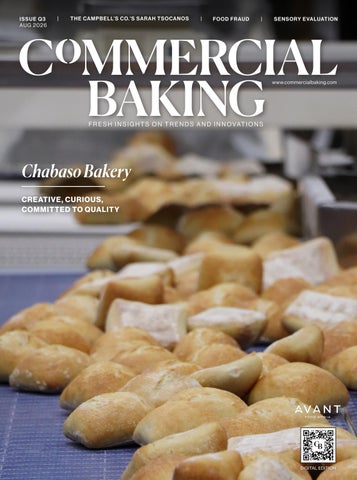
Cover: In New Haven, CT, Chabaso Bakery is scaling the business the same way it makes its bread: with creativity, curiosity and a commitment to quality. Read more on page 22. Photo by Olivia Siddall | Avant Food Media
9
COMMERCIAL BAKING
BUILT ON THE LEGACY OF
Middleby Food Processing & Middleby Bakery 2.0 are now MIDERA, uniting best-in-class equipment, total line solutions, & specialized expertise to power the future of food production. Your goals drive our innovation. We create automated systems that streamline operations & reduce labor demands.
TOP OF THE LINE EQUIPMENT FOR Bread & Buns / Artisan & Flat Breads / Sweet Goods, Cakes & Muffins / Biscuits, Crackers & Energy Bars / Pizza & Pastries / Tortillas & Snacks Midera experts at every step of the production process. One partner, total line solutions.
High Capacity Serpentine Solution for all Bakery Categories
Proof / Bake / Cool
Bread Dough Make-up Machinery
Complete Cake & Sweet Goods Processing Lines
Deposit / Extrude / Rotary Mold / Cut / Decorate
MIDERA.COM
Interleavers / Stackers Interleaving Materials
Automated Bakery Equipment & Commercial Bag Closures
Washing / Sanitizing / Drying
Fill / Deposit / Portion / Pump
Automated Guided Vehicles
Dough Mixing Specialists
Liquid Packaging Systems
Freeze / Chill Steam / Proof
CONNECT WITH US +1 540 569 4331
Complete Biscuit & Cracker Solutions
KEEP IN TOUCH
Managing Product Climate / Clean Rooms
Tortilla & Tortilla Chip Production Lines
High-Capacity Bread & Bun Conveyorized Systems
Industrial Specialty Bread Systems
Automated Logistic Solutions
Professional Baking Machinery
IN THIS ISSUE
Departments
79
TRENDS Category Outlook: Tortillas | Flatbread
67
Category Outlook: Donuts
73
Artisan at a Glance
102
I N N OVAT I O N S
87
102
11
Category Insight: Tortillas | Flatbread
79
Category Insight: Donuts
87
Commercial Baking Channel
98
Ad Index
104
QUICK READS Editor’s Note
12
Seen and Heard
15
Business Intel
95
The Last Word
106
COMMERCIAL BAKING
A N OTE FR O M TH E ED ITO R
The Whole Package Let’s talk about dexterity. I’ve spent 16 years watching with fascination how my son can use both sides of his brain and body. He masters not only math and science but also words and music. And then he writes with his left hand but golfs with his right. It reminds me of the acuity it takes to master the art and science of baking. I saw that in action in New Haven, CT, when I visited Chabaso, led by Charles Negaro Jr., president and CEO and son of the bakery’s founder. This issue’s featured bakery is an artisan-at-scale company born from Atticus, a bakery cafe that still lives on the Yale University campus. While Charles Negaro Sr. is the quintessential idea man, Negaro Jr. is the engineering type who also fixes cars in his spare time. Threaded between them is a passion for making good bread. I call that “generational dexterity” … and the perfect formula for commercially producing artisan bread. Creativity — and the ability to dream big — is necessary for the “art” in artisan and the entrepreneurial spirit to start a bakery business. But growth must be calculated, and guardrails are imperative to scale it.
JOANIE SPENCER Editor-in-Chief | joanie@avantfoodmedia.com
Look around your bakery or manufacturing plant: How are you assembling teams to ensure the mix of art and science? If it’s not present from the daily work all the way up to the corporate strategy, you might be missing out on the whole package.
AUGUST 2026 Q3
12
Designed With Your Bakery In Mind... Because there’s a lot of dough riding on your pans.
Save time, energy, and money with ePAN® designs. ePANs improve efficiency by heating and cooling faster leading to lower oven temperatures and reduced baking cycle times.
QUALITY, SERVICE, AND INNOVATION FROM A PARTNER YOU CAN TRUST.
DISCOVER EPAN ® DESIGNS A Family Business Since 1964
937.652.2151 | info@americanpan.com | americanpan.com |
Seen eard H-
AND
“We have a new generation of employees coming into the industry, and that creates a lot of opportunities to improve training, including ability and accessibility to equipment.” Esteban Gomez | senior VP of engineering | Roskam Foods On innovation flexibility during BEMA Convention 2026 Photo courtesy of BEMA
“The weight of communication should change depending on your position in the hierarchy. The higher you are at the top, the more time you should spend making sure people understand what you’re saying.” Trevor Noah | comedian, keynote speaker During the keynote session at IDDBA 2026 Photo courtesy of the International Dairy Deli Bakery Association
“‘Natural’ can mean different things to different people; that’s the first challenge when we talk to customers about labels. We have to understand them and solve the communication breakdown.” Catherine Vinci | technical manager, NOAM | Givaudan On the importance of communicating through reformulations
15
COMMERCIAL BAKING
SEEN AND HEARD
“Food ultimately isn’t about optimization; it’s about people, memory, generosity and curiosity. It’s an exchange of cultures … Technical understanding can help support your goals but should never replace them.” Chef J. Kenji López-Alt | writer, keynote speaker Kicking off IFT FIRST 2026 Photo courtesy of IFT
WHEN WHEN PROOFING PROOFING FLOOR SPACE SPACE IS TIGHT...
“In this day and age, if you’re in business, you cannot have customers without tending to your audience.” Alton Brown | renowned cook, author and filmmaker On maintaining a brand in the age of social media Photo courtesy of the International Dairy Deli Bakery Association
LOOK UP. If you’re looking for a high capacity proofer that takes maximum advantage of minimum floor space, look no further. Our CapStep Proofer’s only limit … is your ceiling.
CapStep PROOFER
When your pans or peel boards enter the CapStep Proofer, they will be raised upward. When the pans reach the top of our system, they are gently moved over to the downward section by a transfer conveyor and lowered one level. This process continues – one Step at a time – until your product is ready to leave the proofer. CapStep’s PLC controlled temperature and humidity HVAC and mechanical movement system is built for heavy-duty long life. Call us today at 1.877.222.7929. We’ll help you take the next Step in automated bakery proofing systems. capwayautomation.com
SEEN AND HEARD
“When consumers walk into a store, every product is fighting for its arguments on why someone should choose it. Sustainability is an honorable argument to choose.” Felix Bischopink | CEO | Packiro On packaging implications in the supply chain
“Don’t feel obligated to hop on a flavor bandwagon if you don’t see a true story or purpose behind it.” Lasheeda Perry | pastry chef and owner | Queen of Flavor Discussing flavor trends at IDDBA 2026 Photo courtesy of Lasheeda Perry
“The most effective packaging solutions balance performance, consumer experience, operational needs, sustainability goals and cost. That’s why it’s so valuable to get out into stores and look at packaging in the real world.” Jessie Schwartz | president | Strategic Packaging Partners Highlighting the purpose of packaging among new EPR requirements Photo via LinkedIn
AUGUST 2026 Q3
18
SEEN AND HEARD
“There’s no such thing as a neutral interaction. Either you are adding or taking away ... You never leave the room the same as you walked in.” Colonel Dan Rooney | keynote speaker Speaking to ABA convention attendees on navigating operational change Photo courtesy of the American Bakers Association
“Consumers aren’t willing to give up the ‘indulgent moment.’ It’s about finding that right balance and maintaining the taste and quality profile they’re looking for.” Colleen McGinnis | senior director, fresh emerging acquisition and partnerships | NielsenIQ On bakery’s role in making indulgence healthy Photo courtesy of Colleen McGinnis
“You have to repeat your strategy a lot before it really cascades throughout the organization … When you feel like you’ve communicated enough, do it two or three more times after that.” Brian LeComte | 2026-28 ABA chair | president and COO, Gold Medal Bakery Discussing leadership tactics during ABA Convention Photo courtesy of the American Bakers Association
AUGUST 2026 Q3
20
BABY STEPS, BIG MOVES Chabaso is coming into the spotlight ... and doing it the artisan way. BY J OA N I E S P E N C E R
If the leadership team at New Haven, CT-based Chabaso Bakery were a band, they’d probably be called Charlie and the Slow Ferments. Although they’re not musicians, the name certainly sums up the vibe. Under the leadership of president and CEO Charles Negaro Jr., this 32-year-old family-owned artisan bakery has been slowly and steadily making its way onto the commercial scene.
In this era of general suspicion around processed food, products like Chabaso’s are gaining trust from not only consumers but also buyers and category managers.
AUGUST 2026 Q3
22
All photos by Olivia Siddall | Avant Food Media
Artisan bread, especially in the supermarket perimeter, is still riding the wave of consumers’ fascination with at-home bread baking that has naturally flowed into increased sourdough sales across numerous channels. For Chabaso, that means breaking out of the New England region, heading down the Mid-Atlantic coast into the Southeast and inching toward the Midwest.
F E AT U R E D B A K E R Y: CHABASO
23
COMMERCIAL BAKING
CHABASO
“We’ve been making progress and gaining trust,” said Reed Immer, director of sales and marketing. “We’re not n ecessarily trying to jump across the US at this point, but we are filling gaps and leveraging relationships in divisions where we’re already visible and building new momentum by generating broader awareness in the artisan space. We’ve been taking baby steps in this evolution toward becoming a holistic solutions provider.” With the renaissance of artisan bread, many consumers see the in-store bakery as a beacon of fresh-baked bread in a perceived world of processed foods, and they’re flocking to it. While the market isn’t flooded yet, the perimeter is still increasing its artisan population. While in-store bakeries are seeing more traffic, they’re also facing less available labor. That was a common concern the Chabaso team saw at the International Dairy Deli Bakery Association (IDDBA) show earlier this year. Attendees showed interest in the bakery’s latest bake-at-home line, created to fill that gap as retail-ready and available in flowwrapped, sealed packaging. “We’re never going to compromise on the quality of our breads, so we’ve developed products and formats that not only preserve the integrity but also make it easier for a retailer with labor constraints,” Immer said. “We’re coming up with ways they can round out the category with an appetite-inducing wall of bread that has a few extra days of shelf life but that still comes from the quality Chabaso has built its name on.” By adding frozen and par-baked programs to its fresh direct-store delivery model, Chabaso has amplified its customer support.
AUGUST 2026 Q3
With increased traffic and decreased labor resources, in-store bakeries rely on products like Chabaso's offerings.
24
THE FRED PFEN IN G C OMPAN Y INGREDIENT HANDLING
SMART SOLUTIONS. PROVEN PERFORMANCE. For more than a century our customers have relied on Pfening to help their operations run efficiently and produce high quality goods. As we continue to grow, we remain committed to our Customer First principles to deliver value, reliability and support.
BAT CHI NG GC O NNT TTR RRO OO L AT A C CH HHIN CO C O ON R BATCHING CONTROL
WATER DOSING
DRY AND LIQUID INGREDIENT HANDLING Automatic systems for bulk dry & liquid, minor & micro ingredients BATCHING SYSTEMS Integrated, recipe based control
PROOFING ,A FTC EC RH ME NG TACONTROL TIO ON BATCHING B AT IN N C N, ARO RNOL OD COOLING
WATER DOSING Precise temperature and volume control PROOING, FERMENTATION, COOLING Engineered environments for yeast based dough products and baked product cooling systems
614.294.5361 www.pfening.com
sales@pfening.com
CUS SBATCHING OTC MCH EHI NIN G NECO ER EN DTR SR YO STLEMS BTAT NIG C ON CONTROL
ENGINEERED SYSTEMS. ENDURING PARTNERSHIPS. Pfening has been a trusted partner to the baking and food industry since 1919.
DESIGN. ENGINEERING. FABRICATION. CONTROL. INSTALLATION. SUPPORT.
CHABASO
“There are a lot of good artisan breads out there, so we have to differentiate ourselves in the ways that people will recognize,” Negaro Jr. said. “When we think about ‘white glove’ service, it starts with supporting our customers and their ideas and then folding that into our p roduct lineup and flexible operation to say, ‘We can make that happen.’” With consumers’ increasing interest in healthy living, fermented breads like sourdough offer benefits that people want more than ever. The key for Chabaso is knowing the difference between a trend and a legitimate need … though making quality bread with health benefits was inherent for Chabaso long before the age of influencers. “The current values we’re amplifying were already part of the foundation from Charlie’s dad when he started the company,” Immer said. “We’ve been making bread that people want to eat for more than 30 years, and now we’re seeing more mainstream interest in healthy bread and clean labels. People are understanding the benefits of sourdough, not only for the nutrition but also as a great flavor in bread.”
As Chabaso’s values align with consumer interest, growth has become organic, so to speak. That said, market expansion doesn’t necessarily mean more SKUs, but it does require automation to produce at scale. Getting it right depends on the intention behind the operation. “We’re not trying to be a shop that offers a million products or every imaginable variation,” Immer said. “But we have to properly invest in assets that help us maintain our first priority, which is creating the highest quality bread at scale. And within that framework, we can consider how to bring new concepts to life.” With artisan automation, enhancing product quality and consistency is more important than speed and throughput. In that regard, Negaro Jr. and COO John Gibson focus automation decisions on the people and product in this BRC-certified plant, ensuring that any machines introduced will improve the slow process, not change it.
For example, even at scale, the poolish has to sit for 11 to 15 hours before it is ready for the mix. And installing a new Filtrine water chiller ensures the dough temperature can be controlled for improved consistency.
WATCH NOW: Charles Negaro Jr. shares how to balance decades of artisan knowledge with the ease of automation.
Although automated dough handling, sheeting and makeup from Rheon plays an integral role in the process, people are still very involved in areas like scaling, scoring and quality assurance. It’s not hard to find several 20- or even 30-year veterans on the bakery floor providing decades of expertise. So, stepping into automation to create artisan at scale makes knowledge critical to maintaining the long-standing product quality.
There’s a balance between staying on top of trends and giving customers what they want without expanding the portfolio too far outside the core. Achieving that often requires a natural expand- contract cycle year over year to maintain a focused portfolio that still allows room for R&D to get creative. “We get feedback from our customers all the time, and that helps us identify gaps in the lineup,” Negaro Jr. said. “We’re focused on filling those gaps in a methodical way and not getting distracted by whatever the latest craze might be.”
AUGUST 2026 Q3
With artisan automation, the key is enhancing the slow process, not changing it, especially for long fermentation.
26
At Farinart, we believe the best solutions are rooted in nature. Today’s bakers are looking for ingredients that make sense— both in terms of performance and environmental impact. Farinart now offers a solution: a new Collection of regeneratively grown whole-grain flours and specialty malt flours.
Want to learn more? Talk to our sales team to discuss our new products.
Chosen with care.
farinart.com toll free: +1 866 327-4627 info@farinart.com
Cultivated with intention.
CHABASO
“We have a lot of knowledge here,” Gibson said. “We work together to keep the product flowing the correct way, and we collaborate to find the best types of equipment. Instead of trying to take labor out of the operation, we’re trying to make more product, more efficiently, and make sure people are still a part of the process.” One recent investment focused on easing some of the physical demands. Robotray robotic technology now moves peelboards from the makeup line to the racks, and from racks to the ovens.
“We collaborate to find the best types of equipment. Instead of trying to take labor out of the operation, we’re trying to make more product, more efficiently, and make sure people are still a part of the process.”
“We’re people first in everything we do,” Gibson said. “We added the Robotray system to eliminate that manual aspect of moving the boards to and from the racks, especially with so much leaning and bending that’s involved, and that gives people some relief.” The bakery has also invested in bulk storage, larger proofing areas, more oven firepower and packaging technology. Bringing people and automation together to maintain the authenticity of a time-honored process comes from one simple starting point: curiosity.
John Gibson | COO | Chabaso
“We’re very curious to see how we can do things differently,” Gibson said. “We need to be efficient and make great quality product, but we can’t necessarily rely on doing things the way they’ve always been done. We have to be willing to change.” For example, two new Contemar indoor silos will not only double the operation’s capacity, but they will also allow the team to explore product development using different flour blends. As sourdough demand increases, so has the need for proofing capacity. With curiosity, creativity and an engineering mindset, the operations team internally designed and built two proofers to handle it.
AUGUST 2026 Q3
28
Baked to inspire. Built to scale. EXPERIENCE THE
RADINI BREAD LINE
AT THE RADEMAKER EXPERIENCE CENTER CHICAGO
BRING YOUR RECIPES
DEVELOP & OPTIMIZE
SCALE WITH CONFIDENCE
TEST. DEVELOP. EXPERIENCE BOOK YOUR PRODUCT TRIAL AT THE EXPERIENCE CENTER OR CALL +1 330 650 2345
www.rademaker.com | info@rademakerusa.com
CHABASO
Entering into frozen products, especially for the bake-at-home line, also required packaging innovation like an Ilapak Carrera flowwrapper, which creates business opportunity that could lead to operational expansion in the future. “We’re looking at ways we can e liminate bottlenecks in the packaging area,” Gibson said. “It won’t be difficult to expand for that reason, especially when we have the runway to do it. And that will be a tremendous growth opportunity for us.” That same curiosity drives not only technology advances but also product development. Protein has been taking over the airwaves, and customer demand led Chabaso to create a protein-rich ciabatta line that also rolled out at IDDBA. Development was not frivolous; it involved strategic discussions, R&D trial and error
AUGUST 2026 Q3
and confirmation that a high-protein dough could run on the line.
—Above Product development is a team effort to ensure efficiency at scale while meeting Chabaso's artisan quality standards.
“Those are the kinds of conversations we have,” Negaro Jr. said. “The way we’ve set up our R&D is customer-focused while making sure it’s beneficial to the business and not just a phase.” The operation also has a “bakery inside a bakery” … the production area for Atticus, Chabaso’s sister company and original concept. The area’s primary purpose is producing baked goods for the two Atticus locations in New Haven, but it also serves as Chabaso’s testing ground. R&D can push the envelope while tapping into market data to gauge what could resonate with a broader audience. “It allows us to stretch our minds in ways that bring creativity to breads we’re developing,” Immer said. “We can ask ourselves, ‘How far of a departure is this?’ And then maybe we can push ourselves
30
“The way we’ve set up our R&D is customerfocused while making sure it’s beneficial to the business and not just a phase.” Charles Negaro Jr. | president and CEO | Chabaso
CHABASO
a few steps further and still make it work at scale.”
Management, where it garners attention from several businesses around the region, including Chabaso customers.
Operational excellence is built upon an artisan foundation.
“We’ve been pleasantly surprised that our passion for supporting emerging food brands is shared by many of our customers,” Immer said. “At the corporate level, they see local procurement is a differentiator that’s worth building upon. And as individuals, many of them want to share their food industry expertise as a way to give back to entrepreneurs.”
“There’s an engineering aspect in Charlie’s mind that starts with the artisan bread quality, and he works that within operational standards,” Immer said. “That allows us to do cool things without seeing guardrails as constraints.”
In addition to customers, participants also include distribution partners, solutions providers, grocers and foodservice operators. As the program grows, it’s becoming a food industry community that fosters new relationships, trust and education.
The bread, without compromise, comes first. But then again, there’s no bread without people. Chabaso focuses on people, and that began with founder Charles Negaro Sr., who always put people and community at the heart of the bakery. Becoming a Certified B Corporation in 2023 has helped hone the focus and benchmark it. “Having B Corp certification gives us the structure of knowing specifically what we should be focusing on and m easuring,” Negaro Jr. said. “And that allows us to keep specific programs going for the most impact.” One of those programs is the CT Food Launchpad, a passion project Negaro Jr. and Immer have built to help local food entrepreneurs navigate the challenges that come with starting a business. In turn, it supports the local economy and job market as these companies grow. “It sounds a little corny, but that’s what clicked for me,” Negaro Jr. said. “We wanted to find other people who are as passionate about food as we are and help them get to the point where they’re a growing company.” CT Food Launchpad hosts an annual conference at the Yale School of
AUGUST 2026 Q3
From left: Reed Immer, John Gibson and Charles Negaro Jr. lead Chabaso through slow and steady artisan growth.
32
CHABASO
INNOVATIONS FROM THE BAKERY FLOOR Chabaso Bakery produces artisan breads at scale for a variety of retailers and foodservice operators throughout New England and along the Eastern Seaboard. As the company’s notoriety expands toward the Midwest, the operation has introduced automation in thoughtful ways to enhance its slow fermentation process. Here are some of the supplier innovations that are helping to support that mission. Contemar indoor silos Filtrine water chiller The Fred D. Pfening Co. scaling system Ilapak Carrera flowwrapping Perhaps in the future, CT Food Launchpad could grow beyond its state lines and partner with other prominent business schools and food communities, but for now, it’s simply a manifestation of Chabaso’s passion for community. And just as B Corp certification is the measurement tool, these are not the endgame. It’s still all about the bread. “These are interesting dots that connect in different spaces,” Immer said. “And while we’re always looking for smart ways to make those connections, they’re complementary to the top priority, which is making sure we have the best bread coming out of the oven.” Fundamental values like passion, creativity and artisan craftsmanship come together at Chabaso. Whether it’s supporting the c ommunity through CT Launchpad or looking out for the people on the production floor, the Chabaso team goes at it with intention. “There’s a vision here,” Gibson said. “It’s to make great bread and be a great place to work. We have a good team that I can learn from and that can learn from me. We don’t lead with ‘No.’ We’re always curious, and we respect one another. And that is a great environment.” While Chabaso is making some big moves, it’s getting there one baby step at a time. “We don’t aspire to growth for the sake of it,” Negaro Jr. said. “Slow and steady is what works for us.” CB
AUGUST 2026 Q3
34
Pavailler ovens Rheon dough sheeting and makeup VMI mixers
FSA
Control Sugar, Enhance Baking
!" " ! "# $ " " $$% $$ ! #® $%$ &' (%()$ *)(+ ,$ $-' .% (/$+0 !1+2*-(&.1%' 33$-$+(&$ !$+2$%&(&.1% (% +11 %) .2$' $ *3$ 1+ $ -(3$ *)(+ #%'*+$ !$+2$%&(&.1% &( .-.&0 .% ,1 (% 1 *)(+ !1+2*-(&.1%'
¨ # # ® "#
1+ 1+ "
%# ## % " # ## % "
A Bona Fide Powerhouse Sarah Tsocanos serves The Campbell’s Co. — and the industry — with the heart of a baker and the mind of a student. BY M A D D I E L A M B E RT
There’s a finite number of people who have been in the meeting room and the R&D lab when legacy brands like Pepperidge Farm talk innovation. Having a presence in both aspects requires the a bility to move seamlessly between the two environments and translate the dialogue in each. It’s a special skill set that marks a powerful leader. Sarah Tsocanos, associate director of business quality for Camden, NJ-based The Campbell’s Co., possesses this ability. Her 12 years managing various parts of Pepperidge Farm’s portfolio have included roles such as R&D technologist, senior research scientist and manager of bakery R&D. Recently, she was named to that director-level position overseeing the product quality for Pepperidge Farm’s Fresh & Frozen Bakery, Cookies and G oldfish crackers.
Photo courtesy of Sarah Tsocanos
In Tsocanos’ professional experience, a white lab coat and safety glasses are just as impactful as brainstorm sessions and strategy meetings. She approaches her role as a caretaker for the brand, greeting each day with a consumer-centric mindset, asking questions such as “Why could a pouch of
AUGUST 2026 Q3
38
EXECUTIVE PROFILE: SARAH TSOCANOS
crackers be so impactful for a mom on the go?” and “How can a pack of cookies offer that same mom a chance to indulge in a day run by other people’s schedules?”
perates. We have to figure out how to o meet in the middle and make each new product commercialization a success.”
That innate curiosity is the foundation of Tsocanos’ leadership style and enables her to operate from a blend of vision, empathy and execution. Stepping into consumers’ shoes and seeing through their eyes empowers her to turn any obstacle into opportunity. “I’m always learning — and relearning — how our consumers are evolving, so we can deliver what they want but also challenge the space they’re already in,” she said. “The more intimately you know your consumer and your target audience, the more effective you are as it relates to p ushing those boundaries.” Pushing boundaries is in Tsocanos’ DNA. Her career is stacked with experience overseeing and executing the entire commercialization gamut, from a new product’s early stages as an abstract idea to its performance in a line trial. Her leadership style reflects a combination of her own technical know-how and her team’s cross-functional collaboration.
“The more intimately you know your consumer and your target audience, the more effective you are as it relates to pushing those boundaries.” Sarah Tsocanos | associate director of business quality | The Campbell’s Co.
For Tsocanos, every individual voice for every individual Campbell’s brand is one that must be heard, from Goldfish’s night-owl sanitation lead to Milano’s plant manager.
Tsocanos’ comprehensive knowledge of market dynamics wouldn’t be possible without her background in bakery science, which began at Kansas State University, where she got a degree in Bakery Science and Management. As an undergrad, she was afforded a six-month internship at Pepperidge Farm’s Connecticut headquarters, where she got a taste of a corporate environment through an R&D lens. Early on, she saw the concept-to- commercialization process and learned how to troubleshoot common — and unprecedented — issues that arise when developing products at scale. Watching how to bring an idea to life and execute it in the facilities showed her the grit required to make it in the commercial baking industry … and further amplified her enthusiasm to be part of it. “I’d be lying if I said this work wasn’t hard,” she said. “It is, and it should be. But it’s hard in the most privileged way. We are the stewards of some of the most iconic brands in American history, and I take so much pride in that. It’s always a part of every conversation … from the tough ones to the ones full of praise.” This pride, passion and curiosity also led Tsocanos to volunteer with the American Society of Baking (ASB) and extend her leadership capabilities. Her responsibilities in the organization have grown over her decade-long tenure, during which she’s held various committee roles and served on its board of directors for six years. In each position, she devotes her time and energy to being an influential voice for the association and the industry.
“I make it a point to introduce myself to everyone I’m going to be working with across the line,” she said, noting that she sees each manufacturing facility visit as a hands-on teaching and learning experience. “I want to ensure that each person knows why I’m there, but I also want to leave enough room in the conversation to hear everything they know and everything they’re seeing about how the line
39
COMMERCIAL BAKING
EXECUTIVE PROFILE
Photo courtesy of American Society of Baking
Tsocanos was elected chair of the ASB board of directors for the 2026-27 term, making her the fourth woman to hold the position.
“So many of the leadership opportunities, experiences and exposure I’ve had in my career have been afforded to me through my involvement in ASB,” she said. “Participating in those types of strategic conversations around the longevity of the organization is such a significant and impactful opportunity. It really shaped and refined how I approach business objectives, not only with my direct teams but also the broader Campbell’s umbrella.”
to widen the lens and see all sides of the industry has helped Tsocanos lead from a holistic vantage point … and it didn’t go unnoticed.
Translating her ASB leadership experience into conversations at Campbell’s began, again, with Tsocanos asking questions: How can she tap into her current pool of resources and use her personal network to enhance the broader community of baking professionals? What can she do to make fellow bakers feel seen?
Maintaining her career with a “boots on the ground” mentality and learning how to steer her team when the course goes askew earned Tsocanos ASB’s 2025 Rising Baker Award. The award recognizes young professionals who have made significant contributions to wholesale baking and proven their abilities as industry leaders. Tsocanos was specifically honored for her role in new product development across Pepperidge Farm brands and for leading cost-saving initiatives and business continuity projects to support manufacturing operations n ationwide.
Because, as this baker knows, looking and seeing are two different things. Learning
Receiving this peer-nominated award, while a humbling experience, signaled to
AUGUST 2026 Q3
40
Tsocanos that she was on the right track and making an impact in an industry as vast as it is permanent. “The legacy of the baking industry is one that’s unmatched,” she said. “Being a small chapter in that legacy and recognized as such — and hopefully setting up my generation and future generations for success — is one of the most impactful things that I’ve taken away since winning that award.” Following that award was another year of hard work and goal-setting. At BakingTECH 2026, Tsocanos was elected as ASB’s board chair for the 2026-27 term. In this role, she will drive workforce development and champion the science of baking, leading the decision-making body that ensures the commercial baking industry remains at the forefront of innovation and progress. Her time as board chair
®
Baking without Ribbon Burners: Replace DGF Ovens with New Emithermic® XE Technology
Eliminates all ribbon burners. Simplifies cleaning and maintenance. Improves product consistency and baking efficiency. Features a humidity-controlled product zone.
A Markel Group Company
Easily converts from gas to electric heat in the future. READ MORE
For details, go to readingbakery.com or call (01) 610-693-5816.
EXECUTIVE PROFILE
will add to the long line of individuals who have guided ASB and its members, and the distinction makes Tsocanos the fourth woman to serve in this position in the association’s more than 100-year history. Waste it, she will not. Tsocanos is already at work increasing the visibility of the breadth of opportunities in the baking industry to students and early careerists. “Knowing the pool of talent we have at our fingertips, not just from K-State but from the broader food science community and the different facets of that, means getting the word out is crucial,” she said. “Sharing the message of how you truly can make a career in this part of the food industry — and what an empowering career it can be — is one of my top priorities for this year.”
“We are the stewards of some of the most iconic brands in American history, and I take so much pride in that.” Sarah Tsocanos | associate director of business quality | The Campbell’s Co.
on the agenda is ensuring that established baking professionals have the opportunity to further refine their technical skills and build on the foundations they’ve already laid. Tsocanos plans to do this by continuing the association’s commercial bread production course and using the m omentum of in-person training to expand A SB’s reach. Continuous learning is how Tsocanos paved her path in this industry, and it’s how she will maintain her stride. With the heart of a baker and the mind of a student, she is poised to keep making a difference. “For me, that’s what it’s all about,” she said. “It’s never really been about the level I’m reaching or how high I’m climbing. It’s more about ensuring I always stay grounded to what we’re doing as an industry and what we’re providing for consumers — and all humans on Earth.” CB
Tapping into this talent pool is one avenue Tsocanos is taking to fill the current workforce gap … another is emphasizing the power of mentoring. As a seasoned leader passionate about uplifting every member of the industry, Tsocanos guides and motivates anyone who may feel the pangs of professional discomfort, and she encourages her industry peers to do the same. According to Tsocanos, no leaders are ever immune to the value of peer-to-peer wisdom.
Whether through ASB’s formalized mentoring program or by offering support and an open ear, mentoring is at the top of Tsocanos’ to-do list as board chair. Also
AUGUST 2026 Q3
Photo courtesy of Sarah Tsocanos
“There are situations and opportunities at any and every point of an individual’s career that could warrant mentoring,” she said. “It’s important to remember you’re never too senior a leader to benefit from it.”
Husband-and-wife duo Anthony and Sarah Tsocanos in the R&D lab at a Pepperidge Farm bakery.
42
Scaling an Emerging Brand How ZoRoCo and RBS helped Partake expand production and possibilities
Partnerships built on trust and transparency
Since 2007, Idaho-based ZoRoCo Packaging has been delivering contract manufacturing and co-packaging solutions that help brands scale efficiently. From sourcing and blending to packaging and fulfillment, ZoRoCo offers turnkey services with a focus on flexibility and transparency. Recently, Reading Bakery Systems partnered with ZoRoCo to design and install an automated tunnel oven system to support the growth of Partake, an emerging allergen/ gluten-free cookie brand.
RBSConnect control panel
AUGUST 2026 Q3
ZoRoCo differentiates itself through highly collaborative relationships with its customers. The company’s custom-built ERP system offers an example of that approach, as it gives ZoRoCo’s clients 24/7 access to their accounts. Customers can see everything from inventory and production status to waste and work order data, enabling a level of transparency that’s uncommon in contract manufacturing. That same partnership mindset guided ZoRoCo’s decision to work with Partake during its early stages. Inspired by founder Denise Woodard’s mission to create safe, allergen-free cookies for her daughter and others with food allergies, ZoRoCo took a chance on the brand, supporting its growth from startup to a now-nationally recognized product line.
Cookies entering oven
44
Pick-and-place robotics system
SPECIAL SECTION: A DV ERTO R IA L
From batch production to scalable automation
Driving throughput, consistency and new opportunities
For the first several years, ZoRoCo baked Partake products in rack ovens. As demand grew, the company began exploring how to scale production while maintaining the product quality and allergen controls that defined the brand. ZoRoCo’s move to a linear, automated oven system followed several years of careful evaluation, which included layout planning in an existing facility and long-term capacity considerations.
From product trials through installation and startup, RBS worked closely with ZoRoCo’s team to ensure a smooth transition to the automated production line. Hands-on support and training helped ZoRoCo operators adapt to the new system quickly and take advantage of its time- and labor-saving features. Operator controls on the Rotary Moulder and Wirecut Machine automate key forming steps while allowing recipes and process settings to be saved and repeated with precision. Both machines are also designed for easy access, simplifying cleaning and maintenance.
Following a comprehensive evaluation, ZoRoCo partnered with RBS, leveraging its process expertise, validation capabilities through the Innovation Center and strong customer support to ensure a successful scale-up. To support Partake’s cookie product mix and allow room for expansions into adjacent products, RBS engineers designed an automated system featuring a Rotary Moulder, Wirecut Machine and Emithermic Oven zone, delivering the flexibility, consistency and throughput required to support both current products and future innovation. Trials conducted at the RBS Science & Innovation Center helped reduce risk, verify product quality and process design before installation.
The same automation and ease of use extend to the Emithermic Oven zone, which combines Thermatec® radiant panels with convective heat transfer and a humidity-controlled bake zone. Recipe-driven controls help ensure consistent performance while reducing the need for constant operator oversight. Once the RBS line was operational, ZoRoCo saw immediate and measurable results. Partake’s daily throughput tripled, allowing the brand to meet growing market demand and expand its distribution.
Implementing the new oven system was a challenge to fit in the plant and involved a major operational shift. ZoRoCo transitioned its gluten-free production into a new facility and converted its existing operation into a fully Big-9 allergen-free manufacturing environment, creating a scalable, future-ready platform for Partake and other better-for-you brands.
With the additional capacity now available, ZoRoCo and Partake are exploring new product opportunities. The combined flexibility of the RBS forming equipment and oven will allow Partake to expand its product portfolio and further maximize the system’s long-term value.
Positioned for growth in the better-for-you market Today, ZoRoCo is focused on continuing to grow alongside its customers, helping existing brands scale within current capacity while preparing for future expansion. The company’s leadership team remains committed to the better-for-you segment, including plant-based and allergen-friendly foods, where demand continues to rise.
According to ZoRoCo’s Chief Growth Officer Sharone Story, the automated RBS system has helped put ZoRoCo in a strong position for continued success:
In the short term, our new automated tunnel oven from Reading Bakery Systems will allow us to scale Partake up in a way that works for them and our production team. Longer term, this flexible RBS system and their hands-on support enables us to help View RBS production the next generation of food brands bring innovative snack products to market. line video at ZoRoCo
Chief Growth OfficerPackaging. – Sharone Story
See ZoRoCo’s Production Line in Action.
45
COMMERCIAL BAKING
An Indulgence Liberation Butter Baked Cake Co. proves ‘healthy indulgence’ isn’t an oxymoron. B Y L I LY C O TA
What does it mean to be truly “clean label” in a category undergoing an expedited overhaul? For Oceanside, CA-based Butter Baked Cake Co., it means everything. Crafted with an intentional selection of label-friendly ingredients including organic Ceylon cinnamon, Redmond Real Salt, Lakanto powdered monk fruit sweetener and organic vanilla, there’s purpose behind every loaf cake, cookie, muffin and cupcake. “Everything we make is focused on nutrient density, so it’s all made with h and-selected ingredients like almond flour, cage-free eggs and non-GMO butter,” said Whitney Lounsbury, founder, CEO and self-proclaimed chief indulgence officer. “From the very start, our products have always been for everyone to enjoy, indulge in and celebrate with.”
All photos courtesy of Butter Baked Cake Co.
AUGUST 2026 Q3
46
The foundation beneath the brand is clear, but that doesn’t make its future predictable. The baking industry is changing, and indulgence is facing a metamorphosis. With pressure from every angle of the healthy consumer mindset, it compresses, changes state and ... transforms. With an array of sugar-, grain- and gluten-free goodies, Butter Baked Cake isn’t just acknowledging this transformation. It’s also catalyzing it.
EMERGING BRAND: BUTTER BAKED CAKE CO.
Better-for-you brands are popping up everywhere, and consumers’ need for speed is rushing the go-to-market process. What makes this brand different is its clean-label focus, which entails keeping an eye on what consumers need, want and crave for nearly a decade. Since 2018, the sweet goods brand has been on a mission to release indulgence from its negatively connotated shackles. That started long before the brand found its true name. Originally known as “Just Made Keto,” Butter Baked Cake wasn’t targeting the right crowd. Yes, the products have always been low-carb and sugar-free, but they’re more than that; consumers just couldn’t tell. Despite a lineup of loaf cakes and muffins featuring decadent flavors like Death by Chocolate, Cinnamon Pecan Crumb, and Strawberries and Cream, many shoppers saw just another health-and-wellness fad parading as a sweet treat.
following the doctor’s orders rather than diet trends.
“In previous times, better-for-you could skate by just on macros … Now, there’s a broader audience really shifting into this healthy indulgence movement and demanding more from their food.” Whitney Lounsbury | founder and CEO | Butter Baked Cake Co.
“In previous times, better-for-you could skate by just on macros,” she said. “Now, there’s a broader audience really shifting into this healthy indulgence movement and demanding more from their food, and they’re realizing they have more options and flavors available. They’re not limited to a narrow aisle.” Deviating from traditional formulation to fill that gap requires the innate t enacity to try again when compatibility issues halt the process. Setting out to create a sugar-free sweet treat may seem like a futile pursuit to some, but it’s that relentless ambition that puts Butter Baked Cake in the position to lead the clean- label revolution … with a little trial and error along the way.
“Even though sugar reduction is a huge part of what we believe in and nutrition has always been our top priority, we still wanted consumers to see our product as a treat,” Lounsbury said. “As betterfor-you products flooded the market, we realized we needed to start speaking a different language so when people saw our cupcakes at the store, they didn’t see them as just ‘health food.’” By changing its name to include three words synonymous with indulgence, Butter Baked Cake clarified its intentions while showcasing its most important attributes: function and flavor. Most of the brand’s products have 7 grams of protein and 4 grams of fiber per serving, and while the phrase “keto-friendly” has waned in popularity, it’s still a label Lounsbury believes is important, e specially for those
Butter Baked Cake’s products have always been keto, but the name change placed indulgence front and center.
47
COMMERCIAL BAKING
EMERGING BRAND
“One of the biggest shifts in finally getting things to taste great was finding the right ingredients and partners,” Lounsbury said. “Alternative ingredients are not very flexible. It was a big challenge to make the product taste like ‘regular’ cake.” After finalizing the formula, the brand turned to a co-manufacturer for help with scaling up. That relationship lasted 14 months until production challenges became insurmountable. In the CPG world, short-lived co-man partnerships are a garden- variety experience. There’s an abundance of co-mans available, but finding the right match isn’t always seamless. Incompatible equipment, strict requirements and food safety compliance issues are all common barriers to scaling non-traditional bakery products. Butter Baked Cake found success with a local gluten-free producer that dabbles in contract manufacturing and distribution. The facility appealed to Lounsbury for many reasons, one of which included low minimum order quantities. “I can’t say enough good things about where we are now,” Lounsbury said. “They’re gluten-free certified and USDA certified, and they were willing to scale with us. Some places expect you to do 60,000 units when you’re only in 100 stores, which isn’t ideal for someone just getting started.” Timing is everything, and no two brands move at the same pace, so it’s important to form the right relationships with the right resources that match that stride. Butter Baked Cake’s timing was spot on, and having a well-matched co-packer furthered its direct-to-consumer (DTC) approach as well as kick-started retail opportunities. Driven by frost-your-own treat boxes, frozen baked goods and ready-to-use frosting pouches, this model tackles consumer demand for at-home indulgence without the extra effort. Looking ahead, Butter Baked Cake Co. is focused on fundraising and R&D, building out its team and supporting faster retail expansion with updated packaging and flowwrapping.
AUGUST 2026 Q3
48
Evaluate Your Tunnel Oven for
UPGRADE OR REPLACEMENT Service & retrofit expertise Global references Modular design
Meet SENIUS at Pack Expo October 18-21, 2026 McCormick Place Chicago, Illinois USA
Assessment by oven specialists Many industrial bakeries operate tunnel ovens that still run but no longer optimally. Changes in energy costs, capacity requirements, and uptime often raise the question: Should the oven be upgraded, partially replaced, or replaced entirely? SENIUS supports bakeries with expert tunnel oven assessments, focused on realistic, value-driven solutions.
+1 708-289-4997
Book an assesment by a SENIUS specialist
www.senius-inc.com
SENIUS North America Inc.
mail@senius-inc.com
EMERGING BRAND
“I had to get serious about how I was going to make this grow and what that looks like for us operationally instead of just ‘nibbling around the edges,’” Lounsbury said. “I was funding the business myself and have done much of the legwork of fundraising and investing my own money to get all the kinks worked out and lay the groundwork for the next phase of growth. We’re working on packaging right now to hopefully get our muffins to a better price point.” Though DTC distribution has always been the brand’s go-to model, its products — including four-packs of muffins, pound and half-pound loaf cakes, cookies, and frosted cupcakes — can also be found in roughly 15 Erewhon Market locations, Mothers Markets and various local retailers across Southern California. Just like everything else behind the brand, this placement is intentional. Specialty retailers and health food stores can be an influential starting point for many emerging brands looking to get in front of specific consumers. For Butter Baked Cake, it was just the start of identifying a dedicated consumer base.
Butter Baked Cake found its niche early on, relying on DTC distribution to reach customers nationwide.
assisted living centers, where residents with diabetes constitute a pre-identified customer base.
“Three years ago, we got into Erewhon, and that added a whole element of cachet for our brand,” Lounsbury said. “We sell really well there, and some consumers have purchased our in-store cupcakes and loved them so much they started with our subscription service that comes with muffins and a five-ingredient frosting so they can make their own.”
“Right now, we’re really focusing on tackling our backyard, expanding to as many local stores as possible, as well as cafes and gyms,” she said. “We’re locking in the opportunities across NorCal and the Pacific Northwest to get our door count where it needs to be for the fundraising that we’re starting in September.”
As the business expands beyond DTC and further into retail, foodservice and grab-and-go distribution, it’s sure to wiggle its way through any gaps in the dessert market. In addition to a subscription service that brings the indulgence nationwide, Butter Baked Cake has also made its way into local
In terms of portfolio growth, the brand is anticipating consumer demand as it wraps up R&D on a single-serve cake option designed for indulgence on the go. Consumers are opting for smaller portions and convenience, and this is a category in which Butter Baked Cake sees itself thriving.
AUGUST 2026 Q3
50
“We’re launching a ‘cup of cake,’ and I’m so excited to see the consumer response,” Lounsbury said. “It’ll have frosting on the bottom, one of our muffins in the middle and frosting on the top, with a lid. It’s a grab-and-go treat that you can eat with a spoon. It’s not about the aesthetic or looking luxurious. Instead, it’s all about enjoying food for what it is.” Butter Baked Cake navigated its way through distribution debacles, partnership fallouts and formulation struggles to come out stronger on the other side. The growth avenues are paved, and with a category-shaking innovation on the horizon and doubt in the rearview mirror, Butter Baked Cake’s GPS is set. Next stop: Indulgence liberation. CB
YOUR VISION, OUR VERSATILITY. Machines built so well, they last forever.
Brownies: Portions: 250 p/min onto a tray. Sheets: 15 - 20 full sheet pans p/min.
Protein/Energy Bars: High-quality protein & energy bars 300 - 900 p/min.
Cookies: Accurate placement, uniform weight, no smearing 200 - 800 p/min.
Frozen Dough Production: Placed break n’ bake or individuals 600 - 1500 p/min.
Gingerbread: Sheeting and shaped cookies 200 - 400 p/min.
Biscotti: Biscotti formed to pan length 1 to 4 rows 10 - 40 p/min.
Scones: Artisan scones, all shapes and sizes 150 - 400 p/min.
THE CCM DOUGH DEPOSITOR High production Small foot print 2 minute die change over Large inclusion operation
Full access toolless sanitation Remote access/monitoring Intuitive operation and maintenance Challenging products
Ph:: (604) 888-8686 | Tf: (877) 700-8686 | E: in info@fmefoodmachinery.com | www.fmefoodmachinery.com
B E T T E R B Y D E S I G N , B U I LT T O L A S T F O R E V E R .
© Miss Irine on Adobe Stock
True or False? As formulating with natural flavors and colors increases, so does the risk of food fraud. BY CA R O L B R ZOZOW S K I
As food companies work toward removing artificial colors and flavors from their R&D toolbox in accordance with the FDA’s end-of-year voluntary deadline, some are running into an unexpected — and potentially costly — challenge: food fraud in the ingredient supply chain.
through fake branded ingredients or packaging, and origin fraud through false claims like ‘Madagascar vanilla’ or ‘singleorigin cocoa.’” Commodity price volatility and margin pressure have also increased the instances of food fraud, which tends to occur in high-cost, high-variability ingredients such as vanilla, olive oil, honey and cocoa, as well as with higher-risk ingredients such as cinnamon, spices, nuts, colors, flavors and specialty grains.
Food fraud usually consists of intentional, economically motivated adulteration done in an effort to reduce costs or increase profit. It involves deceiving the buyer, regulator or consumer through substituting, diluting, mislabeling or misrepresenting an ingredient.
“Vanilla may be extended with synthetic vanillin, honey may be diluted with cheaper syrups, cinnamon may be substituted with lower-cost cassia,” said Kevin Kenny, founder of Invenimus Training Institute, which provides food safety training to the global food, product and packaging industries. “Natural color claims may not match the actual ingredient source.”
“Ninety percent of food fraud is money-driven,” said Freeman Libby, senior advisor at The Acheson Group, a global food safety consulting firm. “Other driving factors include limited product supply, high demand for organic and non-GMO product, concealing spoilage or inferior quality, c ounterfeiting
AUGUST 2026 Q3
52
CRITICAL ISSUES: FOOD FRAUD
Food fraud sits at the complex intersection of food safety, food quality, consumer protection, customs enforcement and criminal fraud, making consistent regulation difficult. “It is a cross-functional effort,” said Sara Jane Bellocchi, strategic accounts manager with TraceGains. “Procurement influences supplier selection and reactivity to price pressure. R&D typically manages the ingredient substitution process. Operations is responsible for receiving ingredients and following procedures for quality and safety.” In the US, the problem is addressed via the Federal Food, Drug and Cosmetic Act’s adulteration and misbranding p rovisions and FSMA Intentional Adulteration rules. Enforcement can involve the FDA, USDA, US Customs and Border Protection, state agencies, and, in serious cases, the US Department of Justice. Globally, Global Food Safety Initiative (GFSI)-recognized schemes such as Safe Quality Food, Brand Reputation Compliance Global Standards, and Food Safety System Certification 22000 now require food fraud vulnerability assess-
“Food fraud should not be treated only as a quality issue or a compliance exercise. It is a public health issue, a supplier assurance issue, a regulatory issue and a brand protection issue.” Kevin Kenny | founder | Invenimus Training Institute
ments and mitigation plans. The Codex Alimentarius Commission sets standards globally, and the European Food Safety Authority and EU Food Fraud Network coordinate enforcement. In Canada, the Canadian Food Inspection Agency enforces Safe Food for Canadians Regulations and the Food and Drugs Act for labeling and adulteration. “Regulations are strong on paper, but enforcement is often reactive and resource-limited,” Libby explained. “Fraud tends to be uncovered after economic or safety damage occurs,
© Forenna on Adobe Stock
53
but most investigations result from consumer complaints.” Many of the risks with food fraud originate upstream in the supply chain, before ingredients ever reach the manufacturer. Natural colors and flavors are often harder to verify than synthetic or commodity alternatives because they come from agricultural sources that vary by crop, region, season, harvest conditions and processing method. Synthetic detection methods can be costly. “Synthetic alternatives are usually more chemically consistent, less expensive and easier to standardize analytically,” Kenny said. “Natural ingredients often require more sophisticated verification tools such as isotope ratio analysis, chromatography, spectroscopy, DNA testing or fingerprinting against known authentic reference materials. The goal isn’t to test everything. The goal is to understand where fraud would be most profitable, easiest to hide and hardest to detect.” Putting safeguards in place at the bakery level can help minimize the risk of food fraud. Using only trusted, verified suppliers is one of the most important p reventive measures.
COMMERCIAL BAKING
CRITICAL ISSUES
“A strong ingredient supplier relationship is a critical control point,” said Vanessa List, director of quality for Puratos, which supplies cocoa and other high-cost, high-variability ingredients to the food industry. “Trusted, transparent supplier partnerships act as both a preventive and an early-detection mechanism. Also, paying attention to a supplier’s internal culture is a key defense against food fraud. Do they have a strong code of conduct, anti-fraud policies and employee training on food integrity? Reducing internal food fraud is just as important as controlling external threats.” Ingredients such as honey, which are at a higher risk for adulteration, often have multiple levels of testing built into the supply chain to ensure quality. “Imported honey is tested when it enters the US to ensure it’s pure and p roperly labeled from the correct country of origin,” explained Catherine Barry, VP of marketing for the National Honey Board. “Major US producers undergo testing to receive certifications from third-party groups that specialize in testing honey. Beyond that, building a trusted ingredient supplier relationship can help bakers feel confident in the quality and purity of the honey they’re purchasing.”
BEST PRACTICES FOR AUDITING CLAIMS •
Conduct supplier risk assessments and vulnerability analyses
•
Perform unannounced, on-site supplier audits; verify chain-of-custody
•
Use analytical authenticity testing
•
Periodically verify the COA with an independent or buyer-directed testing service
•
Carefully monitor price increases and market disruptions to minimize food fraud risk
•
Use approved supplier programs with periodic requalification to build reliable, longer-term vendor relationships
•
Understand that if the price for a competitive ingredient or product seems too good to be true, it probably is
Source: Invenimus Training Institute
© Hordina Anastasia on Adobe Stock
Sometimes, though, supply chain disruptions, market changes and price volatility force manufacturers to source ingredients from unfamiliar suppliers. In those instances, List noted a few factors to consider during the vetting process. “Bakers should look for enhanced transparency and traceability via Certificates of Analysis (COAs), product specifications, authenticity testing results, adulteration detection methods and traceability records,” she said. “Check a supplier’s qualifications and review their audits,
AUGUST 2026 Q3
54
One Health Diagnostics
®
Manage Sanitation with Confidence Hygiena’s complete, audit-ready sanitation software solution, KLEANZ, to help you plan, execute and track your food safety and sanitation plan in real time.
KLEANZ
®
Learn more about KLEANZ Hygiena®, KLEANZ® are registered trademarks of Hygiena, LLC
© 2026 Hygiena, LLC. All rights reserved.
CRITICAL ISSUES
food safety and fraud prevention systems, and verify GFSI certifications.”
Safeguard against food fraud
List also encourages the use of early-risk alerts for issues, such as ingredient shortages, market changes and emerging adulteration trends.
trusted supplier 1 Build partnerships
“Based on an alert, bakers can adjust their sourcing strategies, increase testing or implement additional controls before fraud may impact operations,” she said.
2 Verify COAs and audits
With natural colors and flavors, additional documentation related to country-of-origin verification, processing methods, extraction solvents used, organic status, sustainability claims, allergen controls and compliance with natural definitions is also required.
authenticity 3 Review testing results
4 Use early-risk alerts
“These requirements become especially important when the ingredient supports a natural, organic, plant-based, sustainably sourced, single-origin or no artificial colors claim,” Kenny said. “Companies need documentation not only for food safety but also for claim substantiation.”
5 Check traceability records
The consumer health risks — short and long term — can be severe when fraudulent ingredients introduce undeclared allergens, toxic dyes, industrial chemicals or contaminated substitutes. © Kalpona on Adobe Stock
“With traditional food safety incidents such as microbiological contamination, companies may identify the immediate hazard like salmonella, E. coli, or mold contamination, but the root cause is not always obvious at first,” Kenny noted. “Fraudsters may adulterate a product in a way that doesn’t cause immediate illness. Instead, it exposes consumers to low levels of toxic substances over time. Health consequences may not appear until years later, making the fraud much harder to detect, investigate or link back to a specific ingredient.”
“The public doesn’t care that the deception started somewhere else. This is why food fraud should not be treated only as a quality issue or a compliance exercise. It is a public health issue, a supplier assurance issue, a regulatory issue and a brand protection issue.”
Even when safety risks are low, food fraud can damage consumer trust and trigger class-action litigation, retailer d elistings, and reputational harm. Financial impacts include rejected inventory and increased insurance and legal costs. Food fraud can significantly impact a company, even if it didn’t knowingly commit fraud.
Reformulating products using natural colors and flavors opens up new opportunities for bakers. It can also expose them to a higher risk of ingredient fraud. Relying on trusted suppliers and working collaboratively across departments — R&D, compliance, supply chain and procurement — can reduce that risk and prevent fraudulent ingredients from reaching the production floor. CB
“Once an ingredient enters finished products, a company may still own the crisis factors, including recalls, retailer questions, consumer complaints and brand damage,” Kenny said.
AUGUST 2026 Q3
56
30 Years. Never Obsolete. Fortress Technology engineers upgradeable inspection systems for food and packaging manufacturers who plan long term.
JOIN OUR TEAM AT BOOTH S-1752
sales@fortresstechnology.com | (416) 754-2898
The Science of Senses Sight, touch, smell, taste and texture are all at play when consumers open their wallets. BY M AG G I E G L I SA N
The warm, yeasty aroma of sourdough. The pillowy give of a chiffon cake. The sharp crack of a well-baked biscotti. Before consumers even take a bite, their senses have been activated, and whether they realize it or not, they’re already forming an opinion. That response is exactly what sensory science works to understand. As the discipline matures, more commercial
AUGUST 2026 Q3
bakers are treating sensory evaluation not just as a final sign-off but also as a product development tool built in from the start.
the industry standard, giving bakers a reliable way to compare.
For decades, sensory evaluation in food product development came down to one question: How much do consumers like this? The nine-point hedonic scale — with “dislike extremely” on one end and “like extremely” on the other — became
“For 70 years, the field operated under that mode,” said David Lundahl, founder and CEO of InsightsNow. “But in the past five years there’s been a radical change that goes beyond ‘liking’ to include b ehavioral scoring.”
58
That framework, however, has its limits.
P R O D U C T D E V E L O P M E N T: S E N S O R Y E V A L U AT I O N
Lundahl — who holds a PhD in sensory science and has spent his career studying the distance between what consumers say they’ll do and what they actually do — calls this the “say-do gap.” Two cookies might score nearly identical on a liking scale, he said, but the occasion, setting and consumer’s state of mind can matter just as much. One person grabbing breakfast on the run and another reaching for an indulgent end-of-day treat will evaluate the same product through an entirely different lens. “We found it’s better to segment moments than people,” Lundahl said. “What type of moment is this product designed for? That’s a more powerful lens than demographic targeting.”
apart in a crowded category. Building that fingerprint is one thing; protecting it during reformulation, ingredient swaps or line extensions is another.
“What type of moment is this product designed for? That’s a more powerful lens than demographic targeting.” David Lundahl | founder and CEO | InsightsNow
That thinking extends beyond individual products into brand equity. Lundahl calls it a “sensory brand fingerprint,” the distinctive, recognizable sensory signature that defines a product and sets it
None of that, however, makes traditional sensory methodology obsolete. Trained sensory panels, discrimination testing and descriptive analysis still do quite a bit of the heavy lifting; context is simply what makes that data actionable in the real world. For commercial bakers and their ingredient suppliers, there are typically two main modes of sensory evaluation, each with an important role to play. The first is internal panels. These are composed of individuals within who are trained to objectively describe and measure product attributes. The second mode is consumer panels. Unlike the trained groups, these panels are meant to reflect the general population and capture realworld preferences to reveal whether
Left to right: © David, Eddy, Iryna Miadzvedzeva on Adobe Stock
59
COMMERCIAL BAKING
PR O D U CT D E V ELO PM EN T
what the trained panel measured will drive purchases.
Photo courtesy of Campden BRI
Abby Bauer, director of sensory and consumer science for North America at Cargill, leads a program that deploys both modes. Her trained internal panel functions as what she calls “human instruments,” assessing the intensity of specific sensory attributes across appearance, aroma, taste, flavor and texture. These screened tasters come in with personal preferences and preconceived notions, so it’s important for her team to calibrate panelists around a shared set of objective descriptors to keep subjectivity from seeping into the data. Trained internal panels can help objectively describe and measure a baked good’s sensory attributes.
“We tell them: ‘We know you have opinions, and those opinions matter, but for this purpose, we don’t need your opinion. We just need you to mark the intensity,’” Bauer said. “The information from those panels is then paired with consumer testing data to determine not just what’s different between products but also whether those differences actually matter to the people buying them.” During external testing, consumers rate their “liking” for a product. For example, a recent chocolate chip cookie study conducted by Cargill revealed four distinct preference segments: one that prized an ooey, chocolate-forward cookie; one that favored thin and crispy; one that preferred a thick, substantial texture; and one that cared most about appearance above all else. The results of pairing trained and consumer testing methods make it clear that hitting the sensory mark depends entirely on which consumer segment a baker is trying to reach. For smaller and mid-size companies without the resources to build and
AUGUST 2026 Q3
aintain a program at that scale, Carlana m Rodriguez, R&D product development manager at Sethness Roquette, points to a method she presented at the American Society of Baking’s BakingTECH conference this year: Small Group Product Evaluation (SGPE). The approach requires fewer panelists than traditional descriptive analysis — t ypically eight to 12 from a screened pool of 15 to 20 — and less intensive ongoing training, making it more accessible without sacrificing integrity. “When I was working at a commercial bakery, I wasn’t aware of some of these tools and resources,” Rodriguez said. “Everyone thinks sensory means a triangle test or a paired comparison, but those require at least 30 panelists, and most of the time, bakeries don’t have the resources to use this many semi-trained people in a sensory panel. There’s a whole spectrum of methods available by using SGPE and rapid sensory methods.” Another cost-effective way to conduct external consumer panels is in partnership with universities, which can help
60
smaller companies access representative sample sizes without building an internal infrastructure. For bakers looking to go deeper, Rodriguez also pointed to the Society of Sensory Professionals, which offers training resources for companies at any stage of building a program. Those tools matter most when the stakes are highest, and in bakery product development, few decisions carry more sensory risk than reformulation. Perhaps no ingredient puts that into sharper focus than eggs. When commercial bakers swap or remove eggs, they’re not just changing a formula. They’re also altering what a consumer might see, smell, taste and feel. Nelson Serrano-B ahri, director of innovation and culinary at the American Egg Board (AEB), describes eggs as a “Swiss army knife,” delivering functional and sensory b enefits across every category measured by trained panels. “When you are using eggs for aeration, the consumer expectation is
PANE TOSCANO BREAD BASE
AUTHENTIC SOURDOUGH. ARTISAN BREAD, SIMPLIFIED. Formulated with dried rye sourdough, PANE TOSCANO BREAD BASE helps bakers achieve the depth of flavor and crust character that define true artisan loaves – without the complexity of maintaining a starter.
True sourdough flavor
Predictable baking performance
Consistent dough handling
Artisan-level results at scale
Bake with confidence. Bake with the best. www.BreadPartners.com | 609.261.7276
PR O D U CT D E V ELO PM EN T
lightness, fluffiness and lift,” Serrano-Bahri said. “When you’re using them for emulsification, it’s creamy and smooth and uniform. Even something as simple as an egg wash — when you want that flawless, uniform shine — can play a huge role.” Take the eggs out, and the sensory results are noticeable: Sponge cakes lose volume and turn dense; rich doughs lose gloss and soft interior structure; strong aromas become dull. According to AEB data, more than half of food science and safety professionals rate eggs as very important or irreplaceable for the quality of baked goods. Crucially, consumers register their absence even when they can’t name it. “Sometimes they can’t put their finger on it, but they experience it,” Serrano-Bahri said. “A product may still technically perform, but if it’s not delivering, consumers aren’t going to associate it with a premium baked good.” Of all the sensory attributes consumers are evaluating, one tends to be the least forgiving: texture. “It’s hard for people to get over bad texture,” Bauer said. “Even if it tastes good, if the texture is not what the consumer is expecting, they’re not buying that product again.” Shelf life poses an additional challenge when it comes to maintaining texture. Oxidized fats can produce off-flavors that present as cardboardy or paint-like. M oisture loss can soften a crisp exterior or make a tender crumb dense. A product might hit every sensory target on day one, but by day 14, miss entirely. Bauer knows this firsthand. Her team recently worked with a baker who was changing how products were stored and shipped, specifically the temperature conditions at which cakes were held during distribution. The concern was whether those changes would affect quality over time. Cargill’s sensory team tasted and evaluated the cakes at multiple points throughout their shelf life, tracking where and when any degradation became noticeable. The team also compared their findings with those of a texture analyzer, an instrument that measures a food’s physical properties such as firmness, elasticity and resistance. The analyzer detected differences in the cakes earlier than the trained human panelists did. Advances in sensory science may reveal tension between human and technology methods. AI-assisted analysis, predictive modeling and rapid methods like CATA (Check-All-That-Apply) are gaining traction, promising to make sensory programs faster and more accessible. But the human element remains irreplaceable.
And that perception, as bakers know, is everything. CB
AUGUST 2026 Q3
62
© Chloe1128 on Adobe Stock
“No instrument can truly replicate how a human perceives a product,” Rodriguez said. “That’s why sensory input is so important in product development. It helps us understand how a human will actually perceive what we’ve made.”
INDUSTRY INNOVATORS
RECOGNIZING TOMORROW’S LEADERS, TODAY
THE FUTURE OF BAKING STARTS HERE. KNOW AN UP-AND-COMER IN THE BAKING INDUSTRY?
Nominate them for the Industry Innovators Class of 2026.
SCAN THE QR CODE TO SUBMIT YOUR NOMINATION BY
FRIDAY OCTOBER 16
HOW STRATEGIC SUPPORT MAXIMIZES BAKERY INVESTMENTS When bakeries invest in automated ingredient handling systems, mixers and dough handling equipment, the expectation is clear: These systems should deliver reliable performance for many years. The good news is that they often do. And longevity depends on how the machinery is maintained, documented and supported over time.
Beyond Service Contracts: A Lifetime Support Strategy A lifetime support strategy begins during the planning phase, when supplier partners evaluate how new equipment will integrate with existing lines, controls and infrastructure. “Equipment life expectancy is closely tied to the level of attention a system receives after installation,” said Kevin Geye, director of aftermarket sales at Coperion. “Attention goes beyond fixing problems when they occur. It involves routine, purposeful assessments of machines, controls and overall system performance.”
AUGUST 2026 Q3
Two factors play a particularly important role in extending equipment life: •
•
Regular visits from specialized service professionals, even when equipment is operating normally. Easy access to troubleshooting resources, service histories, and ongoing operator and maintenance training.
64
The Evolution of the Service Technician Equipment technicians are increasingly becoming long-term process advisors to bakers. “Our experts have been involved with a system from the earliest stages
SPECIAL SECTION: A DV ERTO R IA L
of engineering, installation and commissioning,” said Charlie Schmid, field service technician at Coperion. “They understand not only the equipment but also the unique production environ ment in which it operates.” These experts work across numerous facilities and production processes; they gain a broad perspective that can be difficult for individual bakeries to develop internally. “In many ways, these individuals function less as service technicians and more as system experts,” Geye said. “Their experience across multiple plants and applications gives them the ability to spot inefficiencies and recommend improvements that extend beyond a single machine.” Bakers should consider the strength and reach of a provider’s service organization when evaluating equipment. During this process, important questions key decision makers should think on include: •
•
•
Are knowledgeable system experts located regionally or available in real-time through advanced collaboration technology? Can service personnel quickly access information about a specific installation? Does the organization draw expertise from multiple industries and processing applications?
Protecting Knowledge in a High-Turnover Environment Employee turnover can create big gaps in equipment expertise — when experienced employees leave, critical information can disappear. Technology provides new solutions to this challenge. Advanced remote digital support platforms, like Connect Advisor from Coperion, combine helpful resources including AR/VR, guided workflows and live audio-video collaboration tools to provide step-by-step guidance, with remote technical experts providing realtime customer support. Connect Advisor automatically documents maintenance activities, creating a searchable record that remains available regardless of personnel changes.
Intelligent Modernization Creates New Value With ongoing economic uncertainty influencing capital spending decisions, many bakeries are focusing on upgrades and modernization projects vs. complete equipment replacement. This trend highlights another advantage of a lifetime support strategy. When equip ment experts have extensive knowledge of a bakery’s systems, historical perform ance data and operational goals, they can identify targeted upgrades that can deliver meaningful improvements.
Experience the Coperion difference with lifetime support.
Visit our website
Rather than replacing entire production lines, commercial bakeries may benefit from modernized controls, improved automation, enhanced data collection or upgraded components that increase throughput, boost efficiency, reduce labor demands and improve overall uptime. For bakers wanting to ensure that their equipment continues delivering value throughout its lifespan, the right combination of proactive maintenance, knowledge management, expert support and intelligent modernization will keep their bakery systems optimized for decades.
Best Practices to Maximize Capital Equipment Investments Make service and support a proactive strategy. Combine real-time data with extensive system experience from the manufacturer’s supplier to identify productive upgrades. Consider the strength and reach of a manufacturer’s service team.
Watch our TechTalk
Learn more at coperion.com/fhn
65
COMMERCIAL BAKING
Extend product freshness and shelf life with Reiser form/fill/seal packaging
Produce the highest-quality vacuum and MAP packages Reiser Form/Fill/Seal Packaging Machines n Superior package seals extend product shelf life, providing
the extra time needed to reach new, distant markets n Fast, easy changeovers from one package style to another n Rapid Air System guarantees the highest quality packs n Wide range of machines for all production requirements n Backed by Reiser’s industry-leading service and support
Watch video 2026
www.reiser.com Reiser • Canton, MA • (781) 821-1290 Reiser Canada • Dundas, ON • (905) 631-6611 Reiser UK • Milton Keynes, Bucks • (01908) 585300
Simpler. Faster. Better.
C AT E G O R Y O U T L O O K : T O R T I L L A S | F L AT B R E A D
Targeted Strategy Wins B Y B E T H D AY
Maintaining the Core
Perimeter Tortillas/Wraps/Flatbreads Dollar Share
FLATBREAD: 7 . 1 % TORTILLAS: 3 . 7 % LAVASH: 3 . 1 % WRAPS: 9.6%
PITA: 1 5 .1 %
Tortillas and flatbreads are an essential pantry item for many consumers. Traditional products still largely drive category growth, but offerings with targeted health attributes and premium ingredients add purchase value. Highlighting versatility, convenience and availability will stimulate growth.
ALL OTHER: 0 . 5 %
NAAN: 60.9%
Total US - Multi Outlet W/ C-Store (Grocery, Drug, Mass Market, Convenience, Military and Select Club & Dollar Retailers) | Latest 52 Weeks Ending June 14, 2026 Source: Circana Omnimarket Integrated Fresh, a Chicago-based Market Research Firm (@WeAreCircana)
Tortillas Dollar Sales DOLLAR SALES ($ IN MILLIONS)
% CHANGE VS. A YEAR AGO
REFRIGERATED
$290.87
1.7%
PERIMETER
$16.38
-5.8%
FROZEN
$1.41
-12.8%
Total US - Multi Outlet W/ C-Store (Grocery, Drug, Mass Market, Convenience, Military and Select Club & Dollar Retailers) | Latest 52 Weeks Ending June 14, 2026 Source: Circana Omnimarket Integrated Fresh, a Chicago-based Market Research Firm (@WeAreCircana)
67
With $4.4 billion in sales reported in the Circana data for the latest 52 weeks ending June 14, 2026, center-store tortillas/taco kits are stable but not necessarily expanding. While tortillas are a household fixture, there are some barriers to category momentum, including competition from wraps and flatbreads that serve similar meal occasions. “Tortillas are a staple category, with traditional core products making up the majority of sales rather than shifting dramatically to alternative offerings,” said Katie Ferrall, director of client insights at Circana. “Brands that are winning combine clear positioning with strong shelf presence and availability. Flat performance of center-store tortillas reflects steady demand, uneven brand results and shifts in where and how consumers shop.” Performance for center-store tortillas varies across brands. Larger, established players such as Mission Foods and Guerrero’s Mexican Foods, both brands under the Mexico-based Gruma Corp.’s umbrella, and Minneapolis-based General Mills’ Old El Paso brands are seeing slow sales in core products, which is impacting the category. Ferrall noted private label and brands such as La Banderita, owned by Norcross, GA-based Ole Mexican Foods, are gaining market share, largely driven by distribution and clear shelf positioning.
COMMERCIAL BAKING
C AT E G O R Y O U T L O O K : T O R T I L L A S | F L AT B R E A D
“Distribution and targeted innovation move the needle for tortillas, rather than a broad shift to better-for-you products,” Ferrall explained. “In a mature category like tortillas, simply being more available and offering the right balance of value or wellness can drive growth.” For instance, Ole Mexican is performing well with its specific health-focused p latform, Ole Xtreme Wellness.
Targeted Health Claims Two-thirds of consumers use valueadded products, including flavored, healthier and diet-focused tortillas, according to Mintel’s “US Tortillas and Wraps Market Report 2026.” Items carrying health claims that satisfy specific needs often positively impact sales. Ferrall pointed out that 28% of shoppers are purchasing tortillas with net carb claims, which outperform broader low-carb positioning and drive the s trongest buyer growth. “The biggest opportunity for tortillas is at the intersection of health, flavor and functionality with products that deliver a clear benefit while still meeting taste and everyday usage needs,” Ferrall explained. “At the same time, flavorforward options like vegetable and cheese are expanding their consumer base and driving incremental sales by combining taste with perceived betterfor-you benefits.” From a consumer standpoint, corn tortillas tend to benefit from perceptions of authenticity and ingredient simplicity, which helps support demand, while flour tortillas are seen as more versatile. However, Ferrall noted flour tortillas compete with wraps and other bread alternatives, which may contribute to steeper dollar declines
AUGUST 2026 Q3
Perimeter Tortillas/Wraps/Flatbreads Dollar Sales
DOLLAR SALES ($ IN MILLIONS)
% CHANGE VS. A YEAR AGO
WRAPS
$42.11
19.1%
FLATBREAD
$31.20
36.2%
TORTILLAS
$16.38
-5.8%
Total US - Multi Outlet W/ C-Store (Grocery, Drug, Mass Market, Convenience, Military and Select Club & Dollar Retailers) | Latest 52 Weeks Ending June 14, 2026 Source: Circana Omnimarket Integrated Fresh, a Chicago-based Market Research Firm (@WeAreCircana)
when compared with corn tortilla sales, which have not declined as much.
Refrigerated Sees Growth Demand for tortillas has not necessarily declined; rather, it’s being spread across more formats such as the refrigerated section. Smaller than the center-store tortilla segment, sales of refrigerated tortillas are higher than those sold in the perimeter, posting 1.7% dollar and 5.8% unit growth, according to Circana data. “A shift in consumer preference for more freshness, authenticity and premium appeal is driving growth for refrigerated tortillas, with shoppers associating these products with a homemade experience versus shelf-stable items,” Ferrall said. “Brands like Tortilla Land and Fresca Tortilla Co. showed strong performance, impacted by increased velocity and growing demand for p roducts that deliver more authentic, meal-ready solutions at home.”
Wrapping Up Sales Wraps and flatbreads are outperforming traditional tortillas in center store, driven by better-for-you positioning, versatility and alignment with evolving meal occasions. The center-store wraps/ flatbreads segment, excluding tortillas, showed 11.2.% dollar and 7.2% unit increases, according to Circana data. There is also a shift in perception, with wraps and flatbreads being viewed as more
68
NEW
Introducing BakeGard Ultra CL BakeGard Ultra CL is a clean label mold inhibition system designed to: · Replace higher-cost natural mold inhibitor systems with a consistent, lower cost-in-use clean label solution without compromising label requirements or performance · Combine the power of dried vinegar and cultured wheat flour, BakeGard Ultra CL provides clean label compatibility while creating a meaningful cost-in-use advantage · Deliver a clean, natural fermentation flavor · Enable the replacement of higher cost-in-use cultured wheat flour-based solutions For breakthrough solutions and customized clean label preservation with our superior technical collaboration, you can count on AB Mauri.
SCAN TO
abmna.com · 1.800.772.3971
LE ©2026 AB Mauri Food Inc.
AR N M O RE
C AT E G O R Y O U T L O O K : T O R T I L L A S | F L AT B R E A D
modern, with placement and labeling influencing shoppers’ behavior. “Growth for this segment is tied to health-oriented claims,” Ferrall said. “Fiber, grain blends and saturated fat positioning resonate with consumers seeking more balanced, everyday options. Simple, familiar products like plain wraps and flatbreads account for most of the gains, highlighting the importance of flexibility over niche flavors.”
Pockets of Growth Pita and flatbreads are examples of how consumers are navigating value today. Center-store pita posted 33.5% gains in dollar sales but also 18.9% price increases. Despite higher prices, units increased by 12.2%, according to Circana data. Ferrall pointed out that even with price increases, unit growth for pita remains strong, which demonstrates shoppers’ willingness to pay more when they perceive higher quality or a more premium experience. “Within center store, growth is increasingly polarized, as consumers are either trading down into private label for value or trading up into more premium, artisanal offerings,” Ferrall explained. “This type of shopping behavior aligns with broader trends across flatbreads, where price points are already higher than traditional tortillas.”
Center-store pita posted
33.5% gains in dollar sales in the latest 52 weeks ending June 14, 2026. Source: Circana
AUGUST 2026 Q3
Naan and pita products are outperforming other perimeter flatbreads in terms of sales, due to strong distribution and versatility across meal occasions. They have also had some unit growth, compared with declines for perimeter flatbreads, wraps and tortillas. “Core flavors such as plain pita and garlic naan are growing due to consumer interest in familiar, easy-to-use options,” Ferrall said. “Naan performed well in Walmart and other key retailers, with growth in e-commerce helping expand reach.”
Opportunities Ahead Products that deliver targeted health attributes such as net carbs or fiber, as well as simple, flavor-forward options, will keep the category fresh. Optimizing pack sizes and formats to match everyday usage is also key. “Thoughtful innovation needs to focus on value, versatility and product differentiation,” Ferrall explained. “Growth is also closely tied to distribution and channel strength.” For tortillas, the main obstacle to growth is fragmentation, as producers face competition from wraps, flatbreads and refrigerated options. By developing a strategy that combines strong value and broad availability — while delivering simple flavor or targeted health attributes — all brands will grow sales. CB
Center-Store Wraps/Flatbreads Unit Sales UNIT SALES (# IN MILLIONS)
% CHANGE VS. A YEAR AGO
PITA
32.31
12.2%
WRAPS
25.59
13.5%
NAAN
12.90
-1.9%
FLATBREAD
8.11
-8.9%
LAVASH
3.33
1.6%
ALL OTHER
0.24
-1.6%
Total US - Multi Outlet W/ C-Store (Grocery, Drug, Mass Market, Convenience, Military and Select Club & Dollar Retailers) | Latest 52 Weeks Ending June 14, 2026 Source: Circana Omnimarket Integrated Fresh, a Chicago-based Market Research Firm (@WeAreCircana)
70
Built to Bend
Tortillas should bend, not break. Rivland Rice Gel® helps retain moisture in the dough, so tortillas stay soft and flexible and have a longer shelf life. Labeled simply as rice flour, Rice Gel delivers clean-label performance in both corn and flour tortillas.
Discover more at Rivland.com
©2026 Riviana Industrial
PROGRESSA pastry PASTRY LINE FOR INDUSTRIAL RETAIL BAKERS
FRITSCH lines deliver more than product – they deliver production improvements that hit your bottom line • • • •
Consistency in dough shape and size Lower scrap and rework Higher throughput with less labor Reduced contamination risks thanks to hygienic design
FRITSCH Bakery Technologies Part of the MULTIVAC Group fritsch-group.com | 800-800-8552
C AT E G O R Y O U T L O O K : D O N U T S
Snackable, Portable, Affordable
Donuts satisfy the sweet tooth of consumers of all ages because they offer an indulgent eating experience that is affordable, accessible, and available in various flavors and formats. The global donut market is poised for notable growth, projected to reach $19.96 billion, expanding at a CAGR of 3.5% between 2026 and 2035, according to a Business Research Insights report.
B Y B E T H D AY
Center Store vs. Perimeter Donuts Unit Sales (# in Millions)
CENTER STORE
PERIMETER
600
Overall, the donut category benefits from consumer perception of the baked good as permissible indulgence. Portable and convenient, donuts align with on-the-go lifestyle trends, which also fuel sales increases. “Compared with other sweet baked goods, donuts are relatively low-priced and available in flexible pack sizes, making them appealing to budget- conscious shoppers,” said Katie Ferrall, director of client insights at Circana. “From a performance standpoint, the category showed modest dollar growth of about 1.5 percent, driven entirely by perimeter sales, which are up 2.7 percent, while center store remains slightly down. One notable shift is the strength of fullsize donuts, which are driving perimeter growth, while mini donuts have softened.”
582.06
496.11
400
200
Seasonality Finds Favor 46.49 12.22 0 FULL-SIZE DONUTS
DONUT HOLES
Total US - Multi Outlet W/ C-Store (Grocery, Drug, Mass Market, Convenience, Military and Select Club & Dollar Retailers) | Latest 52 Weeks Ending June 14, 2026 Source: Circana Omnimarket Integrated Fresh, a Chicago-based Market Research Firm (@WeAreCircana)
73
Driven by a combination of freshness, classic flavors and affordability, perimeter donuts reported almost $2.5 billion in sales, according to Circana data for the 52 weeks ending June 14, 2026. Unit sales were up 1.4% during the same time period. Full-size donuts dominate the segment, accounting for 62.1% of dollar share, with c ontinued growth in dollars and units. Glazed donuts remain a s tandout variety, d elivering strong unit growth and remaining one of the top- selling flavors.
COMMERCIAL BAKING
C AT E G O R Y O U T L O O K : D O N U T S
There is more driving the category than classic glazed donuts alone. According to the Business Research Insights report, seasonal and themed donuts bearing unique flavor profiles also boost consumer interest. Specialty is also gaining traction, particularly in the perimeter, with Circana data reflecting a 2.5% unit increase for this subsegment. A balance of both keeps the perimeter donut segment on the rise and appeases different consumer interests. “A key factor behind this growth is the balance between everyday staples and limited-time or seasonal offerings,” Ferrall said. “Classic flavors generate most of the absolute growth, while seasonal varieties, especially fall-inspired flavors like pumpkin, apple cider and maple, help generate enthusiasm and drive incremental purchases.” Perimeter donut trays represent a small share of the category, but they are showing growth that appears to be driven more by distribution gains and improved in-store visibility vs. pricing or product innovation. Ferrall observed that increased availability in grocery channels is helping expand reach and generate sales for this segment. While center-store full-size donuts hold the largest market segment, they compete with fresh perimeter baked goods offered in full-size formats. Center store’s limited variety and lack of differentiation from what perimeter products offer make it difficult to attract gradual demand. “Full-size donuts represent approximately 97 percent of center-store sales, yet they overlap heavily with the formats and flavors available in fresh bakery, without offering the same perception of freshness,” Ferrall explained. “Expanding
AUGUST 2026 Q3
Perimeter Donuts Dollar Share
DONUT HOLES: 6 . 9 % SPECIALTY: 1 . 2 % MINI: 0 . 5 % TRAYS: 0 . 3 %
ASSORTED | MULTI-PACK: 29.0% FULL-SIZE: 6 2 .1 %
Total US - Multi Outlet W/ C-Store (Grocery, Drug, Mass Market, Convenience, Military and Select Club & Dollar Retailers) | Latest 52 Weeks Ending June 14, 2026 Source: Circana Omnimarket Integrated Fresh, a Chicago-based Market Research Firm (@WeAreCircana)
into new formats, sizes or unique flavor profiles could help reinvigorate growth in this segment.”
Small Pockets of Growth Overall, growth is flat for center-store donuts, but Ferrall noted pockets of growth in smaller, more snackable formats. Donut holes were a standout, posting significant gains in both dollars and units, 73% and 63.3% vs. a year ago, respectively. While centerstore mini donuts remained steady in dollars — showing a 1.7% increase vs. a year ago — this product type took a hit in unit sales during the same period, dropping -9.9%, according to Circana. “Private label is currently the fastest- growing player in center store, while
74
Center-store donut holes saw the largest change in dollar sales, up
73% in the 52-week period ending June 14, 2026. Source: Circana
Reliable flow. Gentle touch.
Every ingredient plays by its own rules. That’s why the FlexWall® is engineered with the nuances of baking in mind. It supports a wide range of challenging materials and keeps production flowing. Gentle agitation keeps movement consistent without stressing or damaging sensitive ingredients. With built-in features to boost accuracy, prevent degradation, and speed up cleaning, the FlexWall® delivers results you can count on.
Partner with us. www.kubota-btca.com
C AT E G O R Y O U T L O O K : D O N U T S
some branded offerings are weighing in on overall performance,” Ferrall said. Flavor trends in center store are also shifting, with items like old-fashioned, apple cider, cinnamon, pumpkin and glazed showing strong momentum and mirroring successes seen in perimeter donuts. Additionally, larger multi-packs such as 8- and 15-count options are driving growth, while sales of centerstore single-serve donuts are declining. “To boost center-store sales, brands should focus on differentiated pack sizes, strong value positioning and flavor combinations that set them apart from fresh bakery options,” Ferrall observed.
Niche Opportunities Circana data reflects success for premiumization across total food and beverage and total bakery. Consumers are trading up for premium brands instead of paying less for value-driven products. However, donuts appear to be experiencing slightly different dynamics as shoppers are more likely to purchase mid- or low-priced donut brands vs. those positioned as highquality or artisanal. “This consumer behavior reflects the fact that donuts are succeeding as an affordable treat,” Ferrall said. “Delivering on permissible indulgence at a great price will drive category growth.” Donut offerings with health-related information — including calorie labeling and nutritional attributes — are on the rise. Ferrall noted that donuts carrying calorie-related claims have more than doubled in dollar sales. Vegan and vegetarian claims are also increasing. However, there is limited evidence that this is driving overall category growth.
AUGUST 2026 Q3
Center-Store Donuts Dollar Sales DOLLAR SALES ($ IN MILLIONS)
% CHANGE VS. A YEAR AGO
FULL-SIZE
$1,749.05
-1.2%
DONUT HOLES
$44.58
73.0%
MINI
$0.88
1.7%
SPECIALTY
$0.02
-79.9%
$1,794.53
-0.1%
TOTAL
Total US - Multi Outlet W/ C-Store (Grocery, Drug, Mass Market, Convenience, Military and Select Club & Dollar Retailers) | Latest 52 Weeks Ending June 14, 2026 Source: Circana Omnimarket Integrated Fresh, a Chicago-based Market Research Firm (@WeAreCircana)
“While health-conscious options are gaining visibility, they are not yet a core driver of sales,” she said. “Claims related to protein, fiber and gluten-free are relatively flat, indicating that consumers still primarily view donuts as an indulgent product rather than a health-focused choice.”
Ingredients for Success Consumers’ grocery budgets remain tight as they increasingly focus on value. Donuts are well positioned to leverage economic pressures as they cost less than many bakery treats and can often be purchased individually vs. in large packages. The baked goods’ versatility in format, type and taste gives shoppers options for their varying needs and appeals to single- and multi-occupant households. “Growth in dollar sales across retail is largely price-driven, with unit volumes tightening because shoppers have become more selective,” Ferrall explained. “As a result, price matters. To sustain growth, donut producers should focus on delivering strong value while maintaining a balance between core products and innovative varieties. Well-priced classic flavors are essential but offering seasonal and limited-time products will engage consumers and drive incremental purchases.” Optimizing pack sizes to better meet consumer needs — particularly through value-driven multi-packs and new formats — helps differentiate donuts from other perimeter offerings. Expanding distribution, strengthening in-store positioning and embracing evolving occasions are the ingredients for successful category growth for donuts. CB
76
Our Solution Is Always the Perfect Fit Because It’s Built for You. Solve your toughest secondary packaging challenges with our automated solutions
Scan For Video Visit PACK EXPO Booth N5316
The BPA Difference Secondary packaging solutions for the bakery, snack and tortilla industries. BPA loads your packaged and naked products into cases and various secondary containers including your hffs machines, wrapper chain in-feeds and indexing thermoform machines. blueprintautomation.com
CUTTING EDGE TECHNOLOGY AND THE ART OF OLD WORLD BAKING A classic tortilla redesigned for the health conscious consumer. Brolite’s Keto Tortilla runs well without being too sticky or difficult to run. Bakers can save time at the mixing level by using a full base. The tortilla is light and chewy with enough elasticity to prevent cracking and crumbling. Ir’s everything you love about a classic flour tortilla without the carbs.
Keto Tortilla BROLITE PRODUCTS, INC (630) 830-0340 | FAX (630) 830-0356 1335 SCHIFERL ROAD, BARTLETT, IL 60103 | 1900 S PARK AVE, STREAMWOOD, IL 60107
C AT E G O R Y I N S I G H T: T O R T I L L A S | F L AT B R E A D
Formulating for Value B Y B E T H D AY
© Ilia Shcherbakov on Adobe Stock
Tortillas and flatbreads are typically considered an alternative to bread as a part of a meal or snack. Consumers’ desire for nutritional value, versatility and convenience is driving R&D and manufacturing for brands. Read how producers are aiming for the category’s sweet spot by developing new formulations that deliver the health attributes consumers demand while maintaining the eating experiences they crave.
© Gokercy on Adobe Stock
79
COMMERCIAL BAKING
C AT E G O R Y I N S I G H T: T O R T I L L A S | F L AT B R E A D
Denver-based Insignia International, whose tortilla brands include La Tortilla Factory and Mama Lupe’s, constantly explores ways to incorporate health attributes like high protein, low carb and gluten-free into its products while delivering the experience of traditional tortillas. The company has been evaluating new trends with plant-based proteins, and its R&D team developed a new La Tortilla Factory dairy-protein tortilla that uses whey protein as the main ingredient. “The biggest trend we see is consumers looking for higher protein around weight loss, GLP-1 medications and healthier options,” said Jason Parasco, CEO of Insignia International. “Substituting ingredients in tortilla formulations is challenging since product characteristics are altered in the process. While keeping pace with market trends, we remain committed to delivering the highest q uality flour and corn tortillas that function well and taste delicious, which is what our end-use consumers expect from our brands.” Incorporating more protein content re q uires careful formulation to maintain desired texture and machinability.
High-protein doughs can be more dense and less e lastic, which requires adjustments in mixing times and hydration levels. Balancing the right amounts of certain ingredients creates dough that runs effectively on equipment. “Dough formulation directly impacts breakage with tortillas, so properly formulating when using alternative ingredients is essential,” Parasco explained. “Once we have a workable formula, our products must then go through the baking process to ensure consistent quality.” Delivering great taste is a key pillar for Insignia’s brands. While clean labels and desired health claims are what consumers seek, products must also impart flavor and texture. “Consumers are tired of eating betterfor-you products with gritty texture and no flavor,” Parasco said. “Sensory is a big part of the eating experience. With our new dairy-protein tortillas, R&D and operations teams have found the right combination of ingredients to deliver great results for our tortillas made with alternative ingredients.”
Aligning R&D with manufacturing capability is essential when enhancing or creating new bakery items. Parasco pointed out that La Tortilla Factory has been a pioneer in producing better-foryou tortillas. Along with its Net Zero Carb product, the brand offers high-protein and sourdough tortillas in the refrigerated space. These new SKUs underwent countless iterations to land on the right formulation. “It took nearly a year to run trials and develop the right formula for both our new protein and sourdough refrigerated tortillas,” Parasco said. “We do not produce them internally yet to mitigate potential risk. It’s my philosophy that when considering a significant capital investment within the first year of launching a product, it is not always the best decision to mass produce unless you know you have a home run.” Insignia’s new refrigerated sourdough tortillas use a high-end San Francisco sourdough ingredient similar to standard flour. The functionality of the dough impacts machining, as too much or too little water causes sticking.
Photo courtesy of Palermo’s
AUGUST 2026 Q3
80
READY. SET. DOUGH.
From donuts to sweet goods, tortillas and flatbreads, Moline brings the precision, repeatability and production reliability processors count on. High-speed systems. High-capacity performance. Real-world results, built for demanding bakery environments.
EXPLORE WORLD-RENOUNED B A K E RY EQ U I P M E N T A N D D O U G H SYS T E M S
MADE IN THE USA. BUILT TO LAST. BACKED FOR LIFE.
moline.com
C AT E G O R Y I N S I G H T: T O R T I L L A S | F L AT B R E A D
“When the tortillas are cut or baked, operations must complete consistent sizes and shapes and then input the right toast points to achieve proper baking,” Parasco said. “Sourdough can be temperamental, and if it doesn’t come out correctly, the whole batch must be thrown out. The early stages of the process are critical to ensure the end product is successful.”
San Diego-based PACHA expanded its manufacturing capabilities for its glutenfree, minimal ingredient tortilla line made from sprouted buckwheat and sea salt. Since the use of alternative ingredients inherently changes formulation, PACHA is constantly experimenting with ingredients and processes to enhance the quality and function of its tortillas.
© Pavel Siamionov on Adobe Stock
Insignia’s tortilla brands use automation throughout production, but team members constantly monitor operations to stay ahead of interruptions or equipment breakdowns and keep manufacturing running smoothly.
planning and evaluating equipment options for future automation and scale.”
“We recently added psyllium husk to our tortillas, which improved the texture, durability and performance immensely,” said Adam Hiner, co-founder of PACHA. “This ingredient also added a nice fiber boost to the recipe, and we have received quite a bit of positive feedback from our customers as well.”
PACHA launched its tortillas into retail outlets at the beginning of 2026, and the company plans to introduce them to foodservice channels soon. These significant growth opportunities will increase demand, making scaling production a priority.
Initially, PACHA relied on manual processes and custom equipment to produce its tortillas since the batter behaves more like pancake batter and conventional presses didn’t work. New equipment has been a game-changer.
PACHA tortillas are shipped frozen and typically slacked out in the refrigerator at retail. With shelf life a recurring issue for most bakers, PACHA is on the hunt for new advances with packaging materials and equipment that would extend shelf life for its products.
“We acquired a new tortilla press, which really enhanced the consistency of our tortillas and made use of labor more efficient,” Hiner said. “For the past six months, we have focused on
AUGUST 2026 Q3
“While our process is semi-manual, we are planning to automate much of the production and packaging this year to improve our efficiency and scale to keep pace with our growth,” Hiner explained.
Combining Old World techniques with modern technology, Milwaukee-based Palermo’s produces pinsa, pizza crusts and Italian bread products using family recipes brought from Italy. Inspired by Roman-style street food, pinsa is made from a special blend of wheat, rice and soy flours using 80% hydration. The pinsa dough is pressed using special docking methods to replicate traditional hand-press processes.
82
AmberPro® Vital Wheat Gluten
VITAL. RELIABLE. SUSTAINABLE. AmberPro® Vital Wheat Gluten begins as HRW wheat, grown right here in the heartland, and is processed in our state-of-the-art facility before being delivered to bakeries across the country. Let us be your trusted, domestic partner.
Contact:
sales@amberwaveusa.com
C AT E G O R Y I N S I G H T: T O R T I L L A S | F L AT B R E A D
“Palermo’s pinsa crusts are one of our fastest-growing segments in both foodservice and frozen pizza, driven by consumers’ desire for authentic, artisanal experiences paired with operational simplicity,” said Nick Fallucca, chief innovation officer at Palermo’s. “Our pinsa-style products stand out, as increased hydration and 24-hour fermentation create a light, airy interior and a crisp exterior.” To meet product demand, Palermo’s invested heavily in next-generation crust innovation. Its new 200,000-squarefoot West Milwaukee facility houses advanced baking technology, energy efficient operations and a high-efficiency production line capable of delivering artisanal-style Roman crusts at scale. “Featuring equipment imported directly from Italy, there is no limit to what we can produce,” Fallucca said. “The qualities of our pinsa products are traditionally difficult to execute at scale, especially in frozen formats. It is a complex process, and we are one of three manufacturers globally with the proper equipment to produce pinsa on a commercial scale.” For those navigating gut health issues, Palermo’s pinsa flour blend and long fermentation process break down the gluten structure, making products more tolerable for people with gluten sensitivities. However, pinsa is made with wheat flour containing gluten, and Fallucca emphasized that it is not safe for those with celiac disease. “Designed specifically with foodservice operators in mind, our pinsa products offer premiumization without complexity, providing an authentic, high-hydration, fermented dough that delivers deep flavor, improved digestibility and a crisp, open crumb,” Fallucca said. “They are a
AUGUST 2026 Q3
great canvas for all types of flavors and cuisines. While our facilities are highly automated, we still rely on our expert pizzaiolos for the science and craft behind everything we make.”
prices rising, which has stretched profit and loss for brands,” Parasco said. “Our goal is to meet our customers’ needs and create the best user experience with our product for consumers.”
Palermo’s pinsa products are shipped frozen to customers and can be baked from frozen or thawed and prepared for end use. These products are versatile and save cost and labor for foodservice operators. Ready-to-use formats eliminate scratch prep.
All shipping for Insignia’s tortillas is driven by specific customer orders. Parasco noted the company doesn’t ship refrigerated or frozen products, as slacking methods are inconsistent and there are many factors such as handling time, temperature and moisture build-up within packaging that can negatively impact products if improperly slacked.
Labor and cost pressures create difficulty for many producers across categories. For Palermo’s, transportation costs for ingredients and finished goods have been difficult. However, Fallucca noted that it maintains a diversified supplier base and are always looking for solutions. For Insignia’s tortilla brands, supply chain issues have challenged operations over the past year. Major disruptions were overcome to ensure products were delivered to customers on time. “It has been a challenging year within the supply chain and with gas and other
“We are shifting from shelf-stable into the refrigerated space, producing items that can be used by consumers on as-needed basis without the unwanted additives necessary to preserve shelf life,” Parasco said. While addressing specific health claims adds value to tortillas and flatbreads, enhancing formulations to improve texture, taste and functionality and aligning with manufacturing allows producers to flood the category with products consumers prefer. CB
“While our facilities are highly automated, we still rely on our expert pizzaiolos for the science and craft behind everything we make.” Nick Fallucca | chief innovation officer | Palermo’s
84
Scan here to learn more about our full range of bakery packaging.
From product concept to your best performing line. Great products need a proven path to production. Bühler helps you test recipes, validate processes, solve challenges, and scale with confidence. From concept to full production, you achieve consistent quality, higher output, and reliable uptime with proven technology and expert support. Contact us today
Imagine the possibilities. Scan to explore!
buhler.minneapolis@buhlergroup.com
C AT E G O R Y I N S I G H T: D O N U T S
Double-Duty Donuts B Y B E T H D AY
© RecCameraStock on Adobe Stock
Donuts remain a popular bakery staple offered in countless flavors, shapes and sizes. Unique and seasonal varieties engage consumers, while betterfor-you alternatives and clean ingredients satisfy healthier preferences. Here’s how a few producers are keeping pace with demand, getting creative with formulations and aligning R&D strategies with operational capabilities.
© Elen_Elen on Adobe Stock
© MulderPhoto on Adobe Stock
87
COMMERCIAL BAKING
C AT E G O R Y I N S I G H T: D O N U T S
Years of experimenting with dough and batter formulations for its donuts was worth the R&D investment for Summit, IL-based Talerico Bakery. The ability to use one formulation to m anufacture its fresh and freeze-thaw varieties m aximizes production efficiencies while ensuring quality is maintained. “Quality stems from maintaining consistency throughout manufacturing, so we established similar processing controls for both fresh and frozen donuts, which improved efficiency and streamlined the process significantly,” said Chris Goebel, VP and GM at Talerico Bakery. “Planning and strategic scheduling of labor and equipment is essential to optimize line efficiency.” Talerico Bakery installed automated lines across multiple facilities and runs each donut variety on designated lines based on the daily production schedule. Variations in volume can potentially create operational challenges.
ups for different flavors, fillings and icing colors are necessary,” Goebel said. “These adjustments require time- consuming changeovers, which reduce m anufacturing capacity.”
“We address LTO challenges by strategically compressing manufacturing timelines and optimizing line utilization while also establishing clear minimum-run thresholds.”
Buffalo, NY-based Rich Products Corp. understands that to remain relevant in the highly competitive donut c ategory, it must continuously evaluate R&D and operations to enhance efficiency, expand capabilities and ensure evolving customer needs are met. Rich’s R&D teams work closely with manufacturing teams to ensure all product innovation aligns with operational realities. “Our cross-category R&D expertise allows us to build innovation roadmaps that balance broad market appeal with the flexibility to create tailored solutions for our customers,” said Deborah Andrews, director of product, donuts, for Rich’s. “As a result, our donut business remains strong.”
Deborah Andrews | director of product, donuts | Rich Products Corp.
Some donut profiles are more complicated to produce due to ingredients, structure or finishing requirements. Andrews explained that certain doughs require specific scheduling to accommodate sanitation protocols triggered by flavors, colors or inclusions, while others require adjusted line speeds to ensure peak performance in the fryer. Meanwhile, limited-time offerings (LTOs) can be challenging, given shorter production windows and ingredient minimums.
“When producing smaller quantities of donuts with multiple c omponents, added touches and additional change
© AnnaPig on Adobe Stock
AUGUST 2026 Q3
88
“We address LTO challenges by strategically compressing manufacturing timelines and optimizing line utilization, while also establishing clear minimum-run thresholds to ensure quality, consistency and operational efficiency,” Andrews said. “A highly disciplined production plan enables large-scale and smaller volume runs to be executed efficiently
C AT E G O R Y I N S I G H T: D O N U T S
while meeting inventory needs and evolving demand.” Changing consumer dietary preferences have inspired new vegan and gluten-free baked goods, as well as zeroadditive options and cleaner production processes. Las Vegas-based Bakeful Donutful specializes in mini donuts that are baked, not fried. “The primary challenge in making our donuts is the logistical complexity of scaling a baked item in a market built largely for fry lines,” said Tony Davis, founder and CEO of Bakeful Donutful. “Since we bake our donuts, the timing and cadence of our production lines are fundamentally different, and we have invested heavily in materials and staging to manage this process.” Bakeful uses a hybrid approach in its operations, combining automation for efficiency and consistency with a human element at critical touchpoints. The process is automated when the batter is deposited into the moulds and throughout the enrobing and topping stages. Operations are more manual in the packaging area, where employees hand-place donuts into trays to maintain their integrity before being individually wrapped and sealed. Davis explained that using hand-touch methods at this stage ensures a bakery-case look in a packaged format.
consistent on-line quality assurance to ensure every batch meets our standards for taste and texture.” R&D follows a clean-label philosophy to use only real pantry ingredients and adhere to non-GMO, kosher and zero artificial ingredient standards. Its commitment to using 25% less sugar challenges formulations due to sugar’s functionality as a natural preservative. “The biggest hurdle for our R&D is sugar reduction, and we have experimented for some time to perfect the water activity levels for our donuts,” Davis said. “We found the secret sauce is not necessarily high-tech equipment, but rather the meticulous calibration of baking temperatures and durations to achieve the perfect crumb and mouthfeel without the need for fried fats.” Once cooled, the donuts move through an automated enrobing station. Toppings such as confetti sprinkles and mini chocolate chips are applied while the coating is still tacky. Products then enter a dedicated cooling tunnel to firmly set the coating and toppings. “The precision required for our finishing processes keeps me up at night because it is a time-sensitive and pace-oriented
“The success of our end product came down to an exhaustive testing process,” Davis said. “We perform constant and
AUGUST 2026 Q3
Bakeful recently added a new cartoning machine that has significantly streamlined end-of-line efficiency. Donuts are flowwrapped, placed in cartons and stored using a cold-chain process for frozen distribution. “Our goal is to integrate more automation to increase throughput and manage labor costs, allowing the company to keep its premium item at an accessible price point for consumers,” Davis said. New equipment advances combine mixing, frying, baking and finishing in one system, allowing multiple varieties to be made simultaneously. As product variety and volumes vary, one line sized to fit all processes may not be the solution for every donut manufacturer. “The idea behind using one line is to manufacture donuts from start to finish,” Goebel said. “If somewhere in between there is an interruption, everything comes to a stop. We are a mid-sized bakery that produces a high volume of donuts that are batter-dropped right into the fryer.
© Bareca Media on Adobe Stock
The company maintains a scalable footprint by using standard rotating convection ovens. Refining this baking process resulted in the ability to make tens of thousands of individual units daily while maintaining rigorous quality consistency.
phase,” Davis explained. “It is a delicate dance to balance artisanal precision with the requirements necessary to ensure shelf-stable products for three to four months.”
90
THINK OUTSIDE OF THE BAG
Flexible packaging solutions for modern bakeries. Primary Packaging – Consistent seals and clean presentation across high-value SKUs. Robotics & Secondary Packaging – Reduce manual handling while maintaining speed and accuracy. Palletizing & Tote/Basket Management – Protect downstream flow and eliminate packaging bottlenecks.
HARPAK-ULMA.COM • 800-813-6644
© 2026 Harpak-ULMA Packaging, LLC, 85 Independence Drive, Taunton, MA 02780 USA
C AT E G O R Y I N S I G H T: D O N U T S
A dedicated cake fry system allows manufacturers like us to utilize the full line as it is designed.” When considering adding equipment, Goebel emphasized that working closely with vendors to outline specific needs allows them to better understand what will enhance production strategies, so cost-effective, problem-solving acquisitions can be made. To this end, Talerico Bakery is considering a line that includes integrated oil supply and filtration for its newest facility. “Half of our lines have inline oil filtration systems,” Goebel said. “The others require the oil be removed, filtered and returned to the fry system, which is labor intensive and requires stoppage of production runs.” Talerico Bakery strives to meet the needs of customers that do not want their baked goods to have a “machine made” appearance. “We produce a wide variety of flavors, fillings and styles, and what sets us apart is our ability to do the finishing touches,” Goebel said. “We work with our customers while considering whether there is volume enough to support production that combines automation with manually applied finishing techniques that deliver a homemade experience.” Improper handling of products can negatively impact end use. Talerico Bakery supports its customers by providing instructions to in-store employees about how to best handle products for the highest quality results. For Bakeful, advances with packing materials have improved freshness for some packaged products. The company conducted extensive research with
AUGUST 2026 Q3
“We work with our customers while considering whether there is volume enough to support production ... to deliver a homemade experience.” Chris Goebel | VP and GM | Talerico Bakery
packaging vendors to find new materials offering a superior moisture barrier. “It’s a holistic marriage of recipe sequencing, ingredient quality and thermal management,” Davis said. “This combination, along with our precise water-activity controls during the bake, allows the consumer to enjoy a fresh experience weeks after the product was made.” Commercial bakers continually adjust processes to amplify bakery freshness. Shipping frozen product not only preserves fresh-baked qualities, but also reduces waste. “A successful frozen format begins with strategic product formulation paired closely with precise manufacturing processes,” Andrews said. “Elements such as mixing times, proofing conditions and sheeting techniques play a crucial role in developing the soft, light and pillowy texture consumers expect from a high-quality donut.” Developing a formula that runs well and meets target specifications and sensory properties is an art and a science. Andrews emphasized that having skilled operators on the plant floor who understand baking science such as dough rheology, and can make real-time adjustments through a run, is critical to managing consistency and quality.
92
Ingredient selection also plays a big role. Meeting clean-label requirements can pose challenges, especially with supply sourcing. Bakeful constantly audits and sources new potential partners while navigating a smaller, but growing, vendor pool for non-GMO ingredients. “We are seeing an influx of new vendors in this space as national trends shift toward the clean-label standards we’ve championed from day one,” Davis said. Talerico Bakery seeks solutions for adhering to regulations concerning additives and artificials while giving its customers the items they expect. Goebel acknowledged the importance of complying with regulations to remove artificial colors and flavors. “We are close to our goal of achieving 100 percent artificial color and flavor replacement status, yet it’s a challenge to remove an ingredient and replace it with something that may be substandard,” he said. “The decorettes that go on our sprinkled donuts have come a long way with the natural colors, but they’re still not as vibrant as what we used before.” Combining creative R&D with strategic use of automation and handcrafted techniques is a winning formula for donut manufacturers. Finding the right balance will help them roll out fresh, delicious products that meet market demand and grow the category. CB
THE NEXT GENERATION OF
SIFTERS TO
STREAMLINE YOUR INSPECTION PROCESS.
Qi-Series
Quick Inspection
Gravity & Inline Sifters UNPARALLELED INSPECTION ACCESS
WATCH IT IN ACTION!
2017 S. 4th Street, Leavenworth, KS 66048 (800) 682-3121 sifter@gwmfg.com
BUILD A MORE AGILE BAKING & SNACK OPERATION Discover technology to help lines run faster, handle multiple products, control allergens and adapt as demands change—making operations efficient, flexible and safe. At PACK EXPO International 2026, see more packaging and processing solutions than anywhere else in North America—for baking and snack products and beyond.
See machinery in action, materials and system solutions from 2,600 exhibitors.
Gain actionable insights from 150+ free sessions on automation, sustainability, AI and more.
REGISTER NOW & SAVE! PACKEXPOINTERNATIONAL.COM Don’t miss:
Discover cross-industry solutions to improve product consistency, quality and yield.
October 18-21, 2026 Chicago, Illinois, USA Produced by:
BUSINESS INTEL
How to Stop Market Erosion By staying vigilant, commercial bakery brands can halt it in its tracks. BY M E R I D I T H E L L I OT T P OW E L L
Of all the challenges today’s leaders have to deal with, market erosion has to be the toughest. It’s tough to identify, tough to manage and even tougher to solve. And no one can escape it … not even in the baking industry. At its core, market erosion is the gradual loss of an organization’s market share, position and/or pricing power, and it’s due to a combination of internal and external factors. It’s different from most business disruptors because it unfolds slowly and operates as a trend rather than an event. It’s like a bellwether that reveals everything about how the marketplace is changing. While some fluctuations in margins are just a natural part of doing business, consistent margin erosion indicates deeper issues within a business model or the external environment.
Disruptive competitors are those that enter the market by shifting customer value, undercutting prices or bypassing traditional sales channels. Some general examples include Uber vs. taxis or Airbnb vs. hotels, as well as Starlink’s impact on traditional internet providers. New or commoditized products can often cause pressure on both sides of the pricing equation. High-end brands redefine the premium purchase, while those on the low-end can start offering “good enough” products that are often more convenient and far less expensive. Changing consumer behaviors, caused by information, societal pressure and new trends, can shift how people see or value products. The baking industry has seen this reflected in the reformulation of sugar- and gluten-free products and the impact of GLP-1 medications.
The biggest challenge with market erosion is that it can come on slowly, and by the time it’s visible, it’s difficult to stop the bleeding. The good news is that spotting market erosion early allows a company or brand to leverage it for opportunity. However, if it’s missed, it can quietly stifle growth.
Technological shifts have ushered in the world of AI. New tools and platforms are changing how customers buy or gain value from products or services, as well as brands’ ability to increase production and create efficiencies in how baked goods are made or delivered.
While there are many causes of market erosion, a few key shifts should be on the radar for commercial bakery leaders.
Believe it or not, there’s always an upside to market erosion, and there are measures bakery brands can take to get ahead of —
95
COMMERCIAL BAKING
BUSINESS INTEL
Spotting market erosion early allows a company or brand to leverage it for opportunity.
Go to the customer. Companies must meet customers and consumers where they are. That means staying open to new channels and use cases. Once the mindset of a customer shifts, so do their priorities, including what they worry about, what they need to protect and where their opportunities are. In that regard, convenience becomes critical to preventing market erosion.
or even stop — it and, ultimately, use them to their advantage. Combating margin erosion isn’t solely about tweaking numbers or slashing prices. It’s a holistic endeavor that encompasses understanding customer behavior, refining business propositions, and continuously innovating. It requires a deep dive into how the business is presented, how the team engages with customers, and how the business can adapt to customers and consumers’ changing needs and concerns.
Embrace technology. It can be overwhelming, but understanding and leveraging advanced tools such as AI can slow market erosion. When used correctly, digital technology can protect margins and enable more effective communication with customers and consumers.
Here are some specific strategies that can be very powerful in defending against market erosion. Track the right indicators. In today’s marketplace, there’s more change happening outside the industry than inside, and that can impact a business’s success. Every industry is different, but general indicators include market share, consumer behavior, pricing power and where new customers or consumers are coming from. Any shifts in these areas will signal the market is changing. The sooner a change is noticed, the sooner it can be leveraged.
In the face of ever-evolving economic landscapes, understanding and countering margin erosion is more than just a business strategy; it’s a survival skill. While external factors may be beyond our control, how businesses respond to these challenges is entirely within their grasp. Leaders have a choice to make. Ignoring market erosion may very well shorten the life of a brand. However, embracing it can forge a path to growth and profitability. CB
Strike the balance. As consumer behaviors shift, it’s important to meet their current needs without abandoning core products. There’s a balance in offering tried-and-true products while safely responding to changing consumer demands. Testing the market allows a brand to keep up without over-committing to a passing fad.
— Meridith Elliott Powell, MBA, CSP, CPAE, is a Hall of Fame keynote speaker and business growth strategist who helps organizations turn uncertainty into a competitive advantage. Named one of the Top 15 Business Growth Experts to Watch, she has worked with clients including Microsoft, IBM, Berkshire Hathaway and State Farm. She is the author of the best-selling book THRIVE: Turning Uncertainty to Competitive Advantage. Contact Meridith at meridith@meridithelliottpowell.com.
Stop competing on price. Success is defined by what truly makes a product or service worth the price. In the baking industry, high-quality ingredients matter in a health-conscious world, but consumers need to be educated on what they are paying for. Consumer loyalty comes from clearly established branding that leads to increased engagement.
AUGUST 2026 Q3
96
Connecting the plant floor for SMARTER, FASTER decision making.
We’re Exhibiting! Plant-wide integration gives you full visibility. See every system status, alarm, and performance metric in one connected platform. NorthWind puts all your plant data at your fingertips for smarter, faster decisions. SCADA MES AI Troubleshooting Insights
www.northwindts.com
BOOTH LU-7521
Commercial Baking Channel Our multimedia collection is full of videos, podcast episodes and more, where you can get a deep look — and listen — into the exciting shifts happening in the baking industry.
TechTalk with Coperion FHN | Lifetime Support for Bakery Equipment Kevin Geye, director of after-market sales and business development, talks about what bakers should consider beyond the initial capital equipment investment. fhn.coperion.com
TechTalk with Purefield Ingredients | Wheat Protein Solutions for Bakery Formulations Katelyn Rickmon, application technologist, and Breck Babbs, sales director, discuss current consumer trends around gluten and protein and their impact on bakery applications. www.purefield.com
TechTalk with JLS Automation | Peregrine Cartoning Solution Sean Spees, director of cartoning solutions, shares how the Peregrine IS system enhances operational efficiency and simplifies the user experience. www.jlsautomation.com
APRIL 2026 Q2
98
COMMERCIAL BAKING CHANNEL
TechTalk with Equinom | Managing Wheat and Flour Variability Lilach Aviad, VP of product and marketing, explains how data-driven insights into wheat and flour variability can optimize production and reduce costs. www.equi-nom.com
TechTalk with Harpak-Ulma Packaging | Rethinking the Future of Fresh Bakery Josh Becker, bakery and confection product manager, sheds light on the benefits of tray sealing for a wide range of fresh bakery applications. www.harpak-ulma.com
part of Royal Kaak since 1991
In need for a
Local Service Technician? Wherever your bakery operates, our U.S.-based Field Service Engineers are ready to support you. With local expertise, original spare parts, and fast response times, we keep your production running with maximum efficiency.
Contact us +1 (716) 609-4253 kaak.com/service
COMMERCIAL BAKING CHANNEL
Catching Up with Commercial Baking: Kathy Sargent at BEMA 2026 Kathy Sargent, VP of baking technology and commercialization at Bimbo Bakeries USA, shares some of her favorite parts about attending BEMA’s annual convention as a baker guest.
Catching Up with Commercial Baking: Jay Hardy at BEMA 2026 Jay Hardy, VP of sales for J&K Ingredients, reflects on his tenure as the 2025-26 BEMA board chair and his involvement in the development of a new s trategic plan for the association.
Fresh from IDDBA 2026 Maddie Lambert, associate editor of Commercial Baking, shares her main takeaways from the IDDBA 2026 tradeshow floor.
Stefano Mozzi on Bauducco’s new facility Stefano Mozzi, global CEO of Bauducco, outlines how the new Zephyrhills, FL, production facility will help the bakery further its reach in the US and beyond.
ARTISAN
AT A GLANCE
Artisan innovation is flourishing. From unique flavor combos to boundary-breaking baked goods, see what’s trending in retail bakery cases. P OWER E D BY
UNBE-“LEAF”ABLE While their fruity counterparts are often a popular bakery inclusion or garnish, fig leaves are creeping up in popularity. From pie to Danish to babka, this aromatic ingredient amps up a product’s flavor profile.
Photo courtesy of Del Sur Bakery
Craft to Crumb is an Avant Food Media title and sister publication of Commercial Baking. This section offers a glimpse into what’s trending in the artisan world and what could be next to hit commercial production. For more insight and inspiration happening in the retail baking community, scan the QR code or visit www.crafttocrumb.com.
AUGUST 2026 Q3
102
A R T I S A N AT A G L A N C E
Photo courtesy of Thea Bakery
Photo courtesy of Blackbird Doughnuts
DOT CAKE DOMINATION
SAVORY GETS ZESTY
Sensationalized on social media, cakes coated in icing and rainbow nonpareils are booming. Twists on the trend include adding the garnishes to the likes of donuts and cookies.
To perk up products like focaccia and sourdough, bakers are increasingly incorporating lemon into their breads. With its bright hue and flavor, its use extends beyond sweet eats.
Photo courtesy of Old World Levain Bakery
Photo courtesy of Crumbl
BREAKFAST BEYOND THE BOWL
GREEN WITH ENVY
Cereal pieces and cereal-infused milk bring breakfast vibes into the equation. Incorporating them into cookies, cakes, donuts and pies offers customers a new take on a traditional staple.
Veggies are adding some contrast to sweet and savory bakery items. From asparagus in galettes to chard in scones, greens are shaking up menus and sneaking in a touch of nutrition.
103
COMMERCIAL BAKING
SUBSCRIBE Fresh insights on trends and innovations
Ad Index The following advertisers appear in this issue. We encourage readers to reach out to these companies through the listed website or email for further information. This index is provided as a service to readers and advertisers, but Commercial Baking does not assume any liability for errors or omissions. Please send any updates or corrections to info@commercialbaking.com.
AB Mauri
69
100
Amber Wave
83
85
AMF Bakery Systems
Digital editions Website Newsletters Multimedia
4
63, 89
8
Bellarise
5
AUGUST 2026 Q3
Capway Automation
16-17
Coperion
36-37, 64-65
Corbion
108
Farinart
27
w w w.farinar t.com info@farinar t.com
BluePrint Automation
Subscribe now.
107
w w w.corbion .com foodus@corbion .com
w w w. bcwilliams .com info@bcwilliams .com
w w w. bellarise .com info@bellarise .com
Curated for decision makers...
Cain Food Industries
w w w.cope rion .com/fhn info@cop erion .com
w w w. avantfoodmedia .com info@avantfoodmedia .com
BC Williams
13
w w w.c apwayautomation .com sales@c apwayusa .com
w w w. amfbake r y.com sales@amfbaker y.com
Avant Food Media
Bundy Baking Solutions
w w w.c ainfood .com sales@c ainfood .com
w w w. amcor.com nor thameric aflexibles@amcor.com
Print magazines
86
w w w. bundybakingsolutions .com info@bundybakingsolutions .com
w w w. ambe r waveusa .com sales@amber waveusa .com
Amcor
Sifting through the noise
Bühler Group w w w. buhle rgroup .com buhler. minneapolis@buhlergroup.com
w w w. ammfg .com ambers@ammfg .com
www.commercialbaking.com/subscription
78
w w w. bakewithbrolite .com s .delghingaro@broliteproducts .com
w w w. abmna .com customerser vice . abmauri@abmauri .com
AM Manufacturing Co.
Brolite
77
61
w w w. bre adpar tne rs .com info@breadpar tners .com
104
51
w w w.fmefoodmachine r y.com info@fmefoodmachiner y.com
w w w. blueprintautomation .com sales@blueprintautomation .com
Bread Partners
FME Food Machinery
Fortress Technology w w w.for tre sstechnology.com sales@for tres stechnology.com
57
AD INDEX
Fred D. Pfening Co.
25
Great Western Manufacturing
93
14
91
97
PMMI
94
Purefield
ADVERTISE Request the media kit
21
w w w. purefield .com sales@purefield .com
w w w. harpak- ulma .com info@harpak- ulma .com
Henry & Sons
7
w w w.dhe nr yandsons .com info@dhenr yandsons .com Hygiena
Northwind
w w w. pmmi .org info@pmmi .org
w w w. handtmann .us ma x . king @handtmann .us
Harpak-Ulma
72
w w w. nor thwindts .com matt. lugar@nor thwindts .com
w w w.gwmfg .com brooke .wagner@gwmfg .com
Handtmann
Multivac/Fritsch w w w.fritsch - group .com rachael . novak@multivac .com
w w w. pfe ning .com sales@pfening .com
Rademaker
29
w w w. rade make r.com sales@rademaker.com 55 Reading Bakery Systems
w w w. hygie na .com/kleanz sof t waresales@hygiena .com
41, 44-45
www.commercialbaking.com/advertise
w w w. re adingbake r y.com info@readingbaker y.com
J&K Ingredients
2
w w w. jkingredie nts .com sales@jkingredients . net
Reiser
66
w w w. reise r.com sales@reiser.com Kaak
99
w w w. kaak .com jlaros@ka ak .com
Kubota Brabender Technologie
Repco
75
w w w. kubota- bt.com/c a golmes@kubota- btc a .com
Rexfab
Lallemand
w w w. rexfab .com rexfab @rexfab.com
35
w w w. lalle mandbaking .com baking @lallemand .com
Manildra Group USA
19
w w w. repcoworld .com/bake r y info@rep coworld .com
33
Rivland 31
Paul Lattan paul@avantfoodmedia.com 816.585.5030
71
w w w. rivland .com industrialsales@riviana .com
w w w. manildrausa .com info@manildrausa .com Senius Midera Food Processing, Inc.
10
w w w. mide ra .com ccoiner@midera .com
49
w w w. se nius- inc .com mail@senius- inc .com
Siemer Milling Co. MoistTech
101
moisttech .com/applic ations/human -food- moisture info@moisttech .com Moline w w w. moline .com sales@moline .com
81
Steve Berne steve@avantfoodmedia.com 816.605.5037
43
w w w. sie me rmilling .com jay.wallace @siemermilling .com
Van der Graaf
3
w w w.vande rgraaf.com/cb info@vandergra af.com
105
Erin Zielsdorf erin@avantfoodmedia.com 937.418.5557
COMMERCIAL BAKING
THE LAST WORD FROM CLAUDIA CARTER, PH.D
The Missing Ingredient When I launched Wheat2School, I thought I was creating a program to teach students about wheat. What I did not expect was how much it would teach me about our industry.
It reminded me that consumers are not looking to be convinced; they are looking to connect. That is why I believe one of the greatest opportunities for our industry lies beyond product innovation alone. What if we invested as intentionally in grain literacy as we do in quality improvement and product development? What if we embedded grain education into programs such as FFA, 4-H and Farm-to-School initiatives?
Having worked across the wheat value chain, I have learned that while specialization has helped our industry grow, some of our greatest opportunities emerge when we look beyond our own disciplines. Farmers grow the crop, millers produce the flour, bakers create products consumers love, nutrition professionals focus on health outcomes and educators inspire learning. Every role is essential. Yet, the greatest impact often happens when we work toward a shared purpose.
The future of grain foods will always depend on innovation. But it may depend just as much on our ability to cultivate curiosity, build understanding and create meaningful connections. When people experience the story behind their food, they do more than appreciate it: They become advocates for the people, products and communities that make it all possible. CB
That became clear through Wheat2School, a field-to-food education program where students plant wheat, harvest it, mill it into flour, and transform it into foods they recognize and enjoy. What surprised me most was that the learning extended far beyond the classroom.
— Claudia Carter, PhD, is executive director of the California Wheat Commission and California Grain Foundation and founder of Wheat2School. A food scientist, cereal scientist and nutrition education researcher, she has spent her career building connections across agriculture, baking, nutrition and education. Through research, storytelling and collaboration, she helps people better understand the grains, farmers and systems that bring food from field to table. To connect with Dr. Carter, email carter@californiawheat.org.
Families, educators, foodservice professionals and community members became part of the experience. Many adults arrived with long-held assumptions about wheat and grain foods. But when they met the people behind the grain, experienced the journey from field to food and tasted the results for themselves, something remarkable happened: Curiosity replaced skepticism, questions led to conversations and appreciation grew.
AUGUST 2026 Q3
106
Formulate for health and wellness without sacrificing performance. You shouldn’t have to choose between nutrition and performance. Corbion’s portfolio of health & wellness solutions helps you formulate for today’s consumer while protecting the things that matter most on the line. We test every one of our systems in real-world industrial settings to make sure our solutions preserve machinability, dough tolerance, consistency, and above all, product quality.
Formulate for what’s next, today. corbion.com
foodus@corbion.com
CorbionFood ©2026 Corbion