Intralox’s new Active Integrated Motion (AIM) Glide™ is a gentle, hygienic automation solution. It eliminates unscheduled downtime and jams while requiring 75% less maintenance and 50% less cleaning time than metal slat switches.
Gentle product handling while maintaining orientation
75% less maintenance
Reliable zero-jam automation
50% less cleaning time
Zero lubrication required
AVANT FOOD MEDIA
Paul Lattan
President - Principal
Steve Berne
Executive Vice President - Principal
Joanie Spencer
Vice President - Partner
COMMERCIAL BAKING
Paul Lattan
Publisher | paul@avantfoodmedia.com
816.585.5030
Steve Berne
Director of Sales | steve@avantfoodmedia.com
816.605.5037
Erin Zielsdorf
Account Executive | erin@avantfoodmedia.com
937.418.5557
Joanie Spencer
Editor-in-Chief | joanie@avantfoodmedia.com
913.777.8874
Mari Rydings
Editorial Director | mari@avantfoodmedia.com
Jordan Winter
Creative Director | jordan@avantfoodmedia.com
Olivia Siddall
Multimedia Director | olivia@avantfoodmedia.com
Annie Hollon
Digital Editor | annie@avantfoodmedia.com
Maddie Lambert
Associate Editor | maddie@avantfoodmedia.com
Lily Cota
Associate Editor | lily@avantfoodmedia.com
Beth Day | Maggie Glisan
Contributors | info@commercialbaking.com
Commercial Baking is published by Avant Food Media, 1703 Wyandotte St., Suite 300, Kansas City, MO 64108. Commercial Baking considers its sources reliable and verifies as much data as possible, although reporting inaccuracies can occur. Consequently, readers using this information do so at their own risk. Commercial Baking is distributed with the understanding that the publisher is not liable for errors and omissions. Although persons and companies mentioned herein are believed to be reputable, neither Avant Food Media nor any of its employees accept any responsibility whatsoever for their activities. Commercial Baking magazine is printed in the USA and all rights are reserved.
No part of this magazine may be reproduced or transmitted in any form or by any means without written permission of the publisher. All contributed content and advertiser supplied information will be treated as unconditionally assigned for publication, copyright purposes and use in any publication or digital product and are subject to Commercial Baking ’s right to edit.
Commercial Baking ISSN 2767-5319, / USPS Publication Number: 25350 is published in February, April, June, August, October and December, in print and digital formats by Avant Food Media, 1703 Wyandotte St., Suite 300, Kansas City, MO 64108. Periodicals Postage Paid at Kansas City, MO, POSTMASTER: Send address changes to Commercial Baking, c/o Avant Food Media, 1703 Wyandotte St., Suite 300, Kansas City, MO 64108.
Circulation is tightly controlled, with print issues sent only to hand-verified industry decision makers and influencers. To apply for a free subscription, please visit www.commercialbaking.com/subscription
Buckle up, everyone! We waved goodbye to 2025, saw it disappear in the rearview mirror … and had about a minute to catch our breath before the new year rang in with a bang.
When the year started with the food pyramid being turned on its head, it was a sign we were in for a ride. And then more tariff turmoil was right on its heels, with uncertainty brewing by the week. The market is reflecting the proliferation of GLP-1 drugs, which are more accessible now than ever through just about any wellness site on the web.
We can’t hide from the changes — and bakers have never been shy of challenges, anyway — so it’s time to lean in. The industry associations are amping up the support, from webinars to fly-ins to education sessions. Whether you’re attending the American Society of Baking’s BakingTECH conference or the American Bakers Association’s or BEMA’s conventions, you’ll find education, networking and information to guide you on the road ahead.
And if you ask me, to find the best resources, all you have to do is look around. In this industry, we’re always surrounded by people who get it. Allow me to illustrate: I was at an industry dinner and watched a supplier tell a baker — who had no need for the equipment he sold — that he’d love to have her come by his company’s tech center, just to brainstorm ideas and see if they could perhaps suggest more connections for her.
That right there is why I love this industry — and what I love most about my job. The people. When it comes to storytelling, nothing beats the people of the baking industry. Your strength, resilience and selfless determination are truly what make this industry great.
So, as we embark on what might be a bumpy ride, it will be my honor to be your travel companion. Let’s take on another year ... together.
Seen Heard AND
“Boosting
fiber does not have to come at the expense of fun or flavor. When fiber is chosen for functionality and not just for a number, you can deliver nutrition, texture and eating quality in the same bite.”
Richard Charpentier | CEO | Baking Innovation Via LinkedIn
“They’ve started caring about the whole life cycle. How is the product sourced? How is it used, discarded and packaged?”
Kasra Eskandari | director of sales consulting | NielsenIQ
“We’re only beginning to understand what AI could really do for workforce stability and long-term operational resilience in baking.”
Pedro Medina | founder and chief data farmer | Haystack Data Solutions On the
drivers of AI in the baking industry
“There are a lot of things we can do that are practical, tangible and easily implemented to protect ourselves.”
Andy Lomasky | senior director of IT | PMMI Discussing the threat of cybersecurity risks during Pack Expo 2025
WHEN PROOFING FLOOR SPACE IS TIGHT... WHEN PROOFING FLOOR SPACE IS TIGHT...
“The takeaway is simple: If your sampling can’t tell you who you reached, why it mattered and what it drove ... it isn’t growth.”
Jack Shannon | co-founder and CEO | Recess LinkedIn post on how brands should treat sampling as media
LOOK UP.
If you’re looking for a high capacity proofer that takes maximum advantage of minimum floor space, look no further. Our CapStep Proofer’s only limit … is your ceiling.
When your pans or peel boards enter the CapStep Proofer, they will be raised upward. When the pans reach the top of our system, they are gently moved over to the downward section by a transfer conveyor and lowered one level. This process continues – one Step at a time – until your product is ready to leave the proofer.
CapStep’s PLC controlled temperature and humidity HVAC and mechanical movement system is built for heavy-duty long life. Call us today at 1.877.222.7929. We’ll help you take the next Step in automated bakery proofing systems.
“Value has three components: price, quality and convenience. Brands need to communicate value across whichever dimension matters most in the moment.”
Chris Campbell | VP, content and client relationships | The Food Institute
Discussing 2026 food trends on the Food for Thought Leadership podcast Photo via LinkedIn
“We’re taught to stand on our own merits. But after 15 years in this industry, I’ve seen that ‘standing alone’ is the quickest way to fall.”
Spencer Sorrell | manager, national accounts sales | C. H. Guenther On the importance of growth through collaboration
“When I interview [candidates], I don’t ask what they want to learn from me. I ask, ‘What am I going to learn from you?’”
Dale Easdon | president | Klosterman Baking Co.
On recruitment, during Season 16 of Commercial Baking
Troubleshooting Innovation podcast
Co.
’s
Photo courtesy of Klosterman Baking
Photo via LinkedIn
THE BIG CHILL
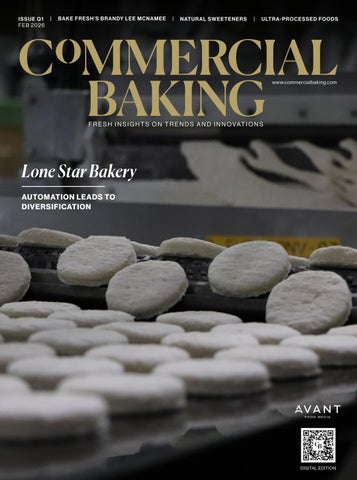
Automation leads to diversification for Lone Star Bakery’s frozen baked goods business.
BY MARI RYDINGS
As the saying goes, “Everything’s bigger in Texas.” Need proof? Look no further than Lone Star Bakery. The San Antonio-based frozen baked goods manufacturer operates two 200,000-square-foot facilities — Plant 1 and Plant 2 — within a mile of each other, serving a customer base as varied as the products that roll off the lines. As if that’s not big enough, Lone Star is focused on growing even more.
To appreciate the magnitude of Lone Star’s business, it’s important to understand how it started: in 1889 as a small retail bakery with a local reputation for
its fresh bread. When Mac Morris Sr. purchased the bakery in the ’50s, he remained committed to upholding its traditional values and producing the same high-quality bread while expanding distribution.
By the mid-’80s, Lone Star was under the leadership of Mac Morris Jr., who recognized that fresh bread alone could no longer sustain the business. With the evolution of freezing technology, he saw an opportunity to transition production from fresh to frozen, starting with muffins for Shoney’s restaurants, eventually expanding to frozen biscuits for other customers.
All photos by Olivia Siddall Avant Food Media
LONE STAR BAKERY
As business picked up, Lone Star built Plant 1 to accommodate the volume. It’s been expanded several times over the years, and now produces biscuits, cake, cinnamon rolls, and frozen dough and has kosher and halal capabilities. Plant 2, which opened in the early 2000s, is USDA-certified and manufactures meat-filled products such as kolaches and pot pies along with fried hand pies, potato waffles, brownies and individual cup desserts.
LISTEN NOW:
Tracy Fletcher talks about Lone Star’s path to building its first full-scale manufacturing facility.
The Lone Star customer portfolio includes some of the best-known brands in QSR, foodservice and casual dining, along with in-store bakeries and delis. Its sales regions cover the US, Canada, Latin America, New Zealand and the Philippines. Frozen biscuits and fried hand pies generate the bulk of business, with frozen dough, cinnamon rolls, blondies, kolaches, pot pies, dessert cups and potato waffles filling in the rest.
Operational flexibility, customization capabilities, continuous innovation and an entrepreneurial approach to customer requests all contribute to Lone Star’s longevity and continued growth.
Lone Star’s willingness to try almost anything has opened many doors over the years. In fact, it’s how the company got into the fried hand pie business. When a long-time QSR frozen biscuit customer asked if the bakery wanted a shot at making the dessert, it jumped at the opportunity, kicking R&D into high gear and setting up a pilot production line to get things rolling before eventually making a full investment.
“We started small, running the line one day a week,” said Dave Tarin, director of inventory management. “Now, we run two shifts a day, six days a week in Plant 2. The line runs about 500 pies per minute, and it’s at capacity.”
Meanwhile, the two biscuit lines in Plant 1 are producing millions of biscuits every day in multiple sizes and packs. The facility runs two 12-hour shifts 24/7 for 13 days before a three-day shutdown for cleaning.
“We stamp more than 900 biscuits a minute,” Tarin said. “If we’re running a 2-ounce biscuit, we can make 2.5 million biscuits in one shift.”
Downstream, an army of Staubli robots keeps pace with the high volume by organizing frozen biscuits into pre-configured stacks and rows for fast and efficient packaging.
“Since we’re family-owned, there isn’t a lot of red tape so we can be nimble,” said Tracy Fletcher, president and thirdgeneration leader, following in the footsteps of her father, Morris Jr. “Our customers recognize we’re willing to work with them and will act quickly to fulfill their requests. That’s one of the reasons we’re as successful as we are.” An
Innovation Center will strengthen Lone Star’s already robust in-house R&D capabilities.
Having the biscuit and fried pie lines running at full capacity is a blessing and a curse. It means business is booming, but at the same time, it also limits growth. Capital investments at Plant 1 will enable Lone Star to overcome those limitations: A second fried pie line will also handle frozen biscuit pucks, and a third biscuit line will have baked pie capabilities.
In addition to the new fried pie and biscuit lines, Lone Star recently installed a cup line for individual desserts, as well as an automated kolache roller/panning line. The company is also putting the finishing touches on upgrades to the flour system and spiral freezer refrigeration systems at Plant 1. More cold storage, upgraded oven controls and an expansion of the on-site fabrication shop top Fletcher’s wish list.
The investments will alleviate capacity challenges and increase op erational
“We are heavy in QSR, and we need to diversify. We’re looking to spread out our customer base, build even better relationships with our current customers and find new business to fill capacity.”
Tracy Fletcher | president | Lone Star Bakery
efficiencies, but more importantly, they will help Lone Star attract new customers. The QSR landscape is evolving, and Fletcher is keenly aware of how that could impact the bottom line.
“We are heavy in QSR, and we need to diversify,” Fletcher said. “We’re looking to spread out our customer base, build even better relationships with our current customers, and find new business to fill capacity. Adding automation and new lines will help us pursue that.”
Fletcher constantly keeps an eye on areas where upgrades and automation could further improve efficiencies at both facilities. For example, her team looks closely at the biscuit and fried pie lines, where equipment runs constantly, to determine where and when to automate next. The team also analyzes sales and overall market performance of existing SKUs. This broad view allows
By investing in robotic technology, Lone Star Bakery added downstream efficiencies to the high-volume biscuit lines.
Produce your entire bread line with a single, versatile Vemag Dough Divider
n Gently handles dough
n Unmatched scaling accuracy
n Precisely scales a wide range of dough portions
n Produces a variety of crumb structures
n Handles absorption rates from 45% to 95%
n No divider oil needed
n Fast, easy changeovers
n Come run your product with us at the Reiser Customer Center.
www.reiser.com
Reiser • Canton, MA • (781) 821-1290
Reiser Canada • Burlington, ON • (905) 631-6611
Reiser UK • Milton Keynes, Bucks • (01908) 585300
Vemag VDD807 high-speed, singl single-lane dough divider
them to evaluate the benefits, costs and feasibility of future investments.
With automation comes a magnified expectation of innovation and new product offerings. As QSR and foodservice operators search for ways to increase foot traffic, they look to their bakery partners for help diversifying menus and creating limited-time items that will draw people in.
To more quickly accommodate product development requests from existing customers and attract new business,
of its R&D team. It is also building an Innovation Center on-site that will include space to host working sessions with customers. These investments will allow R&D to keep innovating around flavors and formats — baked pies, frozen biscuit pucks and individual dessert cups are currently in the lab — while also meeting customer requests for clean-label options and formulas with natural colors and flavors.
“We know our customers’ menus, and that’s part of the inspiration,” said Christie McElya, R&D director at Lone
items. We make 95 percent of our fillings in-house, so we can create whatever unique flavor a customer requests. Our customers are highly concentrated in QSR, and as they work to increase foot traffic to their stores, limited-time offers have become a great contender.”
The R&D team doesn’t operate in a vacuum; it works closely and collaboratively with both the sales and production teams.
“A lot of times, our customers will ask the sales team if Lone Star can develop a new product or flavor for them, and we’ll work with R&D to get samples made,” said Dave Sumner, sales director. “Sometimes, our R&D team suggests a new trending flavor for one of our existing products. If I can spark one customer, we have the opportunity for a limited-time order. It’s all about keeping fresh ideas at the forefront, building relationships, being available and doing our best for our customers.”
Then again, that doesn’t mean every idea gets the green light.
“With any new product, whether it’s from a customer or an internal idea, we have to take into account whether we have the equipment, personnel and production capacity to make it work,” Fletcher said. “And, of course, will it generate revenue?”
As Lone Star diversifies its customer base and product offerings, optimizing operational efficiencies and food safety practices across both facilities is a priority. Last summer, the bakery implemented a Redzone management software system on the production floors, and the positive impact was realized almost immediately.
Tracy Fletcher (left) took the reins from her father, Mac Morris Jr., in 2020 and is focused on business diversification.
Moline manufactures the three core elements of yeast-raised donut systems in sheeting, proofing, and frying.
• Mid capacity/high flexibility or highest capacity systems available.
• Fully rounded technical support for operations, maintenance, and sanitation.
• Full washdown systems designed for 24/7 operation.
• Full offering of in-line finishing including glaze, icing, topping, sugaring and crunch.
Yeast-Raised Donuts
Cake Donuts Honeybuns
LONE STAR BAKERY
“The results are amazing, from identifying downtime issues to improving efficiencies,” Fletcher said. “Now when we see a problem, we can react quicker.”
The system has increased employee engagement and instilled a feeling of empowerment. Lone Star leadership is proud of those achievements because they mean 600 people in two separate buildings are aligned toward the same business goals.
“Redzone has really opened up the line of communication with the teams,” said Jennifer Acuna, director of quality, food safety and sanitation. “We’ve seen employees taking more leadership, making sure their lines are running smoothly and identifying issues immediately versus waiting for their supervisor to walk over. It’s brought a lot of ownership to their lines.”
Real-time analytics are another benefit. By having immediate access to data, line operators can track drop weights and case weights more accurately, which has reduced product giveaway and enhanced quality.
“We’re seeing even higher quality in the product bakes,” Acuna added. “For example, if we’re getting a little too dark of a color on one side of the biscuit oven, Redzone alerts the oven operator, who can make adjustments in real-time rather than running an entire shift of dark biscuits.”
Once Redzone was implemented on the production floors, Lone Star expanded it to the compliance department. The technology allows employees to track measurements and CCPs in real time on their tablets and make adjustments as needed. It will also make preparing for audits easier for Acuna’s team because
“It’s all about keeping fresh ideas at the forefront, building relationships, being available and doing our best for our customers.”
Dave Sumner | sales director | Lone Star Bakery
data will be at their fingertips rather than in paper files.
“Audits are an opportunity for everyone to learn from best practices,” Acuna said. “They are all about continuous improvement and a way to avoid becoming stagnant. We’ve made some adjustments to some of our programs to meet customer requirements, and we’re constantly learning. It’s one more benefit we bring to the table with our customers.”
To help make those audits meaningful to every employee, Acuna has made it her mission since joining Lone Star five years ago to ensure a robust and seamless culture of food safety across the two facilities. She built on the company’s existing monthly food safety trainings by focusing on the “why” behind the practices in place. She also established an incentive program and anonymous reporting to encourage employee engagement.
“We want to make sure our employees recognize that food safety is the number one priority for leadership,” Acuna said. “We try to make it more of a team environment so we’re all working together to ensure food safety and quality within the organization. If someone goes above and beyond to make sure we avoided a food safety incident, or brought something to our attention, or had an idea about how we could improve, we want to recognize them.”
Employee engagement is a priority not only as a company goal but also because it can set Lone Star apart from stiff employment competition in the immediate area.
“When Lone Star built Plant 1, we were the only large employer in the area,” Fletcher said. “It’s just been in the past five years that there has been a business boom.
Our Solution Is Always the Perfect Fit Because It’s Built for You.
Solve your toughest packaging challenges with our automated solutions Scan For Video and Learn More
The BPA Difference
Secondary packaging solutions for the bakery, snack and tortilla industries. BPA loads your packaged and naked products into cases and various secondary containers including your hffs machines, wrapper chain in-feeds and indexing thermoform machines.
H-E-B, Amazon, The Dollar Tree and others have all built distribution centers within a mile of Lone Star.”
Despite the competition, Lone Star has weathered labor challenges well, thanks in part to a focus on building a company culture that upholds four themes: Honor Your Commitments, Take Pride in Your Work As a Team, Embrace Change with Energy and Enthusiasm, and Keep Your Word — Always Do the Right Thing.
That culture is demonstrated through significant investments in training and career development that help employees strengthen their skills and industry knowledge. Earlier this year, members of the R&D team attended the International Baking Industry Exposition and Kansas State University’s Flour Forward workshop, and partnerships with various organizations provide ongoing comprehensive training .
With 400,000 total square feet of production space for frozen baked goods manufacturing, Lone Star Bakery offers a big chill deep in the heart of Texas. It’s looking to the future, and with newly automated lines, ramped up R&D and a knowledgeable workforce, it’s primed and ready to take on new business while helping current customers find their next big thing. CB
INNOVATIONS FROM THE BAKERY FLOOR
Lone Star Bakery operates two 200,000-square-foot facilities, servicing QSR and foodservice customers with frozen baked goods ranging from biscuits to fried hand pies to kolaches. Below is a list of supplier innovations that can be found on both bakery floors.
ATS Automation automated cup line
Baker Perkins, a brand of Coperion band oven
BluePrint Automation case loaders
Easymac depositors, dough extruders, sheeting line
Formic palletizers
Illapak flowwrappers
Moline dough extruders, sheeting lines
Peerless depositors, mixers
The Fred D. Pfening Co. liquid ingredient handling system
Redzone bakery management software
Reiser Vemag extruders and waterwheels
Sasib, a Middleby Bakery brand band oven
Staubli robotic systems
Winkler tunnel oven
Unifiller, a brand of Coperion depositors, filling transfer pumps
Installation of a third biscuit line will alleviate capacity challenges.
A Place to Call Home
After 30 years at Bake Fresh, Brandy Lee McNamee leads the company with a baker’s heart.
BY JOANIE SPENCER
Every minute Brandy Lee McNamee has spent in the baking industry has been with Chesapeake, VA-based Bake Fresh. She’s been there from the time it was a small Dunkin’ Donuts franchise to its current status as a four-facility commercial donut manufacturer providing customers coastto-coast a variety of fresh and frozen sweet goods including donuts, cookies, croissants and more.
She started as an hourly employee working a typical after-school job … 30 years later, McNamee is president and CEO.
“The evolution this company has experienced,” she reflected, “has, on a personal level, been my evolution, as well.”
Over the years, McNamee made it her job to learn everything she could about not only the production process but also the ins and outs of the business. In those early days, when her office work was finished, she’d busy herself by helping out on the production floor. It fed her innate curiosity (and, some say, her inability to sit still), but it also created real-world experience to supplement her education.
“Putting in that work gave me a great respect for what really happens in our
bakeries,” she said. “It helped me understand where and how we make our money and what’s important for the business. And it gave me this unique experience to learn firsthand how things worked. Then I could apply that knowledge to my education in college and business courses while I was growing in my career at the same time.”
Rising into leadership in the same company is not only a rarity these days — 30 years with one employer is usually reserved for baby boomers or Gen Xers — but it also comes with specific challenges. For starters, muscle memory can become the enemy, especially when one of the hardest adjustments for leaders is letting go of task-oriented duties.
McNamee enjoys turning challenges into opportunity, so she’s always seen job growth as professional development. In that respect, she’s learned a great deal from the example set by her mentor, Bake Fresh’s previous CEO Jeff Saunders, as he often empowered her to learn her own lessons along her path.
“When you get into a leadership role, it can be easy to just go on ‘autopilot’ and jump in on tasks because you think you can solve something really fast,” she said. “But a big part of my development is how I develop teams, and that means sitting back, asking questions and allowing them to get to the answers themselves. That’s my next stage: helping others find the same opportunities that I was given.”
Letting go of muscle memory means learning how to use new muscles, and that gave McNamee the chance to focus on big-picture endeavors, creating new growth opportunities.
In 2017, while she was helping to lead operations, Bake Fresh completed an
“When we have these big things put in front of us, we have to rewrite the playbook. The rules are different now, so we all have to change what we’re doing … For me, it means, ‘Let’s go. Let’s figure it out.’”
Brandy Lee McNamee | president and CEO | Bake Fresh
unorthodox acquisition that more than tripled the company’s size practically overnight. It resulted in structural changes to the business that required bringing higher-level roles to the organization. While change management can be one of the hardest hurdles for organizations to overcome, McNamee’s power of observation revealed a gap she could fill, while her love of a good challenge got her moving.
“I knew everything there was to know inside our bakery’s four walls, but I needed to bring something else to the table,” she recalled. “I realized quickly that I needed to ‘know what I don’t know.’”
She found the answers in the MBA program at Northwestern University’s Kellogg School of Management, where she enrolled with support from partners at Coppermine Capital, the family-fund private equity firm that took ownership of Bake Fresh in 2005. In the program, McNamee created a network of peers and professors who are still in her circle today.
“[Coppermine] cares about us,” Mc Namee said. “They want us to do well, show growth, and continuously set plans and follow them. They’re great supporters of the business, in good times and bad, and they’re the catalyst for the growth we’ve had. It’s enabled our long-term strategy that sets us apart in terms of being able to scale while maintaining flexibility.”
In the entrepreneurial culture of Bake Fresh, McNamee has always leaned into her propensity to take action. She’s in the room for the initiatives that are most important to her, and she has never been afraid to be an “only,” whether that was a woman at the table in a male-dominated industry or the only operations director among the c-suite crowd at the Kellogg School.
“I’ve always tried to change, adapt, do more and learn how to think differently when I need to,” she said. “And I’ve always done that in the spirit of getting better or helping my Bake Fresh family improve.”
Today, change management involves implementing a new ERP system across the entire Bake Fresh network to integrate all operational and financial metrics.
“This was an opportunity to enable managers and other leaders to make better informed decisions because we’ll have true data-driven reporting,” McNamee said. “I anticipated a bit of a struggle in terms of adapting to change, but everyone has made huge strides to get where we need to be. And everyone is sharing in the pain of change and the learning that we gain from it.”
That’s the power of empowerment, and it requires trust. Obviously, McNamee can’t be in every plant every day, so trust is a huge factor in the day-to-day operation.
“Trust becomes especially important on the fresh side of the business,” she said. “They’re making day-to-day decisions on hitting 100 percent fill rates, and that sometimes means they have to think outside the box. That can’t happen without a high level of trust in both directions. Then we can integrate our goals and plans with reality and tie it all back to the success of the organization.”
WATCH NOW:
Brandy Lee McNamee describes how current headwinds facing the industry can lead to positive change.
As 2026 begins with a host of new challenges, from increased tariff uncertainty to MAHAdriven consumer guidance, McNamee is ready to face it all head-on. The key to resiliency in the face of adversity, she said, is meeting conflict with curiosity.
“These are big challenges, but you know, that’s what I love,” she said. “When we have these big things put in front of us, we have to rewrite the playbook. The rules are different now, so we all have to change what we’re doing … and move fast. What does that mean? For me, it means, ‘Let’s go. Let’s figure it out.’”
In a baker’s heart, curiosity, loyalty and humility meld together and create an unbreakable bond. McNamee may not have expected to spend three decades at Bake Fresh, but the time has taught her more than she ever could have dreamed.
“It’s pretty humbling to sit in this role, when every big milestone in my life has happened while I’ve been here,” she said. “It’s integrated with who I am, and I feel like it’s in my DNA … I am Bake Fresh as much as Bake Fresh is me.” CB
McNamee has spent her 30-year career with one company: Bake Fresh.
Calm, Cool … Unbothered
Backed by its “Sour Squad,” this dietitian-led brand is prioritizing gut health with authentically fermented sourdough crackers.
BY LILY COTA
Perfecting sourdough at scale may sound like a big challenge for a budding brand, but it’s the pivotal component that sets Kansas City, MO-based Unbothered Foods apart.
Made without commercial yeast, Unbothered Foods’ Sourdough Crackers are formulated to optimize flavor and digestion while maintaining the vibe of a carefree snack. For consumers dealing with IBS and gluten intolerance, snacking has never been “care-free.” Their diets are restricted by what their guts can handle, leaving little room for casual eating.
Thanks to increased interest in sourdough during the pandemic, consumers have a better understanding of the connection between fermentation and gut health, leading them to the snack aisle in search of mindful gratification. But their options are limited.
This realization pushed dietitian and digestive health expert Morgan Murdock to apply her expertise toward building a snack brand that’s there for the little guy … or gut.
“It was hard to tell my patients to eat the same four brands when I knew I could make a new product they could eat and
All photos courtesy of Unbothered Foods
With three simple-yet-elevated flavors, Unbothered Foods’ crackers place sourdough in the spotlight.
EMERGING BRAND
enjoy,” Murdock said. “Working in gut health as a brand is exciting because we can help improve people’s lives entirely.”
Suddenly, Murdock’s home kitchen was overtaken by sourdough starter as she prepared bread and pizzas for her patients to pick up. It wasn’t long before the brand evolved, taking shape in the form of fermented crackers.
“Sourdough was truly what everyone loved, but I knew long-term I wanted something shelf stable that could be a pantry staple, not just a random treat,” Murdock said. “So crackers felt like the right starting point.”
Demand grew quickly, and Murdock moved production to a shared kitchen with a team of five. After securing space on the shelves of a few neighborhood stores around its original home of Chicago, Unbothered Foods officially launched in early 2023.
With regular sell-outs and a swelling reputation, the brand’s concept was validated, but the limits to its smallscale manufacturing were also fully exposed. When it was clear capacity had hit its cap, and the tiny sheeter and five-rack oven were no longer cutting it, the brand began its search for a co-manufacturer.
“I started producing on a smaller scale and bootstrapped for a while, but it was very clear there would come a breaking point, and my passion is not in manufacturing,” Murdock said. “I knew I didn’t want to run the bakery.”
As a startup, it’s hard to find a manufacturer willing to work with the operation and its smaller runs. It’s even trickier when fermentation is in the mix.
“I want people to feel like they’re in on the story, part of the journey and connected to something bigger than a bag of crackers.”
Morgan Murdock | founder | Unbothered Foods
“Our dough is fermented for 24 hours before it’s baked, so we needed the expertise of bread bakers who weren’t scared of fermentation, but also cracker manufacturers who had the right equipment,” Murdock said.
Essentially, the brand was looking for its Goldilocks: small enough to understand fermentation, large enough to produce at scale. It was a process that took more than a year, one that led the brand to the West Coast in search of a world beyond sourdough flavoring.
“Even though there are other sourdough crackers on the market, most are not actually fermented,” Murdock said. “They add sourdough flavor to give it that distinct taste, but there’s no real fermentation, which is the whole point of the Unbothered brand. Fermentation is a non-negotiable for us.”
LISTEN NOW: Morgan Murdock talks about the “why” behind the brand.
And, as non-negotiables go, Murdock held steadfast. Through many trials, cross-country flights and product runs, Murdock relentlessly sought the perfect manufacturer fit.
When the “just right” fit emerged, a new struggle began. The R&D process required multiple test runs, dough reformulations and built-in buffer days to meet the brand’s fixed fermentation requirements.
Who better to lead the reformulation charge than Murdock herself?
“It’s not just mix and bake,” Murdock said. “If the dough gets messed up, you have to start all the way back from the fermentation piece. It’s trial by fire, but it’s necessary if you want to work with the big players.”
The journey was arduous, but once Murdock gained confidence in the baking team, she returned the brand’s focus to what it knew best: showing consumers what proper digestive health could feel like, and how to achieve it in a flavorful format.
Timing is in the brand’s favor, as the digestive health market is booming, with a total worth of more than $51 billion in 2025, according to Grand View Research. Baked goods are emerging as a formidable vehicle for gut-boosting ingredients, proving that today’s consumers aren’t willing to trade flavor for function.
And they want to feel something when they snack; they want to connect. While sales and distribution partnerships are a telling description of a consumer base, social media provides a direct path to forming those connections, and Unbothered Foods’ “Sour Squad” paints a picture worth a thousand words.
“From day one, the Sour Squad was my way of turning a cracker brand into a community,” Murdock said. “I want people to feel like they’re in on the story, part of the journey and connected to something bigger than a bag of crackers.”
Functioning as a hub and growth engine, the Sour Squad has been there since the brand’s earliest days, when Murdock was still hand-rolling crackers and testing new recipes in the shared kitchen. Now, it’s the brand’s inner circle, the people who get to go behind-the-scenes, have first
access to new product drops and even get invested in the brand through community fundraisers.
With distribution on Amazon, expansion into boutique retailers nationwide, and a recent Whole Foods launch, the Unbothered Foods community stretches far beyond its origin in the Windy City. The brand is capturing the attention of consumers nationwide.
“Our customers don’t just buy crackers,” Murdock said. “Every bag we sell feels like a little vote of confidence to keep going and keep doing it the right way.”
For now, Unbothered Foods is set on maintaining quality and consistency by sticking to the original three flavors that allow the spotlight to shine on sourdough: Sea Salt & Flax, Cheddar & Chive, and Rosemary & Sea Salt.
“We have a lot of exciting retail partnerships on the horizon, so we’re focused on growing distribution,” Murdock said. “We’d like to add more sourdough products, but that’s probably still a couple of years out. We want crackers to be the champion that gets us into stores.”
Built on a dietitian’s promise of access to easy, digestible snacks, Unbothered Foods is staking a claim in an overlooked category, facing operational and formulation challenges head-on, all while remaining calm, cool and … unbothered. CB
For consumers with dietary restrictions, sourdough is the light at the end of the snack aisle.
Consistent flow for sticky powders, fibers, and pellets.
The NX feeder is built with a negativeangled trough that keeps even the most challenging ingredients moving.
From fine flours to sticky dough bases, its design minimizes buildup for consistent, precise flow - ideal for difficult, poor-flowing powders.
Choose a system engineered for reliability and a partner that knows the nuances of your process.
Learn more about the NX Feeder. sales@kubota-btca.com
Taking the Lead
Opportunities exist for the baking industry to guide the UPFs conversation.
BY KARA ELDER
The current lack of a comprehensive definition for ultra-processed foods (UPFs) means that, for now, it exists in the crosshairs of perception, reality and politics. It’s difficult for everyone, from bakers to policymakers, to agree on the best path forward to provide clear, actionable nutrition guidance for consumers. While the food industry awaits the FDA’s definition of UPFs, commercial bakeries can seize the moment as an opportunity for innovation, both in messaging and product.
The emergence of the four-tiered NOVA Food Classification System in 2009, which categorizes foods by level of processing rather than nutritional value, added confusion rather than clarification because of a disconnect between what it was designed to do — serve as a research tool — and how it’s being implemented as a guideline. Nearly 20 years later, that confusion has taken on a life of its own.
“One thing that’s helpful to keep in mind is that [the NOVA] framework was put together by Brazilian public health researchers to provide a tool to close the massive knowledge gap between what we know about food and health and the clear trajectory of poor dietary health outcomes,” said Charlotte Biltekoff, PhD, professor of American studies and food science and technology and Darrel Corti-endowed professor of food, wine and culture at the University of California — Davis. Her most recent book, Real Food, Real Facts: Processed Food and the Politics of Knowledge, examines the intersection of food, science, processed food and consumer concerns.
Characterizing all ultra-processed food as unhealthy and something to be avoided ignores the reality that processing can make food nutritious, shelfstable and convenient. In its conversations with policymakers and industry leaders, the American Baking Association (ABA) emphasizes that looking at the level of processing isn’t helpful.
“We need to be focusing on nutrient density, not just of the product, but of an overall diet,” said Campbell Genn, senior director of government relations at ABA, during a 2025 International Baking Industry Exposition panel discussion. “We’re really working on our end, especially on the policy side, to educate staff and policymakers about the benefits of processing and the nutrients that we’re able to deliver to American families.”
She added that many lawmakers and their staff are unfamiliar with the scope of
“We’re really working on our end to educate staff and policymakers about the benefits of processing and the nutrients that we’re able to deliver to American families.”
Campbell Genn | senior director of government relations | American Bakers Association
the grain foods category. Refined grains span staple and indulgent grain foods alike. Foods such as bread can be important sources of vitamins like iron, thiamin, riboflavin, niacin and folic acid. Indulgent products are also still important, though they may score lower nutritionally.
“While the nutritional benefits of whole grains are well known, refined grains also serve an important purpose,” Genn said. “When it comes to indulgences, ABA’s Bakery Playbook research shows that 61 percent of consumers have had snack cakes or pies in the past 30 days, whether from a grocery store or a restaurant. In fact, consumers are seeking moments to provide joy and bring people together for celebratory occasions.”
Such engagement from industry partners helps lawmakers understand how the entire supply chain contributes to food safety, consistency and nutrition at scale.
Refined grains hold a place of importance in the consumer diet as sources of indulgence and celebration.
FROM PRODUCT TO PALLET ...
Consistent seals, clean presentation, and reliable performance across high-volume bakery SKUs.
Reduce manual touchpoints and stabilize line performance as labor availability changes.
Maintain speed and accuracy while handling product variety and pack configurations.
Protect downstream flow and eliminate bottlenecks beyond the wrapper.
“We are committed to engaging in meaningful dialogue with policymakers to ensure baked goods continue playing a vital role in a balanced and healthy diet,” said Rasma Zvaners, VP of government relations for ABA. “The baking industry’s focus remains on providing consumers with a variety of delicious food choices while maintaining high standards for safety, quality and transparency.”
But looking at the consumer side, anxiety about UPFs and their potential impact on health shouldn’t be ignored.
“There’s growing awareness — and even concern — about what’s in our food and how it’s made,” said Erin Ball, executive director of the Grain Foods Foundation (GFF). “That’s partly because people have more access to information and opinions than ever before. But that landscape can be noisy and confusing, and not everything out there is grounded in sound nutrition science.”
Bakers have an opportunity to confront inconsistent messaging and address consumer concerns by following GFF’s example and focusing on nutrition science and health outcomes rather than broadly defined food categories. Grouping foods solely by how they’re processed, without considering their science-based nutritional value or public health benefits, can lead to confusion and misrepresent the role many foods play in a balanced diet.
“That’s why it’s so important to keep the conversation grounded in science and trust while also recognizing the real questions people are asking,” Ball said. “Consumers want food that feels safe and nourishing, and that aligns with their values. It’s on all of us in the grain foods industry and across the food system to
offer clarity and reassurance that meet those needs.”
It’s also important to remember that there’s more at play than a lack of scientific literacy. What consumers eat — and what they’re told not to eat — evokes an emotional reaction, too. Social media can amplify misinformation and oversimplify narratives, and anyone can claim they’re a nutrition expert and exert real influence in the nutrition space.
“Food processing is a complex topic, and while it’s important to ask questions, the current discussion often overlooks the role processing can play in improving nutrition delivery, safety, shelf life and accessibility,” Ball said. “When that nuance is lost, beneficial foods risk being unfairly dismissed, even when they contribute meaningfully to healthy, balanced diets.”
Providing access to nutritious, affordable grain foods that fit into real-world diets is the industry’s primary goal.
Compressor Downtime is a Recipe for Disaster.
In high-volume baking, compressor failure and air contamination are more than an inconvenience - they’re a critical threat to operations. When the air stops, the ovens cool, the dough falls, and your margins evaporate.
At Kaeser, we engineer air systems that treat purity as a performance metric. Our two-stage dry-running compressors deliver ISO Class 0 oil-free air, ensuring that the only thing touching your product is the quality you intended. We’ve turned the utility of compressed air into a strategic asset that optimizes your Total Cost of Ownership.
When air purity, uptime, and operating costs are non-negotiable, Kaeser turns compressed air from a critical control point into a competitive advantage.
A 2025 consumer survey conducted by the Food Integrity Collective and Linkage Research in support of the Non-GMO Project’s recently announced Non-UPF Verified Standard certification more explicitly lays bare how societal polarization has damaged consumer trust in government institutions. The survey revealed that, in respect to their food choices, shoppers rank food manufacturers low, just above social media influencers, and below government and artificial intelligence.
It’s not all doom and gloom. Uncertainty creates opportunity. For example, scientific research has long pointed to the lack of dietary fiber in most Americans’ diets. Product innovation in the UPF space to address consumer health needs, such as increasing fiber while maintaining safety, taste and affordability, presents an opportunity to food processors. Updating formulations could give commercial bakeries an easy way to highlight nutrition.
“If we start with this idea of processing as iterative innovation, it frames up some of the challenges we’re having right now in the UPF dialogue, and it also opens the door to what the next frontiers might be,” Ball said during a recent webinar on navigating UPFs hosted by the American Society of Baking (ASB).
The industry can also support research to close scientific gaps, engage in evidence-based policy dialogue, and collaborate with health professionals and scientists. Although consumers can be wary of industry-funded research, it’s worth the effort. Bakers have an opportunity to proactively contribute clear, accessible, science-based information about what goes into the foods they make.
“We need to think beyond this as an individual problem, a failure of individuals to understand, or a failure of science communicators and the industry to tell their story well,” Dr. Biltekoff said.
On that front, organizations such as GFF, ABA and ASB are committed to generating high-quality research and translating it into practical, credible, evidence-based insights.
Commercial bakeries strive to support public health, whether by fortifying breads with essential nutrients, offering whole grain options or adapting to evolving dietary guidelines. Until terms like “ultra-processed” are clearly defined, it’s even more important to focus innovation on providing nutritious foods that fit into real-world diets. CB
The UPF conversation is an opportunity for bakers to educate consumers on valuing nutrition over processing.
No Longer Niche
Baking at scale with natural sweeteners requires a little finesse, some trial and error, and a lot of patience.
BY MAGGIE GLISAN
not so long ago, the best bet for anyone seeking naturally sweetened cookies or bars was the local natural foods store. Today, when “clean label” is on the tip of every tongue, and “minimally processed” is the health claim du jour, shoppers are just as likely to find those same products lined up right next to the OREOs and Chips Ahoy! at any mainstream supermarket.
Consumer and industry momentum behind natural sweeteners isn’t just anecdotal — it’s measurable. The global natural sweeteners market is projected to grow from roughly $31 billion in 2024 to nearly $43 billion by 2030, according to Research and Markets, driven by continued demand for plant-derived, cleanlabel alternatives across food and beverage categories.
In broad terms, “natural sweeteners” encompass ingredients sourced from plants or whole foods such as honey, maple syrup, agave, monk fruit and fruit-based sweeteners, as well as high- intensity options like stevia. For bakers, their appeal lies less in novelty than in
perception: These ingredients signal familiarity, transparency and a move away from heavily refined inputs. At the same time, they introduce formulation challenges, requiring adjustments to manage sweetness intensity, texture, moisture and shelf life.
That tension between trust and performance mirrors consumer sentiment. According to the American Sugar Alliance, when consumers are asked to identify the “healthiest” sweeteners, traditional options like honey (64.4%) and raw cane sugar (33%) consistently outrank artificial alternatives such as aspartame or sucralose, underscoring the advantage of ingredients that feel recognizable and close to their source.
“The question now isn’t whether sweeteners are used,” said Miriam Aniel Oved, head of integrated marketing at Tastewise. “It’s which ones consumers trust and feel good about.”
Just as important, consumers are parsing the language around sweetness more carefully.
“Reduced sugar gets people in the door,” Oved noted, “but ‘naturally sweetened’ helps them feel good about staying.”
In baked goods, that distinction places pressure on brands to deliver indulgence alongside clean labels, balancing sweetness sources with structure, flavor development and texture in ways that don’t feel compromised.
With consumers increasingly linking sweetness to wellness — clean energy, reduced bloating, stress support, etc. — natural sweeteners are positioned not just as sugar substitutes but also as tools that help baked goods fit into everyday health and lifestyle routines.
Los Angeles–based Lexington Bakes produces cookies, brownies and oat bars using organic ingredients and no artificial sweeteners or preservatives. The brand is part of a growing wave of bakeries rethinking sugar and sweetener choices, along with the level of transparency consumers expect from ingredient sourcing.
For its products, Lexington Bakes relies on fair-trade, unrefined, organic cane sugar, a choice Lex Evan, the company’s founder and CEO, said balances performance with values.
The company also partners with Crown Maple and Just Date for its maple syrup and date sugar, selecting ingredients that are high-quality and responsibly sourced. Crown Maple’s syrup
The global natural sweeteners market is projected to reach nearly $43 billion by 2030.
Source: Research and Markets
is produced in small batches from certified organic trees in New York, while Just Date’s date sugar provides a minimally processed alternative to refined sugar, which helps Lexington Bakes maintain its clean-label philosophy while delivering functional sweetness.
Working with natural sweeteners often means accepting that they aren’t simple drop-in replacements for refined sugar, especially in formulations where sugar functions beyond sweetness. In cookies, granulated sugar influences creaming efficiency, spread and texture, all variables that become harder to control with less refined alternatives.
“The granule size of the sugar really matters,” Evan said. “When you try to do that with something like date sugar, which is more of a powder, it just doesn’t work. It wasn’t giving me the texture I needed.”
Other products, such as brownies, are more forgiving. In that instance, sugar melts into butter and chocolate, building sweetness and flavor simultaneously. That melting behavior
allows for more flexibility with alternative sweeteners, compared to cookies, where structure is less negotiable.
Oat bars present another challenge. Evan initially formulated his with maple syrup alone, but it wasn’t sticky enough to hold the oats together. Adding date sugar solved the problem while providing additional benefits.
“It reduced added sugar, helped bind everything together and added fiber,” he said. “But it’s not a one-to-one swap. You really have to test and learn how it interacts with other ingredients.”
But structure is only one part of the balancing act. There are taste variations to consider as well. Date sugar, for example, carries a pronounced taste that can dominate if overused. Its reaction to heat must be considered, as well. Unlike cane sugar, date sugar doesn’t melt smoothly, thickening instead into a paste that can resist blending.
Another brand navigating the realities of natural sweeteners at scale is Maxine’s Heavenly, a cookie company that has prioritized unrefined sugars since its earliest formulations. According to co-founder and CEO Robert Petrarca, coconut sugar and dates weren’t added in response to trends; they were foundational from day one.
“We were really interested in alternatives to highly refined sugar from the very beginning,” Petrarca said. “Coconut sugar was one of the first commercially available options at the time, and we went all in on it early, even when almost no one else was using it.”
Dates also became critical when Maxine’s Heavenly made the leap to shelf-stable products. Coconut sugar
alone, Petrarca said, couldn’t deliver the moisture retention needed to survive long distribution timelines.
“When we needed shelf life, dates changed everything,” he said. “They were kind of a miracle ingredient for us.”
But, like Evan, Petrarca emphasized that natural sweeteners introduce layers of complexity that refined sugar largely eliminates.
“[With white sugar] you strip everything out, grind it to the same mesh every time, and you get total consistency,” he said. “With coconut sugar and dates, you’re dealing with natural variation. Mesh size alone can change how much a cookie spreads.”
Shelf life, particularly for soft-baked cookies, remains one of the biggest hurdles for product development that relies on natural sweeteners.
“Crispy cookies are much easier,” Petrarca said. “Soft-baked cookies are incredibly volatile. There’s a reason you
don’t see many of them in natural grocery aisles. They’re hard to keep stable through long distribution chains.”
Petrarca sees growing consumer awareness around types of sugar — not just sugar reduction — as a meaningful shift.
“People care more than ever about where sweetness comes from,” he said. “Not all sugars are created equal. If you stay grounded in that belief, and you’re willing to do the hard work upfront, that’s where you win long term.”
As natural sweeteners move from niche to mainstream, so does the conversation around them. For bakers, success isn’t just about finding a perfect one-to-one replacement for refined sugar. It’s also about understanding what each sweetener contributes, where it falls short, and how it fits into a product’s broader goals around taste, texture, shelf life and transparency. The brands finding traction are those willing to do the work: testing, adjusting and accepting variability in exchange for ingredients consumers recognize and trust. CB
While coconut sugar is a viable natural sweetener, it often needs additional formulation strategies for issues like moisture retention.
PURATOS MAKES SOURDOUGH SIMPLE
As a global leader in bakery ingredients, Puratos is the partner of choice for industrial, retail and artisan bakers. It has the knowledge, expertise and resources to help commercial bakers innovate for shifts in the bread aisle, with customized solutions to help their businesses stay competitive, relevant and on-trend.
Sourdough Reigns Supreme
Bread is evolving … it’s no longer an automatic grocery cart staple. Research shows that center store sales of sandwich bread have declined -5% while sourdough is up more than 25% , offering evidence that consumers are gravitating toward flavorful baked goods with clean labels and gut-health benefits.
of consumers eat sourdough daily 51%
Source: Taste Tomorrow by Puratos
Sourdough creates new opportunities for bakers looking to stay ahead of market trends, especially in the bread aisle. Younger consumers are drawn toward the natural fermentation, premium ingredient list and unique flavor sourdough brings to the breadeating experience. Puratos’ products deliver these attributes in a convenient format that doesn’t compromise quality, taste or texture.
of consumers eat sourdough every day, during holidays or for special occasions 99%
of consumers think sourdough adds to the tastiness of bread 72%
Ready-to-Use Sourdough Solutions
Sponge-and-dough systems, long proofing, and maintaining a mother dough add complexity and cost to sourdough production. These factors also increase labor needs and create inconsistent finished product. Because the sourdough process requires a significant amount of time, throughput and production efficiency are negatively impacted.
Puratos’ Sapore and O-tentic sourdough solutions are pre-fermented and stabilized so they’re ready to use immediately, complete with the natural fermentation, complex and diverse flavor, and simple ingredient list consumers want without the production hassle.
Whether the goal is a tangy flavor or one that’s milder, Puratos’ experts help bakers optimize the solution to their specific process and define their signature taste, while also offering:
• Consistency at scale for industrial and artisan lines
• Clean-label formulations with no artificial preservatives or added sugars
• The ability to blend products to create endless flavor possibilities
Pilot Testing, Technical Support, Ongoing Research
The Puratos Industrial Pilot Bakery, powered by AMF , provides access to experts who can help bakers validate sourdough recipes, optimize processes and accelerate time-to-market. The facility combines Puratos’ expertise in ingredients and recipe formulation with AMF’s advanced bakery equipment and integrated automation solutions.
Puratos further demonstrates its commitment to sourdough and preserving its history by maintaining the world’s only Sourdough Institute , founded on three pillars: Protect, Research and Inspire. The Institute’s Quest for Sourdough online library features nearly 3,000 sourdoughs from around the world. Bakers can upload their sourdoughs to compare and contrast as well as help research efforts.
Through the Sourdough Institute, Puratos partners with global organizations and universities to deepen the scientific understanding of sourdough and conduct ongoing research into its impact on gut health.
A Recipe for Growth
BY BETH DAY
Bread, buns and rolls are iconic grocery items. Bread is enjoyed by 98% of US consumers and most commonly purchased from the center of the grocery store. But there is growing engagement outside of the bread aisle, especially by younger consumers, according to Mintel’s “US Packaged Bread Market Report 2025.”
Sandwich Bread Growth
All around, sandwich bread holds its own. Perimeter sandwich bread showed 3.3% dollar and 1.1% unit growth, according to Circana data from the latest 52 weeks ending Nov. 30, 2025. Sandwich bread dominates center store, boasting $10.02 billion in sales and 2.94 billion in units, but it’s taken a -3.1% and -4.0% dip in both, respectively, in the latest 52 weeks.
Promotional displays for center store bread are being dispersed throughout the store and are often positioned near bread and bun complements, such as peanut butter and jelly, hot dogs and hamburgers.
“Meal solution promotions are always a great way to increase frequency of use,” said Dawn Aho, principal of client insights, bakery vertical at Circana. “King’s Hawaiian sliders and rolls have had a season-long advertising campaign with College Game Day and NFL Slider Sunday, promoting a variety of tailgate and party recipes.”
Package sizes and varieties depend on consumer needs. Although center
Center Store Buns and Rolls Dollar Share
Total US - Multi Outlet w/ C-Store (Grocery, Drug, Mass Market, Convenience, Military and Select Club & Dollar Retailers) | Latest 52 Weeks Ending Nov. 30, 2025
Source: Circana Omnimarket Integrated Fresh, a Chicago-based Market Research Firm (@WeAreCircana)
store sandwich breads offer half loaves, Aho noted there is more flexibility with size options in the perimeter, including bulk bins that allow consumers to select the number of buns and rolls they wish to purchase. Half loaves of bread and 4-pack buns and rolls appeal to those who do not eat bread often or to single or small family households that prefer variety in smaller quantities.
Perimeter breads offer a wide range of additional attributes and options that are spurring growth. Private label makes up the majority of perimeter breads for both crusty and sandwich bread segments.
HAMBURGER | HOT DOG BUNS:
They are typically more affordable than center store brands.
“A variety of sizes and packaging, perceived freshness and globally inspired flavors are all reasons for growth,” Aho said. “The assortment of flavors and types of perimeter sandwich breads is vast, affording consumers options for special occasions that are not available from center store brands.”
Nutrition in Center Store
While packaged bread remains a core staple, brands must enhance products, moving beyond budget-friendly or whole wheat to keep pace with modern perceptions of nutrition and clean ingredients, according to Mintel’s report.
“Nutritional claims, including keto, glutenfree and organic, are helping brands limit declines or show slight growth,” Aho said. “High-protein center store breads are a recent addition to the category but may add another benefit for consumers.”
For example, she noted Horsham, PA-based Thomas’ recently introduced two protein bagel varieties.
Some sourdough brands are marketed as beneficial for intestinal health, among other claims. Thomasville, GA-based Flowers Foods and Mexico City-based Grupo Bimbo have brands that promote healthy eating and support gut health.
“Most major center store brands have sandwich breads and buns that deliver these benefits, and the majority of them are staving off declines or growing slightly,” Aho said. “Gluten-free characteristics often place brands in the frozen or refrigerated grocery sections, but the few brands in center store show slight gains.”
Perimeter Breads Dollar Sales
CRUSTY | MEAL
SANDWICH
SPECIALTY
PANINI | CIABATTA | FOCACCIA SWEET
ALL OTHER
HISPANIC TOTAL
Total US - Multi Outlet w/ C-Store (Grocery, Drug, Mass Market, Convenience, Military and Select Club & Dollar Retailers) | Latest 52 Weeks Ending Nov. 30, 2025
Source: Circana Omnimarket Integrated Fresh, a Chicago-based Market Research Firm (@WeAreCircana)
Small, but Mighty
While a smaller center store segment, specialty rolls reported 17.9% dollar and 18.6% unit increases vs. a year ago. A popular style over the past few years, brioche comprises the majority of center store specialty rolls. Many sandwich bread brands have also introduced brioche options.
“The top three brands within center store specialty rolls are private label, with a 45 percent dollar share, followed by Sara Lee Artesano and Pepperidge Farm Farmhouse brands, and most are brioche buns and rolls,” Aho observed.
Globally inspired center store ciabatta/ panini/focaccia is the only subcategory showing major year-over-year change, with 8.9% dollar and 6.8% unit gains, according to Circana. Private label
Bread is enjoyed by 98% of consumers and typically purchased from center store.
Source: Mintel
represents about 66% of total dollar sales for this segment.
“Artisan bread types within this segment are increasing, though it is a small share of the total,” Aho said. “Wheat and olive oil ciabatta and Tuscan panini are the top varieties within center store. The ability to introduce new flavors and formats of these bread styles can be a successful innovation technique for manufacturers.”
Despite bread and buns’ appeal as affordable staples, the economy may slow growth for the category, per Mintel.
Aho also observed that over the past few years, household penetration rates have been down across grocery categories.
“We have seen a trend of bifurcation within bread and many other categories as consumers make choices based on discretionary income,” Aho explained. “Mainstream brands lose sales to premium bread products when trading up and private label items when seeking affordability. Manufacturers need to remind their consumer base of the benefits of their brands and products.”
Leveraging Trends
Manufacturers of bread, buns and rolls should focus innovation on new flavors and formats, nutritional claims, package sizes, and channels. One size does not fit all, and strategies should differ based on product style and whether sold in center store vs. perimeter.
“It seems easier to introduce innovation to the perimeter as it is mostly private label brands,” Aho said. “The center store bread aisle is very competitive, and innovative ideas are always under pressure
Center Store Breads Unit Sales (# in Millions)
Total US - Multi Outlet w/ C-Store (Grocery, Drug, Mass Market, Convenience, Military and Select Club & Dollar Retailers) | Latest 52 Weeks Ending Nov. 30, 2025
Source: Circana Omnimarket Integrated Fresh, a Chicago-based Market Research Firm (@WeAreCircana)
to perform like established products even though most innovation appeals to discrete consumer segments and not the masses.”
Pack sizes and their channel distribution are growth opportunities, while flavor trends tend to start in the perimeter and move to center store once they have gained traction. Aho noted that bread manufacturers should keep a finger on the pulse on the popularity of bread replacements as consumers look for healthier carrier options, including egg wraps, cheese wraps and tortillas.
While bread, buns and rolls remain on grocery lists, consumers are adjusting shopping patterns and product preferences. Considering all pertinent trends while tailoring innovation with marketing strategies will contribute to category growth. CB
Meets Inno ation Innovation
Celebrating Flavors and Sizes
BY BETH DAY
Seasonal celebrations and special occasions drive demand for cakes, and the global market is forecasted to reach $123.45 billion in 2030, according to a recent Mordor Intelligence growth trend report for 2025-2030. Unpackaged artisanal cakes accounted for more than half of market share in 2024, but packaged formats are expected to expand 4.8% by 2030.
Perimeter Takes the Cake
Products in the perimeter are leveraging category trends. Perimeter cakes posted 2.4% growth, with $6.56 billion in dollar sales, and this segment is nearly 12 times the size of center store cakes, according to Circana retail data from the latest 52 weeks ending Nov. 30, 2025. Private label brands slice the competition, comprising more than 80% of perimeter cake products.
“Private label depth and breadth in the perimeter affords convenience via size and flavor varieties,” said Dawn Aho, principal of client insights, bakery vertical at Circana. “Private label items tend to be more affordable than center store brands, and families managing their monthly budgets make tradeoffs during every shopping trip across the two store locations.”
Perimeter gains are driven by increases in four subcategories, according to Circana data.
With a reported 7.3% growth, perimeter layer cakes is the largest of the subcategories. This segment provides multiple size options, including full, half and quarter cakes as well as cake slices, to provide solutions for most meal occasions
LAYER
CHEESECAKES
SNACK CUPCAKES
SHEET
SPECIALTY
CUPCAKES
LOAF/POUND
ALL OTHER
Total US - Multi Outlet W/ C-Store (Grocery, Drug, Mass Market, Convenience, Military and Select Club & Dollar Retailers) | Latest 52 Weeks Ending Nov. 30, 2025
Source: Circana Omnimarket Integrated Fresh, a Chicago-based Market Research Firm (@WeAreCircana)
Perimeter Cakes Dollar Sales
in large and small households. Perimeter layer cake flavors with the greatest sales growth include Tres Leches, carrot, red velvet, chocolate and white/vanilla, many of which are specifically unique to the perimeter.
Loaf/pound cakes also showed perimeter gains, reporting 4.2% growth. This segment wins over consumers with top-selling flavors such as banana/ banana nut, plain/vanilla, lemon, strawberry shortcake and marble cake. With a 3.8% increase, the specialty cakes subsegment offers various perimeter items that are driving sales, including mousse cakes, creme cakes, tiramisu, pudding cakes, tortes and roll cakes.
Perimeter cakes posted $6.56 billion in dollar sales vs. a year ago.
Source: Circana
Lastly, the perimeter All Other snack cakes subsegment also showed increased sales, reporting a 16.9% increase vs. a year ago. Aho noted that top sellers include cake parfaits, cake pops, petit fours and whoopie pies, along with traditional flavors such as vanilla, chocolate, and cookies and creme.
“Offering consumers a choice of interesting flavors, multiple sizes and multiserve assortments is the common thread among all of these growing perimeter cake segments,” Aho explained. “Perimeter cakes offer perceived freshness and
a bakery-like experience. These product choices align with consumer needs and provide variety for individual family members and preferences for celebrations and parties.”
Center Store Declines
While Mordor Intelligence predicts growth for the category globally, Circana has reported decreases in sales for several segments in perimeter and center store over the past year. Three of the largest center store market subcategories showed declines, including the loaf/pound cake segment, which posted $284.13 million in sales, a -2.4% decrease vs. a year ago. The angel food/ bundt/sponge cake segment reported a -12% decline, and specialty cakes dipped -4.7%.
Center Store Snack Cakes Dollar Share*
“Sales for the leading cake manufacturers for these subcategories reflected decreases,” Aho said. “Possible factors driving declining performance within center store cakes could be current diet trends, including use of GLP-1 drugs. There is always a segment of the population that is focused on weight management, which can impact sales of more indulgent bakery items like cakes.”
On the upside, there were 7% dollar and 6.8% unit gains posted for center store sheet cakes, according to Circana data. Aho attributes positive performance for this segment exclusively to sales increases for Brazilian-based Bauducco Foods’ All Butter Panettone Cakes.
Center Store Cakes Dollar Sales
LOAF/POUND
ANGEL FOOD/BUNDT/SPONGE
LAYER
SPECIALTY
SHEET
ALL OTHER
TOTAL
Total US - Multi Outlet W/ C-Store (Grocery, Drug, Mass Market, Convenience, Military and Select Club & Dollar Retailers) | Latest 52 Weeks Ending Nov. 30, 2025
Source: Circana Omnimarket Integrated Fresh, a Chicago-based Market Research Firm (@WeAreCircana)
Center store sheet cakes grew 7% in dollar sales vs. a year ago.
Source: Circana
Mintel’s “US In-store Bakery Market Report 2025” highlights the increasing number of smaller households as well as the preference for small treats enjoyed by snackers. These shifts create an opportunity for commercial bakers to innovate on center store snack cakes with flavors and convenient packaging.
Center store nut swirl snack cakes, also demonstrated dollar and unit sales growth. Aho noted that nearly all of this small segment’s increase can be attributed to sales of Thomasville, GA-based Flowers Foods’ 6-count Tastykake Cinnamon Pecan Swirl snack cakes.
Egg-Free, Vegan on the Rise
While cakes that include eggs still represent 72.8% of sales in 2024, Aho noted that vegan and egg-free cakes may show double-digit growth by 2030, given that they are currently a small market.
“A few cake brands marketed as vegan, including Just Desserts, Rubicon Bakers, Better Bites Bakery and Abe’s Muffins, are reporting nearly $25 million in sales currently, although dollar sales performance versus a year ago is flat,” Aho said. “Vegan cake mixes are available online and in limited stores, which can also impact growth.”
Recipe for Growth
Limited-time offerings and seasonal inspiration can ignite excitement for cakes. Perimeter products are leveraging consumer preference for artisanal celebration cakes, both fresh and conveniently packaged, in sizes that fit a range of needs.
“Center store cakes have more hurdles to overcome to increase sales,” Aho said. “Center store brands that expand product offerings with flavor innovation, multiple sizes and more variety packs can mimic the flexibility and greater assortment of products in the perimeter.”
Consumers’ cake preferences are trending toward perceived freshness with a bakerylike experience. Innovation with popular flavor profiles, a variety of sizes and formats, and multi-serve options leverages cake trends with the potential to increase sales. CB
FROM FINE POWDERS TO GOURMET TOPPINGS
The STA Servo Topping Applicator Handles It All With Precision And Speed.
FROM SWEET TO SAVOURY
The STA Servo Topping Applicator is engineered to meet the high demands of industrial bakeries with its robust versatility, making it a standout choice for innovative and reliable topping solutions while promoting efficiency and reducing waste.
Diverse Topping Compatibility
Multi-Mode Functionality
Telescopic Height Adjustment
Servo-Driven for Precision and Speed
12” to 60” Customizable Widths
Recipe Driven with Touch Screen
Quick-Change Roller System
All Stainless Construction Easy to Clean
Available in Three Standard Models
Balancing Efficiency and Demand
BY BETH DAY
Bread, buns and rolls are grocery staples used to make a variety of simple, affordable meals that can be eaten at home or on the go.
Here’s how bakers are evaluating their operations to solve industry challenges, meet evolving needs, and improve efficiency and output.
Henadzy on Adobe Stock
Photo courtesy of Klosterman Baking Co.
For 130 years, Hebron, KY-based Klosterman Baking Co. has produced bread, buns, rolls and other products for generations of consumers. With decades of experience, the company fundamentally understands the precise chemistry of baking and the coordinated operations and teamwork necessary to effectively manufacture each product.
“Since coming to Klosterman, I have learned that baking is a science, so variables make a difference in the outcome,” said Dale Easdon, CEO of Klosterman Baking. “For example, any variation in a major ingredient like yeast or wheat can impact the finished product. To ensure consistent quality, the team must make appropriate adjustments, whether to the dough itself or the baking conditions. Our amazing team of master bakers helps guarantee every product is something our customers will love.”
Klosterman uses the straight dough and sponge-and-dough fermentation methods. It continually invests in upgrading and replacing equipment across the enterprise. Bakery technology has evolved, but lead times to acquire new machinery can be extremely long, as much as 18 months, according to Easdon. To manage these cycles, Klosterman structured a five-year capital investment plan that includes critical investments in modern technology.
“We have incorporated new technology for growth with a 50/50 mix on replacement just by age of assets, so investing in our operations has been an integral part of our growth,” Easdon said. “We are purchasing equipment that can handle our volume for the next five years.”
All Klosterman bakeries are undergoing significant capital investment projects. Its oldest bakery had a full oven upgrade,
“We have incorporated new technology for growth with a 50/50 mix on replacement just by age of assets, so investing in our operations has been an integral part of our growth.”
Dale Easdon | CEO | Klosterman Baking Co.
and a new conveyor system was installed. New proofers, a tracking cooling system, faster packaging lines and a new divider for a high-speed bun line were also purchased for other bakeries.
“I am especially excited about the new mixing equipment, which accommodates larger batches,” Easdon said. “We installed a new mixer that is larger than my office, so now one new mixer replaces two, which increases production capacity.”
Klosterman’s newest bakery in Hebron houses three production streams, including a bun, bread and donut line, as well as its new flagship headquarters, which was moved from the original location in Cincinnati.
Operationally, the biggest challenge for Minneapolis-based Rise Baking Co. is balancing efficiency with innovation. Its R&D and insights teams partner closely to stay ahead of emerging trends, anticipate market shifts and develop new products that resonate with customers.
“There is an ever-increasing desire for products that are both convenient and high-quality, so we are always working to balance our novel ideas with efficient operations,” said Michael Docherty, EVP of marketing, R&D and innovation at Rise Baking. “We are committed to working with our customers so we can develop products that meet market demands and also perform well in operational environments.”
Rise is dedicated to maintaining the consistency and quality its customers depend on, while also investing in the right technologies and processes to stay agile. Docherty emphasized that the company’s ultimate goal is to make life easier for customers.
•High
More consumers are demanding bread products that are high in protein and made with clean ingredients, and aligning those needs with R&D and operations capabilities ensures more efficient production. To serve that demand, the Klosterman team works directly with its customers, hosting weekly tastings and quality inspections.
“One of our largest customers is close to launching a new high-protein bread,” Easdon explained. “The formulation is being developed by a cross-functional team, including the testing phase, packaging and labeling. It is high protein, but not carb-free, which helps retain a strong flavor and texture profile. Our customer will launch the bread variety while we work with them on formulating a similar bun product.”
High-protein bread formulations can challenge operations, requiring adjustments to mixers and equipment. As a result, the price point for this new product is about two and a half to three times higher than a standard loaf, but it meets the demand of those who are seeking more protein.
“We are also seeing requests for artisan bread, so we partnered with Sixteen Bricks Bakery, owned by Cincinnati baker Ryan Morgan, to produce an artisan bread line for us,” Easdon
said. “Between production of our high-protein products and our artisan bread line, we’re meeting all our customers’ creative needs.”
The artisan bread line is distributed to some of Klosterman’s fresh markets. For larger-volume orders, frozen product is shipped nationwide for distribution through the company’s network. For example, Klosterman partners with DOT Foods to ship smaller quantities more affordably to customers with limited storage.
“Our frozen business stream is growing at an extremely fast rate, nearly catching up to our fresh volume, as many customers prefer frozen product due to extended shelf life,” Easdon said. “Frozen products are also more affordable because operations can run large batches, which reduces price points.”
Thaw-and-sell convenience remains key to Rise Baking’s business, as does offering options such as artisan baguettes, loaves and ciabatta, which are baked in small batches using natural starters and quality ingredients. The company maintains product quality and consistency by communicating with customers and investing in state-of-the-art baking and packaging equipment.
“We see advances in both equipment automation and ingredient functionality that help optimize production and deliver consistent results,” Docherty said. “Our team is always exploring new technologies and processes that enhance the ability to provide high-quality products at scale.”
Rise customers prioritize convenience, quality and consistency as they adapt to evolving consumer preferences such as shopping online with pick-up and delivery services. The company modified its offerings to promote convenience while reducing potential issues during transit. For example, it launched a twin pack of baguettes vs. a single long loaf to minimize breakage when handling.
Strategic use of operational capabilities is essential to achieving efficiency. Klosterman’s multiple production lines manufacture bread, buns and rolls tailored to specific end uses. Some facilities are dedicated to bun production, while others produce multiple items.
Additionally, some Klosterman facilties manufacture only those products that are free from top allergens, which also results in added efficiency.
• Compatible with wire tires or any other closure device
• Built in metal detector
• Built in rejection system
• Servo driven bagger
• Centerline setup for easy repeatable setup
Our Servo 65 Bagger with built in metal detector is designed to allow metal detection after the loaf is bagged, even if you want to use a wire tie.
Don’t let food safety take a back seat, use the industry’s safest bread bagger!
“Sesame product operations are complex because of the need for segregation and the deep cleaning process required after every batch,” Easdon said. “Two of our five bakeries are 100 percent sesame-free, which was a deliberate move by us to ensure ease of operations. Producing without sesame seeds results in a higher run rate and increased output, and it allows the bakery to run longer.”
In addition to routine challenges, the ever-changing financial landscape, tariffs and manufacturing costs have also created uncertainty. Assembling a strong procurement team that sources supplies and forecasts future disruptions helps identify cost-effective purchasing strategies that align with future production plans.
“Like much of the industry, we are navigating a dynamic environment shaped by shifting consumer expectations and ongoing economic pressures,” Docherty explained. “Inflation, labor and rising input costs have prompted us to look for products that deliver both value and versatility, which is an opportunity for us to strengthen our supplier partnerships.”
Employee retention is a constant concern. Klosterman employs 1,000 permanent employees who are considered family. The ability to fill open positions is critical, and Klosterman provides professional training, a positive work environment and desirable benefits to help with retention.
“Bakery is a tough industry, as production teams must endure heat, physical labor and long hours to produce the volume necessary for us to meet customer needs 24 hours a day, seven days a week,” Easdon observed. “We are proud of how we take care of our employees, and it is essential that we create strategies to
“Inflation, labor and rising input costs have prompted us to look for products that deliver both value and versatility, which is an opportunity for us to strengthen our supplier partnerships.”
Michael Docherty | EVP of marketing, R&D and innovation | Rise Baking Co.
attract new employees to compete with other companies.”
Understanding what the future holds for the industry’s workforce is also concerning. Easdon believes that encouraging the next generation to consider a career in commercial baking could potentially be a strategy.
“As I work with and learn from other wonderful industry leaders, I think it is critical for us to determine how to attract and educate young leaders about the industry and the opportunities they have worldwide,” he said.
Manufacturers remain committed to working with their customers to make bread, buns and rolls that align with consumer trends. Balancing creative R&D, strategic operations and advanced technology is the recipe for promoting category growth. CB
Continuous Mixing. Nonstop Perfection.
Bak Bake your best buns every time with Exact Mixing. everytimewithExac est ry i e wit ng.
Bread and bun production is challenging with variables like temperature, environment, recipe roduction ischallengingwithvariablesliketemperature,enviro challen ing var abl s ik t mper ur nv nt, ecipe challeng g w th riables e at e, e ironme r cipe accuracy, flour quality, and operator training affecting the finished product Exact Mixing’s ur quality,andoperatortrainingaffectingthefinishedproduct.ExactMMixing’s advanced Continuous Mixing technology eliminates these variables and makes flawless buns Conti uous Mixingtechnologyeliminatesthesevariablesandmakesflawl imina s t ese v i ak s fla es bu at rates exceeding 15,000 pounds per hour srate exc ex eedi 5 0 d ou g ra e xc n 0 p un s p 15,000poundsperhour.
Make perfect product all day, every day with Continuous Mixing. ke p roduct rf ct odu a l ay v r th o u i allday,everydaywithContinuousMixing.
• Just in time dough means less waste from line stoppages timedoughmeanslesswastefromlinestoppages
• Less labor and energy usage vs batch mixing abor a d ergy u g s c m xi g andenergyusagevs.batchmixing
• Eliminates variables due to batch process ates l n s i b es u ba p variablesduetobatchprocess
• Consistent bun size and color stent bunsizeandcolor
• Excellent dough temperature control ent Exce lent t pe atur cont l doughtemperaturecontrol
• User-friendly, automated system operation and controls riendly, automatedsystemoperationandcontrols
Blending Technology with Craft
BY BETH DAY
Cakes remain a celebratory centerpiece for special occasions, but product taste, quality and consistency are essential. Manufacturers understand the importance of aligning R&D strategy with the right blend of operations capabilities, advanced technology, skilled labor and premium ingredients to produce cakes that resonate.
Here’s how a few wholesale cake producers integrate each aspect to create desserts that generate sales.
Photo courtesy of Strictly From Scratch
Minneapolis-based Rise Baking Co.’s R&D and production teams work together to develop cake and icing solutions that meet the evolving needs of its customers. This collaboration ensures the company’s finished cakes provide flavors and formats that help their customers meet consumer demand.
“Versatility is key, and we have developed a broad portfolio backed by world-class brands, so our customers can build the kind of program that becomes a cake destination,” said Michael Docherty, EVP, marketing, R&D and innovation at Rise Baking. “From classic dessert cakes and base-iced layer cakes to pre-cut iced cake squares and mini Bundt cakes, each Rise product is designed to deliver a soft texture, balanced sweetness and dependable performance in both room temperature and refrigerated environments.”
Engaging with customers onsite helps ensure consistency with baking, finishing, packaging and display. Rise tailors its packaging to each product; fully decorated cakes are packaged in domes for easy merchandising, while cake layers
are packed for convenient day-of use. The company’s pre-cut, pre-iced cake squares provide a ready-to-customize base to help customers save on labor while maximizing creativity.
Balancing automated equipment and manual operations is an evolving consideration for cake producers. Formulation, style, format, finishing, and fresh or frozen distribution determine equipment and labor use. While each type of cake presents its own set of challenges, Rise’s supply chain and operations teams focus on smart solutions to ensure consistency and quality across formats.
“We focus on finding the right balance between automation and handmade craftsmanship,” Docherty said. “Our teams have identified best practices that make sure every product meets our high standards.”
Phoenix-based Strictly From Scratch also maintains exacting standards of product quality by strategically blending expert hand craftsmanship with automation. Overall, the operation is roughly 50% automated. The company’s
“Automated depositing, scaling and finishing technologies have evolved to deliver the speed, accuracy and consistency necessary to fill large orders without sacrificing the texture and handcrafted bakery experience consumers expect.”
Rudy DePaola | president and CEO | Strictly From Scratch
sheet cakes and batter-based products are better suited for automation, which yields faster results and requires minimal equipment changeovers.
“This hybrid approach allows us to maintain artisan quality while efficiently responding to the heavy demands of our commercial-scale production,” said Rudy DePaola, president and CEO at Strictly From Scratch. “Each product line dictates whether production is automated or completed by hand.”
DePaola believes the biggest innovation shaping the cake category in recent years has been the emergence of hybrid automation supported by smarter ingredient systems.
“Bakeries now have the tools to achieve large-scale consistency while still delivering premium products with a handmade feel,” DePaola said. “Automated depositing, scaling and finishing technologies have evolved to deliver the speed, accuracy and consistency necessary to fill large orders without sacrificing the texture and handcrafted bakery experience consumers expect.”
With egg prices all over the place, bakers are looking for ways to reduce or replace them without sacrificing quality.
Acti Egg Reduction, Intens Egg Replacement and Sunset Glaze from Puratos make it easy to cut costs while delivering the texture and premium look your customers want. Win-win.
Learn more at puratos.us.
Acquiring a cake cutter was a game changer for Strictly From Scratch. DePaola said the equipment allowed the company to enter the sheet cake category with commercial-level consistency that operations could not previously support at scale.
“This equipment, along with our batter depositors and a unique baking vessel, allowed us to standardize portioning, enhance visual uniformity and reduce labor variability,” DePaola explained.
Dripping Springs, TX-based Tootie Pie Co. expanded into the cake category by creating styles and flavors in multiple formats and sizes, including its individually packaged Tootie’s Cutie cakes. To support its foray into the wholesale business, the bakery built an 11,000-square-foot facility to produce cakes and other desserts.
“We worked with designers to build a linear, lean flow process from start to finish,” said Scott Calvert, president of Tootie Pie. “Raw ingredients arrive on one side of the facility, and completed products are packaged on-site at the other side.”
To finish its round cakes, the company uses a Unifiller Cake-O-Matic icer that features a tool that combs the side of the iced cake. Final finishing with rosettes, flowers or piping is completed by hand.
“Many of our customers display our cakes in bakery cases or on dessert carts and want them to look handmade,” Calvert said.
Once its production facility was built, adding equipment to increase efficiency and enhance operations was a pathway to growth for Tootie Pie. With that, Calvert acknowledged the challenges with
retaining labor and the need for equipment that improves production efficiency.
“We have a good mix of equipment and people to carry out operations at our production facility,” Calvert said. “We evaluate our equipment needs by considering how it will help our team minimize unnecessary physical labor, create efficiency, streamline production and quickly realize ROI.”
Multi-station equipment that includes a depositor for cake batters, filling liquids and icings is on Tootie Pie’s wish list because it would increase production efficiencies for the company’s labor-intensive Tres Leches sponge cakes, which are soaked with three types of milk and topped with whipped cream.
Aligning cake trends with production strategy is essential to supporting customers. Buffalo, NY-based Rich Products noticed consumers are opting for smaller, more intimate gatherings instead of larger ones. To supply cake sizes that meet this demand, Rich’s introduced a 5-inch cake format, with other smaller-sized cake items launching soon. It also conducted a consumer survey to determine new preferences for cake designs.
Photo courtesy of Strictly
“Keeping pace with consumer trends to help our customers provide cakes that satisfy evolving demand requires strategic coordination among our R&D, operations and marketing teams,” said Samantha Osika, product manager, desserts at Rich Products. “Our survey found that consumers prefer decorations with rosettes and florals, and seasonal flavors such as pumpkin and lemon, while s’mores, gingerbread and orange creme profiles are gaining traction.”
Sometimes adjustments to operations are necessary to effectively create products with preferred flavors, styles and sizes. Rich’s automates some of its processes to achieve large-scale production, but it strategically uses labor on the manufacturing line for cake customization.
“This strategy allows our team to be flexible and agile with designs to quickly respond to shifting consumer or customer demands,” Osika said. “We operate multiple manufacturing facilities
in the US, plus distribution facilities across the country to ensure reliable supply and quick distribution.”
Demand for clean labels, extended shelf life and products without artificial colors and other sensitive ingredients opens the door for ingredient innovation. At Rich’s, the top priority is to produce safe, high-quality food made with trusted ingredients.
“We are actively working to transition away from artificial colors,” Osika said. “Our proactive approach helps us get ahead of potential shifts and ensure we comply with all regulations and safety guidelines.”
The advances in clean-label stabilizers, freeze-thaw stable inclusions and next-generation flavor systems have also made transporting frozen products easier. Shipping products frozen allows Strictly From Scratch to protect quality and ensure stability throughout complex distribution channels. These advances
help extend shelf life, reduce waste, preserve freshness and ensure consistency for customers.
Industry-wide disruptions over the past five years have required bakers to be more proactive, strategically using R&D and operations to stay ahead of supply chain volatility. One of the biggest operational challenges for Strictly From Scratch involves lead times.
“Due to the number of niche custom items that we develop, we must constantly source new materials that do not always follow predictable supply patterns,” DePaola explained. “Often ingredients arrive ahead of packaging, or packaging is ready but a specific specialty component is delayed, and all while customers are requesting accelerated timelines.”
Increased interest in modern equipment has also resulted in longer lead times for orders. Calvert believes suppliers created this demand by upping their game and producing advanced technology that is user-friendly and easier to break down and clean.
“One of the biggest takeaways for me is the importance of building relationships with equipment manufacturers,” Calvert said. “Strong relationships with manufacturers like Unifiller allow us to outline our vision of what we want to accomplish, and they have the expertise to help us create solutions.”
Automation, ingredient innovation and elevated consumer expectations have created opportunities for cake manufacturers. When investment in R&D and enhanced technology aligns with current operations capabilities and skilled labor, bakers will find a successful growth strategy. CB
Henadzy on Adobe Stock
LESSMORE
INTEGRATED, MONOBLOCK ROBOTIC CARTONER IN THE INDUSTRY’S SMALLEST FOOTPRINT
What Banking Teaches Baking About Cyber Risk
As smart manufacturing ramps up, so does the threat of digital disruption. Classic principles still apply.
BY MELISSA AARSKAUG, EXECUTIVE CONNECT
Years ago, security training in banking was physical, rehearsed and immediate. Tellers were trained with a clear understanding that a robbery could happen at any time. Employees were taught to comply without hesitation. The goal was safety, containment and keeping the business operating.
Banking leaders understood that prevention alone was not a strategy. Incidents were expected, and resilience depended on preparation.
The threats facing commercial bakeries may look different, but the underlying security principles haven’t changed. Ransomware has replaced robbery. System outages have replaced stolen cash. Yet many manufacturing organizations still approach cybersecurity as if technology alone will prevent disruption.
Security begins with accepting exposure. Banks never assumed robberies wouldn’t happen. They accepted risk and planned around it.
In commercial baking, cyber risk is often treated as an abstract possibility rather than an operational certainty. Bakeries depend on ERP systems, production scheduling software, automated equipment, quality systems, logistics platforms and
supplier integrations. Each connection expands exposure; accepting this reality is responsible leadership. The question is not whether systems could be impacted, but how prepared the organization is when they are.
Deterrence reduces opportunistic attacks. In banking, cameras, access controls, alarms and consistently enforced procedures discouraged theft. Most criminals looked for easier targets.
Many attacks against manufacturers are not sophisticated. Instead, they exploit outdated systems, weak access controls or rarely monitored environments.
Basic safeguards such as access limitations, strong authentication and consistent patching significantly reduce risk. For bakeries operating at scale, deterrence protects production continuity as much as data. A disrupted production line can be far more damaging than a compromised file.
Visibility prevents small issues from becoming shutdowns. Banks invested in visibility. Cameras and monitoring systems were not about stopping robbery. They were about knowing when something happened and responding quickly.
In commercial baking, cyber risk is often treated as an abstract possibility rather than an operational certainty.
Visibility means understanding which systems are critical, recognizing what normal activity looks like and identifying deviations early. For commercial bakeries, this includes production systems, inventory management, quality controls and distribution platforms. Early awareness can mean the difference between an interruption and a shutdown.
Response must be planned before pressure hits. Bank employees were trained to respond calmly under stress. Clear procedures reduced confusion and protected both people and the business.
Cyber incidents demand the same discipline. Uncertainty often causes more damage than the attack itself. Delayed decisions, unclear authority and fragmented communication extend downtime.
Prepared bakeries define response roles in advance. Leadership knows who makes decisions, who handles internal and external communication, and how production priorities are set during disruption. Response planning is about reducing chaos when the unexpected occurs.
Human behavior drives outcomes. Banks understood people were the variable. A missed step or moment of distraction could create exposure. Today, phishing emails, credential reuse and accidental data sharing account for a significant portion of cyber incidents. Technology can reduce risk, but company culture determines how quickly issues are surfaced and addressed.
Organizations that encourage early reporting recover faster. Those that punish mistakes create silence, allowing threats to escalate unnoticed. Security awareness should be practical and routine. Employees do not need to be experts. They need to recognize issues and feel empowered to speak up.
Recovery defines operational resilience. Banks measured success by how quickly normal operations resumed after an incident. Bakeries face similar expectations. Downtime impacts production schedules, retailer relationships and revenue. Reliable backups, tested restoration processes and clear communication plans are essential. Recovery is not a technical afterthought. It is a business requirement.
Leadership sets the tone. In banking, when procedures were respected at the top, they were followed throughout the organization.
Cybersecurity follows the same pattern. Executives need to ask the right questions: Which systems are critical? How long can production operate without them? Who is accountable when something goes wrong? Security has never been just a technology issue. It is an operational responsibility.
The threats have evolved, but the lessons from banking remain relevant: Accept exposure. Deter where possible. Maintain visibility. Practice response. Plan recovery. Lead deliberately.
Leaders who approach cybersecurity with the same discipline once applied to physical security will be better positioned to protect operations, employees and long-term performance. CB
Melissa Aarskaug is an engineer and cybersecurity professional with experience in banking and extensive work across regulated, operationally complex industries. She is an author and the founder of Executive Connect. She helps leadership teams translate security principles into practical strategies. Contact her at aarskaugm@gmail.com
Commercial Baking Channel
Our multimedia collection is full of videos, podcast episodes and more, where you can get a deep look — and listen — into the exciting shifts happening in the baking industry.
TechTalk with Puratos USA | Sourdough and Functional Fermentation
Meg Schneider, product manager of sourdough and grains, talks about the functionality and consumer appeal behind sourdough products. www.puratos.us
TechTalk with Farinart | Trends in Baking Mixes
John Howard, business development and sales manager, discusses how bakery operations can benefit from current trends in baking and dessert mixes. www.farinart.com
Jason Walley on product innovation in the soft pretzel space
Jason Walley, head of products and innovation at Ditsch USA, explains why product development must stay true to the core of the brand.
Trina Bediako on seeking opportunities for growth
Trina Bediako, CEO of New Horizons Baking Co., describes how the newly installed pancake line will support overall growth for the company.
Mike Porter on complete line integration solutions
Mike Porter, president and COO of New Horizons Baking, highlights the benefits of working with a sole vendor partner to oversee a full line installation.
Stephanie Kriebel on creating a distinct flavor experience
Stephanie Kriebel, co-founder and CEO of OMG! Pretzels, shares the importance of focusing on flavor and consumer experience to create a memorable brand.
Alexander Salameh on generating opportunities through automation
Alexander Salameh, CEO of Bakery de France, details how automation provides the baking industry’s workforce with room for growth and evolution.
A Day at Ditsch USA
Get an exclusive look inside the US division of the century-old German baking company set on disrupting the pretzel category with fresh takes on the baked good staple.
A Day at New Horizons Baking Co.
Take a peek inside the multi-generational family business that turned a small bun operation into a blended company of food solutions, with a facility that runs one of the fastest bun lines in the McDonald’s network.
Season 17 | Troubleshooting Innovation podcast
In the latest season of Commercial Baking ’s awardwinning podcast, Spiros Assimacopoulos, CEO of The Good Bread Co., shares his journey through automation, expansions and more.
Sponsored by WP Bakery Group USA
January 2026 New Products | What’s in the Bag?
In this exclusive video series, the Commercial Baking editorial team looks at what’s trending with the latest product releases
ARTISAN AT A GLANCE
INTEREST IN CITRUS
A little pinch of citrus goes a long way in baked goods. Bakers are getting zesty with these fruits, incorporating blood oranges in tartlets, grapefruit in cream cheese hand pies and key lime in buttercream frosting.
Artisan innovation is flourishing. From unique flavor combos to boundary-breaking baked goods, see what’s trending in retail bakery cases.
POWERED BY
Photo courtesy of 12 Kitchens
BOTANICAL CHARM
Floral and botanical flavors lend an elegant flair to delicate treats and pastries. Lavender macarons, elderflower cake and rosemary thyme focaccia are among the many ways to incorporate these trends.
IS IT FRUIT?
Meticulously crafted to look exactly like their inspiration, these hyper-realistic fruit pastries are gaining popularity with consumers because of their aesthetic appeal, fruit-forward flavors and vibrant colors.
LEVELED LAMINATION
It’s hard to imagine a croissant without its signature honeycomb-esque structure and flaky texture, but bakers are reimagining this pastry staple by intentionally compressing the dough and baking it in a 2D form.
GOING, GOING ... GLOBAL
International flavors are influencing menu development as people seek the experience of home-based travel. Bakers are turning toward savory delights by incorporating daikon, kimchi, curry and chili crisps.
Photo courtesy of Supermoon
Photo courtesy of Cake Bloom
Photo courtesy of Alexander’s Patisserie
SUBSCRIBE
The following advertisers appear in this issue. We encourage readers to reach out to these companies through the listed website or email for further information. This index is provided as a service to readers and advertisers, but Commercial Baking does not assume any liability for errors or omissions. Please send any updates or corrections to info@commercialbaking.com
WP Bakery Group 17 www.wpbakerygroupusa.com patk@wpbakerygroupusa.com
www.commercialbaking.com/adv ertise
paul@avantfoodmedia.com 816.585.5030
Growing the Future
The baking industry was built on tradition, skilled expertise and community. But its future will be defined by something equally important: how intentionally we as an industry welcome and develop the next generation of professionals.
More than 20 years ago, a strong group of professional women, including me, founded the Society of Bakery Women with one simple goal: to create a space where women in the industry, especially baking and milling science students, could connect, learn and grow. What began as a small networking effort has become a national platform with 26 sponsors, a scholarship program for undergraduate and graduate students, and year-round events that bring students and professionals together in meaningful ways. The lesson is clear. When you invest in people early, and when you create environments where they feel welcome and supported, you build not only careers but also an enduring industry.
Attracting young talent is no longer optional. As experienced leaders retire and consumer expectations keep evolving, we need new professionals who bring fresh perspectives on sustainability, nutrition, technology and workforce culture. Yet recruitment alone is not enough. Retention, engagement and leadership development depend on whether people feel they belong. Individuals grow the fastest and stay the longest when they are seen and heard, mentored, and given real opportunity.
Creating welcoming spaces means opening networks that have traditionally been closed. It means offering mentorship and sponsorship. Most importantly, it clearly shows students and early career professionals what a
future in baking can look like, from operations and quality to R&D, policy, marketing and executive leadership. It also means investing in professional development and removing barriers through scholarships, internships, hands-on exposure and stretch opportunities.
What I have witnessed through the Society of Bakery Women is the power of community. When students meet industry leaders, when young professionals find mentors who advocate for them, and when companies step forward as partners in development, confidence grows, innovation accelerates and loyalty deepens.
The future of baking is not just about products or processes; it is also about people. Invested, enthusiastic people are our strongest assets. If we want an industry that remains strong, innovative and relevant, we must intentionally bring in the next generation and create space where they feel they belong, have a voice and are given the tools to lead. Then, we will do more than fill jobs. We build the next successful chapter of our industry’s legacy. CB
Lee Sanders, CAE is president of Lee Sanders Strategy Group LLC, advising select food and agriculture clients on federal and state legislative, regulatory and public affairs strategy. She is also the founder and current president of the Society of Bakery Women (SBW), which serves as a platform, providing resources and expanding diversity in the baking industry through professional networking events and its student scholarship program. For more information on Lee Sanders Strategy Group or SBW, email Sanders at lee@sandersstrategygroup.com
With labels getting more and more attention, bakers are under increasing pressure to deliver clean-label baked goods that also maintain a mold-free shelf life.
Our cultured wheat mold inhibitors and acidification solutions slow mold growth and protect product freshness without altering flavor, texture, or label simplicity.
The result: longer shelf life, more consistent performance, and increased consumer trust.
Choose mold control for today’s bakery labels corbion.com