026
F‑ROAD 2
F INDIAN O
INDIA’S FIRST AND ONLY MOTORSPORTS & OFF‑ROAD MAGAZINE
/‑
026 | Rs. 99
ST 2 JULY / AUGU
delay MONSOON oad spoils Off‑r FC India pleasure, R face may have to rain fury
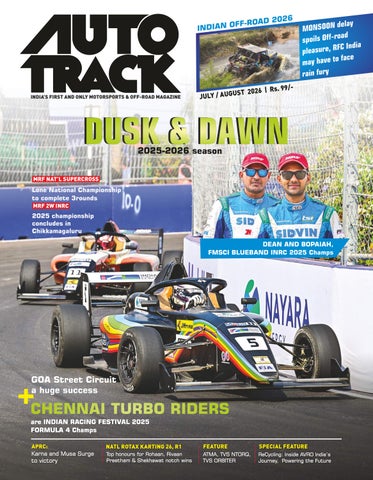
2025‑2026 season MRF NAT’L SUPERCROSS
Lone National Championship to complete 3rounds MRF 2W INRC
2025 championship concludes in Chikkamagaluru
DEAN AND BOPAIAH, FMSCI BLUEBAND INRC 2025 Champs
GOA Street Circuit a huge success
+CHENNAI TURBO RIDERS are INDIAN RACING FESTIVAL 2025 FORMULA 4 Champs APRC꞉ Karna and Musa Surge to victory
NATL ROTAX KARTING 26, R1
Top honours for Rohaan, Rivaan Preetham & Shekhawat notch wins
FEATURE
ATMA, TVS NTORQ, TVS ORBITER
SPECIAL FEATURE
ReCycling꞉ Inside AVRO India’s Journey, Powering the Future
16
th
www.autotrack.ind.in
EDITORIAL / IMPRINT
Hi,
IMPRINT
Editor S. Ashok Kumar Tiwari Concept and Design꞉ S. Ashok Kumar Tiwari
T
Staff Photographers꞉ Noorulla, KeshavaMurthy
After months of uncertainty and legal proceedings, the Blue Band FMSCI Indian National Rally Championship calendar has finally been announced. An apparent out‑of‑court settlement has brought much‑needed relief to competitors, teams and organisers, allowing preparations for the country's premier rally championship to move ahead.
Correspondent꞉ K. Manjunath Ghanshyam A Tiwari
he 2026 season got off to a delayed start as several National Championship promoter rights went under the hammer, resulting in a few major championships changing hands. However, with some calendars now falling into place, Indian motorsport is finally gathering momentum.
The first major highlight of the year was the FMSCI Annual Awards Ceremony, held in Bengaluru for the first time. The gala evening was a resounding success, reflecting the Federation's efforts to raise presentation standards closer to those of the FIA Awards while honouring the country's finest competitors, teams and officials.
There are encouraging developments beyond the domestic scene. The Ministry of Youth Affairs and Sports has stepped up efforts to bring more international motorsport events back to India. FMSCI President Arindam Ghosh and senior officials even missed the opening session of the Awards Ceremony to attend meetings in New Delhi with government representatives, sponsors and stakeholders. While several procedural and regulatory hurdles remain, the discussions have generated optimism. The prospect of Formula 1 and MotoGP returning to India in the coming years would provide a fresh lease of life to the Buddh International Circuit, under its new owners. India's only FIA Grade 1 circuit, had earlier hosted both F1 and MotoGP.
The big news is the two prominent championships. GodSpeed has retained the MRF Mogrip FMSCI Indian National Rally Championship for two‑wheelers, while Blue Band continues with the four‑wheeler Indian National Rally Championship. The JK Tyre Indian National Racing Championship has found a new promoter after the Madras Motor Sports Club (MMSC) lost its bid. The National Motorcycle Racing Championship has also changed hands and is expected to attract more manufacturers, while MMSC has responded by launching new two‑wheeler and four‑wheeler racing “National Challenge Series”.
The Indian Racing Festival returns with a six‑round calendar from September, continuing its successful city‑based format, while off‑road enthusiasts eagerly await the Rainforest Challenge India despite concerns over the delayed monsoon.
Four National championships of 2025, promoted with the backing of Mysuru‑ based, Vijayawada businessman are scrapped as the federation had to interfere to finish three of these four, last season.
With over 50 national championship rounds still to be run across the remaining 32 weekends, a few calendar clashes appear inevitable. Nevertheless, the season promises intense competition across disciplines.
As the engines roar into life across the country, we wish every competitor, organiser, official, volunteer and enthusiast a safe, successful and memorable motorsport season.
S. ASHOK KUMAR TIWARI Editor M꞉ +91‑9845296190 autotrack.editor@gmail.com
O1 autotrack.ind.in JULY / AUGUST 2026
Managing Editor꞉ Roopa A. Tiwari Sr. Correspondent꞉ S. Nithyanand
Gokul
Spl. Correspondent꞉ David Bodapati Western Region꞉ autotrack.west@gmail.com Mob꞉ 09757176958
Editorial Office꞉
Auto Track 7/3‑1, Lalitha Engineering Building, Subbanna Garden Main Road, Vijayanagar, Bangalore‑40 autotrack.editor@gmail.com www.autotrack.ind.in For Subscription, contact꞉ 9845296190
For Advertisement, E꞉ ashok.autotrack@gmail.com The Publisher makes every effort to ensure that the magazine’s contents are accurate. However, he accepts no responsibility of any effects arising therefrom. Printed at Raj Hans Enterprises, Rajajinagar Industrial Town, Bangalore‑560044. Published by S. Ashok Kumar Tiwari At # 7/3‑1, Lalitha Engineering Building, Subbanna Garden Main Road, Vijayanagar, Bangalore ‑ 560040
VOLUME 18, ISSUE 4
CONTENTS
58
July / August 2026
04 IRF GOA STREET CIRCUIT꞉ 04
4W INRC, RALLY OF HIGHLANDS꞉ 08
2W NRC, RALLY OF CHIKKAMAGALURU꞉ 14
4W INRC, RALLY OF MAHARASHTRA꞉ 18
DEAN INTERNATIONAL NEWS꞉ 24 IRF, FORMULA 4 FINALS꞉ 43
MRF NATIONAL SUPERCROSS꞉ 46
50 68
514
26꞉ ATMA
NATL, ROTAX KARTING, R1꞉ 49
28꞉ AVRO, RECYCLING JOURNEY
34꞉ NARAYANA’S CLASSIC CARS
IMSC ANNUAL OFF‑ROAD꞉ 50
35꞉ HYEGG
APRC, CHENNAI꞉ 54
2W NATL SPRINT FINALS꞉ 58
NATL AUTOCROSS 4W FINALS꞉ 60
20
22
54 16
62 46
11 30
40꞉ ETHANOL BLENDING
O2 autotrack.ind.in JULY / AUGUST 2026
64
08 44
56
56꞉ TVS ORBITER 57꞉ TVS NTORQ
IPONE Enters India's Premium Motorcycle Lubricant Market
J
apanese Heritage, Manga Boldness, and World‑Class Performance Now Available to Indian Riders Backed By Motul India
Podium for Naveen‑Musa pair
H
yderabad‑based rally driver Naveen Puligilla, along with seasoned co‑ driver Musa Sherif of Kasargod, secured a podium finish in the WRC3 category at the iconic Safari Rally Kenya 2026, the third round of the FIA World Rally Championship.
The Indian duo finished third in WRC3 class, and second in the African ARC3 class. They were placed 24th overall clocking a total time of 5 hours, 22 minutes, 17.9 seconds in the common field where higher‑class cars also competed.
Having qualified fourth after a series of fastest laps in the official practice session, 18‑ year‑old Chiranth, astride a TVS Apache RR 310, set a hot pace in Race‑1 to lead from the start. However, in the fifth of the eight‑lap race, he fell to P5 following a contact with another rider. But he recovered and overtook three riders in the last lap to post a fine win, his first in the championship.
Bengaluru racer Chiranth Vishwanath scripts history in Motegi, Japan
C
hiranth Vishwanath from Bengaluru scripted history winning a race at the iconic Mobility Resort Motegi racetrack in Japan recently as he finished the round 3 of the FIM A s i a R o a d R a c i n g Championship with a victory and a fourth‑place finish in the TVS Asia Championship category.
In Race‑2, Chiranth was in P2 until the last lap when he had another contact with fellow‑ rider which cost him two spots and he eventually finished fourth.
Motul India introduced IPONE to the Indian market, bringing the French premium lubricant brand's blend of performance engineering and bold rider c u l t u re to a fa st‑ e v o l v i n g generation of motorcyclists. This is not merely the introduction of a new product range. Inspired by J a p a n e s e c u l t u re, a 1 0 0 % motorcycle engine oil brand, IPONE enters the Indian market
NEWS
as a premium lifestyle choice for young riders who seek the perfect blend of style, speed, and performance, breaking the traditional perception of engine oils. This new range arrives backed by the industrial authority and pioneering legacy that have made Motul the global standard for performance. Taking its architecture from the judo belt progression system, the collection maps each tier to a specific level of riding intensity, from the everyday commute to the competitive track.
Royal Enfield brought its High‑Octane GRRR Nights X underground experience to Bengaluru
R
oyal Enfield's GRRR Nights x Underground arrived in Bengaluru, bringing together motorcycling, music and automotive subculture for a
high‑energy evening. The event delivered an immersive evening celebrating motorcycling and its subcultures, performance machines, music and expression.
Reflecting on the weekend, Chiranth said꞉ “It was a tough but good weekend for me. I had good pace through Race‑1 and though I lost position, I kept my cool to eventually win the race after I moved past three front‑ runners in the last lap. It was a good learning experience for me and I am grateful to TVS Racing, my sponsors and family for the support.” JULY / AUGUST 2026 autotrack.ind.in 03
04 autotrack.ind.in JULY / AUGUST 2026
INDIAN RACING FESTIVAL, GOA
Raoul Hyman and Alister Yoong Shine
Goa Street Circuit JULY / AUGUST 2026 autotrack.ind.in 05
Indian Racing Festival's
Goa Street Race Delivers High‑Octane Action
T
he inaugural Goa round of the Indian Racing Festival delivered edge‑of‑the‑seat racing as Raoul Hyman and Alister Yoong claimed victories in Round 4 at the Goa Street Circuit near Mopa International Airport. Race 1 (Driver A)꞉ Hyman Holds His Nerve at Home
Representing Goa Aces JA Racing, Raoul Hyman produced a composed drive to win Race 1 in 24꞉03.490, giving the home team a memorable triumph on 06 autotrack.ind.in JULY / AUGUST 2026
debut at the Goa street circuit.
Starting behind pole‑sitter Aqil Alibhai of Chennai Turbo Riders, Raoul Hyman of Goa Aces JA Racing seized the lead early and resisted sustained pressure throughout the race. Alibhai finished second in 24꞉06.800, just 3.310 seconds adrift, while Ishaan Madesh of Speed Demons Delhi completed the podium in 21꞉44.818 (The race was red flagged in the last minute of the 25 minutes scheduled and the results were
INDIAN RACING FESTIVAL, GOA
Bangalore completed the podium in 28꞉23.984.
Early on, pole‑sitter Gabriela Jilkova ran wide under pressure, allowing Shah to make a decisive move and trigger a reshuffle at the front. Despite Shah closing rapidly in the final laps, a late safety car neutralised the race and locked the order.
“When I saw Sohil in my mirrors, I knew I had to find a few extra tenths,” said Yoong. “Luckily, it was just enough to hold on.” Championship Impact
With a Race 1 podium via Madesh and a Race 2 win through Yoong, Speed Demons Delhi emerged as the biggest winners of the weekend and now lead the championship standings. Big Picture
reclassified as per the drivers positions on the track.)
A mid‑race red flag erased Hyman's 2.8‑second lead, but the Briton regrouped quickly after the restart to reassert control. Late drama involving Madesh and Tom Canning brought out another red flag, with results declared on the previous completed lap ‑ securing Madesh's podium finish.
The tight 2.064 km, 12‑turn street circuit; with limited run‑off and heavy braking zones; proved unforgiving and unpredictable. With identical machinery across the grid, the Goa round underlined that driver skill and racecraft are proving decisive.
.
“It's the home race for the team, and finally we could bring the win home for Goa Aces and Mr. John Abraham,” said Hyman. “Aqil pushed me the entire race; we were separated by tenths all weekend.” Race 2 (Driver B)꞉ Yoong Converts Pressure into Victory
Race 2 belonged to Alister Yoong of Speed Demons Delhi, who capitalised on early chaos to take the lead and secure victory in 27꞉50.811.
Starting further back, Sohil Shah of Kolkata Royal Tigers delivered one of the drives of the weekend, slicing through the field to finish second in 27꞉51.119, just 0.308 seconds behind Yoong. Ruhan Alva of Kichcha's Kings JULY / AUGUST 2026 autotrack.ind.in 07
The setback dramatically altered the complexion of the rally. Defending champion Karna Kadur and veteran co‑driver Musa Sherif sensed an opportunity and steadily reduced the deficit. By the end of Day One, Karna had moved to within a second of Dean, setting up a fascinating battle for second place while Aditya remained comfortably clear at the front.
Jason Saldanha and PV Srinivasa Murthy occupied fourth overall, while Bengaluru's Ritesh Guttedar completed the top five.
With only three cars contesting the premier INRC1 category, the overnight order mirrored the overall standings, with Aditya leading Dean and Karna.
Jason and Ritesh Spark an INRC2 Thriller
endured years of interrupted campaigns, near misses and unfulfilled promise. Indore finally provided the breakthrough moment.
Aditya Sets the Pace as Championship Battle Heats Up
With only two rounds remaining in the championship, much of the attention was focused on the title battle involving championship leader Dean Mascarenhas and defending champion Karna Kadur. The Arka Motorsports driver, Kadur, needed a strong result to keep his title hopes alive, while Dean's objective was to leave Indore with an unassailable championship lead.
Instead, the opening day belonged to Aditya Thakur.
The Himachal Pradesh driver, partnered by Virender Kashyap in the Team Sidvin India Racing Volkswagen Polo, immediately stamped his authority on the rally and opened a commanding lead of 1min 14.5sec over his more fancied rivals.
Aditya's pace on the opening loop left the field scrambling for answers as he dominated the 10 autotrack.ind.in JULY / AUGUST 2026
gravel stages and steadily extended his advantage.
Dean's day was considerably more eventful. Early technical issues restricted his progress before he launched a determined fightback during the
third stage. Just when it appeared that the championship leader was beginning to claw back time, disaster struck in the opening corner of the long fourth stage where a rear‑left puncture cost him over a minute.
If Aditya's dominance defined the overall rally, the INRC2 category delivered some of the closest competition of the weekend.
Bengaluru's Ritesh Guttedar and co‑driver Suraj M initially established the pace before Mangaluru's Jason Saldanha and
4W NATIONALS, INDORE
The battle continued into Sunday, with Jamwal beginning the day holding a slender two‑ second advantage. Vishakh responded in style, outperforming his rival in both remaining stages to reverse the deficit and secure victory by an equally narrow margin.
The Arka Motorsports pairing of Anushriya Gulati and Karan Aukta completed the podium after a measured and consistent performance.
Abhimanyu Sajeevan and Venunath V retained their overnight positions to finish fourth and fifth respectively.
.
veteran navigator PV Srinivasa Murthy fought back strongly in the longer stages.
The lead changed hands repeatedly as neither crew was willing to concede ground.
Guttedar struck back in SS3, only for Saldanha to respond emphatically in the final stage of the day and build a 14.4sec overnight advantage.
Behind them, Kerala's Fabid Ahmer and Milen George were locked in an absorbing contest with Delhi's Harkrishan Wadia and Kunal Kashyap. The battle remained unresolved until the closing stages of Day One when Wadia lost significant time, allowing Fabid to consolidate third position.
Philippos Matthai and Harish KN a l s o f e a t u re d p ro m i n e n t l y throughout the day, repeatedly threatening to enter podium contention before ending the leg within striking distance of the leaders.
The drama continued on the final day. Fabid and Milen mounted an inspired charge, setting the fastest times in both stages and reducing what had once been a sizeable deficit to just eight
seconds at the finish. Despite the late pressure, Jason and Murthy maintained their composure to secure victory for Arka Motorsports.
Fabid and Milen finished second, while Wadia and Kashyap completed the podium.
Vishakh Prevails After INRC3 Duel
The INRC3 category produced one of the most intriguing contests of the rally.
Chettinad Sporting's Vishakh B a l a c h a n d r a n o f Thiruvananthapuram and co‑ driver Chiranth Jain of Karkala appeared to have the category under control for much of the opening day. However, the Hamirpur‑Coimbatore pairing of Sheshank Jamwal and Raghuram Saminathan refused to allow the leaders any breathing space.
The lead swung repeatedly as penalties, stage times and changing conditions altered the order.
Vishakh appeared to lose momentum in the final stage of Day One after dropping time to Jamwal, but penalties handed to the latter ensured the contest remained finely poised.
JULY / AUGUST 2026 autotrack.ind.in 11
Anushriya Headlines Ladies Category
One of the standout perform‑ ances of the rally came from Anushriya Gulati.
The Dehradun driver was not only the class leader among the women competitors but was also firmly in contention within the overall INRC3 category throughout the event.
Partnered by Karan Aukta, Anushriya consistently featured among the quickest runners in her category and ended the rally as a deserving Ladies class winner.
Shillong's Phoebe Dale Nongrum secured second place after a steady drive, while Kottayam's Athira Murali overcame significant mechanical problems to complete the podium.
Athira's campaign was particularly unfortunate. Running strongly throughout the rally, she lost considerable time with driveshaft issues and later nursed the car through the final stage to secure a classified finish.
Young Chikkamagaluru driver Tarushi Vikram also impressed on home terrain and continued her encouraging season. Naveen's Misfortune Opens the Door in INRC3T
The INRC3T category looked firmly under the control of Hyderabad's Naveen Puligilla and Santosh Thomas.
The pair dominated the opening day and entered the final leg with an advantage exceeding three minutes.
Naveen further extended his lead by setting the fastest class time in the opening stage on Sunday and appeared certain to secure victory.
Motorsport, however, can often be unforgiving.
A mechanical failure in the final 12 autotrack.ind.in JULY / AUGUST 2026
stage brought the leading crew's challenge to an abrupt end and transformed the outcome of the category. Delhi's Baljinder Singh Dhillon and co‑driver Goutham CP capitalised on the opportunity to secure victory for R‑Tech Motorsports.
The Bengaluru pairing of Thejas Reddy and Ravindra Kumar inherited second place, while the retirement of the leaders remained one of the biggest disappointments of the week‑ end.
Earlier, Hyderabad's Jeet Jhabhak had shown tremendous pace in a newly developed Hyundai i20 N Line before a gearbox failure forced him out of contention.
Late Drama in Gypsy and Classic Categories
The FMSCI Gypsy Challenge also witnessed a dramatic reversal of fortunes.
Aneesh Sangma and Dinky Varghese appeared firmly on course for victory after building a commanding 44‑second advantage and remaining fastest through much of the rally.
The final stage, however, changed everything.
A costly delay saw the leaders surrender more than a minute, allowing Mohammed Kaif Khan and Jibran Ahmed to climb from second place and claim victory.
Local competitors Vinod Singh and Adithya Garg completed the podium after a consistent performance.
The Classic Challenge Cup proved more straightforward.
Bengaluru's Asool Albert John and Kodagu's Aiyappa Bopanna steadily extended their ove‑ rnight lead and secured a comfortable victory over the Snap Racing pairing of Siddhartha Santosh and Sawan Sathyanarayan.
4W NATIONALS, INDORE
Dean's Long Wait Finally Ends
Although Aditya Thakur and Virender Kashyap deservedly emerged as overall winners of the Rally of the Highlands, the defining image of the weekend belonged to Dean Mascarenhas and Gagan Karumbaiah.
Dean began the final day determined to protect his championship position rather than chase an unlikely overall victory. A fastest time in the opening stage helped strengthen his hold on second place before mechanical concerns slowed both Team Sidvin India Racing cars later in the day.
Team Sidvin India Racing, supported by MRF, completed a memorable weekend by securing both the rally victory through Aditya Thakur and the National championship through Dean Mascarenhas.
The Rally of the Highlands may have belonged to Aditya on the results sheet, but it will be remembered as the rally where Dean Mascarenhas finally became an Indian National Rally Champion.
.
Karna Kadur mounted a late charge to move ahead of Dean and claim second overall behind Aditya, with Dean ultimately settling for third place. It mattered little.
The podium finish was sufficient to secure Dean and Gagan their maiden Blueband Sports Indian National Rally Championship title with a round still remaining in the season.
For a driver who first captured national attention as a teenage prodigy and spent years searching for the right opportunity to fulfil his potential, the achievement represented one of the most satisfying championship victories in recent Indian rallying history.
JULY / AUGUST 2026 autotrack.ind.in 13
Anushriya Headlines Ladies Category
One of the standout perform‑ ances of the rally came from Anushriya Gulati.
The Dehradun driver was not only the class leader among the women competitors but was also firmly in contention within the overall INRC3 category throughout the event.
Partnered by Karan Aukta, Anushriya consistently featured among the quickest runners in her category and ended the rally as a deserving Ladies class winner.
Shillong's Phoebe Dale Nongrum secured second place after a steady drive, while Kottayam's Athira Murali overcame significant mechanical problems to complete the podium.
Athira's campaign was particularly unfortunate. Running strongly throughout the rally, she lost considerable time with driveshaft issues and later nursed the car through the final stage to secure a classified finish.
Young Chikkamagaluru driver Tarushi Vikram also impressed on home terrain and continued her encouraging season. Naveen's Misfortune Opens the Door in INRC3T
The INRC3T category looked firmly under the control of Hyderabad's Naveen Puligilla and Santosh Thomas.
The pair dominated the opening day and entered the final leg with an advantage exceeding three minutes.
Naveen further extended his lead by setting the fastest class time in the opening stage on Sunday and appeared certain to secure victory.
Motorsport, however, can often be unforgiving. A mechanical failure in the final
12 autotrack.ind.in JULY / AUGUST 2026
stage brought the leading crew's challenge to an abrupt end and transformed the outcome of the category.
Delhi's Baljinder Singh Dhillon and co‑driver Goutham CP capitalised on the opportunity to secure victory for R‑Tech Motorsports.
The Bengaluru pairing of Thejas Reddy and Ravindra Kumar inherited second place, while the retirement of the leaders remained one of the biggest disappointments of the week‑ end.
Earlier, Hyderabad's Jeet Jhabhak had shown tremendous pace in a newly developed Hyundai i20 N Line before a gearbox failure forced him out of contention. Late Drama in Gypsy and Classic Categories
The FMSCI Gypsy Challenge also witnessed a dramatic reversal of fortunes.
Aneesh Sangma and Dinky Varghese appeared firmly on course for victory after building a commanding 44‑second advantage and remaining fastest through much of the rally.
The final stage, however, changed everything.
A costly delay saw the leaders surrender more than a minute, allowing Mohammed Kaif Khan and Jibran Ahmed to climb from second place and claim victory.
Local competitors Vinod Singh and Adithya Garg completed the podium after a consistent performance.
The Classic Challenge Cup proved more straightforward.
Bengaluru's Asool Albert John and Kodagu's Aiyappa Bopanna steadily extended their ove‑ rnight lead and secured a comfortable victory over the Snap Racing pairing of Siddhartha Santosh and Sawan Sathyanarayan.
4W NATIONALS, INDORE
Dean's Long Wait Finally Ends
Although Aditya Thakur and Virender Kashyap deservedly emerged as overall winners of the Rally of the Highlands, the defining image of the weekend belonged to Dean Mascarenhas and Gagan Karumbaiah.
Dean began the final day determined to protect his championship position rather than chase an unlikely overall victory. A fastest time in the opening stage helped strengthen his hold on second place before mechanical concerns slowed both Team Sidvin India Racing cars later in the day.
Team Sidvin India Racing, supported by MRF, completed a memorable weekend by securing both the rally victory through Aditya Thakur and the National championship through Dean Mascarenhas.
The Rally of the Highlands may have belonged to Aditya on the results sheet, but it will be remembered as the rally where Dean Mascarenhas finally became an Indian National Rally Champion.
.
Karna Kadur mounted a late charge to move ahead of Dean and claim second overall behind Aditya, with Dean ultimately settling for third place. It mattered little.
The podium finish was sufficient to secure Dean and Gagan their maiden Blueband Sports Indian National Rally Championship title with a round still remaining in the season.
For a driver who first captured national attention as a teenage prodigy and spent years searching for the right opportunity to fulfil his potential, the achievement represented one of the most satisfying championship victories in recent Indian rallying history.
JULY / AUGUST 2026 autotrack.ind.in 13
Tanveer regains crown with dominant victory in last round MRF Mogrip FMSCI National Rally Championship concludes
14 autotrack.ind.in JULY / AUGUST 2026
2W RALLY NATIONALS
M
ultiple National champion Abdul Wahid Tanveer of Mysuru scripted a memorable comeback becoming the overall National champion in the 2025 MRF Mogrip FMSCI National Rally Championship for two‑ wheelers.
After narrowly missing out on the championship in 2024 by just three points, Tanveer won the Rally of Chikmagalur, the final round to clinch the 2025 National Championship.
The 2025 crown further strengthens Tanveer's reputation as one of India's most versatile motorcycle racers. His achievements across disciplines include overall FMSCI Indian National Rally Championship (2W) titles in 2021 and 2023, the National Supercross Championship in 2016, and National titles in two classes in the inaugural FMSCI Dirt Track Nationals in 2023.
Representing Petronas TVS Racing, the former National champion delivered a flawless performance at the season‑ ending round, topping the timesheets in all seven special stages to secure a dominant victory and reclaim the crown he last held earlier in his career. The 35‑year Tanveer
Promoted by God Speed and organised by the Motor Sports Club of Chikmagalur (MSCC), the championship finale was held on the outskirts of Chikmagalur and featured the Palya and Vasant Cool stages, which competitors tackled multiple times across the day.
Tanveer completed the rally with a comfortable 19sec advantage over teammate Samuel Jacob, while defending champion Rajendra RE recovered from a crash in SS4 to finish third, another 20sec behind. Hero MotoSports rider Arun T of Tumakuru was fourth, over 1min 19sec adrift of the winner, while Petronas TVS Racing's Imran Pasha completed the overall top five. JULY / AUGUST 2026 autotrack.ind.in 15
category, Devraj Venkatesh was equally impressive. The VM Motorsports rider topped six of the seven stages to secure a comfortable victory. Guwahati's Chandan Kumar M finished second, over a minute behind, while Hubballi's Chetan Hosatti claimed third place. Syed Asif Overcomes Mechanical Trouble
The Scooter class (up to 210cc) appeared firmly under the
Petronas TVS Racing Sweeps Premier Category
The Super Bike Pro Expert class (up to 500cc) mirrored the overall classification, with Tanveer leading home teammates Samuel Jacob and Rajendra RE in a commanding one‑two‑three finish for Petronas TVS Racing.
Nataraj R of VM Motorsports, the sole entrant in the Super Bike Expert class (up to 500cc), comfortably topped the category and finished an impressive eighth overall.
Bharath edges out Nithyan in Supersport upto 165 class
The Supersport up to 165cc category produced an entertaining battle between VM Motorsports teammates Bharath L and Nithyan L.
Bharath laid the foundation for victory by setting the fastest times in four of the seven stages and eventually secured the class win by 12sec. Nithyan, who dominated the final three stages, finished second, while Shivamogga privateer Dheeraj H claimed third place.
16 autotrack.ind.in JULY / AUGUST 2026
The Supersport 165‑260cc class saw Hero MotoSports rider Arun T emerge victorious after setting the pace through all the Palya stages and the final run through Vasant Cool. Petronas TVS Racing's Imran Pasha, still recovering from injuries sustained in the previous round, fought bravely to finish second, 12sec behind. Hero MotoSports rider Karan Kumar completed the podium, while TVS Racing teammates Banteilang Jyrwa and Sachin D rounded out the top five. Hemanth and Devraj Dominate Bigger Capacity Classes
VM Motorsports enjoyed further success in the larger‑capacity categories.
Bengaluru rider Hemanth M produced one of the most dominant performances of the rally in the Supersport 260‑460cc class. Fastest in every stage, he built a margin of more than three minutes over local rider Puneeth KS, while another Bengaluru rider, Vijay Kumar M, completed the podium. In the Super Stock 260‑450cc
2W RALLY NATIONALS
control of Petronas TVS Racing's Syed Asif Ali from the outset.
Despite suffering silencer issues and eventually running the final two stages with a detached exhaust, the Bhopal rider managed his advantage carefully and held on for victory.
Teammate Karthik N finished second, 13sec behind, while Bengaluru privateer Goutham N completed the podium despite finishing over five minutes adrift.
Somyya Seals Women's Victory
Hero MotoSports rider Somyya Chaudhary delivered one of the most convincing performances of the event in the Women's category.
Fastest in six of the seven stages, Somyya steadily built an advantage that eventually exceeded two minutes. Petronas TVS Racing's Aishwarya Pissay struggled with handling issues throughout the day and had to settle for second place despite her vast experience and proven pace. Navaneeth Leads VM Success in Super Stock
Puducherry's Navaneeth Kumar added another victory to VM Motorsports' tally by winning the Super Stock 165‑260cc category in a total time of 57min 55.563sec. Jagadeesh G of Coimbatore finished second, 1min 42sec behind, while Bengaluru's
Pradeep C completed the podium. Jeevanandham D and Jayson Joy rounded off the top five.
Darpan Shines in Star of Karnataka
The Star of Karnataka category provided local fans with plenty to cheer about.
Shivamogga's Darpan Darshan secured victory with a margin of over one minute. Toufiq Azam Basha of Bhadravathi finished second, while Bengaluru's Vishwas SD marked his return to competition after nearly five years with an encouraging podium finish.
Local riders Krithin Naveen and Mohammed Ajaruddin completed the top five. Tanveer's Moment of Redemption
While several riders celebrated class victories at Chikmagalur, the day ultimately belonged to Abdul Wahid Tanveer.
After enduring the heartbreak of losing the 2024 championship by the narrowest of margins, the Mysuru rider returned in 2025 with renewed determination. His performance in the season finale left little room for doubt.
Fastest in every stage, winner of the rally, and crowned National champion once again, Tanveer's triumph at Chikmagalur was a fitting conclusion to one of the most‑competitive seasons in recent years.
.
JULY / AUGUST 2026 autotrack.ind.in 17
Dean Mascarenhas signs off with commanding victory in Maharashtra Rally Blueband Sports concludes rally season on a successful note
18 autotrack.ind.in JULY / AUGUST 2026
4W RALLY NATIONALS, NASHIK JULY / AUGUST 2026 autotrack.ind.in 19
T
he Blueband Rally of Maharashtra, the sixth and final round of the FMSCI Blueband Indian National Rally Championship (INRC) 2025, brought the curtain down on a dramatic season with a challenging three‑day event held on the outskirts of the holy town of Trimbakeshwar. Featuring two major changes to the traditional format — a tarmac surface and an extended three‑day schedule — the rally tested crews with a blend of high‑speed precision driving and technical stage management and concluded in March 2026.
The rally opened with a 2.1‑km Super Special Stage designed primarily for spectators. Run in reverse order, the compact stage ensured edge‑of‑the‑seat action until the very last car crossed the finish line as top contenders took 2O autotrack.ind.in JULY / AUGUST 2026
the run only towards the end.
Defending champions Karna Kadur and Musa Sherif immediately stamped their authority on the event by setting the fastest time on Day One. Mangaluru's Jason Saldanha and Bengaluru's co‑driver PV Srinivasa Murthy, competing in the INRC2 category, surprised many by clocking the second‑ fastest overall time. Aditya Thakur and Virender Kashyap, winners of the previous round, slotted into third place less than a second behind.
Harkrishan Wadia and Kunal Kashyap ended the opening leg in fourth while Fabid Ahmer and Milen George rounded out the top five. Newly‑crowned National champions Dean Mascarenhas and Gagan Karumbaiah adopted a cautious approach on the opening evening, avoiding unnecessary
risks to finish sixth overall.
Jeet Jhabhak and Sekhar V topped the INRC3T category and finished seventh overall, remaining within the competitive one minute and fifty second band from the leaders. Vishakh Balachandran and Chiranth Jain led the INRC3 category while Anushriya Gulati topped the Ladies class at the end of Day One.
The real challenge, however, awaited competitors on Day Two when crews tackled two loops of three Special Stages covering 71.64 km of highly technical and extremely fast tarmac roads.
Dean's Charge Turns the Rally Around
The second day completely transformed the complexion of the rally. Dean Mascarenhas began attacking from the very first stage, immediately cutting
into the five‑second deficit he carried overnight. While Dean was setting the pace, his Team TSI Racing teammate Aditya Thakur crashed out dramatically within the opening 2 kilometres of the stage after sliding nearly 200 metres into a culvert, damaging the car beyond repair.
Karna Kadur then lost crucial time in the Karoli stage, where he was over 12 seconds slower than Dean. The momentum of the rally shifted decisively thereafter. Dean continued to dominate the remaining stages while Karna struggled to regain rhythm, allowing the Mangaluru driver to steadily consolidate his advantage. By the end of Day Two, Dean and co‑driver Gagan Karumbaiah had built a commanding lead of nearly 93 seconds over Karna, who nevertheless managed to retain second place overall.
4W RALLY NATIONALS, NASHIK
Jason Saldanha's Charge Ends in Heartbreak
The INRC2 category witnessed one of the most dramatic stories of the rally. Jason Saldanha and PV Srinivasa Murthy, driving for Arka Motorsports, began the day brilliantly after ending Day One second overall. The pair stunned the field in the short Karoli stage by clocking an incredible 6min 05.9sec, over 12 seconds quicker than the benchmark time set by the reigning champions.
However, their championship hopes suffered a massive blow when a puncture in SS4 cost them nearly four minutes. Although the pair fought back strongly to finish the day in fourth overall and collect valuable leg points, the lost time proved impossible to recover.
before a puncture in SS4 significantly dented his championship challenge.
Fierce Battles Across Categories
In INRC3, Abhimanyu Sanjeevan appeared unstoppable for most of the day, steadily increasing his advantage stage after stage before suffering setbacks in the final stage. Meanwhile, Abin Rai and Vishakh Balachandran engaged in one of the closest battles of the rally, frequently exchanging stage honours across the six tests. Champion‑
ship leader Vishakh, along with co‑driver Chiranth Jain, eventually ended the day with a healthy 49‑second advantage over Abin Rai and Jasheer Moideen. Kottayam pair Athira Murali and Arun Chakkalaykal held third position.
The INRC3T category saw Jeet Jhabhak dominate proceedings after an early challenge from Tejas. From SS3 onward, Jeet controlled the rally and finished Day Two with a lead of over one minute and forty seconds. Naveen Puligilla, Baljinder Singh
and Thejas Reddy remained locked in a close battle for the remaining podium positions.
In the Junior INRC standings, Abin Rai and Tarushi Vikram occupied the top two positions, while the Ladies category saw Athira Murali lead Tarushi after a dramatic sequence of incidents involving Anushriya Gulati and Phoebe Nongrum. Anushriya retired early while Phoebe lost t i m e af t e r a c ras h , b ri e fly allowing Tarushi into the lead before Athira fought back strongly in the final stage .
Harkrishan Wadia was also climbing steadily through the order before crashing out in SS4. Delhi's Philippos Matthai, who had been shadowing him closely throughout the stages, inherited the position and produced a composed drive to hold third overall by the end of the day.
Another noteworthy performance came from Bengaluru's Pragathi Gowda, who impressed with remarkable consistency to place fifth overall and third in class, just three seconds behind a resurgent Daraius Shroff. Fabid Ahmer too was making steady progress
JULY / AUGUST 2026 autotrack.ind.in 21
emerged as one of the rally's biggest revelations. Driving maturely and avoiding unnecessary risks, the Arka Motorsports pair comfortably retained third place overall after beginning the final day with a healthy margin.
Mumbai's Daraius Shroff and Bengaluru's Arjun Dheerendra mounted a determined final‑day charge for the podium. Although they gained time in all three stages, the Chettinad Sporting pair ultimately fell short by just four seconds.
The day proved particularly punishing for the Gypsies and Classic Cars, with multiple mechanical failures forcing several retirements.
Champions Finish in Style
With a substantial lead heading into the final day, Dean Mascarenhas and Gagan Karumbaiah focused primarily on bringing the car home safely. The newly‑crowned National champions from Team TSI Racing, supported by Sidvin and MRF, executed the strategy perfectly while still extending their lead by another 30 seconds to seal a dominant victory in the Rally of Maharashtra. Having already secured the National title at Indore a month earlier, Dean and Gagan's victory in Maharashtra provided the perfect finish to a memorable championship‑winning campaign.
Multiple National champions Karna Kadur and Musa Sherif, representing Arka Motorsports with MRF backing, were unable to defend their crown and eventually settled for second place, over three minutes behind the winners. Delhi's Philippos Matthai and Bengaluru co‑driver Harish KN 22 autotrack.ind.in JULY / AUGUST 2026
Pragathi Gowda and Chandramouli, supported by Sidvin and MRF and representing Chettinad Sporting, delivered one of the standout performances of the rally by finishing fifth overall in a field of 32 cars, matching pace with many of the leading male competitors. Jason Saldanha and PV Srinivasa Murthy eventually finished sixth overall.
INRC2 Title Goes to Jason and Murthy
The INRC2 category remained fiercely contested till the very end. Philippos Matthai and Harish KN entered the final day with an 18‑second advantage over Daraius Shroff and Arjun Dheerendra, who attacked relentlessly but eventually finished four seconds short. Pragathi Gowda and Chandramouli completed the podium.
Vishakh and Chiranth Crowned INRC3 Champions
Chettinad Sporting celebrated success in INRC3 as Thiruvananthapuram‑born Vishakh Balachandran and co‑ driver Chiranth Jain of Karkala drove a composed rally to clinch both the class victory and the National title.
Privateers Abin Rai and Jasheer Moideen retained second place while Tarushi Vikram and Vybhav Mukund completed the podium. Abhimanyu Sajeevan finished fifth behind Ashwin Pugalagiri.
Jeet Jhabhak Wins the Battle, Naveen Puligilla Takes the Crown
The INRC3T category produced a fascinating championship conclusion. Jeet Jhabhak and Sekhar V gave JA Motorsports a memorable class victory, but it was Hyderabad pair Naveen Puligilla and Santosh Thomas of Chettinad Sporting who secured the season championship with a second‑place finish.
Bengaluru's Thejas Reddy and SSB Arjun of Snap Racing completed the podium, while Baljinder Singh Dhillon and
Goutham CP narrowly missed out by a single second.
Tarushi Vikram Claims Ladies National Title
The Junior INRC positions remained unchanged on the final day as Abin Rai and Jasheer Moideen secured the Junior INRC title. Tarushi Vikram and Vybhav Mukund finished second.
The Ladies category battle went right down to the wire, with young Tarushi Vikram emerging as National champion in her debut full season. The Chikkamagaluru driver overcame stiff competition from Shillong's Phoebe Nongrum Dale and Athira Murali, one of the breakout performers of the year, whose campaign was disrupted by a puncture and subsequent mechanical trouble.
4W RALLY NATIONALS, NASHIK
Despite their setback earlier in the rally, Jason Saldanha and PV Srinivasa Murthy did enough with a steady fourth‑place finish to secure the INRC2 championship, thanks largely to the valuable points cushion they had built during earlier rounds of the season.
Classic and Gypsy Categories
In the Classic Challenge, Siddhartha Santosh — who had already secured the championship with a round to spare — skipped the finale. Satish P of Bengaluru and KR Rishikesh of Thrissur emerged as the winners and the only classified finishers after recovering from a Day Two retirement.
The Gypsy category saw Bengaluru pair Sanjay Agarwal and Dheeraj Manae end the season on a high by winning the final round and securing the overall honours in the category.
.
JULY / AUGUST 2026 autotrack.ind.in 23
INTERNATIONAL NEWS
played an important role in finishing cleanly and maximising mileage. Support from PH Sport, whose experience at the highest level, helped keep the step up in fine fettle.
Dean & Gagan
finish 7th in WRC3 debut at Rally Islas Canarias
I
ndian rally champions Dean Mascarenhas and co‑driver Gagan Karumbaiah successfully completed their maiden FIA World Rally Championship, finishing 7th in the WRC3 class debut at the 50th edition of Rally Islas Canarias 2026, completing one of the season's most demanding all‑ asphalt events in the WRC. Driving a Ford Fiesta Rally3, prepared by PH Sport, the Indian duo made a memorable debut and used the event as a crucial learning exercise on fast, technical and unfamiliar European tarmac stages. This is the first event on the world stage with TSI Racing, which gave them
24 autotrack.ind.in JULY / AUGUST 2026
a platform after they won the Indian National Rally Championship in 2025. Competing along with higher‑ powered cars in the Premier Classes, the Indian duo finished overall 48th and 7th in their class, the WRC3 class.
The rally, based in Gran Canaria, featured 18 special stages presenting a steep challenge for a crew making its first appearance in WRC3 at this level. Despite brake issues on the opening day, Mascarenhas and Karumbaiah worked through the problem, adapted across the remaining stages and steadily built confidence through the weekend to successfully finish
the rally clocking 03h 41m 50.6sec for a little over 301.3 competitive kilometres, including a 10‑min penalty.
For Mascarenhas, the result was about much more than times alone. Every loop offered a reference point in car setup, stage management, tyre usage and pace‑note execution, while also underlining the precision required to compete in international Rally3 machinery on sealed‑surface rallies. With no experience at this level, Karumbaiah used the pace notes training to show composure and
“It's been a challenging weekend, with tricky conditions, rain in parts, and changing grip levels making it difficult to settle into a rhythm on the first day. We overcame brake issues and settled down, and on Saturday the focus has been on regrouping and learning as much as possible from every kilometre. Every stage taught us something new. Overall, it has been a tremendous experience and a valuable learning curve,” said Dean Mascarenhas. “This outing marks an important step for TSI Racing as it returns to the WRC arena after 18 years, and we want to continue the long‑term effort to place Indian talent on the international rally stage. For Dean and Gagan, Rally Islas Canarias was a first chapter as they prepare for the grind into the season. It is a demanding debut that delivered exactly what the programme was designed for꞉ experience, perspective and a stronger foundation for future WRC3 appearances,” said Mohan Nagarajan, Chairman and Managing Director of Sidvin Energy Engineering, who put together the whole package.
.
Pune hosts inaugural edition of Drift ‘N’ Drunch
F
ormula Karting, a part of Prasuk Jain Hospitality, successfully hosted the inaugural edition of Drift 'N' Drunch x Pune Karting Cup, bringing together racers, motorsport enthusiasts, families and lifestyle seekers for a unique two‑day celebration of speed, entertainment and community at Formula Karting, Pune. The championship witnessed outstanding performances across all categories. In the Under‑12 category, Rudra Bartakke emerged as the winner,
while Mohil Chaudhari secured the runner‑up position and Siddharth Bhanushali finished as the second runner‑up. In the Under‑60 kg category, Kunal Desai claimed the championship title, followed by Ved Chitgopekar as runner‑up and Nehem Boyles as second runner‑ up. In the Above‑60 kg category, Nitish Chaudhari was crowned the winner, with Aadyant Almal securing the runner‑up position and Devnath Yadavrai finishing as the second runner‑up. The event combined the competitive spirit of the Pune Karting Cup Championship with the vibrant atmosphere of Drift 'N' Drunch, creating a first‑of‑ its‑kind motorsport lifestyle festival in the city. Participants competed across four categories Under 12, Under 60 KG, Above 60 KG, and Corporate for a total prize pool of 1.2 lakh, while spectators enjoyed a packed schedule of racing action, entertainment, live DJs, food experiences, gaming activation and community engagement. The championship followed a structured format comprising qualifying rounds, elimination heats and finals, ensuring competitive racing throughout the weekend. Adding to the excitement were appearances by accomplished racing drivers Sai Shiva Sankaran and Akshat Misra, who interacted with participants and shared their racing expertise.
Indian rider Johann Emmanuel wins QSTK600 championship in Qatar
I
ndia's Johann Emmanuel, astride a Kawasaki ZX‑6, scripted history by becoming the first from his country to win the coveted Qatar Superstock 600 Championship (QSTK) by winning both the races in the postponed final round here on Friday to provide a grand climax to his debut season in this class. The 19‑year‑old Chennai‑based Johann, trailing championship leader Marton Belleli from Hungary by nine points going
into the weekend's double‑ header, needed to win both races to seal the title and he delivered in a stunning fashion.
Qualifying second, Johann, won both races, withstanding immense pressure to clinch the championship with a 21‑point advantage. He finished the season with six wins out of 10 races, having endured a 200 Kmph crash and three retirements due to mechanical issues.
.
.
Indian riders at the launch of the IPONE Young riders choose brands that reflect both their performance expectations and their identity. With IPONE, Prominent Indian riders
NEWS
participating abroad and India from the two wheelers fertinity were part of the launch. IPONE e n t e r e d I n d i a’s P r e m i u m Motorcycle Lubricant Market.
.
Malaysia is a premier travel destination celebrated for its vibrant cultural melting pot (Malay, Chinese, and Indian influences), stunning tropical landscapes, and incredible food scene. From bustling urban hubs to serene rainforests and beaches, the country offers a diverse array of experiences for every type of traveler.
We have been invited by the
Malaysian government and tourism department to explore the beauty of their country. Under Tourism MALAYSIA 2026, the government is promoting its tourism around the world. I had the opportunity to visit and explore a few places recently. Also attended their music festival, RAIN RAVE 'WATER MUSIC FESTIVAL' AT MEGAFAM AT KUALA LUMPUR.
.
JULY / AUGUST 2026 autotrack.ind.in 25
26 autotrack.ind.in JULY / AUGUST 2026
ATMA, TYRE SAFETY JULY / AUGUST 2026 autotrack.ind.in 27
From Waste to Wealth꞉
Inside Avro India's Journey
I
n 2002, Sushil Kumar Aggarwal walked into the plastics business with no experience, no technical knowledge, and no blueprint. What he did have was a lifetime of entrepreneurial instinct, forged across 15 ventures, from bicycle parts and home appliances to building India's largest private‑sector LPG bottling plant in the early 1990s. He also had an unconventional idea꞉ to manufacture plastic furniture entirely from recycled material.At the time, the concept had no precedent in India. The organised plastic furniture
28 autotrack.ind.in JULY / AUGUST 2026
market was dominated by a handful of established players; Nilkamal, Supreme, Cello, National, all manufacturing from virgin plastic. The idea that recycled plastic could produce furniture of comparable quality, aesthetics, and durability was met with scepticism. Aggarwal started with a single injection moulding machine, an investment of approximately INR 1.5 crore, and a production capacity of just 25,000 to 30,000 pieces per month, operating out of a modest facility in Ghaziabad.By sourcing recycled plastic at a fraction of the cost of
Founder Sushil Kumar Aggarwal
virgin polymer, Avro was able to price its products up to 40 per cent lower than national brands, while offering dealers higher margins. For example, a chair that a competitor sold for INR 400‑500 could be purchased from Avro at INR 150, without any compromise on colour, finish, or structural integrity. The dealers responded immediately. Within a single year, Avro expanded from one machine to ten, setting up manufacturing across three locations. The company never looked back.Today, Avro India Limited is listed on both the NSE and BSE
under MSME segment, operating with a production capacity of over 20,000 pieces per day, and offering more than 300 product SKUs spanning chairs, tables, cabinets, and stools designed for both indoor and outdoor use. The company serves over 8,000 pin codes across 24 states through a distribution network of 30,000‑ plus retailers and 300‑plus distributors, one of the largest in the Indian plastic furniture industry. Avro was also the first company in the recycled plastic furniture segment to offer a three‑year product guarantee, a
cost efficiency and distribution reach. It is this relentless pursuit of cost leadership through recycling that has defined Avro's journey. The Founder's Story꞉ In Conversation with Sushil Kumar Aggarwal Sushil Kumar Aggarwal does not speak like a corporate chairman. His story is not curated for investor decks; it is lived, and it shows. In a candid conversation, Aggarwal takes us through his journey, from the streets of his childhood to building one of India's most distinctive plastics enterprises. Q꞉ Your personal story is central to the Avro narrative. Take us back to where it all began. A꞉ I think my entrepreneurial instinct was born out of necessity. When you grow up in a household where every rupee counts, you do not sit around thinking about what career to pursue — you start figuring out how to create value from whatever is in front of you. That is what I did. At 13, I was already working in my father's bicycle parts shop — not just helping, but thinking about how to do it better, how to reach more customers, how to grow. By 14, I had taken over the entire business and started expanding it across South India on my own.That early experience taught me something that no classroom ever could꞉ business is
SPECIAL FEATURE ‑ RECYCLING
move that reinforced consumer confidence and set a new benchmark in the market.What makes Avro structurally different from its competitors is not just pricing, it is the entire operating model. While most furniture manufacturers purchase ready‑ made polymer granules from petrochemical companies, Avro processes its own raw material in‑house, sourcing post‑ consumer and industrial plastic waste, over 12 different types including cement bags, salt bags, agricultural films, rigid scrap, and contaminated packaging, and converting it into high‑grade recycled granules. This vertical integration gives the company significant insulation from virgin polymer price volatility, which is directly linked to global crude oil
markets, and allows it to maintain consistent margins even during periods of commodity instability.The Indian plastics industry, of which Avro is a part, is one of the country's most dynamic manufacturing sectors. Valued at approximately USD 44 billion in 2025, the industry is projected to reach USD 60 billion by 2030, driven by rising demand across packaging, automotive, healthcare, infrastructure, and consumer goods. India's plastics sector comprises over 30,000 processing units, employs more than 5 million people, and exports to over 200 countries. Government initiatives such as Make in India, Production‑ Linked Incentive schemes, and dedicated Plastic Parks are channeling fresh capital into the sector, while India's relatively low per capita plastic consumption, approximately 11 kg compared to over 30 kg in the United States signalling a huge scope for growth.Within this expanding landscape, the plastic furniture segment has evolved from a commodity category into a competitive, brand‑conscious market. However, the segment remains largely price‑driven, with hundreds of small and mid‑ sized manufacturers operating with limited compliance and lower overheads. For an organisation like Avro, the competitive environment demands constant innovation in
not about qualifications or capital. It is about understanding what people need, finding a way to deliver it, and having the courage to keep going when everyone around you says it cannot be done. Every business I have built since — whether it was LPG bottling, computers, bicycle rings, corrugated sheets, or plastic furniture — has followed the same principle. I enter a sector where I see a gap, I figure out a way to fill it at a lower cost or with a better model, and I scale it as fast as I can. That formula has not changed in five decades. What has changed is the size of the opportunity. Q꞉ Before Avro, you built India's largest private‑sector LPG bottling plant in the early 1990s. Tell us about that. A꞉ That was the turning point in 1993‑94, right after Manmohan Singh's liberalisation. LPG bottling had been entirely government‑controlled, and suddenly the private sector was allowed in. I was barely in my twenties with maybe INR 15 lakhs in the bank. The cost of setting up the plant was several crores.I went to the State Financial Corporation for a loan. They refused. They said this is a new sector, private LPG bottling is unheard of, we cannot fund you. So I funded it myself. I released advertisements in newspapers, called up potential dealers across the country, and said — join hands with me, I am
The next generation is building on process, patience, and strategic clarity. His two sons — Nikhil Aggarwal, the elder, and Sahil Aggarwal, the younger
JULY / AUGUST 2026 autotrack.ind.in 29
and waited. When they saw me growing — ten machines in one year, three locations — then they said, oh, it actually works. That is how I accidentally created a 5,000 crore ecosystem in recycled plastic furniture across the country. More than a hundred units are operating today because of what we started.
Q꞉ How do you compete with large corporations who use 100 per cent virgin plastic while you use recycled material?
building India's largest private‑ sector LPG bottling plant in Bangalore. People believed in me. Each dealer gave a deposit of one lakh per dealership. Between that and my savings, I built the plant.It became a real success. I crossed crores in my bank account for the first time. But then problems started — government agencies were not forthcoming with gas supply, oil companies were not supporting transportation, and consistency became very poor. We faced a choice꞉ cheat customers by short‑filling cylinders, or get out. My father said — you made your money, leave with your integrity. So we sold the plant to Shakti LPG in Hyderabad at a premium. That taught me the most important lesson꞉ never 30 autotrack.ind.in JULY / AUGUST 2026
compromise your customer's trust, even if it means walking away from a profitable business. Q꞉ In 2002, you entered plastics with no experience. What gave you the confidence? A꞉ Honestly, the belief that I could figure it out. I had zero idea what plastic furniture was — how it was made, what machines were needed, nothing. But I saw that the only players were large corporations selling at high margins with virgin plastic. I thought — what if I could use recycled plastic and deliver the same product at half the price? Nobody had done it. People said it would not work. For the first two years, the industry watched
A꞉ Two things. First, the large corporations have huge markups. They do not compromise on their profitability. I am volume‑driven. I believe the volume game is something I will win very easily. Second — and this is the real edge — my raw material cost is fundamentally different from theirs. Their costs are tied to global crude oil prices and polymer markets. Mine is tied to plastic scrap, which costs a fraction and does not fluctuate the same way. Even when international markets are volatile — dollar movements, polymer price swings — we are insulated. The scrap price remains almost flat. So our margins are protected. We also give credit to our dealers. We do not take advances. We offer dealerships with zero investment — anybody, anywhere in the country can join. My confidence is this꞉ when I am giving a product that is so reasonably priced, with great quality and service that nobody else can match, the person getting associated with us will not want to cheat us. It is their livelihood. They will protect the relationship. That is the foundation of our 30,000‑dealer network across 24 states. Q꞉ You are called the 'Daddy of Plastics.' How did that come about?
A꞉ The industry gave me that name. I have been National President of the All India Plastic Moulded Furniture Manufacturers Association from the day it was incorporated, and they insist I remain because they say I understand the ecosystem better than anyone and I share ideas and technology openly, which most people do not do. When I started using recycled plastic to make furniture 24 years ago, people did not believe it would work. For a couple of years they watched. When they saw me growing, they said — oh, it actually works. And they followed. I trained them, gave them technology, even gave some of them money and support. I did not hold anything back. Because of that, an entire ecosystem was born. I created the wave. And I am proud of that. Q꞉ Beyond business, you are deeply involved in community work. What drives that commitment?
A꞉ Girl‑child education is my priority. I support over 100 schools, I personally fund 50 per cent of school fees for any underprivileged girl from any standard up to 12th. For poor girls getting married anywhere in India, we provide four chairs and a table free of cost. I have also started rehabilitating jail convicts. I visit prisons, pay bail for those who cannot afford even INR 5,000, and offer them jobs in my company. These people will never get another chance otherwise. I want to give them that chance. I have pledged all 36 of my donatable organs, including my entire body, and have helped more than five lakh people across India make similar pledges. Within my own company, I pay 50 per cent of school fees for all 400 employees' children from my personal salary. Women make up 30 per cent of our workforce
I also go to over 40 colleges every year, mentoring students, training young entrepreneurs. I have addressed over five lakh people as a motivational speaker. I have earned honorary professorships and even a PhD — and I never attended a single day of college myself. Poverty is not a lack of money. It is a lack of dignity. I decided to give people opportunity, not sympathy. That is my life's mission.
Q꞉ What is the one thing you want people to take away from your story?
A꞉ That where you start does not decide where you end. I changed 15 businesses. I failed, I struggled. But I never stopped. Today, when I sit here and talk to you, I have built one of the largest recycled plastic furniture companies in India, I have pioneered an industry that employs thousands, and I am working to solve the country's plastic waste crisis. If I can do it, anybody can. But you must be willing to work harder than everyone else, maintain your honesty even when it costs you, and never lose sight of the fact that business must serve a purpose beyond profit. That is what I tell every student, every entrepreneur, every young person I meet. Your life is your own to build. Nobody else will build it for you.
What began as a cost play quietly became something far larger꞉ a standalone business opportunity that the company now believes will dwarf furniture in both scale and strategic importance. In May 2025, Avro formalised this shift with the incorporation of Avro Recycling Limited, a wholly owned subsidiary of Avro India Limited, dedicated exclusively to plastic waste recycling. The subsidiary operates out of Ghaziabad with India's largest flexible plastic recycling facility — a distinction that matters, because flexible plastics are precisely the category that India's recycling ecosystem has failed to address.
high‑speed plastic washing equipment — currently handles approximately 600 metric tonnes per month. The extrusion line, which converts washed material into usable polymer granules, has a capacity exceeding 1,000 metric tonnes per month. By the close of Q4 FY2026, the company has scaled its combined flexible recycling capacity to 1,000 metric tonnes per month, making it the single largest organised processor of flexible plastic waste in the country. But the real ambition lies in what
SPECIAL FEATURE ‑ RECYCLING
— and I treat every one of them like my own family. Their mothers work alongside them.
comes next. The second recycling division — rigid plastic processing — deploys what the company describes as its most significant technological advantage꞉ high‑end optical sorting equipment sourced from Germany. These machines can take a mixed batch of polymers — PP, HDPE, LDPE, PET, ABS — in multiple colours, all thrown into a single container, and sort them by both polymer type and colour at high speed. The output is clean, segregated, high‑grade recycled granules that can replace up to 50 per cent of
The plant currently processes complex, contaminated waste streams that the rest of the industry considers untouchable꞉ cement bags, salt and sugar packaging, putty bags, calcite bags, agricultural films, and multi‑layered food pouches. These are materials that, in their virgin form, cost 100–125 per kg. Once discarded, their value drops to near zero — 5–7 per kg at best — because no one has the technology, infrastructure, or willingness to process them at scale. Avro does. The facility houses two core processes꞉ washing and extrusion. The washing line, sourced from China — because India does not yet manufacture
Recycling at Scale꞉ Avro's Biggest Bet
For most of its two‑decade history, Avro India's recycling capability existed in service of its furniture business, a backward integration strategy that allowed the company to source raw material cheaply and maintain pricing power in a competitive market. But somewhere along that journey, the maths changed. JULY / AUGUST 2026 autotrack.ind.in 31
virgin plastic in the manufacture of finished products — at roughly 60 per cent of the virgin material cost. This capability addresses one of the most technically challenging problems in non‑PET recycling꞉ polymer contamination. When different types of plastic are mixed — as they inevitably are in post‑consumer waste — conventional recyclers cannot separate them. The result is low‑ quality filler material worth 15–25 per kg. Avro's optical sorting technology converts that same mixed waste into segregated, high‑value granules worth 60–100 per kg. The margin differential is the foundation of the entire recycling business case. The company's combined target across both flexible and rigid recycling is 5,000 metric tonnes per month by FY2028 — achieved through expansion at the existing Ghaziabad facility and new greenfield plants in states where plastic waste availability is high and processing capacity is absent. Potential locations include Rajasthan, Gujarat, South India, and Eastern India. Capital for this expansion, estimated at 200–300 crore, is expected to come from a combination of internal accruals, angel and equity investors, and eventually a potential IPO for Avro Recycling Limited when the balance sheet and valuations support it. Why Recycling Is India's Next Sunrise Sector Avro's timing is not accidental. India's plastic recycling landscape is undergoing a structural shift driven by three converging forces꞉ regulation, corporate demand, and sheer volume. On the regulatory front, the Government of India's Extended Producer Responsibility (EPR)
32 autotrack.ind.in JULY / AUGUST 2026
norms now mandate that rigid plastic producers incorporate at least 30 per cent recycled content into their products. For every FMCG company, automotive manufacturer, and consumer brand operating in India, this creates an immediate, non‑negotiable demand for high‑quality recycled plastic — a demand that barely existed five years ago. Companies that cannot source compliant recycled material face penalties, reputational risk, and an inability to meet their own sustainability commitments. The problem is that supply is nowhere near demand. India's plastic recycling market — valued at approximately USD 4 billion — is overwhelmingly skewed toward PET, where recovery rates exceed 90 per cent. But PET is a small fraction of total plastic consumption. The bulk — PP, HDPE, LDPE, and flexible multi‑layered packaging — remains underserved, with fragmented infrastructure, informal supply chains, and almost no organised players operating at the scale and quality corporates require. The waste plastic recycling market stood at 10.9 million tonnes in 2024 and is projected to reach 25.4 million tonnes by 2033, growing at a CAGR of 9.37 per cent. But these numbers mask the reality that most of this volume is processed by thousands of small, informal
units producing low‑grade output unsuitable for branded manufacturing. The volume trajectory is equally compelling. India currently consumes approximately 25 million metric tonnes of plastic per year, of which roughly 40 per cent — 10 million metric tonnes — is discarded. Per capita plastic consumption stands at around 11 kg, compared to over 30 kg in the United States. As urbanisation, infrastructure spending, e‑commerce, and consumer demand continue to accelerate, industry projections suggest consumption could reach 60 million metric tonnes within the next decade — with discarded volumes rising
proportionally. Add to this the growing wave of EPR‑mandated e‑waste — laptops, phones, washing machines, refrigerators — each containing 15–30 per cent plastic components, and the scale of the recycling challenge becomes clear. For Avro, this translates into a market with near‑unlimited feedstock, growing regulatory demand for its output, and almost no organised comp‑ etition in the specific polymer categories it processes. As Aggarwal puts it꞉ "Even if competitors come in, welcome to the party. We need more than a thousand facilities across India to handle this waste. We are only one."
.
AVRO RecyclingThe new company will open to recycling of all materials
The Next Generation꞉ Nikhil and Sahil Aggarwal.
If Sushil Kumar Aggarwal built Avro on instinct and grit, the next generation is building on process, patience, and strategic clarity. His two sons — Nikhil, the elder, and Sahil, the younger — each lead distinct verticals within the business, bringing complementary strengths to a company in transition. Nikhil Aggarwal oversees Avro's recycling operations and has been the driving force behind the company's move from backward integration to standalone recycling business. His perspective is shaped by the hard reality of what it took to get here. "We started recycling because we wanted to control two things — electricity and raw material. If you control those, you can beat any competition," Nikhil explains. "But when we started building raw material expertise, we realised this is a bigger game. There is a bigger problem to be solved here. There is a bigger market. And we can be part of this journey because the next 30, 40, 50 years of India looks very strong in this." The journey, however, was anything but smooth. Years of R&D, imported machines that proved useless, sunk costs that would make most listed companies flinch, and the constant tension between experimental spending and shareholder expectations.
"Last two, three years, we have been trying to perfect that experience — a lot of research, experiment — which as a listed company, we should not do," Nikhil admits. "Because I have to try ambitions which are not in sync with my listed company. Listed companies only care about profit, profit, profit." But it is precisely this willingness to
absorb short‑term pain that has given Avro a moat.
Nikhil estimates the company has at least a six‑month head start over any competitor attempting to replicate what Avro has built — not because of any single machine, but because of the accumulated ecosystem of process knowledge, supplier relationships, and commercial‑ scale recycling expertise developed over two decades. His view on the future is measured but firm꞉ "Our goal is to get to 5,000 tonnes per month in three to four years. But we are solving problem by problem because the problem is humongous. Currently we are dealing with industrial scrap and somewhat consumer scrap. The moment we deal with only consumer scrap, that is a different volume altogether — a lot of changes in supply chain, a lot of things we will have to work out." For Nikhil, the generational vision is personal. Both he and his brother have daughters. In an industry overwhelmingly dominated by men, bringing the next generation of women into the business is an aspiration that goes beyond succession planning. "We want to build this business for generations to come. And if our daughters can come into this industry — which is a very male‑ dominated one — that would be the biggest thing for us as two brothers." Sahil Aggarwal, meanwhile, is spearheading Avro's expansion into air cooler manufacturing — a vertical that represents the natural next step for a company with deep plastics expertise and an established national
distribution network. The logic is straightforward꞉ approximately 75 per cent of Avro's existing 30,000‑strong dealer network already deals in air coolers. The same injection moulding machines that produce furniture can manufacture cooler bodies with only a change of moulds. And up to 95 per cent of an air cooler's plastic components can be made from recycled material.
In a country where rising temperatures, rural electrification, and growing consumer aspirations are driving air cooler demand deep into tier‑ 3 towns and villages, the market opportunity is significant. India's air cooler industry is undergoing a material transition — from mild steel to plastic — and Avro is positioned to ride that shift with a cost advantage no competitor relying on virgin plastic can match. Each cooler body weighs 8–10 kg, meaning the air cooler division alone could consume over 2,000 metric tonnes of recycled plastic per month — more than double the furniture division's current usage. The planned investment is approximately 100 crore, targeting 200 crore in annual revenue with a minimum 10 per cent PAT margin. For Avro, the air cooler business is not just a revenue diversifier — it is a powerful downstream consumer of the company's recycling output, tightening the loop in its circular economy model. Looking Forward
Taken together, Avro India's three verticals — furniture, recycling, and air coolers — form an integrated ecosystem that few companies in India's plastics sector can claim. The furniture business provides stable cash
SPECIAL FEATURE ‑ RECYCLING
The next big step
flow and national distribution reach. The recycling business supplies raw material to both furniture and future product lines while opening a massive B2B opportunity with corporates. And the air cooler expansion leverages existing infrastructure, dealer networks, and recycled material to enter a high‑growth consumer segment with minimal incremental capital.
The company's stated ambition is to reach 200 crore from furnitu re, 5 0 0 c r o r e i n co m b i ne d revenue across all three vertic als within the next two to thr ee years — 300 crore from recycling, and early revenue from air coolers. PAT margins are targeted at 7–8 per cent for furniture and 10 per cent or above for recycling and air coolers. Whether Avro achieves those numbers will depend on execution — scaling recycling capacity, breaking into corporate supply chains, navigating regulatory uncertainty, and managing the complexities of a still‑informal waste supply chain. But the direction is clear, the foundation is built, and the opportunity is as large as India's plastic waste crisis itself. "There are many myths around plastic that create the wrong impression in people's minds," says Aggarwal. "But if recycling is done the right way — scientifically, at scale, and with intent — it will create value not just for Avro, but for every stakeholder and for the nation." The company is open and ready to cater to any segment, including automotive and other sectors where major parts made by plastics. There is a huge potential for recycling plastics for across industries and the company is all set to capture this opportunity.
.
JULY / AUGUST 2026 autotrack.ind.in 33
Powering the Future
Karnataka's Renewable Energy Journey, the Rise of Peer‑to‑Peer Solar Trading, and Hygge Energy's Impact
Autotrack spoke to Mr. Srinivasappa,
Karnataka is often discussed today as a leader in renewable energy, particularly solar. But the state's engagement with renewable energy is not a recent development. Could you take us through how this journey began and how Karnataka first established its reputation in the power sector?
K
arnataka began generating electricity from renewables as early as 1902, when the first utility‑ scale hydroelectric power plant was established at Shivanasamudra with an installed capacity of about 6,000 hp. It supplied power to the Kolar Gold Fields. At the time, electricity was transmitted at voltage levels not yet achieved even in Europe or the USA. This early initiative was supported by the Mysore Maharajas, who were strong advocates of techno‑ logical advancement. By 1905, electricity had reached Bangalore. For several decades afterwards, the state experienced surplus power generation and actively invited industries to set up operations, supported by this availability of electricity into the 19ar policy for 2014–2020 set a target of adding about 6,000 MW of solar capacity, aligning with the central government's national solar mission. Between 2013 and 2018, Karnataka announced plans for a solar park near Pavagada. Spread across 53 sq. km, the Pavagada Solar Park 34 autotrack.ind.in JULY / AUGUST 2026
eventually reached about 2,050 MW of installed capacity, making it one of the state 's most significant renewable projects. Around 200 MW is transmitted to Uttar Pradesh under an interstate power‑sharing arrangement allocating roughly 10% of the generation to other states. By the early 2020s, Karnataka had firmly established itself as a renewable energy leader. Up to 2021, it ranked first in renewable energy capacity and continues to lead in mini‑hydel generation with around 940 MW installed. Overall renewable capacity in the state now exceeds 20,000 MW, reflecting sustained policy direction and coordinated efforts by state agencies to meet defined targets.
While large solar parks have played an important role, attention in recent years has increasingly shifted towards rooftop solar. What potential does rooftop solar hold in Karnataka, and why has it become such an important focus area for policymakers?
As large‑scale projects progressed steadily to build a strong base of installed capacity, attention shifted to rooftop solar, which also holds enormous potential in Karnataka due to high solar irradiation. It is the natural next step in expanding renewable energy adoption. Against this backdrop, Karnataka began exploring new models of energy usage and
Director ( Technical), KERC about Solar rooftop and the benefits
distribution, specifically peer‑to‑ peer (P2P) energy trading. The idea is simple but transfor‑ mative꞉ a person who installs a solar rooftop system is not only able to use the electricity generated for personal consumption but also able to sell excess energy directly to neighbours and other consumers. In effect, energy becomes a tradeable commodity, allowing solar owners to recover their investment more efficiently and often earn better tariffs than those offered by traditional utility mechanisms. Interestingly, Karnataka has been at the forefront of implementing peer‑to‑peer energy trading. Could you explain how the regulatory framework for this model came into place and how the concept moved from policy discussion to actual implementation?
Karnataka has taken the lead in P2P energy trading by introducing policies and regulations to enable it. The regulatory framework was put in place after extensive work by officials involved in drafting the policy. No other state has yet implemented a similarly robust mechanism for P2P energy transactions.
The regulations attracted the attention of industry innovator Hygge Energy, who, by engaging the Karnataka Electricity Regulatory Commission (KERC)
and Karnataka 's DISCOMs, enabled this P2P concept to evolve from policy to practice, and very encouraging and successful pi80s. Despite that early advantage, the energy sector changed. What did Karnataka do to continue thriving in this evolving landscape?
Heavy reliance on a single source, i.e., hydroelectric power, due to Karnataka 's natural resources, eventually led to power shortages. This reinforced the need to diversify in the renewable energy sector. At the time of independence, India's total installed capacity was 1,362 MW, of which Karnataka accounted for about 40 MW. As d e m a n d g r e w , t h e s t a t e 's familiarity with renewables encouraged more structured renewable energy policies, particularly for solar. By 2008 Karnataka had emerged as a policy leader, introducing dynamic state policies to promote renewable energy and becoming the first southern Indian state to install a utility‑ scale 3 MW solar plant near Bangalore. These policy directions remained consistent across successive governments. The renewable energy policy for 2009–2014, which was the first of its kind in the state and in South India, laid the foundation for further proliferation of renewables.
As technology advanced, the sollot projects followed.
Hygge Energy is a climate technology company that uses fintech for cleantech, creating digital platforms that connect renewable energy assets with modern energy markets. Operating as our technology provider, Hygge is a key player translating Karnataka 's P2P regulations into real‑world systems by working with service providers — the feet on the ground — who install solar, support customers, and maintain infrastructure. In the platform model,
these service providers can continue their relationship with customers even after installation, earning ongoing revenue as electricity transactions take place. For every unit of electricity traded, a small platform fee is generated, part of which flows back to the service providers, ensuring sustained engagement and better service quality.
Beyond enabling energy trading itself, the model also appears to create a wider ecosystem of services and economic opportunities. What are some of the broader benefits that this system brings to consumers, service providers, and the energy market as a whole?
This model has several advantages. If a solar installation or smart meter is not working, service providers can respond quickly. The platform also helps them acquire new customers, as users can choose from approved providers with confidence. Beyond this, the entire system promotes renewable energy and opens the door to future offerings such as carbon credits. Hygge has also developed a carbon emission tracking system, which, once extended
beyond domestic users to commercial and industrial customers, will enable participants to generate carbon credits through the same platform, hence creating yet another revenue stream. The initiative has also attracted attention at the national level, particularly in the context of digital finance and emerging technologies. Can you tell us a little about that?
The broader impact of this policy framework has already been visible on national platforms. During the Global Fintech Festival 2025, Karnataka was showcased as one of the few states adopting the Reserve Bank of India's (RBI) Central Bank Digital Currency (CBDC) framework. Out of only three live CBDC‑based products demonstrated, one was Karnataka's P2P solar rooftop trading system. CBDC, India's legal digital currency, has become central to discussions a r o u n d t h e c o u n t r y 's cryptocurrency and digital finance policy, and Karnataka's energy trading model has emerged as a practical use case.
have the option to accept or reject it. The next day, smart meters validate the actual energy transactions, and DISCOMs adjust the bills accordingly, reflecting how much power was sourced from solar and how much from the grid. The pilot program is already underway. What has the response been so far, and how might this model influence the future of energy markets both within Karnataka and beyond?
The pilot phase began on 12th August 2025, and the response has been phenomenal, largely because the model ensures benefits for all stakeholders. The officials involved in shaping the policy have become participants themselves, installing solar at their own homes and engaging with the platform.
Looking ahead, the model is already influencing other states. Uttar Pradesh has started its own pilot, while West Bengal and Kerala have announced similar policies. However, Karnataka's framework remains distinctive in its scale and integration of
INTERVIEW‑ RENEWABLE ENERGY
This is where Hygge Energy began to play a critical role. Could you explain how they fit into this ecosystem and how their platform helps operationalize P2P solar trading?
technology; no other region in the world has yet implemented a project of this exact nature. In terms of scale, Karnataka currently has over 700 MW of rooftop solar installed. 1 kW of rooftop solar typically generates around 4 – 5 units per day, depending on irradiation levels, which translates to roughly 4,000 to 5,000 units per MW. A significant portion of this energy is used for self‑consumption, but the surplus, which was previously sent back to the grid, can now be traded through the P2P system, allowing owners to earn higher returns than traditional utility tariffs, which in the state are around 3.86 per unit for installations up to 10 kW.
From its early experiments with hydropower in 1902 to its current leadership in solar and digital energy trading, Karnataka's journey reflects a long‑standing commitment to innovation in the power sector. With policy support and companies like Hygge Energy helping operationalize these ideas, the state is now shaping what could become a model for the rest of the country — and potentially for the world.
.
From a practical standpoint, how does the trading system actually function for users who want to buy or sell solar energy through the platform?
Operationally, the system works through Hygge 's mobile and Web app that connects buyers and sellers. Participants can choose between long‑term contracts, short‑term contracts, or open‑market transactions based on dynamic pricing. In the open market model, solar owners can offer a certain number of units at a chosen price, while buyers place bids. An algorithm matches demand and supply, and determines a settlement price. Bids must be placed before 6 p.m. each day, after which the settlement price is announced, and participants JULY / AUGUST 2026 autotrack.ind.in 35
ALL CHARGED UP
Hygge Energy and Atria Renewable to promote Rooftop Solar
I
n alignment with the guidelines issued by the Karnataka Electricity Regulatory Commission (KERC) , climate fintech innovator Hygge Energy and rooftop solar solutions provider Atria Renewable have entered into a Memorandum of Understanding (MOU) to collaborate on accelerating rooftop solar adoption and enabling peer ‑to‑ peer (P2P) solar energy trading across Bengaluru, Karnataka.
As per the agreement, Hygge Energy will onboard Atria Renewable as a preferred solar installation partner for rooftop solar. The two companies will share relevant consumer data, insights, and technical inputs for the purpose of enabling rooftop solar adoption and facilitating P2P energy trading. The intent of the agreement is also to work toward s developing a strategic partnership to have a common mobile application supported by Hygge Energy's P2P app (available on the Google Play Store and Apple App Store ).
Hygge Energy's blockchain ‑ and AI‑enabled P2P platform is an end‑to‑end rooftop solar trading solution designed to operate in compliance with
KERC regulations for P2P energy trading. It supports multiple trading mechanisms ,enables blockchain ‑based contract execution ,and supports payment transfers in line with the Reserve Bank of India's Central Bank Digital Currency (CBDC) policy. The same platform also enable s integration support for rooftop solar loan financing and provides platform‑related training and onboarding support to Atria Renewable, delivering seamless customer experience.
As the solar installer, Atria Renewable will conduct site surveys, system design, proposal submission, installation, and commissioning of rooftop solar
Commenting on the partnership, Prateek Saxena, CEO of Hygge Energy, said, “This collaboration with Atria Renewable brings to life Hygge's vision of using fintech for cleantech at scale. Working with strong local partners like Atria will help Hygge bolster the P2P energy market while strengthening the local economy. Such p artnerships ensure that the benefits of our technology extend beyond individual users to the wider community by translating technology innovation and policy support into real‑world deployment that will expand rooftop solar adoption in Bengaluru and enable consumers to participate directly in P2P energy markets .”
ROOFTOP SOLAR R ENERGY
systems. The y will ensure high‑ quality installations and compliance with all applicable regulatory and safety standards. Following installation, Atria Renewable will also provide customer support, including maintenance and warranty services, as agreed with customers.
producer, we have also expanded our renewable portfolio to include solar, so we are excited to partner with Hygge Energy, whose peer‑to‑ peer energy trading platform is already well established and being used in Karnataka. We are also encouraged by the innovative solutions Hygge is developing, including carbon emission tracking and carbon credit mechanisms, which have the potential to open up new opportunitiesin the P2P landscape.”
Hygge's P2P initiative in Karnataka provided them with the capability to create a unique financing model for rooftop solar and battery storage through the tokenization of assets on CBDC . This model allows solar installers such as Atria to promote rooftop solar adoption while expanding their businesses and supporting local job creation.
.
C. S. Sunder Raju, Chairman and Director, Atria Group, added, “Since its establishment in 1960, the Atria Group has remained committed to advancing sustainable energy and community initiatives. As India's first private hydropower
KARTHIK RAJU
SUNDER RAJU JULY / AUGUST 2026 autotrack.ind.in 37
LIFESTYLE & SOCIETY
New Journey
Vintage and Classic Car Museum
W
e recently had the opportunity to visit Udaipur to attend Narayan Seva Sansthan's 45th grand mass wedding for differently‑abled and underprivileged. We also took this opportunity to visit the Vintage and Classic Car museum. We produce few images of the beauties. In a powerful celebration of compassion, dignity, and social inclusion, Narayan Seva Sansthan successfully concluded its 45th Free Mass Wedding Ceremony for Differently‑Abled and Economically Weaker Couples at the Seva Mahatirth, Liyon Ka Guda campus in Udaipur. The two‑day ceremony witnessed 51 couples from different parts of the country solemnise their marriages amid Vedic chants and sacred rituals, marking the beginning of a hopeful new chapter in their lives. One of the most exciting places to visit is the Vintage and Classic Car Museum. The museum features an exquisite collection of royal antique cars, making it a heritage site worth exploring. Other than the art collectors, historians and royalty explorer, the Vintage and Classic Car Museum is the best vacation spot for both kids, adults and car lovers. Inaugurated on 15th February 2000 by Lord Montagu of Beaulieu, Vintage and Classic Car Museum is owned by Rana Shri Arvind Singh Ji Mewar. Vintage and Classic Car Museum is home to 20 antique cars, which includes four classic Rolls‑ Royce, one MG‑TC convertible, two 1939 Cadillacs, one Ford‑ A Convertible, one 1936 Vauxhall‑12, rare models of Mercedes and some of the solar operated rickshaws and many other vehicles. The spectacular collection of vehicles is housed in the former Mewar State Motor Garage which also serves as a museum site. There is a semi‑circular motor garage whose forecourt is enclosed within a much larger courtyard. There is also a Shell Petrol pump located on this property, but it is believed that the condition of the petrol pump is unstable. You will be amazed to find that the vehicles are preserved wonderfully. Vehicles dating late 1900 are still kept speck free.
36 autotrack.ind.in JULY / AUGUST 2026
I
ndia's ethanol story is no longer just about fuel blending. It is increasingly becoming a larger conversation around energy security, rural economic growth, import reduction, and long‑term strategic resilience. Over the last decade, India's ethanol blending programme has quietly transformed from an ambitious policy initiative into one of the country's most significant energy transition success stories. From a blending level of merely 1.5% a few years ago, India has now achieved E20 implementation across the country, a milestone many believed would take much longer to accomplish. But the bigger shift may just be beginning. In a major recent development, the Bureau of Indian Standards (BIS) notified technical standards for higher ethanol‑petrol blends including E22, E25, E27, and E30 fuels, signalling that India is already preparing the framework for the next phase of ethanol adoption beyond E20. This is being seen as an important policy signal towards a future‑ ready ethanol mobility ecosystem. The momentum is now extending beyond policy discussions into actual vehicle launches. Union Minister for Road Transport and Highways Nitin Gadkari recently announced that Maruti Suzuki will unveil a flex‑ fuel passenger vehicle on June 5, World Environment Day, capable of running on E100 — or 100% ethanol fuel. If launched as 40 autotrack.ind.in JULY / AUGUST 2026
Bharati Balaji, Deputy Director General, All India Distillers' Association
From E20 to E100꞉ The Next Big Shift in India's Fuel Economy
expected, this would mark a major milestone for India's automobile sector and could become the country's first mainstream passenger vehicle capable of operating entirely on ethanol. The development is significant because it demonstrates that India's ethanol roadmap is now moving from blending targets to actual flex‑fuel mobility adoption.
From Fuel Blending to Energy Security
The timing of this shift is important. Global geopolitical tensions, disruptions in crude oil supply chains, rising logistics costs, and volatile energy markets have once again exposed the vulnerabilities associated with excessive dependence on imported fossil
fuels. India imports nearly 85% of its crude oil requirement, making energy security one of the country's most pressing strategic priorities. Against this backdrop, ethanol offers India something unique꞉ a domestically produced, scalable, and renewable fuel alternative. Unlike imported crude, ethanol is produced within the country
The Infrastructure Already Exists One of the strongest advantages India currently possesses is that
the most successful example of large‑scale ethanol adoption. The country has operated a mature flex‑fuel ecosystem for years, where consumers can choose between petrol, blended fuel, and pure ethanol at fuel stations depending on price and convenience. India now appears to be gradually moving in a similar direction. Several automobile manufacturers have already developed flex‑fuel prototypes for the Indian market, while
India’s ethanol story is no longer just about fuel blending. It is increasingly becoming a larger conversation around energy security, rural economic growth, import reduction, and long‑ term strategic resilience. the ethanol ecosystem is no longer theoretical. The country is already supplying nearly 2000 crore litres of ethanol annually for blending purposes, while production capacity has expanded substantially over the past few years. Distribution systems, storage infrastructure, blending mechanisms, and supply chains are already operational at scale. This makes the transition towards higher blending levels significantly easier compared to launching an entirely new fuel ecosystem from scratch.The recent BIS notification for E30 standards is therefore not merely a technical update, it is a preparatory signal for future scalability. Higher ethanol blends are no longer being viewed as experimental concepts but as realistic next‑ stage policy possibilities. The Flex‑Fuel Opportunity Perhaps the most transformative opportunity lies in flex‑fuel vehicles. Globally, Brazil remains
policy discussions around higher ethanol blends such as E85 and E100 are also gaining momentum. Government discussions around permitting higher ethanol‑compatible fuels under evolving vehicle regulations indicate that India's long‑term ethanol strategy is expanding rapidly. Industry experts believe that once policy clarity emerges, flex‑ fuel adoption could accelerate relatively quickly because the core technology is already globally established. The upcoming Maruti flex‑fuel launch could therefore become more than just a product unveiling; it may become a symbolic moment for India's ethanol transition story. Consumer Economics Will Decide Adoption Ultimately, however, consumer acceptance will depend on economics. Flex‑fuel vehicles may initially involve slightly higher manufacturing costs due to material compatibility and fuel system modifications. But
lower running fuel costs could offset the additional upfront expense over time. This is similar to the trajectory witnessed in the electric vehicle segment, where consumers gradually accepted higher acquisition costs because of long‑term operational savings. At the same time, India's transition beyond E20 will require careful balancing between rapid adoption and consumer confidence. Public discussions across automobile communities already reflect both optimism and concern. While many consumers support reduced crude dependence and cleaner fuels, there are also questions around mileage impact, compatibility of existing vehicles, maintenance costs, and fuel infrastructure readiness. This makes policy coordination between government, OEMs, oil marketing companies, and industry stakeholders extremely important. Ethanol Beyond Automobiles The ethanol opportunity also extends beyond transport fuels. Large institutional kitchens
this requires further technical research and vehicle compatibility testing, even limited blending in diesel could significantly reduce import dependence because diesel consumption in India remains substantially larger than petrol consumption.
ETHANOL ENERGY
using agricultural feedstocks such as sugarcane, maize, and surplus grains. This creates what industry leaders often describe as a “circular economy” where value generated from fuel consumption flows back into rural India instead of leaving the country through crude imports.
A Defining Decade for India's Biofuel Economy India's ethanol journey is now entering a far more ambitious phase. The country has already demonstrated that large‑scale blending is possible. Industry capacity exists. Infrastructure exists. Technical pathways exist. Policy momentum is building rapidly. What India does over the next few years may determine whether ethanol remains a blending programme or evolves into a much larger national energy strategy. The recent BIS standards for E30 fuels, discussions around E85 and E100, and the expected launch of India's first E100‑ compatible passenger vehicle all point towards one conclusion꞉ India is preparing for a future where ethanol may play a far bigger role in mobility, industrial fuel use, and energy security
Several automobile manufacturers have already developed flex‑fuel prototypes for the Indian market, while policy discussions around higher ethanol blends such as E85 and E100 are also gaining momentum.
including hospitals, schools, hotels, and commercial food chains consume enormous quantities of LPG every year. Industry experts believe ethanol‑ based burners could emerge as an alternative fuel solution for such applications with appropriate technological and policy support. Another area under discussion is ethanol blending in diesel. While
than ever before. The transition will require careful implementation, technological adaptation, consumer awareness, and coordinated policymaking. But the direction is increasingly clear.
India moved from E10 to E20 faster than many expected. The next chapter may be even bigger.
.
JULY / AUGUST 2026 autotrack.ind.in 41
result yet in International Karting, with a second place finish in Round 2 of the RMC Asia Trophy in Pattaya, Thailand.
NEWS
Indian Stars Mitansh Jain and Arhaan Koreishi Shine
The 15‑year‑old delivered one of his best qualifying results, clocking 51.218 on the 1.2 km Bira circuit, just 0.118 seconds behind Thailand's Pannu Stienmonkong who was fastest.
Mumbai's Kiaan Shah finishes second
M
umbai's Kiaan Shah (Rayo Racing) produced his best
Kiaan started fourth in Heat 1, but lost a place at the start. He soon overtook Japanese racer Shun Sekiguchi and Eason Tseng of Chinese Taipei. Next, he got past Stienmonkong and finished second behind Thailand's Toby Gale.
Team MRF Tyres takes podium in Sweden
T
he second round of the 2026 FIA European Rally Championship delivered drama, surprises and intense competition throughout the weekend. Mārtiņš Sesks and Renārs Francis secured second
overall with a mature and controlled performance, while Brynildsen collected crucial points for the Teams Championship. Strong praise also goes to Simone Tempestini, an excellent fifth overall after a highly consistent
Hemanth Muddappa seals historic 18th National title after IMSAC verdict
I
n a landmark verdict for Indian motorsport, Bengaluru's Hemanth
42autotrack.ind.in JULY / AUGUST 2026
Muddappa of Mantra Racing is officially declared as the 2025 National Champion in the premier Unrestricted class after the Indian Motor Sports Appeals Court (IMSAC) restored his National title won during the final round of the MMSC FMSCI Indian National Motorcycle Drag Racing Championship at the Madras International Circuit last December.
I
ndian motorsport continues to gather global momentum, and at the heart of that surge stands Mumbai Falcons Racing League (MFRL), leading the charge in developing world‑class racing talent from India. The team delivered a statement performance at the 2025‑2026 UAE ROTAX MAX Champ‑ ionship, securing two championship titles, five top‑
three finishes and the overall Teams' Championship underlining its role as a premier platform nurturing India's next generation of international racing talent. Leading the charge, Tyla Harris clinched the DD2 Champion‑ ship with 1123 points, while Maurits Knopjes dominated DD2 Masters with 941 points. Together,
Johann Emmanuel secures points in European Superbike, Championship Podium for Geoffrey Emmanuel in Thailand
T
he Emmanuel brothers from Chennai, Johann and Geoffrey, came up with stunning displays over the weekend in the Yahama R7 Cup run along with European Superbike Championship (ESBK) and the BRICS Championship, respectively.
Johann Emmanuel, astride the Yamaha R7, and nursing a fractured wrist he had suffered during training, became the first Indian to score points with a
seventh‑place finish in the European Superbike Championship (ESBK) at Estoril, Portugal, marking a significant milestone for Indian motorcycle racing. Meanwhile, in Buriram, Thailand, 21‑year‑old Geoffrey Emmanuel secured a spectacular second‑ place finish for Gusto Racing at the Chang International Circuit during the latest round of the BRIC (Buriram United International Circuit)
FORMULA F4 FINALS, CHENNAI
Teen Prodigy Shane Chandaria Clinches Formula 4 Indian Championship Title
Rookie sensation caps off breakout season by becoming youngest F4 champion
at Madras International Circuit
JULY / AUGUST 2026 autotrack.ind.in 43
T
he third season of the FIA‑ certified Formula 4 Indian Championship, which is part of the Indian Racing Festival, culminated in a thrilling finale at the Madras International Circuit in Chennai on December 14 as Shane Chandaria became the youngest title winner at the age of 15.
Having entered the 2025 season as a fresh‑faced rookie, Kenya's Chandaria finished it as the indisputable champion. It was the first championship win of his young career. The Chennai Turbo Riders carried a 24‑point lead at the top going into the fifth and final round this weekend. However, he had a challenge on his hands as his more experienced rivals were closing in and a tricky track and trying conditions awaited at the Madras International Circuit.
But Chandaria, nicknamed 'Baby Samurai', was up to the task and made most of the head start to clinch the championship in Race 1 itself. Starting the first race of the day in pole position, the teenager completed the 23 laps in 26 minutes, 25.059 seconds. Though he finished second behind Kichcha's Kings Bengaluru Sachel Rotge, who clocked 26꞉22.674, the top 2
finish was enough to seal the title.
Even after the championship was wrapped up, Frenchman Rotge and Chandaria, as they so often have this season, were once again locked in battle in Race 2 despite the reverse grid pushing them at the back of the track, they fought off competition and staged some daring overtaking moves towards the end to finish on the podium. While 16‑year‑ old Luviwe Sambudla of Goa Aces won the race, Rotge, who pulled off a double overtake in the last lap, finished second and Chandaria third to leave their indelible mark on the season. Chandaria and Rotge dominated the 2025 Indian F4 Championship, finishing first and second respectively. The third position was taken up by seven‑ time Indian National Karting Champion Ishaan Madesh. Chandaria's team Chennai Turbo Riders, meanwhile, won the team championships.
The F4 championship confirmed Chandaria's status as one of the more exciting driving talents. The Kenyan, with an Indian heritage, started in the sport at the tender age of five. Since then, 44 autotrack.ind.in JULY / AUGUST 2026
FORMULA F4 FINALS, CHENNAI
he has gone from strength to strength. He dominated the Kenya National Karting Championship, earning Rookie of the Year honours in 2021 and the National Championship title in 2022.
He moved to UK to race in the British Karting Championship in 2024 and transitioned to single‑ seaters through the Formula Global Shootout Program (FGSP). During Round 2 in Chennai, he made history as he
became the first Kenyan to win an FIA Formula 4 race.
F4 is a motor racing championship for formula racing cars that adhere to FIA Formula 4 regulations. It is a feeder series, serving as the first step in single‑ seater racing pyramid. Not only does it give young drivers a taste of international competition, but also awards the all‑important Super Licence points, which are needed to make the cut for F1. In this year's Indian
.
JULY / AUGUST 2026 autotrack.ind.in 45
completed the podium on 28.
Hero Motosports rider Jinendra Sangave dominated the Novice Group B Up to 260cc class. Taking the lead midway through the opening lap, he steadily extended his advantage to score an emphatic win. Coimbatore's Karthik A secured second place ahead of Shillong rider Skhemborlang D, while local riders Elbis Lynghoi and Evander Sangma completed the top five.
The Indian Experts Group B Up to 260cc class provided another thrilling contest. Hero Motosports rider Arun T from Hassan led from the front while teammate Karan Kumar and Petronas TVS Racing's Imran Pasha battled fiercely behind him. In the closing stages of the first moto, Imran and Banteilang Jyrwa overtook Karan to finish second and third respectively.
Prajwal Vishwanth
dominates Shillong Supercross opener with double victory Meghalaya makes its debut in the calendar of Supercross Nationals
B
engaluru's rising motocross star Prajwal Vishwanth of the Petronas TVS Racing team emerged as the standout performer of the opening round of the MRF Mogrip FMSCI National Supercross Championship 2026, held at the demanding custom‑built Kurkalang Stadium circuit, Bhoirymbong, Shillong in April.
Displaying exceptional pace, consistency and composure under pressure, Prajwal clinched a commanding double victory in the premier SX1 Group A Up to 500cc category to bag the “Best Rider” honours of the event.
Prajwal grabbed the holeshot in the opening moto and maintained control despite relentless pressure from his Petronas TVS Racing teammates Ikshan Shanbagh and Rugved Barguje, who eventually finished second and third respectively. Shillong's Banteilang 46 autotrack.ind.in JULY / AUGUST 2026
Jyrwa put in a spirited effort to take fourth place in his first home race.
The second moto turned into one of the most‑dramatic races of the day. Rugved made a brilliant start with Ikshan close behind, while Prajwal settled into third position ahead of Bantelang. However, with five laps remaining, Rugved skidded and Ikshan too crashed while attempting to avoid him. The incident momentarily blocked Prajwal's path, allowing Bantelang to squeeze through and take the lead. Prajwal, however, quickly regrouped, overtook the local favourite and s u rg e d a h e a d t o c o m p l e t e a sensational clean sweep. Banteilang finished second while Rugved recovered to claim third ahead of Ikshan.
With a perfect tally of 40 points, Prajwal topped the overall standings ahead of Banteilang, while Ikshan and Rugved ended level on 30
points.
The SX2 Group A Up to 500cc category saw an intense intra‑ Kerala battle, with Ernakulam riders Amal Verghese and Suhail Sathar fighting for supremacy. Amal led the opening moto, while Suhail successfully defended second position from Coimbatore's Manikandan until the latter briefly went off track at a jump section and dropped back. Anoop ES capitalised to finish third.
In the second moto, Suhail stormed into the lead with Amal shadowing him closely. Manikandan again mounted a challenge before Amal suffered a fall on the third lap, paving the way for Kochi's Shreeraj Harshan to move into second position. Suhail remained untroubled thereafter and sealed the overall victory with 37 points. Amal finished second overall with 31 points, while Manikandan
Moto two saw Karan Kumar bounce back strongly to claim victory ahead of Arun and Imran. Arun's consistency earned him the overall win with 37 points, while Karan secured second on 33 points. Imran finished third overall with 32 points, narrowly ahead of Banteilang.
Coimbatore riders dominated the Private Experts Group B 2/4 Stroke Up to 260cc category, with Karthik A taking top honours ahead of Akbar B. Shillong's Paomin Vaiphei claimed third place while Jeeva Nandham and Bengaluru's Bharat L rounded out the top five.
The junior categories produced some of the most action‑packed racing of the weekend. In the JR SX Group A 150cc to 250cc class, Pune's Yash Shinde emerged victorious after surviving a dramatic opening moto in which the leading trio crashed within laps of each other. Kochi rider Ector Ezak and Pune's Akshat Hupale were also in contention throughout the race.
In the combined results, Yash secured the JRSX1 overall title with 37 points ahead of Ector and Akshat, while Aleena Shaikh, the lone female rider in the category, finished fourth overall. In the JRSX2 division, Chaitanya Joshi completed a clean sweep with maximum points ahead of Darshit Chavan.
SUPERCROSS SHILLONG, GOA
Bengaluru youngster Vismay Ram dominated the JRSX3 Up to 65cc class by winning both motos and finishing with a perfect 40‑point score. Thannin T and Rithin Sai, both from Coimbatore, completed the podium positions.
The local riders' class was won by Shaun Lalremruata Chhangte of Aizawl ahead of Shillong's Benshailang Khongjee and Meban Aiboklang Suiam.
The Shillong round once again underlined the growing competitiveness of Indian supercross, with established factory teams, emerging privateers and talented juniors all delivering thrilling battles on one of the country's most challenging dirt circuits. For Prajwal Vishwanth, however, the weekend belonged entirely to him as he stamped his authority in the first round of the championship with a flawless performance in the premier class.
Prajwal Vishwanath secures back‑to‑back
'Best Rider' honours in Goa
Multiple champ Rugved and youngster keep the fight alive after Round 2
B
engaluru's Prajwal Vishwanath of Petronas TVS Racing continued his dominant run in the MRF Mogrip FMSCI National Supercross Championship 2026 by clinching the overall honours in Round 2, held at the Navelim Bypass circuit in Goa. With another commanding performance in the premier SX1 Group A Up to 500cc category, Prajwal also
bagged the 'Best Rider' title for the second consecutive round at Goa on April 25.
The premier SX1 category once again belonged entirely to the Petronas TVS Racing riders, who occupied all the top positions across the weekend. Prajwal entered the Goa round high on confidence after scoring a double victory in Shillong, and he wasted no time in asserting himself at the front.
In the opening moto, Prajwal grabbed the lead early with teammate Ikshan Shanbagh and Rugved Barguje in pursuit. Ikshan suffered a crash in the very next lap and re‑joined behind local rider Banteilang Jyrwa. Determined to recover lost ground, Ikshan quickly regained position while Rugved too suffered a fall during the intense chase. With three laps remaining, Ikshan had closed right onto Banteilang's rear wheel and eventually overtook him to complete the podium behind Prajwal and Rugved.
Moto two proved even more dramatic. Ikshan made a brilliant start ahead of Prajwal and Rugved, but in a repeat of the first moto, he crashed at almost the same spot and dropped down the order. Prajwal inherited the lead but came under sustained pressure from Rugved, who eventually found a way through. Prajwal fought hard to reclaim the top spot and launched repeated attacks at almost every corner, but Rugved held firm to take the win. Banteilang completed the podium while privateer Amal Verghese finished fifth in both motos.
Consistency across both races ensured Prajwal emerged overall winner with 37 points, followed closely by Rugved on 35 points. Ikshan finished third overall with 30 points, while Banteilang and Amal completed the top five standings.
The SX2 Group A Up to 500cc category produced another closely fought contest. Amal
JULY / AUGUST 2026 autotrack.ind.in 47
SUPERCROSS NATIONALS GOA In the JRSX2 Up to 85cc category, Pune riders Chaitanya Joshi and Darshit Chavan dominated proceedings with Sujan J of Coimbatore finishing third. Moto two saw Eactor bounce back strongly to take victory ahead of Yash and Akshat, while the JRSX2 results remained unchanged.
At the end of the round, Yash Shinde secured the JRSX1 overall victory with 37 points ahead of Eactor on 35 and Akshat on 32. Aleena finished fourth overall with 26 points. In JRSX2, Chaitanya completed a clean sweep to emerge overall winner ahead of Darshit.
Verghese from Ernakulam led the opening stages of moto one before crashing out of contention, handing the advantage to Kochi's Shreeraj Harshan. Coimbatore rider Manikandan K maintained steady pressure behind the leader while Abdul Lathiff from Pattambi secured third place.
Amal bounced back strongly in moto two, storming into the lead and this time holding on till the finish. Manikandan followed him home in second place while Shreeraj once again finished on the podium. At the end of the round, Manikandan emerged overall winner with 37 points ahead of Amal on 33 and Shreeraj on 32. Abdul Lathiff and Suhail Sathar rounded out the top five.
Hero Motosports rider Kathiroli S impressed in the Novice Group B Up to 260cc class after taking the holeshot and controlling the race despite repeated pressure from Shillong rider Jayden WN. Aizawl's Shaun Chhangte capitalised on a crash ahead of him to move into third place with three laps remaining. Jayden attempted several overtaking moves on Kathiroli but was unable to get past the leader. Karthik A of Coimbatore and Bengaluru's Bharath L completed the top five. 48 autotrack.ind.in JULY / AUGUST 2026
The Indian Experts Group B Up to 260cc category witnessed some of the closest racing of the weekend. In moto one, Kathiroli once again led for most of the race before mechanical trouble struck after a jump section with just two laps remaining. Petronas TVS Racing's Imran Pasha, who had been shadowing him throughout, inherited the lead and surged ahead for victory. Hero Motosports rider Arun T briefly held third before being overtaken by Banteilang Jyrwa, while Sachin D completed the podium after Arun's machine slowed dramatically in the closing stages.
Moto two saw Imran grab the holeshot ahead of Kathiroli, Arun and Banteilang. Arun steadily climbed into second place with three laps remaining while Kathiroli settled for third. Imran's strong performances in both motos earned him the overall victory with 37 points. Banteilang secured second overall on 31 points while Arun T and Sachin D tied on 25 points. Jayden WN completed the top five standings.
In the Private Experts Group B Up to 260cc category, Coimbatore rider Karthik A dominated from the start with fellow city rider Akbar B following in second. Aizawl's Shaun Chhangte initially
held third before Thrissur rider Abhi S Nath charged through the field after an aggressive recovery ride. In the closing laps, the battle intensified before Karthik held on to take victory ahead of Abhi and Shaun. Akbar and Paominthang completed the top five.
The junior categories once again delivered thrilling action. Kochi's Eactor Ezak led the opening stages of moto one in the JRSX1 Group A 150cc to 250cc class before suffering a fall. Pune rider Yash Shinde capitalised to take over the lead, while Chaitanya Joshi charged from third to second in the opening lap itself. Akshat Hupale also remained in contention throughout the race. By the finish, Yash emerged winner ahead of Akshat and Eactor, while Bengaluru's Aleena Shaikh finished fourth.
Bengaluru youngster Vismay Ram continued his impressive form in the JRSX3 Group A Up to 65cc class. After overtaking Thannin T of Coimbatore on the second lap of moto one, Vismay controlled both races comfortably to score a perfect 40‑point haul. Thannin finished second overall ahead of fellow Coimbatore rider Rithin Sai, while Kerala's Mazi Shakkir secured fourth place. The local riders' category saw Aleg Sequira emerge victorious ahead of Yoshva Lobo, while Adarsh Kandu completed the podium. Peter Sequiera finished fourth.
With two rounds completed, Prajwal Vishwanath has firmly established himself as the rider to beat in the championship. The back‑to‑back 'Best Rider' honours and another overall SX1 victory have strengthened the Bengaluru rider's status and as the rider to watch this season.
.
NATIONAL KARTING NEWS
Mini Stars Shine Bright
L
eading the charge was Aaruthran Prabhu (Kartkrew Motorsports), who produced a dominant display in the Mini Under‑10 category by winning both the Super Heat and Finals in the IAME National Series India held at the CoASTT Kartomania Circuit.
Top honours for Rohaan Madesh, Rivaan Dev
PreethamJishnu Seralathan, Rudrapratap Singh Shekhawat notch wins
B
engaluru's Rohaan Madesh (Peregrine Racing) claimed top honours in the Senior Max Final as the first round of the MECO‑ FMSCI National Karting Championship RMC 2026 with SIDVIN Energy Engineering as the Presenting Sponsor and MRF Tyres as the partner sponsor, concluded at the CoASTT circuit. Equally impressive in Round‑1 which attracted 75 entries, was Chennai's Rivaan Dev Preetham (MSPORT) who extended his domination in the Junior class by winning both Final and Pre‑ Final races, though in contrasting styles, to launch his defence of the National title he won last year. Bengaluru's Jishnu Seralathan (Peregrine Racing) delivered a stunning finish to win the Final in the Mini Max category while Rudrapratap Singh Shekhawat (Leapfrog Racing) from Gurugram topped the Micro Max Final. In the Senior Max final, Arjun Chheda (Crest Motorsport) from Pune enjoyed a great start and once he opened a sizeable lead, he was virtually unchallenged while behind him, Bengaluru's Rohaan Madesh (Peregrine Racing) broke away from a
closely bunched chasing pack to eventually finish second, ahead of Eshanth Vengatesan (MSPORT) from Chennai. However, Chheda dropped to fifth after receiving a 10‑second penalty for jump start, while Madesh and Vengatesan moved up to first and second while Mumbai's Krish Gupta (Leapfrog Racing) was placed third.
The Pre‑Final race winner, Akshat Misra (Peregrine Racing) from Bengaluru lost his track position early in the Final and finished eighth. Rivaan Dev Preetham, the reigning champion, had to absorb a lot of pressure in the final with Mumbai's Hamza Balasinorwala (Crest Motorsport) shadowing him almost throughout the 14‑lap Junior Max Final race that was red flagged following an on‑ track incident and restarted. Behind the pair, the battles raged on for minor placings before Bengaluru's Rishik Rohit Reddy (MSPORT) hung on to complete the podium. Rivaan Dev, in fact, enjoyed a fruitful outing today as he topped the Pre‑Final race too without much ado after having topped the qualifying and the two Heats earlier in the day.
In the Mini Max final, Jishnu Seralathan came up with a brilliant move on the last lap to snatch a dramatic win, slipping past race leader Rudrapratap Singh Shekhawat, a couple of corners before the finish. In heart‑stopping final laps of this race, Jishnu, Rudrapratap and defending champion Faridabad's Arshi Gupta (Leapfrog Racing) were involved in a three‑way battle for the podium spots.
Approaching the finish line, the trio went wheel‑to‑wheel before Jishnu edged in front at the finish line, closely followed by Rudrapratap who had won the Pre‑Final comfortably earlier in the day, and Arshi who, however, dropped two spots on receiving three‑second penalty for jump start. Hyderabad's Shiv Tummala (Peregrine Racing) moved up to third in the final classification. Earlier, Rudrapratap Singh Shekhawat came up with eye‑ catching performances in the Micro Max class which he dominated, winning both the Pre‑Final and Final with aplomb. He displayed impressive pace and race craft to steer clear of the chasing pack for deserving wins. He also delivered two podium finishes in the Mini Max category, wi nni ng the Pre‑F i nal and clinching a second‑place finish in the Final.
.
In the Finals, Aaruthran looked set to challenge for the overall lead before becoming involved in a multi‑kart battle among the front runners. Despite the incident, he comfortably secured victory in the Mini Under‑10 class, further strengthening his position as one of the brightest prospects in Indian karting. The Mini podium ultimately featured Shiv Neel Narain, Eeshan Swaroop and Rudra Gokulnath, three youngsters who demonstrated exceptional speed and racecraft throughout the weekend. Their performances, alongside those of Aaruthran Prabhu, Abdur Rehman and Ayansh Patil in the Under‑10 category, provided compelling evidence that India's karting pipeline is producing a new generation of highly skilled racers capable of competing on the international stage in the years ahead. Among the older categories, Laksh Bafna (LB Racing) recovered brilliantly from retirement in the Super Heat to claim a commanding victory in the Senior Finals, while Rehan Khan Rasheed (Momentum Motorsports) continued his impressive form in the Junior category by dominating both the Super Heat and Finals from pole position. He finished ahead of team‑mate Aditya Prathap and Pune's Abhishikt Barse.
.
JULY / AUGUST 2026 autotrack.ind.in 49
50 autotrack.ind.in JULY / AUGUST 2026
OFF‑ROAD, MOODBIDRI
Perumbavoor's
Rahul and Pramodh bag the first
IMSC Off‑road Trophy 2026 PHOTO BY꞉ SURESH
JULY / AUGUST 2026 autotrack.ind.in 51
1
40 competitors were part of the 11 categories spread across two full days. Natural track with a few created obstacles were part of the five stages within the Oddoor farm facility between Mangaluru and Moodbidri in the IMSC off‑road Trophy 2026. Three stages were part of the day one activity. While the final day was kept reserved for the fully Modified and Open class. In the Stock Diesel class Vishak from Kasaragod along with Sharath were the winners of the class followed by Sudin Rai and Rathan finished in second position, while the third place was bagged by Sachin Jalsoor and Vaibhav Kajegadde Mehroof and Mohammed Aslam won the Stock Petrol class, the second position was bagged by Aslam Somnagarjun BN and Gagan Y, settled for third was the pair of Shabil koya and Jamshi Ruby. SUV Open class belonged to Chathur Adhityaa R from Bengaluru and Adarsh Kuthimanda, followed them in second were the pair of Jawad and Midhun P as Ramesh Arunachalam and Satish finished third. 52 autotrack.ind.in JULY / AUGUST 2026
Jack Anil from Puttur along with Dr. Mahabala Bhat were the winners of the Thar 2020 class , while Ashwin and Uzni Mohammadh finished behind them, as Jayaprakash BV and Anchith Rai finished third. Jimny class was won by Kothamangalam's Athul Thomas and Rajeev Lal PM, Sabu Xavier and Sujith Chengappa finished ahead of the third finishers Dheeraj Manae and Siddartha Santhosh. Payyanur's Shoni Pavithran and Rajeev Lal PM won the Ladies class, as Aksa Elza Johnson and Ashwin Das finished second and Rachana along with Sabu Xavier claimed third position. Bengaluru's Ramesh Arunachalam along with Satish won the Master class which was their second podium of the day Chandra Mouli along with Gayathri finished second while Ashwin Das and Aksa Elza Johnson finished third. Junior class went Abhishek Borker K from Puttur and M Manish's way as TM Ponanna along with Aman Appachu KP finished second as Chathur Adhityaa R and Adarsh Kuthimanda completed the podium. Marking the end of day one activities.
OFF‑ROAD, MOODBIDRI
while Subhash Utekar along with Cyril Dmello finished third. In the Modified Diesel class was bagged by the Kodagu pair of Bopaiah Kongettira and Bopanna MP and finished behind them in second were the pair of Ajith nad Vipin MS, while Benzeer PP and Nasar CK finished third. Rahul from Perumbavoor along with Pramodh won the Modiried Petrol class followed by Vishn and George in second, Mehaboob Karuvadi and Shafi CK finished third.
.
Day two had three classes which included Modified Diesel, Modified Petrol and Open class fighting it out in the four stages.
Open class was bagged by Perumbavoor's Rahul and Pramodh, as Athul Thomas and Rajeev Lal PM settled for second,
JULY / AUGUST 2026 autotrack.ind.in 53
Karna wins
Double delight for Tarushi Vikram and Athreya Kousgi
B
engaluru ace Karna Kadur along with co‑driver Kumar Ramaswamy (Coimbatore) of Arka Motorsports survived a turbo failure and surged to victory in the 49 t h South India Rally, organised by the Madras Motor Sports Club, at the Madras International Circuit, as his arch‑ rival Gaurav Gill retired with mechanical problem.
The 37‑year‑old Kadur's pace through the weekend was literally as hot as the weather itself as he blitzed the combined FIA Asia‑Pacific Rally Championship and the FMSCI Indian National Rally Championship grids while yet again showcasing his undoubted talent. Finishing in
54 autotrack.ind.in JULY / AUGUST 2026
second spot in the APRC was Hyderabad's Jeet Jhabkah and co‑driver Musa Sherif from Kasargod, while the Spanish husband‑wife team of Edgar Vigo Lopez and Fatima Ameneiro Teijeiro completed the podium.
In the INRC Overall segment, the top three finishers, besides Kadur, were from Bengaluru as Ritesh Guttedar and Suraj M (AART Motorsports) finished second ahead of Arvind Dheerendra and Shahid Salman (Duran Racing). Ritesh topped the INRC 2 class.
Meanwhile, two female competitors, Tarushi Vikram (Chikkamgaluru) of Chettinad Sporting and Anushriya Gultati (Dehradun) were among the top
10 finishers in the INRC. Tarushi, along with co‑driver Athreya Kousgi walked away with a double, topping the Ladies and Junior INRC classes while Anushirya (co‑driver Karan Aukta) of Arka Motorsports finished second in the INRC 3T category, behind Vishakh Balachandran.
Bengaluru's Arvind Dheerendra and co‑driver Shahid Salman, marked their Duran Racing team's debut by winning the INRC 3 class.
In INRC2, Ritesh Guttedar / Suraj M from AART Motorsportswith a lead of 31sec were the winners as Jeet Jabhakh / Musa Sherif followed them in second the pair of Arjun Y Mavaji / Jeevarathinam J from Chettinad
Sporting finished third.
Arvind Dheerendra / Shahid Salman from Duran Racing with over 1min 30sec lead were the winners of INRC3 class followed by Chandan Manchegowda / Suraj Keshav Prasad from Arka Motorsports in second position, while Tarushi Vikram / Athreya Kousgi from Chettinad Sporting finished third.
In INRC 3T class Vishakh Balachandran / Chiranth Jain from Duran Racing with less than a minute difference dominated the class followed by Anushriya Gulati / Karan Aukta from Arka Motorsports as their teammates Adith KC / Avinash CA finished third.
Tarushi Vikram / Athreya Kousgi from Chettinad Sporting with a
Tarushi Vikram / Athreya Kousgi from Chettinad Sporting with 14min lead managed to keep their teammates Sonakshi Paranthaman/ Dheeraj Salimath behind them in the JINRC class Hoshmand Elavia / Venu Ramesh Kumar finished third.
The Master cup winner was Pradeep Ravi / Thimmu Uddapanda from Arka Motorsports while Balakrishna Jayasimha / Arjun Dheerendra finished in second position.
Sreejesh MP/ Naushad KM were the lone finishers in the classic Cup. The only hiccup for Kadur in an otherwise perfect run was the sudden loss of turbo power in Sunday's second Special Stage that cost him over a minute when leading Gill by about 30 seconds. However, three times APRC champion Gill himself stopped with a mechanical problem in the same Stage and that turned the tide irrevocably in Kadur's favour whose service crew did a superb job in resolving the turbo issue during the 30‑minute service break.
debut APRC season, it was as good an outing as he could have hoped for. “When Gill dropped out, I could breathe easy and with no chance of catching up with Karna (Kadur), I opted to secure my APRC points even if it meant easing off a bit. There was a moment when I saw Gill parked on the Stage and I spun, but recovered. It was close!” said a relieved Jhabakh who had finished fourth in the APRC Round‑1 in Otago, New Zealand earlier this month.
APRC INDIA, CHENNAI
huge margin of over 8min were the toppers in Ladies class, Athira Murali / Arun Chakkalakkal from Duran Racing finished second, Sonakshi Paranthaman / Dheeraj Salimath from Chettinad Sporting completed the podium.
For Edgar Vigo Lopez, it was a trial by fire. “We are happy to finish on the podium, but it was very challenging. The heat! We are not used to it, but seriously, we are thankful to Arka Motorsports for giving us a great car. Overall, our first trip to India was enjoyable and we now look forward to doing well in the remaining two APRC rounds in China and Indonesia,” said Lopez.
.
“It was a bit of a struggle for me after I lost the turbo barely 700 metres into the Stage (19.38 Kms), but somehow survived. Though I lost over a minute, I had sufficient lead to retain my top position. Also, I was lucky that there was a break for service after the Stage and I was able to get back on pace over the remaining two Stages. I was positive through the weekend and it helped me a lot to have the mechanics who have worked with me for over a decade and they knew exactly how and what to do. Of course, I am thrilled to win here and get a good start to the season,” said Kadur.
For young Jeet Jhabakh, in his
JULY / AUGUST 2026 autotrack.ind.in 55
TVS Ntorq 150꞉
Featherweight, Full‑Throttle
TVS's 150cc Ntorq brings genuine pace, sharp tech and everyday sense to Bangalore's chaotic streets
FEATURE
B
angalore rewards a scooter that can think on its feet, and the TVS Ntorq 150 does exactly that. At 115kg it feels almost featherweight for a 150cc machine, and the moment the Indiranagar signal drops, that lightness translates into a genuine turn of pace — 0 to 60 in 4.5 seconds, quick enough to clear the pack before the auto‑rickshaws close ranks. The 12‑inch wheels that some might call a compromise are, in this chaos, a gift꞉ flick‑of‑the‑wrist agility through gaps you wouldn't attempt on anything larger.
The suspension is unapologetically firm. Twin front shocks and that off‑centre rear monoshock keep the Ntorq planted and communicative, and while you feel the seams on a scarred stretch of the Outer Ring Road, the trade‑off is a chassis that stays composed when you're carrying speed. Point it at a clear ribbon of Nice Road and it keeps pulling to 105 kmph with real urgency before the surge tapers; we saw an indicated 121 kmph under controlled conditions.
Then there's the tech, and this is where the Ntorq shows off. The TFT screen borrowed from the RR310 is crisp and legible, traction control quietly earns its keep on monsoon‑slicked tarmac, and the quad LED projector headlamps throw so much light that a late dash down an unlit road never feels like a gamble. Adjustable brake levers, single‑ channel ABS on the front disc, a tunable auto start‑stop timer, and follow‑me‑home lights round out a package that feels engineered, not accessorised. Efficiency holds up too — around 37 kmpl when ridden hard through mixed conditions, dipping only in the crawling stuff. The 5.8‑litre tank and 22‑litre underseat bay (a half‑face helmet fits neatly) keep it practical, and there's a front pocket for your phone. The Ntorq 150 isn't asking you to choose between fun and function in Bangalore. It simply hands you both.
.
56 autotrack.ind.in JULY / AUGUST 2026
Comfort is the Orbiter's headline act. The telescopic front fork and twin rear shocks soak up the broken edges and sudden craters of an Indian road with a plushness that belies the price bracket, and 165mm of ground clearance means speed breakers rarely make you wince. At 112kg it's light and easy to thread through traffic, yet the 14‑inch front wheel lends a reassuring steadiness that smaller‑wheeled rivals can't match. Even after a 45‑minute crawl home, fatigue stays minimal, and there's genuine room for a tall rider and pillion.
TVS Orbiter
The 120Nm of torque is quietly muscular, hauling two adults up a 7 to 8 degree incline without protest, which is useful on Bangalore's countless flyovers. City mode unlocks the full 68 kmph and a punchier response; Eco tames things to 45 kmph and stretches the battery. In our testing the Orbiter returned a real‑world 100 to 105 km in Eco and 80 to 85 km in City across every kind of terrain, so range anxiety rarely enters the conversation. A full charge from
REVIEW, 2W ELECTRIC
the 650W unit takes around four hours, easily done overnight.
The details are thoughtful. Cruise control that holds steady even downhill, a hill‑hold that gently nudges you against the slope, an under‑seat bay for two half‑face helmets, a USB‑A port, and an optional grocery hook. The instrument cluster stays readable in harsh sunlight, the panel gaps are tight, and the boxy styling feels modern and genuinely premium. As an everyday companion for the city, the Orbiter is hard to fault.
.
Silent Torque, Serious Range
Refined, comfortable and surprisingly capable, the TVS Orbiter makes a compelling case for going electric in the city
T
here is a particular kind of relief that comes from riding an electric scooter through Bangalore's gridlock, and the TVS Orbiter distils it beautifully. Thumb the throttle and the BLDC hub motor slips forward in near‑total silence — no clatter, no vibration, just smooth, immediate motion. In a city where the soundtrack is usually a wall of horns, that quiet feels like a small luxury. JULY / AUGUST 2026 autotrack.ind.in 57
Samuel Jacob, Nataraj R
crowned 2025 fmsci Sprint National champions
Kathiroli wins 2 titles as INRSC 2025 season concludes at Chikkamagaluru
S
amuel Jacob of Udupi and Nataraj R of Mysuru emerged among the leading National champions as the FMSCI Indian National Rally Sprint Championship (INRSC) 2025, promoted by FB Motorsports, concluded with the Grand Finals successfully organised by the Motor Sports Club of Chikmagalur in March 2025.
Samuel was crowned the National champion in the Group A Open class (up to 550cc), while Nataraj clinched the National title in the Group A Privateers class (up to 550cc). Both riders 58 autotrack.ind.in JULY / AUGUST 2026
capped their championship‑ winning campaigns with impressive performances in the season finale.
In the finals, Samuel won the Group A Open class, finishing two seconds ahead of Arun T of Tumakuru. Nataraj, a further three seconds adrift, completed the podium in third place. D. Sachin and Banteilang Jyrwa, separated by just over a second, finished fourth and fifth respectively.
Nataraj continued his strong run by winning the Group A Privateers class. Sanjay
Somashekar finished second, 12 seconds behind, while Bengaluru's Pavan BK was a further three seconds adrift in third. Sinan Francis of Kerala narrowly missed the podium by less than half a second, while GS Amogh Nag of Bengaluru completed the top five.
Nithyan L secured the 2025 National title in the Group B class up to 165cc. In the finals, he defeated Bharath L by four seconds, while Sanjay Somashekar finished third, another six seconds behind. Yogesh P was two seconds short of a podium finish and ended
fourth, while Jeevanandham D finished fifth.
Nineteen‑year‑old Kathiroli Senthil Kumar of Pooluvapatti, Coimbatore, claimed his maiden National title in the Group B 165–260cc class. He capped off the season by winning the finals ahead of Karan Kumar by four seconds. Banteilang Jyrwa of Shillong secured third place, while D. Sachin of Bengaluru missed the podium by just 0.645sec. Arun T of Tumakuru was another 0.303sec behind in fifth.
Rajesh Swami of Mumbai was crowned the 2025 National
Bengaluru's Suhail Ahmed became the 2025 National champion in the Group B Royal Enfield class (up to 500cc). In the finals, he edged past Sreekanth Komana by a slender 0.747sec margin. Sinan Francis of Kerala took third place, four seconds behind, while MI Shajeer and Arjun Joy M finished fourth and fifth respectively.
Syed Asif Ali of Bhopal secured the 2025 National title in the Group B Scooter class (up to 210cc). In the finals, Shammi Khan of Nashik finished second, 14 seconds behind, while Karthik N claimed third place, a further five seconds adrift. Goutham N of Bengaluru and Dilip Kumar M rounded off the top five.
Somyya Chaudhary emerged as the 2025 Ladies National champion after winning the Group B Women's class (up to 260cc). She finished an impressive 18 seconds ahead of Tanaya Singh of Pune. Former champion Ryhana Bee, a further 16 seconds behind, completed the podium. Misriya KS and Neha Chaudhary finished fourth and
fifth respectively.
Experienced rider Venu Ramesh Kumar of Coimbatore won the National title in the Group B Veterans class (165–260cc). M. Saeed followed in second place, eight seconds behind, while Bengaluru's Jeevarathinam J held on to third with a four‑ second deficit. Moazzam Pathan of Vadodara finished fourth and Amarjit Singh was fifth.
Kathiroli Senthil Kumar added a second National crown to his tally by winning the Group D 165–260cc class title. Karan Kumar finished second, 13 seconds behind, while Bharath L secured third place by a narrow margin of just 0.147sec. Thangaraj S missed the podium by a little over a second, while Rajesh Swami of Mumbai finished fifth.
SPRINT NATIONALS, CHIKKAMAGALURU
champion in the Group B 260–450cc class. In the finals, he enjoyed a seven‑second advantage over Bengaluru's Trinesh V, while another Bengaluru rider, Suhail Ahmed, finished third, a further nine seconds behind. Venu Ramesh Kumar of Coimbatore was fourth, 26 seconds off the pace, while MI Shajeer completed the top five.
Devaraj Venkatesh of Bengaluru clinched both victory in the finals and the National title in the Group D 260–460cc class, winning by less than a second. Sreekanth Komana finished second, while Arjun Joy M took third, nine seconds behind. Chandan Kumar M narrowly missed a podium finish by 0.510sec, while Sathish S completed the top five.
Jiendra Kiran Sangave of Kolhapur secured the National title in the Group A Teenagers class (165–260cc). Param Singh finished second, two seconds behind the winner.
.
JULY / AUGUST 2026 autotrack.ind.in 59
Philippos Matthai 2025 champion in premier INAC 1‑Unrestricted Class
D
elhi speed maestro, Philippos Matthai clinched victory in the premium INAC 1 Unrestricted Class while hometown hero Aeman Ahmed, who delivered a performance of rare authority emerged as the fastest driver in the Grand Finale of the FMSCI Indian National Autocross Championship (INAC) 2025 .
In a fitting culmination to a fiercely‑contested season, unfolded amidst the red earth and rolling terrain of Chikkamagaluru, producing a spectacle of speed, skill and resilience, Aeman Ahmed and Syed Salman of Mysuru became National champions for 2025 in two classes each. Multiple champion Philippos Matthai of Speed Sport Delhi, however, k e p t h i s re p u t a t i o n i n t a c t winning the INAC 1 unrestricted class and became the champion 60 autotrack.ind.in JULY / AUGUST 2026
in the premier class once again.
The championship Grand Finale organised by Motor Sports Club of Chikkamagaluru, saw top drivers from across the country qualify through zonal rounds before battling it out in the Chikkamagaluru Gravel Fest. As per the championship format, winners of each class in the final are declared National Champions for 2025. The Chikkamagaluru finale brought together the best of Indian autocross, established champions, emerging talents and inspiring comeback stories. Each contributing to a vibrant and competitive field. The challenging gravel tack tested not just outright speed, but also car control, strategy and mental toughness, making every class a contest of fine margins.
As the dust settled on the 2025 season, Aeman Ahmed's name stood tallest, his double victory and overall fastest time symbolising a new benchmark in Indian autocross. Yet, beyond the headlines, the championship celebrated a broader narrative꞉ the growth of the sport, the emergence of new talent, and the enduring passion that drives competitors to push limits on every run. Kudos to many unsung heroes, who managed to pull off the championship despite brickbats from many sides!
Adding further depth to the competition was Matthai, an eleven‑time national champion across rally and autocross, rally and sprint disciplines, who was at it again. Matthai demonstrated his enduring class by clinching the premier INAC‑1 Unrestricted Open title, which he first won in
Vijayawada in 2019. He also finishing a close second in the highly competitive INAC‑1 up to 2000cc category. His presence ensured that the battle at the front remained intense and closely fought.s
Phillippos Matthai from Delhi won the Unrestricted Open class with a two second lead over Chetan Shivram and Vaibhav Marathe finished third with over 5sec difference. Representing Team Ammyfied Rallying which he founded, Aeman combined precision with raw pace to set the benchmark for the weekend. His blistering run in the INAC‑1 up to 2000cc class proved decisive, as he outpaced a field packed with proven champions and rising stars. Racing on familiar terrain, the Chikkamagaluru driver showcased remarkable control
Aeman Ahmed from Chikkamagaluru won the INAC2 upto 2000cc class as well and Arnav Pratap Singh was two seconds behind to settle for second position and Raunak Jana with over 3sec difference was third. After winning the same CC class in INAC1 Aeman Ahmed from Chikkamagaluru won the INAC2 upto 2000cc class as well and Arnav Pratap Singh was two seconds behind to settle for second position and Raunak Jana with over 3sec difference was third.
and confidence, translating his vast experience into a national triumph. He further underlined his dominance by securing a second National title in the INAC‑2 up to 2000cc class, completing a memorable double and stamping his authority across categories. Chikkamagalurian Aeman Ahmed with just over a second difference managed to win the INAC1 upto 2000cc class, Phillippos Matthai finished second while with over two seconds difference Chetan Shivram had to settled for thirds. Among the standout performers was Mysuru's Syed Salman, a seasoned rallyist with an
impressive pedigree in the Indian National Rally Championship. Salman delivered a clinical performance to secure a double of his own, winning both the INAC‑2 up to 1450cc and 1650cc classes. His runs were marked by consistency and tactical brilliance, reflecting years of experience at the highest level of Indian motorsport in JK Tyre colours.
Seasoned campaigner Chetan Shivram of Bengaluru brought his wealth of experience to bear in the INAC‑2 Open class, where he emerged victorious in a borrowed car. The 2019 Overall Indian National Rally Champion and a respected mentor to many young drivers, Chetan's performance was a reminder of his enduring competitiveness and deep understanding of the sport. His measured yet aggressive approach proved crucial in a class that demanded both pace and precision, as Arnav Pratap Singh finished behind him in second, Phillipos Matthai with over 250th of a second difference stood third. Meanwhile, Kolkata's Uday
AUTOCROSS NATIONALS, FINAL
finished ahead of Vaibhav Marathe, as Arnav Pratap Singh with just less than .300th of a second difference had to settled for third.
Ganguli provided one of the most heartening success stories of the championship. Having steadily improved over the past couple of seasons, particularly after gaining valuable experience competing in the south, Ganguli finally broke through to claim his maiden national title in the INAC‑3 Open class. His victory proves his persistence, adaptability and the rewards of sustained effort. as localite Tarushi Vikram followed him in second and Mohammad Asad Faridi with less than a second difference was third.
One of the most inspiring narratives of the weekend came from Dr. Shivani Pruthvi of Davangere. Daughter of former rally star Pruthvi, she also drove many rallies with her mother, Dr. Deepti as co‑driver. After taking time away from the sport to complete her MD in Orthopaedics, Shivani returned to competition with renewed focus and determination. Her efforts culminated in a landmark achievement as she clinched her maiden National Autocross title in the Ladies Class which she won by a huge margin. Anusha NS came second in the finale ahead of Ashrafi Gaikwad of Goa, a maiden podium in a national round for both. It was a Championship victory that spoke not just of talent, but of perseverance and balance between professional and sporting excellence.
.
With over three seconds lead Syed Salman from Mysuru held on to the top slot in the INAC2 upto 1450cc, while Farhan Muhammed finished behind him in second, while Alex Kuruvila fell short by 2sec and had to settle for third. Mysurian Syed Salman with over a second lead won the INAC2 upto 1650cc class he JULY / AUGUST 2026 autotrack.ind.in 61
INTERNATIONAL NEWS
Pacific Production Cup and participation in selected World Rally Championship events. Born in Manjari village, near Pune, he is regarded as a pioneer in Indian privateers to sustain a long presence in international rallying.
Reflecting on his debut appearance, Takale described finishing the 2025 Dakar Classic as a key milestone in his career. For the 2026 edition in Saudi Arabia, he said꞉ “My goal is to complete the event again and improve on last year's result through a consistent, disciplined approach.”
Sanjay Takale, the only Indian in a car at Dakar,
returns with team Aerpace Racers
A
ce rally driver, Sanjay Takale, the first and only Indian driver to take part on four wheels at the world's toughest rally raid event, the Dakar, marks his second successive appearance as he is set to journey from Delhi to Saudi Arabia, on Tuesday.
Takale, made his debut at the Dakar in 2025, becoming the first Indian to compete and finish in the Car category, where he was placed 18th overall and 10th in his class, in the Dakar Classic category, a regularity event for historic vehicles.
Takale, 57, will once again race for Team Aerpace Racers, paired with French navigator Maxime Raud. He will receive technical and logistical support from Compagnie Saharienne, France, which also backed him during his 2025 campaign. TVS Sherco rider Harith Noah of Kerala, and privateer Jatin Jain, also from Pune, will be the other two Indians in the two‑wheeler section at Dakar.
With more than three decades in motorsport, Takale's career spans motocross in the 1980s and a long stint in car rallying, including a title in the Asia‑ 62 autotrack.ind.in JULY / AUGUST 2026
“The Dakar always fascinated me. It is the biggest, longest and the most challenging rally of all the rallies in the World. Competing there has been a lifelong dream. It's not just a rally ‑it's the ultimate test of endurance and spirit,” he had said after his first finish.
The Dakar Rally remains one of the world's most‑demanding motorsport events, covering stages across sand, dunes, rocks and varied terrain over two weeks. The Dakar Classic focuses on endurance and navigational accuracy for older rally vehicles, testing crews on precision rather than outright speed.
Takale is expected to be the only Indian entry in the four‑wheeler field for the second consecutive year, underlining the still‑limited Indian presence in international cross‑country four‑wheel rallying.
.
INTERNATIONAL NEWS
from both sides. Finally, he managed to finish on top in one of the closest finishes. Ramdan Rosli and Haziq MD Fairues finished second and third. Chiranth Vishwanath held on to sixth position while Rakshith Shihari Dave finished eighth. Race2꞉
Sarthak Chavan wins season opener, and adds a second podium
P
une youngster Sarthak Chavan, who finished third in the 2025 championship, hogged limelight in the opening round of the TVS Apache RR310, TVS Racing International championship 2026 held concurrently along with Idemitsu FIM Asia Road Racing Championship at the Petronas Sepang International Circuit, Malaysia. He won the race on Saturday and was on podium again on Sunday in the weekend races, in the grid which had four Indian racers. He finished second in Race 2.
third and had to get back to fourth. With four laps to go all the three Indian riders were in line from Sarthak in fourth, Chiranth in fifth and Rakshith in sixth. Three laps to go Sarthak held on to fourth, while Chiranth and Rakshith slid to sixth and seventh. With two laps to go, Sarthak clocked the fastest lap time but remained in same position. Rakshith went past
Chiranth to hold on to sixth position and Chiranth continued his slide but regained his place. Sarthak set the fastest lap time for the second time and rode aggressively to overtake all three front runners and led the race. But once again, three corners before the finish, he was caught up in between them and managed well to pull out of the bunch despite vehicles restricting his handle movement
As there was no relief from rain, this race was declared as a wet race. The grid position remained the same. Sarthak from P5 entered the first corner in second but was choked and exited the curve in fourth. With five laps to go Sarthak had moved to third and there on moved up to second in the same lap. Chiranth and Rakshith were in ninth and tenth and KY Ahamed was in 16th. With four laps to go, Chiranth had to pull out and Rakshith crashed out in the very next lap. This race saw racers sliding out in corners periodically. Sarthak was behind MD Ramdan Rosli till the first two laps. But there on, Ramdan started extending his lead and Sarthak decided to ride cautiously as there was a huge gap between Luis Miguel and him. KY Ahamed had climbed upto 8th position in the final lap and finished in ninth position. Ramdan won the race followed by Sarthak in second and Luis Miguel finished in third.
.
Race1꞉ Sarthak began the race in P5 and in the very first lap mid track he overtook all the three front runners on a right hander, but while exiting the same curve went wide and was unable to hold on and slipped back to fourth. Rakshith from seventh on the grid, moved to fourth before slipping to ninth. Chiranth from eighth moved to fifth and KY Ahamed crashed in the very first lap and had to pull out. With five laps to go Sarthak moved to JULY / AUGUST 2026 autotrack.ind.in 63
OFF‑ROAD NEWS
The corporate‑backed off‑road events, the heart of the Palar Challenge remains fiercely open. The grid is populated by club members, engineers, local garage mechanics, and corporate professionals who spend their weeknights prepping custom‑built off‑ roaders just for the chance to test their limits against the riverbed.
Bangalore Offroad Drivers Association are overall champions
in the 20th edition of Palar Challenge 2026
T
he shifting, unpredictable sand traps of the Palar riverbed played host to a historic milestone this week as the 20th annual Palar Challenge concluded in Ranipet. Marking two decades as a cornerstone of Indian motorsport, the landmark anniversary edition saw the Bangalore Offroad Drivers Association (BODA) sweep the podium, asserting Karnataka's dominance in a grueling multi‑ state grid.
What began twenty years ago as a modest cross‑country trail drive has evolved into India's most enduring and respected 4x4 endurance test. This year's event drew veteran drivers and weekend builders from across Chennai, Bangalore, and Kerala, competing across three distinct vehicular classes꞉ R1 Extreme, R2 Modified, and R3 Stock. Unlike purpose‑built, manicured off road speed tracks, the sprawling Palar riverbed is entirely untamed. Its deceptive sand pits, massive sand climbs, and sudden water crossings shift with every kilometre, demanding a mix of precise navigational strategy, brutal mechanical punishment, pure driver 64 autotrack.ind.in JULY / AUGUST 2026
intuition and effective teamwork.
The Victors on the Riverbed The podium breakdown highlightED a fierce inter‑state rivalry, BODA, Bangalore Offroad Drivers Association were the overall champions, followed by Jeepers of Bangalore in second and 4X4 Beats, Kerala finished third.
In the fiercely contested Individual Category, driver Siddarth Varman (Team 631) from Chennai delivered a masterclass in technical sand driving stages to claim the VM Sports Foundation Trophy. He was chased closely by Siddu of BODA and Chaturaditya of Team Kali 4x4, who locked in the first and second runner‑up spots respectively.
Overall winners were Bangalore Off‑road Drivers Association followed by Jeepers of Bengaluru in second and 4x4 Beats from Kerala completed the podium. Siddarth Varman from Chennai won the Individual category followed by Siddu from BODA in second while Chaturaditya from Team Kali 4x4 Bengaluru finished third. In the Extreme category BODA were the winners and in Modified category Jeepers of Bangalore were the winners while stock class belonged to Kishan N of Chennai. Most performing 4WD was bagged by Pradeep from BODA, second was bagged by Madhu also from BODA and the third place was bagged by Chetan of Jeepers of Bangalores
.