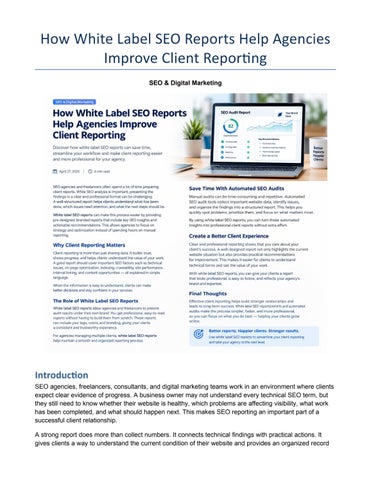
How White Label SEO Reports Help Agencies Improve Client Reporting SEO & Digital Marketing
Introduction SEO agencies, freelancers, consultants, and digital marketing teams work in an environment where clients expect clear evidence of progress. A business owner may not understand every technical SEO term, but they still need to know whether their website is healthy, which problems are affecting visibility, what work has been completed, and what should happen next. This makes SEO reporting an important part of a successful client relationship. A strong report does more than collect numbers. It connects technical findings with practical actions. It gives clients a way to understand the current condition of their website and provides an organized record
that can be reviewed over time. The challenge is that producing this level of reporting manually can consume many hours, especially when an agency manages several websites at once. Automation can reduce repetitive work by collecting website information, identifying common SEO issues, and organizing findings into a structured format. Agencies can then spend more time interpreting the information, creating strategies, and communicating recommendations. For agencies that want reports to fit their own client-facing workflow, branded reporting can also make the experience more consistent. This article explores how automated SEO audits and professional reporting can support agencies, why reporting quality matters, which sections a useful report should include, and how agencies can build a more efficient reporting workflow.
Why SEO Client Reporting Matters SEO is often a long-term process. Changes to rankings, traffic, technical health, content performance, and conversions may happen over weeks or months rather than immediately. Because of this, clients need regular communication that shows what has been discovered, what has been changed, and what should be prioritized. Without a clear reporting process, even strong SEO work can be difficult for a client to understand. An agency may have completed technical fixes, optimized pages, improved internal links, or developed new content, but if those activities are not communicated properly, the client may not see the full value of the work. A professional report creates a shared reference point. It can show the starting condition of a website, document important findings, explain completed work, and outline future priorities. Over time, a series of reports can also make it easier to identify trends and compare performance. Good reporting should be understandable to the intended audience. A technical SEO specialist may be comfortable reviewing detailed crawl data, while a business owner may prefer a short explanation of the issue, its potential effect, and the recommended action. Agencies can serve both audiences by presenting important details in organized sections and using plain language where possible.
The Challenge of Manual SEO Reporting Manual reporting can involve collecting data from multiple tools, copying figures into spreadsheets, checking pages individually, writing explanations, adding screenshots, formatting documents, and reviewing the final report before sending it to a client. None of these tasks is necessarily difficult on its own, but together they can become a significant operational burden. The problem becomes more visible as an agency grows. One website may be manageable, but ten, twenty, or fifty client websites require a repeatable process. If every report is created from scratch, the team can spend a large amount of time on formatting and administration instead of strategy. Manual processes can also create inconsistency. Different team members may use different report structures, terminology, priorities, or levels of detail. A client who receives a highly detailed report one month and a short, differently structured document the next month may find it harder to compare progress. Automation can address some of these challenges. Instead of starting with a blank document, an agency can begin with organized audit information and then apply human analysis to the findings. The goal is not
to remove professional judgment. The goal is to reduce repetitive preparation work so professionals can concentrate on decisions that require experience.
What an Automated SEO Audit Can Identify A website audit can examine many elements that contribute to technical and on-page SEO. Depending on the auditing platform and configuration, a report may identify missing or duplicated title tags, meta descriptions, broken links, redirect issues, indexability concerns, canonicalization problems, heading structure issues, image optimization opportunities, internal linking weaknesses, and other technical signals. Performance-related checks can also be useful. Page speed and user experience can affect how visitors interact with a website, while mobile usability is important because many searches happen on mobile devices. An audit can help teams identify pages that deserve closer investigation. Content-related checks may include thin or incomplete pages, duplicate content patterns, missing headings, weak metadata, or opportunities to improve topical relevance. An audit should not automatically decide whether a page is valuable, because context and search intent matter. Instead, it should provide evidence that helps an SEO professional decide what to investigate. The value of an automated audit is therefore partly in its ability to organize a large amount of information. Instead of searching for every issue manually, an SEO professional can review categorized findings and decide which items deserve priority.
Building a Useful SEO Report A useful SEO report should be structured around the questions a client is likely to ask. What is the current situation? What problems were found? Which problems matter most? What work has been completed? What should happen next? A strong report can begin with an executive summary. This section should provide a short overview of the website's condition and highlight the most important findings. It should avoid overwhelming the reader with technical details before establishing the bigger picture. The next section can provide audit findings organized by category. Technical SEO, on-page SEO, performance, content, internal linking, and other areas can each have their own section. Each issue can include a short description and, where appropriate, a recommended action. A priority system can make the report easier to use. For example, issues can be grouped as high, medium, or low priority based on the website's circumstances. Prioritization should be based on evidence rather than simply counting how many issues exist. Finally, the report can include next steps. This gives the client a practical understanding of what the SEO team plans to address and why those actions are relevant.
Why Branding Matters in Client Reports Clients interact with an agency through many touchpoints, including emails, meetings, dashboards, proposals, invoices, and reports. Consistent branding across these materials can make the overall experience feel more organized and professional.
Branded SEO reports can include an agency logo, colors, contact details, terminology, and a consistent layout. For agencies, this means the report becomes part of the service experience rather than looking like a document copied directly from a third-party tool. White label SEO reports can be particularly useful when agencies want to provide clients with audit information while maintaining their own identity. A consistent report structure can also help teams standardize the way they communicate findings across different accounts. Branding should not be used to hide the source or nature of information. The report should remain accurate and transparent about the work performed. The purpose of branding is to create a coherent client-facing presentation, not to replace useful information with promotional material.
How White Label SEO Reports Support Agency Workflows White label SEO reports can help agencies create a repeatable reporting workflow. Instead of designing every report independently, an agency can establish a standard structure that is adapted to each client. A typical workflow might begin with a website audit. The platform collects technical and on-page information and organizes it into categories. The SEO professional then reviews the findings, removes irrelevant information, checks important issues, adds context, and identifies priorities. The report is then presented using the agency's preferred branding and shared with the client. This approach can reduce administrative effort while preserving professional review. The agency remains responsible for interpreting the data and deciding what recommendations are appropriate. A repeatable workflow can also make onboarding easier for new team members. When the reporting format is standardized, employees can learn where findings belong, how recommendations should be written, and what information clients typically expect. For larger agencies, standardization can also support quality control. Managers can review reports against a consistent framework instead of checking a completely different format for every account.
Making Technical SEO Understandable One of the most important skills in SEO reporting is translating technical information into language that a client can understand. Terms such as crawlability, canonical URLs, structured data, indexability, and HTTP status codes may be familiar to SEO professionals but confusing to business owners. A report can solve this problem by combining technical accuracy with short explanations. For example, instead of listing a canonicalization issue without context, the report can explain that search engines may need clearer signals about which version of a page should be considered the preferred version. The same principle applies to performance findings. A report can explain that slow pages may create a poor user experience and should be investigated, rather than simply presenting a technical score with no explanation. Screenshots, examples, and prioritized recommendations can also improve comprehension. The goal is not to simplify the facts until they become inaccurate. The goal is to make the facts actionable for the person responsible for the business.
Using Reports to Prioritize SEO Work A website can contain dozens or even hundreds of potential SEO issues. Treating every issue as equally important can make an SEO strategy difficult to execute. Reporting should therefore help teams prioritize. Priority can depend on several factors, including the severity of the issue, the number of pages affected, the importance of the affected pages, the likely user impact, and the relationship between the issue and broader business goals. For example, fixing a critical indexing problem on important commercial pages may deserve attention before making minor metadata improvements across a small group of low-value pages. Similarly, improving internal linking to strategically important content may be more valuable than correcting a minor issue that has little practical effect. A good report provides evidence for these decisions. The report should help the client understand not only what was found but why a particular action is being recommended now.
Reporting for Multiple Clients Managing several client accounts creates a need for consistency. Each business may have a different website, industry, audience, and SEO strategy, but the agency still needs an efficient internal process. A standardized report template can provide a common foundation. The agency can then customize the executive summary, priorities, recommendations, and examples for each client. This approach also makes recurring reporting easier. Monthly or quarterly reports can follow a familiar structure while still reflecting changes in the account. Clients can quickly locate the sections they care about and compare current information with previous reports. Automation is particularly useful at this stage because it can reduce the amount of repetitive data collection. Instead of manually rebuilding the same audit every reporting cycle, teams can generate updated findings and concentrate on changes, trends, and strategy. The result is a workflow that combines standardized processes with client-specific expertise.
SEO Reports and Client Communication A report should support communication rather than replace it. For complex projects, an agency may need to discuss findings during a call or meeting. The report can then serve as a reference document that records the key points. Before sending a report, the SEO professional should review it for accuracy and relevance. Automated systems can identify potential issues, but not every finding will have the same importance for every website. Human review is essential for deciding what to emphasize. The agency can also use the report to create a short list of discussion points. This makes client meetings more focused. Instead of spending the entire call reading the document, the team can discuss major findings, completed work, business priorities, and upcoming actions. Clear communication can make technical SEO feel more manageable. Clients do not necessarily need to become SEO experts. They need enough information to understand the work, make informed business decisions, and see how the strategy is progressing.
Common Mistakes in SEO Reporting One common mistake is including too much information without prioritization. A report containing hundreds of technical findings may look comprehensive, but it can be difficult for a client to determine where to start. Another mistake is using unexplained technical terminology. If the reader does not understand what an issue means, the report may fail to communicate its practical importance. A third mistake is focusing only on problems. Reporting should also document improvements, completed work, positive trends, and opportunities. A balanced report provides a more useful picture of the account. Another issue is inconsistency. If report structures, metrics, definitions, and time periods change frequently, comparisons become more difficult. Finally, reports should avoid making unsupported promises. SEO outcomes depend on many variables, including competition, search demand, website quality, content, technical factors, and search engine changes. A professional report should describe findings and planned actions accurately rather than guaranteeing specific ranking outcomes.
Choosing the Right Reporting Workflow The best reporting workflow depends on the agency's size, client mix, service model, and technical requirements. A freelancer working with a small number of clients may use a relatively simple process, while a larger agency may require standardized templates, automated audits, dashboards, approval stages, and account-level reporting. Regardless of size, the workflow should reduce unnecessary repetition. Teams should identify which steps require professional judgment and which steps can be automated. Data collection and basic issue detection are often good candidates for automation. Interpretation, prioritization, strategy, and client communication generally require human involvement. The workflow should also include quality checks. Before a report reaches a client, someone should verify important data, confirm that recommendations are relevant, and ensure that the document is easy to understand. A practical reporting system is one that saves time without reducing accuracy or communication quality.
The Relationship Between Audits and SEO Strategy An SEO audit is a starting point rather than a complete SEO strategy. It identifies conditions and potential problems, but strategy requires context. A website may have technical issues that are worth fixing, but the broader business goal could involve increasing qualified leads, improving ecommerce sales, growing a specific service area, or building authority around a topic. Recommendations should therefore connect website findings with business objectives. Reports can help make this connection visible. An agency can explain how technical improvements support crawling and user experience, how content changes address search intent, or how internal linking supports important pages.
This approach makes reporting more strategic. Instead of simply delivering a list of errors, the agency demonstrates how individual improvements fit into a larger plan.
Improving Reporting Efficiency With Automation Automation is most useful when it removes repetitive work while leaving important decisions to professionals. An automated system can scan websites, collect findings, organize information, and generate a report structure. The SEO professional can then review and refine the results. This can reduce the time spent on tasks such as copying data, formatting sections, and repeating the same checks. It also makes recurring audits easier because the same basic process can be repeated consistently. Automation can be especially helpful for agencies that need to produce reports on a schedule. A standardized process reduces the chance that a routine report is delayed because someone had to rebuild the document manually. However, automation should be treated as a support system. SEO recommendations still need to consider the specific website, business model, target audience, competition, and goals.
Best Practices for Professional SEO Reports Several practices can make reports more useful. First, define the reporting period clearly. Clients should know whether the document covers a month, quarter, audit date, or another period. Second, separate findings from recommendations. This makes it easier to understand what the audit discovered and what the agency proposes to do. Third, prioritize the most important issues. A short list of meaningful actions is often more useful than a long list with no order. Fourth, use consistent terminology and formatting. Repeated structures make reports easier to scan. Fifth, include context. A number or score has limited value without an explanation of what it means. Sixth, review automated findings before publication. Automated tools can identify patterns, but professional judgment is needed to confirm relevance. Finally, keep the report focused on the client's goals. Technical information should support business decisions rather than become an end in itself.
Conclusion Professional SEO reporting is an important part of agency operations and client communication. As websites become more complex and agencies manage more accounts, manually preparing every audit and report can become inefficient. Automated SEO audits can reduce repetitive work by collecting website information and organizing potential issues into structured findings. When these findings are reviewed by an SEO professional and presented clearly, they can become a practical tool for planning and communication.
White label SEO reports can add another layer of efficiency by allowing agencies to present reporting in a consistent, client-facing format aligned with their own brand. Used responsibly, they can support standardized workflows while still leaving room for client-specific recommendations. The most effective reporting process combines automation, human expertise, clear communication, and consistent presentation. Instead of treating an SEO report as a simple list of errors, agencies can use it as a strategic document that explains the current situation, identifies priorities, documents progress, and creates a clear path for future optimization. For agencies and freelancers looking to improve their reporting workflow, the objective should be simple: spend less time on repetitive report preparation and more time on meaningful SEO analysis, strategy, implementation, and client success.
About the Author The AutoSEOSystem Team creates practical resources focused on SEO audits, technical SEO, website optimization, SEO reporting, and digital marketing workflows for agencies, freelancers, and businesses.
Better reports. Clearer communication. More efficient SEO workflows.