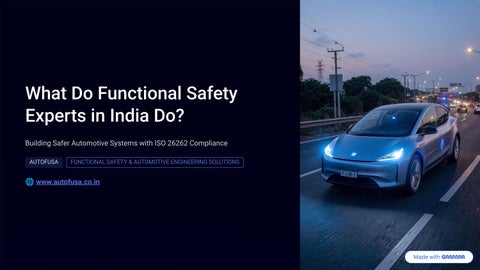
What Do Functional Safety Experts in India Do? Building Safer Automotive Systems with ISO 26262 Compliance AUTOFUSA
FUNCTIONAL SAFETY & AUTOMOTIVE ENGINEERING SOLUTIONS
🌐 www.autofusa.co.in
Who Are Functional Safety Experts?
Functional Safety Experts help automotive companies develop safe electrical and electronic systems. They identify safety risks, define safety requirements, and support compliance with ISO 26262 throughout the product development lifecycle.
Risk Identification
Safety Requirements
ISO 26262 Compliance
Spotting potential failures before
Defining clear, traceable safety goals
Guiding teams through every phase
they become hazards
for every system
of the standard
Why Functional Safety Matters Modern vehicles contain dozens of ECUs, sensors, and millions of lines of software. A single failure can have serious consequences. Functional Safety Experts help organizations stay ahead of risk.
Prevent Hazardous Failures Systematically eliminate risks that could endanger drivers and passengers
Improve Product Reliability Build robust systems that perform safely under all conditions
Meet ISO 26262 Requirements Achieve compliance across all ASIL levels and project phases
Support Safer Vehicle Launches Reduce development risks and accelerate time to market with confidence
Performing Hazard Analysis and Risk Assessment (HARA) CORE RESPONSIBILITY
HARA is the foundation of every ISO 26262 project. Functional Safety Experts lead this critical process to identify what can go wrong, how likely it is, and how severe the consequences could be.
Identify Hazards
Assess Risks
Pinpoint potential system failures and hazards
Determine severity, exposure, controllability, ASIL
Evaluate OPS Analyze operational situations and contexts
Define Safety Goals Set ASIL-based safety goals and requirements
Each step builds on the last, ensuring that every potential hazard is systematically evaluated and assigned an appropriate ASIL classification before any design work begins.
Developing Functional Safety Requirements
From Hazards to Requirements Once hazards are identified, experts translate them into precise, verifiable safety requirements that guide the entire development team.
Functional Safety Concept (FSC)
Technical Safety Concept (TSC)
High-level safety behavior and responses
Implementation-level safety architecture
Safety Mechanisms
Requirement Traceability
Hardware and software fault detection
End-to-end linkage from goals to tests
Working with Engineering Teams Functional Safety Experts are not siloed — they integrate safety activities into every stage of product development, collaborating across disciplines.
System Engineers
Hardware Engineers
Software Engineers
Define system boundaries and safety
Implement safety mechanisms at the
Develop fault-tolerant, ASIL-compliant
interfaces
circuit level
software
Test Engineers
Project Managers
Validate safety requirements through
Align safety milestones with project
structured testing
schedules
Verifying Functional Safety
Confirming Safety Goals Are Achieved Experts rigorously verify that safety requirements have been correctly implemented before any system reaches production.
1 Safety Reviews
2
3
4
Fault Injection Testing
ISO 26262 Validation
Structured peer reviews at
Requirement Verification
each development phase
Traceability checks from
Deliberately introduce
standard requirements
goals to implementation
faults to validate system responses
Final confirmation against
Preparing Safety Documentation Comprehensive documentation is the backbone of ISO 26262 compliance. Functional Safety Experts prepare and maintain all required artifacts to support audits, customer approvals, and safety assessments.
📋 Safety Plan
🔍 HARA Report
Defines the safety lifecycle activities and responsibilities
Documents all identified hazards, scenarios, and ASIL ratings
⚙️ FSC & TSC
📊 FMEDA & FMEA
Functional and Technical Safety Concepts for the system
Quantitative and qualitative failure analysis reports
✅ Safety Case
📝 Verification Reports
Structured argument demonstrating that the system is safe
Evidence that all safety requirements have been met
Where Functional Safety Experts Work Demand for functional safety expertise is growing rapidly across India's automotive ecosystem — from traditional OEMs to cuttingedge EV and autonomous driving startups.
Passenger Vehicles
Electric Vehicles (EVs)
Commercial Vehicles
Autonomous Driving
ADAS Systems
Semiconductor Companies
Tier 1 Suppliers
OEMs
Build Safer Automotive Systems with AutoFuSa AutoFuSa helps automotive companies in India achieve ISO 26262 compliance through expert consulting, engineering support, and training.
ISO 26262 Consulting
HARA, FMEA & FMEDA
Safety Case Development
End-to-end compliance guidance and
Comprehensive hazard and failure
Structured safety arguments for
functional safety assessments
analysis services
audits and customer approvals
ISO/SAE 21434 & ASPICE
Functional Safety Training
Cybersecurity and software process
Upskilling teams on ISO 26262
improvement consulting
concepts and practices
🌐 Visit us at https://autofusa.co.in to learn how AutoFuSa can support your functional safety journey.