Electric switch needs cross-party support
Report laments setback for EV transition with clean-car programme being ‘virtually dismantled’ by the coalition
The government is being urged to bring in a combination of three policy settings to boost the adoption of EVs.
Drive Electric says New Zealand needs to look at what’s being done overseas or risk the economy losing out on billions of dollars if emissions targets are missed.
It has made the call to action in its State of the Nation 2026 report, which was launched at parliament on May 20.
The in-depth research requests
the government to provide strategies that ensure manufacturers supply lowemissions models through standards or mandates.
On the demand side, Drive Electric says policies with tax incentives or financial mechanisms are needed to cut the upfront cost difference between EVs and models with internal combustion engines (ICEs).
And when it comes to infrastructure policies, nationwide charging networks are essential to
ensuring electric cars are a practical choice for consumers.
Jurisdictions elsewhere in the world that combine all three are seeing the fastest EV adoption rates, according to the report.
Kirsten Corson, who chairs Drive Electric, emphasises policy changes have led to New Zealand slipping from being a world leader in 2023 and a raft of countries –including emerging economies –are “overtaking us”.
“Transport electrification has crossed a global inflection

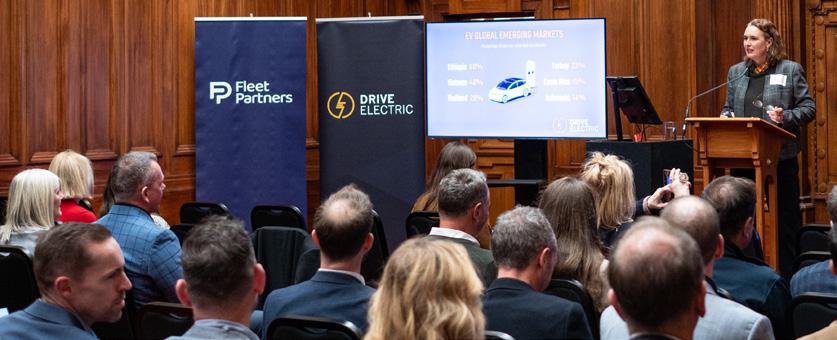
Drive Electric’s Kirsten Corson launching the State of the Nation 2026 report at parliament last month
LOAD IT SHIP IT TRACK IT CLEAR IT DELIVER IT !
BIGGER IS BETTER




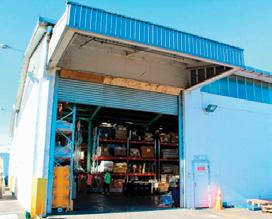
move to new, much larger premises means we are to offer even more services to our dealer clients
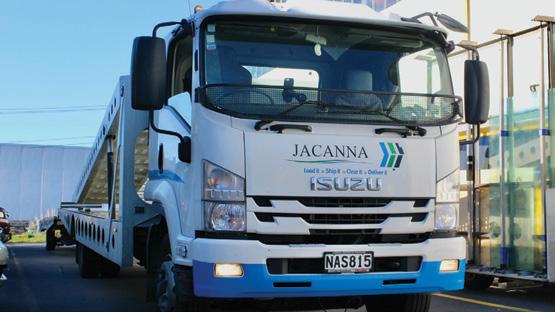
to door ro-ro vehicle shipping from Japan and Australia
Containerised vehicle shipping from anywhere in the world

Vehicle tracking


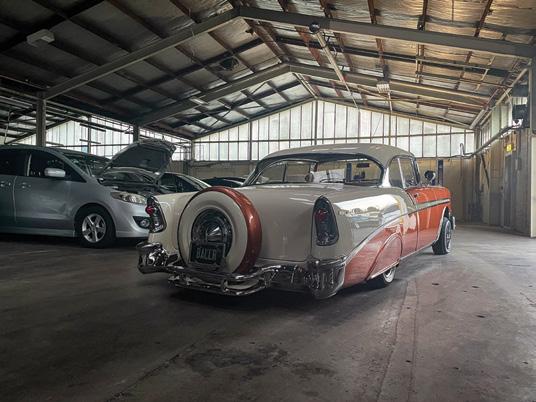

VEHICLE SHIPPING
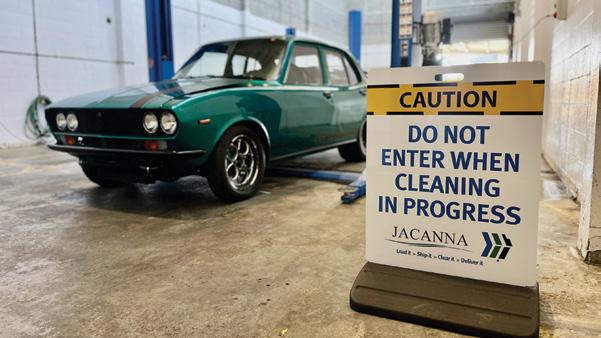
Approved MPI transitional facilities and cleaning services
GENERAL FREIGHT
VEHICLE TRACKING
SHIPPING SCHEDULE

We are specialists in transporting and exporting all types of Vehicles, Commercial trucks, vehicles of Special Interest and other RORO Heavy Cargo & Machinery.
it all off is Jacanna’s SmartTrade Rewards Programme, you can earn points for almost any reward you choose
Tel: +64 9 825 0888 info@jacanna.co.nz www.jacanna.co.nz
and conditions apply.
We have developed a worldwide network of Agents who understand the commitment required to service our demanding market.
www.jacanna.co.nz
Tel: +64 9 825 0888
Finding out where your vehicle is at any one time of the process, gives you the ability to manage the collection and processing of documents and payment on time.
TRS and shipping services from Japan to New Zealand. www.jacanna.co.nz
info@jacanna.co.nz
Tel: +64 9 825 0888
Why ICE age still has some decades to run
James McDowall on the long thaw to EVs
There’s a tempting story about electrification that goes something like this: the electric-vehicle share of new registrations climbs, prices fall, the inevitable tipping point arrives and the fleet flips.

A report by the NZ Institute for Economic Research (NZIER) for the MTA points to a more glacial transition. That isn’t to undermine the uptake of EVs or their real benefits, it’s to be realistic about the pace.
The average New Zealand vehicle is now just over 15 years old, up from 14.2 in 2015, so half a year of ageing in a decade. Modest perhaps, but in the wrong direction. The European Union sits at 12.5 years for light passenger models and we’re at 15.2.
Trucks tell a sharper version of the same story with 17.8 years here and 14.1 in the EU. Buses are 16.4 versus 12.2. Only light commercials have bucked the trend, edging down to 13 years.
Two things are doing the work. First, vehicles are entering the fleet older. Used-imported cars now arrive at 9.3 years on average, up from 8.9 in 2015. Used trucks have leapt from 7.6 to 10.7 years over the same period.
Second, vehicles are exiting later. The average car now leaves the fleet at 20 years while an imported used light commercial doesn’t retire until 23.3. That has direct consequences. New vehicle-safety technology –ADAS in particular – is being rolled out faster than ever, but the share of vehicles on our roads that carries it is rising slowly.
The same dynamic shows up in warrant and certificate of fitness failure rates, which are climbing. Older vehicles fail more often. That isn’t a regulatory failure, it’s a stock-not-flow problem.
The Ministry of Transport keeps used imports at roughly 45 per cent of registrations through its forecast period. Even if the new market went all-electric tomorrow, almost half of what’s registered would continue to arrive used and ageing.
Petrol hybrids will dominate that used stream until the early 2030s with electric cars only becoming the majority of used imports in the decade after 2035, held back – in part – by Japan’s slow uptake at home.
The result is a fleet that, even in 2045, the NZIER models as 46 per cent fully electric. That leaves 54 per cent running on liquid fuel in some form.
By 2035 the picture is starker. Only 14 per cent of the light passenger vehicle fleet will be fully electric with 86 per cent still reliant on liquid fuel in some form – petrol at 43 per cent with the balance made up of hybrids, plug-in hybrids and diesel.
For the industry, the implication is structural rather than dramatic. The internal-combustion business – servicing, repair, parts and fuels –has a long runway.
The EV transition is real and accelerating, but it’s a transition the industry will live alongside for two decades, not race through. The car on the hoist in 2030 looks remarkably like the one there today. The one in 2040 might not.
DIRECTORS
Darren Wiltshire dazzz@autofile.co.nz ph. 021 0284 7428
Brian McCutcheon brian@autofile.co.nz ph. 021 455 775
DESIGNER
Adrian Payne arpayne@gmail.com
EDITOR
Darren Risby ris@autofile.co.nz
JOURNALISTS
Matthew Lowe matthew@autofile.co.nz
Sue Brebner-Fox sue@autofile.co.nz
MOTORSPORT
Mark Baker veritas.nz@xtra.co.nz
Visit www.autofile.co.nz to subscribe to Autofile magazine and have it delivered monthly in print. The subscription rate is $78 plus GST for 12 issues per year.
Autofile magazine is also available online as a readable file or downloadable as a PDF.
Back copies dating to 2017 can be found on the website where you can subscribe to our Insight email alerts.
Copyright: Published monthly by 4Media Ltd
All statements made, although based on information believed to be accurate and reliable, cannot be guaranteed, and no liability can be accepted for any errors or omissions. Reproduction of Autofile in print or digital format in whole or part without written permission, whether by copying or any other means, is strictly forbidden.
All rights reserved. ISSN 0112-3475 (print) ISSN 2350-3181 (online)

W We of fer a full range of ser vices
• Entry Certification for imported cars
• Vehicle Appraisals
• WoF/CoF Inspections
• Road User Charges
• Registration & Relicensing
• Exhaust Emission Testing
www.vinz.co.nz

JAMES McDOWALL Head of advocacy, Motor Trade Association
point. It’s no longer primarily an environmental movement. It is an economic opportunity and national security imperative,” says Corson.
“What’s needed is a bipartisan strategy to electrify our transport system with supply, demand and infrastructure policies operating simultaneously because every jurisdiction that has achieved rapid EV uptake has done so with all three levers engaged.
“Without policy certainty, providers of private capital will price in risk or head to other markets, consumers will defer purchases, and our transition from imported liquid fuels will be slower and more expensive.
“The question is no longer whether electric transport will transform New Zealand because it will. The question is whether New Zealand will lead that transformation or be reshaped by it.
“Structural advantages are in place and consumer appetite is there. What remains is policy
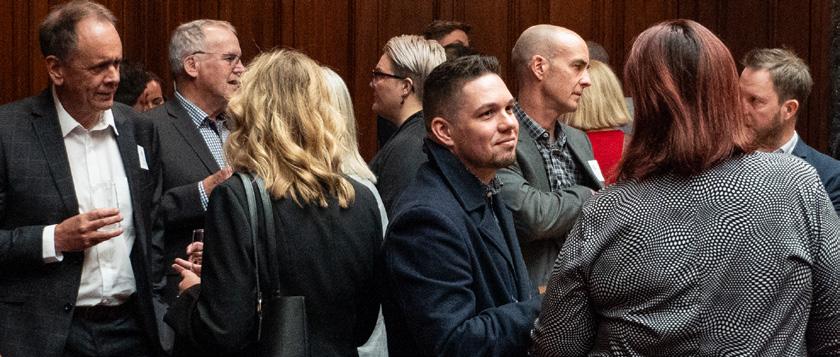
Some of the guests at the launch of the State
commitment to match them.”
Drive Electric’s report cites Norway as an example of why policies are important for the lightvehicle fleet.
It started to incentivise EVs in 1990. After 35 years of consistent government policy, about onethird of cars on its roads are electric with 96 per cent of new models sold there last year being battery electric vehicles (BEVs).
“The lesson is to set a realistic electrification target, craft policy to support goals and refrain from changing the policy direction every few years,” states Drive Electric’s report.
It highlights New Zealand as having one mechanism remaining
from its clean-car programme, which is the clean vehicle standard (CVS). In 2026, the coalition reduced the scheme’s penalty rate to $15 per gram of carbon dioxide (CO2) per vehicle, “a fraction of its initial level”.
In contrast, Australia’s newvehicle efficiency standard (NVES) penalty rate is A$50/gCO2, or about NZ$61, above a model’s target. Importers have two years to offset deficits through credit trading before a penalty becomes payable. If unresolved, the rate doubles to A$100.
The Treasury has estimated New Zealand could face a Paris Agreement liability of between $3.3 billion and $23.7b by 2030 if emissions targets are missed.
Transport is responsible for nearly 18 per cent of our greenhouse gas emissions and is a sector the Climate Change Commission has identified as capable of almost fully decarbonising before 2050.
The pathway to this is “increasingly clear” with New Zealand having many foundations in place to do so, contends Drive Electric.
PRE‑SHIPMENT INSPECTIONS
For example, the Climate Change Response (Zero Carbon) Amendment Act, which passed with bipartisan support in 2019, established a 2050 net-zero target and emissions budgets.
STABLE SETTINGS NEEDED
By 2023, electric models made up more than 27 per cent of newvehicle sales in New Zealand, driven by a combination of supply, demand-side and infrastructure policies.
Key policies included the CVS, which was launched as the clean car standard (CCS) to encourage importers to supply loweremissions models.
There was also the clean car
discount (CCD), which reduced the sticker prices of cleaner vehicles, and a road-user charge (RUC) exemption for light EVs.
“Together, these measures were forecast to reduce emissions by 3.4 million tonnes and reduce petrol imports by 1.4 billion litres by 2035,” states Drive Electric’s report.
“Since January 2024, major policy changes have altered the trajectory of electrification.
“The CCD was repealed, EVs entered the RUC system at the same rate as diesels and the CCS was weakened twice.”
All that said, the country has advantages for electrification. These include high renewable power generation, increasing consumer familiarity with EVs, an expanding charging infrastructure, and growing industry capability in the transport, energy and technology sectors.
However, “the challenge is whether policy settings remain stable enough for households, businesses and infrastructure providers to invest with confidence”. The economic and wider implications of failing to do so are “significant”.
Research has been published this year by the Sustainable Business Council and Climate Leaders Coalition, which represents more than 150 companies and about 45 per cent of private-sector GDP.
It states a successful lowemissions transition could add $22.6b annually to GDP by 2035, rising to $33.6b by 2050, with transport electrification identified as a major contributor to that opportunity.
The report also identifies policy coherence and mediumterm certainty as the biggest barriers to investment.
“Our current settings risk undermining both,” says Drive

of the Nation 2026 report at parliament last month
Electric. “While global momentum continues to accelerate, our transition has slowed.”
It adds New Zealand spends an estimated $7b-$9b annually on petroleum imports with no domestic refining capability since Marsden Point’s closure in 2022. Transport emissions also carry $10.5b in annual social costs, including more than 2,000 deaths from hospital admissions.
THE BIGGER PICTURE
Drive Electric’s report goes beyond EVs. It covers the full electric-transport system, such as micromobility, because two-thirds of all vehicle trips are less than 6km.
E-scooters, e-bikes, e-cargo bikes and e-mopeds are increasingly filling that gap with significant growth forecast.
EVs make up four per cent of our heavy fleet but are responsible for 25-30 per cent of road-transport emissions. With 98 per cent of it still fuelled by diesel, decarbonising this segment requires “significant” policy change.
The number of electric buses in New Zealand has grown about 12-fold in three years. For example, Palmerston North’s BEV fleet achieved a 69 per cent surge in usage while Auckland Transport now operates the largest zeroemissions fleet in Australasia.
The maritime industry has gone from no electric ferries in 2023 to several now operating, with megawatt charging systems and home-grown technology creating export opportunities.
As for new cars, one in four sold worldwide is electric. In China, it’s one in two. Norway has reached 96 per cent of new registrations being
New Zealand has every advantage we need to lead the transition
EVs, yet after 35 years of policies only 32 per cent of its total fleet is electric.
Corson says the most important takeaway from the State of the Nation 2026 report is transformation at scale takes time, consistency and bipartisan commitment.
“The transition isn’t just for wealthy nations. Emerging markets have identified the sovereign opportunity to reduce dependence on imported fossil fuels.”
Many countries making systemic choices are seeing results. For example, sales of new electric cars in Ethiopia now sit at 60 per cent. There’s also an import ban on ICEs and the country boasts 95 per cent renewable energy.
Vietnam has domestic manufacturer VinFast and sits at 40 per cent EV sales, while Thailand – a regional manufacturing hub –comes in at 28 per cent.
Turkey, at 22 per cent, is the largest BEV market in Europe by volume. Costa Rica, with 15 per cent, is the highest in the Americas. And Indonesia, at 14 per cent, has seen its electric sales triple year-onyear as the ICE market contracts.
By comparison, New Zealand has fallen behind. In 2025, about 11 per cent of newly registered vehicles were electric.



TIMES ARE CHANGING
The EV market has undergone a significant reset since the 2023 edition of the State of the Nation report was released.
The CCD is gone, the CVS has been weakened and is under review by the coalition, and RUC are payable on EVs. Drive Electric says these policy changes all had an immediate impact on sales.
In 2023, electric cars accounted for 20 per cent of new sales in this country. By 2024, their share had
fallen to 10.6 per cent. Since then, the electric market has started to stabilise but its structure has rapidly shifted.
By the end of May, 6,186 new BEVs had been registered in New Zealand during 2026, which was up by 138.9 per cent from 2,589 during the same period of 2025.
The year-to-date total for new plug-in hybrids (PHEVs) is 4,072 for a 152.9 per cent jump from 1,610, according to NZTA data.
March was a big month for new electric sales. BEVs came in at 2,275, up by 284.9 per cent compared to the same month in 2025, while PHEVs surged by 11.3 per cent to 1,137.
These increases coincided with rising global oil-price volatility because of the conflict in the Middle East, which has renewed public attention on affordability at the pump and dependence on imported fossil fuels.
More than 50 per cent of EVs are now made in China and battery prices have dropped significantly,
[continued on page 6]
EASY APPLICATION

Submit two downloadable forms and simply send to us for review.
COMPETITIVE INTEREST RATES & FEES
Our partnerships give us the ability to offer superb lending rates.
www.autobridge.co.nz
EFFICIENT SERVICE
Hear back from our team about finance in as little as 24 hours.
NZ BASED
Autobridge is New Zealand based and covers the country, so we are never far away when you need us.
Extra funding for fuel reserves
The coalition has committed hundreds of millions of dollars in response to the global fuel crisis.
Nicola Willis, Minister of Finance, says Budget 2026 includes $150 million for extra strategic fuel reserves with $450m set aside for additional temporary fuel-related measures if required.
“Since the outset of the conflict, our approach has been to stay ahead of risks to New Zealand’s supply, keep the economy moving and support those most affected by higher fuel prices with temporary measures,” she adds.
“The situation in the Middle East remains uncertain, so it’s prudent to be ready should prices rise further, and add more pressure to households and businesses.”
Extra funding is being provided for Fire and Emergency, Corrections,
police, Customs and education to maintain frontline operational activities in the face of sustained fuel-price increases.
The government is simplifying fringe-benefit tax rules for private motor vehicles by removing the requirement for detailed logbooks.
Simon Watts, Minister of Revenue, says: “Changes in this area will simplify the rules by taking a ‘close enough is good enough’ approach. This will reduce compliance costs for businesses.”
May 28’s budget included investing $7 billion in infrastructure, such as building the Cambridge to Piarere Expressway, and $400m for state-highway resilience upgrades.
There is $69m to double the number of Trades Academy places to 20,000 by 2030, which will provide free training to more year 11 to 13 students. Some $15m
Our strength comes from knowing our customers’ needs, understanding and fulfilling them

will enable industry skills boards to develop at least eight new industry-led secondary subjects focused on specific industries.
Budget 2026 introduces a charge on banks, non-bank deposit takers, insurers and other financial market participants to help cover the costs of services provided by the Reserve Bank.
[continued from page 5]
but sticker prices remain out of reach for many Kiwis, which has created a “central policy challenge”.
The ute market is rapidly changing. Three years ago, the LDV T60 was the only electric model available here.
Now multiple electric utilities have entered the market, “marking the beginning of electrification in one of New Zealand’s most emissions-intensive vehicle categories”. They boast vehicleto-load capability and have had a “warm” reception, while van options are growing but suppliers need further support to scale.
New Zealand has structural advantages most countries cannot match, according to Drive Electric’s report.
These include 88 per cent renewable electricity generation, a grid capable of charging the entire light-vehicle fleet off-peak and the transport-cost advantage of EV owners paying the equivalent of 40 cents per litre.
On the flipside, Australia –“once the laggard” – introduced
“This mirrors the approach taken by the Financial Markets Authority and Commerce Commission, which fund much of their activity through levies on participants,” says Willis.
“This levy will ensure the cost of regulation and supervision is borne by players rather than taxpayers.”
It’s estimated the charge will recover about $209m over the next four years. The cabinet hopes to make decisions early next year with a view to it being rolled out in mid-2027.
Willis says at a time when many families and businesses are under pressure from higher living costs and global uncertainty, the budget takes steps to support Kiwis now while strengthening the economy for the years ahead.
Motor Industry Association’s reaction to Budget 2026 – page 20
its supply-side NVES last year and has overtaken New Zealand’s EV market share for the first time.
Conversely, New Zealand’s clean-car programme has been “virtually dismantled, setting back uptake” and our public charger-toEV ratio of one to 52 is among the lowest in the OECD.
March’s EV surge reflects “genuine consumer appetite, but policy volatility extracts a cost borne by the whole transition”.
Corson says: “New Zealand has every advantage we need to lead this transition – world-class renewable energy, an adaptable grid and consumers who want to make the switch.
“What has been missing is policy consistency to give investors and households the confidence to act.
“We cannot afford another reversal. A long-term, bipartisan strategy isn’t idealism. It’s the minimum requirement for attracting private capital and delivering energy independence for every New Zealander.”
Minister of Finance, Nicola Willis
Training talent key to future
MITO is keen to increase the number of learners it attracts annually, and according to data provided by the organisation. This was down from a recent
new occupations and how quickly we can get those completed.
“Automotive apprenticeship
MITO AUTOMOTIVE BUSINESSES & LEARNERS, 2021-25
PATHWAY FOR MECHANICS
People coming through MITO’s apprenticeships are filling about 50 per cent of the industry’s needs with the remainder mostly coming across the border.
Sturrock Saunders chairs the organisation and is also president of the Motor Trade Association.
He believes the country needs to get better at developing talent and support employers so we get to the stage where “immigration settings are supplementary to the workforce”.
In addition to MITO’s push to bolster vocational education, Immigration New Zealand (INZ) is tweaking its settings later this year to help tackle shortages in the industry. It has announced new rules for its skilled-migrant category will take effect from late August, and has confirmed key occupations for the trades and technician residence pathway.
INZ has also provided information about the simplified median-wage settings that apply across all skilled-migrant categories and has clarified qualification requirements for claiming points towards scores to reach application thresholds.
It follows the government’s announcement in September 2025 of changes to the programme to help employers here retain skilled workers and support long-term economic growth.
The trades and technician pathway will be for migrants who either work in specified roles, hold a relevant qualification at level four or above or have at least four years of relevant post-qualification skilled work experience, including at least 18 months in New Zealand paid at or above the median wage.
The list of eligible occupations includes automotive electricians, motor mechanics, panel beaters, vehicle-body builders and vehicle painters at skill level three.
INZ says these jobs were added to the list “because they are skilled, have relevant qualification at the appropriate level for the pathway and bring important skills to the economy”.
It adds: “Many highly skilled workers in these roles didn’t have a realistic pathway to residence under the current skilled-migrant
category settings. There is a history of migrant recruitment showing there’s a gap in the labour market. Recognising these qualifications and providing a more realistic wage threshold for these occupations will help attract and retain migrants.”
MITO SUCCESS STORIES
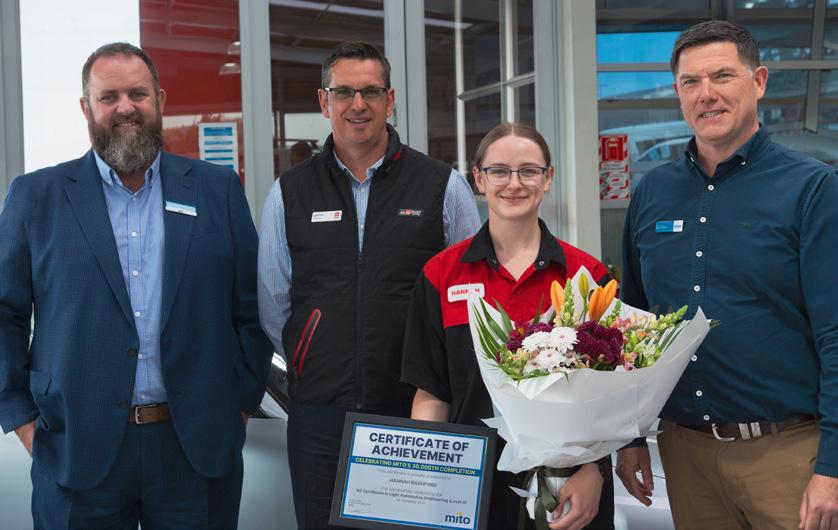
Hannah Bashford, an automotive technician graduate, holds the distinction of becoming MITO’s 30,000th programme completion since its first national certificates were registered in 1995.
She works at Tasman Toyota in New Plymouth and completed MITO’s NZ certificate in light automotive engineering at level four last year.
Craig Clarke, chief executive officer, says: “Investing in apprentices is vital for the future of our industry and we’re proud to
help develop the next generation of automotive talent.
“Hannah worked incredibly hard throughout her apprenticeship and has become a skilled, confident technician.
“Her qualification is also an important step in Toyota’s technician pathway – one that can ultimately lead to becoming a Toyota master technician, of which there are only 19 in the country.
“We’re proud Tasman Toyota is home to five of these master technicians and we’re excited to support Hannah as she continues her journey in the trade.”
Ali Mirzada is a refugee from Afghanistan. When he arrived in New Zealand, he had never heard of an apprenticeship.
But he’s now thriving in the role and developing his skills at Morrison Motors in Ashburton.

Toyofuji vessels Voyage
Moji Osaka Nagoya
TOYOFUJI SHIPPING SCHEDULE
Hannah Bashford, of Tasman Toyota, was the 30,000th person to complete a MITO programme. Also pictured, from left, are Mark Gebbie, MITO’s group manager of workforce development, Craig Clarke, CEO of Tasman Toyota, and MITO director Dean Eggers
My advice is if you can get work experience, learn as much as you can and be positive
– Ali Mirzada

Mirzada came here with his family in 2022. While at Ashburton College, he joined MITO’s StartUp programme. It offers year 11 to 13 students the chance to earn micro-credentials by working one day a week at an automotive business.
Rhys Calcutt, service manager at Morrison Motors, says: “I believe in the programme. It lets me bring in someone straight out of school, give them work experience and see how they perform before offering an apprenticeship.
“Plus, since they haven’t worked elsewhere, we can shape them into the kind of employee we need for our business and industry.”
Mirzada was offered an apprenticeship by the business and has started MITO’s NZ certificate in light-vehicle engineering at level five.
He says StartUp gave him an idea about what it is to be a mechanic. “My advice is if you can get work experience, learn as much as you can and be positive.”
Zoe Connolly was working in a pharmacy before deciding she needed a change to something different.
“I’ve always liked cars and have been around them all my life, so I thought it would go handin-hand,” she says. “I went for a interview on on a break, showing up in my work blazer and lipstick. They took a chance on me and I’ve been at Brook’s Auto Painters in Nelson for almost three years.”
Despite having little experience beyond basic tools, the support from Connolly’s workplace gave her a base to learn from.
She is close to completing MITO’s NZ certificate in nonstructural collision repair at levels three and four.
“The mixture of learning online and being around and doing the physical task, you can cement and understand it. It falls into place and makes sense.
“There is so much to learn. Even though I’ve been in the job for three years, I’d say I’m still pretty green at some things. I’m excited to keep learning and finding new skills.”
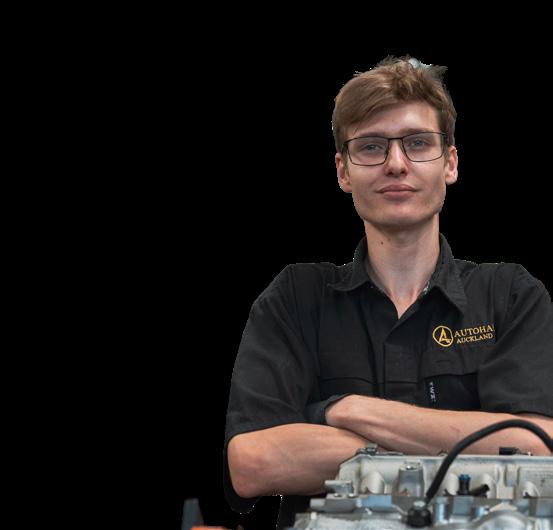
Blake Martin enjoys fixing things, which led him to complete the NZ certificate in light automotive levels three and four through MITO.
His apprenticeship was at Autohaus Auckland, which provides maintenance and repair services for European car brands from 1950s classics to current-day models. The business in Parnell is owned by his father Byron.
“Having dad around always working on cars convinced me to continue with that kind of career,” he says.
The younger Martin started training at Autohaus after leaving Massey High School.
He has been in the mechanical workshop where his duties include warrants of fitness, services, working on engines and modifying vehicle software. “Literally, it’s never the same day. Even if I work on the same part, it’ll be a different car every day.”
His advice for other learners is: “Just ask a lot of questions, ask the stupid questions. Make sure you know more than you need to.”
Ask a lot of questions, ask the stupid questions. Make sure you know more than you need to
– Blake Martin

I’ve always liked cars and have been around them all my life. I thought it’d go hand in hand
– Zoe Connolly

WORKING TOGETHER
MITO shed the shackles of Te Pūkenga in January to become an industry-owned private training establishment.
Under its structure as a charitable company, the Motor Trade Association (MTA) shares its ownership with other associations.
Its founding shareholders include the Aggregate and Quarry Association, Association of Australasian Diesel Specialists, Bus & Coach Association, Chartered Institute of Logistics and Transport, Collision Repair Association, Gas Association and Ia Ara Aotearoa Transporting.
Others are the Imported Motor Vehicle Industry Association, Motor Industry Association, MTA, MinEX Health and Safety Council, National Road Carriers Association, the Drillers Federation, Engine
Reconditioners Association, Heavy Haulage Association, Trucking Association, Log Transport Safety Council, Minerals Council, WasteMinz and Tractor & Machinery Association.
The board is chaired by Sturrock Saunders, president of the MTA. His deputy is Warren Flowerday, owner of Christchurchbased Tandem Smash Repairs and vice-chairman of I-CAR NZ.
The directors are Dean Eggers, MD of the Symons Group, Iain Haycock, CEO of McMillan Drilling, Kim Milne, chief people officer at ELF Holdings, Jason Land, MD of Collins Automotive and CEO of ADAS Experts, and Warwick Wilshier, chairman of the Log Transport Safety Council and MD of Williams & Wilshier Transport. The MTA’s James McDowall is shareholder convenor.
Awards to recognise training excellence

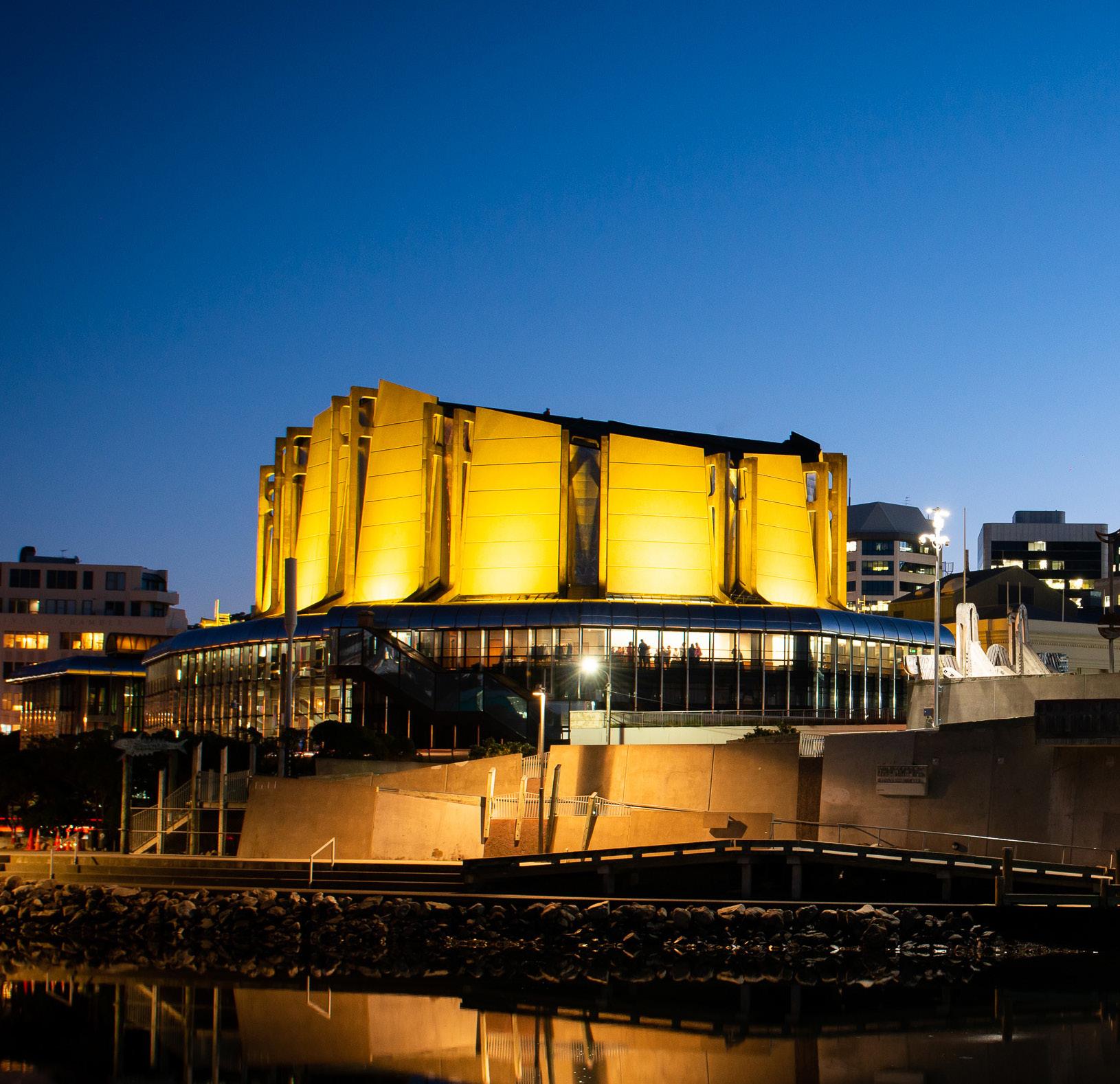
MITO is set to recognise outstanding achievement in vocational education and workforce development with the launch of its inaugural Industry Summit and Awards.
The MITO Industry Summit and Awards is a national event to be held in Wellington on 1 September. It will bring together industry leaders, employers, educators and trainees from across MITO’s sectors to celebrate excellence, leadership and innovation in industry training. The awards will recognise businesses, schools, supervisors and learners who help shape New Zealand’s future workforce—from building skills and capability to supporting learners, strengthening pathways and preparing the future workforce.
Nominations close 3 July 2026, with judging concluding on 31 July.
Award categories
Entries will be assessed against award‑specific criteria by a judging panel with expertise in industry, education and training. Judges will consider evidence of excellence, impact, leadership and outcomes relevant to each category across MITO’s industries —automotive, commercial road transport, extractives, drilling, gas, and logistics.
The categories include:
Training Business of the Year:
This award recognises a workplace that demonstrates outstanding commitment to high‑quality, learner‑centred on‑the job training.
Supervisor of the Year:
Recognises an exceptional workplace supervisor who has demonstrated excellence in on‑job training, coaching, mentoring, assessment support and learner development.
Secondary School of the Year:
Recognises a school that has demonstrated outstanding commitment to promoting MITO career pathways, supporting learners into industry training, and partnering effectively with MITO to strengthen work‑based learning opportunities for students.
Lifetime Achievement Award for Industry Training:
Recognises an individual who has made an extraordinary, sustained and positive contribution to vocational training.
Best Promotion of Trades Careers: Recognises an organisation or initiative that has made an outstanding contribution to raising awareness of trades careers.
Inclusive Training Business of the Year:
Celebrates a workplace that has demonstrated exceptional commitment to equitable, inclusive and culturally responsive training practices.
Learner of the Year:
Recognises outstanding apprentices and other learners from across MITO’s industries who have demonstrated exceptional commitment to their training, strong technical competence, professionalism and a positive contribution to their workplace and the wider industry.
LTSC Training Company of the Year:
Recognises an LTSC member organisation that demonstrates sustained excellence in safety leadership in log transport operations; the development of a skilled, capable workforce; active commitment to formal MITO qualifications and LTSC accreditation; and creating an environment where learning is valued, supported and embedded in everyday operations.
Reasons to enter
• Celebrate excellence and achievement in industry training.
• Recognise outstanding people, businesses and learners.
• Raise the profile of vocational pathways and trades careers.
• Showcase best practice and innovation across industries.
• Gain national recognition as a leader in industry training.
Visit mito.org.nz/about/ industry-awards for information on how to enter.
MITO Industry Summit and Awards
MITO’s Board proudly invites employers and stakeholders to register their interest in attending this complimentary event.
Share ideas, celebrate achievement, and strengthen the pathways that support skilled people and thriving businesses across Aotearoa.
Keynote speakers

Te Radar MC

Brad Olsen Infometrics

Dr Michelle Dickinson Engineer and technologist


Register your interest
Scan this QR code to register your interest in attending before Friday 3 July
David Galbraith Business and leadership coach
Mike Casey Rewiring Aotearoa
Convention calling for Kiwis
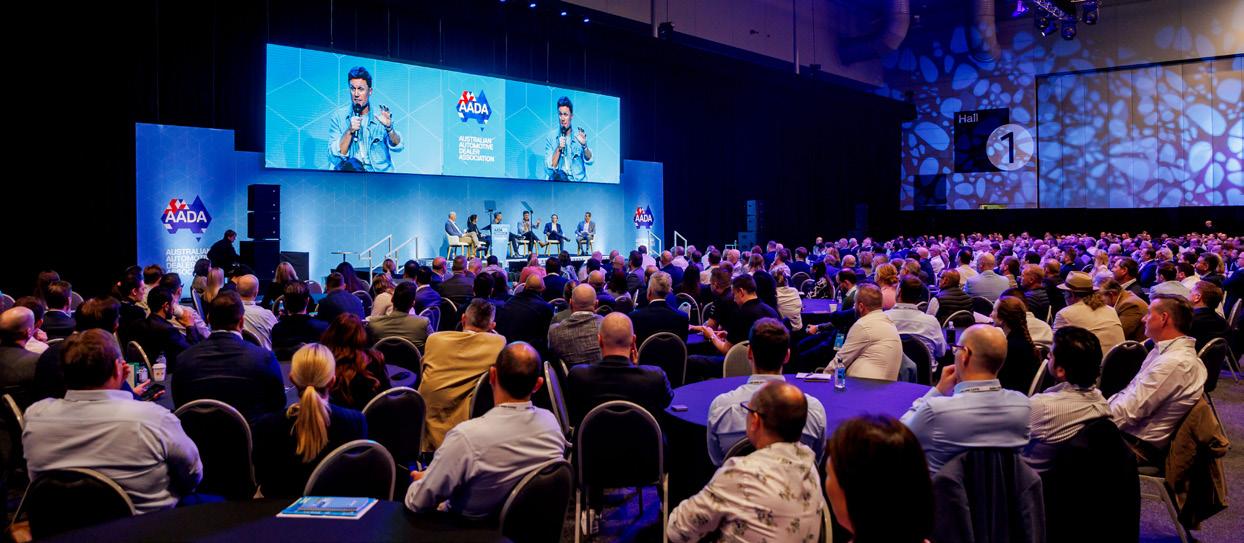
New Zealand dealers are being encouraged to learn more about business innovations and key market issues by attending the 2026 Australian Automotive Dealer Association (AADA) Convention and Expo.
The event at the International Convention Centre Sydney from July 29-30 will bring together franchised new-car dealers, industry suppliers, automotive leaders and retail experts for one of the region’s major dealer-focused events.
The organisers say it’s an opportunity for Kiwis to attend a major international dealer convention in a nearby and comparable market.
There will also be the chance to experience a programme of presentations, speakers and workshops focused on issues reshaping automotive retail on both sides of the Tasman.
The AADA notes that Australia and New Zealand are distinct markets, but many of the pressures facing dealers are shared, including tightening margins, new brands,
Special offer for delegates
New Zealand dealers attending the 2026 AADA Convention and Expo in July are automatically eligible for special registration rates.
Organisers are keen to attract more Kiwi attendees and have confirmed delegates from this side of the ditch will pay the same registration prices as AADA dealer members.
The offer provides a practical opportunity for New Zealanders to attend a major international dealer convention in a similar market.
Patrick Tessier, convention director, says: “We treat New Zealand delegates like they’re members of our association and encourage them to come over.
“We would love New Zealand dealers to talk to us about coming as a group and we’re open to helping them in any way we can.
electrification, artificial intelligence (AI) and shifting regulatory demands.
It has been confirmed that New Zealand dealers attending the annual event, which attracts about 1,000 people each year, will pay the same registration prices as its dealer members.
Patrick Tessier, convention director, says the programme for this year covers the whole dealership operation, including new and used vehicles, parts, service, finance and insurance, and the after-market.
“It means all the workshop content is very relevant to New Zealand dealers and there’s always something we can learn from different markets.”
Some of the presenting companies at AADA 2026 with trans-Tasman operations include Titan DMS, AutoGrab, AdTorque Edge, CarExpert and Auto-IT.
Tessier notes attending the convention each year allows dealers to refresh their ideas, take stock of how the market has changed in terms of policy and other dynamics, and discover what’s new out there.
“Potential New Zealand delegates can also contact me directly about any questions they may have. We would be thrilled to help them out.”
Another bonus for delegates is that all AADA 2026 content will be available on demand to their dealerships for three months after the event.
This extends the value of the convention beyond those who attend in person because leadership teams, department managers and other staff can revisit key sessions, share learnings internally and apply insights across the business after the event.
For more details, visit aadaconvention.com.au. For convention enquiries, email info@aadaconvention.com.au or Patrick Tessier at email Patrick@ aadaconvention.com.au.
“Our convention office will happily manage group registrations and hotel bookings to help take the pain out of making such arrangements, as we do for Australian dealers.
“There are very important and similar market issues that dealers in New Zealand and Australia have to face, so the programme we’ve put together is highly relevant for New Zealand attendees,” he told Autofile.
“As for the workshops, those are all about education and put on by companies that largely operate in both markets, whether it be as providers of dealer management systems or businesses offering products related to AI or other service solutions.
“What’s also important is the products, services and solutions in the expo are all dedicated to dealers and designed to support dealerships.
“That in itself makes it worthwhile to visit AADA 2026 to see what the latest technology is and the AI tools that are believed to be the silver bullet if married into businesses in the right way.”
The two-day convention and expo will feature more than 65 exhibitors and around 40 speakers.
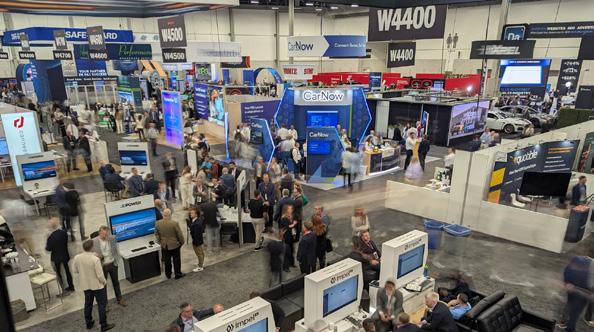
Organisers say the convention’s programme covers the whole dealership operation
t The programme on the main stage includes sessions examining the issues shaping dealership profitability, operations and longterm performance.
One of the presentations on the opening day, which features Damon Rielly and Paul Maric from CarExpert, will explore how dealers can thrive in a high-tech, low-margin environment shaped by changing buyer behaviour, new brands, electrification, pricing pressures and more informed consumers.
Later that day, a panel of experts will examine why used vehicles have become one of the most important opportunities in dealership retail. It will delve into margins, stock turnover and cashflow.
Among the day-two highlights are a presentation on retention that will examine the value of service customers and why after-sales are critical to dealership stability.
There’s also a session exploring business marketing return on investment and the role of AI in handling leads.
As for the workshops, these will provide focused, practical sessions on topics including AI readiness, cybersecurity, used EVs, advanced driver-assistance systems, dealership profitability and more.
James Voortman, the AADA’s chief executive, says the event is the “pre-eminent automotive conference in Australia” and he’s eager to see more New Zealand delegates attending.
“There’s no market closer to

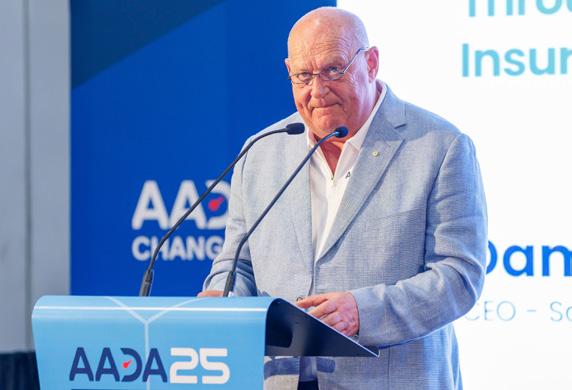
Patrick Tessier, the AADA’s convention director, at last year’s event
• For information about the workshop series: aadaconvention.com.au/aada_workshops
• To check out the AADA Pentana Solutions live stage series, log onto: aadaconvention.com.au/aada-live-stage
• To register for AADA 2026, visit: aadaconvention.com.au/register-for-aada-2026
us and while there are differences between the two automotive markets, there is an increasing number of businesses based in Australia that operate in both countries,” he adds.
“The convention is a chance to not only showcase our industry but also many of the businesses that have sprung up and support the new-car retail sector, whether it’s classified businesses, software companies or those dealing with supplies and the workshop.
“It’s always humbling seeing the size of the industry, and the breadth and reach of it.”
Voortman says the event is a great opportunity for all delegates to understand current trends and what they need to focus on in their day-to-day work.
The event always has an international flavour, with guests over the years coming from Canada, the US, Brazil, the UK and Europe, which helps expand its appeal beyond Australian dealers.
“The other important thing about bringing international people together is we’re all in a very similar industry and franchised to the same multi-national companies,” explains Voortman.
“It’s a good opportunity for us to give each other intelligence, communicate and keep those relationships going because we’re better off for sharing that intelligence.”
Besides tackling issues close to home, AADA 2026 will feature broader international discussions that examine global challenges, EV


growth, Chinese brands, consumer choice and what dealers can learn from overseas markets.
Voortman says: “New Zealand dealers will appreciate these sessions as much as our Australian members because you go back about five years and we probably weren’t as focused on geopolitics as we are now.
“Vehicles just used to arrive and we would sell them, but I think since Covid-19 we have realised how far away from the start of the supply chain we are and it doesn’t take much to upset that balance.
“As businesses, it’s important we have that geopolitical element on our risk registers. We can’t control a lot of it, but it’s important to discuss strategies to try to minimise any risks that accrue from it.”


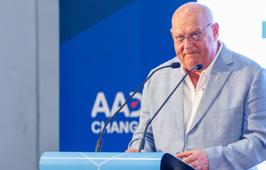
James Voortman, chief executive officer of the Australian Automotive Dealer Association
BUY SMARTER. SELL FASTER. STAY AHEAD.
Hundreds of vehicles auctioned every week and nearly 1,500 users ready to trade.
Auction Online gives you real-time access to the true used-vehicle market, nationwide. Buy, sell and manage stock from anywhere – fast, transparent and competitive. Whether you’re clearing trade-ins, moving aged stock or filling your yard, our streamlined auction platform simplifies every step.
• Nationwide dealer network
Almost 1,500 users actively buying and selling.
• Real-time pricing transparency
Live bidding ensures you always hit true market value.
• High stock turnover
Hundreds of vehicles auctioned every week across NZ.
• Purpose-built dealer platform
Designed specifically for franchise & independent dealers.
• Fast, simple, secure
Seamless listings, bidding and purchasing from one platform.
Join Auction Online today and start trading smarter


Relocation marks end of era
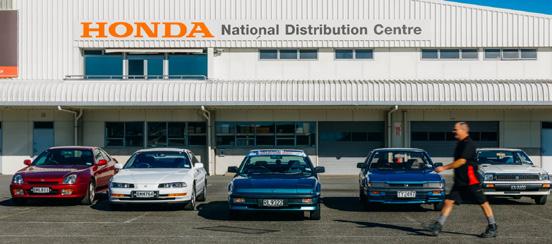
Honda New Zealand is closing its national distribution centre in Nelson to cut new-vehicle delivery costs and transit times.
The marque has had a base in the city for nearly four decades after it purchased the Annesbrook assembly plant in 1988.
Honda invested heavily at the site, including millions on a new paint shop in 1991.
In 1995, it added an engine assembly line, the first and only one in New Zealand.
The factory closed in 1998, but Honda remained in Nelson with its distribution operations moving to the current 2.34-hectare site in Wakatu Industrial Estate in 2001.
Honda NZ says the decision to relocate its pre-delivery inspection and distribution activities to Auckland is because the city offers advantages through port access,
transport networks, and proximity to the highest concentration of sales and dealer activity.
The timeline for full relocation will align with operational requirements, including remaining vehicle shipments scheduled through Nelson, while the Elms Street dealership will be retained.
The company says: “As part of this project, Honda has considered the impact on our people. We explored redeployment opportunities and confirmed a staffing approach that includes
Rules for loans changing
Motor-vehicle finance providers and agents face the prospect of lower compliance costs and more workable rules after an amendment bill passed its third reading last month.
It means the Credit Contracts and Consumer Finance Act (CCCFA) has changed with regulatory responsibility for lenders being transferred from the Commerce Commission to the Financial Markets Authority (FMA) next month.
Cameron Brewer, Commerce and Consumer Affairs Minister, says people should be able to access affordable finance when they need it, whether buying a home, upgrading a car or managing household costs.
“Under Labour’s CCCFA changes, lending became harder, slower and more frustrating than it needed to be,” he adds.
“We are simplifying the rules, reducing unnecessary compliance
costs and supporting a more competitive lending market. That means better access to credit, more choice and more affordable finance for consumers.
“We’re also removing unnecessary personal liability for senior managers and directors, and making consequences for certain disclosure breaches more proportionate.”
Responsibility for credit regulation will change from July 1, after which companies providing such services will operate under the FMA’s licensing regime.
Clare Bolingford, the FMA’s executive director of licensing and conduct supervision, says:
“By aligning credit regulation with broader financial services, we’re creating a framework that better supports responsible lending and consumer protection.
“Introducing a licensing regime for lenders will give the FMA more ways to monitor and supervise lending activity.”

Looking back, it was in 1976 that the Nelson plant became the first outside of Japan to assemble Hondas.
The first-generation Civic – a 1.2-litre, three-door manual – was put together from completely knocked down kits by importer and distributor New Zealand Motor Corporation (NZMC). It was also offered with an optional two-speed semi-automatic Hondamatic transmission.
Honda started to acquire the brand’s assets from NZMC in the mid-1980s, firstly with a 25 per cent stake in 1985.
Honda NZ Ltd was formed three years later and assembly continued in Nelson until August 21, 1998, with the end of operations resulting in the loss of about 220 jobs.
The National government’s decision in 1997 to remove tariffs on imported cars had rendered the plant unviable. About 4,500 people worked there over its lifetime and made 160,406 vehicles.

fixed-term support roles to support business continuity and effective handover during the transition.”
Honda NZ’s distribution centre in Nelson
A 1976 Civic hatchback
Margins dip after record spell
Turners Automotive Group reports car-sale margins have decreased to levels seen about two years ago as consumer demand weakens.
After starting the year with a record quarter, activity at its branches nationwide has dropped since late March.
It says the US-Iran conflict has affected the business, but there’s optimism vehicle sales and margins will increase as 2026/27 progresses.
Aaron Saunders, chief financial officer, told those attending the group’s results briefing on May 21 that margins during April and the first half of May were between $150 and $200 a unit lower than from January to the end of March.
“We’re still seeing good growth in finance and stable performance in insurance, but our retail business has seen a drop-off,” he said.
“Volumes are down and margins are back at the levels they were in April to June 2024. This is a place we’ve been before. The economy went into recession in that winter period of 2024 and it feels a bit like that again.”
Todd Hunter, chief executive officer, said the market is facing “challenging circumstances”. But the group’s diversified model has been resilient through previous cycles “and we’re going to get the opportunity to prove that again”.
He added a fiscal year shouldn’t be judged on a six-week period. “We’re going through a pricing transition like 2024 and 2025, so you always see some pressure on margins as you go through that.
“Once demand sorts itself out, margins will build again. We’re entering financial year 2027 wellpositioned and well-funded for the next phase of growth.”
CRUNCHING THE NUMBERS
Turners has posted a record normalised net profit before tax (NPBT) of $63.2 million for the year ending March 2026, up by 16 per cent from 2024/25.
The result brings forward the group’s $65m NPBT target set for
the 2028 financial year to 2027. The latest profit also lays the foundation for Turners’ $100m NPBT goal by 2031.
Other highlights for 2025/26 include a nine per cent year-onyear rise in revenue to $451.2m and the full-year dividend was also higher, up by 14 per cent higher to 33 cents per share.
Turners says the past financial year had two distinct halves with the first constrained by a soft consumer environment and tight margins.
positioning, selective buying and maintaining credit quality while continuing to invest in branch expansion.
“The group benefits from diversification, with continued momentum from its annuity finance and insurance”.

“The second half delivered a strong recovery as consumer confidence improved and Turners benefitted from proactive stock management culminating in a record profit performance in quarter four,” it explains.
The automotive retail division’s revenue rose by 10 per cent to $315.3m and profit was up 12 per cent to $32.6m. Finance clocked up $77m in revenue and $19.2m in profit, up by 13 and 19 per cent respectively.
Automotive retail is set to benefit from a full-year contribution from branch openings during the past 12 months, while finance is positioned to make gains from a materially larger loan book.
The current financial year will target “network groundwork rather than expansion” with no new branches scheduled to open. That said, four new dealerships and two replacements are being developed for the 2028 financial year.

ACTION BY DIVISION
Revenue grew by five per cent year-on-year to $50.2m in insurance as profit rose seven per cent to $17.3m.
While conflict in the Middle East “softened early trading” in 2026/27, Turners has deployed the “same tough macro playbook” it ran in the 2024 and 2025 financial years.
It includes disciplined inventory
The first half of 2025/26 in automotive retail saw constrained sourcing and tight margins on the back of soft demand. During the second half, sourcing initiatives, pricing optimisation and stock discipline delivered margin expansion.
Total owned units sold lifted by nine per cent with a focus on the lower-priced segment where demand was most resilient.
Operational efficiency gains supported higher stock turn and lower working capital.
The three new Christchurch
branches, which opened in the 2026 financial year’s first half, have driven a 22 per cent jump in units sold across that region.
Finance delivered a record result with consumer lending growth a key factor in the loan book increasing by 27 per cent to $566m.
Premium-tier lending represented 59 per cent of the ledger, up by three per cent when compared to March 2025. Consumer arrears came in at 2.5 per cent versus the industry average of 5.6 per cent and was “among the widest gaps the business has recorded”.
The insurance division continued its steady expansion with strong premium growth. Key dealer and finance broker partnerships remained a primary driver.
Digital distribution capability was strengthened and included launching a mechanical breakdown insurance product for the privateto-private car market. New partners – VTNZ, Gaspy and Quashed – were added during the year, increasing Autosure’s digital footprint.
Turners Servicing and Repairs is leveraging strong brand awareness. Cross-selling, upsells and reminders with the group’s wider customer base are starting to contribute through service plans sold with cars. The division continues to roll out mobile mechanics in locations to mirror Turners’ network.
EC Credit’s revenue of $8.5m was down 17 per cent from the previous year and NPBT fell 49 per cent to $1.8m, excluding a goodwill write-down.
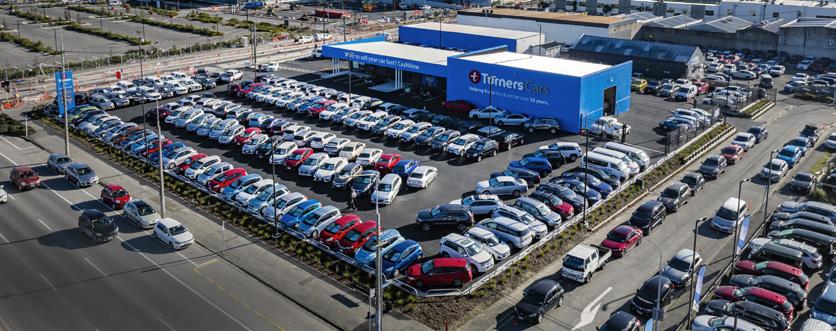
The three new Turners branches in Christchurch, which opened in 2025/26’s first half, have driven a 22 per cent jump in car sales in the region. Pictured is the site in Moorhouse Avenue, Sydenham
Todd Hunter
Aaron Saunders
A complete solution for your auto lending needs.
Multi-Tier Solution
Flexible lending for Tiers 1 to 4 via a single application point.
Wide Range of Vehicles
Loans for a diverse range of vehicles – cars, motorcycles, boats, EVs, light commercial, caravans and motorhomes.
Simple and Easy
Continuously improving processes and systems to enable more approvals in less time.
Top franchise takes out hat-trick
Duncan & Ebbett Hamilton has scooped the supreme title at Jaguar Land Rover NZ’s retailer of the year awards.
It also took out the sales team and experiential team categories with its hat-trick reflecting strength across commercial performance and customer engagement.
“We always believe in what we do and to be recognised at this level is a proud moment for everyone,” says dealer principal Martin Westall. “The benchmark is high and we’re honoured to set it this year.”
Archibald & Shorter in Auckland fared well with Greenlane employee Karim Jivani winning the service adviser of the year award while Nick Kumarasinghe was top sales executive.
The same dealership also secured the team titles for service and parts, and Mark

Neems received the John Fairhall Memorial Award, which is given in recognition of emerging leadership.
Christilea Van Wyk, of Armstrong’s Wellington, was business manager of the year.
The top body shop was Arlington Motors, also in the capital.
The ceremony was hosted by
Monthly hikes in price

The cost of diesel jumped by 36.6 per cent between March and April, while petrol increased by 12.6 per cent.
The price of both fuels rose in the 12 months to April this year –petrol by 30.1 per cent and diesel by 91.3 per cent.
By comparison, the largest annual increases for petrol of 37.7 per cent and diesel, up 95 per cent, came in the 12 months to June 2022.
“In the two months since February 2026, petrol increased by 33.6 per cent and diesel by 94.9 per cent,” says Nicola Growden, Stats NZ’s prices and deflators spokesperson.
Electricity prices, meanwhile, rose by 2.4 per cent in April compared to March. They have been increasing monthly since December 2024.
The seasonally adjusted value of fuel purchases rose by 5.9 per cent in the March quarter when
compared to the final three months of last year.
When accounting for price effects, total fuel sales went up by 0.2 per cent over the same period and the value of stock held by retailers climbed by 42 per cent to $290 million.
As for spending on motor vehicles via electronic card transactions, that dropped by $8.1m and 4.1 per cent in April when compared to March.
Fuel expenditure fell by $1m and two per cent.
Overall spending in retail and core-retail industries declined by 1.3 per cent, and by $89m and $84m respectively. Expenditure on consumables was down by 2.1 per cent, in hospitality by 1.3 per cent and on durables by 1.1 per cent, indicating Kiwis are keeping their purse strings tight.
The total value of electroniccard spending dropped by $160m and 1.6 per cent over the same period.
Motorcorp Distributors at Shed 10 in Auckland last month and general manager Ben Montgomery says the results show dealership standards continue to rise.
The numbers behind Duncan & Ebbett Hamilton winning the top award “speak for themselves”.
He adds: “It achieved more
than 120 per cent of annual sales targets, the highest net-promoter score across the network, and recognition from our Asia-Pacific team for a noticeable uplift.
“We’re proud of every retailer. The competition gets stronger every year and that’s what drives us forward.”
‘Stylish’ electric range
The premium electricvehicle division of BAIC, one of China’s largest carmakers, is being officially launched in New Zealand this month.
Arcfox’s arrival follows the introduction of its parent company and complements BAIC-branded models with a BEVfocused offering.
The marque’s vehicles here will boast intelligent driving hardware “akin to that found in high-end EVs without the eye-watering price-tag”.
Simon Rutherford, chief
operating systems to deliver a premium experience in the heart of the EV market.
“We’re working to expedite stock so we can do our part to help Kiwis get through petrolpump pain while reducing emissions from the fleet.”
The first arrival is the T1, a small to mid-size model with a lithium iron phosphate battery capable of more than 300km on the WLTP.
“It could be considered as a crossover with a raised ride height,” says Shiguang Guo, general manager of Arcfox NZ. “It represents a value proposition

Arcfox’s T1
The team from Duncan & Ebbett Hamilton

Budget backs ‘resilient’ roads
The budget always provides an important signal about government priorities, not only for the year ahead but the economy’s longer-term direction.
For New Zealand’s automotive and transport sectors, Budget 2026 wasn’t about major direct intervention in the car market.
There were no new-vehicle purchase incentives, no major fleettransition scheme and no direct automotive package.
Instead, its relevance to our sector was largely found in the areas which sit around the car market – infrastructure, fuel resilience, business productivity, and the cost of keeping people and goods moving.
That matters because the automotive industry doesn’t operate in isolation. It’s part of a much wider system connecting households, businesses, regions, ports, freight routes and supply chains. When transport is more reliable, efficient and resilient, the benefits are felt well-beyond the road itself.
The package of capital investment includes roads, rail, local infrastructure and transport resilience. For the automotive industry, that’s welcome because New Zealand’s fleet relies on a network that’s safe and fit for purpose.
One practical budget announcement for companies using vehicles was the reform of fringe-benefit tax. While it may not attract the same attention as big infrastructure projects, it matters for businesses providing cars to staff and managing fleets.
The proposed changes would replace the current daycounting approach with a simpler category-based system with vehicles classified according to private-use levels.


This should reduce some of the compliance burden associated with logbooks and quarterly checks, while also recognising the practical differences between branded work cars, perks, and vehicles mainly used for commuting or as pool cars.
AIMEE WILEY Chief executive officer, Motor Industry Association
The changes include updated calculation rates for standard vehicles, hybrids and EVs with the new rules intended to apply from April 1, 2027.
For industry, these enabling settings are important because tax and compliance rules can influence business confidence, fleet decisions and the cost of providing vehicles.
The Cambridge to Piarere extension of the Waikato Expressway was one of the more significant transport announcements. This section of SH1 is a critical freight and economic link between Auckland, the Waikato, Bay of Plenty, and central and lower North Island.
Investment in this corridor should support safer and more reliable journeys, while improving the movement of goods across one of the country’s most important freight routes.
Focus on reliability is important
because transport policy isn’t only about new projects, it’s about the day-today dependability of the network.
Delays, closures and poor resilience have real economic consequences.
They affect freight movements, servicing, parts availability, vehicle distribution and regional connectivity. A well-performing system is core economic infrastructure.
Fuel security and fuel-price pressure were also important features of last month’s budget.
The government has provided funding for extra strategic fuel reserves and has set aside a reserve for temporary, targeted support if global conditions worsen.
This reflects the reality New Zealand remains exposed to international fuel supply and price volatility.
For the automotive sector, prices at the pump have a direct influence on consumer behaviour, business operating costs and fleet decisions. When fuel prices rise sharply, households and companies reassess how, when and what they drive. It can influence demand for more fuel-efficient vehicles, hybrids, EVs and other lower-emissions technologies.
It can also increase cost pressure on transport operators and businesses with big fleets, so measures that strengthen fuel resilience are relevant not only to motorists, but the wider economy.
The budget landed in the context of broader funding reforms for transport.
The move towards a more modern road-user charges system, including potential electronic and flexible payment options, remains one of the more significant policy shifts on the horizon.
For the automotive industry, it will be important any future system is practical, technology neutral, privacy conscious and workable for distributors, fleet operators, companies and consumers.
Industry priorities remain clear for the MIA. New Zealand needs a policy environment that supports vehicle choice, affordability, safety, emissions reduction and transport productivity.
That requires investment in infrastructure, and regulatory settings which are clear, proportionate and aligned with the realities of a small, right-hand-drive market.
Enabling settings, including tax, compliance and regulatory settings, can make a practical difference to affordability, business confidence and vehicle access.
Budget 2026 wasn’t transformational for the automotive sector, but did contain measures that matter.
Investment in transport resilience, fuel security, skills and business compliance all affect the operating environment for MIA members and the wider industry.
The automotive sector is ready to play its part, with our members sitting at the intersection of technology, consumer choice, regulation and transport delivery.
Leading the conversation
Shift beneath market’s surface
New Zealand’s new-vehicle market is undergoing a structural change that goes well beyond short-term fluctuations in monthly sales.
With the first quarter of the calendar year behind us, two key talking points are the erosion of brand loyalty and rising economic pressure on automotive retail.
Price-sensitive buyers are moving from brand affinity to feature-rich value. The share of new-vehicle sales has fundamentally changed. While the “big three” brands aren’t collapsing, they are leaking major market share to value entrants.
Whether dealers represent traditional volume, luxury or entrant marques, or a combination, the seismic shift has direct implications on approaching marketing and getting customers.
This isn’t just a recent trend. In 2024, volume brands accounted for 84.7 per cent of all businessto-consumer new-vehicle sales, effectively controlling the market.
European marques held 11.8 per cent, while EV and new entrants made up just 3.5 per cent. At that point, the market was consolidated and most buyers defaulted to established mainstream options.
By 2025, early signs of disruption started to emerge.

Traditional volume brand share fell to 81 per cent, while luxury and European marques grew to 13 per cent, and EV and new brands nearly doubled to six per cent. While modest, this shift indicated alternative options were gaining traction particularly as pricing, availability and buyer awareness improved.

JAMES HENDRY Director, sales and operations
However, it’s the sales data for 2026’s first quarter that confirms this is no longer a gradual change, but an acceleration.
Volume brands now account for just 69 per cent of the market, down by 15 percentage points in less than two years. At the same time, luxury and European brands have steadily risen to 16 per cent. EV and new-entrant brands have surged to 15 per cent.
What’s driving this shift isn’t just the rise of EVs, but the broader expansion of alternatives.
New marques are competing aggressively on price and features.
European brands are benefiting from a polarisation of the market with buyers trading down for value or stepping up for perceived quality and prestige.
The result is a “squeezed middle” where traditional volume players are no longer the default choice.
For dealers, this has strategic implications.
volume players are no longer the default choice
Relying on brand familiarity, location or existing demand may no longer be enough to sustain performance because people are actively comparing more marques than ever and often well before engaging directly with traders.
ensure businesses and brands are considered.
Mid-funnel engagement via platforms such as Meta remains essential to nurture interest and drive traffic, while Google Search captures users at the end of their research journey with high-intent demand base keywords.
In a market where 30 per cent of purchasers are now looking beyond traditional options, dealerships which win will be those that adapt fastest – not just what they sell, but how they stay visible, relevant and competitive during the buyer journey.
Sustainable growth for 2026 and beyond will come from deliberate marketing strategies that speak to the customer journey and consider key segment messaging.
Traditional volume brand dealers may consider pivoting to retention and hybrid reliability. EV and new entrant businesses could focus on messaging around trust, warranty and test drives. Luxurycar buyers may be more responsive to ownership experience.
This means nearly one-in-three Kiwi consumers are buying outside of traditional volume brands, a fundamental change in behaviour.

This reinforces the importance of a full-funnel marketing approach. Upper-funnel activity, particularly through programmatic and video, is becoming critical to
The key takeaway is dealers cannot afford to let the market outpace marketing. The question is if marketing strategies are built for 2025’s landscape or 2026’s reality.

The month that was... June
June 8, 2007
Official cash rate increased
The governor of the Reserve Bank, Alan Bollard, increased the official cash rate (OCR) by 25 basis points to eight per cent.
He cited New Zealand’s strong domestic demand, particularly in the housing industry, increasing government spending, skilled staff shortages, the minimal effect from previous increases in the official rate and a significant rise in dairy prices as factors that influenced his decision.

“Had we not increased the OCR this year, it’s likely the inflation outlook would now be looking uncomfortably high,” explained Bollard.
“This further increase in the official cash rate is to ensure that inflation outcomes in New Zealand remain consistent with achieving the target of one to three per cent inflation on average over the medium term.”
June 26, 2009
Downturn nearing end
Things were still tough in the economic world, but there were indicators of some light on the horizon.
“There have been signs of improvement in some indictors, but in many cases it’s a matter of going down at a slower rate rather than genuine improvement,” said Doug Steel, senior economist with Westpac.
“We still expect the recovery to begin in the second half of 2009, more particularly in the fourth quarter, but it will be slow and the effects for consumers won’t really be felt until well into 2010.
“New Zealand has probably been in recession for 18 months although official figures for the second quarter won’t be available until September. There’s no magic bullet to yank us out of this. But the huge policy response – lower interest rates and fiscal stimulus including tax cuts – is starting to turn things around.”
Steel added consumer spending on larger items was well down. That wasn’t just on cars, but on electrical goods, overseas trips, furniture and so on. “Customers are cautious and have shut their wallets.”
However, he said a big positive for the country was the net-migration figures, which were much stronger than forecast and should stimulate economic activity.
“On a permanent or long-term basis, 2,700 more people came in than left. The net inflow in the previous year was 4,900. We expect annual net migration to exceed 20,000 for the whole of 2009. The main reason for the increase so far is fewer Kiwis are leaving, especially to Australia.”


June 13, 2008
Mobil introduces biofuel
Amid further fuel-price rises, which saw the cost of petrol and diesel jump by six cents a litre at most pumps, Mobil became the first of the country’s big oil companies to announce a trial of biofuels.
All four main suppliers were swift to raise their fossil-fuel prices in response to a hefty rise of US$10.25, or around NZ$13.58, a barrel that week in the ruling rate quoted for refined supplies from Singapore.

Caltex, which insisted such a jump could have justified a 10c retail increase, was soon followed by Mobil, BP and Shell.
But amid fear that world oil prices would keep marching up – after doubling in the past year to more than US$130, or NZ$172, a barrel –Mobil chose to begin a small biofuel trial in the lower North Island.
Although parliament had yet to pass legislation for mandatory biofuels sales targets, the company introduced ethanol derived from sugar cane to 91 octane and 98-octane petrol at a service station in Johnsonville, on the main road from Wellington to Porirua, and said it would add four more outlets in the capital and Manawatu in the future.
June 18, 2015
Industry in Japan faces tough times
The automotive industry in Japan wanted the government to tackle issues around taxation amid a sustained drop in cars being made and sold.
Sizeable decreases over the past fiscal year had mostly come on the back of a hike from five to eight per cent in consumption tax, the country’s equivalent of GST, in April 2014. On top of that, an increase in mini-vehicle taxation came into effect in April 2015 while another rise in sales tax to 10 per cent was slated for April 2017.
Even as the weaker yen boosted the value of exporters’ earnings from overseas sales, some analysts estimated that Japan’s annual automotive output might shrink by more than 1.6 million units over the coming decade.
Production of cars, trucks and buses plummeted by 7.5 per cent during the financial year to March 31, 2015, marking the 10th month in a row of falls, reported the Japan Automobile Manufacturers’ Association. It believed the outlook for the domestic market was “tempered by concerns about adverse impacts” of tax increases.
Chairman Fumihiko Ike said: “We will continue to lobby the government for further revisions to taxes related to the industry to reduce their burden on car owners.”

We provide roadside assistance your customers will actually use
▪ Nationwide 24/7 support
▪ Enhance customer retention and loyalty
▪ Easy to bundle into vehicle sales
▪ Trusted, NZ-owned provider
▪ MTA approved



Industry movers
SRIRAM PADMANABHAN has been appointed head of brand for New Zealand by Nissan Oceania. He started in the Auckland-based role last month.
Padmanabhan has more than two decades’ experience in the automotive industry across sales and network development, marketing and corporate strategy.

He has joined the Kiwi operation from Nissan Motor India where he led a business transformation programme for three product launches. Before that he was director of marketing and customer experience for Nissan Oceania, leading the “defy ordinary” brand direction and launches.
Padmanabhan’s career has included senior leadership roles at Nissan Motor Australia, and for Ford in Oceania, Asia-Pacific, Europe and emerging markets.
PAUL JAMIESON has been appointed into the new role of general manager of Avanti Capital, which was established to scale the funds-management platform Avanti Finance launched in 2017.

It focuses on diversifying and expanding the company’s investment offering, including mortgage and private credit investment products for institutional, wholesale and high net-worth investors.
Jamieson, pictured, has previously worked at Flexigroup, Fisher & Paykel Finance, the Reserve Bank of NZ, the London-based operations of Moody’s, USB Investment Bank and Deutsche Bank.
For the past seven years he has been group treasurer. Treasury will now report to Brad Lang, group chief financial officer.
MAT McNAY has become country manager of CarExpert NZ, a joint venture with Trade Me. He previously served as commercial director of media in Australia where he helped to build relationships with automotive brands and agencies.

McNay, pictured, is leading local operations, partnerships and go-to-market activity, while building out a team across editorial, video and commercial.
“CarExpert has made a strong start in New Zealand,” he says. “Having been part of the journey in Australia, I’m excited to build on that momentum here.”
Damon Rielly, chief executive, adds: “Mat brings established relationships with OEMs and agencies across Australia and New Zealand.” CarExpert NZ combines content with a team of specialists to help Kiwis research, compare and buy their next new vehicle.
STURROCK SAUNDERS has become chairman of MTF Finance’s board following Mark Darrow stepping down after six years in the role to take up the same position at Health NZ.
Saunders, pictured, has extensive governance experience as president of the Motor Trade Association, co-chair of Dekra NZ, chairman of MITO and director of Auto Stewardship NZ. His career began in automotive retail, where he owned and led a multi-franchise dealership, giving him an understanding of dealer operations, customer expectations and franchise economics.

Fuel crisis adds to case for switching
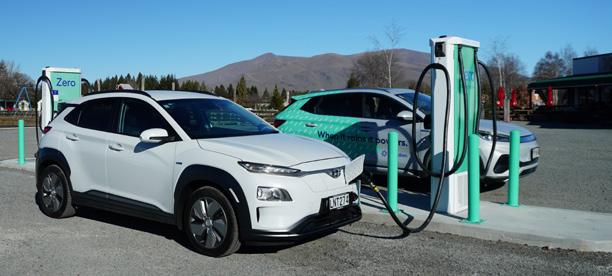
Ongoing uncertainty around oil supplies has sharpened Kiwis’ awareness of fuel security, boosted interest in electric cars and created a surge in demand for public charging, reports Meridian Energy.
“Concerns once centred on EV charging availability, affordability and range anxiety,” says Tim Calder, principal product manager. “But those issues are being addressed and the reliability of petrol supply is being questioned.”
Meridian has seen a 30 per cent jump in customers actively using its charging network and a 20 per cent increase in sessions.
Calder adds: “With more chargers than ever, more range and more awareness, many people now appreciate an EV may be perfect.
“There are more than 500 charge points in Meridian’s network
and we’re planning for another 900 fast-charge points over the next three years.”
Energy analysts say New Zealand has crossed the “electrification tipping point” where switching is cheaper over a car’s lifetime.
“That point was reached before the start of the fuel crisis,” says Calder. “Even when road-user charges are factored in, EVs are cheaper to run than petrol vehicles for most drivers, alongside lower servicing and maintenance costs.
“There are affordable options in the market and plenty of secondhand options to suit different budgets.”
Change at regulator
Asenior public-service leader with a strong background in business has been made chief executive officer of the Commerce Commission.
Suzanne Stew stood out among a strong field of applicants for experience across the private and public sectors, which will equip her with a perspective to serve the regulator well, says chairman Dr John Small.
consistently delivering results”.
Stew’s leadership roles at the Ministry for Business, Innovation and Employment (MBIE) have built on her work in the private sector.

She has earned a strong reputation for her “outstanding leadership, a focus on people she works with and the ability to navigate complex systems while
She started her career as an electronic product engineer in the UK with British Telecom and Sony.
After emigrating here, she held senior management positions at Wrightson and TelstraClear before entering the public sector with NZ Trade and Enterprise and the Ministry of Justice.
At MBIE, Stew oversaw a portfolio across 11 regulatory systems and was also its acting CEO.
Suzanne Stew
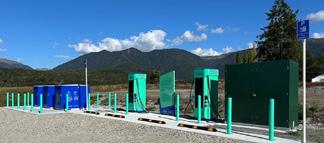
Meridian Energy’s facility at Twizel
The facility at Springs Junction between Christchurch and Nelson
Next questions for our vehicle fleet
Arecent report compiled for the Motor Trade Association (MTA) by the NZ Institute for Economic Research on the state of our fleet is a useful contribution to the debate on transport policies.
It brings together important data on ownership, fleet composition, electrification, repair complexity, industry structure and future trends.
However, an insightful report doesn’t have to be the final word. The next step is to fill in the gaps, test implied assumptions and ask counterfactual questions that matter for policies.
One of its most important findings is that New Zealand remains dependent on vehicles. People’s access to them is high, private mobility is central to daily life and access to a car is essential for many households, especially outside urban centres.
The report is also valuable because it avoids pretending electrification is happening faster than it is. While EVs are growing, they still remain a small share of the fleet.
Hybrids, especially petrol models, have contributed more to the low-emissions transition so far, which reflects affordability, available stock and Aotearoa largely being a technology taker.
This is especially important for used imports. The report identifies constraints in supplying used EVs. Japan remains our key source market for used vehicles, but its penetration of electric cars remains low.
Used EV supply is also affected
by battery condition, shipping restrictions, charging compatibility and buyer confidence.
Policy that assumes the used-import market can rapidly switch to large volumes of affordable EVs courts aspiration.
The report also highlights the growing complexity of repairs.

KIT WILKERSON Head of policy and strategy kit@via.org.nz
Modern cars increasingly depend on connected and advanced driver-assistance systems, proprietary software, security access, calibration processes and diagnostic tools controlled by original equipment manufacturers (OEMs). Repair documents matter but aren’t the whole issue.
The deeper problem is that repair capability is increasingly being designed around OEMs’ systems. Workshops may need their involvement, software access, online authorisation, security credentials, parts pairing or postrepair calibration.
This issue is better understood as choice of repairer, not simply the right to repair. Any policy that places obligations on importers to provide information or access only OEMs control risks an indirect veto over independent imports.
The report also highlights our fleet’s age, which is old by international comparison, and its renewal is a policy concern. But the treatment of used imports needs a careful counterfactual.
The research notes the fleet’s average vehicle is about 15 years while a used import enters it at around 10. That means a typical
used car coming in is younger than the average of what’s already on our roads.
It’s fair to say used imports influence the fleet’s age, but the direction and mechanism of that matter.
The relevant question isn’t whether an imported used vehicle is older than a new one. It’s what the buyer would otherwise have kept or bought.
For many households, the realistic alternative to a $12,000 to $20,000 used import isn’t a new car. It’s an older, lower-quality one already in the fleet, or opting for a delayed or no replacement, so independent imports may be a main renewal mechanism.
Imported used vehicles may also influence fleet age because they have substantial remaining life. They aren’t random 10-yearold models. They are chosen from source-market stock because they are good, valuable and commercially viable enough to buy, ship, comply and sell here.
The same counterfactual problem applies to safety. The MTA’s report is right that newer vehicles generally come with the newer technology and older imported vehicles may not introduce the latest systems as quickly.
But the relevant safety question isn’t whether a used import has the newest available tech. It’s whether it cuts or increases harm when compared to what the buyer would otherwise keep or purchase.
Safety should be assessed by
harm prevented. Crash-prevention systems are important, but accidents aren’t the only source of harm. Emissions create big climate and public-health costs. Larger models can impose greater risks on pedestrians, two-wheelers and occupants of smaller vehicles.
This is where the comparison between new and used becomes more complicated.
Much of the used-imports market consists of smaller petrol or hybrid cars. A lot of the new market includes larger SUVs and utes, many of them diesel.
A new diesel utility with the latest safety technology may still impose greater emissions harm and risks to people outside it than an older small petrol or hybrid passenger vehicle. That doesn’t mean newer safety technology is unimportant. It means the safety question should be framed around total harm prevented.
A useful extension of the MTA’s report would ask what buyers do when affordable options become more limited. It could ask what’s realistically available from Japan and other right-hand-drive markets, whether used EV supply can meet policy expectations at ordinary price points and what harm different vehicle types impose.
The report is insightful, but insight should be a starting point and not the end of the discussion.
The next step is to fill the gaps. That’s what cars Kiwis can afford, what they would otherwise keep or buy, what harm different vehicle types impose and how policy can improve the fleet without reducing affordable access.

Youngest range to hit market
The all-new RS 5, Audi’s first high-performance plug-in hybrid (PHEV), is slated to arrive in New Zealand in September.
It combines a 375kW 2.9-litre twin-turbo with a 130kW electric motor for total system output of up to 470kW and 825Nm.
Greg Leet, general manager of Audi NZ, says the PHEV marks “the beginning of a new era for our RS models” by combining sharper dynamics with day-to-day usability.
“It introduces an innovative new drive concept that lifts performance to another level while still delivering the everyday usability customers expect.”
The RS 5 is about 9cm wider than the base-model A5 at both ends with flared fenders. The three-dimensional single-frame, with a honeycomb grille and air curtains to control airflow, dominates the front.
At the rear, the aerodynamic diffuser and RS sport-exhaust system’s matte-oval tailpipes provide a sporty finish.
Darkened matrix LED headlights and the signature of the daytimerunning lights in a checkered-flag design reinforces its purposeful appearance.
Underneath, the RS 5’s modular electrified powertrain makes it
debut on an RS model for the first time.
The improved V6 and electric motor work through a hybridised eight-speed gearbox and all-new quattro with dynamic torque control that distributes torque between the rear wheels with speed and precision.
The result is stability, agility and safety at all speeds.
Supporting this is a chassis with RS-specific axles, twin-valve shock absorbers, RS-tuned steering, large 20-inch wheels in tailored tyres and powerful steel or ceramic brakes.
The RS 5 captures data on pedal inputs, oversteer, understeer and acceleration forces while recording and comparing laps and times. For a complete record, an optional dashcam integrated into the rear-view mirror can capture video highlights.
The inside gets contraststitched bucket seats and a covered steering wheel. There’s a large, curved display behind the steering wheel with a digital cluster and infotainment system in it. A smaller display is on the passenger side.
The RS 5 Sedan has a recommended retail price of $194,990 while the Avant starts at $196,990. By comparison, the previous-generation Avant was $169,990.
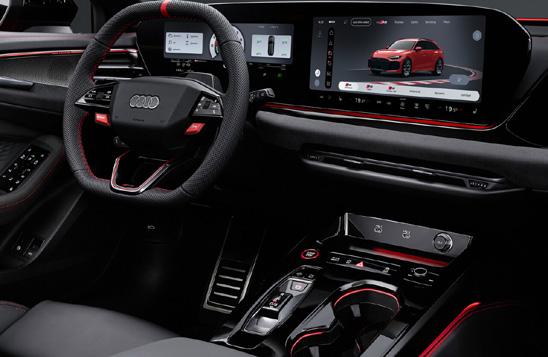
ELECTRIC ‘ENTRY POINT’
The Q4 e-tron has been boosted with more range and greater charging capacity. It also boasts reimagined digital stage and intuitive controls, exterior design and lighting features.
“While this is an upgrade, it feels more like an all-new model,” says Leet. “New features and technological advances enhance it as the electric entry point to the brand.”
Audi NZ is yet to confirm the model range for the Q4 e-tron SUV and its Sportback with wouldbe buyers being encouraged to register for more information in coming months.
The Q4 e-tron is the first Audi to support bidirectional charging, so its high-voltage battery can receive
Q4 e-tron SUV and Sportback
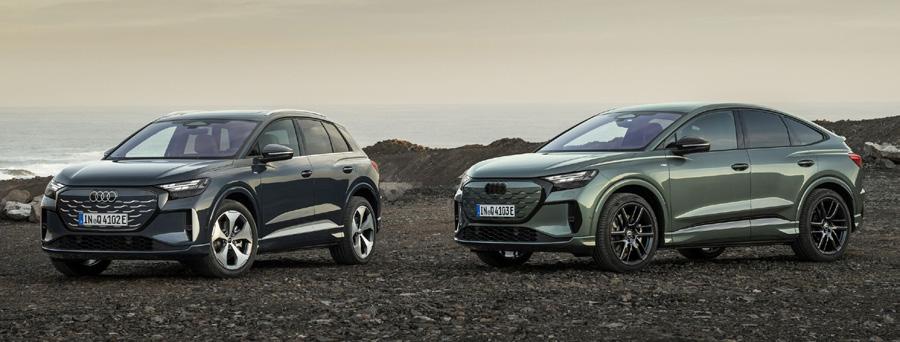
energy from the grid and feed it back to external devices.
For example, it can power e-bikes via a socket in the boot or a charging port adapter.
With the performance variants of the SUV and Sportback e-tron quattros, maximum charging capacity has increased by 10kW to 185kW. On longer trips, this keeps charging stops brief. In some variants, the high-voltage battery charges from 10-80 per cent in about 27 minutes.
Some 185km can be added to the performance in 10 minutes and the battery can be automatically or manually preconditioned for better charging performance. Its range has climbed to 592km.
The all-new interior is optional with the S line. There’s a panoramic display with an 11.9-inch instrument cluster and a 12.8inch MMI touch display keeps everything in clear view.
Also in the all-electric space, Audi will unveil its new A2 e-tron later this year. Leet describes the need for a compact EV at an entry price-point as “extremely important”. He adds: “This e-tron will not only strengthen our electric portfolio, but will make entering
The RS 5’s driver-orientated cockpit


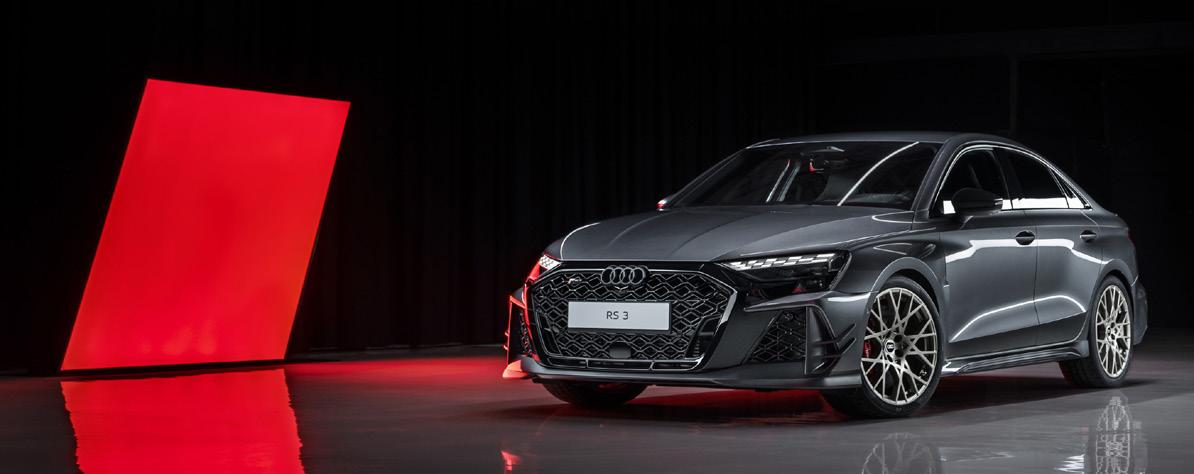
the brand more accessible with the price-point we hope to secure.”
The aim is for it to further rejuvenate the marque’s line-up. A preview of its silhouette can be seen in the first design sketch and its name is a nod to the A2 of more than 25 years ago.
After more than 20 new models in 2024 and 2025, Audi says it now has the youngest portfolio among its competition – from fully electric compacts to the premium full-size segment.
‘UNIQUE’ IN SEGMENT
An exclusive special-edition model will celebrate the 50-year anniversary of its five-cylinder engine, says Audi Sport. Only 750 examples of the RS 3 Competition Limited will be built with 10 available in New Zealand.
Its inline five makes the brawny compact unique in its segment by “combining extraordinary performance with an unmistakable sound”. When driven, the car lives up to its sporting pedigree thanks to a coil-over suspension and stiffer rear stabiliser.
There’s a matte serial number in front of the shifter. Leet says the limited edition represents a rare opportunity for fans to own a piece of Audi history.
Pricing and specifications for New Zealand will be released soon, and the 10 units destined for our shores will be evenly split evenly across the sportback and sedan. They will be pre-specified and have extensive standard kit. Both feature neodymium gold wheels, RS bucket seats, special digital dials and consecutive numbering. Green and white are the two exterior colour options.
It was back in 1983 that the
Audi Sport quattro delivered 225kW and 350Nm from its 2.1-litre engine. Today, the RS 3’s 2.5-litre five cylinder produces 294kW and 500Nm, making it the only engine of its kind in this segment.
This power enables the RS 3 Competition Limited to accelerate from 0-100kph in 3.8 seconds and reach a top speed of 290kph. Its signature sound is created by its one-two-four-five-three firing order. A fully variable RS sports exhaust enhances this with flaps that open earlier in dynamic, performance and torque-rear modes for a more pronounced engine note.
For the first time, the RS 3 features a coil-over suspension including a new rear stabiliser. In combination with the torque splitter and standard ceramic brakes, the limited edition offers distinctly sporty handling.
The materials used in the twintube shock absorbers – stainless steel at the front and aluminium at the rear – help cool the hydraulic fluid. The front shocks have external reservoirs. Better cooling means the dampers perform consistently.
‘ANYTHING BUT NARROW’
The all-new A6 Avant marks an important milestone for Audi with the marque saying the model
reconnects with customers through one of its most recognisable lines.
One of the brand’s most important models in the premium business-class segment, it’s priced from $158,990 plus on-road costs.
Built on Audi’s advanced premium platform combustion, it features a TFSI engine with mild-hybrid technology for improved efficiency and dynamic performance.
It also introduces intuitive digital and infotainment systems, advanced lighting technology and intelligent driver-assistance features.
“The A6 Avant will serve a unique corner of the market, but its capability is anything but narrow,” says Leet.
“This generation reinforces why it remains a cornerstone of Audi’s identity by delivering on space, sophistication and performance.”
The sporty design of the A6 contributes to its aerodynamics, achieving a drag coefficient of just 0.25, the best of any Avant with a combustion engine.
Air curtains ensure smooth airflow around the front wheels and sides, while controllable coolair intakes behind the single-frame grille optimise airflow through the engine bay. Audi has refined sealing between the front bumper
and cooling unit to reduce the loss of airflow in this area by up to 70 per cent.
At the rear, aerodynamic panels, an extended roof-edge spoiler and a wide diffuser create a clean flow stall, striking a balance between rear-axle lift and air resistance.
Inside, the curved MMI panoramic display features a 11.9-inch virtual cockpit and a 14.5inch MMI touch display with OLED technology.
A 10.9-inch MMI frontpassenger display is standard. This enables content streaming, navigation assistance and access to infotainment features while a privacy mode ensures the driver isn’t distracted. A Bang & Olufsen 3D premium sound system with head-restraint speakers are standard.
The A6 Avant is powered by a three-litre V6 TFSI engine with MHEV-plus to deliver 270kW and 550Nm of torque.
Paired with a seven-speed S-tronic transmission and quattro all-wheel drive, it makes the 0-100kph dash in 4.7 seconds.
The MHEV-plus system provides up to 18kW of extra boost and 230Nm more torque during acceleration, while regenerative braking recovers up to 25kW of
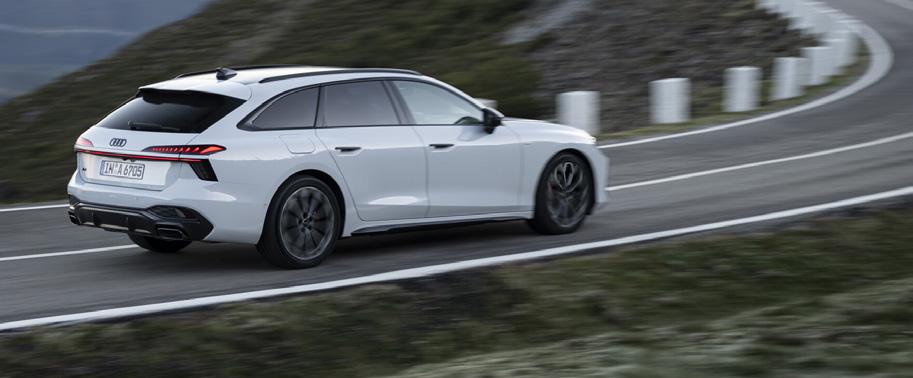
Audi’s A6 Avant
The RS 3 Competition Limited
Growing talent in grassroots series
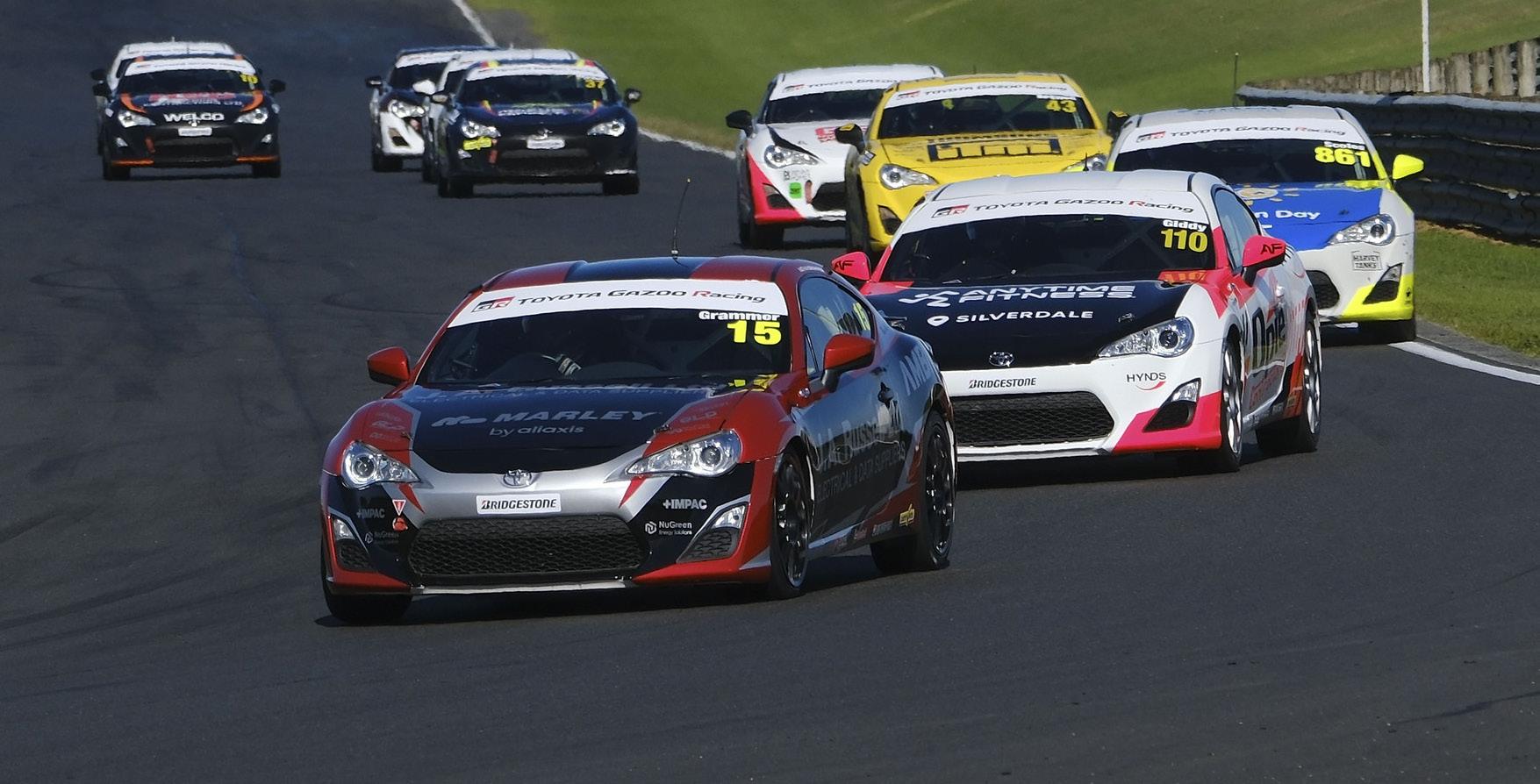
expand and its second-tier series is proving just as popular.
The championship-level GR86’s six races attracted 16 entries this summer. It was won at the final round by Chris White, who finished second in the last race of the season.
Attention has now turned to the four winter rounds of the Toyota 86 Trophy Series for the original TR86s, the first-generation racers used from 2013 until they were superseded in 2024.
The non-championship series runs until August and is aimed at drivers looking to progress to the GR86 competition.
The original vehicles are still fast. The overall 86s’ lap record at the 3.32km Taupo circuit, for example, was set by Ash Blewett in 2014.
Although the secondgeneration cars have a bigger 2.4-litre engine, his 1:42.258 has never been bettered, while the 1:14.210 lap time around Hampton Downs set in the same year by champion Tom Alexander still stands.
Marcel Bartley, who is aiming to start his career in the best possible way. The 22-year-old is almost brand new to motorsport.
He made his debut in the third round of the Jackson Orchard series at Highlands Motorsport Park in a GR86. He started in 12th and worked his way through the field to fifth before a mechanical issue forced his retirement.
A round later Bartley secured four second-place finishes over the course of a weekend, which was enough to win the round.
“I like the pathway the 86 series offers because it’s a good platform to start my career,” he says. “I’m looking to make a statement now and then do the same at the GR86s later this year.”
Riley Boswell, of Hamilton, is rising through the ranks. He has built a reputation as a stand-out in the BMW Racing Series in recent seasons, having started karting at the age of just seven. The family team REB Motorsport is running his Toyota 86.
The 16-year-old says: “My father and I built an E46 in 2022
We’ve got better and better, and this past season has been good because we got some great results.”
Taupo-based Toby Elmiger is back for a second tilt at the trophy. He returns as a race-winner who has made a name for himself in the 12 months since he last competed in a TR86.
He’s relatively new to the sport having only competed in cars for two seasons, but following his trophy campaign in 2025 he contested the growing TA2 category scoring 10 podiums and two victories.
“I’ve chosen to compete in the Toyota 86 Trophy Series to stay sharp,” says Elmiger. “Having these competitive fields and constant close racing is great for development, especially over winter when usually it’s just testing and simulator work.
“The main objective is to see how quickly I can adapt and change my style to suit the 86, and put up a fight against top upcoming drivers.”
Rising star Ajay Giddy, aged 15, was a late inclusion for this year’s
and took part in the summer GR86 series.
Returning for a second season, Nathan Grammer aims to build on his third overall result last year,
The 16-year-old has continued to build experience by competing in the North and South Island Endurance Series with Mackenzie Motorsport, and securing the 2025 Motorsport NZ One-Hour Endurance Series for classes four and five.
He enthuses: “This series provides valuable seat time through the off-season while keeping me sharp heading into what’s going to be an important 2026/27 summer campaign.”
Sixteen-year-old Josh Hill, of Queenstown, recently completed his first series outside of karts.
He won class three of the Jackson Orchard Sprint Series in his 86 also took out the Grant Aitken Perpetual Trophy.
Hill was supported in his campaign by a couple of notable names, professional driver Paul Blomqvist and former Toyota 86 star William Exton, and says it was
Nathan Grammer scored a hard-fought first win at the Toyota 86 Trophy Series




a significant help moving into circuit racing.
“The sprint series was a great start for moving up from karts, which I’ve been competing in since I was seven,” he says.
Long-time Toyota racer Mark Mallard makes a welcome return to racing in the trophy series. A stalwart of Kiwi motorsport and owner of Crème Insurance, which has done a lot more than most companies to sponsor young drivers over the past few seasons, he’s at the wheel of his Toyota 86.
It’s the vehicle Mallard raced in the main-game championship four years ago and his son Thomas was behind its wheel it for his debut Toyota 86 season.
“The old jigger was sitting in the garage,” he smiles. “I do run it every now and then in the GTRNZ and Auckland Car Club Production Race Series.
“I just love driving the TR86 and I always try to get a class win or two in it every year. Now is a good time to get it out and enjoy it.”
After suffering a minor stroke
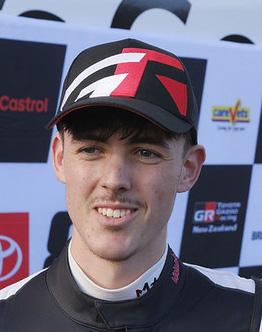

recently, he wants to have fun and test himself more than anything else on his road to recovery.
CareVets, a long-time supporter of the 86 series, sponsors a scholarship car for the entire trophy season. The seat has been secured by Hamilton racer Taylor Mitchell this year.
The scholarship’s annual shootout was held at Hampton Downs, and put the skills and fitness of eight drivers to the test.
Mitchell impressed on the run and the gruelling 10-minute Wattbike endurance test before excelling in an interview scenario. He engaged engineers and driving judge Tom Alexander with his track and set-up skills.
The 18-year-old says: “I didn’t expect to win, especially against such high-quality opposition, but I’m stoked to come out on top.”
Nieko Scoles, meanwhile, has been racing cars for three years since he was 13. He started off in an 86 when contesting club events and the South Island Endurance Championship.




“I have already had a lot of experience in these cars,” he says.
“I’ve had some good results along the way, and have learned a lot each time I’ve driven and raced the vehicle.”
Scoles made his “main game” 86 debut earlier this year in the GR86 round at the New Zealand Grand Prix weekend.
Aucklander Mitch Vye is aiming to build on a promising appearance in last year’s trophy series when he made his debut in the final round at Taupo.
A strong performer in Senior Rotax Karts in the Auckland region in 2024 and 2025, the 17-year-old has also competed in two rounds of GTRNZ in the GT4 class. In the past season’s five-round Auckland Production Series, he won group A on his way to second overall.
“It’s been a good summer season and my objective is to do well,” says Vye. “I will try to win, but more importantly to learn and gain a lot more experience.”
And finally to Lee Zeltwanger, an all-round sports fanatic who also
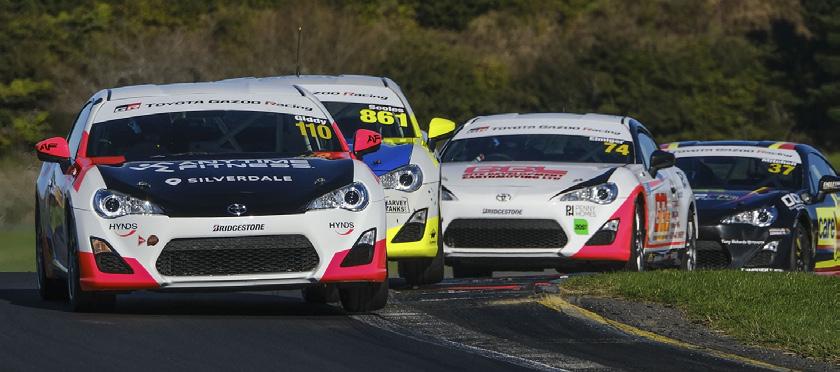


plays seven and 11-a-side football.
The 23-year-old is a graduate in sports exercise, nutrition and management, and enjoys working on this race vehicles as well as driving them. He has been racing for 15 years after starting in karts when aged seven.
“I shifted into cars in 2018 starting with the BMW Race Driver Series. I enjoyed that for three years before moving into the BMW E46 class for seasons.”
Zeltwanger’s highlights include winning the Kapellen Trophy for Rotax Mini Max in Switzerland in 2012 and the junior restricted class in the North Island Championship two years after that. “Now, though, I have my eyes set on the Toyota 86 Trophy Series.”
OFF TO FLYING START
Nathan Grammer won this season’s first race after fighting off waves of attacks from Ajay Giddy and Nieko Scoles in cool, fine weather at Hampton Downs in mid-May.
Giddy then stepped up to win the second race ahead of Nieko Scoles and Taylor Mitchell. Scoles started from pole but was instantly overtaken by Giddy, who led for the rest of the way to the chequered flag.
In race three, Toby Elmiger took the victory meaning the Toyota 86 Trophy Series had three different winners from three races.
The action continues from June 20-21 at Taupo. Rounds three and four are at Manfeild from July 4-5 and August 1-2.
Ajay Giddy leading race two around Hampton Downs
Tribunal rules repairs were done in ‘reasonable’ time even considering shutdown for Christmas
Background
Ranjit Jadhav purchased a 2013 Range Rover Evoque for $16,990 from Craig Hearn Motors on December 8, 2025.
He claimed there were issues with the car overheating, so he returned it to the trader in Napier on December 12 and a loan vehicle was provided.
Jadhav then emailed the dealer noting his overall lack of confidence in its safety and roadworthiness.
He also raised some extra issues such as “steering instability and side-to-side swaying particularly noticeable at 100kph, a knocking noise from the front driver-side wheel area [possible tie rod or ball joint] and excessive suspension noise”.
On January 7, 2026, Jadhav rejected the Evoque under the CGA. He stated the faults affected its safety, reliability and fitness for purpose, and the car hadn’t been repaired within a reasonable period.
The trader’s director, Craig Hearn, said repairs had been delayed by the Christmas holidays and took until January 20 to complete.
The case
Hearn provided the tribunal with an invoice from Auto Shop Automotive. He said the work took longer than expected because of the various issues to assess in addition to difficulty identifying the cause of overheating.
The invoice detailed the replacement of a faulty thermostat and listed other issues raised by the buyer with the car.
The repairer checked the steering and suspension noise. The vehicle was raised on a hoist, and the wear on the front and rear suspension was found to be “okay”. Such components typically wear due to a combination of age and
mileage. The technician also roadtested the car. No knocking, noises or steering issues were discovered.
The tribunal’s assessor expressed his opinion the repairs were minor and, from his assessment of the evidence, the Evoque had been fixed.
Jadhav had, since the hearing, raised a further issue regarding the overheating, which the dealer was assessing.
The finding
The issue in this case was whether the Evoque was of acceptable quality for the purposes of section six of the CGA.
Whether a vehicle is acceptable is considered from the point of view of a reasonable person fully acquainted with the state and condition of the goods including any hidden defects.
Jadhav’s concerns with the Evoque were raised on December 21. After the Christmas break, the car was assessed and a faulty heat sensor was repaired. No other issues were identified. He didn’t provide any evidence other than his own observations to substantiate other issues existed.
Based on the evidence, the tribunal was satisfied that the overheating, which was related to a faulty sensor, constituted a breach of the guarantee of acceptable quality because it occurred soon post-purchase and was a preexisting minor defect.
Regarding other matters raised by Jadhav, the adjudicator found
there were no proven CGA breaches and establishing any sat with the buyer. He had to provide evidence that showed, on the balance of probabilities, any alleged defects existed but hadn’t done so.
Moreover, the invoice provided by Hearn Motors revealed the other issues were investigated and no problems were uncovered.
Having found the faulty sensor breached the CGA, the tribunal had to consider what the appropriate remedy was under section 18 of the act.

Jadhav wanted to reject the Evoque and, while the legislation provides several remedies, the starting point is repair by the supplier. Hearn Motors fixed the car and, therefore, met its legal obligation to do so.
Jadhav rejected the Evoque before the work was carried out and continued to maintain he could reject it.
The right to reject can arise when a supplier has failed or declined to remedy a breach or when it is substantial. The tribunal ruled that wasn’t the case here.
It also decided the repairs were done within a reasonable time. The car was dropped off just before Christmas 2025 and Jadhav rejected it on January 7 by which time there had been no refusal or unreasonable delay in fixing the Evoque.
The tribunal noted it would have made that finding even if the seasonal close-down period hadn’t

The case: The buyer wanted to reject his Range Rover Evoque after it overheated soon after purchase and said he lost confidence in the car. The trader took a month to repair it and supplied a loan vehicle for the customer to use.
The decision: The tribunal dismissed the application to reject the car under the Consumer Guarantees Act (CGA) because the dealer fixed it in a reasonable timeframe and the remedial work wasn’t of substantial character.
At: The Motor Vehicle Disputes Tribunal via video link.
been part of the alleged delay. It also found the overall time taken to repair the car wasn’t unreasonable in the circumstances, which included having to determine if the other faults claimed by Jadhav existed.
The total time between the vehicle being dropped off and when it was ready for uplift was one month, which was reasonable. Taking Christmas into account, it was more so.
The only other ground Jadhav could have had for rejection was if the CGA breach was of substantial character.
The car wasn’t new and repair work the tribunal’s assessor described as “not particularly serious” had been done. There were no other proven safety issues affecting the Evoque.
If any new proven issues did arise, including those that had been raised since the hearing, Jadhav might have had further rights under the CGA in relation to them.
Taking those factors into consideration, the adjudicator didn’t consider the failure met the requirements of substantial character so the buyer wasn’t allowed to reject the vehicle. It had been repaired and no grounds existed for rejection.
Order
The application by the buyer to reject the car under the CGA was thrown out.
A 2013 Range Rover Evoque
Adjudicator refers case to transport agency with concerns over how car passed certification
Background
Kanchana Weerasekara purchased a 2014 Toyota Aqua for $8,500 from Kiwi Cheap Cars in Sandringham, Auckland, on October 8 last year.
A post-purchase inspection by the AA uncovered pre-existing structural damage that might have impacted on a WOF being obtained for it.
Weerasekara raised the issue with Kiwi Cheap Cars, which didn’t respond, so he rejected the Aqua. He wanted the dealership to reimburse him the purchase price and costs.
The case
A model-year
The consumer information notice provided by the trader stated the Aqua wasn’t imported as a damaged vehicle.
However, a CarJam report noted it had been involved in two collisions in Japan during 2022 with both rated as medium-scale impacts.
The vehicle passed New Zealand entry certification around August 29, 2025, and Weerasekara was its first buyer here.
He had an issue with the hybrid battery soon after purchase, which the trader resolved. He then found a broken silencer bracket and, because of his concerns about the Aqua’s overall condition, he arranged for an AA inspection on December 1.
The AA’s report stated the right-hand side of the front chassis was dented, which was a WOF issue, and surface rust was forming. There was also evidence of accident-damaged engine mounts in the same area.
The lever for the parking brake needed adjusting because of excessive travel, which was another warrant problem, and the left-front door’s glazing wasn’t very clear.
The tribunal’s assessor agreed
brake and areas of structural damage would most likely not meet WOF requirements. He also questioned how the Aqua had met entry-certification requirements.
Before the hearing, the tribunal asked the trader to provide a copy of the certification documentation, but it failed to do so.
The buyer wanted to be reimbursed $229 for the AA inspection and $150 he paid the trader for a bumper touch-up. He said he wasn’t provided with an invoice for that amount.
On December 1, based on the AA report, Weerasekara rejected the Aqua. The dealer didn’t respond to the notice of rejection so filed his application with the tribunal on December 19. The trader failed to appear at the hearing.
The finding
The issue requiring the tribunal’s consideration in this case was if the Aqua had been of acceptable quality under the Consumer Guarantees Act (CGA).
The structural issues uncovered by the AA meant that repairs would be needed before the car got another WOF.
The tribunal also questioned how it met entry-certification requirements and obtained its first warrant given the visible structural damage.
The adjudicator was satisfied these problems were pre-existing.

occurred after purchase and were likely related to accidents in Japan, so it was ruled the Aqua wasn’t of acceptable quality in breach of section six of the CGA.
The buyer sought to reject the car, get back the cost of the AA report and be reimbursed the money he paid the trader for work on the bumper.
The tribunal didn’t consider Weerasekara would have purchased the Aqua if he had been fully aware of the nature and extent of the pre-existing and underlying structural issues, so it found the vehicle was substantially unfit and he could reject it.
The buyer rejected the Aqua on the same day he learnt of its issues, so there was no question he didn’t exercise his right in a reasonable time and the tribunal also found he hadn’t damaged it so he hadn’t lost the right to reject it.
The adjudicator ordered that he should be reimbursed the car’s sticker price and the $150 he paid at purchase for the work on the bumper on the basis the trader would benefit from that.
Under section 18(4) of the CGA, a consumer can be awarded damages for any loss or damage resulting from a failure which was reasonably foreseeable as liable to result from the problem.
Weerasekara had incurred the costs of the AA report. The tribunal was satisfied this arose
The case: The buyer wanted to reject his Toyota Aqua after discovering it had pre-existing structural damage that could have prevented a warrant of fitness (WOF) being issued for it. The trader failed to respond to the application to the tribunal and didn’t appear at the hearing.
The decision: The purchaser’s claim to reject the vehicle was upheld by the adjudicator. The dealer was ordered to refund the sticker price and other costs which were incurred by the consumer.
At: The Motor Vehicle Disputes Tribunal via video link.
from the breach of section six of the CGA so should be paid by Kiwi Cheap Cars.
The final matter to consider was whether the dealer should reimburse him the $87 hearing application fee.
The tribunal can only award costs against a party when “the proceedings are frivolous or ought never to have been brought, the matter ought to have been settled before a hearing but that party refused without reasonable excuse to participate in prehearing discussions – or acted in a contemptuous or improper manner during those discussions – or the party fails to attend the hearing without reasonable cause”.
Kiwi Cheap Cars hadn’t responded to the claim, which had clear merit, and didn’t appear at the hearing so the adjudicator ordered the filing fee be reimbursed.
The tribunal directed a copy of its findings be provided to the NZTA because of its concerns about how the Aqua passed entry certification.
Orders
The claim for rejection was upheld. The trader was ordered to refund the car’s purchase price of $8,500, the $150 the buyer paid for the bumper repair, $229 for the report and the $87 hearing filing fee. The dealer was also ordered to uplift the Aqua at its own cost.

Dealers sparkle with success
Bay City Mitsubishi has been crowned supreme diamond dealer for the third time in four years by Mitsubishi Motors New Zealand (MMNZ).
It adds to the same accolade it won in 2023 and 2024 after Morrison Mitsubishi in Sockburn, Christchurch, took out last year’s overall title.
The Tauranga-based company also scooped the award for parts excellence on May 8 at Tākina Wellington Convention and Exhibition Centre with the ceremony attended by more than 200 dealership and head-office staff.
This year’s other diamond dealers were Wayne Kirk Mitsubishi in Hastings, WR Phillips Mitsubishi in New Plymouth, Morrison Mitsubishi Ashburton, Delaney Mitsubishi on the Kapiti Coast, Simon Lucas Mitsubishi in Auckland, Baigent Motors, of Matamata, and Peter Keown Automotive, Oamaru.
MMNZ says the event recognised standout members of its network after a year of strong performance for the marque. It came third overall for sales in 2025 and maintained its position as the country’s second most popular passenger-vehicle brand.
The ASX and Outlander were the second and third best-sellers respectively, while the Triton was the third most popular light commercial.
Tony Johnston, chief operating officer, describes MMNZ holding its position in the sector and delivering 14,172 vehicles for a market share of 10.4 per cent as “outstanding”.
He says: “Our dealers’ commitment to customers, ability to adapt and take pride in what they do is what keeps Mitsubishi relevant to Kiwis. The diamond awards are about recognising the best of that effort, teams who go above and beyond.”
Johnston says the breadth of this year’s winners highlights the depth of talent across MMNZ’s network. “What stands out every year is how competitive these awards are.
“To be recognised at this level means you’re delivering excellence across every part of the business and doing it consistently. It reflects the pride our dealers take not just in selling vehicles, but in building long-term relationships with customers.”
Other winners on the night included Magnus Lennie, of

Opotiki, for service excellence and Cavanagh Motors in Te Puke, Western Bay of Plenty, for parts and service.
The finance dealer of the year was Andrew Simms Mitsubishi Botany, and the managing director’s award went to Jason Robb, of Manukau Autos, south Auckland.
Customer service awards went to Manukau Autos in group one, McVerry Crawford Mitsubishi Palmerston North in group two and Delaney Mitsubishi in group three.
Andrew Simms Mitsubishi in Newmarket, Auckland, Pacific Motor Group in Whangarei and Piako Mitsubishi Morrinsville were group winners for top new-vehicle sales. Awards for top market share were presented to Andrew Simms Mitsubishi Dunedin, Pacific Motor Group in Whangarei and Archibald Cars, Kaitaia.
ELECTRIFYING DEBUT
The Outlander Sport HEV, which was unveiled at the awards ceremony, signals a “significant” step forward in MMNZ’s electrified journey and is a “clear response” to shifting demand as more Kiwis turn to lower-emissions models.
Known as the Xforce in other
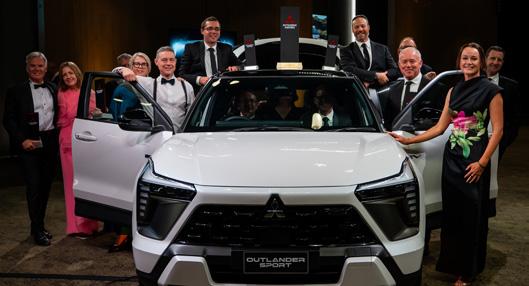
markets, more than 62,000 units of the hybrid compact SUV have been sold in Asia, Latin America, Africa and the Middle East since its debut in 2023.
Johnston says: “We’re seeing more New Zealanders looking at electrified options, but not everyone is ready to make the jump to fully electric or plug-in hybrid vehicles [PHEVs].
“The Outlander Sport HEV gives customers a highly efficient, practical SUV with the benefits of electrification that fits into everyday life.”
It marks the brand’s first step into petrol hybrids here.
The system pairs a 1.6-litre MIVEC engine with the marque’s latest-generation hybrid technology, which automatically switches between EV, hybrid and engine drive modes.
It incorporates multiple hybrid operating modes, including parallel and series hybrid configurations.
The system automatically selects the most efficient set-up based on driving conditions and battery charge.
Designed to maximise electric drive, the SUV uses regenerative braking and intelligent energy management to reduce fuel consumption while maintaining smooth performance.
“This system does the thinking for you,” says Johnston. “It’s constantly adapting to how and where you’re driving, so you get the efficiency benefits of electrification without changing your habits.”
Visit autofile.co.nz for the full story on the HEV and MMNZ’s citations for its award winners.
Aaron Chatfield, dealer principal of Bay City Mitsubishi, with the supreme diamond dealer trophy
Checking out the new Outlander Sport HEV
Winners and Mitsubishi Motors New Zealand staff at the 2026 Diamond Dealer Awards ceremony
8,175
7,167

Imported Passenger Vehicle Sales by Make - May 2026
Imported Passenger Vehicle Sales by Model - May 2026
Call to change dealer rules
The Motor Vehicle Disputes Tribunal (MVDT) has renewed its bid for some amendments to be made to the Motor Vehicle Sales Act (MVSA).
Its latest annual report highlights recommendations made in recent years to improve the law, such as changing section 54 to require dealers’ email addresses to be included in publicly available contents of the motor-vehicle traders register.
Trade steady
There were 7,167 used-imported cars sold in May for a 1.3 per cent drop from 7,259 in the same month of 2025, but last month’s total was up by 5.6 per cent from 6,784 in April. The 2026 total now stands at 36,725 units, 4.6 per cent higher than 35,100 by this time last year. Toyota’s Aqua was last month’s top model with 633 units. The Prius was second on 404 and Nissan’s Note was third on 369.
The tribunal’s members suggest section 142(1)(b) should be amended make it easier for notices and documents to be served by email, and for section 88 to enable assessors to continue hearing matters until they are reappointed or replaced.
Other recommendations are reviewing MVSA provisions, such as the definition of “sale” in section six – and provisions around the meaning of motor-
vehicle trader in sections seven through to nine – to ensure all methods of marketing and selling cars are captured.
Also on the wish list is changing clause 5(2) of schedule one so respondents must provide a summary of their responses and supporting documents.
“Early receipt of this information will promote more productive settlement discussions and enable the tribunal to more efficiently
Used Imported Passenger Registrations - 2022– 2026
determine
applications,” it states.
The MVDT’s report urges a review of the definition of “motor vehicle” in section six of the MVSA and suggests an exclusion along the lines of a model “with a gross vehicle mass [GVM], as determined by the manufacturer, of more than 3,500kg”.
It wants the Motor Vehicle Dealers (Exclusion of Heavy Vehicles) Order revoked, which defines a heavy vehicle as having a GVM of 3,500kg or more.
“The effect of the order is the tribunal can only decide matters involving vehicles with a GVM of less than 3,500kg,” states the report for the year June 30, 2025, which was released in April.
The definition in the order is inconsistent with the Heavy Motor Vehicle Regulations, which defines such units as having a GVM in excess of 3,500kg if they aren’t considered as being “heavy” under the rules.
LIVING IN DIGITAL WORLD
The MVDT is taking part in a digital strategy for courts and tribunals, which recognises using technology wisely is essential to enable all people to participate.
Some 96 per cent of its hearings in 2024/25 used audio-visual technology to allow a party, witness and or tribunal member to attend remotely.
In addition to this, most hearings are held online.
More people are now using generative AI to help prepare claims, so the MVDT wants to ensure it explores and understands the ramifications of AI use by parties and the tribunal.
It plans to consider developing policies to effectively integrate and utilise AI to assist the public and improve decision-making processes.
It adds policies should also ensure any such use is ethical and unbiased “including being aware of pitfalls, such as model collapse”.
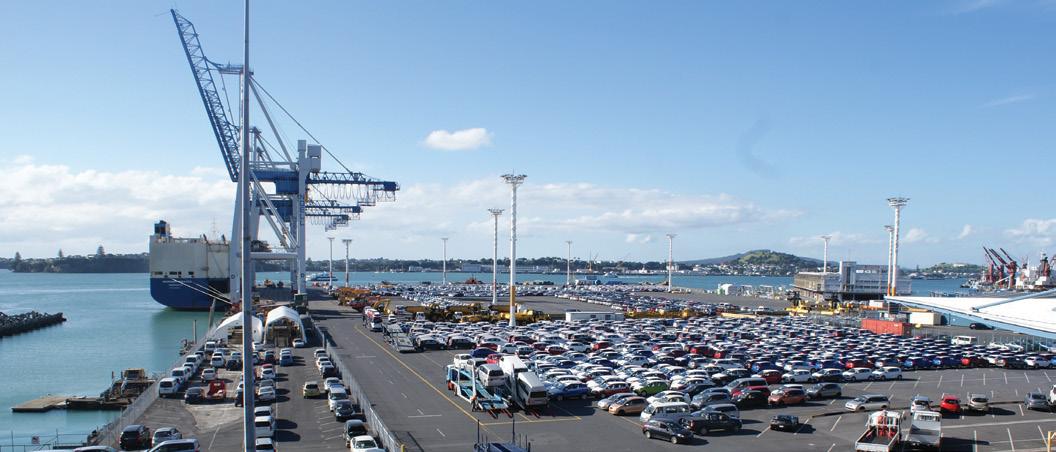

Illegal lending results in ban
Ilaisaane Malupo, trading as Nane Easy Loan Finance Services NZ, has been banned from operating in the industry for two years after providing personal loans without being registered.
She has also been ordered to pay $15,000 in reparations to seven borrowers and complete 150 hours’ community service.
This was a reduction from a starting point of about $50,000 in combined reparations and fines alongside the ban, which the judge at Auckland District Court said recognised the legal requirement to balance Malupo’s sentence against her lack of means to pay.
Under the Financial Service Providers (Registration and Dispute Resolution) Act and Credit Contracts and Consumer Finance Act, all consumer credit providers must be registered and certified.
Simon Anderson, head of credit investigations and compliance, says: “On several occasions, we advised Malupo of the legal requirement to become registered. Not only did she ignore this, but she targeted people who could least afford her loans.”
As well as being unlicensed, Malupo’s terms included interest rates of up to 15 per cent per week, which would double if borrowers
failed to pay back loans within 28 days. Late fees of up to $10 per day were also levied.
“The distressing element of this case was many of her customers were already struggling when they came into contact with her,” adds Anderson. “After taking out a loan, some would sell meaningful personal items or miss other essential payments, such as rent, to keep up with repayments.”
In some cases, she threatened borrowers in south Auckland who fell behind on payments with public exposure on Facebook and Tongan media sites.
At sentencing Judge Sharp said
statements by victims illustrated the emotional and financial impacts people had faced.
“There are persons who have suffered as a consequence of paying fees and interest they shouldn’t have had to pay.”
GOOD IMPORTS MONTH
Some 7,825 used passenger vehicles crossed the border in June to bring the year-to-date total to 37,172.
There were 7,631 arrivals from Japan and 132 from Australia.
In addition, 29 came in from Singapore, 13 from the UK and 12 from the US.
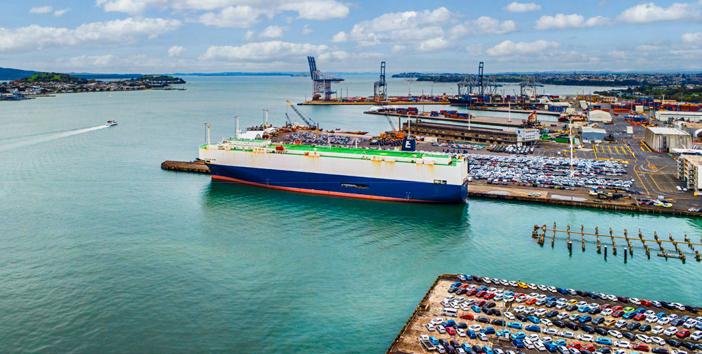
Loan-book quality boosts profit
The Geneva Group has reported $12 million in net profit before tax (NPBT) for 2025/26 to double the previous year’s total of $6m.
The result reflects gains across all divisions with Quest Insurance accounting for 46 per cent of the jump. New Zealand lending operations contributed 43 per cent of the rise and FP Tonga was responsible for 11 per cent.
Group net profit after tax climbed from $4.6m to $8.6m and by 87 per cent while total assets grew by two per cent to $217m.
Geneva’s trading update of May 12 notes its strong unaudited
results reflect a “significant improvement in earnings quality, balance-sheet strength and operating performance”.
Quest posted NPBT of $10m, up by 38 per cent on 2024/25.
Net premium income rose by 57 per cent to $62m from $39m. Its underwriting result grew to $15m from $11m.
“Strong operating cash flows increased Quest’s cash holdings by $5m, or 13 per cent, to $47m,” reports Geneva. “This was achieved despite a 26 per cent year-on-year decline in investment income to $1.5m reflecting lower market interest rates.
SECONDHAND CAR SALES - May 2026
“The solvency coverage ratio remains robust at 163 per cent, demonstrating prudent capital management.”
Lending operations in this country and Tonga reported NPBT of about $2m, up by some $3.3m on 2024/25.
For financial year 2027, “the lending strategy remains focused on driving receivable growth through targeted re-engagement with introducers, increased relationship manager presence in the market, and maintaining competitive pricing while balancing risk and returns”.
The insurance operations are
expected to continue to post stable earnings and cash generation.
“The board remains confident Geneva is well-positioned to deliver sustainable earnings, maintain strong capital discipline and create long-term value for shareholders.”
DROPS ACROSS MARKET
There were 16,201 second-hand cars sold by dealers to the public in May for a six per cent drop from 17,230 in last year’s same month.
There were 14,438 trade-ins for a 7.4 per cent decrease and private transactions totalled 38,924, which was down by 10.2 per cent.
new cars
New
Passenger Vehicle Sales by Make - May 2026
New Passenger Vehicle Sales by Model - May 2026
Brand gets plenty of satisfaction
Suzuki has won Canstar’s customer satisfaction newcar award resulting in it taking out the title more times than any other automotive brand over the past decade.
This year is the seventh time the marque has come out top after securing back-to-back victories from 2014-15, 2017-18 and 2024-25.
The award allows people to rate their new vehicle across six categories comprising overall satisfaction with it, driving experience, reliability, point of sale and after-sales service, and value for money.
“Suzuki is the only marque to earn a perfect set of five-star reviews from its customers in our 2026 award ratings on key aspects of the purchasing and ownership experience,” says Tom Slee, of Canstar.
“Along with Suzuki’s decadelong dominance of our award, these results prove that in a competitive and fast-changing market it continues to deliver quality vehicles, great value for money and memorable experiences.”
Aaron Wales, national automobile sales manager for Suzuki NZ, adds: “To receive this award for the seventh time and the third year in a row is a massive achievement for our team and dealer network. Receiving

recognition from customers demonstrates our ability to meet the needs of Kiwis with reliable and suitable small cars and SUVs.”
GLOBAL RECOGNITION
Rolls-Royce Motor Cars (RRMC) Auckland has been crowned Global Provenance Dealer of the Year for 2025 at a ceremony in China.
Sales boom
Registrations of new cars came in at 8,175 last month for a rise of 20.2 per cent from 6,801 during May 2025.
The award recognises the company’s “mastery of the Provenance programme” with the aim of ensuring pre-owned vehicles are curated with the “same attention to detail as a new commission, preserving the heritage and value of the marque for future generations”.
After receiving the honour in Shenzhen, staff from the dealership which is part of Autosports Group, went to RRMC’s Asia-Pacific dealer presentations in Vietnam.
Toyota’s RAV4 was May’s best-seller with 531. Next up were Tesla’s Model Y with 415, Ford’s Everest on 340, Mitsubishi’s ASX with 282 and Kia’s Sportage on 256.
Tesla and BYD came fourth and fifth on the marques ladder with 490 and 471 units respectively. These two brands managed 106 sales between them in May 2025.
New Passenger Registrations - 2022– 2026
The marque says the success of two Asia-Pacific dealer partners at the international awards, with RRMC Osaka in Japan named global franchise of the year, underscores the region’s growing influence as a hub for “bespoke craftsmanship and luxury excellence”.
Irene Nikkein, regional director of Asia-Pacific, adds: “Our dealer
partners are trusted ambassadors who bring our philosophy to life with dedication. I’m continuously inspired by the cultural fluency and dedication they show in weaving our global philosophy into the fabric of their communities. Their insights ensure Rolls-Royce remains a universal icon of luxury.”
TAKEOVER APPROVED
The Commerce Commission has granted clearance for the Astra Energy Group to acquire all shares in GNZ Holdco and in NPD Group Investment, including their subsidiaries.
The regulator considered the potential impact of the proposed merger on the retail and wholesale fuel-supply markets.
Commission chair John Small says an investigation found the deal is unlikely to substantially lessen competition. It had earlier raised provisional concerns.
“Our investigation included looking at the markets in which NPD and Gull operate, and assessing whether there would still be adequate alternatives to constrain the new company’s ability to raise prices and reduce the quality of service,” he adds.
“Following this work, we are satisfied the proposed merger isn’t likely to substantially lessen competition in any market in which the parties compete or are likely to compete in.”
New Passenger Vehicle Sales by Motive Power
From left, Chris Brownridge, CEO of RRMC, Brent Polites, head of franchised automotive at Autosports Group, Irene Nikkein, regional director of RRMC Asia-Pacific, and Julian Jenkins, RRMC’s director of sales and brand
‘Proper Kiwi thrashing’ for ute
JAC has been carrying out its New Zealand pre-launch testing programme of the T9 PHEV, marking the next step in bringing its electrified workhorse here.
It says early indications suggest the performance, specifications and technology on offer will position the ute as competitive in the market.
The marque has established a presence here through its lineup of commercial vehicles and the diesel variant of the T9 was launched in early 2025.
JAC says it’s also proven in EV technology with its trucks supporting local fleets, including Woolworths, KiwiHarvest, Kaibosh, Fieldays and a winery, as well as
global operators such as DHL, Heineken, PepsiCo and Ikea.
JAC’s New Zealand team has been applying the same approach with the plug-in hybrid ute as taken with the diesel T9 prior to its
launch by completing hundreds of hours of testing across tarmac, mud, snow, sleet, gravel and rivers.
The programme builds on tests in Australia where the company worked with experts and operators
New Commercial Sales - 2022– 2026
of facilities including Holden’s former Lang Lang Proving Ground.
“We’re excited to be putting the T9 plug-in through its paces,” says Andrew Craw, general manager of JAC NZ. “There has never been a more relevant time for a vehicle like this as Kiwis look for options to balance performance, capability and efficiency.
“Putting it through real-world conditions is critical to ensuring it delivers where it matters most so we can say with confidence it does what it says on the tin.”
The local testing includes putting the PHEV through its full range of ute duties from towing and off-roading to everyday worksites, family demands and
New Commercial Sales by Model - May 2026

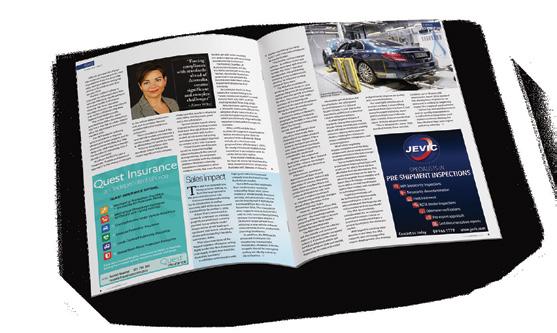

“giving it a proper Kiwi thrashing”. JAC first unveiled the plug-in T9 in New Zealand at Fieldays in June 2025 when it showcased an orange prototype designed to capture attention and gather real-world feedback. Farmers, tradies and families were invited to share their expectations with some insights fed into vehicle development.
SAFETY CENTRES OPEN
The NZTA is making progress across its commercial-vehicle safety programme with six centres now operational.
The Taupo facility has opened with access limitations for overlength loads.
Operations at the safety centre in Bombay, south of Auckland, are expected to start soon. In early May, the agency activated the weigh-in-motion scales
and automatic number-plate recognition cameras.
It has been collecting information on vehicles such as weight, permit, registration, certificate of fitness status and road-user charge status. This information may be used by the NZTA’s compliance teams in investigations.
Meanwhile, the Regulatory Systems (Transport) Amendment Bill has gone through parliament with four changes impacting the commercial-transport sector.
The new legislation means the director of land transport will be able to suspend a transport service licence (TSL) for major health and safety concerns, and will need to
used commercials
approve new people in control of such services.
Transferring, leasing or assigning a TSL now carries a maximum fine of $30,000 for an individual and $100,000 for a company, and the NZTA is able to audit operators believed to be carrying out a transport service without the required licence.
TRITON MAKES IN-ROADS
There were 3,121 new commercials sold in May for a year-on-year rise of 8.8 per cent from 3,423.
Ford’s Ranger was the top model with 809 sales, down by 22.9 per cent from the 1,049. Toyota’s Hilux was second on 776 for a 14.5 per cent drop and Mitsubishi’s Triton climbed by 102.5 per cent to 322.
There were 374 used commercials first registered last month, up by 29 per cent.
Used Commercial Sales by Model - May 2026
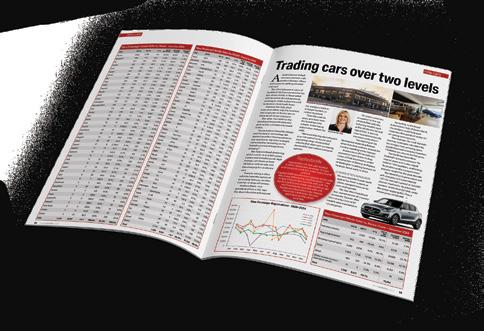
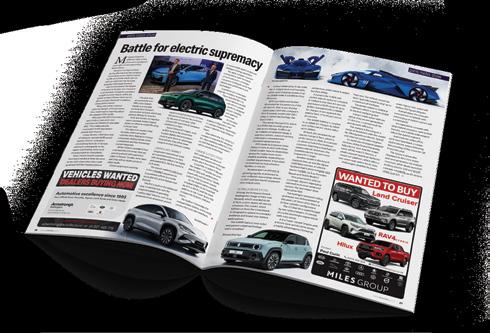
Electric car demand hots up
Registrations of new battery electric vehicles (BEVs) reached 1,613 units last month compared with 526 in May 2025, while plug-in hybrids (PHEVs) came in at 1,043 units compared with 350.
Together, they accounted for 23.5 per cent of total sales of new vehicles in May, up from 8.6 per cent during the same month of last year, according to the Motor Industry Association (MIA).
And that shift is “more pronounced” when it comes to cars with BEVs and PHEVs accounting for 29.6 per cent of that part of the market compared to 10.9 per cent in May last year, 26.2 per cent during April 2026 and 33.6 per cent in March this year.
Aimee Wiley, chief executive of the MIA, says: “This indicates the elevated plug-in demand seen in
vs sales
recent months continued into May rather than being confined to a single monthly result.”
So far this year, BEVs and PHEVs combined make up 20.1 per cent of new-vehicle registrations compared with 9.9 per cent over the same period in 2025.
Hybrid volumes remain comparatively stable year on year, which “suggests the current movement is concentrated in plug-in vehicles” rather than being a general lift across all electrified powertrains.
“Current fuel-supply conditions remain stable, but elevated prices and uncertainty about future fuel costs are now part of the purchasing environment,” adds Wiley.
“Against that background, stronger BEV and PHEV registrations appear consistent
with buyers placing greater weight on operating costs and exposure to fuel-price volatility, although registration data alone cannot identify a single cause.”
Published economic indicators point to a mixed operating environment.
Retail activity showed signs of improvement earlier this year, but more recent confidence and monetary policy commentaries indicate higher fuel prices are adding pressure to household budgets and business costs.
A total of 11,294 new vehicles were registered in May 2026, which is an increase of 1,068 units and by 10.4 per cent compared to the same month of last year.
On a year-to-date basis, sales have gone up by 6,380 units, or 12.4 per cent, versus the same period in 2025.
Last month’s results were led by light passenger vehicles with a 20.1 per cent year-on-year jump.
Light-commercial registrations were down by 10.1 per cent over the same period and heavy commercials were stable after edging up by 0.5 per cent.
Year to date, 57,971 new vehicles have been sold.
Wiley notes growth remains positive across major segments with the “clearest movement” in light passenger vehicles being supported by stronger activity from private and business buyers.
OFFERS ROLLED OUT
Kia has launched a free service plan programme on the back of what it describes as the country’s “best EV ownership offer”.
Available across the range, but not the Carnival, it’s been designed
Imports vs sales – used passenger vehicles

Imports
– new passenger vehicles
to make owning a Kia “even easier”.
Todd McDonald, managing director of Kia NZ, says: “We want to provide a value-add proposition which enhances ownership experience.
“A service plan offers protection and convenience. There are no surprise costs, the vehicle receives scheduled maintenance at a dealership and it delivers the convenience of knowing everything is taken care of.”
A complimentary three-year or 45,000km plan now applies to the EV3, EV4, EV5, EV6, EV9, Seltos and Tasman. It’s four years or 40,000km for the Stonic, Sportage and Sorento.
The initiative follows a special offer of three years of “free motoring” on the EV3 and EV5 with the marque paying on-road costs, three years or 45,000km of roaduser charges, three years’ charging fees at $1,500 and a service plan.
Meanwhile, Nissan’s More ownership programme has been
launched here. It doubles the brand’s service-activated warranty to 10 years or 300,000km when its network is used. There’s also free roadside assistance and flat pricing for the first five scheduled services.
The scheme complements existing EV coverage and includes an eight year or 160,000km lithium-ion battery state-of-health warranty for capacity loss below nine bars.
It also offers a backdated warranty extension for eligible vehicles bought new from January 2023. Owners who have completed all scheduled services with Nissan qualify. For customers who have serviced their cars outside the network, re-entry is available after a $99 assessment.
Michael Hill, Nissan Oceania’s director of after-sales, says: “The programme delivers industryleading peace of mind, cost certainty and long-term value. By extending warranty coverage, roadside assistance and fixed-price
servicing, we’re rewarding loyalty and making ownership simpler.”
The More programme introduces flat pricing for the first five services “in response to customer feedback”. It costs, for example, $499 for the Qashqai and X-Trail including e-Power models, and $599 for the Navara, Patrol and Z.
Nissan has also launched two initiatives with the 2026 X-Trail. The first is a yearly loan rate of one per cent for up to 24 months with Nissan Finance. The other is a $1,000 loyalty bonus for anyone who owns a Nissan, bought new or used, or an immediate family member of an existing owner.
“At a time when the cost of living is biting, compounded by fluctuating fuel prices and potential interest-rate increases, we want to try to alleviate a little of the pain when buying a new X-Trail,” says Sri Padmanabhan, country head of Nissan NZ. “The one per cent finance offer is among the best in the market.”
New imports up
There were only 60 fewer new cars imported than sold last month with 8,175 being registered and 8,115 crossing the border. Daily sales, averaged over the past 12 months, now stand at 282 units.
May’s imports of new passenger vehicles were up by 42.2 per cent on the same month of 2025 and 37,202 have come in so far this year.
As for used-imported cars, there were 7,167 registrations last month and 7,825 units came into New Zealand. Average sales per day were 231 in May while the 12-monthly average was 237 per day – down from 243 in May 2025.
The 1,894 new commercial vehicles imported last month was up 28.3 per cent from a year ago and 3,052 sales were completed. Registrations per day, as averaged over the past year, are 110.
As for used commercials, 353 were registered for the first time last month compared to 175 being imported. Year to date, 1,369 have crossed the border.
Imports vs sales – used commercials

BE SEEN WHERE THE INDUSTRY LOOKS FIRST


Since 1984, Autofile has been the heartbeat of New Zealand’s motor industry news. By advertising with us, you’re not just gaining exposure — you’re joining a trusted network that informs, connects and drives the industry forward.