www.autofile.co.nz
JANUARY 2026
THE TRUSTED VOICE OF NZ’s AUTOMOTIVE INDUSTRY SINCE 1984
Safety feature rules risk to fleet renewal New and used sectors implore coalition to ensure any extra mandatory requirements are phased in
O
fficials are being warned older cars will remain in the fleet for longer if mandates are introduced that prevent “safer-than-current” vehicles from coming into the country. Industry members have raised concerns over proposals to make a number of advanced driver-assistance systems (ADAS) compulsory at the border and want any fresh rules applied to the used sector at least 16 months after they come into force for new vehicles. The government is considering mandating automatic emergency braking (AEB), lane-keep support systems, and acoustic vehicle alert for “quiet” electric and hybrid models for new and used light and heavy imports. A consultation document prepared by the NZTA says it’s looking at either mandating all those features, keeping the status quo or raising awareness by encouraging people to buy
Drive dealership growth with confidence 2025’s best-sellers and trends p 12
End of road after 60 years
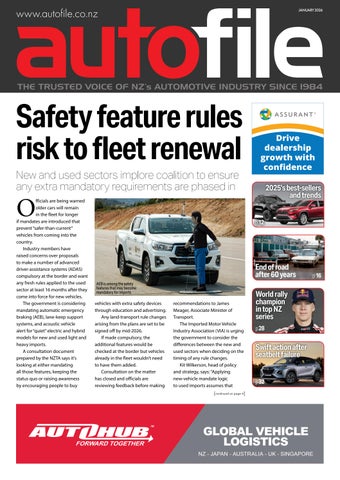
AEB is among the safety features that may become mandatory for imports
vehicles with extra safety devices through education and advertising. Any land-transport rule changes arising from the plans are set to be signed off by mid-2026. If made compulsory, the additional features would be checked at the border but vehicles already in the fleet wouldn’t need to have them added. Consultation on the matter has closed and officials are reviewing feedback before making
recommendations to James Meager, Associate Minister of Transport. The Imported Motor Vehicle Industry Association (VIA) is urging the government to consider the differences between the new and used sectors when deciding on the timing of any rule changes. Kit Wilkerson, head of policy and strategy, says: “Applying new-vehicle mandate logic to used imports assumes that
p 16
World rally champion in top NZ series
p 28
Swift action after seatbelt failure p 32
[continued on page 4]
GLOBAL VEHICLE LOGISTICS NZ - JAPAN - AUSTRALIA - UK - SINGAPORE
LOAD IT SHIP IT TRACK IT CLEAR IT
GERDELIVER IS IT ! TER
move to new, much larger premises means we are to offer even more services to our dealer clients
to door ro-ro vehicle shipping from Japan and Australia
ainerised vehicle shipping from anywhere in the world Customs clearance Vehicle tracking
VEHICLE SHIPPING
GENERAL FREIGHT
VEHICLE TRACKING
SHIPPING SCHEDULE
We are specialists
We have developed
exporting all types of Vehicles, Commercial trucks, vehicles of Special Interest and other RORO Heavy Cargo & Machinery.
Agents who understand the commitment required to service our demanding market.
Finding out where your vehicle is at any one time of the process, gives you the ability to manage the collection and processing of documents and payment on time.
TRS and shipping services from Japan to New Zealand.
proved MPI transitional facilities and cleaning services
g it all off is Jacanna’s SmartTrade Rewards Programme, transporting andreward you choose a worldwide network of you can earninpoints for almost any
Tel: +64 9 825 0888 info@jacanna.co.nz Terms and conditions apply. www.jacanna.co.nz
www.jacanna.co.nz
JACANNA.CO.NZ
Tel: +64 9 825 0888
www.jacanna.co.nz info@jacanna.co.nz
Tel: +64 9 825 0888
Call Steve Owens now on 021 947 752 GUEST EDITORIAL
Australia can learn from across ditch
Heath Barclay outlines why New Zealand is a leader with its end-of-life tyres scheme
T
he end-of-life tyre With the significant (ELT) discussion in ELT volumes generated Australia has gone each year across both into overdrive and I can’t countries, Australia has be happier to see it being some extra challenges prioritised. to overcome. Rogue Within the space of operators mean poor HEATH BARCLAY two weeks in November, practices, such as illegal Managing director, the Australian House of dumping and exporting, Bridgestone ANZ Representatives’ standing continue, and there’s a committee on industry, innovation big number of free riders importing and science announced an end-toproduct and not contributing to end inquiry into the tyre industry, our current voluntary scheme. and the Trans-Tasman Recycling A simple way to create Alliance (TTRA) was launched. greater governance around Between our two countries, more sustainable operators there are 600,000 tonnes of ELTs to and increased participation in a process and lessons can be learnt product stewardship scheme is to from each other. In many ways, make it mandatory. New Zealand is ahead of the curve Reputable brands such as with its successful scheme. Bridgestone are investing in Tyrewise is a great example of researching new markets and what can be achieved when the end-of-life solutions through Tyre industry bands together backed Stewardship Australia, but it should by the government. I was involved be a level playing field and a in developing it before moving to voluntary scheme just isn’t enough. Australia in 2013 and it becoming The industry still has a long mandatory is to be celebrated. way to go and there’s so much For us, it meant levelling the opportunity, for example, around playing field and a win for those retreading truck tyres. We have in the industry who already took to reduce our risk and reliance on sustainable operations seriously. export markets for tyre-derived When John Staples, our former fuel by developing and supporting director of NZ business, retired, he local markets for tyre-derived saw his involvement in Tyrewise products and retreading. becoming mandatory as a major We need to create greater achievement of his 40-year career. governance around rogue Australia can learn from New operators, provide more options for Zealand’s actions. I’m hoping the recycling in regional and remote inquiry, and information sharing areas, and boost motivation for and objectives of the TTRA, retailers to adopt more sustainable highlight there’s a clear opportunity outcomes. This requires more for an equally successful scheme funding and accountability. here. I’m not just saying this If we look to New Zealand, because I’m a proud Kiwi myself, there’s a framework to be but this is an area in which New considered for effective product Zealand has led the way. stewardship in Australia.
DIRECTORS
EDITOR
dazzz@autofile.co.nz ph. 021 0284 7428
ris@autofile.co.nz
Darren Wiltshire
Brian McCutcheon brian@autofile.co.nz ph. 021 455 775 DESIGNER
Adrian Payne
arpayne@gmail.com
Darren Risby JOURNALISTS
Matthew Lowe
matthew@autofile.co.nz
Sue Brebner-Fox sue@autofile.co.nz MOTORSPORT
Mark Baker
veritas.nz@xtra.co.nz
Visit www.autofile.co.nz to subscribe to Autofile magazine and have it delivered monthly in print. The subscription rate is $78 plus GST for 12 issues per year. Autofile magazine is also available online as a readable file or downloadable as a PDF. Back copies dating to 2017 can be found on the website where you can subscribe to our Insight email alerts. Copyright: Published monthly by 4Media Ltd
All statements made, although based on information believed to be accurate and reliable, cannot be guaranteed, and no liability can be accepted for any errors or omissions. Reproduction of Autofile in print or digital format in whole or part without written permission, whether by copying or any other means, is strictly forbidden. All rights reserved. ISSN 0112-3475 (print) ISSN 2350-3181 (online)
NZ’s independent vehicle inspection specialists We of fer a full range of services. • Entry Certification for imported cars • Vehicle Appraisals • WoF/CoF Inspections • Road User Charges • Registration & Relicensing • Exhaust Emission Testing
www.vinz.co.nz
Appointed by the NZ Transport Agency
www.autofile.co.nz
3
news
[continued from page 1]
excluding non-compliant vehicles will somehow raise standards automatically. “In reality, it can reduce fleet renewal by preventing otherwise safer-than-current vehicles from entering the market. When replacement slows, older vehicles remain in service longer, delaying overall fleet improvement.” He adds new-vehicle mandates raise the future standard of models globally and suggests used-import policy should focus on maximising the rate at which New Zealand’s existing fleet is upgraded within affordability constraints. “Used-import mandates must be timed to when better-thancurrent vehicles are actually available in sufficient numbers, rather than mirroring new-vehicle timelines.” VIA supports the intent to lift road safety through modern technologies, but raises concerns over the timing, affordability and operational feasibility of such changes for used imports.
It opposes a used fleet and into 2027 start date New Zealand’s for features such affordability band, as AEB to be not simply with compulsory for Japan’s new-vehicle used light vehicles rule dates.” because it says this VIA recommends would precede a minimum of 16 the practical months from safety supply window for features being affordable, eight mandatory in new to 12-year-old vehicles before they Japanese vehicles James Meager, Associate Minister of become compulsory relied on by many Transport, is expected to make decisions for entry compliance on ADAS rules in mid-2026 Kiwi households with used. and small to medium-sized New safety requirements for businesses. imports are also likely to increase “If mandates are set ahead of the cost for companies trying to real-world availability in Japan’s secure compliant models from used fleet and ahead of what Japan because they will reduce households can afford, New the range that meets the required Zealanders will be priced out of standards. upgrades and will hold on to older “That narrowing creates scarcity vehicles longer,” explains Wilkerson. at auctions, which increases “Our used-import channel hammer prices for remaining relies overwhelmingly on Japanese compliant vehicles,” adds Wilkerson. stock. Regulatory timelines should “The used-import market align with the real arrival curve isn’t a random slice of Japan’s of safety technology into Japan’s fleet. It’s a tightly filtered subset shaped by price, mileage, grade and household affordability. That matters because each additional regulatory requirement narrows the compliant supply set.” VIA urges caution against any policies introducing mandates before supply exists in the usedfleet pipeline from Japan. The association highlights the mean age of used imports is 11 years but says if that was the compliance threshold it would risk Comprehensive Motor Vehicle Insurance eliminating about 50 per cent of current used supply. It suggests 12 years would be better to base ADAS policies on, although this would still result in about a 20 per Guaranteed Asset cent reduction in supply. Protection Insurance In 2027, New Zealand will primarily import 2015-16 Japanese vehicles. In that range, AEB fitment was incomplete and concentrated in higher-specification trims, which means early mandates may lead to a scarcity of suitable models and higher prices. “AEB will be fully mandated in Japan from the end of this year, which means New Zealand will inevitably receive AEB-equipped vehicles as they age,” says Wilkerson. “Meaningful AEB volumes
Our strength comes from knowing our customers’ needs, understanding and fulfilling them
Mechanical Breakdown Insurance
Credit Contract Indemnity Insurance
Mechanical Breakdown Insurance EV & Hybrid option available Uber & Taxi cover available
Contact:
Simon James 027 239 0253 SimonJ@questinsurance.co.nz 4
www.autofile.co.nz
for us begin around 2029, large volumes arrive around 2033 and broad availability occurs in the early 2030s once the 12-year offset is applied. In practical terms, New Zealand cannot ‘fall behind’ Japan in used-import safety standards. “It can only mistime access by setting requirements ahead of when those vehicles are available and affordable in the source market’s used fleet.” Lane-departure warning (LDW) and lane-keep assist (LKA) technology aren’t mandated in Japan and remain trim-dependent, which makes it unclear how quickly either will become prevalent in Japan’s used fleet. “That uncertainty is why fixeddate mandates are risky,” continues Wilkerson. “On our current view, New Zealand availability for LDW and LKA doesn’t reach ‘mandate ready’ volumes until the mid-tolate 2030s – if at all.” To align mandates with Japan’s existing model coverage and arrival of ADAS-equipped vehicles in a price range Kiwis are prepared to pay, VIA recommends AEB and LDW become compulsory for used light vehicles from 2035, and LKA from 2037.
COMPLIANCE PATHWAYS ADAS feature visibility at the sourcing stage is limited and inconsistent, especially for older Japanese vehicles and lower-spec trims. This is a further practical constraint flagged by VIA. Auction or document fields aren’t standardised, so mandates dependent on pre-purchase confirmation “risk compliance friction, supply loss and price distortion rather than improved safety”. Wilkerson suggests creating a dual-compliance pathway to reduce supply choke points, with one for when documentation exists to show safety feature compliance and another for performancebased compliance using safety ratings. “ADAS policy should maximise the rate of safety improvement per dollar of household transport spend by accelerating affordable fleet turnover, not maximising
news
Compulsory acoustic vehicle alert is being considered for some electric and hybrid models
t nominal compliance at the border.” He also urges any mandates be supported by a clear problem statement, quantified death and serious injury (DSI) reductions by accident type, and a cost-benefit case that tests affordability and supply impacts. “Mandating specific technologies only makes sense if it targets material contributors to DSI outcomes and if the benefits justify the costs. “VIA requests the NZTA publishes or references the specific crash problem statement for the ADAS mandate, including which crash types it is designed to prevent, estimated DSI reductions and the cost-benefit case.” The association supports exemptions from safety mandates for disability and mobility vehicles, and recommends transitional relief for segments disproportionately affected yet essential for households, community services and small to medium enterprises. It also wants the government to confirm a review of policies in 2030 to reassess ADAS uptake in Japan’s used fleet with particular focus on LDW and LKA availability, pricing effects and verification practicality.
GLOBAL ALIGNMENT The Motor Industry Association (MIA) wants the government to introduce a “realistic” transition period for making new safety features on imported light vehicles compulsory. It suggests the coalition should harmonise implementation dates of any new rules with major jurisdictions, particularly Australian Design Rules (ADRs), or adopt later start times.
Aimee Wiley, chief executive, passenger vehicles, so the only says each new requirement should action required is to reference the include a minimum two-year leadappropriate minimum international in between introduction dates for standard. new models and then all models. It describes AEB as a highly In addition, motorbikes and effective system that’s already mopeds should be excluded when widely fitted voluntarily by international standards don’t exist importers. or are still being developed. The MIA supports mandating “The MIA and its members have AEB for light vehicles, excluding long supported the introduction motorcycles, aligned with UN of modern technologies that align Regulation No 152 (R152) and with established international ADR 98/01, which deems R152 (01 standards. Ensuring New Zealand’s series) technically equivalent. regulatory requirements are Core functional requirements consistent with key source markets under UN R152 include being is essential able to detect for certainty, imminent forward compliance and the collisions, provide timely availability driver warnings, of safe vehicles.” apply braking The MIA automatically to says updates to avoid or mitigate land-transport accidents, permit rules should also driver override at explicitly reference any time and to the applicable ensure safe vehicle international operation in case of standards for each system failure. safety feature, Wiley highlights rather than only there’s no mandate providing the highfor emergency – Aimee Wiley lane-keeping level descriptions used in last year’s systems (ELKS) in NZTA consultation document. Australia, Japan or the US. Europe “Manufacturers rely on mandated it under EU 2021/646 certainty and specificity,” explains from July 2022 with a two-year Wiley. “Clear identification of the delay allowed for vehicles equipped minimum required standard for with hydraulic power steering. each feature is essential to ensure The MIA’s submission notes compliance and support in-service Australia consulted on ADR 107/00 inspection regimes, including (ELKS) in 2025 and proposed confirmation that malfunction implementation dates are indicator lamps operate correctly.” November 1, 2027, for new models The MIA notes anti-lock and a year later for all new vehicles. braking systems (ABS) and “However, Japan is unlikely to electronic stability control (ESC) mandate ELKS until 2029 or 2031, are already mandated here for light and US development of a federal
The MIA expects land transport rules to present the required international standards for each feature
standard remains behind schedule,” adds Wiley. “The MIA does not believe automatic lane-keep systems, such as those defined in UN R157, are appropriate for mandatory fitment in New Zealand at this time and must be considered as out of scope of this proposal. “New Zealand should adopt ELKS only when all major source markets have mandated it to avoid disadvantaging consumers through reduced model availability or increased costs. ELKS isn’t applicable to motorcycles.” Lane-departure warning systems are widely and voluntarily adopted in our light-vehicle imports and the MIA supports mandating such technology for all light vehicles except two-wheelers, if the rule references the correct international standards. It adds acoustic vehicle-alerting systems (AVAS) are also prevalent overseas for quiet models and backs introducing this for those that operate silently or with minimal propulsion noise. Some hybrids generate sufficient internal combustion noise at low speeds and may not require AVAS. International standards do not yet include L-category vehicles, so the requirement should exclude motorcycles and mopeds. Wiley has also provided feedback about mandating safety features for imported heavy vehicles, raising issues similar to those facing light vehicles. “We are concerned the consultation material doesn’t specify the exact international regulations the NZTA intends to adopt,” she says. “To support compliance and reduce ambiguity, the MIA expects the land-transport rule to present the required standards for each feature, including applicable series amendments, exemptions and scope definitions.” The MIA also recommends all introduction dates for heavyvehicle standards align with, or occur later than, equivalent ADRs with a minimum two-year window between introducing rules for new units and then applying them to all models. www.autofile.co.nz
5
news
Pains can come with growing E
From left, Kimberley Gargiulo, Todd Hunter and Chris Lamers
xpansion has become the holy grail for many businesses, but the relentless pursuit of more and greater opportunities also adds pressure to day-to-day management responsibilities. Todd Hunter, chief executive officer and managing director of Turners Automotive Group, Kimberley Gargiulo, head of SG Fleet NZ, and Chris Lamers, CEO of MTF, have provided insights into how they deal with that. The three experts, who took part in a panel discussion at the annual conference of the Financial Services Federation (FSF), agree it’s not enough to simply be in charge. The sign on the door might proclaim who the boss is or something similar, but leaders all need the same thing to succeed and that’s followers. Lamers says it’s all about getting
the right team around you. “The biggest challenge is remaining focused on the same goals.” That’s a message that resonates with Gargiulo. “We’ve just been through the amalgamation of a New Zealand and international business, and certainly the key thing has been alignment and staying focused on the same goal.”
SP E C I A L IS T S I N
PRE‑SHIPMENT INSPECTIONS MPI biosecurity inspections Biosecurity decontamination Heat treatment NZTA border inspections Odometer verifications Pre-export appraisals ?
Lost documentation reports
www.jevic.com 6
www.autofile.co.nz
Hunter says Turners has worked to the same model for years. “It’s a praise-based model, good behaviour is recognised and encouraged. Consistent teamwork only comes about with consistent leadership. That’s why you’ll see us always promoting from within whenever we can.” That ethos is reflected in the executive team where Hunter says the shortest-serving member has seven years with the company, the longest being 20. A bit of optimism goes a long way too. “You don’t have to be Pollyanna. It’s okay to recognise tough times and be up front about it. But your core role is as a motivator. Good leaders stay out of the way of good people.” Lamers adds a good dose of resilience to the mix. “It’s important to recognise staff have a lot more going on in their lives than work. How do you refill their cups? Sometimes slow is smooth and smooth is fast. You can’t constantly push.” Gargiulo agrees. “Culture is set from the top. You must quietly nip bad behaviours in the bud. As the leader, it’s your responsibility to eliminate poor behaviour you don’t want in the workplace. No one is going to do it for you.” Lamers describes himself as an optimist. “A positive mindset is critical. It’s the Ted Lasso thing of belief in the organisation, themselves and their colleagues will take you forward.” That said, it’s on expansion
that their philosophies align. Gargiulo says there’s no escaping that growth is important with new private-equity owners, but she agrees with Hunter when he says it can’t come at any cost. “We can all point to companies that have become unstuck when they have been too focused on growth,” Gargiulo points out. “Sure, you’d rather grow than shrink. But ultimately it’s good staff and customer experiences that drive good outcomes for shareholders.” Lamers is blunter. “Growth is a measure of relevance. If you’re shrinking you are becoming less relevant to customers, but growth is also only one of the measures of success. The past 12 months have been tough, a case of doing the right thing to provide stability.” SG Fleet NZ has the added complexity of operating overseas. Gargiulo says: “That’s not all bad because we can tap into international business information, yet we are encouraged to think globally but act locally.” Hunter believes expansion must be the aim, but good operators look past profit. Instead, they focus on outcomes and ongoing expectations. “That brings challenges, but it keeps coming back to focus and everyone doing their bit because we’re only as good as our people.” Lamers returns to his theme of optimism. “You often hear things like ‘if I’m not winning, I’m learning’. However, the flip side is that when you consistently win, you can fail to learn, fail to read the signals or even register the signs. Fighting hard in what’s been a tough climate has been a great teacher.” Gargiulo accepts talking positively can lead change. “The truth is growth usually requires change of some sort and fostering the ability to adapt is critical. When people understand the need for change, they are much more likely to accept it and grasp the opportunities it can bring.” Lamers says it’s also good to remember not to take too much on
news
Current mindsets
Todd Hunter: “Optimism and ambition. Have a plan, stick to it, things will get better.” Chris Lamers: “Find time to relax. Holidays are for relaxing not recovering, but come back ready to face new challenges.” Kimberley Gargiulo: “Have upbeat conversations about the future. Set the expectation that the future is exciting and the potential is there.”
t at once. “It’s easy to come up with an idea or strategy, but executing it is entirely different. It’s okay to say, ‘not now’ although it takes discipline.” Hunter believes failure can be a wonderful teacher too, although his biggest came with a sizeable bill and one he regrets having had to pay.
Delegates at the FSF’s conference on November 6 in Auckland
“We wanted to expand and bought into a second-hand dealer network. This added sites. It also brought a complete clash of cultures. “It took a massive toll all because of ‘white-line fever’, that desire to grow, grow, grow when we would have been better to be more circumspect. It was a mistake I’m in no hurry to repeat.” Turners altered its entire strategy of branch expansion off the back of the move. “We really didn’t think it through.” Gargiulo believes in good governance. “It will help lead you to
sustainable growth, fit-for-purpose growth that helps avoid those kinds of mistakes.” Lamers agrees. “Some of our board members have viewed the toughness of economic conditions as an opportunity to reset and consolidate, shifting the focus slightly off growth.” Hunter points out the benefits of having a good board. “Relationships are so important. They are a big part of our success, which is partly borne out of an odd mix, almost like a hybrid of family and corporate approaches.” He also credits the ownership
structure of Turners for its success. “About 30 per cent of shares are held by board members. But the employees also have a big holding through a share scheme, which has helped create a long-term view across the business. “People ask openly if decisions that will be good in the short term will still look good years into the future.” Gargiulo sums it up. “Growth, balance, sustainability, short term, long term. These are all things that have a lifecycle. It’s just about striking a balance but looking to the future.”
www.sbltd.co.nz www.autofile.co.nz
7
2025 in review
Clean car rules challenging T
ougher emissions targets and planned reforms of the clean car standard (CCS) were front of mind in issues of Autofile during 2025. An increase in complaints about dealers, the dwindling number of registered traders, how to encourage EV uptake and additional changes to finance regulations also made the headlines. Other hot topics included the failure of right-to-repair rules, a shake-up of vocational training and Chinese brands entering the market.
JANUARY: CHARGING REVIEW The government announced the launch of a review into how public infrastructure for electric cars was to be paid for. It came after plans for a network of 10,000 charging points by 2030 were included in New Zealand’s second emissions reduction plan for 2026 to 2030. The coalition said extensive facilities would give consumers the confidence to shift to EVs by tackling range anxiety. The document detailed “our journey towards net zero” and covered other initiatives, such as ensuring the CCS was effective and changes to fuel-excise duty and road-user charges (RUC).
navigating stricter CCS targets introduced from January 1, 2026, while simultaneously supporting the transition to lower-emissions vehicles.”
FEBRUARY: EMISSIONS TESTING The government was asked to reconsider plans to introduce in-service conformity testing (ISC) for light imports from certain jurisdictions with industry experts concerned it would result in unnecessary regulatory burdens. The draft Land Transport Rule: Vehicle Exhaust Emissions Amendment (No 2) 2024 contained a clause that stated when an approved emissions standard requires ISC testing, the manufacturer is responsible for conducting it. The MIA said the amendment would only apply to certain new models from Europe and the US and would distort market competitiveness. VIA called for the standards from different jurisdictions to be treated as “alternative but equal” – and for “equitable treatment” of Japanese standards that cover approximately half of our fleet. Pukekohe Kia was recognised by the marque as a “global best” and received a platinum prestige award. It was one of 350 dealerships to
Prime Minister Christopher Luxon, left, and Rick Armstrong, right, at the opening of Lexus East Auckland, Botany, in February
The industry was calling for a flat fee per vehicle to recover the estimated $5.5 million annual cost of running the CCS. The NZTA was deciding how to structure the fee before introducing it in mid-2025. It expected the charge to be $18$23 per unit. The agency sought views on charging per vehicle or importer, at what stage the fee should be paid and if it should vary depending on the type of vehicle. The Motor Industry Association (MIA) advocated for a flat fee per unit as straightforward and equitable, and urged officials to include it in on-road costs paid by consumers. The Imported Motor Vehicle Industry Association (VIA)
also supported a per-vehicle charge at first registration. An almost perfect storm of shifting consumer preferences, the economic downturn and regulatory changes shaped trends across all light-vehicle sales categories in 2024, according to the MIA. It reported overall new registrations of 128,828 were down by 13.5 per cent from 148,973 in 2023. When compared with 2022, the decline was 21.8 per cent. Aimee Wiley, chief executive, said the figures highlighted the need for policy stability to support sustained market growth and resilience. “Looking ahead, the primary challenge will be
FROM JAPAN TO NEW ZEALAND
ON TIME, EVERY TIME
TOYOFUJI SHIPPING SCHEDULE Toyofuji vessels
Voyage
JAPAN
Moji
Osaka
NEW ZEALAND
Nagoya
Yokohama
Auckland
Lyttelton
Wellington
Nelson
8 Feb
9 Feb
Trans Future 5
165
—
13 Jan
14 Jan
17 Jan
5 Feb
7 Feb
Dream Angel
60
30 Jan
2 Feb
3 Feb
4 Feb
18 Feb
T/S to NC1 v201 & TF6 v164
T/S to NC1 v201 & TF6 v164
21 Feb
New Century 1
201
—
26 Jan
27 Jan
31 Jan
20 Feb
22 Feb
23 Feb
—
T/S = Tranship to next available TFS vessel
Contact: Adam Stone
8
www.autofile.co.nz
adam.stone@toyofujinz.co.nz
www.toyofujinz.co.nz
2025 in review t attain the achievement out of 7,000 franchises worldwide and was the first in New Zealand to do so since 2019. Todd McDonald, managing director of Kia NZ, said: “This award is reserved for the best of the best. We couldn’t be prouder of the team at Pukekohe.” Air pollution from vehicles was coming down but their harmful emissions still had a social cost of more than $10 billion a year. A government report said the fleet reached its largest size ever in 2022 and annual kilometres travelled had increased over recent decades. It added air pollutants from exhaust emissions per kilometre would likely reduce over time, but other non-exhaust air pollution – including from tyre and road wear – would continue to go up. Brett Gliddon was appointed chief executive of the NZTA, replacing Nicole Rosie. He had been in the role on an acting basis and was group general manager of transport services for the previous five-and-a-half years. Gliddon
started with the agency in 2009 when he became principal project manager.
MARCH: DEALER COMPLAINTS UP The number of annual complaints about dealers was set to hit its highest level in three years after more than 100 were lodged with the registrar of motor-vehicle traders in seven months. The government reported there were 107 complaints about traders between July 1, 2024, and January 31, 2025, which was one shy of the total for the year to June 30, 2024, and above 70 in 2022/23. Concerns about unregistered trading were the most common problem. A business consultant warned dealers faced paying millions of dollars in penalty fees under the CCS over coming years. Phill Haynes, of Juno & Jupiter Consulting, forecasted 28 per cent of new light passenger vehicles needed to be fully electric or plugin hybrids in 2025 if importers were to hit CCS targets. For the used-
Carolyn McMahon started as the first female president of Honda NZ in April
imports sector, he predicted 20 per cent. In 2024, EVs had an 11.2 per cent share of the new-car market and made up 2.2 per cent of used imports. Haynes estimated the new-vehicle industry would have to pay CCS fees of about $75m in 2025 and the used-imports sector $40m. He said those totals could rise to $175m and $49m respectively by 2027. Carolyn McMahon made history by being appointed the first female president of Honda NZ. With almost
three decades’ experience at Honda Australia, her leadership positions had included vice-president and director. “I’m honoured to take on this role at an exciting time for the industry,” she said. McMahon had overseen merging the cars division across the Tasman with Honda Australia MPE – motorcycle, power equipment and marine. Motorcorp Distributors appointed Ben Montgomery as its GM after Steve Kenchington left the role to become chief executive of the Giltrap Group. Montogomery took charge of the company’s 40-strong team and was responsible for eight Jaguar Land Rover franchises in New Zealand. He had worked for Giltrap, which owns Motorcorp, since 2012 and was most recently Volvo NZ’s general manager.
APRIL: IMPORT NUMBERS DROP The annual number of used vehicles imported from Japan tumbled by more than 30,000 in 2024 with the CCS and its cost implications cited [continued on page 10]
Loans as diverse as our customers A multi-tier auto lending solution for new and used vehicles for business and personal use Consumer. Commercial. Wholesale. Lending criteria, fees, terms and conditions apply
GET IN TOUCH
introducers.avantifinance.co.nz/auto-lending
www.autofile.co.nz
9
2025 in review
[continued from page 9]
as a key factor for the downturn. New Zealand was previously the third biggest taker of such stock from Japan, behind the UAE and Russia. However, it was overtaken in 2024 by Mongolia and ended up in fourth spot. Some 81,290 units were imported into this country from Japan in 2024, giving Aotearoa a 5.2 per cent share of the market. This compared with 114,252 and 7.4 per cent in the previous year. Jim Shi, managing director of Autohub NZ, said the reduction could be attributed to domestic economic constraints and regulatory factors, particularly the CCS. A plan by the coalition to scrap requirements for its agencies to buy zero or low-emitting models came under fire from Drive Electric. It was among changes politicians wanted to make to procurement rules so it would be easier for businesses to win government contracts, which were collectively worth more than $50b per annum. Drive Electric believed removing requirements to prioritise EVs would undermine
JAC NZ was a new major sponsor of Fieldays in June. The marque’s CEO Andrew Craw, pictured right, with Richard Lindroos, of the National Fieldays Society
years of progress. “These changes represent a significant step backward in our transition to a lowcarbon transport future,” said chair Kirsten Corson. Armstrong’s opened a refurbished dealership in Cambridge Terrace, Wellington, after a multi-stage investment. The revamp of the Porsche facility cost $14m and took two-and-a-half years to complete. Troy Kennedy, Armstrong’s chief executive officer, said: “Wellington has always been a cornerstone of our operations and remains central to our longterm plans. The new showroom and workshop are testament to this commitment.”
VEHICLE IMPORT FINANCE AT COMPETITIVE INTEREST RATES
w
EASY APPLICATION
EFFICIENT SERVICE
Submit two downloadable forms and simply send to us for review.
Hear back from our team about finance in as little as 24 hours.
COMPETITIVE INTEREST RATES & FEES
NZ BASED
Our partnerships give us the ability to offer superb lending rates.
www.autobridge.co.nz
Autobridge is New Zealand based and covers the country, so we are never far away when you need us.
09 320 5646
ENQUIRE NOW ABOUT TRADE FINANCE FOR YOUR BUSINESS 10
www.autofile.co.nz
MAY: FOCUS ON RIGHT TO REPAIR
and led. The MTA said such a move would better enable employers to shape vocational training so it remained current and aligned with business needs. Chery was planning to enter the New Zealand market with a network of 10 dealerships. They would be in Whangarei, north, central and south Auckland, Pukekohe, Hamilton, Tauranga, Taupo, Lower Hutt and Christchurch. The marque’s launch was set for 2025’s third quarter as part of its global expansion strategy.
Politicians were warned a one-sizefits-all approach to right-to-repair rules would be unsuitable for the car industry and could prompt some marques to quit the market. The Motor Trade Association (MTA) said in its submission on the JUNE: TARGETS PROVE TRICKY Consumer Guarantees (Right to VIA was calling for a major rethink Repair) Amendment Bill that there of the CCS and warned the current should be sector-specific rules system wasn’t allowing importers instead of the proposed blanket to meet emissions targets. A approach to consumer laws. key concern was the weight The shake-up sought to require adjustment used to calculate manufacturers to make repair parts individual targets, which it said and information available to Kiwis incentivised heavier vehicles and to extend the lifetime of products. penalised lighter, more efficient Lee Marshall, the MTA’s chief models. Instead of working executive, said the proposals were out goals for different models, too simplistic in tackling right-toit recommended applying flat repair issues. penalties for each Toyota NZ gram of carbon announced dioxide over a set the permanent threshold when appointment of vehicles are first Tatsuya Ishikawa registered. VIA as CEO. Ishikawa said unless action stepped into the was taken, the CCS role on an acting would exacerbate basis in June 2024 problems around after Neeraj Lala stock shortages, The car industry paid tribute to Rick Murrell, who died on a fishing trip in took a leave of rising costs and July 2025. He was dealer principal absence before market inefficiencies, at Southland Kia, Invercargill, and a former president of the MTA resigning the and create a more following month. In other moves, polluting and ageing fleet. Mark Young and Andrew Davis The government announced joined the board as directors. it would be introducing a fee Young was also named chief risk of $22.46 including GST when and value-chain officer, while Davis imported light vehicles were first became chief strategic officer. registered. The charge would apply The return of work-based from July 1 and was designed to training to the automotive industry recover the costs of administering was hailed as the best outcome the CCS, which had been funded for learners and employers. The by the Beehive since January 2023. MTA said it was what the sector An NZTA spokesman said: “We had lobbied for after the coalition sought feedback. Most submitters announced it wanted to scrap supported charging a flat fee per Te Pūkenga, the NZ Institute of vehicle at registration.” Skills and Technology. It had been A dealer and finance lender was assured that MITO – the training fined $115,000 for failing to provide organisation for automotive – key information to borrowers would emerge as industry-owned about loans. El Cheapo Cars, [continued on page 12]
BUY SMARTER. SELL FASTER. STAY AHEAD. Hundreds of vehicles auctioned every week and nearly 1,500 users ready to trade. Auction Online gives you real-time access to the true used-vehicle market, nationwide. Buy, sell and manage stock from anywhere – fast, transparent and competitive. Whether you’re clearing trade-ins, moving aged stock or filling your yard, our streamlined auction platform simplifies every step. • Nationwide dealer network Almost 1,500 users actively buying and selling. • Real-time pricing transparency Live bidding ensures you always hit true market value. • High stock turnover Hundreds of vehicles auctioned every week across NZ. • Purpose-built dealer platform Designed specifically for franchise & independent dealers. • Fast, simple, secure Seamless listings, bidding and purchasing from one platform.
Join Auction Online today and start trading smarter auctiononline.co.nz www.autofile.co.nz
11
2025 in review
[continued from page 10]
which was based in Wellington, was also ordered to pay $341,931 in compensation to hundreds of customers. It followed the company pleading guilty to seven charges the Commerce Commission filed under the Credit Contracts and Consumer Finance Act (CCCFA). Simon Rutherford joined Armstrong Motor Group as chief executive officer of its import and distribution operation. He took up the job with Auto Distributors NZ (ADNZ) after an extensive career with Ford, which included eight-and-a-half years as managing director of Ford New Zealand. He also served as president of the MIA from 2022-24. In his new role, Rutherford would oversee all ADNZ brands, including Leapmotor, Smart, Peugeot, Citroen and Opel.
JULY: PLEA TO BOOST EVs Drive Electric warned the country risked missing out on a $100b-plus economic opportunity over the next five years unless the government changed its policy settings around EVs and infrastructure. The group outlined key areas to enable the coalition to boost the uptake of low and
The Giltrap Group created NordEast Vehicles in August to represent all six Geely brands. From left, William Zhou and Frank Li, of Zeekr Australia, with Michael Giltrap and Dane Fisher
zero-emissions vehicles, which it said would cut fleet emissions, and provide social, financial and green benefits. It delivered a briefing to ministers noting New Zealand’s EV market share had declined after the repeal of the clean car discount, introduction of RUC, changes to ACC levies and weakening of the CCS. “New EV registrations dropped from 27 per cent [of new-car sales] in 2023 to 5.3 per cent in 2024,” it reported. “EVs comprise less than one per cent of the total fleet.” Biosecurity NZ was reviewing the vehicles, machinery and parts import health standard after brown marmorated stink bug (BMSB) detections declined in the previous high-risk season.
Crossover comes top The Toyota RAV4 was the country’s best-selling new model of 2025 with 11,295 registrations to usurp Ford’s Ranger by 1,614. Overall, there were 97,987 new cars registered last year. That was up by 12.3 per cent from 87,285 in 2024, while 39,866 new commercials amounted to a drop of 3.7 per cent from 41,384. Mitsubishi’s ASX was the second-placed new car on 4,970 units and its Outlander was third
12
www.autofile.co.nz
with 4,309. Next up were Ford’s Everest on 3,324 and Toyota’s Yaris Cross with 2,018. The Ranger was the leading commercial with 9,681 units. Next up were Toyota’s Hilux on 8,152, Mitsubishi’s Triton with 3,279, Nissan’s Navara on 2,500 and the Hiace with 2,064. When it came to marques, Toyota topped the ladder for new cars with 22,402 registrations. Mitsubishi was second with 10,815 and Kia third on 8,597. Suzuki with 4,925 and Mazda with 4,920 made up the top five. Ford was the most popular brand for new commercials with 10,983 sales. Next up were Toyota with 10,617, Mitsubishi on 3,280, Nissan on 2,500 and BYD with 1,882.
Potential changes included updating the list of countries required to treat goods for the insect. The action came after a relatively quiet high-risk season with 38 live detections between September 1, 2024, and April 30, 2025, compared with 111 in 2023/24. The number of dead BMSBs found increased from 1,222 to 1,265. The ex-director of an importing business was ordered to pay more than $1m after it fell into liquidation. Yujiro Fujisawa formed Wellington-based Callin Auto NZ in 2012 and proceedings to wind it up began in 2022. Liquidators said it was “loss-making except for one year” because it didn’t sell cars with enough margin to cover its costs. They took high-court action against him. At a hearing, Justice Johnstone said Fujisawa had run the business in a way likely to create a substantial risk of loss to creditors. He was ordered to pay the liquidators $1,013,774 plus costs and interest. Importers of new and used light vehicles faced the prospect of having to meet extra criteria under sweeping reforms touted by the government. Chris Bishop, the Minister of Transport, outlined a raft of proposed changes to landtransport rules that he wanted to introduce over the next 18 months. These included tougher safety standards for imports. Autonomous emergency braking and lane-keeping systems were cited as among the technologies that could become mandatory. The government also planned to review the frequency and requirements of warrant of fitness (WOF) and certificate of fitness (COF) inspections for new and used light vehicles.
AUGUST: EXTRA LOAN REFORMS Finance providers and car dealers were hoping “necessary and welcome” reforms of lending laws would bring a period of consolidation for the industry following numerous changes over the past decade. Further amendments to the CCCFA had been put forward by the government, including transferring regulatory responsibility for credit contracts and consumer finance from the Commerce Commission to the Financial Markets Authority (FMA), and transitioning creditors and mobile traders to a new licensing regime. The proposals were part of a reform package of three bills. The Financial Services Federation (FSF) called for the changes to be the last for some time to avoid its members incurring extra costs and allow them to focus on putting more resources into developing products. Demand for used vehicles was expected to increase in 2025 as the industry emerged from a “grim” period for sales. That was the prediction of Greg Hedgepeth, chief executive of Turners Automotive Retail, as the company expanded across the country and announced plans to open at least one new branch a year over the next five years. Supporting that action were three new sites opening in Christchurch in 2025 to replace Turners’ previous facility in Detroit Place, which was closed after 20 years. The NZTA suspended access to names and addresses on the motor-vehicle register for parties failing to comply with annual reporting requirements. It had targeted members of organisations non-compliant under section 241 of the Land Transport Act
2025 in review t and halted their access when appropriate. It had spent six months engaging with industry bodies over business owners not meeting their 2024 annual reporting requirements. Those who failed to submit any type of report were given a final opportunity by the agency to complete a compliance declaration form before their authorisations were suspended.
SEPTEMBER: STANDARD SHAKE-UP Organisations representing the industry broadly welcomed coalition proposals to revamp the CCS and make its approach to cutting emissions fairer. The plans included scrapping the weightadjustment system for cars and light commercials entering the fleet. In addition, carbon credits would be allowed to be traded between the used imports and new-vehicle sectors to create more flexibility for importers. The lifespan of credits would be extended from three to four years so businesses
could benefit from more certainty when managing compliance. The proposals in the Land Transport (Clean Vehicle Standard) Amendment Bill (No 2) had been long-awaited. The popularity of low and zeroemissions models faced possible disruption as the government pressed ahead with plans to introduce electronic RUC for all light vehicles. Industry bodies largely welcomed proposals to transition the fleet to a new system over coming years. The overhaul would have significant impacts for the industry, consumers and motorists, according to the MIA’s Aimee Wiley. “We agree with the Minister of Transport when he states this is the biggest change in 50 years to how the roading network is funded,” she said. “The MIA also believes this is the single biggest change for all Kiwis because it will impact every light vehicle in New Zealand.” The Giltrap Group created a new division, NordEast Vehicle
debut here. NordEast’s goal was to deliver 5,000 fully electrified vehicles within three years.
OCTOBER: DEALERS TOTAL DIPS
Dongfeng appointed Armstrong’s as its distributor for New Zealand in October. Its initial line-up was to include, from top, the 007, Vigo and Box
Distributors, to represent all six Geely Group brands on our shores. It was the first time globally the marques – Geely, Farizon, Lotus, Polestar, Volvo and Zeekr – had come under one distributor. The announcement followed news Zeekr was to soon make its
The number of registered motorvehicle dealers fell to a 13-year low amid trading conditions many in the sector described as among the toughest the market has experienced. Chris Stephenson, of Enterprise Motor Group, said: “The CCS in its current form is going to make it harder for us to source vehicles at prices people will be able to pay.” At the end of September, there were 2,591 dealers on the motor-vehicle traders register, which was the lowest since June 2012 when the total was 2,605. Dealer numbers had been in general decline since peaking at 3,535 in November 2017 and hadn’t topped 3,000 in the past three years. A used-car dealership in south Auckland owed creditors more than $4.7m. Rising operating costs [continued on page 14]
Contact: Rohit Parmar | 021 810 997 | rohitp@genevafinance.co.nz
www.autofile.co.nz
13
news 2025 in review [continued from page 13]
and competition were cited as reasons for its woes. Mohammed Jan, of Liquidation Management, was appointed to oversee Otahuhu-based Vehicle Direct – and two associated businesses, Auto Trading and Auto Compliance & Repairs – on September 3. His report said issues had included an inability to recover costs, liabilities from guarantees and challenging economic conditions. Secured creditors included Westpac NZ, which claimed it was owed $3.2m across the three companies. The CCS was described as “no longer fit for purpose” with calls for it to be overhauled or replaced with more effective and equitable alternatives. Concerns were raised by the industry that it potentially impeded efforts to reduce transport emissions, would distort the supply of stock to New Zealand, and threaten the future of businesses in the new and used-imports sectors. The comments came in submissions to the government about its plans to make changes to the CCS. James McDowall, the MTA’s head of advocacy, said members had faced major disruption in recent times because of frequent regulatory changes and the industry was in a “highly vulnerable state”. The number of vehicles crossing the border via Auckland fell to their lowest level since 2013 after the port handled 172,000 units in its 2025 financial year. The total was down by 17 per cent from 2023/24. In line with market conditions, volumes from roll-on, roll-off (ro-ro) vessels declined by 27 per cent, coming
There was plenty of fun at the FSF’s awards night in November at MOTAT, Auckland
in below budget. On the flipside, trans-shipments increased. Port of Auckland Ltd said it had strengthened its vehicle-handling capabilities by expanding capacity and enabling three ro-ro ships to berth at the same time by utilising Jellicoe Wharf.
NOVEMBER: LIQUIDATION RISKS Dealers who owned their premises and larger groups had the best staying power as the overall number of traders across the new and used markets dropped. That was the view of Larry Fallowfield, the MTA’s sector manager for dealers, who said weaker sales had affected the number of registered traders. “It’s fair to say we all thought the theory was let’s survive to ’25, but it’s let’s survive through ’25.” The coalition said lending reforms would make it simpler for people to access credit. A select committee recommended the Credit Contracts and Consumer Finance Amendment Bill, which would affect providers of car loans and their agents, be passed by parliament. It was introduced in March and would shift lenders from certification to a licensing
Marque lands hat-trick Toyota took out the top three spots for used-imported cars in 2025 as the sector shrank for the second consecutive year. There were 85,031 used passenger vehicles registered here for the first time, which was down by 13 per cent from 97,688 in 2024. The Aqua, pictured, came in at number one on 9,010 units and a 10.6 per cent share of the market. 14
www.autofile.co.nz
This compared with 9,740 units and 10 per cent in 2024. Next up was the Prius on 6,122 sales. The Corolla was third with 4,312. Nissan’s Note and Mazda Axela’s completed the top five with 3,605 and 3,340 respectively. Toyota was again the bestselling marque with 31,851 sales of used-imported cars and a market share of 37.5 per cent.
regime and remove parts of the CCCFA that don’t align with the new regulatory approach. The MTA described government proposals to overhaul WOFs as “timely”. Lee Marshall, chief executive, said changing the regime had been on the industry’s agenda for years. Under the plans, the first WOF for new light vehicles would be issued for four years, those aged four to 10 would have to be inspected every two years and vehicles over 10 years would have an annual check. The scope of WOF and COF A inspections was set to be amended and new safety requirements, such as automatic emergency braking, were being considered for fresh imports. VIA said implementation timelines for entry-certification changes should reflect our market, and production and compliance schedules in Japan. The Giltrap Group raised $232,000 for a children’s hospital after its third Starship Supercar Show in Auckland attracted more than 8,000 enthusiasts. Money was raised for the Starship Foundation through ticket sales and a charity auction, with 2025’s tally bringing the total collected since 2021 to more than $635,000.
DECEMBER: LENDING CHANGES
Nissan was second and Mazda third, so this top three has been the same for the past four years. The former had 11,894 registrations, the latter 11,710. There were 1,265 Toyota Hiaces sold for 30.4 per cent of 2025 used commercials market. Those figures were down from 2,292 and 37.6 per cent in 2024. Two Nissans came second and third – the NV350 on 249 and NV200 with 232.
Overall, there were 4,157 used commercials registered in New Zealand last year versus 6,103 in 2024 for a drop of 31.9 per cent. Toyota was 2025’s top marque with 1,709. Nissan was second on 792, followed by Ford with 268.
The Commerce Commission advised those in the vehiclefinance space at the FSF’s annual conference that it would be business as usual until oversight of their operations were shifted. Responsibility was set to transfer to the FMA under the Credit Contracts and Consumer Finance Amendment Bill. Recycling more car parts was on the agenda in a bid to build on Tyrewise’s success. The country’s first regulated product stewardship scheme collected nearly 4.5 million old tyres in its first year. Auto Stewardship NZ, the governance organisation for Tyrewise, said it wanted to create a circular economy for all vehicle components. Taking two years to implement, a new-look CCS was hailed by the MIA as a sensible way to revamp the scheme it said was costing New Zealand hundreds of millions of dollars without cutting emissions. The coalition passed legislation to slash fees for new and used imports by about 80 per cent for 2026 and 2027, and pledged to complete a full review of the CCS by June 2026.
www.autofile.co.nz
15
news Barry Grouby Motors’ Clayton Road yard before it closed in 2025
Time called after 60 years T
here were once dozens of used-vehicle dealerships in Rotorua but only a handful remain. Now a family-run business, which traded for more than six decades, has become the latest to exit the market there. Barry Grouby Motors was launched in 1963 and operated from several premises over the years, including a spell in Pukaki Street from 1966 to 1973. The business was founded by Barry Grouby Snr, who started his career in the automotive industry in 1948 while living in Wellington before moving to Rotorua where he set up his own dealership. One of his sons, Barry Grouby, continued the family tradition of selling vehicles. He took over the reins of the eponymous business in 2005 and moved to a yard on Clayton Road. The dealership shut for good late last year with the younger Grouby, who ran the company with his wife Sharryn, citing difficult economic times as one of the reasons for closing. “We decided to walk away while we still had some buttons on our shirt and without owing people anything because we read all those horror stories of other dealers around the country closing up and owing rent,” he told Autofile. “If I had stayed there for another month, I would have been pouring more money down the gurgler. But we owned all the stock and took home the cars that were left to sell them. “Since 2005, the overheads on our yard tripled and there was nothing I could cut to make it any cheaper because you need your 16
www.autofile.co.nz
Barry Grouby Snr worked in the car industry in Wellington and Rotorua
dealer system and you need to advertise cars. “With the cost of living and cost of everything else these days, running a dealership is hard. Talking to other people from industries involved with us, such as tyre fitters and auto electricians, everyone’s in the same boat and thinking of doing the same thing.” Grouby says his father, who passed away in 2016, was in the automotive business from an early age and had a motorcycle retail shop in Miramar, Wellington. It was called Airport Motors. Grouby Snr ran his own yard for several years after moving to Rotorua before he and his wife separated, leaving him to raise three children as a solo dad. As a result, he stepped back from the industry for a while before starting a valet shop from home and later joining Ken Cumner Motors as a salesman before branching out on his own again.
The site in Pukaki Street, Rotorua, operated from 1966 to 1973
The younger Grouby followed in his father’s footsteps by becoming a licensed motor-vehicle dealer and starting to sell cars in Rotorua from around 1990. “I worked for a dealer called Geoff Kenny, who is now a board member at MTF, and I worked with him for a number of years,” recalls Grouby. “I think it was kind of in my blood to be in the car business. “I also did a stint in the UK in 1999 selling used imports. But it wasn’t the same as New Zealand because it was a much longer process getting cars from Japan so that business didn’t take off as much as we had hoped. “It was a good experience though and I then started my own yard in 2005. I’m sad it has closed because it’s done me really well. “I rented my yard off a local family for the past 20 years and they’ve been so good to me. I’ve enjoyed the industry, it’s been a lot of fun and there have been some
hilarious moments over the years.” Some of the fun appears to have disappeared from the sector with many dealers “a little bit on edge” as they increasingly battle each other to secure vehicles with import numbers being down. Grouby has seen plenty of changes during his time in the industry, and says Rotorua had a peak of more than 40 used-car dealers in the late 1990s and early 2000s. The number of dealerships, particularly small car yards like his, has fallen since and family businesses especially appear to be struggling to survive. “Having lots of those small car dealers is an era gone by. If you own the premises and are living on the land then it might be a bit easier, but these are sad times for traders. “Everything has slowed up. It’s taking longer to get paint and panel work done, it’s taking longer
news
Award-winning NZ Roadside Assistance Barry Grouby took over the business in Pukaki Street, Rotorua, from his father in 2005
t to get cars complied. You’re not more older cars stay on the road getting sales out as quick and it and prices for older vehicles will makes things harder. start to climb because people still “Saying that, I’ve enjoyed my want recreational vehicles to do time and it’s been good to my the stuff they want to do. family. I’ve got three boys and they “I stopped importing years ago. have all got good jobs, but not in I never got involved with the cleanthe car market. It’s the end of an car schemes and just stuck with era for Barry Grouby Motors.” second-time around vehicles, which He recalls how the arrival of we were buying off other dealers. imported vehicles en masse from Everybody is doing that now. Japan changed the industry, even “It’s the only way to buy cars if if many consumers showed initial you’re not importing but you’ve reluctance towards those cars. got to pay top dollar for good, “There were people who clean cars and you’ve got to hunt wouldn’t touch Japanese imports for them. and only wanted New Zealand“The cost of living also means a new. I came up against that a lot as new car is probably the last thing a young salesman on a shopping list but, as time went for many people. The on, it was no longer compulsive buyers an issue. you used to see back “As more and in the day, I haven’t more of those seen one of those imports came probably in about onto our roads, two years. Everybody the better they just buys a car as a got and they really necessity now.” have done people Grouby is quite well and unsure what his given them a great new career will choice of vehicles.” be, but he intends The push for to do “something more hybrids and completely away EVs has also been a from the motorsignificant market vehicle industry. It’s shift in Grouby’s – Barry Grouby been great but it’s time and he adds time for a change”. the government’s regulation When he shut up shop last year, changes of recent years have he still had “a bit of stock here so turned the industry on its head. will likely do a bit of wheeling and “New Zealand is a recreational dealing on Trade Me and hold on country where we tow boats, to my licence for a while”. caravans and trailers, and people “I was a little bit apprehensive go hunting in four-wheel drives, about the decision having been but the EV market isn’t really here this long. But I didn’t want to catering for them. stay here pouring money down “I think we’re going to see a lot the gurgler.”
I’ve enjoyed the industry, it’s been a lot of fun
We’ve got you covered ▪ 100% NZ-owned and operated ▪ Low-cost alternative ▪ 24/7 roadside assistance ▪ Nationwide accredited network ▪ MTA approved
0508 NZROAD / nzra.co.nz www.autofile.co.nz
17
Looks like you survived in 2025 A
s we slide into 2026 with tyres barely gripping, let’s glance in the rear-view mirror at what was last year’s wild ride through car-dealer world. Buckle up because if you’re reading this, congratulations, you made it. Sadly, more than 100 registered traders didn’t as they have taken the off-ramp into the liquidation car park. Back in February, my Autofile article was ambitiously headlined “innovation to boost vehicle sales”. At the time, I was feeling optimistic and maybe too optimistic as I predicted brighter days ahead. And spoiler alert, I wasn’t entirely wrong, but I wasn’t entirely right either. My crystal ball confidently declared: “As interest rates ease, consumer confidence will bounce back and sales will recover – gradually.” Turns out, “gradual” was like watching paint dry for some sectors. In fact, the used-imports market ran out of optimism faster than a V8 Supercar driver on the barrier at the bottom of Mount Panorama’s Conrod Straight.
OFF WITH SPEED BUMP Last year kicked off with talks on the motor-vehicle register (MVR) and section 241 regarding access and annual reporting. Thrilling stuff, right, but these conversations mattered.
18
www.autofile.co.nz
We also saw early engagement on safety reforms. That’s what we now know as new requirements for cars entering our fleet. These proposals include the likes of automatic emergency braking, lane-keep assist, and acoustic vehicle-alert systems for battery electric models and hybrids.
procedures weren’t followed or fully understood. It’s a timely reminder that everyone needs to strengthen MVR processes and tighten security in LARRY FALLOWFIELD Sector manager – dealers, 2026 because no Motor Trade Association business wants to be the next one making headlines for the wrong reasons.
GLIMMER OF PROGRESS February brought a show of unity as the MTA, Financial Services Federation, Insurance Council and Motor Industry Association to name a few all sat in the same room as NZTA staff with the main goal of simplifying the annual reporting process for MVR access. Thanks to strong industry and member feedback, along with continued discussions and constructive exchanges of views, the agency introduced the 2025 declaration form. This is a far more pragmatic approach to reviewing access requirements. While this year’s process may have seemed more demanding for dealers compared with 2024’s annual reporting, several significant gaps became obvious with the previous system. That was particularly the case around preventable privacy breaches that occurred simply because correct
RIGHT TO REPAIR (NOT) March saw a member’s bill reach parliament. The idea behind the Consumer Guarantees (Right To Repair) Amendment Bill was noble, and that was for importers and suppliers to have to provide repair information and parts. However, comparing a $10 toaster to a $40,000 car was like saying a pushbike and Porsche share the same parts list and maintenance plan. It was very hard to support legislation that wouldn’t achieve its desired result. The proposals were dismissed by the house after the politician turned up late for the second reading of her bill. It’s a hard lesson, but one must always be on time, especially if it’s critical. Or was it not that critical in the first place? That bill shouldn’t be confused with a more automotive focused right-to-repair bill still sitting in the
parliamentary ballot, or “biscuit tin”, waiting to be selected for debate. Come May, I was feeling brave and predicted Toyota’s RAV4 would dethrone the Ranger as New Zealand’s bestselling model after Ford’s decade of dominance.
BREATH OF FRESH AIR September brought the Clean Vehicle Standard Amendment Bill (No 2) back into the spotlight. The headlines are now well behind us with carbon-dioxide charges dropping by about 80 per cent from January 1. Importers breathed a sigh of relief at a time when the economy was starting to move into second gear. The previous 2026 regulated policy change could have sent us into reverse with no substantial environmental benefits. As for December, that was a sprint to the finishing line for the MTA’s advocacy team, filing submissions for new safety requirements for entrants to our fleet, the heavy-vehicle productivity rule reform and lightvehicle inspections regulations. Last year tested resilience, patience and maybe even our sense of humour. To those who survived, hats off to you. Will 2026 be easy? No, but after 2025 the automotive industry can handle a few Conrod Straight mishaps.
www.autofile.co.nz
19
ADTORQUE EDGE EVERY DAY WITHOUT ALICE COSTS YOU LEADS, SALES AND CLARITY Built five years ago to track leads, ALICE has grown into New Zealand’s first fully integrated automotive intelligence platform. With over 700 dealerships, we provide unmatched visibility into stock, marketing, websites & operations. We don’t just track leads. We provide the intelligence to sell more cars.
KNOW WHICH LEADS ARE WORTH CHASING MOVE STOCK FASTER WITH AUTOMATED UPDATES SEE EVERY DOLLAR SPENT, SEE EVERY DOLLAR EARNED
ALICE FIND OUT MORE
(09) 887 1822 20
www.autofile.co.nz
info@adtorqueedge.com
adtorqueedge.co.nz
ADTORQUE EDGE
ADTORQUE EDGE
Lead fast, think smart for sales I
n a market where buyers can compare, configure and even purchase cars online in minutes, slow responses and static campaigns are no longer optional. Dealers have never had more data or digital tools at their fingertips, but creating more sales still comes down to execution. The next 12 months will reward those who act with speed, precision and creativity.
THE 15-MINUTE RULE Every digital enquiry, whether from Meta, Google, your website or a third-party marketplace, should be treated like a customer in your showroom. A 15-minute rule across all platforms isn’t just best practice, it’s an advantage. Response time directly links to conversion rates. Leads waiting for more than 30 minutes often go cold and have probably gone to another dealer. Audit your processes to see how long it takes for leads to get a human response. If the answer is “it depends”, that’s a cue to tighten them up because the fastest wins the lead and often the sale.
USE AI TO PRIORITISE Not all leads are equal. AI-driven lead-scoring helps dealerships
identify which show campaigns major strong buying intent, companies use, but such as those who at dealership level. have viewed finance pages or returned PROFILE YOUR multiple times to IDEAL CLIENT specific listings. Performance starts By integrating with clarity. Who is AI lead-scoring into your most profitable customer relationship buyer? What do they JAMES HENDRY management (CRM) or drive, how do they Director, sales and operations AdTorque Edge NZ marketing automation buy and where do platforms, salespeople can focus they spend time online? first on high-value leads while Defining your ideal customer nurturing lower-intent ones profile helps you stop paying to automatically. reach everyone and start investing This doesn’t replace intuition, to reach the right ones. it enhances it. Think of it as giving Once you’ve defined this your team a cheat sheet for who to audience, set your campaign call first. targeting to match. Then go further by uploading your CRM STAND OUT CREATIVELY data into Google and Meta to In crowded social feeds, basic create customised audiences. static images won’t cut it. Rich These platforms can then find media formats, such as interactive “lookalike” customers who share carousels, 360-degree spins and the same characteristics as your short-form video, spark interest. existing best ones. AI video tools now allow you When you compare how these to produce branded adverts of segments perform against local professional quality in minutes, benchmarks for cost per lead and not days. conversion, the insights are often Combine this with dynamic eye-opening. creative – when offers, models and headlines automatically adjust to TRACK WHAT’S SELLING each viewer – and you’re suddenly If you aren’t tracking beyond running the kind of personalised website metrics, you’re missing the
full story. Track every sale and call back to its true source. Most dealers are tracking the quantity of website leads and calls, but few track their origins back to source, such as paid Google, social, display, video and so on. Understanding which channels generate real sales, versus those that simply drive clicks, helps you allocate budget where it matters the most.
KEEP OFFERS FRESH It sounds simple, but too many websites show expired offers or are missing them altogether. If your digital ads are promoting a newyear finance deal, your site should match that messaging. Are offers on your inventory, for example, displayed prominently on your listings? Consistency builds trust and trust converts. Dealers don’t need to reinvent the wheel to improve return on investment. Respond fast, prioritise smartly, create differently, target precisely, track what matters and always keep your offers up to date. Those who master these fundamentals won’t just generate more leads, they will generate extra sales more efficiently and ahead of competitors.
ALICE BY ADTORQUE EDGE
EVERY DAY WITHOUT ALICE COSTS YOU LEADS, SALES AND CLARITY Used by over 700 dealerships, ALICE provides unmatched visibility into stock, marketing, websites & operations. ALICE goes beyond just tracking leads, providing the intelligence to sell more cars.
KNOW WHICH LEADS ARE WORTH CHASING MOVE STOCK FASTER WITH AUTOMATED UPDATES
ALICE (09) 887 1822
SEE EVERY DOLLAR SPENT, SEE EVERY DOLLAR EARNED
info@adtorqueedge.com
adtorqueedge.co.nz
FIND OUT MORE
ADTORQUE EDGE www.autofile.co.nz
21
news
Industry movers Chinese brands take
DAVID COLUSSO has been appointed managing director of distribution for Inchcape Australasia to lead OEM engagement and strategic partnerships on both sides of the Tasman. He has extensive experience as a finance director and is also MD of operations in his new role. David Colusso Colusso played a pivotal role in securing distributorships with Deepal and Foton in Australia, and has been instrumental in expanding Inchcape’s footprint in New Zealand. “His understanding of retail operations and brand stewardship positions him to drive distribution excellence,” says Blair Read, Kym Mellow managing director of Inchcape Australasia. KYM MELLOW has become managing director of operations for Inchcape Australasia. He is focusing on network development, strategic partner growth, and the optimisation of value-added services in finance and insurance, logistics and fulfilment. Read notes: “This appointment is a testament of Jerry Delaney Kym’s leadership in transforming Inchcape NZ during his recent secondment.” JERRY DELANEY has been promoted to general manager of New Zealand. His priorities include enhancing network capabilities, and OEM and partner engagement. Darren Morgan As former head of distribution, he contributed to market-share growth for the business and is also now as member of the Australasian executive leadership team. DARREN MORGAN has become general manager of Inchcape Logistics and leads Autonexus’ operations to deliver solutions to support the company’s strategic partners. He has a background in service operations and OEM relationship management.
LUKE McCARTIE has been promoted to general manager of the Grey Lynn branch of Auckland City Toyota. He has been with the company for 13 years after starting as a sales representative in 2012 and becoming used-vehicle sales manager in 2017. McCartie’s previous sales roles have included spending a year at Winger Motors from May 2011 and working at Albany Toyota for nearly three-and-a-half years before that. He’s thrilled about his latest role and aims “to build great teams, deliver exceptional results and make Auckland City Toyota Grey Lynn the benchmark for excellence”. CHRISTINA TWELFTREE has joined Ford Australia and New Zealand to replace communications director Matt Moran, who has taken on a role in Bangkok. Twelftree joined the blue oval in Shanghai in 2016 as part of the brand communications team. In late 2018, she shifted to the US where her responsibilities included working on the Michigan Central Station project – a new mobility hub for Ford Motor Company. For the past few years, she has been the CEO of the communications and investor relations teams. Twelftree is now responsible for all aspects of communications on both sides of the Tasman.
TO FEATURE IN INDUSTRY MOVERS EMAIL EDITOR@AUTOFILE.CO.NZ 22
www.autofile.co.nz
out top two in survey
M
arques from China have usurped their rivals to secure the top two spots in rankings based on feedback from franchises in New Zealand. The dealer-distributor relationship index (DDRI) is conducted by the Motor Trade Association (MTA) each year with questions sent out to about 500 businesses in October. The views of 260 respondents have been compiled into a report, which has now been shared with participants and circulated to importers via the Motor Industry Association. Larry Fallowfield, the MTA’s sector manager for dealers, says 2025 brought “quite the shuffle” in the rankings of marques. “In 2024, a Japanese brand led the pack, another sat in fourth, two Europeans filled second and third, a Chinese brand rounded out fifth and another Chinese contender bottom,” he adds. “Fast forward to 2025 and the podium looked different. Two Chinese brands took gold and silver, with two Japanese close behind in third and fourth, and a European hanging on to fifth. At the other end, a US brand took last place with one of the lowest scores we’ve ever recorded. “Maybe it’s a sign of shifting dynamics, growing Chinese influence and the competitive pressure facing global players, but the race is on and the track is changing.” The survey has become a foundation for understanding and improving dealer-distributor relationships, and its report aims to provide independent, actionable insights to strengthen collaboration between distributors and dealers. The 2025 survey attracted 261 responses from light-vehicle dealerships, a 20 per cent jump on 2024 to beat the previous record of 253 in 2022. One of the DDRI’s key principles
is confidentiality. As a result, individual responses are never shared and results are aggregated to ensure anonymity. Questionnaires were also sent to businesses selling heavy commercials, motorcycles and scooters. When including these, total responses came to 292. “To strengthen participation and data reliability, information was powered by Autofile’s Dealer Directory, providing access to an extensive network,” adds Fallowfield. “This approach enhanced reach and improved the accuracy of reporting, ensuring the DDRI reflects a broad view of the industry.” Changes in last year’s survey included seven new questions, three being reworded for clarity and a category on advanced driverassist systems for the first time. Twenty-three brands met the required response rate for inclusion in the final report, with five achieving more than 70 per cent participation while 11 marques fell below the cut-off and were not represented. Fallowfield hopes the survey response rate will increase in 2026 and lead to the production of the 20th DDRI report for light vehicles, and the first ones for heavy commercials and two-wheelers. “The MTA conducts this survey as an independent service to the industry, and receivers of the report cannot use its contents for external marketing, media or on social platforms. What happens in the DDRI stays in the DDRI. “With record participation and expanded question sets, the 2025 survey offers deeper insights into industry trends and priorities. “As the automotive landscape shifts towards advanced technologies and evolving consumer expectations, tools such as the DDRI will remain essential for fostering collaboration and driving continuous improvement.”
Confidence gently returns to market I
t’s clear 2025 was a year defined by adjustment, resilience and the early stages of recovery with the newvehicle sector operating against a backdrop of subdued economic conditions, careful household spending and tightening business investment. Despite these challenges, the market has shown an encouraging ability to stabilise and, in the second half, some momentum started. The first quarter of 2025 was marked by softness, as expected. January and February’s results reflected a market recalibrating after several years of policy-driven fluctuations. Light commercial volumes were constrained as businesses deferred fleet replacement and focused on maximising existing assets. At the same time, there was a demand shift. SUVs strengthened their dominance, hybrids gained traction and while battery electric vehicles (BEVs) remained part of the mix, uptake was still below the level needed to track towards strengthened CO2 targets. March and April reinforced these themes. Light passenger demand remained comparatively steady, supported by private buyers prioritising fuel efficiency and cost of ownership. In contrast, heavy commercial registrations were significantly lower than a year earlier with freight and construction still under pressure. This caution was logical but delayed the renewal of older vehicles and slowed emissions and safety progress. May marked the first sign conditions were set to shift. While
softer on a yearin hybrids gained to-date basis, sales momentum off a lifted slightly above smaller base. the same month in By contrast, 2024. For many in the BEV demand was sector, this raised the variable, strong question of whether during certain we were seeing an months but early turning point or dampened by cost brief stabilisation. sensitivity, charging AIMEE WILEY June provided a considerations and Chief executive officer, Motor Industry Association clearer answer. The economic caution. government’s Investment Boost New Zealand’s diverse initiative, signalled in May’s budget, economy and geography shape appeared to influence business a wide range of needs with many and rental purchases. This month vehicles serving business and delivered a 26 per cent increase in personal use across a dispersed new registrations compared with population. With around 850 light the previous year with gains across vehicles per 1,000 people, we have the light passenger and commercial one of the world’s highest persegments. BEV uptake improved capita ownership rates. significantly, reaching its highest Consumer choices are point since the clean car discount influenced by driving patterns, ended in 2023. This reinforced that vehicle capability requirements, when policy settings are consistent infrastructure availability and and supportive, buyers respond. affordability. Emissions outcomes The upward trajectory then are balanced against practicality, became more pronounced with confidence and cost of ownership. July, August and September Experience shows Kiwis are recording year-on-year growth, willing to shift to lower emissions giving the industry renewed models but in ways reflecting confidence after prolonged their budgets, lifestyles and needs. subdued activity. September was This reinforces the importance of strong, driven largely by a surge in maintaining a broad mix of lowlight passenger and renewed rental emissions technologies across the demand. Business purchasing fleet as a single-track approach also strengthened, reflecting risks limiting choice and slowing Investment Boost’s impact. adoption, particularly when new However, it would be simplistic options introduce extra cost, to characterise this recovery as inconvenience or complexity. EV-led. The reality in 2025 was The final quarter of 2025 more nuanced. Hybrids were the solidified the theme of gradual most consistent growth story. stabilisation. October and Households and fleets gravitated November were the fourth and towards their practicality, fuel fifth consecutive months of savings and accessibility. Plugyear-on-year growth. Hybrids
dominated car demand, business purchasing held firm and rental activity strengthened as regional and tourism-related travel remained resilient. Heavy commercial volumes continued to lag, reflecting ongoing softness in construction and freight, but even here we saw early interest in loweremissions technologies. Looking back across the year, several themes stand out. First, certainty and affordability remain key drivers of fleet renewal. When households and businesses feel confident, financially and in long-term policy settings, they are prepared to invest. Second, the transition is progressing, but unevenly. Hybrids are providing an essential bridge, while EVs remain important but not the sole pathway forward. Third, timely fleet renewal is central to achieving our safety and environmental goals. Delays slow progress, while stable policy settings help accelerate it. Industry resilience was evident in 2025. Distributors and dealers adapted to shifting demand, evolving technology and uncertain economic conditions. Commitment to investment, innovation and customer support has positioned the sector well. We’re not yet in a full growth cycle and challenges remain. But progress made last year gives us confidence. With consistent policy, improving economic conditions and continued collaboration across the sector, we can build on this momentum to support the industry and New Zealand’s wider transition objectives.
Leading the conversation Intelligent mobility | Safer vehicles | Cleaner transport | Smarter regulation www.autofile.co.nz
23
looking back
The month that was... January January 18, 1999
January 24, 2000
Crackdown on dealers planned
F&I profits escalate
Traders were warned by the Commerce Commission they would face increased scrutiny in 1999. The regulator had identified dealers as a key group flouting the Commerce Act and Fair Trading Act. It said it continuously received complaints about traders and had already taken enforcement action against a cross-section of the industry. In 1998, seven Toyota dealers in Auckland were fined $50,000 each while action was continuing against another with the matter already having gone as high as the Privy Council in London. Toyota NZ had also fallen foul of the commission, copping a $250,000 fine plus $10,000 in costs. In addition, the regulator had court action pending against Caltex, Mobil, Shell and Fletcher Challenge Energy. The Motor Vehicle Dealers’ Institute (MVDI) had banded together with the commission and Ministry of Consumer Affairs to educate rather than discipline dealers into complying with the relevant regulations. Executive director, Steve Downes, said the strategy was to use an olive branch rather than a big stick. The plan was the commission would pass onto the MVDI the names of its members who appeared – by the number of complaints received – not to be complying. The institute would then follow up with those who kept cropping up regularly. When trends were identified, the MVDI would then hold seminars and publish articles in its magazine to educate dealers.
Sales of finance and insurance (F&I) products, and warranties, were making record contributions to dealerships’ bottom lines. Autosure reported its traders achieved record profits per retail unit sold in December 1999. All were confident this part of their business would continue to substantially boost overall profitability. Steve Owens, general manager, said the reason Autosure’s dealers had improved the profitability of this area of their operations was because they realised F&I could be a major part of their business. “Our training system helps them focus on this sector and make it work.” He added that finance companies were not lending all that much more money. It was the results traders were achieving with this finance that had improved as far as Autosure’s clients were concerned. Owens said: “Some of our dealers who were not making much money from sector can’t believe what an important part of the profitability of their business this it has become.” Wayne Croad, of Protecta Insurance, said his company was “run off its feet” with increased demands from its traders for F&I information.
January 12, 2007
Toyota tops again Toyota dominated sales in the New Zealand market during 2006 by taking out top overall new vehicle sales, new car sales and new commercial sales. It was also the best-selling brand for used-imported cars and commercials. The only two main prizes the Japanese marque didn’t win were most popular new-car model, which was Holden’s Commodore but only by 79 units from the Corolla, while the number-one used import was Subaru’s Legacy. Sales of new vehicles in 2006 were down by 3.4 per cent compared to 2005 with new cars decreasing by seven per cent. But the big fall came in used imports, which tumbled by 18.5 per cent. Overall, the total number of “new” vehicles in 2026 – that’s to say New Zealand-new sales and first-time registrations of used imports – was down by 12.7 per cent from 269,914 in the year before to 235,601.
January 29, 2010
Hyundai is hiring If you were looking to move on from your current dealership, you might have been pleased to hear Hyundai was hiring. The New Zealand-owned business was preparing for further growth by launching a nationwide recruitment drive. It was supported by a highly public media campaign aiming to attract people to the brand to continue its “outstanding” sales performance, said national sales manager Tom Ruddenklau. He added: “2009 was Hyundai’s most successful year yet by selling more vehicles in New Zealand than it ever has done before in its 28-year history. That’s why, as the campaign says, from Northland to Invercargill, from mechanics to service managers and salespeople, every dealership is looking for more people.” Hyundai NZ finished 2009 with positive results in what was a tough year for the industry. It sold a record 5,042 units, an increase of 6.7 per cent in a year that saw the overall new-car market fall by 28 per cent. The result saw the brand climb to fifth place in the passenger-vehicle market, up two from 2008. It secured 8.6 per cent of the overall market in December to finish with 7.2 per cent for the year.
Don’t go searching for news. Let the news come to you. Subscribe now to 24
www.autofile.co.nz
INSIGHT
for twice-weekly updates
www.autofile.co.nz/subscribe
tech report
Mandates must follow real supply This makes the cut-off and a 2027 government’s proposed mandate produces 2027 mandate for an effective supply automatic emergency contraction of roughly braking (AEB) deeply 35-50 per cent. problematic. That scale of In 2027, New disruption is not Zealand will primarily manageable. It would be importing raise prices, reduce KIT WILKERSON Head of policy and strategy 2015-16 Japanese mobility for lowerkit@via.org.nz vehicles. While AEB income households adoption was rising at that time, and slow fleet turnover as people it was far from universal and hold onto older, less-safe vehicles heavily concentrated in higher for longer. specification trims. None of this argues against AEB. Kiwis overwhelmingly purchase It argues for timing it correctly. lower specification, more Evidence shows meaningful affordable variants. As a result, real availability for New Zealand AEB availability for vehicles our consumers emerges closer to market in fact will buy in 2027 is 2029 with near universal access closer to 55-60 per cent, not the in the early 2030s. A mandate in headline figures often quoted. that window captures real safety Combine that partial gains without collapsing supply or availability with a 12-year age undermining equity. 120
Lane-departure warning (LDW) and lane-keep assist (LKA), however, are different cases. These systems are not mandated in Japan, remain trim dependent and plateau at lower adoption levels. Shifted by the same 12-year lag, LDW doesn’t reach meaningful availability until the mid-2030s and LKA may never become universal in the used-imports pool. Mandating them early would remove affordable models without delivering proportional safety benefits. Safety policy must be grounded in real-world supply, not aspiration. Ignoring the 12-year import lag doesn’t accelerate progress. It entrenches inequality. The right policy aligns with how New Zealanders actually purchase their cars and not how we wish they did.
Japan ADAS v NZ ADAS availability – adjusted by import age
100 80 Fitment percentage
W
hen the government proposes new safety technology requirements for vehicles entering New Zealand, many assume it’s simply a matter of choosing a date and letting the market adjust. That assumption ignores a structural reality because our country doesn’t just import new cars. We also bring in used vehicles from Japan roughly 12 years after their first sale. This lag isn’t a flaw in the system. It is the system. Unless safety policy reflects that reality, mandates will not accelerate safety. Instead, they will shrink supply, raise prices and widen inequity. Used imports dominate our light-vehicle market with a mean import age of around 11 years. It’s tempting to treat that mean average as a reasonable compliance cut-off. But a mean is only a midpoint, not a safe policy threshold. Setting a mandate at 11 years instantly disqualifies roughly 50 per cent of all used imports because around one-half of the vehicles entering New Zealand are older than that. That is not a gradual nudge, it is a supply shock. A more defensible benchmark is the 80 per cent availability age because this is the point at which most of the market remains accessible. For Aotearoa’s used imports, that threshold sits at roughly 12 years. Even then, a mandate removes about 20 per cent of supply overnight before considering whether those vehicles actually carry the required technology.
60 40 20 0
2010
2012
2014
2016
2018
JAPAN AEB
2020 JAPAN LDW
2022
2024
JAPAN LKA
This graph shows how quickly AEB, LDW and LKA were adopted in Japan and how those ADAS realistically become available in New Zealand with the age distribution of used imports applied. Because 80 per cent of our used imports are 12 years old or newer, a 12-year shift is used to model when our importers can access models equipped with each system in meaningful volumes. Even though Japan mandated AEB for new vehicles and reached nearuniversal fitment by 2021, NZ doesn’t receive these until they reach
2026
2028
NZ AEB – 12yr
2030
2032
NZ LDW – 12yr
2034
2036
2038
2040
NZ LKA –12yr
affordable import age resulting in NZ AEB availability rising only from the late 2020s and hitting high coverage in the early 2030s. LDW and LKA, which have no Japanese mandate, rise more slowly and never reach full adoption. Accordingly, NZ cannot expect high availability of these features until the mid-to-late 2030s, if ever. This modelling demonstrates ADAS mandates based on new-vehicle adoption timelines in Japan cannot be applied directly to NZ’s usedimports market without causing major supply shortages. Source: VIA
Advocate Advise Advise • Advocate • Connect Connect Imported Motor Vehicle Industry Association
www.via.org.nz www.autofile.co.nz
25
new cars
Plugged in for ‘power uplift’ T
oyota’s RAV4 is returning early this year in its sixth generation with two firsts – a plug-in hybrid (PHEV) and GR Sport variant. There will also be new styling and technology for what is New Zealand’s and the world’s topselling passenger car. And for the first time on our shores, the RAV4 will be available in three designs starting with the Core and its range of grades and powertrains. The Adventure, meanwhile, is for tackling roads less travelled and the GR Sport will boast a “bold, sleek, sporty edge”. The PHEV will provide access to higher power output compared to hybrid variants while offering a reduction in carbon dioxide (CO2) emissions. Andrew Davis, Toyota NZ’s chief strategic officer, describes it as a “natural next step for Kiwis on their electrification journey”. He says: “It suits just about everybody. It has a PHEV powertrain built on our sixthgeneration hybrid technology with a floor mounted high-capacity rechargeable battery.” Not only does it save fuel and CO2 emissions, but the combination of its electric motors
The new sixthgeneration RAV4
with the more powerful battery gives the plug-in a “power uplift” compared to the standard hybrid. Davis says the vehicle’s new design is based on three design elements. These are “big foot” with an emphasis on large-diameter tyres, “lift up”, which encompasses its SUV elevation, and “utility” for its capability and easy-to-use cargo space. The front bumper and grille have been redesigned to have a sharper and cleaner look. It boasts a strong c-shaped headlight arrangement and deeper grille featuring 3D designs. The 2026 RAV4’s entertainment experience includes a new multimedia system with swipe-across screens to mirror personal digital devices. Island architecture is a design
VEHICLES WANTED DEALERS BUYING NOW Automotive excellence since 1993.
Your official Audi, Porsche, Jaguar, Land Rover and Volvo dealer
Wellington 66 Cambridge Terrace, Te Aro, Wellington | 04 887 1306
To advertise here, contact:
advertising@autofile.co.nz or ph 021 455 775 26
www.autofile.co.nz
in which various functions, such as displays and switches, are grouped. In addition to a horizontal instrument panel, it offers improved use by arranging the navigation system, meters and other elements to reduce eye movement. The centre console’s design enhances usability with its fastcharging smartphone pads and USB ports. It also comes with a reversible console-box lid that can be used as an armrest or a tray when flipped. While the overall RAV4 size remains the same, the back-door window angle is more upright to expand trunk capacity from 733 litres to 749l and the rear seatbacks are flatter when folded. The marque has structured the new RAV4 range to meet the needs of three key groups of buyers – private customers, businesses and fleets, and driving enthusiasts. It comes with two powertrains and drivetrains. The PHEV will be available in three guises. These are the frontwheel drive (FWD) GXL, AWD XSE and the AWD GR Sport. As the model’s flagship, the GR Sport will only be offered with the PHEV AWD. Based on the sixthgeneration 2.5-litre hybrid system, 22.7kWh lithium-ion battery, and powerful front and rear electric motors, it produces a maximum combined total system output of 227kW. It will be the most powerful RAV4 in New Zealand to date.
The Core will be available in four grades – the GX HEV FWD and AWD, GXL HEV FWD, AWD and FWD PHEV, XSE PHEV AWD and Limited HEV AWD. The XSE PHEV AWD sits in a mid-point between the GXL and fully specified Limited. All hybrid grades employ a fifth-generation system with a 2.5l petrol engine and either FWD or e-four AWD for a combined total system output of 143kW. First deliveries of the new RAV4 are expected in the first half of this year with demonstration models in stores sooner than that.
SINGLE GRADE SEDAN While sales of new sedans have declined, Toyota NZ will continue to offer the Camry – although in just one grade, the executive-level ZR. Davis says the model has served the marque and its customers well for three decades, taking a key role in the company’s “no customer left behind” approach. “The Camry is the only remaining model in our mediumsedan segment, which has declined steadily as customers shift to SUVs. “But we’ve listened to customers and will be keeping the ZR in our portfolio. It’s a way of streamlining our efforts into providing cars Kiwis want.” In its current guise, the ZR model is powered by a 2.5l petrol hybrid engine with an e-CVT transmission and has a fueleconomy rate of 4.5l/100km.
new cars
Sedan’s range reaches 630km K
ia’s all-new EV4 comes in two long-range grades – the Light 2WD and higherspecification GT-Line 2WD. The marque describes them as the most aerodynamic models it has ever made, while the fifth battery electric car in its portfolio boasts a WLTP driving range of up to 633km. “The EV4 is another progressive expression of Kia’s design ethos ‘opposites united’ and is a unique addition to our impressive EV range,” says Todd McDonald, managing director of Kia NZ. “Drawing on the awardwinning features of its recently launched cousin, the EV3, this fastback provides customers with the technology they’ve come to expect from our electric vehicles in a forward-thinking and expressive design. “At the time of launching the
The EV4 Light 2WD LR
EV3, its range was and is industryleading in New Zealand, tackling range anxiety head on and providing a solution. “The EV4 further builds off this range, showcasing our innovation as a brand.” The fully electric sedan’s available power and torque come in at 150kW and 283Nm, battery capacity is 81.4kWh and the battery can be boosted from 10-80 per cent in just 31 minutes when The HS Hybrid+
using an ultra-fast DC charger. It also features a digital 29.6inch panoramic display, the brand’s latest suspension technology, Kia Connect functionality, over-the-air updates, e-call access, exterior and interior vehicle-to-load capabilities, and a range of advanced driverassistance systems. The Light 2WD Long Range’s package boasts forward collisionavoidance assist, lane-keeping and lane-follow assist, smart cruise
control with stop and go, and a rear-view monitor with dynamic guidelines. Extra features for the GT-Line 2WD Long Range include a fullcolour, head-up display, heated and ventilated front seats, heated steering wheel, power sunroof with one-touch tilting and sliding function, power tailgate, exclusive 19-inch alloys, wireless phone charging and a premium Harmon Kardon sound system. Pricing starts at $63,990 for the Light 2WD Long Range and $75,990 for the GT-Line 2WD Long Range, plus on-road costs. “We are excited to introduce the EV4 as part of our EV line-up in New Zealand,” adds McDonald. “It offers an innovative design, comfort, refinement, and an unheralded range with practicality and versatility. We’re certain it will surprise many people.”
WANTED TO BUY
Variants launched
T
he evolution of MG’s HS line-up is complete with the arrival of the all-new HS Hybrid+ and Super Hybrid. The latest variants of the mid-sized SUV offer “the best of electrified motoring” for local conditions and “significantly improved efficiency”. The HS Hybrid+ delivers maximum power and torque of 165kW and 340Nm thanks to a high-capacity 1.83kWh hybrid battery, 1.5-litre turbo engine and 146kW electric motor. When it comes to adjustable regeneration levels, drivers can choose from low or high to optimise energy capture.
With a wider 1,890mm body and extended 4,670mm length, passengers have ample room to relax. Boot capacity is 1,484l with the rear seats folded. The HS Super Hybrid’s 154kW and 340Nm traction motor delivers combined output of 220kW and 350Nm, and boasts an improved pure-electric WLTP range of up to 120km. This variant has more than 1,000km of combined range when fully charged and fuelled. The HS Hybrid+ is available for $44,990 for the Excite and $48,990 for the Essence, excluding on-roads. The HS Super Hybrid costs from $52,990 and $56,990 respectively.
Contact:
Paul Curin
0274 333 303
pcurin@milesgroup.co.nz
www.autofile.co.nz
27
motorsport
World’s future stars face off
R
ising Kiwis including V8 Supercars race-winner Ryan Wood Supercars star Ryan Wood is mounting a challenge at this year’s Toyota Formula Regional and single-seater racer Oceania Trophy Louis Sharp are up against some top talent from home and overseas in New Zealand’s premier series. From its first season in 2005, the Toyota Racing Series has offered drivers a high-intensity boost going into the international racing year. It has provided end-to-end weekends contesting trophies, offering competitors 2,500-3,000km of practice, qualifying and racing while European and American tracks are closed for the northern hemisphere’s winter. Now known as the Seb Manson Castrol Toyota Formula Regional Oceania Trophy Louis Sharp (CTFROT) and in its 21st season, the country’s fastest category pits drivers visiting here against top Kiwis over four meetings. In 2025, the championship ran over five rounds and attracted 21 entrants with Zac Scoular, Alex Crosbie and Seb Manson flying our national flag. It was won by Sebastian Lindblad, Red Bull’s fast-rising Brit, as Scoular finished second overall. “He wanted to follow in the Entries for 2026 suggest the footsteps of what Will Brown and standard of competition will be Broc Feeney did last season in the of the same exciting and high Toyota FR. Ryan loves driving and standards as last year. loves new challenges. He sees this It’s the second straight season as a great opportunity to broaden in CTFROT for Manson. Last year, he his skill set. scored two race wins on his way to “He knows the competition is Freddie Slater sixth overall. incredibly tough, but that is exactly The 17-year-old’s 2025 campaign “I’m excited to be back for a why he’s doing it, and that’s to stay was the foundation of his first full second full season,” he says. “It sharp and continue developing year of racing internationally. was cool last time around and I’m before another Supercars season. The former New Zealand aiming higher this time. I want to He was one of our supported National and South Island Formula build on those results and use the drivers a few years ago, so it’s Ford champion followed up his championship as a launch pad for great to have him representing the domestic campaign with a season an even stronger 2026 season.” foundation again.” in the USF Pro 2000 Championship The Tony Quinn Foundation has Wood is thrilled to reconnect and a run in the Japanese Formula awarded V8 Supercars race-winner with the Tony Quinn Foundation Regional series in which he netted Wood a $40,000 grant to contest and is looking forward to the second overall. the series. challenge of racing at home. Manson is hoping all his hard Greg Murphy, foundation “I’ve always been eager to work at home and abroad in 2025 trustee, says the opportunity compete in the Toyota FR Trophy will add up to an even stronger was one Wood has been eager to series ever since I first watched it 2026 campaign. pursue for some time. back in 2014,” he enthuses. 28
www.autofile.co.nz
“We came really close in 2021 before Covid-19, so it’s awesome to finally get a deal done this year with great backing from the foundation and so many others.” Rising star Louis Sharp has also been awarded a grant, his one’s for $100,000, to support his campaign. “I’m super excited to return home and race in New Zealand’s premier championship,” he says. “This series has been on my bucket list since I was very young, so to have the opportunity with the foundation’s help is a dream come true.” Looking ahead, Sharp anticipates the campaign will be invaluable preparation before his European return. “Having the whole offseason spent racing in such a competitive environment with some of the best upand-coming drivers from around the world is perfect preparation before heading back to continue my path towards F1.” The UK’s Freddie Slater was the first confirmed entry out of the blocks for this year’s Castrol Toyota Formula Regional Oceania Trophy and is being tipped as one of the favourites for the title. The 17-year-old won the 2020 FIA Karting World Championship in the direct-drive class, and took out the European titles in 2021 and two years later. Slater also won the Ginetta Junior Championship in the UK in 2023 before progressing to junior single-seater formulae and finding immediate success. He won the Italian F4 title with Prema Racing in 2024 and, in the same year, the F4 UAE title with the Mumbai Falcons. He raced to eight victories last year for Prema on his way to winning the Formula Regional European Championship, and was the first confirmed driver for the M2 Competition team here. “Learning new circuits will keep the season exciting in New Zealand,” says Slater. “Hopefully we can put on a
motorsport Two-time WRC winner t good show for the fans worldwide Kalle Rovanperä is who will be following.” starting his single-seater career in New Zealand Chinese junior formula racer and Mercedes Junior Team member, Yuanpu Cui, will begin his 2026 racing season with Mtec Motorsport. Cui is originally from Xi’An in Shaanxi province. He began racing when he was just eight years old and is one of his home country’s brightest motorsport prospects having raced in karts for the best part of a decade. A former World Series Karting race winner, he Yuanpu Cui achieved success when he switched to circuit racing, securing glory in both the British and Chinese F4 series. The 17-year-old has experience in Formula Regional as well, having competed in six races in FR Middle East in 2024 and in four rounds of the FR European Championship. He’s in New Zealand on the back of his first season in GB3 in the UK. Yevan David Cui is hoping he’s able to produce a competitive season here as part of Mtec’s line-up. “I’m focused on just performing to the best of my ability and trying to achieve some good results,” he says. “Of course, I’m very excited to be racing in New Zealand with Mtec. It will be very challenging and it’s a high-level competition.” Jack Taylor has crossed the ditch to compete in Aotearoa’s premier single-seater championship. Oceania Trophy and is looking He was a star in last year’s GB4 forward to competing closer to the by scoring two wins, two pole lucky country. positions, four podiums and three “After two years of racing in fastest laps. the UK in GB4, this is my first time The Tasmanian is competing for in New Zealand and my closest Giles Motorsport in the four-round campaign to home yet so I’m Castrol Toyota Formula Regional obviously really looking forward to
he also made his debut in the GB3 and scored 15 points across the Silverstone round’s three races. Aspiring Japanese single-seater racer Kanato Le is bringing vast experience of junior formulae with his CTFROT challenge when he joins the Hitech team. Aged 18, Le is originally from Tokyo but moved to the UK alone when he was just 12 years old for the European karting championships and to progress his dream of making it to F1. Three seasons in karting netted one European title and several top-10 championship finishes before he stepped Jack Taylor up to single-seaters in 2022, competing in F4 and gaining tin-top experience in the Ginetta Junior Championship. And one rumour has turned out to be true. Two-time World Rally Championship winner Kalle Rovanperä’s single-seater journey is starting in New Zealand. He hopes it will be transformational process and take him to the top level of circuit racing. Having retired from rallying, the 25-year-old has his it,” says Taylor. “CTFROT has a strong sights set on progressing towards reputation and was a much better the highest levels of single-seaters, option for me than doing winter which will include Super Formula testing in Europe.” in 2026. Kiwi Motorsport’s Yevan David “It hasn’t been an easy choice has become the first Sri Lankan to by any means,” says the Finn. “I’ve race for the trophy. achieved so much in rallying and Raised in Singapore, he was the those things at a young age.” top rookie in the 2025 Euroformula American Ugo Ugochukwu Open Championship and is here claimed two race wins, and Kiwis as a prelude to joining the FIA F3 Zack Scoular and Louis Sharp Championship with AIX Racing. one each, on the series’ opening The 18-year-old began weekend at Hampton Downs from his career in karting before January 9-11. It concludes with progressing to F4, which he the NZ Grand Prix at Highlands competed in throughout 2024. International Motorsport Park, As well as competing with Cromwell, between January 30 and success in last year’s Euroformula, February 1.
SPECI A L IS T S IN PRE‑SHIPMENT INSPECTIONS MPI biosecurity inspections
www.jevic.com
Biosecurity decontamination
Heat treatment
NZTA border inspections
Odometer verifications Pre-export appraisals
?
Lost documentation reports www.autofile.co.nz
29
disputes
Tribunal overturns clause to contract out of law because car was primarily for private usage Background
On May 29, 2025, Riverstone Contracting Ltd purchased a 2019 Mercedes-Benz 400d GLE from Southern Specialist Cars for $69,990. Brendan de Martin, company director, signed the vehicle offer and sale agreement (VOSA) and the part in it stating the car was being acquired in trade for business purposes so the Consumer Guarantees Act (CGA) didn’t apply. He and his wife saw it advertised on Trade Me and, postdelivery, he discovered it didn’t have a sunroof as advertised. He contacted the trader and told a staff member it was unacceptable. The dealer said it would rectify the matter and, while it was doing that, the buyer could continue using the car. Three months later, when the issue hadn’t been resolved, De Martin’s lawyer gave notice to the trader rejecting the vehicle and the family stopped driving it.
The case The hoped-for remedy to resolve this issue was the dealer sourcing a comparable car with a sunroof in exchange. By August 19, 2025, a workable solution hadn’t been achieved mainly because any similar vehicle with a sunroof was either unfit or significantly more expensive than the price De Martin paid for his car, so he sent a formal letter through his lawyer to the trader rejecting it. The tribunal considered if the parties had validly agreed to contract out of the CGA. In the end, the adjudicator didn’t find this issue to be determinative because the applicants could also have brought their claim 30
www.autofile.co.nz
under section nine of the Fair Trading Act (FTA). The circumstances in which parties are permitted to contract out of the CGA’s guarantees are set out in section 43 and the general rule is that it’s not allowed. However, a limited exception is when the agreement is in writing and a car is acquired in trade, and all parties to the agreement are in trade and have agreed to contract out of the act’s provisions. If these preconditions are met, the tribunal must decide if it’s fair and reasonable for the parties to be bound by their agreement having regard to considerations in section 43.
The finding The tribunal didn’t need to decide if the 400d GLE was acquired in trade. Even if it had, the adjudicator wouldn’t have considered it fair and reasonable for the parties to be bound by any agreement to contract out of the CGA. The price of the car was $69,990. If all other factors were equal, that value was such the parties might be expected to be bound to what they included in their contract. That was because the amount in issue, should any matters have arisen between the parties, was relatively significant and it was important for there to be some contractual certainty.
As well as being a vehicle ordinarily acquired for personal use, it was apparent the 400d was being acquired by Riverstone for such use – particularly by Mrs De Martin in her role as a midwife – and that business use was only incidental to her personal use of it. Overall, were it not for the fact that for accounting or insurance reasons Mr De Martin named Riverstone as the purchaser, there would be no question this was a personal transaction. There was no reason in principle why the CGA shouldn’t apply and the tribunal didn’t consider it would be fair for the parties to be bound to any contracting out. Section nine of the act states to correspond with the description by which a vehicle is sold, it must be sufficiently “similar to” that description in the sense of “having a marked resemblance or likeness”. A vehicle without a panoramic sunroof is insufficiently like one that does, so that was a failure to comply, and the consumer may choose to reject a car under section 18 when an issue can’t be remedied or is substantial. The tribunal ruled the problem in this case couldn’t be fixed. While the buyer had anecdotal evidence a panoramic sunroof could be installed, the $30,000 cost was unrealistic. The failure was also deemed to be of substantial A 2019 Mercedes-Benz 400d GLE
ery, The case: Upon deliv2019
the buyer discovered a Mercedes-Benz 400d GLE didn’t have a sunroof, which was advertised in its listing on Trade Me Motors, and rejected the car. The dealer said it would remedy the situation. Three months later, the trader hadn’t found a replacement vehicle with a sunroof, so the purchaser lodged an application with the tribunal to resolve the issue. trader The decision: Thethe was ordered to refund $69,990 purchase price.
At: The Motor Vehicle Disputes Tribunal via video link.
character as defined in section 21 of the CGA, so the consumer was entitled to reject the car and this was done via a phone call to the trader. The fact the buyer didn’t insist on a refund immediately and allowed time for the trader to try to find a replacement was irrelevant. The adjudicator also considered the dealer’s reassurance the De Martin family could continue driving the car in the interim was a licence to carry on using it. Because the tribunal had found a substantial failure under the CGA, it was unnecessary to determine the alternative application under the FTA but it did so anyway. Remembering the FTA doesn’t require fault or knowledge, even the innocent description of a car as having a panoramic sunroof when it didn’t must be taken as capable of misleading a buyer, so section nine had been breached. The tribunal was satisfied the consumer suffered loss and that, if necessary remedies hadn’t been available under the CGA, the adjudicator would have ordered avoidance of the VOSA under section 43 of the FTA.
Orders The trader had to pay the buyer $69,990 and collect the car.
disputes
Purchaser claims it wasn’t told about write-off status but disclosure featured in advertising Background
Lake Self-Loading Ltd purchased a 2019 Jeep Grand Cherokee SRT8 Facelift Black Package for $86,000 on July 13, 2025. When the company tried to trade it in, it discovered the car had been written off in Australia before being imported. Aaron Lake and his wife Christine, directors of Lake Self-Loading, claimed they were unaware of this when they bought the vehicle. They said they paid too much for it and sought a remedy under the Fair Trading Act (FTA).
The case Aaron Lake saw the car advertised on Trade Me but didn’t view it prepurchase. He said he was familiar with that type of vehicle having previously owned three Jeeps. In evidence, he provided a Turners Group valuation dated August 14, 2025, which set its market value at $50,000. Lake Self-Loading submitted that this showed it had paid too much for the vehicle and the reduced value was linked to its status as a written-off import, which hadn’t been disclosed. Niki Mills, director of Christchurch European, disagreed with the valuation submitted and he estimated the market value was $75,000 because of its low mileage. He then provided evidence to show the trader had disclosed the Jeep was an Australian statutory write-off. The dealer’s salesman told the hearing he had informed Lake the vehicle was imported damaged during a telephone call and had been written off after being stolen. He added there were no issues relating to the car’s status. Lake couldn’t recall whether he had been given that information or not. Mills also noted the Jeep was $15,000 less than the comparable
A 2019 Jeep Grand Cherokee SRT8
ths The case: Thirteen mon vered that
post-supply, it was disco a 2019 Jeep Grand Cherokee had been written off in Australia before being imported into New Zealand. The purchaser claimed the trader failed to inform it about that and sought a remedy from the tribunal. The dealer said the buyer wasn’t only verbally informed about the issue, but information was also available on its website and the Jeep’s Trade Me advert. r’s The decision: The buye . application was dismissed
At: The Motor Vehicle Disputes Tribunal via video link.
list price for a vehicle of its type and condition because of its write-off status. However, the buyers stated their price comparisons indicated it wasn’t listed for less than market value. Christchurch European provided a copy of the Trade Me advert, which clearly set out the car’s status and included a header stating, “damaged import check”. It added: “This vehicle was imported into New Zealand with obvious damage or deterioration. This alert will not appear if the vehicle had superficial dents to some of its body panels.” The description of the car included: “Note – ex-Australian statutory write-off, stolen then recovered. Pics available.” Lake said he didn’t review all the advert’s content and didn’t notice references to it being a written-off vehicle. He added the consumer information notice (CIN) wasn’t provided with the Trade Me advert and a backdated CIN had been supplied post-supply, which was contrary to the requirements of the Consumer Information Standards (Used Motor Vehicles) Regulations 2008 (CIS Regulations). It was submitted had a CIN been provided with the advertisement, this would have included the car’s status. The dealer stated Trade Me’s system automated the production of information that must be
provided under the regulations and its own system produced a CIN from the details it held, which was produced and sent to Lake Self-Loading with the contract. The dealer added there was also a link on Christchurch European’s website with a CIN.
The finding The issue for the tribunal to consider was whether Christchurch European had engaged in misleading conduct in breach of section nine of the FTA and, if it had, what remedies were available. The tribunal reviewed the Trade Me listing and noted it did contain CIN information and, more particularly, a prominent box titled “damaged import check” that gave details about the car’s status. It also noted a sale could not be completed on the Trade Me system for Christchurch European listings, which instead provided links to the dealer’s website. The adjudicator reviewed the trader’s site and saw a CIN could be obtained from a listing by clicking on a link titled “consumer information notice”, which produced the document. The CIS Regulations set out what must be provided when a dealer sells a used vehicle. They state that a CIN must be attached to the car in a prominent position. Included in the regulations is a requirement to provide information about used imports,
such as the country where a vehicle was last registered and if imported damaged. As noted, the buyers claimed the rules hadn’t been complied with. The requirement to display the CIN is set out in regulation six of the CIS Regulations, which contains specific provisions relating to internet sales, and the tribunal was satisfied Christchurch European complied with those rules. The regulations establish a minimum standard that must be complied with. Under the FTA, there may be a requirement to provide more information, especially if specific information is requested. In this case, there was no evidence any such inquiries were made and the tribunal found Lake Self-Loading hadn’t established the dealer engaged in false or misleading conduct in breach of section nine of the FTA. It was satisfied Christchurch European made the Jeep’s status as an Australian statutory write-off available in the Trade Me sales advert and on its own website. The adjudicator said Lake stated he didn’t review all the available information. If he had, it would have been apparent to him the Jeep had been imported as a statutory write-off.
Order The application was dismissed. www.autofile.co.nz
31
news
Seatbelt failure sparks recall S
uzuki has called back about 18 per cent of Fronx SUVs sold in New Zealand because of concerns over their rear seatbelts. The recall applies to 214 units, which includes some of the company’s stock, after 1,081 had been registered before Christmas when the all-new model was withdrawn from the market. The number of affected vehicles in use and dealer demonstrators here is 191. Across Australia, 249 out of about 1,600 sold have been called back. The recalls follow a “customer alert” being issued on December 22 by ANCAP after a seatbelt retractor failed during a full-width frontal test. This resulted in an “uncontrolled seatbelt release” when a crash-test dummy became unrestrained and hit the rear of the front seat. The Fronx had already received zero points in that test before the failure occurred because of the high chest load recorded. ANCAP’s testing showed the SUV, which received an overall one-star rating, delivered “poor” levels of protection for adult and child occupants. Suzuki NZ implemented urgent measures to ensure Fronx owners could still travel over the festive period after a “do not use” recommendation for the rear seats. Gary Collins, chief executive officer and executive general manager of automobile at Suzuki NZ, says: “We have been in communication with customers to advise if their vehicle is included in the recall or not. If their vehicle is affected, we have recommended they don’t use the rear seats until replacement components are fitted. “If this is inconvenient for customers, we have asked they advise us to assist with alternative transport arrangements until the safety recall is completed.” Collins describes the marque’s dealerships as being “very supportive” and it has been in close contact with them to support owners impacted by the recall. He told Autofile on January 7: “Suzuki NZ has endeavoured to 32
www.autofile.co.nz
A Suzuki Fronx undergoing ANCAP’s full-width frontal test
Dummies during crash-testing
seriously and play an important role in strengthening vehicle safety, performance and reliability. “The Fronx Hybrid was developed with the aim of being a vehicle that meets the safety standards of Australia and New Zealand. It has been certified as such, providing peace of mind for our customers.” On the actual problems, the company explains: “Due to a manufacturing defect, the left-rear seatbelt retractor mechanism may not operate as intended. “As a result, excessive belt lengths may be released in the event of an accident or hard braking. If the left-rear seatbelt doesn’t operate as intended, it could increase the risk of injury or death to vehicle occupant.”
‘RARE AND SERIOUS’ Gary Collins, CEO of Suzuki NZ
respond to customer questions and concerns throughout the holiday period with management directly involved in these communications. “The recall for the Fronx also applies to Suzuki Australia and we’ve been working with them throughout. We will be in contact again with customers affected by the recall when the replacement components are supplied to us by Suzuki Motor Corporation [SMC]. “The Fronx has been an incredible success for Suzuki NZ, recognised for its great value, high specifications, strong fuel efficiency and attractive styling. We are working closely with SMC on the matter to ensure the continued sales success of the model in our market.” After the release of ANCAP’s customer alert, the NZTA issued its own statement advising owners to avoid carrying passengers in the rear seats. “The Fronx has received a onestar safety rating based on its poor performance in the crash test,” says the agency. “While the seatbelt failure is serious, the low rating reflects poor performance across
all aspects of testing by ANCAP. “The failure of this safety-critical component in a crash test is a significant concern.”
ACROSS THE TASMAN A statement issued by Suzuki Australia acknowledges ANCAP’s recent assessment of the 2025 Fronx Hybrid. It adds it is “taking decisive action, including a thorough investigation, as customer safety is non-negotiable and remains Suzuki’s highest priority”. “Suzuki Australia has elevated the review to a matter of immediate focus, and is working with SMC in Japan and Suzuki NZ to fully understand ANCAP’s testing outcomes. This review is being progressed with urgency and at the highest levels of the organisation.” The statement – issued on December 22 by Michael Pachota, general manager of automobiles – says the company “firmly believes” in learning from local testing and regulatory feedback as part of its continuous improvement philosophy. “These assessments are treated
ANCAP says the Fronx’s onestar rating reflects its overall performance, particularly structure and restraint systems, and isn’t a consequence of the seatbelt failure. Its protection percentage scores came in at 48 for adult occupants, 40 for children and 65 for vulnerable road-users. Safety-assist was assessed as 55 per cent. In the full-width frontal test, excessive chest loads were recorded for the rear passenger. Key body regions of child occupants were capped at zero points due to high head acceleration and excessive neck tension. “We exist to give consumers confidence,” says Carla Hoorweg, ANCAP’s chief executive officer. “When our tests reveal results of this nature, we will act in their best interest by communicating our findings promptly and transparently. The seatbelt component failure is rare and serious. “ANCAP encourages all manufacturers to bring their vehicles forward for testing ahead of market release as it allows the opportunity for issues to be identified and rectified before vehicles are driven on roads.”
THE
C
ARO
Total new cars
Total imported used cars
10.6%
RY
Whangarei Auckland Hamilton Thames Tauranga Rotorua Gisborne Napier New Plymouth Wanganui Palmerston North Masterton Wellington Nelson Blenheim Greymouth Westport Christchurch Timaru Oamaru Dunedin Invercargill Whangarei Auckland Hamilton Thames Tauranga Rotorua Gisborne Napier New Plymouth Wanganui Palmerston North Masterton Wellington Nelson Blenheim e c Whangarei Auckland Hamilton Thames Greymouth 5
6,422
2024: 7,184
NT
U
U
D Whangarei Hamilton O Thames NTauranga Auckland Rotorua Gisborne Napie r New Plymouth Wanganui Palmerston North Masterton Wellin gton Nelson Blenheim Greymouth
D
em b
er 20
6,708
2024: 7,127
5.9%
2
NORTHLAND NEW: 136
2024: 135
0.7%
USED: 125
2024: 148
15.5%
AUCKLAND NEW: 2,936 2024: 3,296 10.9%
BAY OF PLENTY
USED: 3,290 2024: 3,479 5.4%
NEW: 315
2024: 349
9.7%
USED: 300
2024: 315
4.8%
WAIKATO NEW: 541
2024: 479
12.9%
USED: 558
2024: 577
3.3%
GISBORNE
TARANAKI NEW: 79
2024: 84
6.0%
USED: 87
2024: 67
29.9%
2024: 37
21.6%
USED: 52
2024: 61
14.8%
2024: 57
35.1%
USED: 52
2024: 46
13.0%
33.3%
2024: 55
65.5%
NEW: 156
2024: 176
11.4%
USED: 94
2024: 112
16.1%
MANAWATU–WHANGANUI
NELSON NEW: 37
2024: 30
USED: 19
HAWKE ’S BAY
TASMAN NEW: 29
NEW: 20
NEW: 196
2024: 296
33.8%
USED: 150
2024: 172
12.8%
WELLINGTON NEW: 599
2024: 944
36.5%
USED: 523
2024: 570
8.2%
WEST COAST NEW: 26
2024: 22
18.2%
MARLBOROUGH
USED: 33
2024: 31
6.5%
NEW: 32
2024: 34
5.9%
USED: 35
2024: 32
9.4%
CANTERBURY NEW: 1,027 2024: 893
15.0%
USED: 1,098 2024: 1,082 1.5%
OTAGO NEW: 202
2024: 246
17.9%
USED: 210
2024: 275
23.6%
SOUTHLAND
OTHERS (Chatham Islands, overseas, unknown)
NEW: 87
2024: 101
13.9%
NEW: 4
2024: 5
20.0%
USED: 65
2024: 88
26.1%
USED: 17
2024: 17
0.0%
FI NANCE TO S H I F T YOUR B USINES S I NTO TO P G EAR
Your Vehicle Import Finance Specialist
To find out more visit us at www.blackbirdfіnance.co.nz or call us on 0800 000 999 www.autofile.co.nz
33
Imported Passenger Vehicle Sales by Make - December 2025 MAKE
DEC ‘25
DEC ‘24
Toyota
2,616
2,550
Mazda
894
881
Nissan Subaru Honda BMW
Suzuki
Mitsubishi
Mercedes-Benz Lexus Audi
Volkswagen Land Rover Tesla Ford
581 513 236 156 126 125 125 104 64 38 29 18
Volvo
14
Mini
Jaguar
Chevrolet Hyundai Porsche Jeep BYD
Renault
Chrysler Dodge
Pontiac
Polestar
Plymouth Peugeot Isuzu
Haval
13 10 10
8
Alfa Romeo Triumph Others
+/- %
DEC ‘25 MKT SHARE
2025 YEAR TO DATE
2025 MKT SHARE
MAKE
MODEL
DEC ‘25
DEC ‘24
2.6%
39.0%
31,851
37.5%
Toyota
Aqua
741
732
1.5%
13.3%
11,710
13.8%
Toyota
Corolla
365
313
958
1.3%
750
-22.5%
254
-7.1%
679
-24.4%
191
-18.3%
133
-6.0%
134 123
-6.0% 1.6%
127
-18.1%
33
15.2%
92 25
-30.4% 16.0%
31
-41.9%
9
44.4%
15 12 19 6
-6.7%
-16.7% -47.4% 33.3%
7
13
-46.2%
5
0
500.0%
9
-55.6%
5 4 4
24 0
3
13
2
0
2 2 2 2 2
Buick
Total
970
2 2 1
13
6,708
-79.2%
400.0%
-76.9%
1
100.0%
2
0.0%
3
200.0% -33.3%
0
200.0%
2
0.0%
1 2
100.0% 0.0%
0
100.0%
7,127
-5.9%
35
Imported Passenger Vehicle Sales by Model - December 2025
-62.9%
14.5% 8.7% 7.6% 3.5% 2.3% 1.9% 1.9% 1.9% 1.6% 1.0% 0.6% 0.4% 0.3% 0.2% 0.2% 0.1% 0.1% 0.1%
11,894 7,282 7,617 3,008 2,142 1,451 1,725 1,350 1,499 993 464 205 247 185 181 197 111 63
0.1%
127
0.1%
32
0.1% 0.1% 0.1% 0.0% 0.0% 0.0% 0.0%
127 20 49 46 16 4 8
0.0%
30
0.0%
11
0.0% 0.0% 0.0% 0.0% 0.2%
100.0%
10 12 15 6
343
85,031
14.0% 8.6% 9.0% 3.5% 2.5% 1.7% 2.0% 1.6% 1.8% 1.2% 0.5% 0.2% 0.3% 0.2% 0.2% 0.2% 0.1% 0.1% 0.1% 0.1% 0.0% 0.0% 0.1% 0.1% 0.0% 0.0% 0.0% 0.0% 0.0% 0.0% 0.0% 0.0% 0.0% 0.4%
100.0%
Toyota Nissan Mazda
Nissan
Subaru Toyota
Honda Nissan Mazda Mazda
Subaru Toyota
Nissan Toyota
Honda Suzuki
Mitsubishi Mazda Toyota
Subaru Subaru Toyota
Mazda Toyota Toyota
Mazda BMW BMW
Mazda
Subaru Honda
Volkswagen Honda Others Total
Prius Note
Axela
Serena
Impreza C-HR Fit
X-Trail CX-5
Demio XV
Yaris Leaf
Vellfire Vezel Swift
Outlander Atenza Camry
Outback Legacy Sai
CX-8
Alphard Vitz
CX-3 Mini
320i
Premacy Forester Shuttle Golf
Odyssey
489 289 224 212 212 208 195 194 169 165 146 113 111
62 60 57 57
5.4%
4,312
5.1%
-0.4% -3.6%
-26.4%
242
-19.4%
160
5.6%
187 211 213 177
11.2%
-8.1%
-22.5% -17.5%
34 232.4% 68
63.2%
127
-16.5%
69
29.0%
147
64
16.6%
288
101 68
10.6%
48.2%
108
89
9,010
195 220
73 66 50 91 29
1.9%
-31.3% -6.8% -3.0%
24.0%
-34.1% 96.6%
6 850.0%
57
83
-31.3%
45
39
15.4%
50 44 44 41 41 40 37 36
1,666
6,708
57 28
-12.3% 57.1%
64
-31.3%
61
-32.8%
97 41
-57.7% -2.4%
52
-28.8%
2,058
-19.0%
75
7,127
2025 MKT SHARE
11.0%
10.9%
225
DEC ‘25 2025 YEAR MKT SHARE TO DATE
1.2%
441
110 106
+/- %
-52.0% -5.9%
7.3% 4.3% 3.3% 3.2% 3.2% 3.1% 2.9% 2.9% 2.5% 2.5% 2.2% 1.7%
6,122 3,605 3,340 1,987 2,677 2,790 3,202 2,343 2,143 2,250 2,052 802
1.7%
1,383
1.6%
1,562
1.6% 1.5% 1.3% 1.0% 1.0% 0.9% 0.9% 0.8% 0.8% 0.8% 0.7% 0.7% 0.7% 0.7% 0.6% 0.6% 0.6% 0.6% 0.5%
24.8%
100.0%
1,004 1,517 923 810 792 505 685 520 415 609 830 532 543 535 755 514 438 599 537
22,388
85,031
7.2% 4.2% 3.9% 2.3% 3.1% 3.3% 3.8% 2.8% 2.5% 2.6% 2.4% 0.9% 1.6% 1.2% 1.8% 1.8% 1.1% 1.0% 0.9% 0.6% 0.8% 0.6% 0.5% 0.7% 1.0% 0.6% 0.6% 0.6% 0.9% 0.6% 0.5% 0.7% 0.6%
26.3%
100.0%
WHAT DO YOU WANT FROM YOUR VEHICLE SUPPLIER? 34
www.autofile.co.nz
Standard drives profit drop C
Trade slides
dropping penalties under the long-term capability”. These scheme from a top rate of $33.75 include recruiting a brand and to $7.50 per gram of carbon marketing manager to accelerate There were 6,708 used-imported dioxide for used imports from investment in direct-tocars registered in December for a drop the start of this year. consumer channels. of 5.9 per cent compared to 7,127 in the Other challenges in the same month of 2024. Toyota’s Aqua topped the models ladder first half of the 2026 fiscal OWNERSHIP CHANGE with 741 units. The Prius was second on year were cited as economic A management buyout of 489 and Corolla third with 365. Next up were weakness, margin pressure, NZ Cheap Cars has been the Nissan Note on 289 and Mazda Axela low immigration and the cost completed with managing with 224. of living. While the revenue director Michael Yang and Neil Last month’s top three marques were decline reflected lower car Saunders, chief financial officer, Toyota with 2,616 units, Nissan sales, this was partially offset by acquiring full ownership of the on 970 and Mazda with improved retail pricing. Finance company from co-founder Eugene 894. penetration rose to 32 per cent. Williams following a structured Insurance topped 41 per cent. procurement costs and tighten financing process. “Several external factors supply.” A statement from the company provided partial offsets,” adds The company notes it has reads: “Williams, who also founded the company. “Lower interest benefitted from increased onshore and previously listed 2 Cheap Cars rates are improving affordability sourcing through direct purchases on the NZX, has exited the New through reduced finance costs alongside trade-ins, which help Zealand used-car retail industry. while a strong New Zealand dollar reduce exposure to carbon-credit “NZ Cheap Cars will continue against the yen supported more obligations and support a more operating under its existing brand favourable import pricing. “balanced inventory mix”. and management structure with “However, significant In response to market a focus on steady growth and international competition for conditions, 2 Cheap Cars has maintaining its position as one of late-model, fuel-efficient Japanese made operational adjustments to the country’s leading used-vehicle vehicles is continuing to drive up “enhance flexibility and strengthen dealership groups.”
arbon tax costs chargeable under the clean car standard (CCS) have impacted 2 Cheap Cars’ net profit after tax (NPAT), which fell to $1.01 million during 2025/26’s first half. That was a year-on-year drop of 39.5 per cent from $1.67m. Revenue and income were down over the same timeframe, by five per cent from $42.01m to $39.77m, as vehicle sales fell by 13 per cent to 3,604 units. The company’s gross margin over the six-month period decreased by two percentage points to 19 per cent – down from $9.01m to $7.86m. 2 Cheap Cars says the drop in NPAT was primarily because of a $700,000 after-tax impact of the CCS “as other movements largely offset each other”. It adds the CCS impacted used importers due to shifting compliance thresholds and rising carbon credit costs. That said, some relief has arrived with the government
Used Imported Passenger Registrations - 2021– 2025
Used Imported Passenger Vehicle Sales by Motive Power - December 2025 DEC ‘25
DEC ‘24
+/- %
DEC ‘25 MKT SHARE
2025 YEAR TO DATE
2025 MKT SHARE
Full battery electric
172
102
68.6%
2.6%
1,757
2.1%
Plug-in hybrid electric
85
56
51.8%
1.3%
743
0.9%
Non plug-in petrol hybrid
3,548
3,065
15.8%
52.9%
41,339
48.6%
10,000
Petrol
2,777
3,793
-26.8%
41.4%
39,918
46.9%
5,000
Diesel
126
111
13.5%
1.9%
1,273
1.5%
0
0
0.0%
0.0%
1
0.0%
6,708
7,127
-5.9%
MAKE
25,000
2021 2022 2023 2024 2025
20,000 15,000
0
Others (includes non plug-in Jan
Feb
Mar
Apr
May
Jun
SOLID COMPANY QUALITY VEHICLES CHOICE & VARIETY OF STOCK EXPERIENCED AGENTS DEALER ONLY SUPPLIER GREAT VALUE FOR MONEY
Jul
Aug
Sep
Oct
Nov
Dec
diesel hybrid, fuel cell)
Total
85,031
contact: Koh Nagata
email: nagata@heiwa-auto.co.jp
www.heiwa-auctions.com www.autofile.co.nz
35
Consumers focus on cyber risks S
ecurity is an important factor when it comes to purchasing decisions with about 90 per cent of consumers saying strong protections directly influence if they opt for a connected vehicle. That’s according to RunSafe Security’s connected-car index, which surveyed 2,000 motorists in the UK, US and Germany. Eighty-seven per cent of respondents believe cybersecurity is a driver with more than one-third willing to pay a premium for enhanced protection, while 70 per cent will consider buying an older, less-connected model to reduce risk.
“All technology in cabins to sell cars can actually have the opposite effect if consumers lose trust in safety,” says Joe Saunders, chief executive of RunSafe Security. The study found 79 per cent of people prioritise physical safety over data privacy, reflecting awareness that connectedvehicle vulnerabilities carry consequences. While 65 per cent think remote hacking is possible, only 19 per cent feel “very confident” their car is protected. Over-the-air software updates are seen as risky with 80 per cent believing they could be hacked.
The report found growing unease about the complexity of software supply chains, with 77 per cent of consumers viewing third-party components as cybersecurity risks and 83 per cent wanting greater transparency with software origins. Concerns are especially high around AI-based features with 85 per cent saying they would worry more if such systems came from outside suppliers. The EU has introduced two binding cyber-security regulations, UN R155 and UN R156, that apply to all vehicles registered in member states.
Taken together, they require carmakers to adopt a systematic, proactive approach to security and maintain the integrity of softwaredriven models. Both rules became mandatory for new type approvals in July 2022 and, as of July 2024, applied to all vehicles undergoing that process.
YEAR’S END BIG MONTH There were 77,449 used cars imported into New Zealand during 2025, a drop of 12.2 per cent compared with 88,180 in 2024. During December, 6,734 units crossed our wharves for last year’s biggest month since 6,772 in July.
USED IMPORTED PASSENGER VEHICLE ARRIVALS 16,000 15,000 14,000 13,000 12,000
2019
2021
11,000 10,000
2020
9,000 8,000 7,000 6,000
2024 2022
2025 2023
4,000 2,000
JAN
FEB
MAR
APR
MAY
JUN
JUL
AUG
SEPT
OCT
NOV
TOTAL
DEC
Used Imported Passenger Vehicles By Country Of Export COUNTRY OF EXPORT
Australia
Great Britain
JAN ’25
FEB ’25
MAR ’25
APR ’25
MAY ’25
JUN ’25
JUL ’25
14
25
23
12
3
13
14
81
121
100
142
150
112
187
2025
AUG ’25
SEP ’25
OCT ’25
NOV ’25
DEC ’25
DEC MKT SHARE %
2025 TOTAL
16
66
17
104
27
0.4%
334
143
105
169
138
160
2.4%
1,608
2024
1,305 249
2023
MKT SHARE
TOTAL
0.4%
272
2.4%
1,263
MKT SHARE
1.1% 0.2%
Japan
6,484
6,418
7,469
4,732
8,273
7,596
6,518
4,914
5,464
5,222
5,395
6,501
96.5%
74,986
85,992
96.5%
113,462
98.0%
USA
38
20
13
14
14
5
12
19
10
21
23
16
0.2%
205
234
0.2%
265
0.2%
6,667
6,602
7,615
Singapore Other countries Total
21 29
8
10
5 5
15 2
4,917
11 6
8,457
15 15
7,756
23 18
6,772
14
2
5,108
10 11
5,666
13 20
5,462
20 13
5,693
18 12
6,734
0.3% 0.2%
100.0%
173 143
77,449
250 150
0.3% 0.2%
88,180 100.0%
250 241
We provide international vehicle shipping solutions for New Zealand's automotive industry, along with inland transport options throughout the country!
www.dolphinshipping.co.nz
36
www.autofile.co.nz
0.2%
115,753 100.0%
Connecting You to the World of Vehicle Shipping.
Visit our website for more
0.2%
Speak to our team on
+64 9 303 0075
Massive jump in fine coming T
he government wants to increase the penalty for businesses advertising promotion prices but failing to charge them by 733 per cent. Nicola Willis, Minister of Finance, is bolstering the Fair Trading Act (FTA) when it comes to those running misleading promotions because the regime “has become outdated”. Under the current law, companies that advertise a promotional price but fail to charge it face a $600,000 fine. Willis says that isn’t enough of a deterrent so it will be increased to $5 million and that can go higher
for particularly bad examples of misleading consumers. Legislation to enact this will be introduced to parliament early this year. In addition, companies will face a fine three times the value of the commercial gain made or loss avoided if found to be misleading customers over pricing. The change has been announced with the Commerce Commission reporting an almost 23 per cent rise in fair-trading complaints over the past five years. Anne Callinan, deputy chair of the commission, says: “We’re pleased to hear penalties will
increase. We think it will make a huge impact in terms of setting deterrents against illegal conduct.” Consumer NZ’s chief executive, Jon Duffy, adds: “We’re often talking about multinationals which are facing stiffer penalties in other jurisdictions. “It’s important our penalties provide a deterrent similar to overseas.” After consultation with businesses and other groups, Willis says the government has decided against proceeding with plans to stop directors taking out insurance or indemnifying themselves from FTA penalties.
She adds: “We have also opted not to progress proposals to expand infringement fees and unfair contract terms provisions.”
SECOND-HAND SALES UP There were 16,888 secondhand passenger vehicles sold to members of the public by dealers last month for an 11 per cent rise from 15,208 in December 2024. The total for trade-ins came in at 13,893 for an 11.7 per cent increase from 12,437 over the same timescale. Private transactions totalled 38,809, which was up by one per cent from 38,443.
SECONDHAND CAR SALES - December 2025 DEALER TO PUBLIC REGION
DEC ‘25
DEC ‘24
Auckland
5,649
5,258
Bay of Plenty
1,149
Northland Waikato
Gisborne
Hawke’s Bay Taranaki
Manawatu-Whanganui Wellington Tasman Nelson
Marlborough West Coast
552
1,696 123 571 357
PUBLIC TO PUBLIC +/- %
MARKET SHARE
DEC ‘25
DEC ‘24
7.4%
33.4%
12,723
13,113
996
15.4%
6.8%
2,811
2,607
565
1.1%
513
1,596
134
7.6% 6.3%
-8.2%
313
14.1%
1,580
1,450
9.0%
134
133
901 154 131 116
721 143 121 110
25.0% 7.7% 0.8% 8.3% 5.5%
3.3%
10.0% 0.7%
1,787 3,736 353
460
0.7%
281
2,972
2.1%
905
881
NZ Total
16,888
46
-17.4%
15,208
11.0%
0.2% 100.0%
140 38,809
669
587
14.0%
10
-20.0%
52
21.2%
174
161
39
29.1%
38
0.2%
39
275
Other
26.2%
7.3%
355
0.0%
362
262
Southland
14.4%
457
171
5,141
+/- %
1.6%
2.1%
162
5,425 1,992
53
13.4%
313
15.2% 4.9%
53
359
21.0% 14.4%
1,011
1,094
2,117
717
19.3%
1,157
187
1,220
2,562 820
587
190
3.4%
Canterbury Otago
700
0.2%
493 367
7.8%
970
0.9%
407
12.0%
-3.8%
1,981
0.8%
5,522
367
1,984
0.8%
6,187
-0.7%
5.3%
3,074
-3.0%
3,761
1,331
9.4%
DEC ‘24
-0.1%
1,359 972
DEC ‘25
1,788
3.4% 2.1%
PUBLIC TO DEALER +/- %
7.2%
8
17.3%
63
8.1%
11.5%
-5.3% 0.0%
5.5%
2,190
2,007
2.7%
183
159
15.1%
12,437
11.7%
2,012
-1.0%
125
12.0%
38,443
1.0%
432
435
9
13,893
0
9.1%
-0.7% 0.0%
EASY ONLINE APPLICATION
<60 MINUTES AVE RESPONSE TIME Approvals are subject to responsible lending inquiries. UDC’s loan eligibility criteria, fees, terms and conditions apply.
Autofile Change of Ownersfip banner 190x45 17.07.25.indd 1
www.autofile.co.nz 16/07/2025 4:30:56 pm 37
new cars New Passenger Vehicle Sales by Make - December 2025
New Passenger Vehicle Sales by Model - December 2025
MAKE
DEC ‘25
DEC ‘24
+/- %
DEC ‘25 MKT SHARE
2025 YEAR TO DATE
2025 MKT SHARE
Toyota
1,494
1,846
-19.1%
23.3%
22,402
Mazda
378
173
118.5%
5.9%
4,920
183
68.3%
Mitsubishi Suzuki
Hyundai GWM Ford
328 308 296 287
MG
Honda Kia
Subaru BYD
Nissan Chery
Volkswagen Tesla
Mercedes-Benz Lexus BMW
Jaecoo Cupra
Skoda
Omoda Geely Audi
264 249 219 172 152 141 140
Land Rover Volvo
Mahindra
Dongfeng Porsche Zeekr
Peugeot Isuzu
Leapmotor KGM
Jeep
Polestar Yamaha Ineos Fiat
Jaguar BAIC
992 296 237 298 255
85 70 64 63 62 42 42 36 36 27 24 20
111 103
3.5%
-62.5% 36.9% 36.9%
0 14,000.0% -9.2%
250
-53.2%
139
-27.3%
156 27
-11.5% -41.0%
214.8%
28
150.0%
63
0.0%
90
-28.9%
0
6,200.0%
92
-54.3%
72 60
-22.2% -30.0%
9
300.0%
0
2,700.0%
0
2,000.0%
16
5
125.0% 380.0%
18
30
15
2
650.0%
12
8.3%
16 13 13 11 6 6 6 4 4 3
15 46 16
3 2 6 7 0 0
Others
13
20
Total
6,422
7,184
38
-3.7%
-39.9%
122
92
24.9%
286
584
108 101
10.8%
-38.1%
130
117
-29.1%
402
118
56
Mini
GMC
703
www.autofile.co.nz
-40.0% 6.7%
-71.7% -31.3%
100.0% 200.0% 0.0%
-42.9%
400.0% 300.0%
-35.0%
-10.6%
10.9% 5.1% 4.8% 4.6% 4.5% 4.1% 3.9% 3.4% 2.7% 2.4% 2.2% 2.2% 1.8% 1.8% 1.7% 1.6% 1.4% 1.3% 1.1% 1.0% 1.0% 1.0% 0.9% 0.7%
10,815 4,925 4,028 3,237 4,692 4,131 3,626 8,597 2,306 1,904 2,306 1,032 1,721 1,592 1,452 1,453 1,787 978 404 958 828 224
1,303 922
0.7%
1,088
0.6%
377
0.6% 0.4%
534 52
0.4%
495
0.3%
433
0.2%
299
0.3% 0.2% 0.2% 0.2% 0.2% 0.1% 0.1% 0.1%
51
203 337 245 473 25 48 67
0.1%
185
0.0%
42
0.1%
4
0.2%
486
100.0%
97,987
MAKE
MODEL
DEC ‘25
DEC ‘24
22.9%
Toyota
RAV4
903
994
5.0%
Mitsubishi Outlander
235
135
4.1%
Ford
4.8%
Toyota
3.7%
Suzuki
11.0%
Mitsubishi ASX
5.0%
Hyundai
Tucson
3.3%
GWM
Haval H6
4.2%
Suzuki
8.8%
MG
2.4% 1.9% 2.4% 1.1% 1.8% 1.6% 1.5% 1.5% 1.8% 1.0% 0.4% 1.0% 0.8% 0.2% 1.3% 0.9% 1.1% 0.5% 0.4% 0.1% 0.5% 0.1% 0.4% 0.2% 0.3% 0.3% 0.3% 0.5% 0.0% 0.0% 0.1% 0.2% 0.0% 0.0% 0.5% 100.0%
Mazda Mazda
Everest
Yaris Cross Swift
Fronx ZS
Mazda3 CX-5
Mitsubishi Eclipse Cross Honda
Jazz
Subaru
Outback
Toyota
Jaecoo Toyota Chery BYD
Toyota
Corolla Cross J7
Corolla
Tiggo 4 Pro Sealion 6
Land Cruiser Prado
339 216
108
117
-7.7%
13
723.1%
99
601
-83.5%
93
105
-11.4%
85
27
214.8%
0
7,800.0%
201
-61.7%
102 95 85
63 56
168
84
131
78
33
78 77
Nissan
Ariya
70
MG
GWM
Toyota Suzuki
Toyota
Nissan Geely
Hyundai
MG3
Haval Jolion Yaris
Jimny
Highlander X-Trail
Starray EM-i Santa Fe
Volkswagen Tiguan MG
HS
Tesla
Model 3
Cupra Omoda Kia
BYD
Subaru Subaru Kia
Honda Toyota
Others Total
Terramar C5
Stonic
Sealion 7 Forester
Crosstrek EV5
e:N1
bZ4X
43.5%
-24.2%
127
HR-V
20.7%
0 10,900.0%
74
Honda
4.4%
82.4%
Model Y CX-30
4,309
108
Tesla
Mazda
3.7%
149
107
71
57 55
286.7%
0
5,500.0%
46
6.5%
66
-18.1% -13.6%
1,971 752
1.6%
1,609
1.5%
940
1.5%
1,030
1.4%
1,476
1.3%
978
1.3%
1,126
1.3%
1,953
1.2%
715
1.2% 1.2%
702
-18.9% -27.3%
0
4,000.0%
31
29.0%
18
-45.9%
100.0%
0
3,300.0%
2,621
-37.7%
23
7,184
1,161
0.9%
113
0.7%
-65.0%
43.5%
845
0.9%
0.8% 0.7% 0.7% 0.7%
881 896
1,272 788 782 736 176 308 616
0.6%
1,258
0.6%
561
0.6% 0.6% 0.6% 0.5% 0.5%
25.4%
-10.6% 100.0%
2.1% 1.9% 1.1% 2.0% 0.8% 1.6% 1.1% 1.0% 1.5% 1.1% 1.0% 2.0% 0.7% 0.7%
0.8%
1,050
0.9%
1.9%
739
0.9% 0.9%
3.4%
1.7%
1,024
1.0%
1.9%
1,668
1.1%
29.7%
53
36
1.1%
0.8%
4,400.0%
74
1.1%
52.9%
0
40
6,422
1.5%
15
72
55
1,633
-24.2%
-30.6%
40
33
407.1%
85
123
33
1.7%
1,118
-20.9%
43
40
1.7%
1,825
86
37
40
1.7%
2,018
86
48
43
1.8%
1,815
1.1%
34
44
136.4%
1.9%
3,324
3,400.0%
52 49
-35.9%
3.1%
2
14
66
58
-49.4%
3.4%
1,841
1,284
67 59
69.6%
3.4%
1.2%
91
59
61.9%
5.3%
-41.7%
69 68
5.1%
74.1%
113 109
4,970
11.5%
402.3%
85
2025 MKT SHARE
11,295
43
122
2025 YEAR TO DATE
14.1%
43.0%
179
DEC ‘25 MKT SHARE
-9.2%
237
216 197
+/- %
337 492 276 171 192
34,508
1.3% 0.1% 0.9% 1.0% 0.9% 1.1% 0.9% 1.2% 1.3% 0.1% 0.8% 0.8% 0.8% 0.2% 0.3% 0.6% 1.3% 0.3% 0.6% 0.5% 0.3% 0.2% 0.2%
35.2%
97,987 100.0%
new cars
Major revamp for dealership T
he team at Simon The redeveloped premises of Simon Lucas Mitsubishi Lucas Mitsubishi has in Wairau Valley celebrated the opening of its redeveloped dealership in Auckland. The facility in Wairau Valley on the North Shore boasts a bigger Tony Johnston of MMNZ, second from right, area to house the marque’s full Simon Lucas, centre right, and team members range and an overhanging upstairs showroom has been added to enhance displays. To mark the project’s completion, owner Simon Lucas hosted a special event at the end The revamped of November for key clients, lease interior companies, Mitsubishi Motors NZ (MMNZ) executives, staff and their community. This facility sets a MARQUE’S RECORD YEAR Warren Brown, chief executive project partners. It was followed officer of MMNZ, adds: “This high benchmark and we’re proud Lexus NZ notched up its strongest by a three-day sale with exclusive to stand alongside them.” transformation is a testament to annual result with 1,453 deliveries offers and giveaways. the dealership’s commitment to Lucas’ connection to Mitsubishi to place second in 2025’s largest “This redevelopment has been a delivering outstanding service and spans more than 30 years. He luxury-car segment – one unit long time coming and we’re proud began his career at the marque’s ahead of Mercedes-Benz and strengthening the brand. to unveil a space that reflects the head office in Porirua near “Simon and his team have behind BMW, which had 1,787 exceptional experience we want to registrations. consistently demonstrated passion, Wellington where he supported provide,” says Lucas. professionalism and dedication to national dealer operations. Andrew Davis, vice-president, “Our team and customers He later became dealer says: “Achieving another annual showed tremendous patience principal of Kirk Motors in record in a tough market speaks while we operated from Auckland before realising his longto the trust customers place in the temporary facilities, so we are held ambition to be owner of his brand. It’s also a testament to the New passenger-vehicle sales came to excited to welcome everyone own dealership, buying what’s commitment of our Lexus teams.” 6,422 last month for a year-on-year fall of into a modern, spacious and now known as Simon Lucas Last year, Lexus opened new 10.6 per cent from 7,184 in December 2024. fully revitalised dealership. Mitsubishi. and refurbished dealerships in The Toyota RAV4 was the best-selling model “Living and working The redevelopment Wellington, east Auckland and with 903 registrations. It was followed by locally has always been follows the company Newmarket. It also extended its Mitsubishi’s ASX with 339 and its Outlander important to me. We opening a service and parts electrified offering with the NX and on 235. The Hyundai Tucson and Ford Everest believe in supporting our centre in Silverdale in midRX available as plug-in hybrids, were tied with 216. Predictably, December’s number-one community. This investment 2024 as the Northern Corridor and the all-new RZ has just landed. marque was Toyota with 1,494 units. reflects our commitment rapidly expands. It’s strategically Looking ahead, the brand aims Second spot was claimed by to the North Shore and our located one kilometre from SH1 to grow further with the latest Mitsubishi with 703. customers.” and by major thoroughfares. iteration of the ES.
Toyota out front
New Passenger Registrations - 2021– 2025
New Passenger Vehicle Sales by Motive Power - December 2025 DEC ‘25
DEC ‘24
+/- %
DEC ‘25 MKT SHARE
2025 YEAR TO DATE
2025 MKT SHARE
Full battery electric
578
839
-31.1%
9.0%
6,871
7.0%
Plug-in hybrid electric
421
691
-39.1%
6.6%
4,848
4.9%
Non plug-in petrol hybrid
2,734
2,885
-5.2%
42.6%
39,081
39.9%
Petrol
2,216
2,293
-3.4%
34.5%
38,903
39.7%
4,000
Diesel
473
459
3.1%
7.4%
8,284
8.5%
2,000
Others (includes non plug-in
17 -100.0%
0.0%
0
0.0%
18,000
2021 2022 2023 2024 2025
16,000 14,000 12,000 10,000 8,000 6,000
0
MAKE
diesel hybrid, fuel cell)
Jan
Feb
Mar
Apr
May
Jun
Jul
Aug
Sep
Oct
Nov
Dec
Total
0 6,422
7,184
-10.6%
97,987 www.autofile.co.nz
39
new commercials
Visitor numbers boost rentals R
ental companies are feeling optimistic about the peak season with much-improved tourist levels anticipated. “Some great numbers are returning” as operators see some relief after the past few years and a quiet winter in 2025. “Many overseas markets are starting to rebound and return in greater numbers,” says Ben McFadgen, chief executive officer of the Rental Vehicle Association. “We’re not quite back to prepandemic levels yet, but we are getting close.” With more international visitors arriving and more Kiwis travelling over the warmer months, popular
destinations are now noticeably busier and routine summer maintenance means road cones will appear. McFadgen adds: “With everyone out enjoying the country, we’re
2021 2022 2023 2024 2025
8,000 6,000
2,000 0
DEC ‘25
DEC ‘24
+/- %
Ford
877
1,579
-44.5%
Mitsubishi
287
179
60.3%
Nissan BYD LDV
266 132 129
Fiat
122
Isuzu Fuso
Mercedes-Benz Hino
25
Ram
21
Factory built
21
Scania
Chevrolet Suzuki
Others Total
86
633.3% 41.9%
-18.2%
18
438.9%
80
-15.0%
30
337.5% 3.3%
33
-18.2%
23
-8.7%
95
-73.7%
5
320.0%
13
23.1%
17
28
15
0
1,500.0%
130
-32.3%
16
Kia
111.5%
16
27
Volkswagen
61
18
70 31
Iveco
264.4%
121
68
-8.7%
73
99 97
GWM
508
12 88
2,884
2
3,098
Jan
Feb
Mar
Apr
May
-39.3%
500.0%
-6.9%
Jul
Aug
Sep
Oct
Nov
Dec
New Commercial Sales by Model - December 2025 DEC ‘25 2025 YEAR MKT TO DATE SHARE
2025 MKT SHARE
10.6%
20.4%
2025 YEAR TO DATE
2025 MKT SHARE
MAKE
MODEL
DEC ‘25
DEC ‘24
+/- %
16.1%
10,617
27.5% 26.6%
Ford
Ranger
790
1,474
-46.4%
27.4%
9,681
8.2%
Toyota
Mitsubishi
Triton
287
179
60.3%
10.0%
3,279
30.4% 10.0% 9.2% 4.6% 4.5% 4.2%
10,983
3,280 2,500 1,882 1,389 605
3.4%
1,621
2.4%
550
3.4%
586
2.4%
981
1.1%
514
0.9%
386
0.9%
530
0.7%
223
0.7%
56
0.6%
351
0.5%
340
0.6% 0.4% 3.1%
100.0%
MAGAZINE www.autofile.co.nz
Jun
DEC ‘25 MKT SHARE
210 89
2,173
39,866
SUBSCRIBE TO
40
OWNERSHIP CHANGE The Ingham Motor Group has taken over the Central Motor Group Ford dealerships in Rotorua and Taupo. The deal marks a major expansion of Ingham’s footprint. “We’re thrilled to welcome Ingham as new custodians of our dealerships,” says Annaliese Atina, managing director of Ford NZ. “Ingham’s commitment to
4,000
MAKE
464
happening and will be keeping a close eye on it. Speeding puts you and others at risk. It also impacts New Zealand’s reputation as a safe place for visitors. At the end of the day, everyone’s trying to get somewhere so take a breath and enjoy the journey.”
New Commercial Sales - 2021– 2025
10,000
New Commercial Sales by Make - December 2025
Toyota
asking drivers to slow down and take extra care. “Worrying speeds have been recorded in Canterbury, central Otago and the Mackenzie Basin. Police are aware of what’s
6.3% 4.7% 3.5% 1.5% 4.1% 1.5% 1.4% 2.5% 1.3% 1.0% 1.3% 0.6% 0.1% 0.9% 0.5% 0.9% 0.2% 5.5%
100.0%
Nissan Toyota BYD LDV Fiat
Ford
GWM Isuzu
Hilux
Navara Hiace
Shark 6
Deliver 9 Ducato Transit
Cannon D-Max
Mercedes-Benz Sprinter Fiat
Scudo
Iveco
Daily
Factory built Ram Kia
Isuzu Isuzu
Volkswagen Others Total
Geely 1500
Tasman
N Series F Series
Amarok
307 266 147 132 99 88
424 73
264.4%
18
633.3%
63 23 86
76
105
68
53
70 45 34
-27.6%
133.3%
330.4%
2.3%
-27.6%
16
337.5%
68
-33.8%
28.3%
0
3,400.0%
18
28
-35.7%
15
0
1,500.0%
25
-44.0%
21 18
0
23
14
33
14
53
14 361
2,884
354
3,098
2,100.0%
-21.7% -57.6% -73.6% 2.0%
-6.9%
9.2% 5.1% 4.6% 3.4% 3.1%
8,152 2,500 2,064 1,882 513 561
2.6%
1,256
2.4%
927
2.4% 1.6% 1.2% 0.7%
550 815
41 29
0.6%
271
0.5%
340
0.6% 0.5% 0.5% 0.5%
12.5%
100.0%
205 325 290 247
5,938
24.3% 8.2% 6.3% 5.2% 4.7% 1.3% 1.4% 3.2% 1.4% 2.3% 2.0% 0.1% 0.1% 0.7% 0.5% 0.9% 0.8% 0.7% 0.6%
14.9%
39,866 100.0%
used commercials t quality brands and service aligns with Ford’s values.” Trent Ingham, Ingham’s managing director, adds: “As a 100 per cent Kiwi-owned and familyoperated business with more than four decades of experience, we are deeply committed to communities we serve.” The two franchises now trade as Ingham Ford Taupo and Ingham Ford Rotorua.
of Trade Me Motors. “The constant influx of models can make buying a new car feel overwhelming. Our aim is to make this process easier. “We’ve invested in CarExpert because of its success in Australia. Its content engages with millions of Aussies every month.” Founded in 2020 by Alborz Fallah, Anthony Crawford and
Used Commercial Sales - 2021– 2025
2500
JOINT VENTURE ONLINE Trade Me has teamed up with CarExpert.com.au to launch CarExpert NZ (CENZ) early this year. The partnership will make researching new vehicles easier by providing consumers with access to independent reviews. “This joint venture will bring together the strength of Trade Me’s audience with CarExpert’s proven expertise,” says Brendan Hall, head
1000 500 0
DEC ‘25
DEC ‘24
+/- %
Toyota
127
186
-31.7%
Nissan
44
68
-35.3%
25
-32.0%
2
550.0%
6
33.3%
Fiat
Isuzu Hino LDV
Mitsubishi Suzuki
Daihatsu
Volkswagen UD Trucks Chevrolet Volvo
Renault
Mercedes-Benz Mazda Iveco
Holden
Peugeot Others Total
18 17 16 13
49 13 13
6.1%
38.5% 23.1%
9
10
8
9
-11.1%
1
300.0%
8 5 4 3 2 2 2 2 2 2 1 2
339
5 5
-10.0%
0.0%
-40.0%
0
200.0%
1
100.0%
0 6
200.0% -66.7%
1
100.0%
2
-50.0%
4 9
415
There were 2,884 new commercials registered in December for a yearon-year decrease of 6.9 per cent from 3,098. The Ford Ranger was the top-selling model with 790 units. Toyota’s Hilux was second with 307 and Mitsubishi’s Triton was third on 287. There were 339 used commercials registered last month, down by 18.3 per cent.
2021 2022 2023 2024 2025
1500
MAKE
52
platforms including its own website, Trade Me and Stuff. Halls adds: “Dealerships and manufacturers will benefit from this partnership that will attract and inform Kiwis, driving valuable leads straight to them. This is an exciting opportunity to be an attractive channel for dealers and brands to market offerings.”
RANGER TOP MODEL
2000
Jan
Feb
Mar
Apr
May
-50.0% -77.8%
-18.3%
Jun
Jul
Aug
Sep
Oct
Nov
Dec
Used Commercial Sales by Model - December 2025
Used Commercial Sales by Make - December 2025
Ford
Paul Maric, CarExpert has become one of Australia’s most influential automotive brands. Fallah says: “We’ve always believed consumers deserve transparency, trust and independent advice when buying a new car.” CENZ’s content will be syndicated across multiple
DEC ‘25 2025 YEAR MKT TO DATE SHARE
DEC ‘25 MKT SHARE
2025 YEAR TO DATE
2025 MKT SHARE
MAKE
MODEL
DEC ‘25
DEC ‘24
+/- %
15.3%
268
41.1%
Toyota
100
124
-19.4%
29.5%
1,265
19.1%
Ford
Hiace
792
6.4%
Nissan
NV200
20
6
233.3%
5.9%
232
5.0%
232
5.6%
16
-12.5%
4.1%
140
3.8%
96
9
11.1%
2.9%
205
37.5% 13.0%
5.3% 4.7%
1,709
61
267
2.7%
211
2.4%
78
2.4% 1.5% 1.2% 0.9% 0.6%
79 37 28 41
8
0.6%
10
0.6%
48
0.6% 0.6% 0.6% 0.3% 0.6%
100.0%
28 19 24
8
113
4,157
1.5% 6.4% 2.3% 5.1% 1.9% 1.9% 0.9% 0.7% 1.0% 0.2% 0.2% 0.7% 1.2% 0.5% 0.6% 0.2% 2.7%
100.0%
Fiat
Isuzu Ford
Hino
Nissan Toyota
Daihatsu Suzuki LDV
Nissan Toyota Toyota Fuso
Hino
Chevrolet Ford
Nissan Others Total
Roller Team Ducato Elf
Ranger Dutro
Caravan Regius Hijet
Carry T60
NV350 Hilux
Dyna
Canter
Ranger G10
Transit
Vanette
29
0 2,900.0%
18
13
11
9
14 10 10
12
8
9
9 8 7
38.5% 22.2%
-16.7%
26
-65.4%
6
33.3%
-11.1%
1
600.0%
8
-12.5%
7
37
6
14
5
2
150.0%
4
30
-86.7%
52
83
7 6 5 3
339
8 1
-81.1% -57.1% -25.0%
400.0%
1
200.0%
415
-18.3%
-37.3%
8.6% 5.3% 3.2% 2.9% 2.7% 2.4% 2.4% 2.1%
29
100.0%
2.8% 4.9% 3.7% 2.3% 1.9%
79
1.9%
62
42
15.3%
3.4%
77
1.5%
0.9%
1.4%
96
154
1.2%
5.6%
153
1.8%
1.5%
0.7%
115
249
1.8%
30.4%
58
2.1% 2.1%
2025 MKT SHARE
1.5% 6.0%
75
1.8% 3.7%
147
3.5% 1.0%
24
0.6%
47 60
848
4,157
1.1% 1.4%
20.4%
100.0%
Receive 12 issues a year full of need-to-know news covering New Zealand’s car industry and connected sectors $ for only 78 plus GST Just visit autofile.co.nz/subscribe to sign up. www.autofile.co.nz
41
Crossover claims Kiwi crown T
from Japan with a focus on hybrids. In 2025, it sold 10,871 pre-owned Toyotas directly or via its franchise network. Tatsuya Ishikawa, chief executive officer, says: “We know New Zealand’s shift to lower emissions will require a range of practical solutions to meet the needs and lifestyles of customers. “This is why we champion a multi-powertrain pathway by offering hybrids, the fuel-efficient GR performance range, PHEVs, BEVs and emerging hydrogen technologies. “This broad portfolio keeps mobility affordable, accessible and fit for purpose for the full range of needs across New Zealand while enabling progress towards a cleaner future.” This year will see Toyota NZ launch several new models.
-1,096
7,612
3,210 -629
8,226
Jul ‘25
10,822
Sep ‘25
9,729
10,358
8,480
10,239
Aug ‘25 Oct ‘25
Nov ‘25
Dec ‘25
7,892 9,352
9,010
Year to date
94,194
Change on Dec 2024
29.7%
Change on last month
8,087
165
-195
10,707
-1,355
6,422
2,588
97,987
6.3%
-37.3%
MORE IMPORTED
LESS SOLD
-10.6%
-1,759
67,338 66,242 66,407 69,617 69,422 68,793 67,438 65,679
68,267
244 244 246 252 255 259 264 267 271 268
274 276
280
270 264
260
273 268 261 253 243 254
240
December 2023 — December 2024
220
200
180
3.9%
-5.3%
LESS STOCK
0
DEC
6,804
66,998
300
NOV
8,391
340
December 2024 — December 2025
283
OCT
5,708
6,081
242
320
SEP
6,421
292
301
AUG
Jun ‘25
-1,457
6,951
6,991
239
239
JUL
May ‘25
68,455
8,408
5,682
69,764
340
JUN
Apr ‘25
-1,309
-2,296
DAYS STOCK AT HAND
MAY
Mar ‘25
72,060
8,052
7,184
- 12-MONTH AVERAGE
FEB
Feb ‘25
-235
5,756
6,949
DAILY SALES
JAN
Jan ‘25
STOCK
DEC
Dec ‘24
VARIANCE
REGISTERED
Days of stock
CAR SALES
IMPORTED
The new-generation Hilux and sixth-generation RAV4 are expected to get here in 2026’s first half. The updated Corolla Cross, including an all-wheel-drive GR Sport, has arrived with early orders being delivered. Ishikawa says the marque’s guiding principle is to make ever better cars that bring enjoyment to customers and this principle is embedded in Toyota’s strategy, which focuses on technologies and innovations to enhance driver involvement. The recently announced GR GT is a “clear example of this in action”. Harnessing Toyota’s sports-car pedigree and engineering teams behind the Lexus LFA, it focuses on lightweight materials including aluminium and carbon fibrereinforced plastic panels. “The GR GT is the ultimate
DAYS STOCK IN NZ - NEW CARS
Dealer stock of new cars in New Zealand
APR
Imports of new cars in December came in at 9,010. This was up 29.7 per cent from 6,949 units in the same month a year ago and 6.3 per cent higher than 8,480 in November. Registrations of 6,422 new passenger vehicles were completed last month, which was 10.6 per cent lower than 7,184 in December 2024. It was also down by 37.3 per cent from November’s total of 10,239. The numbers have resulted in the stock of new cars still to be registered increasing by 2,588 to 68,267. Daily sales – as averaged over the previous 12 months – stand at 268 units per day, up from 239 a year ago. December’s results mean stock at-hand has climbed to 254 days if sales continue at the current rate, although that’s below the 301 achieved in the same month of 2024.
oyota NZ continues to go “from strength to strength” by notching up record sales in 2025. For the 38th year in a row, it was this country’s best-selling marque with 33,019 registrations. It was the RAV4 that “stole the show”, no longer just being the most popular passenger vehicle but also securing the top spot as the country’s number-one model on 11,295 units. The next generation of this model will reach our shores this year with a refreshed design and better fuel economy, as well as a plug-in hybrid (PHEV) in the lineup for the first time. Other top 10 new vehicles for Toyota in 2025 included the Hilux with 8,152 registrations and Hiace on 2,064, according to NZTA data. The company is also a significant importer of used stock
MAR
Surge in stock
SPEED SERVICE RELIABILITY 42
www.autofile.co.nz
Staff at Farmer’s service facility in Tauriko
t expression of our ‘race cars into road cars’ mission,” explains Ishikawa. “It’s a pure GR born from racing and honed through the cycle of ‘drive, break, fix’ to create a machine that’s an extension of the driver.” The company’s Let’s Go Places brand vision, meanwhile, reflects “commitment to people, communities and innovation, and our role in keeping mobility safe, inclusive and in reach for all Kiwis”. Ishikawa says connecting to communities is core to the brand’s success here. Every store has local organisations it supports with funding, vehicles or voluntary work. “And sport has a way of weaving us together. Through our partnership with NZ Rugby, we stand with the teams in black – the All Blacks, Black Ferns and Sevens.”
The centre for fleet and private clients
SERVICING EXPANDS Farmer Autovillage has opened a new satellite service centre to cater for Tauranga’s expansion south of the city. The all-marques facility in Whakakake Street, Tauriko, has been developed for private and fleet customers. It offers a full range of services including warrants of fitness, mechanical repairs, windscreen repair and replacements, and a dedicated tyre centre. Henry Clarke, service manager, is supported by senior service adviser Sharn Wickett, concierge Mason Sutherland and parts adviser Aidan Winch. The technical team includes Paul Loots, Frikkie Steenberg, Hennie Cronje, Nigel Cook, Hiram Africa and Jordan Dowse.
DAYS STOCK IN NZ - USED CARS
Combined, they have more than 70 years’ experience. The centre is fully equipped for servicing EVs and hybrids, while customers’ courtesy options include loan vehicles, shuttle services, and e-bikes and scooters. For those preferring to wait on-site, there’s a lounge with wi-fi and coffee. The site is also home to Farmer Autovillage’s motorhome sales and service, which has relocated from Hewletts Road, Mount Maunganui.
LANDMARK REACHED BYD has officially surpassed 10,000 vehicle sales in New Zealand since launching here in 2022. It says the achievement reflects the growing demand for sustainable and innovative electric vehicles in the market.
CAR SALES
Dec ‘24
160
Jan ‘25 Feb ‘25
140
Mar ‘25 Apr ‘25
120
100
May ‘25
80
Jul ‘25
Jun ‘25
Aug ‘25 Sep ‘25
December 2023 — December 2024
60
Oct ‘25
Nov ‘25
40
Dec ‘25
December 2024 — December 2025
20
DEC
NOV
OCT
SEP
AUG
JUL
JUN
MAY
APR
MAR
FEB
JAN
VARIANCE
STOCK
7,127
-485
10,883
6,787
-185
9,995
IMPORTED
REGISTERED
6,667
7,370
6,642 6,602 7,615 4,917 8,457 7,756 6,772 5,108 5,666 5,462 5,693
6,734
7,267
1,194
10,017
8,064
-1,292
9,675
7,067
-1,401
6,437
-1,520
6,806
950
7,263 7,472 7,009 6,781
6,708
85,031
Change on Dec 2024
1.4%
-5.9%
MORE IMPORTED
10,180 10,343
77,449 18.3%
-703 348
Year to date
Change on last month
DEC
There were 6,734 used cars imported last month, an increase of 18.3 per cent from November when 5,693 units crossed our border. The latest figure was also up by 1.4 per cent from 6,642 in December 2024. Some 6,708 units were registered last month, which was the second-lowest monthly total of 2025. The number was 5.9 per cent lower than 7,127 registered in the same month of 2024 and down 1.1 per cent from 6,781 sales in November. The 26 more used cars imported than registered last month ended a run of five consecutive falls and took unregistered stock on dealers’ yards or in compliance shops to 3,301 units. This was 69.7 per cent lower than the 10,883 a year ago but up 0.8 per cent from 3,275 at the end of November. Average daily registrations for December were 233 compared to 268 a year ago.
Dealer stock of used cars in New Zealand
180
Days of stock
Import levels up
-1.1%
LESS SOLD
-2,364 -1,547 -1,088 26
8,823
10,967 7,311 5,910 4,363 3,275
3,301
DAILY SALES
DAYS STOCK AT
268
41
- 12-MONTH AVERAGE
HAND
263 258 253 247 243 240 238 236 235 234 234 233
39 39 41 36 41 46 41 31 25 19 14 14
0.8%
-69.7%
LESS STOCK
Simply Shipping & Logistics
NO STRINGS ATTACHED www.moana-blue.com | sales@moana-blue.com | 0800-662 622
www.autofile.co.nz
43
BE SEEN
WHERE THE INDUSTRY
LOOKS FIRST
Material TBC
AUTOFILE IN PRINT ▪ AUTOFILE.CO.NZ ▪ INSIGHT DEALER DIRECTORY ▪ INDUSTRY DIRECTORY Autofile connects your business with the people who matter most in the New Zealand motor industry
M O R E
From our widely read magazine to our high-traffic website and directories, your message gets seen by the right audience at the right time
T H A N
J U S T
A
Accelerate your growth Advertise with Autofile
M A G A Z I N E