www.autofile.co.nz
SEPTEMBER 2026
THE TRUSTED VOICE OF NZ’s AUTOMOTIVE INDUSTRY SINCE 1984
Standard’s settings ‘need to be realistic’
Used-imports sector to suggest rethink of penalties and offering scrappage credits as part of overhaul
Drive dealership growth with confidence Paul Kelly calls time on career
O
fficials are being urged to ensure new targets for the clean vehicle standard (CVS) are realistic and achievable as industry organisations prepare for discussions on revamping the scheme over coming months. The Imported Motor Vehicle Industry Association (VIA) has welcomed the coalition recognising used cars need to be treated differently from new imports under a rejigged standard. The government has confirmed it will retain the scheme, and work will soon start on new targets and settings due to take effect from January 2028. In addition, different carbon dioxide (CO2) emissions targets for used vehicles crossing the border will be established. The first stage of the review established the CVS as the most cost-effective mechanism to boost imports of lower-emissions models and that canning the scheme
p8
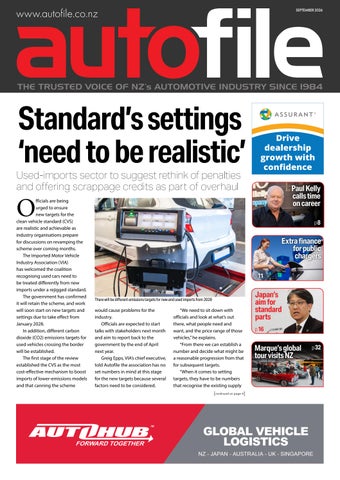
Extra finance for public chargers p 11 There will be different emissions targets for new and used imports from 2028
would cause problems for the industry. Officials are expected to start talks with stakeholders next month and aim to report back to the government by the end of April next year. Greig Epps, VIA’s chief executive, told Autofile the association has no set numbers in mind at this stage for the new targets because several factors need to be considered.
“We need to sit down with officials and look at what’s out there, what people need and want, and the price range of those vehicles,” he explains. “From there we can establish a number and decide what might be a reasonable progression from that for subsequent targets. “When it comes to setting targets, they have to be numbers that recognise the existing supply
Japan’s aim for standard parts
p 16
Marque’s global tour visits NZ
p 32
[continued on page 4]
GLOBAL VEHICLE LOGISTICS NZ - JAPAN - AUSTRALIA - UK - SINGAPORE
LOAD IT SHIP IT TRACK IT CLEAR IT
GERDELIVER IS IT ! TER
move to new, much larger premises means we are to offer even more services to our dealer clients
to door ro-ro vehicle shipping from Japan and Australia
ainerised vehicle shipping from anywhere in the world Customs clearance Vehicle tracking
VEHICLE SHIPPING
GENERAL FREIGHT
VEHICLE TRACKING
SHIPPING SCHEDULE
We are specialists
We have developed
exporting all types of Vehicles, Commercial trucks, vehicles of Special Interest and other RORO Heavy Cargo & Machinery.
Agents who understand the commitment required to service our demanding market.
Finding out where your vehicle is at any one time of the process, gives you the ability to manage the collection and processing of documents and payment on time.
TRS and shipping services from Japan to New Zealand.
proved MPI transitional facilities and cleaning services
g it all off is Jacanna’s SmartTrade Rewards Programme, transporting andreward you choose a worldwide network of you can earninpoints for almost any
Tel: +64 9 825 0888 info@jacanna.co.nz Terms and conditions apply. www.jacanna.co.nz
www.jacanna.co.nz
JACANNA.CO.NZ
Tel: +64 9 825 0888
www.jacanna.co.nz info@jacanna.co.nz
Tel: +64 9 825 0888
Call Steve Owens now on 021 947 752
Making foundation for future market GUEST EDITORIAL
The rental sector is shifting from resilience to long-term capability, says James Dalglish
A
s international sector has already made tourism recovers, meaningful progress. the rental vehicle Our members now sector is shifting its focus operate around 25 per to long-term capability. cent of their combined The rental industry fleets under the clean has spent the better part vehicle standard, JAMES DALGLISH of five years adapting to comprising around 23.5 Acting CEO, Rental disruption and challenges Vehicle Association NZ per cent hybrid vehicles have evolved over time. and 1.5 per cent battery First came the Covid-19 electric vehicles. pandemic and closures of our Those figures demonstrate border. These were followed by that the transition towards lowersupply-chain disruptions, vehicle emissions transport is already under shortages, inflationary pressures way. At the same time, operators and rising operating costs. continue to experience the practical For many operators, simply realities of fleet transition. While maintaining fleets and meeting hybrids have achieved strong customer demand became uptake, a wholesale shift to fully increasingly complex. electric fleets still remains distant. Today, however, the industry Customer demand, charging is entering a different phase. infrastructure, vehicle availability International visitor arrivals are and operating economics all continuing their recovery and are continue to influence fleet now approaching pre-Covid levels. purchasing decisions. That recovery is flowing through The path to decarbonisation is the tourism ecosystem and unlikely to be defined by a sudden providing greater confidence for switch. More realistically, it will be rental operators as they make plans a gradual evolution as technology for the future. While challenges matures, infrastructure expands remain, the conversation is shifting and market conditions align. from resilience to optimisation. The rental vehicle sector has The past few years have showed remarkable adaptability reinforced the importance of over recent years. Having navigated strong systems, clear processes and unprecedented disruption, disciplined decision-making. operators are now in a stronger Many operators have responded position to focus on efficiency, by improving fleet management customer outcomes and long-term practices, embracing digital tools sustainability. and refining the way they operate. The challenges have not Changes initially made out of disappeared, but the outlook is necessity are now delivering lasting brighter. If the past five years were benefits and creating stronger, about resilience, the next five may more resilient businesses. be about capability – building One area where this stronger businesses, embracing is particularly evident is innovation and continuing towards decarbonisation and the rental a lower-emissions future.
DIRECTORS
EDITOR
dazzz@autofile.co.nz ph. 021 0284 7428
ris@autofile.co.nz
Darren Wiltshire
Brian McCutcheon brian@autofile.co.nz ph. 021 455 775 DESIGNER
Adrian Payne
arpayne@gmail.com
Darren Risby JOURNALISTS
Matthew Lowe
matthew@autofile.co.nz
Sue Brebner-Fox sue@autofile.co.nz MOTORSPORT
Mark Baker
veritas.nz@xtra.co.nz
Visit www.autofile.co.nz to subscribe to Autofile magazine and have it delivered monthly in print. The subscription rate is $78 plus GST for 12 issues per year. Autofile magazine is also available online as a readable file or downloadable as a PDF. Back copies dating to 2017 can be found on the website where you can subscribe to our Insight email alerts. Copyright: Published monthly by 4Media Ltd
All statements made, although based on information believed to be accurate and reliable, cannot be guaranteed, and no liability can be accepted for any errors or omissions. Reproduction of Autofile in print or digital format in whole or part without written permission, whether by copying or any other means, is strictly forbidden. All rights reserved. ISSN 0112-3475 (print) ISSN 2350-3181 (online)
NZ’s independent vehicle inspection specialists We of fer a full range of services. • Entry Certification for imported cars • Vehicle Appraisals • WoF/CoF Inspections • Road User Charges • Registration & Relicensing • Exhaust Emission Testing
www.vinz.co.nz
Appointed by the NZ Transport Agency
www.autofile.co.nz
3
news
[continued from page 1]
chain and push from there. If we’re importing vehicles with an average of 135gCO2/km now, then what does ‘better’ look like? “The starting point needs to be realistic and improve from that rather than being crazy low and unachievable, which will only lead to us quibbling over how bad we’re going to fail. That doesn’t help anyone. “We haven’t come up with a starting number yet. We hope the officials are doing some more nuanced work around trying to figure out how to come up with a target and not just looking at numbers on a spreadsheet.” Latest figures from the NZTA show used light-vehicle imports averaged 135gCO2/km in the first seven months of this year against an average target of 110g over the same period. For new imports, the year-to-date average was 143gCO2/km compared with an average goal of 139g. The combined emissions figure for new and used light vehicles
We have some hard negotiation to do around the settings whoever wins the election
– Greig Epps
was 140gCO2/km versus a target of 127g. Epps notes that as officials determine future targets for vehicles they will also need to consider at what level credits and penalties apply. The CVS was developed to allow importers to generate credits to offset penalties that they accumulated and was meant to be “fairly neutral”. However, VIA states 70 per cent of used vehicles
SP E C I A L IS T S I N
PRE‑SHIPMENT INSPECTIONS MPI biosecurity inspections Biosecurity decontamination Heat treatment NZTA border inspections Odometer verifications Pre-export appraisals ?
Lost documentation reports
www.jevic.com 4
www.autofile.co.nz
imported in 2025 were penalised. “After the clean car discount’s removal, EVs were hard to sell until we hit this year’s fuel crisis, and for used-vehicle importers they were also hard to find and difficult to ship,” adds Epps. “We saw the new-car sector was able to accumulate a couple of million credits because on that side of the market EVs were coming in. But on our side, at the start of this year we had about 300,000 credits. If the policy is meant to balance credits and penalties, that’s a clear sign it isn’t working.” He hopes talks will focus on other ways for importers to accrue credits as VIA plans to raise the idea of a scrappage credit scheme to accelerate reducing the fleet’s age and emissions profile. “An issue with the original policy was we didn’t have a way of balancing out penalties and credits, so part of these discussions will need to be on how we create credits. “It may be built into a set target or the sorts of vehicles classified, but we also have some ideas around other ways to look across the fleet and fleet-management approach to generate credits. “Used imports are helping to optimise the existing fleet. It’s more likely a used import pushes a car out of the other end of the fleet than a new one coming in. “So how do we successfully pull vehicles from the fleet and is that an area where we can create credits and credit the industry for taking steps to shift a vehicle out?” Epps adds such an approach
would reward businesses for the verified permanent removal of older vehicles and might fit into how the revamped CVS for used imports works. “If we look at what’s coming in at the front end and tick a box, we may have done well there,” he says. “But as we saw in 2025, used-import volumes were in the mid-70,000s and down 30 per cent from historical levels, and the fleet’s age went up. “We’re not replacing those older vehicles and still have about 20 per cent of the fleet older than 20 years old. We need to look at how we shift vehicles out. “VIA has gathered a lot of data and analysis about the fleet over the past year or so. That means we can go into conversations with officials with some ideas and thoughts early on rather than it being a completely fresh start.” The association would have preferred the used-imports sector to be excluded from the CVS, but Epps describes the government treating it differently from the newvehicle market as an “important acknowledgement” of a problem that’s been raised consistently. New and used are “essentially different products”, which means the CVS has been one policy regulating two separate markets. Epps says the coalition’s decision creates an opportunity to design a system that better reflects market realities and VIA is now eager to see what the stage-two design process will lead to. “The product mix and type of vehicles being imported meant one policy across all of them wasn’t working and was creating differences. This next phase is going to be important because it will be saying what does separate mean. “We want to ensure the conversation will look at the characteristics of the used market, what’s out there, what consumers want, what’s affordable and how we make a workable system that gives us certainty into the future and meets whatever goal the government is trying to achieve. “From that, we can understand the shape of the market and start
news t putting some pressure onto it. “Even within that system, we might still need weight adjustment and be open to asking, is that something we still require in a used-only policy?” The general election on November 7 will take place while talks on the future of the CVS are under way, but Epps is optimistic if there is a change of government, the incoming one will continue with a two-stream approach. “I don’t think any political party is pushing back on the idea of a dual-market system and it will really come down to what the settings are. We have some hard negotiation to do around those settings whoever wins the election.” He hopes the revamped regulations will be rubber-stamped by about the middle of next year, which will give the industry time to understand what the CVS will look like from 2028. The sector is also hoping the talks result in a period of stability after frequent adjustments of emissions targets and penalty settings since the scheme was launched in January 2023. “It’s a tight timeframe but we’re not starting fresh with no knowledge about what we think will work,” adds Epps. “Those initial conversations in October should get off to a good start. “Ultimately, from January 1, 2028, we want some certainty for a good period into the future. From there, the industry can carry on and try to hit those targets. We also need to be aiming for longer-term outcomes rather than putting a lot of short-term pain on the industry and creating uncertainty. “The idea is we continue to improve the fleet with every vehicle rather than letting perfection be the enemy of improvement.”
SCHEME ‘WELL-ESTABLISHED’ The government announced on August 25 it will retain the CVS and Chris Bishop, Minister of Transport, says it “became clear” last year that its settings weren’t well-matched to market conditions. “Most importers were
The government says the current CVS settings aren’t well-matched to market conditions
struggling to meet the passengervehicle targets with charges likely to be passed to consumers through higher prices and reduced choice,” he adds. “At that time, the government made critical short-term changes to ease pressure on importers and keep cars affordable for families and businesses. We also committed to complete a full first-principles review of the standard.” Stage one of that review was completed earlier this year. It found the CVS to be the most cost-effective way to increase the availability of lower-emissions models in this country and most industry stakeholders taking part in it supported keeping the scheme. Bishop notes in feedback on the review that the car industry stated the standard is well-established with importers accumulating credits and charges over time. Removing it at this stage would be “highly disruptive” for the industry. “The government has decided to retain a standard and progress work to calibrate the settings so they are realistic and achievable for industry. It has also agreed to set different targets for used imports to reflect they have different and older technology.”
DRIVING EMISSIONS LOWER The Motor Industry Association (MIA) has welcomed retaining the CVS and plans for work on recalibrating its settings to better reflect New Zealand’s market. Chief executive Aimee Wiley describes last month’s decision as an “important step” towards establishing a more durable and effective vehicle-emissions framework. “The MIA has consistently supported retaining a regulated CVS while arguing strongly its
settings need to reflect the realities of vehicles motorists can afford, want and need. “This decision responds directly to issues the MIA and our members raised through the stage-one review. We acknowledge the government and officials for engaging seriously with the data, evidence and industry expertise provided.” As a small, fully importdependent market, vehicle technology and product availability in New Zealand are largely determined by global manufacturing, product planning and allocation decisions.
Wiley says this makes it important for future CVS settings to recognise the technology available when a vehicle is made and different characteristics of supply across our market. “A new-vehicle distributor sourcing current global production and a used importer sourcing vehicles manufactured for overseas markets several years earlier don’t have access to the same vehicles or technology pool,” she explains. “The same principle applies across vehicle segments. Technology availability, consumer requirements and the pace of transition aren’t uniform across the [continued on page 6]
VEHICLE IMPORT FINANCE AT COMPETITIVE INTEREST RATES
w
EASY APPLICATION
EFFICIENT SERVICE
Submit two downloadable forms and simply send to us for review.
Hear back from our team about finance in as little as 24 hours.
COMPETITIVE INTEREST RATES & FEES
NZ BASED
Our partnerships give us the ability to offer superb lending rates.
www.autobridge.co.nz
Autobridge is New Zealand based and covers the country, so we are never far away when you need us.
09 320 5646
ENQUIRE NOW ABOUT TRADE FINANCE FOR YOUR BUSINESS www.autofile.co.nz
5
news
[continued from page 5]
market. Good regulation needs to recognise those realities while continuing to drive measurable and durable improvement in vehicle emissions.” The MIA believes the government’s focus on achievable settings provides a sound basis for work that reduces CO2 emissions and motoring costs while maintaining model availability, affordability and choice. “This isn’t about stepping away from lower emissions,” says Wiley. “It’s about getting the settings right so the standard can deliver sustained emissions reduction in the real world. “Kiwis deserve access to the best and safest technology, and to the lowest emissions and most energy-efficient vehicles they can afford.” The association will now turn its attention to the next phase of helping shape a durable and evidence-led CVS that works. Wiley adds the MIA’s objective remains a scheme that supports
Aimee Wiley, of the MIA
James McDowall, of the MTA
sustained emissions reduction while maintaining choice, affordability, availability and renewal of the fleet.
KEY ‘POLICY LEVER’ The Motor Trade Association (MTA) describes keeping the CVS for new and used imports as the right decision and, like other industry organisations, it adds the next step must be to make the targets achievable. James McDowall, head of advocacy, says it was pleased to be part of the review’s first stage and government officials have
Our strength comes from knowing our customers’ needs, understanding and fulfilling them
Mechanical Breakdown Insurance
Comprehensive Motor Vehicle Insurance
Credit Contract Indemnity Insurance
Guaranteed Asset Protection Insurance
Mechanical Breakdown Insurance EV & Hybrid option available Uber & Taxi cover available
Contact:
Simon James 027 239 0253 SimonJ@questinsurance.co.nz 6
www.autofile.co.nz
Chris Bishop, Minister of Transport
acknowledged members’ input helped inform the decisions cabinet reached. “We have long argued it would be remiss not to have a standard,” he adds. “It remains the last policy lever we have to influence vehicle CO2 emissions. “It stops New Zealand becoming a destination for less fuel-efficient, higher-emissions vehicles that cost more to run. “Retaining the standard for new and used imports keeps that lever in place.” The MTA says it had called for
what stage two of the review will consider, which is whether the CO2 targets cut emissions and motoring costs faster while remaining achievable for the industry as well as maintaining vehicle availability, affordability and consumer choice. McDowall emphasises: “Achievability and certainty for the industry are now central to the next phase of work, which is what we asked for.” The MTA had argued that used imports don’t need to be treated differently under the CVS, but cabinet has decided to establish separate CO2 targets for this sector. “We will be engaging with officials to ensure any separate targets are grounded in market realities, don’t disadvantage the used-import channel, and continue to protect affordability and choice for motorists,” adds McDowall. “To date the standard has succeeded in shifting the vehicle mix towards hybrids. The test now is whether the next set of targets stays realistic.”
On board with agency
C
hris Bishop, the Minister of Transport, says the new structure of the NZTA’s board means it has the expertise to deliver. David Smol has been reappointed for a two-year term, while Lana Stockman, Steve David Smol Haszard and Murdo Beattie are on three-year terms. Bishop says: “David Smol’s regulatory, governance and public-sector experience will continue to provide valuable oversight to the board. “Lana Stockman brings a diverse background across finance, engineering, psychology and regulation. Her understanding of commercial and investment trade-offs for regulators and operators will strengthen the board’s capability.” As for Haszard, he is a “commercially astute board member and executive
leader with strong regulatory experience. His experience leading organisations through change, including as chief executive of WorkSafe and managing partner of Meredith Connell, will be valuable”. Bishop adds: “Murdo Beattie brings deep commercial and investment management experience, including in complex infrastructure and transport-related transactions. “His leadership on significant transactions, including the recapitalisation of Air NZ and the crown’s reacquisition of KiwiRail, will add strong commercial expertise to the NZTA’s governance.” Bishop has acknowledged Catherine Taylor, who is retiring. “She has made substantial contributions to the board’s governance and oversight of the NZTA. Catherine’s leadership as chair of the regulatory sub-committee has been valuable in supporting the board’s responsibilities.”
www.autofile.co.nz
7
news
Dealership begins new era A
used-car business has been given a new name and looks after nearly 28 years, but customers visiting the Christchurch dealership will still encounter plenty of familiar faces despite the change of ownership. The Paul Kelly Motor Company has been bought by Dan Chima, Yuri Van Toor and Darren Griffith, who also run Ute Nation and Southern Specialist Cars in the city. They have rebranded it as The Motor Company. The takeover deal includes a sales site on Moorhouse Avenue and the former PK Auto Services in Stevens Street, which has been renamed The Motor Company Service Centre. Chima is excited to complete the purchase and a key aspect of the transaction was retaining the previous staff of about 20, some of whom have decades of involvement with the business. He told Autofile: “It’s been a longstanding business in Christchurch and has got a great reputation, but more importantly there’s a huge amount of respect for the team. “A lot of them have been with Paul Kelly for 10 or 20-plus years. They have a lot of experience and knowledge that can’t be replaced
The Motor Company at Moorhouse Avenue, Christchurch
very easily. The people we’ve taken on with the business are a key part of why we decided to do it. “We took on every employee from that company as well as having employees from our own businesses. We are actively hiring at the moment and have about 10 positions we’d like to fill as we look to expand. “We had a pretty long consultation period with the staff leading into the changeover to allay any fears they might have had, and we let them understand who we were and what we wanted to do to make them part of the journey. “There’s a huge responsibility on us to lead this team for the next 20 years and we don’t take that lightly at all.” Chima describes the sales site
as “great” and hails the Stevens Street service centre as “probably one of the best workshop facilities in Christchurch, franchised or nonfranchised”. He adds the fit-out of the service building, which has more than 25 vehicle bays, and the way it operates were major factors in deciding to purchase the operations from Kelly. “It helps us with our existing businesses, Southern Specialist Cars and Ute Nation, and improves our offering to clients by having that proper retail-focused workshop facility, which we didn’t have until now. “Meanwhile, the target market of The Motor Company, as it was for Paul Kelly’s business, is cars between $10,000 and $40,000. “This wasn’t a segment we
were operating in with our other two businesses so it’s a nice fit and captures a different part of the market for us. “We’ve had a busy start as owners and have already identified some great synergies between that business and our existing businesses, and we’re really happy.” Chima says The Motor Company has ambitions to expand its number of sites and is looking for future opportunities in the usedcar space. “I don’t see us changing the target market of those $10,000 to $40,000 used cars, but I think there’s room for the company to double its footprint and double its stock holding in the short-tomedium term. “We’re Christchurch-based so Christchurch is our priority, but we
FROM JAPAN TO NEW ZEALAND
ON TIME, EVERY TIME
TOYOFUJI SHIPPING SCHEDULE Toyofuji vessels
Voyage
Trans Future 5
168
JAPAN
NEW ZEALAND
Moji
Osaka
Nagoya
Yokohama
Auckland
Lyttelton
Wellington
Nelson
—
24 Aug
25 Aug
29 Aug
16 Sep
T/S to DRA v65
T/S to DRA v65
18 Sep T/S to TF7 v170
Dream Angel
65
—
31 Aug
2 Sep
6 Sep
20 Sep
23 Sep
25 Sep
Trans Future 7
170
—
7 Sep
8 Sep
12 Sep
30 Sep
T/S to DRJ v56
T/S to DRJ v56
2 Oct
Dream Jasmine
56
—
13-14 Sep
15 Sep
20 Sep
5 Oct
8 Oct
10 Oct
T/S to TF6 v169
Trans Future 6
169
—
19 Sep
21 Sep
26 Sep
14 Oct
T/S to NC1 v207
T/S to NC1 v207
16 Oct
T/S = Tranship to next available TFS vessel
Contact: Adam Stone
8
www.autofile.co.nz
adam.stone@toyofujinz.co.nz
www.toyofujinz.co.nz
news t will be looking at opportunities as and when they come up. We’re not going to limit ourselves.”
‘RIGHT OPPORTUNITY’ The Paul Kelly Motor Company was established in 1998 with three staff and grew over the years to become well-recognised across Canterbury. Kelly has sold about 70,000 cars over the years and is proud his company was never involved in any dispute tribunals. “We’ve looked after our clients and staff,” he told Autofile. “I don’t know if anybody in the past 25 years would have created anything like the volume we did and the profitability of how good that business was over the years. “It hasn’t been just a job for me, it’s been a career. I always ran the business not so much standing there selling cars but looking at it from the outside as a customer. “From the word go, I wanted to run it like a Harvey Norman or a big local store and not just a used-car yard. I think that was the biggest advantage I had.” He launched the company with the support of his then-business partner Andrew Simms, who is now managing director of Andrew Simms Newmarket, before buying him out within 12 months. Kelly says the early success of his business was helped by a special pricing plan with all the vehicles priced at $9,990 during the first month. “I made more money in that first month than I made in all of the previous year,” he smiles. “I was so excited because I was making money and we could barely keep up with demand.
From left, Paul Kelly completes the deal to sell his company to Dan Chima, Yuri Van Toor and Darren Griffith
“A lot of people would have stopped at that but I wondered if I could make twice that. I just worked and worked and achieved some great things. “I kept buying more cars and kept going, but I think the proudest thing for me is what we achieved with people over the years.” The business has had consistently low staff turnover and some employees have been there more than two decades. Kelly was always keen to foster a good culture and working environment. “We’ve got people who have worked for me for a long time and I know they have done well for themselves over the years by being part of a successful group. “I’m very much for getting people into work and giving them an opportunity. They work hard and they will be well looked after. “I’m proud of everything we have achieved and it wasn’t just about me. It was the guys preparing the cars right, buying
them right, delivering them and being professional. I was just the guy who had to steer the team in the right direction, and ensure we had good morals and standards.” One of the most-reported-on perks for Kelly’s employees came in 2018 when he took all his staff to Las Vegas to mark the company’s 20th anniversary. The trip for almost 50 people was not incentive-based and involved everyone at the business, including someone who had only joined a few weeks earlier. The company also shared a percentage of its profits each year equally with everyone on the payroll, people reaching 10 years of service received $10,000 and it closed annually for staff to have a special day out. Kelly, 56, decided to sell the business because he saw no longterm future for it within his family. “I started the company quite young and had children a bit later in life so my children are too young
to take the business over – my oldest son is 13. “I held on to it through the years until I found the right opportunity and right people to own it because that was more important to me than what I got paid for it. “It was all about the actual owner and how they would look after the people working there and, so far, all I’ve seen is really good. Everybody kept their job and Dan will need to hire more people. “My name has come off the door, his name’s on it, the new logos look good and Dan has hit the ground running. “He should be pretty rapt to purchase it because it’s probably the largest branded used-car business in the South Island. He has also got some seriously good people and processes. It’s just a great outcome for everybody.” Kelly, who has a private car collection of about 20 vehicles, is stepping away entirely from the automotive sector. He plans to focus his efforts on growing the commercial, retail, office and industrial property business he has been running in the background up until now. “That’s me done with the motor industry, I’ve got enough cars at home,” he says. “There’s several millions of dollars’ worth sat at home and I’ll probably now have more time to enjoy them. “I’ve got plenty on with my other business, so it’s not like I’m going to be doing nothing. “I’m also off to run my old Pontiac Trans Am at the Bathurst 1000 Touring Car Masters this year and stuff like that.”
The Motor Company Service Centre in Waltham
www.autofile.co.nz
9
news
Takeover deadline extended T
he closing date for the buy-out of 2 Cheap Cars (2CC) has been pushed back by about four weeks to September 23. Sena & Co Ltd, which is owned by David Sena, co-founder and chief executive of the target company, has offered 80 cents for each ordinary share it doesn’t hold. Sena’s company wrote to shareholders on August 10 notifying them the final date for acceptances had been extended from August 23 to September 23. The letter states: “The minimum acceptance condition will be satisfied once we receive acceptances which will result in Sena & Co holding or controlling 90 per cent or more of voting rights in 2CC, unless waived in accordance with the terms of the offer. “If the 90 per cent threshold is not reached and the condition isn’t waived, the offer will lapse. “Shareholders will then not receive their cash consideration of $0.80 per share and the stock will likely trade down towards or below the pre-announcement price of $0.66. “Shareholders are encouraged to accept the offer as soon as possible to help ensure the offer can proceed to completion and receive their cash promptly once the offer conditions are satisfied.” The letter notes the offer period may be further extended in accordance with the Takeovers Code. It urges those who have yet to accept to read the offer document and target company statement. Sena & Co adds they should consider a series of points when making their decisions, such as the independent directors unanimously recommending the offer be accepted. It says the offer price is within the valuation range stated in the independent adviser’s report, which is included in the target company statement. The price of 80c per share includes a 21 per cent premium 10
www.autofile.co.nz
2 Cheap Cars’ branch at Sylvia Park, Auckland
on the closing NZX price of 66c on UPDATES ON TRADING July 9, the last trading day before 2 Cheap Cars has issued two the takeover notice was lodged, reports on its results since the and 39 per cent to the 12-month takeover bid was announced with volume-weighted average price the first lodged with the NZX on of 58c. August 4. As 2 Cheap Cars noted in an That stated net profit after tax announcement to the NZX early (NPAT) for June came in at about last month, trading up to July 27 $500,000, although trading has was weaker than in the current since been “weaker”. financial year’s In addition to NPAT first quarter, and of about $600,000 conditions remain in each of April and volatile. Other points May, total profit was raised in the letter around $1.7 million for include: 2026/27’s first quarter. Trading in the “The company company’s shares wouldn’t ordinarily is illiquid and the provide an update offer presents based on a single a chance to month’s performance,” sell for all-cash says chairman Michael consideration. Stiassny. “It’s providing The independent it in the context of directors advised being subject to a on July 27 that takeover offer and to – Michael Stiassny up until July 23 keep shareholders no competing updated. proposal had emerged. “The board cautions the results 2 Cheap Cars’ share price will for any individual month or short probably fall towards or below period do not provide a reliable its pre-offer level should the basis from which to extrapolate takeover fail. performance for the remainder of the financial year. Trading The letter adds: “If you have not conditions remain volatile and the already accepted the offer in company isn’t providing financialrespect of your shares, but wish year 2027 earnings guidance.” to do so, please complete and That update was made before return the acceptance form. If you 2 Cheap Cars’ July accounts were have already accepted the offer, finalised. “However, as noted in you don’t need to take any further the independent adviser’s report action.” released, trading in July to the
Trading conditions remain volatile
date of that report had been weaker than the first quarter,” adds Stiassny. The company issued another update on August 14, which showed NPAT in July was about $320,000 to take the unaudited total for the first four months of the 2027 financial year to $1.99m. Stiassny says that month’s result was consistent with the August 4 update that trading had become softer, primarily reflecting reduced sales volumes and average margins.
RETAIL DEVELOPMENTS Amid the news of Sena’s takeover bid, the company opened a new branch in Henderson, west Auckland, at the start of July. The dealership is intended to replace 2 Cheap Cars’ operation in Penrose, which is closing in September with the landlord planning to redevelop the site. “The replacement of Penrose had been contemplated in the company’s planning and the Henderson opening doesn’t represent a planned net increase in retail footprint,” says Stiassny. “Additional capacity remains available at the Sylvia Park site and the company believes its footprint is appropriately aligned with current operational output. “The company will continue to review its retail footprint having regard to market conditions, operational capacity and expected returns.”
news
Scheme to boost charging network T
he coalition, which has pledged to deliver 10,000 public EV chargers by 2030, has opened the second round of zero-interest loans to encourage private-sector investment. Crown-owned National Infrastructure Funding and Financing Ltd released a request for proposals for the latest round of concessionary lending on August 10. About $21 million is being made available to charge-point operators seeking co-investment to deliver charging sites. Applications will be assessed via an open procurement process focused on delivering the best value for money and strongest contribution to expanding the public network. Chris Bishop, Minister of Transport, says: “Many Kiwis are interested in making the switch
to cut fuel costs or their carbon footprints, but we continue to hear concerns about access to chargers, especially for longer journeys outside main centres. “Before this government began addressing the issue, New Zealand had just over 1,800 public charge points, one of the lowest chargerto-EV ratios in the OECD. “It’s a chicken-and-egg situation. Companies are reluctant to invest in infrastructure until there are more EVs on the road, while many people are hesitant to buy an EV until they know charging will be readily available. “That’s why we are taking steps to unlock greater private investment, expand the network and give New Zealanders confidence to make the switch.” The second funding round builds on the first set of concessionary loans announced
A ChargeNet rapid charger
in March, which will deliver 2,574 charge points via partnerships with ChargeNet and Meridian Energy. The finance can fund up to 50 per cent of a project’s capital costs, has zero per cent interest and boasts a maximum tenure of 12 years. Bishop says round one showed strong market demand for the programme and that concessionary
lending can unlock major privatesector investment. “Projects under way will more than double the public network and represent a major step towards achieving our long-term goals,” he adds. “By 2030, our target is to have 10,000 charge points across the country, providing roughly one charger for every 40 EVs.” In addition to putting “downward pressure on power bills”, the coalition is developing minimum standards for EV chargers so people can choose ones that will automatically charge overnight when power is cheapest. It is allowing rooftop solar installation on existing buildings without a building consent, which has seen such connections climb by 19 per cent in the past year, and is doubling the limit for households exporting power back to the grid to 10kW.
Lending in the fast lane Our new Avanti Partner Portal is more than an origination platform. It’s a whole new custom-built system that helps you get more deals to approval faster.
AVANTIFINANCE.CO.NZ/PARTNERPORTAL
Lending criteria, fees, terms and conditions apply.
www.autofile.co.nz
11
news
Support for policy add-ons T
he Imported Motor Vehicle Industry Association (VIA) says a regulator’s report shouldn’t be taken as saying insurance products sold by car dealers are fundamentally wrong. It supports the Financial Markets Authority (FMA) aiming to ensure consumers are treated fairly when signing up for insurance and other financial products when buying a vehicle. The regulator has raised questions about how some policies are sold, how well people understand what they are buying and the oversight insurers provide when products are distributed through third parties. VIA’s view is such issues need to be taken seriously, but dealersold policies must not be labelled inappropriately and consumers shouldn’t be prevented from taking out protection at point of sale. “A car is essential for many New Zealanders,” says Greig Epps, the association’s chief executive. “Products such as mechanical breakdown and credit insurance can protect people from being faced with significant, unexpected repair bills when already servicing a vehicle loan.” He contends the right regulatory outcome isn’t to make such products harder to obtain. When there’s evidence of inappropriate sales practices, inadequate disclosure, poor training or problematic remuneration, such matters
need to be tackled directly and “We would be concerned proportionately. if isolated examples of poor Epps adds: “People commonly conduct were used to justify broad arrange the vehicle, finance and regulation that imposes significant insurance at the same time. cost on responsible businesses “There’s nothing or reduces access to wrong with that if products.” customers understand While the what they’re being FMA has singled offered, know the out intermediary product is optional, oversight, training understand the and sales processes benefits, limitations as areas for and exclusions, and improvement, Epps are making a genuine says “practical issues” choice.” can be addressed He says paying without assuming the for them through a whole model needs car loan also means dismantling. consumers can access As for the regulator, cover they might its report highlights not otherwise afford while products address upfront without taking relatively small and out extra finance. specialised markets, “Insurers “they share common – Michael Hewes characteristics commonly offer significant discounts including complex on policies written for more than features, and significant exclusions 12 months, which is a saving and limitations”. generally only available when Michael Hewes, director of cover is arranged at the outset. credit, deposit-taking, insurance “None of this diminishes the and advice, says insurers cannot need for good conduct at the outsource responsibility for fair point of sale. Dealers must make consumer outcomes. sufficient enquiry to ensure He adds: “When products products meet customers’ needs, are sold through intermediaries, they are fit for purpose and can be insurers still need robust systems, purchased affordably. controls and monitoring to ensure “When that standard is met, this consumers are treated fairly. model is often the most practical “We have seen a recurring gap and cost-effective way to get between policies, systems and appropriate cover. controls insurers described, and
Insurers need robust systems to ensure consumers are treated fairly
Focus on dealers M ark Greenfield, who has more than 25 years’ experience in the car industry, has become head of sales – auto at Avanti Finance. His appointment builds on a strong track record in business development, sales and leadership, including more than a decade with Motorcentral 12
www.autofile.co.nz
Technologies, which is part of the Avanti group of companies. Most recently, as head of business development, Greenfield helped grow the business by strengthening relationships and expanding its development focus. In his new role, he will lead sales for Avanti Finance Auto and Motorcentral, focusing on partner
how they operated in practice. “New Zealanders should be supported to make informed decisions about products they purchase and have confidence they are likely to meet their needs.” The FMA says its review identified four key areas of concern. Sales practices and distribution arrangements may not consistently support informed customers’ decision-making. Consumers may purchase products that fail to consistently meet their needs, objectives or expectations and without fully understanding them. In addition, insurers aren’t consistently identifying and responding to emerging conduct risks. Distribution oversight is where “industry uplift is most needed”. Insurers outlined onboarding and training for intermediaries, but the review found limited evidence of monitoring and oversight proportionate to risks associated with commission-based and intermediated sales. The regulator adds insurers have acted to embed Conduct of Financial Institutions requirements with some companies showing mature approaches to governance and complaints management, and using product performance data to improve consumer outcomes. The FMA has provided targeted feedback to insurers. It now expects the sector to consider its findings and assess whether similar issues exist in their operations.
relationships, growth the way we partner and delivering solutions with them.” to make doing business Lee Robson, general with the company manager of auto, easier. adds: “Mark has strong “Every dealer has a industry knowledge, different view of what commercial focus and success looks like at a clear understanding any given time,” says of the market. His Mark Greenfield Greenfield. “My focus appointment brings is on listening, asking the right experienced leadership and questions and understanding continuity to our auto sales where Avanti can add real value team as we grow our introducer not just through our products, but network across New Zealand.”
BUY SMARTER. SELL FASTER. STAY AHEAD. Hundreds of vehicles auctioned every week and nearly 1,500 users ready to trade. Auction Online gives you real-time access to the true used-vehicle market, nationwide. Buy, sell and manage stock from anywhere – fast, transparent and competitive. Whether you’re clearing trade-ins, moving aged stock or filling your yard, our streamlined auction platform simplifies every step. • Nationwide dealer network Almost 1,500 users actively buying and selling. • Real-time pricing transparency Live bidding ensures you always hit true market value. • High stock turnover Hundreds of vehicles auctioned every week across NZ. • Purpose-built dealer platform Designed specifically for franchise & independent dealers. • Fast, simple, secure Seamless listings, bidding and purchasing from one platform.
Join Auction Online today and start trading smarter auctiononline.co.nz www.autofile.co.nz
13
news
Building trans-Tasman links O
rganisers of an annual convention are hoping to increase engagement between dealers and automotiverelated businesses in New Zealand and Australia. This year’s Australian Automotive Dealer Association (AADA) Convention and Expo attracted more than 1,000 delegates with issues such as changing customer expectations, margin pressure, new brands, electrification and the use of AI being tackled. The two-day event, held at the International Convention Centre Sydney, brought together franchised new-car dealers, industry suppliers, automotive leaders and retail experts. Patrick Tessier, convention director, says: “AADA was pleased to welcome 15 New Zealand-based attendees this year representing dealer businesses and allied industry organisations. “Their attendance reinforced the growing relevance of the event for automotive retail businesses on both sides of the Tasman. “While Australia and New Zealand operate in different regulatory and market environments, many of the commercial pressures facing dealers are increasingly similar.” A series of panel discussions, workshops and presentations were held at the event. Topics in the spotlight included marketing effectiveness, and the evolving relationship between dealers and manufacturers. Tessier notes several sessions were particularly relevant for the New Zealand attendees, including a panel examining how international disruption, geopolitical risk, changing vehicle mix, EV growth, Chinese brands and policy pressures are affecting markets. “The discussion reinforced that dealers in smaller, open markets such as Australia and New Zealand are exposed to many of the same global forces, even when the local settings differ.” 14
www.autofile.co.nz
Michael McQueen, left, AADA 2026’s opening guest speaker, and convention director Patrick Tessier
The main-stage programme begun for next year’s AADA featured sessions on competing Convention & Expo, which will in high-tech, low-margin new-car be held in Melbourne on July 21 markets and building stronger and 22, and organisers see strong used-vehicle operations. value in continued trans-Tasman Others centred on improving engagement. customer retention through “The convention provides fixed operations, and New Zealand dealers understanding how AI, and allied industry data and digital tools professionals with are changing dealership an opportunity to performance. benchmark against Meanwhile, the larger Australian workshops gave market, hear from delegates access to local and international practical sessions speakers, meet across operational, suppliers operating legal, commercial and across both countries technology topics. and compare how These sessions dealers are responding covered the likes to shared commercial of cybersecurity, AI pressures,” he explains. readiness, marketing “AADA thanks return on investment, the New Zealand customer experience, attendees who joined used EVs, fixed us in Sydney and looks operations, future forward to building on mobility and dealership that participation in profitability. future years.” The AADA Expo was – Jono Wu ‘VALUABLE INSIGHT’ a major part of the delegate experience Among this year’s with more than 70 exhibitors delegates from New Zealand was showcasing products, services and Jono Wu, marketing manager solutions for automotive retail, of Enterprise Motor Group and while the expo’s live stage provided Community Financial Services access to short presentations (CFS). between meetings, exhibitor visits He told Autofile the real value and networking. of attending for him wasn’t Tessier says planning has discovering brands or new ideas
Buyers are using AI to build their shortlists before they contact a dealer
but gaining validation for what’s happening in New Zealand. “Session after session, the pressures and priorities being talked about on stage were the exact things we’ve already got under way at CFS and Enterprise,” he says. “These include speed to lead, tightening up stock accuracy, being upfront with customers on trade-in values, and treating finance and protection as a proper conversation rather than an afterthought. “It was genuinely reassuring to sit in a room full of Australian dealer principals and tech vendors and realise we’re not behind the curve. A lot of what we’re currently building and doing is exactly where the industry’s heading.” Wu notes the event also provided insight into using AI to assist the customer journey without replacing any part of it. “The research was consistent. Buyers are using AI to build their shortlists before they contact a dealer, but they still want a human for the actual decision. “The real opportunity for us in New Zealand is using AI to enhance multiple touchpoints in between faster and smarter follow-ups, richer and more accurate vehicle information online, and automated reminders and check-ins through the ownership journey while ensuring a real person is still doing the reassuring and closing. “That’s directly applicable to how we handle leads, follow-ups and service communication across our branches.” How fast the industry is adapting to artificial intelligence and the growth of Chinese marques were topics that dominated activities over the two days. Wu says brands such as BYD, GWM, Chery, Geely and Omoda Jaecoo are experiencing significant sales growth in Australia, while several established mainstream manufacturers are going backwards in a two-speed market. “For us sitting in the usedcar space, that raises a strategic question the whole sector needs
news t to get ahead of. And that’s at what point does the value proposition on a new Chinese vehicle start to outweigh buying used, given how aggressive their new pricing, warranties and tech are? “What happens in three to five years’ time when today’s new Chinese cars start coming through as used stock? How does that reshape sourcing and residual values across the industry?” Wu recommends anyone considering attending AADA’s future conventions should go but make sure they have a specific problem they’re trying to solve, rather than simply seeing what’s out there. “The content spans the whole dealership, sales, service, finance and marketing, so it’s easy to leave with 40 good ideas and no clear priority. Pick your lens beforehand and filter everything through it. “I’d also say don’t skip the vendor floor. Some of the most useful practical details came from the tech and F&I providers.”
The AADA Expo featured more than 70 exhibitors showcasing automotive retail products, services and solutions
James Hendry, AdTorque Edge’s director of sales and operations, suggests delegates attending the AADA event should go in with a question they want answered, rather than simply rocking up to “see what’s happening”. He notes the event offers a packed programme and people will get more out of it by selecting which sessions to attend based on something they’re dealing with back home. “Make sure you spend some proper time on the expo floor too rather than just sitting in sessions back-to-back because some of the best conversations happen around
a stand and over networking drinks,” he says. “And if you can swing it, take a couple of people from your team so you can split up across sessions running at the same time and compare notes after. Nobody can cover it all solo.” Hendry adds AADA 2026 had a real buzz and dealers turned up wanting answers to the challenges and issues giving them headaches right now. “I was lucky enough to see it from both sides, attending for the content as well as exhibiting with AdTorque. I’d sit in on the big main stage or workshop session, then
head straight into, ‘okay but what does this actually mean for my dealership?’ conversations at the stand. “The big takeaway for me was how upfront Aussie dealers are about margin compression right now. It’s a genuinely tough, lowmargin, high-tech market over there. “That came through loud and clear in the Sovereign Insurance session with buyer behaviour shifting, new brands muscling in and pricing pressure everywhere. We’re having that same conversation in New Zealand, just maybe a year or so behind.” Hendry says the used-car panel discussion also stood out because there’s a shift towards treating used vehicles as a profit driver rather than something to deal with once a new-car sale is complete, “and that’s something many New Zealand dealer groups could take a lot from”. Anneke Featonby, senior commercial lead at AutoPlay, was [continued on page 16]
www.sbltd.co.nz www.autofile.co.nz
15
news
Drive for common car parts T
he chairman of the Japan Automobile Manufacturers Association (JAMA) is urging its members to standardise vehicle components. Koji Sato says doing so will save time and money to pump into better productivity, new technologies and advanced factories. The envisioned list of “Japan standard” parts could even be expanded to cover those made by suppliers at home and overseas. The efficiency drive is one of the most ambitious attempts yet to reshape the supply base spanning Toyota, Nissan, Honda, Subaru, Mazda, Mitsubishi and Suzuki. “The most important theme facing the Japanese automotive industry is improving international competitiveness,” says Sato, who is also Toyota Motor Corporation’s chief executive officer. “We aim to strategically create areas of cooperation to improve efficiency. “We have a strong sense of crisis the Japanese industry is in. Now is the time to further develop and evolve with the challenges and reform initiatives we must face.” Sato adds Japan must also improve efficiencies to free resources for its carmakers to invest in new technologies. For example, customers are no longer interested in multiple interior layouts. They want software interfaces, advanced driver-assist technology, faster-
charging batteries and batch of components powertrain options. or materials within the Standardising parts next year or two. customers don’t see Another of the allows carmakers to seven challenges improve brand value JAMA is focusing in areas they do and on is resources and enables them to components because fund multi-pathway Japan is trade-reliant approaches to offering when it comes to different drivetrains. natural resources. Currently, This is especially suppliers make some the case with rare70,000 wire-harness earth elements and variants to satisfy lithium ores needed car companies’ for electrified cars and requirements, making their batteries, and large-scale automation the industry has to – Koji Sato grapple with Chinese difficult. If the industry can standardise moves to limit exports basic architectures, suppliers can of key rare-earth elements and automate manual assembly. semiconductors. While JAMA has yet to establish Silicon Valley and China have formal deadlines, it aims to make gained the upper hand in fully progress on standardising the first automated driving, so JAMA
wants to build a better domestic infrastructure for developing and commercialising such technology, and for the Japanese government to set up a testing framework. Spanning across different six categories, heavy domestic taxes applied to vehicles can amount to around $20,000 for an owner over the 13-year lifespan of a car costing about $32,900. The association says this stifles sales and the system needs overhauling. The automotive industry in Japan needs to implement a multipathway approach to achieving carbon neutrality, and still faces pushback on some initiatives such as promoting hydrogen and carbon-neutral fuels. To build a cleaner and more sustainable industry, JAMA’s members require a cross-sector network for linking data and tracing components. Many experts believe that will be a massive undertaking given the international nature of supply chains. The industry’s future growth has become more linked to software and silicon, but Japanese carmakers still struggle to cultivate homegrown talent to create software-defined vehicles and have problems attracting overseas experts to the country. Tackling this may well be essential to keep the country’s brands front and centre on the global market.
around 80 per cent of the market whereas in Australia our footprint is much smaller, so we’re keen to build more of a presence there and are growing our team accordingly. “As we expand across Australia, getting our name out there matters so being at AADA next year is likely to be important for us.” She notes much of the convention focused on AI, such as who’s doing what, what companies can get out of it and how it can help streamline business, and there was also plenty of discussion about the EV market.
a number of areas, particularly AI, so it’s a great opportunity to see what’s out there and bring some of those insights back to New Zealand as we continue building our own capability in that space,” she adds. “It was my first time there. We went along to look around and do some research on whether we needed a presence next year. It definitely answered that question – yes, we need to be there. It’s also a good networking event, and even without a stand it’s worthwhile talking to people and seeing what everyone else is up to.”
Toyota’s factory in Motomachi, Yokohama
We have a strong sense of crisis the Japanese industry is in
[continued from page 15]
another of the Kiwi contingent at the Sydney event and describes it as eye-opening in terms of what may lie ahead for the industry. “Some of the highlights for me were the products coming to market and how we might integrate with them to make things more streamlined for customers,” she adds. “The keynote speakers were strong, and it was valuable to see who was attending and gauge whether it would be worthwhile for us to be there again next year. “Here in New Zealand, we hold 16
www.autofile.co.nz
Featonby believes the event is worth attending for people connected with the industry, whether they have a presence across the Tasman or not. “Australia’s moving quickly in
news
Repair. Refinish. Lead. Develop capability across your workforce with MITO’s updated automotive body programmes, supporting skill development from entry-level through to advanced and leadership roles. Find out more at mito.nz/programmes/automotive
Training. By industry. For industry. www.autofile.co.nz
17
Securing access to register ‘critical’ P
erhaps I’m sounding like a broken record, but there are still misconceptions or misunderstandings about the motor-vehicle register (MVR) and its importance to traders. Access to the MVR is an essential part of day-to-day operations for car dealers. Whether assessing a trade-in, purchasing stock, verifying ownership or conducting due diligence on a vehicle, traders regularly rely on information sourced from it and its access requirements changed in November 2022. Most dealers obtain MVR information through third-party providers which combine data from multiple sources into a single report. These are commonly referred to as vehicle history or check reports although the exact branding varies between providers. The popularity of these services comes from their ability to present information in one easy-to-read document to help dealers make informed purchasing and appraisal decisions. Typical information included in these reports may include money owing checks, vehicle history information, stolen car checks, security interest verification, ownership and odometer history, and safety and compliance information. For most dealerships, these reports have become an
18
www.autofile.co.nz
indispensable riskmeet the compliance management tool. requirements While traders often highlighted through focus on the vehicle the 2025 NZTA information itself, another declaration process. important aspect is It has become frequently overlooked. evident that some When a vehicle traders’ responses history report includes were based on LARRY FALLOWFIELD Sector manager – dealers, registered owner details, misunderstanding Motor Trade Association the information is sourced rather than a genuine from the MVR under authorised assessment of their MVR privacy access provisions. This means controls and obligations. dealers are being entrusted with As a result, I believe some access to personal data and have operators that passed the 2025 a legal obligation to protect this declaration process may find the private information. same responses and supporting Access to registered owner evidence will be insufficient when details is typically granted the 2026 cycle begins. through MTA membership or is directly approved by the NZTA, IS YOUR BUSINESS READY? which allows approved thirdThe annual section 241 declaration party providers to supply reports is no longer simply an exercise containing information from the in confirming your company has register. The important point authorised access. to understand is access to MVR The NZTA expects businesses information is a privilege. to demonstrate that privacy As expectations of privacy obligations are embedded protection increase, the NZTA and into everyday operations and Office of the Privacy Commissioner supported by documented policies, are placing more emphasis on staff training and effective controls. how businesses access, manage This means you should be and protect personal information prepared to provide evidence obtained from the register. your privacy framework isn’t only This year, I’ve spoken with and documented but actively followed assisted numerous dealers who across the organisation. were unaware of their obligations Questions the regulators will under section 241 of the Land expect dealers to answer include: Transport Act or were struggling to Do employees understand their
obligations when accessing information? Have staff completed privacy and MVR-related training? Is there a documented process for reporting a privacy breach? Are user permissions reviewed regularly? Is access removed promptly when an employee leaves? Can you show how searches are monitored and audited? If you cannot confidently answer these questions and produce supporting evidence, now is the time to review your processes. At a minimum, dealers should have in place an MVR privacy breach response guide, employee onboarding and offboarding procedures, and an internal MVR access training programme. Traders also need a data retention and information management policy, general statement on appropriate MVR use, and a staff training register and training records. Dealers who wait until the NZTA declaration form lands in their inboxes may find themselves rushing to gather evidence and address compliance gaps under pressure. By contrast, companies that review their policies, strengthen their processes and invest in employee training will be far better prepared when declaration time arrives.
MIA DataHub is here.
New Zealand's official new vehicle market intelligence, developed by the Motor Industry Association and powered by InfoAgent. Understand the market. Track the trends. Identify opportunities.
F O U R T R US T E D R E P O R T S , O N E H U B
REPORT 01
REPORT 02
Common Segmentation
Market Development
Compare segment, make, model, fuel and buyer type month-on-month and yearto-date.
Track how the New Zealand market is evolving over time, with leading makes and models.
REPORT 03
REPORT 04
Motive Power Development
Market Shift
Monitor BEV, PHEV and HEV adoption trends across the New Zealand fleet.
Understand how buyer preferences have changed over the past decade.
See sample reports: infoagent.co.nz/mia-datahub
www.autofile.co.nz
19
news
Industry movers
KUL SINGH KARGIL takes over as chief executive officer of Trade Me next month from Anders Skoe, who is returning to Europe. Kargil, pictured, was previously chief commercial and marketing officer at Real Estate Australia where he was responsible for commercial divisions, audience, brand, customer experience and marketing. Prior to that, he held senior roles across strategy, marketing, sales and brand at GE Capital and GlaxoSmithKline. He says: “Trade Me has been part of the fabric of Aotearoa for more than two decades. I feel privileged to lead this business into its next era.” Chairman Owen Wilson describes Kargil as an “exceptional leader” with the qualities needed to guide the company through its next period of growth. He adds: “Kul brings a wealth of executive experience, operational expertise and a track record of delivering growth. Anders leaves Trade Me in a strong position for the future.”
TIANSHU XIN has joined Stellantis to lead its China and Asia-Pacific region. He reports to Antonio Filosa, chief executive officer, and is also a member of the leadership team. Xin, pictured, has 30 years of experience across operations management, strategy, business development, mergers and acquisitions, sales and marketing in a range of industries. In February 2025, he became chief operating officer of Stellantis China and head of the Stellantis Leapmotor Alliance. He continues to serve as chief executive of Leapmotor International, a role he has held since November 2023. Gregoire Olivier has been appointed strategic adviser and Pablo Di Si has taken on the new role of chief performance officer. The latter was most recently president of Volkswagen Group North America. DAVID LEACH has been appointed as Eroad Ltd’s new CEO. The New Zealand-based executive has more than two decades of experience building, scaling and transforming technology businesses serving global markets. Leach, pictured, is joining Eroad from holding the same position at Javln, a cloud-based insurance software company. He was previously chief and executive director of Cin7. John Scott, Eroad’s executive chair, says: “David has a track record of scaling software businesses, building high-performing teams and delivering disciplined growth.” Scott’s appointment as executive chairman has been extended for a limited period to provide leadership continuity until Leach starts with the company in October. RACHAEL COYLE has started in her new role of head of dairy, fuel and payments with the Commerce Commission. Coyle, who is based in Wellington, has been with the regulator for 11 years and was most recently head of telecommunications in the market regulation branch. Louise Stephenson has become regulatory investigations manager for the newly established team responsible for market regulation, while Andrew Harrison continues as fuel manager.
TO FEATURE IN INDUSTRY MOVERS EMAIL EDITOR@AUTOFILE.CO.NZ 20
www.autofile.co.nz
Tony Howard with his daughter Alison.
Deal on napkin start of thriving operation Photo: NBR
T
he founder of the Howard Group, who was the driving force behind the business that has become Manukau Toyota Group, has passed away. Tony Howard was a wellrespected businessman whose determination, commercial instinct and belief in people helped to build one of the country’s largest and most successful Toyota dealership groups. After studying accountancy and starting off in retail, Howard entered the car industry when he bought Rio Motors in Greenlane, Auckland, from Sir Colin Giltrap. That first dealership marked the start of a career spanning several decades. Howard went on to establish and operate dealerships across the city representing Honda, Nissan and Toyota. More than 35 years ago, he acquired the Toyota franchise and its premises in Gladding Place, Manukau, from the Giltrap Group. According to Howard, the deal was signed on a paper napkin after he and Sir Colin had despatched all the lawyers out of the meeting room. Two signatures on a napkin and the good faith inherent in that became the foundation of the group that today operates Toyota dealerships in Manukau, Botany, Papakura and Pukekohe. Under Howard’s leadership and determination to succeed,
the Howard Group grew into a major automotive and commercial property business. Manukau Toyota Group became New Zealand’s largest Toyota franchise group by sales volume, serving thousands of customers each year across east and south Auckland. Howard could recognise opportunity. His decision to secure land in Botany before the area’s full growth potential was realised enabled the development of an awardwinning flagship Toyota franchise. Central to Howard’s philosophy was a belief in taking on good people, trusting them to do their jobs and looking after them well. This approach created a sense of loyalty and many employees have built careers of 10, 20 and 30 years or more with the company. He also ensured the Howard Group remained a family business when his daughter, Alison “Ali” Guise, became managing director after his retirement. Even though he was retired, Howard took satisfaction in seeing the group continue to grow under the leadership of his family and people he had supported during their careers, including the building and opening of its new Pukekohe Toyota dealership in 2025. Howard will be remembered as an entrepreneur, mentor and respected figure in the automotive industry.
ADTORQUE EDGE
Phone data reveals real value O
ne of the most common questions I hear from dealer principals and marketing managers is they are generating leads, but don’t know which are turning into something. The answer often starts with a phone call. Despite the growth of digital enquiry forms, live chat and online booking tools, it remains the highest volume touchpoint in the buyer journey. More than 80 per cent of incoming leads come via the phone from high-intent customers ready to book, confirm or buy. Yet for most dealerships, what happens on those calls has historically been invisible with no record of whether one became a lead and no way to know if clients got what they needed. Call-tracking technology, and specifically AI-powered call intelligence, is changing that. Call tracking shows which marketing channels are driving calls by assigning unique tracking numbers to campaigns such as Google Search, Meta, a Trade Me listing or radio spot. The major benefit has come from layering AI on top of that data because modern platforms listen, transcribe, classify and score calls to unlock insights that would
otherwise take hours conversations and of manual review. whether the team Not every handles them as well inbound call is a sales as they could. opportunity. AI Coaching For dealers Agent gives handling hundreds visibility into how of calls a month, individuals handle separating genuine calls, identifies leads from general missed opportunities JAMES HENDRY enquiries has and highlights Director, sales and operations AdTorque Edge NZ traditionally been development areas manual and inconsistent. with real call examples attached to For a multi-franchise New provide a different kind of feedback Zealand dealership that handled to mystery shopping or reviews. 1,826 calls in one month with A proof-of-concept analysis an 81.5 per cent answer rate, across eight calls showed the this matters enormously. Of depth of insight this generates, those calls, 69.1 per cent were highlighting sales calls ending classified as qualified leads and without confirming a customer’s 1,262 conversations represented name or vehicle details, and a web commercial opportunities. Quotes booking form that was misrouting were provided on 302 occasions submissions to leave callers without and bookings confirmed 304 times. confirmation. These issues are hard As one marketing manager put to spot from aggregate data alone. it, they now know exactly how Call intelligence also feeds into many quotes or service calls come campaign optimisation. from a month’s volume and how When AI classifies every call by to substantiate spending more on intent, dealerships can optimise it, which is the difference between spend towards qualified lead calls defending a budget on gut feel rather than just volume, weighting and justifying it with evidence. attribution by outcomes instead of Knowing the calls that are treating all of them as equal. leads is only half the picture. A channel that’s driving high The other half is understanding volumes but low quality isn’t what happens during those delivering value.
Classified leads can also trigger automated workflows in real time, such as customer relationship management updates, lead alerts, follow-up messages and escalation flags. For this dealership, 71.1 per cent of calls and 1,299 conversations were flagged as requiring action. Automating that triage frees staff to focus on the conversation rather than admin. As its marketing team put it, capability validates that leads are being delivered to the stores. If they aren’t converting though, that points to a lead-handling issue and provides important direction to review to increase conversion rates effectively. Call AI also enables benchmarking internally over time and against industry reference points. Answer rate, qualified lead rate, booking conversion and sentiment can be tracked monthly to create a baseline that makes improvement or decline immediately visible, which is drawn from calls rather than selfreported data. Across a group, consistency becomes a competitive tool. Strong call scores can be identified and replicated, while results with gaps can be prioritised for coaching.
C A L L T R A C K I N G BY A D T O R Q U E
KNOW WHICH ADS DRIVE CALLS. KNOW WHICH CALLS DRIVE SALES. Close the loop on your marketing performance. AdTorque Call Tracking
TA L K T O THE TEAM AT A D T O R Q U E T O D AY
connects every inbound call back to its source - so you always know which campaigns are working, which aren’t, and where to focus your spend. SEAMLESS INTEGRATION WITH YOUR MARKETING CAMPAIGNS REAL-TIME REPORTING ON CALL VOLUME, SOURCE AND OUTCOME DATA THAT IMPROVES DECISIONS, PROCESSES AND PROFIT
(09) 887 1822
info@adtorque.com
adtorque.com www.autofile.co.nz
21
Road ahead for next government
W
ith an election approaching, there will inevitably be plenty of discussion about what different sectors want from the next government. For our new-vehicle industry, the message is relatively simple. We aren’t asking for constant policy change or bespoke New Zealand rules developed in isolation from the rest of the world. We need a stable, modern regulatory environment that gives businesses confidence to plan and invest while making it easier to bring the safest, cleanest and most technologically advanced vehicles to this country. There are three areas where the government can make a real difference. First is to make stage two of the clean vehicle standard (CVS) genuinely evidence-led. The decision to retain the scheme, and recalibrate its future targets and settings is welcome. The MIA supported retaining a regulated standard, but we have consistently argued its targets must reflect the realities of the New Zealand market. Product planning, model lifecycles and allocation decisions happen globally, often years before a vehicle reaches our shores. Stage two of its review is the opportunity to get that calibration right. For the MIA, success looks like this. Start with real vehicle and market data, credible industry forecasts, expected volumes and mix, technology availability and realistic future product supply. Then test that evidence against economic analysis, international
experience, the with global vehicle conditions needed to development. support uptake, and The Vehicle what New Zealand Dimensions and consumers and Mass Rule is an companies want, need example. Modern and can reasonably heavy vehicles, afford. including battery Good targets electric and Euro 6 should be the output trucks, can be AIMEE WILEY of the evidence, constrained by Chief executive officer, Motor Industry Association not the starting requirements assumption. That means testing designed for an earlier generation ambition against what can of models. Batteries, emissionsrealistically be supplied, purchased control equipment and advanced and used here. safety technologies can all add to We shouldn’t simply adopt a vehicle dimensions or weight. target set for another market or Elsewhere, internationally create unrealistic goals and expect accepted technologies can still New Zealand’s vehicle market to require exemptions, modification somehow make it work. or additional certification simply Forward forecasting will because our rules haven’t yet always be necessary, but it must caught up. That adds cost, delay be grounded in credible product and uncertainty, and can slow and market evidence rather than the arrival of technology already assumptions about technologies, proven overseas. models or levels of buyer uptake The issue is that the process for that may emerge several years changing rules and recognising new from now. technology can be too slow and The final test is straightforward. complex for the pace at which the And that’s can the proposed CVS global vehicle market is moving. settings realistically work across our We need a faster and more market, including different vehicle systematic approach to rule segments and use cases, without reform with greater recognition of unintended consequences for Australian Design Rules and United availability, affordability or choice? Nations Economic Commission for Second, the rules holding Europe standards. Where credible new technology back need to be international standards already modernised. There is little value in exist, New Zealand should start encouraging newer, cleaner and from a position of recognition and safer vehicles into our fleet if the ask whether there’s a compelling system then makes it harder than it reason to depart from them. should be to get them on our roads. This would allow our regulatory The reality is that parts of system to maintain strong safety our land-transport regulatory levels while keeping pace with framework haven’t kept pace proven new technology.
Finally, there needs to be a focus on fleet renewal and preparation for what comes next. We have one of the oldest fleets in the OECD and it continues to age, which slows the uptake of newer safety, efficiency and emissions-reduction technologies. Every newer vehicle crossing the border brings improved crash protection, driver-assistance technology, energy efficiency and emissions performance. Those benefits flow through multiple owners over the vehicle’s lifetime. We also need to look ahead. Connected, automated and software-based technologies are developing rapidly. New Zealand shouldn’t have to wait years for technologies already transforming automotive markets overseas. As a small market, our advantage isn’t in inventing unique regulatory systems. It’s in moving quickly, aligning intelligently with credible international standards and creating an environment where proven new technology can reach our country sooner. None of these priorities requires us to reinvent the wheel. They require stable policy, modern regulation and decisions grounded in evidence. Last month’s CVS decision provides a strong foundation and retains the framework while recognising its settings need to work for our market. The same approach should be applied across the wider regulatory system by modernising outdated rules, supporting fleet renewal, and making it easier for Kiwis to access safer, cleaner and more advanced cars.
Leading the conversation Intelligent mobility | Safer vehicles | Cleaner transport | Smarter regulation 22
www.autofile.co.nz
Trusted by dealerships & automotive partners
ADD MORE VALUE TO EVERY VEHICLE YOU SELL We provide roadside assistance your customers will actually use ▪ Nationwide 24/7 support ▪ Enhance customer retention and loyalty ▪ Easy to bundle into vehicle sales ▪ Trusted, NZ-owned provider ▪ MTA approved AWARD-WINNING ROADSIDE ASSISTANCE PROVIDER Partner with NZRA | 0508 NZROAD | nzra.co.nz
www.autofile.co.nz
23
looking back
The month that was... September September 24, 2004
September 23, 2005
Enforcement under fire
Branding foundation achieved
The Motor Trade Association (MTA) and Independent Motor Vehicle Dealers Association (IMVDA), approached the Ministry of Economic Development’s national enforcement unit (NEU) asking for updates on the Motor Vehicle Sales Act. Chief of the IMVDA, David Vinsen, said his organisation had officially requested an outline of the NEU’s policies, procedures and progress completed to date. That came after MTA staff met with Shane Keohane, head of the unit, to discuss unregistered traders. According to Keohane, the NEU’s number-one priority was to ensure compliance with the law. To pursue that, the unit continued to investigate all instances of unregistered trading reported to it, usually by means of letters requesting registration. But Mike Mapperson, owner of Cooper Cars in Auckland, told Autofile this position was unacceptable. He said: “All they are doing is finding unregistered traders and inviting them to register. “The cost of registration is a slap with a bus ticket when you think registered dealers who have paid the fee are getting bigger fines for having the wrong window cards on their cars.”
More than a year after its major relaunch, the MTA had built up a solid brand foundation and was actively consolidating achievements it had made, according to the organisation’s annual review. Published in anticipation of the MTA’s conference in Fiji during October, the review outlined the association’s progress in nine key areas. One of those was the development of its brand. The review cited the results of an AC Nielsen survey in which 88 per cent of respondents said they recognised or linked the MTA to the automotive industry and 77 per cent rated being an MTA member as somewhat or very important. Other areas of improvement included standards as evidenced by a steady decline in calls to the MTA’s mediation line. As for membership, numbers were trending upwards “as more industry businesses formally commit to standards required by the MTA’s customer promise and meet the membership criteria”. For the year ending June 30, 2005, the association’s revenue was up from $7.7m to $7.9m. Some 46 per cent was from trading sales, 28 per cent from investment, 22 per cent from membership subscriptions, and four per cent was from its conference and sponsorship.
September 11, 2009
September 2018
www.autofile.co.nz
September 2018
Samoa’s exclusive dealership revealed
Industry on alert for stink-bug season
While many New Zealand-based dealerships had been pitching to export right-hand-drive (RHD) vehicles to Samoa, rumours had also been swirling that one company had gained the business. The announcement that Motor1 would open a dealership in Apia that month sparked a lot of interest. The importer spent nine months working with Samoa’s government on a vehicle import-export strategy, said Mark Lewis, of Motor1, one of New Zealand’s largest car importers. He added: “The strategy not only supports Samoa’s now active legislation, but also promotes an environmentally sound, cost-effective and safe alternative to ownership in what’s now a left-hand-drive country.” Cars traded in with Motor1 in Samoa would be shipped to New Zealand before being on-sold to buyers in South America, Europe and Asia. Older cars unsuitable for this would need to be scrapped. Lewis said: “A lot of the late-model vehicles still hold significant value on the international market. “There’s no need for vehicles to be dumped. Neither is there a reason for local owners to be duped out a fair price for their old cars.”
The automotive supply chain was expected to cope T with the onset of the high-risk period for brown marmorated stink bugs, although teething problems were possible. September 1 saw the start of the new season for the biosecurity threat that caused havoc across the supply chain earlier in 2018. Heat treatment of all used vehicles and machinery from Japan was now mandatory, as well as approved pathways for new vehicles, to prevent the bugs getting into New Zealand. Issues facing the supply chain had been exacerbated by Typhoon Jebi hitting western Japan on September 4. Although delays would be possible during the stink-bug season, not as many forward bookings for vehicles in Japan as normal were being made at that time. Traders had been reporting lower business activity, the dollar’s cross-rate with the yen had tumbled and there was a lack of storage in Japan. On top of that, heat-treatment surcharges ranged from $225-$250 per vehicle depending on the service provider.
The TrusTed voice
of The auTo indusTry
for more Than 30
Industry on high alert for stink-bug season
Typhoon hits Japan as importers of used vehicles are being affected by extra biosecurity, transport and cross-rate costs he automotive supply
chain is expected to cope with the onset of the highrisk period for brown marmorated stink bugs (BMSBs) – although teething problems are possible. September
1 saw the start of the new season for the biosecurity threat that wreaked havoc across the supply chain earlier this year. Now heat treatment of all used vehicles and machinery from Japan is mandatory, as well as approved pathways for new vehicles, to prevent the bugs getting into New Zealand. The measures result from the new import health standard (IHS) released by the Ministry for Primary Industries (MPI) last month. Issues facing the supply chain have been exacerbated by Typhoon Jebi hitting western Japan on September 4, killing at
least seven people and injuring about 200.
Logistics companies and border-inspection organisations
are now assessing its impact on facilities at Kobe and Osaka and are warning of likely reductions
High alert – the new stink-bug season has started
in capacity, reports VIA (the Imported Motor Vehicle Industry Association). Although delays will be possible during the stink-bug season, which ends on March 30, not as many forward bookings for vehicles in Japan as normal are
being made at the moment. Traders have been reporting lower business activity, the dollar’s cross-rate with the yen has tumbled and there’s a lack of vehicle storage space in Japan. On top of this, extra costs
are being borne by importers. Heattreatment surcharges currently range from $225-$250 per vehicle depending on the service provider, landtransport prices in New Zealand are rising and the price of shipping – or bunker – fuel is rising. David Vinsen, VIA’s chief executive, says despite the short timeframe, with the new IHS being released just three weeks ago, businesses are well-prepared. “It’s still going to be tough, but companies involved say they are ready to various degrees,” he told Autofile. “This stink-bug season
24
www.autofile.co.nz
INSIGHT
for twice-weekly updates
p11
Record revenue online
Aston Martin takes to skies
p16
p19
Charge range of 380km
Autonomous world in his sights
p22
[continued on page 4]
GLOBAL VEHICLE LOGISTICS
NZ - JAPAN - AUSTRALIA
Don’t go searching for news. Let the news come to you. Subscribe now to
years
Specialised training that’s proven to increase profits
www.autofile.co.nz/subscribe
- UK - EUROPE
tech report
Switch needs to follow fleet’s life I
n the previous issue of Autofile, Drive Electric’s 2026 election manifesto was covered under the headline “drive to bring back tougher import laws”. I think there’s more agreement between VIA and Drive Electric than the headline might suggest because we want our light fleet to move towards low and zeroemissions vehicles, and the sooner the better. We want OEMs building their best technology, fleets buying EVs, enough charging infrastructure to make those vehicles practical and new EVs entering the market today to become affordable used vehicles in the years ahead. Drive Electric is focused on accelerating EV uptake. VIA approaches the transition from the perspective of the whole fleet. That distinction matters when the manifesto describes New Zealand’s reliance on used imports as a “dependency” and refers to “older technology” and “older, less efficient imports”. Used imports are older, but that doesn’t necessarily mean less efficient and it doesn’t automatically mean older technology. Age, technology and environmental performance are related, but aren’t the same thing. The latest Ministry of Transport (MoT) data illustrates the point. VIA’s reconstruction of lightvehicle cohorts, including zerotailpipe EVs, indicates the actual mix of vehicles entering New Zealand as used averaged around 15 per cent lower-rated CO2 exhaust emissions than those entering the fleet new in 2023 and 2024.
The same issue Equivalent appears with harmful expectations for used air pollution. The NZTA’s imports should follow Rightcar methodology after an appropriate rates petrol hybrids at fleet-age lag once five stars and Euro 5 vehicles meeting those petrol vehicles at four. expectations have A Euro 6d diesel car had sufficient time gets three stars and a to enter the global KIT WILKERSON Head of policy and strategy Euro 6d diesel van or secondary market kit@via.org.nz ute receives two. in commercially That’s relevant to what’s being meaningful volumes. imported. Efficient Japanese petrol Put simply, if we want 10-yearhybrids make up a substantial old EVs to be available in 10 years’ part of used supply, while some of time, somebody has to build them our highest-volume new vehicles in 2026. We cannot arrive in 2036 remain diesel utes. A car doesn’t and penalise the used market become clean because it’s new or because OEMs didn’t produce dirty because it is used. enough EVs a decade prior. None of this is an argument The MoT already recognises against EVs, but the opposite. this problem. In its 2024 review The new-vehicle of the clean vehicle market is where standard, officials the strongest noted allowing pressure should go more time would because that’s where enable the volume technology can still of EVs available to be changed. import from Japan OEMs can decide to increase. what models to More develop and build, recent ministry which powertrains analysis similarly to use and what distinguishes the stock will be available to future two markets – demand for EVs is used-car buyers. a major issue in the new market, Used importers can only while used is constrained by stock choose from what’s already in the that exists in source countries. secondary market, which leads to This is also why we agree with what we think should be a fairly Drive Electric about corporate simple policy principle. fleets. EVs entering the new market Technology transition today will progressively become obligations should follow the fleet’s the used vehicles New Zealanders lifecycle. New-vehicle requirements buy in the future. We want that should lead, reflecting the ability pipeline to become as large as of marques to determine the possible. specification of future models. But a stronger NZ-new used-
Some of our highestvolume new vehicles remain diesel utes
vehicle pipeline doesn’t make independent imports undesirable. If we relied only on vehicles originally supplied to this country as new, tomorrow’s used market would be limited to the stock that happened to come in earlier years. Independent imports give us another source of supply, allowing buyers to draw from much larger overseas stocks and select models that meet the country’s needs at affordable prices. That’s better understood as diversification than dependency. For everyday households, the relevant comparison is usually between a 10-year-old hybrid and the much older car being driven now. If somebody cannot afford a new electric car, preventing them from buying a cleaner, safer and more efficient used vehicle doesn’t put an EV on their driveway. It can leave the older vehicle on the road for longer. That’s why VIA keeps coming back to fleet renewal. Push the new market hard towards zero emissions, encourage fleets to buy those vehicles, build the charging network and create the stock we want for the future. At the same time, we need to make the best possible use of vehicles that already exist, help Kiwis move into better cars at price points they can afford, and accelerate the retirement of the oldest, least safe and highestemitting parts of the fleet. The quickest transition comes from creating tomorrow’s zeroemissions fleet as quickly as possible while improving what we have today.
Advocate Advise Advise • Advocate • Connect Connect Imported Motor Vehicle Industry Association
www.via.org.nz www.autofile.co.nz
25
new cars
In-cabin experience ‘connected’ T
he eighth-generation ES will arrive on our shores this year, ushering in a new era for the luxury sedan with the introduction of Lexus Connected Services technology. There will also be a wider electrified line-up spanning hybrid and battery-electric powertrains with pricing starting from $96,900 plus on-road costs. Andrew Davis, vice-president of Lexus NZ, says the all-new ES marks a major step forward for the marque here. “The ES has long resonated with New Zealand drivers for its refinement, comfort and quiet driving experience,” he adds. “What’s compelling about this new generation is the way it evolves those strengths through a more contemporary design, increased spaciousness and a significantly more connected incabin experience.” The fully electric ES 500e Dynamic introduces the marque’s interactive manual drive with an eight-speed virtual gear system. In manual mode, drivers can use paddle shifters to select gears while the low-mounted battery lowers the centre of gravity to enhance dynamic capability. The new RZ features a steer-by-wire system and yoke steering wheel
The six-seater Lexus TZ
26
www.autofile.co.nz
The all-new ES 500e Dynamic
Inspired by the LF-ZC concept revealed in 2023, the interior of the new ES adopts a minimal and open layout with a focus on rear-seat space for “optimum” comfort. The ES will also become the first Lexus launched here with connected services capability, with Davis saying the system has been designed to make owning the car feel easier and more reassuring. Its features include remote lock and unlock capability, vehicle status updates, cloud-based navigation and vehicle tracking. The two hybrids, the ES 300h Premium and Limited, start at $96,900 and $104,900 respectively, plus on-road costs. The ES 500e Dynamic is priced from $109,900.
STEERING BY WIRE Lexus’ latest all-electric SUV has been launched as the new-vehicle market here “starts to stabilise” and demand for EVs grows. The RZ combines a yoke steering wheel with the marque’s steer-by-wire system. Instead of a traditional connection, steering inputs are translated electronically with the aim of delivering faster response, greater precision and a more controlled drive. The system adapts to speed, providing lighter inputs at low speeds and greater stability on the open road without the need for hand-over-hand steering. “This is a major step forward for Lexus in New Zealand,” says Davis. “Steer-by-wire fundamentally changes how the vehicle responds. Once you experience it, you understand the benefit immediately. “It’s an example of introducing new technology in a way that feels natural and easy to use. “There’s been a lot of change in the market over the past 12 to 18 months, but our approach hasn’t needed to change. “We built flexibility into our lineup from the start and what we’re seeing now is the market aligning with that.” As Lexus’ first model built on a dedicated battery-electric platform, the RZ represents the fully electric end of its line-up. Its advancements include a WLTP range of up to 460km, increased power, enhanced
charging capability and a new 22kW onboard AC charger. Davis says the RZ sits alongside Lexus’ hybrids and plug-in hybrids, reinforcing the brand’s multipowertrain approach.
‘DRIVING LOUNGE’ SPACE The all-new TZ is Lexus’ first threerow fully electric SUV made on its dedicated EV platform. “The weight distribution and low centre of gravity make it feel stable and composed on the road,” says Davis. “It changes the way passengers experience longdistance SUV travel.” Developed under the concept of “driving lounge”, the TZ prioritises people and shared experiences with a spacious interior. A newly developed platform, slim panoramic roof and quietness combine to “create an open and calming cabin environment”. Davis adds: “Our multipowertrain approach is important because customers are on different journeys. The TZ sits at the fully electric end of that strategy and shows what’s possible when Lexus leverages the benefits of a dedicated EV platform.” Sustainable materials, such as forged bamboo and recycled aluminium, are used while the SUV’s circular-vehicle development incorporates manufacturing processes designed to minimise environmental impact. More information and specifications will be released closer to local launch in early 2027.
new cars
Hybrids extend brand’s range N
issan is boosting its topselling X-Trail line-up with new two-wheel-drive (2WD) e-Power hybrid variants and the debut of two “adventurefocused” Rock Creek grades. The ST-L and Ti-L hybrids offer 150kW of power and combined fuel consumption of 5.4l/100km, an improvement of about 11.5 per cent over the AWD e-Power variants, which deliver 6.1l/100km. Combined carbon-dioxide emissions for the 2WD hybrids are 123g/km compared to 139g/km for their AWD stablemates. The distinctive new grades of the X-Trail Rock Creek, meanwhile, have been developed for buyers seeking a more “rugged interpretation” of a family SUV. Offered in seven-seat configuration for the petrol model and five-seat configuration for the e-Power, they are built on the AWDs of the ST-L petrol and e-Power respectively. Outside, they have a black V-motion grille, black roof rails, gloss-black door mirrors and exclusive 18-inch alloys. Inside, durable ballistic nylontrimmed seats feature embroidered badging, and there’s orange contrast stitching across the seats and dashboard trim. Both Rock Creek variants feature a “technology step-up” over the ST-L donor grade, adding a 10.8inch head-up display and a 12.3inch full TFT instrument cluster.
The X-Trail Rock Creek
Until September 30, all four X-Trails are being offered with $6,000 off. The introductory prices are $49,990 plus on-road costs for the ST-L, $55,990 for the Ti-L, $50,590 for the Rock Creek petrol seven-seater and $55,590 for the 4WD e-Power Rock Creek variant.
NISMO GETS MANUAL The Nissan Z range is gaining its first manual Nismo, a redesigned Z Coupe front end, and equipment and chassis upgrades. The headline change for this year is the arrival in New Zealand of the six-speed manual Nismo. It’s the first time the marque’s most focused Z has been offered with such a transmission in this country. It joins the existing automatic variant, taking the Z line-up to four grades along with the manual and automatic Z Coupes. The Nismo manual uses a shortstroke six-speed gearbox with an exclusively tuned drive mode. In this form, it delivers 309kW of
power and 520Nm of torque for an increase of 11kW and 45Nm. For 2026, the Z Nismo models also adopt two-piece front-brake rotors derived from the GT-R. These components reduce unsprung mass by about 9kg. The new Z Coupe has a redesigned front bumper and grille, and new 19-inch alloys. In addition, manual and automatic variants feature upgraded Nismo
monotube dampers for improved handling and ride comfort. Leading the Coupe’s palette is a new hero shade called unryu green, which is joined by the return of boulder grey two-tone with a black roof. “The Z is an icon,” says Steve Milette, managing director of Nissan Oceania. “It has always been about the connection between driver and car, so bringing a manual to the Nismo and genuine GT-R-derived hardware doubles down on our promise to our most committed enthusiasts.” The 2026 Z range, including the new manual Nismo, is now available for order with first customer arrivals slated for this month. The Z Coupe starts at $89,990 and the Z Nismo is priced from $108,500 plus on-road costs, and exclude premium paint and statutory charges.
WANTED TO BUY CR-V
JAZZ
CONTACT:
Paul Curin 0274 333 303 pcurin@miles.co.nz
CIVIC
Nissan’s Z Nismo
www.autofile.co.nz
27
motorsport
CareVets racer takes out trophy
T
aylor Mitchell has won the 2026 Toyota 86 Trophy Series thanks to a mature drive that saw him banking points all through the final meeting. Nathan Grammer won the opening race of the weekend at Manfeild, and Nieko Scoles took out the second before Grammer surged through to win the championship’s last race. Mitchell posted a fourth place in that opening race, and was swamped and finished seventh in the second. However, he bounced back to podium in the final race to wrap up the four-round series title. Racing with the CareVets team, Mitchell arrived at the final round from August 1-2 with a decent points lead. But with three winners from three races at the penultimate Manfeild round, he couldn’t afford to cruise home. Most racers had adjusted their vehicles’ set-up after the previous weekend, meaning the racing would be close and results could be very different from what went before. Two competitions exist within the series, the trophy itself and a winter series for more experienced racers. In the trophy series, Mitchell sat just 12 points ahead of Scoles, both of whom are huge “finds” on the New Zealand racing scene, while Riley Boswell had shown strong form through the series in a familyrun team and was third, 39 points behind Scoles. In the winter series, Toby Elmiger was 20 points ahead of Scoles with Mitchell only four more points behind. Grammer and
Taylor Mitchell’s win means he will step up to the main Toyota GR 86 Championship
Boswell were a little further back, but well within striking distance. Last season’s champion Lee Zeltwanger proved the winter campaign was a great springboard into the summer season and went on to win the rookie title in the 2025/26 Bridgestone GR86 Championship. At stake for the overall trophy winner was a ride in the CareVets Scholarship GR86 for the 2026/27 championship with the vehicle, engineer and mechanic costs all taken care of along with $10,000 from Crème Insurance. In race one, Grammer missed second gear off the start line and dropped to eighth place, then swept back through the field to win. He stormed past leader and pole-position holder Marcel Bartley at the infield hairpin on the sixth lap to take the lead. “I got a good initial launch but just that shift into second I got slightly wrong,” says Grammer. “I hit neutral down the straight and watched everyone go by. “The car was absolutely on fire
though. It was absolutely insane in the wet and that helped me get back up to first. It’s great to see Marcel get third too and it was a fun race.” In race two, Invercargill’s Scoles took his third – and most important – victory of the series. His great start saw him grab second behind leader Riley Boswell, and he pressured the latter’s yellow car throughout the race until the sixth lap when he found a way past. Scoles describes it as his best win of the series. “I got a mean launch, made a great start and got great traction away from the line which got me up to second. “Full respect to Riley, he had plenty of pace in that race but I was able to get by. It put me in a strong position for the final race and I was aiming to do exactly the same in that one.” With Mitchell finishing well back in seventh, race two gave Scoles an eight-point advantage with 75 points available for each race win. It all came down to race three.
Toby Elmiger led off the start in race three and battled eventual winner Grammer to the very end
Nathan Grammer’s performance marks him as one to watch over future seasons 28
www.autofile.co.nz
Elmiger took the lead in lap one, closely followed by Grammer. Pole-position holder Josh Hill was third, but the big mover in the first lap had been Mitchell who moved from seventh to fourth ahead of Boswell and Scoles. As Grammer and Elmiger battled for the lead, all eyes were on the fight for the trophy title. On the sixth lap Mitchell came through to third ahead of Hill, Boswell and Scoles, who was watching his title hopes fade. Elmiger ran wide at the infield hairpin on the ninth lap and let the title-battlers through. That cleared the way for Grammer and Mitchell to come home first and second. There was some consolation for Scoles who won the winter series class, but the big prize went to Mitchell. CareVets Scholarship boss Keith Houston praised Mitchell’s speed. “He’s done very well indeed and we’re all looking forward to seeing how he goes in the rookie class of the Bridgestone GR86 Championship next season. “It was very close. Nieko has run some brilliant races and it was an exciting race.” Mitchell was ecstatic. “I’m speechless. I knew what I had to do and I drove as hard as I could. To get second overall in that race after the last two races was more than I had hoped. “It’s just great to win the trophy and I’m excited about what’s to come in the main championship.”
motorsport
Quentin Palmer and Noel Moloney in action. Photo: Chelsea Karl
Q
uentin Palmer and co-driver Noel Moloney continued their winning form in this year’s Hawkeswood Mining North Island Rally Series (NIRS) by claiming victory in the BP Rally Taumarunui. They have been the team to beat this season having won the first two rounds, but were forced to miss the Taranaki Tarmac Rally third round because of their New Zealand Rally Championship commitments. That meant Palmer and Moloney went into the Taumarunui event on August 8 facing strong opposition from Tony Differ and Jayson Stringer in
their Mitsubishi Lancer EX Turbo, Carlin Leon and Nathan Roa in their Subaru Impreza WRX and Gavin and Hamish Feast, also with an Impreza. Driving their Skoda Fabia Rally2 Evo, Palmer and Moloney won every competitive stage to build a comfortable margin of more than four minutes. “It went like clockwork,” says Palmer. “It was a good day and privilege to win on the return of this event to the NIRS calendar. “The first couple of stages were a challenge with slippery conditions but after that grip improved over the day.” Second overall, but not
Team’s third victory ‘went like clockwork’
registered for the series, were Zeal Jones and novice co-driver Finn Fenning in their Impreza. The former is back in Aotearoa after an 18-month stint in Japan and Finland with Toyota Gazoo Racing’s world rally team. Third overall and the second NIRS competitors home were Vanuatu’s Julien Lenglet and Kiwi navigator Fleur Pedersen, also in a WRX. Based in Taumarunui and promoted by two district councils and Dannevirke Car Club, the oneday national event consisted of eight special stages over 135km of King Country public-gravel roads last used in 1999 as a NZ Rally
Championship round. A four-stage 64km clubman’s rally was run over the afternoon’s loops of stages. The NIRS heads for the penultimate round, the Rally Bay of Plenty, on October 31. Starting and finishing in Whakatane, this event is an enduro special on gravel and forestry roads around the Eastern Bay of Plenty’s districts. The final round of the series is the Maramarua Rally in north Waikato on November 14. Based in Te Kauwhata, it’s steeped in rally folklore. It boasts three 40km loops to create 120km of fast and smooth forest special stages. The event is open to international competitors.
Kiwi offroader leads series across Tasman
Y
oung offroad racing sensation Boston MorganHoran has taken the outright lead of the Motorsport Australia Offroad Championship (AORC) with one round remaining after winning the Loveday 400 in South Australia. His and fellow Kiwi and navigator Will Haddock’s performances were nearly faultless from the prologue right through to the final section of the event.
They finished eight minutes and 18 seconds ahead of second-placed Beau Robinson and Shane Hutt, with Todd Lehmann and Tanner James a further six minutes back. And the wraps came off Morgan-Horan’s new V8-powered 4WD Mason Trophy Truck at the Loveday meeting at the end of July. He says: “I am pretty ecstatic. I can’t thank everyone enough, all the boys and Lloyd for getting
Boston Morgan-Horan and his new Mason Trophy Truck. Photo: AORC
me here. It was my first run in the truck and it was a picture-perfect weekend.” Morgan-Horan now sets his sights on the final stop of the AORC, the Kalgoorlie Desert Race in Western Australia from October 23-25.
“The plan is to go to Kalgoorlie and get to the end,” he says. “It would mean a lot to win the championship. I’ve actually been trying to win races but I’m now in a position where I can win it outright. It will mean a lot when it comes around.”
SPEC I A L IS T S IN PRE‑SHIPMENT INSPECTIONS MPI biosecurity inspections
www.jevic.com
Biosecurity decontamination
Heat treatment
NZTA border inspections
Odometer verifications Pre-export appraisals
?
Lost documentation reports www.autofile.co.nz
29
disputes
No provision in legislation to return trade-in to consumer rejecting car supplied in deal Background
Krystle Taiapo bought a 2014 Mercedes-Benz C180 from 1 Stop Motors Ltd for $25,890 on September 22 last year. She paid for it by trading in her Honda Stream for $2,000 and with an MTF Finance loan. Five months later, she rejected the car because its exterior paint was peeling. The dealer accepted her rejection. The trader said it would arrange for the reimbursement of loan payments and refund the $2,000 for the Honda as soon as Taiapo returned the C180. However, she wanted the Stream returned to her and to be refunded all her MTF payments including interest. If she couldn’t have those terms, she wanted to keep the C180 and have 1 Stop Motors repaint it.
The case Both parties were told at the start of the hearing that if there was no dispute over the rejection of the C180, then before the tribunal would consider Taiapo’s request for it to be repaired she needed to persuade it that she could set aside her decision to reject it. The adjudicator expressed a tentative view that it doubted she would do so given ownership of the C180 was revested in 1 Stop
A 2014 Mercedes-Benz C180
30
www.autofile.co.nz
Motors on notification of rejection. Taiapo was also told if she overcame that legal obstacle, she would then need to satisfy the tribunal there had been a failure to comply with the guarantee of acceptable quality in the Consumer Guarantees Act (CGA). Faced with those issues, she elected to focus on remedies the tribunal could award in her favour to give effect to her rejection of the C180. At purchase, Taiapo entered into a loan agreement and the term was 60 months at an interest rate of 23.3 per cent. She agreed to make weekly payments of $181.24 starting on September 30, 2025. Up to May 9, 2026, she had made principal repayments totalling $2,231 and paid interest of $5,686. Two weeks post-purchase, Taiapo discovered the car’s exterior was peeling so the trader repainted it. However, in early February, the paint started to come off again and she discovered the vehicle’s original colour was white. She considered that created a “material insurance risk as the car’s physical state does not match its legal record”. On February 13, Taiapo rejected the vehicle, which was accepted by the dealer. Its director Giancario Moretti said 1 Stop Motors would
refund the finance payments made to Taiapo within two business days of the C180 being returned. Taiapo told the trader she wanted her Honda back. Moretti said: “The courts would just say you are refunded the trade-in value amount.” In this case that was $2,000. But if she wanted the Honda back, she would have to cover the C180’s $6,000 paint job. She refused to refund the cost to repaint the car. Instead, she decided to retain it until the Honda was returned to her. By that time, she had travelled 11,000km in the Mercedes-Benz. She told the hearing it hadn’t been driven since she gave her notice of rejection. The trader collected it on the day of the hearing.
The finding The CGA states a consumer is entitled to a refund or another consideration provided in respect of rejected goods, or replacement with goods of the same type and of similar value to replace what’s been rejected. Refund, in this context, means a refund in cash of the money paid or the value of any other consideration provided, or both as required. While Taiapo could opt to receive a refund or replacement, she couldn’t insist on the return of her trade-in. The trader didn’t dispute its liability to refund all principals repaid by her. The interest payments were different because they weren’t paid in respect of the rejected car, but were the cost of acquiring the funds to buy it. However, if paying interest is a loss reasonably foreseeable from the failure in issue, the tribunal does treat interest payments as recoverable under the CGA.
The case: The buyer rejected
her 2014 Mercedes-Benz C180 after its paint job peeled twice despite the trader’s attempts to remedy the issue. The dealer accepted the rejection of the car. However, the consumer held on to the vehicle because she wanted her Honda trade-in returned as well as a refund of her loan repayments. She also suggested the paint could be redone. The decision: The dealer was ordered to pay the purchaser $4,231.
At: The Motor Vehicle Disputes Tribunal via video link.
In this case, apart from two periods when the C180 was with 1 Stop Motors, Taiapo had full use of the vehicle. The interest paid to the date of rejection was about $2,550. The tribunal wasn’t satisfied that expense was a reasonably foreseeable loss, so that amount was offset by Taiapo’s use of the car. She refused to return the C180 unless the trader returned the traded-in Honda. But the CGA doesn’t provide a means of returning a trade-in to a consumer rejecting the acquired vehicle. That being the case, the tribunal had no means of ordering the refund of any interest paid from the date of rejection. The problem in this case was that after Taiapo rejected the vehicle, she chose to retain it and the dealer responded by continuing to debit payments under the loan agreement. While not entirely satisfactory, the trader’s actions were in part justified in that Taiapo maintained, until the hearing, she might have preferred to keep the C180. The interest payments after the date of rejection were not the result of the car’s failures but decisions made by the parties after it was rejected.
Order The trader was ordered to pay Taiapo $4,231, which was the principal paid plus the trade-in’s value of $2,000.
disputes
Adjudicator agrees with dealer too much oil put into engine meant it needed to be replaced Background
Natasha Mtakwa purchased a 2016 Range Rover Sport for $64,549 from Auto 66 Ltd on June 6, 2023. In July of the same year, the car was involved in a crash requiring extensive repairs. Soon after it was fixed, a warning light came on and the buyer’s husband added some oil. But the engine failed and needed to be replaced. The applicant rejected the vehicle. Auto 66 said overfilling the engine with lubricant caused it to fail.
The case The car was returned to Mtakwa in October 2023 and two months later an “engine oil critically low” warning light came on so the buyer’s husband added about three litres of lubricant. Darryn Caulfield, director of Auto 66, noted free roadside assistance was available but wasn’t used and no contact was made with the dealer before the oil was added. Mtakwa submitted: “[My husband] Eddie isn’t a mechanic and acted in good faith in response to the dashboard warning. White smoke was observed and the vehicle was moved a short distance to Baigent Motors.” An invoice from Baigent Motors stated about nine litres of oil were drained from the sump and it was unable to road test the car because of lubricant in the intake. Intercooler and intake hoses were removed to drain the oil, the engine was started and a noise was present. It added: “This does not state a conclusion that oil overfill caused engine failure.” After Mtakwa’s insurance claim for repairs was declined, her husband asked for a review of their case. “It’s plausible the damage resulted from human error in adding too much oil rather than from normal wear and tear,” he said. “We believe this incident falls under the category of accidental
damage, which should be covered under our policy.” On September 11, 2024, policy provider IAG replied: “Our assessor has confirmed the failure is not accident-related, likely due to mechanical wear and tear, and not related to overfilling the engine with oil.” On October 19, Mr Mtakwa replied to IAG: “I have attached a professional opinion from Turbo & Diesel Automotive Services. It states overfilling the engine with oil by three litres, as occurred in my case, would cause hydraulic pressure leading to significant damage to the engine. “This is consistent with damage observed by Baigent Motors and the findings of Duncan & Ebbett, which noted low engine compression and presence of metal particles in the oil filter. Additionally, the 2016 Range Rover manual advises that overfilling the engine with oil can cause serious damage.” Notwithstanding the submissions made to IAG, Mtakwa maintained at the hearing and in the application to the tribunal that the failure arose from “general wear and tear” and a lack of durability, but the actual cause hadn’t been established. In part, that was based on Duncan & Ebbett’s pricing for a replacement engine. However, the repairer hadn’t been told about the oil overfill. IAG advised the claim had been denied because of the policy wording. This stated: “The type of damage claimed [the mechanical breakdown, failure of your vehicle] from an accidental oil overfill is excluded.”
The tribunal’s assessor noted when that particular engine model was released, he was Jaguar Land Rover’s highestqualified technician at dealer level in New Zealand. He disagreed with IAG’s opinion in its email of September 2024 and noted referenced issues were related to other models. His view was the engine failed due to oil overfilling. The dealer was also of the opinion the overfilling caused the failure. It stated: “During earlier discussions at our premises, Eddie Mtakwa acknowledged he had added the excess oil, which ultimately led to the damage. Auto 66 cannot be held responsible for events that occurred entirely outside of our control.” It wasn’t until after the insurance claim had been denied that Mtakwa pursued the trader and then made an application to the tribunal. She submitted the claim was their “last resort” and someone needed to take responsibility for what had occurred. Her husband added there was a known history of failures with the engine model in the Range Rover and it was possible the car was “one of the bad ones”.
The finding Mtakwa had to establish if there had been a breach of the CGA. The cause of the engine failure was her husband overfilling the oil.
The case: The buyer rejected
her 2016 Range Rover Sport after a warning light came on. Her husband added three litres of oil, which overfilled the engine and caused it to fail.
The decision: The trader
said it wasn’t notified about any engine-oil light issue. It added the purchaser had free roadside assistance but hadn’t used it so it wasn’t responsible for repairs. The application under the Consumer Guarantees Act (CGA) was dismissed.
At: The Motor Vehicle Disputes Tribunal via video link.
The tribunal didn’t accept the issue arose through wear and tear and a durability failure, or the cause hadn’t been established. It clearly had been and the adjudicator noted the couple were arguing with the insurance company that overfilling was the cause. It was only when the matter came before the tribunal that their position changed. The adjudicator didn’t consider there was a clear link between the oil caution light and the vehicle’s condition at purchase. If it had been an issue then, the light would have come on sooner. The other possibility was that an issue with sensors or the engine, unrelated to repairs, developed over time. If that was the case, it might have been a durability failure. However, no evidence was received to explain why the warning light came on in the first place.
Order The application was dismissed.
A 2016 Range Rover Sport
www.autofile.co.nz
31
news
Global tour celebrates heritage D
ozens of Mercedes-Benz fans travelled in style across the country as part of the marque’s journey dubbed 140 Years, 140 Places. After visiting Asia, the roadshow came down under to celebrate the “heritage, innovation and passionate community” that define the company in New Zealand. The global tour is a celebration of the 140th anniversary of Carl Benz filing the patent for the first automobile. Three travelling new S-Class models were given heritageinspired names as part of the event. New Zealand welcomed Gottlieb, a nod to Gottlieb Daimler, while Carl and Bertha toured Australia. The Kiwi leg of the journey was launched at Flying Fish film studios in Auckland where VIP guests, media and friends of the brand celebrated the origins of motoring in Aotearoa. The evening paid tribute to the arrival of New Zealand’s first motor vehicles in 1898 when Wellington politician William McLean imported two Benz vehicles, the Petrolette and Lightning, aboard the SS Rotomahana. Broadcaster Mike McRoberts was on hand to introduce the latest S-Class, which was revealed from within a period-inspired container. The model will be launched on our shores later this year. From Auckland, a convoy headed south to Ardmore Airport where Mercedes-Benz owners and enthusiasts gathered at the Warbirds Association Hangar as classic, rare and contemporary models came together, with the display showcasing the evolution
Mercedes-Benzes at the Warbirds Association Hangar, Ardmore On display at Ardmore The Mercedes-Benz convoy between Ayrburn and Highlands Park Mercedes-Benz NZ’s event team and staff On-track action
of the S-Class across almost every generation. Lloyd Marx, an owner and guest, was invited to apply the official commemorative sticker featuring an image of his 1963 (W111) 220 SE to the new S-Class. Continuing the tour’s tradition, each major stop was marked with a bespoke location sticker placed on the S-Class to create a visual record of the journey. The convoy of vehicles travelled
south via Taupo and Hawke’s Bay before visiting Paraparaumu’s Southward Car Museum, which is home to the oldest surviving motor vehicle in New Zealand – an 1895 Benz Velo imported by Christchurch businessman Nicholas Oates in 1900. The South Island section of the tour took in places such as Kaikoura and Lake Tekapo before arriving at Ayrburn Estate in Arrowtown, where participants were met
The convoy’s stop-off at Cromwell
A 1963 (W111) 220 SE 32
www.autofile.co.nz
by a privately owned collection of Mercedes-Benzes arriving in convoy from Dunedin. Then it was onto Highlands Motorsport Park, where classics joined the new S-Class and Mercedes-AMG GT 63. “Together, the cars brought 140 years of history to life on track, creating a powerful scene that united early classics with today’s luxury and performance flagships,” says a Mercedes-Benz NZ spokesperson. “It captured the spirit of the global tour of connecting generations of vehicles, owners, fans and collectors through a shared passion for the brand.” The New Zealand leg took six days, covered about 3,800km, and generated more than 10,000 photos and videos before the journey continued in July to India.
THE
ARO
NT
U
U
Total new cars
Total imported used cars
13.0%
RY
Whangarei Auckland Hamilton Thames Tauranga Rotorua Gisborne Napier New Plymouth Wanganui Palmerston North Masterton Wellington Nelson Blenheim Greymouth Westport Christchurch Timaru Oamaru Dunedin Invercargill Whangarei Auckland Hamilton Thames Tauranga Rotorua Gisborne Napier New Plymouth Wanganui Palmerston North Masterton Wellington Nelson Blenheim Greymouth A Whangarei Auckland Hamilton Thames
9,137
2025: 8,088
C
D Whangarei Hamilton O Thames NTauranga Auckland Rotorua Gisborne Napie r New Plymouth Wanganui Palmerston North Masterton Wellin gton Nelson Blenheim Greymouth
ug
8,156
2025: 7,465
9.3%
ust 2026
NORTHLAND NEW: 189
2025: 165
14.5%
USED: 146
2025: 116
25.9%
AUCKLAND NEW: 5,143 2025: 4,176 23.2%
BAY OF PLENTY
USED: 3,945 2025: 3,685 7.1%
NEW: 447
2025: 374
19.5%
USED: 419
2025: 340
23.2%
WAIKATO NEW: 688
2025: 662
3.9%
USED: 712
2025: 703
1.3%
GISBORNE
TARANAKI NEW: 136
2025: 122
11.5%
USED: 113
2025: 102
10.8%
2025: 34
0.0%
USED: 55
2025: 54
1.9%
2025: 22
63.6%
USED: 89
2025: 70
27.1%
11.4%
2025: 53
11.3%
NEW: 209
2025: 213
1.9%
USED: 116
2025: 136
14.7%
MANAWATU–WHANGANUI
NELSON NEW: 36
2025: 35
USED: 47
HAWKE ’S BAY
TASMAN NEW: 34
NEW: 39
NEW: 276
2025: 297
7.1%
USED: 195
2025: 198
1.5%
WELLINGTON NEW: 566
2025: 645
12.2%
USED: 618
2025: 518
19.3%
WEST COAST NEW: 21
2025: 26
19.2%
MARLBOROUGH
USED: 36
2025: 20
80.0%
NEW: 50
2025: 37
35.1%
USED: 45
2025: 39
15.4%
CANTERBURY NEW: 937
2025: 903
USED: 1,191
2025: 1,056 12.8%
3.8%
OTAGO NEW: 247
2025: 274
9.9%
USED: 307
2025: 271
13.3%
SOUTHLAND
OTHERS (Chatham Islands, overseas, unknown)
NEW: 113
2025: 92
22.8%
NEW: 6
2025: 11
45.5%
USED: 91
2025: 89
2.2%
USED: 31
2025: 15
106.7%
FI NANCE TO S H I F T YOUR B USINES S I NTO TO P G EAR
Your Vehicle Import Finance Specialist
To find out more visit us at www.blackbirdfіnance.co.nz or call us on 0800 000 999 www.autofile.co.nz
33
Imported Passenger Vehicle Sales by Make - August 2026 MAKE
AUG ‘26
AUG ‘25
Toyota
3,127
2,827
Mazda
998
1,097
641
675
Nissan
1,248
Subaru
770
Honda BMW
246
Lexus
216
Suzuki
178
Mitsubishi
Mercedes-Benz Audi
Land Rover
125 112 59
Volkswagen
52
Tesla
50
Mini
30
BYD
20
Ford
Porsche Hyundai Volvo
Peugeot
8
Chevrolet MG
Fiat
Aston Martin Alfa Romeo Others
35.7%
Toyota
Aqua
877
817
-9.0%
12.2%
7,594
12.6%
Nissan
Note
410
324
-5.0%
182 126 151 122
44 97
-5.0%
75.6%
-2.2%
12.7%
-17.2% -8.2%
34.1%
-46.4%
20
150.0%
3
566.7%
13
11
130.8% -30.4% 27.3% 16.7%
6
116.7%
17
-52.9%
19 5
-42.1% 60.0%
3
0.0%
2
Dodge
21,584
400.0%
2
Holden
38.3%
1
2
Kia
10.6%
5
3
McLaren
AUG ‘25
-42.9%
3
Chrysler
AUG ‘26
14
3
Daihatsu
MODEL
8 7
LDV
MAKE
259
12
8
2026 MKT SHARE
31.2%
14
11
2026 YEAR TO DATE
587
23
13
Jaguar
AUG ‘26 MKT SHARE
25.7%
16 14
Jeep
Total
142
+/- %
993
123
2 2 2
17
8,156
4 0 3
75.0%
300.0% 0.0%
0
200.0%
0
200.0%
1
100.0%
19
-10.5%
3 4 1
7,465
-33.3% -50.0%
100.0% 9.3%
15.3% 9.4% 7.9% 3.0% 2.6% 2.2% 1.7% 1.5% 1.4% 0.7%
9,576 5,602 4,983 1,983 1,447 1,427 1,068 1,157 1,026 469
0.6%
491
0.6%
403
0.4%
211
0.2%
104
0.2%
165
0.2%
117
0.2%
133
0.2%
79
0.1%
169
0.1%
60
0.1%
148
0.1%
61
0.1%
23
0.1%
21
0.0%
11
0.0%
23
0.0%
39
0.0%
10
0.0%
34
0.0%
28
0.0%
33
0.0%
12
0.0% 0.2%
100.0%
17
199
60,507
F O U R T R US T E D R E P O R T S , O N E H U B
MIA DataHub is here. Explore DataHub 34
www.autofile.co.nz
Imported Passenger Vehicle Sales by Model - August 2026
15.8% 9.3% 8.2% 3.3% 2.4% 2.4% 1.8% 1.9% 1.7% 0.8% 0.8% 0.7% 0.3% 0.2% 0.3% 0.2% 0.2% 0.1% 0.3% 0.2% 0.1% 0.1% 0.0% 0.0% 0.0% 0.0% 0.1% 0.0% 0.1% 0.0% 0.1% 0.0% 0.0% 0.3%
100.0%
Toyota
Prius
Toyota
Subaru Mazda Toyota
Leaf
Mazda
Demio
Honda
Subaru Mazda Toyota
Fit
XV
CX-5 Yaris
Nissan
X-Trail
Honda
Vezel
Toyota
Vellfire
Suzuki
Subaru Toyota Toyota
Swift
Levorg RAV4
Alphard
Toyota
Camry
Mazda
Atenza
Mazda
Mitsubishi Toyota
Subaru Honda
Subaru Toyota BMW
Premacy
Outlander
Yaris Cross Legacy
Odyssey
Outback Vitz
Mini
Mazda
CX-3
Toyota
Spade
Subaru Total
Axela
Serena
Nissan
Others
Impreza C-HR
Nissan
Nissan
Corolla
Kicks
Forester
494 361 255 230 222 220 212 209 205 198 197 186
+/- %
10.8%
5,740
9.5%
26.5%
5.0%
2,999
5.0%
-12.1%
385
-6.2%
12.3%
308
-25.3%
176
25.0%
273 120 206
-18.7% 76.7% 1.5%
280
-26.8%
195
1.0%
153 85
29.4%
118.8%
163
168
134
76
76.3%
41
131.7%
38
121.1%
157
164
121
124
88
37
95 84
81 77 75 74
63 61 56 51 50 50 49 48 47
44
2,212
8,156
75 73 70 84
-3.0% -4.3% -2.4%
137.8% 8.0% 5.5% 7.1%
-11.9%
20
215.0%
37
51.4%
44 42
38.6% 21.4%
61
-18.0%
54
-9.3%
48 39
4.2%
23.1%
6
683.3%
2,018
9.6%
35
7,465
2026 MKT SHARE
7.3%
562
227
AUG ‘26 2026 YEAR MKT SHARE TO DATE
25.7% 9.3%
6.1% 4.4% 3.1% 2.8% 2.7% 2.7% 2.6% 2.6% 2.5% 2.4% 2.4% 2.3% 2.0% 1.9% 1.6%
3,692 2,869 1,890 1,834
1,768 1,550 1,773 1,628 1,727 1,480 1,396 1,021 1,484 1,142
823
1.5%
975
1.2%
573
1.1%
341
1.0%
590
1.0%
449
0.9%
581
0.9%
535
0.9%
628
0.8%
330
0.7%
472
0.7%
377
0.6%
351
0.6%
409
0.6%
414
0.6%
354
0.6%
345
0.6% 0.5%
27.1%
100.0%
293 387
17,287
60,507
Common Segmentation Market Development
6.1% 4.7% 3.1% 3.0% 2.9% 2.6% 2.9% 2.7% 2.9% 2.4% 2.3% 1.7% 2.5% 1.9% 1.4% 1.6% 0.9% 0.6% 1.0% 0.7% 1.0% 0.9% 1.0% 0.5% 0.8% 0.6% 0.6% 0.7% 0.7% 0.6% 0.6% 0.5% 0.6%
28.6%
100.0%
‘Maintaining confidence’ in system S
action in relation to some exixteen driver testing officers (DTOs) have been suspended DTOs, while about 650 drivers will need to resit their tests over the and seven stood down with next six months. hundreds of motorists having to There were 8,156 used-imported The number of motorists resit their practicals. passenger vehicles registered last affected may increase, and The action comes as part month for a year-on-year increase of the agency is working with of an NZTA investigation into 9.3 per cent from 7,465. The Toyota Aqua topped the ladder with 877 VTNZ to maintain testing “abnormal test results” after sales for a 10.8 share of the market. Next up capacity and minimise concerns were raised about was the Prius with 494. disruption. some DTOs. Nissan’s Note claimed third with 410 The probe comes after Mike Hargreaves, director registrations, Toyota’s Corolla was five officers at the company’s of land transport, says the fourth on 361 and Subaru’s branch in Highbrook, east agency has been investigating Impreza was fifth with 255. Auckland, were dismissed last since October 2025, and some year and had their testing-officer practical tests for passenger and endorsements suspended amid heavy-vehicle endorsements may tests are conducted appropriately allegations of accepting payments not have been completed properly every day. This action relates to a to pass people taking practicals. or to the required standard. small number of testing officers, “This action is about ensuring but highlights the important role RULES FOR CHARGERS the safety of road users and testing plays in helping ensure The government has removed maintaining confidence in the drivers have demonstrated skills what it describes as “unnecessary system,” he says. “When we can’t and knowledge.” consenting barriers” to EV charging rely on a test result, we need Hargreaves adds testing by infrastructure, making it faster and to confirm the driver meets providers is carefully monitored and easier to install them. the required standard for their are conducted properly, but “when Chris Bishop, Minister licence class. Retesting is the most we identify concerns, we will act”. Responsible for RMA Reform, effective way to do that. The NZTA is also considering says amendments to the National “The vast majority of practical
Rise of 9.3%
Used Imported Passenger Registrations - 2022– 2026
Used Imported Passenger Vehicle Sales by Motive Power - August 2026 AUG ‘26
AUG ‘25
+/- %
AUG ‘26 MKT SHARE
2026 YEAR TO DATE
2026 MKT SHARE
Full battery electric
316
159
98.7%
3.9%
2,616
4.3%
Plug-in hybrid electric
104
63
65.1%
1.3%
651
1.1%
Non plug-in petrol hybrid
4,124
3,761
9.7%
50.6%
29,569
48.9%
Petrol
3,491
3,364
3.8%
42.8%
26,668
44.1%
Diesel
121
117
3.4%
1.5%
1,002
1.7%
1 -100.0%
0.0%
1
0.0%
MAKE
25,000
2022 2023 2024 2025 2026
22,500 20,000 17,500 15,000 12,500 10,000 7,500 5,000
Others (includes non plug-in
2,500 0
Environmental Standards for Electricity Transmission Activities (NES-ETA) introduce nationally consistent permitted activity standards for EV chargers. “By setting clear national rules, we’re making it much quicker and easier to get chargers in the ground while still managing effects appropriately. The NESETA now explicitly includes EV charging infrastructure with permitted activity rules covering the full lifecycle from construction through to operation, upgrade and replacement.” The amendments apply to private chargers, facilities in transport corridors, chargers associated with other infrastructure or buildings, such as service stations, and standalone charging facilities including hubs. Bishop announced in March plans to get 2,574 new charge points installed nationwide as part of a co-investment scheme with ChargeNet and Meridian.
Jan
Feb
Mar
Apr
May
Jun
Jul
Aug
Sep
Oct
Nov
Dec
diesel hybrid, fuel cell)
Total
0 8,156
7,465
9.3%
60,507
Motive Power Development Market Shift www.autofile.co.nz
35
Port notches up record profits T
he number of cars handled by Lyttelton Port Company totalled 39,138 for the 12-month period to June 30, an increase of 11 per cent from 35,233 in the previous fiscal year. The company has also posted a record net profit after tax of $35 million for 2025/26, which was up by 40 per cent from $25m. The result was underpinned by revenue of $226m, up by nine per cent. Chairman Barry Bragg says the past financial year showed the value of a disciplined focus on performance. “This is a result our people can be proud of,” he adds. “It wouldn’t
have been possible without the support of staff and customers. “Our job now is to keep lifting returns so we can reinvest in the port, support its long-term growth and become the South Island’s port hub. “The board is determined to make real gains in health and safety. Our plan spans stronger leadership, better work practices and asset upgrades.” Container volumes for the year held steady at 427,462 twenty-foot equivalent units, down less than one per cent on 431,556 handled in 2024/25. General cargo was positive
climbing by 19 per cent, coal going up by 14 per cent and bulk fuel rising three per cent. Log exports were down 17 per cent, held back by high shipping costs that led to cargo being stockpiled or despatched to the domestic market.
Lyttelton Port is on track to deliver a full-year dividend of $14.5m
DIP IN USED IMPORTS Some 6,746 used cars were imported during August. It was the third lowest month of 2026 and took the year-to-date total to 63,691. There were 6,560 arrivals from Japan, 135 from Australia, 19 from the US and 12 from Singapore.
with grain, fertiliser and stockfeed volumes strong on the back of favourable conditions in agriculture. Total bulk trades climbed by nine per cent to 3,830,379 tonnes, which included the increase in car volumes as well as dry bulk
USED IMPORTED PASSENGER VEHICLE ARRIVALS 16,000 15,000 14,000 13,000 12,000
2021
11,000 10,000
2020
9,000 8,000
2024
7,000
2022 2025
6,000 4,000
2023
2026
2,000
JAN
FEB
MAR
APR
MAY
JUN
JUL
AUG
SEPT
OCT
NOV
DEC
Used Imported Passenger Vehicles By Country Of Export COUNTRY OF EXPORT
Australia
Great Britain
2026
JAN ’26
FEB ’26
MAR ’26
APR ’26
MAY ’26
JUN ’26
JUL ’26
AUG ’26
AUG MRKT %
2026 TOTAL
17
14
13
8
13
12
8
8
0.1%
93
89
156
193
367
131
149
149
135
2.0%
1,369
2025
2025 TOTAL MARKET %
1,599
2.1%
334
0.4%
2024
2024 TOTAL
1,285
MARKET %
255
1.5% 0.3%
Japan
4,966
5,860
7,108
10,078
7,608
9,307
10,375
6,560
97.2%
61,862
74,956
96.8%
86,040
97.5%
USA
28
13
19
8
12
9
15
19
0.3%
123
204
0.3%
249
0.3%
5,136
6,059
7,353
Singapore Other countries Total
27 9
8 8
9
11
18 8
10,487
29 8
7,801
25 25
9,527
23 12
10,582
12 12
6,746
0.2% 0.2%
100.0%
151 93
63,691
173 143
77,409
0.2% 0.2%
100%
256 170
88,255
0.3%
Connecting You to the World of Vehicle Shipping. We provide international vehicle shipping solutions for New Zealand's automotive industry, along with inland transport options throughout the country! Visit our website for more
www.dolphinshipping.co.nz
36
www.autofile.co.nz
0.2%
100.0%
Speak to our team on
+64 9 303 0075
Action needed to tackle crime T
he Motor Trade Association (MTA) wants the government to support the setting up of an industry and police fuel-retail crime group. It says fuel theft and associated offending create risks with staff safety, major financial costs and undermines the viability of small retailers. The MTA describes engagement between the fuel sector, police and government to date as being “ad hoc and dependent on political will rather than a standing structure”. In 2025, there were 28,095 instances of theft reported to police and the association
contends this figure understates the true number as many such crimes go unreported. A small, industry-recognised fuel-retail crime group, to be convened by the MTA and fuelsector representatives, is seen as a way forward. There would need to be a commitment from political parties to support it, and provide regular, structured engagement with the Minister of Police and senior police representatives. “Fuel theft is linked to broader offending, including vehicle theft, burglary and organised crime,” says the MTA. “Despite this, it isn’t
consistently prioritised in policing and the most common complaint from retailers is reported incidents aren’t followed up. “This discourages reporting, erodes deterrence, encourages repeat offending and undermines retailer confidence in the system.” The MTA, in its pre-election manifesto, wants the next Minister of Police’s letter of expectations to the Police Commissioner to identify fuel-retail crime as a focus area. In addition, the association is lobbying for 100 per cent tax deductibility on crime-prevention capital expenditure because small retailers face disproportionate
costs to invest in prevention measures that reduce harm, such as bollards, security film, automatic number plate recognition cameras, fog cannons and staff-protection measures. The MTA would also like to see a capped fund created specifically to assist small to medium-sized businesses when buying approved crime-prevention technology.
SLIGHT DROP IN TRADE There were 16,350 second-hand cars sold by dealers to the public during August for a 2.2 per cent dip from 16,725 in the same month of last year.
SECONDHAND CAR SALES - August 2026 DEALER TO PUBLIC REGION
AUG ‘26
AUG ‘25
Auckland
5,436
5,585
Bay of Plenty
1,162
1,145
Northland Waikato
Gisborne
Hawke’s Bay Taranaki
Manawatu-Whanganui Wellington Tasman Nelson
Marlborough West Coast
534
1,689 113
AUG ‘26
AUG ‘25
-2.7%
33.2%
12,738
14,362
1.5%
7.1%
2,618
2,947
1,844
-8.4%
134
-15.7%
375
-13.6%
1,482
1,512
-2.0%
121
141
-14.2%
82
41.5%
789
0.6%
548 324
911 144 139 116
605 843 156 127 2,407
Southland
321
NZ Total
MARKET SHARE
-10.7%
2,470
Other
+/- %
598
Canterbury Otago
PUBLIC TO PUBLIC
794
46
16,350
3.3%
10.3% 0.7%
-9.4%
322
1,463
5.6%
2,052
2,343
0.9% 0.7%
9.4%
302
4,307
1,320
9.1%
-7.7%
3,955
2,086
3.4% 2.0%
8.1%
1,779
0.9% 0.7%
1,044 3,084
457 399 325 306
703
628
-8.2% -6.2%
1,149 30
190
-12.1% -6.0%
-12.4%
804
812
-13.4%
133
167
381
-14.7%
303
1,075
16,725
-2.2%
1.0%
47
6.8%
-1.0%
9
211.1%
70
8.6%
-20.4%
19
147.4%
455
-3.3%
-5.4%
2,195
2,037
-7.6%
139
173
-19.7%
13,891
-2.8%
2,204
-13.9%
133
-2.3%
43,397
76
-5.1%
11.9%
-46.4%
440
28
-6.7%
56
470 167
+/- %
-14.1%
1,211
-9.8%
-22.1%
461
993
39,028
-11.2%
587
2.0% 100.0%
6,317
1,101
-5.0%
130
5,892
1,035
338
0.3%
-11.3%
206
-4.9%
5,953
4.5%
AUG ‘25
177
3,243
5,629
44
AUG ‘26
-14.9%
15.1%
1,897
+/- %
-14.7%
1,227
2.6%
4.9%
PUBLIC TO DEALER
-10.1%
440 11
13,496
0
7.8%
0.0%
Don’t go searching for news. Let the news come to you. Subscribe now to
INSIGHT
for twice-weekly updates
www.autofile.co.nz/subscribe www.autofile.co.nz
37
New Passenger Vehicle Sales by Make - August 2026
New Passenger Vehicle Sales by Model - August 2026
MAKE
AUG ‘26
AUG ‘25
+/- %
AUG ‘26 MKT SHARE
2026 YEAR TO DATE
2026 MKT SHARE
MAKE
MODEL
AUG ‘26
AUG ‘25
Toyota
2,387
1,983
20.4%
26.1%
12,801
18.5%
Toyota
RAV4
886
1,038
Kia
860
775
11.0%
9.4%
6,104
8.8%
Mitsubishi
ASX
475
396
Mitsubishi
917
Mazda
460
GWM
351
Suzuki
346
MG
344
BYD
336
Honda Ford
Audi
Hyundai Volkswagen Geely
Nissan Mini
Tesla Leapmotor Dongfeng Skoda
Mahindra Omoda GAC
Denza
Porsche Zeekr Volvo
Others Total
62
441.9%
530
-49.8%
130
342
-53.2%
101
11.9%
5
1,940.0%
153
-36.6%
77
14.3%
121
116 91
99
100
95
52
97
62
18.7% -1.0%
82.7%
0
6,100.0%
39
12.8%
58
66
38
66
36
4.3%
6,200.0%
34
44
-2.4%
0
61 61
36.2%
145.6%
166
102
20.5%
68
162
88
BAIC
4.9%
-2.9%
108
Mercedes-Benz
328
175
113
Land Rover
0.6%
32.5%
142.6%
160
Lexus
344
265
101
167
Subaru
-10.3%
245 170
Jaecoo
513
244
177
BMW
5.8%
294
266
Chery
867
79.4%
-12.1% -42.4%
0
3,600.0%
33
43
-23.3%
31
48
35 32 181
9,137
0
3,500.0%
0
3,200.0%
204
-11.3%
8,088
-35.4% 13.0%
10.0% 5.0% 3.8% 3.8% 3.8% 3.7% 3.2% 2.9% 2.7% 1.9%
5,606 2,712 3,018 2,965 3,340 3,551 2,220 2,587 1,770 999
1.9%
1,215
1.8%
1,377
1.8% 1.8% 1.3%
1,211 2,380 984
1.2%
974
1.2%
826
1.1% 1.1%
590 916
1.1%
1,121
1.0%
2,605
0.7%
412
1.0% 0.7%
664
512
0.7%
920
0.6%
526
0.5%
293
0.4%
506
0.4%
372
0.4%
284
0.4%
353
0.4% 0.3% 2.0%
100.0%
464 411
1,635
69,224
F O U R T R US T E D R E P O R T S , O N E H U B
MIA DataHub is here. Explore DataHub 38
www.autofile.co.nz
8.1% 3.9% 4.4%
Toyota
Mitsubishi Toyota
Corolla Cross Outlander
243
Yaris Cross
222
Ford
Everest
5.1%
Kia
Stonic
3.2% 3.7% 2.6% 1.4% 1.8% 1.7% 2.0% 3.4% 1.4% 1.4% 1.2% 0.9% 1.3% 1.6% 1.0% 3.8% 0.7% 0.6% 1.3% 0.8% 0.4% 0.7% 0.5% 0.4% 0.5% 0.7% 0.6% 2.4%
100.0%
Toyota Mazda
CX-5
Kia
Seltos
Kia
Sportage
GWM
Haval H6
Kia
Carnival
Toyota
Corolla
MG
ZS
Chery
Tiggo 4 Pro
Mazda
CX-30
Suzuki
Swift
Suzuki
Jimny
BYD
Subaru Suzuki
Jaecoo Honda Kia
Jaecoo
Hyundai Nissan Audi
Toyota Audi
Honda
Atto 3
Outback Fronx J7
ZR-V
Sorento
Tesla
Model Y J5
Tucson X-Trail S5
Yaris Q7
Jazz
Land Rover Defender GWM
Others Total
386
Land Cruiser Prado
4.3% 4.8%
597
Haval Jolion
+/- %
9.7%
4,801
6.9%
19.9%
5.2%
2,461
3.6%
323.4%
352
9.7%
89.8%
223
411
-45.7%
218
122
78.7%
216 191 186
181 130 313 94
184
151
142
167
132
76
153 137 130
22.7% 66.2%
-39.0% 97.9% 21.9%
69
121.7%
160
-14.4%
83
-15.0% 73.7% 56.6%
112
131
-14.5%
107
21
409.5%
94
-1.1%
108 95 93 87 86 86 81
60 70
80.0% 35.7%
68
27.9%
83
3.6%
91
-5.5%
68
19.1%
77
150
-48.7%
70
21
233.3%
21
214.3%
80 70 68 66 65 64
58
2,943
9,137
0 8,000.0%
95 60 52 34
-26.3% 13.3% 25.0% 88.2%
69
-15.9%
8,088
13.0%
2,888
2026 MKT SHARE
-14.6%
141
128
AUG ‘26 2026 YEAR MKT SHARE TO DATE
1.9%
6.5% 4.2% 2.7%
2,393 2,109
1.3%
1,174
1.7%
1,869
2.4%
1,127
2.4%
965
2.1%
1,371
2.0%
1,706
2.0% 1.7%
1,785 452
1.6%
1,121
1.4%
880
1.5% 1.4%
1,446
490
1.2%
1,086
1.2%
716
1.2%
753
1.0%
639
1.0%
558
1.0%
695
0.9% 0.9%
475 362
0.9%
2,392
0.8%
1,459
0.8%
349
0.9% 0.8%
516 877
0.7%
721
0.7%
118
0.7%
602
0.7% 0.6%
32.2%
100.0%
3.0%
919
2.4% 2.4%
3.5%
376 631
28,830
69,224
Common Segmentation Market Development
2.7% 1.6% 1.4% 2.0% 2.6% 2.5% 0.7% 1.6% 2.1% 1.3% 0.7% 1.6% 1.1% 1.0% 0.9% 0.8% 1.0% 0.7% 0.5% 3.5% 0.7% 2.1% 1.3% 0.5% 1.0% 0.2% 0.9% 0.5% 0.9%
41.6%
100.0%
Blue oval gets behind franchise F
Sales spike
ord NZ has teamed up with much as 75 per cent and reduce Auckland FC to become its global line-up by around 50 per the club’s official cent by 2030. Some 9,137 new cars were vehicle partner and extend Reducing the number registered during August, up by its support of the sport of powertrains, trims and 13 per cent from 8,088 in the same month of last year. nationwide. specifications is viewed by Toyota’s RAV4 was the bestselling model with Under the deal, the chief executive Oliver Blume 886 units and a market share of 9.7 per cent. company is supplying as a fast way to lower costs Next up was the Corolla Cross on 597. the A-League franchise and lift margin back towards It was followed by Mitsubishi’s ASX and with a fleet to assist dayits long-term target of eight to Outlander on 475 and 386 respectively. to-day operations on and 10 per cent. Another Toyota, the Land Cruiser off the field. The company has yet to Prado, completed the top five “We see ourselves as identify which vehicles it’s with 243 sales. the driving force behind New reviewing, but the strategy Zealand sport, not just a logo points to a gradual withdrawal but embedded in how these of low-volume niche products, organisations operate,” says overlapping models and Mathew Slade, Ford NZ’s expensive derivatives. marketing director. Future investment is “With Auckland FC, that expected to centre on big comes through literally. Our VW sellers such as the Golf, The VW Tiguan vehicles are moving the team and Tiguan, T-Roc and Passat, and its gear, and we’re showing up at the ingrained with football in New important EVs. Touran production ground and in the community.” Zealand was a no-brainer.” has ended, while Audi has phased Nick Becker, chief executive of out its A1 and Q2. Auckland FC, says: “Partnering with PROFITABILITY DRIVE Cupra is one of the group’s a company like Ford that shares The Volkswagen Group plans to fastest growing brands and Skoda the same goals and that’s strongly cut product complexity by as appears less likely to face cuts, but
New Passenger Registrations - 2022– 2026
Seat has been dropping off. The focus at Porsche is expected to fall on its many variants more than model families. The VW Group wants to reduce complexity rather than canning nameplates. Costs associated with vehicle programmes increasingly stem from the proliferation of engines, batteries, software versions, driver-assistance systems, interior configurations and extras.
CALLING TIME WITH KIA The Giltrap Group is ending its representation of Kia on Auckland’s North Shore next month. The decision reflects a change of strategy for Giltrap amid the “continued evolution” of the car market and follows a 17-year relationship between the two companies. Kia North Shore will operate as a dealer for the marque until October 15, providing ongoing vehicle sales, servicing and customer support, warranties and service plans.
New Passenger Vehicle Sales by Motive Power - August 2026 MAKE
AUG ‘26
AUG ‘25
+/- %
AUG ‘26 MKT SHARE
2026 YEAR TO DATE
2026 MKT SHARE
Full battery electric
1,049
383
173.9%
11.5%
11,768
17.0%
Plug-in hybrid electric
1,174
432
171.8%
12.8%
7,717
11.1%
Non plug-in petrol hybrid
3,442
3,285
4.8%
37.7%
24,264
35.1%
Petrol
2,889
3,118
-7.3%
31.6%
21,048
30.4%
4,000
Diesel
583
870
-33.0%
6.4%
4,427
6.4%
2,000
Others (includes non plug-in
0
0
0.0%
0.0%
0
0.0%
9,137
8,088
13.0%
18,000
2022 2023 2024 2025 2026
16,000 14,000 12,000 10,000 8,000 6,000
0
diesel hybrid, fuel cell)
Jan
Feb
Mar
Apr
May
Jun
Jul
Aug
Sep
Oct
Nov
Dec
Total
69,224
Motive Power Development Market Shift www.autofile.co.nz
39
new commercials
Business aiming to ‘bounce back’ A
dealership specialising in recreational vehicles (RVs) is closing its sales yard and shifting to a smaller site in response to tough trading conditions. RV Mega in Mount Maunganui has announced it’s also cutting staff numbers as it downsizes until economic conditions in New Zealand recover. Owner Richard Olsen says the business will move from its leased site in Hewletts Road to a smaller location as it continues its workshop and retail operations with reduced vehicle sales. He explains the cost-of-living crisis, higher fuel prices, tariffs and lower visitor numbers to Mount
Maunganui last summer after a fatal landslide have created three challenging years for the company. “Unfortunately, I’ve had to make quite a few of my staff redundant, which is never a nice thing to go
AUG ‘26
Toyota
1,115
Mitsubishi
337
Ford LDV
Isuzu
Mercedes-Benz BYD
2022 2023 2024 2025 2026
8,000 6,000
2,000 0
14.8%
-43.1%
115
114
0.9%
109 104
93
Geely
Hino
Volkswagen
Foton
93.8%
-40.9%
-20.0%
33
33.3%
3
1,200.0%
32
108
-70.4%
27
75
-64.0%
25
Ram
48
176
50
25
Farizon
-31.9%
40
31
Iveco
160
-59.3%
35
Kia
28.6%
145
39
GWM
262
59
44
Fuso
Total
+/- %
1,113
Scania
32 38 33
Jan
Feb
Mar
Apr
May
-24.2%
New Commercial Sales by Model - August 2026
20.6%
6,973
27.9% 26.8%
Toyota
Hilux
890
743
10.0%
Ford
Mitsubishi
Triton
337
262
36.2% 10.9% 3.7%
7,239 2,602 582
3.5%
1,162
3.0%
1,117
1.4%
271
3.4% 1.9%
421
1,419
1.3%
302
1.3%
182
1.1%
433
1.0%
389
1.0%
305
0.9%
170
0.8%
5.0%
-15.0%
256
0.8%
117
0.7%
0.7% 100.0%
128 107 234
1,562
25,971
SUBSCRIBE TO MAGAZINE 40
www.autofile.co.nz
Dec
AUG ‘25
-26.1%
3,621
Nov
AUG ‘26
207
-19.2%
Oct
MODEL
0.7%
26
Sep
MAKE
110.0%
40.0%
Aug
2026 MKT SHARE
10
21
3,079
-18.4%
Jul
2026 YEAR TO DATE
1,150.0%
15
153
9.4%
Jun
AUG ‘26 MKT SHARE
2
21 21
Others
971
ELECTRIC PRICE PARITY Farizon NZ says it’s notching up strong sales of its V7E. During the first half of 2026, it secured a 44 per cent share of the fully electric van segment, which it adds was more than any other such vehicle on the market. Brand manager Kevin Richard
4,000
633
Nissan
Fiat
AUG ‘25
He’s cautiously optimistic about the future and hopes cutting overheads now means the dealership can “bounce back” when the market improves. The NZ Motor Caravan Association says the industry is having to adjust after the uptick experienced during the Covid-19 pandemic has cooled significantly.
New Commercial Sales - 2022– 2026
10,000
New Commercial Sales by Make - August 2026 MAKE
through, for them or me,” he adds. Olsen, who says motorhomes and caravans have been his passion for more than a decade, purchased RV Mega in June 2020 after a career in supermarket management.
2.2% 4.5% 1.6%
4.3% 5.5% 1.0% 1.2% 0.7% 1.7% 1.5% 1.2% 0.7% 1.0% 0.5% 0.5% 0.4% 0.9% 6.0%
100.0%
Toyota
Ranger Hiace
Mercedes-Benz Sprinter BYD
Shark 6
Isuzu
D-Max
LDV
Nissan Ford
GWM Kia
Toyota Geely Isuzu
Farizon LDV
Iveco Ram Fiat
Others Total
Deliver 9 Navara Transit
Cannon Tasman
Land Cruiser C12e
F Series V7E
Deliver 7 Daily
1500
Ducato
571 194
99
+/- %
28.6%
10.9%
2,602
181
7.2%
24
204.2%
59
145
-59.3%
35
32
71 56
92
137
93.8%
-22.8% -59.1% 9.4%
32
108
-70.4%
26
0
2,600.0%
0
2,100.0%
18
66
-72.7%
16
26
-38.5%
3,621
-15.0%
31
47
25
22
19
6
21
17 396
3,079
14
532
24.0%
5,161
-38.1%
73
18.5%
28.9%
-41.5%
48
2026 MKT SHARE
19.8%
976
160
93
AUG ‘26 2026 YEAR MKT TO DATE SHARE
-34.0% 13.6%
216.7% 21.4%
-25.6%
6.3% 3.2%
6,223 1,878
341
3.0%
1,117
2.3%
763
2.4%
335
1.9%
1,419
1.1%
433
1.8% 1.0% 1.0% 0.8%
697 359 200
26
0.8%
175
0.6%
73
0.7%
97
0.6%
110
0.5%
215
0.6% 12.9%
100.0%
91
3,656
19.9% 10.0% 7.2% 1.3% 4.3% 1.3% 2.9% 5.5% 2.7% 1.7% 1.4% 0.8% 0.1% 0.7% 0.4% 0.3% 0.4% 0.4% 0.8%
14.1%
25,971 100.0%
used commercials t believes the result reflects growing confidence in the marque and the case for electric commercials. “These numbers speak for themselves,” he says. “It’s the market telling us the V7E is the van that fleet operators want. Buyers are seeing they no longer have to trade off practicality or price to go electric, and that confidence is translating directly into sales.” The marque is distributed here by a division of Giltrap, the NordEast Group. Managing director Dane Fisher says the sales performance validates the priceparity strategy behind the V7E’s launch earlier this year. “We said from day one that electrification needs to be accessible, not aspirational, and the market has responded,” he adds. “When you remove the price barrier, businesses are ready to
switch. This is only the beginning for Farizon in New Zealand.” Launched on our shores in April, the V7E is priced from $55,990 plus on-road costs. It offers up to 329km of WLTP driving range from its 67kWh battery, seven cubic metres of cargo capacity and a payload of up to 1,243kg. DC fast-charging takes the
Used Commercial Sales - 2022– 2026
2500
AUG ‘26
AUG ‘25
Toyota
251
147
Isuzu
22
15
Nissan Ford
Hino
Daihatsu
Volkswagen Suzuki LDV
Mitsubishi Mazda
Chevrolet Fiat
UD Trucks Honda Ram
Mercedes-Benz Fuso
Cadillac Bedford Others Total
54
20 17
1500 1000 500 0
+/- %
70.7%
69
-21.7%
20
0.0%
46.7%
21
-19.0%
3
333.3%
9
14
-35.7%
8
1
700.0%
0
300.0%
14
13 9 8 6 3 2 2 1 1 1 1 1 0
443
10 4
28 1 2
40.0%
125.0%
-71.4%
500.0% 0.0%
1
100.0%
1
0.0%
0 1
100.0% 0.0%
0
100.0%
7
-100.0%
0 345
There were 3,079 new commercial vehicles sold last month for a yearon-year decrease of 15 per cent from 3,621. Toyota’s Hilux was the top model with 890 sales and a 28.9 per cent share of the market. Ford’s Ranger was second on 571 and Mitsubishi’s Triton was third with 337. Their market shares were 18.5 and 10.9 per cent. The top five was completed by Toyota’s Hiace on 194 and the Mercedes-Benz Sprinter with 99. The Farizon V7E, meanwhile, notched up 21 sales for a 0.7 per cent share of the overall new commercial market. Its year-to-date total is now 97. There were 443 used-imported commercials registered last month, which was up by 28.4 per cent from 345 in August 2025.
2022 2023 2024 2025 2026
2000
Jan
Feb
Mar
Apr
May
100.0% 28.4%
Jun
Jul
Aug
Sep
Oct
Nov
Dec
Used Commercial Sales by Model - August 2026
Used Commercial Sales by Make - August 2026 MAKE
NEW DOWN, USED UP
battery from 20-80 per cent in around 30 minutes, minimising downtime for busy fleets. The EV is backed by a five-year or 200,000km vehicle warranty, an eight-year or 200,000km battery warranty and 12-month to 20,000km service intervals “to give fleet operators certainty” over total cost of ownership.
AUG ‘26 MKT SHARE
2026 YEAR TO DATE
2026 MKT SHARE
MAKE
MODEL
AUG ‘26
AUG ‘25
12.2%
523
50.0% 16.3%
Toyota
Hiace
216
114
4.3%
Nissan
Daihatsu
Hijet
14
10
56.7%
5.0% 4.5% 3.8% 3.2% 2.9% 2.0%
1,608 137 164
143 84
49 68
2.0%
146
1.8%
42
1.8% 1.4% 0.7% 0.5% 0.5% 0.2%
83 31 19 12
6 5
0.2%
21
0.2%
1
0.2% 0.2% 0.0%
100.0%
3 1
69
3,215
5.1% 4.4% 2.6% 1.5% 2.1% 4.5% 2.6% 1.3% 1.0% 0.6% 0.4% 0.2% 0.2% 0.7% 0.1% 0.0% 0.0% 2.1%
100.0%
Nissan Toyota Ford
Isuzu
Nissan Suzuki Isuzu
Toyota Hino
Volkswagen LDV
Hino
Toyota Fuso
Toyota
Mazda
Volkswagen Others Total
NV200 Caravan Regius
Ranger Elf
NV350 Carry
Forward Dyna
Dutro
Transporter T60
Ranger Hilux
Canter
Toyoace BT-50
Amarok
21 14
12
+/- %
89.5%
48.8%
1,345
40.0%
3.2%
84
30
-30.0%
13
7.7%
5
140.0%
13
-15.4%
4
125.0%
8
14
-42.9%
7
1
600.0%
4
75.0%
12
10
9
18
11 9 8 8
0
16
7
12
7
4
7
20.0%
-50.0%
800.0%
-50.0% -41.7% 75.0%
7
14
-50.0%
6
0
600.0%
54
-9.3%
6 5
49
443
8 1
345
AUG ‘26 2026 YEAR MKT TO DATE SHARE
-25.0%
400.0% 28.4%
4.7%
174
3.2%
110
2.7%
102
2.0%
118
1.8%
33
2.7% 2.5% 2.0% 1.8%
1.6%
71
1.4% 1.1%
11.1%
100.0%
3.4% 2.1% 3.2% 2.3% 3.7% 2.1% 1.0%
67
106
1.4%
2.6%
66
1.6%
1.6%
5.4%
73
105
1.6%
41.8%
67
1.8% 1.6%
2026 MKT SHARE
2.1% 3.3%
18
0.6% 3.3%
33
1.0% 2.2%
55
1.7%
38
1.2%
26 23
501
3,215
0.8% 0.7%
15.6%
100.0%
Receive 12 issues a year full of need-to-know news covering New Zealand’s car industry and connected sectors $ for only 78 plus GST Just visit autofile.co.nz/subscribe to sign up. www.autofile.co.nz
41
Value of electric imports jump T
he value of passenger vehicle imports totalled $6.1 billion for the 12 months to the end of June, which was up by $1.1b and 23 per cent from the previous year, reports Stats NZ. Over the same period, the value of reduced-emissions imports – including battery electric vehicles (BEVs), hybrids and plug-in hybrids (PHEVs) – increased by 33 per cent to $2.9b. Internal combustion engine (ICE) importations, including those powered by diesel or petrol, rose by 16 per cent to $3.1b. Stats NZ says while the value of ICEs imported remained higher than that of vehicles with lower emissions, the difference has narrowed over time. In the latest 12-month spell, ICE vehicles crossing the border were
valued at $202 million more than reduced-emissions alternatives as opposed to $4.5b more in the year ended June 2019. “Reduced-emissions vehicles accounted for 48 per cent of the total value of all passenger vehicles imported in the year ended June 2026,” says Shanna Dilworth, Stats NZ’s international accounts spokesperson. “Nearly one-in-three passenger imports were hybrid electric vehicles.” The import figures show all categories of low-emissions vehicles increased their value over the past year. The value of hybrids, which accounted for 58 per cent of the total of reduced-emissions vehicles brought in, climbed by 7.9 per cent to $1.7b. Meanwhile, BEVs jumped by 105 per cent to $810m and PHEVs
Imports vs sales – new passenger vehicles CAR SALES
Aug ‘25 Sep ‘25 Oct ‘25
Nov ‘25 Dec ‘25 Jan ‘26 Feb ‘26
Mar ‘26 Apr ‘26
May ‘26 Jun ‘26 Jul ‘26
Aug ‘26
Year to date
Change on last month Change on Aug 2025
IMPORTED
REGISTERED
9,729
10,352
8,226
10,223
7,892 9,351 8,889 6,427
VARIANCE
8,088
-196
10,708
-1,357
6,376
2,513
-623
-1,997
9,003
-2,576
8,525
10,035
-1,510
8,113
8,158
-45
6,781 6,857 9,300
13,136 8,692
7,137 7,103 9,938 8,713
9,137
67,831
69,224
10.1%
13.0%
-33.8% MORE IMPORTED
4.9%
MORE SOLD
-356 -246 -638
4,423 -445
increased by some 76 per cent to $413 million. Japan was the main source of reduced-emissions imports in the June 2026 year, taking out 44 per cent of the sector at a value of $1.28b. Next was China with 30 per cent and $877m, and South Korea on 8.6 per cent and $251m. China was the main provider of BEVs. It accounted for 73 per cent of such imports while Japan supplied 63 per cent of hybrids. The value of imported vehicles, parts and accessories totalled $935m in June for a rise of $97m or 11.5 per cent when compared with the same month in 2025. The biggest jump in this category during June was those from China, which rose by $116m. Such imports from across the Tasman climbed in value by $19m and those from South Korea
went up by $14m. In contrast, the value of imports for the same category from the EU fell by $14m month-on-month. The data also shows the automotive category recorded an increase in value for the three months ending June 2026, rising by 20.4 per cent from the same period a year earlier to hit $2.64b. The tally for the 12 months to the end of June was also up, climbing 16.4 per cent from $8.29b a year ago to $9.65b.
CRITERIA PUT TO TEST The BMW iX3 is the first car to achieve a five-star safety rating after being assessed against ANCAP’s latest criteria. The test and rating requirements are updated every three years to reflect industry advancements, changing crash
Imports vs sales – used passenger vehicles AVG SALES PER DAY
DAILY SALES
345
263
261 345 341 206 290 255 324
237 263 331 281 295
- 12-MONTH AVERAGE
CAR SALES
258
Aug ‘25
267
Oct ‘25
270 268 271 271 276 278 282 287 290 293
IMPORTED
REGISTERED
5,666
7,061
5,108
Sep ‘25
5,422
Nov ‘25
5,657
Dec ‘25
6,727
Jan ‘26
5,136
Feb ‘26
6,059
Mar ‘26
7,353
Apr ‘26
10,487
Jun ‘26
9,527
May ‘26
7,801
Jul ‘26
10,582
Aug ‘26
Year to date
6,746
Change on last month Change on Aug 2025
7,465
-2,357
7,001
-1,579
6,778 6,694
-1,121 33
-2,458
8,224
-871
6,948
-889
6,781
3,706
7,563
1,964
8,156
-1,410
7,162 8,079
60,507
32.1%
9.3%
MORE IMPORTED
-1,395
7,594
63,691
-36.3%
VARIANCE
639
2,503
AVG SALES PER DAY
DAILY SALES
235
235
241 226 226 216 245 248 265 226 231 252 261 263
- 12-MONTH AVERAGE
235 234 234
233 233 234
236 237 237 239 239 241
1.0%
MORE SOLD
SPEED SERVICE RELIABILITY 42
www.autofile.co.nz
t risks and evolving consumer expectations. With the latest criteria for 2026-28 now in effect, the iX3 was the first model to go through the new “stages of safety” approach. These include safe driving, which covers how well the vehicle supports the driver and provides a safer experience, and crash avoidance. Then there’s crash protection, which tackles how well the vehicle’s structure, airbags and seatbelts protect occupants and other road users. The fourth stage is postcrash with the car’s design being assessed and how on-board systems can assist emergency responders improve occupant care after a collision. Carla Hoorweg, ANCAP’s chief executive, says: “We’ve again stepped up our assessment to capture and evaluate the many ways a modern car can protect its occupants and road users.
“The iX3’s specification and performance have captured the essence of the new requirements. “This approach retains all the traditional crash tests ANCAP is synonymous with. “Building on this, our 2026 requirements encourage even better protection for a broader range of occupants through restraint systems and vehicle designs that cater for people of different body types and sizes. “Fuel leakage and EV battery integrity are now reviewed, which is particularly relevant given the increasing number of EVs now on our roads. “Another new area of focus is e-call, which is an automatic crash function that notifies emergency services of a crash and its location.”
FRANCHISES BEING SOLD Eagers Automotive is looking to sell its franchised businesses in New Zealand to Armstrong’s Motor Group with the deal expected to
Imports vs sales – new commercials DAILY SALES
Aug ‘25 Sep ‘25
-964
116
105
Oct ‘25
Nov ‘25
3,426
-2,134
114
Dec ‘25 Jan ‘26
4,020
-1,660
130
Feb ‘26
Mar ‘26 Apr ‘26
May ‘26 Jun ‘26 Jul ‘26
Aug ‘26
Year to date
Change on last month Change on Aug 2025
REGISTERED
2,523
3,487
2,449 2,403 1,292 2,338 2,360 2,074
3,135 1,901 1,860 2,229 3,755
1,956
19,270
-47.9%
-20.1%
LESS IMPORTED
VARIANCE
2,792
-343
2,738
-335
3,600 3,627 3,621
-1,262 -1,553 -486
3,498
-1,597
2,875
-646
3,346 2,762
3,052
26,801 10.5% 9.3%
MORE SOLD
-1,486 993
-1,096
Typhoons impact
Some 8,692 new cars crossed the border in August. The year-to-date total now stands at 67,831. There were 4,017 units imported from Japan, 1,983 from China, 1,147 from South Korea, 692 from Thailand and 220 from Belgium. There were 1,956 new commercials imported last month to take 2026’s total to 19,270 with 1,270 units coming in from Thailand. Next up were Japan with 306 and Belgium on 84. The Motor Industry Association reports August’s results should be interpreted with caution as typhoonrelated disruption to shipping schedules from Asia delayed some departures and pushed several arrivals into the final days of the month. Chief executive Aimee Wiley says: “That’s likely to have influenced registration volumes across parts of the market, making individual brand and model movements less representative than usual. “Passenger registrations continued to strengthen, increasingly supported by battery electric vehicles and plugin hybrids, while commercial activity remained subdued.”
Imports vs sales – used commercials AVG SALES PER DAY
CAR SALES
IMPORTED
be settled in the fourth quarter of this year. In addition, the Queenslandbased company will retain and grow easyauto123, its used-vehicle operation in this country. In Auckland, Eagers has North Harbour Ford and North Harbour Mazda on the North Shore and John Andrew Ford & Mazda in Grey Lynn. In Manukau, its franchises include Nissan, Hyundai, Isuzu, GMSV, MG, Nissan and Suzuki. It also has a servicing centre with Davie Holden and a trade parts operation. Eagers describes the status of the potential deal with Armstrong’s as “entry into a nonbinding term sheet”. It adds it will retain the easyauto123 operation in New Zealand, which will enable “the allocation of capital to other strategic growth initiatives”. The used-car business, which it’s looking to expand, already has two branches in Auckland and one in Christchurch.
90
88
116 130 117 117 108 96 89 98
- 12-MONTH AVERAGE
CAR SALES
106
Aug ‘25
104
Oct ‘25
103 103 106 107 108 109 110 109 109 110
Sep ‘25
Nov ‘25 Dec ‘25 Jan ‘26 Feb ‘26
Mar ‘26 Apr ‘26
May ‘26 Jun ‘26 Jul ‘26
Aug ‘26
Year to date
Change on last month Change on Aug 2025
VARIANCE
AVG SALES PER DAY
DAILY SALES
13
15
IMPORTED
REGISTERED
270
399
-129
290
-28
333
-144
11
383
-18
12
296 325 262 330 189 252 365 380 175 251 437 289
2,338
-33.9% -2.4%
LESS IMPORTED
365 315 274
345 380
-69 10
9
12
0
389
48
2,888
10
-93
-191
353
10
56
366 339
12
13 12
-88
11 13
-64
11
- 12-MONTH AVERAGE
15 14
13 13 13 12 12 12 12 11 11 11
-9.3%
-3.3%
LESS SOLD
Simply Shipping & Logistics
NO STRINGS ATTACHED www.moana-blue.com | sales@moana-blue.com | 0800-662 622
www.autofile.co.nz
43