Association says whole-of-fleet approach vital as cabinet considers clean vehicle standard’s future
Better management of the existing fleet is being called for to help reduce transport emissions rather than the coalition applying increasingly stricter carbon dioxide (CO2) targets to used-car imports.
The government is considering whether to change the clean vehicle standard (CVS) and has engaged with industry associations and stakeholders before cabinet decides on any possible reforms.
The Imported Motor Vehicle Industry Association (VIA) is among those to have provided feedback.
It suggests dropping used cars from the CVS and focusing instead on other measures to better support fleet renewal.
It believes robust exhaust emissions and safety standards are among the measures that will be more effective for delivering a cleaner fleet than enforcing average CO2 targets at the point of import.
At the same time, VIA supports
keeping a regulated standard for new light vehicles crossing the border to help “shift the import mix and move New Zealand closer to its carbon-reduction goals”.
The Ministry of Transport (MoT) has been leading the review of regulations for imported light vehicles and was due to advise Chris Bishop, Minister of Transport, on its findings last month.
A paper is due to go to cabinet by the end of June on whether to keep the CVS, which was launched as the clean car standard in 2023, or abolish it. If the standard is retained, the MoT says the next step will be to review the scheme’s settings through detailed policy design work.
VIA was keen on splitting the CVS into separate rules covering
[continued on page 4]
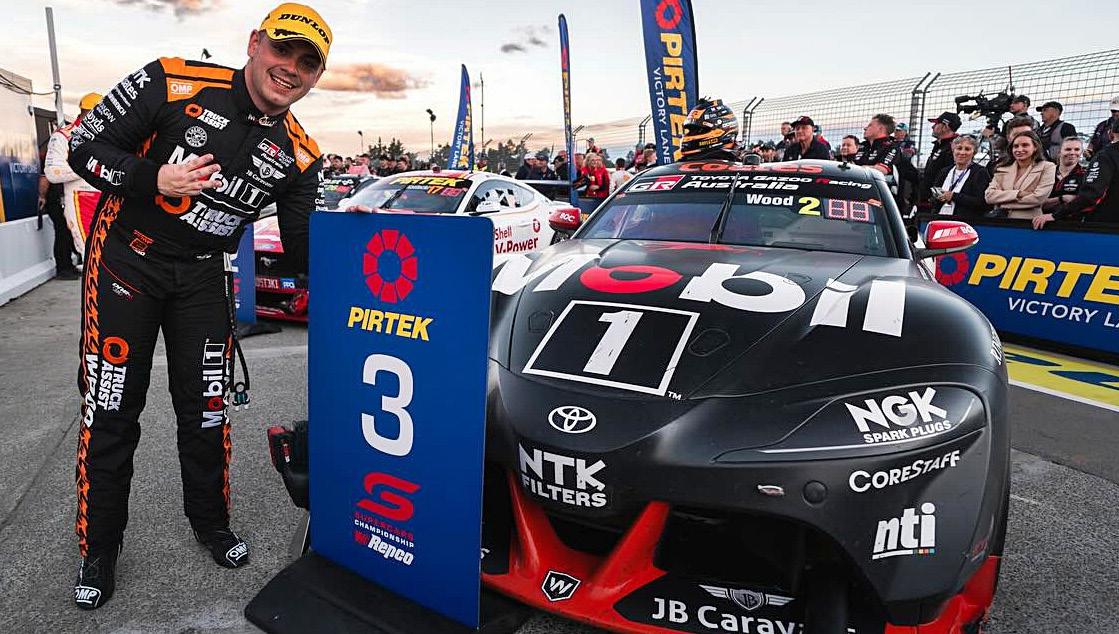
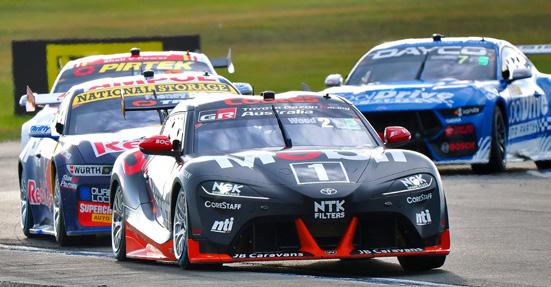
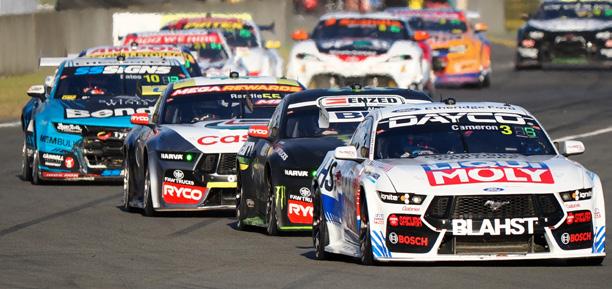
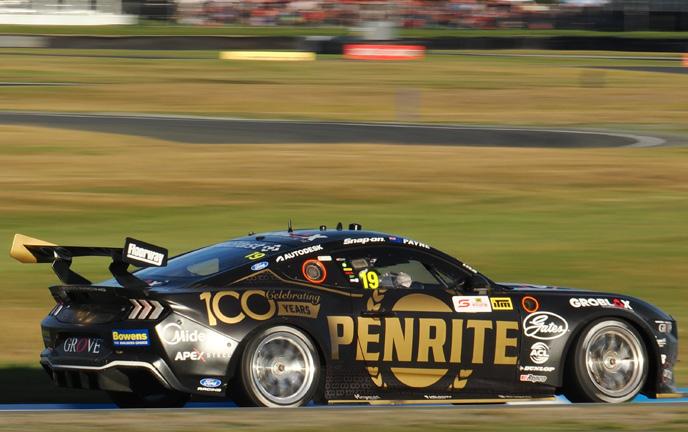
V8 wins for Kiwis on home circuits
p
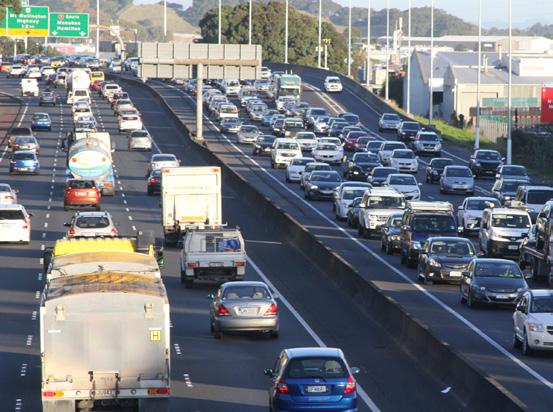
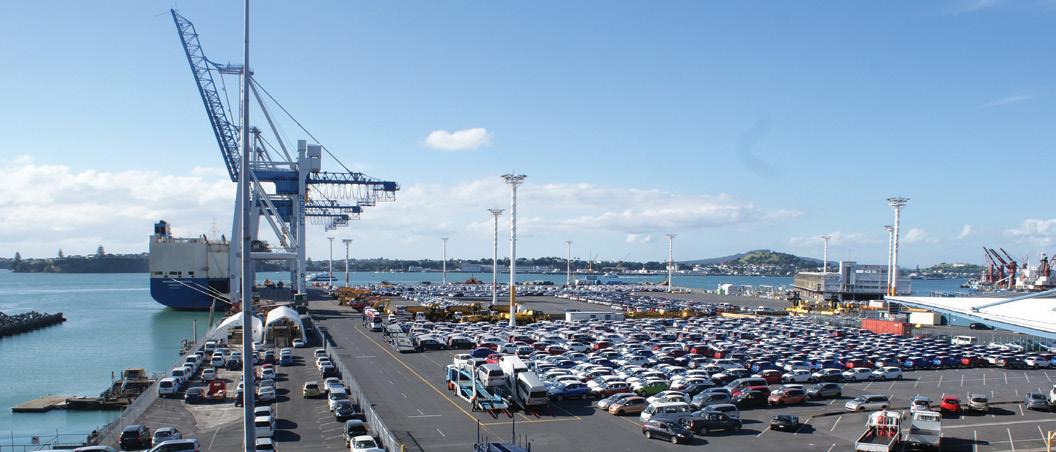
VIA wants the government to focus on rules to tackle fleet turnover
LOAD IT SHIP IT TRACK IT CLEAR IT DELIVER IT !
BIGGER IS BETTER
move to new, much larger premises means we are to offer even more services to our dealer clients
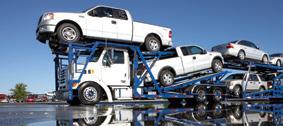
to door ro-ro vehicle shipping from Japan and Australia
Containerised vehicle shipping from anywhere in the world
Vehicle tracking
VEHICLE SHIPPING
Approved MPI transitional facilities and cleaning services
GENERAL FREIGHT
VEHICLE TRACKING
SHIPPING SCHEDULE
We are specialists in transporting and exporting all types of Vehicles, Commercial trucks, vehicles of Special Interest and other RORO Heavy Cargo & Machinery.
it all off is Jacanna’s SmartTrade Rewards Programme, you can earn points for almost any reward you choose
We have developed a worldwide network of Agents who understand the commitment required to service our demanding market.
www.jacanna.co.nz
Tel: +64 9 825 0888
Finding out where your vehicle is at any one time of the process, gives you the ability to manage the collection and processing of documents and payment on time.
TRS and shipping services from Japan to New Zealand. www.jacanna.co.nz
info@jacanna.co.nz
Tel: +64 9 825 0888
Going above what’s needed by the law
Lyn McMorran explains why credit-related insurance code has been updated by FSF
The Financial Services Federation (FSF) was pleased to launch its updated credit-related insurance code last month at an event in Auckland, which was attended by our members as well as representatives from the Financial Markets Authority and Financial Services Complaints Limited.
products have been taken out, what they cover and how to claim, and sets a cooling-off period of at least 14 days.
DIRECTORS
Darren Wiltshire dazzz@autofile.co.nz ph. 021 0284 7428
Brian McCutcheon brian@autofile.co.nz ph. 021 455 775
DESIGNER
Adrian Payne arpayne@gmail.com
The document was originally published in 2019 to set standards for the federation’s insurer members that are above and beyond what’s required by legislation.
It detailed what consumers should expect from responsible insurance providers by covering what credit-related insurance is and why it’s good for providers’ customers.
Insurer responsibilities in the first code included being easy to get hold of and responsive, to provide plain English policy documents and full instructions for making a claim, and to respond to any claims promptly.
It set out consumers’ responsibilities to provide accurate information when buying products or making a claim, asked them to make timely claims, and understand the terms and conditions.
The updated code has been written with input from FinCap, a charitable trust supporting more than 700 financial mentors in their work across the country, and dispute resolution schemes.
It strengthens consumers’ rights by making it clear the products are optional unless a condition of the loan. The code also states the insurer will make it clear what
In addition, the obligations of insurers have been strengthened. They are required to ensure their products are sold responsibly – either directly or through a dealer or agent – and to take proper care to recognise customers who may be in vulnerable circumstances.
They must also ensure products and processes provide fair outcomes, cancel policies and provide full premium refunds without delay if they are mis-sold, and work constructively with a financial mentor if applicable.
Another obligation on policy providers is to make it easy for customers to lodge a complaint, either through their internal process or their independent dispute resolution scheme.
The code is binding on the FSF’s insurer members and can be used by FinCap-supported financial mentors to provide to their clients. It’s available on the FSF’s website and our members’ sites. It will also be made available in hard copy to FinCap’s mentor network.
The FSF believes in the value of credit-related insurance to provide protection when things go wrong – whether that be through redundancy, illness, accident or death of the policyholder, or through loss or damage to the asset. The updated code ensures our members’ customers are being treated as fairly as possible during the lifetime of their policies.
EDITOR
Darren Risby ris@autofile.co.nz
JOURNALISTS
Matthew Lowe matthew@autofile.co.nz
Sue Brebner-Fox sue@autofile.co.nz
MOTORSPORT
Mark Baker veritas.nz@xtra.co.nz
Visit www.autofile.co.nz to subscribe to Autofile magazine and have it delivered monthly in print. The subscription rate is $78 plus GST for 12 issues per year.
Autofile magazine is also available online as a readable file or downloadable as a PDF.
Back copies dating to 2017 can be found on the website where you can subscribe to our Insight email alerts.
Copyright: Published monthly by 4Media Ltd
All statements made, although based on information believed to be accurate and reliable, cannot be guaranteed, and no liability can be accepted for any errors or omissions. Reproduction of Autofile in print or digital format in whole or part without written permission, whether by copying or any other means, is strictly forbidden.
All rights reserved. ISSN 0112-3475 (print) ISSN 2350-3181 (online)
W We of fer a full range of ser vices
• Entry Certification for imported cars
• Vehicle Appraisals
• WoF/CoF Inspections
• Road User Charges
• Registration & Relicensing
• Exhaust Emission Testing
www.vinz.co.nz
Appointed by the NZ Transport Agency
LYN McMORRAN Executive director, FSF
the new and used sectors when the review was announced last year. It claimed a single standard for both markets was undermining emissions goals because it risked slowing down the turnover the policy sought to encourage.
However, chief executive Greig Epps says it has since adjusted its position and wants its members to be exempt from the CVS, and for a greater emphasis on regulations that address how vehicles enter, move through and exit the fleet.
“After talking with officials at the ministry in January, we moved to saying, ‘Actually, don’t do anything to us at all’ with regards to the clean vehicle standard,” he told Autofile.
“The reason being that the policy is trying to influence design and you can’t influence the design of a vehicle that’s already been on the road for 10 years.
“The purpose of shifting the supply channel to lower emissions only really works on those making new cars, so leave it there but use
We think officials need to be looking at the whole fleet and not just the entry point
– Greig Epps
other policy levers to address used imports.
“We’re not trying to escape notice because our members still have emissions standards to meet and other regulations the government is putting in place. But from a policy point of view, we think officials need to be looking at the whole fleet and not just the entry point.
“If the goal is lower emissions
and a safer fleet, then renewal matters as much as what powers the vehicles. We need rules that enable that turnover, not restrict it.”
VIA suggests policies for used imports should be focused on what vehicles coming into the country are replacing and whether Kiwis can afford them. That’s because used imports are often the only affordable upgrade pathway for many households, and restricting such supply impacts fleet renewal and increases real-world emissions.
Epps says the current CVS is failing to work as intended because the average age of cars in New Zealand has increased and the volume of used imports has reduced in recent years.
This means many vehicles are being kept for longer and, rather than consumers replacing what they own with fresh imports, “we’re just churning through what’s already here and that’s not making the fleet any better”.
“The statistics may say the average CO2 from used imports is going down, but it’s only going down because there are fewer vehicles we can bring in to meet the very strict targets that have been set,” continues Epps.
“However, if we’re not bringing enough replacement stock into the country, then we’re not refreshing the fleet.
“Used-vehicle sales are currently up year on year by a few percentage points. People are looking for cars but if we’re not bringing in as many as we used to, what are they buying and selling? They’re buying and selling cars that
are already here. That’s not helping to shift the emissions profile.”
He says used importers may not yet be able to reach zero emissions. That said, they can bring in models with lower emissions than those currently on the road, which will support a “transition over time from where we are to something better”.
“If separately the government is also making sure new vehicles entering the fleet are the best they can be, with their designs heading towards zero emissions, then we will get somewhere because those vehicles will transition through into the second-hand fleet. The used supply out of Japan is also going to get better.
“That’s how to deal with what’s coming in. But the government should also look at what’s here and monitor what’s leaving the fleet to ensure we’re pulling the worst vehicles out.”
REVIEW BY BEEHIVE
The MoT sent out a range of questions to VIA at the beginning of January this year as part of its “first principles” review of the CVS, which has involved engaging with the motor-vehicle industry, international bodies, government agencies, key advocacy groups and experts on the subject.
Officials asked the association if it supported a regulated fuelefficiency or CO2 standard for imported light vehicles continuing or what alternatives might work better for New Zealand.
VIA replied stating it backs the CVS remaining for new vehicles because a regulated standard can influence production, specification and supply decisions, “and therefore has a credible role in shaping future fleet composition”.
As for used imports, Epps says: “Not as a primary CO2 reduction mechanism. Used vehicles are already built, and a CO2-at-import standard mainly affects supply, price and turnover rather than global emissions outcomes.
“For used vehicles, VIA considers fleet management outcomes are better supported through local emissions and safety standards, and economy-wide in-use
measures that influence how vehicles are operated over time.”
He also explains in the correspondence that approaching the two sectors separately will reflect market reality rather than distorting it and reducing competition.
“New and used vehicles enter the fleet through different pathways, serve different consumers and influence fleet outcomes in different ways.
“Regulation that recognises those differences is more likely to support effective fleet management than a single uniform standard. When products aren’t substitutable, there can be no distortion of competition between them.”
He continues to say regulations treating new and used vehicles as if they operate in the same market are more likely to create risks of an unfair trading environment.
“First, there’s a risk of unfairness to the public if ambition for new vehicles is diluted to accommodate constraints in the used market. That would weaken the policy’s ability to influence future vehicle design and production, which is where global CO2 reductions can be most effectively achieved.
“Second, there is a risk of unfairness to consumers if regulatory tools designed to encourage the manufacture of cleaner new vehicles are applied to used cars that were produced many years earlier.
“In that case, the policy increases prices and slows fleet turnover without delivering corresponding emissions benefits.”
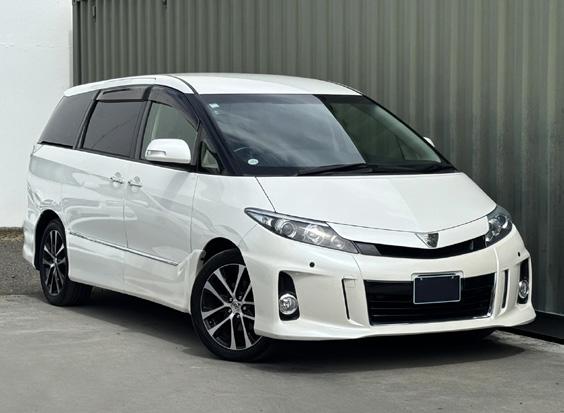
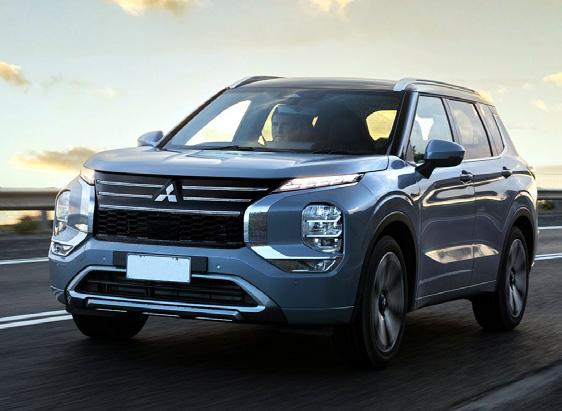
Epps highlights the shrinking supply of family-sized vehicles to illustrate his point as used models effectively don’t compete with new seven-seaters offered by original equipment manufacturers.
“A household considering a 2015 Toyota Estima at around $15,000 is not cross-shopping a 2025 Mitsubishi Outlander XLS at approximately $49,000. Equally, a buyer with the financial capacity for the new vehicle isn’t substituting down to a 10-year-old, higher-mileage import.
“These products serve different consumers and different roles in the fleet.
“VIA considers the appropriate policy response isn’t to pursue symmetry for its own sake but to apply ambition when it’s effective, such as with new vehicles, and fleet-management discipline where it matters, which is with used vehicles.”
Epps also outlines to the MoT what VIA believes will support a constructive process once the cabinet has decided whether to keep the CVS.
These include clarity for the scheme by import pathway, an evaluation framework including turnover and fleet-age indicators, and confirmation of how fleet “improvement” is being defined in the review questions.
VIA also wants consideration of fleet management to be the organising principle for future settings and for sufficient engagement timeframes to test proposals against real-world fleet dynamics.
COMPARING OPTIONS
The latest action by the coalition comes after a reset of CVS penalties at the start of this year, which has provided some relief for importers and has helped increase the variety of models they can bring in.
Bishop announced in November that the fees for 2026 and 2027 would drop from a top rate of $67.50 to $15 per gram of CO2 for
new vehicles, and from $33.75 to $7.50 for used imports.
He claimed the move would save importers $264 million in net charges and prevent huge price hikes for consumers.
When legislation to make those amendments was passed the government also committed to reviewing the CVS this year.
An MoT spokesperson told Autofile the first stage of the review has involved officials seeking feedback on different options to the current regulations and it is on track to report to cabinet’s economic policy committee by the end of June.
“The government has launched a full review of the standard,” they add. “A full policy review should consider and compare all options, so the Minister of Transport can make an informed decision.
“However, we can say that when the government made changes to the CVS at the end of 2025 it became clear the standard wasn’t working under current market conditions. It risked driving up costs for importers – costs that would potentially pass through to New Zealanders as higher prices.
“Communications to the public and industry on the next steps are expected following the review.”
COMPETITIVE INTEREST RATES
EASY APPLICATION
Submit two downloadable forms and simply send to us for review.
COMPETITIVE INTEREST RATES & FEES
Our partnerships give us the ability to offer superb lending rates.
EFFICIENT SERVICE
Hear back from our team about finance in as little as 24 hours.
NZ BASED
Autobridge is New Zealand based and covers the country, so we are never far away when you need us.
www.autobridge.co.nz 09 320 5646
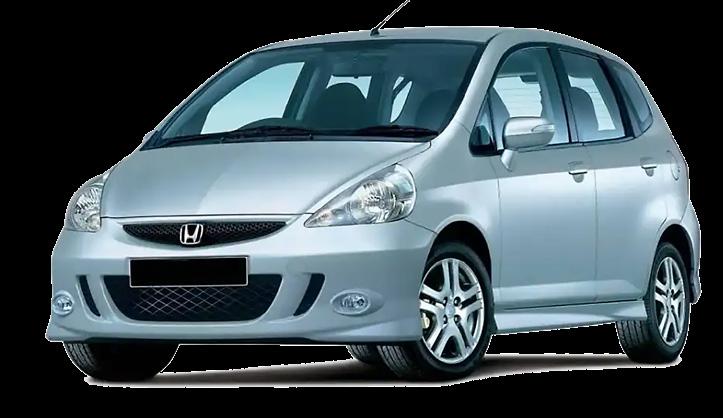
Used imports, such as a 2015 Toyota Estima, serve different consumers and different roles in the fleet to new models like Mitsubishi’s Outlander XLS
Roadmap for industry’s future
The electrification of the fleet, increased technology in cars and a drop in vehicle ownership will impact the automotive industry over the next two decades.
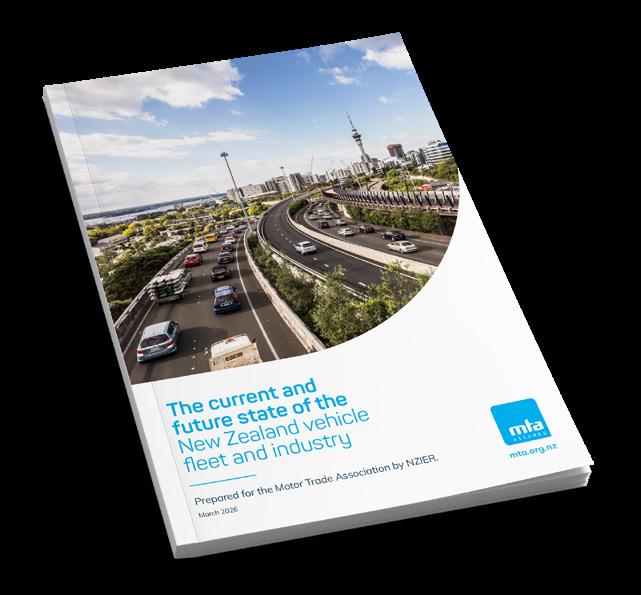
These three major trends have been identified in research commissioned by the Motor Trade Association (MTA) and completed by the NZ Institute of Economic Research (NZIER).
The report – called The Current and Future State of the New Zealand Vehicle Fleet and Industry – has been carried out as part of the association’s commitment to be a “voice and representative” for the sector.
Simon Bradwell, the MTA’s head of communications, says it contains some of the most indepth information available on the automotive landscape and is a resource all the industry can benefit from.
“The NZIER has provided an informative and thoughtprovoking analysis with implications not only for the industry but government and communities,” he adds. “It offers a roadmap into the future.”
For example, electrification of the fleet will not only result in more charging infrastructure having to be provided, it will also see a drop in demand for general repairs because EVs have fewer moving parts and a shift in skills will be needed to deal with their systems.
The switch in powertrains is predicted to be relatively gradual over the next decade before accelerating, while increasing technology will continue to make vehicles less likely to be involved in collisions and more reliable with faults identified earlier.
But they will be more expensive to fix “because the
investment required to undertake repairs, and need for access to proprietary data and information, will continue to put pressure on independent service providers”.
The report says the future could well see reductions in ownership levels and vehicle kilometres travelled, less demand for new models, vehicles staying in the fleet longer and fewer service requirements.
WHERE WE’RE AT NOW
New Zealand’s fleet has expanded by 2.3 per cent annually since 2015 and has outstripped population growth despite a drop in newvehicle registrations over the past four years. Light passenger vehicles now account for around 75 per cent of what’s on our roads.
The NZIER estimates there were about 429,000 petrol hybrids by the end of 2025 with a large proportion being used imports. That compares to around 100,000 EVs, which make up two per cent of the fleet, and some 48,000 plug-in hybrids (PHEVs).
The slow rate of electrification is put down to total cost of ownership and EV sticker prices not yet being less than cars with internal combustion engine (ICEs) and – until recently – the lack of options when it comes to light commercials.
As for the heavy fleet, there’s the extra issue of differing usage requirements of various types of vehicles suited to available technology. The exception is buses in metropolitan areas where a relatively high proportion are now electric.
The average age of a vehicle was 15 years in 2023 compared to 14.3 in 2015 with the fleet’s age “heavily influenced” by the high prevalence of used imports, which on average cross the border aged at 9.3 years.
In addition, cars are also getting older when they exit the fleet, which could be due to annual mileages dropping.
The use of automated driverassistance systems (ADAS) in new models continues to advance, resulting in the decreased likelihood of people being killed or seriously injured in crashes. However, the fleet’s age slows the rate of technological advancement, while warrant and certificate of fitness failure rates are rising.
WHAT THE FUTURE HOLDS
New Zealand’s fleet is projected to continue growing steadily over the next two decades. By 2035, the Ministry of Transport (MoT) estimates it will reach about 5.07m units – up by around 320,000 or by seven per cent compared to last year.
Light passenger vehicles (LPVs) will continue to dominate, accounting for about 74 per cent of the fleet in 2035 and 2045.
Light commercials are being predicted to stay at 18 per cent, with motorbikes and trucks each coming in at four per cent.
Notably, these splits aren’t expected to change significantly under different rates of EV uptake. Instead, key variables will be the fuel type and emissions profile in each vehicle category.
Although the proportion of the Kiwi fleet that’s electrified is relatively small, it’s forecast to grow over the next 20 years.
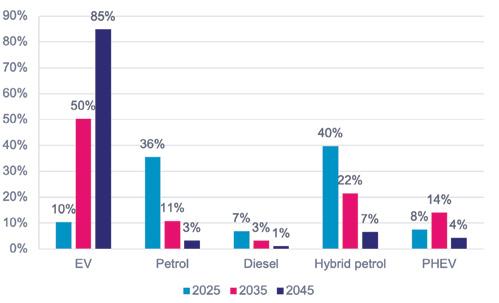
By 2035, the MoT predicts newcar sales will be heavily weighted towards electric and hybrid models. Registrations of new petrol cars are projected to decline from 36 per cent of this segment’s total in 2025 to 11 per cent by 2035. New electric passenger vehicles are estimated to jump from 10-50 per cent over the same period.
Between 2035 and 2045, sales of new petrol cars are likely to fall from 11 to three per cent with new EVs increasing rapidly from 50-85 per cent.
The reports states: “The growth in the expected proportion of new LPV registrations that are EVs comes at the expense of petrol hybrids and petrol ICEs. This supports the theory hybrids are a transitional technology on the path to full electrification.
“The International Energy Agency expects 80 per cent of new vehicles sold in China by 2030 will be electric, including PHEVs.
The NZIER’s report for the MTA
“This represents a share of sales the MoT in New Zealand estimates will not reach until around 2045.”
A major driver of increasing electrification overseas is lower prices. In part, this is due to the reduction in production costs of vehicles and their batteries.
Also, government policies in some countries include purchase subsidies, rewards for trading in older ICEs and tougher emissions regulations.
Looking further forward, the switch to EVs will also be driven by ICEs no longer being made and increasingly stringent environmental standards – and these implications extend to Aotearoa.
“A notable feature of new car and EV sales in recent years in New Zealand has been the increase in sales of Chinese vehicles and the growing presence of Chinese brands here,” the report states.
“China accounts for 70 per cent of global EV production with 80 per cent of this attributed to Chinese
brands. It accounted for 40 per cent of all EV exports in 2024 and 70 per cent were for Chinese brands.
Future production of Chinese EVs will have a significant impact on fleet electrification.
“In China, nearly all small EV cars are priced at less than the average small ICE. Across each segment of LPVs in China, except the mediumsized segment, there’s no price premium for an EV. In some cases, a discount was observed as of the end of 2024.”
Source: MoT
The price drop was significant in most segments between 2023 and 2024. This was down to lower battery costs. For example, an average pack for an electric SUV in China fell by 30 per cent with its sticker price falling by 10 per cent as a result. Decreasing battery costs are expected over the next few years with more being made and an oversupply of lithium.
“It could be expected we will continue to see a decrease in the purchase price of EVs, especially
from China, in New Zealand, which will increase fleet electrification.”
An unknown factor is the global-trade situation. The increase in tariffs on Chinese models in the US and the EU, and the removal of subsidies for EVs in the US, could impact our market.
“In recent years, PHEV sales in China have been growing faster than those of EVs as they offer greater flexibility, can handle longer trips when charging infrastructure is insufficient and their battery range has increased.
“There has also been growth in extended range EVs with a small ICE recharging the battery rather than powering the vehicle, especially in the SUV category where they accounted for 25 per cent of new sales in 2024.
“This trend in China isn’t reflected in MoT forecasts. In New Zealand’s forecasts, PHEVs remain a relatively small share of new registrations and are almost a transitional technology from ICEs to EVs.”
[continued on page 8]
Many major car manufacturers have previously had policies of halting ICE production in the runup to 2035. Some of these have been rolled back or abandoned. But for new petrol cars to be sold in New Zealand implies they will still be made in 2045.
The type of used passenger vehicles being imported will continue to evolve in response to changing supply conditions in our main source markets, such as Japan.
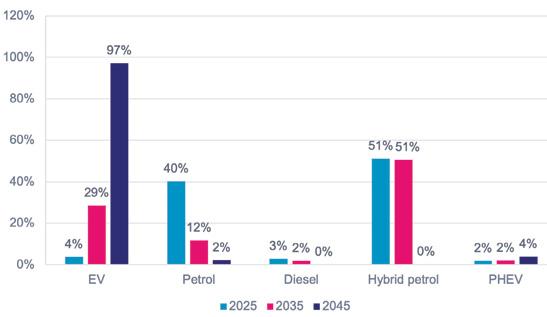
A key feature of the MoT’s forecast for used-imported cars is most will be petrol hybrids even in 10 years’ time with EVs only becoming dominant in the following decade.
By 2045, used EVs are expected to make up 97 per cent of sales of used-imported passenger vehicles, up from four per cent in 2025 and 29 per cent in 2035.
Petrol cars are slated to fall from 40-12 per cent of used registrations from 2025-35. The decline is likely to continue until 2045 when petrol is expected to account for two per cent of used-imported sales.
Japan has a low penetration rate when it comes to EVs with only three per cent of new-car sales in 2024 being electric. By 2035, it aims to sell 100 per cent electrified vehicles. The target for 2030 includes 20-30 per cent EVs and 30-40 per cent hybrids.
The government there is
supporting this through subsidies and tough emissions standards.
Given the average age of a used import entering New Zealand’s fleet is more than nine years old, “this would explain a large shift to used EV imports in the decade following 2035”.
The report describes this transition from petrol hybrid to EV as “significant” because the Ministry of Transport forecasts that used imports will account for 52 per cent
of sales here, even out to 2035.
The relatively slow predicted increase in imports and sales of used electric cars is also due to logistical and technical barriers. In recent months, some shipping companies have restricted their transportation due to perceived fire risks during transit.
There are also compatibility issues between Japanese EVs and New Zealand’s charging infrastructure.
The MoT forecasts new registrations of light commercial vehicles (LCVs) will also see a growing share of electric models, but diesel will remain the dominant fuel type by 2035.
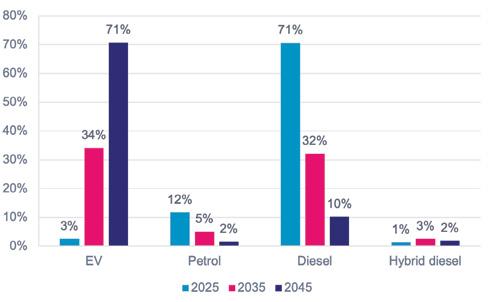
In 2035, diesel-powered models will account for 32 per cent of light-commercial sales with electric estimated to make up 34 per cent.
Ten years after that, new diesel LCVs will have a 10 per cent market share with electric jumping to 71 per cent. The relatively slow adoption of electric across the light-commercial fleet is consistent with global trends.
Although MoT modelling shows some increase in sales of hybrid light commercials, the NZIER’s report for the MTA explains this may understate the actual increase in their popularity.
“As for LPVs, PHEVs are gaining popularity in China. Given the purchase price advantage of Chinese models and share of global production that China represents, we can expect to see more of these models. PHEVs may better suit the usage of New Zealand LCVs.”
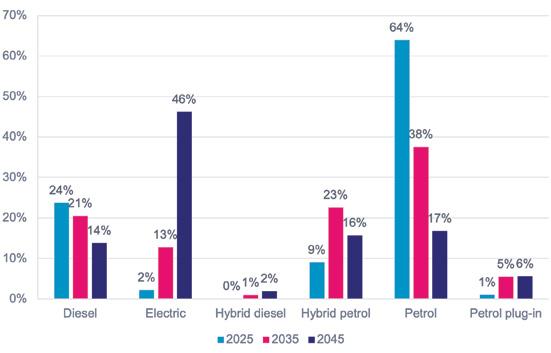
The relatively slow electrification and average age of our fleet mean that even by 2035 EVs are only expected to make up 14 per cent of the light-passenger fleet, half as many as hybrids.
Petrol models will still comprise 43 per cent of the fleet. It’s only in 20 years’ time that EVs will make up
Toyofuji vessels Voyage
Moji Osaka Nagoya
TOYOFUJI SHIPPING SCHEDULE
Figu
Source: Ministry of Transport
Source: Ministry of Transport
Source: MoT
Percentage of new LCV registrations, base case forecast 2025, 2035 & 2045
Percentage of new LCV registrations, base case forecast 2025, 2035 & 2045
Percentage of new LCV registrations, base case forecast 2025, 2035 & 2045
Percentage of new LCV registrations, base case forecast 2025, 2035 & 2045
Percentage of new LCV registrations, base case forecast 2025, 2035 & 2045
Percentage of new LCV registrations, base case forecast 2025, 2035 & 2045
BY FUEL TYPE, 2025-45
more than half of the car fleet with hybrids on 21 per cent.
Despite the forecast that 43 per cent of light passenger vehicles will still be petrol-powered in 2035, this will represent a major decline from 2025. The number of petrol cars is expected to fall from about 2.7m to 1.6m by 2035.
“This is, however, largely offset by a forecast increase of more than 700,000 petrol hybrids and an increase of 200,000 PHEVs,” according to the report. “It’s only in the following decade that New Zealand is forecast to see a very large decline in vehicles with an ICE.
“Petrol vehicles are projected to decline by a further 700,000 between 2035 and 2045. Petrol hybrids are expected to drop by 300,000 and PHEVs are forecast to remain unchanged at around 240,000.”
CHANGES ON THE HORIZON
The NZIER’s report says industry dynamics are changing as invehicle technology ramps up and new business models emerge.
The increasing use of ADAS, and integrating computer systems and proprietary software into cars, is complicating diagnosis and repair.
“Access to manufacturer-specific tools, diagnostic equipment and repair manuals is restricted or requires costly investment in diagnostic tools, subscriptions or licences.
“This is making it difficult for independent businesses and is leading to advocacy for rightto-repair regulations that oblige manufacturers to give access to repair information.
“The increased investment required, combined with owners
of businesses reaching retirement age, is leading to consolidation in the general repair and collisionrepair sectors as larger chains and franchise operations acquire independent service providers.
“In collision repair, the entry of insurers into the market is also changing its dynamics.”
Looking forward, the fleet’s rate of growth slows and may decrease together, and less vehicle kilometres travelled (VKTs) are being forecast.
The MoT predicts the fleet will expand to 5.07m units in 2035 or by seven per cent. In the following decade, this rate more than halves to three per cent with 5.23m forecast by 2045.
This is explained by an ageing population changing households’ travel requirements, increased intensification of cities, better public transport and growth in shared mobility.
The ministry forecasts VKTs will grow in line with population and economic growth over the next two decades. However, time-ofuse or congestion charging – and people shifting from cars to public transport and freight from road to rail and coastal shipping – could see distances fall over the next 20 years.
And going back to the fleet’s electrification. This will happen at an increasing pace, especially after 2035, but ICEs will continue to make up a large proportion even in 2045.
Only 13 per cent of the fleet is forecast to be fully electric by 2035, increasing to 46 per cent by 2045, meaning 54 per cent of it is still powered by fossil fuels – at least in part in the case of hybrids and PHEVs.
Simon Moore has joined Broadlands Finance as general manager of the Auckland-based company.
The New Zealandowned and operated business has been running for more than 30 years and has “an incredible foundation”.
Moore adds:
“My mission is to build on this legacy by spearheading a bold new era of growth and transformation.
our great team here, connecting with our industry partners and driving innovation in the Kiwi automotive landscape.”
“We are committed to evolving our digital capabilities, product offerings and customer experience to ensure Broadlands becomes the go-to brand for motor-vehicle finance in New Zealand.
“I look forward to working with
Moore has some two-anda-half decades of experience in sales strategies and lending operations.
His previous leadership positions include several years as general manager at Geneva Finance and Quest Insurance.
Before that he was national sales manager at Assurant, formerly Protecta Insurance. His other past roles have been at MTF Finance, the Bank of New Zealand, Nissan Financial Services Australia, FleetPartners NZ, Custom Fleet, Winger Motors and GE Capital.
Aiming to expand growth in finance Chairman steps down
Craig Stobo has resigned as chair of the Financial Markets Authority (FMA) following an independent review into his conduct.
Cameron Brewer, Minister of Commerce and Consumer Affairs, says Stobo agrees it’s important the organisation remains focused on its core regulatory role “and continues to command the confidence of ministers, regulated entities and stakeholders”.
In addition, he acted reasonably in disclosing a governance-related interest and later agreeing to resign from it, but shouldn’t have delayed it for as long as he did, while his applications for FMA travel were not inappropriate.
The review, undertaken by Wendy Aldred KC, examined several matters raised by members of the FMA’s board.
Brewer says its four findings included there was no evidence of an inappropriate relationship between Stobo and a former staff member.
However, aspects of Stobo’s public commentary didn’t meet the standards of political neutrality expected of the chair of an independent crown entity and regulator. Brewer adds: “It is appropriate for Stobo to resign from the role.”
Steven Bardy remains as acting chairman while a process is undertaken to appoint someone to the position on a permanent basis.
Simon Moore
Craig Stobo
Annual pricing review paused
Trade Me Motors says there will be no price increases in July or August for car dealers currently on its standard rate card.
The company has put its yearly pricing review on hold to provide “clarity and support” for traders, and has unveiled package decisions designed to offer stability and flexibility.
Jayme Fuller, client and industry director, says the pricing pause takes into consideration unprecedented levels of uncertainty in New Zealand’s automotive market.
“We know conditions are still pretty unsettled right now,” she explains. “We have been listening and watching the macroeconomic landscape closely.
“With that in mind, we’ve made the decision to defer any pricing changes for all dealers that were
not on our previous Get Ahead promotion.
“This means there will not be a July 1 or August 1 price change for the majority of our clients. The intent is simple. We want to give the industry some breathing room and see how things settle.”
Trade Me will continue to monitor conditions and stay close to the industry
– Jayme Fuller
At the same time, Trade Me Motors says it recognises some dealers who leveraged substantial pricing arrangements in the past now face an imminent expiration of that promotion.
Fuller adds: “We know this could mean a difficult decision, so we want to make it easier. For those dealers, we are extending the Get Ahead promotion.
“Dealers will be able to remain on their current package with a 10 per cent price adjustment, still maintaining a significant discount to the existing package’s rate card.
“This extension will run through to January 1, 2027, providing a further six months at these highly preferential rates.”
Importantly, she says, all package refreshes and new products the company announced on April 7 will still be rolled out to help dealers retain the best profit in stock they source.
This includes access to the AutoGrab platform now being available on all packages, and two new products available for the Premium and Ultimate packages.
“Trade Me will continue to monitor conditions and stay close to the industry,” adds Fuller.
“We will reconnect in early July to share an update and talk about what’s next.”
EXTRA TOOLS FOR DEALERS
A video has been produced to explain the changes in packages
for car dealers. It outlines a shift beyond listing vehicles into a highperformance platform providing traders with tools for market intelligence, operational efficiency and buyer engagement.
The presentation, which is fronted by Steve Vermuelen, industry relations manager, highlights the new benefits across packages developed after industry feedback.
The goal is to help dealers sell more vehicles with greater profit by leveraging data and creating extra ways to connect with consumers.
Watchlist Activator is a new feature now included in the Ultimate and Premium packages. It allows direct engagement with passive buyers.
Dealers can send time-limited offers to those who have watchlisted cars to convert interest into immediate leads.
AutoGrab Recapture, which is exclusive to Ultimate, turns a trader’s sales history into a realtime sourcing pipeline.
It alerts dealers when previously sold stock is relisted, providing a chance to buy back known inventory and re-engage with past clients or new prospects.
AutoGrab’s most powerful module, Delve, has been included in the Premium package.
It offers deep market analysis into purchasing decisions.
The Enhanced package now has real-time pricing and sourcing modules from AutoGrab to take the guesswork out of valuations and stock acquisition.
And MyListings are included in the Lite package.
This tool helps dealers with data-driven actions on their slowmoving inventory.
Trade Me Motors adds it has improved wider industry relations by engaging with more bodies and original equipment manufacturers to help facilitate outcomes, while its client and industry team is now better resourced.
Visit https://tinyurl.com/ y5y2h6mc to watch the video.
Marques face tougher targets
Australia’s new-vehicle efficiency standard (NVES) is now in its first full year of operation with much tougher emissions targets than when it was launched.
The supply-side mechanism sets average carbon dioxide (CO2) goals for new cars and light commercials weighing up to 4.5 tonnes.
Manufacturers must meet an average emissions target for their fleet. If they fail to do so, they incur penalties, while those beating the goals secure credits.
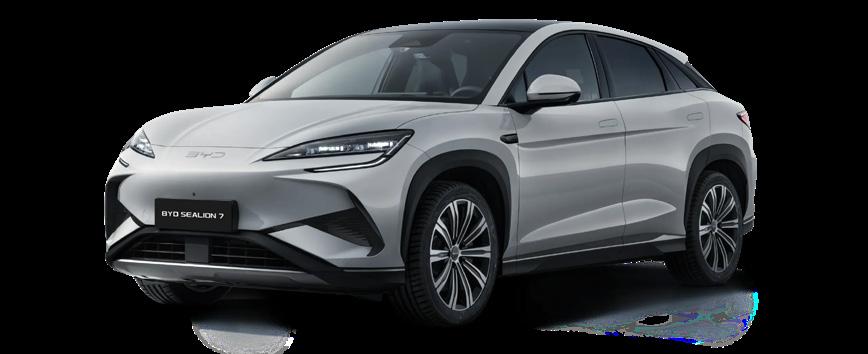
Australian sales of BYD’s Sealion 7 surprised many last year. The mid-size SUV came second on 2025’s EV ladder with 13,410 units. Tesla’s Model Y was first on 22,239
NVES TARGETS AND YEAR-ON-YEAR CO2 DECREASES
for the driver. The rated towing capacity must also be given for MC category vehicles. This is the maximum towing mass in kilograms as specified by the manufacturer.
The information on the RAV, along with a massadjustment factor, is then used to calculate an entity’s IEV for its total fleet over a performance period.
CREDITS & LIABILTIES
The federal government’s aim is for the NVES to cut fuel costs for motorists and pollution created by road transport, and increase the choice of fuel-efficient models –petrol, hybrid and electric.
Targets are lowered annually as an incentive for “regulated entities”, such as carmakers and suppliers holding vehicle-type approvals, to reduce their fleet emissions.
The NVES Act came into effect on January 1, 2025, setting out the targets for the scheme’s first five years of operation.
The first reporting period started in July last year and ended on December 31. It included 59 regulated entities and 620,947 units entered onto the register of approved vehicles. About 68 per cent beat their targets, more than 17 million NVES units were generated and 12 per cent of covered vehicles were zeroemissions.
However, targets in this period were the easiest part of the fiveyear pathway. Headline limits tightened sharply from 2026 with the economics compounding quickly for high-volume suppliers.
As for the bigger picture, the government remains committed to net-zero by 2050 as part of its international obligations.
Transport makes up about onequarter of emissions in Australia with light vehicles contributing around 70 per cent.
By 2050, the NVES aims to deliver an estimated A$95 billion
Australia’s light fleet outperformed its targets in 2025. For type-one vehicles, the average CO2 figure was 114g/km. The type-two average was 199g/km. Cars are type one and light commercials are type two
– or about NZ$115b – in fuel savings, A$5b in health savings and improved fuel security.
New-vehicle buyers should have a greater choice of lower-emitting models, which over time will also become available in the secondhand market where 70 per cent of Australians buy their cars.
More than 85 per cent of the global market has a fuel-efficiency standard including the European Union, US, China, India and Japan. In addition, New Zealand has the clean vehicle standard.
HOW SYSTEM WORKS
Carmakers need to meet or beat the annual NVES target for what they supply to the Australian market during each performance period from January 1 to December 31, except for 2025 when the scheme kicked off on July 1.
Before a final emissions value (FEV) is issued, an entity has two years to address its account balance by extinguishing units against its interim emissions value (IEV).
More fuel-efficient, low or zeroemissions models can be supplied over a subsequent performance period as offsets. In addition, units
can be purchased from other registered entities.
The NVES regulator supports a closed market for trading units. There’s no open market or ability to trade with a company that isn’t regulated. Entities set the value of a unit they trade.
Those not compliant with the targets are liable for a financial penalty and will get an infringement notice with 28 days to pay. The amount payable is equal to the FEV multiplied by A$50. If fines remain unpaid after the due date, legal action may follow.
The final date for a business to extinguish units against its IEV for 2025 is December 31, 2027, with the FEV for 2025 being issued in February 2028.
All regulated entities must submit data to the NVES system. Entry on the register of approved vehicles (RAV) must be completed before a model is provided to the market for the first time.
They must ensure all data is correct. This includes the vehicle type, its emissions in grams of CO2 per kilometre and its mass in running order including all fluids, standard equipment and 75kg
The first and least stringent NVES period was July 1 to December 31, 2025, after which the tightening of CO2 targets started.
Chinese carmakers have already generated what could turn out to be a price advantage of between $13,000 and $17,000 for every car imported, according to Steve Bragg, a partner at Pitcher Partners. The company provides services to the automotive industry.
He describes the per-unit credit values being generated by Chinese marques as “enormous” and highlight how far “behind target” some fleets of legacy original equipment manufacturers (OEMs) are sitting.
“The Chinese OEMs aren’t just accumulating large volumes, they are doing it with exceptionally strong ‘credits per unit’ economics,” says Bragg.
“This underpins a meaningful headstart in the emerging unittrading market as headline targets tighten sharply no matter the eventual value of such credits in dollar terms. Conversely, the first and most lenient NVES period showed a cohort of traditional and prestige OEMs accruing liabilities.”
From the start of 2026, the NVES headline limits fell considerably from the 2025 baseline.
The CO2 target for new passenger vehicles, classed as type one, has dropped by 17 per cent from 141-117g/km. Type two, that’s new commercials, fell by 14.3 per cent from 210-180g/km. Both targets get stricter still from 2027-29.
Bragg describes the tightening of targets as a “particularly nasty aspect” of the NVES because any shortfall is not confined to a few “non-compliant models”.
It’s multiplied across each OEM’s entire volume as the scheme applies a fleet-average obligation across all vehicles entered onto the RAV, creating a powerful multiplier effect on exposure.
The scheme’s “per unit” basis highlights how quickly exposure scales. Some volume brands, such as Mazda, Nissan and Subaru, are already carrying “meaningful penalties”.
Several low-volume prestige marques, such as Ferrari and Aston Martin, posted “extreme outcomes” in 2025 that reflect how far above target their fleets sit before standards tightened.
Bragg says: “While the first interim performance results confirm the mechanism is working, they also expose a widening structural gap between brands already long on compliance units and those
heading into a tightening pathway with limited room to move.”
The first NVES interim results up to December 31 showed most regulated entities beat their targets and a large pool of tradable units has been created.
Chinese OEMs have entered the scheme structurally long on units, giving them a commercial lead as unit trading becomes a real market mechanism.
“Consumers will feel the biggest impact,” says Bragg. “As compliance costs rise, buyers are likely to pay more for vehicles they want while discounts will be used to move the vehicles they don’t want.
“Dealers may see a partial upside through higher prices for new and used cars, lifting gross profit in dollar terms, but only if inventory risk is managed.”
MARKET SHARES SHIFT
The NVES came into force on July 1, 2025. Later that month, the Federal Chamber of Automotive Industries (FCAI) called on the government to
provide more reasons for buyers to opt for EVs.
Tony Weber, chief executive, said: “There are now more than 100 EV models and more than 50 plug-in hybrids [PHEVs] available to Australians.
“But supply is only part of the equation. Demand remains constrained by affordability, infrastructure and consumer confidence, factors the government must address if the NVES is to succeed.”
China became the market’s second-biggest country of origin
by the end of September and accounted for 77.5 per cent of yearto-date BEV sales.
Ford’s Ranger was crowned Australia’s best-seller of 2025 with 56,555 units. Overall, there were 1,209,808 new registrations, down by 0.9 per cent from 2024.
PHEVs recorded the strongest growth of any drivetrain last year with 53,484 units – up by 130.9 per cent compared with 2024. BEVs totalled 103,269 units for 8.3 per cent of the market. Hybrids rose by 15.3 per cent to 199,133, “reinforcing their role as the most popular lower-emissions option”.
Weber added: “The growth of BEV market share has been anaemic, increasing by 1.1 percentage points over the past two years and well below earlier projections.”
In February, China with 22,362 units overtook Japan on 21,671 to become Australia’s largest source of new vehicles for the first time.
The overall market dropped by 4.5 per cent year on year, but BEVs accounted for 11.8 per cent of the
Tony Weber
total, a record high monthly share for the segment.
February 28 was when the US and Israel launched air strikes on Iran, assassinating its Supreme Leader and inflicting civilian casualties. Iran responded with missile and drone strikes and closed the Strait of Hormuz.
What followed was a surge in EV sales across the Tasman amid surging prices of fossil fuels, mirroring consumer sentiment in New Zealand and many other countries.
There were 15,839 BEVs sold in Australia during March for a market share of 14.6 per cent. That compared to 7.5 per cent in the same month of 2025.
Weber said: “It’s too early to determine if this represents a shift in the market. More consumers are considering EVs due to the disruption to fuel supply caused by conflict in the Middle East along with the review into the fringebenefits tax concession for EVs.
“The industry would welcome a sustained shift to EVs, given its substantial investment in bringing more than 100 EV models to the market and efforts to meet ambitious NVES targets.”
DRIVING FORWARD CHANGE
The first NVES results were released on February 18 and showed the industry hitting its targets for the reporting period from July 1 to December 31, 2025.
However, challenges are “significant” as the goals become more stringent through to 2029, warns the FCAI.
Weber says the first-period results show marques responded quickly to meeting emissions goals, but a reduction in targets up to 2029 will present issues.
“An increase in the range of zero and low-emissions vehicles available in Australia supported the achievement of first-year targets,” he adds.
“To support reduction objectives, car makers have increased the range of EVs available to consumers. Despite this increase in supply, they represented just 8.3 per cent of
new-vehicle sales during 2025.
“Sustaining compliance as targets tighten will require materially stronger EV uptake than current trends indicate. This is a major concern because an increase in EVs on Australian roads is critical to achieving the stringent government targets.”
The NVES target for cars in 2026 is 17 per cent lower than 2025 and 14 per cent lower for light commercials. By 2029, the target for passenger models further decreases by 59 per cent compared to 2025 and will be 48 per cent lower for light commercials.
The rate of improvement required to avoid penalties presents a challenge and any extra costs generated by the scheme will likely be passed onto buyers.
the government to retain targeted demand-side incentives for BEVs. Its submission into a review of the electric car discount states such measures complement supply-side mechanisms.
The discount scheme removes customs duty on fully electric and plug-in hybrid passenger models. It also exempts eligible BEVs –those priced below the luxury car tax fuel-efficient threshold – from fringe-benefit tax (FBT), which acts as a “substantial” saving for employees using salary sacrifice arrangements.
New Zealand is given as an example. It introduced the clean car discount in April 2022, which provided rebates for lowemitters. BEV sales increased and, by 2023, accounted for more than 25 per cent of new passenger-vehicle registrations. However, after it was scrapped in December 2023 and road-user charge exemptions were removed in April 2024, BEV sales dropped to 5.6 per cent of newcar registrations in 2025. Similar patterns occurred in Germany where the fully electric market share fell from 18.4 per cent in 2023 to 13.5 per cent in 2024 when purchase subsidies were canned in December 2023.
The German government has since indicated it is considering new targeted incentives being introduced from 2026 to support BEV uptake.
The FCAI is lobbying Australia’s government to continue demandside incentives to complement the NVES, ensure any FBT exemption changes improve accessibility for buyers and extend tariff exemptions to electrified light commercials.
Supply-side regulation alone will not deliver the transition –
Weber believes sales results have shown this has played big role in encouraging consumers to go fully electric.
Tony Weber
“The increase in the supply of zero and low-emissions vehicles being undertaken by carmakers is the best action they can take to meet the targets,” says Weber.
“However, the key to longterm success of the NVES relies on increased EV demand. The FCAI is keen to see the government consider policy settings that support demand for EVs and lowemissions vehicles.”
A week before the release of the first NVES report, the FCAI urged
“Manufacturers have responded to the NVES by expanding the range of BEVs available. But supply-side regulation alone will not deliver the transition. Demand must also be supported if Australia is to meet its emissions objectives.”
As NVES targets shift over coming years, any changes to demand-side incentives must improve accessibility and avoid undermining consumer confidence, contends the FCAI.
Its submission highlights international experience showing the abrupt removal of incentives can lead to declines in EV uptake.
While the FBT exemption is generous, it is narrowly focused because not all consumers can access it and it provides greater benefit to those in higher tax brackets. FCAI data shows that in the six months before the policy’s rollout in 2022, there were 16 BEVs eligible for the exemption and sales amounted to 1.9 per cent of the light-vehicle market.
By the end of 2025, there were more than 100 BEV models available with 83 eligible for FBT exemption. Some 96,723 units were sold last year, or 8.1 per cent of light-vehicle registrations.
Weber says if the tax exemption is canned, the government needs to consider other demand-side incentives to support its ambitious NVES targets.
He adds consumer purchasing decisions continue to be influenced by total cost of ownership, suitability to individual needs and access to recharging infrastructure.
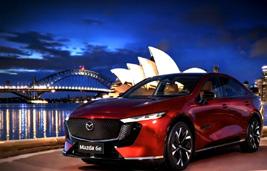
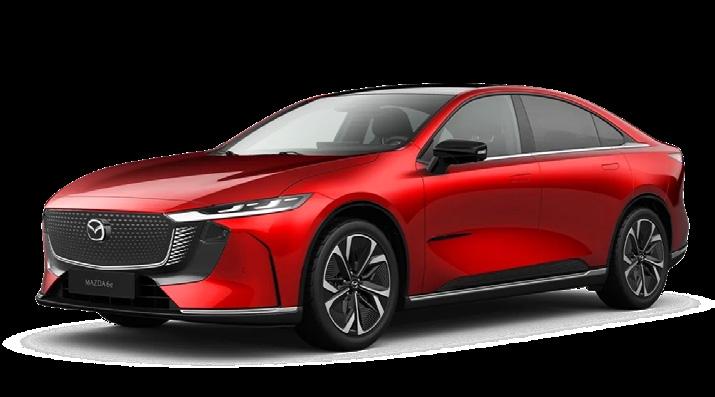
Mazda Australia is launching two BEVs this year – the 6e and CX-6e
Electric sector set for ‘revolution’
One of the stars of Melbourne Motor Show will be arriving in New Zealand during the third quarter of this year.
The Z9GT will be Denza’s first model down under to have parent company BYD Auto’s next-generation Blade Battery 2.0 technology and Flash ultrafast charging, which it claims will “revolutionise” the industry.
With the Flash charger’s peak 1,500kW DC capability, it will take about nine minutes to “fuel up” from 10-97 per cent.
This type of charging requires bespoke facilities and Denza says its first such sites will be operational at selected franchises by the end of 2026.
The Z9GT rides on the brand’s new e3 platform, which features a world-first three driving motors for performance and manoeuvrability. System output is expected to be around 850kW for a 0-100kph time of 2.7 seconds, while its driving range will come in at about 820km.
The EV is the first model to feature advanced DiSus-A air suspension, which ensures the car remains comfortable even when the unfortunate happens, such as a tyre blowout.
The onboard software helps manage a puncture at highway speeds in milliseconds by actively controlling power delivery, steering behaviour and braking.
Mark Harland, chief operating officer of Denza Australia, says:
“The Z9GT proves electrification can deliver not just efficiency, but exhilarating performance, extraordinary safety and genuine long-distance usability.”
Local specifications and pricing will be announced closer to launch.
MAKING EVs ‘ACCESSIBLE’
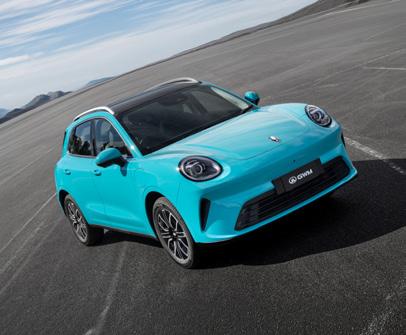
GWM’s Ora 5 SUV is due to be launched here next month following its big reveal across the Tasman last month.
The next-generation model represents a “significant advancement” in the brand’s strategy and reinforces its commitment to expanding “accessible” battery-electric options for Kiwis.
It brings increased size and capability to the nameplate, and will lead an expanded line-up with more new models slated arrive this year and in 2027.
With GWM already established in plug-in hybrid (PHEV) offerings, the expansion of the Ora range will strengthen its “new-energy credentials”.
Despite its larger size and enhanced capability, the 5 is priced in line with the outgoing Ora hatchback and will come in two variants – the Lux and Ultra.
The EV has a front-mounted electric motor producing 150kW and 260Nm. Energy is supplied by a 58.3kWh lithium iron phosphate battery for a WLTC range of about 430km. Power consumption is 15.5kWh/100km.
The Ora 5 supports DC fast charging up to 120kW, enabling a 30-80 per cent recharge in around 20 minutes under optimal conditions, while AC charging supports overnight topping up. Vehicle-to-load functionality delivers up to 6kW of external power for recreational applications.
The addition of new SUV positions GWM to capitalise on the clean vehicle standard, building further momentum towards its “drive to the top five” ambitions.
‘ICONIC DRIVER’S CAR’ BACK
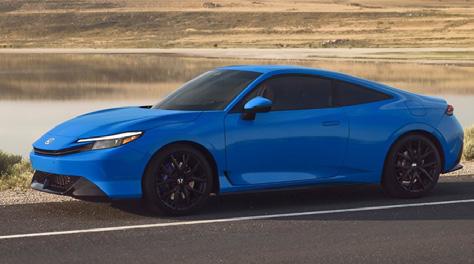
One of Honda’s historic nameplates is back after more than 25 years with the Prelude being reborn as its first hybrid sports car.
Available to order from $69,990 plus on-road costs, it comes in a single grade with a choice of five exterior colours, and boasts a “modern hybrid technology and performance-focused engineering”.
Carolyn McMahon, managing director of Honda NZ, says: “We are fortunate to experience some of the world’s best driving roads. With the all-new Prelude, Kiwis will have a car that promises an elevated connection.”
Built on a platform shared with the Civic Type-R, it has a “best-inclass hybrid engine and attractive pricing.”
The Prelude features new S+ Shift technology, which aims to enhance engagement by
Robert Thorp, Honda Australia’s director of automotive, says its fuses legendary design heritage with sustainable performance, “bringing fun into electrified era for sport coupes”.
He adds: “The 2026 Prelude is a bold reinterpretation of an iconic driver’s car for the hybrid era.”
eHYBRIDS DOWN UNDER
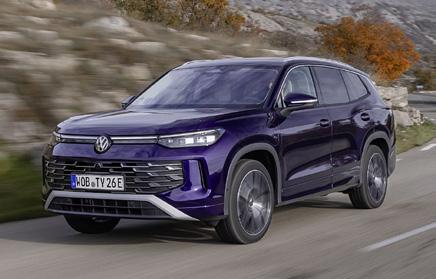
Two PHEVs from Volkswagen made their first Australian public appearance at the show in Victoria’s capital.
The Tiguan and Tayron eHybrids represent the brand’s “next evolutionary step” in electrified performance and efficiency.
The Tayron is positioned as a family SUV. It brings together long-range hybrid capability and the marque’s modern design language.
The PHEV offers “generous” cabin and luggage capacity. It has an “elevated ride comfort, refined interior layout and strong hybrid performance”.
The Tiguan eHybrid, meanwhile, has been made for buyers “transitioning towards electrification without compromise”.
The SUV’s proportions, “agile” handling and contemporary digital cockpit “make it an ideal choice for commuters and suburban drivers seeking premium efficiency in a midsize footprint”.
The two eHybrids will soon arrive across the ditch.
Denza’s Z9GT
The Honda Prelude GWM’s Ora 5
VW’s Tayron eHybrid
Inspection changes pose risks
The Motor Trade Association (MTA) has criticised changes to warrants of fitness (WOFs) as being a “cost to safety” and failing to boost Kiwis’ spending power.
Cars aged four to 14 will move to inspections every two years instead of annually, those over 14 will shift out to yearly and the first warrant will be at four years instead of three.
The MTA is concerned about the overhaul because New Zealand has the second-oldest fleet in the OECD and its road toll is poor compared to other developed nations.
James McDowall, head of advocacy, says: “When we canvassed our members, who conduct 80 per cent of WOFs, for their views last year there was widespread consensus the proposals would mean more unsafe vehicles on our roads.
“The failure rate is currently 41 per cent with the existing rules. At any given time, there are more than half a million vehicles on the road without a valid warrant. The new structure is hardly going to improve those figures.”
In the government’s original proposal, owners of cars up to 10 years old would have been able to get a WOF every two years. However, that’s been increased to 14 years from next year.
“You don’t have to be a mechanic to realise many vehicles deteriorate as they age,” adds McDowall. “One in three between eight and 10 years old already presents with safety-related issues every year.
“Cars only needing a warrant every two years up to 14 is going to mean more on our roads with dangerous faults, such as worn tyres and brakes.
“The reality is many motorists don’t keep a close eye on their vehicle’s condition and rely on the WOF to find issues.”
For that reason, the MTA recommended the first warrant should last three years – not four – and for the two-yearly check to end at seven years.
The
McDowall also questions the coalition pitching the changes as financially helping motorists under pressure from fuel and cost-ofliving prices.
He says while saving about $70 on one less WOF a year may be “well-intentioned”, drivers will probably end up paying more in other costs such as larger maintenance and repair bills due to the extra delay between inspections.
Then there’s insurance, ACC levies, and the cost to taxpayers of increased enforcement and education to consider.
The coalition, however, is adamant its changes will mean vehicle owners “saving time and money” under the WOF and
The reality is many motorists don’t keep a close eye on their vehicle’s condition
– James McDowall
certificate of fitness (COF) regimes.
It adds there will be public education to help people understand how to maintain cars between inspections and tougher enforcement.
The infringement fee for operating a vehicle with a WOF expired by more than two months will jump from $200 to $350.
Penalties for non-compliant wheels and tyres will rise from $150 to a $350 infringement charge and up to the maximum $1,000 for a court-ordered fine.
VIEWS FROM BEEHIVE
Chris Bishop, the Minister of Transport, says New Zealand has “very frequent” inspections compared to other countries.
He notes modern models are “significantly” safer and more reliable, but our rules haven’t kept pace and “impose unnecessary costs” on motorists.
“Other countries including Ireland, Germany, Japan and Australia inspect every one to two years or at ownership change and achieve comparable or better safety outcomes.”
Bishop adds the coalition’s “simple changes will deliver massive benefits for Kiwis”.
A cost-benefit analysis by officials shows the changes should deliver between $2.6 billion and $4.1b in net benefits over 30 years through reduced inspection fees, less time spent on compliance and fewer unnecessary repairs.
“Many people will welcome these changes, especially when households are feeling pressure due to high petrol and diesel prices because of the conflict in the Middle East,” opines Bishop.
He believes changes to WOFs and COF As align inspection efforts with “actual risk, meaning fewer unnecessary inspections, lower costs for owners and less time spent jumping through administrative hoops” while still ensuring cars are safe to drive.
“The government consulted on these changes last year with 74 per cent of respondents in support of reducing inspections for lower-risk vehicles,” says Bishop.
James Meager, Associate Minister of Transport, adds: “The changes mean compulsory inspections will be focused where they make the biggest difference to safety – with older and higherrisk vehicles. Data on risk shows an increase in crashes when vehicle factors were recorded for those from about 15 years old.”
He says modelling “conservatively” suggests an estimated 0.6 to 1.3 per cent increase in defect-related accidents.
NEW REQUIREMENTS
From November 1, 2026, new light vehicles will require their second WOF after four years, not three.
Those over 14, and motorbikes registered before January 2000, will move to annual inspections – up from six-monthly for some.
Light vehicles aged four to 14, and registered on or after November 1, 2019, will transition from annual to two-yearly WOFs, and light rentals will move from six-monthly to yearly COF As.
There will be checks to ensure no warning or malfunction indicators are showing for automatic emergency braking and lane-keep assist if installed.
From November 2027, light vehicles aged four to 14 – and registered on or after November 1, 2013 – will shift from annual to two-yearly WOFs.
coalition believes WOF changes will save Kiwis time and money
Client experience top priority
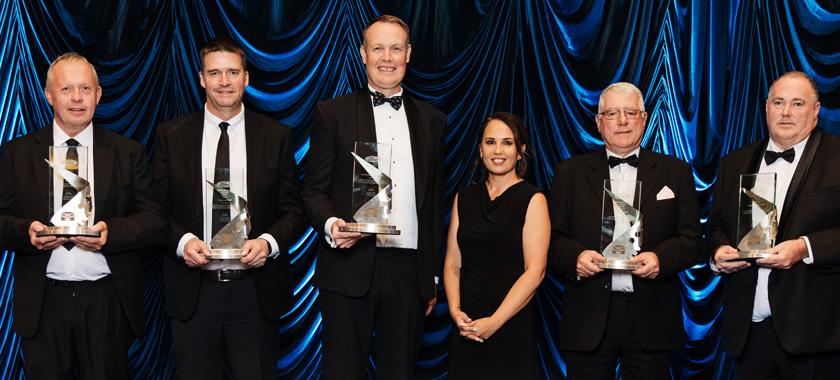
Ford NZ has celebrated the achievements of its dealer network by revealing the winners of the company’s president’s awards.
The recipients included Nathan Abernethy, of Regional Ford in Gore, Peter Gluyas, of Gluyas Ford in Ashburton, and Stephen Hermansen, of Ocean Ford, Whakatane.
The others were Hamish Sheard, of Pacific Motor Group in Whangarei, and Michael Tappenden, of South Auckland Motors.
Annaliese Atina, managing director of Ford NZ, says: “It’s a privilege to recognise the exceptional dedication of this year’s winners. We’ve made the customer ownership journey our North Star and these five dealerships have led the way.
“Their success is built on relentless attention to detail and commitment to ‘small wins’ that create lasting impressions for our drivers. These awards
also celebrate the significant investment in training and operational excellence required to stay at the top of our industry.”
Determined by rigorous satisfaction metrics, the president’s award criteria place the highest value on customer experience.
Elevating this remains a core strategic priority for Ford NZ, which works in collaboration with its dealer network to refine
all touchpoints from first-time purchase to the long-term reliability of servicing.
“We believe the real relationship with our customers begins the moment they drive off the lot,” says Greg MacDonald, network strategy director.
“That’s why we place such emphasis on the long-term customer journey when selecting our president’s award winners.
“The teams at these dealerships should be proud of their work.
“They aren’t just selling vehicles, they are building trust and ensuring that every Ford owner feels supported at every turn.”
Last month’s ceremony took place during a gala dinner at Te Pae Convention Centre, Christchurch. It was attended by dealer principals, their partners and Ford NZ’s leadership team.
Data for clean vehicle standard modified
The NZTA has revised calculations used for the clean vehicle standard (CVS) as the coalition assesses the scheme’s future.
Chris Bishop, the Minister of Transport, announced last year that a review of the policy, which was launched as the clean car standard in January 2023, will be completed by the end of June.
In the meantime, the NZTA notes it was still required by law to revise reference data for carbon dioxide (CO2) targets, mean weights and slope-of-line calculations by April 30.
It alerted dealers to the fresh CVS data on April 23, adding publication of the information doesn’t “pre-empt decisions” on the standard’s future.
The new data shows annual CO2 targets for passenger vehicles in 2027 will be 103g/km under current
settings and 175g/km for commercials.
They are set to drop to 76g/km and 144g/km respectively in 2028.
This year, they are 108g/km for cars and 207g/km for commercials.
The mean weights used for setting targets have also been updated.
Cars, type A, will shift from 1,482kg in 2026 to 1,549kg for the next two years. Commercials, type B, move from 2,098kg to 2,174kg over the same timeframe.
As for the slope-of-line figures, these have been set at 0.0343 for type A and 0.0526 for type B for this year. In the updated reference data, these move to 0.0374 and 0.0486 respectively for 2027 and 2028.
The CVS works on the principle
that each light vehicle, new or used, in an importer’s account has a calculated CO2 value.
This can be positive, which may earn account holders a credit, or negative, which can result in a charge. Credits can be used to offset charges or traded with other importers.
Values are calculated using a formula that considers each model’s emissions score, its tare weight and whether it’s passenger or commercial.
Using this information and reference data, which is set in legislation or weight data from the motor-vehicle register fleet, the CO2 value is calculated.
“The CO2 value is important but so is the ratio to the weight of the
vehicle and the annual target,” says the NZTA. “If the vehicle has a low CO2 value for its weight it’s more likely to get a credit.”
Meanwhile, the Ministry of Transport received 44 responses to its request for information on market insights for a future roaduser charges (RUC) system.
The replies came from existing and prospective local and international providers, with many expressing an interest in supplying a range of services.
“We are encouraged by the number and calibre of the responses, many of which suggested a range of tailored solutions for multiple user groups,” says a spokesman.
“There’s strong potential to develop a diverse and competitive market. Thank you to everyone who responded. Your responses are informing the policy advice.”
From left, Stephen Hermansen, Nathan Abernethy, Michael Tappenden, Annaliese Atina, Peter Gluyas and Hamish Sheard
Chris Bishop
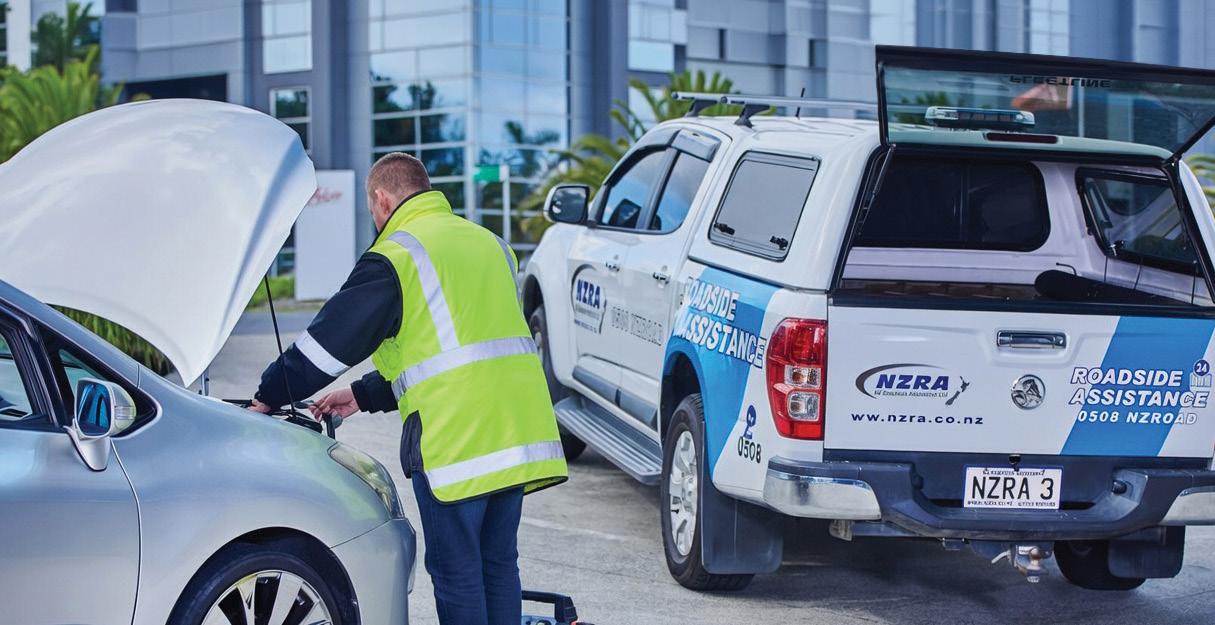
A ROADSIDE PARTNER YOUR CUSTOMERS CAN RELY ON
Enhance your insurance offering with proven, nationwide support
▪ 24/7 roadside assistance across New Zealand
▪ High-performing, accredited provider network
▪ Cost-effective without compromising quality
▪ Seamless integration with claims and assistance workflows
Getting weight adjustment right
The publication of updated clean vehicle standard (CVS) calculation inputs for the 2027 and 2028 obligation years last month is a very important development for the new-vehicle sector.
Last year, officials proposed removing weight adjustment and moving towards uniform targets.
The new-vehicle industry didn’t support that approach and welcomed the decision to undertake a full review of the CVS during 2026, which is to be delivered in two stages.
That’s now under way and we are awaiting the outcomes of the stage-one review, which will determine the direction of any subsequent stage-two reforms.
In that context, last month’s NZ Gazette is particularly relevant because it reflects the application of the existing framework to actual 2025 registration data.
When applied in practice, the data demonstrates the weightadjusted settings for 2027 and 2028 sit closer to what industry experience and observed market outcomes indicate is workable than earlier proposals suggested.
Whether weight adjustment is retained as part of future CVS settings remains a matter for upcoming decisions. However, in the near term, continuing weightadjusted targets for 2027 is a positive and welcome outcome.
More broadly, it demonstrates the current review process is working as intended. Industry input is being tested against data and evidence, and policymakers are taking a considered approach
to what’s achievable and effective.
At its core, weight adjustment reflects how vehicles are actually used. A small urban car doesn’t serve the same purpose as a large SUV or a ute. Heavier vehicles carry more, tow more and are often essential to business and productive activity.
AIMEE WILEY Chief executive officer, Motor Industry Association
In some segments, particularly light commercials such as utes, EVs currently available don’t yet fully deliver comparable range, towing capacity and payload across key use cases although new options continue to enter the market.
Applying uniform emissions targets across such a diverse fleet would be unlikely to accelerate the transition.
It would place disproportionate pressure on the segments where technology and supply have not yet aligned with policy expectations.
range of models to be offered.
This dual effect is a key reason why the outcome has been positively received across the industry and the broader context is equally important.
New Zealand is a small, fully importdependent market.
We don’t influence global production decisions. Platforms and powertrains are determined in much larger markets, often years in advance.
In that environment, domestic policy doesn’t drive supply, but it does influence New Zealand’s integration with global supply and allocation systems.
A CVS needs to be retained but calibrated to our market conditions
Retaining weight adjustment helps ensure targets remain aligned to vehicle characteristics and real-world use.
It also plays a critical role in enabling the uptake of lower-emissions technologies, particularly EVs.
Under a weight-adjusted system, electric vehicles generate more credits, helping balance fleet emissions across an importer’s portfolio while enabling a broader
Manufacturers prioritise markets where regulatory signals are clear and stable. Importers, in turn, make decisions on model mix and volume well in advance, often with limited ability to adjust in the short term. Policy instability carries real consequences.
The CVS provides a framework that supports planning, allocation and investment. Removing it would be unlikely to accelerate change.
It would increase uncertainty and reduce New Zealand’s ability to compete for allocation in already-constrained global supply chains where markets with clear and stable regulatory settings are prioritised.
The market has also shown how quickly consumer behaviour can shift. March saw a notable surge in EV registrations driven by rising fuel prices and concern around potential fuel-supply disruption linked to the Iran conflict.
Whether this represents a sustained trend remains to be seen. However, the availability of EVs on the ground at that level of demand was, in part, a result of the CVS supporting a broader range of lower-emissions models being brought in.
It also highlights the importance of having the right settings in place before demand shifts occur. That reinforces the significance of policy that supports steady fleet renewal.
What’s increasingly clear from the data and market response is that a CVS needs to be retained but calibrated to our market conditions, including what consumers need, can afford and are willing to transition towards.
The industry is still awaiting outcomes from the government’s review, but the next steps will need to consider trajectory settings, affordability impacts and the balance between ambition and achievability.
If there’s a lesson to be learned from the weight-adjustment debate it is that durable policy is rarely built on extremes.
A well-designed CVS doesn’t need to choose between environmental outcomes and market realities. It needs to align them. Getting weight adjustment right will be central to achieving that balance in practice.
Make marketing work smarter
Last month, we explored how car dealerships can use programmatic advertising to reach new audiences earlier in the buyer journey instead of waiting for customers to search when they’re already close to deciding.
That conversation often leads to a question we hear from marketing teams about moving some of their Meta budget into programmatic display and video.
It may seem logical as both are digital platforms, target audiences and drive traffic.
But comparing Google’s DV360 and Meta side by side is the wrong approach because they serve different roles in modern marketing.
So how do they complement each other? Meta is one of the most effective platforms for turning interest into action with billions of Facebook and Instagram users. Its algorithm is highly effective at identifying those most likely to engage or submit an enquiry.
For dealerships, this makes Meta a powerful middle and lower-funnel platform. It performs well for retail offers, stock campaigns, test-drive promotions, lead generation and retargeting
website visitors. It works best when some awareness or interest exists.
DV360 operates differently. Rather than advertising inside one platform, it connects advertisers to thousands of premium digital environments –news sites, streaming video and connected TV, podcasts, digital radio and digital out-ofhome screens.
JAMES HENDRY Director, sales and operations
AdTorque Edge NZ
Instead of waiting for someone to open Facebook or search for a car, DV360 allows dealerships to influence buyers as they consume content across the broader digital ecosystem.
This is where brand discovery and early consideration often begin. First impressions are critical in influencing the buyer journey from the start and help create demand for your business.
OPERATING IN TANDEM
A client may first see your dealership through a streaming video ad or premium website placement. Days later, they might search your business’ name on Google or click a Meta retargeting ad.
Both played a role in the sale.
DV360 created awareness and introduced your brand to new potential buyers and Meta captured engagement.
Looking at lastclick leads can hide the impact of earlier touchpoints. Rather than replacing Meta, programmatic activity expands the top of the funnel.
It allows companies to reach new people, build awareness and grow retargeting pools that can later be activated through Meta and Search.
This combination helps dealerships influence buyers earlier in the research phase, build larger and more qualified retargeting audiences, cut reliance on expensive search keywords and improve lower-funnel performance.
Many businesses rely heavily on Search and Meta because they produce fast, visible results. But relying solely on them means competing for the same buyers as everyone else. That drives up costs and often turns marketing into a price-led race.
When programmatic channels
EVERY DAY WITHOUT ALICE COSTS YOU LEADS, SALES AND CLARITY
are added, dealerships gain the ability to influence consumers before that competition even begins.
We introduced programmatic display and video at 20-25 per cent of total budget for a dealership to expand reach beyond Google and Meta, targeting in-market buyers and enabling cross-channel remarketing across all three environments.
Campaign results
+28% total leads generated.
−14% cost per lead across channels. +41% remarketing pool size. +33% engaged users.
Search-engine optimisation and social media capture existing demand, while programmatic creates new demand to reach buyers earlier and feed a larger, warmer audience.
The next time you ask about moving budget from Meta into DV360, it may be better to think about leveraging the strengths of each to improve performance and if your marketing budget is effectively reaching customers at all stages of their buying journeys.
The month that was... May
Second quarter, 2006 Finance company collapses
The collapse of three seemingly substantial finance companies over a few months had sent a strong message to the automotive industry.
While mainstream media had focused on investors, who were owed a total of more than $400 million, there were lessons to be learned by car dealers and buyers.
The companies involved – Provincial, National Finance 2000 and Western Bay Finance – also had substantial motor-vehicle sales operations. Industry observers pointed the finger at those operations as being part of the problem with all three businesses.
In many cases, these sales operations were a front for recycling cars repossessed by the finance companies when customers defaulted on loans. That camouflaged the fact that more of their clients were walking away from repayment commitments.
In the case of West Bay Finance, the last of the three to go into receivership, the provision of bad and doubtful debts had climbed to $12.4m – almost 25 per cent of its total loan book.
May 22, 2009
Biodiesel gets a boost
A grants programme for biodiesel production was aimed at kick-starting this fledgling sector of New Zealand’s fuel industry.
As part of 2009’s budget, $36m would be allocated to the scheme over three years with funding available from July 1.
Gerry Brownlee, Minister for Energy and Resources, said: “By supporting biodiesel production in New Zealand, we can help get a new industry up and running. It can provide jobs for Kiwis and at the same time help to reduce greenhouse gas emissions.”
The grants were available to domestic biodiesel producers selling their products to a range of end users. Some biodiesel was already produced in New Zealand from waste cooking oil, while current uses included vehicles, fishing fleets and boilers.
Brownlee said the initiative fulfilled the government’s pre-election promise of providing incentives for biodiesel producers in recognition of the advantage bioethanol already enjoyed.
According to industry analysis commissioned by the Energy Efficiency and Conservation Authority, biodiesel made here was expected to result in reductions of greenhouse gas emissions of between 50 and 90 per cent compared to ordinary diesel.
May 18, 2007 Budget 2007 announced
Michael Cullen, the Minister of Finance, introduced the government’s much-heralded business tax reform when he delivered his budget.
Cullen announced that the company taxation rate would be reduced from 33 per cent to 30 per cent at a cost of $2.1 billion over four years. There would also be additional transitional costs of $130m.
The government claimed the reforms would “provide incentives for our businesses to increase investment, increase innovation and increase productivity”.
The announcement marked the first time the government of the day had shifted on the corporate tax rate since 1988. The package also included the allowance of $630m over four years in tax credits for research and development.
Cullen added: “These changes will encourage the innovation we need to keep our firms dynamic, competitive and productive.”
May 2018
Car dealers must follow recall laws
Vehicle importers and dealers were being warned of the dangers associated with bringing in and selling cars, especially trade-ins, that had alpha-type Takata airbag inflators.
The government had ordered the mandatory recall of about 50,000 vehicles with the systems installed that had yet to have remedial action completed. The campaign, which affected some models made from 2000-11, was issued because faulty airbags had been associated with 23 deaths and about 230 serious injuries worldwide.
The recall, which was ordered by Kris Faafoi, Minister of Commerce and Consumer Affairs, meant that from May 3, 2018, vehicles with alphatype Takata systems would become banned imports.
In addition, registered motor-vehicle traders ran the risk of incurring a fine of up to $600,000 under the Fair Trading Act if they failed to comply with the call-back’s requirements.
The Motor Trade Association was going to great lengths to ensure its members were up to speed with what was required. Greig Epps, industry relationship manager, said: “The recall takes effect at the end of May, so dealers should be using the time until then to make themselves familiar with the range of models affected on www.rightcar.co.nz.”
“They can assess current stock to determine if any vehicles should be taken to the relevant brand for recall service.”
Avoid confusion and procrastination
Where to begin? With the chaos or that gentle and distinctly Kiwi urge to just deal with it later?
I ponder this because compliance obligations can be funny things. On paper, they are clear, orderly and logical.
In real life, they tend to take on a life of their own like that little gremlin you can never find. Especially under New Zealand Gazette notice number 2022-au4073, which governs how registered traders access personal information from the motor-vehicle register (MVR) under section 241 (S241) of the Land Transport Act.
Early last year, industry groups and the NZTA sat down together to see if there was a smarter, more efficient way to manage MVR access requirements.
The goal was to reduce duplication, tighten up privacy protections and ensure everyone was meeting their obligations without drowning in paperwork.
Out of that collaboration came the 2025 declaration form and, in theory, it was the administrative equivalent of a freshly groomed vehicle. Unfortunately for some, it felt more like washing cars on a windy day in that you do your best to stay dry, but the spray keeps coming back at you no matter where you stand.
Whether you’re at a big
dealership or smaller yard, selling shiny stock or modest movers, the MVR declaration form will not magically complete itself. It doesn’t manage itself either. It will not resurface and say, “remember me”. Someone needs to take control and get it done.
LARRY FALLOWFIELD Sector manager – dealers, Motor Trade Association
This story kicked off on November 1, 2025, when businesses with approved access received an email with “motorvehicle register access annual reporting” in the subject line.
That wasn’t a bad subject line and it was just very honest. It triggered the same instinct as a compliance-heavy subject line – mild suspicion, followed by a strong desire to open it “when things quieten down”.
For some, the email was mistaken for spam. For others, it prompted immediate questions, which included:
Is this about WOFs or something to do with rego?
Is this mine or does someone else do this?
Should I be worried?
Nothing had technically gone wrong at this point, but confusion had officially unpacked its bags.
Then came December 18 when another email arrived. This one was titled “2025 compliance
declaration” with a “2025 S241 compliance letter” attached. Again, nothing inherently wrong except perhaps the timing.
December in the motor trade isn’t a calm month.
Workshops are flat out, sales are buzzing, warrants of fitness and servicing are coming and going faster than Cookie Time biscuits in the smoko room, and everyone’s thinking about their holidays.
So, when the letter outlined a list of compliance actions, some marked as time -sensitive, the response by most was predictable. Not exactly panic, but a collective intake of breath and a quiet wellmeaning thought of, “right, I’ll come back to that”.
What followed was a nationwide outbreak of dealer procrastination, strong enough to qualify for a podium finish at the 2026 Commonwealth Games.
By March, most people assumed things were sorted or at least sitting in a folder with flagged emails.
That’s when the next layer revealed itself. Emails don’t always go where we think they do. Staff move on, roles change and inboxes fill up. Occasionally, an important message quietly goes into the void.
The result of inaction meant some businesses found their MVR access suspended, not out of defiance or neglect, but simply because the right message never landed in the right place.
At this point, the situation had shifted from “minor admin task” to “how did this get so complicated so quickly and how do I fix this now”.
Here’s the key takeaway and it’s refreshingly simple. Every business needs to ensure the correct MVR contact person is listed. If you’re an MTA member, you can reach out to me. If not, contact the S241 team at the NZTA.
The declaration process is ongoing and it will happen again this year. If the email goes to the wrong person, nobody wins but this isn’t about blame. It’s about recognising how easily things can slip through the cracks when everyone is busy doing their actual jobs.
While procrastination can be a proud and time -honoured Kiwi tradition, it works best when it’s applied to DIY jobs at home and not compliance deadlines.
With good planning, internal responsibility and fewer mystery emails, we might just see the 2026 chapter of this saga downgraded from “confusion and chaos” to something closer to “a mildly inconvenient but brief administrative task”.
Industry movers
HELEN SUNLEY has been named general manager of Mercedes-Benz NZ. She joined the marque in 2022 as head of sales, bringing experience across automotive from the UK and New Zealand.
Sunley has contributed to key commercial and operational initiatives, including the successful rollout of its agency model, says the company.
It adds: “Her leadership is characterised by a strong commercial focus, collaborative approach and commitment to delivering a premium customer experience.
“Her industry background, combined with her work across sales transformation and network engagement, supports our ongoing focus on customercentric innovation and strengthened retailer collaboration.”
NESHALIN NAIDU has been promoted to general manager at Auction Online to oversee operational strategy, business performance and national growth.
He joined the automotive auction platform in 2023, and has played a key role in strengthening operational systems and supporting its expansion.
In his new role, Naidu is leading the team as Auction Online continues to scale its marketplace, and develop technology aimed at improving transparency and buyer confidence in wholesale vehicle trading.
His previous roles have included sales executive for Orix NZ and marketing intern at Hyundai Motors NZ. Naidu graduated from AUT with a degree in marketing in 2015.
ANTONY DIXON has started his term as chairman of Intelligent Transport Systems New Zealand (ITSNZ). He has more than two decades of experience in senior roles in the IT and manufacturing sectors.
Dixon’s career includes founding Times-7, which makes and exports radio-frequency identification antennas, and senior roles with Datacom, EDS and IBM.
In February 2023, he joined Cubic Transportation Systems as business development director for New Zealand with a focus on relationship management and market development.
Dixon, pictured, is also a member of the Institute of Directors. His governance experience includes roles with the Opportunity Party, Wellington ICT Graduate School and Otari School, Wilton.
Lee McKenzie, who has held senior roles at the Ministry of Transport and NZTA, has been appointed as ITSNZ’s deputy chair. She was most recently manager of future transport at the agency, leading a team researching and supporting emerging tech solutions.
DON ROMANO has been promoted by Hyundai to president of Asia-Pacific, which covers New Zealand and 31 other countries.
He remains as chief executive and president of Hyundai Australia with his time split between Sydney and Indonesia.
Romano joined Hyundai Australia in March 2025. Before that he was president and CEO of Hyundai Auto Canada for 10 years.
Capital branch reigns supreme at ceremony
Lexus of Wellington was the supreme winner at the luxury marque’s business excellence awards.
The honours celebrate dealerships that deliver excellence in leadership, customer experience, sales, service and community engagement.
Andrew Davis, vice-president of Lexus NZ, says: “Lexus of Wellington had a standout year. It transitioned into a new home, hosted the Lexus Design Award, and continued to create events and partnerships that connect with its community.
“Opening a facility is one thing, but what stands out is how quickly the team has embedded the Lexus experience into the space. It’s about the people inside it and culture created for customers.”
The supreme award reflects excellence across new and used vehicles, finance, parts and service, people, facilities, environment, profit, standards and delivering the marque’s “promise to experience amazing”.
Davis says: “It’s not just about sales. It’s about how our customers feel when they walk through the door, how they’re supported throughout their ownership journey and the trust that builds over time.
“That’s omotenashi [hospitality] in practice – anticipating our guests’ needs and creating an
environment where they feel welcomed.”
The Wellington franchise was chosen from a strong group of finalists including those in Hamilton and Hawke’s Bay, while the sales and marketing award went to Christchurch.
Davis adds: “Every dealership represents the brand in its community and the standard is high, so to be recognised at this level is significant.”
The awards come as Lexus grows its electrified range and presence nationwide. “As we evolve the brand, the role of our dealerships becomes even more important.” Later this year, the marque will launch its first vehicle with Lexus Connected Services in the all-new ES.
Derek Tilyard, left, CEO of Lexus of Wellington, and Andrew Davis, vice-president of Lexus NZ
Aaron Frazer, right, chief executive of Lexus of Christchurch, with Tatsuya Ishikawa, CEO of Toyota NZ
Uniform approach vital for policies
The government has widened fuel-sourcing options and has planned for continuity of supply as a basic requirement because of what’s happening in the Middle East, but it seems to take a different approach for affordable vehicles.
The point isn’t whether one agrees with that, but what that choice shows. When ideal standards run into supply limits, the coalition is willing to secure the best available product and keep the system running.
When supply risk becomes serious, it doesn’t treat the ideal standard as absolute. It treats continuity of supply as something that cannot be ignored because fuel shortages hit households, freight, businesses and the wider economy.
The problem is automotive policies haven’t been consistently developed on the same basis.
The likes of the clean car standard, the 2024 emissionsrule changes and especially the extra changes slated for 2028, and the proposed requirements for advanced driver-assistance systems in 2027 assume suitable stock can be sourced from Japan.
That assumption matters. We asked the Ministry of Transport whether it had done supply modelling and were told it hadn’t. If the cars aren’t there in the required volumes, the practical effect is not that a cleaner or safer market suddenly appears. Instead, fewer vehicles qualify for import.
When the industry raises that point, it is too often treated as if it’s pleading a special case
rather than providing evidence about how our source markets work. That’s the issue.
When fuel supply is under pressure, the government treats limits as real.
When the volume of affordable cars is under pressure, it has been far more willing to treat lower supply as an acceptable outcome and even as evidence that the system is working.
KIT WILKERSON Head of policy and strategy kit@via.org.nz
Lower supply can, in some cases, be treated as success. If something causes harm, a government can say less of it is the policy working.
But with fuel, it’s not acting as though reduced access is a good outcome. It’s widening flexibility to keep supply available. If that’s what the coalition is willing to apply to fuel, it needs to explain why affordable vehicles should be treated differently.
people don’t buy brand-new vehicles. Many keep an older one for longer and delay replacement. Some take on extra debt for a model that’s less suitable.
In practice, narrowing affordable supply can materially slow fleet improvement rather than speed it up.
That should make sourcemarket supply a central design constraint for policies. Instead, the pattern has too often been to acknowledge limits in what is available in Japan and just carry on as though they aren’t binding. If a rule depends on supply, then supply must be treated as a design constraint not an afterthought.
Narrowing affordable supply can materially slow fleet improvement
That question is harder to avoid because the standards being adjusted for fuel, but not for vehicles – at least for a few very influential standards – relate to the same harms of noxious and greenhouse gas emissions.
Independent imports don’t form a fringe market. They are one of the main ways New Zealand households replace their cars. Restrict that channel and
The starting questions are simple. What and how much stock exists in the source market, and at what prices and with what relevant features? If that work isn’t done, the rule is being designed around aspiration and not reality.
When industry tries to provide missing evidence, the response is revealing. If the government needs to understand fuel-supply risk, market participants are treated as having operational knowledge and their evidence appears to be viewed as worth testing.
With vehicle policy, by contrast, the independent import industry is too often treated as though its evidence can be discounted as self-interested.
That isn’t robust regulation. Every affected party is selfinterested, including incumbents, manufacturers, regulators and ministers.
It also isn’t a reason to ignore evidence about how the market works. It’s a reason to test evidence properly.
If continuity of supply justifies adjusting our fuel settings when the best available product falls short of ideal, the government needs to explain why the same reasoning doesn’t also apply to affordable cars.
The point isn’t whether one endorses that choice. The point is the government has now shown the rule it is willing to use when supply limits become binding.
That doesn’t mean abandoning ambition. It means recognising the difference between announcing a high standard on paper and achieving real market improvement.
A serious transport policy would pose a simple and publicinterest question. How far can standards be pushed before they start breaking the affordable replacement market many Kiwis rely on?
If the government wants different rules for fuel and cars, it should say so and explain why. Until it does, the current position doesn’t look like a settled principle but pragmatism applied selectively.
Chinese marques disrupt market
Japan relinquished its status as the world’s top-selling carmaker in 2025 to signal a significant shift in the automotive industry.
It had led the way since 2000 but lost out last year to China by about two million units. China notched up 27m deliveries.
Among the best performing marques, BYD surpassed Ford to rank sixth globally, while Geely overtook Honda for eighth.
Six Chinese carmakers entered the top 20 including Chery, Changan Automobile, SAIC Motor and Great Wall Motor. They outnumbered Japan’s five.
It all represents a restructuring of the global automotive landscape, driven by China’s strengths in advanced technology, cost efficiencies, and rapid research and development.
Blink and you could easily miss the arrival of the next Chinese marque or model.
Dongfeng, for example, is “striving” to bring all-electric and internal combustion engine price parity across multiple segments in New Zealand.
Positioned as the best-value
fully electric SUV here, the Vigo’s sticker price was $37,990 until the end of April.
The launch deal included a free optional large panoramic moon roof valued at $1,500, equating to a total offer of $3,500.
“The Vigo is an example of Dongfeng breaking barriers to EV ownership,” says Simon Rutherford, chief executive of Armstrong’s Distribution Ltd. “There’s no other small SUV on the market offering premium features plus legroom and boot space.”
Six airbags, front and rearparking sensors, and a 360-degree surround-view camera are standard. Level-two advanced features include AEB, forwardcollision warning, lane-departure warning, lane-keeping assist and intelligent adaptive cruise control.
Despite its compact footprint, it offers a 2,715mm wheelbase, 500 litres of boot capacity and has room for five people.
The SUV, which now has a maximum retail price of $39,990 plus on-road costs, is 4,306mm long, 1,868mm wide and 1,654mm high, while the tailgate has a 150kg load capacity and vehicle-to-load
capability. It comes complete with roof rails, a towing capacity of 750kg and camping mode that manages power to maintain the cabin temperature while providing continuous power even when locked.
There are 18-inch alloys, wireless Apple CarPlay and optional Android Auto, wireless charging pad, a 12.8inch central touchscreen and an 8.8-inch digital driver display.
The SUV’s 51kWh battery can be charged from 30-80 per cent in 18 minutes and can deliver a WLTP range of 340km.
It’s backed by a six-year or 200,000km warranty, eight-year or 200,000km battery warranty and six years’ roadside assistance.
Joining the Vigo is the 007 sedan in two variants. The longrange rear-wheel drive offers up to 520km of range on one charge while the all-wheel drive (AWD) performance can make the 0-100kph dash in less than four seconds. The Box fully electric hatch completes the range.
INTO ‘NEXT-GENERATION’
Leapmotor’s dual-motor C10 AWD is the marque’s first vehicle to
feature fast charging from 30-80 per cent in 22 minutes.
The 800-volt set-up enables rapid DC charging to peak power level of 180kW and better thermal efficiency of the 81.9kWh lithiumiron phosphate battery.
The improved charging efficiency and thermally stable chemistry is achieved with no preheating resulting in a longer life cycle, less stress across components and “excellent” usable energy.
The C10 AWD’s high-voltage motors operate more efficiently at high speeds, improving acceleration. The lightweight design of the system is class-leading at 75kg and supports higher regenerative braking to further support its 437km WLTP range.
With peak power of almost 440kW and maximum torque of 720Nm, it accelerates from 0-100kph in four seconds.
“The C10 AWD redefines electric mobility by offering a seamless blend of high-performance driving and precision handling,” says Brian Carr, general manager of sales at Auto Distributors NZ. “It’s built to take you further and go anywhere with confidence.”
Dongfeng’s Box
From left, the Dongfeng Vigo, Chery’s Tiggo 7, Leapmotor’s C10 AWD and the B5 Leopard from Denza
The AI smart electric-drive motor with intelligent upgrades enables cloud-based diagnostics.
There’s 360-degree dashcam functionality using the EV’s surround-view cameras to record while driving.
The SUV, which is available from $64,990, has a 14.6-inch infotainment screen, 10.25-inch digital cluster and 12-speaker sound system. There’s a panoramic glass roof and up to 1,410l of cargo space.
The marque also has the Life and Design variants of the B10, which start at $49,990. It’s a compact RWD and tech-focused alternative to the C10.
AIMING AT TOP END
Denza, which is BYD’s luxury brand, is aiming to make in-roads across the SUV segment.
Its range kicks off with the five-seater B5 and B5 Leopard, priced from $88,990 to $96,990 respectively.
Both feature a plug-in hybrid powertrain delivering 425kW and 760Nm of torque via a dualmotor 4WD system. Powered by a 31.8kWh blade battery, they offer up to 90km of pure electric range and support DC fast charging up to 100kW.
The B5 Leopard adds offroad capability with hydraulic adaptive suspension, front and rear electrically actuated mechanical differential locks, and a 3,000kg towing capacity.
The larger flagship B8 starts at $109,990 for the seven-seater and $117,990 for the six-seat variant.
These SUVs have a 91-litre fuel tank for extended range, a 3,500kg towing capacity and electric differential locks – front and rear on
the six-seater. Range approaches 1,000km with electric and hybrid modes combined.
Denza’s models come here via its head office in Australia with chief operating officer Mark Harland overseeing both sides of the Tasman.
“With the B5 and B8, Denza is taking a swing at the establishment,” he says. “They offer something the market hasn’t seen before by combining cutting-edge technology, serious off-road capability and luxury that doesn’t ask you to compromise.”
The D9 all-electric luxury people mover is the latest addition to the marque’s line-up with the front-wheel drive (FWD) model priced from $104,990 and the AWD from $115,990.
Built on BYD’s advanced ePlatform 3.0 architecture, it features an eight-in-one powertrain for 230kW of power and 360Nm of torque in FWD form. These statistics increase to 275kW and 470Nm for the AWD. WLTP ranges are 520km for the FWD and 480km for the AWD.
With 200kW DC fast-charging and 11kW AC charging, plus vehicle-to-load capability, the D9 is designed for long journeys and everyday charging.
The interior layout is two-twothree. Second-row captain’s chairs come with ventilation, massage, power leg rests, lumbar adjustment and memory settings, and more than 900mm of legroom and 1,500mm of headroom in each row.
AWD models have the DiSusC suspension system.
Cargo space comes in at 410 litres. With the seats down, this increases to a generous 2,210l.
FOSSIL-FUEL ARRIVALS
Chery’s Tiggo 7 line-up has grown with two petrol-powered variants, the Urban and Ultimate, starting from $34,990 plus on-road costs.
It has the same styling cues as the Super Hybrid. Inside, there’s a 12.3-inch twin-screen digital dash featuring wireless Apple CarPlay and Android Auto with wireless device charging.
Paired with a six-speed dualclutch transmission, the 1.5-litre turbocharged engine produces 108kW of power and 210Nm of
torque while achieving 6.9l/100km in combined fuel efficiency.
The Tiggo 7’s safety features include adaptive cruise control, autonomous emergency braking and lane-keeping assistance. The SUV comes with a seven-year and unlimited kilometre warranty.
Lucas Harris, chief operating officer of Chery Australia and New Zealand, says: “It combines modern design, innovative technology and exceptional value – a formula that resonates strongly with families and urban drivers alike.”
WANTED TO BUY
Denza’s D9
The Tiggo 7 Ultimate
V8 victories on home circuits
Drivers in the 2026 Supercars Championship faced a rare challenge when the series rolled into Taupo just days ahead of Cyclone Vaianu.
The extreme weather event forced the cancellation of Sunday’s racing on April 12 with organisers adding a “make up’” race at the Christchurch leg a week later.
Brodie Kostecki arrived in New Zealand on a roll having won three of the four races last time out in Melbourne and he was sitting on top of the points table.
He was quick during practice and snatched pole for Saturday’s first race although his dominance didn’t continue in qualifying for race two in Taupo when Kiwi Ryan Wood grabbed pole in his Toyota.
Kostecki was untroubled in the first race of the first weekend of New Zealand’s “double header”.
He secured victory ahead of Will Brown and Wood, who battled hard for most of the contest. Matt Payne finished fifth with fellow Kiwi Andre Heimgartner 12th.
“I didn’t get the ideal start but knew if I could hang in there, side by side, I would have the inside line for the next corner,” said Kostecki.
“We had a good car like we did at Melbourne and it showed. I’m really happy with the team at the moment and we’re on a bit of a roll.”
That said, the Australian was unable to repeat his earlier dominance in the Saturday afternoon’s 60-lap race.
Wood led from pole and was comfortably ahead of Brown and defending champion Chaz Mostert after the first round of pit stops. Then, with 18 laps remaining,
the drivers went into the pits for the last stop of the race.
As they returned to the circuit, Wood had been jumped by Mostert, and had Brown and Broc Feeney breathing down his neck.
By lap 55, Wood was back in the lead and he took the chequered flag ahead of Feeney and Mostert. It was the first-ever race win for the Toyota Supra in the V8 Supercars. Payne and Heimgartner finished fifth and 12th respectively.
“It’s pretty special and thanks to the team,” said Wood. “It was
incredible and I can’t believe it. It means so much to do it in front of my fans, family and friends.
“My dad was probably bawling his eyes out, but my mum was probably a bit tougher. To be honest, the last two laps were pretty emotional. I would just like to thank everyone who made it happen.”
The decision to cancel Taupo’s Sunday races was due to the impending arrival of the cyclone. It ultimately brought rain to the circuit, but not the wild weather that had been forecasted.
Organisers made the call on the Friday afternoon to revise the weekend’s schedule before announcing at midday on Saturday that the following day would be cut.
The cautious approach would have resulted in a significant financial hit for the business due to lost ticketing, hospitality and revenue from media rights.
The cancellation of the Sunday’s action limited the Taupo Super 440’s total attendance to 29,562. The event attracted 67,411 spectators to its inaugural running in 2024 and 51,454 last year.
PAYNE CLAIMS DOUBLE
This year was the first time New Zealand hosted two rounds of the V8s championship with the meeting in Taupo being followed by Ruapuna from April 17-19.
Matt Payne scored pole in the Christchurch Super 440 opener on the Friday, but it was his team-mate who took the win.
Kai Allen pulled off an undercut to beat Brodie Kostecki. From fourth on the grid, Allen rose to the podium places in a chaotic opening lap before taking two tyres during his pit stop while his primary rivals opted for four.
That time saving proved critical. Kostecki was second, unable to make the most of his newer rubber, while Ryan Wood completed the podium on a similar strategy. Payne ended up fifth.
“How good was that,” enthused Allen of his breakthrough victory.
“It had been coming, I just had to be patient and then my dream came true.”
Payne’s weekend appeared cursed the following day when he lost a wheel in the morning race,
The Ruapuna weekend of the V8 Supercars attracted 65,000 spectators
Ryan Wood celebrating in Taupo.
Photos: Geoff Ridder
Wood’s first place gave the Toyota Supra its debut V8 Supercars win
but he recovered in the afternoon to celebrate an emphatic win in the weekend’s third race.
“It was absolutely unreal,” he said. “I finally got the start nailed, so I just drove away and the thing was on rails.”
On the final day, Payne capped off a dominant weekend at Ruapuna with victory in race 13 of the Supercars Championship.
He led home a one-two for Grove Racing, while fellow Kiwi Wood suffered late heartbreak in the fight for the Jason Richards Memorial Trophy.
Starting from pole for the 61-lap race, Payne made a clean start to lead into turn one but Wood lost ground off the line and dropped to seventh. Allen surged from sixth to third by turn four and Will Brown moved into second.
Behind them, an early incident involving Jackson Walls, Rylan Gray and Aaron Cameron also collected David Reynolds and brought out the safety car. On the restart, Wood and Anton De Pasquale made contact, dropping the latter down the order.
Up front, Payne began to edge away as Allen and Will Brown battled over second place and, as the pit-stop window opened, Allen was among the first to stop before undercutting Brown.
Andrew Heimgartner also pitted early as he worked to recover from
his starting position. Payne stayed out longer and built a significant buffer before his first stop on lap 25, rejoining still comfortably in the lead.
As the rest of the field completed their stops, Payne led Allen by just under five seconds with Broc Feeney, Brown and Kostecki behind.
Wood remained in the mix – he was inside the top six once pit strategies had played out – while Heimgartner had worked his way forward into the top 10.
By lap 40, Payne had extended his lead by some 10 seconds. Allen was holding off Feeney, with battles continuing throughout the field as drivers completed their second stops.
The final pit stops saw Payne rejoin with a nine-second lead over Allen with Feeney close behind in third. Wood was still in contention inside the top 10 and Heimgartner had climbed to 11th.
With seven laps remaining, Wood’s race ended abruptly when his car slowed on the main straight and stopped, bringing out the safety vehicle. He had been in a strong position to win the Jason Richards Memorial Trophy.
Allen held behind Payne to defend from Feeney. Kostecki and Chaz Mostert were locked in a physical duel further back that ended with Kostecki forced off
the road by Mostert and spun, dropping to the back.
Kostecki labelled it as “interesting” while Mostert said “that wasn’t my intention” as the rivals reflected on their fender-banging incident, which saw Kostecki sliding sideways on the grass and back across the track at high speed.
Mostert, who later received a 30-second penalty, said the rivals “made wheel-to-wheel contact, the thing just spat me sideways and the last one whiplashed Brodie off so that wasn’t ideal”.
Kostecki added: “I got a fair way up the inside. I think he saw I was coming pretty late and tried to turn in, but I was already up a fair way. That put me up on the grass there and I didn’t run him off the road or anything.
“I gave him a car length because I’m not about that and, obviously, the rest happened. I’m glad I didn’t take out any other cars and believe there was a flag marshal’s post there, so I’m just glad nothing serious happened.”
At the front, Payne remained in full control to take a clear victory, completing a clean sweep from pole position.
Allen followed him home, while Feeney finished third, which was enough to secure the Jason Richards Memorial Trophy. It was the first time ever for Grove Racing team taking out the top two steps on the podium in the V8 Supercars.
Heimgartner recovered well to finish eighth after starting 20th.
The late-race incident involving Kostecki also impacted the championship standings with Feeney leaving New Zealand with the points lead.
A history-making attendance of 65,806 was confirmed for the inaugural Christchurch Super 440. That included a total sell-out of the Saturday and Sunday along with strong support for the additional Friday race, which was carried over from Taupo.
Round five of series is the Tasmania Super 440 from May 22-25 in Launceston.
Matt Payne shot back into title contention over the series’ two New Zealand rounds with his wins at Ruapuna
Broc Feeney ahead of Brodie Kostecki
Rust appeared to have been concealed by filler and paint in car sold on ‘as is, where is’ basis
Background
Benjie and Sheena Pedro bought a 2005 Honda Fit for $2,300 from Affordable Kiwi Cars Ltd on March 26, 2025.
The couple wanted to reject the vehicle under the CGA because of extensive rust in its rear doors.
The trader said it was unaware of the problem at the time of sale and was unable to repair the car because the business had closed. It offered to buy it back for $1,200.
The case
Pre-purchase, the Pedros were told the Honda had been “approved by AA”, which was shown on an AA sticker. They said this led them to believe the Fit had passed an independent inspection and was in sound condition.
Eight months post-supply, it underwent a $39 warrant of fitness (WOF) when its odometer was on 250,856km. The vehicle failed the inspection because of structural corrosion on the inside of both rear doors within 150mm of the hinge and pillars.
Repair quotes were sought. One estimate was $3,125, so the buyers asked Affordable Kiwi Cars to fix the car. The trader declined responsibility and said the business had closed, but offered to buy the Honda back for $1,200, which the purchasers considered unreasonable because of the severity of the rust and expenses already incurred.
At the hearing, the dealer explained the Fit was a trade-in and sold on an “as is, where is” basis and, that at its price point of $2,300, the business only ensured it was mechanically sound prior to sale. It was unaware of any corrosion issues beforehand.
The finding
The first issue for the tribunal to consider was whether the Honda
A 2005 Honda Fit
had any defects that amounted to a failure of acceptable quality under the CGA.
The Fit was a cheap, older model with high mileage. Accordingly, a reasonable consumer would expect a degree of wear and age-related deterioration.
However, even taking these factors into account, the evidence established the car had extensive rust in its rear doors prior to sale.
The tribunal’s assessor said the corrosion was significant, affected the Fit’s structural integrity, and appeared to have been concealed by filler and paint.
This level of rust presented a safety risk, particularly in a rollover scenario, because of its proximity to the door hinges and b-pillars, which are key structural components designed to help maintain the cabin’s shape.
The Honda failed a WOF due to the rust, so the tribunal found the Fit wasn’t as free from minor defects and wasn’t as safe or durable as a reasonable person would expect even for its sticker price and age.
The tribunal also rejected Affordable Kiwi Cars’ submission the Honda was sold on an “as is, where is” basis. The trader’s description of vehicle in this way didn’t diminish or remove the CGA’s statutory guarantees, nor did the low purchase price.
Considering all circumstances,
the tribunal was satisfied the Fit didn’t comply with the guarantee of acceptable quality, so the buyers could reject the car if the problem was ruled to be major.
Under section 21 of the CGA, a failure is of substantial character if a reasonable consumer, fully informed of the nature and extent of the issue, wouldn’t have acquired the goods or the goods were unsafe due to the failure not meeting acceptable quality standards.
The adjudicator was satisfied the Honda’s excessive rust was substantial. The corrosion was extensive, was found in a critical structural component, appeared to have been concealed with filler and paint, compromised the car’s structural integrity and posed a safety risk.
The tribunal found that a reasonable person fully informed of this level of hidden corrosion in both rear doors wouldn’t have purchased this vehicle.
Rust so close to the b-pillars formed part of the car’s core safety structure and corrosion of this extent also meant the pillars might not have performed as intended in an accident.
The failure, therefore, went beyond age-related wear and what a reasonable person purchasing a low-value, older vehicle would anticipate. The defect rendered the Honda unsafe.
The available remedies are set
The case: Eight months postpurchase, the buyers discovered their Honda Fit was structurally unsound due to excessive rust in two doors. They wanted to reject it. The trader said it was unaware of the issues when the vehicle was supplied and was unable to fix it because the business had closed.
The decision: The rejection of the car under the Consumer Guarantees Act (CGA) was upheld and the dealer was ordered to pay out $2,339.
At: The Motor Vehicle Disputes Tribunal via video link.
out in section 18 of the CGA. The legislation states when a failure of acceptable quality is substantial, the consumer is entitled to reject the goods.
Because the adjudicator had ruled the corrosion in both rear doors was a substantial issue under section 21 of the CGA that the purchasers were entitled to reject the Honda and the trader was ordered to refund the purchase price.
The tribunal also found the buyers should be reimbursed the $39 they paid for the WOF inspection.
The adjudicator was satisfied this cost was recoverable under section 18(4) of the CGA because it was incurred to determine the full extent of the Honda’s corrosion.
Consumers are entitled to recover costs reasonably flowing from a trader’s breach of the legislation, including diagnostic or inspection fees incurred to identify or confirm defects giving rise to the claim.
Accordingly, the buyers were entitled to a refund of $2,339 made up of the $2,300 purchase price and the $39 WOF fee.
Orders
The buyers’ application to reject the vehicle was allowed by the adjudicator.
Affordable Kiwi Cars was ordered to pay them $2,339 and uplift the car.
Tribunal decides sale of vehicle was private and not supplied by the trader ‘by
Background
Kyle Gibson bought a 1996 Toyota Hiace for $14,000 on August 22, 2025, from what he thought was Sweet As Campervans Ltd.
About two months postpurchase, its engine overheated and needed to be replaced. The buyer wanted to reject it under the Consumer Guarantees Act (CGA).
However, the dealer denied selling the van. It said the Hiace was supplied privately by the trader’s husband on behalf of another individual and the business wasn’t involved in the transaction.
The case
The primary issue was whether the tribunal had jurisdiction to hear the case. Under the Motor Vehicle Sales Act (MVSA), it can only consider a claim if one party is a registered trader.
This meant the adjudicator had to find evidence the dealer sold the van to Gibson. If that had happened, the hearing could then decide if the Hiace met the CGA’s guarantee of acceptable quality.
Prior to purchase, NZTA records showed the vehicle was registered to the husband of Katrin Metzger with the latter being the trader’s director. A CarJam report also showed it had never been registered to the dealer.
Gibson saw the van advertised on Metzger’s personal Facebook Marketplace page, which displayed a “Sweet As Campervans” logo. He claimed this led him to believe he was dealing with a trader and the van would be supplied with consumer protections.
Initial communications took place via Facebook before Gibson was asked to continue via WhatsApp with Metzger’s husband, whose profile image also displayed the business’ branding.
Text messages were exchanged pre-purchase. Gibson asked: “Did you guys offer any warranty.”
fine margin’
Metzger’s husband replied: “Not really. You can add mechanical breakdown insurance to the vehicle’s insurance through the likes of AA or other providers. We have done our best to have the vehicle professionally checked over mechanically prior to sale with all maintenance done, fully serviced, new warrant of fitness etc.”
Gibson understood those assurances to be consistent with a trader transaction.
As part of the arrangement, pre-sale work was done on the van. The invoice was issued under the dealer’s customer account and paid for via its Visa card. Metzger explained those repairs occurred without her authorisation.
Gibson paid for the Hiace into a personal bank account held by Metzger and her husband. He said no vehicle offer and sale agreement (VOSA) was given nor did he recall signing a contract.
He received no consumer information notice (CIN), which was a requirement if the Hiace was sold by a dealer. Instead, Gibson relied on the WhatsApp message thread as evidence of the agreement.
The buyer collected the van from the couple’s home address, which he also understood to be the trader’s premises.
On October 10, Gibson noticed smoke from the engine and found coolant under the van. Days later, Warkworth Auto Wreckers inspected it and reported substantial rust in the cooling
system. A thermostat was so corroded it had seized. The workshop said the engine needed replacing.
Gibson obtained a quote from a Toyota dealer for a short block and parts totalling $8,768 including GST.
Shortly after the claim was filed, the dealer filed a statement asserting the company wasn’t involved in the transaction.
Metzger said the van wasn’t owned by the trader, the business received no payment and it was a private transaction by her husband on behalf of her brother. Her husband filed an affidavit stating he was responsible for the sale and wasn’t a registered dealer.
The finding
The case: Two months after purchase, the engine of the buyer’s 1996 Hiace overheated and needed to be replaced. He wanted to reject it. However, the trader said it didn’t sell the van. It added the vehicle was supplied privately on behalf of a third party, so it wasn’t liable for the repairs.
The decision: On balance and by a fine margin, the tribunal found it was a private sale and dismissed the application.
At: The Motor Vehicle Disputes Tribunal via video link.
profile picture also displayed the business’ logo.
Under the MVSA, the tribunal only has jurisdiction when one of the parties is a dealer. For it to hear this claim, Sweet As Campervans must have sold the van to Gibson, or the party who did sell it had to be a trader at the time.
Based on the evidence presented, several factors pointed towards and away from the dealer having been the supplier.
The van was advertised on Facebook Marketplace via Metzger’s personal account. But her profile image displayed a Sweet As Campervans logo, which gave the appearance it was being marketed by the business.
Negotiations between Gibson and Metzger’s husband occurred through WhatsApp where his
Pre-sale mechanical work was quoted, invoiced and recorded under the trader’s customer account, and was paid for using the dealer’s credit card. However, the van was never registered to the trader.
Payment for the Hiace was made into the couple’s personal bank account and there was no evidence either of them individually met the statutory definition of a motor-vehicle trader.
Gibson was informed no warranties were attached to the van, which was more consistent with a private transaction.
He collected the vehicle from where the couple lived. It was also the location from which the trader operated. This might have indicated overlap between personal and business environments but didn’t determine the seller’s identity.
None of the usual hallmarks of a dealer sale were present.
There was no VOSA, no CIN and no other documentation referencing the trader.
On balance and by “a fine margin”, the adjudicator ruled it was a private sale and the tribunal had no jurisdiction to decide if the van had been of acceptable quality under the CGA.
The application was dismissed.
A model-year 1996 Toyota Hiace
Celebrating dealer commitment
Suzuki New Zealand has presented awards to its bestselling dealerships as part of a celebration in Wellington.
Holland’s Suzuki Cars in Christchurch took out the overall top prize, which was based on total sales volumes for 2025.
Gary Collins, chief executive officer of Suzuki NZ, says: “With a long history of more than 33 years selling our vehicles, Holland’s Suzuki Cars not only ranks as our highest selling dealer but also tops our service retention rankings with outstanding service packages and customer retention.
“With more than 60 years’ experience in the industry, Gordon Holland has developed a customerfocused culture with his wellestablished team. The results speak for themselves.”
Auckland franchises Winger Suzuki Greenlane and West City
TSuzuki came second and third respectively in the top award category.
Excellence in sales prizes were also presented in three different categories.
Alan Berry Motors in Gisborne won the rural section, Hawke’s Bay Suzuki and Whanganui’s David Jones Motors shared top honours for provincial, and Mexted Motors in Tawa, Wellington, scooped the urban title.
Collins says Suzuki’s dealerships across New Zealand have all adapted to many challenges over the past couple of years, and have provided outstanding support to vehicle owners.
The company also acknowledged its long-standing relationship with dealers and staff at the prize-giving event in the capital, which coincided with the launch of the brand’s e Vitara.
he coalition is aiming to remove or suspend regulatory barriers that make it harder for companies and communities to cope with global fuel shocks.
Businesses, fuel users, freight operators and the public have been asked to report any red tape that might be hindering the government’s response to crisis caused by the war on Iran.
“New Zealand’s fuel supply is stable and we’re focused on keeping it that way,” says David Seymour, Minister for Regulation.
Suggestions the government is looking into include allowing some heavy vehicles to carry more
The marque has been represented in Blenheim by Motorworld Suzuki, previously known as Wadsco Motorworld, for
more than four decades.
The latter was established when John Wadsworth and Rex Scoble purchased Terry Motors in 1984 taking over the Suzuki franchise from that point. In 2020, the business was rebranded to Motorworld with Jared and Melanie Morris at the helm.
“Throughout its 40-plus years, the dealership has been a strong Suzuki performer and among our top market-share dealerships,” says Collins.
“We also acknowledged Steven Hanna from Winger Greenlane after 40 years selling Suzuki. Commencing with Perry Motors in 1986, Steven later moved to be part of the Winger Motors team based in Greenlane.
“Throughout that time, Steven has built long-term relationships with thousands of happy Suzuki customers.”
Fuel-crisis rules action
per weight on each trip so less journeys are required to improve fuel efficiency.
License-class weight thresholds for zero-emission vehicles could be brought into line with similar diesel models.
For example, some electric utes are heavier than their diesel counterparts, pushing them into a different weight threshold. This means people need a higherclass licence to drive them, which prevents uptake.
Time and access restrictions for over-dimension vehicles may be
relaxed to enable off-peak travel, shorter trips and fuel savings.
Some restrictions on routes over-dimension vehicles can take and when they can travel could be shelved. For example, there are parts of Auckland’s motorways and toll roads they cannot be driven on meaning more fuel is burnt using less direct routes.
“We’re still in phase one of the national fuel-response plan, but we don’t want a repeat of the Covid-19 lockdowns,” says Seymour. “Doing work to boost fuel efficiency now helps to ensure we can stay in
phase one for as long as possible.”
Chris Bishop, Minister of Transport, adds: “One of the consistent messages from the freight sector is weight restrictions are holding back efficiency.
“In the short term, even small increases in permitted loads could reduce the number of trips needed, saving time, lowering costs and reducing fuel use.
“We need to balance that with safety and network impacts, but there are sensible changes we can make that will lift productivity without compromising standards.
“Fuel prices are putting pressure on households and businesses, which is why this work matters.”
Warwick MacLachlan, sales manager at Holland’s Suzuki Cars
Jared Morris, of Motorworld
Steven Hanna, of Winger Greenlane Suzuki
Steven Lowe, of West City Suzuki
Mark Munkittrick, of Mexted Motors
Gareth Jones, of David Jones Motors
Alan Berry, of Alan Berry Motors
OUND
7,110
6,786
Imported Passenger Vehicle Sales by Make - April 2026
Imported Passenger Vehicle Sales by Model - April 2026
Call to speed up energy switch
An expert in energy systems says a rethink is needed into how New Zealand powers its transport system with the Middle East conflict showing how exposed it is to fuel shocks.
Professor Nirmal Nair, of the University of Auckland’s department of electrical, computer and software engineering, says market volatility highlights the risks of depending on fossil fuels and the need to accelerate EV-ready infrastructure.
The country imports most of its transport fuels, and price jumps flow into household budgets, freight costs and inflation pressures.
Nair says this emphasises the need for cleaner, local options, such as electric cars but their widespread adoption depends on grid capacity, charging access and smart policies.
About 3.5 per cent of New Zealand’s 3.5 million light vehicles are electric. In Norway, a country of
similar size with about 2.9m units, more than 30 per cent of the fleet is electric.
Nair says Norway’s uptake has been supported by long-term incentives, which started in the 1990s. These have included an exemption from sales tax for EVs and, more recently, taxation on high-emissions models.
A strength for New Zealand is most of its electricity comes from renewable sources and the national grid has powered the country for more than a century.
However, Nair says the system will need to adapt as EV numbers grow, particularly around how electricity is priced and when people charge up.
Market grows
There were 6,786 used-imported cars registered last month for a 5.5 per cent year-on-year increase from 6,431. Toyota’s Aqua was the top model with 664 for a 9.8 per cent share of the market. The Prius was second on 437 and the Corolla came third with 378. Next up were the Nissan Note with 333 and Toyota’s C-HR on 225. The top three marques were Toyota with 2,527 units, Nissan with 945 and Mazda on 745.
“These insights are essential to ensuring EVs can be adopted safely, affordably and at scale.”
DEBTS TOTAL $4M
A dealership in Christchurch has gone into receivership with liabilities of $4.16 million. Good Cars ran into difficulties in late 2025 and was placed into receivership in December by a secured creditor owed $2.17m.
The wholesale electricity market gives companies confidence to invest in renewable generation, but the retail side – what we all pay – needs attention.
“It’s a policy decision the
Used Imported Passenger Registrations - 2022– 2026
government, grid owners, regulators and retailers must address together. Building a resilient, low-carbon transport system will make New Zealand less vulnerable.”
Engineering researchers at the university will play their part in supporting changes with their work spanning largescale grid integration, battery innovation, charging optimisation and policy design.
Creditors listed include automotive, finance and shipping companies, with Westpac and Inland Revenue owed $875,000 and $673,000 respectively.
Colin Gower and Diana Matchett, of BDO Christchurch, are the receivers.
They say: “The company experienced unfavourable trading conditions and a reduction in margins on the sale of imported vehicles. As a result, a number of loans were in default and our appointor exercised their right to appoint receivers.”
Used Imported Passenger Vehicle Sales by Motive Power
Deal on free trade reached
Atrade agreement between Australia and the European Union will boost the competitive position of German marques down under by scrapping tariffs and easing regulatory barriers.
The deal means an import duty of five per cent on EU-built vehicles will be canned. This will put the likes of BMW, Mercedes-Benz and Volkswagen on a more level playing field with China, Japan and South Korea, whose cars already enter Australia tariff-free.
The agreement is part of a broader EU push to secure access to raw minerals, such as lithium,
and reduce European dependency on China.
Changes to Australia’s luxury car tax (LCT) under the deal are also expected to benefit German premium brands. The threshold for the 33 per cent levy on imported EVs will rise to the equivalent of about NZ$144,640 from around NZ$110,500. This will allow more high-end fully electric models to avoid the charge.
Hildegard Müller, president of the German Association of the Automotive Industry, describes the deal as “particularly important” for her members. She has also welcomed
Australia’s commitment to recognise EU type approvals, which should speed up certification processes for new models.
The deal needs to be ratified by Australia’s legislature and the European Parliament, and will not take effect until at least 2027.
Tony Weber, chief executive of the Federal Chamber of Automotive Industries, has welcomed the decision to scrap tariffs between the two jurisdictions and the increase in the LCT threshold for zero-emissions models.
He says: “This is a positive outcome for consumers and brings
European vehicles in-line with other major markets.
“The change to the tax is incremental and leaves in place a measure that no longer reflects the structure of the Australian market. LCTs were first introduced nearly 40 years ago to protect a domestic manufacturing industry which no longer exists.”
BIG USED IMPORTS JUMP
There were 10,784 used cars imported last month, which was up by 119.3 per cent from 4,917 in April 2025.
The total included 10,369 from Japan and 371 from Australia.
Group upgrades profit guidance
Turners Automotive Group expects net profit before tax and before goodwill adjustments to be about $63 million for its 2025/26 financial year. That’s up from its previous guidance of about $60m and approaches its previously stated profit target of $65m for the 2028 fiscal year. The update comes after a stronger-than-expected trading performance across all core parts of the business.
Summer trading has been described as positive with strong vehicle sales volumes and an improvement in margins earned in automotive retail.
The company reports it has also benefited from disciplined purchasing, effective pricing and continued gains in market share.
Finance lending activity has performed well “with January and February delivering several new lending records” as Turners seeks to grow its book without compromising credit quality.
The business continues to gain market share in the vehicle finance segment.
Turners has provided an update on a review of the carrying value of EC Credit with regard to its secondhalf performance and the outlook for that operation.
SECONDHAND CAR SALES - April 2026
“This review has now been largely completed and, while still subject to a final audit review, the group expects a non-cash goodwill write-down of between $7m and $9m,” says Turners.
“EC Credit is the smallest division in the group and is regarded as non-core to the automotive platform strategy.”
Excluding the goodwill writedown relating to EC Credit, the upgraded guidance confirms Turners is set for another record annual result after continued growth in recent years. Its full-year results are due to be announced in May.
Todd Hunter, chief executive officer, says: “We are delighted with the continued strength across all three core divisions.
“This is a great achievement by the whole team, particularly given the still challenging economic conditions.”
DIP ACROSS MARKET
Dealers sold 14,892 second-hand cars to the public last month for a 2.6 per cent decrease from 15,297 in April 2025.
There were 13,393 trade-ins for a three per cent fall from 13,808 and 36,780 private transactions, which were down by 10.1 per cent.
New
Passenger Vehicle Sales by Make - April 2026
New Passenger Vehicle Sales by Model - April 2026
Hydrogen roll-out hits roadblock
Sales of fuel-cell electric vehicles (FCEVs) in Japan fell by 83 per cent between 2021 and 2025 to just 431 units with a collapsing refuelling network deterring would-be buyers and leaving owners with fewer outlets to fill up at.
The country now has about 150 hydrogen stations, which is down by around 10 per cent from five years ago and less than the government’s target of 320.
Under a 15km access standard, roughly 90 per cent of Japan qualifies as existing in a coverage gap. About 70 per cent of stations close by 5pm and many don’t operate daily. This limits coverage to fewer than 10 per cent of Japan’s population after 6pm.
A single station costs around 50 million yen to build, or about NZ$5.45m, while throughput is too low for many to cover ongoing staffing and maintenance costs.
Subsidies by the government to buy FCEVs have been cut to a maximum of ¥1.05m from ¥1.5m while subsidies for battery EVs have risen by up to ¥1.3m to widen the price gap.
Toyota’s Mirai, for example, starts at ¥7.41m, or NZ$81,000, and Honda’s CR-V e:FCEV is ¥8.33m. BEVs in Japan start from around ¥2m or NZ$22,000.
Many carmakers previously interested in hydrogen have made u-turns. Stellantis has
canned its light commercial FCEV programme citing no mid-term economic viability.
General Motors has halted next-generation development. It has wound down its joint venture with Honda, ending shared production of the CR-V e:FCEV. Renault and Cummins have exited passenger and electrolyser segments respectively.
Sales climb
Registrations of new cars totalled 7,110 in April for a rise of 16.9 per cent from 6,080 in the same month of last year.
safety inspections to be shipped “as is” without extra testing.
For the new batch of imports that means keeping the steering wheel on the lefthand side.
Toyota’s RAV4 was the best-selling model on 568 units. Next up were Mitsubishi’s Outlander with 257 and GWM’s Haval 6 on 245.
Toyota’s Corolla Cross was fourth on 213 with Kia’s Sportage on 204. Last month’s top marque was Toyota with 1,440 units. Second spot was claimed by Kia on 595 with Mitsubishi third on 548.
Toyota, Hyundai and BMW, however, remain committed to fuel-cell cars. The former wants to develop a value chain from production to end use and plans to soon install hydrogen production equipment at its main Aichi factory.
Hyundai’s next-generation Nexo has a range of more than 826km and can be refuelled in five minutes, and BMW is targeting production of a hydrogen iX5 SUV by 2028.
SPORTS PARTS LAUNCHED
Toyota NZ has launched its Gazoo Racing (GR) parts line-up to offer drivers a new level of performance and personalisation.
The collection of genuine tuning parts helps owners unlock their cars’ potential and create something unique.
“Bringing in GR parts is a huge milestone for the brand,” says Andrew Davis, chief strategic
New Passenger Registrations - 2022– 2026
officer. “It means drivers can get genuine factory-developed performance upgrades. For us, it represents the next steps in growing the GR community here.”
Toyota Stores will support owners wanting to upgrade their vehicles with trained team members who understand what these parts are designed to do and how to get the best out of them.
FROM STATES TO JAPAN
The Murano crossover, which goes on general sale in the US early next year, will be Nissan’s first American-made sold in Japan since the 1990s.
The marque is following Toyota and Honda in leveraging a loosening of certification rules to enable the flow of American imports. The new regulations essentially allow cars that pass US
Japan’s transport ministry revamped the rules as a gesture towards addressing the trade imbalance with the US. Toyota is selling Camrys, Highlanders and Tundras from the US in Japan this year.
Honda will start doing the same with its Acura Integra Type S and Passport TrailSport Elite in the second half of 2026 – its first reverse imports in nearly four decades.
IT’S ALL IN THE NAME
Volkswagen is renaming its ID.4 as the ID Tiguan as it shifts from numeric branding for its EVs. The SUV will get its new moniker and a facelift this year.
The move follows VW’s revised naming strategy unveiled at the IAA Mobility Show in Munich in September when it introduced the ID Polo.
By reviving well-known nameplates, it aims to make its electric line-up more familiar to buyers.
The ID Tiguan is expected to more closely resemble its fossilfuelled sibling in design and positioning.
New Passenger Vehicle Sales by Motive Power
Bank fined for unreasonable fees
The high court has imposed a $2.48 million penalty on the Co-operative Bank for breaching the Credit Contracts and Consumer Finance (CCCFA).
The judgement comes after the Commerce Commission entered into a settlement agreement with the bank, which admitted to breaking the law.
Sarah Bartlett, the regulator’s director of credit, says the lender has remediated 48,249 customers to the tune of $7.23m, and accepted the overcharging occurred after compliance and process failures.
She adds: “Investing in compliance and rigorously auditing processes and controls is
a crucial step towards avoiding an investigation, court action and a hefty penalty.”
The Co-operative charged 12 unreasonable fees across various lending products, such as home and vehicles loans, with most imposed between June 6, 2015, and November 30, 2021.
In her judgement, Justice Heine noted the circumstances behind the breaches varied but suggested there was a “fundamental failure” at the bank at the time to appreciate what was needed to comply.
New Commercial Sales - 2022– 2026
She said the penalty wasn’t an amount that would be seen as “merely the costs of doing business” and was “sufficient to contribute to deterring others from running the risk of noncompliance”.
CHECKING TESTICLES
JAC has given away a ute to support a campaign to make men more aware of how to spot testicular cancer.
Andrew Craw, general manager, says backing Testicular Cancer NZ’s lottery with a T9 as its top prize was an easy decision.
New Commercial Sales by Make - April 2026
New Commercial Sales by Model - April 2026
“Let’s be honest, as blokes we aren’t the best at putting ourselves under the hood for a health check,” he adds. “We’ll spend all weekend tinkering with tools but ignore a literal warning light on our own body’s dashboard. If we can get more men checking themselves, that’s a win-win.”
The lottery encouraged men to check for lumps and then enter the online draw during April, which was Testicular Cancer Awareness Month.
The condition is the numberone cancer affecting Kiwi men under 40 with about 180 diagnosed annually.
On average, eight New Zealanders die from it every year, but it’s 96 per cent curable if caught early.
Sir Buck Shelford, campaign ambassador and a rugby legend,
says: “When you think about it, women have normalised breast checks over generations. Men, on the other hand, are useless and still tend to ignore the basics when checking their own bodies.”
Dr Jim Duthie, the organisation’s medical adviser, says 62 per cent of male Kiwis don’t know how to check “so we’re here to change
that”. He adds late detection can have lasting impacts, particularly on fertility.
Peter Dickens, chief executive of Testicular Cancer NZ, says: “With JAC and our other partners, we’re confident we found a formula that will make a positive impact on this most diagnosed cancer in young men in Aotearoa.”
used commercials
RANGER ON TOP
There were 2,753 new commercials sold in April for a year-on-year increase of 0.6 per cent from 2,737.
Ford’s Ranger was the top model with 753 sales and 27.4 per cent of the market. Toyota’s Hilux was second on 607 and 22 per cent, while Mitsubishi’s Triton was third with 268 and 9.7 per cent.
The top three marques were Ford on 837 units for a market share of 30.4 per cent, Toyota with 836 and Mitsubishi on 268.
There were 324 used-imported commercial vehicles sold last month, which was up by 2.5 per cent from 316.
Toyota’s Hiace was the bestseller with 114 registrations and a market share of 35.2 per cent, followed by Nissan’s NV200 and Caravan on 28 and 15 units respectively.
Used Commercial Sales by Model - April 2026
Franchise wins global recognition
Auckland Central Kia has received a prestigious award as part of the marque’s global honours.
The business has been recognised as one of the Kia Corporation’s top performers worldwide with a platinum prestige dealer title.
The top five per cent of its franchises achieve the distinction annually. With more than 7,000 operating globally, the one in Newmarket is among 350 to achieve the status.
“It’s an amazing honour to receive this award and a tribute to the team for the outstanding work it does every day,” says Tim Owen, general manager of Auckland Central Kia. “We are humbled to receive this accolade and look forward to welcoming many more customers to our showroom.”
Managing director Matthew
Wales adds: “We hold ourselves to high standards and strive to deliver the best possible experience for everyone.
“That commitment extends across the entire customer journey from vehicle purchasing through to after-sales support and servicing. We are ecstatic with this award.”
Imports vs sales – new passenger vehicles
Todd McDonald, managing director of Kia NZ, says the platinum prestige dealer award is reserved for the “best of the best”.
“We’re proud of Auckland Central Kia, particularly its commitment to excellence and ability to elevate the dealership to this extraordinary level of performance,” he adds.
“To receive this recognition, a dealership must excel across multiple performance measures, including sales volume and growth, business management and customer satisfaction. Tim, Matthew and their team have worked hard to achieve this. The award is a testament not only to their efforts, but also to the strength, trust and credibility of the brand.”
PROGRESS ON ENFORCEMENT
The Ministry of Business Innovation and Employment (MBIE) is using registration data to root out illegal car dealing and ensure compliance with the Motor Vehicle Sales Act (MVSA).
A key part of its approach is a data-matching process developed with the NZTA.
“This helps identify activity that may indicate a person is required
Imports vs sales – used passenger vehicles
Matthew Wales, centre left, MD of Auckland Central Kia, accepts the award from KT Lee, CEO and president of Kia NZ. Also pictured are Abdul Rakeeb, far left, of Kia NZ, and Tim Owen, of Auckland Central Kia
to be registered as a trader,” explains MBIE.
“Each month investigators review the data and identify individuals whose sales activity may exceed what the act allows. These cases are assessed using a consistent process.”
MBIE takes an education-first response with the scheme and investigators contact individuals to provide them with information about their MVSA obligations. People get a chance to explain their circumstances or clarify activities.
In many cases, early engagement resolves issues.
Most individuals register once they understand the requirements, while others provide information that explains why that may not be required. When appropriate, investigators issue education letters to support future compliance.
If individuals don’t respond, provide no explanation or continue selling cars without registering, matters may be escalated.
“Since the data matching began, several cases have progressed to early enforcement with a few moving towards prosecution pathways.”
MBIE adds its proactive approach supports early engagement, helps prevent consumer harm and promotes a fair market for compliant traders.
The investigations team is continuing to refine its approach with the NZTA and internal teams, “focusing on early education, proportionate responses and effective compliance outcomes”.
‘ONGOING RESPONSIBILITY’
MBIE is reminding registered dealers about their legal obligations and advises they keep up to date with the MVSA, which sets out requirements such as registration, disclosure, record keeping and compliance with consumer protections.
“Successful traders treat compliance as an ongoing
responsibility, not a one-off task,” says MBIE. “You should regularly check trusted sources to stay up to date with obligations and any changes that may affect your business.”
Such sources include the New Zealand Legislation website, and the news and notices page of the motor vehicle-traders register.
Post-sale responsibilities are important for dealers. When consumer guarantees apply, traders are expected to address issues appropriately, such as carrying out remedial work in a reasonable time.
“Traders who understand these expectations are more likely to act when a customer raises a concern. This means assessing the issue without delay, communicating expected timeframes and arranging repairs efficiently.”
MBIE notes acting early can reduce consumer frustration and lower the risk of disputes being escalated.
Imports climb
The number of new cars imported almost matched the number sold last month, with 7,101 crossing the border and 7,110 being registered. Daily sales, averaged over the past 12 months, now stand at 279 units.
April’s imports of new passenger vehicles rose by 10.6 per cent from the same month of 2025 and 29,422 have been imported so far this year.
Used-car imports totalled 10,784 last month for an increase of 119.3 per cent from 4,917 a year ago, while registrations rose 5.5 per cent to 6,786. April’s average sales per day were 226, while the 12-monthly average was 238.
The 1,901 new commercials imported last month was the lowest total this year. Meanwhile, 3,052 units were sold and registrations per day, as averaged over the past year, are now 110. As for used commercials, 353 were registered for the first time last month compared to 388 being imported. Year to date, 1,196 have been imported.
BE SEEN WHERE THE INDUSTRY LOOKS FIRST
Autofile connects your business with the people who matter most in the New Zealand motor industry
From our widely read magazine to our high-traffic website and directories, your message gets seen by the right audience at the right time