www.autofile.co.nz
JULY 2026
THE TRUSTED VOICE OF NZ’s AUTOMOTIVE INDUSTRY SINCE 1984
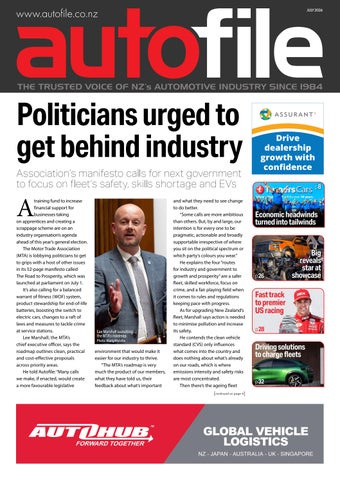
Politicians urged to get behind industry Association’s manifesto calls for next government to focus on fleet’s safety, skills shortage and EVs
A
training fund to increase financial support for businesses taking on apprentices and creating a scrappage scheme are on an industry organisation’s agenda ahead of this year’s general election. The Motor Trade Association (MTA) is lobbying politicians to get to grips with a host of other issues in its 52-page manifesto called The Road to Prosperity, which was launched at parliament on July 1. It’s also calling for a balanced warrant of fitness (WOF) system, product stewardship for end-of-life batteries, boosting the switch to electric cars, changes to a raft of laws and measures to tackle crime at service stations. Lee Marshall, the MTA’s chief executive officer, says the roadmap outlines clean, practical and cost-effective proposals across priority areas. He told Autofile: “Many calls we make, if enacted, would create a more favourable legislative
Lee Marshall launching the MTA’s roadmap. Photo: Marty Melville
environment that would make it easier for our industry to thrive. “The MTA’s roadmap is very much the product of our members, what they have told us, their feedback about what’s important
and what they need to see change to do better. “Some calls are more ambitious than others. But, by and large, our intention is for every one to be pragmatic, actionable and broadly supportable irrespective of where you sit on the political spectrum or which party’s colours you wear.” He explains the four “routes for industry and government to growth and prosperity” are a safer fleet, skilled workforce, focus on crime, and a fair playing field when it comes to rules and regulations keeping pace with progress. As for upgrading New Zealand’s fleet, Marshall says action is needed to minimise pollution and increase its safety. He contends the clean vehicle standard (CVS) only influences what comes into the country and does nothing about what’s already on our roads, which is where emissions intensity and safety risks are most concentrated. Then there’s the ageing fleet
Drive dealership growth with confidence p8
Economic headwinds turned into tailwinds
p 26
Big reveals star at showcase
Fast track to premier US racing p 28
Driving solutions to charge fleets p 32
[continued on page 4]
GLOBAL VEHICLE LOGISTICS NZ - JAPAN - AUSTRALIA - UK - SINGAPORE
LOAD IT SHIP IT TRACK IT CLEAR IT
GERDELIVER IS IT ! TER
move to new, much larger premises means we are to offer even more services to our dealer clients
to door ro-ro vehicle shipping from Japan and Australia
ainerised vehicle shipping from anywhere in the world Customs clearance Vehicle tracking
VEHICLE SHIPPING
GENERAL FREIGHT
VEHICLE TRACKING
SHIPPING SCHEDULE
We are specialists
We have developed
exporting all types of Vehicles, Commercial trucks, vehicles of Special Interest and other RORO Heavy Cargo & Machinery.
Agents who understand the commitment required to service our demanding market.
Finding out where your vehicle is at any one time of the process, gives you the ability to manage the collection and processing of documents and payment on time.
TRS and shipping services from Japan to New Zealand.
proved MPI transitional facilities and cleaning services
g it all off is Jacanna’s SmartTrade Rewards Programme, transporting andreward you choose a worldwide network of you can earninpoints for almost any
Tel: +64 9 825 0888 info@jacanna.co.nz Terms and conditions apply. www.jacanna.co.nz
www.jacanna.co.nz
JACANNA.CO.NZ
Tel: +64 9 825 0888
www.jacanna.co.nz info@jacanna.co.nz
Tel: +64 9 825 0888
Call Steve Owens now on 021 947 752 GUEST EDITORIAL
Road must stay open to electric destination Used imports have different but essential role to new-car market in switch, says Greig Epps
T
here’s no serious Many households argument about aren’t choosing between the direction of new EVs and used hybrids, travel in New Zealand but between $15,000 because electric vehicles replacements, older petrol are the end point for the models or keeping cars light fleet. they have for longer. GREIG EPPS Our country has good Lower running costs Chief executive, reasons to move that matter, but the first hurdle Imported Motor Vehicle Industry Association way. We have a highly is still the sticker price. renewable electricity Affordable used EV system and import almost all our supply doesn’t yet exist in sufficient transport fuel. volume in Japan or other rightIn addition, every vehicle hand-drive source markets, and powered by locally generated we also face shipping constraints, electricity reduces our exposure battery-confidence issues and to imported oil, volatile prices and affordability limits. transport emissions. Our future pool of used electric So, the question isn’t whether cars must first be created via we should transition to EVs. It’s the new-import channel, which how we manage that in a way should carry the game-changing that’s practical, affordable and ambition. It’s where the newest EV durable because changing the fleet technology enters the fleet and takes time. where policy can most directly Norway is often held up as influence supply. the poster child for uptake. It has The used-import channel has achieved extraordinary levels of a different but equally important electric new-vehicle registrations role. It supports practical fleet after decades of consistent policy. refreshment right now by bringing But even there, where in affordable hybrids and efficient recent sales of new cars have petrol models that can replace overwhelmingly been electric, a older, higher-emitters already on large share of the fleet is still petrol our roads. A used hybrid replacing and diesel. Even when the new a 20-year-old petrol car is still market changes quickly, the fleet progress. It may not be the end changes slowly. goal, but it’s a step in the right Norway also started from a very direction. different position. Its EV transition Poorly calibrated policy has been backed by longrisks breaking that pathway. If running tax settings, cross-party unreachable targets, compliance commitment, high national wealth, costs and supply constraints push and a fiscal base shaped in part by budget-friendly replacements oil and gas revenue. out of reach, buyers don’t We cannot copy its headline automatically switch to EVs. result and ignore the machinery The destination is electric, but that produced it. We need a shift the road there must remain open that reflects how Kiwis buy vehicles. for ordinary Kiwis.
DIRECTORS
EDITOR
dazzz@autofile.co.nz ph. 021 0284 7428
ris@autofile.co.nz
Darren Wiltshire
Brian McCutcheon brian@autofile.co.nz ph. 021 455 775 DESIGNER
Adrian Payne
arpayne@gmail.com
Darren Risby JOURNALISTS
Matthew Lowe
matthew@autofile.co.nz
Sue Brebner-Fox sue@autofile.co.nz MOTORSPORT
Mark Baker
veritas.nz@xtra.co.nz
Visit www.autofile.co.nz to subscribe to Autofile magazine and have it delivered monthly in print. The subscription rate is $78 plus GST for 12 issues per year. Autofile magazine is also available online as a readable file or downloadable as a PDF. Back copies dating to 2017 can be found on the website where you can subscribe to our Insight email alerts. Copyright: Published monthly by 4Media Ltd
All statements made, although based on information believed to be accurate and reliable, cannot be guaranteed, and no liability can be accepted for any errors or omissions. Reproduction of Autofile in print or digital format in whole or part without written permission, whether by copying or any other means, is strictly forbidden. All rights reserved. ISSN 0112-3475 (print) ISSN 2350-3181 (online)
NZ’s independent vehicle inspection specialists We of fer a full range of services. • Entry Certification for imported cars • Vehicle Appraisals • WoF/CoF Inspections • Road User Charges • Registration & Relicensing • Exhaust Emission Testing
www.vinz.co.nz
Appointed by the NZ Transport Agency
www.autofile.co.nz
3
news
[continued from page 1]
Giving their views at the MTA’s event – from left, Act’s Cameron Luxton, NZ First’s Andy Foster, National’s Erica Stanford, the Greens’ Julie Anne Genter and Labour’s Tangi Utikere. Photos: Marty Melville
to consider. The average light passenger vehicle in New Zealand during 2024 was 15.2 years old compared to 14.3 in 2015, while in the European Union it was 12.5 years in 2023. It’s for these reasons the MTA wants to pilot a targeted upgrade scheme. This would mean giving a $2,000 allowance to Kiwis who permanently scrap a registered vehicle aged 20 years or older with that money redeemable towards a newer replacement. The thinking behind this is to complement any import-side settings that remain in place without penalising purchases of newer vehicles. A rolling 20-year threshold would focus on removing the
oldest cars from the fleet. What replaces them will need to be 10 years old or newer and there should be no powertrain bias because models with internal combustion engines are “still cleaner and safer” than vehicles more than two decades old. The MTA suggests paying for the time-limited trial from the National Land Transport Fund (NLTF), for example at one per cent. If NLTF investment is about $5.72 billion – as it was in 2024/25 – one per cent would equate to about $57 million annually, which could support around 28,000 upgrades via $2,000 vouchers. Proof of scrappage would be needed with anti-fraud settings enforced. “This is a relatively cheap route
to emissions reductions with practical support geared towards the most disadvantaged in society,” says the MTA. Investing to boost the uptake of EVs is being proposed by the association. It recognises companies’ fleets as the dominant entry point for new vehicles, which later become sought-after NZ-new used cars for households. The current tax framework treats business vehicle investment uniformly with no mechanism to recognise the national fleet’s safety, productivity and decarbonisation benefits when companies acquire EVs. The MTA says: “Investment Boost, introduced in Budget 2025, provides a framework to recognise this through the same productivity logic the government has endorsed for capital investment generally. “Through this scheme, we should allow EVs double the current depreciation rate to 40 per cent.
“The result would be a programme with no new compliance and no new spending line.” Eligible models would be battery electric bought as assets, with the upfront tax deduction in the year it is first available for use in addition to ordinary depreciation on the remaining 60 per cent of the cost base. Within three to five years, the increasing availability of EVs will support a stronger second-hand market and potentially lower their sticker prices for households without the need for direct consumer subsidies. Also on the environment, the MTA wants a battery product stewardship scheme rolled out using Tyrewise as a model for success. It says while electrified vehicles look set to cut emissions, the absence of a system to manage old batteries poses a big risk.
The MTA’s election-year manifesto has been produced after close consultation with its members and a big issue it tackles is upskilling the automotive workforce. Chief executive Lee Marshall told Autofile: “I would say the idea for a national trades training fund is the most ambitious of all our asks.” He explains this could be supported by using money from the scrapped final-year fees-free scheme. “Rediverting some funding towards helping businesses take on apprentices can help industry outcomes. “When we poll our members, the lack of ability to find skilled tradespeople is still the numberone issue constraining business performance.” Among the leading calls in the MTA’s roadmap is creating a
scrappage scheme to get older vehicles out of the fleet. “When we compare New Zealand to other developed countries, one of the major things we think that keeps our fleet old is we don’t have any meaningful mechanism to see vehicles taken out of it.” In some ways, the “fleet upgrade scheme” aims to address some of the same problems the clean car standard and discount did, but from vehicles at “end-of-life rather than at the start”. Overall, the manifesto aims to stimulate dialogue between industry and government because “it’s important we work together on large issues and, as much as possible, try to achieve cross-party support”. Visit autofile.co.nz for an in-depth interview with Marshall.
Opinion from the top
SP E C I A L IS T S I N
PRE‑SHIPMENT INSPECTIONS MPI biosecurity inspections Biosecurity decontamination Heat treatment NZTA border inspections Odometer verifications Pre-export appraisals ?
Lost documentation reports
www.jevic.com 4
www.autofile.co.nz
news t
A regulated scheme for tyres has been set up under the Waste Minimisation Act (WMA) but one for batteries, which were declared priority products some years ago, doesn’t exist despite organisations being set up to oversee it. To solve the problem, the MTA wants regulations completed and gazetted under the WMA, with Auto Stewardship NZ installed as the product stewardship organisation. Costs to cover the future processing of batteries would be captured at import where they would be weighted by type, capacity and handling cost. Importers, sellers, transporters, repairers and processors would need to be registered, and recovery and recycling targets set. The self-funding scheme would reduce fire and contamination risks at workshops, scrap yards, transporters and landfills. There would also be clearer liability and chain-of-custody arrangements for businesses handling damaged or end-of-life packs. “A working, regulated and industry-funded scheme needs to be in place ahead of the projected end-of-life battery wave, not after it,” says the MTA. Decisions by the coalition recently about the WOF system have been opposed by the association, its members and other industry organisations. The MTA stresses that failure rates rose from 37 per cent in 2017 to 41 per cent in 2024, which includes retests and understates the number of unsafe vehicles on our roads. It says the reforms stand to “significantly” reduce fleet safety. While checking advanced driverassistance systems is “sensible”, this shouldn’t justify longer inspection intervals because core roadworthiness checks on tyres, brakes, steering and suspension still need to be done. The association is calling on the next government not to automatically proceed with the second phase of the reforms, which are due to extend two-yearly WOFs to vehicles aged seven to 14 years. At minimum, this needs to be delayed by two years so data from
THE ROAD TO PROSPERITY How the next Government and the Automotive Industry can drive economic growth.
2026
A national trades training fund is the most ambitious of all our asks – Lee Marshall other changes can be assessed. “If the next government intends to proceed with the second phase, it should be delayed from November 2027 to November 2029. “A two-yearly WOF cycle takes two years. The second tranche is timed to arrive before even one full cycle has played out under the first. A two-year delay allows that cycle to complete and provide evidence before the next changes land.” The MTA wants a simpler regime maintained for pre-2000 vehicles provided complementary road-safety measures support the renewal of the fleet. It adds consultation should start on mileage-based inspections alongside the move to digital and universal road-user charges (RUC). “As digital RUC infrastructure matures, mileage data could support a shift towards inspections tied to usage rather than age alone for a more evidence-based approach.”
TRAINING AND TALENT New Zealand’s ambitions are being limited by shortages of tradespeople and technicians, and the MTA wants major action to tackle this. The NZ Institute of Economic Research estimates each apprentice costs a business between $80,000 and $100,000 per year, which is “only negligibly offset” by Apprenticeship Boost. In addition, the “ineffective” final-year fees-free scheme was canned in this year’s budget.
The MTA is calling for the annual savings from that of between $150 million and $200m to be redirected into a national trades training fund (NTTF) with Apprenticeship Boost scrapped. The government is being urged to target trades and technical roles underpinning transport delivery, infrastructure and fleet
resilience such as construction, civil, mechanical, electrical, heavy automotive and car maintenance. Barriers to tools and supervision support need to be removed so more young people sign up for apprenticeships, with access made simple for employers and providers with clear eligibility and quality requirements. A regular review of in-scope occupations needs to be built into the NTTF so it tracks workforce demand rather than legacy lists. If this is done, the MTA believes barriers to employers taking on apprentices and investing in training will nosedive. In addition, there will be: More capacity to deliver the roading and transport programme, and maintain the fleet. A stronger, more reliable domestic skills pipeline and less reliance on immigrants. Lower youth unemployment and a durable solution to the skills shortage. [continued on page 6]
VEHICLE IMPORT FINANCE AT COMPETITIVE INTEREST RATES
w
EASY APPLICATION
EFFICIENT SERVICE
Submit two downloadable forms and simply send to us for review.
Hear back from our team about finance in as little as 24 hours.
COMPETITIVE INTEREST RATES & FEES
NZ BASED
Our partnerships give us the ability to offer superb lending rates.
www.autobridge.co.nz
Autobridge is New Zealand based and covers the country, so we are never far away when you need us.
09 320 5646
ENQUIRE NOW ABOUT TRADE FINANCE FOR YOUR BUSINESS www.autofile.co.nz
5
news
[continued from page 5]
As part of replacing the NCEA, all secondary trades programmes should include a mandated component delivered in workplaces because vocational learning is still too classroom-based. “The result is a gap between what employers see at the school gate and what an apprentice needs to become a valuable asset,” says the MTA. “The design of the new qualifications system is a once-in-ageneration opportunity to embed workplace learning as the default for trades rather than treating it as an optional extra.” It’s calling for 50 per cent hands-on training, and allowing polytechnic, digital and classroom components to complement workplace learning. A funding mechanism is needed to support schools and employers, recognising the time and supervision cost employers absorb when taking on schoolbased learners. This would mean students
Sturrock Saunders, president of the MTA, at parliament’s legislative chamber. Photo: Marty Melville
leave school with practical and demonstrable skills backed by qualifications, and there will be faster transitions into apprenticeships with fewer dropouts in year one. As for importing talent, the MTA is calling for action from Immigration NZ (INZ), starting with its green list that offers fast-track residency pathways for people in specific occupations. It contends the current twotier system can significantly lag real-time shortages, which creates delays, repeated lobbying cycles, and uncertainty for employers and migrants. The association’s fix is an industry-led quota model with
Our strength comes from knowing our customers’ needs, understanding and fulfilling them
Mechanical Breakdown Insurance
Comprehensive Motor Vehicle Insurance
Credit Contract Indemnity Insurance
Guaranteed Asset Protection Insurance
Mechanical Breakdown Insurance EV & Hybrid option available Uber & Taxi cover available
Contact:
Simon James 027 239 0253 SimonJ@questinsurance.co.nz 6
www.autofile.co.nz
approved peak bodies managing an annual allocation of priority roles, and INZ retaining oversight and enforcement powers. It would entail industry organisations having an annual skills limit, and swapping roles in and out as needed. Such changes would be supported by evidence with INZ retaining authority to suspend roles, impose conditions and bar non-compliant employers from hiring migrants. All of this, the MTA adds, will lead to faster responses to genuine shortages, less bureaucratic churn and politicisation of roles, clearer accountability for industry and better stewardship of settings. In turn, there will be more predictable access to skilled migrants when needed. In addition, settings for accredited employer work visas should be streamlined for members of approved standards-based peak bodies by removing the need for employer accreditation and job checks because the current system can be slow and duplicative. By simplifying job mobility, migrants could be allowed to move between member businesses covered by the same organisation with INZ notified when this happens. The latter would still be able to stop companies hiring migrants. This fix would reduce delays and lower compliance costs for trusted employers, and result in less INZcreated labour shortages but a more agile market response.
LEGISLATION CHANGES The MTA has convened a crossindustry workforce to broker a solution that caters to consumer and industry needs by considering our unique market when it comes to right to repair. It’s lobbying for a legislated
tiered-access framework that considers what’s best for customers, vehicle importers and the repair sector in a balanced and reasonable way. “The government and industry can work together to streamline processes, and relieve unproductive pressure points and increase competition especially for smallmedium enterprises [SMEs],” it says. The association wants the Motor Vehicle Disputes Tribunal expanded so it can hear repair and workmanship disputes, and for adjudicators to make allowances for depreciation under the Consumer Guarantees Act. It adds a mandatory franchising regime is needed, as well as active enforcement of existing safeguards against unfair contract terms to benefit smaller parties. Other ideas include establishing basic monitoring of debanking activity so regulators, government and affected sectors have visibility, a notificationbased safe harbour for eligible SME collective bargaining arrangements, improving fuelpricing competition and reducing average fuel costs by amending relevant legislation. The next government also needs to focus on crime with service stations being among the “most vulnerable businesses in our communities for crime”. The MTA wants an industryled fuel retail crime group set up with parties committed to regular engagement with the Minister of Police and NZ Police. In addition, an explicit focus in tackling fuel theft and retail crime needs to be in the minister’s letter of expectations to the Police Commissioner after the general election, as well as 100 per cent tax deductibility for crime-prevention expenditure and a fund to help SMEs invest in technology.
BUY SMARTER. SELL FASTER. STAY AHEAD. Hundreds of vehicles auctioned every week and nearly 1,500 users ready to trade. Auction Online gives you real-time access to the true used-vehicle market, nationwide. Buy, sell and manage stock from anywhere – fast, transparent and competitive. Whether you’re clearing trade-ins, moving aged stock or filling your yard, our streamlined auction platform simplifies every step. • Nationwide dealer network Almost 1,500 users actively buying and selling. • Real-time pricing transparency Live bidding ensures you always hit true market value. • High stock turnover Hundreds of vehicles auctioned every week across NZ. • Purpose-built dealer platform Designed specifically for franchise & independent dealers. • Fast, simple, secure Seamless listings, bidding and purchasing from one platform.
Join Auction Online today and start trading smarter auctiononline.co.nz www.autofile.co.nz
7
news
Diversifying key to success T
he number of car dealers across New Zealand has been declining for years and the trend is accelerating. In addition, sourcing stock is getting harder and pricier for smaller operators, the burden of compliance is increasing and the investment required to compete digitally is now substantial. These are headwinds for the industry, but they are tailwinds for Turners Automotive Group, according to chairman Grant Baker and Todd Hunter, chief executive officer. “As barriers rise and sub-scale operators continue to exit, our network, brand and integrated platform become more valuable,” they say. “We are well-placed to continue gaining market share and intend to do so. We remain firm believers that being closer to our customers drives sales and generates more sourcing leads.” The company now owns 33 sites nationwide with a cost value of $166 million and more are “in active development”. “The pipeline is building and we continue to see opportunities to purchase sites at attractive valuations as we move through the interest-rate cycle.
Todd Hunter, left, and Grant Baker
“Our branch expansion in Christchurch is the clearest example of roll-out economics in action.” The city now has three branches of Turners Cars, which has resulted in a 15 per cent increase in sourcing leads and a 22 per cent jump in local units sold. “The model works,” say Hunter and Baker. “It’s exactly the operating leverage we’re aiming to replicate as the network expands and we locate branches closer to key population catchment areas.” Four more new branches and two replacements are in the pipeline for 2027/28, while 2026/27 “will be a year of building and preparing rather than opening, laying important groundwork for the next wave of growth”.
while retaining enough capital to fund growth. The board declared a final dividend of nine cents per share, fully imputed, taking the full-year dividend to 33cps. That was up by 14 per cent on 2024/25 for a compounded annual rate of 10.5 per cent over the past 12 years. “Sustaining this return of value requires the same discipline in capital allocation that has characterised this business from the beginning.”
CROSS-DIVISION RESULTS
Since 2021, Turners has set multi-year targets and has hit them early. It delivered net profit before tax (NPBT) of $45m in 2023/24 and $50m in 2024/25, both one year ahead of schedule. Based on the company’s momentum in the 2026 fiscal year, it expects to deliver its $65m prediction for 2027/28 in 2026/27. “We don’t set targets to manage expectations,” say Baker and Hunter. “We set them to stretch ourselves and then hold ourselves accountable.” The company hosted an investor day in March and set its next chapter of $100m profit by financial year 2031. It also aims to provide shareholders with a reliable and growing cash return
Baker and Hunter say 2025/26’s record result is a reason to feel good about where Turners is heading. NPBT was $63.2m, ahead of upgraded guidance. Turners Cars’ sourcing strategy is increasingly focused on domestic supply, which is proving to be a “genuine competitive advantage”, while the expansion of its network is “reinforcing” its presence in key markets. This division also saw strong performance from its commercial division, and damaged and endof-life revenues, during the past financial year. Strategically, the biggest opportunity remains expanding the branch network as automotive
FROM JAPAN TO NEW ZEALAND
ON TIME, EVERY TIME
TOYOFUJI SHIPPING SCHEDULE Toyofuji vessels
Voyage
JAPAN
NEW ZEALAND
Moji
Osaka
Nagoya
Yokohama
Auckland
Lyttelton
Wellington
Nelson
9 Jul
11 Jul
12 Jul
Dream Angel
63
10 Jun
14-15 Jun
16 Jun
21 Jun
5 Jul
Trans Future 6
167
—
22 Jun
24 Jun
28 Jun
17 Jul
T/S to NC1 v205 & TF5 v167
T/S to NC1 v205 & TF5 v167
New Century 1
205
—
29-30 Jun
1 Jul
5 Jul
18 Jul
21 Jul
23 Jul
Trans Future 5
167
—
6 Jul
7 Jul
11 Jul
2 Aug
5 Aug
7 Aug
8 Aug
Dream Jasmine
55
—
16 Jul
17 Jul
19 Jul
2 Aug
T/S to TF5 v167
T/S to TF5 v167
T/S to TF5 v167
19 Jul T/S to TF5 or TF6 V.167
T/S = Tranship to next available TFS vessel
Contact: Adam Stone
8
www.autofile.co.nz
adam.stone@toyofujinz.co.nz
www.toyofujinz.co.nz
news retail has kept up its momentum despite the economic conditions. Oxford Finance delivered a strong result in 2025/26 with its loan book growing in volume and quality. Its arrears remain “well below market levels, a testament to our disciplined approach to credit”. Consumer loans rose while commercial lending dropped. Autosure continues to build up a head of steam in the insurance sector, especially via its digital and direct-to-consumer channels. Early sales after launching mechanical breakdown insurance for the private-to-private market “have been encouraging and validates this as a complementary, scalable growth opportunity”. Turners Servicing & Repairs – still in its early stages – is positioning the group to secure a “meaningful” share of a $3 billion market, which “sits alongside everything else” it does. “As flagged earlier in the year, we reviewed the carrying value of the EC Credit business, resulting in
Turners’ media investment totalled $5.1m in 2025/26, while its servicing and repairs division is positioning the group to secure a “meaningful” share of that market
a non-cash goodwill write down of $7.5m,” explain Hunter and Baker in their annual report. “EC Credit is the smallest part of our group and is non-core to automotive, which is where we see the most compelling long-term opportunity. “We will keep investing in our people, property, technology and brands to ensure the platform we’ve built remains the one Kiwis turn to when it comes to buying, selling, financing, insuring and servicing vehicles.”
WINNING IN TOUGH TIMES A key driver for Turners Automotive Group will continue
to be diversification and it remains confident in its trajectory and expectation to hit its $65m profit target for 2027/28 a year early. “That will be the third time we’ve beaten a multi-year target ahead of schedule,” say Hunter and Baker. “After that, we’ll have our sights firmly set on $100m by financial year 2031. “The platform is built, the team is exceptional and we have a fiveyear strategy, which we believe is credible, funded and executable. “We have great businesses that are even better together. Each part makes the others stronger, and the platform we’ve assembled is one
that cannot be quickly or easily replicated. That’s what the next chapter is about – not building something from scratch, but unlocking the full potential of what we’ve already built. We are excited about what that looks like.” As for the past financial year, late March brought uncertainty as geopolitical events weighed on consumer sentiment and car trading during April was subdued. “We’ve seen this before. In automotive retail, we have implemented the same ‘tough macro’ playbook used in financial years 2024 and 2025 with a strong cost focus, more selective buying and positioning inventory for where demand is, including cheaper smaller-engine vehicles and increased purchasing of smaller hybrids. “In the meantime, finance and insurance keep building. They are annuity businesses so don’t stop when a car yard gets quiet. Diversification is enormously valuable in periods like this.”
www.sbltd.co.nz www.autofile.co.nz
9
Lending in the fast lane Our new Avanti Partner Portal is more than an origination platform. It’s a whole new custom-built system that helps you get more deals to approval faster.
AVANTIFINANCE.CO.NZ/PARTNERPORTAL
Lending criteria, fees, terms and conditions apply. 10
www.autofile.co.nz
Avanti puts dealers in control AS PRESSURE BUILDS on car dealers to deliver faster finance approvals with fewer touchpoints, specialist lender Avanti Finance has launched a new loan-origination platform to remove friction from the application process and put greater control back in traders’ hands. The company says its Avanti Partner Portal is changing how it does business by using intelligent automation to improve the quality and speed of lending decisions. The self-service system has been purposebuilt to enable introducers to submit and manage their applications without the need for back-and-forth emails or phone calls. A personalised loan rate for customers can be generated in less than one minute by entering only a few details. Avanti says the new portal has more than halved the overall time it takes to submit a finance application while automated approvals, powered by a new decision engine developed by Avanti’s in-house technology team, can be delivered in less than a minute after submission. Lee Robson, general manager of auto, says the fresh approach comes after listening to feedback from introducers and delivering on many of their requests and needs. “We’ve given introducers an easier and more comprehensive tool from which to administer finance through Avanti,” explains Robson. “We have put control of the loan application, electronic verification and settlement processes into the hands of introducers to enable them to manage those processes far more efficiently.” Through a single dashboard, dealers can monitor application progress, upload documents and receive real-time status updates. Once an application is fully approved, loan contracts are automatically generated and ready for customers to review and sign – another part of the new process that saves time. Designed to provide speed and control for introducers, the portal also helps dealers grow their business by delivering better experiences for customers. “We have really focused on minimising the amount of information we ask for through the application process,” says Robson. “Ultimately, customers and introducers have less time these days, and both parties want a quick outcome for applications. “Internally, we have also significantly cut the time it takes for us to make referred decisions. “In comparison to our outgoing portal,
Lee Robson
We want to become the partner of choice for all our introducers and are proud to deliver a market-leading solution Lee Robson, GM Auto, Avanti Finance
Asheelta Sharma Asheelta Sharma
we’ve cut that time by more than two-thirds. Since going live, we’ve been seeing lenderreferred decisions ranging between four and eight minutes, depending on the complexity.” More efficient internal processes help make Avanti’s services more meaningful to customers, with Robson highlighting that the
company can now settle loans with cleared funds advanced “on the hour, every hour”. The “intuitive” portal went live in April after being piloted with a small group of introducers since November 2025. He says: “We had a group of introducers working with us through the whole build to ensure what we delivered was what the wider industry actually needed. “They have been with us throughout the design and launch phase to make sure the service meets the needs of introducers. “What we have delivered for version one is a very strong starting point. Although our first version is functional, slick and robust, it’s just the start. We have several revisions coming in the future to improve the portal’s functionality, which are aimed at making it even easier to work with Avanti.” The pace of improvement is now supported by a significant lift in change agility, with the platform provider and Avanti’s in-house technology capability enabling faster, more efficient updates. Robson adds: “Avanti has invested heavily in technology enablement over the past few years. We are now well-placed to adapt to change as it happens, at speed.” Supporting dealers through the transition has been a focus. Asheelta Sharma, process improvement and optimisation lead, says resources and webinars have helped introducers quickly build confidence on the new platform. “Feedback on the portal has been very positive,” she adds. “Introducers are telling us it’s intuitive to use and the self-service functionality helps them deliver a better customer experience. “We’re also hearing that auto-decisioning helps speed up turnaround times across the application journey. That’s been great to hear as those are some of the key pain points we set out to solve.” The portal is the latest innovation from Avanti as part of its commitment to continuous product development to meet emerging industry and consumer needs, and fulfil its own ambitions. “We aim to challenge the status quo and grow value off the back of great service, great support and great systems,” says Robson. “The Avanti Partner Portal is delivering a major milestone in our journey to make loan origination with Avanti comprehensive, simple and fast. “We want to become the partner of choice for all our introducers and are proud to deliver a market-leading solution.” www.autofile.co.nz
11
news
Insights into changing market D
ealers in New Zealand are being urged to get ahead of their rivals and act now before pressures and innovations emerging in the Australian market start to impact businesses on this side of the Tasman. A number of speakers will tackle industry developments at the 2026 Australian Automotive Dealer Association (AADA) Convention and Expo this month, giving delegates a chance to gain insights into those changes. Nicholas Johnson, AdTorque Edge’s head of growth, is among those who will be presenting at the July 29-30 event in Sydney. He told Autofile that New Zealand dealers who attend can gain a perspective of the industry they can’t get at home and gain “first-mover advantage” over domestic competitors. AADA 2026 also puts delegates in the same room as dealers, original equipment manufacturers (OEMs) and suppliers setting the pace for automotive retail in the southern hemisphere. “It’s a chance to benchmark against a larger, faster-moving market, pressure test your plans with people facing the same challenges at a greater scale, and
come back with a clearer view of doing the early research for buyers where you’re strong and where before they see a traditional ad, you’re exposed,” explains Johnson. which means some of the old “Australia typically runs 12 to promotional tactics can start to 18 months ahead of New Zealand work against you. on digital and retail innovation, “Second, there’s what we call so AADA 2026 is effectively a look the ‘performance penalty’. When over the horizon with enough lead you lean too hard into performance time to act on what channels and you see.” underinvest in brand, Being held at total revenue can the International drop 20 to 50 per Convention cent over time. Centre Sydney, “You still see the event brings strong impressions, together franchised plenty of clicks and new-car dealers, a sharp cost per lead industry suppliers, in reports. But the automotive leaders leads that turn up are and retail experts more price sensitive for a programme and harder to close, of presentations, so the damage discussions and shows up in flat gross workshops. Then profit per unit, not there’s the expo, in dashboards or – Nicholas Johnson reports. which features more than 65 exhibitors. “Third, frontJohnson is running a workshop end new-vehicle margins are on July 30 on “maximising dealer now a relatively small slice of marketing return on investment in total dealership gross, so every a changing media landscape”. marketing dollar has to work across He notes the way people buy the whole business and not just cars is shifting and three areas new sales.” are effectively hitting dealers at Johnson will discuss what once. “First, AI tools are already a modern dealer-marketing
AADA 2026 is a look over the horizon with enough lead time to act on
Special price for Kiwis Organisers of the AADA Convention and Expo hope delegates will seize the opportunity to learn about the key issues affecting the industry by attending this year’s event. To help attract more visitors from this side of the Tasman,
12
www.autofile.co.nz
New Zealand dealers are automatically eligible for special registration rates and will pay the same prices as the AADA’s dealer members. Besides access to the expo and a series of presentations, workshops and networking
opportunities, all of this year’s event content will be available on demand to delegates’ dealerships for three months. Patrick Tessier, convention director, says while the event is based in Australia, there are always things people can learn from other markets. “New Zealand is the closest country to us and probably the
ecosystem should look like in the context of the changing market. He also points out the same forces affecting Australia are at play in New Zealand, but often with less room for error because the market is smaller. “New Zealand dealers are dealing with the same pressures of rising media costs, fragmented lead sources, AI reshaping how people research vehicles and being asked to do more with leaner budgets. “We work across both sides of the Tasman and the pattern is consistent. The gap between topperforming dealers and everyone else tends to come down to the same handful of levers whether you’re in Auckland, Christchurch, Sydney or Adelaide.” An upside for New Zealanders attending AADA 2026 is timing and gaining knowledge of market developments. “Many of these shifts are a little further along in Australia, so there’s still real first-mover advantage in New Zealand for dealers who act before the same pressures fully land at home,” adds Johnson. Delegates are also able to access data, research and practical frameworks from people working
most similar market to ours, so the relevance of our programme for New Zealand dealers is very high. “Kiwi dealers can learn more about things such as stock turnover, reconditioning, the relationship between finance and insurance, and how to retain used-car customers. Hopefully New Zealand can teach us something as well.”
news t across hundreds of dealerships, but rather than having months of trial and error those insights are condensed into two days.
PROTECTING MARGINS Another topic being addressed at AADA 2026 is “how to thrive in a high-tech, low-margin new car sales market”. A main-stage presentation about this subject on the convention’s opening day features CarExpert co-founder Paul Maric and Damon Rielly, its chief executive officer. It will focus on the structural changes reshaping new-car retail such as tighter margins, new entrants, electrification, demos and near-new stock, pricing transparency and customers arriving at dealerships more informed than ever. Rielly says this is an important topic because new-vehicle retail is no longer just about having stock and waiting for customers to walk in.
Dealers in both markets are dealing with many of the same pressures
– Damon Rielly
“Buyers are doing much more of the journey before they ever engage with a dealer,” he told Autofile. “They are comparing models, prices, ownership costs, finance options, reviews and alternatives in real time. “Dealers who can meet that customer with transparency, speed and trust will be better placed to protect margin and convert.” Rielly notes the same forces are playing out in Australia and New Zealand with consumers facing the same broad questions, such as which brands to trust, which technologies to consider, what
represents value and how to feel confident in a major purchase decision. “Through our partnership with Trade Me and the launch of CarExpert NZ, we now have a closer view of how Kiwis are researching, comparing and shortlisting new cars,” explains Rielly. “That gives us a unique perspective on the full buying funnel, from early awareness and education through to comparison, intent and purchase support. “For dealers, that matters because the opportunity isn’t simply to generate more leads, it is to understand how intent is formed
AADA CONVENTION & EXPO
and how to turn better-informed customers into better-quality sales opportunities.” Rielly describes AADA 2026 as a valuable opportunity for car traders to step outside the day-to-day and consider broader changes in the region. “Australia and New Zealand do not always move in the same way, but dealers in both markets are dealing with many of the same pressures, such as margin compression, new brands, changing OEM strategies, electrification, digital retailing, lead quality, staff capability and rising customer expectations. “The benefit of attending is that dealers can benchmark themselves against peers, hear what’s working in other markets and come home with practical ideas they can apply in their own businesses. “It’s also a chance to build relationships with OEMs, technology providers, finance and insurance partners, and dealers across the region.”
SYDNEY | 29-30 JULY
Mates’ RatEeRsS FOR KIWI DEAL
REGISTER NOW!
aadaconvention.com.au www.autofile.co.nz
13
news
Awards for work in training T
wo leaders at MITO have been honoured with chairman’s awards from the Collision Repair Association (CRA). Chief executive Verna Niao and Warren Flowerday, deputy board chair, have been recognised for going above and beyond in service to the industry. They received the awards at a dinner in Melbourne from Jeff Robson, who is now in his second year as the CRA’s chairman. He says: “Warren and Verna were instrumental in returning the organisation back into industry ownership, which is a tremendous achievement and a great win.” Flowerday has been a key figure in the collision repair and refinishing sector for many years. He has been with I-CAR since 2022, and served for 13 years on the CRA’s national executive and for four years as chairman before joining MITO’s board.
From left, Jeff Robson, Scott Wiseman, CRA national executive member, Warren Flowerday, Verna Niao and Ben Thomas, editor of PanelTalk, the CRA’s official journal
“I invited Warren to join early in 2025 knowing we would need someone with his energy and stature to support this important work,” says Sturrock Saunders, who chairs MITO’s board. “He has been a stalwart throughout and our success is due in no small part to his efforts.” Flowerday adds: “Our industry has given me a lot over the years, so being able to give something
back and to be helping support MITO’s transition has been important to me. “I am especially honoured to be sharing this award with Verna. “It takes good people around you who care about the future of the trades and are willing to put their hand up. Verna carried an incredible workload during the process.” Niao has headed up MITO since
data experience that has helped us turn a complex reporting environment into a professionalgrade platform. “This launch is the first stage of a broader programme to modernise our data services, improve accessibility, and support the future needs of members and industry.” Chris Knight, chief executive officer of InfoAgent, says: “We’re proud to partner with the MIA on DataHub and support a more streamlined, secure way for approved users to access automotive data and insights. “It’s now live with data access and product enquiries managed directly by us.” Organisations outside the MIA’s membership interested in accessing industry data should email Angela Drake, customer partnerships lead, at enquiries@infoagent.co.nz. InfoAgent is managing all data queries, including access to available products, subscriptions and tailored data solutions.
rade Me has appointed Lisa Stewart as head of motors after leading its marketplace division for the past seven years. Before joining the online platform in 2017, she held roles at eBay and strategic consultancy firms in London. “I’ve been part Lisa Stewart of the Trade Me team for nine years, bringing a background in global marketplaces from my time at eBay in the UK,” says Stewart. “While there, my focus was on strategic responses to Facebook Marketplace and designing enhanced, category-specific experiences. “I initially joined Trade Me as head of strategy and ventures, which gave me a fantastic bird’s-
2022 and has also served on I-CAR’s board since 2017. “Verna brings a wealth of expertise in supporting industry to meet its goals,” says Saunders. “Her commitment has driven MITO’s success since she began in 2002.” Niao adds: “It’s a privilege to work with such an inspiring industry, and the people whose skill and commitment help shape its future.”
Vehicle data for new era Top spot in motors role
T
he Motor Industry Association (MIA) is modernising how newvehicle sales data is managed and reported in New Zealand. The MIA DataHub, which has been developed in partnership with InfoAgent, is a secure and flexible platform that creates a stronger foundation to deliver timely, reliable and valuable insights. Aimee Wiley, the association’s chief executive, says the system is an important step in ensuring the MIA’s data is managed professionally. “For our members, it provides a more modern and accessible way to engage with key industry reporting,” she explains. “For the wider market, it creates opportunities for approved access to high-quality automotive data and insights.” Wiley describes the partnership with InfoAgent as central to developing a secure and sustainable model to use MIA data. She adds: “InfoAgent brings technical expertise and commercial 14
www.autofile.co.nz
T
eye view into how all our different business units connect. “Since then, I’ve had the privilege of leading several of our businesses and I’m thrilled to step into my new role. “Motors is a fantastic team. I’m looking forward to delivering great value for dealers while elevating the experience for buyers and private sellers.” Stewart has replaced Brendan Hall, who is relocating across the ditch. He says: “Deciding to leave Trade Me has been a bittersweet choice for my family and me as we prepare to return to Australia. “I’m proud of what members of the motors team have achieved. I will be cheering them on from across the Tasman.”
www.autofile.co.nz
15
news
Three wins in row for company M
iles Skoda has been named the marque’s dealer of the year for the third time in a row, and has picked up awards for sales and its business department. The franchise in Christchurch balanced and sustained excellence across the company, and stood out in 2025 for its consistent sales performance, after-sales, marketing and operational foundations. Among the other winners at the awards ceremony at the Onslow restaurant in Auckland was WR Phillips Skoda in New Plymouth. It came top for service and customer experience. Farmer Autovillage in Mount Maunganui was the top parts team and Tristram Skoda on Auckland’s North Shore secured the marketing title. Alex Brown, Skoda NZ’s general manager, says the main award recognises dealerships that excel across all areas of operation rather than in one discipline. He adds: “It’s about doing the hard things well, everywhere and all at once. It recognises dealerships that operate with balance, discipline and alignment, and deliver strong results across the full customer journey.
From left, Andre Heyns, Miles Group managing director, Miles Skoda’s after-sales manager Glenn Carson, sales manager Christopher Willetts, group marketing manager Mark Lincoln and general manager Jodie Tait
“What sets a dealer apart is that nothing feels accidental. “The results reflect clear leadership, well-defined expectations and teams which understand how their roles contribute to the bigger picture.” Brown says Miles Skoda taking
out the top title for the third consecutive time is a first in New Zealand. “To achieve this level of performance once is impressive. To sustain it three years in a row speaks to a culture of consistency, pride and professionalism.”
Matt Markby, left, Skoda NZ’s product manager, and Paul Phillips, dealer principal of WR Phillips James Yates, left, Skoda’s head of product support and warranty, and Mitchell Robertson, Farmer Autovillage Skoda’s group parts manager Natalie O’Brien, Skoda’s marketing manager, and Davide Punturiero, Tristram Skoda’s dealer principal
It warned short-term savings for motorists will be outweighed by extra costs from deferred maintenance and repairs, and there will be more unsafe cars on our roads because of changes to inspection frequencies. “Our position is formed by MTA members, who carry out 80 per cent of the country’s WOF inspections and who were clear in their reservations, which were based purely on concern for the safety and bank balance of everyone on our roads.” In its election-year manifesto,
the association is calling on politicians to defer the change in WOF frequency for vehicles aged eight to 14 for two years while further evaluation work can be carried out. Elsewhere in the MTA’s WOF, the coalition received passes for progress on crime, and its “reassuringly calm and consistent” messaging on the fuel crisis. Strong performances in the past six months in immigration and education have also earnt praise. However, a fail was issued for the economy with the absence of “long-promised green shoots” adding to pre-election pressures on the government, which has “five months to turn that around”.
Warrant changes criticised T he Motor Trade Association (MTA) has given the coalition a fail for safety in its latest warrant of fitness (WOF) inspection. The black mark is one of two for the government, but it has been awarded an overall pass after receiving ticks for taking action against crime, fuel, immigration and education. James McDowall, the MTA’s head of advocacy, says the six-monthly warrant delivers a serious message in an innovative format on how well the coalition
16
www.autofile.co.nz
is working with and for the automotive sector. “There is possibly a degree of irony that the government’s own WOF reforms got a fail in our inspection,” he adds. “The reforms were a significant issue for MTA members and industry. Unfortunately, it chose to go ahead with changes that were unwelcome to many in the sector.” The association highlighted its concerns about the proposals when it published an open letter to the Beehive in newspapers at the end of 2025.
MITO Industry Summit and Awards
Join us to share ideas, celebrate achievement, and strengthen the pathways that support skilled people and thriving businesses across Aotearoa. Keynote speakers Te Radar MC
Brad Olsen
David Galbraith
Infometrics
Business and leadership coach
Dr Michelle Dickinson
Mike Casey
Engineer and technologist
Rewiring Aotearoa
Learn more Scan this QR code to find out more about the MITO Industry Summit and Awards. www.autofile.co.nz
17
Dealers help keep economy moving N
ew Zealand’s economic recovery hasn’t exactly gone to plan in 2026 but it hasn’t fallen off the cliff either. According to the June quarterly predictions from the NZ Institute of Economic Research (NZIER), the global fuel crisis has pushed costs higher and confidence lower. The initial sharp rise in prices triggered by the Middle East conflict have flowed through to inflation, which is expected to climb above four per cent in the June quarter. It’s not the kind of surprise anyone ordered for this year, but it’s one shock New Zealand has so far managed better than many might have expected. Fuel costs have had an enormous impact on our economy. When prices at the pump rise, they nudge up the cost of almost everything, from freight through to groceries and services, and that has been showing up in inflation data. However, there has been a balancing factor at play. The NZIER notes underlying inflationary pressures have remained relatively contained during the war, meaning the recent spike has largely been driven by fuel rather than a widespread surge in pricing activities. This looks more like a curve than a spiral because businesses are feeling the squeeze, but
18
www.autofile.co.nz
importantly they’re not When I recently spoke over-reacting. to someone in the Demand and industry, he joked, competition remain the “who would have key in limiting how far guessed Donald companies can push Trump would be the prices. It’s a sign that the best EV salesperson economy hasn’t sprung in New Zealand?” into panic mode. Or, as It was tongue-inLARRY FALLOWFIELD Sector manager – dealers, many Kiwis might put it, cheek, but reflected a Motor Trade Association “she’ll be right, let’s do behavioural shift. what we do and get on with it”. The Reserve Bank faces a The motor-vehicle market delicate balancing act. Inflation has been a surprisingly strong has again been rising, which performer despite rising costs and would normally call for higher worldwide uncertainty. interest rates. At the same time, Year-to-date figures to the however, demand is softening and end of May from the MTA’s vstat confidence has taken a dip. website show around 55,861 new The NZIER expects the official light vehicles – that’s to say those cash rate will go up from July weighing less than 3,500kg – have followed by another hike later in been sold for an increase of 12.9 the year. While that will add some per cent compared to the same pressure to borrowing, it’s a signal period in 2025. policymakers are acting to keep Registrations of used lightinflation expectations anchored. vehicle imports topped 38,331 While headlines focus on rising units for the period, up by 5.4 per inflation and global uncertainty, cent. New heavy vehicles rose there are several reasons to by 5.2 per cent and used heavy maintain a positive outlook in 2026. imports dropped by 33.8 per cent. First, the current inflation The fuel crisis has shocked spike has largely been tied to fuel “fence-sitters” to explore and shift prices rather than widespread towards more efficient models with overheating of the economy. This hybrids taking some 31 per cent makes it more likely to ease as of 2026’s market by May 31, while global conditions stabilise. battery electric vehicles accounted Second, businesses and for 14.6 per cent of registrations. households are showing Here’s where a bit of Kiwi adaptability rather than retreat. humour captures a deeper truth. Spending hasn’t collapsed,
investment hasn’t stalled and key sectors, such as car sales, are still performing well. Third, New Zealand’s structural drivers remain intact, infrastructure projects are ongoing, the farming industry is growing and the switch to lower-emissions technologies lays foundations for future activity. In the automotive market, the mix of new vehicles, used imports and emerging electric options gives consumers flexibility, which is a key strength in uncertain times. The rest of 2026 could be more challenging than the start of this year, but not necessarily as hard as 2024 and 2025. Growth may moderate and confidence may remain patchy, but the economy has entered this period from a position of relative strength. A lasting resolution to the fuel crisis will be key. The NZIER’s outlook assumes geopolitical tensions will ease by the end of this year, allowing inflation to drift back towards the Reserve Bank’s target range by mid-2027. If that plays out, the current slowdown could prove to be just that and not a setback. For now, the road has become a bit rougher, costs have climbed and confidence has taken a knock. But New Zealand’s economy looks less like it’s stalling and more like suffering a speed adjustment to manage fuel-tank levels.
www.autofile.co.nz
19
news
Industry movers Helping to unlock
JERRY DELANEY is taking over from Russell Pederson as dealer principal of the Ultimate Motor Group in late August. Delaney, pictured, previously spent 14 years with Ford NZ where he served 11 as sales director. He joins Ultimate from Inchcape where he was most recently general manager for this country. His return to the retail network marks a “significant appointment” for the Tauranga-based franchise. Annaliese Atina, managing director of Ford NZ, says: “Jerry’s passion for the brand and track record in executive leadership will be invaluable as we continue to deliver exceptional service to customers.” Ultimate thanks Pederson for his significant contributions and leadership as dealer principal.
LAURETTE LANE and JOE BOND have joined MTF Finance’s executive leadership team. Lane has been appointed as chief credit officer. She was previously with Toyota Finance NZ leading the credit operations and customer service teams. Laurette Lane During her career, she has held senior leadership roles with Toyota Finance, ASB, UDC and ANZ developing expertise in consumer, commercial and asset finance lending. Bond is now the company’s chief commercial officer. He has also joined from Toyota Finance where Joe Bond he spent the past four years as head of sales. Before that, Bond held senior positions with Honda NZ and BMW Financial Services NZ, building experience across sales, business development and customer relationships. He started his career as a mechanic before progressing through parts, vehicle sales and finance positions. “We are continuing to invest in people, technology, products and customer experience,” says Chris Lamers, MTF’s chief executive. “Attracting leaders of this calibre is a strong signal of the opportunities ahead for our business.” Visit autofile.co.nz for the full story. SAMANTHA BARRASS will not be seeking reappointment as chief executive of the Financial Markets Authority (FMA) when her five-year term concludes at the end of January 2027. Steven Bardy, acting chairman, says Barrass advised the board at the end of last year she was unlikely to stay on because of family needs in the UK. Since then, the board has been preparing the process to recruit her replacement. Bardy says the board is grateful for Barrass’ leadership and her continued commitment to the FMA for the remainder of her term. He adds: “Samantha has provided strong leadership through a period of expansion for the FMA, including the implementation of the Conduct of Financial Institutions regime. “Her regulatory experience has been invaluable as the FMA has navigated a challenging global environment and prepared to take on credit regulation.” Barrass adds: “I will provide my full support to ensure a smooth handover. There is much to do as we continue to deliver against priorities in our financial conduct report.”
TO FEATURE IN INDUSTRY MOVERS EMAIL EDITOR@AUTOFILE.CO.NZ
20
www.autofile.co.nz
business potential
A
ngela Drake has been Garage, an automotive workshop appointed customer in west Auckland, along with her partnerships lead at husband Jesse. InfoAgent and has taken more than Her previous roles have 15 years of automotive experience included managing director into her new role. of DriveText, a company using She has held a mix of artificial intelligence to corporate positions and help registered traders has hands-on business create detailed car ownership, which give adverts. her a practical, end-toBefore that, Drake end understanding of had nearly 10 years how the car industry at Trade Me between operates. 2012 and 2021. She was Angela Drake Drake is working senior national account closely with InfoAgent’s clients to manager before becoming sales understand their needs for vehicle manager for the North Island. data, and help them get value InfoAgent provides customised from the information and tools the information to improve business company provides. processes and mitigate risks “The depth of experience across associated with legal and statutory the business is exceptional,” she requirements in the automotive told Autofile. “I’m looking forward and transport industries. to helping customers unlock more Its developers, product designers value from data and technology and business development while building strong, long-term specialists have come together after partnerships.” many years of being “immersed” in Drake also owns JD’s Auto the vehicle-data landscape.
Efficient logistics critical
Keisuke Nagashima has joined general cargo, as well as and Auckland-based Jacanna as its full containers and less-thanbusiness development manager. container-load operations, He was previously director which “opens up a new avenue of Bordercheck from January to someone like me who has predominantly been 2017 to September 2025. He was general vehicle-focused”. Nagashima told manager at Autohub from 2013-21 and Autofile: “One of the things that makes New spent two years before that as the marketing Zealand unique is our location. co-ordinator for Brake & Transmission Ltd. “As an island Keisuke Nagashima Nagashima is nation far from major global manufacturing hubs, also a director, producer, photographer and a competitive efficient logistics and supplychain management are critical to driver at 86Fighters, which specialises in media production keeping our economy moving. “I’m responsible for bringing for the automotive and motorsport industries. new business to Jacanna, whether that be in vehicle, parts, farming, In addition to dealing with cars, he says Jacanna machinery and or general cargo has facilities to handle industries.”
ADTORQUE EDGE
Before they Google, they watch M
eltwater’s 2026 report on New Zealand’s digital landscape confirms what many dealership marketers have been saying for some time, and that’s video has become the default way Kiwis discover, research and engage with brands online. For a dealership’s strategy, the case for investing in YouTube and broadcaster video on demand (BVOD) has never been stronger. New Zealand’s 5.06 million internet users, or 96.2 per cent of the population, are spending an average of 42 hours online each week, and a significant share of that time is video. Comedy and viral content top weekly viewing habits at 44.6 per cent of users aged 16-plus, tutorial and how-to videos sit at 32.6 per cent, and product review content is 18.3 per cent. These formats are relevant to the vehicle research journey. YouTube alone reaches 67.2 per cent of Kiwi internet users monthly to make it the country’s fourth most-used platform. The data on how Kiwis engage with video content during the buyer journey and the influence on purchasing decisions reinforces the opportunity. Online video and TV streaming
pre-roll ads are cited working. It is about as a discovery channel reaching buyers by 21.3 per cent of earlier before they New Zealand internet are in-market and users, while TV ads competitors have remain the fourth had a chance to most influential brand influence them. discovery source at One recent 31.5 per cent. BVOD case study using sits squarely at the contextual video JAMES HENDRY intersection of that targeting alongside Director, sales and operations AdTorque Edge NZ television viewing relevant automotive habit and the precise audience content delivered a cost per-lead targeting that traditional broadcast 61.5 per cent lower than the same has never been able to offer. advertiser’s best-performing paid For a high-consideration search activity with a 61.7 per cent purchase like a vehicle, that higher conversion rate. combination is powerful. Where and when your message appears matters as much as the GAINING FROM VIDEO message itself. Most dealerships concentrate spend in search and social. NO BIG BUCKS NEEDED These are effective channels, but The most common objection increasingly competitive and to video advertising is cost. In expensive. practice, the barrier is lower than Video offers something these most dealers assume. formats simply cannot – emotion, Franchises typically have access motion, and storytelling. to manufacturers’ libraries of TV A 30-second advert can show commercial adverts so a creative a car in context, demonstrate agency can localise with businesstechnology features and build specific branding, offers and an genuine brand preference before end-frame. This keeps production the customer has started comparing costs low while maintaining high dealerships, models, visiting production values. websites or requesting quotes. Many dealers are also creating This isn’t about replacing what’s short-form social content, such as
walkarounds, test drives, newarrival showcases and customer stories, which can be adapted for YouTube pre-roll or BVOD formats with minimal extra effort. And for those wanting purpose-built creative, AI-powered and low-cost production tools make it possible to produce compelling, brand-safe video from existing imagery, copy and brand assets to streamline the process considerably.
Meltwater’s data for 2026 makes it clear that video is where Kiwis are spending their time and forming purchase intent. YouTube and BVOD give dealerships the reach, targeting and creative capability to influence buyers before the search phase even begins by building a larger, more engaged audience for search and social to convert. Searchengine marketing and social captures existing demand. Video creates the demand by influencing new, engaged and high-value audiences to conversion. The audience is there and the creative options are more accessible than ever. The question is simply whether your dealership is showing up before the competition does.
PROGRAMMATIC VIDEO BY ADTORQUE EDGE
STOP PAYING TO ADVERTISE TO EVERYONE. TARGET THE BUYERS THAT MATTER. Our in-house creative team builds high-quality, custom video designed to stop the scroll - then our programmatic targeting ensures it only reaches the customers most likely to convert. Lower cost per lead. Better return on investment.
IN-HOUSE VIDEO CREATIVE BUILT FOR THE AUTOMOTIVE INDUSTRY REFINED TARGETING FOR MAXIMUM RELEVANCE AND ENGAGEMENT CONTINUOUS OPTIMISATION FOR BETTER RESULTS OVER TIME
(09) 887 1822
info@adtorqueedge.com
adtorqueedge.co.nz
ADTORQUE EDGE www.autofile.co.nz
21
DataHub driving industry ahead
R
eliable information has always been important to the automotive sector, but its value is increasing as the operating environment becomes more complex. The vehicle market is changing quickly. New technologies, shifting consumer behaviour, evolving policy settings, supply-chain pressures and the transition of the national fleet are all shaping the decisions businesses need to make. In this environment, access to trusted information is essential. It helps businesses understand the market, identify trends, plan with confidence and contribute meaningfully to discussions about the future of transport in New Zealand. For the Motor Industry Association, improving how information is collected, managed and made available has been a major priority. In 2024, data and the development of a new system were identified as a key pillar of the MIA’s strategic plan. Since then, significant work has gone into building the foundations for a more modern, consistent and robust approach. This month, we are pleased to mark an important milestone with the launch of the MIA’s DataHub, which is the first step in a broader programme of work to improve access to the country’s information on the automotive industry. It has been developed to provide a stronger foundation for data management, reporting and future services, while supporting a more structured approach when
responding to industry mean that every requests. future product or The launch follows service is complete about two years of on day one. work by the MIA to Rather, it marks determine how this the point at which information should the MIA now has the be managed and underlying platform to identify the right needed to support a partner to help deliver more sophisticated AIMEE WILEY the system. approach over time. Chief executive officer, Motor Industry Association Throughout this As DataHub process, we have maintained develops, there’s potential to enable a strong focus on quality, more detailed analysis, broader integrity, and ensuring that datasets and tailored reporting. industry information is managed This could include areas such responsibly and effectively. as car-park information, vehicle The MIA has partnered transaction insights, economic with InfoAgent, which brings indicators and other market considerable experience in intelligence that helps build a automotive data across New clearer picture of what’s happening Zealand and across the Australia. sector. InfoAgent DataHub has also has also worked with been built the Federal with future Chamber of development Automotive Industries, Australia’s in mind. Over time, there may equivalent of the MIA, and brings be opportunities to explore valuable expertise in building additional ways of interacting practical, industry-focused tools. with information and identifying Over the past year, much of insights more efficiently. the work has focused on the Tools such as artificial architecture required to support intelligence could help users DataHub. ask better questions, recognise While this technical foundation patterns more quickly, and largely sits behind the scenes, it’s turn complex information into critical to the system’s long-term something practical and useful. value. A useful data platform As with all future development, depends on reliable inputs, wellthe focus will remain on ensuring designed structures, appropriate any extra functionality is accurate, quality checks, and tools that can relevant and valuable to the present information in a clear and industry. meaningful way. For the MIA, the importance of The launch of DataHub doesn’t DataHub is not simply the system
Stronger evidence supports better decision-making
itself. It’s what the system enables. The motor-vehicle industry is often at the centre of major policy and economic discussions. Emissions, safety, fleet renewal, consumer choice, affordability, infrastructure, technology and regulation all require a clear understanding of the market and how it is changing. Without that foundation, decisions can be based on partial information or assumptions which don’t fully reflect the realities facing businesses and consumers. A stronger evidence base supports better decision-making. It allows the industry, government and other stakeholders to identify emerging trends, understand pressures and opportunities, and assess the potential impact of policy or market changes. It also helps ensure that discussions about the future of transport are grounded in what’s happening across the fleet, rather than relying solely on anecdotes or short-term market signals. As the vehicle sector continues to evolve, the need for reliable, accessible and well-managed information will only grow. The launch of DataHub is a significant step towards meeting that need. It reflects a considerable amount of work by the MIA, InfoAgent and our partners, and lays the groundwork for a more informed automotive industry. For organisations outside of MIA membership with an interest in accessing industry data, email Angela Drake, customer partnerships lead at InfoAgent, via enquiries@infoagent.co.nz.
Leading the conversation Intelligent mobility | Safer vehicles | Cleaner transport | Smarter regulation 22
www.autofile.co.nz
Trusted by fleet operators & logistics companies
KEEP YOUR FLEET MOVING, NATIONWIDE
Minimise downtime with reliable 24/7 roadside support ▪ Rapid response across NZ ▪ Nationwide accredited network ▪ Scalable solutions for fleets of any size ▪ Reduce disruption and operational delays
AWARD-WINNING ROADSIDE ASSISTANCE PROVIDER Partner with NZRA | 0508 NZROAD | nzra.co.nz
www.autofile.co.nz
23
looking back
The month that was... July July 23, 2004
Second quarter, 2007
Autosure sold to Vero
Quarterly stats round-up
The largest provider of warranty and credit insurance products to New Zealand’s automotive industry, Autosure, had been purchased by Australasian conglomerate Vero. The company was set to continue operating under the same brand because of its high recognition and popularity. Steve Owens, who had taken over from John Copson as managing director, told Autofile the running of the company wouldn’t be affected. “It will be business as usual for our dealers. We will be operating with complete autonomy although, of course, we are very excited about the immense resource Vero will provide.” Vero supplied general insurance under AMP, SIS and its own brand, and operated niche brands Vero Marine, Vero Liability, Axiom and Mariner while AA Insurance was a joint venture with the NZ Automobile Association. The purchase only involved Autosure’s future business and didn’t include its portfolio of policies, a stipulation that Owen said was now standard practice.
Sales of new and used vehicles were stable in 2007’s second quarter. New passenger-vehicle registrations rose by 0.2 per cent from 17,702 to 17,732, but usedimported cars decreased by 3.9 per cent from 31,610 to 30,367. Toyota was the top choice for new cars with 2,660 units, which was up by 1.9 per cent on 2,610 sold during 2006’s second quarter. The Holden Commodore was the top model, up by 69.4 per cent from 391 to 821. Used-imported Toyotas dominated in the second quarter with 8,305 units purchased. That figure was down 4.4 per cent on 8,691 in 2006’s second quarter. Subaru’s Legacy was the top used import with 1,331 units, but its registrations declined by 5.7 per cent from 1,411. Sales of new commercials were up 0.9 per cent from 6,283 to 6,340 while such used imports fell 10.6 per cent from 3,087 to 2,760. Toyota was the top commercial seller with new registrations, up by 7.4 per cent from 1,741 to 1,869. There were 1,073 used-imported Toyotas sold, which was down by 11.4 per cent from 1,211 in 2006.
July 18, 2014
July 24, 2009
Call for lending code to target sharks
Petrol v diesel running costs revealed For customers looking to buy a petrol or diesel vehicle, the financial benefits are always of consideration. In 2009, the average annual costs of running a petrol car decreased by 9.4 per cent compared to 2008, according to the AA. It said the two major contributing factors were drops in fuel prices and interest rates. While prices of new cars had increased, petrol had declined dramatically from the highs of 2008 when the AA’s calculations were based on $2.15 per litre. The running costs in 2009 came in at $1.67/l. The cost of petrol continued to be a moving target. It was largely being affected by the weakening New Zealand dollar keeping domestic prices up and the drop in global demand pushing international prices down as the economic crisis worsened. As more affordable diesel models had entered our market, it had become easier to compare those with relatively affordable petrol models. Diesel vehicles still commanded on average a higher retail price than their petrol counterparts. However, low worldwide demand kept the price for diesel fuel significantly lower than petrol. Buyers also had to consider road-user charges for diesels and slightly higher servicing costs.
The Financial Services Federation (FSF) wanted responsible lending rules being rolled out as part of a crackdown on loan sharks to be strictly enforced. The Credit Contracts and Financial Services Law Reform Bill passed its final reading in May 2014 when a proposal to scrap commission on credit-related insurance products was canned after industry pressure. The government was taking another step forward by publishing a document on what was likely to be included in the lending code that all financial providers and their agents would have to follow. It would cover how providers must behave towards borrowers – and how charges, fees, commissions and extended warranties would be administered and work in the real world. The FSF was gathering views of its members, many of which operated in the car sector, before coming up with a draft submission for sign-off before lodging it with the government. “It’s the usual situation in that our members are already responsible lenders and will comply with the code,” said Lyn McMorran, executive director. “But it will all come down to lenders who aren’t members. “How are they being informed about the changes so they can have input? How prepared will they be when the code comes into force?”
Don’t go searching for news. Let the news come to you. Subscribe now to 24
www.autofile.co.nz
INSIGHT
for twice-weekly updates
www.autofile.co.nz/subscribe
tech report
Making reforms to repairs work T
his isn’t a criticism of the New Zealand Choice of Repairer campaign because VIA and I support it. Consumers should be able to choose who works on their cars, and independent repairers should be able to access the information needed to diagnose, fix, calibrate and safely return them to the road. An owner shouldn’t be forced back into an authorised dealer network simply because the original equipment manufacturer (OEM) controls the software, diagnostic tools, security gateways or technical information. However, independent importers and repairers need to understand the debate can move in two directions – one opens the market while the other can quietly turn access into a new form of supply control. The difference is where the obligation lands. If the law says the party controlling information must provide access, having choice of repairer can work. Independent repairers get practical access, consumers get real choice, and OEMs and system controllers remain responsible for what they control. But if the law says local suppliers or importers must provide repair information, regardless of whether they control it, the result is different because that model doesn’t open the market. It shifts responsibility onto the wrong party while leaving technical control inside the authorised ecosystem. For independent importers, that isn’t a minor drafting issue but a direct threat to their supply model. Independent importers don’t
design or make the be repaired in vehicle. They don’t principle, but because control OEM repair the authorised portals, diagnostic ecosystem controls the software, securityinformation pathway. gateway access, That isn’t consumer calibration files, protection. It’s a veto recall systems, parts over independent databases, battery data supply and it’s not just KIT WILKERSON or recycling information. Head of policy and strategy hypothetical. kit@via.org.nz They source existing Some parts of the stock and bring them in via lawful authorised ecosystem have every compliance pathways. commercial incentive to prefer a Independent repairers face supplier-based model. It keeps the same problem from the repair technical control where it already side. They can invest in tools, skills, sits while shifting legal risk onto training and staff. However, they the local independent business. cannot remedy software-locked That model protects authorised cars with information they aren’t channels and doesn’t solve the allowed to access. access problem. When the slogan becomes “all Independent businesses suppliers should provide repair should be careful when the word information”, the industry needs to “unsupported” is used. If a vehicle ask who controls it. is genuinely unsafe or cannot If it’s the OEM, authorised meet local requirements, that’s a distributor, diagnostic platform, compliance issue. software controller, securityIf a car is described as gateway administrator or system “unsupported” because the OEM controller, the obligation must sit fails to make information available there. If it doesn’t, the law makes to independent players, the answer it impossible for the independent isn’t to ban it or make the importer sector and leaves the real liable for the OEM’s refusal. gatekeeper untouched. That’s how The answer is to require the repair policy becomes supply policy. OEM or relevant system controller A car may be lawful, safe, to provide the information. The compliant and capable of being remedy is access, not exclusion. supported in this country. This isn’t about protecting our But if an independent importer patch at all costs. It’s about making is required to provide OEMrepair reforms work for the whole controlled information it doesn’t market. Consumers need repair hold and cannot compel, that choice and vehicle choice. vehicle can become commercially Independent repairers need impossible to bring in. access to do the work from the That’s not because it’s unsafe, party that controls the system and not because consumers don’t independent importers should want it and not because it cannot remain responsible for what they
control. That’s lawful import, entry compliance, vehicle condition, preparation, disclosure, accurate representations and information they actually hold. OEMs and system controllers should remain responsible for information and systems they control because that’s the proper allocation of responsibility. In my view, a well-designed regime should include repair critical and certification-relevant information, recall data, software details, battery and high-voltage procedures, calibration material and lifecycle-support information when these things are needed for safe and lawful operation. It should also include proper safeguards. No one is arguing for unrestricted public access to security-sensitive systems. Cybersecurity, safety, privacy and intellectual property all need to be managed properly. Some access may need authentication, logging, rolebased permissions, technician accreditation or other controls, but safeguards should manage real risk and shouldn’t become a general refusal mechanism. The independent sector should support the NZ Choice of Repairer campaign and we shouldn’t sleepwalk through the drafting. Every proposal, slogan and draft clause should be tested against one question – does the obligation follow the party that controls the information? If yes, reform can help consumers, repairers, importers and the wider vehicle system. If no, it could create a barrier to lawful independent supply.
Advocate Advise Advise • Advocate • Connect Connect Imported Motor Vehicle Industry Association
www.via.org.nz www.autofile.co.nz
25
fieldays
Big reveals star at showcase J
AC officially launched its T9 PHEV at Fieldays after kicking things off with a tradie breakfast pie. The marque turned heads at 2025’s event with an orange prototype and invited Kiwis to share their feedback, which went back to its engineers. Twelve months on and the covers came off with a launch price of $59,990 plus on-road costs to make it the “sharpest in the plug-in hybrid ute segment”. It boasts 360kW of power, and up to 1,005km of combined range and 100km of pure EV range on NEDC figures. There’s 3,500kg of braked towing capacity, a 915kg payload and five ANCAP stars “with a score that places it as New Zealand’s safest hybrid ute”. Dual electric motors underpin the drivetrain, paired with a four-speed transmission. “When we rocked up to Fieldays last year with the prototype, people were clear about what they wanted – a PHEV that works like a proper ute and doesn’t cost an arm and a leg,” says Andrew Craw, general manager of JAC NZ. The ute got jacked up pretty high so visitors could check out its powertrain, a project overseen by JAC technician Ravi Latchman. Craw told Autofile: “Our technical team was thrown the challenge to get this made for Fieldays in a short time. Credit where it’s due because they smashed it. “Ravi prepped it and engineered the stands in the workshop. The structure was then transported to
Showing off internals
The T9 ready for some farm action
Mystery Creek. With the help of our event team, it was hoisted up before the stands were installed and finishing touches made.”
HYBRID FORWARD ORDERS The only Outlander Sport HEV in the country was a big pull for Mitsubishi at Fieldays in what’s shaping up to be a “landmark” year for the marque in New Zealand. The hybrid is slated to arrive on our shores in 2026’s third quarter and enquiries for it were strong at Mystery Creek. “We took a number of forward orders for the model on-site, which is encouraging as full details are yet to be released,” Reece Congdon, head of marketing and corporate affairs, told Autofile. “It shows Kiwis are hungry for hybrid and EV options and are increasingly gravitating towards brands they know and trust. “Fieldays is always important on our calendar. While we don’t solely view it as a sales event because its primary purpose is as a touch point
with our customers, we still posted strong on-site sales and expect to convert many more leads over coming weeks. In addition, we took registrations of interest for the new Pajero and our soon-to-arrive BEV.” Mitsubishi is the country’s third most popular marque overall and second for passenger vehicles. Tony Johnston, chief operating officer, says its 2026 new models will open the door to different segments. “It’s about ensuring we offer the right vehicles for where the market’s heading while continuing to build on the strengths that have made us such a popular choice for Kiwis. “The ASX continues to play a key role in our line-up and remains a popular option for customers. The Outlander Sport HEV sits alongside it.”
VISITING FROM MELBOURNE Ford’s showcase at Mystery Creek last month was headlined by the 2026.5 Ranger and Everest, while its special guest was Natalie
Ford NZ team members 26
www.autofile.co.nz
Manariti, Ford International Market Group’s director of the two models. Manariti, who leads these vehicles’ global product strategy, lifecycle and market positioning, shared development insights at the event. Based in Melbourne, she has been a key architect behind the brand’s right-hand-drive conversion programmes. “New Zealand is an important market for the Ranger and Everest globally,” says Manariti. “Being at Fieldays allowed us to connect with drivers who put our vehicles to the test every day. “The 2026.5 updates represent a direct response to customer feedback, delivering more of the V6 power, smart technology and rugged versatility Kiwis demand.” Annaliese Atina, managing director of Ford NZ, adds: “Fieldays is vital to connect with New Zealand’s backbone. Having Natalie join us highlighted how important this market is to global success.” Ford’s 184kW and 600Nm threelitre turbo-diesel engine is now
Mitsubishi’s first hybrid
fieldays
GWM’s rugby-league pitch
t offered across extra variants to give buyers more access to “premium V6 performance”. The new two-litre turbo diesel delivers 125kW and 405Nm. It transitions to a conventional timing chain and features an updated fuelinjection system. The Active is the Everest’s all-new entry-level variant, while the off-road-ready Tremor V6 is back in the Ranger line-up. Ford also showcased its Transit, which has “versatile configurations and options for every Kiwi”.
ELECTRIC LINE-UP Toyota NZ showed off its lowemissions technology. Its line-up included the RAV4 PHEV, and the all-new battery electric Hilux and bZ4X Touring, alongside established workhorses. Andrew Davis, chief strategic officer, says: “Fieldays is where New Zealand comes together to talk about how we work, live and move, so it was the right place to have conversations about what the future of mobility looks like.” The marque’s goal at Mystery Creek wasn’t to change perceptions overnight, but to show how electrification can apply across different industries and operating environments. “We understand a one-sizefits-all approach won’t work for everyone, especially in rural New Zealand. The critical part is our
electric powertrain options are made to meet Kiwis’ needs.” The “future-focused” line-up came with Toyota NZ celebrating 50 years at Fieldays and included the roll-out of its fully electric Hilux. “The ute has earned its place by proving itself time and time again, says Davis. “As we look ahead, we’re applying that same focus on quality, durability, reliability and real-world performance to new technologies.”
BACKING THE WARRIORS Great Wall Motor created an “immersive sales stadium experience” for visitors, which also built on its partnership with the NZ Warriors and “Wahs selling cars” platform. The marque’s site flagged up the importance of investing in local partnerships, supporting regional communities and building connections with clients. It had a large indoor showroom alongside an outdoor area, including a rugby-league field, stadium seating, jumbotron screen and towing challenge to showcase its models’ abilities. Cameron Thomas, country manager, says: “Fieldays provides an incredible platform to connect directly with Kiwis.” The company had some exclusive offers at Fieldays, including up to $4,000 worth of free accessories with every Cannon
Toyota’s site
bought and zero-deposit, threemonth deferred payment across the range. There were also 50 units of the limited-edition Cannon XSR, exclusive Wahs number plates for the first six buyers and the chance to land a park-up sideline experience at a Warriors home match.
SHOWING OFF BRANDS Auto Distribution Holdings Ltd showcased arrivals from its growing portfolio of marques at Fieldays. Simon Rutherford, chief executive officer, says: “Our brands are gaining traction because they deliver exceptional technology, innovation and value across different segments, and we are also
expanding our retail footprint.” Leapmotor is adding the B10 REEV, a fully electric rangeextended model priced at $39,990 plus on-roads, to its line-up and rolling out the all-new B05. The Design variant of the “hot hatch” was on show. It produces 160kW and 240Nm from its 67.1kWh battery. The B05 Life, which has a 56.2kWh battery, had a Mystery Creek launch price of $43,990, with the Design starting at $47,990. BAIC’s flagship B30 Premium Adventure Hybrid AWD had a Fieldays offer of $49,990 and a 50 per cent saving on its roof platform. The X55 Premium Plus had a launch offer, which was $35,990 or $2,000 off.
WANTED TO BUY CR-V
JAZZ
CONTACT:
Paul Curin 0274 333 303 pcurin@miles.co.nz
CIVIC
BAIC’s latest model
www.autofile.co.nz
27
motorsport
Fast track to premier US racing
S
cott McLaughlin is wellentrenched in the cut and thrust of America’s IndyCar Series Championship. Along with Sir Scott Dixon and recent arrival Marcus Armstrong, he is part of the biggest ever Kiwi presence in the Indy’s “main game”. McLaughlin is racing with the Penske team. He has shown he’s able to run at the front but is often let down by mechanical issues and sometimes dragged into multivehicle crashes. Most recently, the 32-year-old and his good mate Will Power came together in the closing laps of the IndyCar race at Detroit, a tangle some might say was inevitable on the narrow 2.57km street course. “I don’t know if I annoyed Will or what,” said McLaughlin afterwards. “We were side by side at turn three and I got a little sideways. That meant I pressed him into the wall a bit aggressively, so I understand if he’s a bit annoyed about that.” Power then overtook the New Zealander, who “got back up alongside him but then he just turned across on me and gave me no space, no option”. The 45-year-old Australian won the 2018 Indianapolis 500 and secured the IndyCar Championship in 2014 and 2022. Power is competing this time around in the number 26 Dallara-Honda for Andretti Global. McLaughlin was born in Christchurch and moved to Hamilton with his family at the age of three. His career path has been unusual – progressing from karting into touring cars in Australia and McLaughlin was the 2018 V8 Supercars champion driving this Ford Falcon FG X for DJR Team Penske
28
www.autofile.co.nz
Scott McLaughlin with his 2026 Team Penske car
New Zealand to now competing at the top level for open-wheelers in the US. He began racing karts in 1999 at KartSport in the Tron, winning his first title in 2002. After his family relocated to the Gold Coast in 2003, McLaughlin started to contest Australian titles as well as racing back home. In 2008, he represented New Zealand in the junior class at the Rotax Max Challenge Grand Finals alongside Nick Cassidy. McLaughlin made his V8 Supercars debut in 2010, becoming the youngest driver to race in the championship. In Aotearoa, he was behind the wheel of a Holden VE Commodore for the 2012 season of the short-lived but spectacular V8 SuperTourer series. He won six races for MPC Motorsport on his way to becoming the competition’s inaugural champion. Five years later, McLaughlin moved to DJR Team Penske, which
is now known as Dick Johnson Racing, and narrowly missed out on the V8 Supercars title. The following year, 2018, he made good by taking out the championship in race number 30 at Pukekohe. That success kicked off a series-winning spree with outright wins in 2019 and 2020. The door to America then opened with the opportunity to run with Penske Chevrolet. McLaughlin recalls: “I wanted to move to the Penske team in the IndyCar Series. My primary motivators were the challenge of racing open-wheel cars, to realise my long-time goal of being in the Indianapolis 500 and the chance to compete against my childhood hero Scott Dixon.” Team boss Tim Cindric was sceptical about moving McLaughlin to IndyCars because the Kiwi hadn’t driven an open-wheel racer since he had completed some Formula Ford meetings. McLaughlin changed Cindric’s The Kiwi made his Indy 500 debut in 2023
mind by altering his strength and conditioning regimen, as well as completing private simulator time to show he had the talent and physical fitness to move from the mechanical grip-reliant Supercars to the downforce-reliant Dallara DW12 IndyCar. On January 25, 2021, Penske and McLaughlin announced he would race in the IndyCar Series with PPG Paints as his main sponsor. Since then, he has twice finished third overall in the championship. “I think I started karting wanting to be a V8 Supercar driver, but Scott Dixon put Indy on the radar for me and then meeting Roger Penske during my time in the V8s started things moving,” says McLaughlin. “Ultimately, I always wanted to come to race in America, whether that was Nascar, sports cars, IndyCars, whatever.” While he’s still “a wee bit” Supercars, McLaughlin describes open-wheelers as his “passion”.
About the team
Team Penske, formerly known as Penske Racing, not only competes in the IndyCar Series, it’s also in the Nascar Cup Series and IMSA SportsCar Championship. The team made its competitive debut at the 24 Hours of Daytona in 1966. It has since raced in a wide range of disciplines, such as CanAm, Trans-Am, Formula 1 and Australia’s Supercars. Penske has amassed more than 500 race victories and about 40 championships across various racing categories.
motorsport
Rally result matches record J
ack Hawkeswood stormed home to win the Lone Star Rally Canterbury by just two-tenths of a second from Jack Stokes, points leader in the Brian Green Property Group New Zealand Rally Championship. It made for the equal closest finish in the history of the series with the margin of victory being the same as when Chris West outmuscled Richard Mason at Otago in 2005. Hawkeswood got in front on the penultimate stage of the day and held his nerve in the final blast around Ruapuna Raceway to earn his second outright career win and move to within two points of the championship lead. Quentin Palmer took a second successive podium finish in his Skoda Fabia Rally 2 by finishing third while Jack Stokes maintains
Jack Hawkeswood.
Photo: NZRC / Geoff Ridder
his advantage in the race to the championship title. Defending Canterbury champion Robbie Stokes crashed out on the second stage of the day after winning the opening stage in his Stokes Motorsport Fabia Rally 2. For the second straight event, Ari Pettigrew barely put a foot wrong in winning the open and
overall two-wheel drive (2WD) classes in his Porsche 911. He secured a brilliant fourth overall and mixed it with the leading contenders all day. Grant Blackberry took the Rally Challenge 4WD class lead to earn the class win. He held off Thomas Paul by just over 40 seconds. Paul took out drive of the rally for his
victory in the Group A Challenge class and second overall Rally Challenge 4WD. Josh Keighley finished second to Paul in the Group A Challenge and pipped Caleb Macdonald for the Rally Challenge 4WD’s final podium spot. Terri Taylor came third in the Group A Challenge. Deane Buist took out the classic class to build on his championship lead. Ben Harding and Roger McKay completed the podium. Rory Lawn backed up his Rally Challenge 2WD win at Otago by edging Josh Silcock for a class win. Ian Warren completed the podium. Tim Mackersy saw off Dave Strong in the battle for the minor spots on the open 2WD podium, while Phil Macquarie made it two wins from two in the historic 2WD class after holding off Pat Norris and Mike Cameron.
McCall rules at Woodhill
M
anukau’s Tony McCall has sealed his position as the most successful Kiwi offroad racer of all time. He won the 2026 Woodhill 100 over King’s Birthday Weekend to become the only driver to take the title seven times. The race covered 185km over 10 laps. The Woodhill is New Zealand’s fastest and longest-running endurance race. It’s held on forest roads and sand tracks in Woodhill Forest near Helensville, north-west of Auckland. Off the start, McCall tailed pole-sitter and four-time Woodhill winner Daynom Templeman with
UTV racer Noah Hutchison third on the grid. Pelted with rocks on the faster roads that would otherwise have suited his car, McCall dropped back almost one minute behind the flying Templeman. The former spun at one intersection, enabling Hutchison to take second place. “I got back on the trigger and caught him up,” says McCall. “He knew he couldn’t stay in front in the faster stuff, so I was back chasing Daynom.” As the leaders encountered lapped traffic, McCall had slashed a two-minute deficit to 80 seconds before then breaking through the
Tony McCall takes the chequered flag.
Photo: Phil Hagan
one-minute barrier. “Once I saw the back of Daynom’s car, I knew I could put pressure on him.” Templeman then hit another vehicle, smashing his steering in the process, and McCall was in the lead with two laps remaining.
He took the chequered flag one minute ahead of Hutchison with Connor Nicklin third. In addition to his seven Woodhill wins, McCall has won more classone events and outright New Zealand titles than anyone else.
SPEC I A L IS T S IN PRE‑SHIPMENT INSPECTIONS MPI biosecurity inspections
www.jevic.com
Biosecurity decontamination
Heat treatment
NZTA border inspections
Odometer verifications Pre-export appraisals
?
Lost documentation reports www.autofile.co.nz
29
disputes
Tribunal rules trader taking three months to fix app’s connectivity issue wasn’t unreasonable Background
Samantha Leon and Ernest Matthewson bought a 2025 MG ZS for $39,623 from Winger Motors on July 23 last year. They soon became concerned about its performance and functionality, and claimed the car was non-compliant with section six of the CGA. The dealer didn’t accept it was of unacceptable quality.
The case Soon after purchase, Leon tried to complete the activation process for the iSmart app on her cellphone but it failed to link to the car. It displayed messages indicating the MG hadn’t updated since delivery, so the buyers contacted the dealer. Initial suggestions related to network connectivity and account settings. Despite attempts, the app didn’t work. The purchasers then observed that, unlike the demonstration MG they test drove, their car didn’t display other vehicles on the instrument cluster. In early August, they claimed they had concerns about its drivability in that it struggled to maintain speed and acceleration lagged on longer inclines. At least once, the car was reportedly unable to exceed 70kph on a hill despite extra throttle input. The buyers observed the engine speed increased significantly with sustained revolutions above 5,000rpm. Winger Motors arranged for the MG to be inspected at its Penrose service centre on August 22. Its technicians couldn’t match mobile devices to iSmart.
The purchasers said they also raised concerns about the MG’s performance on hills. They added the technician advised them such symptoms were unusual and would be escalated to technical support. The vehicle was returned on the same day and the tribunal noted its service records, signed by Leon, only recorded the iSmart issue. The buyers claimed to still have the same problems with instances of the MG struggling with inclines. On their second visit to the trader on October 10, diagnostics indicated an update was needed. The dealer advised this couldn’t be installed and its technicians were unable to connect to iSmart. The vehicle was returned on November 24. The service records noted a software update was applied and a hard factory reset carried out. Afterwards, the trader could connect Apple and Android devices to the MG. The next day, the buyers were told the update had been applied late the previous evening. They didn’t collect the MG at that time. Winger Motors’ records dated December 1 showed the app was working and the case was closed. The following day, the purchasers notified the dealer they were rejecting the MG. They cited software-related issues from delivery, repeated failed repair attempts, loss of confidence in the car’s reliability and safety, and the inability to verify an effective and remedy had been achieved. They requested supporting documents and communications between Winger Motors and MG. The dealer declined to accept
the rejection. It maintained it had exercised its right to repair and the iSmart problem had been fixed. The buyers then instructed a lawyer, who initially advised the trader they intended to get an independent expert assessment of the vehicle and repairs. The trader consented. The lawyer then advised the purchasers no longer wished to proceed with that. The car was still with Winger Motors. At the hearing, the dealer stated the only fault it ever investigated was the app’s connectivity. Afterwards, it gave the tribunal extra information about the two other alleged faults.
The finding The adjudicator said the buyers failed to prove, on the balance of probabilities, the instrument cluster on their car was defective. The evidence showed repeated attempts were made by them and the dealer to connect mobile devices to the MG without success. That issue wasn’t resolved until late November 2025. The inability to use the iSmart app meant the car wasn’t free from minor defects and failed to comply with the CGA’s guarantee of acceptable quality. The buyers alleged the MG performed poorly on long hills. The evidence consisted of their own experiences. There was no independent evidence, no mechanical report, no diagnostic finding or technical assessment to show that was the case. The purchasers could have obtained such evidence, including through an independent
The case: The buyers claimed
there were problems with how their MG ZS was operating. They wanted to reject it under the Consumer Guarantees Act (CGA) and get a refund. The dealer didn’t accept it was of unacceptable quality and fixed what it said was the only substantiated problem in a timely fashion.
The decision: The adjudicator
dismissed the claim because Winger Motors didn’t refuse or fail to remedy one matter within a reasonable time.
At: The Motor Vehicle Disputes Tribunal via audio-visual link.
inspection they initially indicated they wanted to pursue but chose not to. The adjudicator ruled this claimed issue wasn’t proven. Of the three alleged defects, the only one that had been established was with iSmart. Although it took the trader three attempts and more than three months to fix the issue, the tribunal didn’t consider that was unreasonable. The purchasers submitted that Winger Motors failed to provide enough evidence to show the software update had remedied the fault. However, it was for the buyers to establish such a defect was unresolved. If they considered iSmart was still not functioning, they could have collected the car and tested it. The adjudicator ruled the app was an ancillary feature providing convenience and enhanced user interaction with the vehicle. The tribunal’s assessor said software issues could arise early in a car’s life cycle and were commonly addressed through updates and revisions post-delivery. In his experience, such issues aren’t unusual and don’t indicate a car is fundamentally defective.
Order
A model-year 2025 MG ZS and its iSmart system 30
www.autofile.co.nz
Winger Motors didn’t refuse or fail to remedy the problem with the app in a reasonable time, so the application was dismissed.
disputes
Information and navigation systems needed to be upgraded to function across New Zealand Background
Anthony Kendall purchased an imported 2018 Tesla Model S for $44,950 from Luxxio Vehicles Ltd on December 29, 2025. Certain systems didn’t function and an upgrade was required. Kendall had the work done by Tesla NZ and wanted to claim the costs incurred. The dealer said more was done to the car than was needed so it wasn’t liable for all the bill.
The case The first issue was if the car was of acceptable quality under the Consumer Guarantees Act (CGA). The second matter was whether there had been misrepresentation under section nine of that legislation or misleading conduct under the FTA. Kendall took the car to Tesla NZ on January 14, 2026. It issued an estimate of $1,051 excluding GST to upgrade its visual display and navigation for it to work here. It also estimated for the upgrade, and an associated infotainment part for the marque’s Autopilot 2.X hardware and software. That was $3,583. On January 15, Kendall raised concerns with Luxxio claiming the EV’s functionality had been misrepresented. He stated: “There was no written or verbal disclosure that navigation routing, LTE [longterm evolution] connectivity or remote app functionality wouldn’t operate properly in New Zealand or additional hardware upgrades would be required.” Also, while the GPS positioning and partial map display were visible, full navigation was unavailable. The dealer provided a screenshot of a system used to list vehicles for sale that noted enhanced Autopilot and premium connectivity features. After receiving Tesla’s estimates, Kendall gave Luxxio 10 working
The case: The buyer wanted
a refund for a significant information and navigation upgrade on his 2018 Tesla S. However, the trader said more work was done than was needed so it wasn’t liable for the costs.
The decision: The tribunal
ruled the dealer had breached the Fair Trading Act (FTA) because the car was supplied as having connectivity functions that didn’t operate in New Zealand. The trader was ordered to pay the purchaser $1,118.
At: The Motor Vehicle Disputes
A 2018 Tesla Model S and its visual display
days to pay them. He rang the dealer after five days and was advised the issue was being looked into. On January 29, he said he would have Tesla resolve the issue and delivered the car that day to the marque for the work to be done. Luxxio responded that night. It stated the media control unit (MCU) upgrade Kendall referenced went “well beyond” what was needed to restore basic connectivity. “The MCU2 upgrade includes substantial hardware and software enhancements not necessary solely to enable basic functions.” Kendall noted his issues related to the car’s inability to operate navigation and cellular connectivity on this country’s network. He replied: “Tesla has confirmed the only remedy to restore these functions is the MCU and LTE hardware upgrade. This isn’t an elective upgrade for additional features, but the required work to make the vehicle function correctly in New Zealand.” Kendall was asked why he had mandated 10 working days for resolution. He said he had experienced some service-related delays with Luxxio and was concerned that, if a deadline wasn’t set, he might not get a response. Tesla NZ’s repairs cost $5,856. On February 16, the trader told the buyer it wouldn’t pay for the MCU upgrade because it was more than what was needed.
Tribunal via video link.
Luxxio added it could have done the job for about $1,000. It provided an invoice to upgrade a 2015 Model S in February to resolve the same issues, which was carried out by Tesla for $1,296.
The finding The tribunal was satisfied that the EV didn’t function as it should have, and a SIM card with an extender and an update of its configuration were required. Ordinarily, a CGA remedy would follow. However, in this case, the tribunal needed to consider if Kendall had followed the process for that legislation. He gave the trader 10 working days to fix the problem, but the CGA stipulates no time frames other than requiring breaches to be remedied in a reasonable period. After five days, Kendall called Luxxio, which said it was looking into the upgrade. After 10 working days, he told the trader he was taking the car to Tesla NZ for repairs. The dealer disputed the extent of the proposed work. However, Kendall went ahead with it expecting Luxxio to foot the bill. If it could have been established the trader failed or refused to fix the car, under section 18 of the CGA it would have been open to Kendall to have the breach remedied elsewhere and recover reasonable costs.
However, the tribunal didn’t consider the point had been reached where it could be said Luxxio, which is based on Auckland’s North Shore, had failed or refused to address the issues. The issues weren’t urgent and the adjudicator didn’t consider Kendall’s demand for resolution in 10 days to be reasonable. Also, the trader didn’t decline to fix the issues. It was ruled the CGA-mandated process wasn’t followed. It was noted repairs cannot be dictated by the consumer. A third-party remedy can only take place if the trader agrees to that or refuses or fails to repair. The tribunal wasn’t provided with material the sale was based on. But from evidence provided at the hearing it accepted the car was sold as having navigation and connectivity functions that failed to work in New Zealand without remedial work. That said, the tribunal didn’t accept that the MCU and ECU upgrades were necessary to rectify any representations made at the time of sale. The adjudicator found Luxxio had breached section nine of both the CGA and FTA. Kendall was entitled to a remedy but only some of Tesla’s work could be claimed back.
Order Luxxio had to pay Kendall $1,118 for breaching the FTA. www.autofile.co.nz
31
news
Charging solutions for fleets B
usinesses are being encouraged to develop schemes for employees to charge their work EVs at home to support more fleets to make the switch to low and zero-emissions models. Drive Electric has produced a white paper to provide companies with a practical guide covering planning, safety, technology, employee engagement and managing such schemes. The industry group’s report, called Home Charging Work EVs, describes transitioning to cleaner vehicles as a smart move for companies, and the most effective and affordable way to power them up is where employees live. “Home charging is safe, simple and affordable,” says the document. “It reduces operating costs, increases vehicle availability and accelerates progress towards emissions targets while delivering greater convenience and satisfaction for employees. “It is the missing link in many fleet strategies. Getting it right unlocks cost savings, operational resilience and sustainability.” Drive Electric notes benefits of home charging EVs include faster progress towards lower-emissions goals and cheaper running costs than using public facilities. It adds electric cars can be fuelled up overnight to improve fleet utilisation and availability, while smart chargers can track power use and simplify staff reimbursement. Topping up at home closes gaps in fleet coverage, particularly for remote workers and field-based employees who rarely visit central offices. “By leveraging existing home electrical systems, businesses can accelerate fleet electrification without significant capital investment,” the report explains. “As homes and workplaces evolve into fuel stations of the future, establishing effective homecharging programmes is no longer optional, it’s essential for successful fleet electrification. 32
www.autofile.co.nz
Drive Electric says home charging EVs can be a missing link in fleet managers’ strategies
“Achieving this requires a structured approach, beginning with strategic planning and extending through to robust employee engagement and management.” Drive Electric highlights 82 per cent of EV charging in New Zealand is already done privately, while 97 per cent of owners of low and zeroemissions models charge at home at least some of the time. Other reasons to support its proposals include overnight charging results in electric cars being started daily fully charged to eliminate range anxiety, cutting downtime during working hours and having vehicles available when they are most needed. There’s also providing scalability without high upfront costs because installing residential chargers is often cheaper than expanding facilities where people work. Home-charging solutions show commitment to employees’ wellbeing, provides more convenience and this, in turn, can help with staff retention. “Based on average fleet-usage patterns and cost differentials, most installations achieve positive return on investment in 18-24 months through reduced fuelling costs and operational expenses.” In addition, using renewable electricity reduces national reliance on oil products with imported petrol and diesel costing some $8 billion to $9b a year. “Producing more renewable
At a glance
Charging a BEV at home is the cheapest way to clock up 100km based on a zeroemissions model using 18kWh per 100km. It costs less than $3 to charge at home during off-peak times at 19 cents per kWh, less than $6.50 to charge at home during peak hours at 36c/kWh and $15.30 using public DC charging at 85c/kWh. energy for transport, rather than relying on overseas fossil fuels, will reduce New Zealand’s vulnerability to price and supply fluctuations of the global oil market,” the paper says. “Technological progress will help us further harness the potential of charging to strengthen our energy system and reduce transport emissions.” Number-crunching by the paper’s authors shows charging a battery EV at home is the cheapest way to drive 100km based on zeroemissions vehicles using about 18kWh of electricity to clock up that distance. It costs less than $3 to charge an electric car at home off-peak to complete a 100km trip. The price for residential charging at peak hours comes in at less than $6.50 and rises to $15.30 with public DC chargers. The report notes systems must also comply with WorkSafe NZ’s second-edition guidelines. “Installing EV chargers in
employees’ homes is a strategic opportunity for businesses. Success depends on getting the fundamentals right – safety, compliance, risk management and ongoing oversight. This paper provides a practical roadmap to capture benefits while managing complexity. “When implemented well, home charging delivers a rare combination of lower costs, greater efficiency, happier employees and measurable sustainability gains. “It positions businesses to lead in the transition to electric mobility while maintaining low risk and regulatory compliance.” Drive Electric acknowledges potential barriers may include an increasing number of people living in apartments or rentals. “Charging isn’t possible for some households in dense urban areas. Although 85 per cent of Kiwi homes have a dedicated car park, 15 per cent will continue to depend on public facilities.” Retrofitting and power-supply upgrades can be complex and expensive, and if a household has multiple electric vehicles then switchboard capacity may have to be upgraded. Charging installations require specialised expertise, and Drive Electric says there needs to be increased awareness on costs, timeframes and safety. Among its recommendations for action by businesses are using certified installers, complying with regulations, and establishing legal agreements on ownership, costs, maintenance and removal. Companies are urged to reimburse staff for electricity use, secure the right insurance, and involve and support employees through the changeover. “Organisations implementing comprehensive home-charging strategies will be best positioned to capitalise on operational and strategic benefits of fleet electrification while contributing to sustainability objectives.”
THE
C
ARO
Total new cars
Total imported used cars
21.2%
RY
Whangarei Auckland Hamilton Thames Tauranga Rotorua Gisborne Napier New Plymouth Wanganui Palmerston North Masterton Wellington Nelson Blenheim Greymouth Westport Christchurch Timaru Oamaru Dunedin Invercargill Whangarei Auckland Hamilton Thames Tauranga Rotorua Gisborne Napier New Plymouth Wanganui Palmerston North Masterton Wellington Nelson Blenheim Greymouth J Whangarei Auckland Hamilton Thames
9,963
2025: 8,221
NT
U
U
D Whangarei Hamilton O Thames NTauranga Auckland Rotorua Gisborne Napie r New Plymouth Wanganui Palmerston North Masterton Wellin gton Nelson Blenheim Greymouth
une
7,567
2025: 6,799
11.3%
2026
NORTHLAND NEW: 283
2025: 161
75.8%
USED: 137
2025: 128
7.0%
AUCKLAND NEW: 4,432 2025: 3,805 16.5%
BAY OF PLENTY
USED: 3,650 2025: 3,385 7.8%
NEW: 617
2025: 438
40.9%
USED: 365
2025: 330
10.6%
WAIKATO NEW: 897
2025: 696
28.9%
USED: 663
2025: 591
12.2%
GISBORNE
TARANAKI NEW: 170
2025: 128
32.8%
USED: 105
2025: 78
34.6%
2025: 24
216.7%
USED: 64
2025: 51
25.5%
2025: 44
25.0%
USED: 85
2025: 78
9.0%
8.0%
2025: 67
9.0%
NEW: 292
2025: 223
30.9%
USED: 144
2025: 108
33.3%
MANAWATU–WHANGANUI
NELSON NEW: 55
2025: 50
USED: 73
HAWKE ’S BAY
TASMAN NEW: 76
NEW: 54
NEW: 397
2025: 316
25.6%
USED: 163
2025: 189
13.8%
WELLINGTON NEW: 906
2025: 774
17.1%
USED: 545
2025: 464
17.5%
WEST COAST NEW: 30
2025: 25
20.0%
MARLBOROUGH
USED: 36
2025: 27
33.3%
NEW: 64
2025: 54
18.5%
USED: 36
2025: 24
50.0%
CANTERBURY NEW: 1,141
2025: 1,056 8.0%
USED: 1,087 2025: 953
14.1%
OTAGO NEW: 400
2025: 300
33.3%
USED: 304
2025: 233
30.5%
SOUTHLAND
OTHERS (Chatham Islands, overseas, unknown)
NEW: 134
2025: 122
9.8%
NEW: 15
2025: 5
200.0%
USED: 89
2025: 66
34.8%
USED: 21
2025: 27
22.2%
FI NANCE TO S H I F T YOUR B USINES S I NTO TO P G EAR
Your Vehicle Import Finance Specialist
To find out more visit us at www.blackbirdfіnance.co.nz or call us on 0800 000 999 www.autofile.co.nz
33
Imported Passenger Vehicle Sales by Make - June 2026 MAKE
JUN ‘26
JUN ‘25
Toyota
2,588
2,474
Mazda
975
949
Nissan Subaru Honda BMW
Lexus
Suzuki
Mercedes-Benz Audi
Mitsubishi Tesla
Volkswagen Land Rover Mini
Jaguar Volvo Jeep
689 638 259 193 172 152 133 131 96
Porsche Renault
Peugeot
Hyundai
Chevrolet Kia
Holden BYD LDV
Chrysler Dodge
Citroen
Cadillac
Alfa Romeo Smart
Maserati Others
17 15
8 8 7 6 5 5 5 4 4 3 3 3 3 2 2
18
7,567
2026 MKT SHARE
MAKE
MODEL
JUN ‘26
JUN ‘25
4.6%
34.2%
15,564
35.1%
Toyota
Aqua
685
667
2.7%
12.9%
5,593
12.6%
Nissan
Note
366
329
19.2%
237
9.3%
661 107 161 147
-3.5%
80.4% 6.8% 3.4%
103
29.1%
2
4,700.0%
30
63.3%
108
17
20
2026 YEAR TO DATE
578
26 22
JUN ‘26 MKT SHARE
19.3%
73
49
+/- %
1,033
57
17
Ford
Total
1,232
21
21.3%
-21.9% 52.9% 4.8%
14
42.9%
16
6.3%
11
54.5%
7
114.3%
1
700.0%
2 3 4
300.0% 133.3% 50.0%
1
400.0%
0
500.0%
2 0 5 4
150.0% 400.0%
-20.0% -25.0%
1
200.0%
1
200.0%
0 0 1
25
6,799
Imported Passenger Vehicle Sales by Model - June 2026
300.0% 200.0% 100.0%
-28.0% 11.3%
16.3% 9.1% 8.4% 3.4% 2.6% 2.3% 2.0% 1.8% 1.7% 1.3% 0.8% 0.6% 0.3% 0.3% 0.3% 0.2% 0.2% 0.2% 0.1% 0.1% 0.1% 0.1% 0.1% 0.1% 0.1% 0.1% 0.1% 0.0% 0.0% 0.0%
7,012 4,031 3,691 1,473 1,033 1,077 885 791 785 302 391 345 152 135 122 101 135 86 16 47 59 44 25 25 73 12 30 29 10 8
0.0%
14
0.0%
12
0.0% 0.2%
100.0%
6
168
44,282
15.8% 9.1% 8.3% 3.3% 2.3% 2.4% 2.0% 1.8% 1.8% 0.7% 0.9% 0.8% 0.3% 0.3% 0.3% 0.2% 0.3% 0.2% 0.0% 0.1% 0.1% 0.1% 0.1% 0.1% 0.2% 0.0% 0.1% 0.1% 0.0% 0.0% 0.0% 0.0% 0.0% 0.4%
100.0%
Toyota Toyota
Subaru Mazda
Nissan Nissan
Honda Mazda Mazda Toyota
Nissan
Subaru Honda Toyota Suzuki
Subaru Toyota
Mazda
Mitsubishi Mazda Toyota Tesla
Toyota Toyota Toyota BMW
Toyota
Honda
Subaru Subaru Nissan BMW
Mazda
Others Total
Prius
Corolla
Impreza Axela Leaf
Serena Fit
Demio CX-5
C-HR
X-Trail XV
Vezel Yaris
Swift
Levorg
Vellfire
Premacy
Outlander Atenza
Alphard
Model 3
Yaris Cross Spade 86
Mini
Camry
Odyssey Legacy
Forester Kicks 320i
CX-3
436 295 236 235 232 221 218 204 192 191 185 153 148 133
68 67
4.8%
2,151
4.9%
-1.7%
-21.1%
155
42.6%
87.1%
314
-30.6%
179
7.3%
163
25.2%
259
-26.3%
147
4.1%
199 152
-7.0% -2.6%
54
146.3%
31
200.0%
64
25.0%
62
71
11.2%
298
82 74
9.4%
-4.8%
111
80
4,171
310
124
60 48 42
-9.9%
32.3% 23.3% 47.9% 61.9%
2 3,250.0%
65
13
400.0%
58
38
52.6%
59 56 53 51 50 50 47
46 46 43 49 50 37
23.3% 4.1% 0.0%
35.1%
46
-4.3%
2,223
1,797
7,567
21.7%
422.2%
58
44
28.3%
9
46
6,799
2026 MKT SHARE
9.1%
-21.7%
240
JUN ‘26 2026 YEAR MKT SHARE TO DATE
2.7%
557
100 93
+/- %
-20.7% 23.7%
11.3%
5.8% 3.9% 3.1% 3.1% 3.1% 2.9% 2.9% 2.7% 2.5%
2,699 2,112 1,359 1,383 1,297 1,150 1,313 1,237
993
2.5%
1,328
2.0%
1,055
2.4% 2.0% 1.8% 1.3% 1.2% 1.1% 1.1% 1.0% 0.9% 0.9% 0.9% 0.9% 0.8% 0.8% 0.7% 0.7% 0.7% 0.7% 0.7% 0.6% 0.6% 0.6%
29.4%
100.0%
1,154 842 661 741 398 571 359 481 426 415 208 214 232 257 321 316 268 355 301 196 223 253
12,842
44,282
6.1% 4.8% 3.1% 3.1% 2.9% 2.6% 3.0% 2.8% 2.2% 3.0% 2.6% 2.4% 1.9% 1.5% 1.7% 0.9% 1.3% 0.8% 1.1% 1.0% 0.9% 0.5% 0.5% 0.5% 0.6% 0.7% 0.7% 0.6% 0.8% 0.7% 0.4% 0.5% 0.6%
29.0%
100.0%
WHAT DO YOU WANT FROM YOUR VEHICLE SUPPLIER? 34
www.autofile.co.nz
Lending model proves ‘resilient’ C
invest in MTF Connect, its multiEntrusted to the company year programme to modernise by Ngati Whatua Orakei, the technology, improve efficiency name recognises its role in There were 7,567 and “create a more seamless” ensuring safe navigation used-imported cars registered in consumer experience. across the Waitemata and June for a year-on-year jump of 11.3 “We need systems the contributions of Murray per cent from 6,799 units. Such sales have increased for two straight and technology that McGehan, the port’s longmonths with June’s total up by 5.7 per cent allow us to move faster, serving harbour pilot-boat from 7,162 in May and by 11.6 per cent support customers better master. from 6,782 during April. and continue improving “Te Ihu will sail across the So far in 2026, there have been 44,282 the experience we deliver,” Tasman from Hart Marine in registrations, which is 5.7 per cent explains Lamers. Victoria in August, so the arrival higher than 41,895 by this “Transformation of this scale is of this waka from foreign shores to time last year. a significant investment, but critical Aotearoa adds further depth and to remain competitive.” meaning to the name,” says Chris Noel Johnston, a long-standing multiple MTF franchises in Otago Mills, general manager of marine, shareholder and director, has now and Central Otago. cruise and multi-cargo. switched back to being deputy He was first appointed to the “We will recognise Murray chairman of the board. company’s finance board in 2019, through a commemorative plaque He was acting chair before and has contributed across key in the wheelhouse of Te Ihu.” Sturrock Saunders’ arrival. governance areas including credit The tug comes in at 17.54 Johnston has been involved and nominations committees. metres long, the beam is 5.25m with the company for four decades. and her displacement is 23 tonnes He joined as a shareholder in 1985 NAMED FOR SERVICE lightship. The engines are Scania after starting off as a car dealer in Port of Auckland has revealed the Di16s, which produce 560kW Dunedin. Over that time, he has name of its new pilot vessel Te Ihu, of power, and the water jets are played a key role in the business’ which translates as the bow, nose Hamilton HTX42. Te Ihu is expected growth, including establishing and point of first contact. to enter service in September.
onsumers have been delaying major purchases, although “much-promised green roots started to grow” before the Middle East conflict erupted. Despite that, chief executive officer Chris Lamers says MTF Finance’s strong half-year result reflects the “disciplined growth, continued investment and resilience” of its business model. For the six months ending March 31, underlying profit after tax was $4.7 million, up from $4.1m. There was $407.7m in new lending and $47.4m in originator earnings. Total assets came in at $1.2 billion. “It has remained a difficult environment for many households and businesses,” adds Lamers. “Where our model stands apart is originators who own franchises work in communities they serve. “As volatility returns to the economy, human connection matters more than ever.” The company has continued to
Sales up 11%
Used Imported Passenger Registrations - 2022– 2026
JUN ‘26
JUN ‘25
+/- %
JUN ‘26 MKT SHARE
2026 YEAR TO DATE
2026 MKT SHARE
Full battery electric
385
131
193.9%
5.1%
1,948
4.4%
Plug-in hybrid electric
74
53
39.6%
1.0%
464
1.0%
Non plug-in petrol hybrid
3,557
3,251
9.4%
47.0%
21,601
48.8%
Petrol
3,418
3,280
4.2%
45.2%
19,513
44.1%
Diesel
133
84
58.3%
1.8%
755
1.7%
0
0
0.0%
0.0%
1
0.0%
7,567
6,799
11.3%
MAKE
25,000
2022 2023 2024 2025 2026
22,500 20,000 17,500 15,000 12,500 10,000 7,500 5,000
Others (includes non plug-in
2,500 0
Used Imported Passenger Vehicle Sales by Motive Power - June 2026
Jan
Feb
Mar
Apr
May
Jun
SOLID COMPANY QUALITY VEHICLES CHOICE & VARIETY OF STOCK EXPERIENCED AGENTS DEALER ONLY SUPPLIER GREAT VALUE FOR MONEY
Jul
Aug
Sep
Oct
Nov
Dec
diesel hybrid, fuel cell)
Total
44,282
contact: Koh Nagata
email: nagata@heiwa-auto.co.jp
www.heiwa-auctions.com www.autofile.co.nz
35
‘Squeeze’ on entry-level cars C
ustomer enquiries for cars priced at less than $5,000 on Trade Me Motors have risen by 1.2 per cent in a year. Toyota’s Corolla was the most in-demand model from budgetconscious buyers in the 12 months to May 11, followed by Suzuki’s Swift and Nissan’s Tiida in second and third respectively. The Mazda Demio came fourth and Honda’s Fit was fifth. Brendan Hall, outgoing head of motors, says the Corolla’s popularity comes down to its reputation for dependability, which is important for many in the current economic climate.
“It’s been a staple on Kiwi roads for decades and for good reason,” he adds. “When you’re buying your first car, especially on a tight budget, reliability is the absolute top priority.” Hall notes there has been a “squeeze” at the entry-level end of the market, with demand remaining strong and buyer intensity increasing by 22 per cent per vehicle. It means when a good budget car is listed online, it gets snapped up fast. The median days on Trade Me for vehicles under $5,000 comes in at 14 days, while highly sought-after models are averaging
about eight days on the platform. A regional breakdown of the numbers shows the Swift beat the Corolla in Auckland and Hawke’s Bay as the model most enquired about. Toyota’s RAV4 led the way in Marlborough and the Hilux was the most sought-after budget vehicle in Gisborne. The Subaru Legacy took the number-one spot in Otago. “It’s fascinating to see how local geography dictates what buyers are looking for,” says Hall. “Even on a strict $5,000 budget, Kiwis are highly practical. “A city dweller needs a nimble hatchback for tight parking, while
a buyer in Otago needs the allwheel-drive capability of a Legacy for winter roads. It proves there’s really no such thing as a one-sizefits-all budget car in New Zealand.” The price filter for less than $5,000 was applied using Trade Me’s estimated listing value, which serves as an approximation of value rather than the seller’s stated asking price.
BIG MONTH FOR IMPORTS There were 9,527 used cars imported in June to boost the year-to-date total to 46,684. It was the second-biggest month of 2026 after April.
USED IMPORTED PASSENGER VEHICLE ARRIVALS 16,000 15,000 14,000 13,000 12,000
2021
11,000 10,000
2020
9,000 8,000
2024
7,000
2022 2025
6,000 4,000
2023
2026
2,000
JAN
FEB
MAR
APR
MAY
JUN
JUL
AUG
SEPT
OCT
NOV
DEC
Used Imported Passenger Vehicles By Country Of Export COUNTRY OF EXPORT
Australia
Great Britain
JAN ’26
FEB ’26
MAR ’26
APR ’26
17
14
13
9
89
156
193
371
2026
MAY ’26
JUN ’26
JUN MARKET %
2026 TOTAL
13
12
0.1%
78
132
149
1.6%
Q1
Q2
Q3
2025
Q4
1,090
302
404
435
458
62
28
96
148
2025 TOTAL MARKET %
1,599
2.1%
334
0.4%
2024
2024 TOTAL
1,285
MARKET %
1.5%
255
0.3%
Japan
4,966
5,860
7,108
10,369
7,631
9,307
97.7%
45,241
20,371
20,601
16,896
17,088
74,956
96.8%
86,040
97.5%
USA
28
13
19
8
12
9
0.1%
89
71
33
41
59
204
0.3%
249
0.3%
5,136
6,059
7,353
9,527
100.0%
46,684
20,884
21,130
17,546
17,849
100%
88,255
Singapore Other countries Total
27 9
8 8
9
11
18 9
10,784
29 8
7,825
25 25
0.3% 0.3%
116 70
34 44
41 23
47 31
51 45
173 143
77,409
0.2% 0.2%
256 170
0.3%
Connecting You to the World of Vehicle Shipping. We provide international vehicle shipping solutions for New Zealand's automotive industry, along with inland transport options throughout the country! Visit our website for more
www.dolphinshipping.co.nz
36
www.autofile.co.nz
0.2%
100.0%
Speak to our team on
+64 9 303 0075
Network makes Kiwi market debut T
he Fix Network has expanded into this country by opening its first collision centre in Auckland. Fix Auto Penrose introduces the company’s model to the market by combining local ownership with established standards. It’s operated by Dean and Emma Letcher, who together have more than 25 years of experience in the collision-repair industry. “Entering New Zealand is an important step for us,” says Steve Leal, president and chief executive officer of the Fix Network. “Dean and Emma bring strong experience and a commitment
to quality. We are now looking forward to growing our presence alongside them.” Fix Auto Penrose is the first in a series of centres being planned with three more on the cards, while the company’s introduction here expands on an existing foundation with Novus Glass. “We’ve built Novus around local ownership and consistent service,” says John Armstrong, managing director of Novus Glass NZ and Fix Auto Collision NZ. “That same approach will guide the growth of Fix Auto.” The addition of the centre in Penrose takes the brand’s global
network to more than 875 facilities across 10 countries. Meanwhile, the South Island shone at the AA’s Auto Centre awards with Dunedin taking out the top gong overall. The team stood out for its customer service, performance, operational expertise and commitment to improvement, says Jonathan Sergel, the AA’s chief mobility officer. He adds: “We’re proud to have such a stellar group of people representing the AA. Dunedin also won the title in 2023, so they’ve got a recipe for success going.” AA Auto Centres are grouped
into three population-based zones with factors such as customer experience, administration, audits and sales performance considered. The facility in Nelson came first in the town category and Rangiora was first in the regional zone. Dunedin took out the city title alongside its overall win.
BOOSTS IN TRADING Some 16,365 second-hand passenger vehicles were sold by dealers to the public last month for a 3.2 per cent rise from 15,850 in June 2025. Trade-ins came in at 13,980 for a 6.3 per cent uptick from 13,148.
SECONDHAND CAR SALES - June 2026 DEALER TO PUBLIC REGION
JUN ‘26
JUN ‘25
Auckland
5,463
5,376
Bay of Plenty
1,009
1,029
Northland Waikato
Gisborne
Hawke’s Bay Taranaki
Manawatu-Whanganui Wellington Tasman Nelson
Marlborough West Coast
584
1,708 137 541 386 968
567
1,626
-1.9%
6.2%
2,736
2,854
5.0%
-8.6%
123
-5.7%
-2.0%
31.4%
121
-14.9%
718
3.3%
338
309
16,365
13,544
-10.9%
Southland NZ Total
12,984
129
2,284
56
33.4%
16.2%
2,509
Other
1.6%
833
118
742
JUN ‘25
6.0%
Canterbury Otago
JUN ‘26
364
592
155 103
MARKET SHARE
-11.6%
1,464
116
+/- %
3.0%
155
1,435 115
PUBLIC TO PUBLIC
3.6%
10.4% 0.8%
1,801 3,945 322
0.7% 0.6%
437 396 344 271
100.0%
39,376
43
27.9%
55
-8.3%
445
382
-7.2%
841
852
173
180
0.0%
150
146
-9.5%
34
-1.4%
170
142
1.3%
105
20.0%
41,642
-5.4%
483
28
427
6
13,980
-1.3% 6.6%
12.8%
2,059
2,057
-3.9%
-18.2%
2,323
36
16.5%
55
-6.8%
-12.3%
15.7%
142.9%
-12.2%
309
45
0.2%
14
392
1,016
3.2%
19.8%
396
483
1,002
15,850
1,086
1,037
2.1%
126
9.3%
1,105
9.4%
0.3%
1,301
+/- %
182
-10.9%
6,006
33.3%
560
199
3,263
5,598
42
648
-9.0%
15.3%
2,084
-4.1%
1,117
9.9%
4.5%
5,955
-14.6%
2,249
0.9%
5,966
377
2,087
0.7%
-4.1% -5.9%
5.9%
2,906
JUN ‘25
4,192
1,440
8.8%
JUN ‘26
-2.2%
1,320 1,017
+/- %
1,842
3.3% 2.4%
PUBLIC TO DEALER
0
13,148
2.7%
28.6% 13.1% 19.7% 0.0%
6.3%
EASY ONLINE APPLICATION
<60 MINUTES AVE RESPONSE TIME Approvals are subject to responsible lending inquiries. UDC’s loan eligibility criteria, fees, terms and conditions apply.
Autofile Change of Ownersfip banner 190x45 17.07.25.indd 1
www.autofile.co.nz 16/07/2025 4:30:56 pm 37
new cars New Passenger Vehicle Sales by Make - June 2026
New Passenger Vehicle Sales by Model - June 2026
MAKE
JUN ‘26
JUN ‘25
+/- %
JUN ‘26 MKT SHARE
2026 YEAR TO DATE
2026 MKT SHARE
Toyota
1,770
1,523
16.2%
17.8%
8,740
Tesla
936
457
104.8%
9.4%
2,106
415
28.7%
Kia
Mitsubishi BYD
GWM
595 534 503
MG
497
Ford
Suzuki
Mazda
Honda
Jaecoo Chery
Hyundai
Mercedes-Benz Volkswagen Subaru BMW Audi
Dongfeng Nissan Lexus Mini
Land Rover BAIC
Leapmotor GAC
Skoda Cupra
376 330 307 291 281 231 216 192 176 167 163 125 124
Geely
Porsche
Mahindra Xpeng
Omoda Isuzu
Peugeot
Forthing Jeep
Polestar Smart
Maserati
804 365 230 345 328 300 247
14.9%
-26.0% 37.8%
116.1% 9.0% 0.6% 2.3%
17.8%
97
189.7%
276
-21.7%
27
116 164
755.6% 65.5% 7.3%
278
-39.9%
120
4.2%
148
10.1%
0 12,400.0%
314
-61.5%
97
95
2.1%
118
146
86
108
83
25
66
77
55
39
85 81
50
Denza
833
121
60
Volvo
Ineos
957
40
0
-19.2% -20.4%
8,500.0% 232.0%
0
8,100.0%
24
150.0%
10 0
-14.3% 41.0%
400.0%
4,000.0%
32
41
30
0
3,000.0%
16
31.3%
31 28 21 19 13
26 55 24 0
-22.0% 19.2%
-49.1% -20.8%
1,300.0%
10
19
7
1
600.0%
3
66.7%
9 7 5
35 2
-47.4% -74.3%
250.0%
Others
38
88
-56.8%
Total
9,963
8,221
21.2%
38
www.autofile.co.nz
9.6% 6.0% 5.4% 5.0% 5.0% 3.8% 3.3% 3.1% 2.9% 2.8%
4,538 4,224 2,602 2,194 2,679 2,083 2,264 2,010 1,650 899
2.3%
1,218
1.9%
737
2.2% 1.8% 1.7% 1.6% 1.3% 1.2% 1.2% 1.2% 1.0% 0.9% 0.9% 0.8% 0.8% 0.7% 0.6% 0.6% 0.5% 0.4% 0.3% 0.3% 0.3% 0.3% 0.2% 0.2% 0.1% 0.1% 0.1% 0.1% 0.1% 0.1%
1,884 759 968 919 722 738 917 762 503 616 365 273 306 383 205 329 354 209 279 196 111 406 149 166 77 63 79 14 19 14
0.4%
678
100.0%
51,407
MAKE
MODEL
JUN ‘26
JUN ‘25
+/- %
17.0%
Tesla
Model Y
908
407
123.1%
4.1%
Toyota
Corolla Cross
309
67
361.2%
5.1%
Ford
295
204
44.6%
5.2%
Mitsubishi
273
479
4.4%
Jaecoo
8.8%
Toyota
8.2%
Kia
4.3%
GWM
4.1%
Mitsubishi
3.9%
BYD
3.2% 1.7% 2.4% 3.7% 1.4% 1.5% 1.9% 1.8% 1.4% 1.4% 1.8% 1.5% 1.0% 1.2% 0.7% 0.5% 0.6% 0.7% 0.4% 0.6% 0.7% 0.4% 0.5% 0.4% 0.2% 0.8% 0.3% 0.3% 0.1% 0.1% 0.2% 0.0% 0.0% 0.0% 1.3% 100.0%
Kia Kia
BYD MG
Toyota MG
Suzuki
Hyundai GWM
Toyota BYD
Chery
Nissan Suzuki
Honda Toyota
Subaru Kia
Chery
Mazda BAIC
Toyota
Honda Suzuki MG Kia
Honda
Mitsubishi Dongfeng Toyota
Leapmotor Mini
Toyota Audi
RAV4
Sportage Everest
Haval H6 ASX
Outlander J5
Atto 3
Seltos EV3
Atto 2 ZS
Corolla MG4
Swift
Tucson
Haval Jolion Yaris Cross Atto 1
Tiggo 4 Pro X-Trail Fronx CR-V Yaris
Outback Stonic
Tiggo 7 CX-5 B30
Land Cruiser Prado Jazz
Jimny HS
EV5
HR-V
Eclipse Cross Vigo
Highlander C10
Countryman bZ4X S5
Mercedes-Benz GLC Others Total
821 303 281 240 227
779
93
240 181
5.4%
225.8% 17.1%
-43.0% 32.6%
0 22,700.0%
195
109
180
24
650.0%
147
114
28.9%
139
15
185 162 143
444
78.9%
-58.3%
0 16,200.0%
48
197.9%
118
128
-7.8%
111
77
114 107 107 100
826.7%
102
11.8%
98
9.2%
44.2%
0 10,700.0%
27
270.4%
45
88.9%
93
136
84
38
121.1%
81
159
-49.1%
75
0
7,500.0%
0
7,300.0%
47
48.9%
85 83 79
60 70
73
135
72
145
69
61
73 70 67 67 64 64 63
44
2,878
9,963
-50.3% 13.1% 52.3%
-29.7%
-26.4%
0
6,300.0%
25
152.0%
21
181.0%
27
111.1%
44
57
-45.9%
91
87
59 57
12.9%
252.6%
172
59
38.3%
19
63 63
-31.6%
13 3,146
8,221
-63.4% 34.1%
338.5% -8.5%
JUN ‘26 MKT SHARE
2026 YEAR TO DATE
2026 MKT SHARE
8.2%
3,219
6.3%
9.1% 3.1% 3.0% 3.0% 2.8% 2.7% 2.4% 2.3% 2.0%
1,908
3.7%
1,494
2.9%
1,328 1,494 1,275 1,807 1,554 351 490
1.9%
1,055
1.6%
450
1.8%
447
1.5%
1,216
1.4%
377
1.4% 1.2%
779 858
1.1%
1,266
1.1%
874
1.1% 1.1% 1.0% 0.9% 0.9% 0.8% 0.8% 0.8% 0.8% 0.8% 0.7% 0.7% 0.7% 0.7% 0.7% 0.7% 0.7% 0.6% 0.6% 0.6% 0.6% 0.6% 0.6% 0.6% 0.6% 0.6%
28.9%
21.2% 100.0%
489 498 637 752 369 324 586 433 839 225 662 248 585 450 559 299 244 346 647 213 363 178 170 194 254 190
18,411
2.6% 2.9% 2.5% 3.5% 3.0% 0.7% 1.0% 2.1% 0.9% 0.9% 2.4% 1.5% 0.7% 1.7% 2.5% 1.0% 1.7% 1.0% 1.2% 1.5% 0.7% 0.6% 1.1% 0.8% 1.6% 0.4% 1.3% 0.5% 1.1% 0.9% 1.1% 0.6% 0.5% 0.7% 1.3% 0.4% 0.7% 0.3% 0.3% 0.4% 0.5% 0.4%
35.8%
51,407 100.0%
new cars
Company reports loss due to tax F
ord New Zealand has posted a $4.7m loss after paying $25.1m in tax following the resolution of a dispute between Inland Revenue and the US Internal Revenue Service. The company’s annual report to the end of 2025 says the respective authorities have agreed on transfer pricing adjustments relating to its 2017-21 income-tax years. Ford NZ adds it has reflected the outcome of the deal, which centres on how much it pays its multinational parent for vehicles it sells, in financial statements for 2022-25 under “an advance pricing arrangement”. The dispute’s conclusion means Ford NZ’s total tax bill last year included $18.9m in tax previously not provisioned. By comparison, it paid $2.8m in income tax in 2024 and made an $8.5m profit. Despite last year’s extra expenses, the company still had cause to celebrate after annual profit before tax jumped by 81.4 per cent year on year and climbed from $11.3m to $20.5m. Revenue rose by 4.6 per cent from $915.4m to $957.6m. This included $887.5m in vehicle sales, up from $854.6m in 2024, and $70.2m in parts sales, which rose from $60.7m. The report, which was released on June 9, shows warranty expenses more than doubled to $72m from $33.7m.
trust, leadership, fairness and Annaliese Atina, managing director of Ford NZ, says the responsibility. Chief executive officer Tatsuya results come with the marque Ishikawa says the result is continuing to demonstrate Some 9,963 new cars were registered particularly meaningful “market-leading performance in June, up by 21.2 per cent from 8,221 in the same month of 2025. because it reflects the views across key segments”. Tesla’s Model Y, with a market share of 9.1 per of everyday Kiwis. She adds: “The Everest cent, was the best-seller with 908 units, up by “Trust is not something and Mustang maintained 123.1 per cent from 407. a company can claim,” leadership in their Toyota’s RAV4 and Corolla Cross came he adds. “It’s something respective segments, with next on 821 and 309. The former’s total customers give you and both delivering significant increased by 5.4 per cent from 779 one something you must earn year-on-year growth and year ago, while sales of the latter every day. dominant market shares. jumped by 361.2 per cent “To be recognised as New “The Ranger maintained its from 67. Zealand’s most reputable company position as top-selling vehicle in for a third consecutive year is a the midsize pick-up segment for “Alongside the existing product reflection of the incredible work the 11th consecutive year. of our stores and team members portfolio, we will launch a single“In the light-commercial turbo engine line-up to expand across the country.” sector, the combined strength of the depth of the range as well Toyota led the top 10 on trust the Ranger and Transit secured as the highly anticipated Ranger and ranked second for leadership Ford’s leadership for the seventh Super Duty, specifically designed and responsibility. It strengthened consecutive year.” to meet the evolving needs of New its fairness score compared with Ford New Zealand’s after-sales Zealanders for superior towing, offlast year. division delivered a “standout “We are proud to see our performance” in 2025, with roading and cargo capability.” fairness score increase as we’ve substantial growth in parts and been working hard to deliver MARQUE TOPS POLL service revenue. Toyota NZ has been named the value for our customers from That expansion was supported country’s most reputable company new and used cars to service and by migrating its secondary parts accessories,” says Ishikawa. warehouse to increase capacity by claiming first place in Kantar’s corporate reputation index for the “This recognition isn’t about and resolve supply constraints, looking backwards. It’s about the which ensures critical requirements third time running. It has ranked in the top 10 responsibility that comes with for customers are met. continuing to earn trust into the every year since the index was Atina says the company is established and has placed in the future. Mobility is changing rapidly committed to strengthening its top five all but once. and our role is to help shape commercial and performanceThis year has seen its overall that future in a way that works. vehicle leadership this year, score increase to 112 points That means making mobility and will continue to focus on with improvements across more accessible, sustainable and enhancing the overall customer the four “reputation pillars” of tailored to the needs of Kiwis.” experience journey.
Tesla top
New Passenger Registrations - 2022– 2026
New Passenger Vehicle Sales by Motive Power - June 2026 MAKE
JUN ‘26
JUN ‘25
+/- %
JUN ‘26 MKT SHARE
2026 YEAR TO DATE
2026 MKT SHARE
Full battery electric
2,610
1,023
155.1%
26.2%
8,792
17.1%
Plug-in hybrid electric
1,196
492
143.1%
12.0%
5,266
10.2%
Non plug-in petrol hybrid
3,049
2,965
2.8%
30.6%
17,859
34.7%
Petrol
2,535
3,141
-19.3%
25.4%
16,081
31.3%
4,000
Diesel
573
600
-4.5%
5.8%
3,409
6.6%
2,000
Others (includes non plug-in
0
0
0.0%
0.0%
0
0.0%
9,963
8,221
21.2%
18,000
2022 2023 2024 2025 2026
16,000 14,000 12,000 10,000 8,000 6,000
0
diesel hybrid, fuel cell)
Jan
Feb
Mar
Apr
May
Jun
Jul
Aug
Sep
Oct
Nov
Dec
Total
51,407 www.autofile.co.nz
39
new commercials
Chinese brand has ‘strong appeal’ A
rmstrong’s has signed a partnership with Jiangling Motors Corporation (JMC) to represent the commercialvehicle brand in New Zealand. The deal was struck at JMC’s head office in Nanchang, China, and will deliver Kiwis access to a range of “exciting new products”. Rick Armstrong, founder and executive director of Armstrong’s, says: “JMC has strong appeal to us because we have identified an opportunity in the market for affordable, durable and capable commercials suited to the evolving needs of drivers and businesses. “JMC is recognised as a commercial specialist and its products will be a welcome
addition to the other carefully chosen brands our Auto Distribution Holdings Ltd [ADHL] division manages. “We see JMC’s product portfolio as highly targeted and focused.
2022 2023 2024 2025 2026
8,000 6,000 4,000 2,000 0
MAKE
JUN ‘26
JUN ‘25
+/- %
Ford
989
987
0.2%
Mitsubishi
436
355
22.8%
BYD
Isuzu
868 185 153
GWM
107
LDV
76
Kia
71
Farizon Fuso
Volkswagen
Volvo Chevrolet Others Total
-27.6%
46
0
28 38
7.9%
3,500.0%
16
62.5%
17
3,477
-4.3%
0
27
24 152
60.7%
52.0%
53
19
5,200.0%
25
33 26
Ram
105
44
35
Hino
67.2%
12.5%
-80.8%
37
CRRC
64
136
240
38
Scania
-54.9%
46
41
Fiat
410
7,100.0%
45
Mercedes-Benz
2.5%
0
52
Nissan
847
25
178
3,597
Jan
Feb
Mar
Apr
May
37.0%
-37.7% 41.2%
-24.0%
-14.6% -3.3%
Jul
Aug
Sep
Oct
Nov
Dec
JUN ‘26 2026 YEAR MKT TO DATE SHARE
2026 MKT SHARE
17.0%
18.3%
JUN ‘26 MKT SHARE
2026 YEAR TO DATE
2026 MKT SHARE
MAKE
MODEL
JUN ‘26
JUN ‘25
+/- %
25.0%
5,280
27.7% 26.4%
Ford
Ranger
872
876
-0.5%
25.1%
4,916
9.7%
Toyota
Mitsubishi
Triton
436
354
23.2%
12.5%
1,932
410
-54.9%
64
67.2%
28.4% 12.5% 5.3%
5,542 1,932 821
4.4%
945
3.1%
362
2.2%
418
2.0% 1.5%
309
82
1.3%
1,321
1.3%
256
1.3%
205
1.2%
208
1.1%
194
1.1%
194
1.0%
152
0.9%
238
0.7%
132
0.7% 0.5% 4.4%
100.0%
MAGAZINE www.autofile.co.nz
Jun
New Commercial Sales by Model - June 2026
91
105
1,190
19,977
SUBSCRIBE TO
40
partnerships with Ford and Isuzu. In addition, it boasts a “world class” supplier base with key partners, such as Bosch, Continental, Denso and ZF. “I’m excited to bring our products to a market where their capability and value will be appreciated,” says Sun Xiaoquan, president of JMIE, which is JMC’s sole export agent. “New Zealand will be JMC’s 111th export market. “We recognise New Zealand is a competitive market, and are confident our all-new models will resonate with drivers who demand capable products that can support commercial and lifestyle needs.” Simon Rutherford, ADHL’s chief executive, adds: “When
New Commercial Sales - 2022– 2026
10,000
New Commercial Sales by Make - June 2026
Toyota
“It will strengthen our own and partner dealer operations.” JMC, which produced its first vehicle in 1968, offers a range of commercials including utes, vans and buses. It has well-established
4.1% 4.7% 1.8% 2.1% 1.5% 0.4% 6.6% 1.0% 1.3% 1.0% 1.0% 1.0% 0.8% 1.2% 0.7% 0.5% 0.5% 6.0%
100.0%
Toyota BYD
Ford
Gwm
Isuzu LDV Kia
Farizon Toyota
Nissan Fiat
Hilux
Hiace
Shark 6 Transit
Cannon D-Max
Deliver 9 Tasman V7E
Land Cruiser Navara
Ducato
Mercedes-Benz Sprinter Isuzu
N Series
CRRC
eS12 Max
Isuzu
Volvo
Volkswagen Others Total
F Series FM
Amarok
590 231 185 109 107 91 60 55 50 47
654 151 110 59 27
-9.8%
53.0%
-0.9%
54.2%
122.2%
0
5,500.0%
42
11.9%
0
5,000.0%
46
240
-80.8%
32
37
-13.5%
33
-18.2%
35 30 27 27
23 38
2,700.0%
24
-20.8%
3,597
-3.3%
13
406
442
3,477
-21.1%
0
22 19
52.2%
69.2%
-8.1%
6.6% 5.3% 3.1% 3.1% 2.6% 1.7% 1.6% 1.4% 1.4%
3,663 1,487 821 588 362 617 226 290
67
130
1.3%
1,321
0.9%
193
1.0% 0.9% 0.8% 0.8% 0.6% 0.5%
11.7%
100.0%
182 142 130
47 85
123
2,655
24.6% 9.7% 7.4% 4.1% 2.9% 1.8% 3.1% 1.1% 1.5% 0.3% 0.7% 6.6% 0.9% 1.0% 0.7% 0.7% 0.2% 0.4% 0.6%
13.3%
19,977 100.0%
used commercials t researching the JMC opportunity, we discovered it is a brand forging a trusted reputation globally built on key foundations. Its vehicles combine strong real-world capability with highly competitive pricing, creating a compelling proposition for New Zealanders. “They feature robust construction, which makes them incredibly durable, and feedback from users in existing markets is drivers appreciate the peace of mind knowing their vehicle can handle more than a bit of the rough stuff. “JMC also now offers a versatile new-model portfolio. We’re in the process of refining exactly what our launch sequence will be, but all new arrivals will deliver on looks, capability and value. “Of high consideration, especially in the current
environment, is a commitment to lower operating costs for customers who need power with fuel efficiency and don’t want to compromise on capabilities. We plan to provide options to match particular use cases.” More information about Armstrong’s partnership with JMC, including the official New Zealand
1000
REGISTRATIONS DIP
0
+/- %
Toyota
229
97
136.1%
Hino
27
21
28.6%
Ford
Isuzu
Mitsubishi Daihatsu Suzuki
Chevrolet Mazda
Volkswagen
Mercedes-Benz Fiat
UD Trucks Subaru
Holden GMC
Dodge
Scania Others Total
21
600.0%
22
-31.8%
7
71.4%
15
14
16
15 12 7 6 5 4 4 3 2 2 2 2 2 1 5
432
1.9%
3
16
8
6.7%
-12.5% -12.5%
0
600.0%
3
33.3%
3
66.7%
2
100.0%
4
-50.0%
2
0.0%
2 2
50.0% 0.0%
0
200.0%
0
100.0%
1 13
273
There were 3,477 new commercials sold in June for a year-on-year drop of 3.3 per cent from 3,597. Ford’s Ranger was the top model with 872 sales.
500
JUN ‘25
LDV
2022 2023 2024 2025 2026
1500
JUN ‘26
52
COMPLIANCE OPERATION
2000
MAKE
53
and targeted vehicles heading into Milford Sound. A spokesman says: “We recently inspected 319 passenger service vehicles and interviewed their drivers. Police inspected 1,100 light vehicles including many rentals, which is a significant section of the tourist market. “The team found several unlicensed operations and logbook non-compliance that resulted in follow-up action. “It was pleasing to see a high level of compliance in traditional areas of concern, such as fuel and oil leaks, and clean engine bays.”
The NZTA has run an operation to assess the compliance levels of commercial operators serving the foreign tourist market. It was carried it out on SH94
Used Commercial Sales - 2022– 2026
2500
Jan
Feb
Mar
Apr
May
100.0% -61.5% 58.2%
Jun
Jul
Aug
Sep
Oct
Nov
Dec
Used Commercial Sales by Model - June 2026
Used Commercial Sales by Make - June 2026
Nissan
website, product line-up and pricing, will be released at the start of 2026’s third quarter.
JUN ‘26 2026 YEAR MKT TO DATE SHARE
JUN ‘26 MKT SHARE
2026 YEAR TO DATE
2026 MKT SHARE
MAKE
MODEL
JUN ‘26
JUN ‘25
+/- %
12.3%
402
49.3% 17.2%
Toyota
Hiace
195
61
219.7%
45.1%
951
4.5%
Hino
Nissan
NV200
18
9
100.0%
4.2%
128
4
325.0%
3.9%
83
53.0%
6.3% 4.9% 3.7% 3.5% 3.2% 2.8% 1.6% 1.4% 1.2% 0.9% 0.9% 0.7% 0.5% 0.5%
1,154 106 113 121 89 63 56 54 19 29 24 19 14
8 3
0.5%
13
0.5%
9
0.5% 0.2% 1.2%
100.0%
4 1
38
2,339
4.8% 5.2% 3.8% 2.7% 2.4% 2.3% 0.8% 1.2% 1.0% 0.8% 0.6% 0.3% 0.1% 0.6% 0.2% 0.4% 0.0% 1.6%
100.0%
LDV
Nissan Nissan Toyota
Daihatsu Ford
Toyota Toyota Fuso
Isuzu
Suzuki Hino
Isuzu
Toyota
Nissan Ford
Dutro T60
Caravan NV350 Regius Hijet
Ranger Hilux
Dyna
Canter Elf
Carry
Ranger D-Max
Toyoace Vanette Transit
Mercedes-Benz Sprinter Others Total
22 17 17
18 2
13
24
12
7
12 10 9
22.2%
750.0% -45.8%
4
200.0%
9
11.1%
9
71.4%
0.0%
9
14
-35.7%
7
13
-46.2%
9 7 5 5 4 3 3 3
52
432
10 8
-10.0% -12.5%
2
150.0%
6
-33.3%
1
200.0%
62
-16.1%
5 4 1
273
0.0%
-25.0%
200.0% 58.2%
5.1% 3.9% 3.0% 2.8% 2.8% 2.3% 2.1% 2.1% 2.1% 1.6% 1.6% 1.2% 1.2% 0.9% 0.7% 0.7% 0.7%
12.0%
100.0%
81
2026 MKT SHARE
40.7%
3.5% 5.5%
80
3.4% 3.5%
96
4.1%
45
1.9%
56
2.4%
74
3.2%
53
2.3%
56
2.4%
41
1.8%
44
1.9%
52
2.2%
22
0.9%
15
0.6%
31
1.3%
46
2.0%
15 14
356
2,339
0.6% 0.6%
15.2%
100.0%
Receive 12 issues a year full of need-to-know news covering New Zealand’s car industry and connected sectors $ for only 78 plus GST Just visit autofile.co.nz/subscribe to sign up. www.autofile.co.nz
41
Clean-vehicle costs hit profit A
major importer has reported net profit after tax (NPAT) of $3.2 million for 2025/26, which it says shows the “resilience” of its vertically integrated operating model despite challenging market conditions and higher clean car standard (CCS) costs. The result posted by 2 Cheap Cars was underpinned by a “significant” improvement in trading during the second half of the past fiscal year as stronger vehicle margins, better procurement conditions, and record finance and insurance (F&I) penetration rates contributed to improved final-quarter profitability. Revenue was down by 0.3 per cent when compared to 2024/25. Gross margin was $17.4m for a drop of two per cent and car sales
totalled 7,239 compared to 7,675. Earnings before interest, taxes, depreciation and amortisation, including finance income, were $8.1m for a rise of one per cent. NPAT fell from $3.3m to $3.2m. The company describes its early performance during 2026/27 as “encouraging”, and reinforces confidence in the group’s trajectory and “resilient market positioning”. Chairman Michael Stiassny says: “2 Cheap Cars’ strong brand position, which is well-suited to a recessionary market, will enable it to navigate external factors likely to continue influencing conditions, including interest rates, fuel and shipping costs, and settings under the CCS.” He adds the group is “wellpositioned to continue to navigate market volatility” thanks
Imports vs sales – new passenger vehicles CAR SALES
VARIANCE
IMPORTED
REGISTERED
Jul ‘25
10,822
7,605
3,217
Sep ‘25
9,729
10,354
-625
8,226
10,227
Jun ‘25 Aug ‘25 Oct ‘25
Nov ‘25 Dec ‘25 Jan ‘26 Feb ‘26
Mar ‘26 Apr ‘26
May ‘26 Jun ‘26
8,391 7,892 9,351 8,889 6,427
8,221 8,089
-197
10,709
-1,358
6,386
2,503
-2,001
9,007
-2,580
8,525
10,036
-1,511
8,115
8,159
-44
6,781 7,101 9,300
7,137 7,105
9,963
Year to date
46,249
51,407
Change on Jun 2025
10.8%
21.2%
Change on last month
170
14.6%
MORE IMPORTED
22.1%
MORE SOLD
-356 -4
-663
to its disciplined inventory management, flexible sourcing strategies, and focus on operational efficiencies, cash-flow management and balance-sheet strength. “We are running a tight ship, and while broader market conditions remain impossible to predict, improved momentum coming into the new financial year is encouraging.” The company’s results for 2025/26 reflect “solid performance amid a challenging operating environment” for used vehicles. It adds: “Elevated regulatory costs, subdued consumer confidence and soft economic conditions impacted demand throughout much of the year. “Profitability was materially impacted by increased carboncredit costs under the CCS, which
adversely affected year-on-year NPAT by about $1.7m relative to financial year 2025. “Gross margin declined by two per cent reflecting ongoing compression – primarily because of carbon-credit costs – through the first half of financial year 2026. This was partially offset by improved second-half trading performance and operational efficiencies. “The group maintained strong F&I penetration rates – insurance hit a record 44 per cent, up from 36 per cent in the year prior – during the second half, supported by disciplined sales execution, improving procurement conditions and a more stable consumerfinancing environment. “Changes to credit settings under the CCS also contributed positively during the last quarter
Imports vs sales – used passenger vehicles AVG SALES PER DAY
DAILY SALES
245
255
274 261 345 345 341 206 291 255 324 237 263 332
- 12-MONTH AVERAGE
CAR SALES
251
Jun ‘25
259
Aug ‘25
263 267 270 268 271 271 276 279 282 287
REGISTERED
6,772
8,063
-1,291
7,063
-1,397
7,756
Jul ‘25
5,108
Sep ‘25
5,666
Oct ‘25
5,422
Nov ‘25
5,657
Dec ‘25
6,727
Jan ‘26
5,136
Feb ‘26
6,059
Mar ‘26
7,353
Apr ‘26
10,784
Jun ‘26
9,527
May ‘26
7,825
6,799 7,467 7,004 6,779 6,697
-1,582 -1,122 30
8,226
-873
6,950
-891
6,782
4,002
7,567
1,960
7,162
44,282
Change on Jun 2025
22.8%
11.3%
MORE IMPORTED
-2,359
-2,459
46,684 21.8%
957
7,595
Year to date
Change on last month
VARIANCE
IMPORTED
663
AVG SALES PER DAY
DAILY SALES
260
237
227 241 235 226 226 216 245 248 265 226 231 252
- 12-MONTH AVERAGE
240 235 235 234 234 233 233 234 237 237 237 239
5.7%
MORE SOLD
SPEED SERVICE RELIABILITY 42
www.autofile.co.nz
t with reduced carbon costs supporting profitability on vehicles imported and sold under the revised settings.” The company adds its directsourcing model, via subsidiary Car Plus KK in Japan, continues to support superior inventory quality, procurement flexibility and margin optimisation. Operating expenses remained “tightly controlled” throughout the year despite ongoing inflationary pressures across rent, employment, compliance and utilities costs. “The group also continued to refine its operating model, including the adoption of a hybrid compliance strategy combining internal capability with selected outsourced providers to improve flexibility and efficiency.” The company says it’s continuing to strengthen longterm capability and improve customer acquisition efficiency. During the past financial year, this included increased investment
into direct-to-consumer marketing channels, strengthening brand capability and enhancing digital customer engagement initiatives to reduce reliance on third-party listing platforms over time. 2 Cheap Cars declared a final gross dividend of 3.99 cents per share to take total gross dividends to 6.14c. It says the final dividend represents about 60 per cent of second-half NPAT in line with the company’s stated policy.
DISTRIBUTOR PULLS OUT Inchcape NZ has ended its agreement to be KGM’s distributor by mutual consent with a final date for the split to be confirmed as Autofile went to press. The South Korean brand says its models will continue to be available here. Up to the end of June, KGM had sold 61 new vehicles, down by 80 per cent compared to the first half of 2025. Some 38 units of the Torres have been registered, down from 210,
Imports vs sales – new commercials CAR SALES
Jun ‘25 Jul ‘25
Aug ‘25 Sep ‘25 Oct ‘25
Nov ‘25 Dec ‘25 Jan ‘26 Feb ‘26
Mar ‘26 Apr ‘26
May ‘26 Jun ‘26
Year to date
Change on last month Change on Jun 2025
IMPORTED
REGISTERED
2,673
3,487 3,426
3,123 2,449 2,523 2,403 1,292 2,338 2,360 2,074 3,135 1,901 1,894
2,229
13,593 17.7%
-28.6%
LESS IMPORTED
2,792
2,738
DAILY SALES
-814
112
105
-903
114
-2,728
134
331
-289
3,600
-1,197
3,627
-1,289
4,020 3,621 3,498 3,346 2,875 2,762
3,052
19,154 10.5% 9.3%
MORE SOLD
-1,261 -1,424 -211 -974 -868
-823
Source of imports
There were 9,300 new cars imported last month to take the total for the first half of 2026 to 46,249. Japan topped the ladder with 4,413 units to boost its year-todate total to 19,498 while Thailand was second with 1,381. Third place went to China on 1,209. South Korea with 1,096 units and the US with 327 rounded out of top five, with Belgium and Germany next up on 238 and 236 respectively. They were followed by India with 128, the UK on 96 and Australia with 71. As for new commercials, 2,229 crossed our border during June to take this year’s total to 13,593. The vast majority, some 1,411 units, came in from Thailand. Second spot was claimed by Japan, way back with 431. The top five was completed by China with 75, the US on 52 and Belgium with 51. In addition, 42 new commercial vehicles were imported from France and 32 from across the Tasman.
Imports vs sales – used commercials AVG SALES PER DAY
VARIANCE
along with 13 Rextons, down from 44. Two Mussos have been sold along with eight Musso Grands, which compares to 35 and 15 respectively in last year’s first half. “We review our partnerships to ensure we have the right portfolio for our business aligned with strategic growth objectives,” says an Inchcape spokesperson. “As a result, we have made the joint decision to end our agreement for KGM in New Zealand. We are working with KGM to ensure a smooth transition for the brand.” KGM’s dealer footprint has diminished. In Auckland, its franchises in East Tamaki, Drury and on the North Shore have shut. That leaves Western KGM in Henderson and Winger’s in Greenlane in the city. According to its website, its other dealerships are in Paeroa, Taupo, Napier, Wellington, Christchurch, Alexandra and Dunedin, and there’s a servicing centre in Palmerston North.
93
88
116 117 117 125 108 96 89
102
- 12-MONTH AVERAGE
CAR SALES
106
Jun ‘25
104
Aug ‘25
103 103 106 107 108 109 110 109 109 110
Jul ‘25
Sep ‘25 Oct ‘25
Nov ‘25 Dec ‘25 Jan ‘26 Feb ‘26
Mar ‘26 Apr ‘26
May ‘26 Jun ‘26
Year to date
Change on last month Change on Jun 2025
VARIANCE
IMPORTED
REGISTERED
298
399
-101
290
-20
294 296 270 325 262 330 189 252 365 388 175 251
1,620
43.4%
-14.6%
LESS IMPORTED
365 315 274
-71
AVG SALES PER DAY
DAILY SALES
13
15
12
-19
10 10
51
9
333
-71
11
383
-194
12
366
-1
345 380 339 389 353
2,210
-15
11
-128
14 12
49
11
-214
13
-102
12
- 12-MONTH AVERAGE
15 14 13 13 13 12 12 12 12 11 11 11
-9.3%
-3.3%
LESS SOLD
Simply Shipping & Logistics
NO STRINGS ATTACHED www.moana-blue.com | sales@moana-blue.com | 0800-662 622
www.autofile.co.nz
43
BE SEEN
WHERE THE INDUSTRY
LOOKS FIRST
AUTOFILE IN PRINT ▪ AUTOFILE.CO.NZ ▪ INSIGHT DEALER DIRECTORY ▪ INDUSTRY DIRECTORY Autofile connects your business with the people who matter most in the New Zealand motor industry
M O R E
From our widely read magazine to our high-traffic website and directories, your message gets seen by the right audience at the right time
T H A N
J U S T
A
Accelerate your growth Advertise with Autofile
M A G A Z I N E