
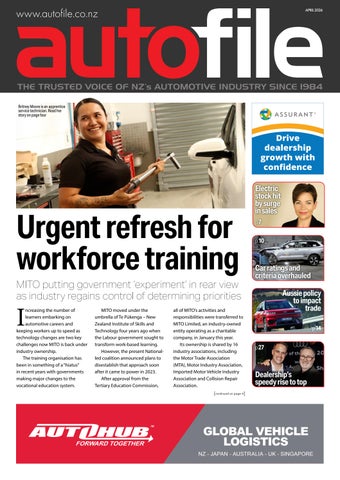
MITO putting government ‘experiment’ in rear view as industry regains control of determining priorities
Increasing the number of learners embarking on automotive careers and keeping workers up to speed as technology changes are two key challenges now MITO is back under industry ownership.
The training organisation has been in something of a “hiatus” in recent years with governments making major changes to the vocational education system.
MITO moved under the umbrella of Te Pūkenga – New Zealand Institute of Skills and Technology four years ago when the Labour government sought to transform work-based learning.
However, the present Nationalled coalition announced plans to disestablish that approach soon after it came to power in 2023.
After approval from the Tertiary Education Commission,
all of MITO’s activities and responsibilities were transferred to MITO Limited, an industry-owned entity operating as a charitable company, in January this year. Its ownership is shared by 16 industry associations, including the Motor Trade Association (MTA), Motor Industry Association, Imported Motor Vehicle Industry Association and Collision Repair Association.
[continued on page 4]


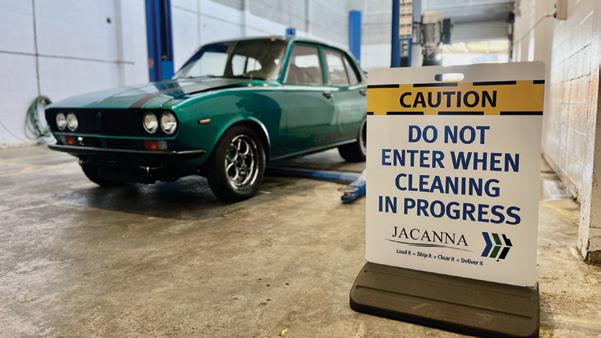
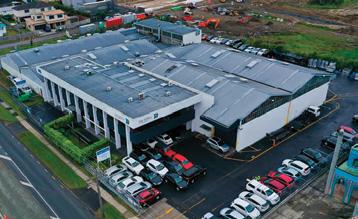
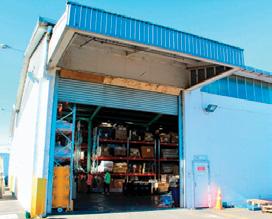
move to new, much larger premises means we are to offer even more services to our dealer clients
to door ro-ro vehicle shipping from Japan and Australia
Containerised vehicle shipping from anywhere in the world

Vehicle tracking



Approved MPI transitional facilities and cleaning services
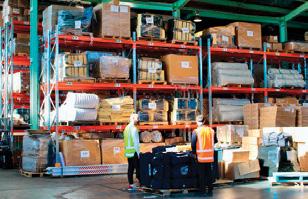
We are specialists in transporting and exporting all types of Vehicles, Commercial trucks, vehicles of Special Interest and other RORO Heavy Cargo & Machinery.
it all off is Jacanna’s SmartTrade Rewards Programme, you can earn points for almost any reward you choose
Tel: +64 9 825 0888 info@jacanna.co.nz www.jacanna.co.nz
and conditions apply.
We have developed a worldwide network of Agents who understand the commitment required to service our demanding market.
www.jacanna.co.nz
Tel: +64 9 825 0888
Finding out where your vehicle is at any one time of the process, gives you the ability to manage the collection and processing of documents and payment on time.
TRS and shipping services from Japan to New Zealand. www.jacanna.co.nz
info@jacanna.co.nz
Tel: +64 9 825 0888
Todd Hunter on why industry bodies matter more than ever for the automotive sector
New Zealand’s car industry is often described as fragmented and diverse, sometimes even a bit “tribal” by spanning importers, manufacturers, dealers, repairers, lenders and service providers.

What’s less often acknowledged is how effectively this complexity is navigated by a small number of industry bodies punching well above their weight.
The likes of the Imported Motor Vehicle Industry Association (VIA), Financial Services Federation (FSF), Motor Industry Association (MIA) and Motor Trade Association (MTA) sit at the heart of this ecosystem.
Each represents different parts of the value chain, yet together they provide something far greater than the sum of their parts – an informed and practical voice for an industry that touches almost every Kiwi. What makes their contributions particularly noteworthy is how lightly resourced they are. Compared with the scale of the sectors they represent, and the regulatory, technological and consumer changes they engage with daily, their staffing and budgets are modest. Yet they are consistently present in policy discussions, regulatory reform, standards development and public debate. That’s no accident. These organisations are powered by the industry itself. The hardworking teams of all four bodies put their heart and souls into their causes whether it’s CCCFA reform, the clean car standard or the latest whim of a politician. They all do a fantastic job.
But also acknowledge countless individuals from member companies who contribute time, expertise and leadership on a voluntary basis. They sit on boards, working groups and committees, often alongside demanding day jobs, because they understand a stronger, more sustainable industry benefits everyone. That level of collective commitment is easy to overlook, but is fundamental to why these organisations work.
The car industry isn’t monolithic and nor should it be. There are times when the MIA, VIA, MTA and FSF will take different views on issues. That diversity of perspective reflects the real-world complexity of the sector. What matters is these differences are navigated constructively with a shared intent to improve outcomes for Kiwis, businesses and the economy.
At a time when regulation is becoming more complex, technology is reshaping vehicles and mobility, geopolitical tension is at an all-time high and public expectations are rising, the value of credible representation has never been greater. Without these bodies, our industry would be more fragmented, less understood and far less effective in engaging with the government and public.
The real story isn’t just what these organisations do, but how they do it with limited resources, strong collaboration and sense of purpose. That’s something the automotive sector, and our country more broadly, should recognise and support.
DIRECTORS
Darren Wiltshire dazzz@autofile.co.nz ph. 021 0284 7428
Brian McCutcheon brian@autofile.co.nz ph. 021 455 775
DESIGNER
Adrian Payne arpayne@gmail.com
EDITOR
Darren Risby ris@autofile.co.nz
JOURNALISTS
Matthew Lowe matthew@autofile.co.nz
Sue Brebner-Fox sue@autofile.co.nz
MOTORSPORT
Mark Baker veritas.nz@xtra.co.nz
Visit www.autofile.co.nz to subscribe to Autofile magazine and have it delivered monthly in print. The subscription rate is $78 plus GST for 12 issues per year.
Autofile magazine is also available online as a readable file or downloadable as a PDF.
Back copies dating to 2017 can be found on the website where you can subscribe to our Insight email alerts.
Copyright: Published monthly by 4Media Ltd
All statements made, although based on information believed to be accurate and reliable, cannot be guaranteed, and no liability can be accepted for any errors or omissions. Reproduction of Autofile in print or digital format in whole or part without written permission, whether by copying or any other means, is strictly forbidden.
All rights reserved. ISSN 0112-3475 (print) ISSN 2350-3181 (online)

NZ’s independent vehicle inspection specialists
W We of fer a full range of ser vices
• Entry Certification for imported cars
• Vehicle Appraisals
• WoF/CoF Inspections
• Road User Charges
• Registration & Relicensing
• Exhaust Emission Testing
www.vinz.co.nz
Appointed by the NZ Transport Agency
All have supported the change after raising concerns that the old centralised system for work-based learning was failing to produce the right number of graduates with the skills required.
MITO has been helping people build careers in the automotive, commercial road transport, extractives, drilling, gas and logistics industries for more than 50 years. It currently offers 27 automotive courses, but plans to update and refresh those options to bolster the workforce.
Verna Niao, chief executive, says the changes mean MITO is “back where it rightly belongs” and describes it as a positive move for the sectors it works with.
She told Autofile: “Being back in industry ownership means our direction is set by people who use the system every day, in other words, employers, apprentices, learners and industry stakeholders.
“Industry itself is setting the direction and priorities, which it hasn’t been able to do for the

past four years under government ownership.
“It gives us clearer accountability and the ability to move faster when the industry needs change to meet the shifting demand for certain skills.
“For example, advances in technology mean every time a new model comes out there’s often something new that plugs into it or something else connecting with it. There are challenges around ensuring we have good material
People with apprenticeships from MITO are filling about 50 per cent of the industry’s needs
– Sturrock Saunders
employers offer in the workplace are aligned with jobs in the industry, such as light and heavy automotive technicians.
“Those pathways remain the core. But at the same time, we’ve got to look at the building blocks of shorter, targeted upskilling options to respond to technological changes ahead of us.
“We’re taking a fresh look at what we offer. I’m excited about the energy and passion for making the best possible products for our automotive industries.”
and experiences for our learners because technology changes so very quickly.”
Niao adds one challenge for a small country such as New Zealand is the fleet’s age, which means those in the workforce need to be across a wide range of technologies and systems.
The recent ups and downs with Te Pūkenga meant investment in MITO’s programmes was limited, but its leaders are now looking at how to improve supporting apprentice pathways as a priority.
“We’ve been in a holding pattern and have to move out of that because there are updates needing urgent attention,” explains Niao.
Many qualifications MITO’s
Last year MITO had more than 2,900 businesses and nearly 6,800 secondary school and tertiary learners involved in its automotive programmes.
Niao says the latter figure is “not quite enough” and the organisation is keen to increase its numbers.
The fresh industry-led approach is being guided by a board of seven directors, including MTA president Sturrock Saunders as chairperson. James McDowall, the MTA’s head of advocacy, is the board’s shareholder convenor.
The board has approved strategic and business plans for 2026, which Niao notes will allow MITO “to get its house in order”, and goals are being set for the next three to five years.
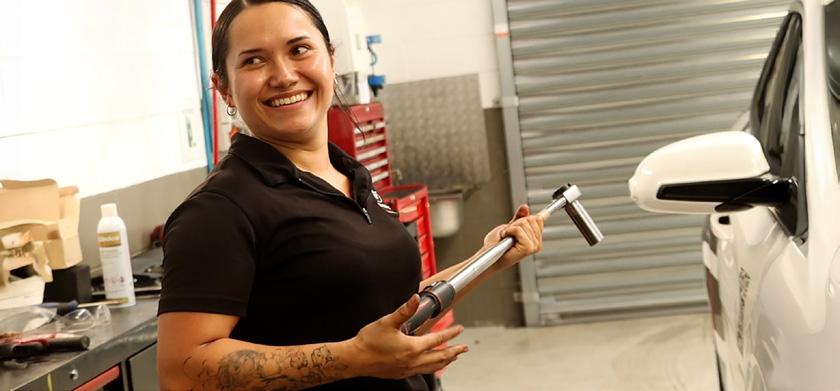
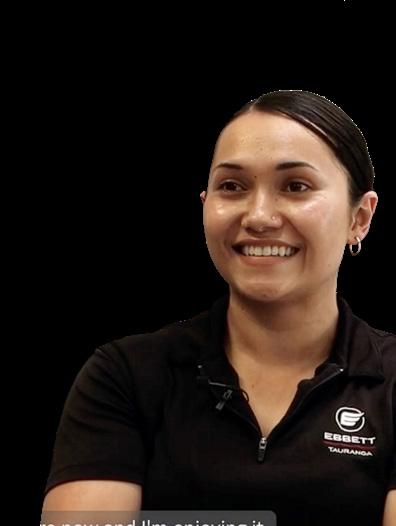
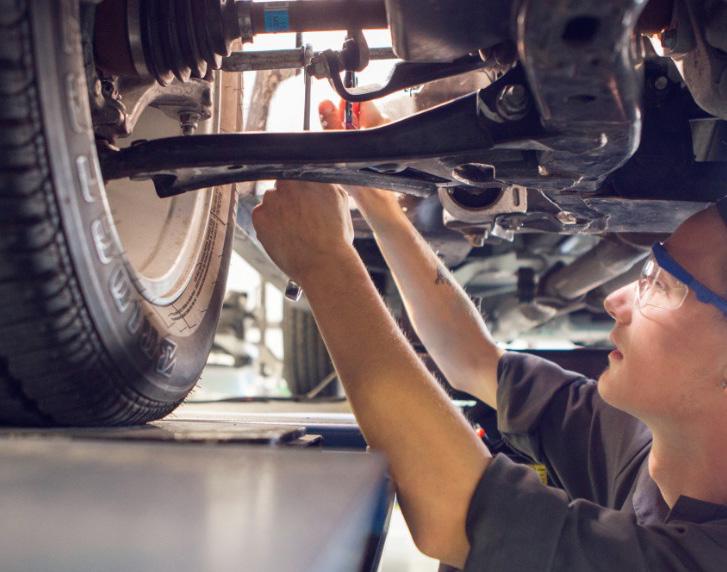
Britney Moore headed to university after school but partway through her studies realised she’d rather be in a workshop. She’s now an apprentice service technician at Ebbett Tauranga.
Her fascination with the automotive world began when she didn’t just play with remote control cars, but pulled them apart to understand how they worked.
She started off with the company around four years ago and was in the grooming department for about a year-and-a-half before progressing to be an apprentice.
“I do love hands-on work,” says Moore.
“I was interested in seeing where the industry would lead me, and I’m here now and enjoying it.
“The best thing about my job would be that every day I come in it’s something different. There are a variety of jobs and tasks, so I’m always learning something new.
“Studying and training with MITO is good. Its support is amazing and you earn while you learn. It’s kind of a no-brainer.”
Saunders told Autofile there’s a “huge opportunity” to build credible career pathways and attract more people to the motorvehicle industry.
“People coming through with MITO apprenticeships are filling about 50 per cent of the industry’s needs,” he says. “The rest are mostly coming across the border and we’re seeing people arriving with required skills through visa programmes.
“However, we need to get a lot better in New Zealand at developing talent and finding ways to support employers in those pathways, rather than them taking on the burden of all the costs of developing a new employee.
“You want it so immigration settings are supplementary to the workforce. We’ve got to be building and giving young people an opportunity to grow and develop careers. That has to start with support from government and industry getting behind learners.”
Saunders says businesses may struggle when the economy picks up unless they are attracting and retaining talent because plenty of other industries will be “scrambling for the same group of people”.
Niao adds immigration settings are useful for ensuring adequate numbers in the workforce, particularly for filling experienced
Our job is to make industry training as accessible as we can to every part of New Zealand
– Verna Niao
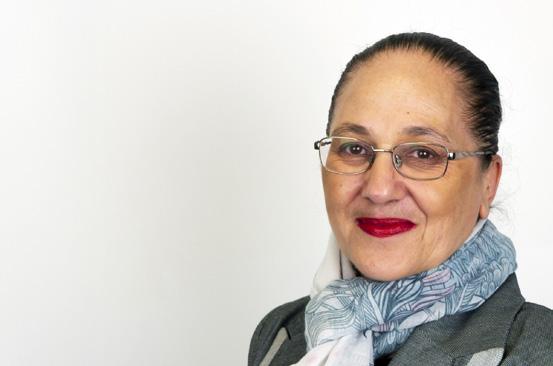
roles where there are shortages, and work best with local training and apprenticeship options.
She would also like MITO to be able to offer its training programmes to those from overseas who become residents on an equal basis to domestic learners, rather than them being treated as international students.
“They’re on work visas and allowed to work here, they’re paying tax and businesses have invested a lot into welcoming these people, so I don’t understand why they can’t get the same opportunities for learning.
“Our job is to make training as accessible as we can to every part of New Zealand, and to every person who has an employer and wants to get tertiary qualification on the job.”
February 2019
The Labour government announces plans to form Te Pūkenga – NZ Institute of Skills and Technology by merging 16 institutes of technology and polytechnics.
April 2020
Merger becomes effective. Te Pūkenga also takes over responsibility for industry and apprenticeship training from nine industry training organisations.
January 2022
MITO becomes a business division of Te Pūkenga.
December 2023
The National-led coalition announces it has begun the process of disestablishing Te Pūkenga.
October 2025
The Education and Training (Vocational Education and Training System) Amendment Bill does away with the centralised model created under Te Pūkenga. It enables the reestablishment of 10 regionally governed polytechnics with more to follow. It also creates eight industry skills boards to manage work-based training across defined industry groups.
December 2025
The Tertiary Education Commission approves MITO’s transition to MITO Ltd from the start of 2026 via the Transport Industry Skills Board.
January 1, 2026
MITO emerges from Te Pūkenga to become owned by industry.
Saunders notes one way to steer people towards automotive careers would be to adjust the government’s fees-free policy for those in study or training so it’s better suited for those on vocational pathways.
The scheme initially paid for first-year fees, but was changed by the coalition from 2025 to instead cover the final year for tertiary students or the final two years for work-based learners.
“The apprenticeship and learner
model is different from university,” he explains.
“I think current government policy is the wrong way around for many of our learners and those in year one need support as opposed to in year three.
“That’s because 95 per cent of their training happens in a workplace and to develop someone through a full apprenticeship requires significant supervision and support at work, particularly early on.
“As a business, if you’re under financial duress, you may think, ‘can I afford to invest in year one or two before I get some productivity out of a learner?’. If you consider that, it shows why the sector needs frontend support.
“MITO would be a good bet for the government to try rolling out something different to the thirdyear fees-free programme. You want to remove any impediment to employers saying yes to taking on apprentices and allowing learners to undertake qualifications.”
[continued on page 6]
Submit two downloadable forms and simply send to us for review.
Hear back from our team about finance in as little as 24 hours.
NZ BASED
Our partnerships give us the ability to offer superb lending rates.
Autobridge is New Zealand based and covers the country, so we are never far away when you need us.
www.autobridge.co.nz 09 320 5646
Reflecting on the Te Pūkenga experience, Niao says the government had a “monumental challenge” bringing 25 polytechnics and industry training organisations together.
Before being appointed chief executive of MITO Ltd, Niao was MITO’s executive director from January 2022 as it transitioned to Te Pūkenga.
“It was four years, we gave it a go, tried a change in direction and we take the lessons from it. But I’m pleased MITO is back in industry ownership because only industry can develop, shape and determine the priorities for its workforce.
“Bringing the cultures together of different organisations that had different purposes was a good experiment but I’m unsure the timing was right or that we fully understood what we were trying to do.
“For industry, MITO remained focused on making sure nothing changed for our employers and
learners during that time, and reassuring our customers it was simply a change of owner.
“We wanted no day-to-day disruption for them and learning programmes.”
Niao is excited MITO can now be “extremely focused” on its courses and less concerned about a system that’s in reform.
“The strategic intent set by our industry owners has given us a clear message that MITO’s place in the world is delivering world-class and inspiring careers through innovative workforce development.”
MITO has been operating
Our strength comes from knowing our customers’ needs, understanding and fulfilling
as a charitable company since January 1, which means all funds and any surpluses are reinvested in helping the sectors it serves.
Saunders says being part of Te Pūkenga “was a chapter and we move on”, with everyone now committed to supporting industry, understanding its needs and ensuring what MITO provides is fit for purpose.
“MITO is a genuine entity by industry, for industry with the benefit of industry at heart. The board and management looked at different proposals and landed on becoming a charitable company, which means no shareholder has a pecuniary advantage.
“The shareholder group has come up with a challenging and enabling strategic plan, which means we can focus on what it’s going to take to deliver for industry.”
The transition away from being overseen by government was a “careful balancing act”, but Niao praises MITO’s shareholders for establishing the new governance model.
“They were making decisions very quickly and, while there were some challenges, the transition was effective because they appointed a shareholder convenor to act on their behalf,” she says.
“The industries that own MITO had to work hard to get ownership back. Now they’ve got it, they’re ambitious about moving things forward.
“The board has approved strategic and business plans for 2026. My job and my team’s job is to deliver on those things. We’re reinvesting in our products to ensure this engine is as fine-tuned as it can be for 2027.”
While MITO is ambitious, fresh challenges may lie ahead with the
conflict in the Middle East and Kiwis preparing to go to the polls in November.
Saunders says the past 18 months have probably been the toughest for our economy in decades.
“Some sectors and regions are starting to go well, but I don’t think any single industry could say it is booming. Automotive has some good green shoots. However, we need to see business confidence start to rise further before large numbers of people are being taken on in the workforce.
“The situation with Iran isn’t going to help, but the economy will eventually pick up again.
“The top of the North Island, around Tauranga, Hamilton and Auckland, is where the greatest population of employers is.
“That area has been hit hard by recessionary pressures. But when those lights turn on again and the northern economy starts to fire up, there will be a real demand in learner volume.”
Niao adds: “We’re in an election year, and employers will apply caution and wait to see the results.
“There are some real challenges in 2026. It might mean some businesses decide not to take a young person on, and that person then chooses another industry and won’t come back to us.
“That’s why we work hard with schools on work placements. We have got more than 1,000 secondary students who go through mini-apprenticeships and we sign up about one-third of them for further training.”
Even if businesses can’t take on apprentices this year, MITO is keen for them to get in touch with a view to providing work experience for youngsters in their communities.
Niao stresses it’s important for employers to have confidence in MITO and highlights it’s being led by experienced individuals.
“They should take great comfort from MITO being industry-owned and shouldn’t hesitate to talk to us. We want to hear from industry because we exist for them. If they think we’re missing bits, tell us because we want to know.”
Some marques are struggling to keep up with the spike in demand for new electric cars and are expected to take months to rebalance their stock levels.
The threat to fuel supplies –and rising petrol and diesel prices after war broke out in the Middle East – has seen Kiwis rush to buy battery-only EVs (BEVs) and plug-in hybrids (PHEVs).
Aimee Wiley, chief executive officer of the Motor Industry Association (MIA), says consumer interest in EVs increased sharply in March, but some dealerships have been unable to adjust supply at the same pace.
“Several brands are already experiencing low stock or moving to forward orders, reflecting similar patterns seen during Covid-19,” she told Autofile.
“Over the past 12 to 18 months, BEVs averaged around five per cent of registrations with model holdings aligned to that mix. The current surge is, therefore, outpacing what was planned and is available in the market. It will take some months to recover those stocks.”
The change in consumer preferences is likely to have importers reassessing their ordering strategies. However, Wiley notes timing remains a constraint.
“For many, supply operates on long lead times, often several months or more, and this demand shift isn’t unique to New Zealand,” she says.
“Similar trends in other markets may place pressure on allocation. Cars ordered now may take months to arrive and there’s a risk for importers in committing to large volumes if demand proves temporary. Importers must balance responsiveness with that uncertainty unless they are supported by firm orders.”
There was an immediate shift towards EVs after the US-Israel-Iran conflict began on February 28. Such registrations have climbed to their strongest levels since the clean car discount was abolished by the coalition at the end of
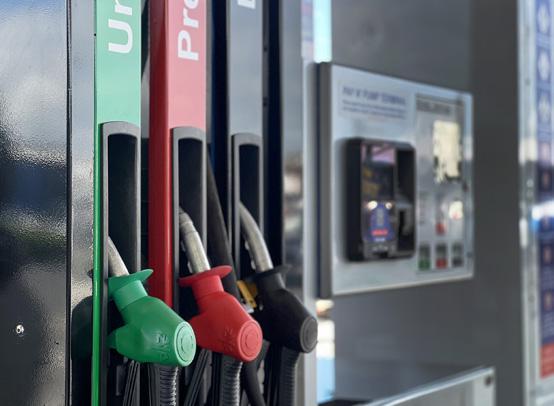
2023, “underscoring how quickly consumer behaviour responds to external cost pressures”.
Regardless of how long the conflict lasts, Wiley anticipates its effects will be felt in the new-vehicle market and broader economy for some time.
“In my opinion, the situation is likely to disrupt global supply chains. Events, such as the Covid-19 pandemic, have proven to have lingering effects for some time after.
“While different in cause from coronavirus, I suspect the current geopolitical environment is likely to drive similar outcomes through supply uncertainty and flow-on impacts to manufacturing and logistics. Perception alone can influence behaviour and planning.
“In the near term, maintaining a reliable fuel supply and consistent shipping arrivals will be critical to economic stability. At the same time, rising fuel costs will continue to feed into the cost of living, shaping vehicle-purchasing decisions and motorists’ driving patterns in the short term.”
Based on the latest available information, MIA members are reporting most shipments in the coming couple of months are still expected to arrive as planned.
There have been a few reports about delays, but Wiley notes this appears limited to isolated cases with no present indication of broader cancellations.
“However, higher fuel costs
Prices at the pump mean some Kiwis have been opting for zero and low-emissions cars
are likely to increase shipping expenses, strain margins and ultimately flow through to consumer pricing over time.”
Rising prices at the pump for petrol and diesel in March and April are clearly influencing consumers’ decisions and the MIA
has noticed significantly increased interest in EVs, reflected in elevated online search activity and a lift in their sales.
Wiley says the association has no concerns about the government’s decision last month to allow fuel that meets Australian standards to be imported, if necessary. New Zealand isn’t accepting higher sulphur fuel at this stage and “standards remain appropriately aligned”.
As for the national fuel plan, which outlines what will happen if there are major supply disruptions, she adds remaining at lower response levels is preferable.
“Escalation to higher levels involving fuel rationing or allocation would be highly disruptive across the economy. In the meantime, a prudent approach is to conserve when possible and ensure contingency planning is in place.”

The cost of shipping is set to be impacted as global oil prices fluctuate in response to the Middle East conflict.
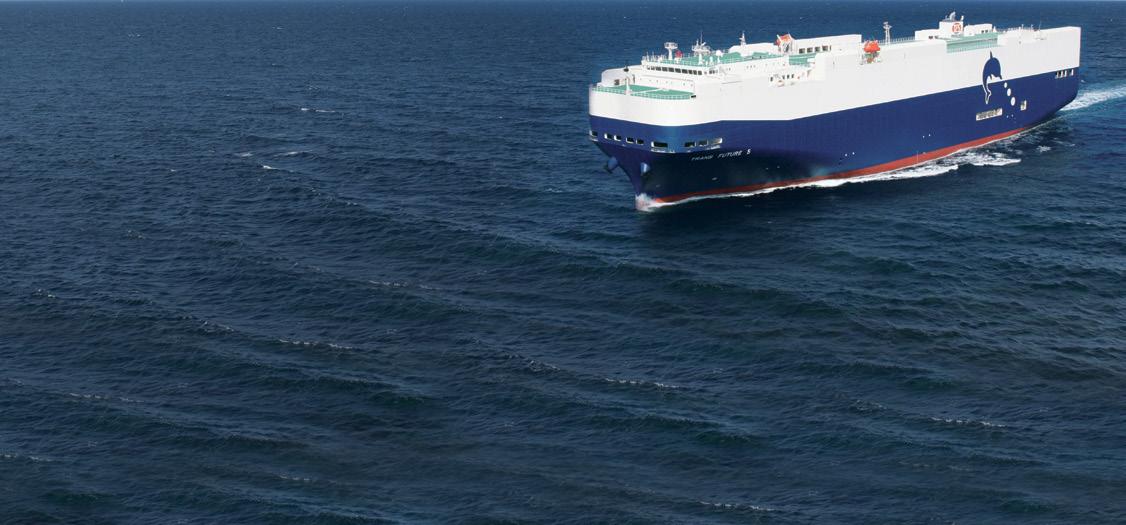
The Imported Motor Vehicle Industry Association (VIA) reports operators of roll-on, roll-off (ro-ro) vessels have mostly confirmed their schedules so it hopes disruption in that space will be avoided.
“But obviously the kicker will be the fuel costs,” warns chief executive Greig Epps.
By March 25, bunker prices were about double the level they were in late February before the war started. The cost per barrel isn’t the only factor as 20 per cent of the world’s crude oil comes from the Gulf region and transits the Strait of Hormuz, which means supply and its surety are major issues.
In the short term, logistics companies have little room to manoeuvre because price adjustments linked to fuel costs are standard in shipping contracts and typically apply retroactively, creating cash-flow pressures when prices jump.
Epps says: “With bunker-fuel adjustments done in arrears, we probably won’t see any impact on shipping costs for another month or so. However, I’m concerned once those recalculations are made that
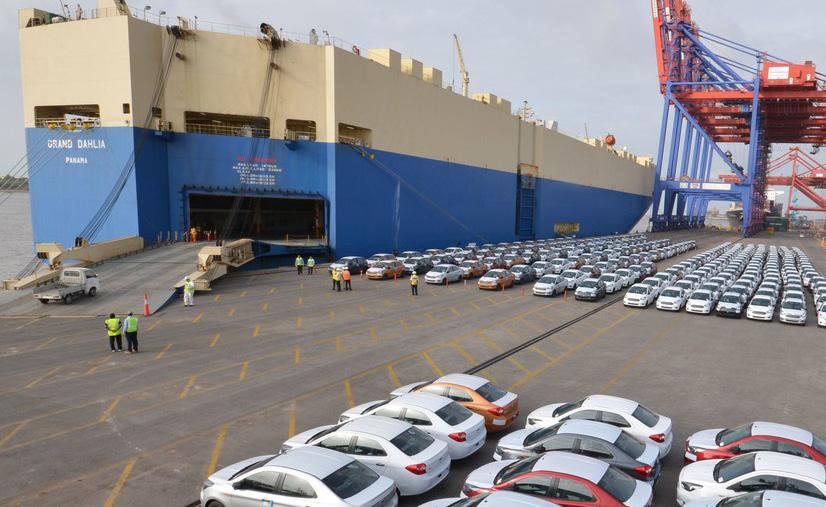
it could be six months to a year before we see them turn around depending on how long this conflict carries on.
“The ro-ros will probably still operate. But if fuel costs towards the middle of the year go up too much, it may put some people off the number of vehicles they are thinking of importing.”
As for electric cars, used stock is available in Japan and Epps describes the spike in interest from Kiwis wanting to switch to vehicles with a plug amid rocketing prices at fuel pumps as real.
“However, we need to get more certainty from carriers they will take them onboard,” he told Autofile. “As more used EVs become available, it would be good for us to be able to bring those cars
down, but the problem isn’t only the shipping costs.
“We need to work with the shipping lines to ensure there’s availability of space on vessels because I sense some shipowners are wary of those vehicles. I heard of a couple of cancellations of EV berths last year, but people aren’t coming to me saying it’s a real problem at this stage.
“It would be frustrating if we can’t get space on ships because these electric vehicles are in demand with Kiwis. If we start seeing more issues in this space, we may have to escalate it to government as a core concern.”
Epps stresses the fuel crisis had yet to affect what models were being imported and their volumes by the end of March. Instead,
changes to the clean car standard (CCS) at the start of the year have led to more variety and volume coming through.
“We may see more demand for hybrids and EVs, but that also hinges on availability in Japan. Low stock levels have always been the issue for used electric cars there.
“A dealer recently back from Japan told me they felt buyers from the United Arab Emirates and Russia weren’t as prominent at auctions, and there were more Kiwi buyers there. His trip was the week things kicked off, so it was interesting to see Russian and UAE activity had pulled back in the first few days.”
The potential impacts of the Middle East conflict mean the automotive industry is “finding it hard to catch a break”, says Epps.
“We saw activity and enthusiasm increase in the first couple of months of this year because importers could see some positivity from CCS penalty reductions, which gave them more choice in Japan.
“They could get the vehicles they wanted without having to compromise on mileage and condition. I toured Port of Auckland last month and noticed quite a few people movers being

unloaded, which was great because we had been struggling to bring those in last year. It was good to see an increase in the sorts of models and varieties.
“The reductions in CCS charges were going to bring more choice and better conditions back. However, the war will start impacting our industry although maybe not straight away.”
As for the crisis at the pump, the government says it will allow fuel that meets Australian specifications into New Zealand to help strengthen domestic “resilience”.
Shane Jones, Associate Minister of Energy, says the decision removes unnecessary technical barriers in a tight global market.
“Countries that can access a wider range of shipments are better placed to keep fuel flowing,” he says and the alignment could be in place for up to 12 months.
“The change reduces the risk of supply disruptions driven purely by
technical differences.
“Our specifications are very similar. Fuel refined to Australian standards is compatible with New Zealand vehicles. It meets safety and quality expectations.”

New Zealand will not, at this stage, follow Australia’s lead and relax standards to allow higher sulphur fuel. “However, we will keep an eye on whether further changes to specifications could open up further supply channels if necessary,” explains Jones.
VIA’s view is that pragmatism is needed.
“We wouldn’t want to see fuel standards relaxed for an extended period,” says Epps. “Maybe three months or so would be okay.
“We wouldn’t expect excessive damage to engines from higher sulphur fuels, but it will advance wear and tear on emissions systems of many older models. Newer models have direct-injection
engines and other systems that may be more affected by buildup and residue.
“It has been suggested we perhaps only relax sulphur limits on 91 and keep it low on 95 so people have a choice. It isn’t ideal to run a 91-tuned engine on 95. But if people are concerned about residue building up, it might be an okay short-term compromise.
“If we had a fleet-management approach to transport, we would probably be better prepared to address some of these issues.
“By that we mean having entry requirements for new vehicles to ensure we’re getting the newest technology, in-service requirements to ensure people keep cars running as well as possible and exit requirements to get the worst performers out of the fleet.
“If we need to accept higher sulphur fuel for an extended
period, people should be taking vehicles in for regular maintenance inspections to ensure emissions systems are working properly.”
As for car dealers, now is the time for them to make the best decisions for their businesses.
Epps suggests perhaps pulling back from offering a full tank of fuel with vehicles sold because even though they want to deliver good service, “you shouldn’t bleed yourself dry in the process”.
He adds: “Traders should talk to customers about the impact government decisions might have on cars. If a vehicle runs rough on higher sulphur fuel, you need to let the consumer know it’s not a problem with the car, it’s the environment we’re in with standards that don’t completely meet vehicle settings.
“Once we get into the relaxed sulphur limits, people need to understand what’s going on to minimise friction if they take a car back concerned about the way it’s running.
The NZTA has updated the ratings of used vehicles on Rightcar.govt.nz with the message Kiwis are twice as safe in five-star models compared to those with one star.
The revamped system draws on information from 9.5 million cars and 2.6m injured road users involved in police-reported crashes on both sides of the Tasman between 1987 and 2023.
The agency is pleased the average risk of death or serious injury in collisions for people driving 2023 models is now some 43 per cent lower than in those manufactured in 2001.
It reports the overall safety of the light fleet has gone up by more than 50 per cent based on data analysed by the accident research centre at Melbourne-based Monash University.
Todd Wylie, the NZTA’s principal adviser of vehicle safety, says: “Your choice of vehicle could make all the difference in avoiding a crash, and in protecting you and loved ones from serious injury or death if a crash happens.
“Buying a safe car is one of the most important decisions you can make, and you can find high-rated options in most price ranges and categories.”
Ratings have been changed for 16 per cent of light vehicles with 642 models dropping by one star. This has resulted from newer, safer ones entering the fleet.
Forty-six models now have used car safety ratings (UCSR) instead of vehicle safety-risk ratings, which are estimated.
These include Tesla’s Model 3, which is the first fully electric car to achieve a rating of five stars, along with popular models such as the Ford Everest, Mazda CX-30 and MG3.
The NZTA says SUVs are leading with small and medium-size models in this segment having the highest proportion of five stars. Next up are people movers and medium-sized cars.
It adds older vehicles perform
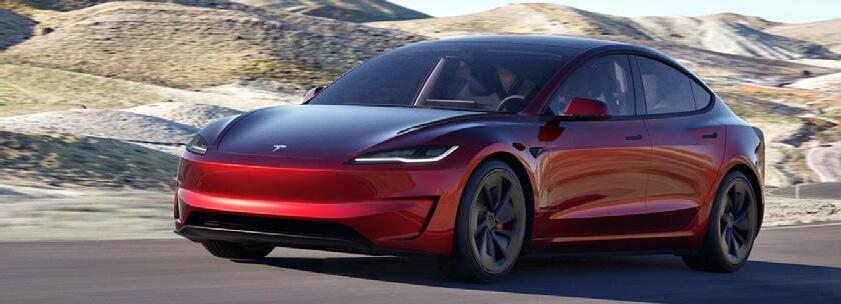
poorly with 76 per cent being one-star rated from before the year 2000. However, commercial utes perform the worst – 77 per cent score only one or two stars and now have the poorest safety performance among recent models despite their popularity growing.
In addition, many poor performers are driven by novices, increasing their risk. On the flipside, almost 1.5 million models now have five stars.
Overall, more than 700,000 used cars’ ratings have changed. These include some newer models moving from expired ANCAP ratings.
The updated UCSR system applies to most light vehicles on our roads. To achieve a five-star overall rating, a model must provide “excellent protection for people in it, good protection for other road users and key crashavoidance features”.
Wylie adds: “The worst vehicles for overall performance are responsible for more than a five-fold increase in road trauma resulting from crashes in which they’re involved. That’s why checking ratings before you buy is so critical.”
Visit Rightcar to check how many safety stars a car has by typing in the number plate or make and model. The website also has a video explaining how ratings change over time at rightcar.govt. nz/safety-ratings/lifecycle.
Registered motor-vehicle traders must ensure they are using up-to-date labels. Visit dealer. rightcar.govt.nz to find out more.
ANCAP has overhauled its rating criteria and describes its new system as a notable update that strengthens how it evaluates vehicles.
The fresh approach is based on “the stages of safety”, which are safe driving, accident avoidance, crash protection and post collision through what’s known as the Haddon Injury Prevention Matrix.
Carla Hoorweg, chief executive, says the changes allow ANCAP to incorporate feedback, enhance existing tests and incorporate extra areas of focus.
“It also provides a structure that can adapt to technological

Checking ratings before you buy is so critical
– Todd Wylie
developments which will shape the automated driving future,” she adds.
Developed with Euro NCAP, the shared international benchmark aims to ensure Kiwis and Australians continue to benefit from advanced crash testing and assessments.
ANCAP re-examines its criteria every three years with the sole focus of reducing vehicle-related deaths and serious injuries.
The 2026-28 protocols “further strengthen the rigour and relevance” of tests, and several changes have been made in response to consumer feedback.
There have been instances of drivers unintentionally pressing the accelerator instead of the brake pedal.
The new rules consider smart systems that monitor pedal inputs together with information from crash-avoidance cameras and sensors that detect cars, pedestrians and two-wheelers. If the vehicle can interpret such data to recognise a potential danger and automatically reduce acceleration, whether moving forward or in reverse, points are scored.
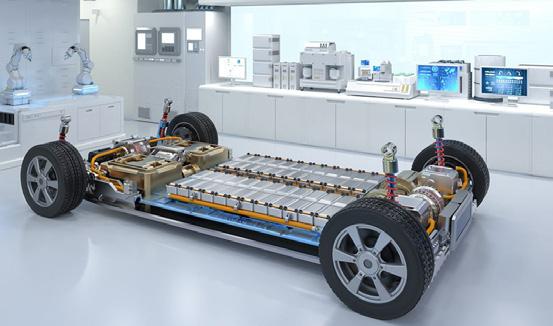
In recent years, an increasing number of hybrids and EVs have entered the fleet. New-energy models bring with them potential risks, so energy management levels in and after an accident are now assessed.
ANCAP examines if a disturbed high-voltage battery is less likely to combust within set periods of 20, 40 and 90 minutes, and the risk
of fire should be communicated to the driver after a crash.
For example, a warning notification can be shared if a fire starts during charging via a dashboard display or phone app, and EVs’ high-voltage batteries should be isolated after a serious collision and be able to notify first responders.
Many basic driver controls are now buried in cars’ touchscreens and sub-menus, but ANCAP says it’s time for marques to offer physical buttons for important systems, such as the horn, indicators, hazard lights, windscreen wipers and headlights, or dedicate a fixed portion of the cabin screen to primary functions.
Electrically operated door handles, which sit flush with bodywork when not in use, should remain operable after an accident.
human survival, ANCAP now places greater emphasis on the availability and performance of e-call systems.
Active driver-assistance systems (ADAS), which are often criticised for abrupt or irritating interventions, are now rewarded for smooth, intuitive operation as well as technical performance.
As for the four assessment areas now being evaluated, known as the stages of safety, they are:
Safe driving: This considers technologies and features that assist in providing a safer experience for the person behind the wheel and occupants.
Crash avoidance: Assesses systems that help prevent or mitigate critical incidents through warnings or autonomous intervention.
such as vehicle structure, seatbelts, airbags and head restraints, to mitigate injuries to occupants, pedestrians and cyclists.
Post-crash: Addresses the “golden hour” of emergency response through post-accident rescue information and assistance systems.

Collision protection: Evaluates the performance of traditional accident-protection elements,
A multi-tier auto lending solution for new and used vehicles for business and personal use
Consumer. Commercial. Wholesale. Lending criteria, fees, terms and conditions apply

All four stages are scored out of 100 and expressed as a percentage. Minimum thresholds continue to apply for each stage, determining the overall rating.
Acknowledging post-crash response time plays a critical part in

More than 40 per cent of all new vehicles sold in Australia in 2024 featured technology capable of automatically connecting with the emergency services after an accident.
“Our updated protocols set a benchmark for emergency-call systems,” says Hoorweg. “We want to encourage manufacturers to enhance existing systems and provide an incentive for all brands to fit this technology.”
Despite progress, the deployment of e-call remains limited on our shores with fewer than 10 per cent of new vehicles sold in 2024 kitted out with it.
“New Zealanders shouldn’t be left behind when it comes to lifesaving technologies such as e-call,” says Hoorweg. “The potential for it to make a difference is too big for manufacturers to ignore.
“Through the upgraded protocols, ANCAP is setting a clear
[continued on page 12]





bar that will continue to challenge industry beyond regulation, inform consumers and help reduce road trauma.”
As part of aligning tests with consumer experience, ANCAP is performing more on-road testing to better track the real-world capability of on-board technology.
Speed-sign recognition accuracy forms part of the process with data captured being provided to manufacturers so they can improve systems.
“Our role is to continually push for improvements in all areas of safety and our 2026 protocols reflect that,” says Hoorweg.
“The outcome will be better protection of occupants and those around them through the active prevention of crashes, superior protection and improved post-crash management.”
Under ANCAP’s new criteria, points will be scored for alerting and adjusting airbag deployment based on an occupant position. Why? If a passenger puts their feet on the dashboard for example, the airbag can be activated resulting in severe injury.
If the seat or seat rails fail in a collision assessment, an automatic 50 per cent loss of points per test is now applied to the crash-protection score.
About 15 per cent of road deaths involve pedestrians, so cars with better-protected a-pillars are being marked up if effective protection at 20, 30 and 40kph can be demonstrated.
Motorbikes have been added to the T-bone crash-avoidance test, and cars are examined and scored for their ability to detect and alert for seatbelt routing and misuse scenarios.
The safety of increasingly big pick-ups and crash-avoidance technology fitted in them has come under ANCAP scrutiny.
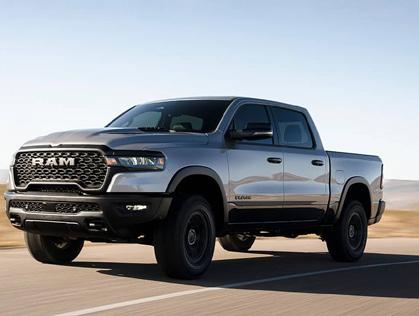
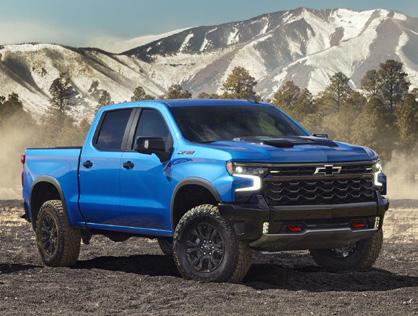
Its inaugural large utilities ADAS safety comparison included the Chevrolet Silverado 1500, Ram 1500, Toyota Land Cruiser 79 Series, Toyota Tundra and an updated version of the Ford F-150.
“Larger vehicles pose a bigger threat to other road users than cars,” says Hoorweg. “The best way to reduce the risk of fatalities and serious injuries is to ensure they do the best possible job at avoiding a crash.
“This first-look comparison establishes a benchmark for large pick-ups and provides a path forward in creating better outcomes for road users.
“We’ve applied international best practice in testing to this segment to ensure there’s an incentive for manufacturers to improve crash-avoidance technology.”
ANCAP set a high standard for the programme, well above regulation, and the models tested had a high degree of advanced on-board technology.
Performance did vary but the results showed there’s a strong base to build on and “a clear opportunity” to achieve the performance levels seen in passenger vehicles.
Initial comparisons will be used to inform developing a framework for future testing and extra safety information is expected to be available for a broader range of large pick-ups this year. Future phases could potentially extend into physical crash protection.
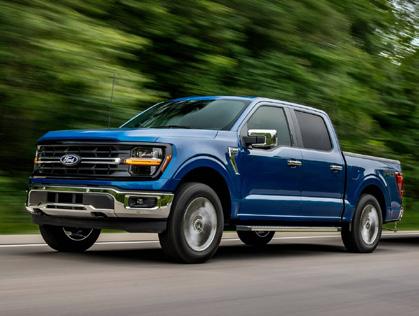
Fitted with one of the most comprehensive ranges of active features among the large utes assessed, the F-150 achieved the highest score of 81 per cent and a platinum safety grading. The next highest was the Ram 1500, which scored 70 per cent and gold.
The two Toyotas provided a reasonable level of performance to achieve silver. The LC79 and Tundra scored 55 and 50 per cent respectively. The Silverado offered a narrower range of crashavoidance performance with 27 per cent and a bronze grading.
Utes have been central to the ANCAP regime since 1992. Over this time, it says rigorous assessments have driven improvements across the traditional smaller ute segment.
The availability of objective safety information for these utilities has not only encouraged manufacturers to elevate their product offerings, but has delivered direct safety benefits.
Stepping up in size, mass and towing capacity, larger utes –some commonly referred to as pick-up trucks – have become increasingly popular. Traditionally designed for loads such as caravans, boats or animal trailers, they are now frequently seen in general, everyday use.
ANCAP says anecdotal views suggest that due to their physical size and greater mass, they can pose a higher risk and are less safe than other vehicles they share the road with.
The Model Y achieved the highest overall weighted score of any model assessed by ANCAP last year, recording strong performances across all areas of occupant protection and active safety technology.
It’s the second time the Tesla EV has taken the top spot with the pre-facelifted model coming first in 2022.
Each year, ANCAP identifies the strongest-performing vehicles based on a weighted sum of scores for adult and child-occupant protection, vulnerable road-user protection and safety assist.
In a year with several highly anticipated releases on both sides of the Tasman, Toyota’s Hilux achieved the top score for a utility vehicle.
The safest models in other categories were the Tesla Model 3 – medium car, Volvo EX90 – large SUV, MG IM5 – large car, the MG S5 EV – small SUV and the Mini Cooper E – light/small car.
“Our testing continues to reinforce a clear message – the safest vehicles are those designed with safety as a system, not a checklist,” says Hoorweg.
“The top performers delivered consistent results across physical crash protection, crash avoidance and vulnerable road-user safety, rather than relying on strength in a single area.
“We’re also seeing increasing alignment between ANCAP’s test requirements and technologies that genuinely matter on Australian and New Zealand roads. Improvements in autonomous emergency braking, lane support and driver-monitoring systems are translating into more robust protection for everyday driving.
“The breadth of top performers shows high levels of safety are achievable across multiple segments, giving consumers clearer choices.”
When buyers are ready, the last thing you want is a finance process that isn't.

Speed: Applications processed fast - no unnecessary delays.
Clarity: We keep both you and your customer in the loop, every step.
Confidence: 20+ expert advisers ready seven days a week.
Stop waiting. Start selling. Talk to better finance™ today!


Acompany providing services to the automotive industry warns sales of new vehicles across the Tasman could drop because emissions regulations risk creating gaps in supply that could then be filled by importing used cars.
Pitcher Partners says unless new-vehicle efficiency standard (NVES) rules are substantially eased, Australia’s new-car market could tumble by up to 600,000 units a year.
It adds sticker-price increases resulting from penalties under the scheme could lead to consumers forking out A$12 billion more, or about NZ$14.55b, over the next five years.
Downstream, this would make sourcing nearly-new and used stock from overseas more attractive.
The research into the effect of the NVES – Australia’s equivalent of New Zealand’s clean car standard (CCS) – shows sales of new vehicles contracting by about 200,000 in 2026 to one million units.
Next year, registrations are projected to fall to 900,000 or about 300,000 fewer than last year, according to Pitcher Partners.
The decline becomes more pronounced in 2028 with newvehicle sales predicted to come in at about 680,000. That would be 520,000 units below 2025.
And the outlook for 2029 is 450,000 units or some 750,000 below last year’s total.
If these projections come to pass, 1.7 million new-vehicle sales would be lost to the Australian market over the next
five years because of the federal government’s regulations.
A new sector of parallel imports of new and nearly-new cars, as well as grey imports, from other righthand-drive markets could then emerge.
Those jurisdictions would likely include Japan, piling extra pressure on used importers in Aotearoa trying to access compliant stock.
“We believe Australia might see an influx of used parallel imports as a result of the NVES similar to what happened when New Zealand opened its market, where parallel imports made up 60-70 per cent of new registrations in 2002-12,” says Pitcher Partners.
“The NVES could increase prices of new cars to a level where used vehicles and used parallel imports will be more attractive.”
In addition, higher prices may compel owners to hold onto their current vehicles for longer, pushing out the consumer purchase lifecycle.
Pitcher Partners believes if Australians opt for used models it will cause the new-vehicle market to shrink as much as 60 per cent by 2029 as demand drops and traditional brands exit the market.
It adds such a decline would be driven by reduced supplies of higher-emissions vehicles people wish to purchase and dealers feeling financial pressure because of their reliance on the profits of high-emitters.
Traditional brands may also quit Australia due to tightening supplies of compliant models and imbalances in competition with
39,603 sales & 6,282,82 credits
115,504 sales & 2,890,652 credits
No models are banned, and more polluting models can be offset by EVs or low-emitters.
The scheme, as a supply-side mechanism, has similar aims to the CCS being reviewed by the New Zealand government.
The CCS has courted controversy since its launch in January 2023.
In November last year, the coalition passed legislation slashing fines for imports failing to meet targets with revised fees applying from the start of this year.
At the time, Chris Bishop, Minister of Transport, said the temporary measures needed to be quickly put in place to avoid the risk of about $264 million in net charges being passed on to households and businesses.
38,465 units & 508,517 liabilities
13,877 units & 215,261 liabilities
original equipment manufacturers holding surplus compliant models.
Effectively, they could be squeezed out.
The NVES, which was launched on July 1, 2025, requires carmakers to supply new vehicles that meet average per-kilometre targets for carbon dioxide (CO2) emissions.
These reduce over time to encourage cleaner imports.
That was because supply constraints meant importers were unable to source enough lowemissions models.
As reported in the March issue of Autofile, targeted consultation into the CCS has been completed as part of a full policy review so Bishop can “consider and compare all options”. It will be reported back to the cabinet’s economic policy committee by June 30.
“In conducting the first stage of this review, the Ministry of Transport is engaging with the industry, international bodies, key advocacy groups and subject matter experts,” says a spokesman for the government department.
That said, it’s almost inconceivable officials here haven’t investigated how the NVES, which is operating. If they haven’t, perhaps they should.

Under Australia’s scheme, emissions limits are applied to passenger vehicles, which are classed as “type one”, while light commercials are classified as “type two”. Targets are weight-adjusted for each vehicle.
Companies that beat their target are awarded units, or credits, that can be sold to those needing to offset the extra pollution from
other vehicles. Overall, the fleet across the Tasman outperformed its average targets in both categories last year.
The NVES targets for this year have tightened and are 17 per cent lower than 2025 for passenger vehicles and 14 per cent lower for light commercials. Pushing out to 2029, type-one targets will be 59 per cent lower than 2025 levels and down by 48 per cent for type two.
The Federal Chamber of Automotive Industries (FCAI), Australia’s equivalent of the Motor Industry Association here, says significant challenges lie ahead for the new-vehicle sector as NVES goals become more stringent.
Tony Weber, chief executive, says the scheme’s results for 2025 showed marques responded quickly to the task of hitting their targets.
“An increase in the range of zero and low-emissions vehicles in Australia has supported the
An increase in EVs on roads is critical to achieving the stringent targets
achievement of first-year targets,” he adds. “To support the reduction objectives, carmakers increased EVs with more than 100 models available.
“However, EVs represented just 8.3 per cent of new-vehicle sales in 2025, only a 1.1 percentage point increase on 2023.
“Sustaining compliance as targets tighten will require stronger uptake of EVs than current trends indicate. This is a concern because an increase in EVs on roads is critical to achieving the stringent targets.”
The rate of improvement required to avoid NVES penalties presents a big challenge and Weber agrees with Pitcher Partners that extra costs generated by the
scheme will likely be passed on to buyers.
He says: “The increase in the supply of zero and low-emissions vehicles by carmakers is the best action they can take to meet the targets.
“However, the key to longterm success of the NVES relies on increased electric demand. That remains subdued. The FCAI is keen to see the government consider policy settings that support demand for EVs and low-emissions vehicles.”
The Electric Vehicle Council believes last year’s results show the scheme is a success.
Chief executive Julie Delvecchio says when it was legislated, critics
warned of “supply shortages, soaring prices and market disruption”.
She adds the reality is emissions are coming down, the choice of new cars is expanding and EV sales are increasing.
“The first performance report shows strong industry performance, healthy competition and a clear acceleration in cleaner vehicles coming to Australia.
“The data confirms what we said all along, and that’s clear, predictable standards drive innovation and investment. They don’t break markets, they modernise them.”
Delvecchio notes the results show a review of the scheme should lead to tougher targets.



If not, there’s a risk the momentum for clean cars could be slowed as companies collect excess credits for beating targets that aren’t demanding enough.
The NVES regulator’s performance results for July 1 to December 31, 2025, shows 59 entities entered 620,947 units onto the register of approved vehicles during those six months.
Of those, 68 per cent beat their targets to generate 17.2m credits, which can be traded with companies that didn’t hit goals or used to offset potential penalties as annual targets get tougher.
Overall, the industry had a potential net surplus of 15.9m units that could be carried forward.
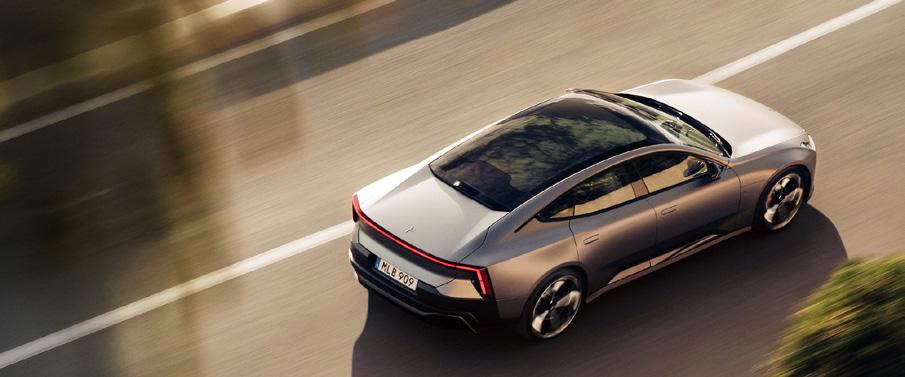
EVs, supplied by 40 entities, made up 12 per cent of all new vehicles sold. BYD, BMW, Kia, Toyota, Tesla, Ford, Volkswagen and Polestar sold models that, on average across their fleets, released less CO2 per kilometre than required.
However, 19 companies missed their targets and could have to buy credits or pay penalties if they fail to improve over the next two-anda-half years.
Mazda sold 38,465 units and accrued 508,517 liabilities of A$25m, or about NZ$29.6m. That was more than twice that of second-placed Nissan, which had 215,261 liabilities amounting to more than A$10.8m.
Hyundai had 39,863 vehicles and 84,563 liabilities while Subaru’s liabilities were 139,635. Other marques to miss their initial targets included General Motors, Honda, Porsche, Ferrari and Jaguar.
At the other end of the scale, BYD had 39,603 units and 6,282,82 credits. It was followed by Toyota with 115,504 and 2,890,652 credits.
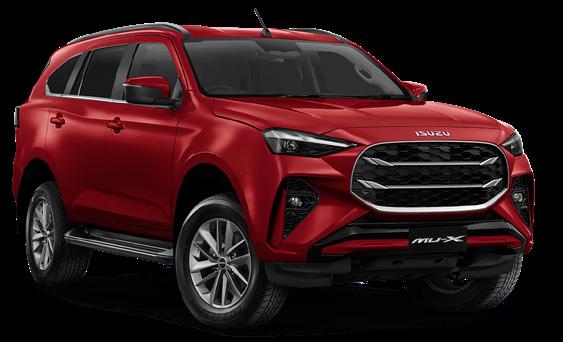
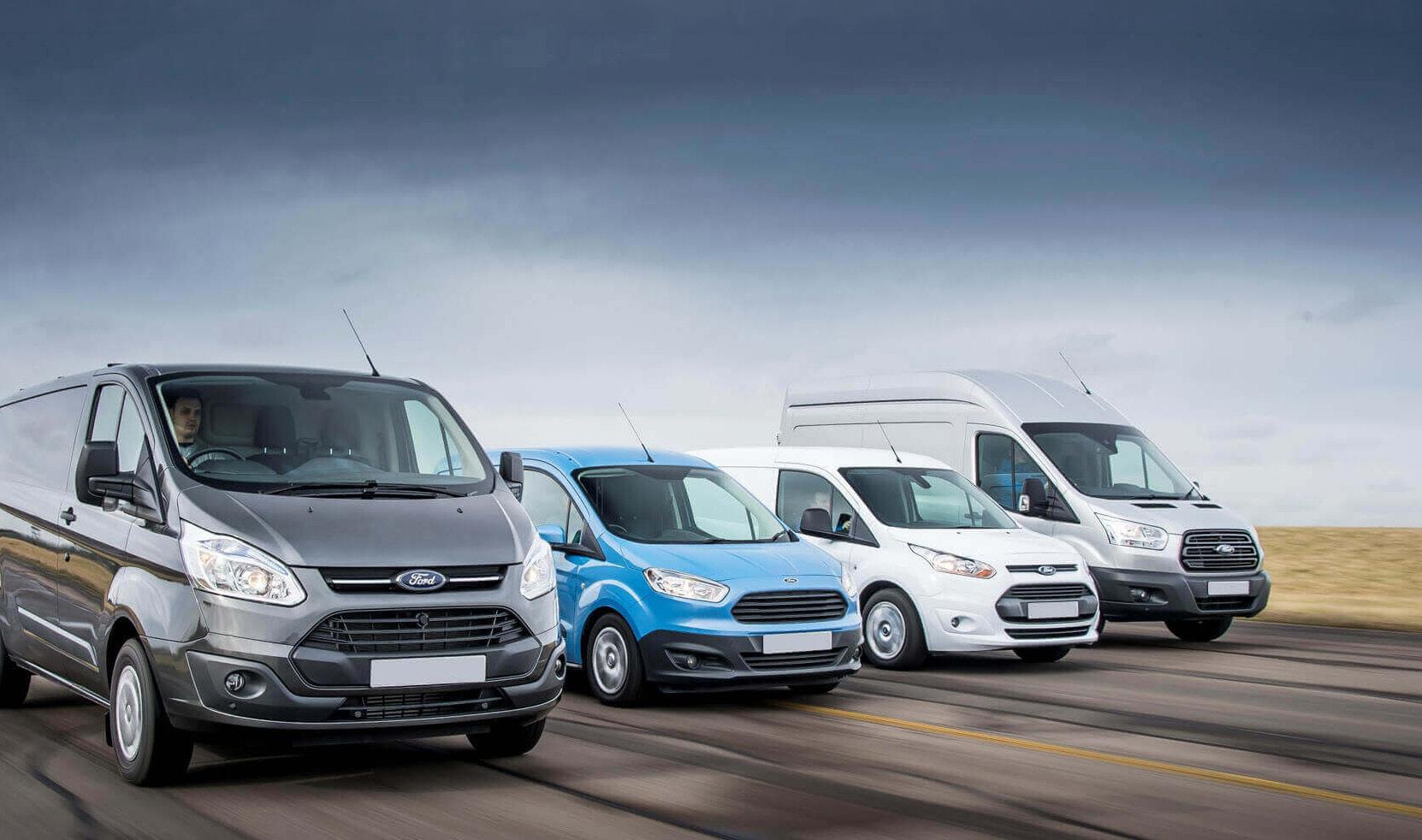
Isuzu Ute Australia finished the first reporting period in the black despite offering only the dieselpowered D-Max and MU-X large SUV. Ford also stayed on the right side of the ledger even though most of its sales were Rangers and Everests.
The overall net surplus of 15.9m units means there’s now a market for trading NVES credits. That could
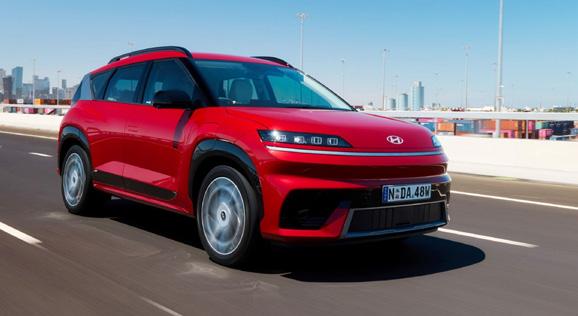

prove critical for marques with only internal combustion engined (ICE) line-ups or ICE-heavy ranges, especially as CO2 targets shift.
Importers have about two years to address any liabilities. Failing that, they face an infringement notice and penalty of $50 multiplied by their final emissions value come February 2028. This doubles to $100 if an entity appeals and loses or fails to pay on time.
Hyundai Australia is among the marques standing by ICEs despite the NVES. Gavin Donaldson, chief operating officer, says it will not remove fossil-fuelled models from its line-up across the Tasman anytime soon.
“We have greater opportunity to sell more hybrids and we’re transitioning to where the demand is,” he explains. “We still have ICEs available in the Kona, Tucson and Sante Fe, but we’re seeing greater demand for hybrids.”
Hyundai’s hybrid sales in Australia climbed by 92.8 per cent last year to 28,851 units – second behind Toyota with 115,953.
It sold 10,556 Tucsons and 10,407 Konas with hybrids of these accounting for 52.4 and 45.7 per cent shares respectively. These two
with the company more driven by what customers want.
The marque will adjust its model mix as the NVES regulations tighten to mitigate the cost of any penalties going onto sticker prices.
“There are three things we need to look at,” says Bhindi. “First and foremost is to offer products and technologies there’s a market for and the customer wants, but as a side benefit can get us credits to maximise our NVES position.
“Secondly, the legislators have created an arena where brands have to do a bit of horse trading on credits and there will be very cheap credits available at a point in time.”
And if the costs of doing business are balanced with “available levers”, then passing them onto consumers should be avoided. “If it does happen, that will be the last option we take.”
models were Australia’s fourth and fifth most-popular hybrids of 2025 behind three Toyotas – the RAV4, Corolla and Corolla Cross.
The Santa Fe’s hybrid share was 81.8 per cent out of 5,125 sales and was the next non-Toyota model in the top 10 best-selling hybrids.
The South Korean marque posted 84,563 NVES liabilities last year, so it will need to trade units with another car company by December 31, 2027, or risk a penalty come February 2028.
Donaldson attributes Hyundai’s NVES result to its N Division products. Apart from the electric Ioniq 5 N, they are powered by high-performance ICEs with figures above headline CO2 targets.
It has, however, indicated more hybrid and EV sales are key to balancing out the scheme’s penalties. The Elexio is joining its expanding electric portfolio across the ditch with the five-seater sized between the Kona Electric and Ioniq 5.
The Elexio was launched in late February with the Elite variant, which has a WLTP range of 546km. An entry-level version will go on sale in 2026’s second quarter.
Vinesh Bhindi, managing director of Mazda Australia, says the NVES is a secondary consideration
Australia’s BEV take-up remains relatively low, suggesting the model mix Mazda will offer locally between now and the end of the decade will complement NVES demands.
“Our thinking is let’s first get the products that help us keep the price-points and value of our technologies reasonable,” adds Bhindi. “Battery electric is less than 10 per cent of the market. While it will grow, we don’t know how quickly.
“The NVES is designed so consumers can still get cars they need and want. Not everybody will buy a battery-electric and nor an ICE. Let’s fix the option that helps consumers first and let the cost of doing business find its level.”
Mazda Australia is introducing two fully electric models this year – the 6e and CX-6e – as well as a petrol hybrid CX-5 before the end of next year.
It already has mild hybrids and plug-in hybrids as part of its line-up, the CX-60 through to the CX-90, alongside petrol and dieselpowered vehicles.
If demand for more electrified offerings intensifies faster than anticipated, it can lean on alliance partners, such as Changan Automobile, which makes the 6e and CX-6e, to deliver alternatives to the market.

Staff from Cooke Howlison Toyota have taken the top honour at the marque’s business excellence awards back to Otago.
The Dunedin company, which has been selling cars since 1907 and Toyotas since 1989 after it acquired Wrightcars, secured the supreme award at a celebration on Waiheke Island.
The accolade recognises allround leadership and excellence, and includes 30 criteria covering franchise operations.
“Our team members are invested in the brand and our partners,” says chief executive Matthew Downing. “They wish to do well for the business and the Otago community we serve.”
The annual awards are divided into “excellence” for specific operational areas, such as service and new vehicles, and “premier” for overall performance.
“Customers see our stores as trusted destinations and that trust sustains Toyota’s leadership in New Zealand,” explains Tatsuya Ishikawa, CEO of Toyota NZ.
“Cooke Howlison should feel proud. Its commitment to serving its region, supporting initiatives and caring for customers is what defines Toyota.”
[continued from page 16]
Andrew Humberstone, managing director of Nissan Oceania until late last month, says the marque is likely to reduce models and sales to stay afloat in the Australian market, which he describes as one of the world’s most competitive. Its drive to survive will also be tough for consumers on budgets.
The Pathfinder and Juke are being cut from its showrooms across the Tasman to accommodate emissions targets. The V6-powered, seven-seat Pathfinder is too thirsty as are non-hybrid versions of the Qashqai.
“We have to address the NVES,” Humberstone says.
“The only way to do that is
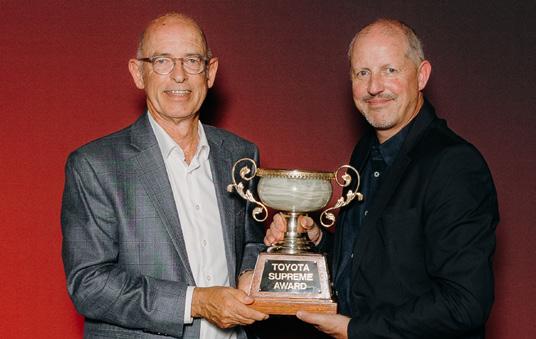
Supreme: Cooke Howlison Toyota, Dunedin –Matthew Downing. Finalists: Hawke’s Bay Toyota – Angus Helmore, and Tasman Toyota, New Plymouth – Craig Clarke.
Citizenship: Tasman. Finalists: Ebbett Toyota, Hamilton – Tony Coutinho, and Rutherford & Bond and King Toyota, Wellington – Derek Tilyard.
Leadership: Tasman. Finalists: Cooke Howlison and Hawke’s Bay.
President’s: South Canterbury Toyota, Timaru – Mark Patterson. Finalists: Manawatu & TRC Toyota – Fraser Hart, and Prescott Toyota, Otorohanga – Ryan Prescott.
New Plymouth’s Tasman Toyota won the citizenship award for its work with an organisation that supports mental health and suicide prevention in the construction industry.
Craig Clarke, chief executive, says: “It’s been special for us to be
through hybrids or e-Power as we call it.”
Cheaper models without hybrid technology will likely be withdrawn. The starting price for the Qashqai has jumped by nearly 60 per cent since the Albanese government was elected in May 2022, rising from A$28,590 plus on-road costs to A$45,640 for the current hybrid. Competition in the EV space has seen the new Leaf deferred for Australia.
The decision to cut the Pathfinder, Juke, Leaf and nonhybrid Qashqais will likely lead to a drop in Nissan’s Australian sales. Its deliveries fell by 21.6 per cent last year and by almost 45 per cent in the first two months of 2026.
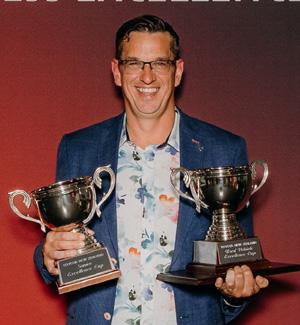
Parts and accessories: Rutherford & Bond and King Toyota. Finalists: Valley Toyota, Thames – Wayne Richards, and Tasman. Service: Tasman. Finalists: Ebbett, and Valley.
Used vehicles: Tasman. Finalists: North Otago Toyota, Oamaru – Lisa Wilson, and Manawatu & TRC.
New vehicles: Prescott. Finalists: Rangiora Toyota – Scott McDermid, and South Canterbury.
Finance and insurance: Miles Toyota, Christchurch – Mark Mills. Finalists: Hawke’s Bay, and Manukau Toyota, south Auckland – Darren Smart.
Branch of the year: Ilam Toyota, Christchurch – Paul Taylor. Finalists: Rotorua Toyota – Alastair Douglas, and Pacific Toyota, Whakatane – Ruan Meyer.
involved with Building Wellness Taranaki. When first approached five years ago, it ticked many boxes for us. The building industry is massive here and many workers are customers. We saw it as an opportunity to give back in a tangible way.”
“Sometimes less is a lot more profitable” and the brand’s restructure is “a cleansing process” necessary to shore up its local future, says Humberstone, while dealers will hope the new Navara can turn the ship around.
Subaru Australia plans to reduce its fleet’s CO2 emissions by gradually adopting hybrids across its range and adding new BEVs.
General manager Scott Lawrence says the marque will continue importing product that hits NVES targets “while staying on the right side of the client”.
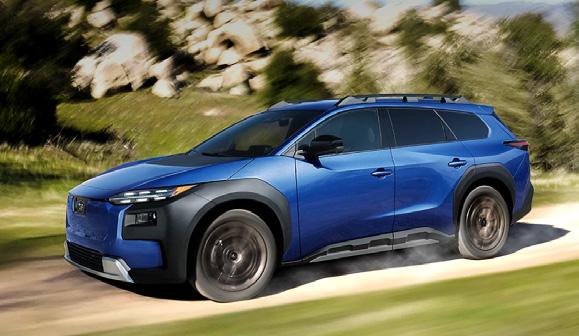
The scheme’s limits are problematic because sales of the fully electric Solterra are too low to offset other models. Only 202
Ishikawa notes the dealership’s submission included endorsements from participants and evidence to show the impact Building Wellness Taranaki is having on an industry “long supported Toyota, but sadly with the highest suicide rate in New Zealand”.
Solterras were delivered there last year – less than one per cent of the 39,005 Subarus sold.
The marque will soon launch the new 280kW Trailseeker in Australia. Further down the track is the Uncharted small batteryelectric SUV, while a global threerow, seven-seat BEV is thought to be under consideration.
In the meantime, increasing the proportion of hybrid sales at dealerships is a priority. For example, the Forester has an ICEhybrid sales split of 50-50, which will shift over time “as hybrid acceptance grows”.
Nuts and bolts: read how the NVES works in the May issue of Autofile
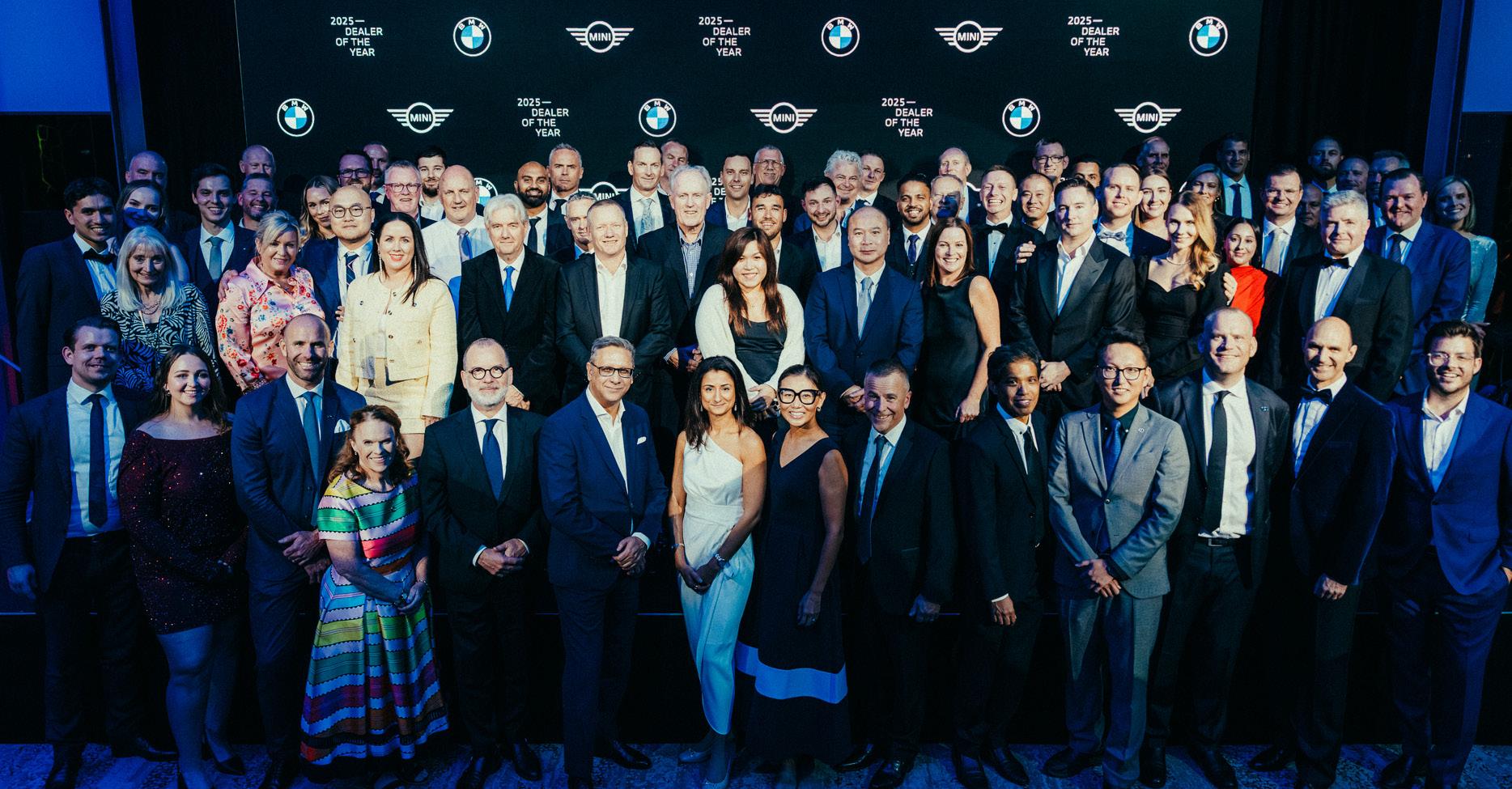
East Auckland BMW has been crowned the marque’s dealer of the year and has scooped four other prizes.
The East Tamaki-based company also triumphed in the marketing and financial services categories, while employees Queenie Chiu and Sam Wyke took out the business manager and sales manager honours respectively.
Two branches of Coombes Johnston BMW each claimed two gongs as did Auckland City BMW. Christchurch and Hawke’s Bay completed the list of winners with Auckland Mini Garage being named that brand’s dealer of 2025.
The gala event, held at the New Zealand International Convention Centre in Auckland in mid-March, came after BMW topped the country’s premium segment for the second year in a row.
It notched up a 20.4 per cent increase in registrations during 2025 compared with 2024, while sales of Minis rose by 4.9 per cent.
“The awards evening is a chance to recognise the importance of our network, and reward the dealers and their staff for outstanding contributions,” says Francois Roca, managing director of the BMW Group NZ.
“Last year saw exceptional sales growth in a challenging economic environment. The foundations of these achievements are in our network.
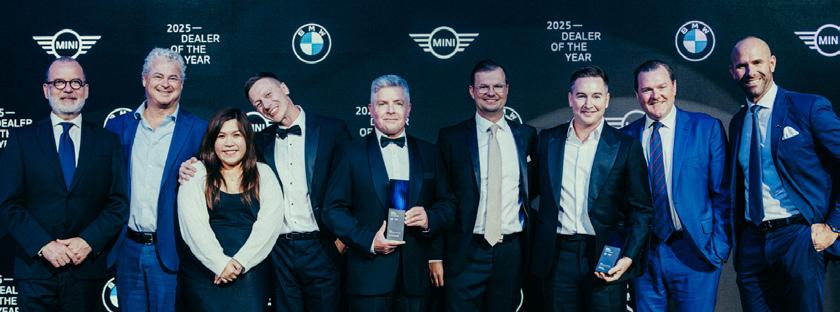
and David Geary of East Auckland BMW, Jonny Highton of Auckland City BMW, Paul Unverricht of Auckland Mini Garage, Brent Polites of Autosports Group, and Alexander Brockhoff of Mini Australia & NZ
Dealer principals David Geary, left, of East Auckland BMW, and Jonny Highton, of Auckland
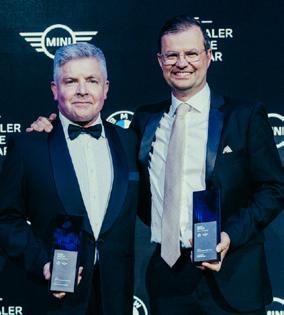
“Among the many highlights in 2025 included the first rollout phase of Retail. Next, which is a transformative leap forward in our retail experience, alongside a record level of investment in
Dealer of the year: East Auckland BMW.
Business manager: Queenie Chiu, of East Auckland.
Sales manager, group two: Kevin Pead, of Coombes Johnston BMW Tauranga.
Sales manager, group one: Sam Wyke, of East Auckland.
Used-cars sales consultant: Caleb Grover, of Auckland City BMW.
Sales consultant, group two: Dylan Boddis, of Coombes Johnston BMW Tauranga.
Sales consultant, group one: Tommas Kondrats, of Auckland City.
Excellence in after-sales: Hawke’s Bay BMW.
Customer service: Coombes Johnston BMW Hamilton.
Marketing and financial services: East Auckland.
Mini dealer of the year: Auckland Mini Garage.
Sales consultant, group one: Caelen Chadwick, of Coombes Johnston BMW Hamilton.
Sales consultant, group one: Selena Hewitt, of Christchurch BMW.
the BMW Group’s facilities and services. This all underlines the dedication of our dealers to provide customers with a premium experience that befits our brand positioning.”
Ritu Chandy, senior vicepresident of the Asia-Pacific, Eastern Europe, Middle East and Africa regions, attended the awards ceremony to commend dealership staff.
The headline news for last month’s new-car sector was the lift in registrations of models needing a plug to power up taking a materially higher share of the market.
Rising fuel costs are now feeding directly into purchasing decisions and the pace of change we’re seeing is faster than expected.
Demand is shifting more quickly than supply pipelines can adjust to, particularly following the strong March for EV sales.
While global supply-chain risks remain present, the more immediate development for our market is the government’s updated national fuel plan.
It sets out four response levels which can be triggered, with New Zealand currently at the lowest “watchful” setting.
Movement between phases isn’t automatic and will instead be determined by ministers based on a defined set of indicators.
These include changes in fuelstock levels, supply disruptions from source refineries, the ability of fuel companies to meet forward orders and any breach of minimum storage obligations.
Broader triggers such as international policy shifts or regional distribution disruptions are also factored in.
The plan also introduces indicative priority bands, outlining how fuel may be allocated at higher response levels.
Band A covers life-supporting services including hospitals, the emergency services, lifeline utilities and defence.
Band B includes economically
important services, such as freight, food supply chains and primary production during critical periods.
Band C captures essential services including public transport and key infrastructure maintenance. Band D applies to remaining commercial uses and band E covers general retail supply.


AIMEE WILEY Chief executive officer, Motor Industry Association
Recent briefings from the Ministry of Business, Innovation and Employment (MBIE) reinforce that, while fuel stocks remain sufficient, price is currently the primary mechanism managing demand.
Officials are actively preparing for a potential phase-two response, which would focus on voluntary reductions alongside possible regulatory measures if required.
What’s notable is the transport system remains functional but it is
already adjusting.
We are seeing reduced light-vehicle use alongside increased uptake of public transport indicating that behavioural change is under way as fuel price pressures clearly influence decisions ahead of any formal intervention.
Also last month, the government confirmed a temporary alignment with Australian fuel specifications to strengthen fuel resilience. In practical terms, this opens access to a broader pool of offshore refinery supply, which is a pragmatic and necessary step in the current environment.
Importantly, the maximum sulphur content remains at 10 parts per million. There’s no proposal to move to higher sulphur fuels and under present conditions this is unlikely to change.
From an industry perspective, we do not anticipate any impact on petrol or diesel vehicles in New Zealand under the proposed alignment. That said, if alternative specifications are introduced, clarity and consistency will be critical. Importers need certainty to manage compliance, product planning and customer expectations.
The MIA is engaging closely with officials across the Ministry of Transport and MBIE to ensure response settings remain practical for the vehicle fleet, and aligned with the needs of importers and distributors.
While the national fuel plan itself doesn’t directly address fuel-specification changes, the parallel work on Australian alignment highlights the need for co-ordinated policy development. Decisions in this space must be workable for importers and consistent with technical requirements of the modern fleet.
More broadly, the current situation reinforces a longer-term shift. Energy security, supply-chain resilience and the pace of transition are now firmly linked.
For our sector, that means ensuring New Zealand continues to have access to the right mix of technologies, supported by policy settings that are stable, predictable and grounded in real-world operational impacts.
BEVs’ market share of overall light-vehicle registrations last month was 22.6 per cent compared to seven per cent in March 2025. PHEVs’ share rose from 3.5 per cent to 11 per cent over the same period.
Source: MIA
We will remain actively involved as this evolves, ensuring the voice of importers and distributors is clearly reflected in immediate response measures and longerterm policy decisions.
New Zealand is now fully digital with Kiwis spending an average of 42 hours online per week and digital media making up 72 per cent of national advertising spend.
Future buyers are active across multiple digital environments long before they search for a car. The question isn’t whether you’re advertising, it’s whether you’re influencing the right audiences early in their buyer journeys.
Most dealers focus heavily on Google Search and social media, which is logical. Search alone accounts for more than half of New Zealand’s digital ad spend and performs strongly for capturing inmarket buyers using keywords. Platforms such as Meta are highly effective at converting engagement into enquiries once interest exists. However, this approach is reactive. It captures demand, but doesn’t build it.
When you analyse campaign data through AdTorque Edge’s ALICE, GA4 or Meta Insights, performance may look healthy with leads flowing and engagement steady although that’s often concentrated in a narrow group of existing or familiar customers.
It may deliver short-term leads, but also highlights the
larger opportunity of expanding to new audiences and exposing buyers to your dealership earlier during their research.
Does your current marketing strategy create demand when you need it or does it rely on conversionfocused advertising?


JAMES HENDRY Director, sales and operations
AdTorque Edge NZ
If your plan is to grow EV penetration, fleet or prestige sales or younger family segments but your marketing primarily engages repeat service clients or legacy buyers, there’s a structural gap. The issue isn’t performance. It’s alignment and that’s where conquest strategy begins.
Most car dealers still buy their top and middle-funnel media directly from publishers unaware more than 85 per cent of digital inventory in New Zealand is traded programmatically.
This shift provides advertisers with cost efficiencies, improved return on investment, lower cost per lead and access to premium publisher inventory via a consolidated campaign budget.
Programmatic is no longer experimental. It’s the infrastructure behind modern digital media

buying. It includes premium website display inventory, online video, connected TV, digital audio – such as streaming radio, podcasts and Spotify, mobile in-app placements and digital out-of-home.
Kiwi consumers find brands through search, social and web ads, TV and online video.
If your strategy only includes Google Search and Meta, you are active in two environments and programmatic unlocks the others. That said, modern programmatic isn’t just about reach.
It’s data-qualified targeting built on first-party CRM audiences, behavioural signals, content consumption, in-market segments, income and household modelling, geo-conquesting and cross-device frequency control.
You’re not just expanding reach, you are qualifying scale. For example, a multi-franchise group looking to grow sales of electric cars can target higherincome audiences engaging with sustainability content or
researching home chargers months before they search “best EV NZ”. Those people can later be retargeted through Search and Meta when intent signals rise.
This is how programmatic strengthens the funnel rather than competing with it.
More than 65 per cent of web traffic is now mobile. Consumers are scrolling, streaming and browsing across devices.
Buying digital media directly cannot apply real-time audience layering or cross-device frequency control. Programmatic allows dealers to build persistent audience pools, control exposure, track impression to conversion, optimise campaigns and feed warmer audiences into lowerfunnel campaigns.
Programmatic diversifies acquisition sources, cuts reliance on keyword bidding wars and improves mid-funnel conditioning Over time, it can lower blended cost per lead by warming audiences before price becomes the main differentiator. In a digital market, conquest is about influencing earlier, building smarter audiences and aligning marketing with growth objectives.

April 12, 1999
Ford’s acquisition of Fleetlease brought to three the number of leasing companies in New Zealand effectively owned by the company.
Through its subsidiary Axus International, Ford Motor Company (FMC) completed the purchase of Fleetlease, this country’s largest such operation with 14,000 vehicles in its fleet.
FMC also owned Hertz Leasing via its parent Hertz International, which in turn was owned by the Hertz Corporation – another of the blue oval’s subsidiaries. In addition, Ford Motor Credit Company was involved in the leasing business here.
The purchase of Fleetlease was the first foray by Axus into this part of the world. It was an extremely ambitious company, leasing many different makes of vehicles, and not just Fords, despite its ownership by that marque.
That same impartiality was expected to be continued here. Hertz Leasing was already a multi-make leasing organisation which viewed Ford as “just another supplier”.
Steve Wilkinson, general manager of Fleetlease, stressed the same situation would apply to his company, while a Ford spokesman told Autofile that it would receive no favouritism.
21, 2006
The resignation of David Parker as Minister of Transport had seen a caretaker minister, Pete Hodgson, looking after the important portfolio as well as energy.
Key figures in the car industry believed it was time for a permanent appointment to be made so there was certainty on major issues. Inevitably when a caretaker minister was in charge, day-to-day issues were dealt with but new initiatives tended to go on the backburner.

The mandatory fitting of immobilisers and whole-of-vehicle marketing (WoVM) for all vehicles imported into New Zealand had been announced as policy but the industry had no hard facts on which to plan and prepare.
While major industry groups such as the Motor Industry Association and Independent Motor Vehicle Dealers Association had serious doubts about the cost benefits of WoVM, there was a need for certainty and time to prepare for the introduction of any compulsory programme.
In the meantime, Australia had effectively halved its vehicle-theft rate in five years, which was largely attributed to fitting immobilisers.
Car companies and dealers were pleased the Reserve Bank left the official cash rate at 6.75 per cent.
They hoped it would ensure the cost of finance for people buying vehicles wouldn’t increase and the exchange rate would remain constant.
However, bank governor Alan Bollard warned the current outlook offered no scope for an easing of policy in the near future. He said inflation pressures and underlying demand were causing sufficient concern that further policy tightening couldn’t be ruled out.
Bollard added several years of strong growth had led to productive resources being stretched, resulting in capacity and labour shortages.
He suggested the recent softening of GDP outturns might have been affected by those restraints and didn’t necessarily reflect a weakening of demand as illustrated by robust retail, housing and import figures.
Bollard said underlying inflation pressures persisted as evidenced by rising business costs and ongoing labour-market tightness.
The chef executive of the Imported Motor Vehicle Industry Association (VIA) said everything that could be done would be done to secure the future of the supply chain into New Zealand during the coronavirus crisis.
David Vinsen explained the association and its stakeholders were working frantically during the national lockdown to ensure the long-term health of the industry.
VIA, other organisations and supply-chain representatives –from source countries to consumers – were in emergency talks and collaborating with numerous government departments to overcome issues created by the pandemic.
Vinsen told Autofile: “I want to reassure people we are working on solutions.” The agenda was vast – from logistics, storage and cash flow to biosecurity, customs and tax.
“I’ve never seen government departments working so co-operatively, and competitors and different sectors of the supply chain working together. The whole-of-government approach has streamlined the response, and decisions are being taken and put into effect quickly.”
Among VIA’s most pressing tasks had been working with Biosecurity NZ to set up verification procedures in this country after the Ministry for Primary Industries withdrew its staff from Japan in March 2020.

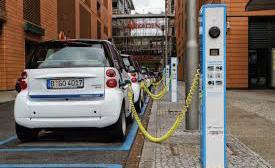
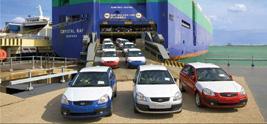
When New Zealanders think about the future of transport in our country, they often picture electric cars, charging infrastructure and smarter technology.
What we talk about less is the workforce required to support that future and who is, and isn’t, part of it at the moment.
The car industry is a significant contributor to our economy.
It keeps people moving, supports regional employment, and underpins thousands of small and medium-sized businesses.
But like many industries undergoing rapid change, it’s facing pressure on multiple fronts. These include technician shortages, tighter consumer spending, increasing operating costs and the shift towards more complex, software-driven vehicles.
In conversations I’ve had across the sector, from owners of dealerships to training providers and directors, a consistent theme is present workforce capability is where strategy succeeds or stalls.
We talk frequently about labour shortages, but less about participation. Women remain under-represented across technical trades, service leadership and senior decision-making roles in automotive.
This isn’t a question of ability. It’s often a question of visibility, pathways and progression.
If young women don’t see automotive as a viable, modern and financially rewarding career, they are unlikely to pursue it. If those who enter the sector do not see clear progression into leadership or commercial roles, they’re less likely to stay.

NATASHA CALLISTER Co-founder, Women in Automotive
That matters, not only from an equity perspective but from an economic one. An industry operating with constrained labour supply cannot afford to overlook half the population.
The shift towards electric and hybrid vehicles, digital diagnostics and connected mobility means today’s careers look very different from those of a generation ago.
when workforce resilience is critical.
With the plethora of new entrants, the brands Kiwis are choosing are also changing. People who once bought the same marque for decades are reconsidering.
Brand switching is bringing new faces through dealership doors and understanding those customers starts with reflecting them.
None of this suggests the car industry needs to be “fixed”.
It has a long history of adapting to change. However, transformation presents an opportunity to think deliberately about who is included in that future.
Workforce capability is where strategy succeeds or stalls
Automotive increasingly requires technical literacy, adaptability and commercial confidence. It offers stable, skilled employment, particularly in regional New Zealand, at a time
Lily Davies made Kiwi history when she completed MITO’s NZ certificate in heavy automotive engineering.
That’s because the technician at Go Bus Transport in Dunedin was the first woman in the country to gain the level-five qualification.
To mark the milestone, MITO ambassador and rally driver, Emma Gilmour, presented Davies with her certificate, which was also a significant achievement for women in trades.
“We’re proud of what Lily has
achieved,” says Garry Shieffelbein, her manager.
“She has been motivated from the minute she started with us and approached the course, which isn’t for the faint-hearted, with a can-do attitude.
“The qualification recognises the effort she put in and knowledge she has obtained.
“She’s a great team member and is always happy to help others, which she is doing now with apprentices coming through.”
MITO training adviser Gary
When industries expand participation, they expand resilience. When they invest in structured development and progression, they build stability. And when they treat diversity as part of economic infrastructure rather than a social add-on, they position themselves more competitively.
New Zealand’s automotive sector is evolving quickly. The question isn’t whether change is coming. It’s whether we will ensure the workforce shaping that change reflects the full breadth of talent available.
Untapped capability is not just a missed opportunity for individuals. It’s a missed opportunity for the country’s economy.
At Women in Automotive NZ, our focus is practical.
We work with training organisations, employers and industry bodies to encourage broader participation in apprenticeships, support career development and make leadership pathways more visible.
The goal is simple – strengthen industry capability by widening access to it.
Women in Automotive NZ was founded in 2023 to support female participation and leadership in the sector. Its 2024 industry-wide accord is now backed by many of the country’s leading automotive businesses. Recently incorporated as a charitable trust, the organisation is working towards official charitable status. Email info@womeninautomotive.nz to find out more.
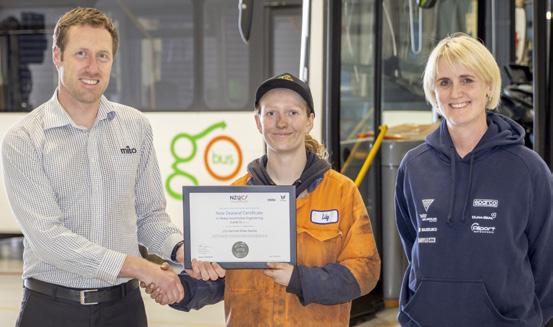
Dench, who supported Davies during her learning journey last year, adds: “Lily was an exemplary learner throughout her training with us, ensuring that she gave
everything she tried 100 per cent.
“She placed a large amount of detail into her qualification making it enjoyable to read and hear of the faults she diagnosed.”
STEVE MILETTE became Nissan Oceania’s managing director on April 1 when he took over from Andrew Humberstone.
Milette, pictured, joined the company in 2017 in Canada as vice-president of sales before being president of Nissan Canada for more than five years.

He was then based at Nissan’s North American headquarters in Tennessee as division vice-president for dealer-network development, customer resources, training and customer experience in the US and Canada.
Massimiliano Messina, chairman of the AMIEO region, says: “With a range of exciting new products coming that defy ordinary, I look forward to Steve applying his customer-first approach to bringing these to market.”
Humberstone has taken up a new senior role at the company’s regional headquarters in Paris.
DAVE HAYTER has become Bentley Motors’ regional director for Asia-Pacific overseeing brand, commercial and network activities, which includes 27 retailers.
Earlier in his career, Hayter played a key role in establishing the marque’s national sales companies in Singapore and South Korea. He has also held leadership roles in the Middle East and Asia, supporting new market entries, distributor development and launching Bentley facilities.

Hayter says: “Having spent much of my career with Bentley in Crewe, it’s a privilege to return to Asia-Pacific, which offers tremendous opportunities.”
BRITTANY THOMAS has joined Avanti Finance as relationship manager – auto to support operations in the lower South Island and Christchurch.
She has extensive experience across the financial services and automotive sectors having held roles with Auto Trader, CFS Finance and Partners Finance & Lease.

The company says her appointment strengthens Avanti’s “commitment to providing responsive, relationship-driven support to introducers”.
CRAIG BAIRD has joined MotorSport NZ’s board. His career includes time as a factory driver for manufacturers, and he has competed at the highest levels of touring car and GT racing.
Baird has off-track expertise in risk assessment and motorsport safety. He has served as driving standards adviser for Supercars and GT categories across Asia, and heads the drivers’ safety group in Supercars.

GWM Australia and New Zealand has made three executive appointments as part of a strategic move for the company.
Samuel Mulkearns has become head of go-to-market and product planning, and has more than a decade of automotive experience working with the likes of Toyota and Holden.
His career spans product planning, launch strategy, sales planning and market readiness, supported by an academic background of a double degree in engineering and industrial design.
GWM says this combination equips Mulkearns with a technical foundation and deep understanding of customer-centric product development.
leadership with Ford, Holden, GM Middle East and the Nationwide Group, which provides safe automotive and specialist transport solutions in Australia.

An aerospace engineer, he has led national service operations, technical support, warranty strategy and large-scale field teams delivering improvements in customer satisfaction, vehicle off-road times and operational efficiency.


“Samuel also brings extensive expertise in safety, electrification, compliance, product lifecycle planning and broader strategic product functions, capabilities that will play an important role as GWM continues its rapid growth in the Australian and New Zealand markets,” the company adds.
In his new role, Mulkearns will work with engineering, design and product teams to strengthen the brand’s position. He will oversee a series of major product introductions as GWM prepares for its biggest launch calendar to date.
DANIEL BOYD has joined MITO as group manager of qualifications after being operations manager at the Low Volume Vehicle Technical Association (LVVTA) for almost two years.
Boyd says leaving the LVVTA and RepairCert NZ wasn’t easy, but his decision came with optimism for its future.
He adds: “From tackling complex challenges to collaborating with certifiers, builders and car lovers, my time at the LVVTA was marked by countless examples of Kiwi ingenuity.”
“My key priority is to ensure every launch is executed flawlessly while delivering vehicles aligned to what drivers want and expect,” Mulkearns says.
Carlo Jacobs is now head of customer experience and technical services at GWM ANZ. He has more than 25 years in technical, operational and customer service
Jacobs is now charged with elevating ownership experience on both sides of the ditch as GWM invests in aftersales capability. His remit spans the customer care centre, technical services, and systems underpinning technician and dealer performance.
The company’s third recent appointment is Aniket Nadkarni as head of after-sales in Australia. A senior commercial executive with 15-plus years of crossindustry experience in automotive insurance, consulting and telecommunications, he has joined GWM from Mitsubishi Motors Australia where he held a senior national after-sales role covering parts, accessories and collision channels.
John Kett, chief operating officer of GWM ANZ, says the appointments are an investment in the brand’s future.
“We are scaling our business but, more importantly, raising our standards,” he adds. “By strengthening our leadership, we’re ensuring growth is matched with operational excellence and best-inclass ownership experience.
“These roles will play a central role in improving performance and ensuring GWM delivers across every customer touchpoint.”
Policymakers should stop treating New Zealand-new and used-car importers as if they perform the same function in the market because they don’t.
They sit at different points in the vehicle lifecycle, influence different outcomes and have different levels of control over products they supply. Regulation that ignores this is no longer credible.
NZ-new importers operate where models first enter the market. What they sell is produced to current factory specifications and regulations, and supported through OEM-controlled channels. They are closely connected to the manufacturing system, and design and technology choices made upstream by carmakers.
If policymakers want to influence what new technologies and standards enter the fleet, this is the natural point.
Importers of used cars don’t determine what’s built and operate with stock that already exists. Their role is to source, import, certify and distribute products that have been designed, made and driven elsewhere.
In New Zealand, that’s not a side issue. It’s the main pathway through which ordinary households access newer models they can afford.
That matters because our fleet doesn’t renew mainly through oldto-new replacement, but mostly via old to somewhat newer used.
It means used imports aren’t just cheaper versions of new vehicles. They form the main mechanism for mass-market fleet renewal. Once that’s recognised, the case for treating them differently becomes
quite straightforward.
NZ-new importers are part of the technology introduction stage of the market. Used importers are part of the technology diffusion phase. New-vehicle supply determines what enters the fleet in the first place. Used supply determines how quickly improvements spread to ordinary households.
KIT WILKERSON Head of policy and strategy kit@via.org.nz
The problem is New Zealand law and regulations have often assumed a broad symmetry between both.
That might once have made sense. In an earlier era, vehicles were more mechanical, less software-dependent and less tied to proprietary manufacturer systems. A supplier who sold a car could generally access parts, tools and information needed to support it.
That world is disappearing because modern vehicles are increasingly governed by software, encrypted systems, proprietary diagnostics, security gateways, telematics, calibration tools, and manufacturer-controlled data.
This affects NZ-new and used importers differently.
NZ-new importers sit inside OEM-supported channels. They are far closer to the source of technical authority, data access and engineering remedy pathways.
Used importers are not. They may remain legally responsible for what they sell, but some of the practical means required to support vehicles are increasingly outside their control.
The core problem is the law has preserved similar obligations while the underlying capability of the different actors has diverged.
This isn’t theoretical. It’s already visible in the wider choice-of-repairer debate. Independent operators increasingly need access to diagnostic systems, software tools, technical information and data that sits behind manufacturercontrolled interfaces. Without that access, an apparently open market isn’t open at all.
The same structural issue affects used importers. If standing behind a car increasingly depends on OEM-controlled systems, then identical legal obligations no longer mean identical practical obligations.
One class of supplier has the tools and channels needed to comply. The other may depend on discretionary access from an upstream actor that controls those systems, and may have limited commercial incentive to support independent importing, repair, servicing or other downstream functions. That isn’t a stable regulatory arrangement.
At the same time, New Zealand cannot simply allow the usedimports pathway to fade away because used imports matter too much for fleet renewal, consumer affordability and competition.
It brings in newer vehicles from markets such as Japan at price-points that matter to real
households. In many cases, these cars are also in materially better condition than similarly aged models already on our roads. If that pathway weakens, the likely result isn’t a surge in newvehicle purchases. For most Kiwis, that’s not financially realistic. The more likely outcome is slower turnover, longer retention of older cars and greater recirculation of those already in the fleet. That would slow technology improvement and safety, not accelerate it.
The answer is not weaker standards or less consumer protection, but better regulatory design.
Responsibilities tied to vehicle design, embedded software, proprietary systems and factorylevel remedy capability should sit with those connected to the manufacturer domain.
Those linked to sourcing, certification and entry compliance should sit with the importer.
And when independent actors need access to OEM-controlled systems to meet legal obligations, the law should require that access to be provided on fair terms. That is not special treatment. It’s simply regulation aligned with reality. Our market depends on both NZ-new and used importers for different reasons. One introduces technology into the fleet. The other diffuses it through the wider public.
A coherent fleet-management approach to regulation should recognise that difference rather than continuing to pretend it doesn’t exist.
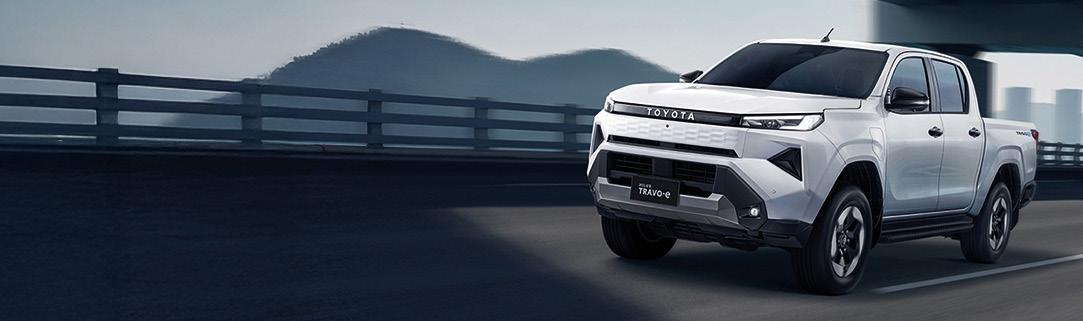
Ahydrogen fuel-cell EV (FCEV) and batteryelectric model will feature in the future line-up of the nextgeneration Hilux.
The ute has been in development for four years, with much of the design and dynamic testing led by Toyota Australia.
“It carries that legacy forward as we approach a milestone – 50 years of the Hilux in New Zealand in 2026,” says Tatsuya Ishikawa, Toyota NZ’s chief executive officer.
“This evolution is a statement of Toyota’s vision with a multi-pathway approach that includes a BEV and FCEV scheduled for 2028.”
There will be 12 different variants of the ute, and the option of a sixspeed automatic transmission and three manual variants.
Ishikawa says the diesel-hybrid Hilux has become popular as buyers realise its system “takes nothing away” from performance while helping to cut emissions and boost fuel efficiency.
Stronger acceleration and smoother operation combined with a start-stop system are now standard across the range, he adds.
There has been strong interest in the SR Cruiser and GR Sport with
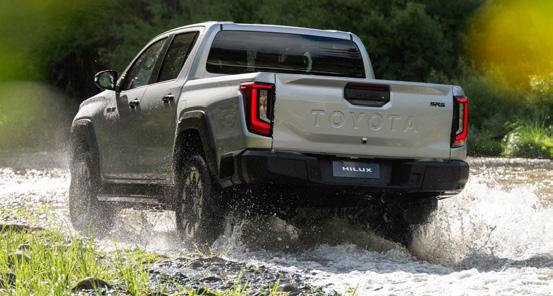
their wide-track configurations.
While these models aren’t part of the initial launch, the marque is exploring opportunities to make them available.
The new Hilux comes with a choice of diesel and hybrid-diesel variants in two and four-wheel drive (4WD). It carries over the 2.8-litre turbo-diesel engine, and delivers 150kW of power and 420500Nm of torque depending on the transmission.
The line-up starts with the SR double-cab wellside 2WD automatic at $49,990, plus on-road costs. There are five diesel 4WDs. They range from the SR cab-chassis automatic from $50,990 to the SR5 Limited double-cab wellside manual at $59,990.
Six diesel mild hybrids are automatic only. These are priced
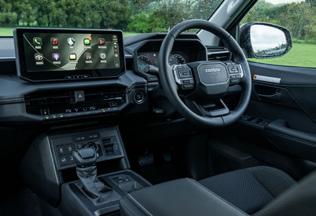
from $54,990 for the SR double-cab chassis and top out at $63,990 for the Adventure double-cab wellside.
The new Hilux’s exterior was led by Toyota Australia’s design team in Melbourne, along with their counterparts in Thailand and Japan.
There are slim-line headlights, an assertive front design and modern lines.
Beyond the cabin and doors, most elements have been reworked. For example, the rear has a step integrated into the tailgate.
The all-new wellside design introduces easy-access side steps, wraparound tail-lights, an integrated tailgate handle with assist system, pressed Toyota logo and centrally positioned reversing camera.
The three-tier instrument panel is flatter to create a more spacious cabin feel and better visibility.
All grades now feature a digital cluster – a seven-inch display for SR grades and 12 inches for the SR5, SR5 Limited and Adventure. A 12.3-inch multimedia touchscreen is centre stage in all grades.
While the core powertrain is unchanged, Toyota has upgraded the Hilux’s performance and technology.
All variants have electric power steering with refined suspension in the SR5 and higher grades. These aim to improve ride comfort, and on and off-road dynamics.
Off-road prowess is one of the ute’s “hallmarks” with 4WD grades using a part-time system with high and low-range ratios. It’s been enhanced with multi-terrain select traction control on most automatic SR grades and above.
Chery says its KP31 concept will be the first utility worldwide to have a plugin hybrid (PHEV) diesel system.
The 2.5-litre turbocharged engine will offer “class leading” thermal efficiency, which is rated at 47 per cent, and it will be 10 per cent more fuel efficient compared to the average diesel powertrain.
Noise, vibration and harshness levels have been a major focus with the production version providing a 30 per cent vibration

reduction when compared to the average diesel.
The KP31 will boast a 1,000kg payload and 3.5-tonne towing capacity.
Visually, the ute has large Chery lettering at the front and rear, a snorkel, chunky 285/70 R17 all-terrains and tub rack with fourby-four recovery tracks.
A petrol PHEV powertrain will join the line-up in 2027 after the diesel variant launches down under later this year.<
Giltrap Audi North Shore secured two of the trophies up for grabs at the 2025 Audi Excellence Awards including dealer of the year.
The business also took out the new-car sales category and was runner-up in the finance and insurance, and service department sections.
Paul Staples, dealer principal, describes being Audi’s top dealer as an incredible honour.
He says: “It’s a testament to our team’s dedication, expertise and passion for the brand.
“I’m proud of what we’ve achieved and the culture we’ve built since opening in 2024. This award reflects commitment to delivering an exceptional experience, and we thank our customers for their trust and support.”
Ebbett Audi in Hamilton scooped three team awards – usedcar sales, service and finance and insurance – and was runner-up for dealer of the year.
The marketing award went to Auckland-based Continental Cars and Archibalds Audi in Christchurch took out parts team of the year.
Greg Leet, Audi NZ’s general manager, says the awards honour those who go above and beyond delivering exceptional results in customer service, finance, marketing and sales. “It’s a testament to the passion and commitment that drive our success.”
On Giltrap Audi North Shore taking out the top award at the ceremony at Prince’s Wharf, Auckland, on February 25 despite only opening in 2024, he adds: “Its ability to set high standards across every area of the business, including team culture, so early in their journey is remarkable.”
Steve Kenchington, chief executive officer of the Giltrap Group, described the result as “outstanding” considering how long the dealership has been operating.
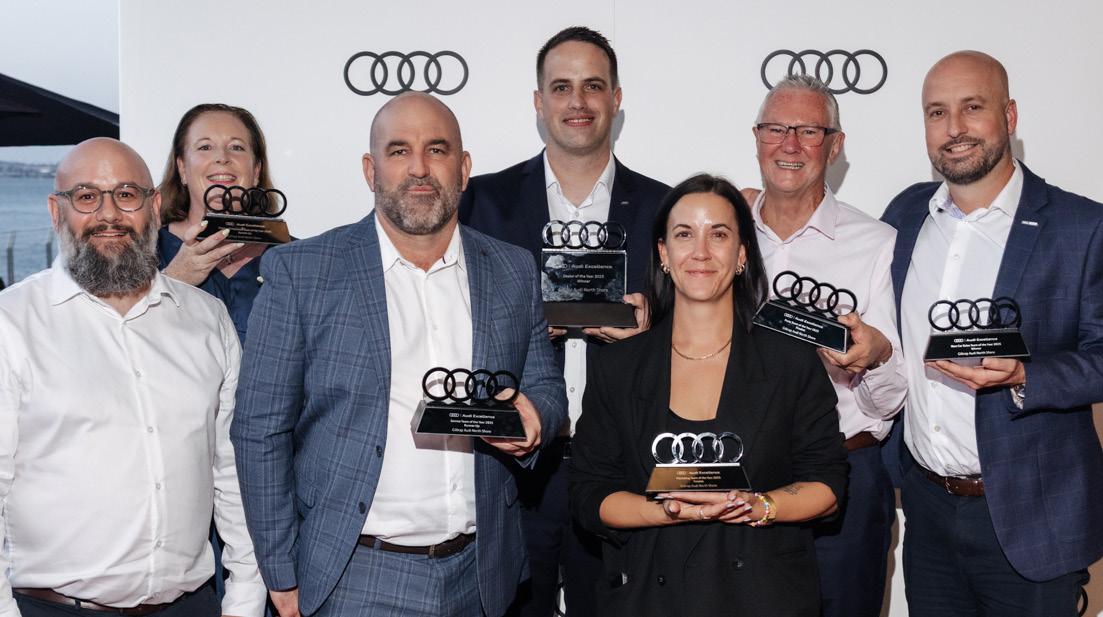
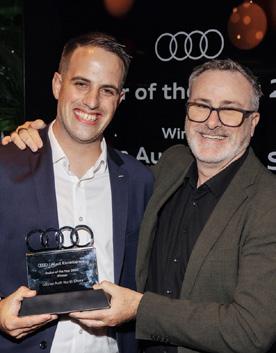
Paul Staples, left, dealer principal of Giltrap Audi North Shore, and Greg Leet, general manager of Audi NZ
Jason Young, of Ebbett Audi, with Ina Economopoulos, of Audi NZ
Richard Wren, left, of Ebbett Audi, and Phil Davis, of Audi NZ
Katie Alderson, of Continental Cars, with Audi NZ’s Andrew Stephenson
Savannah Mountney-Needham, of Ebbett Audi, with EMD’s Duane Jarrett
Hamish Young, left, of Archibalds Audi, and James Yates, of European Motor Distributors
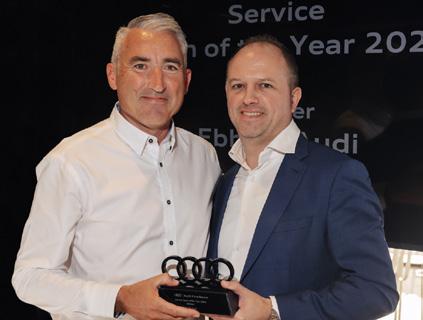

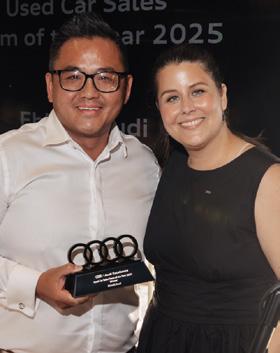

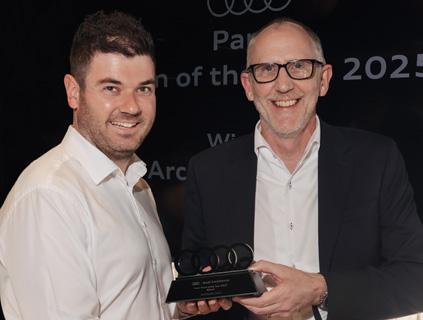
V8 Supercars star Matt Payne is in the fight of his career as this year’s competition gets to New Zealand.
The Kiwi didn’t appear to be the stand-out driver of the opening round at Sydney Motorsport Park, but proved the adage of points mean prizes.
Payne failed to win any first round races in February, but a fourth, third and second gave him a major points boost. “We had a strong opening round but didn’t probably have the car pace we wanted during the race,” he said.
Arriving at Albert Park last month for the Melbourne SuperSprint and second round before the V8s arrive in Taupo this month, Payne was joint leader of the series and seemed set to capitalise on that.
He came second overall in race five of the championship, but wasn’t too happy.
As he parked the number 19 Ford afterwards, he was visibly frustrated his chance of a first victory of the season had slipped through his grasp.
Despite extending his series
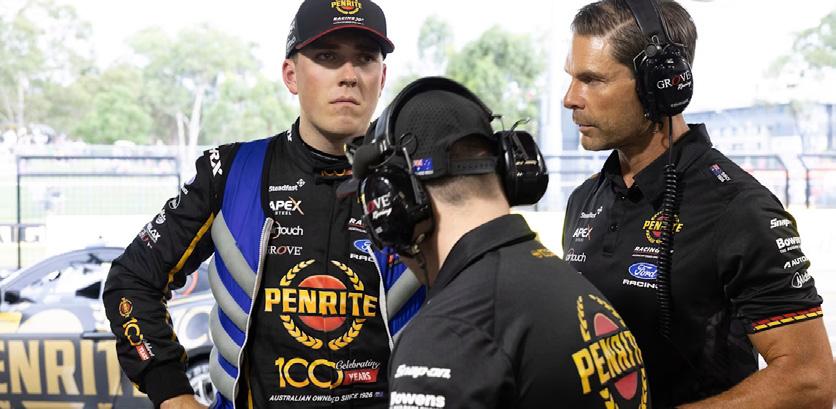
lead by 24 points over Broc Feeney, one of many drivers in the thick of it during a wild race, the defending Bathurst winner knew he had missed an opportunity to get his first win of 2026.
Starting from pole, Payne had few challengers in the early laps, but fellow front-row starter Brodie Kostecki eventually began to close the gap.
The Shell V-Power Ford was on Payne’s rear bumper by the start of lap five and Kostecki made a move down the inside at turn 11
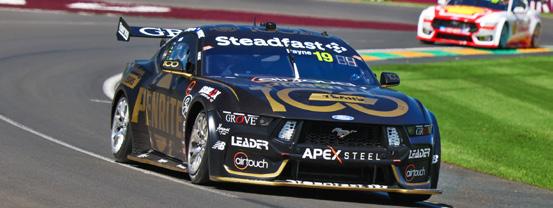
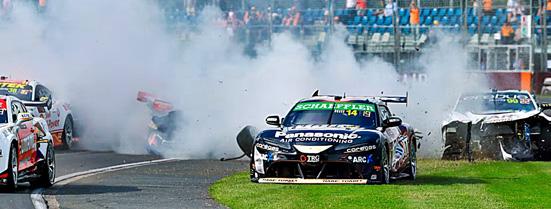
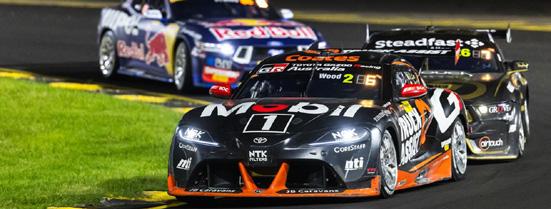
to which the New Zealander could offer little resistance. The former powered on to win.
“Any driver would be as disappointed as I was,” said the Kiwi. “When you start first and finish second, it feels like a failure. Still, it’s obviously good points.”
Payne felt the team hadn’t maximised the changes it needed to make from previous races and he wasn’t the only championship front-runner to strike trouble.
Feeney won race six at Albert Park, fending off Kostecki by just 0.1445 seconds, but destroyed his vehicle in a pile-up at the start of the next race.
Payne’s championship lead evaporated in an eventful race six when he was squeezed into a wall on the first lap by James Golding.
“It’s disappointing to race so hard for one corner and be put in the wall when we could’ve easily gone down to turn three and would have still been in the race. It would’ve played itself out further along the track.”
With three punctures and a broken front-right wheel, Payne parked his Penrite Mustang in the run-off at turn four for his first nonfinish in 43 outings.
He added: “I don’t know how many crashes there were in that race, probably four or five, with pretty average driving.
“It’s what it is at the moment. We’re trying to avoid it and start up the front. But when you’re
not starting up the front, you get caught in it.”
Kiwi Ryan Wood hit Thomas Randle, putting the latter out of the race and copping a time penalty.
Team-mates Jack Le Brocq and Cooper Murray tangled at turn 11, the clash sending the latter deep into the run-off.
The following day, Payne was again undone, this time by a puncture while third. He slipped down the field before finishing 20th.
The carnage continued in the weekend’s final race when the cars of Feeney, Murray and Zach Bates were damaged in a pile-up at the start.
After a clash between Macauley Jones and Kai Allen, Feeney was tipped into a spin and into the path of Murray and Bates. Feeney’s vehicle suffered front-end damage and had its rear-right corner torn off. The Camaros of Murray and Bates copped big front-ends hits.
Meanwhile, Kostecki had a nearperfect weekend in Melbourne last month. One pole, three wins and a second was proof the 2023 champion is back to his best. Heading here, he was the clear series leader on 485 points with Payne in fourth on 412.
Next up is the Taupo Super 440 from April 10-12 where Payne won the opener and Jason Richards Trophy in 2025. Then it’s Christchurch for part two of New Zealand’s first V8s double-header the following weekend.
Despite millions of dollars of public money being invested in creating a new speedway track at Waikaraka Park in Auckland, the result appears to have driven down spectator numbers.
Auckland Council approved $11 million in 2024 to upgrade the Onehunga facility for speedway and stock cars, paving the way for the motorsport’s relocation from Western Springs after 97 years.
Waikaraka Park has hosted speedway since 1967, but the return of racing on November 19 marked the debut of the first track constructed for the sport in New Zealand in nearly 25 years.
The facilities, eight kilometres south of the city centre, have been designed to promote a faster, closer spectacle and allow local competitors to hone their skills in a similar environment to
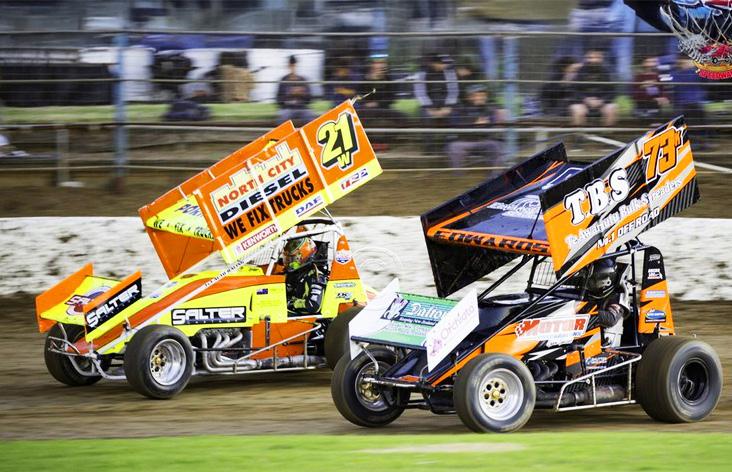
international drivers. The venue is more in line with international speedway tracks, such as those in the US.
The upgrade includes a purpose-built new racing surface, speedway safety wall and catch fence, lighting, improved toilet facilities, enhanced safety features and a restored heritage wall that
Marco Manson won the 2025/26 South Island Formula Ford Championship title at the Super Weekend of Racing at Euromarque Motorsport Park, Christchurch.
The teenager from Auckland had a strong points lead going into the event and qualified on pole. He went on to take out all four races.
“It’s pretty cool to have won it and it was a great weekend,” says Manson. “I’ve learnt a lot from the season and think I’m a much better driver with the experience that I have gained.”
Dylan Petch, whose usual Van Diemen Stealth had been sent north for the nationals, leased a Spectrum 015 from Reagan Edwards to continue his fight for an overall podium placing.
“There was a lot of learning in this car,” says Petch, who finished second overall.
“Every time we have been out in it, we’ve gone faster. At the end of the round, we achieved what we have wanted to achieve.”
Jake Bryant, who came into form as the season continued, was slowed by an electrical issue in the opening race in early March that
honours the venue’s storied history.
The pit area now houses up to 130 racers at a time, 40 more than the old set-up. The pit lane will be open to fans during racing events, allowing patrons to mix and mingle with their favourite drivers.
Speedway New Zealand, the sport’s governing body, certified the safety of the newly laid track at
Waikaraka Park towards the end of 2025 and before the new season.
However, the venue has struggled to fill its 4,500-seat fan areas over the summer.
The final Western Springs meeting on March 22 last year attracted more than 20,000 spectators, with the evening’s premier race a 96-lapper for midget cars featuring a fiveminute refuelling break at 50 laps.
With speedway off the menu at the Springs, there are new proposals for the location in the city’s inner-west.
Auckland Council has announced plans for a semipermanent stage installed during the summer to support festivals and concerts of up to 30,000 people alongside an upgraded boutique sports configuration designed for events attracting about 5,000 fans.
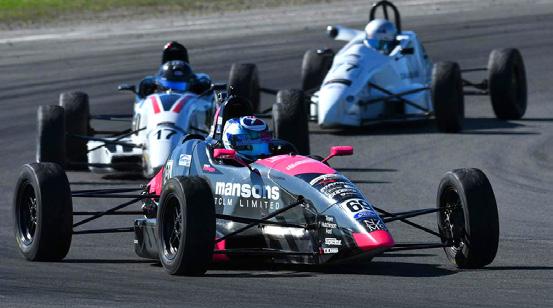
dropped him out of contention and into retirement.
Bryant managed to finish each of the remaining three races in second, often fighting for the lead, but this wasn’t enough to close the gap to Petch. He came third overall, 31 points behind and also picked
up the driver of the day award.
“I was pretty pleased with that,” says Bryant. “The season started off a bit rocky, but at the end of the season the car was on fire.
“We had some suspension problems with its ill-handling and finally got on top of that.”
Jack Fitzgerald, who lived in Gisborne, purchased a 2008 Toyota Hilux Surf Limited 60th Special Edition for $19,980 from Olgo Motors in Rolleston on October 20, 2025.
He claimed he was misled about the fourwheel drive’s condition in regard to dashboard cracks and its tyres, and the fuel tank was empty.
Fitzgerald added it had failed a subsequent warrant of fitness (WOF) due to a defective tail-light and front-left wheel bearings, and suggested it shouldn’t have passed its pre-sale inspection.
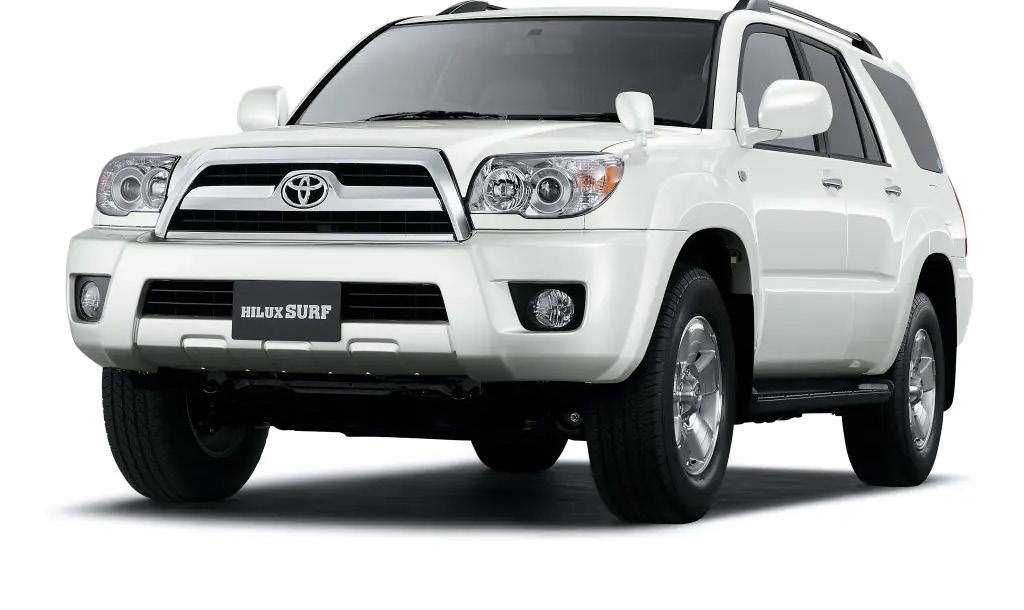
Dunlop Grandtrek AT1 all-terrains visible on the listing, which had a close-up image showing the tyres “in near-new condition”.
The trader denied liability. It was prepared to take the vehicle back and give a refund, but the buyer wanted compensation to fix its alleged faults.
Fitzgerald claimed that during his initial phone enquiry with salesman Brendon Taylor, he asked if there were any cracks on the dashboard.
He said Taylor assured him there were none. But after it was supplied, the buyer found the vehicle had some and, if he had been told that, he said he wouldn’t have paid the asking price. He wanted $200 in compensation noting the cracks couldn’t fixed.
In an email, branch manager Boris Igoshin said, “Brendon has advised this matter wasn’t raised during your discussions”, and he requested any written communication confirming the representation. It appeared none existed leaving this as a matter of conflicting recollections.
Fitzgerald alleged he requested the fuel tank be full on supply at no cost and the trader agreed. It was almost empty on delivery, costing him about $195 to fill up. The dealer agreed to pay that.
The buyer also claimed the Surf
However, at supply, it had Delinte DS2 SUV tyres, which he described as “far cheaper”.
The trader stated the vehicle was originally fitted with allterrains, but they were “old and causing noticeable noise”.
Igoshin added: “To ensure a smoother driving experience, we replaced them with new road tyres and updated the photos and advert on October 18 to reflect this.” He maintained “there was no intention to mislead or misrepresent the vehicle”.
Fitzgerald disputed the listing was updated. He provided a link to it, which he said showed it remained active until October 20 with Dunlops in all pictures, which he claimed were about three times the price of the Delintes.
The trader offered two options – keep the new tyres with a $200 goodwill payment or have the allterrains refitted.
Fitzgerald responded on November 5 that he preferred to have the originals. Two days later, Igoshin advised the old tyres were no longer available because they had been collected by a scrap company.
The buyer had the Surf inspected twice by a repairer, which identified two wheel-bearings

$1,688. The buyer produced a WOF report confirming the left frontwheel bearing was a failure.
The same repairer diagnosed a ticking noise on start-up as being caused by the serpentine belt, which it recommended replacing for $135.
On November 29 and at 139,843km, Fitzgerald tested the 4WD system for the first time since purchase and discovered it wouldn’t engage the low range. His repairer temporarily restored the 4WD actuator.
The buyer provided photos from the Trade Me listing showing the right-hand tail-light was cracked and had a hole covered by red tape, so it shouldn’t have passed the pre-purchase WOF.
He took the Surf to VTNZ in Te Awamutu on November 7, having travelled less than 500km since purchase, where it was failed for the tail-light and wheel bearing. He submitted this showed the WOF issued to the trader shouldn’t have been granted.
Email correspondence showed Fitzgerald first raised complaints on October 30, the day he got the Surf. The trader replied the next day to dispute certain claims, acknowledge the fuel issue and offer options on the tyres.
Its final proposal was $200 towards the tyres and cost of fuel. It advised Fitzgerald to go to the tribunal if still dissatisfied.
The case: The buyer said he was misled over the condition of his Hilux Surf, which he purchased sight-unseen. He claimed for replacement tyres, compensation for dashboard cracks, a full tank of petrol and to replace its frontwheel bearings. The trader offered to reimburse the cost of fuel and pay $200 for lower-grade tyres.
The decision: The dealer was ordered to give the consumer $150 for diagnostic costs, supply four new tyres and remedy the bearings.
At: The Motor Vehicle Disputes Tribunal via video link.
Fitzgerald’s claim totalled $4,931. This comprised of $195 for fuel $195, $200 for the dashboard, $1,452 for four Dunlops at $363 each, $135 for the serpentine belt, $845 for the tail-light, $1,688 for the wheel bearings, the WOF fee of $89, the first diagnosis at $120 and the second one costing $207.
The tyres didn’t correspond with their description for the purposes of section six of the Consumer Guarantees Act, so the tribunal ruled the buyer was entitled to the four nearly-new tyres he bought.
The vehicle failed its WOF inspection on November 7 for a wheel bearing. Subsequent examination by Fitzgerald’s repairer confirmed that both front-wheel bearings required replacing.
The adjudicator was satisfied those defects were present pre-supply and the Surf wasn’t of acceptable quality, so the purchaser was entitled to both being replaced.
It also considered the buyer should be compensated for the diagnostic costs he incurred, but the award was reduced to reflect the fact the trader was only been liable for the bearings.
The dealer had to pay the consumer $150 for diagnostic costs and four tyres. It also had to remedy the front-wheel bearings.
Brannon Fowler purchased a 2020 Hyundai iLoad for $26,990 from the dealer on February 11, 2025.
Within one week, he noticed the van had a suspension issue. He consistently felt it bottom out on road humps and hearing it hit bump stops on small undulations.
Fowler wanted to reject it under the Consumer Guarantees Act (CGA). He claimed Winger Hyundai Greenlane hadn’t repaired with the iLoad within a reasonable timeframe.
The dealer inspected the van on May 8 and advised Fowler no mechanical faults had been identified.
Fowler said the iLoad typically carried around 250kg and had a payload capacity of about 1,100kg.
The dealer asked him to obtain quotes so it could price repairs, so he arranged two mechanical inspections and sent their reports to the trader. Both confirmed suspension concerns and recommended remedial work.
From February to early April 2025, text messages showed the dealer requesting external quotes.
On April 2, the trader asked Fowler not to proceed with those quotes while it arranged an internal inspection.
It checked out the van on May 8. It passed suspension and shock-absorber testing.
The vehicle was taken to Drivesure for an independent inspection and warrant of fitness (WOF). It passed with no advisories, so the dealer told the buyer no mechanical faults had been identified.
The Hyundai was test-driven unloaded by Fowler and the trader’s technician on May 15. No faults were recorded although both acknowledged feeling
the same issues the buyer had described. The dealer offered to discuss a trade of the van into a loan vehicle if desired.
On May 30, Fowler provided Winger Motors with a report from Howick Auto Centre and Electrical. It stated the leaf springs were “sitting very flat” and suggested installing heavy-duty leaf springs and replacing the rear shocks. The report cost $37.38.
From late May until August, communications showed ongoing follow-ups by Fowler including newly observed rust on the roof. The dealer’s replies recorded efforts to secure an in-person meeting with its chief executive and noted scheduling delays.
Fowler told the hearing he wasn’t seeking a meeting. He had just wanted the van repaired, so he filed his application to reject it on October 15.
In response, the dealer said: “Internal and independent assessments showed no suspension fault, and confirmed the vehicle was safe, roadworthy and performing within normal parameters at the time of inspection.
“On each occasion the vehicle was inspected it was unloaded. Included are Hyundai NZ’s specifications confirming the maximum recommended loading. Given Fowler’s occupation as a builder, there is concern the van is frequently operated beyond these limits.”
The tribunal was satisfied the dealer arranged inspections including a WOF and no suspension defects were identified in early May 2025.
However, it also satisfied the Hyundai had a fault which caused it to unnecessarily bottom out on its bump stops over minor road rises.
This meant it wasn’t as free from minor defects as a reasonable buyer would expect, so it failed to comply with the guarantee of acceptable quality under section six of the CGA.

Section 18 of the legislation enables a consumer to reject goods when a supplier has been required to remedy a failure but doesn’t do so within a reasonable timeframe, which the tribunal ruled was the case with this application.
The trader was advised of the defect by at least May 30 when Fowler provided it with Howick Auto’s report. From that point, the dealer’s obligation under section 19 to fix the problem became promptly clear.
Instead, it spent several months insisting on an in-person meeting before progressing with any repairs.
While the tribunal accepted the dealer had paid for a Drivesure inspection, which found no suspension fault, that didn’t excuse its failure to act when presented with Howick Auto’s report.
The CGA doesn’t permit a supplier to defer repairs simply because it disagrees with
A model-year 2020 Hyundai iLoad
The case: The buyer wanted to reject his 2020 Hyundai iLoad because it bottomed out over minor road humps. He had it independently inspected. A repairer recommended installing heavyduty leaf springs and replacing the rear shock absorbers. The trader didn’t remedy the issue so the consumer filed an application eight months later.
The decision: The purchaser lost his right to reject the van because of damage post-supply, but the trader had to fix the other faults.
At: The Motor Vehicle Disputes Tribunal via video link.
an independent assessment particularly when it hasn’t undertaken any further verification of the reported concerns.
A reasonable time must be assessed considering the nature of the goods, defects and circumstances. In this case, the problem was confirmed in late May last year, but by October – when Fowler filed his claim – no repairs had been done. That delay was “well beyond” what a reasonable consumer would expect.
Section 20 of the CGA identifies when a consumer loses the right to reject goods. Fowler would have lost his right to reject the vehicle if it was damaged after delivery for reasons unrelated to its condition when supplied. He acknowledged at the hearing that a dent occurred in the sliding door at some point post-purchase and become rusty.

The tribunal found the damage was more than minor. It involved corrosion and would require panel repair beyond what was needed for ordinary wear and tear.
As that had occurred after delivery and was unrelated to the van’s condition at sale, Fowler lost his right to reject it and was only entitled to have it repaired.
The application to reject the vehicle was dismissed. However, the dealer had to pay the buyer $37.38 for Howick Auto’s report and fix the fault that caused the van to bottom out on its bump stops.
Mercedes-Benz NZ has recognised “outstanding business performance and individual excellence” across its dealerships.
The branches in Botany, east Auckland, and Hamilton-based Ingham Prestige have been hailed as its top two performers of 2025 and inducted into the marque’s circle of excellence. The former also clinched retailer of the year for the fourth year in a row.
Representatives from the two franchises will be invited to Europe to attend Mercedes-Benz’s global product forum in Germany to gain insights into future products and strategy.
Mercedes-Benz Botany, part of Armstrong’s, dominated the annual prizegiving with its staff winning five out of nine individual awards.
Petra Morley was business manager of the year for the third consecutive time and Jia Yang took out the sales consultant category for high-value vehicles.
Arno Human landed the sales manager honour, Steve Mason claimed the prize for service and Darryl DuToit was top parts manager.
Sales consultant awards went to Jason Corlett, of Ingham Prestige, for top-end vehicles

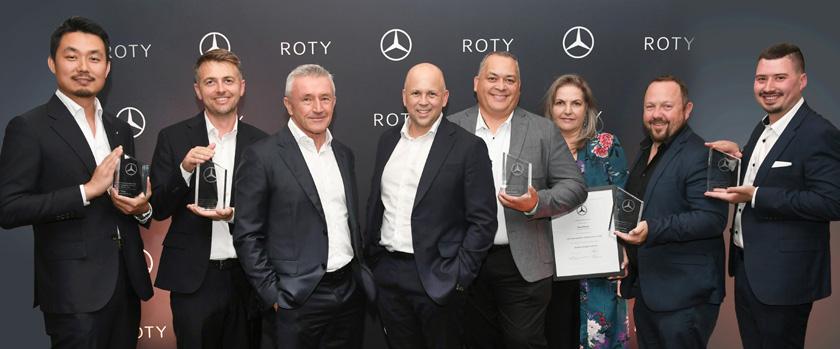

and Harrison Hall, of MercedesBenz Dunedin, for premium new vehicles.
Mercedes-Benz North Shore won two awards – Victor Zhang for sales of certified pre-owned vehicles and Jessica Skinner for service adviser.
Helen Sunley, newly appointed general manager of MercedesBenz NZ, says: “Our retailers are at the heart of the brand.
“We are proud to celebrate their achievements and thank them for their professionalism.”
Jason Nomikos, who is the director of network development and customer services for Australia and New Zealand, adds: “These awards reflect the strength of our whole network and the passion of our people.
“Every team member plays a vital role in delivering the
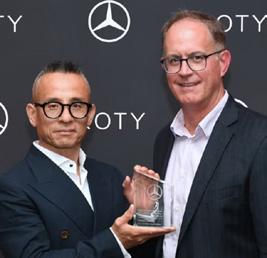
premium experience our customers expect and it’s a privilege to recognise the retailers who consistently set the benchmark.”
The awards night held in Auckland during February brought together representatives from the company’s retailers.
Business leader and ex-All Blacks’ captain Sean Fitzpatrick was the special guest.
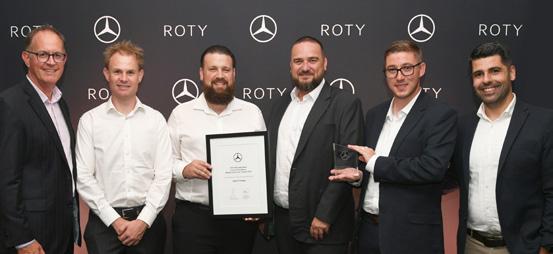
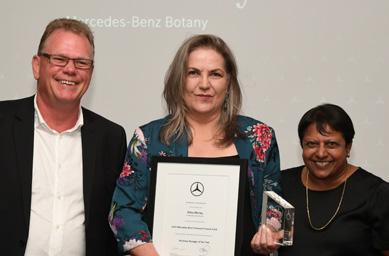

Special guest Sean Fitzpatrick
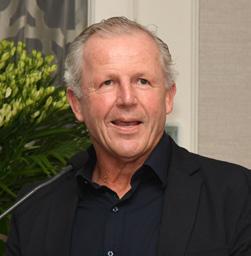
10,063
8,230
2026

An event run by the Financial Services Federation (FSF) has raised $26,825 for Good Shepherd NZ to support its work with females and families.
Now in its 10th year, the Women in Finance lunch has grown from 20 people networking into a sell-out gathering of about 200 professionals from the sector.
Lyn McMorran, the FSF’s executive director, says: “What began as a simple idea, creating a space for women to connect, has evolved into one of the most anticipated events on our calendar.
“Good Shepherd’s mission, and its vital work addressing economic harm and financial hardship, is a natural fit for our sector.
“Many of the women it supports have experienced situations that impact their wellbeing.
“Our members are proud to

The used-imported car market saw a 373.1 per cent jump in battery-electric sales last month, up from 130 in March 2025 to 615. Registrations of plug-in EVs climbed by 86.4 per cent and traditional hybrids rose by 21.4 per cent. Petrol models fell by 9.8 per cent. There were 8,230 used imports registered in March for a 13.3 per cent rise from 7,261. Toyota’s Aqua topped the ladder with 791. Nissan’s Leaf came fourth on 444.
Used Imported Passenger Registrations - 2022– 2026
contribute in a meaningful way to an organisation doing so much good for women and families.”
Good Shepherd NZ’s chief executive, Tania Pouwhare, adds: “Too many families don’t have enough money for the basics, have no savings to fall back on and are burdened by unmanageable or unjust debt.
“Support like this allows us to provide practical assistance that strengthens financial security,
stops economic harm and enables women to be physically safe.”
This year’s event in Auckland was hosted by television presenter Petra Bagust. It featured a panel discussion with Samantha Barrass, chief executive of the Financial Markets Authority, and Janine Grainger, founder of Easy Crypto.
They were joined by Sister Teresa and Sister Mary, both in their 80s, who joined Good Shepherd six decades ago.
The fundraiser was made possible by sponsors Equifax, Alfa Financial Solutions, DebtManagers, Finzsoft and Nissan. FSF members and businesses donated more than $10,000 of auction prizes to help top last year’s total of $18,000.
The FSF has strengthened its relationship with Good Shepherd by developing an economic harm code of practice. It outlines members’ responsibilities to prevent and reduce economic harm while helping keep customers and staff safe.
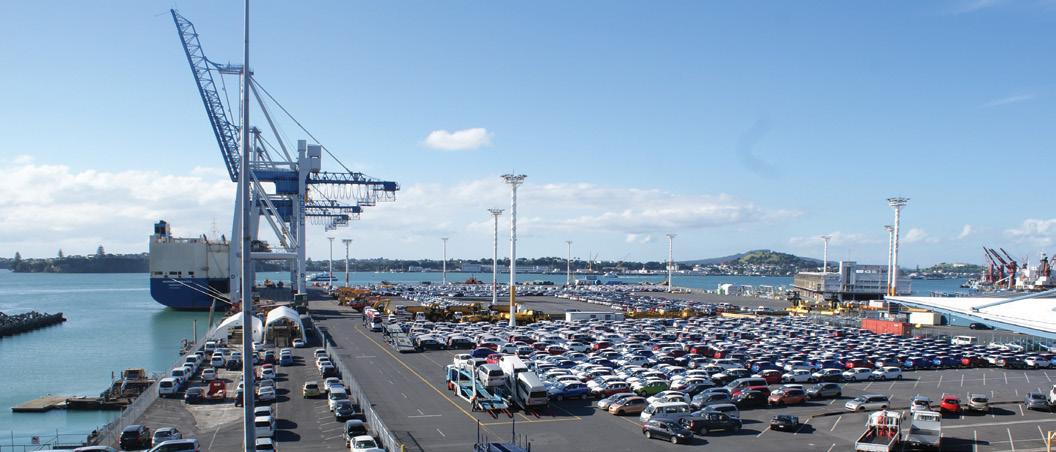

The number of cars coming into the country has impacted on the half-year results of Port of Auckland Ltd.
The company say its strong revenue performance for the six months ending December 31 was mainly driven by higher volumes through its container terminal.
In addition, imports of cars climbed by 22 per cent to 97,148 when compared to the same period in 2024. Vehicle dwell times came in at 1.5 days and was 1.9 days for containers.
Underlying net profit after tax amounted to $53.8 million. That was up $11.8m for a year-on-year
jump of 28.1 per cent. Revenue totalled $204.3m for 4.5 per cent increase to $8.8m.
Statutory net profit after tax was $59.6m for the first half of 2024/25 while capital expenditure amounted to $54.9m.
Container throughput was “strong” with 20-foot equivalents closing in to 500,000.
There were 1.7m tonnes of bulk and break-bulk cargo, and 100,000 vehicles in total, while an in-port niche area for biofouling was approved by the government and launched.
Roger Gray, chief executive, says: “The team is managing higher
volumes safely while keeping a tight rein on costs. There are clear signs of a strengthening economy, and we’re set to support this and deliver strong outcomes for Auckland.
“We’re getting on with our generational $200m-plus investment in infrastructure, the shipping channel and the space entrusted to us by ratepayers.”
The fast-track consented big-ship wharf at Bledisloe North and Auckland International Cruise Terminal are on track with completion set for early 2027.
The port is set to finish reclamation at the container terminal with the Fergusson North
Wharf extension to start later this year. These upgrades will benefit shipping lines by creating more space to work larger vessels.
The board has declared an interim dividend of $26m to Auckland Council.
There were 7,368 used cars imported during March, which was down by 3.2 per cent from 7,615 in the same month of last year.
The total included 7,116 from Japan and 198 from Australia.
There were also 19 arrivals from the US, 13 from the UK and 11 from Singapore.
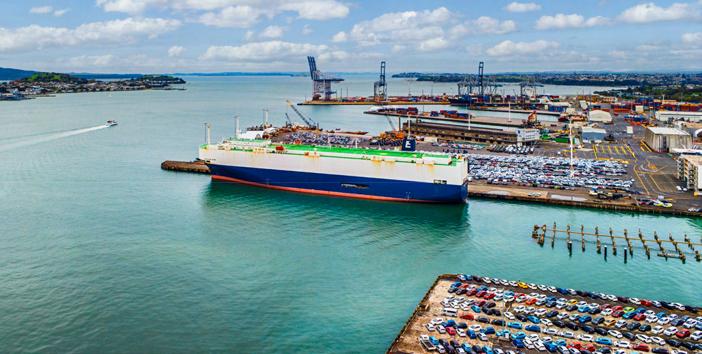
MTF says it’s focused on executing the next phase of expanding its lending capability across the country.
It wrote $792.2 million in new lending, had record originator earnings of $91.6m and had finance receivables of about $1.1 billion at the end of 2024/25.
Chief executive officer Chris Lamers says: “The focus for the year ahead is on leveraging capability to accelerate growth and improve customer access to finance.”
MTF is targeting lending to small and medium-sized enterprises, longer tenure,
specialist products, and continued investment in its franchise and dealer networks.
The company has seen signs of recovery across the country, especially in regional areas and the South Island with improving confidence in sectors such as agriculture, tourism and construction flowing through to customers and businesses.
Lamers says the dealer channel remains a significant opportunity.
“The way New Zealanders are buying vehicles is changing. We need to evolve with that.
Strengthening our position in newvehicle finance helps us capture
more of the customer journey, including the second-hand market, which remains our core business.”
Board chairman Mark Darrow adds: “Our priority now is translating our investment into tangible benefits for customers, originators and shareholders.”
Meanwhile, Stu Myles has resigned as deputy chairman after joining the board in 2020. He recently sold his Christchurch franchise to focus on a new opportunity in the MTF network.
“The professionalism and commitment to doing the right thing by people and the business characterises the approach Stu
brought to his time on the board,” says Darrow.
Hamish Jacob, owner of MTF Thorndon in Wellington and who recently completed the company’s future director programme, has been elected to the board.
Dealers sold 17,812 second-hand cars sold to the public in March for a 7.5 per cent increase from 16,565 in the same month of 2025.
There were 16,458 trade-ins for a 6.9 per cent rise from 15,394.
Private sales came in at 42,091, which was a decrease of 8.7 per cent from 46,114.
BAIC is offering discounts of $3,000 across its line-up in New Zealand until the start of June.
Current prices are $34,990 for the X55 Premium, $39,990 for the B30 Elite Adventure, $44,990 for B30 Premium Adventure HEV and $49,990 for the B30 Premium Adventure HEV AWD, plus on-road costs and dealer delivery fee.
“These are unbelievable pricepoints for specification rich and capable new models,” says Simon Rutherford, chief executive of Auto Distribution Holdings Ltd (ADHL), which is owned by Armstrong’s.
“BAIC has almost 70 years of engineering experience, is established in more than 90 countries and has enjoyed awardwinning success in right-handdrive markets such as South Africa. Now it’s our turn to experience the quality and prowess of these SUVs.”
A variety of accessories available “creates an opportunity for owners to personalise their vehicle to their individual tastes”.
Many are “adventure orientated” to support off-road use. These include a roof platform, roof side ladder, side-window extension rack, roof storage box and side awning. Others are electric running boards and nitrogen shock absorbers, and front engine and rear motor guards.
The SUVs are available at seven locations, including Armstong’s
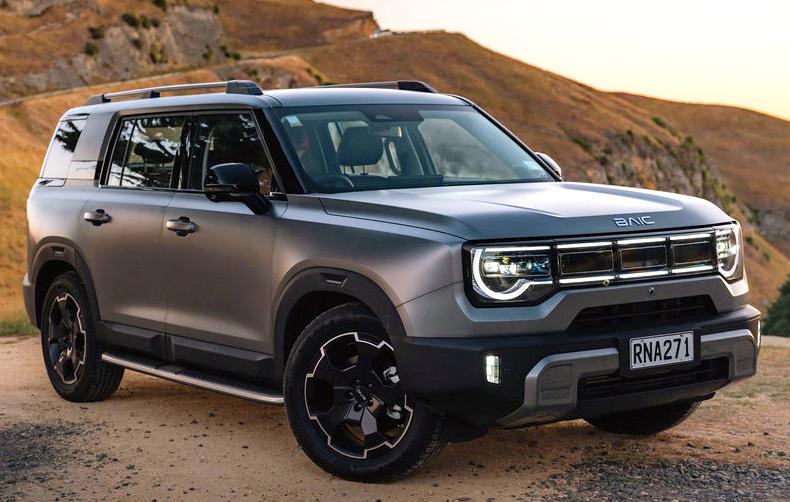
BAIC dealerships in Auckland, Wellington and Christchurch.
Then there’s Takanini Auto Group, Auckland Auto Group on the Albany Highway, Waikato Auto Group in Hamilton and Tauranga Motor Group.
“Although we have 65 per cent of the market covered, we will continue to expand our network, especially into the South Island, to ensure everyone can easily access sales and service,” adds Rutherford.
“We have lofty aspirations for the brand and are confident we can develop an extensive nationwide network as we grow the product offering to serve interests of owners well into the future.”
All BAICs come with a seven-year and unlimited kilometre warranty. In the case of the B30e, there’s an eight year and unlimited kilometre hybrid
New Passenger Registrations - 2022– 2026
battery guarantee. In addition, a seven-year roadside assistance package is standard.
The service interval on the X55 and B30 is one year or 10,000km with the marque’s plans also available over three, four and five years.
“Offering such a comprehensive warranty and servicing programme
demonstrates BAIC is confident in its product quality and is here for the long haul,” says Rutherford, who adds UDC has been selected as its finance partner of choice in New Zealand.
Meanwhile, luxury EV brand Arcfox could be available here in the next 18 months with ADHL staff working on when it’s best to launch the BAIC subsidiary.
Founded in 2017, it’s likely to launch in New Zealand with two models.
Three more BAIC-branded vehicles are expected to hit the market within the next two years.
BAIC, which has its global headquarters in Beijing, has manufacturing partnerships with Hyundai and Mercedes-Benz, and is the latter’s biggest single shareholder.
Sales of fully electric new cars soared by 284.9 per cent last month to 2,275 from 591 in March 2025. Plug-in hybrids jumped from 304 to 1,137, or by 274 per cent.
Registrations of petrol cars fell by 23.8 per cent, diesels rose by 9.2 per cent and traditional hybrids were pretty steady, down by 0.7 per cent.
Overall sales in the sector during March were 10,063, up by 19.7 per cent from 8,404 in the same month of last year.
The proportion of consumers falling behind on payments for car loans has hit a two-year high of 6.2 per cent of active accounts. Centrix reports arrears reached that level in January after jumping by 11 per cent compared to the same month of 2025.
Enquiries for vehicle finance in the January quarter recorded a year-onyear increase of 5.4 per cent as overall consumer credit demand rose by 8.3 per cent.
Campervan operator
Tourism Holdings Ltd (THL) says strong growth in rentals has helped increase its net profit by 17 per cent.
The company is also seeing global forward rental revenue coming in at more than 15 per cent higher than at the same time last year, reports chief executive Grant Webster.
However, struggling international tourism in America and weaker vehicle sales are impacting on its earnings outlook.
For the six months to December 31, THL’s revenue was $477.3 million, up by four per cent on the same period in 2024. Net profit after tax (NPAT)
jumped by 17 per cent to $29.6m as underlying net profit rose by 11 per cent to $29.5m.
The company had an 11 per cent uplift in the sale of service revenue, primarily from rentals,
but experienced a four cent drop in revenue from selling goods. Its fleet grew by 10 per cent to 8,688 units.
Chair Cathy Quinn reports THL is expecting underlying NPAT
for the full financial year to be in the range of $43m to $47m, up by about 50-65 per cent up on 2024/25.
“Plans we have in place and execution of our strategic initiatives are expected to improve financial performance and deliver rental revenue growth, cost reduction and effective balancesheet management,” she says.
“These efforts are supported by a strong long-term tourism outlook and expected recovery in RV sales markets.”
The company has progressed strategic initiatives it unveiled in August.
These have included the conditional agreement to


sell its UK and Ireland arm for about $58.33m, and exiting two underperforming dealerships in Australia. It has closed its factory in Brisbane and has consolidated activity in New Zealand while reducing North American costs.
Webster says rentals remain the engine of THL’s business model and continue to power its global revenue performance.
“Structural drivers, including growing airline capacity and demand for our category of independent travel, continue to support a positive outlook for RV rentals.”
That said, he remains cautious about the US market, describing it as “off the menu” for many international travellers this year.
Looking ahead, forward rental revenue is up in New Zealand and Australia by 20-25 per cent.
Canada is up by about 30 per cent with the US down 25-30 per cent.
THL is expecting challenging conditions for vehicle sales to persist and the second half-year is expected to largely reflect trends seen in the first six months of 2025/26.
Webster remains confident in the outlook for tourism
worldwide and sees the current fiscal year as one of transition as the company rolls out “transformational initiatives against ongoing weakness in RV sales markets, broader macroeconomic challenges and uncertainty regarding the timing of a recovery”.
He adds: “Looking further
ahead, the execution of our strategic initiatives, continued recovery in international tourism and rental-vehicle demand, and ongoing cost-out actions are expected to materially benefit financial year 2027.”
There were 4,847 new commercials sold in March for an increase of 39 per cent from 3,487 in the same month of 2025.
Toyota’s Hilux was the top model with 1,182 sales. Ford’s Ranger was second on 1,036 and Mitsubishi’s Triton was third with 414.
The top three marques were Toyota on 1,534 units for market share of 31.6 per cent. Second spot was claimed by Ford with 1,147.
There were 467 used commercials registered last month, up by 17.3 per cent from 398.
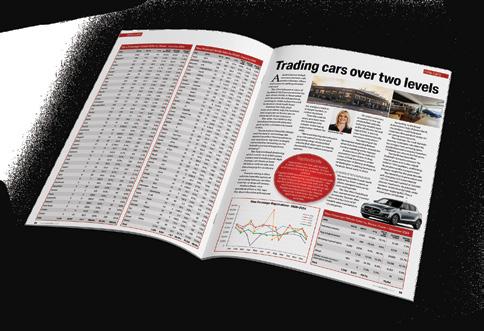
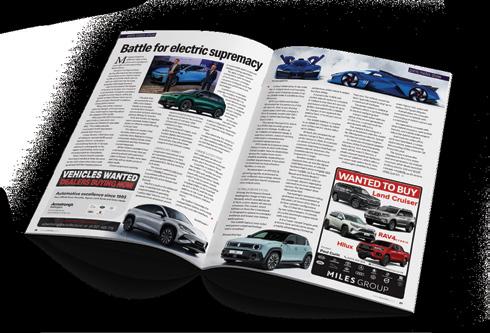
Ford has provided Canoe Racing New Zealand (CRNZ) with a fleet of Ranger Hybrid Stormtraks for daily operations, and getting to competitions and training.
The utes mean CRNZ can streamline its national logistics and transport needs with a reduced environmental footprint so it can focus more resources on athlete development, its high-performance programme and community initiatives.
“We have a deep-seated history of backing people and teams that make New Zealand proud on the world stage,” says Annaliese Atina, managing director of Ford NZ.
“CRNZ embodies the spirit of hard work, precision and excellence. We’re thrilled to provide the driving force behind our incredible paddlers.”
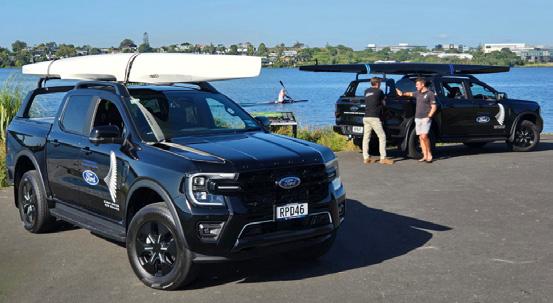
Graham Oberlin-Brown, chief executive of CRNZ, adds: “Success in canoe racing isn’t just about what happens on the water. It’s about the preparation and ability to get our team and their gear to the right place at the right time. Having a partner like Ford NZ is a game-changer for us.”
Meanwhile, Toyota NZ has extended its partnership with the

NZ Olympic Committee (NZOC) and Paralympics NZ (PNZ) for four more years.
Susanne Hardy, assistant vicepresident, says: “These partnerships unite communities, celebrate diversity, and showcase what’s possible through perseverance and performance.”
Toyota NZ has teamed up with the NZOC and PNZ since
2018 in addition to its global Toyota Olympic and Paralympic partnership. While the global deal recently ended, it is continuing to partner at a local level to support Kiwis on the world stage by providing a range of hybrids.
A stop-sale order on a compact SUV has ended after a three-month hiatus prompted by a safety failure.
The Fronx was withdrawn from dealerships in late 2025 late, but it was back on the market last month after Suzuki established a factory remedy to address the defect.
Concerns arose when the model received a one-star ANCAP rating. During a full-width frontal test simulating a head-on collision, a rear-seatbelt retractor failed. This caused the passenger dummy to become unrestrained.
The NZTA advised owners of the 1,115 vehicles delivered last year to not carry rear passengers until the issue was resolved as Suzuki temporarily withdrew the Fronx from sale.
A recall was then initiated to replace the left and right-rear seatbelt assemblies.
Gary Collins, chief executive of Suzuki NZ, says private owners are being prioritised in the call-back with the goal of having affected vehicles remedied by late April.
Since the stop-sale was lifted, there has been plenty of interest in the Fronx with more than 100 units delivered in the first week of its return.
“The Fronx was a huge success from launch and catapulted up our ranking to the number-two position by the end of the year,” says Collins.
“The compact SUV segment is a busy space in the market with many established and new entrants. We have a strong presence in the
segment, particularly with the Jimny and return of the Fronx.”
Kia has launched an “industry leading” initiative designed to make getting behind the wheel of a new electric car easier as prices of fossil fuels climb.
It’s offering three years of “free motoring” when people buy a new EV3 or EV5 by paying the on-road costs, three years’ or 45,000km road-user charges and three years of charging fees of $1,500.
That’s all backed up by a complimentary three-year or 45,000km service plan.
“Now is the best time to sign up for a Kia EV as fluctuating fuel prices continue to make newvehicle ownership more difficult,” says Todd McDonald, managing director of Kia NZ.
“Times are challenging, but the need for clean, economical and accessible motoring doesn’t stop. We hope these initiatives
can help introduce many more Kiwis to a sustainable and costeffective way to meet their mobility requirements.”
The deal got under way at the start of April and will run for three months.
Auckland-based MP Cameron Brewer has been appointed as a minister outside cabinet. He is now responsible for commerce and consumer affairs, small business and manufacturing, and has become Associate Minister of Immigration.
Simeon Brown has taken on the energy portfolio, Chris Bishop is Attorney-General, and Penny Simmonds has responsibility for tertiary education and science, innovation and technology.
Also after April 2’s cabinet reshuffle, Nicola Grigg is now Minister for the Environment and Simon Watts is the new Minister for Auckland. Visit autofile.co.nz for a full report.
There were 1,285 more new cars sold than imported last month with 10,063 being registered and 8,778 crossing the border. Daily sales, averaged over the past 12 months, now stand at 276 units. March’s imports of new passenger cars were up by 26.3 per cent on the same month of 2025 and 22,325 have been imported so far this year. It was also a big month for registrations of used-imported cars. They totalled 8,230 while 7,368 came into New Zealand. Average sales per day were 265 in March while the 12-monthly average was 237 per day – down from 253 in March 2025. There was only an 83-unit difference between 3,135 new commercial vehicles imported last month and 3,052 sold. Registrations per day, as averaged over the past year, are now 110. As for used commercials, 353 were registered for the first time last month compared to 365 being imported. Year to date, 808 have been imported.



Since 1984, Autofile has been the heartbeat of New Zealand’s motor industry news. By advertising with us, you’re not just gaining exposure — you’re joining a trusted network that informs, connects and drives the industry forward.