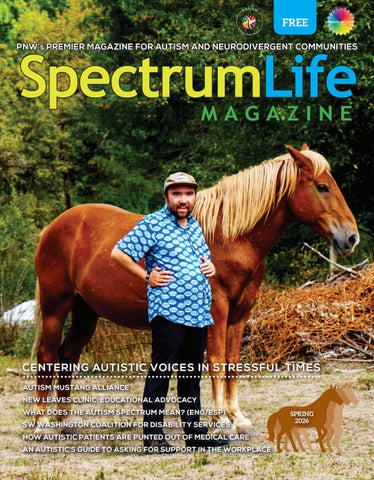
Spectrum Life Magazine Spring 2026 from Autism Empowerment
L ightly-weighted for an extra sense of security and stability, the TwiddleNathan helps youngsters find that “just-right zone” for maintaining attention and appropriate behavior for tasks and activities. Crafted from cozy, durable fabrics and plush fleece, the Nathan features high-grade fidgets attached with ribbon loops that snap, to enable switching around and personalizing fidgets for variety’s sake, training purposes, or the child’s own preferences.
Ideal for home, therapy clinics, and ”safe spaces” at school and other group settings.
TWIDDLE®NATHAN
12
CENTERING AUTISTIC VOICES IN STRESSFUL TIMES
FEATURED SECTIONS
4 5
From the Publisher
Acceptance is found in listening deeply and creating space for every person to be seen, valued, and supported.
Connections for our Community
A lived commitment: choosing Unity, Hope, and Light in all seasons.
ADVOCACy
Autism Mustang Alliance
Nonspeaking advocates seen, heard, and believed.
Centering Autistic Voices in Stressful Times
An invitation from Niko Boskovic to listen, learn, and rethink.
Conexiones en la Comunidad con Tanya
¿Qué significa el espectro del autismo?
What Does the Autism Spectrum Mean?
Rethinking what autism looks like.
LIFESPAN
31
RECREATION
Upcoming Autism Empowerment Activities
Promoting a culture of acceptance, enrichment, inspiration, and empowerment through connection, education, and community.
The AE-NCC Creators Corner
Updates and opportunities from AE’s Neurodivergent Creators Collective.
EDUCATION
SW Washington Coalition for Disability Services
Building bridges, sharing resources, strengthening community.
An Autistic’s Guide to Asking for Support in the Workplace
Lyric Rivera sheds insight on the accommodation conversation. 7 20
35
32 49 42 12 14 16 50
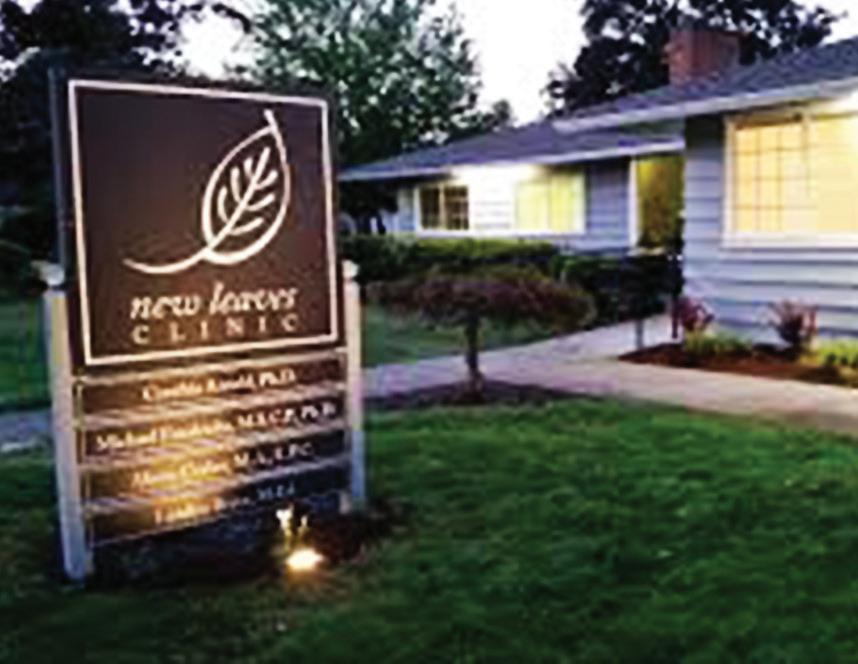
New Leaves Clinic: From Assessment to Advocacy
Educational support for IEPs, 504 plans, and school success.
HEALTH + WELLNESS
How Autistic Patients are Punted Out of Medical Care
Referred, deferred, and dismissed.
THERAPy
Right Where You Are
A poem of hope and healing by Karen Krejcha.
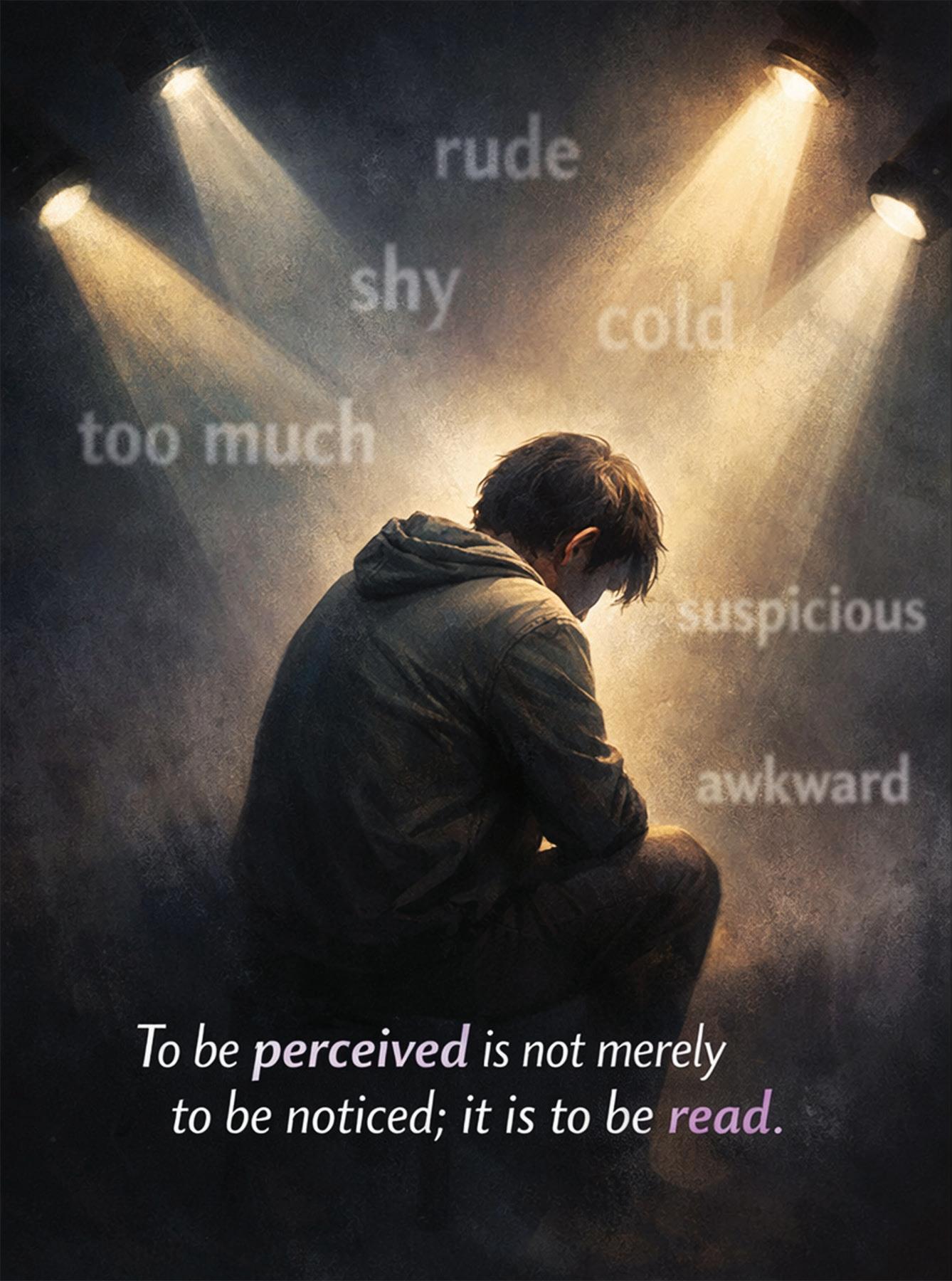
“DON’T Perceive Me!”
When being noticed feels like a threat.
Welcome to the Spring 2026 edition of Spectrum Life Magazine!
We are living in serious times. Many in our community are carrying stress, uncertainty, grief, and questions about what lies ahead. Yet even here, we believe there is still room for truth, compassion, courage, and hope.
At Autism Empowerment, our mission remains rooted in acceptance, enrichment, inspiration, and empowerment—not as slogans, but as a way of showing up for one another with love, integrity, and purpose.
As Autism Acceptance Month rolls around again in April, we are reminded that acceptance is more than awareness and more than a season. It is found in listening deeply, honoring lived experience, building bridges, and creating space for every person to be seen, valued, and supported.
We start this issue with Connections for our Community (page 5), reflecting on why Autism Acceptance must remain a lived commitment. In Advocacy, Autism Mustang Alliance (page 7) and our featured cover story, Centering Autistic Voices in Stressful Times (page 12), both by Niko Boskovic, invite readers to listen, learn, and make room for nonspeaking autistic perspectives. We continue our bilingual outreach with Conexiones en la Comunidad con Tanya (page 14), followed by What Does the Autism Spectrum Mean? (page 16), which challenges narrow assumptions about what autism looks like.
In Lifespan, SW Washington Coalition for Disability Services (page 20) highlights the power of collaboration and community, while An Autistic’s Guide to Asking for Support in the Workplace (page 26) offers practical insight for navigating accommodations.
In Recreation, you’ll find Upcoming Autism Empowerment Activities (page 31) and The AE-NCC Creators Corner (page 32), celebrating connection and creative opportunity. Education features New Leaves Clinic: From Assessment to Advocacy (page 35), and in Health and Wellness, How Autistic Patients are Punted Out of Medical Care (page 42) confronts urgent gaps in care. We close with Right Where You Are (page 49), a poem about peace in hard seasons, and “DON’T Perceive Me!” (page 50), a powerful reflection on vulnerability and being seen.
Wherever this season finds you, may this issue remind you that your life has value, your voice matters, and you do not walk alone.
With grace and gratitude,
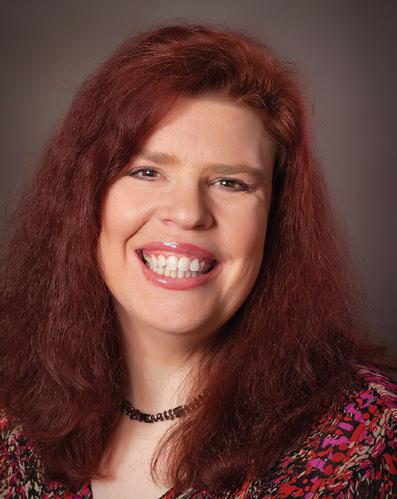
Karen Krejcha
Executive Director & Co-Founder: Autism Empowerment™
Editor: Spectrum Life Magazine™
SPRING 2026 | VOLUME 16, ISSUE 2
SPECTRUM LIFE MAGAZINE TM
A program of Autism Empowerment TM
Karen Krejcha, Autism Empowerment, Publisher
Dave Born, Graphic Designer
Editorial Advisory Board:
Aaron Blackwelder
Amy Donaldson, Ph.D, CCC-SLP
Tanya English
John Krejcha
Ryan Krejcha
Anson Service, Psy.D, LMHC
Brian Tashima
Mailing address:
Autism Empowerment
P. O. Box 871676 Vancouver, WA 98687 (360) 852-8369 www.AutismEmpowerment.org spectrumlife@autismempowerment.org
Autism Empowerment is a 501(c)3 nonprofit devoted to promoting a culture of acceptance and empowerment for children, teens, adults and families within Autism and Neurodivergent communities.
Autism Empowerment makes no warranty, guarantee, endorsement or promotion of any service provider or therapy option listed in this publication or our websites: AutismEmpowerment.org and SpectrumLife.org. This is a free community magazine created as a courtesy to the public. Autism Empowerment cannot be held liable for any action or decision based upon information found in this publication or our websites. It is the responsibility of individuals to discuss any therapy or treatment option with their care team. Every effort is made to ensure accuracy and verify information, however readers using this information do so at their own risk. No part of this publication may be reproduced or transmitted without prior written consent from the publisher, Autism Empowerment.
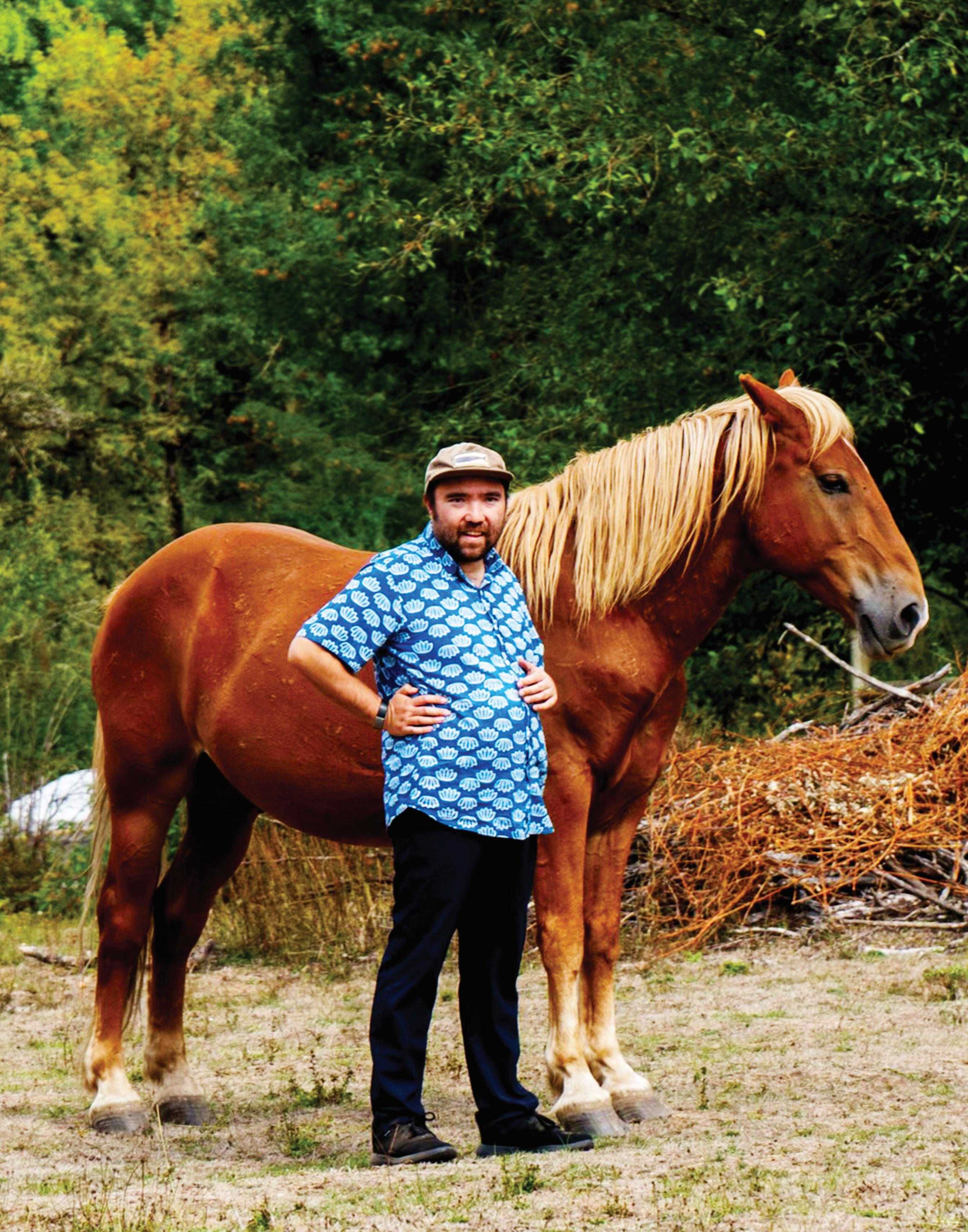
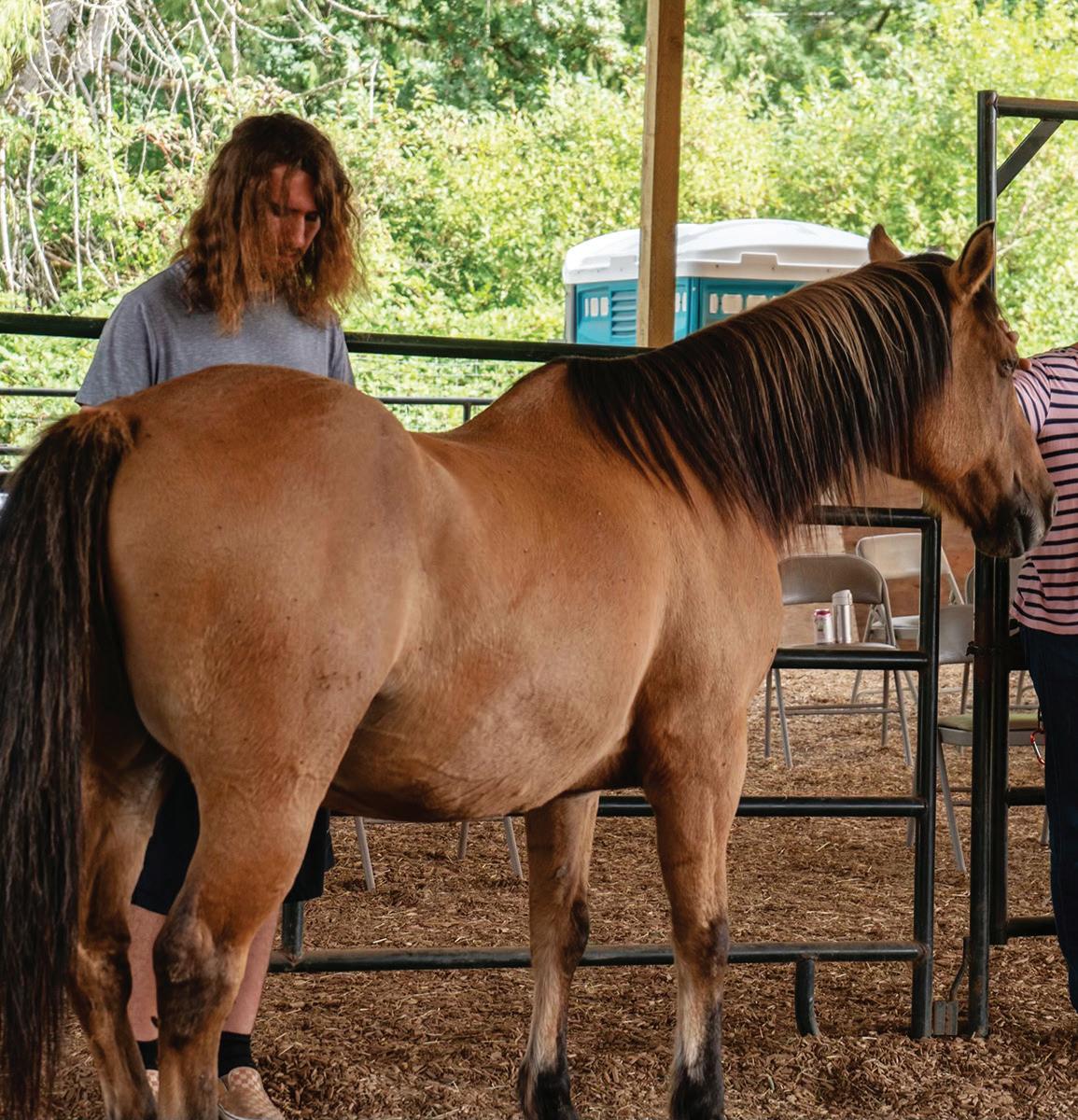
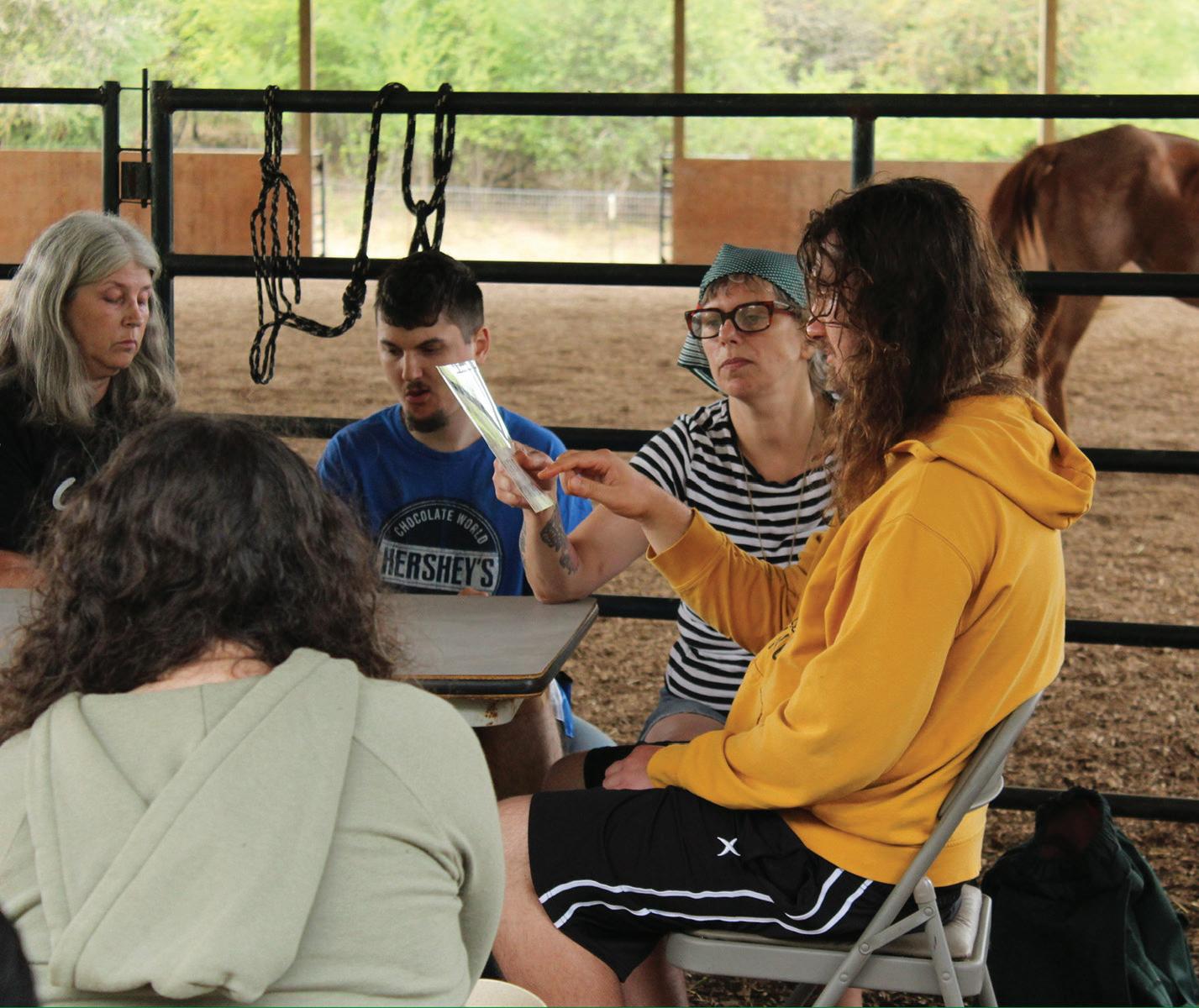
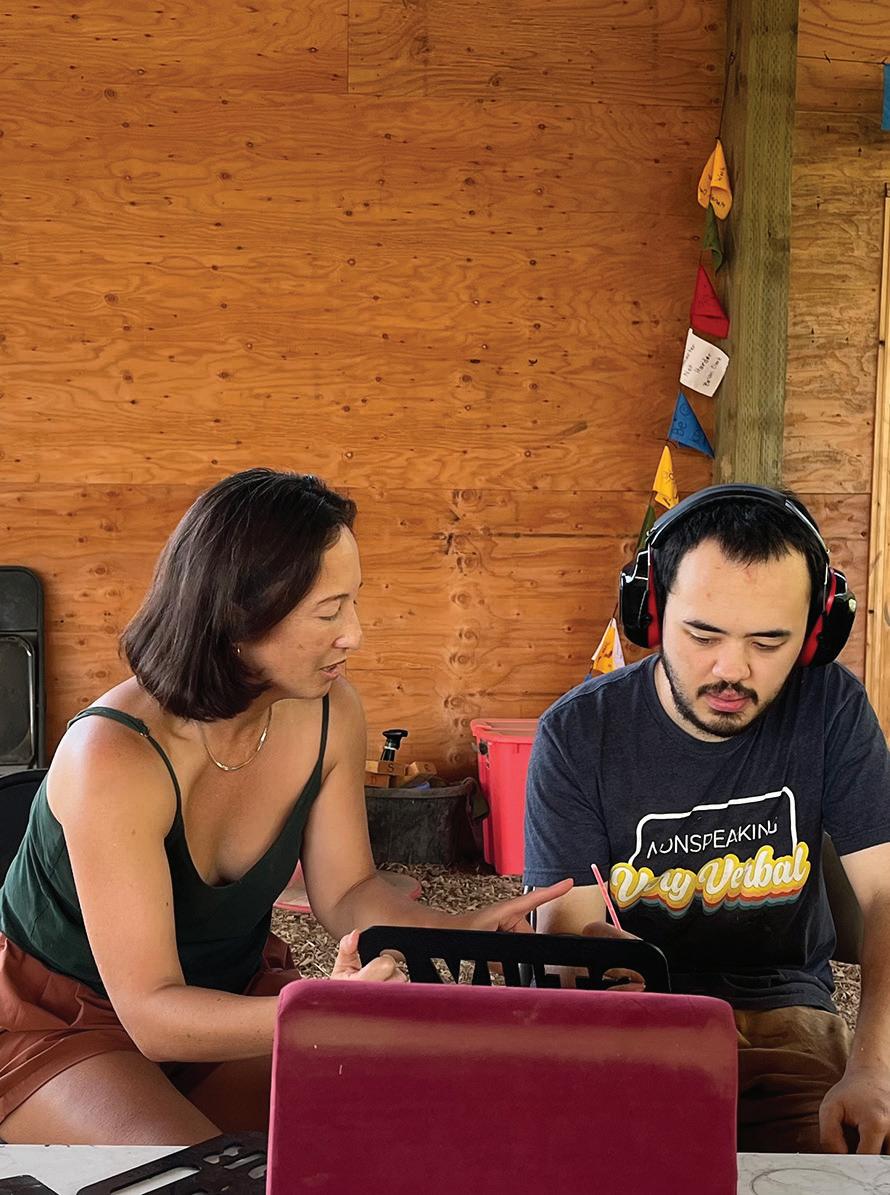
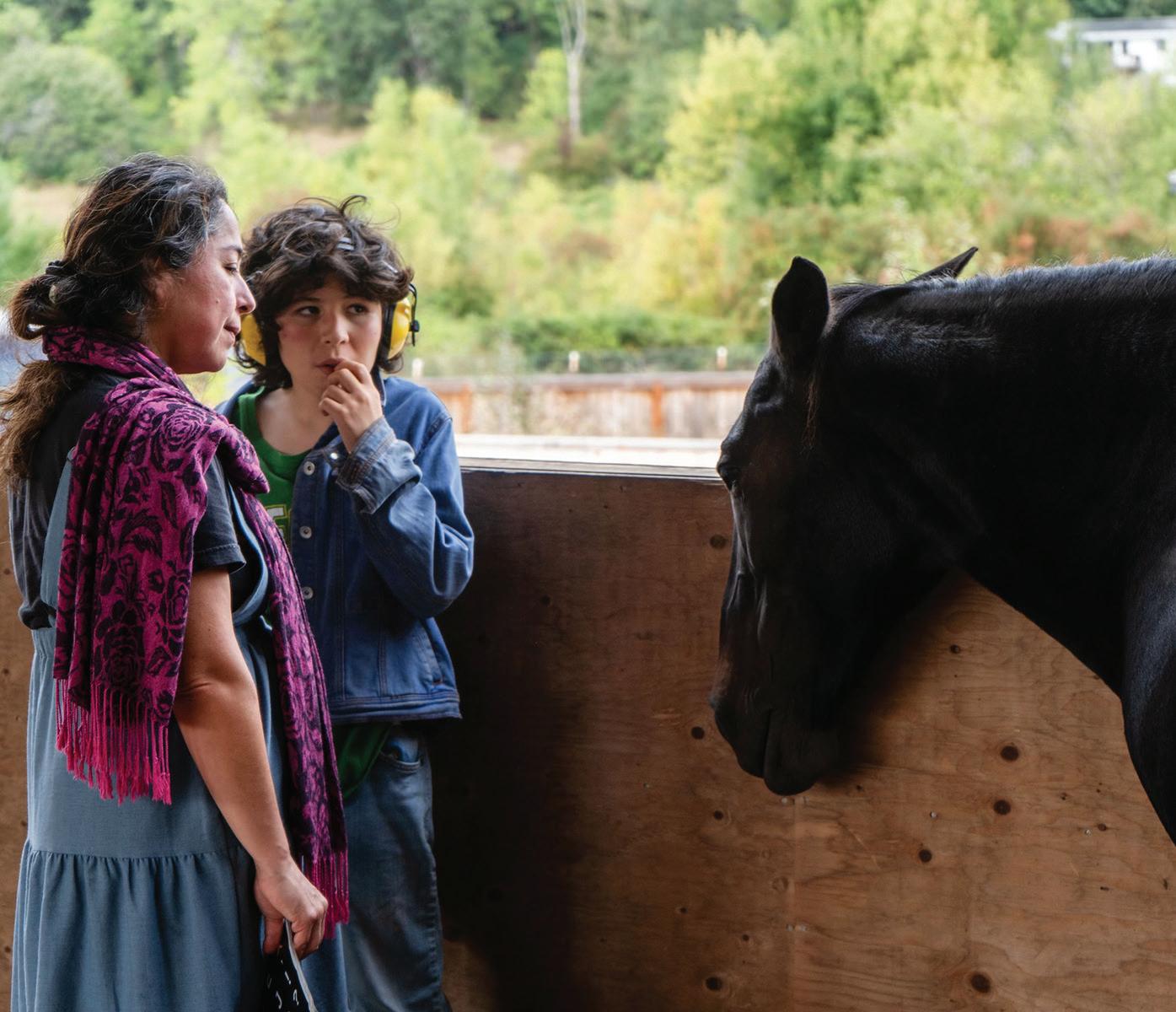
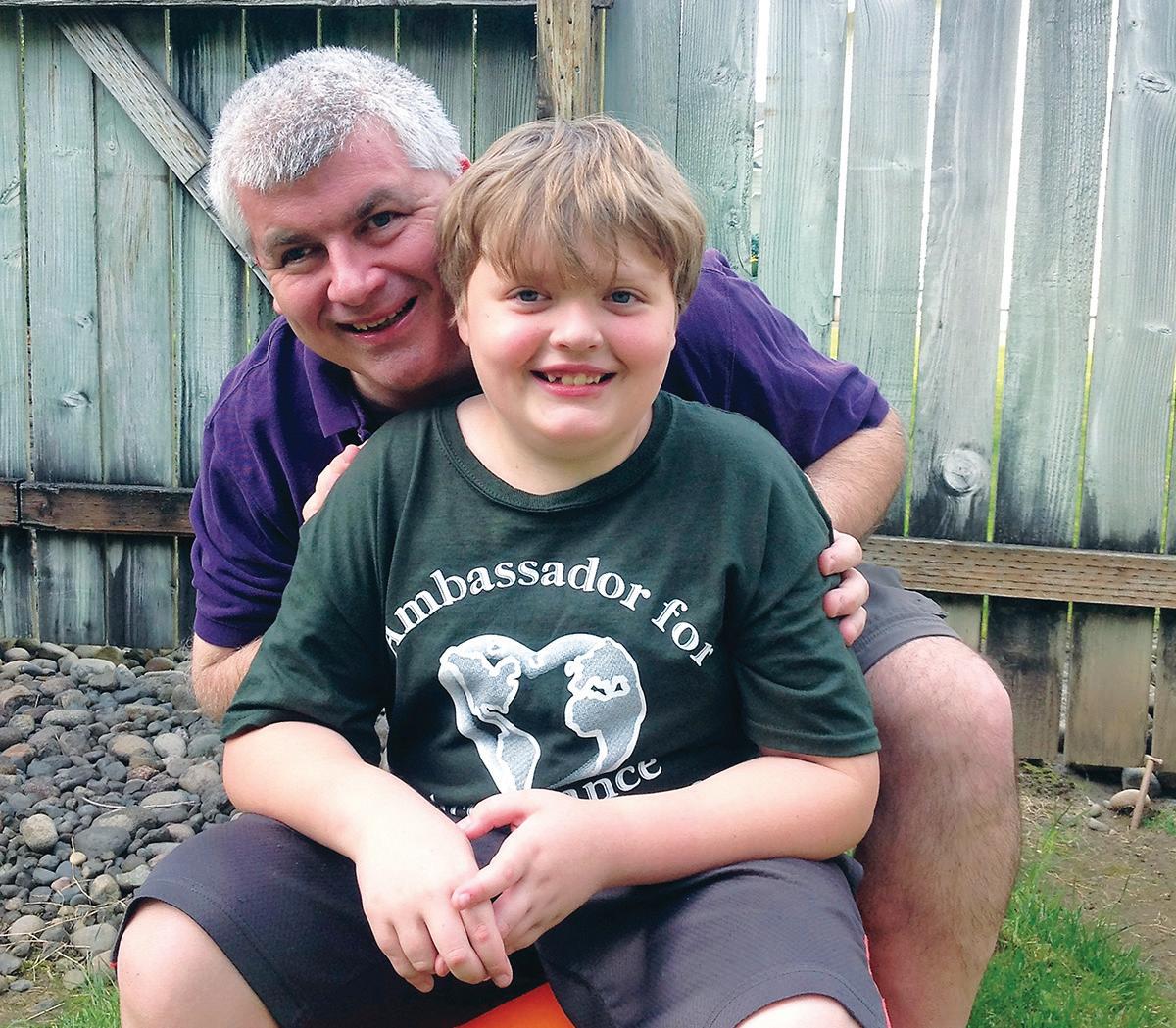
This cover photo highlights two powerful pieces by Niko Boskovic that center nonspeaking autistic perspectives: Autism Mustang Alliance (page 7) and our cover story, Centering Autistic Voices in Stressful Times (page 12).
www.
Photo courtesy of: Autism Mustang Alliance
Connections for our Community Choosing Unity, Hope, and Light
As we move through Autism Acceptance Month, many in our community are carrying a complicated mix of emotions.
There is love. There is pride. There is courage. There is also weariness.
We are living in a time when autistic and neurodivergent people, disabled people, and many marginalized communities are too often misunderstood, underestimated, spoken over, or treated like problems to be solved instead of human beings to be valued. There is real division in our world right now, and some of that division can be felt within our own autism communities too.
At Autism Empowerment, we believe acceptance must be more than a slogan or a seasonal campaign. It is something we live. It shows in how we listen, how we speak, how we serve, how we advocate, and how we treat one another.
That spirit runs throughout this spring issue of Spectrum Life Magazine
Its pages reflect themes we believe matter deeply right now: listening to lived experience, making room for overlooked voices, building bridges through coalitions and alliances, supporting one another through education and advocacy, and creating space for hope, creativity, and healing even in stressful times.
One of the clearest takeaways is this: People of all ability levels deserve to be seen, heard, believed, and included.
Not as an afterthought. Not only when it is convenient. Not only when their story fits someone else’s expectations.
Another takeaway is that community requires unity.
Unity does not mean we all think alike. It does not mean we avoid hard conversations. It does not mean we ignore differences in support needs, language, politics, theology, or lived experience. It means we choose to build people up rather than break people down.
It means we choose dignity over division. We choose love over fear, peace over hostility, patience over reaction, kindness over cruelty, and self-control over chaos.
Those are not weak choices. They are strong ones. They are healing ones.
At Autism Empowerment, our Four Foundational Pillars continue to guide us: Accept, Enrich, Inspire, and Empower
Accept means making room for people to be fully human, fully worthy, and fully themselves.
Enrich means offering resources, education, and opportunities that help people grow and thrive.
Inspire means sharing stories and creativity that remind us hope is still alive.
Empower means helping people recognize their value, use their voice, and pursue their best possible lives with dignity and support.
As we move toward Autism Empowerment’s 15th anniversary and Spectrum Life Magazine’s 10th anniversary this summer, we find ourselves in a season of reflection and transition.
We are asking where we are strongest, where we can serve most meaningfully, and how we can continue helping others let their light shine. Our road has had detours, potholes, and caution signs, but as we move forward with faith and purpose, the path ahead is becoming clearer.
We feel called to lean even more deeply into connection, content, education, creativity, collaboration, and communitybuilding. We want to keep creating articles, resources, tools, stories, programs, and spaces that meet people where they are and move them toward hope.
We do not need to copy what other autism or disability organizations are doing. We want to be faithful to the work we have been given: building bridges, amplifying lived experience, encouraging self-advocacy, nurturing belonging, and sharing light in a world that can feel very heavy.
That is part of the heart behind this issue.
From advocacy and workplace support to coalition-building, health care access, creativity, and poetry, these pages remind us that even in hard seasons, there is still beauty, still purpose, still courage, and still room to breathe. Right Where You Are (page 49) speaks to that quiet truth: peace is not always found in easy circumstances, but it can still meet us in difficult ones.
Wherever you find yourself this Autism Acceptance Month and beyond—hopeful, weary, unseen, determined, or somewhere in between—please remember this:
You matter. Your voice matters. Your life has value. And you are not walking alone.
Let us keep choosing unity. Let us keep making room for one another.
Let us keep building a kinder world where more people can be encouraged and empowered to use their gifts for a greater purpose.
With love, grace, and hope,
Karen Krejcha and John Krejcha
Co-Founders, Autism Empowerment
Photo courtesy of: Autism Mustang Alliance
Autism Mustang Alliance Seen. Heard. Believed.
A Spectrum Life conversation with Niko Boskovic and Searmi Park
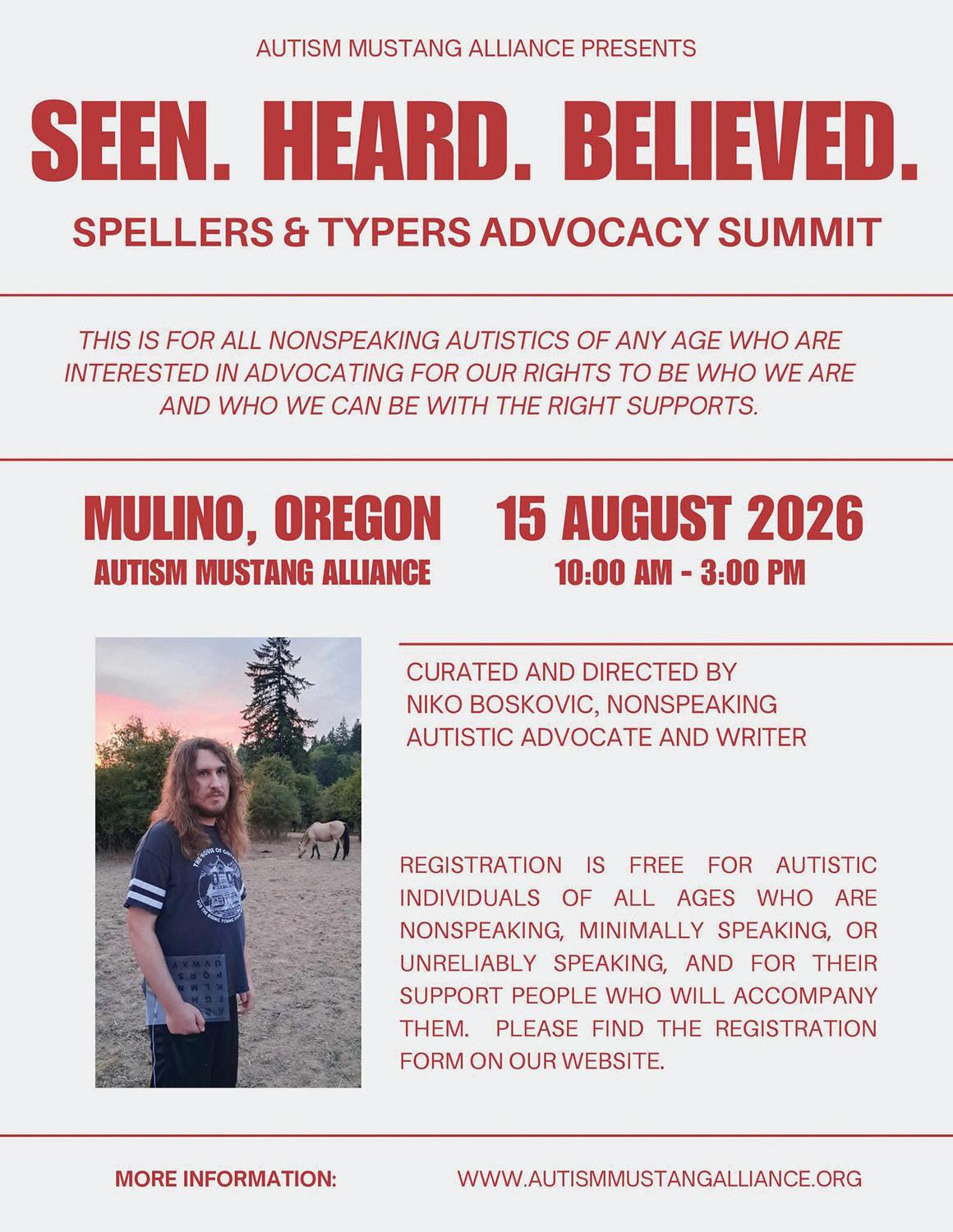
In the Winter 2026 issue of Spectrum Life Magazine, feature columnist Niko Boskovic announced that an advocacy summit for nonspeaking autistics who spell and type to communicate will take place in August 2026 in partnership with Autism Mustang Alliance (AMA) in Mulino, Oregon.
AMA established nonprofit status in June of 2020 and opened its doors in February of 2022 to offer programming for autistic adults who age out of school transition programs. We thought it would be a great opportunity to ask Niko to interview AMA’s director, Searmi Park, about their past collaborations, the people who made life-changing impacts on their lives, and how challenging and unlearning ableism remains a work in progress.
What follows is less a traditional Q&A and more a reflective conversation about communication, agency, and what can change when nonspeaking autistic voices are truly heard. This interview was conducted entirely online over the course of two weeks.
A Life-Changing First Meeting
Niko: Searmi, I am really glad that you were willing to be interviewed for Spectrum Life Magazine’s Spring issue. Very often, nonspeakers don’t have the opportunity to ask people why they work with autistics or what it is about their services that fills their hearts.
When we first met, it was for Empowered Communication, an event you were organizing in 2024, which featured four spellers on a panel answering questions about our life experiences.
My impression of you was only outshined by the breathtaking landscape: birds chirping, feet walking along a gravel road raising dust, the creek babbling under the wooden bridge, trees all around. Amidst the animal smells, the crunch of hay underfoot released yet another sweetness to enjoy. Really calming to me and, no doubt, your family.
Searmi: Hey Niko, thank you so much for giving me this opportunity! First of all, I have to tell you that the “get-toknow-each-other” dinner the night before the first Empowered Communication conference, when I met you, was absolutely life-changing for me.
I was chatting with you and Danny Whitty, another speller self-advocate from California. Besides it being my very first candid conversation with nonspeakers at your level of fluency on the letterboard (our whole family was totally star-struck with you all that evening!), I was completely blown away by what you said to me, right when I sat down to join your table, followed by Danny’s comment.
That conversation sums up why our family left Los Angeles, came to Oregon, started our nonprofit, and are embarking on this endeavor with you. Do you remember??
Niko: I remember that evening. You had provided an amazing spread of Thai food at WeBUILT, this co-housing complex, which made me get excited about working with you. The dinner was held in the Community Barn, where there were all sorts of sensory props and furniture.
I never thought someone would install a playground spinny bar indoors! There was a covered hot tub outside. Someone had clearly designed this communal area with care and thoughtful execution.
In the meantime, I was feeling so glad to be in the company of Danny and your son Ben, since I don’t hang out regularly with people at night over dinner. I share this all because my memory of that evening is infused with so many things.
I believe we were talking about finding our community easily genuine and accepting of each other. I’d never met Danny or Ben, but they were the only people in the room who knew me like no others. They were brothers.
So much of my world is foreign to most people, which makes it huge to meet other spellers and typers.
Searmi: It was very clear there was a strong energy present at that dinner, one I would describe as a comfort or release, which turned into a sort of joyous communion. Ben had been working on typing and spelling for many years, and had only reached open-ended with a message for you and the other speller advocates just a few weeks prior, so this was all new for our family to have Ben with his peers and that he could converse with everyone!
Ben, however, did not sit down to chat with you all like I thought he might, and instead was in constant motion, touching and tapping everything, signing over and over that he wanted to go to the car or go home. He seemed very dysregulated and overwhelmed, acting as if he did not want to be there.
And that’s when you told me these two things I will never forget: first, “Your love for Ben lights up the room,” and second, that Ben might seem upset on the outside, but actually, he was just so happy and excited to be there.
Danny quickly chimed in, “You moms know, but we know better.”
Continued on page 8
That conversation was a huge “A-ha” moment for me: I realized that we moms think we know so much about our kiddos, but in a way, we know so little!
This so-called “knowledge” can be very limiting, for the fact is that what we know has been understandably but unfairly influenced by all the events that have taken place in the course of our lives together with our disabled children.
This has created strong ideas—or what we might even regard as truths—about what is possible for you, what is best for you, and what actions to take for you.
Until that dinner with you and Danny, I did not realize how little autonomy and agency Ben had over his own life, and moreover, that his controller was actually ME.
Giving Autonomy Back
Niko: You and my mom had similar “coming away” moments that instantly led to fundamental changes in your family dynamic. You probably have your history of weird treatments
of ABA therapy at home each week. I had learned about “recovered kids” and was on a mission to have Ben totally free of any signs of autism by age six (he was diagnosed at two).
In 2008, we met an Occupational Therapist (OT) who wanted to do Facilitated Communication (FC) with him. Sadly, we were not ready and did not believe her. It wasn’t until we saw the documentary Wretches and Jabberers in 2011 that we had the huge shock that “Holy crap, Ben has been HERE this whole time!” Ben was nine years old at the time.
In 2012, our family decided to leave Los Angeles and move to Portland. We needed a slower pace of life and to be surrounded by nature. This led us to discovering mustangs, leaving Portland, and moving to a ranch on acreage so we could live with the horses. The interactions between Ben and our first untouched wild horse Uma was the reason behind starting Autism Mustang Alliance! But that is for another story.
We are so grateful for the free time that COVID gave us, and I would say it wasn’t until then (Ben was 18 that year) that
for Ben like I did (daily saunas to sweat out toxins, vitamin shots in the bum, and topical chelation) and felt like you couldn’t do enough. Maybe you were involved in local disability groups too.
For my mom, she went to a presentation by a local autistic woman named Karla Fisher who worked at Intel and shared what her daily life was like. Karla was able to articulate many things that she experienced that my mom noticed I did too, and realized she’d been listening to the wrong people.
Was your experience with giving the autonomy back to Ben an easy one?
Searmi: Ha, if only! You are correct—we too put Ben through topical chelation, vitamin shots in the bum... No sauna, but we had magnetic mattresses and did clay baths, special diets, supplements, and all kinds of therapies, including 40 hours
we started the deep dive into typing and spelling, and thus the journey of giving Ben autonomy.
The process is ongoing—since Ben has only been open-ended for over a year, we still need to remind ourselves to ask Ben his opinion and to include him in decisions and conversations.
A Shift in Perspective
This shift in our perspective is why Autism Mustang Alliance will now exclusively serve autistics who are non-, minimally, or unreliably speakers, with all aspects of our program informed by spellers and typers, with the long-term goal being that it is eventually run by you all.
Continued on next page
Photos courtesy of: Autism Mustang Alliance
This year we will be dipping our toes in the following areas: a mini day program, overnight opportunities with peers, online mindfulness coaching with in-person equine work for parents, caregivers, and support people, and equine sessions for spellers and typers alongside their families.
It is both a dream and a necessity to embark on creating this advocacy summit with you, Niko. We parents with disabled kids can be so ableist, and most of us do not even know it.
I say this with no shame or blame; but it does take some raw self-reflection to see the decades of layers of ableism that have built up, to have the courage and humility (and a good dose of humor!) to peel them off. After all, our motive was always love.
Centering Nonspeaking Leadership
Niko: Learning that about you isn’t surprising, and it sounds like Ben and I have so much more in common than I thought.
As pioneers in this endeavor, we need to recognize the try in everyone, yet maintain our high standards for the goals we wish to achieve. I cannot wait to see what is to come.
Where can Spectrum Life readers go to learn more about Autism Mustang Alliance and the upcoming Spellers and Typers Advocacy Summit?
The upcoming Spellers & Typers Advocacy Summit will take place on August 15, 2026, at Autism Mustang Alliance in Mulino, Oregon. Content for the event will be curated and directed by Niko Boskovic and centers advocacy, rights, and the belief that autistic people deserve to be seen, heard, and believed.
Registration is free for autistic individuals of all ages who are nonspeaking, minimally speaking, or unreliably speaking, along with the support people accompanying them. If you are interested in advocacy issues, disability justice, and spending a day with other people who type or spell to communicate (or who are learning to do so), this is for you.
When some form of communication is available and accessible to someone who is non- or low-speaking, it’s definitely empowering and life-changing. Your organization is one of the few to focus on nonspeaking autistics.
Do you think we are ready to be more of the face of this community or will it be difficult for parents to hold back? Ableism is hard to shake.
Searmi: I have no doubt that you all are ready to speak for yourselves (pun intended!), and I cannot think of a stronger role model than you, Niko. I am so honored that you are leading this summit.
As for us parents, I do think change is already happening! It is so important for all of us to remember that everyone is doing their best, and the way forward is with compassion and to lead by example.
Photos courtesy of: Autism Mustang Alliance
This day is our first effort to center the nonspeaking perspective, and there will no doubt be people who still want to attend to learn from and appreciate our resiliency and lived experiences. If this is you, we encourage you to contact AMA to get more information about volunteering.
Thank you for sharing with those who might be interested!
Niko Boskovic is a 24-year-old autistic adult from North Portland, Oregon who uses a letterboard to communicate, advocate and share his passions and ideas. He graduated in 2019 with an Oregon high school diploma and currently takes classes at Portland Community College. Niko is passionate about poetry, nature, family, and disability justice and is very pleased to be able to share his thoughts and experiences with youth, adults and families in autism communities through his regular blog at Autism Empowerment and Spectrum Life, Navigating with Niko. Connect with Niko on Facebook: @NikoBoskovicPDX
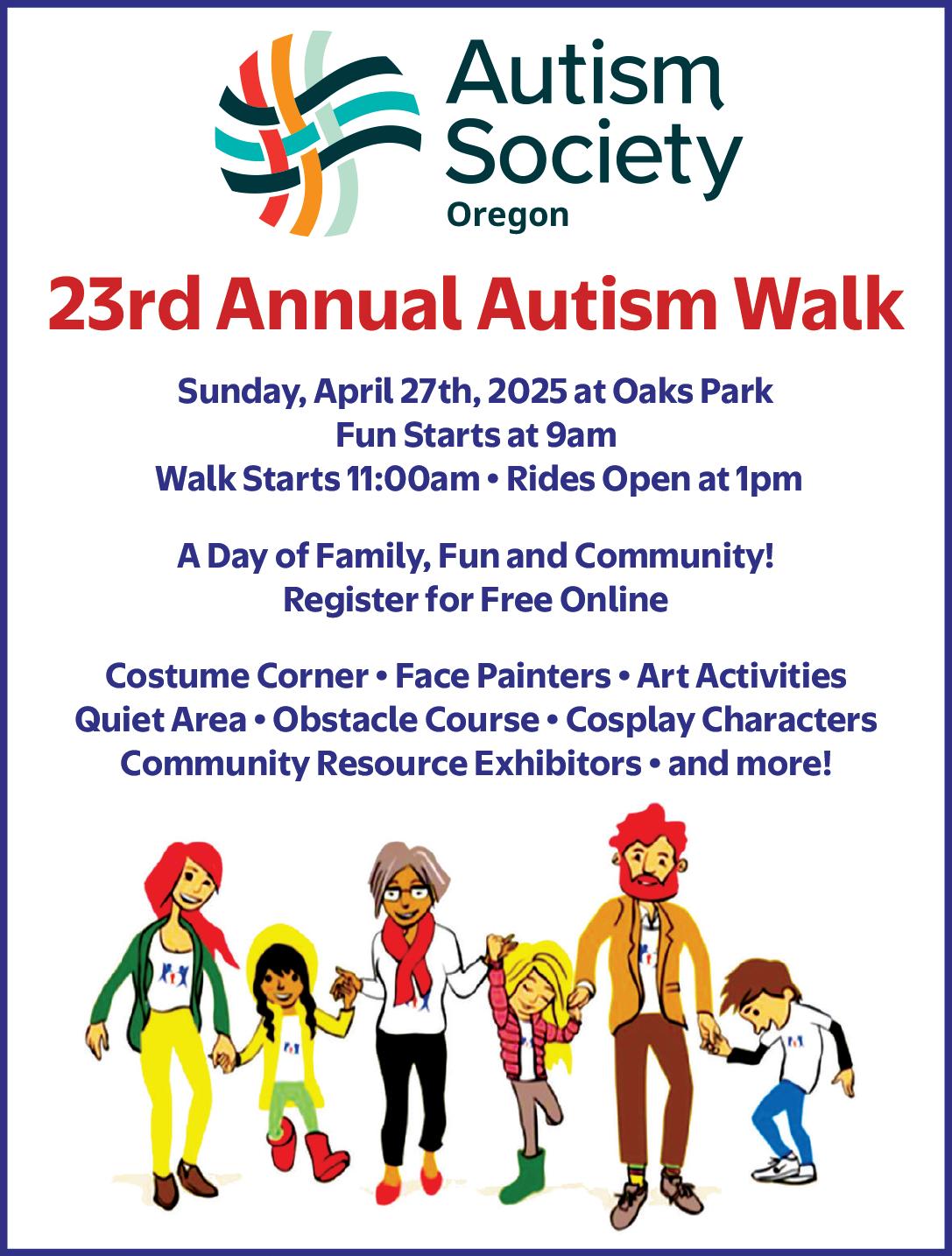
24th Annual Autism Walk
April 26th, 2026
Tualatin Hills Athletic Center 50 NW 158th Ave in Beaverton Fun Starts at 9am • Walk Starts 11:00am
A Day of Family Fun and Community! Register for Free Online Registration at: https://charity.pledgeit.org/PDX2026
Costume Corner • Face Painters • Art Activities Quiet Area • Obstacle Course • Cosplay Characters Community Resource Exhibitors • and more!
Easy and Meaningful Ways to Support Autism Empowerment
Other Ways
To Make an IMPACT!
Financial Gifts (including cash, stock, crypto, DAFs, etc.) support Autism Empowerment’s programs and structure. This is an impactful way to help us build capacity and support nonprofit programs like Spectrum Life Magazine. Thank you for your support! www.autismempowerment.org/donate
Honorarium, Memorial Giving & Endowments - Autism Empowerment offers the option to make a tax-deductible gift in honor of or in memory of a loved one This is a wonderful and respectful way to honor someone special in your life We also have the capacity to accept endowments Please inquire
Start a Facebook Fundraiser for your birthday or another occasion Ask your friends and family to support Autism Empowerment in an easy and feel-good way Win-win! Set up a fundraiser: www.facebook.com/fund/autismempowerment
Employee Matching Gifts - Thousands of employers match charitable donations made to our organization at NO cost to you (other than your donation) Please check with your Human Resources Department for details
eBay Giving Works & PayPal Giving Fund - Support Autism Empowerment anytime you shop or sell at eBay See our listings Visit: ebay.to/1lCaFKm or givingworks.ebay.com/charity-auctions/charity/autism-empowerment/50668
Humble Bundle - Humble Bundle sells games, books, software, and more at discounted prices, with EVERY purchase supporting charity! Choose Autism Empowerment at www.humblebundle.com
Billy Footwear offers fashionable, adaptive, easy-to-wear shoes with a universal design When you order through our link, we earn a percentage of every purchase https://billyfootwear.com/?ref=AUTISM EMPOWERMENT
AE Amazon Wish List - Help fulfill our list! https://bit.ly/AEAmazonwishlist Amazon Shopping - Autism Empowerment receives affiliate income when you shop through our link: https://amzn.to/429XLgO
Fred Meyer Rewards Card - Support AE every time you shop at Fred Meyer This doesn’t cost anything Just sign up and shop Autism Empowerment’s number is WA330 www fredmeyer com/i/community/community-rewards
Vehicle Donation - Support Autism Empowerment with your vehicle donation (running or not) bit ly/autismvehicle or get more information on our website: www autismempowerment org/get-involved/ways-give/donate-vehicle
Volunteer! Be a Social Media Ambassador and share our content Join our fundraising or thank you committee www.spectrumlife.org/impact
Please visit AutismEmpowerment org to learn more We are a 501(c)(3) nonprofit #45-2455219 www.AutismEmpowerment.org/get-involved/ways-give
Email: Donations@AutismEmpowerment.org or call (360) 601-4678 with any questions.
Centering Autistic Voices in Stressful Times
Inviting Families to Listen, Learn, and Rethink
By Niko Boskovic
Navigating withNik
This year has barely begun, but time feels like it’s moving quicker than expected by the clock. However, some days feel like thick clouds crowding the sky. There’s a lot coming at us on different fronts, and because so many autistic people are empaths, we have a tendency to soak up the vibes of the people around us.
This is especially hard for those of us who are nonspeaking and might not be able to productively vocalize our overwhelm and spiral deeper into OCD and/or anxiety. (Such is my present dilemma.)
Perhaps you are feeling restless at the thought that politics is knocking on our community’s door and amplifying nonautistic voices that could potentially harm us and our access to community living supports.
Ever since the [ICE-related] deaths in Minneapolis in January 2026, there has been a twinge of fear in the air—anger and frustration mixed in with the sharp sweetness of daphne blooms.
What happened to the disabled protestors and the ones who hid at home from armed men going door to door looking for brown people? How did all those grade-schoolers manage staying home for weeks because their caregivers and parents were terrified of getting separated from their disabled children?
It’s no wonder that so many autistics are struggling in these unrestful times.
As a disabled person, I have personal fears about this administration’s hostility towards autistics like me and other people who have high support needs.
We are watching in real time how nine states are attempting to roll back the protections of Section 504, and there aren’t staff remaining in the Department of Education’s Office of Civil Rights to investigate discrimination complaints.
With legal challenges tying up the courts, we are veering into survival mode.
Surviving this storm will take the efforts of all of us: those of you who are guardians making all life decisions for their disabled adult children; parents and caregivers watching this administration’s Secretary of Health and Human Services (HHS) insist that vaccines are to blame for autism; and school staff ringing the alarm bells about the cuts to special education and how they will hurt students’ futures.
Continued on next page
Photos courtesy of Loreta Skucas
At every level of the systems that affect autistic people’s lives, there ought to be concern and outrage on the rampant assault on our tenuous footing in society. There are so many autistic people of various support needs that are going to be affected by this administration’s lack of respect for autistic lives.
If more autistic people were in these systems as designers and providers instead of primarily as clients, the outrage would be louder. One thing I believe should be required of any disability group seeking to represent a population is that it be staffed by the people it purports to support.
Many autism advocacy groups don’t have any representation of nonspeakers. Perhaps they don’t really represent autistic concerns so much as they offer the caregiver perspective, which is really different from the nonspeaker’s perspective.
So while there are a couple of spellers on this year’s Interagency Autism Coordinating Committee under HHS Secretary Kennedy, they are sharing a platform with many vaccine deniers.
What are the things that concern someone like me—a nonspeaking autistic with high support needs—in this springtime season?
There are so many, but here’s what keeps my mind percolating: the efforts of a subgroup of parents who are determined to debase our lived experiences with the vague label of “profound” or “severe” autism.
Their drive has gained credibility as it masks its ableism behind paternalistic values. These same parents are openly derisive of autistic people’s experiences or dismiss our perspectives if they don’t align with their autism narrative.
There’s a lot I recognize in these parents because as a child, a lot of time and money was spent on making me less autistic: years of gluten-free pasta and homemade pizza, weekly occupational therapy and speech therapy, and an ABA program seven days a week.
My parents were pretty consumed with “recovering” me from autism—until my mom met an autistic adult, that is. After that, it was quickly obvious that she could either continue doing what she was doing or open herself to the possibility that she got a lot of what she thought about autism wrong, and let me lead.
This is a simplified version of what became a multi-year person-centered plan, complete with goals, action items, and an outside behavior consultant holding people to task. It became a commitment to learning about disability from disabled people that has no end date.
We gained a theoretical understanding of how ableism has permeated American society right down into the family unit. It has been an incredible journey for the both of us, and the natural rhythm of disabled life seems to fit us better than the constant anxious state of pursuing “recovery.”
This shift has made my current life possible: authentic, autonomous, and nurturing of my strengths and interests.
Furthermore, these qualities are incompatible with a life driven by other people’s decisions; a life where you don’t have a way to communicate in school or at home—a life where everything you do is more focused on and judged in greater scrutiny than anyone else around you—a life with a future that people FEAR instead of feel hopeful about.
All of this for years creates a message that the burden of autism is heavy indeed. It becomes part of your support system. Over time, your values align with people with whom you find kinship.
You may find that your world has shrunk to a small group of in-person friends, but a lot of online comrades are living their own version of your situation. Meanwhile, you try all sorts of therapies; some help, most don’t.
There is the daunting future of “what-ifs” and “Will X be safe from harm if something happens to me?” that lives like a whisper. Maybe some of this makes sense to your experience of autism?
My point is that learning about autism is best practiced by centering the autistic perspective.
Getting to that point is as much a process of making certain life choices as it is of following the stories of nonspeaking people, sharing what has resonated with your autistic loved one, reading about autistic people’s lives (but not written by their parents!), and making communication the cornerstone of their approach.
This can look very different between nonspeakers and, by no means, has to be high-tech. Expressing oneself is a fundamental need and how we share our humanity.
Try to learn about disabled people’s history and treat it as a project for life. Because no matter what you think you know about autism (or any diagnosis you don’t share), if you aren’t learning from actual autistic people, you aren’t learning from real sources on autism.
It sounds simple when you think about it. We are here, if you would give us your consideration.
Navigating with Niko is part of a regular series at Autism Empowerment and Spectrum Life Magazine by Niko Boskovic. To read past and future articles, visit www.spectrumlife.org/navigatingwithniko.
Photos courtesy of Loreta Skucas
por Tanya English
¿Qué significa el espectro del autismo?
¿Ha escuchado comentarios como estos cuando se habla de autismo?
“Yo lo veo bien, lo que le hace falta es más disciplina.”
“Pero si se ve sano.”
“Pues es muy inteligente.”
“Otro niño con autismo que yo conozco ni habla, pero el tuyo sí.”
Todavía existe mucha confusión sobre lo que realmente es el autismo. Por eso quería platicar un poco sobre este tema desde mi propia experiencia no solo como madre de hijos con autismo, sino también como persona autista.
Sí... yo soy autista.
Muchas personas se sorprenden cuando lo digo. A veces me responden cosas como:
“¿De veras? Pero si tú te comunicas muy bien.”
“Pero tú trabajas.”
“Pero tú puedes hablar con la gente.”
Y justamente ahí es donde vemos uno de los problemas más grandes: muchas personas tienen una idea muy específica en su mente sobre cómo “se ve” el autismo.
Cuando alguien no encaja en esa imagen, entonces asumen que no puede ser autista.
La realidad es que muchas personas autistas incluyéndome a mí hemos aprendido a enmascarar lo que se le conoce como “masking” que es el acto de esconder ciertas dificultades para poder navegar el mundo. Esto significa observar a los demás, aprender reglas sociales que no siempre entendemos de manera natural, y esforzarnos mucho para parecer que todo está bien.
Pero ese esfuerzo también puede ser muy cansado.
Aunque por fuera alguien pueda parecer que “todo está bien”, por dentro puede estar trabajando muy duro para manejar la ansiedad social, el ruido, los cambios inesperados o la sobrecarga sensorial.
Por eso es tan importante entender que el autismo no se ve igual en todas las personas.
Todos somos diferentes.
Conforme pasa el tiempo, también hay más información sobre el autismo. En la última década se han empezado a usar niveles en los diagnósticos, del nivel 1 al nivel 3.
Muchas personas piensan que estos niveles se refieren a la severidad del autismo — que el nivel 1 es “leve” y el nivel 3 es “severo”. Pero en realidad no funciona así.
Los niveles se refieren principalmente a la cantidad de apoyo que una persona puede necesitar en ciertas áreas, y esas áreas pueden variar mucho de persona a persona y todos contamos con diferentes habilidades.
Por ejemplo, hay personas que tienen altos niveles de habilidades sociales pero pueden tener dificultades con habilidades cognitivas como la memoria o la atención. Otras personas pueden tener dificultades expresándose verbalmente, pero pueden expresarse escribiendo, cantando o utilizando un aparato de comunicación aumentativa y alternativa (AAC por sus siglas en inglés).
También hay personas que hablan mucho y tienen un vocabulario muy amplio, pero que tienen dificultad para entender el sarcasmo, las indirectas o ciertas reglas sociales que muchas personas aprenden de manera natural. Algunas personas autistas son muy buenas con números, patrones o información detallada, pero pueden sentirse abrumadas con cambios inesperados o con ambientes muy ruidosos.
Aquí es donde entra la idea del espectro
Cuando hablamos de autismo como un espectro, no estamos hablando de una línea que va de “poquito autismo” a “mucho autismo”. Más bien, el espectro es como un perfil único de habilidades y necesidades, donde cada persona tiene una combinación diferente de fortalezas y áreas donde necesita apoyo.
Por ejemplo, una persona puede necesitar mucho apoyo en la comunicación social pero muy poco apoyo en el aprendizaje académico. Otra persona puede comunicarse bien pero necesitar apoyo para manejar la regulación emocional o la sensibilidad sensorial. También hay personas autistas que pueden parecer muy independientes por fuera, pero que en realidad están haciendo un gran esfuerzo interno para manejar el estrés social, los sonidos, las luces o los cambios en la rutina.
Por eso dos personas con autismo pueden ser completamente diferentes una de la otra.
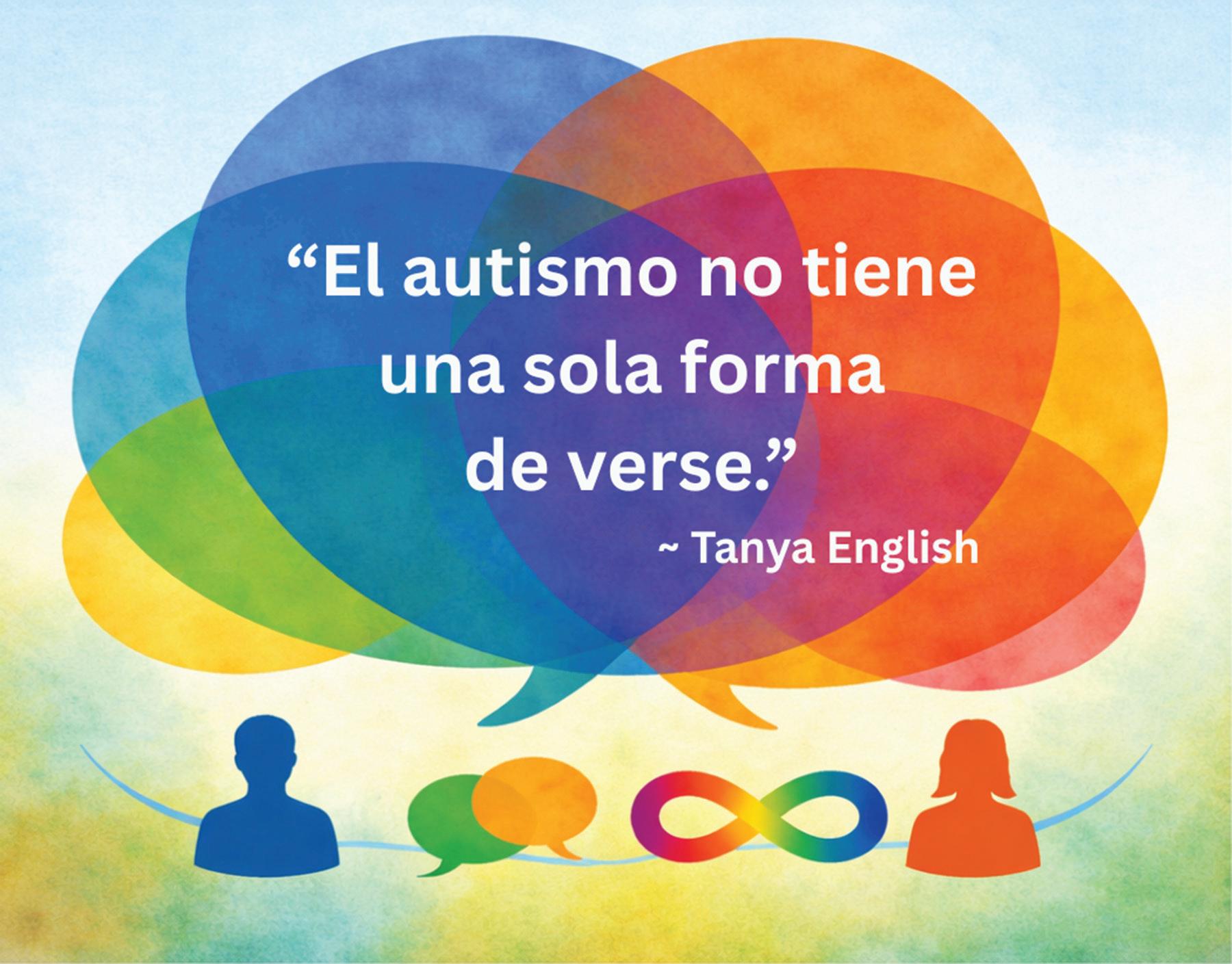
El autismo no tiene una sola forma de verse.
• Algunas personas autistas no hablan o utilizan dispositivos de comunicación.
• Otras hablan mucho.
• Algunas necesitan apoyo durante toda su vida.
• Otras estudian en la universidad, trabajan o tienen familias.
Todas siguen estando dentro del espectro.
Continúa en la página siguiente
Entender el espectro nos ayuda a dejar de comparar a las personas autistas entre sí. En lugar de preguntarnos “qué tan autista es”, podemos empezar a mirar a cada persona con más curiosidad y hacer preguntas más útiles: ¿cuáles son sus fortalezas?, ¿en qué áreas necesita apoyo?, y ¿qué tipo de apoyos pueden ayudarle a participar plenamente en la comunidad?
Cuando empezamos a ver el autismo de esta manera, no solo cambia la conversación. También cambia la manera en que apoyamos a nuestros hijos, estudiantes y miembros de la comunidad. Porque al final, el objetivo no es que una persona autista “parezca menos autista”. El objetivo es que tenga las herramientas, el respeto y las oportunidades necesarias para ser quien es y participar plenamente en el mundo.
Pero entender el espectro también significa reconocer que las experiencias dentro del autismo pueden ser muy diferentes, tanto para las personas autistas como para sus familias.
Hay familias que cuidan a personas autistas que necesitan altos niveles de apoyo en su vida diaria. Ese trabajo requiere tiempo, energía, paciencia y mucho amor. Muchas veces también implica navegar sistemas complicados, buscar servicios que no siempre son fáciles de encontrar y cargar con una gran responsabilidad día tras día.
Ese esfuerzo merece ser reconocido.
Hablar de fortalezas dentro del autismo no significa ignorar los desafíos reales que muchas personas y familias enfrentan. Ambas cosas pueden existir al mismo tiempo. Puede haber momentos de orgullo, aprendizaje y conexión, y también momentos de cansancio, preocupación o incertidumbre.
Todas esas experiencias son válidas.
Mi esperanza es que con el tiempo podamos seguir cambiando la forma en que la sociedad entiende el autismo. Pasar de una mirada enfocada solamente en los déficits a una que también reconozca las fortalezas, sin negar los apoyos que muchas personas necesitan.
Al mismo tiempo, este cambio toma tiempo. Requiere mayor comprensión social, más educación y, sobre todo, sistemas que realmente apoyen a las personas autistas y a sus familias.
Mientras tanto, lo más importante es recordar que cada persona dentro del espectro tiene su propio camino, sus propias habilidades y sus propias necesidades y que cada familia que acompaña ese camino merece apoyo, comprensión y una comunidad que camine a su lado.
Tanya English nació en Los Angeles, California, pero creció en Tijuana, México. Reside en Vancouver, Washington desde el 2014. Es una persona bilingüe y bicultural con autismo y con un fuerte sentido de justicia. Como coordinadora de la Coalición de Padres del Condado de Clark en PEACE NW y miembro de la junta directiva de Autism Empowerment, Tanya trabaja estrechamente con familias e individuos, ayudándolos a conectarse con recursos en la comunidad y a navegar sistemas complejos. Cree que las comunidades sólidas y solidarias fomentan familias saludables y así, las familias saludables pueden empoderar a los demás a prosperar.
By Tanya English
Rethinking What Autism Looks Like
This article is part of our Conexiones en la Comunidad series and has been translated into English for broader accessibility.
Have you heard comments like these when people talk about autism?
“I think he looks fine, he just needs more discipline.”
“But he looks healthy.”
“Well, he’s very intelligent.”
“Another child with autism that I know doesn’t even talk, but yours does.”
There is still a lot of confusion about what autism really is. That’s why I wanted to talk a little about this topic from my own experience—not only as a mother of autistic children, but also as an autistic person.
Yes... I am autistic.
Many people are surprised when I say that. Sometimes they respond with things like:
“Really? But you communicate so well.”
“But you work.”
“But you can talk to people.”
And that’s exactly where we see one of the biggest problems: many people have a very specific image in their mind of what autism “looks like.”
When someone doesn’t fit that image, they assume that person can’t be autistic.
The reality is that many autistic people, myself included, have learned to mask, which is what is known as “masking,” which is the act of hiding certain difficulties in order to navigate the world. This can mean watching others, learning social rules that we don’t always naturally understand, and putting in a lot of effort to make it seem like everything is fine.
But that effort can also be very exhausting.
Even if on the outside someone seems like “everything is fine,” on the inside, they may be working very hard to manage social anxiety, noise, unexpected changes, or sensory overload.
That’s why it’s so important to understand that autism does not look the same in every person.
We are all different.
Over time, there has also been more information about autism. In the last decade, diagnostic levels have started to be used, from Level 1 to Level 3.
Many people think these levels refer to how “severe” the autism is—that Level 1 is “mild” and Level 3 is “severe.” But in reality, it doesn’t work that way.
The levels mainly refer to the amount of support a person may need in certain areas, and those areas can vary a lot from person to person, and we all have different skills.
For example, some people have strong social skills but may have challenges with cognitive skills like memory or attention. Other people may have difficulty expressing themselves verbally, but can express themselves through writing, singing, or using an Augmentative and Alternative Communication (AAC) device
There are also people who talk a lot and have a very wide vocabulary, but who struggle to understand sarcasm, hints, or certain social rules that many people pick up naturally. Some autistic people are very good with numbers, patterns, or detailed information, but may feel overwhelmed by unexpected changes or very noisy environments.
This is where the idea of the spectrum comes in.
When we talk about autism as a spectrum, we’re not talking about a line that goes from “a little bit autistic” to “very autistic.” Rather, the spectrum is like a unique profile of strengths and needs, where each person has a different combination of abilities and areas where they need support.
For example, one person may need a lot of support with social communication but very little support with academic learning. Another person may communicate well but need support with emotional regulation or sensory sensitivity. There are also autistic people who may appear very independent from the outside, but who are actually putting in a great deal of internal effort to manage social stress, sounds, lights, or changes in routine.
That’s why two autistic people can be completely different from one another.
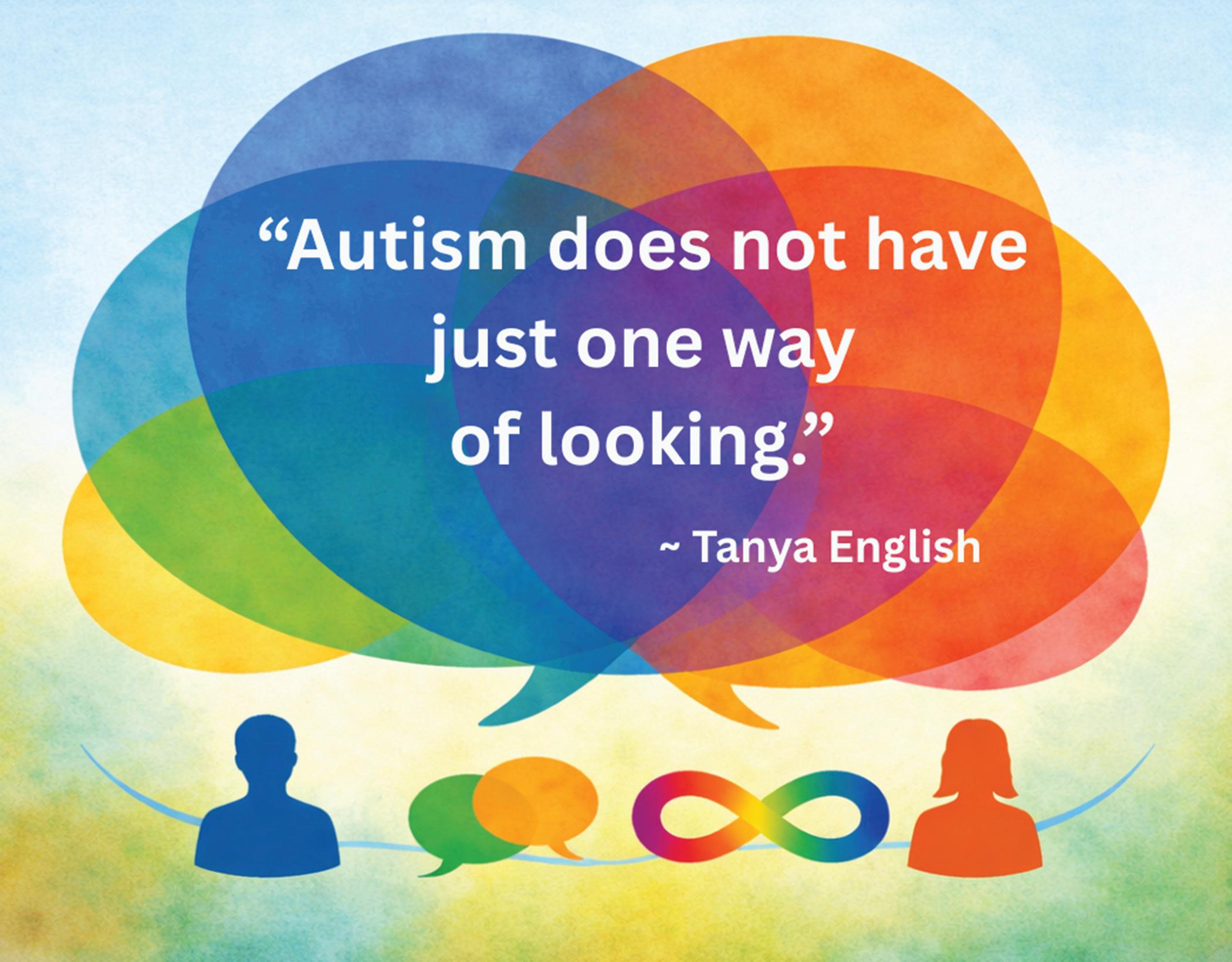
Autism does not have just one way of looking.
• Some autistic people do not speak or use communication devices.
• Others talk a lot.
• Some need support throughout their lives.
• Others go to college, work, or have families.
All of them are still on the autism spectrum.
Continued on next page
Understanding the spectrum helps us stop comparing autistic people to one another. Instead of asking, “How autistic is this person?” we can start to look at each person with more curiosity and ask more useful questions: What are their strengths? In what areas do they need support? What kinds of supports can help them participate fully in the community?
When we begin to see autism this way, it doesn’t just change the conversation. It also changes how we support our children, students, and community members.
Because in the end, the goal is not for an autistic person to “seem less autistic.”
The goal is for them to have the tools, respect, and opportunities they need to be who they are and to participate fully in the world.
But understanding the spectrum also means recognizing that experiences within autism can be very different, both for autistic people and for their families.
There are families who care for autistic people who need high levels of support in their daily lives. That work requires time,
energy, patience, and a lot of love. Many times, it also means navigating complicated systems, searching for services that are not always easy to find, and carrying a huge responsibility day after day.
That effort deserves to be recognized.
Talking about strengths within autism does not mean ignoring the real challenges that many people and families face. Both things can exist at the same time. There can be moments of pride, learning, and connection, and also moments of exhaustion, worry, or uncertainty.
All of those experiences are valid.
My hope is that, over time, we can keep changing the way society understands autism—moving from a view focused only on deficits to one that also recognizes strengths, without denying the supports that many people need.
At the same time, this change takes time. It requires greater social understanding, more education, and above all, systems that truly support autistic people and their families.
In the meantime, the most important thing is to remember that every person on the spectrum has their own path, their own abilities, and their own needs, and that every family that walks alongside them deserves support, understanding, and a community that walks by their side.
UNTIL NEXT TIME!
Tanya English was born in Los Angeles, California, but spent her formative years in Tijuana, Mexico, before settling in Vancouver, Washington, in 2014. She is a bilingual and bicultural advocate for autistic people, with a strong sense of justice. As Coordinator of the Clark County Parent Coalition at PEACE NW and a member of the Autism Empowerment Board of Directors, Tanya works closely with families and individuals, helping them access resources, connect with their community, and navigate complex systems. She believes that strong, supportive communities foster healthy families, which in turn empower people to thrive.
WHOLE LIFE, WHOLE COMMUNITY CONFERENCE
Supporting individuals with Intellectual/Developmental Disabilities, their families, and the professionals who support them across the lifespan.
FRIDAY, MAY 15, 2026
9:00AM - 5:00PM
CLARK COLLEGE
GAISER HALL
Keynote Speakers
Breakout Sessions
Connection Opportunities
Lunch Included
Breakout Sessions in Spanish Sesiones en español
Scholarships Available
Volunteer Opportunities Available
Please request accommodations or interpretation by April 10, 2026. Questions? call 360-823-2247 or email info@peacenw.org.
For 10 years, PEACE NW has stood alongside individuals with disabilities and their families—building community, advancing advocacy, and creating meaningful connections. Join us in celebrating and visit our website to learn about events, activities, and opportunities to get involved.
SW Washington Coalition for Disability Services Building Bridges, Sharing Resources, Strengthening Community
By Karen Krejcha and John Krejcha
When families and individuals are trying to navigate disability services, support systems can sometimes feel scattered, even when many caring organizations are doing meaningful work. In Southwest Washington, a new coalition is working to build bridges and strengthen community.
Launched in Fall 2025, the SW Washington Coalition for Disability Services brings together disability advocates, service providers, community partners, and allies who share a commitment to strengthening resources, amplifying voices, and building a more connected and collaborative support network.
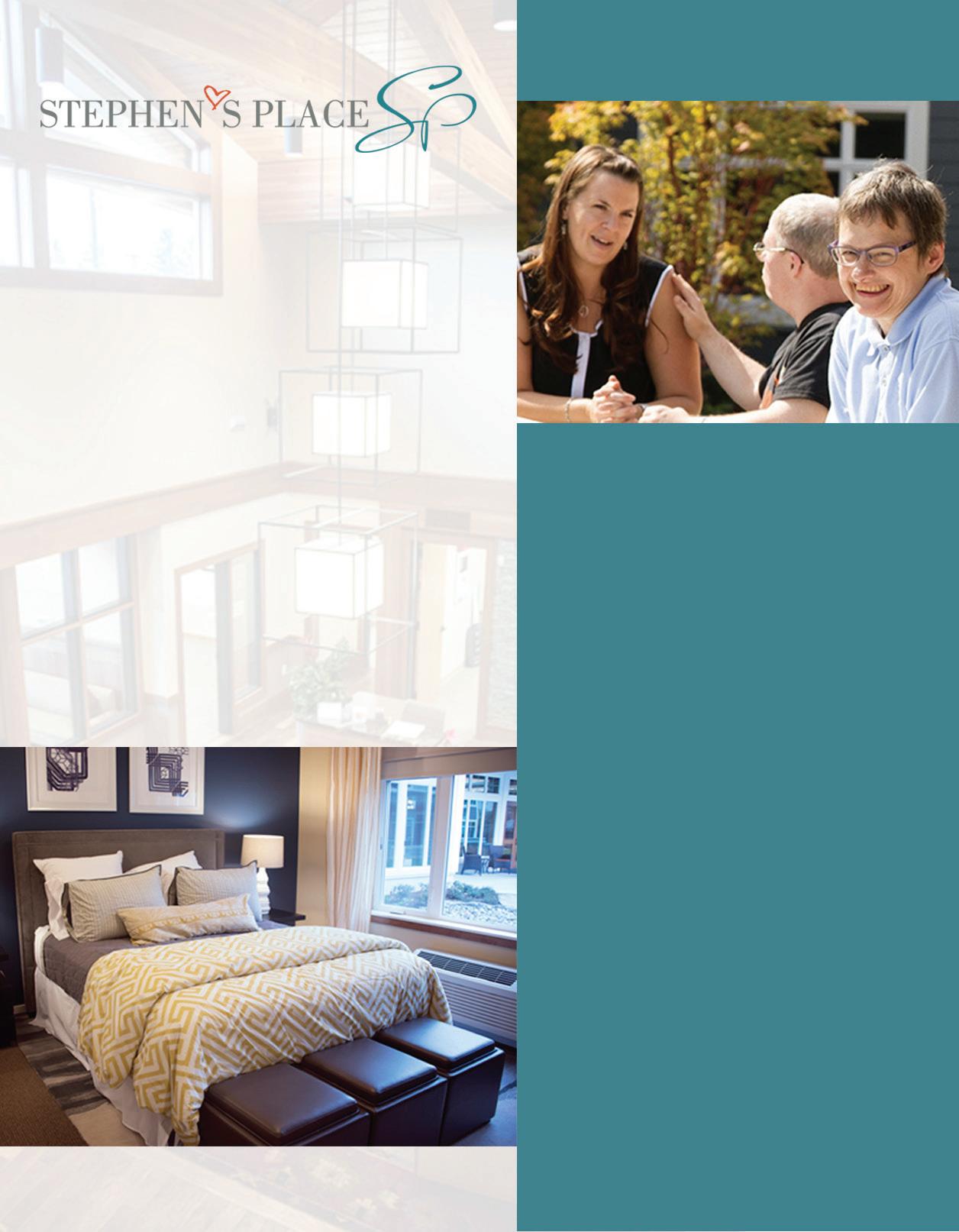
Co-founded by Heather Bartholomew of Stephen’s Place and Darla Helt of PEACE NW, the coalition is creating space for organizations to learn from one another, respond to shared challenges, and work together on behalf of individuals with intellectual and developmental disabilities (I/DD) and their families.
Spectrum Life recently spoke with both leaders about how the coalition began, what it hopes to accomplish, and why collaboration matters now more than ever.
Meet the Founders
Hello, Heather and Darla! Thank you for talking with us today. Please tell our readers a little bit about each of your backgrounds.
Heather: I’m Heather Bartholomew, the Executive Director of Stephen’s Place. I’ve been at Stephen’s Place since the day it opened, 11 years ago. I’m originally from Olympia, Washington, went to school at the University of Montana (Go Griz!), and then relocated back to the Pacific Northwest.
I am married and have four incredible children who keep me busy, remind me of all the good in the world, and constantly challenge my thoughts! Our family lives in the Vancouver area and enjoys all this area has to offer, from outdoor recreation to concerts and performances in Portland. We are always on the move!
Growing up, my dad was a Superintendent of schools. He spent years prior to this working with students with disabilities. In our household, all people were treated with respect, and each was as important as the next. I watched as my father would provide the same attention to a conversation with someone on his Board or one of his administrators
as he would a student, and particularly the students who had disabilities.
This was one of his passions, and it found its way to me. In school, I would see who needed that extra help, I would pair up with the student who was partially blind on a field trip with stairs, and I was the kid who wanted to make sure everyone got to participate.
This passion has continued throughout my life. I’m still the person who will check to see if someone needs help, jump in where I can make a difference, and cheer loudly for ALL the participants (okay, maybe a LITTLE louder for my children!).
I truly believe each person in the world can teach me something, and I am respectful of that. I believe that’s why I love what I do. I see all that adults with intellectual and developmental disabilities have to offer this world, and I want them to feel the love and support the rest of the world gets every day.
If they can have this support at home, at Stephen’s Place, they can carry it out into the world and feel stronger in their self-advocacy, their independence, and in achieving their goals.
In doing this work, I have become a better person, I have become a better parent, and I have become a better advocate for our residents and for the lens through which the world should see them.
Continued on next page
Photo credit: Mary Rebekah
Moore Photography
Darla: I’m Darla Helt, Director of People Empowered and Communities Enhanced (PEACE NW), and perhaps most importantly, a parent. For more than 35 years, I’ve worked alongside families and individuals navigating the systems that support people with intellectual and developmental disabilities.
My perspective in this work is both professional and deeply personal. As a parent, I understand firsthand how complex these systems can be and how important it is for individuals and families to have strong networks of support.
At PEACE NW, we often say the answer is yes, and the question is how? Every individual has unique strengths, needs, and goals, and those needs are not optional. People deserve thoughtful solutions and opportunities that allow them to build the lives they want for themselves.
That is one of the reasons collaboration matters so much. Organizations like Autism Empowerment, Stephen’s Place, and many others are doing incredible work across our community. When we come together and share what we know, we strengthen the entire system of support around individuals with I/DD.
Ultimately, the goal is simple—making sure people have the opportunity, support, and community they need to live their best lives.
How the Coalition Began
Take us back to the beginning: what sparked the coalition, and what gap or need were you seeing in Southwest Washington?
Heather: I met Darla when I first started at Stephen’s Place, and we’ve stayed in touch ever since. I’ve always been a big cheerleader for the work she does—the love she brings to it and the genuine care she shows every person she works with. She’s not just running a business; she’s truly making a difference.
When the “Big Beautiful Bill” passed, I started thinking about the challenges ahead for nonprofits and other service providers, especially with potential cuts to services both nationally and locally. It became clear that many of us would be facing similar hurdles.
And if the past has taught me anything, it’s that we’re stronger when we work together.
I began thinking about how we might collaborate—how we could find efficiencies in the work we do and in the resources it takes to do it. I’ve been fortunate to have so many mentors in this community who support the neurodivergent population, and I wanted to do whatever I could to support them and the community I serve.
So naturally, I called Darla. She’s had such a positive impact on our community and has done so much already. I told her, “Let’s do this.” And that’s how it started—we began by inviting people to come together, mostly by bribing them with coffee and cookies, just to see what we could accomplish together.
Darla: When conversations began nationally and at the state level about potential cuts to services for individuals with I/DD, many of us became deeply concerned.
These services already require significant coordination and support, and reductions could have a real impact on people’s daily lives.
Around that time, Heather reached out to talk about the idea of bringing organizations together through a regional disability coalition for Southwest Washington. Heather has been an incredible leader in creating space for this collaboration, and I immediately saw the value in the idea.
While services are critically important, community is just as important. When organizations know one another and work together, we are better prepared to support individuals with I/DD and respond to challenges as they arise.
What started as a simple invitation to gather and talk has grown into a collaborative group of organizations that share a commitment to strengthening supports for individuals across our region.
A Shared Mission
In your words, what is the SW Washington Coalition for Disability Services, and who is it here to serve?
Heather: The SW Washington Coalition for Disability Services is a group of people with disabilities and those who serve and support them, who have come together knowing that the sum of us can be greater than each of us as individuals and as individual organizations
Continued on page 22
Photo courtesy of : Peace NW
We come together to serve each other and anyone with I/DD who needs advocacy and services, with the goal of being more than what we can be alone.
What is the overall mission of the coalition, and how did you come up with this mission statement?
Heather: Our mission is to foster collaboration among advocates, service providers, and community partners to strengthen disability services—amplifying voices, sharing knowledge, and working together to promote dignity, independence, and quality at all stages of life in Southwest Washington and beyond.
This mission was created by the first ten or so partners who came together and said, “This is what we want, this is what we need, and this is what we can do.”
Collaboration in Action
The coalition’s mission mentions collaboration, amplifying voices, and strengthening services. What does that look like in real life?
Heather: I love this question because you can actually see it happening in our meetings now that we’ve been working together for a while. Sometimes it looks like someone finding housing more quickly because, at the end of a meeting, a few organizations had the chance to connect in person and really understand that individual’s needs. Other times, it’s an organization facing a challenging situation and calling another executive director to come present or train their team.
It’s also about supporting each other—sharing feedback about unmet needs, helping identify the right skills for open board positions, or brainstorming solutions when the right resource doesn’t exist yet.
It also looks like shared space and resources. When one organization has an opportunity to help the whole group communicate better with an agency, they open their doors and share that space and time.
At the end of the day, it’s about building a community where our voices are stronger together than they ever could be alone.
Darla: In real life, collaboration looks like connections turning into action.
When organizations, advocates, and community partners come together regularly, we’re able to pull ideas, experience, and knowledge into one space. Instead of everyone working in separate lanes, we can share what we’re seeing, identify gaps, and find ways to support one another.
Organizations like Stephen’s Place, PEACE NW, Autism Empowerment, and many others each see different parts of the system. When those perspectives come together, we gain a much clearer understanding of how to strengthen services overall.
Ultimately, collaboration helps ensure that individuals with I/DD have access to a stronger network of support
one that helps them pursue their goals and live the lives they choose.
Why This Matters Now
Why are coalitions like this important right now, wherever someone may be located?
Heather: As Helen Keller once said, “Alone we can do so little; together we can do so much.” That idea really captures why coalitions matter right now.
We live in a time when we’re constantly bombarded by news, social media, and countless messages telling us what should matter most. Coalitions give communities the opportunity to come together and say, this is what matters to us.
At the same time, resources from federal and state programs are becoming more limited. That makes collaboration even more important. By working together, organizations can protect and strengthen the support that already exists while also advocating for the resources our communities will need in the future.
Coalitions allow groups to share knowledge, coordinate efforts, and speak with a stronger, more unified voice. And in times of uncertainty, that collective voice—and collective action—can make all the difference.
How does the coalition decide what topics to focus on?
Heather: The agenda is shaped by the coalition members themselves. At each meeting, members have the opportunity to suggest topics, share challenges they’re seeing, or raise new ideas that would benefit the group or the community.
We also dedicate time in every meeting to highlight one organization. That gives everyone a chance to better understand the services available in our community, what gaps may exist, and where collaboration could help.
In addition, we regularly discuss current advocacy issues, upcoming events, and opportunities to work together on shared goals. If a member identifies a need—whether it’s training, resources, or community awareness—they can bring it forward, and the group decides together how to address it.
In that way, the coalition’s focus evolves based on what members are experiencing in real time and where we can have the greatest impact together.
What are the coalition’s “ground rules” or shared commitments for working together across different organizations and perspectives?
Heather: One of our core beliefs is that everyone has an important role to play in our community. I often say, “There’s enough need that we are all needed.” Because of that, we don’t see each other as competitors—we see each other as partners working toward the same goal.
Continued on page 24
Coalition Members and Community Partners • A Growing Network of Support
Featured here are some of the organizations involved in this growing coalition.
Our ground rules start with approaching conversations in good faith. We ask members to listen openly, share honestly, and be willing to learn from one another. Everyone comes to the table with different experiences and expertise, and we see that as a strength.
We also follow some simple but important guidelines for respectful dialogue: no interrupting, no inflammatory language, and a commitment to treating each other with courtesy and respect. Those basic expectations help create a space where organizations feel comfortable sharing challenges, ideas, and opportunities to collaborate.
Current Priorities and Early Momentum
What are your top short-term priorities for the next six to 12 months?
Heather: There are several areas that we will be working on in the next six to 12 months:
• Advocacy
• Community awareness and understanding
• Shared resources and learning
• Program efficiencies
Of these priorities, which one or two feel most urgent right now, and why?
Heather: Advocacy and shared resources. These are the most vital issues given the nature of the world in which we live. These areas also afford us the opportunity to get to know each other well as we continue to build the infrastructure of our coalition.
What are your longer-term goals?
Heather: Longer-term goals are increasing community awareness of services and advocacy opportunities, and growing the partnerships and services our community provides for neurodivergent individuals.
Can you share one early “win” or promising example of collaboration, even if it’s small, that helps people picture the impact?
Darla: One early collaboration we’re excited about is the coalition working together to create shared information bags for resource fairs and community events. These bags include materials from multiple organizations, so individuals and community members can access a wide range of resources in one place.
Thanks to the incredible Autism Serves Helping Hands volunteer group from Autism Empowerment, we’ve been able to organize and assemble these materials together. Their support has helped all of us make better use of our time and resources while reaching more individuals and families across the community.
It may seem like a small step, but it’s a great example of how collaboration works in practice. By bringing information together, we are helping individuals connect with a broader network of services, supports, and opportunities.
Where do you see the coalition in a year from now?
Heather: I see the coalition having its own website and a centralized hub of resources for the Southwest Washington area—something everyone can access easily. This would include an advocacy page with tools, opportunities, and information that any organization or individual could use. Essentially, a “one-stop” place to make accessing services simpler and more efficient.
There are so many incredible organizations supporting the neurodivergent population, and each one does so much more than just its core mission. Being part of this coalition has given me a deeper appreciation for all that our community offers, and it’s made me even more committed to helping the coalition grow so these resources continue to be available and expand over time.
Darla: In a year, I hope to see the coalition continuing to grow as a strong and connected network across Southwest Washington.
Ideally, we will have a shared online presence where individuals, families, and providers can easily find information about services, advocacy opportunities, and community events. That kind of shared resource can make it much easier for people to find the support they need.
I also see the coalition continuing to participate in community events, resource fairs, and advocacy efforts alongside organizations that have not yet joined, but are committed to supporting individuals with I/DD.
Continued on next page
Most importantly, I hope the relationships between organizations continue to deepen. When communication and trust grow, the entire system becomes stronger and better able to support individuals in building the lives they want for themselves.
How to Get Involved
If a Spectrum Life reader is a self-advocate, family member, provider, educator, employer, or community ally, what does “joining” the coalition look like for them?
Heather: Attendance at the coalition is open to all who want to do more, build a stronger advocacy community, and are concerned about keeping and growing the services our community provides.
We currently have individuals who are self-advocates, members of disability boards, programs that provide support in employment, housing, education, case management, transportation, support groups, law, guardianship, social support, mental health, behavioral health, systems navigation, and transition programs—all individuals and groups that focus, in whole or in part, on the neurodivergent community.
What does participation look like, including time commitment, meeting format, and ways people can support the coalition from inside or outside Southwest Washington?
Heather: Meetings are held every other Tuesday, with attendees joining both in person and via Zoom. We typically meet in one of the Stephen’s Place conference rooms at 501 SE Ellsworth Road in Vancouver, though from time to time we meet at a partner location. Participants can plug in at any level of commitment that suits their current abilities. As with anything, the more you can commit, the more you will take away from the group.
The coalition is open to organizations and community members in Southwest Washington and beyond. If you live outside the area and would like to add your voice, advocate with us, or support the work, please reach out.
For information or to join, email Heather Bartholomew at hbartholomew@stephensplace.org.
Darla: Whether someone lives in Southwest Washington or in another community, there is a role for everyone in strengthening disability dignity, access, and inclusion.
What we are building through this coalition is actually a very simple and easily replicated idea: bring people together, share knowledge, and work collaboratively to strengthen support for individuals with I/DD.
Organizations like Stephen’s Place, PEACE NW, Autism Empowerment, and many others are showing what can happen when communities work together.
Now more than ever, there is a need for collaboration. In many ways, it is a return to our roots—neighbors, advocates, and providers working together to ensure individuals with I/DD have the opportunity to build meaningful lives and pursue the dreams they have for themselves.
Communities everywhere can do this, and when they do, the impact can be profound.
Is there anything else you’d like Spectrum Life readers to know?
Darla: One thing I would want readers to remember is that strong communities are built through relationships.
Individuals with I/DD have so much to contribute to our communities, and when the right supports and opportunities exist and are in place, people are able to pursue their goals, participate fully in community life, and build the futures they envision.
What gives me hope is seeing organizations like those within the coalition coming together with a shared commitment to that vision.
When we collaborate, we strengthen not only our services, but the entire community around the individuals we serve.
And ultimately, that is what this coalition is about—helping individuals with intellectual and developmental disabilities live their best lives.
Karen Krejcha is the co-founder and Executive Director of Autism Empowerment. She is Editor of Spectrum Life Magazine and founder of the disability consulting firm Spectrum of Voices LLC. Karen was diagnosed on the autism spectrum in her 40s, after the diagnosis of her two children. She has been married to co-founder John Krejcha for more than 33 years and is devoted to her family, her community, and building a kinder world rooted in dignity, acceptance, empowerment, and love.
John Krejcha is co-founder and Program Director of Autism Empowerment, where he supports community outreach, advocacy, and program development, and serves on the Editorial Advisory Board of Spectrum Life Magazine. John is married to co-founder Karen Krejcha and is the proud father of two autistic children. Dyslexic and neurodivergent himself, John is deeply committed to advancing acceptance, inclusion, and empowerment across autism and disability communities.
An Autistic’s Guide to Asking for Support in the Workplace
The Accommodation Conversation
By Lyric Rivera aka Neurodivergent Rebel
I spent 18 years working before being diagnosed as Autistic at age 29.
At 11, I helped my mom at her salon, doing tasks like sweeping, cleaning tools, managing inventory, and later booking appointments. This early work gave me a strong foundation when I officially entered the workforce a few years later.
For most of my work life, I didn’t know I was Autistic, but generally got my needs met.
In high school, when I was 16, I landed my first fast-food job and quickly set my sights on management, mostly because it offered more autonomy and control over my work environment.
At 17, I felt like I was “winning work” and had worked my way up to an assistant management position at the restaurant, unaware at the time of the additional strings that would come with that promotion.
By my teens, being a dedicated worker was central to my identity, a trend that continued as time marched on.
Passionate, Driven, and Highly Motivated People Often Burn Out First:
I was at a crisis point when I was diagnosed as Autistic nine years ago.
At that time, I was burned out, sick, depressed, and anxious. Without knowing I was Autistic and ADHD, I didn’t understand why life was so hard or that accommodations could help.
In the workplace, when workers burn out, it is often the most passionate employees, who care the most, who end up burned out, not the employees who are less passionate about their work. That’s because people who don’t care as much are much less likely to exert themselves or give extra time for something they don’t care about.
In this way, when we are passionate people, our passions, which can be our biggest strengths, can burn like fires with flames so big that they char us down to nothing if we don’t protect them... or at least that’s what happened to me leading up to my autism diagnosis.
Autism, Neurodivergence and Burnout:
Autistic and otherwise neurodivergent employees can also be more susceptible to burnout due to constant pressure to
conform and blend in with the people and systems around us, which can increase stress, especially when we’re forced to navigate unaccommodating environments and mismatches between job demands and personal resources.
A core part of being Autistic for me is that it is in my nature to be very all or nothing with things, and this carries over into my work-life, making me a very dedicated employee.
Earlier in my career, not knowing about my neurodivergence meant I often worked harder than many peers, and kept my struggles to myself, sometimes being taken advantage of by employers.
I learned the hard way to protect my energy and set boundaries around rest, especially with people or situations that drain me and discourage me from self-care.
Don’t let go of the things that bring joy to your life.
We also have to feed our internal fires by holding onto activities, people, and moments that bring us joy and connect us to ourselves and those around us.
When I focused only on work and neglected things I enjoyed and people I loved, I became exhausted and lost track of my purpose.
When we let go of the things outside of work that give us meaning and purpose, it can lead to an exhausting, hopeless-seeming life.
Being diagnosed Autistic changed everything for me.
It was like something had snapped me out of a dream.
Understanding I was Autistic gave me a new perspective and validation for my life and work experiences, making sense of years of confusion. I realized I could thrive in supportive environments and finally understood why the freedom to work in my own way is often the key to my success.
Through the lens of autism, I made sense, my life made sense, and I wanted to tell everyone, but not everyone was ready to hear what I had to say.
To Disclose or Not to Disclose?
As I quickly found out, disclosures can be messy, complicated, and nuanced.
Continued on next page
Speaking up about or asking for tools to support our needs is often the first step we must take if we hope to get our needs met. Still, safety and risk are things we often must consider.
There are many ways we can ask for support, including disclosing our specific disabilities or neurotypes to those around us. However, when we’re not sure it’s safe to disclose, we may shift to a more stealth approach, such as disclosing a struggle we’re having and asking for the specific support or tool we need to address it.
Disclosing can have both benefits and risks. Additionally, if the workplace you’re in is already neuro-affirming and supportive, and the people you work with already have a decent understanding of autism and/or neurodiversity, disclosures may not feel necessary.
What a Neuro-affirming Workplace Looks Like in Practice:
• Psychological Safety
Environments where people can be honest about their struggles, reject toxic positivity, and leave room for people’s vulnerabilities so that they can be fully “human” without fear.
• Strength-Based
Focusing on unique talents and matching people to tasks and jobs where they are skilled, rather than punishing differences and focusing on people’s struggles.
• Flexibility as the Default
Offering flexibility in how, when, and where work gets done; recognizing the human variability in work pace and style.
• Clear, Transparent Communication
Providing policies and explaining the “why” behind decisions, in multiple formats (like written and oral instruction), so that learners of all types are supported.
Whether you choose to disclose or not is a deeply personal decision, and is often situational with no universal answer.
Potential Benefits of Disclosure:
• Access to Support & Legal Protections
Depending on where you are in the world, disclosures may be necessary in order to hold an employer, school, or other service provider responsible for their “duty to accommodate” and offer “reasonable adjustments” and protections against discrimination related to a person with a disability (which autism and other forms of neurodivergence often qualify as).
• Authenticity and Reduced Masking
Disclosing your neurodivergence and particular diagnosis, fully or partially, may help you better communicate with others about the tools and supports you need to work in ways that suit your brain. It may also help people understand you better, reducing the exhausting effort that comes with concealing your struggles and needs.
While disclosures can be the first step you take to get your needs met, they don’t come without risk.
Potential Risks of Disclosure:
• Stigma and Bias Against Autistic and Neurodivergent People
Despite laws that make discrimination illegal, unconscious bias is hard to prove and can affect people’s perceptions of us, and can lead us to being passed over for opportunities or promotions.
• Variable Understanding of Autism and Neurodivergence
Not all people we share with, like coworkers, managers, or Human Resources (HR) departments, will have the knowledge needed to offer adequate help, which can lead to misunderstandings, harmful assumptions, and inadequate support.
• Privacy
Because people talk, even when they’re not supposed to, sharing can mean we lose control over how our personal information is handled or perceived by others.
If you do opt to disclose that you are Autistic, ADHD, or otherwise neurodivergent at your workplace, you may want to be strategic about how you reveal this information and who you share it with.
Strategic Considerations:
There are ways you can be strategic about disclosing your neurodivergence at work.
Continued on page 28
• Timing
You can disclose at any point in the interview process during recruitment (for interview adjustments), after a job offer, when challenges arise, or during a role change. I recommend doing so only with people you feel safe sharing with.
• Diagnosis is Not Always Required
Some employers may offer support regardless of whether you have a formal diagnosis, and may not require a diagnosis if you can reasonably explain to them the need you have, the support you’re requesting, and how you will use that support to do better work for the employer.
• A Gradual Approach to Disclosures or Partial Disclosures
Start by disclosing to a trusted manager or HR team member, and consider partial disclosures, framing the conversation around specific needs, job functions, and strengths rather than leading with a label.
Requesting Accommodations:
When I was newly diagnosed as Autistic, I didn’t yet fully understand my rights or the best ways to speak up and ask for the supports and accommodations that I was legally entitled to as a person with a disability.
I’ve had to hone, develop, and practice those self-advocacy skills in adulthood, since I didn’t learn them growing up. Back then, when I didn’t even know what my needs were, it would have been helpful to have some ideas of where to start.
Because every Autistic and neurodivergent person’s journey and needs are unique, consider whether any of the supports or accommodations below could help you.
As a neurodivergent person, some examples may include (but are in no way limited to):
Sensory & Environmental Supports
Support for sensory processing differences.
• Scheduled movement breaks and access to sensory tools
• Noise-canceling headphones
• Quiet workspaces or hours
• Adjustable lighting
• Flexible schedules and/or remote work options allowing control over the physical environment (to help reduce sensory overload, minimize distractions)
Communication Supports
Support for communications differences.
• Giving instructions written, verbally, or both, depending on a person’s individual needs and preferences
• Providing meeting agendas in advance and summaries, or at least action items, in writing after meetings conclude
• Allowing the use of a transcription or voice recording device
• Offering clear & direct feedback
• Offering alternative communication channels (email/chat) if spoken communication creates barriers
Task Management & Organizational Supports
Supports for differences in energy management, memory, and focus, and those of us who struggle with prioritization.
• Visual schedules, task lists, alarms and reminders, or project management software
• Breaking projects into smaller steps
• Regular check-ins and support from leadership and team
• Flexible deadlines, when possible, if helpful
• Flexible start times (to help accommodate different circadian rhythms)
Continued on next page
Once you know the obstacles in front of you and what tools could help equip you to face those better or potentially remove those obstacles, the next step is to determine who and how you will have those conversations with the people around you.
How to Have the Accommodation Conversation:
1. Self-Assess
Identify your top 1-3 barriers to achieving your goals or improving your well-being.
2. Focus on Solutions, Not Problems
Frame requests around your effectiveness and contributions.
Some examples:
• “To minimize distractions and produce higherquality reports with more accuracy in the time allowed, it would help me to have a few hours of uninterrupted work time in the mornings, a quiet workspace, and noise-canceling headphones.”
• “Offering flexible start times or hybrid work options helps me manage my energy best. This also supports parents, caregivers, and anyone seeking better work-life balance.”
• “Providing meeting agendas and notes in advance helps me prepare and contribute most effectively. This also benefits team members who are introverted or have different processing speeds.”
• “Having quiet zones and accessible noise-canceling headphones for anyone to use can reduce sensory stress, helping to create a calmer environment for everyone to concentrate.”
3. Be Prepared to Collaborate
Your employer may suggest alternative solutions. The goal is to find an effective adjustment, not necessarily your first idea.
What if the Systems Worked By Design?
The framework of disclosure and accommodations can often place risks and burdens on Autistic and other neurodivergent people to be vulnerable by sharing intimate details about our lives, medical histories, and weaknesses, instead of focusing on
our skills and how we can best utilize those skills as part of a team.
A truly equitable and inclusive world would not require disclosures or be guarded by gatekeepers, because it would be inclusive by design.
It would make the accommodations autistic and other neurodivergent people depend on available to everyone in a workplace who feels those changes could make their lives easier through a process of Universal Design, moving away from the models of “special accommodations” for a few and moving toward better design and inclusion for all, thus reducing the risk and stigma for those who need support.
The Ripple Effect:
Many accommodations and practices that empower Autistic and neurodivergent employees can also help to boost the productivity and satisfaction of the entire team, even those who identify as neuro-average or neurotypical.
Learn more in my best-selling business ethics book, Workplace NeuroDiversity Rising, which was “a trend for 2023” and praised in Forbes as “an excellent ‘how to manual’ based on lived experience and professional competence”.
Get the book: https://books2read.com/neurodiversity-rising/
To read other columns Lyric Rivera has written for Spectrum Life Magazine, please visit: www.SpectrumLife.org/askingautistics
Lyric Rivera (they/them) is an Autistic self-advocate from Texas who runs the neurodiversity lifestyle blog Neurodivergent Rebel. They are also the founder of NeuroDivergent Consulting. Lyric is known as the pioneer of the #AskingAutistics hashtag, where simple questions prompt open-ended responses that Autistic people can easily chime in with, and invites participants to engage each other in conversations related to the topic. This hashtag connects NeuroDiverse people who would not otherwise have a reason to engage with each other and fosters a collective understanding of the Autistic experience. www.NeurodivergentRebel.com
Upcoming Activities •
Visit Autism Empowerment and www.SpectrumLife.org for additional updates
Autism Empowerment Upcoming Activities
Autism Society of Oregon Walk Sunday, April 26th, 2026
9:00 am - Noon
Tualatin Hills Athletic Center 50 NW 158th Ave, Beaverton, OR
GiveBIG 2026 for Autism Empowerment
Tuesday, May 5th and Wednesday, May 6th, 2026
Early Giving starts April 28th https://bit.ly/givebigautism
Your gift supports AE and Spectrum Life!
Whole Life, Whole Community Conference Hosted by Peace NW Friday, May 15th, 2026
9:00 am - 5:00 pm
Clark College Gaiser Hall 1933 Fort Vancouver Way, Vancouver, WA
Autism Empowerment and Spectrum Life Magazine will be exhibiting. Come by and say hi!
AE-NCC Monthly Chill and Chats
First Saturday of each month: 3:00 pm Via Zoom with Brian Tashima https://us02web.zoom.us/j/86095978904
AE - NCC One Year Highlights - Ask Me Anything Saturday, April 18th: 2:00 - 3:00 pm Via Zoom with Brian Tashima
Artificial Intelligence and the Future of Filmmaking Saturday, May 16th: 2:00 - 3:00 pm Via Zoom with Craig McCourry
Introduction to Independent Writing & Publishing Saturday, June 20th: 2:00 - 3:00 pm Via Zoom with Brian Tashima
AE-NCC Resource Library
Free videos, past workshops, links, and downloadable content. bit.ly/aenccresourcelibrary
To learn more about becoming a free AE-NCC member and register for upcoming events, visit: www.AutismEmpowerment.org/aencc
First SaturdAutism Empowerment www.AutismEmpowerment.org/donate
Ongoing
Enrichment:
• SpectrumLife.org website
• AutismEmpowerment.org website
• Autism Empowerment Podcast
• Autism Empowerment Education
• AE Neurodivergent Creators Collective
Service & Volunteerism:
• Autism Empowerment Cares
• Autism Serves: Helping Hands
• Autism Serves: Virtual Volunteerism
Support:
• AWEtism We Embrace (Autistic & Non-Autistic Adults, Parents and Allies)
• Community Engagement and Advocacy
• Online Resource Directory
Connect with us online!
linktr.ee/autismempowerment
/SpectrumLifeMagazine
/AutismEmpowerment
/AutismEmpowermentPodcast
@SpectrumLifeMag
@AutismEmpowermt
@Podcast_Autism
Autism Empowerment
Autism Empowerment
autism_serves_helping_hands www.
The AE-NCC Creators Corner Updates and opportunities from AE’s Neurodivergent Creators Collective
By Brian Tashima
Welcome, Spectrum Life readers! It’s Brian, program coordinator and instructor for Autism Empowerment’s Neurodivergent Creators Collective (AE-NCC). Can you believe it’s spring already? Here’s our quarterly update on what the Collective has been up to and what we have in store for the coming months.
If you’re just hearing about the AE-NCC, it’s a free program designed to support and amplify the talents of creative autistic and neurodivergent teens and adults of all ability levels via workshops, mentorships, on-demand resources, and more.
As we near our one-year anniversary (more on that below), we’re happy to say that we are making progress toward our long-term goal of becoming a thriving collective that not only offers training and encouragement from a neurodivergent perspective, but also builds friendships, sparks creative projects, and opens doors to bigger stages in publishing, film, and entertainment.
In addition to our monthly online gatherings and workshops, our Facebook group has seen regular postings about not only our offerings, but also opportunities from our members and other groups and organizations.
Recent workshops:
In February, we were treated to an awesome in-depth presentation by Edward Martin III titled “Low Budget Filmmaking: Lighting and Cinematography Basics.” Edward was incredibly generous with his knowledge (and Q&A!), and we’re so grateful for the practical tips he shared that you could apply right away—whether you’re filming a short film, a documentary, or just getting started. Some of the topics he covered included lighting fundamentals, camera basics, audio, gear, planning, postproduction, and distribution.
Edward is the founder of Hellbender Media and is a very prolific creator with over 154 credits in film, writing, and production to his name. He also teaches filmmaking workshops at comic and special interest conventions several times a year, so we were fortunate to have him as our guest!
Watch the replay here:
https://youtu.be/fvMzgMuJ_RY
Then in March, we welcomed Martin Vavra, owner and founder of Galaxy Sailor Productions, for an insightful workshop titled “Editing a Short Film.” Martin guided us through how to review a story from an editor’s standpoint, how to make smooth transitions to build that story, and how important collaboration is between all the creative people working on a specific project.
Martin is an editor, producer, cinematographer, and director for both films and commercials, with credits that include the Portland, Oregon-based NBC series Grimm. He also teaches full filmmaking courses in Portland several times a year through his Dynamic Frame Film Academy, so he knows his stuff!
Watch the replay here: https://youtu.be/Vdv4X4RSi6I
Chill and Chat
Our “Chill and Chat” sessions on the first Saturday of each month continue to bring our members together to share their projects, discover opportunities for collaboration, and explore new interests! If you’ve been looking to find inspiration and connections with other neurodivergent creatives around the country—without pressure, awkward networking, or “performing”—these sessions might be perfect for you.
They’re relaxed, low-key, come-as-you-are online hangouts where you can talk about what you’re working on (or want to work on), brainstorm and get friendly feedback, ask questions, or just listen in. Camera-off is always okay, and the sessions are not recorded. And of course, like our monthly workshops, they are free of charge!
What’s Coming Up?
During the second quarter of 2026, our monthly workshops will feature a highlight-reel recap, another award-winning filmmaker, and a reprise of a previous presentation! Each workshop will be presented virtually via Zoom, so anyone can join us regardless of where they are.
April 18th: AE-NCC Year One Highlights + Ask Me Anything (AMA)
Join Autism Empowerment’s Neurodivergent Creators Collective for a relaxed one-year recap + AMA! We’ll highlight some of our favorite workshops, events, and Creator Corner resources from our first year, share links/handouts so you can revisit anything you missed, and open the floor for an Ask Me Anything Q & A conversation about creativity, community, and where AE-NCC may be headed next. Come to celebrate, get connected, and leave with a handy resource list you can bookmark and share.
May 16th: Craig McCourry - Artificial Intelligence and the Future of Filmmaking
Autism Empowerment and our Neurodivergent Creators Collective are proud and excited to present a thought-provoking discussion on artificial intelligence and how it relates to the
Continued on next page
future of the filmmaking industry, delivered by professional filmmaker Craig McCourry. Craig has been researching this topic for years and has lots of valuable thoughts to share. If you’re a filmmaker yourself and are wondering what kind of impact artificial intelligence might have on your craft, this is sure to be of interest!
Craig McCourry is an award-winning filmmaker, producer, and director whose career spans over 35 years and more than 70 countries. As the founder of Banyan Tree Movies, Craig specializes in creating emotionally resonant period dramas rooted in the 1930s to 1960s, with a special focus on Asian and Asian American narratives.
His past credits include the historical drama feature films Battlebox, Hong Kong 1942, and Christmas at the Royal Hotel, and his most recent project is The Singularity Protocol, a sci-fi short
film about two WWII soldiers who are contacted by an artificial intelligence from the future (featuring yours truly in a small cameo role).
June 20th: Brian Tashima – Introduction to Independent Writing & Publishing
This is an encore presentation of a workshop that I gave last July. At that time, we were unfortunately unable to record it due to technical difficulties, so we’re doing it again! Learn what goes into writing and publishing a novel on your own while making sure the quality of your work is on par with books from larger, traditional publishers.
As regular readers of Spectrum Life Magazine may already know, I’m the author of the Joel Suzuki series, an awardwinning, seven-volume set of young adult science fiction/ fantasy novels about a teenage guitarist who travels to another world where his autism is a source of magic. I’m happy to share what I’ve learned through my experiences, and I hope to see you at this workshop!
If you’re not already part of the AE-NCC, we’d love to have you!
There is no cost or requirement to become a member. All experience levels are welcome, and you can get involved in whichever way you choose, whether it’s volunteering as a mentor, attending a workshop or Chill and Chat session, or something in between.
Your presence, perspective, and participation will help the AE-NCC grow into what it is meant to be: a supportive collective that celebrates creativity, uplifts voices, and embraces new opportunities to thrive. Join us today!
Subscribe on YouTube: www.youtube.com/autismempowerment
Sign up for email: https://bit.ly/aenccemail
Follow on Facebook: www.facebook.com/groups/aencc
Contact us directly: brian@autismempowerment.org
Brian Tashima is a neurodivergent author, screenwriter, filmmaker, musician, entrepreneur and philanthropist. He is also the managing general partner of Second Player Score, an arts and entertainment company whose mission is to provide career opportunities within the entertainment industry to people from the autism and neurodivergent communities. His credits include the award-winning Joel Suzuki series—a young adult sci-fi/fantasy coming-of-age story about a teenage boy whose autism is the source of his magic, the manga-style comic book series Glorified and the short film Hold My Beer. He also serves on the Board of Directors for Autism Empowerment. https://linktr.ee/briantashima.
Photo courtesy of : Craig McCourry
education
KNOWLEDGE TO EMPOWER FAMILIES AND INDIVIDUALS
New Leaves Clinic: From Assessment to Advocacy Support for IEPs, 504 Plans, and School Success
By John Krejcha
For the past 22 years, New Leaves Clinic has been serving the Portland metro area. When Spectrum Life first interviewed and featured Cynthia Arnold, Ph.D., in Fall 2021, New Leaves Clinic was already a trusted resource for neurodivergent individuals and families seeking assessment, diagnosis, and affirming support.
Since then, the Hillsboro-based practice has continued to grow. In late 2025, New Leaves Clinic expanded its services to include special education advocacy, accommodations consulting, and executive function coaching—offering families additional support as they navigate Individualized Education Programs (IEPs), 504 plans, and other schoolrelated challenges.
We recently caught up with Cynthia to learn more about the clinic’s evolution and how New Leaves Clinic is positively helping students and families learn and advocate with greater clarity and confidence.
Hello, Cynthia. Thank you so much for speaking with us again. For readers meeting you for the first time, would you share a little about your background and how your practice has evolved over the years?
My husband and I began New Leaves Clinic in 2004. My focus has always been on neurodiversity, while his was neuropsychology. (He passed away in 2016.) I attended graduate school with the sole focus of working with autistic people.
My parents first introduced me to working with neurodivergent and medically complex people as a young child. We volunteered weekly in a medical foster home with people of all ages and special health needs.
As I moved through my career, the Dyslexia community asked for my support. ADHD is a common challenge for neurodivergent folks, so I have become an expert in that as well. (It doesn’t hurt that my kids and I are ADHD.)
I am an active member of both communities and went to both national ADHD conferences this year (i.e., CHADD & APSARD). I am also a lifetime member of the national organizations for Autism, Dyslexia, and ADHD.
I specialize in providing assessment and diagnosis of neurodevelopmental disorders. I provide limited therapy these days due to assessment demand. I will sometimes see a family 3—5 times who feel lost or scared, and could use help figuring out a direction regarding education, therapy, medication, etc.
New to the clinic, our educational advocates provide educational advocacy, and one provides executive function coaching. This is a great addition for families that need more support than I can provide in an ongoing relationship.
What is your connection to the autism and broader neurodivergent community?
Everyone on our staff has family members who are neurodivergent, ranging from mild to high support needs.
Between us, we have personal experience with trauma, dyslexia, autism, ADHD, anxiety, depression, and cancer within our immediate family members, causing significant emotional and academic challenges.
One of the biggest changes since our last interview is the addition of educational advocacy and accommodations support. What led you to expand in this direction, and what services are now available?
At New Leaves Clinic, we highly value the diversity of life, including the full spectrum of age and ability. To better support our clients, we have added educational advocates to our practice to assist those navigating the complexities of
Continued on page 36
Photo courtesy of Cynthia Arnold
educational teams and navigating both the IEP and or 504 process, both of which are protected under the Individuals with Disabilities Education Act (IDEA).
Who are the educational advocates leading this part of your practice, and what are their backgrounds?
At New Leaves Clinic, we have three educational advocates: Amy Dorlon, Sarah McPartland, and Adrienne Baerg, M.Ed.
There is no need for eye contact; you can bring all your stuffies or anything that makes you comfortable, turn the lights off if needed or wanted, and, if you like, we can invite in a fuzzy friend. I usually bring animals to the clinic. We have three dogs and seven guinea pigs! Our newest pup is there the most, an 8-week-old golden retriever named Rainier.
In addition, neurodiversity-affirming means I, as a provider, am truly excited to share your journey to understand yourself and to create a home/work/life/academic balance that works for you. My goal is to help you optimize your functioning so you can have balanced mental health and avoid burnout.
One was a homeschool teacher, one was a regular education teacher, and one was a special education teacher who is also trained as a dyslexia specialist. Readers can view backgrounds on our website, which is listed in the contact section below.
All three previously worked with Diane Wiscarson of Wiscarson Law before she retired. I have always highly respected Ms. Wiscarson, so when she announced her retirement, she and I worked together to transfer their skills to New Leaves Clinic so their work could continue in support of families. Ms. Wiscarson also trained them to know how to keep records that would be useful if an attorney is needed.
At New Leaves Clinic, I am a psychologist, not a lawyer. Our educational advocates provide educational advocacy but refer out for legal matters. Ms. Wiscarson is kind enough to be on standby for any questions or referrals we need.
When needed, they will refer to an attorney and work with the attorney and family on the child’s behalf. Educational advocates are highly literate of the rules and laws and give educational advice, but do not give legal advice.
Your clinic promotes itself as “neurodiversity-affirming”. What does that look like in practice at New Leaves Clinic?
First and foremost, neurodiversity-affirming means we are a safe place for people to seek answers without judgment.
Many of our clients have had terrible experiences with mental health and medical providers. We strive to be accessible and safe for all who are brave enough to seek answers.
What geographical regions do you serve?
Our advocates primarily serve Oregon and Washington. However, since there is no licensing to be an educational advocate, they could practice in other states if needed.
I am licensed in Oregon, so Washington clients seeking assessment or diagnosis must either come in person or use telehealth after crossing into Oregon.
What are some of the most common ways your educational advocates are helping students and families right now?
Advocates can usually meet with parents within a week of completing the paperwork to become a client. At the first meeting, the advocate discusses what is needed and helps establish a timeline.
Some parents need their advocate to organize all previous assessments and treatment records for presentation at a meeting. Others want to brainstorm what additional services or accommodations might benefit their child. Still others are hoping to connect with a lawyer or assessment provider, and appreciate the appropriate referrals.
Our advocates ensure that neurodivergent needs are recognized and prioritized during the IEP or 504 process in the following ways:
• Helping families understand the special education system and public education options from birth to age 21.
• Organizing and managing the special education process to assist the family in navigating evaluation planning to determine eligibility for special education services.
• Attending Evaluation Planning Meetings to determine eligibility for special education services.
• Attending Individualized Family Service Plan Meetings from birth to the age of 5.
• Assisting families in understanding the difference between a 504 plan and an Individualized Educational Program, also known as an IEP.
Continued on next page
Photos courtesy of New Leaves Clinic
Amy Sarah Adrienne
• Attending 504 plan and IEP meetings from ages 5 to 22.
• Assisting IEP teams in using disability-specific evaluation reports to develop meaningful goals and accommodations.
• Explaining accommodations, discussing data collection models to track progress, and identifying local or online support resources.
• Explaining IEP Progress Reports and how to use them when advocating for their child.
• Assisting parents in advocating for their child’s specific needs.
• Attempting to build a collaborative partnership between the family and school team to support the child/young adult’s academic, social, and emotional needs through the IEP or 504 plan.
• Educating families on how to access medical specialists.
What are some of the biggest challenges neurodivergent students and their families are facing right now in IEP and 504 plan systems?
There are several common challenges neurodivergent students and families are facing in today’s IEP and 504 plan systems.
1. Funding
Families and advocates have shared that educational teams comment during meetings on funding shortages that affect services and supports, which directly impact the implementation of IEPs and 504 plans. More importantly, the identifiable needs of the disabled child may go underserved.
Funding conversations are irrelevant in an IEP or 504 meeting; the discussion should focus on the child’s needs and identifying the necessary Specially Designed Instruction (SDI) and accommodations to help the child access their education.
The end result though is that families often walk away feeling their child is a “burden” to the system. As an advocate, I can’t imagine that is the message school teams want their families to leave with, but often that can be the end result.
A child is more likely to succeed when instruction is intentional and aligned with their needs. Consistent parent partnership and collaborative communication are key to that success.
2.
Lack of support
Lack of support for inclusion is another challenge many families with neurodivergent children are currently facing.
While “inclusion” is a frequently used term in education, many conversations highlight a significant lack of support within general education settings for students being included. In practice, students with disabilities are often placed in these environments—sometimes for the first time—without the necessary adult support or resources, causing failures rather than building success.
One significant challenge involves lagging executive function skills, which often develop at different stages compared to neurotypical peers.
Unfortunately, some educational professionals expect these skills to be mastered solely on the basis of a student’s age, without fully accounting for their neurodivergence. This creates avoidable barriers that could be mitigated by assessing a student’s current performance level and meeting them where they are.
4. Missing or ignored accommodations
Too often, school teams state that certain accommodations are not included on IEPs or 504 plans for specific grade levels, often adding that they want the student to be “as independent as possible.” This can imply that parents do not share the same goal for independence.
In reality, while everyone wants the student to succeed independently, there is frequently a lack of understanding regarding skill development. This often leads to accommodations being ignored because of the child’s age, rather than focusing on current functioning and need.
5. Progress assessment
Progress is rarely linear; it is often cyclical and can be delayed by variables such as unmet basic needs, trauma, social isolation, or co-occurring disabilities.
A more successful approach that advocates have found when working with families and school teams is to facilitate conversations in which educational teams recognize that growth is not always linear.
Continued on page 38
3. Misunderstanding surrounding skill development for the student
Photo courtesy of Cynthia Arnold
It is essential to consider the whole child when identifying needs so they can succeed in the educational environment and grow academically, socially, and emotionally.
Many families fear being labeled “difficult.” How do you help parents advocate firmly while still protecting the long-term relationship with the school team?
A strategy that advocates have found most helpful is quite simple: keep the focus on the child in need.
Often, families and educational teams conduct in-depth evaluations that provide a plethora of information about how the disability impacts the child’s ability to access education. The advocate’s role is to assist the team in having collaborative conversations about the student’s needs and to get curious with the team about how to help them feel and experience success.
If we keep the center of attention on the student’s needs both academically, socially, and emotionally, the conversations often lend themselves to solutions. Often, when meetings are tense and overwhelming, it is due to a massive communication breakdown. The advocate’s role is to repair as much as possible in order to meet the needs of the student with the disability and ensure access to their education.
What does “success” look like to you and your clients in special education advocacy, especially for neurodivergent students whose progress may not look linear?
Just as IEP and 504 plans are to be individualized to meet the needs of the student, success is very similar. A part of an advocate’s role in the journey with the family is helping the family and school team identify what success looks like for the child from the child’s perspective, the family’s perspective, and the educational team’s perspective.
Sometimes the definition of success is different for the people on the team, and that is why it is essential that all team members communicate with one another on a consistent basis.
As an advocate, I feel that if there is consistent communication among the school team, the family, and the student, success has been achieved. If the IEP and 504 are meeting the needs of the student and progress is being made, success has occurred.
Most importantly, if the student feels supported, seen, and valued by the IEP team, which includes the parents, they have succeeded.
Continued on next page
Do you also support college students?
In college, graduate school, and work, you want to be wellversed in the Americans with Disabilities Act of 1990 (ADA) and its amendments. Each university has a different set of requirements to apply for accommodations.
Most colleges require a ‘current’ psychological-educational assessment. This generally means an assessment within the last three years. For many universities or colleges, to request accommodations, the assessment needs to include a written description of how the scores negatively impact academics. Meaning, a diagnosis alone is usually not enough to access accommodations through disability services.
We are happy to review the requirements by the college/ university you would like to attend, help you clarify what paperwork/assessments are needed, and complete any additional testing necessary. We are also happy to review past testing and complete paperwork from your current college to apply for disability services.
What does the intake process look like for your various services?
Potential clients should call our office and speak to our office manager, Shelly. She then creates a new client in our system and sends paperwork through our online portal.
Once all paperwork is complete, a first appointment is made. Intakes for assessments with Dr. Arnold are usually within 30 days, with testing two weeks after that and feedback results the following week. Meeting with an advocate is usually within seven days.
What are your current rates and how do meetings work (virtual/in-person)?
The rate for educational advocacy is $180/hour. Most advocacy meetings are virtual, though some choose in-person as needed. Assessment costs vary widely depending on the breadth of the assessment.
Do you offer any reduced-fee options, packaged support blocks, or brief consults for families who may not be able to afford ongoing advocacy?
We offer a $50 consult for 30 minutes with an educational advocate to see if this service could be useful.
We don’t provide other reduced costs to clients, as we have never found a way to make this equitable. Instead, we donate our time to local organizations and donate to groups like Autism Empowerment and Spectrum Life Magazine
What is the best way for our readers to contact you for support?
Our website has comprehensive information. Calling is the best way to have additional questions answered or to begin the process of becoming a client. We can be reached in a variety of ways:
What’s next for New Leaves? Do you have any plans to expand the educational advocacy services or add specialties?
I have found that growing beyond three or four providers reduces my quality of care. I like to have hands-on knowledge of clients and their challenges, and to support my staff. So, I don’t plan to add anyone at present. If I were to add someone, and you know someone who is great with neurodivergent folks, I’d like to provide more counseling/talk therapy support.
What else would you like Spectrum Life readers to know?
First, I really appreciate all of those at Autism Empowerment and Spectrum Life Magazine and all that you do for the community. Thank you so much for allowing us to let people know about our new services.
Second, I rent space to a long-time friend and excellent dyslexia tutor, Miranda Barker. She is a Barton-certified dyslexia tutor. She provides dyslexia tutoring on-site at New Leaves Clinic through her business, PDXDyslexia.com
John “Big Leaf” Krejcha is co-founder and Program Director of Autism Empowerment, where he supports community outreach, advocacy, and program development, and serves on the Editorial Advisory Board of Spectrum Life Magazine. John is married to co-founder Karen Krejcha and is the proud father of two autistic children. Dyslexic and neurodivergent himself, John is deeply committed to advancing acceptance, inclusion, and empowerment across autism and disability communities.
Photo courtesy of New Leaves Clinic
health & wellness
DEVELOPING A SENSE OF WELL-BEING AND WHOLENESS
How Autistic Patients Are Punted Out of Medical Care
Referred, Deferred, Dismissed
By Dr. Anson Service, aka the Neurodivergent Doctor
My wife and I dropped her best friend off at the emergency room last weekend. For the past three months, she experienced intense and gradually increasing pain. She is neurodivergent.
Maybe that is all I need to tell you for you to understand her high anxiety, frustration, lack of hope, and downright bad attitude (albeit justified) about going to get medical help when in need. This visit was long overdue.
For most people, when they have a medical problem, especially in an emergency, they go to a medical professional, fully expecting a proper assessment, a diagnosis, and a possible solution. Unfortunately, many of the autistic people I work with and know well must get to a point where they finally decide their symptoms are “real and severe enough” to justify the energy cost of an appointment.
I put quotes around “real and severe enough” because so many of them have been told their symptoms aren’t real, don’t make sense, that they can’t be that bad since they are not showing pain like medical professionals expect, or that it is all in their head.
One of the problems many of my neurodivergent friends have when they see their doctor is that they don’t seem to quite communicate what is going on in a way that gets them the help they need.
Because of this, I help my own clients practice what to say during their medical exam by writing down their concerns in advance. I instruct them to write it all down in a way that, if needed, they can just hand the paper to the doctor, so there is at least some hope that the medical professional will understand and meet their medical needs. However, most people I work with find it very difficult to condense their entire lived-body experience into a 15-minute narrative.
There are several reasons for this, including difficulty even knowing how they feel, and showing up to their appointment already overstimulated from unnecessarily bright lighting, a waiting room full of TV noise, crying children, yelling parents, and that one person who is coughing up a lung in the middle of the waiting room with no mask on.
Worst of all, and I hear this often, it is the chronic torture of simply being “perceived.” If you have felt this, you know exactly what I mean. If not, no worries, I have written an article about this for Spectrum Life that is also included later in this issue.
After all their effort and emotional energy spent on even getting to the medical office, they get in, explain what is going on, and then… punt!
Not in the satisfying football way, where Team A purposely gives Team B the ball because Team A doesn’t think they have the ability to go very far with it. I’m talking about medical punting where one medical professional doesn’t want to work with the patient, or doesn’t quite know what to do, so the patient is referred out to another medical professional.
Instead of “Tell me more so I can understand how to best help you,” they get, “Hmm. That’s complex. Let’s send you to someone else.” Usually, this means being referred to a specialist. Punt!
Who catches our neurodivergent friend? A cardiologist with a one-month wait? A geneticist with a yearlong wait? A specialist you never asked for who opens the chart, looks at it with a concerned or confused look at the referral, and says, “I’m not sure why you’re here?” Let me punt this to someone else.
Meanwhile, the symptoms keep happening in their body in real time, and they are now more intense and frequent. Then psychological effects kick in, which only adds to the pain.
I didn’t coin the term medical punting. A client I work with was the first person I had heard use this term as she described the dozens of specialists she has seen trying to find out why she feels so bad most of the time.
I did some immediate research on this and found that the term “medical punting” has been around for a while, although it’s rarely used. But there are other names for it as well, such as medical hot potato, diagnostic odyssey, care discontinuity, and referral cascade
Continued on next page
Autistic people, especially those with co-occurring conditions, are frequently moved along through the system rather than meaningfully worked with inside of it (Mason et al., 2019).
The part that medical professionals do not seem to understand: autism often comes with complexity.
Autistic people are more likely to have co-occurring medical and mental health conditions than their non-autistic peers. That’s not an insult, and it’s not “somatization.” It’s a consistently observed pattern across studies and reviews, which often include higher rates of gastrointestinal issues, sleep disturbance, epilepsy, ear and sinus problems, asthma, skin conditions, and other chronic conditions.
Of course, our list would not be complete if I didn’t mention the three co-stars of the show, which are ADHD, anxiety, and depression (Tye et al., 2019; Khachadourian et al., 2023; Bougeard et al., 2024).
More conditions mean their case is “complex,” which means more specialists, more tests, more coordination, more medication interactions, more trips to the doctors, more paperwork, more missed school, more missed work, and more “it might be X, but also Y, but also Z.”
In other words, this is the kind of clinical picture that does not fit neatly into a single visit, a single body system, or a single diagnosis code. More conditions mean more confusion and more medical costs. I find this especially true with my autistic friends who sometimes do not present like they are in pain or need help.
One thing I am not confused by is that our U.S. medical system is not built for autistic people.
The 15-minute visit is not a conspiracy. It’s about productivity.
Primary care visits are often short because of... money. It is a travesty that money plays such a powerful role in our healthcare system.
Money is more powerful than doctors, or hospital or clinic administrators. Just ask any medical professional who diagnosed a person and created a clear path to wellness, only to have it denied by insurance companies who retort that the testing or treatment was “not medically necessary.”
In my professional work, I have lost an incredible amount of money because insurance companies refused to pay for the client’s necessary care that had already been provided. The part that makes even less sense is that many of these clients had preauthorization for that exact care, only to be denied later when all the services were provided.
I am not inclined to go after the patients for the insurance company’s dishonesty, so I end up losing that money. This is a sad reality for many medical and mental health providers.
A classic observational study found a median visit length to be around 15–16 minutes, with multiple problems packed into each encounter (Tai-Seale et al., 2007). It’s basic math: the more people a medical professional sees in a day, the more money is made for the clinic or doctor.
But the more people who receive services, the more money insurance companies have to pay. So, the insurance companies insist on shorter visits, denials, and confusing systems to deter you, their customer, from obtaining help.
The other downside of this is that I know quite a few doctors in various specialties, and they all attest that running people through the medical system like cattle increases the likelihood of mistakes and poor outcomes, and does a severe disservice to patients.
It is clear to me, however, that the vast majority of medical professionals are unhappy about this, but their voiced concerns are muffled by the loudness of the money being shoved into the pockets of those who profit from denying healthcare to those in need.
Now layer in what autistic patients frequently must do in that short 15-minute appointment time:
• Recognize where the problems are in their own body. This can be especially challenging for those who also experience alexithymia, interoception impairment, or anosognosia. These conditions describe various issues with putting words to what they are experiencing with their mind, emotions, or body.
• Translate their internal states into clinician-friendly language that will not get them labeled as ignorant, a drug seeker, or hungry for attention.
• Communicate their needs while in a state of sensory overload.
• Answer rapid-fire questions from doctors and nurses while masking or compensating. Oh, and the answers are expected to be accurate and complete. This is difficult when the brain’s executive functioning system is offline, which is a condition of ADHD.
• Remember timelines, medication lists, and past workups.
• Advocate assertively without being labeled “difficult.”
Continued on page 44
This is one of the most likely places where punting begins. It may not always be out of malice or laziness, but out of time scarcity combined with clinical uncertainty. And we all know how we feel about uncertainty. Even the medical system relies on certainty, and when there is uncertainty, it tends to make medical systems defensive.
The “autism gap” in the exam room: when clinicians don’t know what they’re seeing.
Research repeatedly finds that autistic adults report barriers related to clinician knowledge, communication mismatch, sensory environments, and procedural hurdles (Mason et al., 2019; Doherty et al., 2022).
Recently, a client was seeking help and told that she was not autistic by a psychiatrist because he had a son who was autistic, and she, an adult female, did not present like he did. She was then informed that they would have to do an assessment to see if she was autistic.
She asked if they had anybody there who could do that test, and they answered, “No, we don’t have anyone who can do that, and we don’t have the tests for it.” Then WHY are they insisting on retesting her to rule out autism if they can’t test for autism in the first place? This is all too common.
One study focusing on sensory and communication barriers describes how autistic adults can be misunderstood, especially when they appear socially skilled but communicate differently, or when clinicians rely on nonverbal cues that don’t map neatly onto autistic expression (Strömberg et al., 2022).
I am thinking about the time my wife was in labor. She was having a contraction. The doctor was baffled that she wasn’t writhing in pain. He asked if she felt the contraction, to which she answered, “Yes.” He replied something like, “I don’t think I’ve seen anyone take a contraction like that at this point in the birthing process.”
She was in pain, but she did not show it in a way that the doctor was accustomed to. Her friend, whom we recently took to the emergency room, sat there in the exam room as medical professionals looked at her skeptically because she was not screaming from the pain. She simply did not show pain as expected. Many of us autistic people do not often show outward signs that others might recognize.
If a clinician’s mental template of autism is “nonspeaking little boy who lines up trains,” then an adult who makes eye contact (because they learned to), uses humor (because it’s a coping tool), or looks “fine” (because masking is survival) may not get their needs recognized as legitimate needs at all. Strömberg and colleagues note that these implicit expectations can directly contribute to misinterpretation and to poorerquality information being provided (Strömberg et al., 2022).
Instead, the clinician sees “anxious,” “complicated,” “vague,” “too many symptoms,” “maybe psychosomatic,” “maybe functional,” or “maybe stress.” I see a neurodivergent person who is frustrated and in pain. This leads us to a dangerous phenomenon: diagnostic overshadowing
Diagnostic overshadowing: when everything becomes “just autism.”
Diagnostic overshadowing occurs when a clinician attributes a person’s symptoms to an existing diagnosis rather than investigating them as potentially distinct medical issues. It’s well described in healthcare (Hallyburton, 2022), and autismspecific discussions highlight how co-occurring conditions can be missed when clinicians assume the primary diagnosis explains everything (Gupta & colleagues, 2023).
This doesn’t always look like overt dismissal. Sometimes it looks like a smile and a referral. Punt!
Continued on next page
Quitting on the patient, as long as there is a referral, can be a kind of socially acceptable avoidance: “I’m taking you seriously, but I’m sending you somewhere else.”
But when the receiving specialist doesn’t know why you’re there, or won’t see you for months, the referral becomes a delayed “no” masquerading as “I care enough to send you to someone I am sure can help better than I can.”
Just ask autistic people about the consequences of medical punting.
When autistic adults are asked directly about barriers in primary care, they report not only barriers to access but also adverse outcomes, including untreated conditions and the tendency to avoid seeking care (Doherty et al., 2022).
They describe being doubted, struggling to communicate, and leaving appointments with fear, helplessness, or a decision to avoid care until things become unbearable (Shaw et al., 2024).
This isn’t happening in a vacuum. Across population studies and systematic reviews, autistic people show elevated risk of premature mortality compared with non-autistic groups, though estimates vary and require careful interpretation (O’Nions et al., 2023; Forsyth et al., 2023).
It is clear to see that “medical punting” is not merely annoying; it’s dangerous.
Why “punting” happens: The hard truth.
1) Fragmentation is treated like a feature, not a bug.
Modern medicine is specialized. Specialization saves lives... that is, unless the patient’s problem lives in the spaces between specialties
Autism specialists are hard enough to find, but add autism to chronic illness, lack of money, sensory hypersensitivity, and communication barriers, and we have a perfect recipe for falling through those spaces (Mason et al., 2019).
2) Complexity triggers risk management.
When clinicians feel uncertain, they often default to:
• Refer out
• Order broad labs
• Document defensively
• Keep the visit narrow
This is rational behavior inside a system that punishes missed diagnoses and rewards seeing as many patients as possible in the shortest amount of time. It’s also another recipe for punting.
3) The environment itself disables people.
Sensory overload isn’t a personality quirk; it’s a barrier that can reduce a person’s ability to communicate, recall details, and regulate emotion. This is especially true for many in high-stakes contexts like receiving proper healthcare (Strömberg et al., 2022).
4) Autistic communication is often read as suspicious.
Flat affect can be read as “not in pain.” Detailed speech can be read as “dramatic.” Scripted speech can be read as “rehearsed.” Hesitation can be read as “unreliable.” These are not moral failures; they are interpretation failures.
5) Access delays turn referrals into abandonment.
In the U.S., appointment backlogs are widely reported across specialties, with surveys describing weeks-long waits in many markets (AMN Healthcare, 2025). I have had to wait two months for a specialist appointment, only to be called the day of to be told the doctor was sick.
Their next opening was three months out. I never went. I still need to go. If the system’s solution to complexity is “see a specialist,” and the specialist is not accessible, then complexity becomes a worsening, slow-motion crisis.
What To Do About It
The research is surprisingly consistent, and even more surprisingly, it’s fairly simple. Actual autistic adults, researchers, and I point to the following changes being needed, such as:
• Offering alternatives to phone calls and ambiguous scheduling, such as online or app-based scheduling.
• Having prewritten pre-visit concerns that the patient can, if need be, simply hand over to the medical professional.
• Reducing sensory overload in waiting areas, such as having more private, quieter, darker areas to wait.
My clinic has two waiting areas. One with music and lights, and the other with dim lighting and no music.
• Training clinicians in the various forms of autism presentation.
I am available to help educate and train professionals on autism. Other resources, such as Autism Empowerment, an extremely helpful nonprofit organization, have a myriad of resources that can help as well.
• Offering choices with communication preferences.
Not all autistic people have the same limitations. Some prefer direct face-to-face communication, while others prefer someone else to take care of the communication altogether. Ask which styles they prefer.
• Treating “multiple symptoms” as a pattern to investigate, not a reason to disengage (Doherty et al., 2022; Strömberg et al., 2022; Mason et al., 2019).
• The medical industry must also stop pretending that a 15-minute visit can ethically support a complex case.
Continued on page 46
How Autistic Patients Are Punted Out of Medical Care, continued from page 45
This is a matter that we must address with the insurance industry, which dictates how long a session should last, what should be covered, and what is not medically necessary. The medical professional is often at the mercy of the insurance companies.
Autistic patients do not need to be bounced, buffered, triaged into oblivion, or politely escorted out of care with a referral slip masquerading as help.
They suffer from medical punting. They need clinicians and systems willing to stay in the room long enough to face complexity without flinching.
When medicine keeps punting the patient, the problem does not disappear; it just travels downstream, gathering pain, cost, fear, and damage with every delayed handoff. A referral is not treatment. A waitlist is not care.
And “someone else should handle this” is not a humane healthcare model.
If we want to call ourselves a civilized medical system, then we must stop treating autistic people like difficult cases to punt along.
We need to start treating them like human beings whose bodies, pain, and lives are worth the effort of understanding.
To read other columns by Dr. Service, visit: www.SpectrumLife.org/neurodivergentdoctor
Subscribe to his YouTube channel: www.youtube.com/@NeurodivergentDoctor
Continued on next page
References:
1. AMN Healthcare. (2025, May 27). New survey shows physician appointment wait times surge 19% since 2022 (press release). https://bit.ly/4ceftXA
2. Bougeard, C. (2024). Prevalence of autism spectrum disorder and co-occurring conditions (systematic literature review). FOCUS (American Psychiatric Association Publishing). https://psychiatryonline.org/doi/full/10.1176/appi.focus.24022005?utm
3. Doherty, M., Neilson, S., O’Sullivan, J., Carravallah, L., Johnson, M., Cullen, W., & Shaw, S. C. K. (2022). Barriers to healthcare and self-reported adverse outcomes for autistic adults: A cross-sectional study. BMJ Open, 12(2), e056904. https://bmjopen.bmj.com/content/12/2/e056904
4. Forsyth, L., et al. (2023). All-cause and cause-specific mortality in people with autism spectrum disorder: A systematic review. The Lancet Regional Health – Europe https://bit.ly/sciencedirect-paper
5. Gupta, N., et al. (2023). Diagnostic overshadowing in highfunctioning autism: Mirtazapine, buspirone, and modified cognitive behavioral therapy (CBT) as treatment options. Cureus. https://pmc.ncbi.nlm.nih.gov/articles/PMC10289477
6. Hallyburton, A. (2022). Diagnostic overshadowing: An evolutionary concept analysis. Journal of Clinical Nursing https://pmc.ncbi.nlm.nih.gov/articles/PMC9796883/?utm
7. Khachadourian, V., et al. (2023). Comorbidities in autism spectrum disorder and their etiologies. Translational Psychiatry https://www.nature.com/articles/s41398-023-02374-w?utm
8. Mason, D., Ingham, B., Urbanowicz, A., Michael, C., Birtles, H., Woodbury-Smith, M., ... Parr, J. R. (2019). A systematic review of what barriers and facilitators prevent and enable physical healthcare services access for autistic adults. Journal of Autism and Developmental Disorders, 49(8), 3387–3400. https://pubmed.ncbi.nlm.nih.gov/31124030
9. Nicolaidis, C., Raymaker, D. M., McDonald, K. E., et al. (2013). Comparison of healthcare experiences in autistic and non-autistic adults: A cross-sectional online survey facilitated by an academic-community partnership. Journal of General Internal Medicine, 28(6), 761–769. https://pmc.ncbi.nlm.nih.gov/articles/PMC3682026
10. O’Nions, E., et al. (2023). Estimating life expectancy and years of life lost for autistic people in the UK: A matched cohort study. The Lancet Public Health. https://pmc.ncbi.nlm.nih.gov/articles/PMC10769892
11. Shaw, S. C. K., Carravallah, L., Johnson, M., O’Sullivan, J., Chown, N., Neilson, S., & Doherty, M. (2024). Barriers to healthcare and a “triple empathy problem” may lead to adverse outcomes for autistic adults: A qualitative study. Autism, 28(7), 1746–1757.
https://pubmed.ncbi.nlm.nih.gov/37846479
12. Strömberg, M., et al. (2022). Experiences of sensory overload and communication barriers by autistic adults in health care settings. Autism in Adulthood. https://pmc.ncbi.nlm.nih.gov/articles/PMC8992902
13. Tai-Seale, M., McGuire, T. G., & Zhang, W. (2007). Time allocation in primary care office visits. Health Services Research, 42(5), 1871–1894.
https://pmc.ncbi.nlm.nih.gov/articles/PMC2254573
14. Tye, C., et al. (2019). Characterizing the interplay between autism spectrum disorder and comorbid medical conditions: A review. Frontiers in Psychiatry.
https://pmc.ncbi.nlm.nih.gov/articles/PMC6354568
Dr. Anson Service is a licensed mental health counselor, and part of a team that assesses individuals for autism, ADHD, and more at Adventure Psychological Services. Dr. Service has written for various magazines and authored several books and is happy to further educate others on autism and other areas of neurodiversity. He and his wife have raised three young men and are now raising their dog, Luna. www.NeurodivergentDoctor.com
RIGHT WHERE YOU ARE
By Karen Krejcha
Right where you are, Love is near. In every silence, In anxiety and fear.
When the road feels long, When the way feels hard, There is hope beside you Right where you are.
When the season of pain stretches Past what feels fair, When your heart feels weary, There is meaning there.
This is not your failure Or a flaw in design, This is maturity growing; This is you being refined.
Our roots reach deeper. They’re out of plain sight. Seeds of promise are still breaking Through the darkest of nights.
More can be tended In valleys we fear, Than on the high ground When skies appear clear.
So remember, don’t measure Your worth by pace. And don’t let comparison Steal your rightful place.
Do not keep striving To hide every scar. There is healing for you Right where you are. Bring all your questions. Bring every tear. Bring all the heartache You have carried here.
You do not have to Be stronger by far, Because you are still held Right where you are.
If you are tired of waiting, There is purpose still. If you’re confused and hurting, There is peace here still.
If you are still trembling, Worried you have not gone far. There is beauty still blooming Right where you are.
So rest in this moment. Look toward the North Star. There is Love meeting you always Right where you are.
Karen Krejcha is the co-founder and Executive Director of Autism Empowerment. She is Editor of Spectrum Life Magazine and founder of the disability consulting firm Spectrum of Voices LLC. Karen was diagnosed on the autism spectrum in her 40s, after the diagnosis of her two children. She has been married to co-founder John Krejcha for more than 33 years and is devoted to her family, her community, and building a kinder world rooted in dignity, acceptance, empowerment, and love. https://linktr.ee/karenkrejcha
“DON’T Perceive Me!” When Being Noticed Feels Like a Threat
By Dr. Anson Service, aka the Neurodivergent Doctor
The following sentence makes immediate sense to a surprising number of autistic people, yet is beyond comprehension to most everyone else:
“I don’t want to be perceived.”
To some non-autistic readers, that probably sounds melodramatic, but for many autistic people, “not wanting to be perceived” is not theatrics, poetry, or a joke. They are totally serious. It is a way of describing something very real: the intense discomfort of being watched, noticed, interpreted, evaluated, or socially judged.
I first noticed this with an autistic friend of mine when we, along with six other people, sat down at a restaurant to eat. I noticed some of the people at the table were looking at each person in our group with big smiles, as if to say, “This is so much fun.” I also noticed my friend shifting more than usual in his seat, looking around the room in discomfort. His shifting drew more attention to him.
The people looked at him more, maybe trying to throw him a look like, “It’s okay, you don’t have to be uncomfortable.” Suddenly, he sprang up from his chair and headed for the exit. As he left, he said in a frustrated and irritable tone, “Take a picture, why don’t you?” He walked home. This did not alarm me at all.
Working with so many autistic people, this type of response is understandable to me, and I knew why he left in such a hurry. I see it as him taking care of himself, and I completely support that. His quick exit left others in the group looking
around in confusion, not knowing what they had done to upset him. Later, when I met up with him, I asked him how he was doing, and he replied, “People kept looking at me. I don’t like being perceived.”
Where does this “feeling perceived” emotion
come from?
Autistic people often grow up learning that being visible is risky. If they speak too directly, they are rude. If they do not speak quickly enough, they are thought to have an intellectual impairment. If their face does not match the expected emotional script, they are cold or uncaring. If they are animated, they are too much or “extra.”
If they are quiet, they are suspicious, anxious, or shy. If they avoid eye contact, they are dishonest or disengaged. If they make eye contact too much, they are seen as aggressive or are flirting.
When you consider some of these concepts, it is actually a remarkable system that we are all living within... remarkably confusing. The rules are nonsensical and contradictory, the punishment for breaking those rules is harsh and unfair, and having lived so many years in this incredibly messed-up social system, we autistic people can learn to become our own judge, jury, and executioner, figuratively, often before anyone else gets a chance to judge us.
Do you know how non-autistics feel about us?
Research has shown that non-autistic observers often form less favorable first impressions of autistic people within seconds, and that these impressions are driven more by style than by substance. In one study, neurotypical peers rated autistic people more negatively and reported less willingness to interact, based on brief “thin slices” of social behavior.
Crucially, those biases disappeared when observers judged conversational content without the audio-visual social cues that usually trigger snap judgments (Sasson et al., 2017). That is an elegant way of demonstrating a deeply concerning fact: autistic people are often not rejected because what they say is bad, but because how they are seen or perceived makes other people uneasy (Sasson et al., 2017).
In my experience, we have the potential of making others uneasy because they often cannot “figure us out” quickly.
Think about small talk: We don’t typically like it, but it serves a social purpose. It is how non-autistic people quickly determine whether you are a safe person to be around.
Continued on next page
Think about it. You are waiting at a bus stop, and the person next to you says, “Gonna be a hot one today.” For any of you who might be wondering if this is meaningless small talk or a riveting, groundbreaking observation, it is, unfortunately, meaningless small talk.
This Walter Cronkite wannabe just used up 400 mL of valuable oxygen telling you something that didn’t need to be said. But if we look beyond the pointless face of small talk, we can understand that he is actually waiting to see how you respond to see if you are a safe and willing conversationalist.
If you say, “Yeah, gonna be a scorcher,” he knows you are open and willing to be nice and interactive. Not that he intended to interact with you, but your response affirms that you are unlikely to shank him with a sharpened toothbrush, prison-style.
However, instead of that response, you say, “Actually, the air temperature is not particularly high. What is making it feel uncomfortable is the elevated humidity, especially if the dew point is high enough to reduce evaporative cooling.
“Moreover, I am not unaware that you used 400 mL of oxygen, and because it is socially expected that I respond to your mindless statement, I have now wasted... (does some quick mental math), 5100 mL of said oxygen. Thank you and congratulations on converting our precious atmospheric resources into conversational exhaust.”
This... this beautifully crafted response may give the impression that you are irritated and will not suffer fools. And they would probably be right if this is how you think.
To be perceived is not merely to be noticed; it is to be read.
And for many autistic people, being read by the average stranger is not only an exercise in futility, but can be offensive to some as well.
After all, who wants someone trying to peer deeply into their soul like that, especially when you feel that the person has no business doing that? You are a private person, not some public display of brilliance, or someone who is expected to entertain others.
This is where people tend to misunderstand us.
People hear that an autistic person does not want attention, and they may assume the issue must be shyness, social anxiety, or low self-esteem. Sometimes those things are part of the picture, but often the experience is more specific than that.
It is not just, “I worry people won’t like me.” It is, “I expect that being seen will result in misinterpretation, pressure, scrutiny, or correction.” One is fear of rejection in the abstract, while the other is a learned expectation that visibility comes with social cost.
Continued on page 52
A systematic review of autistic people’s experiences of stigma found that autistic people are frequently aware of being stereotyped, judged, and discriminated against, and that they often respond with concealment, camouflaging or masking, selective disclosure, self-advocacy, or efforts to reconstruct identity (Han et al., 2022).
Autistic people are not imagining that being noticed can go badly. They have many years of evidence.
Once you understand that, “not wanting to be perceived” stops sounding mysterious or stuck up and starts sounding more like pattern recognition (Han et al., 2022).
This is one of the reasons the phrase “I don’t want to be perceived” resonates so strongly with so many I have worked with. It captures, in plain but precise language, a cluster of experiences that research likes to scatter across more formal terms: stigma, social-evaluative threat, masking or camouflaging, first-impression bias, and interpersonal stress.
The phrase itself is not an official diagnostic descriptor or even a technical construct. It is more of a description of lived experiences, and many autistic people know exactly what it means when they hear it.
A large body of work on camouflaging (also known as masking) helps explain why.
Camouflaging refers to the strategies autistic people may use to hide, soften, compensate for, or mask autistic characteristics during social interaction. Researchers developed the Camouflaging Autistic Traits Questionnaire directly from autistic adults’ lived experiences and found strong links between camouflaging and measures of anxiety, depression, and well-being (Hull et al., 2019).
Later work found that higher levels of camouflaging were associated with a greater risk of mental health problems in autistic adults (Hull et al., 2021). In other words, many autistic people are not merely socializing; they are managing an ongoing performance review of their own existence. How exhausting!
Like many exhausting things, it can become invisible to outsiders precisely because the person doing it gets rather good at it.
If you mask like I do, you may appear calm while internally running the social equivalent of air traffic control: monitor facial expression, adjust tone, analyze their tone, remember to nod (but not too much), do not ramble, do not look away too long, and do not look at them too intensely (three seconds of eye contact, then look to the right thoughtfully, then back to eye contact—repeat with variations).
Also, don’t forget to laugh at the right time and with the right volume and tone—no, not like that (sounding like a super villain). You must also reduce hand movement, ask a reciprocal question, do not mention “the fascinating thing” (your special interest), mention a less fascinating thing, seem spontaneous in a carefully managed manner, etc.
The result is that autistic distress can be hidden beneath what looks, from the outside, like composure. That is very effective... if your goal is being misunderstood.
Studies examining the reasons and costs of camouflaging found that autistic adults often camouflage to get by socially, avoid negative judgment, and navigate settings like work or education, but doing so is associated with poorer mental health (Cage & Troxell-Whitman, 2019).
A systematic review also concluded that camouflaging is commonly used to cope with the everyday social world, though the evidence also points to significant personal costs (Cook et al., 2021).
So, when an autistic person says they do not want to be perceived, they may not mean they want to vanish into mist as a magician might. They may mean they do not want to trigger the exhausting cycle of being judged, correcting the judgment, masking to avoid future judgment, and then paying for that effort later.
The social side of this matters too.
A lot of old, crusty, outdated autism discourse assumes that social difficulty lives entirely inside the autistic person, like a software defect. But I would argue that communication
Continued on next page
breakdowns between autistic and non-autistic people are often mutual rather than one-sided.
Mitchell, Sheppard, and Cassidy note that the neurotypical majority frequently misperceives autistic people, and that these relational failures may have implications for development and mental health (Mitchell et al., 2021).
That changes the whole social situation. If an autistic person feels distressed at being perceived, the problem may not be that they are irrationally frightened of ordinary social contact. The problem may be that they are entering a context where the dominant group has a strong track record of misreading them and then blaming them for the misreading.
And remember, many do not feel that other people have earned the right to know them.
Many of us see ourselves as complex creatures, and it may feel insulting that others assume they can understand us, especially during the torture of a mindless, meaningless conversation.
There is evidence that the issue really is relational.
Research has found that autistic people often communicate quite effectively with one another. In my experience, I relish the opportunity to talk with other autistic people, but I have found that I tend to avoid conversations with non-autistic individuals.
I feel like I “get” autistic people better than most, and I feel much more comfortable and safer in their presence. In a study of information sharing, autistic peer-to-peer communication was highly effective, while mixed autistic/non-autistic communication showed more breakdown (Crompton et al., 2020).
Other work has suggested that non-autistic people may be more distressed than autistic people when an interaction partner does not use expected gaze patterns, which again points away from the idea that autism alone explains the problem and toward the idea that expectations themselves are part of the friction (Han et al., 2022).
This is worth dissecting because it exposes a cultural absurdity; non-autistic people are often treated as though they simply “read people well,” while autistic people are treated as though they are the mysterious ones who cannot possibly read others well. But some of what gets called “reading people well” is actually just rapid conformity detection. It is not empathy so much as aesthetic policing masquerading as understanding.
Interestingly, those first impressions are not neutral. Morrison and colleagues found that variability in first impressions of autistic adults was driven more by characteristics of the rater than by characteristics of the autistic adult being judged. Autism knowledge mattered. Stigma mattered.
Willingness to interact was influenced by the observer’s own traits and assumptions, not just by the person being observed (Morrison et al., 2019). That finding should be taped to the
forehead of every decision-maker in every institution that continues to ignore the conditions that produce autistic distress.
Sometimes the problem is not that autistic people are “hard to read.” Sometimes the problem is that the readers are short-sighted, biased, and overconfident.
Even more telling, first impressions of autistic adults appear to improve when diagnosis is disclosed and when peers have greater autism knowledge (Sasson & Morrison, 2019). That suggests that autistic people do not merely need to become more acceptable. It suggests they are often being evaluated through ignorance, and that when ignorance is reduced, so is the harshness of perception.
Now, let’s circle back to the phrase itself: “I don’t want to be perceived.”
This does not always mean the same thing for every autistic person. Sometimes it means not wanting to be watched while doing ordinary tasks. Sometimes it means feeling panicky when someone enters the room and comments on what you are doing.
Sometimes it means a visceral discomfort with eye contact, social attention, or being made into an object of interpretation. Sometimes it means wanting to exist without the exhausting obligation to be read and understood.
Sometimes it means wanting to stim, move, think, dress, or rest without feeling that every visible difference is being scanned for evidence of defect. Sometimes it means, in the most straightforward possible sense, “Please let me just be my own person, not a performer.” In other words, don’t look at me and leave me be.
For some autistic people, not wanting to be perceived can become intertwined with burnout.
Raymaker and colleagues defined autistic burnout as a syndrome resulting from chronic life stress and a mismatch between expectations and abilities without adequate supports, marked by long-term exhaustion, loss of function, and reduced tolerance to stimulus (Raymaker et al., 2020).
Continued on page 54
Participants described acceptance, support, reduced expectations, and doing things in autistic ways, including unmasking, as part of recovery.
That matters because it suggests that relief does not come from becoming easier for others to watch. Relief comes from not having to spend so much of oneself behaving as others expect. That, I believe, is the key distinction.
To say an autistic person does not want to be perceived is not necessarily to say they do not want relationships, community, recognition, or love.
It may mean they want those things without surveillance. Without forced translation. Without the constant feeling that their body, voice, face, posture, interests, and timing are all being passed through a hostile social performance checkpoint.
And frankly, that is not a bizarre or unworthy desire. That is a profoundly human one. “Just let me be... me. Oh, and go focus on something else.”
The real question is not why some autistic people dislike being perceived. The real question is why society has made perception feel so punishing in the first place.
If being noticed repeatedly leads to misreading, and misreading leads to correction, and correction leads to masking, and masking leads to exhaustion, and exhaustion leads to burnout, and burnout leads to very poor health and life outcomes, then “please do not perceive me” is not some weird, uncalled-for demand. It is the culmination of an entire survival strategy boiled down to a single request: “Don’t perceive me, please.”
I do need to clarify that autistic people are not hiding from reality. They are hiding from other people’s misinterpretations of it and the effect that it can have on them. Moreover, given the track record of our social system, one can hardly blame them.
I have concluded that “not wanting to be perceived” is not fragility, vanity, or some dramatic internet trend within autism groups. It is what happens when being seen has meant being misread, corrected, tricked, lied to, abused, targeted, or punished for failing to perform in the approved manner according to the unwritten rules of society.
For many autistic people, invisibility is not the goal. The goal is safety, accuracy, and relief. Many of us simply need a break, and being perceived can be work. The tragedy is not that autistic people shrink from perception, but that perception has so often come with judgment.
And maybe that is the real indictment here: not that autistic people do not want to be seen, but that the world has made it dangerous to be seen and perceived.
To read other columns by Dr. Service, visit: www.SpectrumLife.org/neurodivergentdoctor
Subscribe to his YouTube channel at www.youtube.com/@NeurodivergentDoctor
References:
1. Cage, E., & Troxell-Whitman, Z. (2019). Understanding the reasons, contexts and costs of camouflaging for autistic adults. Journal of Autism and Developmental Disorders, 49(5), 1899–1911. https://doi.org/10.1007/s10803-018-03878-x
2. Cook, J., Hull, L., Crane, L., & Mandy, W. (2021). Camouflaging in autism: A systematic review. Clinical Psychology Review, 89, 102080. https://doi.org/10.1016/j.cpr.2021.102080
3. Crompton, C. J., Ropar, D., Evans-Williams, C. V. M., Flynn, E. G., & Fletcher-Watson, S. (2020). Autistic peer-to-peer information transfer is highly effective. Autism, 24(7), 1704–1712. https://doi.org/10.1177/1362361320919286
4. Han, E., Scior, K., Avramides, K., & Crane, L. (2022). A systematic review on autistic people’s experiences of stigma and coping strategies. Autism Research, 15(1), 12–26. https://doi.org/10.1002/aur.2652
5. Hull, L., Petrides, K. V., Allison, C., Smith, P., Baron-Cohen, S., Lai, M.-C., & Mandy, W. (2019). Development and validation of the Camouflaging Autistic Traits Questionnaire (CAT-Q). Journal of Autism and Developmental Disorders, 49(3), 819–833. https://doi.org/10.1007/s10803-018-3792-6
6. Hull, L., Levy, L., Lai, M.-C., Petrides, K. V., Baron-Cohen, S., Allison, C., Smith, P., & Mandy, W. (2021). Is social camouflaging associated with anxiety and depression in autistic adults? Molecular Autism, 12(1), Article 13. https://doi.org/10.1186/s13229-021-00421-1
7. Mitchell, P., Sheppard, E., & Cassidy, S. (2021). Autism and the double empathy problem: Implications for development and mental health. British Journal of Developmental Psychology, 39 (1), 1–18. https://doi.org/10.1111/bjdp.12350
8. Morrison, K. E., DeBrabander, K. M., Faso, D. J., & Sasson, N. J. (2019). Variability in first impressions of autistic adults made by neurotypical raters is driven more by characteristics of the rater than by characteristics of autistic adults. Autism, 23(7), 1817–1829. https://doi.org/10.1177/1362361318824104
9. Raymaker, D. M., Teo, A. R., Steckler, N. A., Lentz, B., Scharer, M., Delos Santos, A., Kapp, S. K., Hunter, M., Joyce, A., & Nicolaidis, C. (2020). “Having all of your internal resources exhausted beyond measure and being left with no clean-up crew”: Defining autistic burnout. Autism in Adulthood, 2(2), 132–143. https://doi.org/10.1089/aut.2019.0079
10. Sasson, N. J., & Morrison, K. E. (2019). First impressions of adults with autism improve with diagnostic disclosure and increased autism knowledge of peers. Autism, 23(1), 50–59. https://doi.org/10.1177/1362361317729526
11. Sasson, N. J., Faso, D. J., Nugent, J., Lovell, S., Kennedy, D. P., & Grossman, R. B. (2017). Neurotypical peers are less willing to interact with those with autism based on thin-slice judgments. Scientific Reports, 7, Article 40700. https://doi.org/10.1038/srep40700
Be Here!Featured
business inquiries, email: SpectrumLife@AutismEmpowerment.org or call (360) 852-8369