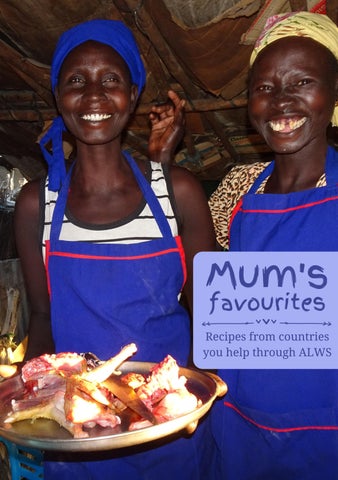
Mum's favourites
Recipes from countries you help through ALWS
Why the pot bubbles At Kakuma Refugee Camp, through ALWS you support 14 refugee cooks to prepare meals for up to 5,000 people each day – many of them children. These people have fled conflict, lost family, left everything behind. You welcome them with three hot meals each day – maize, beans, lentils, high protein porridge. Behind the kitchen where the mass meals are prepared is this pot. It’s special food for those who are sick or elderly or can’t manage the normal food ration. This pot bubbles to make sure no one is forgotten, no one’s special needs overlooked. In Mum’s Favourites, you’ll find recipes from the mums of the front-line workers you support through ALWS. Many of these workers are young women. Through education, they have overcome the challenges that can hurt girls, and built careers where they can serve others. This is why we step out so refugee children can step in to school. Whether through Walk My Way, Mother’s Day gifts or Gifts of Grace, we work together to make sure no one is forgotten, and your kindness can be a blessing ALWayS.
Recipe for success! Ayen was 14 when she was forced to leave school to care for the family’s cattle. Living in South Sudan, Ayen says without education the only way she could feed her own children was by collecting firewood. But it was not enough: “It is hard to see your young children starving.” Through your ALWS support, Ayen was trained in catering and business. She saved enough money to buy sugar and tea to sell cups of tea, then used the profit to buy ingredients to cook and sell food. People loved Ayen’s food, and kept coming back - so Ayen expanded her roadside stall into a restaurant, and employs four women! “Now, my children can go to school. I encourage them to complete school. I myself didn’t get to finish school, but now I feel as confident as those who did. Thank you!” A mother is she who can take the place of all others, but whose place no one else can take.
Kenya
"My mother is called Gladys Moraa, but we call her Mama D. When we could get sick, my mother could make us this soup combo. We used to think it had magical healing power. To date, when I get sick, I always make this soup. For some reason, I feel much better that next day. Matoke is a variety of banana indigenous to the Kisii community where I come from. It comes from the family of bananas known as the East African Highland bananas." Hilda Thuo Livelihood Officer LWF World Service
'Mother' in the Kisii language is 'Mama'
Mama D's Matoke Serves 4 Ingredients 1 bunch of green bananas (Matoke) (about 5-10) 3 chopped tomatoes 1 red/white onion, chopped 2 carrots, chopped 1/2 cup of coriander, chopped 1 tablespoon of salt 1 cup of cooking oil 3 green chilis Salt to season Cayenne pepper to taste
Directions 1. Smear oil on your hands and peel the bananas to prevent your hands from getting sticky. 2. Place the bananas in a bowl of water with salt to prevent the bananas from turning dark. 3. In a pot, place all the ingredient except coriander. 4. Let the pot simmer until the bananas are soft. 5. Add salt, coriander and a little water and let it simmer for about three minutes.
Nepal "Dupka is a cuisine from the farwestern region of Nepal. My mother was very apt at preparing this traditional nutrient-dense delicacy from her young age. It is prepared by mixing the proper concentration of two types of pulses: gahat (horse gram) and kalo maas (black lentils). It is cooked best in an iron karahi and at last fried with butter by adding red chilli and ‘jimbu’. To surprise us, my mother
occasionally puts coin in one of the dupka balls and whoever gets the coin she says is the luckiest among the family members. Luckily, I have received my share of coins and have been collecting them as a token of good luck. It is a challenge to cook this dish perfectly and therefore I have taken it as a personal quest to pass down the legacy to my extended family. Now that I am married, I put my best effort into cooking this dish at my new house as frequently as possible since this dish is likable via acquired taste. I am yet to beat my mother’s perfection at making this dish and has become an inside family joke for not getting it right till today!" Jagriti Chand Project Officer LWF Nepal
Dupka Ingredients Horse gram lentil (gahat) – ½ cup Black lentil (kalo Maas) – 2 cups (grind by adding little water & make a coarse paste) Turmeric powder- ½ tsp Asafoetida (hing)- ½ tsp Red Chillies - 1 to 2, chopped Coriander powder – 1 tsp Cumin seeds – ½ tsp Garlic cloves- 5 to 6 cloves, chopped Ginger – as per taste Sichuan pepper(timur)- a pinch Salt- as per taste Ghee – 1 tsp Jimbu – a pinch Method Keep a big deep pan (Karahi) on medium heat. Add horse gram and roast. Add water and boil for 15 minutes. In a bowl mix ginger and garlic paste, coriander powder, timur powder, red chilli powder, turmeric powder, salt and mix it with black lentil paste, and make small balls of dupka. You can also put a 2 rupee coin in one of the dupka balls to add surprise to this dish. Once the water boils, add the dupka balls one by one and turn to cook both sides. Add water and ginger/garlic paste to the remaining black lentil paste and add to the pot. Cook on low heat for 20-25 minutes, stiring occasionally and adding water if needed. Put another pan on medium heat with 1 tbsp ghee. When hot add remaining cumin seeds, remaining coriander powder, asafoetida, garlic, coriander leaves, red chilies and jimbu and saute until brown. Now pour it into the cooked Dupka and mix well. Serve with rice.
Cambodia
"I would like to thank my mother who always gives love and makes delicious food for children and families." Sokim, Admin & Finance Officer Pursat Program Office Life With Dignity
A mother thinks about her children like an oar to a canoe (Khmer proverb)
Pork Ribs Soup Mix all ingredients together in a soup pot 1.1 kg Pork Ribs 2 liter Water 1 kg Water spinach 1 plate of mixing Ingredient(Fresh Lemongrass, Galangal, Turmeric, Kaffir Lime Leaf, Shallot peels, garlic) 1/2kg Ambarella leaf 1 small bowl of Brohok Fish Meats 2 spoons for salt fish oil 2 spoons of sugar
Somalia "Canjeero (or sourdough pancakes) is the most common breakfast food in Somalia. Somalians typically eat around 3-4 pieces for breakfast often accompanied by a cup of tea. It's commonly served drizzled with butter and sugar, with meat stew, with honey or mixed with black tea. Somalis make Canjeero the night before they plan to eat it, so before going to bed you will often hear the slapping sound of Canjeero being prepared around the neighborhood. My mother used to make us Canjeero on every breakfast as she would say that it brings the family together and it is our symbol of joy in the house. So nobody used to skip breakfast as the Canjeero was counted according to the number of people around and when distributed everyone had to be present. On the streets, the seller used to sell and shout out our window every morning to the neighbours. He would sing: Hot canjeero! Hot canjeero! Fortunate is he who gets it Lucky is the one who eats it Good wife, buy it Give it to your knight So he would roar like a lion." Yurub Dakane EARC Technical Staff LWF World Service Somalia Sub-Program
Canjeero Somalia In Somalia, it is cooked on a tava which is a circular disc stove. A conventional pan can be used. Ingredients 1 cup white corn flour ½ cup sorghum flour 1 Tbsp. instant dry yeast 4 cups self-rising flour ¼ cup sugar 1 tsp salt 4 cups lukewarm water
How to cook 1. In a large bowl, mix the white corn meal, sorghum flour, yeast and half of the water, making sure it is properly combined. Leave to rest. 2. After one hour, add in the self-rising flour and sugar, then slowly add remaining water for a smooth batter. 3. The key to achieving classic Canjeero taste is the fermentation. The mix should rest in a warm place to allow the fermentation to take place. The minimum time would be a few hours but to achieve a more authentic, sour-Canjeero taste, you can let the batter ferment for up to one or two days or maybe overnight. 4. In a non-stick frying pan or using a tava, put on medium heat, ladle the batter mix into the pan according to preferred portion size, making sure that the batter spreads fully across the surface of the pan. 5. Cover the pan and cook for a few minutes until golden brown. The texture should be spongy with no liquid remaining.
South Sudan
"My mother was born in a small village called Iyak in Ikotos County, South Sudan. Her name is Ester Achoho. My mother likes cooking a traditional food called Nanyangoyo in Lango language. My mother liked cooking this food because it is a complete meal on its own, and more so it is eaten more during season for cultivation because it gives a lot of energy and one would drink a lot of water after eating it." Ityeng Anna Peter Assistant education officer LWF South Sudan
'Mother' in Lango language is Lyang
Nanyangoyo "Nanyangoyo is made of black eyed peas, water, salt and groundnut paste. This is how the food is prepared: First the black eyed peas are sorted and washed. Then the peas are put in boiling water and salt is added. Then it will be cooked until the soup is dried. Finally, groundnut paste is added and mixed with the cooked peas, and then served and eaten."
Nepal "Tihar is the festival of lights and love, a tradition to appreciate our family bonds and rituals. In our home, a distinct pleasant aroma covers our house the entire week. It smells like a mixture of hot butter and rice and sweet sugar, and it's the aroma of my mother’s special dish, Selroti. My mother uses a recipe passed down to the 'Pandey family' for generations. She says there’s a reason why the outer layer is hot, red, and crispy whereas the inner layer is soft, chewy, and buttery. From the right number of whisks of the dough to the right portions of sugar, honey, and rice paste, to the right techniques to make a perfect circle on the oil pan, my mother is a master of this dish. Every evening, after our family sits in a circle to enjoy this crunchy and buttery feast, we find our happiness skyrocket, binding us together with each bite of Selroti. After all, my mother defines all of this really well when she says ‘Food is the closest way to one’s heart’."
Shriju Panday Project Officer LWF Nepal
Selroti Ingredients Rice - 2.5 Pound (or you can buy instant rice flour from market) Water or milk – 500 ml Ghee – 2 cups Sugar – 2 cups Cooking Oil – 1 litre You may add these for your taste: Wheat flour – one cup Baking soda to make it big (if you would like)- 0.5 Tbsp Cardamom, cashew nuts Directions 1. Soak rice overnight 2. Drain out water and put rice in mixer grinder along with sugar and clarified butter 3. Grind for about 3-4 minutes until it becomes paste 4. If the batter is too liquid, add 1 tbsp. of rice flour 5. Cut the top portion of a plastic bottle to drop batter 6. Add oil ½ inch in a pan and heat 7. Drop the batter in oil making round circle 8. Fry until golden brown 9. Enjoy!
Kenya
"This is traditional food of the Kikuyus who hail from Central Kenya. It is cooked in homesteads on a daily basis. It can either be fried or mashed with potatoes/green bananas. It is considered a healthy food by the folks that live away from the village, yet they don't cook it because its so involving, especially the use of firewood or charcoal. That’s the food that my mother regularly cooked for me and my siblings when we were growing up. When my mother went to the farm she left it boiling on the fire and it was our responsibility to feed the fire with firewood and add water until it cooked. When my mother gets wind of my visiting the village, she cooks githeri because she knows I miss it and I love it. In my community mothers are addressed by the names of their eldest children. Our eldest is a daughter called Njeri. So my mum is known as Mama Njeri in our neighbourhood." Pauline Kwamboka Omagwa Communications Officer LWF Kenya-Djibouti-Somalia
Githeri It is best when it is cooked with a black African pot on 3 firestones. Ingredients 1. Maize 2. Beans 3. Potatoes 4. Carrots 5. Onions 6. Tomatoes 7. Cooking oil 8. Salt
How to cook Mix maize and beans at a ratio of 1:2. Winnow them to remove any dirt. Wash them until they are clean. Put them into a pot and fill it with water to cover the ingredients. Place the pot on a 3 stone fire place. Boil the mixture until they are soft. Remove from the fire and drain the water. Peel a few English potatoes and carrots. Slice the carrots into small pieces. You can choose to halve the potatoes or cook them whole if their size is small. Dice onions, place them on a sufuria (cooking pot) and add oil. Cook them until they brown. Cut tomatoes and add. Put a pinch of salt and stir for a few minutes until the tomatoes are reduce to a paste. Add the carrots and slightly cook them. Add the potatoes and cook until they are slightly soft. Ensure the salt in the mixture is okay, and serve.
Papua New Guinea
"I love eating this type of food because they are fresh food taken from the garden. When I eat the food, I feel the taste of the food itself no chemical or acid. This type of food gives more strength and keeps me healthy. (Salt and curry is added to make the food taste nice.) This recipe includes aibika - a leafy green vegetable grown in the Pacific. It has high nutritional value: rich in protein, calcium, iron, Vitamins A and C and folic acid. It is one of the green vegetables usually recommended for pregnant and breastfeeding mothers. Pitpit is also used. It is an edible plant similar to a sugarcane plant from a distance. However, on closer look, it varies with thin stem and flowering tip when is ready to be harvested. It is found in Southeast Asia. It can be eaten raw or cooked." Lulen Kae Workmeri Trening School Coordinator ELCPNG Ministerial Service Divisionl
Taro & Banana with Chicken in Coconut Cream Ingredients 3 large taro 2 bunches cooking banana 1 chicken 2 coconuts 10-15 pitpit 3 bundles of aibika 2 round onion or spring onions to taste ½ garlic clove 2 fresh ginger 6 cherry tomatoes 1 tsp salt and curry 2 maggie cubes Method 1. Peel all the vegetables, wash them (except taro) and put them aside. 2. Cut all the vegetables and put them in a big pot in this order: put taro at the bottom, banana and pitpit on the top. 3. Cut the chicken into pieces, wash them and put them on top of the pitpit. Add salt and curry to taste. 4. Scrape coconuts, add water to it and squeeze into the pot until the liquid covers the food. Bring to boil. (Save some cream in a bowl to add later.) 5. While your food is still cooking, wash all the garlic, ginger, onion, tomatoes. Cut onion and tomatoes into small pieces and grate ginger and garlic. Wash aibika but do not cut, leave it as it is. 6. When chicken is half cooked, add aibika. Let it cook for 5 minutes, then you add on ginger, garlic, onion, tomatoe and maggie cube and add some cream. Bring to boil for another 5 minutes then reduce heat and finish off cooking. Then serve.
Burundi
"My name is Euphrasie Nakadende. I’m 82 years old. My husband died in 2010. I have 10 children, 8 are already married. Leonidas Nyandwi, who is working in LWF, is my seventh child as it is meant by his name. My favourite recipe is beans with cassava and vegetable."
N’umusazi arubaha nyina (Even a madman respects his mother)
Beans with Cassava & Vegetables "This is how I prepare the recipe. I take this cooking pot. I wash it and I add water and put the pot on the fire that I made with wood. I take the beans, I select them by taking away the rotten ones, I wash them and I put them in the pot and I cover it. After 4 hours, I add vegetables and cassava in the pot and I continue to put wood and verifying whether water is sufficient to avoid burning the food. When the food is almost ready, I add salt and peanut flour. After 30 minutes, the food is ready for eating, I wash the dishes, I remove the pot from the fire, I put it on the dishes and we eat it. The importance of using the cooking pot in preparing food is that it makes a good meal. If you take food prepared in a pot, you cannot prefer the one braised."
South Sudan
"My mother’s favourite food is called lakotokoto. My mum likes the food because it is faster to cook and she tells us the food contains all the food values that children need for their health." Ajok Pamela Muno English Teacher Yusuf Batil Secondary School LWF South Sudan
'Mother' in Acholi language is Mego
Lakotokoto Ingredients Kale, cut into small pieces 4 raw eggs. If the kale is much, more eggs can be added. Onions Oil Salt Method The kale is fried with oil and onions. Then salt is added with other spices as necessary. With some water added, it will be left to cook for some time. To prepare the sauce, the eggs are broken and added to and mixed with the cooked kale. Then the mix will be allowed to dry up before the cooking pot is removed from fire.
Don’t forget those who are suffering, but imagine you are there with them. Hebrews 13:3b (CEV)
1300 763 407
alws.org.au
ALWayS for the forgotten