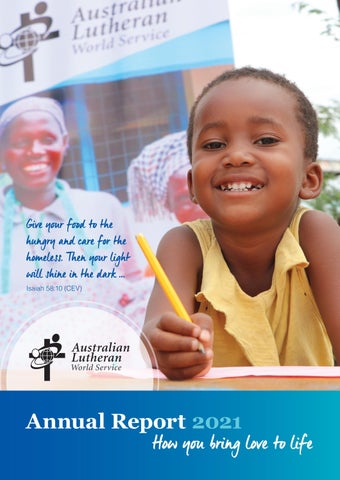
Give your food to the hungry and care for the homeless. Then your light will shine in the dark … Isaiah 58:10 (CEV)
Annual Report 2021
How you bring love to life
Your help in 2021
is a blessing ALWayS Through ALWS, you sent more funds than ever before to help more than half a million people in need – 547,461 people directly, benefitting tens of thousands more. Thank you! Photo: LWD
You welcomed 13,043 refugees and asylum seekers arriving at Kakuma and Kalobeyei Refugee Camps, and helped them feel safe and secure. Photo: LWF Kenya
After 3 years of your support, the Ministry of Education in the State of Jubaland in Somalia have now successfully taken over the running of the Accelerated Learning Program, providing education for 1,500 children! Photo: LWF Kenya
Our Community Action team visited over 60 schools to engage, inform and inspire over 20,000 students. Photo: St Martins Lutheran College
4,174 people took part in over 30 Walk My Way events around Australia – and raised enough to support 13,611 refugee children to go to school! Photo: ALWS / J Hoff
2
Cover image: Your kindness through ALWS helps deliver education to 60,000 children like Grace at Kakuma Refugee Camp in Kenya – including children with disabilities. At 1.5 metre COVID-distancing, that’s a school line-up of refugee children 90 kilometres long! Photo: LWF Kenya
Photo: EKOTA
‘‘
Before, I felt like a burden to my family … This work has made me ‘an important person’ in the family.
ˮ
Dhola, Cox’s Bazar, Bangladesh
Your light in the dark Thank you! In 2021, our Lutheran community continued to carry light into some of the world’s darkest places giving food to the hungry and caring for the homeless (Isaiah 58:10) as the effects of COVID-19 continued to impact on people’s physical, social and mental wellbeing.
Our 2021 Annual Report showcases the hope you gave to 547,461 people! This included welcoming refugees in Kakuma and Cox’s Bazaar, supporting disability inclusion in Somalia and Indonesia, training youth, women and small business groups in Cambodia, Nepal and South Sudan, supporting farmers in Myanmar, Burundi, and Papua New Guinea, and equipping health centres in South Sudan. Through your generosity ALWS also delivered urgent support to families caught up in the earthquake and tropical storm in Haiti, conflict and food insecurity in Afghanistan and Ethiopia, and unprecedented floods in South Sudan. Here in Australia your ALWS team reached over 20,000 students in 60 schools delivering awareness session in person and online. As you read this annual report, we hope that you will be inspired by the difference this awareness is making not just in the lives of these students but also in the lives of those they are touching inspired by your actions.
Your ALWS team leveraged the strength of our partners overseas finding ways whenever possible to augment your contributions through matching grant opportunities. Working in partnership with other church agencies in Australia, we were able to tap into further Australian Government grants for protracted emergencies. In addition, we are pleased to report ALWS achieved successful reaccreditation with the Australian Government at full level. This will enable us to secure Government grants for humanitarian and development work for the next 5 years. None of this could happen without your kindness, support from the Australian Government, our partners overseas, and the commitment and dedication of the staff, board and volunteers at ALWS. Thank you – and may your light keep shining.
Leah Odongo
Acting Executive Director Former Executive Director Jamie Davies resigned in February 2022. We thank her for her tireless service and commitment to the Board, staff, and those we serve.
Photo: LWD Cambodia
What grows when you water Like all parents, Mrs Vorn Rem in Cambodia wants to do all she can to equip her children to build a safe and secure and happy life for themselves. Yet, like many mums and dads you help through ALWS, she was so poor, she could barely feed her three children – let alone put them through school, or find medical care when they were sick. Vorn grew vegetables on a plot of land just 20 metres x 25 metres, using ways that weren’t well suited to the changing climate. At best, she earned little more than $2 a day. When floods came, and insects attacked, she earned just about nothing. Your help through ALWS supported Mrs Vorn Rem to find a way out. She received three days of training in drip irrigation techniques, and other climate-friendly agricultural techniques. The training was provided through our ALWS Cambodian partner, Life with Dignity, and included new integrated farming systems, agriculture kits, and material support like tools. Mrs Vorn Rem then started growing diverse types of 4
vegetables – string beans, cucumbers, tomatoes, chilli and sweet corn. She has big plans: “I have saved money from vegetables and have bought a water pump. “I have also bought more agricultural materials and seeds. I am going to scale up my farm to be as big as medium commercial vegetable farms. “I will generate more income from my farming fields to commercial horticulture through applying new technology. I am confident to apply this because I have learnt from LWD and have used my new skills in practice”. The work is still very hard, but you can see by Mrs Vorn Rem’s produce and smile the success she is achieving. In fact, her family’s income has DOUBLED! What’s most important is the future Mrs Vorn Rem sees for her children: “I have spent my new income for food and for my children’s education. My family condition has increased through this support. I am free from debt, and have stable food all year round. I have saved for health treatment and my children’s schooling in the future!”
How you help those in need Your support through ALWS is focused directly on the world’s most vulnerable people, who are also in danger of being forgotten. Through this Annual Report, you’ll see icons next to each report showing the type of work you support:
People who are forced to be refugees, or are displaced within their own country
People with
disabilities
Those who are most marginalised or suffering most from injustice, including the poorest of the poor
Women and girls in all their
People hurt by
diversity
disasters
Led by the communities you help, and working together with local partners, your gifts support… Education Pre-school, primary, those who have missed out or been left behind, children with extra needs Equipping Agricultural and vocational training, savings and loans, micro-enterprise, livelihoods Empowerment Knowledge, confidence, skills and support for equality in human rights Emergencies Fast focused action to save lives and rebuild communities
… so the people we serve together experience: Photo:LWF/C. Kästner
awakened hope
fostering hope for the future through empowerment and practical support
amplified voice
listening to the voices of the most vulnerable, fostering opportunities for them to speak up, and adding our voice, so that they may be heard
abundant life Students enjoy their lunch porridge, which you help provide, at Kakuma Refugee Camp, Kenya.
equipping people with the resources they need to create a fulfilling life for themselves and their communities
5
Kakuma Refugee Camp What Local Partner
Kakuma Refugee Assistance Project LWF Kenya-Somalia
Where
Kakuma Refugee Camp and Kalobeyei Settlement, Kenya
Who
21,131 people in partnership with other agencies
ALWS Action
$350,000
Why our help is needed
Just under 200,000 refugees live in Kakuma. Through LWF Kenya-Somalia, you help provide primary education, early childhood development, child protection and sustainable livelihoods programs.
Our action together in 2021
• 13,043 refugees and asylum seekers received at receptions centres • 12,260 children provided with teaching and learning materials • 9,450 individuals in the host community have increased access to clean water • 2,593 youth empowered through different initiatives including talent search, sports and games • 1,011 children from host community schools participated in targeted programs to protect them from abuse and exploitation • 299 parents trained in a 3-day course on social and emotional learning, while 97 community leaders were sensitized on enrolling children with disabilities in school • 13 community mobilizers trained in identification of children with disabilities and referral to services • Capacity building of 110 teachers and 4 school counselors in inclusive education • 3 peace committees established to strengthen the peaceful coexistence between refugee and host community • 171 youth and women involved in income-generating activities.
What we’re learning
There is a need for further training to break down the prejudices and social beliefs preventing women and girls from participating in certain activities.
Our impact
Providing education and activities for youth, and ensuring children and people with disabilities are included in these activities benefits entire communities and works to break cycles of intergenerational poverty.
6
Through ALWS, you ensure refugee host communities are not forgotten, like the Turkana community near Kakuma Refugee Camp, Kenya. Photo: LWF Kenya
Dadaab Refugee Camp What Local Partner Where Who ALWS Action
Dadaab Refugee Assistance Project LWF Kenya-Somalia Dadaab Refugee Camp, Kenya 43,567 people in partnership with other agencies $50,000
Why our help is needed
Dadaab refugee camp was created in 1991 as a result of the Somali civil war, and is currently home to more than 250,000 mostly Somali refugees.
Our action together in 2021
• Provided quality education services to 41,617 learners in pre-primary and primary schools • Supported the psychosocial wellbeing of 1,350 older persons and 600 Persons living with disabilities.
What we’re learning
Various advocacy strategies such as radio talk shows, public forums, visibility materials, and participation in marking international days are crucial in ensuring people with disabilities know about and use the services available to them.
Our impact
Schooling for children is vital not only for their learning and future opportunities, but also for their psycho-social well-being which is enhanced through making friends and having a routine.
South Sudan (Jonglei) What Local Partner Where
Community Empowerment for Resilience and Peaceful Co-existence LWF South Sudan Jonglei State – Duk, Twic East and Bor South Counties
Who ALWS Action
9,906 people in partnership with other agencies $600,000
Why our help is needed
Jonglei is the least developed part of South Sudan and indeed of Africa, lacking basic infrastructure due to decades of civil war. The COVID-19 outbreak in South Sudan coupled with prolonged floods have added yet another major challenge to the already fragile socioeconomic system in the county.
Our action together in 2021
• 150 households adopted climate smart agriculture techniques on crop and vegetable farming • 810 youth and women increased their income by 35% after training in fishing, poultry production and beekeeping • 1,128 students supported in six Early Childhood Development Centres • 6,751 students supported with books, pens, blackboards, maps and sporting materials • 229 adolescent schoolgirls consistently attended classes due to menstrual health empowerment and support with sanitary items • 9 project-funded schools created management boards • Ten community-based protection and psychosocial support committees were formed and engaged 467 community members.
What we’re learning
With the ongoing changes in the climate and weather patterns, programs must be climate-sensitive and take a long-term approach to ensure resilience of communities through community-based adaptation action.
Our impact
Overall school attendance has improved, including for girls. The community is taking initiatives to build resilience to the changing climate at the household level.
South Sudan (Magwi) What
Promoting Socio-Economic Integration of Returnees and Receiving Communities in Magwi County
Local Partner
LWF South Sudan
Where
Eastern Equatoria State – Magwi County
Who
8,765 people
ALWS Action
$400,000
Why our help is needed
As the more than 2.25 million South Sudanese refugees begin to return home from refugee camps in neighbouring countries. Returnees have increased from 30,244 in 2020 to 66,065 in 2021.
Our action together in 2021
• 1,807 primary school learners supported with teaching and learning supplies and dignity kits • 10 untrained teachers taken through basic lesson preparation and delivery training • 48 School Management Committees and members of Parent Teacher Associations trained • Classrooms and offices in two primary schools rehabilitated • 1,119 people reached with various peace building, land rights, protection, climate justice, and gender based violence initiatives aimed at promoting social cohesion between host community and returnees • 2 boreholes drilled • 4 boreholes repaired benefitting 945 households • 2 health facilities renovated • 120 farmers trained and supported to increase their livelihoods through income generating activities and village savings and loan associations.
What we’re learning
To be successful, humanitarian response and development support must go side by side with building peaceful coexistence.
Our impact
As well as addressing immediate needs, the project helps address the systemic causes of conflict such as poverty, inequality and lack of functioning accountability systems.
Don’t forget those who are suffering, but imagine you are there with them. Hebrews 13:3
‘‘
I want us to be self-sufficient with food. If we can do this, I will have strength to work even harder, so my children can stay in school. Sylvia, Burundi
ˮ
Burundi What
Community Integrated Development Project (CIDP)
Local Partner
LWF Burundi
Where
Cancuzo and Ruyigi Provinces
Who
16,506 individuals
ALWS Action
ALWS: $95,467 DFAT: $270,376 Total: $365,843
Why our help is needed
Burundi is one of the poorest countries in the world, with more than 70 percent of the population living in poverty. Food security issues have become severe.
Our action together in 2021
• 720 most vulnerable school children supported with school materials (notebooks, pens, math boxes) • 25 Agricultural Groups established, supported through training and provided with agricultural equipment, motor pumps and watering cans • 2 livestock rearing groups established and supported with livestock, medicines, technical support and training • 9 sessions on the organisation and management of pre-cooperative groups 8
Photo: ALWS / LWF Burundi
• 7 Village Savings and Loan Associations established, trained and supported • 7 roads rehabilitated through cash for work scheme with 154 participants • 7 Community Environment Protection projects supported through cash for work scheme with 203 project participants • 14 community awareness sessions on Child Protection and the prevention of Sexual and Gender Based violence with 320 participants • 2 Women’s Rights Day events • 7 sessions on Disaster Risk Reduction for 94 community members and 46 government officials • 7 COVID-19 awareness and prevention sessions.
What we’re learning
Group work contributes to social cohesion. In addition, the use of local technical services during implementation of activities better prepares the community to take ownership.
Our impact
Community members have begun to adopt improved agro-pastoral techniques and their living conditions are improving. Diverse crops are now seen in households and at the markets. ALWS acknowledges the support of the Australian Government in Burundi through the Australian NGO Cooperation Program (ANCP).
Somalia What Local Partner Where
Support for Ministry of Education of Jubaland (Somalia) to Rebuild State’s Education Sector LWF Kenya-Somalia
Cambodia What
Holistic Rural Development Program
Local Partner
Life With Dignity
Where
Pursat, Battambang, Kampong Chhnang, Kampong Speu, Svay Rieng and Prey Veng Provinces
Who
147,755 people in partnership with other agencies
ALWS Action
$500,000
Kismayu, Somalia
Who
1,574 people
ALWS Action
ALWS: $100,423 DFAT: $218,144 Total: $318,567
Why our help is needed
This project year concluded three years of support to the Ministry of Education Jubaland, to run an Accelerated Learning Program (ALP) for children aged between 10 and 18 who have missed or never been to school.
Our action together in 2021
• Accelerated Learning Program at two learning centres targeting 1,500 out-of-school children • Monthly stipend for 2 staff and 11 teachers • Two successful enrolment drives conducted. Many learners who had left school to support family decided to enrol again. • 1,500 students provided with nutritional support -morning/evening fortified porridge • 242,500 litres of water supplied to the centres • Hygiene kits for 1,254 learners, including sanitary pads for 700 girls • Gender and disability appropriate toilet facilities are improved in the learning centres • The two ALP centres also benefited from teaching and learning materials.
What we’re learning
Due to food insecurity in the Internally Displaced Persons’ Camps where the children live, providing porridge in the morning and evenings to school learners can increase school retention.
Our impact
Schools are an excellent protection environment for children of communities affected by protracted conflict and other natural disasters. Now quality schooling is available, and the Ministry of Education has successfully and sustainably taken over the running of the ALP. ALWS acknowledges the support of the Australian Government in Somalia through the Australian NGO Cooperation Program (ANCP).
Why our help is needed
Rural communities need support to develop sustainable livelihoods resilient to climate change and natural disasters.
Our action together in 2021
• 1,609 community members, 72 youth and 1,167 school children developed skills to be resilient to the impacts of disasters and climate change • 142 people trained in disaster risk reduction • 16 primary school disaster risk reduction plans developed • 268 families provided with solar lanterns • 9 schools supported with disaster mitigation equipment including water-tanks, gardens, and fans • 88 community and school rainwater tanks installed • 67 families provided with emergency kits • 12 rural infrastructure projects built, including 7 pre-schools and 3 village roads • 9 rural irrigation infrastructure projects built, including water storage and spillways • 38 new Small Business Groups formed • 32 small business groups trained in financial management and marketing • 14 off-farm business groups received technical and material start up support.
What we’re learning
Enabling farmer-to-farmer cross learning has been found to enhance technical capacity appropriate to the local context. Coupled with appropriate support, farming behaviours have improved to include climateresilient techniques and increased income.
Our impact
As disadvantaged people in Cambodia see the power of local level community engagement to bring improvements to their living conditions, they are encouraged to increase the community-building activities they do together. 9
Myanmar (Education) What
Safe and Inclusive Education for Children in Rakhine State
Local Partner
LWF Myanmar
Where Who
ALWS Action
Rakhine State 16,316 people (14,141 children) ALWS: $160,000 DFAT: $40,000 Total: $200,000
Myanmar (Human rights) What
A Rights-Based Advocacy Approach for Advancing Land, Legal Identity and Women’s Rights in Myanmar
Local Partner
LWF Myanmar
Where Who
9,975 people in partnership with other agencies
ALWS Action
This project runs from 20202022. Total funding provided across the project period from ALWS - $133,295 (NB none sent in 2021)
Why our help is needed
Conflict, COVID and a military coup has disrupted education for children in Rakhine state, including from Rohingya communities.
Our action together in 2021
• 14,141 children in 8 Internally Displaced People (IDP) camps have accessed education through 16 Temporary Learning Spaces • During COVID-related lockdowns, teachers provided home-based learning to students • 40 “Star Teachers” have been trained to train other teachers in disability awareness and inclusive education • 93 teachers and Parent Teacher Association members have been trained in Gender Inclusion • 5 Girls Clubs have been established • Female-teacher peer network groups have been established.
What we’re learning
Too often, families expect girls to drop out of school once they reach puberty. Tragically, girls expect this too. This is reinforced by a lack of female teachers, leaders and lack of educated women in the community. By supporting more female teachers, this means more girls stay in school longer.
Our impact
Through awareness-raising activities, school communities (including teachers and Parent Teacher Associations) understand how important it is for children with disability to be able to access and attend school. These community members are now actively working towards increasing attendance of children with disability. ALWS acknowledges the support of the Australian Government in Myanmar through the Australian NGO Cooperation Program (ANCP) and the Australian Humanitarian Program (AHP). 10
Rakhine, Chin & Kayin States
Why our help is needed
Vulnerable communities in rural areas of Myanmar face challenges in accessing basic human rights, including their right to claim and access their land, their right to a legal identity, and the rights of women.
Our action together in 2021
• 146 farmers received land registration certificates • 65 women gained the skills to identify and raise issues of women’s rights • 159 community members and local government staff trained in identity documentation laws and rights • 3 local community members were supported to advocate at the national level • Contributed to the Universal Periodic Review process raising 11 human rights issues to the United Nations Human Rights Council.
What we’re learning
In 2021, LWF Myanmar developed a new, highly practical Gender Strategy and tools. It was developed bottom up by LWF staff with support from a technical expert. Because of this, there is a commitment to and clear vision of how to empower women as equal decision makers in their homes and communities.
Our impact
When the project started, women were typically confined to the home with the male being perceived as responsible for the household’s welfare. Now women are actively engaged in community groups and make up a sizeable minority of these self-help groups traditionally led by men.
Photo: LWF Nepal
‘‘
I learnt how to make bamboo stools to sell for income. My husband, who is also deaf, makes them too – but I’m even faster than him!
ˮ
Chhiring Dolma Gurung, Nepal
Nepal What
Local Initiatives for Community Empowerment and Development Project (LICED) and Promotion of Women’s Empowerment and Rights Targeting Rural Women (POWER)
Local Partner
LWF Nepal
Where Who
ALWS Action
Kailali, Jhapa, Morang, Lalitpur, Bardiya, Dolakha districts in Nepal 16,229 people in partnership with other agencies ALWS: $250,162 DFAT: $562,869 Total: $813,031
Why our help is needed
The families you work with are from communities with heightened levels of vulnerability due to poverty and marginalisation. These include Dalit communities, ethnic minority groups, Bhutanese refugee communities and people with disability.
Our action together in 2021
• 592 people have earnt on average 11,570 Rupees (AUD$130) per month (increase of AUD$10/month on baseline) for their families after having support in business development and use of new technology • 217 farming families have been supported to access public land to farm on, growing vegetables and cereal crops for their families’ consumption and additional income • 1,287 farmers have learnt new, climate-smart farming techniques (eg use of mulch, organic pesticides, liquid manure, plastic tunnel usage) which has increased their crop production
• 61 new tube wells have been built, and 40 have been rehabilitated, providing 1,557 people with safe drinking water for their homes and schools • 2 hospitals and 12 local health centres were provided with medical equipment (including PPE, masks, face shields, oxy-meter, oxygen cylinders and isolation beds) • 31 communities have established emergency funds, grain banks or have purchased search and rescue equipment to be prepared for flood, landslide and earthquake disasters • 21 survivors of gender-based violence have received counselling and legal support • 388 elderly people and single women have been connected with government services and resources • 246 people have received formal government recognition of their disability, which will entitle them to health, travel, education and income support.
What we’re learning
This year, LWF Nepal began working with a mobile App company to provide agricultural services (training, advice on when to plant and harvest, market prices and information) via mobile technology to farmers. This helps farmers increase their income, particularly when they can’t travel to get these services due to accessibility, disability, cost or COVID-19 lockdowns.
Our impact
Vulnerable families are now active members of community groups such as women’s groups, cooperatives, Disabled People’s Organisations. Through these groups they identify their own development priorities and are equipped to access resources and services from local government. ALWS acknowledges the support of the Australian Government in Nepal through the Australian NGO Cooperation Program (ANCP). 11
Papua New Guinea What
Church Partnership Program
Local Partner
Evangelical Lutheran Church of PNG (ELCPNG)
Where
Country-wide
Who
4,174 people
ALWS Action
DFAT: $938,164
Why our help is needed
PNG communities face daily challenges to lives and livelihoods, yet lack much needed access to essential services and support. Women, children and people with disabilities are particularly at risk.
Our action together in 2021
• 1,673 people in 48 local government areas engaged in assessment of COVID-19 impacts leading to improved COVID-19 response planning • 1,457 people engaged in World Disability Day events • Design of waist-high vegetable gardens at the Morobe Disable Agency • 468 people in 12 communities participated in meetings to identify marketable crops they can farm • 23 people trained in bee farming and honey production to strengthen their livelihoods • 31 men participated in awareness raising on gender equality • 57 people trained as adult literacy teachers • 53 people trained in administration skills • 39 young people trained to advocate on environmental issues affecting their communities • 50 people trained on climate disaster risks • 28 people trained in disaster risk management • 21 health service staff trained in financial management • 225 district church personnel trained in good governance.
What we’re learning
Youth trained and supported in Lae are now leading advocacy efforts in their communities because they are confident and have more background knowledge.
Our impact
Through the Church Partnership Program, the ELCPNG has increased community wellbeing by strengthening their health and education services, supporting women, children and people with disabilities, and assisting communities to reduce conflict and manage disaster risks. ALWS acknowledges the support of the Australian Government through the PNGAusPartnership. 12
Indonesia (PK Hephata) What
Rights based empowerment of people with disability through community-based rehabilitation
Local Partner
Panti Karya Hephata, Huria Kristen Batak Protestan
Where
6 districts in North Sumatra
Who
3,833 people
ALWS Action
$62,000
Why our help is needed
Children and adults with disabilities face barriers to inclusion and to exercising their rights. This includes their rights to education, health and other services and having opportunities to develop their livelihoods.
Our action together in 2021
• 312 people with disabilities supported to develop plans to live independently • 95 children with disabilities supported to attend school • 68 school teachers trained on child rights and child protection • 468 people with disabilities trained to manage their sustainable livelihoods programs • 31 people with disabilities supported to start their own small businesses • 18 families of people with disabilities supported through a revolving fund to start small businesses • 1,500 face masks made by people with disabilities distributed • Food assistance provided for 384 people with disabilities affected by COVID-19 impacts • Training and support provided to strengthen the management and governance of organisations of people with disabilities in 4 districts • Awareness raising on rights of people with disabilities for 187 people, including 59 with disabilities.
What we’re learning
Using both a community-based rehabilitation approach and a rights-based approach helps empower people with disabilities to know their rights and access the services they are entitled to.
Our impact
Support for people living with disabilities and for their families has fostered independent living and increased participation in their communities. Raising community and government awareness of the rights of people with disabilities has contributed to greater inclusion of people with disabilities in development processes.
Indonesia (CDRM&CDS) What
Disaster Risk Reduction Through Rights Based Empowerment of Communities
Local Partner
Centre for Disaster Risk Management & Community Development Studies (CDRM&CDS)
Where
Who
ALWS Action
North & West Sumatra 8,614 people in partnership with other agencies ALWS: $175,458 DFAT: $135,534 Total: $310,992
Why our help is needed
North and West Sumatra Provinces are very exposed to the physical, economic, and social impacts of disasters, with risks being exacerbated by climate change. Many people have insecure livelihoods which make them less resilient when disaster strikes. Women and people with disabilities are particularly at risk.
Our action together in 2021
• 2,466 people in 36 schools oriented and supported to be COVID-19 safe • 375 poor families supported to set up family handwashing points • 40 community health posts supported with personal protective equipment (PPE) • 307 malnourished children provided with nutritious food • 489 flood-affected people supported with emergency assistance • 834 villagers in 21 villages engaged in reviews and redesigns of disaster risk reduction and COVID-19 response plans
• 198 community-based organisations trained to engage in village development activities • Members of 142 community-based organisations, including 56 women’s groups, trained and supported for sustainable livelihoods • Strengthened management of 28 savings and credit groups • Strengthened revolving fund systems of 64 farmer groups and 46 women’s groups • Strengthened food security for 123 poor families • 5 organisations of people with disabilities supported to provide micro loans to people with disabilities and their families for livelihoods activities • Strengthened capacity of Lutheran church agencies to implement community empowerment activities.
What we’re learning
It has been important to treat the COVID-19 pandemic as a disaster because of its broad impact on communities, affecting livelihoods, health, education, and community cohesion. The program focus on reducing the risk of disasters and building community resilience has been very appropriate in this context.
Our impact
Village communities have become more alert and aware of COVID-19 risk mitigation measures (handwashing, wearing masks, vaccination) helping to make their communities COVID-19 safe. Disaster risk reduction plans have informed village development priorities, while support for 142 community-based organisations has brought better access to food, income and government services. ALWS acknowledges the support of the Australian Government in Indonesia through the Australian NGO Cooperation Program (ANCP).
Your help for Indonesia included handwashing stations to help prevent COVID-19. Sign reads: ‘Let’s wash our hands with soap and running water’. Photo: CDRM&CDS
13
South Sudan: Floods
Afghanistan:
Refugees & Displaced People Where
Afghanistan : Bamyan, Kabul, Laghman, Nangarhar. Pakistan: Islamabad.
Why our help was needed
383,553 people have been displaced within Afghanistan and 10,861 individuals have been forced to flee to Pakistan, due to insecurity and violence, poverty, drought, and the COVID-19 pandemic.
ALWS Action
$100,000
Where Why our help was needed
ALWS Action
How many helped 40,142 people in partnership with other agencies
Kenya: Drought Where
Turkana and Garissa Counties
Why our help was needed
Over 6,000 household affected by severe food and water shortage due to drought resulting from the poor performance of the OctoberDecember 2020 short rains and the March-May 2021 long rains.
ALWS Action
• 890 water containers for households • 40 large water storage tanks • 360 kg chlorine and 6,400 aqua tabs for water treatment • 4 net houses for crops • 194 goats for households • 2 water pans de-silted to increase supplies of clean water • Community members sensitised on waste management
14
$100,000
• 40 households displaced by flood supported by cash for pit latrines and 40 dug pit latrines • 102 households displaced supported by cash for emergency shelter and constructed huts • 3,500 households will benefit with borehole repair • The response is continuing. Help delivered by LWF South Sudan How many helped 28,085 people in partnership with other agencies
Haiti:
Earthquake & Tropical Storm Where
Grand-Anse, Nippes and Sud Departments
Why our help was needed
A 7.2 magnitude earthquake struck southwestern Haiti on 14 August 2021, killing 2,207 people and injuring 12,268 people. This was followed by Tropical Storm Grace, resulting in flooding and landslides.
ALWS Action
$75,000
$100,000
• Food packages for 750 households Our action together included: • Support for 270 pregnant or breastfeeding mothers and mothers with young children
48,000 people in this region are already experiencing severe acute food insecurity, which has been significantly worsened by consecutive years of floods (2020 and 2021).
• 50 households affected by flood Our action together included: displacement supported by cash for food
• Food and fuel distribution Our action together included: • Cash for food • Cash for work • Healthcare support • Winterisation kits • The response is ongoing. Help delivered by Community World Service Asia (via Act for Peace)
Jonglei - Duk and Twic East counties
• 4 water networks rehabilitated, Our action benefiting 5 schools and 16,320 together included: people • Hygiene promotion activities for 20,963 people • 903 water filters and water buckets • Access to water restored for 600 households • Drinking water provided to 200 Households • 300 of the most affected households provided cash grants.
Help delivered by LWF South Sudan
Help delivered by LWF Haiti
How many helped 61,824 people in partnership with other agencies
How many helped 30,213 people in partnership with other agencies
Ethiopia:
Conflict & Food Insecurity Where
Tigray, Amhara, Afar and Southern Nations, Nationalities, and Peoples’ Region (SNNPR)
Why our help was needed
Conflict and military action beginning in November 2020 resulted in food insecurity for 1.7 million people
ALWS Action
$100,000
• 2,167 households received cash Our action grants together included: • 23 tonnes food and 5,980 litres cooking oil • Cooking sessions for 1,864 women • 500 water sanitation & hygiene kits
Bangladesh:
Refugees & Host Community Where
Cox’s Bazaar Refugee Camp and Host Community
Why our help was needed
Rohingya people have been forced to flee their homes in Myanmar from systematic discrimination, statelessness and targeted violence. 913,660 Rohingya refugees currently live in the Camp.
Project 1: Create an enabling environment where Rohingya refugees and the nearby host community people live with peaceful co-existence and social cohesion in Cox’s Bazar, Bangladesh ALWS Action
• 500 Emergency Shelter and NonFood Item kits • 7,700 face masks • 8 mass hygiene promotion sessions • 4 blocks of communal latrines • 4 blocks of communal bath shelters
• 11,800 saplings planted Our action together included: • 3,300 kitchen utensil sets • 8,517 mosquito nets
• 1 new borehole
• 2,527 supplementary food items for pregnant and lactating mothers
• 210 leaders trained on psychosocial support
• 36,608 metres of drainage lines cleared
• 1 Child Friendly Space established and equipped Help delivered by Lutheran World Federation Ethiopia; Ethiopia Evangelical Church of Mekane Yesus Development and Social Services Commission. How many helped 46,789 people in partnership with other agencies
ALWS: $41,497 Matching grant donor: Diaconia Evangelical Church of Czech Brethren USD $190,514
• Mosquito larva control spray applied to 8,808 meters of the cleared drainage lines Help delivered by Lutheran World Federation (LWF) and Rangpur Dinajpur Rural Service (RDRS) How many helped 26,086 people in partnership with other agencies Project 2: Australian Humanitarian Partnership Bangladesh Consortium Multi Year Rohingya Response
Myanmar: Displaced People Where
Kayin State
Why our help was needed
Conflict in Myanmar has forced families to flee their homes and stay in surrounding jungle areas. They have limited access to food, shelter, hygiene items, and safe water.
ALWS Action
$50,000 (including $30,000 contribution from Transform Aid International Australia)
A month’s supply of rice, oil Our action and salt has been provided together included: to 450 families. How many helped 3,107 people in partnership with other agencies
ALWS Action
DFAT $229,837 in 2020 as part of the multi year response
• 47,570 saplings planted and Our action together included: nurtured • 521 refugee women and 94 families in host community provided cashgrants and livelihood materials to start income generating activities • 94 women provided with relevant soft-skills, vocational/business and leadership development training Help delivered by Rangpur Dinajpur Rural Service How many helped 870 people ALWS acknowledges the support of the Australian Government in Bangladesh through the Australian Humanitarian Program (AHP).
15
Photo: Tatachilla Lutheran College
From Awareness to Action Whether it was leading Chapel, teaching classroom lessons about injustice and poverty, or supporting a school to hold a Walk My Way, the ALWS Community Action team was out and about in person AND online in 2021… …reaching over 20,000 students in 60 schools! The team’s experience is that after students learn more about issues like refugees, poverty, and social justice, they’re fired up – and want to know how they can help. Like Mack, from Living Waters in the Northern Territory. After hearing about the journey refugees make to find safety, Mack came up to the Community Action team with his wallet open – and gave all the money he had in there ‘to help those people’.
Activity
Number
Face to face presentations to schools
184
Zoom presentations to schools
33
Chapel presentations
13
Staff Professional Development presentations
11
Schools who took part in Walk My Way
24
Schools who took part in What’s My Business
7
Total number of schools impacted 60 Total number of students impacted More than 20,000
What’s My Business, where students start their own small business and donate the proceeds to help people through ALWS, continued in 2021. Tatachilla Lutheran College in South Australia expanded their Year 6 Business Enterprise unit to give students an authentic learning experience around the importance of small business for the communities where ALWS works.
Teachers found having a reason for selling their products gave students an incentive to work as hard as possible. Students shared their learnings that, even though they are young, they can change the life of someone they don’t even know. While so many young people are wrestling with how they can make a difference in the world, we’ll continue to share stories of people in developing communities, so students see the life-change they can make possible. 16
Mack gave all he had in his wallet after learning about refugees from the ALWS Community Action team. Photo: ALWS
Photo: ALWS
Kindness from Kingaroy Photo: St John’s
– to Kakuma!
Hatching a plan to help
Emily, Giaan, Megan and Ruby are students at St John’s Lutheran School, Kingaroy. Throughout 2021, they and their classmates spent lunchtimes collecting and sorting drink containers from around the school. The students recycle the containers through the Containers for Change program to support refugee children at Kakuma Refugee Camp in Kenya to go to school. The 20 children in the students’ class, supported by their teacher Naomi, aimed to raise enough money to support 20 refugee children. At $26 per child for a year’s school, and 10 cents per container, that’s 5,200 containers that needed collecting, cleaning and recycling.
Daisy is in Grade 4 at a Lutheran school in South Australia.
She needed little egging-on to hatch a plan for a rooster to boost the nest egg of a family in Cambodia: “I raised $30 selling eggs at Dad’s office. I used it to buy some chickens in Gifts of Grace, and also a School Kit for some kids that needed it. It made me feel happy that I could help others in need – to help them live their lives a happy way!”
Photo: supplied
When they achieved their target, one 9-year-old explained: “A little bit of effort on our part can change another child’s whole future!”
Very Valuable Volunteers
In 2021, volunteers donated 440.5 hours of their time which represents a saving of $13,197 – which means more of your donation gets to those who need it. Thank you, Volunteers!
Where you live
What you gave in 2021 – thank you!
SA
$2,043,880
NT
$31,580
QLD
$1,145,033
NSW
$1,137,128
VIC
$1,151,860
TAS
$9,222
WA
$134,546
ACT
$170,245
NZ
$1,993
Other*
$179,853
TOTAL
$6,005,340
Give your food to the hungry and care for the homeless. Then your light will shine in the dark …
* Lutheran Women of Australia, grants from LLL Permanent Funds, interest forgone on LLL accounts, etc
Isaiah 58:10 (CEV)
Gorgeous gourds David is a member at St John’s Lutheran Church in Unley SA, and grew and sold pumpkins to raise more than $650 to help others through ALWS… … including farmers in South Sudan who receive pumpkin seeds after attending Farmer Field Schools you support through ALWS. 17
‘Are we there yet?’: Stepping out in Walk My Way A record number of our Lutheran family stepped out in 2021 so refugee children could step in to school. 4,174 people from around Australia took part in Walk My Way, a 26km walking challenge. Walkers asked friends and family to sponsor them – and raised enough to support 13,611 refugee children to go to school through ALWS. Participants walk-ed, wheel-ed and woof-ed in over 30 events from the Barossa to Brisbane. Young and the not-so-young, people living with a disability, mums and dads, kids in prams – all united in changing the future for refugee children. While 661 people Walk-ed Their Way through the largest Walk of 2021 in the Barossa in May, many schools, churches and groups who lived further afield organised their own Walks, right where they lived.
Clients, staff, and their families – and pets! – joined in the Barossa Walk My Way. Support worker Tamara (blue headband) said: “This is a wonderful chance for our clients to give back to the community and demonstrate that everybody has the ability to make a difference for the good of others.” Photo: ALWS / D Modra
Like St Matthew’s Lutheran Church in the little town of Maclagan in Queensland. In September, they cheered on their 10 Sunday School children (plus a few ring-ins) as they walked 26 laps of the church and Sunday School building for their Walk My Way. Member Margaret shared, ‘The congregation as well as various mums, dads, grandmas, grandpas, uncles, aunts, cousins and neighbours helped fill the donation box with a wonderful amount of $1,394. The kids gave it their all with lots of sweat and ‘are we there yet?’ comments and were thoroughly busted when done, but they all felt strongly about helping the children in Africa to go to school.’ Each $26 raised supports a refugee child in school for one year, providing school-books, desks, training of teachers - even school lunches! To everyone who walked, or supported a Walker, or volunteered as a Traffic Marshall/Breakfast Preparer/ countless other jobs … thank you!
School leaders Ruby and Lana, from St Jakobi Lutheran Campus, decided to kick-start their school’s Walk My Way efforts by organising students to make and sell Scrunchies and Hacky-Sacks. More than 300 items were sold at weekly stalls, meaning the school was able to support 209 refugee children to go to school! Ruby shares: “We feel really grateful we will be helping children like us go to school.” Photo: The Leader newspaper, Barossa
18
ALWS thanks the LLL for their generous support of Walk My Way in 2021.
Your kindness brings love to life! In 2021, ALWS was blessed and humbled to be entrusted with over $9.0 million to bring love to life – more money to projects helping people than ever before! This exceeds the 2020 total of $8.1 million.
Such a wonderful result is tribute to the generosity of the 8,000+ Australian supporters who donated to ALWS in 2021, despite the challenges of a second year of COVID-19.
83.3% to Field and Advocacy work
This kindness was matched with strong ongoing commitment from the Lutheran Laypeople’s League and the Australian Government’s Department of Foreign Affairs and Trade. ALWS was expecting a deficit year for 2021, but due to the wonderful result there was a surplus of revenue over expenditure for the year. ALWS are planning to expend this surplus in the 2022 year, and this will be reflected by a deficit result in 2022. The 2021 funding result enabled ALWS to maintain our commitment to 13 core programs, plus help people hurt by seven different emergencies. ALWS takes accountability very seriously, and therefore invests the appropriate amount of resources to ensure the funds entrusted to ALWS are used properly and effectively, as well as efficiently. This includes the costs of meeting global and national best-practice standards to ensure ongoing accreditation and continuous improvement as an aid and development agency.
The good news is more than 83% of our expenditure in 2021 supported projects that help and educate people! Thanks to the commitment and professionalism of the ALWS team & partners, the achievement of reaching 547,461 people in 2021 with an ‘overheads’ investment (fundraising, administration and accountability costs as defined by ACFID) of just 16.7%! The 5 year average for ‘overheads’ is only 15.4%. Full credit for this wonderful result must go to ALWS supporters who donate around $8.40 for each $1 invested in fundraising (in 2020 $7.80 for each $1 invested). Supporter generosity, and careful long-term planning by the ALWS team, has ensured that ALWS is in a strong financial position and can continue to strengthen our services to people in need. They are also critical to ensure aid and development programs can continue even if unexpected ‘shocks’ (bushfires, natural disasters, COVID-19) impact planned budget income.
8.5% to Fundraising ‘overheads’* 8.2% to Administration and Accountability ‘overheads’* * ‘Overheads’ are administration and fundraising costs as defined by the ACFID Code of Conduct. Percentages are calculated from total 2021 disbursements. The 5 year average is 15.4%. ALWS aims to minimise overheads as much as possible without affecting services. Refer to full financial statements later in this report. Funds and other resources designated for the purpose of aid and development are used only for those purposes and are not used to promote a particular religious adherence or to support a political party, or to promote a candidate or organisation affiliated to a particular party.
No matter what challenges our Australian community faces, ALWS will continue to amplify the voices of those we serve with supporters and Government. We will be innovative and flexible in our communication of those needs and seek opportunities – such as matching grants – to grow the power of our supporters’ kindness. As always, we seek to work in productive partnerships that leverage our networks and international partners. In summary, ALWS maintains a sound financial position as at 31 December 2021. ALWS has the capacity to meet all its obligations as and when they fall due and retains sufficient money in reserve to meet all its legal obligations.
Thank you!
19
AUSTRALIAN LUTHERAN WORLD SERVICE SPECIAL PURPOSE FINANCIAL REPORT FOR THE YEAR ENDED 31 DECEMBER 2021
Director’s Report
20
21
AUSTRALIAN LUTHERAN WORLD SERVICE SPECIAL PURPOSE FINANCIAL REPORT FOR THE YEAR ENDED 31 DECEMBER 2021
Independent Audit Report
22
23
AUSTRALIAN LUTHERAN WORLD SERVICE SPECIAL PURPOSE FINANCIAL REPORT FOR THE YEAR ENDED 31 DECEMBER 2021
Statement of Comprehensive Income
24
Statement of Financial Position
25
AUSTRALIAN LUTHERAN WORLD SERVICE SPECIAL PURPOSE FINANCIAL REPORT FOR THE YEAR ENDED 31 DECEMBER 2021
Statement of Changes in Equity
26
Statement of Cash Flows
27
AUSTRALIAN LUTHERAN WORLD SERVICE SPECIAL PURPOSE FINANCIAL REPORT FOR THE YEAR ENDED 31 DECEMBER 2021
Notes to and forming part of the financial statements
28
29
AUSTRALIAN LUTHERAN WORLD SERVICE SPECIAL PURPOSE FINANCIAL REPORT FOR THE YEAR ENDED 31 DECEMBER 2021
Notes to and forming part of the financial statements
30
31
AUSTRALIAN LUTHERAN WORLD SERVICE SPECIAL PURPOSE FINANCIAL REPORT FOR THE YEAR ENDED 31 DECEMBER 2021
Notes to and forming part of the financial statements
32
33
AUSTRALIAN LUTHERAN WORLD SERVICE SPECIAL PURPOSE FINANCIAL REPORT FOR THE YEAR ENDED 31 DECEMBER 2021
Notes to and forming part of the financial statements
34
35
AUSTRALIAN LUTHERAN WORLD SERVICE SPECIAL PURPOSE FINANCIAL REPORT FOR THE YEAR ENDED 31 DECEMBER 2021
Notes to and forming part of the financial statements
36
ALWS Board of Directors
Ms Jodie Hoff,
Mr Andrew Kotzur, BBus (Admin), MAICD –
Jodie is the Principal of LORDS (Lutheran Ormeau Rivers District School) in Pimpama, Queensland. She has a passion for service-learning and embedding it into school culture (in curriculum through building partnerships locally and globally). Jodie has worked regionally and nationally to develop resources to support schools with their service-learning journey for Lutheran Education Australia. She has had the opportunity to see ALWS’ work first-hand in Cambodia, Kenya and Mozambique. Jodie joined the Board in 2019.
Andrew is the Managing Director of a family-owned engineering and manufacturing company. In his role, he works closely with farmers and businesses in the grains industry across Australia. Andrew is a member of Zion Lutheran Congregation at Walla where he currently serves as Chairperson. He has served on the Board of Management of St Paul’s College Walla Walla, where he was chairperson for a number of years, and is also chairperson of the Walla Walla Refugee Resettlement Committee – a community-based group providing resettlement and work opportunities in the Walla Walla area. Andrew joined the ALWS Board in 2020.
B Teach (P-10), BEd, GradDipEd (Theology), MEd Leadership – Chair
Mr Peter Renner – Vice Chair Peter is a retired bank executive with a 39-year career, with the last 15 years in Human Resources. Peter is currently the chair of two residential body corporate organisations. He has been a member of Ringwood Lutheran Church for the past 39 years, and is the chair of the parish, congregation and retirement village. Peter also serves on LCA Victorian District subcommittee for audit, risk and finance, and on the Good News Lutheran College Council. He has visited ALWS’ work in Indonesia. Peter joined the Board in 2017.
Ms Morgan Brookes, BA BEd Middle/Secondary (Honours) – Board member
Morgan is a Secondary Science teacher at Cornerstone College, Mount Barker. She has been the leader of a school educational service trip to the Kalahari Desert, South Africa, for several years. Morgan visited ALWS’ project in Indonesia and has served on the Board since 2010.
Mr Thomas Brennan, MEd, GradCertEdLead,
BMus(Hons), BEd(Sec), BA, MACEL – Board member
Photo: ALWS / LWF Burundi
Thomas is the Principal of Lakeside College in Pakenham, Victoria. He previously worked as the Acting Director for the African Hope Learning Centre, an NGO providing education in Cairo, and as a Lecturer in Education and Theology at the Petrescue Bible Institute, also in Cairo. Thomas also serves as a Church Council Member and worship leader at Pakenham Lutheran Church. He joined the ALWS Board in 2020.
Board member
Rev Simon Cooper
, BTh, Grad Dip Min – Board Member (resigned Jan 2022)
Simon Cooper was introduced to the developing world while growing up, living 5 years in PNG and 2 years in Tanzania with his family. During his 22 years as a Lutheran Pastor, he has spent 13 years working in Lutheran schools, where he has been a passionate advocate for serving people in need through ALWS. Simon has visited ALWS projects in Burundi, Kenya, and Mozambique, and joined the Board in 2020.
Mr Michael Stolz , EMBA (Complex Program Management), BEng (Aeronautical), GAICD – Board Member
Michael is a Key Accounts Director in the Asia Pacific Region for Cubic Transportation Systems. He commenced his career as an engineer in the Royal Australian Air Force, before moving into project and program management, management consulting, and business development. Michael’s strength is building partnerships, and leading organisations through significant change. Michael has 12 years experience as a Non-Executive Director, providing governance at The Port of Townsville, The Lutheran Church of Australia Queensland District, and The Lutheran Church of Australia. He joined the ALWS Board in 2020.
The ALWS Board met on 19-20 March, 26 May, 16 June, 10-11 September, 2 December, and 15 December in 2021. The Finance Audit and Risk Committee (FAR) met on 3 March, 13 May, 1 June, 27 July, 24 August, and 30 November in 2021. The FAR Committee members are Peter Renner (Chair), Jodie Hoff, Michael Stolz, and Ron Asquith (Director at ATS Accountants). The Program Advisory Committee (PAC) met on 11 June, 9 September, and 12 November. The PAC members are Thomas Brennan (Chair), Anthony Sell (Director Design and Learning at Seed Initiatives) and Geoff Robinson (Expert Disaster Risk Resilience, Senior Program Manager, Act for Peace). 37
Positive Partnerships LUTHERAN CHURCH OF AUSTRALIA
Lutheran Church of Australia (LCA) The LCA seeks to bring love to life, and has tasked ALWS to implement this as the church’s Overseas Aid and Development Agency.
Department of Foreign Affairs and Trade (DFAT) ALWS is accredited by the Australian Government’s Department of Foreign Affairs and Trade (DFAT), responsible for managing Australia’s aid program. To maintain accreditation, ALWS’ systems, policies and processes are rigorously reviewed by the Australian Government. In 2021, ALWS went through the 5-yearly reaccreditation process and received full accreditation for a further 5 years. In 2021, ALWS received support through the Australian NGO Cooperation Program (ANCP) for the programs in Burundi, Indonesia, Myanmar, Nepal and Somalia, along with a regional project in Gender. Through the PNGAusPartnership, the Australian Government also supported the Church Partnership Program in PNG. Through the Australian Humanitarian Partnership and the CAN DO Consortium, the Australian Government also supported our work in Bangladesh and Myanmar. ALWS gratefully acknowledges DFAT’s support for these programs.
Lutheran World Federation/Department for World Service (LWF World Service) LWF World Service is the humanitarian and development arm of the Lutheran World Federation, and the main implementer of overseas aid and development for ALWS. It has a global program embracing developing countries in Africa, Central America, South-East Asia and the Middle East. It is certified by the Core Humanitarian Standard (CHS) and and operates as one of the largest implementing partners for the UN’s refugee agency in nine countries.
Action by Churches Together (ACT Alliance) ACT Alliance is a network of 137 churches and affiliated organisations that work together in humanitarian assistance and development. ACT Alliance works in over 120 countries in its work for a just world. ALWS is a member of the ACT Alliance and its Pacific Australia and New Zealand Forum. ALWS is the chair of the ACT Alliance Safeguarding Community of Practice.
Lutheran Laypeople’s League (LLL) The LLL provides generous support for ALWS’ work, in the areas of: community education (What’s My Business? program), community action (Walk My Way) and administration (including interest on funds held in perpetuity). ALWS gratefully acknowledges LLL’s generous support.
Church Agency Network (CAN) The CAN is a group of 12 Australian church-based aid and development agencies. The network is an opportunity to work together and to share experiences and practice, recognising that together we can achieve much more. ALWS is actively engaged in all CAN groups, which include CEOs, Program Managers, Program Effectiveness and Finance Managers. Through the CAN DO Consortium, ALWS contributes to enhanced coordination and impact in disaster response and risk reduction in over 200 countries and territories worldwide.
Emergency Action Alliance (EAA) ALWS is proud to be a founding member of the EAA. The EAA is made up of 15 Australianbased member charities who are experts in humanitarian aid and specialise in different areas of disaster response. By combining the expertise of the 15 members, the EAA can focus the desire of Australian donors to help into a targeted response to an international emergency. 38
Australian Charities and Not-for-profits Commission (ACNC) The ACNC is the independent national regulator of all Australian charities. The ACNC has been set up to maintain, protect and enhance public trust and confidence in the sector through increased accountability and transparency. ALWS is registered with ACNC and adheres to all requirements of an Australian not-for-profit organisation.
Australian Council for International Development (ACFID) ALWS is a signatory to the ACFID Code of Conduct. ACFID is the umbrella organisation for Australian overseas aid and development agencies. Its Code requires members to meet high standards of corporate governance, public accountability and financial management. ALWS is committed to full adherence to the Code. Acting Executive Director Leah Odongo is a member of the Code of Conduct committee, and ALWS staff are also members of various other ACFID communities of practice and steering groups. For more information or to lodge a complaint for breach of the Code with the ACFID Code of Conduct Committee, please contact: W: www.acfid.asn.au / E: acfid@acfid.asn.au / T: (02) 6285 1816 / F: (02) 6285 1720
ALWS has a Complaints Policy which can be found at www.alws.org.au To lodge a complaint regarding ALWS, contact the Complaints Manager at complaints@alws.org.au or 02 6021 5329, or if the complaint is regarding the Executive Director contact Board Chair Ms Jodie Hoff chair@alws.org.au or 07 5540 8888.
Photo: LWF Nepal
‘‘
‘I am very happy with this machine as I do not have to wake up early to peel the maize manually. It has reduced my workload significantly.’
ˮ
Sita Kumar Pariyar, Nepal
39
Photo: ALWS / D Modra
Vision, Mission, Pa ssion Our Mandate
We love because God first loved us. Jesus said, “For I was hungry, and you gave me something to eat; I was thirsty, and you gave me something to drink; I was a stranger, and you invited me in; naked, and you clothed me; I was sick, and you visited me; I was in prison, and you came to me… Truly I say to you, to the extent that you did it to one of these brothers or sisters of mine, even the least of them, you did it to me.” (Matthew 25:35-36,40).
Our Vision
Our Goals Help... through partners to ensure people live in more just and sustainable communities through long-term development programs, and that people affected by emergencies receive life-sustaining care
ALWS envisages a world where love comes to life (see 1 John 4:9-12); a world where all people live in just societies, where we are all empowered to achieve our full potential, uphold our rights and the rights of others for a life with peace and dignity; and where we are all inspired to remember, welcome and support those who suffer from poverty and injustice (see Galatians 2:10 and Leviticus 25:35).
and enable the Lutheran family to reach out in love for justice
Our Mission
with the people, funds and time needed to sustain the work of the organisation
ALWS reaches out in love, for justice. We bring together people willing to work in service to help end suffering. As partners, we work openly and accountably, supporting programs which welcome, respect and bring hope through care to those fleeing from, or hurt by, disaster, conflict, poverty or oppression. We add our voice to the voices of those unheard and excluded, together crying out for justice so that we can all live in just and sustainable communities.
Our Approach
Considering the alarming rise in inequality in our world, we focus on supporting those who are on the move and affected by disaster in the Asia-Pacific and Sub-Saharan Africa. Within these groups, we intentionally seek out those most at risk of abuse, exclusion and inequality and those who experience disadvantage due to gender or disability. We deliberately invest in partnerships and collaborations that seek to reach those who are most marginalised. We work to inspire and equip people to support work which is rights-based, sustainable, and integrated.
Inspire...
Resource...
Like to know more?
1300 763 407 alws.org.au alws@alws.org.au PO Box 488 Albury NSW 2640
ALWayS for those forgotten Australian Lutheran World Service (ALWS) is the Overseas Aid and Development Agency of the Lutheran Church of Australia – ABN 36 660 551 871