AHE 2026
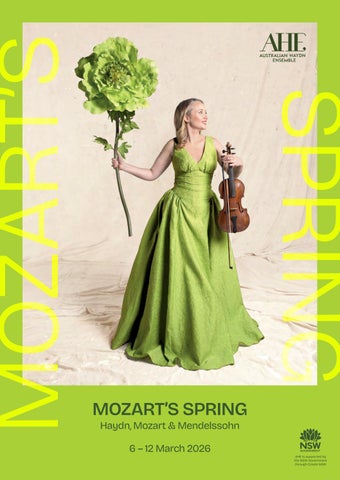
MOZART’S SPRING MARCH

BEETHOVEN’S FOURTH
APRIL / MAY
DIVINE BOHEMIANS
JULY / AUGUST
1/2 “...ELEGANCE, INVENTION AND EMOTIONAL DEPTH.”
Limelight,2025
STATE LIBRARY OF NSW
SEPTEMBER
HAYDN’S OXFORD
OCTOBER / NOVEMBER
18TH CENTURY UNPACKED PRE-CONCERT EVENTS
MOZART & HAYDN
MARCH
BOHEMIAN COMPOSERS IN VIENNA
JULY
HAYDN’S LONDON CONNECTION
OCTOBER
PROGRAM DETAILS
ARTISTS
Skye McIntosh, Artistic Director and violin
Matthew Greco, violin
Rafael Font, viola
Daniel Yeadon, cello
PERFORMANCES
BERRY
Friday 6 March, 7pm
Berry Uniting Church Hall
SOUTHERN HIGHLANDS
Saturday 7 March, 4pm
Bowral Memorial Hall
SYDNEY
Sunday 8 March, 5pm
The Paintings Galleries, State Library of NSW
MELBOURNE
Wednesday 11 March, 7pm
Primrose Potter Salon, Melbourne Recital Centre
CANBERRA
Thursday 12 March, 7pm Gandel Hall, National Gallery of Australia

PROGRAM
HAYDN String Quartet Op. 33 No. 3 in C major Bird
MENDELSSOHN String Quartet in E flat major MWV R 18
Interval (20 minutes)
MOZART String Quartet No. 14 G major K. 387 Spring
The concert duration is approximately 1 hr 50 mins, including an interval


A MESSAGE FROM SKYE

I am delighted to welcome you to our opening concert of 2026, Mozart’s Spring. This string quartet program celebrates youth, new ideas and fresh inspiration through three important composers who transformed the string quartet into one of the most expressive and intimate musical forms that we know and love today. There is something uplifting about beginning our season with music that feels so full of light and possibility in what can often feel like overwhelming times. In this concert, we move through each composer’s unique creative perspective: Haydn’s wit and imagination, Mozart’s radiant maturity, and Mendelssohn’s astonishing early genius.
We begin with Haydn’s Quartet
Op. 33 No. 3, nicknamed TheBird for its playful, chirping motifs in the first movement. The Op. 33 quartets marked an important turning point in the history of the string quartet, bringing a new sense of freedom, humour, and conversation between the players. Haydn himself proclaimed that he felt he had achieved something entirely “new and different” with these works
At the heart of the program is Mozart’s String Quartet No. 14 in G major, K. 387, often associated with the idea of spring for its sense of vitality and optimism. Written when
Mozart was 28 years old, it is full of melodic invention and warmth, and reflects his deep admiration for Haydn. Having been inspired by Haydn’s recently published Op. 33 string quartets, Mozart was keen to emulate and extend the genre even further. The four instruments display a new level of equality, constantly sharing ideas and responding to one another as if in lively conversation.
Mendelssohn’s Quartet in E flat major offers an interesting contrast. This relatively unknown work, written when he was just fourteen, reveals a composer already capable of depth and sophistication. Its lyrical slow movement and finely balanced structure suggest a musical voice that feels complete, reminding us of Mendelssohn’s extraordinary natural gifts. Together, these three quartets invite us to step into a youthful world of warmth, colour, and imaginationfull of optimism. It is a great pleasure to perform these works with my wonderful AHE colleagues, and to begin our new season with such joyful and life-affirming music. Thank you for joining us, and we hope you enjoy Mozart’s Spring.

— Skye McIntosh Artistic Director & Founder Australian Haydn Ensemble


The Australian Haydn Ensemble (AHE) was founded in 2012 by Artistic Director and Principal Violinist Skye McIntosh and is now in its fifteenth year. AHE has established itself as one of Australia’s leading periodinstrument groups, specialising in the repertoire of the late Baroque and early Classical eras. It takes its name from the great Joseph Haydn, a leading composer of the late 18th-century.
AHE’s flexibility and inventiveness are inspired by Haydn’s fabled originality and the virtuosic musicians he worked with at the court of Esterházy for almost 30 years. It performs in a variety of sizes and combinations, ranging from quartet, quintet or septet, to chamber orchestra with special guest soloists to a full orchestra with choir.
The Ensemble has developed a flourishing regular series in Sydney, performing at the City Recital Hall, ACO On The Pier, and the Utzon Room, Sydney Opera House; in Canberra, at the National Gallery of Australia. AHE also performs throughout regional NSW and presents education workshops
to students of all ages, focusing on imparting 18th-century historical performance techniques.
AHE is particularly interested in presenting unusual programs of 18th-century chamber versions of works by Haydn, Mozart and Beethoven, as well as presenting the music of emerging composers and lesser-known composers, such as Boccherini, Wranitzky and Mysliveček.
To commemorate its 10th anniversary, the Ensemble recorded its third CD, entitled The Mozart Album, released in 2024. In October 2023 AHE undertook its first international tour of the United States, including performances at Carnegie Hall and at the opening of the new Australian Embassy in Washington DC, garnering full houses, standing ovations and glowing reviews.
The Ensemble is delighted to be presenting its first subscription season at the Melbourne Recital Centre in 2026.
THE ENSEMBLE


Skye McIntosh violin
______
Skye is the founder and Artistic Director of the Australian Haydn Ensemble, now in its fifteenth year. This audacious undertaking is a testament to Skye’s musicianship and entrepreneurial spirit. AHE, known for its innovative and ambitious programming, was delighted to perform at the Adelaide Festival in 2022 and Canberra International Music Festival in 2022 and 2023, as well as continuing to tour to Canberra and across regional New South Wales each year.
Skye attended the Royal Academy of Music in London, the Queensland Conservatorium and the Sydney Conservatorium of Music, has made numerous concert appearances as soloist and director, and led the AHE on its first tour to the US in 2023, including a performance at Carnegie Hall. She has also toured nationally with the Australian Brandenburg Orchestra, as well as performing with the Orchestra of the Antipodes (Pinchgut Opera) and the Australian Romantic & Classical Orchestra. In 2024 ABC Classics released AHE’s third CD, featuring Skye performing Mozart’s Violin Concerto in G major.
Skye is playing a violin by Tomaso Eberle, 1770, Naples
______ Matthew Greco violin 2
Matthew is a concertmaster, soloist and core member of some of the world’s leading period instrument ensembles. He has been a regular member of the Australian Brandenburg Orchestra and concertmaster of the Orchestra of Antipodes (Pinchgut Opera) since 2006. In 2010 he moved to The Netherlands where he studied Baroque violin at The Royal Conservatoire of The Hague and worked with leading European ensembles including De Nederlandse Bachvereniging and Les Talens Lyriques (France). He is a founding member of the Sydney-based ensemble The Muffat Collective. Matthew enjoys teaching baroque violin at the Sydney Conservatorium of Music as well as performing with a variety of international ensembles and festivals in Australia and Europe. Committed to producing a unique and individual sound based on historical performance practices, Matthew believes that 17th- and 18th-century music is full of vitality and emotions that speak to us now, as much as they did in the past.
Matthew is playing a violin by David Christian Hopf, 1760, Quittenbach


______ Rafael Font viola
Rafael Font is a violinist and violist specialising in historically informed performance (HIP) of music from the baroque to the romantic periods, and is highly acclaimed for his virtuosity and improvisational skills.
Rafael started learning the violin at the age of five in his hometown of Caracas, Venezuela, with advanced studies at the Guildhall School of Music and Drama in London and the Royal Conservatory of The Hague.
Now based in Sydney, Rafael regularly performs with many of the leading HIP ensembles in Australia, such as the Australian Haydn Ensemble, the Australian Brandenburg Orchestra, and the Australian Romantic & Classical Orchestra. Rafael is also a founding member of the chamber ensemble The Muffat Collective.
______
Daniel Yeadon cello*
Dr Daniel Yeadon is a Senior Lecturer at the Sydney Conservatorium of Music, University of Sydney, where he coordinates the Masters Performance program, teaches cello and viola da gamba, and coaches chamber music. Daniel also engages in research into learning, teaching and historical performance practices. Originally from the UK, Daniel read physics at Oxford University and then completed his postgraduate studies at the Royal College of Music in London.

Rafael is playing a viola by Simon Brown, 2010, Sydney
Daniel has a love for a wide range of musical genres and is an exceptionally versatile cellist and viola da gamba player, performing repertoire from the Renaissance through to Contemporary. Daniel is a passionate chamber musician, playing regularly with Australian Haydn Ensemble, Ironwood, Australian Romantic & Classical Orchestra, and Bach Akademie Australia. For many years Daniel was a member of the renowned Fitzwilliam String Quartet and the exuberant period instrument ensemble Florilegium. He has made many award-winning recordings.
Daniel is playing a cello by William Forster II, 1781, London

*Dr Daniel Yeadon appears courtesy of the Sydney Conservatorium of Music
THE PERFORMERS


OUT NOW
“…GREAT MUSIC PERFORMED WITH FORCES UNCOMMON.”
ClassikON 2025
______ Beethoven, Mozart & Boccherini


1 – 10 May 2026
Berry | Bowral | Sydney | Canberra | Bathurst
Book by using the QR code or calling 1800 334 388
Franz Joseph Haydn (1732-1809)
String Quartet in C major Op. 33 No. 3 (Bird)
Allegro moderato
Scherzando. Allegretto Adagio ma non troppo
Rondo. Presto
Haydn always had a good head for business, and when he introduced his Op. 33 to the world, he knew exactly what he was doing.
I am issuing, by subscription, for the price of 6 ducats, a work consisting of 6 Quartets for 2 violins, viola and violoncello concertante, correctly copied and WRITTEN IN AN ENTIRELY NEW AND SPECIAL WAY (FOR I HAVE NOT COMPOSED ANY FOR TEN YEARS).
This was the letter that Haydn’s regular patrons and subscribers received early in 1782, offering exclusive copies of his newest set of string quartets – Op.33. Such letters were standard practice for 18th-century chamber composers; in the era before copyright, exclusive prepublication subscriptions were a staple source of income. What’s special about this letter is the claim that Haydn puts in capitals. It’s true that he’d written no string quartets since Op. 20 of 1772 – but were these new quartets really written in an “Entirely New and Special Way”?
Well – to take just one examplelook at the scherzando (“joking”) second movement of Op. 33 No. 3. The Op. 33 quartets are generally reckoned to be a decisive moment in the evolution of the string quartet and Haydn’s jokes are the key that unlocked everything that followed. With the admission of humour – that
great leveller – true musical conversation becomes possible.
“This new conception of musical art” writes Charles Rosen “changed all that followed it”.
All of which would be of purely academic interest if this music hadn’t held the repertoire on its own merits, and from its earliest days the Bird seems to have been a special favourite.
A long-established nickname is always significant: birdsong was a popular musical motif in the 18th century, when caged linnets or skylarks were popular pets (Mozart’s pet starling, famously, could whistle a theme from his seventeenth piano concerto).
The chirruping opening theme of the Op. 33 No. 3 - and the avian duet of the scherzo’s central section – were designed to charm listeners, as well as players. Haydn looked outward even as he looked inward - a gimmick can still form part of a sublime discourse.

And indeed, so characterful is the opening subject that you barely notice its originality – the weightless, bass-free texture, the unprecedented first bar of (in Hans Keller’s words) “accompaniment to nothing”. The scherzo is as muted and hushed (sotto voce, with all four instruments laying on their lowest strings) as its twittering central section is brilliant. The dignified warmth of the Adagio’s opening phrases gives way to an unexpected playfulness as well as delicacy, and the Rondo finale is all the more compelling for being both so quiet and so crisp. But Haydn’s fantasy never allows its wings to be clipped. There are some delightful surprises along the way – and the best might just be the last…
ABOUT THE MUSIC
Felix Mendelssohn (1809-1847)
String Quartet in E flat major
MWV R 18
Allegro moderato
Adagio non troppo
Menuetto - Trio
Fuga
By his early teens, Felix Mendelssohn was said to be able to play practically any orchestral instrument, and he handled the violin and viola with equal flair. In that regard, he was far from alone among the Mendelssohn children: his sister Fanny was an outstanding pianist, and their younger brother Paul was a very handy cellist. Paul went on to pursue a career in finance, but together they grew up immersed in the classical chamber repertoire, and it was never difficult, amid their cultured and lively Berlin circle, to assemble almost any chamber lineup for a spot of recreational music.
So, friends and relations gathered each Sunday at the Mendelssohn’s family home to play chamber music, or even form a small orchestra, and between the ages of twelve and fourteen Felix wrote 13 short symphonies for them to play together – testing his compositional skills in what we might think of as a uniquely friendly and supportive workshop environment. By now, it was becoming clear that young Felix’s talents were (to put it mildly) in a class of their own. “He might become a great violin player” wrote his violin teacher Carl Zelter to Goethe, soon after Felix’s fourteenth birthday in February 1823, but Zelter was also amazed by his pupil’s progress as a composer – “he is growing beneath my eyes”. Little more than a month later, on 25 March 1823, Felix began work on his first full-length string quartet.
Characteristically, he completed it in barely eleven days.
And naturally enough, he took as his model the quartets of Haydn and Mozart; the masters who were the most frequently played (and loved) by amateur quartet players at that time and place (Beethoven, in 1823, was still dangerously avant garde). But Felix’s home sessions and excellent violin technique had served him well: the opening Allegro moderato has a Mozart-like polish and warmth. The bittersweet second movement drops into a shadowy C minor, in what might almost be a trial-run for the slow movement of Mendelssohn’s great String Octet, still two years in the future. The playful Minuetto does its best to live up to Haydn’s famous imprecation (“I wish someone would write a really new minuet”), with just the lightest touch of romantic yearning and mystery in the central Trio, and the finale follows the example of Haydn’s Op. 20 quartets (and Mozart’s K.387) by taking the form of an energetic, brilliantly-worked fugue.
It’s dazzlingly done (for a fourteenyear-old, it’s practically perfect) and it must have thrilled Felix’s family and friends. And yet he – and they – will have been aware that new currents were gathering in the world of music. A reckoning with the spirit of Beethoven was both necessary and inevitable before Felix faced the world as a fully-fledged quartet composer; he put this quartet aside, and it lay unpublished until 1879. By his fifteenth birthday – 3 February 1824 – he’d moved on, and Zelter had a new challenge for his charming, astonishing pupil: “Now work on, until you become a master”.

Wolfgang Amadeus Mozart (1756-1791)
String Quartet No. 14 in G major K.387 (Spring)
Allegrovivaceassai
Menuetto:Allegro
Andantecantabile
Moltoallegro
TomydearfriendHaydn:Afather whohaddecidedtosendhis childrenoutintothewideworld thoughtitbesttoentrustthemto theprotectionandguidanceofa famousman,whobygoodfortune alsohappenedtobehisbestfriend. Heretheyarethen,OgreatManand dearestFriend,thesesixchildrenof mine.Theyare,itistrue,thefruitof longandlaboriousendeavour
There’s never been a dedication quite like the one with which Mozart headed the six string quartets that he composed between late 1782 and January 1785. But then, there’s never been a musical friendship quite like Mozart’s and Haydn’s. The warmth between the 52-year-old Haydn and the 29-year-old Mozart was real; so too was their mutual respect. Following Haydn’s example as a composer of quartets was no simple matter, and Mozart’s “long and laborious endeavour” is far removed from the “Amadeus” image of the carefree genius taking down dictation from heaven.
Mozart met Haydn for the first time in December 1781, shortly before Haydn published his Op. 33 string quartets. Mozart was fascinated, and in late 1782 he began a new set of six string quartets of his own. He took more than two years to complete the set, modelling his technique directly upon Haydn’s Op. 20 and Op. 33 quartets. Only in January 1785 could Haydn, Mozart and two friends finally play through the six new works at Mozart’s apartment in Vienna, in front of an invited audience. It was
on that night that Haydn turned to Leopold Mozart (who was making a rare visit to his son in the Imperial capital) and told him “Before God, and as an honest man, I tell you that your son is the greatest composer known to me either in person or by reputation. He has taste, and furthermore, the most profound knowledge of composition”.
The work that we know as K.387 was the first of Mozart’s six “Haydn” quartets, completed (according to Mozart’s own date in the manuscript) on New Year’s Eve 1782. Everything about it suggests a fresh start by a supreme master. The warmth and elegance of the opening theme jumps from the page (like Haydn, the viola-playing Mozart had a performer’s insight into what sounds good on a string instrument) and the movement’s gentle pay-off is pure Haydn à la Mozart. It’s the easy natural freshness, if you like, of a new creative spring; no hint of “long and laborious endeavour” troubles the listener’s ear.

The same could be said for the jokey soft-loud swells of the Menuetto and the glowing, blossoming dialogue of the Andante. And in the fugal finale Mozart foreshadows both the Jupiter symphony and his great operatic finales in music with a Haydn-like momentum and wit. Next stop, Figaro, we might almost say. If the four-note opening motif is indeed (as many scholars believe) based on the plainsong credo, that only gives this joyous, ringing exercise in master-craftsmanship an even more appropriate meaning. This is music that could stand as both a tribute to Haydn, and a joyous profession of faith in the path that the older man had opened. No two masters ever gave each other – or us – quite so much.
Richard Bratby
ABOUT THE MUSIC

YOUR SUPPORT IS VITAL—

Since the very beginning AHE has been strongly committed to bringing beautiful music to the regions of New South Wales and beyond – and in 2026 we are once again performing as many concerts in the regions as possible.
And we can’t do it the way we do it without you! Your support is vital and all gifts are very much appreciated.
You can even make a recurring gift over 12 months, and any amount over $2 is tax deductible.
Thank you!
Skye McIntosh Artistic Director


WAYS TO DONATE
• Online: use the QR code
• Online: go to australianhaydn.com.au/donate
• Call us on 1800 334 388
PATRONS—
Our patrons enable us to continue presenting wonderful concerts, and we could not do what we do without them - we are so grateful to them all.
AHE donor categories are named after famous 18th-century patrons who supported and commissioned many of the works of Haydn, Mozart, Beethoven and others that we are re-discovering today.
About our Patron Categories
Maria Theresa
The Queen was a patron of Viennese music, and Haydn wrote his Te Deum at her request.
Esterházy
Prince Esterházy was the main patron of Haydn.
Waldstein
Count Waldstein was an early patron of Beethoven.
Van Swieten
He was a keen amateur musician and patron of Haydn, Mozart, and Beethoven
Galitzin
He was an amateur musician and is known particularly for commissioning three Beethoven string quartets Op. 127, 130 and 132.
Lobkowitz
He was a Bohemian aristocrat and a patron of Beethoven.
Razumovsky
He commissioned Beethoven’s Op. 59 String Quartets.
Patron
Her Excellency the Honourable
Margaret Beazley AC KC
Governor of New South Wales
Founding Patron
The Late Dr Timothy Pascoe AM
The Chair’s Circle
The Chair’s Circle is a group of dedicated supporters who have made a multi-year commitment to supporting the long-term vision of the Australian Haydn Ensemble.
Marco Belgiorno-Zegna AM & Angela Belgiorno-Zegna
Sherry & the late Tom Gregory
Karin Keighley
Peter & Lisa Macqueen
Kevin McCann AO & Deidre McCann
Ian & Pam McGaw
Anthony Strachan
Peter Young AM & Susan Young
Anonymous (1)


Artistic Director’s Circle
The Artistic Directors Circle is a group of passionate supporters who have made a commitment to supporting the education program of the Australian Haydn Ensemble and the vision of the Artistic Director
Adrian Maroya
Jon & Susanne North
Peter & Vivienne Skinner
Musicians Chair
Skye McIntosh, Artistic Director & Leader’s Chair
Supported by Mrs W.G. Keighley
Maria Theresa $25,000
Sherry & the late Tom Gregory
Howarth Foundation
Karin Keighley
Kevin McCann AO & Deidre
McCann
Anonymous (1)
Esterházy $15,000 - $24,999
—
David & Anne Eustace Foundation
Peter & Lisa Macqueen
Anthony Strachan
Peter Young AM & Susan Young
Waldstein $10,000 - $14,999
— Marco Belgiorno-Zegna AM & Angela Belgiorno-Zegna
Carolyn Fletcher AM
Sherry Gregory, in memory of the late Tom Gregory & the late
Timothy Pascoe AM
Ian & Pam McGaw
Van Swieten $5,000 - $9,999
—
Martin & Ursula Armstrong
Richard Fisher AM & Diana Fisher
Carolyn Fletcher AM
Reg & Kathie Grindberg
Adrian Maroya
Jon & Susanne North
Peter & Vivienne Skinner
Galitzin $1,000 - $4,999
Antoinette Albert
James Ashburner
Mark Bethwaite AM & Jill
Bethwaite
Clive Birch
Keith & Louise Brodie
Jason Catlett
Chapman Eastway Charitable
Foundation
George H. Clark
Robert & Carmel Clark
Dr Terry & Julie Clarke
Jean Cockayne
Christine Cooper
Peter & Prudence Davenport
Rob Diamond
Jeremy Eccles FRSN & Kate
Eccles OAM
Dr Meredith Edwards
David, Katrina & Madeline Evans
Ralph Evans AO & Maria Evans
John Fairfax AO & Libby Fairfax
Dr Marguerite Foxon
Bunny Gardiner-Hill
Prof Pru Goward AO
Sharon Green
James Hardigg
The Hon Don Harwin
Ann Hoban
Sarah de Jong
David Kent OAM & Angela Kent
Celia Lillywhite
David Maloney AM & Erin Flaherty
Jeremy Morris & Kate Guilfoyle
Trevor Parkin
Nick Payne
David & Elizabeth Platt
Kay Vernon
The Hon. Anthony Whealy K.C. & Annie Whealy
David Whitehouse
Anonymous (6)
Lobkowitz $500 - $999
Priscilla Adey
Mary
Tony
Dr
Lloyd
Richard
Anonymous (4)
Razumovsky $250 - $499
Ann
Wendy
Paul
Diana
Alicia Williams
Anonymous (3)
Foundations
Chapman Eastway Charitable Foundation
David & Anne Eustace Foundation. Howarth Foundation
Jibb Foundation
Key Foundation
Sinsay Pty Ltd
Stoneglen Foundation
This listing is correct as of 5 Feb 2026, and we gratefully recognise all donations received since 1 January 2025
PARTNERS—
GOVERNMENT PARTNER—

PARTNERS—

SUPPORTERS—

BACKSTAGE
Board —
Kevin McCann AO (Chair)
Carolyn Fletcher AM (Deputy Chair)
Adrian Maroya
Skye McIntosh (Artistic Director)
Jon North
Vivienne Skinner
Peter Young AM
Marco Belgiorno-Zegna AM (Emeritus Chair)
The Australian Haydn Ensemble acknowledges the traditional custodians of the lands on which we perform. We pay our respects to Elders past and present. The Australian Haydn Ensemble is a not-for-profit organisation
ABN 26 202 621 166
PO Box 400
Strawberry Hills NSW 2012 1800 334 388 (Freecall) | australianhaydn.com.au

Behind the Scenes —
Skye McIntosh, Artistic Director & CEO
Ailsa Veiszadeh, Administrator
Alison Dunn, Marketing & Communications
Roderick van Gelder, Production Management & Lighting Design
Marguerite Foxon, Front of House & Administration*
*In Kind Support
In Kind—
John Dearn, Canberra
Jean Gifford, Canberra
Greg & Wendy See, Berry
Stuart & Felicity Coughlan, Berry
Steve & Mary Beare, Berry
Keith & Louise Brodie, Berry
Rob & Antoinette Sampson, Bowral
Images—
Images throughout by Helen White except pages 6 - 7, supplied and James Mills and page 12, Oliver Miller
Penrith Youth Orchestra