FRANCIS GIACCO
Recent work
Pictures at an Exhibition (apologies to Mussorgsky)
with selected works from the 80’s and 90’s
15 June - 2 July 2023
3 A USTRALIAN G ALLERIES
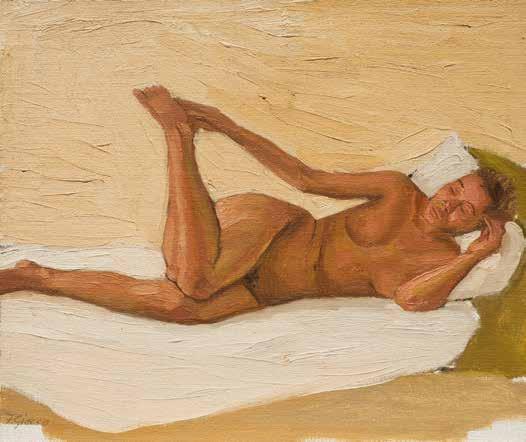
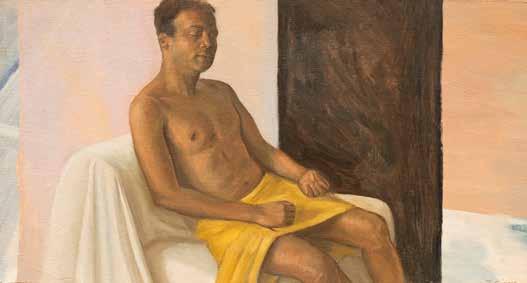
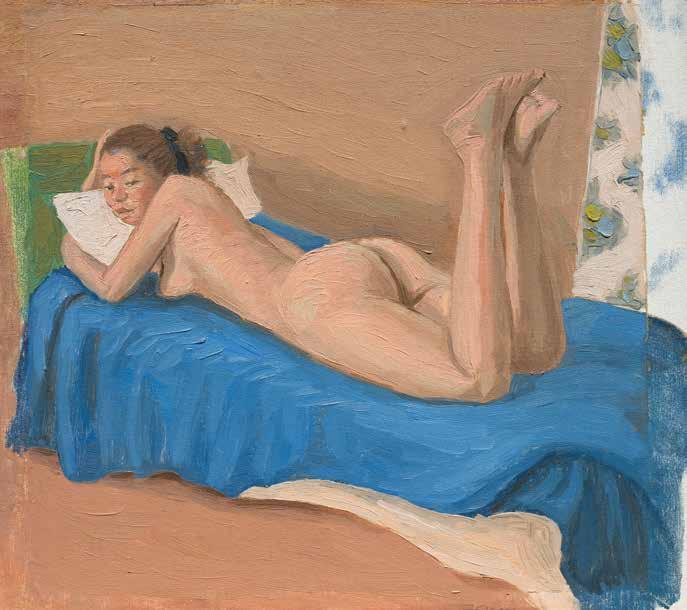
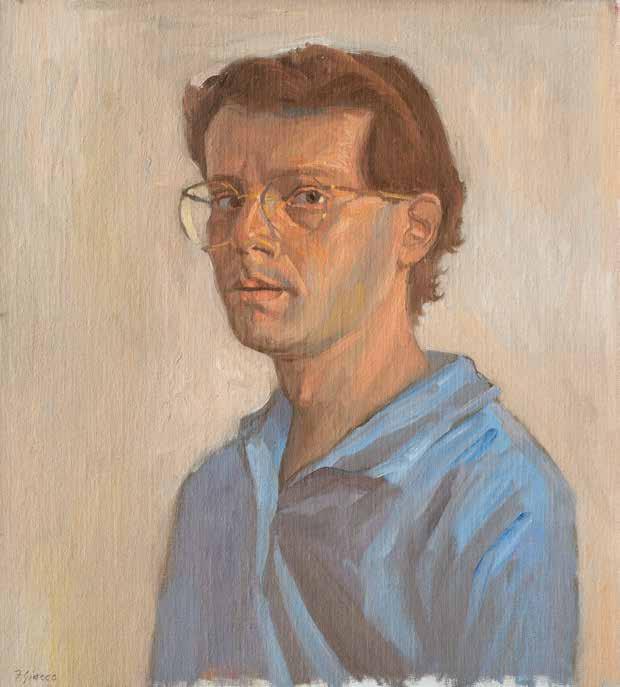
Contents Essay - Christopher Allen - National Art Critic, The Australian 4 Artist Statement 9 Recent Work 10 Egg Emulsion Paintings 36 Early Oil Paintings 46 Portrait Studies 54 Still Lifes 66 Landscapes 72 Figure Studies 76 Nude Figure Studies 86 Self Portraits 92 Biography 102
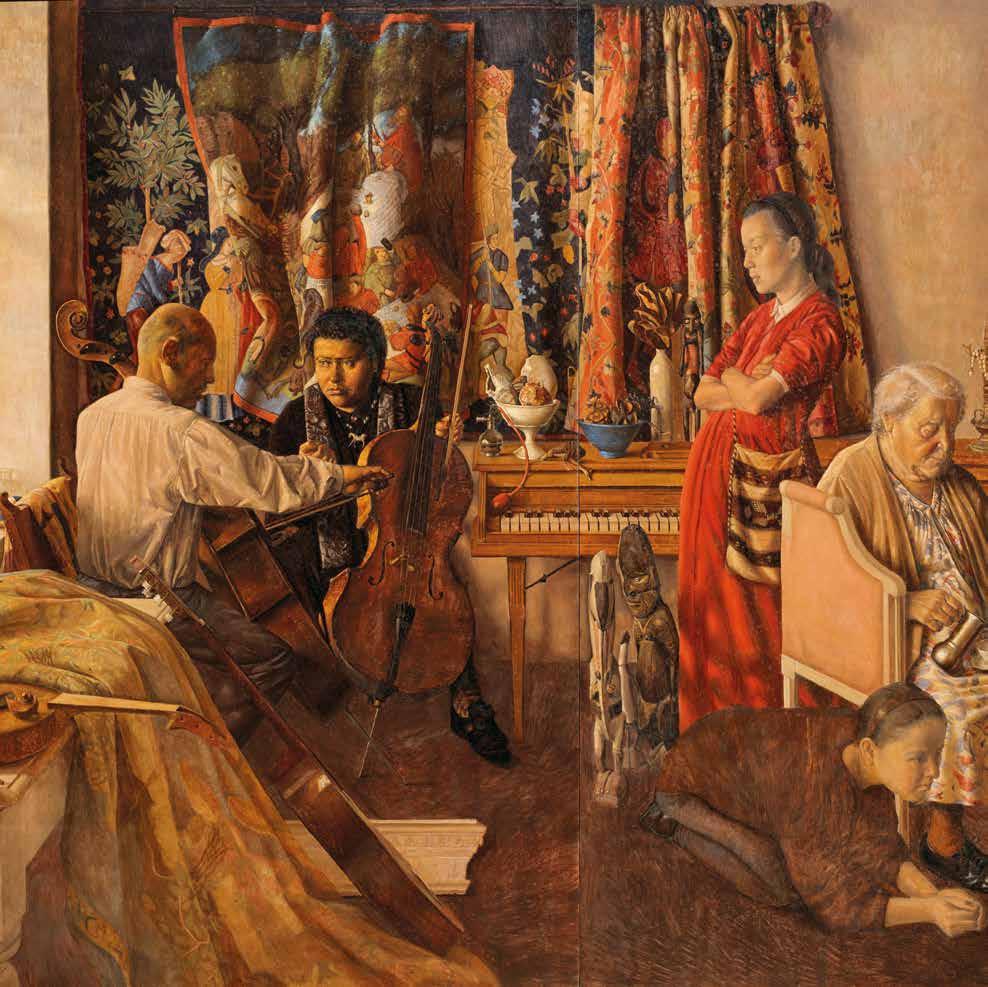
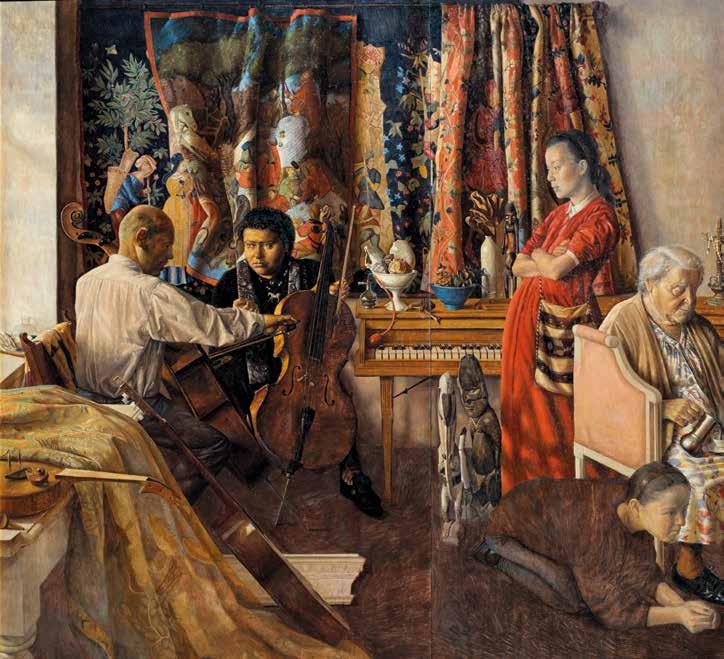
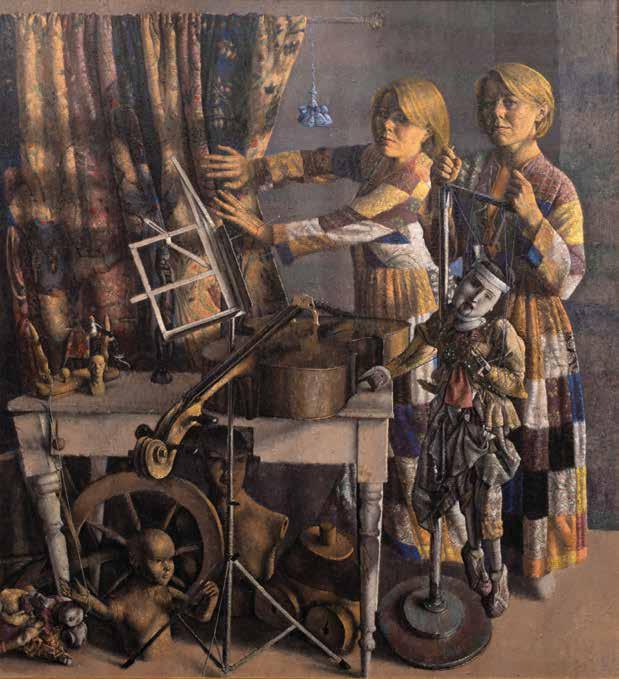
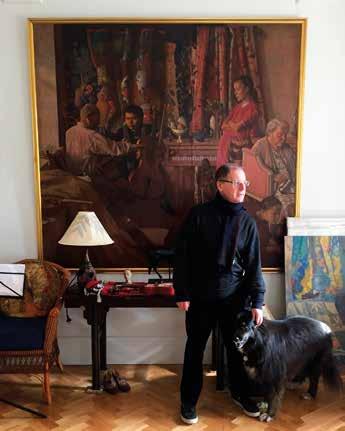
Francis Giacco had already been exhibiting for some years but achieved greater notoriety when he was awarded the Archibald Prize in 1994 for Homage to John Reichard (p.39), a far more complex work than any of the pictures that had won the prize in the previous few years – Bryan Westwood’s Elwyn Lynn in 1989, Geoffrey Proud’s Dorothy Hewett in 1990, Bryan Westwood’s Paul Keating in 1991-92 or Garry Shead’s Tom Thompson in 1993, largely executed – according to the AGNSW website – in a half-hour sitting following a long lunch with several bottles of wine and a meditation session. All of these are respectable accounts of their subjects, especially by current standards, but Giacco’s was an incomparably more ambitious picture – which may, incidentally, have opened the way for Bill Robinson’s eccentric but charming Self-portrait with stunned mullet in the following year, when Giacco was himself again a finalist with Family portrait (p.37).
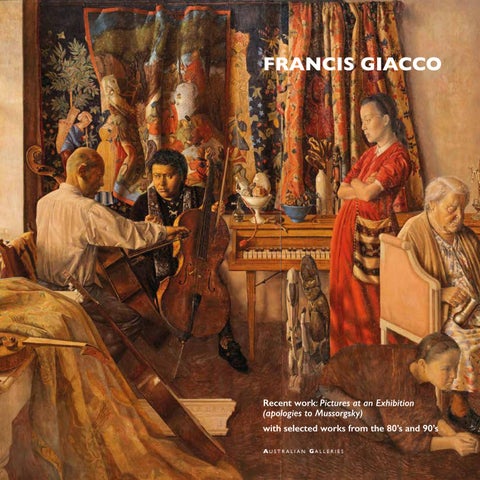
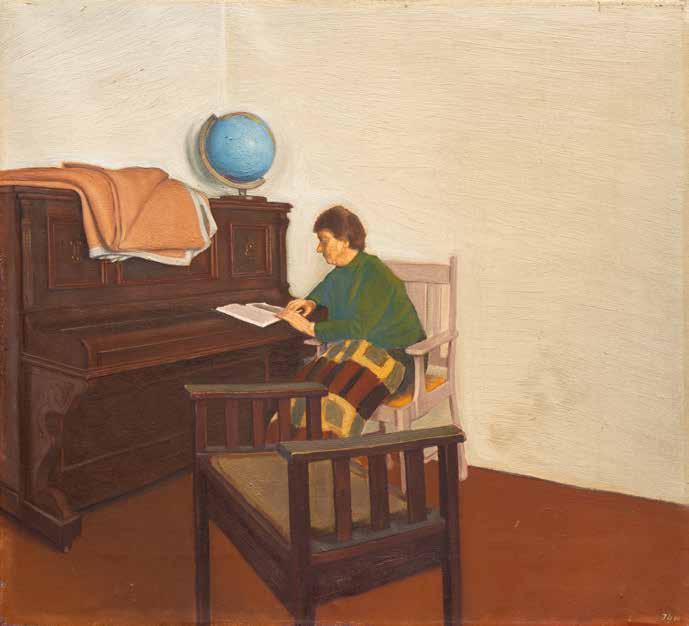
Giacco’s Archibald winner was given its exhibition title after the untimely death of the cellist John Reichard, and attracted some controversy at the time because of the relative lack of prominence of the purported subject. It is true that the figure on the right, a portrait of his grandmother pouring coffee, or indeed the other two younger women, are more directly striking, but the allusive and shadowy profile of Reichard draws our attention, even when we do not know the tragic story behind the painting. Otherwise, it might almost have been titled Self-portrait in absentia , because the keyboard in the centre reminds us that Giacco himself played the piano with the two cellists; he is also an amateur composer and has written several pieces of music inspired by paintings in the exhibition, which can be listened to by scanning a QR code on the picture label. But as though the artist wanted to add to the sense of subtle malaise in this picture, what we might take for a harpsichord is in reality a silent keyboard, used by Mozart, Liszt and many others for practice during long coach journeys. Standing on it, in the very centre of the composition, is a recurring autobiographical motif in Giacco’s painting: a barber’s spray bottle, recalling his Calabrian father’s profession in Sydney.
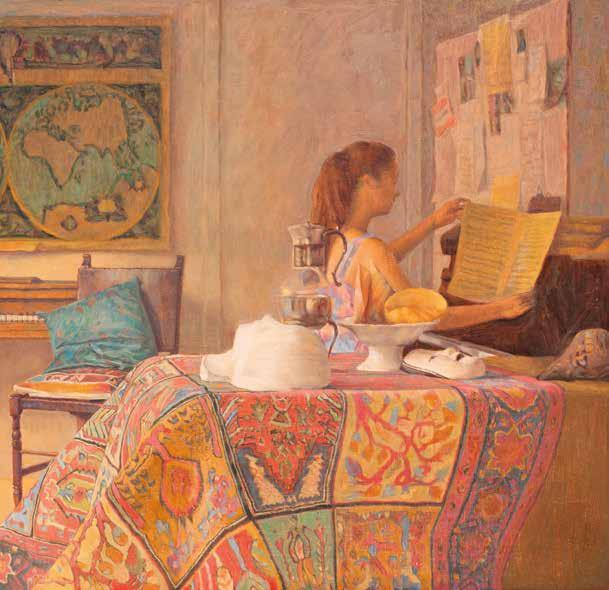
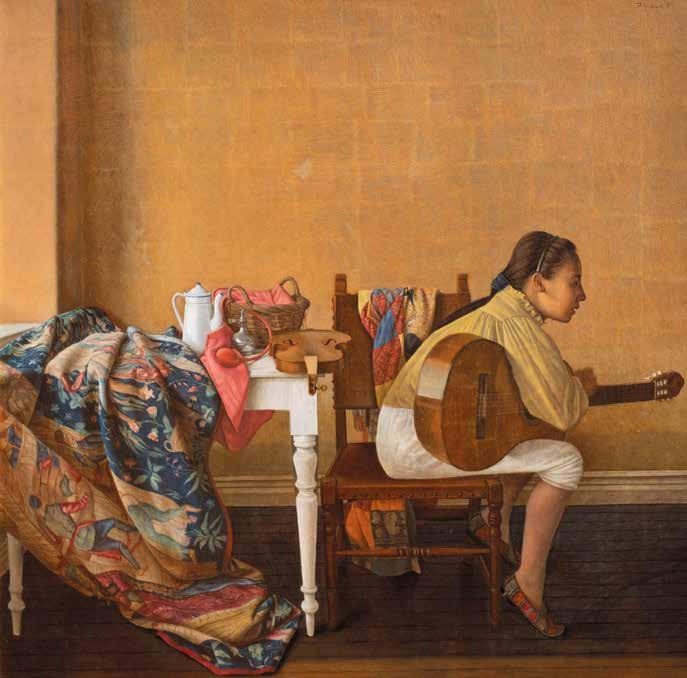
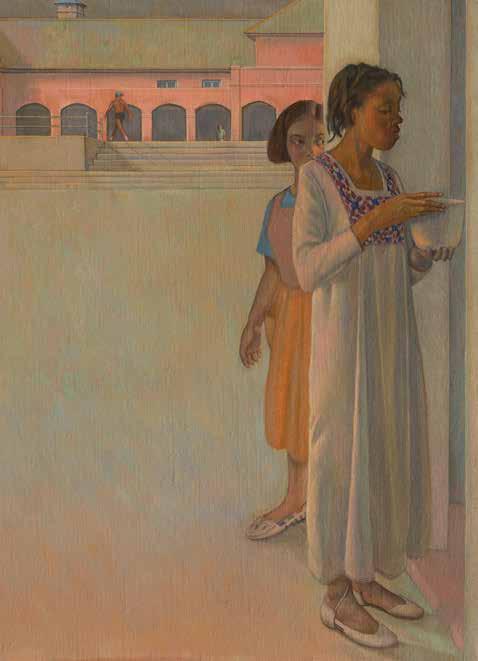
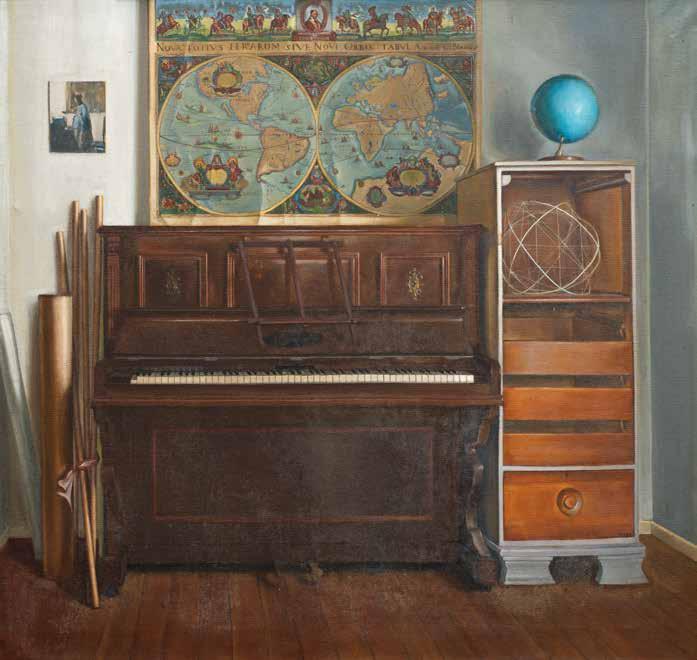
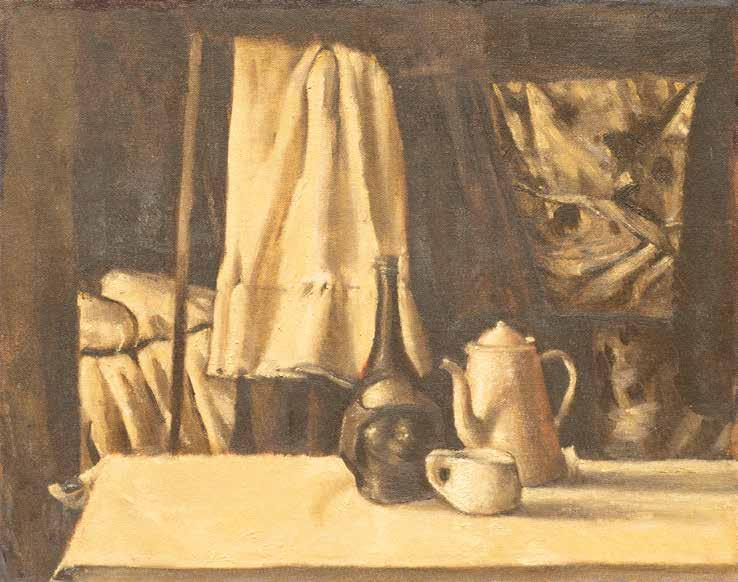
of the unattended instrument, implying the absence of its performer and often anticipating his arrival, is a common one in the artist’s tantalisingly small oeuvre. Other motifs include the foreground repoussoir on the left and the abundance of tapestries and rugs. The presence of Vermeer is palpable throughout Giacco’s work, including his most recent paintings; but here it is synthesised with Balthus’ strange existential disorientation, especially in the figures on the right. Throughout Giacco’s work, in fact, we can see how he was inspired by the great realist painters of the twentieth century, like Balthus and Lucian Freud, who were themselves underrated during the years dominated by abstraction but have since, with the decline of interest in abstract painting, been acknowledged as giants of the modernist period.
But even to call these painters ‘realists’ reminds us what a slippery term that is. In most people’s minds it probably conjures up the idea of painting something like a faithful copy of reality, or at least of appearance. But the whole history of art reminds us how different faithful accounts of appearance can be; Caravaggio and Monet have very little in common, and yet each of them was devoted to the idea of visual fidelity, and they can indeed be separated on that score from others, whether Byzantine painters or Fauves, who had other priorities. But two main factors complicate the definition of a faithful account: the first is that the world of experience is not an object (a photograph of a view is an object, but our visual experience of the same view is not), so that even deciding what we are to paint involves choice, selection and priorities; and the second is that a painting, in contrast, is indeed an object, and one with very particular material properties. Making a picture is thus always a matter of constructing a finite and objective visual equivalent of an inherently nonfinite and non-objective reality.
Again unlike earlier winners of the prize, Giacco’s work is dense with arthistorical allusions, the most obvious of which are to Vermeer. The motif
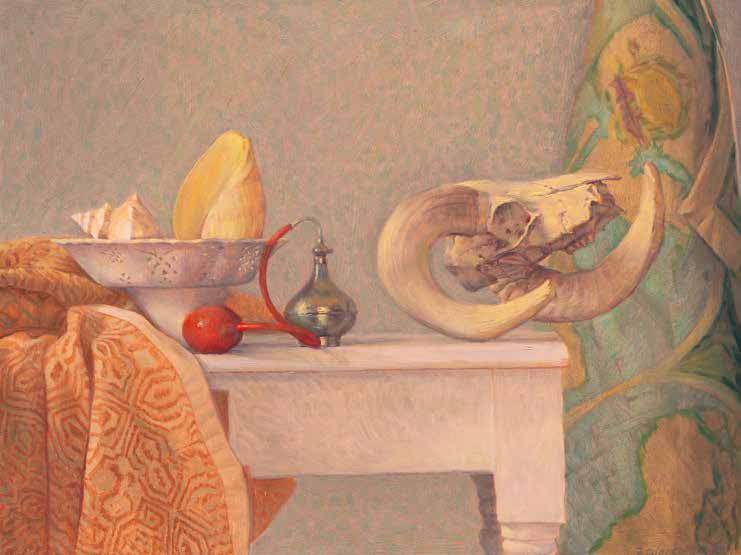
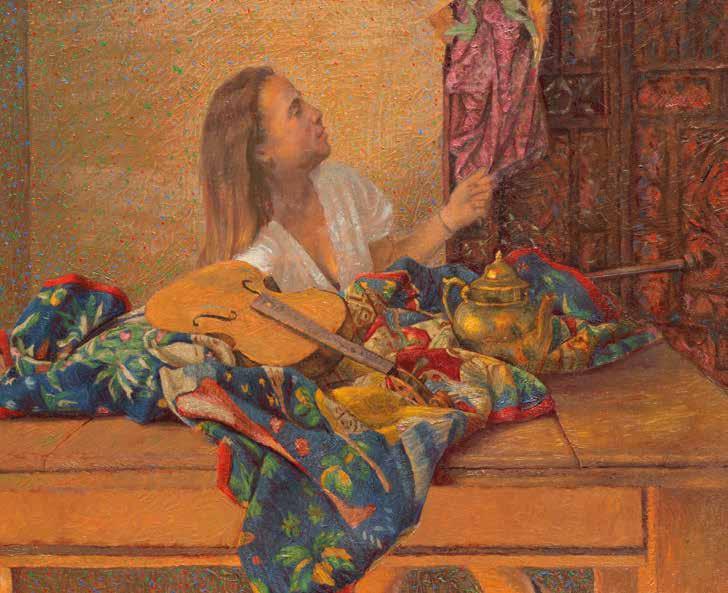
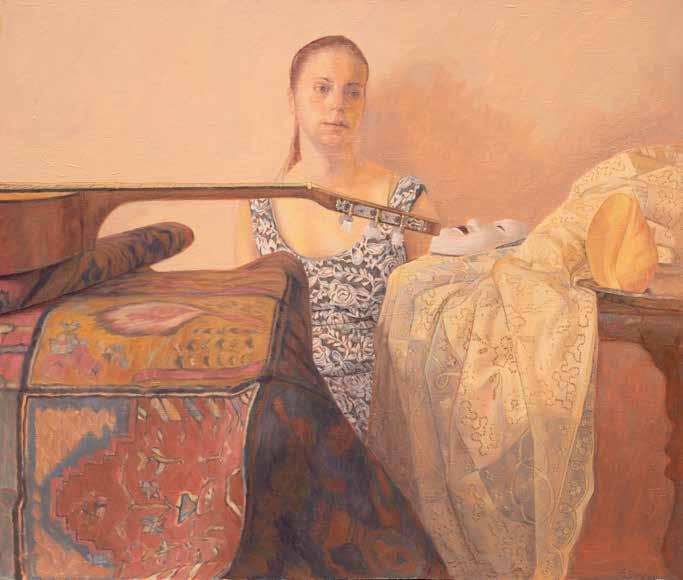
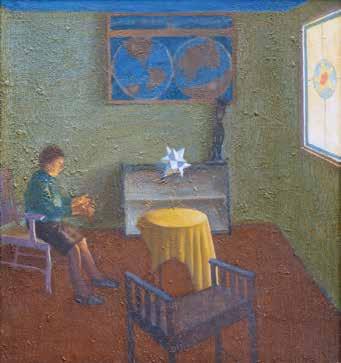
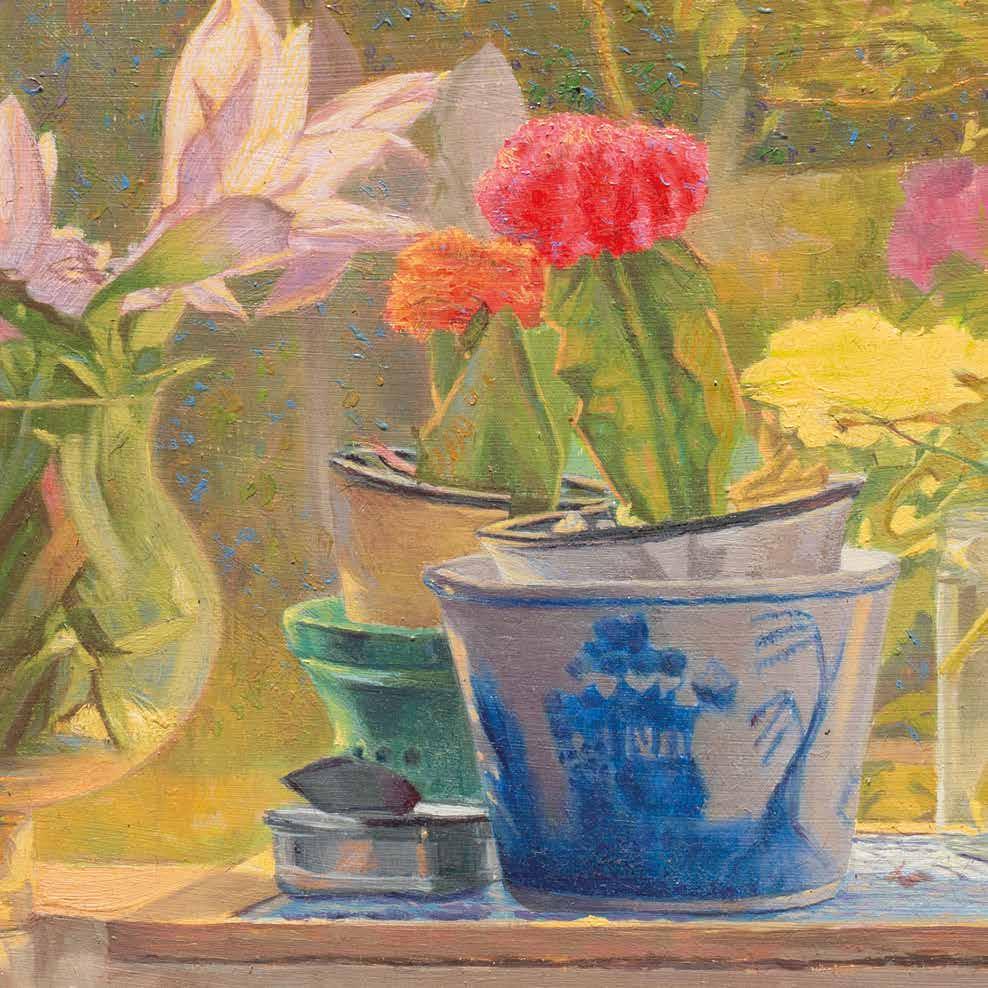
Giacco’s painting evokes just this slippery and ambiguous quali ty of ‘realism’. On the one hand it is full of minute detail and vivid evocations of material phenomena; but on the other hand it is disturbingly unreal and disconcerting in its compositional and psychological construction. And this disconcerting quality is compounded by the nature of the paint surface itself, at once almost Flemish in the articulacy with which it records
6
the incidents of visual appearance and yet somehow insubstantial and disembodied, as though all of these figures were moving around in a dream.
To understand the origin of this style, we have to look more closely at Giacco’s earlier works, and at the highly individual path that he took to reach his mature style. The paths of artists have almost inevitably become more complicated over the last century, with the breakdown of the transmission of technical knowledge. Once, they learnt their craft as the apprentices of masters; this system was later replaced by academic teaching, first partially in the seventeenth and eighteenth centuries, and then completely in the later nineteenth. The comprehensive takeover of teaching by the modern academy was almost at once followed by a rebellion against the academy’s authority, and successive waves of modernism and postmodernism gradually sapped art teaching of almost all useful content.
Like so many modern artists, therefore, Giacco – whose formal studies at university had been in architecture – had to go in search of masters capable of imparting the secrets of painting. He and his wife Jenny, also a fine painter, studied at Julian Ashton’s and gravitated to Brian Dunlop, in whose work they sensed something of what they were looking for; Giacco’s work still has echoes of Dunlop’s influence. Dunlop himself liked to point out that he had been taught by Jeffrey Smart, who had studied with Fernand Léger, who had in turn been the pupil of the famous academic master Léon Gérôme. But most importantly he and Jenny went to study in Vienna, and there he became fascinated by the kind of painting techniques thought to have been used in the fourteenth and fifteenth centuries, from Siena to Flanders.
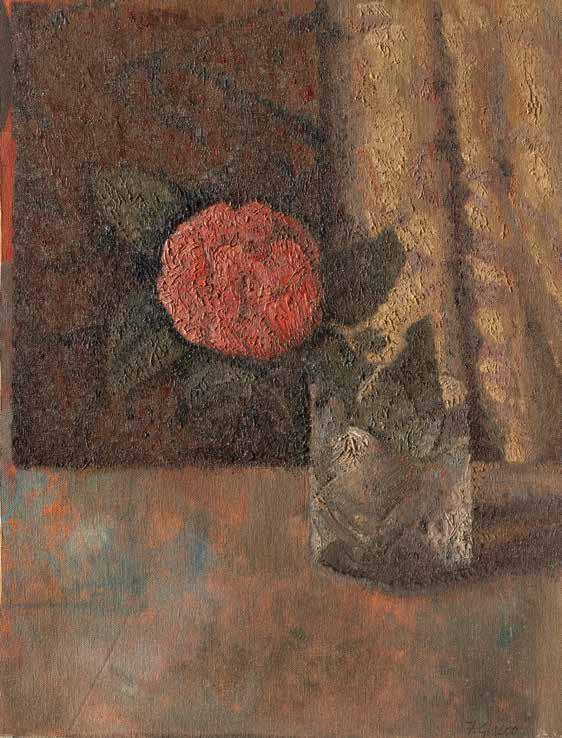
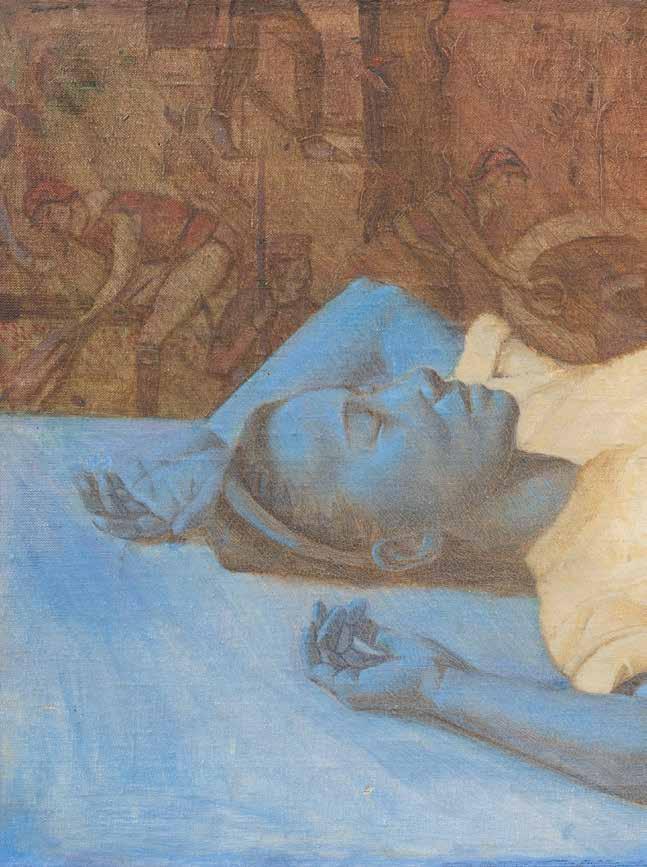
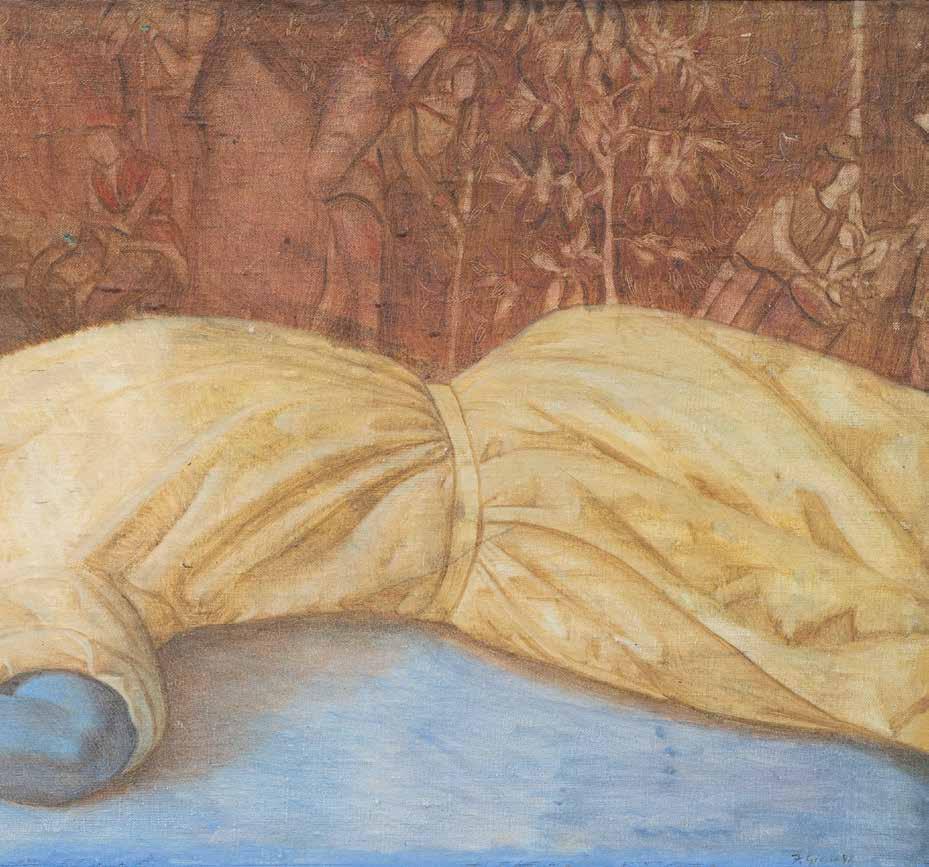
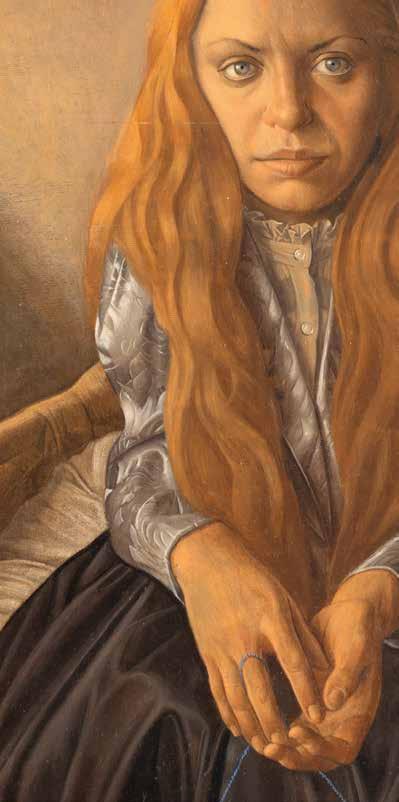
In the version of these practices that Giacco eventually adopted for himself, he would begin by preparing a panel or canvas in red – like the red underpainting of icons before receiving their cover of gold leaf – and then carefully draw his design before slowly painting it in an egg oil emulsion which emulated the effect of tempera. The paint had to be applied in small strokes and built up by hatching, in a grid of squares whose vestigial shadows in the finished work sometimes recall the way
7
that gold leaf was applied in small squares. Perhaps surprisingly however, the painting at this stage was all carried out in white, gradually constructing a tonal underpainting by the variable density of the white hatching; colour was then applied in a second stage, using oil glazes. Those who have not practised oil painting will probably, and quite naturally, be unaware that almost all pigments are translucent without the admixture of white; much of the richness of oil painting as a technique lies in the soph istication with which opaque and translucent pigments are combined and layered. But because glazes cannot easily be applied over wet paint, they tend not to be used by plein-air painters like the Impressionists, who instead prefer opaque mixtures which they can employ and even mix into each ot her (‘wet-in-wet’) in the field.
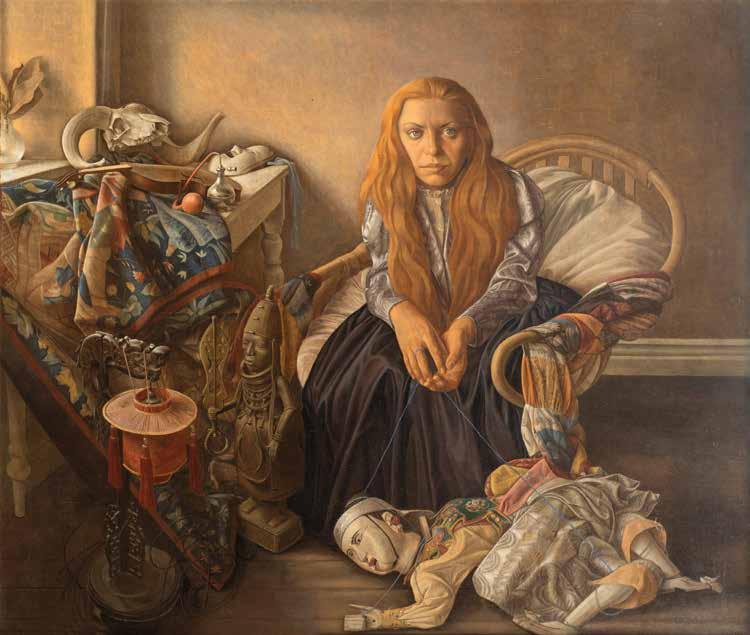
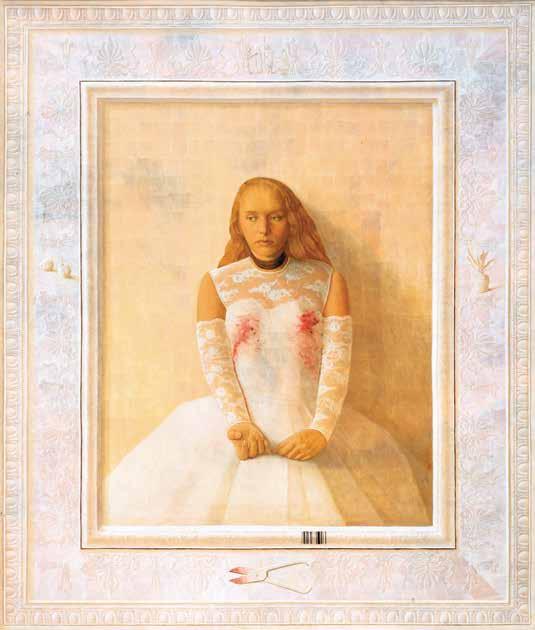
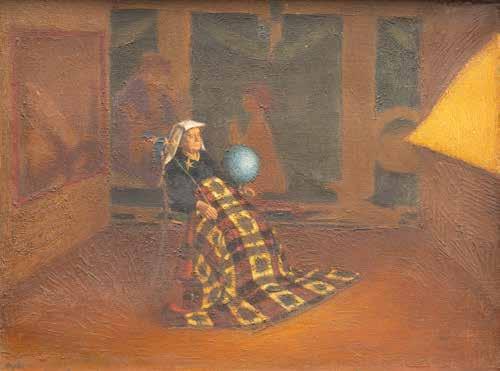
Giacco’s highly individual and even idiosyncratic technique represents the antithesis of this approach. It involves careful preparation and drawing, minute underpainting, and finally layers of glazes to achieve the rich subtlety of textures and colours we have already seen in the Archibald painting. But this work is, in reality, already something of a compromise between his strict early technique and some limited elements of a more conventional oil painting technique. If we look at even slightl y earlier works like the Saint Agatha (p.42), we can appreciate the full and quite radical effect of his strict approach: the picture is strikingly and almost hypnotically detailed and precisely articulated, and yet it has an uncanny and, as already suggested, ‘disembodied’ quality, which arises quite literally from the fact that his colours have no body. Opaque paint has body and substance; glazes are simply veils of chroma, in this case drawn across achromatic modelling.
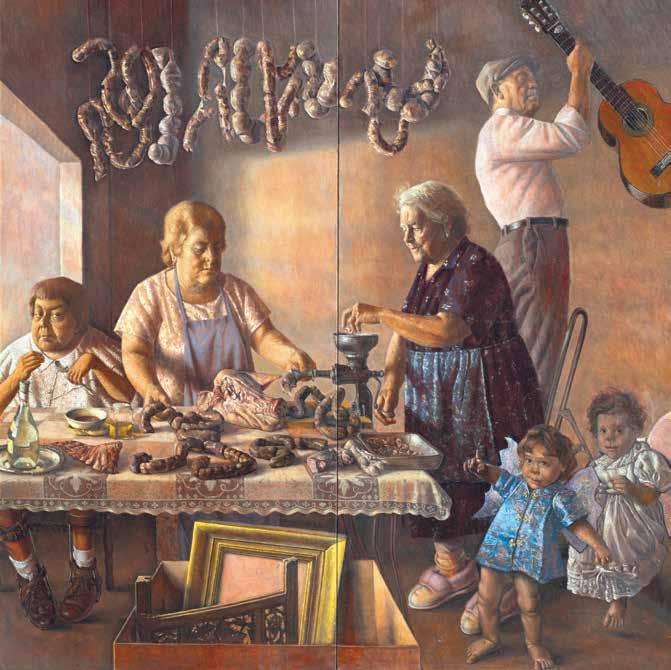
And this is, ultimately, the explanation for the dream-like unreality of Homage to John Reichard , for all its profusion of almost obsessively observed and precisely rendered detail. The technique he employs here has a little more solidity than the earlier work, but it is still ethereal and intangible compared to the pictorial effects we usually associate with oil painting. But if there is a certain tension here between apparent reality and dream-like elusiveness, Giacco took that tension to a much higher pitch in his Archibald finalist painting of the following year, Family portrait
8
The subject of this work is his Calabrian family, engaged in the most earthy and primal of ancient family traditions that had been carried on in many parts of Europe without interruption for centuries: the slaughtering of a pig early each winter and the curing and salting of every part of the animal to provide meat for the cold months ahead.
Here, the family is gathered around a table in the basement, with the artist’s mother and grandmother in the act of grinding all the smaller offcuts of the animal to make sausage. The table itself is covered with the grotesquely-twisted forms that will be hung up and dried. No words are exchanged in this dark visceral activity, carried out for hundreds of years by illiterate women, the same women who would have prepared the corpse of a deceased relative for burial. On the right Giacco’s father, an amateur musician, takes down his guitar, hinting at some dimension of transcendence of the gross materiality of the women’s work. On the left is his disabled sister, recalling in contrast a suffocating sense of imprisonment in the material. This is a painting in which Giacco confronts the existential reality of his Calabrian heritage, which takes symbolic form in the actual body of the pig, in all its material weight. He drives his subtle and dreamlike technique to confront, paradoxically, a world of brutal corporeality. As though betraying the stress inherent in this effort, the colour scheme of the painting is almost intolerably hot, and its smooth impassive surface erupts in places into patches of expressive impasto.
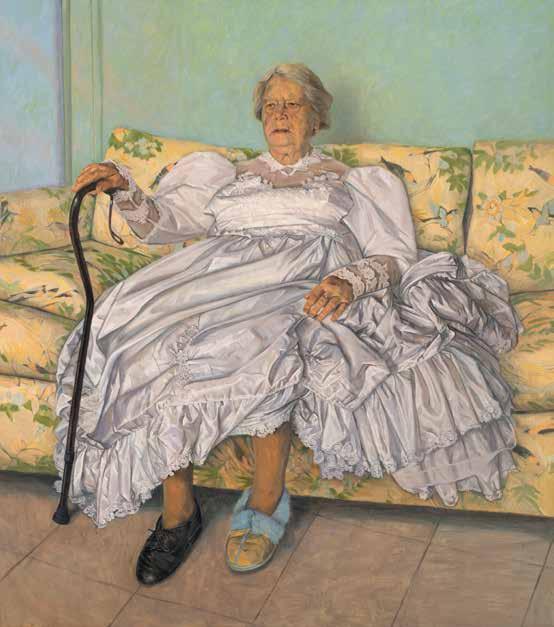
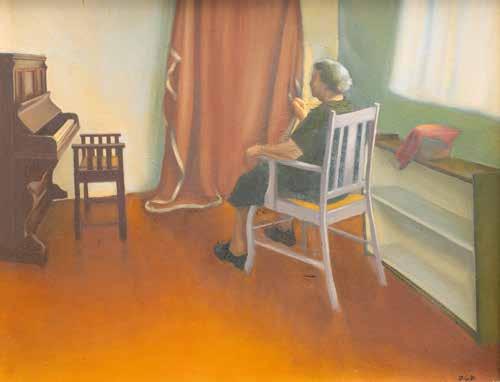
After the cathartic reckoning of this powerful but disturbing picture, Giacco adopts a more relaxed mode, a cooler palette and a more traditional oil painting technique in another remarkable work, a third study of his maternal grandmother. This large painting is calm and still, but it would be misleading to suggest that it is serene or happy. We are at once struck by the almost sinister contradiction of an old woman wearing a bridal dress, and her mismatched shoes only add to the sense of disquiet. She is, as the title of the picture tells us, a vedova bianca, a White widow (p.43). The expression was used in Calabria of girls who were left behind, usually soon after their marriage, by young husbands who went abroad to seek opportunity in the new world; once they had established themselves with a job and a home, they would send for their wives to join them.
Giacco’s grandmother, however, not long after bearing his mother, was left for what ended up being twenty-five years; a quarter of a century during which youth and joy slipped away, unable to remarry or take a lover, only to be sent for at last when already well into middle age.
There is, as already suggested, a distinct tension between Giacco’s practice of painting and the subject-matter that has been so important in some of his most memorable works. His artistic culture, highly refined and with its inspiration in the poetic lucidity of Sienese or Flemish painting of the early Renaissance, is in almost all respects completely alien to the earthy materiality of Calabrian life, barely changing for centuries, remote from any of the intellectual or spiritual ideas that have occupied the western mind from the early modern period to the present day. And yet for that very reason, he had to face and come to terms with that dark ancient heritage, and on the members of his family who were its living representatives.
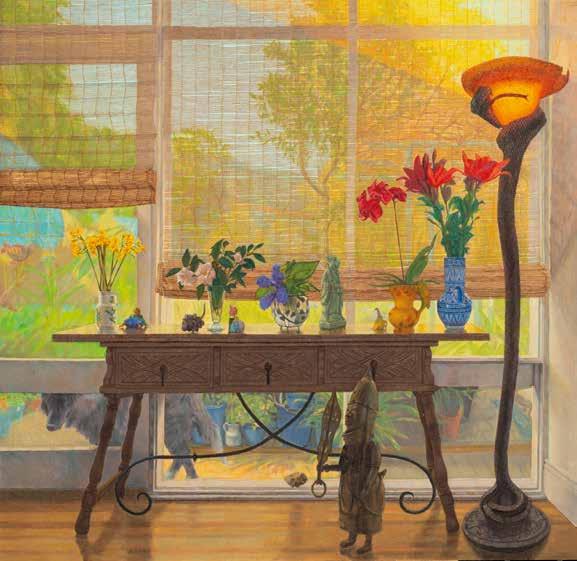
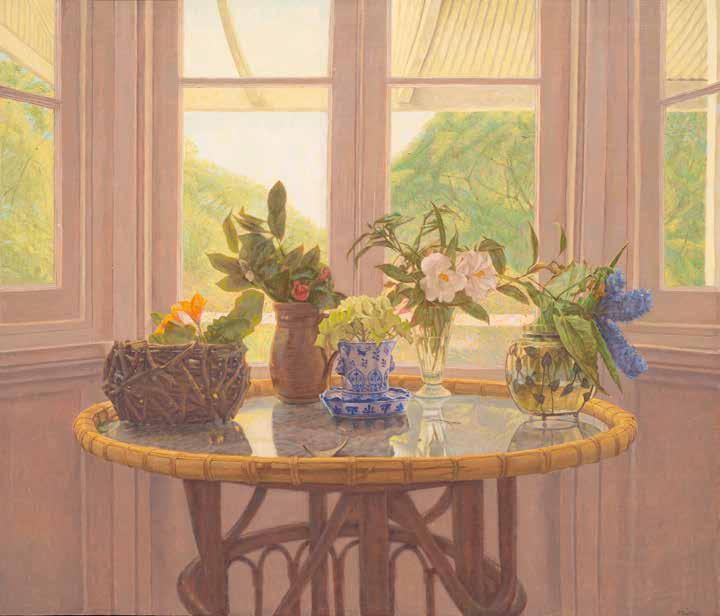
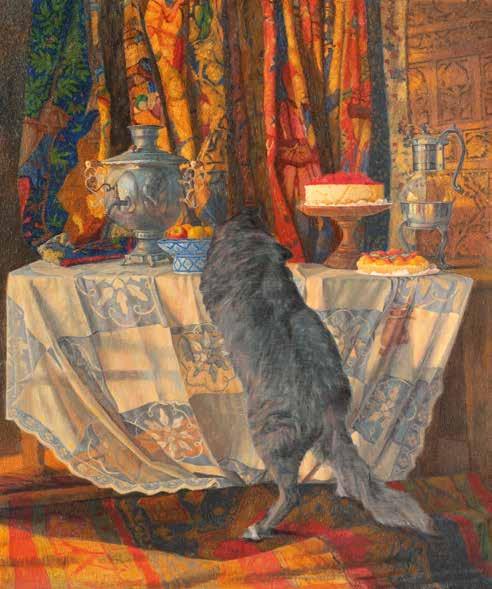
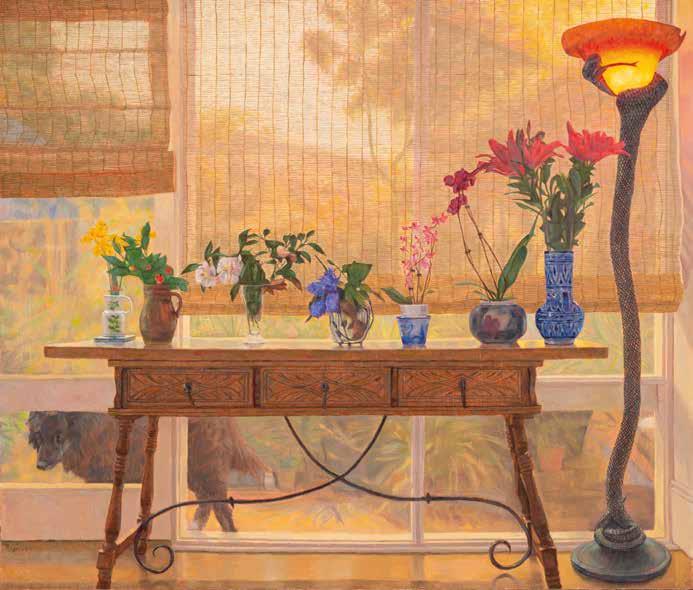
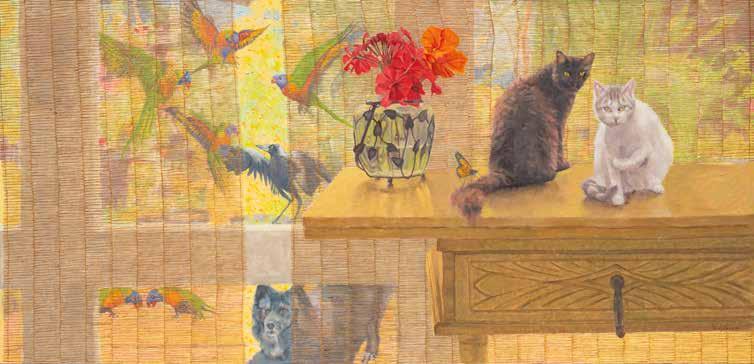
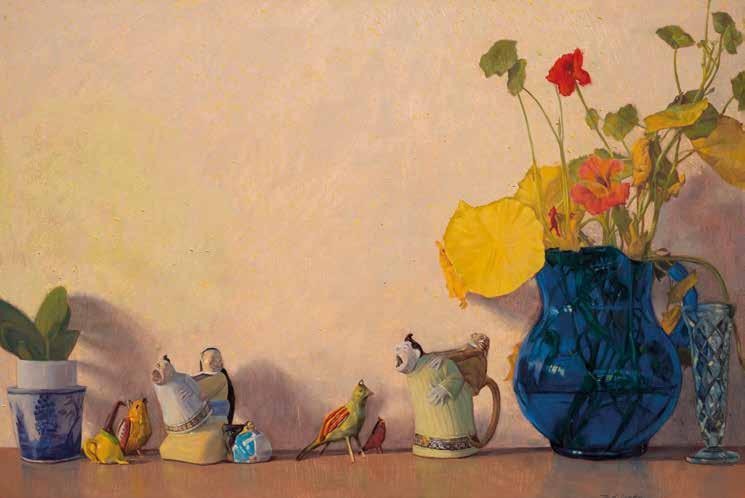
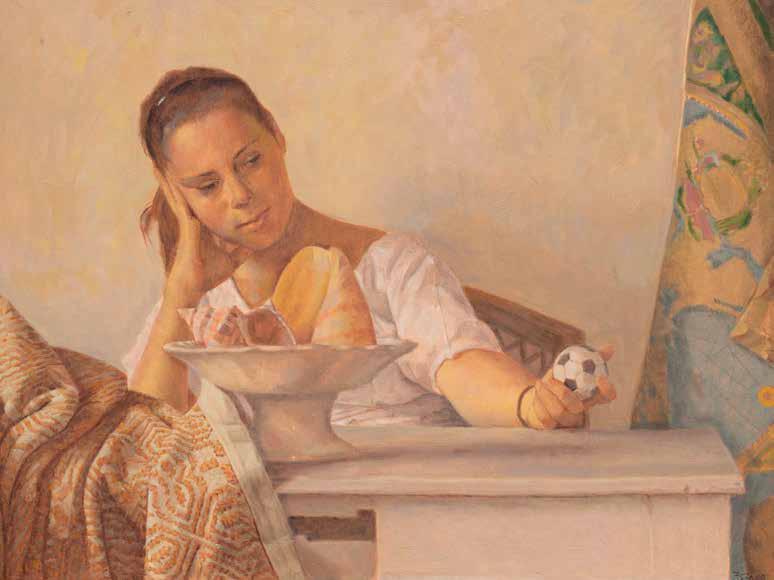
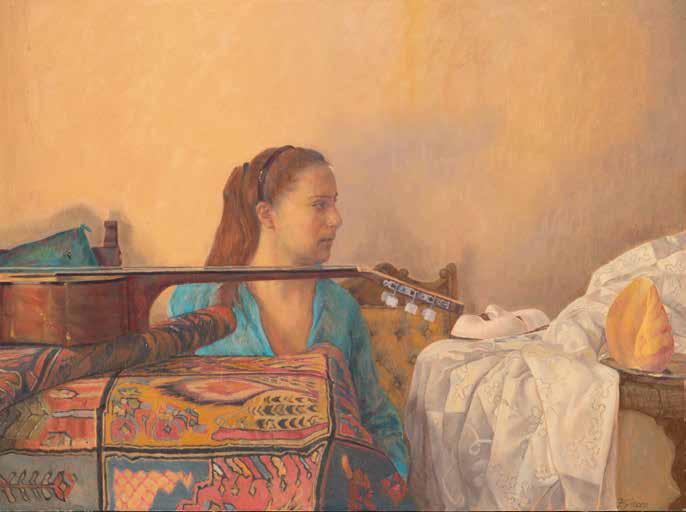
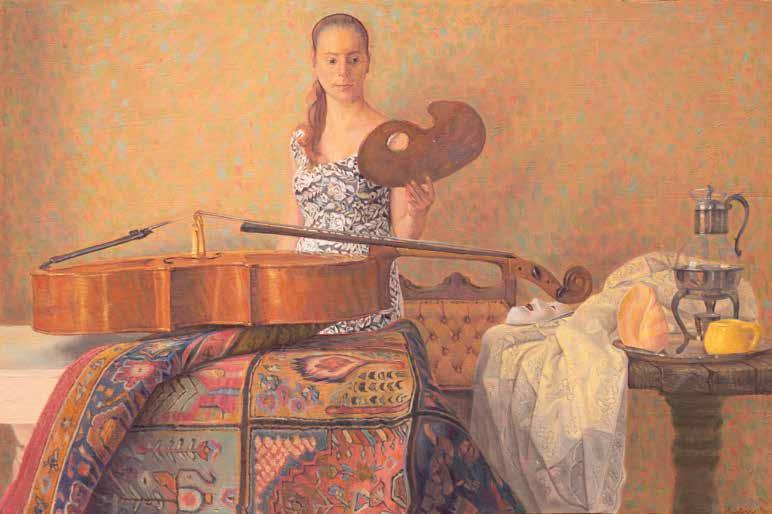
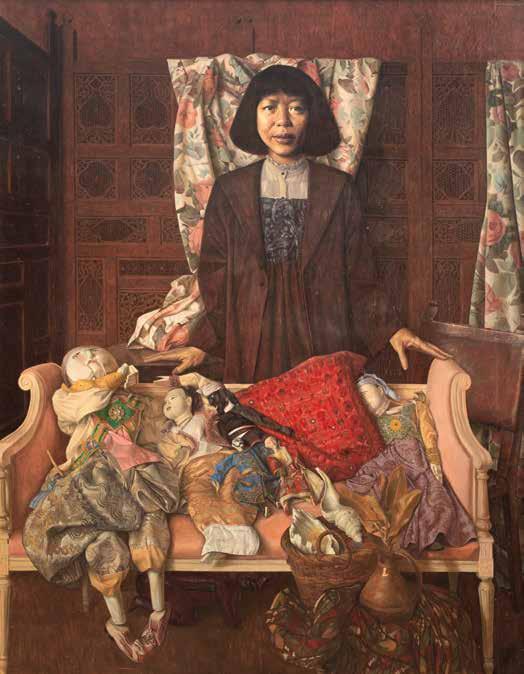
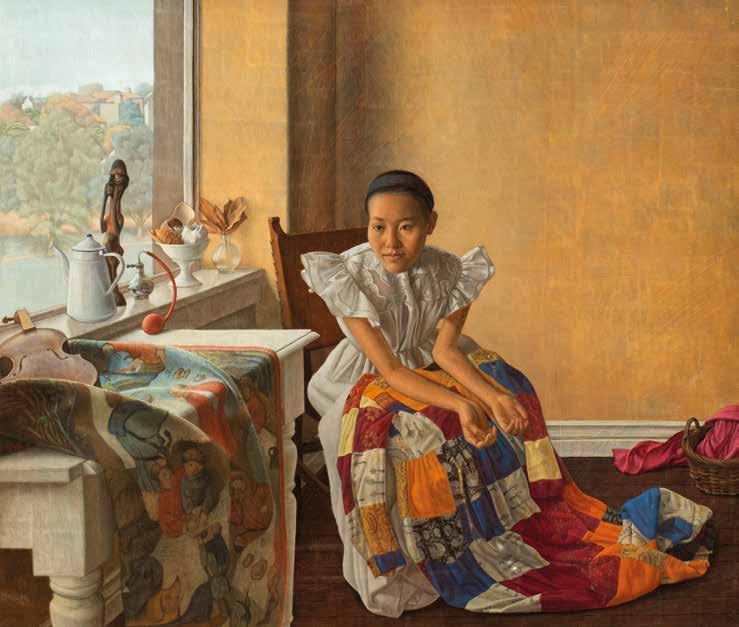
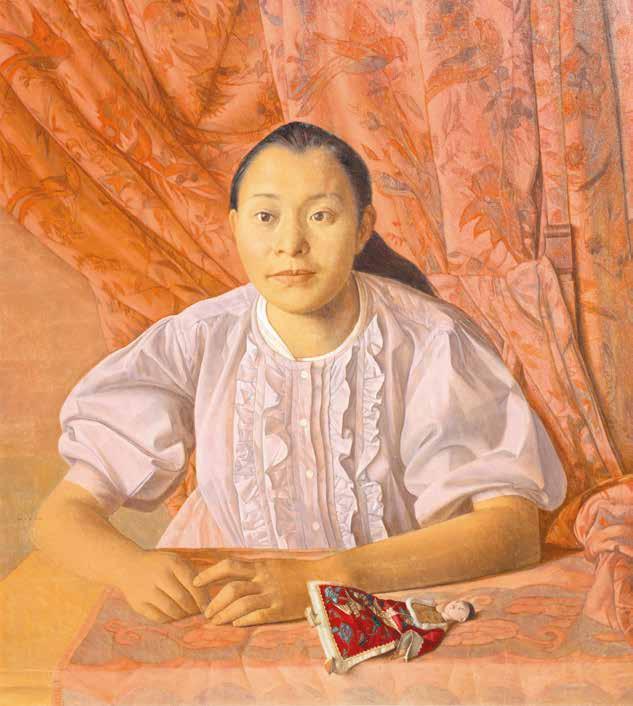
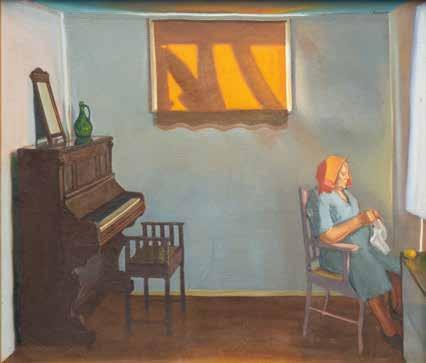
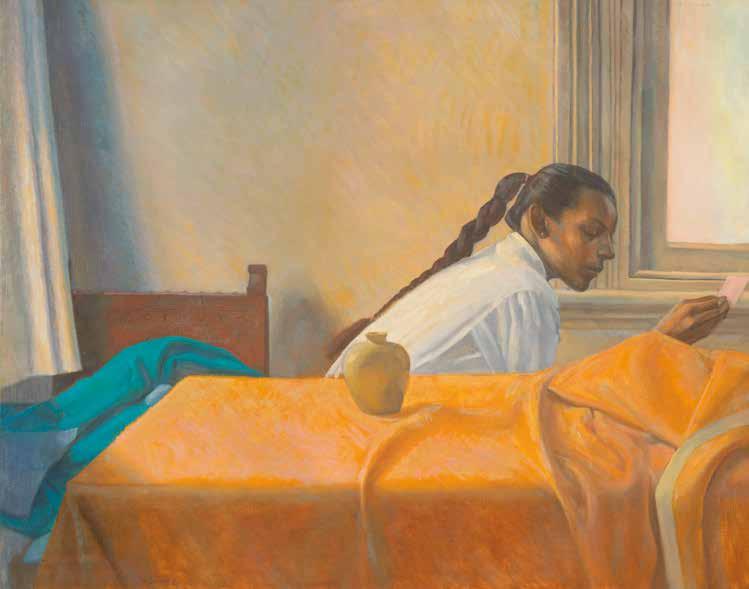
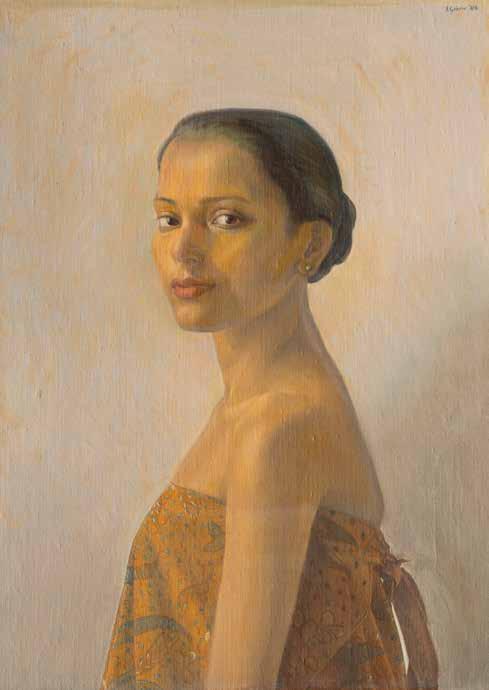
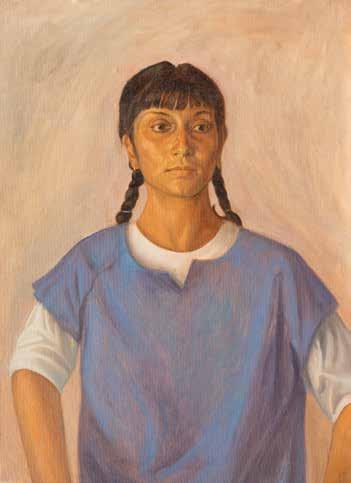
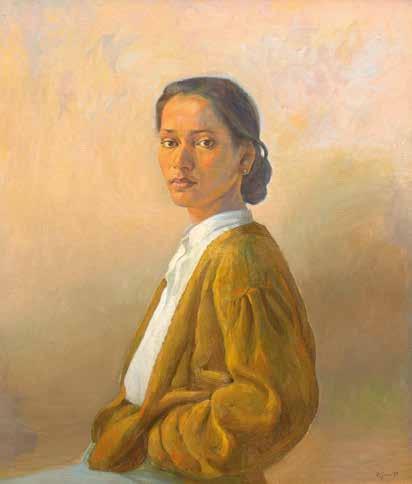
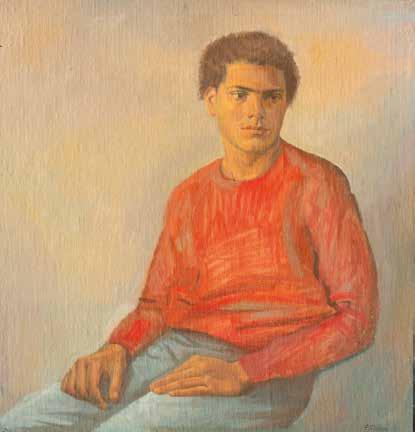
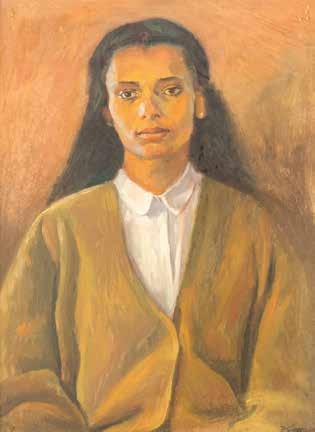
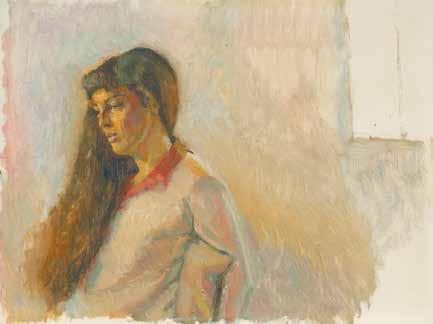
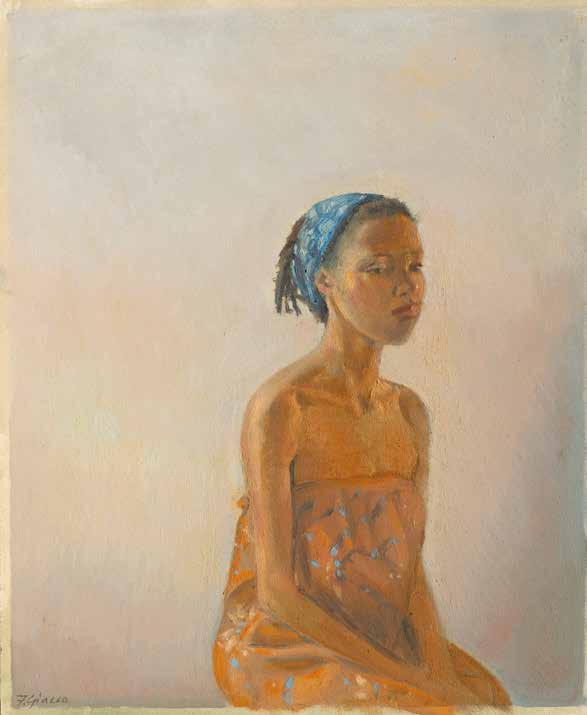
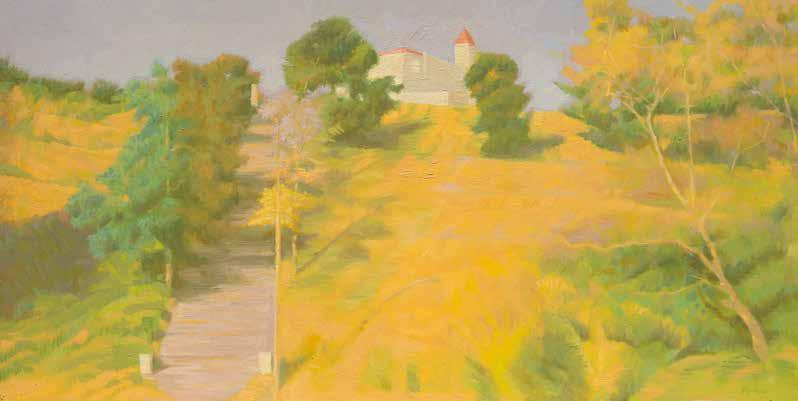
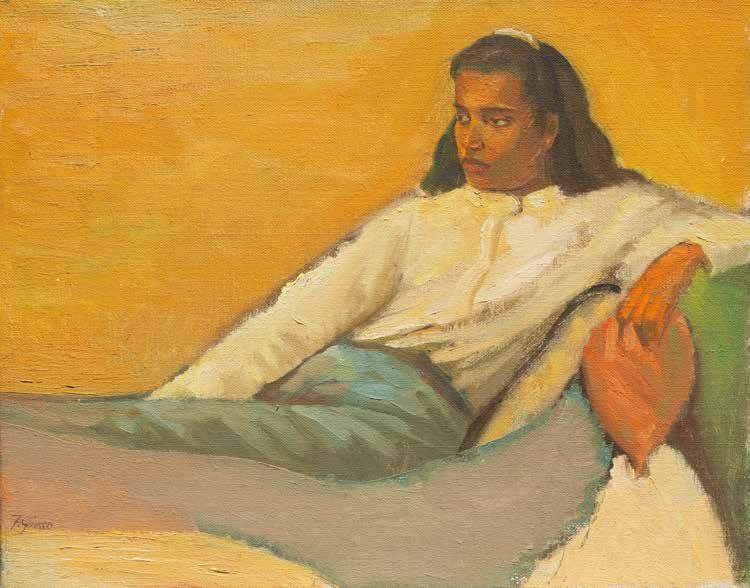
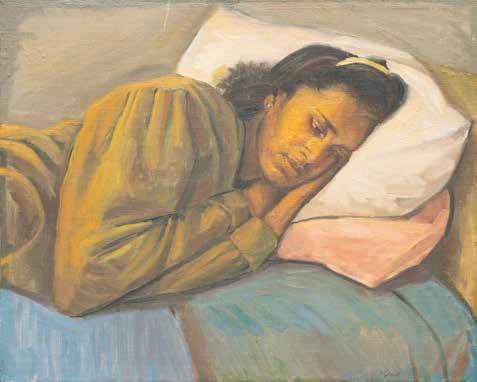
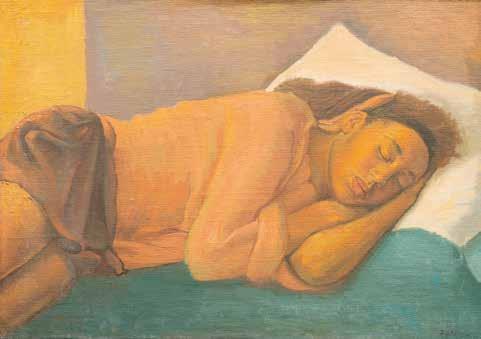
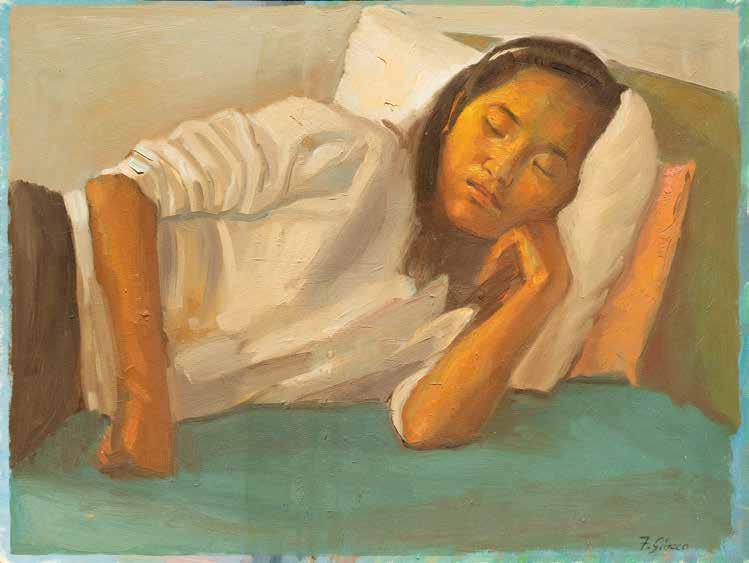
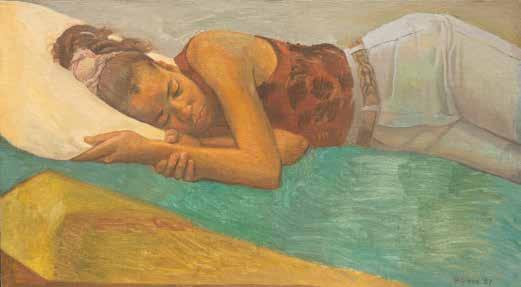
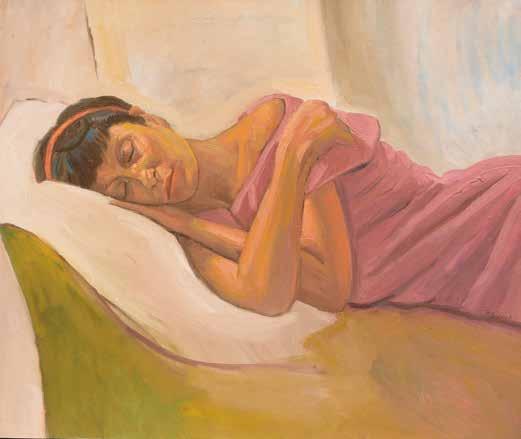
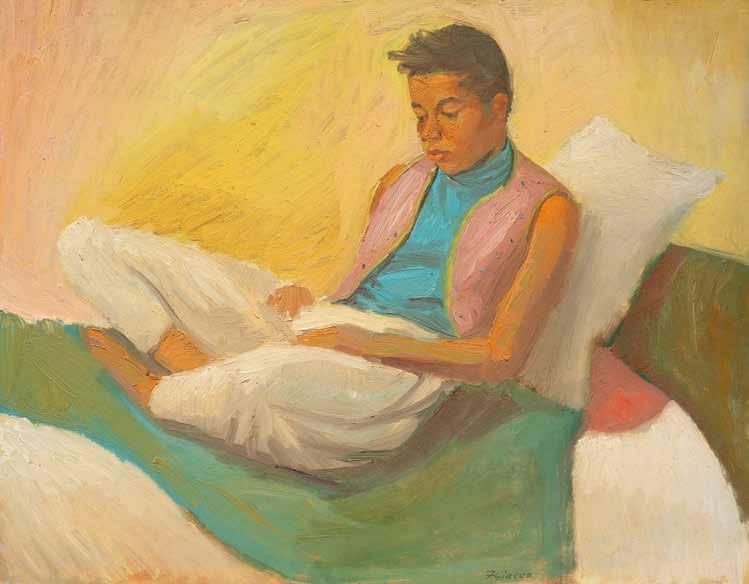
In his more recent paintings, Giacco still uses family members as subjects, but now the sitters are his daughters, educated and artistic young women with university degrees, who have been raised in his world of aesthetic culture; these girls, twins, appear as infants on the lower right of Family portrait , but have grown far from the intense and inarticulate world of that painting. And that is perhaps why the most recent pictures are imbued with a new kind of serenity and peace, in which Giacco is able to meditate on the qualities of visual phenomena without being burdened by moral and existential anxieties: to ponder the mutability of light, the ambiguities of figure and ground, and the inexhaustible pleasure, mystery and elusiveness of a world of appearances that can never be objectively known or definitively captured.
Christopher Allen
National Art Critic, The Australian April 2023
9
10
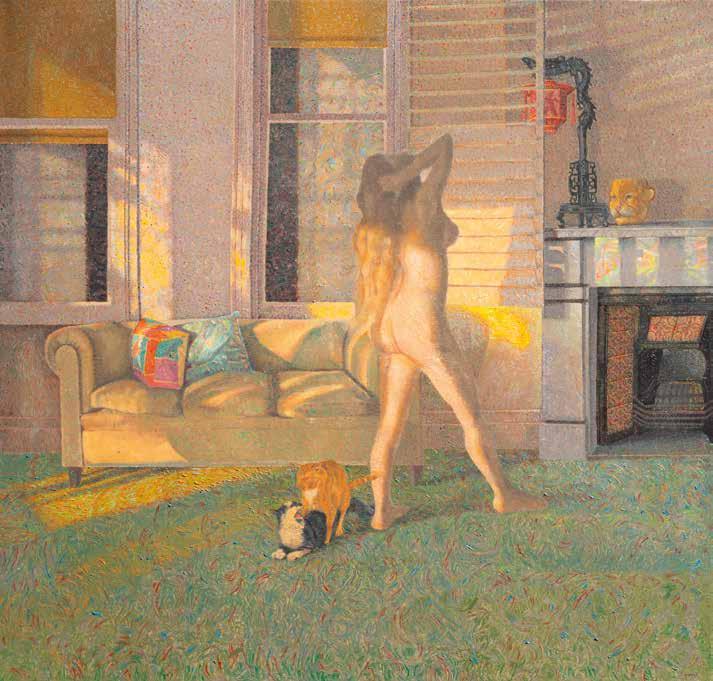
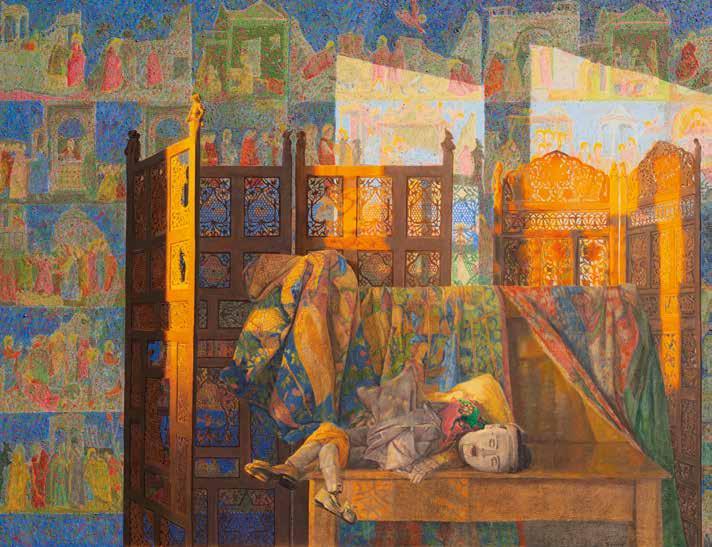
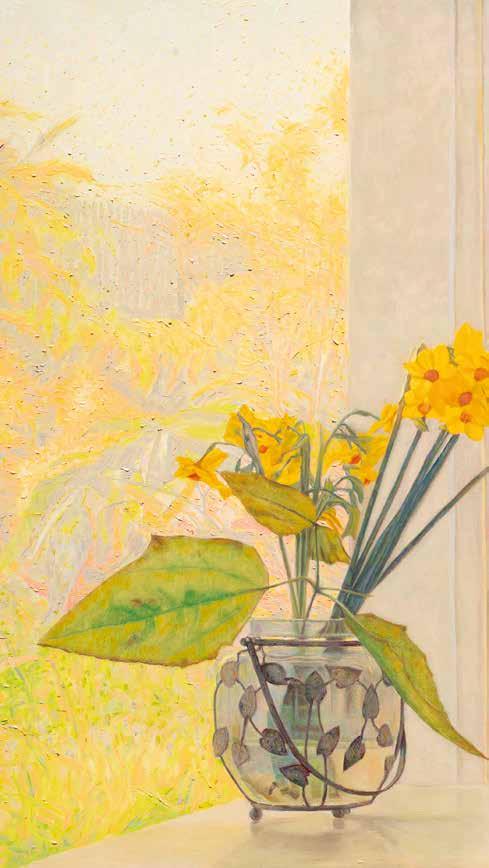
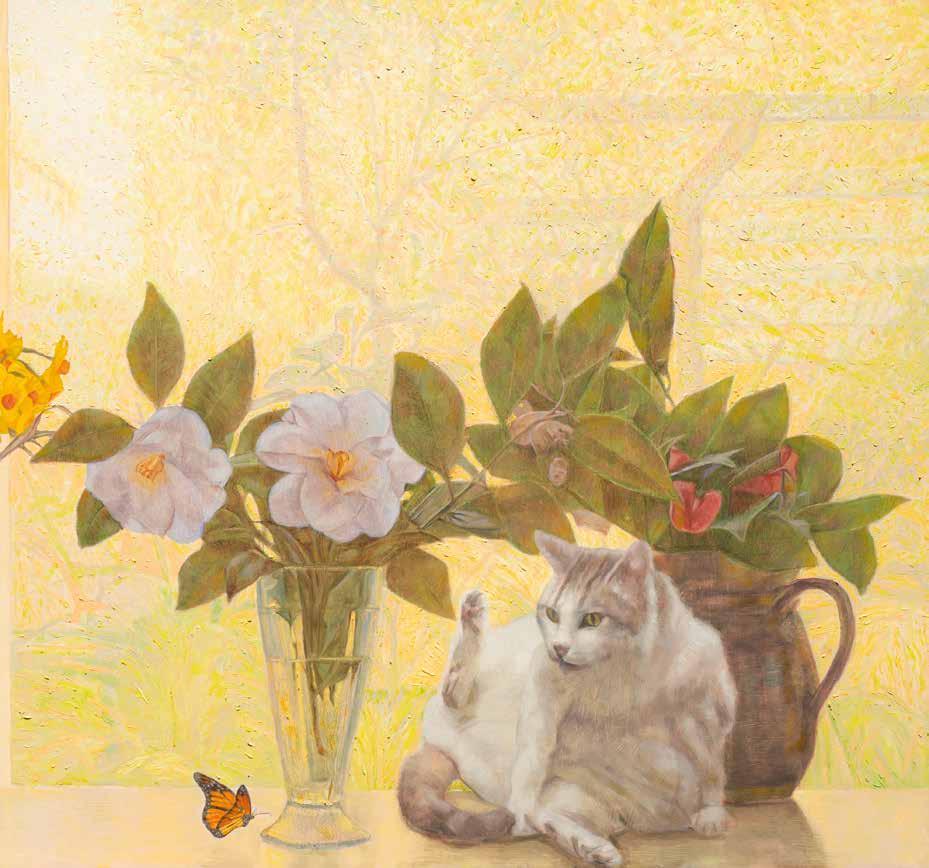
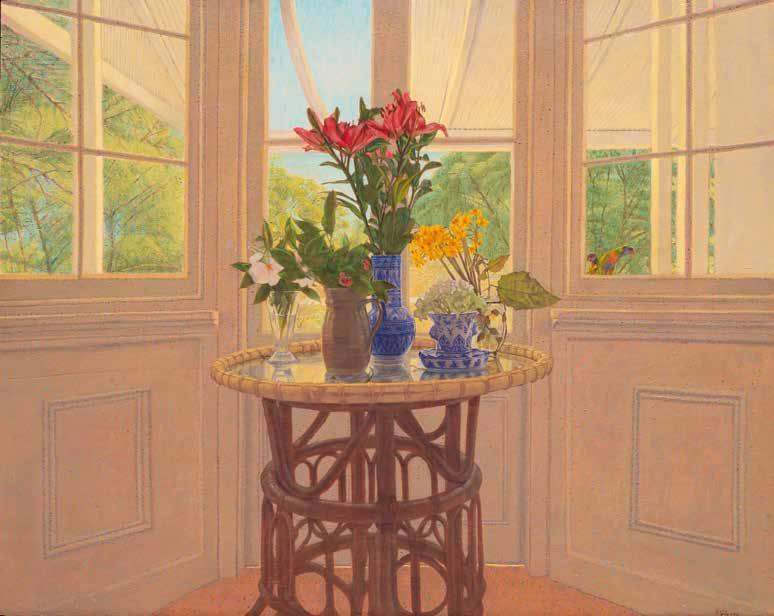
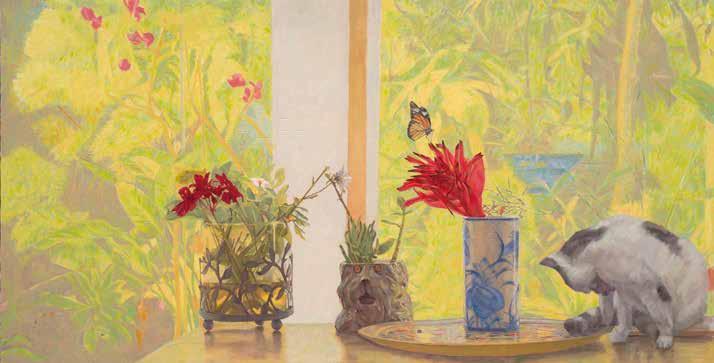
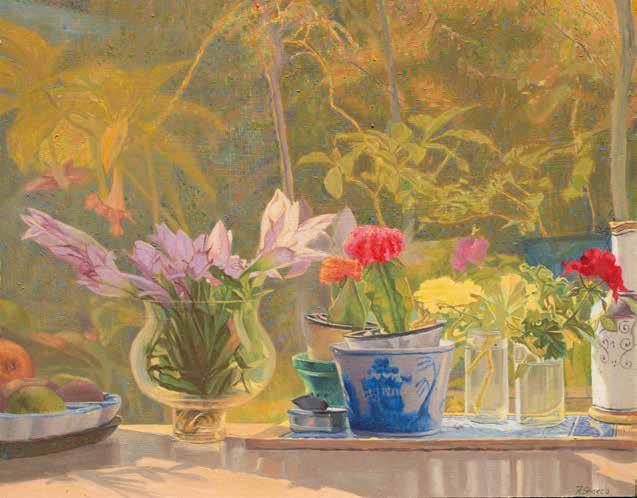
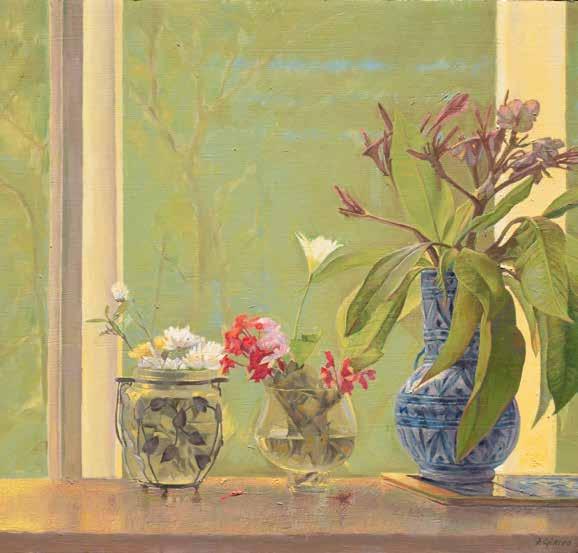
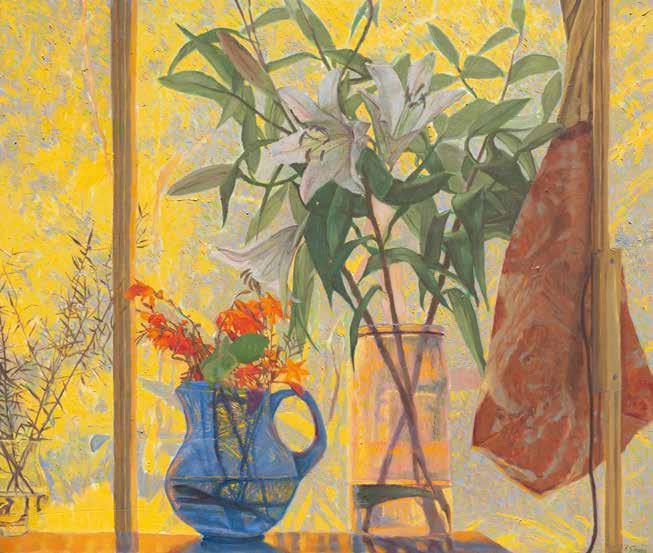
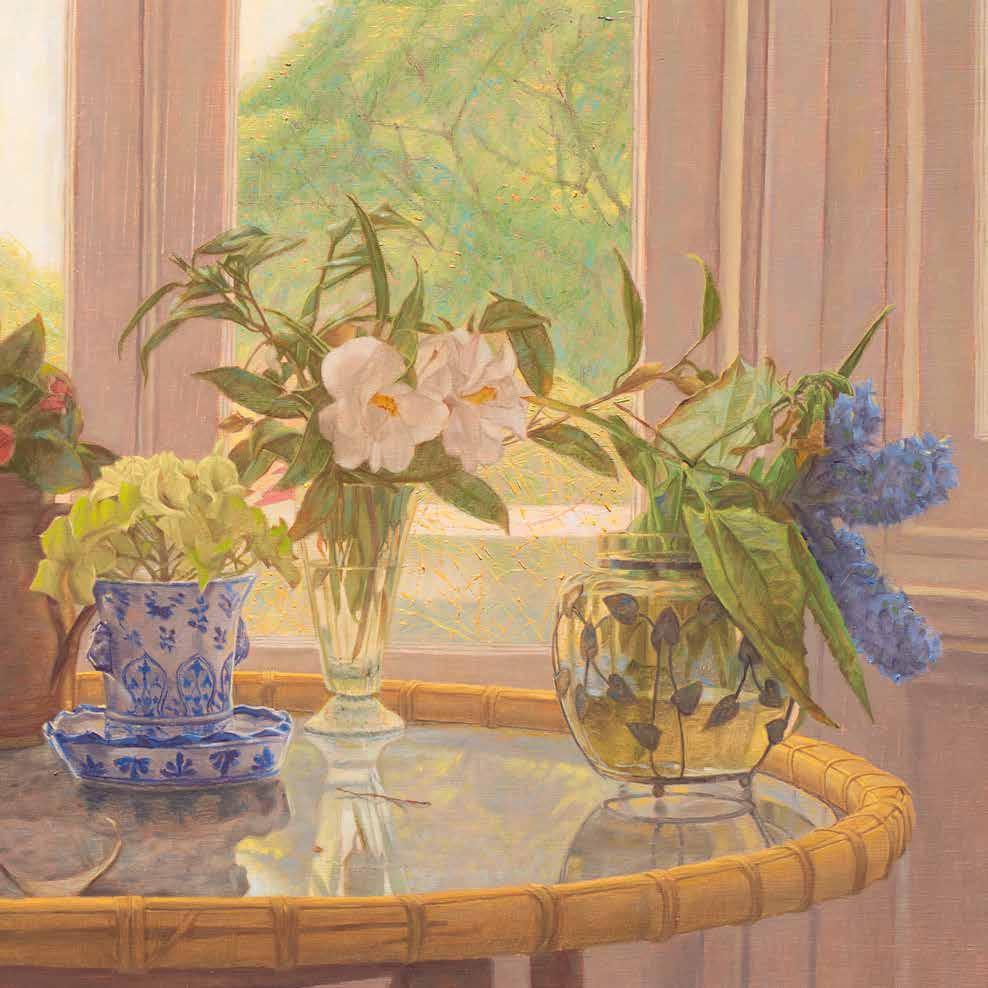
I remember waking up and seeing my primary school tie hanging on the bed post, it was grey with yellow and blue stripes.
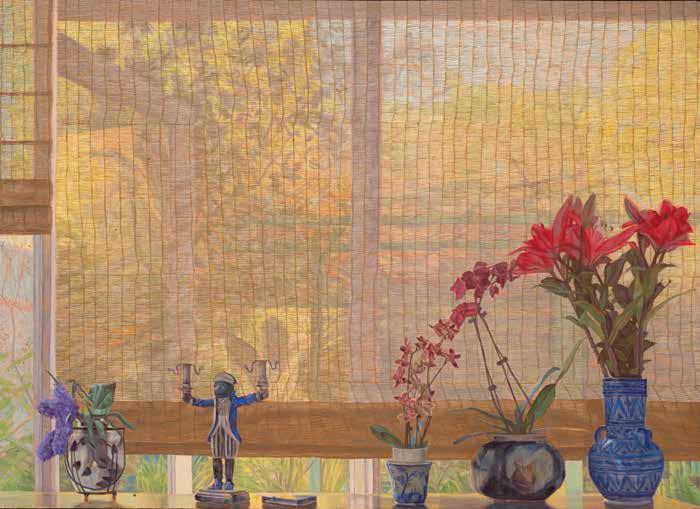
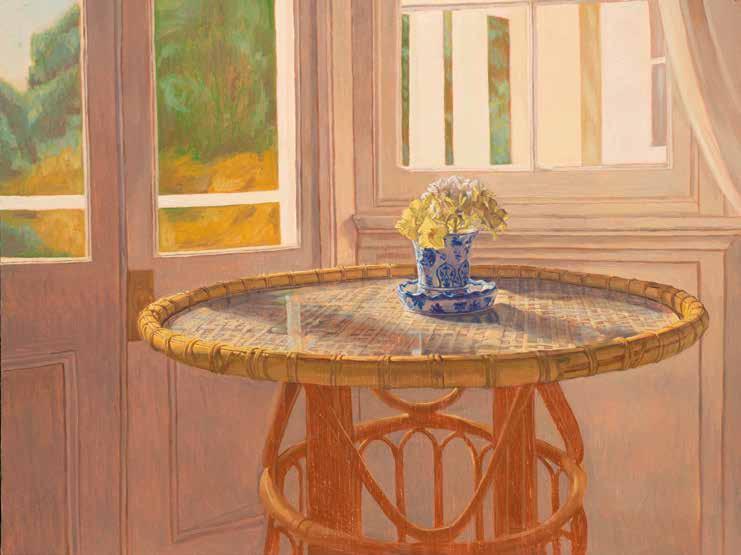
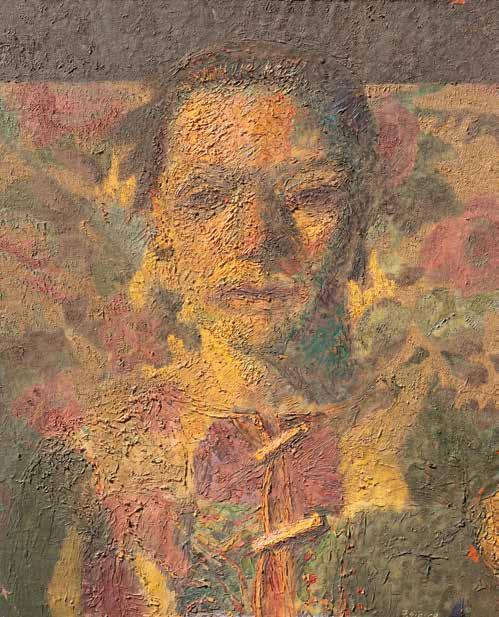
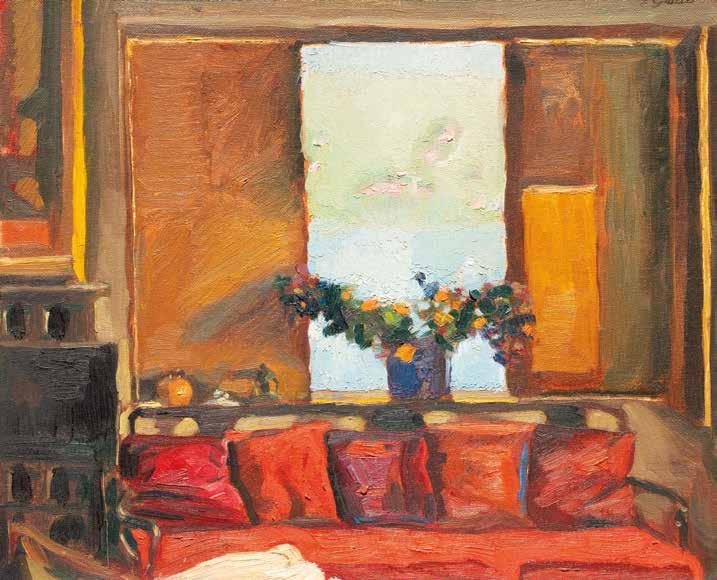
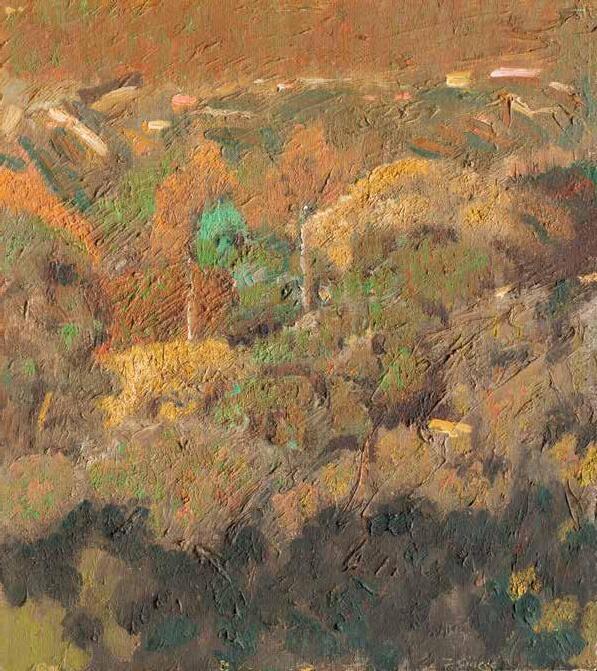
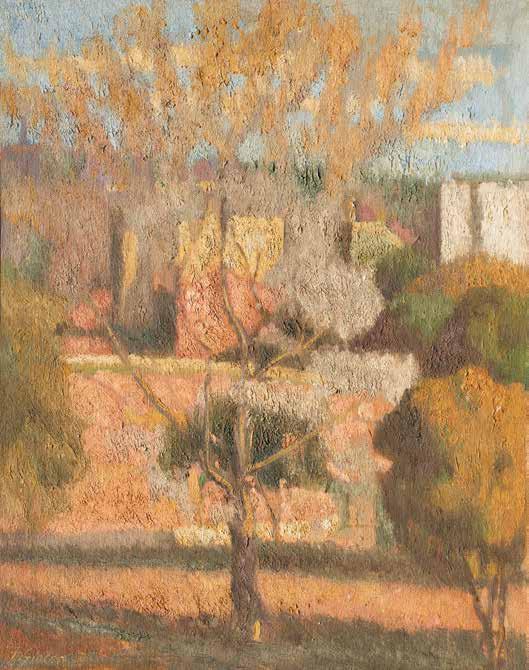
As the morning light came in the tie seemed to vibrate and dissolve into grainy, greyish particles, which gradually merged into the yellow, blue and grey colours.
I once read the joy of watching light bounce off the walls was like the joy of listening to music.
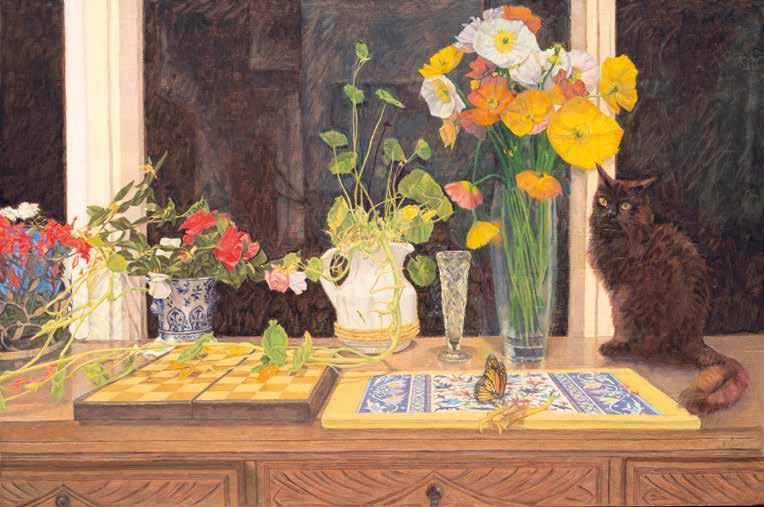
I’ve been studying and composing music most of my life and have composed a short, related piece of piano music for each of the recent paintings (these can be accessed by scanning the QR codes beneath each painting). The music is unedited and related to my current musical studies.
This show is dedicated to my family: Jenny, Anna, Sira, Helen and Renee Francis Giacco, 2023
11
Francis Giacco
Born 1955, Sydney, Australia
1973-76 Bachelor of Science (Architecture), University of New South Wales, Sydney
1976-80 Studied painting under Brian Dunlop and David Wilson
1980-83 Studied art at the Hochschule für Angewandte Kunst in Vienna with Professor Maria and Professor Fruhner
Travelled extensively studying art in Europe, especially Italy
1988-89 Travel and study in USA and Europe
SOLO EXHIBITIONS
2023 ‘Recent Work: Pictures at an Exhibition (apologies to Mussorgsky) with selected works from the 80’s and 90’s’, Australian Galleries, Sydney
2017 ‘Recent paintings’, Australian Galleries, Melbourne
2015 ‘For Gemma Giacco’, Australian Galleries, Roylston Street, Sydney
2013 ‘In memory of Brian Dunlop’, Australian Galleries, Roylston Street, Sydney
2011 ‘In Memory of My Father’, Australian Galleries, Derby Street, Melbourne
2008 Philip Bacon Galleries, Brisbane
2005 Eva Breuer Gallery, Sydney
2002 Tim Olsen Gallery, Sydney
1997 Philip Bacon Galleries, Brisbane
1996 Olsen Carr Art Dealers, Sydney
1995 Philip Bacon Galleries, Brisbane
1985 Robin Gibson Gallery, Brisbane
1984 Robin Gibson Gallery, Brisbane
1980 Prouds Gallery, Sydney
GROUP EXHIBITIONS
2015 ‘An exhibition of paintings, sculpture & works on paper’, Australian Galleries, Roylston Street, Sydney
2014 Eutick Memorial Still Life Award, Coffs Harbour Regional Gallery, Coffs Harbour, NSW
‘one of each’, Australian Galleries, Derby Street, Melbourne
2013 ‘Ukulele Exhibition’, Gallery East, Sydney
‘Australian Galleries at Gallows Gallery’, Gallows Gallery, Perth
2011 ‘large exhibition of small works’, Australian Galleries, Roylston Street, Sydney
‘large exhibition of small works’, Australian Galleries, Derby Street, Melbourne
104
2010 Shirley Hannan National Portrait Award, Bega Valley Regional Gallery, Bega, NSW
Doug Moran National Portrait Prize, State Library of New South Wales, Sydney
2009-10 ‘Mosman Art Prize Winners’, Mosman Art Gallery, Sydney
2008 Shirley Hannan National Portrait Award, Bega Valley Regional Gallery, Bega, NSW
2003 ‘Portrait Artist Australia Exhibition’, Arthouse hotel, Sydney
Hills Grammar Art Prize, Hills Grammar, Sydney
2002 Opera Australia Vintage Wine and Gourmet Auction, Sydney
‘Portrait Artists Australia Exhibition’, Arthouse hotel, Sydney
2001 ‘Portraits 2001, An Australian Odyssey with Gloria Dobrowolska’
Doug Moran National Portrait Prize, State Library of New South Wales, Sydney
1997 Salon des Refusés (Peoples Choice winner), S.H. Ervin Gallery, Sydney
1996 Opera Australia Vintage Wine and Gourmet Week Auction, Sydney
Kings School Art Prize, Kings School, Sydney
Mosman Art Prize (Winner), Mosman Art Gallery, Sydney
1995 Charles Hewitt Gallery, Sydney
Hills Grammar Art Prize (Winner), Hills Grammar, Sydney
Archibald Prize, Art Gallery of New South Wales, Sydney
1994 Archibald Prize (Winner), Art Gallery of New South Wales, Sydney
Doug Moran National Portrait Prize, State Library of New South Wales, Sydney
1993 Archibald Prize, Art Gallery of New South Wales, Sydney
1992
Doug Moran National Portrait Prize, State Library of New South Wales, Sydney
1991 Salon des Refusés, S.H. Ervin Gallery, Sydney
Blake Prize, Sydney
1985 Jupiter Casino, Gold Coast, QLD
1984 Australian Galleries, Melbourne
1977 380A Gallery, Sydney
1976 Macquarie Galleries, Sydney
PRIZES
2014 Glencore Percival Portrait Painting Prize (Winner), Perc Tucker Regional Gallery, Townsville, QLD
Eutick Memorial Still Life Award (Winner: People’s Choice), Coffs Harbour Regional Gallery, Coffs Harbour, NSW
2013 Mortimore Art Prize (Finalist), Australian Art Sales, Sydney
1997 Salon des Refusés (People’s Choice winner), S.H. Ervin Gallery, Sydney
1996 Mosman Art Prize (Winner), Mosman Art Gallery, Sydney
1995 Hills Grammar Art Prize (Winner), Hills Grammar, Sydney
1994 Archibald Prize (Winner), Art Gallery of New South Wales, Sydney
105
COLLECTIONS
Art Bank, Sydney
Columbia University, Washington DC
Commonwealth Bank, Australia
Mosman Art Gallery, Sydney
Perc Tucker Regional Gallery, Townsville, QLD
University of New South Wales, Sydney
University of Sydney, Sydney
PORTRAITS AND COMMISSIONS
Anna Waldman, Australian Council for the Arts, Sydney
Gosia Dobrowolska, internationally renowned actor
Hindley International Hotel, Mural, Adelaide
John Laws
Lee Lin Chin, SBS Newsreader
Mr and Mrs Harper, Allen & Hemsley
Professor Druttman, first female judge in Israel
Professor George Smith, Professor of Law, Columbia University, Washington DC
Professor Salsbury, Sydney University, Sydney
R. Penprase, Civic Theater Townsville, QLD
Reverend Clyde Paton, Principal of St Andrews College, University of Sydney, Sydney
Sanctuary Cove Resort, Painting series, Gold Coast, QLD
Sebel Town House, Paintings, Mirvac, Australia
Shirley Sinclair, wife of the New South Wales Governor, Sydney
Sir Anthony Mason, Chancellor, University of New South Wales, Sydney
St James Building, Mural, “Spirits of St James”, Sydney
Teresa Haremza, internationally renowned singer/actor
106
Vale
Dorothy Giacco
Louise Giacco
Dianne Geffen
Stephen Nordon
With thanks
Christopher Allen
Greg Weight
David Stein
Mitchell Brown
Maria Stoljar
Stuart Purves, Erin Stapleton, Saskia Vranken, Alexandra Hlynka, Stephanie Hall
107
108 FRANCIS GIACCO 9 780648 116295 > ISBN 978-0-6481162-9-5 SYDNEY: Roylston Street 02 9360 5177 MELBOURNE: Derby Street 03 9417 4303 Stock Rooms 03 9417 2422 enquiries@australiangalleries.com.au australiangalleries.com.au Design and Production by Publications A USTRALIAN G ALLERIES