Austin Seminary • Winter 2025
Discovery Weekend AT AUSTIN SEMINARY
March 13 - 15, 2026 GENEROUS FINANCIAL AID
AFFORDABLE HOUSING
RENOWNED FACULTY AFFIRMING
COMMUNITY
CENTRAL
LOCATION
Embrace Your Calling
Scan the QR code or visit www.austinseminary.edu/admissions to register today!
Winter 2025
Volume 141 | Number 1
2
Message from the President
4
Living Sin Fronteras: Austin Seminary’s New MDiv for a Changing Church
6 8
My Journey to Turkey and Greece My Palestine Reflection
10
Alumni Story: Living the Gospel at the Borderlands: Three Alumni Share Their Ministry Journeys
12
Donor Story: Bridging Borders, Building Leaders: Why Your Support Matters
13
Program Spotlight: Building Bridges For the Next Generation
16
From the Archives: A Brief History of Austin Seminary and Its Developing and Changing Identity as a Borderlands Institution
17
Faculty Spotlight: Austin Seminary Faculty Discuss Borderlands Curriculum
20 21 22
Faculty Books Upcoming Opportunities It’s a Brand New Day at Austin Seminary!
Windows is published two times each year by Austin Presbyterian Theological Seminary. To read prior issues, go here: AustinSeminary.edu/windows Austin Seminary Windows Austin Presbyterian Theological Seminary 100 E. 27th St. Austin, TX 78705-5711 phone: 512-404-4808 e-mail: marcom@austinseminary.edu
Follow Us
@austinseminary
austinseminary.edu ISSN 2056-0556; Non-profit bulk mail permit no. 2473 | Printed on recycled paper
Winter 2025 | 1
A MESSAGE FROM THE PRESIDENT
B
orders serve as both physical boundaries and mental constructs that shape how we perceive the world, dividing it along lines of race, ethnicity, religion, political ideologies, and other marks of both imagined and factual differences. As geographical borders worldwide become more rigid through exclusionary policies and immigration enforcement regulations, “border thinking” has become a key factor in the social divisions we face today. This divisiveness has seeped into otherwise relational communities, such as families and churches, with undesirable results. As we aim to prepare responsive church leaders for today’s challenges and given its proximity to the U.S.-Mexico border, Austin Seminary recognizes the importance of engaging in this conversation by becoming a seminary in the borderlands, where “border thinking” is explored and analyzed to develop ministerial practices that promote empathy, inclusion, broadmindedness, and solidarity. While borders create walls and controlled entry points, the borderland is a broader space where differences are examined alongside similarities, adaptations, and the blessings and challenges of mutuality.
While borders create walls and controlled entry points, the borderland is a broader space where differences are examined alongside similarities, adaptations, and the blessings and challenges of mutuality. For this reason, the Seminary’s new affirmation of this borderland identity seeks to foster a community of bridge builders—Christian leaders capable of navigating social divides to mend broken relationships and restore the sense of communion that the Church is called to uphold. With this commitment, Austin Seminary will focus on developing leaders who transcend boundaries, build bridges, and address the evolving needs of today’s ministry, for the topography of God’s reign is seamless, incapable of stopping divine Grace at any border. The articles in this Windows edition show that the commitments to being a seminary in the borderlands are not merely aspirational; they profoundly shape our current curriculum, partnerships, and initiatives. I believe that by reading these articles and stories, you will feel inspired to join our journey into the ever-changing and uncertain territory of a borderland, where we are challenged to accept that the God we seek to know is, and will forever remain, our greatest mystery. A mystery we might catch a glimpse of if we dare to welcome—honestly and wholeheartedly—the soul-stirring presence of one another. Faithfully yours,
José R. Irizarry President 2 | Austin Seminary
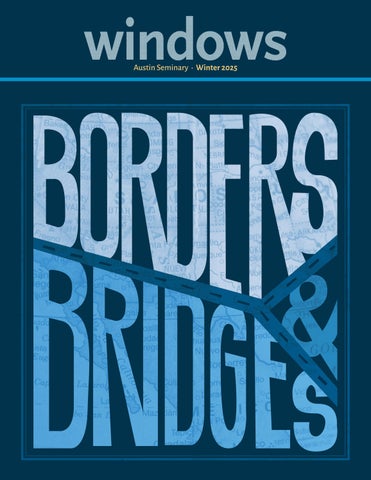
Borders and
BRIDGES
MASTER OF DIVINITY CURRICULUM This curriculum prepares “people for ordained Christian ministry and other forms of Christian service and leadership” who wrestle with the biblical, theological, and ministerial implications of Christian ministry in a liminal space, a space of questionable borders and missing, needed bridges. 78 CREDIT HOUR DEGREE 90% TUITION GRANTS AVAILABLE 10 COMPREHENSIVE FELLOWSHIPS
& ADDITIONAL SCHOLARSHIPS
The Borders and Bridges MDiv is also offered through our dynamic dual-degree pathways: MDIV / MSSW
MDIV / MBA
Master of Divinity (MDiv) & SOCIAL WORK (MSSW) WITH THE UNIVERSITY OF TEXAS AT AUSTIN
Master of Divinity (MDiv) & BUSINESS ADMIN. (MBA)
WITH SCHREINER UNIVERSITY
LEARN MORE AT WWW.AUSTINSEMINARY.EDU
Winter 2025 | 3
F E AT U R E A R T I C L E
Living Sin Fronteras: Austin Seminary’s New MDiv for a Changing Church by Rev. Dr. Margaret Aymer
“To survive the Borderlands / you must live sin fronteras / be a crossroads.” --Gloria Anzaldúa, “To Live in the Borderlands”
I
n 2024, as part of our ongoing pattern of curricular assessment, the faculty of Austin Seminary approved a new Master of Divinity (MDiv) program, which began this academic year (2025-26). At 78 credit-hours, the program better aligns with the size and scope of MDiv programs nationally. Additionally, we have added a distinctive to our program: the theme of Borders and Bridges. First-year students are required to take a January term intensive: “The World, God, and Self in the Borderlands,” which will involve them in a cross-cultural exploration of some form of borderlands, whether at the US-Mexico border or in some other setting. In their final year, students must take courses with the theme “Borders and Bridges” from across the departments of the Seminary. They will choose one from each department: Biblical Studies, Theology, Ethics and History, and The Church and its Ministries. Additionally, they will take a required Borders and Bridges course on Ministerial Leadership. Since 1902, Austin Seminary has considered its geographic location near the US/Mexico border as central to its identity. As early as the 1920s, the Seminary offered courses in Spanish, and it was one of the earliest educators of Latine Presbyterian pastors. The choice of this theme recalls our heritage as a seminary in a geographic borderland and names a reality we see for the church and the nation in the mid-21st century. More than ever, the mainline church finds itself
outside of the center of power and pushed toward the borderlands of society, to places ripe with tension and with the possibility for creative response. Borders and Bridges thus both names a geographic and political reality as well as a metaphoric description of the world and church in this season of ministry. The Borders and Bridges theme builds upon Austin Seminary’s mission in at least three ways. By focusing on borderlands, we hope that this
The Reverend Dr. Margaret Aymer serves as vice president for Academic Affairs and dean of faculty, and is the First Presbyterian Church, Shreveport, D. Thomason Professor of New Testament Studies. Aymer teaches core courses on the Introduction to the New Testament, Exegesis, and Greek, as well as elective courses in various disciplines, including African Americans and the Bible, and feminist and womanist biblical interpretation. She became Academic Dean at Austin Seminary in 2022—the first woman and the first person of color to hold that position. Aymer has published four books: First Pure, then Peaceable: Frederick Douglass Reads James (T&T Clark, 2008), Fortress Commentary on the Bible (with Gale A. Yee, Fortress Press, 2014), James: Diaspora Rhetorics of a Friend of God (Sheffield Publishing, 2014), and Islanders, Islands and the Bible: Ruminations (Semeia Studies, 2015; with Jione Havea). 4 | Austin Seminary
theme better equips students who enter ministry during this fraught time to understand and name the contours of the borderlands in which they find themselves and to be bridge-builders within that space, makers of God’s peace and heralds of God’s justice. Changes in church and society necessitate those who can work with creativity and love in borderland spaces and build meaningful relationships and bridges between warring parties. Second, we intend, with this theme, to invite students to engage a range of voices – consonant and dissonant – as they seek to learn to be creative bridge-builders. Finally, we hope this theme will help students better learn how to build community, both here on campus and in the ministries to which they are called. The theme also responds to the first goal of the
Seminary’s strategic plan: to form interculturally proficient graduates. Seminary itself is a kind of borderland, a borderland between the academy and the church, a waystation between the call and professional ministry in which God’s people gain some of the formation they need to respond to that call. Our hope is that, with our new Borders and Bridges theme, we signal to current and prospective students that at Austin Seminary, they will examine their own contexts, face their own prejudices and presuppositions, their walls and fences. Here, they will challenge the certainties of their ancestors of faith. And here, they will find that God’s grace always builds bridges and sets tables amid the borderlands.
“
Our hope is that, with our new Borders and Bridges theme, we signal to current and prospective students that at Austin Seminary, they will examine their own contexts, face their own prejudices and presuppositions, their walls and fences.
Winter 2025 | 5
My Journey to Turkey and Greece by Gary Renfro MDiv Senior
Master of Divinity student Gary Renfro reflects on his experience as a participant in a travel seminar led by Austin Seminary Professor Dr. Rod Caruthers and Seminary of the Southwest Professor Dr. Jeehei Park. This truly was the trip of a lifetime. Austin Presbyterian Theological Seminary partnered with our neighbors at Seminary of the Southwest for a remarkable journey through Turkey and Greece. This collaborative pilgrimage was thoughtfully led by Dr. Jeehei Park, assistant professor of New Testament at Seminary of the Southwest, and Dr. Rod Caruthers, assistant professor of New Testament at Austin Seminary. Our traveling cohort consisted of 18 participants, including four of us from Austin Seminary. The purpose of this 12-day journey was to give us a perspective of the lands and cultures where the early church took root and Christianity began to spread. Dr. Park coordinated a well-organized itinerary that covered food, lodging, and transportation. Our journey began with a 14-hour flight from Austin to Amsterdam, and then on to Istanbul. We explored the ruins of ancient cities and historical sites such as Ephesus, Sardis, Pergamon, Assos, Philippi, Thessaloniki, Delphi, Corinth, and Athens. Some of the highlights for me included: • • • • • • •
Visiting the Hagia Sophia and Blue Mosque in Istanbul Exploring the ancient ruins of Ephesus, including the Bouleuterion Theatre and the Library of Celsus Standing at the Temple of Athena, perched atop a mountain overlooking the Aegean Sea Touring the Monastery of Latamos in Thessaloniki with its 5th-century mosaic of a beardless Jesus Visiting the presumed site of Paul and Silas’ imprisonment in Philippi Gazing upon the Monastery of the Holy Trinity in Kalampaka, Greece Walking through the ruins of Corinth and ascending to the Acropolis in Athens
What struck me most was the breathtaking architecture and craftsmanship, especially the artistry of the Muslim mosques in Istanbul and the early Christian church structures. The dedication, engineering brilliance, and cultural ingenuity that went into building the huge stone temples, theaters for public discourse and amusement, as well as bustling marketplaces, were truly amazing. As I reflect on this experience, one thing stands out: the spread of the gospel was physical. It was also often dangerous and demanding. Yet, despite centuries of change, conflict, empire shifts, and natural disasters, the church still stands. The resilience of the Christian faith and its message is nothing short of miraculous. I am deeply grateful for this unforgettable opportunity and all that I learned along the way. 6 | Austin Seminary
Winter 2025 | 7
My Palestine Reflection by Janet Taylor MDiv Senior
Following a travel seminar to Palestine led by Austin Seminary Professor Rev. Dr. Crystal Silva-McCormick, Janet Taylor reflects on how the journey reshaped her faith and understanding of the region.
T
he one thing most people talk about when Palestine is part of a conversation is “Land.” So, let’s talk about the land. It’s simply gorgeous. Driving from the Jordan border into Bethlehem took my breath away. In that short drive, you see the Dead Sea, a stretch of desert that seems so vast, and then, shortly thereafter, mountains, not foothills like you see in Texas, but mountains. Yes, everything is hot and there’s a lot of sand, but what struck me most was the flora. There are beautiful groves of palm trees, shrubs, olive trees, and trees with wide-reaching branches to shade the hot stretches of sand. It’s simply beautiful. It feels like this land is still very much alive. Every person I met, every stray dog roaming around, every bird, every part of God’s creation knows how very special this land is. While I don’t have space in this article to share all of our trip experiences, I want to start by highlighting how the Palestinian people always exhibited biblical levels of hospitality. We met families with very little to spare, yet they cooked full meals for us, shared their horror stories of the occupation, and expressed their love of God and hope. They are angry, but in their anger, there is a beautiful resistance through their existence. (I saw it on t-shirts and memorabilia—Existence is our resistance.) This is a people filled with centuries of trauma, living in conditions close to hell, yet they still don’t turn their backs on God or on community. Every encounter with them drew me closer to God. The land and the people are beautiful, but what they are 8 | Austin Seminary
experiencing is not. Conversations with local families and community leaders revealed how difficult daily life can be. Access to necessities such as water, food, and electricity is never guaranteed. The Israeli government maintains strict control over these resources, and entire neighborhoods may have power or water shut off without warning or explanation. Travel is equally restricted. Highways are heavily monitored, and checkpoints can block or delay movement for hours, making even the simplest of journeys unpredictable and exhausting.
As part of our studies in Palestine, we attended lectures, classes, and interfaith services that revealed how deeply committed the people are to surviving and making meaning amid loss—loss of land, culture, and, for many, even life as they once knew it. For them, daily existence is no longer recognizable compared to what it once was. To me, the atmosphere and restrictions echoed the treatment of Jews in Nazi-occupied Europe. I can only speak from my perspective, but the comparison was hard to ignore.
Beyond the classroom, our encounters with the land and its people gave life to what we were learning. Each day offered moments of beauty and awe. We hiked from Bethlehem to Battir, where we shared a simple yet abundant lunch on a patio overlooking a quiet lake and the mountainside. We visited Jericho and stood on the mountain traditionally believed to be where Jesus prayed following his baptism. Standing there, with the awareness that my feet rested on the same mountainside where Jesus once stood, I felt a profound connection: praying to the same God, in the same land, across the span of centuries. I brought home a rock from that mountain, and when I hold it in prayer, it becomes a reminder of God’s presence. It comforts me with the hope that I am joined to the story of Jesus and to the sacred land where faith first took root. One of the most unforgettable moments of my time in Palestine was seeing the separation wall up close. It is not just a barrier; it is a massive concrete structure that towers over homes and roads, cutting through neighborhoods and farmland. What was initially presented as a way to provide security has, in practice, become a system that traps entire communities. Some neighborhoods are completely surrounded by the wall. Access to schools, hospitals, and markets are narrowed down to heavily guarded checkpoints. At times, access to these essential resources is cut off altogether. The wall twists and winds across the land, sometimes only a few feet from front doors, leaving people with little space to move or even see beyond the gray slabs that now dominate their horizon. What struck me most was not only the size and scale of the wall itself but also the way it reshaped the lives of those living in its shadow, restricting their freedom, resources, and hope. These experiences—the resilience of the people, the depth of their faith, and the sacredness of the land—revealed both the pain of the present and the enduring holiness of a place that continues to shape lives, meaning, and hope. I am forever changed, and for that I am so grateful.
Winter 2025 | 9
ALUMNI STORY
Living the Gospel at the Borderlands: Three Alumni Share Their Ministry Journeys by Gary Mathews Two of Austin Seminary’s current priorities are a focus on borderlands and the arc of ministry. Reflecting these themes, three alumni share how their vocations evolved from seminary to parish ministry to nonprofit missions, and how their experiences now inform the guidance they offer students discerning their own arc of ministry. What in your seminary experience was foundational for your interest in border ministry? Anabell: Growing up on the Mexican border, I witnessed firsthand the challenges of poverty, migration, and socioeconomic marginalization that have long shaped the region. In Seminary, reading Gustavo Gutiérrez’s theology helped me make sense of those early experiences, offering a framework for understanding where God might be in these experiences, how faith speaks into systemic injustice, and what role we as the church might take. Also, I’ve always admired Dr. Rigby’s persistent question—“So what?”—posed after lively theological discussions. It’s a question I carry with me in both study and practice: What does this theology or learning material lead me to do? What am I being called to do with this that I am learning? Pete: I’ve always been interested in learning about different cultures, and living in proximity to the border has often provided opportunities to serve and learn. A seminary course I took on conflict resolution really helped me understand how important listening and asking good questions are for gaining cultural competency. Ann: In 1993, an Austin Seminary alumna visited the campus, following her mission trip to Guatemala. She brought with her beautiful garments made by indigenous women in a cottage industry founded by Rigoberta Menchú. From Professor Terry Muck’s Indigenous Religions course, I knew about Menchú, the 1992 Nobel Peace Prize laureate. She was cited “for her activism for Indigenous rights and social justice, particularly for the Maya people of Guatemala.” The donation I gave that day allowed me to care for two beautiful huipils (tunics made and worn by Central and South American indigenous women) for the next thirty years. Today, the huipils still hang in my home and allow me to witness Menchú’s courageous life as a persecuted citizen, migrant, and immigrant. That 1993 experience prepared me to speak out on behalf of border ministries. 10 | Austin Seminary
How has your church leadership experience molded your non-profit border missions? And what did you learn in your border ministry that you take back to your church? Ann: Plaza de Paz and the work undertaken and accomplished by Flor Saldivar greatly ignited my heart for border ministry. As a retired Episcopal clergy, when I met Ms. Saldivar in February 2021, I was inspired to support Plaza de Paz financially, even as I was to speak to diocesan parishes about the call to support and participate with the diocesan border ministry along the Rio Grande Texas border. However, early this year, the doors of Plaza de Paz and all non-profit border ministries were closed by the current U.S. Administration. For the present, borderland ministries are shuttered. Pete: The church, where I previously served as an associate pastor and have now returned to serve as pastor, has been blessed to receive immigrants from the Middle East and East Africa, coming from a diversity of Christian backgrounds. Over many years, we learned about the different needs of resettled refugees and those seeking refugee status through the asylum process. This experience was a good background for me to lead a Christian non-profit ministry whose mission is to challenge local churches to “welcome the stranger” by intentionally building relationships with new neighbors from around the world. Most churches are focused on their own programs and developing community amongst themselves, which often distracts them from seeing diverse people from many nations who live in proximity. It’s surprising to many American Christians to experience the openness and hospitality of immigrant households, and it is beautiful to see cross-cultural friendships and trust form among people from such different backgrounds and life experiences. The experience of leading the non-profit has helped me realize the importance of local churches to train and equip their members to see their life as a mission of Christ, and to build skills that help them empathize and come alongside immigrants displaced from their homes, not as projects or objects of pity, but as image bearers of God who deserve dignity and to know the love and welcome of Christ expressed through God’s people. Anabell: Two key church experiences deeply shaped my understanding of systemic injustice. The first was a summer I spent as a missionary in Cuba as a young college student. Although I didn’t yet have the language for “systemic
injustice,” I encountered its reality in tangible ways through economic scarcity, government control, and the resilience of faith communities living within those constraints. Later, as a community organizer in San Antonio and Austin, I was introduced to the term itself. Working alongside congregational leaders on issues like immigration and education helped me see how systemic injustice operates in various contexts, and how faith-based organizational leadership can play a role in challenging it. I am currently a member of Covenant Presbyterian Church in San Antonio, where we respond to our calling by partnering with organizations that address systemic injustices both locally and globally. We see this engagement as a central expression of our identity as the church of Jesus Christ. The Presbyterian Pan American School is an international preparatory institution welcoming young leaders from around the world. Located in South Texas, it serves as a vital bridge between cultures and a place of healing and empowerment in a region characterized by historical marginalization, migration, and cultural division. What I have brought back to my church from my involvement at Pan American School is a deeper commitment to justice-centered ministry, leadership development, and solid Christian education of younger generations. What do you think is most important for today’s students to learn about cross-cultural/borderland ministry? Pete: The skill of ministry praxis is an important practice of combining loving service and biblical reflection with people of different cultural backgrounds. It’s important to hear the voices of believers from the majority world and how the gospel brings hope in ways that may surprise us and challenge our assumptions.
Anabell: It is important for students to understand that the social issues present at the border —immigration, poverty, and socioeconomic marginalization — are not accidental. These realities are the result of systemic, intentionally designed structures. Engaging in borderland ministry begins with recognizing how our immigration policies, international relations, economic systems, and cultural frameworks contribute to and sustain these realities. Developing this awareness is essential to cultivating a critical lens, which in turn shapes how we collectively respond. What border ministry resources do you recommend for church leaders? Pete: Books: Welcoming the Stranger by Matthew Soerens and Jenny Yang (2018); You Welcomed Me by Kent Annan (2018); Inalienable by Eric Costanzo, Daniel Yang, and Matthew Soerens (2022); Start with Welcome by Bri Stensrud (2024). Films: All Saints (2017). Between Borders (2024) Ann: Menchú’s books, especially Crossing Borders (1998). Anabell: Texas Impact, which offers hands-on learning experiences centered on human migration and the immigration realities along the Texas–Mexico border. To gain deeper insight into the legacy of Pan American School, I recommend the book Planting Trees by Dr. Jim Currie, a limitededition volume available exclusively at the Presbyterian Pan American School. Also, engaging the work of Gloria Anzaldúa, whose writings vividly capture the complexity of life in the U.S.–Mexico borderlands. Finally, if the opportunity arises, I strongly recommend attending the Arte de Lágrimas: Refugee Artwork Project, directed by Dr. Gregory Cuéllar of Austin Seminary, which offers a powerful artistic window into the lived experiences of migrants and refugees.
BIOGRAPHIES Ann Normand (MDiv’95, DMin’01), a retired Episcopal priest, lives in San Antonio, Texas. Ann has a B.S. in Education from Texas Tech University. Her first career was that of an elementary school teacher. In addition to her MDiv from Austin Seminary, she also focused on Anglican Studies at Virginia Theological Seminary. Soon after, Ann received a DMin from Austin Seminary. After serving as Assistant Rector and Rector of Episcopal parishes, Ann became the Canon to the Ordinary to the IX Bishop of the Episcopal Diocese of Texas. (Pictured left: Ann with husband Rt. Rev. Rayford B. High.) Pete Seiferth (MDiv’01) lives in Tucson, Arizona, where he is pastor of Northminster Presbyterian Church. He earned a BA in Anthropology and Religious Studies from the University of Arizona, Tucson, and a DMin from Fuller Seminary. Pete has also served as Executive Director, Tucson Refugee Ministry; Interim Pastor, St. Andrew’s Presbyterian Church, Tucson; Associate Pastor, Northminster Presbyterian Church, Tucson; and Associate Pastor, Central Presbyterian Church. Anabell Rosales (MDiv’07) is from Piedras Negras, Mexico. She came to the United States to attend Presbyterian Pan American School with the support of Parkway Presbyterian Church in Corpus Christi. She attended Schreiner University and graduated from Austin Seminary in 2007. She is currently a second-year doctoral student in the Leadership and Learning in Organizations, Ed.D. program at Vanderbilt University. She is a middle school educator in San Antonio and a mother of two, a vivacious eleven-year-old daughter, and a sweet five-year-old son. Winter 2025 | 11
DONOR STORY
Bridging Borders, Building Leaders: Why Your Support Matters When we asked one of our graduates, The Rev. Jasiel Hernandez (MDiv’18), why he continues to support the mission of Austin Seminary, he powerfully answered:
to nurture unity, mutual respect, and collaboration in any community they serve. And that’s a clear and tangible reflection of God’s kingdom becoming real in today’s world.”
“As a church that continues to change given the various sociopolitical movements in our country, it is essential that any theological institution, especially one as inclusive and innovative as Austin Seminary, provides the appropriate guidance to students so that they may become transformative bridge-builders—faith leaders who are not afraid to embrace differences. By doing so, graduates will be equipped
Rev. Hernandez, who serves as Head of Staff at First Presbyterian Church of Kerrville, Texas, represents the heart of our mission: preparing leaders who are not only theologically sound but also emotionally intelligent, culturally agile, and spiritually grounded.
12 | Austin Seminary
Your gift to Austin Seminary is more than merely a donation. Indeed, your generosity helps to foster these characteristics in the next generation
of Christian leaders. It demonstrates that you, too, want to be part of building bridges instead of walls. Join us. Support the Seminary that’s redefining what it means to lead faithfully in all of life’s borderlands.
PROGRAM SPOTLIGHT
Building Bridges for the Next Generation: The Master of Arts in Youth Ministry and Progressive Youth Ministry by Dr. Andrew Zirschky
W
hen young people ask difficult questions about faith, identity, belonging, or their future, they need leaders who can respond with both theological depth and pastoral imagination. At Austin Seminary, the Master of Arts in Youth Ministry (MAYM) exists to form precisely the kind of bridge-building leaders who connect the life of faith with the real lives of children, adolescents, and young adults. The MAYM is designed from the ground up to cross the boundaries between classroom and contextual ministry. Each student serves in a ministry placement for the full three years of the program, bringing real-world experience into dialogue with classroom learning. Coursework is intentionally designed to help them bring their lived ministry challenges into the classroom and to take fresh theological insight back into the churches, camps, justice ministries, or nonprofit organizations where they minister. Learning and formation in the MAYM also happen across contextual borders. Students journey through the degree as a cohort, but they serve in settings as diverse as suburban congregations, rural camps, urban afterschool programs, and college ministries. Their shared study enriches individual
learning but it also cultivates habits of listening across differences, helping them learn to build bridges between ministry contexts and the young people they serve. One example of this integrative approach is the final assignment in the course, “Youth Minister as Pastor and Leader.” Each student delivers a polished TED-Talk-style presentation on an emerging ministry issue before faculty and their peers. The talks are video recorded for students to distribute online, and the best talks are showcased live at the Progressive Youth Ministry (PYM) Conference. These talks, rooted in real ministry experience and theological study, launch graduates into wider ministry leadership opportunities. Some have been invited to expand their talks into full workshops at other regional and national events such as the Mo Ranch Youth Worker Summit. The natural connection between the MAYM and PYM reflects a shared vision of preparing leaders who can bridge divides and reimagine ministry with the next generation. Since finding a new home at Austin Seminary, Progressive Youth Ministry has become a gathering place for children’s, youth, and young adult ministry workers from across mainline denominations. The conference now draws more than 200 people annually to Austin, and boasts an active Facebook community of more than 4,000. One of the ways that PYM builds bridges is by drawing on voices outside traditional youth ministry. In 2024, participants learned from Rebecka Peterson, the National Teacher of the Year, who brought the wisdom of the classroom into conversation with church-based ministry. They were challenged by theologian Cláudio Carvalhaes to see youth ministry as part of the broader justice work of the church, and urged by Ross Murray of GLAAD to dismantle walls between ministries serving LGBTQ+ youth and the wider faith Winter 2025 | 13
MAYM AND PYM continued community. These voices, alongside pastors and practitioners, helped participants see their ministries through new lenses and imagine new possibilities. Like the MAYM, PYM expands the definition of ‘youth’ to include the entire “first third of life,” and intentionally crosses traditional boundaries between children’s, youth, and young adult ministry, equipping leaders to think holistically about faith formation. Launching this fall, Flourish: A Journal of Progressive Ministry, embodies PYM’s commitments to both crossing age boundaries and uniting practical ministry with theological reflection by bridging the gap between an academic journal and popular resource.
14 | Austin Seminary
Where the MAYM equips degree-seeking students to cross boundaries between study and practice, PYM extends that work to a broader circle of ministry leaders. Together, they form a unique ecosystem: a seminary degree program and a national conference working in tandem to cultivate leaders who can guide young people into a faith that is just, inclusive, and compassionate in the ways of Jesus. In a time when many young people feel disconnected from religious communities, Austin Seminary is preparing and resourcing leaders to build bridges between generations, across contexts, and into the future.
PROGRAM SPOTLIGHT
Building Bridges for the Next Generation: Children’s Sermons by Children by Rev. Dr. Carolyn Helsel
I
n fall 2024, Austin Seminary received a grant from the Lilly Endowment Inc. for the Children’s Sermons by Children program, which aims to help churches equip older children (ages 8-12) to lead the children’s sermon or children’s time during worship. As part of this effort, we launched a Listening Tour to learn from kids themselves about what they like about worship, how they learn about God, and what their favorite stories are from the Bible. Our first Listening Tour stop took place on September 14, 2025, at Covenant Lutheran in Temple, Texas. Associate Director for the Sharing Faith Initiative, Amanda Herridge, previously worked for this congregation as their director of Children’s Ministries, which helped the congregation to say “yes!” to our request so readily. The staff and parents were prepped ahead of time with knowledge of the interviews, their purpose, and the consent forms they would be asked to sign to allow us to videorecord their children. On the morning of, Amanda arrived with Kenzie Tuttle, first-year MDiv student worker for the Sharing Faith Initiative, and the two set up the recording equipment in one of the Sunday School rooms. During the Sunday School hour, their current Children’s Ministry Director pulled kids out of their classes (those whose parents had already given consent and signed the necessary forms) for our quick interview. I introduced myself as someone who “teaches at a school for pastors” and the purpose of the interviews: “to teach pastors about what kids think about worship.” And what we heard was so inspiring!
Of the fourteen kids interviewed, several noted how their pastor’s sermons helped them learn more about God. When asked who they would turn to if they had a big question about God, many named their parents, grandparents, or pastor. We also asked if children had been part of the worship service before and whether their participation had been their idea or if they had been asked by someone else. For all but one, they had been asked to participate, which reminded us of how important it is to invite young people to be part of our worship leadership. Two sisters each commented on how they would turn to their mom or grandmother if they had questions about God, because both “know a lot about the Bible and about God.” Both of these girls would be great at delivering children’s sermons during worship, and their pastor has already been equipping the teenagers to do the same. After one teen gave his children’s sermon several weeks ago, several young people approached the children’s director and volunteered to do the same! Equipping children for worship leadership, even in leading the Children’s Sermon, can help inspire the next generation to take a more active role as well. For more information on how your church can get involved, contact us at sharingfaith@ austinseminary.edu or visit our website at sharingfaith. austinseminary.edu.
Winter 2025 | 15
FROM THE ARCHIVES
A brief history of Austin Seminary and its developing and changing identity as a Borderlands institution: the Spanish-Speaking Department. by Rodrigo Leal The first step in Austin Seminary coming into its identity the department’s existence, only a total of forty-six students as a developing Borderlands institution doesn’t begin with were enrolled. Austin Seminary itself, but with the Texas-Mexican Presbytery Students were also not fully integrated into the Austin of the Synod of Texas (PCUS). Seminary community. They did The Presbytery was founded not live in Sampson Hall with in 1908 by Walter S. Scott and the rest of the students but in Robert D. Campbell to develop East Austin with members of the Mexican Presbyterian churches congregation of El Buen Pastor in southwestern Texas as part church. of a home missionary program. During these decades, the The Presbytery also developed Texas-Mexican Presbytery educational programs, and seeing would be responsible for the a need to better equip ministers financial support of churches and church workers in the in the Southwest of Texas. The practical matters of Church work, Presbytery’s ultimate goal was the Presbytery partnered with Students of the Austin Seminary to help all churches become Spanish-Speaking Department, 1929 Austin Seminary to establish the self-sustaining, at which point Spanish-Speaking Department they would become part of their in 1921. respective geographic Presbytery. This goal This department offered Spanish speakers was achieved in 1955, marking the end of the from Texas and Mexico an opportunity to Texas-Mexican Presbytery and the dissolution take Seminary courses such as Homiletics, of the Spanish-Speaking Department. Personal Evangelism, Church History and The creation of the Spanish-Speaking Theology, all fully in Spanish. Students Department in 1921 marked a pivotal would be required to study both Spanish moment in Austin Seminary’s evolution and English, give weekly pastoral calls, and toward becoming a Borderlands institution. teach Sunday school classes. Students who Founded through collaboration with the completed the two- or three-year program Texas-Mexican Presbytery, the department The first director of the would graduate not with a full degree, but Spanish-Speaking Department was embodied a pioneering spirit of bilingual with a certificate of completed coursework. the Rev. Dr. Antono H. Perpetuo. theological education and cross-cultural He was Austin Seminary’s first Alumni of the program would then often Latino faculty member. ministry. Although both the Presbytery be placed in churches in the Texas-Mexican and the department were dissolved in 1955, Presbytery. their impact reshaped the Seminary’s understanding of its Though tuition at the Seminary was free at the time, the mission and regional identity. They laid the groundwork for Presbytery was responsible for funding the housing and cost today’s dedication to developing leaders who operate at the of living of the department’s students. Student class sizes intersections of culture, faith, and justice—leaders ready to were very small as the Presbytery often capped class sizes serve in the many borderlands around the world. due to financial constraints. In the first twenty-five years of The Archives at Austin Seminary collects, preserves, and provides access to material documenting the history of our school (going back to 1902), as well as the work of the Presbyterian Church in Texas, Louisiana, Arkansas, and Oklahoma. The Archives supports the faculty, staff, students, and other researchers by providing physical and intellectual access to the collections. To learn more about the Archives and its services, visit: www.austinseminary.edu/library/austin-seminary-archives 16 | Austin Seminary
FAC U LTY S P OT L I G H T
Borderlands as Curricular Interlocutor by Rev. Dr. Patricia Bonilla
T
he US-Mexico border ranks among the most militarized borders between two nations that are not at war. This borderland brings into focus the violence of US imperialism, and its asymmetrical power—manifested through militarized force, extractive economies, political domination, and public discourses that construct brown and black bodies as threats to national security.
Discourses that emphasize the urgency of preserving the sacredness of a particular “American way of life” have been amplified by adherents of Christian nationalism. These ideologies can be traced back to the expansionist ideology of Anglo-American Manifest Destiny. As my colleague at Austin Seminary, Professor Gregory Cuéllar, observes in his book, Resacralizing the other at the US-Mexico Border: A Borderland Hermeneutic, “When traced to the sacred, AngloAmerican imperialism registers as a desacralizing power that legitimized the conquest of Mexico’s northern territories and rendered infinite the postcolonial wound of those initially conquered and their offspring.” In her groundbreaking work Borderlands/La Frontera: A New Mestiza, Chicana author, activist, poet, and artist Gloria Anzaldúa acknowledged the ways in which the US-Mexico border, as both a geopolitical location and metaphysical construct laid bare the violent and painful realities of those who live along the 1,950-mile long stretch between the US
and Mexico, as well as the countless migrants, refugees, and asylum seekers who make their way to the U.S. southern border. Anzaldúa described the Borderlands as “una herida abierta, an open wound where the third world grates against the first and bleeds.” Founded in 1902 as a “frontier” seminary committed to preparing pastors for ministry serving primarily Presbyterian churches in Texas—and later extending its impact more broadly throughout the Southwest—Austin Seminary is today the mainline Protestant seminary closest to the US-Mexico Border. As the seminary reimagines its degree, non-degree, and life-long learning curricula, we must grapple with the complexities and violence of an increasingly militarized border and challenge the discourses that normalize cruelty at worst, and apathy at best, toward those Cuéllar names as the “desacralized Other.” The seminary’s revised Master of Divinity curriculum introduces two new courses that directly engage the theme of Borderlands. By integrating the Borderlands as a curricular interlocutor in theological education, my hope is that students will interrogate dominant narratives surrounding migration, denormalize violence at the US-Mexico border, and challenge ongoing manifestations of U.S. imperialism so that alternative ways of building bridges and relating to the world, self, and God might inform our theological imagination and our public witness.
The Reverend Dr. Patricia Bonilla, Assistant Professor of Christian Education at Austin Seminary, is an ordained deacon in the United Methodist Church. Her awards and honors include being a 2022-2023 HTI (Hispanic Theological Initiative) / Lilly Dissertation Fellow and being named a United Methodist Woman of Color Scholar (2018-21). Bonilla has published in Religious Education, the official journal of the REA, Connecting Faith and Justice: Junior High Curriculum, Lectionary Year C (UMC Church and Society, 2018), and Wellsprings, A Journal of United Methodist Clergywomen (2015).
Winter 2025 | 17
FAC U LTY S P OT L I G H T
An Open Wound: Grounding a Borderlands Curriculum by Dr. Ángel J. Gallardo
T
he late theorist Gloria E. Anzaldúa begins her seminal 1987 book Borderlands/La Frontera: The New Mestiza with this statement: “The U.S.-Mexican border es una herida abierta [an open wound] where the Third World grates against the first and bleeds.”1 By describing the borderlands as ‘an open wound’ (una herida abierta), Anzaldúa instructively grounds Borderlands Theory within the historical landscape that produced the U.S./Mexico border. Anzaldúa elaborates on the historical basis for a heuristic use of borders in an extended passage.
conceptual borders inform our theological imagination and sometimes hinder our common life. This phenomenon certainly applies in the case of Texas. Initially under Spanish colonial rule, and later, under North American expansion, Texas was forged through a series of military invasions, religiously-justified territorial dispossession, and sustained by economic systems of racial violence. Beginning in the 1500s, the Spanish empire claimed dominion over this region and its indigenous populations, establishing pueblos and Missions throughout the Southwest. Centuries later, after gaining independence from Spain in 1821,
“Borders are set up to define the places that are safe and unsafe, to distinguish us from them. The border is a dividing line, a narrow strip along a steep edge. A borderland is a vague and undetermined place created by the emotional residue of an unnatural boundary. It is in a constant state of transition. The prohibited and forbidden are its inhabitants. Los atravesados live here: the squint-eyed, the perverse, the queer, the troublesome, the mongrel, the mulato, the halfbreed, the half dead; in short, those who cross over, pass over, or go through the confines of the ‘normal.’”2 Here is the crucial point. Borders—whether physical or conceptual—are products of history. In our case, the turn to borderlands is relevant because, as Professor Gregory Cuéllar has stressed, Austin Seminary is the closest mainline seminary to the southern border. Our proximity to the border raises crucial questions. As the church, what does it mean to inhabit an open wound? How do we embody solidarity with those afflicted by anti-immigrant policies or targeted by armed vigilantes and ICE agents? As a seminary, what does faithful theological education look like in this place? The decision to use borders and bridges as an organizing framework for the new curriculum offers a unique opportunity to address these questions. Grounding the new curriculum in our historical context can enable seminarians to understand how physical and 1 2 3
image 1
the newly formed nation of México held Tejas as a northern territory. By the 1830s, the Mexican government passed liberal immigration laws as well as land grants allowing ‘American agriculturalists,’ namely, white plantation owners from southern states, to settle in Tejas (see Image 1).3 Such legislation, designed to bolster economic development, even led prominent abolitionist Benjamin Lundy (1789-1839) to call for “Mexican colonization” (see Image 2). As an alternative to slavery, Lundy proposed that formerly enslaved Black people
Gloria E. Anzaldúa, Borderlands/La Frontera: The New Mestiza, 4th ed. (Aunt Lute Books, 2012) 25. Anzaldúa, Borderlands/La Frontera, 25. James Hamilton Young, Samuel Augustus Mitchell, and Mitchell & Hinman, New Map of Texas with the Contiguous American and Mexican States (Philadelphia: S. Augustus Mitchell, 1835), retrieved from the Library of Congress, https://www.loc.gov/item/2008625106/
18 | Austin Seminary
Faculty Spotlight continued resettle in Nacogdoches, San Antonio, and along the Brazos and Rio Grande to work for pay on sugar, cotton and rice plantations.4 Lundy’s proposal tragically failed. From its inception, Mexico had prohibited slavery, which proved to be an insurmountable obstacle for U.S. business interests. According to The Law of April 6, 1830 issued by the Mexican government, if American agriculturalists wanted to continue immigrating to and farming in Tejas, they had to cease enslaving Black people within its borders (see Image 3).5 Plantation owners like Stephen F. Austin, for instance, protested: “Nothing is wanted but money, and negroes are necessary to make it.”6 White settlers (or Texans) saw this prohibition as a form of Mexican ‘tyranny’ because it threatened their private property. In response, Texans along with a few Tejano families, decided to wage an insurrectionist war. After securing independence from Mexico in 1836, Texans redrew the map, establishing the southern border of their new republic along the Rio Grande. Not only was slavery enshrined in its constitution, but Texan elites began systematically dispossessing Tejano families of their ancestral lands by using dubious legal tactics or violent coercion. Ironically for countless “atravesados,” the border crossed them.
image 3 4 5
6 7
Although the Republic of Texas was annexed to the U.S. in 1846, its refusal to abolish slavery eventually compelled
image 2
state leaders to join the Confederacy in the Civil War (18611863). Even though President Abraham Lincoln issued the Emancipation Proclamation in 1863, many Texans, refused to enforce it, and continued practicing slavery until June 19, 1865. Hence the recent establishment of Juneteenth as a federal holiday. This historical context, which illuminates our current political situation, is critical to Anzaldúa’s analysis. “Gringos in the U.S. Southwest consider the inhabitants of the borderlands transgressors, aliens—whether they possess documents or not, whether they are Chicanos, Indians or Blacks. Do not enter, trespassers will be raped, maimed, strangled, gassed, shot. The only ‘legitimate’ inhabitants are those in power, the whites and those who align themselves with [them]. Tension grips the inhabitants of the borderlands like a virus. Ambivalence and unrest reside there, and death is no stranger.” 7 Our geographic location matters because we inhabit an open wound. Educating Christian leaders to serve in places of ambivalence and unrest will undoubtably present challenges. The key, however, will be to ground our use of borders and bridges in the history that has shaped the lands we inhabit. While this vision might seem daunting, I believe we are up to the task.
See Marilyn M. Sibley, “Lundy, Benjamin” in Handbook of Texas (Austin: Texas State Historical Association), accessed October 13, 2025, https://www.tshaonline.org/handbook/entries/lundy-benjamin. Alaman, First Secretary of State, “Decreto de 6 de Abril de 1830 [Law of April 6, 1830],” ed. Department of the Interior (Mexico City: Republic of Mexico, 1830). “No se hará variación respecto de las colonias ya establecidas, ni respecto de los esclavos que haya en ellas; pero el gobierno general, ó el particular de cada estado, cuidarán bajo su más estrecha responsabilidad del cumplimiento de las leyes de colonización, y de que no se introduzcan de nuevo esclavos.” Translation is produced by the author. Accessible: https://digitalcollections.briscoecenter.org/item/419409#page/1/mode/2up Bryan Burrough, Chris Tomlinson, and Jason Stanford, Forget the Alamo: The Rise and Fall of an American Myth (New York: Penguin Press, 2021), 15. Anzaldúa, Borderlands/La Frontera, 25-26.
Dr. Ángel J. Gallardo, Assistant Professor of Church History at Austin Seminary, teaches survey courses on the history of Christian thought, race and religion in the Americas, as well as seminars on Bartolomé de Las Casas and Christopher Columbus. In 2024, Dr. Gallardo contributed a chapter, “Mapping the Origins of Christianity in the Americas,” to the Bloomsbury Religions in North America Series. His chapter, “Legacies of Slavery and Dispossession in the Texas/Mexico Borderlands,” will be published in an edited volume titled Baptists and Missions Worldwide: History, Music, and Theopolitics by Baylor University Press (June 2026). Winter 2025 | 19
FAC U LTY B O O K S
Christian Theology in a Pluralistic Age David H. Jensen, ed. (Wipf and Stock) Christian Theology in a Pluralistic Age, edited by David H. Jensen, is the product of the 2023 Frierson Conference held at Austin Presbyterian Theological Seminary. Jensen assembles a broad range of Christian theologians to explore the challenges and opportunities of religious diversity and religious non-affiliation for the Christian faith. How does today’s context of radical pluralism affect Christian theology? Can Christian theologians be claimed by more than one religious tradition? What makes constructive interreligious dialogue possible? By exploring the ways in which engagement with other traditions changes them, these theologians offer hopeful reflections for the church’s dialogical future.
Being Presbyterian in a Dysvangelical America Ted V. Foote Jr. and P. Alex Thornburg (Westminster John Knox) In Being Presbyterian in a Dysvangelical America, Ted V. Foote Jr. and P. Alex Thornburg speak directly to Presbyterians who are disillusioned and confused by how Christianity is being misused in American culture. So often, our beliefs as faithful Christians do not line up with the shouted chants and disturbing actions taken by those claiming to represent a true vision of Christianity. Twenty-five years after their best-selling book Being Presbyterian in the Bible Belt, the authors return with fresh urgency to affirm the heart of Reformed theology and what it means to be truly evangelical in a time of theological and cultural distortion. With clarity, compassion, and a touch of humor, Being Presbyterian in a Dysvangelical America equips readers to name what feels wrong, rediscover what is right, and live into a gospel that is still good news for all.
20 | Austin Seminary
UPCOMING OPPORTUNITIES
Holy Curiosity: Wonder Stories to Engage All Worshippers Through Lent When: Saturday, January 17, 2026 @ 9 a.m. – noon Where: Austin Seminary campus or Online via Zoom Cost: Free
The Sharing Faith Initiative invites you to a free, hands-on workshop titled “Holy Curiosity: Wonder Stories to Engage All Worshippers Through Lent.” Rev. Jen Kindsvatter will lead the group in creating storytelling blocks for use in worship during Lent. Participants will leave the workshop with completed lesson plans and manipulatives (all free!). A complimentary lunch will also be provided. This is a wonderful opportunity for faith-sharers of all ages to create, wonder, and share. More information and sign-up opportunities are available by scanning the QR code
Join a Collective Thread! A Collective Thread is a regional strand in the greater tapestry of The 787 Collective, weaving together young adult (22-35 year old) ministry leaders through shared stories, spiritual practices, and mutual support. Rooted in faith and growing through connection, these ecumenical groups nurture resilience and renewal amid the joys and challenges of ministry. We suggest monthly meetings for Collective Thread participants, but it is up to the participants to determine how often they meet. Our goal is to have Threads be as geographically specific as possible. For instance, rather than doing a Dallas-Fort Worth Thread, we have a Fort Worth Thread and are looking to host one in Dallas as well. Similarly, the Thread we are launching in Houston, Texas, will be focused within the 610 loop. The closer the better.
To sign up, scan the QR code.
Cultivating Ideas Join us this Spring, online, for Cultivating Ideas, a monthly webinar where seminary faculty and staff share thoughtful perspectives on topics that matter. Each one-hour session offers space for reflection, learning, and meaningful conversation. From the healing power of storytelling to preaching in a time of crisis, these gatherings are designed to inspire and equip.
Spring 2026 (Schedule subject to change.) 1/8 “Resilience in Pastoral Ministry” Rev. Dr. Sarah Allen 2/5 “Homeward Bound: A Christian Perspective on Home, Homelessness, and Hospitality” Dr. David H. Jensen 3/5 “South Africa and Palestine: Sister Struggles” Rev. Dr. Crystal Silva-McCormick Scan the QR code to register.
4/2 “Frederick Douglass, James, and the Bible as Living Scripture” Rev. Dr. Margaret Aymer 5/7 “What’s In Your Go-Bag? Preparing Ahead of Time for Worship and Preaching in Times of Crisis” Rev. Dr. Jen Lord Winter 2025 | 21
It’s a Brand New Day at Austin Seminary! In August 2025, Austin Seminary celebrated the launch of its new brand with students, faculty, and staff. The new brand captures the Seminary’s historic soul and its evolving mission to form leaders for today’s borderlands of faith and culture. More than a new logo, it’s a renewed expression of movement, connection, and purpose—telling the story of a seminary whose faith and imagination continue to shape the church and the world.
22 | Austin Seminary
President José R. Irizarry Board of Trustees Denise Nance Pierce (MATS’11), Chair Wick Alexander Lee Ardell Thomas Christian Currie James A. DeMent (MDiv’17) Jill Duffield (DMin’13) Britta Martin Dukes (MDiv’05) Peg Falls-Corbitt (CIM’20) G. Archer Frierson II Jasiel Hernandez (MDiv’18) Cyril Hollingsworth (CIM’16) Ora Houston David H. Jensen Shawn Kang John A. Kenney (CIM’20) Steve LeBlanc
Steve Miller (MDiv’15) Lisa Juica Perkins (MDiv’11) Stephen J. Rhoades Sharon Risher (MDiv’07) Pamela Rivera Conrad Rocha Kenneth Snodgrass (MATS’16) Laureen Suba (MDiv’14) Michael Waschevski (DMin’03) Sallie Sampsell Watson (MDiv’87) Elizabeth C. Williams John Williams (MDiv’87) Rachel Wright Shirley Zsohar Trustees Emeriti Cassandra Carr Lyndon Olson Jr. B.W. Payne Max Sherman
Editor Jeff Sanchez Design Mike Beitler Contributors Selina Aguirre Ryan Arnold Gary Mathews Usama Malik Mikala McFerren Alison Riemersma Mona Santandrea David Schmersal Kristy Sorenson
Like our students are learning to lead with faith and purpose, you can do the same through your charitable giving. Here are some strategies to consider: • • •
Make qualified charitable distributions from your IRA if you are 70½ or older. Give highly appreciated securities, avoid capital gain taxes, and receive a deduction for the full value of the assets instead of what you paid for them. Recommend grants to Austin Seminary from your donor advised fund.
And to provide support for our Christian leaders of tomorrow, you can: • • • •
Name Austin Seminary as a beneficiary of your IRA or other retirement plan. Give unneeded life insurance. Create a life income gift to supplement retirement or take care of a loved one. Make a gift in your will or living trust of a specific amount, a percentage, or what’s left over.
To learn more about these ideas or to discuss additional planned giving strategies, contact Ryan Arnold, Vice President for Institutional Advancement, by phone at 512-404-4807, or by email at rarnold@austinseminary.edu.
Winter 2025 | 23
Non Profit Org U.S. Postage PAID Austin, TX Permit No. 2473
windows
Austin Seminary 100 East 27th Street, Austin, Texas 78705-5711
MidWinter
Lectures ‘26 Jan. 26 - 28
Austin Seminary
2026 LECTURERS CATHERINE KELLER
DAVID GUSHEE
“Creation, Ecology and Hope: An Eartheology of All That Is”
“A Post-Evangelical Reading of the Book of Job”
CURRIE LECTURER
JONES LECTURER
CHRIS TIRRES
WESTERVELT LECTURER “Spiritual Activism in South Texas: Lessons from Virgilio Elizondo and Gloria Anzaldúa”
TO REGISTER: SCAN QR CODE OR VISIT AUSTINSEMINARY.EDU/MIDWINTERS