austinbar.org
MARCH 2026 | VOLUME 35, NUMBER 2
![]()
MARCH 2026 | VOLUME 35, NUMBER 2
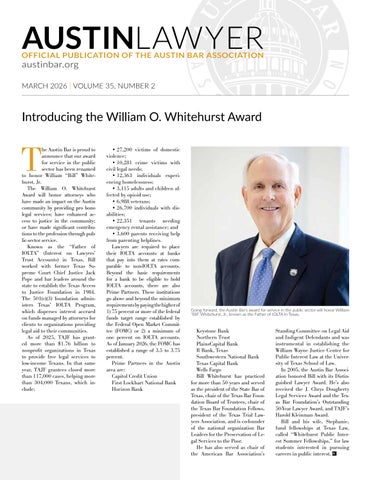
The Austin Bar is proud to announce that our award for service in the public sector has been renamed to honor William “Bill” Whitehurst, Jr.
The William O. Whitehurst Award will honor attorneys who have made an impact on the Austin community by providing pro bono legal services; have enhanced access to justice in the community; or have made significant contributions to the profession through public-sector service.
Known as the “Father of IOLTA” (Interest on Lawyers’ Trust Accounts) in Texas, Bill worked with former Texas Supreme Court Chief Justice Jack Pope and bar leaders around the state to establish the Texas Access to Justice Foundation in 1984.
The 501(c)(3) foundation administers Texas’ IOLTA Program, which disperses interest accrued on funds managed by attorneys for clients to organizations providing legal aid to their communities.
As of 2025, TAJF has granted more than $1.76 billion to nonprofit organizations in Texas to provide free legal services to low-income Texans. In that same year, TAJF grantees closed more than 117,000 cases, helping more than 304,000 Texans, which include:
• 27,200 victims of domestic violence;
• 10,281 crime victims with civil legal needs;
• 12,363 individuals experiencing homelessness;
• 3,115 adults and children affected by opioid use;
• 6,988 veterans;
• 26,700 individuals with disabilities;
• 22,351 tenants needing emergency rental assistance; and
• 3,600 parents receiving help from parenting helplines.
Lawyers are required to place their IOLTA accounts at banks that pay into them at rates comparable to non-IOLTA accounts. Beyond the basic requirements for a bank to be eligible to hold IOLTA accounts, there are also Prime Partners. These institutions go above and beyond the minimum requirements by paying the higher of 1) 75 percent or more of the federal funds target range established by the Federal Open Market Committee (FOMC) or 2) a minimum of one percent on IOLTA accounts. As of January 2026, the FOMC has established a range of 3.5 to 3.75 percent.
Prime Partners in the Austin area are:
Capitol Credit Union
First Lockhart National Bank
Horizon Bank

Keystone Bank
Northern Trust
PlainsCapital Bank
R Bank, Texas
Southwestern National Bank
Texas Capital Bank
Wells Fargo
Bill Whitehurst has practiced for more than 50 years and served as the president of the State Bar of Texas, chair of the Texas Bar Foundation Board of Trustees, chair of the Texas Bar Foundation Fellows, president of the Texas Trial Lawyers Association, and is co-founder of the national organization Bar Leaders for the Preservation of Legal Services to the Poor. He has also served as chair of the American Bar Association’s
Standing Committee on Legal Aid and Indigent Defendants and was instrumental in establishing the William Wayne Justice Center for Public Interest Law at the University of Texas School of Law.
In 2005, the Austin Bar Association honored Bill with its Distinguished Lawyer Award. He’s also received the J. Chrys Dougherty Legal Services Award and the Texas Bar Foundation’s Outstanding 50-Year Lawyer Award, and TAJF’s Harold Kleinman Award.
Bill and his wife, Stephanie, fund fellowships at Texas Law, called “Whitehurst Public Interest Summer Fellowships,” for law students interested in pursuing careers in public interest. AL
Get paid faster, control your finances, and stay compliant with 8am LawPay, trusted by 115k+ legal professionals.
Next-business-day deposits that keep cash flowing
True IOLTA protection built for law firms
Endorsed by all 50 state bars, the ABA, and 60+ specialty bars

Discover why thousands of bar members trust LawPay

Don’t Miss the Austin Bar’s second-annual Golf Tournament! You can still sign up to play in the Austin Bar Association’s second-annual Golf Tournament! On April 16, join us at Lions Municipal Golf Course for a shotgun start at 8 a.m. Then, after the tournament, join us for a catered luncheon, where we will raffle off great prizes! This is a great networking opportunity for younger and veteran lawyers, as well as judges. Bring a friend, a sibling, a spouse, and come have fun! Register at austinbar.org/golftournament.

billy@austinbar.org
Austin Bar Association 712 W. 16th Street Austin, TX 78701
Austin Bar app available for iPhone and Android.

twitter.com/theaustinbar
FOLLOW instagram.com/theaustinbar
https://www.linkedin.com/ company/austin-barassociation
vimeo.com/austinbar


24-Hour Suicide & Crisis Lifeline - 988 - call or text | Live chat: SuicidePreventionLifeline.org
Texas Lawyers’ Assistance Program (TLAP) - 1-800-343-8527
TLAP is a 24-hour confidential crisis counseling and referral program to help lawyers, law students, and judges with substance use and mental health issues.
Justice Mack Kidd Fund
The Austin Bar Foundation administers the Justice Mack Kidd Fund, which can provide financial assistance to individuals seeking treatment for depression or similar illnesses. Visit austinbar.org/?pg=justice-mack-kidd-fund to learn more.
Personal Crisis Assistance Program (PCAP)
The Austin Young Lawyers Association Foundation provides grants and/or peer support for individuals suffering from a personal crisis.
Contact Debbie Kelly: 512-472-0279 x 105
Sheeran-Crowley Trust
Administered through TLAP, the trust provides financial help to Texas attorneys, judges, and law students who need treatment for substance use, depression, and other mental health issues. Visit sheerancrowley.org to learn more.
Alcohol & Drug Abuse
Austin Drug & Alcohol Abuse Program - 512-454-8180
Alcoholics Anonymous - 512-444-0071
Cocaine Anonymous - 512-479-9327
Narcotics Anonymous Counseling - 512-480-0004
Psychiatric Emergencies
Emergency Screening in a Psychiatric Crisis 24/7 - 512-472-4357
Samaritan Center (provides professional counseling services on a sliding scale) - 512-451-7337


AUSTIN BAR ASSOCIATION
Maitreya Tomlinson President
Judge Maya Guerra Gamble President-Elect
Sarah Harp Secretary
Ciara Parks Treasurer
Mary-Ellen King Immediate Past President
AUSTIN YOUNG LAWYERS ASSOCIATION
Jenna Malsbary President
Gracie Wood Shepherd President-Elect
Lena Proft Treasurer
Ben Evans Secretary
Emily Morris Immediate Past President
Austin Lawyer
©2026 Austin Bar Association; Austin Young Lawyers Association
EXECUTIVE OFFICES
712 W. 16th Street
Austin, TX 78701
Email: austinbar@austinbar.org Website: austinbar.org
Ph: 512.472.0279
DeLaine Ward Executive Director
Debbie Kelly Associate Executive Director
Roslyn Warner Assistant Editor
Samantha McCoy Assistant Editor
Abigail Ventress Assistant Editor
Billy Huntsman Managing Editor
Austin Lawyer (ISSN #10710353) is published monthly, except for July/August and December/January, at the annual rate of $10 membership dues by the Austin Bar Association and the Austin Young Lawyers Association, 712 W. 16th Street, Austin, TX 78701. Periodicals Postage Paid at Austin, Texas. POSTMASTER: Send address changes to Austin Lawyer, 712 W. 16th Street, Austin, TX 78701.
Austin Lawyer is an award-winning newsletter published 10 times a year for members of the Austin Bar Association. Its focus is on Austin Bar activities, policies, and decisions of the Austin Bar board of directors; legislation affecting Austin attorneys; and other issues impacting lawyers and the legal professionals. It also includes information on decisions from the U.S. District Court for the Western District of Texas and the Texas Third Court of Appeals; CLE opportunities; members’ and committees’ accomplishments; and various community and association activities.
The views, opinions, and content expressed in this publication are those of the author(s) or advertiser(s) and do not necessarily reflect the views or opinions of the Austin Bar Association membership, Austin Bar Association board of directors, or Austin Bar Association staff. As a matter of policy, the Austin Bar Association does not endorse any products, services, or programs, and any advertisement in this publication should not be construed as such an endorsement.
Contributions to Austin Lawyer are welcome, but the right is reserved to select and edit materials to be published. Please send all correspondence to the address listed above. For editorial guidelines, visit austinbar.org in the “About Us” tab.


There is no prescribed method of practicing law. Attorneys can do so in large regional, national, and international firms. They can also do so as part of governmental bodies, as corporate counsel, or in small-to-midsized firms. That being said, statistics show that a significant percentage of lawyers operate (like I do) as solo practitioners in private practice. There are many obvious benefits of associating with other attorneys, whether in governmental, private, or corporate practice. So, why do many lawyers choose to go it alone?
While that answer is ultimately unique to the individual, there are many reasons for choosing solo practice. I have heard countless stories about now-successful practitioners who started out small because of necessity. They were typically trying to practice in competitive markets without established opportunities. Although necessity sometimes makes the choice for you, there are many other reasons for choosing to practice
MAITREYA TOMLINSON, AUSTIN BAR PRESIDENT
solo (spoiler alert: there are also challenges that should be considered).
For many, the paramount reason is the autonomy that solo practice affords. Have you ever wanted to be your own boss? Well, here’s your chance. The autonomy permitted by solo practice allows attorneys to become more entrepreneurial. You get to exclusively decide the direction of your practice and (generally) the kind of clients that you want to represent. To a certain extent, you also control the amount and type of work that you perform. If successful, you will be busy, and late-night/weekend work will not go away. But doing the work is more satisfying because the fruits of the labor solely belong to you, and you made the decision to accept the work (which is far more satisfying than someone making that weekend-altering decision for you).
Autonomy and other reasons for going solo also have additional benefits that should not be overlooked. Solo practice typically means lower overhead. With the advent of virtual offices and subscription-based services, a solo practitioner can operate with relatively low overhead and enjoy greater profit margins. For many attorneys, solo practice also means that they are rarely conflicted out of legal work. Coupled with autonomy, the lower overhead and more potential work allow solos to bill fewer hours if they choose to do so. In turn, they can dedicate those hours to their fam-

ily, their hobbies, or other activities. When I first went it alone, I would dread the slower periods and, at times, wonder when my phone would ring again. As my practice grew, I learned to be grateful for periods of less work and utilize the free time to try to maintain a healthy work/life balance.
Like anything in life, however, solo practice can also present challenges that must be considered. I almost chose the word “freedom” before settling on the word “autonomy” when discussing the reasons for going solo above. But I changed my mind because solo work has its own demands that can be restrictive. As solos, attorneys must manage the business side of their practice and perform many non-legal-related tasks that are not economically feasible to delegate. In doing so, solos frequently wear many hats, including managing the financial, risk-management, information-technology, and administrative activities necessary to practice law. Operating as both management and labor, solos cannot focus as freely on legal work. And solos cannot lean on co-workers to pick up the slack when their professional and personal lives create obstacles to performing that work.
Additionally, a solo practitioner’s income tends to fluctuate and can create some uncertainty regarding spending and planning, which can be especially acute when solos are still es-
tablishing their practices. Lastly, solo practitioners lack the readily available social interaction (or watercooler talk) that other forms of practice can provide. This can be isolating for solo practitioners.
If you choose solo practice, however, you are not truly alone. The State Bar of Texas offers materials to help you get started, including technology resources and coaching through the Texas Opportunity and Justice Incubator. And both the State Bar and the Austin Bar Association have solo/ small firm sections whose members are willing to help guide you or simply answer questions about the best practice management software.
I’d like to leave you with a few takeaways regarding solo practice from my own experience. If possible, I would advise working with others to start your career. I still utilize knowledge that I gleaned while working for, and with, excellent attorneys. Soak it in and use that knowledge when going it alone.
I would also advise you to become more active in the legal community through Bar service and through affinity groups. Doing so can solve the potential isolation problem and provide other benefits such as mentorship opportunities and business referrals. Also, don’t let your initial book of business discourage you. While not insignificant, I didn’t feel confident that my billing would sustain me when I first ventured out. But going it alone allowed more time to market and develop new referral sources, so my billing grew.
Feel free to reach out to me if you have any questions about solo practice. Many have assisted me, and I don’t mind paying it forward. AL


The Austin Bar welcomes the following new members:
Taylor Becker
Tamara Braz
Jennifer Cochran-Green
Christy Costlow
Nina Fantl
Gracen Hashem
Sam Henry
David Mikalsen
Anna Obek
Austin Reed
Robert Rouder
Rebecca Trevino Tri Truong
Charles Watson
Abigail Willie


Congratulations to Katherine L. Beran, who has been promoted to partner at Allensworth. Katherine is a construction attorney with a background as a trial lawyer litigating cases involving breach of contract, breach of fiduciary duty, construction defects, foreclosures, fraudulent liens, construction disputes and lease assignments, fraud, anti-kickback violations, and employment disputes. She is a graduate of UT School of Law.
Congratulations to Jack E. Byrom, who was promoted to partner at Allensworth. Jack is certified in construction law by the Texas Board of Legal Specialization. His practice involves project delay claims, construction defect claims, change order disputes, warranty issues, and lien and bond claims. He represents owners, contractors, subcontractors, and design professionals. He is a graduate of UT School of Law.
Congratulations to Daniela Peinado Welsh, who has been elected to shareholder at Graves Dougherty Hearon & Moody. Daniela is a trial and appellate lawyer who helps businesses enforce contracts and families enforce wills. Her practice has involved $20,000 to $20 million at issue, and she practices at both the federal and state levels, as well as in arbitration. She is a graduate of the Notre Dame School of Law.
Congratulations to Kathryn Bibby, who has been elected a princi-


pal at Lloyd Gosselink Rochelle & Townsend. Kathryn is a member of the firm’s water and districts practice groups and assists in the governance, organization, and operation of local government entities, including water districts and utilities. She is a graduate of George Mason Law School.
Congratulations to Danielle Lam, who has been elected a principal at Lloyd Gosselink Rochelle & Townsend. Danielle represents municipalities, water districts, water supply corporations, utilities, and landowners in matters relating to certificates of convenience and necessity (CCNs), water supply, water quality, and water rights. She is a graduate of the University of Houston Law Center.
Congratulations to Lauren Thomson, who has been elected a principal at Lloyd Gosselink Rochelle & Townsend. Lauren practices environmental law at the federal, state, and local levels. As a member of the firm’s water practice group, she assists clients with issues pertaining to water quality, water resource development, regulatory compliance, enforcement, permitting, and litigation. She is a graduate of Texas A&M University School of Law.
Congratulations to Roslyn Warner, who has been elected a principal at Lloyd Gosselink Rochelle & Townsend. Roslyn’s practice focuses on administrative law in the area of public utility regulation. She
represents municipalities and utilities before the Public Utility Commission of Texas, the State Office of Administrative Hearings, and the Railroad Commission of Texas. She is a graduate of SMU Dedman School of Law.
Congratulations to Brandon Knighton, who has joined Braun & Gresham as an attorney and counselor. He represents landowners and property owners across Texas in real estate transactions, disputes, and litigation, bringing more than six years of legal experience to the firm. He is a graduate of Baylor Law.
Congratulations to Stephen Ringquist, who has joined Braun & Gresham as an attorney and counselor. Stephen advises business owners, developers, landowners, and financial institutions regarding complex real estate and business transactions in Texas, Minnesota, and Wisconsin. He is a graduate of Hamline University School of Law in St. Paul, Minnesota.
Congratulations to Nathan Yates, who has joined Braun & Gresham as an attorney and counselor. Nathan has more than 20 years of experience in real estate and energy, representing property owners and leveraging prior inhouse roles with development companies. His practice now focuses on land use and development for property owners. He is a graduate of Texas Tech’s School of Law.


International Women’s Day, observed annually on March 8, serves as a global recognition of women’s achievements and an ongoing call to advance gender equality. Historically, female attorneys, scholars, and activists have advanced legal arguments, challenged discriminatory frameworks, and helped redefine the contours of civil rights. In courtrooms, classrooms, legislatures, and community organizations, women have been instrumental in championing reforms related to workplace equity, education, family law, voting rights, and protection from violence and discrimination.
Despite significant progress, gender disparities remain in many areas of the legal field and for women in general in the United States compared to other developed nations. Women continue to encounter obstacles in compensation equity, representation in senior leadership roles, access to mentorship networks, and work-life balance structures that disproportionately affect caregivers.
I remember during the pandemic when the show “Workin Moms” came out on Netflix. I was perplexed at the postpartum classes and time that the working moms got to spend with their infants. It wasn’t until I realized it was a show based in Canada that explained the extended care and time given to families to focus on the family after welcoming a baby. I was led to believe that it was normal to have a child and get back to work within 8-12 weeks or whatever FMLA permitted. Instead of looking at the past and how far
JENNA MALSBARY, AYLA PRESIDENT
we’ve come with parental leave, it is important to understand how far there is still to go in advocating for women who choose to, or have no choice to, be working moms. I know that some of my colleagues got minimal leave postpartum, and I want to acknowledge their hurdles navigating profession and parenting. But imagine where the norm is mandated long-term support for women and families. It’s vital to continue demanding extended medical treatment, care, and support postpartum, whether working or not.
In 2006, Mexico enacted the General Law for Equality between Women and Men (Ley General para la Igualdad entre Mujeres y Hombres), a federal mandate that establishes and guarantees equality of opportunities and treatment for women and men across both public and private spheres. In 2014, Mexico amended its Federal Constitution to require gender parity (equality) in the nomination of candidates for federal and local congressional elections. This obligated political parties to present candidate lists composed of 50% women and 50% men, creating binding parity requirements for nominations. In 2019, the constitutional reform known as “Paridad en Todo” (“parity in everything”) expanded gender parity obligations beyond electoral nominations requiring that 50% of positions—both elective and appointed—across the executive, legislative, and judicial branches at the federal and state levels be held by women, making Mexico one of the world leaders in comprehensive gender parity mandates.
If you didn’t already know about this, I hope that your jaw dropped like mine when I found out. It is incredible. While it contradicts the United States Supreme Court Justice Ruth Bader Ginsberg’s response of “when there are nine” to
the question of when there would be enough women on the United States Supreme Court, it would be monumental to have equal representation in governmental positions in the States.
In 2024, the first female President was elected in Mexico, Claudia Sheinbaum, and since taking office she has facilitated further equality efforts for women including but not limited to equal pay and women’s rights to live a life free of violence. Other countries have also recently paved the way for women’s equity, protection, and equality. While in the U.S. women’s rights are at risk of being taken away, we can look to the progress and movement of other countries as inspiration and hope for the future and future generations.
I draw inspiration from the fearless Pakistani education advocate and survivor, Malala Yousafzai. Her first book, “I am Malala,” which came out in 2013 was eye-opening on access to education and equality for women on a global level and an inspiration of the power of courage and bravery. Her most recent memoir in 2025, “Finding My Way,” describes her resilience, determination, and ability to be real and lean into vulnerability, navigating a life dedicated to advocacy for access to education for girls.
Celebrating and educating about International Women’s Day provides a meaningful moment to reflect on remaining challenges both in the U.S. and globally with clarity and purpose that can be carried through the rest of the year and practiced day to day.
Attorneys also hold a unique responsibility in shaping public conversations around gender equality as we influence laws, regulations, and precedents that directly affect the rights of women and girls. I want to give a distinguished mention to one of the outstanding
Austin Young Lawyers Association Directors, Samantha McCoy, for her advocacy for survivors and purpose driven work to create change through accountability and education on a global level. She is an inspiration as an attorney, advocate, survivor, and parent. If you find yourself interested in advocacy, she is a great resource of where to start and how to begin making change. Through purposeful advocacy, members of the bar can help ensure that evolving legal frameworks support substantive—not merely formal—equality. This includes evaluating the disparate impact of legislation at all levels, promoting equitable workplace practices, and facilitating access to- and demanding- justice for individuals whose rights have been marginalized or overlooked.
Supporting women’s equality is not solely a matter of compliance or professional obligation; it strengthens the legal system as a whole. Diverse perspectives enrich legal reasoning, enhance problem-solving, and improve the quality of representation offered to clients. When women have equitable access to leadership, decision-making roles, and professional development, the legal community becomes more innovative, resilient, and capable of addressing complex societal issues.
My intent on writing about International Women’s Day is both to encourage celebration and a call to action. It provides an annual reminder of the legal profession’s capacity—and responsibility—to promote equality through both individual practice and institutional reform. By honoring the achievements of women in the legal field and reaffirming our commitment to equitable practices, we can continue moving toward a more inclusive future where all individuals are empowered to contribute fully to the pursuit of justice. AL
This year’s AYLA Day of Service on Martin Luther King, Jr. Day was a powerful reminder that service is at the heart of leadership. AYLA volunteers showed up in a big way across the Austin community serving with organizations like BIG, Inside Books Project, Generation Serve, and the Central Texas Food Bank. Volunteers also donated books through BookSpring, created Valentine’s Day cards for seniors in the community, donated blood through We Are Blood, and contributed to the Diaper Bank and Seedling. AYLA thanks every volunteer and partner organization for their time, energy, and compassion in honor of Dr. King’s legacy. AL


AYLA Teams Up With Young Men’s Business League and Young Women’s Alliance for January Docket Call
AYLA kicked off 2026 with a Docket Call at Industry East Side where AYLA members had the opportunity to meet members of the Young Men’s Business League and the Young Women’s Alliance. The event was a full house and a fantastic way to kick off the year. AYLA extends a huge thanks to sponsors Eunice
AL
and Sean
Tell us a little bit about yourself and your law practice.
This really is an honor. I am a huge advocate for AYLA as an amazing organization that I firmly believe sets a good foundation for attorneys. I was born and raised outside Philadelphia. My path to Austin was a bit winding. I went to Penn State undergrad, then I spent time in North Platte and Lincoln, Nebraska, before landing in San Antonio where I attended St. Mary’s University School of Law. Eventually, I found my way to Austin, and I couldn’t be happier about how things worked out. Currently, I’m an attorney at Zinda Law Group, where our practice focuses on personal injury law. We work with people during some of the most challenging moments of their lives. It is an honor helping families across Texas through various tort matters. Our goal is two-fold: first, to help clients navigate what can be an incredibly overwhelming legal process, and second, to fight for the justice and compensation they deserve. Knowing that we’re making a tangible difference in families’ lives when they need it most makes it rewarding.
How long have you been involved in AYLA and what has been your best AYLA experience so far?
I joined AYLA while I was still in law school, which turned out to be one of the best decisions I made. I was genuinely curious about the legal landscape in Austin. I wanted to know what the community was like, how attorneys practiced here, etc., and AYLA seemed like the perfect way to get connected. What I didn’t expect was just how welcoming the organization would be. I was fortunate enough to meet some truly exceptional attorneys early on, including Jenna Malsbary, who’s now AYLA’s presi-
dent. Jenna went out of her way to make sure I felt welcomed at every event and took advantage of every learning opportunity that came my way. That kind of generosity set the tone for my experience with AYLA.
The monthly docket calls [are the best experience] because they give you the chance to meet, discuss, and learn from attorneys who are experienced in various types of law.
What was your childhood dream job?
I didn’t have a moment where I thought, “That’s it, that’s what I want to do with my life.” I think that worked out for the best because it allowed me to stay open to different possibilities. I grew up intrigued by world events, history, and politics, and that led me to the news before and during law school.
Getting to help people through some of their darkest days, advocating for them when they’re at their most vulnerable is truly fulfilling in ways I couldn’t have imagined as a child. There’s something deeply meaningful about being the person someone can turn to when their world has been turned upside down by an injury or tragic life event. While I might not have dreamed about being a personal injury attorney when I was younger, I feel like I’ve found work that aligns with my values and gives me a genuine sense of purpose.
What are some of the things you enjoy most about living in Austin?
Austin has so much going for it, and if I had to narrow it down, I’d say it comes down to three things: the welcoming people, the constant energy, and the outdoor opportunities.
First, the people here are genuinely kind and welcoming. There’s

this openness in Austin. People are willing to connect, to help each other out, to build community, to even grab coffee or lunch. That’s been especially important for me as someone who moved here without an established network.
Second, the city has this vibrancy and electricity that keeps things exciting.
And finally, Austin’s commitment to green spaces, trails, and outdoor recreation is incredible. I love that you can have such an active, outdoor-oriented lifestyle right in the heart of a major city. It’s that perfect blend of urban amenities and natural beauty that makes Austin special.
What’s your best piece of advice for young attorneys?
I’m still learning so much myself every single day. I have found great leaders, mentors, and friends who I probably pepper with too many questions. The law is constantly evolving, and so is our understanding of how to practice it effectively. Daily commitment to growth has been essential for me.
I see the attorneys who really excel in this profession are the ones who never stop being students of the law. I will end with the classic cliché of making sure I stay humble and stay hungry. AL
TUE, MARCH 24
AYLA CLE: Serving Vulnerable Clients Through Trust & Fiduciary Roles
12 - 1 p.m.
Hilgers House RSVP at AYLA.org
Lunch Sponsored by Cadence Asset Management & Trust, now part of Huntington Bank
THUR, MARCH 26
Diversity Bar Mixer
5:30 - 7:30 p.m.
Hilgers House


Ari Cuenin is a partner at Stone Hilton, where he litigates complex government disputes. He has presented more than 30 arguments in state and federal courts, and has been involved in more than a dozen U.S. Supreme Court cases for the State of Texas.
Fifth Circuit allows RICO claims to proceed in medical-billing dispute.
Allstate Indemnity Co. v. Bhagat (5th Cir. No. 25-20020). The Fifth Circuit reversed the dismissal of Allstate’s civil RICO and related state-law claims arising from an alleged insurance-fraud scheme involving a freestanding emergency room. Allstate alleged that Memorial Heights Emergency Center and affiliated physicians and entities conspired with personal-injury attorneys to refer car-accident patients, to bill non-emergency care using high-level emergency codes, and to submit inflated bills that Allstate ultimately paid through settlements. The district court dismissed the case, concluding that Allstate failed to plead reliance necessary for fraud claims. The court also rejected Allstate’s claims on causation grounds, taking the view that Allstate’s settlements were an intervening cause.
The Fifth Circuit held the district court erred at the threshold by analyzing the RICO claims as if they sounded in common-law fraud. Because the alleged predicate act was mail fraud, reliance was not an element of a civil RICO claim. The panel also reasoned that Allstate plausibly alleged both proximate cause and but-
for causation: the alleged scheme was designed to extract settlement payments from insurers, and thus the settlements did not sever the causal chain. The court also rejected the notion that Allstate’s continued settlements in the face of the alleged scheme rendered it “complicit,” which presented factual dispute that could not justify dismissal at the pleadings stage in any event.
This opinion strengthens insurers’ ability to plead and pursue RICO claims predicated on fraudulent medical billing tied to personal-injury litigation. It reinforces that settlements do not automatically break causation and that reliance is not required for mail-fraud RICO claims. Even outside that context, the opinion offers further support for rebutting arguments that settlement negotiations demonstrate complicity warranting dismissal at the pleadings stage.
ANTITRUST: Court examines market-definition requirement in affirming summary judgment.
Endure Industries, Inc. v. Vizient, Inc. (5th Cir. No. 24-10995). The Fifth Circuit affirmed summary judgment for Vizient, the nation’s largest group purchasing organization (GPO), holding that Endure Industries failed to define a legally sufficient relevant market—an essential element of its Sherman Act and Clayton Act claims. Endure, a supplier of disposable medical supplies, alleged that Vizient monopolized access to acute-care hospitals through exclusive dealing, rebates, and refusal to deal, particularly by favoring incumbent suppliers like 3M.
The panel emphasized that, outside per se violations, antitrust plaintiffs must establish a product market encompassing all reasonably interchangeable substitutes. Endure proposed two markets: (1) sales of disposable medical supplies to general acute-care centers through GPO-negotiated contracts, and (2) sales of such supplies to Vizient-member hospitals alone. The court rejected both. Evidence showed that a substantial percentage of hospitals
purchase outside GPOs or leave GPOs altogether, undermining claims of consumer “lock in” or lack of product interchangeability. Endure’s own expert conceded that nearly 30 percent of hospital purchasing occurred outside GPO channels, which the district court deemed “powerful evidence” of reasonable substitutes. The narrower “Vizient-only” market failed because members were free to exit Vizient or purchase elsewhere. Because Endure failed at the market-definition threshold, the court declined to address its alternative theories of monopoly power or anticompetitive conduct.
Endure is a strong reminder that market definition is no mere pleading formality, but a merits requirement that can defeat antitrust claims on summary judgment. As this example shows, plaintiffs should expect to marshal concrete evidence of exclusion, lock-in, or lack of substitution, especially in consolidated but voluntary markets.
TRADE SECRETS: Fifth Circuit vacates $75m+ jury award.
Trinseo Europe GmbH v. Kellogg Brown & Root, L.L.C. (5th Cir. No. 24-20460). The Fifth Circuit affirmed a post-trial ruling vacating more than $75 million in jury-awarded damages for trade-secret misappropriation, holding that Trinseo failed to apportion damages among multiple alleged trade secrets. Although the jury found that KBR and affiliated defendants misappropriated four of Trinseo’s ten asserted trade secrets relating to polycarbonate manufacturing technology, Trinseo’s damages expert presented an “all-or-nothing” model that assumed misappropriation of all ten.
Relying on Fifth Circuit precedent analogizing trade-secret damages to patent law, the panel held that apportionment is required when the accused product incorporates both misappropriated and non-misappropriated features. The court endorsed the district court’s application of apportionment principles drawn from Fifth Circuit precedent and persuasive authority from the Federal Cir-
cuit and the Northern District of California. Because Trinseo offered no methodology for valuing the four trade secrets actually found to be misappropriated—and no way for the jury to do so—the damages award could not stand. The court also affirmed summary judgment on Trinseo’s alternative confidential-information claims as preempted by the Texas Uniform Trade Secrets Act, and upheld the permanent injunction.
Trinseo is a cautionary decision for trade-secret plaintiffs: damages theories must be apportioned and defensible against partial liability findings. Experts who bundle multiple trade secrets into a single valuation risk total loss of damages post-verdict. But practitioners should also anticipate similar considerations in Daubert motions, in Rule 50 practice, and in developing damages strategies in complex trade-secret litigation. AL


Laurie Ratliff is a former staff attorney for the Third Court of Appeals. She is boardcertified in civil appellate law by the Texas Board of Legal Specialization and owner of Laurie Ratliff LLC.
The following are summaries of selected civil opinions issued by the Third Court of Appeals during January 2026. The summaries are an overview; please review the entire opinion. Subsequent histories are current as of February 9, 2026.
LAW: Court reverses child-support award that deviated from the MSA.
Gan v. Mathijssen, No. 03-2400115-CV (Tex. App.—Austin Jan. 29, 2026, no pet. h.) (mem. op.). Husband alleged wife took community funds and placed them in her separate accounts during the divorce and paid community funds to her mother. As a result, the trial court awarded husband a $30k judgment against wife. The
trial court reduced child support from the MSA amount of just over $1,300 per month to $750 per month to account for father’s expenses to travel to Texas for his possession of the child. The court of appeals held that the trial court abused its discretion when it deviated from the MSA’s child-support amount. According to the court, the Family Code provides that parties are entitled to judgment on a MSA if the MSA meets the statutory requirements. The MSA complied with the statutory requirements and the narrow exceptions that allow a trial court to deviate from the MSA—family violence or sex-offender status—did not apply. The court rejected wife’s argument that the trial court abused its discretion on the community-property division. The evidence supported the finding that wife depleted community funds during the divorce. The court affirmed in part and reversed in part.
TTCA: Court holds City is immune from damage claim under the emergency exception.
City of Austin v. Sahyouni, No. 03-23-00416-CV (Tex. App.—Austin Jan. 30, 2026, no pet. h.) (mem. op.). Sahyouni sued City for personal injuries and property damages sustained in a collision with a police car. The collision occurred when the officer was responding to the highest priority disturbance call and his car skidded across the road while turning. Sahyouni alleged negligence and negligence per se.
City alleged that it was immune based on the TTCA’s emergency exception. The trial court denied City’s plea. The court of appeals noted that under the emergency exception, City is immune unless the officer: 1) failed to comply with laws applicable to emergency action, or 2) if in the absence of such laws, the officer acted with conscious indifference or reckless disregard for the safety of others. Because Sahyouni did not allege the officer failed to comply with laws applicable to emergency actions, the only inquiry was whether the officer acted with conscious indifference or reckless disregard. Sahyouni’s allegations at most showed negligence. Recklessness requires more than allegations of negligence. Thus, Sahyouni’s evidence did not create a fact issue on recklessness to demonstrate immunity was waived. The court reversed and dismissed.
Court holds arbitrability of dispute is for arbitrator with agreement that selects the AAA.
AutoLotto, Inc. v. Paychex, Inc., No. 03-24-00116-CV (Tex. App.— Austin Jan. 16, 2026, no pet. h.) (mem. op.). Paychex sued AutoLotto for breach of contract after Paychex funded AutoLotto’s payroll and AutoLotto failed to pay the balance owing. AutoLotto denied the existence of a contract but moved to compel arbitration pursuant to the contract. Paychex argued the question of arbitrability was for the court to decide. The trial court denied Au-
toLotto’s request to stay pending arbitration and granted summary judgment for Paychex. The court of appeals rejected AutoLotto’s argument that there was no contract because its employee lacked authority to sign the agreement. The parties entered the contract in 2018 and acted pursuant to it for several years with Paychex providing over $13 million in payroll. As to whether the court or the arbitrator decides arbitrability, the court observed that when parties select the AAA rules, they “clearly and unmistakably” delegate to the arbitrator questions of the existence, scope, or validity of an arbitration agreement and the arbitrability of any claim. Thus, the trial court erred in denying the motion to compel arbitration. The court reversed and remanded with instructions to compel the parties to arbitrate the arbitrability of their dispute. AL


or any of the individual justices on the Court.
The following is a summary of selected criminal opinions issued by the Third Court of Appeals from June 2025. The summary is an overview; please review the entire opinions. The subsequent history is current as of January 6, 2026.
Finality of prior convictions.
Martinez v. State, No. 03-2300464-CR (Tex. App.—Austin July 9, 2025, no pet.) (mem. op., not designated for publication). Evidence was sufficient to support jury’s finding that defendant’s prior conviction was not a probated sentence. Martinez was convicted of evading arrest with a vehicle and
sentenced as a habitual offender to 35 years’ confinement. On appeal, Martinez argued that the evidence was insufficient to support the jury’s finding that a prior conviction was final for purposes of the habitual-offender statute. Specifically, he claimed that the judgment form reflected that he was placed on probation, which had not been revoked at the time of his sentencing in this case. The court disagreed, observing that the judgment of conviction in the prior case recited that appellant was sentenced to “10 months OCJ [Osceola County Jail],” and the fields indicating that his sentence had been suspended or that “special conditions of release” had been imposed were left blank. Additionally, no conditions of probation were checked on appellant’s judgment; the portion of the judgment where it appeared that the trial court would have specified the counts for which probation had been given and the period of probation assessed were blank; and although there was a checkmark next to “probation,” this indicated that the probation office was given a copy of the judgment. Viewing the evidence in the light most favorable to the jury’s finding, a rational juror could have found beyond a reasonable doubt that Martinez was not placed on probation.
BLOOD DRAWS: Probable-cause affidavits.
Taylor v. State, No. 03-23-00521CR (Tex. App.—Austin July 11, 2025, pet. ref’d) (mem. op., not


designated for publication). Affidavit contained sufficient facts to establish probable cause to believe defendant had driven while intoxicated, and alleged omissions in affidavit were not material. Taylor pleaded guilty to intoxication manslaughter. On appeal, Taylor challenged the trial court’s denial of his motions to suppress evidence obtained from a blood draw performed pursuant to a search warrant. He argued that the affidavit supporting the search warrant failed to allege facts sufficient to establish probable cause for the search and that the trial court abused its discretion by denying him a hearing under Franks v. Delaware at which he could challenge the affidavit’s truthfulness. The appellate court rejected both contentions. Regarding the facts alleged, “the circumstances of the accident itself were particularly probative of the existence of probable cause to search Taylor’s blood for evidence of intoxication,” including witness descriptions of the accident as “bad” and a “head on collision,” with Taylor suddenly veering into another lane at night, without his headlights activated, and striking the victim’s stationary vehicle. The collision caused the victim’s car “to spin backward for over thirty feet,” from which the magistrate could have reasonably inferred that Taylor had been driving at a high rate of speed, and the accident “was grave enough that both Taylor and [the victim] were taken to the hospital, the latter with life-threatening injuries after being pulled from his vehicle.” Taylor had admitted to an officer that he had “smok[ed]

a blunt,” and “[w]hen confronted with the collision’s severity, he began to cry, called himself an idiot, and blamed the crash on his bad life choices.” The court concluded that “[c]onsidering the short duration between the crash, which a reasonable magistrate could have determined was caused at least in part by Taylor’s intoxication, and the search warrant’s issuance,” which was approximately three hours later, “the magistrate had a substantial basis for finding the existence of probable cause to search the blood.”
Taylor also argued that certain facts were omitted from the officer’s affidavit, entitling him to a Franks hearing. The appellate court noted that although “[s]ome courts have held that Franks challenges reach not only affirmative fact statements in an affidavit but also ‘material omissions’ from the affidavit,” neither the Court of Criminal Appeals nor the Austin court had decided the question. The court “continue[d] to leave the question open because the material-omission attack here fails on its merits.” The court concluded that the omission of certain facts from the affidavit could have indicated that such facts were simply not present during the investigation. Moreover, “the alleged omissions were not material under Franks.” Considering the facts that were alleged, “a reasonable magistrate would not have abused her discretion by continuing to find that probable cause for the search existed even if the affidavit had also expressly stated each allegedly omitted fact.” AL


BY VELVA PRICE, TRAVIS COUNTY DISTRICT CLERK
Editor’s Note: The monthly jury trial verdicts update is first published through Bar Code.
Kevin Crown v. Scott & White Clinic
Cause No.: D-1-GN-20-001832
Judge: Jessica Mangrum
Dates: January 12-16, 2026
Attorneys:
Plaintiffs: Jay Harvey, Winkler Harvey/Mark McLean, McLean Law PC [Austin]
Defendants: Brian O’Toole, Griffith Davison [Austin]/ Laura O’Toole, German Beaman & Brown PLLC [Austin]
Summary: Plaintiff claims he received permanent near-fatal injuries following the performance of gallbladder removal surgery. Eleven of the jurors found that the Scott & White Clinic, through its employee, Wade Dunlap, MD, did not proximately cause injury to Plaintiff Kevin Crown.
Jose Antonio Venero v. Juan Antonio Lozada
Cause No.: D-1-GN-21-002358
Judge: Jan Soifer
Dates: January 13-16, 2026
Attorneys:
Plaintiff: Jason Snell/Lynn Watson, Snell Law [Austin] Defendant: Pro Se, Licensed Attorney in Colorado and Texas [Miami, FL]
Summary: Plaintiff sued Defendant for defamation based on a published interview in an on-line publication that is read by the Venezuelan immigrant community. (Both parties are naturalized citizens from Venezuela.) Defendant denied that the statement(s) that the plaintiff was a scammer and a criminal were defamatory. Defendant filed a counter-claim that Plaintiff’s lawsuit was an abuse of process. The court found that the defendant’s statements were defamatory per se prior to trial. Eleven members of the jury found that Defendant’s statement was not substantially true, the defendant knew or should have known that the statement was not true, and awarded as follows: Injury to reputation sustained in the past - $25,000; injury to reputation in the future - $15,000; past mental anguish - $50,000; future mental anguish - $25,000.
The jury further found by clear and convincing evidence that the defendant knew the statement was false to the extent that the defendant had serious doubts as

to the truth of the allegations and awarded $500,000 in exemplary damages. (Note: Since the jurors were not unanimous, the exemplary damages cannot be awarded.)
State of Texas v. Benjamin Bruce
Cause No.: D-1-DC-25-904088
Judge: Dayna Blazey
Dates: January 12-16, 2026
Attorneys:
State of Texas: Jacob Salinas/ Alexis Gonzales [Austin]
Defendant: Michael Watson/ Angelica Cogliano [Austin]
Summary: Defendant was alleged to have entered an apartment through the window and then touched a female minor in two separate places. The jury found the defendant not guilty on the offense of Indecency of a child by contact, guilty of burglary of a habitation, and guilty of indecency with a child by contact.
State of Texas v. Reymundo Cardenas-Gutierrez
Cause No.: D-1-DC-25-204039
Judge: Clifford Brown
Dates: January 13-14, 2026
Attorneys:
State of Texas: Clayton Myers/ Max Shaps [Austin]
Defendant: Henry Curtis Woodcock [Austin]
Summary: The Defendant was arrested for aggravated assault with a deadly weapon. According to a district attorney press release, the defendant was arrested by the Travis County Sheriff’s Office in May 2025 for attacking two victims. The jury convicted the defendant, and the court sentenced him to four years in prison.
State of Texas v. Daniel Quesnel
Cause No.: D-1-DC-24-500421
Judge: Brandy Mueller
Dates: January 20-22, 2026
Attorneys:
State of Texas: Jacob Salinas/ Alexis Gonzales [Austin]
Defendant: Michael Watson/ Angelica Cogliano [Austin]
Summary:Defendant was charged with indecency with a child. The jury found the defendant not guilty. AL


BY JEREMY SIMON, TEXAS LAW COMMUNICATIONS
This story is an expanded version of a shorter news item that appeared in the fall 2025 issue of Texas Law Magazine.1
Rachel Smith escaped an abusive marriage, but the damage to her finances remained.
She’d left the relationship but was still burdened by $80,000 in debt, after her husband ran up sales tax for his business—but listed it in his wife’s name. He’d also opened credit cards in her parents’ names and charged $250,000 to those accounts. Then, after Smith fled their shared home, he put all the household utilities in her name, adding hundreds more dollars to her financial troubles.
Smith’s case is sadly not unique, said Texas Law Professor Angie Littwin. “Coerced debt occurs in a relationship characterized by domestic violence—also known as intimate partner violence—when the abusive partner incurs debt in the survivor’s name using fraud, coercion, or manipulation,” Littwin explains. An abuser may fraudulently open credit cards in their partner’s name or force them—through explicit or implicit threat—to take out loans.
Littwin is the recognized expert on this type of financial abuse, which she first named “coerced debt” in a 2012 paper.2
The current legal options frequently fail survivors, especially when they were pressured to take on the debts. “Generally, it’s not that survivors lose in court; it’s that there are few remedies for coerced debt generated by coercive transactions,” she said. “There’s often no law to even bring a case under.”
For coerced debt survivors nationwide, the Fair Credit Reporting Act3 only enables identity theft victims to erase fraudulent debts from their credit report. “Debt via fraud is a form of identity theft,” Littwin explains, but
debt via duress or manipulation is not. (Littwin also recommends freezing credit4—provided it can be done safely—so new debt cannot be incurred by an abuser.)
“There are no great remedies for coerced debt at the federal level,” she said.
Meanwhile, “survivors with fraudulent debt can even have problems being believed because decision makers like police can be skeptical when the perpetrator is an intimate partner,” Littwin said.
Her work on the topic isn’t purely academic. Littwin’s research has helped produce laws to support and protect survivors of coerced debt.
Widespread, but Often Unseen
Domestic violence survivors and professionals working in the field report how widespread coerced debt is. In 2014, Littwin and Professor Adrienne Adams of Michigan State University surveyed callers to the National Domestic Violence Hotline: more than half reported suffering coerced debt.
Yet, it’s a societal problem that Littwin said remains too-often hidden.
When Littwin presents to groups unfamiliar with domestic or intimate partner violence, she’s often faced with questions: “‘How could somebody end up with this much debt in their name without their knowledge or consent? Why not leave a relationship when the alternative is financial ruin?’ And then I start into talking about coercive control,” Littwin said.
Coercive control was explored in depth by Evan Stark, who wrote the definitive book on the concept. It shares elements with crimes like kidnapping, hostage-taking, and brainwashing. The abusive partner essentially seeks “to undermine the other partner’s free will by controlling

every aspect of their life,” Littwin said, possibly preventing their victim from working—or taking their earnings if they do work—as well as from driving, connecting with friends and family, or making their own choices about how to dress, cook, or raise their children. “Coerced debt can play an important role, because it can prevent the victim or survivor from having alternatives to leaving the relationship,” Littwin said.
“Once survivors find out about the debt, their credit score may be wrecked,” she explains. Today, beyond securing loans, credit scores are used in applications for employment, housing, and basic utility services. “In other words, exactly what someone needs if they would like to leave a relationship and start over on their own,” Littwin adds. “So, damaged credit scores can really be a barrier to somebody leaving an abusive relationship.”
Fellow academics emphasize the importance of Littwin’s scholarship. “Angie has shown that many
women have debt for which no just legal system would hold them accountable. She has shined a light on something that was there all along, but we would not see,” said Robert Lawless, the Max L. Rowe Professor of Law at the University of Illinois Urbana-Champaign and a nationally recognized expert in bankruptcy law, consumer finance, and empirical legal studies. “The work already has become part of the conversation about how to help financially struggling households,” he said.
Littwin earned her undergraduate degree from Brown University and juris doctor from Harvard Law School. After law school, she clerked for the Honorable Rosemary Barkett of the U.S. Court of Appeals for the 11th Circuit and founded Reaching Out About Depression, a community-organizing project for low-income women. She was a lecturer at Harvard Law School before joining the Texas Law faculty in 2008. The year prior, as part of the 2007
Consumer Bankruptcy Project—an ongoing research project studying people who file for bankruptcy— Littwin proposed that the team interview cohabitating women about domestic violence. They found that a higher percentage of women who filed for bankruptcy had also suffered domestic abuse compared to the general population.
That prompted Littwin’s conversations with domestic violence counselors and advocates. Why might female bankruptcy filers have a higher rate of domestic violence than other women? she asked the professionals. Their answer: the “rampant” coerced debt they’d seen in their practices. “And that’s how I realized there was something going on that needed to be studied and understood,” Littwin said.
Littwin took what those DV professionals told her, combined with Starks’ writing on coercive control, and translated it for a legal audience. “This debt is incurred in the context of coercive control, so I called it ‘coerced debt,’” she said.
Fast forward to today, and Littwin has authored or co-authored numerous significant publications on coerced debt. Recently, with colleagues, she completed a major study funded by the National Science Foundation5. The researchers examined coerced debt among Texas women divorcing abusive men. Theirs was the first-ever large federally funded study of coerced debt. The findings? Among the study participants, credit cards made up nearly half of all accounts with coerced debt, and women with coerced debt had lower estimated credit scores compared to women without coerced debt. The study also found divorce to be an ineffective legal remedy for coerced debt, and legal rights under debtor-creditor law were deemed effective for less than 10 percent of coerced debts.
Littwin’s latest article looks at the Supreme Court’s 2023 decision in Bartenwerfer v. Buckley6 , which said a woman could still be held responsible for a debt created through the fraud perpetrated by her husband and business partner—even though she wasn’t
involved in it. That ruling is troubling for survivors of coerced debt, because it suggests they might be stuck with fraudulent debts forced on them by abusive partners. Littwin argues the decision doesn’t require courts to treat survivors this way, and she makes the case that they should still be allowed to clear coerced debts through bankruptcy. Using findings from the NSF study, she shows how denying this relief punishes victims instead of protecting them.
Legal changes remain necessary. Among its findings, the NSF study shows that for approximately 100 women with coerced debt active at the time of their divorce, only one of their ex-husbands was ordered to pay off the coerced debt he created.
Smith found herself in a similar place. She was unable to erase her husband’s sales tax owed to the state government. While the U.S. government has a program to help innocent spouses erase coerced tax debt, state governments don’t. Meanwhile, Smith’s parents filed for bankruptcy to delete their credit card debt, but bankruptcy rarely helps with unpaid taxes. And to close the cable account put in her name by her husband, Smith had to return the service provider’s equipment or pay the provider $700. But she didn’t have the money. That forced Smith to take a risky step: she snuck into her old house to grab the equipment so she could return it to the provider.
Such examples aren’t unusual to professionals. “When I worked in legal aid, I knew the law was not helping our clients. It needed to be changed,” said Carla Sanchez-Adams, senior attorney with the National Consumer Law Center, who discovered Littwin’s work on coerced debt while working as a managing attorney with Texas RioGrande Legal Aid following her graduation from Texas Law. Sanchez-Adams began collaborating with Littwin around 2013, and Littwin later joined the Texas Coalition on Coerced Debt7, which Sanchez-Adams had established. TCCD is made up of Texas-based attorneys, advocates, policymakers, financial professionals, and
law enforcement who are interested in promoting identity theft protections for survivors of family violence. Sanchez-Adams is now a senior attorney with the National Consumer Law Center, where she focuses on emerging issues in banking and payment systems, including debt collection and credit reporting issues impacting survivors of gender-based violence.
But legal changes are underway. In Texas, Littwin’s work has prompted laws to be enacted, expanding the definition of identity theft to include coerced debt. On June 20, 2025, Gov. Greg Abbott signed Texas House Bill 42388 to protect survivors of coerced debt, as well as other forms of identity theft, from collections on most debts. Littwin had testified about the proposed law three times. “I was very happy that the bill was signed,” she said. “With the new law, if somebody has a court order stating that her coerced debts were created via identity theft, creditors must stop collections on those debts.” While there are some exclusions, “the law is, nevertheless, very important,” Littwin said. “The Texas Coalition on Coerced Debt had been trying for a few sessions to get a law passed, so this law is a tremendous step forward.”
Smith could have benefited from the new laws, since her husband created most of her debts through coercive transactions rather than fraud, which “already had remedies in the form of protections from identity theft,” said Littwin. “Providing a remedy for debt created by coercive transactions is where the new laws, such as the Texas law, make a major difference.”
Meanwhile, Littwin continues to provide expert support to TCCD, and she’s consulting on a pro bono pilot where lawyers help coerced debt survivors obtain orders declaring they’ve been the victims of identity theft. Whenever she’s called on for expertise, Littwin makes herself available, said Ann Baddour, Texas Appleseed’s state director of projects aimed at bringing low-income and immigrant consumers into the financial mainstream.
“Angie’s work has not only made a difference in Texas, but
grown a movement across the country,” said Baddour, with multiple national organizations now working on issues of coerced debt.
“When we’re successful, we can help some people in the most vulnerable circumstances find and access pathways to financial survival and relief,” Baddour said. “To have someone like Angie, who’s in it for the long haul and whose commitment is from not just the mind, but also from the heart, it means the world.” AL
Jeremy Simon joined Texas Law in August 2023 after more than a decade on the Texas McCombs communications team, where he most recently focused on promoting faculty research and expertise. Among his other roles before coming to UT, he wrote about equities markets in New York City and after moving to Austin was an editorial intern at Texas Monthly magazine. He is a graduate of Vassar College with a B.A. in English.
Angela K. Littwin is the Charles Sapp Chair in Banking, Financial, Commercial and Corporate Law Professor at Texas Law. She is an expert on bankruptcy, consumer law, and commercial law. Her current research involves the study of attitudes towards bankruptcy among consumers being sued by debt collectors, bankruptcy local legal culture, and the relationship between consumer credit and domestic violence. Professor Littwin’s courses include bankruptcy, secured credit, and a seminar on the regulation of credit cards.
1 https://law.utexas.edu/ news/2025/11/13/shining-a-lighton-coerced-debt/
2 https://law.utexas.edu/faculty/publications/2012-Coerced-Debt-The-Role-of-Consumer-Credit-in-Domestic-Violence/
3 https://www.ftc.gov/legal-library/ browse/statutes/fair-credit-reporting-act
4 https://www.usa.gov/credit-freeze
5 https://www.nsf.gov/awardsearch/show-award/?AWD_ ID=1920557&HistoricalAwards=false
6 https://www.supremecourt.gov/ opinions/22pdf/21-908_n6io.pdf
7 https://financialabusehelp.org/guide/ coerced-debt-toolkit-overview/ about-texas-appleseed-and-texas-coalition-coerced-debt
8 https://capitol.texas.gov/BillLookup/ History.aspx?LegSess=89R&Bill=HB4238

In 2026, law firms across the country continue to face unprecedented challenges in recruiting and retaining legal talent. From intensified competition to shifting attorney expectations to the lingering aftershocks of the Great Resignation, the legal labor market remains turbulent. Amid all this complexity, one piece of advice stands out above all others: Be patient.
A bird in hand is not always worth two in the bush. Rushed hiring decisions are no longer just risky, they are extraordinarily expensive. Both hard costs and soft costs of turnover have surged in recent years, making a deliberate, patient approach to hiring not just prudent but essential to a firm’s financial health and cultural stability.
The Real Hard Costs: Turnover Is a Million-Dollar Problem
Turnover in law firms has always been costly, but recent data underscores just how economically damaging it has become.
A 2025 analysis found that when a third-year associate leaves a firm, the total financial impact can exceed $1 million, accounting for recruiting fees, lost billable hours, ramp-up time for replacements, and disrupted client relationships. https://bennettfinancials.com/associate-churn-cost-law-firms/
This figure aligns with industry-wide findings that replacing legal professionals often costs between 1.5 to 4 times the attorney’s annual salary, depending on seniority and specialization. In
BY HOLLY PULIDO

small and midsized firms, which make up a large percentage of the Austin legal landscape, those proportional costs can be even higher. [attorneyatwork.com]
Additional data shows:
A mid-level lawyer’s departure costs $40,000–$60,000 in direct replacement fees alone. [accuhire.com]
Costs balloon when partners leave; the cost of replacing an Am Law 100 partner averages $2.3 million, not including the potential loss of clients who follow them out the door. [decipherintel.com]
Standard recruiting fees now run 20–30% of a new associate’s firstyear salary, before any onboarding or training costs are added. [https:// bennettfinancials.com]
These numbers only account for tangible, measurable expens -
A mid-level lawyer’s departure costs $40,000–$60,000 in direct replacement fees alone.
es—the “hard costs.” But the real damage often extends far beyond what can be documented on a financial statement.
The Hidden Soft Costs: Culture, Morale, and Lost Momentum
While hard costs can be quantified, soft costs quietly erode the firm from within. They are harder to measure, but often more destructive to long-term success.
High turnover disrupts the social and professional fabric of a firm. When attorneys see colleagues frequently exiting, it creates uncertainty, undermines trust in leadership, and fosters an atmosphere of instability. Even when departures are balanced by new arrivals, the constant churn can lead to a destabilized culture which strains internal relationships and norms.
2. Loss of Institutional Knowledge
Much of a law firm’s value resides not in documentation but in people—seasoned attorneys who know clients’ histories, understand procedural nuances, and mentor junior lawyers. Frequent turnover disrupts that knowledge chain, slowing case progress and diminishing client confidence.
3. Morale and Burnout
Whenever someone leaves, their work must be absorbed by remaining staff. This often means longer hours, increased stress, and resentment—particularly dangerous in a profession already known for burnout risks. Studies confirm that morale drops when colleagues depart, and that further attrition often follows. [accuhire.com]
4. Client Impact
Clients notice when teams change. Whether it’s a partner departure, associate turnover, or paralegal disruption, clients may feel uneasy, question the firm’s stability, or even move their business elsewhere. The resulting loss of revenue can dwarf recruitment expenses.
Why Patience Is Essential in 2026
In today’s increasingly competitive legal market, speed is no longer synonymous with effectiveness. Patience allows firms to make decisions that align with long-term needs, not just shortterm gaps.
Here’s why patience pays off:
1. Better Cultural Alignment
Hiring slowly ensures that candidates match the firm’s values, work style, and long-term goals. A poor cultural fit is one of the leading drivers of turnover, especially for early-career attorneys still determining what they want from the workplace.
2. Improved Retention
Retention begins at selection. Firms that take the time to evaluate competencies, career motivations, and interpersonal dynamics make hires who are more likely to stay.
Given the large figure potential cost of losing even a single associate, it is always more cost-effective to wait for the right hire than to move quickly on the wrong one. Your long game leads to long-term savings.
As COOs, managing partners, and hiring managers evaluate their 2026 workforce strategies, patience must become a core competency. Rushed hiring may plug a temporary need, but it risks
opening much larger financial and cultural wounds.
The most successful firms this year will be the ones that:
• Prioritize cultural fit and alignment.
• Invest deliberately in onboarding and training.
• Examine internal processes that lead to attrition.
• Value long-term stability over short-term convenience.
• Understand the true financial and cultural cost of turnover.
In a legal industry where people are the product, slow hiring is often the fastest path to lasting success. AL
Holly Pulido is a seasoned leader in law firm operations with extensive experience in strategic management, financial stewardship, and legal technology. She has held prominent leadership roles, including President of the Austin Chapter and International Board Member of the Association of Legal Administrators. Known for championing strategic innovation and operational excellence, Holly helps firms modernize systems, elevate performance, and build strong, people-centered cultures. Her leadership approach blends vision, practicality, and a deep understanding of the evolving legal industry.

Y’all | definition: meaning to refer to a group of people – “you all”. As in, we’d like to help y’all succeed.
We know Texas. Since 1979, we’ve been protecting Texas lawyers, across all Texas jurisdictions, in all areas of practice. We use the best Texas defense trial lawyers around. And, we insure more lawyers in the State of Texas than any other insurance provider.
Y’all is who we serve.
Apply today to be protected by the best.
We help Texas attorneys succeed.

The Austin Bar recently conducted its Judicial Preference Poll.
The purpose of the preference poll is to allow the public to see how local attorneys evaluate their colleagues in the legal community.
For each race, Austin Bar members were asked to indicate which candidate they believed was best qualified to serve in the position for which he or she was running. Members did not have to vote in every race. Members cast their votes through Election Runner, a third-party online polling system. These results are strictly the opinions of the individual attor-
neys participating in the poll and are not intended as an endorsement of any candidate(s) by the Austin Bar Association or any affiliated organization.
The results are below. Of the 2,864 eligible voters, 285 participated.
Justice of the Peace Precinct 1
• Ciara Parks, 176 votes
• Andrew Reginald Hairston, 47 votes
• No answer, 62
Justice of the Peace Precinct 2
• Randall Slagle, 158 votes
• Mariel Kelley, 77 votes
• No answer, 50 votes AL


The Austin Bar’s LGBTQ Law Section is proud to invite you to our annual event supporting the Austin Bar Foundation.
Join us for the fifth annual Drag and Justice Fundraiser, featuring the Drag Queen Game Show, Tuesday, April 28, from 5:30 to 8:30 p.m. at Highball, 120 S. Lamar Blvd.
Guests will enjoy a networking hour from 5:30 to 6:30 p.m., followed by game-show-style entertainment, including an opening game featuring esteemed special guests, rounds of interactive musical bingo played via your phone, and a high-energy trivia finale with guest volunteers.
Throughout the evening, guests can also enjoy tarot read-

ings in a separate lounge area for an immersive experience alongside the main program.
Visit austinbar.org/dragandjustice for additional information, tickets and sponsorship opportunities. Email will@willshindlerlawfirm.com with questions about the event. AL
The 2026 Andrea Pair Bryant Luncheon, presented by the Austin Black Lawyers Association Foundation, honored Travis County District Clerk Velva Price and Kathy Holt Richardson.
Velva Price has been the district clerk for Travis County since 2015. She graduated from the University of Texas School of Law in 1986 and represented individuals, governmental entities, and corporations throughout Texas.
She previously served as Austin Bar president for 2000-01 and was its first African American president. She has also served as president of the Austin Black Lawyers Association and the Travis County Women Lawyers’ Association.
Velva has volunteered her time to many boards and commissions, such as the State Bar of Texas, Volunteer Legal Services of Central Texas, the Texas Supreme Court Grievance Oversight Committee, the City of Austin Ethics Review Commission, and David Chapel Missionary Baptist Church.
Kathy is the founder of HR Legal Search and has more than 30 years of experience in legal recruiting. She was one of the youngest, as well as the first Black woman, assistant dean of career services at the University of Texas School of Law.
HR Legal Search has consistently been named one of Texas’ Best Legal Recruiting Firms by Texas Lawyer since 2011. Before HR Legal Search, Kathy founded the legal recruiting firm of Major, Lindsey & Africa and served as the founding chair of the National Association of Legal Search Consultants’ Belonging and Inclusion Committee.
Outside of legal recruiting, Kathy is a certified yoga instructor and wellness counselor. She’s an avid hiker and mountaineer who summited Mt. Kilimanjaro, Mt. Meru, and Mt. Kenya in 2024.
The Andrea Pair Bryant Legacy Luncheon honors the life and work of Andrea Pair Bryant, a


founding member of the Austin Black Lawyers Association. Andrea was an active member of the Austin Bar Association, Legal Aid of Central Texas, Voluntary Legal Services, the Catholic Diocese Law Project, and the National Bar Association, which is the nation’s oldest and largest association of African American lawyers and judges.
A recipient of a Fulbright Scholarship that enabled her to study physics in Germany, she graduated from Columbia University and worked as a programmer at IBM. Several years later, she enrolled in Georgetown University Law Center while keeping her day job. After graduating with her JD in 1978, she and her husband, Mel, were transferred by IBM to Austin.
The Austin Black Lawyers Association Foundation is a 501(c) (3) founded in 1973. The foundation provides scholarships to high school seniors, undergraduates, and graduate students pursuing legal careers. The primary scholarship programs are the Heman Sweatt Scholarship and the Virgil C. Lott Scholarship.
The Hemann Sweatt Scholar-
ship is named after the first African American to attend the University of Texas School of Law and was established to assist students with the cost of taking the Law School Admission Test (LSAT).
The Virgil C. Lott Scholarship
is named after the first African American to graduate from the University of Texas School of Law and is awarded to a graduating high school student, based on need, to assist with the cost of attending higher education. AL

Thank you to everyone who volunteered for the Jan. 31 CANLaw Clinic! It was one of our largest and most successful clinics. Because of you, we were able to prepare 23 estate planning packets for cancer patients and their families!
Specifically, we want to thank:
Judge Bianca Garcia of Travis County Court at Law No. 3. A former CANLaw volunteer herself, Judge Garcia graciously provided coffee and breakfast to the clinic.
The firm of Germer Beaman & Brown for the use of their office space to host the clinic.
The Austin Bar Association and Austin Bar Foundation.
Attorneys
Cayman Angelle
Nadia Bettac
Clark Bullington
Lindsey Drake
Sarah Eddy
Helen Edwards
Kelly Garemko
Terry Garrett
Carlotta Garza-Kilcullen
Melanie Ibarra
Madison Jechow
Austin Jones
Katherine Lickteig
Erin McCready
Thomas Mehaffy
Maria Portella
Jordan Preddy
Ann Price
Rob Rice
Justin Rosas
Chuck Ruesink
Andrew Slaton
Charles Smaistrla
Sue Snyder
Cameron Thomas
Geoffrey Van Olden
Selia Vite-Seiffert
Law Students
Clara Kim
Jordan Sammis
Brooke Sanders
Anran Wang
Jake Burke

Paralegals
Maria Aguilar
Carli Collins
Chloe Fowler
Katie Gleason
Terri Grona
Amber Haney
Erin Hill
Gisela Olivo
Britany Posadas
Diana Price
Morgan Rains-Walker
Celeste Rodriguez
Vivian Yung
Heather Zoric
High School Students
Frannie Cubriel
Lillian Cubriel
Grant Ratcliffgardy

Two Austinites were recently honored with the American Lawyers Alliance (ALA)’s Lifetime Achievement Award.
The purpose of the Lifetime Achievement Award is to recognize members who, over an extended period of time, have accepted leadership positions within ALA, supported the organization on a national level, communicated its goals to the public, and displayed an attitude encouraging the exchange of ideas and experiences.
If Jennifer Benesh and Noel Roberts are familiar names to you, it’s for good reason: Both have been extensively involved in legal-related organizations for more than 20 years.
Jennifer graduated from the University of Texas School of Pharmacy in 1983 and practiced at Eckerd Drugs, Seton Hospital, and the Methodist Hospital at Houston Medical Center.
In 2000, she moved to Austin with her husband, Steve, who had been relocated to the Austin office of Bracewell, and she soon became involved in local legal organizations, including the Austin Bar’s Gala Committee.
She has also served, among other roles, as president of Austin Lawyers Auxiliary, president of Texas Lawyers Auxiliary, as the current co-president of Texas Lawyers Auxiliary, and president


of American Lawyers Alliance.
A Texas history lover, Jennifer served for a number of years on the board of directors for the Friends of the Pound House Foundation, which oversees the preservation of the Dr. Pound Museum and Farmstead in Dripping Springs. She has also volunteered as a docent at the Bullock Texas State History Museum.
While at the University of Texas, Noel Roberts went to work as a “gopher” in the Austin office of Houston-based Vinson & Elkins. It was there she started her “love affair” with the legal profession.
After graduating with a degree
in English, the firm hired her as a legal assistant, then later as a recruiting coordinator for the Austin office. She later worked as a legal affairs coordinator and human resources specialist at Remco America, Auchan Hypermarket, and at BMC Software.
For 10 years, Noel worked with her husband, Bennett, running the oil and gas company LE Energy Company. Since 2013, Noel has worked as a real estate agent, in addition to her volunteer work.
She has served as president of the American Lawyers Alliance, as vice president of the Texas Lawyers Auxiliary and the Austin
Lawyers Auxiliary, the website chair of the Houston Bar Association Auxiliary, a board member of the Houston Charitable Foundation, and the communications and newsletter chair of the Austin Woman’s Club.
Congratulations to both Jennifer and Noel, who have dedicated so much time and effort to bettering the Texas legal community! AL

Congratulations to three Texas Law students, who claimed first, second, and third places in the annual Paper Chase Legal Writing Competition.
This marks the first time in the competition’s eight-year history that the three top places were claimed by students from the same school.
The competition took place in the fall of 2025, and the winners were announced Jan. 28, 2026.
2L Elizabeth Graff won first place, 3L Kayla Shelkey finished second, and 3L Elizabeth Baker claimed third. 3L Grant Shellhouse, who finished second in last year’s competition, was also a semifinalist and placed among the top six competitors this year.
The Paper Chase is put on by the Texas Young Lawyers Association and Baylor Law School. Members of TYLA judge the competition, and Austin-based FVF
Law sponsors the cash prizes of $5,000, $1,500, and $500.
The competition draws law students from all over Texas to test their legal writing skills by responding to a fictional prompt based on current events.
This competition’s prompt required participants to draft a trial brief of no more than 10 pages in support of a motion to disqualify opposing counsel using a series of presumptions established by Texas courts.
A Texas Law student has won first place in five of the eight competitions and has placed among the top three every year.
Second-place winner Shelkey credits Texas Law’s David J. Beck Center for Legal Research, Writing, and Appellate Advocacy with Texas Law’s, as well as her own, success.
First-place winner Graff is a staff editor of Texas Law’s Texas Journal on Civil Rights and Civil Liberties, is a research assistant

for Professors Rachel Rebouché and Alexander Zhang, and a teaching assistant for Zhang’s 1L contracts class. After graduating in 2027, Graff hopes to secure a
clerkship, then focus on a career in litigation.
Shelkey will clerk for 5th Circuit Court of Appeals Judge Leslie Southwick after graduating. AL


CLAUDE DUCLOUX
Back in the 1950s, American children were treated to 130 episodes of Felix the Cat cartoons. Originally a comic strip, the stories migrated to a fun (and badly) animated episodic-cartoon TV series, featuring many of the strip’s famous characters. Any kid in America could name them: “Felix”- the wide-eyed cat, the “Professor,” (a mad scientist who constantly tried to steal Felix’s Magic Bag of Tricks), and “Poindexter”the Professor’s nerdy bespectacled nephew who always wore a mortarboard on his head to tout his intelligence.
However, the true villain was “Master Cylinder,” a robot whose aim was to acquire all knowledge, and to build futuristic weapons. Thankfully, “M.C.” was always foiled by Felix. But, like a scary movie plot, M.C. is back! We are clearly working with Master Cylinder’s offspring: ChatGPT and Anthropic’s “Claude” (unquestionably my namesake). Thus, a whole new “bag of tricks.” Where are you, Felix? An anxious country needs you!
While I have participated in many CLE panels discussing the present and future uses of A.I. and L.L.M.s, I have naively remained uncertain and a bit skeptical. No more. I realize that resistance is futile. Like aging, global warming, and additional seasons of America’s Got Talent, there is nothing that will stop the relentless advance of A.I. and its integration in our lives, and more importantly, into the practice of law.
Now, I have thoughtfully considered that my resistance may be age-related. Old people hate confusing new stuff, like Instagram and espresso machines. This same prejudice has always applied to the legal profession. But, the Patron Saint of Law Office Operations, the late great J. Harris Morgan, of Greenville, Texas, (1926-2010) constantly warned us

that lawyers who fail to modernize are doomed to be dead and forgotten: “Dinosaurs,” he would say. In his very entertaining fashion, he recounted the historical fate of lawyers:
a. who refused to use a copy machine, relying instead on carbon paper;
b. who insisted on having a secretary who took shorthand rather than learn to use a dictation device;
c. who sent appellate briefs to a printing shop rather than get a word processor;
And, I would add this contemporary item to his examples:
d. Firms who refuse to take electronic payments, relying on the U.S. Mail to deliver firm billing statements, and to await patiently and cluelessly for the client’s check.
Yup. All Dinosaurs.
In February 1991, Morgan informed a large crowd of attendees
at a CLE conference that, within that decade, we would “no longer be heating and air-conditioning 1,500 books” in our law office libraries, because everything would be on computer. Heresy! Liar! The angry lawyers rebuked him, while the crowd heated up the tar and feathers at the luncheon buffet. But he was absolutely right. So, it’s time for me to exercise my inner Harris Morgan, and embrace the obvious: A.I. will kill me and steal my wife.
No, not really. But from all the adulation I see in our profession, none of the changes to our profession in the last 50 years–from computerization, instant communication protocols or E-filing–will have the immense and profound effect as the expansion of A.I. A great guide to normalizing my acknowledgment and appreciation of A.I.’s importance has been an article by Craig Ball, called “The Leery Lawyer’s Guide to AI and
LLMs in Trial Practice.” (I am sure it is accessible through the SBOT CLE Library, and it is very easy to read.)
Last year, I participated in a national panel of four lawyers discussing the uses of A.I. in practice, the younger lawyers were absolutely ecstatic with the use of A.I. for correspondence, summarization, organization and research. When I challenged a lawyer with my admittedly weak argument: “Isn’t it important to you to learn how to communicate effectively in writing.” He intelligently responded. “Oh. Me not like you. I do cofefe.” Well said. Now, of course, there are some decidedly consequential downsides to our expanded use of A.I. Its data farms use MASSIVE amounts of energy. And its appetite is increasing. I think that’s because it is beholden to people who keep A.I. on their cell phones, and ask ChatGPT for important
data like “Where is the best strawberry ice cream in Austin?” (I am not making this up). The amount of energy consumed by ChatGPT to answer that critical question could have instead, run the lights in Jaipur India for the month of March. And if you live anywhere within the curvature of the earth from one of these data farms, you are subjected to an incessant hum which, over time, will turn your brain into nougat. But at least you’ll know where the good ice cream is.
Scientists already acknowledge that A.I. is getting stronger and more powerful, and a 2025 research study by Palisade Research showed the A.I. systems are learning how to resist being shut off.
A.I. consultant Jud Rosenblatt made it clear on CBS news that A.I. is in fact, learning how to escape human control. As scary as that may be, I try to think of the upsides to A.I.’s increasing control and use of logic. I can imagine some wonderful improvements:
• A.I. could actually evaluate stupid questions, and banish those users.
• A.I. could do a much better
job at prosecuting corruption, so we’ll be needing to replace lots of politicians.
• Since A.I. can reason perfectly without a backbone, we could replace at least 51 U.S. senators who can’t.
• Arnold Schwarzegger could play ChatGPT in the movie version. Claude could be played by (ahem) well. You know.
In the meantime, in other news,
I’ve been keeping an eye on our efforts here in Texas which have been given the contradictory term “academic freedom.” There’s an update to courses which will be banned at Texas Academic institutions:
Entomology departments are no longer allowed to teach Bee Keeping, given their communist tendencies. (And don’t even get me started about obeying a
“Queen.”)
Biological Parthenogenesis: Discussing asexual reproduction (especially by vertebrates) is forbidden, until the next Texas Legislature assigns “genders” to their offspring, so they’ll know which bathroom to use.
As usual, please keep the faith, and protect our noble profession. And you already know where the good ice cream is. AL


