austinbar.org DECEMBER 2025 / JANUARY 2026 | VOLUME 34, NUMBER 10
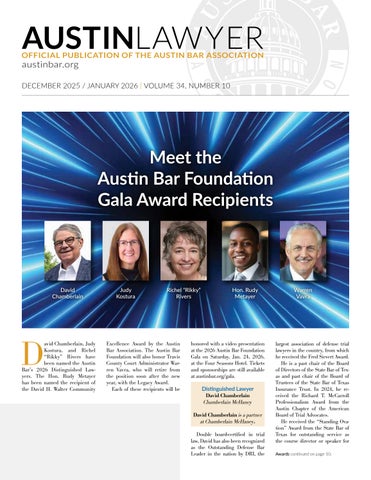
Meet the Austin Bar Foundation Gala Award Recipients
David Chamberlain
D
avid Chamberlain, Judy Kostura, and Richel “Rikky” Rivers have been named the Austin Bar’s 2026 Distinguished Lawyers. The Hon. Rudy Metayer has been named the recipient of the David H. Walter Community
Judy Kostura
Richel “Rikky” Rivers
Excellence Award by the Austin Bar Association. The Austin Bar Foundation will also honor Travis County Court Administrator Warren Vavra, who will retire from the position soon after the new year, with the Legacy Award. Each of these recipients will be
Hon. Rudy Metayer
honored with a video presentation at the 2026 Austin Bar Foundation Gala on Saturday, Jan. 24, 2026, at the Four Seasons Hotel. Tickets and sponsorships are still available at austinbar.org/gala. Distinguished Lawyer David Chamberlain Chamberlain McHaney David Chamberlain is a partner at Chamberlain McHaney. Double board-certified in trial law, David has also been recognized as the Outstanding Defense Bar Leader in the nation by DRI, the
Warren Vavra
largest association of defense trial lawyers in the country, from which he received the Fred Sievert Award. He is a past chair of the Board of Directors of the State Bar of Texas and past chair of the Board of Trustees of the State Bar of Texas Insurance Trust. In 2024, he received the Richard T. McCarroll Professionalism Award from the Austin Chapter of the American Board of Trial Advocates. He received the “Standing Ovation” Award from the State Bar of Texas for outstanding service as the course director or speaker for Awards continued on page 10.
It’s a new day for your practice Your favorite, most trusted business solutions. Now under a new name. Introducing 8am.
Purpose-built for your path forward
Supported by experts you can trust
Designed specifically for legal, accounting, and client-focused professionals
From onboarding to live support, our team is here to help you—every step of the way
Optimized for clarity and control
One platform, many possibilities
Smarter workflows that drive efficiency and deliver the insights you need to succeed
Powerful solutions built to support every part of your business and simplify your day
Learn more at 8am.com/austinbar
CONTENTS
AUSTINLAWYER DECEMBER 2025 / JANUARY 2026 | VOLUME 34, NUMBER 10 AL AL
INSIDE 1
Meet the Austin Bar Foundation Gala Award Recipients
26
IN EVERY ISSUE
8
New Members
CONNECTIONS
What’s With a Dynasty Trust?
8
Briefs
27
Hilgers Haunted Nights a Spooky Success
16
Federal Civil Court Update
28
VLS Recognizes Outstanding Attorneys with Annual Pro Bono Award Ceremony
18
Third Court of Appeals Civil Update
ONLINE austinbar.org austinlawyeronline.com
31
Trauma-Informed Justice in Action: Travis County SARRT and Upcoming Judicial Training
20
Third Court of Appeals Criminal Update
22
Local Jury Trial Verdicts
32
New-ish Cybersecurity Requirements Coming In Hot: Texas SB 2610
24
Supreme Court of Texas
DEPARTMENTS
6
President’s Column
12
AYLA
34
Entre Nous
EMAIL billy@austinbar.org MAIL Austin Bar Association 712 W. 16th Street Austin, TX 78701 Austin Bar app available for iPhone and Android. SOCIAL LIKE facebook.com/austinbar
ONLINE austinbar.org NEWS & ANNOUNCEMENTS
SAVE THE DATE
Tickets & Sponsorships for 2026 Gala Now Available Sponsorships and tickets are now available for the 2026 Austin Bar Foundation Gala! Hosted once again at the elegant Four Seasons Hotel in downtown Austin, this great event’s theme is “Radiant Future” and strives to raise funds to safeguard the future of Austin’s legal future and improve access to justice for Central Texans! To purchase tickets, tables, and sponsorships, please visit austinbar.org/gala. The deadline to be featured as a sponsor is Jan. 16, 2026.
Jan. 13
Family Law Section CLE 12 - 1 p.m. Zoom
FOLLOW twitter.com/theaustinbar FOLLOW instagram.com/theaustinbar CONNECT https://www.linkedin.com/ company/austin-barassociation WATCH vimeo.com/austinbar
America’s Premier Civil-Trial Mediators & Arbitrators Online
View Bios & Available Dates Calendars for our TX Chapter Members, free at
www.TexasNeutrals.org Proud ADR Sponsor to the National Defense & Plaintiff Bar Associations DECEMBER 2025/JANUARY 2026 | AUSTINLAWYER
3
ADDICTION & MENTAL HEALTH RESOURCES 24-Hour Suicide & Crisis Lifeline - 988 - call or text | Live chat: SuicidePreventionLifeline.org Texas Lawyers’ Assistance Program (TLAP) - 1-800-343-8527 TLAP is a 24-hour confidential crisis counseling and referral program to help lawyers, law students, and judges with substance use and mental health issues. Justice Mack Kidd Fund The Austin Bar Foundation administers the Justice Mack Kidd Fund, which can provide financial assistance to individuals seeking treatment for depression or similar illnesses. Visit austinbar.org/?pg=justice-mack-kidd-fund to learn more. Personal Crisis Assistance Program (PCAP) The Austin Young Lawyers Association Foundation provides grants and/or peer support for individuals suffering from a personal crisis. Contact Debbie Kelly: 512-472-0279 x 105 Sheeran-Crowley Trust Administered through TLAP, the trust provides financial help to Texas attorneys, judges, and law students who need treatment for substance use, depression, and other mental health issues. Visit sheerancrowley.org to learn more. Alcohol & Drug Abuse Austin Drug & Alcohol Abuse Program - 512-454-8180 Alcoholics Anonymous - 512-444-0071 Cocaine Anonymous - 512-479-9327 Narcotics Anonymous Counseling - 512-480-0004 Psychiatric Emergencies Emergency Screening in a Psychiatric Crisis 24/7 - 512-472-4357 Samaritan Center (provides professional counseling services on a sliding scale) - 512-451-7337
AUSTINLAWYER OFFICIAL PUBLICATION ALOF THE ALASSOCIATION AUSTIN BAR AUSTIN BAR ASSOCIATION
Maitreya Tomlinson ������������������ President Judge Maya Guerra Gamble �� President-Elect Sarah Harp ��������������������������������� Secretary Ciara Parks ��������������������������������� Treasurer Mary-Ellen King ������������������������ Immediate Past President
AUSTIN YOUNG LAWYERS ASSOCIATION
Jenna Malsbary �������������������� President Gracie Wood Shepherd ������ President-Elect Lena Proft ������������������������������ Treasurer Ben Evans ����������������������������� Secretary Emily Morris �������������������������� Immediate Past President
Austin Lawyer
©2025 Austin Bar Association; Austin Young Lawyers Association
EXECUTIVE OFFICES
712 W. 16th Street Austin, TX 78701 Email: austinbar@austinbar.org Website: austinbar.org Ph: 512.472.0279 DeLaine Ward....................... Executive Director Debbie Kelly.......................... Associate Executive Director Roslyn Warner....................... Assistant Editor Samantha McCoy................. Assistant Editor Abigail Ventress.................... Assistant Editor Billy Huntsman...................... Managing Editor Austin Lawyer (ISSN #10710353) is published monthly, except for July/August and December/January, at the annual rate of $10 membership dues by the Austin Bar Association and the Austin Young Lawyers Association, 712 W. 16th Street, Austin, TX 78701. Periodicals Postage Paid at Austin, Texas. POSTMASTER: Send address changes to Austin Lawyer, 712 W. 16th Street, Austin, TX 78701. Austin Lawyer is an award-winning newsletter published 10 times a year for members of the Austin Bar Association. Its focus is on Austin Bar activities, policies, and decisions of the Austin Bar board of directors; legislation affecting Austin attorneys; and other issues impacting lawyers and the legal professionals. It also includes information on decisions from the U.S. District Court for the Western District of Texas and the Texas Third Court of Appeals; CLE opportunities; members’ and committees’ accomplishments; and various community and association activities. The views, opinions, and content expressed in this publication are those of the author(s) or advertiser(s) and do not necessarily reflect the views or opinions of the Austin Bar Association membership, Austin Bar Association board of directors, or Austin Bar Association staff. As a matter of policy, the Austin Bar Association does not endorse any products, services, or programs, and any advertisement in this publication should not be construed as such an endorsement. Contributions to Austin Lawyer are welcome, but the right is reserved to select and edit materials to be published. Please send all correspondence to the address listed above. For editorial guidelines, visit austinbar.org in the “About Us” tab.
4
AUSTINLAWYER | DECEMBER 2025/JANUARY 2026
PRESIDENT’S COLUMN
The Season of Giving MAITREYA TOMLINSON, AUSTIN BAR PRESIDENT
N
o one wants to be the early versions of Ebenezer Scrooge or the Grinch over the holiday season. But there is something else about this time of year that makes it the season of giving. As cold(er) air begins moving in and lights start adorning the trees, we tend to become more generous. There are many meaningful ways that we (as attorneys) can give back throughout the year. This type of giving will involve less fanfare and gift wrap but will not trail in impact. The most obvious way that attor-
6
neys give back is through pro bono work. The increasing need for access to justice means the demand for pro bono assistance steadily persists. Whether you assist veterans, flood victims, or children, the difference you make in others’ lives is immeasurable and needed throughout the year. Although much less obvious, we can give back to our clients. We could not exist as a profession without clients. There are two things that can go a long way in giving back to them. The first is to provide good customer service. This means returning communications promptly, treating them with respect, keeping them informed, and anticipating needs before they arise. The second is putting yourself in their shoes. We tend to forget how daunting it is to the average client when seeking legal services and the toll that it can take on them, especially in litigation. We also tend to forget the economic impact hiring counsel has on the average person. Being em-
AUSTINLAWYER | DECEMBER 2025/JANUARY 2026
pathetic and cost-conscious while providing legal services can help alleviate these impacts. We can also give back to our colleagues. We can do so professionally by being a welcoming resource to our fellow attorneys. We can answer questions when they arise. We can help develop our junior colleagues and instill confidence in their burgeoning abilities. We can also model professionalism, civility, and other winning habits. Most importantly, we can be mindful when our colleagues exhibit signs of distress and be there when they struggle. We can also give back to our families and loved ones. The old saying is that the law is a jealous mistress. And in a way it can be. Long hours, travel, and other obligations monopolize our time. While this can be burdensome to us, our families and loved ones also pay a price. They pick up the slack that our absence creates. They support us when we deal with
the stress that accompanies the legal profession. In return, we can acknowledge the toll that it takes on them and express our gratitude. We can also dedicate time to spend with them, be present during that time, and make sure that we don’t miss out on the special moments. Last, but not least, we need to give back to ourselves. This profession exhausts us in many ways. It requires us to sell our most precious commodity (time), for many in increments of one-tenth of an hour. The profession also stretches us, takes us out of our comfort zones, and tests us mentally. Give yourself some grace. We all make mistakes, we all feel similar pressures, and we all have things to learn. Also, don’t forget to take some time for yourself and engage in healthy activities. A simple walk on a beautiful evening can ease your stress and help you put things in perspective. Happy holidays! Enjoy giving and take care of yourselves. AL
Do I Know A DoProperty I Know ATax Property Tax Lawyer? Lawyer?
COMPREHENSIVE STATEWIDE PROPERTY TAX REPRESENTATION COMPREHENSIVE STATEWIDE PROPERTY TAX REPRESENTATION Trusted by Lawyers, Tax Consultants and Taxpayers Since 1981 Trusted by Lawyers, Tax Consultants and Taxpayers Since 1981
WWW.TEXASPROPERTYTAXATTORNEYS.COM WWW.TEXASPROPERTYTAXATTORNEYS.COM
BRIEFS New Members The Austin Bar welcomes the following new members: Katherine Bone Thomas Bonham Jalene Brown Kathryn Cherry
ABOVE (from left): Boykin, Carlson, Crosby, Doty, Falgoust, Thebeau.
Jenna Clayborn Oscar Corpus Brenda Eisen Bryan Fagan Caroline Gehring Carson Gilchrist Sophia Johnson Rachel Knight Jennifer Lauren Lauren Mammen Jo Ann Mazoch Mary Monk Hema Mullur Nicholas Pigott Kennedy Quinn Alexander Rigby Frank Robison Deondrey Russell Charles Scalise Sumer Shelton Anna Sherman Thales Smith Hayley Sorenson David Steyer Breanna Wenke D’Angelo Vidhi Yadav Leopoldo Yanez Erin Zwiener
ON THE MOVE Congratulations to Patrick Carlson, who has joined DuBois, Bryant & Campbell as a partner. Patrick focuses his practice on real estate transactions, real estate development, governmental economic development programs, utility development and financing, local government regulation, and representing special districts that provide for the financing, construction, and operation of water, sewer, drainage, road, and park and recreational infrastructure for real estate development projects in Texas. Congratulations to Cleve Doty, who has joined PNT Law Firm as a partner. Cleve was formerly general counsel at a health tech company, a Texas state court trial judge, and assistant attorney general with expertise in small business acquisitions, complex negotiations, corporate contracts, litigation, and business strategy. Congratulations to Rachel Thebeau, who has joined PNT Law Firm as counsel. Rachel previously served in an in-house counsel role at a multi-national corporation with expertise in
investigations, complex problem-solving, communications, and leadership within complex organizational structures. KUDOS The Law Office of Leslie J. Boykin, P.C. was recently recognized with an award from Sam Houston State University, honoring one of the fastest-growing alumni-owned law businesses. Founded and led by Sam Houston State Law alumna Leslie J. Boykin, the firm continues to expand its practice while maintaining a strong commitment to client advocacy and community service.
years. Prior to the city attorney’s office, Neal worked as an assistant attorney general for the Texas Attorney General’s Open Records Division.
Congratulations to Cindy Crosby, who has been promoted from acting deputy city attorney/division chief to deputy city attorney in the City of Austin Attorney’s Office. She has been practicing municipal law for more than 25 years and has served the City of Austin for more than 14 years. Congratulations to Neal Falgoust, who has been promoted from division chief to deputy city attorney in the City of Austin Attorney’s Office. Neal has been with the city for more than nine
Chris Andre
New Vehicle Leasing / Pre-Owned Sales Domestics / Imports / Exotics
Busy Schedule? Call me. Any Make. Any Model. Email | chris@appleleasing.com
8
AUSTINLAWYER | DECEMBER 2025/JANUARY 2026
Phone | 512.653.3718
PARALEGAL TRAINING FROM UT AUSTIN Start a paralegal journey on your terms. UT Austin’s self-paced Paralegal Certificate Program provides in-depth training in essential legal areas, with enrollment available anytime.
Creative, efficient resolution of business disputes. How can we help?
Boost your legal career in just 5 months with our instructor-led program – perfect for aspiring paralegals.
Judge Jeff Rose (Ret.) ROSE RESOLUTION GROUP
Former Chief Justice, Texas’ Third Court of Appeals • 5 Time Texas Super Lawyer • Board Certified, Civil Trial Law
www. RoseResolutionGroup.com
Attend a free information session, or visit:
professionaled.utexas.edu/s/paralegal
DECEMBER 2025/JANUARY 2026 | AUSTINLAWYER
9
Awards continued from page 1.
more than 30 State Bar of Texas legal education courses in the last 15 years. He served as the 2015 president of the Texas Chapters of the American Board of Trial Advocates, Texas Chapters. In 2011-12 he served as President of the Austin Bar Association, the year it was named the Outstanding Local Bar Association in Division IV by the State Bar of Texas. He has served as president of the Texas Association of Defense Counsel and received the association’s Founder’s Award for outstanding leadership and service to the profession. He is named in the peer-selected Best Lawyers in America and has been named a Texas Super Lawyer for more than 20 straight years in Texas Monthly Magazine, an honor limited to five percent of Texas attorneys. He is double-certified in both civil trial law and personal injury trial law by the Texas Board of Legal Specialization. Less than one percent of Texas attorneys are board certified in both of these practice areas. He is the senior partner in the Austin civil trial firm of Chamberlain McHaney and has had the highest peer review rating (A.V. – Pre-eminent) issued by Martindale-Hubbell for more than 25 years. He has served as the course director of the State Bar of Texas Advanced Civil Trial Law Course, State Bar of Texas Advanced Personal Injury Law Course, and the State Bar of Texas Business Disputes Institute, among others. Distinguished Lawyer Judy Kostura Sorrels Law Judy Kostura is a partner at Sorrels Law in Austin. Judy’s passion is helping others. For more than 40 years, she has devoted her professional life to representing individuals, consulting with colleagues, teaching professional legal seminars, and serving as court-appointed guardian ad litem for injured children. The first of her family to graduate college, Judy received a bachelor’s degree from the University of Texas at Austin, working her way through college and law school as an assistant sergeant-at-arms for 10
the Texas House of Representatives. She obtained her law degree from the University of Texas Law School in 1980. After the first five years on her own in a general civil practice, representing family law clients, writing wills and probating them, and handling real estate closings, Judy found her calling in personal injury law. She achieved a $1.1 million jury verdict in 1995 on behalf of a motorcyclist hit by a man with only $20,000 in liability insurance coverage and then collected most of the judgment from the defendant’s liability carrier. A much smaller trial court verdict, forcing a health insurer to treat her injured client fairly, resulted in the Austin Court of Appeals affirming her client’s trial court verdict in 1995. These dual victories resulted from a practice of faithfully pursuing justice from insurers that refuse to honor their obligations. Pursuing the health insurer at trial and on appeal triggered the start of Judy’s expertise in health insurance subrogation law. For nearly 30 years, Judy has helped her clients keep more of their personal injury recovery by requiring their health insurers to put their insureds first. When the Texas Supreme Court altered the law in favor of health insurers in a 2007 court opinion, Judy lobbied the Texas Legislature to reform Texas health insurance subrogation law. Those efforts contributed to improvements for local governmental employees in 2007 and more sweeping reform in 2013. Judy received an award from the Texas Trial Lawyers Association for Legislative Contributions to insurance reform in 2013. The award included three Texas flags, one flown on the date the House of Representatives passed the 2013 law, one flown when the Senate passed it, and the flag flown the day the governor signed the bill into law. The consumer protection organization, Texas Watch, honored Judy with their Champion of Justice award in 2019, and the Texas Trial Lawyers Association presented her with their Lifetime Achievement Award in 2023. Colleagues from around the state have hired her to assist their injured clients. Her generosity in sharing with colleagues led to recognition by the Texas Trial Lawyers Association in 2006 with the John Howie Spirit of Mentorship Award
AUSTINLAWYER | DECEMBER 2025/JANUARY 2026
and the inaugural Capital Area Trial Lawyers’ Scott Ozmun Trial Lawyer of the Year award in 2011. State district courts in counties across the state have appointed her as a guardian ad litem to help injured children preserve their settlement funds. Her work has resulted in savings of millions of dollars for injured children. Judy is a frequent lecturer on various personal injury topics, including how to present information to maximize the recovery of compensation for clients; ethics topics; standards for proving evidence on appeal; changes in the law regarding the discovery and admission of medical evidence; and health insurance subrogation and liens in personal injury cases. She has taught at seminars for the American Association of Justice, Texas Trial Lawyers Association, University of Texas School of Law, State Bar of Texas, University of Houston Law School, South Texas College of Law, Texas Advanced Paralegal Seminar, Capital Area Trial Lawyers Association, Austin Bar Association’s Ultimate Trial Notebook, South Plains Trial Lawyer Association, Texas Academy of Family Law Specialists, Houston Trial Lawyers Association, and others. Her decades of participation in seminars prompted the State Bar of Texas to award her the Gene Cavin Award for Continuing Education during the Advanced Personal Injury Seminar in 2022, the equivalent of a lifetime achievement award in continuing legal education. Judy is a member of the Million Dollar Advocates Forum and has been recognized as a Texas Monthly Super Lawyer continuously since 2015, with additional selection as a Texas Monthly Top 50 Texas Women and Texas Monthly Top 50 Lawyer in Central/West Texas in 2016 and a Texas Monthly Top Women Attorneys in Texas 2021. Distinguished Lawyer Richel “Rikky” Rivers Rivers McNamara Rikky Rivers is a partner at Austin firm Rivers McNamara. A graduate of the University of Texas School of Law, Rikky joined the Law Enforcement Division of the State of Texas as an assistant
attorney general in 1976. In 1980, she left government work and entered private practice with Hilgers and Watkins, becoming a partner in 1983. The firm eventually merged with Brown McCarroll. She stayed at this firm for more than 30 years. In 2011, she founded Rivers McNamara with fellow Austin attorney Mary Evelyn McNamara. Together with attorney Emma Thomson, Rivers McNamara focuses on divorce and custody matters at the trial and appellate levels. Rikky is certified in Civil Trial Law, Civil Appellate Law, and Family Law by the Texas Board of Legal Specialization. She is admitted to practice before the Fifth and Eleventh Circuit Courts of Appeals, the United States District Courts for the Northern, Southern, Eastern, and Western Districts of Texas, and the United States Supreme Court. She has been rated a Texas Super Lawyer for more than 20 years. Between 1996 and 2006, she was master of the Robert W. Calvert Inn of Court, and served as president of the Inn between 2004 and 2005. Since 2007, she has been master emeritus. She has been a member of the Austin Bar Association since 1980 and was a member of the Austin Young Lawyers Association between 1981 and 1988. She has also been a member of the American Board of Trial Advocates, the Collaborative Law Institute for Texas, the Austin Bankruptcy Lawyers Association, the Bar Association of the Fifth Circuit, and the Federal Bar Association. Outside of the law, Rikky has donated her time and efforts to various civic organizations, such as the James Dick Foundation for the Performing Arts, serving on its board of directors since 2015; SafePlace, serving on its board of directors between 2000 and 2004; and the Austin Young Women’s Club of America (YWCA), serving on its board of directors between 1987 and 1996. She also served on Planned Parenthood’s Legal Advisory Committee in 1992, Austin Community College’s Committee for Development of Paralegal Training Program in 1986, and was principal flautist for the Austin Civic Orchestra between 1987 and 1989.
A frequent speaker and writer for legal seminars and publications, Rikky has spoken at various seminars for and written for the publications of the Austin Bar, the University of Texas School of Law, and the State Bar of Texas, among others. David H. Walter Community Excellence Award Hon. Rudy Metayer Chamberlain McHaney Rudy is a dynamic, award-winning attorney, government relations professional, and community leader with a passion for helping his clients achieve their goals through a holistic approach. He leverages his experience representing state agencies and other governmental entities in a broad range of legal matters ranging from federal appellate review of state agency actions to strategic counsel on multi-billion dollar public procurement contracts. While at the Texas Capitol, he draws on his background in public policy and extensive network to amplify his clients’ voices and deliver meaningful results. The son of Haitian immigrants, Rudy is the first generation in his family to graduate from college, public policy school, and law school. He has been a tireless advocate in the community, speaking and working on a host of issues ranging from teaching at-risk children, co-authoring an honor code for the University of Texas, helping form a partnership with local law enforcement and the State Bar to address the issue of community policing, and creating pro bono legal advice clinics for U.S. military veterans. He has been recognized numerous times as one of the most influential young professionals in Texas. Rudy serves as an adjunct professor at the University of Texas School of Law, where he advises students in the university’s well renowned Advocacy program. He also serves as Councilmember of the City of Pflugerville, where he enjoys contributing solutions to the growing city where he lives with his wife, Letisha, and their three daughters: Celeste, Arielyn, and Brooklyn. In his free time, Rudy enjoys var-
ious activities including reading, exercising, and cheering on his beloved Texas Longhorns in whatever sport they are competing in. Legacy Award Warren Vavra Travis County Court Administrator Travis County Court Administrator Warren Vavra has announced he will retire in early 2026. If you’re a lawyer who has done work in Travis County, you’ve likely interacted with Warren– and remember him. “He’s always well-dressed, he’s a smart lawyer, but he sounds like he just got out of a pickup truck after tending to the horses,” said Travis County Local Administrative District Judge Amy Clark Meachum. “I just try to prepare people for Warren and his big personality, he’s the guy in the room that you’re never going to forget.” “I’ve heard him described as a ‘metro-redneck,’” said Jacob Stokes, Director of Court Management for Travis County. As the court administrator, Warren’s job entails scheduling cases for Travis County’s central docket–a job that requires delicate handling of lawyers’ and judges’ often conflicting personalities, said family law attorney Keith Maples. “He has a tough job,” said family law attorney John Barrett of Coble Law & Mediation. “He has to get lawyers and judges in front of each other and have them all stay sort of happy. I’d be in the penitentiary if I had his job.” Warren, however, is especially suited for this role, with 419th District Judge Catherine Mauzy calling him both “the lawyer whisperer” and “the judge whisperer.” “He loves his job,” said Justice Gisela Triana, who served as the 200th District Court Judge in Travis County for 14 years before taking the Third Court of Appeals bench. “And he’s good at his job. He loves helping the litigants and the lawyers. To still take such great pride in doing it right after 30 years is really incredible.” In his 30 years of service to the
Courts, Warren has worked with approximately 85 different judges and probably thousands of different lawyers. “Very few people, in their legal careers, can say they have had such an impact on the profession as Warren has,” said Judge Meachum. “The courthouse just won’t be the same without him.” Warren is a 1992 graduate of Baylor Law School. He has been licensed to practice law in Texas since 1993. He has been a member of the Austin Bar since 1996 and speaks regularly at Austin Bar and AYLA events–most recently at the 2025 Bench Bar Conference. According to Warren, his time working for the Travis County Civil District Judges came about purely by chance. In the spring of 1995, he was an assistant general counsel at the State Bar of Texas when Jim McCormack, then the chief disciplinary counsel, sent him, along with Joseph C. Parker, Jr., to El Paso, Texas, to try a famous reinstatement case. “The ink wasn’t even dry on my bar card, and about all I was qualified to do was carry the trial cases
for Mr. Parker,” Warren said. The judge appointed to hear the case in El Paso was none other than Judge Pete Lowry, the senior civil district judge from Austin. “I was literally working five blocks away from the HMS Courthouse, but I had to go to El Paso to meet Judge Lowry,” said Warren. Less than a year later, Judge Lowry hired Warren as his staff attorney in January of 1996. “If that’s not serendipity, then I don’t know what is,” Warren said. Warren initially planned to be a trial lawyer.” “But that’s not the way my life worked out,” he said. “This was the perfect job for me, it gave me purpose, it energized me, and it made me feel like I was making a difference, like I was taking care of people and helping them. Now, of course, I realize my career worked out just like it was supposed to. I’m so grateful to all the Judges, the lawyers, and all the incredibly dedicated staff members who made this such a rewarding and satisfying job for me, I can’t thank them enough.” AL
DECEMBER 2025/JANUARY 2026 | AUSTINLAWYER
11
AUSTIN YOUNG LAWYERS ASSOCIATION
Building Community in a Competitive Field: Excerpts from a Lunch & Learn with Leaders Panel JENNA MALSBARY, AYLA PRESIDENT
I
n October, I had the honor of sitting on a panel alongside powerhouse attorneys with the Mother Attorney Mentor Association of Austin or the “MAMAs.” The current President of MAMAs, Connie Ditto, strategically recruited myself, Amber Russell, and María Amelia Calaf to speak on a panel moderated by Kate Lincoln-Goldfinch about our unique paths to leadership of initiatives while navigating our careers and motherhood. Yes, I pinched myself, shook off imposter syndrome, and shed a happy tear when I was invited to speak with these outstanding women. The luncheon was full of a wholesome conversation about what inspired us, who stands out as an amazing leader, and how motherhood has shaped your leadership style. One of the questions that we prepared for the panel but were not able to get to discuss was about building community in a competitive field. The topic was, “You’ve all built communities that focus on collaboration over competition. What’s the secret to making that work? And, have you ever had to shift your own mindset away from competition?” This was one I’d prepared for, because most of my leadership is outside of work, and I truly enjoy what I do—not because it’s filled with winning and losing, but because it’s filled with service to others and gratitude for connections and community. I believe this topic becomes even more valuable when younger attorneys begin practicing it early, especially those seeking to build community connections beyond the workplace. 12
Before going into my response, I want to share what some of the other MAMAs contributed when I asked if they could share what their response and advice would have been if we had time for this question. If you know Kate Lincoln-Goldfinch, you know that she is living and breathing competition outside of work at the moment. I am tremendously grateful that she was able to take the time to moderate our panel for the luncheon. The MAMA Perspective: Insights from the Panelists Connie Ditto, President of MAMAs and Partner at Beckstead Terry Ditto PLLC Connie wrote, “MAMAs are in a unique position to understand the constant struggle of lawyer moms– not just to balance work and life, but coordinating our fierceness and perfectionism our careers demand with the compassion and grace our children need. It was created to be a place where we could be unabashedly mothers and lawyers-–devoid of the competitiveness that exists in other legal settings.” She is doing a great job to continue the camaraderie that others established before her in her leadership year. Amber Russell, Founder of LOAR, PLLC and the SOAR Program Amber Russell, founder of LOAR, PLLC and the Scholarship Opportunities and Relationships (SOAR) program, emphasized the importance of prioritizing relationships above all else. She shared the following, “For me, the secret is valuing the relationships above all else. I genuinely believe there is more than enough work to go around. I’ve been practicing long enough to benefit from others who shared openly and collaborated with me, and now I’ve experienced the full circle of being able to do that for others. That perspective chang-
AUSTINLAWYER | DECEMBER 2025/JANUARY 2026
es everything. A big part of it is who you surround yourself with. Inside our firm and in my friendships and community outside of LOAR, I’m fortunate to be around people I truly care about who care about me. That makes it easy to cheer them on, to step aside and let them shine, and to know they’ll be right there celebrating my wins, too. Also, I know there are some circumstances in which we don’t get to choose who we are surrounded by—maybe it’s a large firm and not everyone is your cheerleader, or there are difficult competitors who are clear they don’t want to celebrate your wins. That’s okay, just know you’re not going to invest your time and energy in them, and be glad you can recognize the difference. Your time is a luxury item (thank you Taylor Swift), so value it appropriately and spend it with people who will build you up.” María Amelia Calaf, Partner at Botkin Chiarello Calaf and Founder of LILA María Amelia Calaf is a partner at Botkin Chiarello Calaf and founder of the Latinas in Law Austin (LILA) group. I had the chance to catch her over the phone to get her advice on the secret to building communities that focus on collaboration over competition. María Amalia shared that (like many of us) while at the University of Chicago Law School, the seed of competition was planted by the prevalence of the scarcity mindset created in that environment. She shared that the scarcity mindset sets in when there are just a few prestigious things that everyone wants, which then leads to competition and competitiveness being deeply ingrained into future lawyers’ minds. Starting her career in “big law,” María Amelia brought the competitiveness driven by the scarcity mindset into her practice and life, which did not bring her joy. Once she was able to
make the transformation from scarcity to an abundance mindset, that there are plenty of opportunities to be successful, it made her practice of law a lot more enjoyable. Shifting from big law also allowed her to shift to more collaboration, which ultimately benefited her personally and her clients. María Ameila recognized that there is still the competitive drive, but rather than against others, it is a competitive challenge to herself to do a good job in her advocacy and in her service. Leading by Example My own secret to fostering a community focused on collaboration over competition is twofold: leading by example and surrounding myself with individuals who prioritize collaboration and connection. I would most certainly not want to add to my already existent stress by choosing to serve and surround myself with individuals who are always focused on competition, one-upping each other, and hyper-focused on comparison. I got plenty of that in school and sports. When I’m at an AYLA or other service organization event, I strive to make everyone feel welcome and to leave competition where it belongs—in the courtroom or the office. It took years for me to fully shift my mindset away from the competition that had been a part of my life well before law school. The transformation from competition to collaboration has, without a doubt, made me a better leader, friend, mother, and advocate. It is my sincere hope that readers can take some of this advice and use it to build their own legacy of communities that focus on collaboration over competition, or at the very least, take the necessary steps to shift their mindset so that they are not always operating in “lawyer must compete and win” mode. AL
AUSTIN YOUNG LAWYERS ASSOCIATION
AYLA Celebrates a Fantastic Fall of Events and Community
Listos verde! AYLA’s tour of Q2 stadium included access to the Austin FC locker room.
Behind the scenes on the Q2 Stadium tour during a 4ATX Foundation event.
(L-R): AYLA Treasurer Lena Proft, Roslyn Warner, AYLA President Jenna Malsbary, Samantha Morales, and Viana Hodge enjoy rooftop yoga at CapMetro’s headquarters.
The Kickoff Happy Hour for Freshquires was held at Better Half.
O
• AYLA members took a behind-the-scenes tour of Q2 Stadium to support the 4ATX Foundation and had a Family Night for
ctober was filled with a lineup of fantastic AYLA gatherings: • Attorneys from all practice areas and walks of life came out to the Brass Poppy in the Van Zandt Hotel for a joint Docket Call with the Austin Bar Association’s Entertainment & Sports Law Section. AYLA extends a huge thanks to The Lewis Group for sponsoring the event and hosting a fun giveaway featuring champagne and wine. • Freshquires–the AYLA trailblazers dedicated to providing practice tips and community to first to third year lawyers–came together to welcome new members at its Kickoff Happy Hour at Better Half. • AYLA and the Austin Bar 14
teamed up to host a Leadership Academy alumni and recruitment event at Hilgers House. Past and future Leadership Academy members had the opportunity to connect, and the fearless founders of the Leadership Academy, Justice Karin Crump and David Courreges, spoke on how the program continues to empower young lawyers with meaningful opportunities for professional and personal growth. • AYLA Board Member Daniela Peinado Walsh moderated an insightful panel for a Local Latinos CLE panel. • The AYLA Health & Wellness Committee held an evening flow yoga sessions with the help of CapMetro’s stellar rooftop.
AUSTINLAWYER | DECEMBER 2025/JANUARY 2026
the Austin FC match vs. LAFC. It was a fun time cheering on the Verde and watching the team secure a win. AL
UPCOMING EVENTS THUR, DEC. 18 AYLA Docket Call 5:30 - 7 p.m. East End Ballroom 4715 E. 5th St. RSVP at AYLA.org Sponsored by MRI Centers of Texas
MON, JAN. 19 MLK Day of Service Info to come
AUSTIN YOUNG LAWYERS ASSOCIATION
(L-R): David Courreges, Jackie Davis, Justice Karin Crump, Brian Levy, and Jasleen Shokar.
Freshquires welcomed new members at its Kickoff Happy Hour at Better Half.
(L-R): Linda Garza, Judge Bianca Garcia, Judge Maria Cantú Hexsel, Justice Karin Crump, and Judge Raúl Arturo González participated in the Hispanic Heritage Luncheon.
Freshquires, designed for lawyers with three or fewer years of practice, welcomes new members during its Kickoff Happy Hour.
You’re busy looking out for your clients’ needs. Who’s looking out for yours? Jim Kaighin, Jr., CFP
®
Financial Professional
3305 Northland Dr., Suite 414
512-302-6051
Austin, TX 78731
kaighinjr@momentumin.com
Member: FINRA/SIPC
DECEMBER 2025/JANUARY 2026 | AUSTINLAWYER
15
FEDERAL CIVIL COURT UPDATE
Ari Cuenin is a partner at Stone Hilton, where he litigates complex government disputes. He has presented more than 30 arguments in state and federal courts, and has been involved in more than a dozen U.S. Supreme Court cases for the State of Texas.
UNIVERSITY EMPLOYMENT—Fifth Circuit rejects First Amendment challenge to “unwritten speech codes.” Lowery v. Mills (5th Cir. No. 24-50879).The Fifth Circuit affirmed the dismissal of UT-Austin professor Richard Lowery’s First Amendment claims, rejecting his effort to recast workplace disputes as unconstitutional retaliation or chilling of protected speech. Lowery alleged that administrators responded to his public criticisms— on issues ranging from DEI to university governance—by threatening his affiliation with the Salem Center for Public Policy, discussing his conduct with police, and pressuring his supervisor to “do something” about him. The district court dismissed Lowery’s retaliation claim and later granted partial summary judgment on Lowery’s “chilled speech” claim, concluding thar Lowery had not suffered an adverse employment action. Judge Smith’s opinion first held that Lowery had Article III standing to pursue injunctive relief because alleged “unwritten speech codes” and threats of future enforcement constituted a substantial risk of future harm under Speech First, Inc. v. Fenves, 979 F.3d 319 (5th Cir. 2020). Turning to the merits, the panel emphasized that the Fifth 16
Circuit has not recognized a freestanding “chilled speech” cause of action apart from retaliation, and that retaliation actionable under § 1983 against a public employee requires an adverse employment action such as termination, demotion, or formal discipline. Criticism, meetings, internal discussions, and even an internal police inquiry did not meet that threshold—particularly because Lowery continued to receive raises, reappointment, and tenure protections. The court also affirmed dismissal of Lowery’s challenge to an “unwritten” civility policy because the complaint lacked factual allegations establishing the existence of an enforceable speech code. Lowery thus develops the Fifth Circuit’s body of law for public-employee speech claims. Counsel should consider Lowery when facing First Amendment suits arising from political or academic speech within public institutions. Public employers like universities gain authority that informal pushback, criticism, or internal monitoring— when standing alone—does not give rise to actionable retaliation. Public-employee plaintiffs must show concrete adverse employment actions, not perceived hostility or mere self-imposed silence. MUNICIPAL EMPLOYMENT— Court erases race-discrimination jury award for former city manager. Jones v. City of Hutto (5th Cir. No. 24-50096). The Fifth Circuit affirmed in part and reversed in part an appeal of a multimillion-dollar jury verdict in favor of former Hutto City Manager Odis Jones. Jones had alleged racial discrimination and contractual impairment after the city rescinded his separation agreement and demanded repayment of $412,000. Jones claimed that certain members of the City Council harbored racial animus and engineered the rescission under pretextual concerns about budget shortfalls and defects in executing the contract. The jury awarded $8 million under § 1981 and $4.5 million for state-law breach of contract; the district court later required re-
AUSTINLAWYER | DECEMBER 2025/JANUARY 2026
mittitur based on a statutory contract-damages limitation. On appeal, the panel held that Jones satisfied the threshold Monell requirements for a § 1983 cause of action because the City Council’s rescission resolution constituted official municipal policy directly impairing Jones’ contract rights. Jones, however, still needed to prove that racial animus was the but-for cause of the City Council’s action for his § 1981 claim. Although the record contained evidence of hostility and possibly discriminatory remarks by two councilmembers, the panel emphasized that Jones failed to tie racial animus to a majority of the voting body. Without four votes motivated by race, the “headcount” requirement for municipal intent was not met. The court also rejected Jones’s attempt to invoke “cat’s paw” liability, holding that the doctrine—rooted in agency law—is incompatible with Monell’s bar on respondeat superior liability. This ruling illustrates the high hurdle for § 1981 contract-impairment claims against municipalities. Plaintiffs must prove discriminatory motive of the policymaking majority—not merely influential actors. The case also clarifies that “cat’s paw” theories do not circumvent Monell. Plaintiffs thus face a formidable defense when at most only a minority of municipal officials harbored improper motives. CLASS ACTIONS—Divided panel rejects cross-jurisdictional tolling; deems Hurricane Harvey claims time-barred. Ackerman v. Arkema Inc. (5th Cir. No. 25-20006). A Fifth Circuit panel affirmed the dismissal of nearly 800 property-damage suits filed nearly six years after the Arkema plant explosions during Hurricane Harvey. The panel deemed the claims barred by Texas’s two-year statute of limitations. Plaintiffs argued that the pendency of a related class action had tolled limitations under American Pipe & Construction Co. v. Utah, 414 U.S. 538 (1974). But as that related class action was a federal class action, and
Texas courts had recognized only state-court class-action tolling, the new claims were untimely. Chief Judge Elrod’s opinion reaffirmed the Fifth Circuit’s longstanding Erie prediction: Texas would not adopt cross-jurisdictional tolling. In view of this Circuit precedent, the panel stressed that only the Texas Legislature or the Texas Supreme Court could alter that rule. Plaintiffs’ argument that equitable considerations warranted an extension of tolling doctrine—given Arkema’s notice of the federal class claims and the number of affected claimants—was rejected as foreclosed by precedent. The panel also noted that intermediate Texas courts have consistently applied tolling only where the underlying class actions were filed in Texas state court. Judge Haynes dissented in part, urging certification of the tolling question to the Texas Supreme Court. Arkema thus rejects cross-jurisdictional tolling under Texas law. Litigators should proceed with care, as limitations may run unabated during federal or outof-state class actions. Plaintiffs’ counsel should be mindful of potential state-court actions that could preserve state-law claims. Otherwise, Arkema reflects serious dismissal risk for late-filed class-action suits following unsuccessful or incomplete federal class proceedings. AL
BOLLIER CICCONE STINSON Family Law | Construction Law | Commercial Litigation
Board Certified by the Texas Board of Legal Specialization
LESLIE J.
ANTHONY F.
SUSANNAH A.
EMILY E.
Board Certified, Family Law
Board Certified, Construction Law
Board Certified, Family Law
Board Certified, Family Law
BOLLIER
CICCONE
STINSON
LANDEROS
1101 S Capital of Texas Hwy, Bldg G, Suite 200, Austin, TX 78746 | 512.477.5796 | bclawtx.com
MEDIATION & ADR SERVICES
MARK L. HAWKINS
Rob Holcomb MEDIATOR
THE BEST LAWYERS IN AMERICA®
COMMERCIAL LITIGATION 2012–PRESENT
TEXAS SUPER LAWYERS®
BUSINESS LITIGATION 2016–PRESENT
THE BEST LAWYERS IN AMERICA®
REAL ESTATE LAW 2012–PRESENT
AUSTIN MONTHLY
TOP ATTORNEY 2019–PRESENT
Armbrust & Brown, PLLC 100 CONGRESS AVE., SUITE 1300 • AUSTIN, TEXAS 78701 512-435-2300 • FAX 512-435-2360 MHAWKINS@ABAUSTIN.COM
\Construction | Business | Real Estate | Consumer HOLCOMB-LAW.COM RDH@HOLCOMB-LAW.COM (512) 476-1121
HOLCOMB LAW, PLLC
4407 South IH-35, Suite 201 Georgetown, TX 78626 DECEMBER 2025/JANUARY 2026 | AUSTINLAWYER
17
THIRD COURT OF APPEALS CIVIL UPDATE
Laurie Ratliff is a former staff attorney for the Third Court of Appeals. She is boardcertified in civil appellate law by the Texas Board of Legal Specialization and owner of Laurie Ratliff LLC.
The following are summaries of selected civil opinions issued by the Third Court of Appeals during October 2025. The summaries are an overview; please review the entire opinion. Subsequent histories are current as of November 10, 2025.
> LANDLORD/TENANT: Court reverses attorney’s fees awarded after nonsuit. Collinwood Seniors, Ltd. v. Williams, No. 03-24-00576-CV (Tex. App.—Austin Oct. 30, 2025, no pet. h.) (mem. op.). Williams appealed the justice court’s judgment in this forcible detainer suit to county court. Williams challenged Collinwood’s notice to vacate and sought attorney’s
18
fees. While suit was pending, Collinwood received rental-assistance payments on Williams’ behalf. Collinwood nonsuited and sought disbursement of funds Williams paid into the court’s registry. Williams sought his attorney’s fees, contending Collinwood nonsuited to avoid an unfavorable ruling. The county court found Williams was a prevailing party and awarded fees. Because Collinwood nonsuited without prejudice after receiving Williams’ unpaid rent, the court of appeals concluded Collinwood did not nonsuit to avoid an unfavorable result. Instead, Collinwood nonsuited because it had no ground to evict. Thus, Williams was not a prevailing party. The court reversed and rendered. TORT CLAIMS ACT: Court affirms dismissal of governmental employee in conversion lawsuit. Feltner v. Tex. Military Dep’t., No. 03-23-00653-CV (Tex. App.— Austin Oct. 10, 2025, no pet. h.) (mem. op.). Bruce Feltner’s father donated Bruce’s World War I memorabilia to the Texas Military Forces Museum. Years later, Bruce contacted Jeff Hunt, the Museum’s director, to get it back. The Museum refused. Bruce sued Hunt and the Museum for conversion. The trial court granted Texas Military Department’s motion to dismiss Hunt under CPRC Section 101.106(e) and its plea to the jurisdiction on immunity. Bruce appealed the order dismissing Hunt. Bruce argued that the Museum was not a subsidiary of
AUSTINLAWYER | DECEMBER 2025/JANUARY 2026
TMD, thus Hunt was not acting in an official capacity. According to the court of appeals, an entity is a governmental unit if it is an agency of the government and derives its status from the Texas Constitution or statutes. TMD is a state agency and thus a governmental unit under the TTCA. TMD’s motion to dismiss confirmed Hunt’s status as an employee. The court affirmed. DRAM SHOP: Court affirms summary judgment based on safe-harbor defense. Watson v. Shooters Billiards & Sports Bar, LLC, No. 03-2300517-CV (Tex. App.—Austin Oct. 8, 2025, no pet. h.) (mem. op.). Family of decedent killed in a car accident sued bar under the Dram Shop Act for overserving the driver. The trial court granted bar’s summary judgment under the Act’s safe-harbor provision. The safe-harbor defense eliminates liability for an employee’s over-serving a patron if: 1) the employer requires employees to attend training classes, 2) the employees actually attend the classes, and 3) the bar did not encourage employees to violate the law. Only the third element was in dispute. The court of appeals rejected family’s argument that the bar encouraged over-service by ordering or rewarding over-service. Family presented no evidence that the bar’s manager was aware of over-service or encouraged employees to continue serving obviously-intoxicated patrons. The court affirmed.
FAMILY LAW: Court reverses death-penalty sanction in a discovery dispute. Orsinger v. Orsinger, No. 03-2300664-CV (Tex. App.—Austin Oct. 31, 2025, no pet. h.) (mem. op.). The trial court found father failed to comply with discovery requests and awarded attorney’s fees as sanctions but probated the bulk of the fees pending compliance with discovery. After continued non-compliance, the trial court held father in contempt, awarded additional fees, barred him from offering evidence on the support issues at trial, and found him intentionally underemployed. The court of appeals concluded that the trial court abused its discretion on some of the discovery abuses and by changing a largely-probated, nominal fee award to a death-penalty sanction. The trial court failed to explain why the original attorney-fee award plus additional fees was not considered as a lesser sanction. Further, the trial court abused its discretion finding intentional underemployment based on the failure to answer discovery. The court reversed in part and remanded. AL
Celebrating our new partners and rising leaders.
Angelica Rolong Cormier * |
Kristiana Butler *
Congratulations to Angelica Rolong Cormier and Kristiana Butler Goranson Bain Ausley proudly announces the promotion of two outstanding Austin attorneys— Kristiana Butler and Angelica Rolong Cormier—to Partner. Both exemplify the firm’s commitment to excellence, integrity, and exceptional client service. With these advancements, our Austin team continues to help clients safeguard assets, preserve relationships, and build secure futures for themselves and their families. *Board Certified in Family Law by the Texas Board of Legal Specialization
AUSTIN | DALLAS | PLANO | FORT WORTH | GRANBURY | MIDLAND | SAN ANTONIO
G B A F A M I L Y L A W. C O M
THIRD COURT OF APPEALS CRIMINAL UPDATE
Zak Hall is a staff attorney for the Third Court of Appeals. The summaries that follow represent the views of the author alone and do not reflect the views of the Court or any of the individual justices on the Court.
The following is a summary of selected criminal opinions issued by the Third Court of Appeals from April 2025. The summary is an overview; please review the entire opinions. The subsequent history is current as of October 6, 2025.
> SPEEDY TRIAL - DWI: Defendant was not denied right to speedy trial despite over threeyear delay following arrest and indictment. Fleming v. State, No. 03-2400011-CR (Tex. App.—Austin May 8, 2025, no pet.) (mem. op., not designated for publication). Fleming was arrested for the offense of driving while intoxicated with
a child passenger in September 2019, released on bond, and indicted in March 2020. Fleming was arrested again in May 2023, and she filed a motion for speedy trial and a motion to dismiss for lack of a speedy trial in June 2023. The trial court denied the motion to dismiss in September 2023, and Fleming pleaded guilty in October 2023. On appeal, Fleming argued that the trial court erred by denying her motion to dismiss for lack of a speedy trial. The appellate court disagreed and affirmed. The court expressed “some concerns about the State’s delay in pursuing the charge in this case.” However, “considering and balancing the relevant factors,” the court concluded that the trial court’s ruling “was supported by the record and correct under the applicable law.” The delay of over three years weighed against the State, as did the unexplained reason for much of the delay. Also, Fleming asserted her right to a speedy trial promptly after learning that she was under indictment, which weighed “somewhat in her favor.” However, Fleming failed to make any showing of prejudice, and this factor weighed heavily against her. SEARCH AND SEIZURE – TRAFFIC STOPS: Search of defendant following traffic stop was permissible as search incident to arrest, even though search occurred before arrest. Normand v. State, No. 03-23-
00742-CR (Tex. App.—Austin May 1 2025, no pet.) (mem. op., not designated for publication). Police officers initiated a traffic stop on Normand’s vehicle for failing to stop behind the white line at an intersection. Within a few minutes of the stop, Normand admitted that he did not have a valid driver’s license and had been driving without a license, which was an arrestable offense. During the stop but before the arrest, the officers searched Normand and discovered in his pocket a clear container with a crystalline substance inside and an Altoids tin with a dark substance inside. The substance tested positive for methamphetamine and heroin, and Normand was charged with possession of a controlled substance. Normand filed a motion to suppress, which the trial court denied. The appellate court affirmed the trial court’s suppression ruling on the ground that the officers were authorized to search Normand incident to arrest. First, the court rejected Normand’s contention that during the suppression hearing, the trial court improperly relied on the officers’ reports and recordings without any accompanying witness testimony. The court observed that Normand did not preserve this complaint in the court below and that even if he had, “[t]he Code of Criminal Procedure does not require that witnesses testify before a ruling on a motion to suppress may be made.” Turning to the merits, the court concluded that the officers had probable cause to
arrest Normand for driving without a license and, therefore, to search him incident to arrest, an exception to the search-warrant requirement. “The fact that the search occurred before the arrest did not render the exception inapplicable.” Additionally, “the applicability of the exception is not altered by the fact that Normand was ultimately arrested for and charged with possession of illegal drugs because an officer may arrest an individual for an offense discovered during the investigation of another offense.” The court also rejected Normand’s contention that the amount of time between the search and the arrest rendered the search impermissible. The court explained that the approximately twelve-minute gap between the discovery of narcotics on Normand’s person and his arrest was permissible in light of the manner in which the police conducted the search and that “[t]he decision by the police to divide the search up did not render Normand’s search so separated from his arrest that the search could not have qualified as one incident to arrest.” Finally, the court rejected Normand’s argument that the search was not done to effectuate the justifications for a search incident to arrest. The court explained that “a search incident to arrest can also be justified on the need for police to obtain weapons that could be used to assault an officer or help the defendant escape.” In this case, police found a switchblade knife in Normand’s pocket. AL
Divorce and Child Custody Surveillance ~ Undercover Background Checks Computer & Phone Forensics Corporate Investigations Expert Testimony and more STRICTLY CONFIDENTIAL
“Information is power, the not knowing is devastating.” 20
AUSTINLAWYER | DECEMBER 2025/JANUARY 2026
Anji Maddox
Featured in Forbes Magazine
Austin, Round Rock, & Dallas
LOCAL JURY TRIAL VERDICTS
September 2025 District & County Court Jury Trial Verdicts BY VELVA PRICE, TRAVIS COUNTY DISTRICT CLERK
CIVIL CORRECTION FROM AUGUST 2025 JURY TRIAL SUMMARY: Defendants’ counsel Ryan Willis v. Rainier Management LTD and Baustin Oak Park Ltd. Cause No.: D-1-GN-22-003413 Judge: Jan Soifer Dates: August 19-28, 2025 Attorneys: Plaintiff: Sally Metcalfe, Joe Caputo and Matt Breland [Austin] Defendants: David Chamberlain, Scott Taylor, and Alex Ciechanowicz, Chamberlain/McHaney [Austin] Summary: Plaintiff sued Rainier Management Ltd, an apartment management company, and Baustin Oak Park, LTD, the landowner, because a tree fell on him as he was walking on a pedestrian pathway. Plaintiff stated his back was broken in four places; he required emergency surgery involving two rods and 12 screws. Defendants claimed that the plaintiff was a trespasser, and the tree fell because of the weather (act of God). Eleven jurors found that the plaintiff was an invitee and found Rainier 85 percent and Baustin 15 percent responsible. The jury awarded damages: past physical pain - $275,000; future physical pain - $1.65 million; past mental anguish - $47,520; future mental anguish - $0; past reasonable necessary medical expenses - $165,000; future reasonable necessary medical expenses - $393,121; past disfigurement - $38,000; future disfigurement - $0; past physical impairment - $337,260; future physical impairment - $2.4 million; no gross negligence was awarded. SEPTEMBER TRIALS Luke Carter, Ind. and Derivatively on Behalf of Shibnobi Inc., Shibnobi Gaming, LLC, 22
Shibnobi Studios, LLC, Shibnobi Crypto, LLC, and Shibnobi Software, LLC, v. Cliff Fettner Cause No.: D-1-GN-23-001231 Judge: Cory Liu Dates: September 9-12, 2025 Attorneys: Plaintiffs: Alex More, Carrington, Coleman, Sloman & Blumenthal, LLP [Dallas] Defendants: Diren Singhe, Sul Lee Law Firm, PLLC [Dallas] Summary: Plaintiffs claim that Shibnobi was founded in November 2021 by Plaintiff Carter and Defendant Fettner as a crypto company with a mission to create a community-driven virtual token. After investigation, Carter discovered that Defendant mismanaged Shibnobi for Defendant’s sole benefit. Ten of the jurors found that Carter was an owner of Shibnobi, Shibnobi Gaming, Shibnobi Studios, Shibnobi Crypto, and Shibnobi Software; Defendant benefited from one or more transactions with Plaintiffs by placing himself in a position in which his self-interest might conflict with his fiduciary duties; Defendant did not comply with his fiduciary duty to Plaintiffs; Defendant’s failure to comply with his fiduciary duty was not excused by ratification. Jury damage awards: lost digital assets–the value of digital assets transferred by Defendant from wallets belonging to the Shibnobi Entities - $5,994,566.38. Carter and Fettner did form a partnership before the formation of the Shibnobi Entities and Defendant benefited from transactions with the partnership or by placing himself in a position in which his self-interest might conflict with his obligations as a fiduciary to the partnership; Defendant did not comply with his fiduciary duties of accounting and holding of the partnership property, profit, or benefit derived by Defendant from use by Defendant of partnership property; Defendant’s failure to comply with his fiducia-
AUSTINLAWYER | DECEMBER 2025/JANUARY 2026
ry duties was not excused by ratification. Jury awarded the value of the digital assets transferred by Fettner from wallets belonging to the partnership - $1,427,128,38. Jury further found that the harm to Carter resulted from malice, fraud, and gross negligence and assessed exemplary damages in the amount of $2 million. Caitlin E. Carpenter, Ind. and on behalf of W.W., a Minor and Lorenzo A. Marquez v. Wings, LLC d/b/a Wings ‘N More; Pedro Jaimes Suarez; Esperanza Duran; Leo Viera; Mireya Cruz Marquez and Jessica Guadarrama Cause No.: D-1-GN-23-004486 Judge: Corey Liu Dates: September 22-25, 2025 Attorneys: Plaintiffs: Robert C. Alden/C. Carson May, Byrd, Davis, Alden & Henrichson LLP [Austin] Defendants: Esperanza Duran, Leo Viera, Mireya Cruz Marquez and Jessica Guadarrama Jim Clements, Clements Legal Services, P.C. [Austin] Defendant: Pedro Jaimes Suarez-Lisa Michaux, Leighton, Michaux & Brown, LLC [Austin] Defendant: Wings LLC d/b/a Wings ‘N More-Jon Michael Smith [Austin] Defendant: State Farm-Sean Hoffman, Skelton and Woody PLLC [Austin] Summary: The Plaintiffs claimed that they were injured in an automobile accident in which Pedro Jaimes Suarez was the driver of the other vehicle and was intoxicated. Before the trial, the plaintiff nonsuited Esperanza Duran and Jessica Guadarrama. A unanimous jury found that the following parties were negligent, providing an alcoholic beverage under authority of a license when it is apparent to the provider that the recipient is obviously intoxicated to the extent that he presents a clear danger to himself and others. The allocation was as follows: Wings LLC – 37 percent, Leo Viera – two percent,
Mireya Cruz Marquez – one percent, and Pedro Jaimes Suarez – 60 percent. Damages awarded to W.W., a minor: past physical pain and mental anguish - $767,807.75; future physical pain and mental anguish $11,005,244.42; past disfigurement - $767,807.75; future disfigurement - $11,005,244.42; past physical impairment - $767,807.75; future physical impairment - $11,005,244.42; past medical care expenses $5,570,320.95; future medical care expenses until W.W. reaches the age of 18 - $23,522,335.09; future loss of earning capacity until W.W. reaches the age of 18 - $2.46 million. Damages awarded to Caitlin Carpenter for her injuries: past physical pain and mental anguish - $1.125 million; future mental anguish - $1.125 million; damages to Caitlin Carpenter for her mental anguish that resulted from being a bystander to the serious injury of W.W., a minor: past mental anguish - $17,659,578.26; future mental anguish - $17,659,578.25. Damages awarded to Lorenzo Marquez for his injuries: past physical pain and mental anguish - $1.125 million; future physical pain and mental anguish - $1.125 million. The jury also found by clear and convincing evidence that the harm to W.W., a minor, was from gross negligence due to the act or omission by Pedro Jaimes Suarez, and that Pedro Jaimes Suarez operated a motor vehicle in a public place while intoxicated and that the intoxication caused serious bodily injury, but awarded $0 for exemplary damages. Arnulfo P. Alcorta et. al. v. Kelly Hancock, Acting Texas Comptroller Of Public Accounts Cause No.: D-1-GN-17-006831 Judge: Jessica Mangrum Dates: September 22-25, 2025 Attorneys: Plaintiffs: Nicholas S. Bressi, Law Office of Nicholas Bressi [Austin] Defendant: Jennifer Cook, Attorney General of Texas, General Litigation Division [Austin]
Summary: This case involves a dispute over unclaimed mineral royalties held by the Texas Comptroller of Public Accounts. Plaintiffs claim that the comptroller failed to decide their claim to the royalties within the statutory time period. A unanimous jury found that the 48 plaintiffs did not establish that they were legal heirs of a deceased owner of mineral proceeds remitted to the comptroller by the operator or holder of a mineral well. Hunter Higgins v. Dough Daddy, LLC A/K/A Shipley Do-Nuts and Amber Cokins Cause No.: D-1-GN-20-000891 Judge: Catherine Mauzy Dates: September 22-23, 2025 Attorneys: Plaintiff: Joseph Monahan, Law Offices of Joseph Monahan [Laredo] Defendants: Lucia Ceaser, Hajjar/Peters, LLP [Austin] and Ricardo Pumarejo, Jr., Pumarejo Law [Austin] Summary: The plaintiff alleges he was assaulted by Defendant Amber Cokins, an employee of Dough Daddy, LLC, and Defendant Dough Daddy had control over the prem-
ises and owed certain duties to the plaintiff, which were breached. A unanimous jury found that Defendant Amber Cokins did assault the plaintiff. The jury found that the assault was not justified. Damages awarded are: past mental anguish $5,000. Gail Wilhelm v. Jolisa Johnson Cause No.: D-1-GN-23-007207 Judge: Laurie Eiserloh Dates: September 23-25, 2025 Attorneys: Plaintiff: Myranda Vaughn, Daniel Stark, LLP [Bryan] Defendant: Katherine Wyatt, Skelton & Woody, PLLC [Austin] Summary: Plaintiff claimed that on or around December 2022, a motor vehicle incident caused him physical damage as a pedestrian. A unanimous jury found that the plaintiff was negligent but not the defendant. CRIMINAL State of Texas v. Uriel Loredo-Torres Cause No.: D-1-DC-24-206265 Judge: Melissa Goodwin Dates: September 8-10, 2025
Attorneys: State of Texas: Emily Scholten Defendant: Raymond Espersen Summary: The defendant was indicted for two separate charges - driving while intoxicated, having been convicted two times or more of being intoxicated while driving, and collision involving personal injury. The jury found the defendant not guilty of driving while intoxicated. State of Texas v. Yaseen Naz Cause No.: D-1-DC-25-904062 Judge: Brandy Mueller Dates: September 15-19, 2025 Attorneys State of Texas: Jean Sullivan/ Cahal McColgan Defendant: Angelica Patrice Adel Cogliano Summary: The defendant was indicted for murder under the influence of sudden passion, which occurred on or about January 2023. A district attorney press release stated the following: “During the investigation, the Austin Police Department found that Mr. Naz and the victim were involved in a physical altercation inside the gas station where Mr. Naz worked. Surveillance footage from the gas
partners: Keith D. Maples
Andrea (Andi) St. Leger Judith Bryant
station showed that the altercation occurred inside the store prior to the shooting. After the altercation, Mr. Demps tried to leave but was pursued by Mr. Naz and another store employee into the parking lot. Mr. Naz is then seen on video firing multiple rounds into Mr. Demp’s vehicle through his door and window while he was sitting in his vehicle with the door closed. Defendant claimed self-defense, defense of a third person, and defense of a person’s property.” The jury convicted the defendant of murder and gave him five years in prison. State of Texas v. Christian Alba Cause No.: D-1-DC-23-302315 Judge: P. David Wahlberg Dates: September 10-18, 2025 Attorneys State of Texas: Jason Rew Hunter Defendant: Charlie Baird Summary: The defendant was indicted for murder. A mistrial was declared. AL
Sam D. Colletti Coleen Kinsler
Hillery R. Kaplan Leigh de la Reza
ASSOCIATE ATTORNEYS: Emily Tesmer, Ryan Curington, Katie Valle
DECEMBER 2025/JANUARY 2026 | AUSTINLAWYER
23
SUPREME COURT OF TEXAS ADMINISTRATIVE LAW - Redundant-Remedies Doctrine & Judicial Review of Agency Actions: This case addresses when declaratory-judgment lawsuits complaining of adverse agency actions are barred by the redundant-remedies doctrine. Gonzalez v. Tex. Med. Bd., S.W.3d, 2025 WL (Tex. Oct. 31, 2025) [24- 0340] Reynaldo Gonzalez, Jr. holds a medical degree and law degree but is only licensed to practice law. In 2020 he ran for the U.S. House of Representatives and referred to himself as “Dr. Gonzalez” and a “physician and attorney.” The Texas Medical Board issued a ceaseand-desist order prohibiting Gonzalez from using these titles without designating the authority giving rise to his use of that title. Gonzalez filed suit in the district court alleging that the TMB lacks authority to regulate him, that the statutes in question are facially unconstitutional and unconstitutional as-applied to him, and that the ceaseand-desist order is not supported by the evidence. TMB filed a plea to the jurisdiction, arguing that his suit is
24
untimely under the Administrative Procedure Act and that his declaratory- judgment claim is barred by the redundant-remedies doctrine. The trial court granted TMB’s plea. The court of appeals reversed in part, holding that his facial constitutional claim is not barred. The Supreme Court reversed in part and remanded to the trial court. The Court held that the court of appeals should also have remanded Gonzalez’s claims that the statute is unconstitutional as-applied to him and that TMB acted without lawful authority. The redundant-remedies doctrine only bars claims if they would be wholly redundant of an APA claim. But the APA would only have enabled Gonzalez to challenge the cease-and-desist order. Gonazlez’s as-applied and ultra vires claims seek relief from future orders of the TMB, not just the cease-and-desist order. The Court affirmed dismissal of Gonzalez’s claim that the cease-anddesist order is unsupported by substantial evidence. Gonzalez claims that he did not need to follow the APA’s thirty-day deadline because a TMB regulation gives him the right to judicial review, and that regula-
AUSTINLAWYER | DECEMBER 2025/JANUARY 2026
tion does not specify a deadline. The Court held that the trial court lacks jurisdiction over that claim because only a statute, and not a regulation, can create a right to judicial review. FAMILY LAW – Termination of Parental Rights: At issue in this case is whether the Department of Family and Protective Services orally abandoned its request for termination of D.V.’s parental rights to her child at trial. D.V. v. Tex. Dep’t of Fam. & Protective Servs., S.W.3d, 2025 WL Tex. Oct. 31, 2025) [24-0840] In January 2021, the Department removed D.V.’s child from her home and sued to terminate her parental rights after receiving reports of domestic violence. At trial, the Department’s designated representative—one of its caseworkers—testified both on direct and cross-examination that the Department no longer sought to terminate D.V.’s parental rights but to limit her status to parent non-conservator with no rights of visitation or contact. The Department took no steps to controvert this assertion, but the trial court terminated D.V.’s rights.
The court of appeals affirmed, holding that the Department had not abandoned its pleading, relying on what it regarded as the trial’s larger context. The Supreme Court reversed. It held that in parental-termination cases, which are distinct from other civil litigation for various reasons, an unequivocal assertion by the Department—including its designated representative—constitutes withdrawal of a request for termination. A court may not order termination, therefore, unless the Department clearly repudiates the assertion that termination is no longer sought. In this case, the caseworker’s statement was unequivocal. No contextual features at trial that the court of appeals or the Department identified constitute repudiation of that unequivocal statement, so the trial court lacked authority to order termination. The Supreme Court therefore remanded to the trial court with instructions to appoint D.V. a parent non-conservator, consistent with the caseworker’s testimony and D.V.’s request. AL
Complexity is our specialty. Board Certified by the Texas Board of Legal Specialization in Aviation Law, attorneys Mike Slack and Ladd Sanger, along with senior attorney Derek Quick, of the law firm Slack Davis Sanger, specialize in navigating and winning challenging aviation cases. With three decades of experience and a team of highly-regarded lawyers consisting of licensed pilots and a former NASA® engineer, we have the technical and legal expertise to outwork, out-think, and out-resource any opposition. Austin | Dallas | SLACKDAVIS.COM Commercial Airline | Private & Charter Planes | Helicopter | Air Ambulance
What’s With a Dynasty Trust? BY ZACH WIEWEL, JD, LL.M (TAX), AND ROB HUGOS, JD, CPA, LL.M (TAX)
What Is a Dynasty Trust? Everyone seems interested in making and keeping as much money as they can. A dynasty trust is a special kind of legal arrangement that helps families pass down money and property from one generation to the next. It’s designed to last for many years—sometimes forever—and can protect family wealth from taxes, creditors, and poor financial decisions. Why Do People Use Dynasty Trusts? Many families lose their wealth over time. Studies show that 70% of family wealth is gone by the second generation, and 90% by the third. The concept is called “shirt sleeves to shirt sleeves in three generations.” A dynasty trust can help avoid this by keeping money in a protected account that follows strict rules. Here are the main reasons people use dynasty trusts: • Avoid Certain Taxes: Normally, when you give money to your children or grandchildren, you might have to pay estate or gift taxes. A dynasty trust can help avoid these taxes. • Protect Assets: The trust can be designed to keep the money safe from lawsuits, divorces, and bankruptcy. The official name of this type of trust is a “spendthrift trust.” • Control How Money Is Used: The person who creates the trust (called the grantor) can set rules for how and when the money is given to family members, who can then control it themselves, or someone else, typically a trust company, can control it for them. How Does It Work? A dynasty trust is a type of irrevocable trust, which means once it’s created, it cannot be changed easily. The grantor puts money, property, or investments into the trust. Then, a trustee—a person or company—manages the trust 26
and follows the rules set by the grantor. The trustee decides when and how to give money to the beneficiaries. These beneficiaries are usually the grantor’s children, grandchildren, and future descendants. Where Can You Set One Up? Not every state allows dynasty trusts to last forever. Some states have laws called the “rule against perpetuities,” which limit how long a trust can last. But states like Delaware, Nevada, and South Dakota allow dynasty trusts to continue for many generations. Texas now has a 300-year statute! Try to imagine what was happening in 1725, and that will give you an idea of how long a Texas trust can last. What Are the Benefits? • Tax Savings: If set up correctly, the trust avoids estate, gift, and generation-skipping transfer taxes. To put it another way, the money does not skip generations, the taxes do, so the IRS does not get to render a tax on the trust’s assets at every generation. • Asset Protection: The money in the trust is not owned by the beneficiaries; it is trust property.
AUSTINLAWYER | DECEMBER 2025/JANUARY 2026
A significant advantage of a dynasty trust is that it is drafted to keep the assets safe from creditors and divorce settlements. • Long-Term Planning: The trust can include rules about education, age milestones, or responsible behavior before giving out money, although some of these types of provisions can add unnecessary complexity to it. • Professional Management: Many families often choose banks or trust companies to manage the trust to make sure it is administered properly. Are There Any Downsides? Yes, there are a few things to think about: • Cost: Setting up and managing a dynasty trust can be expensive, but so can generations of taxes. • Complexity: These trusts are complicated and need help from expert lawyers, qualified financial advisors, and CPAs. • Loss of Control: Once the trust is created, the grantor cannot take the money back or change the rules easily; the trust will also be required to file a special tax return annually and could pay higher income taxes.
Who Should Consider a Dynasty Trust? Dynasty trusts are usually used by high-net-worth families—people with a lot of money or property. But even families with moderate wealth might benefit if they want to protect their assets and make sure the property stays in their bloodline. In-law issues can also be addressed. Final Thoughts A dynasty trust is a powerful tool for families who want to protect their wealth, avoid taxes, and make sure future generations are financially secure. While it’s not for everyone, it can be a smart choice for those who want to leave a lasting legacy. AL Zach Wiewel is an Estate Planning attorney at Texas Trust Law and earned his LL.M. in Taxation from NYU School of Law. Rob Hugos is a Board-Certified Estate Planning attorney at Texas Trust Law and earned his LL.M. in Taxation from NYU School of Law.
Hilgers Haunted Nights a Spooky Success
O
n October 24th and 25th, Austin lawyers experienced a new kind of Halloween fun—an immersive, theatrical tour through the haunted halls of Hilgers House. With nearly 200 LED candles lighting the way, guests were ushered through the three floors of Hilgers House as they met magical residents from the house’s 125-year history. The evening began at a pop-up “speakeasy” where the manager (Amanda Arriaga) and resident card shark (Austin Berg) offered guests plenty of free moonshine. Groups of up to eight people at a time were led to the front door of Hilgers, where their tour began. In the piano parlor, the host (Adam Schramek) began to reveal the dark history of Hilgers’ past as a table floated in mid-air. The tour next turned to the dining room, where a proprietor of uncommon objects (Joe Weaver) told guests about his strange obsession with a patient registry from a shuttered insane asylum. The evening continued upstairs, where a mad scientist (Bertil Fredstrom) revealed his cloned “masterpiece” (Hailey Hobren / Dave Spring), and a serial killer (Scott Wells) played a game of chance with poisoned candy. But it was the father in the attic (John Carter) whose psychic touches revealed Hilgers’ ghostly past. The final room took the tour back downstairs, where a spiritualist (Gary Yorke) revealed a bewitching power that was out of this world. And just when it appeared the tour had ended, guests found one final spirit (Chari Kelly/Ayeola Williams) standing between them and the outside world. Hilgers Haunted Nights was produced by the Texas Magic Center, a 501(c)(3) nonprofit created to promote, preserve and advance the art of magic in Texas. The event generated over $5,000 in profit, which was split equally between the Center and the Austin Bar Foundation. The HHN cast was primarily made up of members of the Austin chapter of the Society of American
Magicians. The experience was produced and directed by Adam Schramek and Saul Ravencraft, who also provided tarot card readings throughout the night. Floor guides included longtime Austin magician Kent Cummins and Mike Collins. HHN received high marks from those attending. One long-time Austin magician hailed the “in-
credible performance” as “the best Halloween-themed show” he had ever seen. Austin lawyers were “impressed with the thought and work that went into the experience,” had “a wonderful time,” had their “mind blown” by the “incredible performance,” and thought HHN “should be charging a lot more for this.” The Texas Magic Center and Aus-
tin Bar Foundation would like to thank everyone who attended this inaugural production and helped make it a success. They would also like to thank Texas magician Trixie Bond who sponsored the event. When asked if HHN might return next season, the producers responded that many secrets of Hilgers’ dark, haunted past have yet to be revealed. AL
DECEMBER 2025/JANUARY 2026 | AUSTINLAWYER
27
VLS Recognizes Outstanding Attorneys with Annual Pro Bono Award Ceremony
O
n October 23, Volunteer Legal Services of Central Texas gathered to celebrate the power of pro bono at the Judge Suzanne Covington Pro Bono Service Awards Ceremony. The event recognized law firms and attorneys for their investment of time, legal expertise, and philanthropic resources to increase access to justice. This award ceremony is named after the Honorable Suzanne Covington, who began her judicial career in 1990. Judge Covington served in the 201st District Court in Austin for 15 years. Prior to becoming a judge, a large part of her career was spent as a legal aid lawyer, working with top legal service providers such as DNA-People’s Legal Services in Arizona, Greater Boston Legal Services, and Legal Aid Society of Central Texas. Judge Covington also served as Director of the Children’s Rights Clinic at The University of Texas School of Law. She is a former member of both the VLS and TAJF board. Specifically recognized at the reception were two individuals and one law firm that devoted an extraordinary amount of care and commitment to pro bono legal services. The Susan P. Burton Award is given annually to a volunteer attorney who has been licensed for five years or less and who has demonstrated exemplary pro-bono service. The winner of the 2025 Susan P. Burton Award is Anne Derrig, an associate at Jackson Walker, LLP, with a practice focus on trial and appellate litigation. Since she began volunteering with VLS in 2020, she has dedicated over 120 hours to pro bono work, offering essential legal representation to low-income clients, particularly in housing and defense matters. Anne’s commitment to her clients is not only reflected in the number of hours she has devoted, but in the depth of care and advocacy she brings to each case. 28
The J. Chrys Dougherty Award is given annually to a volunteer attorney for exemplary dedication and commitment to the principle of access to justice for all people regardless of income. The winner of the 2025 J. Chrys Dougherty Award is Angie Marshall with Angie N. Marshall Law Practice. Angie believes deeply that everyone, regardless of income, background, or citizenship status, deserves equal access to justice. This commitment drives both her private practice and her exceptional pro bono service with Volunteer Legal Services (VLS). She has provided vital legal representation to community members on issues such as consumer protection, property rights, and landlord-tenant disputes-- taking more than 20 cases, including over half a dozen each year for the past three years. In 2024 alone, she closed six cases, each one making a meaningful difference in the lives of her clients. The Joseph H. Hart Award honors a firm that demonstrates integrity and commitment to providing legal assistance for the less fortunate—principles that former 126th District Court Judge Joe Hart has demonstrated throughout his legal and judicial career. The winner of the 2025 Joseph H. Hart Award is Sonnenschein Law. We are honored to recognize Sonnenschein Law for their extraordinary dedication to pro bono work through VLS. DeBorah and Alex Sonnenschein began volunteering through the NOVA program—an initiative of the Texas State Bar that allows attorneys licensed in other states or retired inactive attorneys in Texas to provide pro bono services—before they were even licensed in Texas themselves. They have been active and reliable volunteers since 2019. In 2024 alone, the Sonnenscheins participated in 20 in-person clinics and even signed up for the
AUSTINLAWYER | DECEMBER 2025/JANUARY 2026
(L to R): Jackson Walker Partner Michael Roberts, Jackson Walker Associate Anne Derrig, and VLS Executive Director Alisa De Luna.
(L to R): 201st District Court Judge Amy Clark Meachum, Angie N. Marshall, and Alisa De Luna.
(L to R): Haney Law Firm Senior Paralegal Amber Haney, DeBorah Sonnenschein, co-founder of Sonnenschein Law, Alexander Sonnenschein, co-founder of Sonnenschein Law, and Alisa De Luna.
July phone clinic when in-person services were closed. DeBorah and Alex Sonnenschein embody the spirit of service, leadership, and generosity, and we are deeply grateful for the difference they make in the lives of so many.
VLS is fortunate to have the generosity of legal talent and financial support from so many members of the legal community. The Volunteer Legal Services board and staff salute these outstanding volunteers. AL
Thank You to Our Generous Sponsors!
PRO BONO FALL FESTIVAL
GREAT PUMPKIN
GREAT PUMPKIN
Todd Wong, County Court at Law No. 1
Chamberlain Hrdlicka
Terrazas PLLC
Steno
Byrd Davis Alden & Henrichson
Norton Rose Fulbright
Holland & Knight
HARVEST MOON Jessica Mangrum, 200th District Court
Rose Resolution Group
& Brown HARVESTArmbrust MOON
Cantilo & Bennett
Catherine Mauzy, 419th District Court Mauzy Judge Catherine Barnett & Garcia
The Tomlinson Firm, PLLC
419th District Court
Sara E. Saltmarsh, Attorney & Mediator
SCARECROW Cantilo & Bennett, L.L.P. Kaplan Law Firm
Jan Soifer, 345th District Court SCARECROW Laurie Eiserloh, 455th District Court Maya Guerra Gamble, 459th District Court Botkin Chiarello & Calaf
Judge Jan Soifer Brough & Resendez
Lincoln-Goldfinch Law
Sorrels Law
Hanna & Plaut
Nama Howell
Laurie Ratliff LLC
345th District Court
Laurie Ratliff L.L.C.
Darlene Bryne, Third Court of Appeals Chief Justice Darlene Byrne
CANDY CORN
CANDY CORN
Judge Ciara Parks for Justice of the Peace Pct. 1
Nielsen Law Lowell Keig JudgeHarp, Daniella DeSeta Lyttle, 261st District Court Sarah Austin Bar Secretary Sylvia Holmes, CountyKennon CourtWooten at Law No. 3 Leslie Dippelfor for County Travis County Court at Law #2 2 Judge Sylvia Travis County Court at Law #3 Leslie Dippel Court at Law No. Velva Price, TravisHolmes, County District Clerk Velva Price, Travis County District Clerk Justice Gisela Triana, Third Court of Appeals Gisela Triana, Third Court of Appeals SPECIAL THANKS
Ciara Parks forHarp, Justice ofBar theTreasurer Peace Pct. 1 Sarah Austin
Nielsen Law Lowell Keig
Kennon Wooten
30
AUSTINLAWYER | DECEMBER 2025/JANUARY 2026
Trauma-Informed Justice in Action: Travis County SARRT and Upcoming Judicial Training Understanding Travis County SARRT and Its Role in Trauma-Informed Judicial Practices BY SAMANTHA MCCOY, CHAIR OF TRAVIS COUNTY SARRT TRAINING COMMITTEE
T
he Austin/Travis County Sexual Assault Response and Resource Team (SARRT) is a multidisciplinary coalition formed in 1992 to improve the community-wide response to sexual assault. Comprising law enforcement, prosecutors, advocates, medical professionals, and survivors, SARRT’s mission is to foster collaboration, training, and coordination among agencies tasked with responding to adult sexual assault cases. This approach ensures that every stakeholder—from police to victim advocates—works together to provide comprehensive, trauma-informed support for survivors. By integrating knowledge about trauma into policies and practices, SARRT actively seeks to prevent re-traumatization and strengthen systemic responses to sexual violence. SARRT’s work is rooted in recognizing the widespread impact of trauma and promoting recovery pathways. Its initiatives include case staffing with pros-
ecutors to improve outcomes, expanding access to sexual assault exams through clinics like Eloise House, and advocating for systemic reforms. These efforts reflect a commitment to survivor-centered justice and continuous improvement in local sexual assault response. Recap of Trauma-Informed Training for Texas Judiciary On October 16, 2025, the Travis County SARRT Training Committee hosted a statewide trauma-informed training initiative designed to enhance judicial understanding of trauma and its impact on court participants. The training was in collaboration with Asian Family Support Services of Austin (AFSSA), emphasized practical strategies for judges to create safer, more empathetic courtroom environments. Key topics included recognizing trauma symptoms, applying procedural fairness principles, and reducing courtroom intimidation— critical steps for ensuring litigants
feel heard and respected. The program encouraged adoption of approaches that prioritize voice, neutrality, respectful treatment, and trust—core principles of procedural fairness that align with trauma-informed practices. By doing so, courts can minimize re-traumatization and improve case outcomes. Looking Ahead: Spring 2026 Training for Travis County Judiciary Building on the success of the
October training, plans are underway to host a trauma-informed judicial training for Travis County judges in the spring of 2026. This local initiative will focus on applying statewide best practices within the Travis County context. By continuing these efforts, Travis County is positioning itself as a leader in trauma-informed justice. The integration of these practices not only benefits survivors of violence but also strengthens the integrity and effectiveness of the judicial system as a whole. AL
UT’s OLLI Class Tours Hilgers House in October
O
n October 23, the Austin Bar Association hosted UT’s Osher Lifelong Learning Institute where adults can enjoy classes in a relaxed community atmosphere. The program offers an array of non-credit, college-level lectures, seminars and experiential opportunities. The group toured the bar’s headquarters, Hilgers House, and got to hear from Candance Volz, Volz & Associates, who did the three-year historical restoration of the home. Candace is a decorative arts historian. She has an undergraduate degree in Interior Design and a graduate degree in Museum Studies. Peter Hausmann, Hausmann Walls, also spoke about the custom wallpaper and technique he used to install the paper in the house. Peter is listed with the Texas Historical Commission as an experienced company on historical restoration and preservation projects. AL “Students” with the University of Texas’ Osher Lifelong Learning Institute (OLLI) toured the Hilgers House in October to study its historical restoration.
DECEMBER 2025/JANUARY 2026 | AUSTINLAWYER
31
New-ish Cybersecurity Requirements Coming In Hot: Texas SB 2610. What Every Small and Mid-Size Business, Including Law Firms, Should Know BY MARÍA JOSÉ CASTRO LANDAETA, CASTROLAND LEGAL
W
hen Texas Senate Bill 2610 took effect on September 1, 2025, it fundamentally changed how businesses manage personal data across the state.¹ Modeled after leading privacy frameworks such as the CCPA and GDPR, the law establishes new standards for transparency, consumer rights, and data protection.² For small and mid-sized businesses, including law firms, the challenge lies in translating these broad legal requirements into actionable steps. Many of these organizations handle sensitive client and consumer data every day but often lack the robust compliance systems of larger corporations.³ Rising Expectations Around Privacy SB 2610 grants Texans greater control over their personal information, including rights to
access, correct, and delete their data.4 Businesses must now enable individuals to exercise these rights, and to opt out of targeted advertising or data sales where relevant.4 Organizations are also required to post clear privacy notices and to implement security safeguards that match their level of data risk.2 5 For smaller businesses, these obligations raise questions about scalability and cost. Although the law applies primarily to Texas businesses with fewer than 250 employees that own or license computerized data containing sensitive personal information,³ 6 even those below statutory thresholds may be indirectly affected via contractual obligations imposed by clients or vendors who must meet stricter standards.7 Law firms face additional complexity because they must also comply with the Texas Disciplinary Rules of Professional Conduct, which emphasize confidentiality and require technological competence.8 What This Means for Law Firms It’s no secret that legal professionals have long been entrusted
with highly sensitive information. SB 2610 extends that duty into the digital world, where client data moves through email systems, case-management software, and cloud platforms. In many ways, the law raises the bar beyond traditional ethical obligations, ensuring that confidentiality evolves alongside modern technology. At the same time, however, it tiers down certain business responsibilities. Critics argue that this shift represents a step backward in meaningful cybersecurity protection, yet for now, it’s the framework we have to work within.
Patrick
Keel
Mediator Arbitrator
Former District Judge
patrickkeel.com Available by video and in person.
32
AUSTINLAWYER | DECEMBER 2025/JANUARY 2026
To remain compliant, firms should assess their technology vendors to confirm they follow comparable privacy and security standards.7 Regularly reviewing privacy policies, data-sharing protocols, and breach response procedures should become part of every firm’s risk management process. 5 8 Ideally, though, we should be operating far beyond a mere “checkthe-box” approach. A cyber incident today is more than just the risk of fines or regulatory penalties, it will directly affect client trust, professional credibility, and the longterm health of your practice.
Five Steps to Prepare Your Organization 1. Understand your data. Map what personal data you collect, where it resides, and how it is used.³ 2 2. Refresh your privacy notice. Make sure privacy notices (especially on websites and client forms) are concise and transparent.2 3. Evaluate vendor contracts. Include explicit privacy and data protection clauses in all third-party agreements.7 4. Establish an incident response plan. Ensure your organization can detect, contain, and report data breaches quickly, a requirement that now involves notifying the Texas Attorney General and affected consumers within 30 days.5 5. Train your staff. Promote cybersecurity and privacy awareness at every level of your organization.¹ 8 Even if your business isn’t directly subject to SB 2610, applying these practices demonstrates accountability and builds trust with clients and partners who value data protection.9 ²
Texas Legislature Online https://capitol.texas.gov/BillLookup/Text.aspx?LegSess=89R&Bill=SB2610 2 Texas Data Security & Privacy Laws – The Beckage Firm https://thebeckagefirm.com/texas/ 3 SB 2610 Overview and Applicability – Palindrome Tech https://palindrometech.com/ governance-risk-management-compliance-resources/ texas-legislation-sb-2610-cybersecurity-safe-harbor-for-small-businesses-what-you-need-to-knowand-steps-to-prepare 4 Navigating SB 2610 – Bridepoint Consulting
https://bridgepointconsulting. com/insights/sb-2610-navigating-2025-cybersecurity-ruling-texas-businesses/ 5 SB 2610 Compliance for Texas Small & Mid-sized Businesses – Avatar Managed Services https://avatarmanagedservices.com/ texas-sb-2610-data-privacy-compliance/ 5 Texas SB 2610: Cybersecurity Safe Harbor for Small and Mid-Sized Businesses – Spencer Fane https://www.spencerfane.com/ insight/texas-cybersecurity-safe-harbor-for-small-and-mid-sized-businesses/ 7 Texas Comptroller Vendor Manage-
ment Guidance https://comptroller.texas.gov/ purchasing/publications/procurement-contract.php 8 Technology & Confidentiality Rules for Attorneys – State Bar of Texas Blog https://blog.texasbar. com/2025/08/articles/guest-blog/ ethical-ai-integration-for-texas-attorneys-a-practical-guide-to-confidentiality-data-privacy-and-export-controls/ 9 SB 2610 Summary – Clear Guidance https://www.clear-guidance.com/ insights/texas-sb2610-reduced-liability-for-proper-cybersecurity
Beyond Compliance Compliance is only one part of the equation. Businesses that treat privacy as a way to strengthen client trust can enhance both their reputation and competitive advantage.6 For law firms, a strong privacy posture signals professionalism, reliability, and ethical leadership in an increasingly digital world.8 2 Texas has joined a national movement that frames privacy and security as business fundamentals, not optional extras. Organizations that adapt early will be in a stronger position for longterm success built on trust and transparency. 6 AL María José Castro Landaeta is the founder and managing attorney of CastroLand Legal, PLLC, an Austinbased firm specializing in cybersecurity, privacy, and regulatory compliance. María advises startups, MSPs, and midsized companies on developing effective compliance programs that balance legal precision with business practicality.
Endnotes
1 Texas Senate Bill 2610 Full Text – DECEMBER 2025/JANUARY 2026 | AUSTINLAWYER
33
ENTRE NOUS
May It Displease the Court? CLAUDE DUCLOUX, LAW OFFICES OF CLAUDE DUCLOUX
O
ur intrepid reporter now whisks you into the future to a hearing in a standard civil proceeding, where the testimony continues on an issue of proof: P’s [Plaintiff] Atty: Mr Jones, can you give us an idea of your background and training? Jones: Yes, I have a master’s in social work, and a PhD in Urban Studies from U.T. P’s Atty: Did you have a concentration in your graduate work? Jones: Yes, I studied employment issues, in particular hiring and promotion policies. We used statistical data from eight of the largest U.S. cities to analyze trends in diversity. D’s [Defendant] Atty: Objection, your honor. The Court may not consider insupportable and heretical theories. Court: Sustained! P’s Atty: Uh… your honor the witness isn’t here to discuss findings, … he’s just testifying about his academic background. D’s Atty: Your honor, the mere mention of that word is “repugnant, perverse and obscene” according to the recent case of Fakir v. Science. Court: Indeed. You left out “loathsome.” Counsel, move on. P’s Atty: Mr. Jones, did you ever work for a major city government? Jones: Yes, I was the Human Resources director in the City of Houston. I implemented programs in Diversity… D’s Atty: Objection your honor. I request the Court allow me to voir dire this witness! Court: Yes, Proceed. D’s Atty: Are you admitting to this Court that you considered, illegal, insupportable and forbidden considerations while a public employee? Jones: Well, our job was to investigate if statistically valid reasons existed for our presumptions, and …. 34
D’s Atty: What! Statistics? You used MATH? Another forbidden junk-science measurement? Jones: Well, Math wasn’t illegal then. Or science for that matter. D’s Atty: Your honor, I move that the testimony of this witness be stricken, and he be advised of his remaining right to have an attorney present for his incarceration for heresy. And, that he be searched to ensure he is not carrying a forbidden weapon. Jones: What? I don’t have a gun! D’s Atty: I said a “forbidden” weapon: a calculator! Bailiff. Search, please. Clearly, this is all intended in jest. Of course, I do recommend that you upgrade your survival skills, like knot-tying, hiding, and long division.
AUSTINLAWYER | DECEMBER 2025/JANUARY 2026
But, for you lawyers who harbor a secret yearning for critical thinking, let me share my concerns for our future. Think of our first semester in law school, when you were forced to stand up and explain a concept, to defend a premise, or subject yourself to the Socratic cross-exam of a wily professor, who demanded why another premise shouldn’t be more logical. After surviving a few of those, you inevitably felt inspired and reassured that you could meet these challenges without the knots in your stomach. We were forced to consider and address attacks on our beliefs and understandings, and it felt good. We also discovered how our legal system developed, and that there are reasons why certain positions and philosophies do not promote justice. We were actually allowed to
discuss, to put our ideas out there, even if they were shot down. We learned the supreme importance of seeking truth. Speaking for myself, it made me more tolerant and empathetic, as I discovered facts beyond my ken. And isn’t that the true goal of education? And isn’t it why our wonderful legal profession is given a special responsibility to make this a BETTER society? Of course it is! Then…why do I fear that this freedom to consider, advocate, and ultimately lead now appears to be in jeopardy? On October 12 of this year, UT Professor Lisa Moore, a veteran professor of 35 years, described the dismantling of the educational institutions that have traditionally been the pride of our fair University. In a point-by-point fashion, she itemized how politi-
cal agenda has overwhelmed the University’s mission to analyze, investigate and explore ideas big and small in our quest for a better world. The word “Woke” inspires the same fear and disgust as the word “Witch” did 400 years ago. Accusing a professor of being Woke is a career death sentence. Consider that a dozen top administrators have been replaced by political appointees, and the Faculty Council, a venerable and vital advisory body, was dissolved overnight. Poof. Student conduct procedures were revised to make it harder to contest accusations, risking easier suspensions or expulsions simply for speaking out on important issues. We are now informed that the so-called “Flag” courses, which required students to study things like diversity, global cultures, ethics, and reasoning, are being dropped immediately. The reason given was: it is no longer required. Uh…okay. Our social anthropology professors inform us that nearly all large societies go through this intellectual crucible, usually when open discussion of new ideas threatens those in power. We already know how Galileo was prosecuted for suggesting that the Earth revolved around the Sun (“Heliocentrism”), and not vice versa. Galileo, of course, learned that from the works of Copernicus, who wrote five volumes of proofs and notes, but, not being a fan of being tortured as a heretic, told his assistants, “Do not publish these until after I die.” But over the centuries, trying to control the thoughts and outcomes of the human mind is a fool’s errand. Knowledge eventually wins out, but often at a breathtakingly brutal cost. Galileo complained that some of his accusers refused to even look through a telescope. But refusing, denying, opposing, and punishing the truth doesn’t make it go away. As a profession, we have the opportunity—and even the duty— to improve our society, to uphold human dignity, and to ensure that our chosen ideologies are sound. If, by demanding that truth and justice be the guides for our nation, we feel like a “Voice Crying in the Desert,” so be it. Keep yelling until you’re hoarse. Keep the Faith. AL
ADVERTISERS 8am LawPay....................................................................................................IFC
Momentum Independent Network............................................................ 15
Apple Leasing.......................................................................................................8
Noelke Maples St. Leger Bryant, LLP.........................................................23
Armbrust & Brown PLLC.................................................................................17
Patrick Keel.........................................................................................................32
Bollier Ciccone LLP............................................................................................17
REV.........................................................................................................................24
Broadway Bank - Holdsworth & Nicholas, Inc.......................................BC
Rose Resolution Group.....................................................................................9
Brusniak Turner................................................................................................... 7
Scott Baker Mediation, LLC.......................................................................... 15
Cofer & Connelly, PLLC....................................................................................13
She Spies Private Eye, Inc.............................................................................20
Foster Global, LLP...............................................................................................4
Slack Davis Sanger...........................................................................................25
Goranson Bain Ausley Family Law............................................................. 19
Texas Appellate Counsel, PLLC.................................................................... 11
Hargett Mediation - Reed, Claymon, Meeker & Hargett, PLLC....... 18
Texas Lawyers Insurance Exchange......................................................... 35
Holcomb Law, PLLC..........................................................................................17
The National Academy of Distinguished Neutrals..................................3
JAMS.......................................................................................................................9
The Snell Law Firm.............................................................................................5
Lakeside Mediation Center.............................................................................6
UT Austin Center for Professional Education - The University of
Law Office of Thomas Esparza, Jr., P.C......................................................3
Texas at Austin - DEV Building......................................................................9
Loewy Law Firm.................................................................................................21
Vaught Law Firm..............................................................................................33
Howdy Howdy | definition: a greeting as in “How do you do?” As in, howdy, we’d like to help you be successful. We know Texas. Since 1979, we’ve been helping Texas lawyers, across all Texas jurisdictions, in all areas of practice. We help you be successful by providing risk management resources, best practices recommendations and exceptional customer service. Howdy is just the beginning of our long-term relationship. Apply today.
We help Texas attorneys succeed.
TLIE.ORG or (512) 480-9074 5_5625 x 6_75in_Austin Lawyer_TLIE Ads_2025.indd 3
1/20/25 1:00 PM
DECEMBER 2025/JANUARY 2026 | AUSTINLAWYER
35
Big banks handle your money. We tailor your legacy. You deserve a banker who listens to your personal and professional goals to create tailored strategies that feel just right. At Broadway Bank Private Banking, we provide just that—a knowledgeable and dedicated single point of contact, available seven days a week. Come see what it’s like to bank in your own backyard.
P R I V AT E B A N K I N G • ( 5 1 2 ) 4 6 5 - 6 5 6 4 • B R O A D W AY. B A N K / P R I V AT E Private Banking at Broadway Bank is subject to eligibility qualifications. Eligibility criteria may include financial, professional, and/or account verification and evaluation. Subject to change without notice. Member FDIC. #1733639779/10/25