AUT, Vic, and Otago introduce domestic semester exchange trips for students in 2026 Me, Myself and I
(Drawing of Auckland Landscape in Asexual Colours)
Kōrero Toi: Natasha Munro Hurn
(Collage piece)
Queer Loneliness: Finding Hope During Hard Times
The Power of Indigenous Print
Poi+: Identity in the In-Between Rick’s Reel Recommendations | 3 Films About Identity
Tāmaki Makaurau Gig Guide
O-Week Survival Guide
Material contained in this publication does not necessarily represent the views or opinions of AUTSA, it’s advertisers, contributors, Nicholson Print Solutions or its subsidiaries.
This publication is entitled to the full protection given by the Copyright Act of 1994 (“the Act”) to the holders of the copyright, being AUT STUDENT ASSOCIATION (“AUTSA”). Reproduction, storage or display of any part of this publication by any process, electronic or otherwise (except for educational purposes specified in the Act) without express permission is a break of the copyright of the publisher and will be prosecuted accordingly. Inquiries seeking permission to reproduce should be addressed to AUTSA.
Debate is a member of the NZ Media Council and subject to its complaints procedure. Complaints about stories must first be directed in writing to us (provide link) within a month of the story being published. If you are not satisfied with our response you can complain to https://www.mediacouncil.org.nz/complaints/. You will need to attach a copy of the article complained about and any correspondence you have had with us.
CREATOR
Tashi Donnelly
Caeden Tipler
Max Corlett
Liam Hansen
Vinti Shiron
Sophia He
Natasha Munro Hurn
Sara McKoy
Tara Jade Bellairs
Skye Lunson-Storey
Rose Scott
Ricky Lai
Tashi Donnelly
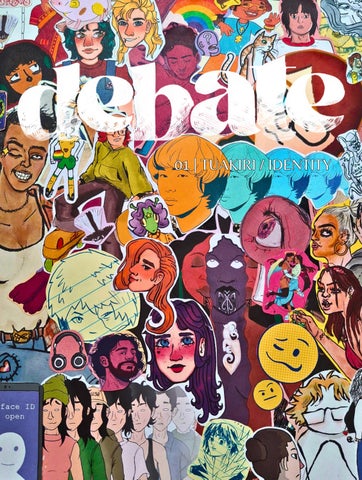
FRONT COVER
Skye Lunson-Storey
CONTRIBUTORS
Caeden Tipler, Tara Jade Bellairs, Ricky Lai, Rose Scott, Vinti Shiron, Max Corlett, Sara Mckoy, Natasha Munro Hurn
Digital
Tashi Donnelly Liam Hansen Skye Lunson-Storey
Madeline Bradley Sophia He
Remember What We’re Fighting For
Kia ora koutou, and welcome to Issue #1 of Debate Magazine for 2026. I’m Tashi Donnelly, former feature editor and, as of this year, the new editor-in-chief. To me, student media is built on curiosity, questioning, and, when it’s needed, protest. I’m here to make sure Debate remains a space that belongs to you, the students.
We’re starting off the year with a theme that can feel insurmountable: identity. It shapes our sense of self, from our bodies to our communities, spanning the personal and the political. For some, it’s a passing thought. For others, it’s a lived reality every day. And right now, identity is being weaponised.
It always has been. When fear rises, someone is chosen to carry it. In Aotearoa, we pride ourselves on being tolerant and laid-back, yet racism, sexism, and homophobia still run through our institutions through law, media, and economics. Policy debates about bathrooms, Treaty principles, immigration, and “equal citizenship” are framed as existential clashes between competing groups. Identity is flattened into labels and presented as mutually exclusive camps. Migrants are blamed for housing shortages. Māori governance is framed as a threat. Trans people become moral panic fodder. These narratives create phantom enemies, absorbing public anger while shielding those in power from accountability.
The problem is not identity. It’s not marginalised communities. The problem is how identities are distorted to stop working people from becoming organised. Because while we argue about culture wars, rents rise. Wages stagnate. Public healthcare strains. Supermarkets post record profits. Wealth consolidates quietly at the top. Division makes workers easier to underpay, easier to exhaust, and easier to replace. And when we see each other as threats instead of allies, we stop asking who owns what, who profits, and who sets the rules.
If we are serious about dignity, safe homes, fair pay, and a livable future, we need more than outrage. We need unions. We need collective worker organising. We need solidarity that crosses race, gender, sexuality, and nationality. Solidarity does not erase identity. It builds across it. Remember what we’re fighting for. The only thing that has ever shifted power toward ordinary people is organised, collective action.
This issue explores identity from (at least a few) angles. From Ricky’s Reel Recommendations on film and selfhood; to Poi+: Identity in the In-Between, a kaupapa grounding identity in culture and connection; to Me, Myself, and I on fads, rebellion, and self-love. We also cover the next steps for the Toitū Te Aroha campaign, AUT’s new cross-country exchanges, and a personal reflection on queer loneliness and belonging in uncertain times.
Identity is not fixed. It shifts with place, politics, culture, and crisis. It lives in protest movements and in movie nights, in dance studios and in dorm rooms. In this issue, we invite you to see yourself, and maybe to question the version of yourself you’ve held on to. Unlearn the identities that were unwillingly assigned to you. Cherish the parts of your identity that ground you in healthy relationships and community.
Welcome to the Identity Issue.
Written by Tashi Donnelly (she/her) @tashi_rd
EDITOR-IN-CHIEF
Not a counter-protest, but countering hate: the Toitū Te Aroha movement
On January 31st, thousands gathered in Tāmaki Makaurau under the banner
Toitū Te Aroha. The rally and hīkoi from Te Komititanga Britomart to Te Waihorotiu Meyers Park focused on countering hate toward a range of demographics, including migrants, refugees, LGBTQIA+ people, faith groups, and tangata whenua. The diversity of the group was shown in the flags they were waving, ranging from the Tino Rangatiratanga flag to the official flag of New Zealand.
Toitū Te Aroha was founded by a group of tangata whenua organisers who came together with the intention of uniting communities who have been impacted by hate. This came in the wake of antimigrant, LGBTQ+, and religious minority protests from the fundamentalist Destiny Church and associated groups. Notably including their storming of a library in West Auckland during Pride Month last year, and their more recent disruptions of two peaceful Sikh religious processions.
Photography by Michelle Beard
On the same day as the Toitū Te Aroha protest, a new group associated with Destiny Church, True Patriots of New Zealand, held its own protest in the Tāmaki Makaurau city centre. The True Patriots aimed to make as much noise as possible, trying and failing to cross the Harbour Bridge. Their rally was focused on anti-immigration, with banners displaying slogans like “this is NZ, not India.”
According to Toitū Te Aroha spokesperson Bianca Ranson (Ngāpuhi, Ngāti Kahu ki Whangaroa), the purpose of the rally wasn’t to counterprotest. The hīkoi was “centred in our own aroha for our communities and coming together in our own mana to show we celebrate our diversity. We celebrate our communities, and our diversity is what makes us a thriving and flourishing country.”
For Ranson, the Toitū Te Aroha movement has a deeper meaning because of her involvement with the Kaiāwhina, a community care and self-defence group born out of the pro-Palestine movement in Tāmaki Makaurau. She’s seen firsthand what happens when Destiny Church shows up to peaceful protests to stir the pot.
As Ranson notes, the risk of violence and hate “hasn’t just been limited to the rainbow community or the Sikh community. It’s even been towards school children at the school strike for climate.”
They make it clear that haka, and Māori culture more broadly, shouldn’t be used in the way Destiny Church has “weaponised” it to create fear amongst communities.
She added that they do not represent tangata whenua, as proven by the display of unity at the Toitū Te Aroha rally.
However, now that Toitū Te Aroha has an established presence and Destiny Church shows no sign of slowing down, the question is: what is next for the movement?
While the kaupapa is wide-reaching, the group had four key demands. These are:
1. Recognise organised harassment as a serious threat and respond decisively.
2. Protect public and community spaces, including schools, libraries, and places of worship.
3. Ensure consequences for leaders and groups who repeatedly target and harass communities.
4. Affirm the right of all communities to exist, gather, and practise their culture and faith safely.
On future protests and other activities, Ranson says, “January 31st was our launch”.
Since then, several spokespeople from Toitū Te Aroha attended Waitangi. There, Fatima Sanussi, who is of Sudanese and Ethiopian descent, spoke on the connection between honouring Te Tiriti
and African struggles against imperialism. Additionally, Rana Hamida, who is Palestinian and joined the global flotilla to Gaza last Spring, spoke out against the coalition government removing Te Tiriti from legislation. As put by Ranson, “it was a way to commit to and strengthen our shared struggles. We hope to grow on that for next year.”
The group’s priorities are focused on safety in every event and action, as well as wānanga within the group, and with allies and community leaders. They’re supporting the Toitū: Visual Sovereignty event on March 1st. There will be more to come in the lead-up to the election; a town hall is on the horizon, for example.
What remains consistent is the group’s readiness to step up for any communities that need their support. Their four key demands, as listed earlier in this article, remain ongoing, included as part of their active petition on OurActionStation.
In Ranson’s words, “Our right to peaceful protest has really been violated. Some of the actions we’ve seen have been escalating. [...] People have the right to be able to gather to raise issues and celebrate who they are in a way that is safe from this very targeted harassment and intimidation.”
“We can stand side-by-side in aroha and acceptance, and stand in mana together.”
Written by Caeden Tipler (they/them) @caedentipler
CONTRIBUTING
WRITER
Photography by Michelle Beard
photography
AUT, Vic, and Otago introduce domestic semester exchange trips for students in 2026
As the global cost-of-living crisis shows no sign of slowing down, the dream for Aotearoa students to piss off for a semester and experience a “Call Me By Your Name” like summer fling in France or Italy has become inaccessible for students who live paycheck-to-paycheck and don’t have an endless bank of Mum and Dad. The majority of students have begun saving up to flee to Melbourne as soon as their degree ends, and the rest of us are stuck on our dingy corner of the world, trying to make the most of the motu as summer holidays are increasingly limited to Jetstar’s domestic network.
If you’re a student mourning your OE, craving a change of scenery, or desperate to reinvent yourself in a new city without dealing with passports and visas, a new pilot programme between AUT - Te Wānanga Aronoui O Tāmaki
Makau Rau, University of Otago - Ōtākou Whakaihu Waka, and Te Herenga Waka - Victoria University of Wellington may be up your alley. In 2026, these New Zealand universities are launching “Uni Exchange Aotearoa”, allowing secondyear undergrads to spend a semester in a different city across these isles.
While a far cry from the transformative experience your mate who lived in Amsterdam for two months claims he had, the new programme still provides the opportunity for a change of pace, allowing students whose mum made them stay at home to experience a
semester in Wellington or Dunedin without dooming themselves to a life around binge-drinking scarfies for the rest of their degree. If you’ve been craving a lick of Welly/Dunners student culture since discovering the tendency of Tāmaki students to avoid speaking to one another for three-to-twelve years, here’s your shot.
Students must have completed 120 points/one year of full-time study by the time the program begins, and are required to maintain a B/5.0 GPA from their time of application until the exchange begins. As this is a pilot programme, only a select few subjects are eligible for the exchange.
This includes:
• Anthropology
• Computer Science
• Criminology
• Economics
• Education (not teacher education)
• Human Resources
• Information Systems
• International Relations
• Management
• Marketing
• Politics
• Psychology
• Public Policy
• Social Sciences / History
• Sociology
There are ten spots available at each university for domestic exchange students, allowing a switcheroo that’ll subsequently see a new cohort of
students from Vic and Otago making their way up to the big smoke. If you happen to come across one of these students, don’t tell them about the ghosts haunting half of our campus.
If you’re interested, head to https://www. aut.ac.nz/student-life/opportunitiesand-careers/uni-exchange-aotearoa and apply for your place by the 8th of April.
Written by Liam Hansen (they/them)
@liamhanse.n
ASSOCIATE EDITOR
Me, Myself and I
What makes your identity? The way you dress, the food you eat, the hobbies and interests that accumulate as you age. When we are young, we start collecting each element of our identity.
From Ma, I inherit my need to create and my strong intuition. From Pops, my wit and logical thinking. Everyone I have ever met, and everything that I have consumed, has left a lingering impression on my mind and habituated itself within me.
This is not exclusive to Gen Z, but we were the first to grow up with a constant window into each other’s lives. Social media made identity feel transferable. I could see who everyone else was becoming and decide which parts I might borrow.
I knew of One Direction. The school I went to had made “What makes you beautiful” the bell for a little bit, and no one believed me when I told them. It sounds small, but it was one of the first times I realised how easily I could absorb something and make it mine.
It was then that I discovered that parts of my identity were manufactured, that they were never mine. I liked that, so I latched onto things without assessing whether they belonged to me, resonated with me, or not. They were fun facts or ideals added to my character sheet.
There are parts of my identity that were founded on a strong inclination to take
a stand for something. Like my sense of justice that really pisses people off. Accusing me of being argumentative. “You should be a lawyer”, and I did actually try to be one. I did not like it very much.
They have never known me, and they never will. I cared a whole lot for them to love me, even if it was for a passing smile. I had managed to link my identity with selfworth and magically made it as packed with misery as I could have. The best part is no one told me to do this; I decided it was true and lived by it as a virtue.
For most of my life, I have been described as a nice, quiet, and mature girl. Marketable. Hearing the way that family describe me, you would assume I was a product they were selling. My best friend would tell you differently. An expert yapper, fruity, and maybe a little insane are closer to being historically accurate.
I resonated heavily with the quote “A jack of all trades is a master of none, but oftentimes better than a master of one.”
The first half of that quote is all I attributed to myself for a very long time. Turns out, like my moral rigidity and strong sense of justice, it might have been a twinge of undiagnosed neurodiversity. And that I am good at things, really good.
Sometimes I would catch myself distraught and unfamiliar with a thing I had just done. I can connect this with growing a consciousness now, but back
then, I would see it as a serious fault. I thought a lot of myself felt displaced or stolen. It is just sometimes that I hated certain ideas so much that I could not stand to comply, or settle, or compromise. Reflecting and realising there are words I said that could have been explained better.
I had long hair when I was 15. It almost reached my knees. During lockdown, I grew an insatiable urge to cut it. I felt suffocated. I did not want it. I was locked in my bedroom with it. I hated combing through knots. I hated the way it demanded attention every morning. This long hair that I kept to show people.
I ended up giving myself a bob; it was not French or anything. Just a bob. Going back to school, I felt normal. Ridden with anxiety, but normal about not having to deal with knee-length hair.
The first rebellious act I did was cutting my hair, despite Mum’s dissent to the mere idea of it. And you know what, it was
Written by Vinti Shiron (she/her) @vintishrnprod
CONTRIBUTING WRITER
that serious to me. The fetters of what I assumed would be a token of my identity for life allowed me to see that there was more to me, and I needed to find it. I learned to be louder and take up space. I dye my hair red all the time now. I tried to resist last year and folded after passing the beauty aisle in Pak’n’Save.
Identity is ever-changing. I am figuring shit out every minute I live. My taste in music, my style, and my hair’s signature colour. Our identity is everything we are: empathy, curiosity, or compassion. Morals and humility. Wearing scrunchies and reposting edits of Shane and Ilya on TikTok.
I am all of it. Even the parts I hate. I am not perfect, and I am not great. Therefore, here I am. Latent yet high off my humanity. Letting the powerful play go on, hoping to contribute a verse where I am able.
Kōrero Toi Natasha Munro Hurn
I crave distortion because it heals me. I am a personal riot, even at times when I desire not to, but then again, I am in a hetero world after all. No one can shut off this queerness because this is my utopia. I am broke as fuck but beautiful and alive!!!
My practice is best seen as both an embrace and a release of my experience as a queer non-binary trans woman in Aotearoa. Through hectic experimentation with digital photography, screen printing, and sculpture, I try to embody a personal celebration for both myself and queer bodies. In a way, I am protesting the ever-growing presence of violence that is placed upon us, gender non-conforming queers, both in common life and in our government institutions backed by the far right. I seek to create techniques that may heal me from this colonial heteronormative world through revealing the euphoric sides of this queer life. Yet since this is my brain, what heals me relates to my experiences of falling in love with punk’s distortions of untrained sonics and utopian anarchism. It is through “fullon” harsh art that I am able to process and build upon myself, as queer euphoria is produced in the distortion. A lot of my art follows a sense of finding beauty in harshness that helps me process difficult emotions or past experiences. Mess is everything to me, especially when it comes to my collages or screen prints, because it is a pure, unapologetic release of my queer existence. Cherishing mess helps me deconstruct gender in whatever beautiful form or mutation I like.
Under all the experimental transanarchist/ proud bimbo loudness of my practice is a thesis of chasing queer utopia. I see utopia as a major part of the queer experience because, to me, it is found in personal community and the vast avenues of self-expression. It is in communal space or found family that we find the safety to explore ourselves and celebrate the others who desire to do the same. Then, in the possibilities of expression, such as art, music, and thrifted fashion, one can find the soul of oneself in the exciting realms beyond this often rough one. So my work in reflection of all its emotional releases is to situate it under the importance of queer utopianism. I hope different queers in the wider communities can empathise with and find joy in my work as a party for them. It is at the party that utopia is euphorically present as a space for you and your family to let loose.
And all of y’all are invited because we all need a bloody party in these times for us!
Written by Natasha Munro Hurn (she/they) @utopia_for_sale
CONTRIBUTING WRITER
collage by Sara McKoy, using works from previous Debate and
Queer Loneliness: Finding Hope During Hard Times
In Aotearoa New Zealand, February is Pride Month; a month to celebrate being LGBTQIA+ (lesbian, gay, bisexual, transgender, queer/questioning, intersex, and asexual). However, LGBTQIA+ folk may find that Pride Month feels different this year. A feeling of worry. A feeling of loneliness. A feeling that the sense of pride in being LGBTQIA+ is starting to fade. These feelings do not come from nowhere. Our community has always been a targeted community for political gain, hate crimes, and violence. Heteronormativity (normalising heterosexuality/being straight) and cisnormativity (normalising everyone to be cisgender/not transgender or gender diverse) silence our community further, making it harder for our community to socialise and engage with others due to stigmatisation and the worry of unwanted homophobia and transphobia. Though it may feel like being queer burdens our isolation and loneliness, it is important to educate people about our community and uplift ourselves during trying times.
Being Queer in Aotearoa New Zealand
Before the arrival of Europeans in Aotearoa, Māori were open to gender and sexual diversity. LGBTQIA+ Māori to this day are still reclaiming their identity. The term “takatāpui” is being reclaimed by Māori who are gender diverse and/ or diverse in sexuality. Traditionally, this means “intimate companion of the same sex.” In the 19th century, New Zealand started to follow suit with the English Laws Act to criminalise homosexuality between
men. It wasn’t until 11 July 1986 that the Homosexual Law Reform Act legalised sex between men. In 2013, the Marriage (Definition of Marriage) Amendment Act was passed for marriage equality. In 2022, the Conversion Practices Prohibition Legislation Act was put in place to prohibit harmful acts of suppressing LGBTQIA+ identities. Late last year, the New Zealand Government introduced restrictions on prescribing puberty blockers for young transgender and gender diverse patients. Puberty blockers are an important medical intervention for transgender and gender diverse individuals in gender affirming care, especially for New Zealand youth. The fear of being queer in New Zealand extends to disruptions and attacks from a religious cult. During Pride Month last year, a religious cult stormed a family-friendly library event hosted by a drag artist and disrupted a pride parade. Despite there being laws to protect LGBTQIA+ people in New Zealand from discrimination and violence, we need stronger protection in place to prevent the rise in hate and violence.
The International Effects of LGBTQIA+ Discrimination
The rise of LGBTQIA+ discrimination has been happening internationally. The United States is reversing protections and implementing laws against the trans community. This echoes the protections that the New Zealand Government is invoking. Other forms of discrimination towards the community around the world include restricting rights such as
marriage, adopting or hiring LGBTQIA+ people, having limited or no protections against violence, having little prevention for conversion therapy, and banning or restricting drag performances and gender-based expression/rights. There are over 60 countries that have criminalised being LGBTQIA+, with punishments ranging from imprisonment to the death penalty. Even though there are countries that decriminalise the community and have put in place laws such as marriage equality, this does not mean a country or an area is 100% safe for LGBTQIA+ people. The effects of what has been happening in New Zealand and around the world toward the community make it harder for us to be ourselves and further isolate us through fear.
Taking Back Pride
Whether you are LGBTQIA+ or not, now more than ever is the time to speak up about the community. Being queer is a human right, and for us to achieve equality, feel pride, prevent queer loneliness and mental health issues, we need to take action. One of the biggest things we can do is vote. New Zealand elections are this year, and voting for candidates who support the LGBTQIA+ community will help protect our rights. If you can’t vote in New Zealand, you can still encourage others to vote, advocate, and sign petitions to protect the community. Advocating for the community can include educating friends and whānau, calling out homophobia and transphobia, joining protests, donating,
promoting, or volunteering for charities and causes. Representation is another way to reclaim pride and to vouch for more queer voices to be heard every day. LGBTQIA+ representation helps make the community seen and heard, it educates people about our identities, and works towards anti-discrimination and loneliness. To drive representation, you can support and promote businesses, work to create LGBTQIA+-friendly work environments, and provide people with opportunities. As a person of the LGBTQIA+ community, uplifting our community is one of the most powerful ways to reclaim our pride.
Finding Community During Loneliness
AUT offers Rainbow Support for LGBTQIA+ students. They have rainbow safe spaces on each campus, rainbow community events, and links to resources on the AUT website and social media.
The Auckland Pride and Heart of the City websites and social media pages have events across Auckland this February for Pride Month. You can find Pride events and gatherings on the Rainbow Networking Group Facebook page and on the Rainbow AUT Instagram. As someone who identifies as a non-binary lesbian, I personally follow Aotearoa NZ Lesbians Social Group on Facebook, Sapphic Sounds on Instagram, and the Charlotte Museum email subscriptions. Sometimes it is a matter of making the most of our identities and interests, and asking through word of mouth, notice boards, or online to find new connections.
Finding Hope During Hard Times
It may be hard to feel positive as a queer person when our rights are being taken away, and hate feels like it is thriving. But one thing our community is known for is being resilient. If the feelings of being lonely, afraid, or depressed about being queer ever overwhelm you, it is important to reach out. Talking to whānau, friends, other students, lecturers, or support groups can help with those feelings. Outline, RainbowYOUTH, Youthline, the Lowdown, Lifeline, and AUT student health and wellbeing resources can help start the conversation around queer mental health. More than anything, the most important thing to do is not give up who you are as a person and not give up on hope through hard times.
Written by Tara Jade Bellairs (they/them/)
@tara_bellairs_portfolio
CONTRIBUTING WRITER
Show your Uni Student ID and scan this barcode instore to get your discount.
your favourite products in-store and scan for more
The Power of Indigenous Print
Kia whakatōmuri te haere whakamua: ‘I walk backwards into the future with my eyes fixed on my past.
In an age of disappearing stories and endless scrolling, there’s something radical about ink on paper. It archives. It refuses to vanish. For Indigenous and minority communities in Aotearoa, that permanence has always mattered. Print has historically been a tool of resistance for Māori, Pasifika, the queer community, and our wāhine. It remains a space students must continue to claim. As the first issue of Debate 2026 looks at identity, I reflect on the history of print media in Aotearoa, from Te Hokioi e rere atu na, to Mana, and Broadsheet, reiterating the relevance they hold today and the importance of “Who gets to tell your story?”
To understand print as resistance and identity, we must reflect on Aotearoa’s historical foundations, starting with Te Hokioi e rere atu na. The first newspaper in te reo Māori, printed by the Kīngitanga in 1862-1863. During this period, print was what radio, television, and the internet are to us today. This countered colonial narratives as an act of political sovereignty. This wasn’t just news. It was a declaration that we can, and we will, speak for ourselves. As part of the proKīngitanga political propaganda, Te Hokioi had nine known issues, sharing official announcements from Kīngi Tāwhiao and reporting on news within and beyond the Kīngitanga. The production of this
newspaper was revolutionary, asserting the Kīngitanga’s ability to convey its voice to the wider Māori community. It was written by Māori, for Māori.
Mana emerged during a time of severe social and political unrest in 1977-1978. It has become recognised as one of the earliest/first multi-lingual Polynesian newspapers. Mana amplified Māori and Pasifika voices, covering land rights, activism, self-determination, and cultural pride. When mainstream media misrepresented or ignored Māori and Pasifika issues, Mana documented the truth for its own communities. Thus, providing a space where Indigenous perspectives weren’t filtered for mainstream comfort. If you haven’t already, go visit the Mana: Protest in Print exhibition held at Tāmaki Paenga Hira (Auckland War Memorial Museum). As stated by Dr Wanda leremia-Allan, one of the curators for Mana: Protest in Print, “The legacy of Mana continues to resonate today, and its vision for a more inclusive and informed society remains as powerful and relevant now as it was in 1977.”
Broadsheet was a feminist publication produced in Auckland from 1972 to 1997. Reporting on politics, sexuality, art, and crime, it helped shape women’s activism in Aotearoa. Demonstrating how minority-focused print can shift national discourse. I first encountered Broadsheet while archiving some of its first issues at the Charlotte Museum Te
Whare Takatāpui-Wāhine o Aotearoa. I was in awe of the pages dedicated to interviewing Māori and Pasifika women. Giving voice to the lived realities we face, from raising children alone to loving other women in a society where homophobia was not only present, but normalised. Across the different movements of Māori sovereignty, Pacific activism, and feminism, print allowed communities to define themselves on their own terms.
Why is reporting for a community different? Well, reporting on Māori for a mainstream audience often frames issues through an outsider’s lens. Whereas, reporting for Māori centres lived experience, whakapapa, tikanga, and community. As a result, the language shifts, and so does accountability. Creating the ultimate power shift. There is a difference between being observed and being heard. Being analysed and being understood. Identity isn’t something others explain about us. It’s something we articulate ourselves.
So why does print still matter in a digital age? I acknowledge that digital and social media dominate while print media faces funding cuts and shrinking platforms. However, choosing to write in print today is an act of manaaki and permanence. There is something so beautiful about the tactile aspect of print media and the way a printed page cannot be buried by algorithms. Sitting in libraries, bedrooms, and archives, we are reminded that print is both archival and physical. Allowing
depth over reaction while it silently waits to be found by someone who needs it.
You carry mātauranga and the stories shaped by whānau, migration, colonisation, and resistance. Those perspectives are not niche; they are foundational to Aotearoa. University publications are training grounds for future journalists, writers, researchers, and artists. In a way, representation begins here. Take the opportunity to write in your reo and about your communities. Also, to write about joy, not just struggle, you are allowed to write beyond trauma narratives. Claim space and take it!
Identity is not passive; it is constructed, defended, and shared. Reflecting on our history, it becomes evident that print has always been part of that construction. Ink has always carried more than words. It carries whakapapa. If identity is about knowing who we are, then print is one way we ensure no one else defines that for us.
Mauri ora!
Written by Skye Lunson-Storey (she/they) @uku_rangi
ARTS, CULTURE, & TE AO MĀORI
EDITOR
Poi+: Identity in the In-Between
For students, identity is rarely set in stone. School is a space of development – where who you’ve been begins to loosen, and who you’re becoming starts to take shape through not only learning, but community. For some, that journey unfolds naturally. For others, it becomes something lived and learned. Poi+ was born from this inbetween.
Founded by Joe Patuki (Tainui, Ngāpuhi), Poi+ is a movement-based workshop that integrates Māori values, te reo cues, and poi movements to create connection through culture for tamariki (children) and rangatahi (young people) as they develop their own sense of self. Joe first imagined Poi+ while navigating his own path as a student at AUT, where he completed a Bachelor of Sport and Recreation, majoring in Sport Management.
Alongside his studies, Joe worked as a youth sports coach across football, tag, and rugby. Through this experience, he began to notice something often overlooked: even well-intentioned sporting environments don’t work for everyone. Many are built around competitive or high-pressure models, which can leave kids who aren’t the typical “sporty” type feeling out of place. Seeing some thrive while others were left behind pushed Joe to reflect on how things could be done differently – and how he could help create more inclusive ways of belonging.
Poi+ grew out of that reflection with the guidance of AUT Ventures, AUT’s commercialisation arm that helps students turn their ideas into real-
world impact. Through our support, Joe was able to move Poi+ from concept to practice, delivering one-hour Poi+ workshops in schools across Tāmaki Makaurau. At its core, Poi+ meets tamariki and rangatahi where they are in their identity journey, supporting them to reflect on — and sometimes challenge — their values in a safe and inclusive space. Sessions are grounded in Te Whare Tapa Whā, a Māori holistic health model that views wellbeing as a balance of four interconnected pillars. Movement through poi supports taha tinana (physical wellbeing), while moments of learning nurture taha hinengaro (mental wellbeing). Taha whānau (social wellbeing) is strengthened through warm-ups that encourage collaboration, all underpinned by taha wairua (spiritual wellbeing), which grounds the programme in meaning and purpose. Together, these elements help participants — alongside Joe himself — understand how culture, values, and community shape who they are becoming.
In this way, Poi+ challenges the idea that identity is ever complete, allowing young people the space to keep growing into who they are. It reminds us that some of the most meaningful understandings of self don’t happen alone, but in the shared work of growth – alongside others.
Kia tupu, kia hua, kia puāwai To grow. To flourish. To prosper.
You can find out more about Poi+ at poiplus.com and @poi_plus on Instagram.
Written by Rose Scott
Rick’s Reel Recommendations: 3 Films About Identity
1. Spirit of the Beehive (Víctor Erice, 1973)
The infallible tale of Mary Shelley’s ‘Frankenstein’ has seen a well-deserved refresh in the people’s consciousness since it was resurrected last Halloween season by Guillermo Del Toro, the monster-lovin’ sweetheart. As much as I was moved by his Netflix-grade epic (how’s that for an oxymoron), it’s since been engulfed by my first encounter with Spanish filmmaker Víctor Erice’s arthouse treasure. About childhood during the Francoist dictatorship in Spain, this may indirectly be the best adaptation of ‘The Modern Prometheus’ since, well, that very first ‘Frankenstein’ in 1931 (dir. James Whale). Whale’s film actually plays a crucial role in ‘Spirit of the Beehive’, which follows a young girl named Ana whose
older sister takes her to the theatre to watch ‘Frankenstein’ for the first time; feat. Boris Karloff in his signature makeup. She becomes enchanted, even if also slightly scarred, by the famous scene where a child of the same age is accidentally drowned by the lumbering but humanely innocent beast. Ana’s pre-adolescent worldview becomes inextricably linked to this movie. Her resulting curiosities, compassion, and spiritual faith are only edified by the discovery of a wounded Republican soldier taking shelter in the family’s sheepfold. Without sidestepping a burgeoning political allegory here, this is also a patient and gorgeous film set in a dry country summer, about what it’s like to encounter that first piece of fiction that rocks your world.
2. Holy Motors (Leos Carax, 2012)
Oh, ‘Holy Motors’, how I miss thee. Like an old friend. Not that old, mind you, and a bit out there, but an old friend nonetheless. Denis Lavant, Kylie Minogue, Édith Scob: these are my friends. Okay, I’ll stop. ‘Holy Motors’ tracks a very wealthy actor named Mr. Oscar (Lavant), you can tell he’s well off, since we’re with him in the limousine between commissions. Over the course of twenty-four hours, he assumes many forms across the various suburbs of Paris. In one stroke, he is a fire-haired derelict who prances around gravestones and resides in the sewers. In another, he is a hitman in track pants pursuing his clone; perhaps a father picking up his daughter from a party. Later, an elderly terminal patient was consoled by his niece. Lavant, a former circus performer in real life, is
no stranger to contorting (sometimes literally) into abstract roles. Between shifts, he barely has time to catch a breath before scuttling off again. While most of us here don’t have the luxury of commuting in a stretch vehicle nor yearning for love with the singer of ‘Love At First Sight’, we all must sympathise with the exhaustion of professional performance in our day-today lives. It’s hard to nail a job interview, lie to your boss, scold your kids, make the first move, keep the peace at home, and act like you’re not scared. It is never clear for what audience Mr. Oscar is performing for, and to what end. But whether he (or we) likes it or not, somebody’s watching. Action!
3. We’re All Going to the World’s Fair (Jane Schoenbrun, 2021)
Jane Schoenbrun’s heart-wrenching opus
‘I Saw the TV Glow’ adapted the fables of Internet creepypasta as gender dysphoria allegory. Years prior, she practiced the same idea in a rawer, chillier, and scarier film. Where, instead of the tale of ‘Candle Cove’, it approached the alternate-reality game of interactive ritual challenges. Coming of age in the era of vlogging, teenage girl Casey wants to “go to the world’s fair”. By recording proof of her pricking her finger, smearing her blood on her laptop, and staring into the strobing void of her screen’s glow, she may be able to attend. On YouTube, she documents physical and psychological changes after the ritual, as well as her interactions with
another challenger over Skype (named “JLB”), who warns her (via a scene that I can remember freezing me in my seat) that “YOU ARE IN TROUBLE”. Winter breeze perfumes the walls of Casey’s house, and distant streetlamps cast shadows mistaken for human figures. Alex G conjures a horror soundtrack suited for the doomscrolling generation. This isn’t for everybody, but for the right person, it’ll be everything. If there’s a better depiction of what it’s like to grow up lonely and with Internet access, I don’t know about it yet. What’s that? ‘Unfriended: Dark Web’, you say? Ah, okay - my bad.
Written by Ricky Lai (he/him)
@rickthelai on IG & Letterboxd
FILM COLUMNIST
Tāmaki Makaurau Gig Guide
23 February - 24 March tickets via undertheradar.co.nz unless otherwise specified
Wed 25th February 7:00pm
Under The Arcade Presents: Paul Cathro with Cowboy Dan Whammy Bar tix from $12 alternative, country/folk, rock
Sat 28th February 8:00pm
Powder Chutes & The Boondocks with Coast Arcade and Haast Hunter
Double Whammy tix from $20 alternative, rock
Fri 27th February 7:00pm
Theia - “Girl,In A Savage World” Debut Album Release Show With Kōmako Whammy Bar tix from $20 art/noise, pop, world
Sat 28th February 4:00pm + 8:00pm
Crying Ivy: Respirator Single Release with Fork, Castlegarden, and Blossom
Whammy Bar tix from $15 alternative, rock
Thu 26th February 8:00pm
Ripship Europe Tour Fundraiser with CTO and SLOW RAGE
Whammy Bar tix from $16.50 alternative, rock
Sat 28th February 6:30pm
All-Ages Hardcore with As Colour Fades, Amanaki, Chasing South, Take Hold
Grey Lynn Community Hall tix from $15 metal, punk/hardcore, AA
Fri 27th February 7:00pm
Hemi Hemingway - ‘Wings of Desire’ Album Launch Party with Roy Irwin and Big Sur Neck of the Woods tix from $20 country/folk, rock
Fri 6th March 7:30pm
Jimmy Acne and Edie VC: Be My Bread Release Show with Jennifer Geihinkan tix from $10 solo/acoustic, folk