![]()


Kia ora! We’re Debate, your free student magazine at AUT. Each fortnight we scatter magazines across campus talking about student news, art, and culture. Each issue is made by us and a small team of contributors - no AI was used in the production of any work to our knowledge.


FOLLOW US ON INSTAGRAM @debate_mag
Editor-in-Chief Associate Editor Arts, Culture & Te Ao Māori Editor
Digital Marketing & Social Media Manager


Te Ao Māori
Te Ao Māori
Ao Māori

TITLE---
Let’s Talk About Drugs
Rare Disorders NZ brings the Rare Beers Challenge
AUTSA joins Student Union’s calls for cost-of-living
support for students amid fuel crisis
NZ’s New Roadside Drug Tests Explained
Free Sexual Health Services for All Students
Peter Thiel: NZer Of The Year?
Rongoā Māori and the Lasting Impact of Suppression
Nā koutou i tangi, nā tātou katoa
Fear & Loathing in Public Houses
Intergration of Rongoā Māori with psychedelic assisted therapy
The High Lesbian “KAWAKAWA” and “RONGOĀ”
Don’t Make Decisions When I’m High
The Alien
Where’s my Lighter

Spill the Tea
Cocaine Ain’t Cool (and why you shouldn’t do it)
Flesh Of The Gods
PUZZLES
catto’s GAME RECOMMENDATIONS
In Rotation: Album Reviews for the Masses Horoscopes 20th April - May 18th
Know your stuff
Rick’s Reel Recommendations

DISCLAIMER
Material contained in this publication does not necessarily represent the views or opinions of AUTSA, its advertisers, contributors, Nicholson Print Solutions or its subsidiaries.
This publication is entitled to the full protection given by the Copyright Act of 1994 (“the Act”) to the holders of the copyright, being AUT STUDENT ASSOCIATION (“AUTSA”). Reproduction, storage or display of any part of this publication by any process, electronic or otherwise (except for educational purposes specified in the Act) without express permission is a break of the copyright of the publisher and will be prosecuted accordingly. Inquiries seeking permission to reproduce should be addressed to AUTSA.
Debate is a member of the NZ Media Council and subject to its complaints procedure. Complaints about stories must first be directed in writing to us (provide link) within a month of the story being published. If you are not satisfied with our response you can complain to https://www.mediacouncil.org.nz/complaints/. You will need to attach a copy of the article complained about and any correspondence you have had with us.
CREATOR---
Tashi Donnelly
Liam Hansen
Liam Hansen
Tashi Donnelly
Tashi Donnelly
Caeden Tipler
Skye Lunson-Storey
Ivy Lyden-Hancy
James A. Glass
Anna-Leigh Hodge
The Hot Lesbian
Skye Lunson-Storey
Maebh McCurdy
Alyx
Maeva Becerra
Tashi Donnelly
Simon Saez
Stu Paul
meoskyan_art
Jed Scott
László Reynolds
KnowYourStuffNZ
Ricky Lai
FRONT COVER
Tashi Donnelly (She/Her) @tashi_rd
CENTREFOLD
Indie McMillan (She/Her) @indie.pd


Niamh Donnelly, Caeden Tipler, Ivy LydenHancy, James A. Glass, Anna-Leigh Hodge, The Hot Lesbian, Maebh McCurdy, Alyx, Maeva Becerra, Simon Saez, Stu Paul, Jed Scott, László Reynolds, KnowYourStuffNZ, Ricky Lai


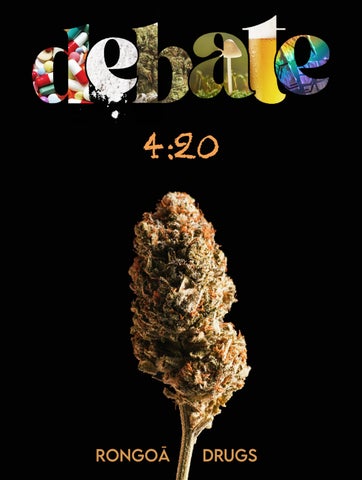
Nau mai haere mai, welcome to the rongoā/drugs issue of Debate. Although the word ‘drug’ is defined by the Oxford Dictionary as: ‘a medicine or other substance which has a physiological effect when ingested or otherwise introduced into the body,’ we tend to associate it more with recreational use than with medical use. But before we get into it, I want to take this opportunity to outline New Zealand’s laws on illegal drugs. Not because I want to scare you, but because it is important to be fully informed if you ever decide to try these substances.
Here in Aotearoa, our drug laws are defined by the ‘Misuse of Drugs Act 1975’, which categorises illegal drugs into three risk levels:
Class A: very high risk of harm
• Covers drugs such as heroin, LSD, MDMA (ecstasy), psilocybin (magic mushrooms), cocaine, DMT, and methamphetamine (P)

• Penalties for supply/dealing: Life imprisonment.
• Penalties for possession: Often up to 1 year imprisonment and/or fines, depending on circumstances.
Class B: high risk
• Covers drugs such as morphine, opium, amphetamines (speed), methadone, fentanyl, ritalin, and some barbiturates
• Penalties for supply/dealing: Up to 14 years’ imprisonment.
• Penalties for possession: Up to 6
months’ imprisonment, and/or a fine of up to $1,000
Class C: moderate risk
• Covers drugs such as cannabis, nitrous oxide (nos, nangs), diazepam (Valium), codeine, and some weaker stimulants and sedatives
• Penalties for supply/dealing: Up to 8 years’ imprisonment on indictment (jury trial). Summary conviction (judge alone) can carry lower penalties (up to 1 year jail and/or fines).
• Penalties for possession: Up to 3 months’ imprisonment (with previous convictions) or a fine of up to $500.
This categorisation doesn’t necessarily follow a strict medical-based or harmreduction framework. The process is partially scientific, but it’s also policydriven and political. In practice, decisions are guided by advice from bodies like the Expert Advisory Committee on Drugs (EACD), which considers multiple criteria: risk of harm, rates of addiction and dependence, social harm, usage statistics, therapeutic value, and international context. It’s interesting that despite the risks to public health and safety, alcohol is a fully legal and mostly societally accepted drug.
I believe that possession for personal use should be decriminalised. I wish with all my heart that New Zealand would follow in the footsteps of countries like Portugal, where decriminalisation of drugs like cannabis, cocaine, and heroin has


resulted in huge declines in overdose deaths, lower rates of HIV and hepatitis, and most importantly, more people accessing treatment. Drugs and addiction shouldn’t be a legal problem; they should be a public health one.
Drugs won’t be going anywhere, no matter how strict the laws get. Homo sapiens and many other animal species have been altering their perception with substances for thousands of years. Reindeer eat mushrooms to get high, dolphins enjoy the narcotic effect of pufferfish toxins, and our own native kererū get drunk off fermented berries in the summertime. Humans have been crafting alcoholic beverages since the Stone Age. We are creatures who enjoy altered states, and I think that’s important to remember before we judge substances and the people who take them.
The problem is, drugs aren’t a moral issue. You’re not a bad person if you use them, and you’re not a good person if you don’t. Rarely in life will you come across problems that fit neatly in those categories. It’s important to investigate our assumptions about these substances and not allow ourselves to be caught up in old-fashioned, puritanical judgments of users.
In this magazine, you’ll read about the good and the bad: personal reflections on alcohol addiction, the integration of rongoā māori with psychedelic-assisted therapy, why cocaine is for losers, drug-

related movie recommendations, and so much more. So, whether you’re inhaling it, drinking it, ingesting it, dissolving it under your tongue, slapping it on your skin, snorting it, or popping it up your bum, drugs are a marvellous, dangerous, and profoundly important feature of our lives. The amount of propaganda surrounding substances is astronomical. The number of human lives saved with the intervention of drugs is incalculable. Recreational drug use has been documented throughout human history, not to mention in many animal species. So buckle yourself in (and please don’t drive) because we’re taking talking about drugs.


Written by Tashi Donnelly (She/Her) @tashi_rd
EDITOR-IN-CHIEF
Illustrations by Niamh Donnelly (She/They)


Makaurau
One in seventeen people live with rare disorders in Aotearoa - a catch all term for the thousands of specified health conditions that, on their own, affect a small handful of Kiwis that are left without a unified health organisation to provide them with support, care, and community. Rare Disorders New Zealand fills this gap, fighting for over 300,000 Kiwis through education, campaigns, and advocacy since the turn of the millennium.
This is why, since 2021, RDNZ has presented the Rare Beer Challenge - uniting craft breweries from across Aotearoa to compete in making ales, lagers, stouts, pilsners, and whatnot with ingredients often better suited to soups, sundaes, and a witches’ cauldron. Previous winners include a stout infused with peppercorn and mushrooms, and a vanilla mint ale.
After five years at Fortune Favours in Te Whanganui-a-Tara, the event moved up to Tāmaki Makaurau in March, taking over 16 Tun in Wynyard Quarter with a flavour selection ranging from spicy tomato to matcha & earl grey. The Debate team tested out some of the drinks and learned about how they all came together - you can watch that over on our Instagram here: @debate_mag.
The 2026 winners held their title from last year, with Shining Peak producing a vintage cuvée combining five years of
barrel-aged stout across 2019-2024 - they were also behind the aforementioned peppercorn and mushroom stout from 2025. Other winners included a hot honey pilsner from Alibi Brewing, and a people’s choice winner in a Sake Lager from Kingsland locals Saint Leonards.
The RDNZ team reported that “the event was an all-round success, not only helping to raise awareness of rare disorders but also raising over $8,600 for Rare Disorders NZ, from both 16 Tun and the satellite event in Wellington at The Malthouse.”
Written by Liam Hansen (They/Them) @liamhanse.n
ASSOCIATE EDITOR
Student presidents and representatives of various university student associations across the motu have united in their call for targeted student support amidst the cost-of-living crisis. While students have been struggling to stay afloat since the economic ramifications of the pandemic (and a good bit before then), the recent increase in fuel prices due to the US/ Israel attacks on Iran and Lebanon, and the continued genocide in Palestine has led to ramifications across the cost of food, transport, and other essentials. In tandem, more students are struggling to receive part-time employment to support their studies - especially international students, and those needing to support their whanau.
The pressure this has placed on student union food banks has been insurmountable. AUT Student Association president James Portegys spoke to RNZ, stating, “Since 2020, year-on-year we’ve seen an increase in our foodbanks, so we were in the 150 sort of packages a week in 2020, and we’re well into the 1800s last year in 2025.”
Student associations across the country, representing the majority of individual universities and subgroups like the National Disabled Students’ Association (NDSA), New Zealand International Students’ Association (NZISA), and the Lincoln University Māori Students’ Association, shared a joint statement last

month calling for “targeted relief for all tertiary students in all future cost-of-living relief packages, including, but not limited to, cost-of-fuel and transport relief.”
“Students, particularly Māori, Pasifika, Disabled, International, and LGBTQIA+, have historically been overlooked and neglected with regards to cost of living relief. Examples of this include the Winter Energy Payment (WEP) and other recent forms of emergency financial support, despite students often also being eligible Community Services Card holders.”
With the toll taken on students in the supercity, AUTSA has also collaborated with their mates across the street at AUSA, sharing a joint statement at the end of March calling for a student relief package that implements free public transport across Tāmaki Makaurau and including students in the fuel subsidy package.
With students travelling across various bus routes, trains, ferries, and motorways to get to class, the cost of fuel and public transport has made the trip too much to bear, with more lectures skipped and classes missed.
Written by Liam Hansen (They/Them)
@liamhanse.n
ASSOCIATE EDITOR


Basics
Yes, New Zealand now has roadside drug testing. This began in Wellington in December 2025 and has been rolling out nationwide through 2026. This means that the police can stop any driver, anywhere, at any time, and administer a saliva drug test (similar to a breathalyser, which is used to test alcohol levels). You don’t need to be driving badly or suspected of impairment; testing can be completely random.
What drugs are tested roadside?
The quick roadside test screens for four different drug types: THC (cannabis), methamphetamine, MDMA, and cocaine. The saliva test detects recent use of these substances, but does not test for impairment.
How does the testing process work?
First, you complete the saliva test, which is just a device which they swipe on your tongue. It takes about 5-10 minutes for the result to come back. If negative: you’re free to go! If it comes back positive, you are required to do a second test. If both tests come back positive, you are banned from driving for 12 hours immediately. The saliva sample is then sent to a lab and tested for up to 25 drugs (including some prescription medications). You are NOT fined at the roadside. Penalties only happen if the lab confirms drugs above legal thresholds.
What are the penalties?
If the lab confirms qualifying drugs, you could be subject to an infringement fine (around $200), as well as demerit points on your licence. More serious penalties can apply in other circumstances, e.g. impairment, multiple drugs, or refusing tests. If you refuse the test, you can be banned from driving for 12 hours immediately, plus receive fines and demerit points.

What about prescription drugs?
This is where the nuance truly comes into play. New Zealand law includes a “medical defence”, which means that if you test positive for a prescribed drug, so long as you followed your doctor’s instructions, you will avoid penalties only after lab confirmation. So even if you were taking your prescribed medication, you can still be stopped from driving for 12 hours at the roadside. And you may still test positive even if not impaired.
But what does it all mean, Basil?
Saliva tests only detect recent drug use, and not actual impairment. So you could test positive even if you feel completely sober. Especially with cannabis (now medically legal in NZ), which can linger in saliva for up to 24 hours.
When comparing with our current alcohol laws, you start to see why the saliva test is pretty controversial. Alcohol laws are based on measured impairment; there is a clear legal limit (250 micrograms per litre of breath for infringement, and 400+ for criminal offence), and strong scientific links between blood alcohol levels and risk of crashing. However, the new drug testing laws are based on the presence of a substance, with no clear impairment threshold, and much weaker links between test results and actual driving ability. In short, alcohol laws ask, “Are you impaired?” while drug laws ask, “Have you used something recently?”
Written by Tashi Donnelly (She/Her) @tashi_rd
EDITOR-IN-CHIEF


Auckland-based HIV support organisation
Body Positive is now offering free sexual health checks to everyone, including international students, regardless of age, gender, sexuality, or visa status.
The expanded service comes as rates of sexually transmitted infections like chlamydia, gonorrhoea, and syphilis continue to rise across New Zealand, particularly among people aged 18 to 25. Around 70% of cases show no symptoms.
Through its Test ‘n’ Treat programme, Body Positive now provides full sexual health screenings at no cost, with results available the same day — often within 90 minutes. A nurse is on-site daily, allowing immediate treatment if needed.
The clinic, led by AUT graduate Benji Watt, operates as a peer-led drop-in service designed to reduce stigma and make testing more accessible.
In addition to testing, the service offers free nursing appointments and Mpox vaccinations for all clients. Free HPV and hepatitis vaccines are available to citizens and residents only.
The initiative is particularly significant for international students, who are often not covered for sexual health services under insurance. At the clinic, eligible clients can also access an initial prescription for
pre-exposure prophylaxis (PrEP), which reduces the risk of acquiring HIV by up to 99% through sex.

Body Positive’s clinic is located at 3 Poynton Terrace, off Pitt Street near Karangahape Road, and is open weekdays with extended hours on Thursdays.

Last month, entrepreneur Sir Rod Drury was named as the 2026 New Zealander of the Year. He is most well-known for founding Xero, the cloud-based accounting software for small businesses.
Drury is also known for supporting the New Zealand Citizenship application of Peter Thiel, co-founder of Paypal and Palantir, after Thiel invested in Xero during its start-up days in the early 2010s. Years after Thiel’s citizenship was personally approved by then Immigration Minister Hon. Nathan Guy, it was revealed that Thiel had visited New Zealand only four times, had never lived in New Zealand and didn’t plan to.
This begs the question, if Drury is a worthy New Zealander of the Year, why not New Zealand Citizen Peter Thiel?
Thiel is very proud to be a New Zealander. In 2024 he told podcaster Joe Rogan that he was eyeing a permanent move here to escape the “confiscatory taxation” in California. Luckily for Thiel, New Zealand isn’t great at taxing wealth. Rogan’s audience will have appreciated the tipoff, and we should be grateful for the exposure.
Thiel also attempted to build a luxury lodge in Wānaka, but abandoned the plans after pesky environmental protection regulations got in the way. But we know it’s the thought that counts.
It is not only Peter Thiel’s domestic
achievements that deserve to be celebrated, but his international ones too.
Thiel has excellent political instincts. He was an early supporter of United States President Donald Trump, becoming officially affiliated with the Republican Party in 2017. He also supported the political rise of Vice President JD Vance, including putting NZ$24.7 million into Vance’s 2022 campaign and reportedly taking Vance to Trump’s Mar-a-Lago office in 2021.
JD Vance is most known for complaining to conservative commentator Tucker Carlson about the US being run by “a bunch of childless cat ladies” during the 2024 election and his suggestions that Americans who choose not to have children should be punished with more taxes and fewer voting rights.
In his spare time, Peter Thiel gives private lectures on the Antichrist, most recently delivering a series of these in Rome. Some of his past suggestions for who could be the Antichrist include figures like climate and anti-war activist Greta Thunberg, and Microsoft founder Bill Gates.
Arguably, Thiel’s crowning achievement is co-founding Palantir, an incredibly influential data analytics firm that most people know very little about. Their clients are mostly military and government agencies, and Palantir helps its customers visualise large datasets through the use of artificial intelligence (i.e. mass
surveillance.)
During its humble beginnings, Palantir was funded by the CIA-backed venture In-Q-Tel and has continued embracing government contracts since going public a few years ago. Since Trump took office in January of 2025, Palantir has received even more funding and contracts. Most recently, this includes being named as part of Trump’s NZ$323.9 billion “Golden Dome” missile defence system project.
Some of Palantir’s other projects include helping the Trump administration build a detailed database with information about Americans to optimise immigration enforcement, enabling the Los Angeles Police Department to engage in both racial profiling and mass surveillance, and helping the Israel Defence Forces plan attacks on Lebanon and Gaza.
That’s a New Zealander who has had an impact. Who else could be a future New Zealander of the Year?
As put by Sir Rod Drury to Radio New Zealand in 2017, New Zealand should make the same (citizenship) offers to other wealthy and influential people. His suggestions include Bill Gates (notecould be the Antichrist) and Meta’s Mark Zuckerberg.
Nominations for the Kiwibank New Zealander of the Year open around midJuly. Watch this space.

Written by Caeden Tipler (They/Them) @caedentipler
CONTRIBUTING REPORTER

Rongoā Māori, traditional Māori healing, is more than medicine. It is a holistic practice grounded in whakapapa, wairua, and a deep connection to te taiao. From native plant remedies to mirimiri and spiritual healing, rongoā has long been central to Māori wellbeing. Today, it continues to be practised in wānanga and some health clinics, and is increasingly recognised as a valid and valuable system of care.
But this wasn’t always the case. In the early 20th century, the Tohunga Suppression Act 1907 (enforced from 1908) was introduced, dramatically disrupting rongoā Māori. The Act was passed under the leadership of Māori politician James Carroll, with support from figures like Sir Āpirana Ngata. At the time, Māori health was in serious decline, and many leaders believed adopting European medical practices would improve outcomes. The Act aimed to stop “harmful” or misleading practices by tohunga, but in reality, it cast a much wider net. Its clauses made it illegal for anyone deemed to be misleading Māori through spiritual or traditional healing, punishable by fines or imprisonment. While it claimed to protect communities, it effectively suppressed legitimate cultural knowledge and practices.
The law has also been linked to efforts to control influential Māori leaders, such as the prophet, healer, and land activist Rua Kēnana of Maungapōhatu. Although few Māori were actually prosecuted under the
Act (notably, two Pākehā were charged), its real power lay in fear. Tohunga were discouraged from practising, and many went underground.
The consequences were significant and long-lasting. With tohunga unable to openly share their knowledge, generations missed out on learning rongoā practices, such as identifying medicinal plants or understanding spiritual healing. Some experts died without passing on their mātauranga. Over time, Māori communities were pushed toward Western medicine, and cultural confidence in traditional healing declined.
Although the Act was repealed in 1962, thanks to advocacy from groups like the Māori Women’s Welfare League, the damage had already been done. Efforts to restore rongoā gained momentum later, including the establishment of the National Organisation of Māori Traditional Practitioners in 1993, and the Ministry of Health publishing standards for traditional healing in 1999.
Today, rongoā Māori is experiencing a powerful revitalisation. Many practitioners continue to serve their iwi and hapū without the need for formal certification, recognised instead by their communities. It’s important to remember that healing is not just about medicine; it can be found in the ngahere among the children of Tāne Mahuta, or by listening to the moana. Practices like rongoā rākau and the
revival of taonga pūoro highlight the deep interconnection between people and the environment.
So why should we care?
Because rongoā Māori represents resilience, identity, and a different way of understanding health, one that is urgently relevant today. The suppression of rongoā wasn’t just about medicine; it was about silencing a worldview. Protecting it now means supporting Māori-led initiatives, respecting tikanga, and ensuring this mātauranga is passed on to our mokopuna.
The story of the Tohunga Suppression Act is not just history; it’s a reminder of what can be lost when knowledge is suppressed and what can be regained when it is reclaimed.

Skye Lunson-Storey She/they/ia @uku_rangi ARTS, CULTURE, & TE AO MĀORI EDITOR

When you cry, we all cry.
Intergenerational drug harm within Māori and Pacific families is a collective systemic inequity shaped by colonisation and poverty. Substance use in Indigenous communities is strongly linked to historical trauma and the ongoing impacts of dispossession. For many whānau, drugs become woven into the rhythm of life. When drug use becomes normalised across generations, its effects ripple, shaping childhood experiences in ways that can limit how young people imagine their future and what they believe is possible for themselves. Growing up in a community surrounded by drugs meant learning early how to read the signs. It meant watching whānau drift between moments of clarity and clouds of addictions, loving them unconditionally while losing them to substances that reshape their body and soul.
Going into tertiary education feels like stepping into a whole other world. Entering university means leaving behind siblings, parents who still battle addiction, and even running away from their own addictions. This cycle of harm means carrying guilt for escaping the constant pull from home. The ability to navigate two worlds reflects a form of cultural intelligence that Western institutions overlook.
Despite these challenges, Māori and Pacific students continue to succeed. Their presence in tertiary spaces is an act of resilience against the systems that
once sought to limit their futures. Their success disrupts the narrative that people from low socioeconomic communities will not succeed. There, my journey was for my family and for all those from places like Papakura.
My poem Nā koutou i tangi, nā tātou katoa reflects this intergenerational struggle and captures the emotional landscape of growing up surrounded by addiction. I am grateful to have grown up with a strong solo mum who refused to continue the cycle and started a shift toward people doing better for future generations.
The intergenerational issue of drugs in Māori and Pacific families cannot be understood without acknowledging the structural forces that shape it. Its impacts on young people are often ignored, creating a generational cycle of people running away for a better life. Those who are in tertiary education demonstrate that healing is possible, cycles can be broken, and education can be a lifeline. As my poem reminds us, when one person cries, the community feels it; and when one person rises, the community rises with them.
Nā koutou i tangi, nā tātou katoa. When you cry, we all cry.
My mātua are blends of ice and tissue.
My pāpā plays dice with the masses.

His eyes rarely meet mine, every blink a roulette clinks in the back of his eyes. He dances in the clouds, I sacrifice the world to see his smile.
My māmā has the eyes of a warrior, the softness of papatūānuku. Each beat of the drum building like fault lines, each stream of lava is a cry for the Moana.
My mātua can’t meet my eyes, losing themselves in them, I know they’re proud. A soft pat on the shoulder, or a call from god?
They live through me as I live for them.
My siblings are a bracket of a song on repeat, each one growing bigger than their shoes.
Each drip of their tears, used as a waiata, meeting from hand to hand, too heavy, or 2 heavy.
My brother is my shadow; we speak with our eyes. Our mātua split on the iceberg of a human body, but my shadow streams through train lines.
For I wonder how his ribs crack between the fault lines. Do I give to him as Tāne Mahuta gave to me?
Will you feel the tide, as my tears pour for things I can not change?
Will I become a memory in my baby’s mind?
I feel the shells break with every tiptoe, the smash of a glass footpath to walk on.
Will the world feel my presence the way I feel it?
Will they trace the freckles of my mata? Each dot is a constellation for the stars for I understand now. That to heal is to feel life in all its glory.
Will my body ever stop shaking when I see the blue taniwha? Eyes red and flashing, will I remember it as my curse or my saviour?
My mātua built me into the mānuka tree, taught me to set the world on fire before I could them.
Nō hea koe?
I am from the roots of the tree, where the bugs lay to rest, I started from a mānuka tree. One day, I will be laid to rest under a kauri tree.
The dirt will fall on me. The rain will soften.
And I will be with my whānau, playing in clouds of ice, with a shadow, a hand, and a drum.
Written by Ivy Lyden-Hancy (She/Her/ia) @tekaraipiture
CONTRIBUTING WRITER
Illustrated by Skye Lunson-Storey (She/They/ia) @uku_rangi
ARTS, CULTURE, & TE AO MĀORI EDITOR

I’ve always found addiction to be a terrifying thing. The idea that you can become hooked on a substance that actively destroys your body, and that you also cannot simply quit, is nightmare-inducing. I’m genetically predisposed to alcohol dependency, and that scares the ever-living hell out of me. The horror stories of people who go through addiction have prevented me from partaking in substances for the most part. If you’ve ever wondered if the images of fucked-up organs on cigarette packaging have actually stopped anyone from smoking, you can now feel fulfilled. Despite my predisposition and general fear of getting hooked on anything, I drank quite a lot last year, and I don’t feel all that good about it, especially since I didn’t even get to experience the alleged social benefits of it.
I used to be given cases of alcohol, usually cider, and just let them sit in the corner of my room, a little monument of the funny juice being constructed before my very eyes. After a little while, I decided to do something about the various cans and bottles collecting dust, and gradually began drinking all these room-temperature beverages over the course of several months, all by myself. The waste-not-want-not philosophy has only ever failed me this one time; not only was I partaking in something that I knew was potentially harmful to me, but I was
doing it in a dark room (inhabited only by myself) at 10pm on Saturday. I felt like crap constantly, drinking out of an obligation to get rid of it and feeding a potentially dormant addiction. A normal action to take would be to pour it down a drain, but no, I felt it was necessary to try to ruin my liver over the course of however long it took to drink it all. Eventually, the drinks would disappear, and the corner of my room would be freed up, but then came the craving for more and my worst fears became realised: I was getting addicted. I think the only reason I staved off the desire for more was because I’m a fussy bitch who won’t drink beer, couldn’t afford anything that actually has a flavour to it, and maybe because I “caught it early”, if I’m referring to dependency like it’s an illness.
Despite my perceived victory, I do somewhat wish I had given in to temptation, as it would mean I could revel in the culture of pubs and clubs. Socialising is difficult for me, and the legends have spoken of so-called liquid confidence being the key to going and speaking to new people. Surely that could only end well for everyone, right? Unfortunately for me, I don’t trust myself to have a healthy relationship with alcohol, and there’s something imposing about being in a building surrounded by people drinking whilst staying dead sober. I have no idea why, but I get an
uneasy feeling when in close proximity to people who are even just tipsy. I’m sure they’re fine people, and if I indulged in a bit of drinking in a social space rather than my bedroom, then perhaps I would realise that, but my brain tells me I must stay on high alert until I’ve left such an establishment. Unable to talk to people sober, whilst afraid to get drunk, is such a strange dilemma. I’m sure some people would suggest that I just learn to control my drinking, but that’s equivalent to telling someone with anorexia to just eat more.
Personally, I feel that cutting back on alcohol is the healthiest course of action I could take. If I miss out on nightlife socialising, then so be it. There are other ways for me to meet people without potentially setting myself on a dangerous course, and I’d like to try to keep any damaging and costly habits in check. If you like drinking, then good for you; hopefully, you’ve got control over it, and if not, I wish you the very best in trying to. Just because it’s something that I personally try to avoid doesn’t mean I’m going to demonise everyone who wishes to indulge themselves now and then. It’s good to meet new people, but so is a healthy amount of caution, know your limits and all that jazz. Drink responsibly, don’t drink at all, do whatever you feel is best.
Illustrated by Tashi Donnelly
(She/Her) @tashi_rd
EDITOR-IN-CHIEF

Written by James A. Glass (He/Him) @magicalflamebow
CONTRIBUTING WRITER
Interview with Anna-Leigh Hodge (Te Rarawa, Ngātiwai)
Interviewed by Skye Lunson-Storey (Arts, Culture, Te Ao Māori editor)
Tū Wairua is a Hauora Māori initiative designed, led, and directed by Māori (Rangiwaho, Ngāi Tāmanuhiri) investigating the safety and effectiveness of administering rongoā Māori Psilocybe taonga species to whānau suffering from problematic methamphetamine use (PMU).
Skye: Can you share a bit about who you are and your haerenga into this kaupapa? Particularly, what drew you to working with psilocybin within a rongoā Māori framework?
Anna-Leigh: Te uri nō Te Rarawa me Ngātiwai, nō Jersey Channel Islands, me Leigh-on-Sea, me Plymouth ōku tūpuna. I tipu ake au i Waitākere, Tāmaki Makaurau.
E noho ana au i Mangaroa Farms, Upper Hutt – kei raro i te pae maunga o Rimutaka, e rere ana te awa o Mangaroa.
E mahi ana au hei Kaimātai Hauora Hinengaro (Health Psychologist), he tauira PhD i Waipapa Taumata Rau (University of Auckland), he Kairangahau hoki i Manawa Ora Integrated Health and Research (Kaupapa Māori research) - Tū

Wairua kaupapa (Rangiwaho Marae, Ngāi Tāmanuhiri)
Ko Manu Kōrero tōku ingoa mō Tīwaiwaka.
Ko Anna-Leigh ahau
Ko au he wahine Māori working at the interface of mātauranga Māori, rongoā Māori, clinical psychology, and emerging psychedelic research. My haerenga into this kaupapa has been both deeply personal and collective, challenging, and has also offered a pathway of reconnecting more firmly to what was buried but never lost for my whānau - our Māoritanga.
From a young age, I experienced the world as layered across wairua, hinengaro, tinana, whenua, and the unseen. For much of my life, those experiences were not always understood or held well within dominant Western frameworks. Over time, that created a strong pull in me to seek out holistic healing approaches that did not split people apart into symptoms, diagnoses, or disconnected parts, but instead recognised the sacred, relational, and interconnected nature of being human.

What drew me to psilocybin within a rongoā Māori framework was not an interest in the substance alone, but in the wider healing potential that can emerge when this work is held in a way that is accountable to whakapapa, tikanga, wairua, whenua, and whānau. Rongoā Māori is not simply about plant medicine in isolation; it is about restoring balance and strengthening mauri through relationship. Tū Wairua spoke to me because it offered the possibility of developing a therapeutic space that was not just clinically informed, but culturally and spiritually anchored; one that could support healing in ways that made sense for our people. Especially in terms of addressing addiction to methamphetamine, a heartbreaking reality that many of us face within our whānau and communities.
Skye: From your perspective, what potential does this kaupapa hold for supporting not just individual healing, but collective healing for whānau and hapori? How can it support whānau impacted by methamphetamine?
Anna-Leigh: For me, the potential of this kaupapa is far greater than individual symptom reduction. Tū Wairua is grounded in the understanding that mamae does not occur in isolation, and neither does healing. Methamphetamine harm often sits within wider contexts of colonisation, disconnection, intergenerational trauma, whakamā,
loss of belonging, fractured whānau relationships, and spiritual injury. Because of that, a meaningful response cannot be purely individualised or biomedical. It must also be relational, cultural, ecological, collective, and intergenerational.
This kaupapa holds potential because it creates space for people to reconnect — to themselves, to their whakapapa, to whenua, to wairua, and to those who walk alongside them both physically and through wairua. For whānau impacted by methamphetamine, that can mean more than helping one person reduce use. It can mean interrupting cycles of mamae, restoring trust, strengthening collective support systems, and helping whānau make meaning of what has happened to them without reducing their experience to pathology alone. In that sense, Tū Wairua has the potential to support not only healing from substance-related harm, but also the reweaving of identity, connection, and collective hope now and for generations to come.
Skye: As a wahine Māori working between the two worlds of mātauranga Māori and Western science, how do you hold that balance as kaitiaki of this kaupapa? What does it mean to you to reclaim and whakamana these practices within clinical research?
Anna-Leigh: Holding that balance requires constant reflexivity, humility, and

accountability. I do not see mātauranga Māori and Western science as equal systems doing the same work, nor do I believe one should dominate the other overall - that is contextual. Rather, I try to hold them both with integrity — being clear about where each framework is useful, where each has limits, and where Māori knowledge must remain protected from extraction, dilution, or being forced to prove itself on Western terms alone. As a kaitiaki of this kaupapa, that means making sure the research does not compromise tikanga, flatten wairua, or treat Māori ways of knowing as secondary.
To reclaim and whakamana these practices within clinical research means creating space for Māori knowledge to lead, not simply be added on. It means recognising that healing can move through Te Kore, Te Pō, and Te Ao Mārama — through potential, transformation, and manifestation — and that not all important change is immediately visible or measurable through conventional clinical tools. It also means documenting this work carefully so that future Māori-led research, workforce development, and intervention models are not forced to start again from scratch. For me, this is both a research task and a responsibility to our tūpuna and mokopuna.
Skye: How has this integration been received, both within te ao Māori and the wider scientific community? Have you encountered stigma or
misunderstanding around psilocybin, especially from whānau, hapū, and iwi?
Anna-Leigh: The reception has been mixed, which I think is understandable within both te ao Māori and the scientific community. This kaupapa can generate deep interest, curiosity, and hope — but also caution, concern, and at times misunderstanding. Psilocybin carries stigma because it has often been framed only through criminal, recreational, or sensationalised narratives. For some whānau, hapū, and iwi, there can be understandable hesitancy about anything associated with drugs, especially when communities are already carrying significant harm from substance use. There can also be concerns about safety, spiritual risk, appropriation, and whether this kind of work aligns with tikanga and Māori aspirations.
Within the wider scientific community, there is increasing openness to psychedelic research. However, there can still be a tendency to privilege biomedical explanations and standardised models over relational, spiritual, and culturally grounded realities. Part of the challenge of this kaupapa is that it asks both worlds to expand. For science to take Indigenous knowledge seriously, and for communities to see that this work is not about importing a trend, but about carefully exploring whether a marae-based, Māoriled, tikanga-held intervention can be developed in a way that is safe, ethical, and of benefit to our people. So yes, there
has been stigma and misunderstanding, but also a great deal of thoughtful engagement and genuine support.
Skye: Lastly, as you reflect on this haerenga, what is your vision for the future of this research and its impact on Māori health? Do you have any final words for rangatahi considering a science career but want to highlight rongoā Māori?
Anna-Leigh: My vision is for this research to contribute to a future where Māori health innovation does not require Māori knowledge to stand at the margins. I would like to see Māori-led, marae-based, culturally anchored therapeutic models taken seriously as legitimate, rigorous, and necessary responses to the challenges our communities face. Furthermore, I would love for the evidence base for Māori ways of knowing, conceptualising and approaching health to be recognised as rigorous and scientific, leading to more kaupapa being funded.
I hope Tū Wairua contributes not only to evidence around safety, feasibility, and healing, but also to Māori workforce development, strengthening Māori governance within research, and future pathways where our own frameworks for wellbeing shape the design of care from the beginning. Ultimately, I hope this mahi helps restore conditions where our people can move toward a worthy state of thriving — not only surviving, but
reconnecting to whakapapa, whenua, wairua, and collective possibility.
For rangatahi considering a science career while wanting to uplift rongoā and kaupapa Māori, I would say this: do not believe that you have to leave your culture at the door to belong in science. The way you see, feel, sense, and relate to the world is not a weakness — in fact, it is your gift.
We need more Māori in research, but not just as people who fit into existing systems. We need Māori who will reshape those systems, ask different questions, protect our mātauranga, and create new pathways for our people. There is space for rigorous science and deep cultural integrity to walk together — but it takes courage, grounding, and trust in who you are and where you come from. AND a strong relationship with those you trust. Start nourishing them more deeply now.

Interview with Anna-Leigh Hodge (Te Rarawa, Ngātiwai)
Interviewed by Skye Lunson-Storey Arts, Culture, Te Ao Māori editor
Illustration by Te Atamea Boynton (she/her) @tayatamea


Before I was a hot lesbian, I was a big stoner. You could say weed made me gay, but I always had it in me. Don’t wanna sound like a Tom Scott song, but I love getting stoney bro. The political and economic state of the world right now fades to the back of my hinengaro. A wave of deep relaxation sets in, and before you know it, kua tau te rangimārie. When I really thought about it, some of my gayest memories always had a blunt involved. Takatāpui Wā? We love weed g. Almost every (3-8hr) date I had ended in a smoke at some girl’s flat or a joint while lying together in the long grass up Maungawhau. A girl date is just constantly relatable, sexy, always pono and tika, genius-level yarns. Add a fat joint to that hononga? Deep soul-pussy connection, and the world is saved. To me, Mere-Jane was made for the gays. In my sapphic story? I don’t think I would be the dyke I am today without thee divine electric pūha.
So here’s 3 memories/stories where my lesbianism and sticky buds intertwined, forging my hot lesbian identity today.
The Boat Ramp
She’s swerving haphazardly down the steep winding Titirangi roads and somehow making it look really casual, even though it feels hectic. We just had a coffee at some flash wank café, and talked shit for about 2 hours. “Keen for a smoke?” Uh, duh. I told her there was a boat ramp with a mean view not far from here. We jumped in her sexy, old nana hatchback and hooned down the back
roads. “Everything is in my glovebox, aha; wanna rip up the weed?” She kept reaching over real close to grab things. I got nervous, tearing up the buds badly. She took over, making fun of me, and quickly rolled up a joint for both of us. We were parked just above the water’s edge, and it lapped gently against the concrete ramp. The windscreen framed the cloudless sky, pink and orange hues painted above the Manukau harbour. Old pohutakawa overhung the spot, its lanky and far-reaching branches creeping into the scene. But I didn’t even look at the view much. We were too busy talking. And maybe I was too busy staring. But she matched my hypo, annoying energy, and so neither of us could shut the fuck up. She was really funny, like funnier than me, which I was kinda like, ugh, ok, whatever, outdo me. But I got over myself pretty quickly. As we drove out of the dark South Titirangi valley with all the windows down, I played one of my favourite songs for her.
West Auckland Dykes
“Fuckin slow down, g!” Everyone wants to speed down West Auckland roads. The bush blitzes past the window at what feels like lightspeed. I trust my homie fully, though. The natives drive with reckless precision, handling the dodgy corners with ease. I brought some yuck edibles and the makings of a phat blunt. “Bitch you came to get zooted!” Of course I did. After all week being mahi dogs at our shit jobs, it was time to relax. We shot off straight into the Waitākeres, on the way to one of many scenic spots scattered
through her bush.
We’re cruising through sleepy Huia. It’s an overcast day with a chill in the air, and we’re both in flannels layered over thick hoodies. I didn’t know I was a homo yet either, but I felt at home with my mate, cause we’re the same in a way we don’t know yet. Or maybe we do, but don’t say. I’m finalising the stoney method of delivery when I catch her staring. I brush off my sticky fingers. “Ea what?” “Huh?”
“You’re looking at me funny. What is it?”
“Nothing man, hurry up.” It’s not time to smoke yet; this was just a pit stop before the final destination. She drives along the coast, a dodgy cliffside on our right. I gaze out the window, listening to the homies’ fresh trap playlist. Dark waters swallow the grey sky, and the tide is all the way in. An embankment of rocks juts out from the shore into the wai. My mate points it out to me. “Oi, you know what that is?” “What?” “A dyke.”
The Smoke Dawg
The bus ride is painstakingly slow, and I’m already late as. Stopping at a dairy, I shoot out to grab some kai for the date. Uhh, let me just get a Whittaker’s block, and got any fancy crackers, boss? That’ll show her I got mad pūtea. I walk to the park, and I think I see her, wearing a colourful jumper, dark green with patches of bright pink and yellow. Sitting, staring at something at the edge of the water. “Sorry, I’m so late, caught the wrong bus.” “Oh, that’s ok, I’ve just been enjoying watching the tuna swimming around.” She was soft spoken and shy, the rest of her outfit making her
look like a beautiful opshop fairy. She had sparkly eye shadow and uniquely placed eyeliner. Quirky and ātaahua too. I thought I was providing the Whittaker’s and flash crackers. Miss brought a whole vintage picnic set with the ploughman’s parāoa, and heaps of fillings to match. Okay, considerate. I like you already.
“Wanna come to mine?” At my flat, she started looking through my books, picking random facts to share with me. Cute ea. I rolled a big joint, like at least a 3.5g. She lit it, and our kōrero continued to flow. She listed off her iwi. Phew, we ain’t cousins.
But she’s from Maniapoto! I had to show her the Maniapoto Voices. Songs of the Māori. Mean album! “Kāhore he wāhine he rite ki a Hinemoa!” The warbling, harmonising kuia made me feel more stoney than I was. I hadn’t had a toke in a bit. I looked over, and Miss sweetie pie had smoked most of the massive blunt.
“Farrrkin hell girl damn!” “Hehe, my bad.” She smiled sweetly back at me, with the reddest of eyes.
Written by The Hot Lesbian @hot_lesbian_initiative
CONTRIBUTING WRITER


@uku_rangi
ARTS, CULTURE, & TE AO MĀORI EDITOR


Q: Ryan, 18yo , he/him
My girlfriend goes to UOA, I go to AUT, she wants to take the bus into the city with me the days we both go in, but I have a good system going where my dad drives me most of the way and I bus from there. It works and I’m getting accustomed to it, but I also wanna spend time with my girlfriend. Should I stick with my current system, or go on in with my Girlfriend? I wanna spend as much time with both of them as I can. Help.
A: Dear Ryan,
Now that you’re an adult (congratulations!), the logistics of everyday life tend to become a third wheel to your relationships. A routine is important while you’re studying. With one, you’ll be less stressed out, and your ritualistic daily tasks serve as the blocks from which you build your independent life. Having a system that works is valuable; it’s okay if you feel protective of it.
Commuting with someone can be meaningful bonding time. When I think about the many hours of my life spent in transit, it warms my heart to know that much of it has been spent in the company of someone I dearly love. The liminal nature of time spent waiting feels like an empty container, waiting to be filled with trappings of your life: a book, a
Written by Tashi Donnelly (She/Her) @tashi_rd
EDITOR-IN-CHIEF
knitting project, your favourite podcast, or a conversation.
I sense you feel as though choosing one option means choosing one person over another. We humans are very sensitive to feelings of neglect and rejection. That’s a good thing; our power lies in community organisation, after all. I understand it’s not an easy emotional mess to untangle, especially if you have reason to believe that either your dad or girlfriend might be upset if they didn’t get to spend that time with you. But healthy relationships allow for flexible solutions.
I have thought of three possible solutions to your problem:
1) Alternate days. You could bus with your girlfriend on some days, and keep the dad rides on others. This way, you can split your time between them and live a guilt-free existence.
2) Meet halfway. Keep the ride with dad, but meet your girlfriend at the transfer point. This way, you get a bit of dad-time and a bit of girlfriend-time all in one day!
3) Protect your routine while creating intentional time. Commute to uni separately, but schedule breakfast or coffee together before class. UoA and AUT students tend to cross-pollinate and travel between campuses for food, people, and spaces. Between classes, it’s very chill and easy to meet at either campus to study, eat, or just enjoy each other’s company!
And remember, love involves care, honesty, and consideration. Not just constant proximity. Sometimes the most loving thing you can do isn’t squeezing every minute in togetherit’s figuring out a rhythm that lets both your relationships and your independence grow.


Cocaine is one of the worst recreational drugs that I can think of, besides glue huffing and meth. This is for a wide variety of different reasons. It is clear that there are drug options that are cheaper, longer acting, and less ethically suspect than cocaine. So why is coke so popular, and why is its usage in New Zealand increasing rapidly?
Part one: Pharmacologically, cocaine is very short-lasting and requires increasingly higher doses for the desired effect to be achieved once tolerance is established (which also happens very quickly). This is a perfect combination for a drug addict; in fact, this is a perfect combination for a drug dealer. A chemical substance that is addictive and doesn’t last very long is an ideal product for drug manufacturers and dealers to sell to consumers. Cocaine is not popular because it’s a good product; it’s popular because it makes money.
According to recent statistics, the vast majority of people using cocaine in New Zealand are male Europeans with high incomes. The people that I know who use cocaine almost all fit into this demographic bracket. They also have some of the biggest egos and talk the most amount of bullshit out of everyone I know. Coincidence? I think not. Personally, I have tried cocaine a total of 3 timestwice while drunk and once while sober. It was okay, but I remember thinking that speed made me feel more ‘on’, and MDMA made me feel more euphoric, and
if I was desiring either of those effects, I would easily pick one of those drugs instead of cocaine.
Some punters claim to only use coke to stay up and awake while they are bingedrinking, and they couldn’t care less about the actual chemical effects aside from keeping themselves awake. This just sounds fucking depressing to me, like if you’re that sleepy from drinking, you’ve probably had too much and should just go to sleep. Doing coke to stay awake for your drunken shenanigans sounds cool and exciting in theory, but in reality, what’s far more likely is just sitting around with a bunch of other idiots at 5am, loudly discussing creative projects and business plans that will never materialise. Furthermore, when alcohol and cocaine combine in the body, they actually create a third, more toxic substance called cocaethylene that is particularly dangerous to the heart.
Part Two of why cocaine is awful is the fact that from plant to powder, manufacture to customer, this drug is drenched in blood and suffering. There can be no ethical consumption of a substance that is smuggled and sold in a ruthlessly competitive market that is defined by its extreme violence. The cocaine trade is mostly controlled by Mexican and Colombian drug cartels that have been terrorising Central America for decades, with the torture and murder of both enemies and innocents being commonplace. Every time someone in NZ
buys a gram of coke, they are lining the pockets of murderers.
One might argue that, with most drugs being illegal, any purchase of a drug is handing money over to a criminal. While this is technically true, I suspect that it will be obvious to the reader that there is a vast difference between an LSD chemist in Amsterdam or a weed grower in Ōpōtiki and the paramilitary criminality of the cocaine cartels. Yes, the drug trade of other substances causes death, addiction and untold misery (in NZ we are familiar with this, with our long history of difficulties with meth), but in my experience, cocaine seems to enjoy a sort of glowing status in our society as relatively benign. This is a lie, and needs to change.
In conclusion, cocaine ain’t cool (and you shouldn’t do it). Aside from the relatively lacklustre effects in comparison to other drugs, its questionable customer base being mostly rich white guys (who do not need to be adding more weight to their often colossal egos), and the toxic dangers of mixing cocaine with alcohol - the drug is inextricably intertwined with death, addiction and suffering at the hands of the cartels and criminal organisations. The purchase of cocaine, even in New Zealand, supports and finances some of the most vicious and morally bankrupt people in modern history. Interestingly, though, if you type ‘coke death squads’ into Google, it will not return information about the cartels.
Instead, it will show information about a very different type of coke, also addictive and run by another powerful and shady multinational organisation, that also murdered people in the pursuit of profit.
I think both are bad.

Written by Simon Saez CONTRIBUTING WRITER
The spiritual and religious use of mindaltering drugs goes back to the very earliest records in human history. In this article, I will explore several different substances that have been used by various cultures to attain alternate states of consciousness for spiritual and religious purposes.
Soma was the name given to a psychoactive drink used in early Vedic religion (the precursor to Hinduism) that was derived from an as-yet-unknown plant and revered as a deity of night, vegetation and the moon. In early Iranian culture, there was an equivalent drink called haoma. The identity of this plant, and therefore the chemical that caused the psychoactive effects, is unknown to modern scholars and has been variously suggested to be some form of psilocybin mushroom, Syrian rue, or ephedra. Soma had various religious hymns dedicated to it and was said to be consumed by the gods, and Zoroastrians (an ancient Iranian religion) still use a species of the ephedra plant as ‘soma’ in their religious rituals in the modern day.
Kykeon is the name of a mysterious psychoactive drink used by the ancient Greeks for ritual purposes. The Eleusinian Mysteries were a significant religious institution that involved ingestion of the drink kykeon, the identity of which has been hotly debated by academics, and suggested by some to have been ergot-parasitised barley (ergot being a fungal parasite that contains the alkaloid
ergotamine, a precursor to LSD). Some traditional classicists had long scoffed at the idea that the Eleusinian Mysteries involved any form of psychoactive drug use, until the 2005 discovery of ergot fragments in both a vase and the gums of a skeleton, found at a temple in Spain dedicated to the two Eleusinian goddesses. The Mysteries were such an important and long-lasting religious ritual in the ancient Mediterranean that two famous figures from classical history, the philosopher Plato and the Roman emperor Marcus Aurelius, whose lives separated from each other by over 500 years, both participated in the rituals of the Mysteries.
The Americas have had a long and ancient history of psychoactive substance use as part of spiritual and religious belief. Mescaline is a psychedelic compound found in both the peyote and San Pedro cactus - peyote being native to the southwestern U.S and northern Mexico, and San Pedro being found in the Andean highlands of Ecuador and Peru. Mescaline is a substance with similar effects to LSD and psilocybin mushrooms, and is used as a ritual tool and religious sacrament by indigenous groups such as the Native American Church (where its religious consumption is legally protected by the US federal government, under constitutional freedom of religion). As peyote, small ‘buttons’ of the cactus are consumed in a spiritual and medicinal setting to treat mental health and addiction issues; as San Pedro, the cactus


is brewed into a tea by a shaman and then ingested ritualistically for similar reasons. Cannabis is one of the most popular and widespread drugs of the modern age. Present in the archaeological record of ancient China and Japan, cannabis cultivation and its use as a medicine and spiritual tool was widespread throughout ancient Central Asia. Chinese Daoist practitioners used cannabis for religious functions - as did Hindu holy men, early Israelite priests, and Mongolian and Russian folk shamans. Ancient Greek historians recorded Scythians using cannabis in their religious funeral rites, comparing it to the Greeks’ own use of intoxicating wine. In the present day, spiritual cannabis use is often associated with Rastafari, a modern Abrahamic religious movement originating in Jamaica. Some Rastafari consume cannabis (called ganja) in a ritualistic context, believing it to have healing properties and to be beneficial to one’s spiritual introspection and growth. In Mexico, the rapidly growing cult of Santa Muerte (a new religious movement that reveres a female personification of death) uses cannabis smoke as an incense for purification ceremonies.
From soma to kykeon, mescaline to cannabis, mind-altering drugs have been used in human religious traditions since earliest antiquity. Whether used in worship or ritual, medicine or divination, healing or guidance, psychoactive substances are an integral part of the human spiritual experience. When one
reflects on contemporary religion in the modern age compared to throughout history, one notices a distinct lack of meaningful ritualistic substance use in current traditions. These drugs have often been sidelined to the arenas of addiction and crime, decoupled from their spiritual origins and looked upon with suspicion and contempt by authorities both religious and secular. I pray for the day when the Pope might roll up a fat joint and get lifted with the Dalai Lama, chiefing that loud skrong hard.
Ah well, dreams are free.
Written by By Stu Paul (Any)
CONTRIBUTING
WRITER


Hello Debate readers! I have decided to review albums in this amazing magazine because I think my friends are getting tired of my ramblings, and I need other avenues to discuss music. Anyways, here are 6 new albums from 2026 that I would like to discuss with you all. Listen to them and support artists! Also, feel free to rip out this page and burn it (safely!) if you disagree with anything.

Dungeon Vision by Earth Tongue (2026)
In The Red - Heavy Psych, Stoner Rock
Nothing’s About to Happen to Me by Mitski (2026)
Having ascended to indie royalty after more than a decade of releases, Mitski’s eighth studio album Nothing’s About to Happen to Me carries a similarly subtle, devastating atmosphere that lingers throughout its half-hour runtime. Internal and tender moments like ‘Cats’ and ‘Instead Of Here’ puts Mitski’s gift for writing simple yet deeply affecting songs on full display. Other tracks like ‘Where’s My Phone?’ recall the raw energy of previous albums, particularly ‘Bury Me At Makeout Creek’, albeit with a lack of stakes that inhibits the song from being a true standout. ‘Rules’ faces a similar fate. Its charming idiosyncrasies and campy horns fail to grow into anything greater than the sum of its parts. Still, Mitski delivers plenty of striking moments and crushing lyrics that makes this brief but impressive album worth a listen.
Berlin-based Kiwis Gussie Larkin (guitar & vocals) and Ezra Simons (drums & vocals) return for their third Earth Tongue album, Dungeon Vision. With the help of psych-rock wizard Ty Segall as producer, the band sharpens their brand of sludgy, fuzz-driven rock, while introducing a few compelling new ideas into the fold. The opener, ‘Dungeon Vision’, sets the stage perfectly: a harmonious brew of chunky riffs, cold-blooded harmonies, and thrashing drum fills. Following after, ‘Demon Cam’ is a thunderous, dynamic cut that lashes you with creative delay effects and layered passages. Across Dungeon Vision, you can hear the band look to expand their horizons. ‘Body Of Water’ introduces some well-implemented acoustic instrumentation that breathes new life into the tracklist. Still, Earth Tongue aren’t trying to radicalize their sound - rather, they confidently build on their well-established sound to varying degrees of excellence.


Trying Times by James Blake (2026)
Good Boy - Alternative R&B, Art Pop
Forever consistent and artistically ambitious, James Blake continues his winning streak with Trying Times, a stirring and atmospherically rich album that solidifies his talent as both a producer and songwriter. With plenty of breathing room across its 47-minute runtime, Trying Times occasionally risks feeling sparse on ideas. Instead, Blake breathes life into each song with lush arrangements, glitched electronics, and unexpected pops of guitar carried out on tracks ‘Trying Times’ and ‘Make Something Up’. The true standout, however, is Blake himself. His subdued, sensitive vocals suit nearly every moment on the album. The various ways it’s mixed, pitch-shifted, and manipulated elevate songs like ‘Death Of Love’ and ‘Didn’t Come To Argue’, making them some of the most compelling tracks he has recorded to date. In many ways, Trying Times feels like a triumph from a man who’s been tinkering away at his craft for years.


maybe by Bruno

Written by Jed Scott (He/Him) @jed__scott
Kiss All The Time. Disco, Occasionally. by Harry Styles (2026) Columbia - Dance-Pop, Indietronica
I’m not entirely sure what to make of Harry Styles these days. The more he tries to present himself as an ever-changing pop chameleon, the more he seems to flounder. Unfortunately, Kiss All The Time. Disco, Occasionally only furthers that trend. His stab at a more restrained and sophisticated shade of dance pop initially intrigued me, especially with lead single ‘Aperture’. Plus, I’ve been wanting Harry to get weirder for a while now. But the album’s pursuit to subvert the typical pop sheen of previous releases only ends up deepening my disappointment. ‘Ready, Steady, Go!’ sounds like a milquetoast Metronomy single that should’ve stayed on the cutting room floor, while ‘Are You Listening Yet?’ borders on slander when it comes to Harry’s attempt at James Murphy-esque lyricism. Where the album does succeed is when it leans into Harry’s strength for writing sharp, radio-ready hooks. ‘American Girls’ and ‘Pop’ are undeniable bangers. The rest? Hmmmmm. Only occasionally.
Portuguese musician Bruno Pernadas continues to explore and flourish on unlikely, maybe, a playful and multifaceted album that leaps with confidence and finesse. Pernadas’ unusual pairing of progressive pop, jazz fusion, and neo-psychedelia makes this album dense, yet never overstuffed. ‘Steady Grace’ and ‘Campus on Fire’ both see Bruno on his own, and despite his amateurish vocals, the charm and alluring experimentation of both tracks end up complimenting Bruno’s limitations. If anything, it’s the passion and ambition on display here that really drives this album forward. ‘Já não tem mais encanto’, one of the more jazz-orientated cuts, impresses with its hefty rhythmic composition and a standout performance from guest vocalist Lívia Nestrovski. ‘Spiritual Spaceman’ brings an ethereal touch to the tracklist, filled with dreamy keys and tasty guitar licks. A bit self-indulgent? Sure - but immersive nonetheless. unlikely, maybe is a layered, fantastical little record that is well worth your attention. Listen to it!

U by underscores (2026) Mom+Pop - Electropop, EDM

underscore’s last album, 2023’s Wallsocket, was a breakthrough moment for the burgeoning producer. Fast-forward to U, her third full-length release, and April Harper Grey proves once again why she’s one of the greatest pop futurists of our time. Once rooted firmly in the hyperpop wave of the early 2020’s, underscores continues to push further into what the sound of pop music could be - a brilliant amalgamation of past, present, and future. It all comes down to April’s meticulous and deeply present skills as a producer, mixer, and engineer. U sounds So. Fucking. Good. ‘Tell Me (U Want It)’, the opener, hits with bright synths and sharp bass hits, before shifting into a sputtering, glitchy club passage you would hear deep into the late hours of a rave. ‘Music’, a love letter to the art itself, is sporadic yet tightly controlled, with an untameable climax that rivals any EDM drop from the early 2010s. ‘Innuendo (I Get U)’ is straight up such a banger… and I give up trying to explain why. Then there’s ‘Do It’, which may stand as one of the crowning achievements in pop music this decade. It flawlessly blends 2000’s-era production, à la Justin Timberlake and Britney Spears, with the maximalist and oversaturated energy of modern pop and EDM. Undoubtedly, U is a home run in every aspect. It wouldn’t be surprising if it ends up as 2026’s greatest pop triumph.


Hi! We’re KnowYourStuffNZ, a peerled drug harm reduction organisation. We’ve been checking people’s drugs and helping people reduce their drugrelated risks in Aotearoa since 2015. We got the Misuse of Drugs Act permanently changed in 2021 so we could do our job without our clients or us getting arrested, which made life WAY easier.
Why get your drugs checked?
If you’re getting medication from a pharmacy or alcohol from a bar, you’re guaranteed that what you’ve bought is what it’s meant to be. There are laws protecting you from dodgy manufacturers. Sadly, there’s no quality control on the illicit market, and before drug checking became a thing, people had to FAFO, which put a lot of people in the hospital.
By the numbers
We do annual testing reports on what we find and publish them on our website. Our first published report back in 2017 showed that only 68% of substances were what they were meant to be. Last year’s report for the 2024-25 season showed 91% of substances were what they were meant to be. 9% still isn’t a great number, so we definitely recommend you come and get your drugs checked.
How it works
It’s pretty simple. People bring us something they’ve bought and are thinking about taking, then we test it to find out what’s in their substance. Once we’ve got the results, we tell the person what we’ve found, and if they want to take their substance, we’ll give them tips on
how to reduce their risks when they do.
We can test most things people bring us. We mainly test
• Powders (e.g., cocaine or Tusi)
• Pills (e.g., MDMA, benzos, or opioids)
• Crystals (e.g., ketamine or speed)
• Liquids and oils (e.g., GHB or 1,4-BD)
• Tabs (e.g., LSD)
• Some plant material, but it depends on the plant.
We have a couple of ways of finding out what’s in people’s stuff. Our main method is with an FTIR spectrometer that shoots infrared light through the sample we take. That infrared light takes a ‘fingerprint’ of the sample and compares that ‘fingerprint’ against our library of substances, and gives us the best match that it can find. We’ve got about 40,000 substance fingerprints to compare the sample to, and it’s updated every time we find something new.
We use strip tests and reagents to find substances in people’s samples when they’re present in too tiny an amount for the spectrometer to see, like fentanyl and nitazines.
Sadly, we can’t reliably test peptides yet, but we’re working on getting the tech to make that happen.
Once we’ve figured out what’s in someone’s sample, we tell them what we’ve found, and we have a chat about that substance. If they still want to take it,

we have a conversation with them about how to reduce their risks, like safer ways to take that substance, how to get their dose right, potentially risky interactions (alcohol, medications, other drugs), and so on. We’ve also got a bunch of sweet harm reduction information handouts people can take away and share if they want.
If the substance turns out to be something unexpected, like if they’ve bought what they thought was cocaine and it turned out to be a mixture of creatine and anaesthetic, or it turns out to be something harmful, we can dispose of their sample in our bleach jar.
And no, we don’t confiscate people’s substances, even if they’re high risk. We believe that people are perfectly capable of making the best decisions for themselves and will reduce their
risks when given clear, evidence-based information. We’ve been doing this for over a decade now, and nobody’s proved us wrong.
Where can you find us?
We post on Instagram, TikTok, Bluesky, and LinkedIn, so feel free to drop us a line if you’ve got questions.
We do fortnightly checking clinics at the Button Factory on Abbey Street in town from 6-9pm. There’s also a daily checking clinic at NZ Drug Foundation HQ on Richmond Street in Grey Lynn. You can find the full details for the clinics around the motu on thelevel.org.nz
Written by Know Your Stuff NZ @knowyourstuffnz

1. I Don’t Hate Las Vegas Anymore (Caveh Zahedi, 1994)
A warning: mileage may vary for this road trip documentary. Caveh Zahedi is perhaps the documentarian most committed to self-sabotage since the time Morgan Spurlock ate 270 Big Macs to conceal his alcoholism in Supersize Me Zahedi, an impolite, offhanded nebbish who is openly manipulative, is as hard to watch as he is impossible not to watch. Perhaps it’s his slightly clueless affect that tempers that rudeness. I Don’t Hate Las Vegas Anymore, which is free to watch on YouTube, is an interesting early-career prototype of the daily vlogs that now occupy the site. Ostensibly trying to ‘prove the existence of God’, Zahedi takes his emotionally detached father and his short-tempered sixteen-yearold brother on a roadie to Las Vegas, hoping that by letting the camera roll, he may capture something beautiful. A roadblock becomes blatantly clear, however: they all hate each other. (‘Nothing that I’ve wanted to happen

has happened the way that I’ve wanted it.’) The prospect of spiritual discovery is complicated even further when Zahedi, a seasoned drugtripper, finds ecstasy pills in a hotel bin and coerces his family into consuming them together. The resulting squabble, which occupies over a third of the movie, is excruciatingly painful to watch. Frankly, it seems that Zahedi has worsened what was already a fraught bond with his kin. And then, in nigh Biblical fashion, a miracle arrives. The editors happily roll with any technical flubs along the way, including a reel with missing sound and accidentally doubleexposing the film. Anxiously staining the comeup of the trip are remnants of a previous scene. In a world of camera buffs willing to clutch their cards close to their chest, Zahedi simply lets his fall as they may. The jury’s still out on whether this repentance brings him anywhere close to heaven, but nailing all of his failures up for scrutiny is at least a strong start.


2. The Weed Eaters (Callum Devlin, 2025)
Seasoned fiends for the trash movie will be schooled up on the so-awful-it’s-amazing propaganda film Reefer Madness (1935). An all-American PSA about how smoking marijuana will turn your children into handsy, gun-toting, suicidal, commie-siding damsels. Ninety years later, two couples somewhere out in the middle of Canterbury have wandered ass-backwards into a cannabis-clouded cautionary tale of their own. The Weed Eaters centers on the quartet’s holiday in a southern farmhouse, who, while half-bored and high, rummage through the property and discover a dusty jar containing a bright-purple something. Even a newbie to the doobie would identify the whiff: it’s weed. Pandora’s Box be damned; they don’t yet know that this bud-strain gives the smoker an insatiable craving for human flesh. The ensuing disaster makes for the funniest (and grossest) comedy about stoner paranoia since Smiley Face (2007), and given that stoner movies are either Seth Rogen hangouts or Evil Bong (2006), The Weed Eaters provides a refreshing counterpoint to what is typically a ruckus for frat-bros. For my money, this movie nails the feeling of slipping out of your own presence
in the middle of a sentence. It’s clearly written and performed by seasoned smokers with their share of good and bad experiences seshing. The two women in the lead, Alice May Connolly and Annabel Kean, especially throw themselves into the mayhem with physical gusto. Particularly in a scene at a gas station, which demonstrates that the hardest part of being high is pretending not to be. An earnest love for pulpy horror leads naturally towards a homage to the Wellingtonian cult-classic Braindead (1992); a death-byline-trimmer so nasty it’d probably make Peter Jackson remember that he used to make movies. The Weed Eaters, the debut feature film from filmmaking duos Sports Team and Horse Bite, premiered at last year’s NZIFF to raucous laughter, and it releases this April theatrically. I hope you have the munchies for it!
Written by Ricky Lai (He/Him) @rickthelai on IG & Letterboxd
CONTRIBUTING WRITER