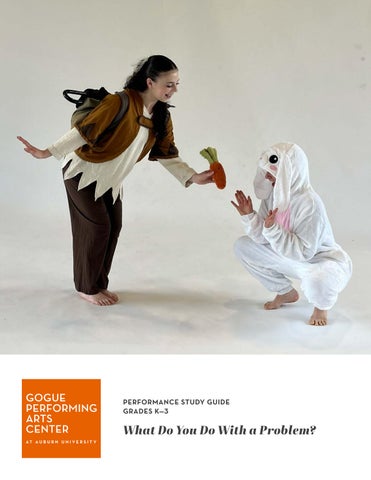
PERFORMANCE STUDY GUIDE GRADES K—3
What Do You Do With a Problem? 1
Credits
The Jay and Susie Gogue Performing Arts Center at Auburn University engages audiences across the university, the state of Alabama and beyond with curated arts experiences that inspire, enlighten and unite. Our annual K–12 School Performance Series provides opportunities for students to enjoy exclusive performances by some of the most talented and accomplished artists from around the world. Prior to each K–12 school performance, teachers receive a study guide containing details about the performance, artist and company, supplemental information about the art form and its history, and grade-appropriate activities designed to spark conversation and exploration in the classroom.
All images featured in this performance study guide are wholly owned and copyrighted by their respective copyright holders and are used for educational purposes only. No copyright infringement is intended. The Gogue Center does not claim ownership of any images unless explicitly stated otherwise. If you have concerns about the use of any image included herein, please contact us immediately. For a list of additional image sources and credits, please contact our Department of Communications and Marketing by telephone at 334.844.7234 or via email at jaosborne@auburn.edu.
To learn more, visit goguecenter.auburn.edu/education. produced by Jay and Susie Gogue Performing Arts Center at Auburn University 910 South College Street Auburn, Alabama 36849 k–12 school performance series contact Andrea Jarmon, D.M.A. Education Coordinator telephone: 334.844.7371 email: gpac.education@auburn.edu
This guide is optimized for accessible online engagement and may contain links to additional resources and multimedia content. To access digital versions of this and other performance study guides produced by the Gogue Center, scan the QR code or visit aub.ie/gpac-psg.
© 2026 Auburn University
PERFORMANCE STUDY GUIDE GRADES K—3
3
Inlet Dance Theatre company members in What Do You Do With a Problem?
Table of contents Credits ���������������������������������������������������������������������������������������������������� 2 Where we will go �������������������������������������������������������������������� 7
Alabama Problem Solvers • 26
Going to the Gogue Center • 7
ACTIVITIES
Who Will You See Here? • 7
Protecting Our Environment ��������������������������������������������������������� 28
What Does the Audience Do? • 7 Acoustics: The Science of Sound • 9
Who to know at the show ��������������������������������������� 10 Meet the Creative Team • 10
What to know before the show ���������������������� 12 Introduction to Dance • 12 Dance Vocabulary • 12 Elements of Dance • 13 Storytelling • 14 Emotions & Feelings • 15 Name That Emotion • 15 Problem Solving • 22 Problems Here, Problems There • 22 Community Leaders & Helpers • 23 Rights & Responsibilities • 23 ACTIVITIES Storytelling Through Movement ������������������������������������������������� 16 worksheet: Story Planner
Resolving A Problem ����������������������������������������������������������������������������� 24
5
Why we go to the show ������������������������������������������������ 26
worksheet: Clean & Littered Environments worksheet: Solution Builder
What to do after the show ������������������������������������� 32 ACTIVITIES worksheet: My Trip to the Gogue Center
Alabama Course of Study standards index �������������������������������������������������������������������� 34 Arts Education • 34 Counseling And Guidance • 35 Digital Literacy And Computer Science • 36 English Language Arts • 36 Science • 37 Social Studies • 37
Additional resources ���������������������������������������������������� 38
photo: Robert Benson
The Jay and Susie Gogue Performing Arts Center at Auburn University
6
Where we will go
What Does the Audience Do? Alabama Course of Study AE17.MU.3-5.15 AE17.MU.6-8.14
GOING TO THE GOGUE CENTER The Jay and Susie Gogue Performing Arts Center, otherwise known as the Gogue Center, is located on the campus of Auburn University in Auburn, Alabama. The Gogue Center houses the 1,200-seat Woltosz Theatre. The theatre was built with exceptional acoustics so that it is possible to hear well from every seat.
National Standards MU:Pr6.1.3-8b
The audience is an important part of the performance. Without the audience, who would watch the performers? Who would clap and sing along and appreciate what the artists bring to the stage? When you are a member of an audience at the theatre, there are a few things to know about what to do and what not to do.
WHO WILL YOU SEE HERE? Ushers These are the people who will greet your bus, lead your class into the building and help you find your seat. Be sure to say “hello!” Stage Crew These are the people who work backstage, so you won’t see them in the lobby, but you might see them before or after the performance, and sometimes, they even come on stage during the performance to move things. Lighting & Sound Operators These are the people who control the lighting and the sound for the performance. You may see them in the middle of the auditorium at the big sound board or in the back of the auditorium in the booth. Sometimes, the spotlight operators are in the back way above your head. Performers These are the people on the stage who may be dancers, musicians, singers, actors, puppeteers or acrobats. It is their job to communicate using their bodies, instruments and voices. Audience Members This includes you, your classmates, and other students and teachers from Alabama, and beyond.
Sit in your seat and look around, but please keep your feet toward the ground.
Listen and watch, but do not talk.
Have a camera or phone? Please turn it off.
The performers will take to the stage, and we know they will engage. You can laugh, you can sing, you can get up and dance, but just make sure that you give them all a chance!
When the song is done, or the show comes to an end, make sure that you give the performers a hand! Applause is the way that we can say thank you for all that they did today!
7
photo: Robert Benson
The Walter Stanley and Virginia Katharyne Evans Woltosz Theatre
8
Acoustics: The Science of Sound Alabama Course of Study Standards SC23.1.1 SC23.2.2 SC23.4.6
SC23.5.2
National Standards NS.K-4.1 NS.5-8.2
Acoustics is the study of sound and how that sound reacts in spaces, particularly rooms and buildings. What is sound? Sound is vibration. That vibration travels through the air and into our ears where we hear it. Vibration begins through movement—for example, strumming a guitar string. That vibration creates a sound wave. In a theater or concert hall like the Woltosz Theatre, acoustics are important so that everyone can hear the performers. There are two ways that acoustics are controlled. The first, reverberation, is controlling how sound waves bounce off surfaces, like walls and floors. Hard surfaces cause more reverberation and make spaces louder. The second way, absorption, is the opposite of reverberation. Soft surfaces absorb sound waves and make rooms quieter. Of the materials and surfaces listed below, which do you think cause sound to reverberate? Which absorb sound? • Tile • Carpet • Stone • Curtains • Cushions • Wood
9
9
Who to know at the show MEET THE CREATIVE TEAM Inlet Dance Theatre Founded in 2001 by executive and artistic director Bill Wade, Inlet Dance Theatre creates and performs innovative dance theatre that explores human experiences and encourages personal growth. Over the past 25 years, Inlet has grown from a small company with a local presence into an organization whose inspiring performances and dynamic educational programs reach audiences around the world.
Inlet’s production of What Do You Do With a Problem? brings author Kobi Yamada’s bestselling children’s book to life through dance and theatrical storytelling. Like the book, the performance follows a young child who tries to avoid a problem that simply will not go away. As the problem grows and grows, the child must find the courage to face it. Through movement, the dancers show how challenges can lead to new ideas, unexpected opportunities and important things about ourselves. Kobi Yamada, author Kobi Yamada is a No. 1 New York Times bestselling author and the president of Compendium, a publishing company that creates inspiring books and gifts. His works include What Do You Do With an Idea?, What Do You Do With a Problem? and What Do You Do With a Chance? He lives with his family in the Pacific Northwest. Mae Besom, illustrator Mae Besom began her career as a character designer in Sichuan, China, after graduating from the Sichuan Fine Arts Institute. She later followed her love of illustration and became a full-time children’s book illustrator. Besom uses traditional materials, including pencil and watercolor, to create the texture and light found in her enchanting illustrations.
10
Inlet Dance Theatre company member
What Do You Do With a Problem?, written by Kobi Yamada an illustrated by Mae Besom, was first published in 2016.
11
11
What to know before the show INTRODUCTION TO DANCE Dance is a performing art that uses movement to express feelings, tell stories and share ideas. Dancers may move to music, other sounds or silence. Some dances are choreographed, or planned in advance, while others are improvised, or created in the moment. Theatrical dance is performed for an audience. It may tell a story and often includes costumes, scenery, lighting and music. Ballet, modern dance and jazz dance are examples of theatrical dance. Participatory dance invites everyone to join in. Instead of only watching, audience members or community participants dance, too. Line dancing, square dancing and partner dancing are examples of participatory dance.
Dance Vocabulary
12
Accent
An emphasized movement or moment
Beat
The steady pulse heard in music
Choreography
A planned sequence of dance steps and movements
Choreographer
A person who creates choreography
Duration
The amount of time a movement lasts
Levels
The height of the dancer’s body in space: low, middle or high
Locomotor
Traveling movements such as walking, running, leaping, hopping and jumping
Non-locomotor
Movements performed in place, such as bending, twisting and stretching
Phrase
A short sequence of dance movements
Shape
The form the body makes in space, such as curved, straight or wide
Tempo
The speed of music or movement
B = Body (This describes WHO is moving.)
The body is the dancer’s instrument. • Dancers may move their whole bodies or individual parts, such as their arms, legs, heads or feet. Elements of Dance
• The body can make shapes using straight lines, curves and angles.
When learning something new, we often ask five questions: Who? What? Where? When? How?
A = Action
When learning about dance, we can answer these five questions with one sentence: “The body performs actions in space and time with energy.” Together, these five answers—body, action, space, time and energy—make up the elements of dance. An easy way to remember them is with the acronym BASTE. Let’s learn more about BASTE and the elements of dance.
(This tells us WHAT the dancer is doing.)
Action includes every movement a dancer performs. • Locomotor movements travel from one place to another. • Non-locomotor movements are performed in place. S = Space (This tells us WHERE the dancer is moving.)
Space is the area in which the body moves. Dancers move through general space and within their personal space. • Dancers can move forward, backward or from side to side. • Movements can be high, middle or low. • Movements can stay close to the body or reach far away. T = Time (This tells us WHEN the dancer is moving.)
Time describes the speed, rhythm and duration of movement. • Dancers can move quickly or slowly. • Movements can be short or long. • Movements can follow a steady beat or change rhythm. E = Energy (This tells us HOW the dancer is moving.)
Energy describes how a movement is performed. • Movement can be strong or light, sharp or smooth, tense or relaxed. Inlet Dance Theatre company members
13
13
STORYTELLING Storytelling is an integral part of our society. It can be used for entertainment, education or preserving history. Stories typically involve plot, setting, characters, theme, tone, a point of view and conflict. The plot is the series of events that make up the story. The plot is the series of events that make up a story. A plot can usually be divided into three separate parts:
Beginning The characters and setting are introduced, and the story begins to take shape.
Middle The characters face a problem or conflict. The action builds as events lead to the climax, or the most important and exciting point in the story. After the climax, the action begins to move toward the conclusion.
The setting is where the story takes place. This can be specific or general, it all depends on the story. Sometimes the settings change throughout the story. Sometimes, the setting remains the same. Establishing the setting helps the audience better understand the story. The characters in a story are the people, animals or imaginary creatures that experience the story. They complete the action; the story is about them, and they move the story forward. The theme is the overall message of the story. It is the “why.” A theme can be a lesson or a warning, or it can be a message of love or hope. The tone is the overall feeling of the story. Is it funny or mysterious? Is it sad or optimistic? The tone is created through word choice and sentence structure, as well as setting and character descriptions. Stories are typically told from either the first-person or third-person point of view. First-person point of view tells the story from a character’s perspective using first-person pronouns (e.g., I, me, my, mine,
14
End
The story reaches its conclusion. The problem or conflict is usually resolved, and we learn what happens to the characters.
we, our, ours). A first-person point of view does not necessarily have to be from the perspective of the main character; it can be from any character telling the story from their personal perspective. Thirdperson point of view tells the story of the characters using third-person pronouns (e.g., he, him, his, she, her, hers, their, theirs). Conflict is what propels the story forward. There are internal conflicts that the characters have to overcome, and there are external conflicts that the characters face. Conflict is what makes the story interesting. How the characters deal with these internal and external conflicts is what propels the plot. The conflict can be between two of the characters (for example, two players competing for one spot on a team). The conflict could be between a character and nature, like someone trying to learn to surf big waves. The conflict could be between a character and something supernatural, such as someone fighting ghosts. The conflict even could be within the character (for example, an actor fighting their own stage fright). Whatever the conflict, how characters face and overcome the conflict is what engages audiences with the story.
Name That Emotion
Emotions & Feelings In What Do You Do With a Problem?, the main character experiences many different emotions. What are emotions? Emotions are natural reactions to what is happening around us and within us. They can affect how our bodies feel, what we think and how we act. Have you ever felt happy? You might smile or laugh. Have you ever felt sad? You might cry, frown or become quiet. What other emotions can you name? How about angry, afraid, surprised, excited or calm? How might someone express these emotions? Everyone experiences emotions. Learning to recognize, understand and respond to them is part of growing up. The main character feels worried and afraid when the problem first appears. As the problem grows, the child may also feel frustrated or unsure. When the child finally finds the courage to face the problem, those feelings begin to change. The story reminds us that emotions are a normal part of life. Understanding our feelings can help us recognize what we need and decide what to do next.
Putting our feelings into words can sometimes be tricky. We can use many different words to describe how we feel. For example, you might say that you are happy, but are you cheerful, proud or pleased? You might say that you are sad, but are you disappointed, lonely or hurt? Learning more emotion words can help us understand ourselves, share our feelings with others and decide what we may need or what to do next. Here are some common emotions and related words that can help describe them. Happy Cheerful, content, glad, joyful, pleased, proud Sad Disappointed, down, gloomy, hurt, lonely, unhappy Angry Annoyed, frustrated, grumpy, irritated, mad, upset Calm Balanced, comfortable, peaceful, quiet, relaxed, still Excited Eager, energetic, enthusiastic, hopeful, interested, thrilled Scared Afraid, frightened, nervous, uneasy, unsure, worried
15
STORYTELLING THROUGH MOVEMENT Alabama Course of Study Standards AE24.D.K.2 AE24.D.K.11 AE24.K.4 AE24.D.1.2 AE24.D.K.7 AE24.D.1.3 AE24.D.K.8 AE24.D.1.4 AE24.D.K.9 AE24.D.1.7 AE24.D.K.10 AE24.D.1.10
AE24.D.1.11 AE24.D.2.2 AE24.D.2.4 AE24.D.2. AE24.D.2.10 AE24.D.3.4
AE24.VA.K.3 AE24.VA.1.5 AE24.VA.2.3 AE24.VA.3.1 CG.PS.A1.5 ELA21.K.27
National Standards DA:CR1.1.K DA:CR1.1.1
NL-ENG.K-12.4 NL-ENG.K-12.5
NL-ENG.K-12.6 NL-ENG.K-12.12
DA:CR1.1.2 DA:CR1.1.3
ELA21.3.33
OBJECTIVE
ACTIVITIES
By completing these activities, students will:
Introduction Review and discuss the “Introduction to Dance” lesson on pages 12–13. Once students have a clear understanding of the different elements—body, action, space, time and energy—ask them to move beside their desks or to a designated area.
•
Identify and describe plot, setting, characters, theme, tone, point of view and conflict
•
Retell the beginning, middle and end of a story and explain how the events are connected
•
Identify how the elements of dance are used in movement
•
Create a comic strip showing a story’s sequence of events in the correct order
•
Plan and create a fictional story or personal narrative
•
Using both arms, reach toward the sky.
•
Use the book as inspiration to interpret feelings and communicate ideas through movement
•
Let one arm fall.
•
Tiptoe in a circle around your desk.
•
Move your shoulders up and down.
•
Touch your toes or reach toward the floor.
MATERIALS For these activities, you will need the following items:
1. Ask students to move their bodies in response to your directions. suggested movement prompts
2. Next, guide students through more complex movement prompts that combine multiple elements. For example, ask students to move a body part in a certain direction or style for a specific amount of time or at a certain tempo. Ask students to identify the elements used in each prompt.
•
A copy of What Do You Do With a Problem?
•
“Introduction to Dance” lesson on page 12–13
•
“Storytelling” lesson on pages 14–15
•
Chart paper or a board
suggested movement prompts
•
Pencils, crayons, colored pencils or markers
•
Make circles with your arms.
•
Paper or journals
•
•
“Story Planner” worksheet on page 18
Make the circles as large as you can, then as small as you can.
•
Photographs or illustrations of problem scenarios
•
Move the circles above you and to each side of your body.
•
“Problem-and-Solution Comic Strip” worksheets (K–3)
•
Move the circles as slowly as you can, then as quickly as you can.
Note to educators: Many activities in this section require students to demonstrate movement. Before beginning, ensure that students have enough room to move safely within a designated area. Remove backpacks, chairs and other obstacles whenever possible. Offer seated or adapted movement options as needed and remind students to remain aware of their personal space.
16
ELA21.K.37 ELA21.1.23 ELA21.1.34 ELA21.2.23 ELA21.2.40 ELA21.3.22
3. Have students return to their desks. If space allows, use this opportunity to introduce a locomotor movement by asking students to walk, hop or slide back to their seats. Storytelling Activity 1. Once students have returned to their seats, read What Do You Do With a Problem? aloud. Reread the passages in which the main character worries about the problem and later discovers that facing it creates an opportunity to learn and grow.
2. Review the “Storytelling” lesson on pages 14–15.
Theme
3. Lead students in identifying the key story elements in What Do You Do With a Problem? Using chart paper or the board, create an anchor chart with the story element headings from the “Story Planner” worksheet on page 18. Record student responses to the discussion questions below.
•
What lesson does the main character learn?
•
What message does the author want readers to remember?
Tone
storytelling discussion questions
•
How does the story feel at the beginning?
Plot Explain that stories unfold through a sequence of events. Each event moves the story forward and helps the characters respond to a problem or conflict.
•
How does the tone change by the end?
Point of View
•
What happens when the problem first appears?
Conflict
•
What does the character do while trying to avoid or understand the problem?
•
What challenge does the main character face?
•
Why is the challenge difficult?
•
How is the problem resolved?
Discuss how each event leads to the next by asking: •
What happens first?
•
What happens next?
•
What happens last?
•
How are these events connected?
Setting •
Where does the story take place?
•
Does the setting change throughout the story?
Characters •
Who is the main character?
•
What do we learn about the character’s feelings and actions?
•
Who is telling the story?
4. Ask students to name emotions and feelings that may arise when someone faces a problem. Record student responses on chart paper or the board. As outlined in the “Emotions & Feelings” section on page 15, encourage students to use as many different emotion words as possible. Exploration For this activity, students will become storytellers. Just as Kobi Yamada created What Do You Do With a Problem?, students will have the opportunity to create their own stories about characters who face problems. Students may create fictional stories about made-up characters or, if they are comfortable doing so, personal narratives about challenges they have experienced. 1. Using chart paper, a journal or the “Story Planner” worksheet on page 18, have students create a story map by answering the story-related questions below.
17
Date
Name
Story Planner Plot
Setting
Beginning
Characters
Middle Theme
End
Tone
Point of view
Conflict
18
•
Plot: What happens first? (Beginning) What actions does the character take to solve the problem? (Middle) How is the problem solved? (End)
Guided Practice For this activity, students will explore how problems and challenges can affect emotions, thoughts and movements.
•
Setting: Where does the story take place?
•
Characters: Who is the main character?
1. Gather students together and ask: “The child in the story was afraid of the problem. What advice would you give the child?”
•
Theme: What lesson is learned?
•
Tone: How does the story feel at the beginning? How does it feel at the end?
•
Point of view: Who is telling the story?
•
Conflict: What problem does the character face?
2. Invite students who wish to share their story plans with a partner or the class. 3. Transition to the next part of the activity by saying: “Dancers can tell stories through movement. Authors tell stories with words and pictures. Next, we will use our bodies to show the beginning, middle and end of a story, including the characters’ feelings and solutions.” 4. Display photographs or illustrations of familiar problem scenarios. Each image should clearly show a problem or challenging situation and a related emotion. For added clarity, include a short written description with each image. 5. Describe each scenario aloud. 6. Working in pairs or small groups, have students identify the emotions suggested by each scenario. Ask them to explain why the situation might feel difficult and how it is similar to the story. 7. Ask students to demonstrate one possible movement response to each scenario. For example, if the image depicts someone who is nervous about a test, they might tap a foot or bounce a leg. If the image depicts someone who has argued with a friend, they might stomp, cross their arms or turn away. Remind students that people may express the same emotion in different ways.
19
2. Invite students to share their ideas. As a class, discuss which solutions seem most helpful and why. 3. Ask students: “How can a problem affect the way we feel, think and move?” Encourage students to connect emotions such as frustration, worry or anger to physical reactions in their bodies. 4. Using the “Elements of Dance” section on page 13, review the difference between locomotor and non-locomotor movement. Remember: Locomotor movements travel from one place to another. Non-locomotor movements are performed while the body remains in one place. To help students recall the difference, chant or sing while clapping the syllables: “Locomotor moves through space; non-locomotor stays in place.” 5. Ask students to demonstrate movement phrases based on the emotions and examples below. Explain that these are only possible examples and that emotions can be expressed through movement in many different ways. Have students repeat each movement or invite them to suggest and demonstrate movements of their own. suggested emotion-and-movement phrases •
Anger (Stomp or make a strong shape.)
•
Nervousness (Tap a foot or bounce a leg.)
•
Sadness (Melt slowly toward the floor.)
•
Frustration (Place both hands on the head or pace slowly across the floor.)
•
Fear (Curl into a shape as though hiding.)
19
6. Working in pairs or small groups, have students create their own emotion-and-movement phrases. Invite each group to perform its phrase for the class. As students present, ask them to identify how they used the dance elements of space and time. suggested discussion questions •
Where are you moving—in general space or personal space?
•
Are you moving with a steady rhythm or a changing rhythm?
•
How quickly are you moving—fast or slow?
•
How long does the movement last—short or long?
7. Have students work with partners. One student will select a teacher-approved fictional problem scenario or an emotion for the other student to explore through movement. After the movement is complete, have students switch roles and repeat the activity.
20
Creative Activity For this activity, students will create a multi-panel comic strip illustrating a problem, steps toward a solution and the solution. They will then use movement to represent the sequence of events. Before introducing the activity, download and review the grade-appropriate “Problem-and-Solution Comic Strip” worksheets. 1. Begin by asking students whether they have ever seen a comic strip. Invite one or two students to describe a comic strip or comic book to the class. Explain that comic strips and books are forms of sequential art. They tell stories in a specific sequence, or order, through pictures. Although they may also include words, the order of the pictures helps communicate the story. 2. Tell students that they will create their own comic strips illustrating a problem, steps toward a solution and the solution. 3. Copy and distribute the grade-appropriate “Problem-andSolution Comic Strip” worksheet. Instruct students to draw the problem, steps toward a solution and the solution in the appropriate panels. Have students label or write sentences as directed.
Kindergarten: After students finish drawing, help them create a movement that reflects each part of the story. Grade 1: After students finish drawing, ask them to write a complete sentence describing each panel. Next, have them create a movement that reflects each part. If time permits, invite students to share their comic strips and lead the class in performing their movement sequences. Grades 2 and 3: After students finish drawing, ask them to write one or more complete, detailed sentences describing the problem, the steps taken toward a solution and the final solution. For example: “I am nervous about a test, so I study and ask my teacher questions. Being prepared helps me feel more confident.” Next, place students in small groups. Ask each group to select one comic strip and create a movement representing each part of the story: the problem, the steps toward a solution and the solution. Have students connect the three movements to form a complete sequence. Invite each group to present its selected comic strip to the class. One student may read the problem-and-solution story aloud while the other group members perform the movement sequence.
Reflection Lead a class discussion about how problems and challenges can affect emotions, thoughts and movements. suggested discussion questions •
How can a problem affect the way we feel, think and move?
•
What movements best show the feelings a character might experience when facing a problem? Why did you choose those movements?
•
What are some ways we can calm our bodies and minds so that we can solve problems more effectively?
Conclusion Before attending What Do You Do With a Problem?, remind students that stories can be told through movement as well as through words. They have practiced this in the classroom and will see it on stage. Encourage students to look for movements that communicate the emotions they identified. Ask students: “How might the dancers show the problem and its resolution? What might those movements look like?”
4. Display student comic strips for classmates and others to enjoy.
21
PROBLEM SOLVING Have you ever had a problem? Maybe your favorite toy broke, or you had an argument with a friend. Perhaps you needed help with a difficult homework assignment. You tried and tried to answer a question, but no matter what you did, you could not figure it out. Maybe an upcoming quiz or test made you feel nervous.
What can we do when a problem appears? How do we begin solving it? The first step is to identify and understand the problem. Instead of hiding from it, we can ask for help, think about our options and explore possible solutions. We can also look for opportunities to learn and grow from the problems we face.
Do not worry—you are not alone. Everyone faces problems. Children, grownups, teachers, neighbors, friends and family members all experience different kinds of problems.
If a toy is broken, what could you do? You might ask a teacher, parent or another trusted adult for help. You might try to fix it yourself if it is safe to do so. You could also choose to play with a different toy. These are all possible solutions.
But what is a problem? A problem is a situation that is difficult, does not work the way it should or needs a solution. When people recognize a problem, they can ask questions, gather information, think of ideas and test possible solutions. Problem solvers use creativity, knowledge and determination to solve problems and make things better. Problems can be small and easy to solve, like a broken pencil or a puzzle that is difficult to finish. They can also be large or complex and require careful thought and planning, like finding ways to keep the environment clean or protect drivers and passengers in cars. Some problems affect only one person, while others may affect many people across a community, state or even the world.
Think about a real or imagined problem. What could you do to solve it? Why might you choose that solution? Could the problem be solved in a different way? When solving problems, one of the most important things to remember is to keep trying. If your first solution does not work, try another. Every problem may hold an opportunity to learn, be brave and discover something good. Problems Here, Problems There Problems can pop up wherever we go. Just as every person faces problems, every place can have its own challenges. Some problems affect only one person or place, while others may affect an entire community. Here are a few problems you might encounter at home, at school or in your community. Home • Your room is messy. • You and a brother, sister or another family member have a disagreement. • You forget to complete a chore. • A family member needs help with a task. • You leave your math book at school and cannot finish your homework.
22
School • Your desk, cubby or locker is messy. • You and a classmate have a disagreement. • Your pencil or book is missing. • You have trouble understanding a lesson. • You leave your science homework at home. Community • A local park is covered in litter. • The swing set at a neighborhood playground is broken. • A busy street needs safer crosswalks.
What other community leaders can you name? Which community helpers do you know?
• A neighborhood does not have enough trees or green spaces.
Rights & Responsibilities
• A nearby stream or pond is polluted.
Community Leaders & Helpers In What Do You Do With a Problem?, the main character learns to face a problem and discover what can be done about it. Like the character in the story, we can solve many problems on our own. Sometimes, we may ask friends or family members for help. Other problems may require help from trusted adults who serve as leaders and helpers in our community. Community leaders and helpers work to make their communities better, although they may serve in different ways. Community leaders make decisions, organize people and help plan for the future. Governors, mayors, city council members and school principals are examples of community leaders. Community helpers provide important services that people need each day. Teachers, librarians, police officers, firefighters, doctors, nurses and sanitation workers are examples of community helpers. Many people can be both leaders and helpers, depending on their roles.
Rights are freedoms and protections that people have, such as the right to feel safe, be treated fairly and share their ideas. Responsibilities are the duties people have to themselves and others, such as following rules, respecting others and taking care of shared spaces. Rights and responsibilities work together. For example, everyone has the right to learn in a safe classroom, and everyone has the responsibility to behave in ways that help keep the classroom safe. In What Do You Do With a Problem?, the main character has the right to feel safe, ask for help and share how the problem makes them feel. The character also has the responsibility to think carefully, make safe choices and decide how to respond. At first, the character tries to avoid the problem, but it continues to grow. When the character finally examines it, they discover that it holds an opportunity. The story reminds us that our rights help us feel safe and supported, while our responsibilities guide us to make thoughtful choices when problems arise.
23
RESOLVING A PROBLEM Alabama Course of Study Standards AE24.VA.K.1 AE24.VA.1.3 AE24.VA.K.2 AE24.VA.1.5 AE24.VA.K.3 AE24.VA.2.2 AE24.VA.K.6 AE24.VA.2.3 AE24.VA.1.1 AE24.VA.3.1 AE24.VA.1.2 AE24.VA.3.2
CG.PS.A2.1 CG.PS.B1.1 CG.PS.B1.3 CG.PS.B1.4 CG.PS.B1.5 CG.PS.B1.11
ELA21.K.33 ELA21.K.37 ELA21.1.33 ELA21.1.36 ELA21.2.42 ELA21.2,44
ELA21.3.35 ELA21.3.38 SS24.K.1 SS24.K.2 SS24.1.1 SS24.1.2
National Standards NL-ENG.K-12.4 NL-ENG.K-12.5 NL-ENG.K-12.12
VA:Cr1.2.Ka VA:Cr2.1.Ka VA:Cr1.1a
VA:Cr1.2.1a VA:Cr1.2.2a VA:Cr1.1.3a
VA:Cr1.2.3a
NSS-C.K-4.3 NSS-C.K-4.5 VA:Cr1.1.Ka
OBJECTIVE
•
What are some problems we might face at school?
By completing these activities, students will:
•
What are some problems communities might face?
•
Use a problem-solving process to identify and evaluate possible solutions
•
Identify rights and responsibilities of citizens and individuals within the home, school, community and state
2. Next, lead a discussion about solving problems. Using chart paper or the board, create an anchor chart outlining the problem-solving steps below. •
Identify the problem.
•
Identify and describe the roles and responsibilities of community helpers, leaders and public officials
•
Think of possible solutions.
•
Consider the possible consequences of each solution.
•
Identify a problem in the school, local community or state
•
Choose a solution.
•
Write an opinion or persuasive letter asking a community leader to help address a community problem
•
Take action.
•
Reflect on the results.
MATERIALS For these activities, you will need the following items:
3. Discuss how these steps can help people solve both personal and community problems. 4. Ask students: “How can community members work with leaders and helpers to solve problems?”
•
“Problem Solving” lesson on pages 22–23
•
Chart paper or board
•
Paper or posterboard
Exploration
•
Pencils, crayons, colored pencils or markers
•
Photographs or illustrations of community leaders and helpers (optional)
1. Review the “Community Leaders & Helpers” section on page 23.
•
Sample persuasive letters (optional)
•
Envelopes and stamps (optional)
ACTIVITIES Introduction Begin by reviewing the “Problem Solving” lesson on pages 22–23. Lead students in a discussion about problems. 1. As a class, discuss what problems are, where they may occur and ways people can try to solve them. Using chart paper or the board, record student responses to the discussion questions below. suggested discussion questions
24
SS24.2.1
•
What is a problem?
•
What are some problems we might face at home?
2. Using chart paper or the board, create two lists—one labeled “Community Leaders” and the other labeled “Community Helpers.” Ask students to name examples of each and record their responses. You may also show students pictures of community leaders and helpers and ask them to identify each person’s role. 3. Once students have provided examples for both lists, lead a discussion about each role. suggested discussion questions •
What does this person do?
•
How does this person help solve problems?
4. Review the “Rights & Responsibilities” section on page 23. 5. Using chart paper or the board, create two lists—one for rights and one for responsibilities. Provide examples of rights and responsibilities. As each example is presented, ask students to sort it into the correct list.
6. Ask students: “If you could improve one thing in our school or community, what would it be?” Invite students to share their ideas and record their responses. After discussing the ideas, select one age-appropriate issue for the class to explore further.
2. After students complete their posters, explain that they will write letters to community leaders or helpers describing the problem and asking for assistance. Recipients might include a principal, school board member, city council member, mayor or governor. Explain that each letter should include:
Guided Practice For this activity, students will apply the problem-solving process to the school or community issue selected during the Exploration activity.
•
A greeting
•
A description of the problem
•
An explanation of why the problem is important
1. Once the class has chosen an issue, lead students in a deeper discussion about the problem. Record their responses.
•
A suggested solution
•
A respectful request for help
•
A closing
suggested discussion questions •
Why is this a problem?
•
Who is affected?
•
What solutions could help?
•
Who might help solve the problem?
•
What should community leaders know about it?
2. Explain that students will create a graphic organizer showing how to recognize a problem, suggest a possible solution, explain why the problem should be addressed and identify an action a community leader or helper could take. A simple flowchart outlining each step works well for this activity. suggested elements and questions to include
For younger students: Allow students to dictate their responses or provide sentence frames. For older students: Encourage students to compose complete opinion letters supported by reasons. Note to educators: If letters will be sent outside the classroom, review them before sending and follow all school policies regarding student communication and privacy. Do not include students’ personal contact information. Sharing & Reflection Invite students to share their posters and letters with a partner, in small groups or with the class. Ask them to explain important details about their work.
•
Problem: What is the problem?
•
Idea: What should be done?
suggested questions
•
Reason 1: Why is this important?
•
What problem did you choose?
•
Reason 2: How will the solution help people?
•
Why is this problem important?
•
Requested Action: What would you like the leader or helper to do?
•
Who can help solve it?
•
How can community members help?
Creative Activity For this activity, students will create a community action poster addressing a school or community problem. You may assign each student a problem or allow students to choose their own. Students will also write a persuasive letter to a community leader or helper asking for assistance.
Conclusion Remind students that communities improve when people work together, identify problems, share ideas and communicate respectfully with leaders and helpers. Even young people can make a positive difference by speaking up, taking responsibility and working toward solutions.
1. Explain that each poster should include: •
A title
•
A drawing of the problem
•
A drawing of the proposed solution
•
At least one way community members can help solve the problem
•
A slogan or call to action encouraging positive change
•
Examples might include “Keep Our Playgrounds Clean!,” “Recycle for a Better Community!” or “Safe Streets for Everyone!”
Share your students’ colorful creations with us. We’d love to see the masterpieces your talented students create. Send us a photo of their community action posters and other projects from this performance study guide. Be sure to include each student’s name, age, grade and school with your submission. You can send all submissions to the Gogue Center via email at gpac.education@auburn.edu.
25
Why we go to the show ALABAMA PROBLEM SOLVERS Did you know that people with connections to Alabama have helped solve some very big problems? Alabama pioneers made discoveries and improvements that changed everyday life—from farming and transportation to medicine. (Some even helped us travel all the way to outer space!) Here are just a few examples of Alabama problem solvers. In the late 1800s, railroad workers could be badly injured while connecting train cars by hand. Jefferson County inventor Andrew Jackson Beard developed an improved automatic railroad car coupler that allowed cars to connect more safely. His invention helped reduce injuries and save lives. Around the same time, scientist George Washington Carver was helping farmers at Tuskegee Institute. Planting cotton year after year had worn out much of the soil they depended on. Carver taught farmers to rotate their crops—or plant different crops in the same fields from season to season. This practice helped restore nutrients to the soil and gave farmers different crops to grow and sell. In the early 1900s, Alabama-born inventor Mary Anderson patented the first effective windshield wiper. While riding a streetcar in New York City, she noticed that the driver had to stop and get out to clear snow and sleet from the front window. She had an idea: What if there were a tool that could clean the window and help keep drivers safe? Back home in Birmingham, Anderson designed a device that could be operated from inside the vehicle. Her invention was an early version of the windshield wipers later used on automobiles.
26
During the 1950s and 1960s, the United States and the Soviet Union competed to achieve new milestones in space. This competition, which included the race to land astronauts on the moon, became known as the Space Race. At Redstone Arsenal in Huntsville, teams of engineers and scientists helped develop early rockets. Later, engineers at NASA’s Marshall Space Flight Center designed and developed the Saturn V, the powerful rocket that carried astronauts to the moon. During the 1970s, Birmingham-born engineer and Auburn graduate George F. Kirchoff Jr. helped make car airbags more dependable. An airbag must fill with gas very quickly during a crash to help protect the people inside the car. Kirchoff used what he knew about rocket propellants to help create a system that could fill an airbag in far less than a second. (That is super-fast!) His work helped make airbags fast and dependable enough to protect drivers and passengers. Mobile-born doctor Regina Benjamin worked to help people get the medical care they needed. In 1990, she opened a clinic in Bayou La Batre, where she cared for families who did not always have easy access to doctors and nurses. Her work helped make health care available to more people and showed how one person can make a big difference in a community. Each of these problem-solving individuals and teams saw a challenge and worked to find a solution. What problems do you see today that might be solved with a creative new idea or action? The Saturn V rocket was designed by engineers at NASA’s Marshall Space Flight Center in Huntsville.
andrew jackson beard
mary anderson
The Old Rotation at Auburn University is the world’s oldest continuous cotton experiment. Established in 1896, this historic one-acre plot demonstrates how sustainable crop rotation and winter cover crops maintain healthy soil.
george washington carver
dr. regina benjamin
george f. kirchoff jr.
27
PROTECTING OUR ENVIRONMENT Alabama Course of Study Standards AE24.VA.K.3 AE24.VA.2.2 AE24.VA.K.6 AE24.VA.3.2 AE24.VA.1.3 DLCS25.1.3
DLCS25.2.1 DLCS25.3.1 DLSC25.3.3
SC23.K.11 SC23.2.11 SS24.K.1
SS24.1.1 SS24.2.1
National Standards NS.K-4.5 NS.K-4.6
NSS-C.K-4.5 VA:Cr.1.2.Ka
VA:Cr1.2.1a VA:Cr1.2.2a
VA:Cr1.2.3a
NS.K-4.7 NSS-C.K-4.3
OBJECTIVE
•
Which environment looks safer and healthier?
By completing these activities, students will:
•
What problem do you see?
•
Identify a human-caused problem in the local environment
•
What may have caused this problem?
•
Explain how litter affects people, plants and animals
•
Who might be able to help solve it?
•
Design a solution to reduce litter in the school environment
MATERIALS For these activities, you will need the following items: •
“Alabama Problem Solvers” lesson on pages 26-27
•
Chart paper or board
•
“Clean & Littered Environments” illustrations on page 30
•
“Solution Builder” worksheet on page 31
•
Pencils, crayons, colored pencils or markers
ACTIVITIES Introduction Begin by reviewing the “Alabama Problem Solvers” lesson on pages 26-27. Emphasize that problem solvers can make an impact in many different areas by addressing challenges both big and small. By solving problems, we not only address challenges that affect us personally but also have the potential to improve lives throughout our communities and even around the world. Note to educators: The problem solvers featured in this lesson have strong connections to Alabama, but you may choose to highlight other individuals or groups. Consider discussing problem solvers from your local community, elsewhere in the United States or around the world. Include examples from a variety of fields and show how their work has made a meaningful difference in the lives of others. 1. Select, print and display a pair of related images from the “Clean & Littered Environments” illustrations featured on page 30. 2. Discuss the differences between the two images. Using chart paper or the board, record student responses.
28
3. Explain that scientists, engineers and community members can work together to solve problems that affect people and the environment. Exploration For this activity, students will become “litter detectives,” examining images of familiar places where litter has collected and suggesting ways to make them cleaner. 1. Divide students into small groups. 2. Select, print and display the “Clean & Littered Environments” illustrations featured on page 30. 3. Ask each group to identify the unsafe or unclean conditions shown in each image. Have students brainstorm and suggest ways to improve each space. 4. Invite each group to share its solutions with the class. differentiation Show a short introductory video about harmful and helpful environmental habits. Use a graphic organizer to match examples of harmful habits with helpful alternatives. Guided Practice For this activity, students will suggest solutions to specific causes of a larger environmental problem. Provide problembased prompts and ask students to respond with direct, practical solutions. You may use one of the environments discussed earlier or introduce a new setting as an example. 1. Using chart paper or the board, create a table with two columns—one labeled “Problem” and the other labeled “Solution.” 2. Present each problem-based prompt and ask the class to suggest direct solutions. Record student responses in the “Solution” column.
suggested discussion questions
suggested problems and solutions
•
•
What do you notice in each picture?
Our playground is covered with litter. What can we do? (Pick up the litter and dispose of it properly.)
•
The playground has a lot of paper and plastic waste. What can we do with these materials? (Reuse or recycle them when possible.)
•
There are no recycling bins at the playground. What could help? (Add recycling bins.)
•
Students sometimes forget to put their trash in the correct bin. How could we remind them? (Create and display reminder signs.)
differentiation Provide pictures showing harmful environmental habits and matching solutions. Ask students to place, tape or glue each problem picture in one box and its matching solution in another, with an arrow connecting the two.
1. Copy and distribute the “Solution Builder” worksheet on page 31. 2. Ask students to complete the worksheet, providing gradeappropriate support as needed. Offer students a choice of several problems, invite them to brainstorm a problem of their own or select one problem for the class to solve together. Sharing & Reflection Gather students in a circle. Invite students to share their “Solution Builder” worksheets. Ask them to identify the problem, explain their solution, outline the steps needed to put the solution into action and describe their design. Students should also explain how their solution could help the community.
Creative Activity For this activity, students will design a solution to a problem in their local environment.
29
Clean & Littered Environments
30
Date
Name
Solution Builder Design a solution to reduce litter at our school. The problem:
My solution:
Identify the steps to follow to solve the problem:
Drawing of my design:
31
What to do after the show POST-SHOW DISCUSSION Included in this section are some activities you can share with your students after they experience What Do You Do With a Problem? at the Gogue Center. Class Discussion Following the performance, gather students for a postperformance conversation. suggested discussion questions •
Which part of the performance did you enjoy the most?
•
What surprised you about the performance?
•
Was the performance different from the book?
•
Did you find the story easy to follow and understand?
•
What questions do you have about the performance?
•
Did the performance make you curious about something new? What would you like to learn?
•
Did the performance make you want to attend another live performance? Why or why not?
For an additional post-performance activity, copy and distribute the “My Trip to the Gogue Center” worksheet on the next page.
Inlet Dance Theatre company members
32
Date
Name
My Trip to the Gogue Center Answer these questions about the performance and your visit to the Gogue Center. List three things you remember hearing or seeing during the performance of What Do You Do With a Problem? 1. 2. 3. Name something you learned during the performance.
Name something from the performance you would like to know more about.
If you could ask a member of the cast a question, what would you ask?
In the space below, draw something special you remember hearing or seeing during the performance.
33
Alabama Course of Study standards index ARTS EDUCATION
34
Standard
Description
Grade
Activity
Page
AE24.D.K.2
Explore different ways to do basic locomotor and non-locomotor movements by changing at least one of the elements of dance.
K
Storytelling through Movement
16
AE24.D.K.4
Illustrate an idea, feeling, or image through improvised movement.
K
Storytelling through Movement
16
AE24.D.K.7
Demonstrate motion and stillness using basic elements of space, including levels and size.
K
Storytelling through Movement
16
AE24.D.K.8
Demonstrate tempo changes with movements that match music or sound stimuli.
K
Storytelling through Movement
16
AE24.D.K.9
Identify and apply different qualities to movements.
K
Storytelling through Movement
16
AE24.D.K.10
Imitate and repeat a variety of body shapes.
K
Storytelling through Movement
16
AE24.D.K.11
Demonstrate ability to move in personal and general space.
K
Storytelling through Movement
16
AE24.D.1.2
Demonstrate a variety of locomotor and nonlocomotor movements, incorporating two or more elements of dance.
1
Storytelling through Movement
16
AE24.D.1.3
Develop a dance phrase with a clear beginning, middle, and end.
1
Storytelling through Movement
16
AE24.D.1.4
Select and demonstrate movements that express an idea or emotion, accompanied by music.
1
Storytelling through Movement
16
AE24.D.1.7
Perform motion and stillness using changing elements of space including facings, pathways, and formations.
1
Storytelling through Movement
16
AE24.D.1.10
Demonstrate a variety of body actions.
1
Storytelling through Movement
16
AE24.D.1.11
Move safely in general space through a range of activities and group formations while maintaining personal space.
1
Storytelling through Movement
16
AE24.D.2.2
Combine movements to form a sequence, manipulating multiple elements of dance.
2
Storytelling through Movement
16
AE24.D.2.4
Select and demonstrate movements that express an idea or emotion using music and explain reasons for movement choices.
2
Storytelling through Movement
16
AE24.D.2.7
Create movement phrases with locomotor and non-locomotor movements, using level, size, pathway, and formation changes.
2
Storytelling through Movement
16
AE24.D.2.10
Create a dance phrase that includes multiple body shapes and actions.
2
Storytelling through Movement
16
AE24.D.3.4
Create a dance phrase that communicates an idea or feeling and discuss the effect of the movement choices.
3
Storytelling through Movement
16
ARTS EDUCATION Standard
Description
Grade
Activity
Page
AE24.VA.K.1
Engage in self-directed exploration and imaginative play with materials, using twodimensional and three-dimensional methods.
K
Resolving a Problem
24
AE24.VA.K.2
Collaboratively create artworks exploring the elements of art and principles of design.
K
Resolving a Problem
24
AE24.VA.K.3
Follow a sequence of steps to create art that expresses feeling and ideas.
K
Storytelling through Movement Resolving a Problem Protecting Our Environment
16 24 28
AE24.VA.K.6
Share and talk about the art they are creating.
K
Resolving a Problem Protecting Our Environment
24 28
AE24.VA.1.1
Engage collaboratively in exploration and imaginative play with materials, using twodimensional and three-dimensional methods.
1
Resolving a Problem
24
AE24.VA.1.2
Explore and experiment with a range of materials.
1
Resolving a Problem
24
E24.VA.1.3
Create works of art on subjects that are real or imaginary, using the elements of art and principles of design.
1
Resolving a Problem Protecting Our Environment
24 28
AE24.VA.1.5
Create an artwork based on observation of familiar objects and scenes.
1
Storytelling through Movement Resolving a Problem
16 24
AE24.VA.2.2
Create a work of art with a range of materials, using two-dimensional and three-dimensional methods to explore personal interests.
2
Resolving a Problem Protecting Our Environment
24 28
AE24.VA.2.3
Follow sequential steps to create works of art on subjects that are real or imaginary.
2
Storytelling through Movement Resolving a Problem
16 24
AE24.VA.3.1
Elaborate on an original or prompted imaginative idea.
3
Storytelling through Movement Resolving a Problem
16 24
AE24.VA.3.2
Investigate personal ideas through the art-making process, using available resources, tools, and technologies and incorporating the elements of art and principles of design.
3
Resolving a Problem Protecting Our Environment
24 28
COUNSELING AND GUIDANCE Standard
Description
Grade
Activity
Page
CG.PS.A2.1
Recognize that everyone has rights and responsibilities
K–3
Resolving a Problem
24
CG.PS.B1.1
Use a decision-making and problem-solving model
K–3
Resolving a Problem
24
CG.PS.B1.3
Identify alternative solutions to a problem
K–3
Resolving a Problem
24
CG.PS.B1.4
Develop effective coping skills for dealing with problems
K–3
Resolving a Problem
24
35
COUNSELING AND GUIDANCE Standard
Description
Grade
Activity
Page
CG.PS.B1.5
Demonstrate when, where and how to seek help for solving problems and making decisions
K–3
Resolving a Problem
24
CG.PS.B1.11
Use persistence and perseverance in acquiring knowledge and skills
K–3
Resolving a Problem
24
DIGITAL LITERACY AND COMPUTER SCIENCE Standard
Description
Grade
Activity
Page
DLCS25.1.3
Organize essential information to solve a problem, with or without digital tools. [AI]
1
Resolving a Problem Protecting Our Environment
24 28
DLCS25.2.1
Create an algorithm to solve a problem collaboratively and explain alternative ways to solve the same problem.
2
Resolving a Problem Protecting Our Environment
24 28
DLCS25.3.1
Develop and document an algorithm that outlines specific steps to complete a project for other learners to follow.
3
Protecting Our Environment
28
DLCS25.3.3
Demonstrate how a larger problem can be broken into sub-problems.
3
Protecting Our Environment
28
ENGLISH LANGUAGE ARTS
36
Standard
Description
Grade
Activity
Page
ELA21.K.27
Identify and describe the main story elements in a literary text.
K
Storytelling through Movement
16
ELA21.K.33
Express ideas orally and connect these ideas through drawing and emergent writing.
K
Resolving a Problem
24
ELA21.K.37
Actively participate in shared and independent writing experiences, for varied purposes and audiences, across different genres.
K
Storytelling through Movement Resolving a Problem
16 24
ELA21.1.23
Identify and describe the main story elements in a literary text.
1
Storytelling through Movement
16
ELA21.1.33
Actively participate in shared writing experiences to compose and develop a well-organized paragraph with a topic sentence, details to support, and a concluding sentence.
1
Resolving a Problem
24
ELA21.1.34
With prompting and support, write a narrative that recounts two or more appropriately sequenced events using transitions, incorporating relevant details, and providing a sense of closure.
1
Storytelling through Movement
16
ELA21.1.36
With prompting and support, write an opinion piece about a topic, including at least one supporting reason from a source and providing a sense of closure.
1
Resolving a Problem
24
ELA21.2.23
Identify the main story elements in a literary text.
2
Storytelling through Movement
16
ELA21.2.40
Write a personal or fictional narrative using a logical sequence of events, including details to describe actions, thoughts, and feelings and providing a sense of closure.
2
Storytelling through Movement
16
ENGLISH LANGUAGE ARTS Standard
Description
Grade
Activity
Page
ELA21.2.42
Write an opinion piece about a topic or text with details to support the opinion, using transitional words and providing a sense of closure.
2
Resolving a Problem
24
ELA21.2.44
With prompting and support, compose and develop a well-organized paragraph with a topic sentence, details to support, and a concluding sentence.
2
Resolving a Problem
24
ELA21.3.22
Describe literary elements within a story, including setting, plot, characters, and themes.
3
Storytelling through Movement
16
ELA21.3.33
Write personal or fictional narratives with a logical plot (sequence of events), characters, transitions, and a sense of closure.
3
Storytelling through Movement
16
ELA21.3.35
Write an argument to convince the reader to take an action or adopt a position, using an introduction, logical reasoning supported by evidence from various sources, and a conclusion.
3
Resolving a Problem
24
ELA21.3.38
Compose and develop a well-organized paragraph with a topic sentence, details to support, and a concluding sentence.
3
Resolving a Problem
24
SCIENCE Standard
Description
Grade
Activity
Page
SC23.K.11
Identify a problem and design possible solutions that lessen the human impact on the local environment.
K
Protecting Our Environment
28
SC23.2.11
Evaluate multiple solutions designed to slow or prevent wind or water from changing the shape of Earth’s surface.
2
Protecting Our Environment
28
SOCIAL STUDIES Standard
Description
Grade
Activity
Page
SS24.K.1
Describe rights and responsibilities of citizens and individuals within the home, school, and community.
K
Resolving a Problem Protecting Our Environment
24 28
SS24.K.2
Describe roles of community helpers and leaders.
K
Resolving a Problem
24
SS24.1.1
Identify rights and responsibilities of citizens and individuals within the local community and the state.
1
Resolving a Problem Protecting Our Environment
24 28
SS24.1.2
Identify public offices in the community and state and the duties associated with them.
1
Resolving a Problem
24
SS24.2.1
Explain how rights and responsibilities for citizens are part of the American system of government.
2
Resolving a Problem Protecting Our Environment
24 28
37
Additional resources Below are supplementary online resources, including links to additional lesson content and activity materials, to help support and enrich your teaching. Additional lesson content MEET THE CREATIVE TEAM Click the links below to learn more about the artists and teams that contributed to the creation, development and production of this performance.
The John F. Kennedy Center for the Performing Arts “Do You Wanna Dance?” X aub.ie/gpac-dance-elements-2 “Elements of Dance: How many ways can a person move?” X aub.ie/gpac-dance-elements-3
Inlet Dance Theatre X aub.ie/gpac-problem-inlet
Additional activity content
Kobi Yamada
STORYTELLING THROUGH MOVEMENT
X aub.ie/gpac-problem-yamada
“Story Planner” worksheet
Other books by Kobi Yamada include:
X aub.ie/gpac-story-planner
•
What Do You Do With an Idea?
“Problem-and-Solution Comic Strip” worksheets
•
What Do You Do With a Chance?
X aub.ie/gpac-problem-comic
•
Maybe: A Story About the Endless Potential in All of Us
•
Trying
Mae Besom
“Clean & Littered Environments” illustrations
X aub.ie/gpac-problem-besom
X aub.ie/gpac-problem-environment
INTRODUCTION TO DANCE Click the links below for additional dance-related vocabulary words and terminology. Kentucky Educational Television (PBS) “Dance Glossary” X aub.ie/gpac-dance-glossary-1 Connecticut’s Official State Website (CT.gov) “A Guide to K-12 Program Development in the Arts (Glossary of Dance)” X aub.ie/gpac-dance-glossary-2 ELEMENTS OF DANCE Click the links below for additional information and resources related to the elements of dance. Perpich Center for Arts Education “The Elements of Dance” X aub.ie/gpac-dance-elements-1
38
PROTECTING OUR ENVIRONMENT
“Solution Builder” worksheet X aub.ie/gpac-problem-solution
Additional reading If you and your students enjoyed reading What Do You Do With a Problem?, consider these titles for classroom or independent reading: •
After the Fall (How Humpty Dumpty Got Back Up Again) by Dan Santat
•
Puppy in My Head: A Book About Mindfulness by Elise Gravel
•
I Am Human: A Book of Empathy by Susan Verde
The Jay and Susie Gogue Performing Arts Center at Auburn University serves students and educators across the state of Alabama and beyond with its annual K–12 School Performance Series. These high-quality and transformative arts experiences are further enriched with performance study guides that provide meaningful cross-curricular connections. Developed by our Department of Education and Engagement, in collaboration with the Gogue Center Curriculum Council, each performance study guide contains information about the featured performing artist(s) or company, the art form, and relevant, grade-appropriate lessons and activities designed to help incorporate academic and arts standards into the classroom. Our sincerest thanks to the members of the 2026–27 Gogue Center Curriculum Council.
2026–27 Gogue Center Curriculum Council Lacey Basgier Secondary Art Lee Scott Academy Alabama Independent School Association Hollie Blakely 3rd Grade Ogletree Elementary School Auburn City Schools Anna Carmichael Elementary Art Beulah Elementary School Lee County Schools Lorraine Chapman Social Studies/History Lee Scott Academy Alabama Independent School Association
39
Dalyneth Diaz 2nd Grade Richland Elementary School Auburn City Schools
Danielle Rosener 5th Grade Northside Intermediate School Opelika City Schools
Sharrell Edmond Assistant Principal/Arts Foley High School Baldwin County School
Hayden Sentenn English Language Arts Lee Scott Academy Alabama Independent School Association
Doreathea Felipe Intervention Woodland Pines Elementary School Auburn City Schools Zambia Harris Principal/English Language Arts Brookville Elementary School Jefferson County Schools Alannah Harte Special Education Drake Middle School Auburn City Schools Cynthia Jackson English Language Arts, Curriculum & Instruction Burns Middle School Chambers County School Dr. Lashae King Assistant Principal/Science Pike Road Intermediate School Pike Road Schools
Liza Simpler 3rd Grade/Arts Montgomery Academy Alabama Independent School Association Frances Smith STEM/Physical Science Lee Scott Academy Alabama Independent School Association Liz Stewart STEM/Science Opelika Middle School Opelika City Schools Joshua Wine Music Auburn Junior High School Auburn City Schools
LaTisha Mangram Math Burns Middle School Chambers County Schools Stephanie Parrish 5th grade/Social Studies Lee Scott Academy Alabama Independent School Association Leann Rhodes Special Education Highland Home School Crenshaw County Schools
39
Walt & Ginger Woltosz Charles & Margie Gavin
GOGUECENTER.AUBURN.EDU GOGUECENTER.AUBURN.EDU/EDUCATION
@AUGPAC
40
@GPACatAU
@AUGPAC
cover: Inlet Dance Theatre company members
2026–27 Season Sponsors