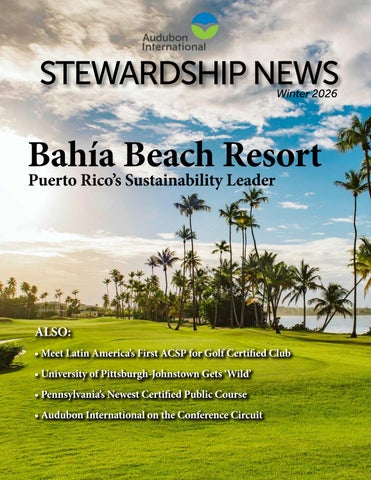
Stewardship News-Winter 2026

Page 1


STEWARDSHIP NEWS

Winter 2026

Bahía Beach Resort

Puerto Rico’s Sustainability Leader

ALSO:

• Meet Latin America’s First ACSP for Golf Certified Club

• University of Pittsburgh-Johnstown Gets ‘Wild’

• Pennsylvania’s Newest Certified Public Course

• Audubon International on the Conference Circuit

OVER $816 ,000 GRANTED ACROSS 59 PROJECTS

THE FAIRWAYS FOUNDATION COULD HELP FUND YOUR PROJECT

Aquatrols established The Fairways Foundation with the purpose of funding local and global projects that advance the conservation of our natural resources. These projects will help to preserve the environment we live and work in while encouraging education and stewardship not only within our own industry but also within wider communities. GRANT SUBMISSIONS ARE ACCEPTED MARCH 1 THROUGH APRIL 30 If you are considering environmentally conscious projects visit TheFairWaysFoundation.co m for more details.

THE NEXT GRANT APPLICATION SEASON BEGINS FEBRUARY 1, 2026

New Year, New Inspiration, New Goals

Audubon International begins yet another year of spreading the sustainability “gospel” and welcoming new members to the stewardship fold, I think back with gratitude on how far we’ve come as an organization. With a dedicated staff that puts our clear mission into action every day, we’re a trusted partner in the global effort to make our planet – our only home – as environmentally balanced as possible in the face of enormous modern headwinds, from pollution and chemical contamination to deforestation, desertification, species endangerment, and, of course, the overarching threat of climate change. We have come so far, yet we have so far to go.

On that note, I want to take a moment to acknowledge our current members – golf courses, hotels, resorts, businesses large and small, parks, college campuses, and entire communities – who voluntarily and enthusiastically take on what I view as the most important challenge of our time: Changing the way we all interact with the natural world to leave it healthy and, yes, sustainable for future generations. By achieving certification in our various science-based, vetted, and mission- rather than profit-driven programs, you truly walk the walk, and we appreciate each of you.

As CEO, I’ve also long valued the way Audubon International works with our members in a true partnership, side by side. In early November, as a guest on “The Hotel Guide” podcast, I described our philosophy to host Edward Leos: “We try to meet people where they are, then help them go further along the journey.” It’s central to our approach, and that will never change.

While golf courses have become the linchpin of Audubon International’s reach in terms of certifications and partnerships, we are also seeing a large surge in interest and participation in the Green Hospitality sector, and expect to see that trend only get stronger in the new year and beyond. As I went on to explain to Mr. Leos in his podcast, “Hospitality is leading the way, because the traveling public has become much more aware – perhaps somewhat driven by COVID, and for safety and wellness – of the impact that our travel has [on the environment]. This has spawned new industries such as eco-tourism and wellness travel. So we are getting more inquiries from those kinds of businesses, too.”

Today’s most successful and forward-thinking hospitality companies are attracted to Audubon International’s Green Hospitality program for many reasons, but one area that’s important to all partners is our emphasis on outreach and education. “We want everyone to be inspired at whatever level they can do,” I continued. “If you’re a tourist at a sustainably managed resort, see some of the materials they have or take part in an outing, you may say to youself, ‘I can do some of these things at home – I can do native plantings and cut down on water use.’ And we want to inspire other businesses to consider this sort of management on their properties.”

One longtime partner in our Signature Sanctuary Program is Bahía Beach Resort & Golf Club on the northeast coast of Puerto Rico, subject of this issue’s cover story, where a marine biologist named Marcela Cañon oversees an ever-expanding culture of sustainability both on property and beyond, out into its neighboring communities and the entire Caribbean region. Since its opening in 2008, Bahía Beach’s ownership has been fully committed to leading the way in learning, modeling, and teaching best practices in wildlife preservation, invasive plant species reduction, water conservation, and much more – including out-of-the-box initiatives such as pet adoption. And they’re never content to stand pat.

Bahía Beach Resort is a truly inspiring story, but it’s not the only one we tell in this issue. Read on to find out what other members are up to across all our programs, and how you, too, can make your mark in the ongoing sustainability journey – in the coming year and beyond.

www.auduboninternational.org

518.767.9051 | Toll-free 1.844.767.9051

Audubon International Headquarters 120 Defreest Drive, Troy, NY 12180

STAFF

Christine Kane , Chief Executive Officer christine@auduboninternational.org

Fred Realbuto, Chief Operating Officer fred@auduboninternational.org

Ken Benoit, Director, Signature Sanctuary Certifications ken@auduboninternational.org

Greg Poirier, Global Director, Green Hospitality Certifications greg@auduboninternational.org

Alexandra Kellam, Member Services Manager alexandra@auduboninternational.org

Jill Moore, Sustainable Communities Program Manager jill@auduboninternational.org

Sarah Honan, Assistant Director of Signature Sanctuary Certifiation sarah@auduboninternational.org

Lauren Wengender, Environmental Program Manager lauren@auduboninternational.org

BOARD OF DIRECTORS

Henry DeLozier, Chairman

Rich Katz, Vice Chairman

Marvin Moriarty, Secretary

Henry Wallmeyer, Treasurer

JC Chi

Ruth Engle

Jennifer Grant, Ph.D.

Rick Lohman

Jim Pavonetti, CGCS

Jake Riekstins

David Robinson, CGCS

James Singerling, CCM

Bryan Stromme

Michael Williams

STEWARDSHIP NEWS STAFF

Vic Williams, Editor & Designer

Dan Shepherd Public Relations

CHAIRMAN’S CORNER

Golf Growth, Healthier Planet

Golf is booming and that is good news for Audubon International and its friends.

According to the National Golf Foundation (NGF) in its 2025 Graffis Report, the game of golf serves 138 million Americans (aged 6+) who played, watched, read about, or followed golf. This count has increased 45% since record-keeping on this subject began in 2016.

Other selected data points from the 2025 NGF Leaderboard report that will interest Audubon supporters include:

• 36.2 million Americans participate in off-course forms of golf. This result continues off-course growth, which has exceeded on-course growth over the past three years.

• Off-course growth has increased by 55% since 2019.

• 28.1 million on-course golfers, which represents an increase of 16% since 2019.

• The largest categories of new golfers by percentage is female, which is up 41% to 7.9 million since 2019, and people of color, who have seen a 44% increase since 2019 to reach 6.9 million golfers in 2025.

• Rounds played exceed 545 million rounds – up 22% since 2019.

Beyond these surging golf statistics is the renewed growth of new golf facilities, which has averaged 14 new 18-hole equivalents per year from 2011 to 2023. This growth pattern follows an average of 189 new facilities each year for the previous 13 years.

Why does this matter at Audubon International? The popularity and growth of golf brings more people in contact with the fresh air-generating open-space expanses of turf and trees that enable a healthier environment. The growth of the number of new facilities brings new golf courses to the possibility of becoming the safe havens that Audubon International champions.

The Audubon Cooperative Sanctuary Program for Golf (ACSP) is an environmental education and certification program that helps golf courses protect the environment, preserve the natural heritage of golf, promote environmental sustainability and gain recognition for their efforts. Membership in the ACSP has steadily grown to include approximately 2,200 golf courses in the United States and three dozen countries worldwide.

Everyone benefits when golf courses are Audubon International sanctuaries. The ACSP assists each golf course member to determine its environmental resources and any potential liabilities and then develop a plan that fits its unique setting, goals, staff, budget, and schedule.

Becoming an ACSP Sanctuary is a straight-forward process and is highly attainable for existing and new golf facilities of all sizes and types. Certification provides Audubon International an efficient way to work directly with members regarding their unique property needs and opportunities while also providing guidance and motivation to act on key environmental components and promote environmental sustainability. Designation as a Certified Audubon Cooperative Sanctuary is awarded to a golf course when it meets environmental management standards in each area. Achieving certification demonstrates an organization’s leadership, commitment, and high standards of environmental management.

Golf courses that are being planned or are under development are ineligible to join the Audubon Cooperative Sanctuary Program for Golf Courses and are referred to the Signature Program. There is a seat at the table for everyone.

At slightly fewer than 73 (72.7) closings of 18-hole equivalents, NGF reports that the US experienced its lowest closure total in two decades while facility supply and demand re-set.

When the business of golf is healthy, opportunity abounds for a more sustainable environment for all.

Another Year of Solid Membership Growth

Audubon International’s Sustainability Mission Keeps Spreading

Audubon International reports that 2025 continued to see strong growth in new certifications across all of its programs.

Most new certifications were awarded in the golf and lodging categories, while nearly 200 recertifications were also awarded to existing partners, some of whom have maintained their certifications dating back to the 1990s. Programs include Audubon Cooperative Sanctuary (ACSP), ACSP for Golf, Green Hospitality, Signature Sanctuary, and Sustainable Communities. Each program provides third-party on-site verification of vetted, science-supported sustainable practices and benchmarks across all required categories. In the case of golf, that includes Environmental Planning, Wildlife and Habitat Management, Chemical Use Reduction and Safety, Water Conservation, Water Quality Management, and Outreach and Education.

“Once again, 2025 was a strong year for new certification growth across our suite of programs,” says Christine Kane, CEO. “We continue to see great interest in and pursuit of certification in our Green Hospitality programs, which reflects the industry’s acknowledgement of sustain-

able best practices as a business and market response necessity. Audubon International continues to lead the way helping golf courses, resorts, communities, and businesses of all kinds invest in a brighter future for the planet.”

The ACSP for Golf continues as the organization’s flagship certification path with 2,200 courses worldwide. New certifications of note in 2025 include Colombia’s Campestre Guaymaral, RJ National Golf Course in the U.K., and such U.S. courses as Old Sandwich and the Kittansett Club in Massachusetts, Sleepy Hollow in New York, Grand Bear in Mississippi, and Victory Ranch in Utah.

Audubon International also continues to build on its enhanced Signature Sanctuary Platinum level option for new projects–a comprehensive, overarching path that includes golf, lodging, other buildings and infrastructure. Introduced in 2023, it added several high-profile travel industry leaders to its enrollment numbers in 2024. Meanwhile, Canada’s Fairmont Le Manoir Richelieu Golf Club has entered the program at the Silver Level after its previous certification in the outdated Classic Program.

Meanwhile, newly certified Green Hospitality Partners include such respected properties as Ojai Valley Inn and

Victory Ranch in Utah earned its first ACSP for Golf certification in 2025 . Photo by Brian Oar

Marriott’s Canyon Villas at Desert Ridge in California, St. Kitts Marriott & The Royal Beach Casino, and a half-dozen

Hyatt Vacation Club destinations from Florida to Colorado and New Mexico.

Each year, Audubon International’s team of Environmental Specialists perform initial site visits at prospective certified properties as well as recertification visits across the country and internationally. They then provide point-bypoint feedback based on each venue’s location, resources, budgets, and needs, help keep them on track through the process, and sign off on new certifications and recertifications once all criteria are met. Once certified, each partner has powerful proof of their sustainability efforts to report to members, customers, managers, owners, and other stakeholders.

Turn to page 25 in this issue for a full list of new certifiations and recertifications for 2025. Follow Stewardship News throughout 2026 as new courses, resorts, businesses, and municipalities come on board.

CERTIFIED COURSES AMONG GOLF MAGAZINE’S TOP 100

Sixteen Audubon International ACSP for Golf and Signature Sanctuary Certified members rank among the world’s “Top 100 Golf Courses in the World 2025-26,” according to an annual list compiled by 126 official raters for Golf Magazine.

Revealed on Nov. 19, the list is based on a wide range of rating criteria, according to editors who take part in the Top 100 panel.

“We don’t prescribe a set method to assess courses as other ranks do,” the magazine’s online announcement reads. “Some panelists believe that enjoyment is the ultimate goal, and thus prioritize design attributes such as width and playing angles, while frowning upon the need to constantly hunt for balls in thick rough. Other panelists value challenge and the demands of hitting every club in the bag. Still others consider a course’s surroundings and overall environment of paramount importance, thereby emphasizing the setting and naturalness of the course. In the end, allowing raters to freely express their tastes is what produces the desired eclecticism in our Top 100 lists.”

Here are the Audubon International courses that made the list. Congratulations to all!

UNITED STATES

BALTUSROL (LOWER)

BANDON DUNES

BANDON TRAILS

BETHPAGE BLACK

CRYSTAL DOWNS

MERION GOLF CLUB (EAST)

PACIFIC DUNES

PEBBLE BEACH

PINE VALLEY

PRAIRIE DUNES

SLEEPY HOLLOW SOMERSET HILLS

CANADA

CABOT CLIFFS

CABOT LINKS

NEW ZEALAND CAPE KIDNAPPERS

ENGLAND SUNNINGDALE (NEW)

Marriott’s Canyon Villas at Desert Ridge in California’s Coachella Valley.
Pacific Dunes, Bandon, Oregon Photo by Brian Oar

Canada’s Peterborough Golf & Country Club Achieves ACSP for Golf Certification

Amultiyear effort by Peterborough Golf and Country Club in Ontario, Canada, has resulted in the organization’s Audubon Cooperative Sanctuary Program for Golf Courses certification — a first in the region.

The strength, commitment, and engagement of the PGCC community was integral to gaining this recognition.

“Our members were at the heart of achieving this certification,” says Kevin Kobzan, course superintendent at the PGCC.

ing how they care for the property’s

“We had members who went above and beyond. They organized monthly meetings, connected with local experts and even engaged the nearby high school’s woodworking class to build nesting boxes for the course’s wildlife habitat.”

PGCC maintains a healthy turf through aeration, top dressing, and vertical mowing technique that removes excess thatch to improve air, water, and nutrient flow. Integrated Pest Management (IPM) techniques are employed by ACSP for Golf Courses certificate practitioners to manage disease thresholds sustainably. Principles of IPM include monitoring for pests and allowing for acceptable levels, prevention through healthy crops and soils, using barriers, traps and beneficial insects, and if needed, managing any required pesticide use in a controlled and targeted manner.

Water, too, is a key focus for Audubon International certified clubs, which use strategies to reduce water

use and protect water sources. Most notably, as part of their certification, clubs commit to ongoing improvement, maintaining detailed records, and preparing for recertification every three years.

For club members, the certification process wasn’t just about meeting environmental standards, but about validating and celebrating the club’s culture of environmental stewardship.

Will Mitchell, PGCC’s general manager, commends the ability of members to bring the project to fruition. “It’s something that is quite unique to Peterborough Golf and Country Club,” he says. “You need a proud, committed group of helping hands, and then you need subject matter experts. We have both.”

Much of the initiative was carried out by the club’s Resource Advisory Group made up of club members Barton Fielders, Roseanne Brien, Karen Thomas, Joanne McCarthy, along with assistant superintendent David Hughes and Kobzan. Their combined commit-

Peterborough Golf and Country Club course superintendent Kevin Kobzan (left), and general manager Will Mitchell are pictured here with their new Audubon Cooperative Sanctuary Program for Golf Courses certificate. This achievement required them to undergo a rigorous, multiyear process detail-
ecosystems and sustainably manage their turf.

ment and expertise helped strengthen the club’s certification submission.

For Kobzan, who has worked at multiple golf courses, the Peterborough club’s approach was distinct. “It was new for me to experience the type of support from a membership that wanted to do this,” he says. “Many clubs might shy away from the extensive work required, but here in Peterborough, members were eager participants.”

One standout achievement for the club was the transformation of an area overrun by invasive dogstrangling vine and buckthorn into a thriving pollinator garden. Another was the partnership with Thomas A. Stewart Secondary School’s woodworking class to build and install nesting boxes. A third was collaborating with experts like Bill Crins, a retired University of Toronto professor, whose background in ornithology, botany, entomology, and conservation biology was a valuable resource for inventorying the club’s wildlife and habitats.

For PGCC, this certification is a testament to a

membership and staff team that understands its role as caretakers of a complex ecosystem. It shows that when passionate individuals come together, they can transform a space into a model of sustainable land management. As Kobzan puts it, “You don’t really need accolades. The reward is that you’re benefiting something important.”

As the club looks to the future, this certification is just the beginning. With a membership committed to environmental care and a leadership that supports innovative approaches, PGCC is on the path for continued, community-driven sustainable practice.

Peterborough Golf and Country Club is a member of GreenUP’s Green Economy Peterborough network. There are many ways businesses can promote and support healthy ecosystems on their property and in their communities. Learn more at greenup.on.ca/greeneconomypeterborough.

Editor’s Note: This story also appeared in The Peterborough Examiner on Dec. 10, 2025

Red Hook is rife with nature trails
Oldfield Club volunteers bring a wealth of talents to the tasks at hand

TWIN DOLPHIN FINDS SIGNATURE SANCTUARY ‘GOLD’

Audubon International congratulates Twin Dolphin Golf Club in Los Cabos, Mexico on their Signature Sanctuary Gold recertification in 2025.

Led by Director of Agronomy Russell Hewitt Social Responsibility and supported community-wide by Sustainability Manager Tamara Weitzsacker, the Twin Dolphin team has worked hard to not only earn their recertification, but to move up to a Signature Sanctuary Gold Level course as well. As an international member, their achievement stands out globally.

They met and exceeded all the requirements for our certification categories, starting with their naturalization and their wildlife,” says Sarah Honan, Assistant Director of Signature Sanctuary Certification, who led the recertification review. “The golf

course itself is just abundant with a lot of corridors, naturalized areas that they continue to expand upon. The property also has a large section that’s more native and wild-kept and connects with the golf course really well. They’ve also got a very successful honeybee program.”

The golf and environmental teams work together to save water and energy and provide ample habitat for wildlife and foster educational opportunities, all while maintaining the beauty and uniqueness of the deserts of Los Cabos.

“It’s a holistic approach,” says Weitzsacker. “Our community awareness programs help members and neighbors keep involved about the environment.”

Stay tuned to the Spring 2026 edition of Stewardship News for a full feature on Twin Dolphin.

Apes Hill’s Sustainable 9-Hole Course Adds to Award Haul

ApesHill Barbados, the casually elegant, critically acclaimed Caribbean resort and residential community, reports that its “Little Apes” Par-3 course has been named the Caribbean’s Best 9-Hole Golf Course at the prestigious 2025 World Golf Awards, celebrating excellence in golf tourism and course design across the globe.

This is the latest World Golf Award that Apes Hill has garnered. Last year it was named “World’s Best Eco-Friendly Golf Facility” and the “Caribbean’s Best Golf Course.”

The award underscores Apes Hill Barbados’ growing reputation as a world-class golf and lifestyle destination, where innovation, sustainability and community are core pillars. The 18-hole course has earned certification from Audubon International for its sustainability best practices, and there are many other green friendly components that permeate the resort and community venue.

Nestled in the heart of Apes Hill’s stunning 475 acres, Little Apes is a fun and scenic short course for all the family where golfers of all ages and abilities can share the joy of the game. With nine holes ranging from 95 to 145 yards, the par-27 walking course is set amid breathtaking views of Barbados and the Carib-

bean Sea.

Designed by golf course architect Ron Kirby, who also designed Apes Hill’s 18-hole layout that is ranked No. 76 in Golfweek’s “Top 100 International Courses,” the short-course holes are inspired by famous golf holes from around the world, reimagined for family-friendly play.

GCSAA Honors Jim Pavonetti for Stewardship

Jim Pavonetti, CGCS, superintendent at Fairview Country Club in Greenwich, Connecticut and a current Audubon International board member, has been named the recipient of the 2025 President’s Award for Environmental Stewardship from the GCSAA.

He will be recognized Feb. 2 during the Opening Session of the GCSAA Conference and Trade Show in Orlando, Fla.

The President’s Award for Environmental Stewardship was established in 1991 to recognize an exceptional environmental contribution to the game of golf; a contribution that further exemplifies the golf course superintendent’s image as a steward of the land.

Pavonetti is a 30-year GCSAA member and has been one of the profession’s most decorated environmental award recipients. He has earned three GCSAA/Golf Digest Environmental Leaders in Golf Awards, while finishing as a runner-up four times in the last eight years. His ELGAs include the 2025 Healthy Land Stewardship Award, 2024 Natural Resource Conservation Award and 2023 Innovative Conservation Award.

“Receiving the GCSAA President’s Award for Environmental Stewardship is an incredible honor and deeply humbling,” Pavonetti said. “It represents not only recognition of the work we have done as a club on our course, but also affirmation that golf can be a leader in sustainable land management. This award highlights years of collaboration, innovation and commitment from our entire team to care for our environment while providing a top-quality golf experience.”

Pavonetti said Fairview Country Club, where he has been superintendent for the last 18 years, uses an integrated approach to sustainability where every decision considers the impact on the environment. He says these efforts not only protect natural resources but also demonstrate that environmental responsibility and course quality go hand in hand.

Water conservation: Implemented advanced irrigation technology to save water and energy, while also making the golf course play better.

Habitat restoration: Established naturalized areas and pollinator habitats that enhance biodiversity and refuge for wildlife.

Nutrient and chemical Management: Use preci-

sion application and organic alternatives to minimize runoff and protect nearby waterways.

Energy efficiency: Transitioning to electric and hybrid equipment, while improving energy performance throughout the entire club’s facilities.

“Jim’s dedication to environmental stewardship while providing enjoyable playing conditions is a tremendous representation of what our members seek to do every day,” GCSAA President T.A. Barker, CGCS, said. “He doesn’t just focus on one area, but has an all-encompassing approach that benefits the members, community and industry. I appreciate and applaud his work and congratulate him on this honor.”

Pavonetti said golf courses are a part of larger ecosystems that can enhance their surrounding communities.

“Through thoughtful management using best management practices, golf facilities can serve as green spaces that support clean water, wildlife, and community well-being,” he said. “Stewardship ensures the game remains sustainable for future generations and shows that golf can be a model for responsible land use and environmental care.”

Originally published in Golf Course Industry, Nov. 19, 2025.

AUDUBON INTERNATIONAL ON THE CONFERENCE CIRCUIT

Nov. 17-19, two Audubon International Environmental representatives – Assistant Director of Signature Sanctuary Certification Sarah Honan and Environmental Program Specialist Lauren Wengender – greeted attendees and sponsors from our booth at the 2025 Carolinas GCSA Conference and Show in Myrtle Beach, S.C. A big thanks to all for helping lead the golf industry into a more sustainable future.

On October 27, 2025 at the Populus Denver Hotel, Audubon International Global Director of Sustainable Hospitality Programs

Greg Poirier sat down on for a “fireside chat” with Jon Buerge, CEO at Urban Villages, during the American Hotel & Lodging Association annual national conference, “The Hospitality Show,” They discussed how the Green Hospitality Certification program is helping resort partners around rhe world realize their stewardship goals.

WHERE WE’LL BE NEXT …

Make sure to stop by and visit our booth at the following events during the upcoming winter golf show season.

• Club Management Association of America World Confernce and Club Business Expo, Anaheim, Calif., Feb. 17-21

• New England Turfgrass Conference & Show, Providence, R.I., March 3

Another Monarchs In The Rough Success Story

Scientists, philosophers, deep-thinkers, and meteorologists have pondered the “butterfly effect” theory for decades, which, generally speaking, asks if a small change in one state of a deterministic nonlinear system can result in large differences in a later state, or more commonly put: ‘Does the flap of a butterfly’s wings in Brazil set off a tornado in Texas?’

Chances are that the “butterfly effect” theory specifically did not cross the minds of Bolingbrook Mayor Mary Alexander-Basta, the Bolingbrook Village board members, nor executive officers of KemperSports Management, but undoubtedly, the intention of the betterment of the environment of Bolingbrook Golf Club’s 300 acres, other properties on Rodeo Drive, Wheatland Township, Will County, the state of Illinois, the United States of America, the Northern Hemisphere, and the entire world did, as just recently Bolingbrook Golf Club achieved designation as a Certified Audubon Cooperative Sanctuary for Golf..

mitment to its environmental program. They are to be commended for their efforts to provide a sanctuary for wildlife on the golf course property,” said Christine Kane, CEO at Audubon International.

Bolingbrook Golf Club’s accomplishments include: extensive native acreage on the property, reducing irrigated areas to conserve water, establishing buffers around water bodies, and conducting outreach and education activities.

Expanding areas of native grasses and the provision of buffers around water body penalty areas are known to be proven methods of attracting butterflies to golf courses. Butterflies are one of nature’s pollination agents, and are an indicator of a healthy environment.

Jeff Gerdes, superintendent at Bolingbrook Golf Club, completed the effort to obtain sanctuary designation on the property — Bolingbrook Golf Club becoming the 49th golf course in Illinois, the 734th nationwide, and the 926th in the world to achieve such status.

“Bolingbrook Golf Club has shown a strong com-

“The Village of Bolingbrook’s vision, along with the maintenance team at Bolingbrook Golf Club led by Superintendent Jeff Gerdes, have paved the way for this honor. The leadership and dedication to being stewards of the environment along with being best in class made this certification possible,” said Doug Friess, Bolingbrook Golf Club General Manager.

The efforts of superintendent Jeff Gerdes could be acclaimed as “one small step for Bolingbrook, but one giant leap for the world’s environment.”

Editor’s Note: This story was Originally published in Chicago Golf Report.

A BIG THANK YOU TO OUR MONARCHS IN THE ROUGH FAMILY

As Audubon International wraps up another year of sustainability success alongside our valued partners, we want to extend a sincere thank you to all the golf courses—both Audubon International members and non-members in 35 states, as well as venues in Canada and Puerto Rico —that have taken part in our Monarchs in the Rough program. We’ve officially reached our goal of 125 new signups in 2025 through funding from the FairWays Foundations, adding 125 more acres of monarch habitat to golf courses and building on the efforts of our 800+ existing participants. Every course that joins means another acre of pollinator habitat!

We will continue to provide seed to Audubon International members, but we are not currently able to offer seed or signage to non-certified courses until additional funding

becomes available. Please stay tuned for updates.

These plantings make a meaningful difference by providing milkweed and native wildflowers that support declining monarch populations, enhance pollinator habitat, and strengthen ecological resilience on golf courses.

Thank you once again for your commitment to restoring monarch habitat and enhancing biodiversity on the landscapes you manage. If your club is an Audubon International member, we encourage you to join the hundreds of golf courses already taking part in this important initiative. Together, we’re making a tremendous difference for monarchs and other pollinators

See where our MITR members have been making a difference at monarchsintherough.org

GREEN HOSPITALITY SPOTLIGHT

Four Seasons Resort and Residences Puerto Rico: All In For Stewardship

WhenFour Seasons hoisted its world-renowned hotel flag on Puerto Rico soil for the first time at Bahía Beach in November 2025, there was no hesitation on the sustainability front. The new operator would carry on its predecessor’s commitment to Audubon International membership by vowing to maintain, and even move beyond, its first Green Hospitality Platinum Certification, earned in 2024.

Since the high-end hotel is central to what Bahía Beach Resort brings to its guests on a daily basis – a well-balanced and deeply ingrained environmental stewardship culture that blends luxury, education, adventure, and the natural world in amazing ways (see page 18) –it’s only natural that Four Seasons would continue down the same path.

“As we join the Bahía Beach Community, we see this as an incredible opportunity for Four Seasons Resort

and Residences Puerto Rico to celebrate the natural beauty and cultural richness of this destination,” says Pablo Molinari, General Manager. “Sustainability is not just a practice; it’s part of our DNA. From protecting local ecosystems to engaging our team and guests in meaningful initiatives, we are committed to ensuring that every experience reflects our respect for the environment and the community we serve.”

Indeed, Four Seasons is now an intrinsic member of an ecosystem planned and developed from Bahía Beach’s earliest days thanks to a forward-thinking, environmentally driven ownership and management philosophy embodied in Soul of Bahía, a non-profit organization headed up by marine biologist Marcela Cañón. Greg Poirier, Audubon International’s Global Director of Green Hospitality Certifications, saw that synergy firsthand when he visited the property in 2024, noting that

“We foster a culture of stewardship by integrating sustainability into daily operations and team values.”

every guest is encouraged to be a part of the culture from the moment they check in.

“Their guests’ awareness of at least some of the programs that fit in this [sustainable culture] is pretty heightened compared to the most,” he says. “And that authenticity is a guiding light. It was all homegrown. It was based in Marcella’s Soul of Bahía, it’s the type of commitment that people want to be attached to, and it’s been allowed to develop on its own, organically beautifully.”

Such well-rounded spirit of cooperation with the development as a whole, and the surrounding community, instills pride in stewardship throughout the Four Seasons team, Molinari adds.

“We foster a culture of stewardship by integrating sustainability into daily operations and team values. Our employees participate in programs focused on conservation and community engagement. For guests, we highlight our efforts through curated experiences, such as nature

walks, educational programs on local biodiversity, and collaborations with local organizations that protect Puerto Rico’s ecosystems.”

Nature walks not only take place on a specially curated and maintained path throughout the Bahía Beach complex, but in nearby El Yunque National Forest, where thousands of species thrive. Hotel guests may join locals to help maintain manatee and turtle habitat, as well. There’s also a hugely successful dog and cat rescue program that results in hundreds of pets finding new homes, either on the island or where guests call home.

Of course, Four Seasons will continue to build on the best practices that earned the resort Green Hospitality certification in the first place, from recycling to downstream waste treatment to installing energy efficient systems.

“They’re in a nice position to be able to show internally in Puerto Rico that it’s not just the ‘luxury’ stuff, it’s also these other important things that have to do with the health and welfare of everyone on the island,” Poirier concludes. “We look forward to working with everyone at Four Seasons to bring things to an even higher level. We all love Puerto Rico.”

More on Four Seasons Resort and Residences Puerto Rico

INTERNATIONAL SPOTLIGHT

ACSP Certification Comes To Colombia

Club Campestre Guaymaral Sets a New South American Standard

It’s eternal spring in the tropical mountains of central Colombia, just a few degrees north of the equator and nearly two miles above sea level, but inside the gates of Club Campestre Guaymaral, it’s also a season of eternal sustainability.

Proudly the first and only ACSP Certified golf club in Colombia and more impressively, South America for that matter, the 36-year-old, private club in the Bogotá suburb of Chia earned its first certification on Dec. 11. ACSP for Audubon International’s Scott Turner, fresh off his in-person “final audit” site visit, summed up his final report with plenty of enthusiasm.

lines but far surpassed them. But ownership, management, and employees at Club Campestre Guaymaral eyed an already-high bar and cleared it with vigor, then raised it. Turner realized that fact right away.

“When I arrived, I was greeted by a team of 12 people, which is usually never the case. It’s always a special moment when you have the opportunity to work with all of the individuals behind the club’s certification. The team was compiled of agronomy staff, general managers, environmental consultants and architects.

“They are [heavily] marketing their Audubon International certification,” he continued. “They have about a thousand members, providing educational tours and camps for them. The environmental staff have identified nine culturally unique or endemic species on their golf course, which led them to take part in our BioBlitz competition this year. The golf staff wear badges with photos of those species, as well as the Audubon Internation logo. The pencils have our branding on them. They’re constantly involving members in environmental stewardship. That was great to see.”

NATURAL AND RENEWABLE

“As someone who was so overwhelmingly impressed by the club’s environmental stewardship, it’s extremely difficult to offer constructive criticism,” he wrote. “I genuinely believe that Club Campestre Guaymaral is the new gold standard for the ACSP For Golf program. For those who criticize golf courses for being enemies of the environment, I will politely share with them what Guaymaral is doing, because it is that impressive.”

Over the past couple years, Turner has carried the Audubon International torch around the world, from mainland China to South Africa. He has witnessed all kinds of excellence in sustainable best practices and signed off on certifications that not only met ACSP guide-

With its two golf courses (including a short course) skirting the Bogotá River as well as a flower farm, Club Campestre Guaymaral’s setting is remarkably rural though the city center is only a skip down the road. The property, which also contains a full-featured clubhouse, soccer fields and swimming pool as well as horse stables and a BMX racetrack, is well-treed, and even though big stands of eucalyptus are technically invasive, they’re left in place to keep wildlife habitat intact – and when a tree falls due to age, it’s turned into wood chips or repurposed into a bench or tee marker.

“It’s very unique,” Turner says. “They have also invested in geofencing and signage to keep golf traffic out of environmentally sensitive areas. The carts are electric and there are solar panels everywhere, saving 18 kilowatts of electricity per month. That’s huge. Their maintenance facility is impressive – they want to make sure members have a good product. There’s signage and catch basins [for the copious rain that falls half the year] everywhere. They

Audubon International’s Scott Turner (left) tours Club Campestre Guaymaral’s golf course with a team truly dedicated to stewardship. Photo courtesy of Club Campestre Guaymaral

have a compost program, clean and organized storage, safety strips painted on the floor. They also purchased a drone that carries 30 liters of product; it’s the size of a small car, and through imaging technology they can determine what patches of grass are afflicted with disease – they can treat that directly as opposed to spraying everything. The club also employs an app that provides real-time information on what holes need to be kept cartpath-only to protect turf as well as nests for the native Black Curassow, which likes to hang out along pond edges, and other birds – and all places where wildlife dwell. “They also have a fabulous replanting program, putting up over a thousand trees and bushes in an area where Guinea pigs, a native species, are known to exist. It’s such a diverse area.”

The club owners’ attention to detail and commitment to sustainability best practices across the board has created a culture that will only grow over time.

club’s suburban setting next to a river means there is the potential for pollution. “They have two water treatment plans onsite. When they go through their two-month dry season they might pull from the Bogotá River, so that water is treated.” What’s not used for irrigation flows into the property’s lakes, with any overflow re-entering the river. “It’s better when it leaves than when it enters, which is great.” Staff diligently removes as much algae bloom as it can – a tough go in overcast conditions –but Turner would like to see them leave more filtering vegetation in place. “With more vegetation, water quality will be better, and you’ll have a more suitable habitat for a variety of fish. But overall, I was very impressed.”

Also, to deepen its environmental commitment even further, the club has found a way to create a better environment for its humans, too, by getting around Bogotá’s brutal traffic issues. “They have a shuttle to pick up staff at a set location in the morning and drop them off at the end of the shift, which I thought was a unique initiative.”

BALANCE INDOORS AND OUT

Club Campestre Guaymaral’s golf courses are planted in Kikuyu, which thrives in the region’s cool climate –temperatures year-round hover in the 60s and 70s at this altitude, skies are often overcast, and even in dry season rain can show up for an hour or in the afternoon. “The soil is clay-based, so they’ve installed a lot of French drains,” Turner adds. “And they’ve planted a ton of succulents and pollinator-friendly plants, which require very little overhead irrigating.”

Even with so much rain washing across the course, the

That goes for the indoor environment as well. “With all the amenities, it’s far more than a clubhouse. It’s like the best resorts in Florida, or even Dubai. The restaurants, the daycare for kids, all the little things they do –they miss nothing. They cross every T and dot every I.”

ALL IN, IN EVERY WAY

The club owners’ attention to detail and commitment to sustainability best practices across the board has created a stewardship culture that Turner believes will only gather momentum over time. “I was so impressed, and they were so proud of their accomplishments and what they were doing. Membership was completely sold on the process. It was very genuine. I’ve been to Asia before and they do great things too, but here, it was just straight from the heart in a different way.”

For more on the club and its achievements as an ACSP Certified property visit clubguaymaral.com.co

From upper left: staff wear special pins illustrating nine species endemic to the course’s region; the native Black Curassow; one of the club’s two water treatment plants; a special drone that carries 30 liters of turf treatment product, allowing pinpoint application rather than wide spraying.
Photos by Scott Turner; Black Currasow courtesy of Wikipedia

ACSP FOR BUSINESS SPOTLIGHT

‘Wild’ Times at Pittsburgh-Johnstown University Earns Top Marks for Sustainability

Thoughthe Audubon Cooperative Sanctuary Program has long centered on golf courses, it began its journey to environmental certification prominence by appealing to and attracting businesses of all kinds, from office buildings to local governments entities to cemeteries. And along the way, the program’s management plan has evolved to reflect advancements in sustainable best practices while maintaining its original focus – Environmental Planning; Wildlife and Habitat Management, Chemical Use Reduction and Safety, Water Conservation, Water Quality Management, and Outreach and Education.

Let’s emphasize that last word – Education – for a moment. While schools at all levels have participated in plenty of outreach efforts alongside golf courses and other businesses over the years, institutions of higher learning haven’t gone for ACSP certification themselves. In fact, there are only two colleges currently carrying certifications.

One of them is the University of Pittsburgh-Johnstown, where a soil science professional named Jim Bassett carries on an ACSP tradition established by his predecessor, who was, ironically enough, a former golf course superintendent. Under Bassett’s leadership, Pitt-Johnstown achieved recertification this year.

“I continued certification by reducing the amount of mowed green spaces, adding natural-ized areas, etc. – just kind of letting nature take over some of the campus’s 729 acres. Now we have a lot more wild space.”

By “wild,” Bassett means, in part, that many acres are no longer at the mercy of the overzealous mower blade. They’re free to take on native species of flora such as goldenrod, and the result is a much richer natural setting for students, faculty, and visitors. “Before, the [crew] mowed and trimmed like crazy, which led to a large CO2 impact, in terms of fuel from two-stroke engines and labor. I’ve started to invest in some battery-operated DeWalt products. I’m just trying to be an environmental steward and employ common sense practices.”

Bassett lived in Northern California for almost a decade where he was exposed to all the flora and fauna, along

with rugged coastline of the Pacific Coast. “I am grateful for the time I spent out west. I went on many adventures and learned a lot outside of the classroom. I got to enjoy many of the National Parks and wild spaces out there.”

Conservation and Environmental Stewardship were always in the forefront of his mind.

Bassett’s Western Pennsylvania roots still run deep. He worked for his father’s construction company for years, then decided to branch out, enrolling at The Pennsylvania State University and earning degrees in Agricultural Science, Environmental Soil Science and Leadership Development. After marrying his wife Lisa and starting a family, he began his employment at Pitt Johnstown. With his construction background and predecessor’s expected retirement, he stepped into his current role and took stock of the sustainability measures in place. He also looked at areas that could use improvement.

“We are located in the Appalachian Plateau here in western PA, a lot of valleys and ridges,” he says. “The property had been treated more like a golf course; he used a lot of spray and fertilization. I have a state pesticide business license and EPA certification, but I don’t like to spray. We do contract out our softball fields and other athletic fields because people like green grass, and I’ll do some aerificaton and throw down a little nitrogen here and there, but I prefer to slice or till the soil. I don’t

Located between Pittsburgh and State College, the Universy of Pitt-Johnstown brings all of Western Pennsylvania’s beauty onto campus. Photo courtesy of University of Pitt-Johnstown

mind dandelions, or broadleaf that’s cut to three and a half inches – people don’t see that when they are driving through the gates. It’s green stuff. Some people like it, some people don’t, but I’m just a big no-till, no-spray guy. That’s my belief.”

Bassett, who also owns and maintains 30 acres of farmland, so he’s keenly aware of various environmental challenges in the region, from previously polluted fishing waters and acid mine drainage, so when Audubon International’s Scott Turner toured the Pitt property this summer, he was eager and proud to display progress on several fronts.

“We have a trout stream, a Paint Creek watershed where they stock trout, so I took him down there to see what’s been happening, such as Boy Scouts pulling fishing line and other pollutants out of there. I learned that ACSP certification, while it’s [traditionally] heavy on the golf, would be helpful to continue, in terms of being a steward of sustainability and the environment.”

When the school newspaper publicized the recertification and the work behind it, Bassett says it also acted as a shoutout to the school’s Environmental Science program and the students pursuing it, though Pitt is more known for health science and engineering. He’s also heard from others “The administration was on board – what to mow, what not to mow, leaving space for pollinator gardens. They gave me free rein. I want to thank UPJ’s administration for allowing me to run with this.”

He also caught wind of Audubon International’s Monarchs in the Rough initiative and plans to learn more. “I also came upon a pollinator stewardship program in California, so I applied for a grant for them to waive the fee, and they did it. There’s plenty of opportunity to learn and keep busy.”

In the immediate future, that meant preparing the

campus for winter, concentrating on student safety while mitigating the use of bag salt on pathways as much as possible – “you can’t grow grass where the ground kisses the sidewalk” – and building on his light-on-the-land maintenance ethic, reducing fuel use, using battery-driven backpack sprayers, and tried and true agricultural practices. “I’m just a bit of old school in my approach,” he says. “It drives some people crazy that there’s a few dandelions, but I like them. They are beneficial to soil structure and pollinators love them. Highly managed turfgrass has shown to be little support to pollinators. I try to be mindful of this and keep everything in balance.

“We’re not at the country club. We are in the mountains, our setting is beautiful. I challenge you to come check it out one day. It’s very cool.”

For more on the University of Pittsburgh-Johnstown, visit https://www.johnstown.pitt. edu

Students, faculty, and visitors at the university find plenty of natural vegetation around the campus, which attracts pollinators.
Photo courtesy of University of Pitt-Johnstown
Great care is taken to blend the Johnstown region’s natural setting with the University’s built environment. Photo courtesy of University of Pitt-Johnstown

Puerto Rico’s Sustainable Heart

Bahía Beach Resort Leads An Island-Wide Culture Shift

Climatic events come and go. Nature takes its course no matter what humans do to arrest or advance it. But on Puerto Rico, which boasts one of world’s most diverse and delicate ecosystems, every natural or manmade shift is magnified – culturally, financially, and politically. Exposed to the elements like few other places on earth, its magnificent subtropical landscape of beaches, mountains, and rainforest is an apt poster child for the phrase “tread lightly.”

That’s what Bahía Beach Resort & Golf Club does better than any other developed entity in Puerto Rico, and what they’ll continue to do for the foreseeable future.

In 2008, this resort and residential development on the island’s northeast coast – which includes 483 acres of natural reserve – made Audubon Signature Sanctuary Gold Certification a centerpiece of its ever-evolving stewardship culture. It remains the first and only resort in the Caribbean to do so. Also, its golf course, designed by Robert Trent Jones Jr., is certified at Silver level, while what is now the Four Seasons Resort and Residences Puerto Rico added its own Platinum Certification in

Green Hospitality.

A marine biologist, Colombian native and adopted Puerto Rican named Marcela Cañón has been there through every milestone, shepherding Bahia Beach Resort to its undisputed status as the island’s sustainability leader as director of Soul of Bahia, the resort’s non-profit organization, which to this day has never rested on its laurels.

“She took the job on the condition that she would also be in charge of Audubon International Certification,” said Ken Benoit, who oversees the Signature Sanctuary program and visited Bahía Beach along with Environmental Specialist Sarah Honan. “She was originally hired to take care of their manmade lakes, water quality, and invasives, but she heard about them going for certification – which, then, was in its early stages.”

Added Honan, “She did some research on us and told the owners, ‘You can hire me, but you have to let me work with Audubon International, and you don’t have to pay me more. I just want to do it.’ She was predisposed to doing it. Now, when another partner enters the Platinum

Situated on Puerto Rico’s northeast coast in the community of Rio Grande, Bahía Beach Resort offers 483 acres of natural preserve woven throughout the property, including nature paths, leatherback turtle sanctuaries, marshes, mangroves, and secondary forests. Photo courtesy of Bahía Beach Resort.

level, we recommend hiring someone as a sustainability lead – a point person to connect the hotel side, the golf side, the community side. They need a Marcela – someone who’s passionate and has the knowledge to really get it going.”

At Bahía Beach Resort, that kind of passion is spreading. Cañon finds ways to add more community and business partners who share her dedication; every day, it seems, her team grows and the stewardship culture deepens.

The commitment is evident everywhere, from the coral reefs just off the resort’s two miles of beach –where endangered species like the leatherback turtle and Caribbean manatee are assiduously protected – to its many acres of on-property marshes, lakes, mangroves, and secondary forests. Nearly two-thirds of the resort are designated green areas. And just a few miles away, the El Yunque National Rain Forest’s 28,000 acre preserve, which was established as a National Park in 1906, offers over 250 species of trees, 150 species of ferns and over 50 varieties of wild orchids, some as tiny as a fingernail. It all adds up to a true western hemisphere treasure that merits great care from Puerto Ricans and the millions of people who visit their island each year.

“It’s impossible to do this with without other people,” Cañón said in mid-November as Four Seasons Resort and Residences Puerto Rico – which was previously a St. Regis property – prepared to reopen under its new brand flag. “It really takes more than a village –the golf superintendent, the president of the company,

“It’s impossible to do this with without other people. It really takes more than a village – the superintendent, the president of the company. Being a good neighbor: how do you do that?”

FOUNDATION OF SUCCESS

The resort’s owner is heavily invested in the Soul of Bahía foundation, providing approximately 60% of its funding, while the remainder comes from events and fundraisers. This partnership reflects a commitment to community engagement rather than merely providing financial assistance.

— Marcela Cañón, Soul of Bahía

all the people that work on landscape. One of the main things the owners initially wanted to do was recognize the natural richness of the area, all the treasures that we have here, and how to protect them, and include the local communities. Being a good neighbor: how would you do that?”

Added Bahía Beach Communications Director Marian Medina, stewardship is “Part of the DNA of the company. It believes in the development, but it must be sustainable. We need to do it in a mindful and responsible way. That’s the evolution of the foundation, which gave us the platform to make Marcela the leader of this amazing thing that we have.”

For instance, the Bahía Beach Resort collaborates with the local elementary school through educational initiatives and community events, including a holiday toy drive for underprivileged children – again, with Cañón and her team overseeing it all.

“She not only spearheaded the [resort’s] certification, she started Soul of Bahía,” said Honan. “The foundation does all the manatee conservation, sea turtle conservation, all the projects with women’s shelters, local schools. And truly, I think it’s ironic that they named that foundation the Soul of Bahía because Marcela is the Soul of Bahía.”

Cañón may quibble with that assessment even though it’s true, just as it was clear to her that, early on, establishing an overarching non-profit entity for every environmental initiative was critical. “We came to a point that

Marcela Cañón speaks at a local school during International Forest Day . Photo courtesy of Bahía Beach Resort

we needed to have a foundation that helped us to work outside of the resort – [expand] some of the educational programs in the resort. We have the base here, we work here, but we are connected to the community through the Espiritu Santo River. We also have the beach right in front of Bahía. It’s a sea turtle conservation beach, an area that’s important for this program.”

Fittingly, Cañón is the leader of the region’s sea turtle Conservation Group and the foundation’s representative with the Natural Resource Department of Puerto Rico, which protects more than 374 nests and over 22,000 hatchlings.

“When we created our educational plan 17 year ago, we did our first beach cleanup as part of it. The environmental campaign grew into a social responsibility program that we maintain at different levels related to our relationship with nature and with the river, and how you can improve that. So far we’ve had more than 30,000 participants in our activities and more than 20,000 volunteers.”

HUMAN CONNECTION AND ANIMAL RESCUE

Those early days of concentrating on the beach and river led to the broad array of services and connections that keep the foundation, the local Rio Grande community, and the entire island moving toward a truly sustainable culture at every social, commercial, and govern-

ment level.

“We are always talking about energy use and energy conservation, water use, water conservation, animal protection, different basic things that we have around and in relationship with the environment in general,” Cañón says. “But also we started to see that it’s not just environmental things that we need to do. We have social interactions with different groups, not just this environmental campaign. We still work with public schools in Rio Grande and [the neighboring municipality of ] Loíza, but we increased our goal and started going to schools in San Juan, where [a lot of] our members are.”

That led to one of the foundation’s most unique and impactful programs – dog and cat rescue and adoption, often by resort guests themselves.

“Abandoned pets on the streets of Puerto Rico are a huge problem. We have more than 300,000, and that’s from a five-year-old census. A lot of people are working on this. The government is trying to do different things, but it hasn’t been enough. It’s a big social and environmental program.”

Of the nearly 1,000 community volunteers Bahía Beach attracts each year to help with its various programs, several hundred work on animal rescue, the seeds of which were planted when the resort was in development. “Dogs would come here and there were construction people, so they had to control those ani-

Since it began working with the surrounding community to help find homes for abandoned pets, Bahîa Beach Resort has rescued 840 dogs and more than 500 cats. Photo courtesy of Bahía Beach Resort

mals,” Cañón says. “I said, ‘hey, we’re going to find them homes, take them to a vet. As an Audubon International certified member, we felt we had to find a solution in the best humanitarian and harmonious way.”

The program continued to expand. “Now we have a shelter. [At first] I would put animals here and there, in different areas of the resort, and eventually it became a shelter. The owner said, ‘We want to do this.’ We’ve rescued 840 dogs, and more than 500 cats. It’s really making a difference.”

Honan points out that the program is also a wonderful source of outreach within the property. “One of the unique parts about the hotel, which I didn’t learn until we were down there this time, is that it allows guests to foster dogs or cats from the shelter in their rooms. When someone is there on vacation and decide to foster a dog, many of them end up adopting.”

Cañón confirms this win-win arrangement.

“Through the hotel, we create a relationship with people. We’re able to take the dogs in as a pet-friendly hotel, take the pets to the hotel, and have them fostered during the day. We walk them, do pet yoga and pet therapy, which is really therapy for people – the pet is the thera-

GOING DEEPER, DOING GOOD

The Soul of Bahía Foundation’s community roots go even deeper, from helping fund local school programs such as beach cleanups, to Cañon leading environmentally focused educational seminars, to doing a toy drive during the island’s “Three Kings” holiday, which extends several weeks beyond Christmas.

“Kids come and they get Christmas or Three Kings presents from Bahía staff taking part,” Honan says.

“They have one big celebration. It’s neat to see a Resort that’s in tune with the surrounding towns, a good partnership where there’s true community – it’s not just, ‘here’s here’s a grant, go fix your own problems.’”

That’s really the driving philosophy behind every partnership – and central to the island’s longtime concern for the environment, dating back to when Spanish settlers set aside the El Yunque Forest as a preserve.

“We have the first protected area in all the Americas, not just the Caribbean. It was protected by the Spanish monarchy,” Cañón says. “The forest service then developed a management structure through what’s called the All Lands plan – a policy that includes all people trying

Volunteers with endangered manatees with the Caribbean center for Manatee Conservation, the resort’s partner in the endangered species conservation program. Photo courtesy of Bahía Beach Resort

to really work with neighbors in community and come up with co-management of the forest.”

Not surprisingly, Soul of Bahía helped lead that wider effort, spearheading its public participation committee. “We work with other organizations, with communities, with teachers and religious leaders, with a lot of different people trying to create that sustainability base and build connections. We have a lot of programs in the reserve to create these connections and protect not just nature, but also get the communities involved locally and regionally.”

DIVERSITY VS. CLIMATE CHANGE

Puerto Rico is, of course, susceptible to hurricanes every year. In the past decade it’s been hit by huge storms that cut off power for weeks on end, eroded beaches and forests, and endangered the island’s abundant but vulnerable fresh water supply.

“Climate change is the biggest problem we have as humanity right now,” Cañon offers. “Everything in our life can be affected by it. We are an island, and sea level rise is a reality. Legislation is strict [in terms of building codes and such], but here at the resort we keep even more space [above expected sea level encroachment]. We consider the sea level rise, also, when working on biodiversity. When you have a higher diversity of plants, for instance, the possibilities of having less impact are better.”

Healthy plant diversity requires a balance and a keen eye on invasives, and the entire resort is involved in that effort – including the golf course. “They’re doing a lot of great stuff, removing invasives, that you would expect a high-level club that’s highly engaged in environmental

efforts,” says Benoit. “They’re growing their own plants, eradicating invasive species, and putting in native species. They’re also growing their own vegetables.”

Cañón says that achieving sustainable flora can sometimes be difficult even in a subtropical environment with several climate zones packed into a small geographical area. “Here at sea level, it can be more complicated because we don’t have as much diversity, but we’ve been increasing our biodiversity with water conservation. We are very careful with this and have been since the beginning.”

Such care feeds into being better equipped to face the next storm, the next drought, the next atmospheric curveball. “I think the island has improved its preparation and we’re more resilient right now as society. Even though basic services like electricity can be a problem, we are more prepared. Climate change is a huge issue, but we always keep it in mind and what we work with. Environmental sustainability, community sustainability, financial sustainability – all must be approached together. And sustainability is an answer to climate change. It’s a way to work with it and to diminish the impact. That’s where we’ve been doing.”

Bahía Beach Resort’s longstanding partnership with Audubon International has only helped strengthen its preparedness level, and its commitment to one of the world’s most sensitive ecologies. “Audubon International helps us enormously because they think about this – and they help us to think beyond.

For more on Bahía Beach Resort & Golf Club, visit www.bahiabeachpuertorico.com.

Local students help leatherneck sea turtles may their way back to the sea from a protected section of Bahîa Beach.

MEMBER SPOTLIGHT

How to ‘Overlook’ Environmental Success

Yes, winter is making its presence known in a snowy and chilly way over much of the nation, but in many ways it’s considerably sunnier in Lancaster, Pa., where Overlook Golf Club continues its winning environmental ways.

A public course racking up some 50,000 Amish Country rounds each year, Overlook achieved certification in the Audubon Cooperative Sanctuary for Golf Program this spring. Erick Strickler, the property’s head spray technician, took the reins on the road to Audubon International’s flagship certification over the past several years, earning solid buy-in from all stakeholders along the way.

“We did first the certification process on our general operating budget,” he said recently as the course’s practice range reopened after a country music concert. “We were able to fit line items in here and there. Our superintendent and director of golf [Ken Ord] were on board, as was the township assistant manager – he was very supportive and wanted to be kept updated on everything and pass the word onto the commissioner. As far as funding, it was very easy to be able to do things without having to jump through hoops and finding a bunch of different avenues to get things [moving forward] so well.”

GCSAA Superintendent George Manos, who had previously helped nearby Lancaster Country Club earn certification, was familiar with the process and enthusiastic about Overlook taking it on. “I approached him and he said, ‘If you want to take the reins, go for it,’” Strickler says.

He wasted no time gaining public and government buy-in for the good work he and the entire Overlook team had accomplished. He made presentations to Lancaster’s board of commissioners and at the town’s Earth Day festival. “The golf course [also] has Facebook and Instagram pages, and through the township as well,” he says. “We have two avenues – not just general golfers but the general public.”

It’s the golfers’ reactions that matter most in terms of the course’s continued popularity, and on that front, things are going very well. “Everybody loves it. They love the idea of the wildflower area. They kept asking me this spring, ‘when’s it going to do something?’ We had a dry spring here, then all of a sudden things started to grow, started to flower. They saw the potential. They enjoy the pollinator area by the pro shop. So everybody’s on board and in tune with it.”

For any course but especially a busy public venue, “in tune” also means in harmony with its environment and the creatures inhabiting it. Overlook’s two ponds

attract blue and green herons, mallards, the occasional osprey and other birds, while the area around it is home to many other species of land and sky. “We adjoin one of the township parks, which is so large that most of it is non-maintained – we have the playgrounds and ball fields and a walking path, but there’s still a lot of woods in there too. So that helps,” Strickler says. “We also want to start an Adopt-a-Box program where golfers can donate funds to adopt a bluebird box. There’s a great Bluebird Society in Lancaster County, so we’re going to join with them to try and get some houses up across the property. We have a healthy population of bluebird now, so I don’ts think establishing nests in boxes will be a problem.”

As for turf treatment, Manos’ crew uses only organic materials and continues to “expand no-mow areas.” Strickler says that in 2026, Overlook plans to budget for a fleet of autonomous that will “save a lot of manpower and fuel use.”

In all, Strickler and the entire Overlook family are committed to taking their recent Audubon International certification seriously, and doing everything they can to strengthen their commitment. “We are still moving ahead on different ideas,” he concludes. “We’re small, only 70 landlocked acres, so the worry originally was that we really can’t do much. But it’s worked out well. The golfers enjoy it. We just need to keep it up.”

For more, visit www.overlookgolfcourse.com.

Erick Strickler proudly displays the Certification placard for Overlook Golf Club

SUSTAINABLE COMMUNITIES Support That Strengthens Neighborhoods

Many of Audubon International’s strongest partnerships begin with the largest segment of our membership, the Audubon Cooperative Sanctuary Program (ACSP) for Golf. Increasingly, we’re seeing exciting overlap between certified golf courses and our residential sustainable communities.

Often a community begins its sustainability journey by certifying the golf course. Once they experience the benefits they’re inspired to bring those same outcomes to the entire neighborhood. This leads many to pursue full community-wide certification and embrace a shared vision of environmental stewardship.

Shared priorities along with support and flexibility to create unique long-range plans and goals specific to the communities’ needs lead to stronger results.

While SCP certification covers 15 focus areas in total it also includes the ACSP for Golf areas of:

• Water quality and conservation

• Wildlife habitat and biodiversity

• Open space and responsible land use

• Environmental education and engagement

• Sustainable use of natural resources

Because these goals align, golf course teams, community staff, and residents naturally find common ground.

This collaboration builds momentum and deepens the culture of sustainability across the whole community.

While our roots run coast-to-coast across the U.S., interest continues to expand internationally and we’re seeing a growing global movement. Many resort-style and master-planned communities are now incorporating sustainability at the earliest planning stages and utilizing their certification to guide long-term environmental success.

One of the greatest benefits of becoming certified in Audubon International programs is the collaborative support participants receive. Our staff works closely with community leaders, golf course personnel, and residents to help them achieve their goals and celebrate their progress as well as connecting other like-minded sustainable community members to share ideas and success stories.

Together, these partnerships create healthier environments, stronger connections, and communities that thrive today and are prepared for tomorrow.

A few examples of Audubon International Members with multiple certifications:

• Hammock Dunes and Bonita Bay in Florida

• Oldfield in South Carolina

• The Landings in Georgia

• Spruce Peak in Vermont — SCP, ACSP and Green Lodging/Green Hospitality certifications

Here’s to a successful and sustainable 2026!

Bonita Bay is one of southwest Florida’s most wildlife-rich communities

2025 CERTIFICATIONS & RECERTIFICATIONS

NEW CERTIFICATIONS

ACSP FOR GOLF

CANADA

ALBERTA

Inglewood Golf and Curling Club

Peterborough Golf and Country Club

QUEBEC

Como Golf Club Inc.

Falcon Golf Club

COLOMBIA

Club Campestre Guaymaral

UNITED KINGDOM

RJ National Golf Course

UNITED STATES

COLORADO

Coal Creek Golf Course

INDIANA

Youche Country Club

IOWA

Davenport Country Club

Palmer Hills Golf Course

MASSACHUSETTS

Old Sandwich Golf Club

The Kittansett Club

Olde Barnstable Fairgrounds Golf Course

MISSISSIPPI

Grand Bear

NEW JERSEY

Green Knoll Golf Course

NEW YORK

Sleepy Hollow Country Club

PENNSYLVANIA

Overlook Golf Course

SOUTH DAKOTA

Prairie Green Golf Course

UTAH

Victory Ranch

WASHINGTON

Columbia Park Golf Tri-Plex

GREEN HOSPITALITY

ST. KITTS & NEVIS

St. Kitts Marriott Resort & The Royal Beach Casino

UNITED STATES

ARIZONA

Marriott’s Canyon Villas at Desert Ridge

CALIFORNIA

Ojai Valley Inn

Hyatt VC The Welk

COLORADO

Hyatt VC The Ranahan

FLORIDA

Hyatt VC Windward Pointe Key West

Hyatt VC Sunset Harbor Key West

Hyatt VC Beach House Key West

NEW MEXICO

Hyatt VC El Corazon de Santa Fe

SIGNATURE SANCTUARY

CANADA

QUEBEC

Fairmont Le Manoir Richelieu Golf Club

RECERTIFICATIONS

ACSP FOR BUSINESS

UITED STATES

COLORADO

City Park, City of Fort Collins

PENNSYLVANIA

University of Pittsburgh at Johnstown

SOUTH CAROLINA

Hilton Head Public Service District (PSD)

ACSP FOR GOLF

AUSTRALIA

Avondale Golf Club CANADA

ALBERTA

D’Arcy Ranch Golf Club

Calgary Golf and Country Club

Innisfail Golf Club

BRITISH COLUMBIA

Tsawwassen Springs

Gleneagles Golf Course

Highland Pacific Golf

Fairmont Chateau Whistler Golf Club

MANITOBA

Niakwa Country Club

St. Charles Country Club

ONTARIO

The Thornhill Club

Stonebridge Golf Club

Granite Golf Club

St. Thomas Golf and Country Club

QUEBEC

Royal Ottawa Golf Club

Club de Golf de la Vallée du Richelieu

Whitlock Golf and Country Club

COSTA RICA

La Iguana Golf Course/Los Sueños Marriott Resort

MALAYSIA

Kuala Lumpur Golf & Country Club Berhad

PHILIPPINES

Manila Southwoods Golf & Country Club

SPAIN

Real Club Valderrama

TAIWAN

Wu Fong Golf Club

UNITED KINGDOM

Marriott Tudor Park Country Club

UNITED STATES

ARIZONA

Paradise Valley Country Club

CALIFORNIA

Coto De Caza Golf & Racquet Club

JW Marriott Desert Springs Resort and Spa

Cherry Island Golf Course

Deep Cliff Golf Course

Little River Golf & Tennis

Los Lagos Golf Course

Valley Oaks Golf Course

Links at Spanish Bay

Oasis at Death Valley

Maderas Golf Club

Mather Golf Course

TPC Stonebrae

Yocha-de-He Golf Club at Cache Creek Casino Resort

COLORADO

The Club at Flying Horse

West Woods Golf Club

Eagle Ranch Golf Club

Aspen Golf Club

Rollingstone Ranch Golf Club

Snowmass Club

The Ridge at Castle Pines North

Colorado Springs Country Club

Vail Golf Club: Vail Rec District

Castle Pines Golf Club

CONNECTICUT

Wintonbury Hills Golf Course

DELAWARE

Merion Golf Club

Wilmington Country Club

Rehoboth Beach Country Club

Deerfield Golf & Tennis Club: White Clay Creek State Park

FLORIDA

Trump National Golf Club, Jupiter

Riviera Country Club

Pelican Marsh Golf Club

High Ridge Country Club

The Ritz-Carlton Members Golf Club Sarasota

Marriott The Rookery at Marco Island

Country Club of Florida

Naples Heritage Golf & Country Club Inc.

The Country Club at Mirasol

Broken Sound Club, The Old Course

Stonebridge Country Club

Audubon Country Club

2025 CERTIFICATIONS & RECERTIFICATIONS

Glades Golf and Country Club

The Club at Quail Ridge

Hawk’s Landing Golf Club at the Orlando World Center Marriott

Moorings Club at Hawk’s Nest

Isleworth Country Club

Sailfish Point Golf Club

Gulf Harbour Yacht and Country Club

Quail Creek Country Club

IGM @ Sandridge Golf Club

Windstar on Naples Bay

Country Club of Naples

The Everglades Club

Sugar Mill Country Club

TPC Treviso Bay Golf Club

GEORGIA

Creek Club at Reynolds Lake Oconee

Great Waters Course at Reynolds Lake Oconee

The Landing at Reynolds Lake Oconee

TPC Sugarloaf

The Preserve at Reynolds Lake Oconee

The Oconee at Reynolds Lake Oconee

The National at Reynolds Lake Oconee

Stonebridge Golf Club

ILLINOIS

North Shore Country Club

INDIANA

Chariot Run Golf Club

IOWA

Brooks Golf Club

Jester Park Golf Course

KANSAS

Sand Creek Station Golf Course

St. Andrews Golf Course

Sykes/Lady Overland Park Golf Club

LOUISIANA

TPC Louisiana

MAINE

Portland Country Club

Bangor Municipal Golf Course

MARYLAND

Laytonsville Golf Course

Leisure World Golf Course

Turf Valley Resort

Lakewood Country Club

Queenstown Harbor

MASSACHUSETTS

Olde Scotland Links Golf Course

Concord Country Club

Dedham Country and Polo Club

Needham Golf Club

TPC Boston

MICHIGAN

Fox Hills Golf and Banquet Center

Lakelands Golf & Country Club

Leslie Park Golf Course

MINNESOTA

Meadowbrook Golf Club

Somerset Country Club

Braemar Golf Course

Baker National Golf Course

NEVADA

TPC Las Vegas

NEW HAMPSHIRE

Sagamore Hampton Golf Club

Baker Hill Golf Club

NEW JERSEY

Laurel Creek Country Club

Brooklake Country Club

NEW MEXICO

The Club at Las Campañas

NEW YORK

The Whippoorwill Club

NORTH CAROLINA

The Country Club of North Carolina

Wade Hampton Golf Club

The Currituck Club

OHIO

Ellsworth Meadows Golf Club

Blacklick Woods Golf Course, Columbus and Franklin County

Metro Parks

TPC River’s Bend

OREGON

Glendoveer Golf and Tennis

Bandon Dunes & Pacific Dunes Golf Courses

Bandon Trails & Bandon Preserve & Shorty’s Golf Courses

Old Macdonald Golf Course at Bandon Dunes

Sheep Ranch at Bandon Dunes Golf Resort

Juniper Golf Course

PENNSYLVANIA

Country Club of York

Saucon Valley Country Club

Lebanon Country Club

RHODE ISLAND

Sakonnet Golf Club

SOUTH CAROLINA

Oldfield Club

Kiawah Island Ocean Course

Turtle Point Golf Club at Kiawah Island

Cheraw State Park Golf Course

Dataw Island Club

Moss Creek Owners Association

SOUTH DAKOTA

Minnehaha Country Club

TENNESSEE

Marriott Gaylord Springs Golf Links

The Legacy Golf Course

Tierra Verde Golf Club

TEXAS

Lost Pines Golf Club

Timarron Country Club

VIRGINIA

Brambleton Golf Course

Algonkian Golf Course

Piedmont Club

Hermitage Country Club

WASHINGTON

Overlake Golf & Country Club

Maplewood Golf Course

The Club at Snoqualmie Ridge

Useless Bay Golf & Country Club

GREEN HOSPITALITY

UNITED STATES

CALIFORNIA

Marriott’s Desert Springs Villas

Marriott Vacation Club, San Francisco

Marriott’s Shadow Ridge Resort

The Westin Mission Hills Resort & Villas

Marriott’s Newport Coast Villas

Westin Desert Willow

Hyatt Highlands Inn Carmel

Marriott Vacation Club San Diego Pulse

FLORIDA

Courtyard & SpringHill Suites by Marriott, Amelia Island

Residence Inn by Marriott - Amelia Island

The Addison on Amelia Island

Seaside Amelia Inn

Hampton Inn & Suites, Amelia Island

SIGNATURE SANCTUARY

MEXICO

Twin Dolphin Golf Club

PUERTO RICO

Bahia Beach Golf Course

Bahia Beach Resort & Golf Club

UNITED STATES

FLORIDA

Colliers Reserve Country Club

Indian River Club

Bonita Bay Club Naples (East)

The Old Collier Golf Club

The Legacy Club at Alaqua Lakes

Osprey Point Golf Club

Marriott Hammock Bay Golf & Country Club

Sarasota National Golf Club

Evergrene

Old Palm Golf Club

INDIANA

Lost Marsh Golf Club/The First Tee of Lake County

NEW YORK

Pinelawn Memorial Park and Arboretum

OREGON

Tetherow Golf Club

TEXAS

Viridian Residential Association

Tierra Verde Golf Club

Kissing Tree Golf Club

WASHINGTON

Chambers Bay Golf Course

SUSTAINABLE COMMUNITIES

UNITED STATES

ILLINOIS

Village of Hawthorn Woods

SOUTH CAROLINA

Town of Hilton Head Island

Turn static files into dynamic content formats.

Create a flipbook