
Received:15May2023Revised:19September2023Accepted:15October2023
DOI:10.1111/1745-5871.12629

Received:15May2023Revised:19September2023Accepted:15October2023
DOI:10.1111/1745-5871.12629
TheAustralianUrbanDesignResearch Centre,SchoolofDesign,TheUniversityof WesternAustralia,Perth,Australia
Correspondence
PaulaHooper,TheAustralianUrbanDesign ResearchCentre,SchoolofDesign,The UniversityofWesternAustralia,Perth, Australia.
Email: paula.hooper@uwa.edu.au
Fundinginformation
ThestudywasfundedbyaWestern AustralianNear-MissAwards(WANMA)2021 (FutureHealthResearchandInnovation Fund)andanAustralianUrbanResearch InfrastructureNetwork(AURIN)HighImpact Project(2021).
Abstract
Planningpolicyforparksistypicallyguidedbyastandardapproachthat failstoaccountforhowcommunitiesactuallyuseparks.Moreover,few researchersknowtheexactparkspeopleuse,eventhough “use” isoften hypothesisedintherelationshipsbeingtested.Publicparticipatorygeographicinformationsystems(PPGISs)presentanopportunitytocollectspecific,spatiallyreferencedinformationonparkuseandpark-basedactivities. However,thereliabilityoftheseinstrumentshasnotbeenstudied.ThePark LifePPGIScapturedresidentiallocation,parklocation,andpark-based behaviouraldatafromasampleofadultsandwastestedforreliability. Kappascoresandintra-classcorrelationsassessedthereliabilityofthe items.Recallofindividualitemsallshowedacceptablereliabilityandmostly achieved “substantial” agreementor “near-perfect” agreement.ThePark LifePPGISisareliableinstrumenttocaptureparkuseandactivities.Such informationisessentialforpublichealthandphysicalactivityresearchers, urbanplanners,andparkmanagerstodevelopinformedplanningandpublichealthpoliciesandprogramsthatpromoteparkuse.
KEYWORDS
parks,physicalactivity,publichealth,publicopenspace,publicparticipatoryGIS,urban geographyandplanning
Publicopengreenspaceisessentialforhealthy, liveable,andsustainableurbanenvironmentsanda priorityundertheUnitedNations(2016)Sustainable DevelopmentGoals.Urbangreenspacesfulfil numerousbiophysical,social,andculturalpurposes (Grose, 2009)tomanageurbanwater,protectbiodiversity,andreduceurbanheatislandeffects.Urban greenspacesalsoprovidesettingsorfacilitiesfor physicalactivity;promotementalwell-beingandsupportattentionrestoration,stressreduction,andpositive emotions;andfostersocialwell-beingthroughsocial interactionandparticipation(Bowleretal., 2010;Dinnie etal., 2013;Koohsarietal., 2015).
Ingeographical,publichealth,andphysicalactivity research, “parks” havetypicallyformedthebasisfor exploringurbangreenspaceandhealthoutcomes (Hooperetal., 2020).Researchershaveoftentakena “recreationalopportunityspectrum” approach(Clark& Stankey, 1980)focusedonphysicalandspatial aspectsofparkprovisionandmeasuresoftheavailabilityandaccessibilitytoparks(Bancroftetal., 2015; Lambetal., 2019)orofthe “quality” ofparks (Bedimo-Rungetal., 2005;Zhangetal., 2018).These methodologicalapproachestypicallyusebuffers aroundparticipants’ homesorcomputedistancesto theclosestparkfromhomesandassessassociations betweenparksandhealthoutcomes(Lamb etal., 2019).However,suchanapproachassumesthat
Thisisanopenaccessarticleunderthetermsofthe CreativeCommonsAttribution-NonCommercial-NoDerivs License,whichpermitsuseanddistributioninany medium,providedtheoriginalworkisproperlycited,theuseisnon-commercialandnomodificationsoradaptationsaremade. ©2023TheAuthors. GeographicalResearch publishedbyJohnWiley&SonsAustralia,LtdonbehalfofInstituteofAustralianGeographers.
GeographicalResearch. 2024;62:134–146. wileyonlinelibrary.com/journal/geor
participantsonlyusetheparkclosesttothemina definedresidentialcatchmentarea,eventhoughother parksareavailabletovisitoutsidedesignatedneighbourhoodbufferareas(Kaczynskietal., 2014).Few studiesidentifytheexactparksthatparticipantsuse, althoughuseisoftenhypothesisedintheaccess–use–healthrelationshipsbeingtested.Indeed, Edwardsetal.(2015)havefoundthatonly27%of adolescentsusedtheparkclosesttotheirresidence.
Internationally,planningforparksorurbangreen spacesistypicallyguidedbyastandards-based approachthatstipulatestargetsfortheprovisionofa minimalquantityofgreenspacepercapitaorthe maximumdistancesresidentsshouldhavetotravelto accessparks(Hooperetal., 2018).Thesestandards helpensureequitabledistributionofparks,including desiredfacilities,amenities,andprogrammingacrossa community,buttheyneglecttoconsiderhowmembers ofcommunitiesusethespaces(Veal, 2013).
Measuresofvisitationtoparksareimportantfor understandingpatternsofgreenspaceuseinurbansettings.Focusedontheimpactofpublicresources,governmentsatalllevelsarechallengedwhenitcomesto showingtheimpactorbenefitoftheserecreational spaces(Spangler&Caldwell, 2007).Hence,theevaluationofpublicspacesisbecomingincreasinglyimportant aspopulationdensitiesincreaseandcompetinginterests forlandallocationarise(Tyrväinenetal., 2007). Essential,butcurrentlylackingisabetterunderstanding offactorsthatinfluencetheuse,preferences,experiences,andvaluesofurbanparksandthebenefits gainedbymembersofthecommunityfromusingthem (Dinnieetal., 2013;Veitchetal., 2021).Addressing thosegapswillfostermorestrategic,evidence-based decision-makingrelatedtofutureparkdesign,service provision,maintenance,orinvestmentstoaccommodate communityneeds.Suchrefinementstodecision-making shouldenablelocalgovernmentstobalancecompeting demandsonlandallocationandassetsorresources (Dinnieetal., 2013).Additionally,toadvocateeffectively forimprovedparkinfrastructure,publichealthandallied professionalswithstrongspatialskillsmustunderstand anddemonstratethebenefitsthatparkshaveforhealth behavioursandoutcomes(Henderson&Fry, 2011).
Localgovernmentcommunitysurveystypically collectinformationonthedemandforparticipationin outdoorrecreation,parkuse,andattitudes.In Australia,communitysurveysareoftenadhocand primarilyusedwhenanewpublicopenspacestrategy isbeingdeveloped,whichmaybeevery5to10years. Moreover,thetypeandqualityofthedatatypicallyvary considerablyacrosslocalgovernments,withlittleorno consistencyinsurveyitemsacrossjurisdictions.
Theaccuratemeasurementofparkuseisamissing linkbetweenunderstandinginteractionsamongpeople, urbangreenspaceenvironments,andhealthbenefits, anditrequiresfurtherexploration(Chenetal., 2020).
Fewstudiesmeasuretheexactparkspeople use,eventhough “use” isoftenhypothesised intheaccess–healthrelationshipsbeingtested. TheParkLifepublicparticipatorygeographic informationsystem(PPGIS)isareliableinstrumenttocapturespatiallyreferencedinformation onparkuseandactivities.Suchinformationis essentialforpublichealthandphysicalactivity researchers,urbangeographersandplanners, andparkmanagerstodevelopinformedplanningandpublichealthpoliciesandprograms thatpromotetheuseofparks.
Thisknowledgegaphindersnewapproachesto parktransformationandrenovation,urbanplanning andparkdesign,andthedevelopmentofenvironmentalchangeinterventionstoimprovepopulationphysical activityandpublichealth.However,themeasurement andsurveillanceofparkuserequireappropriate, reliable,andaccurateinstruments.
Inresponsetothesecriticalresearchgaps, Section 2 providesareviewofdifferentmethodological approachesthathavebeenusedtomeasureparkuse inthegeographicalandpublichealthfields.Section 3 presentsworkonexistingpublicparticipatorygeographicinformationsystem(PPGIS)instrumentsthat havebeendevelopedtoassesstheuseofparksor naturalenvironments.Section 4 advancesthefieldof PPGISandpresentsatest–retestreliabilitystudyofthe ParkLifePPGISinstrumentfortheidentificationof parksusedandtheactivitiesundertakeninparks.
Inpopulationhealthandphysicalactivityliteratures,severalapproacheshavebeenemployedtomeasurepark use(Joseph&Maddock, 2016;Sylviaetal., 2014). Numerousstudieshaveemployedobservation approachesandmomentarytimesamplingmethodsto recordparkusersbehavioursusingtoolssuchasthe SystemforObservingPlayandRecreationinCommunities(SOPARC)(Cohenetal., 2011;McKenzie etal., 2006)andtheEnvironmentalAssessmentofPublicRecreationSpaces(EAPRS)(Saelensetal., 2006).A fewstudieshaveuseduncrewedaerialvehiclessuchas dronesandwearablevideodevicestorecordparkuse andpark-basedphysicalactivity(Park&Ewing, 2017; Suminskietal., 2021).Dataarethenretrospectivelyanalysedtocountparkusersandcodeactivities.Alimitation ofsuchapproachesisthateachobservationalprotocol onlytellsresearchersabouttheuseoftheparksbeing
studiedorobserved.Thus,onlyafewparkswithingiven regionsareassessed,makingitimpossibletoaccurately generalisefindingstodeterminetrendsintheseregions andacrossacommunityorinrelationtothemultiple parkspeoplemayuse(Joseph&Maddock, 2016). Indeed,spatiallyexplicit,perceptual,anduseinformation atcity-widescalesisscarce(Ralletal., 2019).
GlobalPositioningSystem(GPS)technologyhas alsobeenusedtoidentifytheparksthatareused (Evenson,Wen,Hillier,&Cohen, 2013;Maddison& Mhurchu, 2009;Stewartetal., 2016).However,despite theincreasingreachandcapabilitiesofsmartphone technology,whichcouldbeusedforresearchpurposes, theparticipantburdenandprivacyconcernsassociated withlocation-basedresearchmayexplainthesmallnumberofstudiesusingthetechnologytodate(Evenson, Wen,Hillier,&Cohen, 2013;Stewartetal., 2016).Moreover,GPSprovidesnoinformationaboutthereasonsor motivationsforparksusedorthetypesofactivities undertakeninthem(Chenetal., 2020).
Othermethodsforanalysingparkuseinvolve “big data” fromlocation-basedsocialmedianetworks(Martí etal., 2019).User-generatedlocation-baseddataare referredtoasvolunteeredgeographicinformation becausetheexpressedperceptions,interests,needs, andbehavioursarepublishedonline,voluntarily,by users(Martíetal., 2019).Forexample,somestudies haveexaminedparkusebasedonthecountandvisual contentofphotographsgeolocatedwithinparks (Donahueetal., 2018;Hamsteadetal., 2018;Sessions etal., 2016;Songetal., 2020).Othershaveanalysed thelanguageofsocialmediaposts(Instagram), reviewspostedofurbanparksonGoogle(Nița etal., 2021;Parketal., 2022),andTwitter[X]postsrelevanttoparkandnatureexperiencesandrecreational activities(Parketal., 2022).
However,thesedataarenotwithoutlimitation.For example,concernshavebeenraisedaboutlackof representativenessofbothparticipantsandparks.The useofsocialmediaplatformsvariesaccordingtoage groupandwillingnesstogeotagpostsorsharecontent openly(Arribas-Bel, 2014;Heikinheimoetal., 2017; Heikinheimoetal., 2020;Martíetal., 2019).Onlyasmall portionofTwitterusersactivatethegeocodedfunction whenpublishingtweets(Martíetal., 2019),anddata retrievedfromInstagramarenotgeoreferencedtothe exactlocationfromwhichtheywereposted.Instagram hasdelimitedareaswithageolocatedcentrepointto whichalldatawithintheareawillbeassociated(Martí etal., 2019);thus,identificationofanyparkusedisnot reliable.Additionally,becausenopersonaldetailsare retrievedwhenextractingdata,asamplecannotberigorouslycharacterisedintermsofuserprofilesordemographiccharacteristics(Chorleyetal., 2015;Martí etal., 2019).Whileautomatedcontentanalysisofsocial mediadatahasbeenusedtogaininsightsabout revealedactivities,interpretingphotographcontentmay
belessstraightforwardbecausetheperceptionand meaningofwhataphotographdepictscanbehighly subjective(Oteros-Rozasetal., 2018;Song etal., 2020).Moreover,reported “parkuse” behaviour maydependonthecontextofaparkvisit,whichhas implicationsforparkusedatathatrepresenttypicalpark use.Forexample,usersmaybelesslikelytotagthemselvesorshareaphotoinatypicalneighbourhoodpark regularlyusedcomparedwithavisittoalarger,unique, ordestinationpark(Zhang&Zhou, 2018).Indeed,validationagainstnationwidehouseholdsurveyshasshown thatparkphotographyreflectsresidents’ favouriteparks betterthantheirself-reportedfrequencyofvisits(Song etal., 2020).Moreover,thedataprovidenoinformation onwheretheuserhascomefrom,howoftentheyuse thepark,ortheactivitiestheyengageinatthepark.
Assuch,self-reportsurveymeasuresofparkuse remainwidelyusedforlargerscaleparkusestudies andarecrucialforunderstandingpeople’svaluesand motivationsbehindoutdoorrecreation(Tieskens etal., 2018).Inasmallnumberofrecentstudies fromAustralia(Edwardsetal., 2015;Hooper etal., 2020),Singapore(Petrunoffetal., 2021),andthe UnitedStates(Walkeretal., 2009),participantswere askedtodescribetheparkstheyused,whichwere subsequentlymapped.However,ineachcase,the mappingrequiredthatthereportedparksbematched withthoseinspatialdatabasesofparks.Thistaskis time-consuming,particularlyiftherearediscrepancies betweenparknamesreportedbyparticipantsandofficialparknames.Moreover,people’sperceptionsor usesofparksdonotalwaysalignwiththedemarcated areasidentifiedorzonedandmanagedbylocal governmentsaspublicopenspaces.Asaresult,use patternsandattitudestowardsinformalorunmanaged componentsofurbangreenspacearetypicallynot recognisedorincludedinstudiesofparkuse.
Analternativeapproachforcapturingparkusedata thatovercomesmanyofthesemethodological shortcomingsisonline-basedPPGIS.ThetermPPGIS referstodiversemethodsthatengagepeopleingeneratingspatiallyexplicitinformationforvariousplanning anddecision-makingpurposes(Tulloch, 2008).Mappingactivitiesarecommonurbanplanningcommunity engagementstrategies(Kahila-Tanietal., 2019).With thedevelopmentofspatialwebtechnologies,online geo-questionnairesandPPGISareconsideredeffectivetoolstodeepenunderstandingsofquantitativedata (Saadallah, 2020)andtouseinurbanandregional geographyandplanningpractices(Kahila-Tani etal., 2019).PPGISsurveyscanmeasureuses, experiences,andperceptionsinvarioussocialcontexts (Dinnieetal., 2013).Participantstypicallyidentify spatiallocationsonamapandprovidedataspecificto thatlocationforanalysis.Importantly,PPGISmapscan besettocollectdataatvariedscalesandenable respondentstofocusontheirchosenarea.Thus,
researcherscanexplorethehealthoutcomesassociatedwithreportedplacedatawithoutenforcingpreconceivedneighbourhoodboundaries.Anotheradvantage ofPPGISisthatitreducesdatacollectioncostsand increasestheprecisionandefficiencyofspatialdata entryandcollation(Brown&Reed, 2009).Inthecontextofstudyingparkuse,PPGISgeneratesorcaptures high-qualitydatasoresearchersandpractitionerscan understandwhoisusingparks,whatparkstheyare using,andwhytheyareusingthesespaces (Heikinheimoetal., 2020).
Weidentified13studiesthatusedPPGISmethods thatfocusedonurbangreenspaces(Bijker& Sijtsma, 2017;Brownetal., 2014, 2018;deVries etal., 2013;Heikinheimoetal., 2020;Hughey etal., 2021;Korpiloetal., 2021;Latinopoulos, 2022; Pietrzyk-Kaszynskaetal., 2017;Ralletal., 2019; RamírezArandaetal., 2021;Raymondetal., 2016; Schrammeijeretal., 2022).Ninestudiesexplicitly askedparticipantstoidentifyandmapthegreen spacestheyused.However,thespecificinstructions andrecallperiodsdifferedacrossallstudies(forexample, “visitmost” [Schrammeijeretal., 2022], “spendthe mosttimein” [Latinopoulos, 2022], “usedinthepast 30days” [Hugheyetal., 2021], “frequentlyvisit” [Korpiloetal., 2021], “usedforactivitiesinthepasttwo weeks,”“placeswhereyouspendtimewithingreen spaces” [Pietrzyk-Kaszynskaetal., 2017],and “areas youenjoyusing” [Raymondetal., 2016]).Theremainingfourstudieswerelessexplicitintheirinstructions, askingparticipantstomapgreenspacesthatweretheir “favourite ” (Raymondetal., 2016), “meaningful” (Rall etal., 2019),or “attractive,valuableorimportant” (Bijker&Sijtsma, 2017;deVriesetal., 2013).
However,peoplemayvalueparks,greenspaces,or naturalenvironmentswithoutvisitingorusingthem. Therewasalsosomeambiguityaboutwhatismeasured inthesestudies.Phrasesaboutthe “activities” engaged inwithinthespaces,the “motivations” foruse,orreasonstheparkswere “attractive” forusealsodiffered acrossthestudiesfromaskingabout “activities” (Brown etal., 2014, 2018;Raymondetal., 2016), “benefits” (Brownetal., 2014, 2018), “culturalpractices” (Ramírez Arandaetal., 2021), “culturalecosystemservices” (Ralletal., 2019),or “qualities” (Bijker&Sijtsma, 2017; deVriesetal., 2013).Thesedifferencesmake comparisonacrossstudiesdifficult.Exceptforarecent studybyHugheyetal.(2021),theuseofPPGISto measureparkuseandphysicalactivityhas,todate,not beendeployedinpublichealth-focusedresearch.
Furthermore,participatorymappingreliesonindividuals’ abilitiestorecalltheirexperiencesinplacesor landscapesandlocatethepotentialaffordancesof thesespacesonadigitalmap(Brown&Kyttä, 2014).It isessentialtounderstandwhetherpeoplecanreliably recalldetailsoftheirparkuseandassociatedactivities andconfirmifPPGISinstrumentsaresuitablefor
collectingthesedatainpopulationmonitoringandsurveillancestudiesofparkuseandhealthoutcomes.To date,studiestestingthevalidityandreliabilityofPPGIS technologiesandmethods,includingthosetocapture parkuse,havenotbeenconducted(Chenetal., 2020). Thislackofreliabilitydataremainsasignificantgapin thefieldandapplicationsofPPGIS.
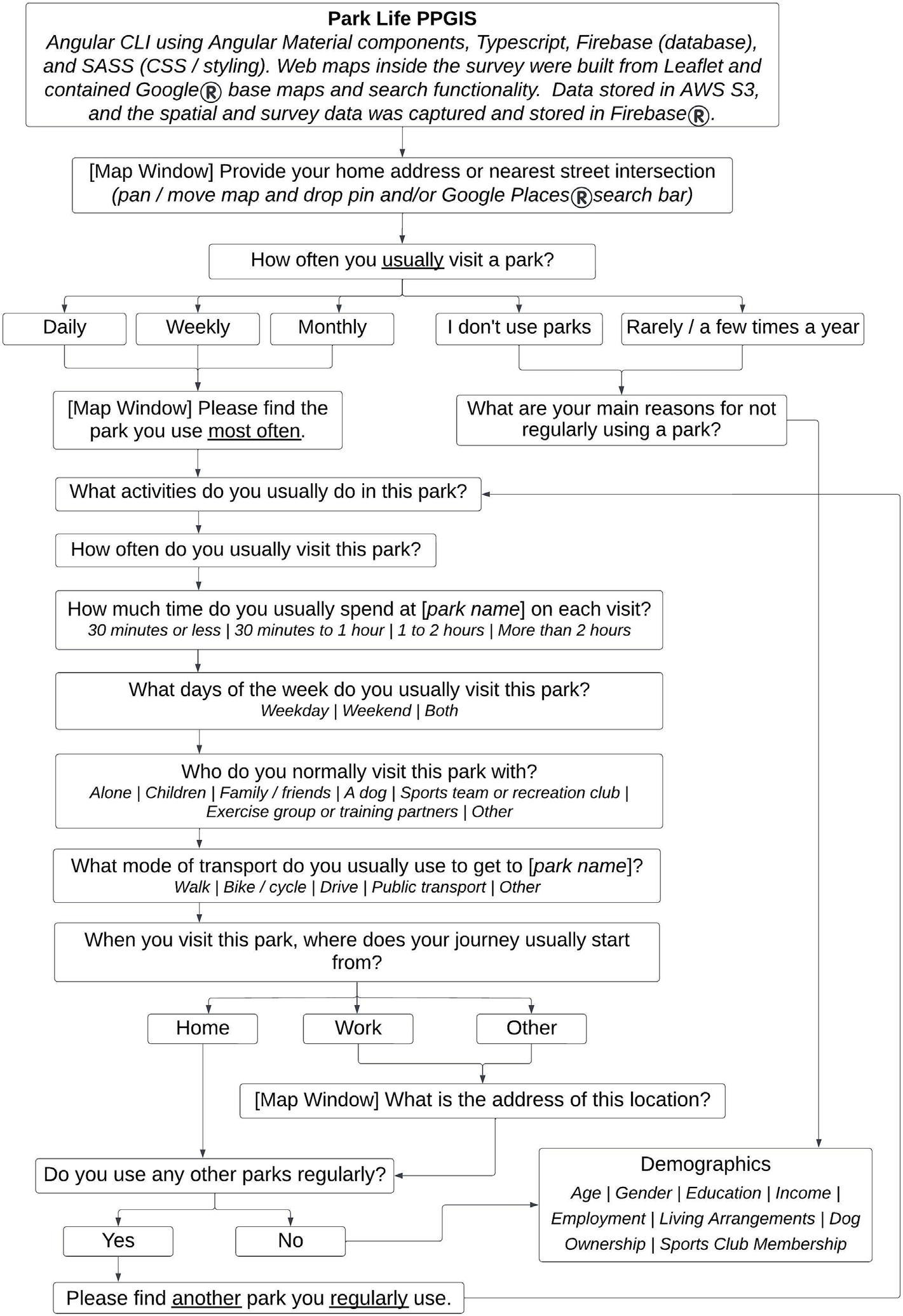
Followingethicsapprovals,the “ParkLife” PPGISwas developedasanonlinegeo-questionnaireinwhichparticipantsindividuallyansweredaseriesofquestions thatwereaccompaniedbyinteractivemapsthatprovidedgeographicalcontextabouttheirparkuse.There werenoconstraintsonthelocationorspatialextentof parksthatcouldbeidentifiedoronthenumberofparks thatcouldbemapped.Thespatialcaptureofdata allowedtheresearchteamtoeasilyintegrateingeographicinformationsystem,thespatiallylinkedpark data,andindividualparticipantinformationandcharacteristics.ThesurveywasbuilttocapturedataAustraliawide,butforthistest–reteststudy,datacollectionwas focusedonPerth,thecapitalcityofWesternAustralia. Thesurveyquestionsandprotocolareoutlinedin Figure 1.Allquestionswereinformedbypreviously implementedlocalgovernmentsurveys,parkliterature, andapanelofexpertscomprisinglocalgovernment parksandplanningmanagers,urbanplanningofficers, andplanningconsultants.
Socialdemographicvariablesoftenmoderatethe builtenvironmentandhumanhealthrelationships.As such,demographicdatatypicallyusedforstudiesthat examineassociationsbetweentheuseofgreenspace andhealthoutcomeswerecollected.Demographic questionscapturedinformationonparticipants’ gender, age,education,income,employmentsituation,living arrangement,dogownership,andsportsclub/team membership.
Participantswererecruitedbyamarketresearch companythatmaintainsadatabaseofpanellistsand randomisesparticipantstospecificsurveysdepending onthedemographicrequirementsofthestudyandthat providesparticipantswithmodestcompensation. PanellistswholivedinthePerthmetropolitanareain WesternAustraliawereinvitedtoparticipate.Toassess test–retestreliability,theParkLifePPGISparticipants (n = 150)weresentthesurveylinkforasecondtime 1weekaftercompletionofthefirstsurvey.Onboth occasions,participantswereemailedalinktothePark LifePPGIS,whichwasconductedonline.
AllanalyseswereperformedusingSPSSVersion 26.0.Kappascores(κ)wereusedtoassessthereliabilityofthecategoricalsurveyitems.Intra-classcorrelations(ICCs,two-waymixed-effectsmodelwith95% confidenceintervals)wereusedtoassessthereliability
ofcontinuoussurveyitems.Interpretationofthecoefficientsreliedonagreement-levelratingsassuggested byLandisandKoch(1977):0–0.2 = poor agreement; 0.21–0.40 = fair agreement;0.41–0.60 = moderate/ acceptable agreement;0.61–0.80 = substantial agreement;and0.81–1.0 = near-perfecttoperfect agreement.
Ninety-oneparticipantscompletedtheParkLifePPGIS twice.Thedemographiccharacteristicsofthestudy samplearepresentedusingdatafromTest1andare
FIGURE1 TheParkLifepublic participatorygeographicinformation system(PPGIS)protocolandquestions.
outlinedinTable 1.Sixty-twopercentofthestudyparticipantswerefemale,50%wereinfullorpart-time employment,28%hadchildrenlivingathome,almost 30%hadadog,27%wereasportsclubmember,and themajority(82%)wereborninAustralia.
4.1 | Test–retestreliabilityofthePark LifePPGIS
Table 2 presentstheKapparesultsoftheParkLife PPGIStestandretest.Themediantimebetweenthe twoParkLifesurveyswas8.7days(range6.5
21.1days).Onaverage,30%ofparticipantsreported
usingaparkmonthly(32%Test1and29%Test2), 45%usedaparkonaweeklybasis(45%Test1and 44%Test2),andabout25%reportedusingapark daily(23%Test1and26%Test2)(Table 2).The “parkuse” screeningquestionthatdeterminedthelevel
ofusualparkuseshowed substantial agreement (kappa = 0.706, p <0.001).
Theparkidentifiedasusedmostoftenshowed near-perfect agreement(kappa = 0.900, p <0.001). Threeparticipantsmappedgreenspacelocationsoutsidetheparkpolygonsdisplayedinthemappinginterface.Assessmentofthesepinnedlocationsrevealed thattwowereschoolplayingfieldsaccessibletothe publicandoneparticipanthadmappedanareaof bushlandthatincludedinformalwalkingtracksthroughoutthatwereaccessibletothepublic.Allthreeparticipantsmappedthesesamelocationsontheirrespective testandretestsurveys.
Onaverage,participantsselectedthreeactivities (range1–6)relatingtotheparkusedmostoften.Ofthe 16parkactivityvariables(Table 2),twoshowed nearperfect agreement,three substantial agreement,three moderate/acceptable agreement,andfour fair agreement.Walkingwasthemostfrequentlyreportedactivity (81%Test1and77%Test2)followedbyexperiencing natureorwildlife,scenery,orviews(37%Test1and 43%Test2),sitting,resting,andrelaxing(37%Test 1and29%Test2),andwalking/exercisingadog(23% Test1and27%Test2).Thepercentagreementofthe 16parkactivityvariablesintheparksused “mostoften” washigh,withallabove75%.Fourteenvariableshad percentagreementsof>80%,with10having>90% (Table 2).
Recalloftheparkvisitationshowedgoodreliability: Frequencyofvisitationtothemappedparksshowed near-perfectagreement(ICC = 0.965,resultnot shown).Timespentattheparkshowed substantial agreement(kappa = 0.706, p <0.005);thosewith whomparticipantsvisitedtheparkshowed near-perfect agreement(kappa = 0.965,0.816, p <0.001,respectively);andthedaysofparkvisitsshowed substantial agreement(kappa = 0.753, p <0.001).Theusual modeoftransportitemshowed near-perfect agreement (kappa = 0.913, p <0.001),andthree-quartersofparticipants(76%Test1and77%Test2)walkedtotheir park.Mostparticipants(99%Test1and97%Test2) indicatedthattheirjourneytotheparkstartedfrom home,andtheseitemsachieved “near-perfect” agreement(kappa = 0.795, p <0.001).
Twenty-two(24%)participantsmappedasecond parkthattheyregularlyused,andfive(6%)mappeda thirdparkthattheyregularlyused.Whereasecondor thirdparkwasmapped,therewas near-perfect agreementfortheparksmapped(kappa = 0.896,0.886, p <0.001,respectively).Justfivedifferentactivities wereidentifiedwhereasecondregularlyusedpark wasmapped(Table 2).Again,themostfrequently reportedactivitywaswalking(81%Test1and77% Test2).Recallaboutsitting,resting,relaxing,and experiencingnatureorscenerywas moderate/acceptable (kappa = 0.625, p = 0.005;kappa = 0.667, p = 0.002),socialisingormeetingfriendsorfamily,and
Parkusedmostoften
Howoftenyouusuallyvisitparks?
Daily23.126.40.706<0.001Substantial Monthly31.929.2 Weekly45.144.4
Mappedpark(s)
Parkusedmostoften--0.922<0.001Near-perfect Park2usedregularly--0.896<0.001Near-perfect Park3usedregularly--0.886<0.001Near-perfect Numberofparksmapped1.31.20.713<0.001Substantial Parkactivities
Whatactivitiesdoyouusuallydoat[mappedparkname]?
Walking83.574.70.669<0.001Substantial Running/jogging9.911.00.861<0.001Near-perfect Walking/exercisingadog23.127.50.839<0.001Near-perfect Socialising/meetingfriendsorfamily19.822.00.684<0.001Substantial Organisedsportscompetitionsortraining0.00.0--Organisedactivities,fitnessclasses,bootcamps, personaltrainingsessions 2.61.9---
Supervisechildrenonplayequipment17.219.80.604<0.001Moderate Sitting,resting,relaxing37.428.60.523<0.001Moderate Cycling3.35.50.479<0.001Moderate Experiencenatureorwildlife,scenery,orviews41.842.90.537<0.001Moderate BBQorpicnicking11.06.60.588<0.001Moderate Watchingsport4.45.50.737<0.001Substantial Usefitnessequipment/outdoorgym2.23.40.795<0.001Substantial SkatePark/BMXorpumptrack0.00.0--Attendcommunityactivities,special/major events,markets,concerts,festivals
13.215.70.520<0.001Moderate Parkvisitation
Howmuchtimedoyouusuallyspendat[mappedpark]oneachvisit?
30minorless44.044.00.705<0.005Substantial 30minto1h41.844.9 1to2h13.212.1
Morethan2h1.10.0
Whodoyounormallyvisit[mappedpark]with?
Adog16.514.30.816<0.001Near-perfect Alone40.742.9
Children16.517.6
Exercisegroup/trainer0.01.1
Sportsteamorrecreationalclub0.00.0 Friends/family26.424.2
Whatmodeoftransportdoyouusuallytaketogetto[mappedpark]?
Cycle5.54.40.913<0.001Near-perfect Motorvehicle18.718.7 Walk75.876.9
ParkLifePPGISitems
Whatdaysoftheweekdoyouusuallyvisit[mappedpark]?
Weekday22.017.40.753<0.001Substantial Weekend20.917.3
Both57.165.3
Whenyouvisit[park],wheredoesyourjourneyusuallystartfrom?
Home98.897.30.9130.795Near-perfect
Work1.21.6
Other0.0%1.1%
Otherparksregularlyused Parkactivities
Whatactivitiesdoyouusuallydoat[mappedparkname]?
Walking81.076.70.6400.002Substantial Walking/exercisingadog19.018.31.000<0.001Perfect Socialising/meetingfriendsorfamily28.619.00.741<0.001Substantial Sitting,resting,relaxing28.623.80.6250.005Moderate Experiencenatureorwildlife,scenery,orviews33.328.60.6670.002Moderate Park2regularlyusedvisitation
Howmuchtimedoyouusuallyspendat[mappedpark]oneachvisit?
30minorless33.333.30.656<0.001Substantial 30minto1h42.937.6 1to2h19.019.0 Morethan2h4.80.0
Whodoyounormallyvisit[mappedpark]with?
Whatmodeoftransportdoyouusuallytaketogetto[mappedpark]? Cycle4.84.80.625<0.001Substantial
Abbreviation:PPGIS,publicparticipatorygeographicinformationsystem.
walkingshowed substantial agreement (kappa = 0.741, p <0.001),andwalkingorexercising thedogshowed “perfect” agreement(kappa = 1.000, p <0.001).Recallofthesecondparkmapped
(regularlyused)againalsoshowedexcellentreliability: Timeusuallyspentattheparkshowedsubstantial agreement(kappa = 0.656, p <0.001);frequencyof visitationandwhotheynormallyvisittheparkwith
showed near-perfect agreement(kappa = 0.806, 0.865, p <0.001,respectively).Theusualmodeof transporttothepark,usualdaysoftheweekvisiting thepark,andusualplaceoforiginallshowed substantial agreement(kappa = 0.625,0.777,0.644, p <0.001,respectively).Moreparticipantsvisitedthe secondparkfromanoriginotherthanhome(5%Test 1and10%Test2).
Thoseinpublichealthandparksandrecreational planningareinvestedinpromotingparkuse.Public healthadvocates includingurbangeographersand planners haveastakeinfosteringpeople’svisitsto parkstopromotehealth-enhancingbehaviourssuchas physicalactivity.Geographersandplannershavea stakeinfosteringvisitsaspartoftheirmissiontostudy and/orprovidequalityrecreationalandleisureexperiences(Krugeretal., 2007).Assuch,themeasurement ofcontext-specificbehavioursisvitaltoimprovingthe predictivecapacityforstudiesthatmeasureenvironmentalcorrelatesofhealthbehavioursandoutcomes. However,abetterunderstandingofthecommunity’s useofparksisrequired,whichinturnnecessitatesthe needforreliableinstrumentstomeasureparkuse. PPGIShasgrowninpopularityasatooltocapture spatiallycontextualiseddataforuseinurbanand regionalplanningpracticeandacademicresearchin planning-relatedandbuiltenvironmentfields(KahilaTanietal., 2019).
PublishedevaluationsoftheeffectivenessofPPGIS havefocusedonparticipationratesand spatialdata quality andaccuracy(Kahila-Tanietal., 2019).Inthis paper,wehaveexaminedthetest–retestreliabilityof theParkLifePPGISforcapturingparkuseandactivities.Toourknowledge,thisstudyisthefirsttoundertakeatest–retestreliabilityanalysisonaPPGIS designedtocaptureurbanparkuse.Thetest–retest resultsindicatethatindividualswereabletoreliably recalltheparkstheyusemostoftenversusthosethey useregularlyandcouldmapthesespacesona digitalmap.
TheParkLifePPGISassesses “usual” parkuse behaviourratherthanadefinedrecallperiodsuchas thelastweekor7days.Therepeatabilityofthe “usual parkuse” questionwas substantial,indicatingthatparticipantswereabletounderstandtheconstructofthe questionandreliablyindicatetheirusuallevelofpark use.Theuseofa “usualframe” inphysicalactivity measurementquestionnaires(Giles-Cortietal., 2006) hasbeenfoundtohaveminimaldifferencesinpsychometricqualitycomparedwiththepastweek’squestions andminimiseinherentweeklyvariationinphysical activity(Domaetal., 2017).Conversely,aprevious parkusestudyfoundhigherreliabilitycoefficientsfor
parkvisitfrequencyanddurationofusewitha “usual week” framethana “pastweek” recall(Evenson,Wen, Golinelli,etal., 2013).Ausualstructurealsoprovidesa morestablemeasureforuseinlongitudinalorexperimentalstudiesseekingtomonitorchangesinparkuse behaviourinthesameindividualovertime(Giles-Corti etal., 2006).Thisdetailisalsoimportantfordetectinga changeinparkuseformonitoringorsurveillance applications.
Recallandmappingoftheparkusedmostoften, andadditionalparksusedregularly,wasveryhigh,with kappacoefficientvaluesinthe near-perfect range. Importantly,thissuggeststhatparticipantscouldreliablydifferentiatebetweenparksusedmostoftenand thoseparksusedregularly.Furthermore,participants wereabletolocatetheirparksonthedigitalmap.The useofGoogle® basemapswaschosentoincrease thefamiliaritywiththeuserexperiencewhenmapping theparks.ArecurringquestionforthoseusingPPGIS asaresearchmethodordatacollectioninstrumenthas beenthespatialaccuracyofthedatacollectedwitha presumptionofPPGISmarkerplacementvalidity (Brownetal., 2015).Inthisstudy,spatialaccuracywas lessofaconcern,giventhatmarkerswereintendedto beassociatedwithapark.Thepotentialforspatialerror wasalsomanagedbydisplayingpolygonsrepresenting parklocationsinthemapwindowtohelpguidethe participant.TheGoogle® searchbaralsoallowed participantstosearchquicklyfortheparktheywanted tolocate.Moreover,toimprovespatialaccuracy, participantswhoselectedalargepark(>10ha)were askedtomovethepintotheareaoftheparkthey typicallyused.
Theparkspeopleuseandtheactivitiestheyundertakeareshapedbyacomplexinteractionbetweentheir individualneeds,preferencesforcharacteristicsof specificlocations,andperceivedaccessibilityand suitabilityoftheparklocations(Chenetal., 2019). Consideringarangeofdifferentrecreationalactivities undertakeninparksisthereforeessentialtounderstandthevariousbenefitsprovidedbyurbanparks (Chenetal., 2019;Krellenbergetal., 2021),better informplanningdecisionsandpublichealthinterventions,andfacilitatethedevelopmentofliveableurban areasthatpromoteparkuse,andhealthandwell-being benefits(Hansenetal., 2019).Allparkactivityitems showed moderate/acceptable orhigherreliability,with fiveactivitiesshowingsubstantialor near-perfect agreement,indicatingthatpeoplecouldreliablyrecall theirparkactivities.Thehighkappavaluesoftheactivitiesreportedinmultipleparksusedindicatethatparticipantswereabletoreliablyandaccuratelyrecall differentactivitiesundertakeninmultipleparks.
ThedetaileddataelicitedfromPPGISsituatethe ParkLifePPGISasaviablemethodthatcouldbeused tocreatepark “quality” scoresbasedonreported amenitiesusedinparks,ratherthansimplyassigning
scoresbasedonthenumberoffeaturesoramenities present.Previousparkqualityscoreshavereliedon objectivedataprimarilyrelatedtofacilityprovision,which failstoaccountforsubjectiveelementsofqualityorecological,cultural,spiritual,orsocialvaluationofthe spaces(DeVreeseetal., 2016).Capturingparkusers’ activitiesandexperiencesallowsforamorebalanced approachtoparksplanning(Ralletal., 2019).Thelistof parkactivitiesusedinthisstudyisapplicabletoother parksinAustralia.However,whenappliedinothercountriesorsettings,theactivitiesmayrequiremodification.
Twodistinctlydifferentmappingapproacheshave beenemployedinearlierapplicationsofPPGISof urbangreenspaceuse.Thefirstapproachaskedparticipantstoidentifyandmapgreenspacesusedorvaluedandthenelicitedinformationonactivities,values, ormotivationsforuseassociatedwiththatgreenspace, fromeitheralistofoptionsoropen-endedresponses. Thesecondapproachprovidedaseriesofpinsrepresentingdifferentactivitiesorvaluesthatparticipants markedonthemaptodefinethegreenspacesinwhich theyengagedinthoserespectiveactivitiesorwere associatedwiththeindividualvalues.TheParkLife PPGISemployedthefirstmethod,becausethealternativeapproachresultsinamultiplicativeeffectofthe responseburdenwiththeplacementofeachmarker (Brownetal., 2015).Moreover,identifyingabehaviouralcontextorsettingmayassistwiththerecall, whichmayaccountforthehighkappacoefficients.
Themappingapproachusedinthestudypresented severaladvantagesovertheuseofsocialmediagenerateddataopportunisticallyextractedbyresearchers. Forexample,ParkLifePPGISpinpointstheparksand openspacesused,avoidingthepitfallsassociatedwith thespatialinaccuracyofphoto-sharingplatforms (Muñozetal., 2020).TheParkLifePPGISapproach enablesgreenspaceplannerstoconsiderthequantity anddistributionofparkswherepeoplecanpursue variousactivities,aswellasmeettheneedsand expectationsofdifferentkindsofusers(Bertram& Rehdanz, 2015).Thisapproachmayalsoinclude assessingthevaluesandusesofinformalgreen spaces,whichoftendonotreceiveattentionin greenspaceplanning(Ralletal., 2019).
Althoughthisstudymakesauniquecontributionto theevidence,ithassomelimitations.First,the participantswererecruitedthroughamarketresearch companyandfinanciallycompensatedfortheirparticipation,whichmayhaveimplicationsfortheaccurate depictionofparkusebehaviour.Byusinganexternal marketresearchcompany,wedonothaveinformation ofthedemographiccharacteristicsofparticipantswho didnotcompleteboththetestandretestsurveys. However,thesample’sdemographiccharacteristics indicateddemographicdiversityinthepopulationand thesamplesizeinthisstudyiscomparablewithother physicalactivitytest–reteststudies(Brownetal., 2004;
Frehlichetal., 2018;Giles-Cortietal., 2006).Second, justunderaquarterofparticipants(24.2%)reported andmappedusingtwoparks.Evenfewer(5.5%)identifiedthreeparkstheyregularlyused.However,among theseparticipants,therewasnoattritionbetweenthe testandretestsurveyinthenumberofparksmapped, suggestingthattherewerenoproblemsassociated withuserwillingnessoracceptancetomapthese. Third,therewaslimitedvariabilityintheactivitieslisted forthesecondmappedparkregularlyused.Thisfactis likelyduetothesmallnumberofparticipantsidentifying asecondpark.Again,thekappacoefficientsforthese activitiesshowed “moderate/acceptable” orhigherreliability.Theslightlylowerkappacoefficientsforthesecondparkactivities(comparedwiththeparkusedmost often)mightindicategreatervariabilityintheactivities undertakenintheseparksand/orthelessregularuse.
TheuseofPPGIStocaptureparkusecouldbeeasilyintegratedintolocalgovernmentpublicopenspace communityconsultationsurveystoprovidebenchmarks ofcommunityparkuseandbenefitsandevaluateany parkupgradesorinterventions.Itshouldbecoupledwith instrumentstoquantifythecontributionsofpark-based physicalactivitytototalphysicalactivitylevels,suchas theParkPhysicalActivityQuestionnaire(Park-PAQ)that hasbeenshowntohaveacceptablereliabilityinprovidingatotalmeasureofphysicalactivityanddetermining theproportionofanindividual’stotalphysicalactivity undertakenwithinparks(Edwards&Hooper, 2023).
Insummary,theParkLifePPGISwasfoundtobea reliableinstrumenttocaptureparkuseandactivities. TheParkLifePPGISadvancesthemeasurementof parkusebehavioursbyexplicitlyaddressingthemissing “exactparklocation” datainpublichealthresearch andpublicopenspaceplanningpolicyandpractice. Thisstudyconfirmsthatpeoplecanreliablyrecall detailsoftheirparkuseandassociatedactivitiesand locatethespacestheyuseonadigitalmap.Further, thecollationofexactparklocationdata,coupledwith park-basedactivitydata,providesaccuratedata neededtoenablebetterpublicopenspaceplanning.
Moreover,thisreliabilitystudyadvancesthefieldof publicparticipatorymappingmethodsandprovides evidenceonthereliabilityofPPGISinstrumentsthat waspreviouslylacking.TheParkLifePPGISelicits informationonparkusethatisessentialforpublic healthandphysicalactivityresearchers,urbanplanners,andparkmanagerstodevelopinformedplanning andpublichealthpoliciesandprogramsthatpromote theuseofparks.
WeacknowledgethecontributionsofDrRamPandit (UWA)andProfessorMichaelBurton(UWA)fortheir contributionstoprojectconceptualisationandsurvey developmentandDrJulianBolleter(UWA)andDr SarahFoster(RMIT)forreviewingearlyversionsofthe
surveycontent.Openaccesspublishingfacilitatedby TheUniversityofWesternAustralia,aspartofthe Wiley-TheUniversityofWesternAustraliaagreement viatheCouncilofAustralianUniversityLibrarians.
CONFLICTOFINTERESTSTATEMENT
Theauthorsdeclarenocompetinginterests.
DATAAVAILABILITYSTATEMENT
Dataareavailableonrequestfromtheauthors.
ETHICSSTATEMENT
TheUniversityofWesternAustralia’sHumanEthics Committeeprovidedethicsapproval(2019/RA/4/1/8734).
ORCID
PaulaHooper https://orcid.org/0000-0003-4459-2901
Arribas-Bel,D.(2014).Accidental,openandeverywhere:Emerging datasourcesfortheunderstandingofcities. AppliedGeography, 49,45–53. https://doi.org/10.1016/j.apgeog.2013.09.012
Bancroft,C.,Joshi,S.,Rundle,A.,Hutson,M.,Chong,C., Weiss,C.C.,Genkinger,J.,Neckerman,K.,&Lovasi,G. (2015).AssociationofproximityanddensityofparksandobjectivelymeasuredphysicalactivityintheUnitedStates:Asystematicreview. SocialScience&Medicine, 138,22–30. https://doi. org/10.1016/j.socscimed.2015.05.034
Bedimo-Rung,A.L.,Mowen,A.J.,&Cohen,D.A.(2005).Thesignificanceofparkstophysicalactivityandpublichealth:Aconceptualmodel. AmericanJournalofPreventiveMedicine, 28(2), 159–168. https://doi.org/10.1016/j.amepre.2004.10.024
Bertram,C.,&Rehdanz,K.(2015).Theroleofurbangreenspacefor humanwell-being. EcologicalEconomics, 120,139–152. https:// doi.org/10.1016/j.ecolecon.2015.10.013
Bijker,R.A.,&Sijtsma,F.J.(2017).Aportfolioofnaturalplaces: UsingaparticipatoryGIStooltocomparetheappreciationand useofgreenspacesinsideandoutsideurbanareasbyurban residents. LandscapeandUrbanPlanning, 158,155–165. https://doi.org/10.1016/j.landurbplan.2016.10.004
Bowler,D.E.,Buyung-Ali,L.M.,Knight,T.M.,&Pullin,A.S.(2010). Asystematicreviewofevidencefortheaddedbenefitstohealth ofexposuretonaturalenvironments. BMCPublicHealth, 10(1), 456. https://doi.org/10.1186/1471-2458-10-456
Brown,G.,&Kyttä,M.(2014).Keyissuesandresearchprioritiesfor publicparticipationGIS(PPGIS):Asynthesisbasedonempirical research. AppliedGeography, 46,122–136. https://doi.org/10. 1016/j.apgeog.2013.11.004
Brown,G.,&Reed,P.(2009).PublicparticipationGIS:Anewmethod foruseinnationalforestplanning. ForestScience, 55
Brown,G.,Rhodes,J.,&Dade,M.(2018).Anevaluationofparticipatorymappingmethodstoassessurbanparkbenefits. LandscapeandUrbanPlanning, 178,18–31. https://doi.org/10.1016/ j.landurbplan.2018.05.018
Brown,G.,Schebella,M.F.,&Weber,D.(2014).Usingparticipatory GIStomeasurephysicalactivityandurbanparkbenefits. LandscapeandUrbanPlanning, 121,34–44. https://doi.org/10.1016/ j.landurbplan.2013.09.006
Brown,G.,Weber,D.,&deBie,K.(2015).IsPPGISgoodenough? AnempiricalevaluationofthequalityofPPGIScrowd-sourced spatialdataforconservationplanning. LandUsePolicy, 43, 228–238. https://doi.org/10.1016/j.landusepol.2014.11.014
Brown,W.J.,Trost,S.G.,Bauman,A.,Mummery,K.,&Owen,N. (2004).Test-retestreliabilityoffourphysicalactivitymeasuresused
inpopulationsurveys. JournalofScienceandMedicineinSport, 7(2),205–215. https://doi.org/10.1016/S1440-2440(04)80010-0
Chen,S.,Sleipness,O.,Xu,Y.,Park,K.,&Christensen,K.(2020).A systematicreviewofalternativeprotocolsforevaluating non-spatialdimensionsofurbanparks. UrbanForestry& UrbanGreening, 53,126718. https://doi.org/10.1016/j.ufug. 2020.126718
Chen,X.,deVries,S.,Assmuth,T.,Dick,J.,Hermans,T.,Hertel,O., Jensen,A.,Jones,L.,Kabisch,S.,Lanki,T.,Lehmann,I., Maskell,L.,Norton,L.,&Reis,S.(2019).Researchchallenges forculturalecosystemservicesandpublichealthin(peri-)urban environments. ScienceoftheTotalEnvironment, 651,2118–2129. https://doi.org/10.1016/j.scitotenv.2018.09.030
Chorley,M.J.,Whitaker,R.M.,&Allen,S.M.(2015).Personalityand location-basedsocialnetworks. ComputersinHumanBehavior, 46,45–56. https://doi.org/10.1016/j.chb.2014.12.038
Clark,R.,&Stankey,G.(1980).Therecreationopportunityspectrum: Aframeworkforplanning,management,andresearch.Pacific NorthwestForestandRangeExperimentStation,U.S.DepartmentofAgriculture,ForestService,809N.E.SixthAvenue, Portland,Oregon97232.December1979.32p. JournalofTravel Research, 19(2),26–26. https://doi.org/10.1177/004728758001 900244
Cohen,D.A.,Setodji,C.,Evenson,K.R.,Ward,P.,Lapham,S., Hillier,A.,&McKenzie,T.L.(2011).Howmuchobservationis enough?RefiningtheadministrationofSOPARC. Journalof PhysicalActivityandHealth, 8(8),1117–1123. https://doi.org/10. 1123/jpah.8.8.1117
deVreese,R.,Leys,M.,Fontaine,C.M.,&Dendoncker,N.(2016). Socialmappingofperceivedecosystemservicessupply The roleofsociallandscapemetricsandsocialhotspotsforintegratedecosystemservicesassessment,landscapeplanning andmanagement. EcologicalIndicators, 66,517–533. https:// doi.org/10.1016/j.ecolind.2016.01.048
deVries,S.,Buijs,A.E.,Langers,F.,Farjon,H.,vanHinsberg,A.,& Sijtsma,F.J.(2013).MeasuringtheattractivenessofDutch landscapes:Identifyingnationalhotspotsofhighlyvaluedplaces usingGoogleMaps. AppliedGeography, 45,220–229. https:// doi.org/10.1016/j.apgeog.2013.09.017
Dinnie,E.,Brown,K.M.,&Morris,S.(2013).Community,cooperation andconflict:Negotiatingthesocialwell-beingbenefitsofurban greenspaceexperiences. LandscapeandUrbanPlanning, 112, 1–9. https://doi.org/10.1016/j.landurbplan.2012.12.012
Doma,K.,Speyer,R.,Leicht,A.S.,&Cordier,R.(2017). Comparisonofpsychometricpropertiesbetweenusual-week andpast-weekself-reportedphysicalactivityquestionnaires:A systematicreview. InternationalJournalofBehavioralNutrition andPhysicalActivity, 14(1),10. https://doi.org/10.1186/s12966017-0470-6
Donahue,M.L.,Keeler,B.L.,Wood,S.A.,Fisher,D.M., Hamstead,Z.A.,&McPhearson,T.(2018).Usingsocialmedia tounderstanddriversofurbanparkvisitationintheTwinCities, MN. LandscapeandUrbanPlanning, 175,1–10. https://doi.org/ 10.1016/j.landurbplan.2018.02.006
Edwards,N.,&Hooper,P.(2023).TheParkPhysical ActivityQuestionnaire(Park-PAQ):Areliablemeasurement toolforpark-basedandtotalphysicalactivity. Health& Place, 83,103085. https://doi.org/10.1016/j.healthplace.2023. 103085
Edwards,N.,Hooper,P.,Knuiman,M.,Foster,S.,&Giles-Corti,B. (2015).Associationsbetweenparkfeaturesandadolescentpark useforphysicalactivity. TheInternationalJournalofBehavioral NutritionandPhysicalActivity, 12,21. https://doi.org/10.1186/ s12966-015-0178-4
Evenson,K.R.,Wen,F.,Golinelli,D.,Rodríguez,D.A.,& Cohen,D.A.(2013).Measurementpropertiesofaparkuse questionnaire. EnvironmentandBehavior, 45(4),526–547. https://doi.org/10.1177/0013916512436421
Evenson,K.R.,Wen,F.,Hillier,A.,&Cohen,D.A.(2013). Assessingthecontributionofparkstophysicalactivity usingGPSandaccelerometry. MedicineandScienceinSports andExercise, 45(10),1981–1987. https://doi.org/10.1249/MSS. 0b013e318293330e
Frehlich,L.,Friedenreich,C.,Nettel-Aguirre,A.,&McCormack,G.R. (2018).Test-retestreliabilityofamodifiedInternationalPhysical ActivityQuestionnaire(IPAQ)tocaptureneighbourhoodphysical activity JournalofHumanSportandExercise, 13(1),174–187. https://doi.org/10.14198/jhse.2018.131.17
Giles-Corti,B.,Timperio,A.,Cutt,H.,Pikora,T.J.,Bull,F.C.L., Knuiman,M.,Bulsara,M.,VanNiel,K.,&Shilton,T.(2006). Developmentofareliablemeasureofwalkingwithinandoutside thelocalneighborhood:RESIDE’sNeighborhoodPhysical ActivityQuestionnaire. PreventiveMedicine, 42(6),455–459. https://doi.org/10.1016/j.ypmed.2006.01.019
Grose,M.(2009).Changingrelationshipsinpublicopenspaceand privateopenspaceinsuburbsinsouth-westernAustralia. LandscapeandUrbanPlanning, 92(1),53–63. https://doi.org/10. 1016/j.landurbplan.2009.02.006
Hamstead,Z.A.,Fisher,D.,Ilieva,R.T.,Wood,S.A., McPhearson,T.,&Kremer,P.(2018).Geolocatedsocialmedia asarapidindicatorofparkvisitationandequitableparkaccess. Computers,EnvironmentandUrbanSystems, 72,38–50. https://doi.org/10.1016/j.compenvurbsys.2018.01.007
Hansen,R.,Olafsson,A.S.,vanderJagt,A.P.N.,Rall,E.,& Pauleit,S.(2019).Planningmultifunctionalgreeninfrastructurefor compactcities:Whatisthestateofpractice? EcologicalIndicators, 96,99–110. https://doi.org/10.1016/j.ecolind.2017.09.042
Heikinheimo,V.,Minin,E.D.,Tenkanen,H.,Hausmann,A., Erkkonen,J.,&Toivonen,T.(2017).User-generatedgeographic informationforvisitormonitoringinanationalpark:Acomparisonofsocialmediadataandvisitorsurvey. ISPRSInternational JournalofGeo-Information, 6(3),85. https://doi.org/10.3390/ ijgi6030085
Heikinheimo,V.,Tenkanen,H.,Bergroth,C.,Järv,O.,Hiippala,T.,& Toivonen,T.(2020).Understandingtheuseofurbangreen spacesfromuser-generatedgeographicinformation. Landscape andUrbanPlanning, 201,103845. https://doi.org/10.1016/j. landurbplan.2020.103845
Henderson,A.,&Fry,C.R.(2011).Betterparksthroughlawandpolicy:Alegalanalysisofauthoritiesgoverningpublicparksand openspaces. JournalofPhysicalActivityandHealth, 8(s1), S109–S115. https://doi.org/10.1123/jpah.8.s1.s109
Hooper,P.,Boruff,B.,Beesley,B.,Badland,H.,&Giles-Corti,B. (2018).Testingspatialmeasuresofpublicopenspaceplanning standardswithwalkingandphysicalactivityhealthoutcomes: FindingsfromtheAustralianNationalLiveabilityStudy. LandscapeandUrbanPlanning, 171,57–67. https://doi.org/10.1016/ j.landurbplan.2017.12.001
Hooper,P.,Foster,S.,Edwards,N.,Turrell,G.,Burton,N.,GilesCorti,B.,&Brown,W.J.(2020).PositiveHABITATSforphysical activity:Examininguseofparksanditscontributionto physicalactivitylevelsinmid-toolder-agedadults. Health& Place, 63,102308. https://doi.org/10.1016/j.healthplace.2020. 102308
Hughey,S.M.,Wende,M.E.,Stowe,E.W.,Kaczynski,A.T., Schipperijn,J.,&Hipp,J.A.(2021).Frequencyofneighborhood parkuseisassociatedwithphysicalactivityamongadultsinfour UScities. JournalofPhysicalActivity&Health, 18(5),603–609. https://doi.org/10.1123/jpah.2020-0540
Joseph,R.P.,&Maddock,J.E.(2016).Observationalpark-based physicalactivitystudies:Asystematicreviewoftheliterature. PreventiveMedicine, 89,257–277. https://doi.org/10.1016/j. ypmed.2016.06.016
Kaczynski,A.T.,Besenyi,G.M.,Stanis,S.A.W.,Koohsari,M.J., Oestman,K.B.,Bergstrom,R.,Potwarka,L.R.,&Reis,R.S. (2014).Areparkproximityandparkfeaturesrelatedtoparkuse
andpark-basedphysicalactivityamongadults?Variationsby multiplesocio-demographiccharacteristics. TheInternational JournalofBehavioralNutritionandPhysicalActivity, 11(1),146. https://doi.org/10.1186/s12966-014-0146-4
Kahila-Tani,M.,Kytta,M.,&Geertman,S.(2019).Doesmapping improvepublicparticipation?Exploringtheprosandconsof usingpublicparticipationGISinurbanplanningpractices. LandscapeandUrbanPlanning, 186,45–55. https://doi.org/10.1016/ j.landurbplan.2019.02.019
Koohsari,M.J.,Mavoa,S.,Villanueva,K.,Sugiyama,T., Badland,H.,Kaczynski,A.T.,Owen,N.,&Giles-Corti,B. (2015).Publicopenspace,physicalactivity,urbandesignand publichealth:Concepts,methodsandresearchagenda. Health&Place, 33,75–82. https://doi.org/10.1016/j.healthplace. 2015.02.009
Korpilo,S.,Kajosaari,A.,Rinne,T.,Hasanzadeh,K., Raymond,C.M.,&Kyttä,M.(2021).Copingwithcrisis:Green spaceuseinHelsinkibeforeandduringtheCOVID-19pandemic. FrontiersinSustainableCities, 3,713977. https://doi.org/ 10.3389/frsc.2021.713977
Krellenberg,K.,Artmann,M.,Stanley,C.,&Hecht,R.(2021).Whatto doin,andwhattoexpectfrom,urbangreenspaces Indicatorbasedapproachtoassessculturalecosystemservices. Urban Forestry&UrbanGreening, 59,126986. https://doi.org/10.1016/ j.ufug.2021.126986
Kruger,J.,Mowen,A.J.,&Librett,J.(2007).Recreation,parks,and thepublichealthagenda:Developingcollaborativesurveillance frameworkstomeasureleisuretimeactivityandactiveparkuse. JournalofPhysicalActivity&Health, 4(Suppl1),S14–S23. https://doi.org/10.1123/jpah.4.s1.s14
Lamb,K.E.,Mavoa,S.,Coffee,N.T.,Parker,K., Richardson,E.A.,&Thornton,L.E.(2019).Publicopenspace exposuremeasuresinAustralianhealthresearch:Acritical reviewoftheliterature. GeographicalResearch, 57(1),67–83. https://doi.org/10.1111/1745-5871.12325
Landis,J.R.,&Koch,G.G.(1977).Themeasurementofobserver agreementforcategoricaldata. Biometrics, 33(1),159–174. https://doi.org/10.2307/2529310
Latinopoulos,D.(2022).Evaluatingtheimportanceofurbangreen spaces:Aspatialanalysisofcitizens’ perceptionsinThessaloniki. Euro-MediterraneanJournalforEnvironmentalIntegration, 7(2),299–308. https://doi.org/10.1007/s41207-022-00300-y Maddison,R.,&Mhurchu,C.N.(2009).Globalpositioningsystem:A newopportunityinphysicalactivitymeasurement. TheInternationalJournalofBehavioralNutritionandPhysicalActivity, 6,73. https://doi.org/10.1186/1479-5868-6-73
Martí,P.,Serrano-Estrada,L.,&Nolasco-Cirugeda,A.(2019).Social mediadata:Challenges,opportunitiesandlimitationsinurban studies. Computers,EnvironmentandUrbanSystems, 74,161–174. https://doi.org/10.1016/j.compenvurbsys.2018.11.001 McKenzie,T.L.,Cohen,D.A.,Sehgal,A.,Williamson,S.,& Golinelli,D.(2006).SystemforObservingPlayandRecreation inCommunities(SOPARC):Reliabilityandfeasibilitymeasures. JournalofPhysicalActivity&Health, 3(Suppl1),S208–S222. https://doi.org/10.1123/jpah.3.s1.s208
Muñoz,L.,Hausner,V.H.,Runge,C.,Brown,G.,&Daigle,R.(2020). UsingcrowdsourcedspatialdatafromFlickrvs.PPGISfor understandingnature’scontributiontopeopleinSouthern Norway. PeopleandNature, 2(2),437–449. https://doi.org/10. 1002/pan3.10083
Nița,M.R.,Arsene,M.,Barbu,G.,Cus,A.G.,Ene,M., Serban,R.M.,Stama,C.M.,&Stoia,L.N.(2021).Usingsocial mediadatatoevaluateurbanparksuseduringtheCOVID-19 pandemic. InternationalJournalofEnvironmentalResearch andPublicHealth, 18(20),10860. https://doi.org/10.3390/ ijerph182010860
Oteros-Rozas,E.,Martín-Lopez,B.,Fagerholm,N.,Bieling,C.,& Plieninger,T.(2018).Usingsocialmediaphotostoexplorethe
relationbetweenculturalecosystemservicesandlandscape featuresacrossfiveEuropeansites. EcologicalIndicators, 94, 74–86. https://doi.org/10.1016/j.ecolind.2017.02.009
Park,K.,&Ewing,R.(2017).Theusabilityofunmannedaerialvehicles(UAVs)formeasuringpark-basedphysicalactivity. LandscapeandUrbanPlanning, 167,157–164. https://doi.org/10. 1016/j.landurbplan.2017.06.010
Park,S.,Kim,S.,Lee,J.,&Heo,B.(2022).Evolvingnorms:Social mediadataanalysisonparksandgreenspacesperception changesbeforeandaftertheCOVID19pandemicusinga machinelearningapproach. ScientificReports, 12(1),13246. https://doi.org/10.1038/s41598-022-17077-3
Petrunoff,N.A.,Yi,N.X.,Dickens,B.,Sia,A.,Koo,J.,Cook,A.R., Lin,W.H.,Ying,L.,Hsing,A.W.,vanDam,R.M.,& Müller-Riemenschneider,F.(2021).Associationsofpark access,parkuseandphysicalactivityinparkswithwellbeingin anAsianurbanenvironment:Across-sectionalstudy. InternationalJournalofBehavioralNutritionandPhysicalActivity, 18(1),87. https://doi.org/10.1186/s12966-021-01147-2
Pietrzyk-Kaszynska,A.,Czepkiewicz,M.,&Kronenberg,J.(2017). Elicitingnon-monetaryvaluesofformalandinformalurban greenspacesusingpublicparticipationGIS. Landscapeand UrbanPlanning, 160,85–95. https://doi.org/10.1016/j. landurbplan.2016.12.012
Rall,E.,Hansen,R.,&Pauleit,S.(2019).Theaddedvalueofpublic participationGIS(PPGIS)forurbangreeninfrastructureplanning. UrbanForestry&UrbanGreening, 40,264–274. https:// doi.org/10.1016/j.ufug.2018.06.016
RamírezAranda,N.,DeWaegemaeker,J.,Venhorst,V., Leendertse,W.,Kerselaers,E.,&VandeWeghe,N.(2021). Point,polygon,ormarker?Insearchofthebestgeographic entityformappingculturalecosystemservicesusingtheonline publicparticipationgeographicinformationsystemstool, “My GreenPlace” CartographyandGeographicInformationScience, 48(6),491–511. https://doi.org/10.1080/15230406.2021. 1949392
Raymond,C.M.,Gottwald,S.,Kuoppa,J.,&Kyttä,M.(2016). Integratingmultipleelementsofenvironmentaljusticeintourban bluespaceplanningusingpublicparticipationgeographicinformationsystems. LandscapeandUrbanPlanning, 153,198–208. https://doi.org/10.1016/j.landurbplan.2016.05.005
Saadallah,D.M.(2020).UtilizingparticipatorymappingandPPGISto examinetheactivitiesoflocalcommunities. AlexandriaEngineeringJournal, 59(1),263–274. https://doi.org/10.1016/j.aej. 2019.12.038
Saelens,B.E.,Frank,L.D.,Auffrey,C.,Whitaker,R.C., Burdette,H.L.,&Colabianchi,N.(2006).Measuringphysical environmentsofparksandplaygrounds:EAPRSinstrument developmentandinter-raterreliability. JournalofPhysicalActivityandHealth, 3(s1),S190–S207. https://doi.org/10.1123/jpah.3. s1.s190
Schrammeijer,E.A.,Malek, ˇ Z.,&Verburg,P.H.(2022).Mapping demandandsupplyoffunctionalnichesofurbangreenspace. EcologicalIndicators, 140,109031. https://doi.org/10.1016/j. ecolind.2022.109031
Sessions,C.,Wood,S.A.,Rabotyagov,S.,&Fisher,D.M.(2016). MeasuringrecreationalvisitationatU.S.NationalParkswith crowd-sourcedphotographs. JournalofEnvironmentalManagement, 183,703–711. https://doi.org/10.1016/j.jenvman.2016. 09.018
Song,X.P.,Richards,D.R.,He,P.,&Tan,P.Y.(2020).Doesgeolocatedsocialmediareflectthevisitfrequencyofurbanparks?A city-wideanalysisusingthecountandcontentofphotographs. LandscapeandUrbanPlanning, 203,103908. https://doi.org/10. 1016/j.landurbplan.2020.103908
Spangler,K.J.,&Caldwell,L.L.(2007).Theimplicationsofpublic policyrelatedtoparks,recreation,andpublichealth:Afocuson physicalactivity. JournalofPhysicalActivityandHealth, 4(s1), S64–S71. https://doi.org/10.1123/jpah.4.s1.s64
Stewart,O.T.,Moudon,A.V.,Fesinmeyer,M.D.,Zhou,C.,& Saelens,B.E.(2016).Theassociationbetweenparkvisitation andphysicalactivitymeasuredwithaccelerometer,GPS,and traveldiary. Health&Place, 38,82–88. https://doi.org/10.1016/j. healthplace.2016.01.004
Suminski,R.R.,Dominick,G.M.,&Saponaro,M.(2021).Comparing countsofparkuserswithawearablevideodeviceandan unmannedaerialsystem. JournalfortheMeasurementofPhysicalBehaviour, 4(2),143–150. https://doi.org/10.1123/jmpb. 2020-0063
Sylvia,L.G.,Bernstein,E.E.,Hubbard,J.L.,Keating,L.,& Anderson,E.J.(2014).Practicalguidetomeasuringphysical activity. JournaloftheAcademyofNutritionandDietetics, 114(2),199–208. https://doi.org/10.1016/j.jand.2013.09.018
Tieskens,K.F.,VanZanten,B.T.,Schulp,C.J.E.,&Verburg,P.H. (2018).Aestheticappreciationoftheculturallandscapethrough socialmedia:AnanalysisofrevealedpreferenceintheDutch riverlandscape. LandscapeandUrbanPlanning, 177,128–137. https://doi.org/10.1016/j.landurbplan.2018.05.002
Tulloch,D.(2008). Encyclopediaofgeographicinformation science.SAGEPublications,Inc. https://doi.org/10.4135/ 9781412953962
Tyrväinen,L.,Mäkinen,K.,&Schipperijn,J.(2007).Toolsformappingsocialvaluesofurbanwoodlandsandothergreenareas. LandscapeandUrbanPlanning, 79(1),5–19. https://doi.org/10. 1016/j.landurbplan.2006.03.003
UnitedNations.(2016).SustainableDevelopmentGoals.Goal11: Makecitiesinclusive,safe,resilientandsustainable. http://www. un.org/sustainabledevelopment/cities/ Veal,A.(2013).OpenspaceplanningstandardsinAustralia:In searchoforigins. AustralianPlanner, 50(3),224–232. https://doi. org/10.1080/07293682.2012.739567
Veitch,J.,Rodwell,L.,Abbott,G.,Carver,A.,Flowers,E.,& Crawford,D.(2021).Areparkavailabilityandsatisfactionwith neighbourhoodparksassociatedwithphysicalactivityandtime spentoutdoors? BMCPublicHealth, 21(1),306. https://doi.org/ 10.1186/s12889-021-10339-1
Walker,J.T.,Mowen,A.J.,Hendricks,W.W.,Kruger,J., Morrow,J.R.Jr.,&Bricker,K.(2009).PhysicalActivityinthe ParkSetting(PA-PS)questionnaire:ReliabilityinaCalifornia statewidesample. JournalofPhysicalActivity&Health, 6(Suppl 1),S97–S104. https://doi.org/10.1123/jpah.6.s1.s97 Zhang,R.,Wulff,H.,Duan,Y.,&Wagner,P.(2018). Associationsbetweenthephysicalenvironmentandpark-based physicalactivity:Asystematicreview. JournalofSportandHealth Science, 8,412–421. https://doi.org/10.1016/j.jshs.2018.11.002 Zhang,S.,&Zhou,W.(2018).Recreationalvisitstourbanparksand factorsaffectingparkvisits:Evidencefromgeotaggedsocial mediadata. LandscapeandUrbanPlanning, 180,27–35. https://doi.org/10.1016/j.landurbplan.2018.08.004
Howtocitethisarticle: Hooper,P.,&Edwards, N.(2024).AreliabilitystudyoftheParkLife publicparticipatorygeographicinformation systemsurvey. GeographicalResearch, 62(1), 134–146. https://doi.org/10.1111/1745-5871. 12629