
Contents lists available at ScienceDirect

Contents lists available at ScienceDirect
journal homepage: www.elsevier.com/locate/buildenv
An evaluation of the policy and practice of designing and implementing healthy apartment design standards in three Australian citiesSarah Foster a, b, *, Paula Hooper c, Anthony Duckworth c, Julian Bolleter c
a Centre for Urban Research, School of Global Urban and Social Studies, RMIT University, 124 La Trobe Street, Melbourne, VIC, 3000, Australia
b School of Agriculture & Environment, The University of Western Australia (M707), 35 Stirling Highway, Crawley, WA, 6009, Australia
c Australian Urban Design Research Centre AUDRC, School of Design, The University of Western Australia Level 2, 1002, Hay St, Perth, Western, Australia
ARTICLE INFO
Keywords:
Apartment buildings
Planning policy
Design guidelines
Residential housing Requirements
Benchmarking

ABSTRACT
Apartment development has proliferated around the world; however concern about design quality has prompted the introduction of comprehensive apartment design policies. Effective implementation of these policies promises to improve design outcomes and create apartments conducive to good health. This study benchmarked whether design requirements linked to health and wellbeing from three Australian states, each with different levels of design governance, were being implemented. Residential apartment buildings (built 2006–2016) were sampled from Sydney, Perth and Melbourne. Data were extracted from plans and elevations to calculate the implementation of quantifiable policy-specific requirements (n = 122) for all residential apartments (n = 10,553) and floors (n = 1094) within the buildings (n = 172). Scores were computed for design objectives (e.g., indoor and private open space, daylight, natural ventilation, acoustic privacy, visual privacy) and overall policy implementation. Sydney and Perth buildings implemented 60% and 55% of all the measured requirements, respectively, whereas Melbourne implemented 43% (p = 0.000). At the time the buildings were developed, Sydney had a comprehensive performance-based design policy and Perth had some prescriptive design standards, whereas Melbourne had discretionary design guidance only. While local contextual factors also contributed to on-ground design outcomes, the findings underscored the importance of design regulation in delivering contemporary apartment buildings that include the design features that could promote residents’ health.
1.Introduction
More than half of the world’s population live in cities, and this is expected to increase to 60% by 2030 [1]. Housing this growing population presents a considerable global challenge. The New Urban Agenda calls for a rethink of the way cities are built, managed, and governed, including the policies that contribute to ‘adequate, affordable, accessible, resource efficient, safe, resilient, well-connected and well-located housing’ [2]. Urban consolidation and increased residential densities are key planning interventions that contribute to the creation of healthy and sustainable cities; and these are largely met through the provision of multi-unit housing within close proximity of shops, services, and transport [3].
Australia’s cities have exceptionally low densities by international standards, and unlike cities in Europe, North America and Asia ‘there is
little collective tradition of higher density living in Australia’ [4]. Yet Australia’s predominantly urban population is projected to almost double by 2050 [5] with its four largest cities - Sydney, Melbourne, Brisbane and Perth - expected to absorb almost 10 million new residents. To sustainably accommodate this growing population, strategic planning policies support a shift from traditional low density detached housing to more compact urban development with a focus on apartment housing. Over the past decade, all major Australian cities have experienced a surge in apartment development [6], with the number of apartments being constructed tripling each year since 2009 [7]. Approximately 10% of Australians now live in apartments [8] and while this remains substantially lower than other countries [9], it signifies an important change to the provision of housing and cultural norms.
The construction and design of apartments are subject to intense debate within Australia and internationally, including concerns about
*Corresponding author. Centre for Urban Research, School of Global Urban and Social Studies, RMIT University, 124 La Trobe Street, Melbourne, VIC, 3000, Australia.
E-mail addresses: sarah.foster@rmit.edu.au (S. Foster), paula.hooper@uwa.edu.au (P. Hooper), Anthony.duckworth@uwa.edu.au (A. Duckworth), julian. bolleter@uwa.edu.au (J. Bolleter).
https://doi.org/10.1016/j.buildenv.2021.108493
Received 9 August 2021; Received in revised form 3 October 2021; Accepted 24 October 2021
Availableonline27October2021 0360-1323/©2021ElsevierLtd.Allrightsreserved.
the potential negative impacts of poor design on building residents [4, 10–14]. Poor design can influence the experience of living in an apartment, but it also exposes residents to a range of environmental stressors that can impact on residents’ health and wellbeing [15–17]. Evidence suggests higher-density housing, which achieves specific design objectives, correlates with better health and wellbeing among residents [16]. At the apartment-level, key design objectives that can promote health include natural ventilation [18–20], thermal comfort [21–23], sunlight access [24–26], acoustic privacy [27–30], apartment outlook (e.g., onto natural areas) [31–33] and space [34–36], although there is less compelling evidence for the latter due to fewer studies and indirect pathways (e.g., crowding). Other building-level features such as communal space, maintenance, storage, and car and bicycle parking can affect the ease and experience of apartment living and indirectly impact wellbeing via psycho-social processes [17,37]. For example, the provision of communal spaces and the activities and social interaction they support have been associated with better mental health among building residents [38,39]. However, one critique of this body of evidence is that it lacks policy specificity, with studies rarely evaluating the health impacts of the policy requirements that underpin the design and delivery of the buildings studied [17].
The implementation of apartment design objectives with the potential to promote health and other outcomes is increasingly promoted and regulated by state and/or local planning departments through design policies and guidelines [40]. There is a long history of government interventions in the design of the built environment [41,42], but recent years have seen an increased reliance on policy instruments to influence design outcomes [43]. Carmona (2016, p.705) defines design governance as ‘the process of state-sanctioned interventions in the means and processes of designing the built environment in order to shape both the processes and outcomes in a defined public interest’ [41]. Different types of regulatory design tools have typically been applied, each with their own strengths and limitations. These range from discretionary guidelines that carry no regulatory or legislative weight and are delivered entirely at the discretion of the proponent; to prescriptive regulations with measurable criteria or standards for new developments [42, 44]. While prescriptive regulations deliver certainty and ease for approval processes [42], they have been accused of delivering sub-optimal outcomes for a site and stifling design creativity [43], however this has been contested [45,46]. More recently, performance-based regulations have been introduced. These focus on design functionality - stipulating overarching design objectives that must be achieved. They allow for flexibility and innovation in how functionality is met, however this also requires greater architectural expertise from those assessing and approving the developments [47]. In contemporary western cities, policy instruments and regulations are the primary medium for governments to influence design quality in developments that are, for the most part, funded, designed and built by private sector actors [48], with their own motivations [43]. Indeed, numerous international jurisdictions have introduced policy standards to shape the design quality of apartments (e.g., London, Singapore, Vancouver, Ireland) [49–51].
Australia is no exception, with state and local governments increasingly adopting apartment design policies and guidelines as a policy intervention to raise the quality of new apartments and protect the more affordable end of the market [40]. Until recently, planning system requirements relating to residential design in most Australian states were predominantly focused on suburban or low-rise development, with relatively few provisions and standards specific to apartment buildings [52–54]. New South Wales (NSW) was an exception to this, having enacted a comprehensive apartment design policy in 2002. Since it was legislated by the NSW state government, State Environmental Planning Policy 65 (SEPP 65) and its companion Apartment Design Guide are widely considered to have raised the quality of medium and higher-density residential apartment buildings in NSW [40,55]. SEPP 65 contains ten design quality principles that developments must meet (e.
g., built form, scale, landscape, aesthetics, safety and security), and the design guide provides objectives, design criteria and guidance to practically achieve these. As a performance-based code, where it is not possible to satisfy these criteria, proponents ‘must demonstrate what other design responses are used to achieve the objective’ [56]. Several other Australian state governments have since proposed or introduced new apartment design legislation (i.e., policies and guidelines) informed by SEPP 65, including Victoria (Better Apartments Design Standards (BADS), effective March 2017) [57] and Western Australia (State Planning Policy 7.3 (SPP7.3), effective May 2019) [58].
The core objective of these apartment design policies is to raise the design quality of new apartments; however, the new generation of policies also has explicit public health aspirations [57,58]. For example, the Victorian policy states, ‘there is a need to lift the quality and functionality of apartments to benefit the health and wellbeing of residents’ (p.4) [57], and the WA policy recognises the importance of good design in promoting social interaction and providing ‘comfortable, productive and healthy’ environments [58,59]. The inclusion of health aims in these newly legislated apartment design policies highlights an increasing awareness in government of the relationship between apartment design and residents’ health and wellbeing [16]. Again, this is not unique to Australia, with international examples similarly recognising the health impacts of quality design [60,61].
The new apartment design policies in WA and Victoria are also vastly more comprehensive than the policies they replaced [16]. Before the new apartment design policy in WA (i.e., SPP7.3), all residential development adhered to State Planning Policy 3.1, Residential Design Codes (commonly referred to as the ‘R-Codes’), which primarily catered to low-rise single and grouped dwelling development with a section providing standards for ‘multiple dwellings’ , including apartment buildings. Under the R-Codes, buildings could be assessed against prescriptive or performance-based criteria [16,53]. The prescriptive or ‘deemed to comply’ standards for apartments were limited to solar access (e.g., setbacks), privacy (e.g., lines of sight, screening, natural surveillance) and space (e.g., minimum indoor apartment and balcony/courtyard sizes, provision of communal space). However, there was a distinct focus in the design code on limiting the impact of a building on its neighbours rather than the detailed design of the building itself - and the amenity provided for inhabitants. The inadequate design direction for apartments prompted the development and legislation of a new planning policy and apartment design code (i.e., SPP7.3 Residential Design Codes – Volume 2 Apartments) [58], which was largely modelled on SEPP 65 in NSW. Like SEPP 65, SPP7.3 includes design elements and associated objectives, paired with standards and guidance to help realise the objectives. Whilst deemed to comply provisions exist; innovative design approaches may be applied to satisfy performance against the objectives.
In contrast to the WA policy environment, Victoria’s guidance for apartment design before 2017 was weaker still – the Guidelines for Higher Density Residential Development provided discretionary (noncompulsory) design advice for apartment developments [62]. While these guidelines included some direction on the design attributes that would improve amenity for residents (e.g., windows in habitable rooms, providing daylight and ventilation to circulation spaces), they were entirely voluntary - delivered at the discretion of the proponent [16,46]. The new Victorian policy, Better Apartments Design Standards (BADS), was introduced in late 2016 and, like SEPP 65 and SPP7.3, it is a performance-based policy where standards should normally be met unless an alternative design solution delivers the objective [63].
An audit of Australian apartment design policies focusing on the quantifiable design requirements that could impact health demonstrated the former policies in WA and Victoria contained relatively little design direction, and both new policies were far more comprehensive [16]. The audit scored policies based on how extensively they addressed health-promoting design objectives (i.e., each policy/guideline was scored based on the percentage of health-promoting design criteria
addressed). WA’s R-Codes scored 11% increasing to 75% for SPP7.3; whereas Victoria’s Guidelines for Higher Density Residential Development scored just 4% which increased to 54% for BADS [16]. This improvement could have been larger had the policies been enacted as originally drafted (i.e., several standards in the draft policies were relaxed or removed after public comment). Nonetheless, if the new policies are implemented on the ground as intended, they could represent a substantial increase in the potential for new apartments to promote residents’ health [16].
In light of the current Australian and international discourse on apartment design quality and its impact on residents, important questions remain unanswered. Are these policies being implemented as intended; and does the existence of a comprehensive design policy improve the quality of apartments? Few studies to date examine policy regulation and internal apartment design quality [46]. Several international studies have benchmarked building compliance with specific policy requirements and/or objectives, including daylight regulation (Sweden) [64], indoor air quality (Portugal) [65], room ventilation (Spain) [66] and greenhouse gas emissions (Scotland) [67]. Only one study has focused on design policy more generally - a recent Australian study evaluated the implementation of ‘good design’ requirements [46]. Allouf et al. (2020) assessed natural ventilation (e.g., percent of corner, cross over and single aspect apartments), private open space (e.g., balcony area), and internal space (e.g., apartment size, allocation of space, storage, ability of space to accommodate four-seat dining table) to test whether different apartment design regulations (i.e., a discretionary system in Victoria versus the performance based controls in NSW) impacted on design quality. The sample comprised just five buildings from Melbourne (built under the voluntary Guidelines for Higher Density Residential Development) and five from Sydney (built under SEPP 65). Compliance measures were extracted from three apartments per building, drawn from an indicative floorplan. Despite the limited sample, their results suggested that the NSW policy, with its combination of minimum standards and performance-based objectives, produced better design outcomes than the purely discretionary guidance offered at the time the buildings were constructed in Victoria. However, no studies to date examine the broad implementation of design policy requirements or focus on those that are important to residents’ health and wellbeing. Knowledge on the implementation of apartment design requirements with the potential to impact health is vital to help policymakers understand whether policies are being implemented as intended and, if not, identify which design objectives are being neglected and should be prioritised.
This study addresses this gap through a comprehensive evaluation of the implementation of design policy requirements in apartment buildings across three cities, each governed by a different policy environment. The study focuses on apartment buildings (built 2006–2016) in Sydney, Melbourne and Perth. In Sydney, buildings were developed under the comprehensive SEPP 65, whilst in Perth and Melbourne, the buildings were developed under policies with few design standards (i.e., State Planning Policy 3.1 ‘R-Codes’ in Perth), or that were entirely discretionary (i.e., Guidelines for Higher Density Residential Development in Melbourne). As noted, both Perth and Melbourne have since legislated new, detailed design policies that also have health aspirations (i.e., SPP7.3 and BADS). This presents a unique opportunity to assess current apartment design practice against the incoming policy aspirations.
The overall aim of this study is to benchmark the implementation of apartment design policy requirements in contemporary apartment buildings, focusing on the quantifiable design requirements that relate to health and wellbeing. The study will:
1. Benchmark the implementation of design requirements in apartment buildings in each city against the specifications in the corresponding state’s apartment design policy. This objective will assess: (a) the degree to which apartment developments in Sydney comply with the
aspirations outlined in the NSW state design policy (i.e., SEPP 65); and (b) evaluate the alignment between current apartment development in Perth (WA) and Melbourne (VIC) and the recently introduced state policies (SPP7.3 and BADS respectively); and
2. Examine whether apartment buildings developed under a more comprehensive apartment design policy (i.e., SEPP 65 in NSW) incorporate more health-promoting design requirements than apartments built in jurisdictions where there was comparatively limited design guidance at the time buildings were approved and developed (i.e., Melbourne, VIC and Perth, WA). This extends previous research [46] by measuring 122 quantifiable policy-specific design standards derived from apartment design policies and guidelines in three states: NSW, WA and Victoria. If delivered as intended, the implementation of these requirements could promote the health and wellbeing of apartment residents.
2.1.
Apartment buildings were randomly selected in the greater metropolitan areas of Sydney, Melbourne and Perth. To be eligible, buildings needed to have 40 or more apartments (with no upper limit), three or more storeys, be built between 2006 and 2016, and available endorsed architectural or development plans (including floor plates for each building level and elevations for each aspect). The date range restricts the sample of buildings in Sydney to those developed under SEPP 65, whereas in Melbourne and Perth, the buildings pre-dated the introduction of BADS (effective 2017) and SPP7.3 (effective 2019), respectively. The building selection process ensured diversity in distance to the central business district (i.e., <5, 5–10, 10–20, 20–30 and > 30 km) and the Index of Relative Socio-economic Disadvantage (IRSD) of the suburb in which the building was located. Further detail on the study context and methodology for identifying eligible apartment buildings is available elsewhere [17]. The final sample comprised 172 buildings (n = 57 in Sydney, n = 69 in Perth and n = 46 in Melbourne) from 113 apartment complexes (n = 30 in Sydney, n = 51 in Perth and n = 32 in Melbourne).
All buildings in the sample were checked using: (1) strata plans prepared by a registered surveyor after building completion; (2) site visits; and (3) online real-estate sites to validate apartment layouts and numbering. This approach ensured the constructed buildings were consistent with the plans and elevations used to extract the policy measures in this study.
2.2. Measurement and scoring the implementation of healthy policy requirements
Apartment design policies and guidelines in NSW (i.e., SEPP 65 and the Apartment Design Guide), Victoria (i.e., BADS) and WA (i.e., SPP7.3) were reviewed, and the quantifiable requirements relating to design objectives that could plausibly impact health and wellbeing were extracted. Requirements related to: (1) daylight and solar access; (2) natural ventilation; (3) acoustic privacy; (4) outlook and visual privacy; (5) indoor space; (6) private open space; (7) communal spaces; and (8) circulation spaces. These design objectives were derived from an audit of the apartment design policies for their potential to promote health [16]. Additional design requirements that impact the ease and experience of apartment living were also extracted (i.e., bicycle and car parking, apartment mix). Despite its importance for health, thermal comfort was not included as a separate design objective because the policies included few requirements that could be measured with our methodology (see below) and other relevant requirements were embedded within the solar and daylight access and natural ventilation assessments.
A comprehensive process was devised to measure policy-specific design requirements and quantify the degree of implementation. Measures for each requirement and their method of extraction from the
architectural plans were developed with guidance from a stakeholder panel comprised of policy and architecture professionals. The method for extracting the measures and calculating policy compliance is described elsewhere [68]. Briefly, the plans and elevations for each building were assessed by a team of architecturally qualified research assistants and source data was extracted. This involved multiple methods (e.g., visual inspection of layouts, measuring dimensions from scaled pdfs, measuring building separation and setbacks in Nearmap, sun path modelling with Rhinoceros with a Ladybug plugin). Data were extracted for all residential apartments (n = 10,553) and residential floors (n = 1094) within the buildings (n = 172). The data were then used to calculate policy implementation measures [68]. In total, 122 unique policy-specific design requirements based on SEPP 65 (78 measures), SPP7.3 (75 measures) and BADS (35 measures) were measured and scored (Table 2). Note: Some requirements were included in multiple policies.
Similar to other policy evaluations [69,70], a simple scoring system quantified the implementation of the policy requirements. Each design requirement was assigned a score ranging from 0 to 1 according to the level of implementation. For example, main bedroom dimensions were measured and used to calculate whether the main bedroom met the 10 m2 minimum area stipulated in SEPP 65 (NSW) and SPP7.3 (WA) (i.e., in this instance both policies included the same standard). If all (100% of) individual apartments in the building met this policy standard, the building was allocated one point representing its compliance with the requirement. Other measures had lower thresholds for scoring maximal points based on the policy specification and logic of the measure – for example, the NSW and WA policies required ≥70% of apartments in a building receive ≥2 h of direct sunlight between 9 a.m. and 3 p.m. at mid-winter. After measuring the hours of solar exposure for all individual apartments in the building, if ≥ 70% of the apartments met the policy standard the building scored a maximum one point.
Points allocated for each design requirement were summed to create a building score for each of the ten design objectives (e.g., natural ventilation, indoor space) and a combined, total policy implementation score. The level of implementation (for each objective and overall) was then calculated as the percentage of the maximum policy implementation score attainable for the measured design requirements. The total possible scores attainable for each building varied depending on the design policy content (i.e., how many quantifiable design requirements were stipulated in NSW, Victoria or WA) and the design of the apartment building. That is, only apartments and buildings with multiple bedrooms, single aspects, cross-through apartments, courtyards and ‘snorkel’ bedrooms were assessed against the specific design requirements for those respective features. When calculating scores, requirements could be counted in multiple design objective scores but were only counted once in the overall policy implementation score. Finally, many apartment complexes in the study had multiple (separate) buildings, and these were measured and scored individually as they often differed in their design and scale. The exception to this was communal open space and parking, which was shared by all buildings in the complex; hence policy implementation scores for these requirements were assigned to all buildings in that complex.
Buildings were first scored for their implementation of the design requirements stipulated in their own, state-specific, design policy. For instance, Sydney buildings were assessed for their compliance with SEPP 65 – the policy that dictated the design of the buildings in the NSW sample. Buildings in Perth and Melbourne were scored against SPP7.3 and BADS, respectively. While the sampled buildings pre-dated these policies, this approach benchmarked the alignment between the building designs and the incoming policy requirements. Next, to enable the comparison of buildings between the cities, all buildings were scored against the total pool of 122 policy requirements (i.e., with a higher score representing increased implementation of the requirements derived from all three policies).
All analyses were performed in SPSS (version 26.0). Descriptive statistics were calculated for the individual requirements, and policy compliance scores in Sydney (i.e., benchmarking the level of SEPP 65 policy compliance) and the policy implementation scores in Perth and Melbourne (i.e., benchmarking how much of the new policies - SPP7.3 and BADS, respectively - were being implemented). The pooled policy implementation scores for the buildings were compared between the three cities using one-way analysis of variance (ANOVA), with post hoc tests to compare between cities.
Table 1 presents an overview of the building sample. Overall, more buildings were located within 5 km of the CBD, and this was consistent for the Perth (59.4%) and Melbourne (45.7%) samples, but not Sydney, where more buildings were located further from the city centre. For the pooled sample, buildings were evenly spread by area disadvantage; however, Perth had proportionally more buildings in relatively higher disadvantage areas, Melbourne more in medium disadvantage areas, and Sydney more in low disadvantage areas. Developments had, on average, two buildings, with seven floors per building and 61 apartments per building.
Table 2 presents a detailed breakdown of the 122 individual policy requirements that were measured and the state policies that included the requirements. It also outlines: (1) the percentage of buildings in each city that scored maximum points attainable for implementation on each requirement; and (2) the mean percentage of apartments per building (by city) that fully implemented the requirement. For example, all state policies required that every habitable room have a window in an external wall. While on average, most apartments in each building delivered this requirement (i.e., NSW: 97.6%, WA: 97.7%, VIC: 96.9%), some buildings did not score a maximum one-point for implementation as they had apartments without windows in habitable rooms (i.e., percent of buildings that scored a maximum one-point for this requirement: NSW: 80.7%, WA: 85.5%, VIC: 69.6%). The 100% threshold for implementation was applied for this requirement because the policies state that ‘every’ habitable room must have an external window.
Other requirements had lower thresholds for scoring a maximum point - for instance, the requirement that apartments be naturally crossventilated with openings on ≥2 walls in habitable rooms. In NSW and
Table 1
Overview of apartment complex & building sample.
Building characteristics Overall (n = 172) n (%) Sydney, NSW (n = 57) n (%) Perth, WA (n = 69) n
Table 2
Individual policy requirements and their implementation in each city calculated as: (1) percent of buildings within the city that implemented the requirement (i.e., received the maximum score attainable); and (2) mean percent of apartments in each building that implemented the requirement.
Policy Requirements Included in state policy Buildings
Minimum internal apartment areas: Studio = 35m2; 1-bedroom = 50m2; 2-bedroom = 70 m2; 3bedroom = 90m2 + 5m2 2nd + bathrooms;
2 (continued )
Scoring ranges: Only apartments with design features were assessed against the specific design requirements for those respective features. Buildings with missing data on certain design features were not assessed against those (i.e., the denominator was reduced). Total building sample: NSW n = 57, WA n = 69, VIC n = 46. Reduced building samples for specific design requirements: (1) Single aspect apartments: NSW n = 50, WA n = 66, VIC n = 46; (2) ‘Snorkel’ apartments: NSW n = 18, WA n = 5, VIC n = 32; (3) Double loaded corridors: NSW n = 19, WA n = 40, VIC n = 41; (4) Cross-through apartments: NSW n = 40, WA n = 45, VIC n = 25; (5) Ceiling height: NSW = 48; WA = 65; VIC = 41; (6) Ceiling height and single aspect: NSW = 44; WA = 64; VIC = 41; (7) Courtyards: NSW n = 45, WA n = 39, VIC n = 30; (8) Communal areas: NSW n = 43, WA n = 55, VIC n = 31; (9) Buildings ≥10 storeys: NSW n = 7, WA n = 13, VIC n = 7; (10) Separate laundry: NSW n = 41; WA n = 27; VIC n = 10.
For total implementation scores, duplicate measures across multiple design themes were only counted once. Points were allocated if the requirement was implemented in: *100% of apartments in the building; †≥75% of apartments in the building; ‡≥50% of apartments in the building; ¶≥60% of apartments in the building; #≥40% of apartments in the building; §100% of apartments in the building implemented ≥50% of the requirement.
WA, the policies stipulated that ≥60% of apartments in a building be naturally cross-ventilated, whereas, in Victoria, the policy standard/ threshold was lower at ≥40%. A higher percentage of Sydney buildings met the 60% threshold than in other cities (i.e., NSW: 50.9%, WA: 29.0%, VIC: 19.6%), and on average more apartments per building were naturally cross-ventilated (NSW: 62.0%, WA: 44.4%, VIC: 32.4%). When the lower 40% threshold (BADS Policy) was applied, implementation
Table 3
scores increased for each city
28.3%).
Policy implementation scores were computed from the individual requirements. Table 3 benchmarks the buildings from each city against their corresponding state design policy – expressed as a percentage of the possible maximum score attainable. Sydney buildings were assessed for compliance with the SEPP 65 design requirements; Perth buildings
Policy implementation scores by design objective and overall policy implementation for: (1) SEPP 65 requirements in Sydney (NSW) buildings; (2) SPP7.3 requirements in Perth (WA) buildings;
Sydney buildings were assessed for compliance with the SEPP 65 design requirements; Perth buildings for the implementation of the SPP7.3 requirements; and Melbourne buildings for the implementation of BADS requirements.
Scores expressed as a percentage of requirements implemented in the building.
a BADS did not include measurable standards relating to parking and apartment mix.
for the implementation of the SPP7.3 requirements; and Melbourne buildings for the implementation of BADS requirements. Sydney buildings, which had been built under the SEPP 65 policy, complied with 56.5% of the requirements assessed in this study. Compliance was highest for private open space at 69.2% and lowest for circulation space at 39.2%. In Perth, buildings implemented 54.9% of the incoming policy requirements, despite the buildings being approved and built before
SPP7.3 legislation. Implementation was highest for private open space at 83.7% and lowest for solar and daylight access at 40.8%. In Melbourne, buildings implemented 39.7% of the incoming policy requirements (again, despite no obligation to do so), with implementation highest for acoustic privacy at 55.4% and lowest for indoor space at 30.0%. It is worth highlighting that the Melbourne buildings were scored on fewer requirements (i.e., 35) than buildings in other cities where the policies
were more comprehensive.
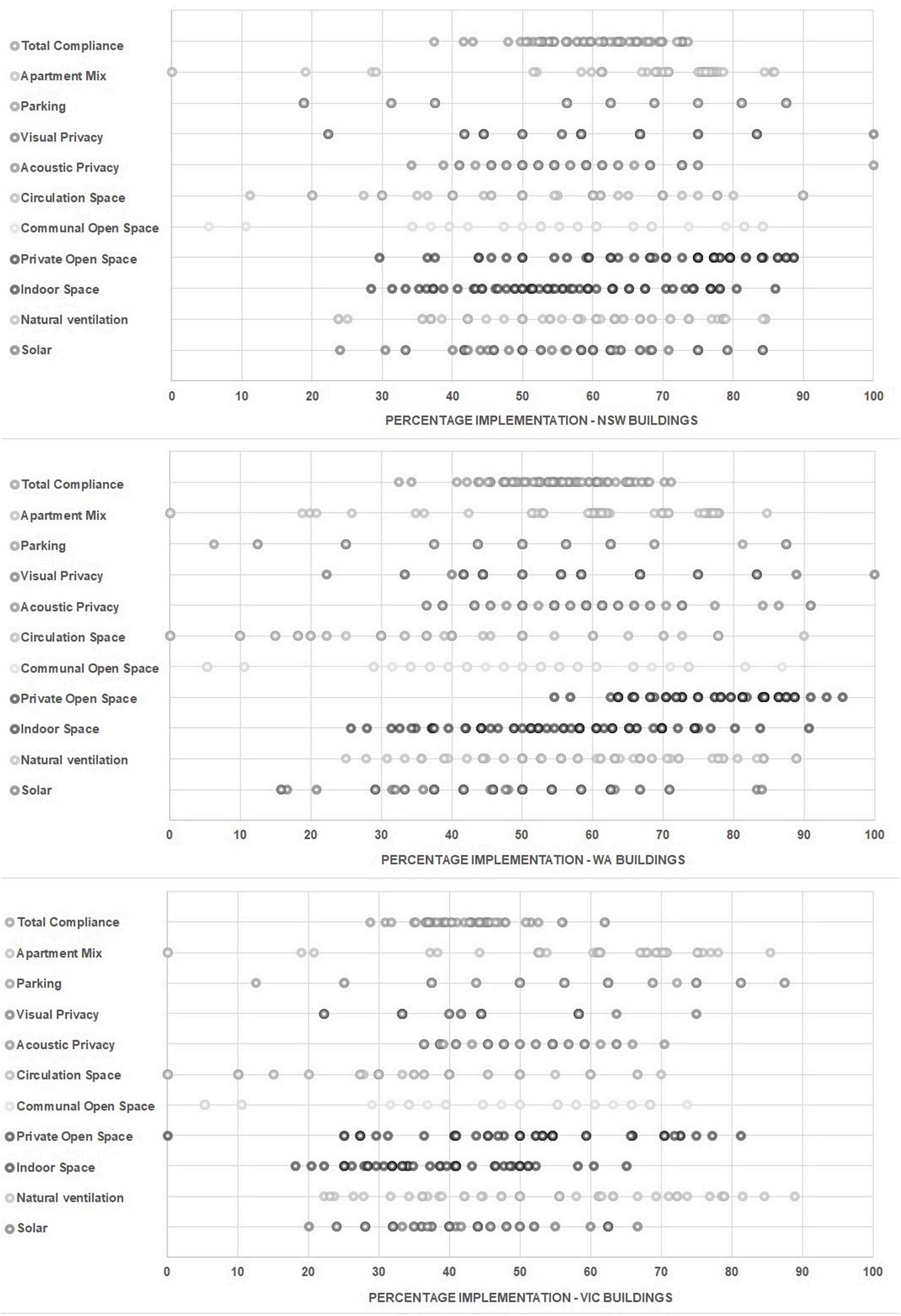
To facilitate comparison between the buildings in the three cities, each building was scored for its implementation of the complete pool of 122 design requirements, regardless of whether they were included in the relevant state policy. While this approach inflated scores for some buildings (e.g., buildings with ≥60% of apartments naturally crossventilated will also acquire points for achieving the lower ≥40% threshold), the higher/bonus scores for these buildings are warranted because they have met the higher threshold. Fig. 1 plots the scores for each individual building (n = 172) by design objective and state (n = 57 Sydney, n = 69 Perth, n = 46 Melbourne), and Table 4 shows the descriptive data and differences between the buildings from each city. For overall policy implementation, Sydney apartment buildings scored highest with an average of 59.8% of the requirements implemented, followed by the Perth buildings on 54.9% and Melbourne on 43.0%. Scores for Sydney and Perth were significantly higher than Melbourne (p = 0.000). This pattern (i.e., Sydney scoring highest, then Perth, then Melbourne) applied to several of the design objectives – solar and daylight (p = 0.000); natural ventilation (p = 0.057), communal open space (p = 0.000); circulation spaces (p = 0.000), visual privacy (p = 0.000) and apartment mix (p = 0.016). Perth buildings scored highest for indoor space, private open space and acoustic privacy, although the differences between Perth and Sydney samples were only significant for private open space (p < 0.01). The Melbourne buildings scored marginally higher for parking (non-significant) but otherwise scored the lowest across all other design objectives. Post-hoc tests revealed the significant differences in the scores were generally between Sydney and Melbourne, and Perth and Melbourne.
This study benchmarked the implementation of policy-specific design requirements in contemporary apartment buildings across three Australian cities. Buildings in each city were assessed against their own state-specific apartment design policy criteria and compared by scoring against the pool of all possible design policy requirements aggregated from the different policies. In the city comparison, Sydney buildings, which were developed under a comprehensive design policy (i.e., SEPP 65), scored higher than those in Perth and Melbourne, where there was relatively limited apartment design guidance when the buildings were developed. However, it is notable that the Perth buildings scored just five percentage points lower than those in Sydney (i.e., Perth: 54.9% versus Sydney: 59.8%), given the disparity in design policy direction. The requirements measured in this study related to design objectives associated with health and wellbeing; hence it is plausible that apartments developed in Sydney and, to a lesser extent, Perth may be conducive to better health outcomes amongst residents than those in Melbourne, where scores were significantly lower.
One assumption tested in this study was that apartments in Sydney would implement more design requirements than buildings in other cities, given the detailed policy direction applied when the buildings were approved and developed. The higher implementation scores for the Sydney buildings are consistent with a recent study [46] that sampled a small number of apartments/buildings in Sydney and Melbourne to explore how the regulatory environment (i.e., discretionary versus regulatory-discretionary controls) impacted the quality of internal apartment design. Our work extends Allouf et al. (2020) as the scale of our study (i.e., three cities, 172 buildings, 10,553 apartments) and
Table 4
Implementation scores for the pooled healthy design requirements (by design objective and overall policy implementation) and differences by city.
Buildings in each city were assessed for their implementation of the pool of all measured design requirements (i.e., from SEPP 65, SPP7.3 and BADS combined). CI: Confidence Interval; S: Sydney (NSW); P: Perth (WA); M Melbourne (VIC). *p < 0.05, **p < 0.01, ***p < 0.001.
measurement of 122 individual policy-specific design requirements allowed for a more detailed and holistic assessment of policy implementation and quantification of differences between cities. While the conclusion of the studies is ultimately similar – that is, the regulatory environment correlated with a greater degree of compliance against the policy requirements we measured; our results for Perth suggest the local context and receptivity to apartments also play a role.
The Perth buildings ranked second to Sydney in the city comparison, and when benchmarked against the incoming planning policy (i.e., SPP7.3), they were, on average, already implementing 55% of the new policy requirements. Indeed, scores for the implementation of statespecific requirements were similar in Perth and Sydney, despite the different regulatory requirements when the buildings were developed. This begs the question – why were Perth buildings implementing many of the policy-specific design requirements in the absence of any regulatory obligation?
Several factors may contribute to the delivery of the design requirements in Perth. First, the planning legislation that applied at the time the buildings were developed (i.e., the R-Codes) contained relatively few design requirements when compared to the incoming SPP7.3; however, the R-Codes still included some regulations (e.g., minimum setback distances, minimum sizes for apartments, balconies and communal spaces) [16]. Indeed, Perth buildings scored highest for the design outcomes: internal space and private outdoor space, where minimum requirements were stipulated under the R-Codes. Further, under the R-Codes, buildings could be approved via two pathways, where those that failed to meet the ‘deemed to comply’ (prescriptive) requirements would then be assessed for their performance against design principles. Compliance with the minimum standards was typically adopted by proponents as a clear and efficient pathway to building approval under the legislation.
The second factor contributing to improved design outcomes in Perth is the relative immaturity of the apartment market. Perth is a sprawling, low-density car-dependent city dominated by detached suburban housing, but the last decade has seen a rapid increase in the construction of residential apartment buildings [6]. Yet Perth residents demonstrate an overwhelming preference for detached housing [71]. Consequently, developers may have deliberately produced apartments and buildings with greater amenity to persuade potential buyers that apartments are a viable alternative to other housing typologies – as both a home and an investment. To deliver better design outcomes, some Perth planners, designers and developers also looked to SEPP 65 in NSW for inspiration, given the industry recognition that SEPP 65 has helped improve the quality of apartments in NSW [55] and the policy’s popularity among stakeholders in other states who were interested in replicating it [40, 72]. For instance, before the formulation of SPP7.3 in Perth, SEPP 65 was explicitly used by local councils when considering design quality of development applications and in the development of local design policies such as the City of Vincent’s Built Form Policy [73].
Melbourne buildings scored lowest in both the city comparison and state-specific benchmarking. They were developed before the introduction of the new state design policy (i.e., BADS); however, in contrast to Perth where half the requirements from the incoming SPP7.3 were already being implemented, in Melbourne, on average, just 40% of the incoming requirements were being implemented. Notably, this is from a policy that contained fewer quantifiable design standards (i.e., 35 requirements in BADS (VIC) versus 75 in SPP7.3 (WA) and 78 in SEPP 65 (NSW)) [68]. At the time the buildings were approved and developed, Victorian controls were the least prescriptive with no minimum requirements for high-rise developments (≥5 storeys) [46] and few quantifiable requirements for low and mid-rise developments (≤4 storeys) [16]. This may contribute to the observed differences between the Melbourne and Perth buildings (i.e., 43% versus 55% respectively). While the regulation in both states was limited at the time the buildings were developed, Victoria had the weakest regulation whereas WA’s R-Codes included some prescriptive standards. This suggests design
regulation positively impacts design outcomes and provides a cautionary example of what can happen in the absence of government intervention, when developers have comparatively free rein. In this context, the introduction of BADS in Victoria can be seen a government intervention to ‘correct market failure’ [43].
Further, design regulations are not implemented in isolation, with governments, creatives (i.e., designers), and the market (i.e., developers and funders) all influencing the final, on-ground, built form [43]. Privately developed housing achieves the developer’s objective when it sells, and consequently, the ‘future utility’ of the home is not always prioritised [74]. This may have been the case in Melbourne’s thriving property market. Melbourne has led the apartment construction boom in Australia due to a combination of lower land prices (compared with Sydney), relatively few planning constraints and strong buyer interest [75]. Indeed, in a recent study of apartment housing in Sydney and Melbourne, a developer commented that they provided higher levels of amenity in their apartment developments when the market was weak rather than when demand was high [76]. Thus, in Melbourne, the combination of discretionary design guidance and a booming market may have created conditions where apartments will sell, regardless of the design, and as a result some design elements may be neglected by developers.
As noted earlier, Sydney buildings were implementing more of the requirements measured in this study – scoring highest in the statespecific policy benchmarking (i.e., 56%) and city comparison (i.e., 60%). However, it could be argued that the Sydney buildings should score higher still, since they were procured under a comprehensive regulatory environment (i.e., SEPP 65). We benchmarked buildings against the quantifiable design criteria in SEPP 65; however, it is important to emphasise that SEPP 65 is a performance-based policy. As such, the requirements need not be implemented, and proponents may meet the policy objectives via alternative approaches or innovations. Furthermore, Carmona (2017) highlights the distinction between ‘the products of designing the built environment’ (e.g., the policy and design guide) and ‘the processes that shape them’ (e.g., design review and approvals) [77]. The ‘low’ level of compliance could be partly attributed to both the administrative difficulty in ensuring full compliance and the opportunity to demonstrate acceptable outcomes using performance pathways where meeting prescriptive measures is less important. The ability or suitability of certain design compliance measures can also be sensitive to project and site context requiring the ‘intervention’ of a performance-based assessment. For example, when the retention of existing vegetation, such as a mature tree, or site topography, may significantly impact site planning and building massing with subsequent implications for the ability to meet other prescriptive requirements.
Regarding the administrative difficulty, there are several potential reasons why an intensely thorough assessment may not be practical or achievable. For example, the effectiveness of the assessment relies on those who administer and regulate performance having sufficient capabilities and experience [77]. Drawing on the example set by the Commission for Architecture and the Built Environment (CABE) in the UK, many Australian state and local governments have established design review panels to provide independent advice on the design quality of development proposals [78]. However, variability in the procedural consistency and levels of expertise of those involved in design review processes has been understood for some time [79–81]. In addition, those undertaking design review may struggle to achieve purely objective standpoints with varying motivations and the influence of factors beyond the domain of spatial compliance [82,83]. For example, reviewers often come from varying professional backgrounds and may value ambitious aesthetic or sustainability approaches over more prosaic compliance requirements. Design review, undertaken by a panel of individuals, is not an exact science and performance between objectives can be competing or understood as a trade-off. In addition, design review panellists are often practicing professionals with an understanding of the economic feasibility implications of meeting certain
requirements in differing economic and environmental contexts which can implicitly influence recommendations.
Design review is considered as advice only, not carrying statutory weight, in a broader decision-making process which means that proponents may not seek full compliance [84]. In addition, there is a steep learning curve in terms of understanding and familiarising with a comprehensive policy, for both proponents and reviewers, which is then subject to the vagaries of decision making in a deliberative, multi-stakeholder environment [41,85]. High volumes of applications, development timeframe pressures, resourcing needs of both comprehensive compliance assessment and the organisation of design review could all contribute to a difficulty in achieving a level of comprehensiveness in the assessment process.
Whilst not the primary aim of this paper, this discussion highlights the imperfect and mutable nature of design regulation and review practice and puts forward a number of reasons why full compliance is an elusive goal. As discussed, imperfect implementation scores are only partly representative of overall performance. Greater resourcing for both the education of those involved in design review and the enhancement of implementation frameworks, such as assessment procedures within local governments, could lead to greater compliance. Reversion toward a more comprehensive ‘deemed to comply’ assessment framework could increase compliance but undo the benefits of the recent transition towards a performance-based system, such as permitting innovation in design [47]. Another possible approach to encourage compliance may be to weight certain compliance standards in terms of their potential impact on occupant health and well-being, although this could introduce a normative approach insensitive to different social and environmental contexts. The performance of built environment projects is unable to be entirely regulated and gauged by adherence to spatial compliance. It is possible that the level of compliance observed in the Sydney buildings represents an ‘honest equilibrium’ balancing policy implementation with the complexity and idiosyncrasies of the development decision making process.
4.1.
This study appears to be the first to comprehensively measure policyspecific design requirements and quantify and compare their implementation across different cities. The selection process sampled contemporary apartment buildings from three Australian cities located within different socio-economic areas and distances of the city centres. The systematic extraction of 122 objective policy-specific metrics based on the design policies for all residential apartments in all the sampled buildings and our ability to quantify and compare policy implementation distinguish this study from previous research [46]. While this study focused on Australian apartment design policies, numerous international cities have developed similar housing design guides [49–51] and this study provides a template for evaluating and tracking design policy implementation.
However, the study also has some limitations. First, buildings in the study were assessed based on prescriptive standards rather than performance-based criteria. Building designers and architects may have applied innovation in their design, ensuring the overall policy objectives were met without necessarily delivering a quantitative standard. This type of performance-based assessment and evaluation was outside the scope of this study. However, given our approach, it is important to acknowledge that it is unlikely buildings would achieve very high (or perfect) implementation scores. Future research could evaluate the correlation between our prescriptive standards-based approach and a more qualitative assessment of building performance.
Second, we assessed buildings against requirements from three state design policies; however, only the sample of buildings in Sydney was developed under the policy (i.e., SEPP 65). Our buildings in Perth and Melbourne were built before the introduction of SPP7.3 (WA) or BADS (VIC), which provided a unique opportunity to benchmark how far
current practice was from the new policy aspirations. While we cannot claim that the policy requirements have (or have not) been implemented as intended (as the policy did not apply at the time of development), our approach provides policymakers with important empirical evidence benchmarking which aspects of their policies are already being delivered by industry, and importantly, which are not. This could help tailor professional education programs that increase the implementation of requirements that are neglected by the industry, as well as make regulators aware of specific elements they need to focus on. An alternative approach for this study would have been to benchmark buildings in Perth and Melbourne against the (now superseded) policies in place at the time of their development. However, given the relatively low level of direction in these policies [16] and the fact that government and industry are now focused on the new, more comprehensive policies, this approach was deemed redundant. Another approach would be to sample buildings in Perth and Melbourne that were developed under the new policies and benchmark them against the new requirements (i.e., consistent with our treatment of SEPP 65 in Sydney). This was not possible because, at the time the study was conducted, no buildings in Perth were approved and constructed under State Planning Policy 7.3; and few (if any) buildings in Melbourne had been developed and constructed under Better Apartments Design Standards. Future research could repeat this benchmarking study using a new sample of buildings in WA and Victoria to evaluate whether the policy intervention (i.e., SPP7.3 or BADS) has increased the uptake of healthy design requirements in buildings developed under the policy.
Third, for many of the buildings, requirements were extracted from the plans and elevations submitted in the Development Application. While it is possible that the design of the final ‘brick and mortar’ buildings deviated from the approved Development Application material, our process involved screening the building plans against other data sources (e.g., Strata title information, real estate sites, marketing materials) and building designs that were noticeably different from the approved design were excluded from the study – increasing confidence that the measures broadly reflected the built form of the respective buildings. Finally, we did not develop a policy implementation measure for thermal comfort, despite its established association with health [21–23]. Our focus on ‘design’ limited our ability to assess some thermal comfort requirements (e.g., use of thermal mass for passive heating and cooling in SPP7.3) and relevant requirements that we were able to measure were scored under solar and daylight access and natural ventilation.
The design features measured and benchmarked in this study were derived from a review of the design attributes associated with, or theorised to influence, health and wellbeing outcomes [16]. While the extant evidence suggests certain design objectives can influence health, studies examining the association between policy-specific measures of design and residents’ health and wellbeing outcomes are scarce [16,17]. Future research is needed to evaluate the impact of design policy standards on residents’ experiences of apartment living and their health and wellbeing. This includes testing whether increased on-ground policy implementation, overall and by design theme, impacts on residents’ health and wellbeing, as well as identifying which individual design requirements have a greater impact on residents.
This study conducted a comprehensive evaluation of the implementation of apartment design policy requirements that, if incorporated as intended, could promote residents’ health and wellbeing. We found that the legislation of a detailed design policy correlated with a greater implementation of design requirements, but local contextual factors also played a role. In our city comparison, Sydney had the most
comprehensive design policy and scored highest, whereas Melbourne had the weakest design guidance and scored lowest. The Melbourne building scores reflected an environment where design outcomes were largely driven by developers, with minimal intervention. In contrast, Perth is a smaller city with a relatively immature apartment market, yet buildings scored relatively well, given the limited apartment guidance when the buildings were developed. Developers may have delivered a higher level of amenity in Perth to convince buyers that apartments were a viable alternative to detached suburban housing. Our benchmarking results also have practical implications as they identify the design requirements (and objectives) with low levels of implementation that need further attention from developers and government building approval processes.
SF conceived and designed the study. PH conceived the measures, with input from SF, JB and AD. SF conducted the analyses and drafted the manuscript. All authors contributed the manuscript drafts and read and approved the final manuscript.
Ethics approval
RMIT University Design and Social Context College Human Ethics Advisory Network (Sub-committee of the RMIT Human Research Ethics Committee) (CHEAN B 21146-10/17); The University of Western Australia Human Ethics Research Committee (RA/4/1/8735).
Declaration of competing interest
The authors declare that they have no known competing financial interests or personal relationships that could have appeared to influence the work reported in this paper.
Acknowledgements
The High Life Study is funded by an ARC, DECRA (DE160100140) and the Western Australian (WA) Health Promotion Foundation (Healthway; #31986). PH is supported by a Healthway Research Fellowship (# 32992) and the Australian Urban Design Research Centre. Study collaborators providing in-kind support include the Department of Planning Lands and Heritage (WA), Office of the Government Architect (WA), Government Architect NSW (GANSW), Planning Institute of Australia (PIA), Landcorp and Heart Foundation. The assistance of apartment residents, resident associations, architects, developers and local government in the study is gratefully acknowledged.
References
[1] United Nations, The Sustainable Development Goals Report 2018, United Nations, New York, 2018
[2] United Nations, New urban Agenda, in: HABITAT III, Quito, Ecuador, United Nations, 2017
[3] B. Giles-Corti, et al., City planning and population health: a global challenge, Lancet 388 (10062) (2016) 2912–2924
[4] B. Randolph, Delivering the compact city in Australia: current trends and future implications, Urban Pol. Res. 24 (4) (2006) 473–490
[5] ABS, 3222.0 - Population Projections, Australia, Australian Bureau of Statistics, Canberra, 2017 (base) - 2066. 2017
[6] M. Shoory, The growth of apartment construction in Australia, in: Bulletin, Reserve Bank of Australia, 2016, pp. 19–26
[7] T. Rosewall, M. Shoory, Houses and apartments in Australia, in: Bulletin, Reserve Bank of Australia, 2017, pp. 1–12.
[8] ABS, 2071.0 - Census of Population and Housing: Reflecting Australia - Stories from the Census - Apartment Living, 2016. Canberra
[9] Housing Statistics Eurostat, Statistics Explained, European Commission, 2019, pp. 1–9
[10] M. Nethercote, R. Horne, Ordinary vertical urbanisms: city apartments and the everyday geographies of high-rise families, Environ. Plann. 48 (8) (2016) 1581–1598
[11] City of Melbourne, Understanding the Quality of Housing Design, 2013. City of Melbourne: Melbourne
[12] State Government of Victoria, Better Apartments, A Discussion Paper, Department of Environment, Land, Water & Planning: Melbourne, 2015
[13] M. Morgan, H. Cruickshank, Quantifying the extent of space shortages: English dwellings, Build. Res. Inf. 42 (6) (2014) 710–724
[14] Mayor of London, Housing Design Standards Evidence Summary, Greater London Authority, London, 2010
[15] P. Barros, et al., Social consequences and mental health outcomes of living in highrise residential buildings and the influence of planning, urban design and architectural decisions: a systematic review, Cities 93 (2019) 263–272
[16] S. Foster, et al., The high life: a policy audit of apartment design guidelines and their potential to promote residents’ health and wellbeing, Cities 96 (2020) 102420.
[17] S. Foster, et al., High Life Study protocol: a cross-sectional investigation of the influence of apartment building design policy on resident health and well-being, BMJ Open 9 (8) (2019), e029220
[18] P. Wargocki, et al., Ventilation and health in non-industrial indoor environments: report from a European Multidisciplinary Scientific Consensus Meeting (EUROVEN), Indoor Air 12 (2) (2002) 113–128
[19] R. Ruotsalainen, et al., Symptoms and perceived indoor air quality among occupants of houses and apartments with different ventilation systems, Indoor Air 1 (4) (1991) 428–438
[20] N.H. Wong, B. Huang, Comparative study of the indoor air quality of naturally ventilated and air-conditioned bedrooms of residential buildings in Singapore, Build. Environ. 39 (9) (2004) 1115–1123
[21] J.P. Clinch, J.D. Healy, Housing standards and excess winter mortality, J. Epidemiol. Community Health 54 (9) (2000) 719–720
[22] E.L. Lloyd, et al., The effect of improving the thermal quality of cold housing on blood pressure and general health: a research note, J. Epidemiol. Community Health 62 (9) (2008) 793–797
[23] P. Howden-Chapman, et al., Effect of insulating existing houses on health inequality: cluster randomised study in the community, BMJ Br. Med. J. (Clin. Res. Ed.) 334 (7591) (2007) 460, 460
[24] M.J. Brown, D.E. Jacobs, Residential light and risk for depression and falls: results from the LARES study of eight European cities, Publ. Health Rep. 126 (2011) 131–140, 1974-
[25] P.-C. Lai, et al., Risk of tuberculosis in high-rise and high density dwellings: an exploratory spatial analysis, Environ. Pollut. 183 (2013) 40–45.
[26] S. Vandentorren, et al., August 2003 heat wave in France: risk factors for death of elderly people living at home, Eur. J. Publ. Health 16 (6) (2006) 583–591
[27] W. Babisch, et al., Road traffic noise and hypertension – accounting for the location of rooms, Environ. Res. 133 (2014) 380–387
[28] G. Bluhm, E. Nordling, N. Berglind, Road traffic noise and annoyance-an increasing environmental health problem, Noise Health 6 (24) (2004) 43–49
[29] B. Jakovljevic, K. Paunovic, G. Belojevic, Road-traffic noise and factors influencing noise annoyance in an urban population, Environ. Int. 35 (3) (2009) 552–556
[30] C. Maschke, H. Niemann, Health effects of annoyance induced by neighbour noise, Noise Control Eng. 55 (3) (2007) 348–356
[31] R. Kaplan, The nature of the view from home: psychological benefits, Environ. Behav. 33 (4) (2001) 507–542
[32] C.M. Tennessen, B. Cimprich, Views to nature: effects on attention, J. Environ. Psychol. 15 (1) (1995) 77–85
[33] N.M. Wells, At home with nature: effects of “greenness” on children’s cognitive functioning, Environ. Behav. 32 (6) (2000) 775–795
[34] H.F. Guite, C. Clark, G. Ackrill, The impact of the physical and urban environment on mental well-being, Publ. Health 120 (12) (2006) 1117–1126
[35] F. Oswald, et al., Is aging in place a resource for or risk to life satisfaction? Gerontol. 51 (2) (2011) 238–250
[36] G. Evans, S. Lepore, A. Schroeder, The role of interior design elements in human responses to crowding, J. Pers. Soc. Psychol. 70 (1) (1996) 41–46
[37] B. Giles-Corti, K. Ryan, S. Foster, Increasing Density in Australia: Maximising the Health Benefits and Minimising Harm, National Heart Foundation of Australia, Melbourne, 2012
[38] M. Kimura, M. Nishiwaki, M. Miyata, Attitudes among residents towards the creation of a community by horticultural activity on the roof top of a housing complex in Tokyo, Acta Hortic. 790 (2008) 205–211
[39] D. Kim, K. Ohara, A study on the role of gardening and planning of green environments for daily use by residents in senior housing, J. Asian Architect. Build Eng. 9 (1) (2010) 55–61
[40] T. Moore, et al., Improving Design Outcomes in the Built Environment through Design Review Panels and Design Guidelines, in: State of Australian Cities Conference, Gold Coast, Australia, 2015
[41] M. Carmona, Design governance: theorizing an urban design sub-field, J. Urban Des. 21 (6) (2016) 705–730
[42] P. Booth, Controlling Development: Certainty and Discretion in Europe, the USA and Hong Kong, Taylor & Francis Group, 1996
[43] M. Carmona, Design coding: mediating the tyrannies of practice, in: S. Tiesdell, D. Adams (Eds.), Urban Design in the Real Estate Development Process, Blackwell Publishing, Chichester, 2011
[44] S. Tiesdall, P. Allmendinger, Planning tools and markets: towards an extended conceptualisation, in: D. Adams, C. Watkins, M. White (Eds.), Planning, Public Policy and Property Markets, Wiley, Williston, 2008
[45] H. de Vries, W.P. Verhagen, Impact of changes in regulatory performance standards on innovation: a case of energy performance standards for newly-built houses, Technovation 48–49 (2016) 56–68.
[46] D. Allouf, A. Martel, A. March, Discretion versus prescription: assessing the spatial impact of design regulations in apartments in Australia, Environ. Plann., B: Urban Anal. City Sci. 47 (7) (2020) 1260–1278
[47] B. Meacham, Sustainability and resiliency objectives in performance building regulations, Build. Res. Inf. 44 (5–6) (2016) 474–489
[48] R. Freestone, G. Davison, R. Hu, Design the Global City: Design Excellence, Competitions and the Remaking of Central, Palgrave Macmillan, Sydney, 2019
[49] Department of Housing Planning and Local Government, Sustainable Urban Housing: Design Standards for New Apartments, Department of Housing Planning and Local Government, 2018. Government of Ireland: Ireland
[50] Mayor of London, The London Plan, Mayor of London, Greater London Authority, London, 2021
[51] City of Vancouver, Housing Design and Technical Guidelines, Community Services, City of Vancouver: Vancouver, 2020.
[52] Urban Design Forum, Moreland Higher Density Design Code, 2012, 25 January 2019]; Available from: http://www.udf.org.au/udf-quarterly/moreland-higher -density-design-code/
[53] Western Australian Planning Commission, in: D.o.P.L.a. Heritage (Ed.), State Planning Policy 3.1, Residential Design Codes, 2018. Western Australian Planning Commission: Perth
[54] Victoria State Government, Plan Melbourne, Metropolitan Planning Strategy, Department of Transport Planning and Local Infrastructure, Victoria State Government, Melbourne, 2014
[55] P. Mould, A review of the first 9 years of the NSW state environmental planning policy No. 65 (SEPP 65), Architect. Aust. 100 (3) (2011) 49, 49
[56] New South Wales Government, in: P.a. Environment (Ed.), State Environmental Planning Policy No 65 - Design Quality of Residential Apartment Development, 2017. New South Wales Government
[57] The State of Victoria Department of Environment Land Water & Planning, Better Apartments Design Standards - New Apartment Design Standards for Victoria, Environment Land Water and Planning and Office of the Victorian Government Architect, State of Victoria, Melbourne, 2016
[58] Western Australian Planning Commission, State Planning Policy 7.3 Residential Design Codes Volume 2 - Apartments, Department of Planning Lands and Heritage, 2019. Western Australian Planning Commission: Perth
[59] Western Australian Planning Commission, State Planning Policy 7.0 Design of the Built Environment (SPP 7.0), Department of Planning Lands and Heritage, 2019. Western Australian Planning Commission: Perth.
[60] Mayor of London, in: M.o. London (Ed.), Housing Design Quality and Standards: Supplementary Planning Guidance. Module C Pre-consultation Draft, Mayor of London, London, 2020
[61] City of British Columbia, in: B. Housing (Ed.), BC Housing Design Guidelines and Construction Standards, City of British Columbia, Vancouver, 2019
[62] Victorian Government Department of Sustainability and Environment, Guidelines for Higher Density Residential Development, Department of Sustainability and Environment, East Melbourne, 2004
[63] The State of Victoria Department of Environment Land Water & Planning, Apartment Design Guidelines for Victoria, L. Department of Environment, Water & Planning, State of Victoria: Melbourne, 2017
[64] I. Bournas, Daylight compliance of residential spaces: comparison of different performance criteria and association with room geometry and urban density, Build. Environ. 185 (2020) 107276
[65] N. Canha, et al., Compliance of indoor air quality during sleep with legislation and guidelines – a case study of Lisbon dwellings, Environ. Pollut. 264 (2020) 114619, 114619
[66] M.O. Maritorena, et al., Analysis of ventilation of dwellings in Spain in relation to technical building code using tracer gas techniques, Int. J. Vent. 11 (3) (2012) 271–280
[67] V. Onyango, N. Burford, Performance of local level planning policies for reducing greenhouse gases: insight from new buildings in Scotland, Manag. Environ. Qual. 31 (4) (2020) 985–1002
[68] Hooper, P., et al., Measuring the High Life: A Method for Assessing Apartment Design Policy Implementation MethodsX, Under review.
[69] P. Hooper, B. Giles-Corti, M. Knuiman, Evaluating the implementation and active living impacts of a state government planning policy designed to create walkable neighborhoods in Perth, Western Australia, Am. J. Health Promot. 28 (sp3) (2014) S5–S18.
[70] P. Hooper, S. Foster, B. Giles-Corti, A case study of a natural experiment bridging the ‘research into policy’ and ‘evidence-based policy’ gap for active-living science, Int. J. Environ. Res. Publ. Health 16 (2019)
[71] Department of Housing, The Housing We’d Choose: A Study for Perth and Peel, Department of Housing, Department of Planning, 2013
[72] Urban Design Alliance, Design quality program 7 Year review: recommendations, in: Submission to the Department of Planning, Urban Design Alliance, Sydney NSW, 2009
[73] City of Vincent Planning Services, in: C.o. Vincent (Ed.), City of Vincent Planning and Building Policy Manual Policy No. 7.1.1 Built Form, City of Vincent, Perth WA, 2018
[74] N. Gallent, M. Madeddu, A. Mace, Internal housing space standards in Italy and England, Prog. Plann. 74 (1) (2010) 1–52
[75] CAN, Property Insights: Australia’s Apartment Boom Reaches Record High, Commonwealth Bank of Australia, 2015
[76] H. Easthope, et al., Improving outcomes for apartment residents and neighbourhoods, in: AHURI Final Report No. 329, Australian Housing and Urban Research Institute Limited, Melbourne, 2020
[77] M. Carmona, The formal and informal tools of design governance, J. Urban Des. 22 (1) (2017) 1–36
[78] M. Keniger, Have design review panels improved the built environment?, in: Architecture AU, 2017
[79] B.C. Scheer, Introduction: the debate on design review, in: W.F.E. Preiser (Ed.), Design Review, Springer, Boston, MA, 1994, pp. 1–10.
[80] E. Dawson, M. Higgins, How planning authorities can improve quality through the design review process: lessons from edinburgh, J. Urban Des. 14 (1) (2009) 101–114
[81] B. Lightner, Design review: a critical evaluation, Cities 9 (4) (1992) 280–287
[82] P. Black, Beauty in the eye of the design reviewer: the contested nature of UK design review, J. Urban Des. 24 (4) (2019) 556–574
[83] P. Black, T.E. Sonbli, The ’veil’ of control: the perceptions and attitudes of UK design-control planners, TPR: Town Plan. Rev. 90 (2) (2019) 139–166
[84] E.J. Haarhoff, L. Beattie, J. Hunt, Improving the quality of the built environment using urban design review panels: an appraisal of practices in Australia and New Zealand, J. Eng. Arch. 5 (2) (2017) 1–13
[85] J.T. White, Future directions in urban design as public policy: reassessing best practice principles for design review and development management, J. Urban Des. 20 (3) (2015) 325–348