
He pou atua, he pou whenua, he pou tangata.
Ko Waitematā te moana
Ko Waikōkota te whenua.
Ko Te Pou Whakamahara a Māui Tikitiki a Taranga te tohu o te kaha, o te kōrero, o te whakapapa o tēnei wāhi, o tēnei whare.
Nau mai e te tī, e te tā ki te whare kōrero, ki te whare whakaari o ASB ki te tahatika o te moana.
Mauri tau, mauri ora!
Pouwhakamahara a Māui-Tikitiki-a-Taranga
The Memorial Post of Māui the Topknot of Tāranga
Robert Jahnke ONZM (Ngāi Taharora, Te Whānau a Iritekura, Te Whānau a Rākairoa o Ngāti Porou), 2016
Laminated tōtara and Corten steel
Proudly commissioned by Auckland Theatre Company for ASB Waterfront Theatre


The symbols of support, of strength and of guardianship stand fast and proud.
The waters of Waitematā ebb and flow against the shores here at Waikōkota, the land upon which we stand.
The pou of remembrance to Māui Tikitiki a Taranga stands tall as a beacon of courage, of stories passed down and of the history that connects us all to this place and to this space.
We welcome you all from near and far to this house of stories, to the ASB Waterfront Theatre.
Mauri tau, mauri ora!
This education pack is designed to support your exploration of this production of Waiora Te Ūkaipō – The Homeland written & directed by Hone Kouka. Whether you’re a kaiako preparing lessons, an ākonga studying the play, or simply curious about this timeless work of love and tragedy, this resource offers insights into both the original text and this specific production.
The pack is divided into three sections:
Activities
After a welcome from Auckland Theatre Company, this section includes key information about the cast and creatives, essays providing essential context and background information, and a synopsis of the production.
This section takes you behind the scenes with artefacts from the rehearsal room, key design concept insights, and notes to and from the cast, giving you a unique window into the creative process.
NCEA-linked activities that you can try in your classroom or at home to help you unpack and explore this production of Waiora Te Ūkaipō – The Homeland written & directed by Hone Kouka. These activities support achievement standards across Levels 1, 2, and 3.
Each section builds upon the previous one, but you can also use individual components as standalone resources. The activities are designed to complement the contextual information and production insights, making this pack suitable for both independent study and classroom use.
Key information about the cast and creatives, essays providing essential context and background information, and a synopsis of the production.
He hokinga mahara. He whakapapa. He kōrero. He whakaari.
There are works of art that leave an impression on a person’s thoughts and memories for years, and this is certainly one of them.
Thirty years on from its premiere at the New Zealand International Festival of the Arts (now Aotearoa New Zealand Festival of the Arts), Waiora Te Ūkaipō – The Homeland stands as one of the most impactful works written for our stages. This play by Hone Kouka MNZM has lost none of its power; if anything, its resonance feels sharper, its questions more urgent, its emotional truth more deeply felt and, sadly, its relevance more present. The story’s exploration of whānau (family), tātai hono (belonging) and tuakiri (identity) continues to speak directly to who we are and to the conversations we are still having as a nation.
Presenting this work now is both an artistic imperative and a responsibility: to honour a landmark work and to offer it anew to audiences who may be encountering it for the first time.
The force and clarity of Hone Kouka’s storytelling have shaped contemporary theatre in Aotearoa. The way he wields language with care, precision and mana reminds us of the critical importance of ensuring that language does not merely survive, but thrives. The leadership displayed by Hone has continued to set a benchmark for bold, rigorous storytelling, grounded in place and lived experience. It is a privilege, as a collective of Auckland Theatre Company, Te Ahurei Toi o Tāmaki Auckland Arts Festival and Aotearoa New Zealand Festival of the Arts, to work closely with Tawata Productions to present this work together for a new generation.
This production is carried forward by a new generation of performers who honour the legacy of Waiora Te Ūkaipō –The Homeland while driving it into the present. Their voices, presence and commitment breathe fresh life into this story of whānau and home, ensuring it remains living, urgent theatre that ignites conversation. We are proud to stand alongside them, and alongside Hone Kouka and Tawata Productions, in sharing a work that continues to define, challenge and nourish our theatrical landscape.
Mauri ora!
Waiora Te Ūkaipō – The Homeland is the work of a young artist, who carved this play in the shadow and light that grief and love creates. The loss of a parent or a loved one can tilt one’s world upon its axis – and this is the place from which this play was written.
Waiora Te Ūkaipō reflects a son’s love for his father, an artist’s love for their whānau and one’s love for their people.
In 2026, we are at work on a production that has been 30 years in the making. Amongst the collaborators there are a myriad of relationships: those who were part of the original collaboration; a father and daughter; a father and son; a mother and daughter; two cousins born in the south but who whakapapa to Te Tairāwhiti; and three generations of artists who have made a commitment to being part of a legacy known to many as Waiora Te Ūkaipō.
This is a story about the effects of colonisation on tāngata whenua and the displacement of Māori communities throughout Aotearoa. The loss of land, the loss of language and the loss of Māori belief-systems impacted tāngata whenua for generations. We continue to see the impact of colonisation and imperialism upon Māori today.
However, like the shadow and light that inspired the young artist to write this play, today we see the resilience
and resistance of tāngata whenua in Aotearoa and throughout the world. We see a new generation of rangatahi Māori, who stand upon the shoulders of the giants who came before them: they are artists, teachers, scientists, composers, astronomers, navigators, farmers, linguists, carvers, diplomats, mothers, healers.
We acknowledge our partners –Auckland Theatre Company, Te Ahurei Toi o Tāmaki Auckland Arts Festival, Aotearoa New Zealand Festival of the Arts – who have stood side by side and shoulder to shoulder with us. They, too, have made a commitment to this work alongside us, in partnership. We must acknowledge Creative New Zealand and Wellington City Council for providing the vital support that keeps our creative company moving forward.
To our collaborators – the actors, directors, designers, production management, stage management, technical specialists, producing team, filmmakers and photographers – we are grateful for our ongoing work together.
Finally, to the young artist who wrote Waiora Te Ūkaipō, we acknowledge you and hope that this work inspires young artists throughout Aotearoa.
Ka ora tonu mātou! Kia manuia! Hone Kouka and Mīria George
Founded in 2004, Tawata Productions is a creative company based in Te Whanganui-a-Tara Wellington, Aotearoa New Zealand.
Specialising in the development and presentation of new performance experiences, Tawata blurs the lines between text, movement and image. We are committed to the development of new stories from Te Moana-nui-aKiwa, the South Pacific Ocean.
Led by writer, director and producer Te Tumu Toi Arts Laureate 2022 Hone Kouka MNZM and theatre and filmmaker Mīria George, Tawata celebrates 22 years of creativity in 2026.
Our work includes the dance theatre farce Ngā Rorirori, the award-winning short film fire in the water, fire in the sky, the annual Indigenous playwriting festival Breaking Ground and our most recent work, the short film Open Looks. Tawata is currently in development of a feature film of Open Looks, and On Springfield Road is the new play in development from Hone Kouka.

22 MAR 2026
Anatonio Te Maioha – Tīpuna
Erina Daniels – Sue/Wai Te Atatu
Regan Taylor – John/Hone
Rongopai Tickell – Amiria
Tioreore Ngatai-Melbourne – Rongo
Te Mihi Potae – Boyboy
Awerangi Thompson – Tīpuna
Mathieu Boynton-Rata – Tīpuna
Huia Rawiri – Tīpuna
Mycah Keall – Louise Stones
Ben Ashby – Steve Campbell
Hone Kouka – Playwright & Director
Hōhepa Waitoa – Assistant Director
Hone Hurihanganui – Composer of Waiata & Haka
Mark McEntyre – Set Designer
Natasha James – Lighting Designer
Cara Louise Waretini – Costume Designer
Maarire Brunning-Kouka – Sound Composer
Tony De Goldi – Props Master
Caitlin Laurie – Props Maker
Iris Little – Musical Director
Teaching Artists – Nī Dekkers-Reihana and Sean Rivera
Education Pack Writer – Anna Turner
Production Photography – Matt Grace, Roc Torio
Rehearsal Photography – Josiah Wood

PRINCIPAL FUNDERS:




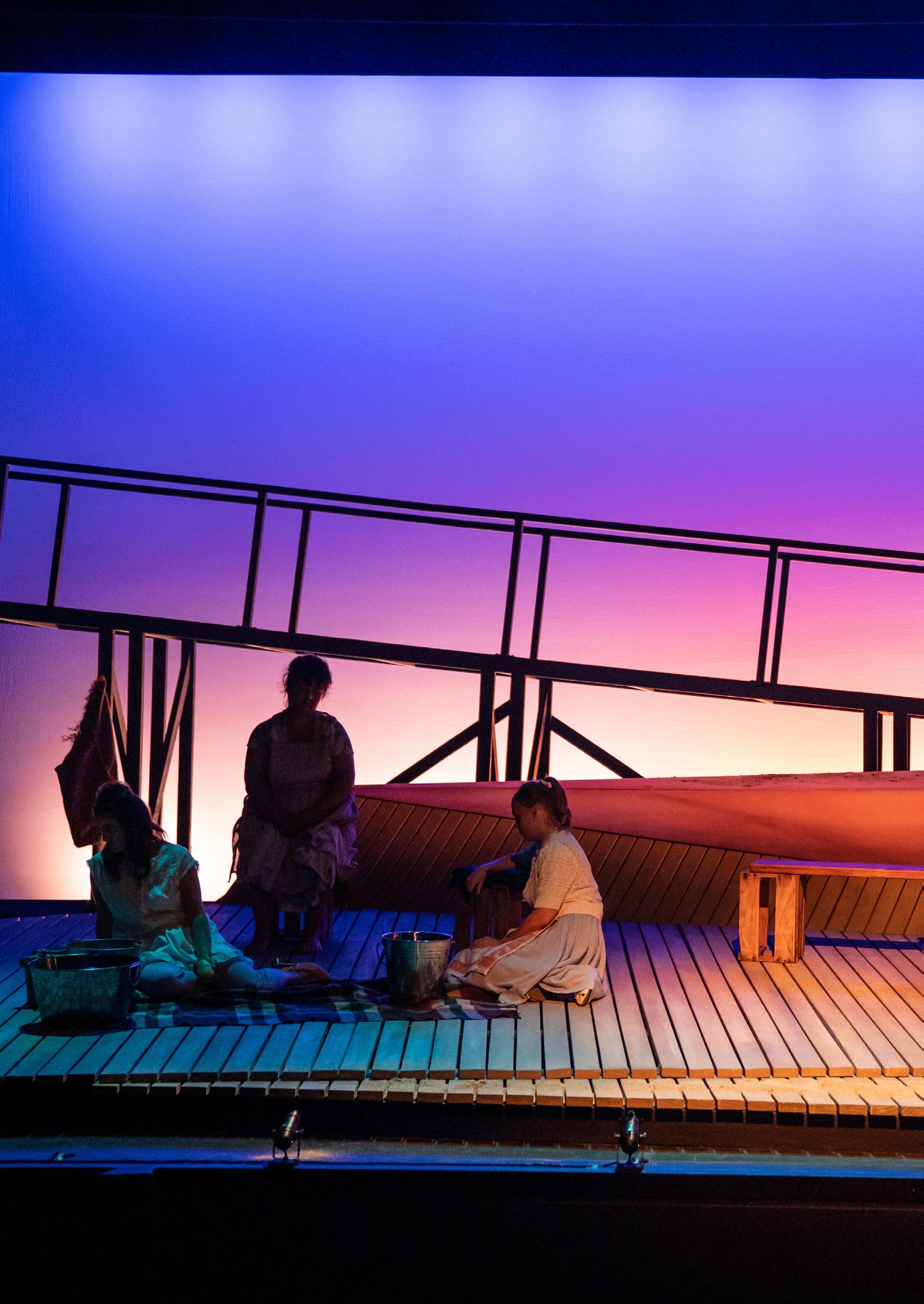
The year is 1965. A Māori family, recently arrived in Canterbury from the East Coast, gathers on a beachside location to celebrate the eighteenth birthday of their youngest daughter, Rongo. Sawmill worker Hone has brought his whānau south — wife Wai, daughters Rongo and Amiria, and adopted son Boyboy — for work and for the futures he imagines for his children.
Hone has invited his Pākehā boss Steve Campbell to the hāngī, believing a longpromised promotion is at hand. Boyboy’s teacher Louise Stones, a family friend, is also present.
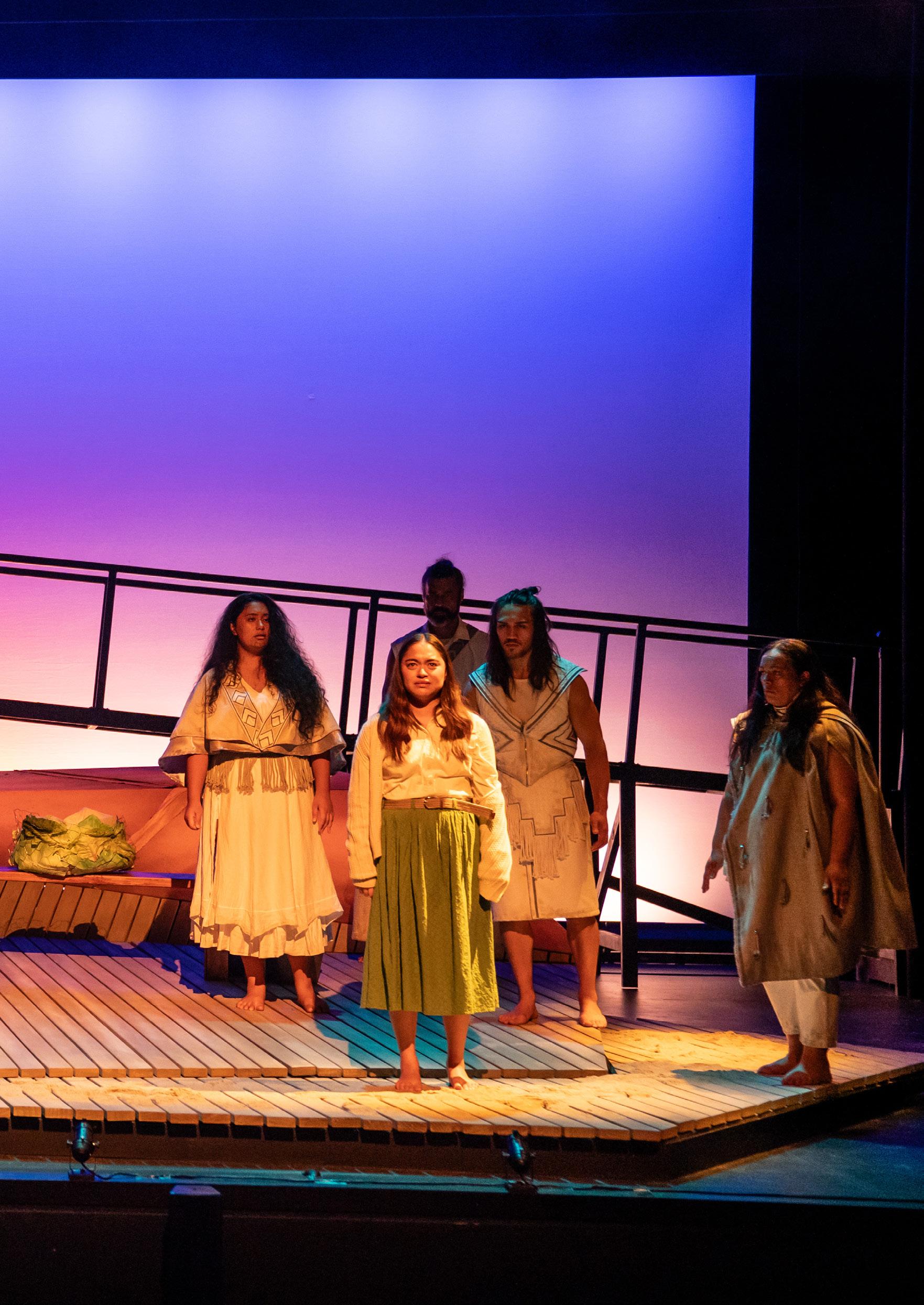
Hovering at the edges of the gathering — sometimes seen, sometimes only sensed — are the Tīpuna, the ancestors, who have travelled from the homeland with the whānau. Of all the family, it is Rongo who feels their presence most keenly. She has not sung since the family left home. As the evening unfolds and long-held tensions surface, Rongo moves closer and closer to the spirit world. At the play’s climax, the family must fight — through haka and waiata — to bring her back.
Waiora Te Ūkaipō – The Homeland is two hours and five minutes long, including interval. It contains strobe lighting, haze, loud and sudden sounds, racist and strong language, depictions of physical violence and family harm, and themes of colonisation and its impact on iwi Māori and whānau Māori.
Ngāti Porou, Ngāti Raukawa, Ngāti Kahungunu
WAIORA TE ŪKAIPŌ 1996/2026
Tēnā koutou katoa,
In late 1994, I was approached by then Executive Director of New Zealand International Festival of the Arts Carla Van Zon ONZM to write a new commission for the 1996 festival. I had to reply with a short brief. My reply was one line: “Everyone is from somewhere else.”
Waiora Te Ūkaipō is based around my own whānau and the move from Te Tairāwhiti to the Catlins in Southland in 1965. I was not on the scene until 1967. Our father had been asked to be lead hand on a native sawmill in Chaslands and, eventually, we made our way up the island to settle in Rangiora, north Canterbury.
While I was writing the play in 1995, our father Hone passed from a prolonged illness. I decided to name all of the characters after my whānau: Hone, Wai, Rongo, Amiria. Boyboy became an amalgam of two of my older brothers (Boydie and Ivor) and Mahurangi represented my eldest brother Philomel. The play then became my means of grieving for my father and the sacrifice he and our mother made for us.
The play premiered on 15 March 1996 at Hannah Playhouse, Te Whanganui-a-Tara (Wellington). It toured nationally and internationally for the next four years.
Since that time, people who were instrumental in the original production and subsequent tours have passed: my mother Wai Te Atatu Kouka, our kaumātua Bob Wiki, Musical Director Laughton Patrick, original chorus member Toni Huata and original cast member Nancy Brunning. Moe mai rā e nga rangatira. Moe mai rā.
In 2023, Jonathan Bielski, Anna Cameron, Mīria George and I met to kōrero about creative work. It was at this time the possibility of a new production of Waiora Te Ūkaipō was first mentioned. In late 2024, Dolina Wehipeihana and Tama Waipara MNZM from Aotearoa New Zealand Festival of the Arts, and Ataahua Papa from Te Ahurei Toi o Tāmaki Auckland Arts Festival were invited into this partnership.
I resisted. Why would anyone want to see this again? How would it be relevant? Returning 30 years later to The Homeland that is Waiora Te Ūkaipō has at times been emotional and surreal.
Rereading the script, I was concerned it may come across as a dusty period piece, dragged out to show what we did in the olden days. Thankfully for me, this was far from the case. The script still held its physicality, the longing and tactile nature in the dialogue and deep, deep emotional care. Thematically, the play still resonates: the effects of colonisation and urban drift on Māori, cultural isolation on a migrant
community, longing for home and aroha –sibling, parental, cultural and spiritual. Emotionally, it could stand strong.
The surreal element has come from people approaching and saying they saw Waiora 30 years ago in Dunedin or Hawai’i or Whakatāne or the UK and how deeply it affected them. Students, who have studied the work in high school or university, speak to me of their excitement in at last witnessing it, and literally generations of theatre-makers know only the reputation of the work to shake your foundations and affect your soul.
Waiora Te Ūkaipō has always been more than a play for me. It has been a collection of like-minded souls who became whānau. I feel the 2026 iteration will be no different. Thirty years on and with the remount fast approaching, I am most excited about this new production. I needed the grit and renewed vision to present this work. Four things stand out for me: hearing those words from the mouths of a new group of actors; having original cast member Anatonio Te Maioha reprising his role; original composer Hone Hurihanganui teaching his haka and waiata to the cast; working with our daughter Maarire Brunning-Kouka in designing the sound for the production. Her mum is Nancy Brunning. This circular resonance has been a recurring theme working towards the new production, adding yet another layer.
I am thankful to those who initially brought this work to light and, now, to this new courageous cast, brilliant crew and producers, and our partners who have supported us in this new production, who will hand this kōrero out to the world.
Ngā mihi mahana, Hone Kouka
Hone is a father, a member of the New Zealand Order of Merit, an acclaimed Māori writer, producer and director, the youngest winner of the Bruce Mason Playwriting Award and a multi-award winner.
In 2022, Hone was named an Arts Foundation Te Tumu Toi Laureate, receiving the Sir Roger Hall Theatre Award.
His plays have been produced in South Africa, Britain, Hawai’i, Canada, Australia, Japan and New Caledonia, as well as throughout New Zealand, with three plays being translated into French, Japanese and Russian. Hone’s plays include Ngā Tangata Toa, Waiora Te Ūkaipō – The Homeland, The Prophet and Bless the Child.
In 2004, Hone co-founded the production company Tawata Productions focusing on the development and presentation of new theatre by Māori and Pasifika artists. Hone became a member of the New Zealand Order of Merit for his services to contemporary Māori theatre in June 2009.
Hone is the Artistic Director, Chief Executive and co-founder of Kia Mau Festival, a Māori, Pasifika and global Indigenous contemporary arts platform, created in 2015 and based in Te Ūpoko o te Ika a Māui.
Hone’s work also extends to the film industry, with two films screening at the Berlin Film Festival: Born to Dance (Screenwriter) and Mahana (Executive Producer). Hone’s earlier work across short films includes being Executive Producer for a series of successful short films, including Nature’s Way, Run, The Graffiti of Mr. Tupaia and Fog.
Hone is a multi-award-winning playwright and his most recent works include the dance theatre production Ngā Rorirori and the new play in advanced development, On Springfield Road.
Waiora Te Ūkaipō – The Homeland premiered on 15 March 1996 at Downstage Theatre, Hannah Playhouse, Wellington, as part of the New Zealand International Festival of the Arts, directed by Murray Lynch ONZM.
In 1997, the production returned to Wellington, before touring in 1998 to Whakatāne, Auckland and Brighton, United Kingdom. In 1999 it toured to Tauranga, Gisborne, Auckland, Whangārei, Palmerston North, Dunedin, Christchurch; and O’ahu, Kaua’i, Maui and Honolulu, Hawai’i.
In August 2016, Hone Kouka directed a revival at The Court Theatre, Christchurch. In June 2018, a production originally performed by students at Whangārei Girls’ High School transferred to the Hannah Playhouse, presented by Wāhine Works and directed by William Walker, as part of the Kia Mau Festival.
This 2026 production is a collaboration between Auckland Theatre Company, Tawata Productions, Te Ahurei Toi o Tāmaki Auckland Arts Festival and Aotearoa New Zealand Festival of the Arts. It opened in Te Whanganui-aTara at the Opera House on Friday 27 February 2026, and opened its Tāmaki Makaurau season at ASB Waterfront Theatre on Saturday 7 March. It is the second production in Auckland Theatre Company’s 2026 Season.
Waiora is a rare work of scale in the contemporary theatre landscape. Kouka was drawn back partly for that reason, and partly because the themes — urban displacement, tāngata whenua’s connection to the land, and racism — are, in his words, "bleakly as relevant now as they were in 1996."
"The racism has shifted from being more direct. You know racism is part of the systemic fabric of Aotearoa. Just look at the government’s actions – removing te Reo, pushing back at Māori initiatives. Some of the racism in the play is overt and very much of that time. Unfortunately now due to the political climate everywhere it has become more overt again. Basically it will always exist – it will just morph into new forms and ways." — Hone Kouka, The Spinoff, February 2026
The landscape for te reo Māori is also markedly different from 1996. When the show premiered, only two members of the cast could kōrero Māori. In this 2026 production, seven are fluent. "That’s a big political shift," Kouka has said. "The evolution of us as Māori and Māori artists. It resonates in a really recent and relevant way." Phrases in te reo that might not have been understood by general audiences when the show premiered are now part of the bilingual lexicon, and the untranslated haka and
waiata will likely be comprehended by more people than ever before.
Kouka also speaks of a deeply personal dimension to this production. His mother, Wai Te Atatu Kouka, passed away in 2015. He is working for the first time with his daughter Maarire Brunning-Kouka as Sound Composer. And one of his older brothers — one of the brothers on whose life the character of Boyboy is based — will see the play for the first time. As Kouka has written: "A devastating line in the play directly linked to our father are words from his mouth. I can still remember standing in our kitchen hearing what he said, unable to move and loving our father so much for how he reacted. With aroha."
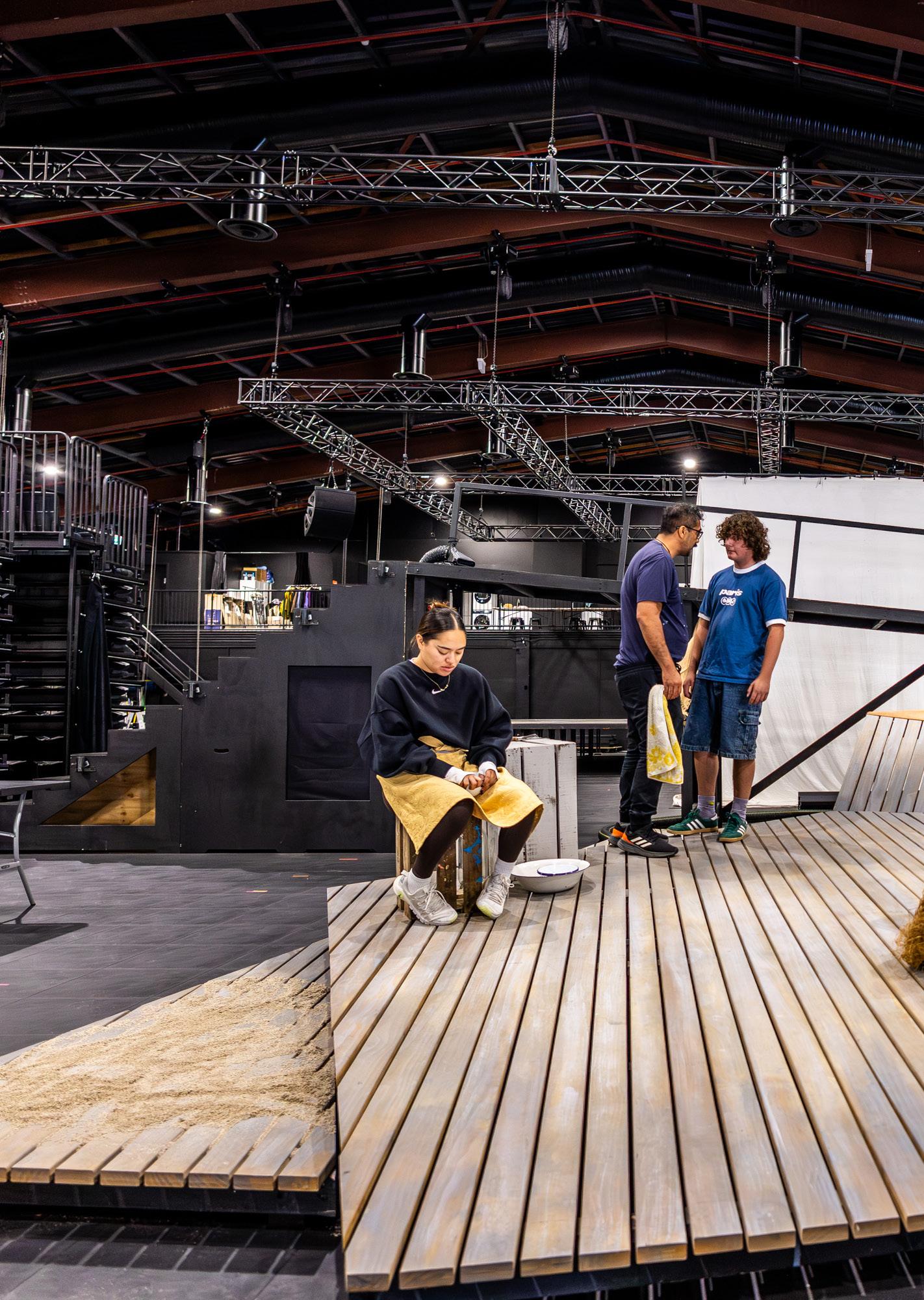
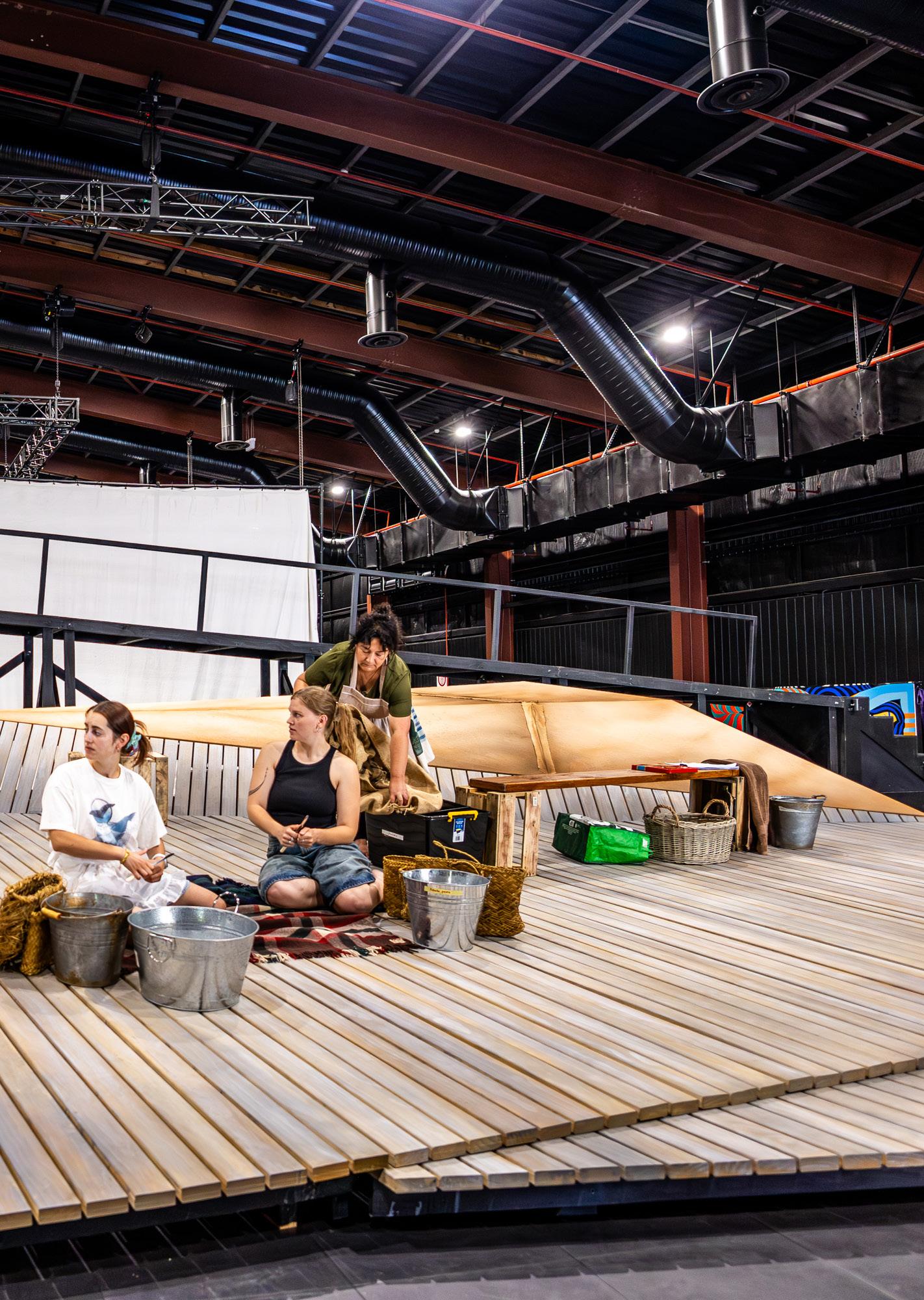
This section takes you behind the scenes with artefacts from the rehearsal room, key design concept insights, and notes to and from the cast, giving you a unique window into the creative process.
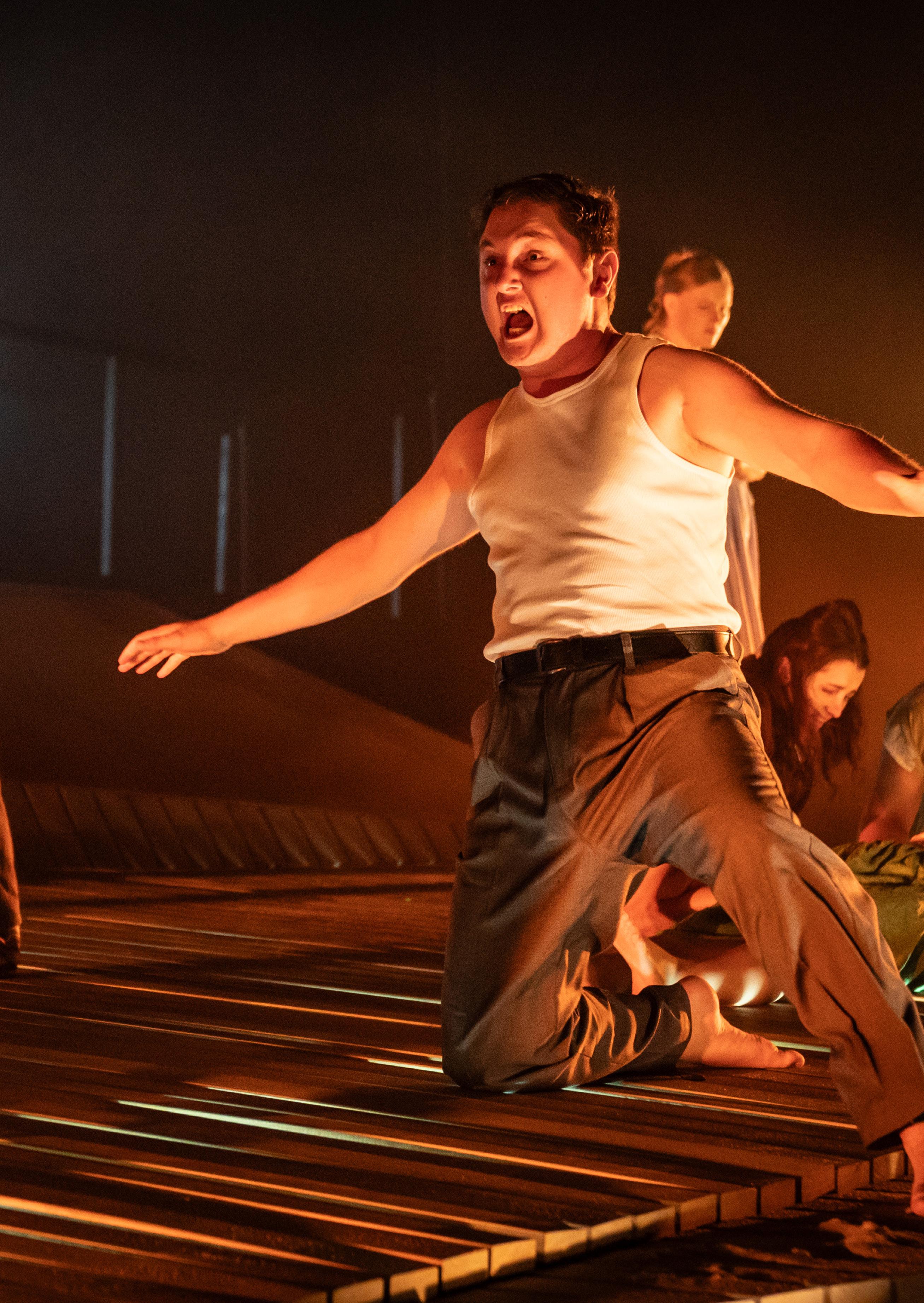
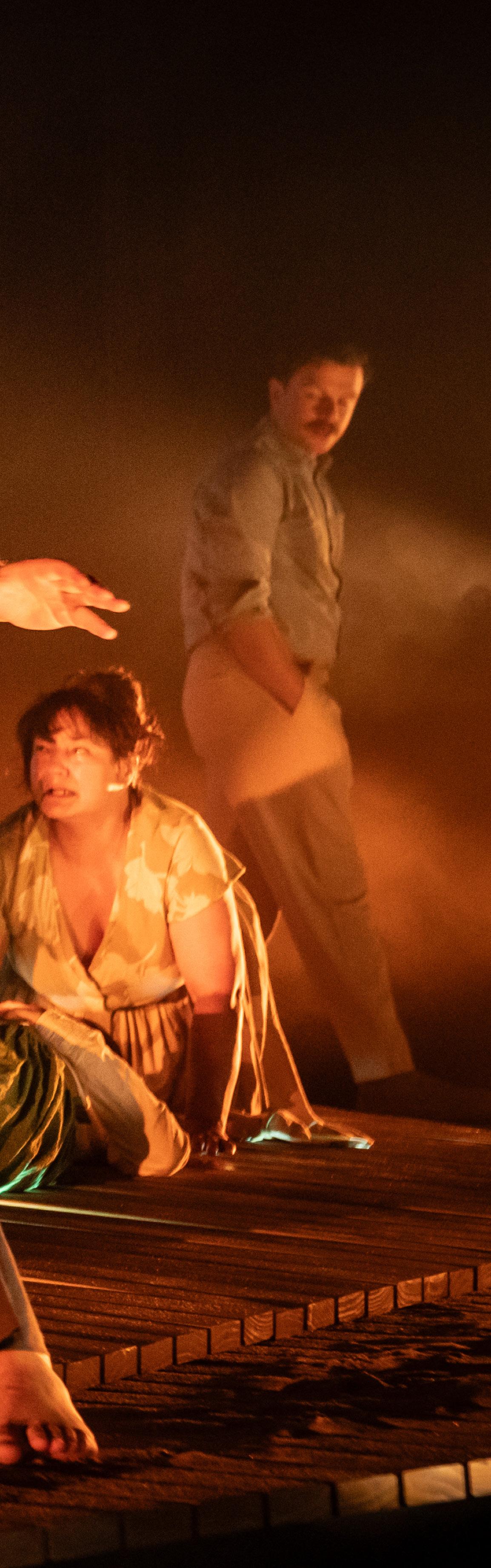
Hone Hurihanganui — Composer of Waiata & Haka
Ngāti Ranginui, Ngāi Te Rangi, Ngāti Pāhauwera and Wairarapa
Hone Hurihanganui composed the original waiata and haka for Waiora in 1996 and returns for this 2026 production to teach his compositions to the new cast. He is a fluent speaker of te reo with expert applied knowledge of tikanga, a singer, composer and playwright who was opera-trained from age fourteen. Outside his musical work, he spent nearly forty years in senior roles across education, health and human resource management, including Chief Executive positions at Rangitāne o Wairarapa Mandated Iwi Authority and Whaiora.
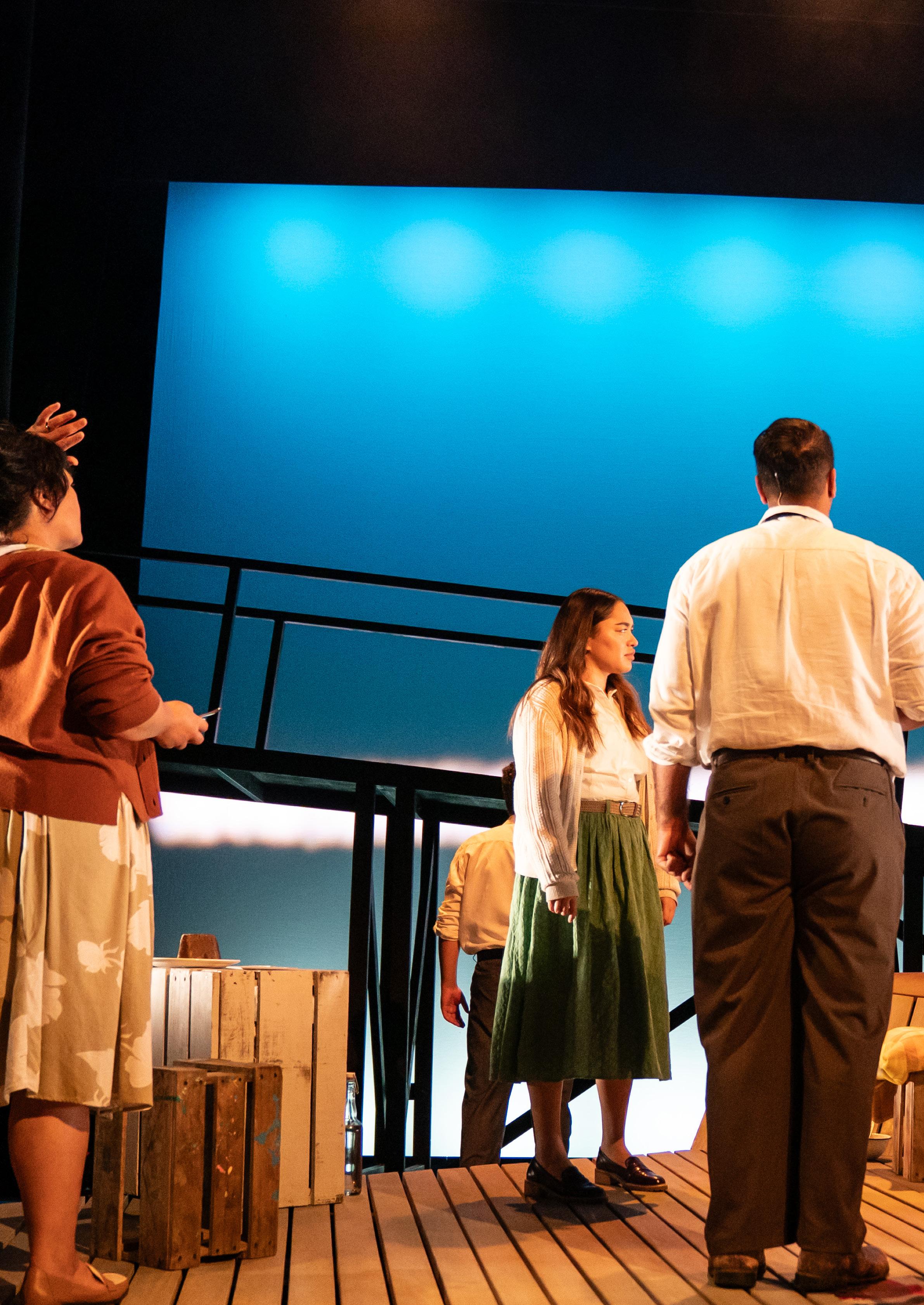
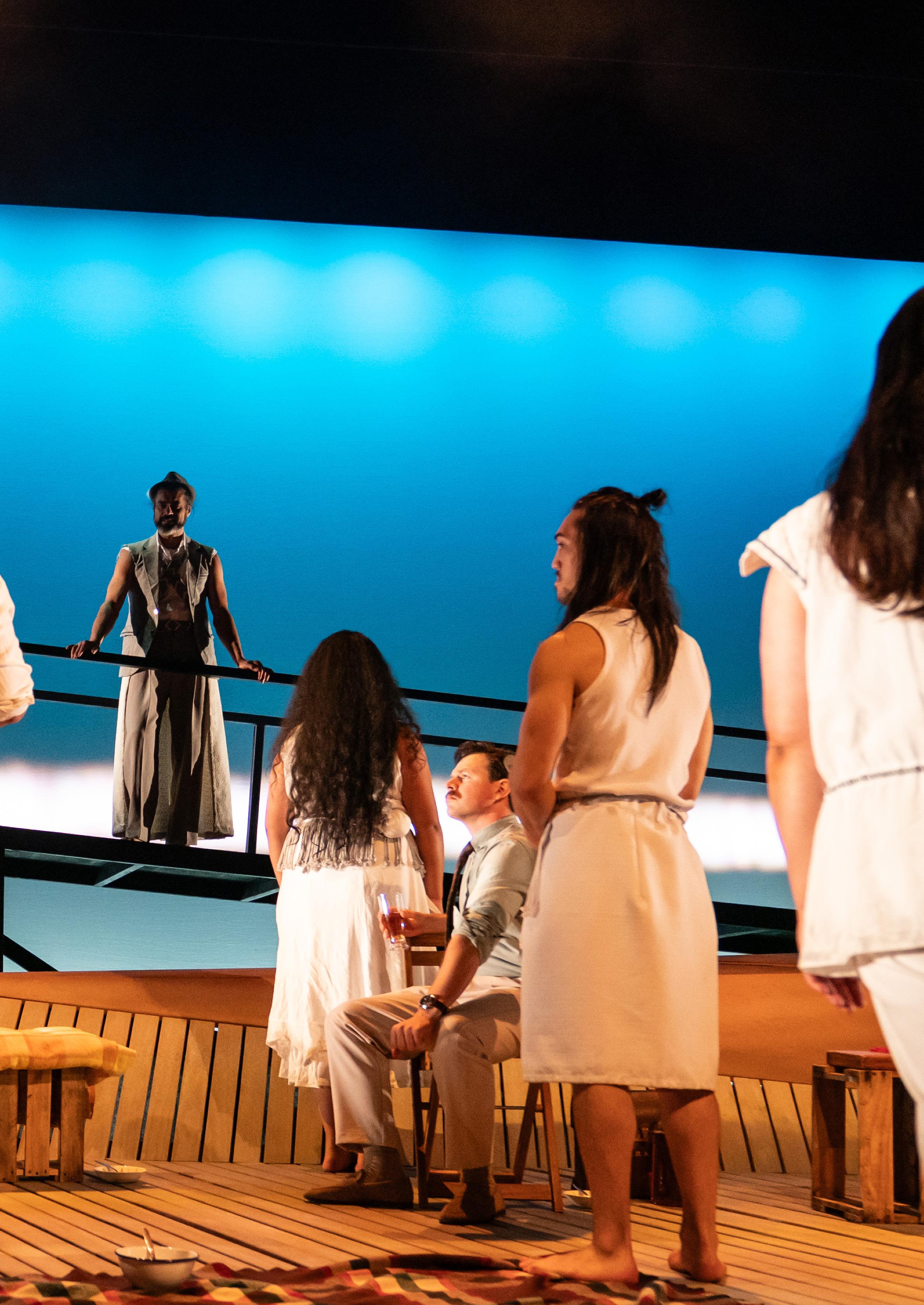
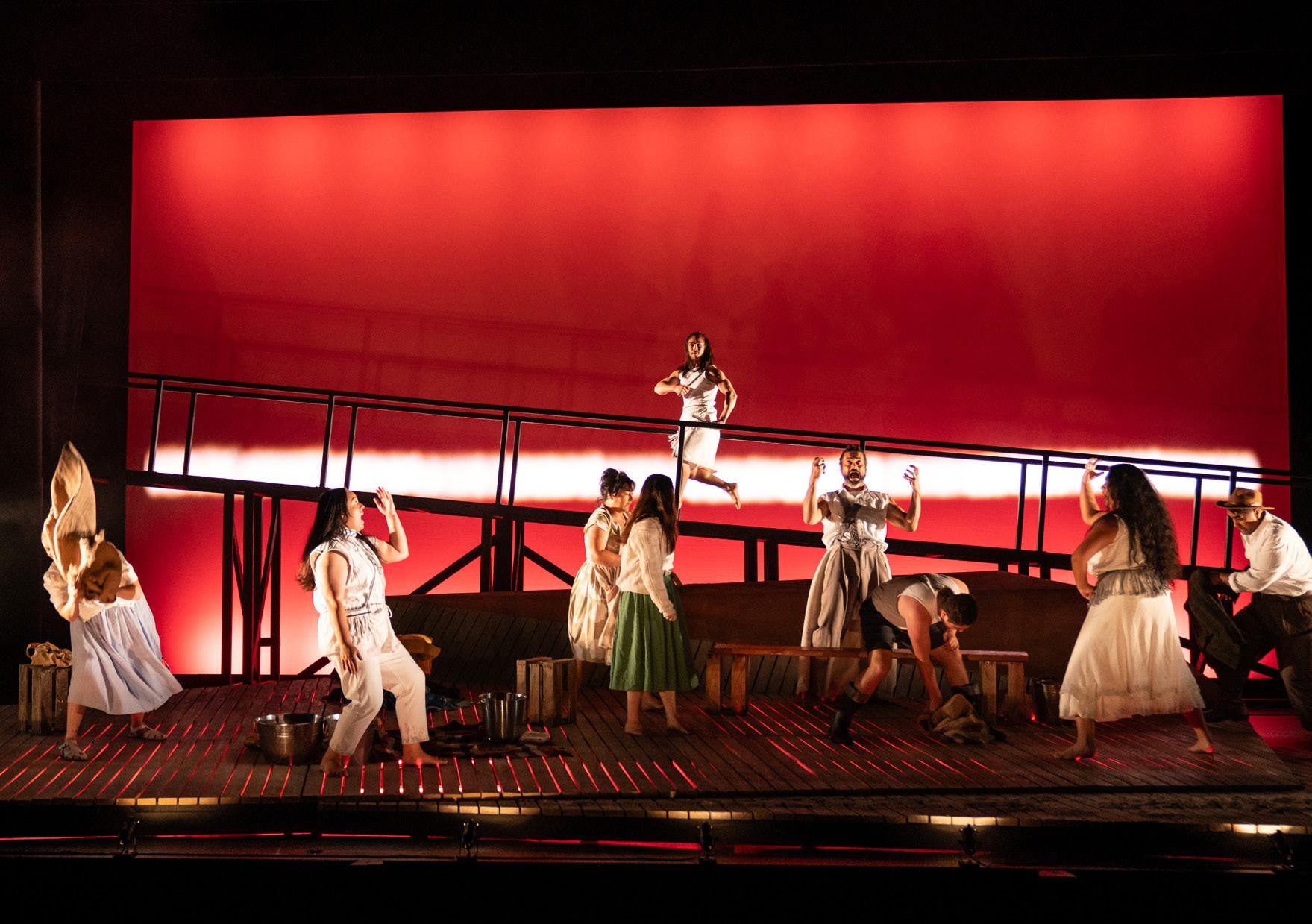
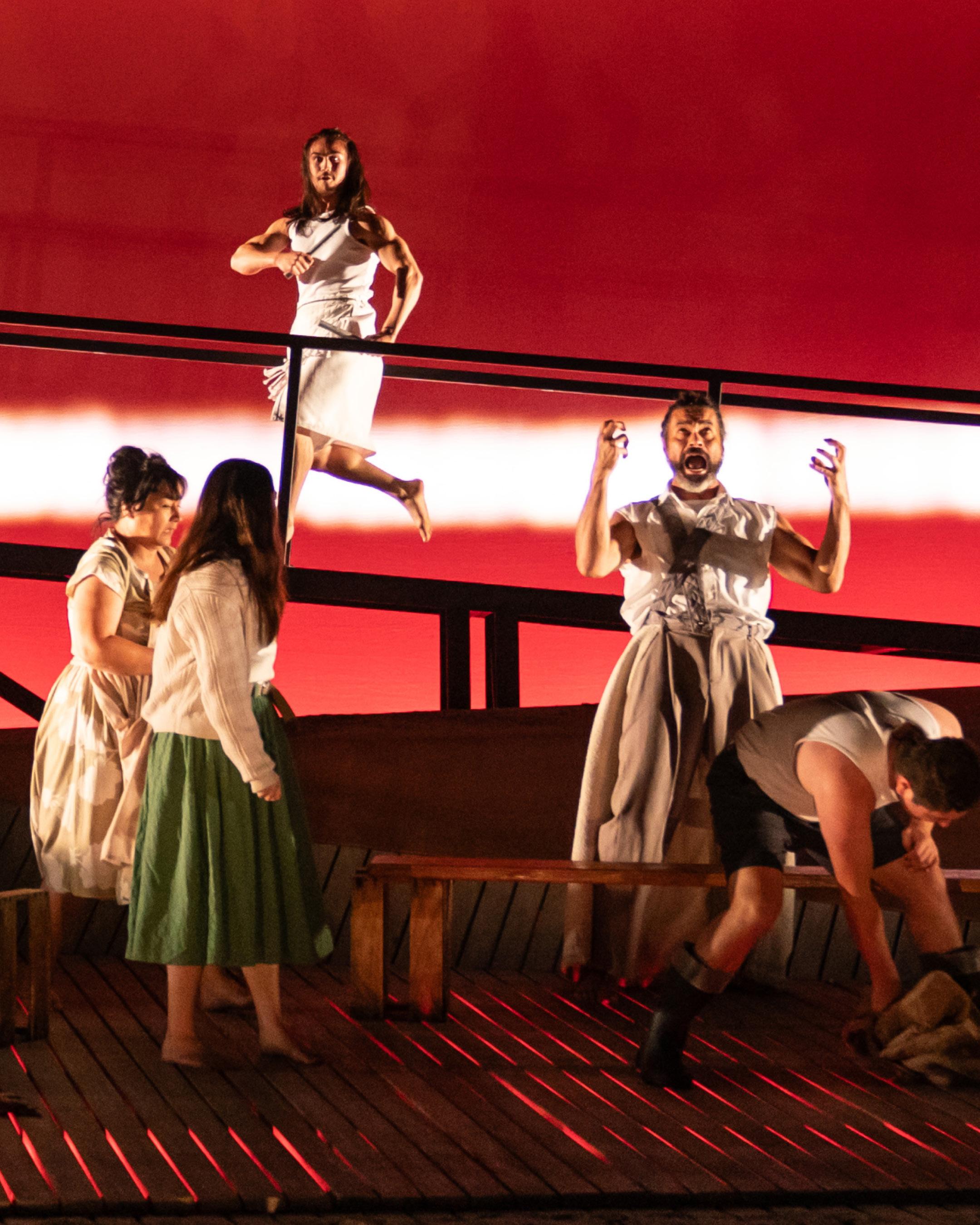
The set is situated on a beach near Christchurch in 1965. Downstage of the main playing area is the moana; the hāngī is located upstage. The Tīpuna occupy an elevated walkway at the rear — a structure McEntyre describes as referencing a jetty or pier — descending into the whānau’s space at key moments.
The starting point for the design was the specific quality of the north Canterbury coastline — the beaches just out from the main road, a mix of sand and rocky clay cliffs, the particular character of the light there. For McEntyre, who grew up familiar with that landscape, the visual reference was precise.
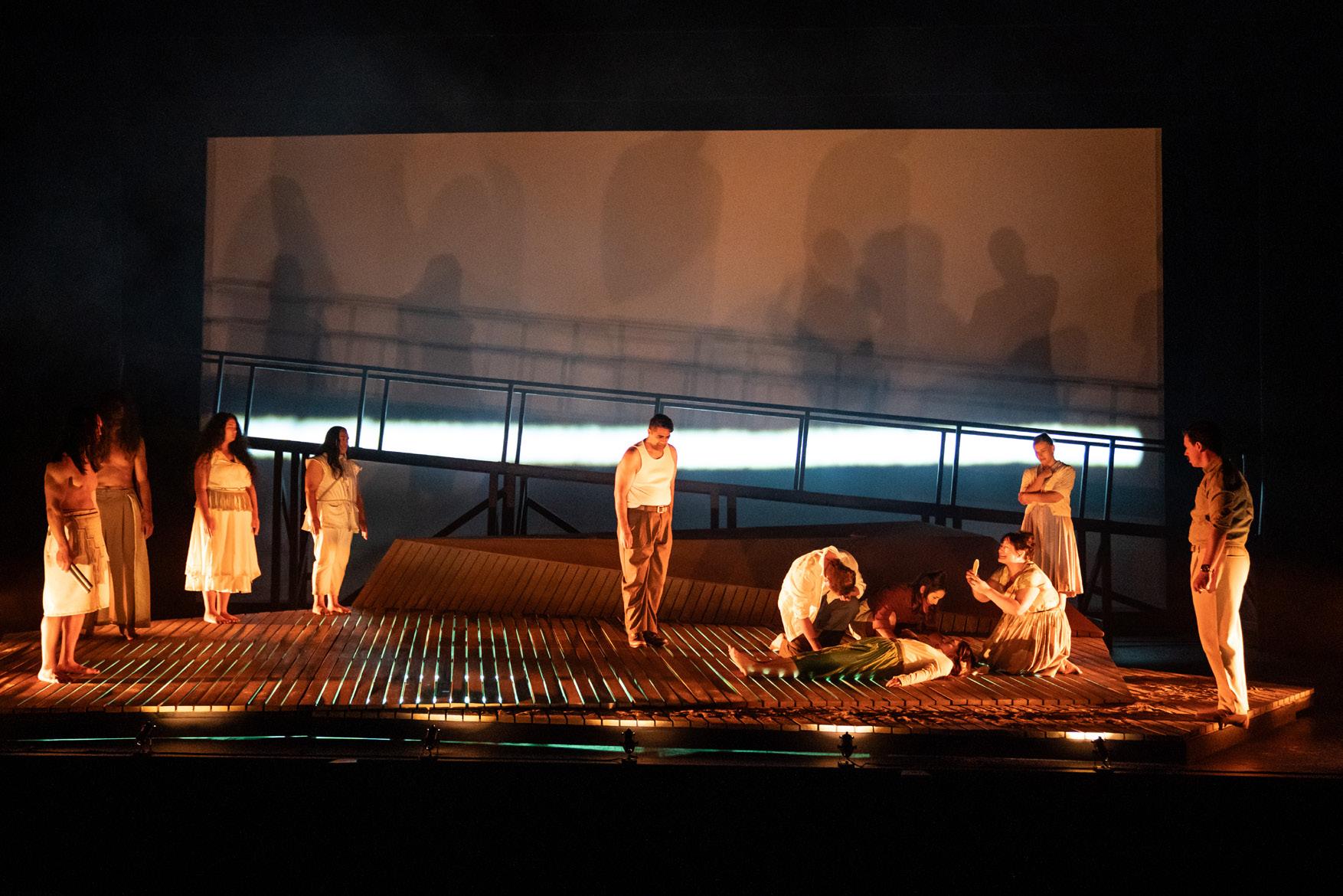
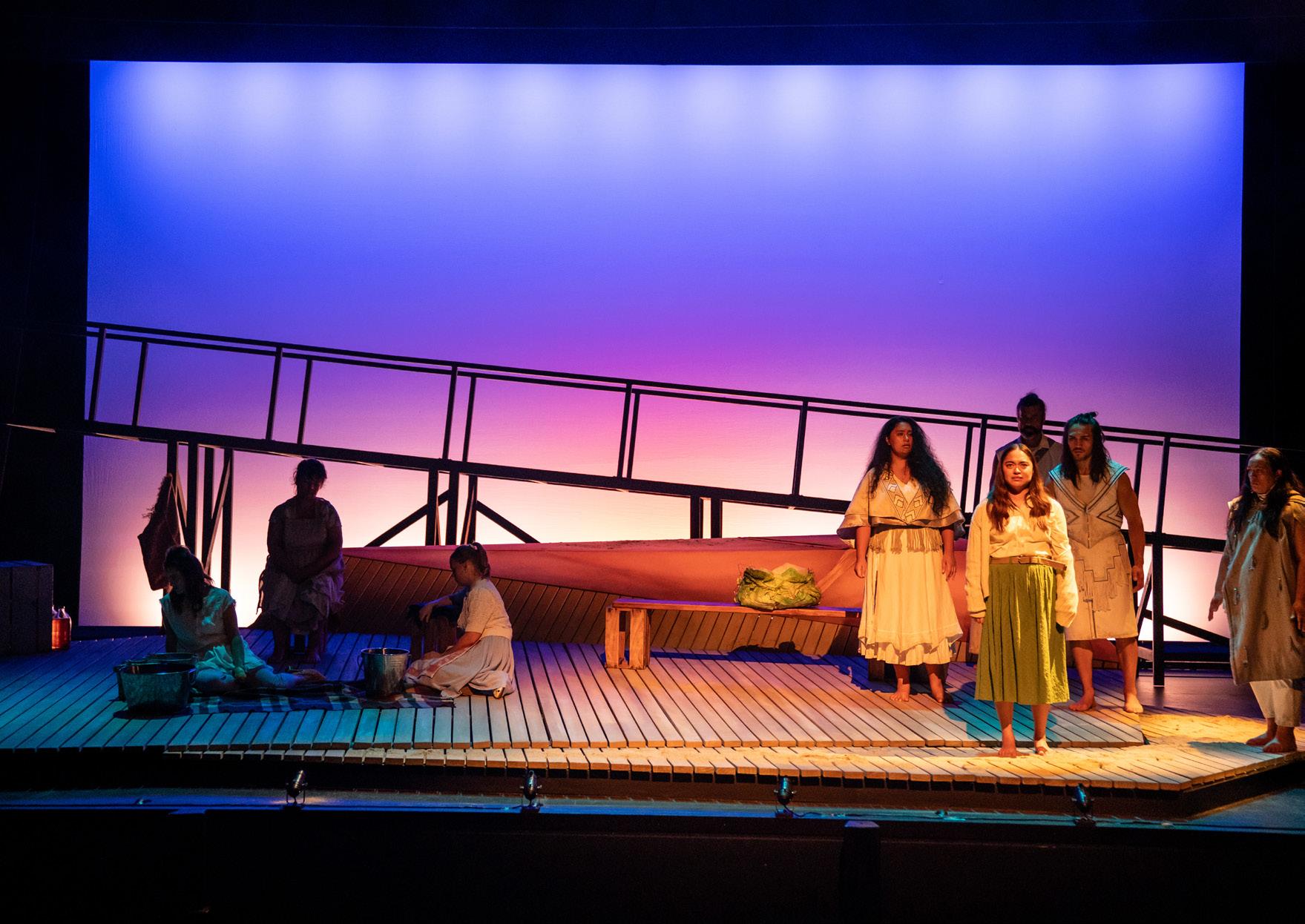
The design concept that emerged is not naturalism but what McEntyre calls a liminal space. "We didn’t want to feel like it was so grounded that we would be stuck in a space," he has said. Everything is light, floating — "like a series of rafts." The set is built from timber and stretched canvas, materials chosen for their presence and their associations: bleached canvas across rural rooftops and fences, the texture and warmth of weathered wood. The materiality is meant to be felt. Real sand runs through the floor of the playing area; the company worked through how to manage its spread backstage during rehearsals.
A significant change from the 2016 production: a wall that previously closed off the upstage area has been removed entirely. "As soon as we took it away with this production, it really made sense," McEntyre has said. Opening up the upstage space maximises the entrances and — crucially — allows side light to run underneath the floating platforms, making the floor itself glow. The design allows the physical and spiritual worlds to coexist without contradiction, while remaining grounded in a specific time and place.
The lighting collaboration with Natasha James has been central to realising the design. Both have spoken about thinking through the work of Colin McCahon and his response to the New Zealand landscape — his particular feeling for light as something weighty, almost spiritual, and his long engagement with land, language and belief. "We’ve been thinking about the light as an object," McEntyre has said — not illumination, but something with physical presence.
McCahon’s paintings — many of them made in or in response to the South Island landscape — frequently place te reo Māori inside vast, charged natural spaces. It is an apt reference point for a design trying to hold the physical and spiritual worlds in the same frame.
Mark McEntyre designed the set for the 2016 Court Theatre revival of Waiora and returns for this production. He has designed for The Court Theatre, Pacific Underground, Tawata Productions, the Aotearoa New Zealand International Festival of the Arts and Melbourne
International Arts Festival, among others. He has represented New Zealand at the Prague Quadrennial of Scenography and Theatre Architecture, and is Academic Manager of Performing Arts at Ara Te Pūkenga.
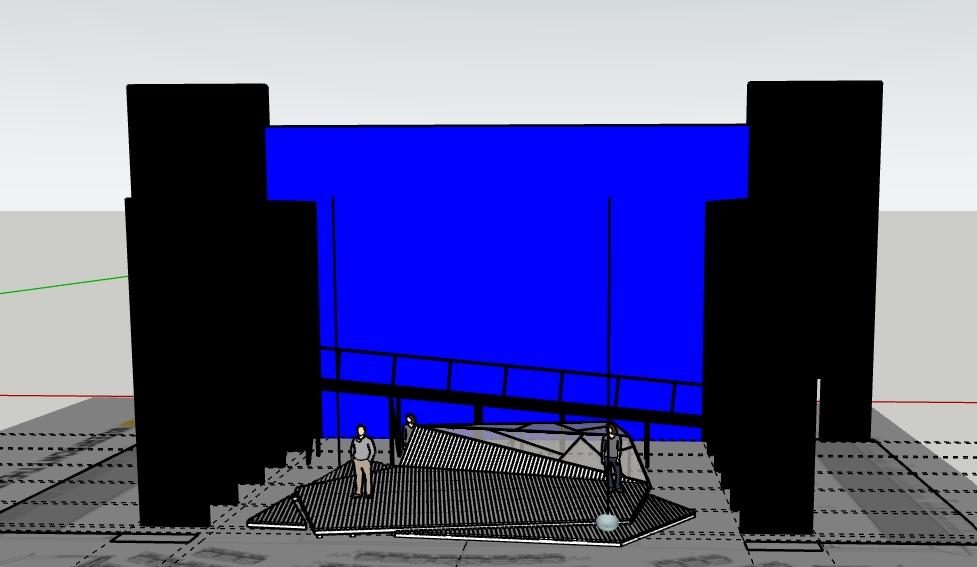
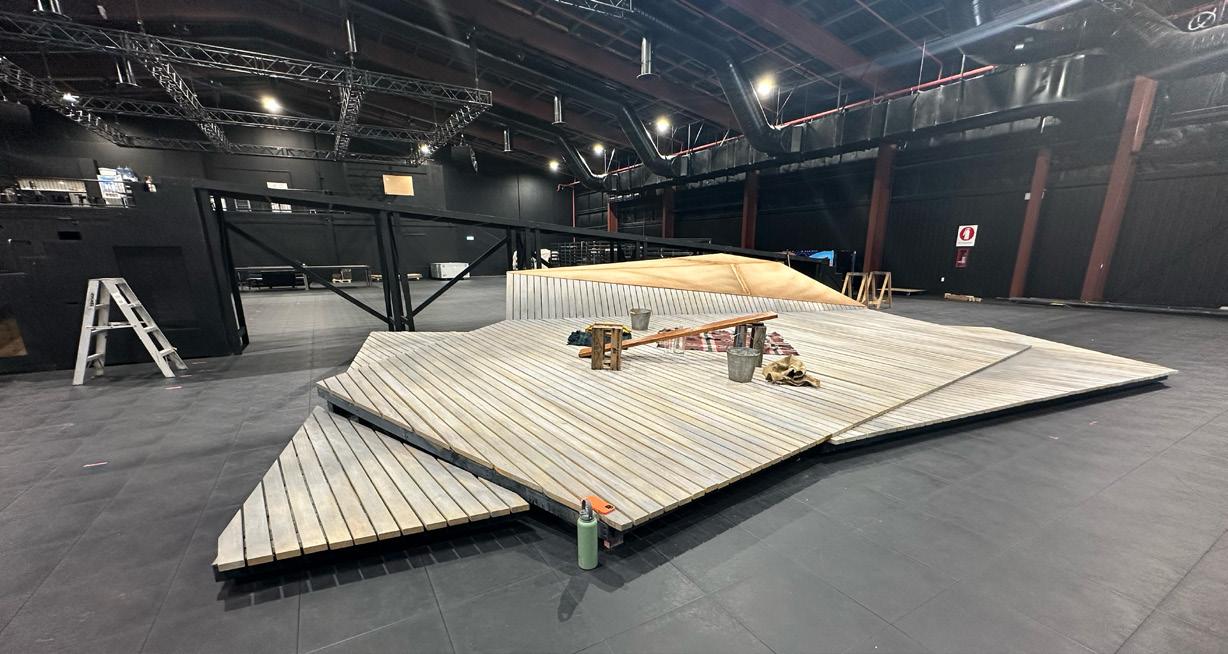
Lighting in Waiora carries the dual work of locating the action in a naturalistic 1965 Canterbury setting while distinguishing the physical and spiritual worlds. The design tracks the progression of the day from cool early morning through to warm evening. Strong side-lighting marks the Tīpuna’s raised platform, giving them a quality distinct from — and more charged than — the world of the living below.
A white cyclorama at the rear of the stage gives the production its Canterbury sky — the vast, flat plains producing a horizon line and a quality of light that James describes as "almost unsettling." The floor, illuminated from beneath through the gaps in the floating platforms, is designed to feel charged. "I think this floor is almost electric at times," James has said, "like there is a current running through it."
There is also a specific historical weight to the landscape being evoked. Since Hone Kouka wrote the play, the Canterbury land has literally shifted through the earthquakes of 2010 and 2011. James and McEntyre have spoken about wanting to acknowledge that — to hint, in the design, that the land itself is alive. It is a layer that did not exist in 1996, and it deepens what the set means.
Natasha James (Tangata Tiriti) grew up in Woodend, a small country town on the lands of Ngāi Tūāhuriri in north Canterbury — the very landscape in which Waiora is set. She trained at Toi Whakaari: New Zealand Drama School and is currently Production Manager for Tawata Productions and Production and Technical Director for Kia Mau Festival.
Maarire Brunning-Kouka composed nine atmospheric tracks for the production as well as the pre-show foyer music. The score was developed iteratively during rehearsals and also incorporates taonga pūoro. Hone Kouka sought a Pūtāratara for the score; a Pūkaea was located when the Pūtāratara could not be found.
"I’m going for happiness and light, which is not what I’m used to, so I’m challenging myself to be in my body and exist with people, instead of trying to hear the ghosts and the trees and the birds."
— Maarire Brunning-Kouka (MĀ), Sunday Star-Times, February 2026
Tūhoe, Ngāti Porou, Ngāti Kahungunu, Ngāti Raukawa
Maarire Brunning-Kouka is the daughter of playwright-director Hone Kouka and the late Nancy Brunning, who played Rongo in the original 1996 production. Maarire toured as a baby with the original Waiora company — she was six months old when the production went to Brighton Festival in the UK. Thirty years later, she returns as Sound Composer for the production her parents made.
Known professionally as MĀ, she is a Wellington-based musician working across abstract downtempo rap, DIY neo-soul and ambient music. In her own words, she was "raised by a tribe of artists." Her debut album Breakfast With Hades was an ode to grief, love, loss and release. Her 2025 album Blame It On The Weather is a set of stories from life in a time of rapid change.
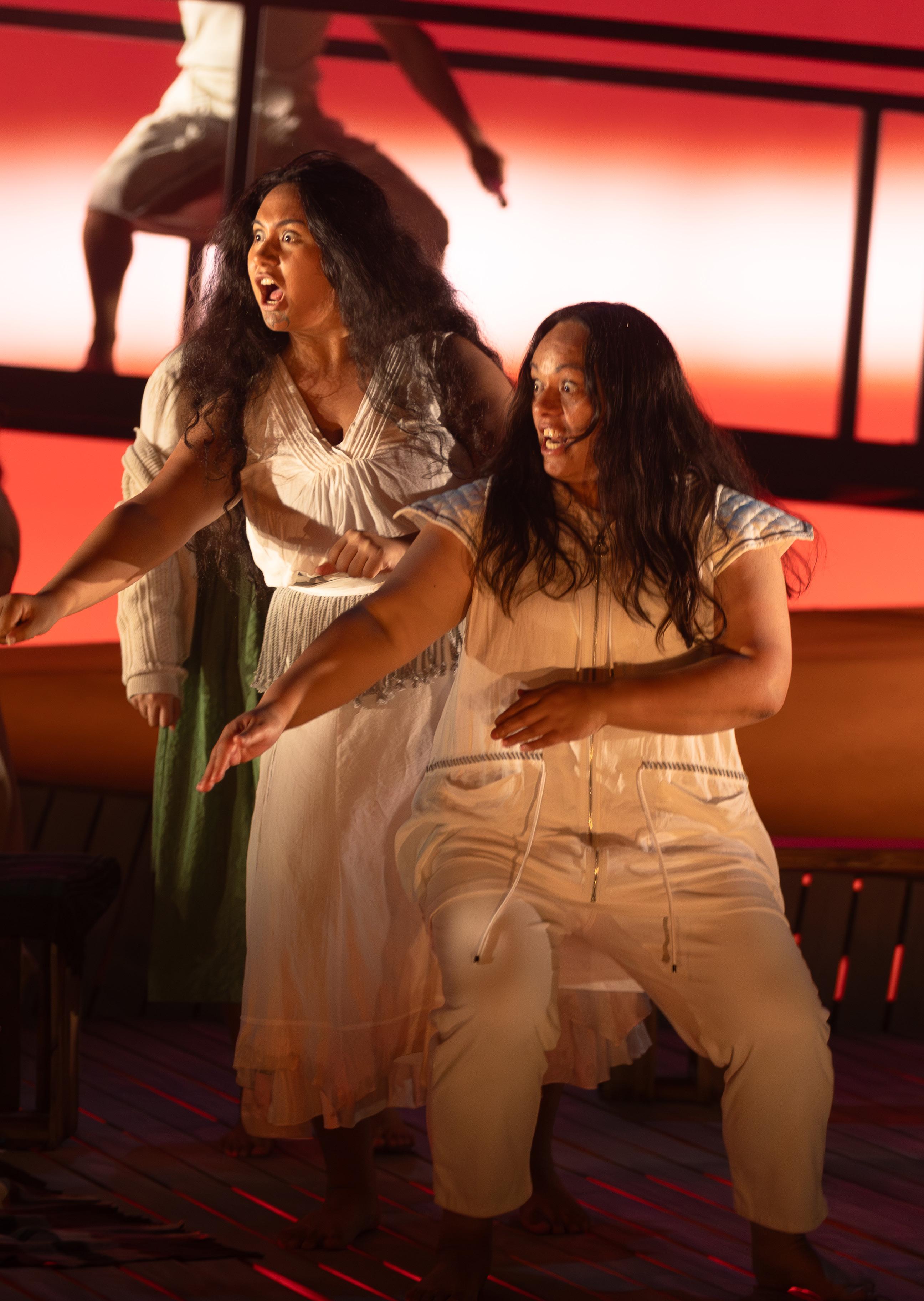
Costume in Waiora does not decorate the story — it tells it. The whānau begin the play in casual clothes and aprons, at ease in their own space on the beach. Before Steve Campbell arrives, they tidy themselves up: a potāe goes on, shoes are adjusted, Hone changes into a white shirt and tie. These small, deliberate acts of preparation carry enormous weight. The family is performing respectability for their Pākehā guest, and every costume adjustment is a negotiation between who they are and who they feel they need to appear to be.
Hone’s shirt tracks his arc across the entire evening. He puts it on for Steve; he tears it off when the promotion fails to materialise. The play ends with him in a singlet — stripped of the performance, left with only himself and his whānau. Wai’s shoes work similarly: she removes them on arrival, comfortable in her own space, and puts them back on when Steve arrives. The adjustment is small. What it communicates is not.
The Tīpuna wear no shoes throughout. Where the living characters negotiate the gap between their world and the Pākehā world around them through what they wear, the Tīpuna remain outside that negotiation entirely. Their bare feet place them in a different relationship to the ground — connected to it in a way the whānau, in their tidied-up clothes, cannot quite be. A significant object developed specifically for this 2026 production is the heru — the comb that Rongo receives as a birthday gift. The company decided it should be made for the production rather than sourced, for reasons of tapu and tikanga.
A matching heru was also created for one of the Tīpuna, with embellishments that unify it with the Tīpuna costume aesthetic. The heru moves between the worlds of the living and the ancestral, and its making was treated with the care that passage requires.
Ngāti Rangi, Te Āti Haunui-a-Pāpārangi, Ngāti Rongomaiwahine, Ngāti Pākehā
Cara Louise Waretini is an awardwinning costume designer with fifteen years of experience. She has worked extensively with Te Rākau Hua o Te Wao Tapu, Tawata Productions and Taki Rua Productions, with her work touring Aotearoa, Australia and Canada.
In 2021, she was awarded Te Tohu Iho Pūmanawa by Toi Aotearoa Creative New Zealand. In 2017, she won the Paul Jenden Award for Costume Designer of the Year for The Night Mechanics (Tawata Productions).
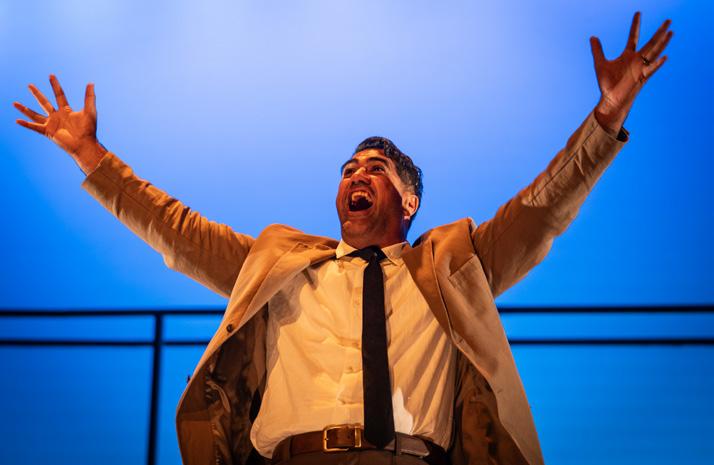
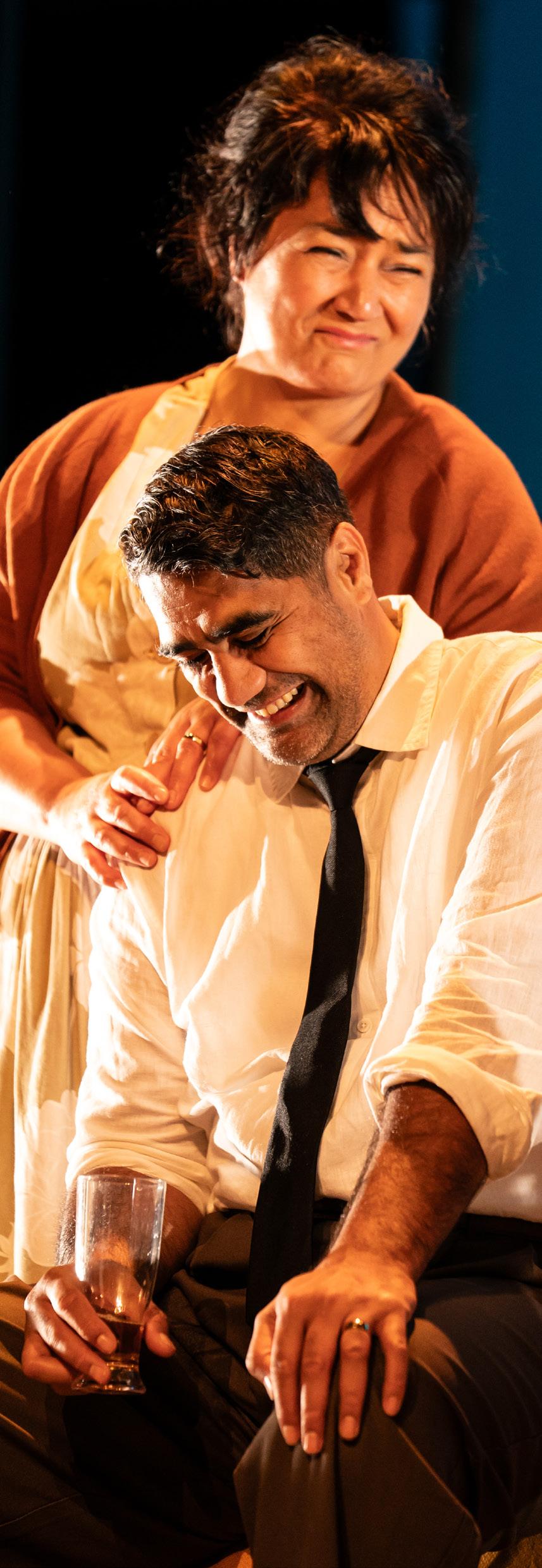
Hone is the father of the whānau, head of the household and deeply loving of his wife and children. He has always worked outdoors and has impressed at the sawmill that brought the family south. He moved his whānau from the East Coast not for himself, but for his children and the futures he believes are possible for them if he can get the right foothold.
His ambition has a specific shape: a promotion. His boss Steve Campbell is coming to Rongo’s birthday hāngī, and Hone believes the offer is coming. The preparations — the food, the welcome, the performance of a good family in a good home — are partly for Rongo’s birthday and partly for Steve. What Hone cannot see clearly is the cost of
this accommodation, and what it is asking of his family.
Costume tells the story of Hone’s inner life across the evening. He begins the play in a relaxed shirt; before Steve arrives, he changes into a white shirt and tie. When the news of the promotion finally comes, he tears the shirt and tie off. The play ends with him in a singlet — stripped of the performance, left with only himself and his family.
Hone Kouka has written that the central question behind the character was: how far would a father go for his children? His answer, built into the play’s climax: all the way to the underworld and back.
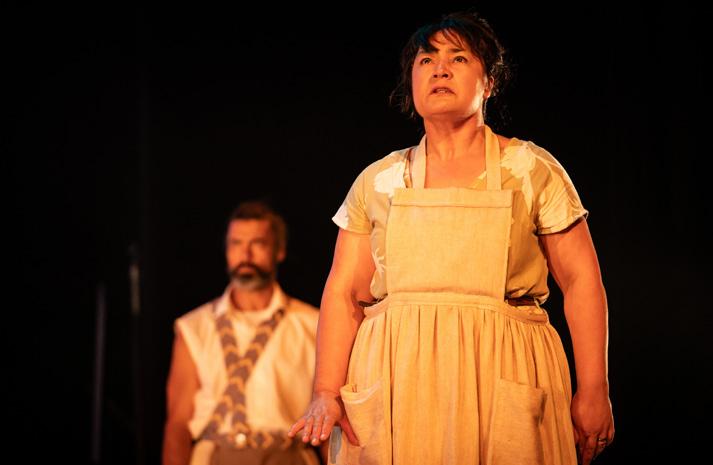
PLAYED BY ERINA DANIELS
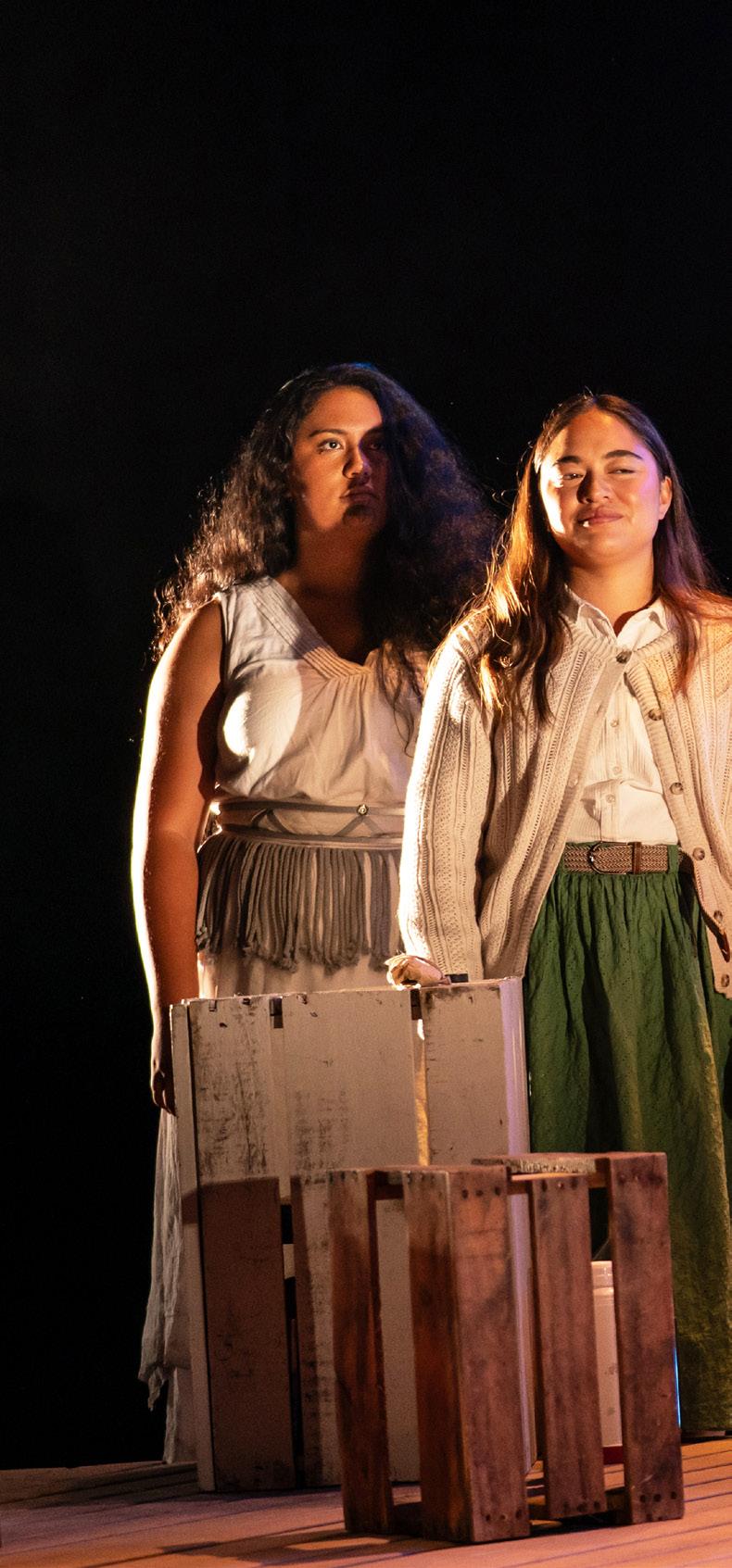
Wai is Hone’s wife and the mother of the whānau. She loves Hone and understands why he made the move south — she holds the family together with a steady, watchful care. She sees her children’s different needs and desires clearly, and does her best to meet all of them.
She is smartly dressed for the occasion. Like Hone’s shirt, Wai’s shoes do quiet dramaturgical work in the play: she
takes them off on arriving at the beach, comfortable in her own space, but puts them back on when Steve Campbell arrives. The adjustment is small. What it communicates is not.
The play is named partly for her — Wai is both a character and a word, meaning water. It is also the name of Hone Kouka’s mother, Wai Te Atatu Kouka, who passed away in 2015. The character carries that whakapapa.
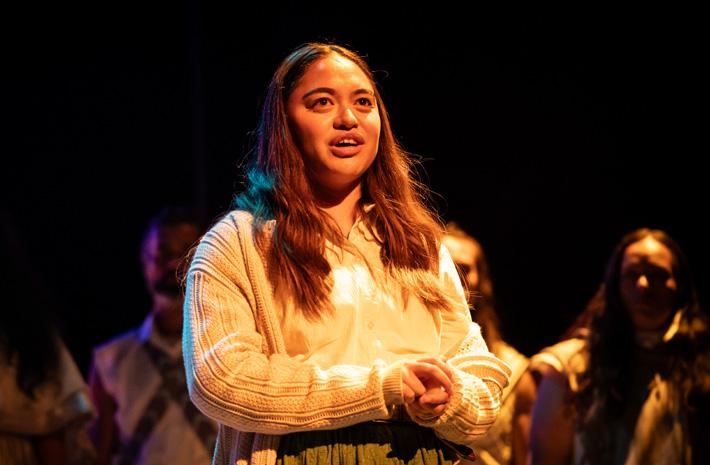
PLAYED BY TIOREORE NGATAIMELBOURNE
The play circles around Rongo. It is her eighteenth birthday. It is also the day the Tīpuna have chosen, because she is the one they can reach.
Rongo deeply misses home and her extended family. She has a beautiful voice but has not sung for anyone since the family left the East Coast. She is the first to see the Tīpuna; they are drawn to her and she to them. Where the rest of the family are managing the gap between who they are and where they are — performing, adjusting, accommodating — Rongo cannot perform. She is still fully connected to the world she left, and that connection is pulling her back towards it.
Nancy Brunning, who created the role in 1996 and toured it for four years, wrote of playing her: "I played the
character Rongo, a young sapling, severed from her roots in Waiora and planted in unfamiliar soil in Christchurch. An urban Māori story that so many of my people experienced." Tioreore Ngatai-Melbourne, who plays Rongo in this 2026 production, grew up in Te Araroa on the East Coast, attending Te Kōhanga Reo and Te Kura Kaupapa Māori, with te reo as her first language. She has spoken about the moment she moved to Wellington for drama school: "My whole life, I’d been surrounded by te ao Māori. Honestly, I didn’t know that not all Māori speak Māori. Rongo says a similar thing in Waiora." When Hone Kouka first approached her for the role, she hesitated — she thought of herself primarily as a screen actress. She decided she was ready for it.
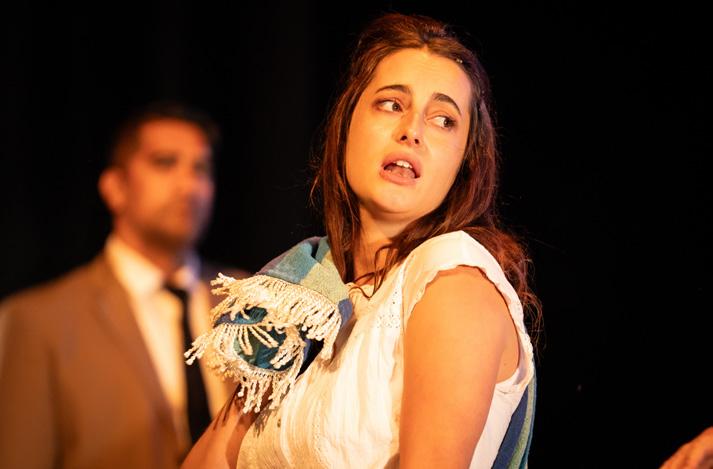
PLAYED BY RONGOPAI
TICKELL
The eldest daughter, Amiria is the family member most at ease with the life they have built in the South Island. She has embraced the move, is engaged with popular culture, and is less connected to her Māori identity than her siblings. She loves the family but experiences their cultural world from a different angle — she is the one for whom the distance from home has become something like freedom. Her position in the play is partly about the choices available to a young Māori woman in 1965, and partly about the ordinary reality that families do not respond to displacement uniformly. Amiria’s adaptation is not a betrayal; it is simply a different survival.
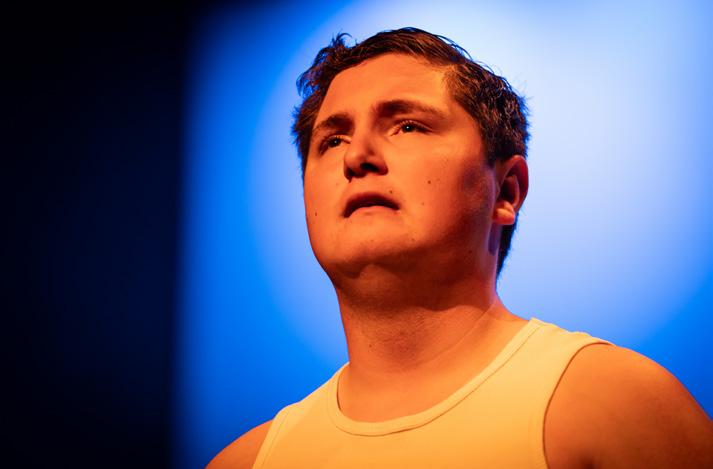
PLAYED BY TE MIHI POTAE
Boyboy is the youngest member of the family — sixteen years old, adopted by Hone and Wai. He is caught between needing guidance and having his own strong opinions. He craves responsibility and recognition. He moves through the play with a quickness — in thought and in body — that distinguishes him from the older characters.
The script gives him his own vernacular: "wanna" and "gotta" rather than "want to" and "have to." These are clues to his youth, his energy, his particular way of being in the world. In this 2026 production, one of the Tīpuna — Mathieu Boynton-Rata’s character, from a future century where te reo Māori has been diminished to a commodity — has come back specifically to encourage Boyboy to speak te reo Māori. The stakes of Boyboy’s choices extend, in the world of the play, far beyond 1965.
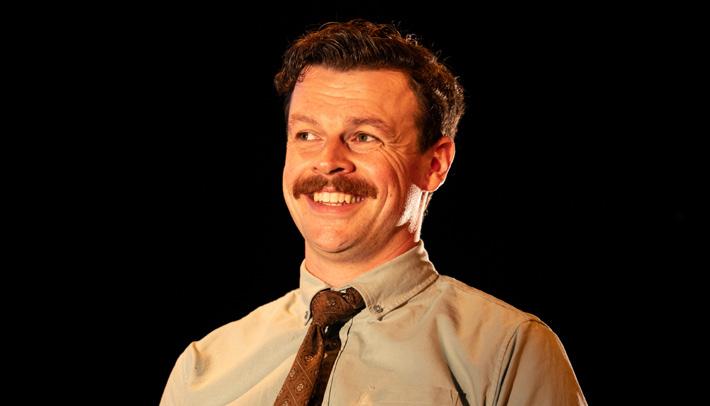
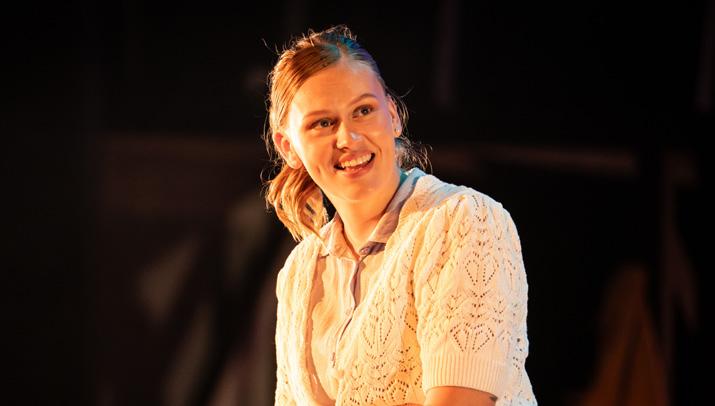
STEVE CAMPBELL
PLAYED BY BEN ASHBY
Steve is Hone’s boss at the sawmill. He can see that Hone is an exceptional worker. What he cannot do — or will not do — is promote him. He doesn’t believe the other workers would accept a Māori foreman. His racism is not the overt, declared kind; it is the kind that presents itself as pragmatism, as an understanding of how things work.
Theatreview reviewer Hariata Moriarty wrote of this production: "The racism portrayed by Hone’s boss, Steve Campbell, makes my skin crawl." Hone Kouka has spoken about how the racism in the play has evolved in resonance across thirty years: "Some of the racism in the play is overt and very much of that time. Unfortunately now due to the political climate everywhere it has become more overt again."
Steve brings flagons of beer. He is generous, in his way. He means no harm, in his own understanding. That is precisely the point.
PLAYED BY MYCAH KEALL
Louise is Boyboy’s teacher and a friend to the family — perhaps their closest Pākehā connection in their new community. She feels genuinely drawn to the whānau, and there is real warmth in her relationship with Wai. She is also a newcomer to Canterbury, which partly explains the bond.
But Louise’s connection to the family is complicated by the nature of her position in it. The saviourism Hariata Moriarty identified in her review — "layered in politeness and progressiveness, but still rooted in control and assumption" — is not malicious. It is the harder thing to name: well-meaning but unconscious. When Steve Campbell arrives, Louise’s position in the room shifts. She is recategorised, and so is her relationship with the family.
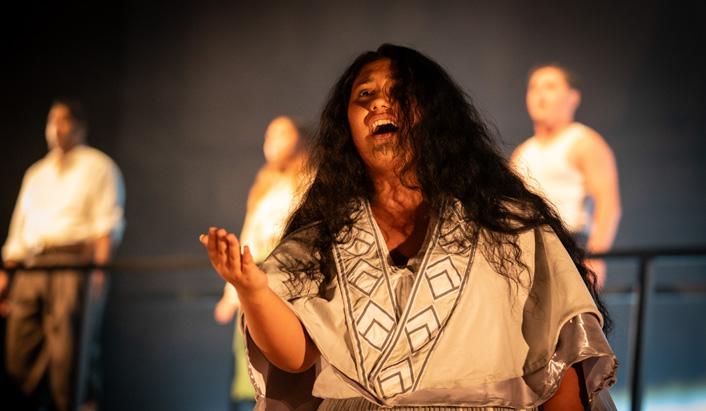
ANATONIO TE MAIOHA, AWERANGI THOMPSON, MATHIEU BOYNTON-RATA, HUIA RAWIRI
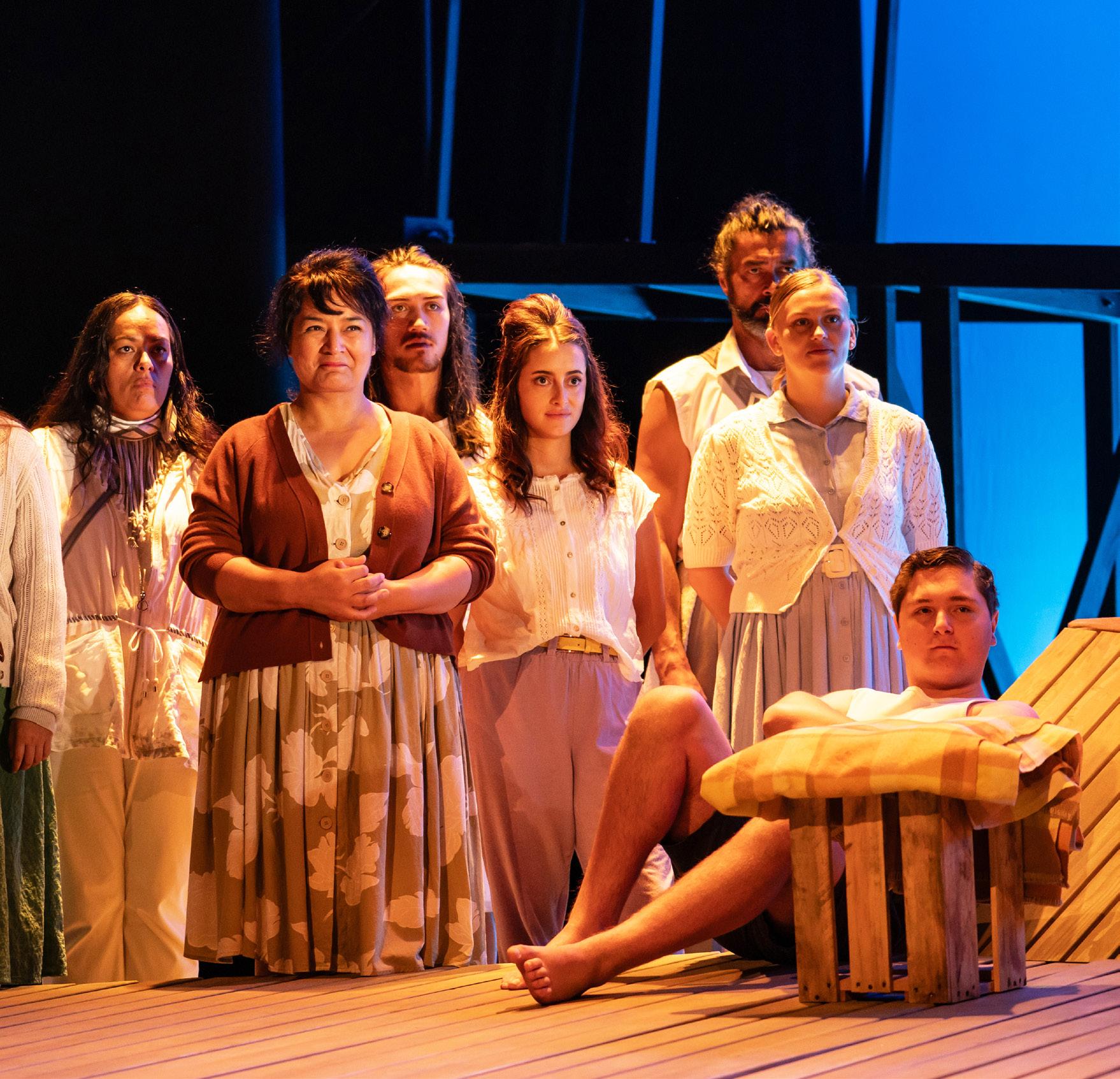
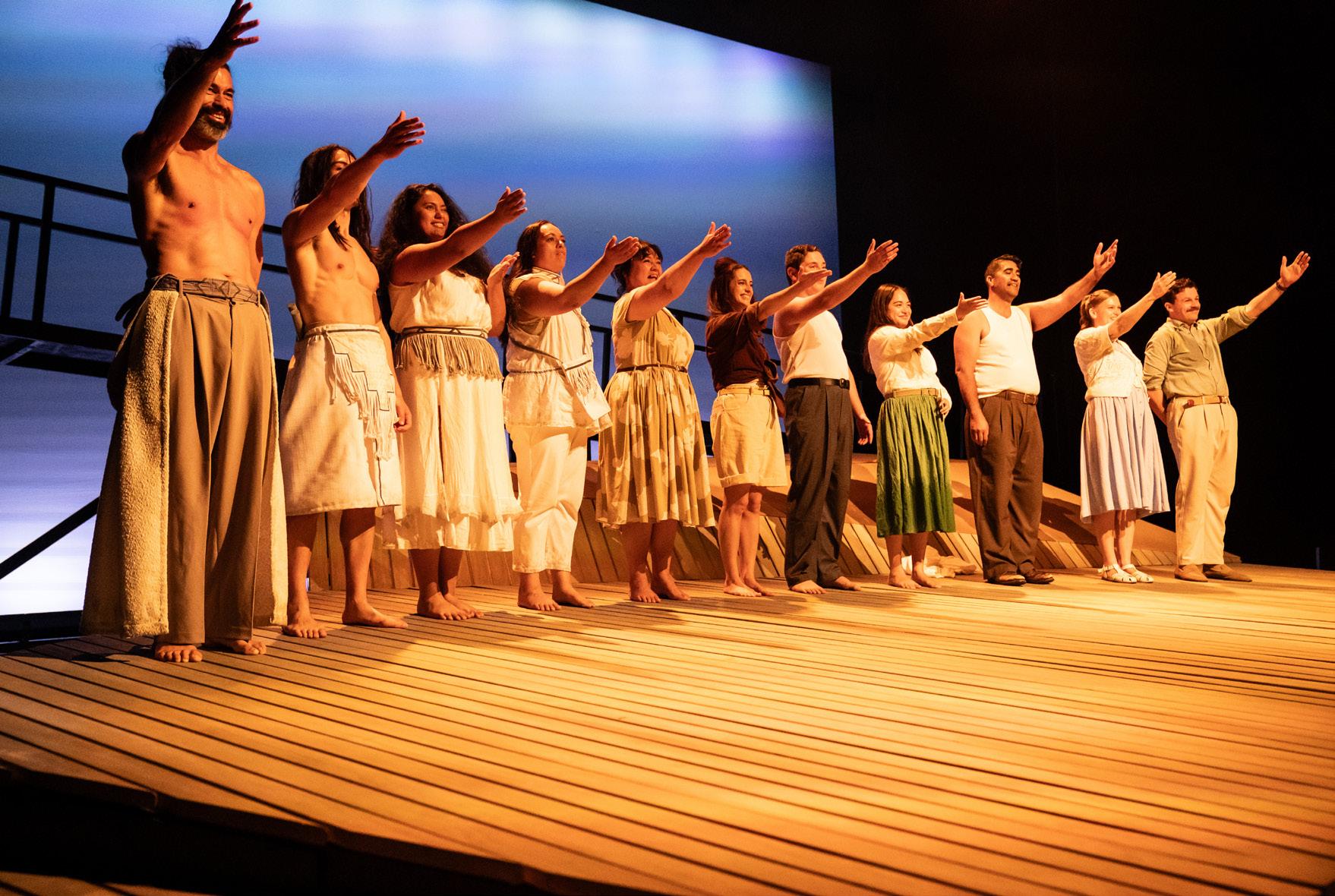
The Tīpuna are the ancestors of the whānau, and they have travelled south with the family from Waiora. They occupy a raised platform at the rear of the stage; they can see the family, but the family — with the exception of Rongo — cannot see them. They shadow the living, echo their movements, build the tension in scenes without intervening in them directly.
Their world was developed with great specificity during the 2026 rehearsal process. Each Tīpuna is connected to an element and to a specific whānau member: Anatonio Te Maioha’s Tīpuna to sand and Hone; Awerangi Thompson’s to water and Rongo; Huia Rawiri’s to wind and Amiria; Mathieu Boynton-Rata’s to lightning and Boyboy. Huia and Mathieu’s Tīpuna are understood as mokopuna of the future rather than the past — one a young, hopeful wāhine Māori; the other from
the twenty-second or twenty-third century, from a time when Māoritanga has become a commodity and te reo Māori is scarce. He has come back looking for a second chance.
The Tīpuna have not arrived with a plan to take Rongo from her family. Their intentions are to save her, to bring her with them. But each arrival comes with consequences.
One of the Tīpuna crosses into the family’s physical world, testing their manaakitanga — and they pass. Jared Hiakita, who played a Tīpuna in the 2016 production, described the function of that moment: "The Tipuna joins them to challenge and test their manaakitanga — they pass, they take good care of him."
Anatonio Te Maioha is the only cast member returning from the 1996 original, reprising his role as Tīpuna thirty years on. He has noted that returning to the text and waiata rekindled palpable memories of the Waiora whānau who have since passed — and that he is energised by the new cast and their reo.
Tīpuna / Tipuna — Ancestors. In the play, the Tīpuna are active presences who watch over and intervene in the whānau’s story.
Ūkaipō — Literally, the place where one feeds at night: the source of nourishment, the homeland, the place of deepest belonging.
Whakapapa — Genealogy and the layering of relationships across time, connecting all living things to their origins and to one another.
Te Ao Wairua — The spiritual world.
Te Ao Kikokiko — The physical world. In Waiora, the two worlds are not separate — they exist alongside each other.
Waiata — Song. The waiata in Waiora carry cultural memory and emotional truth that spoken language alone cannot hold.
Haka — A performed composition involving movement, posture, language and breath. The haka at the climax of the play is an act of love and an assertion of identity.
Manaakitanga — The practice of hospitality, generosity and care. A Tīpuna tests the whānau’s manaakitanga in one key scene.
Tikanga — Correct or appropriate behaviour, guided by Māori custom and values.
Tapu — Sacred; restricted. Certain objects carry tapu which must be respected — hence the heru in this production being made rather than sourced.
Taonga pūoro — Traditional Māori musical instruments. Used in the sound score for this production.
Heru — A comb; a significant cultural object. A heru made specifically for this production is given to Rongo as a gift.
Urban drift — The historical movement of Māori from rural communities to cities and towns, accelerating from the 1940s. By 1966, for the first time, more Māori were living in urban than rural areas.
Tohu — Sign; omen; symbol.
Kōrero — Conversation; discussion; story.
Rourou — Woven food baskets. Wai / Sue uses rourou for kai baskets in the play.
The following articles, interviews and reviews offer further context for Waiora Te Ūkaipō – The Homeland and its 2026 production. They are recommended reading for kaiako and ākonga preparing for study or revision.
’Immigrants in our own country’: Hone Kouka on the 30-year legacy of Waiora Te Ūkaipō The Spinoff, February 2026
Hone Kouka on the return of his whānau-inspired classic, a generation on NZ Listener / NZ Herald, February 2026
Rotorua’s Hone Kouka revives landmark play Waiora Te Ūkaipō – The Homeland Rotorua Daily Post, March 2026
Rising star Tioreore Ngatai-Melbourne set to shine in Waiora NZ Herald Canvas, February 2026
Q&A: Tioreore Ngatai-Melbourne AA Directions, December 2025
From Rotorua stage to Waiora Te Ūkaipō: Te Mihi Potae’s Boyboy breakthrough Rotorua Daily Post, March 2026
Famous 1990s play Waiora set to reopen — Hone Hurihanganui with Julian Wilcox RNZ Māpuna, February 2026
MĀ — ’Natural Observer’: How whenua and whānau shape MĀ’s sound Sunday Star-Times / Sunday Magazine, 15 February 2026 [Print only — no public URL available]
Waiora Te Ūkaipō – The Homeland: ’Sits in conversation with the past, present and the future’ Theatreview, February/ March 2026
Review: Moving play tells universal story of family and belonging (2016 Court Theatre revival) Stuff / The Press, August 2016
This section is specifically designed to help you unpack the show and utilise the information in this pack in the classroom with your kaiako/teacher. Each section references information in the pack and is structured in the following way:
• Pre-reading/Unpacking: A literacy based activity to analyse the material in this pack
• In the Classroom: Brainstorming, prompt and practical activities to provoke discussion and help you explore the education material provided
• Revise: Questions for you to complete individually in preparation for your Live Performance Exam in November. These questions have been specifically developed from the 2026 Exam Specifications provided via the following links:
• Level One Assessment Specifications
• Level Two Assessment Specifications
• Level Three Assessment Specifications
“I am standing in the water so I can touch home” – Hone Kouka
For this section of the education pack you will need to reference pages 7, 14 - 15, 16 - 17 and the media items linked below.
When you are revising for your live performance exam, you will want to unpack what you think the Director, and in this case the Playwright, intended to communicate through his choices. In the case of Waiora Te Ūkaipō and its legacy as a seminal piece of Theatre Aotearoa it is important to consider the show’s whakapapa and its current cultural, social and political relevance. These activities will help you brainstorm and collate your ideas, as well as providing evidence or quotes to support your explanations and discussions around the exam questions.
Use this information to inform the “In The Classroom“ activities.
Dividing into groups, complete the reading below and brainstorm the important ideas that jump out to you:
• In small groups read Note from the Producers (pg 7), Playwright and Director (Pg 14/15), Production
History (Pg 16/17), this short interview clip Interview with Hone Kouka, Waiora Te Ūkaipō – The Homeland and this article from The Spinoff: ’Immigrants in our own country’: Hone Kouka on the 30-year legacy of Waiora Te Ūkaipō | The Spinoff
• Highlight ideas that interest you
• Circle quotes you think would enrich an answer in an exam
• Underline and annotate ideas that link to a specific moment in the performance.
• If you recorded the post show forum, find excerpts where cast and company answered questions:
• Write down ideas that interest you
• Record quotes you think would enrich an answer in a your report or exam
• Record moments in the forum that surprised you or provided more context for something you saw on stage.
• Listen to Hone Hurihanganui, who composed the original waiata and haka, talking to Julian Wilcox on Radio New Zealand: Famous 1990s play, Waiora, set to re-open | RNZ
• Write down ideas that interest you
• Record quotes you think would enrich an answer in an exam
• Record moments in the interview that surprised you or provided more context for something you saw on stage.
Waiora Te Ūkaipō – The Homeland’s thematic staying power: (Divide into four groups)
Understanding the historical context that Hone Kouka drew from when writing Waiora Te Ūkaipō – The Homeland, as well as its current political and social relevance will enrich how you discuss the show as a class and also how you write about it for assessment purposes. This activity will allow you to connect these ideas to the performance you saw on stage, with specific examples.
Use the information you have collated in the Pre-reading and Listening activity, as well as the content in the “In The Press” section on page 37. As a class, write up direct quotes from Kouka or Hurihanganui that indicate how the play is historically relevant and also reflects our current political or social landscape in Aotearoa NZ. Split into smaller groups and choose one of the ideas or quotes you have identified as a class. Complete the following:
• Brainstorm and research the ideas or themes highlighted by the quote
• Make notes on a shared document, ensuring that you take note of references
• Collate visual material that is relevant and insert it into your document or save in a shared folder.
Bring your research and discussion back to the class and then create a large visual brainstorm or mindmap that fleshes out these ideas and links them back to specific performance moments, these could be represented through:
• A sketch of the moment onstage, with detailed annotations
• A quote from a character
• A short explanation of the moment
• If you are creating a digital timeline, you could add voice notes describing the moment.
How theatre form influences Kouka - (Your kaiako/teacher may want to expand on ideas in this section.)
“A beautifully written play that merges Greek tragedy with the classic post-war plays like [those by] Arthur Miller.” - Stuff
Inspired by the above quote, use the following table to discuss and collate your ideas about how Waiora Te Ūkaipō
– The Homeland has been influenced by other playwrights or theatre forms. Choose specific examples from the performance and/or text.
E.g Greek Tragedy
Once you have completed the table comprehensively, discuss as a class how you could incorporate this information into an exam answer or within your portfolio. You may want to try to complete practice exam questions as a group or individually for homework.
In small groups, discuss and choose an ensemble moment that surprised or compelled you in the performance. Break down what made that moment surprising or compelling. Think about the acting and staging decisions, structure of the scene, formations on stage and whether they are addressing you directly or the fourth wall is up. What is being communicated to the audience during this moment.
• Using the ideas from breaking down this moment, create and structure a short performance around an issue, theme or idea from your own life or world. These could be connected to the content of the play.
• Incorporate quotes or ideas directly from Kouka in the performance, referencing the activities you have already completed.
• Use the influences from theatre forms or playwrights in performance, e.g. features of the Greek Theatre Form.
Reflection: How does creating a performance in the same style and structure of a live performance you have seen as an audience member, help you a student of drama.
Directors concept:
• Discuss the purpose of the performance and how the themes or ideas link to what is happening in the world; socially, politically or historically. Link your ideas to specific moments or examples from the performance.
• How did the way the performance was realised impact the style of delivery of the narrative/story?
• How does the content of the play challenge and serve the audience?
• Discuss how the director brought the story to life using Drama Components - Elements, Conventions, Techniques and Technologies.
• What do you think Hone Kouka is asking you to think about in the way he has directed Waiora Te Ūkaipō –The Homeland:
• How did the acting and staging choices affect you as an audience member?
Drama Elements and how they draw our attention to themes, motifs and symbols:
• What were the main themes, questions and ideas evident in the performance? Link these themes, questions and ideas to specific moments or examples from the performance.
• Identify recurring symbols or motifs throughout the performance. Explain why they were important in helping you understand ideas being communicated in Waiora Te Ūkaipō –The Homeland
• How do these themes, symbols or ideas link to the wider world of the play and what impact does this have on the audience?
• Were there moments where the content was confronting or forced you to think about something in a new light? What impact does this have on the audience and you as a member of the audience?
• Reference the wider reading and historical context in this pack, as well as research material you have brainstormed and think about the impact these themes, symbols or ideas have on the lives and arcs of the characters in the play.
(NB - make sure you are familiar with what the established Drama Conventions are by discussing this with your teacher)
• Identify a moment in the performance where Drama Conventions were used to transform the space:
• Explain how the convention or combination of conventions were used in the performance
• Discuss the impact of the use of the convention or combination of conventions in this moment
• Discuss how meaning was created for you, as an audience member, in this moment
• Discuss how the use of a convention or combination of conventions in a specific moment helped you think about the big ideas and themes of the play.
• What was the wider context (socially, historically, politically or geographically) that this moment linked to?
Using the design interviews, complete the chart below to collate important information from the pack.
Technology Designers intention
E.G. costume
E.G. Lighting
Examples of how this was realised
Influence of te ao Māori / mātauranga Māori
IN THE CLASSROOM:
Sketch and annotate key moments
- Either individually or in small groups choose a key moment where technology was used in combination to create tension OR mood OR contrast. Sketch this moment on a large piece of craft paper and annotate in detail, referencing the following:
• Colour palette, material, type of lighting, type of sound
• Symbols, motifs or ideas that are highlighted by the use of technology
• How certain characters are highlighted
• Include quotes or information from the education pack, especially what the Director or Designer was hoping to achieve
Transformation of space (this is in the Level 2 Specifications for 2026)In small groups, choose a moment from the production where the space was transformed. Complete a storyboard for this scene, using the following guidelines:
• 5 - 6 Storyboard Tiles
• Identify and annotate what technologies were used in order to achieve the transformation of the space
• Add subtitles that detail what was happening in the scene and the important storytelling moments highlighted by the transformation of the space and the use of technology
• Annotate the themes, ideas or symbols that are highlighted in this moment and/or how this connects to social, political or historical ideas evident in the play
Share your storyboards with the rest of the class and save them in a shared digital space for revision purposes.
The place and time of Waiora Te Ūkaipō – The Homeland -
“Ultimately, it’s an immigrant story. We as tangata whenua were immigrants in our own country.”
- Hone Kouka in the Spinoff
Kouka’s play explores the ideas of dislocation, displacement and the connection Māori have to their whēnua. The set, costumes and lighting have been explicitly designed and thought out to reflect the original place and time of the play for a new and contemporary audience. Aspects of the design also reflect a Te Ao Māori point of view and voice.
Sketch the following (you could choose one prompt per group or sketch all three):
• Sketch the stage - adding details about the materials used, the shape, layout and levels
• Select and sketch one costume that you found compelling, adding details about colour, shape, material and time period
• Choose a moment where lighting created an interesting or surprising effect on the set/stage or on an actor/s
Add colour and comprehensive annotations to support your understanding of these uses of technology. Discuss their function, purpose and symbolism. Add annotations about:
• What the actors were doing at a specific moment in time. Especially how the actors supported the transition from one space to another.
• How aspects of Theatre Aotearoa or Theatre Marae were used to bring the audience into the world of the play.
• What details had a distinctly Aotearoa New Zealand or te ao Māori feel to them and what did this communicate about the design choices and their message for the audience.
Ensure that you support your annotations with quotes from the designers.
REVISE - (COMPLETE THESE AS YOU STUDY FOR YOUR EXAM)
• Discuss how technology or design was used during a climatic moment in the performance? What do you think was at stake within the scene?
• What was the impact of the way the design, directorial, and acting choices worked together? Choose a moment that surprised, shocked, or excited you to talk about.
• Discuss why the use of sound and lighting design was integral to this performance? Focus on the mood created by sound choices, use of colour and the shapes created by the angles or composition of lighting.
• How were design and directorial elements (props, setting, AV, costuming, audience positioning and interaction) and the Drama Elements used to build the performance? How did this make you feel as a member of the audience?
Technology: link your ideas to specific moments or examples in the performance. Think about lighting, set, sound, props, costumes, make-up and how this helped bring you into the world of the play.
• How was technology used to create the atmosphere in the performance?
• How was technology used to highlight important ideas, themes and symbols in the performance?
• How was contrast and/or focus created or built through technology and why was this important?
• How did the use of technology help you gain a deeper understanding of the themes of Waiora Te Ūkaipō?
• How were technologies used in combination to transform the space in a specific moment?
• How did technology highlight the different characters’ motivations expressed within the performance?
• Discuss why this was impactful, exciting or challenged your expectations.
• How were costumes used to communicate the characters’ purpose in the performance?
IMPORTANT NOTE: When you are writing about Set or Costume, you need to be specific about the following details and also sketch what you see. Imagine the person you are writing for has not seen the production and create a vivid image in their mind of what you saw:
• For example: Set/Props
• The size, shape and dimensions of any set pieces or props used
• The materials used, their textures and the colours
When you are thinking about an actor’s performance to write about in an exam or portfolio, you will want to build a comprehensive profile of how they used their body, voice, movement and use of space. You will want to link these details to specific moments in the performance, describing what was happening on stage and linking to big ideas and wider context.
These activities will enable you to build a kētē of information about characters you found compelling or who were integral to the narrative: PRE-READING
• In small groups read the "Meet the Characters", pages 30 - 35.
• Highlight ideas that interest you
• Circle quotes you think would enrich an answer in an exam
• Underline and annotate ideas that link to a specific moment in the performance.
• If you recorded the post show forum, find excerpts where the actors answered questions:
• Write down ideas that interest you
• Record quotes you think would enrich an answer in your exam
• Record moments in the forum that surprised you or provided more context for something you saw on stage.
The family dynamics and character relationships are integral to the story being told in Waiora Te Ūkaipō. In order to understand each character within the core whānau’s purpose within the wider narrative, it is important to map out how they are connected and delve into what motivates them. Using information above in the Meet The Characters section of this education pack, including the photographs complete the following activity:
• Draw a family tree - you could pull the images directly from the pack to create a physical or digital version. Yours or your group’s version of the family tree should make sense to you and can look different from your peers.
• Annotate their:
• Position in the family
• Relationship to the setting of the play on the east coast of Te Waipounamu (South Island), as well as how they feel about being dislocated and disconnected from Te Ika a Māui (North Island).
• Key relationships and hierarchy within the family
• Annotate what the characters think of each other, include how the characters contrast, the tensions of the relationships
• Add key quotes for each character
• How they evoke a sense of history, or have political or social relevance
• Come up with a key sentence which captures each character’s purpose in the story being told.
Reflection question:
As you constructed the character map, did you find out new information or come up with interesting new ideas to explore? Discuss this as a class with your teacher.
Split the class into groups, one for each group of characters: The Whānau, The Pākehā Guests and The Tīpuna. On large pieces of craft paper create a timeline of key moments in the narrative that impact that group of characters. (Note: not every moment has to be covered, only the important ones that move that group’s story forward.) For each of the moments plotted out on the timeline, add the following details and annotations:
• Is your group the focus of this moment or are they observing or focusing on other characters or a specific character?
• The tensions happening between groups of characters or specific characters in that moment.
• Important lines of dialogue, including annotations around subtext (what isn’t being said but conveyed?)
• How the actors were using techniques; voice, body, movement and space in that moment.
• Short paragraphs about how this moment impacts relationships and the story going forward.
• A sketch with annotations about what is happening physically on stage.
• Links to wider context; such as research, information from this pack or media articles.
Once complete, share your timelines with the rest of the class and discuss how they weave together, adding more details. Save in a shared space so you can access the information when it comes to constructing your report or revising for your exam.
Greek Theatre Influences through the Tīpuna
Explore how the Tīpuna functioned similar to a Greek Chorus and why this was a powerful character and storytelling device. A copy of the script will be helpful:
• Identify the sections where the Tīpuna function like a Greek Chorus
• Bring them to life by staging one or two scenes in groups. As you stage them discuss movement style, audience interaction and purpose within the text. Use features of Greek Theatre to guide your performance. The Greek Theatre resource via Whakaari Aotearoa Drama New Zealand may support you: https://www.drama.org.nz/ resources/theatre-form
OR
• Sketch and annotate / storyboard the moments, unpacking how they were represented through actors’ use of drama techniques on stage, how they were placed in important or impactful moments on stage and how they pushed the narrative forward. Annotate where features of the Greek Theatre form were obvious, giving performance examples.
Drama Techniques: Body, Voice, Movement and Space:
• Describe how an actor who you found interesting or compelling used drama techniques in a specific moment in the performance.
• Describe how two actors used proximity during a moment of tension.
• Explain another actor’s use of drama techniques and how they transformed the space within the performance.
• Choose specific moments where you felt the actor used their body, voice, movement, and space in combination to create impact, focus, or to support an important idea/ theme.
• Thinking about the actors and the way they created their characters:
• How did they use techniques to create a sense of time and place?
• How did they use techniques to communicate their history?
• What social or political ideas did they represent within the play? How did they use techniques to communicate this?
• How did an actor use drama techniques to communicate subtext in their performance? Use a specific moment and example to discuss this use of subtext.
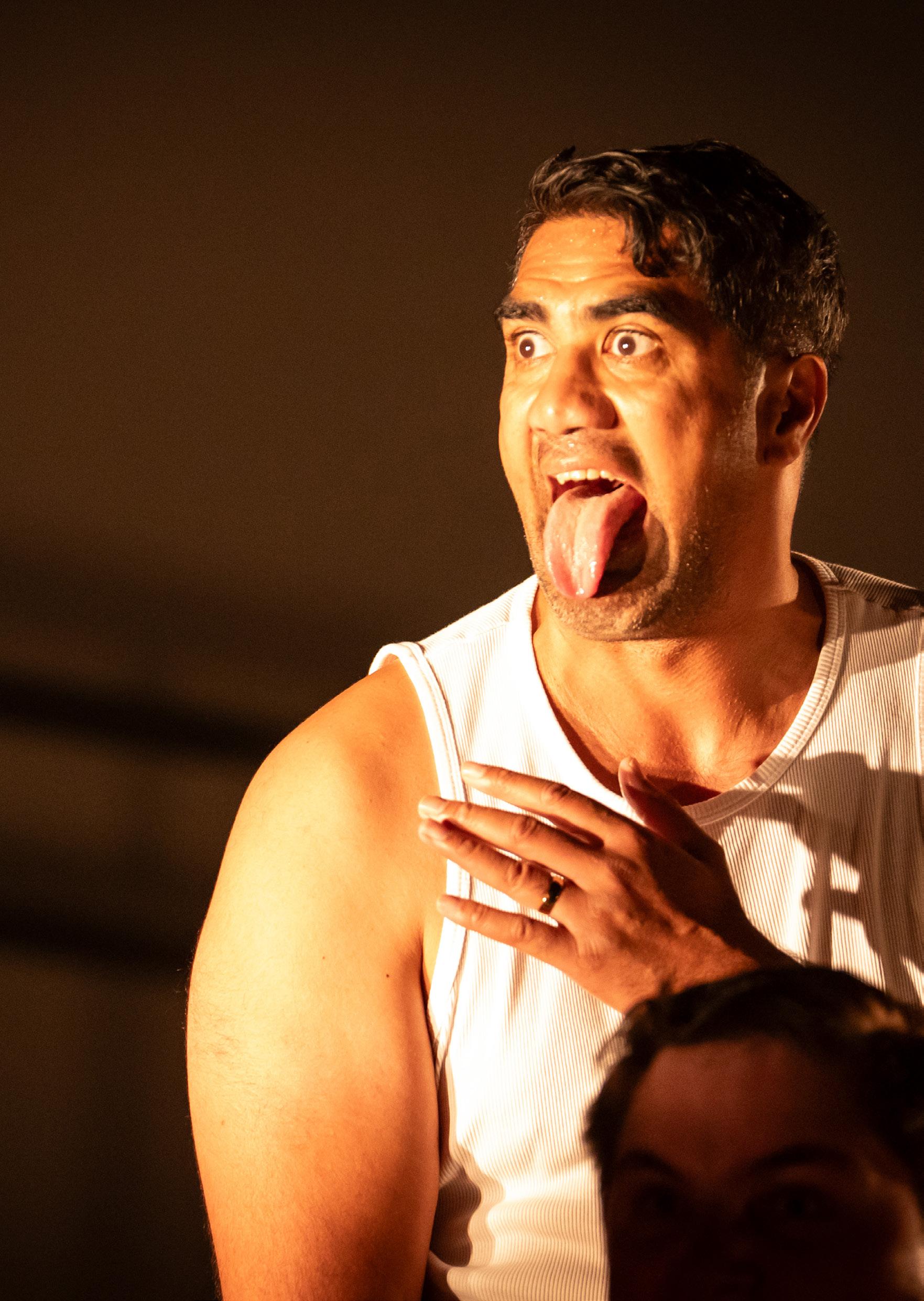
• Discuss what a character communicated to the audience; how did the actor portray them? Plot their character arc and describe how they use techniques to communicate this.
• Discuss the purpose of the characters:
• What impact do they have on the narrative, as well as the audience and actors’ relationship?
• How does the actor’s use of techniques communicate their purpose in the performance?
• Explore the ensemble of characters as a whole: what purpose do they serve in the narrative?
(Teaching note: you may need to support ākonga with kupu and the deeper concepts. Some pre-teaching may be needed here. Te Rakau Theatre Company and Helen Pearse-Ortene’s writing is an excellent reference when teaching Theatre Marae: Kaupapa rangahau | Research | Te Rākau Theatre (terakau.org)
• When we go to live theatre we can often see features of theatre form in the way the play is scripted, staged, directed or performed.
• Theatre Marae emerged in the 1990s when playwrights such as Jim Moriaty, John Broughton, Roma Potiki, Rangimoana Taylor, and Hone Tuwhare were carving out space in the theatrical world, to give voice to the indigenous people of Aotearoa. The practices of this form can be used as a decolonising tool within theatre, as well as in kura, prisons and within the wider community. The framework of this theatre form aims to address themes and ideas around trauma, social justice and honour Māori perspectives in these areas, without being pushed through an exclusively western lens. It allows for western theatrical practices to be woven with te ao Māori and performance traditions. Every theatrical work comes from the point of view of the writer, creator and director, with further collaboration with the actors and/or subjects of the writing. The point of view will be built around specific backgrounds,
experiences, cultural framework and collected knowledge.
• When thinking about how Theatre Marae is applied within a theatrical context it is important to think about how the following rituals or practices are present in performance:
• Pōwhiri, mihimihi, karanga or pepeha
• Karakia
• Whaikorero (oratory)
• Hui (gathering)
• Haka, Waiata, Poi and other aspects of Te Ao Haka
• How the structural and symbolic aspects of the Marae building influence the work. This includes the carvings, paintings and weavings that adorn the inside of a Marae. The structural design of the building, inside and out.
• The methods of passing on oral histories; myths, legends, tā moko and whakataukī
• Mauri (life force), wairua (spirit), Te Reo Māori and Tikanga
• A sense of inner landscape or voice, that speaks to what it means to be Māori and people of this land
• Giving voice to the voiceless, within the parameters of their own cultural practice.
Revision activity: In order to understand Theatre Aotearoa and how it appears or is applied within Waiora Te Ūkaipō – The Homeland we need to draw alignment between the structure of the show and the key features and ideas of the theatre form.
• Unpack and discuss the synopsis on Page 12]
• Brainstorm around the following prompts and present your ideas back to your peers. You could create a short presentation, record a short podcast on voice notes or create a big brainstorm, with sketches and annotations on paper. Be creative, how could you share information in a fun and inventive way?
• Identify powerful moments that utilise the features listed above
• Discuss how these features helped to drive the narrative, drew the
audience into the story and highlight important moments
• What moments will stay with you, discuss why
• How do you think the source material impacted the way the performance was structured
• Discuss why using a Theatre Marae framework for this production enhances the performance
Divide into three groups, each with a big piece of craft paper. Take one of the following prompts per group. Discuss how the prompt applies to Waiora Te Ūkaipō – The Homeland, why it is important to have theatre that speaks to a Māori world view, of the impacts of colonisation and think about how this impacts the audience.
• Mauri (life force), Wairua (spirit), Te Reo, Tikanga
• A sense of inner landscape or voice, that speaks to what it means to be Māori and people of this land
• Giving voice to the voiceless
• Exploring the generational impacts of colonisation
Titiro whakamuri, kōkiri whakamua – Drama is influenced by whakapapa and is a way to respond to and share identity, culture, and perspectives
If you are a Year 11 student viewing Waiora Te Ūkaipō – The Homeland, this section of the pack will help you to unpack and explore the play and apply that learning to an internal achievement standard in 2026. For Year 12 - 13 students this section of the pack aims to extend your understanding of theatre and its function. It will also prompt you to think about how what you see at the theatre can connect with work you are doing in class.
An aspect of the significant learning done at Level One of NCEA is to “contribute to theatre Aotearoa and understand that drama is a way to explore and reflect on whakapapa.” You may be doing this through exploring plays written by Aotearoa playwrights in class, performing scenes from those plays, discussing the function of each play and how they connect with an audience.
THINKING ABOUT WAIORA TE ŪKAIPŌ – THE HOMELAND AS A SEMINAL THEATRE AOTEAROA PLAY:
Activity: As a class brainstorm all the ways that the performance was firmly rooted in Aotearoa and spoke to a local audience. Include the following examples in your brainstorm:
• Language or quotes that are specific to Aotearoa
• Te Ao Māori/mātauranga Māori (Māori knowledge) elements or references
• Accents, acting style
• Specific design choices that reflected our place in the world
• Key scenes or viewpoints represented, that reflected Aotearoa
Take a photo of this brainstorm and keep it in a shared digital space so you can reference it throughout the other activities in this pack.
Function in this section refers to: the plays ability to heal, educate, entertain or transform an audience.
In small groups or in pairs, brainstorm, research and record responses to the following questions. (A mode of recording has been suggested for each question in order to enrich your literacy skills):
:
Brainstorm with pen and paper. Ensure you explore and debate the four words encompassed in the definition of function and then construct a written response that focuses on a specific scene.
• What ideas, themes or messages are being communicated to the audience?
• What impact is that having on the audience?
• How are these ideas healing, educating, entertaining or transforming the audience?
• Can you connect this to a specific scene or moment from the performance?
CONNECTION WITH THE AUDIENCE: Record a verbal discussion where you talk about the following questions. You could brainstorm the questions first, but it is important you don’t script your response.
• Who do you think the intended audience is and why? Who do you think Hone Kouka wrote this for and why?
• Why is this play relevant in 2026?
• What are the social, political and historical ideas that might be hitting differently to when it was originally staged?
• How do you think this connects with the audience?
• How has mātauranga Māori and Te Reo Māori been woven through the performance? What impact does this have on the connection the audience has with the story being told?
• What draws you into the story? The actors, the design, the writing, the themes and ideas? Discuss why.
• What were you feeling throughout the performance?
• What have you thought about since? You could use the following resource to support you: Purpose and Audience Analysis
THROUGH DRAMA TECHNIQUES: these activities are based around developing the skill of sketching and annotation. You can cover one, some or all of the activities.
• Character’s connection to the Waiora Te Ūkaipō – The Homeland: Look at the characters or viewpoints of people represented in the scenes and explore their connection to the thematic content of the performance. Use these questions and the information in the front of this pack to guide you. Create a diagram that represents each character’s stance or viewpoint, and explore why this is important when discussing the themes and ideas evident in Waiora Te Ūkaipō. You could choose a couple of scenes to focus on.
• What do you know about the characters or what do the viewpoints outlined say about the people represented in the scenes - ethnicity, where they are from, their whānau, their upbringing - how does this influence the way they view the world?
• What are their dreams and aspirations?
• What is motivating or driving them? Why do you think they behave the way they do around the core issues of the play?
• What are key quotes that capture the personality, beliefs and aspirations of the characters? How does this impact how they view the world, especially their connection to the whēnua, their whānau and te ao Māori?
• What are their relationships like and what does this say about the way they act on the issues and themes evident in the play?
• Role on the Wall: Choose a character or viewpoint you found compelling or impactful. In a Role on the Wall explore how the actor used techniques to support the function of the play. Narrow this down to a single moment.
Role on the Wall instructions:
• Draw the outline of your charactercould be a gingerbread man shape, stick figure, etc.
• On the outside you will note the external drama techniques you see the actor using in a specific moment, that communicate the function. Use of body, voice, movement and space
• On the inside you will think about or imagine what might be driving these choices; emotions, motivations, subtext.
• Mindmapping: Looking at the drama elements, choose one that you felt was highlighted in a moment in the performance that communicated the function. Create an extensive mind map which details how that element was brought to life through the script, the characters, directorial and design choices.
• For example; what does the time and place of the action communicate to the audience about Aotearoa New Zealand and the themes and ideas that Kouka is trying to unpack?
• For example; how is mātauranga Māori and te reo Māori explicitly woven into this performance of the play and what impact does it have on the audience? How does this support the communication of the core messages of the play?
• Storyboarding: Choose a moment where a specific drama convention highlights the function. Map out on a short storyboard with captions, how the convention was used, detailing what you saw on stage and what it communicated to the audience.
• Sketching and annotating: Choose a moment where technology was used to highlight the function. Sketch how this looked on stage and annotate comprehensively.
BRINGING IDEAS TO LIFE THROUGH PLAY: these ideas could contribute towards or become provocations/ stimulus for devised drama.
• Choose a line from Waiora Te Ūkaipō – The Homeland that you found compelling or impactful. Discuss why as a group.
• Break down the line, think about what it means and what it represents in the play, how it might heal, educate, entertain or transform. What does it make you think about and feel? Does it call you to action?
• Develop a short scene that explores what you have discussed using conventions and elements.
• Prior to performance explain how your short scene connects to the line you have chosen and how it heals, educates, entertains or transforms.
• Make sure that you choose conventions and elements that will communicate your ideas in a coherent way.
• Choose a moment in the performance where you could add more information about a character or an event. This could be prior to the play beginning, during the narrative or what happened next.
• Develop a short scene using conventions and elements
• Discuss together how this scene extends on ideas in the play
• Prior to performance explain how your short scene heals, educates, entertains or transforms the audience. Discuss how you have used conventions and elements to communicate this.
A SCENE: (If you have access to the full script from the play)
• Choose a scene that you felt highlighted the function of the play
• Block and rehearse the scene for an audience
• As you rehearse make choices about your techniques as an actor that will communicate the function of the scene to your audience
• Think about how elements can be enhanced and what conventions could be used in the blocking
• If you could use technology, what would it be? If you have access to it, have a play. If you don’t then express a few ideas to the audience prior to performing
• Perform your scene for your peers and gain feedback
• Justify your choices to the audience and explain what you intended to communicate
• Discuss whether your intention for the performance was communicated and understood. Gain feedback and advice
• If you have time you could implement any feedback given, to enhance how you communicated the function
Drama | NCEA
Explore the function of theatre Aotearoa | NCEA
“Drama transforms the tangible into the intangible.”
This section of the education pack is designed to support Level One drama students navigate the new Level One external Achievement Standard 91943
- Respond to a drama performance. Unlike the Level Two and Three external standards, which are an exam, you will be constructing a portfolio over a period of time in class. It will be based around three key aspects:
• key message of the performance, the use of drama components and your own personal response about how you connected to the performance, capturing the wairua (spirit) of what you watched.
This portfolio will be presented as a slideshow or PowerPoint and can be a mixture of written and audio visual material - the main question you should ask yourself as a student is; how do I communicate my ideas, thoughts, and feelings about what I saw, the
best? With that in mind, you are encouraged to collect your thoughts, discussions and do your research in a range of formats. Such as; voice notes, sketches and annotations, brainstorms, moodboards, recorded physical responses and writing.
Kaiako and ākonga please ensure you read this year’s assessment specifications carefully as you prepare to submit this assessment. You can access the specifications via this link:
NZQA Assessment Specifications - Level One
Below are three activities to support you to expand your ideas and support you during the teaching and learning phase of unpacking the performance.
In pairs, small groups or as a whole class, discuss and brainstorm the following prompts:
• What do you think Hone Kouka was trying to say? Why this story? Why these characters? Why this period of time?
• What do you think he was trying to communicate through his directorial choices they made? How does this connect with what he has written?
• What do the characters in the performance represent and what do they communicate to the audience?
• What do you think the designers are trying to communicate through their choices? How does this bring Kouka’s ideas to life?
Once you have brainstormed around these questions, you could journal, voice note or record thoughts around the following questions:
• How do you identify the key message of a performance?
• Can there be multiple key messages?
• Think about your interpretation of the performance - what was the key message to you?
• What physical evidence from the performance connects to the key message? This could be a scene, a moment between characters, dialogue, a moment where the use of technology highlighted an idea.
• Describe these examples and sketch them in specific detail.
Drama components are techniques, elements, conventions and technologies. Make sure you have explored this language and terminology with your kaiako/teacher.
Now that you have fleshed out what the key message might be, you need to connect it with the choices that the director, designer and actors have made and how they have used the drama components in combination.
Brainstorm in small groups, or in pairs:
• How an actor used drama techniques in a moment that communicated the key message
• How elements created a sense of mood, atmosphere or tension
• How conventions were used throughout the performance
• How technology enhanced the story being told
In the unpacking on the NCEA website for this standard, this aspect of the assessment is unpacked in detail. Your teacher will support you in
understanding this and guide you to explore, research and develop your ideas.
Auckland Theatre Company have included interviews from Kouka and the creative team. You will want to reference this in your portfolio construction.
“The wairua of the performance is experienced as the intangible energetic and emotive qualities that carry the spirit and intention of the play. How the wairua is expressed by the performers provokes a response from the audience and allows them to reflect on the ideas and themes of the play based on their own life experiences and perspectives.”
- 1.4 - Unpacking
• What thoughts, ideas and feelings did the performers provoke in you?
• What have you reflected upon since watching the performance?
• What have you been thinking about (head) and feeling (heart) since?
• What did your gut/sense of intuition communicate to you as you watched the performance?
• What life experiences or perspectives do you bring? What connections did you make?
REFERENCES
Drama | NCEA
Level One External Specifications