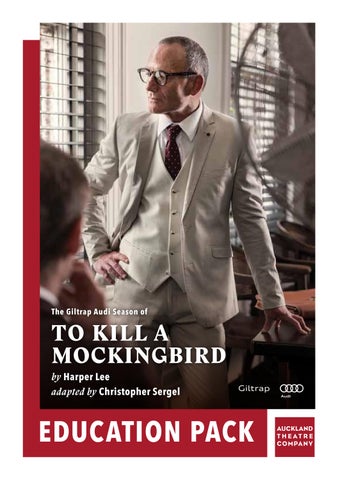
EDUCATION PACK
Contents
THANKS TO OUR SUPPORTERS
A U C K L A N D T H E AT R E C O M PA N Y R E C E I V E S P R I N C I PA L A N D C O R E F U N D I N G F R O M :
Synopsis
To Adapt a Mockingbird
To Direct a Mockingbird
To Design a Mockingbird
To Frame a Mockingbird: Social Context
Additional Reading and Resources
Where Were They Then? Historical Context
About ATC Education
P.04 P.08
P.14
S U B S I D I S E D S C H O O L M AT I N E E S A R E M A D E P O S S I B L E BY A G R A N T F R O M
P.26 P.27
P.38
P.17
To Write a Mockingbird P.21
P.39
Curriculum Links P.39
ATC Education also thanks the ATC Patrons and the ATC Supporting Acts for their ongoing generosity.
VENUE:
Please note • Schools’ performances are followed by a Q&A Forum lasting for 20 – 30 minutes in the theatre immediately after the performance. • Eating and drinking in the auditorium is strictly prohibited. • Please make sure all cell phones are turned off prior to the performance and, if possible, please don’t bring school bags to the theatre.
The Civic, corner of Queen St & Wellesley St, Auckland
SCHOOL MATINEE Tuesday 10 May at 6:30pm PERFORMANCES: Thursday 12 & 19 May at 11am RUNNING TIME:
2 hours and 20 minutes, including a 20 minute interval
SUITABILITY:
This production is suitable for Year Levels 10 – 13.
ADVISORY:
Contains violent themes
• Photography or recording of any kind is STRICTLY PROHIBITED.
1
CAST Atticus Finch — Simon Prast Judge Taylor / Walter Cunningham — Ian Mune Reverend Sykes — Fasitua Amosa Calpurnia — Goretti Chadwick Heck Tate / Mob Member — Kevin Keys Tom Robinson — James Maeva Maude Atkinson / Mob Member — Hera Dunleavy Stephanie Crawford / Mrs Dubose / Mob Member — Claire Dougan Arthur Radley (Boo) / Mr Gilmer / 4th Man / Mob Member — Peter Daube Mayella Ewell / Mob Member — Holly Hudson | Bob Ewell — Scott Wills Scout — Scarlett Featherstone / Billie McKessar / Miro McColl Jem — Louis Sinclair / Liam Farrell / Milligan Hudson Charles Baker Harris (Dill) — Shay MacLeod / Flynn Steward / Nicholas Stuart Court Clerk — Jesse Hilford CREATIVE Director — Colin McColl | Assistant Director — Benjamin Henson Set Designer — Andrew Foster | Costume Designer — Nic Smillie Lighting Designer — Bryan Caldwell | Sound Designer — John Gibson PRODUCTION Production Manager — Robert Hunte | Company Manager — Elaine Walsh Stage Manager — Youra Hwang | Assistant Stage Manager — Jesse Hilford Technical Manager — Bonnie Burrill | Technical Operator — Rachel Marlow Sound Operator — Jonny Keeting | Props Master — Becky Ehlers Wardrobe — Penelope Pratt | Acting Coach / Chaperone — Stephanie Wilkin Set Construction — 2Construct | Sound System Design — Glen Ruske, BounceNZ Additional Sound Programming — Matt Eller Banjos — Peter Daube, John Gibson, David Ward | Violin — Jesse Hinton Accent Coach — Chris Stewart | Vocal Coach — Sylvia Rands EDUCATION PACK CREDITS Writer — Written Content by iamb creative and Lynne Cardy Editor — Lynne Cardy Design images courtesy of Andrew Foster and Nic Smillie Production Images — Michael Smith | Design — Wanda Tambrin 2
SYNOPSIS
I
t is 1935 in the small United States town of Maycomb, Alabama. Two children – Scout Finch and her big brother Jem – know times are tough, as the Great Depression has hit Maycomb’s farming folks hard. But during this year, the Finch children are going to learn even tougher lessons: about injustice and intolerance, and the bravery required to resist it.
Scout and Jem’s mother is dead, and their lawyer father Atticus works long hours at the court-house. The children are raised by the family’s black servant Calpurnia, an older woman who has been a wise and caring part of the Finch household for decades. They also get advice from neighbours: kind Miss Maudie, gossipy Miss Stephanie, and terrifying Mrs Dubose. To the children, Atticus seems old, boring and ‘different’ from other fathers, who go hunting rather than reading and thinking all the time. At school, Scout is asked “how come your daddy defends niggas?” Atticus is representing Tom Robinson, a black field-hand, who is accused of raping a lower-class white woman, Mayella Ewell. Tom faces the death penalty if he is found guilty. The children’s questioning reflects the prejudice of the town’s ‘respectable’ (white) families against
4
blacks: most cannot understand why Atticus would even try to prove that Tom is innocent. A new child, Dill, arrives in town. He makes friends with Scout and Jem, and is fascinated to learn about Boo Radley, a recluse who has hidden in the Radley house for thirty years. Dill wants to entice Boo out, but Atticus puts a stop to the attempts, saying that Mr Radley has the right to choose what he does in his house and it is not their business. Scout asks Atticus about the Tom Robinson case. Atticus says he would not be able to respect himself if he didn’t defend Tom. Scout asks if he will win the case, and Atticus is blunt: no. A few weeks later, a dog goes rabid. Sheriff Heck Tate passes his rifle to Atticus, who kills the dog with one perfect shot. The children learn that Atticus is an amazing shooter, and his nickname used to be One-Shot-Finch. This gives them new respect for their father, who suddenly seems heroic and modest rather than boring. But as the children turn towards Atticus, the town turns against him. Mrs Dubose calls Atticus a “nigger lover”, so Jem destroys her flower bed. Atticus insists Jem apologises, and read to Mrs Dubose every night. Dill runs away from home, and Atticus allows him to stay with the Finch’s.
The Sheriff tells them Tom is being moved to the county jail ready for the trial. That night, Atticus goes out late. Jem, Scout and Dill follow him to the jailhouse. A mob arrives to lynch Tom Robinson. Scout rushes to Atticus and talks to one of the men, the father of her classmate. Her conversation puts the man in
The children are convinced Atticus has won the case. Yet when the verdict comes, all it can do is reveal what ‘justice’ means in the US South in 1935. Time passes. Death visits Maycomb. Mrs Dubose dies – and Atticus tells Jem that by reading to her every day, Jem helped her break a morphine addiction, so she died “beholden to nothing and nobody.” The sheriff tells of another death – Tom Robinson has been shot seventeen times Atticus Finch, To Kill a Mockingbird trying to escape. Bob Ewell makes a Atticus’ shoes for a moment, making threat: “one down – two to go!” him think about Atticus as a father. After the county pageant, The tension is broken; the men leave Scout and Jem are attacked while without violence. walking home. Jem is injured, The trial begins. The children but a mysterious man rushes from sneak out to attend, and Reverend somewhere nearby and fights off the Sykes, leader of Calpurnia’s church , attacker. takes them to watch from the balcony, Bob Ewell is found dead in the a segregated area for blacks only. The street with a kitchen knife in his ribs. witnesses are cross-examined: Heck Heck Tate insists that Ewell fell on Tate the Sheriff, Mayella’s father his own knife; the name Boo Radley Bob Ewell, Mayella herself. Atticus is not mentioned in public. shows that Mayella was beaten by The events of the summer have a left-handed man, and that not all shown Scout the truth of one of her the testimony presented is truthful. father’s sayings: she now understands When Tom Robinson takes the stand, that “killing a mockingbird” is Atticus’ skilful questions bring out a causing harm to the innocent. more believable story.
“You never really understand a person until you consider things from his point of view… until you climb into his skin and walk around in it”
5
TO DIRECT A MOCKINGBIRD: COLIN McCOLL
A
TC’s Artistic Director Colin McColl is clear To Kill a Mockingbird is not just a play about the past. He offers a statistic published recently in The Guardian newspaper: “an average of three black youths are killed by white US police every day. This fact, plus recent racialbased riots in Ferguson Missouri, Baltimore and Chicago were all news when I was considering programming a stage version of To Kill a Mockingbird.”
Additionally, there was renewed interest in Harper Lee’s original 1960 classic because in 2015, Lee’s first version was published as Go Set a Watchman, only months before the author died. In Colin’s words, “it
8
seemed absolutely right and in the zeitgeist to do the play.” Colin highlights that the story remains relevant here and now. “Behind the need for segregation in twentieth-century America was fear. And with America's current fear of Muslims, and Donald Trump's insane idea of building a wall to keep out Mexicans, the story still has traction.” The USA may have an extreme version, but New Zealand has its share of injustices. “Let’s not forget that in 1930s New Zealand, there was considerable prejudice against Maori,” says Colin. He points out that even today, Maori make up the major percentage of our prison population. In a way, we aren't even two degrees of separation from Alabama in the 1930s.”
As director of this production, Colin says “at first I was tempted to ‘politicize’ the story.” His initial ideas included using AV images of 1930s lynch mobs and KKK, plus images of the 60s Civil Rights movement in Alabama to bookend the presentation. But, he says, “it soon became obvious that this was doing Harper Lee's story a disservice. Yes, it's a story of racial prejudice and injustice in 1930s Alabama, but the story is much more than that: it’s about what it means to be a Southerner, a loss of innocence story, a morality tale and a beautiful portrayal of a father’s relationship with his kids.” The final staging of the ATC production is simpler. “We've tried not to impose too much ‘concept’ in re-interpreting this work for the stage. An ensemble of actors (aged between nine and 75) have gathered to relate the story of Atticus Finch and his family, and the effects on a community of his defence in the
trial of a black man falsely accused of raping a white woman.” “The hardest thing for our actors to grasp has been the day to day living with segregation: how it was part of life. How the white community was seemingly oblivious to the hypocrisy of treating their black house servants very well, but adamant that the children of those servants shouldn't attend the same schools as their children. And how difficult and complicated (and downright dangerous) it was for someone in the white community to step outside of this norm. It is this act that heaps so much derision on Atticus and his family. Both Scout and Jem, with their naturally enquiring minds need Atticus to explain these attitudes to them.” “Instead of being political, Harper Lee looks at it in a very human and very family kind of way.”
9
H
elping the cast to understand the social climate of the day has been achieved by a combination of their own research and by a special research file compiled by Assistant Director, Benjamin Henson. Benjamin created the file particularly to help the younger (child) cast members, but it was also particularly useful in the initial stages of rehearsal for the whole company. Particularly they looked at how the novel had been adapted – using information from the novel to fill out the world of the play. Benjamin compiled tables for every scene from the play – matched by appropriate time/location/character descriptions from the novel – and these were used as discovery tools in rehearsal.
Also included in the file:
10
•
A Glossary of terms
•
Character templates - with appropriate quotes from the novel
•
General research; eg: maps of America, visual and costume references
•
Some of cast read Go Set A Watchman – which gave insight into events leading up to segregation.
11
discussion and extension activities •
This is a play with a family at its centre. How are (different) concepts of family explored?
•
Colin describes this as “a loss of innocence story”. Explain, with examples from the play.
•
Extension: Create the “bookend” AV presentation that Colin describes – two short sequences of image and video about current racial violence. The two clips together must be shorter than three minutes. How effectively can you communicate the key information?
TO FRAME A MOCKINGBIRD: SOCIAL CONTEXT
WHERE ARE WE NOW? - FERGUSON In the play, Scout asks Atticus “how could they shoot Tom?” Atticus says that “to them he was just an escaping prisoner. He wasn’t Tom to them.” The prison guards did not see Tom as an individual, a full human being with loves and hopes and fears. As a black man, he was clearly a threat to white society; as an escaping prisoner, he became simply a target. On 9 August 2014 in Ferguson, St. Louis, an unarmed 18-year-old black teenager named Michael Brown was shot and killed by Darren Wilson, a white police officer. Wilson saw only a potential criminal, a suspect in a nearby robbery. Exact details and eye-witness testimony remain disputed, but Wilson fired twelve rounds at Brown. The shooting generated waves of protest, which intensified after a grand jury decided not to indict Wilson. Police used tear gas and rubber bullets to break up the public demonstrations, and the Missouri National Guard were employed to keep the peace. The American Justice Department found widespread racial bias in Ferguson’s criminal justice system and called for it to be entirely overhauled. The New York Times claimed Ferguson was “a place where officers stopped and handcuffed people without probable cause, hurled 14
racial slurs, used stun guns without provocation, and treated anyone as suspicious merely for questioning police tactics.” In Ferguson, 93% of people arrested are black, although AfricanAmericans make up only 67% of the town’s population. The investigative report showed that officers appeared to treat those who lived in predominantly African-American areas of Ferguson as potential offenders and sources of revenue, rather than people to be protected. #BlackLivesMatter The deaths of Michael Brown, Trayvon Martin (another unarmed black youth shot by a Florida resident) and Eric Garnern (choked by a New York police officer) have been a flashpoint for the #BlackLivesMatter campaign. Established in 2012 to highlight and remember victims of police brutality, the movement has expanded to raising awareness of injustice across America’s social systems. Activists choose nonviolent means – such as blocking major traffic routes in Chicago and Washington – to call attention to racial violence. As Time Magazine puts it, “causing discomfort is designed to make society feel the pain and frustration of living as a black person in America.”
•
How does To Kill a Mockingbird help us understand racial tension in America – in the past and in the present?
•
In the preface to the 1988 version of the play, Ray Speakman writes: “Christopher Sergel reminds us… that the issues explored are not those of a ‘regional’ work of art (as the novel is often categorised), but are of importance in Nottingham, Manchester, Birmingham or wherever the play is seen by an audience.”
•
•
•
How much of this story would translate easily to a New Zealand context?
•
Identify a specific racial justice issue or event from New Zealand history. Why was it significant? How has it shaped where we are now as a society?
•
Do race relations have relevance to you? How much racism have you experienced or heard about in New Zealand? Do you think racism is an issue here, now?
What does ‘race’ actually mean? •
How do people typically identify another person’s race? How accurate is this?
•
Do you and the people you know identify as being of a particular race?
•
How is race different from ethnicity? Which is stronger / more important?
EXTENSION: Racism is only one kind of social prejudice. Think of others: sexism, homophobia, xenophobia, others… Re-enact one key moment from the play with someone from this target group in the victim’s place. How does it change the meaning of the scene?
15
WHERE WERE THEY THEN? HISTORICAL CONTEXT
THE TOWN In the play, Miss Maudie tells us that “even in 1935, Maycomb, Alabama is already an old town – a tired old town. In rainy weather the streets turn to red slop, grass grows on the sidewalks, the courthouse sags in the square. Old mules hitched to Hoover carts flick flies in the shade. There’s no hurry because there’s nowhere to go, nothing to buy, and no money to buy it with. Maycomb County had recently been told it had nothing to fear, but fear itself.” The quote comes from the 1933 inauguration speech of President Roosevelt, as an attempt to comfort a country suffering during the Great Depression.
•
Maycomb County is fictional, but based on Harper Lee’s own hometown of Monroeville, Alabama, in Monroe County.
•
In 1930, Monroeville had a population of 2,382 people.
•
It was isolated (driving, it would take two hours to reach the nearest neighbouring town.)
•
The streets were unpaved; there were few cars and no traffic lights.
•
Like Maycomb, Monroeville was racially segregated.
•
Alabama census data shows that 47.8% of people were White, and 52.5% Negro.
•
8% of Whites were illiterate, compared to 25.8% of the Negro population.
Today, 30,000 people a year travel to Monroeville to visit the real-life version of Maycomb, where they can stay at Mockingbird Inn & Suites and buy Boo Burgers and Finch Fries from the Courthouse Café. The play has been performed annually at the town’s courthouse since 1991, and the ticket sales help pay for the upkeep of the courthouse and other heritage sites. THE DEPRESSION In October 1929, the American stock market crashed, wiping out 40% of the value of stocks, and causing a crisis of confidence throughout the American economy. By 1932, quarter of Americans were unemployed. When Scout asks Atticus if they are poor, he confirms that they are indeed, though not as poor as the Cunninghams. Atticus and Walter Cunningham have an arrangement; Cunningham pays for his legal services with turnip greens, wood and hickory nuts, rather than cash. Atticus tells Scout that “the Cunningham’s are country folks and the depression hits them the hardest.”
17
THE JIM CROW LAWS
D
uring the 1930s, the “Jim Crow Laws” legalised racial discrimination in the Southern States of America, including Alabama. The term covers a wide-range of laws enacted between 1880 and 1960 that supported racial segregation, separating people of colour including in schools, workplaces, and other public places. African Americans were said to be “separate but equal.”
Some of these laws included:
•
Separate waiting rooms and ticket windows for whites and blacks travelling on buses.
•
Separate train carriages, where the conductor was authorised to “assign each passenger to the car… designated for the race to which the passenger belongs.”
•
White nurses were excused from attending wards where black men were patients.
•
White and blacks were not allowed to be served in the same room in a restaurant.
•
It was illegal for blacks and whites to play games together. In 1930, Birmingham, Alabama passed the legislation “It shall be unlawful for a negro and white person to play together or in company with each other in any game of cards or dice, dominoes or checkers.”
The courtroom scene of To Kill a Mockingbird shows the Jim Crow laws in effect, as the African Americans are required to sit in the “coloured balcony”. Jem and Scout cause a stir when they break the law – and the town’s taboo – by watching the trial
18
from the balcony too. Miss Stephanie expresses her shock: “I’m absolutely surprised at you children… Why were you sitting over in the coloured balcony? Several people mentioned it.” There were also laws against miscegenation (marriage or intimate relationships between whites and blacks). Mayella Ewell transgresses against these legal and social taboos by desiring Tom Robinson, and attempts to save face by making the accusation of rape. THE REAL TOM ROBINSON? There were several real life cases that may have inspired the false accusation against and trial of Tom Robinson in Harper Lee’s story. In 1934, Walter Lett was falsely accused of raping a white woman. He was convicted and sentenced to death, but this was changed to life imprisonment after many protested the verdict. Harper Lee was ten years old at the time, and her father’s newspaper covered the trial, which took place nearby Lee’s home. The 1931 the “Scottsboro Boys”, nine African-American youths, were put on trial after being accused of raping two white women. There were major problems with the evidence (the women had suffered no injury), but the all-white juries convicted the men.
19
TO WRITE A MOCKINGBIRD: HARPER LEE
T
o the outside world, Harper Lee’s life is as enigmatic as Boo Radley’s was to Scout, Jem and Dill. The publication of To Kill a Mockingbird in 1960 brought her considerable attention but Lee rarely gave interviews, and never published any further novels until Go Set a Watchman in 2015. Her chief interests were described as “nineteenth-century literature and eighteenth-century music, watching politicians and cats, travelling and being alone”. According to the New York Times her “public appearances to accept an award or an honorary degree counted as important news simply because of their rarity. On such occasions she did not speak, other than to say a brief thank you.”
20
Nelle Harper Lee born on 28 April, 1926, the youngest of four children. Her mother was Francis Finch Lee, who rarely left the house and is now believed to have an undiagnosed mental illness. Her father, Amasa Coleman Lee, was a lawyer, newspaper editor, and state senator. In high school, Harper developed her love of literature. In 1944 she left Monroeville for college in Montgomery, and then went to the University of Alabama where she studied literature, history, journalism and law. She was offered a place in the law school but didn’t finish her degree. Instead, she went to New York aged 23 to live as writer. She didn’t earn much money, and supported herself as an airline reservations clerk.
21
In 1956 her friend Michael Martin Brown offered to finance her for a year so she could quit her job and write fulltime. She submitted an early version of To Kill a Mockingbird – titled Go Set a Watchman to a publisher in 1957 – and although it was rejected, she was encouraged to rewrite it. The resulting novel, To Kill a Mockingbird, won the Pulitzer Prize in 1961 and the film adaptation, starring Gregory Peck, was released the following year and won three Academy Awards. Mockingbird has sold more than 40 million copies and is a staple of school English literature classes. In 2006, Mockingbird was ranked by British Librarians as a book “every adult should read before they die”, beating the Bible. In Lee’s last published interview in 1964, she said she “never expected any sort of success with Mockingbird” and confessed she found the public attention “frightening”. She disappeared from public life and insisted she would never publish again. Lee suffered a stroke in 2007 and moved back to Monroeville. In 2015, 22
Go Set a Watchman was released. The release was controversial: questions were asked. “How aware is Lee, really, of this new book? Does she, as her publishers insist, approve of its publication?” asked Bloomberg journalist Claire Suddath. In a statement released by HarperCollins, Lee is quoted as saying: “I’m alive and kicking and happy as hell with the reactions to Watchman”. Harper Lee died in her sleep on 19 February 2016 at an assisted living facility in Monroeville. FACT OR FICTION? Although Mockingbird was not an autobiography, Harper Lee felt that a writer “should write about what he knows and write truthfully”. Here are just some similarities between Lee’s life and fiction:
•
Like Scout, Harper Lee was tomboy who climbed trees and took on the boys. “A dress on the young Nelle would have been as out of place as a silk hat on a hog,” according to one friend.
•
Many people believe that Dill was modelled on author Truman Capote, a friend of Harper’s since childhood.
•
In Lee’s neighbourhood, rumours surrounded Alfred “Son” Bolweare, who was said to have been held captive by his father after robbing a drugstore.
•
The Lee family had a servant named Hattie Bell who watched the children, cleaned the house,
GO SET A WATCHMAN Watchman is set in the 1950s when the adult Scout returns to Maycomb after living in New York. The novel gained most attention for its representation of Atticus Finch, who had changed from the idealist moral campaigner of Mockingbird to a racist who once attended a meeting of the Klu Klux Klan and believes in continued segregation in the South.
and made meals for the family, just as Calpurnia does.
•
Harper’s father, Amasa Coleman Lee, came from a farming family, but became a lawyer. In 1919, he defended two black men charged with murder, but they were convicted and hanged; he was so disillusioned that he abandoned criminal law.
The New York Times said that “the depiction of Atticus in Watchman makes for disturbing reading, and for Mockingbird fans, it’s especially disorienting... Mockingbird suggested that we should have compassion for outsiders like Boo and Tom Robinson, while Watchman asks us to have understanding for a bigot named Atticus.”
23
TO ADAPT A MOCKINGBIRD – FROM PAGE TO STAGE
A
play has different storytelling demands than a book: its drama is driven by action and conflict. Whereas Harper Lee’s novel unfolds slowly over three years, playwright Christopher Sergel brings the action into a tighter timeframe. Tom Robinson’s trial is imminent from the beginning of the play, and the drama of his trial becomes the play’s focus.
Harper Lee’s novel is narrated by Jean-Louise Finch, the adult Scout, so it gives adult hindsight, as the remembered child’s perspective. The 1988 printed edition of Sergel’s play includes the adult Jean-Louise as a character who is onstage throughout, and comments on the events. However, this slows the action and interrupts the flow, and in the revised version this narrator does not appear. Instead, Miss Maudie offers occasional additional information to the audience. In order to condense the action, a number of elements of the novel are not included in the play:
26
•
In the novel, it is Scout’s discontent with her new teacher that provokes Atticus comments about walking in another person’s skin.
•
The children are more persistent in their quest to get a glimpse of Boo Radley. Jem is even shot at and loses his shorts when a late night adventure to the Radley house goes wrong!
•
Miss Maudie loses her house in a fire. As Scout watches the blaze, Boo Radley puts a blanket over her shoulders.
•
The novel shows more of Jem’s relationship with Mrs Dubose, and her character dies well before the Tom Robinson case.
•
Jem and Scout visit Calpurnia’s church, solidifying the relationship with the Reverend.
•
A major character, Atticus’s sister, Aunt Alexandra, stays with the family to help Atticus during the trial and provide a suitable role-model for young Scout. She provides another character Scout must learn to tolerate.
27
TO DESIGN A MOCKINGBIRD
SET Many productions of To Kill a Mockingbird have opted for sets that are fairly literal: for instance, rows of houses. However, the ATC production takes a different approach. Colin says “after much discussion, we've deliberately kept the setting abstract, so audiences can read what they want into it.” There are three main elements to Andrew Foster’s set design:
S
taging To Kill a Mockingbird on what Colin McColl calls the “mighty big stage” of the Civic Theatre poses a specific design challenge: how to find elements that both draw the audience in, to create the intimacy of the story, and fill the stage out, to allow for almost ‘operatic’ big scale moments. This dual scale is also needed to illustrate the differences between the children’s world and the adults’.
28
•
Front: To create a sense of intimacy, a custom-built thrust stage will come right out into the orchestra pit, bringing the action to the audience. The raked (sloping) stage provides various levels; the upper are suggests a porch, while the lower creates a ‘play pit’ for the children.
•
Middle: Over the centre stage area hang dozens of poles, which can move on their ropes.
•
Back: A cyclorama at “jaunty angles” serves as a “billowy cloudy sky.” As with an actual skyscape, changes to the angles and colour of light will change the mood and character of the space in front and below.
Andrew says the aim was to keep the set “as Spartan and uncluttered as possible.” There are a few extra elements to sketch in the idea of the children’s world, such as the dead leaves strewn on the floor for them to play with, and a tire swing that flies in and out. Furniture is used to create specific locations for scenes such as the court room. Colin says the set elements are “at the same time functional and evocative.” Certainly each element comes from both literal and metaphoric images. For instance, the hanging poles hark back to the pioneer history of the USA and small towns like Maycomb, which were made from felled logs. Andrew was inspired by images of American towns taken during the Depression era. He says, “you see buildings that are probably only 30 or 50 years old that are already in a state of disrepair. They’ve never been painted, and they’re really weathered. I liked the idea of coming back to these elemental things that humankind erect to try and gain shelter, but that erode so quickly in something like a Great Depression.” Hanging the poles also allows them to suggest different and darker meanings: Andrew refers to them as “strange fruit.”
29
LIGHTING Lighting designer Bryan Caldwell thinks of lighting as its own storytelling medium. The position, intensity and colours of the lights create different moods. Lighting supports all other design elements, and focuses the audience on key information within in each scene. Directing focus is particularly important in a large venue. Cyclorama lighting (on the draped cloth backdrop) will indicate time of day and the type of weather, and change to show transitions of time and atmosphere
– whether literal, as in the weather, or metaphorical, as in the mood of the town. Caldwell is drawing inspiration from the American Gothic style: bad things happen at night. Darkness – shadows and patches of dimly lit stage - will be a feature in scenes such as the mob coming for Tom Robinson at the jailhouse Brian will direct lights down through the hanging poles to create shadows on the stage. These provide the only shade for characters to retreat to for shade during the hottest parts of the day, the drenching white light that will saturate the rest of the stage.
COSTUME On an abstract set, costume is important to help set the scene in time and place. Costume Designer Nic Simile wants to show the tough economic conditions faced by the characters during the Depression. To achieve this, the costumes need to look weathered and faded, as if they have been in long service, rather than new and squeaky clean. Technically, this means each costume must be “broken down” to a used state.
SOUND John Gibson has taken references to Gospel singing as a starting point, but the soundscape is also more abstract, incorporating a range of ‘noises’ and sound elements into the traditional gospel music. The pacing of the sound during scene transitions will differ; it may be a rapid cut or a smooth transition depending on what mood each moment requires. Some sound cues will be fairly literal, helping to ‘set the scene’ for the audience. The court scene will be underscored by feet and people
knocking, perhaps even played from surround sound speakers that help to place the audience within the context of the courtroom. Throughout, John uses the sound of a single violin and cello to represent the children Jem and Scout. For Gibson, these stringed instruments “have a real intimacy and life to them”. Like the instruments, the characters are similar but different – both from the same family, both suitable to play similar kinds of music, yet different in size and range and tone and mood.
discussion and extension activities
36
•
The hanging poles suggest many things. What did they make you think of? Did your ideas change during the show, or thinking about it afterwards? Compare your own response to some of your classmates – were you all forming the same impressions?
•
“Strange Fruit” has a very specific meaning in the context of USA race relations. Research the term and explain its significance to the hanging poles and the play.
•
Costume provides key information about setting: it helps the audience to recognise the play’s location, historical era, and other circumstances. Identify which elements of Nic Smillie’s costume design communicate this, using specific examples from individual costumes and your own research images.
•
Costume is also a key way to create character. Compare two or more characters’ clothing, and explain how each costume helps to highlight the character’s age, gender, social status and personality.
37
ADDITIONAL READING AND RESOURCES Harper Lee
•
The Guardian Obituary: http://www.theguardian.com/books/2016/feb/19/harper-lee
•
New York Times Obituary: http://www.nytimes.com/2016/02/20/arts/harper-lee-dies.html
•
Go Set a Watchman: What Does Harper Lee want? http://www.bloomberg.com/graphics/2015-harper-lee-go-set-a-watchman/
•
Mockingbird: A Portrait of Harper Lee Charles J. Shields New York: Henry Holt, 2006
•
Monroeville: The Search for Harper Lee’s Maycomb Charleston, SC: Arcadia Pub., 1999.
ATC EDUCATION
A
TC Education promotes and encourages teaching and participation in theatre and acts as a resource for secondary and tertiary educators. It is a comprehensive and innovative education programme designed to nurture young theatre practitioners and future audiences.
ATC Education has direct contact with secondary school
CURRICULUM LINKS
To Kill a Mockingbird
•
Scout, Atticus, and Boo: A Celebration of Fifty Years of To Kill a Mockingbird By Mary McDonagh Murphy, New York: Harper, 2010.
Jim Crow Laws
•
Smithsonian National Museum of American History: http://americanhistory.si.edu/brown/history/1-segregated/segregatedamerica.html
•
PBS: The Rise and Fall of Jim Crow: http://www.pbs.org/wnet/jimcrow/
A
TC Education activities relate directly to the PK, UC and CI strands of the NZ Curriculum from levels 5 to 8. They also have direct relevance to many of the NCEA achievement standards at all three levels.
All secondary school Drama students (Years 9 to 13) should be experiencing live theatre as a part of their course work, Understanding the Arts in Context. Curriculum
38
students throughout the greater Auckland region with a focus on delivering an exciting and popular programme that supports the Arts education of Auckland students and which focuses on curriculum development, literacy and the Arts. Auckland Theatre Company acknowledges that the experiences enjoyed by the youth of today are reflected in the vibrancy of theatre in the future.
levels 6, 7 and 8 (equivalent to years 11, 12 and 13) require the inclusion of New Zealand drama in their course of work. The NCEA external examinations at each level (Level 1 – AS90011, Level 2 – AS91219, Level 3 – AS91518) require students to write about live theatre they have seen. Students who are able to experience fully produced, professional theatre are generally advantaged in answering these questions.
39
ENGAGE
JOIN THE CONVERSATION Post your own reviews and comments, check out photos of all our productions, watch exclusive interviews with actors and directors, read about what inspires the playwrights we work with and download the programme and education packs. Places to find out more about ATC and engage with us:
www.atc.co.nz facebook.com/TheATC
@akldtheatreco
AUCKLAND THEATRE COMPANY
487 Dominion Road, Mt Eden PO Box 96002, Balmoral, Auckland 1342 Ph: 09 309 0390 Fax: 09 309 0391 Email: atc@atc.co.nz