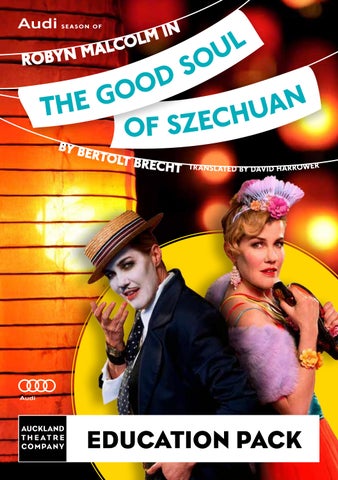
IN M L CO L A M BYN
L U RO O S D O O G N E A TH U H C E SZ F O B Y BE
RTOLT BRECHT TRANSLATED BY DAVID HARROWER
EDUCATION PACK
CONTENTS
SPONSORS Auckland Theatre Company receives principal and core funding from
CREDITS
4
THE SYNOPSIS
6
KEY CHARACTERS
8
TAKING BRECHT IN NEW DIRECTIONS
12
THE SHOW IS EPIC!
14
ABOUT THE GOOD SOUL OF SZECHUAN
18
ABOUT THE PLAYWRIGHT
19
ABOUT BRECHT'S COLLABORATORS 22 MECHANICS: EPIC PRODUCTION DESIGN 25 READINGS AND RESOURCES 30 ABOUT ATC EDUCATION Subsidised school matinees are made possible by a grant from
ATC Education also thanks the ATC Patrons and the ATC Supporting Acts for their ongoing generosity.
CURRICULUM LINKS 31
PLEASE NOTE: • Schools’ performances are followed by a Q&A Forum lasting for 20 – 30 minutes in the theatre immediately after the performance. • Eating and drinking in the auditorium is strictly prohibited. • Please make sure all cell phones are turned off prior to the performance and, if possible, please don’t bring school bags to the theatre. • Photography or recording of any kind is STRICTLY PROHIBITED.
2
31
VENUE:
Q THEATRE, QUEEN STREET, AUCKLAND CITY
SCHOOLS’ PERFORMANCES: Thursday 7 August, Tuesday 12 August and Thursday 14 August at 11am. RUNNING TIME:
2 hours and 30 minutes plus a 20 minute interval.
SUITABILITY:
This production is especially suitable for Year Levels 11 – 13.
ADVISORY:
Contains frequent use of strong language and drug references.
3
L U O DS
BY B E
OO G N E H A T U H OF SZEC
RTOLT BR
ECHT
TR AN SL ATE D BY DAVI D HARROW E R
CAST Shen Te / Shui Ta — Robyn Malcolm God #1 / Mrs Yang / Ensemble — Bronwyn Bradley God #2 / Priest / Ensemble — Simon Prast God #3 / Husband / Ensemble — Cameron Rhodes Brother in Law / Policeman / Ensemble — Andrew Grainger Wang the Waterseller — Shimpal Lelisi Yang Sun / Ensemble — Edwin Wright Whore / Mrs Shin / Ensemble — Goretti Chadwick Carpenter / Shu Fu / Ensemble — Byron Coll Wife / Ensemble — Yuri Kinugawa Sister in Law / Mrs Mi Tsu — Katlyn Wong Nephew / Waiter / Ensemble — Phodiso Dintwe Band — Brett Adams & Stephen Thomas
CREATIVE Director — Colin McColl | Set Designer — John Parker Musical Director/Composer/Sound Design — John Gibson Costume Designer — Elizabeth Whiting | Lighting Designer — Phillip Dexter MSc AV Designer — Tom Bogdanowicz
PRODUCTION Technical & Production Manager — Paul Nicoll Company Manager — Fern Christie-Birchall | Stage Manager — Natalie Braid Assistant Stage Manager — Jamie Johnstone | Technical Operator — Rachel Marlow Wardrobe Technician — Sophie Ham | Sound Operator — Colin Budd Props Master — Natasha Pearl | Unitec Intern (Sound) — Matt Boland Set Construction — 2Construct
EDUCATION PACK Writer — Amber McWilliams | Editor — Lynne Cardy Production Images — Michael Smith | Graphic Design — Saucy Hot Design 4
5
THE SYNOPSIS Life in Szechuan is difficult when Wang, the waterseller, tries to find accommodation for three gods who have arrived. He is turned away at every door. Finally Shen Te, the prostitute agrees to house the gods overnight. Next morning as they leave they urge her to continue her good work. She explains that its hard when life in Szechuan is so difficult and expensive. They agree amongst themselves to pay her for their accommodation. Shen Te uses the money to purchase a tobacco kiosk. But the shops previous tenant, Mrs Shin, demands rice and money; a dodgy family turn up urgently needing a place to stay; as does a man who claims he is unemployed and cadges free cigarettes off her. Her guests suggest she invent a cousin to take control of her affairs. When a carpenter arrives demanding payment for shelves in the shop Shen Te says he must make out the bill to her 'cousin'. More members of the shady family arrive to crash with Shen Te. Everyone cadges cigarettes, they drink, argue and they sing. The shop is busted up in the fight. Meanwhile the gods appear to Wang, who is sleeping in a sewer and ask him to report back on how Shen Te is getting on. Next morning, everyone is asleep at the tobacco shop when Shui Ta, the ‘cousin’ arrives. He tells the family to leave, but they just send the nephew to steal breakfast. Shui Ta clinches a mean bargain 6
with the carpenter for the shelves. Shui Ta tells the husband and wife they’re crooks. He then invites in a policeman, who arrests the whole family when the nephew comes back with stolen food. Later, the policeman suggests Shen Te should marry for money and reputation. Off to meet her prospective new husband at a cafe, Shen Te interrupts Sun, an outof-work pilot, trying to hang himself. She talks him out of it, and when Wang returns, Shen Te buys a cup of water for Sun, even though it’s raining. When the gods next appear to Wang, he tells them all the good things Shen Te has done.
asks for the $200 back; they refuse. The wedding doesn’t happen. Wang sees the gods and asks them to intervene in Shen Te’s case; they refuse. She realises she is pregnant to Sun and reveals this to Wang. When she sees a homeless orphan eating out of the rubbish bins Shen Te is horrified and decides she needs Shui Ta back again to sort things out.
Despite his successful business as a drug lord, the pregnant Shen Te struggles to keep up her disguise as Shui Ta. Wang and Sun accuse Shui Ta of abducting Shen Te and the policeman arrests Shui Ta for murder. The gods undisguised oversee Shui Ta’s trial. Finally Shui Ta reveals his disguise to the gods. In shock, they take off on a cloud, leaving Shen Te to face the community as herself again.
Sun comes to the shop and talks to Shui Ta, and convinces him to sell the tobacco shop on Shen Te’s behalf. Mrs Mitsu offers $300 for the shop. Sun says it’s enough, even though he needs $500 to buy his way into a job in Beijing. Sun reveals he doesn’t intend to take Shen Te to Beijing with him and leaves. Upset, Shui Ta begs help from the barber who is only too keen to marry Shen Te and solve all her problems. He offers his run down shacks for the homeless people Shen Te has been feeding. Shui Ta agrees. However, when Sun comes back it is Shen Te he sees, and he convinces her to marry him instead. Shen Te goes to her wedding, guilty about how she is making money. Sun and Mrs Yang wait for Shui Ta to arrive so they can discuss the money before the wedding. Shen Te says Shui Ta’s not coming and 7
KEY CHARACTERS Each character is a kind of stereotype, mainly defined by their work. Wang is “Wang the waterseller”; Shen Te is “the good-hearted prostitute” but becomes “the shop-owner”. Characters relate to each other according to their roles; they represent social figures, not individual human beings. The play shows how people are pigeonholed by their jobs and social position; to break this mould, you must ‘re-invent’ yourself, as Shen Te does by transforming into Shui Ta.
THE GODS: These ‘gods’ are like middle-managers, sent by their ‘boss’ to find a good person. They gripe and argue, break the rules when it suits them, and ignore complex issues. They are meant to seem very un-god-ly!
8
SHEN TE:
SHUI TA:
Shen Te is the stereotypical “whore with a heart of gold”. She follows her heart instead of her head, so people take advantage of her kindness and vulnerability.
Shui Ta, her alter ego, is the opposite, taking a tough line to create profits and force others to take responsibility.
WANG THE WATERSELLER: Wang acts as a go-between: between the gods and the townsfolk, and between the play and the audience. He spells out what is happening in a straightforward way.
THE FAMILY:
YANG SUN:
The husband and wife, with their extended family, will cheat, steal and lie to get what they want. They feel entitled to a good life, even if they refuse to work for it, and complain rather than being grateful if they get help.
Sun’s role is to be successful and charming; when he can’t be a pilot, he despairs. However, a little flattery is enough to perk him up, and get him back to charming people out of their money.
9
MRS SHIN:
SHU FU:
Where Sun has charm but no money, Shu Fu has money but no charm (at least to Shen Te). The barbers' riches are no use because he is foolish with love for Shen Te; his attempts to help simply make things worse.
Mrs Shin actually recognises Shen Te’s problems; she points out that Shen Te is too soft, and is the only character to see through the Shui Ta disguise. She helps Shen Te when things get tough.
IDEA ACTIVATION
10
•
If you had not read the play prior to the performance, how long would it have taken you to realise Shui Ta was actually Shen Te? How were the “cross-dressing” and “role playing” made evident in this production?
•
What function does Wang serve in the play? How does he relate to the audience and the company on stage?
•
Which religious tradition do the Gods appear to come from? Are they Chinese gods? Greek gods? Christian gods? Find evidence in the play to support your choice. Could they be portrayed as ‘non-deity’ figures?
11
TAKING BRECHT IN NEW DIRECTIONS
Colin McColl discusses his concepts and a whole raft of other devices to jolt the audience out of complacency.”
Brecht’s influence on modern theatre technique can hardly be overstated, says director Colin McColl. “When you watch a theatre presentation today, it's not unusual or strange to see actors or stage management changing the set, to have actors address the audience directly (breaking through the fourth wall), to see the stage lights or the mechanics of the performance, to see film or AV used in the production. Before Brecht all this would have been rare; Brecht made these things popular.” Colin points out that Brecht “wanted an audience that was alert, intellectually engaged and questioning.” To achieve this, he applied the famous ‘alienation effect’, “to discourage the audience from becoming emotionally involved in character or story. He inserted agit-prop political songs in the middle of a sweet scene; he took wild flights of geographical fantasy 12
Brecht often combined newly thought-out theatrical theories with Marxist manifestos. Colin points out, however, that the most emphatically communist plays “are the least produced of his plays today. Nearly all his plays are seen as hard-headed, cynical and didactic, but Brecht was a man of the theatre, a poet, and above all, a story-teller and entertainer. We see this in his great, enduring works, like MOTHER COURAGE AND HER CHILDREN, THE CAUCASIAN CHALK CIRCLE, and THE GOOD SOUL OF SZECHUAN.” “In THE GOOD SOUL OF SZECHUAN, Brecht (and let’s not forget his collaborators here, Ruth Berlau and Margarete Steffin) is less didactic, less interested in hammering home a Marxist theory. He poses questions – and then admits he doesn’t know what the answers are. Instead, he throws the questions over to the audience to answer.”
eliminates two scenes and five characters, and is altogether shorter, tighter, stronger and more contemporary. This is the version ATC is presenting, in a new translation by Scottish playwright David Harrower, and with original music – a powerful and eclectic score – by local composer John Gibson.” Despite the importance of music to the show, Colin is clear that this is not a musical. “Together with composer Kurt Weill, Brecht wrote two musicals – THE THREEPENNY OPERA and HAPPY END – and a wonderful opera, THE RISE AND FALL OF THE CITY OF MAHAGONNY. However, Colin says, “GOOD SOUL is a play with songs.” David Harrower calls his version THE GOOD SOUL OF SZECHUAN, a change from earlier translations, which rendered the title as THE GOOD WOMAN or THE GOOD PERSON. Colin explains the rationale behind this translation. “This play is called DIE GUTE MENSCH VON SETZUAN in its original German. The word ‘mensch’ means a good person, someone of integrity and honour, someone to admire (the opposite, ‘unmensch’, is an utterly unlikeable or unfriendly person). So the title is not gender-specific, and refers to something deeper than just a good human.”
Colin concedes that when you're directing a play in translation, something is always lost. Original information can give clues to the playwright’s intentions. Brecht's first title for THE GOOD SOUL, Colin points out, was DIE WARE LIEBE, “which translates as ‘Commodity Love’ or ‘The Love Market’. Certainly love plays a big part in the actions of both Shen Te and Shui Ta - and there are some tender and cruel scenes that result from her misplaced love.” Dramatic irony plays its part in the effectiveness of the dual characterisation. “Shen Te’s disguise as her capitalist cousin Shui Ta is recognised only by the audience and one other character on stage.” The disguise is easy for us to see through, but not quite so easy to achieve theatrically; there are practical problems to overcome. “They are very fast changes, so we have needed to find ways to streamline the swap from one to another!” Of more interest to Colin has been the interpretive discovery of “what happens when Shen Te's personality slips through the Shui Ta persona…” So what does? That would be telling. Suffice to say that all will be revealed...
Audience response helped to shape the script of THE GOOD SOUL. “Although Brecht never saw the original production at the Zurich Shauspielhaus (he was living in exile in California), he was dismayed by reports on how it was received and immediately started rewriting it. Known as the Santa Monica version, the new script 13
THIS SHOW IS EPIC!
“The dramatic theatre’s spectator says: Yes, I have felt like that too— Just like me — It's only natural — It'll never change — The sufferings of this man appal me, because they are inescapable — That's great art; it all seems the most obvious thing in the world—I weep when they weep, I laugh when they laugh.
“Art is not a mirror held up to reality but a hammer with which to shape it.” —Bertolt Brecht Bertold Brecht is famous for creating “epic theatre”, a style that constantly reminds the audience they’re watching a performance, instead of drawing them into the world of the play. Epic theatre is also called “dialectical theatre” or the “theatre of alienation”. The style is in stark opposition to the traditional ‘well-made’ play of “dramatic theatre” or “Aristotelian drama”. Brecht did not invent the term “Epic Theatre” (it was first used in connection with revolutionary experiments
At the heart of Epic Theatre is the ‘alienation effect’. The original German term is “Verfremsdungeffekt”, which literally means “the effect of making strange”. Brecht wanted audiences to realise that their way of seeing the world was dictated by habit; he wanted to teach them to challenge their preconceptions and look at things with fresh eyes.
Key features of epic theatre EPIC THEATRE CONTENT:
EPIC THEATRE PRESENTATION:
•• Aims to make the audience THINK rather than FEEL
•• Promotes interaction between performers and audience — including players addressing the audience directly
•• Examines moral problems and dilemmas without resolving them •• Is often structurally haphazard, rather than progressing in an orderly way
The epic theatre’s spectator says: I'd never have thought it — That's not the way — That's extraordinary, hardly believable — It's got to stop — The sufferings of this man appal me, because they are unnecessary — That's great art; nothing obvious in it — I laugh when they weep, I weep when they laugh.”
by director Erwin Piscator) but Brecht is the style’s most famous champion.
•• Interrupts the action with songs and poems to stop the audience becoming ‘lost’ in the story
—Bertolt Brecht
IDEA ACTIVATION •
Identify three theatre technologies used in this production that were typical of Epic Theatre.Describe them and explain how they contributed to the alienation effect.
•
What is your response to Epic Theatre, based on this production and/or others you may have seen? Would you prefer to see an Epic or a dramatic performance? Why?
•
Try staging one of the scenes from this play in a naturalistic mode. What difference does this make to the characters? Does it change the meaning of the lines, or affect your response to them?
•• Uses symbols, such as signs, film, screens, projection and flags, to highlight ideas in a non-naturalistic way •• Shows the stage mechanics – the workings of the set, props and lights are visible rather than masked
14
15
Brecht outlined the differences between Epic Theatre and traditional Dramatic Theatre in a chart published in Brecht on Theatre in 1957:
DRAMATIC THEATRE Plot
Narrative
Play has a beginning, middle and end. Issues raised are resolved.
Performance begins anywhere, continues and stops. Issues are not resolved.
Implicates the spectator in a stage situation
Turns the spectator into an observer but arouses the capacity for action
Suggests that what the audience is seeing is just like real life; wears down capacity for action.
The audience must question what they are seeing.
Provides spectator with sensations
Forces spectator to take decisions
Achieves ‘catharsis’, the release of emotions.
Presents pain and suffering as problems to be solved.
Experience
Picture of the world
The audience is caught up in the ‘world’ of the play.
The audience is not emotionally involved in the play.
The spectator is involved in something
The spectator is made to face something
Suggestion
Argument
Instinctive feelings are preserved
Brought to the point of recognition
The spectator is in the thick of it, shares the experience
The spectator stands outside, studies
The human being is taken for granted
The human being is an object of inquiry
The human being is unalterable
The human being is alterable and able to alter
Preconceptions are reinforced; ‘this is the way it is’.
16
EPIC THEATRE
Change is possible, for individuals and the world.
Eyes on the finish
Eyes on the course
One scene makes another
Each scene for itself
Linear development
In curves
Evolutionary determinism
Jumps
The human being is a fixed point
The human being is a process
Thought determines being
Social being determines thought
Feeling
Reason
Audience is encouraged to engage with their emotions.
Audience is required to question and to think.
17
ABOUT THE GOOD SOUL OF SZECHUAN
ABOUT THE PLAYWRIGHT Bertolt Brecht is one of the most influential theatre-makers of the twentieth century. However, his life was marked by conflict and controversy. Here are some key events: •• Born in 1898, in Augsburg, Germany. •• Baptised a Protestant under the name Eugen Berthold Friedrich Brecht. •• Enrols in university in Munich to avoid the draft; attends for one semester before being drafted. •• Serves as a medical orderly for six months at the end of World War I. •• Finishes his first play, BAAL, in 1918. •• Son (Frank) is born to his lover, Paula Banholzer, in 1919.
•• Brecht had been developing ideas for this play since the 1920s. For instance, the prostitute/businesswoman character appears in many of his earlier plays, including BAAL, A MAN’S A MAN and THE THREEPENNY OPERA. •• Brecht began writing THE GOOD SOUL OF SZECHUAN in 1939, while in exile in Denmark. •• His original working title for the piece was DIE WARE LIEBE, meaning "love for sale". The title is a pun on the German for "true love" (DIE WAHRE LIEBE), which has the same pronunciation. •• Brecht’s major collaborator, Grete Steffin, accompanied the Brecht family in their flight from Nazi Germany through
18
Scandinavia and drafted much of the play over several years, despite being terminally ill. •• The script was finally completed in 1941 in Finland. Steffin died in June of that year. •• The play premiered on February 4, 1943, at the Schauspielhaus Zurich, in Zurich, Switzerland. After some reviews misunderstood the play’s message, Brecht reworked the play to make Shui Ta more obviously criminally corrupt (an opium dealer rather than a tobaccoseller, for example), rather than leaving the potential to interpret the character’s capitalist achievements as admirable. •• Brecht defined the theme of the play as “the mortal effect of bourgeois class ethics on a bourgeois society”
•• Joins the Independent Social Democratic party in 1919, beginning a lifelong association with communism. •• First theatrical production, DRUMS IN THE NIGHT, presented in Munich in 1922. •• Marries the opera singer and actress Marianne Zoff in 1922. •• Daughter (Hanne Hiob) is born in 1923. •• Moves to Berlin in 1924 and becomes consultant at Max Reinhardt's Deutches Theater . •• Son (Stefan) born to his mistress, actress Helene Weigel, in 1924. •• Divorces Marianne Zoff in 1927. •• Works in successful collaboration with Elisabeth Hauptman and Kurt Weill throughout the late 1920s. •• THE THREEPENNY OPERA first performed to great acclaim in 1928.
•• Marries Helene Weigel in 1929. •• Daughter (Barbara) born to Weigel in 1930. •• THE RISE AND FALL OF THE CITY OF MOHAGONNY causes riots at the premiere in Leipzig in 1930. •• In 1932, releases a film, Kuhle Wampe, about the unemployed living in shacks. It premieres in Moscow but is banned in Germany. •• Forced to leave Germany in 1933 by Hitler’s rise to power.
“The human race tends to remember the abuses to which it has been subjected rather than the endearments. What's left of kisses? Wounds, however, leave scars.” — Bertolt Brecht
19
•• Flees to Denmark and spends next few years in exile travelling throughout Scandinavia.
•• Called before the House of Un-American Activities in 1947. Testifies that he is not a member of the Communist Party.
•• German citizenship revoked in 1935. •• Granted United States visa in 1941.
•• Returns to Germany with his family in 1948.
•• Lives in the US with his family for seven years, in Santa Monica and New York.
•• Founds the Berliner Ensemble with Helene Weigel in 1949.
•• Becomes a member of the Council for a Democratic Germany in 1944.
•• Receives the Stalin Peace Prize in 1955.
•• Child born to Ruth Berlau in 1944; it does not survive.
•• Dies of a heart-attack in 1956, at the age of 58.
“In his own life and in his writing, Brecht will literally recommend embracing the butcher, suggesting compromises with the Nazis in the case of his own brother and with the murderous Stalin regime when his own neck was at stake, and… making compromises both with witch hunters in America, and the Stalinist regime of the postwar German Democratic Republic. In real life, Herr Bertolt Brecht was always full of excuses as to why it is too dangerous for him to practice kindness in the present.” — John Fuegi, Brecht & Co.
IDEA ACTIVATION
20
•
Consider Brecht’s life in relation to his work. Do the details given here change your view of the writer, or the plays he wrote? Is it important to know biographical and contextual details about the playwright’s life and times when studying a play? Why?
•
What is your view on Brecht’s assessment that people only remember the bad things that happen to them? Defend your viewpoint. How does this statement relate to this play?
21
ABOUT BRECHT'S COLLABORATORS Brecht did not write his works alone. In fact, recent findings suggest that many were largely the work of other authors. In 1929, a Berlin newspaper quotes Brecht admitting to “fundamental laxity in questions of intellectual property” and saying “literary property is an item that should be classed with allotment gardens and such things.” Four women formed Brecht’s “inner circle” of collaborators:
22
HELENE WIEGEL
ELISABETH HAUPTMANN
Helene Weigel was born in 1900, in Vienna, Austria-Hungary, to Jewish parents. Weigel met Brecht in the early 1920s. The couple’s first child was born in 1924, and they were married in 1929. Their second child was born in 1930, the year Weigel joined the Communist Party. A well-respected actress, Weigel gave definitive performances of the female leads in several of Brecht’s plays, including "The Mother" in "MOTHER COURAGE AND HER CHILDREN". In 1933, she and Brecht were blacklisted by the Nazis as political agitators, and had to leave Germany, taking the children (and Brecht’s collaborators/mistresses) through Scandinavia and Russia to the USA. After the war, Weigel returned to Europe with Brecht and they initially settled in Switzerland. Weigel and Brecht co-founded the Berliner Ensemble in East Berlin in 1948, and Weigel became artistic director after Brecht’s death, a role she held until her own death in 1971.
Elisabeth Hauptmann was born in provincial Germany in 1897, and met Brecht in 1922, when she moved to Berlin. They began collaborating in 1924, and Hauptman is credited as a co-author of THE THREEPENNY OPERA, along with Brecht and composer Kurt Weill. However, Brecht scholar John Fuegi says “every indication of the manuscript trail… was that the libretto of THE THREEPENNY OPERA, including the majority of the songs, was at least 70 percent the work of Elisabeth Hauptman.” (A significant proportion of the other 30% should probably be credited to Grete Steffin.) Other work – such as that for Mahagonny – went entirely uncredited. Hauptmann accompanied the Brecht family to the United States, where they remained in exile from 1934 to 1949. After Brecht's death in 1956, Hauptmann continued to publish his works, and served as a dramaturg for the Berlin Ensemble. She died in East Berlin in 1973.
MARGARETE (GRETE) STEFFIN
RUTH BERLAU
Grete Steffin was a Berlin-born working class girl with a strong mind and good education, rare for a young woman of the time. She met Brecht at the Theater am Schiffbauerdamm in 1931, and quickly became his mistress as well as colleague and collaborator. Steffin’s major role in Brecht’s writings that has only been recognised in the last twenty years; her contribution includes drafting the majority of both MOTHER COURAGE and THE GOOD PERSON OF SZECHUAN. Steffin accompanied the Brecht family in their European exile, and served as secretary, critical editor, literary agent, general organizer and interpreter (she was fluent in Russian, English, French, Danish and Swedish and had a grasp of Norwegian and Finnish). It was Steffin who suggested that Brecht and his “extended family” (meaning his various mistresses and children) emigrate to the United States. However, by the time US visas were issued, Steffin was too sick to travel. She died of tuberculosis in Moscow in 1941.
Ruth Berlau was Danish, born in Charlottenlund in 1906. She dropped out of school after becoming pregnant at 13, and took up acting. She made her reputation playing Anna in the Danish production of Brecht's DRUMS IN THE NIGHT. In 1930 she did a bicycle tour of the Soviet Union; when she returned to Denmark, she joined the communist party. She met Brecht in 1933, and by 1935 had become his preferred mistress. Soon after, she divorced Robert Lund and became an active collaborator with Brecht: writing, translating, photographing and directing. In 1940, she followed the Brechts through Scandinavia and Russia, and on to the United States. In New York she gave premature birth to her only child; the baby died after only a few days. After the war, she returned to Berlin as the Brecht family did, but was barred from the Berliner Ensemble by Helene Weigel (Brecht’s legal wife) after Brecht's death. Berlau died in 1974 in East Berlin, after setting her bed alight with a cigarette while in hospital.
IDEA ACTIVATION •
Brecht scholar John Fuegi says of THE GOOD SOUL OF SZECHUAN: “the text features a strong woman seeking to do good in a world that demands evil… The play shouts the agony of Steffin, who lived much of her life as an author wearing a male disguise.” How does the play depict women’s choices, and social reactions to them?
•
Devise/write a short skit in a group of three or four. How did the collaboration work? Who should be given credit for the script among your “inner circle”? How does the process differ from individual work?
23
MECHANICS: EPIC PRODUCTION DESIGN SET Set designer John Parker envisions a run-down, post-apocalyptic space to give the performers plenty to play with—in every sense.
24
Real life disasters have inspired the set for this production. For instance, John has used photos of Japan after the tsunami, which show “those walls of debris, a tangle of corrugated iron and plastic, all swept up in great waves.” Images of the shattered streets and buildings of Christchurch have added the New Zealand dimension. John notes that there actually was an earthquake in Szetchwan Province in 1933, which he says “Brecht may well have known about.” Artistic representations of natural extreme weather have also played their role. John shows a fine line drawing: the iconic picture of “The Great Wave off Kinugawa” by the Japanese artist Hokusai.
scene. Elements lower down will be metal, so that they can be “played” by the performers as percussion instruments. The floor covering will suggest puddles of water, as though the receding waves (or the overflowing sewers) have left their mark....
“The back of the set is like a timelapse wave” John says. “It also forms a rudimentary proscenium arch, drawing on the theatrical tradition as well.” This large structure will be constructed to serve the needs of the play pragmatically as well as visually. For instance, most of the upper structure will be made of imitation materials (so that it doesn’t get top-heavy and pose a toppling risk). However, one jutting strut will be rated to hold an actor’s weight, to enable the company to create a hanging
The play’s sense of edgy uncertainty will be highlighted by very temporary, movable set elements. Rather than a solidly constructed tobacco shop, Shen Te will be mistress of a little mobile kiosk. “The kiosk look is very much the ‘Look Sharp’ or ‘$2 Shop’ kind of look” John explains. Because it’s on wheels, the company can swing the kiosk around to play scenes at the back of the shop, “changing the camera angle” for the audience. Performers will also construct temporary shelters out of 25
shopping trolleys and brooms; this will give an edgy, uncertain look, “like a shanty town constructed by refugees…”
rooms for entertaining her ‘guests’ will be appropriately placed at the top of a rickety ‘stairway to heaven.’
Elizabeth grins. She wants the garish look of “pattern upon pattern upon pattern”, without a hint of tasteful minimalism.
In proper Brechtian spirit, the stage will not be the sole performance space. The play will begin in the foyer, with performers interacting with each other and the audience. The Gods will sweep upon the assembled crowd in an appropriately impressive manner. Once in the theatre, even the constructed set will make full use of the available spaces, with Wang the waterseller’s impromptu home adding an element of surprise to the entrances and exits. Shen Te’s humble
LIGHTING
Layers of mismatched clothing evoke the dressing habits of the homeless and dispossessed. “Street people have a different perception of style”, Elizabeth says. “And so do different cultures. In Asia, I have seen older women going about their business in the street perfectly comfortably in their pyjamas.” Some such cultural differences seem especially funny: in parts
The lighting will reinforce such elements in the Brechtian style. “The lighting will be stripped right back” says Lighting Designer Phil Dexter. “It’s not decorative in any way.” The main lighting state will be a stark blue-white, produced with fluoro lights for a “cheap” look; garish red and green fluoro will be used in the dream sequences. There may even be some UV lighting, working in with the costumes to create specific effects…
of China prostitutes working dark streets at night are required to wear high-vis vests! While Shen Te may not be in fluoro, Elizabeth is kitting out the Gods in HazMat suits. “They’re very bureaucratic Gods”, she says, “and they’ve been sent down to earth, where it’s smelly and grubby. Over the course of the play they get dirtier and dirtier and less and less impressed!” When they don their final disguises, the Gods will wear the caricature trademark ‘disguise’ of Chinese opera, with ludicrous clip-on beards and fake glasses.
IDEA ACTIVATION •
Discuss the idea of Brechtian staging in relation to this production. What stage mechanics were visible to the audience? How did the performers contribute to creating the performance environment as part of their stage action? What purpose did this serve?
COSTUMES The eclectic style of the costumes for this production is all about “creating, not dictating” says costume designer Elizabeth Whiting. To this end, part of the design process has been to encourage the actors to rummage through wardrobe and put together their own outrageous collations of costume. This has led to much laughter – and some creative gold. “Some of the cast
26
have an amazing sense of style” Elizabeth says. “They’ve really captured their various characters. The exercise has given me so much I can use.” Photographs of the session will provide inspiration for the final costumes. Elizabeth runs through a variety of influential looks: Hello Kitty, Mickey Mouse, artificial flowers outside the $2 Shop, 1970s beige hired suits…. “That kind of tackiness is absolutely where we want to go”
IDEA ACTIVATION •
What ideas do the HazMat suits suggest to you? What does this costuming choice suggest about the role and function of the ‘Gods’ in the play?
•
Find three advertising or magazine images of contrasting ‘characters’. Explain what you can read about this character from the clothing each is wearing. Now cut up the images and combine them to make a new character. How does your creation differ from its original elements?
27
MUSIC Music has always been integral to epic theatre. Songs and music provide breaks in the narrative for ideas to be explored in more depth, questions posed to the audience, and the mood altered. Musical director John Gibson points out that Brecht “makes musical styles fight”. For this production, Gibson therefore wants musical styles “smashing up against each other”: a polka seguing into The Cure, hip-hop hitting up against untamed electronica. “After all”, John points out, “Brecht stole from everywhere. His example gives us licence to steal.” Through this musical mish-mash , John will create sound that is “urban, wild and visceral”. There will be only two dedicated musicians – one on guitar/bass/loops, and one playing a drum kit constructed of rubbish.
This “recycled” instrument is in keeping with the post-disaster idea, and also has antecedents in New Zealand and world music. In Paraguay, an orchestra performs classical and popular music on instruments created from items salvaged from the local rubbish dump. In New Zealand, the Auckland group “From Scratch” (which includes well-known musician Don McGlashan) has played innovative homemade instruments since the 1980s. In this spirit of inclusiveness, the performers will also produce both instruments and sound on stage. In addition to ‘playing’ the set, the cast may well be called on to do some beat-boxing, according to John. Even the audience will be expected to contribute, through simple, ingenious ‘found’ instruments.
IDEA ACTIVATION
28
•
Create your own simple instrument from found objects. What kind of sounds can you produce?
•
Choose one musical moment from the production, and explain how music was used to create or enhance the alienation effect. What did the timing / style / production method of this interlude contribute?
29
READINGS AND RESOURCES BRECHT
MUSIC Watch the video of the Paraguay musicians at https://www.youtube.com/watch?v=cmp5E9gEYvU
“Bertolt Brecht and the Epic Theater”. Oregon State University. http://oregonstate.edu/instruct/ger341/brechtet.htm. Publication date unknown. Accessed 07.07.2014. Web.
Watch the video of NZ group From Scratch at https://www.youtube.com/watch?v=0uzanVYcr0I
Brecht, Bertolt. The Good Person of Szechwan. Penguin: New York, 2008. Print.
ABOUT ATC EDUCATION
Brecht, Bertolt. “Short Organum for the Theatre”. First published 1948. Reproduced in PDF at http://blogs.evergreen.edu/stagesofdiscovery/files/2011/10/Brecht-2.pdf. Accessed 08.07.2014. Web. “Brecht on Stage 1”. BBCTWO. https://www.youtube.com/watch?v=T1iAHP68e1Q Published 22 March 2012. Accessed 08.07.2012. Web. “Brecht on Stage 2”. BBCTWO. https://www.youtube.com/watch?v=JAw3IoCbN3U Published 22 March 2012.. Accessed 08.07.2012. Web. “Brecht on Stage 3”. BBCTWO. https://www.youtube.com/watch?v=G09eD34j7rY Published 22 March 2012. Accessed 08.07.2012. Web. Hood, Jacqueline et al. Level 3 Drama Study Guide. ESA Publications (NZ): Auckland, 2014. Print. “Introduction to Brechtian Theatre”. National Theatre. https://www.youtube.com/watch?v=l-828KqtTkA. Posted 26 Jul 2012. Accessed 08.07.2104. Web. Moore, Andrew. “Studying Bertolt Brecht”. Universal.teacher.org. http://www.universalteacher.org.uk/drama/brecht.htm Published 2001. Accessed 08.07.2014. Web.
ATC Education promotes and encourages teaching and participation in theatre and acts as a resource for secondary and tertiary educators. It is a comprehensive and innovative education programme designed to nurture young theatre practitioners and future audiences. ATC Education has direct contact with secondary school students throughout the greater Auckland region with a focus on delivering an exciting and popular programme that supports the Arts education of Auckland students and which focuses on curriculum development, literacy and the Arts. Auckland Theatre Company acknowledges that the experiences enjoyed by the youth of today are reflected in the vibrancy of theatre in the future.
CURRICULUM LINKS ATC Education activities relate directly to the PK, UC and CI strands of the NZ Curriculum from levels 5 to 8. They also have direct relevance to many of the NCEA achievement standards at all three levels. All secondary school Drama students (Years 9 to 13) should be experiencing live theatre as a part of their course work, Understanding the Arts in Context. Curriculum levels 6, 7 and 8 (equivalent to years 11, 12 and 13) require the inclusion of New Zealand drama in their course of work. The NCEA external examinations at each level (Level 1 – AS90011, Level 2 – AS91219, Level 3 – AS91518) require students to write about live theatre they have seen. Students who are able to experience fully produced, professional theatre are generally advantaged in answering these questions.
Thomson, Peter and Glendyr Sacks. The Cambridge Companion to Brecht. Cambridge University Press: New York, 2008. Print. Fuegi, John. Brecht & Co: Sex, Politics and the Making of the Modern Drama. Grove Press: New York, 2002. Print. BRECHT's COLLABORATORS New Zealand playwright Jean Betts wrote THE COLLECTIVE, a dramatisation of Brecht's collaboration with the women in his life, based on John Fuegi's book. www.playmarket.org.nz 30
31
ENGAGE
JOIN THE CONVERSATION Post your own reviews and comments, check out photos of all our productions, watch exclusive interviews with actors and directors, read about what inspires the playwrights we work with and download the programme and education packs. Places to find out more about ATC and engage with us:
www.atc.co.nz facebook.com/TheATC
@akldtheatreco
AUCKLAND THEATRE COMPANY
487 Dominion Road, Mt Eden PO Box 96002, Balmoral, Auckland 1342 Ph: 09 309 0390 Fax: 09 309 0391 Email: atc@atc.co.nz