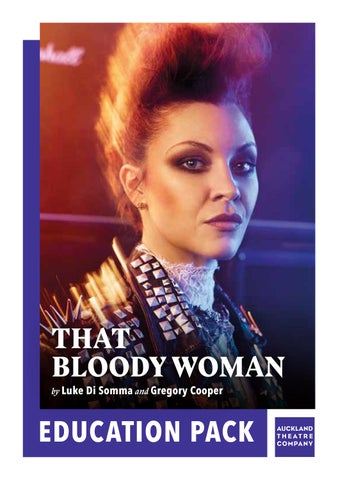
THAT BLOODY WOMAN by Luke Di Somma and Gregory Cooper
EDUCATION PACK
Contents
THANKS TO OUR SUPPORTERS
A u c k l a n d T h e at r e C o m p a n y r e c e i v e s p r i n c i p a l a n d c o r e f u n d i n g f r o m :
About The Play Luke Di Somma Speaks P.04
Director's Perspective Kip Chapman Speaks P.06
S u b s i d i s e d s c h o o l m at i n e e s a r e m a d e p o s s i b l e b y a g r a n t f r o m
Historical Context Speaking of Suffrage
Design: Costume P.25
Design: Lighting P.31
Design: Choreography P.37
P.10
Additional Reading and Resources
Historical Context Kate Sheppard Quotes
About ATC Education
Design: Set
Curriculum Links
P.15
P.19
ATC Education also thanks the ATC Patrons and the
P.40 P.41 P.41
ATC Supporting Acts for their ongoing generosity.
Please note • Schools’ performances are followed by a Q&A Forum lasting for 20 – 30 minutes in the theatre immediately after the performance. • Eating and drinking in the auditorium is strictly prohibited. • Please make sure all cell phones are turned off prior to the performance and, if possible, please don’t bring school bags to the theatre.
Venue:
SKYCITY Theatre, corner of Wellesley and Hobson Streets, Auckland
School Matinee Performances:
Thursday 23 June at 11am
RUNNING TIME:
90 minutes without an interval
SUITABILITY:
This production is especially suitable for Year Levels 11 - 13
Advisory:
Contains frequent use of strong language
• Photography or recording of any kind is STRICTLY PROHIBITED.
1
CAST Kate Sheppard — Esther Stephens
ma e Di Som Co o p e r Gregory
by L u k and
Richard "King Dick" Seddon — Geoffrey Dolan Gang Ensemble — Amy Straker, Phoebe Hurst, Cameron Douglas, Kyle Chuen
C R E AT I V E Director — Kip Chapman | Co-Writer & Musical Director — Luke Di Somma Co-Writer — Gregory Cooper | Associate Musical Director/Repetiteur — Andy Manning Set Designer — Rachael Walker | Costume Designer — Lisa Holmes Lighting Designer — Brendan Albrey | Choreographer — Olivia Tennet Director Intern — Ahi Karunaharan | Music Intern — Max Earnshaw
BAND Keys/Guitar — Andy Manning | Guitar — Tim Heeringa Bass — Hannah Elise | Drums — Cameron Burnett
PR O D U C T I O N Production Manager — Robert Hunte | Company Manager — Elaine Walsh Stage Manager — Cally Castell | Assistant Stage Manager — Tatiana Spirina Technical Manager — Jamie Blackburn | Lighting Operator — James Johnstone Sound Operator — Arran Eley | Props Master — Amy Snape Flyman — Michael Keating | Set Construction — 2Construct
E D U C AT I O N PAC K C R E D I T S Writer — Amber McWilliams Editor — Lynne Cardy Design images courtesy of Rachael Walker & Lisa Holmes Production Images — Michael Smith Design — Wanda Tambrin 2
WRITER AND MUSICAL DIRECTOR LUKE DI SOMMA SPEAKS
L
uke di Somma was studying musical theatre writing in New York when he had the idea for That Bloody Woman.
“I saw a couple of shows which had rock / history / politics mashups, and thought it was really cool and wanted to write a New Zealand version - or for New Zealand audiences, about New Zealand - in that kind of style, and I thought of Kate Sheppard. I came back to New Zealand in 2010, and approached Gregory Cooper to write it with me. We wrote the first draft, did a couple of workshops, got a commission from the Christchurch Arts Festival last year, and now here we are at Auckland Theatre Company.”
4
“It's absolutely a musical. Is it a musical with dancing girls, 'jazz hands' and sequins? Absolutely not. There's a perception that musical theatre is one form, whereas actually musical is a really broad genre. We're trying to stretch what people think of as musical theatre. But it's more than a play with songs. The majority of the 85 minutes is music. There are 22 songs in the show, so it's consistently musical. It's a new kind of musical. I heard a good phrase the other day "rockumentary" - which I quite liked! We are pushing the form; I don't know that there's been a musical like this in New Zealand.” “The figure of Kate was the initial impetus. As we got into it, the cause
became more prominent. When we did more research into her, we started to understand what was at stake politically and how serious the issues were. We celebrate her achievement, but we also explore her personal life, which was kind of a hot mess. We look at what she sacrificed. She gave up her time, her friendships… you could argue she even gave up her family for this. When Hilary Clinton was running for President, someone said 'how are you going to feel not being
establishment. I think all musicals are about underdogs: this show is about overcoming the odds, and the historic sweep of what they achieved.” “I think there's an indictment of (or commentary on) New Zealand's drinking culture, and its domestic abuse culture - some of the reasons women possibly aren't treated equally in this country. [In Kate's time] there was a temperance movement that led to a suffrage movement. I think we haven't even made enough progress on the temperance thing. We've still got high profile cases of domestic abuse... part of the show is questioning how far we have or haven't come. We just want to pose that question so people leave thinking 'what is Kate Sheppard's legacy? What did she fight for, and to what extent have we achieved what she wanted?”
“This show is about overcoming the odds, and the historic sweep of what they achieved.” there for your granddaughter?' She said 'have any of the previous 44 men been asked about their granddaughters?' There's a real double standard in what we expect from women in political leadership.” Initially the appeal of Kate’s story was about taking on the
5
DIRECTOR KIP CHAPMAN SPEAKS
D
irector Kip Chapman joined the process six weeks before rehearsals started for the first Christchurch production of the show.
“There were a number of songs completed and we had a script, so I could certainly see the potential of it. Just the idea of the show is super exciting and right up my alley. I'm really interested in political work and also highly theatrical work and this work ticked both those boxes.” “Over the course of the rehearsal period, we really built the show as a company together. Everyone was contributing to costume design, to dramaturgy, to song creation – some of the songs were written once the company arrived, that's how collaborative an experience it was. By
6
the time we opened in Christchurch, it felt like all of us owned the work, because all of us collectively had built it. The director's job is not to 'tell everyone what to do' - it's to bring everyone's visions into one cohesive idea.” “I didn't approach this any differently because it was a musical. I approached it seeing the theatrical possibilities of it; from the script itself, the possibilities were huge. Auckland Theatre Company provided amazing resources that let us work with other collaborators – we have a new costume designer, a new choreographer, and a set designer for the first time – to make the show so much bigger and better. I don't necessarily think ‘bigger is better’, but in this case, we've been able to do Kate’s story a lot more justice in
this version of the show. It has enabled us to make a massively, wildly theatrical experience, and the music supports – is integral to – that theatricality.” “There's a line in one of the songs: "change doesn't come for free. You've got to give to get it back." I think that's one of the core messages of the show. Women didn't achieve equality by sitting there: they achieved it by fighting. The idea of fighting for votes is a metaphor for how we build societies. We need to
continue to fight. The show bleeds across more than just women's rights. I got married two months ago (to his male partner) - two years ago it was illegal for me to get married. I could have had a 'separate but equal' alternative. The only reason I was able to get married was because people fought really hard. They were spat on, and pushed around, but they fought, and didn't give up, and they achieved a right for me. The fight continues to go on, across so many different areas.”
•
What do you understand by the term “musical theatre”? How does this show meet or disrupt your expectations a musical?
•
This show was created by the company collectively. What do you think are the benefits and challenges of working collaboratively like this?
•
What is Kate Sheppard’s legacy? How has NZ society come since her day? Focus on one of the following issues and show what has changed (or not): • rights for women • drinking culture • domestic abuse / violence
•
What are the current political issues motivating people to ‘get out and fight’ for change? Identify a modern activist who would make a good subject for a musical… How might you dramatize that person’s story?
7
SPEAKING OF SUFFRAGE
A
t the end of the nineteenth century, New Zealand was a rapidly growing British colony. The 1871 census records “the Population of the Colony (exclusive of Maoris)” as 256,393 persons; by 1881 this had risen to 489,933. By 1891, when Kate Sheppard presented the first suffrage petition to Parliament, the population had reached 626,658.
The total number of women in New Zealand in 1891 (“exclusive of Maoris and Chinese”) was 293,781. Of these, 190,658 were unmarried (had never been married); 90,870 were wives and 12,098 were widows. Women’s suffrage began with the temperance movement: that is, women seeking change to alcohol laws to prevent the male drunkenness that led to domestic abuse, squandering family money on alcohol, and
10
community violence. However, the voices of even large, well-supported organisations like the NZ Women’s Christian Temperance Union were ignored in Parliament – because changing the law to regulate male drinking would lose the Government votes. Women’s ‘opinions’ counted for nothing as they had no power to influence the outcome of elections, so their petitions were ignored. On 8 September 1893 the upper house of Parliament passed the Electoral Bill by 20 votes to 18; the governor signed it into law on 19 September, only six weeks before registration closed for the 28 November election. Despite the timeframe, 109,461 women (about 84% of those eligible) enrolled to vote. On polling day 90,290 of them (plus perhaps 4,000 Māori) voted – two out of every three adult women in the country.
PRO-SUFFRAGE ARGUMENTS
ANTI-SUFFRAGE ARGUMENTS
Women were full members of society and should be able to participate in decisions that affected all NZ citizens.
Women were responsible for the domestic sphere - their husbands or fathers were responsible for decisions in the public sphere.
Women would bring a civilising influence to political life; the “gentle sex” would bring new and more empathetic ethics to politics.
Women would be ‘tainted’ by association with the brutal world of politics and become tough and unfeminine.
Women’s presence at the voting booths would be settling and civilising, encouraging men to behave better. (The 1893 election had no issues.)
Colonial elections could be rowdy and rough; “lady voters” would risk “boorish and half-drunken men” harassing them at the polling booths. 11
12
•
Kate asks “are you a feminist?” How did you respond? What does the word mean to you? What connotations does it carry for Kiwis today?
•
What ‘feminist’ issues remain unaddressed? (For instance, Kate Sheppard is on the $10 bill – and yet women still do not have pay equity in New Zealand.) Why might this be the case?
•
How engaged are you personally with the political process? • Do you intend to use your democratic right to vote? Why / why not? • Do you follow political news or support a party? Why or why not? • What impact do you feel you and your friends can have as citizens? • Which issues are most important to you at this point in NZ history?
•
Note that “Maoris and Chinese” are excluded from the census counts of ‘persons’ in New Zealand in the 1890s. • How have attitudes to race changed in New Zealand since 1893? • Who have been the key activists / agitators in this field? What have been the major milestones on their journey toward equal rights? • What issues remain problematic? How are these being addressed?
•
What other social equity issues does New Zealand face in 2016?
13
“All that separates, whether of race, class, creed, or sex, is inhuman, and must be overcome.”
“Is it right that your mother, your sister... should be classed with criminals and lunatics...? Is it right that while the gambler, the drunkard, and even the wife-beater has a vote, earnest, educated and refined women are denied it?... Is it right... that a mother... should be thought unworthy of a vote that is freely given to the blasphemer, the liar, the seducer, and the profligate?”
“If the mother is dwarfed, repressed, how can the children grow to their full mental and moral stature? [There is]… no greater anomaly than the exaltation by men of the vocation of wife and mother on the one hand, while, on the other, the position is by law stripped of all its attractiveness and dignity, and a wife and mother is regarded not only as a "dependent" on her husband's bounty, but even the children of her own body are regarded as his legal property.”
“We are tired of having a 'sphere' doled out to us, and of being told that anything outside that sphere is 'unwomanly'. We want to be natural just for a change … we must be ourselves at all risks.”
“The question for me is whether we can keep Earth a safe, pleasant place for humankind and the ecosystems we rely on.” 14
15
SET DESIGN “This production is shared with the Court Theatre in Christchurch, so ultimately the set packs up into some road cases and tours. Everything has to be durable, take up very little space, and be flexible for future venue proportions!” — Rachael Walker, Designer
SET DESIGNER RACHAEL WALKER SPEAKS
“
The show had its first incarnation in the Christchurch Arts Festival Spiegeltent, where the relationship between audience and performers is very intimate. For this season, we wanted to continue this close association despite presenting the production in a proscenium arch theatre. So we have created a ‘thrust’ stage into the audience.”
“Actors enter through and sing in the auditorium; there is constant talking and singing to the audience and direct interaction with them. The production’s premise is that Kate has brushed off the cobwebs to enter 2016 and question ‘her people’ about how we have continued her good work. The band is a huge visual and aural component on stage throughout.” “The design is spatially succinct but visually busy. It incorporates the traditional theatre architecture and auditorium in order to displace it. Visually it is a fusion of NZ Victoriana - the period of Kate’s life and her bid to get the vote for NZ women (the 1890s) mixed with the period of her 18
Punk gang (mid-1970s onwards). This fusion is a way of communicating the anti-establishment shaking up Kate achieved and the relevance of her achievements now.” “The overall look is based on ‘Grunge Punk’. The limited colour palette and style is strongly influenced by the Sex Pistols artwork of the mid-1970s UK, with the use of cut up text, ripped paper, multiple fonts and grainy, pixelated photography. This DIY punk aesthetic is consistent across all elements of the production, and to every key moment. The gang of four actors are busy ‘tearing apart’ the environment and recreating what they need to tell the story.” “There are many theatrical moments in Kate’s retelling of her achievements. My favourite is the reveal of the third petition of 31,872 signatures. Taped end-to-end, the real pages of signatures created a 300m scroll which was presented to Parliament. We digitalised copies of the actual signatures (including Kate’s) from the National Archives to recreate this. Very moving.”
•
How does the set configuration (proscenium plus thrust) enhance the audience/performer relationship?
•
How familiar were you with the ‘grunge punk’ aesthetic before seeing the show? What other current ‘styles’ might work to ‘modernise’ the show?
•
Using one key moment as a specific example, explain how set elements contributed to the dramatic impact of the production.
19
costume DESIGN "At the start of the show Kate Sheppard (Esther Stephens) arrives in all her glamour and glory. There's a famous image of her in all her ostrich feathers and a big train: we begin the show with that 1880s Victorian look. The other aesthetic, which completely clashes, is the punk, 'Occupy', modern aesthetic: grunge, duct tape, ripped bits of fabric, patches, spikes, leather." — Lisa Holmes, Designer
21
COSTUME DESIGNER LISA HOLMES SPEAKS DRESSING (AND UN-DRESSING) KATE SHEPPARD
“
As Kate’s personality is developed throughout the show she picks up on that punk aesthetic. She gradually reveals herself, breaking away from Victoriana and she becoming ‘punked’ by the punks. As you find out more about her life, she is stripped right down to a really simple dress, and then at the end she's surrounded by the signatures of the women in a really simple coat."
"Kate's costume changes happen on stage, in full view of the audience. She's 'under-dressed' in white ripped jeans, studded gaiters and a silk blouse, so as she strips her Victorian skirts and hat off, more layers are revealed. So she's still got her glamorous side, and her essence of Victoriana - she doesn't become punk as far as the others are - but she's given a hint of it. Eventually she gets right down to her jeans and blouse, and one of the punks puts a
white studded leather jacket on her. This happens in the song 'Enough', where Kate finally feels empowered and knows what direction she has to take. Her big moment - when she's given the most power with the jacket - is that 'Eureka!' moment." "I'm using some of the banner fabric with the printed signatures to create a final coat for Kate. So the signatures will not only surround the set and go out into the audience; Kate herself will also be enveloped in the signatures through her garment. It's a really powerful image to end with." DRESSING THE ENSEMBLE "The punks also play multiple characters. There's not enough time - and it would be silly - for them to do full costume changes, because they need to remain the punks they are, and just take on the smaller roles. The performers have these extra costume elements attached to their 23
belts via carabineers. To play Kate’s Scottish uncle, Cameron Douglas unclips a kilt strip and puts it around himself, he then uses a bowler hat and glasses to play nerdy accountant Walter; the hat makes him look goofy. A cool person would not wear that hat! For Ada, Phoebe Hurst puts on another corset over her costume. It looks like metal but it's actually very hard metallic rubber; she looks like a glitter ball walking around the stage. These small pieces of costume - almost props - differentiate the chorus of characters. The punks also
24
use what is to hand – for instance, when Phoebe plays the vicar she uses duct tape to create a moustache and dog-collar. The changes have their comedic aspects!" "Onstage costume changes are a deliberate stylistic decision, because we want it to be like a real takeover of the theatre. It keeps it interesting. There are no hidden elements. It's all right in front of you. If you were to hide the changes, it would conceal things - that isn't the message the show's trying to get across. It's trying to put everything out there."
•
Explore how the costume concepts for this show are integrated with other design elements. How do the costumes, set, lighting and music work together to convey the show’s concerns?
•
Examine the various elements – colour, shape, material – of one costume. What does each piece of clothing, each accessory, represent or communicate?
•
Create a scene that involves performers playing more than one role. Incorporate costume changes into the scene to differentiate characters. What would be the strongest ‘signature piece’ to use for each? How would each actor solve the practical problems of ‘carrying’ this piece until it was needed, and putting it on?
25
LIGHTING DESIGN “Originally, when we did the show in the Speigeltent you walked in to what looked like a lovely production of an historical piece about Kate Sheppard with nice warm glowing lights. As soon as the punks ran into the space, it turned into an arena rock concert, as if we had taken Bon Jovi's lighting plan and crammed it into this tiny stage. It's quite confronting, and deliberately so." — Brendan Albrey, Designer
27
LIGHTING DESIGNER BRENDAN ALBREY SPEAKS
“
In SkyCity, we try to replicate the initial state on entry with some very basic white lighting - there's no colour - and some banners, and some pretty scenic effects, in front of a beautifullylit red house curtain. When the punks enter, it's audibly and visually quite aggressive. They rip down the banners and rip open the house curtain to reveal this rock-and-roll lighting rig. It's a visible rig: there are little lights on the front of the stage, on the band rostra, banks of lights hanging down. 100% visible!"
“Lighting wise, it is a rock concert. It is very visible, very in your face moving, strobing, bright colours, very fast. It's as far from traditional opera and theatre lighting as you can get. There's bling for everything - parcan chases, moving lights fanning out over the audience, gobos and colour. Rock-and-roll lighting isn't so much about lighting the people, like in theatre. Rock-and-roll lighting - with the hazer and the smoke machines turned on - is about lighting a big picture, you have all the beam shafts 28
through the smoke, it’s 'lighting the air'." "It's about working with the music and hitting all the beats and pulses in the music. There's a lot of flashing the lights, moving them around, beating and chasing in time to the music, which you wouldn't traditionally see in theatre. Literally, the performers and the lights are dancing to the sound of the same drum. We are running quick-tracks and time-code for the band: they have a metronome running for them, so they play at exactly the right tempo. The lighting is triggered digitally from those quick-tracks. In the big, fast songs, there are so many lighting cues that the margin for error if the cues were being called and operated by humans is enough that it can get out of time. The technology to do this has been around for about 15 years; it doesn't get used in theatre very often; it's very common on touring rock concerts, anything that has video and automation and lighting and all those big complex sequences that you would see at Beyonce or Madonna concert. They're often run off a central timecode clock.”
“Sometimes the light follows the actors; sometimes it sweeps out over the audience, or they move around... For 'Tricky Dicky', which is an R&B, hip-hoppy number, it just moves and pulses; it’s not on a particular person, it just keeps the atmosphere alive and the lights are dancing in time with the performers.” “In the Speigeltent, we didn't have a set, so a lot of the shape and depth was provided by the lighting. Now we
have a scenery, it's about creating a visual journey, so it starts off simple and gets bigger and bigger. At the climax in the middle of the show, everything opens up and we reveal the whole lighting rig and the whole set. That pinnacle is the moment that Kate realises that she has to take charge and make it happen…. “
•
Imagine the show in its original production, without set. How would you light the stage to suggest changes in location or time? Give an example using a transition between scenes.
•
Which of the technical terms Brendan uses – parcan, gobo, chase – do you recognise? Compile a short glossary of key lighting terms to introduce a beginner to the basics.
•
Using one key moment as a specific example, explain how lighting elements contributed to the dramatic impact of the production.
29
CHOREOGRAPHY “We had early discussions about this being an anti-musical: there were going to be no jazz hands or galloping around the stage! We wanted to create the frenetic and anarchic energy of a big rock concert, but it still needed to be controlled and sharp. ‘Controlled chaos’ is a good name for it.” — Olivia Tennet, Choreographer
31
CHOREOGRAPHER OLIVIA TENNET SPEAKS
“
The first thing I do when choreographing is listen to the song three times to get a feel for the pace, rhythm and any lyrical elements. Then I improvise to see how my body naturally wants to move to the music. The choreography should feel comfortable and natural for the actors to perform, so it is important to try and harness my first instinct when hearing each song.”
“At first, the biggest difficulty was getting my head around not choreographing big dance sequences and letting the lyrics speak for themselves. It works much more effectively if only particular moments are highlighted with choreography. We didn’t want it to feel too synchronised or contrived.” “The other challenge was filling such a big stage with only six performers. The cast are essentially playing core roles as well as having to fulfil what would normally be played by a chorus. There are only 32
so many formations you can do with half a dozen people, so I had to be really creative with filling space.” “We really wanted to utilise the thrust, but only at important moments, as to not to ‘overkill’ it. It has a lot more impact in songs like ‘Change Doesn’t Come for Free if it’s just used in the climax of the song. In ‘God’s Own Country’ – where it should feel like the show has been hijacked by the gang – we eliminate distance from the audience so it really feels like they’re part of the action.” “I like to be fully prepared before arriving at rehearsals, with choreography completely mapped out in my head. There’s always room to change anything if it’s not working, or the performers come up with a better offer. It’s an everchanging process. There were things I thought worked in rehearsals, but when I saw a full run of the show, I wanted to tweak and improve. You have to try everything to know what works and what doesn’t, and usually the best things come out of lucky accidents!” 33
“Communicating and teaching choreography is about demonstrating the movements with the energy you want, but then being able to watch and give clear direction. The cast are all amazing movers, but not formally trained in dance. When working with actors, it’s sometimes more helpful to translate the movements into ‘actions with an intention’, rather than using unfamiliar dance terminology. We have (funny) labels for different moves that I can call out and the actors know what I’m talking about.” “Sometimes I’ve choreographed moves to the beat of the music, as I would for a straight dance piece. However, when teaching it to the performers, we’ve realised they are singing a different
rhythm, and it feels wrong for them to do choreography to the accompaniment and not the lyrics.” “There are multiple dance styles in the show. For ‘Two Johns’ I was inspired by Soul Train, and for ‘Tricky Dicky’, I watched lots of Beastie Boys videos. The gang have a more grounded, grungier movement language as ‘the gang’ than when they’re playing their other character roles. There’s also quite a bit of sarcasm within the show, so I tried to juxtapose some cheesy/happy dance motifs into songs with really strong lyrics or messages, like ‘F@?k F!@k F@!kity F@?k’ and ‘Tricky Dicky’. I wanted the movement to go against the ‘colourful’ lyrics rather than going over the top with choreography.”
•
How do the performers ‘fill the space’? Where in the room – onstage and off – do they move?
•
How does movement help to delineate between the gang as individual characters and the gang as gang members?
•
Watch some Beastie Boys videos on YouTube. Which elements of their performance show up in the choreography for That Bloody Woman (especially in ‘Tricky Dicky’)? How does this style of movement emphasize the ideas in the song and the show as a whole?
ADDITIONAL READING AND RESOURCES KATE SHEPPARD AND THE SUFFRAGE MOVEMENT
•
Grimshaw, Patricia. “Politicians and Suffragettes WOMEN'S SUFFRAGE IN NEW ZEALAND, 1891-1893.” URL: http://www.nzjh.auckland.ac.nz/docs/1970/NZJH_04_2_04.pdf
•
Malcolm, Tessa K. 'Sheppard, Katherine Wilson', from the Dictionary of New Zealand Biography. Te Ara - the Encyclopedia of New Zealand, updated 12-02-2014. URL: http://www.TeAra.govt.nz/en/biographies/2s20/sheppard-katherinewilson
•
'New Zealand women and the vote' URL: http://www.nzhistory.net.nz/politics/womens-suffrage (Ministry for Culture and Heritage). Updated 17-07-2014. Accessed 09-06-2016.
•
Ward, Paul. “Kate Sheppard – Suffragist”. Published http://www.nzedge.com/legends/kate-sheppard/
ATC EDUCATION
A
TC Education promotes and encourages teaching and participation in theatre and acts as a resource for secondary and tertiary educators. It is a comprehensive and innovative education programme designed to nurture young theatre practitioners and future audiences.
ATC Education has direct contact with secondary school
CURRICULUM LINKS
A
TC Education activities relate directly to the PK, UC and CI strands of the NZ Curriculum from levels 5 to 8. They also have direct relevance to many of the NCEA achievement standards at all three levels.
All secondary school Drama students (Years 9 to 13) should be experiencing live theatre as a part of their course work, Understanding the Arts in Context. Curriculum
36
students throughout the greater Auckland region with a focus on delivering an exciting and popular programme that supports the Arts education of Auckland students and which focuses on curriculum development, literacy and the Arts. Auckland Theatre Company acknowledges that the experiences enjoyed by the youth of today are reflected in the vibrancy of theatre in the future.
levels 6, 7 and 8 (equivalent to years 11, 12 and 13) require the inclusion of New Zealand drama in their course of work. The NCEA external examinations at each level (Level 1 – AS90011, Level 2 – AS91219, Level 3 – AS91518) require students to write about live theatre they have seen. Students who are able to experience fully produced, professional theatre are generally advantaged in answering these questions.
37
ENGAGE
JOIN THE CONVERSATION Post your own reviews and comments, check out photos of all our productions, watch exclusive interviews with actors and directors, read about what inspires the playwrights we work with and download the programme and education packs. Places to find out more about ATC and engage with us:
www.atc.co.nz facebook.com/TheATC
@akldtheatreco
AUCKLAND THEATRE COMPANY
487 Dominion Road, Mt Eden PO Box 96002, Balmoral, Auckland 1342 Ph: 09 309 0390 Fax: 09 309 0391 Email: atc@atc.co.nz