Manusaute VAO SONSof
by
Vela
Anna Turner & Jonathan Price
He pou atua, he pou whenua, he pou tangata.
Ko Waitematā te moana
Ko Waikōkota te whenua.
Ko Te Pou Whakamahara a Māui Tikitiki a Taranga te tohu o te kaha, o te kōrero, o te whakapapa o tēnei wāhi, o tēnei whare.
Nau mai e te tī, e te tā ki te whare kōrero, ki te whare whakaari o ASB ki te tahatika o te moana.
Mauri tau, mauri ora!
Pouwhakamahara a Māui-Tikitiki-a-Taranga
The Memorial Post of Māui the Topknot of Taranga
Robert Jahnke ONZM (Ngāi Taharora, Te Whānau a Iritekura, Te Whānau a Rākairoa o Ngāti Porou), 2016
Laminated tōtara and Corten steel
Proudly commissioned by Auckland Theatre Company for ASB Waterfront Theatre


The symbols of support, of strength and of guardianship stand fast and proud.
The waters of Waitematā ebb and flow against the shores here at Waikōkota, the land upon which we stand.
The pou of remembrance to Māui Tikitiki a Taranga stands tall as a beacon of courage, of stories passed down and of the history that connects us all to this place and to this space.
We welcome you all from near and far to this house of stories, to the ASB Waterfront Theatre.
Mauri tau, mauri ora!
About This Pack
This education pack is designed to support your exploration of Auckland Theatre Company's production of Sons of Vao by Vela Manusaute. Whether you're a kaiako preparing lessons, an ākonga studying the play, or simply curious about this powerful new work, this resource offers insights into Vela's autobiographical script and how this world premiere has been brought to life on stage.
This education pack is divided into four sections:
Pre-reading and Listening
About the Play
Making the Play
Activities
A suggested structure for working through the front of the pack, helping you gather ideas, quotes and observations from the Post Show Forum and the resources here, ready to use in the activities at the back.
After a welcome from Auckland Theatre Company, this section includes key information about the cast and creatives, essays providing essential context and background information, and a synopsis of the production.
This section takes you behind the scenes with artefacts from the rehearsal room, key design concept insights, and notes to and from the cast, giving you a unique window into the creative process.
NCEA-linked activities that you can try in your classroom or at home to help you unpack and explore this production of Sons of Vao by Vela Manusaute. These activities support achievement standards across Levels 1, 2, and 3.
UNPACKING THIS EDUCATION PACK
Each section builds upon the previous one, but you can also use individual components as standalone resources. The activities are designed to complement the contextual information and production insights, making this pack suitable for both independent study and classroom use.
Pre-reading and Listening
Prior to reading through this pack, think about implementing the following pre-reading and listening structure to how you unpack the front half of this pack, so that you can collect ideas and information to complete the activities in the back of the pack.
As a class: with your teacher as scribe, record what you learnt from the Post Show Forum:
• Write down ideas that interest you
• Record quotes you think would enrich an answer in your portfolio or exam
• Record moments in the forum that surprised you or provided more context for something you saw on stage.
Watch: Descendants of Niue -Tau Hologa Niue explores what it means to be Niuean today by reflecting on the past 50 years of self-governance in free association with Aotearoa New Zealand. The docu-series shares the personal experiences of Niueans both on “the Rock” and living abroad. Descendants of Niue -Vela episodePasifika TV
In the Activities section of the pack there are classroom exercises and revision questions that help you unpack the following sections of the pack:
• Playwright and Director’s Vision and Concepts
• Refer to pages 47
• Exploring the Characters of the play
• Refer to pages 49
• Unpacking Design Choices
• Refer to pages 52
• Pacific Theatre Traditions/Wider Context
• Refer to pages 58
In groups of four: assign each group member one of the sections above. As you read through the pages associated with each section record the following:
• Ideas that interest you
• Quotes you think would enrich an answer in an exam
• Ideas that link to a specific moment in the performance
• Share what you have recorded with your group and discuss what you might have missed.
• Save your brainstorm notes in a shared space.
• You could share these with the whole class, so you have everyone’s ideas to draw from as you complete the activities in the back half of the pack or revise for your exam.
Individual Homework: Ensure that you read all the outlined pages of the pack, so that you can add information if you need to.
About The Play
Key information about the cast and creatives, essays providing essential context and background information, and a synopsis of the production.

18 JUNE – 5 JULY 2026

CAST
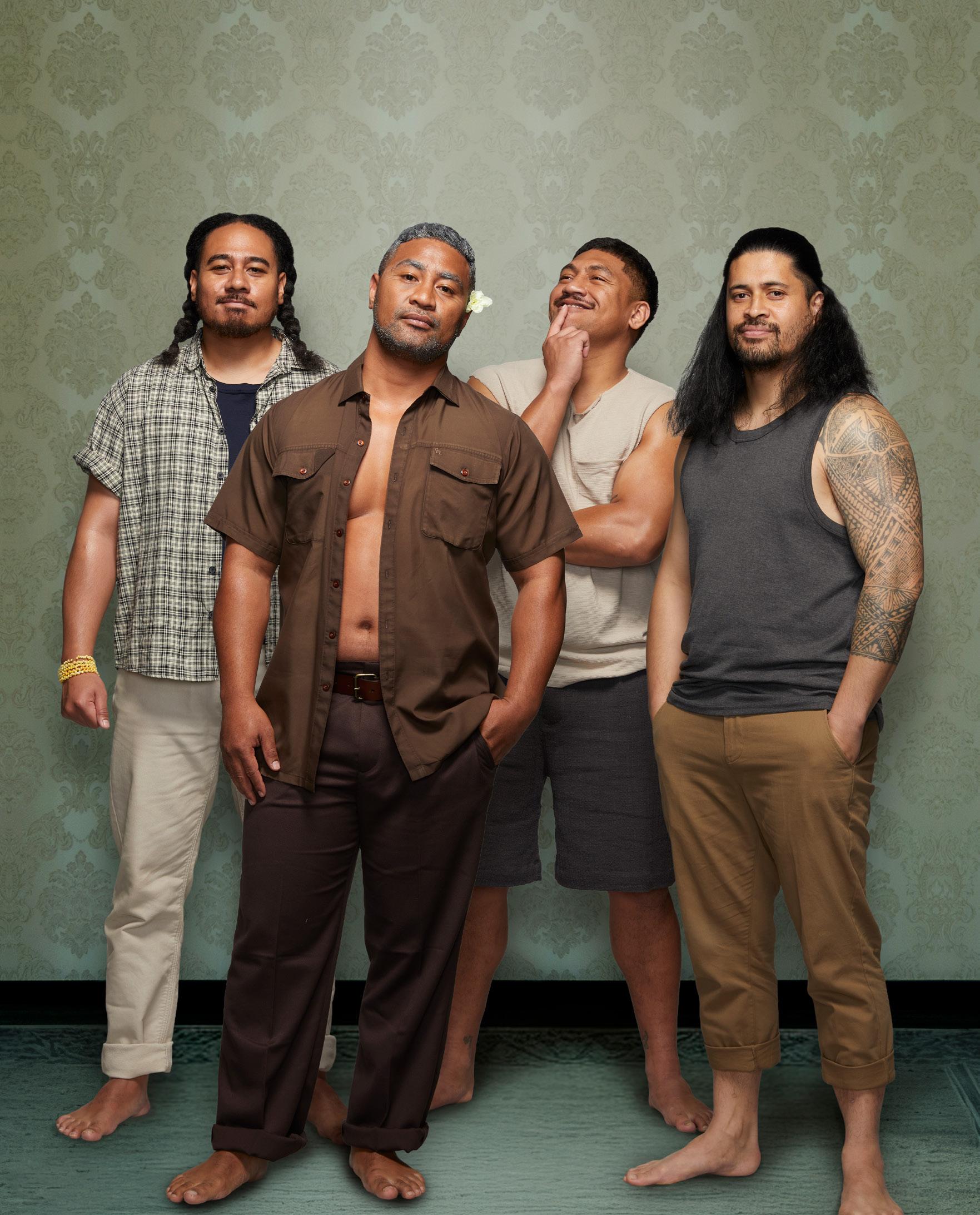
To – Haanz Fa'avae-Jackson
Vao – Beulah Koale
Seki – Epine Bob Savea
Sau – Brett Taefu
CREATIVE
Playwright – Vela Manusaute
Co-Directors –
Anapela Polata'ivao & Vela Manusaute
Production Designer – Sean Coyle
Composer – David Long
Sound Designer – Sam Clavis
Engine Room Assistant Director –Sepelini Mua'au
Dramaturg – Stacey Leilua
Voice Coach – Kirstie O’Sullivan
Teaching Artist –Connor Magatogia & Richard Sikuea

Education Pack Writer –Anna Turner & Jonathan Price
Sons of Vao by Vela Manusaute is the fifth production in Auckland Theatre Company’s 2026 season and the world premiere of this work. The script won Best Play by a Pasifika Playwright at the 2021 Adam NZ Play Awards. This production began previews on Thursday 18 June and opened on Saturday 20 June at ASB Waterfront Theatre.
This production is one hour and twenty minutes long, with no interval. It contains haze, strong language, depictions of smoking and themes of family violence.
Please ensure all mobile phones and noiseemitting devices are switched off.
SUPPORT AFTER SONS OF VAO
If you'd like to talk to someone, these free and confidential services are available.
• 1737 | Call or text anytime to talk with a trained counsellor
• Vaka Tautua, 0800 OLA LELEI | Call 0800 652 535 for Pacific support, by Pacific for Pacific
• Shine | Call 0508 744 633 for family violence support, anytime
• General alcohol drug helpline | Call 0800 787 797 or text 8681 for you or someone you love
• Pasifika helpline | Call 0800 787 799 or text 8681 for Pacific support services
• Suicide Crisis Helpline | Call 0508 828 865 anytime





Nau mai, haere mai
A world premiere of a new work by a New Zealand playwright is always a cause for celebration. But, Sons of Vao is even more significant, a historic first for the Auckland Theatre Company main stage: a world premiere by a Niuean playwright.
Vela Manusaute draws from his own experience to tell the story of a family where a father’s love struggles to be expressed, except through his fists. Vela broke the cycle. In finding art, he found a way to grapple with his experience, and, ultimately, forgive his father and find his peace.
Vela is making this work with his wife and creative partner, the awardwinning Anapela Polata'ivao ONZM. They have attracted a powerhouse creative team and each of its members has sensitively applied their craft to layer this work with pathos.
While Anapela can go big, she is also a master of simplicity. She excels in stripping away the artifice between truth and spectator. In this production, Anapela leaves behind the usual Auckland Theatre Company production grandeur in favour of a father circled by his sons, separated from each
other by an invisible forcefield until, devastatingly, they are not. It is brilliant in its conception and flawless in execution.
This simplicity works because our four actors, Haanz Fa'avae-Jackson, Beulah Koale, Epine Bob Savea and making his debut with us, Brett Taefu, are, quite simply, virtuosos of their craft. We are fortunate to see their collective work as they hold the tenderness and toughness of these characters in balance.
The work of Auckland Theatre Company is made possible by Creative New Zealand and Auckland Council through the Auckland Regional Amenities Funding Board. This public-sector investment in our Company is vital and means audiences of Tāmaki Makaurau can have a theatre company that dreams big and tells their stories at scale.
As winter bites, we turn towards two beloved classics: Macbeth and Cabaret, the latter a co-production with Auckland Live. Be sure to be here for both – there’s nothing like the warmth of live theatre.
Jonathan Bielski Artistic Director & CEO
Note from the Playwright
The story of Sons of Vao has resonated within me for a long time. Initially, I hesitated to tell it because of my personal fears: fears of confronting my past, exposing my family and revisiting the complex relationship with my father. However, five years ago, a profound sense of creative courage finally compelled me to begin.
As I delved into this world, words and memories flooded back, imbuing the narrative with life. Each word written required me to face the painful truths of those days, seeking to understand and find peace with my journey. I realised
that the only path to this understanding was to confront the past directly.
My relationship with my father was fraught with difficulty. Through a child’s eyes, I perceived only struggle and pain, unable to comprehend the love of the man who brought me into this world. I questioned why, what I had done, and sought answers from a higher power.
His passing more than two decades ago left me with a profound need for reconciliation, both with him and, more importantly, with myself. At his funeral, I stood tearless – an angry young man shaped by an upbringing that left me
unable to express love or affection. It has taken years, but finding peace and love as a man, now over fifty years old, has become imperative. This story, therefore, is a journey of forgiveness and celebration.
Sons of Vao is a reflection, looking back and looking forward. The play draws inspiration from my memories of growing up in Niue and New Zealand, finding its heart through the collaborative creative process in the theatre. It is seen through the eyes of a child, a young man and, now, a man with a family, who must forgive and find joy in life.
Today, I recognise the necessity of releasing the past. This play allows me to revisit those years with courage and celebrate them within the theatrical space. It embodies my strength and my ability to face the challenges of my history.
This production is an act of forgiveness
–a personal journey brought to life on the creative stage. While acknowledging the hardships of the past, I choose to celebrate the present through the power of theatre. The words of the play are invigorated with heart and purpose, and it is through the collective effort of a dedicated team that my journey is shared on stage.
Many years ago, I stood on the wharf with my father, fishing for food. Now, more than forty years later and only a short distance away, I am telling this story at ASB Waterfront Theatre, joined by a team of incredible people who have helped turn this journey into a celebration for the world to see.
I hope you are looking down on me, old man, with love – and love for all.
Vela Manusaute
Note from the Co-Directors
Kia Ora | Fakaalofa Lahi Atu | Talofa Lava
We are proud to present Sons of Vao for Auckland Theatre Company. This production marks a significant milestone: it is the first Niuean play produced by Auckland Theatre Company and the work’s world debut. It brings forth the vital voices of Island men – voices rarely heard or seen in mainstream theatre.
At its core, Sons of Vao is about sons grappling with the legacy of a father who has passed on. They carry the weight of his stories, ultimately seeking peace and forgiveness within themselves. Our process on the creative floor has been to explore these characters and bring the author’s words to life – and it has been an immense joy.
Part of the theatrical magic has been discovering the presentation and design of this world, beautifully created by Sean, Sam and David, and shared intimately within this creative space. Another joy has been allowing the words to speak with truth, heart and, of course, laughter. We embrace laughter, even amidst tears, as it reflects the absolute truth of the world we represent and know. Key themes we unpack include loss and love, the intricate bond between fathers and sons, and the journey of a man’s personal history brought to light over forty years. This journey of exploration has allowed us to bring this deeply personal story to life and present it with authenticity. We approached the work with no preconceived notions, granted the creative licence to infuse our collective magic and energy into every aspect of the production.
Serving the story’s purpose and bringing it to vibrant life has been immensely rewarding while also significantly demanding. Stacey Leilua and ourselves were among the thirteen pioneering Pacific artists who founded Kila Kokonut Krew


in 2002 and we have been working tirelessly for years to ensure our voices are heard. It has been a gift to collaborate creatively with each other and Stacey. Now, we stand under the bright lights of ASB Waterfront Theatre, celebrating this creative journey together.
The unique presentation style, inspired by years of collaboration, pushes the boundaries of Pacific comedy. This distinctive approach adds a powerful theatrical element that resonates with both Pākeha and Pacific audiences. We are here not just to tell our stories, but to celebrate them on stage, paving the way for young Pacific storytellers who will walk with us into the future.
Our deepest gratitude to Auckland Theatre Company, Jonathan Bielski and Anna Cameron, and the entire Auckland Theatre Company team for their unwavering alofa and trust in bringing this production to fruition.
A huge fa'amālō to our exceptional actors: Beulah Koale, Haanz Fa'avae-Jackson, Epine Bob Savea and Brett Taefu, for trusting us and for your epic and powerful work in Sons of Vao. Thank you, boys.
Thank you, Louise Gallagher and the PANNZ team.
Thank you, Stacey Leilua, for your insightful dramaturgical eye.
Fa'afetai tele lava to our magnificent creative and management team: Sean Coyle, David Long, Sam Clavis, Kasi Valu, Sepelini Mua'au and Hector Polata'ivao-Saute.
Finally, to all our families. Fa'afetai, fa'afetai, fa'afetai tele lava.
Fakaue lahi mahaki, Anapela Polata'ivao and Vela Manusaute
Playwright & Co-Director
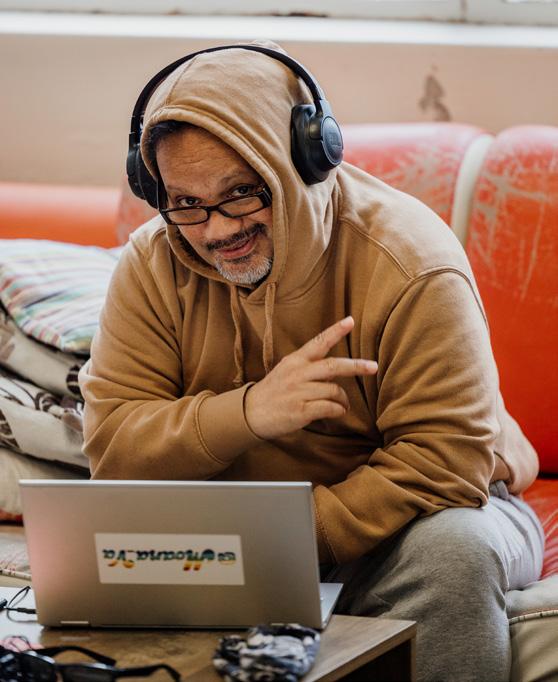
Vela Manusaute
Vela came to New Zealand in 1979. In 1996, he became the first Niuean to graduate from Toi Whakaari: New Zealand Drama School.
A year later, he received the Best Male Comedy award at the Chapman Tripp Theatre Awards as one half of the comedy duo, The Brownies, widely regarded as Pacific comedy pioneers.
His first-ever play, Taro King, performed in 2002 at the Maidment Theatre in Auckland, was an instant hit. In 2007, he won the Philip Fuemana Award for Most Promising Pacific Artist at the Pacific Music Awards, producing nine original Pacific albums from his South Auckland backyard studio, formerly known as Nafanua Records.
He is passionate about Pacific and South Auckland stories, and, together with his partner, Anapela Polata'ivao ONZM, founded Kila Kokonut Krew, a South Auckland creative space that champions South Side stories for the stage and screen. Vela’s vision was the original idea for Kila Kokonut Krew’s The Factory stage musical, which led to his work as an executive producer and actor on the web series of the same name. Vela and Anapela jointly received the Arts Foundation Te Tumu Toi
New Generation Laureate Award in 2014 for their work with Kila Kokonut Krew.
Vela has continued his success in the screen industry. He directed his first short film, The Messiah, in 2017 which won Best Screenplay and Best Art Direction at the Short Circuit Pacific Rim Film Festival in 2020. He also directed an episode of the spiritual drama series Teine Sā, which aired on PRIME in 2021. Brutal Lives –Mo'ui Faingata'a is a Tongan story Vela co-wrote and directed in Season Two; it was the winner of the Best Pasifika Programme category at the New Zealand Television Awards 2023. His latest project is Descendants of Niue – Tau Hologa Niue documentary for the screen, 2026.
Vela has a rich history of connection with Auckland Theatre Company, collaborating with Manukau Festival of the Arts on Strictly Brown in 2009 and Dario Fo’s We Can’t Pay! We Won’t Pay! in 2010, followed by working as co-director on the main-stage production of Red, White and Brass in 2024.
Sons of Vao is Vela’s first full-length play that has been produced by Auckland Theatre Company for the main-stage. The script won the Adam NZ Play Award for Best Play by a Pasifika Playwright in 2021.
Co-Director Anapela Polata'ivao
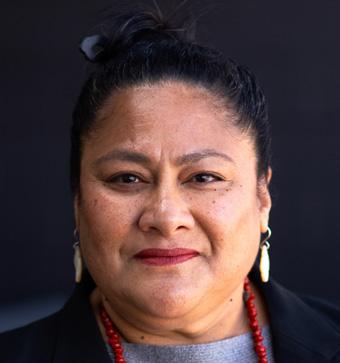
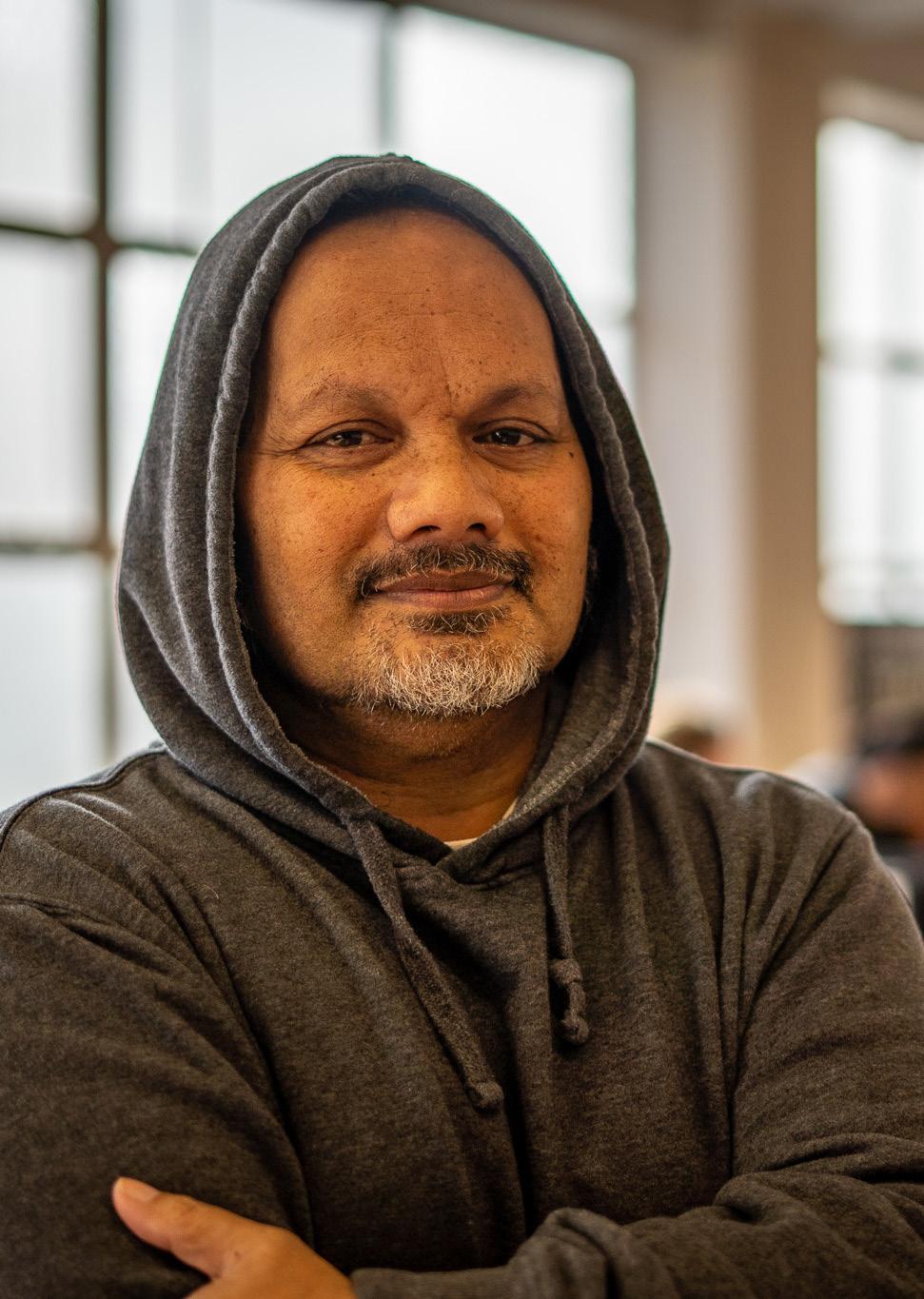
Anapela Polata'ivao ONZM is an actor, producer, dramaturg and director from the Sāmoan villages of Vailoa ma Vaiusu in Upolu and Fagae'e Safune in Savai'i.
Anapela co-founded the Kila Kokonut Krew theatre collective with Vela Manusaute in 2002. She was a 2002 graduate of Toi Whakaari: New Zealand Drama School and taught at the Pacific Institute of Performing Arts. Her vast career has led her to gain multiple awards, including being named an Arts Foundation Te Tumu Toi New Generation Arts Laureate in 2014, Creative NZ’s Pacific Contemporary Artist Award in 2019 and Best Actress in the 2019 Wellington Theatre Awards for her role in Tusiata Avia’s Wild Dogs Under My Skirt.
Anapela gained international acclaim and made history as the first Sāmoan woman to have directed a show off-Broadway when Wild Dogs Under My Skirt made its New York debut and was subsequently named the winner of the Fringe Encore Series at the SoHo Playhouse. In 2019,
she staged her first original Sāmoan opera with Sol3 Mio in South Auckland. She collaborated again with Tusiata Avia on The Savage Coloniser Show in 2023, and the play attracted significant media attention. She directed a theatre adaptation of the film Red, White and Brass for Auckland Theatre Company in 2024. Earlier this year, she directed a production of A View from the Bridge for Silo Theatre, which received widespread critical acclaim.
Her film and TV credits include HBO’s Our Flag Means Death, One Thousand Ropes, The Justice of Bunny King and The Markets. Most recently, Anapela played the lead role of Mareta in the acclaimed New Zealand feature film Tinā, directed by Miki Magasiva, for which she won the award for Best Actress in a Feature Film at the 2025 NZ Screen Awards.
In June 2024, Anapela was recognised in the King’s Birthday Honours List for her services to Pacific performing arts.
Introduction
A world premiere, Vela Manusaute’s (Niue: Mutalau, Hakupu) autobiographical Adam NZ Play Awardwinning script is deeply personal. This is meaty and meaningful theatre that will leave a lasting impact on its audience.
This play is directed by stage and screen legend Anapela Polata'ivao ONZM (Sāmoa: Vailoa and Vaiusu, Upolu; Fagae'e Safune, Savai'i), who recently starred in the hit movie Tinā and directed acclaimed productions including Silo Theatre’s A View From The Bridge and for Auckland Theatre Company, Things That Matter and Red, White and Brass. Audiences can expect Pasifika excellence on stage: one of our nation’s finest directors, searingly stunning writing and virtuosic performances from four extraordinary actors.
What does it mean to forgive?
Spanning four decades, from village life in Niue in the 1970s to the suburbs of Ponsonby, this award-winning play follows the three brothers’ struggle to break free from their father.
Vao is charming, handsome, ambitious. To his three sons, he is a god. But he carries rage in his fists and danger in his eyes. This complicated character will be portrayed by the phenomenally talented Beulah Koale (Samoa: Sala'ilua, A'ele. Tuvalu: Nanumea), star of Silo Theatre’s A View From The Bridge.
It’s an uplifting coming-of-age story, as Seki, To and Sau emerge into adulthood, each affected by their father in different ways.
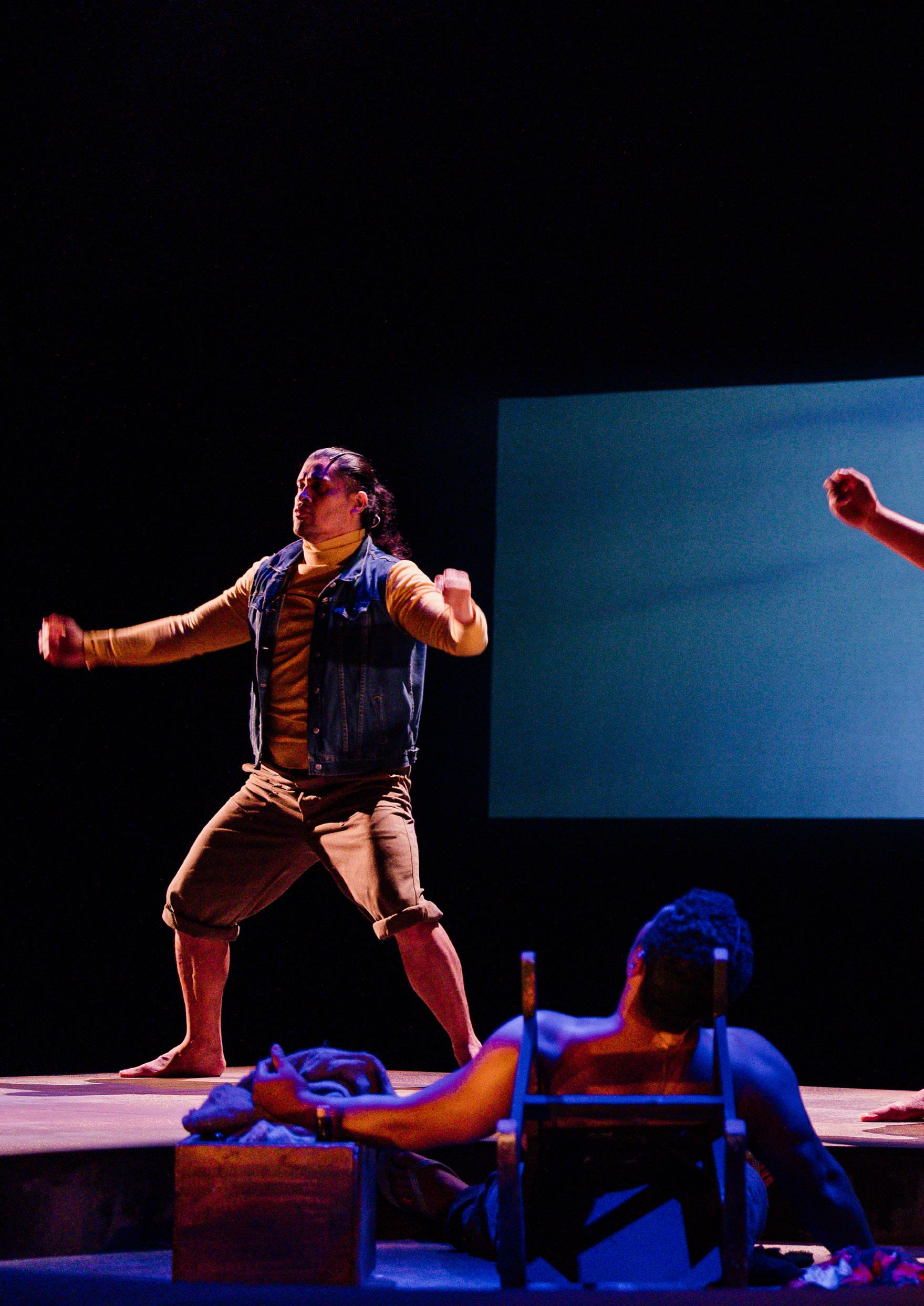
Synopsis
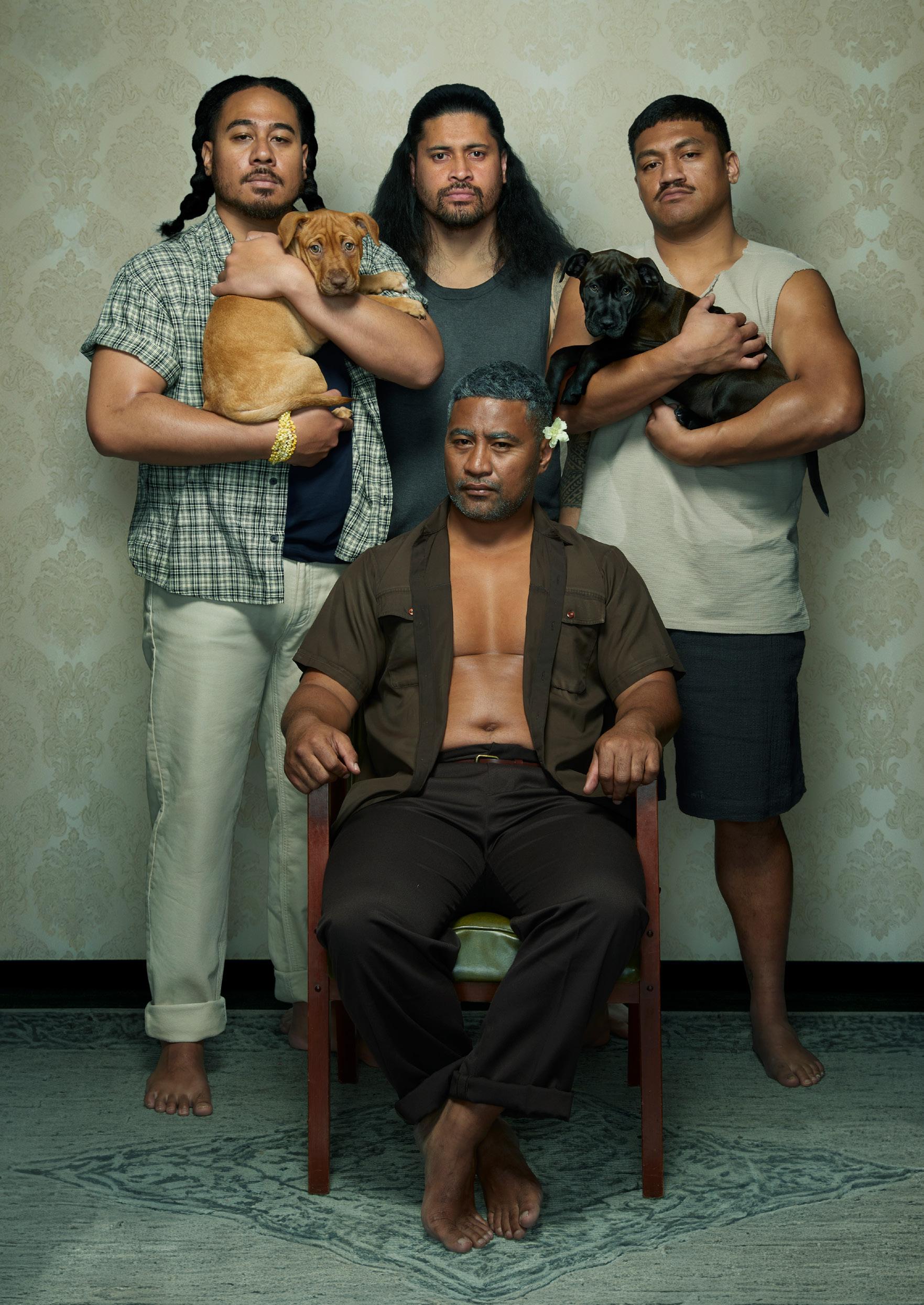
Three brothers reflect on their journey from a small village to the bright lights of Auckland, New Zealand — four decades of stories from the heart. At the centre of their lives is their father, Vao, whose teachings left a legacy of memories, pain, struggles, and tears, but most importantly, the strength to find closure and forgiveness within themselves.
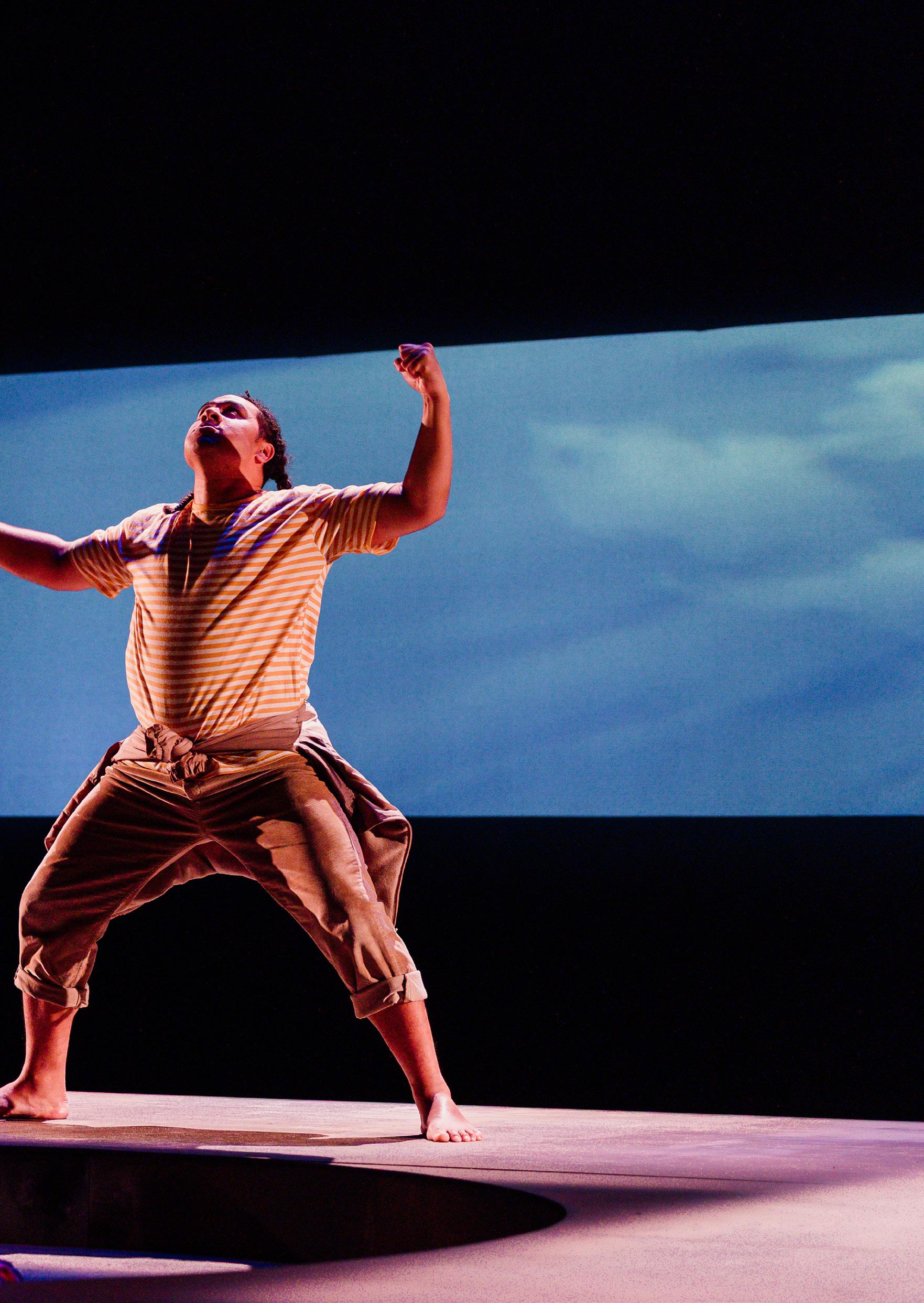
Niue Fact Sheet
Niue’s rich culture and history –interrelated with Tongan and Samoan culture and also distinctly its own – is worthy of much wider reading and exploration than can be achieved in this pack. This fact-sheet focuses on issues raised in the text of Sons of Vao, such as migration to New Zealand.
EARLIEST SETTLEMENT
Niue is a raised coral atoll of 259 square kilometres. It is about 2,400km northeast of New Zealand. Niue was first settled c. 900AD by Polynesians arriving from Samoa. There was a second wave of migration from Tonga in the 16th century. Captain Cook visited the island on his second voyage to the South Pacific. However, he failed to land there, driven away by the Niueans.
INFLUENCE OF CHRISTIAN MISSIONARIES
With the exception of a few whalers, Niue’s next major meeting with Palagi (white Europeans) came in the form of Christian missionaries sent from the London Missionary Society. By the
mid-19th Century, Christianity had taken root on the island. Today, it is the dominant religion.
In the play, Vao and his sons have a complicated relationship with Christianity and the church. The character To blames the church missionary for teaching his father to make home-brewed spirits. Vao believes that his epileptic fits are caused by a curse placed on him by the church minister’s wife. Towards the end of his life, Vao turns to Christianity as a way of coping with the breakdown of his marriage.
FINDING NATIONHOOD
It took Niue a few steps to re-establish its independence in the radically changed world of the pacific after European colonisation. Initially, in 1889, Niuean leaders sent a request to Queen Victoria to become a British colony. This request, perhaps surprising to us, was largely made out of self-defense: they considered it preferable to become a British colony than be colonised by force by another European power. This request was briefly accepted,
but in 1901 Niue was brought within the boundaries of New Zealand along with the Cook Islands. Finally, in 1974, Niue elected to become politically independent (self-governing) in free association with New Zealand. Niue uses the New Zealand Dollar and all Niueans are New Zealand citizens. This, along with the opening of an airport in 1971, has eased the flow of Niueans away from the island.
MIGRATION
In the last 50 years, Niue has experienced a population decline greater than any other nation in the world. A few years before the events of the play, in 1966, Niue’s population had reached its peak of 5,200 people. This was short-lived. In the timeline of the play, by the time Vao’s sons are born in 1971, a mass exodus is already well underway. The destination for most migrating Niueans is Auckland. Today more than 30,000 Niueans live in New Zealand, compared with fewer than 2,000 in Niue.
The situation for Niue now is a complex one. Migration to New Zealand affords Niueans economic opportunities that may not be available to them on the small island. However, this comes
at the risk of isolation from family networks, and the gradual erosion of Niuean language and culture.
In the playtext, when Vao moves to New Zealand he seeks a land of “lots of money”. Seen through the eyes of the sons, New Zealand initially is like a film. However, the family’s fortunes are mixed, as the gravitational force of Vao threatens to keep them stuck in a cycle of addiction, ill health and poverty. In the play, the three brothers never return to Niue. The Niuean language, though, makes a reappearance in the naming of To’s son: Halamoana, meaning the way to the ocean.
In the Press
These links are a starting point for exploring the world of Sons of Vao; the playwright, the kaupapa, and the play itself.
VELA MANUSAUTE: PLAYWRIGHT AND CO-DIRECTOR
Dad Made Me, But Drama Saved Me (E-Tangata)
A profile by Atakohu Middleton from rehearsals at ATC’s Mt Eden base. Vela talks about his late father, the writing of Sons of Vao as an act of healing, and the role drama has played in his life since Toi Whakaari.
Why This New New Zealand Play Marks a Milestone in the Country’s Theatre History (NZ Herald, The Listener)
An extended feature with Vela alongside actors Beulah Koale and Haanz Fa'avae-Jackson in the rehearsal room. The piece traces his path from Selwyn College, where drama teacher June Renwick fought for his place at school, to the world premiere of the play that won him the 2021 Adam NZ Play Award. (Paywalled)
A NIUEAN MILESTONE
Sons of Vao: Vela Manusaute Brings
First Niuean Story to ATC (PMN) PMN News reports on the significance of Sons of Vao as the first Niuean story presented on ATC’s main stage. Vela speaks about hearing Niuean language in mainstream theatre and what that moment means for him and for Niuean audiences.
Descendants of Niue: Tau Hologa Niue (Tagata Pasifika Plus)
A television series exploring Niuean heritage in Aotearoa. Vela’s own path to forgiveness features in one of the episodes. Available on Tagata Pasifika Plus from 17 June 2026.
THE CREATIVE PARTNERSHIP
Sons of Vao: Auckland Theatre Company Debuts First Niuean Play (NZ Herald)
A profile of Vela and his longtime partner Anapela Polata'ivao, who directs the production with him. The piece looks at how the pair built Kila Kokonut Krew together after Toi Whakaari and the work they have done to create space on stage for Pacific stories. (Paywalled)
The Factory (2013 Web Series) (NZ On Screen)
Vela’s earlier musical The Factory, about Pacific Islanders working on Aotearoa’s factory floors in the 1970s, was partly inspired by his father’s working life. The original web series sits on NZ On Screen and offers useful context for the world Sons of Vao grows out of.
MEET THE CAST
Beulah Koale: Unapologetically Southside (E-Tangata)
A profile of the actor who plays Vao. Beulah talks about his career across Aotearoa and Hollywood, his Sāmoan identity, and the work that has shaped him as a Pasifika performer.
THE PLAY
Sons of Vao (Auckland Theatre Company)
The official production page on Auckland Theatre Company’s website, with the full creative team and cast, synopsis, performance dates, content advisories, and information about audio described, relaxed, and NZSL interpreted performances.
Making the Play
This section takes you behind the scenes with artefacts from the rehearsal room, key design concept insights, and notes to and from the cast, giving you a unique window into the creative process.
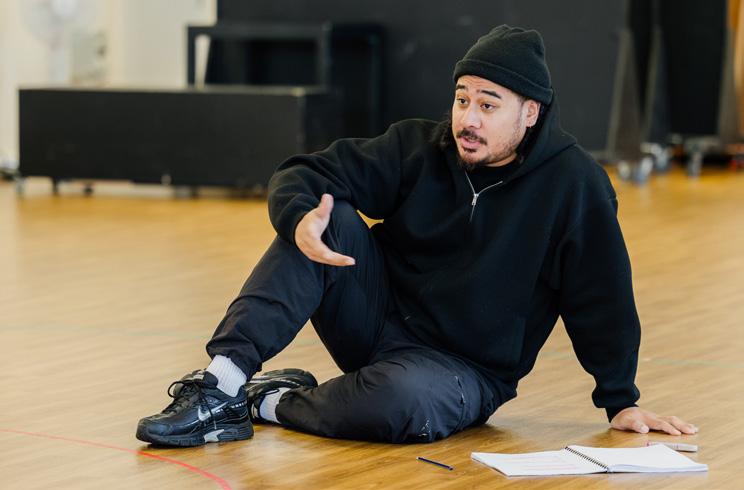
Monday
Rehearsal Room Diary
by Lynette Harris, IIML Placement
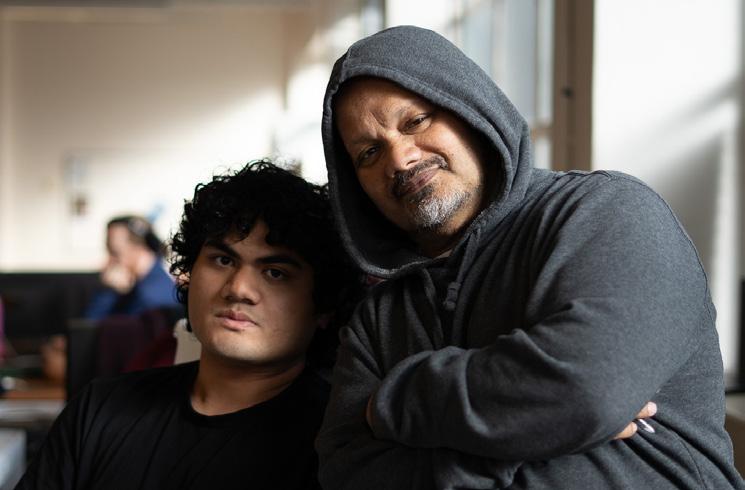
Sons of Vao rehearsals open with a meeting of the full team which includes people from various Auckland Theatre Company departments: ticketing, marketing, publicity, education, and production. Everyone gets an opportunity to introduce themselves and the Artistic Director and CEO points out that there are 45 people sitting around the team meeting circle, and notes that’s how many people it takes to put four men on stage. Over the next week, watching these roles converge is its own education. Two Teaching Artists will also observe in order to design a workshop to give students unique access to the play.
Tuesday
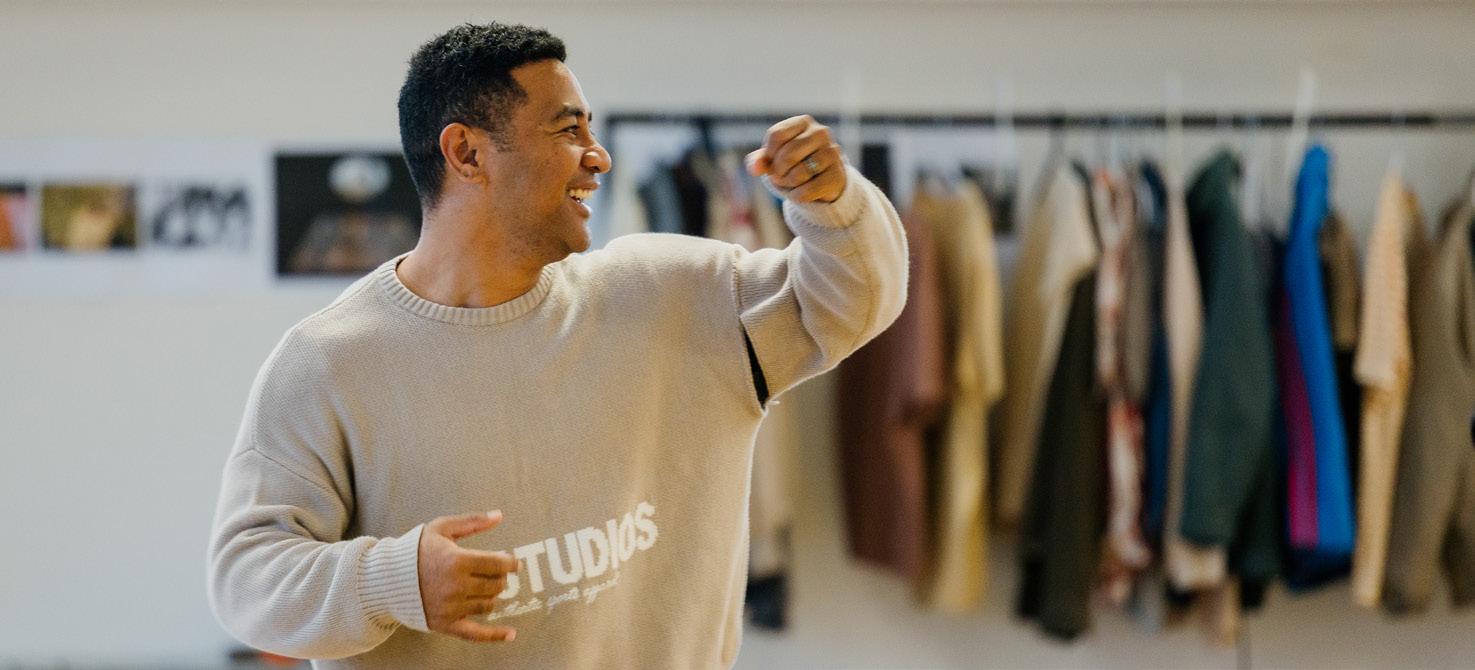
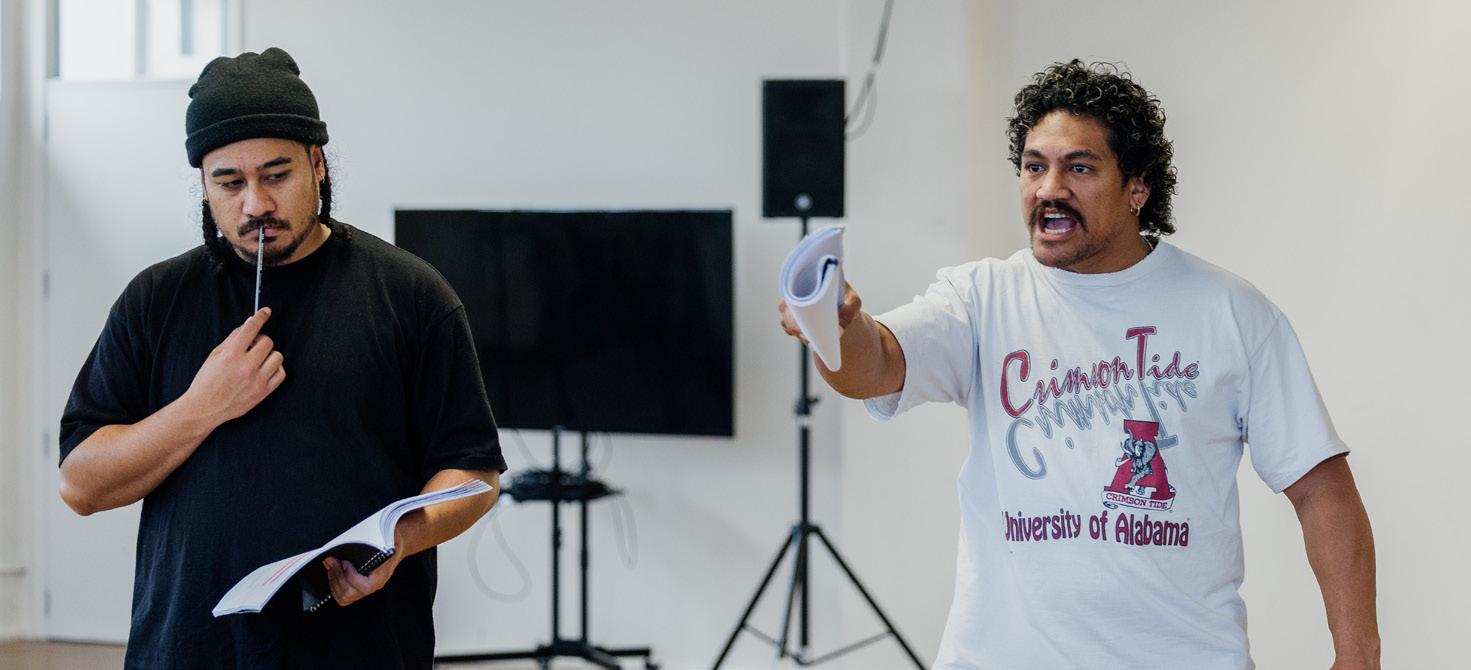
Blocking. The Playwright’s words exist only in the script. Now it’s up to the Directors (two co-directors and an assistant director) to work with the four Actors to find where and how
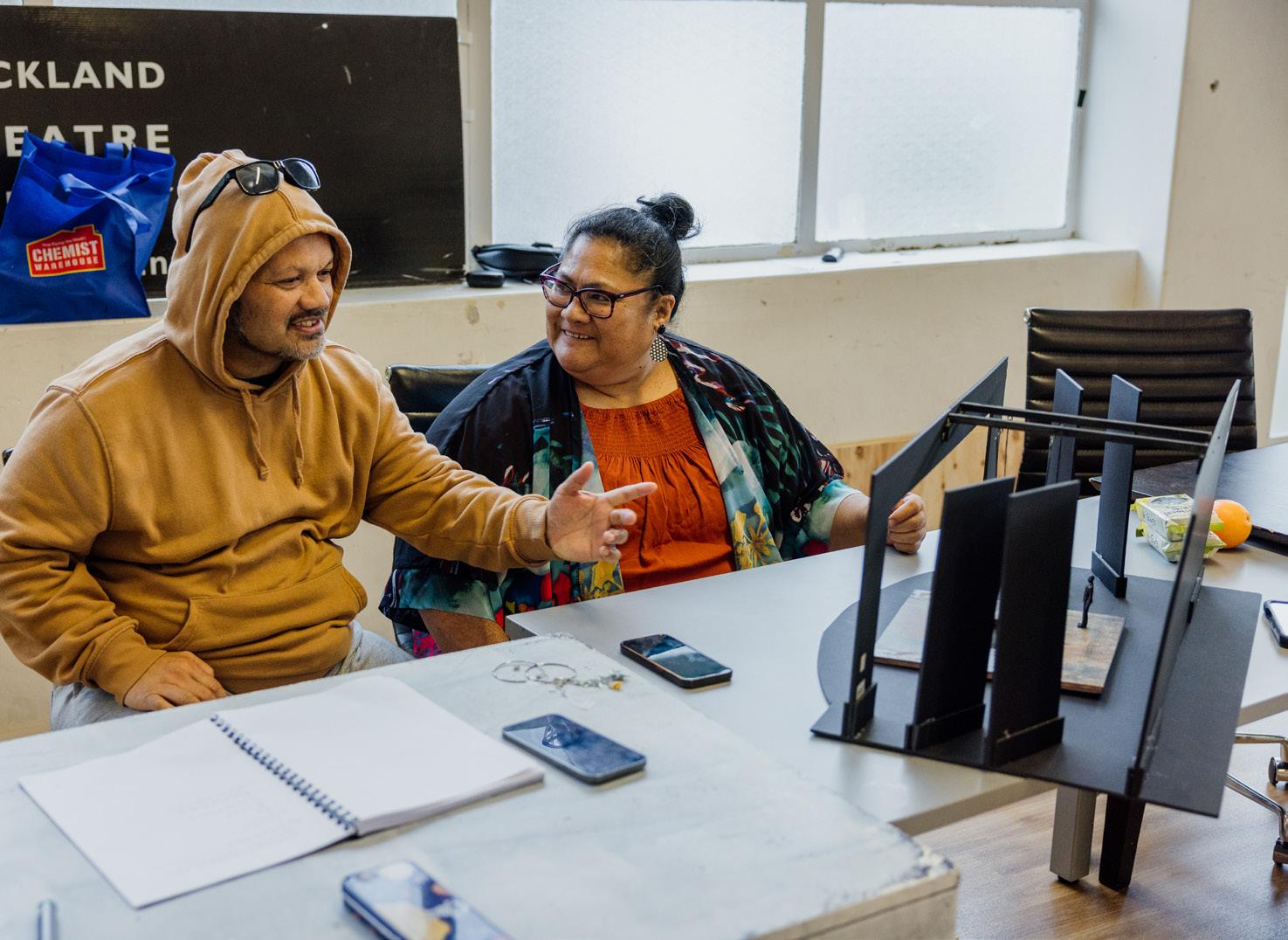
exactly on the stage each line will be delivered. The floor is marked to the exact dimensions of the ASB Waterfront Theatre stage, so Actors and Directors can feel and envision the space before they’re in it. Central to this work is the Set Designer who supplies the team with a scale model of the set, complete with miniatures representing actors and set pieces, and he explains why he has chosen the colour palette and textures in his design, what they represent thematically (rust indicates decay, for example), and his intention
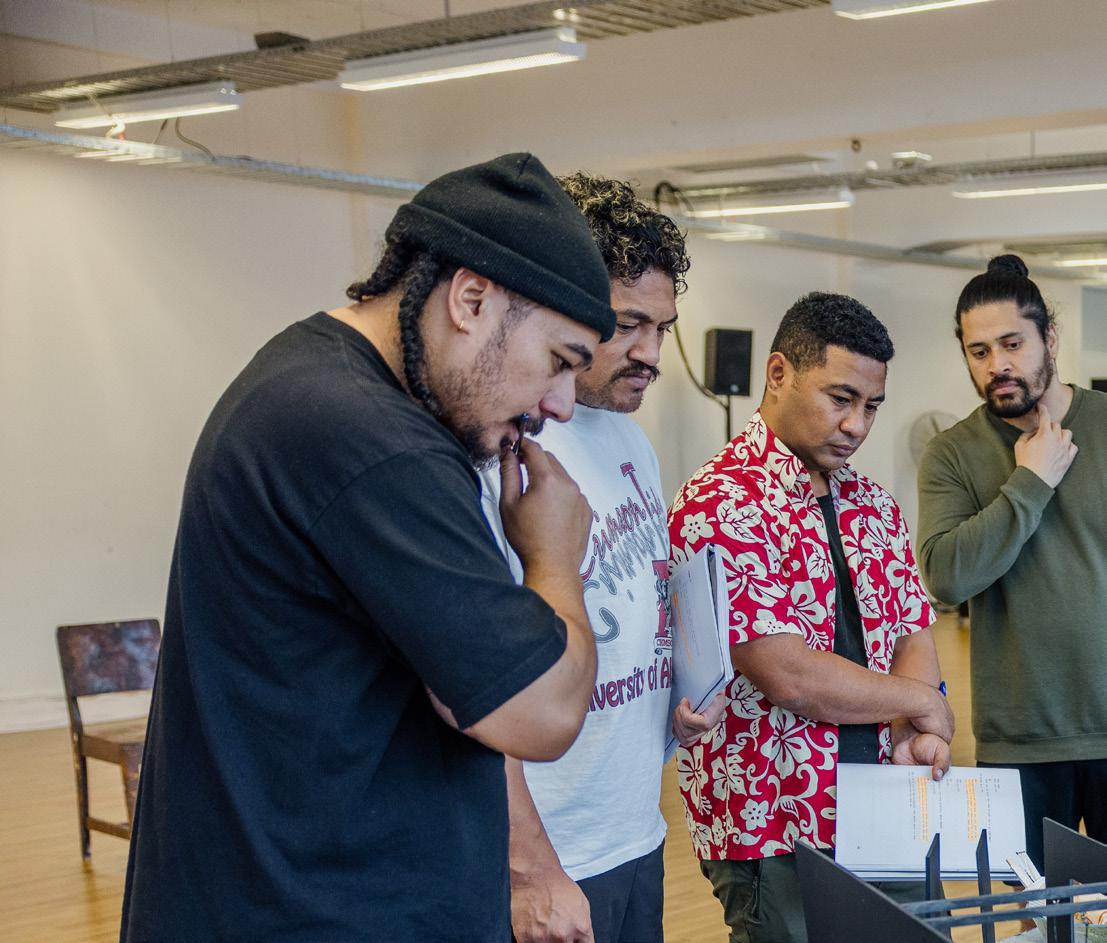
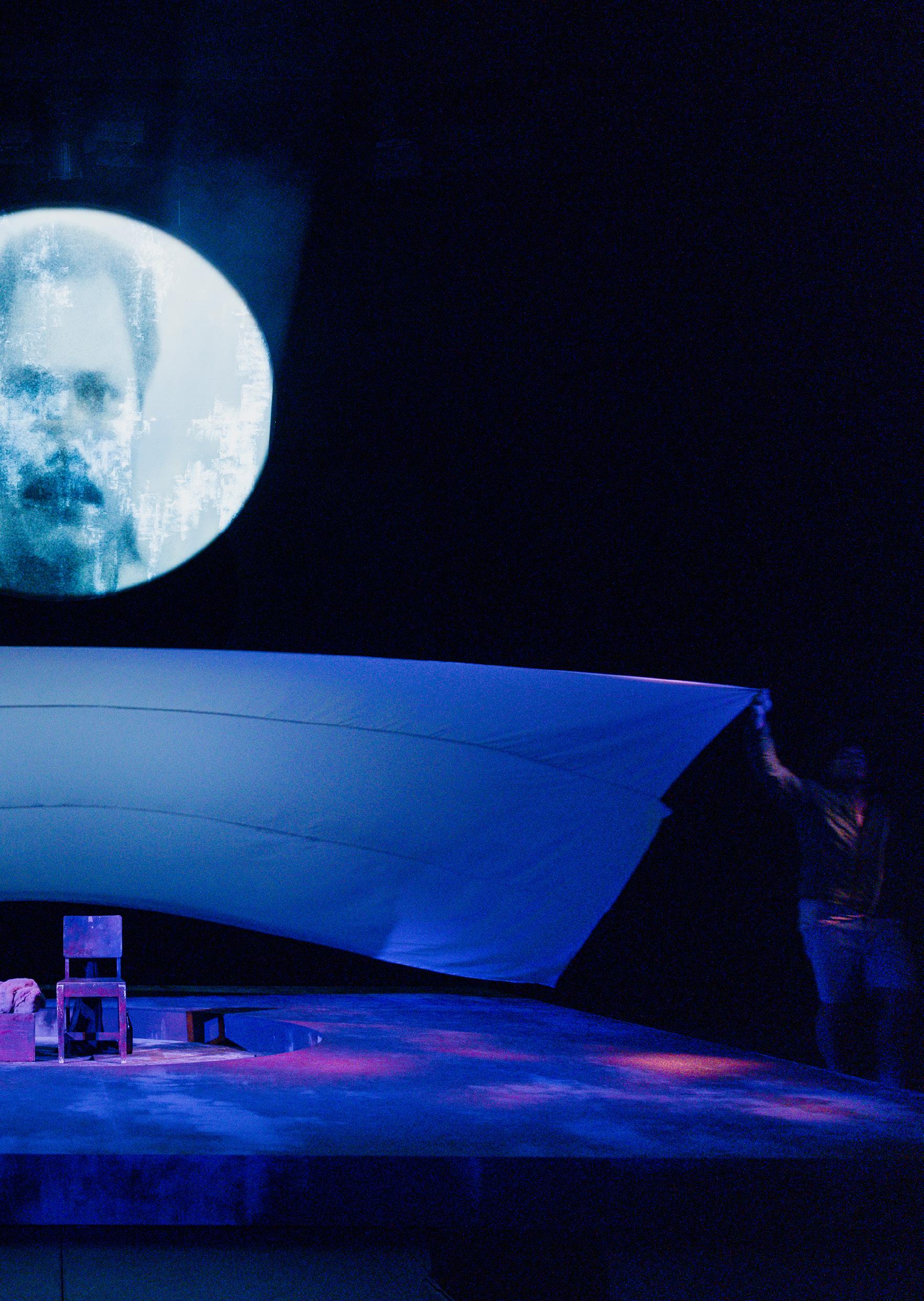
of transmitting a particular island feeling to the audience. Visual choices must be made, and an orange bicycle referred to in the script is discussed. Will it appear in the play? Or be represented by a chair? In theatre, costumes and props are also often within the Set Designer’s domain. This set design includes a round screen suspended above the stage where still images and video can be displayed; perhaps the orange bicycle will appear there. The Set Designer also researches to find appropriate black and white film footage which will screen while the characters reminisce about going to watch old movies as kids.
Wednesday
Dramaturgy. Rehearsals continue with Writer/Co-Director and Co-Director emphasising to the Actors that they’re all collaborating to find the play. It’s significant that this is not a play that’s been produced all over the world for decades or centuries. This is a new work, and at the beginning of the week, only the words, the bravely vulnerable, intimate, autobiographical story, existed. And while a Dramaturg can make various suggestions to improve the script, she says that her main role is preserving the writer’s voice. For example, English is not the first language of the Niuean characters so she flags to the Directors: watch for Actors instinctively correcting the grammar. Throughout rehearsals, Directors are continuously making choices that impact how the written script will be understood on the stage. One significant choice is that, as the Sons are describing their memories,
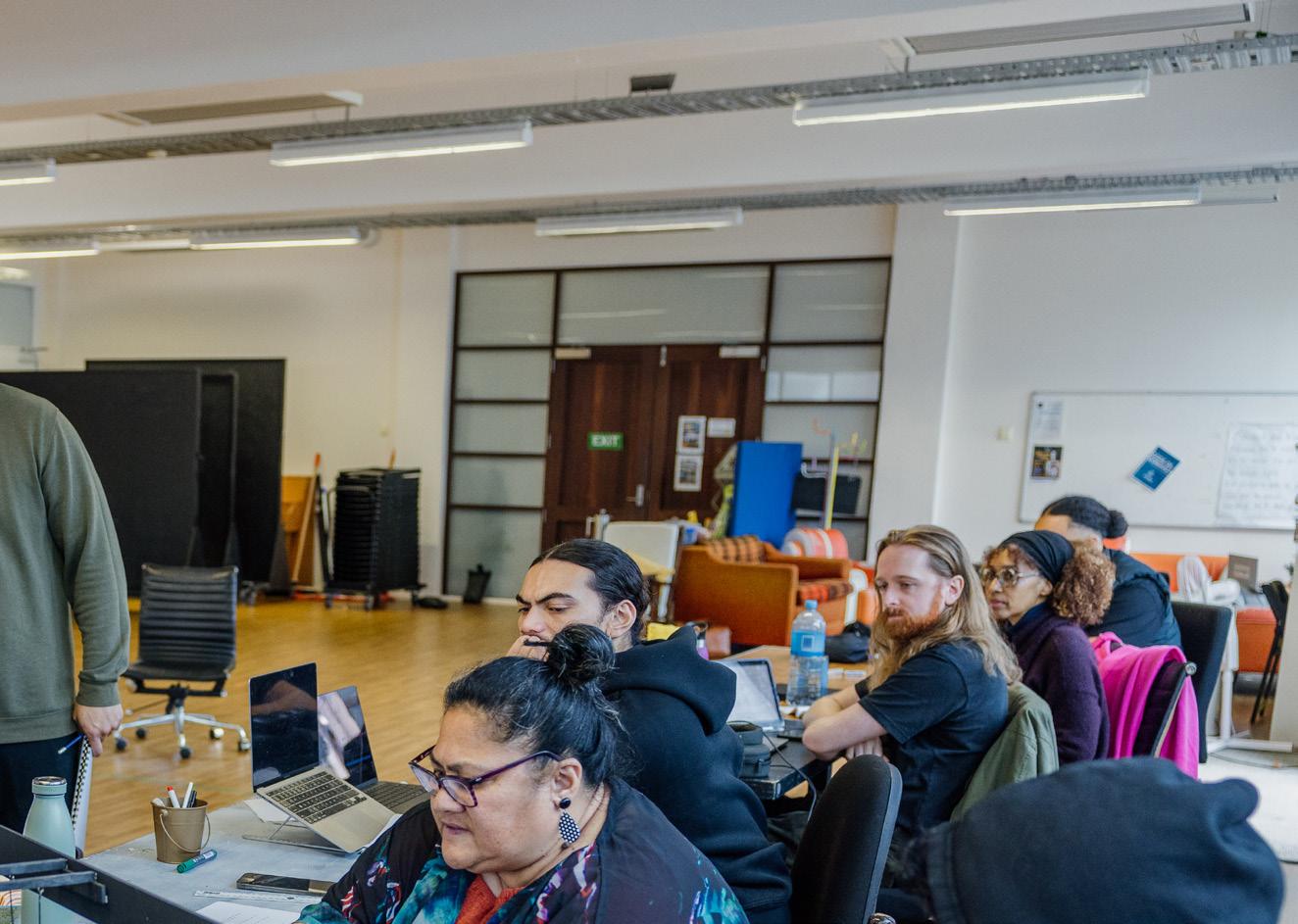
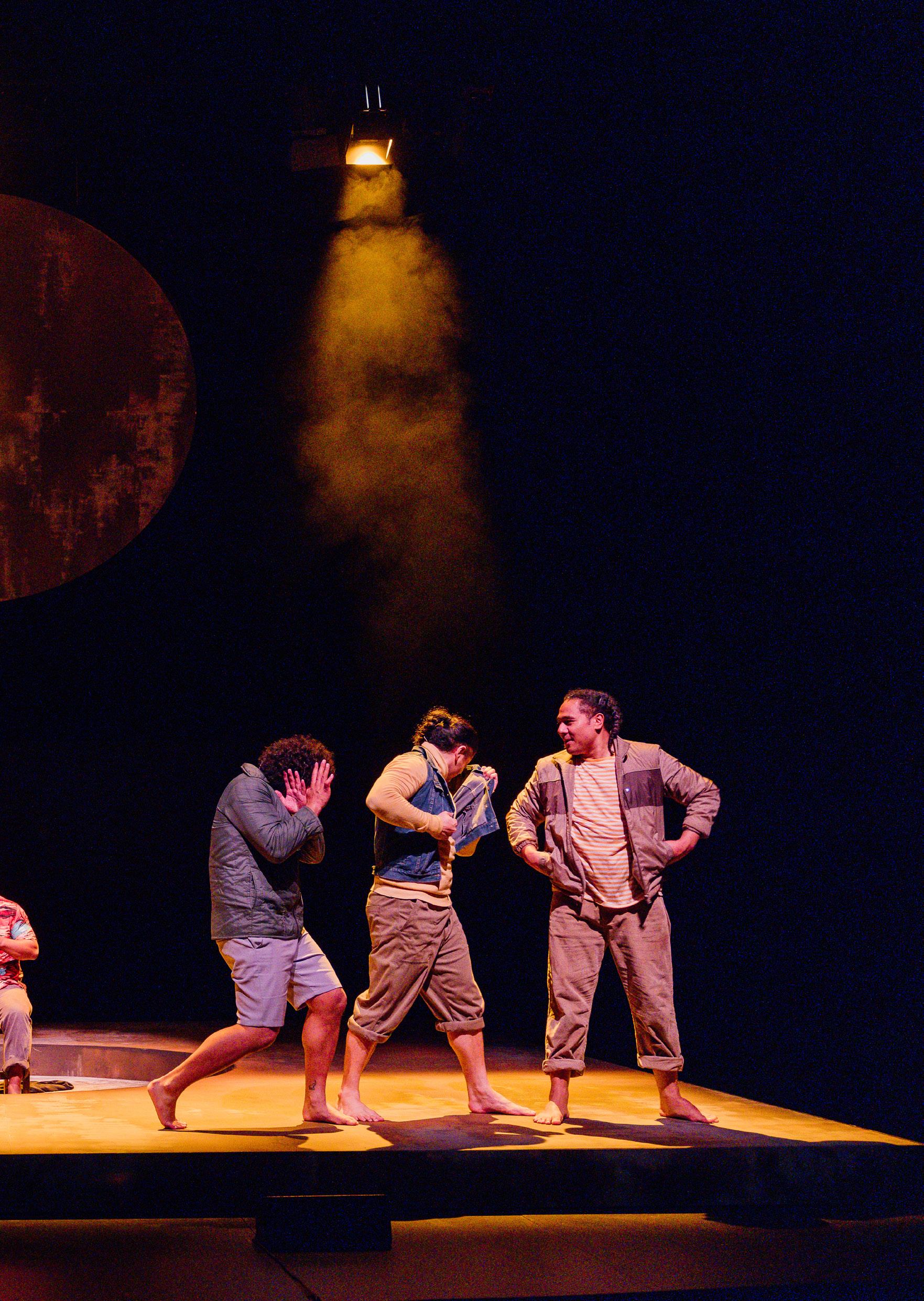
they will mime the actions. Only Vao will use props; he alone is embodied in the present. One prop chosen is a belt, which makes the story especially visceral.
Thursday
Sound builds the world the audience can’t see. The Composer sits at the creative table, watching the rehearsals. Having read the script beforehand, and with the Co-Directors’ input, he’s already prepared a few tracks before rehearsals begin. Throughout the week he also has an area in the ATC building to create more music and sounds to underscore and heighten the drama of the play. Does the play need ominous cellos to heighten the characters’ fear, and sounds of playful puppies or guard dogs? The Stage Manager has an important role here of always being on the ready with music cued for scenes, timing how long a scene takes, and marking the script for where the music begins and fades out.
Friday
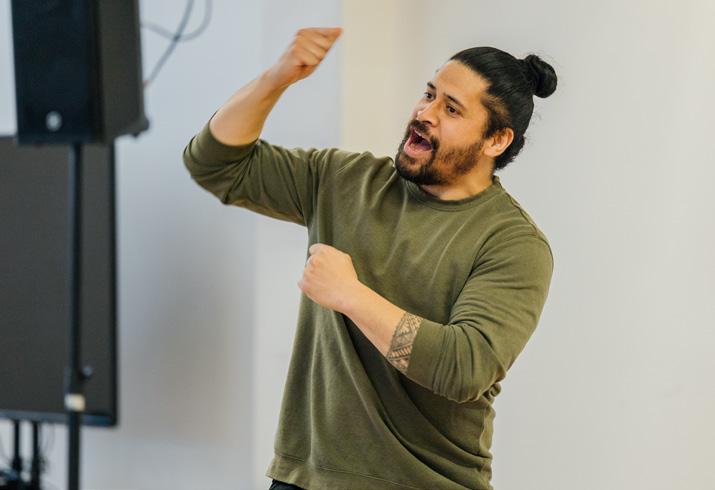
Actors who play the three sons of Vao started to look like brothers earlier in the week, and now their distinctive energies shine through beyond their dialogue. It’s also fun to watch these young professionals choreograph their own dance moves to music that was popular long before
they were born. The Actor who plays their father demonstrates leadership within the acting team and gets a turn at directing. ATC’s professional development residency programme includes an Assistant Director attached to this play who has opportunities to offer input to the Co-Directors as well as direct scenes on his own. The play has flown off the page and taken root on the stage. The Teaching Artists have decided to divide their student workshop development so one will introduce choreography and ensemble work from the play, and the other will focus on set design and themes. Students will view the matinee performances well-prepared to enjoy the play’s layers.
Saturday
Production. Six day weeks are common in theatre productions. The Stage Manager and Production Assistants are behind-the-scenes crew who keep everyone on schedule, fed, and most importantly in high spirits. Their contributions to creating a welcoming environment and keeping the creative team comfortable are invaluable, from seating and snacks, to props and pencils. When Auckland Theatre Company opens the curtains to Sons of Vao at ASB Waterfront Theatre, the audience will be watching four men on stage made possible by the dedication and funding of around 45 people, and it will be worth it. Malo e gahua!
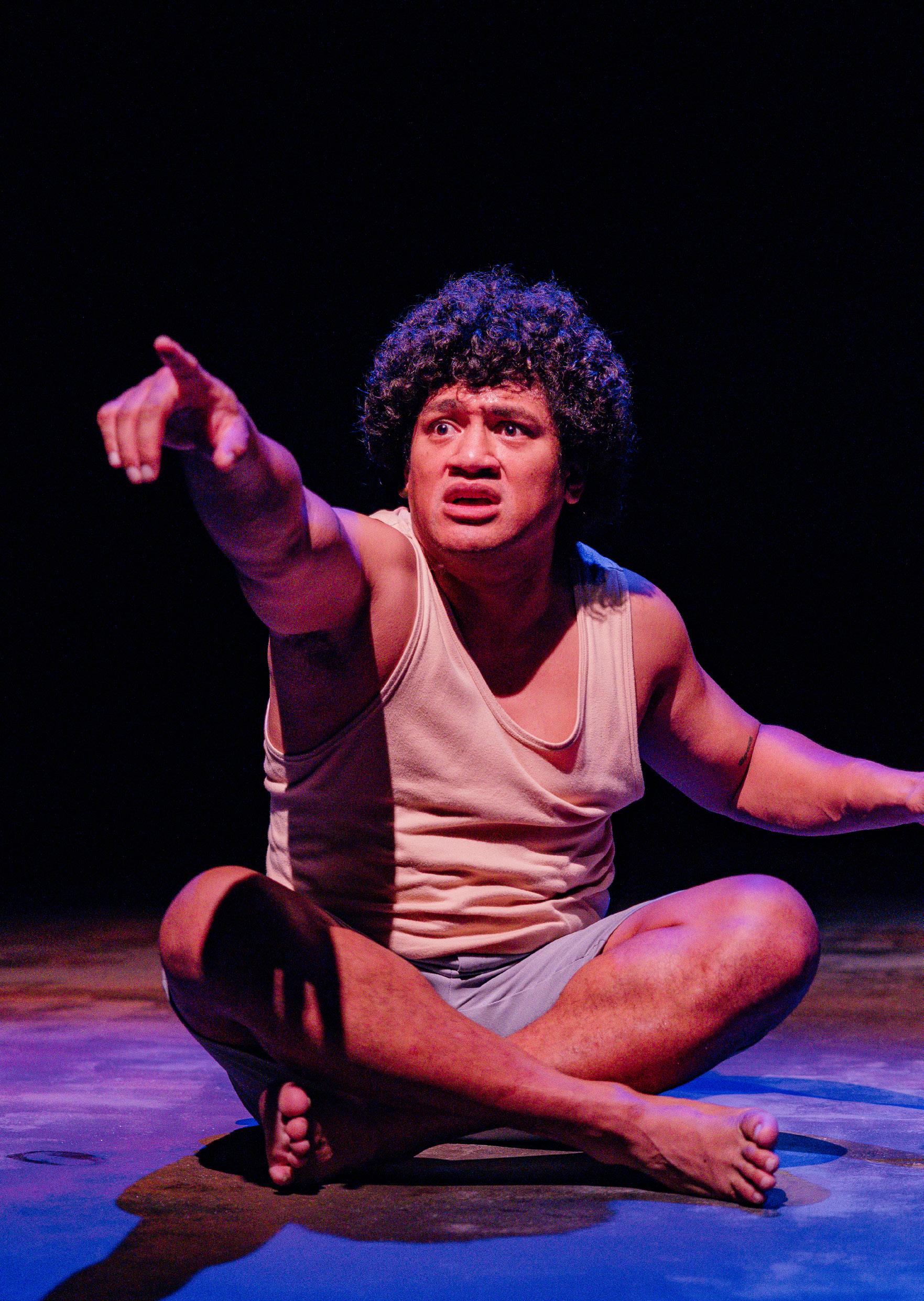
Production Design
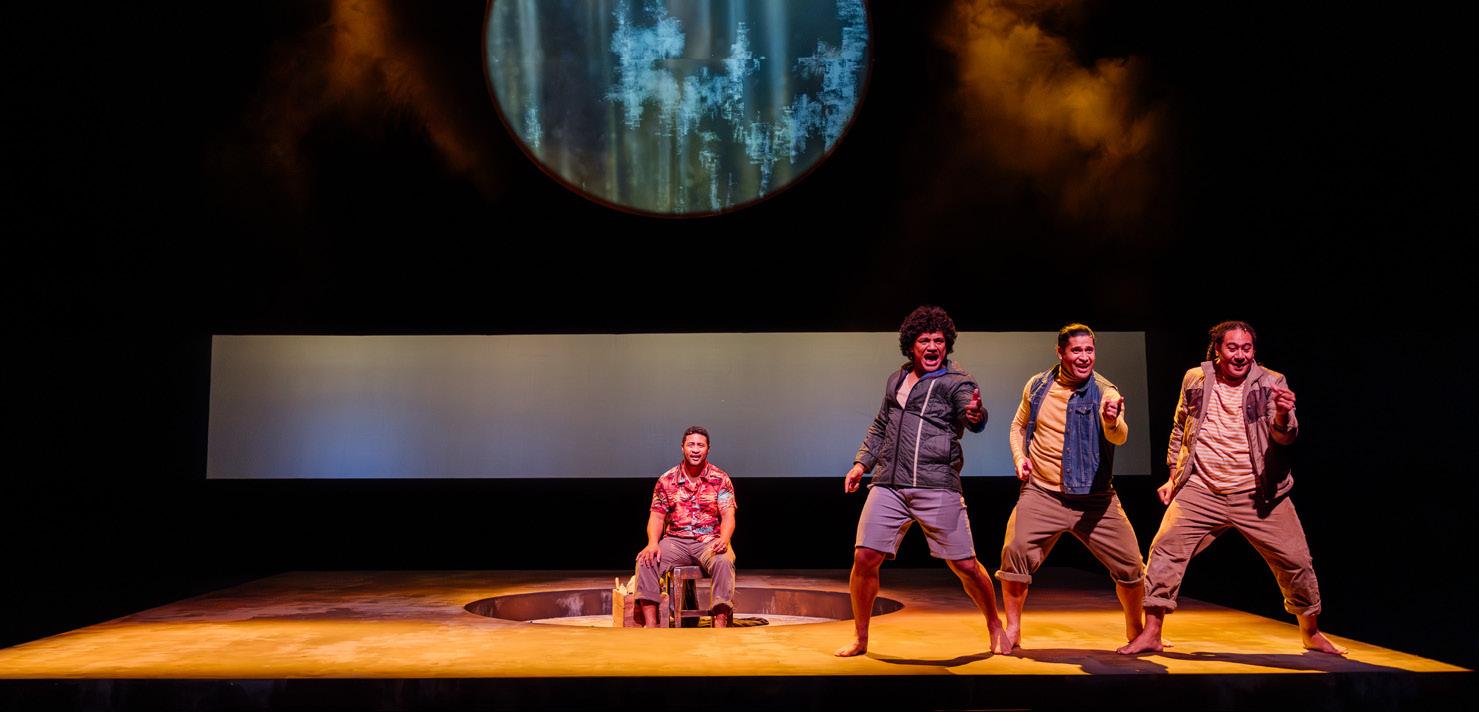
The text of Sons Of Vao poses some special challenges to a production (set & costume) designer. Firstly, the story spans a number of years and various locations, from the island setting of Niue in 1970 to Auckland in 2009. Secondly, the action takes place in the memories of its characters, who are able to flow seamlessly between the drama of the scenes in the past and the here-and-now, directly addressing the audience at ASB Waterfront Theatre.
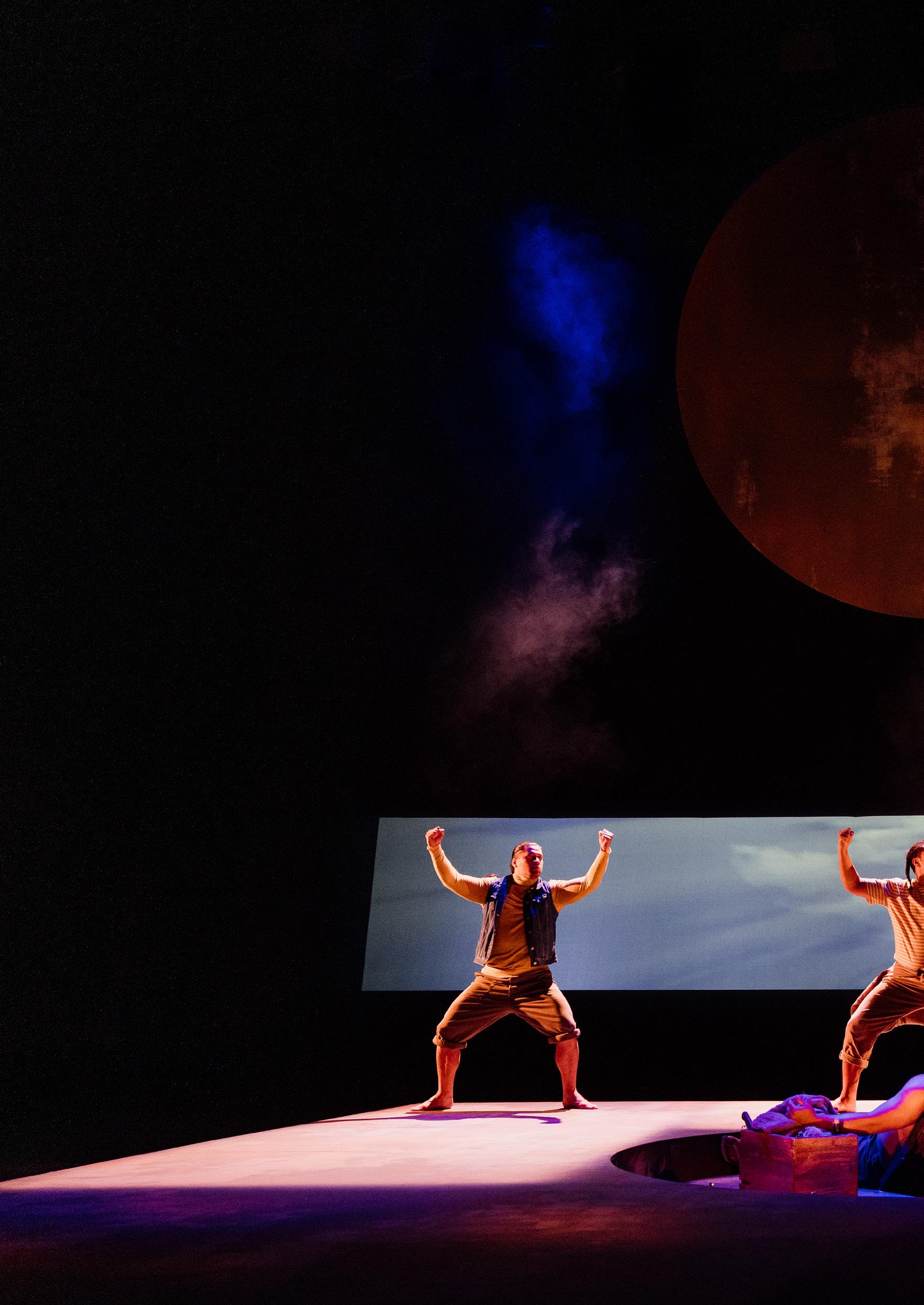
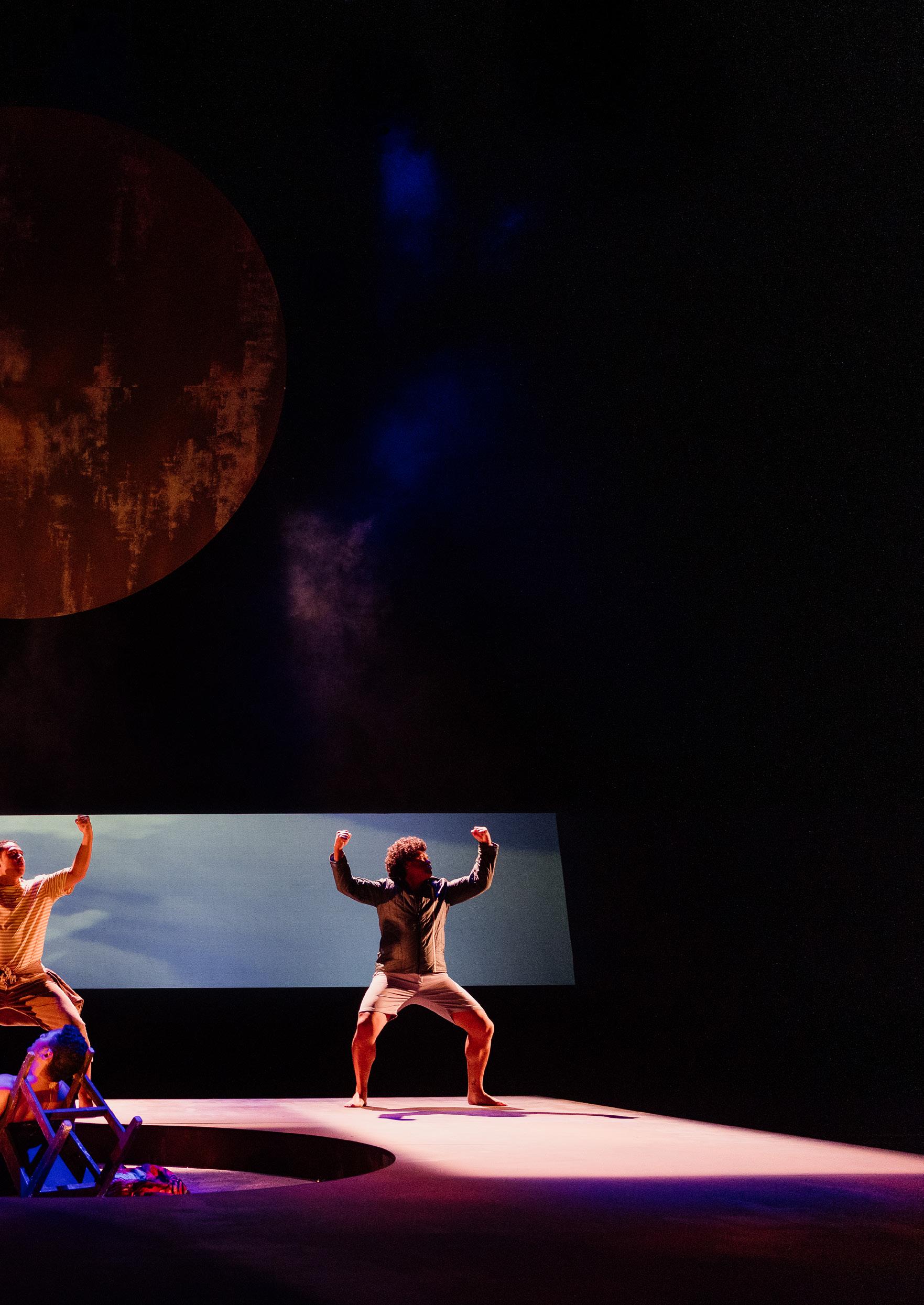
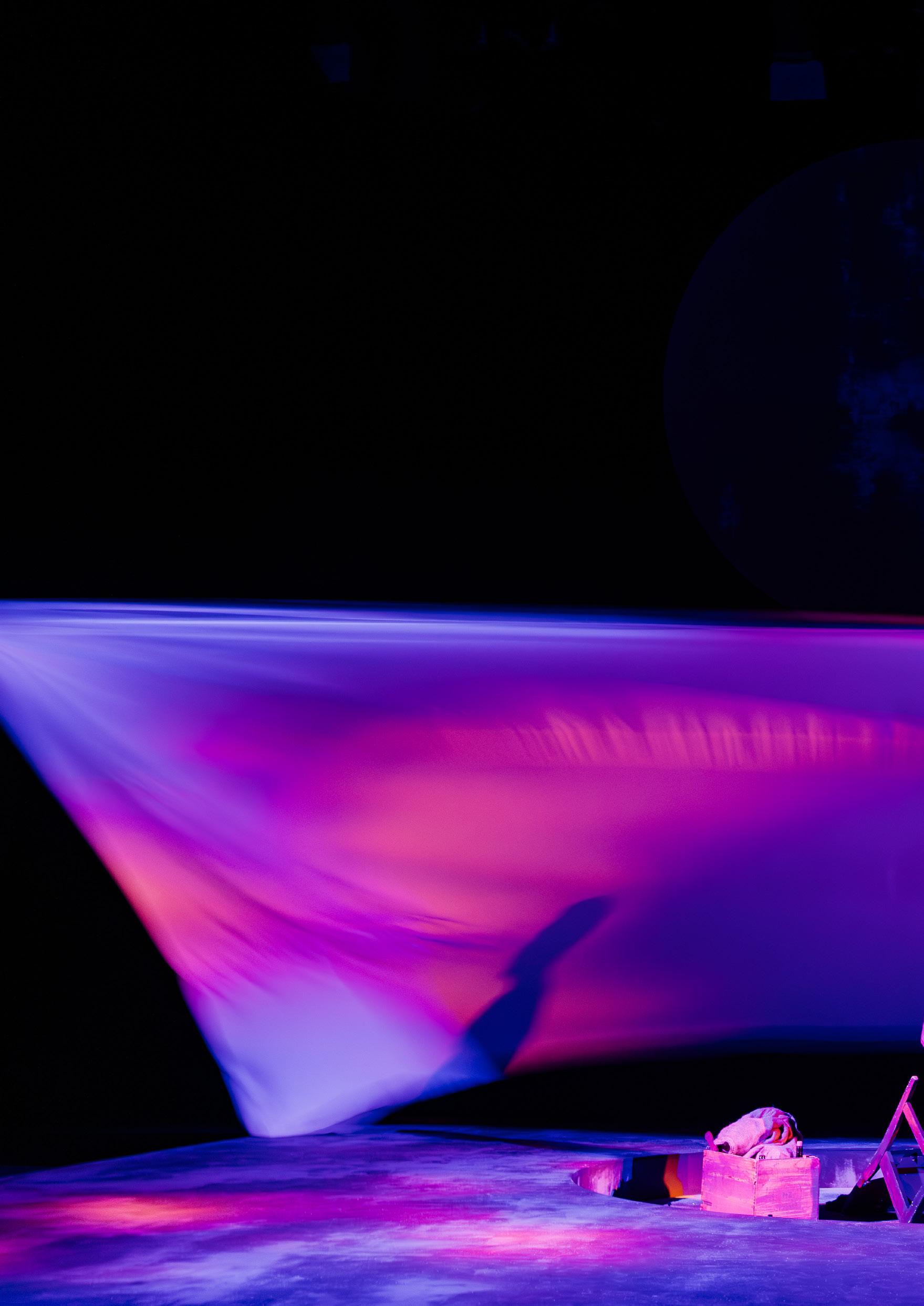
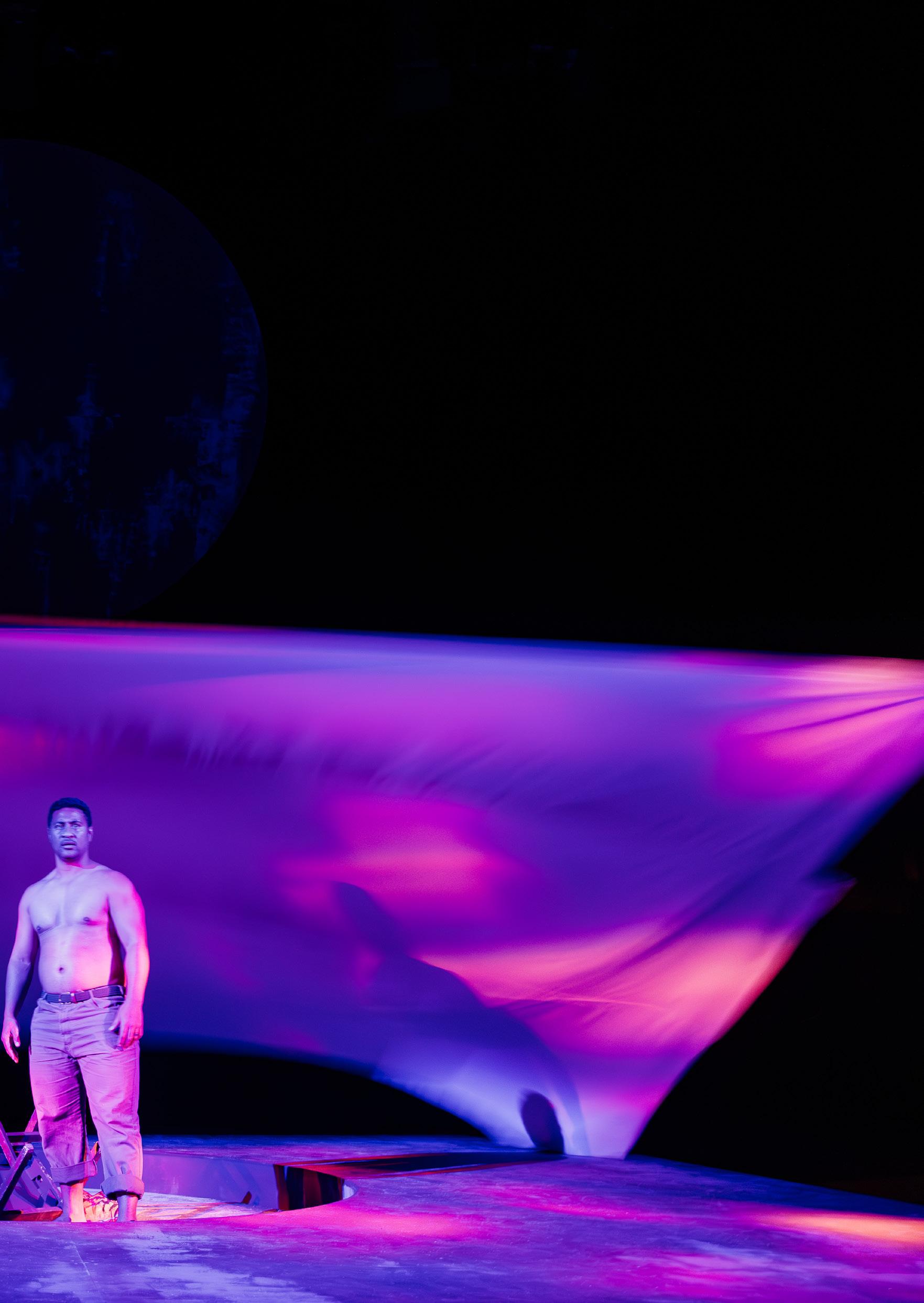
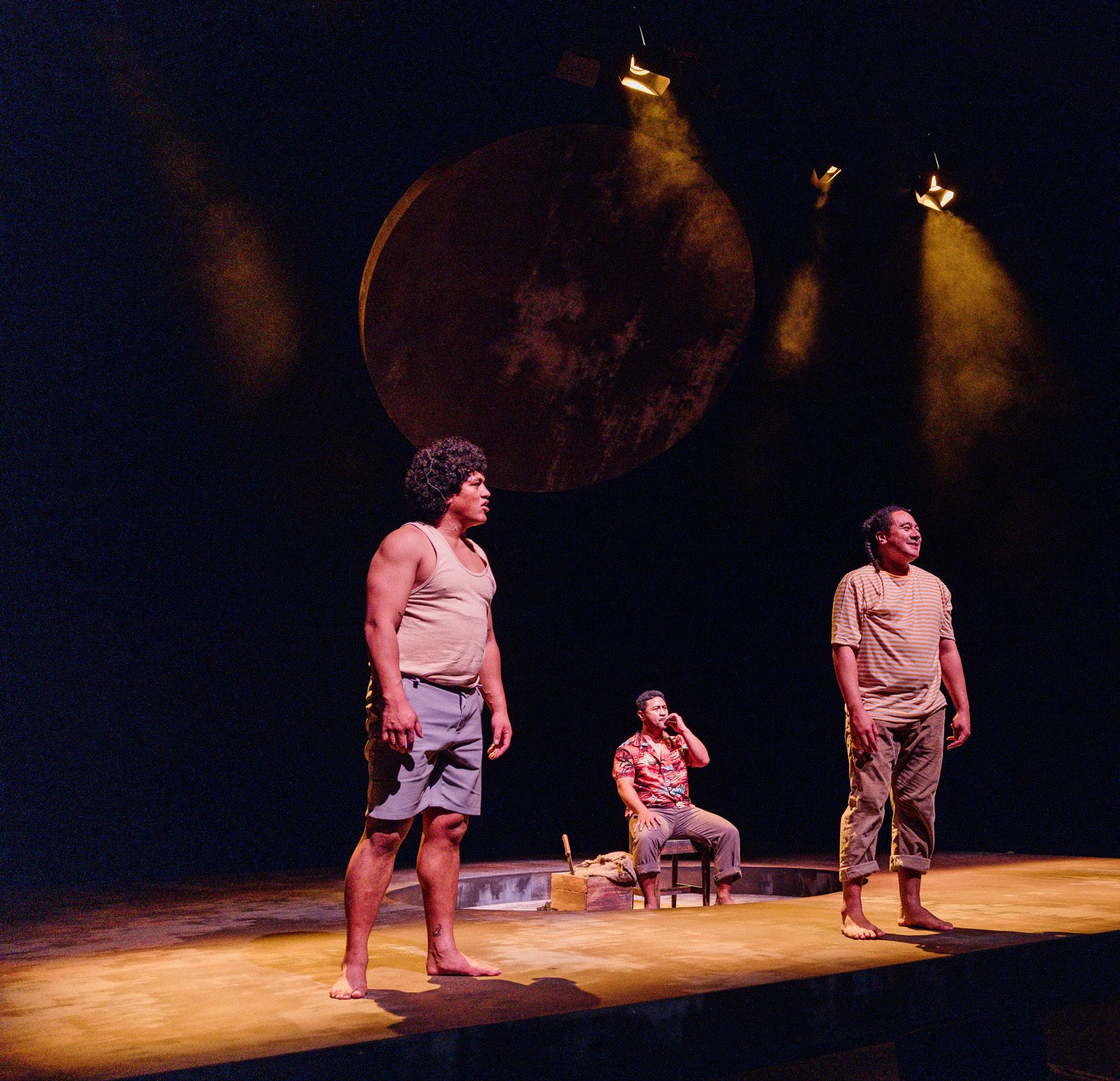
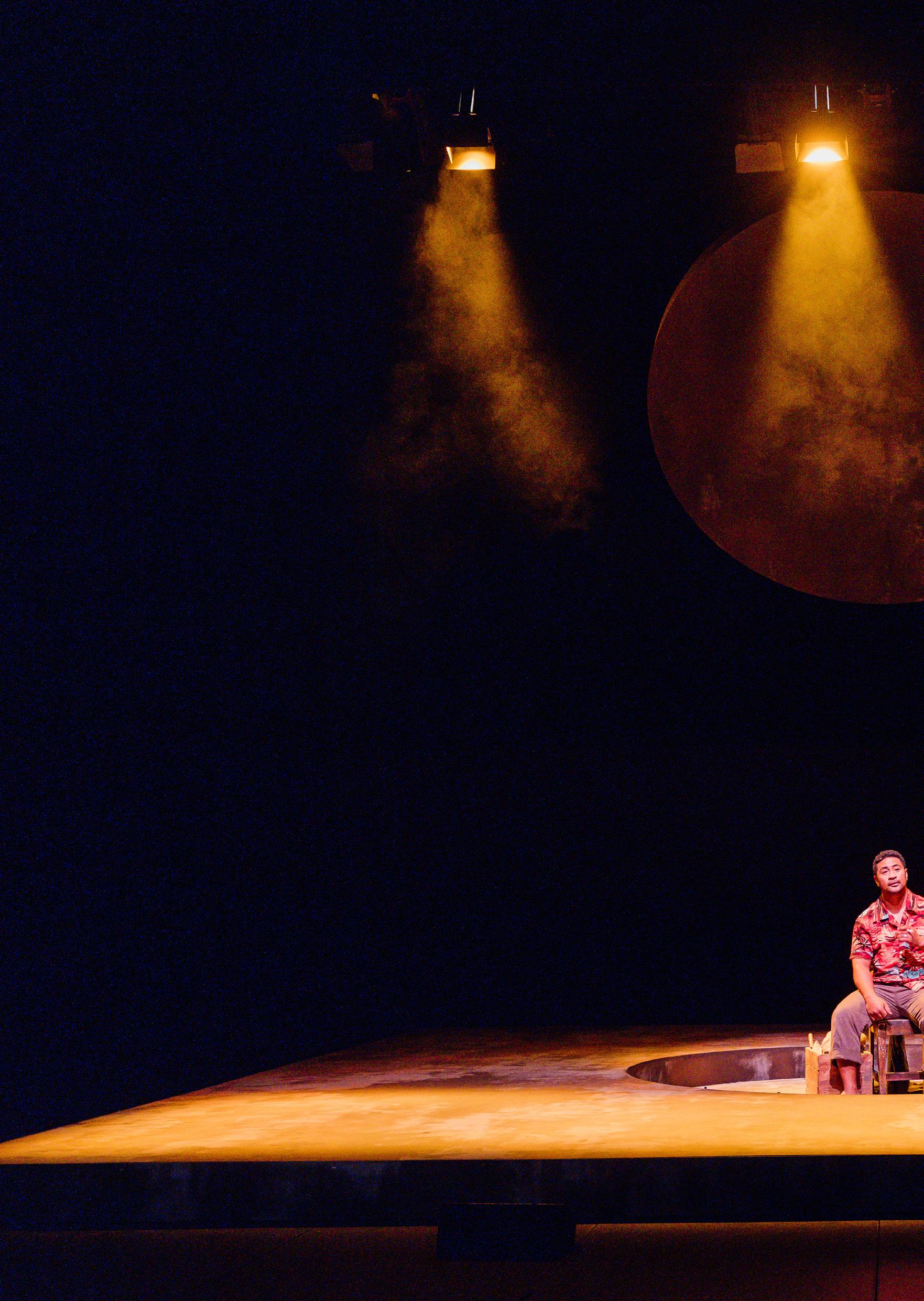
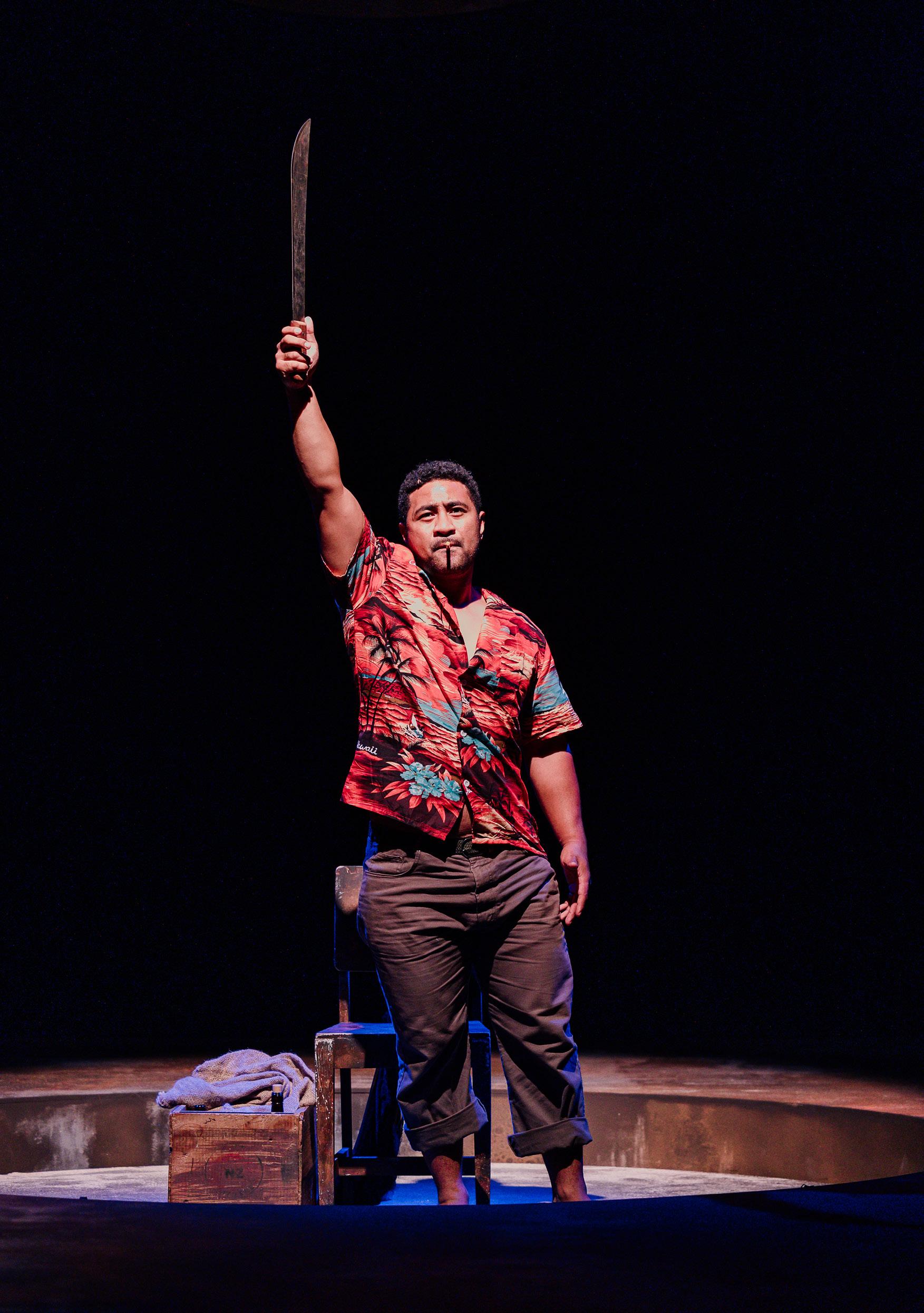
In a play like Sons Of Vao, rather than cluttering the stage with props and set for each and every location, a designer will often choose a minimalist design. In the case of Sons Of Vao, Sean Coyle’s minimalist set works with the direct-address storytelling of Vela Manusaute’s text to invite the audience to fill the space with their own mental images. But this is not a case of a designer cutting corners –quite the opposite! With fewer design elements on stage, each element must work extra hard to convey meaning for the audience. Below, Sean Coyle talks about the intention behind some of the major elements in his design.
A BIG, RUSTY SQUARE
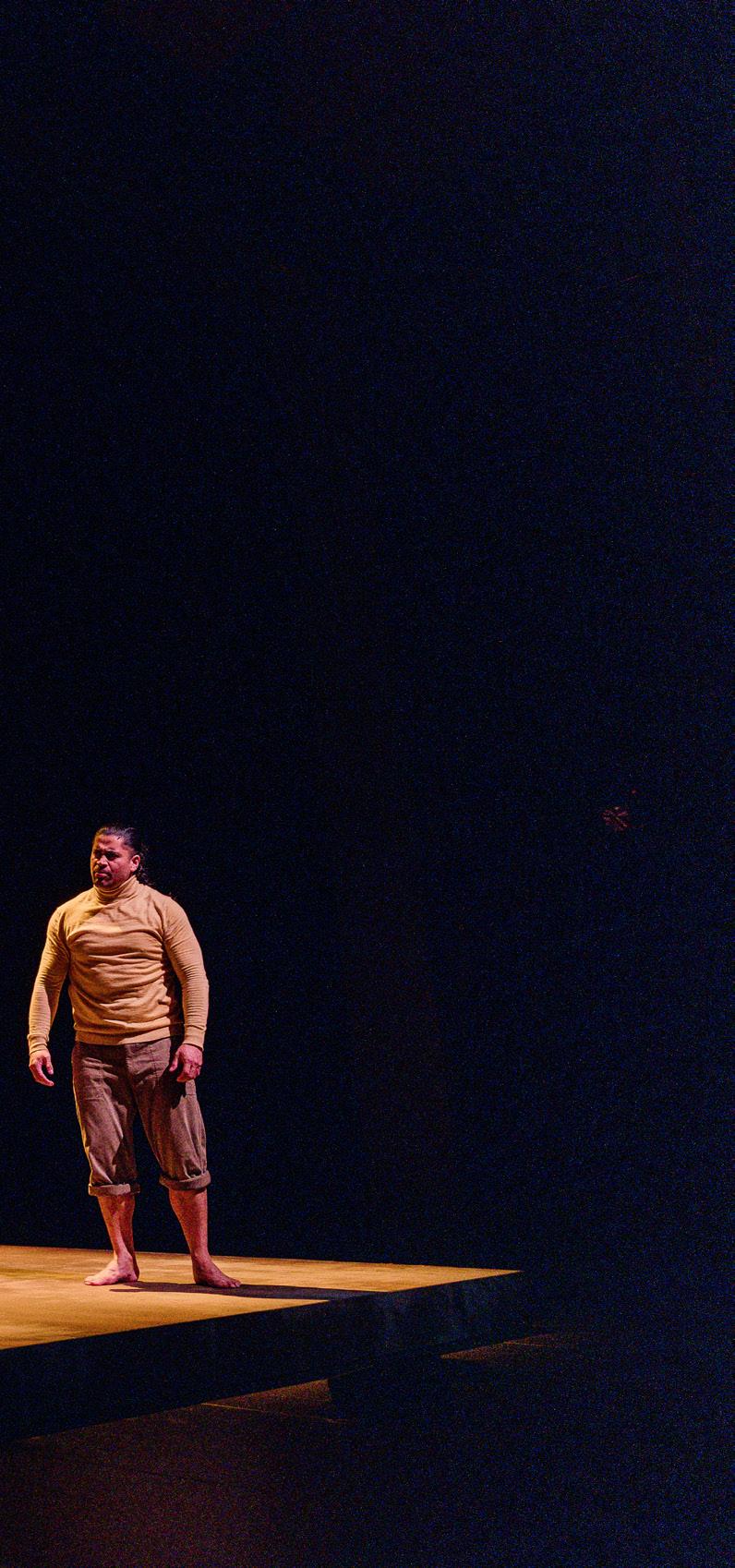
“The idea is that this is a minimal environment: a big, rusty square on the stage. I was really thinking about the material and exploring the feel and look of something that deteriorates over time. This is a memory play and the rust evokes the sense of deterioration: how memories deteriorate over time
but never fully disappear. In fact, rust becomes more accentuated with time, and fragmented and altered. Just like metal oxidises, memory is exposed to an emotional weathering as well. So [the set] embraces the messiness and ambiguity which is prevalent through Vela’s writing throughout the play.”
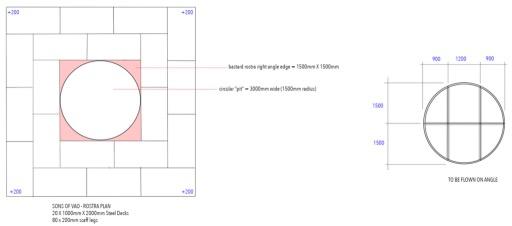
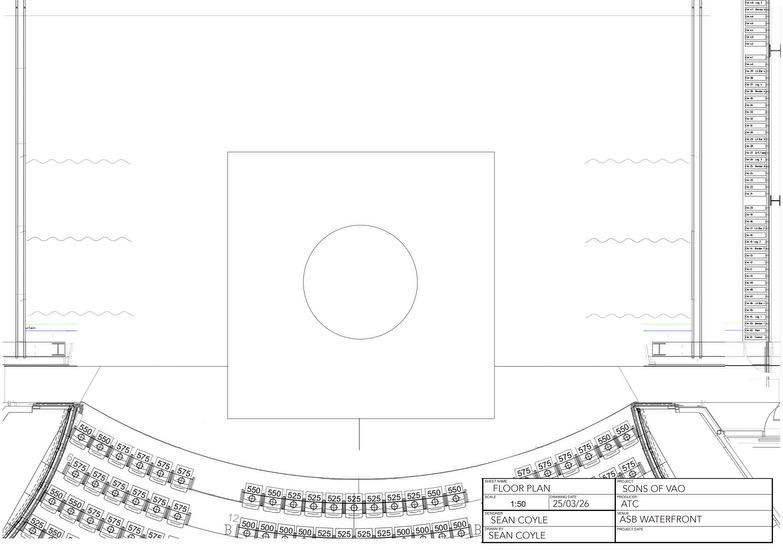
VAO’S AREA
“It’s almost like a piece of the stage has been lifted up, and there is Vao’s area in the centre of the stage. Everything centres around Vao, but there is a dangerousness and a weight that sits over the top. So it’s almost like it’s potentially pushing Vao down into the earth. And also for the boys’ memories, being able to close the trauma as well.”
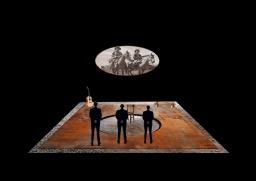
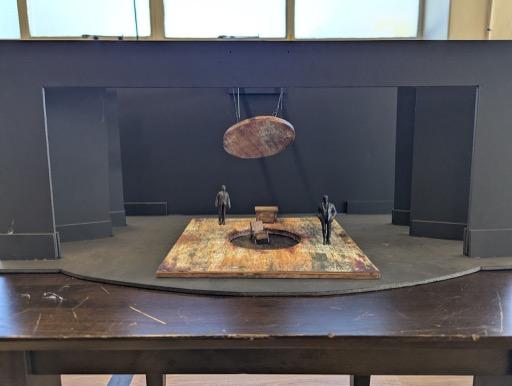
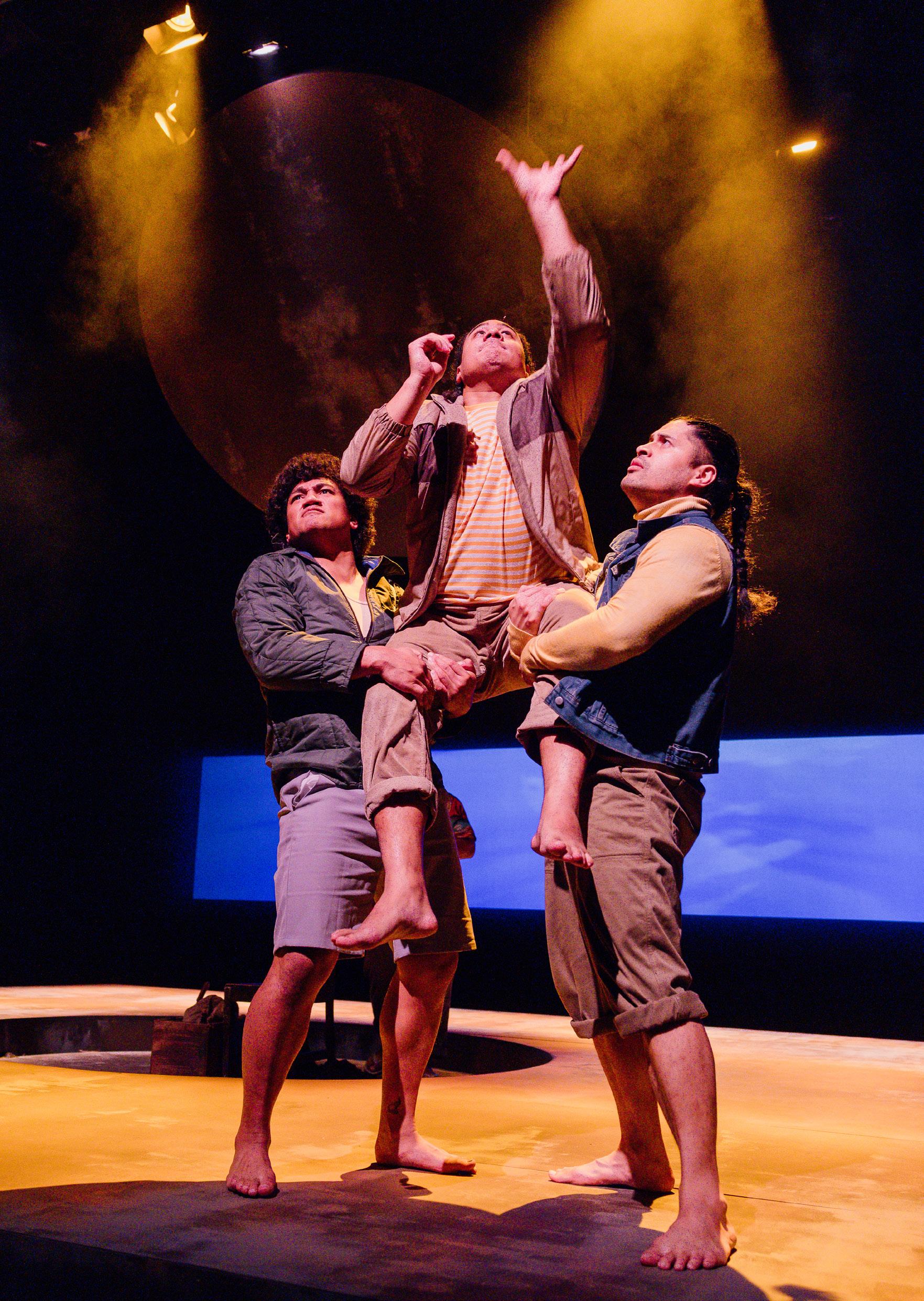
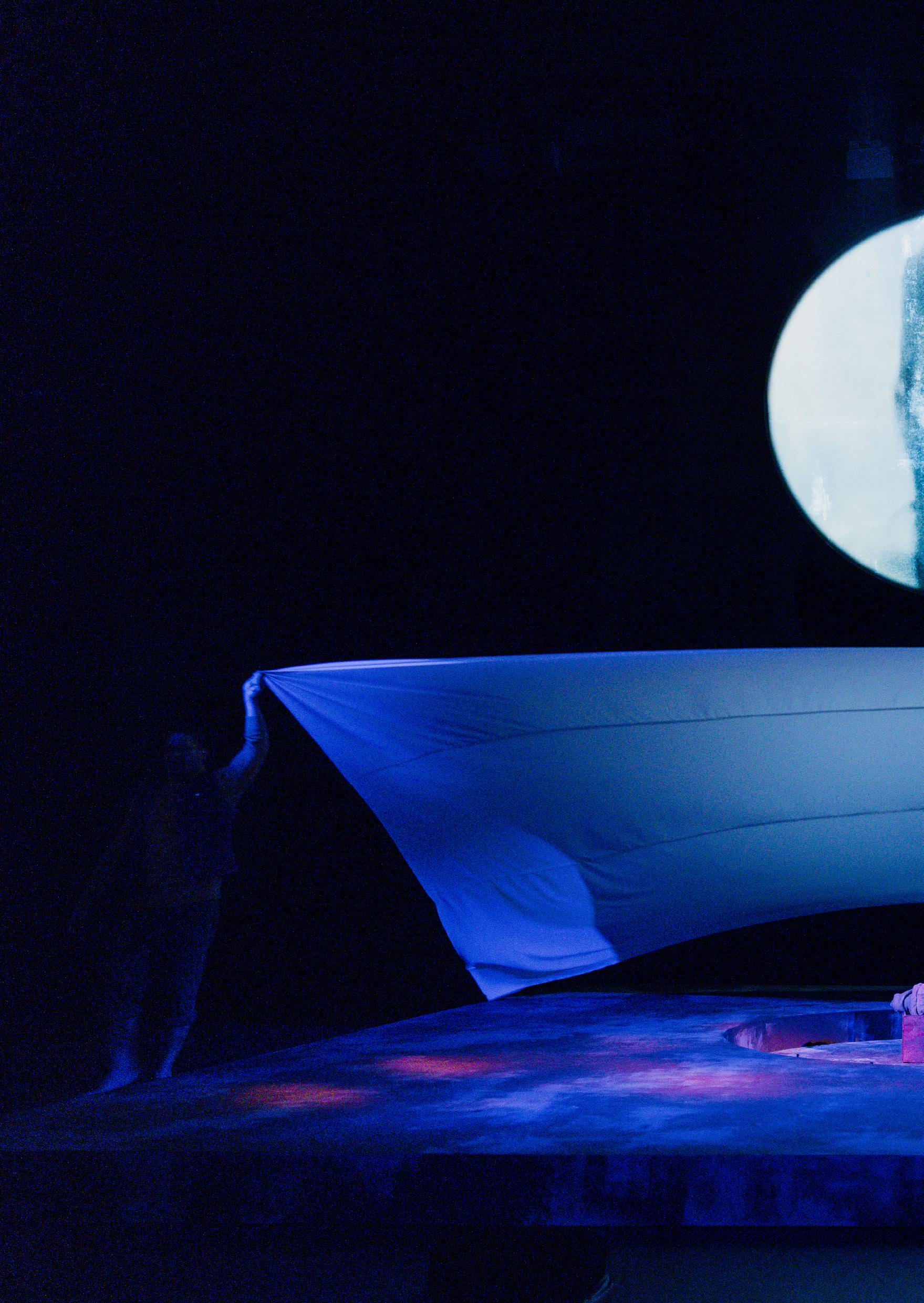
THE SUSPENDED DISC
“We have a projector that is able to project onto this suspended rust disc above the stage and be able to use it within the storytelling. For instance, they talk about going to see western movies in Niue, and that being able to appear as a screen. Or they talk about lying down and looking up at the stars.”

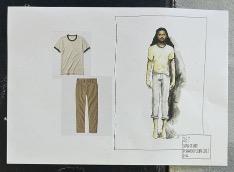
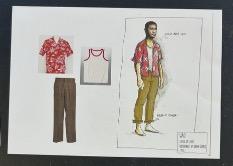
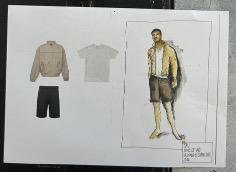
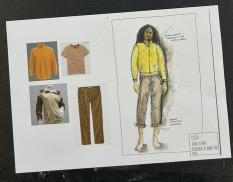
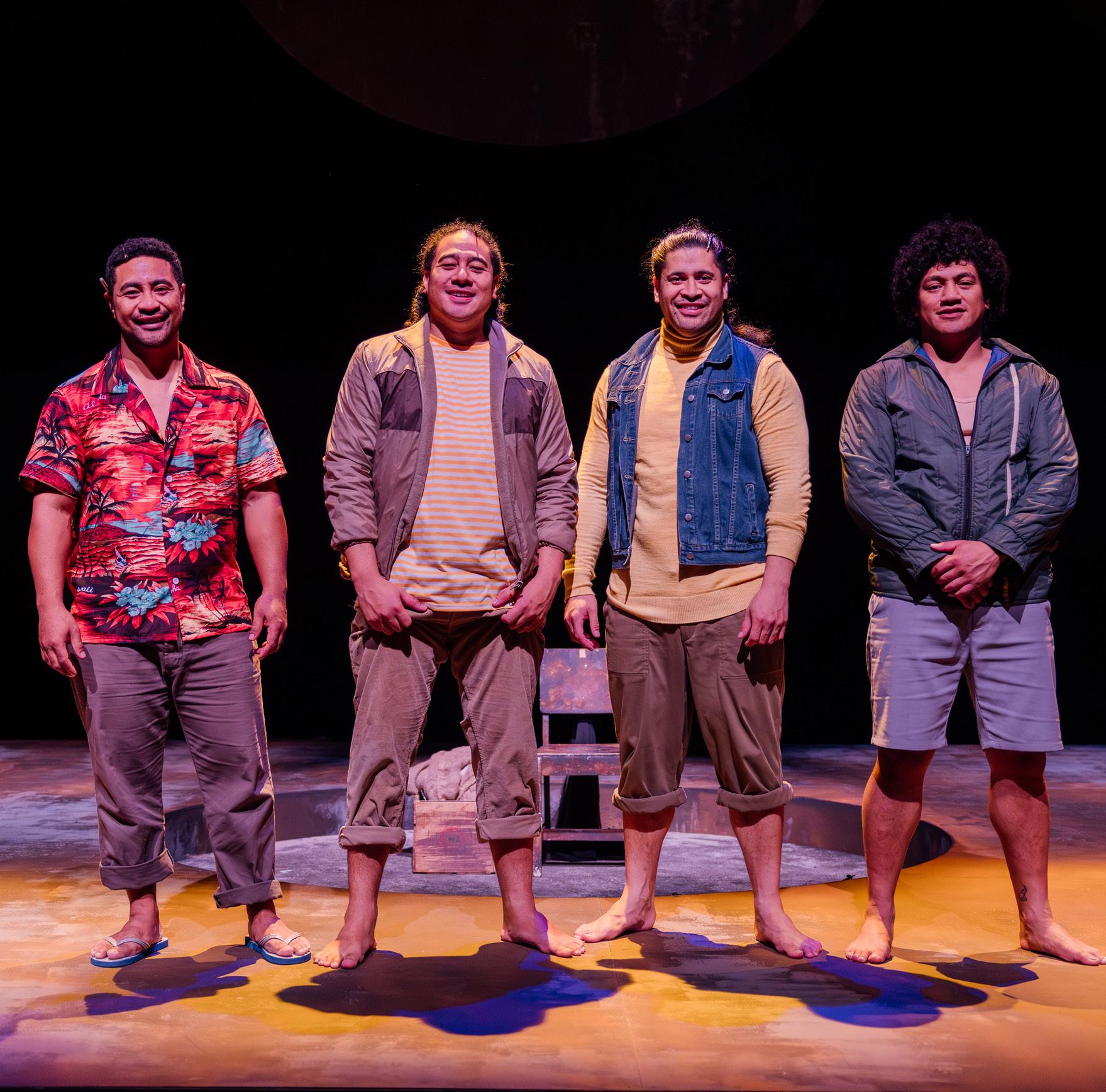
THE COSTUMES
“The play basically spans from the 1970s to the early 2000s, so we’re exploring things that don’t really place us in any particular time. But also feeling like [the characters are] able to exist as contemporary grown-up men reflecting back on their father but also able to regress into childhood.”
ABOUT SCENOGRAPHIC “MINIMALISM”:
Sean Coyle’s design could be called “minimalist”. Minimalism in set design, or scenography, used to be the default in the time of the Ancient Greeks all the way up to the Jacobean period when Shakespeare was writing. As theatre became a prestige pastime for society’s elites, and more money flowed into theatres, designs became larger and more spectacular. Both the melodrama of the Victorian era and turn-ofthe-century realism called for large, intricate sets.
However, scenographic minimalism has had a resurgence since the mid-twentieth century, as theatres have once again become less wealthy and directors have turned their attention away from the conventions of melodrama and realism. A minimalist set can support the meaning-making of a play in a number of ways. For example, it can:
• Create a blank canvas onto which the audience can imaginatively project a range of settings. This is particularly helpful for plays like Sons of Vao which jump around in time and space.
• Direct focus onto the actors and the characters they are portraying.
• Support the creation of surreal, dream, or memory spaces within the narrative.
• Elevate the significance and symbolism of specific set elements or props.
• Allow the writer and/or director to utilise a number of non-realist conventions, such as direct address or narration, without clashing with the design.
Below are some international and local examples of minimalist theatre designs:
• Sally Jacobs’ design for A Midsummer Night’s Dream, dir. Peter Brook, Royal Shakespeare Company, 1970
• Jan Versweyveld’s design for A View From The Bridge, dir. Ivo Van Hove, Young Vic, 2014
• Soutra Gilmour’s design for The Seagull, dir. Jamie Lloyd, Harold Pinter Theatre, 2022
• John Verryt’s design for Tiri: Te Araroa Woman Far Walking, ATC, 2025
Sound Design
The sonic world of Sons of Vao has been created by composer David Long and Sound Designer Sam Clavis.
A composer’s job is to create original music for a production, while a sound designer oversees the implementation of that music, as well as any sound effects. Sam Clavis was able to answer a few questions about the sound design for Sons of Vao.
The narrative of Sons of Vao traverses a number of times and locations. How does the sound support this journey?
There's a fair amount of location and era-specific sound design to help clarify time and place. Mostly this is diegetic sound, often quite ambient. Island birdsong, a crackling fire, muffled TV, Auckland traffic, and so on. David's score also supports this, referencing specific eras at times, as do a few commercial songs.
What elements in the text does the sound design most support or elevate?
Besides the elements mentioned above which aim to immerse the audience, the design heightens elements of conflict & tension in the text, as well as moments showing the fallout of previous trauma: Vao's rage and his battle with epilepsy, the sons' memories of childhood violence, etc.
What sources or references are you drawing on in your sound design?
Funnily enough, David's music for the show, along with Sean's production design, have been significant influences on the sound design. David's music is cinematic and atmospheric, scoring a significant portion of the show. Sean's set is somewhat minimalist and quite psychological. This inspired a sound design that leans cinematic without being very overt, besides a few key moments where it's used to support transitions and provide a "reset".
Lighting Design
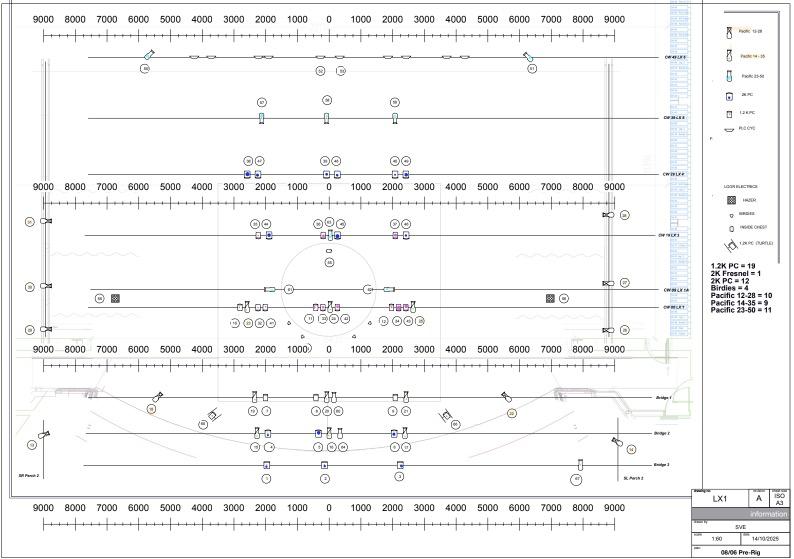
Like Sean Coyle's set, the lighting in Sons of Vao works through restraint. Rather than shifting the audience from place to place with elaborate changes, the design holds the stage in a warm, soft wash and lets light fade gently in and out, mirroring the way the brothers' memories surface and recede.
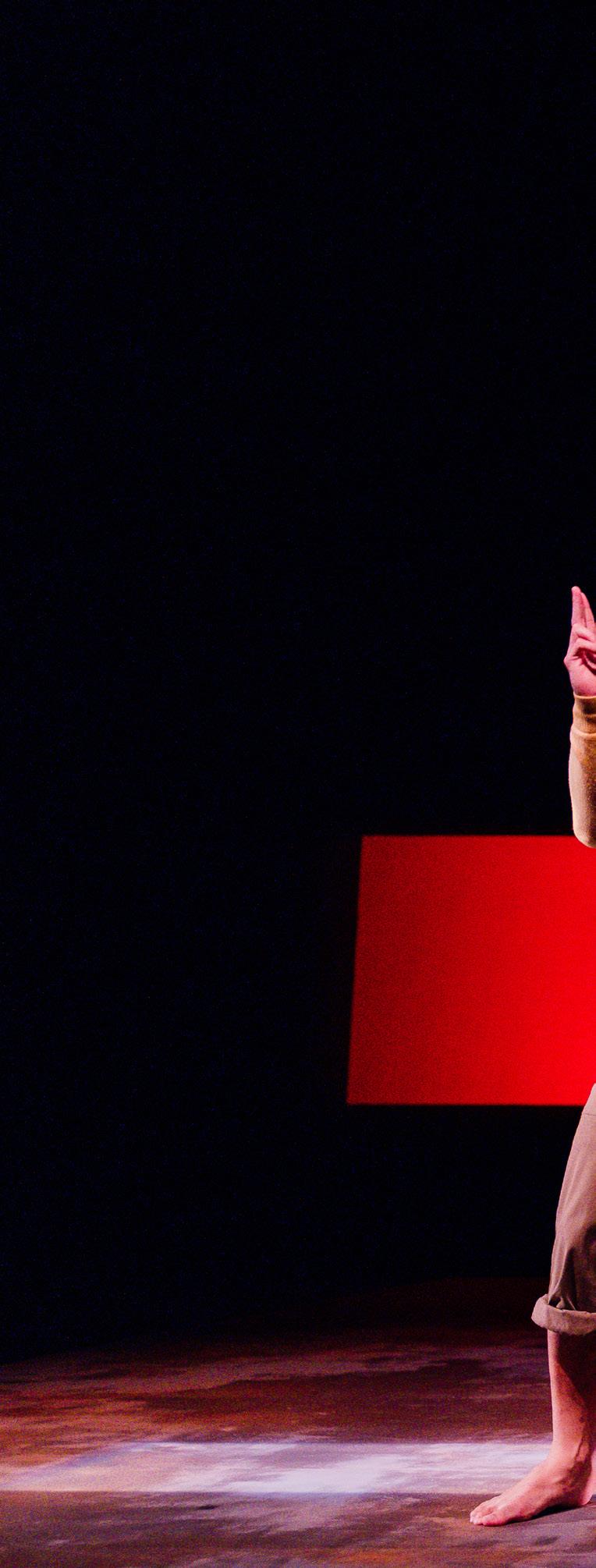
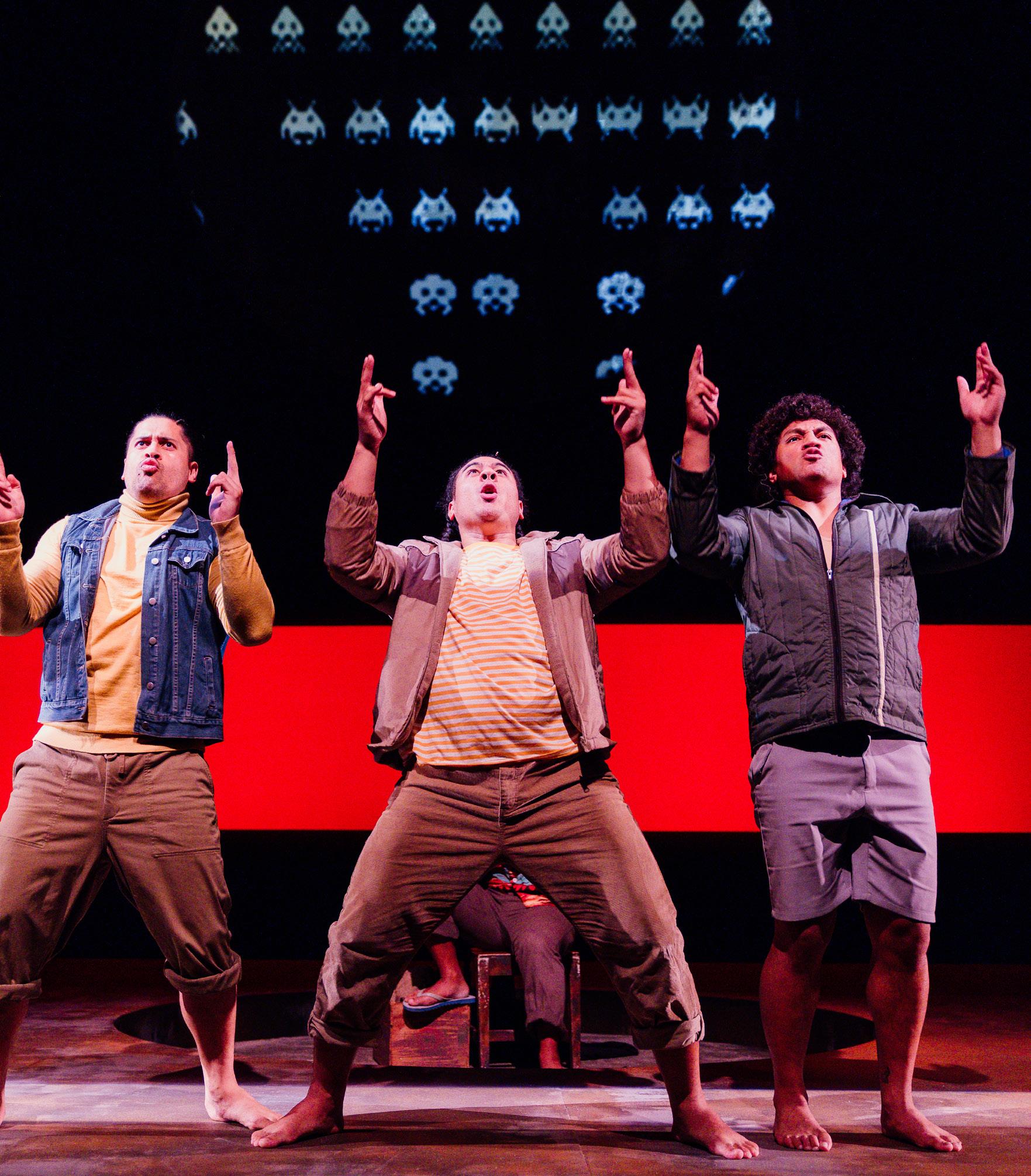
The most striking element stands at the back of the stage: a wide panel of light, softened by a gauze screen in front of it, that glows white, yellow, or red at different moments. The white and yellow read as daylight, grounding the brothers' recollections of Niue and the everyday world of the play. The red belongs to Vao. It rises at moments of anger and high emotion, marking the danger he carries and the points where his rage breaks the surface.
Working with the lighting is the atmospheric haze that drifts across the stage throughout the production. The haze makes the beams of light visible in the air, giving the design a tangible, almost physical quality and deepening the sense that we are inside a remembered world rather than a literal one. Above the stage, the suspended rust disc catches soft projections that flicker and shift, becoming a cinema screen, a night sky, or a window onto the past as the storytelling requires.
Together, the lighting, haze, and projections support the play's central idea: that memory is something felt as much as seen, and that the past, like light, is always falling across the present.
Meet the Characters
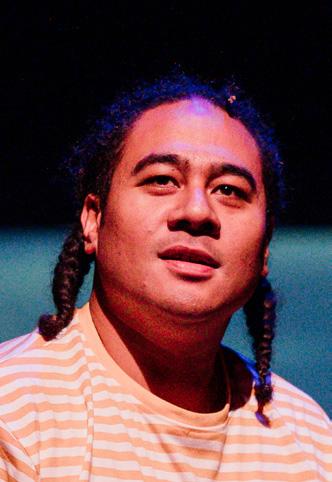
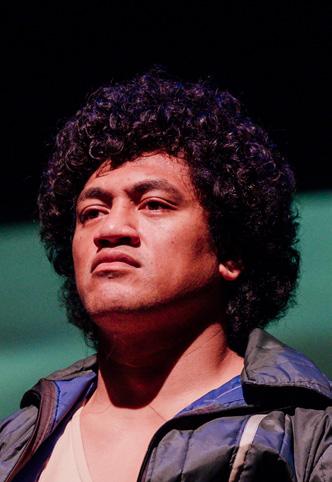
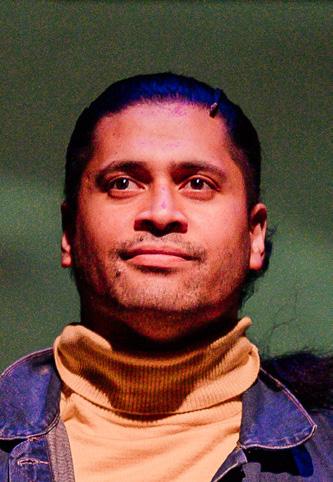
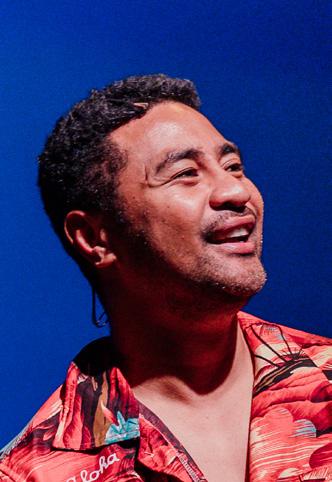
TO
The eldest son and the keeper of stories. Smart and keenly observant, yet physically vulnerable. He played the class clown to survive the playground bullies, finding his only true escape in a library corner, lost in adventure books and hidden from a mad world.
"But with a book, we can become doctors and lawyers."
SEKI
The second son and the favourite child. Strong and handsome, he carries his father's looks. A lover of sports, he worships the very ground his father walks on.
"I am the mirror of my Father. I carry his strength, his eyes and his good looks."
SAU
The youngest son, fuelled by anger and easily overwhelmed by his emotions. He grew up in a school where teachers watched TV all day, his identity marked by the long hair he wore for 21 years of his life.
"I am the most dangerous of the three."
VAO
The father. A charming and handsome man of the plantation who loves his beer and a good fistfight. He is quick with a joke, but when his temper flares, he becomes a monster.
"No tears. I don't want to see any weakness."
Classroom Activities
This section is specifically designed to help you unpack the show and utilise the information in this pack in the classroom with your kaiako/teacher. Each section references information in the pack and is structured in the following way:
• In the Classroom: Brainstorming, prompt and practical activities to provoke discussion and help you explore the education material provided
• Revise: Questions for you to complete individually in preparation for your AS91219 or AS91518 Exam in November. These questions have been specifically developed from the 2026 Exam Specifications provided via these links:
• Level 2 Assessment Specifications
• Level 3 Assessment Specifications
• Level One: There is an individual section for Level One students at the end of this pack that support you to collate your portfolio for external assessment:
• Level 1 Assessment Specifications
Playwright and Directors Activities
From Page to StageWriting and Directing Sons of Vao
Sons of Vao playwright Vela Manusaute co-directed the production alongside Anapela Polata'ivao. As a result, the writing of the play and its direction are deeply interconnected. Use the following activity to explore and unpack their directorial concept.
KNOW, WANT TO KNOW, LEARNED
The resource you will need access to for this activity is a Know, Want to Know, Learned Chart: KWL chart (reference: NCEA Literacy Planning Resources)
You will: Complete the Know section individually, the Want to Know section in pairs or small groups and the Learned section as a whole class.
• Topic: Unpacking Manusaute and Polata'ivao’s concept for Sons of Vao
• Know: What do you already know about what the playwright and directors were trying to communicate through the way Sons of Vao was brought to life on stage? You may also draw on ideas shared during the forum.
• Want to Know: What questions did you have as you watched the production? What themes, motifs, or symbols stood out to you? What quotes, moments, or scenes would you like to investigate further?
• Learned: As a class, use the information in the front section of this pack that relates to Manusaute and Polata'ivao’s ideas and intentions. Discuss the questions raised in your Want to Know section and complete the Learned section of your chart as you discuss as a class.
Extension: Use your notes, class discussions, and the resources in this pack as a starting point for further reading and research. This will help you develop your own ideas, responses, and perspectives for use in your exam or portfolio.
CONCEPT MOOD BOARD
Choose a scene from Sons of Vao that strongly communicates one of the production’s key themes. Create a physical or digital mood board that explores what Manusaute and Polata'ivao were trying to communicate to the audience through their creative choices. Draw on your research and observations to imagine how they may have worked with the designers and actors to bring the moment to life.
Your mood board could include:
• Reference pictures you think might have inspired the scene
• Colour palette for the designer
• Research they might have drawn on
• What they might have said to the actors
• Sketches with annotations of how they have directed actors to use the space and interact with set/staging or technology
• Any other notes you imagine the director was thinking about, for example, highlighting symbols,
imagery or motifs or building tension and contrast.
You may choose to use parts of this in your portfolio or reference it during revision.
REVISE - (COMPLETE THESE AS YOU STUDY FOR YOUR EXAM)
Directors concept:
• Discuss the purpose of the performance and how the themes or ideas link to what is happening in the world; socially, politically or historically. Link your ideas to specific moments or examples from the performance:
• How did the way the performance was realised impact the style of delivery of the narrative/story?
• How does the content of the play challenge and serve the audience?
• Discuss how the director brought the story to life using Drama Components - Elements, Conventions, Techniques and Technologies
• What do you think Anapela Polata'ivao and Vela Manusaute are asking you to think about in the way they have directed Sons of Vao:
• How did the acting and staging choices affect you as an audience member?
Vao and his SonsExploring Character
CREATING CHARACTER PROFILES
Choose one of the brothers or Vao to focus on. Use the education pack, interviews, social media content, and media articles to build a character profile. Include:
• Character name, age, and key physical attributes.
• Their role and purpose in the narrative.
• How their Niue heritage and experiences in Niue and New Zealand shape their identity, relationships, and motivations.
• Their relationship with Vao (if focusing on one of the brothers).
• One key moment in the play that develops the character.
• How the actor used voice, body, movement, and space in that moment.
• Important quotes and ideas from the education pack and interviews.
• Insights from your own research.
• Significant quotes from the performance that reveal character, motivation, conflict, or change.
Extension: Share your profile with the class, compare findings with others who studied the same character, and upload your work to a shared space for revision and portfolio development.
NARRATIVE MAPPING
Split the class into two groups. One group will focus on Vao's journey through the play, while the other will focus on the brothers and their relationship with their father, each other, and themselves. On a large piece
of craft paper, create a timeline of key moments that reveal the themes of loss, love, memory, forgiveness, and the bond between fathers and sons.
For each moment on your timeline, add the following details and annotations:
• The proximity and positioning of actors in the space and what this reveals about their relationships
• The tensions, conflicts, or emotional connections present in the moment
• Important lines of dialogue, including annotations about subtext
• Notes on the actors' use of voice, body, movement, and space to bring truth, heart, humour, or emotion to the scene
• A short paragraph explaining how the moment contributes to the characters' search for understanding, peace, or forgiveness
• A sketch of the set with annotations showing key moments for the characters in the performance
• Notes about how the actors interacted with design elements and this helped create the world of memory, personal history, and family relationships
• Links to wider context, including information from the education pack, designer and director notes, or relevant research
Once complete, share your timelines with the rest of the class. As a class, discuss how isolating Vao’s story arc and the brothers helped you to understand the characters' purpose in the story. Save all timelines in a shared space so they can be used for portfolio construction or exam preparation.
REVISE - (COMPLETE THESE AS YOU STUDY FOR YOUR EXAM)
Drama Techniques: Body, Voice, Movement and Space: You may want to answer all the questions for the same actor or focus on different actors for each question
• Describe how an actor used drama techniques in a specific moment in the performance
• Explain an actor's use of drama techniques and how they transformed the space within the performance
• Choose specific moments where you felt an actor used their body, voice, movement, and space in combination, to create impact, focus, or to support an important idea/theme
• Thinking about a specific character and the way they created the characters arc:
• How did they use techniques to create a sense of time and place?
• How did they use techniques to communicate the wider discussions of the play; immigration, culture, race, etc?
• What social or political ideas did they represent within the play? How did the actor use techniques to communicate this?
• How did an actor use drama techniques to communicate subtext in their performance? Use a specific moment and example to discuss this use of subtext.
Character:
• Discuss the purpose of the portraying these characters in a theatrical context:
• What impact do they have on the narrative, as well as the audience and actors' relationship?
• How does the actor's use of techniques communicate their purpose in the performance?
Design in Sons of Vao
THE BIG MOMENTS REPRESENTED THROUGH DESIGN
In small groups brainstorm the big moments in the performance. A big moment could be defined in the following way:
• Marks an important event in the story
• Reveals a defining moment for a character
• Highlights a key point of tension
• Shows character growth or change
• Challenges the audience in some way
• Choose another moment you find significant.
Fill in the table below for all the big moments you have identified, with an explicit focus on the way design and use of technology moved the story forward.
Your big moments may differ from what your peers/classmates choose to include. This table should reflect your individual understanding and experience of the performance as a member of the audience. Moment
Describe a big moment in detail. Explain in detail what technologies were used.
Draw a small sketch to remind you of the moment.
Notes about culturally significant elements of design. What did they represent or symbolise?
Any relevant quotes from the designers' interviews.
SKETCHING AND ANNOTATING COMPELLING TECHNOLOGY
The design choices in Sons of Vao are highly symbolic, helping to communicate the play's exploration of memory, identity, family, and migration. Set designer Sean Coyle created a minimal environment dominated by a large rusted square, symbolising how memories deteriorate, fragment, and change over time while never fully disappearing. The set embraces the ambiguity and emotional weathering that runs throughout Vela Manusaute's writing.
Construct a detailed sketch of the set and explore ideas by annotating the following:
• Describe one moment where the set was used in a surprising, effective, or memorable way
• Explain why you found this moment compelling
• Include details from the education pack and designer's notes. How did the design support the idea of memory, deterioration, or emotional weathering?
• Research and add notes about any culturally significant aspects of the design. Why were they important to the story and themes of memory, family legacy and complicated feelings of love towards Vao?
• Explain how other technologies interacted with the set to create meaning
• Add significant quotes from the play that connect to this design choice
REVISE - (COMPLETE THESE AS YOU STUDY FOR YOUR EXAM)
• Discuss how technology or design was used during a climatic moment in the performance? What do you think was at stake within the scene?
• What was the impact of the way the design, directorial, and acting choices worked together? Choose a moment that surprised, shocked, or excited you to talk about
• Discuss why the use of sound and lighting design was integral to this performance? Focus on the mood created by sound choices, use of colour and the shapes created by the angles or composition of lighting
• How were design and directorial elements (props, setting, AV, costuming, audience positioning and interaction) and the Drama Elements used to build the performance? How did this make you feel as a member of the audience?
• Discuss the inspiration for a specific element of the design and link it to wider context; social, political, historical or geographical? How did this deepen your understanding of the themes and ideas the play was communicating?
• This would be a good question to explore the cultural symbols and ideas represented in the performance. Technology: link your ideas to specific moments or examples in the performance. Think about lighting, set, sound, props, costumes, make-up and how this helped bring you into the world of the play.
• How was technology used to create the atmosphere in the performance?
• How was technology used to highlight important ideas, themes and symbols in the performance?
• How was contrast and/or focus created or built through technology and why was this important?
• How did the use of technology help you gain a deeper understanding of the themes of RBG: Of Many, One?
• How were technologies used in combination to transform the space in a specific moment? (Level Two students must revise this question)
• How did technology highlight the different characters’ motivations expressed within the performance?
• Discuss why this was impactful, exciting or challenged your expectations
• How were costumes used to communicate RBG’s purpose in the performance?
IMPORTANT NOTE: When you are writing about Set or Costume, you need to be specific about the following details and also sketch what you see. Imagine the person you are writing for has not seen the production and create a vivid image in their mind of what you saw:
• For example: Set/Props
• The size, shape and dimensions of any set pieces or props used
• The materials used, their textures and the colours.
Wider Context and Sons of Vao
PACIFIC MIGRATION TO PONSONBY
Split your class into three groups to complete this activity. Assign one of the following articles to each group.
https://ahi.auckland. ac.nz/2022/03/22/pacific-immigrantsin-the-greater-ponsonby-region/
https://ahi.auckland. ac.nz/2022/03/22/the-removal-ofthe-pacific-community-from-greaterponsonby/
https://www.stuff.co.nz/ national/72897184/colourful-hardcase-ponsonby-in-the-1970s
Activity: Nominate one reader while the remaining members record ideas, quotes, or information from the article that are interesting, challenging or worth exploring further. Focus on the experiences of Pacific peoples migrating to Aotearoa New Zealand and the connections you can identify to specific scenes, characters or stories in Sons of Vao.
After reading, discuss your ideas as a group and add to your brainstorm. Consider:
• How does the article connect to the themes and experiences of Vao’s sons?
• What challenges or perspectives about Pacific migration are explored in both the article and the play?
• How were these ideas communicated through drama techniques, conventions, or technology in the performance?
• What information from the article could be used as wider context in an exam or portfolio?
Share your group's key ideas with the class through a short presentation or discussion. Record useful ideas from other groups and save all notes in a shared location for revision and report writing.
WEAVING IN WIDER CONTEXT
Manusaute drew from deeply personal ideas when writing Sons of Vao which is reflected in the way the story is structured and the ideas presented on stage. He has talked about this at length in the press. Use the following activity to enrich how you discuss the show as a class and also how you write about it for assessment purposes.
As a class read through the Niue Fact Sheet and the In The Press section of this pack.
Split into smaller groups and choose one of the ideas or articles.
Complete the following:
• Research the idea further or read the article; ensuring you pull out the key ideas
• Make notes on a shared document, ensuring that you take note of references
Connect this research or what you understand from the article to a specific moment or a couple of specific moments in the performance:
• Discuss how were these cultural elements incorporated by the creative team OR how does this moment connect to the key ideas represented in the article you have read
• Sketch of the moment onstage, with detailed annotations that include:
• Key quote from a character
• A short explanation of the moment
• Symbols or motifs and how they were brought to life on stage
• Use of drama components; techniques, elements, conventions and technologies
Homework:
Level One - short essay, PPT slides or a voice note: How does this wider context support the key message of the performance and how were the drama components used to bring this to life on stage. What did this make you feel as a member of the audience?
Level Two and Three - short essay: Discuss how a live performance explored a wider social, cultural, historical, or political context. Analyse how drama components were used to communicate these ideas and evaluate their impact on the audience.
REVISE - (COMPLETE THESE AS YOU STUDY FOR YOUR EXAM)
Drama Conventions - strategies established to make meaning and connect to wider context: (NB - make sure you are familiar with what the established Drama Conventions are by discussing this with your teacher)
• Identify a moment in the performance where Drama Conventions were used to transform the space:
• Explain how the convention or combination of conventions were used in the performance
• Discuss the impact of the use of the convention or combination of conventions in this moment
• Discuss how meaning was created for you, as an audience member, in this moment
• Discuss how the use of a convention or combination of conventions in a specific moment helped you think about the big ideas and themes of the play:
• What was the wider context (socially, historically, politically or geographically) that this moment linked to?
Drama Elements and how they draw our attention to themes, motifs and symbols:
• What were the main themes, questions and ideas evident in the performance? Link these themes, questions and ideas to specific moments or examples from the performance
• Identify recurring symbols or motifs throughout the performance. Explain why they were important in helping you understand ideas being communicated in Sons of Vao
• How do these themes, symbols or ideas link to the wider world of the play and what impact does this have on the audience?
• Were there moments where the content was confronting or forced you to think about something in a new light? What impact does this have on the audience and you as a member of the audience?
• Reference the wider reading and cultural and historical context in this pack, as well as research material you have brainstormed and think about the impact these themes, symbols or ideas have on the lives and arcs of the characters in the play.
Pacific Performance Traditions and Practices
The new NCEA Drama matrix asks students to “understand Aotearoa New Zealand as a Pacific nation, and that there are Pacific performance practices and traditions that have travelled here.”
This section explores how Sons of Vao draws on a rich legacy of Pacific theatre. The play tells the story of ‘sons grappling with the legacy of a father who has passed on’ and ‘brings forth the vital voices of Island men, voices rarely heard or seen in mainstream theatre.’ Like many Pacific works before it, Sons of Vao uses dramatic traditions and performance practices that create space for Pacific stories and perspectives.
In groups, explore one focus area and record your ideas in a format of your choice (voice notes, sketches, mood boards, writing, etc.). Be ready to share your findings.
• Pacific Performance Traditions and Western Theatre: Identify
how Pacific symbols, ideas, and performance traditions are woven into the production through acting, lighting, sound, or special effects. How do they support the play’s themes and symbolism?
• Tradition and the Western World: How does immigration shape the story? What is gained or lost by living between Niue and Aotearoa New Zealand? Support your ideas with examples from the play
• Language and Style: Explore the use of Niuean language, New Zealand slang, and different speaking styles. How do these choices shape character and meaning?
• Song and Dance: How do cultural song and dance contribute to storytelling, character development, and cultural identity? Consider how technology enhances these moments
• Changing Social Perspectives: How do the characters navigate tradition,
identity, family, and change? In what ways do they honour their heritage while challenging harmful legacies?
• Place and Time: Analyse how setting and historical context are created through dialogue, characterisation, and production elements. How does this connect to contemporary issues?
• Realism and Theatrical Techniques: Identify moments where realism is enhanced through poetry, set design, lighting, sound, or other drama techniques. How do these elements communicate key messages?
• Tragedy Through Comedy and Satire: How is humour used to explore difficult themes? Discuss specific examples and their impact on the audience.
PACIFIC VALUES FRAMEWORK IN SONS OF VAO
The Pacific Values Framework, introduced through the NCEA Level One refresh, supports teaching and learning that values Pacific knowledge, languages, cultures, and identities.
The five values are Alofa, Kuleana, Vaka, Vā, and Fonua. Your teacher will introduce each value using the NCEA resources.
Activity: Using the descriptions of the five values and the Arts learning area guide, discuss how these values are reflected in Sons of Vao.
For each value:
• Find an example from the rehearsal process or performance.
• Use interviews and information from this resource pack to support your ideas.
• Consider the impact of these examples on the audience.
Reflect on how exploring these values has broadened your understanding of the play and the world it represents.
As a group, choose one value to investigate in depth. Select a key sentence from its definition as a research focus and present your learning through a performance, presentation, or short essay.
REFERENCES
Pacific Values Framework – Delivering for Pacific Learners and Contexts | NCEA
03: Working Together: Cultural Practice in the Theatrespace | Playmarket
Sons of Vao and Level One NCEA
“Drama transforms the tangible into the intangible.“
This section of the education pack is designed to support Level One drama students navigate the new Level One external Achievement Standard 91943 - Respond to a drama performance. Unlike the Level Two and Three external standards, which are an exam, you will be constructing a portfolio over a period of time in class. It will be based around three key aspects:
• key message of the performance, the use of drama components and your own personal response about how you connected to the performance, capturing the wairua (spirit) of what you watched.
This portfolio will be presented as a slideshow or PowerPoint and can be a mixture of written and audio visual material - the main question you should ask yourself as a student is; how do I communicate my ideas, thoughts, and feelings about what I saw, the
best? With that in mind, you are encouraged to collect your thoughts, discussions and do your research in a range of formats. Such as; voice notes, sketches and annotations, brainstorms, moodboards, recorded physical responses and writing.
Kaiako and ākonga please ensure you read this year’s assessment specifications carefully as you prepare to submit this assessment. You can access the specifications via this link: NZQA Assessment Specifications - Level One
Below are three activities to support you to expand your ideas and support you during the teaching and learning phase of unpacking the performance.
KEY MESSAGE:
In pairs, small groups or as a whole class, discuss and brainstorm the following prompts:
• What do you think Vela Manusaute was trying to say? Why this story? Why these characters? Why this period of time?
• What do you think Anapela Polata'ivao and Vela Manusaute were trying to communicate through the directorial choices they made? How does this connect with what Manusaute has written?
• What do the characters in the performance represent and what do they communicate to the audience?
• What do you think the designers are trying to communicate through their choices? How does this bring Anapela Polata'ivao and Vela Manusaute ideas to life?
Once you have brainstormed around these questions, you could journal, voice note or record thoughts around the following questions:
• How do you identify the key message of a performance?
• Can there be multiple key messages?
• Think about your interpretation of the performance - what was the key message to you?
• What physical evidence from the performance connects to the key message? This could be a scene, a moment between characters, dialogue, a moment where the use of technology highlighted an idea.
• Describe these examples and sketch them in specific detail.
USE OF DRAMA COMPONENTS:
Drama components are techniques, elements, conventions and technologies. Make sure you have explored this language and terminology with your kaiako.
Now that you have fleshed out what the key message might be, you need to connect it with the choices that the director, designer and actors have made and how they have used the drama components in combination.
Brainstorm in small groups, or in pairs:
• How an actor used drama techniques in a moment that communicated the key message
• How elements created a sense of mood, atmosphere or tension
• How conventions were used throughout the performance
• How technology enhanced the story being told
WAIRUA OF PERFORMANCE AND PERSONAL RESPONSE:
In the unpacking on the NCEA website for this standard, this aspect of the assessment is unpacked in detail. Your teacher will support you in understanding this and guide you to explore, research and develop your ideas.
“The wairua of the performance is experienced as the intangible energetic and emotive qualities that carry the spirit and intention of the play. How the wairua is expressed by the performers provokes a response from the audience and allows them to reflect on the ideas and themes of the play based on their own life experiences and perspectives.“
- 1.4 - Unpacking
• What thoughts, ideas and feelings did the performers provoke in you?
• What have you reflected upon since watching the performance?
• What have you been thinking about (head) and feeling (heart) since?
• What did your gut/sense of intuition communicate to you as you watched the performance?
• What life experiences or perspectives do you bring? What connections did you make? Were there specific cultural connections you made to the production?
REFERENCES
Drama | NCEA
Level One External Specifications