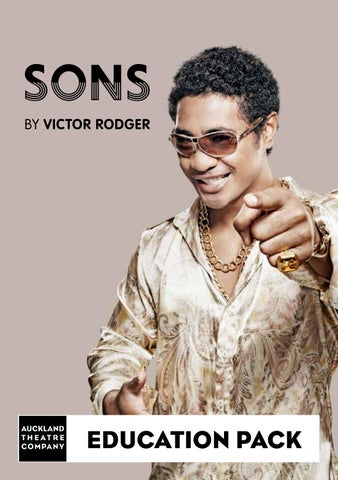
EDUCATION PACK
Sponsors
Contents
Auckland Theatre Company receives principal and core funding from
Subsidised school matinees are made possible by a grant from
Please note: • Schools’ performances are followed by a Q&A Forum lasting for 20 – 30 minutes in the theatre immediately after the performance.
ATC Education also thanks the ATC Patrons and the ATC Supporting Acts for their ongoing generosity.
• Eating and drinking in the auditorium is strictly prohibited. • Please make sure all cell phones are turned off prior to the performance and, if possible, please don’t bring school bags to the theatre.
V E N UE :
ly Avenue and ntre, corner of Or Ce ts Ar re ge an M gere. Bader Drive, Man
m. 23 October at 11a 21 and Thursday y SCHOOL S’ da es Tu , 20 y NCES: Monda PERFORMA out an interval. 90 minutes with : E IM T G ls 11-13 RUNNIN ble for Year Leve production is suita is Th : Y SUITABILIT students. e. of strong languag s occasional use ain nt Co ADVISORY:
• Photography or recording of any kind is STRICTLY PROHIBITED. 2
3
Cast Beulah Koale — Noah | Troy Tu'ua — Lua Rima Te Wiata — Nan | Max Palamo — Manu'a Joanna Mika-Toloa — Sas | Alison Bruce — Grace Lauren Gibson — Alex | Bronwyn Bradley — Sandra
Creative Direction — David Fane | Playwright — Victor Rodger Set Design — John Parker | Costume Design — Charlie Baptist Lighting Design — Rachel Marlow | Sound Design — Isaac Nonu
Production Production Manager — Andrew Malmo Technical Operator — Jamie Johnstone Company Manager — Fern Christie-Birchall Stage Manager — Eliza Josephson-Rutter Camera Operator — John Whiteside Set Construction — 2construct
Education Pack Writer — Amber McWilliams Contributing Writers — Grace Taylor and Tanya Muagututi’a Editor — Lynne Cardy Production Images — Andrew Malmo Graphic Design — Wanda Tambrin & Claire Flynn Design images courtesy of John Parker By arrangement with Premiered in 1995 by Pacific Underground, Christchurch, New Zealand. 4
5
About the Play SONS is Victor Rodger’s first play. The script went through a workshop process at Auckland’s Mercury Theatre in the early days of its development. During and after the workshop, the play was significantly revised. The rewritten version premiered at Christchurch’s Court Theatre in 1995, in a co-production with Pacific Underground. In 1998, Victor reworked the play again, and this revised script was performed that year by Taki Rua Productions at Downstage Theatre in Wellington, winning four Chapman Tripp Theatre Awards (including Most Outstanding New Writer and Most Outstanding New New Zealand play.) This version of the script of SONS was published by Huia in 2008, and is being used for the 2014 ATC production.
“When I first wrote the script, all the characters were goodies or baddies, with Noah and Grace definitely the goodies. But when we did the workshop it became clear to me that we’re all human beings and we all make choices, and while those choices can have wonderful or terrible consequences, it’s not quite as simple as goodies or baddies.” – Victor Rodger
Synopsis Lua watches Noah presenting The Beat music show on TV. Manu’a tells Lua to turn it off. Lua and his girlfriend Sas are secretly pregnant and have decided on an abortion. Sas is reluctant to go through with it but Lua insists. Nan tries to stop her grandson Noah from contacting his estranged father Manu’a. However, Noah needs to reconnect because he believes Manu’a is dying. Noah’s mother Grace intervenes, and says it is Noah’s decision. Noah tells his girlfriend Alex about how Manu’a got two girls pregnant at the same time and chose to marry Sandra, instead of Noah’s mother Grace (who was only 15). Noah visits Manu’a at home. Sandra is hostile but Manu’a is welcoming, although he criticises Noah for smoking, drinking and not knowing his Bible. Noah cannot speak Samoan, so Sandra and Manu’a argue in Samoan. Sandra leaves on Manu’a’s instruction. Manu’a learns about Noah’s life and tells him he has siblings: Lua, a car salesman, and Taulisi, a travel agent in Samoa. They do not know about Noah. Manu’a says he will tell them “when the time is right.” Noah tells Alex about the visit. They go to the car yard where Lua works, pretending to be buyers. Lua finds out Noah is halfSamoan and invites them to a church fundraiser; Noah agrees. Sas visits Lua; she is feeling sick after the abortion, but Lua is more worried about keeping it secret. Manu'a tells Sandra that Noah wants to meet his brother and sister. She stonewalls, saying she was adopted and never knew her birth family, and Noah should be happy just knowing his father. She says Lua will hate them if he finds out about Noah. Alex discovers who Lua is and is furious at
6
Noah. She refuses to go to the fundraiser, saying she needs to work on her upcoming art exhibition, but Noah talks her round. Nan confronts Noah: she cannot understand why he wants anything to do with Manu’a. She tells Noah that she got down on her knees to beg Manu’a to marry Grace, and she can’t forgive him for saying no. Grace quizzes Noah about his meeting with Manu’a. She says that Manu’a was the love of her life; she waited for him for ten years. Alex is the only white person at the fundraiser. Lua makes Noah perform a Samoan dance –Noah looks a complete fool because he has no idea what to do. Sas helps him out, teaching him some moves and Samoan words. Lua flirts with Alex. Sandra drops off some food and Lua points out Noah (as the famous TV presenter) to her. Grace phones Manu’a to find out how he is. She asks Manu’a to please not hurt Noah. Lua, rushing to work, tells Sandra he’s going to try to sell Noah a car. Sandra calls Grace and says she must tell Noah to back off; Grace is placating, but Sandra remains angry and hurt. Nan tells Grace none of this is Grace’s fault. Grace finds herself grieving for Manu’a. Noah gives Manu’a a photograph of himself. Noah makes assumptions about matai, showing his cultural ignorance. Manu’a describes meeting Grace when she was fourteen, saying she was the most beautiful woman he’d ever seen. Noah pushes to meet his siblings, but Manu’a still hasn’t told them the truth. Lua is trying to sell Noah a car. Noah has to go to Alex’s exhibition, but runs into Sas. They talk and she shows him more siva moves. Alex notices Noah’s good mood as she takes him off to the exhibition. Sas tries 7
to tell Lua about what the abortion was like, but he angrily shuts her down. Grace goes to visit Manu’a at home. He tells her she’s beautiful and that he always wanted to be with her. She leaves sadly, running into Lua; she recognises him because he looks like Noah. Lua is watching sport; he ignores his mother but responds to his father’s request for a glass of water. Alex asks Noah why this “Samoan stuff” is suddenly so important, and says he’s not really Samoan. They fight. Sandra arrives and tells Noah not to hassle Manu’a because he’s so sick – she says Noah is “killing him”. She leaves. Noah is furious and vents to Alex. Noah talks to Grace and Nan about the situation; Grace lets slip that Alex has told her about visiting Lua at the car yard. Nan says Manu’a brings misery and Noah should forget him.
Grace confronts Manu’a about hurting Noah, and says he must “just for once” do what he has promised to do. Noah visits Manu’a and confronts him, saying Manu’a is hiding behind Sandra and God. Manu’a demands respect but Noah keeps pushing – Manu’a orders him out of the house. At Alex’s exhibition, Noah is determinedly getting drunk, ignoring Alex’s attempts to talk to him. She loses her temper. Lua arrives, tries to flirt with Alex, and approaches Noah. Noah tells Lua the truth: that he is Lua’s brother. Lua storms home to confront Manu’a and Sandra. Noah follows and Lua discovers they are the same age. Lua is appalled and reveals he made Sas have an abortion only because he was terrified of his father’s reaction to the pregnancy. Manu’a leaves unrepentant; Lua and Noah share a moment of reconciliation.
Talking Points
8
•
The play is made up of very short scenes: most consist of exchanges between just two characters. What does this mean for the narrative? How does it affect the tone of the play?
•
The published script instructs “The play is meant to be performed fluidly so that it flows from scene to scene.” Why is this instruction given? How is it achieved in this production?
About the Playwright – Victor Rodger Victor Rodger was born in 1969. His writing for theatre typically deals with race, racism and identity, and often draws on his own Pakeha/Samoan heritage. Victor began his career as a journalist. His first foray into professional creative writing was composing stories for Ears, National Radio’s children’s programme. His first play, Sons, was produced in Christchurch in 1995. Also in 1995, Victor began his studies at Toi Whakaari: New Zealand Drama School. He graduated in 1997, the same year as his second play, Cunning Stunts, was performed at BATS Theatre as part of Young and Hungry Festival of New Theatre.
•
Manu’a says at one point “I know you haven’t been brought up fa’a Samoa, Noah. I make concessions for that.” How much do you know about “fa’a Samoa”, the Samoan way? If you were suddenly required to ‘fit in’ with another completely unfamiliar culture, what issues and conflicts might you face? Which of these are most clearly highlighted in Sons?
Rodger has been a writer and story-liner for the long-running television soap opera Shortland Street since 2000. In 2001, Rodger won the Sunday StarTimes Bruce Mason Playwriting Award. His third play, Ranterstantrum (2002), was praised by the Evening Post as “a triumph over stereotype”.
•
This play is Victor Rodger’s first, and is strongly autobiographical. If you were going to write a family drama, what events or circumstances might you draw on from your family’s history? How might the people involved feel about being represented in a theatrical presentation? Discuss the ethical issues of creating fictional work based on real events.
Rodger studied writing for film at the Maurits Binger Foundation in Amsterdam in 2004-2005. The following year he was awarded the Fulbright-Creative New Zealand Pacific Writers’ Residency, based
at the Centre for Pacific Studies at the University of Hawai’i. In 2007, his fourth play, My Name is Gary Cooper, was produced by Auckland Theatre Company at the Maidment Theatre. Metro magazine described the play as “a darkly witty demolition of palagi fantasies about Polynesia”. Rodger was the 2009 Ursula Bethell Creative Writing Resident. In 2012, he was made the Creative New Zealand Pacific Artist-in-Residence at the Macmillan Brown Centre for Pacific Studies. In 2013, his play Black Faggot premiered at the Auckland Fringe Festival, winning the Best Production and the Auckland Arts Festival award. The play went on to tour nationally and internationally, and won Melbourne Fringe Festival Award for Innovation. In the same year, At The Wake premiered at Centrepoint Theatre, Palmerston North. Victor Rodger currently lives in Christchurch, the city of his birth.
9
The Direct Director
that kind of emotional restraint “perhaps the most beautiful aspect of directing this piece this time.” “Throughout the whole show, I’ve had to tell the actors ‘just hold the horses back’. Because when you let them go, we’ve got nowhere else to go.”
David Fane talks about SONS David Fane has a longstanding association with the SONS. “It was the first show I ever directed – and I was useless. Twenty years down the track, I’m just marginally better."
10
He’s also been in the play twice: once in Wellington, once in Christchurch. “The Wellington season was directed by Christian Penny – he was one of those directors that just helped open our eyes to things.” David played Manu’a to Robbie Magasiva’s Lua. He says with a grin, “Robbie was awful but he won an award for it – we were all ‘award-winners’ in that show!” David’s deprecating humour – a comedic trademark – is clearly one of the reasons for his success. Asked about his directorial style, he responds cheerfully: “I don’t know what I’m doing!” More seriously, he adds “It’ll find its own way.”
Joking aside, those stereotypes are exactly what he is avoiding in this production of SONS. “The script’s really evolved since we first started” David says. He originally found the play “a bit one-dimensional at times”, but feels that it has developed from a story simply about being afakasi to encompass “the falling down of everyone.” He explains that the themes are more universal than they may seem initially: “Everyone in this play loses a love. It’s about love’s great loss. I don’t think we discovered that twenty years ago – we played it very literally.” That universality, he says, is a key strength of the play.
He’s able to talk semi-seriously about SONS. “What has always appealed to me about this story is that it’s from the view of an afakasi” he says. “It’s a hard thing, being afakasi, because Samoans are nasty people: they think you’re either one or the other, you can’t be both. Yet there’s so much to be admired about the way afakasis go about their lives… trying to be part of both cultures, and stay true to themselves. My kids are going through that process now. I try and help them, but when I’m angry at them I think with my Samoan brain… and when they’re good at something I thank God for their palagi side!”
Clearly the script packs a significant emotional punch. At the first ATC rehearsal reading, there were tears aplenty from the playwright, members of the cast, and several of the ATC staff. “I tell you what” says David, “I’ve never seen so many sookabubbas crying after a read-through!” That emotional impact is a double-edged sword, however, and one David is keen to wield with care. “The play speaks so many home truths – it’s easy to go for the cry straight off. But in life, we tend to try and hold back as much as we can, until the floodgates are opened.” He says he’s found
After all, “we don’t want it to be a sob-fest. If I know I’m going to be crying fifteen minutes into a show, and keep crying, then I’m not going to want to go to that show! Because life isn’t like that. Life isn’t about crying every damn day about the whales or mining or whatever… Of course you’re allowed to cry – anyone’s allowed to cry – but life’s also punctuated by the moments of just understanding.” Not that ‘real life’ is exactly what they’re depicting here. The production highlights the constructed social realities of contemporary culture, too. “The concept is ‘reality television’” David explains “and that’s why we’ve put it in a studio setting. It just made perfect sense.” He’s encouraging the actors to really use the set: “I’ve been trying to teach them to jump all over it. It’s like a jungle gym, with a big TV behind it!” David is quick to point out that “nothing in the play is as it seems.” The production will highlight this idea through the use of a slightly discordant and unusual soundtrack. “With the music that we used, we distorted some of the sound. People will know the track, but we’ve distorted it.” Live singing will be used over the top of recorded tracks “just to throw it off”. In a similar vein, “we’ve got palagi singing Samoan songs, just because it’s NOT their culture…” Samoan language can work the same way. “We thought about subtitles, but sometimes you don’t want a subtitle,
because then you end up reading and you forget about this beautiful scene being played out in front of you. What’s more important? I think the images – the overriding intent.” The use of Samoan also puts the non-Samoan speaking audience in the same position as Noah: slightly bewildered and excluded by the Samoan exchanges. “Exactly” says David. It’s also about trusting the audience to get the gist. “I think New Zealand is a unique place” David says. “We’ve got all these languages around us, and whether you understand them or not, you certainly understand the intent.” The language hasn’t proved a difficulty for this cast. David’s own wife, Bronwyn, plays Sandra, “and she speaks a bit of Samoan, so I was lucky!” He thinks she’s doing a great job, saying with a twinkle “she surprised me – she’s a far better actor than I remembered.” He was full of admiration for her performance in ATC’s production of The Good Soul of SzECHUan earlier this year – and is equally glowing in his assessment of the production itself. “It was the most amazing play. It was so truthful, and honest, and I loved the throwaway nature of it…” This is an approach he’s following in directing SONS. “I suppose that’s what I’ve tried to do here – to keep that same sense of just ‘do this and throw it away’ because somewhere along the line it’s going to mean something to someone. I don’t want to be heavy-handed with it; I don’t want to say ‘cry now!’ I want people to feel that they can make their own minds up.” Credit has to go the cast for making this vision a reality. “The actors are great. They’ve been the most generous cast. I think it’s for that reason that I’m letting 11
them have their way, letting them discover the truth of the characters for themselves.” Sometimes that requires jolting them out of their accustomed comfort zones. David gives a great example of two of the actors who were supposed to be having an argument in a hushed space. “It was all really ‘actor-y’ and they were getting it wrong, and getting it wrong… so we went down to the food court and rehearsed it
there. I said ‘I dare you to do it like you were doing it in the rehearsal room’. They lost the actor voices straight away! That’s the intensity; that teaches us. When we’re presenting all the truths – that’s when the pain comes.” “If we can deal in truth, then we’ll be on the winning side. I suppose it’s ultimately what SONS is about – just wanting the truth.”
Talking Points
12
•
David makes use of deprecating humour throughout his interview; deprecating humour is also one of Noah’s characteristics. Why do people use “put downs” for comic effect? What social function do they serve – in a play script, and in real life?
•
What was your response to the musical choices of this production? Did you find them “not what they seemed?” How was this achieved?
•
Why might taking a rehearsal into a real public space be effective? What other techniques could a director use to give the actors insight into achieving authenticity?
13
"I Wrote My Truth" Grace Taylor talks to Victor Rodger SONS provides a platform for the voice of the in-between. The illegitimate fatherless children, the afakasis' living in multiple worlds of white and brown and women left to be both mother and father. Twenty years since heart was put from pen to page, SONS still rings emotionally true for Victor Rodger. By revisiting the heart of SONS, Victor revisits the heart of his own story. His call was to uncover his fathers’ genealogy to discover family relationships urgently waiting to be woven, explore his ‘afakasiness’ and the politics that come with being a child of mixed race. I, too, am one of these children, SONS was written for people like me. When I was asked to write a piece about Victor in relation to SONS there was only one way to do so. To talanoa while sharing food. So, I find myself at 8am on a Saturday morning at Little Bird café in Ponsonby with Victor Rodger. When afakasi people meet, there exists an unspoken knowing a va, that can be communicated with words, a look, a nod, a smile, a cheeky joke or tears. This is made possible by a unique shared experience. So when this afakasi poet met this afakasi playwright the va had already been paved for us, we just needed to nurture it. This is exactly what Victor achieves through his writing of SONS; he nurtures the va with the audience through the telling of his own story. Victor wrote SONS out of necessity, to see himself and his experience represented. As a New Zealand born afakasi, “brown skinned 14
but raised white and not knowing the brown world”, Victor felt he had “nothing in literature that he could specifically grab hold of” that spoke to his experience. We trade stories of our journeys to negotiate a Samoan and Palagi world as afakasi people. The constant questions by our own people of, “what have you got in you? Where do you come from?” Being made to always feel like the other, no matter which world you are standing in. The juxtaposition of jumping from one culture to the other is beautifully demonstrated in SONS through the nuances of language barriers, mannerisms, behavior, relationships and shifting contexts. This shifting is how the negotiation and navigation skills of afakasi are sharpened. I asked Victor if he thinks the afakasi experience is still relevant 20 years on from SONS inception? Victor replies, “yes, now more than ever, as we are becoming more mixed race.” For Victor, his personal experience evolved from being, “a New Zealander with a Samoan father to, I am Samoan to, I am absolutely both, but still perceived as other.” It is through writing his story, writing his truth that, "Being afakasi went from a fact to a feeling.”
Within SONS we hear the voice of an illegitimate child and experience his sense of urgency to be part of his father’s family and his attempt to give a face and name to the missing branch on the family tree. We experience the unmistakable Samoan father, his way of speaking without having to actually speak. How sometimes, respect is demanded. Victor says, “much of my work is written from a place of anger”. SONS was initially written with a “goodies and baddies” narrative but after the first workshop Victor found that essentially SONS is about human beings, the decisions they make and the consequences that come as a result. "The whole story is a jigsaw puzzle, everyone in it has a piece of the puzzle but not one person has all the pieces of the puzzle” which allows for the audience to read between the lines of the writing. I asked Victor if he feels he holds a responsibility as a writer using family members as content. He replies, “you can tell your part of the story, but who are you to tell someone else’s story". With SONS he had to choose between making decisions as a writer versus decisions as a son, he chose to make decisions as a son.
This is not just a story on the stage in the form of a play with lights, set and interesting characters. This is the story of the writer and it speaks for people discovering who they are. As SONS was named in remembrance of Albert Wendt’s novel SONS FOR THE RETURN HOME it is fitting to quote Wendt’s call to Pacific people,
“We need to write, paint, sculpt, weave, dance, sing, and think ourselves into existence. For too long other people have done it for us – and they’ve usually stereotyped us, or created versions of us that embody their own hang-ups and beliefs and prejudices about us. So we have to write our own stories!” – Albert Wendt Victor has done just that. As he says, "I wrote my truth" and like many others, I am very grateful Victor, that you did.
Fa’afetai tele lava. Here is a brief definition of terms, but these cultural concepts each hold deeper meanings that go past a one line definition. Afakasi -
Samoan transliteration of the word half-caste
Talanoa - talk, discussion, conversation, dialogue without concealment Va
-
is the relational space between people and things
15
16
17
Design Elements SE T & Lighting
“It looks like a TV studio” explains set designer John Parker. “It’s as if this could be the set for The Beat, the TV show within the play.” Set In line with this idea, the set is fairly stark: a stack of offset rostra centre stage, with a massive green-screen covering the back wall of the theatre. John points out that this is only “a rudimentary green-screen”, formed with a white cyclorama drenched in green light. Rather than an actual green screen being used for superimposing different backgrounds, it serves as the background itself, suggesting the TV studio setting. In the published script, Noah’s TV show is on MTV. However, John and director David Fane agreed that in 2014 this seemed a bit dated. Hence the design draws on the “more contemporary concept” of reality TV. In John’s words, the set references “those shows where people write in saying ‘my mother had a baby when she was twelve, where is my half-brother?’” The concept of the TV set is extended to the edges of the stage space. John indicates an area beyond the central rostra stack and says “there’s going to be a kind of ‘greenroom’ here, where people can be ‘off-camera’, as it were.” This means characters can remain as a presence through other scenes without being the focus of attention.
18
The minimalist design allows the set to be used for the multiple varied locations the script demands. There are no walls or doorways, so the actors have the full space in which to roam, and are not constrained to fixed entrance and exit points. This helps to achieve the required “fluidity” in moving quickly and easily between the short scenes.
AV Projection Video and projection will also be used in the show, though the AV equipment will be at the back of the auditorium, not seen on stage. John explains that “we’re going to have a live feed, so that there are moments when the camera might zoom in for reaction shots and so on. We’re playing around with television conventions.” In this vein, captions will be projected: as John puts it, “we’re thinking of doing the CSI thing of having the typewritten words come up to establish the scene in place and time”.
The central collection of layered rostra provides a series of levels, useful in showing hierarchical relationships. Actors can ‘step up’ the conflict by moving up the set steps, or try to go ‘one up’ on other characters by claiming the high ground. However, because the steps are not linear, a character cannot necessarily hold this position of power; there is space for others to join that character and force him or her to literally ‘back down’.
Lighting Visible lighting fixtures will be employed in the production. Lamps on wheeled stands will reinforce the idea of a TV studio, and be manipulated by the actors to ‘highlight’ moments in the action. The lighting stands will contrast with the green backdrop to ensure they are a significant set feature – the audience is meant to notice them.
19
20
21
Talking Points
22
•
Issues of dominance and power are central to this play. Where is the crux of power on this set? Try to identify when and how this ‘power point’ is used at key moments in the play.
•
Lighting is an integral part of the set. How does this call attention to the metaphorical importance of light? How do different characters “claim the limelight” at various moments?
•
What does the AV component add to the production? What does it suggest about how people perform their roles – in life, on stage, and on screen?
•
Why is Noah’s role as a presenter (a job which gives him public recognition) significant in terms of the themes of the play? How is the irony of his position emphasised?
•
There is a saying that “clothes maketh the man”. What judgements did you make about the characters from their costumes? What did their clothing project about their personalities?
23
24
25
26
27
28
29
Resources & Links Hay, Natasha. “Victor Rodger: A complicated mix.” New Zealand Listener. http://www.listener.co.nz/culture/theatre/victor-rodger-a-complicated-mix/ 07.02/2013. Accessed 17.08.2014. Web. “Rodger, Victor”. New Zealand Book Council. http://www.bookcouncil.org.nz/Writers/Profiles/Rodger,%20Victor Undated publication. Accessed 17.08.2014. Web. “Victor Rodger”. Playmarket New Zealand. http://www.playmarket.org.nz/playwrights/victor-rodger Undated publication. Accessed 17.08.2014. Web. Young, Stuart. “’Sons’ shows paternal instincts”. New Zealand Herald. http://www.nzherald.co.nz/lifestyle/news/article.cfm?c_id=6&objectid=14246 20.09.1999. Accessed 17.08.2014. Web. Afakasi Speaks by Grace Taylor, published by Ala Press, Hawaii, 2013
About ATC Education ATC Education promotes and encourages teaching and participation in theatre and acts as a resource for secondary and tertiary educators. It is a comprehensive and innovative education programme designed to nurture young theatre practitioners and future audiences. ATC Education has direct contact with secondary school students throughout the greater Auckland region with a focus on delivering an exciting and popular programme that supports the Arts education of Auckland students and which focuses on curriculum development, literacy and the Arts. Auckland Theatre Company acknowledges that the experiences enjoyed by the youth of today are reflected in the vibrancy of theatre in the future.
30
Curriculum Links All drama students are expected to study NZ Drama at every level, with an emphasis on challenging social and cultural discourses at Level 3. ATC Education activities relate directly to the PK, UC and CI strands of the NZ Curriculum from levels 5 to 8. They also have direct relevance to many of the NCEA achievement standards at all three levels. All secondary school Drama students (Years 9 to 13) should be experiencing live theatre as a part of their course work, Understanding the Arts in Context. Curriculum levels 6, 7 and 8 (equivalent to years 11, 12 and 13) require the inclusion of New Zealand drama in their course of work. The NCEA external examinations at each level (Level 1 – AS90011, Level 2 – AS91219, Level 3 – AS91518) require students to write about live theatre they have seen. Students who are able to experience fully produced, professional theatre are generally advantaged in answering these questions.
31
ENGAGE
JOIN THE CONVERSATION Post your own reviews and comments, check out photos of all our productions, watch exclusive interviews with actors and directors, read about what inspires the playwrights we work with and download the programme and education packs. Places to find out more about ATC and engage with us:
www.atc.co.nz facebook.com/TheATC
@akldtheatreco
AUCKLAND THEATRE COMPANY
32
487 Dominion Road, Mt Eden PO Box 96002, Balmoral, Auckland 1342 Ph: 09 309 0390 Fax: 09 309 0391 Email: atc@atc.co.nz