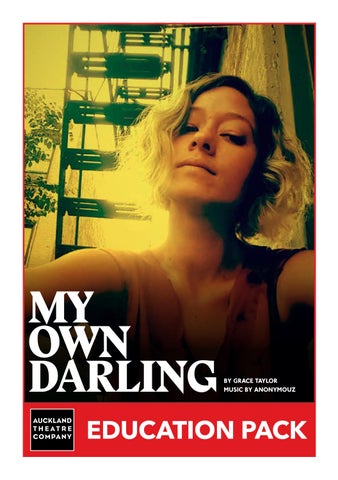
MY OWN darling
by grace taylor music by anonymouz
EDUCATION PACK
Contents
core
FUNDER S
FUNDER
funder
P R I NC I P A L
PARTNERS
Speaking of... My Own Darling P.05
Speaking to...Director, Mia Blake P.20
Speaking of... The Characters P.06
Speaking to... The Design Team P.30
Speaking of... Spoken Word Poetry P.08
Resources and Links P.45
Speaking of... Poetry in Motion P.10
ATC Education P.46
Grace Taylor Interview P.14
Curriculum Links P.47
ATC Education also thanks the ATC Patrons and the ATC Supporting Acts for their ongoing generosity.
Please note • Schools’ performances are followed by a Q&A Forum lasting for 20 – 30 minutes in the theatre immediately after the performance. • Eating and drinking in the auditorium is strictly prohibited. • Please make sure all cell phones are turned off prior to the performance and, if possible, please don’t bring school bags to the theatre. • Photography or recording of any kind is STRICTLY PROHIBITED.
Venue: Mangere Arts Centre - Ngā Tohu o Uenuku
Corner Bader Drive and Orly Avenue, Mangere
RUNNING TIME:
Approximately 50 minutes with no interval
SUITABILITY:
This production is especially suitable for
Year Levels 11 - 13 students
Advisory:
Contains occasional use of strong language
01 1
Cast
grace taylor — Teuila Fasitua amosa — Man from the Maunga, Lady Next Door gaby solomona — Grit-Girl, The Patron
Creative
Writer — grace taylor Direction — mia blake Script Consultants — Philippa Campbell & Lynne Cardy Set Design — jessika verryt Sound Design — anonymouz Costume Design — laura marsh Lighting Design — rachel marlow
Production
Production Manager — Andrew Malmo Company Manager — Elaine WalSH Stage Manager — eliza Josephson-Rutter Technical Operator — Josh bond MAC Technicians — Mark de Jong & john lepper Set Construction — 2construct
Education Pack
Writer — Amber McWilliams Editor — Lynne Cardy Graphic Design — Wanda Tambrin Production Images — Michael Smith
2 02
03
SPEAKING OF… MY OWN DARLING A poet moves through the city of Auckland, from her South Auckland suburb to the summit of Maungawhau (Mt Eden), from the shabby chic of K Road to the heights of Hillcrest. She encounters all sorts of people: a brother on a motorbike, a young mother with an attitude, a patron of the arts and an opinionated lady next door… The poet’s experiences make her question her initial impressions and judgements – not just of the world outside, but of the world within.
“It’s a story of a poet who’s going through a bit of a rough time. Through her observation of the city and the characters within the city, she observes not only them; she starts to look closely at her own observations of them, and then they start to affect her, and create change in her. The big ideas are about: being the observer and becoming the observed.” Mia Blake Director
04
05
SPEAKING OF… THE CHARACTERS Teuila: the poet, the narrator, the observer; a female flâneur in a modern New Zealand city. Grit-Girl: a young woman who “checks all the boxes” of low social status, but whose eyes can still “shoot bites” at those who judge her and her child. Man From the Maunga (MFTM): A brother on a motorbike, who somehow just… knows things. Patron: patron of the arts, who preaches “diverse-city” but whose multicultural greetings ring false. Lady Next Door (LND): a feisty woman whose loudness (as she offers advice on love and sex and hope and poetry) attempts to drown out her loneliness. Auckland: the crucible of the scenes, the setting as ‘character’ that brings the characters together.
06
Auckland we are not a city of angels. We are a city of bodies… We are a city of undone darlings. SPEAK UP FOR YOURSELF • How does the title indicate the key ideas of this performance piece? What does My Own Darling suggest to you? • Which characters did you recognise or relate to most strongly? Did your understanding of any specific character change over the course of the performance? How was this achieved? • How were specific theatrical techniques (blocking, performance, costume, lighting, sound) used to differentiate the characters and make each one distinct for the audience? • What is a “flâneur”? Explore how movement through a place can be a source of inspiration. Can you think of other examples of this kind of travelling poem / story / play? • Auckland becomes almost a character in its own right in this show. What images of place did you find most striking? Why were they powerful?
07 7
SPEAKING OF…. SPOKEN WORD POETRY Spoken word poetry is poetry that is written with the intention for it to be spoken, performed and heard. It is poetry that is bravely breathed life into by the poet that wrote it. Grace Taylor, “Speak for Yourself”
Hearing Grace perform, it is not just a matter of entering a poem and all its rewards, but encountering a writer who occupies her space with dignity, integrity and compassion. This woman has the courage to stand up and speak out.
There can be a misconception that spoken word poets are just performers, but we labour over our writing. We are writers just as much as performers. Grace Taylor, “Speak for Yourself”
Spoken word poetry is the art of performance poetry. I tell people it involves creating poetry that doesn't just want to sit on paper, that something about it demands it be heard out loud or witnessed in person. Sarah Kay, American poet, founder of Project V.O.I.C.E
Paula Green, NZ Poetry Shelf
Spoken word poetry is so popular with young people because it is dynamic and instant. In our fast moving world, young people connect easily with vehicles that deliver instant messages and responses. Grace Taylor, “Speak for Yourself”
Spoken word poetry gets into your blood; it changes the shape of your heartbeat. It's like listening to a language you've never heard before, and realising you understand every word.
SPEAK UP • Do you agree that words have enough power to change people and communities? Can you offer examples from your own experience?
Courteney Peters, Gather and Hunt
• What technical features are characteristic of performance poetry? Which did you notice in the performance of My Own Darling?
No poet will ever take the written word as a substitute for the spoken word; he knows that it is on the spoken word, and the spoken word only, that his art is founded.
• Read the five tips for Spoken Word Poetry at Poetry Power. Use these as a starting point to create your own poem. http://www.powerpoetry.org/actions/5-tips-spoken-word ?
Lascelles Abercrombie, British poet and literary critic
08
09 9
SPEAKING OF…. POETRY IN MOTION
In this ‘poetic play, words are the focus. Theatrical technical elements need to support the language and enhance the images described in the text. But how do you translate a poem from page to stage? What needs to happen to keep the scenes moving, create dramatic tension and ensure visual interest, while still allowing the language to shine? Look at the script excerpts on the following pages and explore some of the suggestions to activate the text.
10
G R I T- G I R L So damn cold in this bus stop I pull my hoodie over my head And watch the street A woman arrives pauses Eyes me sideways Glances up and down the rest of the empty bench Eyes me again quickly Shuffles over to the far end of the bus stop And just stands there . . . waiting Watching I see how you looked at me Fuck your judging eyes bitch I know what you’re thinking Little warm fingers tickle my rough palms I look down Into my sons big brown eyes shining like bright moons I pull his beanie down to cover his ears place my arm around his shoulders fold him into me I can feel her watching us I look up Round my shoulders back Straighten my neck and flick her a burning stare
11
TEUILA The heavenly gates of Family are closed but the Gaming Grassroots Trust is still open for your business A black Toyota Highlander suit buys a dirty glass pipe A Mermaid is for lease diving in midnight dreams of Gentlemen sleeping while daughters of AGG's walk between bus stop, Peaches & Cream K'rd you sit so raw and unapologetic on the skirts of our Harbour bridging poverty and wealth Creativity lives here and she is swelling
WORDS IN ACTION • Where does this scene take place? What do you know about this location? How does it look and feel in reality, and how could you capture this atmosphere in your staging? • This play deals with ideas of judgment and preconceptions. How are those ideas evident in the scene? (Look for what is implied, not just what is stated overtly…) • What are the relationships between the characters mentioned in this segment of the show? How might they be demonstrated in terms of spacial relationships? Try performing the scene to catch the sense of these dynamics in the movements of the characters. • How would you approach presenting abstract conceptual language on the physical space of the stage? The last lines of the excerpt offer a good example – how would you handle this metaphor if you were the director? 12
13
Speaking to... Grace Taylor Grace Taylor talks to Amber McWilliams about making the leap from spoken word poetry to theatre with Auckland Theatre Company; the challenges, the successes and where to from here.
14
15
“It’s been a really good process. Being a writer, and a performer, and involved in the development of it, it makes me appreciate all the other roles involved in making a theatre production.” “One of the beautiful things about this script is that from the get-go it has been very organic and always evolving.” Though she has loved the evolution, it has posed one particular challenge for Grace. “As the writer, I have five – or six, or seven – edits in my head. So when it comes to memorising it as a performer, I’m struggling with that a little bit. It’s not as easy as it usually is for me to memorise text for performance.” Grace has learned a great deal from the other actors in the show. Fasitua’s experience and Gaby’s recent theatre training have both informed her own process. “As a performance poet, used to performing my own work, seeing other people take on my words and bring their interpretation to it – literally bring these characters to life – is amazing. Gaby has become Grit-Girl; Fasitua has become the Man on the Maunga.” Originally Grace was going to play Lady Next Door. “I wanted to be Lady Next Door. So when it started going to Fasitua, I was like… nooooo!” However, she
16
says, “the main thing I’ve learnt through this process is that as a writer I couldn’t be too precious, because one of my goals was to grow myself as a writer, and push myself.” She says she has certainly been pushed, “and stretched, and challenged!” When she was sending the first drafts of the script to Mia, “every single exercise she would give me for a poem, I would complete it, and send it to her thinking ‘this is it, I’ve got it’ – and she would send ten questions back. I hit my breaking point, and it was all good.” Grace says of her working relationship with Mia Blake “I couldn’t have done this with anyone but her. It’s not a mistake that we ended up working together. She has had the ability to challenge me, but also to hold me at the same time. That’s been really important for me.” One of the key learnings for Grace has been “writing in character. I never wrote in character before this show. I actually thought if you write in character it’s not as genuine, not as real. But I have found that I am able to say a hell of a lot more stuff, be a lot more honest, by writing in character. I love that. I absolutely love it.” “All the characters have an
element of me in them. That’s what captured my attention in the first place. They were all birthed out of found poems that I’ve written over the last two years.” If she had to pick a favourite, which character would it be? Grace chooses Lady Next Door. “She gives me permission to voice those doubts I have in my mind.” Some of that doubt Grace is not even aware of until she writes it down; the poetry reveals aspects of herself that have been previously “unacknowledged”. Lady Next Door “says to me ‘it’s okay that you feel like shit’ and ‘who cares what everyone else thinks?’ I like that about her. But then, on the flip side, she’s also got her brokenness. And she laughs at it.” “One of the themes of the show is brokenness: being broken, and not being ashamed of it.” Grace’s personal journey has recently taken her through heart-break and betrayal, so she is writing of her own experience. “It’s so easy in those broken times to place the fault in other people… but it’s about naming my part in that, and how I enabled the things to happen that resulted in me feeling broken.” She feels “a big part of that is being broken but not being sorry for it.” These days, she is more open and less apologetic about her feelings; if she’s having
a bad day, she’ll say so. “I think in this country we’re so polite. We don’t like to show our weak side, so we’ll just get on with it.” Though she’s coming out of the worst of her own depression and sadness, she still has her dark days. She says, “I guess that’s where the title came from. My Own Darling: it’s acknowledging that I can’t look to or depend on anyone else. I can’t depend on a man to make me feel beautiful and wanted. I have to do it for myself.” She cites Alice Walker’s poem “Be Nobody’s Darling” as a catalyst for that theme. “Taking an existing poem and shaping it for theatre is an interesting experience. You pick up on things that are defaults for poets. Our job is to paint a picture with words – to show, not tell.” The trick, Grace says, is learning how to use theatre “to show the things that the poem couldn’t say, or that the poem would say, but that could actually be said better with a lighting change or a costume or prop. It doesn’t have to be so wordy and literal. It’s a good editing tool. It’s a skill that I’m honing. I’m a better writer because of this process, for sure.” Grace is very grateful for the support of Philippa Campbell, who she says “has believed in me the whole time.” Grace adds, “she’s
17
also been straight-up with me, telling me I’m being ‘too safe’. So she’s pushed me too.” Grace aspires to touring My Own Darling, around New Zealand and overseas. “I think the beauty of this work is that it has the ability to go into literary festivals as well as general arts and theatre festivals. That’s another ‘ticket’ for it. And I want to publish it.” These plans are in addition to finishing a new book of poems and preparations to attend the Festival of Pacific Arts Guam 2016 as a Creative New Zealand delegate. “Auckland is such a big part of my life.” Grace was born and raised in Tamaki Makaurau, and has spent a long time working with Auckland communities, especially in youth mentoring. She says, “Auckland is like the sixth character in this show. Auckland is my muse; Auckland is my lover.” However, over the last couple of years, she has had “a love / hate relationship” with the city. She feels that she has
18
been challenged as much as she can, and been given as much as she can, in this place at this time. “I feel safe, and I need a bit of risk. I don’t want to not like my home town. And at the moment I’m a bit tired.” Grace also sees that “there are other young poets – poets I’ve mentored – that can actually do the work I'm currently doing. It’s time for me to step out, and let them do those jobs.” Her duty is to the community she has come from, and right now it seems that the best way to serve it is to leave. “Anything I do is not all about me. Any door I open, any pathway I carve – the next poet or writer has to be able to come up after me.” With this in mind, Grace is contemplating living in Hawai’i, where there is a strong poetry community. “I can contribute there, and they can teach me. I’m excited about that possibility. It’s just a matter of making it happen.”
19
Mia Blake
SPEAKING TO…. DIRECTOR MIA BLAKE Mia Blake has been a fan of Grace Taylor’s work for some time. She describes how she first saw the poet “in these wonderful performances for Manawa Ora, where she was a mentor for kids who have not gone through your normal schooling systems or who had had a bit of trouble at school. Grace was mentoring a young girl, helping her to create poetry. “The girl was not confident enough to perform the poetry, so Grace performed it” Mia says. “I remember thinking ‘Gosh, who is this woman? She’s got
20
such presence.’ I loved watching her… After that, I looked her up online and saw some of her own poetry, and was really taken with it. Her poems about being half-caste, afakasi, which I am too, really resonated with me.” So when Philippa Campbell of ATC’s Literary Unit suggested that Mia might like to try her hand at directing a show by Grace Taylor, Mia’s response was “’Yeah! I know her! She doesn’t know me, but I know her!’ Immediately I was interested.” The poetic form of this ‘play’ is unusual, but Mia was excited by the poetry aspect. She explains that she
“Her poems about being halfcaste, afakasi, which I am too, really resonated with me.”
has “a long history with poetry. My mother’s always had great poetry round the house; she’s a fan. I did Speech and Drama, and my Drama teacher and I used to read poetry together. I was always moved by it. I used to write bad poetry in my teens, and read it and cry. I’ve got an appreciation of the poetic form. I was spurred on by that, and I thought this could be something interesting.” Mia and Grace had an initial meeting about the project. “I just didn’t doubt that we would get on,” Mia says. She was confident that the project would work out: “I just assumed ‘we’re going to do this’.”
The assumption proved a good one, “because Grace and I totally clicked over the material.” Mia felt very much in tune with Grace’s ideas for the show, and says, “it felt like it was supposed to happen.” From there, the project evolved in stages. Grace was already an accomplished performance poet, but she was not an actor, so the next step was a week-long performance workshop to help her develop acting techniques in areas such as voice and movement. Mia suggests the distinction between ‘performing’ and ‘acting’ is subtle and hard to define, but important. She thinks it comes
21
down to “the nuance of creating a full situation” within the context of a scene, saying “I could mimic a character for you, but that’s not acting.” However, the workshop revealed that Grace had “all the performance AND acting instincts that we needed” Mia says. “And she just went for it: no ego, she just jumped in and did everything that I asked her to, and more. It was really exciting, because we just lifted the characters off the page…” In this process the characters stopped being simply observations and became “real live people that we could see, and nut out.” Over the next eight months, there were three more workshops around the women’s other commitments. The pair kept “checking in, and keeping the work alive”; the ATC season gave them a deadline and focus. Mia says “Grace has been great, because it’s hard to be writer and
22
the performer of a piece that is quite personal and that you’re highly connected to. When you’re dissecting and deconstructing, you’re really vulnerable. She’s just been amazing. Sometimes I check in with her and say ‘are you okay with us taking this apart?’ and she’s like ‘whatever is going to work for the piece, I’m happy to do – and I feel like this is working.’” Mia loves that positive collaboration, and the sense that Grace is ‘with her’ in the process. In the early stages of development, Grace was still playing all the characters herself. However, after a workshop or two, she and Mia decided to “bring some new energy into the room”, with two more actors invited to the development workshops. The results were exciting, as Mia and Grace saw that the show might work better with a small cast than as a one-woman show. After
the exploratory sessions, they cast Fasitua Amosa, one of the workshop actors; Gabby Solomona came on board at a later stage. “Basically it’s been all guns blazing since then” says Mia. “We started rehearsal by taking the bones of our script, and adding the flesh.” This has meant a week of devising material and incorporating contributions from all three actors. “It’s been such a blessing to have those new energies…” Mia explains. “Fasitua is very experienced; he asks great questions and gives good provocations. We have worked together before, so we have shorthand established. Then Gabby brings her own energy to the room, and Grace is there ready to write at any time…” With these resources, the script has developed to its finished form. Mia admits the process has meant challenges. “After a few
drafts of the rehearsal script, I was like ‘oh, I just want a simple script!’ But in my heart, I’ve loved every minute of it.” She points out that the special thing about this piece is that it doesn’t fit into an already well-defined genre. “It’s a poetic play… of course, there’s Shakespeare, which I’ve done heaps of, so it resonates with me, but it’s the new take on it. It’s not a foreign voice. It’s a voice that I understand.” That voice, Mia hopes, will also speak to the audience, who are likely to share at least some aspects of Grace’s background and the play’s situations. As Mia puts it, “the characters are all people I know, or I have seen someone like them… I know who she’s talking about.” “I don’t often get to work on New Zealand work, and to be this involved, and for it to be so affecting. That’s a luxury.” She grins. “I’m happy.”
23
24
25
Mia Blake is an experienced actor, but My Own Darling is her directorial debut. She explains what she has learned from her new role…
Mia identifies the difference between being an actor and a director as being to do with the perspective. A director has responsibility for the overview of the production in all its elements. She sees the differences between acting and directing as “the difference between being the observer and the observed” and laughs at how this connects with the ideas within My Own Darling. “Even in my process those themes are coming through!” “Through directing, I’ve actually learned a lot about my acting self.” She feels her previous experience has given her an advantage in stepping into the director role because “I understand the position the actors are in, and how they are vulnerable. I think it’s a real plus to understand that as a director. You have to know when to be kind, and when to say ‘Okay, get over it, move on. Get out of your
26
head, just say the words; don’t try to control everything’.” One important realisation has been that “as an actor, the best thing you can do is just be there, and feel it, and say it. It’s not your job to worry about everything else. And that’s a relief. Having said that, it’s really nice being the director, because it’s equally a relief to not have to ‘go there’ all the time…” When she is acting, she often takes the stress of a role into her body; after the show she needs a strong massage to release the tension and “find myself again”. As a director, “it’s nice not to have to deal with all those emotional ups and downs, and just have the pleasure of watching other people do their craft.” She has realised new things about that craft from looking at it from outside. “I’m in awe of actors – how much they know without thinking that they know anything.” She loves being able to say to the actors “okay, now just try it again and think about doing this” and
“Through directing, I’ve actually learned a lot about my acting self.” the difference that single simple suggestion will make to their performance. “How they make that shift is incredible. It makes you proud.” For this show, given the poetic language, she has asked the actors to focus on “understanding the images that are created; really strongly connecting to who they’re talking to, why they’ve been driven to say that…” Together they have made decisions about “when to play into that poetic form and when to let it go, cast it aside and just let it trip off the tongue.” While this is the case with all acting, she says “it’s more marked with the poetry. There’s a luxury because there are some things in this script that you can just let sit. Just the phrase itself does enough. That’s really cool as an actor.” Simple techniques – such as thinking about the sound of the words – can be sufficient to create a moment of resonance. “All the work’s been done by Grace” Mia says. “It’s enough to think
about three words in succession, and how they mean something in themselves.” Mia has found the technical aspects of directing “lots of fun” and been surprised by how much she already knew about production. After nearly 20 years doing shows, she has absorbed a great deal by osmosis. “A lot of it has to do with communicating clearly to the different teams; you need to let everyone know which page you’re sitting on, so that they can join you.” Once everyone has the same understanding of what they are trying to achieve, collaboration becomes easy and enjoyable. “Unless it is one specific moment or image I’m trying to create, I’m really open to the creative team reading the script, getting excited, and bringing in their ideas. I’ll tweak it from there.” Mia says she has found the collaborative aspect of marrying those creative visions “one of my favourite bits” of directing.
27
The set design has come out of to-and-fro discussions with set designer Jessika Verryt. The pair agreed that they “wanted to create something quite grounded, like a city.” The final design “is very gridlike, to reflect the grids of maps, grids of cities, Polynesian quilts, intersecting roads; we talked a lot about that sort of imagery.” The original idea was to have one single piece of set that moved around, but Jessika brought in a revised design with three set pieces, which appealed to Mia. “I liked the idea of these different levels. We play with the view of the city a lot – there are three main characters and it
feels like there are three spaces we can play with in relation to those characters. As the play unfolds, you start to see that some places belong more to some characters than to others.” She points out that Mangere Arts Centre has a big stage space – high, wide and deep – “and this set feels grounded there, which is great.” Lighting and costume elements will be incorporated into the set. “It all feels quite intertwined… I always liked the idea that the characters could be anywhere at any time, and that they never left that grid. They’re all there, populating that same little area.”
SPEAK UP • How would you define the difference between “performing” and “acting”? • Imagine this play as the original ‘one-woman show’ Mia and Grace imagined. What would be lost if it were a single actor performing the piece? What might have been gained? • Mia says the company had to make decisions about “when to play the poetic form” and when to just let the words flow. Did you notice moments where the poetic language was clearly being emphasised? How did these work in terms of the action as a whole? • Directing and acting make different demands. Which role appeals more to you, and why?
28
29
SPEAKING TO… THE DESIGN TEAM
SET DESIGNER Jessika Verryt
“It’s quite a simple set. We’ve got a floor, and three islands on that floor, with different levels on them for the actors to use. They can be anything – a stoop, a table, a mountain, a curb, a shop front – they’re basic shapes so they’re really versatile.” Jessika Verryt Set Designer
30
Because the script contains so many different places, Jessika says, “you need to go abstract” with the set, allowing the actors to work to show where the scene takes place.” You have a really basic set-up on the stage, and then other things inform us of the different locations. Sound is a really strong way to change where you are, as well as lighting; then of course there’s what the actors say and how they behave.” Why three set pieces? “Well, I was just playing around with the model and that’s what happened!” There is a rationale, however. “Basic design rules say that odd
numbers up to seven are good. One, three, five or seven are really pleasing to the eye.” (Above seven, “it doesn’t matter anymore”: the eye ceases to distinguish the number of individual items, and simply registers ‘lots’!) She refers to other indicators of pleasing proportion in design, such as the ‘rule of thirds’ and the Fibonacci sequence. “An attractive face is in those proportions as well.” The set is painted black, with a white grid pattern on it. “Again it’s really abstract and not very detailed, so it can be anything. It could be a map, it could be a street sign… there are some curves on it too, so it could be part of a mountain.” She says “when
31
SPEAK UP • What resonance did the whiteon-black grid have for you? What images did it conjure?
you’re keeping it that simple and abstract, there’s danger it could be boring.” The challenge for her as a design is to tread the fine line between creating visual interest and allowing the flexibility that the script and the performances require. Other elements can be brought into play to help with this. “We’re putting lights into the set, so there will be three or four strips of light that Rachel Marlow, the lighting designer, can play around with.” The idea came out of imagery in the script... The city is the same, but it shifts into different states, and we wanted to have some way of doing that on stage.” Another important consideration for the designer is the relationship between the stage space and the audience. “Every different seating block arrangement gives a different slant to the performance.” Many factors come into play in making this decision: in addition to the needs of the show, the designer
32
also has to accommodate practical logistics, such as the shape of the theatre building and the number of seats that are needed to allow the appropriate number of tickets. Such considerations meant that Mia and Jessika’s original idea of putting the show within a semicircle amphitheatre configuration was not ideal. Instead, “we’ve gone with a traditional set up.” However, the needs of the show have dictated the way that is laid out. “It was quite a wide seating block when we first got in there. We’ve narrowed it down a bit, so the energy from the actors can be directed at the audience, not spread too far. That way the audience on the sides don’t feel like they’re hanging off the end.” “With this show we’ve decided not to have wings. Wings give actors a place to get off stage and not be there, and for this one we felt that’s not really necessary.” Again, this is all about “keeping it clean and simple: one clear space. The actors are going to be
onstage the whole time, so they don’t need wings to hide behind or keep their props in or do costume changes.” There are cubbies in the constructed set pieces for costumes, so the actors can just pull the clothes out when they need to change character. This Brechtian technique reinforces the show’s concerns with exposure and intersection, and also helps to locate the piece. “It’s part of the city feeling – that the characters ‘live’ in that place, and it’s a whole city, so they’re still there even when they’re not in the scene. They belong there; they’re not only visiting us for the bits where they’re speaking.” With the whole staging concept, Mia and Jessika have been in accord. “We decided it needed to be very simple and honest. Because Grace is a poet, there’s amazing, beautiful language in the play. That needs to be the focus, not fancy tricks.”
• How were the set’s levels used in delineating place and status, two key ideas in the play? • As an audience member, what was your relationship with the actors from your seat in an ‘end on’ seating block? How would this relationship have been different if the show was presented ‘in the round’? What do you think would be the ideal configuration for this piece, if there were no practical limitations on the way the theatre and stage were arranged? • How did the inclusion of lighting elements work in this show to affect the ‘feel’ of the set? • Jessika mentions standard principles of design that create pleasing aesthetics. See what you can find out about these principles. What is the ‘rule of thirds’? What is a ‘Fibonacci sequence’? Can you find examples of these principles in theatre designs or other designs you have seen?
33
34
35
costume DESIGNER Laura Marsh The idea of simplicity carries through into the costume design. “I didn’t want the costumes to be too literal or clichéd” says Mia. “Some characters are quite out there; I wanted the subtlety of their character to be coming through their costume, not loudness sitting on loudness.” The costumes have developed along with the script and characters, explains costume designer Laura Marsh. Because the process has been quite fluid and organic, she has chosen not to create fixed costume “designs”, set in ink from the outside. Instead, she has made suggestions and brought in physical items of clothing for Mia to look at, and to prompt further thoughts and ideas about what is needed. “I’ve bought a few cheap things just to establish the colour palette and the texture of the fabrics,” Laura says. Because the costumes are contemporary, many such items been sourced from op shops.
36
“I did have a fantasy of finding a lot of things on K Road; it would be nice that the characters are talking about K Road and her I am finding costumes out of K Road…” While it was a good place to start, she eventually spread the net wider – the New Lynn SaveMart proved “a winner!” However, some costume items will still need to be made or modified to suit the production’s needs. As Laura explains, “because you’re not trying to find things in the latest fashion, it’s not always easy to find the right things second-hand and in the right size. I’m going to do some making, and dying for garments that we need to be specific colours.” Colour will be important to connect and differentiate characters. “We’ve got three actors and five main characters” Laura says. “The characters are all extensions of Teuila (the poet) in different ways, so we’ve tried to separate Teuila from the other four using a change in colour palette.
The only real colour reference in the play is that Grit-Girl wears blood red jeans. We’ve worked from that; the palette extends from there for those four characters, into reds and browns and black. ” Red references “the attitude of Grit-Girl; she’s bold and fighting to survive, so the blood red has that power. She’s got sass; she’s wearing a baseball cap, to show she’s got a bit of attitude. We’ve complemented that in the outfit with her shoes, which are Palladiums – you lace them up high and they tend towards a subtle military feel.” Such items add up to “a powerful presence and determination.” Actor Gaby Solomona transforms from Grit-Girl into the Arts Patron by taking off her sweatshirt and cap and donning a shawl and glasses. Actor Fasitua
Amosa plays the Man on the Maunga, who Laura describes as “a practical dude who’s always up for finding something free to reclaim or recycle. So his costume looks like it’s been ‘gathered’.” Fasitua also plays the Lady Next Door: “he becomes that fabulous lady by discarding a couple of costume items and putting on a skirt.” The costumes, of course, are only one element of the transformation. “Lighting is going to complement those transitions, to direct focus and give a different vibe. We did a lighting test, and experimented with how to describe those changes in light as well. The great thing about theatre is that process of discovery and experimentation – who knows exactly what it will end up being until we’re in production week!”
SPEAK UP • Describe one of the costumes from the production, and explain how each element (colour, texture, cut, accessories) contributed to creating that particular character. • Laura says “the characters are all extensions of Teuila in some way”. How evident was this idea to you in watching the performance? How was the effect achieved? • Look at Laura’s ‘process diagram’ for assembling the costumes. How similar or different is this to your understanding of the costume design process?
37
38
39
SOUND DESIGNER Anonymouz
“The whole approach to the sound has paralleled the process by which the poetry itself was formed…”f Anonymouz Sound Designer
40
41
Anonymouz
Sound Designer Anonymouz explains that Grace constructed her script by “going to real places, observing characters, and building from what she saw. In the same way that Grace made poetry, the soundtrack is pretty much constructed out of found sound.” “Over the past few weeks, I’ve gone through the script and seen what places are referred to, and I’ve gone to those places and sampled from those environments.” Anonymouz has used these recordings as “initial building blocks to construct different textures. The characters are quite ambiguous and have many layers, so in the same way I’m taking the raw sounds and layering them up to create different sections out of them.” Anonymouz has found no shortage of differences between the soundscapes in various locations. “Even in K Road –
42
one end of K Road has its own sound, as opposed to the other end.” He says that the summit of Maungawhau was interesting. “In the middle of the night, capturing the ambience from up there, the city has its own buzz…” “It’s a unique opportunity to draw from real places because they are referred to in the work itself.” He has relished this opportunity to get out amongst it “instead of relying on generic sound libraries and so forth.” As he points out, “music production usually takes place within four walls, with a static microphone that can’t be moved because it’s put in the optimum position. With this more ‘soundscape’ approach, those four walls fall away, and the microphone can be anywhere you want to place it.” He says this is one of the highlights of working in theatre. “There’s a natural crossover between sound, sound-effects, foley, music,
composition… it's more free than doing traditional music.” After watching the actors in rehearsal, Anonymouz has been able to sketch out a sound plan for the whole show. “I’ve got this little library of sounds to draw from, so as I’m watching the characters come alive off the page, I can give it some context, and go ‘oh, yeah, I’ll use that sample there, and I’ll play that one backwards …’ Now that I’ve got the initial building blocks, the rest follows from that momentum.” “There are some cues where we thought pre-existing pieces of music would fit; there are songs we’ve identified that would work really well. And then there are parts that require a new piece of music to be created…” The process has meant identifying what the needs are at each point in the show: “what is sound effects, what is just sound texture, what is a piece of original music,
and what would suit something that already exists. Once we know what goes where, it’s about honing in on each piece individually, and fine-tuning.” If the right song can’t be found to support the scene, Anonymouz will create music to fill that gap. “I relish the challenge in doing this kind of work, especially in terms of the storytelling aspect, where you’re serving the purpose of the narrative.” He explains how the sound supports the script’s central ideas. “The story arc is one of transition; it’s about a character who breaks herself down to her core and rebuilds herself. That same transition happens sonically. A lot of the sounds aren’t static; they’re subtly moving and evolving.” For instance, “maybe the reverb starts big, then disappears, so it feels as if the room is getting smaller, to mimic what is happening in the scene. The sound is
43
Resources and LINKS “Grace Taylor: The Power of Words.” TedXAuckland. Accessed 04-082015. Web. http://tedxauckland.com/speakers/grace-taylor/
complementing and adding context to what is happening with the characters.” As an example, in one scene Teuila has a creative block. Initially she is uncertain about what she wants to say, but by the end of the scene she has developed a solid idea. Anonymouz explains how “the
sound starts out with a lot of reverb and sounds blurring over the top of each other; it’s not too clear what it is. As the scene progresses, that reverb and the EQ are slowly pulled back, so that the original texture of the sound cuts through and you have a lot more clarity.”
SPEAK UP • Making use of ‘found sound’ and ‘sampling’ is integral to this sound design. How do you respond to this technique? What did you recognise / enjoy particularly within the soundscape of the show? • Matthew indicates that the metaphor of transition in the characters is echoed sonically, and describes one scene as an example of this. Can you identify other moments in the production where the sound functioned in this way?
Green, Paula. “Grace Taylor’s debut poetry collection is tender, strong and essential.” NZ Poetry Shelf. Published 02-12-2013. Accessed 04-082015. Web. http://nzpoetryshelf.com/2013/12/02/grace-taylors-debut-poetrycollection-is-tender-strong-and-essential/ “Manawa Ora” Nga Rangatahi Toa Creative Arts Initiative. Publication date unknown. Accessed 01-10-2015. Web. http://www.ngarangatahitoa.co.nz/one-to-one-montoring/manawa-ora/ Peters, Courteney. “Rising Voices: Grace Taylor.” Gather and Hunt. 2011. Accessed 04-08-2015. Web. http://gatherandhunt.co.nz/Stories/rising-voices-grace-taylor “Speak for Yourself.” The Big Idea / Te Ara Nui. Published 15-11-2012. Accessed 04-08-2015. Web. http://www.thebigidea.co.nz/news/interviews/2012/nov/123600-speakfor-yourself . Taylor, Grace. Afakasi Speaks. Ala Press. Hawa’ii, 2013. Print. Twyford, Jo. “People – Ten Minutes with Grace Taylor.” NZGirl. http://www.nzgirl.co.nz/people/ten-minutes-with-grace-taylor/ Published 30-07-2013. Accessed 04-08-2015. Web.
• What role did music play at different points to support the ideas of the script?
44
45
ATC EDUCATION ATC Education promotes and encourages teaching and participation in theatre and acts as a resource for secondary and tertiary educators. It is a comprehensive and innovative education programme designed to nurture young theatre practitioners and future audiences. ATC Education has direct contact with secondary school
46
students throughout the greater Auckland region with a focus on delivering an exciting and popular programme that supports the Arts education of Auckland students and which focuses on curriculum development, literacy and the Arts. Auckland Theatre Company acknowledges that the experiences enjoyed by the youth of today are reflected in the vibrancy of theatre in the future.
CURRICULUM LINKS ATC Education activities relate directly to the PK, UC and CI strands of the NZ Curriculum from levels 5 to 8. They also have direct relevance to many of the NCEA achievement standards at all three levels. All secondary school Drama students (Years 9 to 13) should be experiencing live theatre as a part of their course work, Understanding the Arts in Context. Curriculum levels 6, 7 and 8 (equivalent to years 11,
12 and 13) require the inclusion of New Zealand drama in their course of work. The NCEA external examinations at each level (Level 1 – AS90011, Level 2 – AS91219, Level 3 – AS91518) require students to write about live theatre they have seen. Students who are able to experience fully produced, professional theatre are generally advantaged in answering these questions.
47
ENGAGE
JOIN THE CONVERSATION Post your own reviews and comments, check out photos of all our productions, watch exclusive interviews with actors and directors, read about what inspires the playwrights we work with and download the programme and education packs. Places to find out more about ATC and engage with us:
www.atc.co.nz facebook.com/TheATC
@akldtheatreco
AUCKLAND THEATRE COMPANY
487 Dominion Road, Mt Eden PO Box 96002, Balmoral, Auckland 1342 Ph: 09 309 0390 Fax: 09 309 0391 Email: atc@atc.co.nz 48