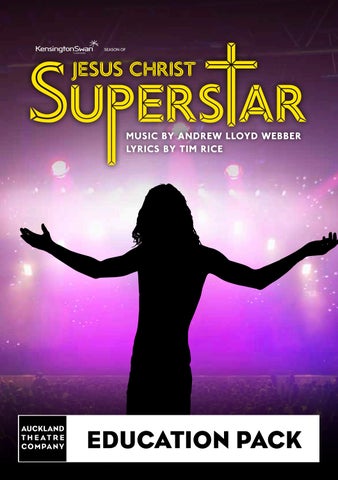
EDUCATION PACK
Sponsors
Contents
Auckland Theatre Company receives principal and core funding from
SUPERSTAR SYNOPSIS
6-9
STAR CHART
10
STELLAR SUCCESS
14
PRODUCTION HISTORY
15
THE ORIGINAL BROADWAY PRODUCTION
16
SUPERSTAR DIRECTION
18
SUPERSTAR DESIGNS
Subsidised school matinees are made possible by a grant from
ATC Education also thanks the ATC Patrons and the ATC Supporting Acts for their ongoing generosity.
SET
22
COSTUME
26
RESOURCES
29
CURRICULUM LINKS
30
Please note: • Schools’ performances are followed by a Q&A Forum lasting for 20 – 30 minutes in the theatre immediately after the performance. • Eating and drinking in the auditorium is strictly prohibited. • Please make sure all cell phones are turned off prior to the performance and, if possible, please don’t bring school bags to the theatre.
V E N U E : SC H O O LS’ C E S: PE R FO R M A N
CKLAND CITY. EEN STREET, AU Q THEATRE, QU
ember at 11am Thursday 13 Nov terval. 2 hours plus an in : E M TI G ls 11-13 IN RU N N ble for Year Leve oduction is suita pr is Th : S U ITA B ILIT Y students. ge. e of strong langua ains occasional us nt Co A DV ISO RY:
• Photography or recording of any kind is STRICTLY PROHIBITED. 2
3
CAST Jesus Christ — KRISTIAN LAVERCOMBE Judas Iscariot — LAUGHTON KORA | Mary Magdalene — JULIA DEANS Simon Zealotes — JEREMY REDMORE | Pontius Pilate — ANDREW GRAINGER Caiaphas — RICHARD GREEN | King Herod — MADELEINE SAMI Annas — SHANE BOSHER | High Priest — GARETH WILLIAMS | High Priestess — COLLEEN DAVIS Peter — KYLE CHUEN | Thaddaeus — ROSITA VAI | Thomas — GEORGE KEENAN
CHORUS AVA DIAKHABY | BLAISE CLOTWORTHY | AMBER LIBERTÉ | MOSES UHILA | TRINITY WHYTE GRACE AUGUSTINE | REUBEN BOWEN | MICHAEL WIGHTMAN | SARAH NESSIA | JAMES CORCORAN RHIAN FIRMIN | TAYLOR GRIFFIN | TYLER BRAILEY | SAM GOODGER HOLLY STOKES | MICHAEL JAMIESON | BRIANNA SMITH
BAND Guitar — ABRAHAM KUNIN | Bass — JONATHAN BURGESS | Drums — SIMON WALKER | Keyboards — ROBIN KELLY Trombone — JONATHAN TAN | Trumpet — ELIZABETH STOKES | Reeds — SCOTT THOMAS
CREATIVE Director — OLIVER DRIVER | Musical Director — LEON RADOJKOVIC Movement Director — LARA FISCHEL-CHISHOLM | Set Designer — JOHN VERRYT Costume Designer — ELIZABETH WHITING | Lighting Designer — SEAN LYNCH Sound System Designer — GLEN RUSKE | Sound Scape Designer — THOMAS PRESS Repetiteur/Vocal Coach — PENNY DODD
PRODUCTION Production Manager — ANDREW MALMO | Company Manager — FERN CHRISTIE-BIRCHALL Technical Manager — BONNIE BURRILL | Stage Manager — GABRIELLE VINCENT Assistant Stage Manager — NATALIE BRAID | Rehearsal Assistant Stage Manager — NATASHA LAY Flyman — AIDEN POND | Sound Engineer — JONNY KEATING | Lighting Operator — ABBY CLEARWATER Pre-Production Logistics — PAUL NICOLL Fight Co-ordination and Choreography Coaching — CRAIG DUNN & MICHAEL HURST Props Master — BECKY EHLERS | Set Construction — 2CONSTRUCT Scaffolding Structure supplied and installed by CAMELSPACE
EDUCATION PACK Writer — AMBER McWILLIAMS | Editor — LYNNE CARDY Production Images — MICHAEL SMITH | Graphic Design — WANDA TAMBRIN & CLAIRE FLYNN
4
5
SUPERSTAR SYNOPSIS
PILATE'S DREAM: Judea’s Governor, Pontius Pilate, has dreamed he met a Gallilean* and has been made responsible for this man’s death.
“WHAT’S THE BUZZ? TELL ME WHAT’S HAPPENING…”
* Jesus was from the town of Nazareth in Gallilee, a region in northern Israel.
Loosely based on the Gospel's accounts of the last week of Jesus's life, the story unfolds through the following songs:
ACT ONE OVERTURE: A foreboding orchestral number sets the scene… HEAVEN ON THEIR MINDS: Judas worries that Jesus has begun to believe his own hype, and that by allowing his followers to call him “King”, he will invite the anger of the Roman authorities. WHAT'S THE BUZZ: The crowd begs Jesus to tell them what is going on. Jesus says they should not worry because whatever happens will be God’s will.
THE TEMPLE: Jesus reaches the temple in Jerusalem, but finds it full of mercenaries. Enraged, he throws the traders and money-lenders out of the temple. Exhausted, he falls asleep and dreams of crowds of needy and disabled people begging him to heal them. He heals some, but is overwhelmed and tells them to heal themselves. EVERYTHING'S ALRIGHT (REPRISE): Jesus wakes in panic from his dream; Mary Magdalene soothes him. I DON'T KNOW HOW TO LOVE HIM: Watching the sleeping Jesus, Mary admits that she loves him and that she is frightened by the power of her feelings and unsure how to manage or express them. DAMNED FOR ALL TIME / BLOOD MONEY: Judas, deeply conflicted, goes to the priests and tells them that they need to stop Jesus for his own good. Judas begs the priests to tell him he is not damned for all time for betraying his friend. The priests offer Judas money to salve his conscience; he angrily rejects it, but reveals that on Thursday night Jesus will be alone in the Garden of Gethsemane.
EVERYTHING'S ALRIGHT: Mary Magdalene, a devoted follower, reassures and calms Jesus. STRANGE THING MYSTIFYING: Judas is critical of Jesus’ association with Mary Magdalene. THIS JESUS MUST DIE: High Priest Caiaphas and the other Jewish priests meet to discuss the Jesus situation, fearing that Jesus will undermine their authority. They agree that Jesus should be killed. HOSANNA: Jesus arrives in Jerusalem and crowds surround and praise him. Caiaphas tells Jesus to disband his following, but Jesus refuses, saying it would make no difference. SIMON ZEALOTES / POOR JERUSALEM: Simon urges Jesus to try to take the power from Rome. Jesus again refuses, saying that people are not understanding his message.
6
7
ACT TWO THE LAST SUPPER: The complacent apostles join Jesus for the Last Supper. He accuses them of not caring about him. He says that Peter will deny him three times, and identifies Judas as his betrayer. Judas says he doesn’t understand Jesus and his decisions, and leaves to fetch the priests. The other apostles fall asleep, leaving Jesus alone. GETHSEMANE (I ONLY WANT TO SAY): Jesus prays angrily, demanding that God explains why he has to die. Finally, he concedes that he is ready to submit to God’s will. THE ARREST: Judas arrives with the priests. The apostles are pushed away by the crowds who taunt and mock Jesus as he is arrested and taken to Caiaphas. PETER'S DENIAL: As predicted, Peter denies Jesus three times, to the horror of Mary Magdalene. PILATE AND CHRIST: Jesus is taken to Pilate, but Pilate says Jesus does not come under his jurisdiction – as Jesus is from Galilee, he should be taken to King Herod. KING HEROD'S SONG (TRY IT AND SEE): Herod mocks Jesus, asking him to prove his divinity by walking across the swimming pool. Jesus remains silent; Herod loses patience and has Jesus taken away. COULD WE START AGAIN PLEASE?: Mary Magdalene and the apostles plead with Jesus to stop all the drama before it gets too serious.
THE CRUCIFIXION: Jesus is nailed to the cross and left to die. SUPERSTAR: In limbo, Judas and the choir question Jesus, asking whether he believes what everyone is saying about him. The question lingers: “Who are you? What have you sacrificed?”
Talking Points • The story of Christ’s crucifixion is one of the best-known in Western history. What might be the advantages and disadvantages of basing a new work on an old and very famous story? • The show’s title was originally JESUS! (yes, with an exclamation mark – like OLIVER!) It was then revised to JESUS CHRIST. Eventually it was released as JESUS CHRIST SUPERSTAR. How does this title indicate the show’s central ideas? What does “superstar” suggest? Has the term’s meaning changed between 1970 and today? • In his book The Musicals of Andrew Lloyd Webber, Keith Richmond describes JESUS CHRIST SUPERSTAR as “a modern masterpiece; a dazzling mix of the hip and the holy, with vibrant music and poignant, potent lyrics.” Discuss this assessment of the show.
JUDAS' DEATH: Judas is in agonies of remorse, having watched Jesus be attacked and beaten by the crowd. He feels he has been used as a tool in Jesus’ plan… with this he goes mad and hangs himself. TRIAL BEFORE PILATE (INCLUDING THE THIRTY-NINE LASHES): The priests and Herod take Jesus to Pilate. Egged on by the mob, they ask Pilate to sentence Jesus to crucifixion. Pilate argues Jesus is mad, not evil, and should be locked up, not destroyed. To appease the crowd, he orders that Jesus receive 39 lashes. Even broken and bleeding, Jesus refuses to respond to Pilate’s attempts to help, saying God’s plans must be carried out. Infuriated, Pilate gives in to the crowd’s demands, and orders the crucifixion.
8
9
star chart “WHO DO YOU THINK YOU ARE?”
JESUS CHRIST A man from Nazareth who has become a famous preacher and prophet. Called “son of God” and “King of the Jews” by an adoring public – until they turn on him and he becomes a martyr.
ANNAS A priest who serves as the right hand man to Caiaphas. Becomes convinced that Jesus is a threat.
THE APOSTLES The group who form the ‘inner circle’ of Jesus’ following. Enjoy the benefits of Jesus’ celebrity status while it lasts, but fail to support him when the crowd turns nasty.
HIGH PRIESTESS
PETER The apostle who thrice denies being a follower of Jesus.
SIMON ZEALOTES The apostle who tries to get Jesus to claim absolute power from Rome.
THADDAEUS
THOMAS
JUDAS ISCARIOT Friend and follower of Jesus. Wants people to focus on Jesus’ message of peace and charity, not Jesus as a celebrity figure or “son of God”.
HIGH PRIEST
10
MARY MAGDALENE A former prostitute and now a follower of Jesus. Finds herself falling in love with her newfound leader.
PONTIUS PILATE Governor of Judea. A fairminded man who does not wish to condemn Jesus but is goaded into doing so by public pressure and Jesus’ attitude of martyrdom.
CAIAPHAS Leader of the Jewish priests. Looks out for the interests of his own followers; sees Jesus as a threat to his own power and to the equilibrium he has established with the Roman authorities.
KING HEROD King of Galilee. Something of a buffoon; unwilling to take responsibility for a decision about Jesus’ fate.
11
CHOIR / CHORUS The crowd that follows Jesus worshipfully until eventually turning on him and calling for his destruction. Played by second year students from Unitec School of Performing and Screen Arts, the chorus also play various ensemble roles throughout the show.
Talking Points • Who is the protagonist of the show? Who is the antagonist? Defend your choices. • What role does the chorus play in this production? Identify some key scenes and discuss how the chorus functions in each. Is their role always the same, or does it change? • As the sole female lead in the show, Mary Magdalene is clearly an important character. What is her function within the narrative? What ideas does she embody? How are these expressed dramatically in this production? • How are the apostles presented? Do they work as a collective character or a series of individuals? 12
13
STELLAR SUCCESS
production history
“EVERYTHING’S ALRIGHT… YES, EVERYTHING’S FINE”
JESUS CHRIST SUPERSTAR began its life as a ground-breaking rock double album – simply because its creators could not get anyone to produce it. In the words of composer Andrew Lloyd Webber, “No-one was interested in doing JESUS CHRIST SUPERSTAR on stage when we started, so Tim Rice and I did it as a record”. The pair had drawn on a biblical story for their first major collaboration, JOSEPH AND THE AMAZING TECHNICOLOR DREAMCOAT. It seemed logical to mine the Bible for other stories that might work just as well. Besides, Tim Rice had always been interested in the crucifixion story. In his autobiography he writes: “From a very young age I had wondered what I might have done in the situations in which Pontius Pilate and Judas Iscariot found themselves. How were they to know Jesus would be accorded divine status by millions and that they would as a result be condemned down the ages?” Despite its title, the show was always intended to be about the human struggles of Judas. “We made him an everyman”, says Rice.” Judas
14
did not think of himself as a traitor. He did what he did, not because he was basically evil, but because he was intelligent. He could see Christ becoming something he considered harmful to the Jews. Judas felt they had been persecuted enough.” The first single of the new rock album, "Superstar", was recorded in late 1969. It did not make a huge impact. The rest of the album was recorded in 1970, and the double LP was released in the UK later that year”. In Lloyd Webber’s words, the album “came out in England to a rather resounding silence: a chorus of – not disapproval – more disinterest, really.” He and Rice assumed that the album was “caught in the crossfire between people who thought it was uncool because of the subject matter, if they were young, and people, who, if they were older, thought it was disrespectful.” As Lloyd Webber remembers, “Tim Rice and I thought it was pretty much dead. And then we got the call to go to America.” And that’s where the story really begins. A new history of Jesus Christ was to become a stellar success…
• In 1971, JESUS CHRIST SUPERSTAR was the number one LP on the United States Billboard Pop charts, selling two million copies in twelve months.
• A film version of JESUS CHRIST SUPERSTAR, shot in Israel at a cost of $3.6 million, was released in 1973. It was directed by Norman Jewison for Universal Studios.
• The album topped the Canadian charts, and made the top ten in unlikely places such as Norway.
• By the end of 1973, the show had clocked £13 million in export earnings for Britain, and album sales had reached 3,500,000.
• The first official touring production (1971) included a rock band and a 32-piece orchestra. The first show played to an audience of 13,000 at the Civic Arena in Pittsburgh. It proceeded to sell out shows in arenas and large-scale concert venues across America. • In October 1971, a staged extravaganza version of the show opened on Broadway to one million dollars’ worth of presales. It ran for 20 months. • In 1972, a different and simpler production opened at the Palace Theatre in London. It ran until 1980 – a total of 3,358 performances – and reached over two million theatre-goers. Box office earnings topped £7 million.
• In 1978, the London production became the longest-running musical in British theatre history up to that time, after 2,620 performances. • By the 1990s, the show had been translated into eleven languages, performed in 22 countries, and grossed more than £100 million. • By 2014, JESUS CHRIST SUPERSTAR had enjoyed repeated arena tours in the US and UK, as well as tours in Australia and South Africa. The song I Don’t Know How to Love Him had been a chart-topping hit for Yvonne Elliman, Petula Clark, Helen Reddy and Sinead O’Connor. Both the film and original album were re-released to great acclaim.
15
THE ORIGINAL BROADWAY PRODUCTION “CAN WE START AGAIN, PLEASE?”
“Traditional theatre pretends that something real is happening on stage. We’re saying there’s a ritual to be performed and we’re doing it. It’s very easy to do traditional theatre and the reaction you get is in the same proportion. This is meant to involve the audience with the magical passage of ideas and feelings on stage. I don’t think anyone will come out feeling neutral about this.”
“Whether you’re an atheist, an agnostic or a Christian you cannot fail to respond to JESUS CHRIST SUPERSTAR.
Tom O’Horgan, Director, 1971 Broadway
Keith Richmond, Author, The Musicals of
production of JESUS CHRIST SUPERSTAR
Andrew Lloyd Webber
“It was one of the worst productions of a musical I’ve ever had the displeasure of seeing in my life. It was the worst night of my life when it opened on Broadway. I didn’t know where to hide. It was this vulgar travesty of what I’d hoped it would be.” Andrew Lloyd Webber, Composer, JESUS CHRIST SUPERSTAR
16
Talking Points • When the album of JESUS CHRIST SUPERSTAR was first released in 1970, it was banned for broadcast by the BBC, on the grounds of being "sacrilegious”. Keith Richmond says it is not blasphemous, just audacious. What do you think of the show’s approach to its religious content?
When the chorus shouts ‘He’s just a man!’ it goes straight to the heart of an historical truth. Old-fashioned churchgoers were outraged but the work wasn’t blasphemous – it was simply audacious.”
• The show has been described as “the story of Christ’s Passion told in the vernacular”. How relevant is the ‘vernacular’ after forty years? How did you respond to the language?
“The total effect is brilliant but cheap, like the Christmas decorations of chic Fifth Avenue store.” Clive Barnes, Reviewer, New York Times
1970 WMMS print ad for the broadcast of JESUS CHRIST SUPERSTAR
• Look at the advertisement for the radio broadcast of the original album. What are its significant features? How does it differ from print advertising in today’s popular press?
17
story. “It’s very hard to associate with a dude wandering round in sandals in a desert among a whole lot of Romans with swords… We have no way to access that. Plus it’s been ruined by ten thousand films.”
SUPERSTAR DIRECTIONS “SEE WHERE YOU’VE BROUGHT US TO…” Oliver Driver didn’t grow up singing ‘Hosannah’. He didn’t own the JESUS CHRIST SUPERSTAR album. In fact, it seems he was less familiar with the show than most of the people he knows. He says that since getting the director’s job on this production, “a lot of people have come up to me – more than for anything else I’ve ever done – and said, ‘Oh my God, it’s my favourite musical…’ ‘Wow, I grew up listening to it as a child…’ or ‘I saw the one twenty years ago with Mark Hadlow’.” The pressure of presenting such a well-known piece can be overwhelming – but only if you let it. “If you concentrate on that, you’ll go crazy,” Oliver says. “You have to not think of it as famous. You have to start where you do for any new show. You take the script; the script is where you draw your ideas. I just have to go ‘I’m hired to put this musical on stage here, now’. If you can do that, it becomes much less of a daunting proposition in terms of what other people’s preconceptions of it are. It becomes a more manageable proposition: ‘I’ve got to move 38 humans to do this massive big musical about Jesus!’ “ Many of those strong preconceptions, of course, come from the fact that
18
the Jesus narrative has no surprises. “That’s one of the other interesting things about this show, different to anything else I’ve done” Oliver says. “Everyone knows the story. Everybody who’s going to sit down in that theatre knows that at the end he gets crucified. That makes it kind of interesting, because you’re dealing with THE most famous figure in history. You can do RICHARD III, and at least some people won’t know what happens to Richard – but in this case, everybody knows what happens to Jesus.” The question for the director, then, is: How do you make that journey interesting to a modern audience? Oliver says with a laugh, “if we did this exactly the same way it was done in the 70s, people would hate it – although they probably think they’d love it!” Why? “We’ve moved on. I don’t think anyone wants to see another ‘swords and sandals’ epic with Jesus wandering round in a loincloth… It doesn’t relate to us.” He explains that “contemporising” the show provides an easier way in for today’s audiences, allowing them to reach a greater understanding of the universal messages at the heart of the
To do this transposition to a modern setting, Oliver focussed on the script, “Of course, it’s made up of song lyrics, but it’s also a script.” In fact, after the initial sitzprobe (sing through) on the first day, Oliver insisted on a play-style read-through on day two, because he wanted the company to acknowledge the importance of the words, not just the music, in telling the story. Looking at the script, he says, what you see is “a man who’s become so famous that he’s loved by almost everyone, and who’s spreading a message of peace, love and understanding, which goes against the religious rulers, who are quite happy with the ways that they’re making money, and their systems and their corruption.” Jesus, here, is the man who takes a stand again a corrupt religious system. “In a modern context, then, we started thinking about who could do that nowadays – who could stand up to the authorities, and be so big that they could be heard? To me, it came down to rock stars.” Oliver cites Bono (lead singer of the Irish band U2) as “the closest we’ve got to Jesus.” He goes on to ask “But what if Bono starting going ‘I’m the son of God’? What if a country the size of America had the same kind of religious fervour and belief that the Middle East still has? God may be dead here for a lot of people, but in the Middle East he’s still very real, and very much a presence in their lives. So what if a
rock star emerged in that Middle East world? What if he appeared in Gaza or someplace that was the size of America and where religion hadn’t died, and was still very prescient? What if this guy came out, and instead of standing on the Mount and preaching to the four hundred, stood in a stadium and preached to the sixty thousand?” These questions underpin the whole concept of this production. “It’s what we’ve used throughout the play – that he’s a rock star. His apostles then become members of the band: Judas is his guitarist, and Simon is the other singer, and Mary’s one of the backing vocalists, and another apostle is the security dude. You still have this band of people that he’s gathered together and that are his closest circle, but they’re not fisherman and carpenters – they’re people who would be within that rock star world.” That said, Oliver is quick to point out that “the religious guys are still the religious guys. It’s still about pissing off the high priests of today, the people who are in charge of our religious beliefs. We still have a religious majority who are ruled over by a military minority: the historical story is no different to modern Gaza, or Iraq.” Oliver explains that in the show “the religious have no real power – that’s why the crowds have to go to Pilate to get Jesus crucified – but the hierarchy is still being destabilised 19
by this guy who is going ‘religion is not about tithing or giving money or control or these people being the only people who can talk directly to God, or anything like that. Religion is all of you. Any of you can have a conversation with God. Anyone can be part of it.’ Why should some guy over there in gold robes have more of a right to that conversation than I do? It’s a good question. You can understand why it annoyed people – and why it empowered people.” Having established the underlying ideas, the mammoth task of actually staging the show lies ahead. Does the fact that this is a musical make this production different, from a directing perspective? “At its base level, it doesn’t,” Oliver says. “My job is still to move people around the stage so that everybody in the audience can see them, while at the same time getting everybody onstage to tell the same story and be in the same world. Then you just become the first audience member. I check that I like that story, and that the story makes sense to me and follows through. Of course, there’s millions of layers on top… But it’s not massively different; it just becomes trickier to direct the singing and the music. You have to become very proficient very quickly at how long bars are – but I just think of that in the same way that I think of pauses and beats in a play. It’s the same; it’s just a different language. Over the English language that we’re working with is a musical language. And I have Leon Radojkovic and Penny Dodd (Musical Director and Vocal Coach) who are there beside me to help with that stuff. I have a great team around me.”
20
Oliver takes a holistic approach and tries to keep the job in perspective. “It’s like anything. You stand there before the mountain and it’s daunting. Then you take the first step, and you’re on your way. You have to keep breaking it down, smaller and smaller… Directing JESUS CHRIST SUPERSTAR? That’s a big job. Directing one of the songs? That’s okay. Directing just the lead singer in that song? Okay, got that taped. Now I’ll put some chorus around it, now I’ll transition it… You just keep building.” Oliver’s strategy in rehearsals is to work fast and not worry too much about the detail at the outset. “Day four, week two, we ran the first half. I’m a strong believer in big, broad brushstrokes and getting the show up on its feet, blocking it and shaping it. Then everybody has an overall understanding. You can always adapt and change it. But at least everyone can say ‘it’s not insurmountable – we’ve done it’.” Once the show’s basic shape has been established, rehearsals become simply about doing it with more finesse, or in Oliver’s words, using “smaller and smaller brushes”. The show presents some interesting technical challenges – most significantly, of course, the finale. “Yes, you have to crucify him,” Oliver says. “But we don’t just want to nail him to a tree. It’s about trying to find interesting ways of interpreting that history (or folklore, depending on your point of view!)”
Talking Points been interested in since childhood) will have an appropriate presence in this production. “We definitely want to have those moments where it’s very visual. The job is to reinterpret it but not so much that you’ve lost the joy of what was there…” As an audience member, therefore, “you’ll still see the familiar tropes, but you’ll hopefully see them in a slightly different way.” Does Oliver have any favourite moments in the show? “I like the big hits, obviously…” However, at this point in rehearsals, “I really like what we’re doing with Simon Zealote’s song, because it’s nobody’s favourite; it’s not even a great song. But we’re doing something with it that makes what we’re trying to do with the whole show WORK. I think people will leave going ‘wow, I really loved that one’. That’s what we’re trying to achieve: to get people to think ‘I loved that song’ without it necessarily being ‘Superstar’ or ‘I don’t know how to love him’. Although…” he says with a smile “Julia Deans doing I Don’t Know How To Love Him is pretty awesome.”
• In 1966, John Lennon said in an interview that the Beatles were “more popular than Jesus”. The backlash in America was huge – former fans gathered in the streets breaking or burning their Beatles records in protest. Can you imagine this kind of reaction happening today? Do rock stars in the modern world have a greater or lesser following than religious leaders? • Oliver uses the metaphor of painting to describe his directing process. What are the similarities and differences between the role of the director and the role of the visual artist? • Identify and explain the various theatre technologies used to stage the crucifixion. What was the cumulative effect they produced? • What was your favourite ‘number’ in the show? Explain your choice.
He is quite clear that the iconographic aspects of the story (which he’s
21
SUPERSTAR DESIGNS “COME ON IN, FOR THE BEST IN TOWN”
SET “Q Theatre is three levels high, but it’s never really used like that” says Oliver Driver. Working with set designer John Verryt to make the best possible use of the available theatrical space, “we created an amazing performance space, rather than a set.” John elaborates: “It’s about doing a rock show in Q Theatre. There is no ‘set’ as such. Q Theatre IS the set.” The seating configuration is ‘in the round’, but with a difference, Oliver explains. “What we ended up doing was putting a stage on the floor, and then another stage right around the perimeter of the theatre, behind the audience and in front of the balcony. So we have the ability for the cast to be in front of you, behind you, above you, below you....” As an audience member, “you’re surrounded.” The band will be in the theatre’s Gods, along with members of the audience. At some points in the show, “there will be people on the stage, next to you in the seating block, on the balcony above you… It will feel like an arena.” The design does borrow from the idea of the Roman arenas. However, Oliver
22
explains that it’s really about making “a play space that gives the actors a way to get around, but also forces the audience to be active. It’s not a show where as an audience member you’re going to sit and face in one direction and have everything come to you. You’re going to have to work a bit.” In John Verryt’s words, “the audience will be immersed in this production; they’re not looking at it from afar.” The design moves a long way beyond breaking the fourth wall: as John declares with a grin, “there’s no wall of any sort!” He reiterates Oliver’s point that “the audience is going to have to turn around and be active while they watch, which we will encourage them to do… Even to the point of standing up and singing, if they feel free enough. That would be fantastic. If the audience stood up and joined in, I’d be thrilled. That’s my ambition for this production.”
23
24
25
costume Given the interactive nature of this production, could audience members get away with wearing their own costume to the theatre? “You could wear a fancy costume, of course,” says costume designer Elizabeth Whiting. “But remember it’s not a 70s extravaganza – it’s now.”
Due to the exploratory nature of this particular design process, Elizabeth says, “I deliberately haven’t put costume designs or ideas up on the rehearsal room walls, because I don’t want anyone to get fixed ideas about how they’re going to look.”
The overall look will be “contemporary rock star”, but the details of many of the costumes are still changing on a daily basis. “We’re still finding it,” Elizabeth explains. “As they’re working through each scene, it’s becoming much clearer who the characters are. Jesus is much more edgy – and much stronger, probably – than in the original JESUS CHRIST SUPERSTAR. He’s got a really interesting personality. It’s been good working with Kristian (the actor playing Jesus) making that work. The same with Judas (played by Laughton Kora, of Kora fame) – everyone will come to see him because of who he is, but we need to find a character in that as well.”
This flexibility has mainly been possible because Elizabeth will be purchasing costumes for this production, rather than making them. “There’s some construction, but not a lot,” she says. “Because we’re buying the clothes, I can afford to wait a bit, and see what comes up from the rehearsals.”
The characterisation process goes beyond simply choosing clothes. Elizabeth explains “We did a make-up call yesterday with Julia Deans (the actor playing Mary Magdalene)… She knows who she is as Mary, so it was a case of finding out how to twist it for us, to present that.” Elizabeth says it has been “good fun” working in such close collaboration with the actors.
26
She has still done the usual preparatory work of a costume designer: “I did sketch – I sketched ages ago. Then Oliver got involved and gave me a whole lot of interesting ideas, so I did some more sketching… Then we got into rehearsal… and I could yet be doing more sketches! But I actually think at this point it’s easier to bring in items and put the costumes together that way.” Essentially, then, the design process for this production is all about organic evolution? “Absolutely” says Elizabeth. “We’re finding it out as we go” agrees John. “It’s exciting and terrifying in equal measure.”
Talking Points • Designer John Verryt says “there is no set. Q Theatre is the set” for this production. How did you respond to the “immersive” nature of the design? Did the configuration of the space prompt you or other members of the audience to stand and join in the performance? Why / why not? • One of the most important props in the production is a full-size mannequin of Judas. How is this mannequin (along with other effects) used in Judas’ climactic number for maximum dramatic impact? • What are the pros and cons of purchasing rather than constructing costumes for a show? • Discuss the hairstyles and make-up used in the production. How did these complement the costume choices to tell the audience about each character’s personality?
27
Resources & Links “Andrew Lloyd-Webber talks Jesus Christ Superstar – UK arena tour”. YouTubeNZ. https://www.youtube.com/watch?v=YEefHQMjahA Published 9.11.2012. Accessed 14.10.2014. Web. “Jesus Christ Superstar.” Really Useful Group Ltd. http://www.jesuschristsuperstar.com/ Updated 30.05.2014. Accessed 18.10.2014. Web. Millar, Scott. “Inside Jesus Christ Superstar”. New Line Theatre. http://www.newlinetheatre.com/jcschapter.html Published 2006. Accessed 11.03.2014. Web. Richmond, Keith. The Musicals of Andrew Lloyd Webber. Virgin Publishing. London, 1995. Print. “Top New Zealand Musicians to Star in Jesus Christ Superstar” scoop.co.nz http://auckland.scoop.co.nz/2014/08/top-nz-musicians-to-star-in-jesus-christ-superstar/ Published 14.08.2014. Accessed 14.10.2014. Web.
28
29
About ATC Education ATC Education promotes and encourages teaching and participation in theatre and acts as a resource for secondary and tertiary educators. It is a comprehensive and innovative education programme designed to nurture young theatre practitioners and future audiences. ATC Education has direct contact with secondary school students throughout the greater Auckland region with a focus on delivering an exciting and popular programme that supports the Arts education of Auckland students and which focuses on curriculum development, literacy and the Arts. Auckland Theatre Company acknowledges that the experiences enjoyed by the youth of today are reflected in the vibrancy of theatre in the future.
30
Curriculum Links All drama students are expected to study NZ Drama at every level, with an emphasis on challenging social and cultural discourses at Level 3. ATC Education activities relate directly to the PK, UC and CI strands of the NZ Curriculum from levels 5 to 8. They also have direct relevance to many of the NCEA achievement standards at all three levels. All secondary school Drama students (Years 9 to 13) should be experiencing live theatre as a part of their course work, Understanding the Arts in Context. Curriculum levels 6, 7 and 8 (equivalent to years 11, 12 and 13) require the inclusion of New Zealand drama in their course of work.
ATC Summer School 2015 12 - 18 January
Friday 21 Nov:
The NCEA external examinations at each level (Level 1 – AS90011, Level 2 – AS91219, Level 3 – AS91518) require students to write about live theatre they have seen. Students who are able to experience fully produced, professional theatre are generally advantaged in answering these questions.
31
ENGAGE
JOIN THE CONVERSATION Post your own reviews and comments, check out photos of all our productions, watch exclusive interviews with actors and directors, read about what inspires the playwrights we work with and download the programme and education packs. Places to find out more about ATC and engage with us:
www.atc.co.nz facebook.com/TheATC
@akldtheatreco
AUCKLAND THEATRE COMPANY
32
487 Dominion Road, Mt Eden PO Box 96002, Balmoral, Auckland 1342 Ph: 09 309 0390 Fax: 09 309 0391 Email: atc@atc.co.nz