EDUCATION PACK
He pou atua, he pou whenua, he pou tangata.
Ko Waitematā te moana
Ko Waikōkota te whenua.
Ko Te Pou Whakamahara a Māui Tikitiki a Taranga te tohu o te kaha, o te kōrero, o te whakapapa o tēnei wāhi, o tēnei whare.
Nau mai e te tī, e te tā ki te whare kōrero, ki te whare whakaari o ASB ki te tahatika o te moana.
Mauri tau, mauri ora!
Pouwhakamahara a Māui-Tikitiki-a-Taranga
The Memorial Post of Māui the Topknot of Tāranga
Robert Jahnke ONZM (Ngāi Taharora, Te Whānau a Iritekura, Te Whānau a Rākairoa o Ngāti Porou), 2016
Laminated tōtara and Corten steel
Proudly commissioned by Auckland Theatre Company for ASB Waterfront Theatre


The symbols of support, of strength and of guardianship stand fast and proud.
The waters of Waitematā ebb and flow against the shores here at Waikōkota, the land upon which we stand.
The pou of remembrance to Māui Tikitiki a Taranga stands tall as a beacon of courage, of stories passed down and of the history that connects us all to this place and to this space.
We welcome you all from near and far to this house of stories, to the ASB Waterfront Theatre.
Mauri tau, mauri ora!
7 – 26 APR 2026
CAST
Helen Clark the Younger –
Lauren Gibson
Helen Clark the Older –
Jennifer Te Atamira Ward-Lealand
VOICE ACTOR
Brian Edwards – as himself
CREATIVE
Playwright – Fiona Samuel
Director – Sophie Roberts
Set Design – Dan Williams
Lighting Design – Rachel Marlow & Bradley Gledhill, Filament Eleven 11
Costume Design – Kirsty Cameron
Composer & Sound Design –Leon Radojkovic
Voice Coach – Kirstie O’Sullivan
Engine Room Assistant Director –Sepelini Mua’au
Engine Room Assistant Designer –Talia Pua
AV Design – Bradley Gledhill, Rachel Marlow, Talia Pua, Sophie Roberts, Dan Williams

PRODUCTION
Stage Manager – Chiara Niccolini
Head of Staging – Molloy
Head of Sound – Sandy Gunn
Technical Operator – Ella Madsen Brough
Production Assistant – Keira Howat
Audio Mix Engineer – Joel Orme
Set Construction – Grant Reynolds, Zorp Creative
Technical Assistant – Rob Larsen
Pattern Cutter – Fiona Fong
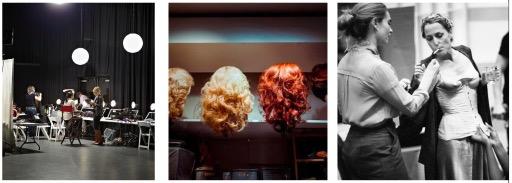
Hair & Make-up Artist – Stef Knight
Additional Voice Coaching – Perry Piercy
Teaching Artists –
Jessica Bennett, Isabella Temm
Education Pack Writers –
Jessica Bennett and Anna Turner
Publicity – Bridget de Launay, de Launay Enterprises
Photography – Andi Crown, Simon Devitt, Tony Drayton, Rachel Sung
Videography – Daryl Wong
SOUND RECORDING
Mixing & Recording – Abraham Kunin
Audio Production Support – Jacob Rush
Percussion – Eric Renick
Violin – Peau Halapua
Viola & Violin – Kali Halapua
Cello – Callum Hall
Bass & Cello – Tim Shacklock
French Horn – David Kay
Helen Clark in Six Outfits, written by Fiona Samuel and commissioned by Auckland Theatre Company, is the third production in Auckland Theatre Company’s 2026 season. This production began previews on Tuesday 7 April and premiered on Thursday 9 April at ASB Waterfront Theatre, Auckland. This production is one hour and fifteen minutes long with no interval. It contains haze and strong language. It is definitely not authorised by Helen Clark.
Please ensure all mobile phones and noise-emitting devices are switched off.
Photography is strictly prohibited, except during the curtain call.
About This Pack
This education pack is designed to support your exploration of Auckland Theatre Company’s production of Helen Clark in Six Outfits by Fiona Samuel. Whether you’re a kaiako preparing lessons, an ākonga studying the play, or simply curious about this new play, this resource offers insights into both the text and this specific production.
This education pack is divided into three sections:
About the Play
Making the Play
Activities
After a welcome from Auckland Theatre Company, this section includes key information about the cast and creatives, essays providing essential context and background information, and a synopsis of the production.
This section takes you behind the scenes with artefacts from the rehearsal room, key design concept insights, and notes to and from the cast, giving you a unique window into the creative process.
NCEA-linked activities that you can try in your classroom or at home to help you unpack and explore this production of Helen Clark in Six Outfits by Fiona Samuel. These activities support achievement standards across Levels 1, 2, and 3.
Each section builds upon the previous one, but you can also use individual components as standalone resources. The activities are designed to complement the contextual information and production insights, making this pack suitable for both independent study and classroom use.
About The Play
Key information about the cast and creatives, essays providing essential context and background information, and a synopsis of the production.
Haere Mai
I commissioned this play because we are committed to backing our playwrights to write new stories about Aotearoa. I chose the subject of Helen Clark because she has led a big life. In the theatre, we should examine big lives. Lives that have touched us all for better and worse. Lives that laid a path. That changed the way we think and live. Clark is all of that and more.
From rural beginnings to progressive politicisation in the crucible of the University of Auckland of the early 1970s to the ninth floor of the Beehive and the top tier of the United Nations, Clark has achieved success in Auckland, in New Zealand and on the world stage. But that success came at a price. Helen Clark endured gendered abuse that had nothing to do with her politics.
It is playwright Fiona Samuel MNZM who has found the way to see beyond the public façade to the personal, the dilemmas, the compromises, the friendships, the battle scars, and most poignantly, the tender early years. Samuel frames the life of Clark through six outfits and wittily satirises the public obsession with her appearance.
We see a kaleidoscope of a person: the ideological differences with her parents, the non-conformist streak, the personal pain at having to suppress her own values to meet political
expectations, the enduring friendships. What emerges is a complex picture of a driven person who pursued the levers of power to achieve what she believed in.
Our two actors approach this mountainous task from different ends of their professional and personal lives. This play asks a great deal of the actors, and we are blessed to have Jennifer Te Atamira Ward-Lealand CNZM and Lauren Gibson embodying Clark at either end of her life.
Director Sophie Roberts makes her debut with our Company with a thrilling vision for how to bring this play to the big stage. I am indebted to Sophie for her theatrical brilliance and the marvellous creative team she assembled.
Whatever we may each feel about Helen Clark, her brand of progressive politics and the decisions she took, what is undeniable are her achievements, her steely determination to see off the challengers and her effective use of the power she gained.
While Clark may have ice-axed her way through the glass ceilings and achieved success, I am left with a disquieting question – today, is the path up the mountain any easier for women who want to step forward into leadership?
Jonathan Bielski Artistic Director & CEO
Note from the Playwright
It was an intriguing phone call.
Jonathan Bielski of Auckland Theatre Company invited me to his office, with the words: “I have a proposition for you.” Who can resist a proposition? Reader, I went there. It turned out that the carrot he was dangling was a commission: he asked if I’d like to write a play and added that he had a subject in mind. His two-word provocation could not have surprised me more. He said:
“Helen Clark.”
That was it – no strings and no direction. And I had no clue where it would take me. This can be a fantastic way to start a creative journey, as long as something emerges from the mysterious region where ideas take shape and as long as there is that essential piece of grit that might make a pearl.
The piece of grit came to me as I researched the heck out of my subject. I was struck again and again by the astonishing barrage of criticism she copped while going about her business.
If Helen was the protagonist, then here was the antagonist – the oppositional force that every drama needs. But what would the form be? Who were the other
characters? Was it comedy or tragedy? I waited, knowing this whatever-it-was wouldn’t emerge if I looked at it too closely –I pretended not to be thinking about it. I prevaricated. I swam. I went to the movies.
And then it came, like a huge golden fish rising up out of deep water: “It’s the clothes!” And, suddenly I knew some things – there were two Helens, and there was a mountain… I was on my way.
Thank you, Jonathan, for that phone call, and thank you also to my mother. I was staying with her as I devoured my stack of Helen Clark books, hoping inspiration would strike. Every morning, we played Scrabble and, every morning, we had this conversation:
Mum: Well? Have you got it yet?
Me: No.
Mum: (shaking her head) I just can’t see it. It’s so… (searching for the word) unlikely.
Me: You have to stop saying that.
After the huge golden fish came to me, I told her what it was going to be. She loved it.
I hope you do, too.
Playwright Fiona Samuel
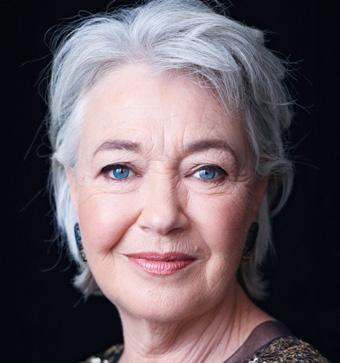
Fiona Samuel MNZM is a multiaward-winning writer and director for television, theatre, radio and film, an Arts Foundation Te Tumu Toi Laureate, a Member of the New Zealand Order of Merit for services to television and theatre, and the 2025 recipient of the Katherine Mansfield Menton Fellowship.
As a creator, she has made a body of work that puts the female experience front and centre, starting with her groundbreaking drama series The Marching Girls, featuring ten young female leads, and continuing through her acclaimed Sunday Theatre dramas Piece of My Heart and Bliss: The Beginning of Katherine Mansfield.
As a playwright, her works for theatre include The Wedding Party, Lashings Of Whipped Cream: A Session with a Teenage Dominatrix and The World’s Wife, a stage adaptation of UK Poet Laureate Carol Ann Duffy’s whip-cracking collection of the same name.
More recently, Fiona has focused on translating complex and controversial reallife stories into compelling drama, with her screenplays for telefeature Consent: The Louise Nicholas Story and feature film Pike River, starring Melanie Lynskey and Robyn Malcolm. Released in October 2025, the film won critical acclaim and large audiences around the country.
Her latest work, Helen Clark in Six Outfits, is another true-life story featuring an iconic New Zealand woman as she has never been seen before: in a comedy about gender, power and climbing mountains.
Note from the Director
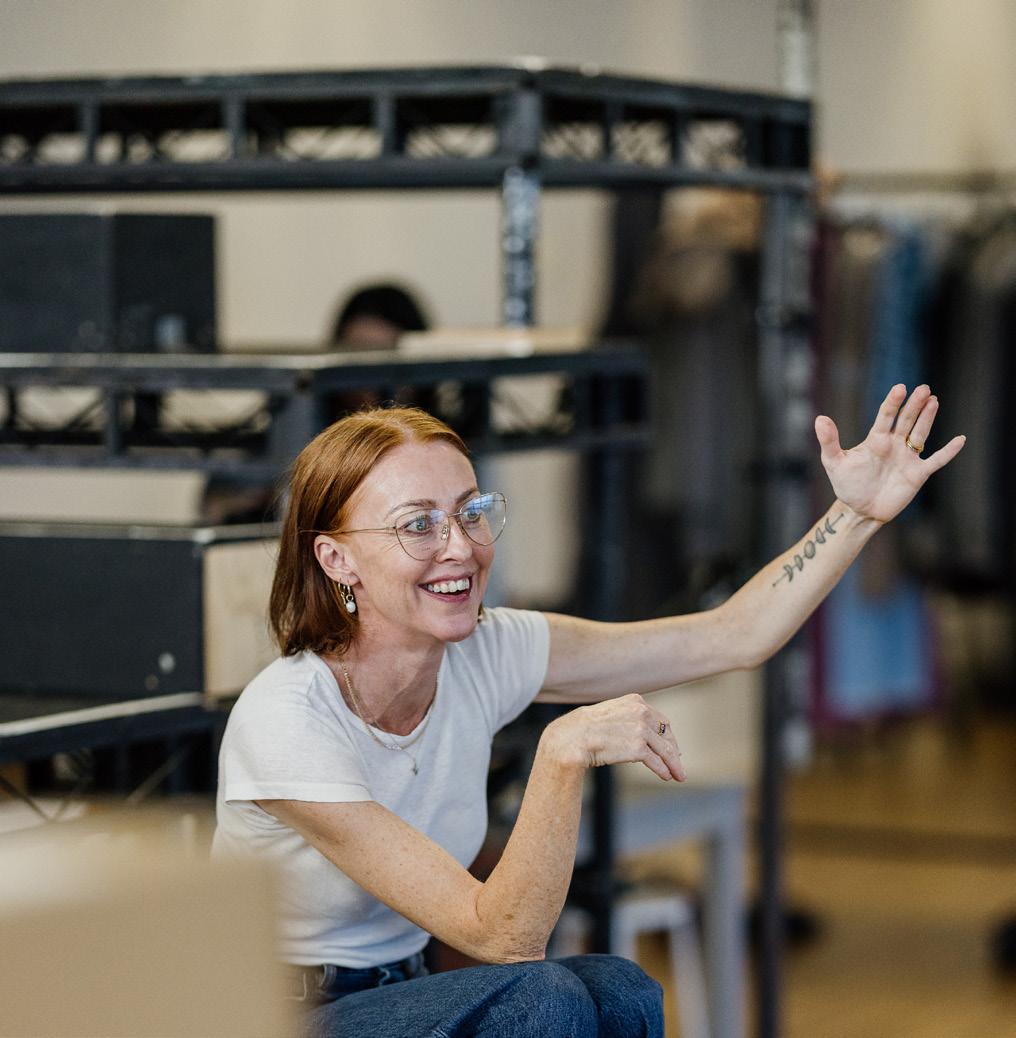
It’s been a great privilege to be part of the team that Jonathan and Fiona put together for this production and to spend the last month exploring and making shape of the themes of this play: how our values are formed, the cost of leadership and, crucially, the ongoing horror show of occupying public space as a woman.
I really believe in the civic function of theatre as a space for public debate and reflection. As our communal spaces shrink and our media landscape becomes increasingly fragmented and automated, theatre becomes an even more essential tool for the ways in which we build our social, relational and emotional intelligence. Great intergenerational discussion and learning have played a central role in this kaupapa, much like those that are alive in the play. It’s been a gift to be in a rehearsal room with such a range of views and experiences of feminism, gender, politics and performance. These moments of challenge were made fruitful by everyone’s openness, honesty and kindness with one another.
While, throughout this process, I’ve been mindful of where a theatrical exploration of a politician veers into political propaganda, I have so much admiration, respect and gratitude for the formidable women in this story. As an artist who trained during Helen Clark’s government, I’ve directly benefited from her historic cultural recovery package for the arts, the likes of which we have not seen since. I graduated from the national drama school into a well-supported cultural landscape that looked very different from the one young artists are stepping into today. That foundation is absolutely the reason I have a career 20 years later; it allowed me to make choices that I wouldn’t be able to afford to make if I were starting out today. I often think about young artists whose work we are missing out on as a very direct result of receding support for the arts over the last couple of decades.
A big ngā mihi to Jonathan Bielski for conceiving of this work and platforming Aotearoa voices and female voices. That’s leadership!
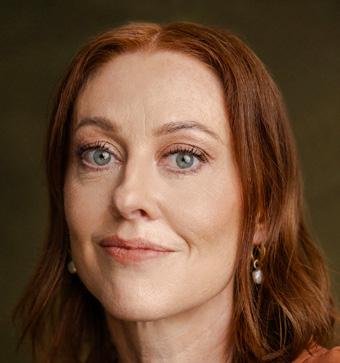
Director Sophie Roberts
Sophie Roberts has been a director and theatre-maker for 20 years and has created work for theatre companies and venues across Aotearoa and internationally.
Her directing credits include Mother Play: a play in five evictions, Taniwha, Camping, ScatterGun: After the Death of Rūaumoko, Live Live Cinema: Night of the Living Dead, The Writer, Break Bread, The Blind Date Project, The Wolves, Hir, Here Lies Love, Peter and the Wolf, Boys Will Be Boys, Perplex The Events The Book of Everything, Sunday Roast Midsummer The Pride and
Sophie was Artistic Director of Silo Theatre from 2014 to 2025. During her 11 years as the artistic leader of the company, she focused on the development and creation of new work from Aotearoa and centring queer and female-driven storytelling within her programming and leadership.
As an arts leader, she is passionate about the centring of rigorous artistic practice within an organisational context.
Her credits as a writer and dramaturg include D.R.A.G (Dressed Resembling a God), Taniwha Peter and the Wolf, Break Bread Hudson & Halls Live!, Wolf’s Lair Broken China
Her awards include four Wellington Theatre Awards and four Auckland Theatre Awards for Excellence.
Sophie is a graduate of Toi Whakaari: New Zealand Drama School and the Future Auckland Leaders programme.
Synopsis
“But to endure against such odds you have to be tough, or develop toughness. And that too, if you are a woman, is evidence against you.”
– Helen the Younger, quoting Brian Edwards
An unforgiving mountainscape. Wind, snow, brutal temperatures. A solo climber perseveres against it all, pushing their way up the cliff with quiet determination.
They’re interrupted by a young woman’s screams, who faces the audience, denounces dancing, then picks up a biography about Helen Clark to read.
It is now the audience learns who these characters are; two Helens, at different stages of their lives.
Helen the Younger, looking forward to an unknown future with passion and fire. Helen the Elder, the climber, looking back on her life in politics, and in some ways, mentoring her younger self as she goes along.
Together, they read through her biography, experiencing the ups and downs of Helen’s career, from the frustrations of struggling to get her foot in the door to the successes of getting legislature passed in government.
As they read, the two Helens embody key figures from their life, including her father who butts heads with her over politics, her mother who pleads with her to settle down, her best friend who rips into her outfit choices, and her political ally who brutally parts ways with her.
All in all, the play spans 60 years. Helen Clark in Six Outfits is a piece of theatre, a history lesson and a fashion show all rolled into one. Fiona Samuel writes a creative dissection of Helen Clark’s rise to being New Zealand’s first elected female Prime Minister, whilst simultaneously providing a scathing review of how women in the public eye are treated. Helen Clark in Six Outfits celebrates our feminist achievements, and asks us to look at how far we’ve come, but also just how much further we still have to go.
Meet the Characters
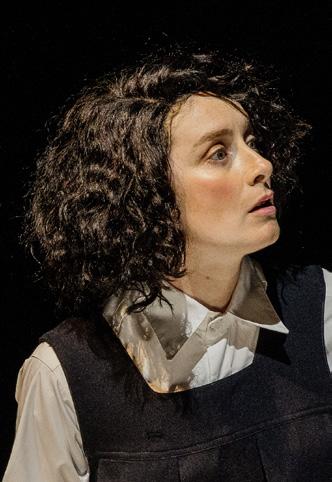
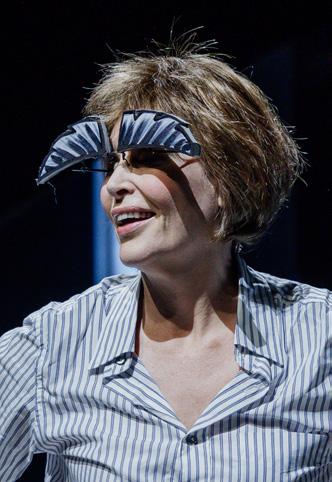
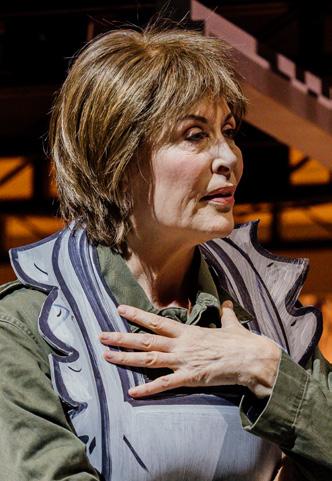
HELEN CLARK
Former Prime Minister of New Zealand and Leader of the Labour Party. This story is about her.
GEORGE CLARK
Helen’s father. Clark was a farmer, and ran the Clark family farm until his retirement. In the 1970s, he was the Chair for the local National Party branch. Most recognisable on stage by his eyebrows.
MARGARET
CLARK
Helen’s mother. Originally of Irish birth, she raised Helen and her three other daughters in Te Pahu, in the Waikato region. She was a primary school teacher. Most recognisable on stage by her apron.
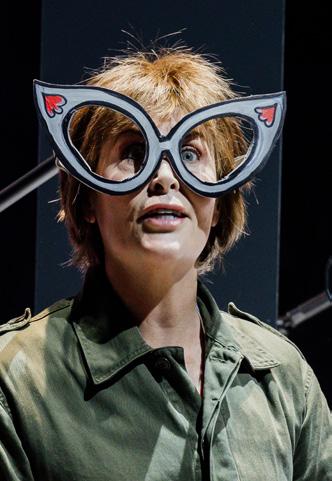
MARJORY ADAMS
Principal at Epsom Girls’ Grammar School from 1953-1970, where Helen attended from 1963-1967. Most recognisable on stage by her glasses.
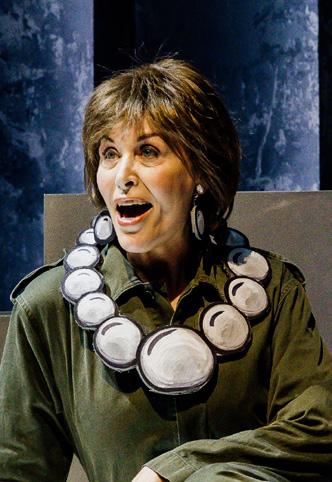
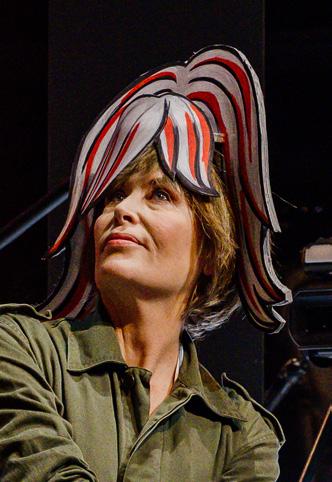
JUDITH TIZARD
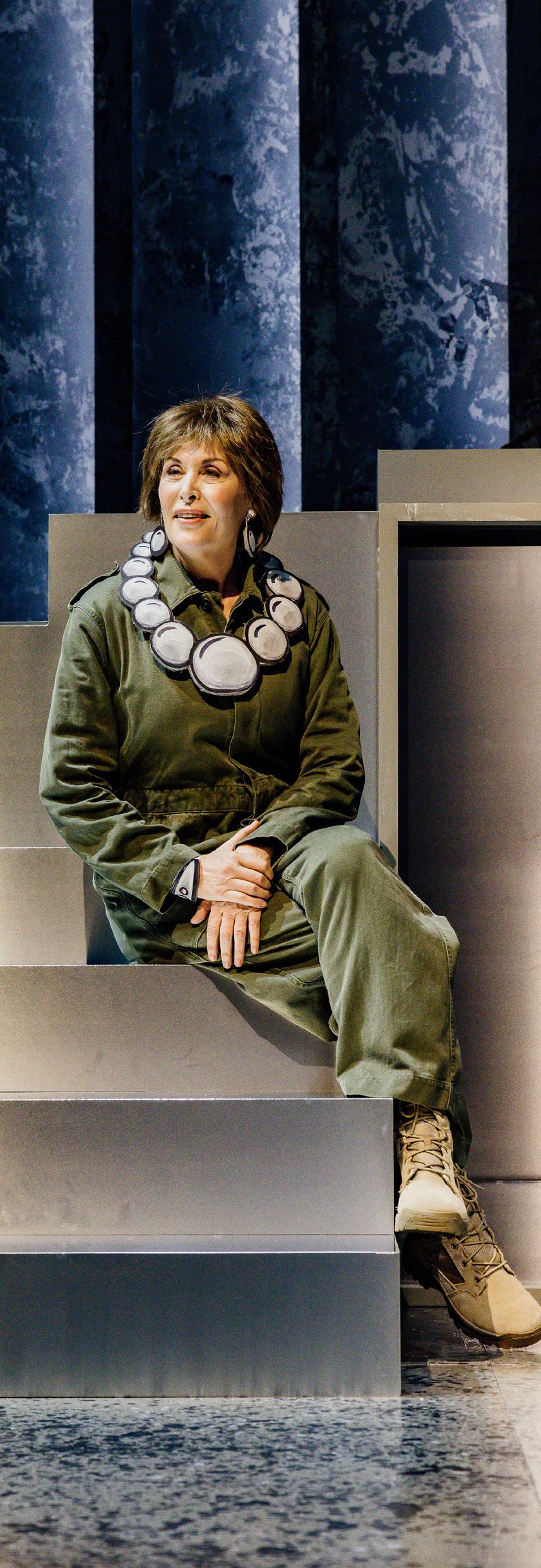
Helen’s close friend. Former MP and member of the Labour Party. She entered parliament in 1991, and was in office from 2002-2008. Most recognisable on stage by her pearl necklace.
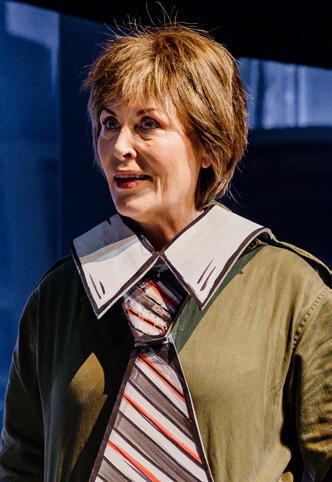
JIM ANDERTON
Former Deputy Prime Minister of New Zealand. Anderton was a member of the Labour Party for several years before resigning in 1989, first founding the NewLabour Party, then The Alliance, then the Progressive Party. Most recognisable on stage by his tie.
MAGGIE EYRE
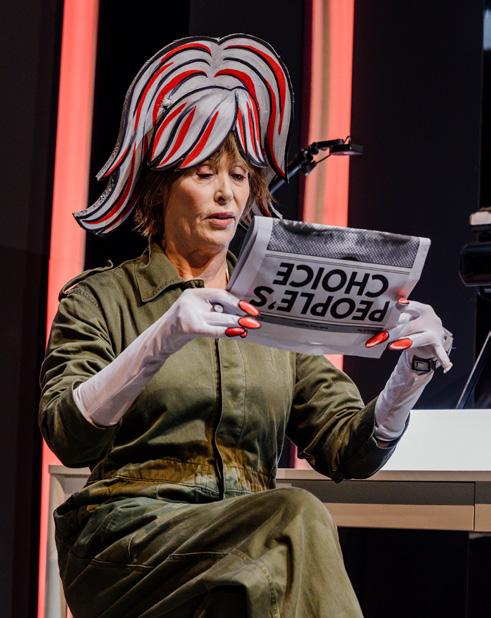
Coach and consultant for personal brands and public speaking. She signed on as Helen’s image consultant when Helen became Leader of the Opposition in 1993. Eyre still works in the coaching industry with her company Fresh Eyre. Most recognisable on stage by her gloves and hair.
MMP In A Nutshell
Every three years, we hold an election to decide our new government.
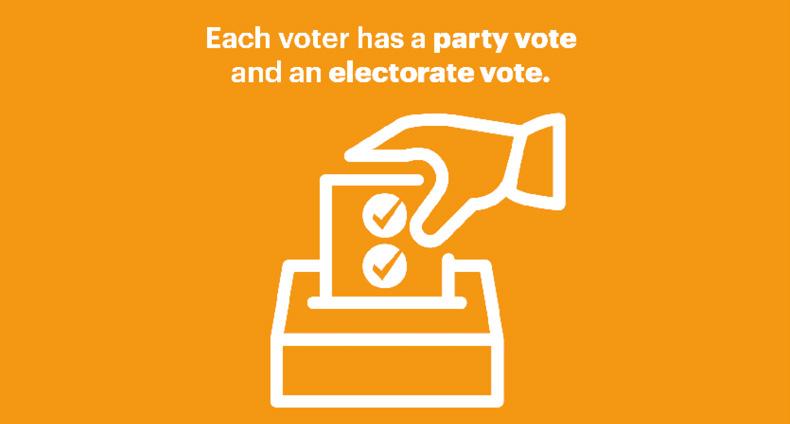
New Zealand uses Mixed Member Proportional (MMP) which means every voter has two votes: one for a party, and one for an electorate.
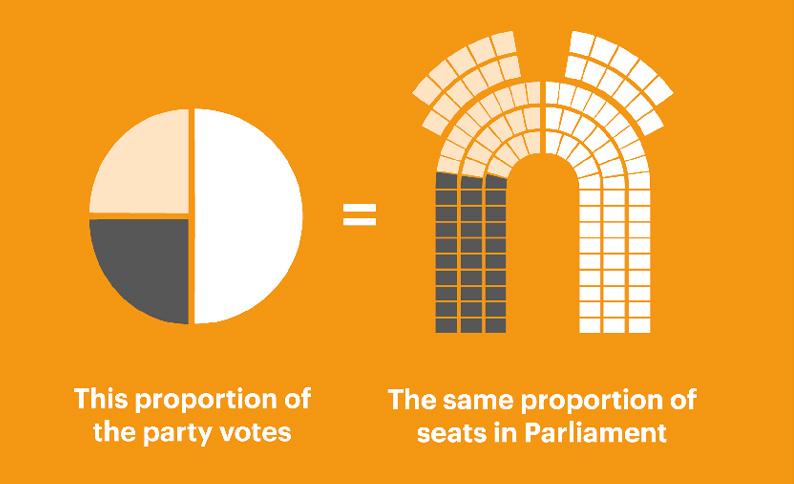
Parliament is generally made up of 120 seats. 72 of those are electorate seats, and the remaining 48 are decided by the party vote. A party has to win an electorate, or 5% of the party vote, to secure a seat in Parliament.
The party vote is for the political party that you want to govern New Zealand, and determines how many Members of Parliament (MPs) the party can bring off their “party list.”
An electorate is the local area you live in. So for example, ASB Waterfront Theatre (where you saw this show) is in the Auckland Central electorate, which stretches from Western Springs to the Port of Auckland and all the way out to Great Barrier Island. This vote is for the one specific MP that you want to be your local representative, and can be different from your party vote.
The MPs that won an electorate take their seats in parliament first. Then, if a party has won a higher party vote percentage, they fill the remaining seats with MPs from their “party list”
- a ranked list of candidates that was published before the election.
Additionally, we have seven seats that are for the special Māori electorates, which voters of Māori descent can vote for from the Māori electoral roll.
Sometimes, a party wins more electorate seats than its share of party vote should allow for, which is when additional “overhang” seats are added. Currently, we have three overhang seats, putting parliament at 123 seats total.
Generally speaking, the party that wins the most seats will determine who the new Prime Minister is. However, if a party doesn’t win enough seats to govern alone, they enter into agreements with other parties to form a coalition. At the last election in 2023, the National Party won the largest majority of the vote, so Christopher Luxon is our Prime Minister. However, because they did not win a high-enough percentage to govern alone, they formed a coalition government with the Act Party, and New Zealand First.
Our next election will be on the 7th November 2026. If you are 18 years or older by the 25th of October, you will be eligible to vote in this year’s election. Enrol now (even if you’re only 17!) and the Electoral Commission will make sure you’re enrolled in time.
In the Press
These links are a starting point for exploring the world of Helen Clark in Six Outfits; the woman, the politics, and the play itself.
HELEN CLARK: EARLY CAREER AND POLITICAL RISE
Helen Clark — NZ History Manatū Taonga’s overview of Clark’s career from her farming roots to Parliament, covering her early years as an MP and her long road to becoming Prime Minister.
Helen Clark Biography — helenclarknz.com Clark’s own website carries a thorough account of her political career from her first election to Parliament in 1981 through to her post-UN work today.
MEDIA SCRUTINY AND GENDER IN POLITICS
Helen Clark in Six Outfits: Writer Fiona Samuel Gives Former PM a Dressing Down — NZ Herald Playwright Fiona Samuel speaks candidly about the scrutiny Clark faced throughout her career and how it shaped the play. (Paywalled.)
Helen Clark — The Elders
A profile of Clark’s ongoing work, touching on how she has continued to speak out on gender equality and women in leadership on the world stage.
HELEN CLARK AS PRIME MINISTER
Over and Out: Helen Clark’s Legacy — NZ Herald
Three political commentators assess her nine years at the helm — frank, mixed, and worth reading in full. (Paywalled.)
Helen Clark — Britannica
A concise international overview of her time as Prime Minister, the legislation she passed, and the firsts she achieved.
HELEN CLARK’S POST-PM CAREER AT THE UN
My Year with Helen — Official Documentary Site
The website for Gaylene Preston’s 2017 documentary, which follows Clark’s campaign to become the first female Secretary-General of the United Nations. Includes reviews, news, and background on the film.
My Year with Helen — NZ On Screen
NZ On Screen’s entry on the documentary, with context on its significance and Clark’s own words on why the campaign mattered.
THE PLAY
Former Prime Minister Helen Clark’s Career through Clothes — RNZ Afternoons
Playwright Fiona Samuel speaks to Jesse Mulligan about writing the play and how Clark was so often judged on her appearance rather than her political record.
Jennifer Ward-Lealand Doesn’t Want to Know if Helen Clark Shows Up to Her Play — RNZ
Jennifer Ward-Lealand and Fiona Samuel speak to RNZ about the challenge of portraying a living public figure, the “torrent of negativity” Clark faced as a woman in politics, and why the clothes were the key to unlocking the story.
Fiona Samuel on Helen Clark in Six Outfits — Newstalk ZB Sunday Session
Fiona Samuel speaks with Francesca Rudkin about finding the substance beneath the humour and what drew her to Clark’s story as a subject for the stage.
Making the Play
This section takes you behind the scenes with artefacts from the rehearsal room, key design concept insights, and notes to and from the cast, giving you a unique window into the creative process.
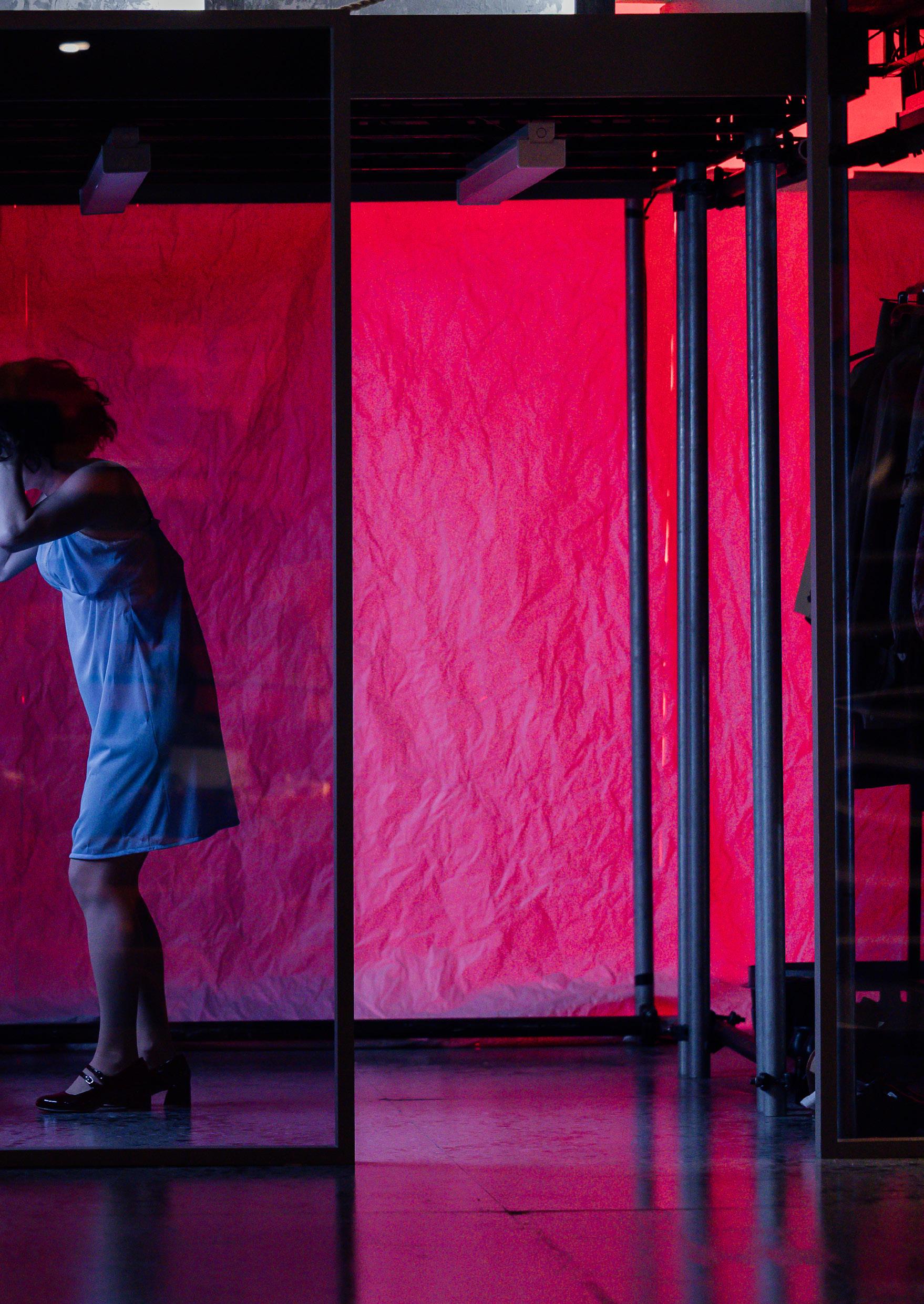
A Conversation with Helen Jennifer Ward-Lealand
(Helen the Elder)
What has been your key focus when finding your Helen?
Jennifer: Watching. Reading. Listening. And spending time trying stuff out on the rehearsal floor. It’s a sort of safest place you get to do that stuff, trying and getting things into your own body. Her body’s not our body, but we have to try and find something that is going to be theatrically satisfying to play.
very clean with my transitions into each different character. So for me it’s a physical-vocal thing that I need to hook into, and if I can get that hook I feel confident. And of course it’s a very fine line of not getting into just caricature, so it’s still finding the emotional truths of each of those people no matter how outrageous or big you’re playing; it has to come from a place of truth.
Was there one particular element or quality to your Helen that was the key to finding the character?
Jennifer: I think there’s a reserve that Helen has. She’s not one that wildly gestures with her arms for instance. And for me, finding a hook into the voice is really important, and also with the six other characters I play, trying to find some differentiation between each of them, where the tune of their speech pattern sits, so that I can try and be
How are you thinking about the performance of gender and identity in politics?
Jennifer: It’s about how Helen’s authenticity was friction to what was expected of women in leadership positions; how they’re meant to behave and how they’re meant to look. And even just ’be’ a woman in politics. Clearly that’s improved, there are more women politicians than back then (she was one of eight) however, I think there is still a concerted effort to shut women’s voices down in politics. The patriarchy goes deep with not
wanting to be told anything by a woman. It’s looking at who we want as our leaders, and is it about being telegenic, photogenic, exuding an idea of power, when actually none of those things have anything to do with the job. She was damn good at her job, and I think it takes an incredible strength of spirit to keep going under what must have felt like enemy fire a lot of the time. Helen said it herself: it’s a reality that if they’re looking at your frock they’re not hearing what you’re saying.
It’s one of my favourite things about rehearsal: you’re learning and processing and trying stuff and challenging yourself, and that never stops, no matter if you’re 16 or 63, in my case. I think there’s a lot to be said for learning from our elders. I did, and do still.
This play has the beautiful technique of a younger Helen talking to an elder. How has that affected how you’ve approached preparing for this play?
Jennifer: It’s the same as when I was a young actor: I had a lot of great older actors that I learned from, and you can’t underestimate what it is you gain as a young actor on the rehearsal floor working with older people and experienced people. It’s such a gift.
What’s your favourite part of the show?
Jennifer: I love the challenge of this being a two-hander, of keeping it sharp and taut, and each beat, each little character scene being their own little world. I love the challenge of that because it makes me work, so I’m going to have to work in this show, and I like working. And of course we’re not alone: we have an enormous amount of technical support around us to help create these images. The ideas in the show don’t just rest on our shoulders. And getting to play Helen Clark! An icon, and an inspirational woman who still has such great impact. And was such a huge supporter of the arts. Lucky us at that time. I remember it well.
The Directors’ Concept
An interview with Sophie Roberts
As a director, how do you break down a script for the stage, and did that process change much with a historical piece that features real people?
You design a show long before you rehearse it which is quite a tricky way to work, because you’re conceiving of the kind of world that the actors are gonna inhabit before you’ve got your actors in the room and you’re actually reading their chemistry, their energy, their natural rhythms, all of those things.
You’re kind of wanting to create something that is specific enough that you’ve prepped, but also has enough flexibility that you can adapt to your actors.
The way I typically will break down a script; I don’t pre plan blocking or anything like that, but I do find that I have a pretty clear idea of the rules, your tonal palette that you’re playing with in terms of movement, shape, performance. Then beyond that I listen to the actors read the scene until
they’re kind of in the pocket of the scene emotionally, and then I’ll just get pictures of what I think it needs to look like.
It’s a process of being responsive, always working off the intention or the motivation that I’m seeing in the actor’s body or breath, and making staging choices based on that.
And so that stayed the same even with this historical context play?
The rules of what does and doesn’t work in a theatre don’t change, and I guess I see my job as more about directing the production rather than getting too caught up in the people that we’re portraying.
Ultimately it matters but it also doesn’t matter because it’s a play, and because it’s very consciously a play, and we’re not going for a documentary style of theatre at all, which liberates you from having to make everything about being authentic or being naturalistic.
This play has the beautiful technique of the younger talking to the elder - how has that affected how you’ve approached preparing for this play, and how this story is told?
I love the dynamic of different generations on stage. I always prefer that in a cast, and from a company point of view, it’s always good when you’ve got people at different points in their professional lives sharing knowledge and skills across all your departments.
It’s a great dynamic within the play; the way that our ambition changes and how you occupy public space as a woman changes over the course of your life. I think women’s lives are defined by seasons in a very different way to men, and that’s largely biological, hormonal, but it’s also to do with what’s expected of women at different points in their life.
Then there’s the fact that two handers are actually deceptively difficult to perform. With an ensemble you have a big kind of collective energy that you’re harnessing, and with a solo you’re working very much off like one person’s instrument and technique and rhythm, but with a two hander you’re trying to kind of lock two people in.
For the actors, the string that they need to keep between them takes an enormous amount of focus, much more so than an ensemble or a solo cause you’re relying on that other person so much and you really are like making that music of the show together.
How did the vision for the design of this show come about?
This team of people, Dan and Rach and Leon in particular, all work together a lot and we have a shared language.
We had a design workshop where I gave the design team a bunch of provocations, the idea of the stairs, the brutalist architecture, lots of images. This show is not a domestic piece that takes place in a kitchen, you have to make choices about what design choices gives us room to play and restrictions to be creative.
This piece is quite sculptural, so we looked for presentational design choices. Mirrors - that was another thing I bought, the stairs, the mirrors, the idea of public/private, the mask, all that camera stuff, I brought all of that in from the top mostly.
And then for Kirsty in terms of costume, yeah very much about taking the idea of the costume but again creating a cohesive aesthetic and tone because it isn’t documentary, you know.
Theatricalising everything basically.
What do you most want audiences to take away from this piece?
I’m never interested in a specific moralising or messaging that I wanna
give people. Personally when I go to the theatre, I want to be fed. I don’t just go to the theatre for entertainment, personally I go to other forms of medium if I want smooth-brained checked-out entertainment.
If I’m going to the theatre, I want some form of emotional, physical, intellectual engagement that activates something in me, whether I disagree with it or not, doesn’t matter, but I like theatre that I walk away with lots of questions in my head, where I feel stimulated, so I think the same applies for this.
It’s not a specific message, I just hope it sparks something for people and they have really interesting conversations afterwards about leadership, politics, what does it mean to occupy these sorts of roles of authority or any kind of public space when you’re not a white man, what’s the cost for leadership if you don’t fit inside that kind of box, so not a specific, just I hope it sparks debate.
What’s your favourite part of the show?
I don’t know! I like the character Maggie Eyre the best just because she’s fun. In terms of a moment in the show, I don’t ever really have a favourite moment, because this is what I love about rehearsal as a director, you have this amazing privilege of being plugged into your actors for four weeks, and every day you see them make new discoveries.
Every day you see them find a new layer or a new tool to add to their skillset, or they discover something new in the text, so I think my favourite thing changes every day when we’re in this part of the process because we’re still in discovery. I always have a few favourite moments when we’re in the theatre, but right now I just enjoy watching the actors’ process of discovery, and it’s satisfying to watch their sense of achievement within that. It’s lovely to see performance start to really rise to the demands of the text, and it’s heroic what they’re doing you know? It’s two actors holding this big, dense show that shifts and changes. It’s a big demand I think on the two actors. So performance is always my favourite aspect of a show.
Set Design
”The environment is permanently hostile (both mountain and parliament). No place to relax.
If you take your eye off the game you will lose a foot hold and fall, perhaps to your death.”
– Sophie Roberts
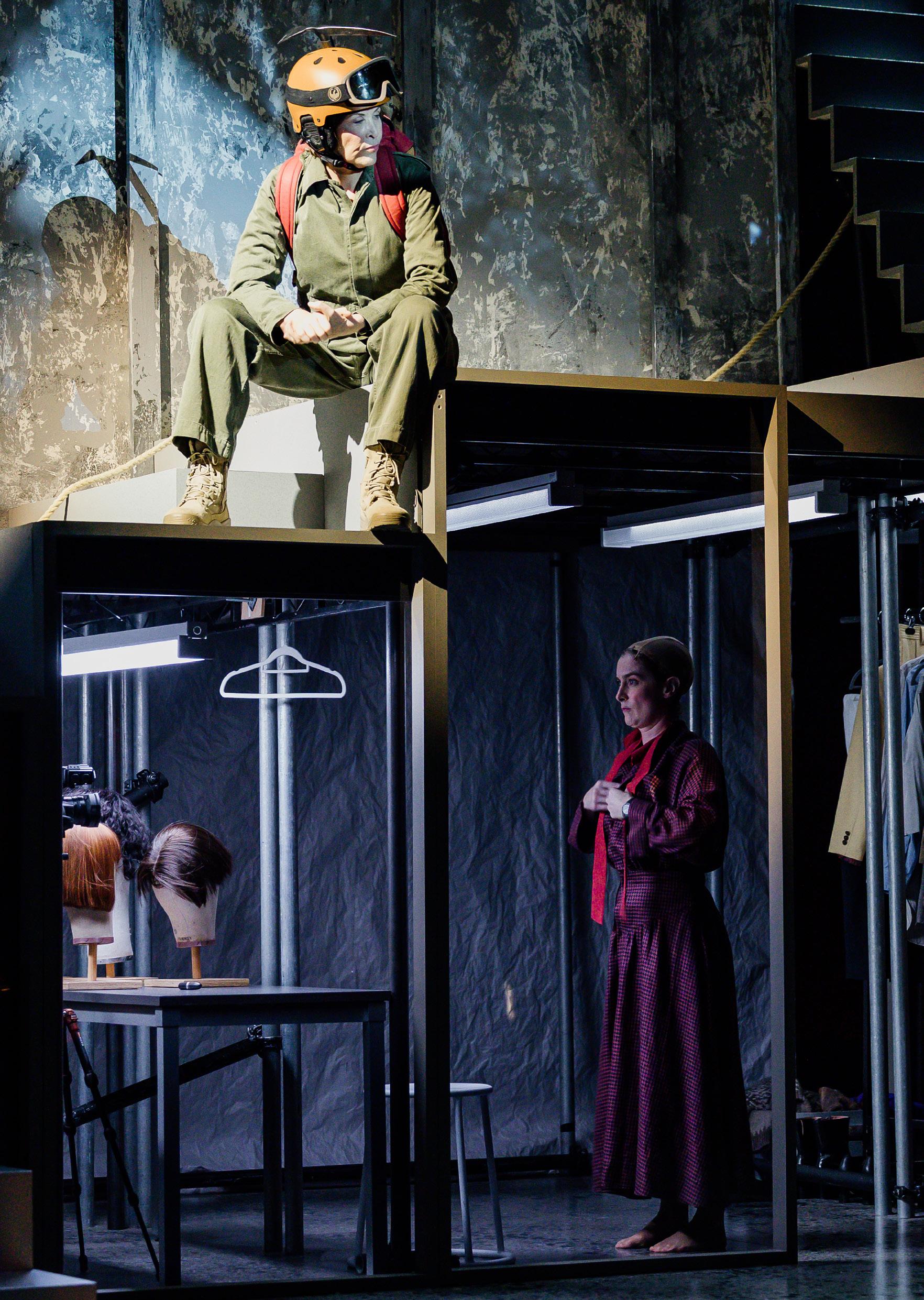
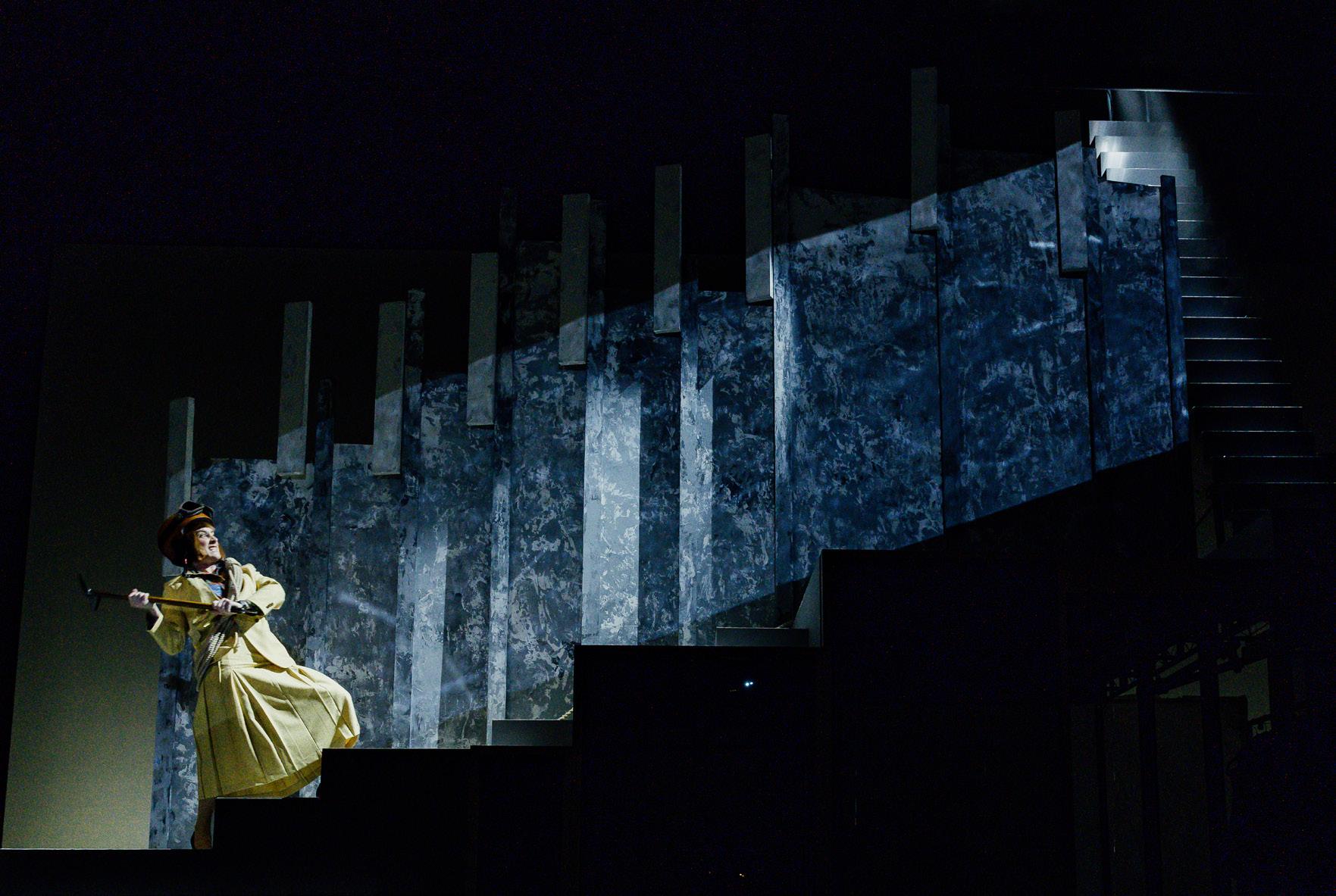
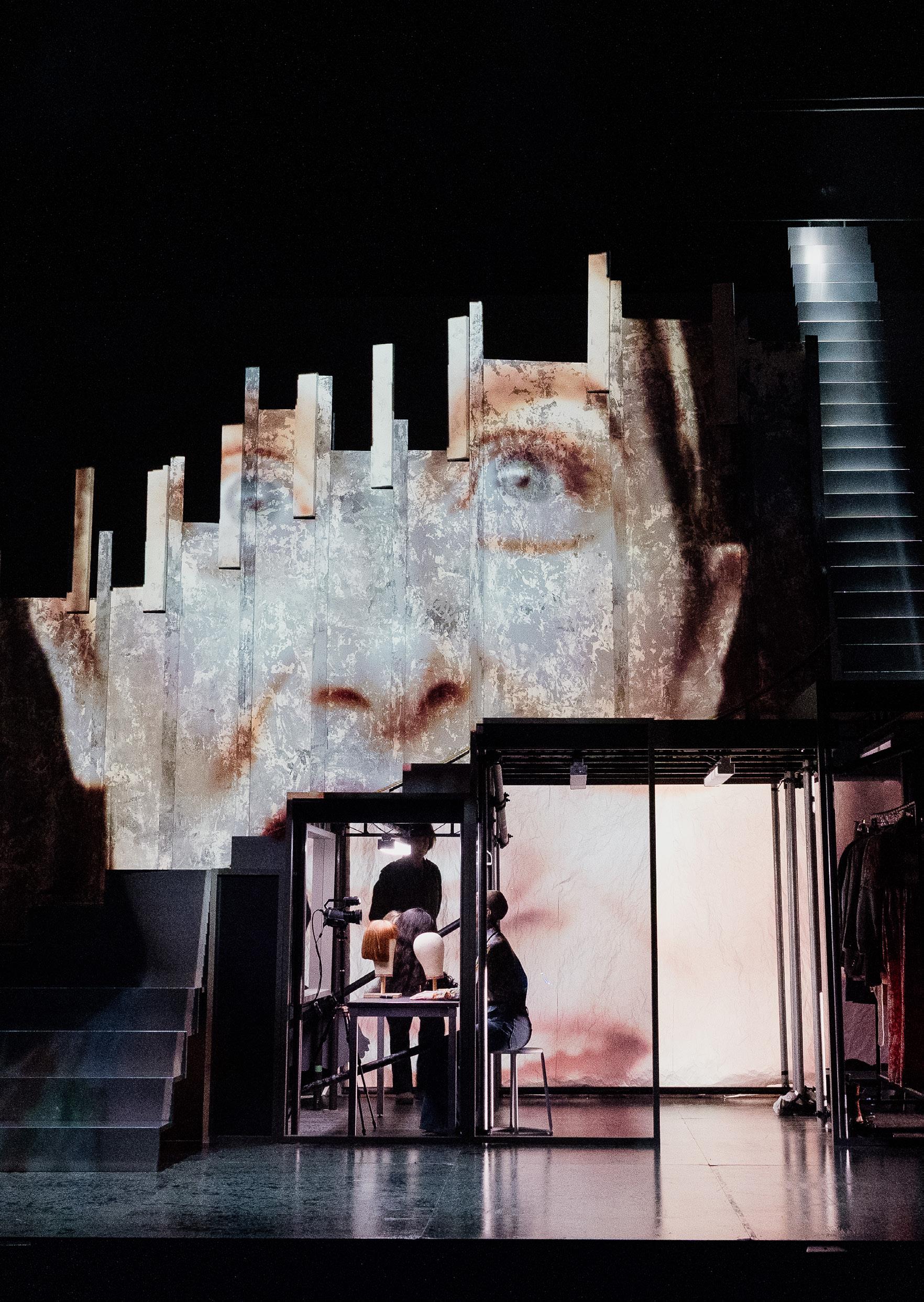
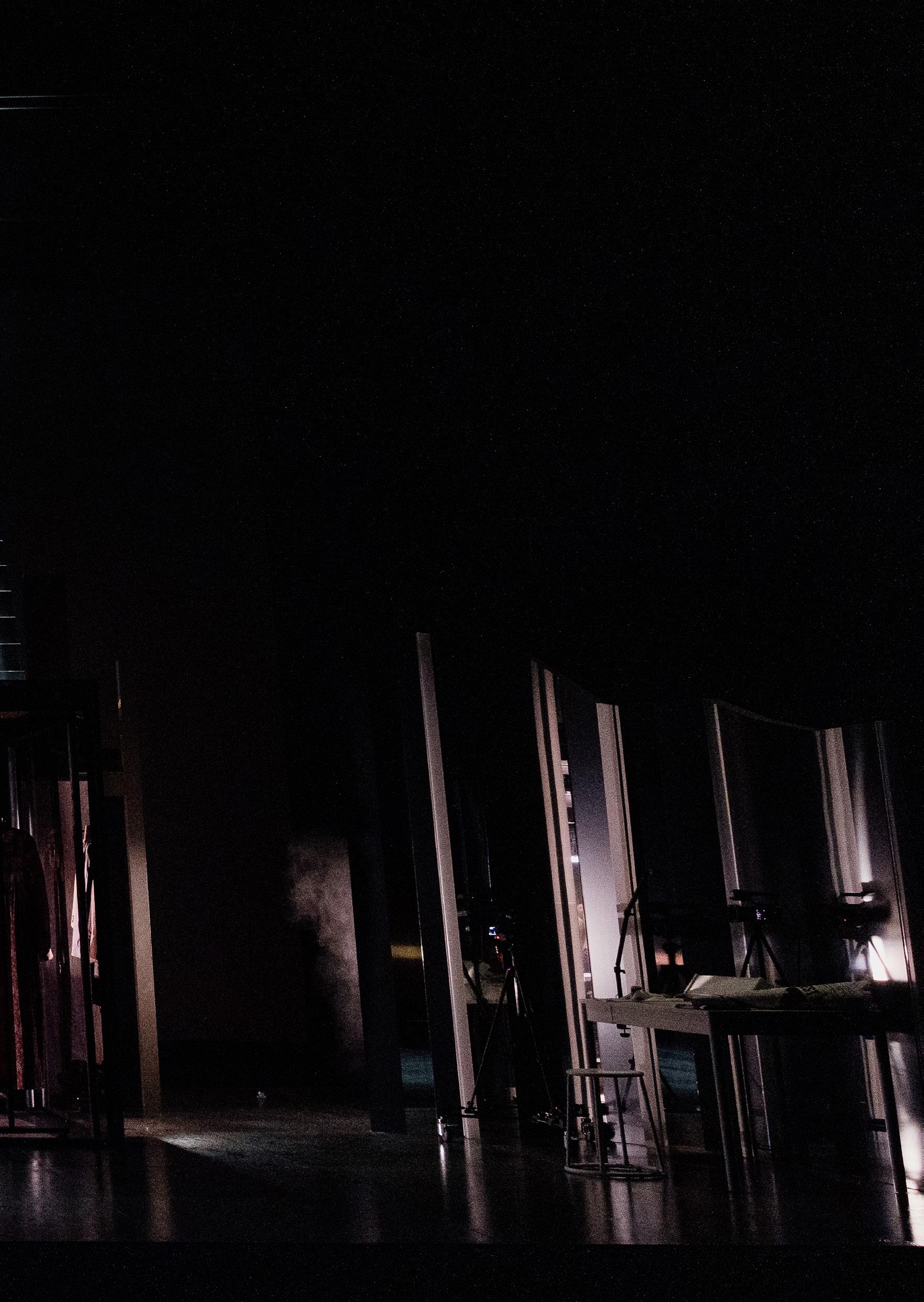
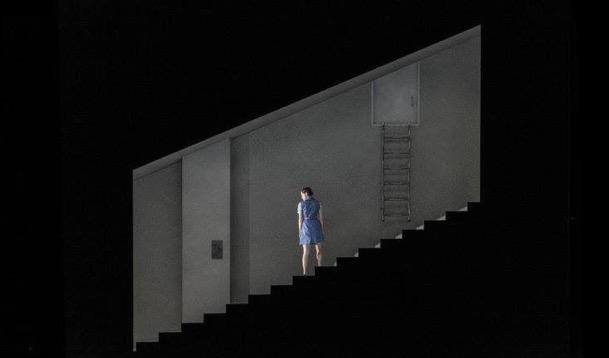
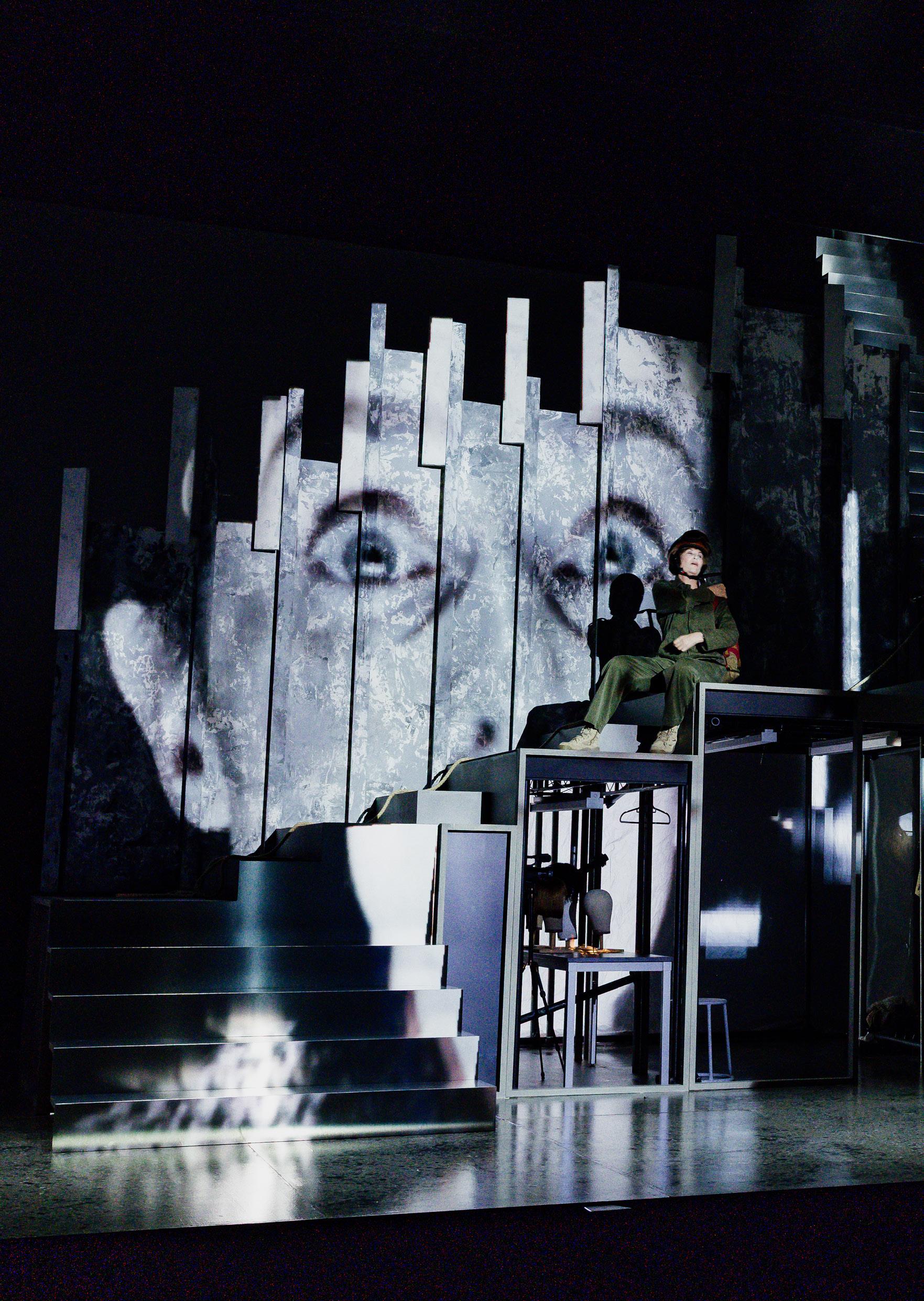
Dan Williams and his team have worked hard to design a stage that is everything but comfortable. Pulling heavily from Brutalist architecture (including the Beehive), the space is cold, sharp, and masculine, made from four main materials - mirror, glass, metal, and concrete. The concrete also takes on three different styles; a highly polished stippled concrete for the floor, a smooth and plain concrete for the stairs, and a light but heavily textured concrete for the back wall. There’s a lot of grey in the set, making for a brilliant contrast with the actors’ costumes, but the materials used still make for a visually interesting design - the set is hard and angular, but coarse and textured, and also shiny and reflective.
The set is built to create a mountainous shape, to further the imagery of a tough environment, and reference Helen’s mountaineering hobby. Dan Williams said “the mountain is a very big part of the story… we want to have
a sense of scale and height, and I really liked that triangular, mountainous kind of shape.”
Continuing the motif of “the endless climb” are the many stairs featured through the set - Williams wanted these to emphasise the idea of never reaching the summit, and as Helen the Elder says in the play: “There is no ’there’ - beyond the mountain is another mountain.”
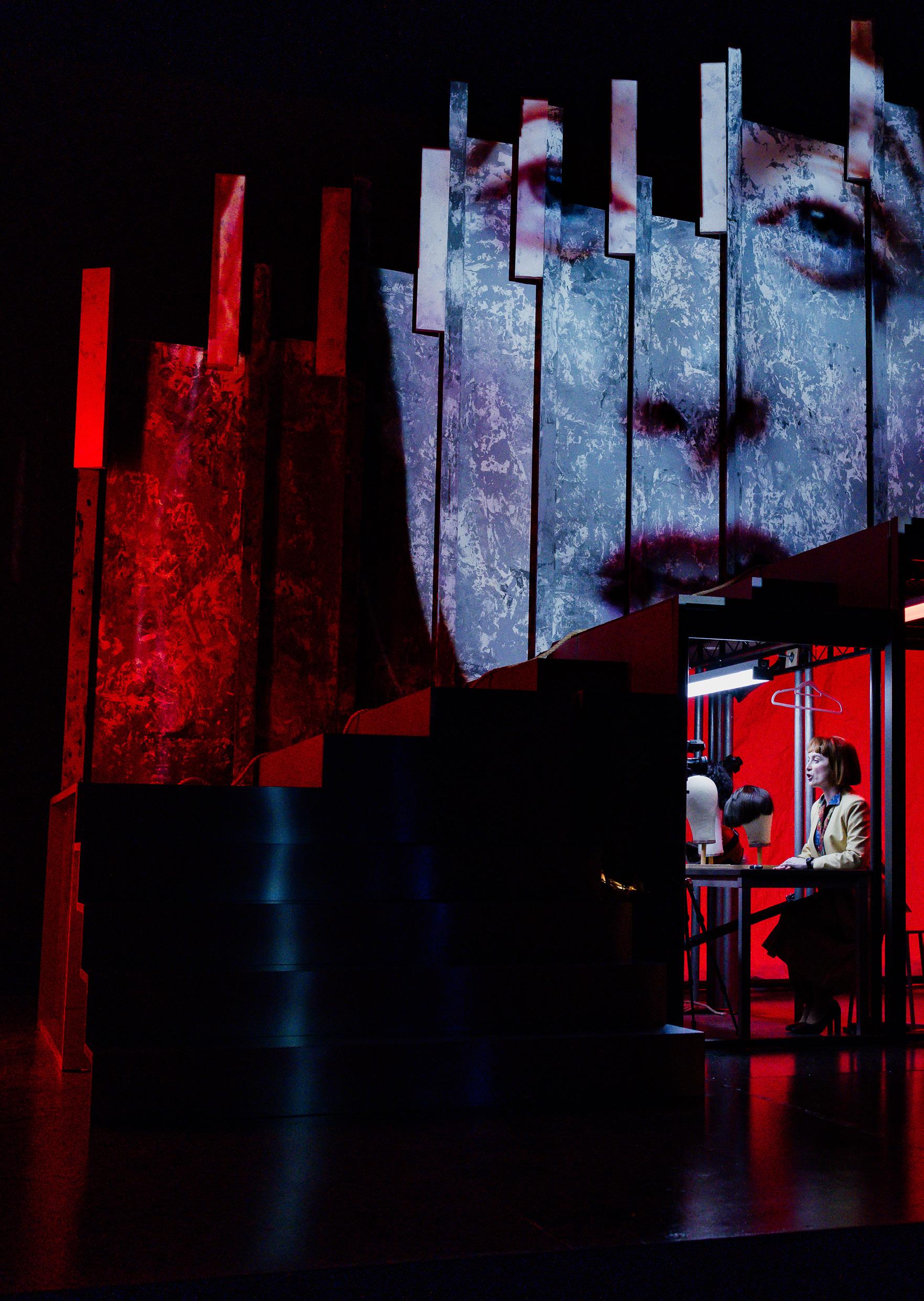
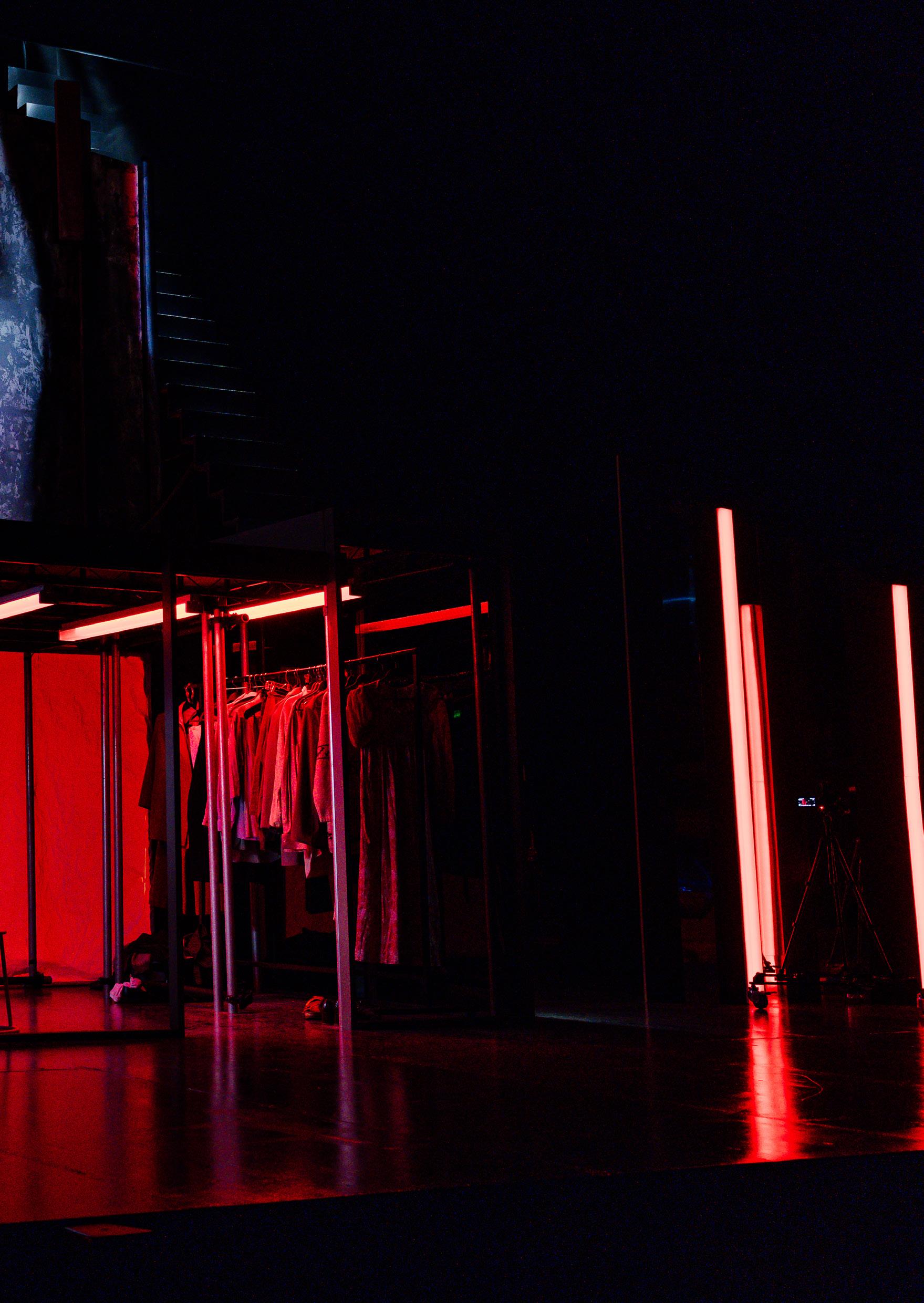
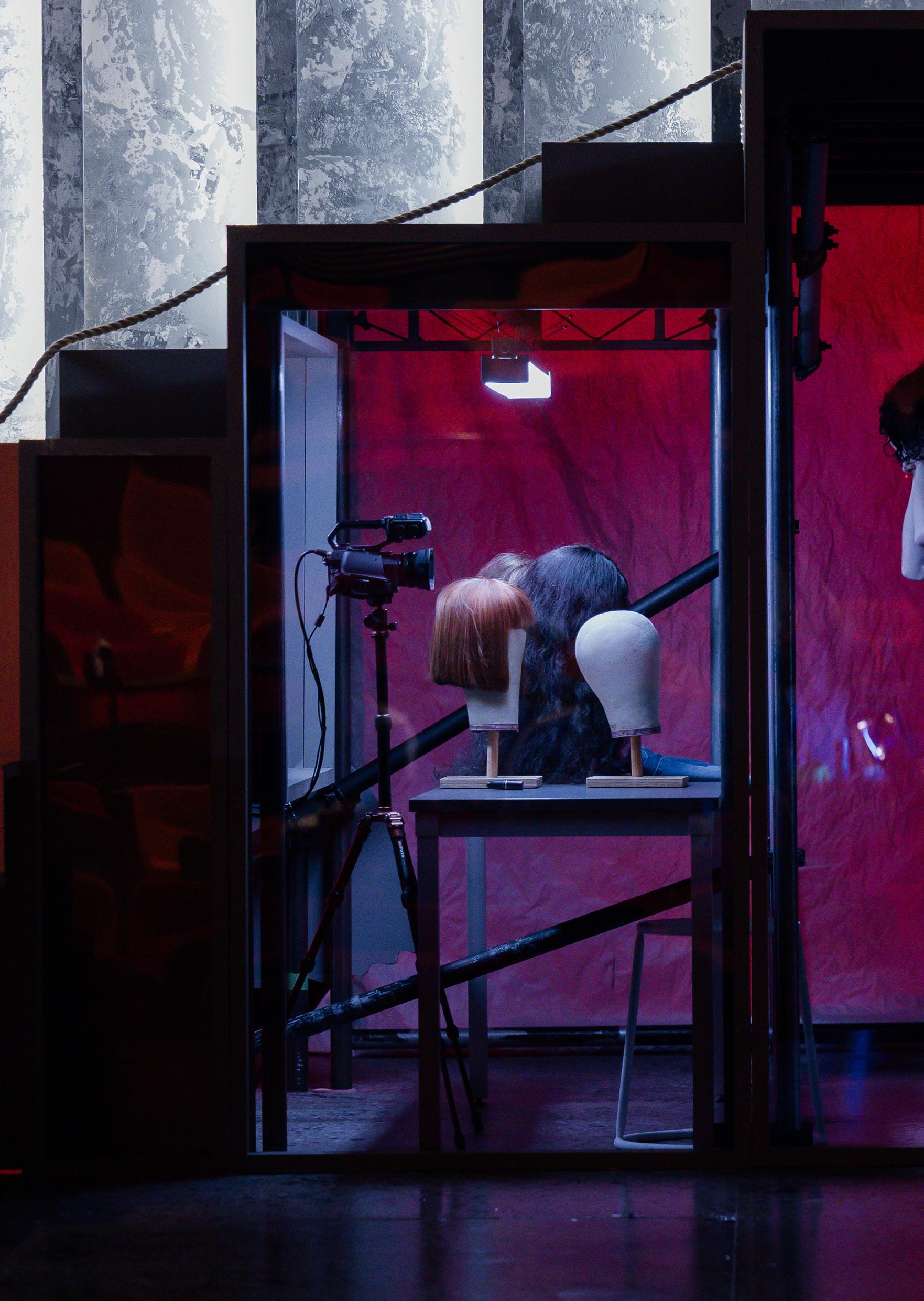
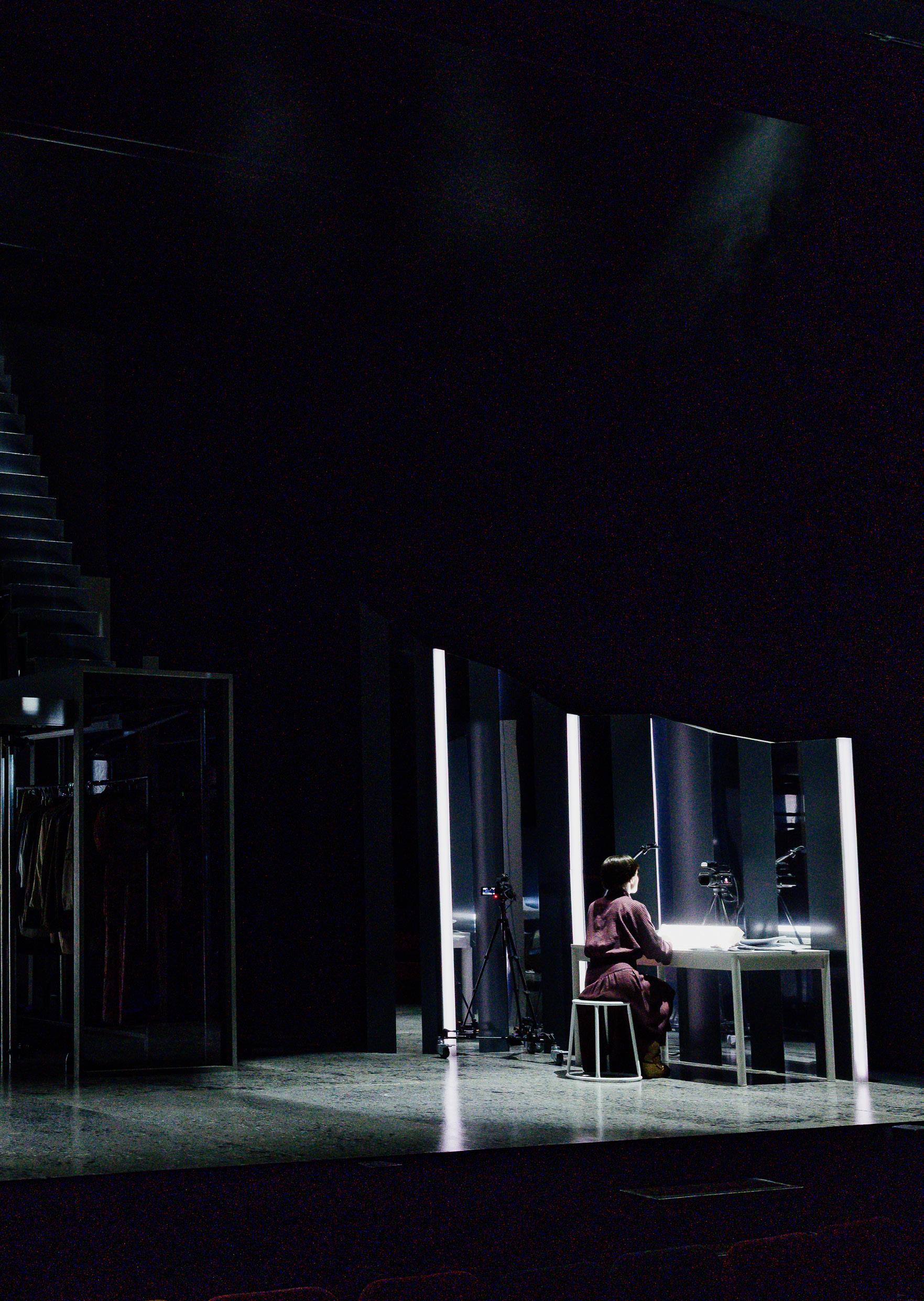
Beneath the set mountain is a small dressing room, obscured by slightly frosted glass, giving the feeling of privacy, yet we can still see Helen whenever she’s in there - what is private becomes public. On stage left and right there are curved mirror panels, creating two more dressing zones. Sophie Roberts spoke to this metatheatrical performance as an opportunity where “offstage becomes onstage,” where the audience can see the actors getting changed and the show doesn’t hide the mic packs.
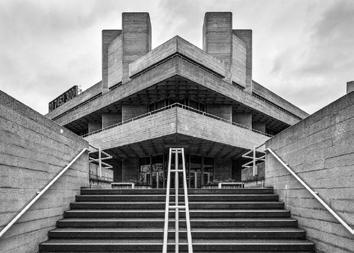
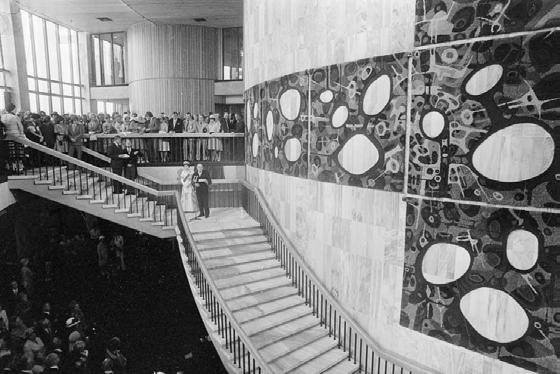
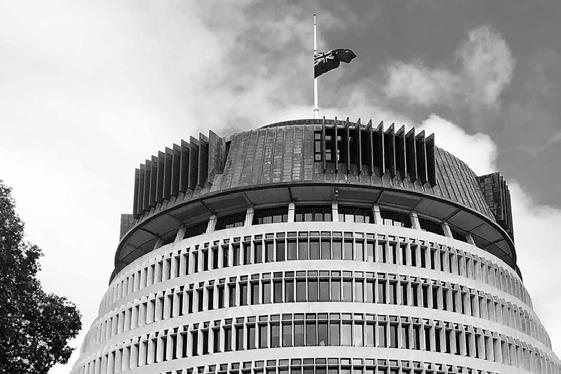
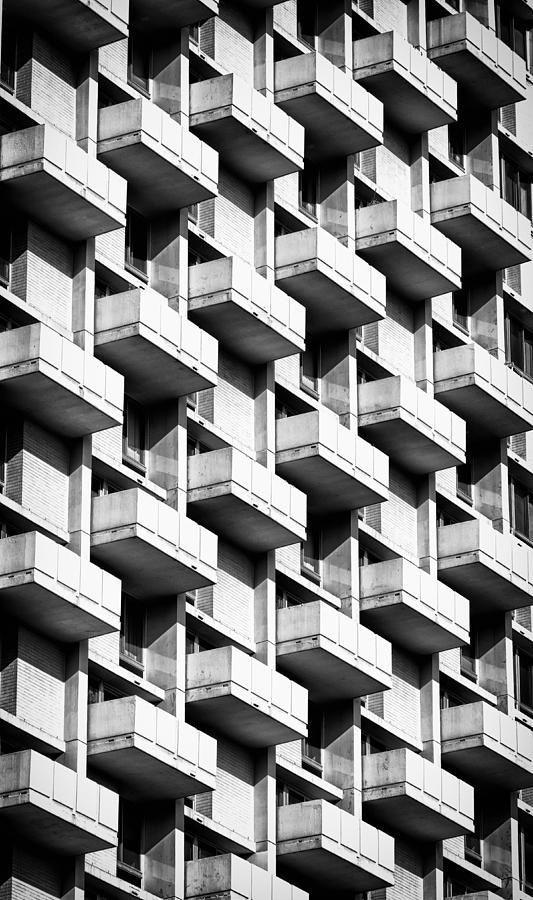

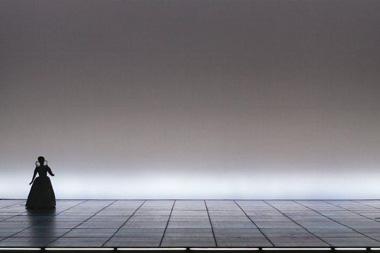
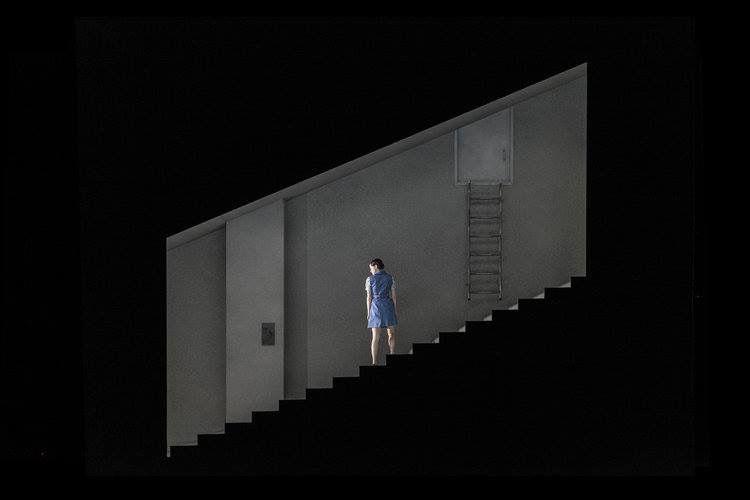
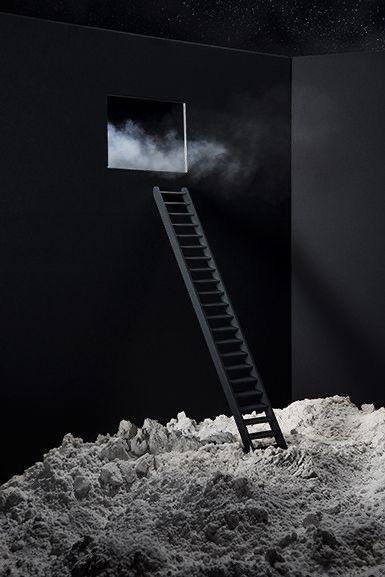
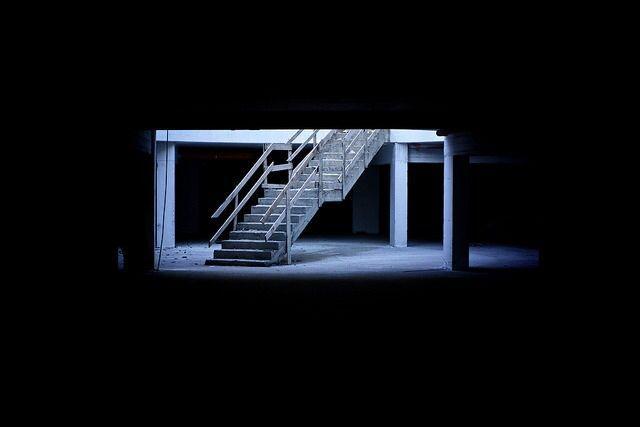
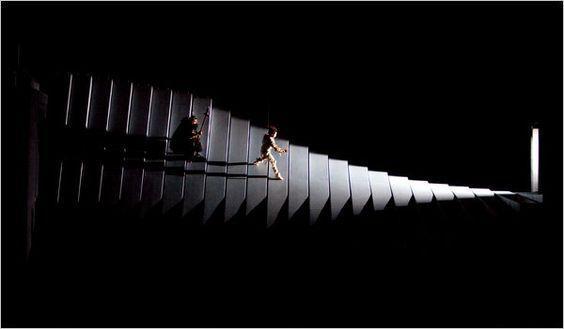
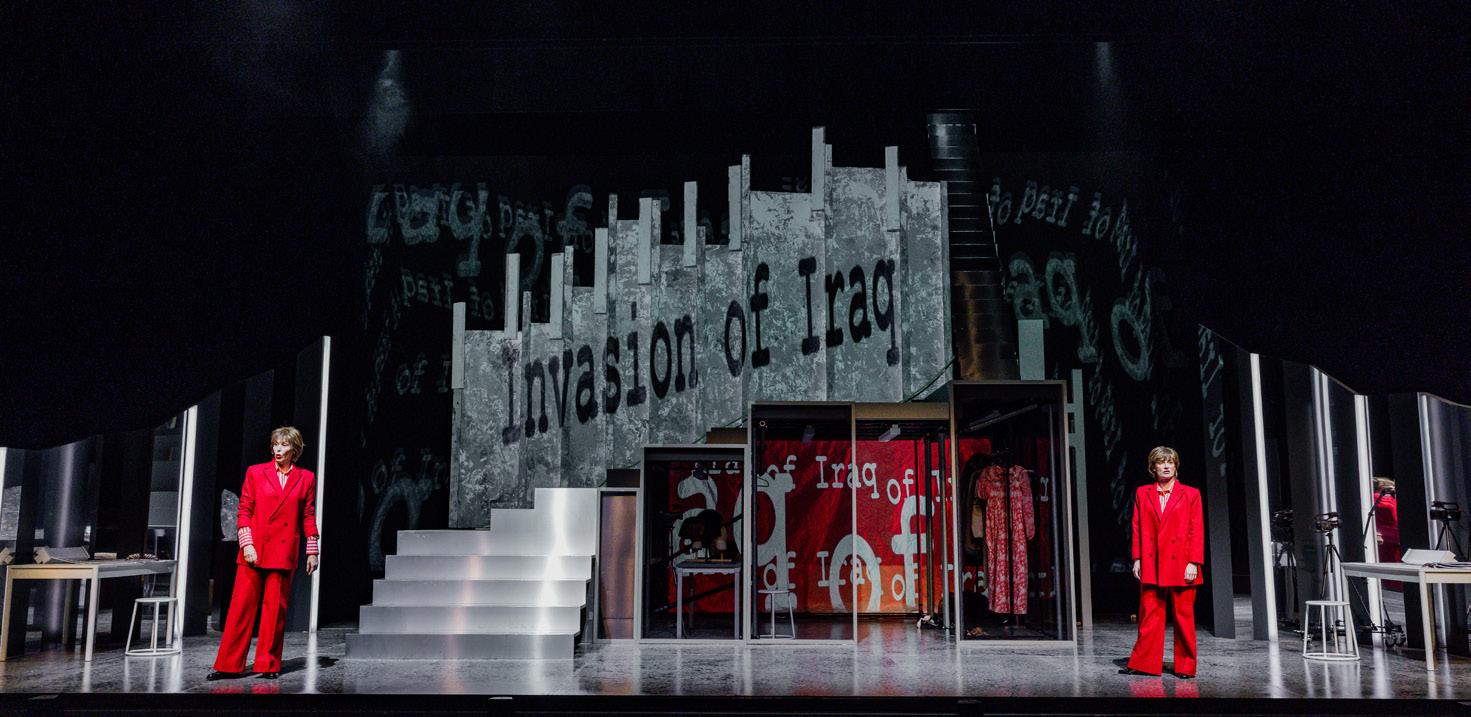
hard, cold, masc, functional, perilous in places.
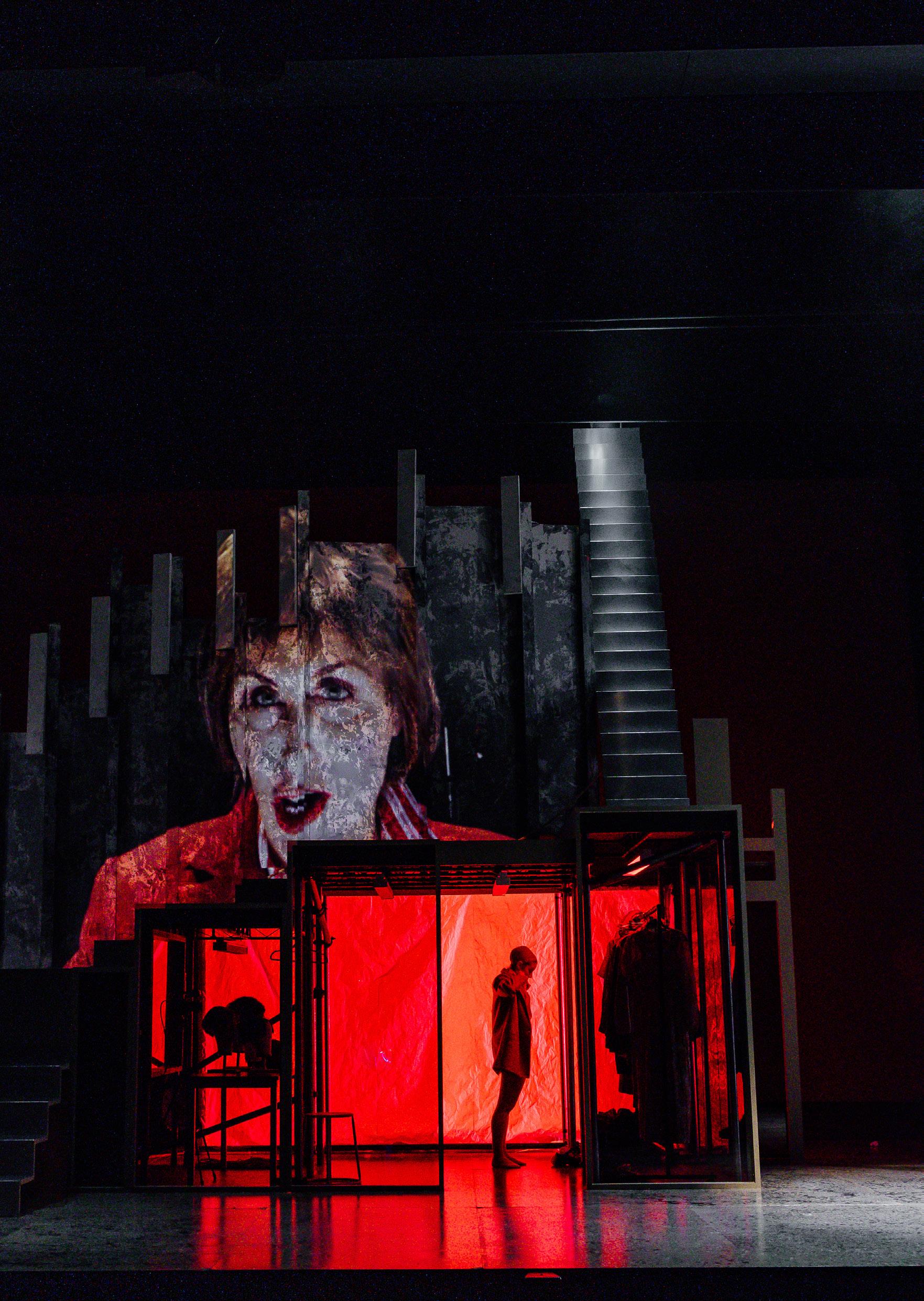
Sound Design
There are two major elements to Sound Designer Leon Radojkovic’s work for this show: the score, and the soundscapes, of which nearly 80% of the content was made during workshops in 2025.
The score was one he wanted to mimic Helen’s journey, to have a feeling of progression, of upwards motion and forwards momentum, but didn’t want anything to sound “too triumphant.” To achieve this, he’s playing with different kinds of patterns in the notes. Some are sets of notes at different lengths, so “a sequence of notes that are groups of four, and then under that may be seven or something like that.” Others are group patterns, that go up in counts; 1234, 12345, 123456, 1234567, and then back to the beginning, where it’s always counting up but never resolving. This jagged climb in the music echoes the motif of the stairways from the set, and follows imagery of graphs and polling. Radojkovic also spoke to how the note patterns would fade in and out over each other, giving the music a constant movement.
For the soundscapes, Radojkovic didn’t want to pull from a music library, and instead created everything with real musicians - a string quartet, a french horn player, and an orchestral percussionist. This team
has been creating a bespoke weather soundscape that can be used for the huge atmosphere moments in the show, but can also be toned down to fill in the background transitions. The main inspirations for this have been the sounds of ice cracking, avalanches crashing, and general alpine sounds.
Lighting/AV
On the LX side of things, Rachel Marlow and Brad Gledhill are continuing the themes of brutalism and harshness. Working with isolated set electrics, the lighting sits in cold white fluro, and reflects off the mirrors, glass, and metal used in the set design. Where light is reflected or shining through gaps, it creates “shards” of light, like cracks in the ice, emphasising the mountain landscape.
The other major focus for the lighting team is being able to switch states to match the changes in tone of the script - the LX design becomes huge and grand when creating the large scale scenes, such as Helen the Elder on the mountain at the very beginning of the show. But the lighting can also focus in on one area of the stage, and become much smaller to echo the more downto-earth moments as well.
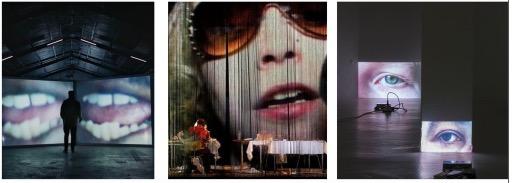
To juxtapose all the harsh scenery and lighting, the team is employing four live cameras to project across the space. The first two are positioned stage left on the dressing table - one is a birdseye camera to look down on props at the table, the other is for the actors to speak directly into. The third camera is a roaming one, to travel
across the main stage area. All three of these will be projected across the mountain face at the back of the theatre. The fourth lives inside the little dressing room area underneath the mountain. The goal for all cameras is to be able to get up close and personal, especially in Helen’s more private moments, contrasting “intimacy versus invasion,” mimicking the way the media dissected Helen’s private life during her career.
Sophie Roberts spoke about also using prerecorded footage, which will play with stylised graphics, really pulling inspiration from the political cartoons of the 90’s to feature exaggerated character features - much like the masks used as part of the costumes.
Costume
Perhaps the most key feature of these costumes is how they constantly change throughout the play. Because we journey with Helen throughout her life, we also experience her style changing as she goes through different decades, different levels of freedom, and different ways of presenting herself for the public eye (though not always to her preference).
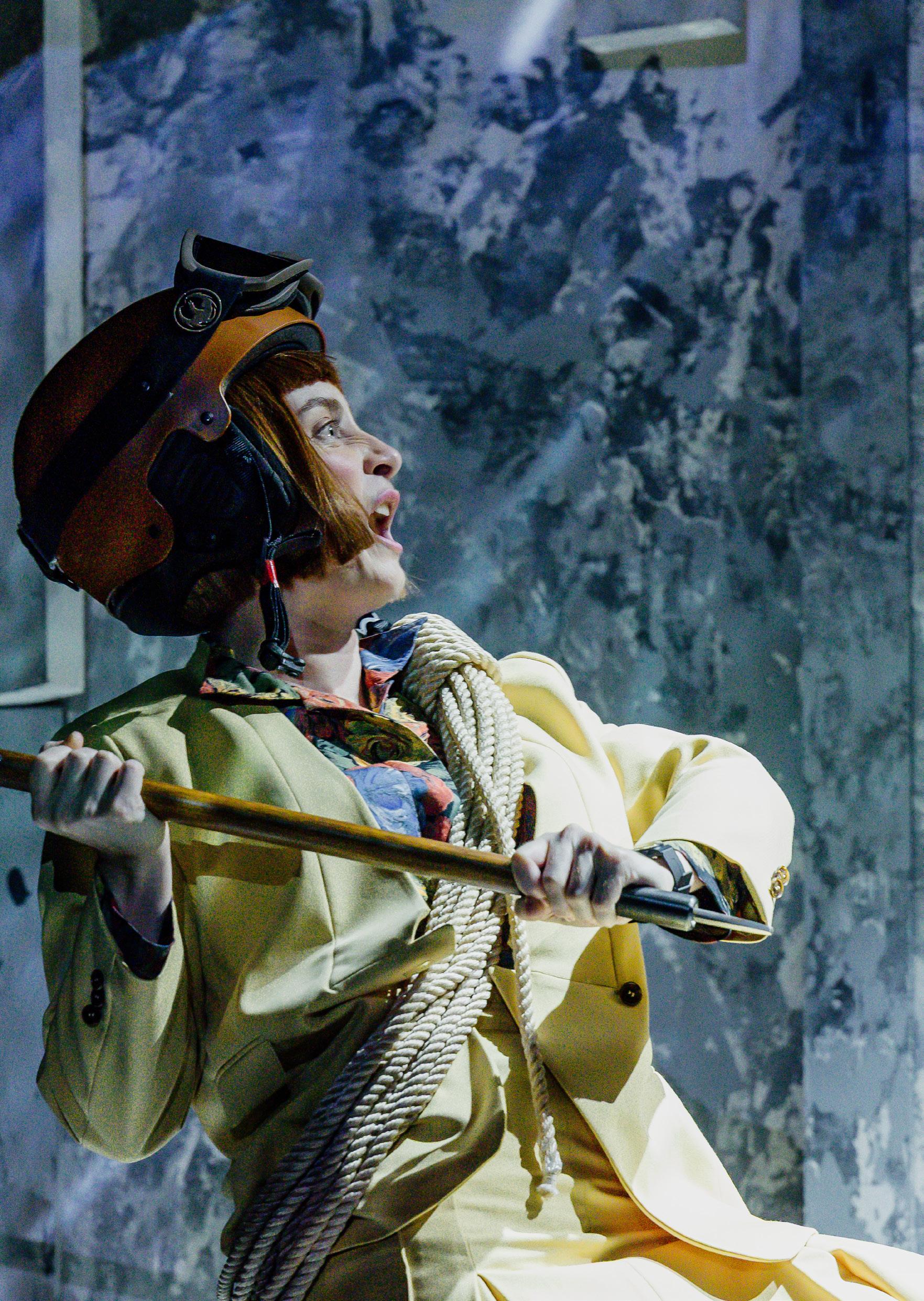
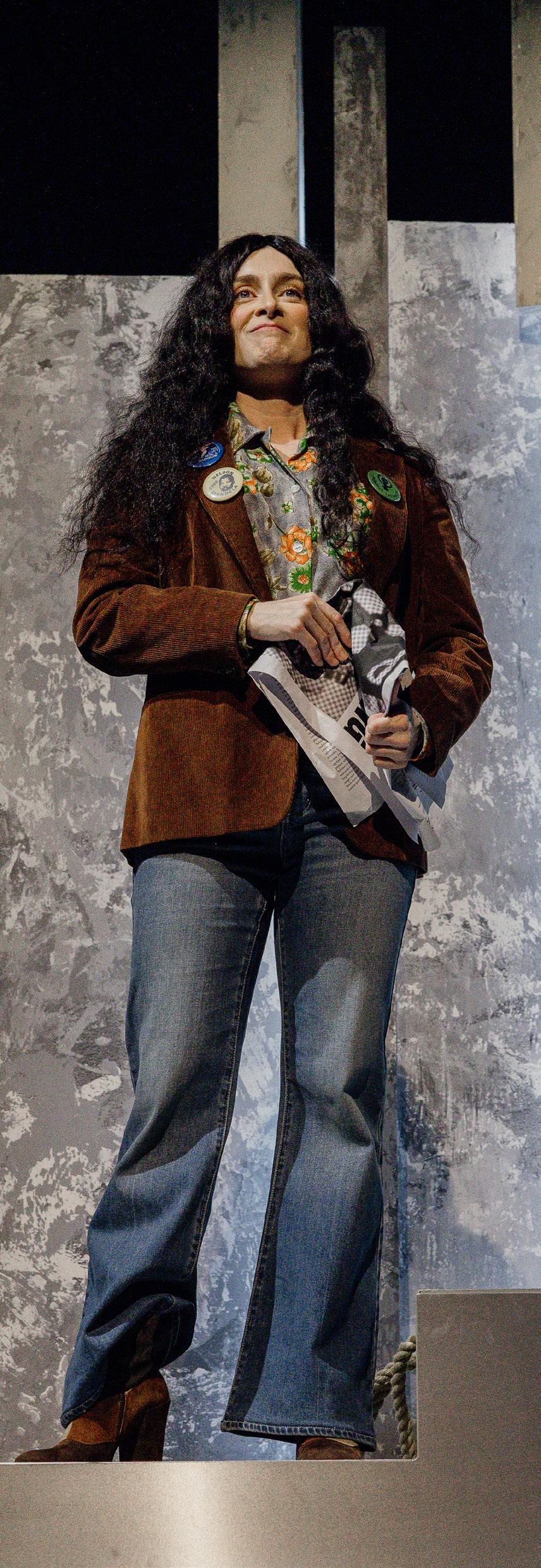
Helen the Elder spends most of the play in a boiler suit, an androgynous piece in a neutral colour palette, inspired by mountaineering and safari gear. This serves as the base for the six other characters that Jennifer WardLealand plays to layer on top, which is done through stylised 2D “drawn” accessories. Leaning into the comic style, these include glasses that are larger than the actor’s face, a giant string of pearls or neck tie, and gloves with fake nails.
Helen the Younger’s first main costume is her school uniform, a simple black and white dress and blouse, inspired by the real Epsom Girls’ Grammar uniforms of the time. This is one of her least colourful outfits in the show, and Helen the Younger ends the play in this uniform, showing how she has experienced this telling of her life through reading her biography.
Next, Helen the Younger moves into her Young Labour outfit. This costume brings colour, flair, and style. Kirsty Cameron notes how cool Helen was, as a “long haired student heartthrob,” which she and Sophie Roberts felt was a version of Helen that was important for audiences to see.
Then, it’s Helen the Younger’s wedding dress. In real life, Helen Clark wore a suit to be married in, but because the play calls for two important suits to be the next costumes for these Helens, Cameron has taken the creative liberty to put Helen in a dress here, but it’s purposefully not her style. This works to make Helen look even more uncomfortable and out of place, and drive home the feeling of this marriage being a deep betrayal of self - a feeling that will come up several times over the course of the play.
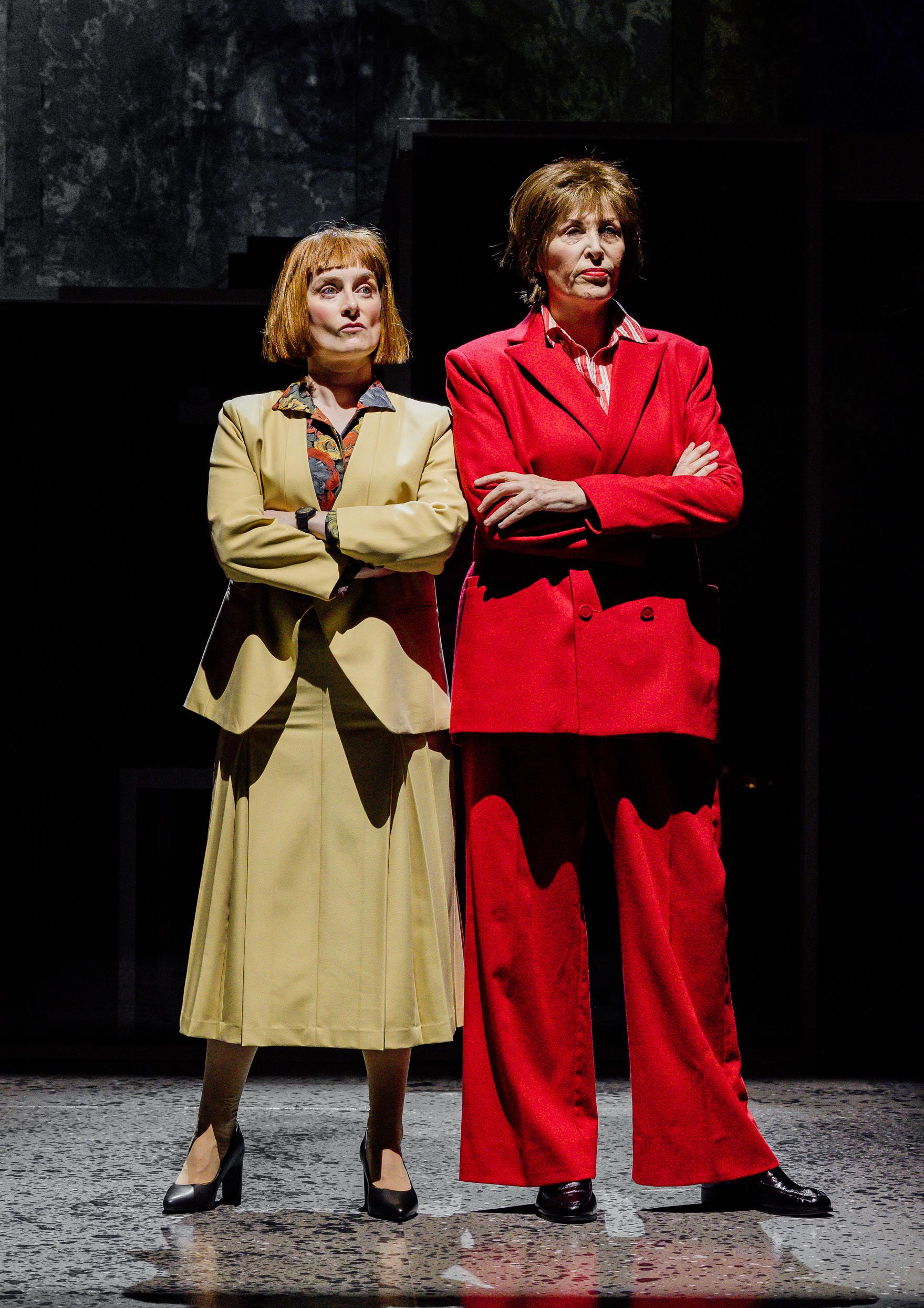
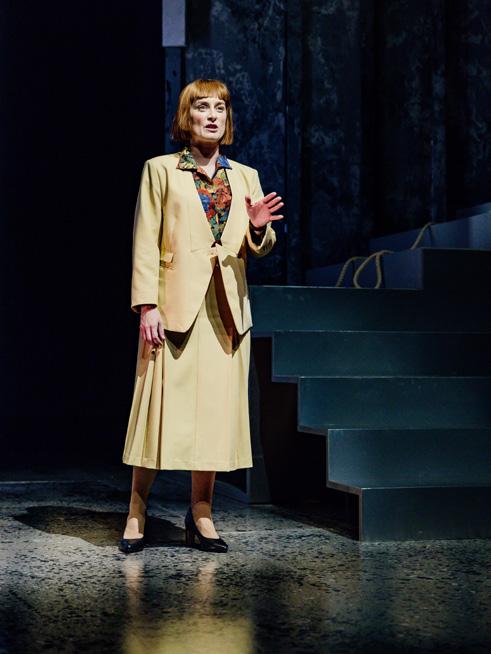
Helen the Younger now changes into her yellow suit, referred to as her “battle suit” in the rehearsal room. Helen spends a lot of time in this outfit, and the exact shade of yellow was carefully chosen. It couldn’t be too pale, as otherwise the suit would blend into the background, but it also couldn’t be too bright, as the next suit is the one that really needs to stand out.
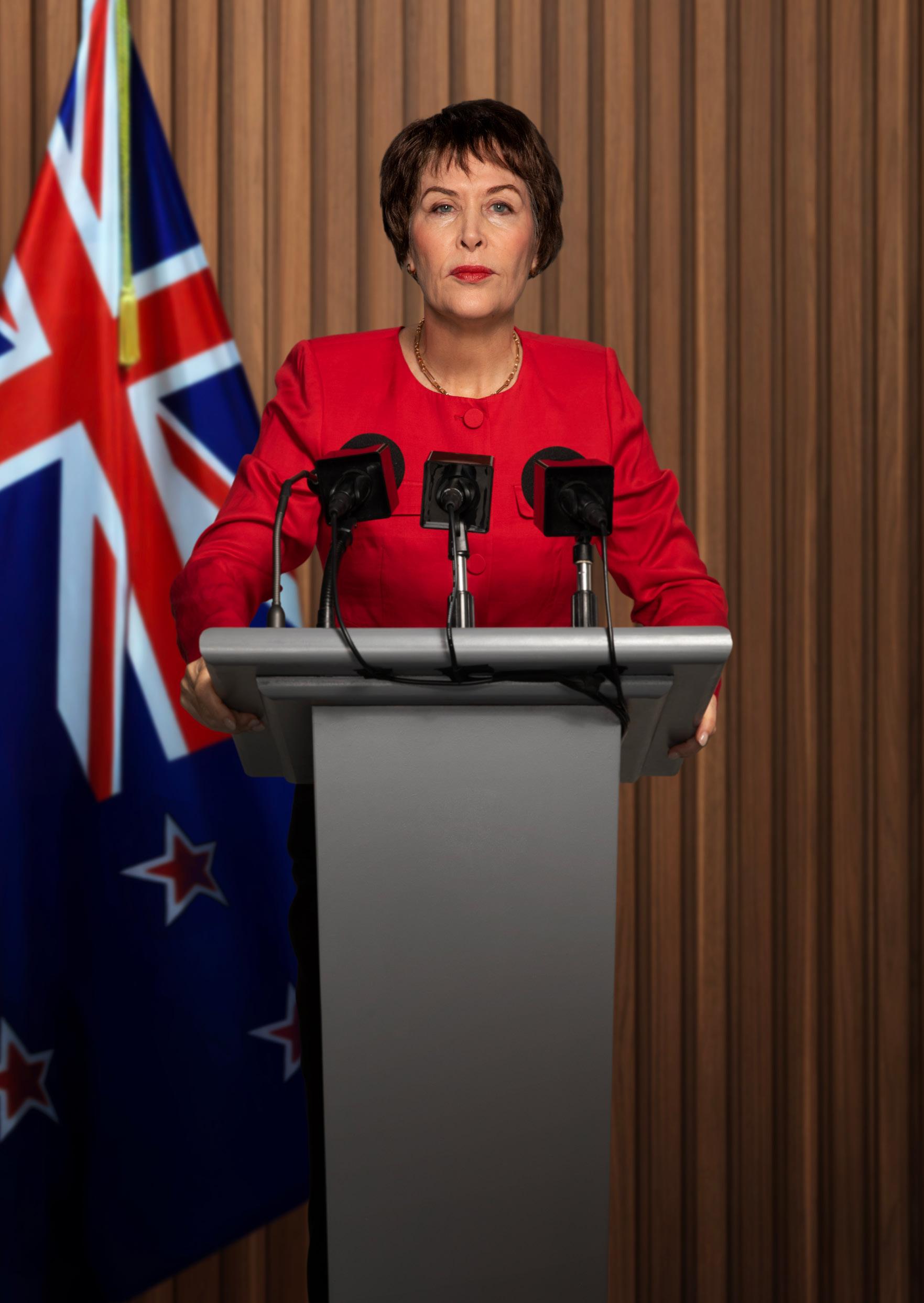
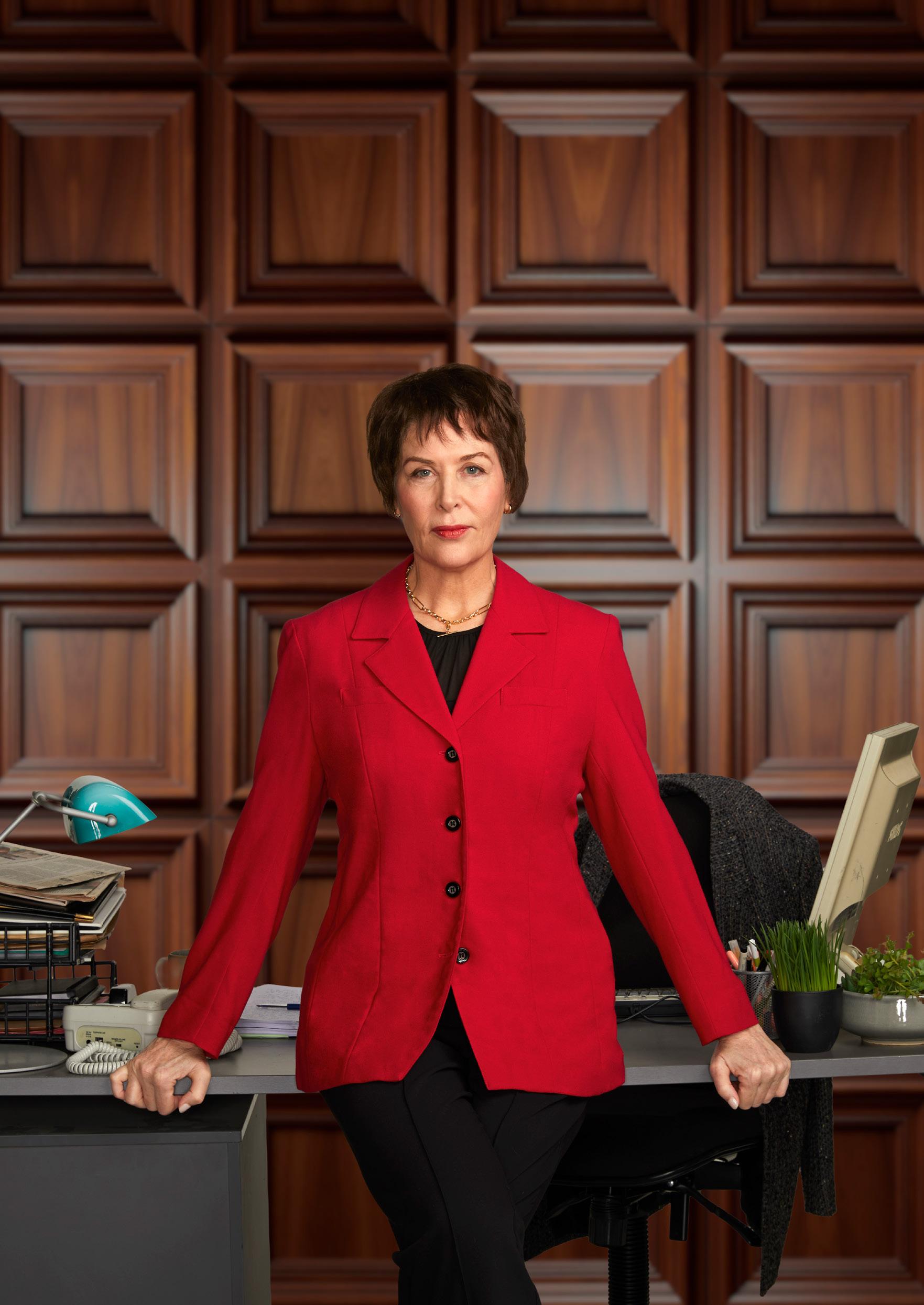
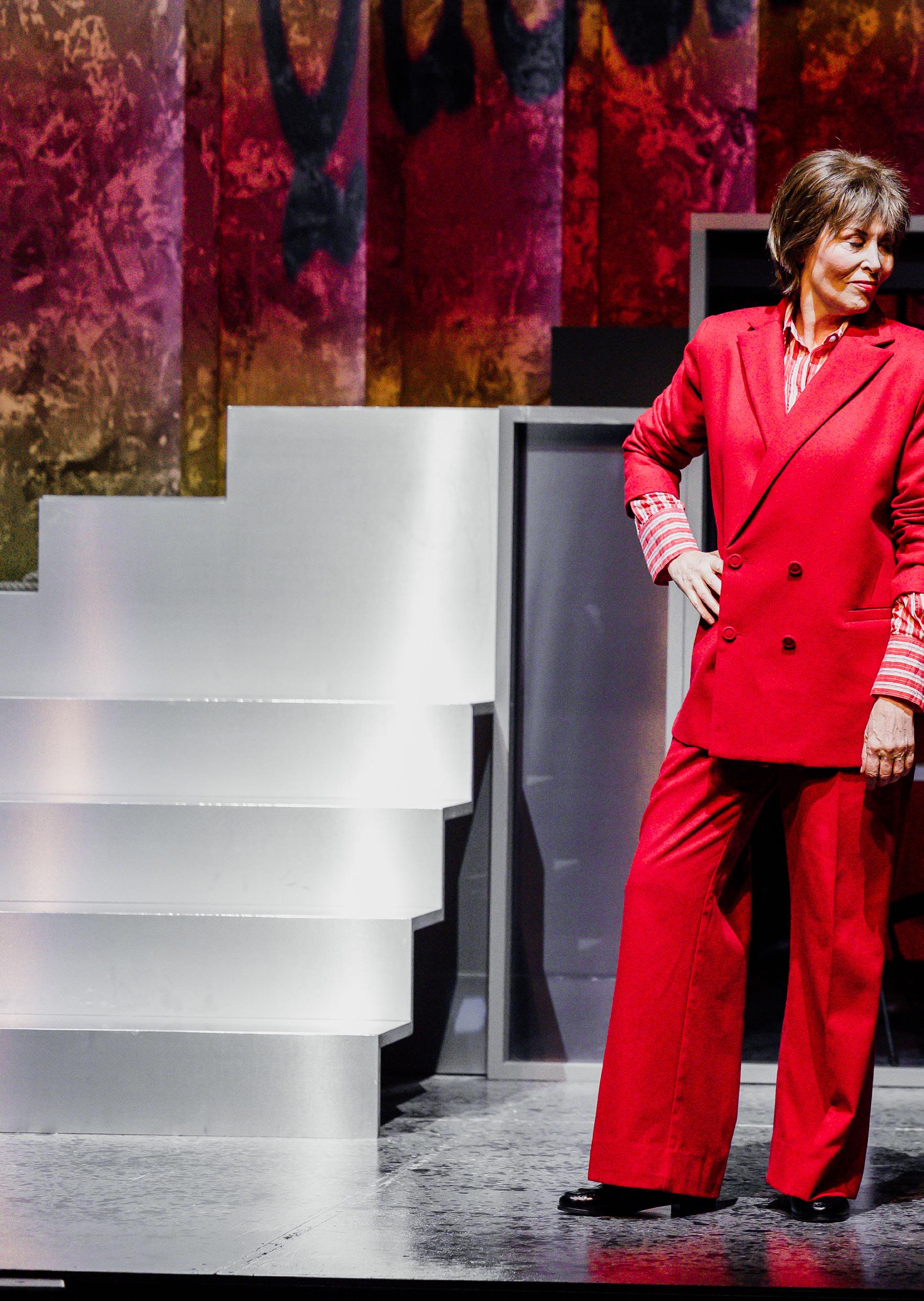
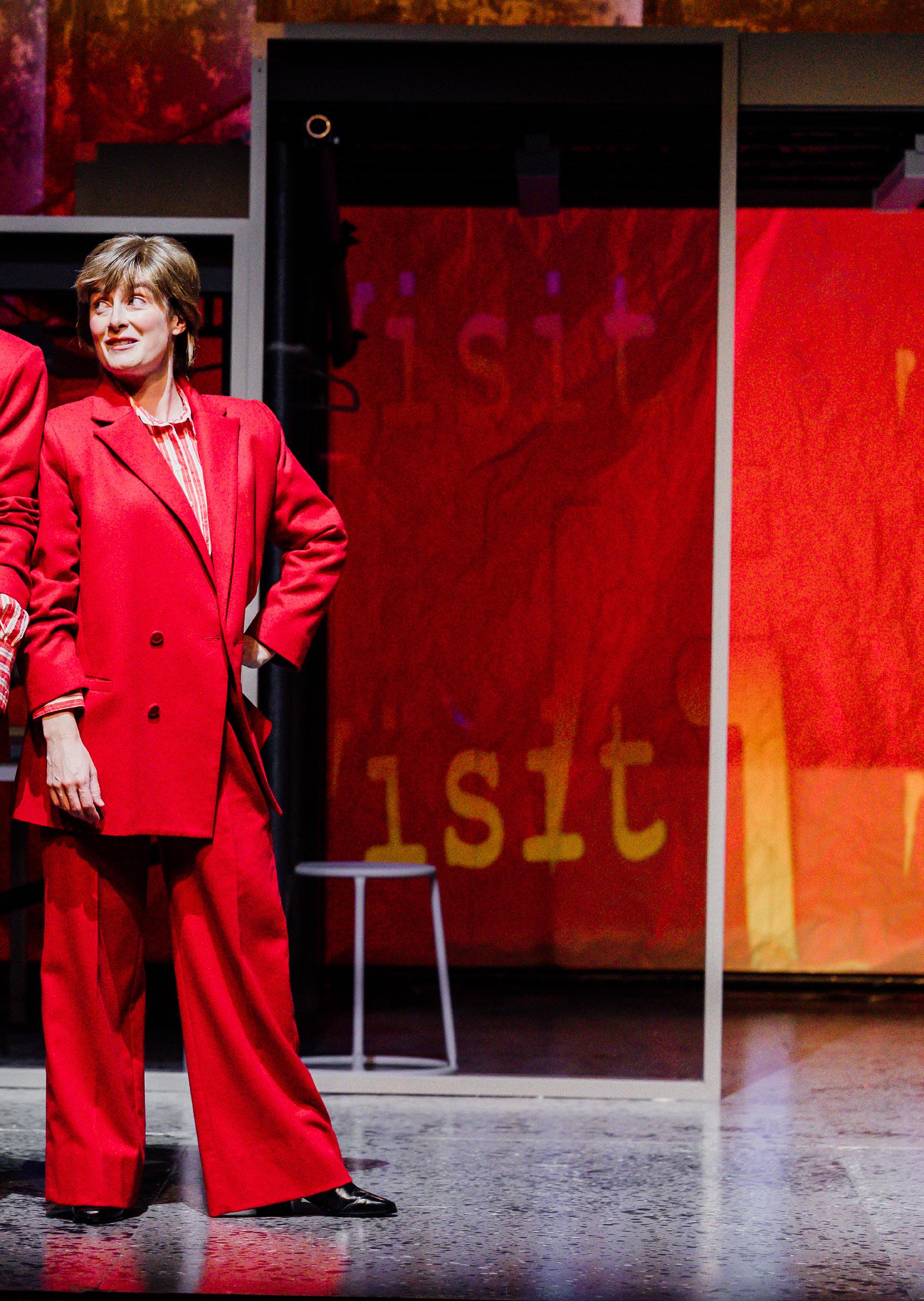
Finally, the show-stopping red suit, which both Helen the Younger and Helen the Elder wear identical versions of. This outfit is maybe the most quintessential Helen Clark look, so on stage Kirsty Cameron is making sure the colour pops - using wool to achieve the specific double-breasted tailoring, this suit has red lining, and a red shirt underneath, ensuring the audience only sees this bright and powerful red.
“...It’ll show the blood, but whatever. That’s what dry cleaning’s for.”
– Helen the Elder
Classroom Activities
This section is specifically designed to help you unpack the show and utilise the information in this pack in the classroom with your kaiako. Each section references information in the pack and is structured in the following way:
• Pre-reading/Unpacking: A literacy based activity to analyse the material in this pack
• In the Classroom: Brainstorming, prompt and practical activities to provoke discussion and help you explore the education material provided
• Revise: Questions for you to complete individually in preparation for your Live Performance Exam in November. These questions have been specifically developed from the 2026 Exam Specifications provided via the following links:
• Level One Assessment Specifications
• Level Two Assessment Specifications
• Level Three Assessment Specifications
Writing Helen Clark in Six Outfits
An “astonishing barrage of criticism she copped while going about her business”
Helen Clark in Six Outfits is a commissioned work, meaning Auckland Theatre Company has asked Fiona Samuel to write a play specifically for the company. With a two-word prompt, Samuel explored the political and personal world of Helen Clark and gave Sophie Roberts the platform to build out the world on stage. Use the following activities to unpack ideas around structure, political inspiration and telling the story of a woman in politics.
PRE-READING AND LISTENING:
In small groups read the Synopsis, Playwright’s Note and the unpacking of MMP. You might also like to reference this podcast episode, which unpacks how MMP came into beingJuggernaut 2: The wild story of the first MMP election | The Spinoff
• Highlight ideas that interest you
• Circle quotes you think would enrich an answer in an exam
• Underline and annotate ideas that link to a specific moment in the performance.
CLASSROOM ACTIVITIES
Why Helen Clark: In a short individual essay, respond to the following prompt - why do you think Helen Clark was used as the inspiration for a newly commissioned play? Ensure you include examples of specific moments from the performance. You could consider:
• Her impact on New Zealand politics
• Her gender and societal expectations at the time
• Her impact after leaving power
• Her clothing and what it communicated
• The “astonishing barrage of criticism she copped while going about her business” was this criticism valid or influenced by gender?
Reflection as a class: Using your individual essays as a jumping off point discuss the quote from Samuel - “An astonishing barrage of criticism she copped while going about her business.” Ensure that you reference specific performance moments from the play in your discussion.
Spanning 60 years - delving into structure: Helen Clark has led a prolific and storied career and like any big tale, it is difficult to fit one person’s life into an hour and a half on the stage. Use this activity to discuss how Samuel structured the play and what the narrative purpose was:
• As a class on the white board or on a big piece of craft paper rolled along the floor, unpack the structure of the play by drawing a timeline of the play. Detail the following;
• Scenes OR episodes; give them a title, e.g. “Helen’s First Outfit”
• How the “outfits” were used as a structural device
• Who are the people in this scene?
• What was the purpose of that scene or episode? What was the playwright saying with these characters at this moment?
• What symbols, themes or ideas were evident in the script/ dialogue?
• In pairs or individually (record as notes, a brainstorm, a short essay or a voice note): discuss why you think Samuel chose to structure the play in this way? You might want to think about how the following was communicated:
• Public versus private life
• How you understood the big political moments in the play
• How the play’s structure captured the breadth of 60 years
Hold onto the work that you produce in this activity to support your response to other activities in this pack, portfolio construction or when revising for your exam.
Politics, Mixed Member Proportional and the Clark Government: Helen Clark was Prime Minister during the early years of New Zealand’s Mixed Member Proportional (MMP) system. She was also the second woman to become Prime Minister and the first elected through a nationwide election. Use this activity to explore how MMP and wider political context can be incorporated into your portfolio or exam responses.
• Choose three key scenes: one prior to Helen becoming PM, the moment she becomes PM, and a moment when she is in power. Consider how MMP (e.g. coalition-building, leadership, representation) influences each moment
• Sketch and annotate the three moments, including detailed visual and staging choices
• Under each sketch, describe what is happening referencing drama techniques, elements, and conventions, and explain how these communicate aspects of MMP politics
• Include quotes from the play that reflect the political context and ideas linked to MMP.
Individual reflection: What did you learn about New Zealand politics and Mixed Member Proportional through these moments? How were these ideas highlighted through drama components, and why are they important in telling Helen Clark’s story?
Theatre as a place for public debate and reflection
Directing Helen Clark in Six Outfits
When revising for your live performance exam or building your portfolio, analyse what the director aimed to communicate through their choices. For Helen Clark in Six Outfits, a new work of Theatre Aotearoa, consider its whakapapa and how it reflects cultural, social, and political contexts past and present. These activities will help you generate ideas and gather evidence to support your exam responses or portfolio.
• If you recorded the post show forum, find excerpts where Sophie Roberts answered questions:
• Write down ideas that interest you
• Record quotes you think would enrich an answer in your report or exam
• Record moments in the forum that surprised you or provided more context for something you saw on stage.
PRE-READING AND LISTENING
• In small groups read the Notes from the Director
• Highlight ideas that interest you
• Circle quotes you think would enrich an answer in an exam
• Underline and annotate ideas that link to a specific moment in the performance.
CLASSROOM ACTIVITIES
Theatre as a space for public debate and reflection: Roberts explores the idea that theatre functions as a forum for public debate and reflection through her direction, which is especially significant when examining a politically themed play. As a class, brainstorm how this performance
demonstrated this, providing detailed examples from the performance. You could do this on a large piece of paper or on the white board. (Make sure you take a photo of your brainstorm and save it in a shared digital space for portfolio construction OR exam revision.)
Practical activity - In small groups, choose a moment where political debate or reflection was clearly evident. Use this as a stimulus to devise your own performance. You may use the same characters or create a new scene inspired by the play. Consider incorporating drama conventions such as narration (breaking the fourth wall), asides, split stage, or chorus of voice/ movement. Share your performance with the class and reflect on how it helped you engage with the ideas in Helen Clark in Six Outfits.
Occupying public space as a woman: Helen Clark in Six Outfits is written as a two-hander, where Helen the younger and Helen the older explore her political lineage through six outfits. Through Samuel writing and Roberts’ directorial choices we explore the impact of a woman occupying public space. In small groups or pairs use these prompts to brainstorm how this was realised on stage:
Consider:
• What Roberts means by the statement “occupying public space as a woman ”
• Think about Samuel’s purpose for writing the play and how this highlights or unpacks the way Helen Clark occupied public space
• What did you think about at the time and what have you thought about since.
Research: Research Helen Clark’s career and discuss how the play has explored aspects of her life realistically or where artistic license was taken to make a specific point. Think of two to three examples to discuss and think about how these were realised on stage through directorial and design choices. Bring your examples back to the class and make detailed notes on the whiteboard or a shared document to use in the next part of the activity.
Discuss and extend - in groups brainstorm around the prompts below. Discuss what you think Roberts intended to communicate through her directing choices.
Prompts:
• In the rehearsal room: how do you think the idea of Helen occupying a public space was explored in the rehearsal room and how does this connect to what you saw on stage?
• The big themes and intentions: identify other themes or intentions that Roberts had for the piece or chose to highlight through design or directorial choices. How were Helen the younger and Helen the older represented and why was this important?
• Style and flair: can you identify a specific style or aesthetic in the way the performance was pulled together. What do you think Roberts intended to communicate through these choices? How did the way play was written influence this style?
REVISE - (COMPLETE THESE AS YOU STUDY FOR YOUR EXAM)
Directors’ concept:
• Discuss the purpose of the performance and how the themes or ideas link to what is happening in the world; socially, politically or historically. Link your ideas to specific moments or examples from the performance:
• How did the way the performance was realised impact the style of delivery of the narrative/story?
• How does the content of the play challenge and serve the audience?
• Discuss how the director brought the story to life using Drama Components - Elements, Conventions, Techniques and Technologies
• What do you think Sophie Roberts is asking you to think about in the way she has directed Helen Clark in Six Outfits :
• How did the acting and staging choices affect you as an audience member?
Drama Elements and how they draw our attention to themes, motifs and symbols:
• What were the main themes, questions and ideas evident in the performance? Link these themes, questions and ideas to specific moments or examples from the performance
• Identify recurring symbols or motifs throughout the performance. Explain why they were important in helping you understand ideas being communicated in Helen Clark in Six Outfits
• How do these themes, symbols or ideas link to the wider world of the play and what impact does this have on the audience?
• Were there moments where the content was confronting or forced you to think about something in a new light? What impact does this have on the audience and you as a member of the audience?
• Reference the wider reading and historical context in this pack, as well as research material you have brainstormed and think about the impact these themes, symbols or ideas have on the lives and arcs of the characters in the play.
Drama Conventions - strategies established to make meaning and connect to wider context:
(NB - make sure you are familiar with what the established Drama Conventions are by discussing this with your teacher)
• Identify a moment in the performance where Drama Conventions were used to transform the space:
• Explain how the convention or combination of conventions were used in the performance
• Discuss the impact of the use of the convention or combination of conventions in this moment
• Discuss how meaning was created for you, as an audience member, in this moment
• Discuss how the use of a convention or combination of conventions in a specific moment helped you think about the big ideas and themes of the play:
• What was the wider context (socially, historically, politically or geographically) that this moment linked to?
Design
PRE-READING
Using the design interviews, complete the chart below to collate important information from the pack.
Technology Designers intention
E.G. costume
E.G. Lighting
IN THE CLASSROOM:
Examples of how this was realised
Helen and her six outfits - split into six groups, designating each group one outfit each. Sketch the outfit in detail. You could also pull imagery from the media or the education pack. Around your sketch, annotate the following:
• The colours, fabric, cut and design of the costume
• The symbolism and motifs represented through the costume
• The specific age Helen was and what stage of her life she was in
Tack each of the sketches up onto the white board or the wall or across the floor. Discuss and brainstorm the following as a class:
• What did the costume design communicate to the audience?
• What thoughts, ideas and feelings did the design evoke in the audience?
• What was being communicated about the person Helen, through the choices made? Do these decisions reflect reality or do they diverge from reality for a specific reason?
Discuss the sketches in detail, unpacking the meaning of the costume choices and their impact on the audience.
Individual reflection (write a short essay, create a presentation or record a voice note): Why do you think the playwright chose fashion as a device to tell this story? How did the costume designer and director’s interpretation of
Influence of te ao Māori / mātauranga Māori
the costuming communicate important ideas and themes about Helen Clark’s life and story to the audience?
A set that is anything but comfortable - Split into five groups, taking a prompt from below each, brainstorm, pull specific examples from the production:
• What were the main materials used in the set? What was the purpose of these materials?
• What did the symbol of the mountain mean within the play? How did the actors interact with it?
• How did the set designer reflect scope and scale?
• How did the set help the audience move between intimate and epic moments?
• How did brutalist architecture influence the set design? Why was this important to New Zealand politics?
Once you have a comprehensive brainstorm, reflect on the following question as a group: How did the set design reflect the political landscape of Helen Clark’s career and how does it reflect our current politics?
• Circle ideas on your brainstorm that help to answer these questions
• Add further ideas that the question prompts you to think about
After reflecting in your groups, discuss this question as a whole class and pull your ideas into a big class brainstorm. You could do this on the white board or on a big bit of craft paper. It might help to blue tack your individual brainstorms to the wall to help you collate. As you brainstorm, answer the following questions:
• What did the set design make you feel and think at the time?
• What has it made you think about since?
• What was the most evocative element of the design?
Individual reflection activity - In a short essay discuss why the inspiration for set design was purposefully uncomfortable and why this was important in telling this story.
How audiovisual elements distinguish between Private and Public Life - like any public figure, there is a tension between their public and private lives, and how this is navigated. The play’s design uses audiovisual elements to both differentiate and explore this idea with Helen. Use the following sketching and annotating activity in small groups to explore how this was communicated to the audience:
• Choose a moment where the use of audiovisual transitions the audience from a public moment to a private moment, or vice versa
• Create three sketches:
• The first moment, the transition, the second moment
• Annotate how audiovisual elements were used in this moment, using specific drama language and details from the performance
• How did other technologies interact with this moment?
• How was tension, focus, atmosphere and mood created?
• Were there specific details about time or place? How did this transport you?
• How was the space transformed in this moment? (Level 2 Specifications)
• Annotate what was being communicated about the character or story at this moment?
• Why was it important to highlight this public vs private moment of Helen’s life?
• How did it serve the story being told?
Reflect as a group or individually (record as a voice note discussion or in writing): What did this moment make you think about or feel? How did it expand your understanding of the main ideas or themes of the play?
The influence of Print Media on Character - while the costumes for Helen are rooted in reality, the characters who support the narrative and populate the world have been inspired by the world of politics and print media - specifically political cartoons. Theatre form is also woven into this element of the design with influences of Commedia dell’Arte. You could use this resource from Whakaari Aotearoa Drama New Zealand if your kaiako/teacher is a member: https:// www.drama.org.nz/resources/theatreform?rq=commedia
In pairs, research the history and style of New Zealand Political Cartoons, you could start here:
• Cartoons - New Zealand Parliament
• New Zealand Cartoon and Comics Archive
• Cartoon | NZ History
Look for specific cartoons that speak to Helen Clark’s political career and discuss what they are depicting, their style of drawing and whether there is more at play than just political commentary, for example; do they hone in on the fact she is a woman? Overt focus on appearance?
Using the ideas you have discussed when researching cartoons; choose one of the characters that flesh out the play to focus on. Create a sketch in the middle of an A3 or large piece of paper of the costume. Add in the prop elements that are 2D/cartoonish. Around the sketch create a collage with annotations of the following:
• Political cartoons that might have been inspiration; style, specific cartoonists
• Annotations about prop or costume elements that link to Commedia
• How the costume/props communicate the characters purpose in the narrative
• Identify the specific features that have been emphasised (e.g. eyes/ eyebrows) and discuss what was being communicated through this choice
Share your sketch and research with another pair or with the rest of the class, and display them or keep a digital record for revision purposes.
Class reflection (record this discussion via voice note OR whiteboard brainstorm): Why was this an effective costuming and prop device in communicating ideas about the supplementary characters within the play? How did it contribute to the overall design concept?
REVISE - (COMPLETE THESE AS YOU STUDY FOR YOUR EXAM)
• Discuss how technology or design was used during a climatic moment in the performance? What do you think was at stake within the scene?
• What was the impact of the way the design, directorial, and acting choices worked together? Choose a moment that surprised, shocked, or excited you to talk about
• Discuss why the use of sound and lighting design was integral to this performance? Focus on the mood created by sound choices, use of colour and the shapes created by the angles or composition of lighting
• How were design and directorial elements (props, setting, AV, costuming, audience positioning and interaction) and the Drama Elements used to build the performance? How did this make you feel as a member of the audience?
• Discuss the inspiration for a specific element of the design and link it to wider context; social, political, historical or geographical? How did this deepen your understanding of the themes and ideas the play was communicating?
Technology: link your ideas to specific moments or examples in the performance. Think about lighting, set, sound, props, costumes, make-up and how this helped bring you into the world of the play.
• How was technology used to create the atmosphere in the performance?
• How was technology used to highlight important ideas, themes and symbols in the performance?
• How was contrast and/or focus created or built through technology and why was this important?
• How did the use of technology help you gain a deeper understanding of the themes of Helen Clark in Six Outfits?
• How were technologies used in combination to transform the space in a specific moment? (Level Two students must revise this question)
• How did technology highlight the different characters’ motivations expressed within the performance?
• Discuss why this was impactful, exciting or challenged your expectations
• How were costumes used to communicate the characters’ purpose in the performance?
IMPORTANT NOTE: When you are writing about Set or Costume, you need to be specific about the following details and also sketch what you see. Imagine the person you are writing for has not seen the production and create a vivid image in their mind of what you saw:
• For example: Set/Props
• The size, shape and dimensions of any set pieces or props used
• The materials used, their textures and the colours.
The Characters of Helen Clark in Six Outfits
When you are thinking about an actor’s performance in an exam or portfolio, you will want to build a comprehensive profile of how they used their body, voice, movement and use of space. You will want to link these details to specific moments in the performance, describing what was happening on stage and linking to big ideas and wider context.
PRE-READING AND LISTENING
• In small groups read the “Meet the Characters” and the interviews with Jennifer Ward-Lealand and Lauren Gibson.
• Highlight ideas that interest you
• Circle quotes you think would enrich an answer in an exam
• Underline and annotate ideas that link to a specific moment in the performance.
• If you recorded the post show forum, find excerpts where the actors answered questions:
• Write down ideas that interest you
• Record quotes you think would enrich an answer in your exam
• Record moments in the forum that surprised you or provided more context for something you saw on stage.
IN THE CLASSROOM
Exploring Helen - two actors realise Helen at different ages: Jennifer WardLealand and Lauren Gibson play Helen at the different ages and stages of her life, from feisty young woman to the powerhouse politician and beyond. Individually, create character technique profiles for both actors, unpacking their unique use of Voice, Body, Movement and Space to portray Helen. You could use the following template to guide you:
Description of how the actor portrayed Helen: what did the actor bring to the character in terms of their choices around voice, body, movement and space?
Costume and makeup (choose the outfit you felt was most iconic): colour, material, what this says about the characters they play throughout the performance, how it impacted posture and movement
Motivations: what motivates them throughout the play, think about their intentions and objectives, what are they trying to achieve?
Subtext: think about specific moments where a character was communicating through subtext
Favourite quote:
Use the information above with the following activity to explore the contrasts and the similarities demonstrated by both actors in realising their portrayals:
• Choose one moment or scene where both actors used their drama techniques to portray Helen in a similar way AND a moment or scene where they portray Helen in a completely contrasting way:
• Sketch both moments, outlining where the actors were positioned, considering proximity, personal and general use of space and levels (consider how they are using the set)
• Annotate how the actors used their voice, body, movement and space in these moments to express Helen, be specific about how their use of techniques was either similar or contrasting
• Reflect on the purpose of the acting choices in these moments. Underneath your sketches write 100 words about why it was important to see a contrast or obvious similarity. You could consider:
• What the playwright intended to communicate in this moment
• What the director might have encouraged in this moment
• Why seeing a similarity or contrast in acting choices was important to the story being told.
Commedia and the characters who people the world: The stylistic design for characters in Helen’s world drew on Commedia dell’Arte, using costume and props inspired by contemporary political cartoons. This also shaped the acting: Helen remains grounded in realism, while these characters are more two-dimensional. Use this activity to explore this contrast and how voice, body, movement, and space were used. Divide into six groups, each focusing on one character. Using your sketch from the design section of this pack (or creating a new one), annotate:
• How voice, body, movement, and space were used
• Commedia dell’Arte features, with detailed examples (e.g. slapstick, action/reaction, status, audience interaction, exaggerated gestures)
• The character’s purpose in the story
• Acting choices showing the character as Helen’s interpretation, not an independent figure
• Examples of social satire or currentaffairs referenced in their dialogue
Your final sketch should thoroughly analyse the character from both a drama technology and techniques performance perspective.
Individual Reflection - write a short essay or record a voice note about why this character was integral to the story being told. Discuss why you think these characters were written and portrayed in the way they were.
• Thinking about the actors and the way they created their characters:
• How did they use techniques to create a sense of time and place?
• How did they use techniques to communicate their history?
• What social or political ideas did they represent within the play? How did they use techniques to communicate this?
• How did an actor use drama techniques to communicate subtext in their performance? Use a specific moment and example to discuss this use of subtext.
Character:
REVISE - (COMPLETE THESE AS YOU STUDY FOR YOUR EXAM)
Drama Techniques: Body, Voice, Movement and Space:
• Describe how an actor who you found interesting or compelling used drama techniques in a specific moment in the performance
• Describe how two actors used proximity during a moment of tension
• Explain another actor’s use of drama techniques and how they transformed the space within the performance
• Choose specific moments where you felt the actor used their body, voice, movement, and space in combination, to create impact, focus, or to support an important idea/theme
• Discuss what a character communicated to the audience; how did the actor portray them? Plot their character arc and describe how they use techniques to communicate this.
• Discuss the purpose of the characters:
• What impact do they have on the narrative, as well as the audience and actors’ relationship?
• How does the actor’s use of techniques communicate their purpose in the performance?
• Explore the ensemble of characters as a whole: what purpose do they serve in the narrative?
Theatre AotearoaTheatre’s ability to heal, educate, entertain and transform
Titiro whakamuri, kōkiri whakamua – Drama is influenced by whakapapa and is a way to respond to and share identity, culture, and perspectives
If you are a Year 11 student viewing Helen Clark in Six Outfits, this section of the pack will help you to unpack and explore the play and apply that learning to an internal achievement standard in 2026. For Year 12 - 13 students this section of the pack aims to extend your understanding of theatre and its function. It will also prompt you to think about how what you see at the theatre can connect with work you are doing in class.
An aspect of the significant learning done at Level One of NCEA is to “contribute to theatre Aotearoa and understand that drama is a way to explore and reflect on whakapapa.” You may be doing this through exploring plays written by Aotearoa playwrights in class, performing scenes from those plays, discussing the function of each play and how they connect with an audience.
THINKING ABOUT HELEN CLARK IN SIX OUTFITS AS A NEW THEATRE AOTEAROA PLAY:
Activity: As a class brainstorm all the ways that the performance was firmly rooted in Aotearoa and spoke to a local audience. Include the following examples in your brainstorm:
• Language or quotes that are specific to Aotearoa
• Accents, acting style
• Specific design choices that reflected our place in the world
• Key scenes or viewpoints represented, that reflected Aotearoa
Take a photo of this brainstorm and keep it in a shared digital space so you can reference it throughout the other activities in this pack.
Function in this section refers to: the plays ability to heal, educate, entertain or transform an audience.
In small groups or in pairs, brainstorm, research and record responses to the following questions. (A mode of recording has been suggested for each question in order to enrich your literacy skills):
THE FUNCTION OF HELEN CLARK IN SIX OUTFITS
:
Brainstorm with pen and paper. Ensure you explore and debate the four words encompassed in the definition of function and then construct a written response that focuses on a specific scene.
• What ideas, themes or messages are being communicated to the audience?
• What impact is that having on the audience?
• How are these ideas healing, educating, entertaining or transforming the audience?
• Can you connect this to a specific scene or moment from the performance?
CONNECTION WITH THE AUDIENCE:
Record a verbal discussion where you talk about the following questions. You could brainstorm the questions first, but it is important you don’t script your response.
• Who do you think the intended audience is and why? Who do you think Fiona Samuel wrote this for and why?
• Why is this play relevant in 2026?
• What draws you into the story? The actors, the design, the writing, the themes and ideas? Discuss why.
• What were you feeling throughout the performance?
• What have you thought about since?
You could use the following resource to support you: Purpose and Audience Analysis
COMMUNICATING FUNCTION THROUGH DRAMA TECHNIQUES:
these activities are based around developing the skill of sketching and annotation. You can cover one, some or all of the activities.
• Character’s connection to Helen Clark in Six Outfits: Look at the characters or viewpoints of people represented in the scenes and explore their connection to the thematic content of the performance. Use these questions and the information in the front of this pack to guide you. Create a diagram that represents each character’s stance or viewpoint, and explore why this is important when discussing the themes and ideas
evident in Helen Clark in Six Outfits. You could choose a couple of scenes to focus on.
• What do you know about Helen Clark and the characters in the play - ethnicity, where they are from, their whānau, their upbringing - how does this influence the way they view the world?
• What is motivating or driving them? Why do you think they behave the way they do around the core issues of the play?
• What are key quotes that capture the personality, beliefs and aspirations of the characters? How does this impact how they view the world, especially their connection to the whēnua; Aotearoa New Zealand?
• What are their relationships like and what does this say about the way they act on the issues and themes evident in the play?
• Role on the Wall: Choose a character or viewpoint you found compelling or impactful. In a Role on the Wall explore how the actor used techniques to support the function of the play. Narrow this down to a single moment.
Role on the Wall instructions:
• Draw the outline of your charactercould be a gingerbread man shape, stick figure, etc.
• On the outside you will note the external drama techniques you see the actor using in a specific moment, that communicate the function. Use of body, voice, movement and space
• On the inside you will think about or imagine what might be driving these choices; emotions, motivations, subtext.
• Mindmapping: Looking at the drama elements, choose one that you felt was highlighted in a moment in the performance that communicated the function. Create an extensive mind map which details how that element was brought to life through the script, the characters, directorial and design choices.
• For example:what does the time and place of the action communicate to the audience about Aotearoa New Zealand and the themes and ideas that Samuel is trying to unpack?
• Storyboarding: Choose a moment where a specific drama convention highlights the function. Map out on a short storyboard with captions, how the convention was used, detailing what you saw on stage and what it communicated to the audience.
• Sketching and annotating: Choose a moment where technology was used to highlight the function. Sketch how this looked on stage and annotate comprehensively.
BRINGING IDEAS TO LIFE THROUGH PLAY: these ideas could contribute towards or become provocations/ stimulus for devised drama.
• Choose a line from Helen Clark in Six Outfits that you found compelling or impactful. Discuss why as a group.
• Break down the line, think about what it means and what it represents in the play, how it might heal, educate, entertain or transform. What does it make you think about and feel? Does it call you to action?
• Develop a short scene that explores what you have discussed using conventions and elements.
• Prior to performance explain how your short scene connects to the line you have chosen and how it heals, educates, entertains or transforms.
• Make sure that you choose conventions and elements that will communicate your ideas in a coherent way.
• Choose a moment in the performance where you could add more information about a character or an event. This could be prior to the play beginning, during the narrative or what happened next.
• Develop a short scene using conventions and elements
• Discuss together how this scene extends on ideas in the play
• Prior to performance explain how your short scene heals, educates, entertains or transforms the audience. Discuss how you have used conventions and elements to communicate this.
REFERENCES
Drama | NCEA
Explore the function of theatre
Aotearoa | NCEA
Helen Clark in Six Outfits and Level One NCEA
“Drama transforms the tangible into the intangible.”
This section of the education pack is designed to support Level One drama students navigate the new Level One external Achievement Standard 91943 - Respond to a drama performance. Unlike the Level Two and Three external standards, which are an exam, you will be constructing a portfolio over a period of time in class. It will be based around three key aspects:
• key message of the performance, the use of drama components and your own personal response about how you connected to the performance, capturing the wairua (spirit) of what you watched.
This portfolio will be presented as a slideshow or PowerPoint and can be a mixture of written and audio visual material - the main question you should ask yourself as a student is; how do I communicate my ideas, thoughts, and feelings about what I saw, the
best? With that in mind, you are encouraged to collect your thoughts, discussions and do your research in a range of formats. Such as; voice notes, sketches and annotations, brainstorms, moodboards, recorded physical responses and writing.
Kaiako and ākonga please ensure you read this year’s assessment specifications carefully as you prepare to submit this assessment. You can access the specifications via this link: NZQA Assessment Specifications - Level One
Below are three activities to support you to expand your ideas and support you during the teaching and learning phase of unpacking the performance.
KEY MESSAGE:
In pairs, small groups or as a whole class, discuss and brainstorm the following prompts:
• What do you think Fiona Samuel was trying to say? Why this story? Why these characters? Why this period of time?
• What do you think Sophie Roberts was trying to communicate through the directorial choices she made? How does this connect with what Samuel has written?
• What do the characters in the performance represent and what do they communicate to the audience?
• What do you think the designers are trying to communicate through their choices? How does this bring Samuel and the director Sophie Roberts ideas to life?
Once you have brainstormed around these questions, you could journal, voice note or record thoughts around the following questions:
• How do you identify the key message of a performance?
• Can there be multiple key messages?
• Think about your interpretation of the performance - what was the key message to you?
• What physical evidence from the performance connects to the key message? This could be a scene, a moment between characters, dialogue, a moment where the use of technology highlighted an idea.
• Describe these examples and sketch them in specific detail.
USE OF DRAMA COMPONENTS:
Drama components are techniques, elements, conventions and technologies. Make sure you have explored this language and terminology with your kaiako.
Now that you have fleshed out what the key message might be, you need to connect it with the choices that the director, designer and actors have made and how they have used the drama components in combination.
Brainstorm in small groups, or in pairs:
• How an actor used drama techniques in a moment that communicated the key message
• How elements created a sense of mood, atmosphere or tension
• How conventions were used throughout the performance
• How technology enhanced the story being told
WAIRUA OF PERFORMANCE AND PERSONAL RESPONSE:
In the unpacking on the NCEA website for this standard, this aspect of the assessment is unpacked in detail. Your teacher will support you in understanding this and guide you to explore, research and develop your ideas.
Auckland Theatre Company have included interviews from Roberts, Samuel and the creative team. You will want to reference this in your portfolio construction.
“The wairua of the performance is experienced as the intangible energetic and emotive qualities that carry the spirit and intention of the play. How the wairua is expressed by the performers provokes a response from the audience and allows them to reflect on the ideas and themes of the play based on their own life experiences and perspectives.”
- 1.4 - Unpacking
• What thoughts, ideas and feelings did the performers provoke in you?
• What have you reflected upon since watching the performance?
• What have you been thinking about (head) and feeling (heart) since?
• What did your gut/sense of intuition communicate to you as you watched the performance?
• What life experiences or perspectives do you bring? What connections did you make?
REFERENCES
Drama | NCEA
Level One External Specifications
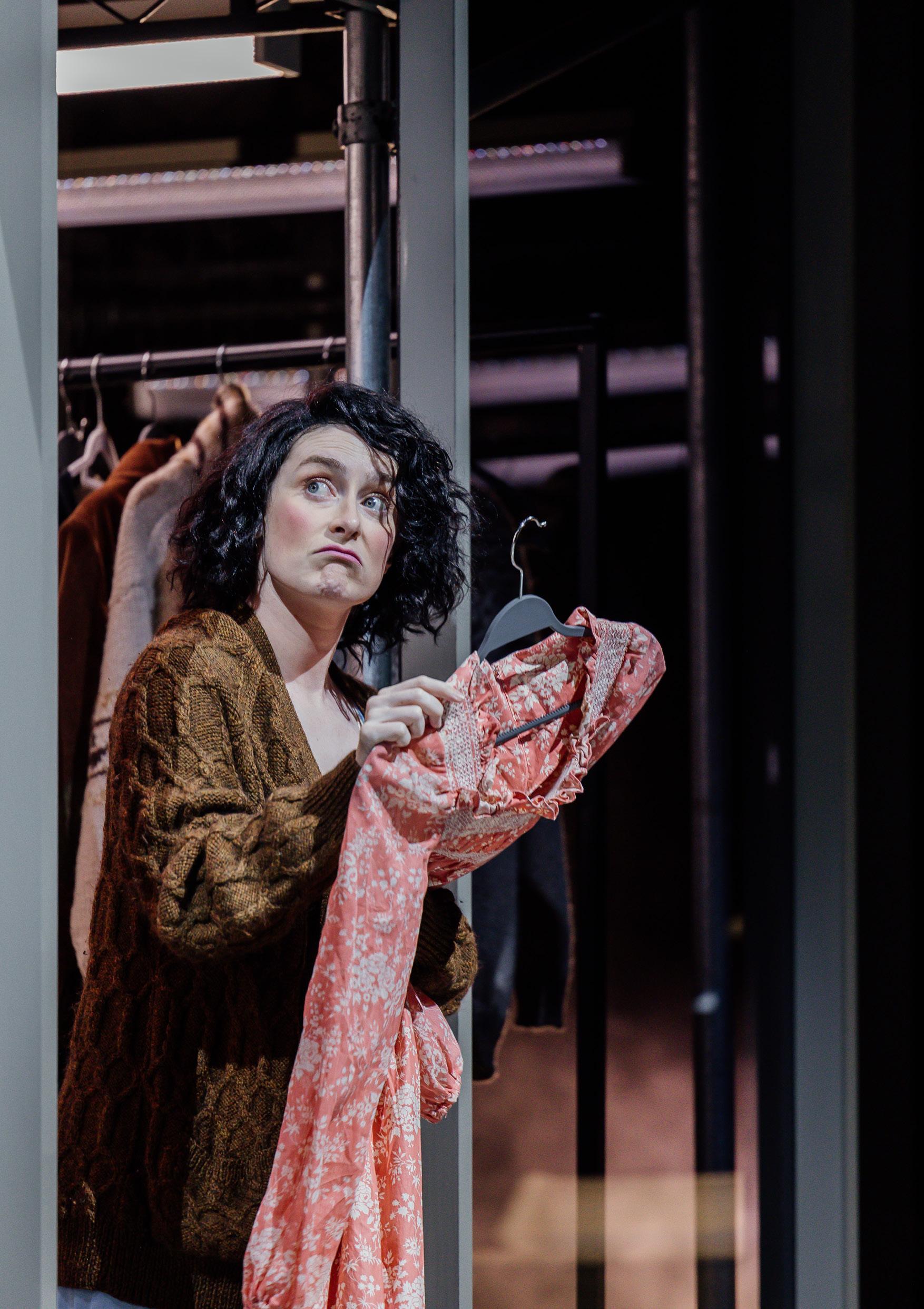
APPENDIX
Glossary
The 2030 Agenda for Sustainable Development - a set of 17 sustainability goals, adopted by UN members in 2015, with the intention to see global sustainability by 2030.
Anti-Smacking Bill - The Crimes Amendment Act 2007, colloquially called the “anti-smacking bill,” removed the legal defence of “reasonable force” for parents being prosecuted for assault on their children.
Apartheid - a system of racial segregation that was used in South Africa from 1948 to 1994. Referenced in this play in relation to the 1981 Springbok Tour, where the country was divided on if South Africa’s continuation of apartheid should prevent New Zealand from playing rugby against them.
Bernina - a brand of sewing machines.
Billiard Room - now the Grand Hall, this was a socialising room for the MPs at Parliament. Helen Clark has described it as having some armchairs tucked behind screens in a corner of the room as the “women’s area.”
Bob Chapman - political scientist and historian. Professor in the Department of History, and later the foundation chair of the Department of Political Studies at the University of Auckland.
“The Bomb” - referenced in this play in relation to widespread protests against nuclear weapons testing in the Pacific.
Brian Edwards - best known as a radio and television interviewer, Edwards is a prolific media broadcaster and author. Writer of “Helen: Portrait of a Prime Minister.”
Butch and Sundance - a reference to the 1969 Western film “Butch Cassidy and the Sundance Kid.”
Caucus - a collective term for all the members of a party sitting in parliament.
Civil Union - a legal relationship giving partners the same rights as married couples. Referenced in this play in relation to the Civil Union Act 2004, making it legal for same-sex couples to enter into a civil union.
“Closing The Gaps” - a policy of Helen Clark’s government aimed at targeting inequality, specifically to assist socio-economically disadvantaged Māori and Pacific Islander groups in New Zealand.
David Lange - leader of the Labour Party from 1983 and eventually Prime Minister from 1984-1989. Helen Clark has described his advocacy for a nuclear-free New Zealand as being his legacy.
Denis Welch - best known as former political diarist for the Listener magazine, Welch is an author and journalist. Writer of “Helen Clark: A Political Life.”
Foreshore and Seabed Act - a controversial bill passed in 2004, this declared that the New Zealand Crown owned public foreshore and seabed areas. This was at odds with many Māori groups who claimed Māori ownership, due to the Treaty of Waitangi and historical possession of land. This bill has since been repealed and replaced with the Marine and Coastal Area (Takutai Moana) Act 2011.
Geoffrey Palmer - leader of the Labour Party and Prime Minister of New Zealand from 1989-1990. He is known for being one of the advocates for the MMP system.
Germaine Greer - an author regarded as a key voice of the feminist movement, she is the writer of “The Female Eunuch.” Referenced in this play in relation to her 1972 tour of New Zealand, where she received indecent language charges for her usage of swear words.
Heather Simpson - New Zealand civil servant, she began working with Helen Clark in 1987 as a policy advisor. She continued working with Clark for 20 years, including becoming Chief of Staff when Clark was Prime Minister.
The Hillary Step - a vertical rock face on Mt Everest considered the most technically difficult part of the Everest climb, and the “final challenge” before the summit.
Homosexual Law Reform - the 1986 act legalising consensual sexual practices between men, and setting a uniform age of consent at 16.
Invasion of Iraq - in 2003, the U.S led troops with various allies into Iraq for the purpose of disarming them of weapons of mass destruction. This invasion is considered the first stage of the Iraq War, and was strongly opposed by several countries, including New Zealand.
Jane Daniels - fashion designer. She began her own label in 1986, and was the main designer of Helen Clark’s wardrobe while she was Leader of the Labour Party.
Jenny Shipley - Prime Minister of New Zealand from 1997-1999, and leader of the National Party until 2001. Most well known for being the first female Prime Minister of New Zealand.
Joan of Arc - patron saint of France. She was a key leader for France in the late 1420’s, during their war with England, called the Hundred Years’ War.
John Key - leader of the National Party from 2006, and Prime Minister of New Zealand from 2008-2016. Most well known for economic policies following the financial crisis of 2008, and the formation of the Canterbury Earthquake Recovery Authority after the 2011 earthquake.
Jonathan Hunt - MP for the Labour Party from 1996-2005. Referenced in this play as President of the Labour Party, where he was Senior Whip (an official who ensures members vote on legislation according to the party platform) from 19801984, and again from 1990-1996.
Keith Holyoake - leader of the National Party from 1957 and Prime Minister of New Zealand from 1960-1972. Referenced in this play for the government’s decision to send troops to Vietnam in 1964, which was considered highly controversial.
LBJ - Lyndon B. Johnson, President of the United States from 1963-1969. Referenced in this play for his escalation of U.S. involvement in the Vietnam War.
Lightbulbs - referenced in this play in regards to the 2007 Sustainability Challenge, Helen Clark challenged New Zealanders to find small ways to take steps towards sustainability. One controversial option was to replace lightbulbs with energy efficient bulbs, which many New Zealanders felt was invasive.
Margaret Wilson - MP for the Labour Party from 1999-2008.
Marilyn Waring - MP for the National Party from 1975-1984. Referenced in this play for her electorate campaign in Raglan, and her disagreement with the National Party over nuclear-free legislation.
Maxina - a style of sequence dance, where a preset pattern of movements is followed.
Mike Moore - Prime Minister of New Zealand briefly in 1990, and leader of the Labour Party from 1990-1993. Moore was best known for his work as Overseas Trade Minister from 1984-1990.
MMP - Mixed Member Proportional, the voting system New Zealand uses for our general elections.
Norman Kirk - leader of the Labour Party from 1965, and Prime Minister of New Zealand from 1972-1974. Most known for particularly active foreign policy, including withdrawing all NZ troops from Vietnam, and for controversially starting the Dawn Raids. These were suspended just weeks after beginning, but were later recontinued by the Muldoon government.
Peter Davis - husband to Helen Clark from 1981. Davis is a sociologist and professor.
Phil Goff - MP for the Labour Party from 1981-1990, and then again from 19932016. Goff was the leader of the Labour Party from 2008-2011, and later Mayor of Auckland from 2016-2022. Particularly known for his involvement in the decision for New Zealand to accept refugees from the MV Tampa.
Prostitution Reform Act - the 2003 act that decriminalised prostitution in New Zealand, and gave new rights to sex workers.
Rachel Hunter - model, actor, and host.
Richard Prebble - MP for the Labour Party from 1975-1993, he then joined the ACT Party upon its establishment in 1993. Prebble was leader of the ACT Party from 1996-2004. He was particularly aligned with Roger Douglas during the Rogernomics era.
Robert Muldoon - MP from 1960, and leader of the National Party from 1974, Muldoon was Prime Minister of New Zealand from 1975-1984. He was most known for a controversial leadership, including a reintroduction of the Dawn Raids. His government won the 1978 and 1981 elections due to the first-past-the-post electoral system, but did not win the popular vote either time. Muldoon infamously called for the 1984 snap election that led to the National Party defeat.
Robin Hyde - a journalist, poet, and novelist. Referenced in this play as being quoted by Denis Welch.
Roger Douglas - Labour’s Minister of Finance from 1984-1988, under David Lange. Most well known for “Rogernomics.”
Rogernomics - the economic reforms promoted by Roger Douglas. A key feature of these reforms was a devaluation of the New Zealand dollar, causing a brief currency crisis as investors raced to sell their assets.
Ruth Butterworth - a political scientist at the University of Auckland from 19651991.
Tampa Refugees - in 2001, a container ship called the “MV Tampa” rescued 433 refugees in international waters. The Australian government refused them access to AUS waters, and transported some refugees to Naruru. 150 people were diverted to New Zealand, where they were granted asylum.
Tim Shadbolt - New Zealand politician, most famous for serving as Mayor of Invercargill from 1993-1995, and again from 1998-2022.
United Nations - a global intergovernmental organisation with the purpose of maintaining international peace and security, and friendly relations between states.
Vietnam - referenced in this play regarding the Vietnam War, fought between North Vietnam and South Vietnam from 1955-1975. Several of New Zealand’s allies were involved in the war, including the U.S (who supported South Vietnam). NZ’s involvement drew intense backlash and public debate about NZ’s foreign policy.
Winston Peters - starting as an MP for the National Party in 1978, Peters founded the NZ First Party in 1993, which he has remained the leader of ever since. Most well known for the length of his political career, he is part of the current coalition government, and was Deputy Prime Minister from 2023-2025.
“Working for Families” - a policy of Helen Clark’s government creating a tax credit system to boost family incomes, specifically aimed at lifting children out of income poverty.