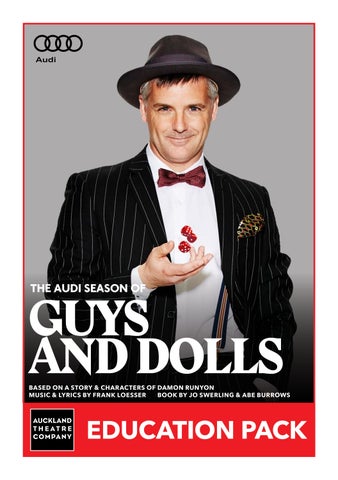
THE AUDI SEASON OF
GUYS AND DOLLS
BASED ON A STORY & CHARACTERS OF DAMON RUNYON MUSIC & LYRICS BY FRANK LOESSER BOOK BY JO SWERLING & ABE BURROWS
EDUCATION PACK
CONTENTS
THANKS TO OUR SUPPORTERS
A U C K L A N D T H E AT R E C O M PA N Y R E C E I V E S P R I N C I PA L A N D C O R E F U N D I N G F R O M :
Synopsis P.04 About the Characters P.08 About the Authors P.12 About the Show P.14
S U B S I D I S E D S C H O O L M AT I N E E S A R E M A D E P O S S I B L E BY A G R A N T F R O M
Directing Guys and Dolls P.16 Musical Direction P.20
ATC Education also thanks the ATC Patrons and the
Set and Costume Design P.27 Lighting Design P.32 Resources and Links P.36 About ATC Education P.37 Curriculum Links P.37
Choreography P.23
ATC Supporting Acts for their ongoing generosity.
VENUE: Venue: Q Theatre, 305 Queen Street, Auckland City.
PLEASE NOTE • Schools’ performances are followed by a Q&A Forum lasting for 20 – 30 minutes in the theatre immediately after the performance. • Eating and drinking in the auditorium is strictly prohibited.
SCHOOL MATINEE PERFORMANCES:
Thursday 12 November at 11am.
RUNNING TIME:
2 hours including a 20 minute interval.
SUITABILITY:
This production is suitable for Year Levels 11 – 13.
• Please make sure all cell phones are turned off prior to the performance and, if possible, please don’t bring school bags to the theatre. • Photography or recording of any kind is STRICTLY PROHIBITED.
01 1
CAST Nathan Detroit — SHANE CORTESE Sky Masterson — ROY SNOW | Sister Sarah Brown — RACHEL O’CONNELL Miss Adelaide — SOPHIA HAWTHORNE | Nicely-Nicely Johnson — ANDREW GRAINGER Benny Southstreet — KYLE CHUEN | Arvide Abernathy — DAVID ASTON Big Jule — GEOFFREY DOLAN | Harry the Horse — WESLEY DOWDELL Rusty Charlie/Cuban Male Dancer — JASON TE METE Brandy-Bottle Bates/Drunk/Hot Box Waiter/Cuban Waiter/Newspaper Man — THOMAS KNOWLES Angie the Ox/ Paper Vendor/Calvin/Cuban Male Dancer — TAINUI KURU Hot Box Girl (Mimi)/ Cuban Female Dancer — ANTHEA HILL Hot Box Girl/Cuban Female Dancer — OLIVIA TENNET | Hot Box Girl/Agatha — AMY STRAKER Lieutenant Brannigan/Joey’s Voice/Hot Box Master of Ceremonies — STEPHEN LOVATT
CREATIVE Director — RAYMOND HAWTHORNE Costume & Set Designer — TRACY GRANT LORD | Lighting Designer — ANDREW POTVIN Musical Director — ROBIN KELLY | Choreographer — JEREMY BIRCHALL
BAND Bass — JONATHAN BURGESS | Drums — TOM BROOME Trombone — JONATHAN TAN | Trumpet/Keys — GUY HARRISON | Reeds — SCOTT THOMAS
PRODUCTION Production Manager — ANDREW MALMO | Company Manager — ELAINE WALSH Technical Manager — NIK JANIUREK | Stage Manager — NATALIE BRAID Assistant Stage Manager — ELIZA JOSEPHSON-RUTTER | Assistant Stage Manager (Intern) — ANNA GILMOUR Props Master — BECKY EHLERS | Revolve Operator/Mechanist — JAMIE BLACKBURN Sound Operator — JONNY KEATING | Lighting Operator — ABBY CLEARWATER Lighting Operator Swing — JAMIE JOHNSTONE | Dresser — PENELOPE PRATT Followspot Operators — BRANDON LUNNY & KEVIN DUDMAN | Wardrobe Manager — FIONA NICHOLS Wardrobe Assistant (Intern - Courtesy of the Royal New Zealand Ballet) — ESTHER LOFLEY Repetiteur — CHRISTINA BEVAN | Sound FX Designer — JEREMY BIRCHALL Sound System Design — GLEN RUSKE (BOUNCENZ) | Set Construction — 2CONSTRUCT Large Format Image Printing — JUGGERNAUT
EDUCATION PACK CREDITS Writer — AMBER MCWILLIAMS Editor — LYNNE CARDY | Design images courtesy of — TRACY GRANT-LORD Production images — MICHAEL SMITH BY ARRANGEMENT WITH HAL LEONARD AUSTRALIA PTY LTD EXCLUSIVE AGENT FOR MUSIC THEATRE INTERNATIONAL (NY)
02
03
SYNOPSIS
ACT I New York City is all hustle (Runyonland). Three gamblers – Nicely-Nicely, Benny, and Rusty – talk tips on horseracing (Fugue for Tinhorns). The Save-a-Soul Mission band and its leader, Sergeant Sarah Brown, implore sinners to repent (Follow the Fold). Gambling boss Nathan Detroit needs a new place to hold his famous “floating” dice game so the police can’t find it. However, policeman Lt. Brannigan is on his case, so there’s only one option open: Joey Biltmore’s garage. But Joey demands a $1,000 security fee, and Nathan is broke (The Oldest Established). To raise the money, Nathan bets big-time gambler Sky Masterson $1,000 that he cannot take a certain “doll” to dinner in Havana. Sky takes the bait – and Nathan selects Sarah Brown. At the Mission, Sky tells Sarah he wants to be saved. She is sceptical, so Sky offers her a deal: he will find the Mission "one dozen
04
genuine sinners" if Sarah will come to dinner with him. Sarah refuses. The two argue about how to recognise love: Sarah thinks she will make a rational choice; Sky thinks love should be a surprise (I'll Know). Sky kisses Sarah and receives a slap! At the Hot Box club, Nathan goes to see Miss Adelaide (his fiancée), perform her act (A Bushel and a Peck). After the show, she talks about their wedding – which he has been putting off for 14 years. Discovering he is still running the dice game, she is furious and throws him out. Alone, she turns to her medical book, which explains that frustration with not being married is causing her chronic cold (Adelaide's Lament). The next day, Sky tries to woo Sarah, and Nathan tries to woo back Adelaide. They say guys will do anything for the dolls they love (Guys and Dolls). General Cartwright, Save-a-Soul’s leader,
threatens to close Sarah’s mission branch because it isn’t saving enough souls. To save the branch, Sarah accepts Sky’s deal to deliver "one dozen genuine sinners" and agrees to go with him to Havana. The gamblers, including Chicago visitor Big Jule, meet to find out where the dice game is, and Lt. Brannigan gets suspicious. The crooks tell Brannigan they are having a "surprise bachelor party" for Nathan. This satisfies Brannigan, and placates Adelaide. She leaves to pack for the elopement. The Mission band goes past; Nathan notices Sarah is missing, and realises he has lost the bet. In Havana, Sky buys rum milkshakes for Sarah, who doesn’t realise they are alcoholic. She gets tipsy and kisses Sky, high and happy (If I Were A Bell), and wants to stay in Havana with Sky. Sky realises he cares about Sarah, so insists on taking her home to New York. They arrive at the Mission in the early hours. Sky says this is his favourite time of day, and Sarah is the only woman he's ever wanted to share it with (My Time of Day). The pair admits they're in love (I've Never Been in Love Before). However, the moment is broken by a police siren; at the sound, all the gamblers run out of the mission, where Nathan has been running the dice game. Sarah assumes Sky took her to Havana so Nathan could use the mission in peace; furious, she sends Sky away.
ACT II The next evening, Adelaide performs at the Hot Box (Take Back Your Mink). Nathan stands her up for the planned elopement, and she is furious. Sarah admits to her grandfather, Arvide, that she loves Sky, but has cut herself off from him because of the dice game in the mission. Abernathy urges Sarah to follow her heart (More I Cannot Wish You). Sky comes to tell Sarah that he will still deliver the sinners. Sarah turns her back on him, but Arvide insists Sky honour his pledge. Nathan is holding the dice game in the sewer, and Sky joins the gamblers there. Big Jule is losing; he insists on using his own
05
blank dice to cheat Nathan out of his profits. Sky punches Big Jule, and gives Nathan $1,000, saying Nathan won their bet. To get Sarah her sinners, Sky proposes a bet on a single dice roll. If Sky loses, he will give each man a thousand dollars; if he wins, every man must go to that night’s mission meeting (Luck Be a Lady). Luck proves a lady, so the gamblers go to the mission. Nathan runs into Adelaide and says he can’t elope because he’s going to a prayer meeting. Adelaide is scathing, wondering why she tolerates Nathan's lies, and he says he loves her (Sue Me). Sky and the gamblers arrive at the mission, to Sarah's surprise. Arvide asks if anyone will testify to their sins. Some do, but Harry the Horse reveals that Sky only got them to come by winning a dice game. Arvide congratulates Sarah
06
for making good come from the evils of gambling. Nicely testifies about a dream that made him repent (Sit Down, You're Rockin' the Boat). Lt. Brannigan arrives and threatens to arrest everyone for last night’s dice game; Sarah lies to protect the gamblers. Brannigan leaves, and Nathan confesses they did hold the crap game in the mission. He also confesses his bet with Sky about taking Sarah to Havana, and says he won the bet. Sarah realizes that Sky wanted to protect her reputation and must genuinely care about her. Sarah and Adelaide meet and resolve to marry their men anyway and reform them later (Marry the Man Today). They do, and all ends happily (Guys and Dolls – Finale/ Reprise).
07
ABOUT THE CHARACTERS
THE GUYS
08 8
NICELY-NICELY JOHNSON
BENNY SOUTHSTREET
Nathan’s friend and gofer, who helps to organise and run the dice game.
Nathan’s other friend and go-to guy in running the crap game.
NATHAN DETROIT
SKY MASTERSON
RUSTY CHARLIE
LT. BRANNIGAN
A likeable rascal, who can’t give up the thrill of running his “floating crap game” (a dice game that moves around so the police can’t find it and shut it down), even to please his fiancée Miss Adelaide.
An attractive high-rolling New York gambler, famous for making crazy bets and wooing women.
An older gambler, who has seen it all and is never short of a comment.
The senior neighbourhood policeman, who is determined to make his mark by finding and shutting down Nathan’s crap game.
09 9
THE DOLLS
10
BIG JULE
HARRY THE HORSE
SERGEANT SARAH BROWN
MISS ADELAIDE
A powerful Chicago mobster; he is slightly scary and intimidates the New York gangsters into letting him get away with cheating.
Big Jule’s second-in-command and spokesperson, also from Chicago.
An earnest and principled member of Broadway’s Save-A-Soul mission.
Nathan’s long-suffering fiancée, who works as a showgirl at the Hot Box nightclub.
‘UNCLE’ ARVIDE ABERNATHY
AGATHA
A staunch member of the Save‑A-Soul mission; friend and confidante to Sarah Brown.
A faithful worker in the Save-ASoul mission organisation. Firm but fair; ready to accentuate the positive in any situation.
11
ABOUT THE AUTHORS
Charley? (1948); the show was a success on Broadway, and was later made into a film. The same team produced Guys And Dolls in 1950 to great acclaim, and won Loesser a Tony Award for Best Musical. Loesser went on to create music and lyrics for shows including The Most Happy Fella (1956) and Greenwillow (1960). He also ventured into film, writing songs for Hans Christian Anderson. His next
The musical of Guys and Dolls was written by Frank Loesser. The show is based on two short stories by author Damon Runyon: "The Idyll of Miss Sarah Brown" and "Blood Pressure". Additional characters and plot elements have been taken from other Runyon stories, such as "Pick the Winner".
FRANK LOESSER was a native New Yorker, born in Manhattan in 1910. His father was a piano teacher, so Loesser grew up in
12
a house full of music. He was expelled from high school, but somehow managed to secure a place at the City College of New York. His college career lasted one year, before he was expelled for having failed every subject except English and gym. Loesser went to work as a singer in a New York nightclub. He also began to write film songs, working for Universal and Paramount Pictures, and had a hit with the song “Baby, It’s Cold Outside”, used in an MGM film. After serving in World War Two, Loesser was employed by producers Cy Feuer and Ernest Martin to write both music and lyrics for Where's
DAMON RUNYON was a Kansas-born journalist and fiction writer. Despite being expelled from school when he was in sixth grade, he decided to go into the newspaper business: he took a
theatre musical, How to Succeed in Business Without Really Trying (1961), was a huge hit, running for 1,417 performances and winning the 1962 Pulitzer Prize for Drama and two Tony Awards. This was the peak of Loesser’s career; his next musical closed during out-of-town tryouts, and he left a musical score half-finished when he died of lung cancer in 1969, aged 59.
job at the Pueblo Evening Press when he was only 15. By 1910 he had relocated to New York, and was working for the New York American. He spent time as a foreign correspondent before and during WWI; after the war he returned to New York to produce a regular column, “This Mornin’s Morning”, which tracked the Broadway stars. Runyon achieved fame with a short story called “Romance in the Roaring Forties”, and went on to write columns, sketches and stories to great acclaim until his death in 1946. The musical Guys And Dolls is named after Runyon’s 1932 collection of short stories.
13
ABOUT THE SHOW Set in Damon Runyon’s mythical New York, Guys and Dolls creates an idealized version of New York in which the diverse population of this vast city, including hardened criminals and puritanical evangelists, are magically able to come together, get along, and even fall in love. stageagent.com
Guys and Dolls premiered at the 46th Street Theatre on 24 November 1950. The original production ran for 1200 performances, and the show won a Tony Award for Best Musical. Meanwhile, two road companies toured the US, playing the show in more than 60 cities. Reviews of the original production included the comments:
“Guys and Dolls is just what it should be to celebrate the Runyon spirit... filled with the salty characters and richly original language sacred to the memory of the late Master.” Richard Watts New York Post
14
“Mr. Loesser's lyrics and songs have the same affectionate appreciation of the material as the book, which is funny without being self-conscious or mechanical.” Brooks Atkinson The New York Times
“It recaptures what [Runyon] knew about Broadway: that its wickedness is tinhorn, but its gallantry is as pure and young as ‘Little Eva’.” William Hawkins New York World-Telegram & Sun
“Frank Loesser has written a score that will get a big play on the juke boxes, over the radio, and in bistros throughout the land. His lyrics are especially notable in that they help Burrows's topical gags to further the plot.” John Chapman, Daily News The musical has since had several Broadway and London theatre revivals. In 1955, it wast adapted into a successful film, directed by Joseph L. Mankiewicz. Five songs were taken out of the film version, but Loesser wrote three new songs for the film version, including “Adelaide” for Frank Sinatra, who played Nathan Detroit.
15
Raymond Hawthorne
DIRECTING GUYS AND DOLLS Raymond Hawthorne is one of New Zealand’s most experienced directors. To his mind, there is not a huge amount of difference between directing a play and a musical. And anyway, he says, Guys And Dolls “is much more a play than a musical. It has the best music you could ever listen to, but it has so much dialogue in it!” One of the difficulties of staging the show is casting: finding performers who can act, sing and dance. “The performers’ versatility is essential to make the show work,” Raymond says. When starting the directing process for a musical, Raymond explains, “you’ve got to know the music.” He had the original Broadway production on CD to
16
listen to; “I found, actually, that I already knew the songs! So there wasn’t much to learn from that. But there was a great deal to learn from the script.” As a product of the 1950s, the story-telling felt slow and a bit repetitive by modern standards. Raymond worked out how to tighten the scripted action, shortening and sharpening the show for a contemporary audience. Watching the film, he noticed the pauses and spaces in it, and thought “God, this is boring!” He decided he wanted the ATC production to bustle along like a babe on Broadway, avoiding that plodding pace. “Snappy, clear, and to the point” was his aim. Storytelling is central to keeping the show alive and moving. Raymond says he focused on
keeping the performers telling stories, even when singing and dancing. This show offers great potential for that, because “Damon Runyon – whose short stories the show was taken from – was very clever with character. There is a wonderful collection of characters in it. You have wonderful contrasting people being woven together, by love and commitment and all those beautiful things.” Discussions in rehearsal have helped to develop the characters fully as individuals for this production. Raymond praises the cast for their understanding of what is needed, saying “they’re all so good, and working so hard. They’re coming up with the goods all the time.” The fact that the performers are all so experienced –
both on stage and in life – brings a great deal to the rehearsal process, making it “a joy”. Raymond says rehearsals sometimes even finish early, because the cast are so well-prepared, having done significant work on the script and music before they arrive. Some of the performers are required to double roles, playing more than one character. Raymond says, “you won’t recognise them when they come on for the second time...” The creative team is also producing great work. Raymond has worked with set and costume designer Tracy Grant-Lord often, so a rapport is already established; he has chosen a young lighting designer, Andrew Potvin, and a young musical director, Robin Kelly, whose work he has seen
17
and admired. Raymond is thrilled to have such a combination of experience and youthful energy on his team for this show. He has appreciated the support of ATC’s production team, who have kept the creatives informed through every step of the process (including negotiations around budgets and set builds). With good co-operation, Raymond says, “production meetings are just a joy, and we’re through them in no time at all.” The same cannot be said of the scene changes in the rehearsal room. While Raymond is very enthusiastic about his revolving set, the revolve is installed directly into the theatre, and so is not available for rehearsals. As a result, set pieces need to be moved and resets done manually, which is obviously more time-consuming than simply revolving them on stage! However, this time is deducted from the show’s actual run-time – and taking that into account, the show is running at the right length for Raymond. “Nobody will be wondering whether it’s nearly time for interval…” he says. “The pace tightens and tightens as the show moves on.” Raymond loves the ideas in Guys And Dolls, especially the show’s message that “everyone is capable of change.” He says the unlikely character combinations allow for a range of genres: romance, tragedy and comedy. “Sarah and Sky have a long journey to fall in love, and even when they do it
18
isn’t necessarily an easy path for them. The same is true for Nathan and Adelaide. There are a lot of heart-breaking moments. Adelaide has a comedic quality to her, but she is also tragic.” This leads to a kind of genuine humanity even in the broader characterisations. Raymond points to Arvide as a character who “understands both sides. He understands Sarah, and her religious fervour; he also understands the potential in Sky. He doesn’t impose on them at all.” The show, says Raymond, “is about forgiveness, and the ability to be open to new things.”
DISCUSSION DATE • Did you recognise the doubling of actors for different roles? What techniques did the performers employ to differentiate between their characters? • How would you describe the pace of this production? How did the director’s decisions about staging work to achieve a show that is “snappy and to-the-point”? • Raymond says the character of Adelaide has “comedic and tragic” qualities. How are these shown in the show? How does the actor negotiate the two, and how do staging elements support her? • Use two characters in the show as ‘case studies’ to explain the key idea that “everyone is capable of change.” Alternatively, illustrate how the theme of “forgiveness” is expressed by the characters.
19
Robin Kelly
MUSICAL DIRECTION
Guys And Dolls, says Robin, is a really big Broadway musical – with the emphasis on ‘big’. “We’ve got a cast of 16, we’ve got props lists as long as my leg, we’ve got a revolve, we’ve got a band.” In the early weeks of rehearsals, Robin has played the piano as the only backing to the cast’s singing. However, the show will have a band of six for performances: Robin himself, who is mainly conducting but plays the piano when needed; a drummer; a bass player; a trombonist; a trumpeter (who also plays very good jazz piano, so will play the piano sections of the score when a
20
trumpet isn’t needed); and a reed player who will be playing tenor and alto saxophones, clarinet and “a bit of flute”. Apparently many Broadway scores have sax / clarinet / flute doublings, which is a good challenge for the reed player. Robin says that “normally, people are strong at two of those – not all three!” To keep the pressure off, he has kept the flute part minimal in his musical arrangement. Robin has done the arrangement for this production himself. So, for the nonmusical, what exactly is an “arrangement”? Robin explains that “the original show was an
orchestral production, with a 20-piece orchestra.” The music is well thought-out for orchestral performance, and all the instruments contribute to the sense of the songs. “If you try to play that score with just the original clarinet part, the trombone, and the drums, it will sound like nothing.” In order for the show to be performed with fewer musicians, the music must be rewritten so all the key elements (rhythm, melody, harmony) are incorporated for fewer instruments. This process is called “arranging”. A careful arrangement, Robin explains, can really influence the style of a particular number. “It’s one of the joys of being a musical director that you can look at a song and say ‘I think it needs to feel like this’. I can shape that. I can bring voices in to hum through it, to give it vocal lushness. Or I can bring a swing beat in underneath it... Arranging is a nice way you can work with the story as a musical director. It’s challenging, but very fulfilling.” While it is possible to start from the original score and simply tweak, Robin prefers to start from scratch, asking “what would sound best with the band I’ve got?” Integrating the band into the show happens as the opening night approaches. “They haven’t been here for the weeks of rehearsal we’ve had; they will just slot in, and it all has to work
seamlessly.” In the third week of cast rehearsals, Robin will lead evening band rehearsals, bringing them up to speed. Investing that time means “they’ll get used to the songs, and my conducting, and be able to make their music notes.” After five ‘band only’ rehearsals, Robin explains, “they’ll have one day – about four or five hours – in the theatre, with the band and the cast all sitting together.” This is known as a sitzprobe, and is “the one chance we have to iron out any difficult corners”, says Robin. “It’s also the chance for the cast to hear the band. Band music sounds different from a piano!” He adds “it can be exciting; it can be unsettling. Ultimately, it’s quite a thrilling process.” After this rehearsal, “we’re into running
21
the show, with the technical and dress rehearsals.” This show is demanding on the performers, as the whole company is required to sing, dance and act. Robin says “we’ve got a very talented cast, which is a blessing.” Personally, even as the MD, he tends to value acting above the rest. “I prefer a voice that has ‘character’ (and I’m using that euphemism knowingly!) – a voice that’s a bit rough around the edges – from someone who knows why they’re singing what they’re singing and can do it with integrity and conviction. I so much prefer listening to that. I like someone who can tell a
story.” He doesn’t get too hung up on nuances of vocal tone if that communication is happening. “I guess that makes my job a bit easier!” Robin hastens to add that in this cast, “we have a collection of lovely voices, and with the calibre of actors we have, I get to do some polishing. I can say ‘you’re telling this great story – now let’s work on the pitch of that note there, because that will turn it from a great performance into something really special.’” Notwithstanding his own role, Robin believes that fundamentally “musicals are about speaking. They’re about telling stories.”
DISCUSSION DATE • Where does the term sitzprobe come from? What is its literal meaning? What is the value of the sitzprobe to the rehearsal process for an opera or musical? • Look online for an example of a full orchestral production of Guys And Dolls. Compare and contrast the musical treatment of any one song, identifying and explaining the difference in ‘feel’ between the orchestral version and the ATC production arrangement. • Which song from Guys And Dolls did you find most memorable? Can you explain why it stuck with you? What are its particular musical qualities? • Do you agree with Robin’s statement that “musicals are about speaking”? Justify your opinion with examples from the production of Guys And Dolls, and other musical theatre productions you have experienced.
22
Jeremy Birchall
CHOREOGRAPHY
As a choreographer, Jeremy Birchall says “I always approach the work from a storytelling point of view first, rather than a dance perspective.” He says he finds it jarring when he watches shows where “the movement comes out of nothing, and makes you very conscious that this is a dance number, or a song.” He feels that “these days we are more savvy about things being emotively driven, rather than just saying ‘oh, that’s a lovely song and dance’. In a musical, the reason we get to a song is that there are no more words to express the feelings.” That heightened emotion is the reason for the dance; it’s not simply about making pretty stage pictures.
Movement, says Jeremy, “informs character”. Costume can assist actors to identify a character’s distinctive movement. “A pair of shoes or a jacket can help an actor to find a way to the physicalisation of a character.” As an example, the women in Guys And Dolls have been wearing rehearsal heels from the beginning of rehearsals. There are two reasons for this: “the first is to see how the piece moves with heels. The second is to get them ‘race fit’!” Without ‘training’ prior to production week, Jeremy says, “they’ll start getting fatigue. It’s hard work!” To address this, the women rehearse for a half-day in heels. In some ways, Jeremy says, rehearsals can be harder than show calls, because the women
23
are dancing on a concrete floor rather than the wooden stage of the actual set, and are dancing for six hours at a time, rather than the two hours of the show. He compares the process to duathlon training, with base training for broad strokes movement and fitness, moving up to the refinement of the dances, and finally attaining ‘peak training’ for the performance season. Currently Jeremy’s favourite numbers are “The Oldest Established” and “Guys and Dolls”. The latter has elements of slapstick – Jeremy says the three performers remind him a little of the Marx brothers – “so there’s a lot of scope to explore the physical characterisation”. However, “The Oldest Established” wins out
24
from a synchronisation point of view; “it’s exciting to watch a whole bunch of guys moving in unison.” Another big number, “Luck Be a Lady”, is still in progress, but Jeremy expects that will also be exciting. “Again, it’s a prime example of approaching that piece of work thinking about what the essential storytelling is.” Sky is rolling for the love of his life against a huge financial loss – the stakes are literally and figuratively high. “We are paring it back and asking ‘what are the most important parts of the physicalisation to tell this story?’ Then we do a little bit of embellishment with movement layered over the top.” The process involves “broad brushstrokes, then coming into the detailing”,
in a similar way to the process for directing a spoken drama. In a musical, the music itself contains clues to aid the process. Jeremy says there are two things you’re listening for in a composition with lyrics. The first is the content of what is being sung. The second, and perhaps even more important, “is the underscoring of what the composer envisaged. There is a huge amount of information in the music.” He gives the example of a line in “Luck Be a Lady”, where Sky sings the word ‘out’ “and then there is an instrumental ‘stab’ there.” Jeremy says those ‘stabs’ – moments of musical emphasis – indicate something should happen at that point. “Good choreography, from my perspective, is going back to the underscoring of the composer, and seeing what the driving rhythms are, and the added instrumental stabs that have been put in, because there’s a vision there already in the mind of the composer. That can be really helpful.” Jeremy says that he often sees examples of people “just listening to the counts, not listening to the scoring of the music. “You don’t arrive at a piece of choreography by listening to the music the night before.” He listens to the score “over and over again on different levels”. Preparation is very important. With tight rehearsal deadlines, Jeremy says, a choreographer must come to rehearsals with “a
preconceived idea and steps” for each number; “there’s not time for everyone to stand around while you say ‘right, we’re going to come up with a dance here’.” That said, things can and do change in the rehearsal room, taking into account the context of the scene and the input of the company. Jeremy says that as a director, Raymond is “quite hands-on... I always refer back to him: ‘is this right? Is this storytelling correct here?” It’s sometimes hard to know where direction and choreography separate, Jeremy explains. “A director will turn to you and say ‘how do we resolve this?’ around a piece of blocking, for example. I often find that I feed into the drama too. Sometimes you are purely a choreographer, but sometimes you are an unspoken assistant director.” Because the choreographer and the musical director and the director are all in rehearsals throughout, “you build up a golden triangle of conversation. You’re all seeing the arc of the narrative.” Working with the expertise of the performers is also part of the choreographer’s brief. As Jeremy has had no hand in casting the show, he needs to assess what each performer is able to do, and how to best showcase their strengths. “You can only do so much preparation in your bedroom, lying down and thinking about it!” Sometimes he has to remind the company “I’ve seen this number
25
play out, but not with 16 actual people!” The ideas in his head don’t always work as he had hoped; “you have to be prepared to let go if it isn’t working.” It’s hard, because “it’s your baby. There’s an ego-release that has to happen for you to be able to let it go.” Stepping back is necessary. “We have to keep coming back to the truth of it. Is this just a gag for a gag’s sake? Are we adding anything? You have to keep checking your work, and create for the truth of the situation.” No movement can be superfluous, or added simply for the sake of showing off. Jeremy says “the hardest thing for dancers and choreographers is to do nothing. But sometimes you have to make that choice.” As a trained actor, Jeremy has a particular eye for the narrative of a dance, and the way that the performers must
“make a journey through the song.” The songs themselves, he points out, often have a three-act structure. “There’s a realisation that happens part way through the song. That’s why musical theatre songs are so wonderful compared to a pop song.” Context makes a difference to the emotional content. Sometimes that can mean a tweak to the order of things; for instance, in “Luck Be a Lady”, Jeremy has asked for a change to the line ‘put down your markers’ prior to the song, so that he can have the characters do that action within the song. “It’s going to create an elevation in drama there.” Choreography goes beyond just dancing and steps. “You have to get inside your text; you have to communicate well with the director; you have to understand narrative and storytelling, to find out what’s driving the movement.”
DISCUSSION DATE • How would you describe the style of choreography in this show? • How was movement used to create character? Did you observe any signature movements or physical phrases particular to a specific character? • Identify moments where a musical ‘stab’ was accompanied by an action. Explain how music and movement worked together to emphasise an idea at those points. • Map the three act structure in one of the songs from Guys And Dolls.
26
Tracy Grant-Lord
SET AND COSTUME DESIGN Tracy says that the approach to a show always depends on the venue. “If we were in a traditional end-on proscenium venue that had quite a bit of wing space, maybe some upstage space, and flying facilities, I would have made some different choices.” However, this production is being staged in the flexible configuration of the Rangatira at Q Theatre. Here the seating blocks will be on three sides, with the two side blocks on the forestage, at stage level. Though there is ample stage space, upstage space and wing space are fairly limited, and there are no flying facilities. What that means for the set design, Tracy explains, is that everything is
“in the room, as it were. There’s nothing that’s beyond the fourth wall – or fifth, sixth or seventh wall!” To create multiple locations without having to move large sets on and off-stage, Tracy has chosen to use a revolve. They have acquired a small revolve, which is being extended to increase its floor footprint. The extension will be cantilevered off the existing revolve’s stage, and made of flooring plywood for strength. Making the revolve bigger was necessary for the Mission scene towards the end of the show, Tracy says. “We knew the Mission scene was going to take place on the revolve; it’s the only scene that doesn’t spill off.” The scene requires the gangsters to be seated in rows, so the revolve needed to be
27
able to accommodate a dozen ‘guys’ in this configuration. A revolve has both benefits and disadvantages. It requires “a particular type of direction from Raymond”, Tracy says, and also some choreography of ‘backstage’ to get things on and off; as Tracy has it, “there are lots of things for the company to negotiate.” As an example, the revolve can go clockwise or anti-clockwise, so the company must decide which way it is turning, which has a significant impact on the staging of the scene. However, from a design perspective, it means that while a scene is playing on the main stage space, the next scene can be prepared on the revolve, ready to come to the centre when required.
28
“What we call the ‘crossover scenes’ we can still make happen, while we establish the big interior scenes, like the Mission, Havana and the Hot Box.” Tracy points out that “even though we are setting and striking scenes during those crossovers, it’s still quite a visible action.” The stage managers will be in costume, so that even if they’re seen during the changeovers, they simply blend in with the action. “We’re incorporating that busyness with the general busy-ness of our world of New York.” Sound will also be used to help cover the scene changes, with traffic noise and car horns making up a streetscape effect. Tracy is designing costumes for the production too, a combination
she really enjoys. Having been trained as both a set and costume designer, she says, “I have quite a holistic way of looking at design for the stage. I like to work on the universal requirements of a show.” Depending on the requirements of the production, “sometimes there’s more scenic weight, and sometimes there’s more costume weight…” This show, she says, is big in both, although “because of the size of the cast, logistically there’s a lot of costumes to be made and things to find.” “We are honouring the classic‑ness of the work, and presenting it to an Auckland audience in 2015 so that it’s fresh and engaging.” Tracy has taken the essence of the design qualities
of the show and its period, and distilled and updated them. “It’s a show that’s very much in, and about, the ‘50s. A lot of the ideas in the show could only have been formed in the 1950s.” She says while those ideas might seem odd or jarring to us now, “because we understand that it happened at that particular time, we understand their relevance.” However, she points out that “inside those ideas are some that never change – and that’s why companies choose to do the show.” In design terms, she says, “there are some iconic visual ideas, so to honour it you need to keep those things going…. But what I like to do is strip it back to the barest essence.” This approach means “we keep the landscape
29
clear for the performance to come through.” Costume-wise, “the 1950s period styling is gorgeous. We all love it. They were really beautiful things; it makes everyone look good!” The main element she is focusing on is the silhouettes. “For the Mission uniforms, it’s quite a contained strictness of silhouette; for the Hot Box girls it’s quite similar, but they’re wearing things a bit too tight.” The showgirls also get glamourous gowns for their big performance numbers. “Some of those Hot Box scenes are quite decorated.” For the guys, Tracy is having some key suits made, as well as using stock suits. “We’re concentrating on the shape and height of the trousers, and the cut of the jackets and shirts, so we retain that ‘50s style.” In practical terms, Tracy needed to design costumes that let the actors move freely, so that they can dance comfortably in them. “One of the joys of this period is that there’s a lot of room in these suits – we’re not looking at anything too tight.” Tight lines, she says, require stretch fabrics for maximum movement. “With these bigger cuts, there’s a lot of room. But of course, the very fact that they’re wearing suits dictates a certain style of movement, and Jeremy (the choreographer) will use that, so the costume becomes part of the nature of the movement.” The suit fabric must be sturdy enough to deal with the rigours of a long
30
season, without bagging or wearing through. “You have to spend a little bit more to get a quality fibre that won’t rip or tear, and that will return to its shape.” For the girls, movement is also important. Some stretch fabrics will be used for the girls’ clothes, to allow the freedom of movement while keeping a tailored look. Tracy has some opportunity to loosen things up metaphorically, if not literally, too: “we’ve got one scene where they do a striptease on stage, so we get them down to their undergarments; they’re a very voluptuous silhouette, which again is appropriate for the period.” At the other end of the spectrum, when Sarah goes to Havana, she will wear a very similar suit to her Mission uniform. “It’s like Sarah doesn’t worry too much about her styling; she’s quite utilitarian in her taste. But we’ve chosen a beautiful mauve blue, which is really pretty. During the course of that scene, as we see her have one too many drinks, her jacket gets undone and she has a pretty blouse underneath.” Tracy says it doesn’t take much for us to see Sarah in a loosened up state. “Unlike the Hot Box girls, who take all their clothes off, Sarah just has to unbutton her jacket!”
DISCUSSION DATE • Tracy says some of the ideas in the show are very much a product of the 1950s. Identify some ideas that have dated and might seem jarring or unusual to us in the twenty-first century. • Tracy also identifies that some of the themes are universal. What are these themes? How do they play out in the narrative? • What role does colour play in the design for this production? Explain what you infer from the colour palette chosen, and the colours used for particular set or costume elements.
31
Andrew Potvin
LIGHTING DESIGN Lighting Designer Andrew Potvin starts from the most basic practical requirements when he approaches a lighting design. “The number one goal is to provide efficient and convenient lighting to the actors in the setting they’re playing in.” After all, the audience needs to be able to physically see the performance! Once that base is covered, the real design elements come into play. Because the set is ‘in the room’ and doesn’t change significantly, that means using lighting changes to pull the audience’s focus and set the scene. “There’s a lot of pressure on the lighting to take you on the journey to the different locations: the streets of New York, the Mission, Havana, the sewer.”
32
Each of those locations will have a different lighting state, with Andrew using a mix of theatrical units (standard theatre lights, usually rigged over stage and over the audience) and practical units (lights that are on stage and part of the visible action, such as lamps) to achieve distinct looks. For example, strings of coloured light-bulbs (called “festoons”) will decorate the set for Havana, and “during the transitions and possibly during the night scenes, we’re using fairy lights and a star curtain to bring some magic to the atmosphere.” Andrew is hoping to be able to fly in some industrial-looking lights during the sewer scene to give an additional sense of the site. Although a lighting designer’s work is done in production week
when the company is physically in the theatre, plenty of preparation is needed beforehand. He attends rehearsals whenever possible, and keeps in touch with the company via meetings and calls. Andrew says about 85% of his work for this show has been pre-planned: he has “prepared the ingredients, so to speak.” Like a chef, he can combine these ingredients in various ways once he’s on site. “The ideas and concepts are derived from conversations with the director, the choreographer and the set designer, and you use all that prep time to develop those ideas and identify the appropriate equipment to bring them into reality. That comes with experience, and a lot of drafting!” Lighting design requires a great deal of paperwork: lamp lists (of the actual lighting fittings needed); gel lists (of the size and number of pieces of coloured lighting gel to be fitted in front of the lights to change their colour); angle calculations (drawings of the angles of the different beams
of light that show what will be lit and unlit by the beam from each fitting, and how the angles will overlap to give coverage); lighting plans (drawings of the theatre grid, with each light specifically marked so the riggers know exactly where to put the light). “If you do your homework appropriately, everything should come to fruition easily once you’re in the space,” Andrew says. “You shouldn’t be deciding what colour the backlight is going to be when you’re in the theatre; that should be decided beforehand.” Andrew will be using some intelligent lighting: “there will be some moving lights and LEDs to give it a bit of energy from the lighting standpoint.” However, he is keen to ensure that the use of modern technologies does not overshadow the show’s period feel. “It’s using the energy of lighting to support and modernise a show that is carefully set in its era. That’s always an interesting challenge.” The overall look Andrew wants for the show is “clean and pretty”.
33
However, he points out that this is a show of two quite distinct halves. Most of Act I happens during the day, whereas the majority of Act II happens at night or underground. To reflect that change in colour terms, “there is going to be a progression from warm, golden sunlight into more blues” as the show goes on. He thinks there will be more colour in the show than perhaps New Zealand audiences are used to. “The opportunities are there in this show for some nice saturations,” he says. Many of his colour choices have, of course, been informed by the costumes and the colours of the set. “Obviously you want to support the rest of the production; it’s not about the lighting alone being the focus.” That said, there will be
opportunities for Andrew to have some fun with lighting effects. There are two styles of lighting in this show” he explains. “One is the traditional, realistic lighting which is fairly generic; you’re not going to notice it that much. But when we get to the songs, that’s when the magic happens; the lighting become more of a character in the show. It fluctuates back and forth depending on where you are in the story.” The musical numbers have required “a lot of communication between Jeremy and myself,” Andrew says. “Identifying where the special moments will be, we can highlight them and pull the distinct imagery out.” Once again, the technical elements are serving the show: it’s all about telling the story.
DISCUSSION DATE • How did the lighting contribute to ‘setting the scene’? Can you identify some of the technological decisions that helped differentiate the locations? • What is a star-curtain? How is one made? How is one most commonly used? • Andrew aimed for a lighting design that was “clean and pretty”. How well do you think he achieved this goal? What elements contributed to this outcome? • Identify one key moment in a song-and-dance number, and illustrate how the various elements worked together to (literally) highlight that moment.
34
35
RESOURCES AND LINKS Buchler, Michael. “Modulation as a Dramatic Agent in Frank Loesser's Broadway Songs”. Musical Theory Spectrum. Oxford Journals, 2015. Accessed 16-10-2015. Web. http://mts.oxfordjournals.org/content/30/1/35.short “Frank Loesser”. Frank Loesser Enterprises. Accessed 16-10-2015. Web. http://frankloesser.com/ Guys and Dolls. Dir. Joseph L. Mankiewicz. With Marlon Brando, Jean Simmons, Frank Sinatra and Vivian Blaine. Samuel Goldwyn Productions, 1955. Film. Kantor, Michael, and Maslon, Laurence. Broadway: The American Musical. (Companion publication to the six part PBS television series of the same name.) Applause Books, 2010. Print. Loesser, Susan. A Most Remarkable Fella: Frank Loesser and the Guys and Dolls in his Life. New York. Donald Fine, 1993. Shiva, Avital. “Guys and Dolls”. stageagent.com. Accessed 04-08-2015. Web. http://stageagent.com/shows/musical/1263/guys-and-dolls Shout, John D. “The Stars: Frank Loesser.” Broadway: The American Musical. Thirteen/WNET. Accessed 16-10-2015. Web. http://www.pbs.org/ wnet/broadway/stars/frank-loesser/
36
ATC EDUCATION ATC Education promotes and encourages teaching and participation in theatre and acts as a resource for secondary and tertiary educators. It is a comprehensive and innovative education programme designed to nurture young theatre practitioners and future audiences. ATC Education has direct contact with secondary school
students throughout the greater Auckland region with a focus on delivering an exciting and popular programme that supports the Arts education of Auckland students and which focuses on curriculum development, literacy and the Arts. Auckland Theatre Company acknowledges that the experiences enjoyed by the youth of today are reflected in the vibrancy of theatre in the future.
CURRICULUM LINKS ATC Education activities relate directly to the PK, UC and CI strands of the NZ Curriculum from levels 5 to 8. They also have direct relevance to many of the NCEA achievement standards at all three levels. All secondary school Drama students (Years 9 to 13) should be experiencing live theatre as a part of their course work, Understanding the Arts in Context. Curriculum levels 6, 7 and 8 (equivalent to years 11,
12 and 13) require the inclusion of New Zealand drama in their course of work. The NCEA external examinations at each level (Level 1 – AS90011, Level 2 – AS91219, Level 3 – AS91518) require students to write about live theatre they have seen. Students who are able to experience fully produced, professional theatre are generally advantaged in answering these questions.
37
ENGAGE
JOIN THE CONVERSATION Post your own reviews and comments, check out photos of all our productions, watch exclusive interviews with actors and directors, read about what inspires the playwrights we work with and download the programme and education packs. Places to find out more about ATC and engage with us:
www.atc.co.nz facebook.com/TheATC
@akldtheatreco
AUCKLAND THEATRE COMPANY
487 Dominion Road, Mt Eden PO Box 96002, Balmoral, Auckland 1342 Ph: 09 309 0390 Fax: 09 309 0391 Email: atc@atc.co.nz 38