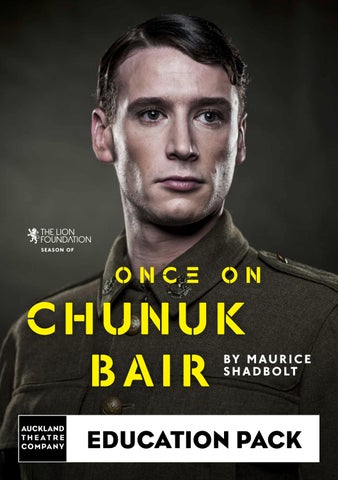
EDUCATION PACK
Contents
Sponsors Auckland Theatre Company receives principal and core funding from
CREDITS
4
WHAT'S THE STORY? — the synopsis
6
WHAT'S IT ALL ABOUT? — key ideas
7
WHO'S WHO ON THE HILL? — the characters
8
WHAT REALLY HAPPENED? — the history behind the battle
12
WHO WENT TO WAR? — facts about the NZ expeditionary Forces 14 WHO'S IN CHARGE HERE? — Ian Mune addresses the troops 18 WHAT'S THE STORY'S STORY? — the history of the play 22 WHO WAS THE WRITER? — playwright Maurice Shadbolt 24 WHAT SETS THE SCENE? — design of ONCE ON CHUNUK BAIR 26 WHERE CAN I FIND OUT MORE? — recommended resources 30 Subsidised school matinees are made possible by a grant from
ATC Education also thanks the ATC Patrons and the ATC Supporting Acts for their ongoing generosity.
PLEASE NOTE: • Schools’ performances are followed by a Q&A Forum lasting for 20 – 30 minutes in the theatre immediately after the performance.
VENUE:
• Eating and drinking in the auditorium is strictly prohibited.
SCHOOLS’ PERFORMANCES: Thursday 19 June, Thursday 26 June, Tuesday 1 July and Thursday 3 July at 11am.
• Please make sure all cell phones are turned off prior to the performance and, if possible, please don’t bring school bags to the theatre. • Photography or recording of any kind is STRICTLY PROHIBITED.
2
MAIDMENT THEATRE, ALFRED STREET, AUCKLAND CITY
RUNNING TIME:
2 hours including a 20 minute interval.
SUITABILITY:
This production is especially suitable for Year Levels 11 – 13 students.
ADVISORY:
Contains occasional use of strong language.
3
CAST Colonel Connolly — Stephen Lovatt Lieutenant Harkness — Sam Snedden Sergeant Frank — Kevin Keys Porky — Andrew Grainger Scruffy — Tim Carlsen Holy — Jordan Mooney
Smiler — Wesley Dowdell Mac — Johnny Bright Bassett / Soldier 1 — Byron Coll Otaki George — Taungaroa Emile Fred / Soldier 2 — Oscar Wilson Nobby / Dusty — Alex Walker
CREATIVE Direction — Ian Mune and Cameron Rhodes Set Design — John Verryt
Costume Design — Tracey Collins Lighting Design — Sean Lynch Sound Design — Jason Smith
PRODUCTION Technical & Production Manager — Paul Nicoll Company Manager — Fern Christie-Birchall Stage Manager — Jade Turrall Assistant Stage Manager — Jamie Johnstone Technical Operator — Abby Clearwater Armourer — Gunner Ashford
Military Advisors — Matt Cross and Pablo Hamber Props Master — Natasha Pearl Costume Supervisor — Fraser Mildon Set Construction — 2Construct
education pack creditsction Writer — Amber McWilliams Contributing Writer — Fern Christie-Birchall Editor — Lynne Cardy
4
Production Images — Michael Smith Design images courtesy of — John Verryt Design — Saucy Hot Design
5
WHAT's the story?
WHAT’S IT ALL ABOUT?
the synopsis
key ideas
ACT ONE A group of New Zealand soldiers struggle up a hill called Chunuk Bair on Gallipoli Penisula, early in World War I (August 1915). Nobby is shot dead. Smiler and Porky raid his corpse. Porky kills a Turkish gunner so Smiler can go to the toilet safely. The Kiwis reach the top and realise hardly any Turks are defending the hill. Other NZ soldiers arrive: tough guy Mac; ex-Bible-teacher Holy; Sergeant Frank and his younger brother Fred; and Scruffy. They are led by capable Colonel Connolly and his new Lieutenant, Harkness, and bring three ruined machine guns. Mac offers to fix the guns. Harkness tries to impress the men with historical knowledge; after checking the territory, he declares they can take the summit. Connolly sends Harkness to find other New Zealand soldiers. Connolly is limping; Fred and Frank remove a bullet from his leg. Mac and Holy explain to Scruffy why they’re trying to capture the hill. Harkness returns with bad news: they’re cut off from the Kiwi troops lower down. Connolly tells Harkness how tough his men are. Fresh British troops arrive on the beach, and the Kiwis expect them to come up as reinforcements. Otaki George, a Maori Battalion soldier, arrives and says most other New Zealanders have been killed. Connolly declares the Kiwis can take Chunuk Bair alone. The company mount a bayonet charge, kill the Turks and take the summit. Harkness digs in to the trenches. Bassett arrives, running communications cable. He says the Australians are mostly dead, the other Kiwis are stuck down the hill, and the British remain on the beach. Scruffy fixes the machine gun. Bassett connects the phone
6
to the British commanders, but the line goes dead before Connolly says the Kiwis have taken Chunuk Bair.
ACT TWO Later. The Kiwis are under heavy fire; they see the Brits on the beach swimming and sunbathing instead of sending reinforcements. Turkish reinforcements arrive. Bassett keeps coming and going, trying to get the phone working. Connolly sends Frank to find out how Harkness and his men are getting on. Finally a phoned message from British General Hamilton: instead of sending British reinforcements, he praises the Australians (!) who have taken Chunuk Bair, and hopes they have a British flag and a musical band to keep their spirits up. The line goes dead again; Bassett promises Connolly to take the truth down the line.
THE REALITIES OF WAR: The play is based on actual events from 6 – 9 August 1915 on Chunuk Bair. Shadbolt highlights the horror (and black humour) of trench warfare under primitive conditions: not enough water, working weapons or information to keep troops functioning effectively. Friendly fire from British ships did kill Allied Forces on the hill. NEW ZEALAND COURAGE: The “Kiwis” are portrayed as genuine human heroes. On the surface they do not respect the dead and make terrible jokes, but in the heat of battle they stand by one another and fight bravely out of pride and camaraderie, regardless of whether they believe in the British version of the “War of Empire”. BRITISH INCOMPETENCE: Shadbolt suggests the British commanders were hopeless – from the clueless General Sir Ian Hamilton to the drunken Brigadier-General Johnston. In the end it is not the Turks but the British that the ANZACs curse…
Frank returns and convinces Connolly to call Harkness’ crew back; the wounded are left and slaughtered by the Turks. Frank saves Fred from a grenade. Holy finds his faith again. Connolly orders a desperate bayonet charge. Harkness keeps trying the phone to call for reinforcements. After many hours, Harkness takes over from an exhausted Connolly. They charge. Harkness and Mac are killed. Connolly tells Frank he is determined to stay and prove how stupid the British strategy is. The phone rings; the British commander instructs them to hold Chunuk Bair without reinforcements. Another bayonet charge. Otaki George is killed. Frank comes back; Fred does not. The British warship finally blasts the hill. Connolly and Porky are killed, Smiler mortally wounded. Frank calls General Hamilton and gives their final message: “F@#K your war.”
7
WHO’S WHO ON THE HILL?
THE RANK + FILE SOLDIERS
the characters THE OFFICERS
colonel connolly
LIEUTENANT HARKNESS
is brave and committed. He is a genuine leader with an unconventional style, using sarcasm and irony to give commands and tell his men how much he believes in them.
is new to the war. He tries to pull rank and give orders but the battle-weary men mock his innocence. He learns through the battle and apologises for his high-handed behaviour.
PORKY is a joker. He gives his fellow
FRED is keen to prove himself and get
soldiers a hard time, teasing them and creating black humour from their situation.
out from under his older brother Frank’s protective shadow.
SMILER is empathetic and
HOLY is thoughtful but disillusioned. He has
understands other people. He recognises that Porky needs to joke, but also stands up for the others when Porky goes too far.
lost his faith after the horrors of the battlefield, and is sensitive to being reminded about it. However, he regains his belief in the end.
sergeant FRank is trustworthy, smart and dependable. His main focus is keeping his brother Fred safe.
scruffy A farm hand. Deep thinking and slightly slow witted. A tad behind the 8-ball.
8
9
MAC wants to appear tough.
OTAKI GEORGE is both
He works hard to keep face, and gets angry at Porky for making jokes at his expense, and Scruffy trying to help him mend the machine gun.
philosophical and practical. He does what is required, but questions why he, a Maori, is fighting this British war. He highlights the superficiality of New Zealand’s biculturalism.
BASSETT is determined and focused.
Nobby A young soldier who has lied
He has committed to do his job, and will do it at all costs.
about his age in order to enlist.
Talking Points •• Which character do you identify with most easily? Explain why. •• In the stage directions, the character of Harkness “finds himself neither comfortable nor welcome anywhere.” Why might this be? (See the director’s comments for clues!) How is his discomfort portrayed in this production? •• Connolly says “We’re damn fine killers. Bred to it. Hunters, farmers, slaughtermen.” What facets of New Zealand’s early society can you see in the behaviour of these characters?
10
11
WHAT REALLY HAPPENED? the history behind the BATTLE “No one ever thought of not coming back.” Cecil Lovegrove, Wellington Infantry Battalion
THE ARRIVAL The New Zealand and Australian troops landed on the Gallipoli Peninsula from the sea on 25 April 2015 – the first ANZAC Day. They arrived at the wrong beach, north of the planned position. The Turks had wellestablished gun positions high in the hills, and as the Allied soldiers arrived on the beaches they were mown down by machine-gun fire. By the end of the first day, hundreds of dead and wounded covered the beach, and the remaining soldiers were haphazardly dispersed through the foothills, taking cover anywhere they could find it, without orders or a chain of command.
THE TERRAIN The Gallipoli Peninsula is largely without cover – the ground is dry and little grows. There was no protection from the pitiless sun during the long days. Hard, rocky soil made it extremely difficult to dig trenches for protection, latrines for waste, or graves for the dead. Flies, dust and heat were constant and lethal companions. Dead bodies piled and rotted in the heat; trenches filled with human
12
waste and maggots. With the Turkish guns playing havoc with incoming ships, supplies were scant – the troops had no wood, barbed wire or other materials to reinforce their positions.
THE TROOPS By the time of the August offensive, the majority of the troops were sick and exhausted. Inadequate shelter and protection meant no rest for the soldiers. Food rations were hard Army biscuit and tinned bully beef – no fruit or vegetables of any kind – so the men were malnourished and suffering from dysentery. In the words of historian Chris Pugsley, “By August 1915 a fit man at Anzac was someone capable of standing up and holding a rifle.”
THE ATTACK In August 1915, there was to be a concerted attack on the Sari Bair Range, a commanding piece of the peninsula. The plan was that the New Zealanders would take Chunuk Bair, backed up by the landing of a British corps at Suvla Bay, while the Australians attacked
Lone Pine and the Nek. Bad decisions by commanders led to unnecessary carnage; for instance, the Auckland Battalion was decimated at Rhododendron Ridge on 7 August. Nevertheless, the Wellington Battalion, under Lieutenant Colonel Malone, managed to seize the high ground of Chunuk Bair just before dawn on 8 August 1915. They held out for two days at tremendous cost – hundreds of lives were sacrificed to hold the hill. On the night of 9 August, the few surviving New Zealanders were finally relieved by British
troops. By the morning of 10 August, the British had been driven out and Chunuk Bair was back in Turkish hands. After the August offensive failed there was a stalemate. In December 1915 the ANZACs evacuated Gallipoli, followed by the rest of the Allied troops in January 1916. Ironically, the withdrawal was carefully planned and executed, in stark contrast to the campaign itself. The Gallipoli campaign had almost no bearing on the outcome of the war.
13
WHO WENT TO WAR? facts about the NZ Expeditionary Forces “When New Zealanders went to war, they were ignorant of its causes and innocent of its meaning.” Ormund Burton, The Silent Division
•• In 1910-1911 New Zealand organised a Territorial Force of some 30,000 men, who were trained in the use of new weapons and military technologies to prepare for war. •• New Zealand channelled huge resources into the overseas war. By 1918, £6,481,002 had been raised for the war effort by New Zealand patriotic societies. •• 100,000 New Zealand men signed up to fight for King and Country in the First World War. More than 16,000 lost their lives and over 41,000 were wounded. •• Of the 8,427 New Zealanders on Gallipoli, 2,721 died and 4,752 were wounded. •• On 7 August 1915, the Auckland Battalion suffered 300 casualties in 20 minutes as they were ordered to run directly across
14
200 yards of unprotected ground directly at the trenches housing the Turk machine gun emplacements. •• 700 men attacked Chunuk Bair on 8 August 1915. By nightfall, less than 70 men remained. •• There are just 265 New Zealand graves at Gallipoli; many are for soldiers who were only identified after the war ended in 1918. •• On Chunuk Bair, the New Zealand Memorial commemorates Kiwi dead who were identified. The New Zealand Memorial to the Missing names 850 soldiers never found. •• The total Allied and Turkish casualties from the Gallipoli campaign are estimated at 500,000.
15
WHO’S IN CHARGE HERE? Ian Mune addresses the troops
On day one of rehearsals, co-director Ian Mune gives a commanding address to his assembled cast and crew, the troops of ONCE ON CHUNUK BAIR. Mune’s first point is that the play is not history. “It’s a highly artificial thing. We need to use all our skills as liars to make it seem as real as possible.” That’s not to diminish the accuracy of the play’s recreation of events; the director is quick to applaud playwright Maurice Shadbolt and historian Chris Pugsley for the amount of painstaking research they conducted to inform the script. “Maurice was always a pedantic bastard” Mune says warmly, “he’d know every damn detail.” That said, the real events serve only as inspiration for the drama. The play is informed by history, but doesn’t recreate it. “If you tried to put the reality of this war on stage, it wouldn’t work,” Mune says. What matters “is how much we invest it with OUR reality.” That means capturing the essential qualities of New Zealand society in the early twentieth century. “We will have to do a great deal of
16
work to find that reality, which we don’t know anymore.” Mune points out the hallmarks of our modern urban environment – cellphones, new cars, fancy takeaway coffee – would have been totally foreign to the young men who signed up to fight for the British Empire in the Great War. “New Zealand was mostly rural. The cities were small.” Even when Mune was growing up, decades later, “virtually every kid had a connection with a farming family. We’d spend our holidays on the farm, swimming in the river. Most people knew how to ride a horse.” That, says Mune, gives the men of the play a different background to today’s urban sophisticates. “So we need to discover the everyday realities of those mostly rural guys, who stuck their hands up to enlist in what was supposed to be ‘the shortest war in the history of the world.’” One of Mune’s objectives for this production is to transport the audience into the past. “We’ve gotta make them time travel in that first six pages.” That means, he says, “we have to know that world so well that we are it.” One way to demonstrate the difference will be through accent. A hundred years ago, the Kiwi accent was much less homogenous than it is now. Most Pakeha New Zealanders still had traces of the original Scots, Irish, Welsh or English accents of their heritage, and the idea of distinct “Kiwi” speech was only just evolving. Mune recommends that the actors do their research, listening to
17
Talking Points • Listen to examples of old New Zealand accents (there is a good archive at http://www.teara.govt.nz/en/interactive/40124/changing-new-zealandspeech ) How are the voices different from modern ‘Kiwi’ accents? Can you reproduce these old-style accents? • How clear were the two worlds of the officers / common soldiers in the play? How was this separation highlighted through the staging and performances? • Mune quotes Shakespeare’s line “Once more into the breach…” Which play is this from? What is the context of the speech, and what is it about? How is it relevant to Connolly’s ironic speech at the climax of CHUNUK BAIR? • Discuss why insults are commonly used as praise in New Zealand. What does this suggest about ‘the national character’?
archived sound recordings of turn-of-thecentury Kiwis. “Hear those voices. They’ll give you a strong sense of a world we don’t know.” In the interests of authenticity, the cast is going to be split for the first weeks of rehearsal. Mune is going to work with the officers, and co-director Cameron Rhodes with the “common soldiers”. This reflects the play’s structure, where the two worlds are kept separate, though existing simultaneously side-by-side. “At the beginning the two worlds won’t see much of each other. So when Connolly and Harkness do add their layer to the play, there’ll be some clashes.” “The men’s whole world is only connected to Connolly through Frank,” Mune points out, “and they have no connection at all to Harkness – he is essentially a foreigner.” The difference is that Connolly is a country man, like the common soldiers, though of a different rank: if the men are the farm-hands, “Connolly owns the farm. He moves easily
18
through the strata, but he doesn’t sit down to have a cuppa with the men.” He commands by working the men – and himself – “harder than anybody else.” Mune hears the echoes of the greats in Connolly’s climactic lines. “His ‘I hate the bloody lot of ya’ speech is a sign of absolute respect – everyone on that hill is feeling trepidation, but there is also respect and a strange sense of fellow feeling. Connolly is this guy who cuts straight through it all.” As much as the play fights against glorifying war, it recognises heroic leadership. “When you’re reading the script,” Mune says, “you should hear ‘Once more into the breach, dear friends, once more…’ All the great commanders have a version of those words.” And, he says firmly, “if you don’t know what I’m talking about, go and bloody find out.” Thus are marching orders given… Best foot forward, troops.
19
WHAT’S THE STORY’S STORY? the history of the play “There is possibly no battlefield in the world more extravagantly haunted.” Maurice Shadbolt, Voices of Gallipoli
• Shadbolt says he wanted to present the events at Gallipoli “in a fresh, human and very vivid light”. How successfully does the play achieve this objective? • Attitudes to war have changed over the decades. How would you describe your generation’s general attitude to combat? Would you personally consider signing up to fight for New Zealand? How about for the Queen and Britain? How does your position compare to the attitudes of the various characters in the play? • What does Shadbolt mean by calling the play “a living memorial”? Does it serve as such? • Create a scene around a New Zealand family dinner table on the eve of war, 1914. Give each character a different attitude to “fighting for the Empire”. How might the scene develop or resolve?
Maurice Shadbolt was always interested in Gallipoli. “As a novelist and as a New Zealander, I had been fascinated by the campaign long before I first visited the peninsula in 1977.” At Gallipoli, he was blown away by the power of the place.
men feel unable to share their stories. In contrast, the 1960s and 70s saw a backlash against the ANZAC legend. Young people protesting the Vietnam War were sceptical about any tradition seen to glorify war, and commemorative ‘celebrations’ were attended by fewer and fewer people.
However, it was in a classical amphitheatre at Troy that the seed of this play was sown. Shadbolt was “struck by something extraordinary. No significant poem, song, novel or painting – literally nothing in our nation’s cultural life – enshrined the New Zealand experience of the Gallipoli campaign; and this though Anzac Day, 25 April, remained conspicuous on our calendars.”
However, by the early 1980s, when the play was written, the mood had changed, setting the scene for art and literature about New Zealand’s role in the Great War. As critic James Bennett explains, “Maurice Shadbolt recognized that the ‘old mythology of Gallipoli’ was moribund and that the tradition needed to be re-examined ‘in a fresh, human and very vivid light‘. His work in collaboration with Christopher Pugsley led him to the conviction that there was a firm basis for revitalizing public memory of the event.”
The drama of Chunuk Bair provided the dramatic focus. In Shadbolt’s words, “I wanted to distil the entire New Zealand experience of the campaign between dawn and dusk in a single day – 8 August 1915, the day 700 or 800 soldiers of the Wellington Infantry Battalion took the summit of Chunuk Bair from the Turks and for a few minutes had sight of the Dardanelles, the objective of the Allied offensive.” Thus the play’s structure fulfils the classical ‘three unities’ of time, place and action: there are no jumps in time or location, and the action proceeds seamlessly from meeting the characters to the inevitable climax.
It was in the theatre in Troy that Shadbolt’s ideas came together. “I conceived a theatrical
ONCE ON CHUNUK BAIR premiered on the eve of Anzac Day 1982 at Auckland’s Mercury
This was partly due to the social history of New Zealand in the first half of the twentieth century. In the early decades, official war propaganda drowned out the stories told by returning servicemen – and made many
20
Talking Points
piece – some kind of living memorial – which would allow Gallipoli to give up its New Zealand dead. Not a novel; a play. My first, and possibly my last.”
Theatre. The original production was directed by Ian Mune, who also directed a revival in 1989, and is the co-director of this Auckland Theatre Company production. In 1992, the play was made into a film, called simply CHUNUK BAIR, directed by Dale G. Bradley.
21
WHO WAS THE WRITER? playwright Maurice Shadbolt 11 novels, was published in 1967. Over the following decades he wrote two more short story collections, a volume of journalism, two plays (the second, “The Great Kiwi Concert Show”, was a musical in a light-hearted vein), a war history (“Voices of Gallipoli”, a recommended resource for students of this play), and two autobiographical works.
Maurice Shadbolt (1932 – 2004) was one of New Zealand’s most prolific and acclaimed authors. Born in Auckland, Shadbolt was a Kiwi through and through. His work consistently explored New Zealand identity and life as a New Zealander, and he used native history, tradition, landscape and folklore in his work. His first collection of short stories, published in Britain in 1959, was called The New Zealanders; a similarly-themed collection, Summer Fires and Winter Country, followed in 1963. Among the Cinders, the first of his
22
Shadbolt received many awards and commendations for his contribution to New Zealand literature, including a CBE (1989), the Commemoration Medal for services to New Zealand (1990), an honorary doctorate from the University of Auckland (1997), and an AW Reed Lifetime Achievement Award (2002). He won the New Zealand Book Award (1981), the James Wattie Award (1978, 1981 and 1987), the Katherine Mansfield Memorial Fellowship (1998) and Memorial Award (1963, 1995), the Burns Fellowship (1963) and the Scholarship in Letters (1959, 1970 and 1982). Four of his novels won New Zealand Book of the Year when they were published. Shadbolt remains the only New Zealander to have won the Katherine Mansfield Short Story Award three times. Shadbolt had four marriages and five children. He died in Taumaranui, aged 72.
23
WHAT SETS THE SCENE? the design of Chunuk Bair “We were instructed at all times to maintain the line of advance. In that steep terrain it was an impossibility.” Vic Nicholson, Wellington Infantry Battalion
SET John Verryt’s set for ONCE ON CHUNUK BAIR emphasises the tricky terrain the soldiers faced in Gallipoli’s harsh landscape. A steep rake runs upstage. Actors enter through crawl spaces in the downstage area, and once they are on the set, there is no going back: the only way is up. “Once you’re on, you can’t get off,” John says, “except over the top.” In the world of the play, the top is where the Turks, and a view of the Dardanelles, lie waiting. “It’s pretty rugged” John tells the cast. “There’ll be a lot of climbing.” To help the actors get used to the steep slope, a large portion of the set is arriving in the rehearsal studio uncharacteristically early, in the second week of rehearsals. The cliff-face will be constructed of plywood for strength, and covered with heavy-duty cardboard. John likes cardboard because “it dings up, and tears a bit” as the actors work on it, giving the required broken-in look.
24
Set-dressing will add to the sense of authenticity, with sand and dirt strewn across the surface. A pile of sandbags will let the actors reshape their environment. For added drama, real explosions will kick up clouds of dust and smoke – thanks to cans of compressed air concealed in crevices.
Set Model
25
COSTUME Costuming is likewise focused on authenticity, with the khakis of the original soldiers’ uniforms. Rather than doing a ‘design’ as such, costume designer Tracey Collins has done “an unbelievable amount of research”, right down to details such as the insignia of the Wellington Infantry Battalion. Each actor/soldier will be fitted with a full uniform, and then “we’ll look at the idiosyncrasies of each character” as rehearsals progress, adding or deleting elements as appropriate. The uniforms will be “in various states of breakdown”, showing the hardship the soldiers have already endured – the costumiers will tear the fabric and muddy the costumes with various types of dirt and charcoal.
LIGHTING Lighting-wise, designer Sean Lynch aims to replicate the progress of the play’s single day, from dawn to dark. He wants to capture “the incredible heat” of the Turkish desert, and make the experience quite visceral,
26
for actors and audience. The approach will be naturalistic, with the whole stage lit throughout, so there’s nowhere for the actors to hide, though some areas will be intensified to focus attention on particular action. Explosions, on and off stage, will be created with flashes of light.
SOUND Sound effects will also shore up the explosions, and create the realistic sense of the battlefield. Sound designer Jason Smith will create recordings that identify the Turkish positions, the far-off battles (such as the Australian offensive at Lone Pine) and the ambient sounds of the landscape. Speaker placement will ensure the audience feels ‘surrounded’, and the soundscape will be fairly continuous under the action. “We’ll start by putting everything in”, Jason says, “and then pare it back.” As with the lighting, the sound will intensify to underscore key moments in the action. You can listen to Jason talking about his sound design on Radio NZ: www.radionz. co.nz/audio/player/2598854
27
WEAPONS Talking Points • How did the director/actors use the set naturalistically and symbolically? Which elements of the set did you find most effective?
ATC Company Manager Fern ChristieBirchall explains the unique challenges of working with weapons on stage...
dealing with an enemy on the battlefield it is difficult to wield in close proximity with your fellow actors.
It is vital for this production that the
We managed this challenge in several ways:
cast is familiar with the weaponry and ammunition accurate to the period. New Zealand soldiers in World War I were armed with Lee Enfield .303 rifles and their commanding officers were armed with .455 Webley Pistols. During rehearsals armourer Gunner Ashfield introduced these weapons and the cast had 4 weeks to familiarise themselves with the action of the rifles, including loading, firing and emptying them. A challenge for the actors is working with the length of the rifles. Alone they stand at approximately 1.2 metres but the addition of a bayonet increases the length upwards
•• There is an etiquette around handling firearms, for example when handing someone a gun you always demonstrate it is not loaded and as you hand the weapon over you say "this fire arm is not loaded". If you are handing over a loaded weapon (as you would as armourer) you acknowledge verbally; "handing you a live firearm". •• During the staging of the production all rounds are either empty or 'blank'. This means there is no projectile but we get a reasonably accurate gunshot effect of sound, flare and recoil.
•• Whenever a real firearm is being used in film, TV or theatre an Armourer must be employed to oversee their care and usage. An Armourer is suitably trained and licensed to handle firearms. There are strict laws governing their use, storage and handling. There are a number of classifications for weapons. In order to handle firearms in this industry the armourer needs to hold a C Class 'Theatrical' license or higher. •• The rules around handling firearms in a stage show are pretty strict. In all cases a real firearm should always be treated as loaded and dangerous. Firing a blank is still a dangerous exercise.
• Discuss how lighting contributed to key ideas in the play – for example the passing of time, the pressures of the battlefield, the camaraderie of the men, and the position of the officers. • How did you respond to the soundscape? Were you conscious of it throughout? When was the sound most apparent? How was it significant at these moments? • Imagine you had to create a costume for one of the British commanders mentioned (without appearing) in the play. How might you research the appropriate uniform and insignia? • How would you describe the overall style of this production? Can you imagine a production using a different stylistic approach? Sketch/build/enact some aspect in the imagined style.
of 1.5 metres. Whilst this was useful for
28
29
WHERE CAN I FIND OUT MORE? recommended resources Bennett, James. “Man Alone and Men Together: Maurice Shadbolt, William Malone and Chunuk Bair” Journal of New Zealand Studies NS13 (2012), 46-61. Victoria University of Wellington. http://ojs.victoria.ac.nz/jnzs/article/view/1189/1116 Published 2012. Accessed 06.05.2014. Cameron, David W. Sorry, lads, but the order is to go: The August offensive, Gallipoli: 1915. UNSW Press. Sydney, 2009. Print. 'First World War bibliography' http://www.nzhistory.net.nz/war/first-world-war-bibliography Manatū Taonga – Ministry for Culture and Heritage. Updated 18.10.2013. Accessed 11.03.2014. Web. “Maurice Shadbolt” New Zealand Literature File. http://www.nzlf.auckland.ac.nz/ author/?a_id=145 Accessed 12.05.2014. Web.
ABOUT ATC EDUCATION
CURRICULUM LINKS
ATC Education promotes and encourages teaching and participation in theatre and acts as a resource for secondary and tertiary educators. It is a comprehensive and innovative education programme designed to nurture young theatre practitioners and future audiences.
ATC Education activities relate directly to the PK, UC and CI strands of the NZ Curriculum from levels 5 to 8. They also have direct relevance to many of the NCEA achievement standards at all three levels.
ATC Education has direct contact with secondary school students throughout the greater Auckland region with a focus on delivering an exciting and popular programme that supports the Arts education of Auckland students and which focuses on curriculum development, literacy and the Arts. Auckland Theatre Company acknowledges that the experiences enjoyed by the youth of today are reflected in the vibrancy of theatre in the future.
All secondary school Drama students (Years 9 to 13) should be experiencing live theatre as a part of their course work, Understanding the Arts in Context. Curriculum levels 6, 7 and 8 (equivalent to years 11, 12 and 13) require the inclusion of New Zealand drama in their course of work. The NCEA external examinations at each level (Level 1 – AS90011, Level 2 – AS91219, Level 3 – AS91518) require students to write about live theatre they have seen. Students who are able to experience fully produced, professional theatre are generally advantaged in answering these questions.
“New Zealand WW100”. http://ww100.govt.nz/ Manatū Taonga – Ministry for Culture and Heritage. Accessed 25.03.2014. Web. “Obituary: Maurice Shadbolt.” New Zealand Herald. http://www.nzherald.co.nz/nz/news/ article.cfm?c_id=1&objectid=3599408 Published 11.10.2004. Accessed 16.05.2014. Web. Pugsley, Chris et al. Kiwis in Conflict: 200 years of New Zealanders at War. Bateman. Auckland, 2008. Print. “Researching New Zealand soldiers in the First World War”. Ministry for Culture and Heritage. http://www.nzhistory.net.nz/war/researching-first-world-war-soldiers . Updated 11.10.2013. Accessed 19.05.2014. Web. Shadbolt, Maurice. Voices of Gallipoli. David Ling Publishing. Auckland, 2001. Print. Wright, Matthew. Shattered Glory: the New Zealand Experience at Gallipoli and the Western Front. Penguin. Auckland, 2010. Print.
30
31
ENGAGE
JOIN THE CONVERSATION Post your own reviews and comments, check out photos of all our productions, watch exclusive interviews with actors and directors, read about what inspires the playwrights we work with and download the programme and education packs. Places to find out more about ATC and engage with us:
www.atc.co.nz facebook.com/TheATC
@akldtheatreco
AUCKLAND THEATRE COMPANY
487 Dominion Road, Mt Eden PO Box 96002, Balmoral, Auckland 1342 Ph: 09 309 0390 Fax: 09 309 0391 Email: atc@atc.co.nz