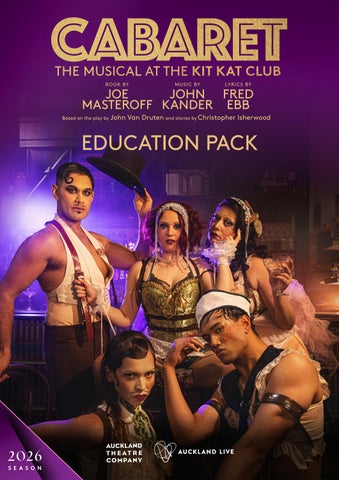
B O O K BY
M US I C BY
LY R I C S BY
JOE JOHN FRED MASTEROFF KANDER EBB
Based on the play by John Van Druten and stories by Christopher Isherwood
EDUCATION PACK
202 6 S E A S O N
He pou atua, he pou whenua, he pou tangata. Ko Waitematā te moana Ko Waikōkota te whenua. Ko Te Pou Whakamahara a Māui Tikitiki a Taranga te tohu o te kaha, o te kōrero, o te whakapapa o tēnei wāhi, o tēnei whare. Nau mai e te tī, e te tā ki te whare kōrero, ki te whare whakaari o ASB ki te tahatika o te moana. Mauri tau, mauri ora!
Pouwhakamahara a Māui-Tikitiki-a-Taranga The Memorial Post of Māui the Topknot of Taranga Robert Jahnke ONZM (Ngāi Taharora, Te Whānau a Iritekura, Te Whānau a Rākairoa o Ngāti Porou), 2016 Laminated tōtara and Corten steel Proudly commissioned by Auckland Theatre Company for ASB Waterfront Theatre
The symbols of support, of strength and of guardianship stand fast and proud. The waters of Waitematā ebb and flow against the shores here at Waikōkota, the land upon which we stand. The pou of remembrance to Māui Tikitiki a Taranga stands tall as a beacon of courage, of stories passed down and of the history that connects us all to this place and to this space. We welcome you all from near and far to this house of stories, to the ASB Waterfront Theatre. Mauri tau, mauri ora!
1
About This Pack This education pack is designed to support your exploration of Auckland Theatre Company’s production of Cabaret with music by John Kander, lyrics by Fred Ebb. Whether you’re a kaiako preparing lessons, an ākonga studying the play, or simply curious about this work, this resource offers insights into both the original text and this specific production. This education pack is divided into three sections:
About the Play
After a welcome from Auckland Theatre Company, this section includes key information about the cast and creatives, essays providing essential context and background information, and a synopsis of the production.
Making the Play
This section takes you behind the scenes with artefacts from the rehearsal room, key design concept insights, and notes to and from the cast, giving you a unique window into the creative process.
Activities
NCEA-linked activities that you can try in your classroom or at home to help you unpack and explore this production of Cabaret by Kander and Ebb. These activities support achievement standards across Levels 1, 2, and 3.
Each section builds upon the previous one, but you can also use individual components as standalone resources. The activities are designed to complement the contextual information and production insights, making this pack suitable for both independent study and classroom use.
2
Contents About the Play Welcome from ATC & Auckland Live
9
Note from the Director
10
Writers
12
About
14
Synopsis
16
Making the Play Set Design
20
Costume Design
22
Sound and the Band
24
Lighting
26
Meet the Characters
28
Meet the Emcee
30
In the Press
32
Classroom Activities ’Let the music play’ exploring Kilby-Henson’s vision
34
’In here’ versus ’Out There’ - Exploring the Historical Context of Cabaret 39 “The war has already arrived” Exploring the design of Cabaret
42
Performing in Cabaret
46
Cabaret and Level One NCEA
48
3
About The Play Key information about the cast and creatives, essays providing essential context and background information, and a synopsis of the production.
4
ABOUT THE PLAY
5
AN AUCKLAND THEATRE COMPANY AND AUCKLAND LIVE PRODUCTION
B O O K BY
M US I C BY
LY R I C S BY
JOE JOHN FRED MASTEROFF KANDER EBB
Based on the play by John Van Druten and stories by Christopher Isherwood
22 SEP – 25 OCT 2026
CAST
Fräulein Schneider – Susan Brady Sally Bowles – Nomi Cohen Ernst Ludwig – Jonathan Martin Fräulein Kost – Hillary Moulder Emcee – Matu Ngaropo Herr Schultz – Steven Ray Clifford Bradshaw – Justin Rogers
KIT KAT CLUB ENSEMBLE
Herman – Monēt Faifai-Collins Victor | Clifford Bradshaw Understudy – Vincent Farane Bobby | Emcee Understudy – Joel Hewlett Rosie | Fräulein Kost Understudy – Sophie Jackson Lulu | Swing – Kira Josephson Otto | Swing – Josh Morris Frenchie | Sally Bowles Understudy – Emily Patterson Texas – Waikamania Seve Maximillian | Ernst Ludwig Understudy – Adeel Surendran Hilde – Te Ohorere Williams Wilhelmina | Gorilla – Hillary Moulder
CREATIVE
Book – Joe Masteroff Music – John Kander Lyrics – Fred Ebb Based on the play by – John Van Druten Based on stories by – Christopher Isherwood Director – Benjamin Kilby-Henson Musical Director – Robin Kelly Choreographer – Kira Josephson Set & Costume Designer – Dan Williams Lighting Designer – Rachel Marlow and Bradley Gledhill, Filament Eleven 11 Sound Designer – Sam Clavis Assistant Musical Director – Billie Hart Voice & Dialect Coach – Kirstie O’Sullivan Engine Room Assistant Director – Jthan Morgan Engine Room Assistant Designer – Grace Newton Education Pack Writers – Jonathan Price & Anna Turner
BAND
Upright Bass – Tom Dennison Piano & Clarinet – Billie Hart Accordion, Piano & Guitar – Robin Kelly Trumpet – Jake Krishnamurti Drums & Percussion – Emerson McCullough Trombone & Sousaphone – Jono Tan Tenor Sax, Alto Sax, Clarinet & Flute – Scott Thomas
PRESENTING PARTNER:
7
Cabaret opened on Broadway on 20 November 1966 at the Broadhurst Theatre in New York City, directed and produced by Harold Prince. It premiered in the West End on 28 February 1968 at the Palace Theatre, London. The New Zealand premiere of Cabaret was staged by Mercury Theatre in Auckland, running from 13 November to 29 December 1974, directed by Robert Alderton and Basil Pattison. Auckland Theatre Company has since staged the musical twice, in 1999 at the SkyCity Theatre directed by Raymond Hawthorne, and in 2010 in the Salon Perdu Spiegeltent directed by Michael Hurst. Cabaret is the seventh production in Auckland Theatre Company’s 2026 season and the company’s third production of the musical. With book by Joe Masteroff, music by John Kander and lyrics by Fred Ebb, it is based on the play by John Van Druten and stories by Christopher Isherwood. Presented in collaboration with Auckland Live, this production is directed by Benjamin KilbyHenson, with musical direction by Robin Kelly and choreography by Kira Josephson. It began previews on Tuesday 22 September and opened on Saturday 26 September 2026 at ASB Waterfront Theatre. The production runs for two hours and 30 minutes, including an interval. This production contains smoke and haze, partial nudity, smoking, sexual themes, anti-Semitism and Nazi symbolism. CABARET is presented by arrangement with Concord Theatricals on behalf of TamsWitmark LLC. www.concordtheatricals.com Please ensure all mobile phones and noiseemitting devices are switched off. Filming and photography are strictly prohibited. 8
ABOUT THE PLAY
Nau mai, haere mai Now celebrating its 60th anniversary, Cabaret remains as potent as it was in 1966. It is one of the great masterpieces of the musical theatre canon. The duo of John Kander and Fred Ebb is among the most successful writing partnerships in musical theatre history. They created unforgettable characters and songs. Chicago is the longest-running musical still on the Broadway stage. Cabaret is revived again and again as audiences demand to return to the famed Kit Kat Club. Kander and Ebb use satire and the disarming form of the musical to tell a cautionary tale. Rooted in the real-life experiences of Christopher Isherwood, who was witness to this moment in history, the story warns us that this can happen again. This cast, led by Matu Ngaropo and Nomi Cohen, is extraordinary. It is a privilege to witness their craft and talent. We are truly blessed with 17 of the best in the biz. Under the visionary direction of Benjamin Kilby-Henson, choreographer Kira Josephson, musical director Robin Kelly, production designer Dan Williams, lighting designers Rachel Marlow and Bradley Gledhill, sound designer Sam Clavis and voice and dialect coach Kirstie O’Sullivan, the Weimar Berlin of 1929 is vividly brought back to life on the ASB Waterfront Theatre stage. Together, Auckland Live and Auckland Theatre Company have produced this new Cabaret for our city as a demonstration of our faith in Aotearoa’s musical theatre artists. We are both invested in this art form and believe in the power of live performance. Cabaret concludes the 2026 Auckland Theatre Company main-stage season. Our Youth Company and Emerging Writers will present the culmination of their year’s work at the Basement Theatre in November. We could not be prouder of all of the artists and crew we have worked with this year. The work we do is generously supported by the residents and businesses of our city through Auckland Council. Thank you. So, willkommen, bienvenue, welcome, haere mai! Here, life is beautiful.
Daniel Clarke Director, Auckland Live
Jonathan Bielski Artistic Director & CEO
9
Note from the Director Benjamin Kilby-Henson It’s the final show of the year and, blimey, it’s spectacular. Cabaret is my absolute favourite of all time (I played the Emcee in high school when I was 17). Nothing is more satisfying than a musical with real substance and Cabaret never disappoints: clever songs, abandonment to be found through dance and some real juicy acting scenes. Set during a fascinating, captivating, terrifying moment in time, the musical has also been a safe haven for audiences who have felt outcast or othered. The champagne is popped in the giddy parties sending off the Roaring Twenties, but we know how those corks are going to land. This text presents us with the ultimate dramatic irony: we know what’s coming and these characters (the majority of whom we come to love in our short time with them) don’t. The story is inspired by Christopher Isherwood’s novel Goodbye to Berlin and Clifford is closely based on Christopher. He is seduced by the everlasting party that is Berlin, distracted from writing his novel as sexuality and gin overtake him. He’s not quite our hero and, despite his attempts to become more educated in German politics, he realises he’s been “fast asleep”. Joining him in dreamlike slumber is Sally, the ultimate whirlwind of hedonism. She is the party girl we all wish we could be, but even she falls into the trap of her own stubbornness. Our Emcee, the Master of 10
Ceremonies, is a seduction figure, leading us to our deepest, darkest desires. At once malevolent, at once the charming host. He holds up a mirror to apathy, whilst also topping up our drinks. Kost, a street-smart sex worker, still scrabbling after the First World War, aligns to the Nazi Party out of fear and poverty. Ernst is the ultimate charmer, assisting Clifford to take advantage of all that Berlin has to offer: first, finding an apartment... then, finding work... then, finding nightclubs then, ultimately, unbeknown to Clifford, enlisting him to assist the Nazi Party. Fräulein Schneider and Herr Schultz are where the true heart of the musical is found. This is such a precious, tender relationship, quashed by rising malevolent forces. Schneider is also petrified: a self-proclaimed survivor, so close to happiness. Schultz is representative of so many innocent Germans; making an honest living, persecuted for political gain simply for being Jewish. One of the ugliest and most deplorable times in human history looms large over the decline of their relationship. Embracing Cabaret as an allegory for a dark period in history, it feels remiss not to look to our own time. There are many events occurring currently that have echoes to Cabaret. It’s a complex and brutal time, and the world is riven with division. It is comforting, then, for us to be united in the power of song, the power of dance, the power of story.
ABOUT THE PLAY
11
ABOUT THE PLAY
Writers KANDER & EBB As a composer, Kander made his Broadway debut in 1962 with A Family Affair, produced by Harold Prince. A year later, in 1963, Kander met lyricist Fred Ebb. Kander and Ebb began to work together, and their first song, “My Coloring Book,” was nominated for a Grammy award. Kander and Ebb’s first theatrical collaboration, The Golden Gate, never opened on Broadway. However, the score convinced Harold Prince to hire the pair for his next production, Flora, the Red Menace, which opened in 1965, starring Liza Minnelli in her Broadway debut. Cabaret, Kander and Ebb’s triumphant hit, opened on November 20, 1966 at the Broadhurst Theatre and ran for 1,166 performances. The show won the 1966 Tony Award for Best Musical and Kander and Ebb won for Best Score. In 1972, the film adaptation starring Liza Minnelli won several Oscars. The stage musical was revived at the Imperial Theatre in 1987 with some of the original cast reprising their roles. The show was revived again in 1998, earning another Tony for Best Revival. Subsequent collaborations included The Happy Time, 70, Girls, 70 and Chicago. Another huge hit, Chicago ran for 898 performances and was revived in 1997, winning six Tony Awards, including Best Revival, Best Choreography, and Best Direction. The team continued their collaboration with The Act, Woman of the Year, The Rink, Kiss of the Spider Woman (Tony Award winner for Best Score), Steel Pier and Over and Over. 12
In 2000 Kander and Ebb were working together on The Visit, based on a play by Friedrich Durrenmatt. After Fred Ebb passed away in 2004, Kander completed the project with playwright Terrence McNally. Kander’s film work includes scores for Something for Everyone (1969), A Matter of Time (1976), Kramer vs. Kramer (1979), Still of the Night (1982), Blue Skies Again (1983), Places in the Heart (1984), I Want to Go Home (1989) and Billy Bathgate (1991), and songs for New York, New York (1977), Cabaret (1972), Funny Lady (1975) and French Postcards (1979). Kander and Ebb also collaborated on music for several television specials. In 1974 they won an Emmy Award and Grammy Award for their work on Liza with a ’Z.’ They won another Emmy in 1993 for Liza Minnelli in London, Steppin’ Out. Other television projects featured Goldie Hawn, Shirley MacLaine, and Mikhail Baryshnikov. For almost four decades, Kander and Ebb wrote music together for theatre, film, and television. Their collaboration was a true partnership. In an April 1997 article in The New York Times, Ethan Mordden wrote, “Mr. Kander and Mr. Ebb celebrate the Big Break, the American love of show biz, making it, performance. Their musicals may be set in Germany, Greece, or South America, may defy Fascism or flirt with death. But at the center of their art lies a love of the talent-take-all wonder of entertainment.”
FRED EBB
JOHN KANDER
JOHN KANDER
Music
John Kander is a Tony, Emmy and Grammy-winning composer, a recipient of the Kennedy Center Honors Award, and a member of the American Theatre Hall of Fame. With frequent collaborator Fred Ebb, he composed the score to dozens of Broadway musicals.
FRED EBB
Lyrics
Fred Ebb (1933–2004) was an award-winning lyricist, librettist and director who frequently and successfully collaborated with composer John Kander. His last projects included a musical version of The Skin of Our Teeth and Curtains, with book by Rupert Holmes. Fred Ebb earned four Tony Awards along with dozens of other accolades, including the Kennedy Center Honors and membership in the American Theatre Hall of Fame.
JOE MASTEROFF
JOE MASTEROFF
JOHN VAN DRUTEN
JOHN VAN DRUTEN
CHRISTOPHER ISHERWOOD
CHRISTOPHER ISHERWOOD
Book
Based on his play
Based on his stories
Born in 1919 in Philadelphia, Joe Masteroff had only one dream from infancy: to write for the theatre. After the essential lonely childhood and four-year stint in the Air Force, he came to New York to face his future: book writer or book seller? Luckily, luck intervened. Before long he had three shows on Broadway bearing his name: The Warm Peninsula starring Julie Harris, and two musicals, She Loves Me and Cabaret, for which he was the book writer. His other work included the libretto for 70, Girls, 70 and Desire Under The Elms and book and lyrics for Six Wives and Paramour.
John William Van Druten (June 1, 1901 – December 19, 1957) was an English playwright and theatre director. He began his career in London, and later moved to America, becoming a U.S. citizen. He was known for his plays of witty and urbane observations of contemporary life and society.
Christopher Isherwood was a novelist, playwright, screen-writer, autobiographer, and diarist. He was homosexual and made this a theme of some of his writing. He was born near Manchester in the north of England in 1904, became a U.S. citizen in 1946, and died at home in Santa Monica, California in January 1986.
13
About The musical Cabaret is the best known iteration of a story which started as a 1939 semi-autobiographical novel called Goodbye to Berlin by EnglishAmerican writer Christopher Isherwood. Isherwood, like other queer writers of the time, had travelled to Weimar-era Berlin in 1929 and become absorbed in the relatively accepting world of Jazz-age cabaret. He shared lodgings with Jean Ross, a British journalist and activist, who at the time was working as a singer in Berlin’s cabarets. When Ross became pregnant (not by Isherwood), Isherwood pretended to be her partner to help her get an abortion. Isherwood observed the rise of Nazism with disinterest until the situation became too dangerous and he left Berlin in 1933. Isherwood drew from his diaries of the time to write Goodbye To Berlin, in which Jean Ross became Sally Bowles. In 1951, Isherwood’s novel was adapted into a play, I am a Camera, which takes its title from the novel’s opening line: “I am a camera with its shutter open, quite passive, recording, not thinking.” In the early sixties, Broadway producer Harold Prince thought that I am a Camera and the original source material could be made into a gritty musical whose story would parallel some of the counter-cultural and racial 14
anxieties of his own time. Since its premiere in 1966, Cabaret (music by John Kander, lyrics by Fred Ebb, book by Joe Masteroff) and the Kit Kat Club has been used to hold a mirror up to whatever political upheaval may be occurring outside the theatre doors, and ask how long one can go on “sleeping” before it comes crashing in (literally, in the case of the brick that gets thrown through the window of Herr Schultz). A 1972 film version was directed by Bob Fosse and starred Liza Minnelli. A commercial and critical success, it was nominated for eight Oscars and won eight Academy Awards, from ten nominations, and still holds the record for the most Oscars won by a film that did not win Best Picture. The film departed from traditional stagings of the musical by presenting all the numbers as diegetic, recognised by the characters as performances within the Kit Kat Club itself. Here, a creative question for all subsequent revivals of Cabaret was established: where to draw the line between presenting “reality” on the one hand, and the performative nature of a cabaret club on the other. The 1993 London revival of Cabaret, directed by Sam Mendes, is credited with bringing many of the submerged political and sexual themes to the
ABOUT THE PLAY
surface and solidifying its reputation as a classic able to speak convincingly to a contemporary audience. In this version, the Emcee, played by Alan Cumming, was overtly sexualised wearing suspenders and painted nipples. Clifford Bradshaw, played by Adam Godley, was presented as gay, closeted, and gathering the courage to come out. At the end of the production, the Emcee wore a striped uniform such as the ones worn by prisoners in Nazi concentration camps, with badges used by the Nazis to mark out communists, Jews, and homosexuals. As Benjamin Kilby-Henson, director of ATC’s Cabaret says, “Set during a fascinating, captivating, terrifying moment in time, the musical has also been a safe-haven for audiences who have felt outcast or othered.” Perhaps it is this duality – the safe haven of the Kit Kat Club’s “in here” set against the terror of “out there” – which has ensured Cabaret’s ongoing popularity with audiences around the world.
15
Synopsis Cabaret is set in Berlin, 1929-30, where the jazz-soaked hedonism of the post-WW1 golden age is about to give way to the chilling rise of Nazism. Into this world arrives Clifford Bradshaw, an American writer searching for inspiration. A chance meeting with a smuggler, Ernst Ludwig, leads Cliff to the Kit Kat Club, presided over by the enigmatic, seductive Emcee. Here, he meets Sally Bowles, a wild and magnetic singer, and the two embark on a whirlwind romance. A parallel love story emerges between Fräulein Schneider, owner of the boarding house where Cliff and Sally are staying, and Herr Schultz, a Jewish fruit vendor. Their beleaguered relationship shows the growing threat of anti-Semitism in Berlin, embodied in the character of Ernst, who eventually reveals his allegiance to the Nazi Party. When Sally becomes pregnant, Cliff urges her to escape to America with him, but she remains bound to the Kit Kat Club and the cabaret lifestyle, leaving Cliff to flee alone.
16
ABOUT THE PLAY
17
Making the Play This section takes you behind the scenes with artefacts from the rehearsal room, key design concept insights, and notes to and from the cast, giving you a unique window into the creative process.
18
MAKING ABOUT THE THE PLAY PLAY
Cabaret is a show of slowly merging contrasts. The Kit Kat Club is all glitter and abandon, while the Third Reich rises in the shadows behind it. This production keeps both in view the whole time by staging the entire story as a cabaret act: we never leave the Kit Kat Club. When the narrative shifts to a boarding house, a fruit shop or a train, these settings are built using the visual language of a cabaret act. Director Benjamin Kilby-Henson and his design team pushed that idea a long way. The audience does not walk into a club that is polished and ready. The war has already been through it, and the Emcee has to bring the whole world back to life in front of us. From there the party and the threat build side by side toward the same ending.
19
Set Design Set and costume designer Dan Williams wanted a Cabaret that looks like no version you have seen. That meant dropping the show’s usual shorthand. There would be no black or red curtains and no gold trim. Instead he spent months researching the jazz bars, dance halls and cabarets of Weimarera Europe and the art of the period looking for the kind of room the Kit Kat Club might be. The palette is Art Deco: sage, oatmeal, flamingo pink, orange and apricot. Chequer floors, velvet drapes, wooden floors and a raised band area ringed with lights. The proscenium is framed in bare bulbs. ASB Waterfront Theatre is a very wide house, so the team built a second proscenium inside the first to pull the audience into the smaller, more intimate club. Sage panelling and wainscoting, pressed tin walls, black ironwork and mirrored frames full of bulbs give the room its texture. The club takes its spirit from the Eldorado, a real queer nightclub in Weimar-era Berlin. It was an eclectic, openly queer space, and the Nazis eventually seized it and turned it into a headquarters. That history sits under the show.
20
The most striking choice is where the show starts. It opens after the war has already arrived. The audience walks into a wreck: the Cabaret sign letters pulled down, a costume rack on the floor, tables and chairs overturned, the room left as it was when the company fled. It should look as though a bomb has gone off inside the club, which puts the Emcee front and centre as the magician who conjures it all back. He does so across the opening number, as the ragged curtain over the band flies out to show the orchestra, the Cabaret sign lifts into place, the company sets the furniture right and clears the mess, and a big swag of sage curtain drops in to frame the club. The set is a wide horseshoe that reaches past the edge of the stage. A raked platform runs into the auditorium with side stairs, so the Kit Kat performers can move down the aisles. This blurs the separation between audience and performer, as in a real life cabaret. The cabaret tables carry on off the stage and into the house, each one set with a lamp and a telephone, a real feature of the Berlin clubs, where guests rang each other from table to table. Beaded curtains hang in the archways, and small lights glow inside seashells along the front edge like footlights.
MAKING THE PLAY
The show stays a cabaret act throughout. The Bentwood chair, a signature object of the cabarets we know, becomes its central emblem and stands in for the Berlin party itself. When the story travels, it travels the club’s way. The train is a row of Bentwood chairs under a giant pair of flown ticket stubs. The world outside shows up as Cliff first sees it, on backdrops with the torn and taped look of pages from the diary he will later write into his novel, the same look carried through the ripped tops of the walls. A window flies in for the party scene, strung with festoon lights, then drops away in a Kabuki reveal for the brick that comes through the glass. “We are not going to have black or red curtains, or gold trim. This is a Cabaret unlike any version you have seen before.” – Dan Williams, Set And Costume Design
21
Costume Design The costumes come out of the same Eldorado world, queer and eclectic and of its period, and lift it into high fashion. This is Weimar Berlin by way of Jean-Paul Gaultier and John Galliano, with the flamboyance of 1990s Dior. One of the first conversations between Kilby-Henson and Williams was about how sexiness would work in this world. Instead of the expected fishnets and bare skin, the allure comes from the unexpected: high fashion, layering, and underwear worn on the outside as part of the act. As Williams and KilbyHenson put it, they could be cleverer than flesh, suggesting more than showing, and giving the performers something to play with.
22
The Emcee changes the most, turning up in something new each time: underwear layered over sharp suiting, sock suspenders, a clean suit, then a pale look trimmed with tassels as he leads the company through the gorilla and clown numbers. Sally Bowles is a Galliano riot of feathers, bright colour and bold fabric across three different wigs, from a natural-looking red to a styled, finger-waved one. She is in bold colour throughout.
MAKING THE PLAY
The Kit Kat ensemble starts in a near Renaissance palette of blush pinks and layered lace, then toughens up with leather strapping, lederhosen and corsetry over the top, plus cat ears and headpieces. During the numbers, the costumes are augmented with clever staging, best of all when the company builds a giant dress for Sally from parasols. Away from the club, the three men wear three clear palettes. Cliff is in the warm, light tones of an American abroad, with a vintage suit, a soft hat and a trench coat. Ernst is navy, blue
and pinstripe, and then the swastika armband appears. Herr Schultz is in older German browns and tweeds. Fräulein Schneider changes almost every scene, in dropped-waisted 1920s shapes with period furs and hats, and Fräulein Kost brings a worn flapper glamour and a gold wig. The turning point of the show is a costume too. For “If You Could See Her”, the gorilla becomes a Josephine Baker act, with a banana skirt she can pick from and eat, a spangled bra and pigtails. The audience laughs, and that laugh is the trap the song springs in its last line. “We knew straight away that we could be cleverer than flesh.” – Benjamin Kilby-Henson, Director
23
Sound and the Band
24
MAKING THE PLAY
Sound designer Sam Clavis keeps the band on stage, contributing authentically to the world of the club. The cast recordings you might know are full of lush orchestration, strings and all, but here the sound is the rougher, more characterful mix of a real cabaret band, led by musical director Robin Kelly. That mix uses found objects alongside instruments: the clarinettist whose instrument is worth more than their house, next to whatever could be picked up around the club to make a noise. A sousaphone earns its place for its shape as much as its sound. It is a mix of the lovely and the strange. The band also makes as much of the show’s sound as it can, live. Cash registers ring, and the team has been trying out a glass box to make the sound of the breaking window, in the style of classic radio-drama foley. Played sound and found sound meet, and the whole score feels made by hand in front of you. “The musician who owns a clarinet worth more than their house, next to a whole jumble of things picked up from the club to make sounds with.” – Robin Kelly, Musical Director
25
Lighting Lighting designers Rachel Marlow and Bradley Gledhill, of Filament Eleven 11, work in the same world of bare bulbs as the set, and the whole rig can shift colour and pick out different corners of the club as the night goes on. Low angles give the traditional footlit cabaret glow and the design can then open up into something much bigger. The two follow spots do a lot of the work. Everything on stage is live performance, so the spots almost become characters, with their own personality and their own movement. Like the band’s instruments, they are worked by hands in plain sight. They also cut two ways. A warm theatrical spotlight is also a cold searchlight, and the lighting team plays on both. An LED strip along the front lights the flamingo curtain at the base of the stage. The team treats the usual cabaret lighting as a kit of parts and then asks what else it can do, with a bit of cheek to it. “The follow spots are the only element worked by human hands, which is so iconic of cabaret. But they also sit on that line of scrutiny and searchlight, so they carry a duality, just as the piece does.” – Filament Eleven 11, Lighting Design
26
MAKING THE PLAY
27
Meet the Characters The people of the Kit Kat Club and the boarding house, and the performers who bring them to life at the ASB Waterfront Theatre. The Emcee (Master of Ceremonies) Played by Matu Ngaropo The host of the Kit Kat Club and our guide through the night. A seduction figure who leads us toward our deepest desires, at once malevolent and utterly charming, he holds up a mirror to our apathy while topping up our drinks. Sally Bowles Played by Nomi Cohen A British cabaret singer at the Kit Kat Club and the ultimate whirlwind of hedonism. She is the party girl we all wish we could be, living for the moment in a gin-soaked dream, until her own stubbornness traps her. Clifford Bradshaw Played by Justin Rogers An American novelist newly arrived in Berlin, closely based on the writer Christopher Isherwood. Seduced by the everlasting party of the city, he is distracted from his novel as sexuality and gin overtake him, and slowly realises he has been “fast asleep” to what is happening around him.
28
MAKING THE PLAY
Fräulein Schneider Played by Susan Brady A Berlin landlady who rents rooms in her large flat. A self-proclaimed survivor, she is so close to happiness with Herr Schultz, yet petrified of the rising forces around her. Her story is where the true heart of the musical is found. Herr Schultz Played by Steven Ray One of Fräulein Schneider’s roomers and the proprietor of a fruit shop. A gentle man making an honest living, he represents so many innocent Germans persecuted for political gain simply for being Jewish. Fräulein Kost Played by Hillary Moulder Another of Fräulein Schneider’s roomers, a street-smart sex worker still scrabbling to get by after the First World War. Out of fear and poverty, she aligns herself with the Nazi Party. Ernst Ludwig Played by Jonathan Martin A friendly and likeable German, and the ultimate charmer. He helps Clifford find his feet in Berlin, an apartment, then work, then the nightclubs, until, unbeknown to Clifford, he enlists him to assist the Nazi Party. Around these seven, a Kit Kat Club ensemble of ten performers and a live on-stage band bring the world of the club to life
29
Meet the Emcee
The host of the Kit Kat Club, played by Matu Ngaropo (Ngāi Tūhoe, Te Rarawa, Ngāti Porou) THE CHARACTER The Emcee, or Master of Ceremonies, is the host of the Kit Kat Club and our guide through the night. He greets us with open arms, promising an escape from the troubles waiting outside, and pulls us deeper into a world of glamour, excess and denial. Director Benjamin Kilby-Henson describes him as a seduction figure who leads us toward our deepest, darkest desires: “at once malevolent, at once the charming host. He holds up a mirror to apathy, whilst also topping up our drinks.” As the Jazz Age fades and the Nazis rise, the Emcee never breaks the spell of the club, which is exactly what makes him so unsettling to watch. THE ACTOR: MATU NGAROPO Matu Ngaropo returns to Auckland Theatre Company as the Emcee, twenty years after his first production with the company. He trained at Toi Whakaari: New Zealand Drama School before building an international musical theatre career, including more than 700 performances in The Lion King and playing George Washington in the Australian production of Hamilton.
He is a founding member of the Modern Māori Quartet and voiced Scar in Disney’s The Lion King Reo Māori (2018). He credits his foundations to kapa haka, where he first found himself on stage. IN HIS OWN WORDS As the Emcee of that club, there is a duality of being a warm, welcoming host, but also somebody who says, “Come in here and get away from the troubles that you will leave outside”. It can be all jazz hands and super charming, but also I’m enlisting you to bury your head in the sand. So there is a bit of cowardice, I think, to him. What an iconic show, and the Emcee is such an iconic role. Following in the footsteps of people like Joel Grey, Alan Cumming, Michael C Hall, Eddie Redmayne, Adam Lambert and of course Billy Porter, who was probably the first person of colour I’d seen play the role. Both my parents are native reo Māori speakers, and part of staying connected was taking us to club, which was haka, and a place to commune with other urban Māori. That was my first foray into being on stage and in front of people. I credit a lot of my foundational skill base to that, for sure. MATU NGAROPO, THE EMCEE
30
MAKING THE PLAY
31
32
MAKING THE PLAY
In the Press The following interviews and features offer further context for Cabaret and its 2026 Auckland Theatre Company production. They are recommended reading for kaiako and ākonga preparing for study or revision. INTERVIEWS AND FEATURES Ben Kilby-Henson’s Cabaret brings record-breaking ATC season to a close NZ Herald, September 2026 Director Benjamin Kilby-Henson on staging Cabaret as the closing production of ATC’s record-breaking 2026 season, and what drew him to the Kit Kat Club. Matu Ngaropo, Cabaret: “I want to do the show justice” The Post, September 2026 Matu Ngaropo (Ngāi Tūhoe, Te Rarawa, Ngāti Porou) returns to ATC as the Emcee, twenty years after his first production with the company. He talks about his path from kapa haka to an international musical theatre career, and about honouring what the show is saying. As the Emcee of that club, there is a duality of being a warm, welcoming host, but also somebody who says, “Come in here and get away from the troubles that you will leave outside”. It can be all jazz hands and super
charming, but also I’m enlisting you to bury your head in the sand. So there is a bit of cowardice, I think, to him. Both my parents are native reo Māori speakers, and part of staying connected was taking us to club, which was haka, and a place to commune with other urban Māori. That was my first foray into being on stage and in front of people. I credit a lot of my foundational skill base to that, for sure. It’s very timely that this show is happening now here for us. I don’t want to be hammering any politics at you, because the show speaks to what it is, and it’s super important to us to honour what the show is saying. MATU NGAROPO, THE EMCEE Butterflies, jazz and a dash of chaos: stepping into Cabaret The Post, September 2026 Jonathan Martin, who plays Ernst Ludwig, on the rehearsal room and finding his way into the world of the Kit Kat Club. My Secret Auckland: Sophie Jackson shares her favourite spots in the city NZ Herald, September 2026 A lighter profile of Kit Kat Club ensemble member Sophie Jackson, useful for a sense of the company behind the production. 33
34
CLASSROOM ACTIVITIES
Classroom Activities This section is specifically designed to help you unpack the show and utilise the information in this pack in the classroom with your kaiako. Each section references information in the pack and is structured in the following way: •
Pre-reading/Unpacking: A literacy based activity to analyse the material in this pack
•
In the Classroom: Brainstorming, prompt and practical activities to provoke discussion and help you explore the education material provided
•
Revise: Questions for you to complete individually in preparation for your AS91518 Exam in November. These questions have been specifically developed from the 2026 Exam Specifications provided via this link: Level 3 Assessment Specifications
35
’Let the music play’ Exploring Kilby-Henson’s vision
For the activities in this section reference the Note from the Director and About the Play on Pages 10 & 14 Connecting key quotes to moments in the performance: Below are four themes drawn from Kilby-Henson’s director’s note. You could split into four groups and take one theme each OR complete this activity in pairs. •
Dramatic irony and apathy
•
Seduction vs Malevolence represented through the Emcee
•
Tender humanity in a dark world represented through the relationship between Schneider and Schultz
•
Fresh design and aesthetic innovation
For each theme: Select one quote from the Note from the Director that supports that theme •
36
Identify a specific moment from the production that brought this idea to life on stage
•
Write a detailed reflection on how Kilby-Henson brought his vision to life on stage. Support your reflection with specific evidence of his directorial choices, noting how he guided actor performances, applied drama elements and conventions, and collaborated with designers.
Ensure you share your quotes and reflections with the rest of the class, collating the information into a shared space for revision or portfolio construction purposes.
What makes Kilby-Henson’s Cabaret unique? Write a short essay responding to the following prompt, using the ideas you collated from the previous activity: How does Kilby-Henson balance the “vibrant, rollicking, hedonistic” energy of the Kit Kat Club with the oppressive historical weight of rising fascism without directly modernising the story? Reference specific details from the production and directorial choices in your answer.
CLASSROOM ACTIVITIES
The power of the Emcee - exploring through performance: Kilby-Henson notes that the Emcee is “at once malevolent, at once our charming host” who “holds a mirror up to apathy, whilst also topping up our drinks.”
•
Explore this practical activity in groups of three or four: •
•
Devise a short sequence inspired by Cabaret that uses the Emcee as a central character within an ensemble or chorus of people. The scene should depict a moment where the atmosphere shifts from giddy entertainment to underlying tension or political reality for example; the end of a Kit Kat Club number transitioning into a scene with Ernst or the rising Nazi presence. Using Kilby-Henson as inspiration “adding found objects and foley alongside their instruments”, assign one actor or musician to create live, atmospheric sound effects using non-traditional items (e.g. clanking glasses, scraping metal, sudden percussive thuds) to accentuate moments of tension.
•
Position your Emcee so they interact directly with the audience/ ensemble exploring two distinct personalities: •
High-energy, welcoming, physical proximity, fluid movement.
•
Sudden stillness, challenging eye contact, subtext of something sinister through body language
Plan how you would use the rest of your ensemble to isolate the Emcee or highlight moments of apathy in the surrounding crowd.
Perform for your peers and discuss how your scene was inspired by KilbyHenson’s choices and why the Emcee is integral to the story Cabaret is telling.
Revise - (Complete these as you study for your exam) Director’s concept: • Discuss the purpose of the performance and how the themes or ideas link to what is happening
in the world; socially, politically or historically. Link your ideas to specific moments or examples from the performance: •
How did the way the performance was realised impact the style of delivery of the narrative/story?
•
How does the content of the play challenge and serve the audience?
•
Discuss how the director brought the story to life using Drama Components - Elements, Conventions, Techniques and Technologies
•
What do you think Benjamin Kilby-Henson is asking you to think about in the way he has directed Cabaret: •
38
How did the acting and staging choices affect you as an audience member?
CLASSROOM ACTIVITIES
’In here’ versus ’Out There’
Exploring the Historical Context of Cabaret
In his Director’s Note, Benjamin KilbyHenson highlights the central tension of Cabaret:
Sketch six storyboard frames that depict your chosen scene, think about the following in your sketches:
“Set during a fascinating, captivating, terrifying moment in time, the musical has also been a safe haven for audiences who have felt outcast or othered. Perhaps it is this duality - the safe haven of the Kit Kat Club’s ’in here’ set against the terror of ’out there’ which has ensured Cabaret’s ongoing popularity.”
•
Where are the characters placed? Is there a physical divide between the Kit Kat Club world (“in here”) and the outside world (“out there”)?
•
How do light and shadow build the mood?
•
Note specific choices in costuming, body language, facial expression, or props that signpost the historical period (1929–1933 Weimar Republic to Nazi rise).
Using the information on Page 10 - 14 create an annotated storyboard of a specific moment in the production that demonstrates this clash between the “in here” of the Kit Kat Club (hedonism, performativity, safe haven) and the “out there” of the world (rising fascism, political apathy, historical reality). In pairs or small groups choose one moment in the production where the political or social context breaks into the world of the characters.
Annotate around each frame of the storyboard: •
Historical Context: what references are being made socially, historically, politically or geographically
•
Kilby-Henson’s exploration of Cabaret as a “safe haven for the othered” versus a “terrifying moment in time” 39
•
Drama components; Techniques, Elements, Conventions and Technologies
•
Explain how the convention or combination of conventions were used in the performance
•
Diegetic reality (the presentational style of acting in the Kit Kat Club) versus narrative reality outside the club.
•
Discuss the impact of the use of the convention or combination of conventions in this moment
•
References and quotes from the About the Play section on Page 14
•
Discuss how meaning was created for you, as an audience member, in this moment
Individual reflection: In a short essay reflect on how the following quote inspired the creation of Cabaret. “I am a camera with its shutter open, quite passive, recording, not thinking.” Discuss how the inspiration for the production influenced the way KilbyHenson has directed Auckland Theatre Company’s version of the show. Refer to specific scenes and provide detailed evidence from the production. You may also like to reference other productions of Cabaret in your writing.
•
Discuss how the use of a convention or combination of conventions in a specific moment helped you think about the big ideas and themes of the play:
•
What was the wider context (socially, historically, politically or geographically) that this moment linked to?
Drama Elements and how they draw our attention to themes, motifs and symbols: •
What were the main themes, questions and ideas evident in the performance? Link these themes, questions and ideas to specific moments or examples from the performance
•
Identify recurring symbols or motifs throughout the performance. Explain why they were important in helping you understand ideas being communicated in Cabaret
•
How do these themes, symbols or ideas link to the wider world of the play and what impact does this have on the audience?
Revise - (Complete these as you study for your exam)
40
Drama Conventions - strategies established to make meaning and connect to wider context: (NB - make sure you are familiar with what the established Drama Conventions are by discussing this with your kaiako) • Identify a moment in the performance where Drama Conventions were used to transform the space:
CLASSROOM ACTIVITIES •
Were there moments where the content was confronting or forced you to think about something in a new light? What impact does this have on the audience and you as a member of the audience?
•
Reference the wider reading and cultural and historical context in this pack, as well as research material you have brainstormed and think about the impact these themes, symbols or ideas have on the lives and arcs of the characters in the play.
41
“The war has already arrived” Exploring the design of Cabaret
Making new choices for a classic production: Split into four groups for the following activity. Each group must take a different highlighted quote from the designers interviews, below: “We are not going to have black or red curtains, or gold trim. This is a Cabaret unlike any version you have seen before.”
“The follow spots are the only element worked by human hands, which is so iconic of cabaret. But they also sit on that line of scrutiny and searchlight, so they carry a duality, just as the piece does.” – Filament Eleven 11, Lighting Design •
Put the quote in the middle of a large piece of paper. Discuss why you think this quote has been highlighted in the pack, make notes
•
Read the design interview that it has been drawn from. Discuss the choices that designer has made, making notes on your brainstorm, pulling out important quotes
•
Link these notes to specific moments in the production, where these choices have been highlighted. Be detailed in your description
– Dan Williams, Set And Costume Design “We knew straight away that we could be cleverer than flesh.” – Benjamin Kilby-Henson, Director “The musician who owns a clarinet worth more than their house, next to a whole jumble of things picked up from the club to make sounds with.” – Robin Kelly, Musical Director
42
CLASSROOM ACTIVITIES
•
Share your brainstorms back with the wider class, adding further ideas as discussion arises.
Cabaret design for an ATC audience: Dan Williams has indicated that he is aiming to steer clear of the classic visual shorthand used in productions of Cabaret; red velvet, black mesh, gold trim, and dark, smoky arches. He is instead turning to authentic Weimarera historical research and the Art Deco movement. In this activity, you will
Design Choice
Traditional Design Trope
compare traditional Cabaret design choices with Dan Williams’ alternative vision, analysing how moving away from clichés alters the audience’s emotional and political connection to the story. Complete the table below using your knowledge of traditional Cabaret productions, the design notes on Dan Williams’ set. You will also need to explore Weimar history to support your notes. Draw directly from Dan Williams’ design note on Page 20.
Dan Williams’ Design Choice
How this created meaning / links to wider context
E.g. Colour Palette E.g. The opening state of the stage E.g. Symbolic use of props/set
43
Sketch and annotate: Drawing information from your completed table; sketch the set in detail. You may choose to do this in pairs or individually. Annotate your sketch in detail, incorporating quotes, and details from the performance. Elaborate on the factual details; colours, fabrics, texture, with what this represented to the audience. Include your own thoughts and ideas in your annotations. A fleeting fragile space: In a short written essay explain in detail how Kilby-Henson and the design team transformed the stage space to establish the Kit Kat Club “as a fleeting, fragile space that has ultimately been destroyed by history.” Use these questions to guide you: •
How was space transformed through the use of technology?
•
Why were these choices made? Think explicitly about the quote above
•
What were Kilby-Henson and the design team trying to say about the world of Cabaret?
•
What were they trying to say about our world?
•
What were you thinking about during the performance and what have you been thinking about since?
Revise - (Complete these as you study for your exam) •
Discuss how technology or design was used during a climactic moment in the performance? What do you think was at stake within the scene?
•
What was the impact of the way the design, directorial, and acting choices worked together? Choose a moment that surprised, shocked, or excited you to talk about
•
Discuss why the use of sound and lighting design was integral to this performance? Focus on the mood created by sound choices, use of colour and the shapes created by the angles or composition of lighting
•
How were design and directorial elements (props, setting, AV, costuming, audience positioning and interaction) and the Drama Elements used to build the performance? How did this make you feel as a member of the audience?
•
Discuss the inspiration for a specific element of the design and link it to wider context; social, political, historical or geographical? How did this deepen your understanding of the themes and ideas the play was communicating? •
44
This would be a good question to explore the intentionally transitional design of the Kit Kat Club and the encroaching reality of war is represented in the performance.
CLASSROOM ACTIVITIES Technology: link your ideas to specific moments or examples in the performance. Think about lighting, set, sound, props, costumes, make-up and how this helped bring you into the world of the play. • How was technology used to create the atmosphere in the performance? •
How was technology used to highlight important ideas, themes and symbols in the performance?
•
How was contrast and/or focus created or built through technology and why was this important?
•
How did the use of technology help you gain a deeper understanding of the themes of Cabaret?
•
How were technologies used in combination to transform the space in a specific moment? (Level Two students must revise this question)
•
How did technology highlight the different characters’ motivations expressed within the performance? •
•
Discuss why this was impactful, exciting or challenged your expectations
How were costumes used to communicate the characters in the play’s purpose in the performance?
45
“Come in here and get away from the troubles”- Performing in Cabaret Exploring the characters: split into groups taking one character each. Create a character profile for your chosen character, use the following instructions: •
•
What has happened to you since the last performance at the Kit Kat Club?
•
What is happening in the world and how is it impacting you?
•
Discuss your experience in the world of the play/the Kit Kat Club
Sketch the actor in their costume
Annotate in detail:
46
Physicalise: Use the process convention ’hot seating’ to interview the character after the play has ended, as if for a documentary. Questions you could ask, be creative:
•
How does the actor move, stand, sound?
•
What does the character want?
•
What do they mean in the world of the play?
•
How do they connect to other characters? What is the purpose of their relationships in the narrative?
•
What is being explored through their character? Themes, ideas, symbols, etc.
•
Key quotations that support your annotations
Revise - (Complete these as you study for your exam) Drama Techniques: Body, Voice, Movement and Space: You may want to answer all the questions for the same actor or focus on different actors for each question •
Describe how an actor used drama techniques in a specific moment in the performance
CLASSROOM ACTIVITIES
•
Explain an actor’s use of drama techniques and how they transformed the space within the performance
•
Choose specific moments where you felt an actor used their body, voice, movement, and space in combination, to create impact, focus, or to support an important idea/theme
•
Describe how a character in the performance uses their techniques to establish status on stage
•
Discuss how power is exemplified on stage and how two characters used their techniques to play with this idea
•
Thinking about a specific character and the way they created the characters arc: •
How did they use techniques to create a sense of time and place?
•
What social or political ideas did they represent within the play? How did the actor use techniques to communicate this?
•
How did an actor use drama techniques to communicate subtext in their performance? Use a specific moment and example to discuss this use of subtext.
Character: •
Discuss the purpose of these characters within the narrative of Cabaret: •
What impact do they have on the narrative?
•
Discuss the importance of the audience and actors’ relationship
•
How do the actor/s use of techniques communicate their purpose in the performance?
•
What do specific characters represent when you are thinking about the wider context of the play and how Kilby-Henson has chosen to direct it? Think about characters who represent specific social, cultural, historical or geographical ideas highlighted by the creative choices. 47
Cabaret and Level One NCEA “Drama transforms the tangible into the intangible.” This section of the education pack is designed to support Level One drama students navigate the Level One external Achievement Standard 91943 - Respond to a drama performance. Unlike the Level Two and Three external standards, which are an exam, you will be constructing a portfolio over a period of time in class. It will be based around three key aspects: •
key message of the performance, the use of drama components and your own personal response about how you connected to the performance, capturing the wairua (spirit) of what you watched.
This portfolio will be presented as a slideshow or PowerPoint and can be a mixture of written and audio visual material - the main question you should ask yourself as a student is; how do I communicate my ideas, thoughts, and feelings about what I saw, the best? With that in mind, you are encouraged to collect your thoughts, discussions and do your research in a 48
range of formats. Such as; voice notes, sketches and annotations, brainstorms, moodboards, recorded physical responses and writing. Kaiako and ākonga please ensure you read this year’s assessment specifications carefully as you prepare to submit this assessment. You can access the specifications via this link: NZQA Assessment Specifications - Level One Below are three activities to support you to expand your ideas during the teaching and learning phase of unpacking the performance. Key Message: In pairs, small groups or as a whole class, discuss and brainstorm the following prompts: •
What do you think Benjamin Kilby-Henson was trying to say? Why this choice of show? Why this representation of these characters?
•
What do you think Kilby-Henson was trying to communicate through the directorial choices he made?
CLASSROOM ACTIVITIES
•
What do the characters in the performance represent and what do they communicate to the audience?
•
What do you think the designers are trying to communicate through their choices? How does this bring Kilby-Henson’s ideas to life?
Once you have brainstormed around these questions, you could journal, voice note or record thoughts around the following questions: •
How do you identify the key message of a performance?
•
Can there be multiple key messages?
•
Think about your interpretation of the performance - what was the key message to you?
•
What physical evidence (e.g. a specific scene) from the performance connects to the key message? This could be a scene, a moment between characters, dialogue, a moment where the use of technology highlighted an idea. •
Use of Drama Components: Drama components are techniques, elements, conventions and technologies. Make sure you have explored this language and terminology with your kaiako. Now that you have fleshed out what the key messages might be, you need to connect it with the choices that the director, actor and designers have made and how they have used the drama components in combination. Brainstorm in small groups, or in pairs: •
How an actor used drama techniques in a moment that communicated the key message
•
How elements created a sense of mood, atmosphere or tension
•
How conventions were used throughout the performance
•
How technology enhanced the story being told
Describe these examples and sketch them in specific detail. 49
Wairua of performance and personal response: In the unpacking on the NCEA website for this standard, this aspect of the assessment is unpacked in detail. Your kaiako will support you in understanding this and guide you to explore, research and develop your ideas. Auckland Theatre Company have included interviews from Benjamin Kilby-Henson and the creative team. You will want to reference this in your portfolio construction. “The wairua of the performance is experienced as the intangible energetic and emotive qualities that carry the spirit and intention of the play. How the wairua is expressed by the performers provokes a response from the audience and allows them to reflect on the ideas and themes of the play based on their own life experiences and perspectives.” - 1.4 - Unpacking
50
•
What thoughts, ideas and feelings did the performers provoke in you?
•
What have you reflected upon since watching the performance?
•
What have you been thinking about (head) and feeling (heart) since?
•
What did your gut/sense of intuition communicate to you as you watched the performance?
•
What life experiences or perspectives do you bring? What connections did you make? Were there specific cultural connections you made to the production?
References Drama | NCEA Level One External Specifications
51