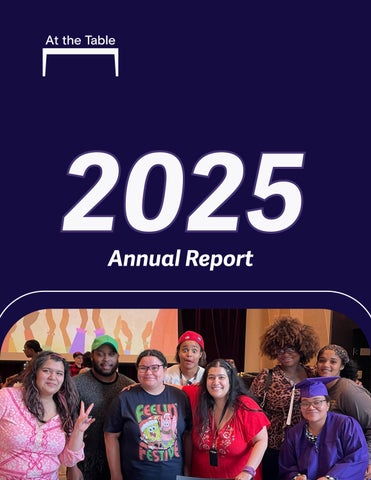
2025 Annual Report

![]()

1. We work in partnership with our students to achieve their goals. We believe that, to be effective, we must center the priorities of our students, identifying and elevating their goals for themselves rather than substituting or imposing our own.
2. We believe that students are intrinsically motivated to learn, grow, and succeed. We therefore believe that punitive consequences are unnecessary and often counterproductive, and reject their use in educational programming.
3. We believe that every student deserves our support. We do not require any student to demonstrate their worth - via their academic performance, demeanor, or otherwise - in order for us to work with them. Further, we reject educational models that value and resource students based on their compliance.
4. We value our students’ identities, beliefs, and cultures. We reject educational policies and practices that are premised on the idea that our students need to be fixed. We see the strengths in our students and know that an equitable system would not require them to compromise essential parts of themselves or meet a higher standard than their more privileged peers in order to succeed.
5. We acknowledge the role of structural oppression in our students’ lives. Our work is informed by our students’ experiences with institutional racism and systems that limit their access to education and economic mobility, repeat traumatic incidents, and perpetuate stereotypes of youth in foster care. We believe it will take a collective effort to address the injustices embedded in education and child welfare, and we are committed to partnering with other organizations aligned with this cause.
6. We believe that education is not limited to school curriculum and course content. We aim to build our students’ critical thinking, information literacy, self-advocacy and self-organization skills and believe it is our responsibility to help them recognize and break down the structural barriers they face in accessing a good education. We intentionally cultivate these skills in our work with students and strive to become obsolete in the face of their growing ability to access information and advocate for their own interests.
7. We see our students as whole people. We make space for their non-academic needs and goals, recognizing that education is one component of our students’ long-term thriving. We intentionally seek out and build partnerships with other organizations that can bring value to our students beyond the realm of education.
8. We make long-term commitments to our students. We recognize the importance of consistent, stable relationships in promoting student success and well-being. We do not eject students from our programs because they are struggling, and we work hard to avoid reassigning students to new staff wherever possible.
9. We believe that young people in foster care should not be forced to choose between permanency and educational support. We are committed to working with young people who have left foster care and to bridging the resource gaps that they experience.
10. We are committed to recruiting board members who have experienced foster care. We believe that organizations should be led by the communities they serve, and that a board that shares direct experiences with the people they support will be more effective and more impactful. We advocate for other organizations to adopt this model of board composition.
Dear At the Table community,
Every year, we see students grow in ways that remind us that progress is rarely linear and almost never happens all at once. It comes gradually – through essays written after midnight, the masterful juggle of multiple deadlines, and the steady persistence that eventually adds up to a degree.
Celebrating our anniversary this year invited us to reflect on five years of student progress (including 57 earning 2-year or 4-year degrees), much of which you’ll read about in the pages to come. And naturally, it invites us to acknowledge our organization’s growth too, whether they are marked by giant leaps and bounds or by single baby steps forward.
This year, we added a new and exciting milestone: our transition to a co-leadership model. This shift reflects the collaborative spirit that has always pushed our work forward. By formally embracing shared leadership, we are strengthening our ability to make thoughtful decisions, support our team, and deepen our impact. It is a model that mirrors our staff values – transparency, harnessing our collective strengths, and shared responsibility for the world we want to build.
This year also saw us move into our first office space. In our last annual report, we dreamed of having a place where our staff could gather, share in each other’s successes, and plan for the challenges. And in this annual report, we have the privilege of sharing the good news that this dream is now a reality. Already, the space has hosted a number of inperson tutoring sessions, team lunches, and staff meetings, one of which featured our festive Halloween costumes.
Together, these moments – our anniversary, our shift into co-leadership, and our new office space – tell a story of progress over time. Like our students, At the Table has grown through steady, deliberate steps. Year after year, we expand our capacity to serve, stay committed to the mission and our students, and celebrate the progress that we’ve made.
Thank you for being part of this progress.
Ashia Troiano Co-Executive Director


3,369 tutoring sessions
1,402 content/advising contacts
182 students
88% college persistence rate
$57,500 for student emergencies
60%
projected graduation rat e (vs. 12% baseline rate for students with foster care experience) 74% course pass rate
By Melanie Chiluisa, Jaclyn Sullivan, and Ashia Troiano

In the spirit of celebrating milestones and progress over time, we are honored to highlight three of our students and recognize their journeys from incoming freshmen to college graduates.
“Anika”, “Emilia”, and Sage all came to At the Table in 2020 at the beginning of their college careers. In the five years since then, we have witnessed the successes, the setbacks, and the breakthroughs that kept them moving forward.
We are committed to walking alongside our students through every stage of their educational journeys – reconsidering majors as new passions emerge, balancing coursework with jobs and internships, stepping away from school at times to care for family, and navigating various obstacles that threaten to interrupt their progress.
Watching students like Anika, Emilia, and Sage grow over several years is one of the greatest privileges of our work. Their paths show how long-term support can be critical to sustaining momentum through the ups and downs of college life.
“Anika” joined At the Table in Fall 2020 at the beginning of her first semester at Hunter College. She had recently transferred from SUNY Albany to finish her Bachelor’s degree, and while she was a dedicated and motivated student, her first few semesters brought their fair share of challenges.
In Fall 2021, Anika made the difficult but important decision to withdraw from classes to prioritize her mental health. When she re-enrolled in school the next year, she was in a much better place, and we picked up where we left off.
Anika recommitted herself to her studies while also navigating major life changes, including the arrival of her daughter. She connected with a love of poetry through a workshop with an encouraging professor and a community of peers. She hit her stride in her pursuit of her Bachelor ’s degree and then started setting her sights on postgraduate education.
In Fall 2024, her last semester before graduation, Anika needed to complete an internship as part of her major requirements. Despite her persistent outreach, she could not find an opportunity that would fulfill the requirement, and was facing the prospect of having to delay her graduation. At the Table stepped in to create an internship opportunity led by our Community Development Coordinator, Juan.
Through this experience, Anika built skills in research, professional communication, and partnership development, and put together a list of key resources for the other students who would follow in her footsteps, including a mental health resource we hadn’t previously known about.
Anika graduated at the end of the semester with a degree in Africana, Puerto Rican and Latino Studies and a minor in English.
In the months that followed, she faced yet another hurdle – funding that she needed for post-graduate housing was being held up by a late-arriving diploma. At the Table supported her by advocating with Hunter College’s Registrar and Financial Aid Offices, the College Choice program, and the ETV program to help resolve the administrative hurdles, which are all too common for students with experience in foster care. At the Table’s Emergency Fund also helped alleviate some of her immediate needs during this period.
By the summer of 2025, Anika shared, with great relief, that the situation had been resolved.
Today, we are in touch as Anika considers internship, fellowship, and postgraduate opportunities. Her perseverance reminds us why individualized, student-centered support matters and how creative problemsolving can help students reach goals that once felt out of reach. I am deeply grateful to her for allowing me to be part of her story.
I have been with At The Table for a few years now, and this year has been one of the most helpful. I’ve had access to my tutor in addition to emergency funding, which helped me to get through a difficult season. The support and care I’ve received from At the Table is invaluable, and I don’t know if I would’ve had the same college experience without them!
- Anonymous
When Emilia first started working with At the Table in Fall 2020, she was actively searching for ways to start her college career. She had previously received misinformation about her academic options and thought that she would not be able to enroll in any school. After learning more about her circumstances, we were happy to share that she had far more options than she was led to believe, and in Spring 2021, she began her first semester at LaGuardia Community College.
Throughout the Spring term, Emilia attended tutoring sessions with me regularly. That, on top of balancing a full-time course load, a job as a medical assistant, and parenting as a single mom, was not easy, but Emilia rose to the challenge. She completed her first semester with an impressive 3.48 GPA, and in Fall 2022, she proudly earned her Associate’s degree in Psychology.
But Emilia didn’t stop there! She chose to continue her academic journey and pursue a bachelor’s degree while maintaining her responsibilities as a working mother. She found her place at the CUNY School of Professional Studies and pursued her degree relentlessly, even enrolling in an additional career preparation program during her final semester. In December 2025, Emilia graduated with a Bachelor’s in Psychology with a concentration in Organizational Psychology.
Over the years, both academic and personal obstacles challenged Emilia in ways that could have put an end to her academic career. But through determination and continued support, she persevered.
She is proof that At the Table’s work goes beyond academia. The relationship we’ve built goes far beyond the numbers, and I am thankful to have been part of her journey. Emilia has now crossed the finish line and joined At the Table’s growing community of alumni, a milestone that reflects the power of true partnership with students.

By Sage Emerson
Getting to college was the easy part. I was a self-starter, so I researched colleges on my own and chose a program I believed would lead to a teaching career. I enrolled in Hostos in the Fall of 2020 and signed up for At the Table, ensuring I had the academic support I needed from the beginning.
My first mentor was Ashia, who was amazing to work with. Ashia met me at a time when I had relatively few life challenges and I was able to manage my assignments independently and meet deadlines. We mostly worked on writing, turning rough drafts into polished arguments, and a fair amount of revising my MLA and APA formatting, something I never loved. When she went on maternity leave, I started working with Jaclyn, another helpful and talented mentor. She supported me in graduating from Hostos, earning my Associate’s degree in Liberal Arts with a concentration in Education, and transferring to Hunter College.
It wasn’t until I transferred to Hunter that things became increasingly more difficult. For starters, none of my Education credits transferred over, so the College let me know I would have to start over if I wanted to continue in Education. In addition, I would have been required to pursue a dual major. By my second semester, I ended up changing majors entirely, realizing I wasn’t as passionate about teaching as I was when I first started. To say I was overwhelmed is an understatement.
Around this same time, my life had taken some turns. To be frank, I felt like my life was falling apart. I was dealing with depression and other mental health conditions, along with some personal issues. I had trouble focusing on assignments and could no longer be the self-starter I once was. The bulk of my work with Jaclyn was much different than my work with Ashia. What was once really easy for me became so much more difficult, and the papers I shared with Jaclyn to help me complete were really just a few bullet points.
So my time with At the Table saw one extreme to the other. With Ashia, I was supported in maintaining my success as an A+ student. And with Jaclyn, I was guided through rediscovering how to become one again.
In Spring 2025, I reached my goal. I graduated from Hunter College with a Bachelor’s in English. And honestly, the staff at At the Table supported and celebrated me more than my own college did. I wasn’t able to walk at my ceremony because the school failed to provide the information I needed to get tickets. But At the Table made sure my graduation didn’t go unnoticed. For a while, I felt discouraged and found myself downplaying my own achievement, but their encouragement helped me truly appreciate how far I’d come. At our Student Celebration, I got to wear my cap and gown, take photos, and get recognized by the At the Table community. They celebrated that moment with me, and it meant the world to me.
Looking ahead to the future, I hope to publish more articles and eventually my own book, perhaps fiction or maybe a memoir. Writing has always been a passion of mine, and one day I hope to create a story that people will read and find themselves in. Sharing my story here is just the beginning.
In each of our annual reports, we share an assessment of the past year’s results to reflect to our community what we’re doing well, what we could be doing better, and how effectively we’re carrying out our commitment to increase the rate at which students in foster care reach their college degree goals. We also include information from our student survey, as we believe the quality of our students’ experiences with us, and the degree to which they feel seen and supported by us, is critical to our success.
In the 2024-25 academic year, our students showed incredible progress, persisting in college at a rate of 88%, higher than our record set last year at 81%. At the Table’s students continue to be on track to earn degrees at four to five times the rate predicted by the available research for their peers in foster care. We are excited by these results.

In FY25, we held 3,369 tutoring sessions and 1,402 content/advising contacts with 182 students for a total of 3,294 hours of tutoring. Students who were in the program for both semesters had about 34 total sessions and contacts on average over the course of the year.
Our rate of successful student intake decreased slightly this year: 46/70 (66%) of eligible students who filled out our interest form in FY25 had at least 2 tutoring sessions by October 1st 2025, down from 74% in FY24. We see this as an important area for growth, as we want our program to be accessible to as many students as possible who come to us seeking support, and we plan to address this in two ways in the coming year. First, we are expanding our team of educators and advisors so we will have more capacity to bring students in off the waitlist. Second, we are building additional capacity to complete intake so we can connect students with At the Table supports more rapidly when they first fill out an interest form.

At the Table’s students persisted in college at a higher rate than ever before, besting the previous high set last year.
Overall, 88% (91/103) of At the Table’s college students who were enrolled in college in Fall 2024 continued in college in Fall 2025 (excluding students who graduated). This number is up from 81% in last year’s report.
Last year, we suggested that the recent rise in our college persistence rates may have resulted from At the Table’s increased wraparound support assisting students with outside-theclassroom challenges that might otherwise have prevented their persistence.
Our outcomes and experiences over the past year lend further weight to this idea. By rapidly purchasing textbooks and laptops for students,
getting their cell phones and internet access turned back on, resolving housing instability, and removing barriers to accessing healthcare, we have closed countless needless off-ramps to our students’ college journeys.
In the 2024-25 academic year, At the Table students passed approximately three-quarters of their classes while averaging a 2.81 GPA (which is between a B- and a B). This is well above the 2.0 threshold needed to maintain financial aid and exceeds the 2.5 GPA requirement to transfer to many competitive senior colleges in the CUNY and SUNY systems.
Below are results for college-enrolled At the Table students in Fall 2024 and Spring 2025, showing the increases in GPA and course pass rate from the prior year:
While most At the Table students do not take winter classes, summer courses play a major role in the academic stories of our students: in Summer 2025, our students passed 84% of their courses, earning an average GPA of 3.2.
Of the 80 students we served in our first two years, over half have completed two-year or four-year degrees.
At the Table’s students sign up for our services because they want to graduate from college, and the rate at which they eventually complete their degrees is the single most expressive measure of our success.
We know that graduation rates for students with lived experience of foster care do not come close to what our students desire and deserve. A study from Chapin Hall at the University of Chicago found that in three Midwestern states, students with foster care experience who enrolled in college (n = 329) had a six-year degree completion rate of 12%. Another Chapin Hall study found that only 8% of community college students with foster care backgrounds (n = 1,664) graduated with a certificate or a degree.
At the Table’s students have already graduated at rates that vastly exceed this baseline. As of this writing, 51% (41/80) of the college students we served in our first two years of operation have completed two-year or four-year degrees. Another 20% are still in college, and we expect most of these students to complete their current degree programs (13 out of the 16 have more than half the credits they need to graduate).
8 students earned associate degrees, 7 of whom are now working with us to earn their bachelor’s degrees. They have moved up to 4-year programs at: Hunter College (2), John Jay College (2), Lehman College, Medgar Evers, and SUNY Plattsburgh. 4-Year
In the 2024-25 academic year, 7 At the Table students earned bachelor’s degrees from Hunter College (2), Empire State University (2), Brooklyn College, John Jay College, and SUNY Stony Brook.
This year, we added a cash incentive to At the Table’s annual student survey, and also redesigned the survey with assistance from Listen4Good, a collaboration sponsored by the Ichigo Foundation. As a result of the redesign and incentive, 81 students responded to the survey, more than twice as many as responded in any other year.
At the Table’s net promoter score, an index of how students answered a question about whether they would recommend the program to others, was a remarkable +78.75, more than 20 points higher than the average education nonprofit tracked by Listen4Good.
In FY2025, our budget grew from $1.01M to $1.27M as our programming for students became broader and deeper. We added a new tutor to the team, allowing us to serve 15 more students. We also doubled our spending on student emergency funding and supplies from last year. Our emergency and student supplies funds are critical resources for removing unnecessary barriers to coursework for our students, and we hope to continue growing these investments in our students for the years to come.
+ $90,738.90 in contributions + $951,500.00 in private grants + $211,950.00 in fee-for-service + $19,985.35 in ACS reimbursements
- $1,123,956.90 in personnel - $51,197.20 in administrative costs - $84,073.74 in student emergency funding, school supplies, and staff trainings a
This year, we laid the groundwork to move into a new office, which we have opened as of this writing. Our new address is 266 West 37th St., New York, New York, 10018.
Our new office allows us to offer in-person tutoring sessions for our students, to host regularly scheduled in-person staff meetings, and to store physical goods, like donated laptops, for our students. It has deepened our collaboration with our neighbor organizations, and given us the ability to strengthen our relationships within the organization.
We want to express deep appreciation to the building management team at GFPE Real Estate New York for their generosity and support of our work.

By Juan Santiago, Community Development Coordinator
We’re thankful for the opportunity to give back to a community of students who continue to define what success means for themselves.
Within a society built around the “norms” of a parent-child dynamic, many of us, myself included, had to grow up outside of that frame, and some assume that because our challenges are different, our successes must be, too. Some of us became caretakers early. Some of us were raised by people who we were not birthed from. We learned to navigate adulthood so often without the safety of family relationships that others might take for granted. But our success is earned the same way all people earn it. We measure by how we build stability, how we pursue opportunity, and how we find our purpose.
We are thankful to build a community with colleagues and peer organizations like City Living, Inspiring Futures, Hearts to Homes, Of Home Family and Future, and so many others who have walked this walk alongside us, maybe not the same steps and maybe not even along the same roads, but towards a world where everyone we serve can move decisively toward their dreams.
For giving us a space to connect with our growing community, we thank Jeff Gural and the team at GFP Real Estate, who made our dream come true of having a central office where our staff and students can meet one another in person.
We are thankful to Nicole Ponzoa and her husband Gus for gifting us the use of the beautiful event space at One Grand Army Plaza where we held At the Table’s 5th Anniversary. We are thankful for our Host Committee for the 5th Anniversary event. And we’re thankful to Baylee Newsom for your ongoing wisdom and encouragement around our event planning efforts.
To Tiana Barnwell, who has helped connect us with the Southwest Airlines ticket vouchers we raffle off at each of our student events, and to everyone else on our wonderful and steadfast board of directors: thank you.
And finally, to our students, for entrusting us with your carefully-chosen paths, we are grateful to you always.
We deeply appreciate the individuals & foundations that made financial contributions in fiscal year 2025.
Below are some of our supporters who played a critical role in helping us achieve our goals.
Alexander and Kat Dominitz
American Eagle Outfitters Foundation
Arbor Rising
Art Chang and Allison Thrush
Brad and Amanda Hargreaves
Caroline Farr
Incandescent
Conrad N. Hilton Foundation
DJ McManus Foundation
M and D Kent
Anonymous
Harman Family Foundation
Ichigo Foundation
Ira W. DeCamp Foundation
Jeffrey and Jessica Zink
Jill and Martin Lebwohl
K Anderson
Mary J. Hutchins Foundation
Matt Davis and Allison Duffy-Davis
Meoh Foundation
Michael Corriero and Mary Ellen Raftery
Morgan McCray
Nicole Ponzoa
Nicole Wong
Paulette and Stephan de la Veaux
Peter Robbins and Page Sargisson
Phillip and Baylee Newsom
Rikki Tahta
Robert and Robin Zink
Rose Schapiro
Solon E. Summerfield Foundation
SparkYouth NYC
SJ Stamm
The Thomas & Agnes Carvel Foundation
Thesis Driven
Ticket to Dream/Famous Footwear
Tiger Foundation
#4: We value our students’ identities, beliefs, and cultures. We reject educational policies and practices that are premised on the idea that our students need to be fixed. We see the strengths in our students and know that an equitable system would not require them to compromise essential parts of themselves or meet a higher standard than their more privileged peers in order to succeed.
- At the Table Statement of Values
At the Table has grown in so many ways since our founding just five and a half years ago. We have expanded from a three-person to a fifteen-person organization. Where we began as a strictly remote program, we now build community with each other in-person at our office and through events like our Friendsgivings and Student Celebrations. We have built powerful new capacities to support students with challenges outside the classroom.
But as we look ahead to 2026 and beyond, we want to tell you about some aspects of who we are that have not changed and will not change as we grow.
At the Table has, from the beginning, been guided by deeply-felt values that our founding team and our board laid out together, and which are posted publicly at www.atthetable.org/our-values.
Our values are tendentious; they talk not just about what we believe in and feel good about, but what we reject and will not do. They arise from our shared critiques of business as usual in the education and foster systems; the ways these systems push people to conform and comply, the ways they devalue and overlook the feelings, insights, and choices of those with lived experience, the ways that they abandon people going through times of struggle, like a transition from foster care or drop in academic standing, when help is needed the most.
Our values, too, reflect our stubborn belief that something better is possible for all of us: staff, students, and our broader community. They reflect our insistence that nonprofits should place the reins of power in the hands of the communities they serve. That every student carries an intrinsic desire to grow and learn. That structural oppression is real and pervasive and must be fought. That our students and their identities and choices and relationships are unspeakably important.
Many institutions, nonprofit and otherwise, today feel themselves torn about whether to stand by their principles or to defend their organization. We do not experience this as a choice, because we understand that an institution is only worth defending inasmuch as it creates good for people, and At the Table’s values are the very root of the good we are able to create.
Let us be clear. You may have read, earlier in this report, about the remarkable outcomes At the Table’s students have achieved over the past five years. Our shared moral and philosophical commitments, our values, were what allowed us to play the role we did in these results. They have helped us attract and hold together a singularly talented group of staff, guided both our programmatic decisions and individual interactions with students, and created the foundation of trust that has allowed staff and students alike to grow in ways they might not have realized were possible.
In the year to come, we will grow in exciting new ways. We will serve more students than ever before. We will deepen our investments in community, material resources, and career support. But we also know and promise that next year, and every year, you will find us, in the most important ways, unchanged.
Wishing you steadfastness and solidarity in the years to come,
Michael ZinkCo-Executive Director
At the Table