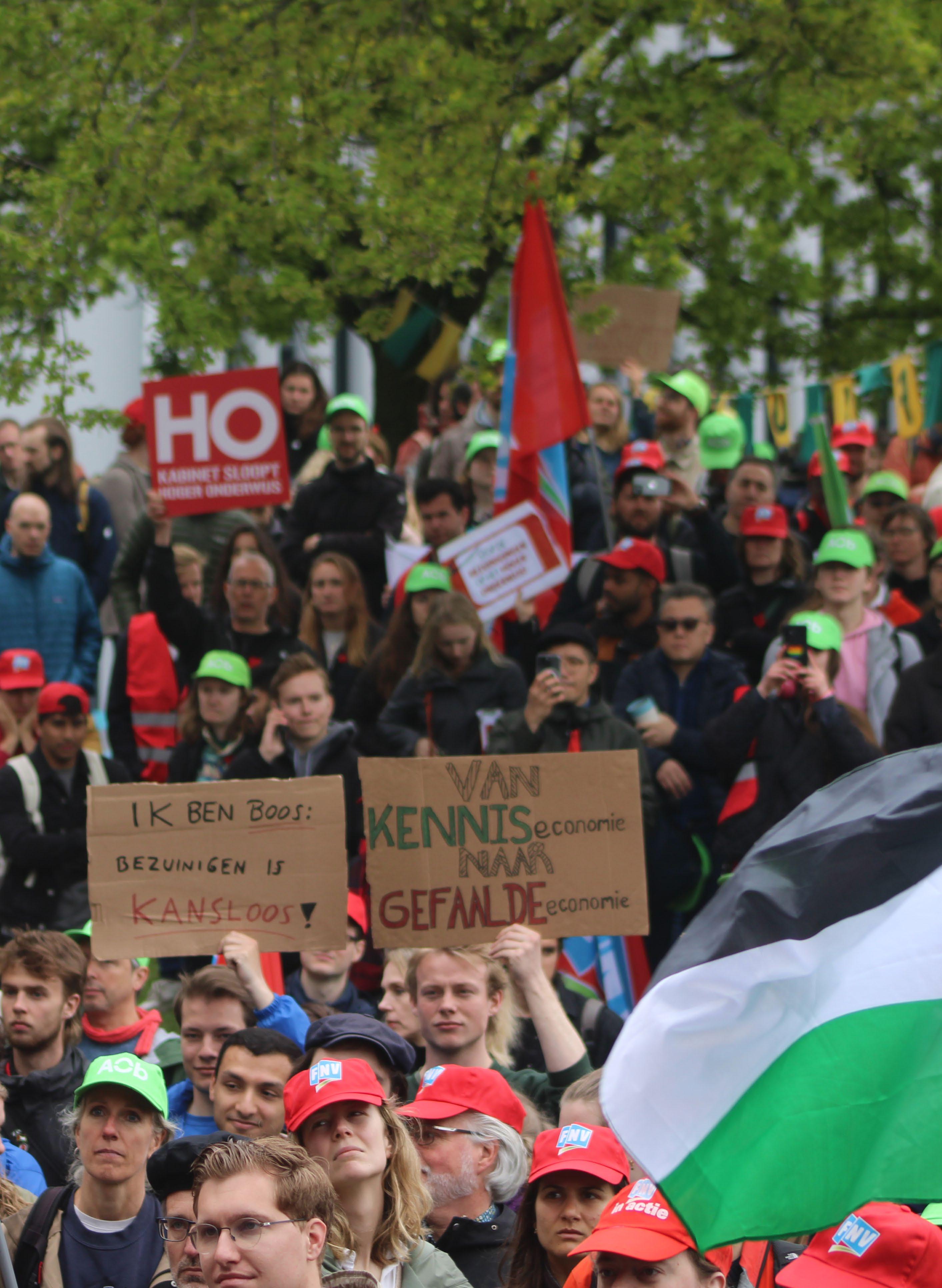
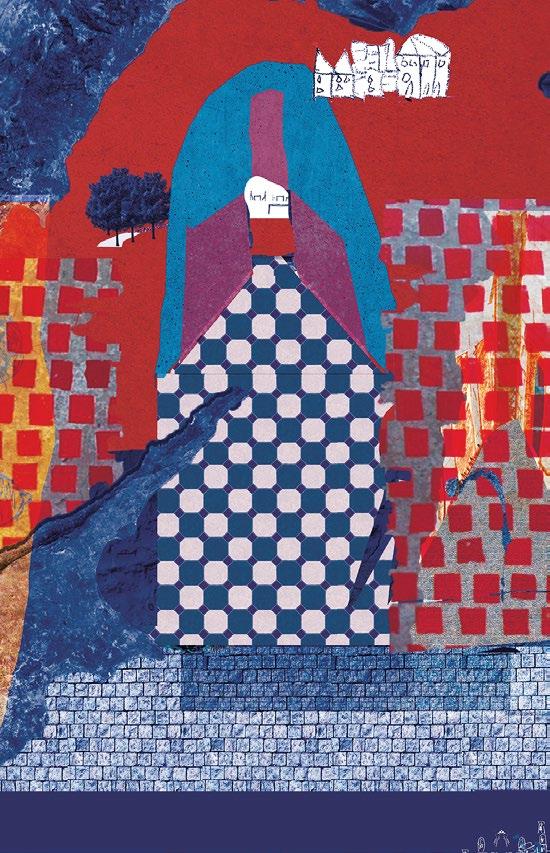
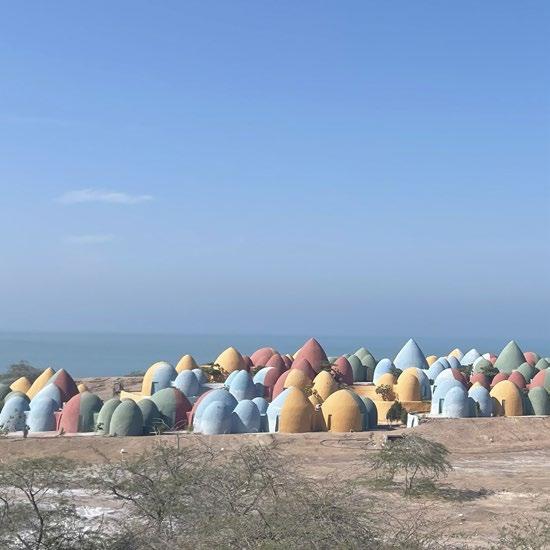
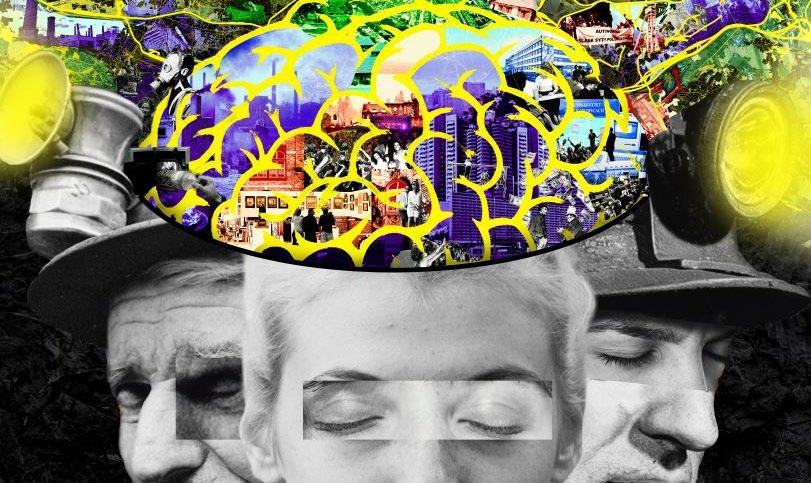
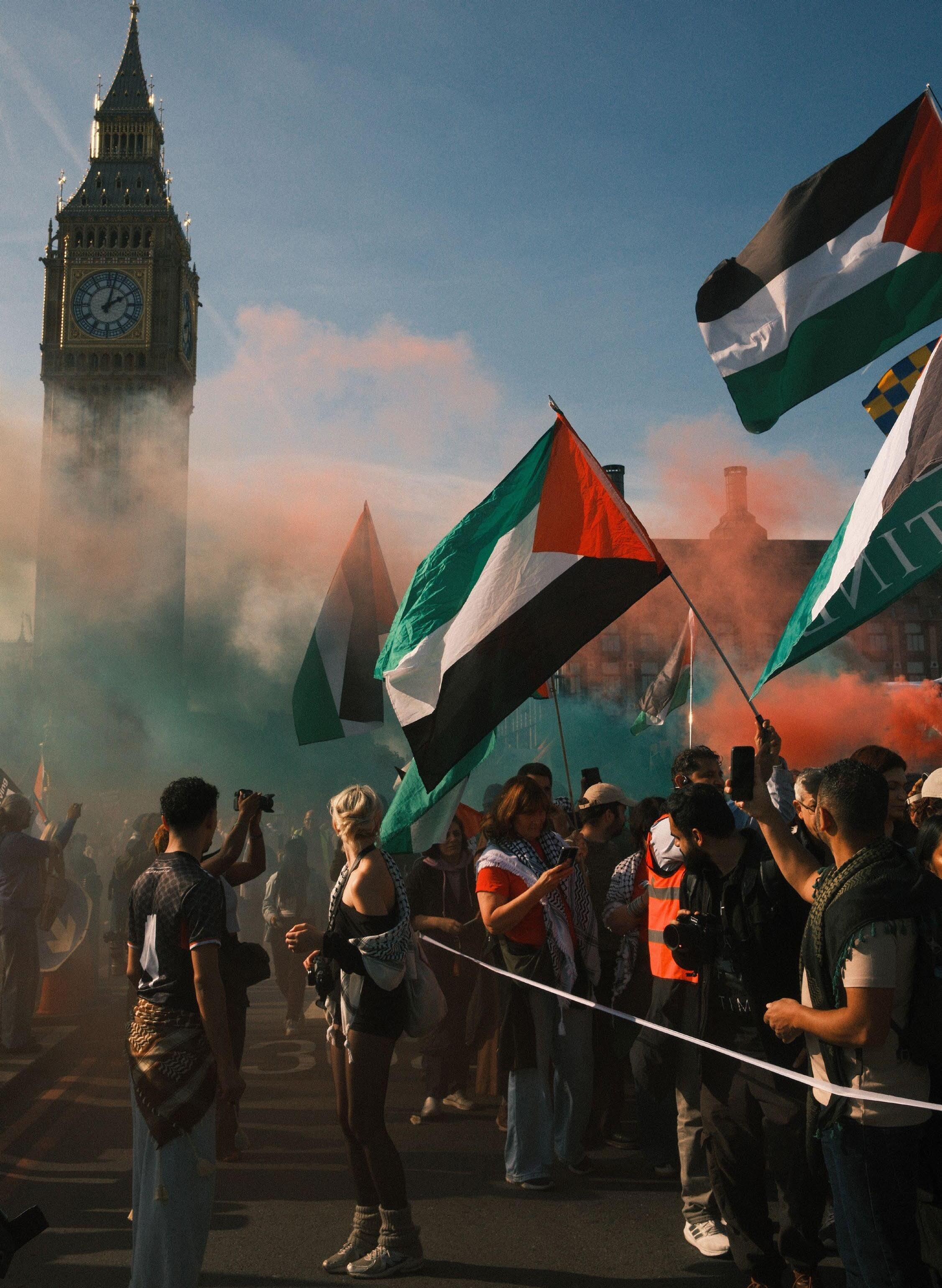
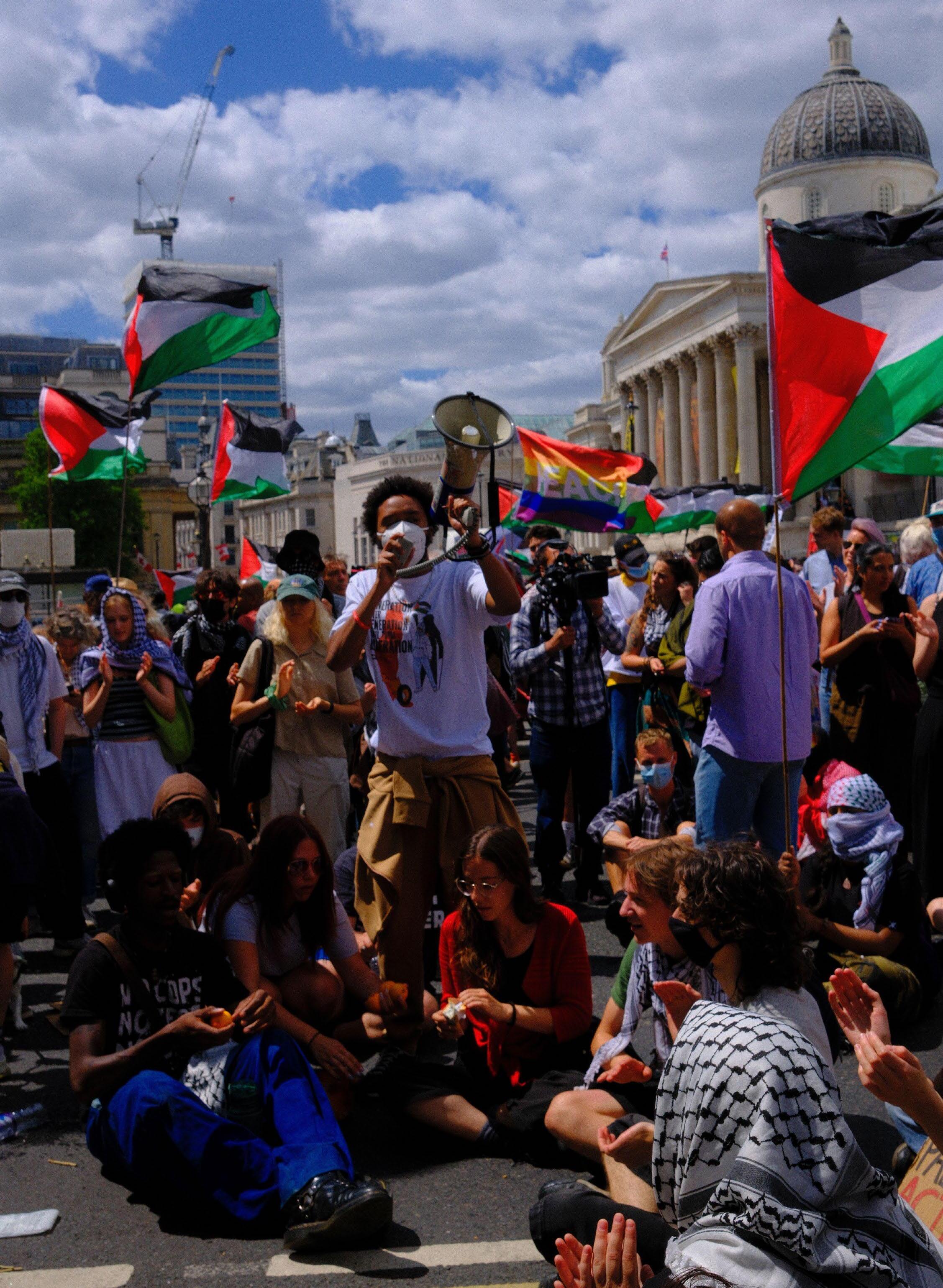
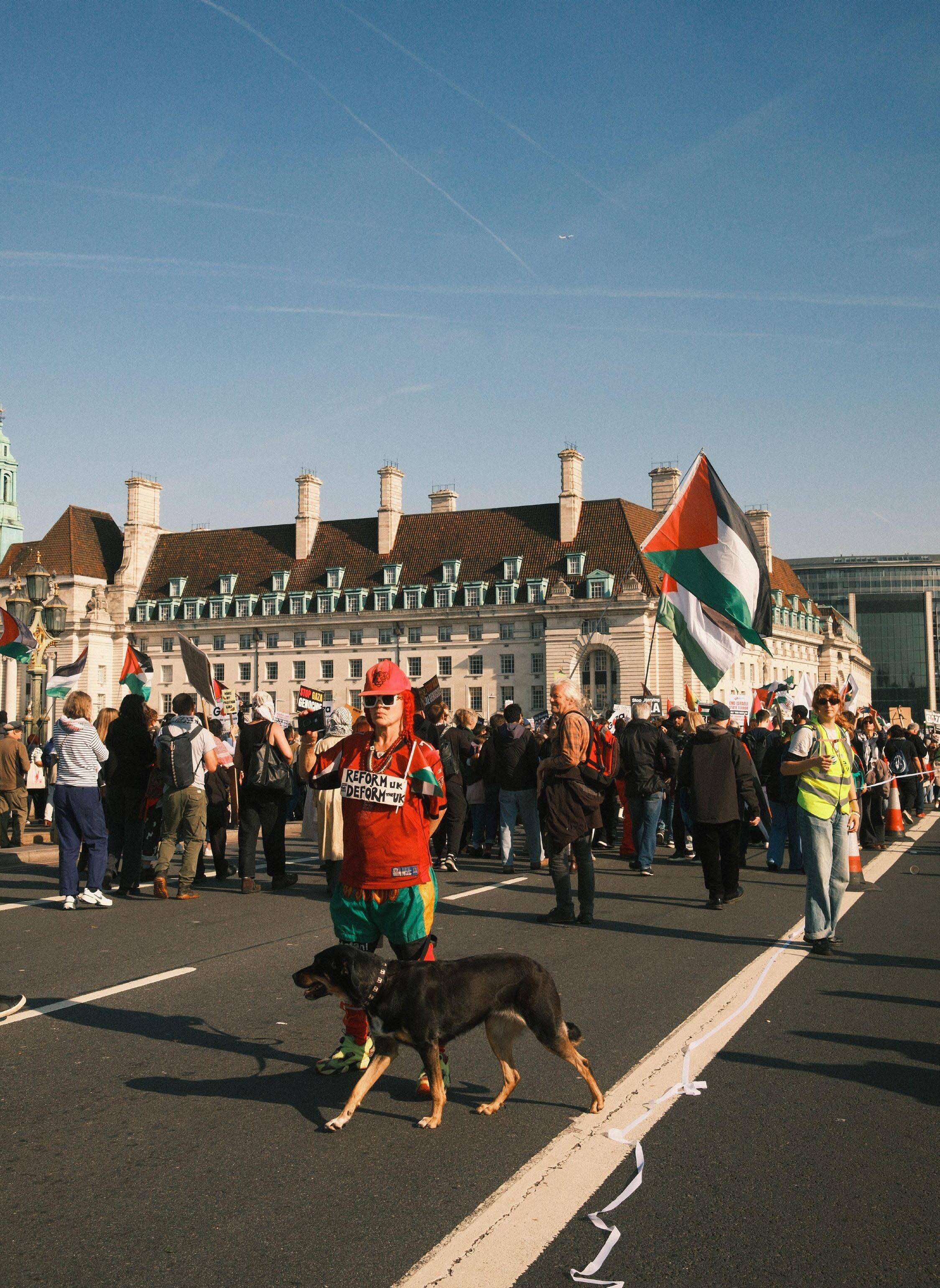
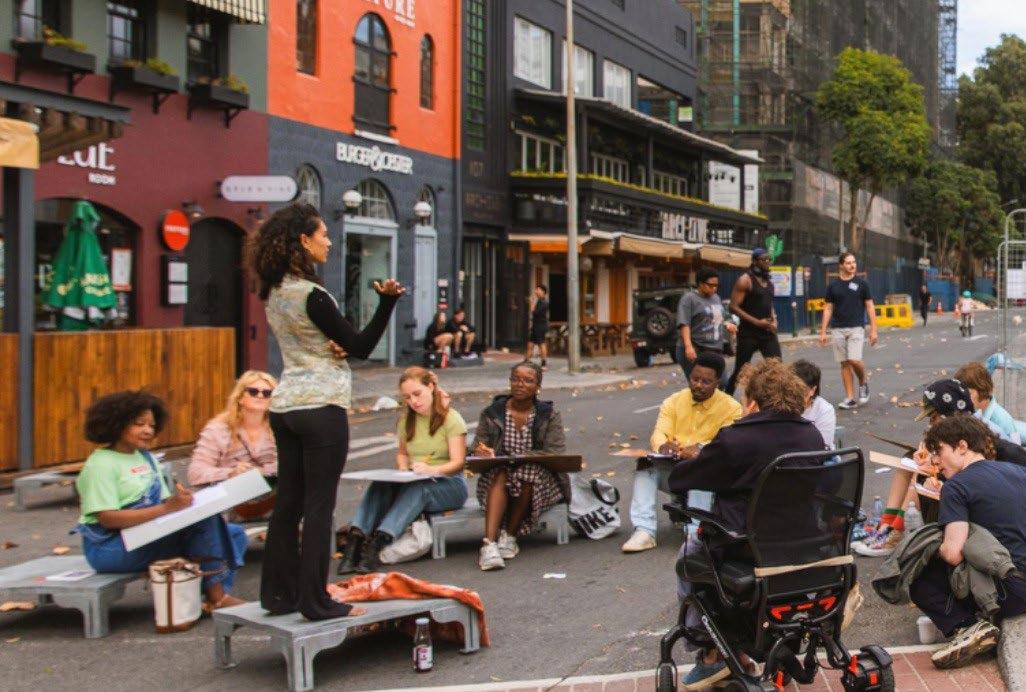
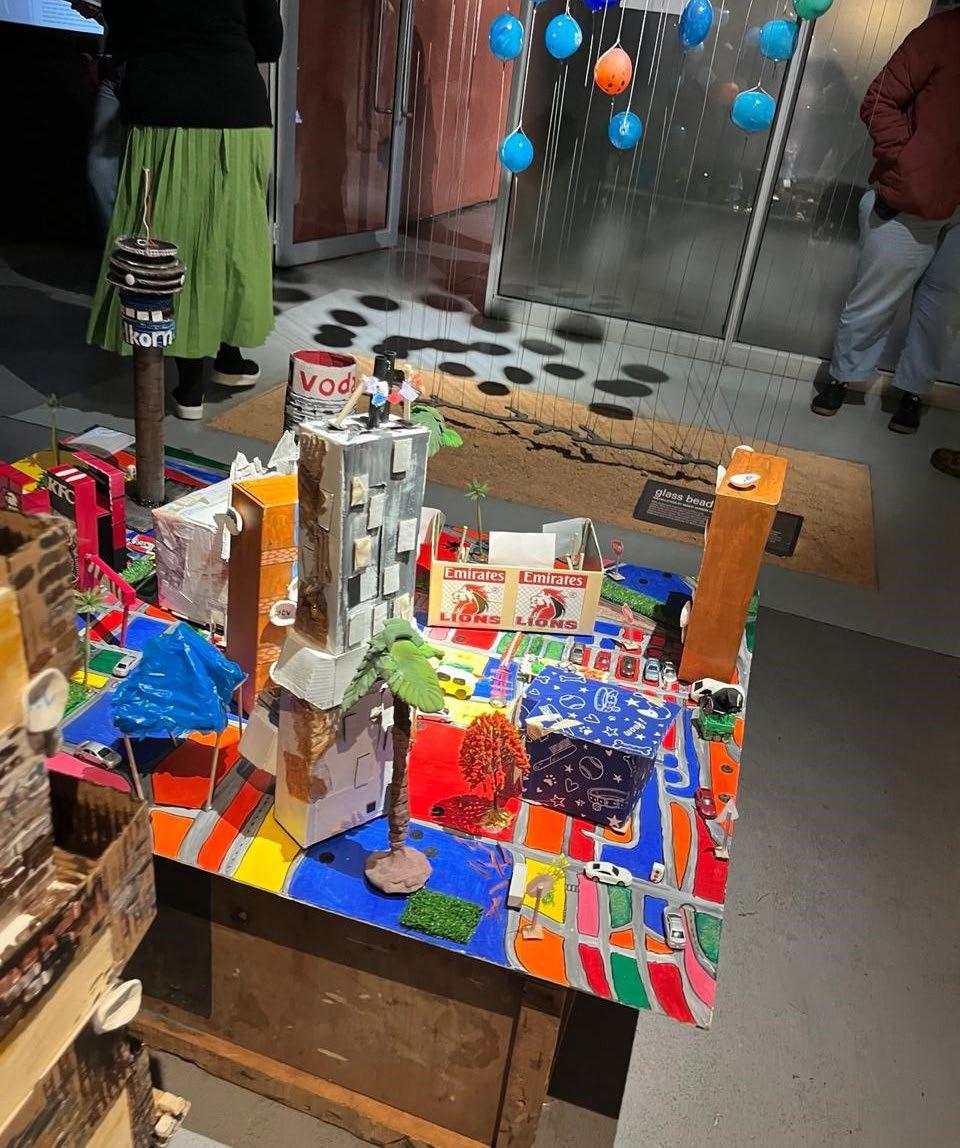
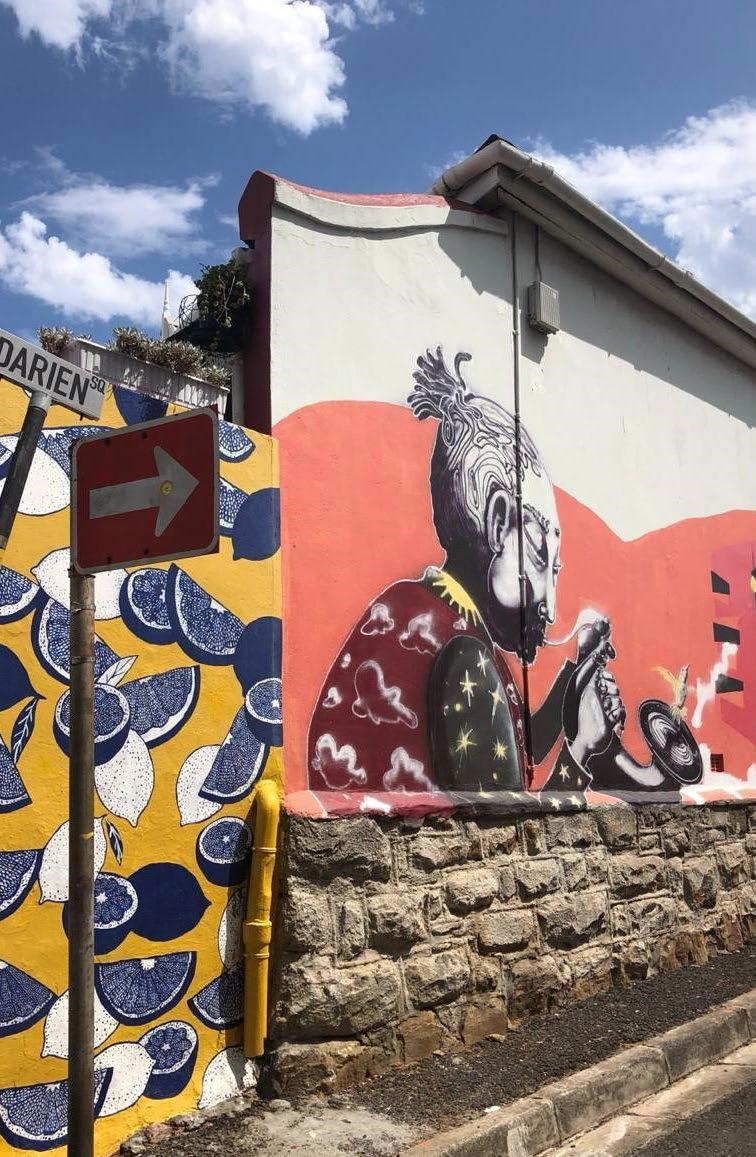
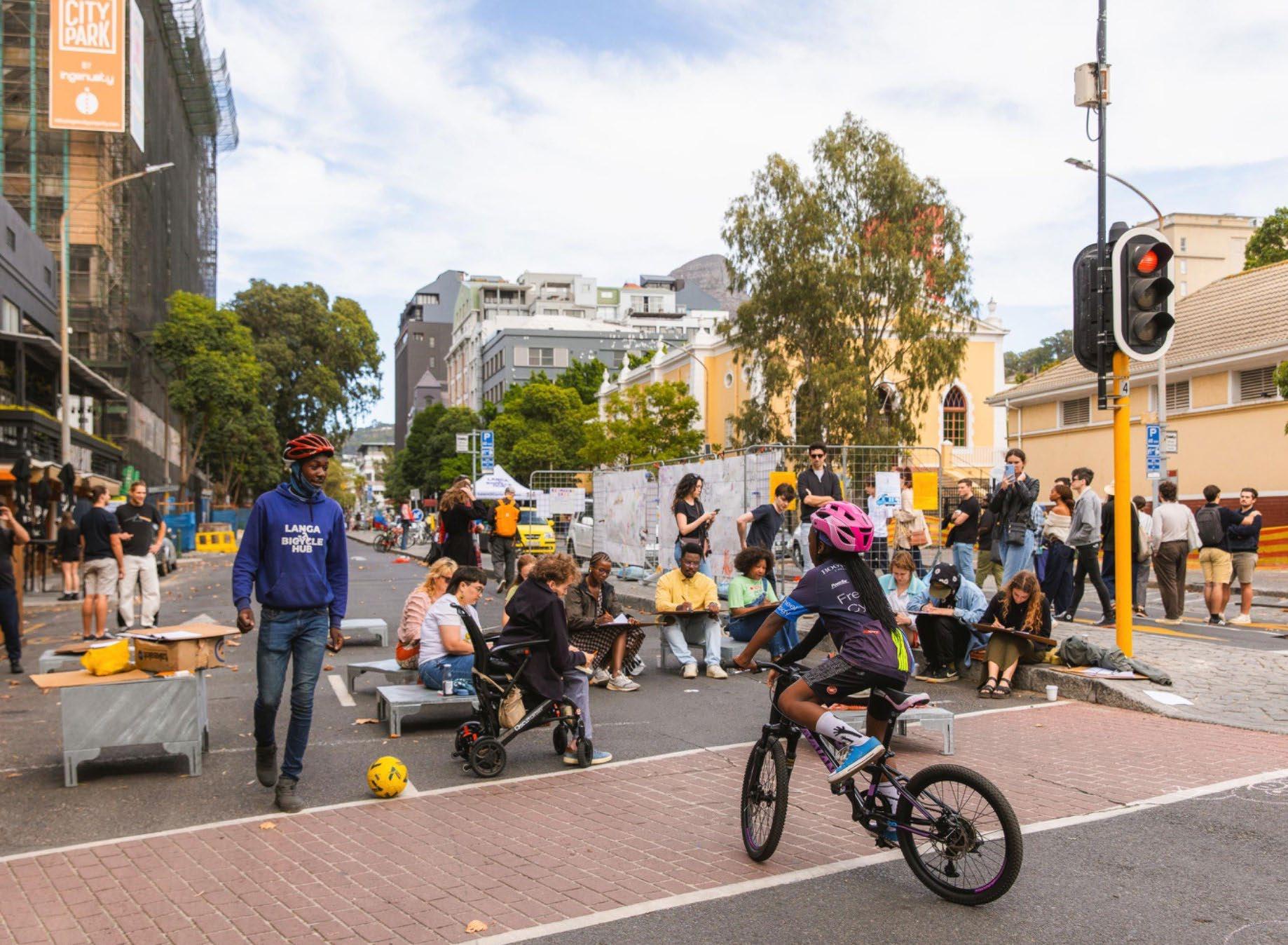
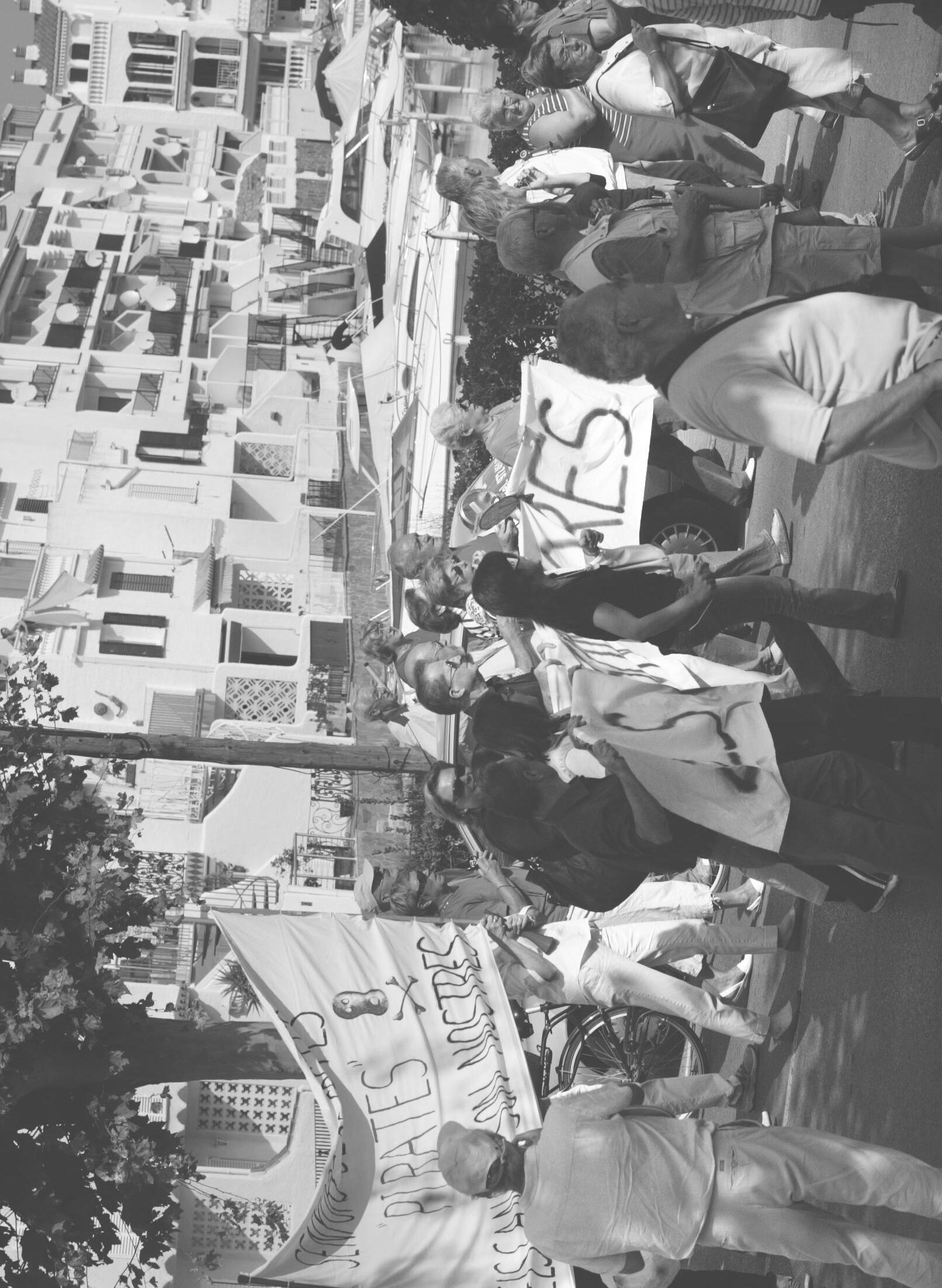
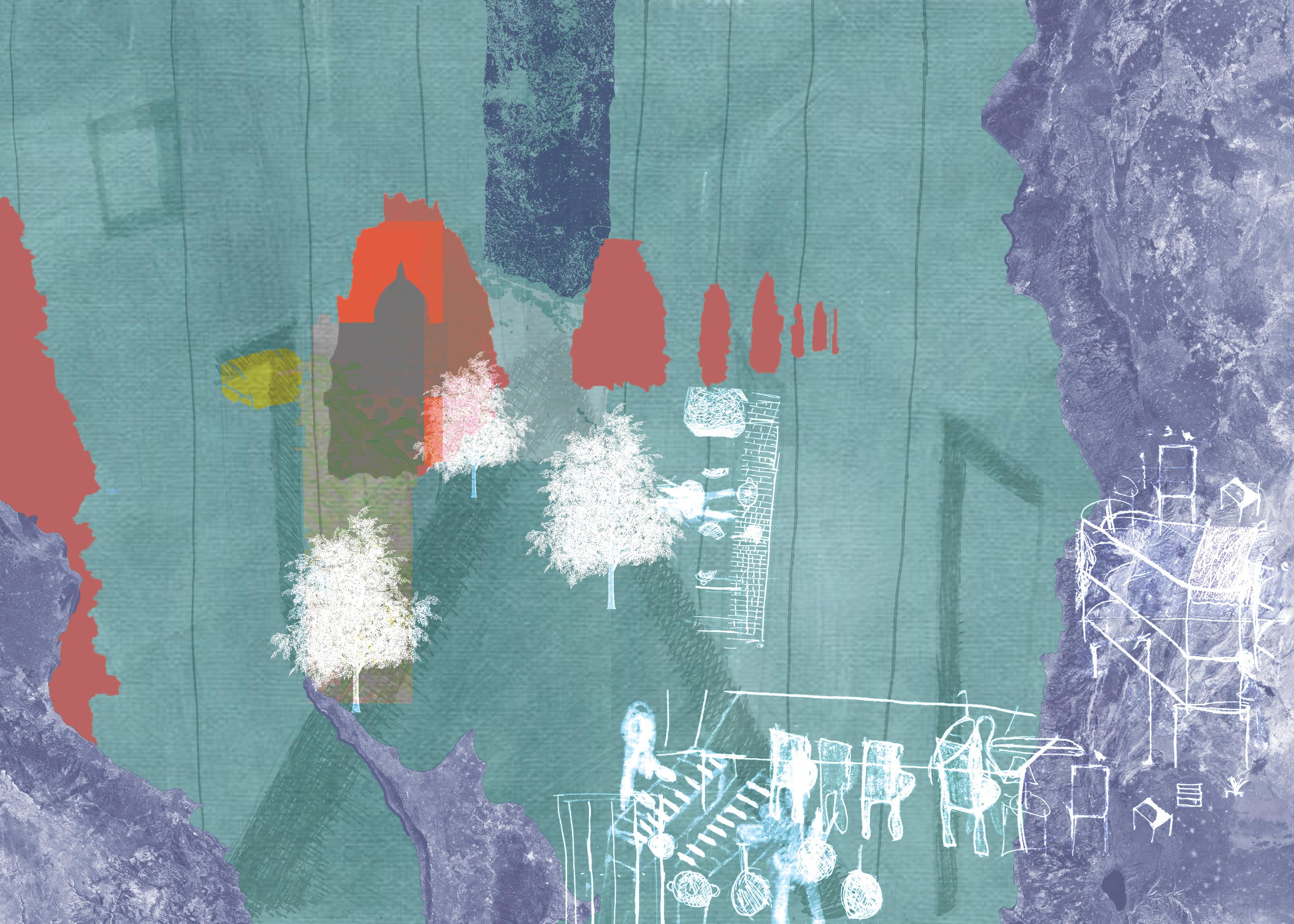
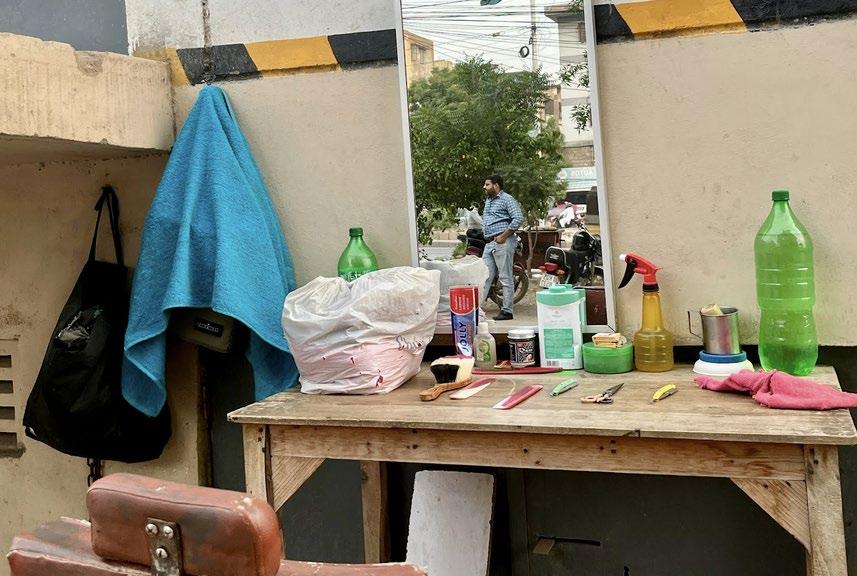
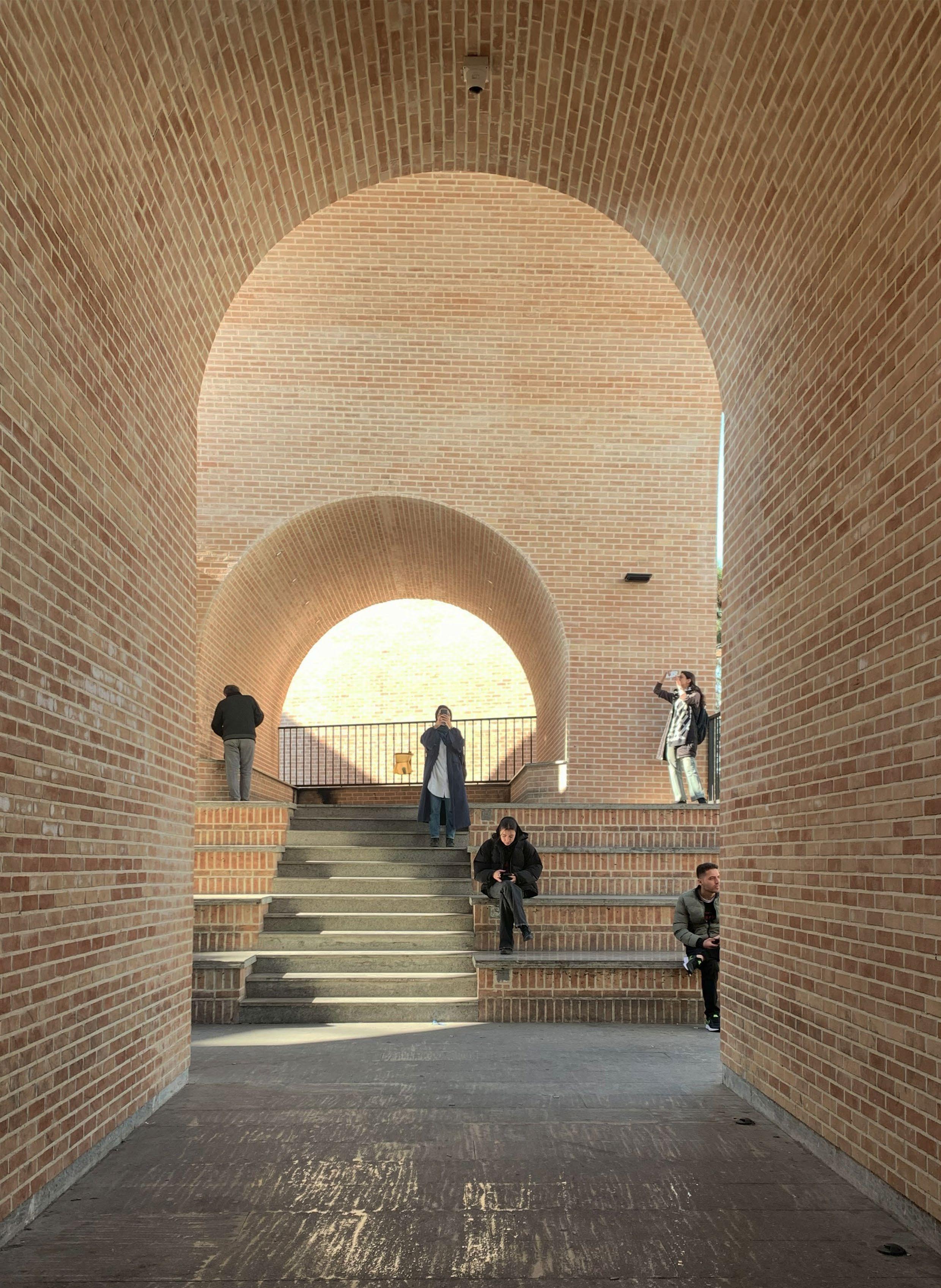
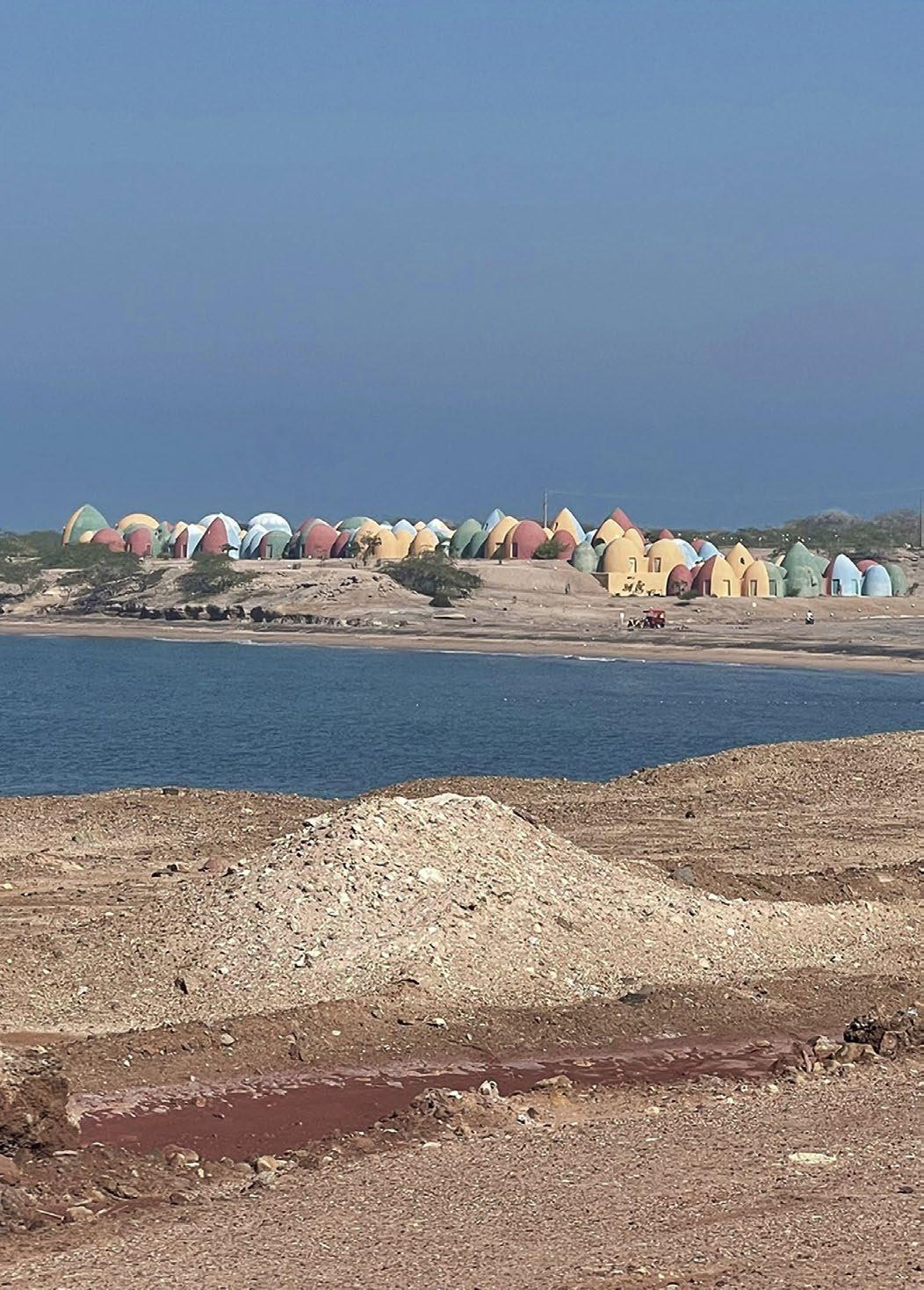
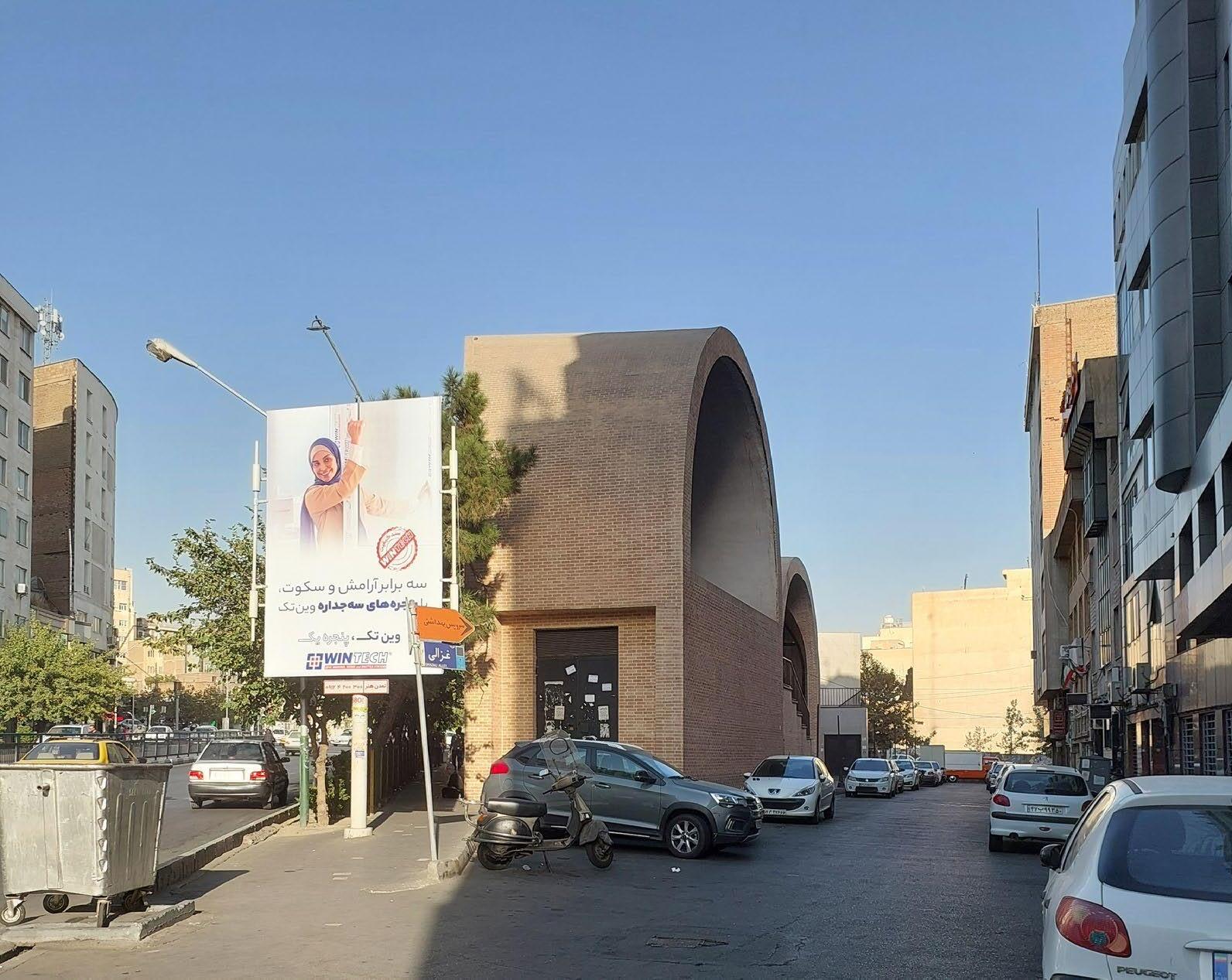
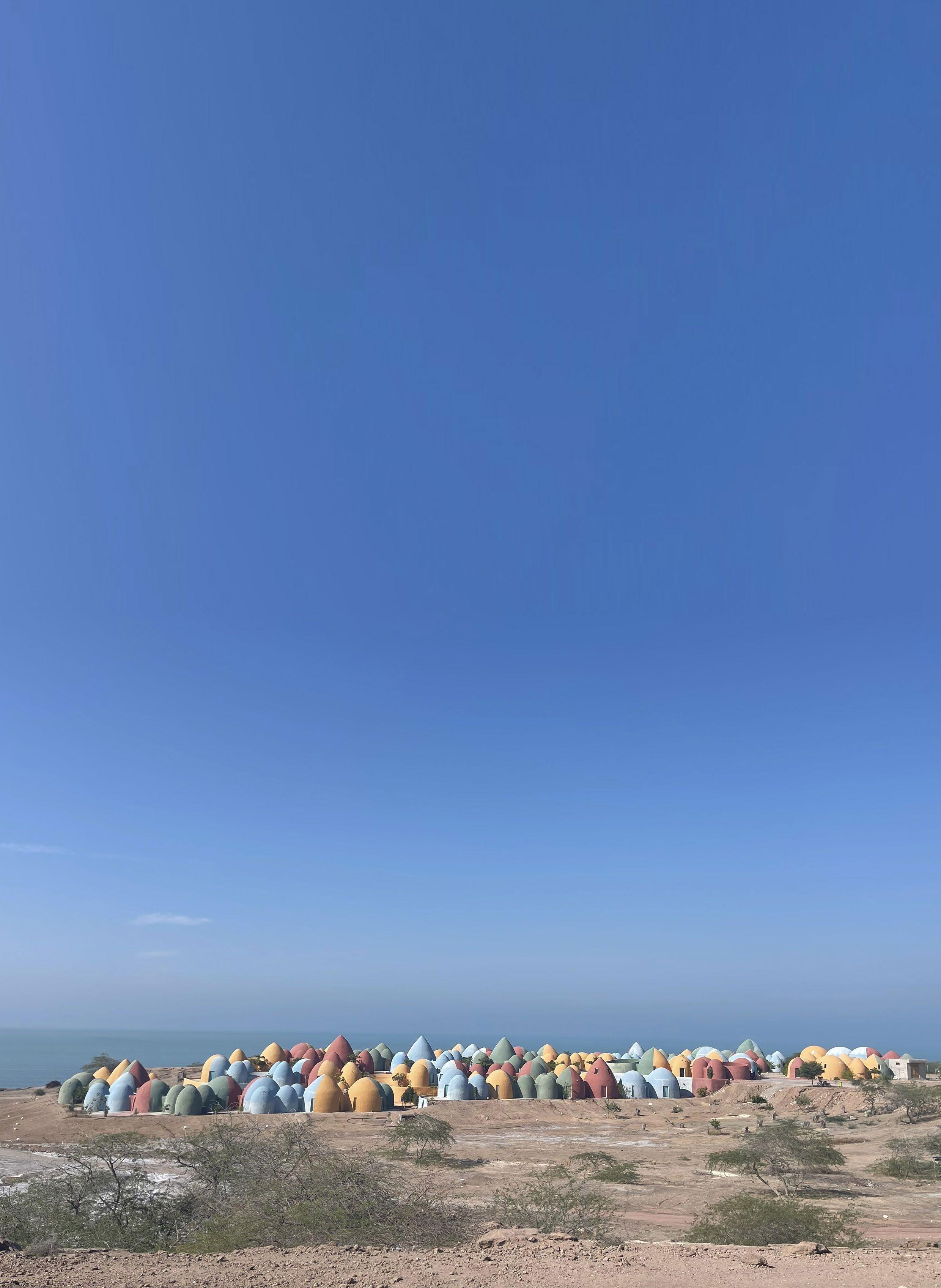
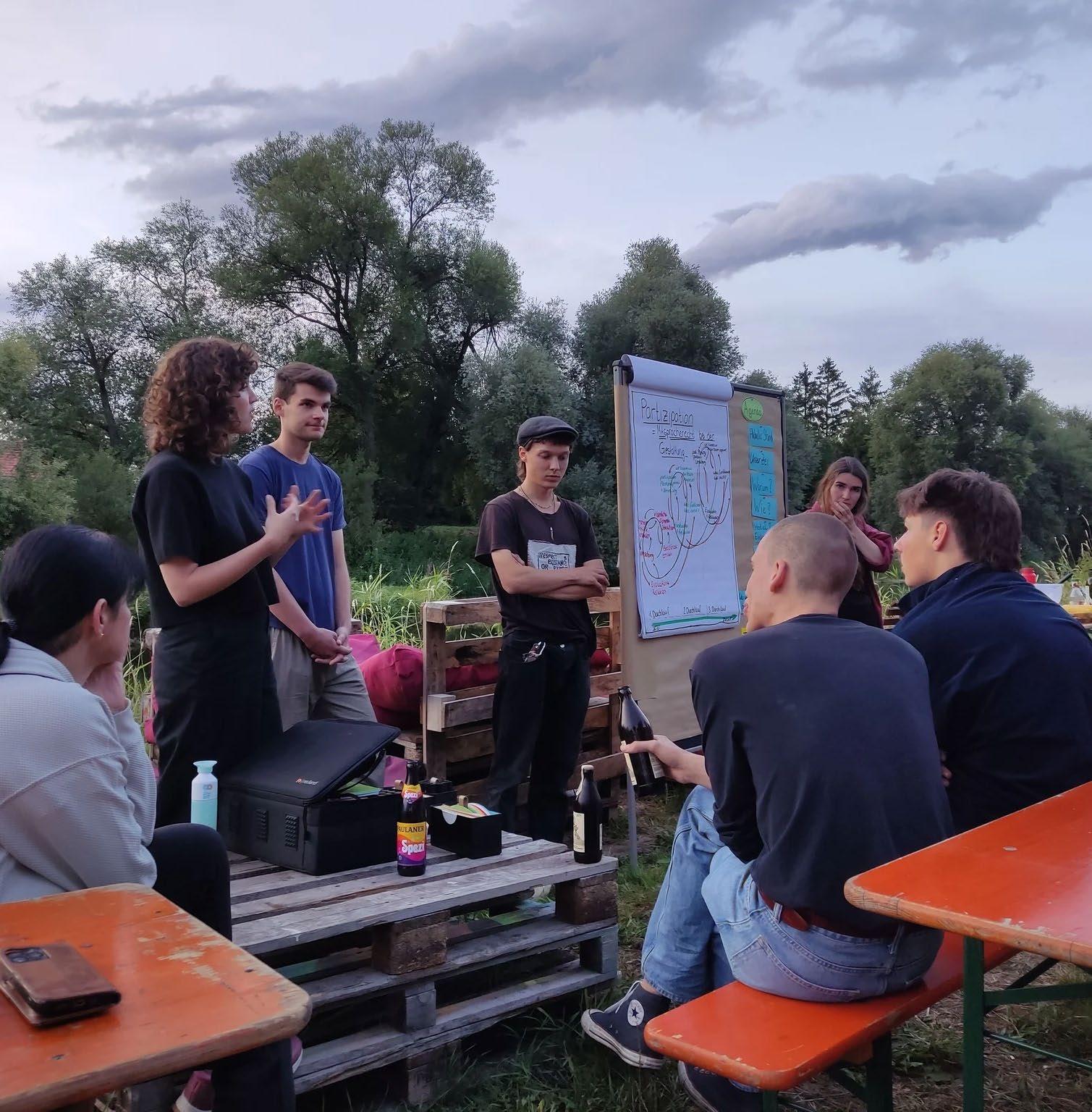
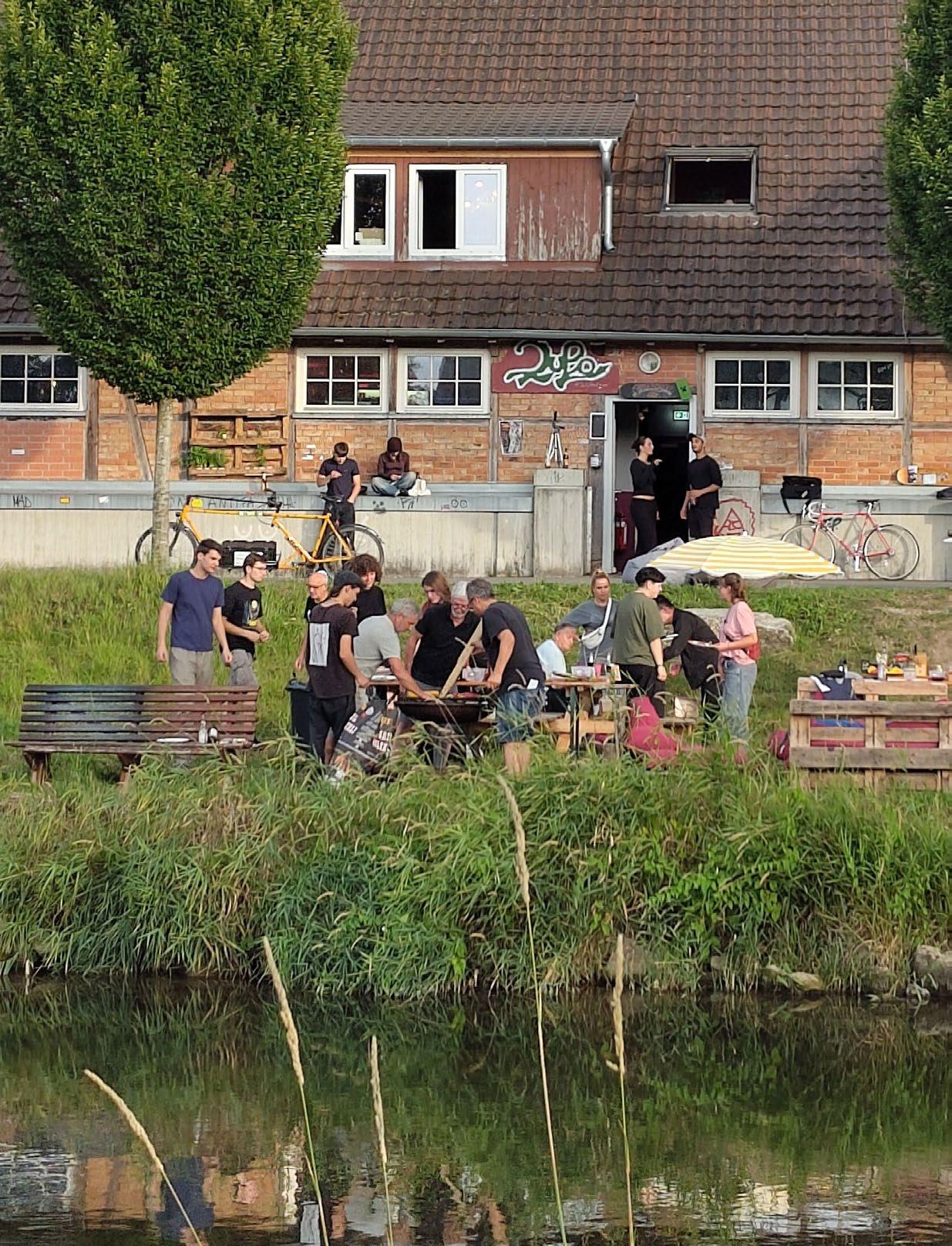
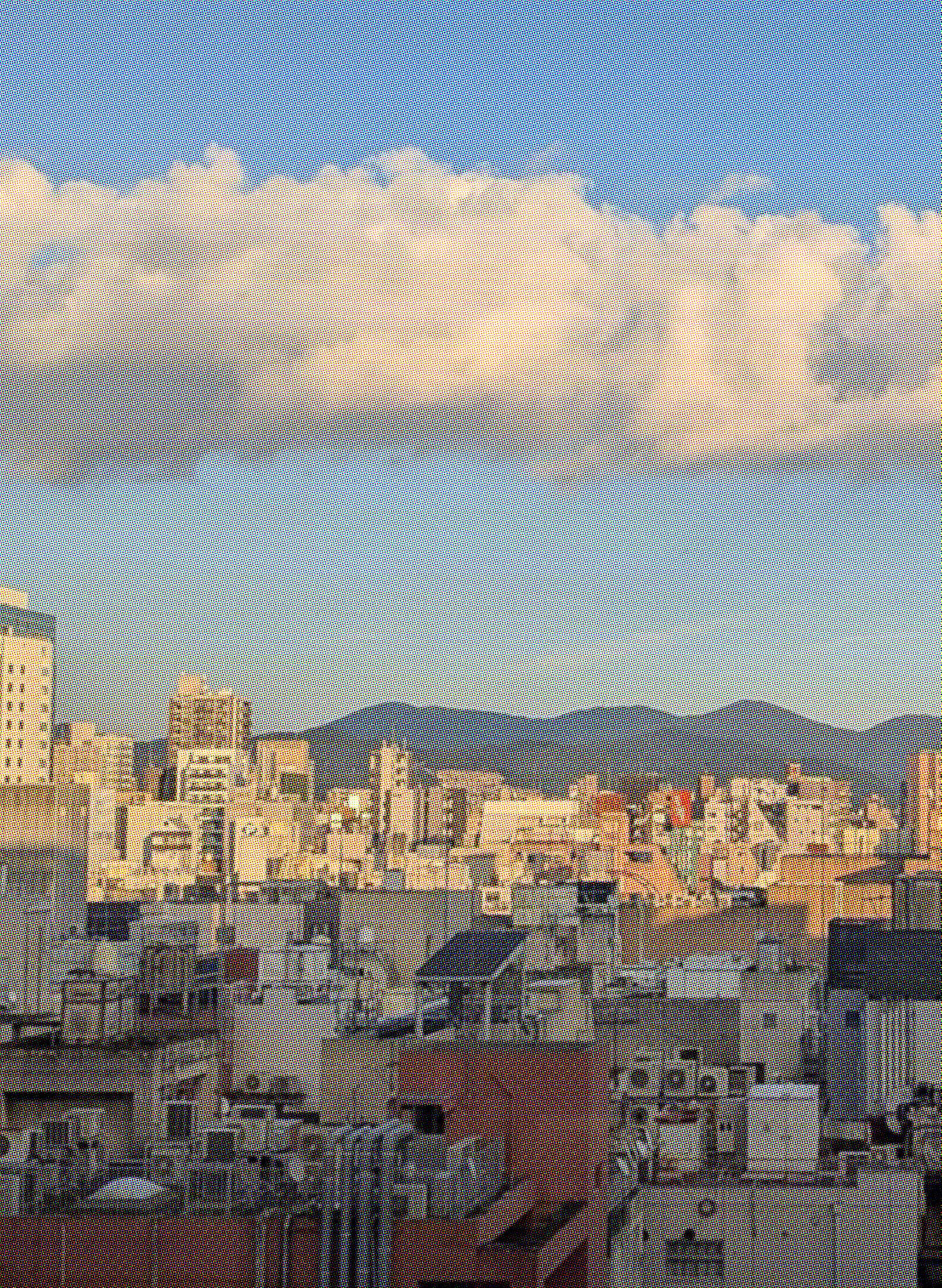
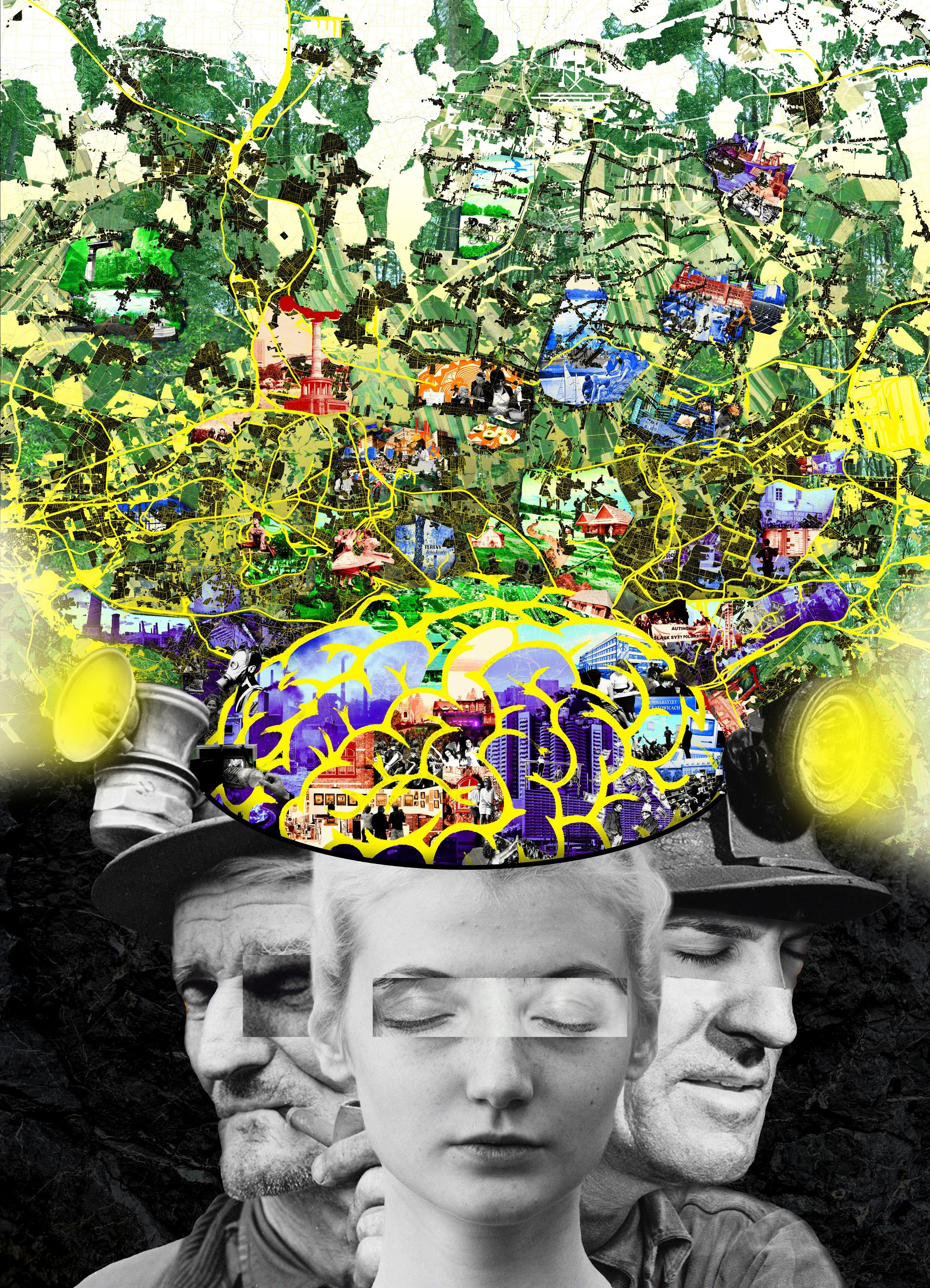
Figure: Protest against the budget cuts in the Netherlands 2025.
Image by Emmelot Linnsen
Editorial foreword
p. I - II
Humna Naveed
To be South Asian in the Whitest of Lands
p. 1 - 4
Ravza Kabaktepe
The CounterMelancholic City
p. 5 - 12
Mokgaetsi Koenaite
Claiming the Streets
p. 13 - 20
Persa Bouziana & Kanellopoulou Konstantina
Between Exclusion and Belonging
p. 21 - 28
Mia Barnard
Beyond ‘Informality’
p. 29 - 34
Martina Botton
When communities shape the territory
p. 35 - 42
From City Dweller to Urbanor
p. 43 - 48
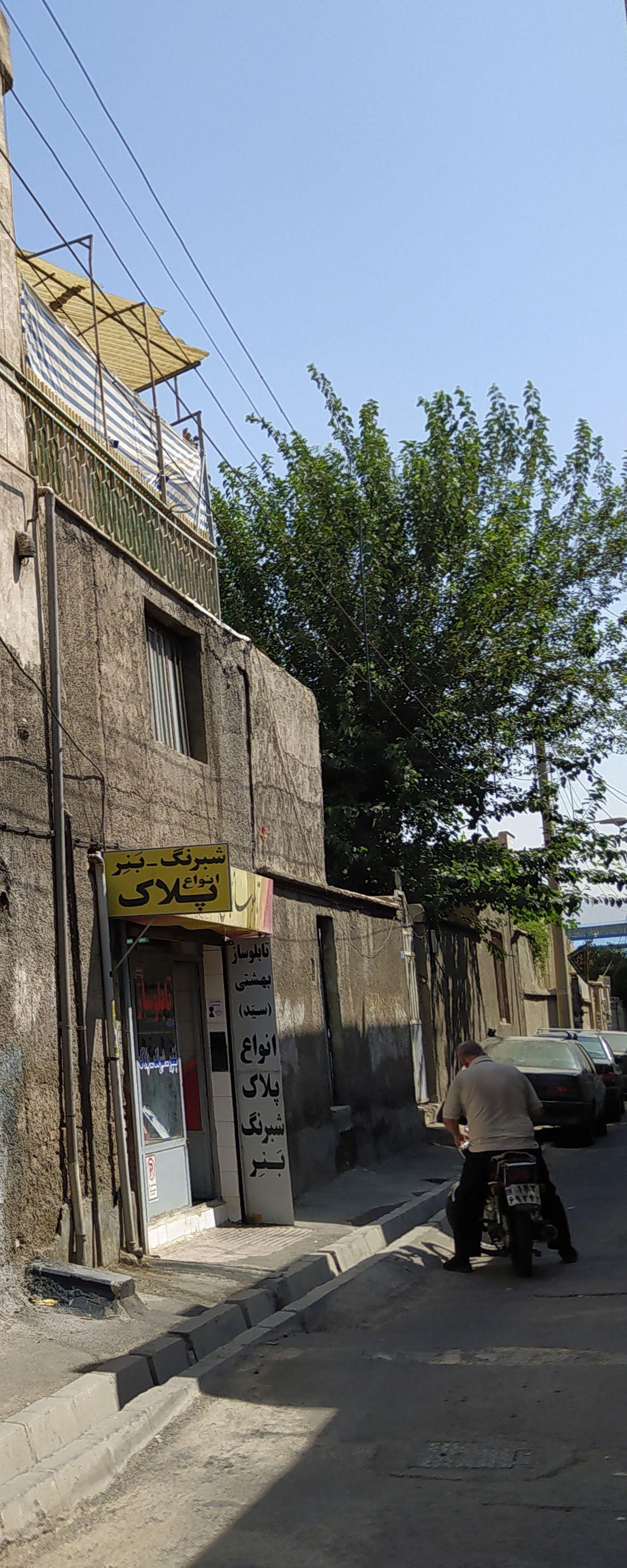
Ahmad Yazdanian and Zahra Rahmati
Space of Politics
p. 49 - 54
Ilaria Palmieri
Micro Geographies of Agency in Displacement
p. 55 - 62
Ziana Shakil
Navigating Karachi as a Daily Wager p. 63 - 68
Nima Tabirizi
Power, Awards, and the Overshadowed Agency! p. 69 - 74
Rashiq Fataar
Civicness and Agency p. 75 - 82
Wiebke Stadtlander, Anna Maria Kovacsics, Caroline Zuchotzki & Paul Geisler
A Site for Everyone?
p. 83 - 100
Adriano Mancini & Juli Osusky
The Art of Kinship p. 101 - 106
Verena Balz & Anca Ioana Forgaci
The DUST Exhibition p. 107 - 108
Fatemeh Nahvandi
Dear Readers,
Thank you for choosing Atlantis!
We’re thrilled and excited that this issue is finally in your hands. Starting with the first steps of questioning the topic, to the final touches of layout printing, it was a process of bringing various thoughts and ideas regarding agency over space and its intertwined traversal within society.
For the series of two issues this year, we began with a simple yet persistent question: What is agency, where do we locate it in the spaces we inhabit and how do we exercise it?
In a world shaped by forces that often feel distant, climate shifts, geopolitical tensions, planning decisions, and economic pressures, our immediate environments can appear outside our control. Yet agency is not only found in grand gestures or institutional power. It is present in quiet acts of care, in resistance, in imagination, and in the everyday negotiations that shape how we move through the city. Agency can be deeply personal, collective, and sometimes conflicting. It is always in the process of becoming.
Atlantis #36.1 is focused on the agency’s emergence, becoming and transformation from past to present in constructive or destructive manners in the form of an individual or collective entity, or a large-scale organization. With this issue, we explore how people claim, lose, contest, and reinvent agency - in homes, on streets, in landscapes, and in the stories we tell about ourselves.
The authors brought diverse observations, studies and narrations from both personal perspectives as well as those of an observer. The issue speaks of personal belonging, immigration, collective actions, locality, identity, institutionalization and many more. A pluriverse of stories tells us how the agency is perceived, experienced and shaped in spatial and social contexts of each author’s work.
Human Naveed, with her poem, reflects on the South Asian diasporic experience in predominantly white environments. The poem shows how identity, belonging, and visibility are negotiated. Using the 2022 Felixstowe dockworkers’ strike as a lens, Ravza Kabaktepe talks about how infrastructures and legal frameworks shape which protests are “permitted” and which are criminalized. Mokgaetsi Koenaite brings stories of youth in African cities transforming ordinary streets into vibrant sites of creativity, survival, and resistance, challenging planning norms that overlook their agency.
Through interviews and fieldwork, this Persa Bouziana & Kanellopoulou Konstantina explore how migrant women navigate Athens across home, work, and public space, revealing fluid socio-spatial boundaries. In her
article, Mia Barnard argues that the term “informality” limits agency by framing African cities through deficit-based, externally imposed language, advocating for decolonized and context-rooted vocabularies. Martina Botton traces how communities resist development pressures to protect landscapes on the Spanish Mediterranean coast. Fatemeh Nahavandi, through a personal reflection, introduces the “urbanor” a resident who transforms passive city living into active, meaningful engagement, emphasising that agency emerges from inner connection and everyday acts of care. Ahmad Yazdanian & Zahra Rahmati reflect on how deterritorialization and loss of place reshape personal agency within processes of planetary urbanization. Drawing on fieldwork in asylumseeker centres, Ilaria Palmieri’s piece highlights the everyday tactics through which displaced residents personalize, adapt, and co-create their environments.
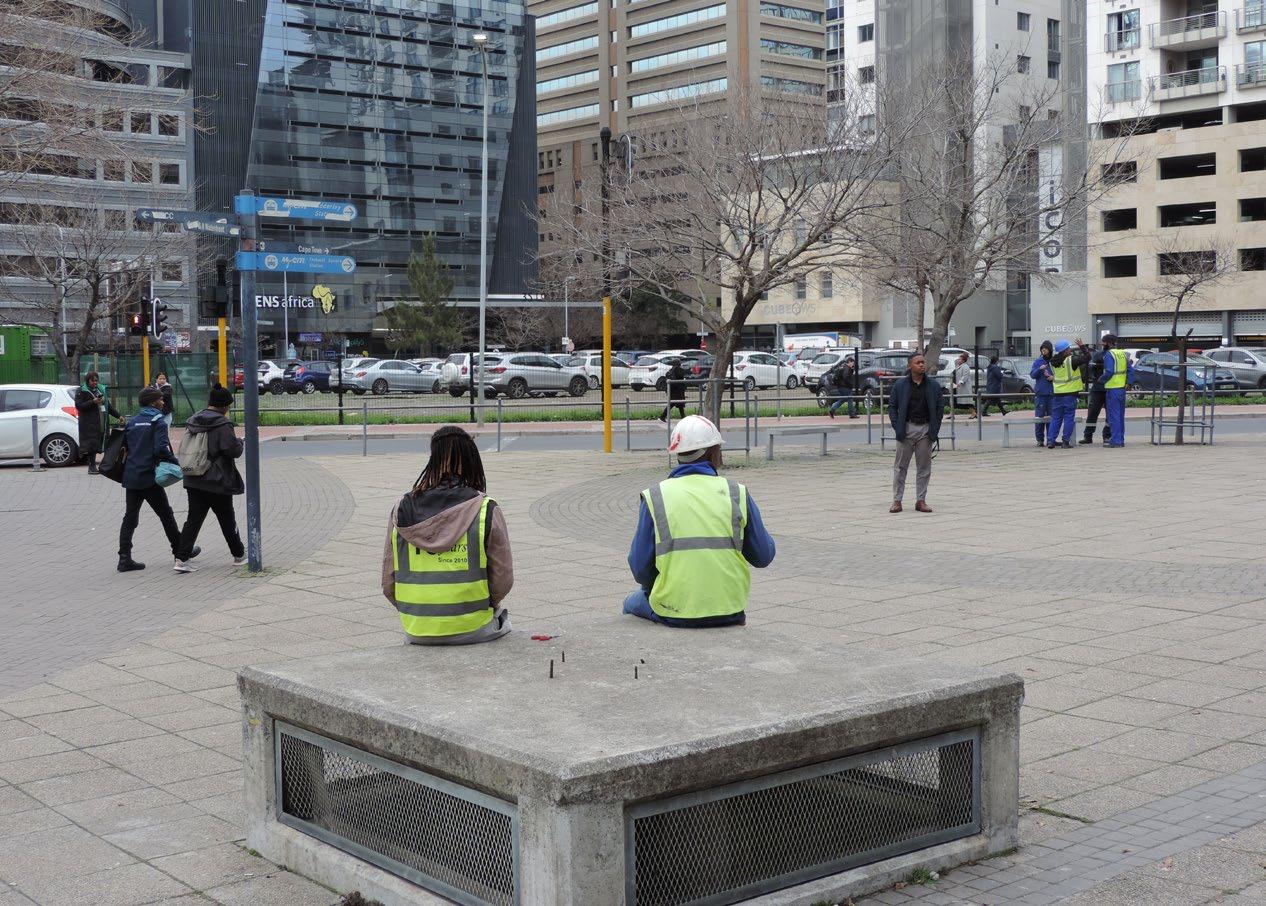
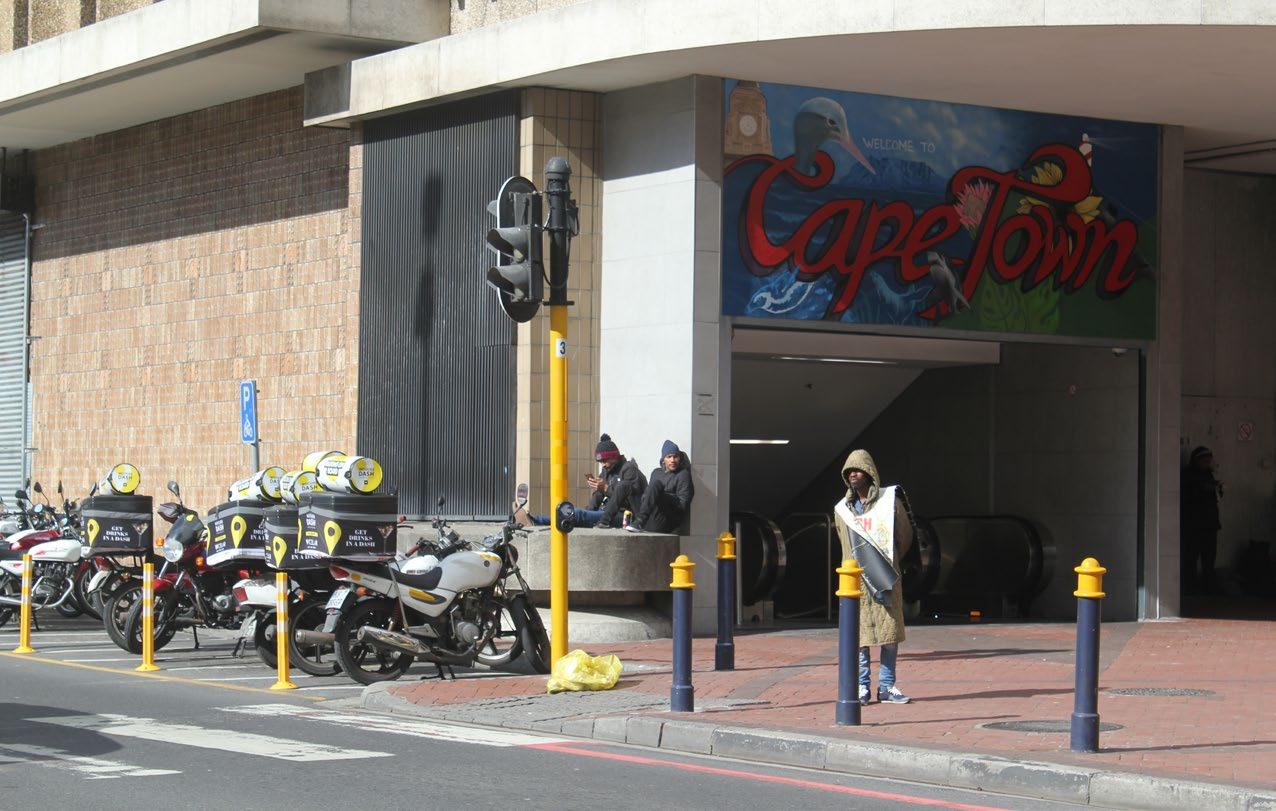
Ziana Shakil examines how Karachi’s informal workers exercise agency through daily acts of adaptation and resilience amid systemic precarity. Nima Tabirizi brings a critique of how awards shape architectural discourse by examining an award-winning architectural project in Iran, showing how international recognition can obscure genuine communitydriven processes. Through photography and observation, Rashiq Fattar’s contribution explores how everyday practices continually reshape a key pedestrian space in Cape Town. It shows that civic agency is fragile and negotiated, requiring ongoing collective participation. Wiebke Stadtlander, Anna Maria Kovacsics, Caroline Zuchotzki, Paul Geisler bring stories of youth-led activism in a small German town, showing how young people mobilize to defend their only public space from redevelopment. Their efforts reveal both the barriers youth face in planning processes and the transformative potential of grassroots participation. Juli Osusky and Adriano Mancini bring us an experimental dialogue that weaves together multiple voices - theoretical, poetic, and speculative - that question what design is and how its agency operates. By layering human and non-human perspectives, the contribution reimagines design as a multi-species, collaborative practice.
Together, the authors remind us that space is never neutral, and neither are the systems that shape it. You will find in these pages forms of agency that are tender and subtle, others that are loud and collective. We hope the narrations convey their interesting aspects and thoughts that resonate with you just as they did with us. Feel free to scribble, paint and overlay your thoughts as you read along. We invite you to question, to feel, to reflect, and perhaps to locate your own forms of agency wherever you might find them!
The Atlantis Editorial Team
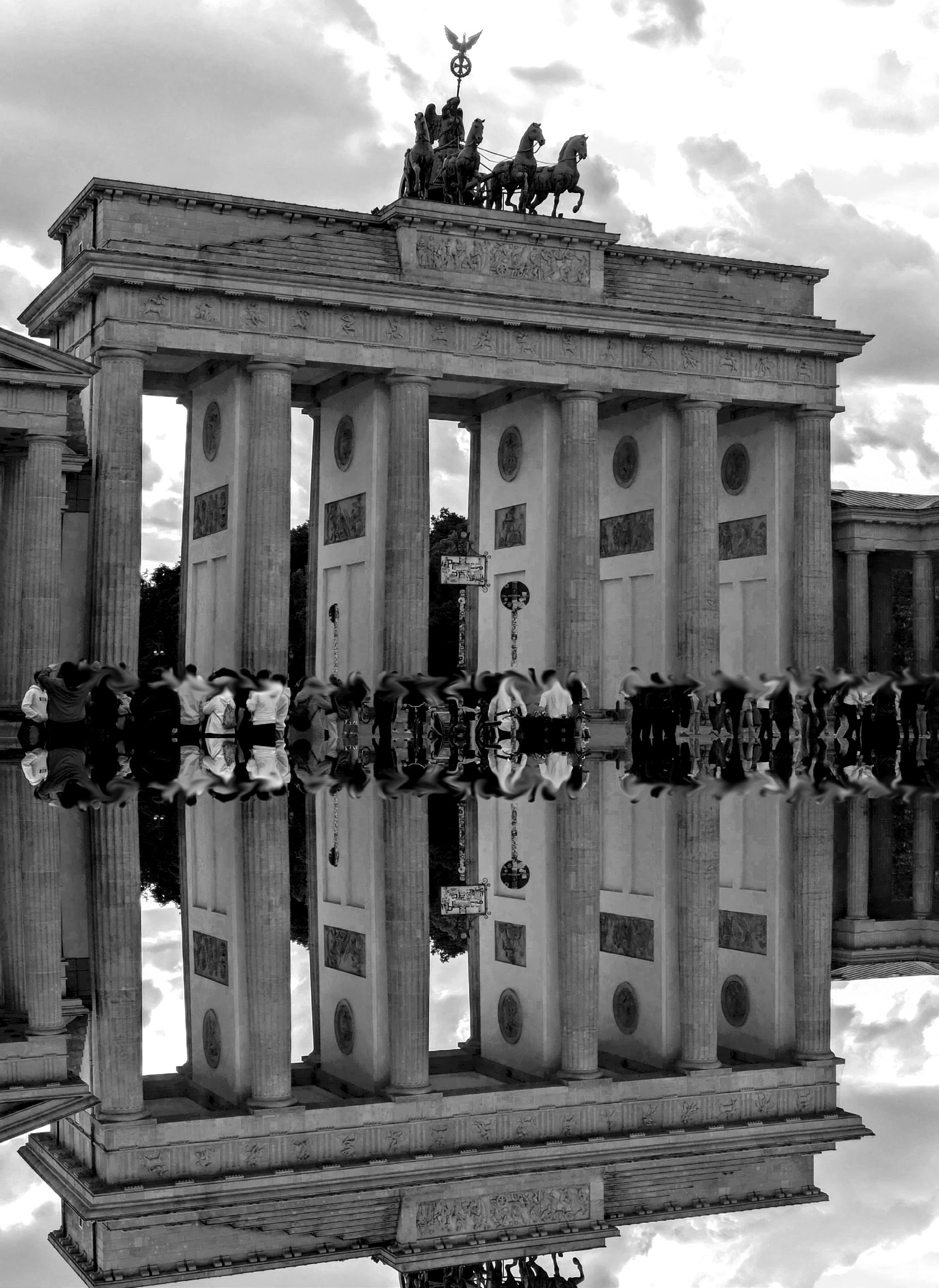
Figure 1: Berlin’s
To be South Asian In Whitest of Lands
A Poem
Humna Naveed
The poem “To be South Asian in the Whitest of Lands” explores the complexities of identity, belonging, and power by highlighting how cultural presence is both imposed upon and reclaimed within social and spatial contexts. By situating personal experiences within collective histories, the work embodies multi-scalar agency: the intimate act of carrying one’s name or skin becomes tied to larger questions of cultural memory, migration, and belonging. It is an ode to my personal experience after having lived in the US and now in Germany as a Pakistani, claiming my space in the foreign cultures and navigating through the environment as a brown woman, an architect, designer, and importantly as a diasporic individual.
To be South Asian
In the whitest of lands
Is to carry your two forked tongue
And split it into three pieces
One always at home
To be South Asian in the whitest of lands
Is to remember your color
Brown against the white A tapestry of genetics
A love affair of resilience
To be South Asian
In the whitest of lands
Is to explain your name
A name that your mother gave you
Once and twice and many times
Until it floats around in foreign accents
Split into unfamiliar vowels
Fragmented, unlike borders
To be South Asian
In the whitest of lands
Is to remember that the land is a shared asset
Just like language
Yet we divide and draw lines
Color coding all the way.
To be South Asian in the whitest of lands is to stand at the fault line of belonging
Planting seeds of being, to color walls that resist color, to claim space; not given,
To be South Asian in the whitest of lands is to bend the weight of gaze into a refusal of erasure, to stitch belonging from fragments, To rewrite geography
As an exercise in Poetry
To be South Asian
In the whitest of lands
Is to remember
Agency is not arrival it is a constant negotiation: to fracture, to re-form, to refuse disappearance.
Discussion
This poem explores the different forms of agency one can navigate through as a migrant in foreign environments. It reframes identity as an assemblage of experiences, visual, haptic, and emotional, and re-centers them around the act of reclaiming space through the singular act of being alive, existing, and through one’s own body and emotional connections. While the poem tethers itself to commonly shared aspects, such as the color of skin, one’s name as a marker of identity, it also captures the struggle and the intangible foreignness in having to acquire a new language of the foreign land as a way of mitigating a silent yet very powerful barrier of communication in the foreign environments. It plays on the concept and symbology of “being and having mother”, something that I extract from my own experience as a mother too, yet it explores it as a possible connection between “motherland” and “mother tongue”, a form of linguistic and geographical association that is commonly referred to in literature and writing. This piece evokes the possibility of redefining agency through acknowledging one’s own existence, the elements of self, and then having them become hybridized with the elements of the foreign environment. Agency, as the prompt suggests, is not a fixed state but a process of becoming, often negotiated at the intersection of self and society. The poem articulates this negotiation through imagery of language, skin, and naming, emphasizing how identity is fractured, reshaped, and reasserted in contexts where one is simultaneously hyper-visible and misunderstood. These dynamics suggest how diasporic individuals navigate a landscape already marked by historical and racialized power structures, while also carving out spaces of resistance and self-definition. The poem intends to foreground the politics of shared environments and how they are divided and color-coded, reflecting broader structures of inclusion and exclusion. While I write from a place of personal experiences, my writing is more human and an invitation to assimilate shared narratives, and this poem offers to open a conversation on the very act of being “A South Asian in the Whitest of Lands”.
By Zeynep Dogan
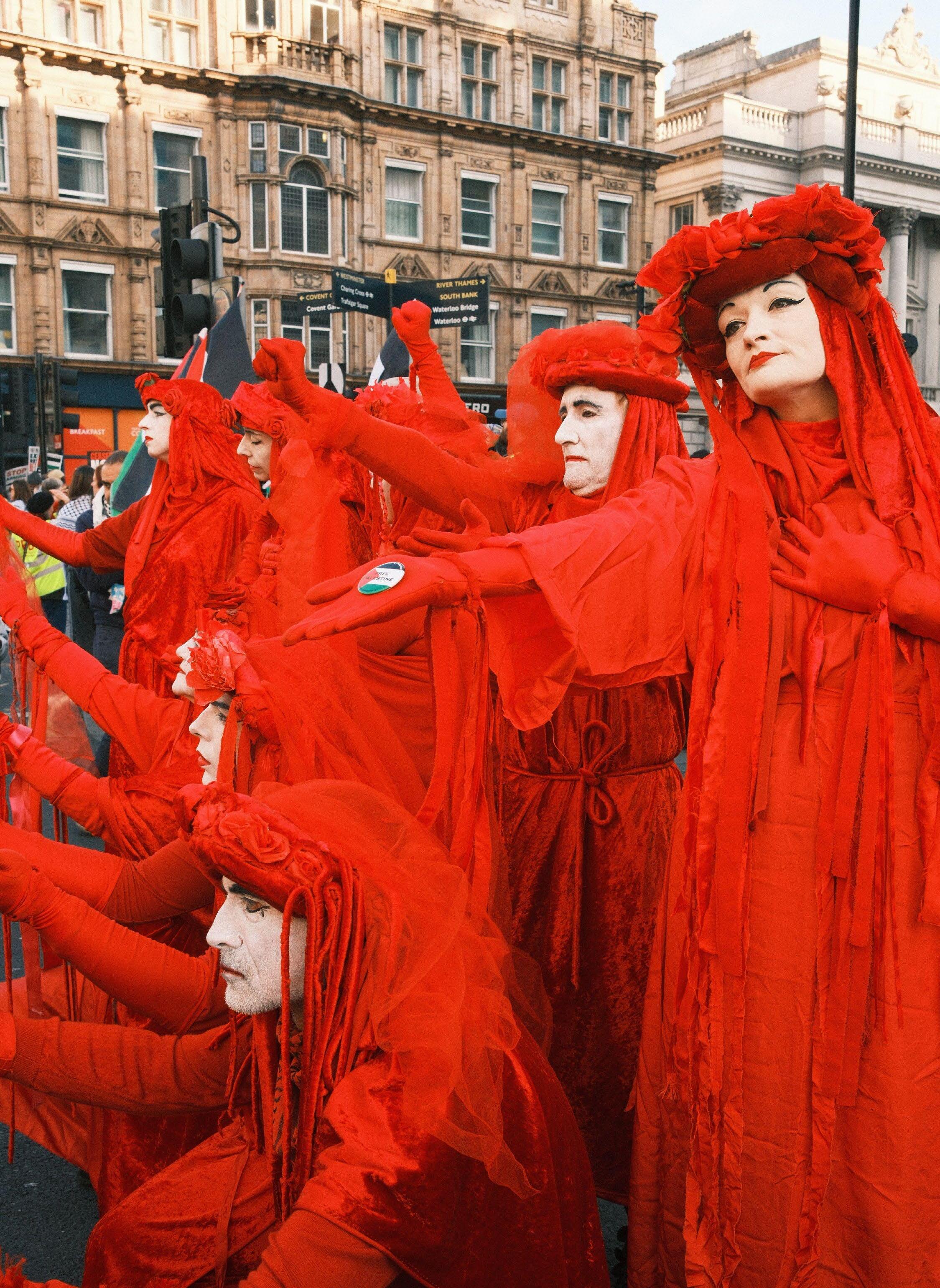
Figure 1: Lancaster Place, 11 October 2025.
The Counter-Melancholic City Remaking London’s Protest Landscape
Ravza Kabaktepe
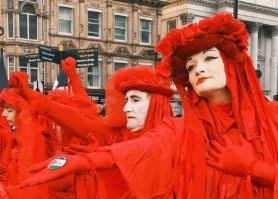
This text traces how protest and policing coproduce urban space in London, revealing emotion, infrastructure, and prediction in convergence. Drawing on a year of situated observation in the city, it examines the melancholic and counter-melancholic forms of dissent. The melancholic city is marked by containment—protests that are affectively charged yet spatially constrained, regulated by permits, routes, and predictive systems. These architectures of management extend from the physical to the algorithmic, transforming the commons into a data-driven terrain. Yet, counter-melancholic practices emerge: reparative, infrastructural, and sustained rather than spectacular. From occupations to care-based assemblies, reimagining protest as maintenance and endurance. The countermelancholic city thus gestures toward an urbanism of care—tender, tactical, and collective—where agency manifests through maintaining presence. This text explores how emotional and spatial practices of dissent continue to shape political and material futures.
From kettling tactics to predictive algorithms, the choreographies of dissent and policing in London reveal a core dynamic: urban space and public emotion are intertwined. Drawing on a year of situated observation, this ongoing research text traces how interstitial voids act as living laboratories where everyday life, protest, and policing continually co-produce the city. Within this, a pattern of melancholic protests emerges: highly choreographed and emotionally saturated. This pattern is being followed by a post-melancholic model where control becomes predictive, even as counter-melancholic phenomena have been observed in response, often oriented toward the maintenance of shared presence.
Protests
Public space is never completed—it is repeatedly built, unbuilt, and rebuilt. In periods of economic pressure, social change, geopolitical tension, and distant conflicts, public demonstration becomes the default mechanism of participation.
Protest and policing form a feedback loop— each continuously reshaping the other’s tactics, language, and affect within the urban environment. When bodies gather on Tower Bridge or in Trafalgar Square, the city’s latent infrastructures are activated: streets, pavements and voids become mutable commons, redefined by protest, counter-protest and order-management agencies.
“Demonstrations choreograph space through movement, density, and improvisation; drawing temporary geometries of collectivity.”
Order management responds architecturally—through encirclement, rerouting, surveillance grids, and mobile units that recast the city’s openness into managed enclosures. These architectures extend beyond the physical: predictive mapping and recognition systems project spatial boundaries before bodies even arrive to the public space. Thus, the commons becomes both material and algorithmic—a site of continuous negotiation between collective expression and its containment.
This is not new. From Peterloo in 1819 to the labour demonstrations of the early twentieth
century to contemporary gatherings such as those for Palestine in 2024–25, mass assemblies have remade the city as a commons. Each has generated measures and counter-measures—revealing that the contest over public space is also a negotiation over how the city itself is designed, sensed, and remembered.
Melancholia, as Sigmund Freud (1917) described, is grief without closure—mourning that loops through repetition. Ann Cvetkovich (2012) expands this into a public feeling: a collective exhaustion emerging when hope becomes habit. Public melancholia is not the absence of emotion but its containment— protest performed within sanctioned limits, feeling rehearsed, and spatially constrained. It exceeds the individual, shaping bodies, streets, and civic imagination. Why do we impose limits on ourselves— permits, routes, decibel thresholds—as if freedom were fragile? This can be read as a process by which control is turned inward and surveillance is internalized. Sara Ahmed (2025) argues that complaint is not mere grievance but world-making—an insistence that the world can be otherwise. Yet the “we” that speaks through protest is never preformed; it emerges through spatial practice, including the entire ecology of dissent: protesters, police, bystanders, architectures, and more-than-human forces.
During a research at the Centre for Research Architecture, I examined the UK dockworker protests. Banners from the 1970s read Freedom, Solidarity, Victory. By the 2020s, they had narrowed to Fair Pay and Save Our Jobs. Slogans compressed as the political horizon contracted, reflecting Cvetkovich’s (2012) notion of public fatigue: exhaustion of activism long after transformation seems impossible. Melancholia represents not individual failure but a transformation of dissent into ritualized practice. The modern relationship between protest and policing in Britain is foundational. The Metropolitan Police’s establishment in 1829, following the Peterloo Massacre, institutionalized a model of public order that balanced crowd control with public legitimacy—a tension that continues to define the interaction (Easton, 2024). The Police, Crime, Sentencing and Courts Act (2021) and the Public Order Act (2023) expand powers over time, volume,
Melancholic
Figure 2: Westminster Bridge, 11 October 2025.
Image by Zeynep Dogan
Figure 3: Trafalgar Square, 23 June 2025.
Image by Zeynep Dogan
and movement. Demonstrations deemed “too noisy” or “disruptive” can be limited, and definitions reinterpreted. This marks a shift in the character of democratic expression, toward a more curated form of event.
“Protest becomes a performance tolerated only within acceptable geometries: zones of containment, regulated soundscapes, and choreographed routes that discipline bodies, voices, and space. ”
Emotional contractions—the cautious optimism, and weary repetition—mirror the spatial contraction. The city is re-mapped, materially and algorithmically, producing forms of dissent characterized by high affective intensity but limited tangible impact. Yet melancholia endures as the after-image of longing—the persistence of political orientation when institutional options appear constrained. Within managed urban enclosures, traces of divergence remain. From repetition emerges a different endurance, a new orientation that begins to outline the post-melancholic city—predictive, monitored, yet still inhabited by bodies that remember how to stay.
Post-Melancholic
To move beyond melancholia does not mean abandoning feeling but reorienting it. The post-melancholic city is a landscape of prediction—an affective and algorithmic terrain, where visibility triggers surveillance more than agency.
By the mid-2020s, UK policing shifted from response to anticipation. Protest was no longer an event unfolding in time but a data pattern. Marketed as data-driven or intelligence-led, predictive policing represents a reconfiguration of management. These systems, centralized under the National Data and Analytics Office (NDAO, 2024), draw on arrest records, social media, and hotspot mapping to forecast activity. Amnesty International’s Automated Racism (2025) has brought about concerns about biases embedded in such systems and their potential impact on equitable environments. If, as Henri Lefebvre (1991) argued that space
is socially produced, then
“today it is pre-produced— algorithmically shaped to anticipate dissent before it forms”
Out of the post-melancholic city’s predictive logic, a different rhythm begins to pulse— counter-melancholic, where response takes the form of maintenance, relation, and staying.
Counter-Melancholic
Beneath this apparatus, alternative practices have been observed. Counter-melancholic actions tend to be reparative, and materially grounded. They differ from spectacle-oriented approaches.
These practices invent new forms of togetherness. As Sophie Lewis (2022) suggests while discussing social structures beyond family, comradeship can be “a relation not yet invented”—built through shared vulnerability rather than blood or institution. From the student occupations for Palestine to the care sector rallies in Westminster, public spaces have been reconfigured into infrastructural arrangements: communal kitchens, rest zones, and legal aid desks emerge. These constituted a gradual reconfiguration of social relations. Here, complaints shifted from spectacle to maintenance; political affect became logistical.
“Counter-melancholia marks a turn from protest as event to protest as duration”
It emphasizes sustained presence and repair. Its politics are infrastructural, oriented toward capacities to hold space, to endure collectively even when public visibility is constrained. Each return to the square can reactivate the unfinished becoming of the commons—a localized form of tactical practice that challenges predictive architectures. These acts reclaim the temporalities that data governance seeks to close, inhabiting the urban pores rather than planned geometries. This shift in strategy suggests that a distinct form of urban agency emerges, one that
prioritizes endurance over spectacle, but in the sustained practices of holding space, staying, and maintaining a collective presence against a city’s predictive mechanisms. The counter-melancholic city intervenes in pre-scripted spaces, composing an emerging, still-unnamed urbanism of care— tender, tactical, and deeply architectural. Agency may manifest not only through visible confrontation but also via sustained, collective presence, pointing toward alternative urban possibilities.
References:
1.Ahmed, S. (2021). Complaint! Duke University Press.
2.Ahmed, S. (2025, June 4). Art and activism of complaint [Public lecture]. Queen Mary University of London.
3.Amnesty International. (2025, October 10). UK: Further 400 peaceful protestors arrested under the Terrorism Act 2000 (Index No. EUR 45/0377/2025). https:// www.amnesty.org/en/documents/ eur45/0377/2025/en/
4.Amnesty International UK. (2025, February). Automated racism: How police data and algorithms code discrimination into policing (AI Index No. EUR 45/8992/2025). https://www. amnesty.org.uk/predictive-policing
5.Beckett, A. (2022, July 20). ‘Stuff your 5%!’ Is the UK facing a summer of discontent – and what can we learn from the winter of 1979? The Guardian. https://www.theguardian. com/politics/2022/jul/20/stuff-your-5is-the-uk-facing-a-summer-of-discontentand-what-can-we-learn-from-the-winterof-1979
6.Cvetkovich, A. (2012). Depression: A public feeling. Duke University Press.
7.Easton, M. (Host). (2024). Policing protest [Audio podcast]. BBC Radio
4. Retrieved October 5, 2025, from https://www.bbc.co.uk/sounds/brand/ m0021b16
8.Freud, S. (1917). Mourning and Melancholia. In J. Strachey (Ed. &
Trans.), The Standard Edition of the Complete Psychological Works of Sigmund Freud, Vol. 14 (pp. 237–258). London: Hogarth Press.
9.Lefebvre, H. (1991). The production of space. Blackwell.
10.Lewis, S. (2022). Abolish the family: A manifesto for care and liberation. Verso.
11.Metropolitan Police. (n.d.). Timeline of the Metropolitan Police. Metropolitan Police. Retrieved October 5, 2025, from
13.National Police Chiefs’ Council. (2024). National Data and Analytics Office (NDAO): Modernising policing through data and innovation. National Police Chiefs’ Council. https://www. npcc.police.uk/our-work/modernisingpolicing/national-data-and-analyticsoffice/
15.UK Parliament. (2023). Public Order Act 2023. https://www.legislation.gov. uk/ukpga/2023/15/contents/enacted
16.UK Government. (2025, October 5). New police powers to protect communities from disruption caused by protests. https://www.gov.uk/ government/news/new-police-powersto-protect-communities-from-disruptioncaused-by-protests
Figure 4: Westminster Bridge, 23 June 2025
Image by Zeynep Dogan
Claiming the Streets: Youth and Improvised Agency
in African Cities
Mokgaetsi Koenaite
In African cities, the street is more than asphalt and dust; it is a canvas, a stage, and a marketplace where youth rewrite the meaning of urban life. While planning documents often imagine sterile sidewalks and orderly zones, young people transform these same spaces into hubs of creativity, resilience, and survival. A street corner becomes a concert hall, a vacant lot a football pitch, and a bus rank a launchpad for micro-enterprises. In these acts, youth demonstrate a radical form of agency: they reimagine what the city can be.
Figure 1: Youth reclaiming the street through collective presence.
By author, 2025
This contribution explores how African youth exercise spatial agency by appropriating, adapting, and reimagining urban space in ways that disrupt dominant planning paradigms. Rather than being passive subjects of urban development, they emerge as active shapers of space and society. Through their practices, they redefine what counts as public, who belongs, and how urban life is lived.
By highlighting these dynamics, the piece seeks to reframe African cities not as sites of deficit but as laboratories of possibility, where youth-driven practices offer critical insights into agency, resilience, and the future of urban life. In doing so, it aims to expand scholarly and planning debates by foregrounding the lived, embodied, and often overlooked contributions of young people to the urban condition.
Positioning Statement:
I write from the perspective of an African researcher and advocate whose work lies at the intersections of planning, geography, and creativity. While my academic background spans housing, transport, waste, and climate, it is my engagement with communities and youth that shapes my lens. I approach cities not as abstract plans but as lived, dynamic spaces of resilience and agency.
“Streets are not lines on asphalt, they are songs sung in footsteps, murals of breath and laughter, waiting for planners to notice what has already been built by bodies in motion, by youth who refuse to wait."
Each morning when I step outside in Braamfontein, a bustling district of Johannesburg, South Africa, I find myself confronted with a paradox. Known as a vibrant student quarter, Braamfontein hosts the University of the Witwatersrand (Wits) and numerous student residences, cafés, and cultural spaces, making it a hub of youthful energy and creativity. Johannesburg, one of Africa’s largest and most dynamic cities, is shaped by history, migration, and informal economies. The streets before me are crowded, loud, sometimes chaotic, and still overwhelmingly full of joy (Figure 2). Young people spill out from cafés, spaza shops (informal convenience stores), dormitories, and taxis. They walk in clusters, claim corners, laugh, argue, transform sidewalks into marketplaces, and animate the streets with music and movement from cheap speakers and nightclubs.
Graffiti colors the walls, while the blare of taxi horns mixes with conversation and beats from street performers. Benches line some streets, where people gather for small conversations, watch the passing crowd,
or simply pause and linger, adding layers of human connection to the urban fabric. There is a density of life here that no urban design textbook could fully capture. What puzzles me most is that this vitality does not emerge from polished planning diagrams, but from the everyday practices of youth who refuse to leave the streets as bare asphalt. And this forces me to question: do the celebrated ideals of contemporary planning such as Jane Jacobs’s “eyes on the street,” Nathan Jurey’s (2012) “live–work–play” districts, the promises of green corridors and sustainable enclaves; still hold weight when confronted with the improvisational realities of cities in the African present?
Jacobs’s (1961) critique of modernist planning remains a turning point in urban thought. She argued against sterile towers and empty plazas, urging instead for density, diversity, and watchful eyes. Her call was a reminder that cities live through people, not just through design. Later theorists such as Richard Florida (2019) elaborated this vision where he praised creative cities animated by cultural workers, while new urbanists celebrated walkability, greenspaces, and vibrant public life (Duany et al., 2000). Although rooted in Western experiences, these frameworks have been critiqued by scholars such as Harvey (2012) and Robinson (2013), who highlight the need to recognise local forms of urban agency, informality, and justice.
Figure 2: Life on the streets of Braamfontein showing youth, commerce, and movement (photo by author, 2025).
Harvey argues that contemporary urban theory frequently overlooks the conflicts and inequalities embedded in capitalist cities, emphasizing that urban development is inherently political and contested.
Robinson highlights that the ordinary city perspective reveals how urban life in the Global South cannot be understood through models derived from Western experience, stressing the need to recognise local forms of agency, informality, and justice. Together, their critiques underscore that applying Western urban ideals uncritically risks misrepresenting how cities in Africa are lived and shaped. When applied in African cities, such concepts risk becoming empty facades as plans and policies may speak of livable streets or vibrant public spaces, but without the people who inhabit and enliven them, these ideals remain abstract.
“In African cities, the street is rarely a neutral corridor. It is a canvas, a stage, and a marketplace.”
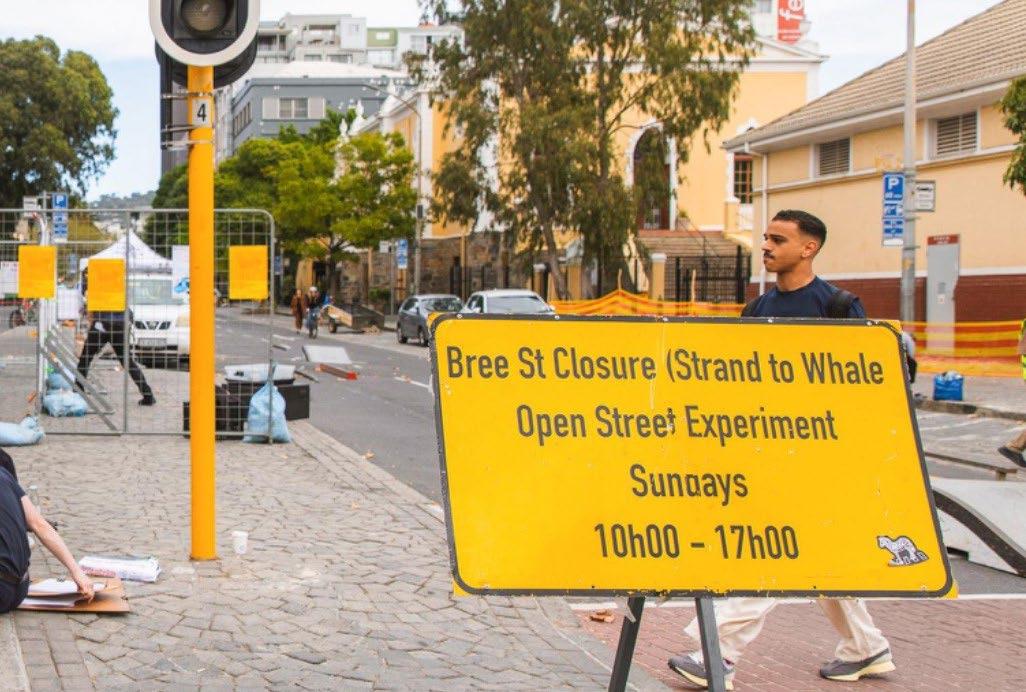
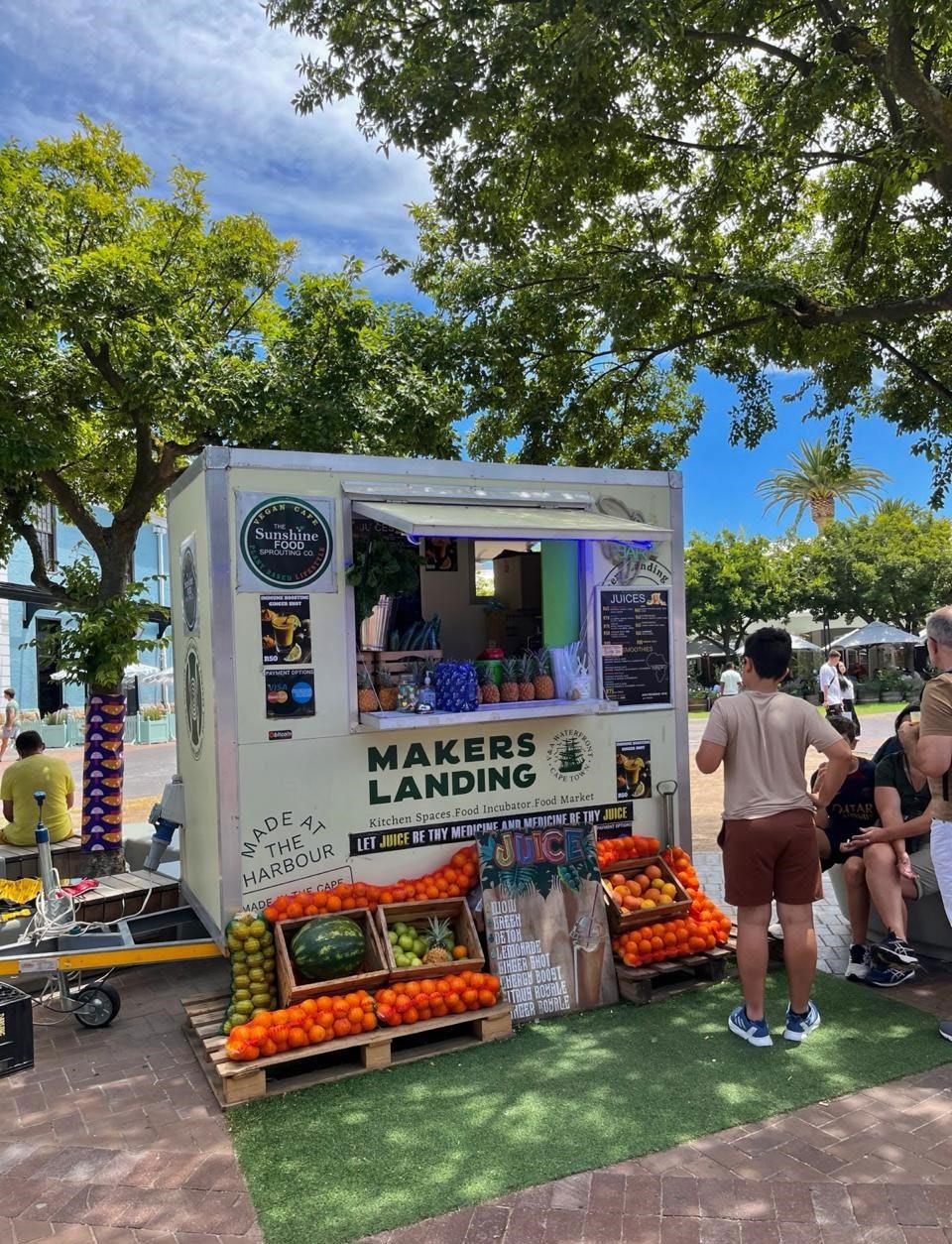
What truly animates a street is not zoning or landscaping but the young people who reimagine its meaning every day while planning documents may describe pedestrian-friendly walkways and public squares, young people convert the same spaces into hubs of creativity and survival. A corner morphs into a makeshift barbershop; a vacant lot into a football pitch; a taxi rank into a launchpad for small businesses. On Juta Street in Braamfontein, Johannesburg, this energy takes shape in the form of youth-led vending, where small stalls overflow with fruit, juice, and handmade goods (Figure 3).
Even ordinary shipping containers or simple street kiosks, which planners might regard as unremarkable or utilitarian, are transformed by youth into vibrant micro-enterprise hubs, animated by colour, conversation, and resourceful energy. These are not accidental uses but deliberate acts of agency. Youth appropriate and adapt space, showing that planning’s promise of inclusivity cannot be realised without them. Lefebvre (1996) would call this the right to the city, emphasising the power not just to access space but to shape it.
Figure 3: Youth-led street vending and micro-enterprises (photo by author, 2025).
However, planning discourse often lags behind these realities. Terms like placemaking or urban regeneration are repeated in glossy policy documents, but they rarely acknowledge that African youth have been placemaking all along. Simone (2018) argues that African urbanism thrives precisely because of improvisation, resilience, and relationality which are qualities that formal planning neither predicts nor adequately values. I have seen this myself in Johannesburg, where Juta Street stands as a living critique of modernist and new urbanist planning ideals. By transforming streets through vending, murals, music, and informal gatherings, youth demonstrate the vitality celebrated in Jacobsian or new urbanist frameworks such as walkable, vibrant, mixeduse streets which cannot be imposed from above but emerges organically from everyday practices.
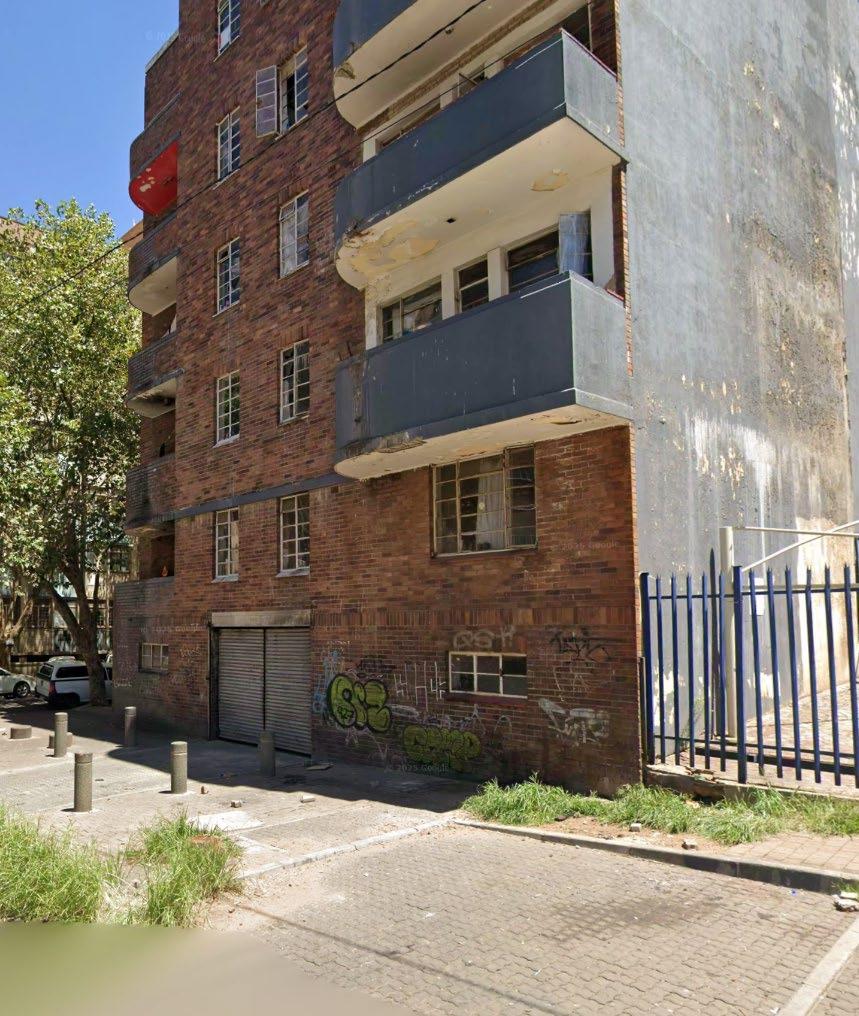
Once a nondescript stretch overshadowed by university offices and abandoned buildings, it has been remade into a cultural artery (Figure 4). Youth transform walls with murals, like the one of a grandmother sipping tea against a fiery red backdrop (Figure 5), turning bare façades into cultural canvases. Around them, thrift stalls spill into sidewalks, while DJs turn ordinary nights into street carnivals. None of this emerged from master plans or top-down design. Rather, it emerged from youth who claimed the street and gave it life, taking advantage of underused spaces, minimal
municipal oversight, and existing urban infrastructure to creatively shape the area.
Some would say that Juta Street is a story of informality. However, calling it merely informal is limiting in the African urban context, where the term is often associated with marginality, disorder, or lack of resources. As Skinner (2008) notes, informality is frequently coded as the absence of formal recognition or institutional support, rather than as a site of creativity and agency. In reality, the practices on Juta Street are far from marginal as they are central to Johannesburg’s economic vitality, cultural expression, and social identity, demonstrating how youth-led initiatives shape the city from the ground up. This demonstrates that vitality does not arrive only when planning bestows it, but when people actively transform space.
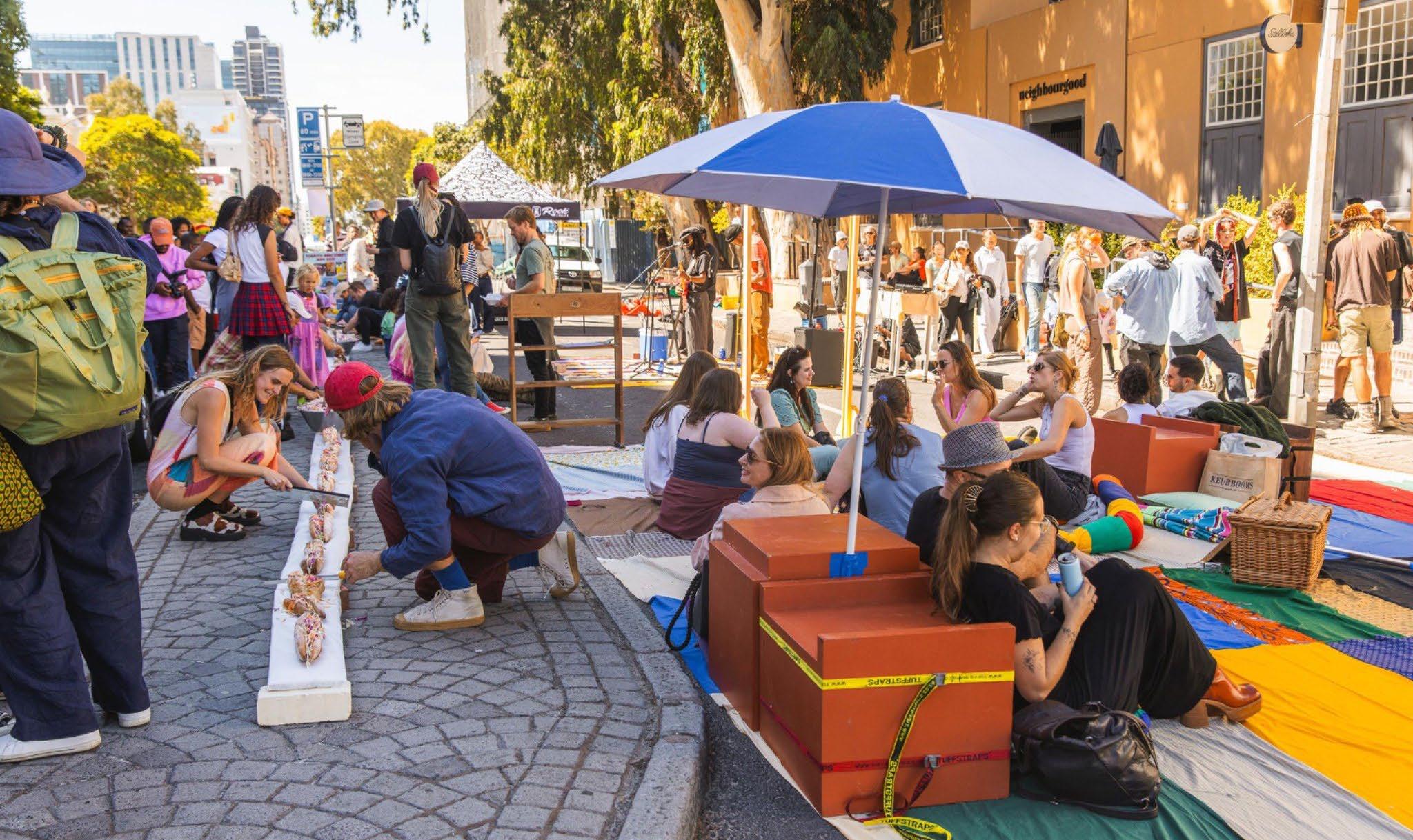
The street is where youth enact improvisation, creativity, and agency daily. Skateboarding, music, vending, murals, and informal gatherings transform ordinary sidewalks, abandoned lots, and underused infrastructure into vibrant spaces of social, cultural, and economic life (Figure 6).
Of course, planning itself is not irrelevant. Cities need infrastructure, safety, and accessible design. The question is not whether planning matters but whether it listens but whether it engages residents through participatory processes, values
Figure 4: Repurposed building (outside-left and inside-right) on Juta Street, Johannesburg, hosting youth art galleries and cultural spaces (photo by author, 2025)
“These improvisations reveal that planning from below is less about drawings and regulations and more about daring acts of presence, improvisation, and claiming the city as a lived, meaningful space.”
their lived experiences, and incorporates informal knowledge and everyday practices into decision-making.. Too often, planning aspires to order, clarity, and control, while youth practices embrace messiness, layering, and improvisation. Where planning seeks a clean façade, youth-led practices transform walls with graffiti, embodying resistance, creativity, and joy. Where planning seeks a green corridor, youth repurpose abandoned lots into gardens that mix food security with art. Where planning insists on liveable streets, youth simply live them through music, protest, flirtation, and trade. These juxtapositions are not contradictions but lessons; for example, that vibrancy emerges from participation rather than prescription, that safety can be negotiated through social presence rather than surveillance alone, and that cultural and economic vitality often arises from improvisation within underused spaces. They remind us that a city is not only designed but performed.
This becomes particularly clear when we look beyond Johannesburg. In Lagos, youth musicians transform sidewalks into stages, their beats infiltrating traffic jams and night markets (Omoniyi et al., 2009). Congested roads, so often framed as symbols of dysfunction, become vibrant concert halls. In Nairobi, matatus buses (privately owned minibuses); adorned with graffiti, lights, and sound systems, reinvent transport as spectacle (Mutongi, 2017). What planners might consider disorderly is, for youth, a cultural commons which are shared urban spaces where people collectively create, perform, and negotiate meaning, culture, and social life. These practices demonstrate what Simone (2020) calls improvised lives exposing strategies that transform uncertainty into invention. They highlight that youth are not simply waiting for inclusion but actively scripting urban futures.
Figure 5: Repurposed building (outside-left and inside-right) on Juta Street, Johannesburg, hosting youth art galleries and cultural spaces (photo by author, 2025)
Planning scholars have begun to recognise the creative potential of urban improvisation. Myers (2020) argues that in postcolonial contexts, improvisation should not be seen as a failure of planning but as a legitimate mode of city-making that reflects local knowledge and practice. Similarly, Mbembe and Nuttall (2004) describe Johannesburg as a site where diverse worlds collide, producing cultural forms that defy neat categories and conventional planning logics. Building on this, Abrahams (2025) highlights how vulnerability and resilience are embedded in Johannesburg’s streets, shaped simultaneously by fear, exclusion, creativity, and belonging. Together, these insights compel us to move beyond simple dichotomies of formal/informal or planned/ unplanned and to recognise African youth as co-authors of the city, actively shaping its aesthetic, economy, and politics from the ground up.
Still, tensions remain. City authorities often respond to youth street practices with policing, eviction, or clean-up campaigns. Informal markets are dismantled, murals painted over, public gatherings restricted. These actions reveal that, despite planning’s celebratory rhetoric of inclusivity, urban governance still often equates youth agency with disorder. Here lies the crux that planning techniques which prioritise order risk erasing the very energies that make streets vibrant. Harvey (2012) reminds us that the right to the city is not granted from above but fought for from below. If planning is to embrace justice and care, it must stop policing improvisation and start learning from it.
Figure 6: Youth reclaiming the street through collective presence during periodic road closures(photo by author, 2025)
As I reflect on Juta Street, I do not see chaos. I see lessons. I see that justice in planning means more than equitable distribution of infrastructure as it means valuing the everyday creativity that sustains public life. I see that care in planning is not just about safety audits or greening projects but it is about creating spaces where people can linger, gather, and express themselves without fear of exclusion. I see that the future of planning depends not only on technical expertise but on humility, a willingness to admit that the city has always been planned, and continues to be planned, by those who walk its streets.
This reframing does not reject planning techniques. Parks, sidewalks, and public squares matter. But they are only beginnings. Without participation, without youth agency, they remain lifeless structures. A park without players is a field of grass. A plaza without performers is an empty slab. A street without youth is just asphalt. What brings these spaces alive is not design alone but the messy, improvised, embodied practices that youth enact daily.
And so, I return to the paradox that greets me each morning. I walk out into the streets, watch young people transform them, and realise that they are not merely occupying what has been built. They are building, in ways our plans rarely predict. They are not simply users of space but designers of meaning. They do not wait for permission but they act. And in doing so, they remind us that the most radical form of planning is already happening, beneath our feet.
References:
1. Abrahams, C (2025). Socio-Spatial Inequality in Urban Neighbourhoods in Johannesburg: Place, Belonging, and Agency. In New Drivers of Division: Urbanisation and Spatial Inequality in Africa and Asia (pp. 111-126). Singapore: Springer Nature Singapore.
2. Duany, A., Plater-Zyberk, E., & Speck, J. (2000). Suburban nation: The rise of sprawl and the decline of the American dream. Macmillan
3. Florida, R. (2019). The rise of the creative class. Basic books.
4. Harvey, D. (2012). Rebel cities: From the right to the city to the urban revolution. Verso books.
5. Jacobs, J. (1961). Jane jacobs. The Death and Life of Great American Cities, 21(1), 13-25.
6. Jurey, N. W. (2012). The live-work-play district: from vision to implementation. Lefebvre, H., Kofman, E., & Lebas, E. (1996). Writings on cities. Cambridge, Mass.
7. Mbembé, J. A., & Nuttall, S. (2004). Writing the world from an African metropolis. Public culture, 16(3), 347-372.
8. Mutongi, K. (2017). Matatu: A history of popular transportation in Nairobi (p. 352). University of Chicago Press.
9. Myers, G. (2020). Rethinking urbanism: Lessons from postcolonialism and the global south. Bristol University Press.
Omoniyi, T., Scheld, S., & Oni, D. (2009).
10. Negotiating youth identity in a transnational context in Nigeria. Social Dynamics, 35(1), 1-18.
11. Robinson, J. (2013). Ordinary cities: Between modernity and development. Routledge.
12. Simone, A. (2018). Improvised lives: Rhythms of endurance in an urban south. John Wiley & Sons.
13. Simone, A. (2020). Cities of the global South. Annual review of Sociology, 46(1), 603-622.
14. Skinner, C. (2008). Street trade in Africa: A review. The Institute of Development Studies and Partner Organisations.
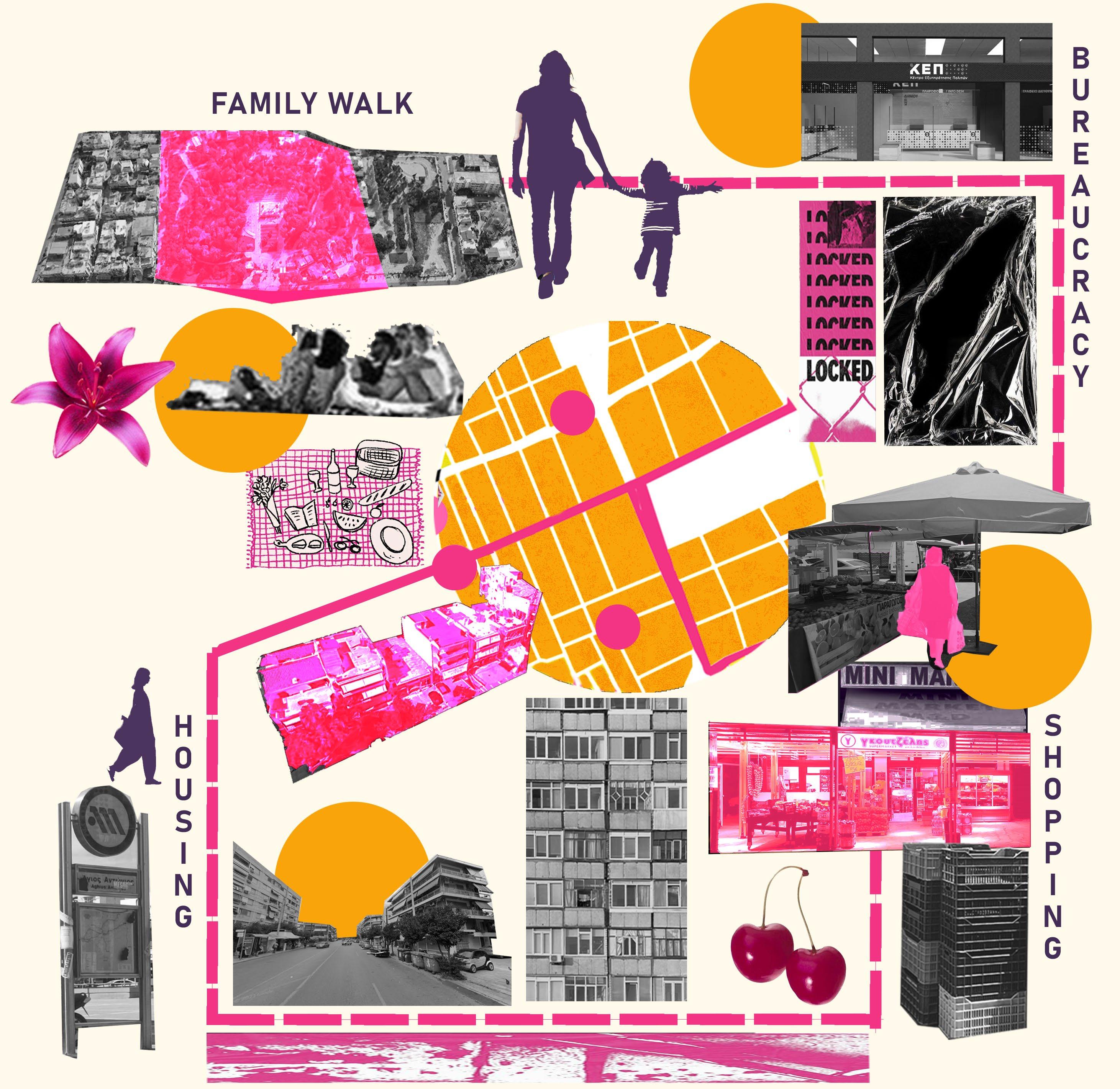
Figure 1: Visual Representation of women’s labour by Authors
Between Exclusion and Belonging The Lived Spaces of Migrant Women in Athens
Persa Bouziana & Kanellopoulou Konstantina
This article explores how migrant women in Athens navigate their daily lives and, through their practices, claim the reconfiguration of socio-spatial boundaries. Urban space is examined through the lens of everyday life, focusing on how it shapes and affects gender relations and identities, both practically and symbolically (Vaiou, 2007, p.29).
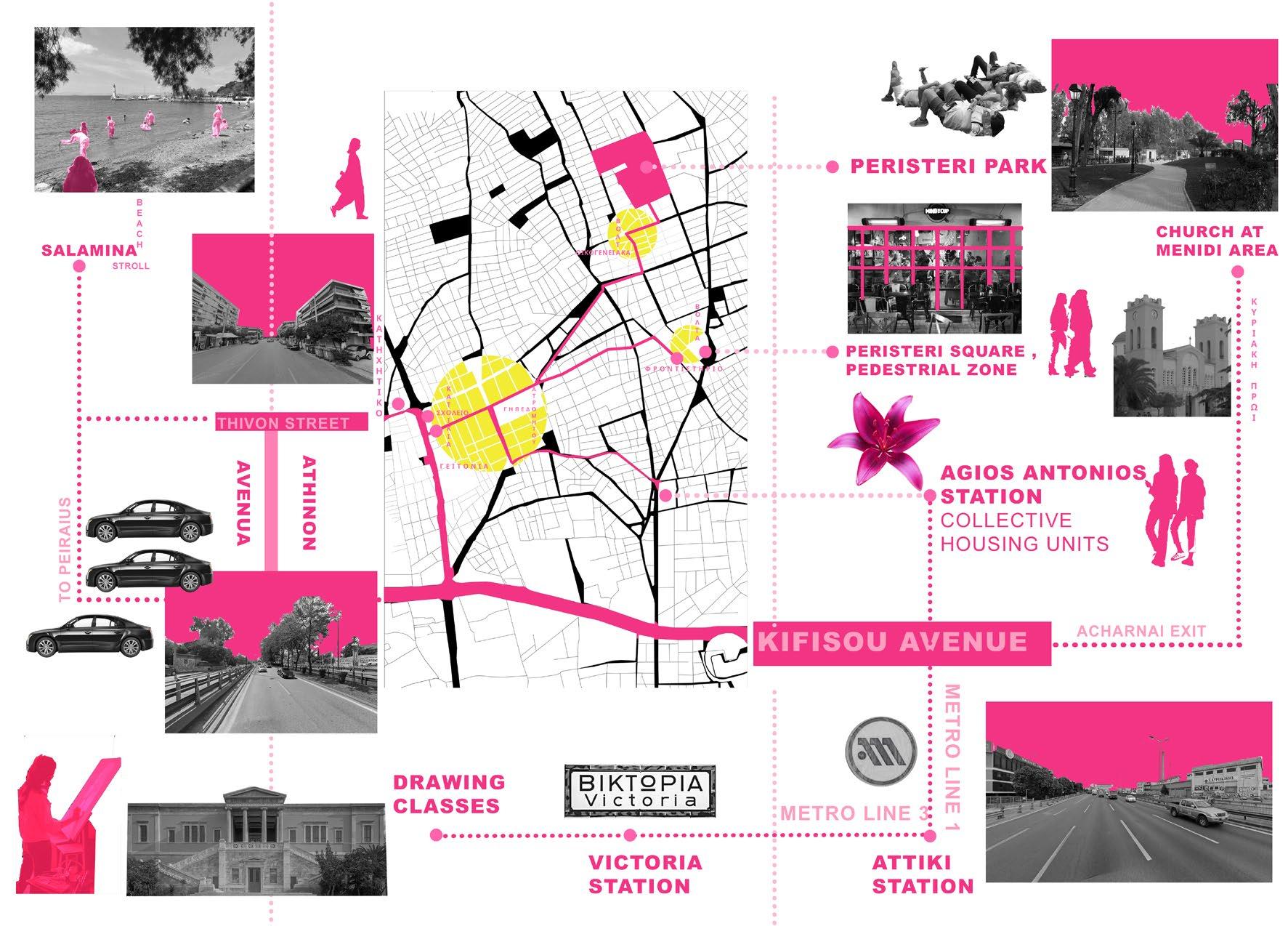
The research goes beyond literature review and includes conversations and interviews with migrant women. In their stories, urban space played a central role as their neighborhoods featured extensively in their description of their everyday lives. This encouraged us to focus our study on a specific area, starting with Agios Antonios in the west of Athens, within the municipality of Peristeri. We visited the site on multiple occasions and, through observation, sought to understand space as a site where gendered everyday life unfolds. We visited the site on multiple occasions and attempted, through observation, to understand space as a place where gendered everyday life is happening. It is important to note the fact that the recent demographic data about the area that would help us map ethnicities and age groups are scarce and incomplete. The data available from ELSTAT (Hellenic Statistical Authority) at the regional or municipal level date back to 2011 and is therefore insufficient to reflect the social conditions of migrant women.
In order to further visualize our findings, we approached space through a series of conceptual maps. We revisited the interview process and asked the women to map their daily routines on a background image of the study area we provided. We visually combined the maps we got back with their narratives. The final maps are the result of our own processing, as we visualized their routes and added additional information from their narratives.
Our interviewees were mostly young, second generation migrants and were hesitant about connecting us to older women in their family. To overcome this, we encouraged them to share their stories about their mothers and other relatives. Inspired by these stories, we attempted to organize more abstract maps in order to capture the routes of a wider circle of women.
These maps were more abstract, since we didn’t have any specific spatial data from the narratives. They don’t have a specific background but they are trying to convey the broader experience of their urban everyday life. They showcase the sectors in which
women separate and organize their daily lives, illustrating how personal routines and social networks intersect to shape their sense of elonging and mobility within the city. Women are highly mobilized and motivated, especially within their neighbourhoods. They have familiarized themselves with the city and can move around it with ease. They organise their daily lives around tasks and obligations to themselves and their families.
“My mom will go out, let’s say, to get things for the house, do chores, stuff like that. In the afternoons she stays with us because she cooks when dad comes home and all that and she usually helps the little one who’s in elementary school, so she sits for hours on end ..... because the little one is a bit.... you know I don’t want to study and all that, so she needs a little help.”
- Interviewee X
Figure 2:
The Daily Life of Interviewee X, Map by Authors
Their daily lives are intense, repetitive and fast-paced. In their interactions, gender oppressions and claims arise. They negotiate the terms and conditions of their own integration and that of their families. Throughout this routine, they also take responsibility for passing on values and experiences to their children for their own development.
By combining all the above and observing the ways in which migrant women organize their daily lives, some key semantic axes emerged. These axes concerned the concepts of public space and labour and defined our research. We also visualized these axes by creating collages that convey the women’ s experiences.
Figure 3: The Daily Life of Mothers, Map by Authors
Public Space
Migrant women live, interact, work, raise children, struggle and compose multiple layers of everyday life in the sphere of public space, affecting all levels of social life (Vaiou, 2007 p. 26). Our interviewees referred to their neighbourhoods based on the nearest public space they recognized. Public spaces function as landmarks in their narratives and can be used to outline and identify their neighbourhoods.
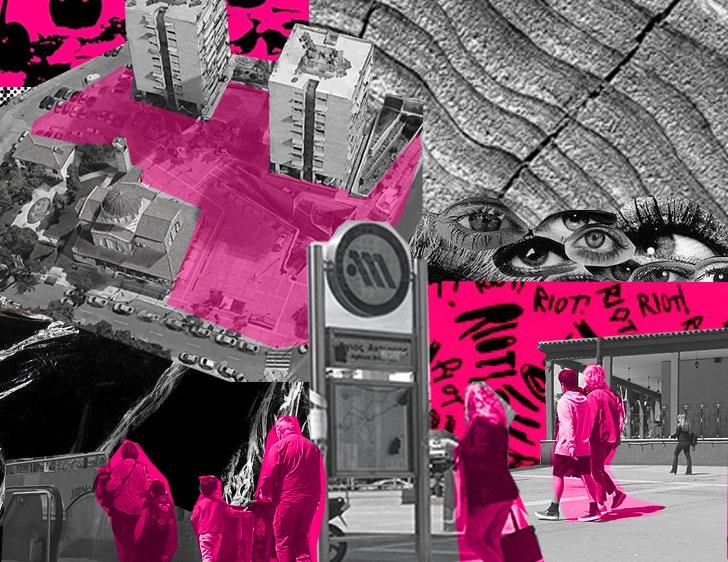
A central concept in our research both on the spatial analysis part and in observing the daily lives of the women we talked to is the concept of boundaries. By boundaries, both physical and metaphorical, we understand the restrictions imposed on women by attitudes and behaviours towards them, which hold a social, gender and racial backgrounds.
Boundaries are empirical in nature, i.e., they are based on the experiences of the migrants themselves or their loved ones. They may appear as choices in their routes, their social interactions and also deeper decisions about their daily lives. They are not necessarily something fixed or irreversible.
A confrontation in the sphere of public space could take on racist dimension, creating discrimination and differentiating social groups. X mentions:
“Generally speaking, everyone is scared for their stores, or something like that…. and now because of the whole situation with the gypsies who have started stealing a lot ….. because we are also a bit dark skinned they think we’re also gonna steal something … even though we don’t dress like that, I mean we dress very normally, we don’t look like we’re gonna steal anything. ”
-Interviewee X
3 : Visual representation of the experience of public space - the constant feeling of being watched, described by the interviewees, the physical and metaphorical boundaries and the invisible claims in their routes, Collage by Authors
Figure
Discrimination follows stereotypes which, in this case, are based on physical appearance. They create social and cultural generalizations regarding the migrants and their origins. However, they also suggest a particularly complex identity formation, a guild complex about their skin colour and an attempt to identify with the norm. They reproduce a stereotypical perception of a body that is targeted and considered foreign.
It is important to understand that such discrimination creates boundaries that make subjects feel that they are being targeted. They are being marginalized simply because they deviate from the dominant norm that appropriates a public and non-public space.
“Ummm… no, at the super market everything is fine I guess, it’s just that in some stores the attitude is a bit… I would say very bad because you walk in a store and people follow you around all the time thinking you’re gonna steal something and this whole situation creates a feeling of….. I don’t know like why would you do that???? like if I wanted to steal something I would have already done that (laughs…), but just sitting there from the time I entered the store till the moment I get out and following me is really bad. ”
-Interviewee X
The store owners that are following X as she shops are exercising the power they believe they have at imposing boundaries and defining limitations. They have internalized the dominant discourses, the politics of borders and immigration control. They act by extending their own institutional superiority to the equally institutional inferiority of immigrants. Through their actions, they define and produce the foreigner and dictate “who belongs where’’ (Papatzani, 2015, p.335).
Interviewee Y - “My mom was in Egypt… I mean she went to school there, everyone there is the same , they don’t feel different, not as we do here.”
Interviewer - “And what about when she moved here?”
Interviewee Y - “Umm yes okey, for her accent, maybe they made fun of her or something. I think that’s all and also about the way she talks or how she can’t exactly express herself. People around find that funny.”
Interviewer - “-Do they have any contact with other people they met here?”
Interviewee Y - “-Oh yes , yes they’ve met many people here… But, in the neighbourhood, umm everyone is Greek so my mom talks to them and everything even tho she also gets very mean comments…. but she can’t do anything different, she has to do her chores and help the family. But she generally has that fear, the anxiety that she’s not being accepted, I mean every Greek person she’s met has behaved badly in a way….”
That is, women, with their daily, unnoticed claims are redefining spatial and social boundaries. Whether in the form of social interactions, new routes through the city, or even their presence in public spaces, they are setting their own conditions for social integration and cohesion.
Labour
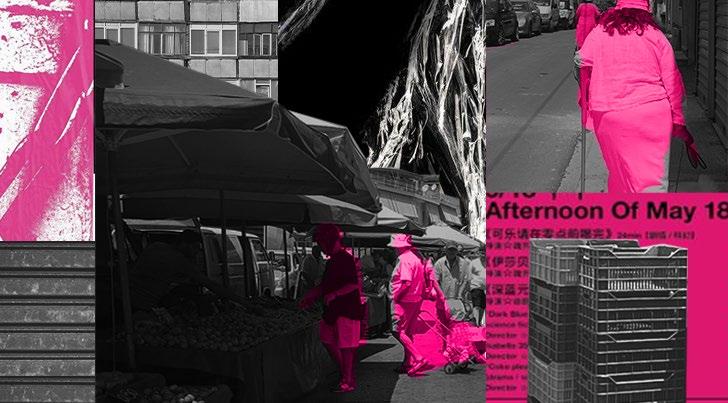
Labour, both domestic and paid, is a central theme in women’s narratives and organizes their daily lives in terms of space and time. Women’s labour becomes invisible and unpaid. It gets placed within a context of care and provision that is strongly linked to the concept of femininity in patriarchal society and is undervalued.
‘‘My mom is not working’’,
mentions interviewee X when talking about her mother. But as we start to talk more about her mom’s daily life she says -
everyday she goes out, like literally everyday , I mean I’m pretty sure my mom knows more stuff than my dad does here in Greece, while my dad has been here for more. She goes , let’s say to the super market, she mostly does chores and stuff... oh and she also did all the papers for my siblings and I, whether it’s for school or tutoring or whatever... she’s done all the paperwork’’.
Interviewee Y shares similar experiences from her mother as well -
In the invisible and unpaid labour section, the informal activities of migrant women contain clear claims for their integration in the country. They claim the dynamic formation of
‘‘ My mom goes to the market on Mondays, for example....Yeah, she gets stuff, she comes home, she cooks if she’s not too tired at around 3 she might take a nap if she’s tired and then wake up and cook Ummmm you know she puts some music on, she dances.... stuff like that...’.’.
a sustainable daily life for their whole family. In the nuclear families of our interviewees, with their fathers exclusively engaged in paid work and meeting the financial needs of the household, the entire burden of social integration and bond-building falls on mothers and affects all family members. A very clear example of that is Interviewee X mentioning -
Figure 4: Visual representation of the experience of public spaceDaily interethnic encounters in the realm of public space, channels and networks of contact with locals or already established immigrants form a new dynamic of social relations that led to renegotiations of the identity of each place, Collage by Authors
‘‘ immediately when she came to the country, dad took her to school to learn Greek so that we also have a good.... so she thought of us first. So she went to school immediately, learned grammar, learned Greek and stuff so that she could help us, because in the elementary school there is a lot of grammar so yes. She mostly did it for us, so we wouldn’t have any problems with our accent or something like that.’’
Conclusion
To conclude, the most important part of this article is the claims of the migrant women we spotted in our conversations with them. The mothers view migration as a complete, lived experience, from the circumstances that prompted them to leave their country of origin and their daily lives they had organized there, to setting in a new country and establishing a sustainable daily life for themselves and their families. They take on the burden of social integration by setting their own conditions for living in the city. The narratives of migrant women reveal their agency as everyday urban actors.
Through subtle spatial negotiations — from claiming a park bench to redefining domestic boundaries — they reshape how belonging and visibility are produced in the city. Their daily practices transform spaces of exclusion into places of presence, care, and collective life. In the same way, the younger women manage situations with similar dynamics by asserting their presence in spaces where they have experienced discrimination.
In this context, it is interesting to reflect on and return to the essential question posed by the interviewees during the interviews: How are the questions we asked them and the information about their daily lives related to the subject of our studies, architecture? This question encourages us to examine the role of socio-spatial boundaries in urban planning. It raises the question of how the theoretical concepts we have studied and the daily experiences of migrant women can be integrated in both theory and practice. How they can serve as a starting point for the analysis of public space and the city.
The role of architecture and urbanism lies in selecting the focus of research and translating these conclusions into design and strategies with gender, ethnic, and social characteristics in mind. Our research highlights new approaches to architecture and urban planning by focusing on the social dynamics of space. It develops methodological tools that attempt to provide an in-depth understanding of the issues and challenges of space (Micha, 2012, p.75). These tools focus on “reading” the intermediate spaces and activating practices that will renegotiate rules and boundaries. Narratives and semantic
maps can serve as participatory design tools that spatially translate multiple everyday experiences. The integration of such practices into design could form the basis for the development of new ways of mapping and utilizing data to read the city through the everyday lives of the people who live in it. In other words, this design will have the potential to recognize the mechanisms through which perceptions and meanings of space are formed, transformed, and challenged. It will also alter the strict boundaries identified through such an approach (Micha, 2012, p.75). Recognizing these everyday agents transforms architecture into a practice of listening and co-creation. It enables new readings of the city - ones that acknowledge the multiplicity of its inhabitants and the subtle mechanisms through which they claim presence, visibility, and rights to space.
References: 1.
2. Papatzani, E. (2015).
3. Vaiou, D.
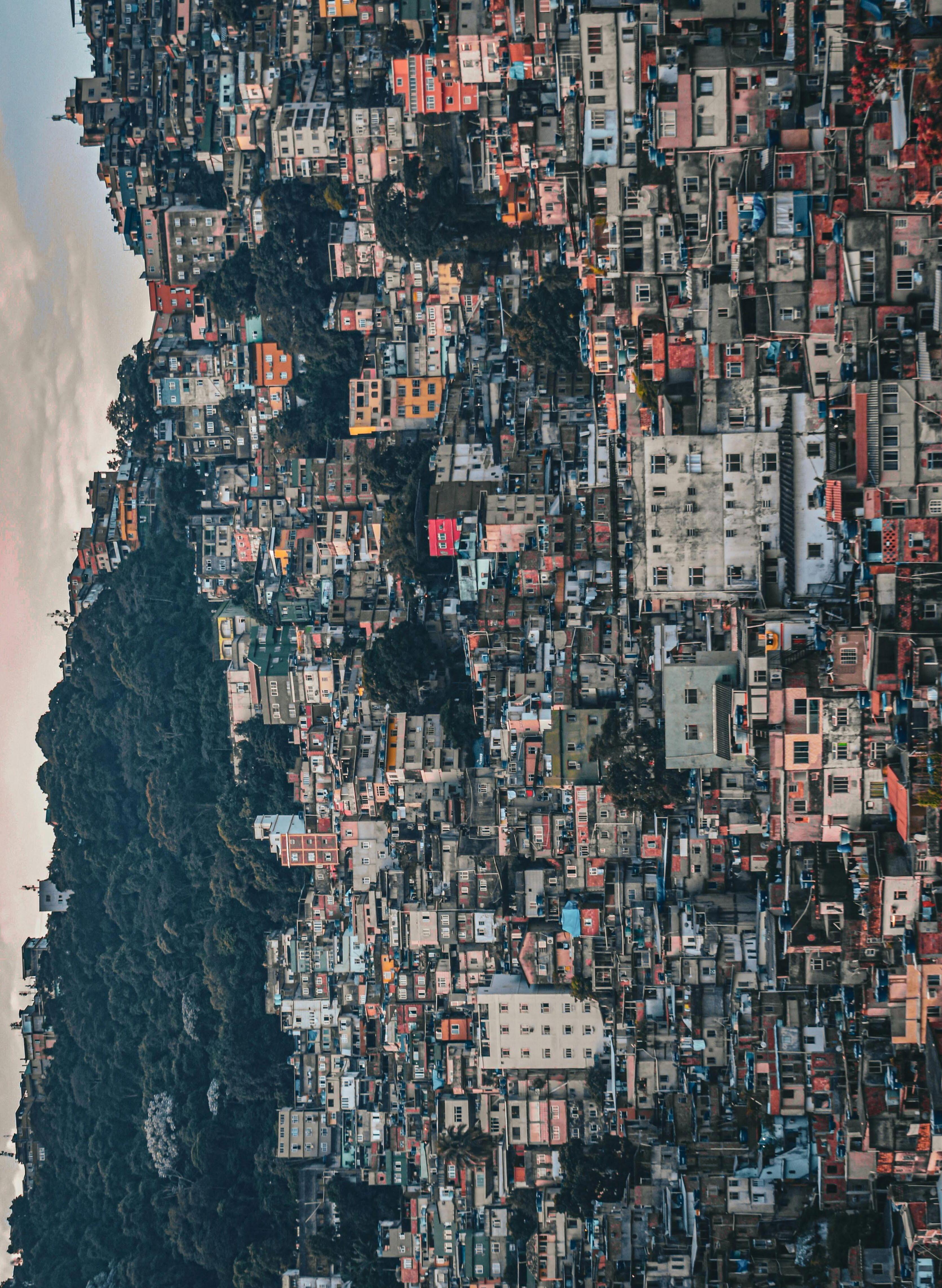
Figure 1 (left): Favella in Brazil: Haque, 2023
Beyond ‘Informality’
Decolonising Language as an Act of Agency
Mia Barnard
The term informality shows the limits of conventional urban planning, reducing African urban environments to a “lack” when measured against Western norms. This paper asks whether language itself shapes our agency in cities: how the words we inherit, use, and contest either restrict or enable the power to act. The labelling of African (and those of the Global South) urbanisms as ‘informal’ hides their complexity, echoing Ferguson’s critique of Africa as a simplified “concept” rather than a continent of diverse systems and practices. When architectural and urban language is framed through outside lenses, it weakens the agency of communities, practitioners, and thinkers in defining their own spatial realities. By looking at calls for linguistic sovereignty, from Joubert’s work on decolonising minority languages to Kanu’s question of whether philosophy can thrive in a foreign tongue, this paper argues that agency is tied closely to the words we choose. Lorde’s reminder that “the master’s tools will never dismantle the master’s house” underscores the danger of leaning on inherited colonial terms. Amidst Africa’s rapid urbanisation, building more grounded and varied languages of practice is not only a matter of recognition but of empowerment: the ability to act, resist, and reimagine beyond imposed categories. Ultimately, the paper presents decolonising architectural and urban language as an act of reclaiming agency. Here, agency is understood as both the power and process of shaping environments, personal and collective, political and deeply situated. It is about finding one’s role within the wider dynamics of space and society, and turning imposed labels into tools for action. By building new, plural languages that speak to African contexts, communities and practitioners strengthen their agency at multiple scales: from individual voice to neighbourhood transformation and continental debate. In doing so, the next generation of ‘African Urbanisms’ can emerge not as reactions to outside definitions, but as grounded, selfdetermined acts of agency.
Somewhere between the word informal and the world it tries to describe, something goes missing. A settlement becomes a “lack.” A city becomes a deviation. An entire continent is rendered in quotation marks. When language crosses borders, it carries more than meaning; it carries worldviews. Every borrowed word brings with it a history of who got to name, and who was named. Naming is never neutral, it defines by reducing, fixing what is still in motion.
“If you name me, you negate me. By giving me a name, a label, you negate all the other things I could possibly be.”
-
Søren Kierkegaard
In architecture and planning, informality has become a habitual, unexamined word. It classifies complex realities with the ease of a stamp. Yet the term defines what is absent, not what exists. It assumes a lack of form, as though those who build and negotiate their environments daily do so outside design. But informality is not the opposite of form, it is form itself: iterative, adaptive, negotiated.
Architecture has always relied on words. We dress spaces in them, often embedding hierarchies within syllables. “Slum,” “illegal,” “marginal,” “informal”, each moralises space, separating those who plan from those who survive.
“Knowing
the name of something doesn’t mean you understand it.”
- Richard Feynman
Feynman’s warning against confusing naming with knowing mirrors how we talk about cities. We repeat informal until it sounds factual, forgetting that the word replaces understanding.
The term entered development discourse through the International Labour Organisation in the 1970s, first describing unregulated work before migrating into planning vocabulary (Agha & Lambert, 2020). It hardened into an epistemic wall, formal/ informal, planned/unplanned, centre/ periphery, dividing those with voice from those merely spoken about. Behind that wall lies the persistent framing of African and Global South urbanisms as deviations from a Western norm. As Ferguson (2006) argued in Global Shadows: Africa in the Neoliberal World Order, “Africa” was not merely described but produced as a concept, simplified and rendered legible for global narratives of expertise. The danger is not only misrepresentation but dependence: when inherited terms dictate what realities can be imagined.
This dependency persists through what Agyekum (2018) calls linguistic imperialism, the gradual abandonment of indigenous languages for foreign ones presumed superior. Across Africa, colonial languages
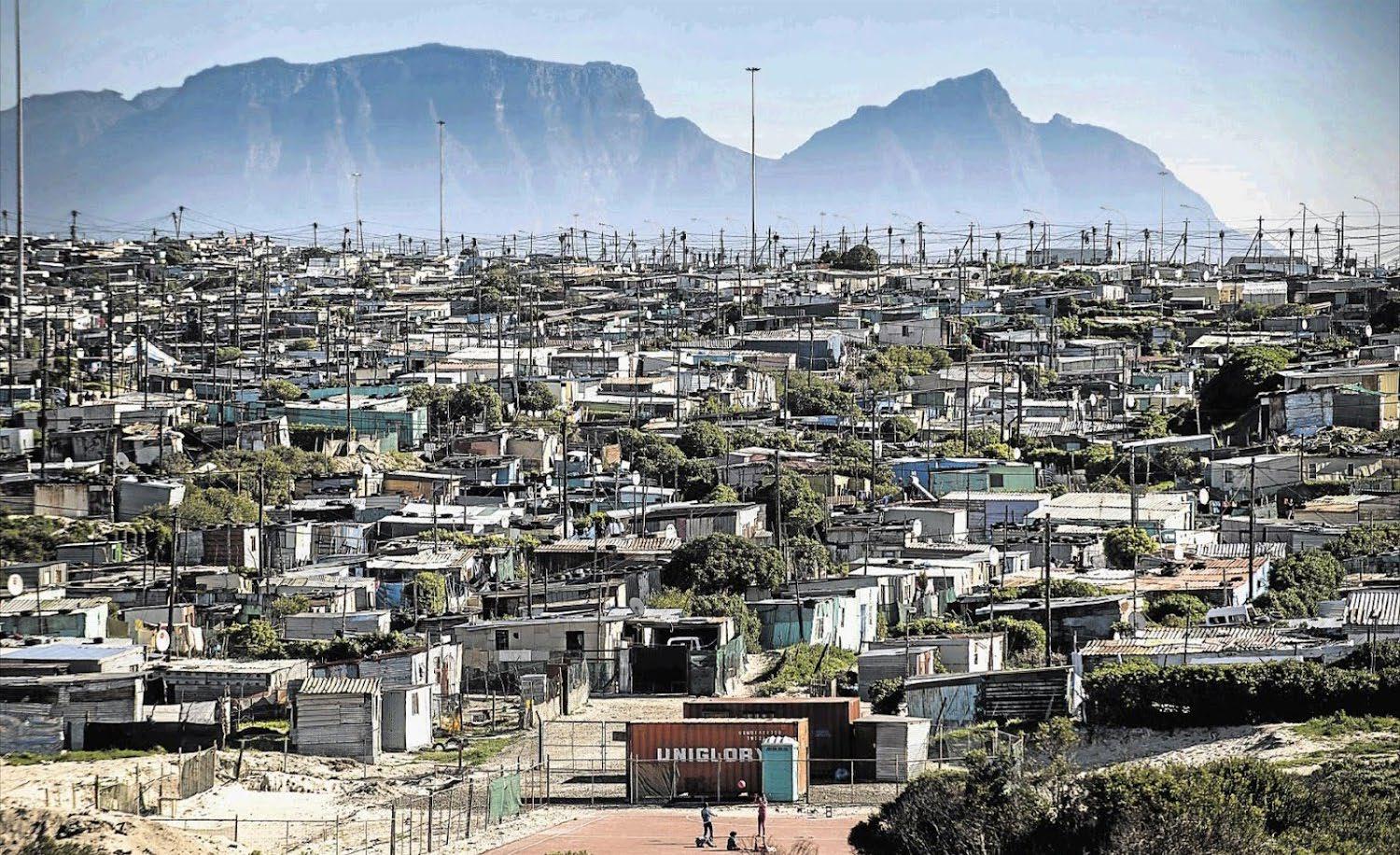
Figure 2: Township in Cape Town: Harrison, 2022
dominate education, governance, and media, marginalising local tongues and reinforcing inequality. Even after political independence, linguistic dependence remains, as local languages are dismissed as unfit for science or policy.
To decolonise language is therefore to reconfigure thought. Every word encodes a worldview: assumptions of value, order, and belonging. Colonialism was never only territorial; it was linguistic. Wolff (2017) shows that the European “nation-state” model continues to shape post-colonial language policy. African nations adopted colonial languages as “neutral” unifiers, ignoring the multilingual realities that define them. This ideology, rooted in Eurocentrism and the illusion of homogeneity, privileges exogenous languages of power while silencing local expression.
Philosopher Ikechukwu Anthony Kanu (2018) asks whether philosophy can exist in a language foreign to its people. His answer: thought must mirror lived reality. “You do not use another person’s wine,” he writes, “to settle your own dispute” (p. 12). To think or design in a colonial tongue is to think within its architecture. Yet Kanu argues for complementarity, bending inherited tools toward new purposes. Similarly, Wolff (2017) proposes mother-tongue-based multilingualism, bridging local languages of identity with global ones of reach. Such a model resists both monolingual nationalism and isolationism.
This hierarchy persists even within Europe. As Joubert (2022) shows in her study of Occitan speakers, France’s internal colonialism mirrors the empire it once projected outward. Paris built its identity by suppressing difference; the French language became an instrument of control. Classrooms became colonial outposts, teaching grammar and hierarchy in the same breath. “The master’s tools will never dismantle the master’s house,” Lorde (1979, p. 112) warned, and teaching one dominant language sustains that house. The same logic governs many African cities, where English or French flatten local realities. Policy promises participation but often rehearses exclusion.
Agyekum (2018) notes, however, that media can serve resistance. Radio, television,
and popular culture have become sites of linguistic decolonisation, revitalising endangered languages and inventing vocabularies for modern life. These acts turn mass media into archives of survival.
If the problem lies in singularity, in one language, one framework, one truth, the alternative lies in plurality. A pluriversal urbanism refuses to translate everything into a single tongue. It treats languages, like cities, as polyphonic systems with their own rhythms of sense-making. IsiXhosa, Yoruba, Arabic, Lingala, French, and English each hold distinct ontologies, ways of relating to space, time, and community. To decolonise architectural language is to nurture this ecology of expression (Escobar, 2018; Mignolo, 2009).
Such plurality redefines agency: not just the power to act, but to decide what action means. When communities reclaim the words that describe them, they shift from being objects of study to subjects of their own narratives. Naming becomes design.
We build with words long before we build with bricks. Terms like informal settlement, resilience, or participation decide who belongs in the conversation and whose experience counts as knowledge. Reclaiming language is reclaiming agency, the right to describe one’s world in one’s own words.
“Replacing informal settlement with a self-organised neighbourhood, or a slum with a community-built environment, changes more than vocabulary; it changes perspective. The first implies deficiency; the second, capacity. Such shifts influence funding, design briefs, and imagination.”
Language that affirms rather than diminishes tells people: you are not an exception to urbanism, you are its definition.
If architecture organises space, language organises thought. Both are acts of design: structured, intentional, inhabited. Every building begins as a sentence; every plan, as a story about who space is for. A colonial
lexicon produces colonial infrastructures; a decolonial lexicon allows new forms to emerge. Reclaiming language is thus an act of spatial justice. It asks us to listen differently, to the poetry of lived experience, the syntax of improvisation, the grammar of survival. The so-called “informal” is not unstructured; it follows logics Western vocabulary cannot capture. There is form in what seems formless, order in what appears chaotic, intelligence in what is dismissed as makeshift.
The task is not to find one correct term but to dwell within tension, to use quotation marks not as fences but mirrors of uncertainty. Language, like the city, is alive: it grows, adapts, and resists. Decolonising language is less rejection than re-assembly, composing new sentences from fragments, blending inherited and indigenous words to describe our realities more honestly. Words are architectures of possibility: they can enclose or expand. The challenge is to build with them differently, to let language itself become a site of emancipation.
Between the word informal and the world it names lies a silence worth listening to. The city is never just material; it is linguistic. Its streets are made of syntax, its institutions of semantics, its horizons of metaphor. To change the city, we must first change its vocabulary. The words we inherit are not only tools, they are blueprints. And if, as Lorde (1979) reminds us, the master’s tools cannot dismantle the master’s house, then it is time to build new ones: not sharper, but truer; not foreign, but ours.
To call them informal is to overlook what they truly are: architectures of citizenship, resilience, and belonging. These are not deviations from urbanism but its redefinition. Here, in the self-built, the reworded, and the reimagined, agency is not granted—it is practiced. Every act of naming becomes an act of making. Every word, a foundation stone for a more just city.
References:
1. Agha, A., & Lambert, K. (2020). Informality and the politics of definition. In the Architecturual Review https:// www.architectural-review.com/essays/ outrage/outrage-informality-is-a-fallacy
2. Agyekum, K. (2018). Linguistic imperialism and language decolonisation in Africa through documentation and preservation. In J. Kandybowicz, T. Major, H. Torrence, & P. T. Duncan (Eds.), African linguistics on the prairie: Selected papers from the 45th Annual Conference on African Linguistics (pp. 87–104). Berlin: Language Science Press. https://doi.org/10.5281/zenodo.1251718
3. Escobar, A. (2018). Designs for the pluriverse: Radical interdependence, autonomy, and the making of worlds. Duke University Press.
4. Ferguson, J. (2006). Global shadows: Africa in the neoliberal world order. Duke University Press.
5. Feynman, R. (2015). Richard Feynman on knowing versus understanding. Farnam Street. https://fs.blog/richard-feynman-knowing-something/
6. Joubert, L. (2022). Internal colonialisms: Language and identity in France’s south.
7. Kanu, I. A. (2018). African philosophy and the problem of language. Nsukka: University of Nigeria Press.
8. Lorde, A. (1979). The master’s tools will never dismantle the master’s house. In Sister Outsider (pp. 110–114). Crossing Press.
9. Mignolo, W. (2009). Epistemic disobedience, independent thought and decolonial freedom. Theory, Culture & Society, 26(7–8), 159–181.
10. Wolff, H. E. (2017). Language ideologies and the politics of language in post-colonial Africa. Stellenbosch Papers in Linguistics Plus, 51, 1–22. https://doi. org/10.5842/51-0-701
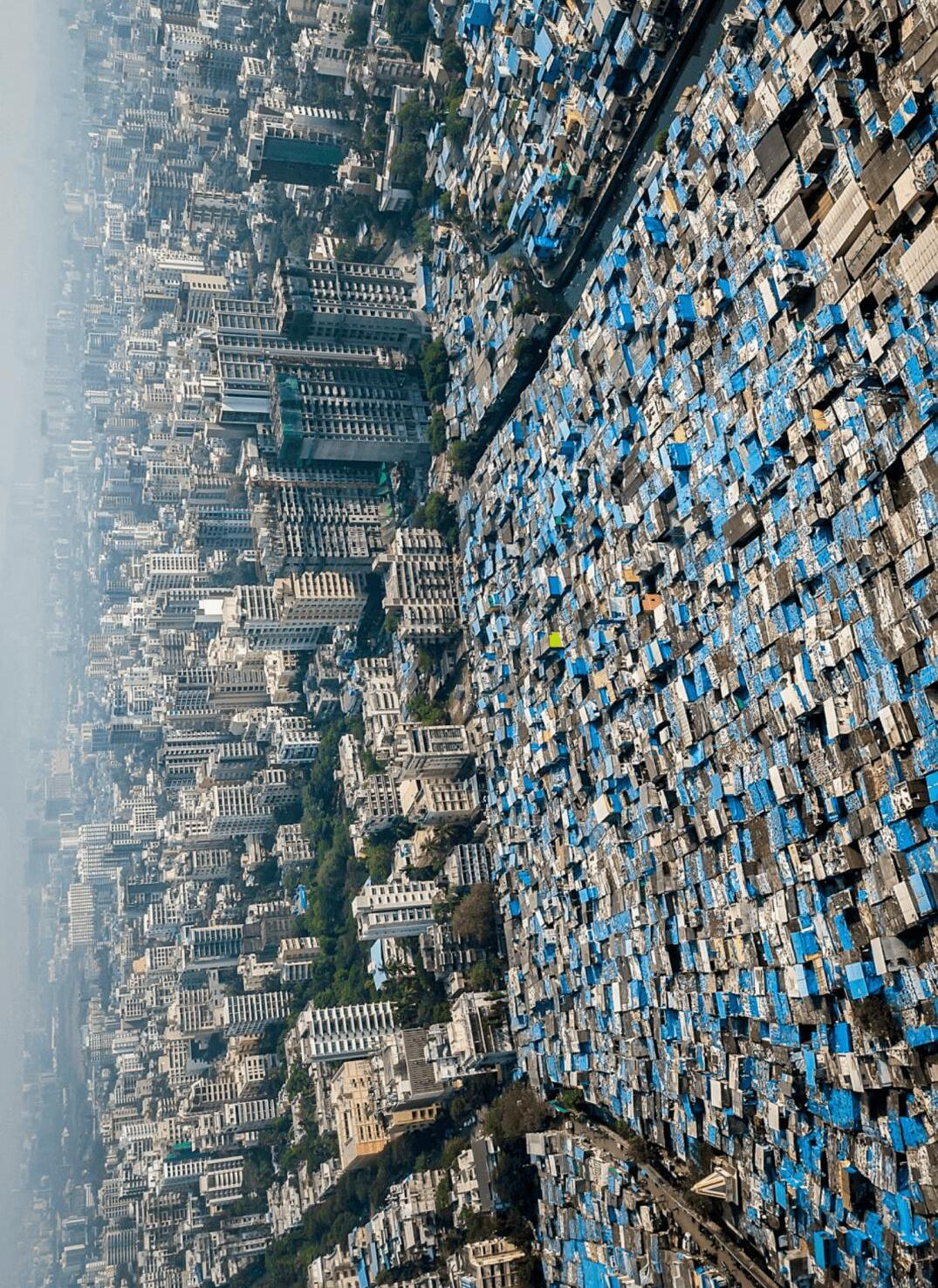
Figure 3 (left): Slum in India: Mazumdar, 2022
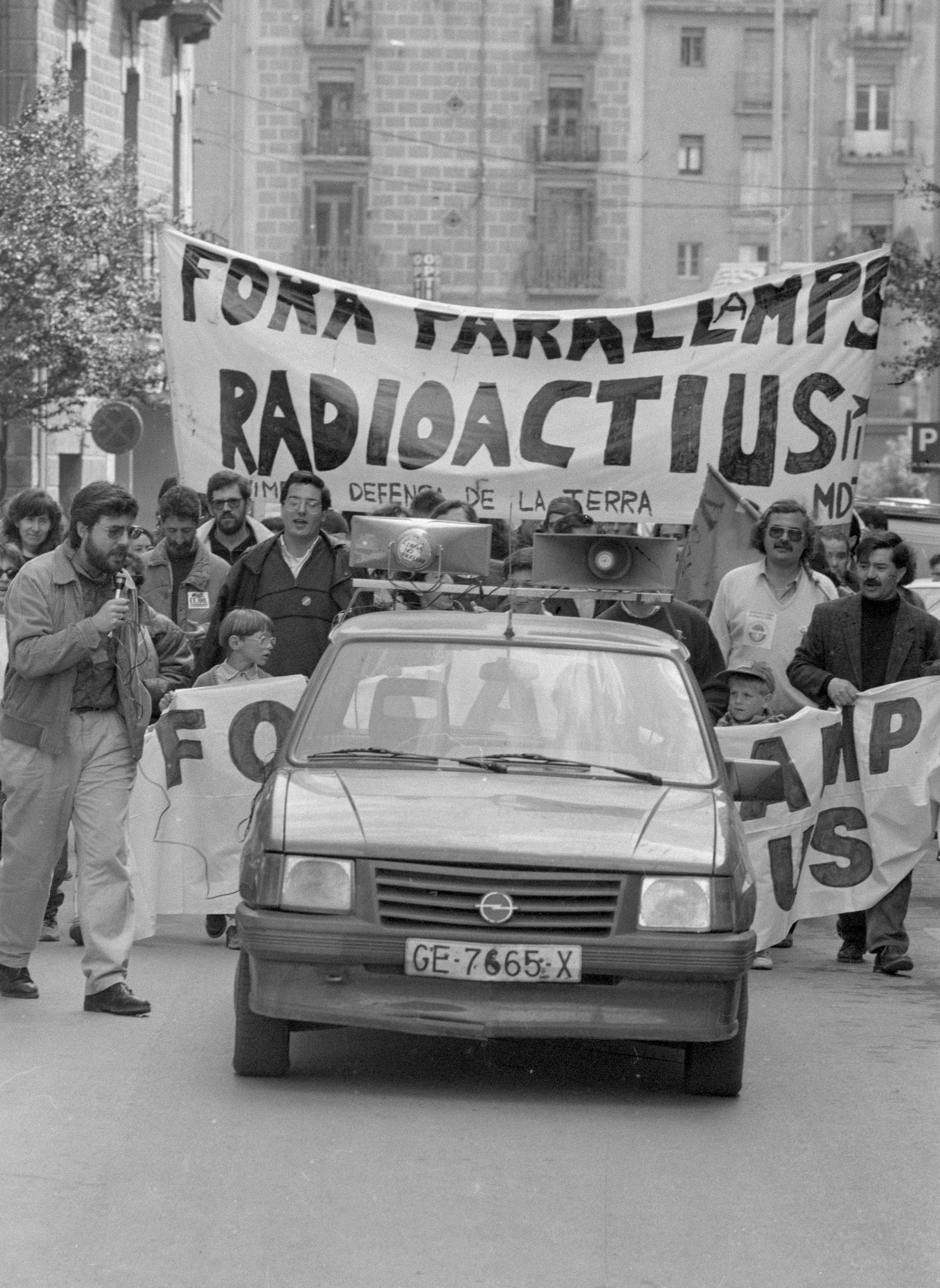
Figure 1: Protest against radioactive lightning rods in the Girona region.
Demonstration leaving Plaça Independència via Anselm Clavé Street, Girona, 1990. Girona City Archive
When communities shape the territory : A n analysis of five decades of environmental conflicts in the spanish mediterranean coast
Martina Botton
The Mediterranean coast of Spain is often imagined as a place of endless sun, turquoise waters, and picturesque villages. Yet behind this idyllic image lies a history of social and environmental battles. Over the past five decades, this territory has been the scene of recurring tensions between large-scale development projects—tourism resorts, urban expansions, energy infrastructures—and the preservation of fragile landscapes, such as coastal wetlands, agricultural terraces, and dune systems, and rich cultural heritage, including historic fishing villages, archaeological sites, and traditional agricultural practices.
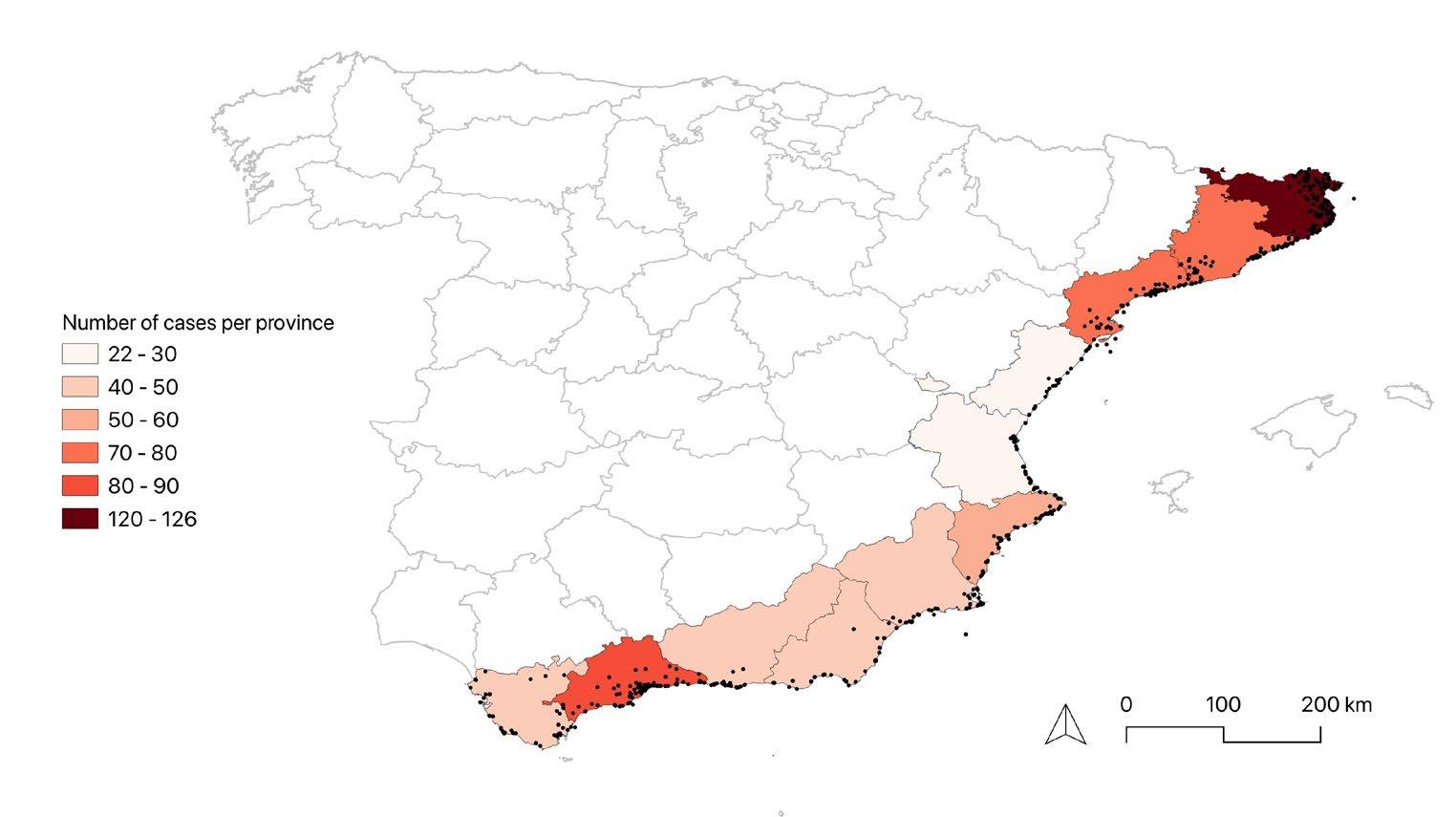
Agency, in this context, refers to the capacity of individuals and communities to resist, adapt, and persist in defending their environment. Along the Spanish Mediterranean, thousands of people have mobilized not only to protect ecosystems but also to defend their sense of place—the collective memory, identity, and belonging tied to specific landscapes (Nogué i Font, 2005). These mobilisations, documented in 640 cases compiled by the MOVxPAIMED research project¹ (Feliu, Vicente, & Nuss, 2025) (Fig. 2), show that the defense of territory is not simply about halting construction projects but about asserting the right to shape society and space from below.
The analysis used in this article aims to analyze how grassroots mobilisations along the Spanish Mediterranean coast have exercised spatial agency in the face of environmental conflict. It draws on the MOVxPAIMED dataset through a combination of quantitative and spatial methods: the 640 documented cases were processed and visualized using Excel and QGIS to identify spatial patterns, temporal trends, and the social composition of mobilisations. Complementary descriptive statistics and thematic mapping supported the interpretation of collective agency across territories. Through this method, it identifies recurring territorial patterns, key actors, and outcomes that reveal how communities collectively shape the transformation of their environments.
Why do landscapes spark such passionate defense? Part of the answer lies in what geographer Yi-Fu Tuan (1974) called topophilia—the emotional bond between people and place. On the Spanish Mediterranean, the coastline is not only a resource but also a cultural and symbolic landscape. It embodies local livelihoods, shared memories, and community identities. When these values are threatened—whether by a housing development encroaching on farmland or a tourism complex displacing fishing grounds—residents often respond with collective action.
Contrary to the dismissive label of “Not In My Backyard” (NIMBY), many of these mobilisations extend beyond private interests.
They articulate a defense of the common good, protecting landscapes as collective heritage (Nuss-Girona, Vicente Rufí, & Canaleta, 2020). The movement Salvem l’Empordà in Girona, for example, emerged in the early 2000s to resist tourist-residential sprawl in one of Catalonia’s most iconic rural areas (Rufí et al., 2023). The platform framed its struggle not merely as a rejection of specific projects but as a broader claim for territorial identity and sustainable land use.
Such cases highlight that agency is not exercised only through formal politics or institutions. It emerges from the capacity of civil society to organize, protest, and persist.
The slogans painted on banners, the public hearings flooded with local voices, and the lawsuits filed in provincial courts all become acts of agency that transform the dynamics of power between citizens, developers, and the state.
The MOVxPAIMED dataset provides a comprehensive overview of these dynamics, offering insights into what triggers conflicts, who participates, and what outcomes they achieve. Out of the 640 documented cases, the most frequent triggers were proposals for residential developments (127 cases) and tourism projects (96 cases). These interventions often targeted areas of high
Figure 2: Documented environmental conflicts along the Spanish Mediterranean coast (1970–2023). (Source: author’s elaboration from MOVxPAIMED dataset)
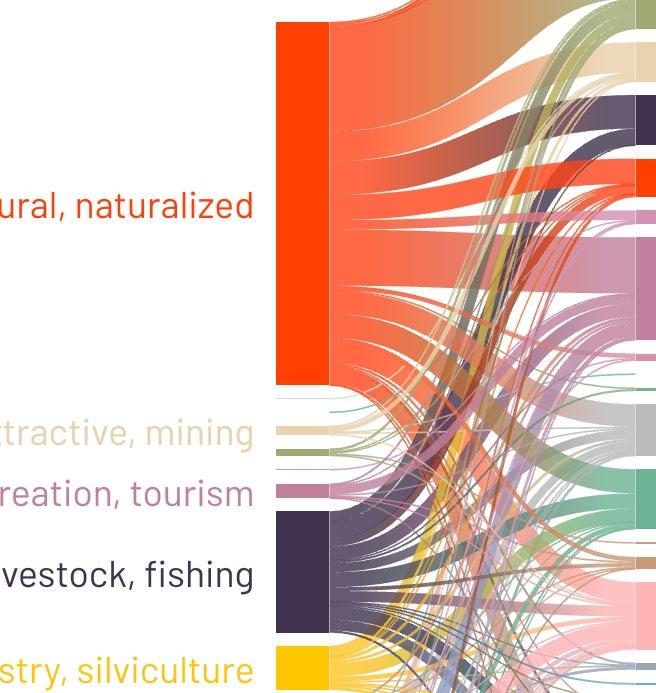
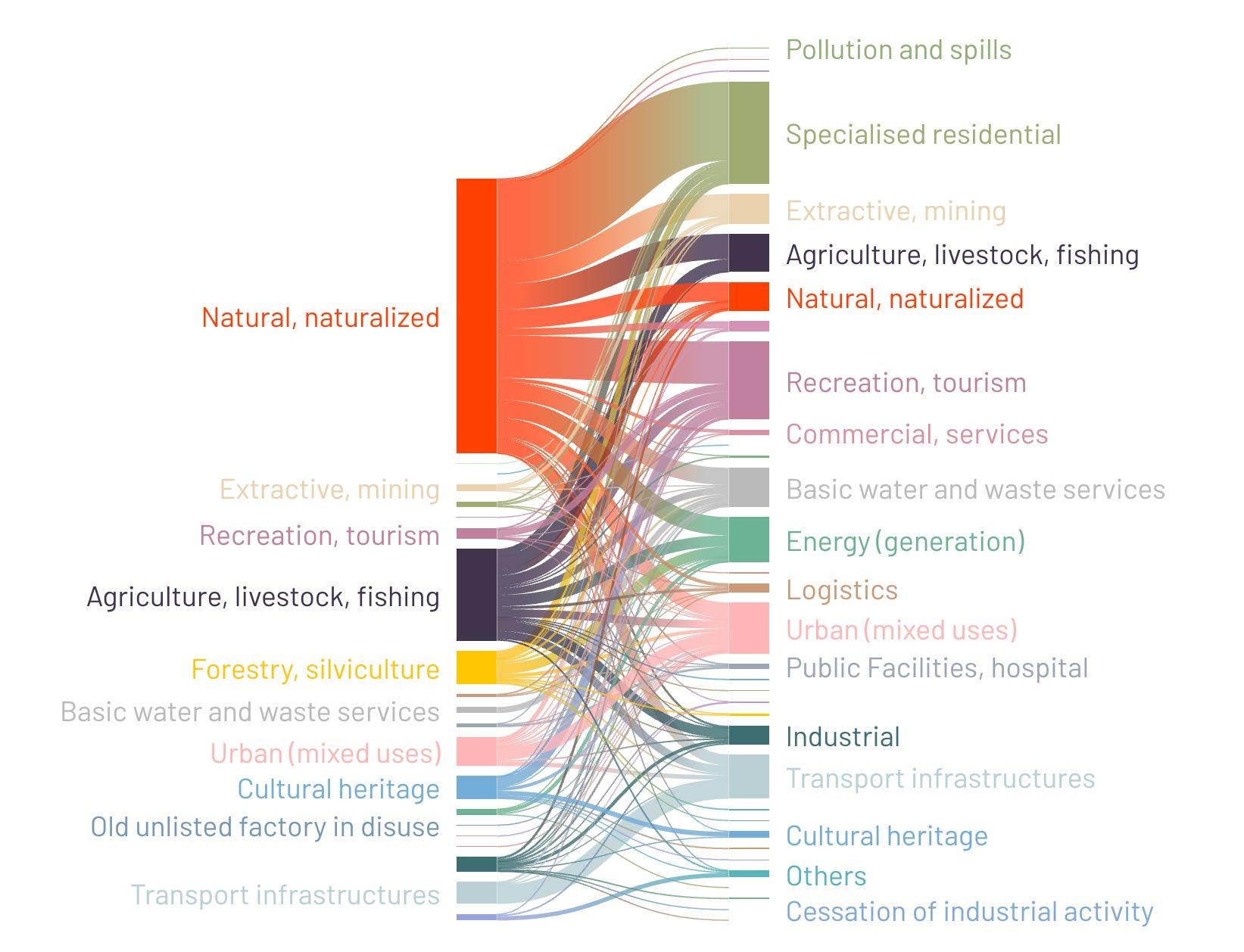
Figure 3: Relationship between preexisting land uses and proposed transformations triggering mobilisation (Source: Author’s elaboration from MOVxPAIMED dataset)
ecological or cultural value, sparking resistance from local residents, grassroots associations, and regional NGOs (Feliu et al., 2025).
Natural or naturalized land was the preexisting condition in more than half of all cases. In other words, conflicts often arose when speculative projects threatened ecosystems, landscapes, or traditional rural uses (Sánchez Cabrera & Ferrandis Martínez, 2025). In this context, landscape is understood not just as scenery but as the dynamic interaction between natural features, human activity, and cultural meaning—a lived space that embodies both ecological and social values. The most common trajectory was the transformation of natural land into residential or tourism spaces, as shown in Fig. 3—a transition that communities perceived as eroding both ecological integrity and local identity.
The social dimension of these mobilisations is equally telling. While some began as small neighborhood initiatives, many grew into broad platforms uniting diverse actors— environmentalists, farmers, fishers, cultural associations, and sometimes even municipal governments. This coalition-building underscores the collective nature of agency. Communities were not only resisting projects but also redefining what territory should mean—livable, sustainable, and shared (Scheidel, Hirsch, & Ville, 2020).
Open cases (227)
Lost cases (104)
Succesfull cases (167)
Partial successful (83)
Temporarily successful (59)
Figure 4: Outcomes of environmental mobilisations across the Spanish Mediterranean provinces.
(Source: Author’s elaborations from MOVxPAIMED dataset.)
Table 1: Percentage of outcome resolution per province. The highest percentage for each province is shown in bold.
Source: Author’s elaborations from MOVxPAIMED dataset.
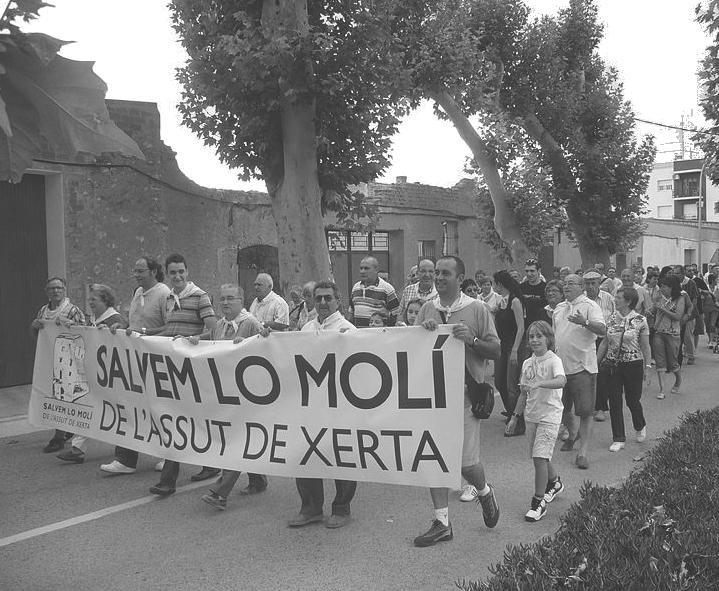
demanding the cleaning of Ter river waters,
Figure 5: Demonstration
Torroella de Montgrí, 1976.
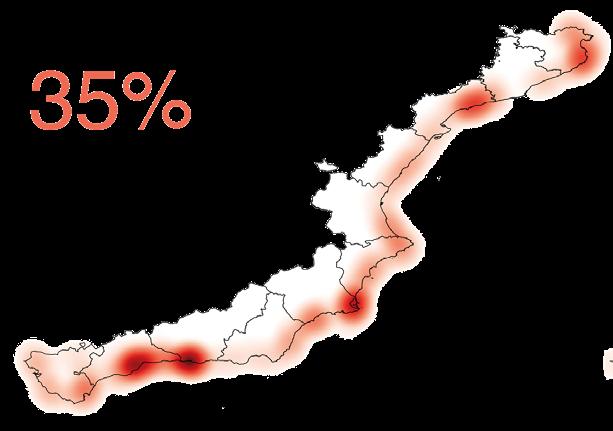
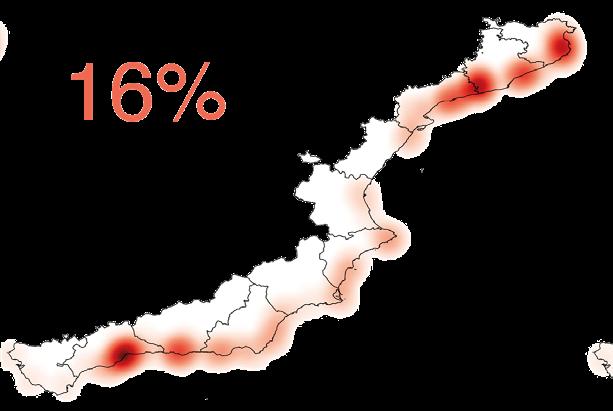
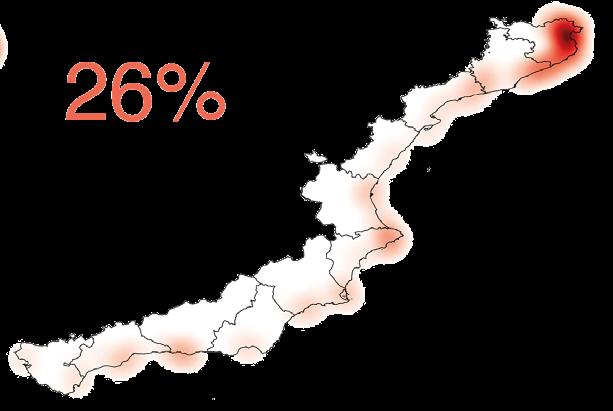
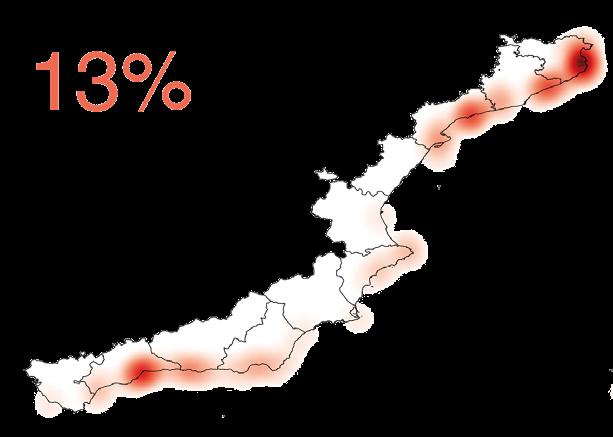
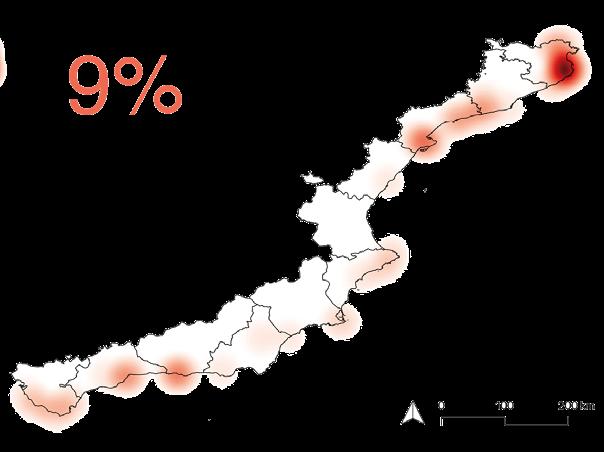
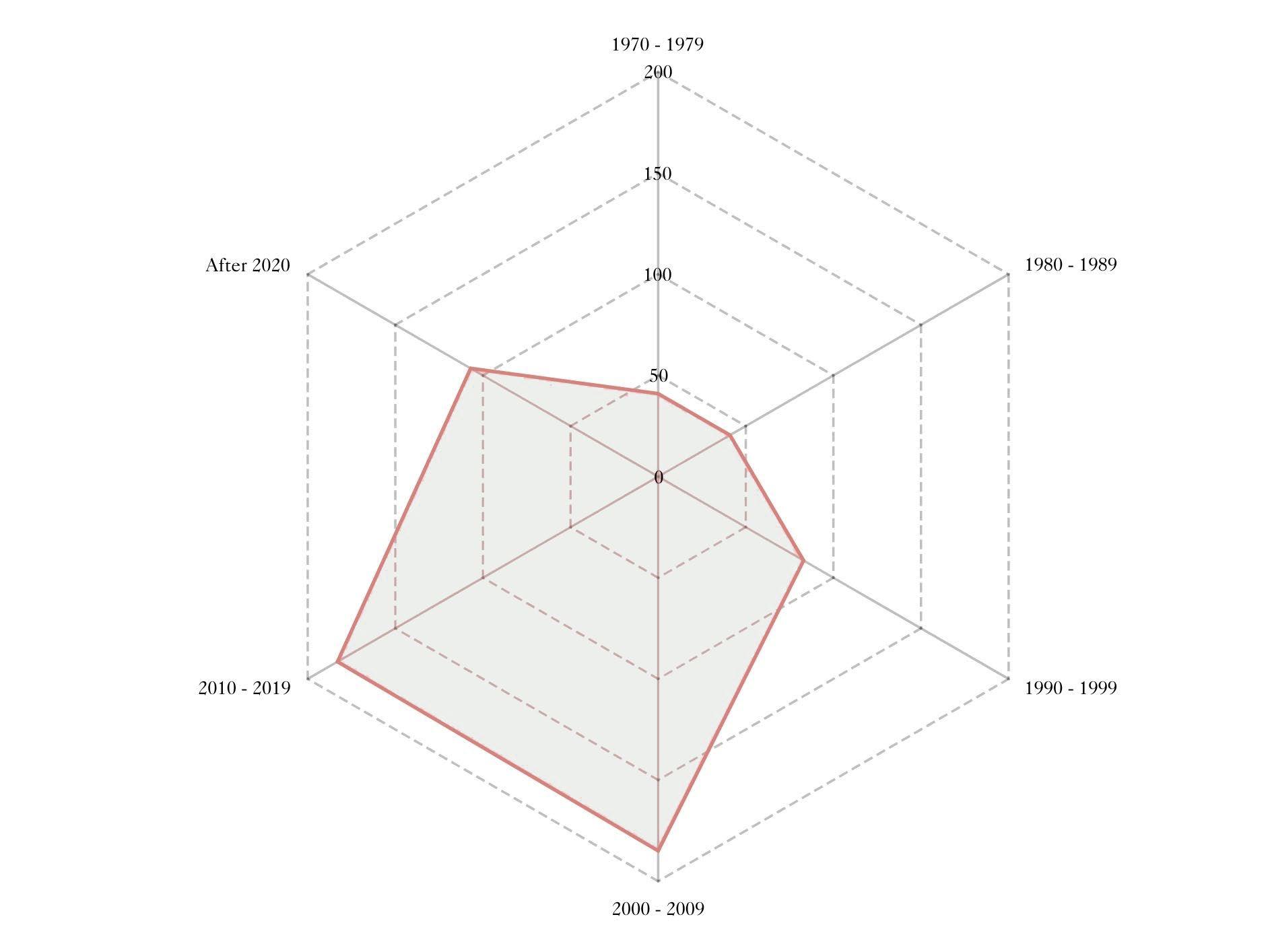
Outcomes vary widely (Figure 4, Table 1). Roughly one-third of the cases remain open, reflecting ongoing tensions and slow institutional responses. About 26% achieved outright success, halting projects entirely, while another 13% gained partial victories, reducing the scope or impact of developments.
1970s–1980s
These figures remind us that agency does not always translate into immediate wins; even in “unsuccessful” cases, mobilisations often left lasting marks on governance, planning, and public awareness (NussGirona et al., 2023).
1990s
Environmental mobilisations on the Spanish Mediterranean coast must also be understood historically (Fig. 6.) Each decade reveals different forms of agency shaped by political and socio-economic contexts.
Figure 6: Number of environmental conflicts documented per decade.
Source: Author’s elaboration from MOVxPAIMED dataset
Early mobilisations emerged during the final years of the Franco dictatorship and Spain’s democratic transition. Many were small, localized, and sometimes clandestine, targeting projects such as dams, polluting industries, or irregular urban developments (Nuss-Girona et al., 2020). The limited number of cases documented reflects both lower visibility and the restricted space for civic protest.
With Spain’s integration into global markets and the expansion of tourism, conflicts multiplied. The post-Olympic urban boom in Barcelona and the spread of residential tourism across the coast triggered strong opposition. Agency took new forms, with citizens organizing platforms, using the courts, and appealing to heritage protection laws (Sánchez Cabrera & Ferrandis Martínez, 2025).
The peak of mobilisation coincided with the real estate bubble (1997–2006) and its aftermath. Massive urban sprawl, transport infrastructures, and energy projects generated widespread resistance (Burriel de Orueta, 2008). Grassroots movements not only stopped projects but also influenced planning policies. In Girona, for instance, mobilisations led to the preservation of landscapes that might otherwise have been urbanized (Rufí et al., 2023).
Conflicts became more complex, linking local struggles to global issues such as climate change, water scarcity, and renewable energy. Wind farms and solar plants, though a green energy source effective for carbon emissions mitigation, sometimes provoked opposition when perceived as damaging to landscapes or imposed without community participation (Feliu et al., 2025). This period highlights how agency evolves—not disappearing but adapting to new challenges.
Across five decades, environmental mobilisations along the Spanish Mediterranean coast have shown that communities are not passive recipients of top-down planning. They are active agents shaping their environment and, by extension, their society. By resisting urban sprawl, touristification, and extractive projects, local movements have defended not only ecosystems but also cultural identities and ways of life.
Agency here is expressed in multiple ways: resistance to destructive projects, persistence in long legal battles, adaptation to changing political contexts, and the creation of new visions for sustainable territory. These mobilisations remind us that landscapes are not empty spaces waiting for development; they are lived territories, imbued with meaning and belonging.
In an era of accelerating global pressures— from climate change to speculative urbanisation—the struggles of the Spanish Mediterranean offer a vital lesson: the power to shape space lies not only in institutions or corporations, but in the collective agency of communities who refuse to accept the erasure of their places.
Looking ahead, these findings underline the need to integrate community-driven perspectives into future coastal planning and climate-adaptation policies, ensuring that the environmental governance of the Mediterranean is grounded in local agency and lived territorial knowledge. Yet beyond policy integration, the future of agency may lie in expanding these networks of care and resistance—linking local struggles across regions and scales.
When
communities shape the territory, they not only defend their places but also redefine what sustainable coexistence means in a
changing world, opening possibilities for new forms of collective action in the face of global crises.
References:
1. Burriel de Orueta, E. L. (2008). La “década prodigiosa” del urbanismo español (1997–2006). Scripta Nova. Revista Electrónica de Geografía y Ciencias Sociales, 12(270). https://www.ub.edu/ geocrit/sn/sn-270/sn-270-64.htm
2. Feliu, J., Vicente, J., & Nuss, S. (2025). Movilizaciones sociales en el Mediterráneo peninsular: Una lectura desde la mitigación y la adaptación al cambio climático. Documents d’Anàlisi Geogràfica.
3. Nogué i Font, J. (2005). Paisatge i identitat territorial en un context de globalització. Treballs de la Societat Catalana de Geografia, 60, 173–183. https://raco.cat/index.php/TreballsSCGeografia/article/view/236376.
4. Nuss-Girona, S., Vicente Rufí, J., & Canaleta, G. (2020). 50 years of environmental activism in Girona, Catalonia: From case advocacy to regional planning. Land, 9(6), 172. https://doi. org/10.3390/land9060172
5. Nuss-Girona, S., Vicente Rufí, J., Canaleta, G., De Meo, I., Duce, C., Luzzietti, B., & Michelis, L. (2023). Civil society mobilizations shaping landscape in Genoa and Girona areas: Results and lessons learnt from the Savingscapes project. Land, 12(4), 922. https://doi.org/10.3390/land12040922
6. Rufí, J. V., Nuss-Girona, S., Castañer Vivas, M., Feliu Torrent, J., Martín-Uceda, J., & Porcel Montané, O. (2023). Landscape preservation on the Mediterranean coast: Do social movements play a decisive role? The case of the Costa Brava (Spain). In Urban dynamics in the post-pandemic period: Tourist spaces and urban centres (pp. 129–151). 10.1007/978-3-031-36017-6_9
7. Sánchez Cabrera, J. V., & Ferrandis Martínez, A. (2025). Conflicto y movimientos sociales en el litoral de la Comunitat Valenciana. Investigaciones Geográficas, 83, 219–247. https://doi. org/10.14198/INGEO.28540
8. Scheidel, A., Hirsch, T., & Ville, J.-B. (2020). Environmental conflicts and defenders: A global overview. Global Environmental Change, 63, 102104. https://doi.org/10.1016/j.gloenvcha.2020.102104
9. Tuan, Y.F. (1974) Topophilia: A Study of Environmental Perception, Attitudes and Values. Columbia University Press.
Figure 7: The Platform in Defense of the Molí de l’Assut, Xerta (Baix Ebre), 2008. Girona City Archive
Figure 1 : Balat Neighborhood, Istanbul (Image by the author).
From City Dweller to Urbanor A
Manual For Activating Your Agential Self in the City
Fatemeh Nahavandi
A city can be alive in structure, even if inefficient, yet dead in experience. History and the circumstances that cities have experienced up to now show that, at any stage of their development, urban life does not always follow a path that allows it to function properly while also fostering meaningful connections with its inhabitants. Without such connection, residents risk becoming mere occupants, going through daily necessities, returning at night to sleep, and repeating another day of unavoidable routines. It is in this context that the concept of agency becomes crucial, especially when urban management fails to address these gaps, leaving both the city and its residents on autopilot.
In response to this challenge emerges the concept of the Urbanor (A term derived from the combination of urban and actor). Urbanors are active city dwellers who feel a profound sense of belonging to their city, cherish it, and act whenever possible to enhance the well-being of both the urban environment and its inhabitants. They disrupt the monotony of routine urban life, breaking the cycles that reduce the city to something imposed, something merely endured. Being an Urbanor is less about formal roles or positions and more about the inner self, emotions, and a cultivated sense of responsibility towards the city. When a sense of belonging is expressed through actions that mitigate the city’s less favorable events or contribute to positive outcomes, it manifests as agency, transforming the Urbanor into what I refer to as an Agential Self.
The seed from which the Urbanor blossoms and grows, manifesting as the Agential Self, emerges through the pursuit of meaning within everyday urban life. By engaging with the realities of urban existence, and creating value through their actions, Urbanors do not remain passive members of the community. Instead, it is through this quest for meaning that they take an active role in shaping the flow of city life, contributing to both the environment and the social fabric in ways that reflect their inner agency. Accordingly, as this seed of meaning takes root within individuals, it becomes clear that cultivating the Agential Self requires nurturing and strengthening one’s inner connection to the urban environment. In essence, the journey from mere resident to Urbanor begins from within, transforming the city from a simple place of residence into a space of engagement, responsibility, and creative influence. This observation leads us to ask a crucial question: how can one move from being just a resident to becoming an Urbanor?
This manual is not meant to prescribe a fixed path, but rather to invite us, first, to reflect on our place in the city, our understanding of it and our sense of belonging, and then to manifest our agential self in everyday urban life. So, let us step into the instructions that follow:
1. Claim Your Right to Curiosity
Curiosity is not just a passing interest. It is a conscious act of paying attention to the realities around us. Carrying a subtle form of defiance, it sometimes becomes an expression of moral courage (Peppers, 2016).
In the context of urban life, curiosity signals the independence of thought among residents, enabling them to interpret and analyze urban events and flows on their own terms, apart from official narratives or institutional frameworks. A spark of such urban curiosity often sets a cycle into motion. From a neuroscience perspective, curiosity engages the brain’s reward system, generating motivation that propels behavior. Those with higher curiosity are more sensitive to gaps in their knowledge, which further fuels their drive to explore and discover (Kaczmarek et al., 2024). That behavior, in turn, creates new experiences, which feed back into curiosity itself, reinforcing and deepening our engagement with the city. Urban environments that embody qualities of curiosity and discovery can transform the way people engage with the city. Such spaces encourage exploration, reflection, and interaction, allowing residents to become active interpreters of their surroundings rather than passive users. When embedded in the spatial and social fabric, this dynamic can generate feedback loops that deepen urban experience and shape future city-making processes.
2. Decode the City’s Palm Lines
“The city, however, does not tell its past, but contains it like the lines of a hand” (Calvino, 1997). It is through curiosity that one is compelled to read the city’s palm lines and get to know it. This is when we shake hands warmly with anyone who has documented, interpreted, or recorded the city in any way, whether through a narrative, a series of urban
Figure 2 :Galata Bridge (Image by the author)
photographs, a scientific article, or even a city encyclopedia. From small-scale writings to scholarly works, each helps us trace the city’s different dimensions including form, history, and inhabitants. Just as understanding precedes attachment in human relationships, knowing the city is essential to connect with it meaningfully.
3. Halfway There… and a Flâneur Emerges
By now, we have equipped ourselves with the mental tools and knowledge to understand the city, and, naturally, developed a desire to know it even more. This is the moment to step beyond our doorstep and into the city’s unfolding story. Without a map, GPS or any guiding device, we let our footsteps lead us, wandering freely through the urban fabric. At this stage, as curious, questioning, and sometimes even critical observers, we trace subtle clues, following the city’s signals, and gradually build our own unique understanding of it, using tools that help us gather and capture our observations and insights, such as contemplation of a scene, photography (Figure 1 & 2), and writing. In the process of transitioning from a mere resident to an Urbanor, and through the very act of meandering attentively and freely, we simultaneously acquire another role, that of a flaneur (The term Flâneur was popularized by Walter Benjamin in his reflections on modern urban experience in Paris), embracing the city through observation, reflection, and exploration.
4. Finishing Touch: Social Interactions
Up to this point, the practices we have discussed possess a cumulative quality: each builds upon the previous one, gradually shaping the citizen’s point of view toward the city. As the final point, however, we turn to social interactions, which (arguably the most important practice) must be cultivated alongside all the others.
In exploring and getting to know the city, we don’t always encounter bright or uplifting moments; sometimes, we stumble upon the most tragic episodes it has endured. Along the way, we may realize that the city we live in today, compared to its past, bears traces
of decline or darknessand it’s easy to feel trapped in despair. Here, the real key is not to isolate ourselves. Being with others who share our concerns, and exchanging empathy and compassion, opens up a space for thinking together, and for turning reflection into action.
Beyond serving as a means to alleviate urban sorrow, these social interactions can themselves become tools for gathering urban information, what is often called oral history: firsthand narratives that might never have crossed the path of a historian, writer, or tourist, and have remained silent until they are finally expressed through conversation. Just imagine the possibilities for a flâneur: while wandering, pausing, and reflecting on what lies before them, they might engage with a local resident, a shop owner, or join a conversation at a social table in a local café, neutral, accessible third spaces that nurture casual encounters, empathy, and can serve as informal grounds where Urbanors gather, reflect, and shape how they exercise their agency through everyday interactions (Figure 3). Gradually activating their agential selves and gaining unique insights into the life and stories of the city.
If you have read this far and feel inspired to embark on your own path toward becoming an Urbanor,
“I
am delighted to imagine that a city may gain one more individual who cares for it, carrying their presence and the spaces they inhabit into meaningful action—especially at a time when a city needs its citizens more than ever.”
This might be as simple as a creatively crafted trash receptacle, made from a cut plastic beer bottle and ingeniously integrated into a tree trunk by a single citizen in a corner frequently used by smokers, or as significant as organizing a peaceful protest against the destruction of urban gardens, ultimately prompting municipal authorities to reconsider their decisions. The Agential Self may also manifest in advocating for a historic building slated for sale, ensuring through
civic engagement that it is preserved and converted into a museum (These examples are actual manifestations observed across various cities).
Based on the idea of the Urbanor, a utopia would be a place where the number of Urbanors equals the city’s population. Just as the qualities of becoming an Urbanor were cumulative, the growth of Urbanors within a city can move beyond mere accumulation: it can trigger an exponential resonance of agency, fostering citizen activism and their alignment with broader urban governance in a structure that is not dominated by topdown management. By contrast, dystopia would be a place where all inhabitants are merely passive dwellers, returning to the city only through narrowly defined, essential activities, a place where no Urbanors remain. This is precisely where the role of urban planners and designers is defined: to define projects and interventions that cultivate more Urbanors within the city, allowing the agency of each individual, especially in moments of crisis, to act as a stabilizer for the urban system itself. Yet, their role can extend beyond these established and formal responsibilities. Beyond designing participatory or interactive projects that spark curiosity and engagement among citizens, urban planners and designers can act as facilitators in people’s journey toward becoming Urbanors. Owing to their expertise and reflective understanding of the city, they often embody the qualities of an Urbanor themselves, making them capable of inspiring and enabling others to develop a similar awareness. This facilitative role can take multiple forms: from sharing thoughtful, awareness-raising content through social media to organizing urban walks that encourage direct encounters between residents and the city’s inner and authentic spirit.
In doing so, they lay the groundwork for a transformative urban manifesto: where Urbanors flourish, the true essence of the city awakens; and through their agential selves, the city learns not merely to endure, but to evolve.
References:
1. Calvino, I. (1997) . Invisible Cities (W. Weaver, Ed.; W. Rodwell, Trans.). Vintage.
2. Kaczmarek, L. D., Kashdan, T. B., & Enko, J. (2024). How Curiosity Enhances Performance: Mechanisms of Physiological Engagement, Challenge and Threat Appraisal, and Novelty Deprivation. Journal of Happiness Studies, 25(7). https://doi.org/10.1007/s10902-02400816-w
3. Peppers, D. (2016). Why Curiosity is a Prerequisite for Innovation. Inc. com. https://www.inc.com/linkedin/ don-peppers/curiosity-act-rebellion-don-peppers.html
3, Cafés as third places: ideal urban spaces for social interactions – a café in Tehran (by author)
igure
An
Here, the social and spatial relations are rooted in neighborhood ties. It shows small houses, narrow and uneven alleyways, and old local shops. (Image by the authors)
Figure 1:
image of the old urban fabric of District 20, Tehran.
Space of Politics: Sense of Belonging and Spatial Agency
Ahmad Yazdanian and Zahra Rahmati Researchers of political economy of space- Tarbiat Modares University
This is how it should be done: Lodge yourself on a stratum, experiment with the opportunities it offers, find an advantageous place on it, find potential movements of deterritorialization, possible lines of flight, experience them, produce flow conjunctions here and there, try out continuums of intensities segment by segment, have a small plot of new land at all times.
Deleuze and Guattari, 1987: 161
In the condition often described as planetary urbanization (Brenner, 2014), social and spatial relations are more than ever grounded in various forms of deterritorialization (Rahmati, Yazdanian, Cheshmehzangi, 2025). When place is lost, one’s agency naturally assumes a particular configuration. In such a situation-where it feels like the ground beneath our feet has vanished-people are no longer connected to the field, they do not know the alleyways, and lack a mastery over the fissures and cracks. Suddenly, while running from the authorities, we turn into a Cul-de-sac and are easily captured.
It is not possible to speak about place without speaking of identity and belonging. In urban planning discourse this is often described as a sense of place or place identity. Without a sense of belonging, one cannot define a relation to a place. No matter how hard one tries to convince oneself that it is home, it does not quite become so- even if one lives there for years. The outcome of such a precarious relation is that the place gradually slips out of the development process. As a subject capable of producing a particular kind of space, one does not feel responsible for it and therefore does little for it. Resulting in packing up and moving elsewhere. Such displacement, over time, reshapes
relations to space-sometimes toward caution, sometimes toward radicalism. Depending on how one situates oneself in relation to “here” and “there,” the balance tilts.
In deterritorialized conditions, cosmopolitan imaginaries emerge, filling the void of place, creating meaning anew, and linking us not to a specific location within a specific coordinate, but to more distant, invisible thresholds- to the condition of humanity in the realm of the Idea. We become cosmopolitan subjects, representatives of universality, aspiring to save “humanity”- a humanity whose boundaries may or may not include us. In such a condition, we belong more to the borders of the world than to any singular geography; even a neighborhood like Shirabad in Zahedan becomes, more than ever, a mere object of analysis.
Not being careful, can easily slide this encounter into nostalgia and pastoralism, luring us toward nationalism or the discourse of “Iranian civilization,” delighting orthodox youth and elders alike.
“Yet beyond such discursive struggles, the task here is to ask: in the absence of a form of belonging to place, what exactly do we lose? And how is our agency transformed?”
In the absence of Belonging, a form of subjective weightlessness emerges-a subject detached from the context, suspended within the circuits of capital, image, and information. This weightlessness, as Lefebvre (1991) describes, is a kind of spatial alienation: the moment when space ceases to be the product of lived practices and becomes instead an object of consumption and planning. In such a space, the lived is marginalized, and subjectivity takes shape increasingly within pre-defined fields of mainstream action.
Yet the loss of place is not merely a geographical absence; it is the erasure of difference. This resonates with what Rancière (1999) calls the politics of the sensible-the
(Image by the authors)
Figure 2:
New residential complexes, District 20, Tehran. These developments embody a growing sense of social and spatial distance.
moment when the dominant sensory order, the regime that determines what is visible, speakable, and audible, is disrupted. Place, in this sense, is not a neutral physical container but a scene of contestation over visibility: over who is entitled to be seen, heard, and recognized. The absence of place, then, means the disappearance of such a scene of dispute-the silencing of spaces where differences could articulate themselves.
Modern urbanism, through projects of regeneration, renewal, and development, more or less empties this scene. The logic of spatial intervention is, in essence, a logic of homogenization (Yazdanian and Rahmati. 2025). Without resorting to any pastoral nostalgia, one can see that the demolition of old houses, the erasure of organic alleys and small squares, destroys not only built form but also the networks of relations, memories, and shared languages that once sustained the subject as a meaningful agent. When a neighborhood is rebuilt from scratch, the social relations that produced its space are simultaneously dissolved. This is precisely
what Massey (2005) describes as space as relation: space not as a fixed background but as the coexistence of heterogeneous forces, interests, and temporalities.
“By destroying lived places, these plural temporalities are compressed into a single linear time-and in doing so, the subject of history is deprived itself.”
However, against this process of deterritorialization, forms of micropolitical resistance arise (Bayat, 2013). What Deleuze and Guattari (1987) term reterritorialization refers to the reappropriation of space at a micro-scale- the ways in which people reclaim cracks and interstices within dominant spatial orders and, from within them, generate new possibilities of living. These small, improvised spaces, often labeled by planners as informal or disordered, are in fact moments of reclaimed agency: instances where the spatial subject emerges
Figure 3:
New residential complexes, District 20, Tehran. The logical endpoint of such a process is a form of alienation, as evident in this image. (Image by the authors)
from the global order and reconstitutes a heterogeneous geography (Simone, 2010). Thus, the question of belonging is not simply about emotion but about politics and agency (Dikec, 2009). Who produces space? Who is authorized to ascribe meaning to place? And who is excluded from this process?
“When belonging is lost, the subject becomes an object circulating within capital, and space turns into a commodity within the global marketplace of locations. Yet when belonging is reconstructed-even at a small scale-the capacity for action is revived.”
Such reconstruction is not a nostalgic return to the past. What matters here is the creation of spaces capable of bearing difference-spaces where singularity, rather than universality, is preserved. As Rancière (1999) writes in Disagreement, politics begins at the moment when those once deemed “inexistent” appear as speaking subjects. To belong to a place,, is to belong to the possibility of appearance, including the possibility of speaking and being heard, rather than merely residing.
From this perspective, place belonging is not a sentimental condition but a radical one, for it contains the potential to rupture the global order of space. In a world where cities are turned into investment platforms and neighborhoods into brands, returning to place means returning to the politics of space (Dikec, 2005)-the restitution of agency to those rendered invisible.
Yet this return is meaningful only when the spatial subject ceases to be a mere object of study or planning and becomes a speaking subject. In most urban discourses, people are positioned as stakeholders-those who may be “consulted,” but not necessarily understood. Progressive agency emerges only when the very structure of listening is transformed-what Rancière calls a redistribution of the sensible. Belonging, in this sense, is not the outcome of policy but the interruption of policy’s logic: the moment when silent voices from below disrupt central echoes and recompose a different collective order.
If Lefebvre reminds us that space is a product of social relations, Rancière adds that these relations are always conflictual and antagonistic between those who occupy space and those excluded from it. Belonging to a place, therefore, is a political intervention in the redistribution of space. In contrast, large-scale development agendas-from urban regeneration to tokenistic participatory projects-often seek to neutralize such conflict, turning the city into a space of silence, consensus, and thus, depoliticization.
“For this reason, belonging is less a psychological or cultural experience than a strategic act. Spatial agency appears in the minute details of everyday lifein how people redefine routes, inhabit temporarily, or even claim a wall’s surface to hang a small sign of life.”
These micro-moments, seemingly trivial, are in Deleuzian terms lines of flight: fissures within the dominant order through which alternative forms of politics are born.
Ultimately, to belong to a place is to recognize space as a field of struggle and possibility-a site where agency emerges not at the macrolevel of institutions but in the micro-level of everyday inhabiting and resistance. This recognition lifts the spatial subject out of its suspended condition and grounds it once again-not on mere soil, but on a terrain of difference, voice, and life.
Figure 4: Together, these images reveal a spatial conflict-a transformation in modes of living that progressively erases place and, consequently, the sense of belonging.
References:
1. Bayat A. (2013). Life as politics: How ordinary people change the Middle East: Stanford University Press.
2. Brenner, N. (2014). Implosions/ Explosions: Towards a Study of Planetary Urbanisation: Neil J Brenner: 9783868593174: Amazon. com: Books. In.
3. Deleuze, G., & Guattari, F. (1987). A Thousand Plateaus: Capitalism and Schizophrenia, trans. Brian Massumi (Minneapolis: University of Minnesota Press.
4. Dikec, M. (2005) “space, politics, and the political” in Environment and Planning D: Society and Space2005, volume 23, pages 171-188
5. Dikeç, M. (2009). “Space, politics and (in) justice.” Justice spatiale= Spatial justice
6. Lefebvre, H. (1991). The Production of Space. Oxford: Blackwell.
7. Massey, D. (2005). For Space. London: Sage.
8. Rahmati, Z., Yazdanian, A., Cheshmehzangi, A., (2025). Territorialisation and Deterritorialisation: A Topography of Conflict in the Tehran University Development Plan, Iran. Journal of Urban Regeneration & Renewal Vol 19 No 2.
9. Rahmati, Z., Rafieian, M., and Dadashpoor, H., (2022). Explaining Power Mechanism in the Preparation and Implementation of Urban Development Plans; The University of Tehran Development Plan as a Case Study. Quarterly Journals of Urban and Regional Development Planning of Allameh Tabataba’i University, Volume 7, Issue 20, June 2022, Pages 41–83.
10. Rancière, J. (1999). Disagreement: Politics and Philosophy. Minneapolis: University of Minnesota Press.
11. Simone, A. (2010). City Life from Jakarta to Dakar: Movements at the Crossroads. London: Routledge.
12. Yazdanian, A., Rahmati, Z., (2025). Urban Regeneration in Iran: A Historical Review of the Formation of the Discourse of Spatial Remains in Cities. Critique of political economy.
Figure 1: On things I have heard By Author, 2024
Micro-geographies of agency in displacement Encounters within asylum settlements
Ilaria Palmieri
This contribution examines how agency emerges within the entanglement of displacement and homemaking, focusing on institutional environments such as asylum-seeker centres.
Often cast as spaces of passivity, these sites are in fact places where residents act, adapt, resist, and persist within constraining systems. Drawing on multiyear field journals, architectural ethnography, and participatory workshops co-developed with residents in reception facilities in Italy and the Netherlands, the article documents everyday acts – personalisation, mutual care, collective rule-making, and subtle spatial hacks – that transform temporary shelters into places of belonging and participation.
By reframing displacement as a spatial condition, it argues that such everyday tactics are not merely responses to exclusion but dynamic assertions of agency that contest the borders of “home” and the presumed neutrality of institutional design. The piece foregrounds subjectivity and co-production – listeningand-mapping sessions, collective drawing, and domestic prototyping of hospitality rituals – to bring forward residents’ experiences and co-create small, actionable tools such as counter-maps, hospitality protocols, and micro-guidelines for shared living in condition of precarity.
In doing so, the article calls for a shift in design discourse: from managing displacement to enabling belonging. It positions displaced individuals as cocreators of their environments and offers transferable prompts that institutions and practitioners can use to strengthen agency in precarious housing contexts.
The figure of the displaced person in institutional frameworks has long been constructed through narratives of vulnerability, dependency, and temporal suspension. Asylum-seeker centers, refugee camps, and temporary accommodation facilities are frequently understood as spaces of waiting – places where life is put on hold while bureaucratic processes unfold. This framing highlights legitimate concerns about structural inequalities and institutional power. However it risks obscuring the complex ways in which residents of these spaces actively engage with their living environments: creating meaning, establishing relationships, and asserting forms of agency within constraining circumstances.
To challenge the portrayal of displacement spaces as sites of passivity means examining how residents transform temporary shelters through everyday practices – personalization, mutual care, collective rule-making, and subtle spatial hacks – that turn them into places of participation, where inhabitants are actively involved in shaping their living environments.
I define these transformations as microgeographies of agency, a concept I developed through multi-year research in reception centers across Italy and the Netherlands. Here I must acknowledge the privileged position from which I write. Unlike the people I engaged with, I have never experienced displacement myself; I could choose my angle of exploration rather than endure the conditions I study. What follows is grounded
in my encounters and observations and should not be read as a general account or prescriptive model. Nevertheless, precisely because of this situated partiality, these experiences highlight the importance of subjective, relational knowledge. They remind us that planning and design are never neutral, but ethically and politically embedded practices. The research aimed to give voice to residents’ struggles rather than extract from them, sharing findings in accessible formats and advocating for policy changes aligned with their priorities.
“They [human experiences] remind us that planning and design are never neutral, but ethically and politically embedded practices”
The research employed periods of observation in reception centers across both countries, documented through field journals attentive to both spatial configurations and social interactions. A second phase involved co-designed workshops with residents –listening-and-mapping sessions, collective drawing, and domestic prototyping – that surfaced counter-maps and hospitality practices otherwise invisible to formal layouts.
Figure 2: Counter map; Italian reception center By Anonymous, 2022
By Anonymous, 2022
Italian and Dutch context
The two countries present distinct architectural logics in reception systems. Italy’s fragmented and often improvised architectural system contrasts with the Netherlands’ standardized architecture and layout of the AZCs (Asielzoekerscentrum). These differences create different conditions for individual and collective agency, offering a comparative lens to understand how residents navigate and transform institutional constraints.
In Italy, reception centers often occupy repurposed buildings situated within neighborhoods: former convents, schools, or apartment blocks that maintain visual and functional connections to surrounding urban life. This embedding, however, seems to be mostly visual rather than practical. The centers remain far from being truly integrated into the urban fabric or considered part of the “official” civic territory.
Similar to the Italian landscape, Dutch AZCs also often emerge from repurposed buildings – converted structures of different origins but generally isolated from the rest of the city, separating asylum seekers from the neighbourhoods’ population. This spatial segregation shapes how agency manifests: more contained within institutional boundaries but occasionally producing formalized recognition of resident-led practices.
In Dutch AZCs, the COA (Central Agency for the Reception of Asylum Seekers) regulates how residents can personalize their living spaces. During the workshop sessions I developed with residents, there were
“This spatial segregation shapes how agency manifests: more contained within institutional boundaries but occasionally producing formalized recognition of resident-led practices.”
occasions when we requested different furniture or permission to personalize locations (walls, wardrobes, windows), but did not receive institutional support. The rationale was that these locations remain institutionally framed as “temporary” and therefore not requiring personalization. This explicit emphasis on temporality implicitly excludes users’ customization of the living environments.
Engagements
Nevertheless, in this scenario, I witnessed how residents negotiated their agency mostly through collective acts in what I call semi-commons: spaces where residents gather informally, creating room for selfdirected activities. The listening-and-mapping exercises proved particularly revealing for me in discovering these sites, as residents narrated their spatial experiences while creating hand-drawn maps of facilities.
Figure 3: A piece of memory
These counter-maps presented alternative geographies that differed from official institutional layouts, highlighting informal pathways and emotionally significant locations that constituted the real geography of daily life. They manifested how residents of those reception centers reclaimed small degrees of autonomy within standardized environments designed to prevent exactly such personalization. These practices were sometimes acknowledged by COA staff, illustrating a more formalized – but also more constrained – recognition of resident-led governance that could be integrated into official procedures.
“Through these rituals of individual and collective care, agency emerges through and around, rather than against, systemic limitations.”
I engaged with various examples of such geographies, but will focus on observations from a case in one Dutch AZC, where kitchen spaces and outdoor areas – meaning outside the sleeping units but still within the reception center – became key sites where residents practice agency. During one of the workshop sessions I carried out, participants expressed discomfort with how the kitchen areas were set up, feeling they couldn’t eat meals in ways that felt familiar to them. In response, we collectively built low tables and sewed cushions so that people could eat on the floor according to custom, transforming standard eating arrangements into culturally responsive ones. Though a simple gesture, it activated a semi-common space that had previously gone unused. The new setup created opportunities for people sharing the same sleeping unit to gather, practice their cultural traditions, and share them with others from different traditions of communal eating. I was particularly excited to witness how, as this activity unfolded, others began joining the workshop and building process. This time, they proposed constructing a small vegetable garden to “take care of such an alienating living location,” as one resident put it.
Through these rituals of individual and collective care, agency emerges through and around, rather than against, systemic limitations. By reframing displacement not merely as a juridical status but as a spatial condition, we can observe how borders extend into daily life while also opening territories of participation that can be governed and designed as commons –thereby shaping how these sites engage with their urban contexts. More than a building, a reception center is a threshold between a system of control and the agency of those inhabiting it. The question becomes: how do residents negotiate this threshold, and what role does design play in either restricting or enabling such negotiation?
Although most AZCs in the Netherlands are typically located on urban peripheries, reinforcing segregation, a different movement is emerging. Innovative projects like Plan Einstein in Utrecht – where an AZC was co-located with public amenities and activities for both asylum seekers and locals – demonstrate how shared practices can reshape urban belonging.
In Italy, personalization often took the form of visible transformations. Residents often reappropriated entire rooms for new functions, transforming storage areas into communal kitchens, prayer spaces, or informal childcare facilities. These adaptations reflected both the flexibility and fragility of improvised infrastructures – creative solutions that could be suddenly dismantled by administrative decisions.
Such improvisations also reflected institutional neglect. Though what proves especially significant is how these micropractices within semi-commons reverberate outward. In Italy, because centers are often embedded in neighborhoods, personalization and community practices spill into the urban fabric, connecting displaced populations to civic life. Italian facilities saw collective rule-making often extend beyond center boundaries, with residents forming solidarity networks with local volunteers and neighborhood groups. Cooking and language exchange frequently involved actors from outside the reception system, embedding displaced communities in local urban fabric through practices of mutual aid and cultural exchange.
I must emphasize that what I describe is not a common trend – quite the opposite. Reception facilities in Italy are widely perceived as “issues” and “problematic.” However, numerous associations, organizations, and civic initiatives are working to shift this perspective. Presenting this reality through my research means making visible a counter-narrative that has emerged through years of struggle, with many more years of work ahead.
Examining the generative conditions within the constrained living realities of reception centers reveals how residents engage in what McDowell (1999) describes as the “contested, fluid, and uncertain” nature of place-making itself. The counter-maps they create do not simply document alternative uses of space; they assert alternative geographies that challenge the singular, official maps positioning them as perpetually out of place. The architectural logic of most reception facilities emphasizes efficiency, surveillance, and the prevention of permanent settlement. It exemplifies what many think of as the refugee camp imaginary, which positions displacement as necessarily temporary and abnormal. But what if – here I follow up on Alessandro Petti (2017) – we stop seeing reception centers as exceptions and instead recognize them as architectural and urban elements with their own heritage and history? Such a reframing opens possibilities for transforming them into infrastructures of cohabitation, ultimately recognizing the people living there as part of the urban fabric.
Building on this possibility, concepts such as infrastructures of care, domestic publics, and threshold urbanism help articulate how micro-practices aggregate into broader urban relations. In both contexts I explored, displaced individuals co-produced territories of participation through acts that contest narratives of passivity. These practices demonstrate what infrastructures of cohabitation might actually look like. The question for designers and planners, then, is how to support these existing practices rather than designing against them.
References:
1. Amin, A. (2008). Collective culture and urban public space. City, 12(1), 5–24. https://doi. org/10.1080/13604810801933495
2. Bayat, A. (2010). Life as politics: How ordinary people change the Middle East. Stanford University Press.
3. Iveson, K. (2007). Publics and the city. Blackwell Publishing.
4. Miraftab, F. (2004). Invited and invented spaces of participation: Neoliberal citizenship and feminists’ expanded notion of politics. Wagadu: A Journal of Transnational Women’s and Gender Studies, 1, 1–7.
5. Pieterse, E. (2013). City futures: Confronting the crisis of urban development. Zed Books.
6. Simone, A. (2004). People as infrastructure: Intersecting fragments in Johannesburg. Public Culture, 16(3), 407–429. https://doi. org/10.1215/08992363-16-3-407
7. Watson, V. (2009). ‘The planned city sweeps the poor away...’: Urban planning and 21st century urbanisation. Progress in Planning, 72(3), 151–193. https://doi.org/10.1016/j.progress.2009.06.002
Figure 4: On things I have heard & seen
By Author, 2024
Figure 1:
An evening view of the sprawl of Karachi’s neighborhoods (Image by the author)
Navigating Karachi as a Daily Wager
An Exploration of Structure and Agency
Ziana Shakil
The cycle of affliction in Karachi, the largest metropolitan city of Pakistan and home to more than 20 million people, is unbroken. In summer, the city is crushed by a heat that lies heavy as a lead blanket. Months later, it is drowned by urban flooding, the brutal arithmetic of the climate crisis. Just before that, it was gutted by the sharpest spikes of inflation. Rewind further: a worldwide pandemic brought its crucial systems to a shuddering halt. Through it all, the static rot of political chaos, crime, and violence festers, stagnant during every season. For people trapped at the epicenter of this unending cascade, life becomes reduced to one narrative: endure. Crisis is the only constant, and adaptability is the core solution.
The Invisible Engine
“But who bears the physical burden of this constant requirement to keep adapting?”
The grunt of Karachi’s economy rests on its working class, a vital contribution that stands in stark contrast to their poor quality of life, a systemic failure affecting both the formal and the sprawling informal sectors. This diverse population - including hawkers, laborers, fishermen, food delivery riders, factory workers, and domestic workersshares common challenges stemming from insufficient social infrastructure, crippling inflation, and inadequate labor protections. Yet, despite its profound impact, this sector remains officially unrecognized and unprotected by the government.
Defining the Research Gap
For the past few years, through the nature of my work and personal curiosity, I have engaged in conversations with an array of people across different places. Driven by this quest, and as a specific focus for my university’s final year project, I set out in early 2024 to understand the realities of the city’s formal and informal daily wage systems with only one question in mind: how does a daily wager navigate a city like this? As a result, I set out to draw insights through detailed conversations with five workers across Karachi.
Examples and Stories:
The city’s working body resides in the path of every potential disaster. This vulnerability is not accidental; it is built into the system. The majority of daily wagers are forced to settle on the urban periphery in informal settlements (katchi abadis), areas defined by their inadequate infrastructure and improvised housing. These quarters, frequently lacking basic utilities like clean water and proper sanitation, create a desperate landscape where, as researchers have noted, residents must “get involved in any kind of work in order to earn for daily food” (Khawaja and Shah, 2018). When a crisis hits, these families are the first to fall.
The climate crisis, manifesting in punishing heatwaves and extreme floods, does not discriminate, yet it disproportionately targets these makeshift communities. The precarity became violently real in 2022, when intense monsoon surges struck Karachi. The heavy flooding caused widespread devastation, particularly in settlements where homes are constructed using mud bricks, corrugated metal, and wood scraps. An unreliable foundation makes collapse inevitable.
I met one such family in Bengali Para, an area in the northwestern part of Karachi. The home of a plumber, a man supporting a family of eleven people, was one of those that simply dissolved in the deluge. “Our houses are destroyed and broken down every time there is heavy rain ”, he told me, the wreckage of his roof having long become a permanent fixture
Figure 1:
An evening view of the sprawl of Karachi’s neighborhoods (Image by the author)
of his memory. Two years later, the family is still struggling to piece their shelter back together.
For the daily wager, destruction means a double penalty. The catastrophe of the flood not only stole his home but also directly paused his income, as the breadwinner was preoccupied tending to the wreckage rather than seeking work. Flooded roads and destroyed infrastructure ensure that even those who escaped damage lose access to their jobs/employment.
This lack of a safety net is exposed by every shock, not just those of nature. When the global coronavirus pandemic hit in 2020, the streets of Karachi fell barren. For the daily wager, there is no work-from-home option; either there is work, or there is no income at all. A rickshaw driver cannot earn without a passenger, or the plumber cannot work in a locked-down neighborhood.
Later on in the conversation, the plumber described the immediate, visceral terror of that period. “There were many problems, especially within our house,” he recalled. “The only way we managed was by loaning money from shopkeepers. We had to loan the money or else my kids would not be fed.” Four years later, he is still paying back that money in monthly installments.
The next area I found myself in was Saddar, home to the city’s vast informal economy. In conversation with a fruit hawker selling bananas, he narrated how a 2018 Supreme Court order uprooted the livelihoods of street hawkers in Saddar. The campaign summarily demolished stalls and livelihoods, initiating an immediate, disastrous chain of consequences. The impact was systemic and swift. Unemployment spiraled into beggary and crushing debt.
Karachi’s informal economy employs 72 percent (Pakistan Labor Force Survey, 2014) of its entire workforce and is the engine that keeps the city going, helping people survive even during periods of severe economic downturn (Hasan, 2021). The threat to the daily wager may also come in the form of a sudden, political mandate that wipes out their livelihood in a single order. The crisis in 2018 rippled outward. The loss of vendors broke food chains, resulting in wastage, and the lack of commuters visiting the decimated markets
disrupted transport systems. Most tragically, the inability to earn forced many families to discontinue their children’s education.
From the south to the city’s central district, my next stop was a garments factory in Surjani Town. The informal economy in Karachi isn’t confined to those navigating the streets—it also extends inside factory walls, where many workers, especially women, labor without contracts or security. For women in this workforce, inflation translates directly into the cost of existence. Speaking to one such worker, a 28-year-old point checker, she shared that with four children and a husband, she is the sole earner for her family of five. When rent increased during the economic crisis, she was forced to take factory work just to keep a roof over their heads. “I wish we could own the house,” she said quietly. “It would fix so many problems just to know we wouldn’t be kicked out over a few hundred rupees.”
Figure 2: Saddar at peak activity, a central node of Karachi’s economy where formal and informal work intersect. (Image by the author)
Agency and Response:
Confronted by a deep-rooted and unyielding system, a daily wager quickly learns that collective political action is rarely an option. Instead, safety and stability are built from the bottom up. Daily wagers rely on tightly knit social and community networks— connections with neighbors, shopkeepers, and other workers—that function as microeconomies of survival. As one plumber explained, “When there is no work available on the streets, we often go to shopkeepers who we have established connections with. They recommend us work and also give our contact numbers to their customers in case they require our services.” These small, decentralized systems fill the gaps left by an absent state, becoming lifelines in a city that otherwise offers little protection.
In the same conversation, I learned that this worker was not just doing one job. He is a plumber, an electrician, a mechanic, a cleaner, a laborer, basically an all-rounder of urban maintenance. Before migrating
from Larkana to Karachi in the 1990s, he had already understood the necessity of multiplicity: to survive, one must know a little bit of everything. In cities like Karachi, where the demand for informal labor is both endless and unpredictable, adaptability becomes the only security. By learning any skill he could, he built a toolkit not only of labor but of autonomy, the ability to navigate a city that constantly shifts beneath him.
Over time, he has built a local identity as a dependable plumber and electrician within the neighborhoods he works in, his reputation sustained through trust and word-of-mouth. Every call from a customer reaffirms this fragile stability. The cycle of essentiality continues: his 16-year-old son now shadows him, helping with small tasks and learning the work alongside his father, not to pursue a single career, but to acquire the same multifaceted toolkit of survival that his father mastered.
Figure 3:
A barbers makeshift setup by the side of a Karachi road.
(Image by the author)
Conclusion and personal positionality:
As daily wagers sustain their livelihoods through their everyday earnings, they also sustain our lives through their skills. Documenting and learning about their experiences made it clearer to me that agency is not only the power to act but a continuous process of adaptation and becoming. For the daily wager, it operates across scales—from individual survival tactics to collective forms of solidarity—and redefines urban life from a different perspective. The plumber’s initiative, the hawker’s persistence, the factory worker’s long commute: each is a negotiation with the crises stacked against them. While these acts of survival are deeply human, they should not exist in isolation. Simultaneously, stark contradiction is reiterated: while the informal economy contributes significantly to the country’s GDP, the quality of life of those sustaining it remains deeply unequal. This points to a larger need for recognition and reform, to move toward an urban future where resilience is not demanded as survival, but chosen as strength. Creating more space for agency, then, means creating structures that do not demand resilience as the only way to live.
References:
1. Hasan, A. (2021, January 3). KARACHI’S STREET ECONOMY. Retrieved from arifhasan.org website: http:// arifhasan.org/culture/karachi-ch/karachis-street-economy
2. Khawaja, A. W., & Shah, N. A. (2018). An Analytical Study on Socio-Economic Conditions of Squatter Settlements in Karachi. Pakistan Journal of Applied Social Sciences, 8(1), 1–23. https://doi. org/10.46568/pjass.v8i1.319
3. Pakistan Bureau of Statistics. (2014). Labor Force Survey 2014. Government of Pakistan.
add some formal value to the space, but does it make sense to cherish this project as a catalyst for pluralism?
Figure 1: Jahad metro station could
Image by: Tina Nemati
Power, Awards, and the Overshadowed Agency!
Nima Tabrizi
“Sometimes projects are picturesque, but does this mean they function as they describe themselves?”
The recent recognition of an Iranian project, which I know well, with the Aga Khan Award for Architecture raises critical questions about the values and realities embedded in such realm. While architectural awards shape academic discourse, professional legitimacy, and the broader narrative of the built environment, their influence demands scrutiny—especially when the outcomes risk diverging from their stated principles. Closer examination of the Majara project in Hormuz Island reveals troubling contradictions between the Award’s declared objectives and the project’s realities. Rather than fostering genuine community engagement and empowerment, the project reflects patterns of external investment, ambiguous land ownership, and detachment from local needs. It risks producing a heterotopic enclave for tourists, disconnected from the island’s urban fabric and cultural commons, while consuming ecological heritage and marginalizing situated knowledge.
This case highlights the complex interplay of power and publicity in architectural recognition, when it comes to the architecture awards’ institutional agency in promoting labels over the real changes. When institutions elevate projects backed by financial or institutional power, grassroots initiatives and authentic cultural expressions risk being overshadowed. I want to reflect on this and question the authentic architectural grounded agency against the institutional fake-framing the “powered” projects.
For some years, I was working with local communities and observing the vernacular architecture across several villages in Iran. I was looking for a profound grasp of how, formerly, the traditional community-driven processes functioned (or malfunctioned) in building their spaces and society. Back in that time, architects made an effort to emphasise the social aspects of their work; however, the mainstream of the architectural scene paid little attention to the lessons that could be learned from the vernacular traditions. As a result, the collective regulations of the interactions that influenced the spaces before the emergence of the nation-state and the sovereignty of centralised governments had been disregarded.
Over time, I noticed that the more projects inspired by vernacular methods and mechanisms were celebrated, the more architects, who sought spectacularity, framed their works within vernacularized embodiments—even when they were not truly aligned with the authenticity of such traditional, community-based, and contextual approaches.
Consequently, the attempts to learn with the vernacular tangible and intangible dimensions, aimed at reviving a collective agency and empowering communities and their bonds with their environment, gradually turned into a spectacular fashion which takes the crust while leaving the kernel behind. In this regard, the superficial charm of traditional forms found its way to the physical appearance of the designs. Furthermore, the intellectually well-written projects’ descriptions were framed through the outsider interpretations and perceptions. The terminology of vernacularity entered the projects’presentations, while the essence remained neglected.
This made me think of how institutional power, which ignites the individual’s desire to be seen, could overshadow the embedded collective aspiration of [vernacular] communities to make their own choices and influence their spaces. However, like much of the other greyness in the world, this crustkernel distinction phenomenon certainly exists on a spectrum and varies across different cases. There are, nonetheless, a few projects that respected the conceived essence in parallel to benefiting from the traditional perceived aesthetics.
After a long process, which was considered to be a careful process, by an esteemed team of internationally recognised juries, my fellow Iranian architects have won the Aga Khan Award. It gives me mixed feelings, as I know the projects—not only having experienced them from within, but also being aware of their social and political context of my country. Is this good news or not? I ask myself. Perhaps, as an Iranian architect, I should be pleased to have heard such news, but what if this happens at the cost of dishonesty —by falsely feeding power, whether in the regulatory system of governance or in the system of recognition of the awards, with information that merely satisfies them?
“Do the architecture awards give value to the projects that would serve the power more than the people, as if they are solutions that respond to the needs and aspirations of communities?”
Rightly or wrongly, architectural awards play a vital role in professional and pedagogical discourses. They strongly influence academies, careers, and architectural validation by consolidating legitimacy and visibility not just for the projects but for their designers as well. Therefore, their influences on the narratives through which we conceive the environment increase with their level of fame.
There are many architectural awards, among which the Aga Khan Award stands out not only for its financial significance but also for the value system it tries to disseminate among architects and communities, with an emphasis on projects rooted in the Islamic cultural landscape. As a result, every Aga Khan Award announcement has a crucial impact on how architecture and architects, both in academia and practice, will adaptively redefine themselves in the years ahead. This is why architects must carefully notice and question the outcome of the Aga Khan Award, with concern, as it somehow influences how architects of those parts of the world position themselves and their projects regarding the social and cultural landscapes. Moreover, as the Aga Khan award emphasises the interconnections between tradition, development, and local identity, a key
question arises: What image of the Islamic world is being reinforced—through which mechanisms, and with what intended or unintended consequences? (Boroojeni, 2025)
As someone who does not consider himself alienated from the grounded evolution of Iranian architecture, I believe I must be sensitive about the manifestation of the Aga Khan Award, regarding its expressed objectives. Hence, I find it necessary to raise some concerns about this year’s award to the Iranian projects: Majera tourist complex in Hormuz Island, and Jahad metro station entrance in Tehran. Since the Aga Khan Award functions as an apparatus of cultural truth-production, it influences collective understandings of what counts as “authentic” architecture, which practices are deemed “sustainable,” and which built forms are rendered “representable”. (Boroojeni, 2025)
In this round of the 2025 award, it is said that the jury team is to promote “the solutions that respond to the needs and aspirations of communities” and cherish projects that “serve as catalysts for pluralism, community resilience, social transformation, cultural dialogue, and climate-responsive design” through careful on-site observation of each nominated project.
To respond to community aspirations and serve as a catalyst for pluralism, projects should prioritise authentic and equitable engagement. This means moving beyond a model where locals are reduced to labourers who do not reside on-site and are merely outsiders to their own habitat’s development by external investors. Moreover, such projects should ensure that much of the financial income, if not all, empowers the host community; otherwise, the complex, detached from the urban fabric, would shape heterotopic luxury enclaves for upper-class tourists, with little cultural interaction or dialogue with the local community.
Projects that claim to address resilience and climate responsiveness need to work actively against gentrification and commodification of land; especially in sensitive and endangered environments like Hormuz Island, where, on the one hand, its ecological heritage is being invasively consumed, and on the other hand, its cultural commons and situated knowledge are being disrespectfully neglected; or socio-politically critical locations like Jahad
metro station in centre of Tehran, where the regulatory system tries to limit the public access to the open spaces and promotes the surveillance to control the citizens social and political collective agencies.
With regret, drawing on years of personal observation, I argue that the mentioned criteria stand in stark contrast to the reality of both projects:
“Majera Project in Hormuz Island, south of Iran, is part of a project called “Presence in Hormuz”. Looking at the colourful domes from afar, I ask myself whose presence was needed in Hormuz Island. Does amplifying the colourful voice of Majera resonate with local people’s agency?”
Figure 1: Majera Project in Hormuz Island, south of Iran Image by: AmirMahdi Mohammadzadeh
Majera project, initiated by external funding from investors of questionable independence, is marked by an unclear land ownership process, on a valuable natural site distant from residential areas, and led by a team that — despite their probable good intentions — remains detached from local needs. Also, from a more architectural perspective, the project, while visually eye-catching and colourful, appears isolated from its natural and vernacular context and is well-polished with a professional presentation that relies on not-so-accurate narratives about its aesthetic and formal origins and construction methods. Moreover, the project stands against its valuable environment by neglecting and removing its local fauna and flora, and being located very close to the sea, shaping a colourful space for affluents to stay on the island without having to engage with its reality.
Jahad Metro Plaza, treated the entrance to the important metro station of Jahad Square with a visually vibrant and delicate space, claiming that it creates an urban public plaza, while on the ground, it transformed a formerly open and accessible space into a socio-politically highlighted spot in the city into a controlled semi-opened space. Using bricks and vaults, it brings a captivating and pleasing sense of traditionality in the middle of urban chaos; however, while the project cherishes its materiality, it is not successful in justifying its significance in that spot. Design elements, such as the widely photographed brick arches, lack structural or programmatic necessity and exist primarily to manage the project’s visual legibility and align it for global spectatorship, while the controlled spatial layout deters long-standing and authentic public life.
“Jahad metro station entrance, despite its claim about transforming a metro entrance into a public space, rejects citizens from using their collective agency over their urban space. It acts as a substantial wall, discontinuing the space and channelising people’s movement.”
Figure 3: Jahad metro station entrance Image by: Omid Aghighi
The interrelationship between power and publicity is something I want to bring up again. The Projects backed by power, whether institutional or financial, can present and promote themselves more easily, overshadowing grassroots creativity and the true values of locally inspired projects. When architectural projects are placed under the spotlight of prestigious awards that influence architects and architectural movements, for better or worse, jury members and organisations, if sincere in pursuing their socio-environmental values, should refrain from turning a blind eye to whitewashing and instead move toward recognising genuinely impactful efforts. They should consider that their selection could offer visibility and credibility, and by empowering the powered, they also play a role in silencing the critical voices.
References:
1. Boroojeni, D. (2025). Reframing the representation of Iranian architecture in the 16th cycle of the Aga Khan Award. LinkedIn:
2. Tabrizi, N. (2025, June 4). Power, awards, and the neglected ground: A reflection on “Majara” and the Aga Khan Award. LinkedIn: https://www.linkedin. com/pulse/power-awards-neglected-ground-reflection-majara-aga-khan-nima-tabrizi-grpac/
3 Mansouri, K. (2021, January 30). From an unfinished map to falling into the earth’s soul: A tightrope walk on the rope of experientialism.
4. Mansouri, K. (2021, January 30). From an unfinished map to falling into the earth’s soul: A tightrope walk on the rope of experientialism.
5. Partow, SH. (2021, January 20). Where Hormuz ends. Meydaan
6. Roshan, R. (2025, September 6). What is the story of Hormuz’s ‘Majara Hotel’?. Shargh Newspapar.
Figure 4: Majera Project in Hormuz Island, south of Iran
Image by: AmirMahdi Mohammadzadeh
Figure 1: CCID worker walking Southwards down St George’s Mall
By Author
Civicness and Agency
Everyday life on Cape Town’s Pedestrianised St’ George’s Mall
Rashiq Fataar
The public realm in South African cities is rarely neutral. Public spaces often emerge through layers of inclusion and exclusion shaped by successive political projects, and today function as stages for everyday negotiation. St George’s Mall in Cape Town’s central business district exemplifies this. Once open to cars, it was pedestrianised during the 1980s amid apartheid, straddling pre- and post-democracy as part of efforts to revitalise the city centre and signal democratic openness. The 0.7 km corridor stretches from the historic Company’s Garden - established by the Dutch East India Company - to the harbour and Foreshore, reclaimed in the 1960s to expand the port. Through research, Our Future Cities has observed how this route operates across 21 city blocks, five major pedestrian crossings, and four public squares. With over 850 photographs, our study reflects on how, 30 years into democracy, this highly used corridor reveals the fragile relations between agency, space, and civic identity. Drawing on Bayat’s (2010) notion of quiet encroachment, Miraftab’s (2004) distinction between invited and invented spaces, and Simone’s (2004) idea of people as infrastructure, we argue that the Mall demonstrates agency as fragile, collective, and contested. Civicness here is not guaranteed by design or infrastructure but continually enacted through everyday practices of use, adaptation, and resistance.
Figure 6: Man hanging paintings on the street By Author
Figure 5: Well-known prohibitive signage located on Thibault Square
By Author
Figure 4: Open Square By Author
Figure 2:
St’ George’s Mall
By Author
Surrounded by offices, retail outlets, heritage buildings, and cultural institutions, the Mall was conceived as both a commercial spine and a civic stage - an invited space (Miraftab, 2004) where democratic visibility might unfold. Like many pedestrianisation projects of the era, it carried symbolic weight, signalling to residents and investors that the city centre could be reimagined as open, accessible, and safe. Three decades later, this civic promise remains uneven: economic restructuring, suburbanisation, shifting commuting patterns, safety concerns, and societal changes following COVID-19 have reshaped the CBD. The Mall reflects these pressures: daytime use contrasts sharply with nighttime emptiness, commercial clusters sit alongside vacant properties, and informal adaptation constantly reshapes the space. The southern portion, near Company’s Garden, demonstrates relative success. Cafés, hotels, and food outlets attract steady daytime flows, while trees, lighting, and outdoor seating provide comfort. Tourist groups gather at memorials and coffee shops, reinforcing its role as a cultural entry point. Yet fragility persists in vacant shops, boarded façades, and poorly positioned benches without shade, which quickly interrupt sociability. Civicness here is contingent, dependent on micro-infrastructures of comfort and care.
In the central section near Cape Town Station, where commuter flows converge, the Mall is at its busiest. Supermarkets and banks anchor activity, crowding pavements with queues, traders, and delivery riders. Inactive fountains and forecourts become makeshift storage or work areas, sustaining what Simone (2004) terms people as infrastructure - collective life organised through improvisation rather than design. Yet this energy is largely transactional: agency is exercised for survival and circulation rather than shared civic encounter, echoing Bayat’s (2010) notion of quiet encroachment.
Northwards, toward the Foreshore, this vitality fades. Thibault Square, Jetty Square, and Pier Place offer generous public space but remain atmospherically inert. Blank façades, wind, and prohibitive signage deter gathering, while benches and artworks sit unused amid inactive edges. These resemble Miraftab’s (2004) failed invited spaces - formally civic yet undermined by regulation, weak design, and lack of programming (See figure 5). Here, urban agency is expressed through avoidance or informal appropriation, revealing how Cape Town’s pursuit of ‘world-class’ urbanism often constrains the lived experience of public space.
Figure 7: Informal trader illegally set up in front of a Woolworths display window By Author
Uneven Sociability
By Author
Figure 2: Image Footgear employees taking their break on an inactive retail front.
Figure 8:
Image Footgear employees taking their break on an inactive retail front.
By Author
Across the Mall, patterns of use are uneven. Clusters form around shaded seating near food outlets, while benches in exposed areas remain empty; informal traders inject vibrancy, yet permanent kiosks are underutilised, and delivery vehicles periodically re-enter the corridor, undermining pedestrian priority. These dynamics highlight the fragility of civicness, which flourishes where economic activity and environmental comfort align but falters where investment and care are absent. This uneven sociability is rooted in the spatial legacy of apartheid: with only around 14,000 permanent residents - 0.4% of Cape Town’s 3.5 million population - the CBD functions primarily as a business hub. As a result, St George’s Mall is lively during the day but empties at night, revealing how historical planning, economic patterns, and temporal rhythms shape the possibilities for sustained urban life.
Agency as Practice
The Mall demonstrates that agency in public space is not fixed but emergent, shifting between invited and invented practices. What began as a formally planned democratic corridor has become a contested terrain where everyday actions - setting up stalls in queues, resting on planters, or using fountains as storage - both compensate for and expose the limits of official design. Among roughly 90 informal traders observed, many were transient, shifting locations and goods over time. Bayat’s (2010) notion of quiet
encroachment captures these subtle claims to the city: small, often illicit acts through which citizens assert presence and negotiate visibility, as seen in instances where traders operate directly in front of formal retail
“The Mall demonstrates that agency in public space is not fixed but emergent, shifting between invited and invented practices”
façades (See figure 8).
On St George’s Mall, such encroachments reveal both resilience and vulnerability. Traders’ tables spill into pedestrian flows, commuters rest on walls instead of empty benches, and delivery riders convert forecourts into depots. These practices sustain life where formal provision falters yet remain exposed to regulation and displacement. Simone’s (2004) idea of people as infrastructure illuminates this dynamic: the Mall’s vitality stems less from design than from the improvised choreography of traders, commuters, and workers who animate it daily. This underscores both the creativity and precarity of urban agency - collective, adaptive, and always contingent on the fragile rhythms of the city.
Design still matters. The 1980s pedestrianisation symbolised openness, but form alone has not secured civicness. Squares remain underused, while activity clusters around everyday infrastructure such as food outlets and shaded seating. This reflects critiques from global South urbanism (Watson, 2009; Pieterse, 2013), which caution against transplanting design models without attending to local socio-political dynamics. St George’s Mall shows how interventions that appear progressive can falter without ongoing stewardship, programming, and adaptation. Broader forces compound this fragility: reduced commuting to the CBD, competition from shopping malls, and persistent safety concerns shape presence and absence. The Mall’s democratic role has been eroded but not extinguished; it functions more as a transitional corridor than a civic destination, yet moments of encounter, such as in Figure 10, continue to carry civic potential. Fragility of Design
falter, and Bayat (2010) emphasises the cumulative power of everyday appropriations. Together, these perspectives frame St George’s Mall as more than a designed corridor: it is a contested civic stage where agency is continually claimed, resisted, and negotiated. Civic life depends not only on formal institutions but also on material stages that allow encounters between strangers and citizens (Iveson, 2007; Amin, 2008). The Mall’s vitality relies less on its original design than on whether the improvised, messy, and collective practices that animate it are recognised, supported, and sustained.
Conclusion
“The research process itself revealed how public space is made and remade through ordinary acts of use, adaptation, and resistance. In tracing these rhythms... ...to study urban space is also to participate in it: to witness how people, through small gestures, continually reassert their right to the city.”
St George’s Mall remains a live case study of public infrastructure embedded in South Africa’s first 30 years of democracy. Its longterm vitality depends on care, participation, and adaptation over time - perhaps even the formation of a new identity. Civicness here is fragile: a product not of initial design but of continual enactment. The Mall reminds us that public space is not a finished product but a process - political, collective, and always in the making. Through our research, we became attuned to the subtle negotiations that animate its everyday life. The research process itself revealed how public space is made and remade through ordinary acts of use, adaptation, and resistance. In tracing these rhythms, we were reminded that to study urban space is also to participate in it: to witness how people, through small gestures, continually reassert their right to the city.
Lessons for Urbanism
For urbanists, the lesson is clear: agency cannot be assumed from built form alone. It requires ongoing investment, recognition of informal practices, and reinvestment in shared values. Miraftab (2004) reminds us that participatory spaces are double-edged - invited by design but redefined through invention. Simone (2004) shows how ordinary people sustain urban life when institutions
In spending time along the Mall, we learned that research is never neutral - it draws you into the life of a place. Listening, walking, and observing became acts of participation in themselves, reminding us that understanding a public space means also being changed by it. As the Mall continues to evolve, perhaps the question is not how to preserve its form, but how to sustain the practices of care and agency that give it life.
By Author
References:
1. Amin, A. (2008). Collective culture and urban public space. City, 12(1), 5–24. https://doi. org/10.1080/13604810801933495.
2. Bayat, A. (2010). Life as politics: How ordinary people change the Middle East. Stanford University Press.
3. Iveson, K. (2007). Publics and the city. Blackwell Publishing.
4. Miraftab, F. (2004). Invited and invented spaces of participation: Neoliberal citizenship and feminists’ expanded notion of politics. Wagadu: A Journal of Transnational Women’s and Gender Studies, 1, 1–7.
5. Pieterse, E. (2013). City futures: Confronting the crisis of urban development. Zed Books.
6. Simone, A. (2004). People as infrastructure: Intersecting fragments in Johannesburg. Public Culture, 16(3), 407–429. https://doi. org/10.1215/08992363-16-3-407
7. Watson, V. (2009). ‘The planned city sweeps the poor away...’: Urban planning and 21st century urbanisation. Progress in Planning, 72(3), 151–193. https://doi.org/10.1016/j.progress.2009.06.002
Figure 10: Musician playing music near Hans Strijdom Avenue
Figure 1: Photograph of Küfa (Kitchen for Everyone) by Initiative ‘Areal für Alle’
A Site for Everyone?
Youth, Agency, and the Struggle over the Stadthallenareal in Riedlingen
Wiebke Stadtlander, Anna Maria Kovacsics, Caroline Zuchotzki, Nepomuk Ecker, Annelie Höfer
In cities and small towns alike, questions of agency over space are questions of democracy.
Learning to practice agency in shared spaces from a young age not only cultivates a democratic sensibility, but also affirms the right to access and shape the urban environments one inhabits. When young people are denied access to shape the spaces they inhabit, their agency over civic life is undermined. The story of the Stadthallenareal in Riedlingen, a small rural town in southern Germany, makes this tangible. Plans to demolish the site, which is currently home to the youth forum, a skate hall, a music initiative, and meeting spaces, and replace it with a hotel and shopping facilities, have been developed largely without the meaningful involvement of the very people most affected.
In unseren Kleinstädten ebenso wie in größeren Städten sind Fragen der Handlungsfähigkeit über Raum immer auch Fragen der Demokratie.
Das Lernen, schon früh im Leben Verantwortung in gemeinsam genutzten Räumen zu übernehmen, fördert nicht nur ein Bewusstsein für demokratische Prozesse, sondern ermöglicht es auch Selbstwirksamkeit darüber zu erfahren, den eigenen Lebensraum mitzugestalten. Jungen Menschen, denen diese Möglichkeit verwehrt wird, fehlt auch die Möglichkeit zur aktiven Teilhabe am öffentlichen Leben.
Das Beispiel des Stadthallenareals in Riedlingen, einer Kleinstadt im südlichen Baden-Württemberg, macht das greifbar: Die Stadt plant, das Stadthallenareal, welches derzeit das Jugendforum, eine Skatehalle, die Musikinitiative und weitere Vereine beherbergt, abzureißen und durch ein Hotel und einen Verbrauchermarkt zu ersetzen. Die Betroffenen selbst wurden jedoch in diese Planungen kaum einbezogen.
Notes:
*Jufo is a youth forum in Riedlingen. It provides space for self-organization and initiative, encouraging projects and events that reflect the interests and wishes of young people.
*Stadthallenareal [city hall area] in Riedlingen is a historically significant site located on the southern bank of the Danube River, adjacent to the town’s historic old town. Historically, it hosted the traditional cattle market, known as the “Viehmarkt,” and has since evolved into a central area for local communities.
*Areal für Alle [area for everyone] is a grassroots initiative in Riedlingen, Germany, advocating for the preservation and democratic redesign of the Stadthallenareal. The group brings together local residents and organizations dedicated to ensuring that the redevelopment reflects the needs and wishes of the community, especially young people, while remaining inclusive for all.
*Küfa [Kitchen for Everyone] is a format we initiated in 2025 to bring residents to the site, inform them about current development plans, spark conversations about the community’s needs and wishes, and begin building a platform of local stakeholders. Through this, we advocate for a transparent and genuinely participatory planning process.
Anmerkungen:
* Jufo ist ein Jugendforum in Riedlingen. Es bietet Raum für Selbstorganisation und Eigeninitiative und fördert Projekte und Veranstaltungen, die den Interessen und Wünschen junger Menschen entsprechen.
* Stadthallenareal in Riedlingen ist ein historisch bedeutsamer Ort am südlichen Ufer der Donau, angrenzend an die Altstadt. Ursprünglich fand dort der traditionelle Viehmarkt statt. Heute hat sich das Areal zu einem zentralen Ort für die lokale Gemeinschaft entwickelt.
* Areal für Alle ist eine basisdemokratische Initiative in Riedlingen, die sich für den Erhalt und die gemeinschaftliche, demokratische Neugestaltung des Stadthallenareals einsetzt. Die Gruppe vereint Anwohner:innen und lokale Organisationen, die darauf hinwirken, dass die zukünftige Nutzung den Bedürfnissen und Wünschen der Gemeinschaft entspricht. Insbesondere den Bedürfnissen junger Menschen, gleichzeitig aber für alle offen bleibt.
* Küfa (Küche für Alle) ist ein Format, das wir 2025 ins Leben gerufen haben, um die Bewohner:innen auf das Gelände einzuladen, sie über die aktuellen Entwicklungspläne zu informieren, Gespräche über die Bedürfnisse und Wünsche der Gemeinschaft anzustoßen und eine Plattform lokaler Akteur:innen aufzubauen. Damit setzen wir uns für einen transparenten und wirklich partizipativen Planungsprozess ein.
Figure 2: Das Stadthallen-Areal in Riedlingen. Foto: Marion Buck (Schwäbische Zeitung, 2023).
Figure 3:
Sketch of Riedlingen showing inner city and Stadthallenareal next to Danube by Wiebke Stadtlander
Danube
City Center
Stadthallenareal
Danube
Donauinsel
Donauinsel
Context and Conflict Kontext und Konflikt
Riedlingen is a small, rural town of about 11,000 people located along the Danube River in southern Germany. Like many towns, Riedlingen faces challenges related to demographic change, rural exodus, an increase in mental illness and loneliness, social inequity, polarization, a lack of intergenerational understanding, the gradual decline of local shops in its historic center, and growing climate crisis pressures. In addition, people with intersecting identities have few spaces to gather outside commercial settings, which leads to a decrease in solidarity.
The Stadthallenareal, a site near the city center, is one of the last such places. Diverse groups, from the youth forum Jufo to musicians, skaters, and theater initiatives, have created space for civic and cultural life there. However, its location by the Danube makes it vulnerable to recurring floods.
The municipal administration’s proposed solution is to demolish the existing site, raise the ground level by one meter, and finance the works through the construction of a hotel and shopping facilities, believing in the neoliberal promise that when the economy benefits, so will the residents. However, this plan would push all civic groups into a single building, the skatehall, a move that risks conflict by forcing very different activities and noise levels into one small space.
In opposition to this approach, we formed the initiative Areal für Alle. Rather than turning the site into a commercial hub for tourists, we argue that its true potential lies in supporting civic life that is desperately needed in Riedlingen. We envision a space where everyday activities can facilitate spontaneous encounters, providing an environment where people can meet, build solidarity, and develop agency through activities in space.
Riedlingen hat rund 11.000 Einwohner:innen und liegt an der Donau. Wie viele ländliche Städte steht auch Riedlingen vor großen Herausforderungen: demografischer Wandel, Landflucht, die Zunahme psychischer Erkrankungen und sozialer Isolation, vertiefte soziale Ungleichheiten, politische und gesellschaftliche Polarisierung, die strukturelle Schwächung des lokalen Einzelhandels, sowie die wachsende Dringlichkeit, auf die Folgen der Klimakrise zu reagieren. Zusätzlich haben vor allem Menschen mit intersektionalen Identitäten kaum Zugang zu Räumen, sich außerhalb kommerzieller Strukturen zu begegnen, was den gesellschaftlichen Zusammenhalt weiter schwächt.
Das Stadthallenareal, unweit des Stadtkerns, ist einer der letzten Orte, an denen Begegnungen außerhalb von Konsum noch möglich sind. Hier treffen sich Jugendforum, Musiker:innen, Skater:innen und Theatergruppen, die das Zentrum zivilgesellschaftlichen Lebens in Riedlingen bilden. Doch die Lage direkt an der Donau macht das Areal anfällig für Hochwasser.
Deshalb schlägt die Stadtverwaltung vor, das Bodenniveau um einen Meter anzuheben, die Deckenhöhe in den Hallen zu verringern und die restlichen Gebäude abzureißen und durch ein neues Hotel und einen Verbrauchermarkt zu ersetzen, um das ganze zu finanzieren. Das geschieht im Glauben an das Neoliberale Versprechen, dass der daraus entstehende wirtschaftliche Gewinn auch den Bürger:innen zugutekommt. Dieser Ansatz würde jedoch erfordern, dass alle aktiven Gruppen gemeinsam in die Skatehalle ziehen. Das hätte zur Folge, dass zivilgesellschaftliche Initiativen erheblich an Raum verlieren würden. Zudem ist bereits jetzt abzusehen, dass die unterschiedlichen Aktivitäten, Lautstärken und Bedürfnisse in dieser Lösung zwangsläufig zu Konflikten führen werden.
Als Reaktion darauf gründeten wir die Initiative Areal für Alle. Statt das Gelände in ein touristisches Konsum Zentrum zu verwandeln, sehen wir sein Potenzial darin, genau an diesem Ort Räume anzubieten, die das Potential haben, das gesellschaftliche Leben in Riedlingen zu stärken. Wir wollen ein Areal schaffen, das spontane Begegnungen ermöglicht. Einen Ort, an dem Menschen Solidarität erfahren und durch gemeinsames Handeln Selbstwirksamkeit erleben können.
July 2025, SommerKüfa [Kitchen for Everyone]
We are carrying pots and tables down to the Danube, setting up the community kitchen. The air smells of garlic and summer. Cyclists pass by. The mayor has just sent an angry email, accusing us of misrepresenting the facts. But to be fair, the newspaper could only find old information, as the current designs for the future of the Stadthallenareal are not made transparent publicly.
“Our demand is simple: real participation. Not staged consultations where outcomes are already determined. Not closeddoor decisions justified after the fact. We want open space to talk, to cook, to imagine what the Stadthallenareal could become.”
We speak as professionals, Wiebke as an architect and urbanist, Caroline as a psychologist, but also as people who grew up here, someone who embodied the experience of having no agency over space.
Juli 2025 – SommerKüfa
Wir tragen Töpfe und Tische nach unten an die Donau und bereiten alles für die Küfa vor. Es riecht nach Knoblauch und Sommer. Radfahrer:innen fahren vorbei. Der Bürgermeister hatte kurz zuvor eine E-Mail geschickt und uns der Falschdarstellung beschuldigt. Doch die Zeitung konnte gar keine aktuellen Informationen finden, denn die neuen Entwürfe für das Areal sind nicht öffentlich zugänglich.
“Unsere Forderung ist einfach: echte Beteiligung. Keine Schein-Konsultationen, deren Ergebnisse längst feststehen. Keine Entscheidungen hinter verschlossenen Türen, die nachträglich legitimiert werden.
Wir wollen offenen Raum. Zum Reden, Kochen, Träumen und Diskutieren darüber, was aus dem Stadthallenareal werden könnte.”
Wir sprechen als Fachleute, Wiebke als Urbanistin, Caroline als Psychologin, aber alle auch als Menschen, die hier aufgewachsen sind und wissen, wie es sich anfühlt, als junger Mensch kein Mitspracherecht über die Geschehnisse in der eigenen Stadt zu haben.
As far as I can remember, 2019 was the first time I heard about things happening at the Stadthallenareal, with the citizen vote. I wasn’t allowed to vote because of my age, so it seemed like information for older people. I joined Jufo in 2022 but didn’t get involved with the plans for the Stadthallenareal until 2023, when Jufo started a petition against the municipal administration’s plans.
Through the petition, which received about 500–600 signatures and public feedback, I started to realize what it would mean to lose this place. That’s why I was delighted about the first involvement in 2024. Initially, I was optimistic, because it seemed like things would change for the better.
Soweit ich mich erinnern kann, war 2019, als es um den Bürgerentscheid ging, das erste Mal, dass ich vom Geschehen rund um das Stadthallenareal hörte. Aufgrund meines Alters durfte ich nicht mit abstimmen. Es schien für mich also eher so, als sei das Ganze etwas, das nur die Älteren betreffe, da sie es waren, die entscheiden durften.
Ich trat dem Jufo im Jahr 2022 bei. Erst 2023, als das Jufo eine Petition gegen die Vorhaben der Stadtverwaltung startete, bekam ich aber wirklich etwas zu den Plänen für das Stadthallenareal mit. Durch die Petition, die etwa 500–600 Unterschriften und öffentliches Feedback erhielt, begann ich zu verstehen, was es bedeuten würde diesen Ort zu verlieren. Deshalb freute ich mich sehr über die erste Beteiligung im Jahr 2024.
Embodied Knowledge of Nepomuk Nepomuks Perspektive
“However, this was short-lived. After the initial involvement, I quickly became doubtful that this was just an attempt to calm things down and not an actual integration of our ideas into the planning process. One meeting wouldn’t be enough for that.”
In 2025, the architects presented us with their updated plans. At first glance, they looked good. They had considered most of our ideas and interests. Upon further consideration, though, it seemed like they had just taken all our best ideas and crammed them into a large hall. While this can certainly have advantages, in this case, though, the negative effects were hard to overlook. There was a high potential for conflict, and we were excluded from the Stadthallenareal.
That’s when we knew we had to expand our vision from Jufo to the entire area. Thus, Areal für Alle was initiated.
“Mein anfänglicher Optimismus hielt jedoch nicht allzu lange an. Denn nach einer Weile kamen Zweifel auf. Handelte es sich vielleicht nur um den Versuch, die Situation zu beruhigen, und nicht um eine tatsächliche Integration unserer Ideen in den Planungsprozess? Denn ein einziges Treffen würde dafür doch nicht ausreichen.”
Im Jahr 2025 stellten uns die Architekt:innen ihre überarbeiteten Pläne vor. Diese wirkten auf den ersten Blick durchaus ansprechend. Sie hatten die meisten unserer Ideen und Interessen aufgenommen. Bei genauerem Hinsehen ergab sich allerdings der Eindruck, dass all unsere Ideen und Bedürfnisse einfach nur in eine Halle gepackt wurden. Gewiss kann dies auch Vorteile haben, doch in diesem Fall überwogen die negativen Auswirkungen. So wäre z. B. das sich ergebende Konfliktpotenzial hoch, und wir, sowie die anderen Kultureinrichtungen, würden an den Rand des Stadthallenareals gedrängt. Von hier an war uns klar, dass wir unseren Blick auf das Areal als Ganzes weiten mussten. Woraus sich die Initiative Areal für Alle bildete.
Embodied Knowledge of Caroline Carolines Perspektive
After finishing my Master’s in Psychology, I returned to my hometown of Riedlingen in December 2024. I had spent my entire life there except for the last three years. Much had remained unchanged, giving me a sense of belonging. To me, this small town is like a snow globe: magical, manageable, and nostalgic.
But beneath that surface, I also saw how little space had changed for young people. The artist Gisela O’Grady-Pfeiffer once told me, “The exciting thing about Riedlingen is that big issues become visible on a small scale.” She was right. The Stadthallenareal makes abstract debates concrete: capitalism versus the commons, profit versus solidarity, and tourism versus community.
“Do we build for the privileged few, or for everyone?”
Nach meinem Masterabschluss in Psychologie kehrte ich im Dezember 2024 in meine Heimatstadt Riedlingen zurück. Mein ganzes Leben hatte ich dort verbracht, mit Ausnahme der letzten drei Jahre. Vieles war unverändert geblieben, was mir ein Gefühl von Zugehörigkeit gab. Für mich ist diese Kleinstadt wie eine Schneekugel: magisch, überschaubar und nostalgisch.
Doch unter dieser Oberfläche sah ich auch, wie wenig sich der Raum für junge Menschen verändert hatte. Die Künstlerin Gisela O’Grady-Pfeiffer sagte mir einmal: „Das Spannende an Riedlingen ist, dass große Themen im Kleinen sichtbar werden.“ Sie hatte recht. Das Stadthallenareal macht abstrakte Debatten greifbar: Kapitalismus versus Gemeingüter, Profit versus Solidarität und Tourismus versus Gemeinschaft.
“Bauen wir für die privilegierten Wenigen, oder für alle?”
4: View from Donauinsel towards inner city ring source: https:// www.riedlingen.de
Figure 5: Timeline giving an overview of the events related to the Stadthallenareal source: https://arealfueralle.info/index. html#header05-1
2017
2019
Hotel Study
The city commissions a feasibility study on the need for hotel capacity.
Two years later, the Hotel Gudrun opens, meeting the identified demand.
Plan to Redesign
City administration proposes demolition of all buildings on the Stadthallenareal and construction of a new hotel and supermarket.
The local council rejects this.
City involves Jufo for the first time
The city planning office and an architectural firm presented initial plans concerning the self-governing youth forum in Riedlingen. It stated that the youth forum would have to give up its current location. No alternative location was planned at that time.
A referendum overturns the council decision.
Controversially discussed, see
Article Schwäbische Zeitung
„Stadthallenareal stays!“
Riedlinger Jufo submits Petition against the expansion of the Stadthallenareal.
So far, there is no alternative venue for the Youth Forum.
Monument Preservation
The town hall complex is designated a historic monument. The town hall, livestock auction hall, canteen, and bull pen are added to the list of cultural monuments. The original plan to demolish the existing buildings and halls is no longer feasible.
Figure
City updates local interest groups
At this meeting, the city and the architectural firm presented a concept in which all cultural institutions would share one building, the existing skatehalll. Unfortunately, the specific needs of those involved were largely ignored.
In short: the planned solution is too cramped and would offer significantly less space for everyone compared to the current situation.
According to the city’s plans, the slaughterhouse is to be replaced by a shopping center, the current city hall is to serve as a multifunctional hall, and the auction hall is to be converted into a city hall. The bull barn (headquarters of the Jufo) is to be demolished and rebuilt as a hotel.
Founding of the Areal für Alle initiative
The Jufo, the Flohmarkttheater, and the youth center were involved when the city presented its plans. The music initiative with its rehearsal room there, for example, was not taken into account at that time.
The Areal für Alle initiative was founded as a platform for all individuals, associations, and groups who maintain, currently use, or would like to use the area.
Petition Areal für Alle
We demand:
Sign our petition
* Preserving the Riedlingen town hall area as a public space and ensuring that it is used in as non-commercial a manner as possible.
* Use that benefits the clubs, the people in the region, and young people in particular.
* A transparent planning and implementation process that actively and bindingly involves the clubs and citizens.
* Reject the plans to build a hotel and a shopping center.
Sommerküfa with Infovevent
First public action of the initiative: community kitchen and exchange with citizens.
Article Schwäbische Zeitung
Figure 6:
Photo showing Küfa at bank to the Danube in front of the Jufo-Building, view from Donauinsel 92
Abbildung 4: Blick von der Donauinsel Richtung Innenstadt source: https:// www.riedlingen.de
2019
Artikel
Schwäbische Zeitung
Abbildung 5: Zeitstrahl mit Überblick über Ereignisse in zusammenhang mit dem Stadthallenareal source: https://arealfueralle.info/index. html#header05-1
Hotelstudie
Die Stadt beauftragt eine Machbarkeitsstudie zum Bedarf an Hotelkapazitäten.
Zwei Jahre später eröffnet das Hotel Gudrun, das den ermittelten Bedarf deckt.
Plan zur Neugestaltung
Stadtverwaltung schlägt
Abriss aller Gebäude des Stadthallenareals sowie Neubau eines Hotels und Verbrauchermarkts vor.
Der Gemeinderat lehnt ab.
Stadt involviert Jufo zum ersten Mal
Das Stadtbauamt und ein Architekturbüro stellten erste Pläne dem selbstverwalteten Jugendforum in Riedlingen vor. Dieser besagte zu diesem Zeitpunkt, dass das Jufo seinen derzeitigen Standort auf dem Stadthallenareal aufgeben müsse. Ein Alternativstandort wurde zu diesem Zeitpunkt nicht eingeplant.
Ein Bürger:innenentscheid hebt den Ratsbeschluss auf.
Artikel
Schwäbische Zeitung
„Stadthallenareal bleibt!“
Riedlinger Jufo stellt Petition gegen Stadthallenareal–Ausbau.
Bisher gibt es keine räumliche Alternative für das Jugendforum.
Das Stadthallen-Ensemble wird unter Denkmalschutz gestellt. Die Stadthalle, die Viehversteigerungshalle, die Kantine, sowie der Bullenstall werden in die Liste der Kulturdenkmale aufgenommen. Der ursprüngliche Plan mit dem Abriss der bestehenden Gebäude und Hallen ist nicht mehr realisierbar.
Bürger:innenentscheid zum Stadthallenareal
Artikel
Schwäbische Zeitung
Update der Stadt für lokale Interessengruppen
Bei diesem Treffen präsentierten die Stadt und das Architekturbüro ein Konzept, in dem sich alle kulturschaffenden Institutionen ein Gebäude teilen sollen, die aktuelle Skatehalle. Leider blieben dabei die konkreten Bedürfnisse der Beteiligten weitgehend unberücksichtigt.
Kurz gesagt: Die geplante Lösung ist räumlich zu eng und würde im Vergleich zur bisherigen Situation deutlich weniger Platz für alle bieten.
Nach den Plänen der Stadt soll der Schlachthof einem Einkaufszentrum weichen, die aktuelle Stadthalle als Multifunktionshalle dienen und die Versteigerungshalle zur Stadthalle umgebaut werden. Der Bullenstall (Sitz des Jufos) soll abgerissen und mit einem Hotel neu bebaut werden.
Gründung der Initiative Areal für Alle
Beim Update der Stadt waren das Jufo, das Flohmarkttheater und das Jugendhaus involviert. Die Musikinitiative mit ihrem dortigen Proberaum wurde zu diesem Zeitpunkt beispielsweise nicht berücksichtigt.
Die Initiative Areal für Alle gründete sich als Plattform für alle Einzelpersonen, Vereine und Gruppen, welche das Areal erhalten-, aktuell nutzen oder nutzen möchten.
Wir fordern:
* Den Erhalt des Riedlinger Stadthallenareals als öffentlichen Raum und eine möglichst unkommerzielle
* Nutzung, die den Vereinen, den Menschen in der Region und insbesondere Jugendlichen zugutekommt.
* Einen transparenten Planungs- und Umsetzungsprozess, der die Vereine und Bürgerschaft aktiv und verbindlich einbezieht.
* Die Pläne, ein Hotel und ein Einkaufscenter zu bauen, verwerfen. Petition Areal für Alle
Sommerküfa mit Infoveranstaltung
Erste öffentliche Aktion der Initiative: Küfa und Austausch mit Bürger*innen.
Abbildung 6:
Photo zeigt Küfa am Donauufer vor dem Jufo-Gebäude, Blick von Donauinsel
Artikel Schwäbische Zeitung
When I got involved, Pauli told me what was happening at the Stadthallenareal and showed me Jufo’s ideas, which included proposals for an open workshop, a housing project, and new collective spaces. I was deeply impressed by the commitment and creativity of these young people. Their ideas had real potential for the town’s future, yet they were being sidelined.
So I asked, “Okay, what do we need to do next?” Together, we organized an informational meeting. I sent the youth proposals to Wiebke afterwards, knowing she could connect her professional perspective with her personal experience of growing up here. Six months later, we stood side by side, presenting at the Sommerküfa and cooking for the community as part of Areal für Alle.
Als ich mich engagierte, erzählte mir Pauli, was auf dem Stadthallenareal passierte, und zeigte mir die Ideen vom Jufo, darunter Vorschläge für eine offene Werkstatt, ein Wohnprojekt und neue kollektive Räume. Ich war tief beeindruckt vom Engagement und der Kreativität dieser jungen Menschen. Ihre Ideen hatten echtes Potenzial für die Zukunft der Stadt, wurden jedoch an den Rand gedrängt.
Also fragte ich: „Okay, was müssen wir als Nächstes tun?“ Gemeinsam organisierten wir eine Informationsveranstaltung. Anschließend schickte ich die Vorschläge an Wiebke, in der Hoffnung, dass sie ihre professionelle Perspektive mit ihrer persönlichen Erfahrung des Aufwachsens hier verbinden konnte. Sechs Monate später standen wir Seite an Seite, präsentierten bei der Sommer Küfa und kochten für die Gemeinschaft, als Teil von Areal für Alle.
Embodied Knowledge of Wiebke
I was born in Riedlingen, but we moved when I was six. Still, I returned every summer, carrying the town in memory as both home and distance. At sixteen, I returned for a while, working in the hospital, caring for the elderly, finishing school with a focus on pedagogy and psychology.
Back then, my friends and I had no place to be. The youth forum, Jufo, existed, yet it felt closed, like a club we were not invited to. With nowhere to gather, our restlessness sometimes tipped into recklessness. We tested limits, wasted time, did the kinds of foolish things that come when energy has nowhere to land. Around the same time, Jufo had to deal with new regulations: more security, stricter rules, and no support from the city. Like many others, I left. Almost all of us left. Riedlingen felt like a place that was prioritizing quietness over agency for youth.
When Caroline told me that the Stadthallenareal was going to be demolished to make way for a hotel and shops, I immediately understood what it would mean: Young people and cultural projects would once again lose a part of their agency.
Wiebkes Perspektive
Ich bin in Riedlingen geboren, aber wir zogen weg, als ich sechs Jahre alt war. Trotzdem kehrte ich jeden Sommer zurück und verbinde die Stadt noch heute mit Erinnerung an Heimat aber auch Fremde. Mit sechzehn kam ich für eine Weile zurück, arbeitete im Krankenhaus, pflegte ältere Menschen und schloss die Schule mit dem Schwerpunkt Pädagogik und Psychologie ab.
Damals hatten meine Freund:innen und ich keinen Ort, an dem wir sein konnten. Das Jufo existierte zwar, aber es wirkte verschlossen wie ein Klub, zu dem wir nicht eingeladen waren. Ohne einen Ort, an dem wir einfach sein konnten, hingen wir oft irgendwo herum. Wir suchten Abenteuer, testeten Grenzen, weil es sonst nichts gab, das uns herausforderte. Und je öfter wir keinen Platz fanden, desto mehr wich die Unruhe der Frustration. Etwa zur gleichen Zeit musste sich das Jufo mit neuen Auflagen auseinandersetzen: mehr Sicherheit, strengere Regeln und keine Unterstützung durch die Stadt. Stück für Stück löste sich alles auf. Viele zogen weg. Auch ich ging. Riedlingen wirkte wie ein Ort, der lieber Ruhe wollte, als Veränderung und Mitbestimmung.
Als Caroline mir erzählte, dass das Stadthallenareal abgerissen werden sollte, um Platz für ein Hotel und Verbrauchermarkt zu schaffen, wusste ich sofort, was das bedeuten würde: Junge Menschen und kulturelle Projekte würden erneut einen Teil ihrer Handlungsmacht verlieren.
“...So I joined the Initiative. “We want participation”, I explain in the kitchen for everyone. “True engagement, not just token consultation.” Participation takes time: understanding needs, opening up multiple imaginaries, and discussing what people want based on that. And, importantly, what they absolutely do not want.”
Afterward, the mayor approaches, hands Caroline and me his business card. “Because we studied, we’re considered experts now,” I whisper. “But the real experts are those who live here, who know what it’s like to have no say in the decisions shaping their town.”
Also schloss ich mich der Initiative an. „Wir wollen Beteiligung,” erkläre ich in der Küche für Alle. „Echte Mitgestaltung, nicht nur symbolische.“ Beteiligung braucht Zeit, um Bedürfnisse zu verstehen, verschiedene Varianten zu eröffnen und gemeinsam zu diskutieren, was die Menschen wollen – und, vielleicht noch wichtiger, was sie auf keinen Fall wollen.
Nach der Küfa kommt der Bürgermeister auf uns zu und überreicht Caroline und mir seine Visitenkarte. „Weil wir studiert haben, gelten wir jetzt als Expertinnen“, flüstere ich. „Aber die wahren Expert:innen sind diejenigen, die hier leben. Die wissen, wie es ist, kein Mitspracherecht bei den Entscheidungen zu haben, die ihre Stadt betreffen.“
Embodied Knowledge of Anna Annas Perspektive
I moved to Riedlingen almost two years ago when I started a new job there. I was born nearby and liked the town from the beginning. In July, a coworker told me about the initiative “Areal für Alle.” I was interested right away and attended the “Sommerküfa,” followed by an informative meeting. The open space of the Stadthallenareal is an important place for Riedlingen’s citizens, especially the youth, and for people like me who are new to Riedlingen, to meet new people. Riedlingen is fortunate to have such a space: It is close to the city center and surrounded by nature, with buildings like the Jufo and the skate hall nearby. The initiative is a great opportunity for the citizens, especially the youth, because they can participate in the decisionmaking process regarding the future of the Stadthallenareal. This way, they experience self-efficacy, which leads to stronger bonds with their hometown, and they are less likely to move away.
“The needs of residents should be prioritized over tourism and consumption.”
Ich bin vor fast zwei Jahren nach Riedlingen gezogen, als ich dort einen neuen Job antrat. Ich wurde in der Nähe geboren und mochte die Stadt von Anfang an. Im Juli erzählte mir ein Kollege von der Initiative Areal für Alle. Ich war sofort interessiert und nahm an der Sommerküfa sowie an einem anschließenden Informationstreffen teil.
Der offene Raum des Stadthallenareals ist ein wichtiger Ort für die Bürger:innen Riedlingens, besonders für die Jugend und für Menschen wie mich, die neu in Riedlingen sind und dort Anschluss suchen. Riedlingen hat Glück, einen solchen Ort zu haben. Er liegt nah am Stadtzentrum, ist von Natur umgeben und in der Nähe befinden sich Gebäude wie das Jufo und die Skaterhalle.
Die Initiative ist eine großartige Chance für die Bürger:innen, insbesondere für die Jugend, weil sie sich aktiv an den Entscheidungen über die Zukunft des Stadthallenareals beteiligen können. So erleben sie Selbstwirksamkeit, entwickeln eine stärkere Bindung zu ihrer Heimatstadt und ziehen mit geringerer Wahrscheinlichkeit weg.
”Die Bedürfnisse der Bewohner:innen sollten Vorrang haben vor Tourismus und Konsum.”
Embodied knowledge of Annelie Annelies Perspektive
My first impression of the area was back in 2019, when my school friends and I were invited to an open house gathering at the Jufo. The place was crowded with young people, slightly older than us, sitting on the ledge of the red brick building by the river, eating, chatting, and creating a warm, welcoming atmosphere. Everyone seemed full of energy and excitement, and we quickly got into conversations. I was impressed by both the place and the people, never imagining that just a few months later, it would be me and my friends creating that same scene.
After that event, we kept coming back whenever we had free time. I spent most of my teenage years there, and the place became the backdrop of my youth. We did what teens do: made friends, lost friends, tried new things, and experienced both the good and the bad. It was where we felt free to grow and to explore who we were becoming.
When I moved away to study, I realized how much I missed having such an open meeting place. I tried to find ways to connect with new people and build community, but quickly learned that for many young people in other parts of southern Germany, especially in the countryside, spaces like this simply don’t exist. Social life is often limited to obligatory settings like school or university. There’s no open ground where you can just be and feel like you belong.
To this day, I haven’t found real friendship there. Connections stay fleeting, and community feels thin. Now, living in Berlin, I finally feel like I can breathe again. Here, people are visible, diversity is present, and life is about more than just studying or working.
That’s why Riedlingen’s city hall area matters so deeply. It’s not just the backdrop to memories like mine: it’s an investment in the city’s future.
“Spaces like this give young people, and really people of all ages, the chance to connect, build community, and create a sense of belonging and quality of life.”
Mein erster Eindruck von dem Areal geht zurück ins Jahr 2019, als meine Schulfreund:innen und ich zu einem Tag der offenen Tür im Jufo eingeladen wurden. Der Ort war voller junger Menschen, etwas älter als wir, die auf der Mauer des roten Backsteingebäudes am Fluss saßen, aßen, sich unterhielten und eine warme, einladende Atmosphäre schufen. Alle schienen voller Energie und Begeisterung, und wir kamen schnell ins Gespräch. Ich war beeindruckt von dem Ort und den Menschen und hätte mir nie vorstellen können, dass nur wenige Monate später ich und meine Freund: innen dieselbe Szene gestalten würden.
Nach diesem Ereignis kamen wir immer wieder zurück, wann immer wir freie Zeit hatten. Ich verbrachte dort die meiste Zeit meiner Jugend, und der Ort wurde zum Hintergrund meiner Teenagerjahre. Wir taten, was Jugendliche tun: Freundschaften schließen, Freundschaften verlieren, Neues ausprobieren und sowohl die guten als auch die schlechten Erfahrungen machen. Hier fühlten wir uns frei, zu wachsen und herauszufinden, wer wir werden wollten. Als ich zum Studieren wegzog, wurde mir bewusst, wie sehr mir ein solcher offener Treffpunkt fehlte. Ich versuchte, neue Kontakte zu knüpfen und Gemeinschaft aufzubauen, musste aber schnell erkennen, dass für viele junge Menschen in anderen Teilen Süddeutschlands, besonders auf dem Land, solche Orte schlicht nicht existieren. Das soziale Leben beschränkt sich oft auf verpflichtende Zusammenhänge wie Schule oder Universität. Es gibt keinen offenen Raum, in dem man einfach sein kann und das Gefühl hat, dazuzugehören.
Bis heute habe ich dort keine echten Freundschaften gefunden. Kontakte bleiben flüchtig, und Gemeinschaft wirkt dünn. Nun, da ich in Berlin lebe, habe ich endlich wieder das Gefühl, frei atmen zu können. Hier sind Menschen sichtbar, Vielfalt ist spürbar, und das Leben dreht sich um mehr als nur Studieren oder Arbeiten.
Deshalb ist das Stadthallenareal in Riedlingen so wichtig. Es ist nicht nur die Kulisse für Erinnerungen wie meine: Es ist eine Investition in die Zukunft der Stadt.
Figure 7:
Whenever I visit my hometown, I still prefer to meet my friends there. It always makes me happy to meet new young people who have discovered the place and made it their own.
Orte wie dieser geben jungen Menschen, und eigentlich Menschen jeden Alters, die Chance, sich zu vernetzen, Gemeinschaft zu erleben und ein Gefühl von Zugehörigkeit und Lebensqualität zu schaffen.
Wann immer ich meine Heimatstadt besuche, treffe ich meine Freund:innen am liebsten dort. Es freut mich immer, neue junge Menschen zu treffen, die den Ort entdeckt und zu ihrem eigenen gemacht haben.
Conclusion for a Participatory Process Für einen partizipativen Prozess
For decades, young people in Riedlingen were denied meaningful participation.
“The Stadthallenareal, threatened by demolition, has become a symbol of this exclusion that shows when agency over space is not granted, it must be claimed.”
Through Areal für Alle, we are in dialogue with the mayor, the town architect, and other initiatives to push for a truly participatory planning process, where those who use the space are genuinely included in shaping it.
Jahrzehntelang wurde jungen Menschen in Riedlingen echte Mitbestimmung verwehrt.
“Das bedrohte Stadthalleareal ist zum Symbol dieser Ausgrenzung geworden und zeigt, wo Handlungsmacht über Räume nicht gewährt wird, muss sie erkämpft werden.”
Durch Areal für Alle stehen wir im Dialog mit dem Bürgermeister, dem Stadtbaumeister und anderen Initiativen, um einen wirklich partizipativen Planungsprozess zu fördern, in dem diejenigen, die den Raum nutzen, aktiv an seiner Gestaltung beteiligt werden.
1. Understanding shifting Needs
Iterative Process for actual participation by Wiebke Stadtlander
While this process does not solve all the issues Riedlingen faces, it can create opportunities to uncover the socio-spatial needs of different citizens in creative ways, translate these needs into spatial designs, and use the lived experience to open up multiple imaginaries that can spark conversations about the future they want, and maybe more importantly, absolutely do not want. Recognizing that a truly just, participatory process is never linear and is an ongoing process that will be reflected on, evaluated, and adapted to shifting needs can help create spaces that provide opportunities for users to activate and adapt the space from the ground up, fostering their agency in space.
“The question is not simply whether the Stadthallenareal will become a hotel or a youth space. The deeper question is: what kind of society do we want, and how do we build it through space? If Riedlingen can learn this lesson, perhaps other towns can too.”
Auch wenn dieser Prozess nicht alle Probleme Riedlingens löst, kann er Möglichkeiten eröffnen, die sozialräumlichen Bedürfnisse unterschiedlicher Bürger:innen auf kreative Weise sichtbar zu machen, diese in räumliche Entwürfe zu übersetzen und die gelebten Erfahrungen zu nutzen, um mehrere Vorstellungsmöglichkeiten zu eröffnen, die Gespräche darüber anregen, welche Zukunft sich die Menschen wünschen und welche nicht.
Zu erkennen, dass ein wirklich gerechter, partizipativer Prozess nie linear verläuft, sondern ein fortlaufender Vorgang ist, der reflektiert, bewertet und an sich wandelnde Bedürfnisse angepasst werden muss ist ein erster Schritt, um Räume zu schaffen, die den Nutzenden ermöglichen, den Raum bottom-up zu aktivieren und anzupassen und so ihre Handlungsmacht im Raum zu erfahren.
“Die Frage lautet nicht einfach, ob das Stadthallenareal zu einem Hotel oder zu einem Jugendtreff wird. Die tiefere Frage ist: Welche Art von Gesellschaft wollen wir, und wie können wir sie räumlich unterstützen, indem die gebaute Umwelt Selbstwirksamkeit und Mitbestimmung ermöglicht? Wenn Riedlingen diese Lektion lernen kann, wer weiß, vielleicht können es andere Städte dann auch…”
...The potatoes sizzle. Cyclists pass by. Conversations about the future of the site continue. The process is still evolving. The next meeting with the mayor is scheduled for October, and we aim to continue capturing a broader range of citizens’ needs.
References:
1. Lefebvre, H., Nicholson-Smith, D., Lefebvre, H., & Lefebvre, H. (1997). The production of space (Reprinted). Blackwell.
2. Boccagni, P., & Duyvendak, J. W. (2021). Homemaking in the public. On the scales and stakes of framing, feeling, and claiming extra-domestic space as “home”. https://www.researchgate. net/publication/350879861_Homemaking_in_the_public_On_the_scales_and_ stakes_of_framing_feeling_and_claiming_extra-domestic_space_as_home
3. Schwäbische Zeitung. (2023, July 13). Initiative wünscht mehr Mitspracherecht beim Stadthallen-Areal. Schwäbische.de. https://www. schwaebische.de/regional/biberach/ riedlingen/initiative-wuenscht-mehrmitspracherecht-beim-stadthallen-areal-3794508
4. Stadtlander, W., Hausleitner, B., & Newton, C. (2025). Carescapes-enhancing liveability of young unhoused adults in Brussels. https://repository.tudelft.nl/record/ uuid:228f7f4f-c448-4bb7-b75c22ebf78feb6f
Figure 1: Hiroshima
Take a moment to look at the panorama of Hiroshima, Japan. Think about the choices of people that lead to this image. For a heightened experience, listen to the song Chouchin by MEITEI, listen at https://metronrecords.bandcamp. com/track/chouchin-2
The Art of Kinship
Explorations on the Relationality of Design
Juli Osusky and Adriano Mancini
Too often, design is mistaken for the act of giving form, or even worse, function: making something work, arranging objects and tools, composing spaces. A demiurgic – rational materializing – practice. But design, we believe, is first and foremost the art of life: a way of inhabiting the world through care, attention, and relation – the capacity to live well with others, human and otherwise.The art of living is not a privilege of architects, makers or artists; it is the everyday practice of cultivating sensibility, of making space for life in its many, fragile forms.
To understand design as the art of living is to understand agency as relational, beyond individual. Agency becomes not the assertion of power, but the courage to be affected, to act from that space of shared sensitivity and responsibility. It is the awareness that every gesture, every decision, participates in a web of interdependencies. As designers, we are part of systems that both sustain and extract; acknowledging this is the first step toward reclaiming the agency to transform them.
This article is an attempt to explore that idea through a multiplicity of voices. Together, they trace a string web from thought to sensibility, from self to other. Diversity of voices and perspectives is not noise; it is the humus where life grows and decomposes, the fertile ground of design as worldmaking. Read this article in any way you like, use the white spaces to scribble down the rattlings of your brain while reading. Claim agency as you read, as you think, because think you must. How do you, how do we make life?
Strings.
This is a web of thoughts, compositions, and stories. Feel free to explore them at your own pace, or add your own. There is not a particular order to these words, and we encourage you to dance between the lines. If you wish, use the qr-code to send your thoughts onto this ever unfinished network. What is the art of life to you? write here:
Biographies in the making.
A collage about two people who are trying to make their way into the world. Stories told and retold, as we strive for meaning in the overlap, in the multitude. Even the authors at times struggle to see whose story belongs to whom. Perhaps, all of us share these memories in some remote corner of our shared un-consciousness. What are your stories? What are our stories?
After the war that took his family, my grandfather was determined to build a house for his new one, he left his home and came back years after, on the same island where he’d watched ships fight it out. For decades he searched for the right spot, a quiet bay facing the sunset, and built it himself, from brick walls to doors to furniture.
I became aware four years ago. Before that I had walked along the path set for me by my dad, an academic and rationalist.
I spent my summers there, climbing rocks surrounded by blue, or in that white maze he made with his hands. Alone or among family and food, I learned it takes a certain kind of luck, sensibility, and intention to build a home, to craft a good life for those you love.
Aware of this path, of the rigidities within which I had spent my life sheltered and straightforward. Lockdowns pinched me in the cheek to wake up this awareness of my own agency and lack thereof.
My parents taught me how to make a home out of small things, to be curious, to question authority, and to care about all, but also eventually needed me to find a clear path.
Set toward engineering by family, school system, and university philosophy, I was sailing in the winds of Euclid, Kant, and Hobbes...
Encounter: a story of co-evolution.
A short story about a lonely woman making a home for herself through the kinship with her more-than-human neighbors. These are not the only thoughts she spoke, merely the fragments which managed to find space in these pages. How do you make a home?
The River of Life.
A poem from a river who wished to write. It is an attempt at representing the unheard, an impersonation of an actor who might, one day, be included in the conversation. The story begins on the mountain peak. In this experiment, and perhaps in reality, the river is plural. Are you not the river too?
Body aching, eyes strained from the fluorescent gas station light, back and feet protesting. Walking home I feel the exhaustion of life.
I remember my past that made my present, the predicament I’m in, the life I cling onto. Exhaustion compounded by weeks of worry, loss, uncertainty, resignation. I should have a good job, friends, family by now, but instead I’m surviving at the gas station doing midnight shifts. Living in a shoebox under the roof of a run down building, my past self would hardly recognize me. But after graduating, reality and fate hit her like a truck, run over by debt, economic crash, automation, and broken relationships.
As I lock up and light a cig on the balcony - the only luxury of my life at this point - the dim twilight of morning uncovers shadowy figures dashing above my head. When I moved in here I was scared of the bats, but as neighbors in the attic above they are more kind than many humans I met, meaning we let each other be.
I love flowers, an affordable luxury to brighten my shoebox. This one pot had budded too tall, the manager wanted to throw them, now they’re my company while I smoke before bed.
Born out of fresh muds and rocky fractures, we linger among lichens and pebbles
as we taste the open air for the first times after days of darkness
some of us remember the eons of descending
along the creeks the dirts the sands the minerals and the Beings we dragged away with us time after time, rain after rain, until we shaped the necks and feet of these mountains We carry what they lose the cliff is what we do to her what we give to and take from her and we are but rancid puddle without its curves we are born out of this drag and reborn through her gifts we and her are one to the point that there is no telling who is who anymore
and yet, off we go rallying between her walls and the Earth’s pull
further down into the valley wet as twilight meandering and dashing through
Through spreadsheets and graphs, regulation and simulation, I was taught to see a world of correct paths and incorrect ones.
High school taught me patience and the value of understanding other cultures and ideas, but it also left me feeling trapped by uncertainty. I needed to pick a creative path to take me out of the pit of dull guilt and insufficiency it had buried me in.
Aware of these paths, I naturally started to rebel, not easily accepting my fate, refuting the capital-t Truth of urban planning and engineering.
Torn between their pragmatism and my longing for meaning, I chose architecture. I thought that’s where peoples’ lives happen, in homes or squares, I hope to make a place where two young lovers could kiss, away from the crowd.
A lifelong rebel, one of my professors taught me the meaning of taking charge, of not being afraid, to pursue what you think is a better path.
I still remember the train to Venice for my entrance exam. Walking out of the station, I saw water at the end of the corridor, light flickering off its surface. When the sun hit me, my heart raced, I felt dizzy as I made sense of the place, and I knew I had to follow that feeling.
So I did, changing my trajectory, learning of urban design, decolonial urban studies, processes of urbanization and capitalization of space, their humanist origins and implications, environmental degradation and insurgence.
I signed up to urbanism because I felt a call from that place, and because I wasn’t sure I’d pass the test. I got into architecture.
As I sit here with them, I notice the bugs around, seeming to enjoy the flowers too, my upstairs neighbors seeming to like the bugs. A lot more activity above.
I got curious, so I researched a bit. Haven’t used the old internet in a while, I was astonished Wikipedia still exists, no one actually searches anymore. Assistants do this now. Anyway, I learned about how bats communicate, that they use sounds we can’t hear to find their way, chat to each other, negotiate hierarchies. I also learned that nowadays you can get these things you connect with your phone, they let you listen in and even talk back? It seems silly, why would anyone talk to bats? On the other hand, I’m not talking to anyone anyway. Probably a waste of money, of which I barely have any. It should arrive tomorrow.
It’s been a month. Diving into the deep end, I have changed like many months compounded into days. Turning on the thing, Veils have been lifted from my eyes and ears. Where I have been barely surviving, meters above, hundreds of hearts are singing, bodies breathing, voices comforting. What I thought to be a city of human misery turns out to be a refuge of other fellows, making their life, friends, family. I feel odd at the memory of tearing up to mere screeches and noises from my phone, from upstairs, all around. Every day I forget the cig perched on the ashtray, I am too absorbed by my neighbors, comrades. From one shoebox to another, they teach me. I am not a stranger to them, they know my presence, my flowers and their insects, an object of fascination, concern, hesitant trust.
The wailing shakes me wide awake, adrenaline pumping. Painful murmuring, I feel as if the thorns pierced my arms and legs. Running upstairs, I want to comfort them, hold them.
worlds of many world of few balanced even as some try to be as violent as possible our bodies contorting on the plane of existence everywhere neglected
we keep speaking, poisoned, imprisoned, compelled to kill those who call us home in turn sabotaging all worlds deep sorrows throughout yet we do not care, cannot care for we are beyond conscious dancing on string figures between those we touch we are rivers of life, of time and among those we birth few became many, many fools, bald and restless, heavy fools, homes on our lungs, structures cutting our ways, sucking at us shameless deaf to our word our drought our flood even as we drag objects as we take apart walls and taste their ground floor carpets as we crave their touch and we take comfort in the bodies of those of us who look like them those of them who take the time
to see us to look at us to tend to us
to lower their heads a bit closer to us
to live with us instead of on top of us those of us who befriend wrens and know their calling, and
The tellings of the art of building were of great inspiration, but the voices we heard seemed lacking to some of us.
At the same time, I began to understand my body as a queer nonbinary person, dancing through labels and identities, beginning to feel at ease with myself.
Learn from the masters, get lost in the discourse, sharpen your skill to make art with the world. We’d say, architecture is more than this, it should be more than this.
All of this combined to give me a sense of urgency, to change mentally, physically, and spiritually. So I moved to the Netherlands to study in a place which hopefully would fulfill what I had been longing for. To live a life free from the shackles of my past, running away from my unaware origin.
One night, inside an old venetian house, some of us were cooking, singing at the piano, smoking on the balcony. What makes this space alive and beautiful? We asked, is it the frescos, the terrazzo floors? We knew our spaces were most shaped through our ways of togetherness, that our work was more about relation than technique. We said, perhaps, architecture should be lived to be learnt. Perhaps, it is the art of living.
Yet I did not feel at ease, not for a long time. Around me were great people doing important work, yet I feared deep down it was all for naught: amazing concepts, rich philosophy, ingenious designs, yet the question lingered: does any of this really matter?
Then covid happened, life got complicated. The bonds created over that slither of freedom revealed their fragility to the messy ways of reality.
Body aching, eyes strained from the fluorescent gas station light, back and feet protesting. Walking home I feel the exhaustion of life. I remember my past that made my present, the predicament I’m in, the life I cling onto. But I also remember murmurs of joy, snickerings of grief, rustlings of comfort, whispers of hope. What this tiny thing on my phone can do.
Making home out of survival, friends out of strangers, communities of strange and odd fellows, tangling and tangling. binding figures. new beginnings
I lost and found myself many times in the mist of Venice, and of its promise. One day, I felt the need to escape, and went. Then came back, and left again, tired once more of old words. I never expected to know more of that feeling, I think it also doesn’t know itself but somehow still knows me.
Looking into the world, a place of suffering, of loss, of grief, made by forces of extraction and greed, our idealism seems misplaced, almost silly.
Now, here, I hear new voices, they sound as true and rich and alive as the myths and songs of silent people I remember slouching over as a teen, they sound like the voices I missed, those that demand us to learn of togetherness. They sound like that feeling I got on the canal in that floating town.
I struggled with these thoughts, with the little voice of doubt, sapping away my motivation and drive, pulling me toward apathy. And I didn’t overcome them yet, they still linger, they always will.
catch the soulful stares of cattle and squirrel
us who rejoice when resting under our shrubs and hearing our pleasing song
we feel the dreadful shivers of our anxious companions, all of us
who crave the time to care for self, for other, for all we speak in each breath as we wait for tomorrow we swim through life savoring and sneaking at instants of belonging
It’s hard to hear the call of life, though, when the mind is restless, when time is scarce. It’s hard to believe in kinship when the meter between our bodies is nothing compared to the breadth of our silence.
But I understand now that they are only some thoughts among many, that hope and justice, empathy and contentment are stronger. And so I keep negotiating within myself and with my peers, humans and beyond, what it means to design, to act, every day and throughout life.
The people I have around move me, our stories are different as are our words but somehow there is overlap, we share indeed at least a world, and we’re determined to make it a home.
These two Italian figures, beautiful, smiling, are a mother — Evangelina — and her son, whom everyone calls Puni. Puni, in Portofino, is a restaurant right in view of the small harbor — very chic. And Puni, Evangelina’s son, has for many years quite literally led the renowned, sophisticated restaurant famous for its dishes from the classic popular cuisine of Liguria.
The popular cuisine of Liguria, like much of Italy’s ancient peasant cooking, was invented by women — mothers, wives, spinsters, aunts. Silent women who rose at five, six in the morning to prepare puff pastries, focaccias, lasagnas, trenette, fish, meats, broths, pestos, marinades, and those sautéed bases that give flavor with basil, parsley, bay, thyme, sage, rosemary, garlic, onions, lemon, olives, anchovies — humble spices.
Those women rose very early, when the men left for the sea. They gathered fragrant herbs from pots by the doorway, from the window sill, or perhaps far from home, up on the hillside. They carried the sea in their eyes — and within the herbs, too, perfumed by the sea winds — and they cooked without wounding the planet. Perhaps, indeed, they were healing it. They prepared food as a quiet gift to life. Those women knew much of the earth and of the sea; they knew of dawns and sunsets, of seasons, of winds and calms; they knew of spaces, scents, colors, of heat and cold; they knew the measures of time.
Cooking day after day, in waiting, they were not merely making nourishment — they were crafting a gift. Wouldn’t it be beautiful if even architects possessed some deep wisdom about what is vague, hidden, consoling, and precious on this planet — about what moves and lives, to be offered to us who sail upon the distant sea of life?
Portofino, 2000
Figure 2 : Sottsass, E. (2022). Foto dal finestrino. Adelphi Edizioni spa
Translated by authors of the essay
The DUST Exhibition Hopes and Dreams of Communities Facing Sustainability Transitions
Exhibtion dates:
EU Week of Cities and Regions (Bruxelles), 13 - 15th October
Stara Zagora Regional Library (Bulgaria), 13th Octobrie - 20th November
TU Delft Aula, entrance foyer (Delft), 3 - 12th December
Faculty of Architecture and the Built Envionment, Orange Hall, 12th December - 16th January
This exhibition presents the hopes and dreams of communities, who are affected by sustainability transitions, and critically discusses how these anticipated futures relate to the intended impact of transition policymaking. The exhibition was produced as part of the project Democratising jUst Sustainability Transitions (DUST), funded under the Horizon Europe research and innovation program, and led by Department of Urbanism, Faculty of Architecture and the Built Environment, TU Delft. The exhibition draws on input from DUST’s Regional Futures Literacy Labs (RFLLs), conducted in the regions of Norrbotten (Sweden), Stara Zagora (Bulgaria), Katowice (Poland), and Lusatia (Germany). All four regions are compelled by the European Union and their governments to phase out energy-intensive industries, such as coal mining. For this reason they face deep structural economic, social, and environmental transformations. Sustainability transitions often affect communities who are unable and/or unwilling to engage with formal policymaking and politics, because they have lost trust in government or lack information, for instance. Against this background the RFLLs engaged rural communities, generations of miners, young people, and citizens in a series of analogue and digital deliberations. Deliberations were analyzed, compared, and visually represented. The exhibition frames the results from these interactions in four triptychs. In conjunction with citizen position papers, they launch communities’ interests in the complex landscape of place-based sustainability transition policymaking and public debate in regions. On a more general level they are a testimony of communities’ deep knowledge about their places, and their capacities to be involved in democratic life and democratic life at scale. “What will replace the mine?”
Credits:
Artwork by OOZE architects & urbanists,with support of Malgorzata Rybak, Delft University of Technology
Exhibition design by OOZE architects & urbanists, with support of Anca Ioana Forgaci, Delft University of Technology
Text by Verena Balz and Anca Ioana Forgaci
This space is an invitation for you to position yourselves, find your space, your agency, ask your questions or answer ours... Write, draw, knit, paint your heart out, think for yourself or think together!
Who decides what our urban environments look like? Who gets to use them, and under what conditions?
- Wiebke et.al
“In the absence of a form of belonging to place, what exactly do we lose? And how is our agency transformed?”
- Ahmad and Zahra
And, perhaps most importantly, who is excluded?
- Wiebke et.al
Author Biographies
Jana Čulek is an architect, urban planner, and researcher focused on how architectural projects communicate through various mediums like text, drawing, film, or models. Her work explores the potential of architecture to reflect on society and instigate change by highlighting underrepresented voices. Čulek graduated from the Faculty of Architecture in Zagreb and furthered her studies at the Berlage Center in 2014. She worked at Rotterdam’s KAAN Architects and founded Studio Fabula in Zagreb. From 2018 to 2023, she pursued doctoral research at TU Delft, exploring utopia as a critical method in architecture and literature. Čulek currently tutors at the University of Rijeka’s Urban Studies Post-Master. Her work has been showcased internationally, including exhibitions at ARCAM Amsterdam and the Architekturmuseum TUM.
Divya Agarwal is a trained architect from Mumbai, India. She completed her B.Arch in 2020 where she gained a holistic understanding of the relationship between art, architecture, and urbanism. After her studies, she worked as an architect in the hinterland mountains of Maharashtra, designing for a society she did not consider while studying. To deepen her understanding of Urbanism, Divya is now graduating with an M.Sc in Urbanism from TU Delft. Her passion lies in researching the live-work relationships of labour and labour-like beings in dense, often unnoticed trade landscapes within cities. Coming from the intricate and layered fabric of Indian cities, she is keen on understanding the orderliness of European cities. “It’s different,” she says, reflecting on the contrasts she observes “but idiosyncrasies of humans are everywhere”.
Ashwin Gupta is an architect from India. He graduated from the School of Environment and Architecture (SEA), Mumbai in 2021. This drawing was an extension of his thesis where he inquired the politics of domesticity and the experience of power it involves, through the drawing of everyday idiosyncrasies. After working in architectural design studios in Belgaum, Karnataka for over two years, he is currently working as a Teaching Associate at CEPT University, Ahmedabad.
TJ Rivera is currently a first-year masters’ student at TU Delft’s Faculty of Architecture and the Built Environment. He got his B.Sc.Arch from TU Delft in 2023 (graduating summa cum laude), where his work was focused on community building, queer theory, and diversity in architecture and the built environment. TJ seeks to create spaces that reflect diverse experiences and inspire social change. Moreover, he is the student assistant of the faculty’s Communications office and the Urban Architecture studio track at the same time. He is also Co-chair of Argus (the Architecture masters’ students’ association).
Selin Erturk is currently a student in the master’s program “Architecture Typology” at the Technical University of Berlin. Additionally, she is doing an internship at Kinzo Interior Design Office. After finishing her bachelor’s degree in Moscow in Reconstruction, she realized that she really enjoys working with historical buildings, striving to find sophisticated solutions that blend the old and the new. She is passionate about delving into different cultures and exploring various worldviews that might be incorporated into design. Recognizing that trends and fashion change rapidly today, she aims to find and design something timeless during her journey.
Takumi Kondo has been studying at the Tokyo Institute of Technology and is currently an exchange student at Technische Universität Berlin. Living amidst significant changes such as climate change, technological progress, urban maturity, diversity, and globalization, Takumi explores how architecture can respond to these challenges. During his bachelor’s degree, he researched user interventions in buildings, considering them sustainable, autonomous, and resilient. This was his first step in contemplating how architecture can contribute to the future society. He believes that architecture has the potential to address issues on both micro and macro scales, with clues scattered worldwide. His ongoing exploration involves observing various countries, regions, architectures, cultures, and ideas.
Bram Terwogt is currently interning at PosadMaxwan and studying Urbanism at Technische Universiteit Delft. With a technical background in engineering from his bachelor’s studies, he has a broad interest in the physical and technical workings of cities. However, his fascination with cities extends beyond their physical form. He enjoys cycling or walking around, exploring how people live, move, and relate to the city. As a designer still in the learning phase, he finds motivation in understanding and improving these ways of life, especially in the face of current climate and ecological crises. His interests include nature-based solutions, flood resilience, healthy urbanism, and heritage conservation.
William Paris is an Assistant Professor and PhD of the University of Toronto. Additionally, he is the co-host of the podcast, ‘What’s Left of Philosophy’. In Paris’s writings and upcoming book, Race, Time and Utopia he argues for the need of utopia for political emancipation. Utopia is not a far-off impossible future, but an actual possible tool to use in the now. In his article ‘Crisis consciousness, utopian consciousness, and the struggle for racial justice’ he argues for the need to go past the awareness model of crisis consciousness, and to move towards a utopian consciousness for social transformation.
Augusta Fišerytė is a MSc Architecture graduate student at TU Delft, currently working on her thesis “Living Archive. Transcalar lens of tree debris in the Lake Gatun”. Previously graduated from BSc(Hons) Architecture in Welsh School of Architecture. While collecting architectural and curatorial experience in Europe and the United States, her focus lies on the forest industry and land use data. Augusta’s aspiration started from Curonian Spit forest research in Nida Art Colony, later she continued on geospatial methods on the Uverito forest in Venezuela, Social and Climate Vulnerability Mapping in New York City for Waterfront Alliance and other projects. Her main focus is finding a close relationship between nature and the built environment, to develop new methods of friendly land use for future generations.
Onė Mikulskytė is the Science & Organization Lead at Team Tumbleweed, where she coleads an international research organization developing a novel, wind-driven Mars rover swarm mission. Together with the team, she is passionate about making deep space more accessible for everyone and speeding up Humanity’s road to Mars. Team Tumbleweed is building next generation rovers that will bring down the cost and scale up collection of scientific data. Onė is currently pursuing an MSc in Astronomy & Astrophysics at the University of Amsterdam. She completed her undergraduate studies in Liberal Arts & Sciences with a major in Physics at Amsterdam University College in 2022. This year, Onė will join the International Space University’s Space Studies Program in Houston, Texas, where she hopes to continue to grow the leadership skills and industry knowledge needed to lead Team Tumbleweed all the way to Mars.
Fábio A. Alzate Martinez is an interdisciplinary designer and researcher with a MSc in Urbanism from TU Delft (Cum Laude), and B.Arch in Architecture and Urbanism from FAAP (Academic distinction), currently running his own practice Nawi Studio. He received several national and international awards and excellence scholarships in his trajectory, and gained knowledge in the scales of the object, building, city, and territory from his professional experiences in Brazil (SIAA, Estudio Tupi, and e-DAU), and in The Netherlands (FABRICations, Mei Architects and Planners, and Flux Landscape Architecture). His work has been published in the conference Acadia, and in the magazine Atlantis, and also exhibited at the Museum of Brazilian Art MAB-FAAP and TU Delft. With the goal to become an agent of positive change, his work aims to integrate knowledge and expand horizons to envision sustainable futures towards a better living environment for all.
Paula Rydel is an interdisciplinary designer with MSc in Architecture and Urban Planning from GUT (Poland) and Architecture for Sustainable Design from POLITO (Italy) under the Erasmus+ programme. She gathered knowledge in Poland and The Netherlands with ex-
pertise in public space design, small-to-large scale interventions, climate adaptation, biodiversity restoration, and future scenarios with an active role in design and visual storytelling. Her current research in design focuses on the exploration of the potential of mycelium in design and ecosystem planning. Additionally, she actively engaged in sustainability-oriented volunteer projects in Portugal, Spain and Italy, and participated in an urban design workshop in South Africa. She received several national and international awards and the IAAC scholarship. Her work is not just moved by professional ambitions, but comes as an extension of her personal mission and belief in creating designs that not only serve immediate purposes, but also contribute to a healthier, more sustainable, symbiotic future.
Lucas Di Gioia Msc Urbanism from TU Delft in 2021. My Master thesis Territories of Mediation: Shared Existences in the Brazilian Amazon was selected for the Archiprix TU Delft selection phase in 2021. My article entitled Hydropower at the Frontier of Urbanisation: Mediating Cosmovisions and the Climate Crisis in the Brazilian Amazon was presented at the 15th International Forum of Urbanism in Bordeaux in 2022 and was awarded best article. I was editor of Atlantis - TU Delft’s Graduate Urban and Landscape Design publication, between 2019 and 2021. Co-editor of A Manifesto for The Just City: Volume 1” (2021) and Expanded Lines - Borderland Urbanism: Brazil, Uruguay and Argentina (2016). My interest lies in the intersection between urbanisation and nature, and how our profession can relate to the territory in times of climate and ecological collapse in a coexistential manner.
Yue Mao studied Urbanism in TU Delft between 2016 and 2018, after that with a grant from Creative Industries Fund NL, coordinated an art and design collective Nomaos on the project “What Do Landscapes Say?”. Currently, under the CORAL Innovative Training Network funded by H2020 Marie Sklodowska Curie Actions, she is doing a PhD at the Leibniz Institute for Regional Geography (IfL) in Leipzig, Germany. Her research and creation interests unfold from human-landscape to human-technology relations, primarily in periphery areas, and explores multimodal methodologies with both visual and textual materials.
Edmond Drenogllava holds a faculty position and is pursuing a Ph.D. in Architecture at the University of Cincinnati – School of Architecture and Interior Design in Cincinnati, Ohio, USA. He also extends his teaching efforts through online lectures at South East European University, Faculty of Architecture and Design, in Skopje, North Macedonia. Drenogllava’s research focuses on the Radical Architecture Movement, specifically its experimentation, innovation, and subversion of traditional architectural conventions and hierarchies. This work aims to explore its historical, cultural,and socio-political contexts, as well as their contemporary relevance in architectural discourse. Drenogllava has authored and co-authored numerous publications, as well as presented in conferences-symposiums, including The Bartlett, Yale, TU Delft, ETH Zurich, University of Pécs, University of Prishtina, and Urban Affairs Association.
Aleix Saura-Vallverdú is an Architect and PhD-Candidate for the Universitat Politècnica de Catalunya, Barcelona (Department of Urbanism, Territory and Landscape) (with a previous Erasmus stay at TU-Delft). His PhD-thesis research focuses on the urban condition of green and blue infrastructure, specifically on the expression of “eco-systemic morphology” developed in Cairo throughout the years. This study has grown through a several-years long collaboration between Cairene and Barcelona experts where he has been able to contribute in the study of the fascinating Egyptian capital.
Stavros Kousoulas is Assistant Professor of Architecture Philosophy and Theory at the Faculty of Architecture and the Built Environment, TU Delft. He studied architecture at the National Technical University of Athens and at TU Delft and received his PhD cum laude from IUAV Venice. He is executive editor of the peer-reviewed architecture theory journal Footprint and the book series Ecologies of Architecture. He is the author of Architectural Technicities (Routledge, 2022) and has co-edited the volumes Architectures of Life and Death (RLI, 2021), Design Commons (Springer, 2022), The Space of Technicity (TU Delft OPEN, 2024) and Noetics Without a Mind (TU Delft OPEN, 2024).
Machiel van Dorst is professor Environment, Behavior and Design, with a primary focus on the intersection of environmental psychology and urban - and landscape design. His research topics are the social aspects of sustainable urbanism, and topics like health, social resilience, spatial control, perceived safety, community design, child-friendly cities, healthy aging, and stress reduction through design. Machiel is responsible for the BK Urban Health program, part of the LDE program Healthy Society and on behalf of BK, board member of the International Forum on Urbanism.
Filip Chládek is a MSc Landscape Architecture graduate student at TU Delft, currently working on his thesis ‘Participatory designing for Urban Adaptation Justice’. He works for a humanitarian NGO called People in Need and doesn’t know how to turn his interest in local ecological and social projects into a job that would pay his rent.
Jan Osusky is a first-year Urbanism student with a background in urban planning and engineering. Recognizing the increasing significance of the intersection between Urbanism and Society, they are interested, how the profession can open up and design not just for people, but with them. Combining hands-on experience from an internship at IVO Innenentwicklung AG of co-design with the research and design mentality in Delft, Jan aims to put people in the center in the graduation year.
Mounir Raji’s work is a delicate mix of portrait photography, sports, fashion and human interest. His deep understanding of color and light, combined with a wealth of technical knowledge, infuse each image with a natural sense of warmth and calm that reflects his persona. His subjects often mirror a similar ease. While freely playing with focus and composition, Mounir’s rich cultural background adds a signature sense of realness to his work that is bound to pull you in.
ATLANTIS
Explorative magazine on urbanism and landscape architecture
Faculty of Architecture, TU Delft
Volume 34, Issue 3, June 2024.
Editors-in-Chief
Shreya Rajmane & Soroush Saffarzadeh
Editorial Team
Alankrita Sharma, Aparnaa Chandrasekaran, Emmelot Linssen, Lady Diana Choque Olivares, Prianka Bali, Risti Ayu Emilia Zahra, Ritika Singhal, Sanginee Gupta, Sarah Mae Tönsmann, Sylvia Crijns
This issue has been made with care; authors and redaction hold no liability for incorrect/ incomplete information. All images are the property of their respective owners. We have tried as hard as we can to honour their copyrights.
The views and opinions expressed in this magazine are those of their respective authors and do not necessarily reflect the position of the Editorial team of Atlantis Magazine or Polis.
ISSN 1387-3679
Atlantis Editorial Team
From the Board
In a moment marked by political polarization, educational reform, ecological crisis, and the precarity of creative work, we see an urgent need to step back and reflect: what is our responsibility as designers? Where do we find—and where do we lose—our agency?
We stand for agency and resistance, whether in everyday moments or through more radical forms of design. We recognize the importance of solidarity and care, fostering a community where vulnerability is seen as strength. And we aspire to celebrate the plurality of knowledge, valuing academic, cultural, activist, and informal ways of learning.
POLIS Board 2025-26
CHAIRPERSON
SECRETARY
TREASURY
PR
EDUCATION
ATLANTIS
PODCAST
TRIPS
PARTNERSHIPS
Megha Sahu & Pranav Mohan
Maria Milusheva
Quazi Anika Afrin
Michele Francesco Bonato
Viola Ebermannová & Simeon Schwager
Shreya Rajmane & Soroush Saffarzadeh
Adriano Mancini
Megha Sahu & Anika Afrin
Chiel Roelofs
EMAIL: polisdelft@gmail.com
WEB: www.polistudelft.nl
INSTAGRAM: @polistudelft
Become a Member
Not yet a POLIS Member? Join our network through one of the different subscription models and gain access to our events, Atlantis Magazine and other publications.
Join the Team
We are always looking for enthusiastic people to join. Interested in one of the POLIS committees? Do not hesitate to find us at our POLIS office (01.west.350) or by email at: polisdelft@gmail.com.
This issue was partly sponsored by :
Would you like to help us continue to produce the Atlantis Magazine and keep the printed version affordable?
Then become a sponsor and contact Chiel Roelofs (outreach) at polisdelft@gmail.com
Atlantis is an explorative magazine for urbanism and landscape architecture curated by students at BK TU Delft. A crucial part of the work of the student association POLIS, Atlantis strives to bring forward critical questions around the state of the built environment.
This year, we focus on the questions of one’s agency over space and society over two issues.
#36.1 Agency, Space, Society
The first issue discusses agency as emergence, becoming and transformation, informed by the past in constructive or destructive manners, in the form of an individual or collective actions, or mass organisations. While it is shaped by one’s physical and political environments, yet it is deeply personal. This issue is a collection of diverse perspectives, stories, poems and practices of exercising agency.
We ask, What are we even doing here?
#36.2 Imaginaries
The second issue is an exploration of agency through radical imaginaries. Stories from the first issue bring out powerful narratives of collective action and individual hope. Building upon these, we invite you to imagine with us our agency in the future. How do we build the hope and the power to imagine a future of care, togetherness and belonging?