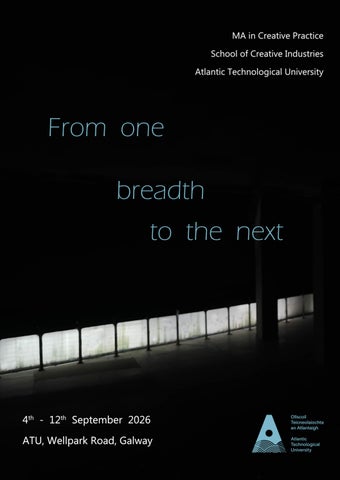
MA in
Creative Practice
From one breadth to the next - School of Creative Industries, Department of Creative Arts and Media, ATU Galway City
From one breadth to the next This exhibition presents the work of students undertaking the MA in Creative Practice at the School of Creative Industries, Atlantic Technological University, Galway. From one breadth to the next offers an insight into how twenty-one students approach expression through creation in a world overwhelmed by continuous movement with minimal time to slow down. Through the multitude of practices, we encounter work that explores the physical realm in a way that encourages us to take note of our experience of this moment, how we decide to persevere. Both natural systems and manufactured frameworks in motion are viewed through a critical lens, asking how we engage with each other and the land around us. Material investigation uncovers truths about our existence. What arises, how reality is perceived, is fragmented. The value of understanding lies in rebuilding this bridge, only after we grant ourselves permission for disruption. Should we take hold of that yearning to pause, there is a moment found where we recognise our bodies. Recalling memories moves us beyond boundaries, both physical and of the mind. Situated at the edge, an honest dissolution. Situated at the edge, a new expanse. Subjects sink and emerge, exceeding the frame. Through this work space is reestablished, connected across generations and lands. Unsettled eyes negotiate who and what receives our attention. Sharing stories, revealing what takes place above and below the surface, what begs for a release. All of this to consider how we realise care. Care in this way is not gentle, these works bravely encapsulate what is at our core and proposes that of others. These are spaces we must protect. When crossing the breadth of the map, take this time to appreciate your own breath.
Curator’s Biography Kate McSharry is a visual artist and curator based in the West of Ireland. Her practice explores pleasure and its dynamic relationship in material and space. Slow looking, rooted in care and critique, moving the body through fluid frameworks of exchange. Her practice has been supported by funding bodies such as Galway City Arts Office, the Arts Council of Ireland and Culture Ireland. She has worked with educational institutions Atlantic Technological University and University of Galway and was Education Officer at TULCA Festival of Visual Arts. Kate was on the board of 126 Artist-Run Gallery & Studios and is Administrator at Artspace Studios. She has curated exhibitions in Ireland and France and exhibited work in Ireland and Sweden.
-3-
From one breadth to the next - School of Creative Industries, Department of Creative Arts and Media, ATU Galway City
Um Al-Sikkeen, from the project Borders in Sand, 2025, documentary photograph, Shurab Displacement Camp, Deir al-Balah, Gaza.
Abdelrahman A. A. Ismail MA in Creative Practice
Abdelrahman Ismail is a Palestinian journalist, filmmaker and visual artist from Gaza, currently based in Ireland. Working across documentary film, photography, writing and visual research, his practice is rooted in lived experience, testimony and the fragile persistence of memory. For years, he documented daily life in Gaza under siege, recording not only destruction, but also the forms of endurance, intimacy and imagination that survive within it. His work asks what images can preserve when places, histories and bodies are exposed to violence, displacement and erasure. He is completing an MA in Creative Practice at Atlantic Technological University, Galway, where his research explores the relationship between childhood, space, power and visual testimony. His current project, Borders in Sand, examines games created and played by Palestinian children during displacement and genocide in Gaza. At its centre is Um Al-Sikkeen, a game in which children draw borders in the sand, divide land, form alliances and fight over territory, using the length of a knife as a unit of measurement. In these improvised rules, the political order surrounding them reappears in miniature: occupation, negotiation, hierarchy, loss and control. The project treats play as a form of testimony and spatial knowledge, revealing how children absorb and reinterpret the structures imposed upon their lives. Bringing together documentary photography, moving image, an artist’s book and installation, Borders in Sand traces the passage of borders from the political landscape into the imagination of childhood. It refuses to reduce these children to victims alone, recognising in their games a fierce act of invention: a way of naming the world, confronting it and remaking it, even amid devastation.
Drawing the Borders, from the project Borders in Sand, 2025, documentary photograph, Shurab Displacement Camp, Deir al-Balah, Gaza.
@abod__ismail abdelrahmanisma@gmail.com
-4-
From one breadth to the next - School of Creative Industries, Department of Creative Arts and Media, ATU Galway City
Drúchtín, 2026, Bioplastic Willow and Bog Myrtle, 63.5 x 63.5 x 88.9 cm
Bernie Joyce MA in Creative Practice
I am a multidisciplinary artist based in Connemara with a twenty-year practice spanning painting, drawing, printmaking, film, and photography. In 2024, I graduated with a BA (Hons) in Contemporary Art from Atlantic Technological University and received the Graduate Interface Inagh Residency. I then received an Ealaín na Gaeltachta Bursary Award and trained as a TAP+ artist. I work for GRETB, teaching junior cycle art, and as a freelance artist for organisations such as Pleanáill Teanga. Recent exhibitions include BACA Collective at the Laneway Gallery, Cork (2025), Interface Inagh at Clifden Arts Festival (2025), and K-Fest (2023). I work through the Irish language, drawing attention to the often unseen, behindthe-scenes dimensions of the Connemara landscape. My practice is shaped by the bog’s intricate, interdependent ecosystems. These fragile landscapes thrive on subtle exchanges—between organisms, water, air, and soil—and my work translates this ecological logic into sculptures. The hidden world of the bog inspires the forms themselves—Sundews, Bog Beacons, and other organisms that make this environment a living, breathing entity. I have turned to biodegradable bio-plastics as an alternative to more traditional media. These sculptures are made from natural materials, including bog plants, and are designed to dissolve and decompose over time, re-entering the ecological cycles they reference. Unlike petrochemical plastics, my bio-plastics are alive to their surroundings: they absorb moisture, shift with temperature, and gradually break down. After the exhibition, the sculptures will be documented as they transform— shrinking, growing mould, and dissolving—so that decomposition becomes not an endpoint but an integral part of the artwork’s lifecycle. My ambition is to continue my research and create locally sustained work that raises awareness of fragile ecosystems, such as the bogs of the west of Ireland, without adding to their degradation.
Feithidí an Choill, 2026, Bog Oak and Bioplastic, 63.5 x 30.5 x 119 cm
https://berniejoyce.ie/ @berniejoyce30
-5-
From one breadth to the next - School of Creative Industries, Department of Creative Arts and Media, ATU Galway City
Still from Called Progress. Still Here, 2026
Deborah Miranda Roldán MA in Creative Practice
Deborah Miranda Roldán is a Galway-based multidisciplinary visual artist, originally from Mexico City. Her current practice brings together film, motion graphics, mixed media and print. She holds a BA in Communication and Mass Media and a H.Dip. in Film Production from the Monterrey Institute of Technology and Higher Education in Mexico. After a decade of working as a video and film editor, motion graphics artist, and cultural events organiser, she moved to Ireland in 2019 to pursue an MA in Digital Media at the University of Galway. She has a strong interest in visual storytelling and her work often explores themes of migration, cultural resistance, social integration and identity. Now completing an MA in Creative Practice at ATU, Deborah explores the intersection of postcolonialism, migration and media by researching enduring traces of colonialism, revealed through the experiences of migrants from colonised contexts living in Ireland. Her video installation, Called Progress. Still Here, examines how colonial legacies continue to shape contemporary identities and social structures, while considering how the displacement of older media by new technologies mirrors colonial systems of hierarchy, erasure, and replacement in the name of modernity. Deborah’s work combines analogue printmaking and mark-making with mixed media and digital animation, to study how analogue practices can both challenge and adapt to narratives of technological progress, preserving material traces and alternative forms of memory.
Called Progress. Still Here, mixed media poster, 2026
@deb.mirandar www.debmirandar.com deb.mirandar@gmail.com
-6-
From one breadth to the next - School of Creative Industries, Department of Creative Arts and Media, ATU Galway City
Component pieces from Home Sick installation, 2026, 7x7cm ceramic tiles
Eva O’Byrne MA in Creative Practice
Eva O’Byrne is a multidisciplinary artist whose practice centres on social engagement. She has a background in psychology, youth arts and health research, and was codirector of 126 Artist-Run Gallery and Studios from 2024-2026. She is this year’s recipient of the Radius bursary, as part of a partnership between ATU and Corlann’s “That’s Life” Programme. Through this partnership, she has led a series of pop-up book making workshops for artists with intellectual disabilities. Eva’s MA project, Home Sick, explores gendered health experiences through collective body mapping, sculpture and installation. Specifically, it interrogates gendered social norms often applied to gynaecological health experiences. Beginning from a foundation of desk research and body mapping activities with workshop participants, this project aimed to question what it means to experience pain, sickness and wellbeing in a gendered body – and how such experiences interact with the social and physical environments in which we live our lives. Three group workshops were hosted over the past semester to develop these concepts, co-create body maps and zines, and discuss participants’ perspectives. Woven through the final pieces in various ways are contributions from 12 workshop participants, who have kindly shared their time, skills and stories throughout this project. Heartfelt thanks to contributors Fatena Abu Mostafa, Carla De Cerf, Jasmin Glavey, Bernie Joyce, Charlotte Nuyt, Yaiza Pilar Pozo Galvan, Deborah Miranda Roldán, Miriam Villacastin, Tracy Watson, and those who wish to remain anonymous.
Image from body mapping workshop, 2026
evaobyrne.art evamichelle.ob@gmail.com
-7-
From one breadth to the next - School of Creative Industries, Department of Creative Arts and Media, ATU Galway City
What Remains, 2026, digital collage
Fatena Abu Mostafa MA in Creative Practice
Fatena Abu Mostafa is a Palestinian poet, storyteller, translator, and multidisciplinary artist from Gaza, currently based in Galway, Ireland. Working across poetry, performance, and sound, her practice explores voice as a site of memory, survival, and resistance. Her work moves through displacement, exile, erasure, grief, and belonging, examining what remains within the body after rupture and loss. Through poetic storytelling and soundbased installation, she creates immersive experiences that invite audiences to engage through language and listening. Fatena has participated in international poetry readings and literary events, including the Cúirt International Festival of Literature, and her work has appeared in anthologies and literary platforms around the world. What Remains is a sound installation that brings together poetic storytelling and sound to explore the relationship between memory, voice, and forced displacement. At its centre is a suitcase given to Fatena before her evacuation from Gaza to Ireland. Once imagined as an object of travel and return, it became a marker of rupture: the moment an ordinary journey was replaced by forced departure. The suitcase becomes both narrator and witness, carrying a story that unfolds through voice. Rather than trying to reconstruct the past, the installation creates a space for listening and explores how voice and sound can carry embodied memory. Long after places, objects, and landscapes have been left behind, voices continue to inhabit the body, preserving what cannot be physically carried and resonating beyond the moment of speaking. Through recorded poetry, silence, and remembered sounds, audiences encounter memory as something not only remembered but continually heard. As they leave, visitors are invited to record a word, sentence, memory, or sound that remained with them. Recorded on Fatena’s mobile phone—the only personal archive she was able to carry from Gaza—their responses allow the work to extend beyond a single story, gradually becoming a shared archive of voices and of what remains.
What Remains, 2026, digital photograph
fatenamustafa2001@gmail.com _fatenamostafa_
-8-
From one breadth to the next - School of Creative Industries, Department of Creative Arts and Media, ATU Galway City
This is Fine? 2026 (Installation detail) Material Memory
Fiona Hession MA in Creative Practice
For Fiona Hession, making is a way of remaining in relation to a world that cannot always be understood. Working across installation, textiles and painting, her practice explores how materials can hold experiences that resist language, carrying emotional, social and political realities through processes of making rather than leaving them solely within the body. Pattern becomes a grounding structure; domestic objects become repositories of memory and materials act as metaphors through which contradiction, vulnerability and care can be negotiated. The return to her practice in 2023 marked a profound shift in her work towards questions of how art functions when understanding reaches its limits. This Is Fine? (2023–2026) grew from an increasing awareness of the emotional pressures of contemporary life. Borrowing its title from the familiar internet meme, the addition of a question mark transforms passive acceptance into an act of enquiry. It asks how we continue to live ordinary lives while remaining conscious of extraordinary suffering. At the centre of the installation, an upholstered armchair wrapped in bespoke devoré velvet weaves imagery drawn from Palestinian visual culture into the ornamental language of historical damask. A reconstructed lampshade, salvaged from a childhood home, and altered landscape paintings that once hung over Irish mantels, further disrupt the familiarity of the domestic interior. Together, these objects no longer offer escape from the world beyond them, instead, they reveal how global realities become woven into the fabric of ordinary life. Rather than explaining violence or offering solutions, This Is Fine? creates a place where contradiction can be held. It asks what it means to witness without turning away, to care without becoming consumed, and to remain in relation to realities that cannot be fully resolved. In doing so, the work offers not certainty, but companionship in the difficult work of staying present.
This is Fine? 2026 (Installation detail) Playing with Fire 4
fionahession21 fiona-hession-789b091a fionahession@outlook.com
-9-
From one breadth to the next - School of Creative Industries, Department of Creative Arts and Media, ATU Galway City
Repose, Limerick, 2026. Photographic pigment print, 25 x 38 cm.
Janne Hernes MA in Creative Practice
Janne Hernes is a photographic artist based in Galway, originally from northern Finland. His practice is centred on long-term projects in which a specific place or motif serves as a basis for exploring concepts and emotions. Hernes situates his practice at the intersection of subjective documentary and art photography. He works with both digital and analogue techniques and specialises in fine art pigment printing. Hernes is a qualified teacher of philosophy and an adult educator. He holds a master’s degree in philosophy and is completing his MA in Creative Practice at Atlantic Technological University, Galway. REPOSE: Pastoral Repose Reimagined REPOSE reimagines pastoral repose in the urban landscape. Repose refers to rest, recuperation, or tranquility following exertion. As a verb, it fails: it should express action, not the absence of it. Yet repose also carries a more archaic meaning. In classical pastoral poetry, repose is imagined as a place of rest and respite, removed from the anxieties of urban life. It is an idyll inhabited by shepherds who sing songs of love and loss. Yet, for classical writers, repose was not simply a retreat, but also a place to reflect on contemporary tensions and preoccupations. Bucolic beauty was contrasted with dispossession and exile, with life exposed to the elements. The project explores what happens when repose is separated from the pastoral world and relocated to the contemporary urban setting. While interrogating the pastoral narrative, REPOSE also examines displacement: the expulsion of people and the disintegration of objects. Pieces out of place. Can a photograph of a cardboard bed in a doorway evoke repose? Is this not the end of the pastoral dream, its dystopian reversal? And yet, for a moment, it becomes a place of respite amid trying circumstances.
Repose, Athlone, 2026. Photographic pigment print, 25 x 38 cm.
www.jannehernes.com
- 10 -
From one breadth to the next - School of Creative Industries, Department of Creative Arts and Media, ATU Galway City
‘An Banshee’ (2026). Poster, digital design.
Jasmin Glavey MA in Creative Practice
“Did I ever tell you now…” Jasmin Glavey is an animator based in Ireland, with interest in stories of past and contemporary Irish life. ‘An Banshee’ is an animated work which captures a brief moment between Mrs. McLoughlin and her grandson Fionn. Situated within the warmth of McLoughlin’s shop at the heart of an Irish town, the story is inspired by moments of nostalgia, time and those who could weave a story from thin air. This piece is to act as a reminder to stop and appreciate these people and memories shared, highlighting this rich culture which continues to live on in today’s modern world. ‘An Banshee’ was created using a blended animated process: a combination of 2D & 3D elements and processes within its production. In using a blended method of animation, balance between the crafted look of traditional animation, which invokes this desired sense of nostalgia, while also embracing the capabilities that 3D animation has to offer is achieved. This process resulted in the final delivery of the piece to feel playful and unapologetic in its imperfection. Highlighting the human presence in the final cut, while using digital animation methods as a means to uplift the artist rather than to mask. This style enhances the narrative of the piece, forming a world where for a brief moment the viewer is encapsulated within the space of Mrs. McLoughlin’s shop. The environment in which the animation is shown is designed for viewers to immerse themselves in this story and its message. Hand crafted zines add a physical element which aims to further highlight the creative process of animation, ranging from character development and storyboards, to narrative development and inspiration.
‘An Banshee’ (2026). Environment detail, digital design.
@jas_g2001
- 11 -
From one breadth to the next - School of Creative Industries, Department of Creative Arts and Media, ATU Galway City
Julliana Gazzinelli MA in Creative Practice
Julliana Gazzinelli is a Brazilian architect and interior designer with extensive experience in high-end residential design, having worked with prestigious architecture practices in Rio de Janeiro. Living abroad reinforced her belief in the importance of public places that invite people to pause, linger, and find refuge from the pace of everyday life, reconnecting with themselves and with nature. Guided by a biophilic approach, her work explores architecture as an infrastructure of presence, seeking a balance between organic curves and orthogonal forms to create spaces that cultivate well-being, belonging, and a deeper connection with the natural world. Urban Oasis: A Refuge for the Senses The Architecture of Pause as a Structure of Presence We are living through an often imperceptible process of dehumanisation. As technology accelerates the rhythm of everyday life, we become increasingly disconnected from ourselves and the natural world. Spaces for stillness and contemplation are rare. This project began with a simple observation in Salthill Park. Despite extraordinary surroundings of Galway Bay, the park functions primarily as a place of movement rather than permanence. People pass through the park, but rarely stop to experience it in full. Urban Oasis proposes an architectural intervention that transforms this condition. Rather than creating another destination, it creates an invitation to remain. Drawing upon biophilic architecture, this proposal weaves a series of pavilions into the existing landscape, extending the site’s natural terraces into spaces for gathering and quiet reflection. Here, architecture does not compete with nature. Instead, it frames it, allowing the landscape to become the protagonist. Grounded in the belief that meaningful presence is fundamental to our relationship with one another and the natural world, this project argues that our future depends not only on technological innovation but also on our capacity to reconnect with the source from which we come. Nature is not simply our environment; it is our origin. By returning to nature, we rediscover the essence of what it means to be human. @annagaboratelier
- 12 -
From one breadth to the next - School of Creative Industries, Department of Creative Arts and Media, ATU Galway City
Dear Jack. 2026. Documentary.
Kyle Moylan MA in Creative Practice
Kyle Moylan is an Irish-American writer and filmmaker based in Galway. His work explores memory, family, place, and the ways stories are carried between generations. His current practice moves between screenwriting and filmmaking, with a particular interest in the relationship between personal history and fiction. His work often draws on archival material and inherited stories to examine how we understand people and places that exist beyond our own memory. Dear Jack is an essay film developed as part of his MA in Creative Practice at Atlantic Technological University. Through photographs, archival footage, and family stories, the film considers what it means to form a relationship with someone you never had the opportunity to know.
kmoylan35@gmail.com
- 13 -
From one breadth to the next - School of Creative Industries, Department of Creative Arts and Media, ATU Galway City
Print, 2026
Letícia Luiza de Oliveira MA in Creative Practice
Letícia Luiza de Oliveira is a Brazilian fashion designer based in Galway. Her experience of living between Brazil and Ireland has shaped her creative practice, which explores cultural identity, migration, belonging, and femininity through fashion. Her practice is centred on the celebration of women, exploring themes of strength, resilience, and emotional complexity. Through research, textile experimentation, print design, and garment construction, she develops fashion as a means of storytelling and cultural expression, with a particular interest in the relationship between identity, place, and personal experience. Her current project explores the connection between Brazilian and Irish maritime narratives, particularly the figure of Iemanjá within Brazilian cultural memory and the Selkie within Irish folklore. The sea becomes a central metaphor for movement, transformation, memory, and the experience of existing between two cultures. Through the development of a fashion collection, the project brings these narratives into dialogue, exploring how mythology, symbolism, and cultural references can be translated into contemporary garments. The collection investigates hybridity not as a conflict between two identities, but as a space where different cultural experiences can coexist and inform one another. Through this work, Letícia aims to create a collection that communicates femininity, fluidity, and cultural connection while reflecting on authorship and representation within fashion. The project ultimately seeks to celebrate the richness of living between cultures and the personal narratives that emerge from this experience.
Moulage experimentation, 2026
@portfolioleticia
- 14 -
From one breadth to the next - School of Creative Industries, Department of Creative Arts and Media, ATU Galway City
Artist Books on display
Liz Moran MA in Creative Practice
Liz Moran is a Galway based artist. She holds a BA Hons in Contemporary Art and a BSc in Marine Science. She is a member of Arts organisations including the VAI and Interface Inagh. Her work has been short and long listed for a variety of prestigious awards and she has attended various residencies. Liz’s work is concerned with the ocean, in particular the transitional point where sea and air meet - the air water interface. This preoccupation grew from a childhood beside the sea in Dublin and continues to be informed by regular immersion in the Atlantic. Proximity to the sea is key to her wellbeing. Her imagery investigates and expresses the fundamental nature of this relationship. Purity, honesty of materials and the play of light are essential elements within the work. Using a variety of media including paint, dye, video and photography Liz creates twodimensional pieces, three-dimensional objects and moving paintings. Liz presents her work to prompt questions around human perceptions and awareness of all that is seen and unseen and to encourage reflection on our own individual impact and interactions with the natural world - in particular the ocean and bodies of water. She recognises lakes, rivers and seas as Beings in and of themselves. These works seek to ignite within us a sense of custodianship for all waters and our environment’s delicate balance.
Artist with piece
lizmoranart@gmail.com www.lizmoran.com @lizmoranart
- 15 -
From one breadth to the next - School of Creative Industries, Department of Creative Arts and Media, ATU Galway City
Blooming Willow, 2026, Detail View
Mariana Tang MA in Creative Practice
Mariana Tang is a Luso-Asian visual artist currently based in Galway, Ireland. Her work is multidisciplinary, combining installation, textiles, drawing, printmaking and technology. She holds a BA in Drawing from the Faculty of Fine Arts of the University of Lisbon (FBAUL) and is currently finishing an MA in Creative Practice at Atlantic Technological University (ATU), Galway. Her work has recently been shown in group exhibitions such as Tentacular Ways: art strategies, ecosystems and planetary transformation at the Academy of Fine Arts Vienna (2025), and GABA at FBAUL (2025). Her background in traditional and digital drawing influenced a multidisciplinary practice that blends art and technology, leading her towards experimenting with immersive installation work and a range of media. Her artistic core is rooted in personal experiences with the sublime, exploring topics such as human life, nature, connection, memory, community, and growth. She invites the public to engage with these themes on a physical and sensory level, opening space for personal reflection. Blooming Willow Mariana’s current work, titled Blooming Willow, explores the ephemerality of life through the biophilia hypothesis: the innate attraction humans have towards other natural forms of life. In this installation, the female figure embodies the weeping willow’s spirit portrayed in the ancient Japanese folklore, “The Willow Wife”. This tale reflects the innate human desire for connection with nature and living beings. This behaviour is a human response to mortality, driving us to pursue connection, growth and presence. Resembling a weeping willow tree, this artwork intends to engage and envelop viewers within its dome, encouraging awareness of the present moment and surroundings. In her practice, Mariana embraces craftsmanship through creating handmade pieces to establish a humanistic approach and reflect the value of this within artists’ creative processes.
Blooming Willow, 2026, Detail View
marianatang.com @mariana.tang contact@marianatang.com
- 16 -
From one breadth to the next - School of Creative Industries, Department of Creative Arts and Media, ATU Galway City
“Sedimented”, 2026, Archival Matte Paper, 21x15cm
Mariola Wiazowska MA in Creative Practice
Mariola Wiazowska is a Galway-based contemporary artist whose practice is rooted in the bogs and wetland ecologies of the west of Ireland. Working across photography, scanography, digital image-making and mixed media, she investigates the relationship between fragile ecosystems and the increasing presence of plastic within the natural environment. Her work is informed by long-term fieldwork and sustained engagement with peatlands as landscapes that hold ecological and cultural significance while existing as spaces of continual transformation. Through walking, close observation, material collection and experimental imagemaking, Wiazowska explores how synthetic materials gradually become embedded within wetland environments, often becoming visually inseparable from the landscapes they inhabit. Rather than documenting environmental degradation directly, she uses abstraction, layering and visual ambiguity to slow perception and encourage closer looking. Her work reveals ecological processes that are often gradual, hidden or overlooked, inviting viewers to reconsider the relationship between human activity and the natural world. Rooted in a sustained relationship with the wetlands of the west of Ireland, her practice understands artistic making as a form of enquiry. By combining reclaimed materials with photographic processes, she explores how contemporary art can make visible the subtle transformations occurring within fragile ecosystems. Through this work, Wiazowska reflects on landscape as a site of ecological change and material entanglement, encouraging greater awareness of our shared responsibility towards these vulnerable environments.
Untitled, 2026, ILFORD FB Semi-Matt, 24x30,5cm
www.marwia.com
- 17 -
From one breadth to the next - School of Creative Industries, Department of Creative Arts and Media, ATU Galway City
What’s in My Head? (2026)
Mark Byrne MA in Creative Practice
Mark has worked in film and television since 1995 in various capacities, but almost always around the camera. He has worked with Oscar-winning directors of photography on blockbuster feature films and alone on no-budget shorts and documentaries, travelling extensively and working with legendary directors such as Nicholas Roeg and John Boorman. His first two feature documentaries, Beyond the Wall and Under the Hood, have found international audiences through festival and television screenings. His latest, The S.U., was joint winner of the Best Feature Documentary award at the Galway Film Fleadh this summer. Having collaborated with other filmmakers on his previous documentaries, this is his first solo project. What’s in My Head? is a scripted and somewhat absurdist documentary by Mark Byrne featuring his friend Danny. The film challenges audiences to question their own assumptions, the motives of the filmmaker, and the reliability of the subject. Warm and funny with a little bit of heartbreak, What’s in My Head? provides no easy answers and sometimes forgets the questions.
What’s in My Head? (2026)
@markbyrnedocs www.imdb.com/name/nm1530600
- 18 -
From one breadth to the next - School of Creative Industries, Department of Creative Arts and Media, ATU Galway City
A Garden in Claddagh, 2026 Digital photograph, from Entangled Care
Miriam Villacastin-Sanchez MA in Creative Practice
Miriam Villacastin is a Spanish multidisciplinary artist based in Galway, Ireland. She holds a BA (Hons) in Contemporary Art from Atlantic Technological University and is currently completing an MA in Creative Practice at the same institution, alongside previous qualifications in Industrial Relations, International Development and Migration Studies, which continue to inform her artistic practice. Her work explores contemporary social realities, with a particular interest in migration, family structures, care, equality and representation. Entangled Care is a multidisciplinary installation that examines the intersections of race, migration, gender and single motherhood through the experiences of interracial families living in Ireland. Combining video, photography, sculpture, sound and domestic objects, the installation recreates the intimacy of a family home, where ordinary acts of care shape everyday life. With a particular focus on textured hair care, the work presents this practice as a space of connection, where mothers navigate unfamiliar traditions, acquire new skills and engage with practices beyond their own cultural upbringing to support their children’s identities. Developed through practice-led research and conversations with mothers raising children of mixed backgrounds, the installation highlights how knowledge can be learned, adapted and shared across generations. Through this project, Miriam seeks to make visible family experiences that remain largely absent from mainstream visual culture and public discourse.
Unfinished, 2026 Digital photograph, from Entangled Care
@villacastin.miriam
- 19 -
From one breadth to the next - School of Creative Industries, Department of Creative Arts and Media, ATU Galway City
The Last Meeting, acrylic and mixed media on canvas, 150x120cm, 2026.
Mohammed Abdulrahman Khalil Almadhoun MA in Creative Practice
Mohammed Almadhoun was born in the Gaza Strip. He is a visual artist whose journey in the arts is characterised by passion, dedication and a permanent connection to his cultural roots. He holds a Bachelor’s in Art Education from Al-Aqsa University (2004) and is completing an MA in Creative Practice at ATU Galway, Ireland (2026). As an active member of the Fine Artists Syndicate and the Arts Committee of the Directorate of Education, Al-Madhoun played a pivotal role in promoting artistic expression within his community. Mohammed has worked across multiple arts disciplines, held several solo exhibitions, and participated in many group exhibitions. He has worked internationally through exhibitions and residencies. Through his art, Mohammed continues to inspire, educate and defend the beauty and resilience of Palestinian culture. Mohammed’s studio, along with his 25-year-old paintings, and his family home in the Jabalia refugee camp in the northern Gaza Strip, were destroyed in the bombing and reduced to rubble. The colours in his current paintings indicate the war of genocide on Gaza: flaming colours as a result of explosions on homes and defenseless people, expressions of intense grief and loss - sometimes appearing as ghosts bidding farewell. The sun fades and comes back to shine again, but children are gone without coming back. In some paintings, Mohammed focuses on the Irish natural landscape. The cliffs and ocean offer character and a moment of stillness. The texture in these works are a main element. In other works, you will see these worlds merge through the use of warm and cold colours. Mohammed is continuing to experiment through this medium, with utmost dedication. His work was presented in Scrimshaw Journal, at the Irish Writers Centre in Dublin, and he recently received a special invitation to present work to Catherine Connolly, the President of Ireland.
The Cliffs of Moher, acrylic and pigment on canvas, 90x90cm, 2026.
art2_ps@hotmail.com art2_ps artm.madhoun
- 20 -
From one breadth to the next - School of Creative Industries, Department of Creative Arts and Media, ATU Galway City
“Threshold // 01” 120cm x 100cm, mixed media on canvas, 2026
Scott Sheridan MA in Creative Practice
Scott Sheridan is an Irish multidisciplinary artist whose practice explores the relationship between painting, digital technology, and the post-digital image. Combining photography, collage, digital manipulation, and painting, his work investigates fragmentation, materiality, and the evolving human figure through cyclical processes of transformation. Informed by contemporary philosophy and art history, his research examines how digital technologies reshape perception, memory, and representation, while exploring painting as a critical material response to contemporary image culture. Becoming Through the Screen explores the human figure within post-digital culture, where digital technologies increasingly shape how images, memory, and identity are produced and experienced. Each work begins as a hybrid digital image created through drawing, photography, and digital manipulation before being printed, torn apart, reassembled as collage, and integrated with acrylic paint. The completed works are then photographed, digitally reworked, and reintroduced into the creative cycle, creating an ongoing dialogue between physical and digital media. This methodology reflects a post-digital condition in which images no longer exist as singular originals but continually circulate, are copied, altered, and transformed. Influenced by Cubism, Dada, and the philosophies of Bernard Stiegler, Gilles Deleuze, Martin Heidegger, and Hito Steyerl, the project positions painting as a material engagement with digital culture. Displayed alongside selected paintings are digitally reworked counterparts, revealing images in continual becoming through cycles of technology, material process, and human intervention.
“Drift // 01” 120cm x 100cm, mixed media on canvas, 2026
- 21 -
From one breadth to the next - School of Creative Industries, Department of Creative Arts and Media, ATU Galway City
Detail of stitch work, 2026, thread, paper, Textiles, 20w x 22h cms
Teresa Mulholland MA in Creative Practice
Teresa Mulholland works as a Psychotherapist and Art Therapist. She holds a BA in Art & Design (GMIT, 2018) and an MA in Art Therapy (Crawford, 2009). Teresa works across multiple processes including drawing, painting, textiles, sculpture and installation. Her practice currently explores connecting with the archetypal feminine through textiles and how this can promote balance and empowerment. Textiles, often associated with the Feminine and the domestic, are an appropriate medium to explore the repressed feminine, through the Goddess theme. Working in this manner has the potential to awaken a deep remembering of the lost, forgotten and hidden archetypal feminine values in our world: the relational, receptive and intuitive. These values are eclipsed by the rational materialism linked with the archetypal masculine. Textiles evoke early memories of touch, connection and comfort. Transitional objects such as soft toys and blankets give children a sense of safety and security. ‘Harlow’s Monkeys’ uncovered ideas around attachment and the importance of contact and comfort. This experiment illustrated how baby monkeys spent more time clinging to an artificial monkey mother covered in terry cloth, as opposed to another figure made of wood and wire even though this figure dispensed food. The slow, repetitive actions of hand-stitching benefit one’s well-being, offering a meditative relaxed theta brain wave state. These actions are not unlike the bilateral stimulation that is used in EMDR (eye movement desensitisation reprocessing) to process traumatic memories & experiences, flashbacks, and maladaptive information processing. Stitching facilitates our need to slow down, withdraw and create space for inner reflection.
Detail stitchworked figurine, 2026, Threads, Organza fabric, Textiles, 25h x 12w cms
Teresa uses stitch to unearth the Goddess, to reconstruct the missing feminine aspects of our collective psyche. Her practice aims to inspire integration, celebration and preservation of these parts in all of us, enabling balance, and easing the tension of opposites between the masculine and feminine. @teresa0mul
- 22 -
From one breadth to the next - School of Creative Industries, Department of Creative Arts and Media, ATU Galway City
Silver Moon, 2026, Sycamore, 20cm, Lime Wax finish
Tommy Carew MA in Creative Practice
Tommy Carew is an award winning multi-disciplinary artist. He studied at the prestigious Furniture College in Letterfrack in the late 1990’s. After building over twenty-five years of experience in various fields including creative woodworking in special education, craftwork, lutherie, boat-building, sculpture and bespoke furniture design-make practice, Tommy has been drawn into the Art world to formulate an approach that combines his innate creativity. He is paying attention to his natural curiosity and listening to a powerful call to express himself through working creatively with wood. Tommy is also a multiinstrumental musician and singer set on exploring how music translates into the visual world, where both form and sound can create something simple that augments our experience and opens internal complexities and richness. About the Work I have consciously blurred the lines between Art and Design for many years. This body of work has gone beyond my usual boundaries as I stepped confidently into a deeper exploration through the medium of wood. I returned to a playful and free approach to making and to personal creative expression. My work has been curiosity driven and intuition guided, involving deep introspection and analysis of structures and systems invisible to us, but which expose frameworks where both humans and the natural world hold the same patterns. This philosophical approach was accompanied by Science, Art, Technology, Psychology, Nature, and strong Mythological connection.
Fire in my head, 2026, Sycamore, Pewter, 30cm x 30cm x 45cm
tommycarewdesign www.tommycarewdesign.com tommycarew@gmail.com
- 23 -
From one breadth to the next - School of Creative Industries, Department of Creative Arts and Media, ATU Galway City
Detail of Marine Snow: Milky Seas, 2026, textile / mixed media hanging 2m x 0.8m
Tracy Watson MA in Creative Practice
Tracy’s sewing skills have evolved into artistic expression as textile creations inspired by her passion for ocean and environmental sciences. Using fabric, dye, beads, thread and stitch her exploration of marine & environmental themes is researched and informed by an academic and professional career in oceanography, environmental regulation / management. Tracy is a member of textile communities in Ireland and Europe and is active with workshops and exhibitions. She is working on her M.A. in Creative Practice at ATU Galway and is a student member of Studio Artists Quilt Associates (SAQA). ATU’s M.A. is giving fresh momentum to her work and supporting the evolving expression of her ideas. Exploring her wonder, delight and connection to the ocean, Marine Snow, her hangings are informed by oceanography to illustrate and illuminate the ocean’s life, fluidity, beauty, fragility and challenges of its relationship with humanity.
Detail of Marine Snow: Sunlight & Silt, 2026, textile / mixed media hanging 2m x 0.8m
tracy.textile.artist tracy@pixelbrush.ie. tracy-watson-449b28177
- 24 -