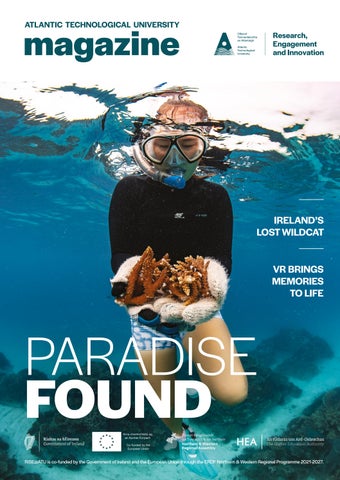
IRELAND’S LOST WILDCAT VR BRINGS MEMORIES TO LIFE
PARADISE FOUND RISE@ATU is co-funded by the Government of Ireland and the European Union through the ERDF Northern & Western Regional Programme 2021-2027.
Mark O Connor Donegal Bay Trust
Editors-in-Chief:
Acknowledgements:
Anne Donnelly and Jorden McMenamin
Creative Enterprise West (CREW); Data2Sustain EDIH; Enterprise Ireland’s New Frontiers Programme; Horizon Europe; Medical & Engineering Technologies Gateway (MET); Precision Engineering & Manufacturing Gateway (PEM); Research Ireland; Special EU Programmes Body (SEUPB); Transformative Research & Innovation in the Built Environment (TRIBE); TU Research and Innovation Supporting Enterprise (TU RISE); Ulster Wildlife; Western Development Commission (WDC); WiSAR Technology Gateway (WiSAR)
Contributors: Ivana Hanjs, Regina Daly, Aidan Haughey, Professor Patrick Pollock, Bernadette Larkin, Jorden McMenamin, Anne Donnelly, Dr Shane Conway, Marita Kinsella, Chris Cornwall, Lynda Duffy, Dr Valerie McTaggart, Miguel Blázquez, Dr Laura Keaver, Vanessa Nobles, Katelyn Hegarty-Kelly, Dr Marion Dowd, Professor Suresh C. Pillai, Dr Conan O’Ceallaigh, Dr Eimear Magee, Erin Pyper, Joanna Frivet, Anagha Ramesh M., Karl Bonner, Joanne Kilmartin and ATU staff and researchers. Photographers: Conor Doherty, Brooke Pyke, Ken Williams, ATU staff, Brad Anderson, James Connolly, Clive Watson, Mark O’Connor, Mike Shaughnessy and Shane O Neill.
We would like to acknowledge the support of funding in the development of this magazine received through the Technological University Research and Innovation Supporting Enterprise (TU RISE) scheme through RISE@ATU, co-funded by the Government of Ireland and the European Union through the ERDF Northern & Western Regional Programme 2021-2027.
Website: www.atu.ie/research
Design & Layout:
Contact us:
The Foundation
communications@atu.ie
Printer: GPS Colour Graphics
On the cover: Katelyn Hegarty-Kelly is helping rebuild coral reefs as part of Reefscapers. Photo credit: Brooke Pyke
ATU Magazine | 3
ATLANTIC TECHNOLOGICAL UNIVERSITY MAGAZINE
Discover our region Uncover our impact Every discovery begins with a question. Sometimes that question leads us into the past, into caves and ancient landscapes, searching for clues about prehistoric wildcats, lost ecosystems and the species that came before us. Sometimes it leads us into the deep blue of the ocean, into cutting-edge laboratories, or into the heart of local businesses shaping a new frontier. At Atlantic Technological University (ATU), our research is shaped by the places we know and the communities around us. It is carried out along coastlines and islands, in towns and villages, and in workshops, clinics and enterprises across the region we call home. The search may begin in the West and Northwest of Ireland, but our influence extends far beyond these regions.
4 | ATU Magazine
In this special edition of the ATU Magazine, we meet a few of the researchers behind the discoveries the archaeologists finding Ireland’s lost wildlife, the marine biologists exploring the hidden lives of humpback whales and restoring coral reefs in the Maldives, and the scientists keeping memories alive and developing life-saving approaches in cardiac care. Together, they show research as a process of partnership and progress that connects us all.
ATU Magazine | 5
ATLANTIC TECHNOLOGICAL UNIVERSITY MAGAZINE
Contents 08 ATU President’s Welcome 09 A Word from the Chief Officer Research, Innovation and Engagement Health and Wellbeing 10 Bringing memories to life
From family farms to Donegal beaches, immersive technology is helping care home residents reconnect with cherished memories.
14 Nutrition still overlooked in cancer survivorship
New research highlights the role of nutrition after cancer treatment.
16 At the heart of it
Inside the story of CroíValve and the researchers working to change cardiovascular care.
18 Reducing the paperwork burden
The Donegal start-up reducing medical notes from hours of work into minutes.
20 Shaping the future of pharmacy
Marita Kinsella discusses the research, education and collaborations driving the next generation of pharmacy.
24
0,000 reasons Ireland needs 2 greater access to genomic testing
Why one researcher believes more people in Ireland should have access to genomic testing.
6 | ATU Magazine
Environment and Sustainability 26 The secret lives of Ireland’s humpback whales
Miguel Blázquez is reshaping our understanding of one of the world’s most iconic marine mammals.
30 Paradise found
Meet the Irish marine biologist helping restore coral reefs in the Maldives.
34 How Killybegs is turning the blue economy green
Killybegs is emerging as a centre for developing and testing marine innovation.
38 The return of the corncrake
The tide is turning slowly on this endangered species according to research by Dr Andrea Parisi.
40 Healing the bog
From wildfire recovery to ecosystem restoration, researchers are helping us understand how Ireland’s peatlands can heal.
42 Ireland’s lost wildcat
The earliest directly dated wildcat ever found in Ireland has been identified, marking a breakthrough in understanding prehistoric wildlife.
Society and Enterprise
Technology and Innovation
46 A seat with a view
60 Could timber solve construction’s carbon problem?
The Glenveagh project transforming a scenic viewpoint into an experience that can be seen, heard and shared.
Dr Conan O’Ceallaigh explores how mass timber engineering is transforming construction into a climate solution.
48 Supporting farm succession through social connection
62 Rethinking veterinary medicine
52 Remote worker or coworker?
64 Can AI solve a legal problem?
54 One million people work from home in Ireland, but can we ‘manage’?
66 A second life for ghost gear
By tackling isolation and promoting wellbeing, Farmer’s Yards makes the transition through farm succession easier for older farmers.
Dr Valerie McTaggart asks whether coworking leads to better collaboration at a time when being remote reshapes working life.
New research led by PhD student Neil Farren suggests managers may be the most under pressure.
56 The untold story of Suresh
From a childhood in rural India to election to the Royal Irish Academy, Prof Suresh Pillai reflects on the people and discoveries that shaped his career.
59 Driving regional partnerships: ATU’s €152 million PEACECPLUS funding to support cross-border partnerships.
Prof Patrick Pollock shares what the future of animal health looks like, and how universities, industry and communities can work together to build it.
When seeking legal advice that can have life-altering consequences, Joanna Frivet asks do we ensure the information people receive, is accurate and trustworthy?
How discarded fishing gear is being recycled into product potential.
68 Power without batteries
ATU researchers have developed battery-free smart sensor for structural health monitoring.
70 Beyond the research
PhD student Erin Pyper shares her passion for adventure, mountain running and pushing her limits.
72 On the horizon
A glimpse of the people, projects and discoveries advancing research and innovation across the region.
74 Research radar ATU Magazine | 7
ATLANTIC TECHNOLOGICAL UNIVERSITY MAGAZINE
ATU President’s Welcome Engaged Research is one of five guiding lights central to ATU’s strategic plan aimed at driving investment, collaboration and engagement across our region. As a technological university, we are in a unique position to support our students, communities and enterprises. To address the challenges faced by modern Ireland, ATU’s activities align with the national framework outlined in Impact 2030 Ireland’s Research and Innovation Strategy (DFHERIS, 2022) and Ireland’s Smart Specialisation Strategy (DETE, 2022). Both initiatives share a commitment to increasing research talent and expertise across disciplines to find solutions for society. At a regional level, the Northern and Western Regional Assembly sets the scene for our local impact. We have recruited over 60 PhDs researchers and 12 postdoctoral positions to boost enterprise support from the landmark €19.6 million investment secured through TU RISE. Across our shared island, the PEACEPLUS programme strengthens our role as a regional anchor institute through cross-border partnerships. Under this funding, the university achieved unprecedented success with projects totalling almost €152 million approved with close to €34 million available to ATU. For the Atlantic, the proposed Ocean Innovation Centre (OIC) in Killybegs creates a space where marine research, industry, maritime skills can come together around the needs of the blue economy. Our relationships with Research Ireland, the Marine Institute, and the Western Development Commission, among many other research partners and collaborators, place this valuable work within a much larger research ecosystem.
Dr Orla Flynn, ATU President
8 | ATU Magazine
In 2025, ATU secured first place in Ireland and third globally for scientific contributions to marine pollution research by our Marine Freshwater Research Centre (MFRC). Marine science continues to be an area of one of our greatest research strengths having world renowned researchers in this field. In 2026, ATU introduced two significant programmes to our students with the School of Veterinary Medicine and the Department of Pharmacy and Pharmaceutical Sciences. Other research areas are emerging in our newly established School of the Built Environment, centred on the sustainable future of construction and infrastructure.
We see the delivery of new rural inclusion initiatives for our farming community with Farmer’s Yards, restoration projects healing our local wildlife, and coworking hubs providing spaces for connection. Throughout this special edition, ATU Magazine represents a lighthouse spotlighting individuals and knowledge driven industries who make a difference to our region. Beir bua, foireann OTA! Dr Orla Flynn ATU President
A Word from the Chief Officer Research, Innovation and Engagement This special edition showcases the breadth of research, innovation and engagement taking place across ATU. The stories featured here demonstrate how research can improve lives, support enterprise, inform policy and deepen our understanding of the world around us. From marine and environmental science to health, engineering, digital technologies, heritage and social innovation, our researchers are tackling important questions and developing solutions to real-world challenges. Partnership is a defining strength of research at ATU. Working alongside industry, public sector organisations, community groups and international collaborators, our researchers ensure their work remains relevant, responsive and connected to societal needs. The stories in these pages represent only a sample of the work taking place across the university, but they capture the ambition, talent and dedication of our research community. I hope they provide an insight into the people, ideas and partnerships that are helping shape a better future.
Dr Brendan Jennings, Chief Officer Research, Innovation and Engagement
ATU Magazine | 9
ATLANTIC TECHNOLOGICAL UNIVERSITY MAGAZINE
Bringing memories to life In partnership with Hillcrest Nursing Home, ATU researchers are using virtual reality (VR) to transform reminiscence therapy for older adults. Residents can step into immersive 360° environments tailored to their personal histories, from familiar seaside landscapes to culturally meaningful settings, designed to spark memories, encourage conversation and reduce anxiety. Working closely with residents, families and care professionals, the research team is codesigning solutions that ensure the technology enhances, rather than replaces, human connection. Project lead and lecturer in computing, Dr William Farrelly, explains: “This project is about more than technology; it’s about ensuring older adults remain connected, stimulated and supported every day.
By combining immersive environments with intelligent AI, we aim to create experiences that uplift, empower and enhance quality of life.” “Over a 12-week pilot, we introduced 360° immersive videos to residents at our Hillcrest and Archview care homes in Letterkenny, designed to evoke nostalgia and bring joy to residents,” said Luke Gavigan, Director of Riada Care Ltd. “This initiative combines two key elements: creating immersive content that brings cherished outdoor experiences into the facility and empowering staff and family members with the tools and training to create personalised VR content for their loved ones.”
Residents participating in the pilot reported significant emotional uplift, enhanced engagement and reduced feelings of isolation.
“ He finds that immersing himself in these virtual environments helps shift the focus away from discomfort, offering relief and freedom.” Nurse on a care home resident at Hillcrest
10 | ATU Magazine
HEALTH AND WELLBEING Nurses at Hillcrest Nursing Home noted that a resident living with chronic pain found that the VR sessions provided a powerful and welcome escape. A virtual walk through a farm saw another resident engage more in conversation, becoming more talkative than ever before. Hillcrest Nursing Home has long used reminiscence therapy as part of its care offering, helping older people reminisce and share emotional experiences from their lives. However, many residents did not always engage with traditional photographs, conversation and storytelling. Faced with these challenges, Hillcrest turned to Data2Sustain’s Test Before Invest programme and applied for support. Hillcrest was able to explore and test VR content created specifically for the local environment, featuring landscapes and surroundings familiar to residents. The results were immediate, with residents responding with smiles and sharing stories. To ensure the programme’s sustainability, the research team developed a comprehensive training programme, including instructional videos to guide carers and family members in creating and editing 360° video content. Care home staff have also been equipped with Meta Quest 3 VR headsets, Insta360 cameras and editing software, enabling them to continually expand the VR content.
ATU Magazine | 11
ATLANTIC TECHNOLOGICAL UNIVERSITY MAGAZINE
“ The overwhelmingly positive feedback from the initial trials highlights the transformative potential of VR in elder care.” Dr William Farrelly
These immersive experiences bring cherished moments to life, such as walking along Donegal beaches, revisiting family farms or exploring local landmarks. Dr Stephen Seawright, Technology Gateway Manager at ATU, emphasised the importance of collaboration in the project’s success: “The project exemplifies a successful collaboration between academia, healthcare providers and funding bodies like Data2Sustain EDIH. It underscores the potential of emerging technologies to
12 | ATU Magazine
address complex challenges in healthcare and improve quality of life for many.”
both of ATU, alongside Societal Impact Champion Luke Gavigan of Riada Care.
The project has also secured additional funding under the Research Ireland ‘Innovating in Health and Wellbeing Challenge’.
Following a successful rollout at Hillcrest, the initiative is expanding to additional Riada Care facilities across Ireland. Ongoing research is exploring further applications, including guided relaxation, sensory support and gentle virtual movement experiences to enhance wellbeing and reduce social isolation.
The funded initiative, ‘Transforming Elderly Care with Immersive Media and Agentic AI: A Multidisciplinary, Scalable, Preventive Approach to Health and Wellbeing (TECH-AGE)’, is led by Dr William Farrelly, with co-lead Dr Martin O’Neill,
HEALTH AND WELLBEING
Trip to a farm: One resident’s VR experience John was very enthusiastic about participating in the “trip to a farm” VR activity. He expressed excitement beforehand, particularly looking forward to seeing the cattle and hearing familiar farm sounds from his past. Once comfortably seated, the VR headset was placed on John and the experience began. He reacted immediately with interest and engagement, saying: “There is a lot of cattle of different colours”.
He remained fully immersed throughout the session. When the sound of a tractor was heard, John instinctively turned his head to follow it, observing: “That might be my brother driving it”, recalling his experiences on the family farm. At one point, John imagined selling one of the cattle at the mart due to the large herd, selecting the black-and-white one and saying it would fetch a good price. When prompted to look around further, John said: “Yes, I see a man in blue”, identifying the farmer in the video.
When the session concluded and the headset was removed, John was beaming. He appeared visibly more relaxed and uplifted, commenting that it was “nice to see the cattle”. His mood had notably improved, and he began reciting poetry to staff, a known indicator of his contentment and emotional wellbeing. When asked if he would like to visit the farm again, John smiled warmly and said: “Yes!”
Members of the research team (L-R): Dr William Farrelly, Dr Sinéad Keogh, Lucas Kupczik, Tianran Zhang, Dr Erik Mac Giolla and Dr Martin O’Neill. ATU Magazine | 13
ATLANTIC TECHNOLOGICAL UNIVERSITY MAGAZINE
Nutrition still overlooked in cancer survivorship Researchers at ATU are calling for nutrition to become a core part of cancer survivorship care, warning that survivors are often left without clear, evidence-based dietary support despite strong and growing evidence. In Ireland, cancer survivorship is rising significantly. Recent national data show that around 1 in 23* people, approximately 4.3% of the population, are living with or beyond a cancer diagnosis, and the number of survivors has increased by more than 50% over the past decade, a major success in modern medicine. However, survivorship can bring lasting challenges, including fatigue, weight changes, bone and cardiovascular health concerns, and an increased risk of other chronic conditions. Researchers say nutrition plays a key role in managing these effects and supporting long-term quality of life. The call follows the publication of a new paper, ‘Nutrition in Cancer Survivorship: Bridging the Evidence-Practice Gap’, in the Proceedings of the Nutrition Society, which highlights a significant gap between what research shows about the benefits of nutrition after cancer and what survivors experience in practice. The review was led by Dr Laura Keaver, Senior Lecturer in Human Nutrition and Dietetics at ATU and researcher with the Health and Biomedical Research Centre (HEAL). Dr Keaver said that survivorship is increasingly recognised as a distinct phase of cancer care, yet nutrition remains under-prioritised.
14 | ATU Magazine
“ More people are surviving cancer, but nutrition is still being left behind, despite its key role in supporting long-term quality of life.” Dr Laura Keaver
HEALTH AND WELLBEING
What they found One of the most striking findings of the research was the limited and inconsistent access to evidence-based nutrition care for cancer survivors, despite clear evidence of benefit. Many survivors are motivated to improve their diet following treatment yet often do not receive timely or appropriate guidance. Dr Keaver said that nutrition after cancer is not about rigid rules or perfection: “Nutrition after cancer doesn’t have to be perfect or complicated. What survivors need is clear, trustworthy guidance that supports their recovery and quality of life.” She added that small, realistic dietary changes can make a meaningful difference to health outcomes and wellbeing.
The researchers maintain that nutrition must be embedded in routine survivorship care rather than treated as an optional extra. Key priorities include clearer referral pathways to dietetic services, greater integration of oncology dietitians into cancer care teams, consistent and practical guidance for healthcare professionals, and more implementation research to understand how best to deliver nutrition care in real-world settings. They propose a tiered model of care, where all survivors can access basic evidence-based nutrition guidance, with specialist dietetic support available for those with more complex needs.
Dr Keaver said ATU is well placed to translate cancer research into practice: “Through developing and evaluating survivorship nutrition models, training future health professionals, and working closely with healthcare providers and communities, ATU is committed to ensuring that evidence-based nutrition support becomes a standard part of cancer survivorship care.” *Source: Cancer Statistics, Irish Cancer Society
The research also highlights concerns for those treated for cancer in childhood or young adulthood. PhD researcher Niamh O’Callaghan noted that longterm, or “late”, effects of cancer treatment can appear earlier in life for this group, placing them at higher health risk compared to their peers. “This underlines why long-term health and nutrition support should be part of care beyond treatment,” she said.
ATU Magazine | 15
ATLANTIC TECHNOLOGICAL UNIVERSITY MAGAZINE
At the heart of it In medical innovation, the real question is how a device performs in the human body, not just in theory. For CroíValve, a Dublin-based medical device company developing novel cardiac technology, that answer demanded more than standard laboratory testing. And that’s where the challenge began. Assessing how a cardiac device behaves inside the body requires advanced clinical imaging, such as echocardiography and fluoroscopy. These tools are rarely available in standard Research & Development (R&D) environments, and even more rarely accessible without significant investment in infrastructure. This created a clear bottleneck for CroíValve: how do you understand device behaviour in a setting that reflects real clinical conditions before human trials? That gap was addressed through a collaboration with the Medical and Engineering Technology (MET) Gateway in partnership with LifeTec Group. Instead of trying to replicate clinical environments internally, CroíValve gained access to one that already existed. The MET Technology Gateway provided advanced imaging infrastructure and specialist technical expertise.
16 | ATU Magazine
This included access to echocardiography visualisation on the bench using a Transesophageal Echocardiogram (TEE) probe. “The ability to have echo visualisation on the bench via TEE probe was a huge benefit,” says Aoife Mulligan, Senior R&D Chemical Engineer at CroíValve. “Visualisation of the device via echo is key to assessing device performance.”
“ This is something we are unable to do in-house” Aoife Mulligan, CroíValve
The collaboration also brought in LifeTec Group model technology, allowing CroíValve to carry out testing within Ireland while still working to international standards of simulation. Business Development Lead at MET Technology Gateway, Mr Billy Donovan explains: “By providing clinical-grade imaging like TEE and fluoroscopy, MET has empowered CroíValve to de-risk R&D in a highly authentic environment.”
He adds that this approach shows “how our infrastructure acts as a commercial catalyst — transforming technical bottlenecks into validated pathways for market-ready cardiac innovation”. The impact of the partnership was immediate. There was a clearer understanding of how the device behaves during simulated implantation. Key infrastructure barriers linked to advanced imaging were removed. Development timelines accelerated. Moreover, preparation for clinical-stage deployment became more structured. The company is also exploring more advanced imaging techniques, including 4D intracardiac echo, to further refine device assessment. At a broader level, the collaboration reflects a shift in how medical devices are developed. As Dr Jamie Meehan, MET Technology Gateway Manager, explains: “By providing CroíValve with a ‘clinical window’ into device performance long before it reaches the operating theatre, we have transformed their R&D process from theoretical to experiential.
“ Our infrastructure acts as a commercial catalyst for cardiac innovation.” Mr Billy Donovan, Business Development Lead.
“When we bridge the gap between bench testing and real-world imaging, we don’t just validate technology — we accelerate the path to lifesaving clinical success.” For the MedTech sector, it demonstrates the impact of providing medical companies with clinically representative testing environments.
CroíValve has secured €33 million in Series B investment backed by BGF, the European Innovation Council and the MedTech Syndicate. The funding will support the expansion of CroíValve’s TANDEM II clinical trial across the US and Europe.
The Irish medtech company is developing a minimally invasive treatment for tricuspid regurgitation, a serious heart condition affecting millions globally. CroíValve’s DUO™ system offers a non-surgical option for patients unsuitable for traditional procedures, aiming to improve outcomes for those living with this complex condition.
By removing infrastructure barriers to advanced imaging, MET enabled CroíValve to accelerate device understanding and readiness for clinical translation in Irish-led cardiac innovations.
“ We don’t just validate technology; we accelerate the path to life-saving clinical success.” Dr Jamie Meehan, MET Technology Gateway Manager
Professor Grygier (in blue), Poznan University of Medical Sciences team, pictured with the CroíValve team. The MET Technology Gateway is co-funded by the Government of Ireland and the European Union through the ERDF Northern and Western Regional Programme 2021-27. ATU Magazine | 17
ATLANTIC TECHNOLOGICAL UNIVERSITY MAGAZINE
Reducing the paperwork burden
For many healthcare professionals, the working day doesn’t end when the last patient leaves. Hours are often spent writing notes, completing referral letters and catching up on clinical documentation. For podiatrist Lucia Byrne, that reality meant evenings, weekends and even holidays were consumed by paperwork. Together with software engineer Chris Cornwall, they set out to solve the problem by creating Clinic Notes AI, an AI-powered clinical scribe designed to reduce administrative burden and give clinicians more time to focus on patient care. Based in Donegal, Lucia is a podiatrist and Chris is a software engineer. They launched Clinic Notes AI in September 2025. What challenges in your podiatry practice first highlighted the need for Clinic Notes AI? We opened our first podiatry clinic (Stride Foot & Ankle Clinic) in Donegal Town in 2022. At the time, Lucia spent evenings, weekends and even holidays finishing notes. We built the first version to solve our own problem, then realised the same issue exists across healthcare.
18 | ATU Magazine
What did you find lacking, and how did that influence the features you chose to develop?
Can you describe how Clinic Notes AI works during a typical consultation?
Research shows clinicians spend about 13.5 hours per week on documentation. That level of administration creates stress and burnout among healthcare professionals. Clinicians still copy and paste notes, which adds extra steps and reduces adoption. We found that existing solutions did not integrate properly with the patient management software we used in our clinic, Cliniko. This led us to prioritise deep integration so notes flow directly into the patient record. Our feature set has been shaped by feedback from more than 250 users, ensuring the product reflects real clinical workflows.
The clinician records the consultation securely in real time. The system transcribes the conversation and converts it into a structured clinical note, referral letter or patient summary within seconds. Once the clinician has reviewed the document, they can add it to the patient’s file with the click of a button.
How has Clinic Notes AI impacted the practitioner-patient relationship, particularly in terms of restoring human connection during consultations? I still remember the first time Lucia tried the prototype in our own clinic. Afterwards, I asked her how she got on, and her words were “this is life changing”. Thankfully, we continue to get similar feedback from users around the world. Clinicians can focus on the patient instead of typing. Eye contact and conversation improve, and patients get access to summaries and action plans before they leave the clinic.
“ I still remember the first time Lucia tried the prototype in our own clinic. Afterwards, I asked her how she got on, and her words were: ‘This is life changing’.” Software engineer Chris Cornwall and podiatrist Lucia Byrne How did you ensure the system could be customised for different practitioners and clinic styles, from solo podiatrists to larger multidisciplinary teams? We focused heavily on flexibility within the integration. When a user logs in, they can import their existing treatment note templates that were previously used for manual notes. The system then generates notes in the same format with minimal setup. Users can also add extra instructions to guide how notes should be structured and written. We track manual edits made to notes and apply those preferences automatically to future notes, which helps each clinician maintain their own style while keeping documentation consistent.
“ Research shows clinicians spend about 13.5 hours per week on documentation.”
What advantages does Clinic Notes AI offer and what integrations are planned next? Our Cliniko integration sends notes directly into the patient record. Clinicians can also pull patient data from Cliniko to create referral letters and summaries and set automatic template selection based on appointment type. In our next release, users will be able to generate reports using historic treatment notes stored in Cliniko. Cliniko is widely used in Ireland, the UK, Australia and New Zealand, which supports our international growth. We plan to integrate with other major practice management systems. Fortunately, a couple of these providers have already contacted us about future partnerships. Is there anything else you would like to tell us before we finish? I’d like to advise anybody who’s thinking of applying for New Frontiers to go for it. Our programme manager, Geraldine Beirne, has gone above and beyond for every start-up in our cohort and meets founders where they are, which is hugely important. Participating in it has opened lots of doors for us, and I’m certain that we wouldn’t be as far along now if it wasn’t for all the support we’ve received, both from Enterprise Ireland and our Local Enterprise Office in Donegal. ATU Magazine | 19
ATLANTIC TECHNOLOGICAL UNIVERSITY MAGAZINE
Shaping the future of pharmacy A conversation with Marita Kinsella, Head of Department of Pharmacy & Pharmaceutical Sciences As pharmacy evolves to meet changing healthcare needs, ATU is preparing the next generation of pharmacists through education, research and industry collaboration. Marita Kinsella, Head of Department of Pharmacy & Pharmaceutical Sciences, discusses the future of the profession and ATU’s role in shaping it. What recent developments will have the greatest impact on the role of pharmacists in Ireland over the next five years? Pharmacy is a diverse profession, and pharmacists work in many different roles across communities, hospitals and industry in Ireland. Now is an exciting time to be a pharmacist in Ireland, as the profession is undergoing significant change and role expansion. One recent initiative, expanding the pharmacist’s clinical role, is the new Common Conditions Service. It enables community pharmacists to provide advice and treatment options for eight common conditions, including cold sores, conjunctivitis and uncomplicated urinary tract infections.
Over the coming years, we are likely to see pharmacists take on further expanded clinical roles, such as prescribing medicines, which will improve access to care and reduce costs for patients. How is ATU preparing pharmacy students for the future of the profession? It is an opportune time to be rolling out the new integrated five-year Master of Pharmacy (MPharm) programme. Having successfully completed the first year of the programme, ATU will have its first pharmacist graduates in 2030. These students are undertaking a future-focused programme following a research-informed curriculum that combines evidence-based pharmacy practice with cutting-edge pharmaceutical sciences, digital health and healthcare innovation.
“ Having successfully completed the first year of the programme, ATU will have its first pharmacist graduates in 2030.” Marita Kinsella
20 | ATU Magazine
How are advances in technology and personalised medicine shaping pharmacy practice? Digital health technologies are becoming increasingly important across healthcare, and a major national digital transformation programme is now underway in Ireland’s health service, including the rollout of integrated electronic health records and e-prescriptions. These developments will change how pharmacists make clinical decisions and engage with patients. AI-enabled decision support tools and digital therapeutics will become increasingly integrated into clinical decision-making and medicines management, and pharmacists will play a central role in supporting patients as they adapt to these technologies. Precision medicine will also reshape pharmacy practice and medicines management. Advances in genomics, biomarker discovery and personalised therapeutics are enabling treatments to be tailored more effectively to individual patients while minimising adverse effects.
How is ATU contributing to advances in personalised medicine? Research within ATU, including work by Dr Rosemary Smyth on biomarkers of drug-induced liver injury and non-alcoholic liver disease, contributes to this field by advancing disease prediction, diagnosis and personalised therapies.Exposure to this research gives students experience in cutting-edge scientific approaches that underpin the future of personalised medicines. Is research an important part of the MPharm programme? Research and innovation are at the heart of our teaching, with the MPharm programme placing a strong emphasis on research-informed teaching and the development of research skills. Students undertake research projects in both their fourth and fifth years, developing skills in critical appraisal, data analysis and evidence-based practice that support lifelong learning and future careers in research and innovation.
How are partnerships with healthcare providers and industry helping ATU prepare graduates for the future? The future of healthcare depends on collaboration. No single profession, organisation or sector can address healthcare challenges in isolation. We work closely with a wide range of stakeholders, including the pharmacy sector, the HSE and other health service providers, as well as the pharmaceutical, biopharmaceutical and MedTech sectors. They provide valuable input on programme development, research priorities and future workforce needs. The development of biologics, gene therapies and RNA-based medicines will continue to drive demand for pharmaceutical sciences expertise. Through our engagement with industry, we understand the skills required in these rapidly evolving areas. Combined with our strong pharmaceutical and biochemical research and teaching, this helps ensure that our students are well positioned to contribute to the development, manufacture and effective use of these new therapies as they evolve.
ATU Magazine | 21
ATLANTIC TECHNOLOGICAL UNIVERSITY MAGAZINE
22 | ATU Magazine
HEALTH AND WELLBEING How does collaboration across ATU support healthcare education, research and innovation? We work with colleagues across the university from a range of health programmes to create opportunities for interprofessional learning, where students learn together and develop the skills needed to work effectively as future healthcare professionals. As patients, we all want to know that the professionals involved in our care are working together in our interests. The same philosophy applies to research and innovation. Many healthcare challenges, including medicines optimisation, digital health, sustainability and chronic disease management, sit at the boundaries between disciplines. We collaborate across ATU to develop new knowledge and innovative solutions that make a meaningful difference for patients and society.
Are there any particular research projects that you would like to highlight? One exciting research project in pharmaceutical and medical technology innovation is being led by Dr Colm Fowley. Funded by Enterprise Ireland, the commercialisation project Nano Particle Solvent Remediation focuses on developing nanoparticle technology to recover and reuse waste solvents generated during the manufacture of pharmaceutical ingredients. Working with industry partners, Dr Fowley and his team, Dr Sean Doyle and Nathan Brewer, are developing solutions that reduce chemical waste and help make pharmaceutical manufacturing more sustainable. Another example is the PEACEPLUS project, iMPROVE. During 2026, Mairead Casserly and Emma Jane Coyle from our department joined ATU’s iMPROVE research team.
iMPROVE is a €10 million crossborder health project focused on developing innovative, personalised care for patients in primary care settings. Participants from Donegal, Sligo, Derry, Tyrone and Tayside in Scotland will undergo pharmacogenomic testing, which helps clinicians understand how a person’s genetic makeup influences their response to medications. This information can be used to tailor treatments and optimise medication choices. The project aims to improve patient outcomes while supporting more effective use of limited healthcare resources. Through these and other research projects, the Department of Pharmacy and Pharmaceutical Sciences is contributing to Irish society and industry by improving patient care, enhancing health services and developing solutions to key industry challenges.
How is research within the Department of Pharmacy and Pharmaceutical Sciences helping to address healthcare and industry challenges? A major strength of our department is the breadth of expertise across pharmaceutical sciences and clinical practice. Key research areas include pharmaceutical and medical technology innovation, translational sciences and clinical therapeutics, and medicines optimisation and future health, brought together under the overarching theme of sustainable health and supporting a One Health approach.
Marita Kinsella (third from left), Head of Department of Pharmacy and Pharmaceutical Sciences with her team. ATU Magazine | 23
ATLANTIC TECHNOLOGICAL UNIVERSITY MAGAZINE
20,000 reasons Ireland needs greater access to genomic testing Genomic capacity is now a fundamental part of modern healthcare systems. Hidden within our DNA are clues about how our bodies respond to medicines, why some treatments work better than others and why certain patients experience serious side effects while others do not. Pharmacogenomic tests attempt to put those clues to work. However, many Irish patient samples have been sent abroad, sometimes to non-EU-accredited labs, raising concerns about turnaround times, regulatory oversight and patient data governance. “Pharmacogenomics testing has been fully implemented in healthcare systems in countries such as the USA and the Netherlands,” says PhD researcher Vanessa Nobles. “But it has not been directly applied to Ireland.” Although pharmacogenomics has revolutionised precision medicine, the infrastructure required to translate its discoveries into clinical care remains unevenly distributed. According to Senator Nicole Ryan, Ireland sends approximately 20,000 genetic tests abroad every year.
24 | ATU Magazine
Irish Government policy now aims to bring at least 50 per cent of genomic testing back into Ireland by 2030, with the Beaumont service positioned as a foundation for expanding incountry capacity. For Vanessa, the implementation of pharmacogenomics into primary care is a vital component of her work: “My research looks at the perceptions and education of Irish healthcare practitioners and their confidence in relation to pharmacogenomics testing.” Many older Irish adults are on multiple medications, putting them at heightened risk of adverse drug reactions, a safety challenge genomics could help address. Polypharmacy rates in the Republic of Ireland show that around 64% of adults aged 45 and over receiving medications are on five or more drugs concurrently, rising to over 80% in those aged 75. “The information related to which test to order and how to interpret the results is not relayed to prescribers effectively,” explains Vanessa. “This often results in a lack of confidence in test ordering and an overall decrease in test utilisation.”
“ Genomics is some of the most sensitive personal data that exists.” Vanessa Nobles, PhD researcher A large international biobank study found that 14.2% of participants were prescribed medications that could be affected by their genetic profile. Among them, 856 individuals were actively prescribed clopidogrel, a blood-thinning medication, while carrying a gene variant associated with an increased risk of major adverse cardiovascular events due to reduced drug metabolism.
“ It is important to explore how genomic testing is implemented because it is not a one-size-fitsall situation.” Vanessa’s mission is clear: pharmacogenomics education must be written into implementation strategies from the very beginning. The HSE-linked iSIMPATHY evaluation showed that clinical pharmacistled medicines review improved patient care in 77% of cases and saved the health service over €1.2 million by reducing adverse drug reactions and related hospital admissions. To increase the uptake of genomic testing, Vanessa believes awareness among Irish healthcare professionals remains a key priority.
“Not many clinicians, primary care doctors or pharmacists are fully aware of the pharmacogenomic tests available to them,” she says. Vanessa adds that improved education and training will be essential to support adoption and ensure clinicians feel confident ordering and interpreting genetic tests.
to improved personalised healthcare to the community.
Ultimately, the future of precision medicine will be built not only on technology but on collaboration that includes clinicians, researchers, policymakers and the public. The benefits can already be seen in large-scale genomic database projects like the UK Biobank and the All of Us Research Programme, where rich scientific discoveries that reflect the genetic diversity of real populations connect directly back into the communities they represent.
This research is funded by RISE@ATU which is co-funded by the Government of Ireland and the European Union through the ERDF Northern and Western Regional Programme 2021-27.
The importance of creating genomic databanks also lies in the security of domestic data governance and the opportunity
The operational launch of the National Genomic Processing Service (NGPS) now marks a turning point in how Ireland approaches genetic testing, from outsourcing to building a regional foundation for genomics.
“ Investing
in domestic genomic testing infrastructure is a commitment to ensuring that Ireland receives the benefits of the genomic revolution.” ATU Magazine | 25
ATLANTIC TECHNOLOGICAL UNIVERSITY MAGAZINE
The secret lives of Ireland’s humpback whales Watching whale documentaries as a child in landlocked Madrid, Miguel Blázquez could never have imagined that one day his research would help reshape understanding of one of the world’s most iconic marine mammals. The ATU graduate has completed pioneering research revealing that humpback whales are arriving along Ireland’s coastline earlier each year, a shift closely linked to rising global ocean temperatures. His work, carried out during his PhD and recently featured by RTÉ News, is helping scientists better understand how climate change is influencing whale behaviour while providing important evidence to support marine conservation. “Like many others, I was attracted to the sea and its creatures from a very young age,” he says. “Despite growing up in Madrid, far from the coast, I developed a fascination with marine mammals. I spent countless hours watching documentaries and that fascination never faded.”
For Miguel, the journey began decades earlier His childhood curiosity eventually led him to study biology before specialising in marine science through an international master’s programme in Marine Biological Resources at what was then GMIT, now Atlantic Technological University. It was there that Miguel met Dr Simon Berrow, a lecturer at ATU and the Chief Executive of the Irish Whale and Dolphin Group (IWDG), who supervised his master’s research on Shannon dolphins. The project resulted in Miguel’s first published scientific paper and laid the foundations for what would become his doctoral research. “When the master’s ended, I felt I wasn’t finished,” Miguel recalls. “Despite the COVID pandemic, Simon and I stayed in touch and began planning what eventually became my PhD on Irish humpback whales. It was really the fulfilment of a childhood dream.”
Mark O Connor Donegal Bay Trust
Miguel’s research analysed more than two decades of whale sightings collected by hundreds of citizen scientists through the Irish Whale and Dolphin Group’s Whale Track Ireland programme.
26 | ATU Magazine
ENVIRONMENT AND SUSTAINABILITY
“ We found evidence that whales use Ireland’s coasts to feed on schooling fish, helping them build up energy reserves throughout their migration.” Miguel Blázquez
What he discovered surprised even him “Some whales show an incredible loyalty to Irish waters, and even to particular locations within Ireland. “We also found that their arrival patterns were very strongly correlated with global ocean temperatures, something we didn’t necessarily expect.”
ATU Magazine | 27
ATLANTIC TECHNOLOGICAL UNIVERSITY MAGAZINE
28 | ATU Magazine
ENVIRONMENT AND SUSTAINABILITY
“ None of this research would have been possible without citizen science.” His research demonstrates that Ireland is a significant feeding ground for humpback whales rather than simply part of their migration route, providing new evidence that can help inform marine protected areas, fisheries management and future conservation policy.
Miguel’s research also demonstrated that Ireland is much more than a stopover during the whales’ migration between Cape Verde and Arctic feeding grounds. Instead, Irish waters provide an important feeding ground where humpback whales replenish their energy reserves before continuing their remarkable journeys. One of the defining features of the project was its reliance on data collected by volunteers. Since 1999, hundreds of naturalists, whale watchers and members of the public
have submitted sightings and photographs through the Irish Whale and Dolphin Group, creating one of Europe’s richest long-term datasets on humpback whales. “The IWDG has done an extraordinary job collecting, managing and validating high-quality data. That voluntary effort is the foundation of everything we now know.” Beyond expanding scientific understanding, Miguel believes the findings have important implications for conservation.
“Our findings show that Ireland is an important habitat for the species. Hopefully, this knowledge will help inform conservation measures and marine spatial planning in the years ahead.” Now working in Spain on the country’s National Restoration Plan for marine ecosystems, Miguel says his time at ATU shaped both his career and his outlook as a scientist. While seeing more humpback whales along Ireland’s coastline is undoubtedly exciting, Miguel cautions that their future depends on healthy marine ecosystems.
“ Their presence should always be celebrated because it reflects a healthy and productive ocean, but it will never be guaranteed. If they can’t find food here, they’ll simply go elsewhere.” ATU Magazine | 29
ATLANTIC TECHNOLOGICAL UNIVERSITY MAGAZINE
From Kildare to the Maldives
Photo credit: Brooke Pyke
Katelyn Hegarty-Kelly is a marine biologist from Co Kildare who has helped plant over 900 coral frames as part of Reefscapers.
30 | ATU Magazine
Paradise found: Maldives reefs Meet the Irish marine biologist building a coral reef paradise in the Maldives. Marine biologist and ATU alumna from Co Kildare, Katelyn HegartyKelly, is helping rebuild coral reefs in the Indian Ocean by creating what she describes as a “reef garden from nothing”. Her work comes at a critical moment. She has warned that global coral reefs are approaching a point of no return as the world experiences its fourth mass bleaching event in recorded history: “That whole 25% category of marine life is under threat. They rely on corals for habitat, for food, and if we lose those corals, we lose those species.”
As a graduate of ATU, Katelyn’s journey began with research on microplastics before her interest turned towards coral reef ecosystems. “I knew I wanted to work in coral restoration or research if given the opportunity,” she says. After graduation, she applied to Reefscapers, a coral restoration initiative working across resort islands in the Maldives. Ten months later, she arrived to contribute to a project that would blend scientific research with public engagement. “What drew me was seeing a project that works,” she says. “They were actively showing progress online, through social media, and that transparency really appealed to me. I wanted to be part of something new and make it grow.” The coral garden Katelyn works on started in a sandy lagoon with no natural reef. Over nearly six years, her team has transformed this area into a thriving ecosystem.
Since joining, Katelyn and her colleagues have planted over 900 coral frames, each made from metal rebar and designed to hold around 41-106 coral fragments. The frames, which resemble spider webs once underwater, are tagged and monitored every six months to track growth. In 2024, a worldwide coral bleaching event caused significant stress to reefs, including the coral gardens in the Maldives. Katelyn emphasises the stakes: “Corals support an entire trophic level in the ocean. If they disappear, reef fish populations collapse, local communities lose income, and coastal areas become far more vulnerable to storms.
“ Coral supports 25% of marine life... Katelyn building a coral frame. Photo credit: Mesmorising Maldives.
If we lose corals, we lose those species.” Katelyn Hegarty-Kelly, marine biologist and ATU graduate ATU Magazine | 31
ATLANTIC TECHNOLOGICAL UNIVERSITY MAGAZINE
“ We’re at 1.4°C warming now. If we hit the 1.5°C tipping point by 2030, we may lose warmwater corals entirely, not just for our grandkids, but potentially in our lifetime.”
Bleaching happens when corals are stressed by higher sea temperatures and expel the tiny algae that give them their colour and provide essential nutrients. Without these algae, corals turn pale and lose a critical source of food. Prolonged bleaching can lead to widespread coral death. Another serious threat to coral reefs is the process of land reclamation. Katelyn describes it as a controversial practice: “When islands are made, sand is pumped on top of a coral reef. That’s what we call land reclamation. It happens a lot, and unfortunately, it can destroy coral.” In February 2025, Katelyn’s team at the Sheraton Maldives Full Moon Resort & Spa relocated five tonnes of coral from a reclamation site to their coral garden. “We had a big team that moved five tonnes of coral to the resort. It took seven hours for the coral to arrive on the boat because they need to remain submerged in saltwater.”
32 | ATU Magazine
Her work reflects the balance between tourism and conservation: “We can’t stop construction entirely, but at least we can relocate corals and protect what’s left.” Despite the challenges, Katelyn remains hopeful. “Seeing a reef emerge from nothing is remarkable. It shows what’s possible with the right tools, knowledge, and community support.” She believes that restoration and public awareness are essential to securing the future of coral reefs. For more information or to support coral restoration, visit Reefscapers.
“ It’s a huge project with financial investment, but it’s necessary to save these ecosystems.”
Photo credit: Modeyx
“ Seeing a reef emerge from nothing is remarkable. It shows what’s possible with the right tools, knowledge, and community support.”
ATU Magazine | 33
ATLANTIC TECHNOLOGICAL UNIVERSITY MAGAZINE
How Killybegs is turning the blue economy green As the maritime sector faces growing pressue to reduce emissions and operate more sustainably, Killybegs is emerging as a centre for developing and testing marine innovation. ATU’s Killybegs Marine Cluster, researchers, industry partners and public sector organisations are working together to develop practical solutions that support decarbonisation while creating new opportunities for growth across the blue economy. The ATU Killybegs Marine Cluster is currently involved in collaboration with the Irish Maritime Development Office (IMDO), in the EU funded Smart Clusters for Maritime Decarbonisation (SMART DEC) project. The overall ambition of SMARTDEC is to support the maritime sector’s transition towards decarbonisation and carbon neutrality through collaboration, innovation and the adoption of cleaner technologies. The Killybegs Marine Cluster has secured funding for two key projects.
34 | ATU Magazine
Hydrotreated Vegetable Oil (HVO) The first involves the trial of Hydrotreated Vegetable Oil (HVO) onboard a pelagic fishing vessel in Killybegs. The trial is testing whether HVO fuel can be used instead of regular fossil fuel to power a ship’s auxiliary generator while the ship is quayside. While berthed in port, the vessel normally uses marine gas oil to power onboard systems and equipment. The aim is to see if using HVO can reduce emissions and the vessel’s carbon footprint. Some modifications are required before the technology can be trialled on the main engines, so for this phase the focus is on the generators and auxiliary load. The next iteration of the project will look at progressing the technology further and potentially integrating it with the vessel’s main propulsion engines.
ENVIRONMENT AND SUSTAINABILITY
The trial, currently taking place onboard the Marine Fishing Vessel (MFV) Sheanne, brings together a range of stakeholders from across the Killybegs marine ecosystem. These include BIM, the Killybegs Fishermen’s Organisation (KFO), Sheanne MFV owners, the Department of Agriculture, Food and the Marine (DAFM), Caterpillar through their agent Finnings, and Donegal Oil’s Killybegs Hub, which is supplying the certified HVO. ATU Killybegs Marine Cluster manager Karl Bonner says: “This is very much an industry led demonstration project, coordinated through the ATU Killybegs Marine Cluster, and provides a practical example of innovation and decarbonisation within Ireland’s pelagic fishing fleet. We expect measurable outputs from the trial, which will be published, and we also intend to support the project with an academic research paper.”
ATU Magazine | 35
ATLANTIC TECHNOLOGICAL UNIVERSITY MAGAZINE
Killybegs Sustainability Charter The second part of the SMARTDEC project involves developing a Killybegs Sustainability Charter with our sustainability partner GreenFeet. The Charter will capture and measure the sustainability activities taking place across the wider Killybegs blue economy ecosystem and establish individual targets and ambitions for participating stakeholders. This includes initiatives such as DAFM’s investment in LED lighting and port electrification infrastructure, private sector investment in solar PV, reductions in grid electricity demand, water efficiency programmes and other decarbonisation measures. Importantly, the Charter provides a framework for measuring and recording these activities across Scope 1, Scope 2 and, where appropriate, Scope 3 emissions. Scope 1 emissions come directly from a company’s operations, Scope 2 emissions are linked to the energy it purchases, and Scope 3 emissions arise from activities across its wider supply chain and business network.
“ Taken together, the two workstreams provide a good example of what we are trying to achieve through the Killybegs Marine Cluster, bringing industry, academia and public sector stakeholders together to turn sustainability ambitions into practical, measurable projects.” Karl Bonner, ATU Killybegs Marine Cluster manager
36 | ATU Magazine
ENVIRONMENT AND SUSTAINABILITY
Beyond decarbonisation While SMARTDEC focuses on decarbonisation, it also highlights broader opportunities emerging within Killybegs’ blue economy ecosystem. Many of these opportunities are linked to sustainability, helping the marine sector reduce waste, improve resource efficiency and create new sources of economic value. In Killybegs, opportunities are emerging across sectors including marine food production (Protein), renewable energy (Energy), ocean data and maritime security (Data and Security). In Protein, significant opportunities are emerging to create greater value from marine resources. Atlantic Dawn Group, a member of the Cluster, is developing an application for a biorefinery focused on higher value products, including specialised proteins and peptides (small protein fragments). Instead of only producing standard seafood products, Atlantic Dawn Group want to extract and produce specialised proteins and peptides that can be used in areas such as food ingredients, health supplements, sports nutrition, pharmaceuticals, or animal feed. These products are typically worth more than raw fish or conventionally processed seafood. In Energy, Killybegs is positioning its existing marine engineering, port and industrial capabilities to participate in the evolving offshore and renewable energy supply chain and maritime skills. A further opportunity lies in Data and Security, reflecting Killybegs’ strategic position on the western edge of Europe and the increasing importance of the Atlantic Ocean in areas such as subsea infrastructure, ocean data, monitoring and maritime security. Connecting these opportunities is ATU. The university is working to establish an Ocean Innovation Centre (OIC) on its Killybegs Campus that will bring together marine research, innovation, industry and maritime skills development.
The centre will complement ATU’s world class Marine and Freshwater Research Centre (MFRC) based in ATU Galway and will build on the Northern and Western region’s key strengths: a coastal community on the Atlantic edge of Europe, with an established marine industry, a working port, an active fishing and seafood sector and a technological university capable of connecting industry challenges with research and innovation. The projects underway through SMARTDEC demonstrate how collaboration between industry, researchers and public sector partners can translate sustainability ambitions into practical action. From alternative fuels and emissions monitoring to marine biotechnology and renewable energy opportunities, ATU is showing how innovation can support both environmental sustainability and economic resilience. Through initiatives such as the ATU Killybegs Marine Cluster, the proposed Ocean Innovation Centre, and the existing successful MFRC, ATU is helping to position the region as a leading hub for marine research, innovation and industry engagement. As Killybegs builds on its strengths in fishing, marine enterprise and research, it is demonstrating how coastal communities can lead the transition to a greener blue economy.
“ The Ocean Innovation Centre will build on the Northern and Western region’s key strengths: a coastal community on the Altantic edge of Europe with an active seafood sector... and a technological univeristy capable of connecting industry challenges with research.”
ATU Magazine | 37
ATLANTIC TECHNOLOGICAL UNIVERSITY MAGAZINE
The return of the Corncrake The tide is turning slowly on this endangered species The Corncrake was once abundant in rural Ireland but became an endangered species due to changes in land use, intensification of agriculture, increased generalist predators and recreation. Its breeding population declined from around 4,000 pairs in the 1970s to 900 in the 1980s, before falling further to just 150 to 200 pairs in recent years. But the tide is now slowly turning, according to the ecologist and researcher Dr Andrea Parisi, whose PhD project, ‘Improving the Knowledge of Corncrake Ecology through Acoustic
38 | ATU Magazine
Monitoring and Airborne Thermal Imaging’, has been published in both the Global Ecology and Conservation and Conservation Science and Practice journals. His findings indicated that novel technologies can be used to count these birds and may help with the conservation of the corncrake. Thanks to the EUfunded Corncrake LIFE project, numbers are steadily increasing since new conservation measures were introduced.
Dr Parisi said: “As part of the Corncrake LIFE conservation project, people from Dublin came to Mayo to listen to these birds. They reacted with amazement and joy. For many, it brings back memories of their early days and childhood.” Supervised by ATU’s Dr James Moran and Dr Joanne O’Brien, and Corncrake LIFE project manager Dr John Carey, Dr Parisi conducted his research in counties Galway, Mayo and Donegal between 2021 and 2024 using acoustic recorder devices and drones for airborne thermal imaging.
ENVIRONMENT AND SUSTAINABILITY
“Farmers and other stakeholders came on board, changing and adapting practices to protect these precious species and their habitats, for example leaving vegetation patches alone from February to September as nesting places and refuges for female corncrakes and their fledglings,” said Dr Parisi. Protecting the corncrake, along with breeding waders and other ground-nesting birds, helps safeguard far more than a single species. By maintaining these habitats, we create space for invertebrates, amphibians and other ground-nesting birds such as the meadow pipit, skylark, whinchat and many more.
“ Corncrakes were part of the fabric and culture of old Ireland and hearing them evokes strong feelings. For many, it brings back memories of their early days and childhood.” Dr Andrea Parisi
“Corncrakes have a short lifespan of two to four years. In Spain, France, Germany and Italy (northern), where I’m from, they are also extremely endangered,” Dr Parisi explains. Other birds are equally endangered and part of the Irish landscape and culture. For example, Eurasian curlews (Crotach in Irish) are threatened with national extinction as only about one hundred pairs are left breeding in the country. The Northern lapwing (Pilibín in Irish) is the national bird of Ireland, and yet it is in dangerous decline. The corncrake is considered an ‘umbrella species’, meaning that conservation efforts focused on it also preserve the wider ecosystem of semi-natural grasslands. Thankfully, they are still abundant in Eastern Europe as land management practices there have not changed.
Research findings Commenting on the research findings, Dr Parisi said: “Our research found there is more corncrake calling activity during a full moon and bright nights between 10pm and midnight (peak in late May/early June); some corncrake may make up to 10,000 notes (calls) per night; each male may be identified by their unique call (with certain confidence); male corncrakes may disperse over greater distances in well-connected landscapes that include multiple vegetation strips left unmown or ungrazed by farmers until later in the season.” The Corncrake LIFE project is co-funded by the European Union and the Government of Ireland.
Map of research area (Galway, Mayo and Donegal) ATU Magazine | 39
ATLANTIC TECHNOLOGICAL UNIVERSITY MAGAZINE
Healing the bog
A €19.2 million cross-border peatland restoration project led by Ulster Wildlife is helping restore Ireland’s peatlands. A group of Atlantic Technological University (ATU) students based at the Letterkenny campus in Donegal have taken part in an innovative peatland restoration summer internship programme.
peatland restoration. ATU is further contributing through the development of a wildfire management plan and the delivery of restoration works at Glenveagh National Park.
The 10-week placements are part of the PEAT+ Project, which is supported by PEACEPLUS, a programme managed by the Special EU Programmes Body (SEUPB). The project is led by local conservation charity Ulster Wildlife alongside eight strategic partners, including ATU.
The placement students, Jamie, Fabio, Conor, Martyna, Erin and Adam, brought expertise from agriculture, analytical science and engineering disciplines. Their placements reflected the multidisciplinary nature of peatland restoration, where research, monitoring, conservation and community engagement work together to improve the health of peatland ecosystems.
ATU is making a significant contribution to PEAT+. In addition to the summer placements, lecturers from the Letterkenny campus are developing educational resources for schools north and south of the border and organising school visits and field workshops to enhance understanding of the importance of peatlands. The project is also supporting two PhD students undertaking advanced research into
The placements also supported several of ATU’s research and innovation activities within PEAT+, including the development of portable soil analysis methods, testing innovative monitoring technologies, and exploring new approaches to hydrological monitoring and environmental data collection. This opportunity provided students with exposure to cutting-edge environmental research while creating valuable opportunities for knowledge exchange between academia and practical conservation.
Importantly, the benefits of the programme extend well beyond 2026. Feedback and learning from this year’s placements will help strengthen future cohorts in 2027 and 2028, ensuring continuous improvement and lasting impact. Despite significant progress in peatland restoration across Ireland in recent years, it is estimated that around 80% of Irish peatlands remain in a degraded state and continue to release carbon emissions. Healthy peatlands store large amounts of carbon, but when damaged through drainage, overgrazing or wildfire, they release that carbon into the atmosphere. Restoring these landscapes is therefore critical in tackling climate change, while also restoring biodiversity, improving water quality and reducing flood and wildfire risk. The €19.2 million cross-border PEAT+ project was established to help restore Ireland’s peatlands and will deliver large-scale restoration across Northern Ireland and the border counties of Ireland. Over the next three years, the project will work across 19 priority sites to restore more than 12,000 hectares of peatland, the equivalent of approximately 16,000 football pitches.
“ It is estimated that 80% of Irish peatland is still in a degraded state and a source of carbon emissions.” Glenveagh-9 40 | ATU Magazine
M inister for Housing, Local Government and Heritage James Browne TD.
“ Initiatives such as the PEAT+ Project create opportunities for us to share knowledge and skills and join forces across the island of Ireland to restore these habitats for nature and to enhance our environment and wellbeing.” Speaking at the project launch earlier this year, Ulster Wildlife Chief Executive Dawn Miskelly said: “We’re very proud to be leading this significant project, which will make a lasting difference for nature, people and climate. “The PEAT+ project will also help recover threatened species closely associated with peatland habitats, including golden plover and the large heath butterfly.” Northern Ireland Minister of Agriculture, Environment and Rural Affairs Andrew Muir MLA said the PEAT+ programme provides a “unique opportunity for collaboration between landowners, project partners and statutory agencies across Northern Ireland and the Republic of Ireland”.
programmes “ Recent
to restore blanket bogs and raised bogs are beginning to show positive trends.” Minister of State for Nature, Heritage and Biodiversity Christopher O’Sullivan TD.
Minister of State for Nature, Heritage and Biodiversity Christopher O’Sullivan TD added: “Recent programmes to restore blanket bogs and raised bogs are beginning to show positive trends. We have much to share with and learn from each other, and I look forward to following the project’s progress as we work together to help our peatlands thrive again.” SEUPB Chief Executive Gina McIntyre said: “PEAT+ aims to protect habitats and species of international significance while also addressing carbon storage and water regulation.
District Council; Newry, Mourne and Down District Council; Mourne Heritage Trust; and RTÉ, alongside associate partners NI Water and the National Parks and Wildlife Service (NPWS). PEACEPLUS is a cross-border funding programme managed by the Special EU Programmes Body (SEUPB) that supports peacebuilding, community development and sustainable economic growth across Northern Ireland and the border counties of Ireland.
This partnership brings together scientific knowledge, land management experience and community engagement skills. It reflects the cross-border nature of the challenge and the shared responsibility to address it.” Delivery partners include Armagh City, Banbridge and Craigavon Borough Council; Atlantic Technological University; Crichton Carbon Centre; Cuilcagh Lakelands Geopark; Fermanagh and Omagh ATU Magazine | 41
ATLANTIC TECHNOLOGICAL UNIVERSITY MAGAZINE
Ireland’s lost wildcat The earliest directly dated wildcat (Felis silvestris) ever found in Ireland has been identified, confirming the species lived on the island more than 5,500 years ago. Until now, no prehistoric cat remains in Ireland had been radiocarbon dated, leaving long-standing uncertainty over whether early finds represented wildcats or later domestic intrusions. The discovery, by Dr Marion Dowd, an archaeologist at ATU, marks a breakthrough in understanding Ireland’s prehistoric wildlife and ecology.
European wildcat Felis silvestris (credit: Luc Viatour, via Wikimedia Commons).
The bones, uncovered during archaeological excavations in Glencurran Cave in the Burren, County Clare, date to around 3600 BC (Neolithic).
42 | ATU Magazine
“ This is the first time we can say with certainty that European wildcats lived in prehistoric Ireland.” Dr Marion Dowd, Archaeologist
“ Wildcats prefer
forest habitats and avoid humans, living mostly solitary, nocturnal lives. Although similar in size and appearance to domestic cats, they are a different species!”
39 bones belonging to an adult male wildcat were discovered deep within Glencurran Cave (credit: Ken Williams).
During excavations, 39 bones belonging to an adult wildcat were discovered deep within Glencurran Cave. There were no cut marks or evidence of human interference, indicating the animal died naturally inside the cave. The bones were identified by zooarchaeologist Margaret McCarthy. Radiocarbon dating carried out at Queen’s University Belfast confirmed the remains were over 5,500 years old. Ancient DNA sequencing by Prof Claudio Ottoni and his team at the University of Rome Tor Vergata further verified the animal as a European wildcat, distinct from both modern domestic cats (Felis catus) and Near Eastern wildcats (F. lybica lybica). For decades, small numbers of cat bones were found on prehistoric sites, including the Mesolithic site of Lough Boora, Co. Offaly, and the Neolithic passage tomb of Newgrange, Co. Meath, but without radiocarbon dating, it was impossible to confirm their age or species.
Dr Dowd says: “We simply don’t know when wildcats arrived in Ireland or when they vanished. Medieval writers mention wildcats in the Irish landscape, but these may have been feral domestic cats. Confusion is also common with the pine marten, known in Irish as cat crainn, or cat of the trees.”“This discovery finally gives us solid evidence that wildcats were here in the Neolithic. The ancient DNA results were especially exciting. To see this Irish wildcat grouping with animals from southern Europe tells us it belonged to a much older, wilder lineage than our domestic cats today.” The DNA also showed that the Glencurran wildcat was a male and belonged to an ancient European lineage, closely related to wildcats from Italy and Spain, rather than the modern Scottish population.The findings raise major new questions: Were wildcats introduced by early hunter-gatherers during the Mesolithic period, or did they arrive thousands of years later with Neolithic farmers? How long did they survive in Ireland before
extinction? And why are so few prehistoric cat remains known? The wildcat was once widespread across Europe but declined sharply from the 1700s due to habitat loss, hunting and competition with domestic cats. As the domestic cat population grew, wildcat numbers plummeted. For Dr Dowd the discovery makes one thing clear: “We need to radiocarbon-date and analyse other cat bones from prehistoric sites across Ireland. Without radiocarbon dating and aDNA analyses, we cannot separate true prehistoric wildcats from later domestic cats.” She adds: “This project shows what can be achieved when archaeology, radiocarbon dating and genomics come together.” Further analyses of cat remains from other sites may ultimately reveal how wildcats reached Ireland, how they lived, and when and why they vanished from the Irish landscape. ATU Magazine | 43
ATLANTIC TECHNOLOGICAL UNIVERSITY MAGAZINE
“ It transforms what we thought we knew about Ireland’s ancient wildlife.”
Photo credit: Ken Williams
44 | ATU Magazine
ENVIRONMENT AND SUSTAINABILITY
ATU Magazine | 45
ATLANTIC TECHNOLOGICAL UNIVERSITY MAGAZINE
A seat with a view ATU has launched An Binse Cliste (The Smart Bench), an innovative digital visitor engagement project delivered by Data2Sustain, ATU’s School of Creative Industries and WiSAR Lab at ATU, which explores how embedded technologies and environmental data can enhance interaction with natural environments.
allowing visitors to experience the project within its intended natural setting.
As part of “Star4All”, a collective awareness platform for promoting dark skies in Europe, three benches across Ireland will be installed at sites in Donegal and Connemara.
Capturing data on night sky darkness, bird activity and air quality, the Smart Bench, designed by ATU lecturer Roscoe Holt, showcases how technology, research and design can enhance visitor experiences while promoting environmental awareness. This information is made available through an accompanying mobile app, enabling visitors to view the data and provide feedback.
The official launch took place at Glenveagh National Park in Co Donegal as part of Heritage Week, where one of the benches has already been installed,
The project brought together expertise from ATU’s School of Creative Industries and the WiSAR Lab at ATU, combining design, embedded systems and
46 | ATU Magazine
digital technologies to develop an environmental data platform through integrated sensor technology. The Smart Bench innovative design frames each stunning landscape in a way that is practical and sensitive to the natural heritage of its surroundings. The intention is to enhance the experience of visitors and showcase our natural environment to a national and international audience interested in engaging with nature. “The Smart Bench – An Binse Cliste – is a great example of how ATU is combining research, technology and design to enhance how people engage with the natural environment,” said ATU President Orla Flynn.
SOCIETY AND ENTERPRISE It was developed in collaboration with public service partners including Connemara National Park, Glenveagh National Park and Donegal County Council, ERNACT with installations in Glenveagh National Park, Fort Dunree and Connemara National Park.
The Smart Bench highlights the potential of digital technologies to create accessible and meaningful interactions with the natural environment, with potential to stimulate the rural economy, while showcasing the value of collaborative innovation across design, research and technology disciplines.
The project demonstrates how digital capability and interdisciplinary collaboration can be applied to develop innovative approaches to environmental engagement and visitor experience.
Stephen Seawright, Technology Gateway Manager for WiSAR said: “The Smart Bench transforms real-time environmental data into a simple and engaging experience for visitors. By combining sensor technology, digital design and environmental monitoring, we are helping the public connect more deeply with landscapes they visit while showcasing the value of collaborative innovation.”
“ Technology opens new and sustainable ways to bring us closer to the natural world. The Smart Bench gives visitors a unique opportunity to immerse themselves in the rich biodiversity of Glenveagh National Park.”
Christopher O’Sullivan TD, Minister of State for Nature, Heritage and Biodiversity
ATU Magazine | 47
ATLANTIC TECHNOLOGICAL UNIVERSITY MAGAZINE
Supporting farm succession through social connection For many older farmers, stepping back from farming is one of the most significant transitions they will face in later life. Farming is not simply an occupation but a lifelong identity, closely connected to family, community and place. Across Ireland and internationally, ageing farming populations, declining numbers of young entrants and growing concerns around farmer wellbeing have intensified discussions about how intergenerational farm transfer can be better supported.
48 | ATU Magazine
Yet succession is often approached primarily through legal, financial and taxation considerations, while the emotional and social dimensions of the transition can receive less attention. To address this challenge, Dr Shane Conway, Research Coordinator at ATU, is leading the development of the Farmer’s Yards initiative, building on research first undertaken at the University of Galway’s Rural Studies Centre and subsequently published in the Journal of Agromedicine.
“ Isolation among older farmers is a real issue, particularly in rural communities where many traditional meeting places, such as the local post office, Garda station and parish priest, are no longer there. ” Anne Mitchell, farmer and participant in the Farmer’s Yards social initiative
SOCIETY AND ENTERPRISE
The Farmer’s Yards approach Farmer’s Yards is a wellbeing and social inclusion initiative designed to support older farmers, particularly those experiencing isolation, challenges associated with ageing, or difficulties related to succession and stepping back from active farming. The initiative is held in livestock marts, bringing farmers together in a familiar rural setting. Dr Conway explains: “ Marts have always been much more than places to buy and sell livestock. They are trusted social spaces where farmers naturally come together to meet their peers. Farmer’s Yards builds on that by creating opportunities to discuss issues such as succession planning, mental wellbeing and farm safety, while sharing knowledge, experiences and maintaining connections with farming life.”
Dr Shane Conway
The Mountbellew pilot Farmer’s Yards was piloted at Mountbellew Livestock Mart, Co Galway, in 2023. In the lead-up to the pilot, feedback from farmers at an Irish Farmers’ Association (IFA) meeting held at ATU Mountbellew helped further shape the initiative. Over a six-week period, more than 300 farmers participated, generating strong interest among farmers and service providers alike. The pilot highlighted a previously unmet need for support alongside traditional succession planning services. Participants valued having a familiar, dedicated space to share experiences, learn from others and remain connected to farming life during periods of change.
“ Farmer’s Yards has built on the important social role of the mart by creating a welcoming space where farmers can talk openly about their problems or worries over a cup of tea, support one another and build new friendships. ” ATU Magazine | 49
ATLANTIC TECHNOLOGICAL UNIVERSITY MAGAZINE
What the pilot revealed The findings suggest that emotional wellbeing is an important, yet often overlooked, element of successful succession planning. The initiative demonstrated the value of creating opportunities for conversation and peer support throughout the transition process. Importantly, the initiative challenges the assumption that stepping back from farming must mean withdrawal from farming life. Instead, it highlights the continuing role that older farmers can play through mentorship, community involvement and the sharing of knowledge and experience. Collectively, the lessons learned point to the need for more holistic approaches to succession that recognise both the human and practical aspects of intergenerational farm transfer.
Why it matters Farmer’s Yards demonstrates how a relatively simple initiative can create meaningful opportunities for engagement, support and knowledge exchange. By complementing existing advisory, legal and financial services, it helps address issues that can be difficult to discuss in more formal settings. The model also supports wider European policy objectives relating to generational renewal, healthy ageing, rural wellbeing and sustainable farming communities, demonstrating how social innovation can support farmers through periods of transition in later life.
50 | ATU Magazine
SOCIETY AND ENTERPRISE
What’s next? Following the success of the Irish pilot, Farmer’s Yards was adapted and introduced in Pennsylvania, USA, in January 2025 by Pennsylvania Farm Link (PFL). Supported by funding from the USDA National Institute of Food and Agriculture through the Northeast Extension Risk Management Education Centre, the rollout demonstrated the initiative’s international relevance and potential. Interest in the initiative is also growing nationally. This has included engagement with Age Friendly Ireland following a feature on RTÉ Radio 1 in February 2026 and subsequent calls in Dáil Éireann for the initiative’s expansion in May 2026. Farmer’s Yards was also showcased at the International Farm Transition Network (IFTN) Annual Conference in Gettysburg, Pennsylvania in June 2026, bringing the initiative to a global audience of researchers, educators and practitioners working in the area of farm succession.
Dr Conway adds: “ Farmer’s Yards has shown the value of combining research with the knowledge and experience of farmers themselves. Keeping farmers at the heart of the initiative will remain central to its future development, guided by the World Health Organization’s AgeFriendly Framework. Through my involvement with ATU’s Age-Friendly University Working Group, I hope to further strengthen the links between research, policy and practice in support of healthy ageing in farming communities.” This article is based on ATU Research Commentary Series Issue 10, Farmer’s Yards: Supporting Farm Succession Through Social Connection in Later Life, drawing on research by Dr Shane Conway.
Acknowledgements Dr Conway acknowledges the support of Mountbellew Co-Op Livestock Mart during the pilot phase of the Farmer’s Yards initiative, funded through the University of Galway Innovation Office’s Illuminate Programme. He also acknowledges the support of the USDA for the adaptation and implementation of the initiative in the United States.
ATU Magazine | 51
ATLANTIC TECHNOLOGICAL UNIVERSITY MAGAZINE
Remote worker or coworker? What began as a temporary COVID-19 pandemic response has become a long-term transformation of how, where, and why people work. Coworking has expanded rapidly, with an estimated 42,000 coworking spaces worldwide. In Ireland, government initiatives, such as the Connected Hubs programme, allocated €8.8 million to 117 projects in 2021 and a further €5 million in 2022 to enhance facilities with hot desks, privacy booths and improved IT infrastructure. However, research has found that the success of coworking spaces is determined less by the availability of desks and technology and more by the experiences they create for workers. While coworking spaces are often promoted as a solution to isolation among remote workers, Dr Valerie McTaggart suggests that meaningful connections do not emerge automatically. Dr McTaggart says: “What really stood out was how much people’s experiences depended on the conditions around the work, not just the tools.” The study, ‘An investigation into how coworking spaces can be developed to support end user buy-in,’ suggests that the future of working in Ireland is being shaped by three ingredients: space, community, and professional value.
52 | ATU Magazine
Drawing on engagement with 27 stakeholders, including coworking users, managers and policymakers, the research explored how coworking spaces can support long-term adoption and sustainability. The findings revealed that successful spaces consistently shared three characteristics: high-quality workspace design, active community facilitation, and opportunities for professional development.
“ Coworking spaces don’t automatically create collaboration. Putting people in the same room doesn’t mean interaction happens.” D r Valerie McTaggart, senior lecturer and researcher
Productivity depends on more than Wi-Fi Early conversations about remote work focused heavily on technology: laptops, broadband and video calls. “We spent a lot of time asking whether remote work could work,” says Dr McTaggart. “But far less time asking what people actually need for it to work well.” Local authorities, enterprise agencies, and employers are investing heavily in remote work hubs and coworking initiatives. But that infrastructure alone is not enough. The research found that workers who experienced meaningful engagement typically benefited from a dedicated workspace, reliable digital infrastructure, clear boundaries between work and home, and opportunities for social interaction. Without these supports, remote work could become isolating and difficult to sustain. Across two studies, one message emerged consistently for Dr McTaggart: flexible working has created new opportunities for people to live and work in the communities they choose.
SOCIETY AND ENTERPRISE
“ People were working from kitchen tables while juggling childcare and homeschooling during lockdowns. But over time, people began developing solutions.” “This is game-changing for individuals, their families, and our region”, she says. “It also takes pressure off large urban centres and revitalises local communities, whether you are working from home or availing of the facilities in a coworking space. This new way of working makes a real difference for everyone.” The research also speaks directly to rural development and digital inclusion policy, where remote and hybrid work are increasingly central to regional growth. The response shows that the future of work is not just about productivity. It is about connection. This article is based on ATU Research Commentary Series Issue 1, Understanding the Future of Work: From Remote Working to Coworking Spaces funded by RISE@ATU, drawing on peerreviewed research by Dr Valerie McTaggart.
Dr Valerie McTaggart
ATU Magazine | 53
ATLANTIC TECHNOLOGICAL UNIVERSITY MAGAZINE
One million people work from home in Ireland, but can we ‘manage’? New research led by PhD student Neil Farren suggests managers may be the most under pressure The research conducted in partnership with recruitment and HR services group, Collins McNicholas, explores how managers are navigating the shift to hybrid work and what supports they need to lead teams effectively. By the end of 2025, the CSO Labour Force Survey suggested around 34% of the Irish workforce worked from home at least some of the time, representing close to one million people. Flexible working has also become a major factor in career decisions. A national survey by the Western Development Commission (WDC) found that more than 90% of workers say remote or hybrid work influences their decision to change jobs. “Hybrid work is becoming a de facto standard work arrangement, but effective management of hybrid teams is not,” says Neil Farren, a PhD researcher at ATU investigating remote work. With hybrid and remote work now firmly embedded in Ireland’s labour market, managers play a crucial role in shaping employee experience.
54 | ATU Magazine
Most of the research on remote work to date has focused on employee outcomes, including work-life balance, travel behaviours, and productivity. Struggles within leadership and the need to adapt managerial practices remain comparatively under-explored.
“ Hybrid work is not just a structural shift; it is a leadership shift.” N eil Farren “While employees’ needs, challenges, performance, and well-being dominate discussions, far less attention has been paid to the people tasked with orchestrating this new world of work on the ground: managers”, Neil adds. Neil’s collaboration with Collins McNicholas, also aims to show how remote working can offer immense potential for developing the West and Northwest region.
“Our collaboration with ATU can highlight practical supports for managers to make remote work delivery on its potential for our region.” says Niall Murray, Managing Director of Collins McNicholas. But this requires a new type of work order: “Organisations that invest in managerial capability and digital support will be the ones that thrive in the new world of work”. “Remote and hybrid models are central to attracting and retaining talent, but continued success depends on ensuring leaders can confidently manage distributed teams”. Early insights from Neil’s research highlight several challenges managers face when leading hybrid teams: “Our initial work shows a persistent employee‑centric focus in the research.” “In Ireland, one of Europe’s remote‑work leaders”, Neil shares, “the real potential is through training interventions and digital innovations that help managers lead hybrid teams with clarity, fairness, and trust.”
SOCIETY AND ENTERPRISE
“ Remote and hybrid work are now central to how Ireland competes for talent, and nowhere is the potential impact more transformative than in the West and Northwest.”
Allan Mulrooney, CEO of WDC
Tracy Keogh, co-founder and chair of Grow Remote, noted that employers need “expert supports to make the transition to remote” at a Joint Oireachtas Committee meeting. Similar concerns have been raised internationally.
Instead, managers should support team members to work autonomously, encourage appropriate home office setups, and provide advice on boundary management techniques. These actions can be developed with investments in infrastructure, skills training, and agreements of norms and processes that foster creativity and open communication networks.
A recent House of Lords committee on home-based working in the UK echoed this issue noting that “management is key to making a success of remote or hybrid working”. A clear warning showed that the UK workforce also lacks the necessary management skills due to under-investment in management training.
For Allan Mulrooney, CEO of the Western Development Commission, remote and hybrid working are central to Ireland’s talent attraction.
Research also suggests that managers should avoid the trap of monitoring tools which can erode trust.
He explains that when organisations back remote and blended work, the benefits extend far beyond the workplace:
“They strengthen towns, support local economies, and help future‑proof our regions.” For example, through the Connected Hubs network, Allan shares how they have developed a ‘third space’ that gives workers access to “world-class facilities closer to home and gives employers confidence that distributed teams can thrive”. “We are seeing people grow businesses and build careers, while living in and building sustainable local communities”, he adds. This research is funded under RISE@ATU. RISE@ATU is co-funded by the Government of Ireland and the European Union through the ERDF Northern and Western Regional Programme 2021-27. ATU Magazine | 55
ATLANTIC TECHNOLOGICAL UNIVERSITY MAGAZINE
The untold story of Suresh Behind every scientific breakthrough is a story of curiosity, persistence and purpose. Professor Suresh C. Pillai, a leading researcher in nanotechnology and biomaterial research, shares the story of his path from rural India to conducting pioneering research at ATU. In March 2026, he was elected a Member of the Royal Irish Academy (RIA) — considered the highest academic honour in Ireland. Prof. Pillai joined ATU in 2013 as a senior lecturer in nanotechnology and currently leads the Nanotechnology and Bio-Engineering Research Centre. Was there a defining moment that made you realise you wanted to be a researcher? It was a gradual progression. As a child, I was always curious about science often asking questions and exploring ideas beyond what was taught in the classroom. Coming from a farming background in Kerala, India, I dreamed as a child of developing new plant varieties that could produce higher yields and improve agricultural outcomes. Although those early ideas never progressed, they sparked a lasting curiosity about innovation and problem-solving. This curiosity continued to grow during my education, as exposure to experiments, problem-solving, and the practical application of science made the subject increasingly engaging.
56 | ATU Magazine
What would you consider to be your team’s top three research discoveries? The first is the development of a nanomaterial-based antimicrobial coating aimed at reducing hospital-acquired infections. This work has led to several granted patents and publications, as well as licence transfers to Irish companies, demonstrating both scientific and practical significance in healthcare settings. Second, we advanced visiblelight-active antimicrobial coatings for industrial applications, enabling more efficient photocatalytic materials that support self-cleaning surfaces and improved hygiene across health sectors. Third, our recent work on textile-based triboelectric nanogenerators (T-TENGs) has yielded high-performance devices that convert human motion into electrical energy. This innovation opens the door to smart textiles that are selfpowered, washable, and suitable for wearable biomedical sensors.
Why do these discoveries matter? Collectively, these contributions matter because they address critical challenges in healthcare, sustainability, and next-generation wearable technologies. If you had unlimited funding for one project, what would you research and why? I would focus on developing advanced biomedical technologies to support older adults, particularly those living with dementia. This motivation is deeply personal: my mother passed away from Alzheimer’s disease two years ago, and I witnessed firsthand the challenges she faced. My sister was her primary carer, and through her experience, I came to understand that caregivers often face even greater emotional, physical, and mental strain than the patients themselves. There were also moments that highlighted how critical timely support can be. On one occasion, my mother disappeared from home for a couple of hours, which was a deeply traumatic experience for my sister. Situations like this emphasise the urgent need for technologies that can instantly alert caregivers and help locate vulnerable individuals quickly and safely.
Pictured L-R: Dr Orla Flynn, ATU President, Professor Suresh Pillai and Professor Daniel Carey, President of the Royal Irish Academy
Has any of your research produced results that surprised you? Yes, some of our research outcomes have genuinely surprised me. In several cases, we began with a clear hypothesis, but the experimental results led us in a different and sometimes more interesting direction. These unexpected outcomes are a vital part of the research process. They challenge our assumptions, encourage us to rethink our understanding, and often open new avenues that we might not have considered initially. What research question are you most excited about right now? How we can design a self-powered system that integrates sensing and energy harvesting within a single platform for biomedical devices. Specifically, I am interested in whether materials can be engineered to continuously convert ambient energy such as mechanical motion, light, or heat into usable electrical power while simultaneously functioning as sensitive, reliable detectors of physical or biochemical signals.
Why is this important? It addresses a fundamental limitation in current sensor technologies, which is dependence on external power supplies and frequent maintenance. By building energy harvesting directly into the material, we can enable longlasting, autonomous operation in applications ranging from wearable health monitoring to biochemical sensing. What has been the biggest challenge in your research career so far? In research, experiments often do not go as expected, and results can be inconsistent despite careful planning and significant effort. This can be mentally demanding, particularly when considerable time and resources have already been invested.
“ Over time, I learned that failure is not the opposite of progress but part of it.”
ATU Magazine | 57
ATLANTIC TECHNOLOGICAL UNIVERSITY MAGAZINE
How have you contributed to the development of other researchers? A significant portion of my time has been dedicated to fostering researchers’ career development, helping them achieve their full potential. I have supervised over 20 postdoctoral researchers and 18 PhD researchers. Most of the former postdoctoral researchers and PhD students under my supervision are now employed at multinational companies such as Intel, Merck, Pfizer, AbbVie, Abbott, Bristol Myers Squibb, and Mylan, as well as at national laboratories, including the Forensic Science Lab. Several of my mentees have earned notable recognition for their outstanding research contributions including the Irish University Chemistry PhD Student Award, PhD Researcher of the Year from the Environmental Science Association of Ireland, and the Kathleen Lonsdale Royal Irish Academy (RIA) Award for the best PhD thesis in chemical sciences in Ireland.
58 | ATU Magazine
“ A significant portion of my life has been dedicated to fostering researchers’ career development, helping them achieve their full potential.” What advice would you give to early-career researchers or PhD students? Research can be challenging, and things don’t always go as planned, but it’s important not to give up. If you enjoy what you do, it becomes easier to stay motivated. Hard work and self-motivation are key, especially when progress feels slow or uncertain. Keep working steadily, stay disciplined, learn from setbacks, and trust your ideas. Not every day is productive or positive, and uncertainties are natural. What matters is accepting these moments without letting them define your journey and continuing forward with patience, effort, and belief in the long-term purpose of your work and life.
TECHNOLOGY AND INNOVATION
ATU’s €152 million PEACECPLUS funding drives regional partnerships ATU’s success in securing PEACEPLUS funding is enabling far more than individual projects. From digital skills and advanced manufacturing to sustainability and educational mobility, new cross-border partnerships are creating lasting opportunities for communities, businesses and learners across the island of Ireland. The university has enjoyed unprecedented success under the programme with projects totalling almost €152m approved with close to €34m available to ATU. The PEACEPLUS programme, managed by the Special EU Programmes Body (SEUPB), aims to promote peace and prosperity through cross-border collaboration. PEACEPLUS represents one of the most significant and strategically important sources of cross border investment on the island of Ireland. PEACEPLUS is about much more than the provision of financial support. It is a mechanism for bringing academic institutions, organisations, communities,
researchers, public bodies, businesses and other stakeholders together to address shared challenges and to develop lasting relationships across borders and communities. Its six thematic areas – building peaceful and thriving communities; delivering socio economic regeneration and transformation; empowering and investing in young people; healthy and inclusive communities; supporting a sustainable and better-connected future; and building and embedding partnership and collaboration – provide a broad framework within which projects can deliver both economic and societal impact. The university will lead four of these projects with several significant stakeholders on both sides of the border. As funding for these projects has been secured there is now significant potential in greater integration of these projects within ATU strategy.
These four projects are: NW DEPTH (€9.9m): A digital employment pathways hub to upskill and reskill 2,000 people in cybersecurity and digital technologies. Innovate+ (€9.4m): A technology cluster designed to enhance innovation and competitiveness among SMEs. SPEAR (€8.4m): A semiconductor photonics research centre supporting advanced manufacturing. North South ESTEEM (€2.3m): A project to simplify and strengthen cross-border education and employment mobility. ATU is a key partner in a further 13 PEACEPLUS funded projects: PEACETIME, iMPROVE, HF-TIC, E-DATA, Gemini, NWCAM2, STRIDE, GRASP, S2@25, PEAT+, FLOW, PRISM, and ONEHEALTH. In addition to PEACEPLUS, ATU continues to engage on a broad range of cross-border initiatives through the newly formed ATU North South Engagement Centre and the well established North West Tertiary Education Cluster (NWTEC) with partners Ulster University, North West Regional College and Donegal ETB. VP with responsibility for Cross Border Activities at ATU, Paul Hannigan said: “The 2025/2026 academic year was about building partnerships and creating a foundation for long-term cooperation. The scale of PEACEPLUS funding reflects the importance of collaborative approaches to regional challenges.”
L to R: Paul Hannigan, VP for Cross Border Engagement and Head of College ATU Donegal; Claire Aldridge, Head of Skills Strategy & Policy, Department for the Economy (NI); Minister of State Marian Harkin, Department of Further and Higher Education, Research, Innovation and Science (ROI); Dr Orla Flynn, ATU President and Paul Beattie, Managing Authority Director, SEUPB. ATU Magazine | 59
ATLANTIC TECHNOLOGICAL UNIVERSITY MAGAZINE
Could timber solve construction’s carbon problem? Buildings are often seen as sources of emissions, but mass timber buildings and infrastructure could help reduce emissions and store carbon within the structures themselves. Dr Conan O’Ceallaigh, Principal Investigator at ATU and Chartered Engineer, is exploring whether mass timber could become part of the climate solution. Unlike traditional materials, mass timber is an engineered wood product that stores the carbon absorbed by trees during their growth.
Across the EU, buildings account for around 40% of energy consumption and 36% of energy-related greenhouse gas emissions (GHG). In Ireland, the built environment produces approximately 37% of national emissions, comprising 23% from building operations and 14% from embodied carbon emissions. These figures highlight the challenge facing the construction sector as Ireland seeks to halve GHG emissions by 2030 and achieve net-zero by 2050. This has led to growing interest in construction approaches that can reduce both operational and embodied emissions. One area of growing interest is mass timber construction.
60 | ATU Magazine
Dr O’Ceallaigh’s current focus is the study, ‘A review of best international life cycle assessment (LCA) practices in wood construction: Challenges for Ireland’, published in the journal Cleaner Environmental Systems. The research was carried out in collaboration with the University of Galway, alongside SAOLWood project coordinator Dr Patrick McGetrick, and lead author, PhD researcher Song Ge. Embodied carbon, the emissions associated with producing, transporting, using and disposing of building materials, is a central focus of this research. Measuring and reducing these emissions requires accurate life cycle assessments (LCAs). This study reviews current Irish and international LCA approaches for timber construction to identify gaps, challenges, and areas for improvement. Beyond the research findings, the project benefited from a strong collaborative approach that brought together expertise from multiple institutions. Dr Patrick McGetrick emphasises that partnerships like this are essential for advancing timber research in Ireland, particularly in the West:
“By bringing together academic expertise, industry insight, and international best practice, we can accelerate the adoption of timber and wood construction solutions that are both environmentally robust and locally relevant.” The project also builds on a growing body of evidence supporting timber as a lowercarbon construction material. Building on Dr O’Ceallaigh’s previous research into innovative all-wood structural systems, this study explores how mass timber can reduce emissions across a building’s life cycle while delivering the strength and performance required for modern construction. Because many of these emissions are determined by material selection and construction methods, early design choices play a critical role. “It means the design stage is where some of the biggest climate decisions are made,” says Dr O’Ceallaigh.
“ Every timber building is effectively locking carbon away for decades. It’s not a one-off extraction, but part of a cycle that depends on forests being continually renewed.”
Dr Conan O’Ceallaigh Across his studies, a consistent picture emerges: timber is not only structurally viable but increasingly competitive as a low-carbon construction material when assessed across its full life cycle. As embodied carbon becomes a greater consideration in construction policy and practice, reliable data and assessment methods are becoming more important. Dr O’Ceallaigh’s research contributes to this evidence base, supporting informed decision-making by engineers, developers, and policymakers. As evidence for mass timber continues to grow, researchers are now focusing on the next generation of challenges and opportunities in timber construction.
Looking ahead, research will explore long-term performance monitoring of timber buildings, modular construction systems, and circular design approaches that enable buildings to be adapted, reused, or disassembled over time. There is also growing interest in the role mass timber could play in public infrastructure, including schools, transport facilities, and community buildings. For Dr O’Ceallaigh, the goal is not to replace traditional construction materials but to expand the range of lowercarbon options available to the industry. As he concludes: “This isn’t about replacing every material. It’s about giving the industry confidence to adopt lower-carbon options where they make sense.”
Dr Conan O’Ceallaigh This research is in collaboration with ATU’s TRIBE Lab (Transformative Research & Innovation in the Built Environment), which focuses on applied research and sustainable construction systems. It also sits within ATU’s newly established School of the Built Environment, centred on the sustainable future of construction and infrastructure. The SAOLWood Project is funded by the Department of Agriculture, Food and the Marine’s Competitive Research Funding Programmes. Project Ref: 2021R543. This article is based on ATU Research Commentary Series Issue 5, Building the Future in Wood: Harnessing Mass Timber to Store Carbon and Deliver Net-Zero Infrastructure, drawing research by Dr Conan O’Ceallaigh.
ATU Magazine | 61
ATLANTIC TECHNOLOGICAL UNIVERSITY MAGAZINE
Rethinking veterinary medicine Professor Patrick Pollock shares what the future of animal health looks like, and how universities, industry and communities can work together to build it. Veterinary medicine stands at a pivotal moment. The profession faces unprecedented demand for veterinary services, alongside workforce shortages across both companion and production animal practice. It is also experiencing increasing expectations around animal welfare and sustainability, rapid advances in technology, and an expanding role in public health and One Health. At the same time, veterinary professionals are being asked to balance clinical excellence with business leadership, communication, and wellbeing. These challenges also represent extraordinary opportunities.
62 | ATU Magazine
A new era for veterinary education The establishment of the School of Veterinary Medicine and One Health at Atlantic Technological University is the first opportunity in more than a century to design a veterinary programme for the profession of tomorrow rather than simply replicate the models of yesterday. From the outset, our ambition has been to create a school that is deeply connected to industry, informed by research and innovation, and committed to producing graduates equipped to thrive in an increasingly complex world. Across much of the world, veterinary education has remained relatively unchanged for decades despite profound changes in society, agriculture, technology and healthcare.
Prof Patrick Pollock
TECHNOLOGY AND INNOVATION
“ As Ireland’s newest veterinary school, we have the opportunity to build something genuinely distinctive.” Built in partnership with the profession
Preparing veterinarians for the future
Our vision has always been that veterinary education should be developed alongside the profession rather than in isolation from it. Industry partners, veterinary practices, referral hospitals, livestock organisations, government agencies and professional bodies have all contributed to shaping the new Bachelor of Veterinary Medicine and Surgery at ATU. These partnerships ensure our teaching reflects contemporary practice while allowing research questions to emerge directly from real-world clinical and agricultural challenges.
Learning through real-world experience Our distributed model of clinical education is particularly important. Students will learn across a network of veterinary practices, referral hospitals and farms throughout Ireland, providing exposure to diverse caseloads while strengthening links between the university and the profession it serves. This collaborative approach benefits everyone involved. Students experience authentic clinical environments, practices become active partners in education and research, and the wider profession contributes directly to developing its future workforce.
Research, innovation and rural impact Our research is driven by a desire to improve outcomes for animals, veterinary professionals and society. Our work spans companion animal medicine, equine surgery, herd health, production animal systems, simulation, educational research, artificial intelligence (AI), disaster medicine, rural and remote veterinary practice, sustainability and One Health. One area of interest is simulationbased veterinary education. By combining advanced simulation with structured feedback and deliberate practice, students can develop confidence and competence before entering clinical practice. This improves educational outcomes while supporting both patient safety and animal welfare. The School of Veterinary Medicine and One Health is also committed to developing research that addresses the needs of rural communities. Remote and rural veterinary medicine, emergency preparedness, livestock resilience and sustainable food production are areas of growing international importance where Ireland is exceptionally well placed to make a meaningful contribution.
The next decade will transform veterinary medicine. AI will support diagnosis and clinical decisionmaking. Precision livestock technologies will change herd management. Genomics and precision medicine will continue to expand. Data science will increasingly inform population health, disease surveillance and preventative healthcare. Advances in vaccines, biotechnology and digital health will reshape both companion animal and farm animal practice. Future veterinarians will require adaptability, emotional intelligence, leadership and lifelong learning to navigate an increasingly complex profession. That is why research into veterinary education itself is becoming so important. Understanding how students learn, how resilience can be developed, how simulation improves clinical competence and how technology can enhance rather than replace human decision-making will be fundamental to the future of the profession. Our ambition over the coming years is to establish ATU as an internationally recognised centre for veterinary education, research and innovation. Ultimately, veterinary medicine has always been about solving complex problems in partnership with others. That philosophy lies at the heart of the School of Veterinary Medicine and One Health. ATU Magazine | 63
ATLANTIC TECHNOLOGICAL UNIVERSITY MAGAZINE
Would you trust AI with a legal problem? Artificial intelligence (AI) is changing how people search for information. Yet when legal advice can have life-altering consequences, accuracy and trustworthiness become critical. How can we ensure people receive information they can rely on? For lawyer and LegalMoov co-founder Joanna Frivet, that challenge inspired the creation of LegalMoov, an AI-powered platform designed to make legal support more accessible while connecting people with trusted legal professionals. In this interview, Joanna discusses why responsible AI matters, the risks of relying on chatbots for legal guidance, and how technology can help reshape access to justice. What inspired you to create LegalMoov? The inspiration for LegalMoov came when I unexpectedly found myself needing a solicitor. I’m a lawyer, but after moving to Ireland to be with my husband, I found myself in a position where I needed a solicitor and had no local network. Searching for help on my phone, I realised how broken the process was: there was no price transparency, no way to distinguish specialists from generalists, and no idea when I could get an appointment. I decided to build LegalMoov to fix that. We use an AI sales pipeline to transform how legal services are bought and sold while ensuring people understand their rights.
Did you immediately see yourself as the person to build a solution? Honestly, at first, no. I just felt like a frustrated consumer. I had started businesses before, but nothing in AI and certainly nothing that had the potential to be global. However, I realised I was in a unique position: I had the legal ‘insider’ knowledge to understand the profession’s hurdles and to fix it. I had the vision and certainly the grit, but I also knew I couldn’t build it alone. I reached out to a friend in Germany who had a decade of experience in legal process automation, pre-dating the AI boom. When our legal expertise and technical ‘know-how’ clicked during that first conversation, I knew we were not just the right people to build a solution; we were the only ones who could bridge the gap between the old-school legal world and the future of AI. What gap does LegalMoov aim to fill? LegalMoov changes the way in which people buy and sell legal services. It is designed to bridge the gap between everyday people and trusted legal support. Many individuals and small businesses currently struggle to understand complex legal language or afford professional advice, often avoiding help altogether due to these barriers.
They are forced to rely on general AI tools for legal information, which is a significant risk given that solicitors have been disbarred for using unreliable AI tools. And if you don’t know your rights, you don’t know your options. What sets LegalMoov apart from other AI platforms is how we have built a dataset made up of the laws and case law of Ireland that is updated daily. We are not just a tech project; we are a structured solution built by lawyers. Who else will use the platform beyond the general public? Beyond the members of the public with legal issues, LegalMoov is built for two critical groups: small businesses and forward-thinking solicitors and mediators. For small businesses, legal needs are recurring, but they can’t afford the high price of traditional firms for every question, nor can they risk the hallucinations of generalpurpose AI. We provide them with a trustworthy, accurate educational layer to manage their legal risks without the guesswork. On the other side of the platform, we serve solicitors who use LegalMoov to sell their services and onboard clients efficiently. To be clear: we aren’t aiming to replace solicitors. However, we understand a fundamental shift in the market: lawyers who use AI to streamline their sales and onboarding will inevitably replace those who don’t.
64 | ATU Magazine
TECHNOLOGY AND INNOVATION
“ Less than 2% of female founders receive funding, and for women from minority backgrounds in rural areas, the figures don’t even exist.” How did you get started building the platform?
What are your plans for the platform?
We hit the ground running with a proof of concept developed with the support of LEO Leitrim. That initial support was crucial — it allowed us to move quickly from a vision into a functional product. As we moved into refining our business model, the New Frontiers programme was instrumental in helping us sharpen our revenue strategy.
Our immediate focus is scaling throughout Ireland, where we have already successfully launched and are building our initial user base. From there, we plan to expand into Northern Ireland and the wider UK market by the end of this year.
We also received vital guidance from Westbic, who helped us navigate various national programmes and connected us with numerous business mentors. Specifically, as a female-led business, the support from Enterprise Ireland’s ‘Going for Growth’ programme and Next Wave programme has been a game changer. These programmes haven’t just given us financial and expert advice; they have provided a structured environment to turn a visionary idea into a scalable and trustworthy company. In the current global context of ongoing crises and rising costs, I simply would not have been able to build a futureproof business model without the mentors who guided me through the process.
This is a critical step in our roadmap, as it allows us to prove the scalability of our AI sales pipeline across different jurisdictions before we target the US market by early 2027. Ultimately, we would love to change the way legal services are sold across the Commonwealth countries that all have the same common law legal model and cover one-third of the global population over the next decade. Is there anything else you’d like to tell us before we finish? I would like to leave you with a final thought on why this mission matters so much: statistically, less than 2% of female founders receive funding, and for women from minority backgrounds in rural areas, the figures don’t even exist. The very fact that LegalMoov exists is something of a miracle. Every startup is a series of neardeath experiences, and we have some critical months ahead of us. However, we believe the importance of our mission will shine through our product.
“ My final ‘public service announcement’ is this: next time you face a legal issue, please do not use general AI chatbots. Instead, try LegalMoov.” Joanna Frivet, LegalMoov co-founder
ATU Magazine | 65
ATLANTIC TECHNOLOGICAL UNIVERSITY MAGAZINE
A second life for ghost gear For many people, plastic has become shorthand for pollution, waste, and environmental damage. But for Dr Eimear Magee, plastic holds promise. In the right hands, what appears like waste can become an opportunity. Her goal is to recover plastic from the ocean, understand it, process it, and return it to industry as a valuable resource. Now a postdoctoral researcher at the Precision Engineering and Manufacturing (PEM) Centre, her research is part of the BluePoint project, an Interreg Atlantic Area collaboration working to build a blue circular economy by tackling marine plastic pollution across Europe. In Ireland, the pilot focuses on recovering and reprocessing abandoned fishing gear, often referred to as “ghost gear”, supplied through collaboration with IFF Plastics Ltd and Inland Fisheries Ireland, including nets and ropes retrieved from the Atlantic Ocean. “Abandoned fishing gear can entangle and injure marine life, disrupt habitats, and contribute to the long-term accumulation of plastic debris and microplastics in the ocean,” explains Dr Magee.
66 | ATU Magazine
“O ften referred to as ‘ghost gear’, this material poses a serious threat to marine ecosystems.”
Dr Eimear Magee “Fishing gear is usually made from durable plastics,” adds Sharon Barrington, General Manager at IFF Plastics Ltd, a family-run plastic washing, shredding, and manufacturing company in Co Clare. “Recycling it means less need to produce new plastic from fossil fuels, reducing environmental impact and contributing to efforts against climate change.” Turning that potential into reality requires understanding exactly how these materials behave after prolonged exposure to the marine environment. Marine plastic pollution affects coastal economies, including fisheries and tourism that depend on healthy seas. This project looks at this material differently, not as pollution, but as a starting point.
Dr Eimear Magee
“Marine plastic has long been overlooked as waste, but it is a valuable resource that deserves attention,” Ms Barrington says. “Products made this way have a lower carbon footprint, as they avoid the high emissions of producing new plastic.” Most fishing ropes and nets are made from thermoplastics, which can be melted and reshaped. The difficulty lies in recycling them effectively and responsibly after exposure to marine conditions.
“W hen recovered, marine plastic can be reused to make new products, reduce pollution and support a circular economy.”
Sharon Barrington, IFF Plastics Ltd
TECHNOLOGY AND INNOVATION
After months or years at sea, these materials are exposed to saltwater, sunlight, mechanical stress and biological contamination. Before they can be reused, researchers need to understand exactly what they are working with. “The goal is to identify polymer composition, as well as detect additives, contaminants, and signs of chemical degradation,” explains Dr Magee. It is a crucial step that bridges environmental ambition with industrial reality. “3D printing offers advantages over traditional processing methods such as injection moulding,” says Dr Magee.
This adaptability creates new possibilities for sustainable manufacturing using recovered resources.” While the BluePoint project’s environmental goal is clear, the overall ambition goes further. The broader goal is to demonstrate that recycled marine plastics are not just viable, but valuable. The research team is also developing business models that support a European blue circular economy, where recovered materials are reintegrated into industry rather than discarded. Creating recycling streams could support jobs, strengthen regional economies, and help businesses meet growing demand for sustainable products.
As David Tormey, Director of PEM Research and Technology Gateway Centre, explains: “We can help Irish manufacturing and maritime sectors become more sustainable and competitive. Through projects like BluePoint, we work with partners to turn promising concepts into practical, scalable technologies that industry can adopt.” When talking about marine plastic, the question may not be how to get rid of it, but what we’re going to make from it. The PEM Technology Gateway is co-funded by the Government of Ireland and the European Union through the ERDF Northern & Western Regional Programme 2021-2027.
“It allows us to adjust processing settings and design in real time,” she adds, “which is essential when working with variable recycled materials. ATU Magazine | 67
ATLANTIC TECHNOLOGICAL UNIVERSITY MAGAZINE
Power without batteries ATU researchers have developed a battery-free smart sensor that generates its own electricity from movement, offering a potential solution to one of the biggest challenges facing connected devices. This could make a real difference in healthcare, infrastructure and many other areas.” Anagha believes the technology has the potential to make connected devices more practical by reducing the need for regular maintenance. If sensors can generate their own energy from everyday movement, they can operate for much longer with less maintenance.
As sensors become increasingly common in healthcare, manufacturing, transport and smart buildings, keeping them powered remains a major challenge. Batteries must be replaced or recharged, increasing maintenance costs and limiting long-term monitoring, particularly in remote or inaccessible locations. The research team, led PhD researcher Anagha Ramesh M. have created a flexible self-powered sensor that converts everyday mechanical vibrations into electricity while simultaneously monitoring those vibrations in real time. Anagha says: “As more devices become connected, we also need to think about how they are powered.
68 | ATU Magazine
Every time we walk, close a door or operate machinery, small amounts of mechanical energy are produced. Normally, that energy is lost. Anagha’s research explored how some of it could instead be captured and used to power a sensor. “Our goal was to develop a material that not only converts ambient mechanical stimuli into electrical energy but also responds sensitively to subtle mechanical vibrations. That means the sensor can power itself instead of relying on a battery,” she explains. To demonstrate the technology, Anagha and her team integrated the sensor into a wireless smart security system. Mounted on a door, it detected mechanical impacts and wirelessly transmitted vibration data without requiring a battery.
“A s more
devices become connected, we also need to think about how they are powered… This could make a real difference in healthcare, infrastructure and many other areas.”
Anagha Ramesh M., PhD researcher
At the centre of the technology is a flexible piezoelectric nanogenerator (PENG). Piezoelectric materials generate electricity when they are bent, pressed or vibrated. These materials enhance the sensor’s ability to convert mechanical energy into electrical signals, enabling it to harvest energy and continuously monitor vibrations without an external power source.
TECHNOLOGY AND INNOVATION
“ The future of
connected devices depends on sensors that can operate independently for years without battery replacement.” Prof Suresh C. Pillai, Principal Investigator
Anagha Ramesh M. PhD researcher
The team believes the technology could support the next generation of structural health monitoring, predictive maintenance, wearable healthcare technologies and intelligent IoT systems. Future applications include monitoring heart rate, breathing, movement and rehabilitation, as well as fall detection, smart prosthetics, sports performance monitoring and wearable medical devices. Beyond healthcare, the technology could also help monitor machinery, buildings and other critical infrastructure, reducing maintenance requirements while improving long-term reliability.
This was recently published in the Journal of Power Sources and carried out in collaboration with ATU’s Wireless Sensor Applied Research (WiSAR) Centre.
This research was funded by RISE@ATU. RISE@ATU is co-funded by the Government of Ireland and the European Union through the ERDF Northern & Western Regional Programme 2021-2027.
“Wearable technology is shaped by advancements in materials. Our work is a leap forward towards energy-efficient wearables and high-conformity contact,” says Dr Karla Muñoz Esquivel, lecturer in Computing at ATU and Principal Investigator at the Wireless Sensor Applied Research (WiSAR) Lab.
ATU Magazine | 69
ATLANTIC TECHNOLOGICAL UNIVERSITY MAGAZINE
Beyond the research Finding perspective in the mountains We often hear about the projects, publications and funding successes that define a research career, but what about the person behind them? In this interview, we take a different approach and get to know PhD student Erin Pyper beyond her research, exploring her passion for mountain running, adventure and the outdoors.
Which sport has benefited you the most physically or mentally? I love the mountains, so I’d have to say mountain running. The sense of achievement both mentally and physically when you reach the top of a peak is amazing. I think it also makes you really present. We’re surrounded by notifications, deadlines and thinking about what’s coming next, whereas when you’re out in the mountains, things become very simple. You’re focused on the basics like breathing when going uphill, your foot placement going downhill and fuelling. It gives me the headspace to work through thoughts that I might not normally have time to process. You’re away from the noise of everyday life and completely in the moment, which I find incredibly relaxing.
One word to describe climbing Kilimanjaro? Breathtaking
70 | ATU Magazine
Erin Pyper
What has been the most challenging mountain you’ve climbed?
If you could give someone one piece of advice about taking up a new activity, what would it be?
I went to the Andes in Peru last year, which was spectacular, but there were some really challenging days. One of the days, we trekked for 10 hours, climbing around 3,500 metres to Yanama Pass, which sits at 4,668 metres above sea level. I definitely felt the altitude effects more in Peru than in Kilimanjaro, and the hot weather probably added to that. It was an enjoyable challenge though, and I’d 100% recommend it!
I’d say don’t rule out a sport or activity just because you don’t feel like you fit the typical image of someone who does it. If you enjoy it, give it a go!
What’s your current sporting goal? Next June, I’m doing the Montane Summer Spine race, which is a non-stop, 268 mile race along the Pennine Way, with 10,732 metres of elevation. I’ll have 156 hours to make my way from Edale to Kirk Yetholm in the Scottish Borders, so the goal is simply to make it to the finish line! It’s my biggest physical challenge yet, so I’m really looking forward to seeing what I can do.
In school, I never ran because I wasn’t fast and I’m quite tall, so I didn’t really see myself as looking like a ‘runner’. But there are so many other aspects to running than being fast. You can do ultra marathons if you enjoy long-distance running, or if you like the idea of getting away from the crowds and being out in nature, you could try trail running. I’ve always preferred having my own goals to work towards and challenging myself so individual sports suited me, but if you’re looking for the social side of exercise, a gym class or team sport might suit you much better. Think about what you want to get out of being active and find something that you enjoy. Don’t try to fit a square peg into a round hole!
BEYOND THE RESEARCH
What books on women’s health would you recommend? Dr Hazel Wallace’s book, ‘Not Just a Period,’ is brilliant if you want to learn about the menstrual cycle and the female body. Dr Wallace is also great on social media if you want to follow a reliable source of information. I’d also recommend, ‘Invisible Women: Data Bias in a World Designed for Men’ by Caroline Criado Perez. It’s not specifically a women’s health book, but it explores the gender data gap across so many aspects of life, from the workplace to healthcare, and highlights the consequences of a world that has been designed around men. It really opened my eyes to how much this can affect women’s everyday lives and it’s something I’ll be mindful of in my research.
As little as 5% of global research funding goes towards women’s health.
Erin recently secured competitive national funding from Research Ireland to investigate how the menstrual cycle influences women’s physical activity and quality of life, addressing a significant gap in current health research.
Erin completed the Seven Sisters Sky Challenge in 2025.
ATU Magazine | 71
ATLANTIC TECHNOLOGICAL UNIVERSITY MAGAZINE
On the horizon A glimpse of the people, projects and discoveries advancing research and innovation across the region.
Gavin Rackard Nutrition strategies to promote sleep in elite athletes
Kiwi fruit and tart cherry juice could improve sleep.
New research led by PhD researcher Gavin Rackard, has identified specific nutritional interventions that may significantly enhance sleep and recovery in elite athletes. The study, ’Nutrition Strategies to Promote Sleep in Elite Athletes: A Scoping Review,‘ was published in the journal Sports in October 2025 and represents a collaboration between ATU, the Sport Ireland Institute and Ulster University.
Dipshikha Das How robots can support human inspectors in medical manufacturing With over 3,600 device vigilance reports in Ireland and more than 1,000 global medical-device recalls in 2024 alone, RISE@ATU researcher Dipshikha Das is teaching robots to support human inspectors in this demanding work. The list featured pacemakers, cardiac pumps, dialysis systems, CT scanners and more. Dipshikha aims to support careful monitoring and inspection of these medical devices through vision-based Learning from Observation (LfO).
72 | ATU Magazine
Dipshikha Das was recognized among ‘50 Women in Robotics You Need to Know About 2023’.
ON THE RISE
Leah Walsh Young adult cancer survivors are being overlooked
Existing nutritional guidelines are neither age-specific nor adapted to unique requirements of cancer survivors.
Leah Walsh, recipient of a Government of Ireland Postgraduate Scholarship Programme, has launched a study to develop tailored nutrition support for young adult cancer survivors aged 1839, a group widely recognised as underserved in cancer survivorship research. Despite improving survival rates, this age group often falls between paediatric and older adult care pathways.
Luke Canavan Dignam Is sport a level playing field? PhD researcher Luke Canavan Dignam examines why women remain significantly underrepresented in sports concussion studies and explores whether artificial intelligence and improved methodologies can help address this imbalance. His review of 21 research studies identified a gap: female athletes have largely been overlooked. Only 5% of participants were women, and none of the studies examined whether the tools worked differently for male and female athletes.
Only 5% of participants were women in sports concussion studies.
ATU Magazine | 73
ATLANTIC TECHNOLOGICAL UNIVERSITY MAGAZINE
Research radar
Testing our waters along the Wild Altantic Way with Beth Brown’s new survey: “Water quality is complex, and one section of a river or beach doesn’t tell the whole story”.
RISE@ATU has supported the development and launch of 23 Research Informed, Industry-Linked Policy Briefs for policymakers, industry, and community stakeholders.
84% of us feel we have “nothing to wear” — are local influencers the solution? Madiha Rubeel explores sustainable fashion messages among young people.
Think you can spot a liar? New research by Dr Erik Mac Giolla says you’re probably wrong.
Former Mayor of Sligo Veronica Cawley shares her experience of myeloma and keeping patients at the centre of cancer research.
You can read more about these stories at www.atu.ie/news 74 | ATU Magazine
ATU Magazine | 75
atu.ie/research