- Key Appointments to ATU’s Senior Leadership Team
- Expansion of Electrical Craft Apprenticeship
7
Our People
Editor: Anne Donnelly
Design: The Foundation
Photography: Conor Doherty, Alison Laredo, James Connolly, Jessica Priddy, Mike Shaughnessy, Clive Wasson, Aengus McMahon. Lauren Fitzgerald, Paul McGuckin, Brad Anderson, Katarina Rozvadska, Ugnius Brazdziunas, and ATU staff.
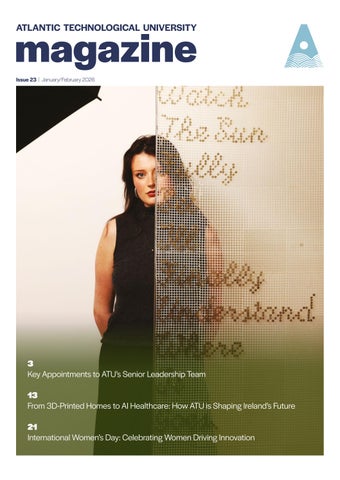
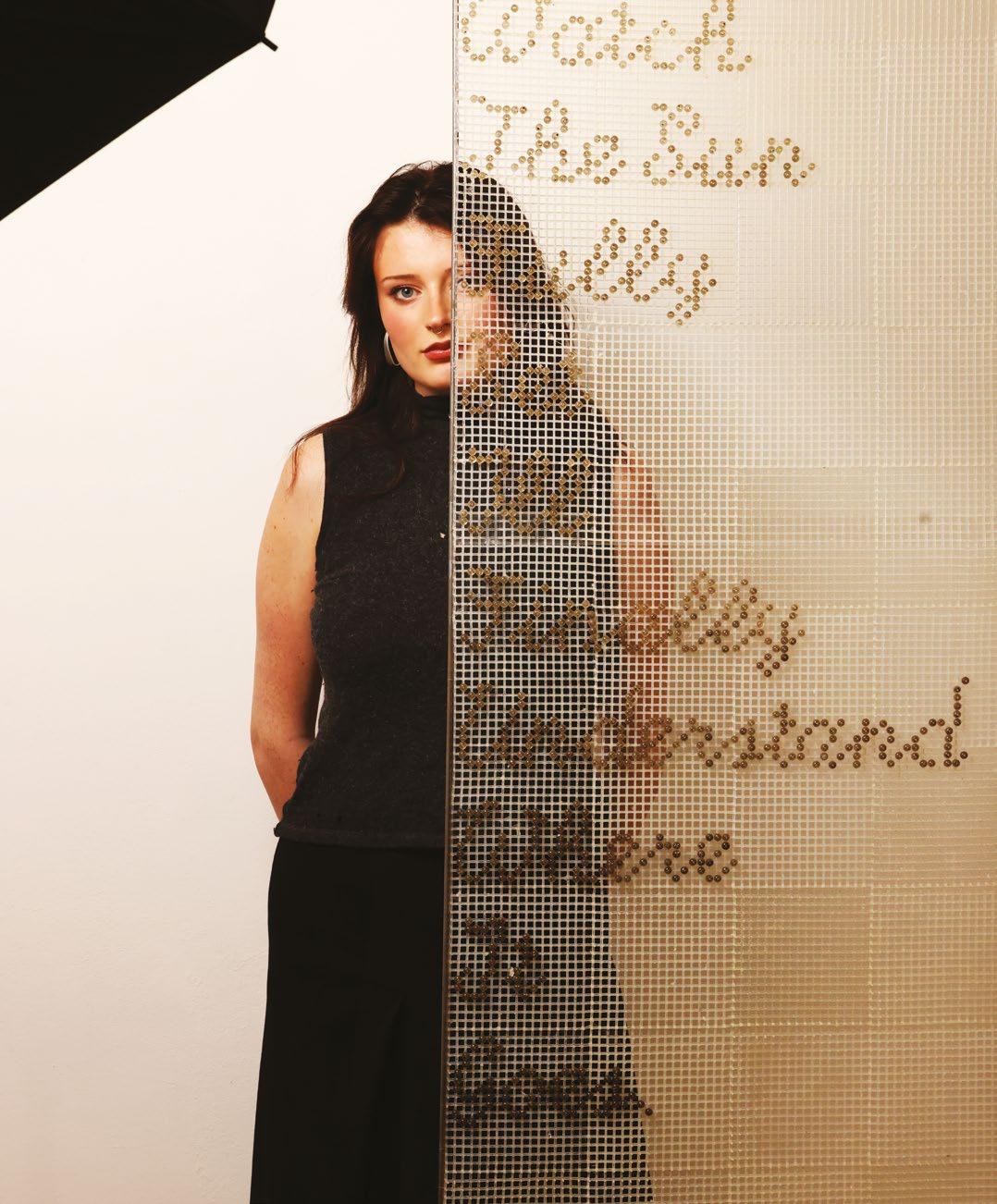
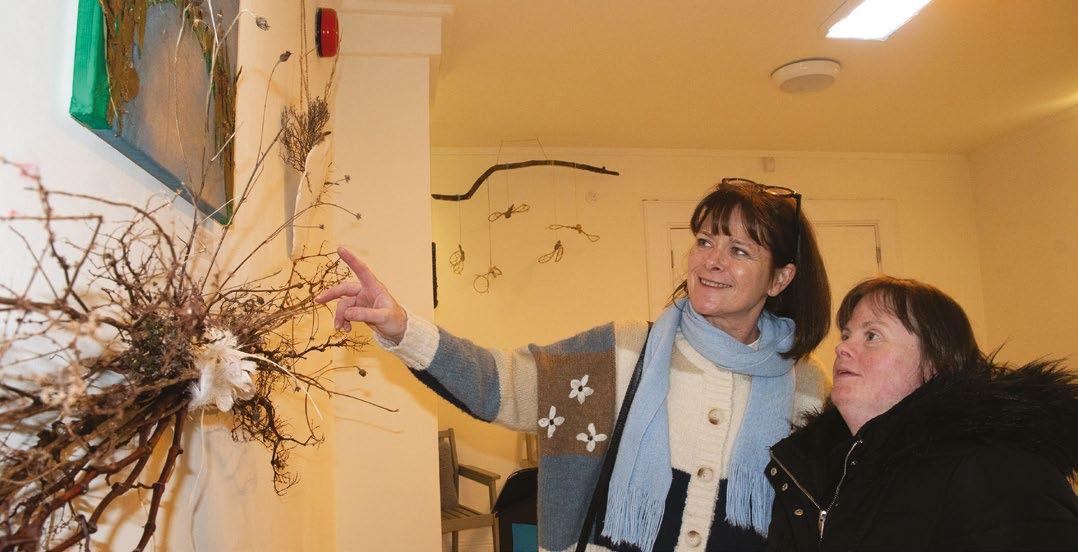
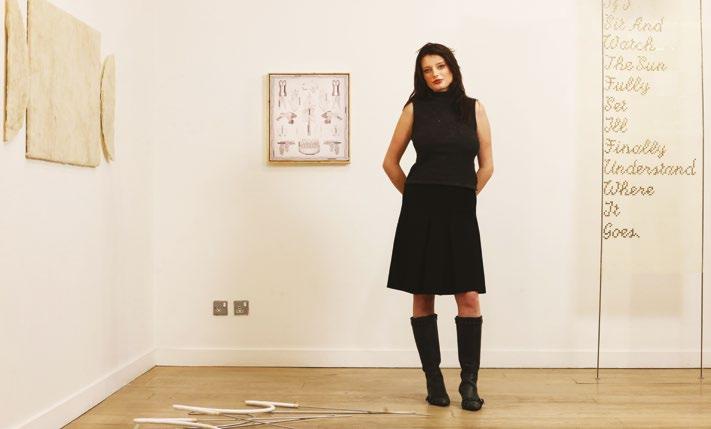
Cover photo: Pictured with her artwork is ATU graduate Lily Mannion who recently won the RDS Members’ Art Fund Award at the 2025 RDS Arts Awards.
Contributors: ATU Communications team, Orlaith Ní Mheachair, Jorden McMenamin, Ivana Hanjs, Bernie Larkin, Chaplaincy and Pastoral Care Team, Jeremy Madden, Sarah Carroll, Sinéad Mulhern, Dr Susan Galavan, Sharon Ferguson, Aimee O. Byrne, Domhnall Melly, Dr Richéal Burns, Brian Mullingan and Eimear O'Tuathaigh.
LET US KNOW WHAT YOU THINK: If there is anything you would like to see in future issues of this magazine, please email anne.donnelly@atu.ie
- Dr Florian Stefanov: Growing with ATU: A Story of Learning, Working, and Belonging
- More Than a Normal Day: Inside the Chaplaincy & Pastoral Care Team
explains
- Dr Susan Galavan how Universities are Adapting to Artificial Intelligence
13
Engaged Research in Action
- From 3D-Printed Homes to AI Healthcare: How ATU is Shaping Ireland’s Future
- When Period Pain Becomes a Workplace Issue
21
Engagement and Innovation
- Celebrating Women Driving Innovation
- Fulbright Specialist from Kansas University Medical School Visits ATU
27
Sustainability in Action
- ATU’s Growing Impact on the SDGs
- Delivering Clean Water in Uganda
- Our Global Reach: A Blueprint for Sustainable Education
- Students Lead the Way in Understanding the Carbon Footprint of Their Degree
Community, Creativity and Achievements
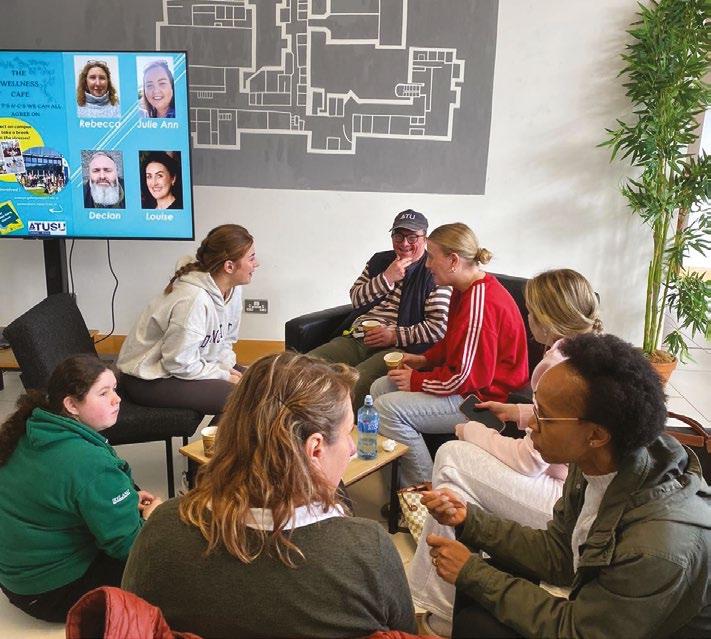
- Collaborating for Wellbeing: The Power of Staff-Student Partnerships in ATU’s Wellness Cafés
- New Annual Bursary for Undergraduate Nursing Students
- Sensing Lannagh Celebrated at the Linenhall Arts Centre
- Lily Mannion wins the RDS Members’ Art Fund Award
- Stone Sanctuary: ATU Students Earn National Recognition for Innovative Design
- Veterinary Lecturer wins Nuffield Ireland Scholarship to Tackle Rural Vet Shortages
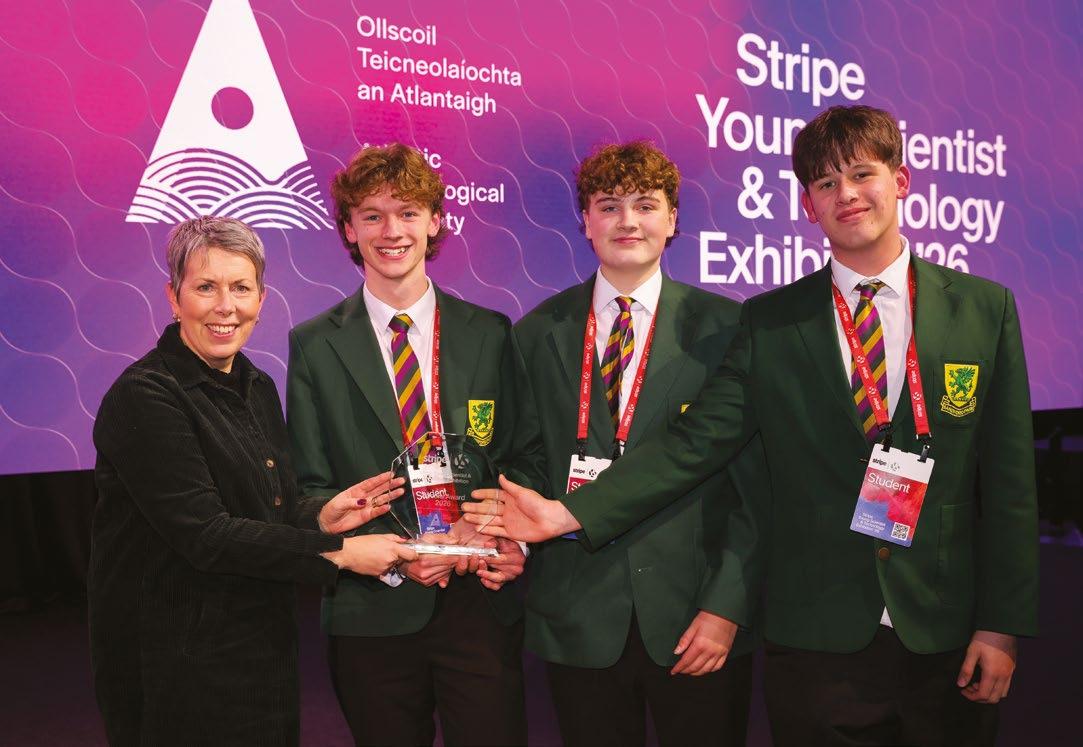
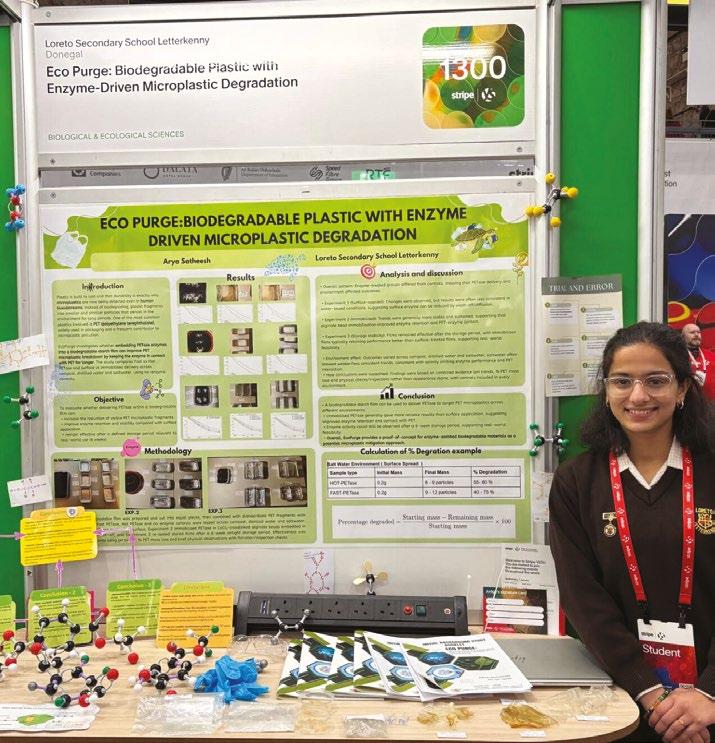
- ATU Supports the Stripe Young Scientist and Technology Exhibition
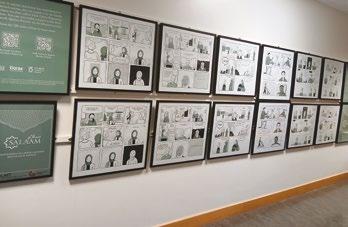
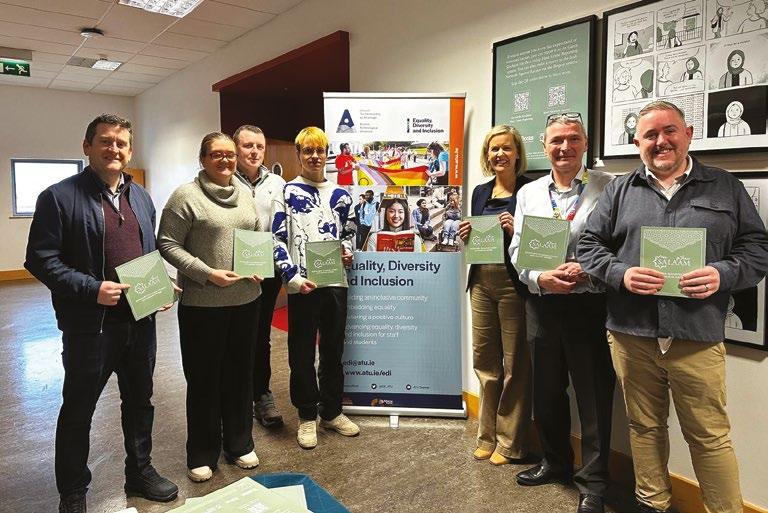
- Championing Inclusion: ATU Hosts the SALAAM Anti-Racism Exhibition
Welcome from the Editor
Dear Reader,
I am delighted to welcome you to our ATU Magazine. In this issue, we begin by sharing news of key appointments to ATU’s Senior Leadership Team, reflecting our continued growth and ambition as a university. We are also pleased to highlight the expansion of the Electrical Craft Apprenticeship programme — an important addition to ATU’s suite of practical, industry- aligned pathways.
We shine a spotlight on some of the people who make ATU such a vibrant place to work and learn. You can read Dr Florian Stefanov’s personal story of learning, working, and finding belonging at ATU; spend a day with our Chaplaincy and Pastoral Care Team; and explore a range of perspectives on one of the most significant conversations in education today: AI in the classroom.
In our Engaged Research in Action section, we offer a glimpse into some of the innovative research taking place across the university
— from 3D -printed homes to cutting- edge AI healthcare technologies — projects that are making an impact in our region and beyond. Research continues to be a major driver of regional growth and competitiveness and to borrow the words of Michelle Conaghan, IDA Regional Manager for Donegal, Sligo and Leitrim: “ATU is the biggest asset for the region of the last three to four years.”
As we look forward to International Women’s Day on 8 March, we are delighted to bring you a special feature celebrating women in innovation, along with an interview with PhD researcher Rebecca Tarpey, whose work focuses on practical, low- cost ways to help people manage menstrual symptoms.
Our Sustainability in Action section showcases ATU’s clean-water breakthrough project in Uganda,
new insights into our global sustainability impact, and the work of our students who are leading efforts to understand the carbon footprint of their degree programmes.
We also take time to celebrate community, creativity, and achievement — from the positive impact of our Wellness Cafés, where staff and students collaborate to support wellbeing, to national design awards won by our students, as well as a prestigious Nuffield Ireland Scholarship awarded to one of our Veterinary lecturers to help address rural veterinary shortages.
There is much more to explore in this issue, and whether you are a student, a colleague, or one of our partners locally, nationally, or internationally, I hope you find something here that informs and deepens your understanding of ATU’s diverse and dynamic activities.
Best Wishes Anne Donnelly
Fáilte ón Eagarthóir
A chara,
Tá áthas orm fáilte a chur romhaibh go hIris Ollscoil Teicneolaíochta an Atlantaigh. San eagrán seo, ba mhaith linn na príomhcheapacháin a rinneadh ar Fhoireann Bainistíochta Sinsearaí Ollscoil Teicneolaíochta an Atlantaigh a roinnt libh, rud a léiríonn an fás agus an uaillmhian atá againn mar ollscoil. Tá áthas orainn chomh maith, an fhorbairt atá tagtha ar an gclár Printíseachta sa Cheardaíocht Leictreach a fhógairt- rud a chuireann le sraith chonairí foghlama praiticiúla OTA, atá ag teacht le riachtainais an tionscail.
Tugaimid aitheantas do roinnt de na daoine in OTA a chuireann le beocht na háite mar láthair oibre agus foghlama. Is féidir cuntas pearsanta an Dr Florian Stefanov a léamh faoina aistear foghlama agus oibre agus mar a tugadh chun muintearais é ag OTA. Is féidir lá a chaitheamh leis an bhfoireann Séiplíneachta agus Cúram Tréadach agus réimse peirspictíoctaí a fháil ar cheann de na hábhair is mó tráchta san oideachas i láthair na huaire, sé sin an Intleacht Shaorga sa seomra ranga.
Sa mhír ar an Taighde Rannpháirtíoch i nGníomh, tá léargas le fáil ar roinnt den taighde nuálach atá ar bun ar fud na hollscoile- lena n-áiritear; tithe priontáilte tríthoiseacha agus teicneolaíochtaí ceannródaíocha i gcúram sláinte-tionscadail a bhfuil tionchar tairbheach acu ar an réigiún seo agus níos faide ó bhaile. Tá an taighde fós ina
phríomhfhoinse fáis agus iomaíochais don réigiún agus i bhfocail Michelle Conaghan, Bainisteoir Réigiúnach an Ghníomhaireacht Forbartha Tionscail (GFT) do Dhún na nGall, Sligeach agus Liatroim:
“Is í Óllscoil Teicneolaíochta an Atlantaigh an sóchmhainn is mó don réigiún le trí nó ceithre bliana anuas.”
Agus Lá Idirnáisiúnta na mBan ag teannadh linn ar an 8 Márta, beimid ag súil le gné-alt speisialta a dhéanann ceiliúradh ar mhná atá bainteach i gcúrsaí nuálaíochta, mar aon le hagallamh leis an taighdeoir PHD, Rebecca Tarpey, a mbaineann a cuid taighde le bealaí praiticiúla chun cabhrú le daoine a gcuid siomptom míosta a bhainistiú ar bheagán costais.
Beidh tionscadail nua atá ag teacht chun cinn á gcur i láthair inár ngnéalt ar Inbhuanaitheacht i nGníomh,
lena n-áirítear; tionscadal FhíorUisce OTA in Uganda, léargais nua i dtaobh ár dtionchair dhomhanda inbhuanaitheachta agus an obair atá ar bun ag mic léinn dár gcuid atá ag fiosrú lorg carbóin a gclár céimeanna.
Tapóidh muid an deis chomh maith, ceiliúradh a dhéanamh ar phobal, ar chruthaitheacht agus ar éachtaí na hollscoile- ar an tionchar dearfach atá ar na Caiféanna Folláine, áiteanna a dtagann baill foirne agus mic léinn le chéile chun tacú le cúrsaí folláine, ar na gradaim náisiúnta deartha atá buaite ag mic léinn na hollscoile, chomh maith leis an Scoláireacht cháiliúil, Nuffield Éireann atá bronnta ar dhuine dár léachtóirí Tréidliachta chun cabhrú leis an nganntanas tréidlianna tuaithe.
Beidh neart eile le plé san eagrán seo, agus cibé acu mac léinn, comhghleacaí nó ceann dár gcomhpháirtithe thú — go háitiúil, go náisiúnta nó go hidirnáisiúnta — tá súil agam go n-aimseoidh tú rud éigin anseo a chuirfidh ar an eolas tú faoi ghníomhaíochtaí éagsúla agus bríomhara OTA.
Le dea-ghuí Anne Donnelly
Highlights from across the University Key Appointments to ATU’s Senior Leadership Team
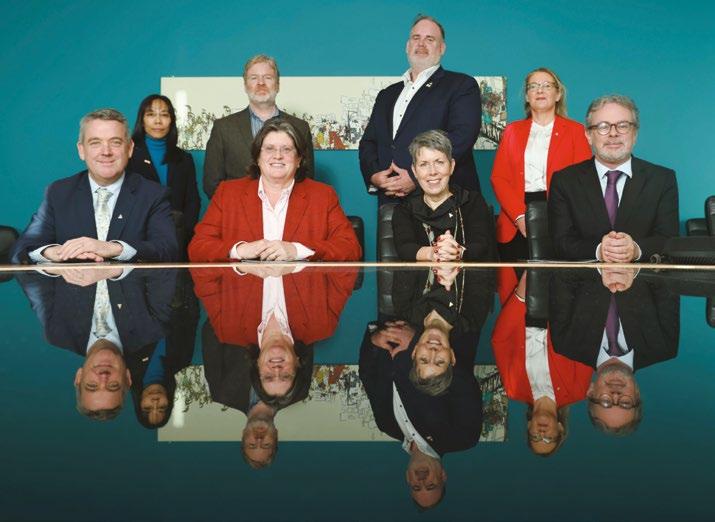
ATU has announced appointments to its Senior Leadership Team (SLT), which will play a central role in shaping the direction of the university. This team brings together leaders with extensive experience in higher education, research and industry engagement, ensuring ATU continues to deliver high-quality education and impactful research across its nine campuses.
The SLT currently includes the Registrar and Chief Academic Officer, the Chief Officer for Research, Innovation & Engagement and four new Faculty Deans. Recruitment for four additional positions to complete the Senior Leadership Team is expected to get underway in the next few months.
Senior Leadership Appointments
Dr Billy Bennett, Registrar and Chief Academic Officer
Dr Bennett has been pivotal in ATU’s development since its inception, previously serving as Vice President with responsibility for Academic Affairs in ATU. He has a distinguished career in higher education leadership and chairs several national boards. His focus is on advancing ATU’s reputation for excellence in teaching and learning:
“I am proud to have been part of the establishment of this new university, and I am looking forward to growing ATU’s reputation for excellence in teaching and learning and delivering innovative and transformative education as the university of choice for students in the Northern and Western region, and beyond.”
Dr Amelia Au-Yeung, Dean of Faculty of Business
Dr Au-Yeung brings over 20 years of experience in business education and leadership, having previously led the Claude Littner Business School to win the Times Higher Education Business School of the Year Award. She is passionate about embedding sustainability and innovation in business education:
“I am thrilled about this appointment. ATU is a progressive university and has made impressive achievements over the last three years since inception. I feel highly privileged to be joining the university’s Senior Leadership Team and work with many amazing and highly achieving colleagues in and outside the Faculty of Business to help the faculty and the university achieve further heights.”
Professor Graham Heaslip, Dean of Faculty of Engineering and Computing
Professor Heaslip brings over 30 years of experience in education, having worked in Ireland, Finland and Australia. Prior to entering academia Graham spent fourteen years working in the Irish Defence Forces both at home and abroad in a variety of logistical appointments, as well as spending time seconded to Humanitarian agencies in a logistical capacity:
“It is a privilege to lead the Faculty of Engineering and Computing at ATU. Our ambition is firmly rooted in place — supporting regional industry, advancing technological capability, and addressing societal challenges through education and research. Working with colleagues, students, and partners, we will continue to strengthen ATU’s role as a driver of opportunity and innovation for the West and Northwest.”
Dr Paddy Tobin, Dean of Faculty of Design, Education & Social Science
Dr Tobin has nearly 30 years of experience at ATU and has led major initiatives in programme development, industry partnerships, and community projects. He also played a key role in establishing CREW (Creative Enterprise West). Dr Tobin leads a faculty that spans creative industries, education sciences, and social sciences, focusing on programmes and projects that deliver meaningful impact for communities across the region:
“This faculty brings together several areas of critical importance for our region, the West and Northwest; integrating programmes of study, research, projects and initiatives that involve our students and graduates directly in industry, schools, care institutions and many other organisations that are at the heart of our communities. We now have both the opportunity, and the responsibility, to deliver something unique and impactful for our regional society.”
Dr Joanne Gallagher, Dean of Faculty of Science and Health
Dr Gallagher brings extensive experience in academic leadership and research, including pioneering veterinary medicine education at ATU. She is committed to creating new education and research opportunities in the West and Northwest:
“As an academic leader and a proud native of Donegal, I am committed to driving growth in the West and Northwest of the country and to creating new education and research opportunities in the region. The formation of ATU has delivered a university of scale and impact providing a unique platform on which to become a disruptor in the higher education landscape, to challenge traditional sectoral norms and make meaningful, sustainable contributions to enhance our region.”
Dr Brendan Jennings, Chief Officer for Research, Innovation & Engagement
Appointed in October 2025, Dr Jennings leads ATU’s research and innovation strategy, enterprise engagement, and national and international collaborations. Formerly Vice President for Research & Innovation at TU Dublin, he has a distinguished track record in advanced communications research and fostering industry partnerships:
“I am delighted to return to my home region to take up this role at ATU, an institution that will be central to the Northern and Western region’s next phase of economic and societal development. Our graduates — confident, adaptable and curious — are the foundation of that future, and I look forward to supporting the university as it drives innovation, partnership and regional impact.”
Announcing the new appointments, Dr Orla Flynn, ATU President, said:
“Our leadership team should reflect ATU’s ambition to deliver transformative education and research that meets the needs of our students, communities, and industry partners. These appointments strengthen our capacity to innovate and collaborate regionally and globally, and I’m looking forward to filling the remaining roles as soon as possible.”
“ ATU is building a leadership structure that will drive progress and impact across all areas of the university. The expertise and vision of this team will ensure ATU continues to serve as a catalyst for regional development and global engagement. "
Maura McNally SC, Chair of ATU Governing Body.
The university is in the process of recruiting the remaining members of the Senior Leadership Team including: Chief Finance Officer, Chief Operating Officer, Chief Officer for People, Culture and Equality and Chief Administrative Officer.
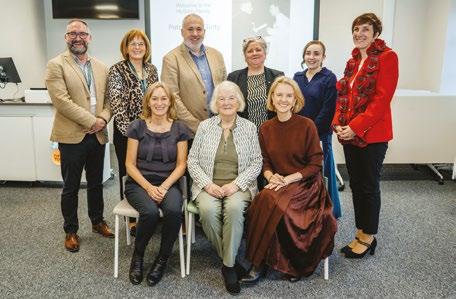
Seated left to right: Dr Billy Bennett (Registrar and Chief Academic Officer), Maura McNally SC (Chair of ATU Governing Body), Dr Orla Flynn (ATU President), Dr Brendan Jennings (Chief Officer for Research, Innovation & Engagement).
Standing left to right: Dr Amelia Au-Yeung (Dean of Faculty of Business), Dr Paddy Tobin (Dean of Faculty of Design, Education & Social Science), Prof Graham Heaslip (Dean of Faculty of Engineering and Computing) and Dr Joanne Gallagher (Dean of Faculty of Science and Health).
Expansion of Electrical Craft Apprenticeship
ATU formally launched the expansion of the Electrical Craft Apprenticeship to its Mayo campus in Castlebar on 26 January. The development will see four additional training blocks delivered annually and capacity increased by 192 apprentices each year. The initiative represents a strengthening of Ireland’s national apprenticeship infrastructure at a time of sustained growth in demand for skilled electrical workers.
The expansion responds directly to rising apprentice registrations, as highlighted by SOLAS, and to employer demand across the construction and electrical sectors. Electrical craft skills are central to the delivery of the National Development Plan, including housing targets, major infrastructure projects, climate action commitments and the national energy transition.
Minister of State for Further and Higher Education, Research, Innovation and Science, Marian Harkin, welcomed the development:
“In 2023 significant funding of €17.04 million was approved by my Department for the Higher Education Apprenticeship Expansion Programme. This funding included almost €8.2 million to ATU, which was disbursed in 2024, with €1.345 million allocated to the Castlebar Electrical Apprenticeship Expansion.”
“ I want to thank ATU for your commitment and belief in the apprenticeship programme and for insuring we have this expansion in apprenticeship training. Most importantly it reflects our shared commitment that every learner has the chance to build a rewarding career and that every community can benefit from the skills that those learners will accrue. "
Minister of State for Further and Higher Education, Research, Innovation and Science, Marian Harkin
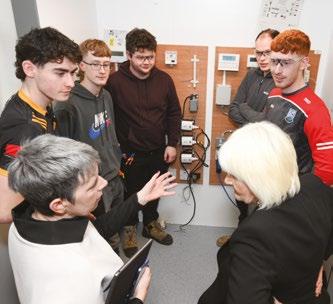
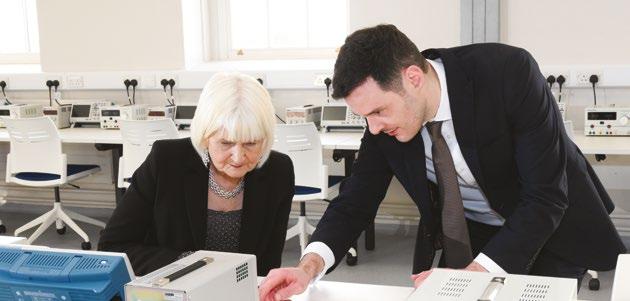
Dr James Boyle, Head of School of Engineering Apprenticeships at ATU demonstrating electrical testing equipment to Minister of State for Further and Higher Education, Research, Innovation and Science, Marian Harkin, TD, in ATU’s Castlebar campus.
ATU President Dr Orla Flynn said the university is committed to meeting national and regional skills needs:
“The expansion of the Electrical Craft Apprenticeship to our Mayo campus is a significant step in strengthening regional access to high-quality apprenticeship education. ATU is proud to play a leading role in expanding highdemand apprenticeships right across our region, ensuring that apprentices can progress through their training in a supportive learning environment.”
Employers across the region are expected to benefit from improved access to training places, while current and prospective apprentices will gain greater flexibility and reduced waiting times. The Department of Further and Higher Education, Research, Innovation and Science described the expansion as a “practical and targeted response” to both immediate training pressures and long-term national workforce needs.
Professional growth, pastoral care, and the future of learning with AI. We bring you insights and stories from the people driving ATU forward
Our People Growing with ATU: A Story of Learning, Working, and Belonging
Dr Florian Stefanov writes about his career path since joining ATU as a student in 2006 with more curiosity than direction.
My journey with ATU began long before job titles or laboratories — back when I first stepped onto campus as a student. I never imagined that the place where I learned, explored, and grew would one day become the centre of my professional life. Yet here I stand today: Dr Florian Stefanov, Senior Medical Imaging Specialist at the Medical Engineering and Technology (MET) Gateway.
Since 2016, MET, funded by Enterprise Ireland, has become a bridge between bright ideas and real-world medical innovation. We support pioneering SMEs and multinational companies by offering testing services and academic expertise that help transform concepts into life - changing therapies and devices. Every time I walk into the lab, I’m reminded that my story with ATU is still unfolding, shaped by the people beside me, the technologies we explore, and the impact we strive to create.
An Erasmus opportunity that changed everything
From undergraduate degree to PhD and beyond
My path didn’t begin in a lab. It began in a lecture hall in Bucharest. In 2006, as a third-year bioengineering student at the National University of Science and Technology POLITEHNICA
Bucharest, I believed my future lay firmly within Romania’s borders. Then everything changed. I was awarded an Erasmus+ scholarship — an academic year in Ireland at ATU (then GMIT). I still remember the disbelief as I read the acceptance letter, unaware that this single opportunity would redirect the entire course of my life.
From the moment I left Romania, my world became a collection of firsts: my first flight, first time travelling alone, first real conversations with native English speakers. Fourteen years of studying English couldn’t prepare me for the moment I boarded that plane, surrounded by unfamiliar sounds, accents, and possibilities.
Graduating with First Class Honours in Biomedical Engineering felt like crossing a finish line, only to discover it was the starting point of something far greater. I remained at ATU for a Master’s by research in biomedical engineering, diving into endovascular therapies and the mechanisms of cardiovascular disease. Conferences, collaborations, and discussions with experts from around the world gave me something invaluable: belief. I learned that breakthroughs don’t come from talent alone — they come from persistence, curiosity, and the courage to keep asking “what if?”
When my Master’s ended, another door opened. I was offered the chance to transfer into a PhD. My research soon moved beyond the lab and into operating theatres at University Hospital Galway and the Blackrock Health Galway Clinic. Watching surgeons treat aneurysms in real time transformed my understanding of engineering. It became human. Urgent. Necessary.
Those experiences shaped my PhD, led to scientific publications, and brought me across Ireland, Europe, and the United States to share my work. They taught me resilience, humility, and the responsibility that comes with contributing to the future of healthcare.
After completing my PhD in 2014, I moved through roles that shaped me further: Post-Doctoral Researcher, Vascular Modelling Engineer, Senior Post-Doctoral Researcher, Technology Leader, and Research Fellow — Haemodynamic Expert. Each step brought me deeper into the mission I had unknowingly embraced the day I arrived in Ireland: to contribute meaningfully to medical innovation.
Innovation in action at ATU MET
Today, in my role at ATU MET, I stand at the crossroads where innovation, engineering, and patient care meet. Every week, I collaborate with R&D teams from across Ireland and beyond —people driven by the same determination to solve real clinical problems. Our conversations often begin with a concept or a challenge, and together we shape those ideas into something real.
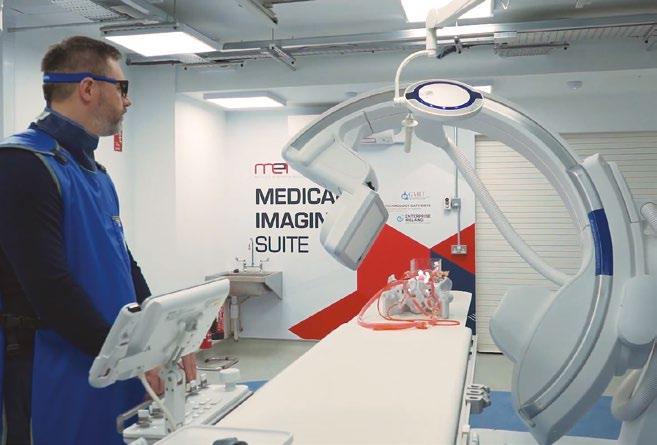
In ATU Galway’s Medical Imaging Suite, I use fluoroscopy and ultrasound to visualise early-stage device prototypes — capturing their behaviour, strengths, limitations, and hidden nuances. There is a unique magic in watching an idea appear for the first time under x-ray or ultrasound.
But imaging is only part of the story. I also recreate clinical scenarios using anatomical models built from real patient data. These simulations are rehearsals for real interventions, opportunities to understand how a device will behave inside the human body long before it reaches a clinical trial.
Showcasing innovation
Some of the most meaningful moments happen far from the imaging screens. They happen when I open our labs to visitors — children from the Glasán Crèche, curious primary and secondary school students, ATU students rediscovering their campus, and staff seeing their workplace through new eyes. I’ve watched children gasp at glowing monitors, point at ultrasound images like constellations, and ask questions that cut straight to the heart of science. I’ve seen teenagers realise that engineering isn’t abstract — it’s alive, tangible, and happening right in front of them.
Then come the official delegations — funding bodies, government representatives, academics, and industry leaders. Their curiosity is different: they want to understand how innovation happens, who drives it, and what impact it can have on society. Each group brings its own energy, and every tour reminds me that our work is not just for companies or researchers—it’s for future engineers, future leaders, future dreamers.
No two days are alike
What I love most about ATU is that no two days are alike. One morning I might be deep in discussion about a new medical technology; by afternoon, I’m guiding visitors through the lab as they glimpse the future of healthcare. Between those moments are unexpected collaborations, ideas sparked in passing conversations, and opportunities that didn’t exist the day before.
“ ATU feels like an ever‑evolving ecosystem of innovation—alive, surprising, and endlessly inspiring. "
When I look back to 2006, I see a young Erasmus student stepping off a plane with a backpack and a belief that hard work could change a life. Two decades later, that belief has carried me from Bucharest to Galway, from student to specialist. My parents’ lesson, “Work hard now, and life will reward you later”, became my compass.
The journey hasn’t been easy, but it has been worth every step. As ATU continues to grow and imagine new possibilities, I’m ready for the next chapter. The future is wide open, and my story here is far from finished.
More Than a Normal Day: Inside the Chaplaincy & Pastoral Care Team
Words by Rosalynn Bovaird on behalf of ATU’s Chaplaincy and Pastoral Care Team.
People often ask what a normal day looks like for the Chaplaincy. We usually laugh before answering, because “normal” really isn’t a word that fits. Every day is different, and even when we start the morning with a plan, it rarely survives the day intact. That’s how Chaplaincy works — you stay open, flexible, and ready for whoever might need you, whether that’s a student panicking over an assignment, a staff member needing a moment to breathe, or someone just looking for a friendly face.
At its heart, our work is about people. Students, staff, visitors — people of all faiths and none. Our role isn’t about having answers or fixing problems. It’s about showing up. Sometimes that means listening to worries, sometimes celebrating good news, and often it’s just sitting down with someone and letting them talk things through over a cup of coffee. And yes, coffee is often essential — especially on busy days when lectures, deadlines, and canteen queues all collide.
Starting the day
Some mornings begin quietly at the desk, checking emails or planning what’s coming up. That might involve organising events, preparing something reflective for a service, or coordinating with colleagues. But we don’t stay behind the desk for long. Most of Chaplaincy work happens out on campus, walking between buildings, popping into common areas, or stopping to chat with someone who looks like they
might appreciate a friendly face. Even a brief “hi, how’s it going?” can spark a meaningful conversation.
Breakfast clubs
Breakfast clubs are a big part of our “office hours.” Over tea and toast, the conversations flow easily: assignments, exams, money worries, housing stress, family stuff, current affairs, and strong opinions about how the local sports team is performing. These chats are relaxed and informal, and that’s exactly why they matter. Trust grows naturally, and sometimes those easy conversations open the door to deeper ones later.
Listening without judgement
As the day goes on, we often meet students one-to-one. Some arrive
knowing exactly what they want to talk about; others don’t — and that’s perfectly okay. Chaplaincy work isn’t about directing or diagnosing. It’s about listening without judgement and giving people space to say what they need to say, in their own way. Often what people really need is a pause, a bit of clarity, or someone simply acknowledging that what they’re dealing with is hard. Even a few minutes of attention can make a huge difference.
Community, culture and campus life
A big part of our role also involves working alongside others across the university. Chaplaincy is very much part of campus life, not tucked away in a corner. That means collaborating
The Chaplaincy and Pastoral Care team: Daniel Caldwell, Kelley Hester, Rosalynn Bovaird and Kim Matthews pictured with Dr Orla Flynn and Dr Michèle Glacken.
on all sorts of events throughout the year, from Diwali celebrations and Eid gatherings to Advent reflections, Christmas carol services, and memorial services where the whole community comes together to remember. There are big, energetic days like ATU President’s Award for volunteering, or Jersey Day, alongside quieter moments like Lent, and Pause for Peace. Some events are lively, others reflective, but all of them are about connection and belonging.
There are meetings too — plenty of them. Some focus on wellbeing, others on financial support, housing, social justice issues, or the overall student experience. Being in those spaces matters because it means the pastoral voice is part of the wider conversation about what student life looks like day to day.
Unplanned moments
Not everything fits neatly into a diary. Some of the most important moments are unplanned: a quick chat that turns into something deeper; a student dealing with a panic attack; a sudden bereavement of staff or student.
Those moments can be challenging, but they’re also a reminder of why this work exists. It’s complex, human, and real. And that’s exactly why we love it.
Open door, open heart
Chaplaincy is for everyone. It’s an open door. You don’t need to be in crisis, you don’t need to belong to a faith, and you don’t need to have the right words. Sometimes people come just to offload, find a bit of calm, or take a breath before figuring out what comes next. If someone leaves feeling even slightly lighter than when they arrived, that feels like a win.
Being present is the key thing. No agenda, no pressure to steer the conversation. Just listening with an open heart and letting people express whatever they’re carrying. Even on busy days, we try to slow down enough to offer a kind word or a moment of genuine attention.
No ‘right’ way to doing the job
Chaplaincy is very much a team effort. We’re always conscious that we are part of something bigger — a team that supports one another, shares
ideas, and responds to the unique feel of each campus. There’s no one ‘right’ way to do our role. What works in one place might not work in another, and that flexibility is integral to the job.
Everything we do is guided by a few simple ideas: listening well, offering emotional and spiritual support, and encouraging understanding across cultures and beliefs. Those principles ground the work, no matter how busy or unpredictable the day becomes.
Sometimes people’s perception of Chaplaincy is that we always know what to say, we are endlessly calm, and glide around campus with a clear diary and a strong cup of coffee. Reality check: none of those things are guaranteed. We try, reflect, adapt, and pivot.
We listen, care, and show up, even on days when we're running on caffeine and good intentions. And honestly, that's what makes it both challenging and wonderful.
How are Universities Adapting to Artificial Intelligence?
For this issue, we sat down with Dr Susan Galavan, lecturer in Architecture at ATU to talk about the rapid rise of artificial intelligence (AI), what it means for education and the role universities must play in shaping this new era of learning.
Susan, you wrote an article recently in The Irish Times about the role of AI in higher education. What sparked your interest in this topic?
Part of it was simply noticing how inescapable AI has become. From Microsoft’s ‘Copilot’ to Google’s AI summaries, it’s all around us, and students are at the centre of this shift. A recent UK study found that 64 per cent of students now use AI to generate text, up from 30 per cent in 2024. That kind of jump tells us something dramatic is happening.
From my discussions with students, it’s clear that they are using these new tools in many different ways. They rely on AI as a learning aid: using it to clarify concepts, break down briefs and brainstorm ideas. But of course, students can also feed an essay question into ChatGPT, generate a convincingly written response, then run it through again to add academic references and a bibliography that looks — and often reads — authentic.
So, for me, as a lecturer, the question became unavoidable: What does all of this mean for the future of education?
What do you think is the core challenge AI poses to learning?
When students outsource their thinking to a machine, they miss out on developing the very skills that higher education is designed to foster — critical thinking, analysis, originality-skills highly valued by employers.
And there are cognitive downsides too. Brain health expert Dr Daniel Amen warns that when we stop actively engaging our brain, it becomes weaker. His advice is simple but powerful: use AI to amplify your thinking, not replace it. For me, this is the heart of our challenge as educators: how do we harness innovation while protecting the learning process?
So, overusing AI can weaken our cognitive function. Are there ways it can positively contribute to student learning?
Absolutely, there is growing recognition that generative AI can enrich learning. It can personalise instruction, provide feedback, or help students engage with ideas in interesting new ways.
However, without guidance, students may treat what artificial intelligence produces as gospel — blindly trusting its outputs without questioning the source, the logic, or the accuracy. But AI isn’t always reliable. It can fabricate facts, reproduce bias, and use outdated information. Add to that the many ethical and legal concerns, plus the environmental impact of large data centres, and it’s clear why AI literacy is now essential.
Dr Susan Galavan
A lecturer at ATU since 2022, Susan brings over 30 years of postgraduate experience in architecture, research and education. She spent 14 years in architectural practice, working on a variety of commercial, community, and residential projects. Her PhD was the first in depth study of Dublin’s Victorian housing (Routledge, 2017), after which she spent 6 years in Belgium on a Marie-Curie postdoctoral scholarship. An active member of the Royal Institute of Architects of Ireland’s AI Taskforce, she is currently exploring the impact of AI on architectural practice and education.
It's reassuring to know that there are benefits to using AI in education. How are universities responding to the challenges AI pose?
At first, many institutions reacted defensively. Some introduced outright bans; others went back to timed, in-person exams in a bid to sidestep AI completely.
These are understandable reactions, but they are not sustainable. Our job as educators is not to shield students from AI, but to prepare them for the reality of the working world. Take my own profession of architecture as an example — a 2025 UK survey found that 59 per cent of architects now use AI in some capacity, up from 41 per cent the previous year. Architectural firms are experimenting with tools that can generate faster design concepts, optimise layouts for energy efficiency, even flag project delays during construction. So, by the time my first-year students graduate in 2030, artificial intelligence is going to be a fundamental part of their working lives. Our role as educators, therefore, must evolve from policing technology to teaching how to use it critically and ethically.
So, are universities shifting their approach now?
They are. Three years after the launch of ChatGPT, there’s been a move from prohibition to engagement with AI tools. Academics across disciplines are starting to ask: “What does good assessment look like now in an age of intelligent machines?”
And the answer is: very different.
For one, we need a radical redesign of assessment. First, we have to adapt — or abandon — assignments that AI can easily do. Second, we need to shift the focus from the final product — an end of term essay for example — to the process of learning itself. We can do this through various means: more in-class engagement, reflective learning journals and oral exams for example. Some lecturers are guiding students on how to use AI as a “thinking partner”, helping them explore ideas, analyse data, or refine arguments ethically and transparently.
For me, ATU’s Teaching and Learning Centre has been instrumental in helping me navigate this important shift. The workshops, supports and tools they provide have been invaluable as I work to integrate AI more thoughtfully into my teaching practice. And what’s really interesting is what happens when I bring the AI discussion into the classroom. Students are very engaged in the topic. Making AI visible reveals how students are already using it, and this in turn creates space to discuss both the risks and the transformative potential. It also makes for a more collaborative working environment, reshaping the classroom as a shared conversation.
What role do you believe educators should play in shaping how AI is used in higher level education?
The future isn’t AI versus educators. It’s AI with educators. We can’t wait around for governments to draft policy — we must lead. Our job is to guide students through the noise, to help them question, analyse, and create with intelligence, integrity, and insight.
Change is never easy. But neither was teaching during the pandemic. The difference here is that AI won’t go away; it will only become smarter. Our challenge is not to stop the technology, but to shape it, ensuring students remain active thinkers, not passive consumers.
“ If we adapt wisely, artificial intelligence can become one of the most powerful learning tools ever created. But if we ignore it, we risk losing the very essence of higher‑level education: the ability to think for ourselves. "
Are we ready for AI-powered smart glasses on our children’s faces?
ATU instructional designer and researcher in Artificial Intelligence (AI) Frances O’Donnell has warned that next-generation AI smart glasses, rolling out globally in 2026, could fundamentally reshape how young people interact with technology, raising urgent questions around privacy, safety, ethics and children’s digital rights.
Her warning comes as Snapchat announced the launch of Specs, its latest consumer augmented reality (AR) glasses. They look like regular sunglasses but have built-in cameras and are designed to layer digital objects onto the physical world, recognise locations, identify objects and faces, and run machine-learning models in real time- all from a device worn on the face. To read more please click here and to listen to Frances discuss what this could mean for children, click here
Engaged Research in Action
From 3D-Printed Homes to AI Healthcare:
How ATU is Shaping Ireland’s Future
At recent showcases and symposia, ATU researchers unveiled breakthroughs such as sustainable 3D-printed concrete for affordable housing, AI-powered cancer diagnostics, and biomedical discoveries from marine microorganisms. These initiatives, alongside pioneering work in robotics, material handling, and pharmacogenomics, highlight how ATU is fostering collaboration to deliver real-world solutions that transform industries and improve lives.
Showcasing cutting-edge research and industry collaboration at Science Week
Pioneering research in sustainable 3D-printed concrete, advanced manufacturing, and health innovation took centre stage at The Model,
Postgraduate researcher Sara Finnerty, was awarded first place in the Quick-Fire Research Competition at the ATU Partnerships for Innovation, Enterprise and Growth showcase hosted by RISE@ATU as part of Science Week 2025 in November. Her work focuses on identifying natural compounds from marine microorganisms, that could support better health and potentially inspire new therapeutic products.
Sligo during the ATU Partnerships for Innovation, Enterprise and Growth showcase hosted by RISE@ATU as part of Science Week 2025.
The event brought together researchers, students, and industry partners to highlight how ATU is strengthening academic–industry collaboration to deliver solutions across a range of sectors.
“ We ran this event as part of Science Week, showcasing how RISE@ATU connects research with industry. Speakers highlighted projects at various stages, from 3D printing and motion capture to curing and diagnosing throat cancer, giving our PhD students insight into real‑ world collaboration, "
Dr Ruth Quinn, organiser of the event and Head of Department of Civil Engineering & Construction Studies
Research Spotlight: Sustainable 3D-Printed Concrete for Housing
ATU researchers are building upon a world-first 3D-printed housing achievement in Dundalk, where three social housing units were completed in just 12 days using COBOD 3D construction printing technology.
Researcher Dr Ahmed Saeedi, enterprise collaborator Mark McGowan of Future Cast, and material supplier Roadstone are developing sustainable 3D-printing concrete to scale affordable, low-carbon housing across Ireland. Their work showcases how the academic–industry collaboration model drives innovation:
“Over the last four years, I’ve been part of the team at Dundalk and Bristol for tremor testing and have been heavily involved in all concrete material testing. Working with Dr Ahmed on aggregates and locally sourced concrete allows him to apply testing at an industry-ready scale and share valuable research insights with us firsthand,” said Mark McGowan, Technical Expert at Future Cast.
Dr Ahmed Saeeid said: “ATU brings research rigour, industry brings practical expertise, and material suppliers ensure quality. Together, this model accelerates innovation.”
AI and Robotics in action at joint RISE@ATU Symposium
The first joint RISE@ATU Symposium brought PhD researchers together to tackle society’s biggest challenges across health, manufacturing, and agriculture.
The symposium, held at ATU Sligo, was hosted by the MedAgriTech AI eXcellence (MATX) and Innovation in Digital Manufacturing and Design (IDMD) Postgraduate Research Training Programmes. They were joined by researchers from the Modelling and Computation for Health and Society (MOCHAS).
Researchers showcased projects ranging from non-invasive MRI treatments using Generative AI for brain tumour detection, to selfpowered wearables for e-Health monitoring, and robots delivering personalised rehabilitation care.
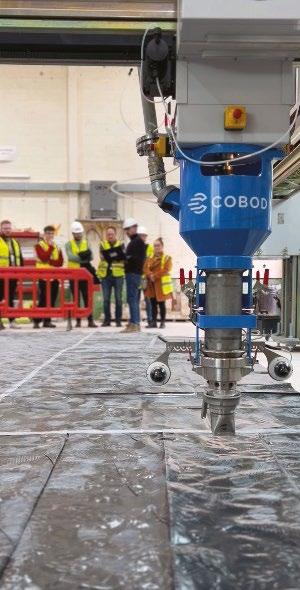
3-D printer for concrete.
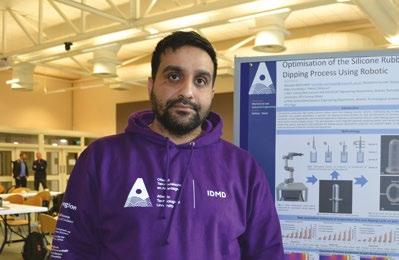
Mostafa Mellizadeh was awarded the ‘Best Poster’ on improving the silicone rubber coating process at the joint RISE@ATU Symposium.
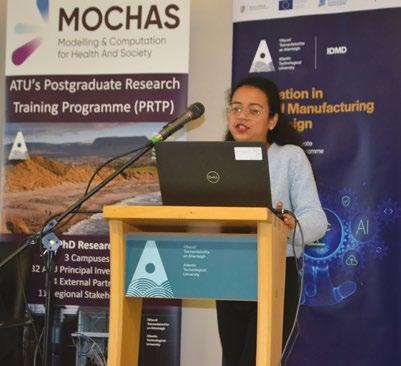
PhD researcher Dipshikha Das delivering a presentation on her research which was awarded ‘Best Talk’ at the RISE@ATU Symposium. She says: “I am exploring how learning from demonstrations can teach robots to perform inspection tasks, enabling effective human-robot collaboration and allowing them to learn like humans, by watching, understanding, and doing.”
PhD Researcher Ali Al Abbas is exploring how robotic interventions can support our physical therapy crisis. His research has been accepted to the ACM/IEEE International Conference on Human-Robot Interaction (HRI 2026), the premier annual conference advancing interdisciplinary innovation in humanrobot interaction.
Research Spotlight: Why Rehabilitation Robots Could Meet the Demand for Physical Therapy
Populations are aging, injuries are rising, and the world simply doesn’t have enough clinicians to go around. In Ireland alone, the over-65 population is projected to double by 2051 and 32% of the workforce will be over 50 by 2031 (Population Projections Results, 2017).
ATU researcher Ali Al Abbas is engineering a future where a single therapist can teach not just one patient at a time, but dozens of robots at once.
What if a rehabilitation robot could learn an exercise just by watching a video?
Not coded. Not programmed. Simply shown. That’s the idea driving Ali Al Abbas whose research blends vision science and human-centred design to take on one of healthcare’s most urgent challenges.
An older, more active world is arriving fast and the demand for rehabilitation is rising even faster than the clinicians who can deliver it.
Cobots With a human touch
Ali is clear about the mission: “We’re bridging the gap between visionbased learning and human-centred care. Therapists will be able to teach and monitor multiple patients remotely, safely and efficiently.”
Unlike traditional rehabilitation robots, which often require expensive motion-capture systems or ‘kinesthetic teaching’ (where a therapist must physically guide the robot), this framework uses only cameras.
Using vision-based Learning from Demonstration (LfD), the robot watches a therapist perform an exercise and extracts the full 3D motion directly from the video. That motion is transformed using Dynamic Movement Primitives, giving the robot a smooth, accurate, adaptable memory of the exercise. The robot doesn’t just copy; it understands the intention behind the movement.
But the real breakthrough is safety.
Safety that feels human
Using Gaussian Mixture Regression (GMR), the system learns the ‘normal’ forces of a healthy limb, building a model of how the exercise should feel. During therapy, it continuously monitors interaction forces. If the patient tenses,
hesitates, or shows early signs of discomfort, the robot senses it instantly and adjusts, ensuring exercises remain self-paced, personalized, and safe.
“The robot observes, learns, and then safely guides patients through exercises, adapting to each individual’s comfort level.”
Scaling care across clinics
Tested on a UR5e collaborative robot, Ali’s framework has already mastered common upper-limb rehab tasks like shoulder abduction and elbow flexion, performing them with smooth precision and gentle awareness.
The implications are significant: One skilled therapist can teach dozens of robots with a single video, scaling expertise across clinics and continents.
“Our goal is to make rehabilitation more accessible, scalable, and safe, where one skilled therapist can teach many robots, anywhere.”
Robots don’t replace therapists, but they support human expertise to make healthcare more accessible than ever before.
ATU researchers were recently commended for their impactful contributions to health research at the 26th Annual Multidisciplinary Health Research Conference, hosted at Sligo University Hospital.
The two - day event brought together clinicians, academics and scientists from across the region, with ATU presenting almost one -third of all research posters.
Closing the gap on cancer screening
PhD researcher Eustes Kigongo received the Best Academic Poster Award at the Early Career Researcher Forum for his comprehensive review on cancer screening participation in Ireland.
Despite free national screening, Ireland recorded the third-highest cancer incidence in Europe in 2023. His review of 12 studies highlights persistent gaps in cervical and bowel screening uptake (averaging 46.4%) and calls for improved strategies to reduce inequalities:
“Ireland may offer free cancer screening, but significant quality
gaps remain,” Eustes noted. “We need innovative, evidence-based approaches to boost participation and close avoidable disparities in access and outcomes.”
Preventing Adverse Drug Reactions
PhD researcher Vanessa Nobles presented cutting- edge research on pharmacogenomics, exploring how personalised medicine can reduce adverse drug reactions and improve patient safety. Her work not only examines the clinical potential of pharmacogenomic testing but also evaluates the practical challenges of implementing these innovations within healthcare systems.
“ Pharmacogenomics has the potential to reduce adverse drug reactions and improve patient outcomes, but we need to understand the barriers
in healthcare
and
develop strategies to implement it effectively,
"
ATU researchers also presented work across menstrual health, clinical practice and digital innovation.
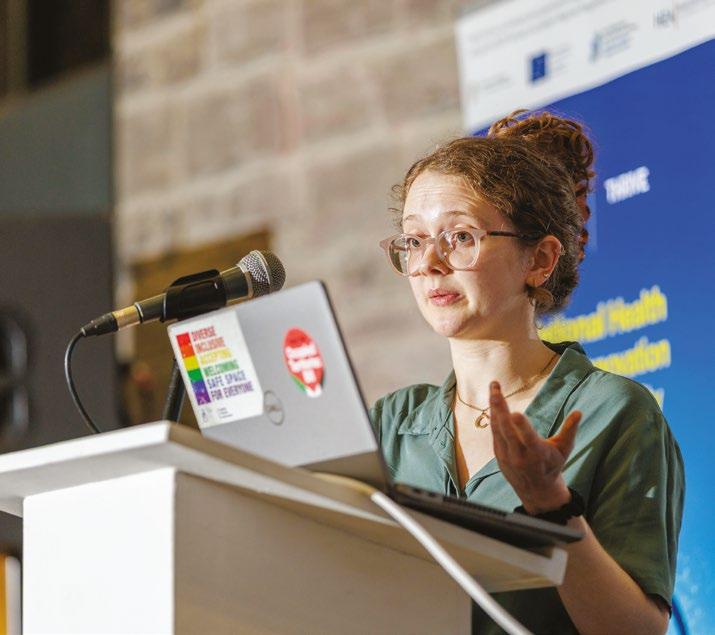
PhD researcher Vanessa Nobles discussing her work on pharmacogenomics in healthcare with Shanika Arachchi at the Early Career Researcher Forum.
PhD researcher Vanessa Nobles
Research Spotlight: When Period Pain Becomes a Workplace Issue: The Research Shaping Ireland’s Menstrual Health Future
Menstrual symptoms are something many people deal with quietly, yet it influences daily life, wellbeing, and even how individuals participate in work and education. Indeed, period pain is costing Irish workplaces more than many realise, with emerging research indicating that menstrual symptoms may lead to the loss of nearly nine working days per person every year. Despite this, menstrual symptoms often go unspoken and unsupported, and there is an urgent need for more research in this area, particularly in Ireland.
At ATU, PhD researcher Rebecca Tarpey is working to change that. Her research explores practical, lowcost ways to help people manage menstrual symptoms, especially those who may not have easy access to specialist care.
Jorden McMenamin, Research and Innovation Communications Officer at ATU recently spoke with Rebecca about her research and why it matters for workplaces, communities, and the wider public.
What evidence already exists on how menstrual symptoms impact the workplace?
A Dutch population-based study of over 32,000 women found menstrual-related symptoms affected an average of 8.9 working days per year, primarily due to presenteeism (Schoep et al., 2019). In Ireland, a 2022 survey by Fórsa reported that over 70% of women had taken time off work due to menstrual pain, with many feeling uncomfortable disclosing the reason. Globally, dysmenorrhoea affects an estimated ~70% of people who menstruate, with many reporting moderate to severe pain (De Arruda et al., 2025).
How do menstrual cycle symptoms affect daily life?
Menstrual cycle symptoms can impact a woman’s work and academic performance, physical activity and sport participation, sleep, energy, concentration, mood and their social engagement. Many people keep going despite uncomfortable symptoms, which means the impact isn’t always visible, but it is still very real.
About Rebecca Tarpey
Rebecca Tarpey is currently completing a PhD in the Department of Sport, Exercise and Nutrition at ATU Galway. Her doctoral research, titled “Management of Menstrual Cycle Symptomology for Quality of Life and Health,” focuses on identifying practical, non-clinical selfmanagement strategies to support individuals experiencing menstrualrelated symptoms.
What are the main barriers to menstrual care?
There are several challenges including: long waiting times for gynaecological services, normalisation or dismissal of menstrual pain, limited access to menstrual health education, financial barriers to supplements, therapies, or consultations and lack of clear guidance on non-clinical management strategies.
As a result, many individuals manage symptoms independently, often without reliable or evidencebased information.
“ My research focuses on practical strategies that people can realistically use day to day, particularly where access to specialist care is limited. "
How does underfunding affect menstrual health research in Ireland?
Women’s health research in Ireland has historically been underfunded, with medical bodies including the Royal College of Surgeons in Ireland (RCSI) stating that reproductive and menstrual health conditions remain poorly researched locally. This has contributed to gaps in Irish-specific data, limited intervention studies, and slow translation of evidence into practice.
How does your research help address those gaps?
My work looks at non-clinical, evidence informed self-management strategies that can be used without specialist referral. These are accessible, low-cost approaches that fit into everyday life, whether in work, sport, or daily routines. By taking international evidence and turning it into practical, easy to use guidance, the goal is to help people who may find it hard to access medical or specialist care.
What self-management strategies show the most promise?
From the research so far, the most consistently effective approaches include regular physical activity, particularly low-to-moderate
intensity exercise; adequate nutrition and energy intake, and targeted supplementation, where deficiencies are present.
In a randomised control trial , women practicing yoga twice a week for 12 weeks were found to have significantly reduced severity of period pain and other physical symptoms. This regular exercise routine has also shown noticeable improvements in overall quality of life and well-being for young women dealing with painful menstruation.
These approaches are not cures, but when used appropriately, they may help reduce symptom burden and support daily functioning.
Why does evidence-informed self-management matter?
Good evidence-based selfmanagement can improve quality of life and daily functioning, reduce hidden productivity losses and support participation without relying solely on medical or leavebased solutions.
I hope that my research will help bridge the gap between scientific evidence and everyday needs, supporting better education, workplace practices, and future policy development.
Thanks, Rebecca, for taking the time to talk to us about your work. One last question: how can research make a difference for women in workplaces and daily life?
Research helps make menstrual health visible, measurable, and actionable. International evidence shows that menstrual symptoms affect daily functioning and work participation, yet they are rarely captured in workplace policy or occupational health frameworks. By identifying effective, low-cost management strategies, research can support prevention, flexibility, and informed workplace supports, rather than relying solely on medical treatment or leave-based solutions.
“ Menstrual symptoms are often normalised, despite their clear impact on quality of life. International research highlights the scale of the issue, but there is still a need for Irish focused research that examines how people can be better supported in daily life. "
Research targeting major health gaps across the Northern and Western Region?
Why don’t people take up vaccination programmes? How can technology support healthier childhoods? How can diet influence sleep and long-term health?
These were among the real-world health challenges examined at the THRIVE Symposium (Translational Health Research, Innovation, Prevention & Equity), held at ATU’s Galway City campus in January.
The three-day event brought together researchers, policymakers, and regional stakeholders to focus on health issues with immediate relevance to communities across the Northern and Western region.
Research on vaccination and screening programmes explored how communication, trust and accessibility, influence uptake and longterm health outcomes, while other projects examined how digital technologies can be integrated into public health approaches to childhood obesity, and how diet can influence sleep quality and recovery. To find out more please click here
“ATU is the biggest asset for the region”
IDA says research talent is reshaping the Northern and Western economy
Research is becoming one of the biggest drivers of regional growth and competitiveness. This was the message delivered at the Innovation, Digitalisation, Enterprise and Society (IDEAS) Symposium on 14-15 January held at ATU’s Sligo campus.
IDA Ireland and ATU researchers came together to discuss how their work is influencing the economic future of the West and North-west of Ireland.
Opening the event, Michelle Conaghan, IDA Regional Manager for Donegal, Sligo and Leitrim, framed the university’s impact: “ATU is the biggest asset for the region of the last three to four years.”
To find out more please click here
Engagement and Innovation
Celebrating Women Driving Innovation: From Enterprise Ecosystems to Entrepreneurial Mindsets
As International Women’s Day 2026 approaches we showcase just a few ways women are advancing innovation in Ireland. Whether shaping national enterprise supports, pioneering advances in women’s health technologies, or cultivating entrepreneurial mindsets within local networks, these are the women driving meaningful change.
‘Give to Gain’: A Call to Action for Women’s Enterprise in Ireland
The campaign theme for this year’s International Women’s Day is ‘Give To Gain’, which resonates strongly across Ireland’s innovation and enterprise landscape. The message is
simple but powerful: when we invest in women through collaboration, research, and opportunity, the return is collective progress.
The Green, Digital, Female -Driven SMEs (GRANDIS) project and the FemTech in Ireland report offer strong examples of this. Although operating in different sectors, both initiatives share a common goal: removing systemic barriers and building inclusive ecosystems where women in enterprise can thrive.
Empowering Women Entrepreneurs in Green and Digital Technologies
GRANDIS is a European project led by the Western Development Commission (WDC) in Ireland with support from ATU staff who are in the stakeholder group. GRANDIS focuses on strengthening the wider ecosystem for women-led enterprise.
Rather than placing responsibility solely on individual founders, the project examines how policies, programmes, and institutions can better enable women-led businesses.
By embedding gender aware thinking into enterprise supports, GRANDIS helps create conditions for women to fully participate in high growth sectors, contributing to long-term regional development and economic growth.
Femtech in Ireland
The FemTech in Ireland report was launched last year by Health Innovation Hub Ireland (HIHI) and highlights both the significant potential of the women’s health innovation sector and the barriers still holding it back.
While the global FemTech market is expected to reach $97 billion by
#GiveToGain
Happy International Women’s Day
Pictured at the launch of the FemTech in Ireland report are left to right: Dr Marion McAfee, Finola Howe, Maria Hall and Fran Best.
2030, progress continues to be held back by underfunded research, limited venture capital investment, and a lack of targeted supports for entrepreneurs developing women centred health technologies.
The FemTech in Ireland report emphasises how Ireland is uniquely positioned to lead this space. With a world class MedTech industry, strong women’s health policy commitments, and a growing digital health start up ecosystem, Ireland has a powerful foundation to accelerate FemTech growth. The report calls for a coordinated national effort across government, academia, industry and investors to strengthen Ireland’s leadership in women’s health innovation.
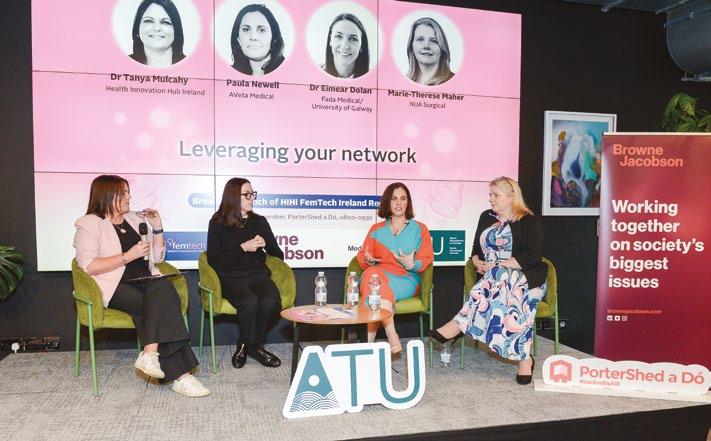
MedLink partnered with HIHI to host a special launch event for this report in November and brought together several industry leaders to speak on a panel session including NUA Surgical, AVeta Medical and Fada Medical.
Exploring the Entrepreneurial Mindset with Sligo Women in Business
On 30 September 2025, the Sligo Women in Business Network, in partnership with ATU, the Local Enterprise Office and supported through RISE@ATU hosted 60 network members in an energising morning of conversation, connection and inspiration in ATU Sligo.
The theme of the event ‘The Entrepreneurial Mindset’, came alive through a dynamic panel discussion facilitated by Fran Best and featuring three diverse and inspiring speakers: Finola Howe, Head of Enterprise & Engagement, ATU; Dr Marion McAfee, Senior Lecturer in Mechatronic Engineering, ATU and Associate
Key takeaways from the Entrepreneurial Mindset conference
At the heart of the panel discussion at the Entrepreneurial Mindset conference were five habits which are simple, actionable and essential for anyone navigating the entrepreneurial journey.
• Learning: Listen with a mission to understand.
• Experience: Identify and use your transferable skills.
• Planning: Use a people-first approach.
• Innovation: Stay curious and take calculated risks.
• Collaboration: Build up relationships & invest in quality products.
Director at the ARC Hub in Health Tech; and Maria Hall, Founder of Hub Planning, a consultancy dedicated to people-centred planning.
Resilience, adaptability, curiosity, and courage were at the heart of the discussion. Each speaker showcased how experience, continuous upskilling, self-reflection, mindset and openness to change can deliver real-world impact. Together, they shared their personal journeys, lessons learned, challenges faced and strategies that continue to shape their work and leadership. The energy in the room came through in abundance as network members chatted over breakfast and enjoyed making new connections. Overall, it was a successful, uplifting and inspiring event.
Empowering Future Women
Leaders: CreateHER and Cumasú at ATU
The programmes, CreateHER and Cumasú also reflect the spirit of International Women’s Day’s campaign theme, ‘Give to Gain’, by fostering environments where women support one another to achieve shared progress.
CreateHER: A Collaborative Pathway for Future Women Innovators
ATU proudly launched the CreateHER programme in ATU Sligo in October 2025 and is now available in ATU Donegal. The programme is a multi-university, female six-week entrepreneurship programme designed to empower the next generation of women innovators. Originally created in the University of Galway’s Ideas Lab, CreateHER has grown steadily through national collaboration and now runs across ATU, SETU, the University of Limerick and MTU.
The programme delivered by ATU Student Entrepreneurship Officer Grace Latham features female leaders from academia, politics, engineering, business and innovation. The workshop sessions are informal and relaxed and course work or assignments are not required. Over the course of the six sessions, students learn how to build confidence, develop an innovative mindset, practice creative skills, network with others and work on their personal development.
CreateHR seeks to open students’ minds to the possibility of developing entrepreneurial skills to lead or create a business now, or in their future careers.
Participants also get the opportunity to shadow employees in partner businesses to see mentorship, and leadership in action. In addition, participants are invited to the 2026 National Alumni Event happening on 17 April 2026 in Galway. This promises to be a fun day and will bring together all participants of the CreateHER programmes from across Ireland.
“ CreateHER is about saying yes to opportunities, even when they feel a little outside your comfort zone. You don’t need to have everything figured out. It’s about showing up, being curious and learning from real experiences. Seeing students grow and become more confident over time is incredibly motivating, and CreateHER is very much a shared learning experience for everyone involved. Through CreateHER, students gain mentors, build meaningful connections, and realise they’re more capable than they think "
Cumasú: Strengthening Women-Led Businesses Across Gaeltacht Regions
The Cumasú programme’s collaborative design strengthens women led businesses while fostering shared learning and collective advancement across Gaeltacht communities supported by a culture of generosity where experienced entrepreneurs and innovation experts give their time and mentorship thereby enabling participants to gain confidence and enhance capability.
The programme, funded by Údarás na Gaeltacht and delivered by ATU iHubs and the Rubicon Centre at MTU, is
a female focused entrepreneurship initiative supporting women across Gaeltacht regions in counties Cork, Donegal, Galway, Kerry, Mayo, Meath and Waterford to develop, launch, and scale their businesses. It provides two structured pathways: Cumasú TÚS (Start) for early stage ideas and Cumasú Fás (Growth) for established female founders seeking to scale, both offering mentoring, expert guidance, and peer to peer learning.
Since launching in September 2024, over 100 women have completed the programmes, with Cumasú dedicated to building a strong, supportive network of female entrepreneurs throughout rural Ireland.
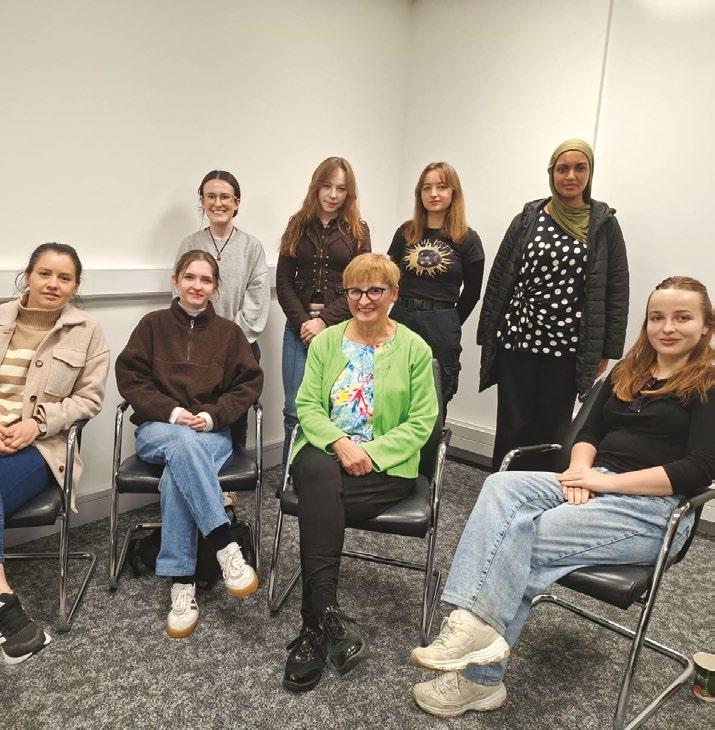
Special guest Una Parsons (front row, centre) at the launch of the CreateHER programme in ATU Sligo.
Reflections from a CreateHER participant
Julia Siegel, ATU Computer Networks & Cyber Security student and a participant on the programme reflects on her experience:
Taking part in the CreateHER programme was a positive and memorable experience that created a genuine space for trust, reflection, and growth. As part of the programme’s first cohort in Sligo, I joined a small group of women from a wide range of courses. Over six weeks, we were introduced to women working across areas such as engineering, politics, and entrepreneurship, all at different stages of their careers.
What stood out most was how open and honest the conversations were. Every woman involved in the programme approached it with warmth, care and genuine encouragement — sharing advice and personal stories that reflected not only their careers but who they are as people. Hearing them speak about values, leadership, and how decisions around family, relationships, and environment shaped their journeys was deeply inspiring and gave me a new perspective on my own future.
The programme encouraged reflection on self-belief, network IQ, and personal development, helping me gain clarity around my goals. The dedication of the organisers was clear in how thoughtful and meaningful each session was. I walked away with a stronger sense of direction, new friendships and connections. I would highly recommend CreateHER and I look forward to the upcoming alumni event in Galway!
“ Confidence, clarity and capability. That's what I gained and more from the Cumasú course. Thanks to this incredible experience, my unique training and mentorship programme 'Oral History Made Easy' is stronger and more accessible than I ever imagined. With incredible staff from start to finish, personalised guidance throughout and amazing peer support, I cannot recommend Cumasú highly enough. "
Dr Angela Maye-Banbury, Founder of Oral History Made Easy
Cumasú is hosting an online event, Ag ceiliúradh na mBan, an Ghnó agus na Gaeilge (Celebrating Women, Business and the Irish Language), to mark Seachtain na Gaeilge and International Women’s Day on Wednesday, on 4 March 2026 at 10:00am. Guest speakers include Senator Evanne Ní Chuilinn and Mollie
Guidera (Irish with Mollie), with Aedín Ní Thiarnaigh serving as MC.
The event is open to all ATU staff and students, with pre-registration required. To register please click here This event is funded by ATU's EDI Activity Support Fund.
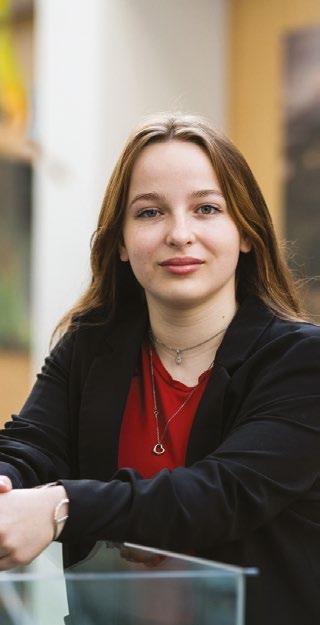
Julia Siegel, CreateHER participant.
Fulbright Specialist from Kansas University Medical School visits ATU
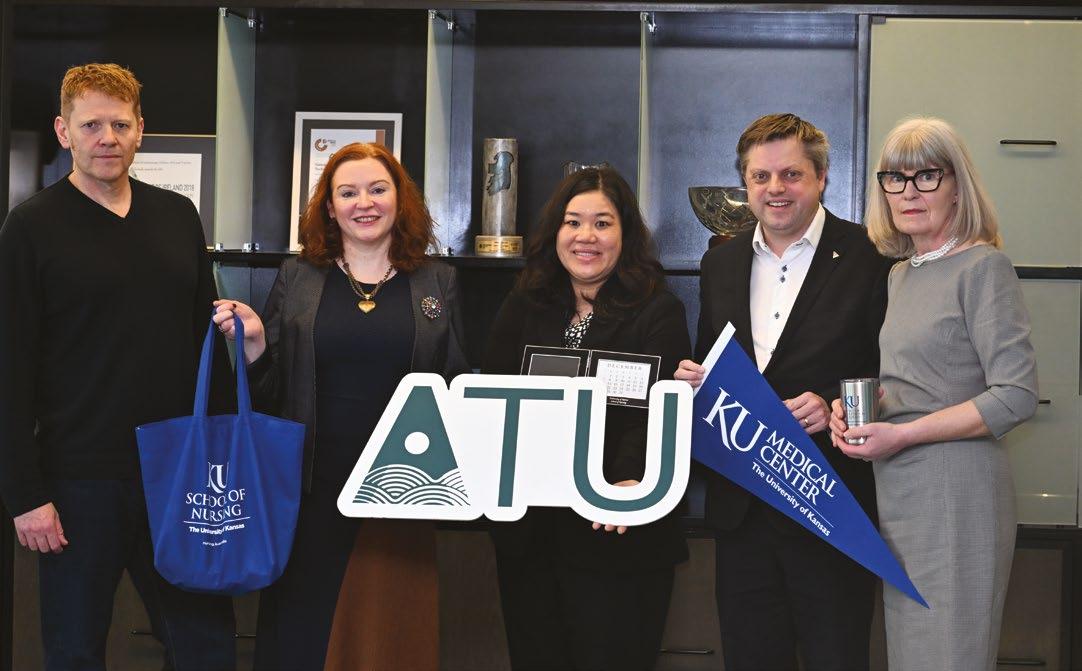
In December 2025, ATU hosted Associate Professor Frances Yang from Kansas University Medical School as part of a Fulbright Specialist Award, a competitive process awarded to Dr Richéal Burns, Director of the HEAL Research Centre and colead of the TU Rise THRIVE PRTP.
Professor Yang is an expert researcher in the field of gerontology and epidemiology with the School of Nursing in Kansas University. Her areas of specialism include examining the measurement of person-centred health outcomes in the presence of comorbid chronic health conditions.
During her six-week stay, Professor Yang visited campuses across ATU as well as delivering keynote speeches at the HEAL annual symposium, the TU Rise THRIVE Winter Symposium and a training day in the Centre for Personalised Medicine at Ulster University. She also provided some valuable presentations for the MISHE Research Centre, and the School of Nursing. Dr Burns organised one-to-one mentoring meetings between Professor Yang and several of the researchers across the HEAL research centre.
Speaking about the visit Dr Burns said: “ATU is so fortunate to benefit from a Fulbright Specialist, and I am grateful to Dr Rita Melia who supports academics and researchers applying for this award. Professor Yang’s expertise and prominence facilitated many training and knowledge transfer events for both students and staff involved in Healthcare and Nursing teaching and research. Several projects and collaborations have been developed and the HEAL Research Centre looks forward to supporting these collaborations and establishing a formal research network with Kansas University.”
Professor Yang, Dr Richéal Burns, Dr Eoin Cullina, Dr Mick McCann and Dr Eileen Gillen at the THRIVE Winter Symposium, ATU Galway Campus.
Professor Yang reflects on her visit to ATU
There are so many positive aspects of my interactions with ATU colleagues. The enthusiastic collaborations expressed at the meetings I have had with colleagues at ATU and practical steps we have taken towards data analysis and grant applications was a highlight of my visit. Additionally, the catalysts for innovation through teamwork and openness in sharing and identifying research ideas and hypotheses to build our formal network with ATU leaders will greatly benefit our joint research agendas.
The approachability and warmth offered by ATU in their support, generosity, and genuine interest in the collective success not only across the Wild Atlantic Way, but globally, was a unique experience.
Through the Fulbright Specialist program, developing a strong translational research approach and research collaboration strategies, we can strengthen ties between ATU’s research leadership and the University of Kansas Medical School (KUMC) specifically, to evolve our network into a genuinely productive transatlantic partnership. Both institutions have strengths in applied health sciences, data science, rural health, digital health, and community engaged research.
My fondest memory from my Fulbright visit to ATU was to truly experience firsthand Céad Míle Fáilte. I want to especially thank my host, Dr Richeal Burns, for going above and beyond to ensure I had an organised, productive, and enjoyable visit.
There was a moment after delivering the keynote at the
THRIVE: Translational Health Research Innovation preVention & Equity PRTP Winter Symposium, chatting with faculty, staff, and students over tea, when I realised conversations weren’t just polite academic exchanges. They were curious, warm, and deeply rooted in the region’s identity, with inspirations from the Wild Atlantic and the legendary strength of Queen Maeve from the top of Knocknarea.
People wanted to understand my work, but they also wanted to share their stories and dreams for improving the health of people living across Ireland and beyond. That blend of intellectual engagement and genuine hospitality will always be ingrained in me along with the spectacular views of Benbulben and Glencar Falls. It made the collaboration feel like joining a community that I was always meant to be a part of.
Professor Yang, Dr Richéal Burns, Dr Rita Melia, Dr Carmel Heaney and THRIVE PhD student Eustes Kigongo after a symposium delivered by the School of Nursing, in ATU Mayo.
Professor Yang receiving a gift from Dr Louise Mc Bride after presenting at the School of Nursing, ATU Letterkenny Campus.
Sustainability in Action ATU’s Growing Impact on the SDGs
The fifth guiding light of our Strategic Plan, ‘Sustainability for the Future’, underscores our responsibility to nurture a sustainable society. We envision a university that not only educates but also leads by example in environmental responsibility and social impact.
Here we highlight two recent publications which strongly reflect the university’s commitment to excellence and leadership in this space.
ATU’s Research Impact on the SDGs
This publication shines a spotlight on recent ATU research articles that have been categorised under at least one of the 17 Sustainable Development Goals (SDGs) by Elsevier.
For each article we have provided a bite-sized summary of the background, methods, key findings, and the impact on the related SDG. You can also access the original research publication.
By showcasing research through an SDG lens, this compilation reinforces
ATU’s role as a collaborative, impactdriven university that contributes positively to a rapidly changing world. To access the report please click here
Sustainability Impact Report
The first inaugural report of its kind, the ATU Sustainability Impact Report for 2025 reflects the university’s commitment to sharing a sustainable future for our communities and beyond.
The report features 47 activities aligned to one of each of the 17 SDGs. These include research publications and projects, campus initiatives, community engagement activities, operational works, enterprise case studies and education programmes. Each piece provides a glimpse into a colossal body of work which contributes towards ATU’s effort to advance sustainability both within our university and in our surrounding communities. To access the report please click here.
Delivering Clean Water in Uganda
Under ATU’s technical leadership, cutting-edge smart water technology has advanced from research labs in Donegal to real-world deployment in Uganda, where it is already improving water security for rural communities.
The Smart Water: Internet of Things (IoT) for Uganda project has reached a significant milestone as these systems transition from advanced academic research to operational use. As part of the collaboration, ATU’s WiSAR Lab provided the technical leadership, working alongside global consultancy Arup, international development organisation Fields of Life, and the Kumi District Water Office to support the rollout of smart water systems now benefiting rural communities.
Launched in 2019 as a joint research initiative, the project has progressed from early concept development and laboratory testing to full-scale deployment on the ground.
“Funded under the Enterprise Ireland Innovation Partnership Programme, the project demonstrates how ATU’s applied research in electronics, wireless communications, and embedded systems can address global sustainability challenges. The ATU team designed and manufactured low-cost, solar-powered IoT systems to continuously monitor community hand pumps, the main water source for many people in rural East Africa.”
Late last year, WiSAR research engineer Senan Morris travelled from Donegal to Uganda to oversee the installation of the new smart monitoring systems and train local engineers alongside the Kumi District Water Office. He also supported commissioning at several community water points to confirm their performance under realworld conditions.
“It was humbling to see the technology making a real difference on the ground,” said Senan Morris. “Working side by side with local teams showed how innovation and collaboration can create lasting impact.”
These smart systems transmit real-time data on water usage and pump performance, enabling local authorities and NGOs to detect faults early, plan maintenance efficiently, and prevent water loss. Conceived and engineered by ATU researchers, the technology reduces downtime and ensures reliable access to clean, safe water, improving health and resilience in rural communities.
Data from the pumps is already supporting local government planning. By providing reliable insights into water usage and performance, the platform enables smarter decision-making and early contingency measures. The system is scalable, with potential for further ATU-led development to include water-quality and environmental monitoring.
Dr Stephen Seawright, WiSAR Technology Gateway Manager at ATU, said: “Through the use of research and technology, we were able to help improve the lives of people in rural communities where access to clean water has long been a daily challenge. This project shows how Irish research, and ATU research in particular, can make a difference globally by turning ideas from the lab into solutions that change lives.”
The Smart Water: IoT for Uganda project supports UN Sustainable Development Goal 6: Clean Water and Sanitation, strengthening local water security, improving public health, and showing how ATU’s applied research can deliver global impact.
Supported by Enterprise Ireland under the Innovation Partnership Programme and co-funded by the European Regional Development Fund (ERDF), this partnership between ATU, Arup, Fields of Life, and the Kumi District Water Office highlights how research-driven innovation can deliver lasting, measurable benefits for communities who need it most.
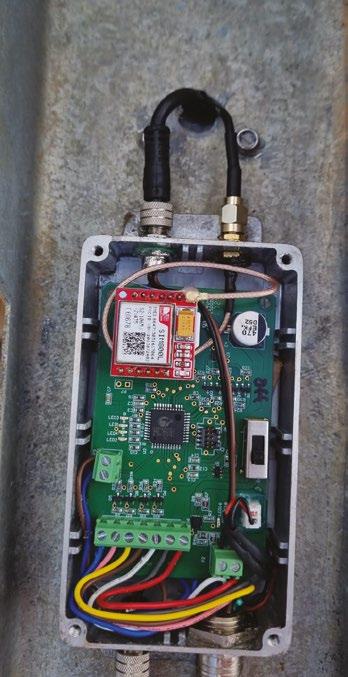
A close-up of the new smart monitoring device installed inside the hand pump, enabling real-time tracking of pump performance and water usage.
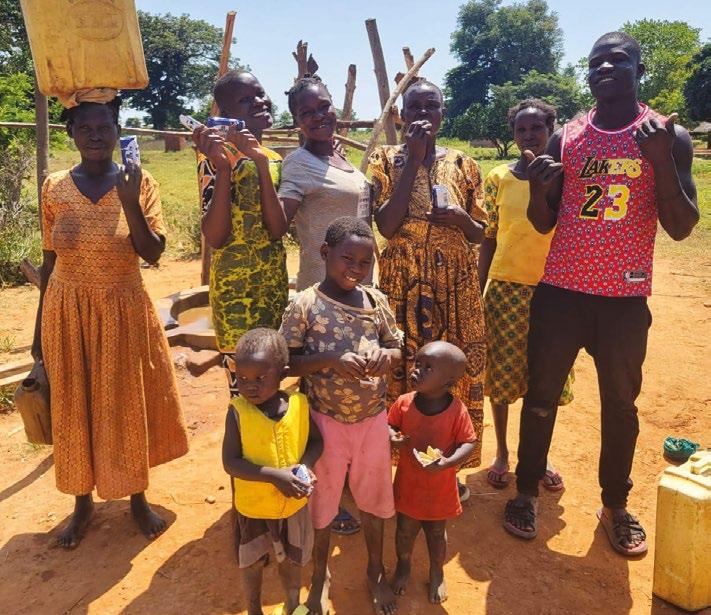
Families collecting water at upgraded water point.
Our Global Reach: A Blueprint for Sustainable Education
From Local Innovation to Global Impact
ATU’s Sligo campus has long been known for its pioneering approach to flexible and online education. However, two recent student journeys illustrate how this expertise is becoming a vital force for sustainable development in emerging economies, offering a powerful blueprint for the future.
These stories aren’t just about individual success; they are indicators of ATU’s unique potential to increase high-quality engineering education across sub-Saharan Africa, offering solutions that tackle the complex challenges of access and ‘brain drain.’
Two Student Journeys Paving the Way
Our first story begins in South Africa with Ian Nell. Back in 2016, Ian enrolled in IT Sligo’s Level 6 online certificate in Automation and Instrumentation. His journey of commitment continued over several years, culminating in 2025 when he graduated with a Master’s degree in Connected and Autonomous Vehicles.
During his studies, Ian kept in contact with Brian Mulligan, the then Head of Online Learning Innovation. Ian shared that, despite extensive searching, he could not find any equivalent suite of programmes anywhere else in the world. This feedback supported a suspicion of Brian: ATU’s unique experience in delivering high-quality online engineering education held immense, untapped potential for developing countries.
Simultaneously, a new opportunity arose closer to home through an international partnership. When Paul Press, an engineer with significant teaching experience in various developing nations, joined ATU (then IT Sligo), as a remote labs engineer during the early days of COVID-19, he brought critical global perspective. Brian successfully secured funding from the Irish embassy in Mozambique for Paul, who had previously taught in Mozambique, to travel there and collaborate with Kenmare Resources, an organisation eager to sponsor young talent.
This collaboration led to Joarsse Joaquim registering on our newly launched work-based Level 7 Mechatronic Systems Engineering degree in 2022 as a trainee engineer with Kenmare Resources in their Moma mine in rural Mozambique. Joarsse has been subsequently followed by several other Kenmare Resources students.
The Vision: Education Without ‘Brain Drain’
Fast forward to 2025: Joarrse has been conferred with his B.Eng in Mechatronic Systems, and Ian graduated at the top of his class from the Master’s programme. Their success demonstrates the viability and high quality of remote, workintegrated learning delivered by ATU.
This achievement has led to an important new phase of development work. Brian Mulligan, now retired from ATU, is leveraging his expertise as a consultant with Universal Learning Systems, working with ATU, and several polytechnics in Kenya to develop low-cost engineering education models that can be rapidly scaled up across sub-Saharan Africa.
Brian says that these two graduates offer a powerful lesson for the future of education:
“ Ian and Joarrse have shown us that not only is there a great need for engineering education in Africa, but there is also great potential for technology to help them provide it for themselves rather than suffering the ‘brain drain’ caused by sending students abroad."
This initiative aligns directly with several United Nations Sustainable Development Goals (SDGs). As Brian explains, online engineering education is a powerful tool:
“ Online engineering education addresses several sustainable development goals in improving access to education and economic growth, reducing inequalities, and developing industry. ATU is incredibly well placed to contribute, based on its 23 years in online distance learning and, more recently, its bold experimentation within the Higher Education 4.0 project. "
ATU’s continued focus on digital innovation is not just serving our local region, it also has the potential to forge a sustainable path for engineering education globally.
If you are interested in hearing more about the project, Brian can be contacted at brian.mulligan@ulsystems.com
Brian Mulligan
Barry Dever, Valeo Vision Systems presents Ian Nell (centre) with the Valeo Industry Award for his performance on the Master of Engineering in Connected and Autonomous Vehicles. Also pictured on the right is Dr Shane Gilroy, Programme Chair, Connected and Autonomous Vehicles, ATU.
Students Lead the Way in Understanding the Carbon Footprint of Their Degree
Students studying Business, Tourism and Events at ATU Sligo are stepping to the forefront of climate action with a new learning initiative connecting their academic studies to the findings of the ‘ATU Sligo Campus Baseline Carbon Footprint Report 2022’.
The recently published report reveals that the ATU Sligo campus produced an estimated 14,655 tCO₂e in 2022, with 1.31 tCO₂e emitted per student (FTE) each year and approximately 5.2 tCO₂e associated with a four-year degree programme.
These figures offer students an opportunity to understand the real environmental cost of higher education, and to explore how their disciplines can drive change.
Students turning insight into action
The Business, Tourism and Events programmes at ATU Sligo already place strong emphasis on sustainability, destination management, corporate responsibility and ethical leadership. With the release of this carbon footprint analysis, students can now integrate real institutional data into coursework, research, event planning and business strategy development.
Lecturers within the Department of Marketing, Tourism and Sport have begun using the findings to:
• Analyse emissions per student and per degree, helping students calculate the carbon impact of their own learning journey.
• Evaluate the footprint of business operations, with direct links to supply chains, procurement, event management and travel, key components of their studies.
• Challenge students to design low-carbon strategies for events, tourism experiences and business practices using the baseline evidence.
• Develop new student-led sustainability projects, including awareness campaigns, carbon budgeting exercises and green event prototypes.
This approach ensures students not only learn about sustainability but actively practise it — mirroring the report’s emphasis on universities leading by example. These directly intersect with tourism and events studies, making ATU Sligo an ideal real-world ‘living lab’ for applied learning. Students will examine:
• Sustainable mobility options, inspired by the high commuting footprint.
• Green event design, focusing on waste minimisation, catering choices and ethical procurement.
• Responsible tourism travel, using the report’s findings on staff and student travel emissions.
• Circular economy principles, responding to emissions from waste and electronic upgrades.
By engaging with institution-wide sustainability challenges, students gain practical skills aligned with both the UN Sustainable Development Goals (SDGs) and the EU’s Corporate Sustainability Reporting Directive (CSRD), critical frameworks shaping the future of business and tourism.
Empowering future leaders
Dr Orla Flynn, ATU President, encouraging student involvement in climate action as central to building a more resilient future says that universities must “not only teach sustainability but live it”.
“Universities are the foundation for future leadership. Measuring our carbon emissions is not just about data — it’s about accountability and collective responsibility.”
Emil Kindl, President, ATU Sligo Students’ Union
For Business, Tourism and Events students, this report provides both a challenge and an opportunity: to understand the environmental cost of education and to design solutions that will shape more sustainable industries.
Looking ahead
As ATU continues its roadmap toward Net-Zero emissions, Business, Tourism and Events students will play a crucial role in: mapping emissions linked to course activities and field trips; prototyping lowcarbon campus events; researching sustainable tourism, mobility and consumer behaviour; and assisting in data collection and awarenessbuilding initiatives.
The university plans to integrate the findings across all programmes, but ATU Sligo’s Business, Tourism and Events students are among the first to bring this data into an applied educational context, transforming carbon accounting into meaningful learning and climate action.
Dr Deirdre Byrne, staff researcher, ATU with Dr Domhnall Melly, lecturer in Tourism and Event management at ATU Sligo.
Community, Creativity and Achievements
Collaborating for Wellbeing: The Power of Staff-Student Partnerships in ATU’s Wellness Cafés
University life is full of opportunities and challenges, and now more than ever, mental health and wellbeing deserve our attention. Between lectures, deadlines, and the complexities of campus life, it’s important to create spaces where students can truly connect, feel supported, and thrive together.
In 2025, ATU took an exciting step forward with the introduction of peerled Wellness Cafés across campuses in Donegal, Mayo, and Galway. Staff and students have worked side by side to plan and deliver these initiatives, breaking down traditional hierarchies to create welcoming spaces where everyone can engage as equals.
The initiative began in ATU Donegal led by Sharon Ferguson, Mental Health & Wellbeing Project Officer. In a reflective essay recently published in the international Journal, Teaching and Learning Together in Higher Education, Sharon, and ATU Health and Social Care student Aimee O. Bryne explore the implementation of a community Peer-Led Wellness
Café model into a university setting to promote and support staffstudent partnerships.
The essay, "No Closed Door": How a Peer-Led Wellness Café Model Facilitated & Supported StaffStudent Partnerships” explains how a peer-led wellness café served as a transformative initiative within ATU Donegal Letterkenny, facilitating meaningful partnerships between staff and students. The café has become more than a wellness initiative, it is also a catalyst for cultural change, empathy, and collaborative growth.
The Wellness Café model was first developed in 2019 in County Donegal as a community-based, peer-led initiative supporting individuals with mental health challenges outside traditional clinical settings. Its guiding philosophy, “Doing with, not for,” emphasises collaboration and empowerment rather than hierarchical support.
Transitioning to university can be isolating, especially for minority or marginalised students. The Wellness Café addresses this by creating a safe, informal space where staff and students interact as equals. Through shared dialogue, creative activities,
and mutual listening, the café fosters social integration, a key protective factor for both wellbeing and academic success.
Emphasising the importance of the staff-student partnership Sharon Ferguson says: “In traditional thirdlevel institutions, the relationship between staff and students can often feel hierarchical and transactional, defined by roles, assessments, and institutional boundaries. However, the peer-led wellness café challenged this dynamic by creating a space where staff and students could engage as equals, united by shared experiences and a common goal of fostering wellbeing.”
“ The [Wellness] café became a living example of how inclusive, informal spaces can nurture genuine partnerships that extend beyond the classroom. I saw that participants created a partnership that empowered both students and staff to contribute to a healthier, more connected campus community. "
Sharon Ferguson, Mental Health & Wellbeing Project Officer, ATU Donegal, and a Wellness Café Peer Facilitator.
ATU student Aimee O. Bryne and co-author of the essay notes the importance of the cafés for students and says: “Students experience a strong sense of connectedness and community by being part of something meaningful. It becomes a space to make new friends, build relationships, and learn from others’ lived experiences.”
A student’s perspective on the Wellness Café
For Aimee, involvement in the Wellness café was transformative — combining academic learning with personal values, building confidence, and reinforcing the power of connection and collaboration. Peerled initiatives resonate with students because they reduce hierarchical dynamics and amplify student voices.
Aimee, a Health and Social Care student and peer facilitator, reflects on her experience:
“I am a second -year Health and Social Care student, and I have proudly volunteered as a Wellness Cafe facilitator for the past two years. The initiative was launched with the intention of creating an on-campus community that fosters connection, safety, and inclusivity, a space with no closed doors. It serves as a supportive environment where students from all backgrounds can
O. Byrne. Health and Social Care student and peer facilitator.
“I am really enjoying being a peer facilitator for the Wellness Café.”
“So glad I signed up, I love it!”
“It’s been a positive experience meeting students that I probably would not have engaged with outside the café.”
Aimee
Students’ reflections on Wellness Cafés.
experience a sense of belonging, compassion, and mutual respect. The Wellness Cafe enhances student wellbeing by promoting community connectedness, engagement, and purpose while celebrating diversity and inclusion.
“We were very grateful for the N -TUTORR Fellowship Funding grant because it gave us the freedom to fully design and shape the project’s branding in a creative and meaningful way. As part of the project, we trained peer facilitators, distributed student vouchers, organised a team-building day event at Lough Key, and carried out evaluations and reflection pieces to help us create a benchmark for future reference.
“I joined the Wellness Cafe because I wanted to be part of something that truly makes a difference in student life, not just for others, but also for myself. As a Health and Social Care student, I saw the opportunity to put some of my learning into practice. The Wellness Café felt
like the perfect place to bring my passion for wellness, mental health, connectivity, and support. It also gave me a chance to build my own confidence in approaching and engaging with students in a relaxed, open environment. Being part of a community where everyone is valued and supported has strengthened my belief in the power of connection and collaboration which will always be a core value in going forward in my career."
Wellness Cafés are currently running in ATU Mayo, ATU Donegal Letterkenny and ATU Galway city campuses. As part of Seachtain na Gaeilge 2026 (1-17 March), the world’s largest celebration of the Irish language and culture, pop up Wellness Cafés will run across the university.
ATU Wellness Café at ATU Mayo.
ATU Wellness Café at ATU Donegal.
New Annual Bursary for Undergraduate Nursing Students
The family of the late Patrick McGinty has announced the establishment of a new annual bursary for undergraduate nursing students at ATU Mayo, to be awarded each year for the next 10 years. This initiative honours Patrick’s lifelong commitment to the nursing profession and his deeply held belief in the transformative power of education.
Born in County Mayo in 1938, Patrick McGinty was a proud Mayo man whose early access to education was limited. Seeking opportunity abroad, he moved to England to study Intellectual Disability Nursing and General Nursing. This education opened doors to professional pathways previously unavailable to him and laid the foundation for a distinguished and impactful career.
Patrick progressed through the nursing ranks to become Divisional Nursing Officer for a 460-bed general hospital in Birmingham, demonstrating exceptional leadership and dedication to patient care. Returning to Ireland with his family, he continued to contribute to the sector through a senior management role with the Brothers of Charity Services. His service with the Nursing and Midwifery Board of Ireland, reflected
his enduring commitment to ethics, professional standards, inclusion, and integrity in nursing.
Colleagues remember Patrick as a “tough but fair” leader who consistently treated everyone with dignity and respect. His values are now embedded in this new bursary, which aims to honour his legacy by supporting the next generation of nurses in his home county.
The Patrick McGinty Undergraduate Nursing Bursary will support students enrolled in undergraduate nursing programmes at ATU Mayo. Nursing students face extensive academic and clinical demands, often accompanied by significant financial pressures. This bursary will help students reduce financial stress to better focus on academic and clinical performance.
In easing these pressures, the bursary will empower ATU Mayo students to succeed in their studies and enter the nursing profession equipped with confidence, competence, and compassion.
Through this 10-year commitment, the McGinty family hopes to inspire and support aspiring nurses just as education once opened new horizons
for Patrick. His legacy of service, leadership, and unwavering belief in the potential of nursing will continue to influence future generations through this meaningful bursary.
“ We are honoured that the McGinty family has chosen Atlantic Technological University, and particularly our nursing students at ATU Mayo, as the beneficiaries of this generous bursary. Patrick McGinty’s life exemplified the transformative impact of education and the profound value of professional integrity. This bursary will make a meaningful difference to our students, supporting them to become the nurses who will care for our communities in the years ahead. We are sincerely grateful for this lasting and thoughtful contribution in Patrick’s memory. "
Dr Justin Kerr, Head of the School of Nursing and Healthcare at ATU, and Vice President for ATU Mayo
Pictured back row left to right: Dr Justin Kerr (Vice President ATU Mayo Campus), Deirdre Sheridan (ATU), Rev Daniel Caldwell (ATU Lead Chaplain), Dr Christina Larkin (ATU, Head of Department of Nursing, Health Science & Integrated Care), Chrissie McGuiness ATU Students Union Vice President), Dr Michelle Glacken (ATU Registrar & VP Students).
row: Patrick McGinty’s wife Mrs Bridie McGinty (centre) with daughters Colette
and Dr Geraldine McGinty.
Front
McGinty
Sensing Lannagh Celebrated at the Linenhall Arts Centre
Sensing Lannagh, an inclusive arts exhibition created by students from ATU Mayo’s Project WAVE, was recently celebrated at the Linenhall Arts Centre in Castlebar. The exhibition formed part of the Mayo Arts Office UPSTART initiative and was developed in collaboration with visual artist Emma Donoghue and musician Benjamin Fox from Irish Lights.
The project involved six Project WAVE students — Marc Bolger, Sarah Connolly, Deirdre Gavin, Lauren McNamara, Mary Ruane and Anna Tobin — who took part in a series of creative workshops exploring their sensory and personal connections to Castlebar’s Lough Lannagh. Using natural, recycled, and textile materials, the students created tactile artworks that reflect their experiences of the local environment.
The students were supported by ATU staff including Sinéad Mulhern, Alisha McDonnell and Jeanette Kilroy and by the Linenhall community team: Justyna Gruszczyk, Alekandra Schulte, Viktoria Filipovska, and Svitlana Frankova.
An original soundscape composed by Irish Lights added an immersive, multisensory element to the exhibition, inviting visitors to engage with the work through sound, touch and reflection. The exhibition opening was well attended and provided students with a valuable opportunity to showcase their work and celebrate their achievements within the wider community.
ATU lecturer Sinéad Kilgannon with WAVE student Deirdre Garvin at the Sensing Lannagh Exhibition.
Lily Mannion wins the RDS Members’ Art Fund Award
ATU graduate Lily Mannion, recently won the RDS Members’ Art Fund Award at the 2025 RDS Arts Awards. The prestigious RDS Visual Art Awards is the most important platform for visual art graduates in Ireland. It provides a curated exhibition opportunity and a significant prize fund of over €40,000, as well as vital exposure for emerging visual artists as they move into early professional practice.
Lily’s practice explores the tensions between the natural world, systems of power, and human intervention. A First-Class Honours graduate of ATU Galway’s Contemporary Art programme, she investigates spaces and phenomena that have been lost or altered through systems of exploitation, extraction, and control.
Drawing on the histories of industry, craft, and labour, her practice examines networks of connectivity and the search for order within chaos. Guided by curiosity and often informed by scientific and mathematical ideas, she focuses on the unknown and the questions it generates. Her work considers the individual’s place within complex systems, creating visual frameworks to interpret and navigate the forces shaping our environment and society.
The RDS Visual Art Awards is the most important platform for visual art graduates in Ireland. It provides a curated exhibition opportunity and a significant prize fund of over €40,000, as well as vital exposure for emerging visual artists as they move into early professional practice.
“ In this field, you need to advocate for yourself and essentially be your own biggest supporter. That's why having a group of people review your work, especially outside of the usual open call system that artists use to apply for work, is incredibly gratifying and validating, especially this early on in my career. Winning the RDS members' art fund award gives me the chance to invest in both myself and my practice, hopefully leading to more opportunities in the future. "
Lily Mannion, ATU graduate and visual artist
Stone Sanctuary: ATU Students Earn National Recognition for Innovative Design
In November 2025, Stone Sanctuary, a collaborative project developed by fourth year students at ATU Connemara, received national commendation at the Institute Designers Ireland (IDI) Awards. The project explored place-making, material connection, and quiet reflection through integration of seating and stone wall construction. The international IDI judging panel shortlisted and commended Stone Sanctuary: Eco Enclave for its originality and sensitivity to landscape, culture, and ecology.
Design Challenge: Crafting a Sanctuary Within the Landscape
Students were tasked with designing an outdoor seating intervention that could be embedded into a traditional stone wall in Connemara National Park. The brief required a careful balance of durability, function, and user comfort, all while ensuring the new structure would feel at home in its rugged surroundings.
Beyond its structural requirements, the project presented a deeper
challenge: honouring the longstanding craft of stonework while contributing meaningfully to the cultural and environmental character of the National Park. Students worked in teams, drawing on research in material selection, user experience, and ecological responsibility. The overarching ambition was to create a “stone sanctuary” that invited rest, contemplation, and connection, both with nature and with local heritage.
Pictured are the students involved in the Stone Sanctuary project with, Eugene Finerty, Regional Manager of Connemara National Park; Stonemason, PJ Davin; Dr Orla Flynn, ATU President and Paul Leamy Head of Department, ATU Connemara.
Bringing the Concept to Life
The Stone Sanctuary project resulted in a series of integrated design features that celebrated material heritage while enhancing the visitor experience in Connemara National Park.
Central to the project was the use of native Irish oak, sourced from Áras an Uachtaráin and Glenstal Abbey, to create tactile, resilient seating that spoke to the natural and cultural identity of the region.
A strong ecological dimension underpinned the design. Students carved cavities into Connemara marble to create micro habitats for solitary bees, merging sculptural form with biodiversity support. Additional features such as a bird water basin and a hedgehog house reinforced the aim of designing for more than human needs, embedding the sanctuary within a wider environmental ecosystem.
Cultural engagement was also considered, with space allocated for rotating sculpture exhibitions, ensuring the site can evolve over time as a hub for creativity, community events, and reflection.
Seating interventions were varied and innovative. Curved, cantilevered benches integrated into the stone wall provided a unique sensory experience within the park’s rugged landscape. A long oak bench was positioned to frame views of Diamond
Mountain and the nearby playground, creating a space for families and walkers to pause and connect with the surrounding environment. The project culminated in the creation of a stone circle viewpoint, carefully integrated into the wall. This gathering space opened vistas into the woods and celebrated the enduring relationship between people, stone, and landscape
The Stone Sanctuary serves as both a place of rest and reflection, and a lasting example of how design education can merge cultural traditions with future facing ecological practices.
Reflecting on the Process
Students emphasised how valuable it was to work with stakeholders outside the university on a real-world project that carried genuine responsibility and potential long-term impact.
Liam O’Flaherty, one of the fourth year students involved, described the project as a transformative experience: “For me, the whole project was unique among any project that I had worked on during my college experience. It forced me to have a different mindset and broaden my perspective, thinking about every aspect through the eyes of the public, to create an inviting and inclusive space for everyone.”
Lecturer Jeremy Madden, who developed the project brief, highlighted the significance of the
students’ achievements: “I created the brief to help students make meaningful connections and provide them with opportunities they might not otherwise have access to. The outcomes of the Stone Sanctuary extended beyond drawings or prototypes. Students produced a body of work that demonstrated originality, competence, and creativity. They contributed to a wider conversation about how design can shape spaces that are meaningful, inclusive, and sustainable.”
“ The students and faculty of ATU Connemara, working with the staff of Connemara National Park, crafted an inspirational seating area combining traditional stone masonry, ecological elements, and locally sourced natural materials. By putting the students at the heart of the design and creative process, a real sense of ownership was achieved, which was evident in the passion exhibited by the students when approaching the project."
Eugene Finnerty, Regional Manager of Connemara National Park
Veterinary Lecturer wins Nuffield Ireland Scholarship to Tackle Rural Vet Shortages
John Donlon, a veterinary lecturer at ATU has been awarded a Nuffield Ireland Scholarship, set to commence this year. Donlon will research ‘Stopping the brain drain: retaining young veterinary professionals in rural Irish communities.’ Over the two-year programme, he will travel internationally, develop his research, and collaborate with the global Nuffield network to gather insights.
Donlon, who specialises in cattle health and welfare with a focus on calves, graduated from University College Dublin (UCD) in 2018 and completed a PhD at UCD on housing conditions and calf pneumonia. He has worked with Teagasc to improve animal health in the dairy calf-to-beef sector and contributed to research on veterinary workforce retention.
A native of Tulla, County Clare, John joined ATU as a lecturer in May last year, playing a key role in Ireland’s new veterinary school.
He said: “I’m honoured to receive this Scholarship. It’s a fantastic opportunity to explore solutions for retaining young veterinary professionals in rural communities and to learn from experts around the world.”
Nuffield Ireland supports individuals across agriculture, food, and rural sectors with international travel, mentoring, and access to a worldwide network of scholars.
Key accreditation milestone for new Veterinary Medicine and Surgery degree
In other veterinary news, the university has been granted an opinion of “reasonable assurance” by the Veterinary Council of Ireland (VCI) for its new Bachelor of Veterinary Medicine and Surgery (BVMS) programme. This milestone confirms that programme development is progressing in line with national and international accreditation expectations and represents a major step forward for veterinary education on the island of Ireland.
ATU Supports the Stripe Young Scientist and Technology Exhibition
ATU has strengthened its role in supporting young scientists across the West and Northwest through its growing collaboration with schools participating in the Stripe Young Scientist and Technology Exhibition.
While ATU has long opened its doors to students seeking research guidance, the past year has seen an expansion in how the university works directly with schools. Teachers and students across the region have increasingly turned to ATU’s campuses for access to laboratories, technical equipment and academic expertise as they develop projects for the national science and technology competition.
The exhibition offers a bridge between post-primary education and the world of higher-level research. By creating structured opportunities for students to engage with its academics, technicians and research facilities, the university aims to help nurture the next generation of scientific thinkers.
This year’s competition saw ATU support dozens of projects with students using lab equipment including 3D printers, testing rigs and coding labs, whilst also receiving support from ATU’s academics and researchers across our nine campuses.
Dr Orla Flynn, ATU President, said: “ATU’s support of the Stripe Young Scientist and Technology Exhibition starts well before the four days of the competition. We provide meaningful research access to our university campuses throughout the whole academic year to students participating in the competition. We know that post-primary schools may sometimes lack the specific resources needed to elevate project ideas, and by opening our campus doors to the next generation of innovators we contribute to regional and national success.”
ATU President Dr Orla Flynn pictured with Sandford Park School students Benjamin Griffiths, Alfie Patrick Scott Stephenson and Sam Colleary, winners of ATU’s sponsored prize for ‘Best Use of Technology’ for their project, Artificial Intelligence: Help or Hindrance to those with Dyslexia?'
Deepta Suresh and Jane Frances Muoneke, students from the Dominican College, Galway, were awarded 1st prize in the Senior Group competition of the Health and Wellbeing Category in the national event for their project, ‘From Vessel Support to Insulin Production: A Prototype Stent for Diabetes Complications.’ They were supported by ATU academics from the Galway City campus and acknowledged this support in their project submission as being instrumental in supporting their research.
Arya Satheesh from the Loreto Secondary School Letterkenny, Donegal received support and access to ATU facilities in the Letterkenny campus while undertaking research on her project ‘Eco Purge: Biodegradable Plastic with EnzymeDriven Microplastic Degradation.’ Arya
received 2nd prize in the Biological and Ecological Sciences category of the competition. Arya was most thankful for the support provided by ATU lecturer Mary Carr during her project development.
Aoife Fadian and Jessica O’Connor, students from the Ursuline College in Sligo received top marks at the event, being awarded ‘Best Group’ in the overall competition, for their project ‘Sheep Strength II: Using Sheep Wool to Reinforce Concrete’. Aoife and Jessica received support from ATU’s academic team in Sligo while undertaking their research work.
Fiona Kelly, Marketing Manager at ATU said: “Through this partnership with Stripe Young Scientist and Technology Exhibition we can support high achieving young scientists at a formative stage of their development. We are committed
to nurturing the next generation of thinkers, innovators, and problem solvers, and we are thrilled at the impact the university is having in supporting and empowering young people to achieve their dreams. Students like Aoife, Jessica, Deepta, Jane Frances and Arya are examples of the incredible students our university has supported during their research journey in the exhibition. We encourage more schools to engage with us so that young people can be supported to maximise their potential and achieve their goals.”
“ Ursuline College would like to sincerely thank staff at ATU and the Precision Engineering and Manufacturing (PEM) centre for their invaluable assistance and support over the last number of years. Having the opportunity to work with high level academic professionals and industrial grade calibration facilities gave our projects the chance to compete with the best. We look forward to working closely with all our sponsors and supporters and greatly appreciate the ATU facilities which are so graciously offered to us every year. "
Anthony Carolan, Stripe Young Scientist & Technology Coordinator, Ursuline College, Sligo.
Arya Satheesh, Loreto Secondary School Letterkenny, at her stand presenting her award-winning project ‘Eco Purge’, developed with support from ATU. Arya placed 2nd in the Biological and Ecological Sciences category and thanked ATU lecturer Mary Carr for her mentorship.
Championing Inclusion: ATU Hosts the SALAAM Anti-Racism Exhibition
ATU’s Equality, Diversity and Inclusion team recently partnered with the Local Authority Integration Team at Galway City Council to host the Sustainable Alliances Against Anti-Muslim Hatred (SALAAM) exhibition in ATU Galway. Hosting the exhibition expresses our continued efforts to combat racist attitudes and behaviours. The exhibition features a series of comics that aim to share the often-harsh experiences faced by members of the Muslim community and open up a dialogue that champions diversity, equality, and inclusion.
This project aims to combat anti-Muslim hatred through the development of tools such as anti-racism training and a support directory, in conjunction with local authorities. Funded by the European Commission, SALAAM has been developed in partnership with civil society organisations Doras, the Immigrant Council of Ireland, and the Irish Network Against Racism. Underpinned by the EU Anti-Racism Action Plan (2020-2025), along with other key legislative and policy developments, SALAAM aims to complement the work of other EUbased civil society actors.
The SALAAM project, led by University of Limerick is shaped in collaboration with Muslim communities in Dublin, Cork, Limerick and Galway, ensuring these perspectives are heard and authentically represented.
Some of these perspectives have been captured in striking artwork by illustrator Soufeina Hamed , a Berlin-based artist who creates comics related to the topics of identity, racism, and Islamophobia. Soufeina brought these first-person accounts of anti-Muslim hatred to life in a series of powerful illustrations to the exhibition.
Funding and Partnerships News
for ATU Integration and TEF Project
ATU welcomes €10.5m
Targeted Enhancement Fund announcement
In December Minister for Further and Higher Education, Research, Innovation and Science, James Lawless TD, announced a €65.8 million national investment targeting the technological sector and publicly funded specialist colleges. ATU has been allocated €10.5 million under this scheme.
The Targeted Enhancement Fund (TEF), which is managed by the Higher Education Authority (HEA), will see funding of up to €30 million disbursed to the institutions this year. Projects will operate over a 36-month period to 31 December 2028. To find out more please click here.
Lead Partner in €10 million ONEHEALTH project
ATU has been appointed as the Republic of Ireland’s lead academic partner in the €10 million ONEHEALTH project, a major crossborder research and innovation initiative led by Catalyst and supported through the PEACEPLUS Programme, managed by the Special EU Programmes Body (SEUPB).
ONEHEALTH brings together Catalyst, ATU, Queen’s University Belfast (QUB), the University of Galway, Tyndall National Institute Cork, and the Health Innovation Research Alliance Northern Ireland (HIRANI). Over the next four years, the consortium will address critical public health and agrifood challenges using advanced artificial intelligence, digital health technologies and integrated data insights.
The project applies a holistic approach, recognising the interconnected nature of human, animal and environmental health. To find out more please click here
€5.1 million funding boost for unlocking heritage opportunities for slow tourism
The project, Unlocking Heritage Opportunities for Slow Tourism (SLOWTOUR) has been selected for €5.1 million in funding under the Interreg North-West Europe (NWE) Programme.
Led by ATU through its STORY@ATU multicampus team, SLOWTOUR is an ambitious transnational project focused on revitalising urban areas by unlocking the potential of industrial and cultural heritage as a driver of sustainable, slow tourism. The project will support cities and regions to reimagine under-used heritage assets, creating richer visitor experiences while delivering lasting social, cultural and economic benefits for local communities. To find out more please click here
Dr Seán Duffy, VP
Lead, ATU with Minister James Lawless TD.
Research Ireland funding awarded to turn harmful plants into sustainable materials.
ATU Researcher Dr Salem Gharbia as a lead researcher together with Dr Giordano Bernardes as a Co-PI, have been awarded €219,196.25 in funding from Research Ireland’s COALESCE programme to explore turning Alien Aquatic Species (IAAS) into sustainable, cellulosebased materials.
The NEIS-Bio (Natural Extractives from Invasive Species for Biobased Solutions) project will explore how invasive plants in Sligo can be repurposed into eco-friendly materials for industry and community use.
“This project has the potential to contribute significantly to environmental sustainability by turning Invasive Species into a valuable resource,” said Dr Gharbia. To find out more please click here
€4.6 million EU fund to develop digital technologies for online apprenticeship courses
ATU and Vodafone Ireland have successfully secured €4.6 million in funding from the EU’s Connecting Europe Facility (CEF) Digital Fund to develop digital technologies for new online and on campus apprenticeship courses for engineering and construction students.
In addition to the CEF funding, both ATU and Vodafone Ireland are investing in the initiative, bringing the total investment in Irish education to €6.25 million.
The fund will be used to develop cutting-edge Extended Reality (XR) labs powered by a private 5G standalone network and on-campus edge computing delivered by Vodafone Ireland.
The initiative will be piloted at ATU Donegal, where students will gain access to immersive virtual and augmented reality environments that replicate physical labs and workshops.
This funding will allow students to learn in new and flexible ways, combining classroom teaching with remote and virtual training – making education more accessible, especially for people living in rural areas or those balancing work, study and apprenticeship programmes. To find out more please click here.
€19.2 million cross-border peatland restoration project
A major €19.2 million cross-border project to restore peatlands, enhance biodiversity and combat climate change was officially launched on World Wetlands Day (2nd February) at Lough Neagh Discovery Centre.
The PEAT+ Project is led by nature conservation charity Ulster Wildlife and is funded by PEACEPLUS, a programme managed by the Special EU Programmes Body (SEUPB). ATU are amongst the delivery partners. To find out more please click here.
News in Brief
Athletic Therapy Programme achieves ARTI accreditation
ATU has secured accreditation from Athletic Rehabilitation Therapy Ireland (ARTI) for its BSc (Hons) in Athletic Therapy and Exercise Rehabilitation
This recognition places ATU among a select group of Irish universities offering programmes that meet ARTI’s professional standards, strengthening allied healthcare provision in the Northwest region.
ARTI is the national governing body for Certified Athletic Therapists, ensuring high standards in the prevention, assessment and rehabilitation of musculoskeletal injuries. Graduates of accredited programmes can sit the ARTI certification exam, a requirement for professional practice in Ireland.
The programme, based at ATU’s Letterkenny campus, will allow students the opportunity to join a regulated profession who work within an allied healthcare role, ensuring the standard of care is maintained. To find out more please click here.
Research Vessel Tom Crean expedition returns from the Celtic Sea
In December, a research team from ATU returned from the Celtic Sea aboard the research vessel (RV) Tom Crean after spending days sampling the ocean to advance our understanding of the carbon cycle.
The SCOOP (Survey of Carbon Oceanographic Observation in Particles) survey, led by ATU’s Dr Elena Pagter, Chief Scientist and a postdoctoral researcher, in collaboration with the Marine Institute, brought together scientists studying plankton, fish, and seabed communities.
Dr Pagter said: “ATU students experienced the reality of offshore sampling at sea: long days, challenging weather, complex instruments, and the excitement of collecting their samples and discovering patterns emerging from fresh data.” To read more please click here
ATU graduate appointed Performance Nutritionist with the U.S. Women’s Soccer Team
For Hannah E. Thornton, a graduate of the MSc in Applied Sports and Exercise Nutrition ATU, a dream career become reality when she was appointed Performance Nutritionist with the U.S. Women’s National Soccer Team.
In her role, Hannah supports player health, availability and performance through evidence-based, practical nutrition strategies. Her day-to-day work includes planning and delivering nutrition support around training camps and matches, collaborating closely with medical and performance staff, and providing individualised guidance to players to support recovery, travel and competition demands. To read more please click here.
ATU Podcasts
Discovery of Ireland’s First Wildcat
Archaeologist Dr Marion Dowd discusses how she identified Ireland’s first confirmed wildcat, dating back 5,500 years. Found in Glencurran Cave in the Burren, the bones were analysed through radiocarbon dating and ancient DNA, offering new insight into Ireland’s early past. To listen please click here.
“24.2% of freight vehicle kilometres in Ireland are empty runs”.
In this episode of the IDEAS Podcast Series, PhD researcher Kithmini Gamage discusses how information technology solutions such as big data analytics, digital platforms, and secure data sharing can address fragmented freight systems, reduce inefficiencies like empty freight journeys, and support more sustainable regional development.
The conversation explores why the biggest barriers to data sharing are often behavioural and organisational rather than technological, and how trust-enabled solutions can strengthen regional connectivity and competitiveness. To listen please click here
The Irish Pub: Invention and Reinvention
Dr Perry Share discusses his newly co-edited book The Irish Pub: Invention and Reinvention The book brings together interdisciplinary research to examine how the Irish pub has been shaped by history, culture, and social change in Ireland and internationally. To listen please click here.
ATU in the Media
Nutrition expert sheds light on realistic protein needs
Protein is the body’s building block, but how high should our intake be?
Nóra Ní Fhlannagáin, lecturer in Sports Nutrition and Public Health Nutrition at ATU, has highlighted the importance of balanced protein intake for overall health, advising that while high protein products have a place, there are clear limits beyond which more isn’t better.
Her insights were recently featured in The Irish Examiner, reflecting growing public interest in protein-rich diets and supplements.
Dare to Howl giving Irish Heritage a modern twist
From Hollie Marie Gallager’s ‘Dare to Howl - Twists ‘n’ Thoughts’ collection (modelled by Zoe Stewart).
ATU graduate Hollie Marie Gallagher is featured in a recent issue of Image magazine. Hollie is the founder, creative director and designer of the luxury fashion brand Dare to Howl, which she established in the third year of her Fashion with Promotion degree at ATU Donegal. Dare to Howl is a brand born from Ireland's wild landscapes and rooted in Donegal's ancient weaving traditions while merging Irish heritage materials with slow fashion principles, challenging fast fashion culture.
Celebrating Christmas in January
ATU lecturer Marion McGarry was interviewed for an article on Ireland’s Nollaig na mBan, (Women’s Christmas) in National Geographic.
Traditionally Nollaig na mBan was “simply a gathering of female friends”, with the males in the house carrying out the household chores. To read more please click here.