
Transporting hydrogen: A global outlook on cross-border trade
I: INTRODUCTION
Clean hydrogen is needed to achieve an energy-secore, net-zero future, with feasible use cases ranging from fertilizer production and steelmaking to zero-carbon fuels and beyond. As this nascent sector develops, clean hydrogen will need to be transported from where it is produced to where it is consumed, often over long distances. Seaborne transportation of clean hydrogen, however, will be significantly constrained by unfavorable techno-economic factors and technical challenges. Instead, clean hydrogen trade will primarily occur via pipeline, although some countries may import electricity to serve as a feedstock for domestic hydrogen production.
Clean hydrogen—that is, hydrogen with little to no carbon emissions—can be produced using several methods. These include processes driven by clean electricity from various sources, such as hydropower, wind, solar, geothermal, and nuclear power. Hydrogen produced from fossil feedstocks, such as natural gas, must include high-rate carbon capture to be considered clean. According to the US Department of Energy’s current definition, hydrogen qualifies as clean if one kilogram is produced with a carbon intensity equal to or less than two kilograms of carbon dioxide.1 Geologic hydrogen—naturally occurring under the Earth’s surface—could be a game-changer, but significant challenges to commercialization remain.
Hydrogen—almost all of which is currently produced with unabated natural gas or coal—is used today to produce ammonia or methanol, or for refinery applications like desulfurizing diesel. Future potential use cases for clean hydrogen include steel making, maritime shipping (likely via clean methanol), long-haul and heavy-duty trucking, and more. While hydrogen is usually not the most appropriate decarbonization vector, due to its high production costs and handling difficulty, it is highly versatile and can theoretically be used in virtually any energy application.
1 US Department of Energy, “Clean Hydrogen Production Standard (CHPS),” Alternative Fuels Data Center, accessed May 20, 2025, https://afdc.energy.gov/laws/13033#:~:text=Clean%20hydrogen%20 is%20defined%20as,per%20kilogram%20of%20hydrogen%20produced
The Atlantic Council Global Energy Center develops and promotes pragmatic and nonpartisan policy solutions designed to advance global energy security, enhance economic opportunity, and accelerate pathways to net-zero emissions.
JULY 2025 JOSEPH WEBSTER
HYDROGEN SUPPLY FUNDAMENTALS
To have a surplus of clean hydrogen for international shipment, countries will first have to produce a domestic abundance of the molecule. Hydrogen supply will be maximized where a region has excellent co-located wind and solar resources, hydropower, natural gas and carbon storage resources, nuclear energy, or, preferably, all of the above.
Future clean hydrogen supply will likely be produced one of three ways. “Blue hydrogen” is produced from natural gas, but with emissions captured via carbon capture and storage. “Pink hydrogen” uses nuclear power to produce hydrogen by powering the electrolysis of water, which splits water into oxygen and hydrogen. Similarly, “green hydrogen” uses renewable electricity from solar, wind, and hydropower to power electrolysis.1
Production of blue hydrogen will be maximized where the emissions generated by its production can be captured and stored underground. Blue hydrogen’s ability to mitigate emissions is hotly debated, with some analyses holding that carbon capture rates are insufficient even as fugitive methane emissions are too high.2 Other analysts express more optimism about the technology’s potential, especially if Autothermal Reforming is employed.3 Ultimately, technology will determine the answer. If blue hydrogen can successfully decarbonize emissions, however, it could play a major role in certain types of international trade, especially via pipeline. Blue hydrogen may hold some advantages over other forms due to its ability to leverage existing infrastructure, including international pipelines.
Pink hydrogen, produced with nuclear power, is unlikely to play a significant role in the international trade of hydrogen, as it will be more expensive than green hydrogen.4 Still, nuclear power will play a critical, if indirect, enabling role for hydrogen. Nuclear power can help decarbonize the grid and ensure that additional renewable generation is purpose-built for hydrogen production. There also may be opportunities for nuclear power and renewables, working in tandem, to maximize total electricity production amid renewables “curtailment,” consequently raising hydrogen production. All things being equal, countries and regions that employ nuclear power will enjoy an export advantage over other hydrogen producers that do not.
Green hydrogen, produced with renewable electricity and water, may play an important role in hydrogen production, although the intermittent nature of most renewables will prove to be a key constraint. Green hydrogen’s electrolyzers intake renewable electricity and water to produce hydrogen. Consequently, production is optimized, in large part, when electrolyzer capacity factors are maximized. Renewables generation underlying green hydrogen production is, however, contingent on rainfall for hydropower, wind speed and sunlight exposure. These factors are highly variable, both diurnally and interseasonally. For instance, US solar PVs’ capacity factor in December 2022 stood at 13.1 percent, versus 33.4 percent in June of the same year.5 The capacity factor of onshore wind nationwide reached 46.6 percent in April 2022, but fell to 23.8 percent in August 2022.6 Hydropower, conversely, tends to enjoy strong, consistent interseasonal and diurnal capacity factors.7 Hydropower
1 Geologic hydrogen, sometimes called natural hydrogen or “gold hydrogen,” forms beneath the Earth’s surface through natural processes and is a major unknown variable in the emerging clean hydrogen sector. Its development, while hardly assured, could revolutionize hydrogen trade. Given the unknowns surrounding geologic hydrogen’s production economics and its abundance in nature, the potential impact of this resource is highly uncertain.
2 David Schlissel et al., Reality Check on CO2 Emissions Capture at Hydrogen-From-Gas Plants, Institute for Energy Economics and Financial Analysis, February 2022, https://ieefa.org/wp-content/uploads/2022/02/Reality-Check-on-CO2-Emissions-Capture-at-Hydrogen-From-Gas-Plants_ February-2022.pdf
3 Hensley Energy Consulting, “Preliminary Performance Comparisons of Hydrogen Production by Auto-Thermal Reforming and Steam Methane Reforming of Natural Gas with Low CO2 Emissions – Preliminary Estimates of Cost of H2 from Auto-Thermal Reforming,” memorandum to Clean Air Task Force, July 2021, https://cdn.catf.us/wp-content/uploads/2021/04/21092209/CATF_ZCFHensleyMemo_Proof_07.16.21-1.pdf
4 “Lazard’s Levelized Cost of Hydrogen Analysis— Version 3.0” in Levelized Cost of Energy, Lazard, April 2023, 27, https://www.lazard.com/ media/5amjxc3g/lazards-lcoeplus-april-2023.pdf
5 US Energy Information Agency, Electric Power Monthly, table 6.07.B, accessed May 23, 2025, https://www.eia.gov/electricity/monthly/epm_table_ grapher.php?t=epmt_6_07_b
6 Ibid.
7 Ibid.
Still, clean hydrogen faces significant challenges, not least because demand and potential supply sources are not necessarily co-located. Given the distances hydrogen will need to travel to reach customers and the technical challenges of transporting it, new delivery infrastructure and trade modalities will be required.
This paper summarizes the fundamental economic and technical factors that determine the suitability of internationally trading hydrogen, identifies potential routes through which hydrogen may be traded, and provides considerations for policymakers to determine when such trade is justified by technoeconomic fundamentals or other considerations, such as the drive to reach net-zero greenhouse gas emissions across all economic activities by 2050 globally.
In particular, this paper briefly examines the potential for future long-distance trade in hydrogen via the following forms:
• Pure hydrogen
• Hydrogen carriers, to include:
• Ammonia
• Methanol
is, in many respects, advantaged over other potential green hydrogen feedstocks due to its low cost, low carbon emissions, consistent diurnal and interseasonal capacity factors, and proximity to large volumes of water.
Green hydrogen at the export scale will likely require multiple generation (and storage) sources working together in tandem. As noted earlier, hydropower has advantages over other green hydrogen power sources, but even it will likely require pairing with other renewables sources. While solar and wind do not enjoy strong standalone capacity factors, pairing them together, along with batteries, will increase the capacity factors of electrolyzers and improve hydrogen’s project economics. Solar and wind are often anti-correlated on both a diurnal and interseasonal basis. Therefore, placing electrolyzers in regions with co-located solar and wind resources may optimize electrolyzer economics.
• Liquid organic hydrogen carriers
• Synthetic fuels
Long-distance clean hydrogen trade, especially intercontinental seaborne trade, suffers from punishing economics. Consequently, most clean hydrogen trade will likely be conducted regionally, via pipeline. Furthermore, trade will occur most often between supply regions that can deliver consistent, uninterrupted, low-carbon, and, crucially, low-cost feedstock for clean hydrogen. Accordingly, regions with hydropower— the Nordics, Brazil, Canada, and the US Pacific Northwest— will enjoy comparative advantages in clean hydrogen supply. Carbon capture and storage (CCS) technologies, if commercialized successfully, could confer advantages to natural gas producing regions with suitable geology for carbon storage.
On the demand side, offtake regions will require steady demand, policy support, and ample resources for decarbonization. From a US perspective, pure hydrogen trade will likely be conducted via pipeline. In addition to trade in pure hydrogen, the United States and other countries can enhance exports within the hydrogen value chain by providing products and services, such as carbon capture and other advanced energy technologies, including solar panels, wind components, and electrolyzers.
Indeed, electrolyzer economics will be optimized by a fully decarbonized grid. Hypothetically, if a grid were completely decarbonized, an electrolyzer could connect to the grid at any point. That flexibility, in turn, could allow hydrogen producers to maximize capital and land use costs. Countries with cheap, abundant, and clean baseload electricity will therefore have an enormous advantage in hydrogen exports.
Other factors besides clean generation resource availability will also be extremely important for future hydrogen trade. In many ways, hydrogen will function like any other market. Geographic proximity to demand centers, capital market access, investor confidence in the rule of law, political stability, human capital, and the ability to absorb new technology will all determine a country’s ability to galvanize investment and become an exporter.
II: HYDROGEN TRANSPORT
Hydrogen is currently often produced on the same industrial compound where it is used, or it is transported to dense, potentially distant demand hubs for industrial use. In the cases where hydrogen is delivered from its production site to consumers, it is typically transported through privately-owned networks of pipelines with continuous flow. Alternatively, “hydrogen merchants” sell compressed hydrogen to industrial consumers, such as refining centers on the US Gulf Coast , where hydrogen is used not for energy, but in chemical processes to remove sulfur from diesel fuel.2 To facilitate the delivery of hydrogen across longer distances, a variety of options are under consideration, designed with hydrogen’s specific properties in mind.
A. Hydrogen’s physical properties
The options for transporting hydrogen across long distances are based largely on hydrogen’s unique physical properties that make it challenging to contain and deliver. Hydrogen is the smallest element in the universe, making it prone to escaping confinement, and it exhibits poor energy density by volume. 3 Hydrogen thus requires costly special containment and delivery systems, and in return, provides little energy compared to conventional fuels. Hydrogen must therefore be compressed or liquefied before it is transported. Even then, hydrogen exhibits a volumetric energy density of eight mega joules per liter (MJ/L) when liquefied and 5.6 MJ/L for compressed hydrogen gas at seven hundred bar pressure, compared to 32 MJ/L for gasoline at ambient conditions.4 Compressed hydrogen is widely used in applications requiring immediate use and frequent refueling, including fuel cell vehicles, but it has a lower energy density than liquefied hydrogen.5
Additionally, hydrogen “embrittlement” can degrade a material’s mechanical properties, causing increased susceptibility to cracking and fracture.6 In pipelines, unmitigated embrittlement can lead to catastrophic failures.
These technical properties, the distance of travel, and, in some cases, its end use will determine the method by which hydrogen will be transported. Several methods are being used or are under consideration for delivering hydrogen.
Existing hydrogen transport methods:
• Containerized hydrogen gas, such as by truck or small water vessel (typically pressurized, e.g., 350 or 700 bar)
• Gaseous hydrogen pipeline (typically pressurized, e.g., 350 or 700 bar)
• Liquefied hydrogen transported by truck
Transport methods under consideration:
• Liquefied hydrogen transported by large oceanic tanker vessels for intercontinental trade
• Hydrogen carriers, which are molecules that store hydrogen in some other chemical form, such as ammonia, rather than as free hydrogen molecules
• Electricity, wherein electricity is distributed directly to an electrolyzer that produces hydrogen at the site where it is consumed.
B. Moving hydrogen across oceans
Virtually every commodity relies on shipborne trade for intercontinental movement. Hydrogen, however, faces technoeconomic and physical hurdles that will likely substantially constrain maritime trade for years, or even decades. Seaborne trade of hydrogen faces significant challenges and will proceed slowly, and likely only via hydrogen carriers. Significant maritime trade in pure hydrogen by ship is extremely unlikely.
2 https://hydrogencouncil.com/wp-content/uploads/2021/02/Hydrogen-Insights-2021.pdf
3 At atmospheric pressure, hydrogen has a volumetric energy density of 0.0107 MJ L-1. Hydrogen has an ambient density of 0.08375 kg m-3, which is 12 percent that of natural gas at 0.6800 kg m-3.
4 “Hydrogen Factsheet,” Center for Sustainable Systems, University of Michigan, 2024, https://css.umich.edu/publications/factsheets/energy/hydrogen-factsheet
5 US Department of Energy, “Physical Hydrogen Storage,” Office of Energy Efficiency & Renewable Energy, accessed May 22, 2025, https://www.energy.gov/ eere/fuelcells/physical-hydrogen-storage; and ScienceDirect, “Compressed Hydrogen Storage,” Renewable and Sustainable Energy Reviews, 2017, https://www. sciencedirect.com/topics/engineering/compressed-hydrogen-storage
6 Ghadiani, Hesamedin, Zoheir Farhat, Tahrim Alam, and Md. Aminul Islam. 2024. “Assessing Hydrogen Embrittlement in Pipeline Steels for Natural Gas-Hydrogen Blends: Implications for Existing Infrastructure” Solids 5, no. 3: 375-393. https://doi.org/10.3390/solids5030025
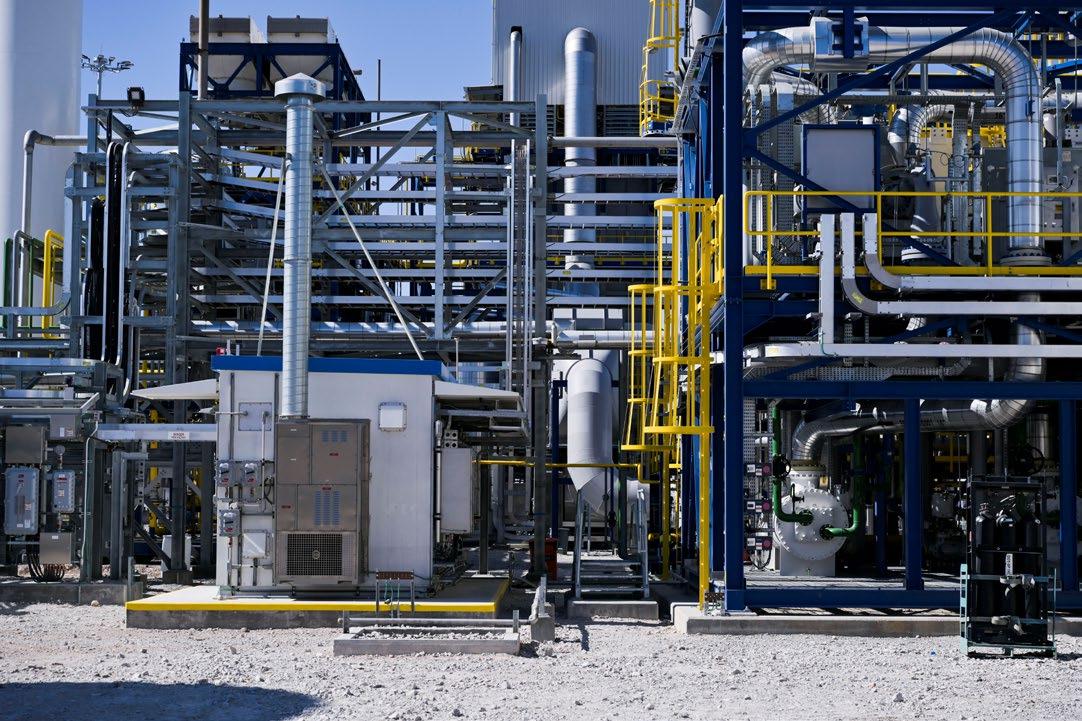
Nevada
Transporting hydrogen via ship
hydrogen for California’s mobility market, May 24, 2022. Source: REUTERS/Bridget Bennett
Transporting hydrogen economically at scale over long-distance, and particularly across oceans via ship, will be difficult. The reasons for this can be broken down into two categories.
First, as discussed above, hydrogen gas must be compressed or liquefied before it is transported. Liquefied hydrogen’s greater volumetric density leaves it more suitable than compressed hydrogen for long-distance, transoceanic transportation, but it still faces challenges, including “boil-off,” or evaporation, due to its low boiling point and volatility.7 As liquid hydrogen’s volumetric energy density is lower than gasoline, diesel, or liquefied natural gas (LNG), it requires more volume to transport the same quantity of energy. Although it remains difficult to forecast, it is likely that the costs associated with
transporting hydrogen in liquid state would be substantially higher than transporting an equivalent volume of LNG, due to the need to utilize purpose-built pipes, valves, pumps, tanks, and compressors that can contain highly dispersible gas and withstand extreme temperatures.
Second, and most importantly, the confluence of the above factors makes hydrogen energetically expensive to convert to a liquid for the purpose of transporting it long distances by ship. To liquefy hydrogen, it must be cooled to -252.87 degrees Celsius, which is near absolute zero.8 Bringing hydrogen to this extreme temperature requires approximately 30 to 36 percent of the energy contained in each unit of hydrogen itself. In comparison, this figure is roughly 10 percent for liquefying natural gas.9
7 Hae-Seong Hwang, Seong-Un Woo, and Seung-Ho Han, “Boil-Off Gas Generation in Vacuum-Jacketed Valve Used in Liquid Hydrogen Storage Tank,” Energies 17, no. 10: 2341, https://doi.org/10.3390/en17102341
8 Global trade of hydrogen: what is the best way to transfer hydrogen over long distances? Oxford Institute for Energy Studies, September 2022, https://www. oxfordenergy.org/wpcms/wp-content/uploads/2022/08/Global-trade-of-hydrogen-what-is-the-best-way-to-transfer-hydrogen-over-long-distances-ET16.pdf
9 Oxford Institute for Energy Studies, September 2022, https://www.oxfordenergy.org/wpcms/wp-content/uploads/2022/08/Global-trade-of-hydrogen-what-is-thebest-way-to-transfer-hydrogen-over-long-distances-ET16.pdf
Air Liquide’s facility in
liquefies
Pure hydrogen’s low volumetric energy density, susceptibility to thermal loss upon conversion from gaseous to liquid form, and high rate of boil-off mean it will almost certainly not be shipped over oceans in large volumes. However, it may be shipped long distances, such as over oceans, via hydrogen carriers, such as ammonia. Closer examination is needed on a project basis to determine which carrier should be used, when, and in what quantities such trade may occur.
Transporting hydrogen by proxy: hydrogen carriers
Hydrogen carriers are compounds that include hydrogen in their molecular composition and can be used as an alternative to transporting hydrogen in its free state—and potentially at lower cost and greater efficiency. These molecules offer a possible solution for transporting hydrogen long distances, particularly across oceans by ship. Compounds or categories of compounds that are potential carriers for transporting hydrogen include ammonia, methanol, liquid organic hydrogen carriers (e.g., methylcyclohexane and toluene), and synthetic fuels. These compounds can be packed more compactly and have a higher volumetric density than pure hydrogen.
The following list* provides a non-exhaustive overview of the value-chain segments and their respective determining factors that are responsible for the economics and relative advantages of different hydrogen carriers:
Production
• Feedstock cost
• Process energy intensity
• Cost of catalyst used to synthesize hydrogen with the hydrogen molecule
• Production equipment cost
Liquefaction
• Process energy intensity and thermal penalty (degree of compound’s energy content lost in liquefaction process)
• Boiling point (temperature at which a compound is liquefied)
Transport and storage
• Boiling point (temperature required to maintain liquid state)
• Volumetric hydrogen content (amount of hydrogen carried in a unit of space)
• Volumetric energy density (amount of energy stored in a unit of space occupied by the hydrogen carrier)
• Gravimetric hydrogen content (amount of hydrogen carried in a unit of mass or weight)
Decomposition (conversion of a hydrogen carrier to hydrogen and other compounds)
• Process energy intensity and thermal penalty
• Technological maturity of process, and economy of scale of process equipment
• Need for carbon capture
• Decomposition equipment cost
*Source: “Executive Summary” in Ammonia Technology Roadmap (Paris: International Energy Agency, 2021), https://www.iea.org/ reports/ammonia-technology-roadmap/executive-summary
The carriers listed above each have advantages and disadvantages, as described below:
Ammonia
Ammonia, which is composed of three parts hydrogen and one part nitrogen, is a globally traded commodity, with roughly 10 percent of production being exported from its countries of origin.10 In 2022, its global market size was approximately 191 million tons.11 The chemical is mainly produced today from unabated natural gas or coal, but it can be synthesized using clean hydrogen production technologies to produce low-carbon ammonia. Ammonia is a critical precursor chemical used in the production of nitrogen-based fertilizers—which sustains approximately half of the global population’s food production-—as well as certain petrochemical products such as synthetic fibers and refrigerants.12
10 “Executive Summary” in Ammonia Technology Roadmap (Paris: International Energy Agency, 2021), https://www.iea.org/reports/ammonia-technology-roadmap/ executive-summary
11 “Fertilizers,” S&P Global, accessed X, https://www.spglobal.com/commodity-insights/en/products-solutions/fertilizers
12 Siemens Industry, “Petrochemical Industry Ammonia Plant,” 2018, https://cache.industry.siemens.com/dl/files/567/109770567/att_995352/v1/PIAAP-00005-0118Ammonia.pdf
Due to its extant global trade, ammonia carries an incumbent advantage as a product with supporting infrastructure, commercial efficiencies, and robust standards and regulations.
Compellingly, ammonia also has a series of chemical properties that make it more advantageous than hydrogen itself for transport over long distances. First, liquefied ammonia can carry more hydrogen per unit of volume than pure hydrogen. Liquefied ammonia has a volumetric hydrogen content of 108 to 120 kg/m3 for ammonia versus 71 kg/m3 for hydrogen, due to ammonia’s higher volumetric density. Second, ammonia is more easily liquefied.13 The substance must be cooled to -33.34 degrees Celsius or lower during liquefaction, which implies a lower energy loss in liquefaction.14 Liquefied ammonia, as a result, is capable of ultimately delivering nearly twice as much energy as liquefied hydrogen.15
The main challenge associated with using ammonia as a hydrogen carrier arises when ammonia must be decomposed to yield hydrogen, referred to as ”cracking.” The technology to do this remains immature, resulting in relatively low conversion efficiencies ranging from 61 to 68.5 percent.16
Methanol
Methanol—which is composed of carbon, hydrogen, and oxygen—is also being examined as a potential carrier for clean hydrogen. The global market for methanol stands at roughly one hundred million tons per year,17 and the commodity is globally traded, as is ammonia, with established standards and regulations. The United States exported roughly 3.5 million tons in 2022.18
Methanol, importantly, is a liquid at room temperature and ambient pressure, enabling its transport without the need for liquefaction or regasification and their associated energy usage.
13 Global trade of hydrogen, Oxford Institute for Energy Studies
14 PubChem, “Ammonia,” https://pubchem.ncbi.nlm.nih.gov/compound/Ammaonia
15 Global trade of hydrogen, Oxford Institute for Energy Studies
Methanol has a volumetric hydrogen content of 95 to 99 kg/ m3, which equates to a higher hydrogen content than hydrogen itself (albeit a slightly lower hydrogen content than liquid ammonia). This is the chief advantage for the use of methanol as a hydrogen carrier.19
On the other hand, synthesizing methanol without emitting carbon is a complex and costly process. It requires combining clean hydrogen with carbon dioxide that has been captured or naturally derived. This process remains several times more expensive than the traditional—but carbon-emitting—method of manufacturing methanol from natural gas or coal. 20
Furthermore, releasing hydrogen from methane molecules so it may be used is also a costly process. Doing so releases carbon dioxide that must be captured, thus creating additional costs. In general, methanol is less expensive to handle and more expensive to produce than ammonia, potentially carrying a 25 to 100 percent higher cost, and undermining its competitiveness as a hydrogen carrier. 21
Synthetic methane
Another potential route for transporting hydrogen through a carrier is via the use of synthetic methane. By combining hydrogen (produced without emissions) with carbon dioxide at high temperatures, it is possible to produce a synthetic methane molecule that is identical to its naturally made counterpart. 22
The use of a synthetic methane carrier would certainly be advantageous for the enablement of international trade in hydrogen, provided that the production costs and thermogenic efficiency involved in synthesis were competitive with the production and liquefaction of ammonia or methanol, and the technology for decomposing carbon and hydrogen from the methane molecule were cost competitive with decomposition
16 American Chemical Society, “Hydrogen Storage: Materials, Technologies, and Applications,” https://pubs.acs.org/doi/10.1021/acsenergylett.1c02189
17 Innovation Outlook: Renewable Methanol, International Renewable Energy Agency and Methanol Institute, 2021, https://www.irena.org/-/media/Files/IRENA/ Agency/Publication/2021/Jan/IRENA_Innovation_Renewable_Methanol_2021.pdf
18 “US methanol trade flow shifts to exports,” Argus Media, January 3, 2023, https://www.argusmedia.com/en/news-and-insights/latest-market-news/2424971-usmethanol-trade-flow-shifts-to-exports
19 Global trade of hydrogen, Oxford Institute for Energy Studies
20 Abigail Martin, “A Step Forward for ’Green’ Methanol and Its Potential to Deliver Deep GHG Reductions in Maritime Shipping,” International Council on Clean Transportation, September 1, 2021, https://theicct.org/a-step-forward-for-green-methanol-and-its-potential-to-deliver-deep-ghg-reductions-in-maritimeshipping%E2%80%AF/
21 “The Role of E-fuels in Decarbonising Transport,” International Energy Agency, December 2023, https://www.iea.org/reports/the-role-of-e-fuels-in-decarbonisingtransport
22 “We Create e-NG,” TES, accessed XX, https://tes-h2.com/green-cycle/step-3-e-ng
technologies for ammonia and methanol, respectively. Advantageously, the synthetic methane molecule could also be consumed directly, in the same manner as natural gas is consumed in areas such as the power sector, in steelmaking, or numerous other industrial processes.
However, the use of the synthetic methane molecule as a hydrogen carrier presents the issue of carbon management. When synthetic methane is broken up to release its hydrogen or when it is used as is, it releases carbon, which must be captured to ensure that the molecule sequesters the carbon captured in the production stage.
Considerable questions remain as to the viability of utilizing this molecule as a means to transport hydrogen. The commercial metrics underpinning this fuel depend in many cases on the interaction of the production costs for hydrogen and the cost of direct air capture, to provide non-biogenic carbon, and the cost for this process ranges between $135 and $335 per ton, with a pathway to reach $100 per ton by 2030 as a global average. 23 Not only would direct air capture costs need to improve dramatically, but, separately, hydrogen must become more competitive, with estimates holding that its price will need to drop below $1 per kg to become price-competitive with existing fuels. 24
Liquid organic hydrogen carriers
Liquid organic hydrogen carriers are molecules that are generally liquid under ambient conditions and are hydrogenated, or loaded with hydrogen, at the point of export and dehydrogenated at the point of import or end-use. This process requires no phase changes to convert the compound from a gas to a liquid or vice-versa, avoiding the energy lost as heat during the conversion process (referred to as the thermogentic penalty). The liquid organic hydrogen carrier molecule that has received the greatest amount of positive attention is the toluene molecule, which when loaded with hydrogen becomes a methylcyclohexane molecule, and is reconverted to toluene upon dehydrogenation. Toluene, as is the case for ammonia, methanol, and synthetic methane, benefits from a
robust existing network of infrastructure and mature global standards and regulations.
Unfortunately, using toluene as a carrier also comes with major disadvantages. For one, it has a volumetric energy density of 47.1 kg(H2 )/m3, which is lower than liquid hydrogen. 25 Additionally, its low gravimetric energy density of 7.35 MJ/kg would likely generate unwieldy shipping costs to transport the fuel. It is not likely that this carrier would be cost-effective in comparison to ammonia, as these characteristics mean that toluene will likely deliver the lowest final quantity of delivered hydrogen of all the carriers discussed thus far. 26
C. Moving hydrogen long distances over land
When moving hydrogen long distances in bulk over land, particularly when crossing national boundaries, the two primary options are to transport the hydrogen via pipeline or to transmit electricity directly to a point of electrolysis, where hydrogen can be produced near the end user.
The economic factors underlying the transport of hydrogen via pipelines or electricity are complex, and different situations may suit different modes of long-distance energy transmission. Furthermore, the nascency of the industry makes forecasting a challenge due to a lack of reference cases.
Pipeline transport
To move clean hydrogen economically via pipeline, certain conditions must first be in place. First, there must be a large source of continuous hydrogen supply. Second, the capacity of the pipeline, a function of its diameter and pressure, must be large and consistent. A study by the Oxford Institute for Energy Studies has found that pipelines with more than ten gigawatts (GW) of transmission capacity would be economical, and increases in diameter are correlated with a decrease in price per megawatt-hour. 27
The economics of a clean hydrogen pipeline network could potentially be inferred from the existing hydrogen pipeline
23 Boston Consulting Group, “Impact of IRA, IIJA, CHIPS, and Energy Act of 2020 on Clean Technologies,” Breakthrough Energy, April 2023, https://www. breakthroughenergy.org/wp-content/uploads/2023/04/Crosstech-Cleantech-Policy-Impact-Assessment.pdf
24 “Hydrogen Shot: An Introduction,” US Department of Energy, accessed June 25, 2025, https://www.energy.gov/eere/fuelcells/articles/hydrogen-shotintroduction
25 Global trade of hydrogen, Oxford Institute for Energy Studies
26 Ibid.
27 Hydrogen pipelines vs. HVDC lines: Should we transfer green molecules or electrons? Oxford Institute for Energy Studies, November 2023, https://www. oxfordenergy.org/wpcms/wp-content/uploads/2023/11/ET27-Hydrogen-pipelines-vs.-HVDC-lines.pdf
networks of areas such as the Gulf of Mexico or the Ruhr Valley in Germany, where there is a well-established natural gas reformation network. 28 Many of these hydrogen networks, however, are private and industry-owned, and their characteristics are not publicly available. Thus, there is considerable uncertainty in forecasting project viability and developers’ internal rate of return for future hydrogen pipelines and networks.
Transmitting electricity to a production point
Transmitting electricity to produce hydrogen at the point of use is more efficient than transporting hydrogen via pipeline. 29 This efficiency may be optimized when high-voltage direct current (HVDC) lines are used to transport electrons over long distances, as HVDC lines can carry 30 to 50 percent lower energy losses than comparable high voltage alternating current (HVAC) lines, which are more prevalent today than HVDC systems. 30
When following the clean hydrogen lifecycle (using green hydrogen as an example) from electrolysis to delivery, hydrogen pipelines may experience between a 40.5 and 88 percent loss in energy content, 31 whereas HVDC lines lose between 8 and 18 percent of their energy content. 32 Pipelines lose energy as hydrogen moves through the multiple steps of the transport infrastructure: AC/DC rectifiers, input electricity, electrolysis, desalination, dehydration/dehumidification, compression, and energy storage. In comparison, HVDC lines incur the costs of an AC/DC rectifier, and transmission loss, which leaves far less opportunity for thermal energy loss.
However, the high capital and operating costs of HVDC lines may mean that the cost per unit of delivered energy may be higher in the case of transmission of electricity, versus hydrogen transport by pipeline. While it is difficult to predict the exact balance of costs for dedicated hydrogen pipelines, the Oxford Institute for Energy Studies estimates that the costs
for pipeline transport may range between $1.2 and $19.7 per MWh per 1,000 km, whereas HVDC transmission may yield a cost of between $2.5 and $97.7 per MWh per 1,000 km. 33 However, the lower cost of hydrogen pipelines may be limited to cases where hydrogen flow is large and relatively uninterrupted and may be less economic over longer distances. On the other hand, utilizing electricity would require entirely new transmission corridors to account for the increase in demand that a large degree of hydrogen electrolysis would entail.
34
Notwithstanding, it is important to consider that HVDC transmission is usable even when hydrogen flow is not consistent, meaning that delivering electricity directly to a point of electrolysis may be preferable for hydrogen production applications without stable, high-volume demand. Furthermore, HVDC transmission is cost-effective over long distances. Lastly, the competitive cost of hydrogen pipeline transmission does not reflect thermal penalties in converting between electricity and hydrogen prior to transport, which could result in a significant energy loss.
Given the favorable efficiency of electricity transmission and the high costs of hydrogen transport, it is likely that clean hydrogen will be manufactured at point of use or nearby, as is the case for 85 percent of hydrogen utilized today, and potentially injected into a local pipeline network in industrial clusters. 35
Using onsite electrolysis with captive transmission lines or structured power purchase agreements preserves optionality, wherein electricity transmitted may be used for hydrogen production or directly consumed elsewhere on the grid. Largescale pipelines will likely not be economical unless there is a cluster of large offtakers at the terminus of the pipeline with steady demand, capable of being met by a consistent and steady supply of clean hydrogen. Critically, however, in cases where these conditions are met, pipelines may be the preferred option. This is especially true in cases where existing
28 Air Products’ U.S. Gulf Coast hydrogen network,” Air Products, 2012, https://microsites.airproducts.com/h2-pipeline/pdf/air-products-us-gulf-coast-hydrogennetwork-datasheet.pdf
29 Hydrogen pipelines vs. HVDC lines, Oxford Institute for Energy Studies.
30 Office of Electricity, “Connecting the Country with HVDC,” US Department of Energy, September 27, 2023, https://www.energy.gov/oe/articles/connectingcountry-hvdc#:~:text=Over%20long%20distances%2C%20HVDC%20losses,%2C%20reducing%20long%2Dterm%20costs
31 Hydrogen pipelines vs. HVDC lines, Oxford Institute for Energy Studies
32 Ibid.
33 Ibid.
34 Joshua D. Rhodes et al., “Renewable Electrolysis in Texas: Pipelines versus Power Lines,” H2@UT, August 2021, https://sites.utexas.edu/h2/files/2021/08/H2White-Paper_Hydrogen-Pipelines-versus-Power-Lines.pdf
35 Michael Barnard, “No, White Hydrogen Isn’t a Limitless Source of Clean Fuel,” CleanTechnica, November 11, 2023, https://cleantechnica.com/2023/08/07/nowhite-hydrogen-isnt-a-limitless-source-of-clean-fuel/
natural gas lines may be repurposed, with significant structural modifications, 36 which can reduce project costs by 65 to 90 percent. 37 Without these modifications, however, severe “embrittlement”—or degradation of the pipeline—may result, which could lead to leakage of hydrogen. At leakage rates of 10 percent, the climate mitigation potential of clean hydrogen could be erased, at least in part, due to its effects on greenhouse gas levels in the atmosphere. 38
III: GLOBAL HYDROGEN TRADE
Existing international hydrogen trade is minimal and usually conducted between adjoining countries. 39 To the extent such trade exists, it is usually in hydrogen carriers, such as ammonia or methanol.40 Over time, and as the techno-economics of hydrogen improves, so will prospects for international trade.
Economics and political economy will remain enduring forces in shaping hydrogen trade. Given the transport complexities and challenges involved in developing the hydrogen market, global trade in hydrogen will largely be determined by fundamental forces of supply and demand, technological advancements, geopolitics, and countries’ willingness to pay a green premium to alleviate pollution, climate change, or both. Consequently, demand for hydrogen imports will be greatest in high-income economies across Europe and Asia that seek to decarbonize but lack sufficient clean hydrogen feedstock potential. These economies will seek to secure their hydrogen needs from the lowest-cost sources.
At the same time, geopolitical factors will weigh on a netzero energy system, as they do the current system. Hydrogen trade is no exception. Europe will be the world’s largest and most important hydrogen importer, due to its climate goals and proximity to supply. At the same time, the continent will
be wary of outsourcing its energy needs and will seek to maximally concentrate value chains within the European market. Europe and other advanced economies with strong industrial bases, but limited renewable potential, may also seek to pay a premium to import hydrogen feedstock as a means of preserving the integrity of their industrial base.
A. Current global hydrogen demand
World hydrogen demand—which is currently based on its consumption as a chemical feedstock for refining and chemicals manufacturing, not as an energy carrier—stood at about 95 million metric tons in 2022, as consumption returned to preCOVID levels.41 Hydrogen demand is dispersed regionally, with China and the United States as the top consumers, followed by the Middle East, Europe, and India.42
About forty-one million metric tons of hydrogen—from unabated natural gas and coal—were consumed by the refining sector, the largest offtaker for global hydrogen, accounting for 43.2 percent of total hydrogen demand.43 Hydrogen is used to desulfurize diesel and is used extensively by so-called “complex refineries,” which are optimized to handle heavy, sour grades of crude oil. China and the United States are the world’s two largest oil consumers and home to some of the world’s most complex refineries; the Middle East, Europe, and India are also important markets.44
The production of fertilizers, which contain hydrogen and nitrogen often in the form of ammonia, consumed about 31.8 million tons of hydrogen in 2022, accounting for about 33.4 percent of H2 demand.45 Apparent nitrogen consumption is also strongly correlated with population. For instance, Asia comprises 57 percent of world nitrogen apparent consumption, which is a proxy for demand of ammonia. Asia’s share of global nitrogen consumption is strongly correlated with its
36 Cynthia Quarterman, The on-ramp for hydrogen: The natural gas network, Atlantic Council, August 7, 2023, https://www.atlanticcouncil.org/in-depth-researchreports/report/the-on-ramp-for-hydrogen-the-natural-gas-network/
37 Hydrogen pipelines vs. HVDC lines, Oxford Institute for Energy Studies
38 Hydrogen pipelines vs. HVDC lines, Oxford Institute for Energy Studies
39 International Energy Agency, Global Hydrogen Review 2024, International Energy Agency, 2024, 104, https://iea.blob.core.windows.net/assets/89c1e382-dc5946ca-aa47-9f7d41531ab5/GlobalHydrogenReview2024.pdf
40 Ibid.
41 Hydrogen,” International Energy Agency, accessed X, https://www.iea.org/energy-system/low-emission-fuels/hydrogen
42 International Energy Agency, Global Hydrogen Review 2022, International Energy Agency, September 2022, https://iea.blob.core.windows.net/assets/c5bc75b19e4d-460d-9056-6e8e626a11c4/GlobalHydrogenReview2022.pdf, 18.
43 International Energy Agency, Global Hydrogen Review 2023, International Energy Agency, September 2023, https://iea.blob.core.windows.net/assets/ecdfc3bbd212-4a4c-9ff7-6ce5b1e19cef/GlobalHydrogenReview2023.pdf
44 Energy Institute, “Resources and data downloads,” accessed May 20, 2025, https://www.energyinst.org/statistical-review/resources-and-data-downloads
45 International Energy Agency, Global Hydrogen Review 2023
population share, as Asia is home to approximately 60 percent of the global population.46 The geographic distribution of ammonia demand and limited indigenous feedstock of supply is suggestive of international trade—and, unsurprisingly, global exports account for about 10 percent of total production.47
Methanol, currently primarily produced from natural gas, is the third most important potential demand source for hydrogen. Hydrogen consumed in methanol processes stood at 15.9 million tons in 2022, accounting for 16.7 percent of world hydrogen consumption.48 Methanol is a widely used precursor chemical in hundreds of consumer products, including paints, plastics, and adhesives. In the future, methanol could enjoy synergy with clean hydrogen. Renewable methanol can be made from clean hydrogen and captured carbon dioxide
instead of natural gas and could be used as a fuel for powering maritime vessels.
Other use cases have had relatively little role in hydrogen demand to date. Direct-reduced iron for steelmaking, a process in which hydrogen plays a chemical role, accounted for 5.3 million tons, although hydrogen consumption for clean steel is expected to grow. Other use cases consumed the remaining one million tons.49
Future hydrogen demand will likely be more varied than seen today, as its energy applications grow. While it is perhaps inaccurate to term hydrogen a so-called “Swiss Army knife,” as not every application is suitable for hydrogen, the molecule is versatile and could conceivably be repurposed for several
46 International Fertilizer Association, “Ammonia,” IFASTAT, 2025, https://ifastat.org/supply/nitrogen%20Products/Ammonia; and UNFPA, “Population trends,” accessed X, https://asiapacific.unfpa.org/en/topics/population-trends-9
47 “Executive Summary” in Ammonia Technology Roadmap
48 International Energy Agency, Global Hydrogen Review 2023
49 Ibid.
An H2 logo is pictured at the Hyvolution exhibition in Paris, France, January 28, 2025. Source: REUTERS/Benoit Tessier
roles including shipping, steel, long-duration storage, longhaul trucking, aviation, industrial heat, and more.50
Clean hydrogen as an energy carrier will have a more difficult time breaking into applications where incumbent fuels or technologies are already dominant, or when competing technologies are more efficient and less costly. To enter new applications, hydrogen must become more technologically viable and economically competitive—and even then, it will likely require policy support and fiscal backing to overcome the technical challenges detailed in section I.
Future demand centers: OECD countries
Future clean hydrogen demand, especially for energy use cases, will be strongest where technological, economic, and policy conditions are most supportive. Many Organisation for Economic Co-operation and Development (OECD) countries and wealthy democracies provide these conditions, with a high degree of technological capability, resources, and a commitment to decarbonization.
Wherever possible, OECD countries will attempt to produce their own hydrogen from clean feedstocks, leveraging indigenous renewable resources, natural gas with carbon abatement, and nuclear power. When they lack these indigenous resources and capabilities but still wish to use hydrogen as a decarbonization solution, OECD countries will turn to imports for hydrogen feedstocks or products.
Europe has set explicit clean hydrogen-related targets, aiming to produce and import ten million tons by 2030. 51 Owing to its limited indigenous resources, strong decarbonization commitments, and stated objectives, Europe is the economy most likely to become a significant clean hydrogen interregional importer, followed at some distance by the Northeast Asian democracies.
Japan, South Korea, and Taiwan all have much lower indigenous clean energy generation than Europe. They are separated from potential clean electricity generation export centers due to geography, geopolitics, or both. Moreover,
unlike Europe, they cannot rely on pipeline or transmission connections to potential hydrogen exporters. In 2023, only 38 percent of South Korea’s grid was powered by nonfossil sources, 31 percent in Japan, and only 14 percent in Taiwan, while 58 percent of Europe’s grid was from nonfossil sources. 52 Moreover, Europe still can find additional generation from onshore wind, onshore solar, and fixedbottom offshore wind resources.53 The Northeast Asian economies, conversely, suffer from greater onshore land use constraints and must also rely largely on the development of floating offshore wind and nuclear energy to fully decarbonize their grids. Since both floating offshore wind and nuclear energy projects will take a long time to develop, Northeast Asia’s priority for a long time will be on greening its grid, limiting its interest in clean hydrogen. Northeast Asia may become an important hydrogen demand center over time, but Europe is likely to remain the world’s largest—and perhaps only—interregional clean hydrogen importer of consequence for some time.
OECD countries outside of Europe and Northeast Asia are less likely to import their hydrogen needs from interregional trade. The North and South American democracies will very likely be able to meet their own hydrogen needs with indigenous production—and will in fact likely flirt with the idea of exporting to import demand centers. Similarly, Australia will seek to become a hydrogen exporter, given its impressive renewables resources.
Intra-regional trade could be important, however, especially in the North American context, as the economies and energy security of the United States, Canada, and Mexico are closely interlinked.
OECD countries will be key to “jumpstarting” global clean hydrogen trade, not only as importers and exporters, but also as technological partners. In order to meet initial world demand for clean hydrogen, however, supply must simultaneously rise to match consumption. Solving this “chicken and egg” problem of simultaneously creating supply and demand, often in different regions and countries, will be fundamental to hydrogen markets.
50 Michael Liebreich, “The Clean Hydrogen Ladder [Now updated to v4.1],” LinkedIn, August 15, 2021, https://www.linkedin.com/pulse/clean-hydrogen-ladder-v40michael-liebreich/
51 “Hydrogen,” European Commission, accessed June 25, 2025, https://energy.ec.europa.eu/topics/energy-systems-integration/hydrogen_en
52 Nicolas Fulghum, “Electricity Data Explorer,” Ember, https://ember-climate.org/data/data-tools/data-explorer/ 53 Ibid.
B. Expected patterns of trade: Regional and technical considerations
Each potential clean hydrogen exporter will face challenges and target different markets. Exporters will seek to tap into nearby or, preferably, adjoining pipeline-connected regions, to minimize transportation costs. Transportation costs and thermodynamic penalties will constrain long-distance maritime shipping. Other export routes are much less probable in the medium term and will depend on improving hydrogen production costs. Finally, significant trade may be conducted in the infrastructure used to produce hydrogen with renewables feedstock, even if the produced hydrogen is consumed domestically, without crossing international borders. Accordingly, in addition to clean energy trade in items like solar panels and wind components, electrolyzers may be shipped internationally.
North Africa: A key potential exporter to Europe, geopolitics permitting
North Africa holds considerable promise for developing largescale clean hydrogen exports. It enjoys excellent indigenous renewables generation potential and proximity to Europe. While the Mediterranean’s offshore wind speeds are relatively modest, onshore wind resources are favorable, and North Africa’s solar potential is some of the best on the planet. Morocco, Algeria, and Egypt, in particular, are the three most likely exporters of hydrogen to Europe, owing to outstanding indigenous renewables potential, natural gas reserves, or both.
However, the region’s nascent hydrogen export ecosystem faces hurdles. Many of these are due, in part, to domestic governance challenges. North African countries have low rule of law index scores, reducing investor confidence in longterm projects. 54 Algeria also has very modest renewables ambitions and has yet to even develop its considerable natural gas reserves.
While domestic political conditions will hinder the region’s hydrogen exports, geopolitics may be a greater constraint for hydrogen trade between North Africa and Europe. The legacy of colonialism, different systems of government, starkly different perspectives on human rights, migration, and other issues continue to inject tensions into relations between Europe and North Africa. Additionally, North African countries with substantial renewables and green hydrogen export potential, such as Morocco, Algeria, Tunisia, and Egypt, have disparate interests and long-running historical disputes with
one another that could potentially affect trade negotiations with Europe.
While North African countries have strong potential to supply clean hydrogen to Europe, it must be careful not to become overly dependent on the region for energy. Europe can mitigate this possibility through several methods. By developing its own indigenous clean energy capacity in offshore and onshore wind, solar, and, in Eastern European countries such as Poland and Ukraine, nuclear energy, Europe can decrease the amount of electricity—and clean hydrogen—it will need to import from abroad. Europe will also likely retain key aspects of the clean hydrogen supply chain. Just as OECD countries maintain “downstream” aspects of the oil and gas supply chain, such as refineries and storage, Europe will likely prefer to import electricity from multiple North African sources, while also constructing significant electrolyzer capacity and ample hydrogen storage. These measures will reduce the risks of disruptions to electricity or hydrogen supplies from North Africa.
In sum, although Europe—especially Southern Europe—will likely import substantial amounts of renewables electricity or even clean hydrogen from North Africa over time, this trade will remain bounded. Uncertainties over North Africa’s investment climate, as well as the region’s complicated and occasionally tense ties with Europe, will constrain intercontinental hydrogen trade via both ships and pipelines.
The United States: Integrated with Canada and Mexico?
The United States will likely conduct substantial volumes of hydrogen trade with its two overland neighbors. Canada, Mexico, and the United States all possess substantial renewables potential and natural gas resources, along with a deep and rich history of economic interconnectivity. Given its abundant natural resources and deep economic integration, North America may become home to the world’s largest clean hydrogen corridor. However, growing and unprecedented trilateral political tensions and tariffs may constrain energy cooperation.
Owing to these economies’ deep integration through the United States–Mexico–Canada Agreement (USMCA), the United States could become a major exporter and importer of clean hydrogen, with the shape of trade determined by the specific characteristics of regional markets. There is precedent: the United States exports and imports substantial amounts of electricity with Mexico and (especially) Canada. There are
54 “China: 2023” in “WJP Rule of Law Index,” World Justice Project, accessed May 20, 2025, https://worldjusticeproject.org/rule-of-law-index/global/2023/China/
more than thirty major cross-border electric transmission lines between the United States and Canada, while the two sides conducted over sixty-six million megawatt-hours of electricity trade in 2019.55 Bilateral hydrogen trade could follow a similar pattern of deep interconnection, with some regions of the United States sending hydrogen over the border, and other regions receiving imports.
As with electricity, most of North American hydrogen trade may take place between the United States and Canada. Many Canadian provinces are endowed with renewables resources, such as wind and hydropower. Canadian provinces rich in hydropower could be particularly well suited for exporting green hydrogen to the United States, as they can use “excess electrons” for export markets. Additionally, hydropower’s ability to provide baseload power—and continual electrolyzer uptime— is a major advantage for many potential green hydrogen end users, such as steel producers.
The United States, Canada, and Mexico could form a deeply interconnected hydrogen market over time, with regional trade dictated by local conditions. Given Canada’s comparative advantage in hydropower, however, the True North will be a
viable supplier for many northern US clean hydrogen markets. It remains to be seen, however, whether most hydrogen trade will be conducted via wires, pipelines, or both. Finally, growing political tensions between the United States and Canada could have profound implications for bilateral trade and crossborder supply chains, including for hydrogen.
Chile: Constrained by geography
Chile is another Western hemisphere country with outstanding renewables potential. This country is particularly noteworthy given its outstanding renewable resources, unique commitment to international trade in South America, and ambitions to have hydrogen serve as an export engine. Its export prospects will be constrained, however, by the tyranny of geography and few regional offtakers.
An important constraint lies within Chile itself. The South American country’s hydrogen export ambitions rest on its ability to produce green hydrogen, but there are relatively few regions in Chile where high-potential solar and onshore wind resources are co-located. Therefore, in order to optimize electrolyzer economics, Chile may have to construct offshore wind, which
55 Natalie Kempkey and ShaMyra Sylvester, “Canada is the largest source of U.S. energy imports,” US Energy Information Administration, June 5, 2020, https:// www.eia.gov/todayinenergy/detail.php?id=43995
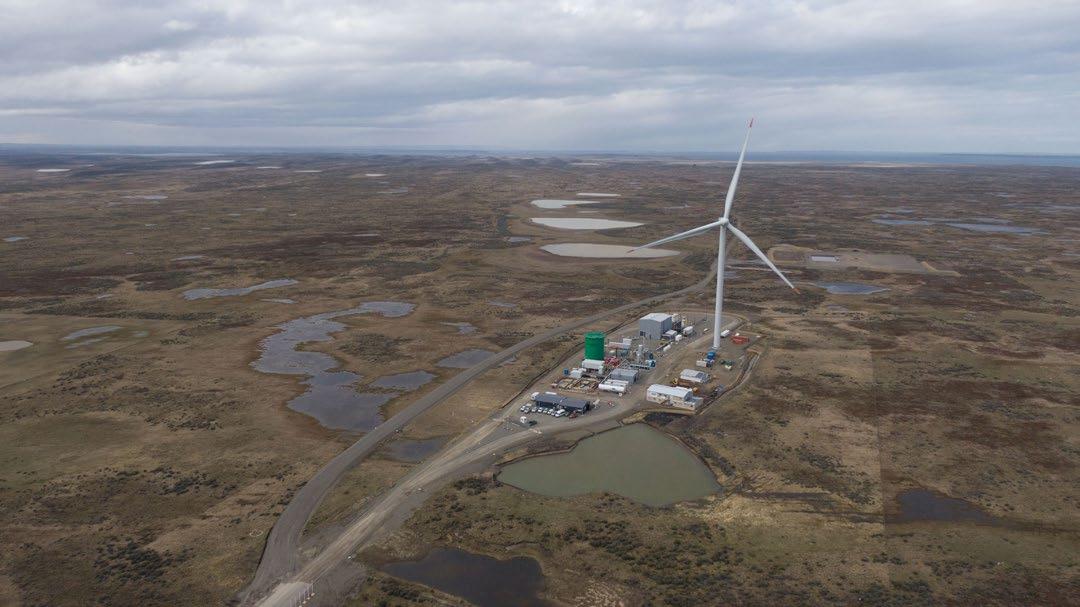
A drone view of HIF Global’s Haru Oni clean hydrogen plant in Punta Arenas, Chile, September 27, 2024. REUTERS/Joel Estay
is relatively expensive, or rely on relatively low electrolyzer capacity factors from solar paired with battery storage.
Chile’s major export hurdle, however, lies in its geographic distance and isolation from export markets—which forces it to turn to ships over wires or pipelines. Indeed, Latin America has limited electricity intraregional interconnections, rendering intraregional hydrogen trade unlikely.56 Additionally, potential hydrogen export markets, such as Argentina or Peru, also possess their own excellent renewables resources. Chile has few prospects for intraregional hydrogen trade.
Chile also will struggle to export hydrogen via maritime routes, due to the challenging techno-economics of seaborne hydrogen transport and the country’s distance from potential import demand centers in Europe and Northeast Asia. Potential Chilean clean hydrogen exports to Europe suffers from modal disadvantage, as pipeline exports from North Africa to Europe will almost certainly be cheaper than maritime imports. Chile’s maritime exports to demand centers are also likely to prove much more expensive than those of its competitors, due to the its geographic distance from key markets.
A ship transiting from Chile’s Port of Antofagasta to the Port of Rotterdam in The Netherlands at ten knots per hour would spend thirty-eight days at sea, traverse nearly 9,200 nautical miles, and incur Panama Canal fees. Conversely, exports from the Port of Houston under the same conditions would result in twenty-six days at sea, navigate about 6,200 nautical miles, avoid Panama Canal fees, and lessen boil-off penalties.
Chile’s exports to Northeast Asia would face even longer distances: Australia and other potential exporters would hold a major advantage due to proximity. Chile does enjoy some of the world’s best renewables potential, however, and it’s possible that electrolyzer costs could fall sufficiently to offset its transportation disadvantages.
Australia: Potential pipeline connections, but far from Northeast Asia
Australia is blessed with some of the world’s best solar resources and excellent wind potential but faces significant transportation hurdles before it can become a major exporter of clean hydrogen. It enjoys excellent co-located wind and solar in the western part of the country, but this region is far from major domestic industrial demand centers. Moreover, Australia is too far from the Indo-Pacific’s most viable clean hydrogen offtakers in Northeast Asia to feasibly build a pipeline. Therefore, it will likely need to trade clean hydrogen via maritime shipments, incurring a costly thermodynamic penalty in the process. Indonesia, Malaysia, and potentially Singapore are potentially within pipeline distance of Australia, but these projects will face considerable technical and financing challenges. Australia could become a hydrogen exporter, but major improvements in shipborne economics are required to realize these ambitions.
The Middle East: Renewables deployment
The Middle East, one of the most sun-soaked and wealthiest regions on Earth, is certainly not lacking in renewables potential or access to capital and hydrogen feedstocks. Yet major hurdles to clean hydrogen exist. Geopolitical risk is a key roadblock, especially when comparable markets exist elsewhere. Moreover, the region has deployed relatively little clean electricity. 57 Saudi Arabia, for instance, still uses enormous amounts of crude oil for summer electricity consumption. 58 Additionally, the region is too far from demand centers to build pipelines, necessitating the use of less economically competitive maritime clean hydrogen exports. The Middle East might ultimately overcome these challenges, but it needs to deploy far greater amounts of renewable electricity and CCS technologies if these ambitions are to be realized, in addition to improvements in maritime transport.
56 Govinda Timilsina, Ilka Deluque Curiel, and Deb Chattopadhyay, “How Much Does Latin America Gain from Enhanced Cross-Border Electricity Trade in the Short Run?” Policy Research Working Paper 9692, Development Economics Development Research Group, World Bank Group, June 2021, https://documents1. worldbank.org/curated/en/756421623173588257/pdf/How-Much-Does-Latin-America-Gain-from-Enhanced-Cross-Border-Electricity-Trade-in-the-Short-Run.pdf
57 Statistical Review of World Energy, 73rd ed., Energy Institute, 2024, https://www.energyinst.org/statistical-review/resources-and-data-downloads
58 Jennifer Gnana, “Middle East’s summer ‘oil burn’ under spotlight as OPEC+ cuts bite,” S&P Global Commodity Insights, July 21, 2023, https://www.spglobal.com/ commodityinsights/en/market-insights/latest-news/oil/072123-middle-easts-summer-oil-burn-under-spotlight-as-opec-cuts-bite
IV: RECOMMENDATIONS
International hydrogen trade holds promise for decarbonization ambitions, but obstacles remain. In order to maximize hydrogen’s uptake for viable use cases via international trade, policymakers should consider the following recommendations.
• To enable the cross-border, long-distance trade of clean hydrogen, a series of higher-priority foundations must first be laid to lower production costs and ensure the development of a clean hydrogen industry in the first place. Competitive power prices and ample interconnection capacity for the grid, availability of non-intermittent clean electricity, lower costs of capital for electrolyzers, electrolyzer innovation for load following, and other enabling factors are deserving of careful attention. Hydrogen trade is not yet a feasible tool for industrial development.
• Where infrastructure is being developed to transport hydrogen over long-distances, thorough due diligence should be performed to ensure that the end-use of the transported hydrogen will remain economically viable for the life of the asset. At the early stages of the development of the hydrogen industry, this is likely to be confined to applications where hydrogen is an irreplaceable chemical feedstock, such as hydrocracking, hydrotreating, ammonia production, methanol production, and other low-risk applications. This may also include applications such as the use of hydrogen for the direct reduction of iron, or long-term energy storage, provided adequate policy support.
• An integrated North American hydrogen market is a much more achievable goal for US policy than exporting clean hydrogen to Europe. Due to the thermodynamic penalties and economic cost of maritime hydrogen shipping, USto-Europe clean hydrogen trade will remain limited in the near-to-medium term. While US and European policymakers should seek to standardize rules and regulations as much as possible, the United States’ most important hydrogen partners, from a trade perspective, may be found in Canada and Mexico. Critically, the USMCA trade agreement should seek to harmonize hydrogen regulations and facilitate trade and investment.
• European policymakers should seek to avoid potential sole-supplier dependency on North African hydrogen imports by integrating their internal electricity networks and, whenever possible, hydrogen transportation systems. Additionally, Europe should consider siting key aspects
of the downstream green hydrogen value chain—namely electrolyzers—within the continent whenever possible.
• Maritime trade of clean hydrogen will center around ports. One way to solve the “chicken-and-egg” problem of matching hydrogen supply and demand at ports is to jumpstart clean shipping. Accordingly, policymakers in the United States and Europe should evaluate the feasibility and potential for “green shipping corridors,” where ships would use methanol or ammonia to conduct trade from port to port.
• A signal should be sent to regulators to collaborate on the unification of a regulatory system that is interoperable and provides common terms for the definition of clean hydrogen, based on parameters associated with temporality, additionality, and deliverability. This system should be subject to an international verification and certification scheme that is compatible with each country’s regulatory framework to facilitate exports. However, insofar as regulations pertain to access to subsidies, feed-in tariffs, or contracts-for-difference, these regulations should be implemented in a phased approach.
V: CONCLUSION
The trade of clean hydrogen at-scale remains distant. While the clean hydrogen industry relies on clean electricity or natural gas reforming with high rates of carbon capture, no nation capable of becoming a competitive hydrogen exporter has developed enough clean electricity surplus or carbon capture infrastructure to meet the scale required to produce these volumes economically. Moreover, the possibility of transporting hydrogen through molecular carriers, such as ammonia, is unrealistic in the near term due to significant cost and technical challenges.
As such, the key priority for policymakers who wish to realize an export-scale clean hydrogen industry is to develop abundant sources of domestic clean electricity. Expediting grid interconnection, permitting, siting, and driving down the market prices of clean electricity are crucial for delivering feedstock for electrolytic hydrogen.
On a smaller scale, however, an export industry might emerge, for such purposes as serving offtakers in strategic industries, such as steelmaking, who are willing to pay a clean or green premium. In these cases, their willingness to pay could offer a business model for international trade in clean hydrogen.
Given the difficulties in international hydrogen trade, however, policymakers and regulators alike should prioritize the development of their domestic clean electricity sectors, rather than relying on dreams of cheap imports.
In light of the realities of hydrogen fundamentals, hydrogen actors should manage their expectations for large-scale hydrogen exports, especially seaborne hydrogen trade. While it is possible that clean hydrogen will be traded internationally in significant quantities in the medium-to-long-term future, most volumes will be consumed near the point of production due to the challenges of transporting hydrogen, especially over water. To the extent hydrogen is traded over maritime routes, hydrogen carriers will be used instead of liquefied hydrogen. Accordingly, given the stopping power of water in hydrogen trade, most clean hydrogen trade is likely to occur with overland neighbors. Instead of dreaming of exporting hydrogen to far-flung locations, policymakers and industry actors should look closer to home.
ABOUT THE AUTHOR
Joseph Webster is a senior fellow at the Atlantic Council’s Global Energy Center, a nonresident senior fellow at the Atlantic Council’s Indo-Pacific Security Initiative, and editor of the independent China-Russia Report. Webster’s broad portfolio focuses on energy and national security, with an emphasis on strengthening constitutional democracy against rival systems.
Webster’s energy research centers on the US-China strategic competition and explores the role of energy in enabling artificial intelligence, the military applications of advanced batteries, and the geopolitical consequences of shifting energy systems. His functional specializations include batteries, solar, onshore wind, semi-baseload wind, and oil and gas.
Webster’s national security-related work encompasses relations between China and Russia, including the countries’ economic interactions, planning for a potential Taiwan-related contingency, and shipbuilding and maritime supply chains.
Drawing from his professional experiences, Webster’s analyses are data driven. While at various US government trade bodies, Webster assessed the Trans-Pacific Partnership and several trade-related topics involving China and Russia. Later, at a boutique energy consultancy in Houston, Webster examined fundamental supply-demand balances for different commodities and led market analysis for the liquefied natural gas portfolio.
Webster frequently writes on energy and geopolitical topics. He has been published at the Interpreter, and War on the Rocks, among others. Webster’s analyses are often cited in the press, including in Axios, Bloomberg, the Financial Times, the New York Times, Politico, Politico Europe, and the Wall Street Journal, as well as by official US and EU government bodies, such as the USChina Economic and Security Review Commission.
ACKNOWLEDGMENT
The author would like to thank ClearPath for its support of this project.
This report was written and published in accordance with the Atlantic Council policy on intellectual independence. The author is solely responsible for its analysis and recommendations. The Atlantic Council and its donors do not determine, nor do they necessarily endorse or advocate for, any of this report’s conclusions.
ATLANTIC COUNCIL BOARD OF DIRECTORS
CHAIRMAN
*John F.W. Rogers
EXECUTIVE CHAIRMAN
EMERITUS
*James L. Jones
PRESIDENT AND CEO
*Frederick Kempe
EXECUTIVE VICE CHAIRS
*Adrienne Arsht
*Stephen J. Hadley
VICE CHAIRS
*Robert J. Abernethy
*Alexander V. Mirtchev
TREASURER
*George Lund
DIRECTORS
Stephen Achilles
Elliot Ackerman
*Gina F. Adams
Timothy D. Adams
*Michael Andersson
Alain Bejjani
Colleen Bell
Sarah E. Beshar
*Karan Bhatia
Stephen Biegun
Linden P. Blue
Brad Bondi
John Bonsell
Philip M. Breedlove
David L. Caplan
Samantha A. Carl-Yoder
*Teresa Carlson
*James E. Cartwright
John E. Chapoton
Ahmed Charai
Melanie Chen
Michael Chertoff
George Chopivsky
Wesley K. Clark
*Helima Croft
Ankit N. Desai
*Lawrence Di Rita
*Paula J. Dobriansky
Joseph F. Dunford, Jr.
Richard Edelman
Stuart E. Eizenstat
Tara Engel
Mark T. Esper
Christopher W.K. Fetzer
*Michael Fisch
Alan H. Fleischmann
Jendayi E. Frazer
*Meg Gentle
Thomas H. Glocer
John B. Goodman
Sherri W. Goodman
Marcel Grisnigt
Jarosław Grzesiak
Murathan Günal
Michael V. Hayden
Robin Hayes
Tim Holt
*Karl V. Hopkins
Kay Bailey Hutchison
Ian Ihnatowycz
Deborah Lee James
*Joia M. Johnson
*Safi Kalo
Karen Karniol-Tambour
*Andre Kelleners
John E. Klein
Ratko Knežević
C. Jeffrey Knittel
Joseph Konzelmann
Keith J. Krach
Franklin D. Kramer
Laura Lane
Almar Latour
Yann Le Pallec
Diane Leopold
Jan M. Lodal
Douglas Lute
Jane Holl Lute
William J. Lynn
Mark Machin
Marco Margheri
Michael Margolis
Chris Marlin
William Marron
Roger R. Martella Jr.
Judith A. Miller
Dariusz Mioduski
*Richard Morningstar
Georgette Mosbacher
Majida Mourad
Mary Claire Murphy
Julia Nesheiwat
Edward J. Newberry
Franco Nuschese
Joseph S. Nye
*Ahmet M. Ören
Ana I. Palacio
*Kostas Pantazopoulos David H. Petraeus
Elizabeth Frost Pierson
*Lisa Pollina
Daniel B. Poneman
Robert Portman
*Dina H. Powell McCormick
Michael Punke
Ashraf Qazi
Laura J. Richardson
Thomas J. Ridge
Gary Rieschel
Charles O. Rossotti
Harry Sachinis
C. Michael Scaparrotti
Ivan A. Schlager
Rajiv Shah
Wendy R. Sherman
Gregg Sherrill
Jeff Shockey
Kris Singh
Varun Sivaram
Walter Slocombe
Christopher Smith
Clifford M. Sobel
Michael S. Steele
Richard J.A. Steele
Mary Streett
Nader Tavakoli
*Gil Tenzer
*Frances F. Townsend
Melanne Verveer
Tyson Voelkel
Kemba Walden
Michael F. Walsh
*Peter Weinberg
Ronald Weiser
*Al Williams
Ben Wilson
Maciej Witucki
Neal S. Wolin
Tod D. Wolters
*Jenny Wood
Alan Yang
Guang Yang
Mary C. Yates
Dov S. Zakheim
HONORARY DIRECTORS
James A. Baker, III
Robert M. Gates
James N. Mattis
Michael G. Mullen
Leon E. Panetta
William J. Perry
Condoleezza Rice
Horst Teltschik
William H. Webster
*Executive Committee Members
List as of March 24, 2025
The Atlantic Council is a nonpartisan organization that promotes constructive US leadership and engagement in international affairs based on the central role of the Atlantic community in meeting today’s global challenges.
© 2025 The Atlantic Council of the United States. All rights reserved. No part of this publication may be reproduced or transmitted in any form or by any means without permission in writing from the Atlantic Council, except in the case of brief quotations in news articles, critical articles, or reviews. Please direct inquiries to:
Atlantic Council
1400 L Street, NW, 11th Floor Washington, DC 20005
(202) 463-7226, www.AtlanticCouncil.org