Strategic energy realignment-Rethinking MDB policy for growth and global stability
Strategic energy realignment: Rethinking MDB policy for growth and global stability
MDBs must recalibrate their energy investment strategies to support scalable, growth-oriented capital flows.
Emerging market and developing economies (EMDEs) are set to play a crucial role in the global energy market over the course of the next quarter century. Between 2018 and 2050, global energy consumption is projected to increase by 50 percent, with the most growth occurring in the Global South.1 By 2050, EMDEs (excluding China) are projected to account for nearly half of global demand for energy.2 In order to fuel this growth, demand for hydrocarbons within EMDE countries is anticipated to grow by 10 percent for oil and more than 50 percent for natural gas.3
This growth, however, is set against a backdrop of declining hydrocarbon production in developed nations, particularly within the Organisation for Economic Co-operation and Development (OECD), where energy security policies are increasingly shaped by decarbonization strategies. These strategies often deprioritize hydrocarbons in favor of rapid transitions to net-zero emissions—leaving EMDEs with few options for securing reliable and affordable energy to fuel economic growth and promote prosperity.
Effective energy infrastructure deployment, however, cannot be divorced from global energy realities—particularly the continued demand for hydrocarbons in the Global South. Multilateral development banks (MDBs) and their governing nations must recognize that this demand is unlikely to decline meaningfully in the coming decades and that refusing to support hydrocarbon infrastructure simply cedes the field to strategic rivals. In a vacuum of funding from reliable Western-aligned partners, EMDEs are forced to turn to high-risk, high-cost investments, including from China.
The resulting path for EMDEs is one of mounting uncertainty and debt, and an even higher economic barrier for long-term growth. As US Secretary of Treasury Scott Bessent put it in his April remarks to the Institute of International Finance, “The history of humanity teaches a simple lesson: Energy abundance sparks economic abundance.”4 The inverse is also true: Limiting EMDEs’ access to hydrocarbons constrains their access to energy and, thus, economic growth.
This undesirable outcome, however, is not a foregone conclusion and can be addressed
1. “EIA Projects Nearly 50% Increase in World Energy Usage by 2050, Led by Growth in Asia,” US Energy Information Administration (EIA), September 24, 2019, https://www.eia. gov/todayinenergy/detail.php?id=41433.
2. “BP Energy Outlook 2024,” British Petroleum, 2024, https://www.bp.com/content/dam/ bp/business-sites/en/global/corporate/pdfs/energy-economics/energy-outlook/bp-energy-outlook-2024-emerging-economies.pdf.
3. “BP Energy Outlook 2024.”
4. “Treasury Secretary Scott Bessent Remarks before the Institute of International Finance,” US Department of the Treasury website, April 23, 2025, https://home.treasury.gov/news/ press-releases/sb0094.
Strategic energy realignment: Rethinking MDB
through the existing framework of MDBs but would require a fundamental shift in energy investment priorities. This paper argues that MDBs must recalibrate their energy investment strategies to support scalable, growth-oriented capital flows—particularly toward hydrocarbons—if they are to remain relevant, effective, and aligned with the development goals of providing economic opportunity through energy access to billions of people in EMDE.
MDBs at a crossroads: The cost of climate-first lending
MDBs were originally designed to channel capital toward economically viable infrastructure projects in developing countries as a strategic tool in the arsenal of the West. The model of aggregated public funds through MDBs was in large part successful because it emphasized commercial diplomacy and fostered the development of decades-long trade relationships. Institutions such as the European Bank for Reconstruction and Development (EBRD) and the World Bank were instrumental in postwar reconstruction, often investing in hydrocarbon infrastructure to stimulate durable partnerships.
In recent decades, however, MDB mandates have shifted. Today, alongside a growing global emphasis on climate change, MDBs have diverged from their original mission of maximizing economic growth. Even in instances without formal restrictions on hydrocarbon financing, they now often treat hydrocarbon development as a last resort and instead favor narrower, self-limiting
frameworks that align energy investments with net-zero carbon emissions targets.
Instead of providing low-risk and lowcost financing for reliable, scalable energy infrastructure, MDBs are prioritizing renewable energy projects that, while at times economic (e.g., the 200 megawatt Kom Ombo solar project secured a tariff of $0.0247 per kilowatt-hour, according to the EBRD5), overlook the dominant need for and rapid scalability of conventional energy projects. In 2023, MDB climate financing—for both adaptation and mitigation—totaled nearly $125 billion,6 while only $14.5 billion was allocated to oil and gas projects.7 These figures reflect only the first-order effects; MDBs serve as powerful bridges between public funds and private capital, meaning even modest contributions can catalyze and multiply far greater commercial investment. When MDB investment stalls, the impact is compounded.
This unbalanced approach fails to acknowledge the reality that hydrocarbons account for over 80 percent of the global energy mix and are required to meet EMDEs’ rising energy demand while renewable generation capacity builds. The world abounds with examples:
y In India, while solar capacity has grown rapidly, coal remains the backbone of the power sector. The Indian government has committed to net zero by 2070, but it recognizes that a complete phaseout of coal without other hydrocarbons would cause significant economic disruption.
5. Nibal Zgheib, “How the EBRD Became Egypt’s Leading Partner for Renewable Energy,” European Bank for Reconstruction and Development (EBRD), November 4, 2022, https:// www.ebrd.com/home/news-and-events/news/2022/how-the-ebrd-became-egypts-leading-partner-for-renewable-energy.html.
6. Natalia Alayza et al., “Multilateral Development Bank Climate Finance: The Good, Bad and the Urgent,” World Resources Institute, November 14, 2024, https://www.wri.org/insights/mdb-climate-finance-2023.
7. Alessandro Ramazzotti, Vaishnavi Varadarajan, and Anggita Indari, “Multilateral Development Banks Must Prioritize Clean & Community-led Energy Projects (Commentary),” Mongabay, May 2, 2024, https://news.mongabay.com/2024/05/multilateral-development-banks-must-prioritize-clean-community-led-energy-projects-commentary.
Strategic energy realignment:
Source: “International Energy Outlook 2021”, US Energy Information Administration, last accessed June 6, 2025, https://www.eia.gov/outlooks/ aeo/data/browser/#/?id=9-IEO2021&cases=Reference&sourcekey=0.
y Meanwhile, Brazil’s energy matrix is often held up as a model for renewable energy, with hydropower accounting for more than 60 percent of electricity generation. However, during periods of drought, Brazil must rely on natural gas and imported liquefied natural gas (LNG) to stabilize the grid—and must continue to invest in the infrastructure to enable this complementarity.
y Similarly, Indonesia outlined ambitions to double its domestic power-generation capacity—aiming to add 100 gigawatts (GW), including 75 GW of new solar, hydro, geothermal, and nuclear to the grid by 2040—but it also recognizes the
need for conventional fuels to stabilize electricity supply. Just this year, it integrated a new floating storage and regasification unit in what’s being billed as Asia’s first gas-topower system.
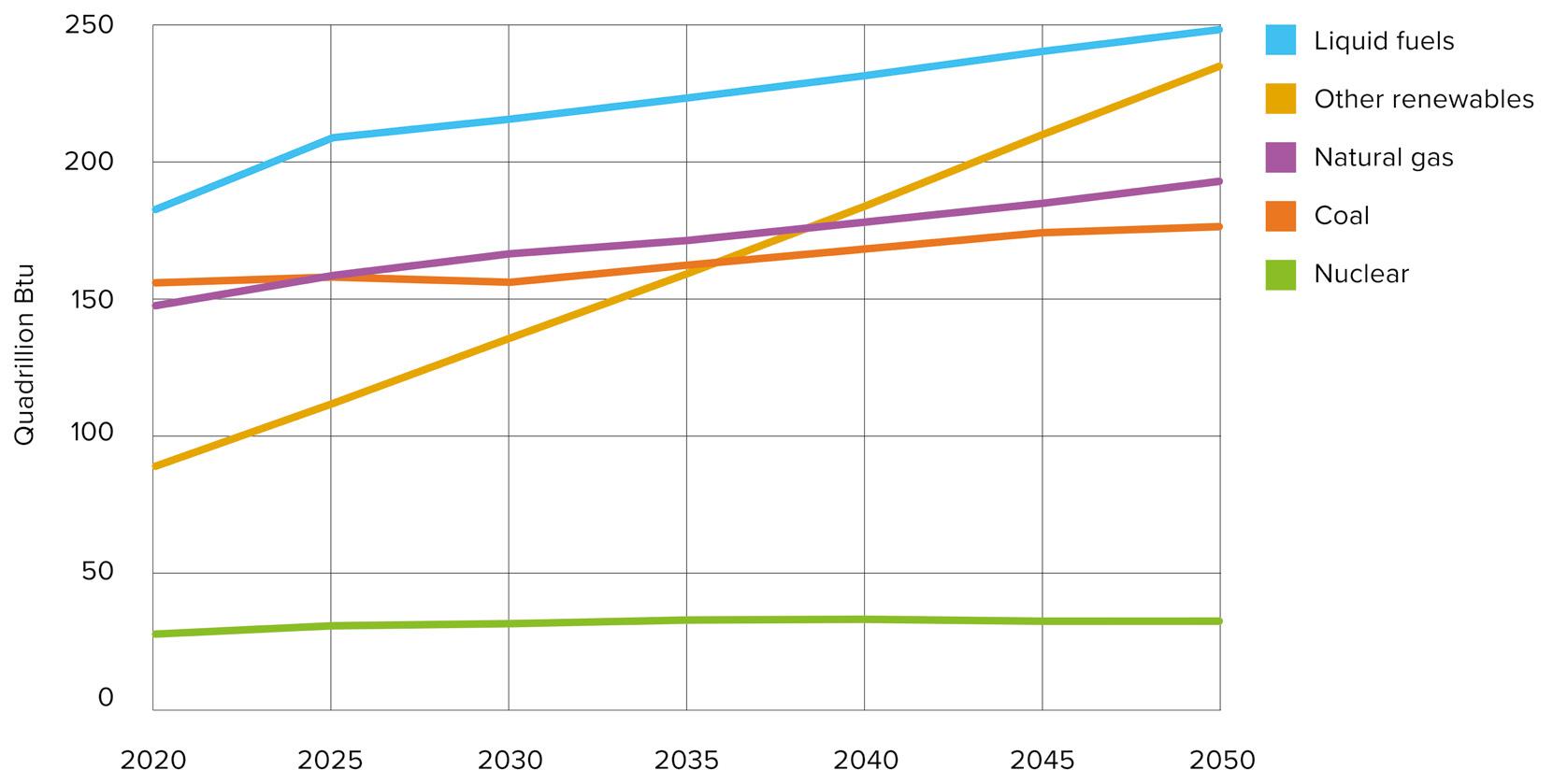
Despite a substantial increase in MDB investment in renewables, the scale of renewable-energy capacity required to offset global demand for hydrocarbon fuels is far from achievable. This is true even in scenarios of high demand growth for renewable energy, where the rate of growth in renewable energy far outpaces the rate of growth in hydrocarbons.8
For the use of renewables to outpace hydrocarbons, developed nations would need to triple the amount they currently have
8. “Liquid fuel will make up 28% of global energy demand by 2050, compared with renewables at 27%. This assumes a 36% increase in liquid fuel demand and a 165% increase by renewables from 2020 levels,” wrote Meghan Gordon and Maya Weber in “Global Energy Demand to Grow 47% by 2050, with Oil Still Top Source: US EIA,” S&P Global, October 6, 2021, https://www.spglobal.com/commodity-insights/en/news-research/latest-news/crude-oil/100621-global-energy-demand-to-grow-47-by-2050-with-oilstill-top-source-us-eia; see also figure 1 above.
Fig. 1: Global energy use through 2050 by source
The refusal of MDBs to finance hydrocarbons has created a strategic vacuum.
invested in renewable energy sources.9 Current estimates show that reaching full net-zero energy system goals would require expenditures of more than $9 trillion per year on average— $275 trillion by 2050.10 These costs are well beyond the financing capacity of MDBs and the fiscal reach of most EMDEs, not to mention the fiscal tolerance of developed nations.
While MDBs lack the funding necessary to develop energy systems of scale, EMDEs possess even fewer resources, but are still expected to meet target goals for emissions reductions by 2030, 2040, and 2050. As a result, EMDEs are trapped in a cycle where they lack adequate capital to build domestic renewable energy projects with MDB funding and have inadequate funding to scale their hydrocarbon industry to meet demand due to underinvestment or prohibitions. This transition has led to severe consequences: most notably, the reliance of EMDEs on high-cost investments.
Ceding influence: How MDB policy fuels Chinese leverage
The refusal of MDBs to finance hydrocarbons has created a strategic vacuum—one increasingly filled by bilateral institutions, private equity, and China. China’s financing strategy benefits from speed, scale, and minimal environmental or governance constraints. This strategy is in sharp contrast to MDB’s complex eligibility criteria, often shaped more by ideology than
practicality, that functionally limit access to MDB capital. Many EMDE governments lack the institutional capacity to navigate these processes, creating additional barriers to energy access, even without formal rules outright preventing hydrocarbon investments. Chinese capital, therefore, more often stands as an attractive option for many EMDEs and poses a significant challenge to Western-backed MDBs that must compete on both timelines and terms. The culmination is a weakened mechanism by which EMDEs can draw closer to Western standards and shared national interests.
However, loans from China in particular are known for exposing recipients to so-called debt-trap diplomacy, in which projects may not be financially viable but serve geopolitical aims. These loans often come with higher interest rates,11 opaque terms, and restrictions on debt restructuring, pushing borrower nations into precarious dependency. This is a well-known phenomenon that MDBs such as the World Bank have highlighted:12
In 2024, the World Bank emphasized that numerous African nations are at high risk of economic collapse, primarily due to substantial debts owed to Chinese creditors. Around 40 percent of low-income countries, including many in Africa, are either in or approaching debt distress, with Chinese loans playing a significant role in this growing financial vulnerability. Furthermore, the issues
9. Strengthening Multilateral Development Banks: The Triple Agenda, Report, Independent Experts Group, June 30, 2023, https://cdn.gihub.org/umbraco/media/5354/g20-ieg-report-on-strengthening-mdbs-the-triple-agenda.pdf.
10. Mekala Krishnan et al., The Net-zero Transition, McKinsey & Company, January 2022, https://www.mckinsey.com/~/media/mckinsey/business%20functions/sustainability/ our%20insights/the%20net%20zero%20transition%20what%20it%20would%20cost%20 what%20it%20could%20bring/the-net-zero-transition what-it-would-cost-and-what-itcould-bring-final.pdf.
11. Ana M. Camelo Vega, Financing Pathways for the Energy Transition: A Regional Approach, Columbia Center on Sustainable Investment (CCSI), September 2024, https:// ccsi.columbia.edu/sites/ccsi.columbia.edu/files/content/docs/publications/ccsi-financing-pathways-energy-transition.pdf.
12. Hanna Sunny and Dr. Karamala Areesh Kumar, “China’s Debt Trap in Africa: A Comprehensive Analysis,” The Geopolitics (TGP), November 23, 2024, https://thegeopolitics.com/ chinas-debt-trap-in-africa-a-comprehensive-analysis/#google_vignette.
Strategic energy realignment:
regarding the sustainability of debt have worsened due to the ambiguity of Chinese loans and the inclusion of stipulations that prevent collective debt restructuring while imposing stringent payback requirements. These traits have raised concerns that nations such as Zambia and Djibouti may get caught up in debt cycles and lose control of their governments to China.
These risks are significant given the magnitude of China’s investments. Its total investments through development finance institutions (DFIs) for energy reached $107 billion in 2023,13 nearly the total amount that OECD MDBs contributed ($125 billion in climate financing)14 that same year. Industry projections show that demand for oil increases through 2050, leading more countries across Latin America,15 Africa,16 and Asia17 to commit to receiving investments from China. Thus, without a fuel-agnostic approach, MDBs risk denying developing countries the flexibility to pursue tailored, resilient energy strategies supported by transparent, low-risk investment strategies. Unless an immediate course alteration is made, MDBs will cede hydrocarbon investment—and the geopolitical influence it can yield—in EMDEs to China. This would deepen EMDEs’ debt and threatens, rather than promotes, EMDEs’ economic growth.18
Reclaiming relevance: How the United States and allies can advance sound capital allocation
To meet today’s geopolitical and developmental challenges, MDBs must realign their priorities to support not just environmental goals, but long-term diplomacy, economic growth, national security, and stable trade relationships. A pragmatic, security-aware approach requires MDBs to move beyond rigid climate doctrines and adopt a flexible, all-of-the-above energy strategy that integrates renewables with responsible hydrocarbon development. Western-aligned MDBs should leverage partnerships with nations that possess scalable hydrocarbon reserves and advanced infrastructure. They should also leverage their own respective resource bases to supply future demand-oriented infrastructure. This approach offers developing countries reliable partners in energy-related goods and services trade, and competitive, transparent alternatives to opaque, high-risk financing from alternative sources such as China that may ultimately undercut economic development priorities. In contrast to the shortcomings of the climate-first approach, the result would unquestionably be enduring alliances, expanded economic oppor-
13. Jevans Nyabiage, “China’s Belt and Road Pivots to ‘Small Yet Smart’ Projects with ‘Modest’ US$107 Billion Financing Pledge,” South China Morning Post, October 23, 2023, https://www.scmp.com/news/china/diplomacy/article/3238840/chinas-belt-and-roadpivotssmall-yet-smart-projects-modest-us107-billion-financing-pledge.
14. Alayza et al., “Multilateral Development Bank Climate Finance.”
15. Joshua Goodman, “Colombia Seeks to Join China-based Development Bank as Latin America Drifts Away from Washington” Associated Press, May 17, 2025, https://apnews. com/article/china-colombia-new-development-bank-trump usae2f3b0da5c330c0cf051351857d1771.
16. “The Waning Western Influence in Africa and the Rise of China,” China Africa Centre blog, February 12, 2025, https://africachinacentre.org/the-waning-western-influence-in-africaand-the-rise-of-china/.
17. Christoph Nedopil Wang, “China Belt and Road Initiative (BRI) Investment Report 2023,” Green Finance & Development Center, February 5, 2024, https://greenfdc.org/china-beltand-road-initiative-bri-investment-report-2023/.
18. “From Lead Bilateral Banker to Chief Debt Collector: China’s Shifting Role in Global Lending,” Lowy Institute, May 26, 2025, https://www.lowyinstitute.org/lead-bilateral-banker-chief-debt-collector-china-s-shifting-role-global-lending.
region
Source: “Voting Powers,” World Bank Group, last accessed June 6, 2025, https://www.worldbank.org/en/about/leadership/votingpowers.
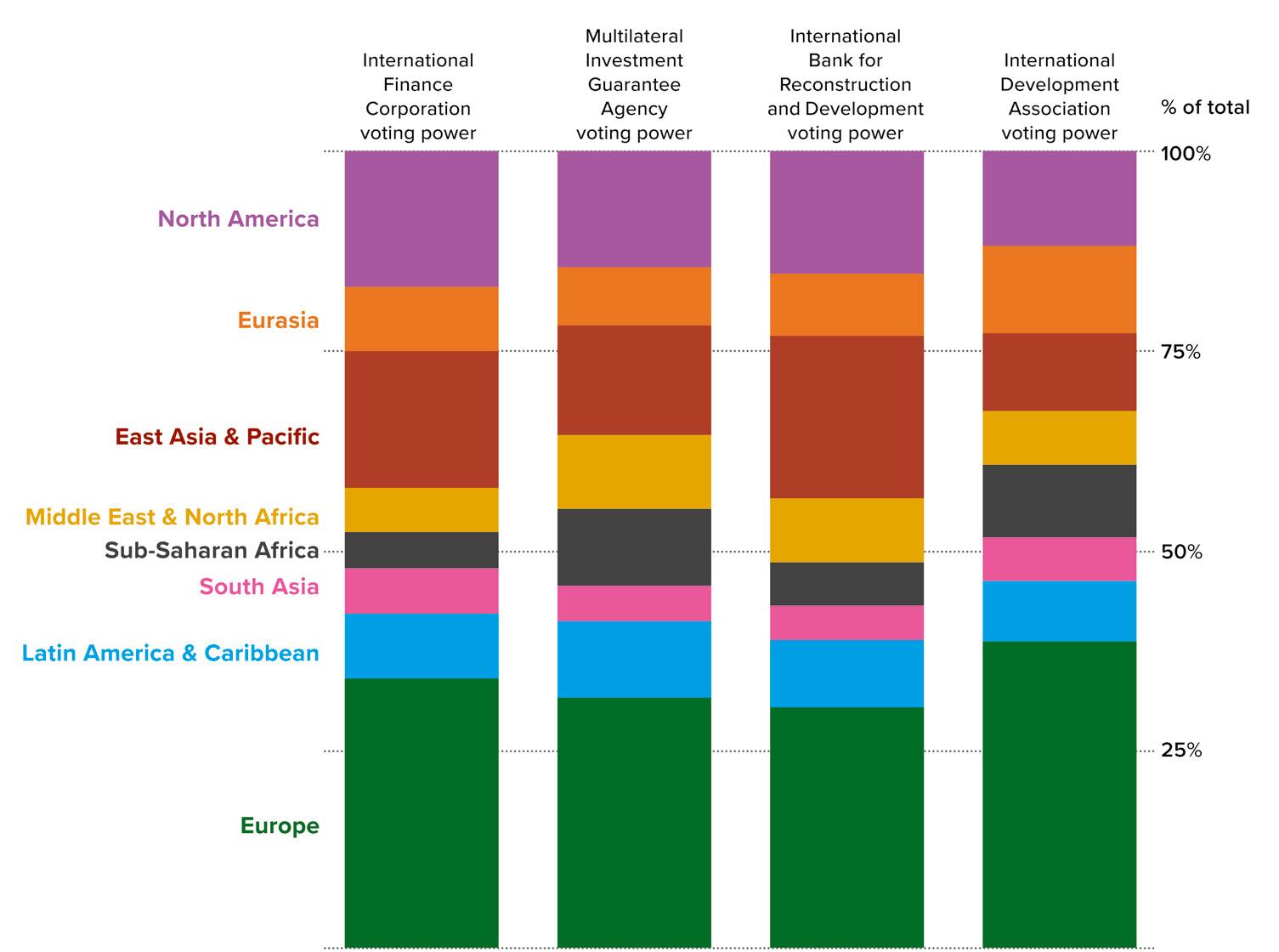
IFC = International Finance Corporation; MIGA = Multilateral Investment Guarantee Agency; IBRD = International Bank for Reconstruction and Developmen; IDA = International Development Association
Fig. 2: Allocation of World Bank votes by
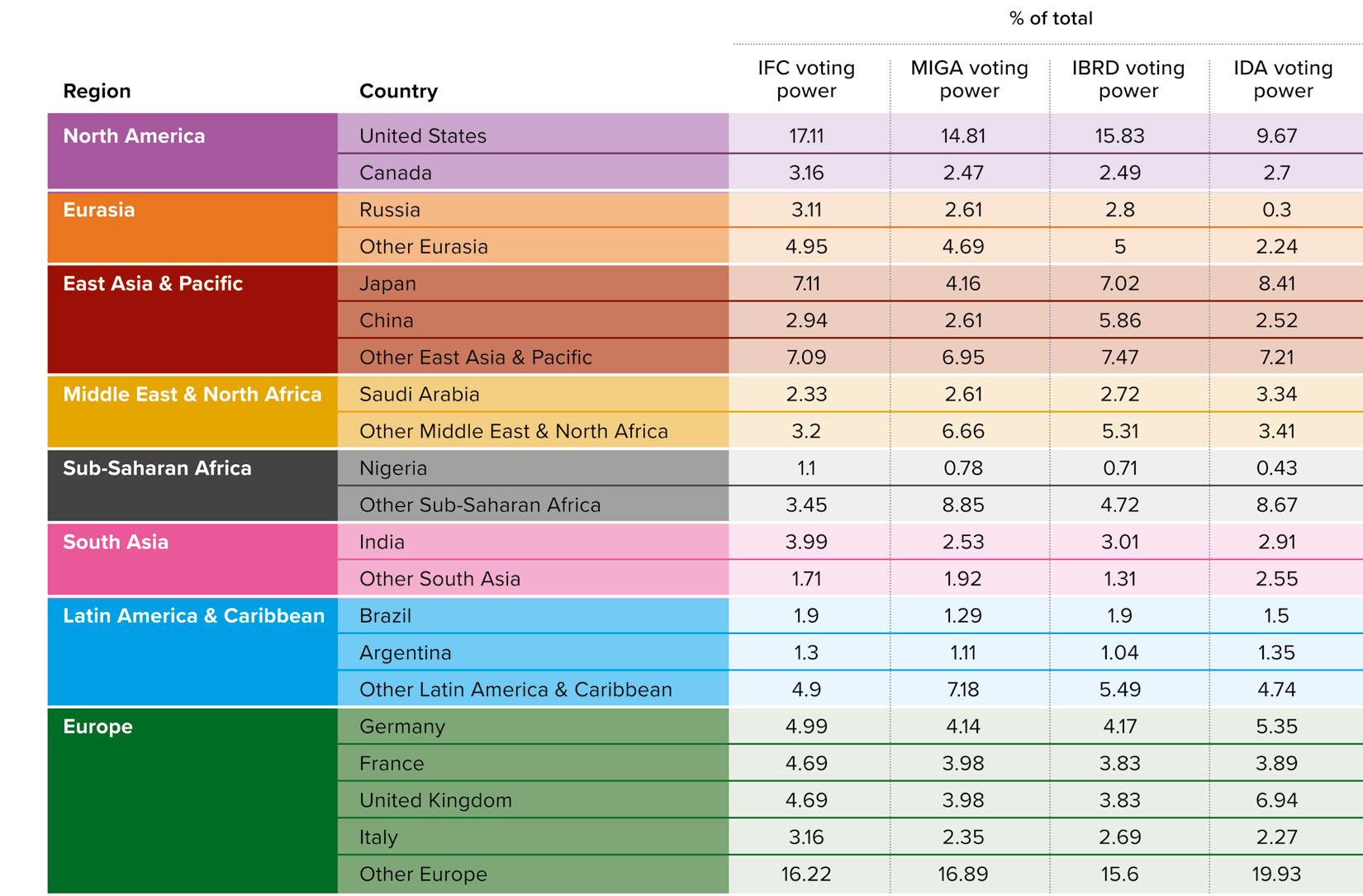
Table 1: Allocation of World Bank votes by country
Strategic energy realignment:
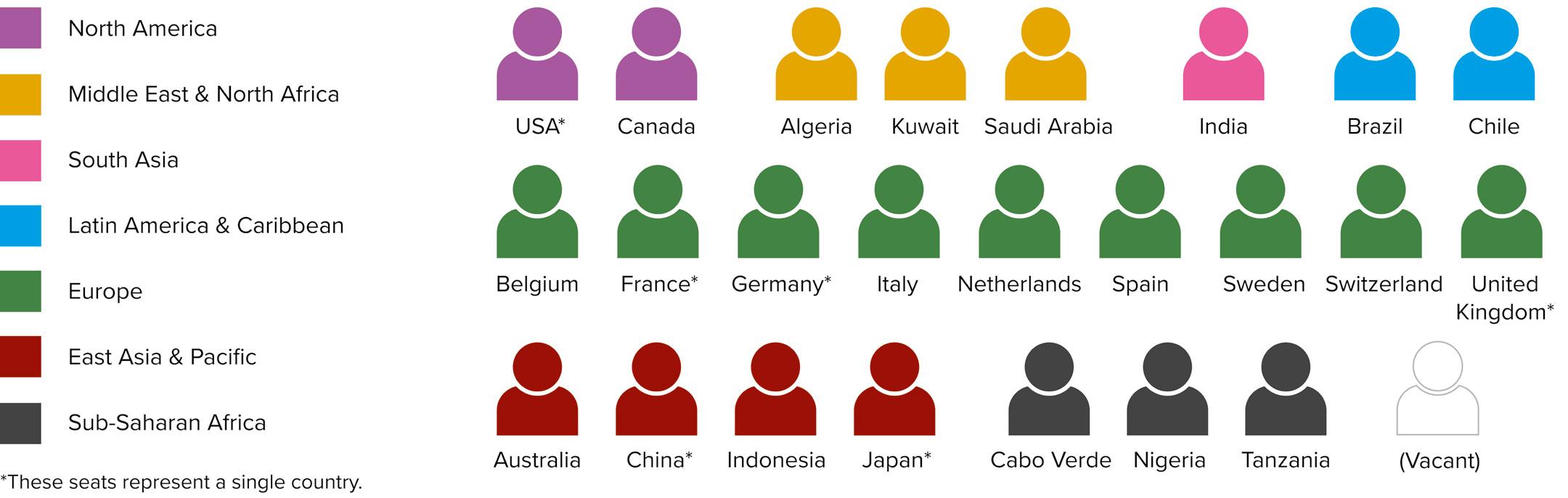
The World Bank Group’s boards of executive directors—serving IDA, IBRD, IFC, and MIGA—decide on policies that guide the banks’ operations. The executive directors across the four boards are the same—except for a seat that is occupied by Sweden on the IDA, IBRD, and IFC boards and by Norway on the MIGA board. Currently, twenty-four of the twenty-five seats are filled: The vacant seat represents a constituency comprising Russia, Belarus, and Syria. Each director casts the combined votes of the countries represented, based on their shareholdings, although there are a handful who represent a single country (noted with an *).
Source: “Voting Powers,” World Bank Group, last accessed June 6, 2025, https://www.worldbank.org/en/about/leadership/votingpowers.
tunity, and reduced strategic dependence on adversarial states.
The United States has a significant role to play in this pivot as the largest shareholder in the World Bank (with 16.5 percent of voting power) and a major stakeholder in other regional development banks. Bessent has signaled the US administration’s commitment to supporting this shift, encouraging the World Bank to prioritize affordable energy investments, which will oftentimes mean investing in hydrocarbon-based energy but also renewable energy.19 Moreover, America has long been a global leader in energy production, technological innovation, and emissions reductions. Now it must deploy those skills to foster a new era of commercial diplomacy—one that facilitates an energy renaissance around the world, delivering energy security and prosperity to the billions of people that lack access to energy.
To achieve these goals, MDBs must be proactive and leverage available mechanisms. To start, they should partner with sovereign wealth funds (SWFs) of like-minded, resource-rich nations. Norway’s Government Pension Fund, with $1.4 trillion in assets under management (AUM), and Saudi Arabia’s Public Investment Fund, with $925 billion, offer potent vehicles for growthoriented energy investment. Both can support MDB goals to drive economic growth in EMDEs by channeling investments into hydrocarbon projects—including natural gas transmission, LNG production and import infrastructure, and scalable grid infrastructure—and both have a record of doing so. While Norway’s SWF has a history of investing in sustainable infrastructure, including $20 billion in renewable projects across Africa and Asia since 2018, it also maintains significant stakes in oil and gas companies (e.g., $40 billion in ExxonMobil and Shell). Saudi Arabia’s fund has similarly invested in African gas projects, such as a $5 billion
19. “Treasury Secretary Scott Bessent Remarks.”
Fig. 3: Current seats on the World Bank Board of Executive Directors
Strategic
stake in Nigeria’s LNG expansion in 2023. The United States could be a key facilitator in creating a meaningful coalition—a strategy already embraced by President Trump through his early diplomatic forays and plan to create an American SWF equivalent. Joint initiatives between MDBs and SWFs that finance hydrocarbon infrastructure—in countries like Indonesia, which manages both the Indonesia Investment Authority (INA) and Danantara Indonesia (with combined AUM of nearly $1 trillion)—present compelling instances for multilateral-driven market development with regional implications. Such partnerships could provide EMDEs with reliable baseload power, while fueling industrialization, creating jobs, and lifting millions out of poverty. This approach not only aligns with MDB goals to reduce emissions but also bridges the North-South energy divide, removing obstacles to accessing hydrocarbons by reversing multiple years of acute focus on climate-oriented infrastructure.
The Net-Zero Producers Forum, conceptualized under the first Trump administration and instituted under the Biden administration, represents a promising initial venue for garnering support for renewed public investment in hydrocarbon assets. Putting the name aside, the forum convenes the capabilities and respective resource bases of Canada, Norway, Qatar, Saudi Arabia, the United Arab Emirates, and the United
States—representing roughly 45 percent of global oil output and 40 percent of global gas output combined. By pooling technical and financial expertise, these countries can support fuel-agnostic development pathways in EMDEs.
The challenge, however, rests in the willingness of America’s partners within MDBs to pull off the veil and demonstrate a commitment to the core principles of economic growth and energy security. The United States has already begun to course correct, prioritizing faster capital deployment and broadening—not narrowing—the range of viable energy investments abroad. Meanwhile, more pragmatic energy policy emerging in countries like Canada and Germany may signal the early stages of a broader realignment, particularly if the Group of Seven (G7) converges around a coherent stance on natural gas.
Yet so far, a disconnect remains between evolving national policies and MDB financing behavior. To regain relevance and competitiveness, MDBs must reframe their respective missions around economic growth, energy access, and strategic resilience. Institutions such as the EBRD should reconsider their reluctance to engage with hydrocarbons, recognizing that development goals cannot be met with ideology alone.
Strategic
Global climate aims cannot succeed without emerging market and developing economies.
Yet current MDB strategies are reactive, restrictive, and out of step with on-theground realities.
In embracing a clear-eyed approach to energy development, MDB shareholders— particularly in the OECD—can begin to unlock the long-term benefits of helping EMDEs grow sustainably, achieve energy security, and resist strategic capture by adversarial actors. To remain effective and relevant, MDBs must return to a development-first framework. This means supporting energy systems that meet three essential criteria:
1. Economic viability: Projects must be financially sound and scalable.
2. Strategic alignment: Investments should come from partners who adhere to agreed-upon international norms and promote transparency.
3. Complementarity: Renewables should supplement, not replace, baseload hydrocarbon power. Baseload power—particularly natural gas—remains the most viable nearterm energy source for many EMDEs.
Conclusion: A call for pragmatic realignment
Global climate aims cannot succeed without emerging market and developing economies. Yet current MDB strategies are reactive, restrictive, and out of step with on-the-ground realities. If left unaddressed, these policies risk marginalizing MDBs, empowering strategic rivals, and perpetuating energy poverty in the very countries they are meant to engage. To ensure sustainable growth in the original sense and global stability, MDBs must become fuel-agnostic, development-oriented institutions. This means recognizing hydrocarbons not as threats, but as tools for progress.
The United States and its allies must act now, not later, to reshape MDB investment mandates. Only by doing so can they bridge the North-South energy divide, counter China’s influence, and deliver on the promise of prosperity for billions still waiting for reliable, affordable power.
Strategic energy realignment:
About the center
The Atlantic Council Global Energy Center develops and promotes pragmatic and nonpartisan policy solutions designed to advance global energy security, enhance economic opportunity, and accelerate pathways to net-zero emissions.
About the authors
Samuel Buchan is a nonresident senior fellow with the Atlantic Council Global Energy Center. He is also the managing partner at Equinox Global Solutions, a US-based strategic advisory firm specializing in energy, trade, advanced manufacturing, and national security.
Buchan has more than a decade of experience shaping federal economic, energy, and national security strategy. He has held roles at the White House National Security Council (NSC) and National Economic Council (NEC), as well as at the US Department of Energy.
During his service on the NSC and NEC, Buchan led high-level engagements and negotiations with international partners on trade, energy security, environmental policy, and infrastructure deployment. He also directed US involvement in multilateral frameworks, such as the G7, G20, and the International Energy Agency. In this role, Buchan was also responsible for managing strategic partnerships, including the US-European Union Energy Council, the Three Seas Initiative, and the Eastern Mediterranean Gas Forum.
Prior to his tenure at the White House, Buchan served as senior adviser to two US secretaries of energy, during which time he spearheaded efforts to strengthen energy security, mitigate geopolitical risks, and support industry expansion of energy exports. Buchan was also the lead architect of the Partnership for Transatlantic Energy Cooperation, a multinational forum dedicated to advancing collaboration within Central and Eastern Europe to advance regional energy security.
Landon Derentz is vice president of energy and infrastructure and Morningstar Chair for Global Energy Security at the Atlantic Council Global Energy Center. Under his leadership, the Global Energy Center devises solutions to the geopolitical, sustainability, and economic challenges of the changing global energy landscape.
During his career, Derentz has engaged in all facets of US energy and climate policy, including as director for energy at the White House, director for Middle Eastern and African affairs at the US Department of Energy, as an energy policy adviser in the US Department of State’s Bureau of Energy Resources, and as a presidential management fellow in the Office of Energy Efficiency and Renewable Energy at the Department of Energy. Derentz has deep experience building diverse coalitions across governments, the private sector, and civil society. He led US efforts to establish the Net-Zero Producers Forum and served as the US representative and vice chairman of the International Energy Agency’s standing groups on emergency questions and the oil market. Additionally, Derentz proudly served as an officer in the United States Air Force.
Derentz graduated with a juris doctor from Pepperdine University School of Law, a master of public policy from the Trachtenberg School of Public Policy and Public Administration at The George Washington University, and a bachelor of arts in communication from the University of Southern California.