Russian illusions:
How the West lost the post-Cold War era
Brian Whitmore
Atlantic Council
EURASIA CENTER
The Atlantic Council’s Eurasia Center promotes policies that secure vital American interests by strengthening stability, opposing aggression by US adversaries, and supporting democratic values and economic opportunities from Eastern Europe to the South Caucasus to Russia to Central Asia.
Author Brian Whitmore
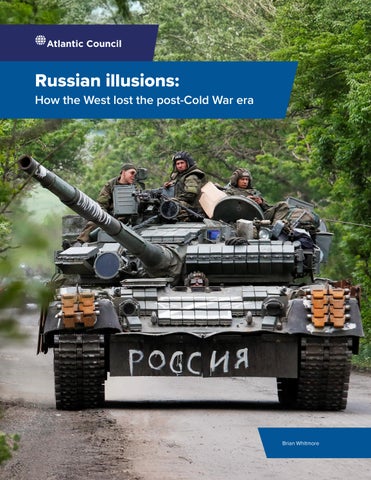
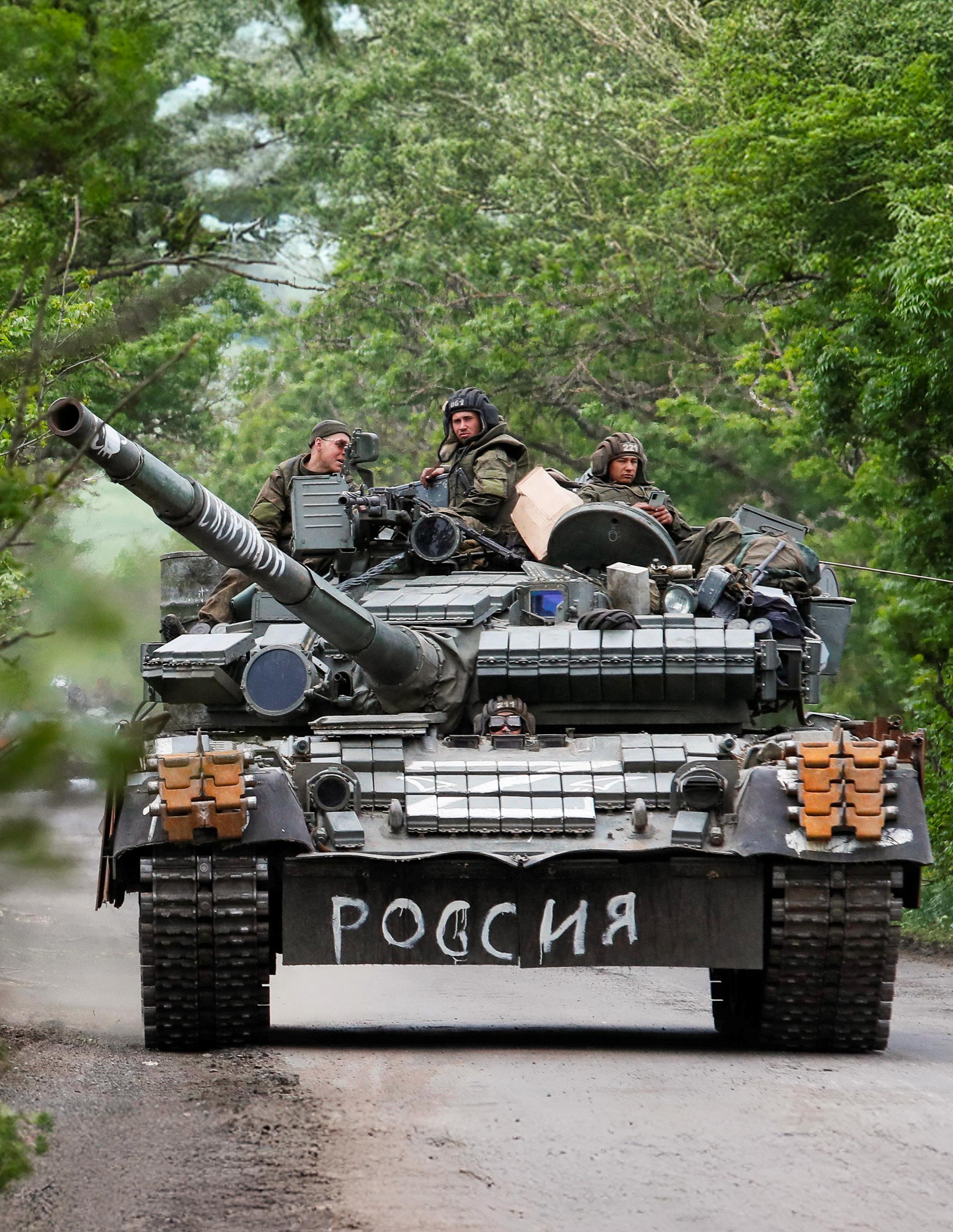
Cover: Service members of pro-Russian troops drive a tank during Ukraine-Russia conflict in the Donetsk Region, Ukraine May 22, 2022. The writing on the tank reads: “Russia”. REUTERS/Alexander Ermochenko
© 2026 The Atlantic Council of the United States. All rights reserved. No part of this publication may be reproduced or transmitted in any form or by any means without permission in writing from the Atlantic Council, except in the case of brief quotations in news articles, critical articles, or reviews.
Please direct inquiries to:
Atlantic Council
1400 L Street NW, 11th Floor
Washington, DC 20005
March 2026
ISBN: 978-1-61977-547-3
Acknowledgments
The author wishes to thank the Smith Richardson Foundation for its generous support for this project, Robert Otto and James Sherr for their thoughtful comments on earlier drafts of this report, and the International Center for Defense and Security in Tallinn for providing valuable feedback. The author also wishes to thank Daniel Malloy and the Atlantic Council’s publications team for their valuable editorial feedback and Zahar Hryniv and Andrew D’Anieri for shepherding the final product to publication.
Introduction: The thirty-years crisis, 1992-2022
If one wanted to get a sense of the “before times,” of what our world felt like before the current era of perpetual crisis, angst, and malaise set in, US President George H. W. Bush’s 1992 State of the Union speech would be a good place to start. The historic address sounds, reads, and feels like an artifact from a bygone era, a relic from a lost civilization. Bush delivered this speech at a time of remarkable American and Western optimism and confidence. It came just over two years after the Berlin Wall came down in November 1989; the next month, Bush and Soviet leader Mikhail Gorbachev declared the Cold War over at a summit in Malta. It also followed the October 1990 reunification of Germany that remade the map of Europe and the December 1991 Belavezha Accords that formally dissolved the Soviet Union, removing the main geopolitical and ideological adversary of the United States and its allies from the map with the stroke of a pen.
The West had won the Cold War, which ended with more of a whimper than a bang. For the third time in the twentieth century, the United States and its allies had emerged victorious in a global struggle against an authoritarian foe—and for the first time in generations, Western liberal democracy did not have an ideological or geopolitical adversary. It was a giddy moment when anything and everything seemed possible. And on January 28, 1992, an exuberant forty-first president of the United States appeared before a joint session of Congress to declare victory to the American people.
Bush spoke in lofty terms about a “dramatic and deeply promising time in our history and in the history of man on Earth” and of “changes of almost Biblical proportions,” before declaring to thunderous applause that “communism died this year” and “by the grace of God, America won the Cold War.” He somberly added: “Now we can look homeward even more and move to set right what needs to be set right.”1
More than three decades later, little seems right—abroad or at home. In fact, the world today seems as dangerous, if not more so, than during the “long twilight struggle”2 of the Cold War that Bush hailed ending back in that 1992 victory speech. Russian President Vladimir Putin, who was a lieutenant colonel
in the KGB when the Soviet Union collapsed in 1991 and who famously called the breakup of the USSR “the greatest geopolitical catastrophe of the 20th century,” launched a brutal full-scale invasion against Ukraine in February 2022, setting off the largest land war in Europe since World War II. Putin's invasion of Ukraine was the culmination of a decades-long process of attempting to restore Russia's status as a great power in confrontation with the West and of attempting to restore Moscow's dominance over the former Soviet empire. The process wasn't linear; nor was it necessarily always teleological. Putin’s predecessor, Boris Yeltsin, presided over a weak state that was largely dependent upon the West and his ability to restore Moscow's lost influence was limited. Putin initially sought convergence with Europe and the West until this came into conflict with his desire to dominate the former Soviet space. Like all history, Russia's post-Soviet development was contingent.
But over the past two decades, Moscow’s aggressive posture has steadily escalated: from a state-sponsored cyberattack on Estonia in 2007, to an invasion of Georgia in 2008 that resulted in Moscow occupying 20 percent of that country's territory, to the 2014 annexation of Ukraine's Crimean peninsula that represented the first forceful change of borders in Europe since World War II, and to Russia's 2014 armed intervention in the Donbas.
By the time Putin launched his full-scale invasion of Ukraine on February 24, 2022, Russia had already manufactured no less than four “frozen conflicts'' in the former Soviet space: in Georgia's Abkhazia and Tskhinvali regions, in Moldova's Transdniester province, and in Ukraine's Donbas region—which resulted in four de facto, highly militarized, albeit unrecognized, Russian protectorates on the territories of these countries. Moreover, in the year prior to Russia's full-scale invasion of Ukraine, Moscow had been steadily expanding its military, economic, and political footprint in Belarus, advancing what was effectively a soft annexation of that country.3 The Putin regime had also been expanding its influence in Georgia since 2012 when Georgian Dream, a political party financed by the
1. Public Papers, Address Before a Joint Session of the Congress on the State of the Union, January 28, 1992, George H. W. Bush Presidential Library and Museum, https://bush41library.tamu.edu/archives/public-papers/3886.
2. John F. Kennedy, Inaugural Address, January 20, 1961, John F. Kennedy Presidential Library and Museum, https://www.jfklibrary. org/archives/other-resources/john-f-kennedy-speeches/inaugural-address-19610120.
3. See Brian Whitmore, “Soft Annexation: Inside Russia's Takeover of Belarus,” Atlantic Council, March 31, 2021, https://www.atlanticcouncil.org/blogs/belarusalert/soft-annexation-inside-the-russian-takeover-of-belarus/; and Yasmeen Serhan, “The Russian Incursion Nobody Is Talking About,” Atlantic, February 22, 2022, https://www.theatlantic.com/international/archive/2022/02/russia-creeping-annexation-belarus/622878/.
Russian illusions: How the West lost the post-Cold War era
Kremlin-connected oligarch Bidzina Ivanishvili, took power.4 And as Moscow's war of aggression against Ukraine raged, leaked Kremlin documents revealed plans for Moscow to effectively absorb Belarus by 2030,5 as well as to destabilize and subjugate Moldova.6
As the Putin regime moved to consolidate its dominance over the former Soviet space, it also stepped-up attempts to directly challenge the United States, the West, and liberal democracy itself as a governing system. And in many ways, Moscow was and is pushing on an open door. The liberal democratic model of governance that appeared so triumphant and invincible three decades ago is today beleaguered and on the defensive as populism, xenophobia, and authoritarian attitudes has been sweeping Europe and North America. The United States is polarized, mired in political tribalism, and plagued by low public trust—its politics paralyzed to the point of dysfunction. So deep is the disillusionment that according to a 2016 study, the share of young Americans who say it is absolutely important to live in a democratic country has dropped from 91 percent for those born in the 1930s to just 57 percent for those born in the 1980s.7 Likewise, Euroskepticism and nativism are on the rise in much of Europe.
The West is clearly experiencing its most acute crisis of confidence in at least a generation. The 9/11 attacks and their aftermath, the Iraq war and subsequent upheaval in the Middle East, the 2008 financial crisis and the subsequent eurozone and migrant crises, and the COVID-19 pandemic have all fed into this angst and malaise. So have persistent inflation and concerns over the rise of artificial intelligence. The economic and cultural shocks of globalization have caused a critical mass of citizens in the West to become alienated and disenfranchised. Advances in technology have put us at the mercy
of algorithms that maximize and amplify outrage and turn that outrage into dollars.
Putin's regime has tapped into and leveraged these powerful emerging global sentiments: growing distrust of institutions and anxiety about social, economic, and demographic change. As Michael McFaul, who served as former US President Barack Obama’s ambassador to Russia, wrote, Putin understands that “if the Cold War’s central ideological struggle of communism versus capitalism was between states, this new ideological struggle of illiberal nationalism versus liberal internationalism is being fought primarily within states.”8
In 2013, a Kremlin-connected think tank called The Center for Strategic Communications, which is often a conduit for policy ideas, published a report recommending that Moscow seek to exploit social fissures in the West over racial divisions, feminism, multiculturalism, and LGBTQ+ rights.9 What followed was a massive campaign of active measures, propaganda, and disinformation, targeted by country to highlight key wedge issues and interfere in elections including the 2016 Brexit referendum in the United Kingdom, the 2016 US presidential election, the 2017 French presidential election, and the 2017 German general election, just to name a few. We have also witnessed an apparent convergence between Putin’s Kremlin and high-profile figures on the Western far right, such as Tucker Carlson in the United States, Nigel Farage in the United Kingdom, and Marine Le Pen in France. Along these lines, Russia enthusiastically supported, and sometimes financed, European populist and anti-immigrant parties such as the National Rally in France and the Alternative for Germany in Germany. Russia has also backed white supremacists, neoconfederates, and state-level secessionist movements in the United States.10
4. See Riges Gente, “Broken Dream: The Oligarch, Russia, and Georgia's Drift from Europe,” European Council on Foreign Relations, December 21, 2022, https://ecfr.eu/publication/broken-dream-the-oligarch-russia-and-georgias-drift-from-europe/; and “Russian Businesses of Bidzina Ivanishvili and His Family,” Transparency International Georgia, April 27, 2022, https://transparency.ge/en/ post/russian-businesses-bidzina-ivanishvili-and-his-relatives.
5. Michael Weiss and Holger Roonemaa, “Revealed: Leaked Documents Show How Russia Plans to Take Over Belarus,” Yahoo! News, February 20, 2023, https://news.yahoo.com/russia-belarus-strategy-document-230035184.html.
6. Michael Weiss and Holger Roonemaa, “Exclusive: Russia's Secret Document for Destabilizing Moldova,” Yahoo! News, March 14, 2023, https://news.yahoo.com/exclusive-russias-secret-document-for-destabilizing-moldova-230008434.html.
7. Yascha Mounk and Robereto Stefan Foa, “Yes, People Really Are Turning Away from Democracy,” Washington Post, December 8, 2016, https://www.washingtonpost.com/news/wonk/wp/2016/12/08/yes-millennials-really-are-surprisingly-approving-of-dictators/; and Amanda Taub, “How Stable Are Democracies? 'Warning Signs Are Flashing Red,' “ New York Times, November 29, 2016, https://www.nytimes.com/2016/11/29/world/americas/western-liberal-democracy.html. A 2023 study by The Open Society Foundation found that this is a global trend among young people. See Open Society Foundations, “Generational Shift: New Global Poll Reveals Large Minorities of Young People Lack Faith in Democracy to Deliver on Their Priorities,” press release, September 11, 2023, Open Society Foundations, https://www.opensocietyfoundations.org/newsroom/generational-shift-new-global-poll-revealslarge-minorities-of-young-people-lack-faith-in-democracy-to-deliver-on-their-priorities.
8. Michael McFaul, “The Tragic Success of Global Putinism,” Atlantic, March 10, 2025, https://www.theatlantic.com/international/ archive/2025/03/tragic-success-global-putinism/681976/.
9. See Brian Whitmore, “Vladimir Putin: Conservative Icon,” Atlantic,” December 20, 2013, https://www.theatlantic.com/international/ archive/2013/12/vladimir-putin-conservative-icon/282572/.
10. See Casey Michel, “American Disunion: How Russia Has Cultivated American secessionists and separatists in its quest to break up the US,” in The Kremlin's Malign Influence Inside the US, (Free Russia Foundation: 2021), 71–88, https://www.4freerussia.org/ the-kremlin-s-malign-influence-inside-the-us/.
So, what happened? How did we fall from the heady optimism of 1992 to the peril, malaise, and danger of today? What lessons can we learn from the post-Cold War period? This report is an attempt to address this question.
Shortly before the outbreak of World War II, the British historian E. H. Carr published his seminal book The Twenty Years Crisis: 1919-1939, which examined the lessons of the interwar period. Carr argued that the period between World War I and World War II was a crisis of the international system, resulting from the failure of the old liberal order to adapt to and understand new and emergent political, economic, and military realities.11
I will argue that a similar dynamic played out in the contemporary West in our own thirty-year crisis between the end of the Cold War and Russia's invasion of Ukraine. The liberal order failed. But how? And why? This report will argue that the seeds
of the current crisis were planted at the moment of the liberal West's victory and grew over the course of the following three decades. The United States and the West misunderstood the nature and intentions of post-Soviet Russia, the true implications of the globalized world that the end of the Cold War ushered in, the histories and aspirations of the other post-Soviet states colonized by Russia, and the degree to which domestic politics and international relations have become entwined in the twenty-first century—and how malign actors can exploit this interdependence.
Seven sections explore the current crisis and how to prevent similar crises in the future. Each of the first six sections focuses on a particular lesson from the post-Cold War period and the conclusion provides policy recommendations.
11. See E. H. Carr, The Twenty Years Crisis: 1919-1939 (London: MacMillan Press Ltd., 1946).
Chapter 1: The land of illusions
Lesson 1: The West was fooled by the illusion of Russian politics and missed its essence. By utilizing dramaturgy, deception, illusion, and what Russian political operatives call pokazuka, the Kremlin was able to fool the West into believing that Moscow was building a liberal democracy when this was actually a facade to mask imperial, oligarchic, and kleptocratic rule.
Remember that time when Madeleine Albright said the United States should just take all of Russia's oil? Of course you don't. Because the veteran US diplomat never said any such thing. But many Russians are nevertheless certain she did—the facts be damned. And why wouldn't they? Top Russian officials have been repeating these fictitious remarks as if they were the gospel truth for well over a decade.
This bizarre claim received its most high-profile treatment back in October 2007 during Putin's annual call-in program, a yearly ritual in which carefully vetted “ordinary citizens” are allowed to ask the Kremlin leader meticulously curated “spontaneous” questions. During the program, an engineer from Novosibirsk claimed that Albright, who served as US secretary of state from 1997 to 2001, had once said Siberia's vast natural resources were too important for Russia to “unfairly control” on its own. What did the Kremlin leader think about that?
Putin feigned surprise. But his answer was clearly far from spontaneous. “Such ideas are a sort of political erotica,” Putin said coolly, taking a gratuitously misogynistic swipe at the first woman to serve as America's top diplomat. “Perhaps they give somebody pleasure, but they are unlikely to lead to anything positive.” He then accused unnamed outsiders of scheming “in their fevered brains” about how to lay claim to Russia's natural wealth, adding that “Russia has the strength and means it needs to defend itself and its interests, both on its own territory and in other parts of the world.”12 The performance and the gaslighting were vintage Putin.
I was monitoring Putin's call-in show for Radio Free Europe/ Radio Liberty at the time and regarded the exchange as just another staged opportunity for Putin to play the tough guy on television. But then I noticed that in subsequent years, the claim was repeated numerous times by various Russian officials. Most notably, in June 2015, the longtime Putin crony and adviser Nikolai Patrushev, who was then secretary of the Security Council, told the Russian daily Kommersant that the United States “really would like it if Russia did not exist as a
state at all.” Patrushev added, “This is because we have a lot of resources, and the Americans think we don’t deserve them or have rights to them; they think we don’t use them as we should. Remember the statement made by Madeleine Albright who claimed that neither the Far East nor Siberia belonged to Russia.”13 Note how the claim has metastasized: If in 2007 the United States just wanted to take Russia's oil, by 2015 it wanted to lay claim to all of Siberia and the Russian Far East as well. So where did this false claim originate? Buckle up, because this is where it gets really weird. Back in December 2006, a retired KGB general, Boris Ratnikov, was interviewed by Rossiyskaya Gazeta, the official newspaper of the Russian government. Ratnikov claimed that in Soviet times he had been involved with a top-secret KGB occult project—sort of like a Soviet version of the popular US television program The X-Files 14
In the Soviet Union, Ratnikov said, “almost all the people with supernatural powers were controlled by the KGB” and were used by the Soviet authorities. “You can't even imagine the war of brains that unfolded in the first half of the last century,” he said. “I'm hardly exaggerating when I say that sometimes there were astral battles. And all this was kept secret and camouflaged, probably not less than the nuclear project.”
Ratnikov said his specialty in this endeavor was mind reading. And after the Soviet Union broke up, he went to work for the Federal Protection Service, where he was assigned to the security detail of Russia's first post-Soviet president, Boris Yeltsin. In this capacity, Ratnikov said he was in close proximity to Albright during many of her official visits to Moscow in the 1990s and was able to—yep, you guessed it—read the US secretary of state's mind.
“In Madame Albright's mind, we found a pathological hatred of Slavs,” Ratnikov said, overlooking the fact that she was of Czech origin, having emigrated to the United States from Prague as a child during World War II and, therefore, was a Slav. “She resented the fact that Russia had the world's largest mineral reserves. She believed that Russia should not control
12. Brian Whitmore, “Spinning the Kremlin: Russia's New Agitprop,” Radio Free Europe/Radio Liberty, November 5, 2007, https://www. rferl.org/a/1079079.html.
13. “За
(“Behind Ukraine's destabilization lies an attempt to radically weaken Russia: Russian Security Council Secretary Nikolai Patrushev on the main threats to Russia's security.”) Коммерсантъ, June 22, 2015, https://www.kommersant.ru/doc/2752250.
14. “Генерал
(“In Madeleine Albright's thoughts, we discovered a pathological hatred of Slavs.”)
December 22, 2006, https://rg.ru/2006/12/22/gosbezopasnostj-podsoznanie.html); and see Brian Whitmore, “Russia's Ministry of Mind Reading,” Radio Free Europe/Radio Liberty, June 23, 2015, https://www.rferl.org/a/russias-ministry-of-mind-reading/27087718.html.
its reserves but that they should be shared by all of humanity under the supervision, of course, of the United States.”
We of course don't know for certain whether the Ratnikov interview was a plant designed to establish a disinformation narrative that could be reinforced and repeated, with its origins obscured and laundered, over the years; or whether Kremlin spin doctors simply saw an opportunity presented by Ratnikov's eccentric and unhinged musings to the national media. But the fact that it appeared in the official newspaper of the Russian government suggests that it probably was orchestrated.
But regardless, this bizarre anecdote is revealing. The manufacturing of scandals, crises, controversies, false narratives, and indeed entire realities is an old technique known as “dramaturgy.” In the Russian language there is even a slang word for it, pokazuka, which is derived from the verb pokazovat, which means “to show.” Dramaturgy and pokazuka are, in turn, often components of a broader strategy deployed by the Russian security services known as “reflexive control,” a doctrine developed by Soviet military strategists in the 1960s that aims to compel adversaries to behave in a manner advantageous to Moscow. It does this by preemptively shaping the physical and information environment through disinformation campaigns, psyops, business ties, political meddling, establishing military facts on the ground—or any combination of the above.15
“The idea behind reflexive control is to shape the environment in such a way that the enemy chooses Russia’s preferred course of action voluntarily, because it is easiest and all the others appear much more difficult and risky, if not impossible,” military analysts Frederick and Kimberly Kagan wrote in 2015. “Reflexive control allows a much weaker force to constrain and even control the activities of a much stronger force.”16
The result is that in Russia, things are not always as they seem, with reality buried beneath layer upon layer of subterfuge, diversion, and deception, something Russians refer to as maskirovka. In his 2005 book Virtual Politics: Faking Democracy in the Post-Soviet World, Andrew Wilson called Russian politics “the society of the spectacle.”17 And in a 2015 article, he noted that the purpose of Russian propaganda “is to create parallel alternative realities. Not just an alternative message, but an alternative reality, with a cast of supporting characters to deliver it.”18
This is not a new phenomenon. In fact, it has been the case for centuries and even extends to the very nature of the Russian political system itself. In his seminal monograph on medieval Muscovy Muscovite Political Folkways, the late Harvard University historian Edward L. Keenan noted that the Muscovite court culture was marked by “extreme forms of the ceremonial camouflage and secrecy” and “the assiduous production of 'noise,'” in which “the realities of an informal, corporate, and oligarchic political system were masked by a facade of complex protocol, hierarchic nomenclature, and ecclesiastical trappings elaborated with great inventiveness and false circumstance.”19
Keenan's stark description of medieval Muscovy could just as easily have been a description of contemporary Russia. And this became evident very early in Russia's post-Soviet development at a time when the United States and the West were still touting the triumph of democracy there. On November 23, 1995, veteran US diplomat Thomas Graham, a senior political officer in the US embassy in Moscow at the time, published a remarkable five-thousand-word article in a Russian daily, Nezavisimaya Gazeta, that shattered the dominant paradigm of post-Soviet Russia.
At the time, most Western analysts of Russian affairs viewed politics in that country as centered around a conflict between pro-Western liberals and a Red-Brown coalition of retrograde Communists and nationalists. In other words, politics was driven by beliefs, values, and worldviews channeled through institutions—just like in the West, albeit with a bit more chaos. The picture Graham painted was entirely different. He presented Russian politics as not defined by institutions, law, political parties, and ideologies but by a naked, valueless, and ruthless struggle for power among clans tied to industrial and economic interests. “These clans differ from one another in a variety of ways, but they all have certain features in common: each is grouped around a powerful political figure and has links with leading financial and industrial organizations,” he wrote. “They have guaranteed access to the mass media and the security apparatus; they control armed groups in the state or the private sector.” Graham adds that neither ideology nor values matter to the clans, noting that all of them have links to members of the Russian parliament, “but the factions—be they
15. Brian Whitmore, “The Great Manipulator,” Radio Free Europe/Radio Liberty, February 24, 2016, https://www.rferl.org/a/the-great-manipulator/27571604.html.
16. Frederick W. Kagan and Kimberly Kagan, “Putin Ushers in a New Era of Global Geopolitics,” Institute for the Study of War, September 27, 2015, https://understandingwar.org/research/russia-ukraine/putin-ushers-in-a-new-era-of-global-geopolitics/.
17. Andrew Wilson, Virtual Politics: Faking Democracy in the Post-Soviet World (Yale University Press, 2005).
18. See Andrew Wilson: “Four Types of Russian Propaganda,” StopFake.org, https://www.stopfake.org/en/andrew-wilson-four-types-of-russian-propaganda/.
19. Edward L. Keenan, “Muscovite Political Folkways,” Russian Review 45, no. 2 (1986): 129, https://www.jstor.org/stable/130423?seq=1#page_scan_tab_contents.
communist, nationalist, centrist or democratic—are of no great importance to any of them.”20
He adds that “none of the clans are devoted to democratic ideals, despite public assurances to the contrary” and that “democratic procedures, including elections, are mostly seen as weapons in the struggle for power.” And, quite prophetically, he forecasts that “this would inevitably lead to a limiting of democratic freedoms.”21 It was as if Keenan's description of a “facade of complex protocol, hierarchic nomenclature, and ecclesiastical trappings” masking “the realities of an informal, ‘corporate,’ and oligarchic political system”22 in medieval Muscovy had been transplanted into late twentieth century Russia. But Graham's warning back in 1995, while absorbed and internalized by many Russia watchers both inside and outside of government, did not really translate into policy. For the past three decades, many Western assumptions about Russia have been flawed. The West assumed that as Russia integrated with the global economy and joined international institutions, it would adopt and internalize the norms and values of the rules-based international order. The West assumed that with the correct combination of incentives, carrots, and—if necessary—sticks, it would entice and nudge Russia into behaving like a status quo power. The West assumed that Russia wanted to be a status quo power. And the West assumed that Russian “reformers” could steer Russia into the Western community of nations. None of these assumptions, which have underpinned Western policy from the end of the Cold War up to Russia's invasion of Ukraine, have turned out to be correct. Russia has proven to be incorrigibly revisionist—either covertly or overtly. Russia's increased integration with the West has not caused it to adopt Western norms and values. Instead, the opposite has happened: It has given Russia an opportunity to export its norms and values to the West. It took Russia's full-scale invasion of Ukraine in February 2022 to force the West to rethink its assumptions and adjust its policies.
These assumptions were flawed for the past three decades because many Western leaders misunderstood and misread the true nature of politics and power in Russia. The West was fooled by the theater of Russian politics and missed its essence. The West was blinded by pokazuka and maskirovka. Western leaders were victims of reflexive control. They saw a Russia freed from seven decades of Communist rule and on the path, however bumpy, to Western-style democracy. But the reality is that Communism wasn't the essence of the problem, it
was just the 20th century manifestation of it. The real problem ran much deeper. Under various facades and under various names, the essence of Russian governance has been remarkably consistent for Russia's history, from the medieval Muscovy to the Tsardom of Russia to the Russian Empire to the Soviet Union to the post-Soviet Russian Federation. For centuries— whether it has been formally governed by Tsars and boyars, commissars and politburos, or presidents and parliaments— Russia has, in essence, always been truly ruled through a web of informal patronage networks, unwritten codes, and complex kleptocratic clan structures. It has always been defined by what the émigré political scientist Alena Ledeneva calls “sistema.” In her 2013 book Can Russia Modernize, Ledeneva writes:
This is not a system that you can choose to join or not— you fall into it from the moment you are born. There are of course also mechanisms to recruit, to discipline and to help reproduce it. In the Soviet Union there was more or less a consolidated state, whereas now it is impossible to disentangle the state from a network of private interests. Modern clans are complex. It is not always clear who is behind which interests 23
But nevertheless, in the triumphalist post-Cold War environment, many Western experts, scholars, and decision-makers saw what they expected to see—or what they wanted to see.
In his classic book Perception and Misperception in International Politics, political scientist Robert Jervis applied the discipline of cognitive psychology to explain the behavior of decision-makers in international relations. According to Jervis, decision-makers tend to seek “rational cognitive consistency” which leads them to “fit incoming information into pre-existing beliefs and to perceive what they expect to be there.” This tendency leads to confirmation bias, interpreting information in a way that is consistent with one’s preexisting beliefs. “Decision-makers tend to fit incoming information into their existing theories and images,” Jervis wrote.24
Western leaders, particularly, but not exclusively, in the United States were deeply invested in the success of Russia's post-Soviet transition to democracy, even when that transition proved to be illusory. The United States, which viewed the defeat of Communism in the Cold War as an affirmation of its most cherished values, was deeply invested in the success of post-Communist Russia, which served to validate the cost and sacrifices of the Cold War. If Communism was the problem in the long twilight struggle with Moscow, then it stood to reason
20. Thomas Graham, “Новый
November 23, 1995. For a translation of the article into English, see Thomas Graham, “Who Rules Russia,” Prospect, January 20, 1996, https://www.prospectmagazine.co.uk/opinions/54970/whorules-russia.
21. Graham, “Who Rules Russia.”
22. Keenan, “Muscovite Political Folkways,” 129.
23. Alena Ledeneva, Can Russia Modernize? Sistema, Power Networks, and Informal Governance (Cambridge: Cambridge University Press, 2013).
24. Robert Jervis, Perception and Misperception in International Politics (Princeton University Press, 1976).
Russian illusions: How the West lost the post-Cold War era
that a post-Communist and post-Soviet Russia would become a Western partner.
As Svetlana Savranskaya and Mary Sarotte wrote, then US President Bill Clinton “saw Yeltsin personally as an indispensable partner in achieving his goals.” And this, they added, “led to the difficult situation where U.S. backing for the Russian democratic transition consisted largely of promoting its favorite 'democrat,' Yeltsin, as the only game in town—even as he was quickly becoming an autocrat in reality.” As a result, “Clinton was willing to close his eyes to electoral irregularities, the rise of the oligarchs, the war in Chechnya, and the rising corruption in the new Russia.”25 Following Yeltsin's armed assault on the parliament in October 1993 that left 147 people dead and 437 wounded, Clinton called Yeltsin to praise him and the US Secretary of State Warren Christopher lauded the Russian president for his “superb handling” of the crisis.26
Likewise, because of its own history of transitioning from a Nazi dictatorship to a vibrant democracy, Germany's leaders believed that country had a special role to play in mentoring Russia through its own transition and was quick to dismiss or ignore evidence that Moscow's democratic transition was illusory. German industrialists, who became deeply entangled with the Russian energy industry after the Cold War, also had a financial interest in seeing a democratizing and benign Russia. And while Western leaders were cheering on what they thought was Russia's democratic transition, the old Soviet system was busy reconstituting itself in Moscow. In an important 2023 article in The Journal of Democracy titled “Why Russia's Democracy Never Began,” Maria Snegovaya noted the resilience of not just the old Soviet elite in Russia, but the old Soviet practices as well.
Soviet power networks with marked elements of patronage and clientelism transitioned straight into the new Russia. Such practices showed remarkable persistence in post-Soviet politics. Common holdover practices included blat (the use of personal networks and contacts to obtain goods and services); “telephone law” (the custom of executive officials putting back-channel pressure on the courts and legal system); and ponyatia (unwritten rules or “understandings” that govern organizations but are opaque to outsiders).27
But despite the reality that the new bosses of Russia looked increasingly like the old bosses, a succession of US presidents treated Russia like a trusted partner. During the Clinton presidency, the “Bill and Boris Show” became a recurring shtick. George W. Bush famously looked into Putin's eyes and said he got a sense of his soul.28 And Obama launched the ill-fated reset with Moscow. Even Joe Biden, who came to office in 2021 with few illusions about Russia (he famously once quipped that when he looked into Putin's eyes, he decided he didn't have a soul29), initially sought a “stable and predictable” relationship with Moscow.
The West's illusory views of Russia represent the meta-lesson of the post-Cold War period. The illusion provides an analog for how the United States and its allies misjudged the entire geopolitical landscape, including the former Soviet space, the nature of globalization, the interdependency of domestic politics and foreign policy, and the lurking dangers for the West in its moment of triumph.
25. Svetlana Savranskaya and Mary Sarotte, “The Clinton-Yeltsin Relationship in Their Own Words,” National Security Archive, October 2, 2018, https://nsarchive.gwu.edu/briefing-book/russia-programs/2018-10-02/clinton-yeltsin-relationship-their-own-words.
26. See National Security Archive, “Yeltsin Shelled Russian Parliament 30 Years Ago – U.S. Praised 'Superb Handling,’ “ The George Washington University, October 4, 2023, https://nsarchive.gwu.edu/briefing-book/russia-programs/2023-10-04/yeltsin-shelledrussian-parliament-30-years-ago-us-praised.
27. Maria Snegovaya, “Why Russia's Democracy Never Began,” Journal of Democracy 34, no. 3, July 2023, 105–118.
28. James Richter, “A Sense of His Soul: The Relation between Presidents Putin and Bush,” PONARS Policy Memo no. 329 (November 2004), Center for Strategic and International Studies, https://www.csis.org/analysis/ponars-policy-memo-329-sense-his-soul-relation-between-presidents-putin-and-bush.
29. Reuters, “U.S. Vice President Biden Says Putin Has No Soul: New Yorker,” July 21, 2014, https://www.reuters.com/article/world/ us-politics/us-vice-president-biden-says-putin-has-no-soul-new-yorker-idUSKBN0FQ1CT/.
Chapter 2: The last empire
Lesson 2: The West did not recognize the ingrained imperial tendencies in post-Soviet Russia—or did so too late. Conditioned by decades of Cold War ideology, the West thought the problem with Russia was Communism but actually it was the older problem of Russian imperialism. Western leaders risk making the same mistake with Putinism.
Indrek Tarand needed a job. It was the summer of 1993 and the twenty-nine-year-old was strolling through the picturesque medieval Old Town of the Estonian capital, Tallinn, when he happened upon some old school buddies drinking at a bar. But this wasn't just any group of old school pals. The group included Mart Laar, then Estonia's youthful thirty-three-yearold prime minister; Juri Luik, who at twenty-seven years of age would soon be appointed the country's defense minister; and Indrek Kannik, then a twenty-eight-year-old member of parliament. The Soviet Union had broken up less than two years prior and democratic Estonia's new political elite was one of the sprightliest in Europe, with the casual vibe of an early Silicon Valley internet start-up. This was the team that would spearhead Estonia's market and democratic reforms, which would pave the way for eventual European Union and NATO membership. But on this lazy summer day, they were enjoying a few beers and discussing the affairs of state. “It was sort of a kindergarten government—average age thirty,” Tarand told me with a wry smile.30 “So I was walking past and they said, ‘Hey Indrek, we have a job for you: We need to appoint you the special representative to the northeast region.’”
The northeast region meant Narva, a city of eighty thousand31 on Estonia's border with the Russian Federation that was populated predominantly by ethnic Russians. And in the early 1990s, Narva meant trouble. Big trouble. Since Estonia restored its independence in 1991, much of its ethnic Russian minority—roughly a quarter of the population—had become increasingly restive.32 The vast majority of them had migrated to Estonia after it was forcefully annexed into the USSR in 1940, replacing the approximately 135,000 Estonians who were either killed or deported to Siberian labor camps following the Soviet invasion. Among those deported to Siberia was the man who would eventually become Estonia's first post-Soviet president, Lennart Meri, then just twelve years old.33 The ethnic cleansing of the Stalin period and Russian immigration that accompanied it dramatically changed Estonia's demographic makeup. And the ethnic Russians, who made up much of the
Soviet-era elite, had become accustomed over the previous four decades to being a privileged minority there.
But that all changed dramatically after independence. Suddenly, Estonian was the official language and Russian the secondary language. To receive citizenship, those who immigrated to Estonia during the Soviet occupation, predominantly ethnic Russians, had to become naturalized and pass language and civics exams. To a group that had become accustomed to the privileged status of imperial overlords, this felt like discrimination and oppression. It wasn't, of course, but the sentiment was real and consequential. And it was a sentiment that many in the Russian political elite were ready and eager to encourage, exploit, and leverage—in Estonia and elsewhere.
In fact, Moscow had begun provoking and leveraging such ethnic tensions in Estonia and elsewhere even before the Soviet Union broke up. In 1989, as Georgia pushed for more autonomy, the KGB stoked conflicts in its predominantly Russian-speaking regions of Abkhazia and South Ossetia. When the Moldovan Soviet Republic established Moldovan as its primary language and retained the Latin alphabet, separatist Russian speakers in the republic's Transdniester region declared independence from Moldova in 1990 with the support of the 14th Soviet Army, which was stationed there. Each of these cases resulted in the establishment of heavily militarized Russian protectorates that undermined Georgian and Moldovan sovereignty after the Soviet Union dissolved in 1991. And Estonian officials worried that the same Moscow playbook was now being used in Narva, where angry locals were calling for independence from Estonia, staging noisy street protests, and blocking rail lines. “For us this was a matter of deep concern because Russia had already shown that in different parts of the neighborhood, Georgia and Moldova, what kind of separatist card they were ready to play,” Luik, Estonia's defense minister at the time, told me, adding that “the Narva city government was entirely in the hands of these Soviet-style Russian leaders.”34 The chair of Narva's city council, Vladimir Chuikin, regularly traveled to St. Petersburg to meet with Russian offi-
30. Indrek Tarand, interviewed by the author in Tallinn, March 15, 2024.
31. According to the 1989 census, Narva’s population was 84,975. By the 2021 census, it had decreased to 53,955. Statistics Estonia https://www.stat.ee/en.
32. Fred Hiatt, “Narva, Estonia: Spark in an Ethnic Tinderbox,” Washington Post, October 8, 1993, https://www.washingtonpost.com/ archive/politics/1993/10/09/narva-estonia-spark-in-an-ethnic-tinderbox/f54c5bff-ddee-45f9-9d0d-1522d27f50b3/.
33. See Brian Whitmore, “Seeking Justice, Not Revenge, in Estonia,” Boston Globe, May 28, 2000.
34. Juri Luik, interviewed by the author at NATO Headquarters in Brussels, May 27, 2024.
cials and called himself the chairman of the Soviet of People's Deputies of Narva.
According to Luik, the government decided that Estonia “needed somebody who would be the face of the state there. Narva was far from Tallinn in the mental sense. We needed somebody who would be credible enough so that people would know that he had deep connections with the present government. But also imposing enough that he would be seen as a special representative. An authoritative type.” With his fluent Russian-language skills and his close personal connections to the prime minister and defense minister, Tarand fit the bill perfectly. So, he set off to Narva to put things right.
At first, things didn't go well. Tarand arrived amid a massive demonstration on central Narva's Peetri Platz, or Peter's Square, within eyeshot of the Russian border. “They were demanding autonomy, defense of human rights, and calling on Russian soldiers to liberate them,” he said, adding that “somebody even hit my wife with a sign.”35
The Kremlin made clear that it was watching developments. In June 1993, Yeltsin menacingly warned Estonia not to forget “certain geopolitical and demographic realities,” adding that Moscow “has means at its disposal to remind Estonia about these.”36 And the international community, most notably the delegation of the Organization for Security and Co-operation in Europe and its high commissioner on national minorities, Max van der Stoel, were parroting Russian narratives—either out of naivete or outright sympathy. In a July 1, 1993, letter to Estonia’s president, for example, van der Stoel expressed concern about a citizenship law that would require language and civics exams for those who migrated to Estonia during the Soviet occupation. “In my view, it is necessary not only to analyze the law on its purely legal merits, but also to consider its psychological effects on the Russian-speaking population of Estonia,” he wrote, apparently unconcerned with the psychological effect the Soviet occupation—with its mass arrests, deportations, and executions—had on Estonians.37 Kannik, who served in the Estonian parliament at the time, noted that “in the early Clinton years we were under enormous pressure about the human rights of Russians, when their rights were protected more here than in Russia.”38
Despite the obstacles, Tarand was able to calm the situation in Narva. He spoke at rallies and on local radio programs and made it clear that if Narva separated from Estonia, salaries and pensions would no longer be paid in Estonian koruna, which by 1993 was already a stable convertible currency, but in unstable Russian rubles that were rapidly losing value. “They didn't like this. They complained to the Estonian parliament and threatened to sue me, which they never did,” Tarand said.39 Attendance at independence rallies soon diminished significantly. A July referendum on autonomy failed to garner the 50 percent turnout required for validity, and the Estonian Supreme Court ruled that the vote was invalid. By the autumn, the crisis was averted.
But it was clear to Estonian officials that they had dodged a bullet. Luik, then Estonia's defense minister, noted:
The Russians were just across the border, and we knew that the local Army headquarters was in Pskov. But at that time the Russian state itself was quite disorganized. Yeltsin hadn't defined a clear policy to go after the Balts. It was more imperialist improvisation . . . They hoped that something would come out of it, but they were not ready to invest heavily in it.40
There was also the matter of some 25,000 Russian troops who remained in Estonia after the Soviet collapse, with the last soldiers leaving in August 1994. “We were also somewhat lucky because, unlike Transdniester, there were no Russian troops in eastern Estonia,” Luik noted. “All the Soviet legacy troops were in the West, protecting the Soviet border. This was very important because if Russia had military bases in the East they could have created a lot more havoc.”41 Likewise, veteran US diplomat Daniel Fried, who served as assistant secretary of state for European and Eurasian affairs from 2005 to 2009 and US ambassador to Poland from 1997 to 2000 (and is now an Atlantic Council distinguished fellow), said the crisis easily “could have ended up with a frozen conflict and a Transdniester situation.”42
The averted crisis in Narva was something of a canary in a coal mine, a harbinger of enduring Russian imperial ambitions in the post-Soviet space. While the Estonians dodged a bullet, the Moldovans, Georgians, and Ukrainians would not be so lucky. As historian Jeffrey Mankoff notes in his book Empires of Eur-
35. Tarand interview.
36. Fred Hiatt, “Narva, Estonia: Spark in an Ethnic Tinderbox,” Washington Post, October 8, 1993, https://www.washingtonpost.com/ archive/politics/1993/10/09/narva-estonia-spark-in-an-ethnic-tinderbox/f54c5bff-ddee-45f9-9d0d-1522d27f50b3/.
37. “Letter from HCNM to the President of Estonia Regarding Non-citizens,” Organization for Security and Co-operation in Europe, July 1, 1993, https://www.osce.org/files/f/documents/9/f/30435.pdf.
38. Indrek Kannik, interviewed by the author in Tallinn, March 14, 2024.
39. Tarand interview.
40. Luik interview.
41. Luik interview.
42. Daniel Fried, interviewed by the author in Kyiv, March 21, 2024.
asia: How Imperial Legacies Shape International Security, the trend toward imperial consolidation would only get stronger: From the mid-1990s, reconsolidating influence across the former USSR has been a central pillar of Russian foreign policy. That strategy entails efforts to encourage citizens of neighboring states to identify with the Russian Federation in its capacity as the successor to the USSR or the Russian Empire. Concepts like “compatriots (sootechestvenniki),” a “Russian World (Russkiy Mir),” or “Holy Rus (Svyataya Rus’)” embody the idea of a Russian imperial nation transcending the Russian Federation’s borders. All of these concepts challenge neighboring states’ efforts to construct their own civic nations and disentangle their histories from Russia.43
But if the Yeltsin period was marked by “imperial improvisation,” in Luik's description, it would become much more systematic under his successor. In her 2016 book Beyond Crimea: The New Russian Empire, political scientist Agnia Grigas described a seven-stage process of “re-imperialization,” in which Putin's Kremlin leveraged what it called “compatriots,” meaning ethnic Russians and other Russophone populations in the former Soviet space to advance their imperial designs. The process includes:
y Using soft power such as promoting the Russian language, culture, literature, and film to attract compatriots.
y Enacting so-called humanitarian policies promoting the rights of ethnic Russians and Russian speakers and paying financial aid and pensions.
y Using Russian state-funded institutions to engage compatriots through government programs, foundations, and paramilitary training.
y Undertaking a systematic effort (i.e., passportization) to grant Russian citizenship to people outside Russia's borders, combined with the explicit intent to “protect” Russian citizens abroad.
y Employing Russian-language media to spread propaganda aimed at provoking ethnic discord and to manufacture a need for the protection of compatriots.
y Explicitly using Russian state resources to defend the rights of compatriots.
y Ordering and conducting military intervention, establishing frozen conflicts, and annexing territory.44
That post-Soviet Russia would attempt to restore its imperial control of the former Soviet space should have surprised exactly nobody. Russia's imperial syndrome has deep roots in its history and political culture and has been central to its identity from the fifteenth and sixteenth century reign of Ivan III and Ivan IV over the Grand Duchy of Muscovy. As Samir Puri notes, “The evolution of Russia was inextricably linked to its expansion, so much so that it is unclear whether Russia created an empire or the process of imperialism created Russia.” Puri notes that “Russia's boundaries expanded dramatically between the seventeenth and nineteenth centuries in three directions: a westerly push into Europe; a southerly push into Central Asia; and an easterly push into Siberia.”45
Whether the nation created the empire or the empire created the nation, Russia's very concept of statehood has always been inexorably tied to its expansion. As Keir Giles writes, “whatever the state of its power or political fortunes, Moscow has always maintained a very expansive view of what constitutes Russian territory,” adding that “where claims were not recognized, continued expansion by direct conquest or colonization has been Russia's default option since the foundation of the Muscovite state.”46 The Russian journalist Anderi Kolesnikov notes pointedly that “Russian identity hinges on the imperial idea.”47
Russia's imperial syndrome has also historically been tied to a belief in a messianic historical mission: the fifteenth and sixteenth century concept of Moscow as the Third Rome; the doctrine of orthodoxy, autocracy, and nationality under Tsar Nicholas I; and Marxism-Leninism in the Soviet period, which Nicholas Berdyev called “a transformation and deformation of the old Russian messianic idea.”48
Additionally, Russia's rulers have historically justified imperialism as a defensive response to a perceived—or manufactured—foreign threat. As Kevork Oskanian notes: Depending on when and where they were undertaken, these civilizing ventures were enforced in different ways. In 'its' East—the Caucasus and Central Asia—imperial Russia styled itself a protector of Christianity, or an “enlightening force” much in the same way as Western powers, using identifiably Orientalist tropes against Muslim “backwardness” and Eastern “irrationality.” In the West, conversely, Russia posed as a guarantor of Orthodoxy against
43. Jeffrey Mankoff, Empires of Eurasia: How Imperial Legacies Shape International Security (Yale University Press, 2022), 24.
44. Angina Grigas, Beyond Crimea: The New Russian Empire (New Haven: Yale University Press, 2016).
45. Samir Puri, The Shadows of Empire: How Imperial History Shapes Our World (Pegasus Books, 2021).
46. Keir Giles, Moscow Rules: What Drives Russia to Confront the West (Brookings Institution Press, 2019), 25–26.
47. Andrei Kolesnikov, “History Is the Future: Russia in Search of the Lost Empire,” Carnegie Moscow Center, February 15, 2018, https:// carnegie.ru/commentary/75544.
48. Nicholas Berdyev, The Origin of Russian Communism (The University of Michigan Press, 1960), 186.
the corrupting dangers of Catholic “Jesuitism,” or the more liberal expressions of the European enlightenment.49
These beliefs about messianism and sovereignty persisted and did not disappear when the Soviet Union collapsed. As Thomas J. Wright explains in his 2017 book All Measures Short of War: The Contest for the 21st Century and the Future of American Power, Russia's problems with the current European security architecture are rooted in differing notions of sovereignty, particularly the sovereignty of small states.
For most leaders, sovereignty means that every country in the world has certain rights. But this is not Putin's definition. Putin equates sovereignty with autonomy, which means being able to provide for your own security and welfare without becoming tethered to allies or relying on larger nations. There are only a handful of truly sovereign nations in the world. The United States is sovereign. China is sovereign. Russia is once again sovereign. And that's about it. Many other nations have outsourced their security to the United States. Some of them, like France, the United Kingdom, and Japan could reclaim their sovereignty if they so desired. The rest could not even if they so desired. They are too small to take care of themselves. Putin does not understand why Russia, a sovereign nation in this sense, ought to be treated on par with states like Estonia, Latvia, and even Poland. Surely, he believes, Russia ought to have a special role, one at least equal to that of the United States and a handful of large states.50
For this reason, Wright explains that “the European security architecture offends” Putin because “it elevates the influence of the smallest members.” He adds that
“Russia's long-term goal is to bring about a transformation of the European security order so it more closely accords with Russia's notion of a hierarchy of sovereign states.”51
Even allegedly liberal Russians were not immune. Anatoly Chubais, one of the architects of Russia's economic reforms in the 1990s and ostensibly one of Russia's most pro-Western public figures, wrote that Russia is a “natural and unique leader” in the former Soviet space and that Moscow should “beef up, increase and strengthen its leadership position in this part of the globe.” Chubais added that: “Liberal imperialism should
become Russia's ideology and building up liberal empire Russia's mission.”52
Vladimiras Laucius, a political analyst at the Vilnius-based Eastern European Studies Center, recalled how in the late Soviet period, his ostensibly liberal Russian friends could not understand why Lithuania and the other Baltic states desired independence.
“They said ‘we want to build democracy together. Why do you want to leave us? Why do you want to become independent? Why don't you want to build democracy together with us?’” Laucius told me. “Russia's imperialism never disappeared, Yeltsin was one of those imperialists, just because you call them liberals or democrats doesn't mean they are not imperialists,” he added.53
Russia's imperial impulses indeed did not die with the Soviet Union, as many in the West had assumed. They had just become stealthier. At first, they were latent. But soon enough they would become manifest.
Western officials were slow to act on this reality, however, as they appeared to hope that Russia could be incentivized into eventually shedding the phantom limbs of its imperial past. A cable from the US embassy in Moscow on January 14, 1994, summarized Yeltsin's take on the conflicts in the former Soviet space, as expressed during his dinner with Bill Clinton: Russia still has to contend with the conflicts going on in the former Soviet Union. We cannot understand why no one is helping us very much. It is very painful for us. The allegations of imperial aspirations are harming us and are not correct. We want less bloodshed. In Moldova we moved in and stopped the bloodshed. We have also done the same thing in South Ossetia. We intend to try to help in Georgia.54
According to the cable, Clinton then turned the discussion to a recent visit by General Pavel Grachev, then Russia's defense minister, to the United States and the prospect of Russian-American military cooperation. Nowhere does there appear to be any pushback or indication that the conflicts in Moldova and Georgia were stoked by Russia.
Arnold Sinisalu, who led KaPo, Estonia's Internal Security Service, from 2013 to 2023, says the West fundamentally misun-
49. Kevork Oskanian, “Russia's Imperial Mindset Dates Back Centuries–and It Is Here to Stay,” Conversation, May 30, 2018, https:// theconversation.com/russias-imperial-mindset-dates-back-centuries-and-it-is-here-to-stay-95832.
50. Thomas J. Wright, All Measures Short of War: The Contest for the 21st Century & the Future of American Power (New Haven, Yale University Press, 2017).
51. Wright, All Measures.
52. See Igor Torbakov, “Russian Policymakers Air Notion of 'Liberal Empire' in Caucasus, Central Asia,” Eurasianet, October 27, 2003, https://eurasianet.org/russian-policymakers-air-notion-of-liberal-empire-in-caucasus-central-asia.
53. Vladimiras Laucius, interviewed by the author in Vilnius, March 18, 2024.
54. Cable from US Embassy Moscow to State Department, “President’s Dinner with President Yeltsin,” [January 13], Novo-Ogarevo, George Washington University National Security Archive, January 14, 1994, https://nsarchive.gwu.edu/document/30920-document-8-cable-us-embassy-moscow-state-department-presidents-dinner-president.
derstood the nature of the Russian threat in the post-Cold War environment. “You all thought that it was about Communism. But it is about chauvinism,” Sinisalu told me, adding: “So many people told us, 'You are so paranoid.'”55
It wasn't until August 2008, when Russia invaded Georgia, that these illusions would be challenged. In testimony before the House Committee on Foreign Affairs on September 9, 2008, Fried, then the assistant secretary of state for European and Eurasian affairs, summarized the shift:
Since 1991, three U.S. administrations have based policy toward Russia on the assumption that Russia—perhaps in fits and starts, imperfectly and in its own way—sought to become a nation integrated with the world: a “normal nation,” that is, part of the international system and its institutions. For its part, since 1991 Russia has asserted its own interest in becoming a part of the world and a part of international institutions. And Russia had made progress in this regard, with American and European support. But with its invasion of Georgia, its continuing refusal to implement the Ceasefire it has signed, and its apparent claim to a “sphere of influence,” Russia has put these assumptions under question and these aspirations at risk.56
If indeed the Russian invasion of Georgia put these assumptions under question, they continued to linger. It wouldn't be until the March 2014 annexation of Crimea and the February 2022 full-scale invasion of Ukraine that they were dispelled.
55. Arnold Sinisalu, interviewed by the author in Tartu, Estonia, March 16, 2024.
56. Hearings Before House Comm. on Foreign Affairs, 110th Cong. (2008) (statement of Daniel Fried, Assistant Secretary of State for European and Eurasian Affairs), https://2001-2009.state.gov/p/eur/rls/rm/109363.htm.
Chapter 3: The kleptocratic state
Lesson 3: The West did not recognize the national security challenges posed by the kleptocratic regime of post-Soviet Russia—or did so too late. This systemic problem is not unique to Putin and will likely remain when he is gone.
Lithuania had a problem. Despite achieving its long-held goals of joining the European Union and NATO in 2004, the Baltic nation still had a very serious security challenge on its hands. It was highly dependent on Russian energy, and the Kremlin was intent on taking advantage. “The Kremlin was using this dependence for political influence inside Lithuania. It wasn't just a problem of energy security, it was weaponized corruption,” Andrius Kubilius, who twice served as the country's prime minister (1999 to 2000 and 2008 to 2012), told me.57
The country's former president, Rolandas Paksas, was impeached and removed from office in 2004 after he illegally granted citizenship to a Russian businessman, Yury Borisov, who was one of his top campaign donors. Parliamentary investigations alleged a quid pro quo with Borisov as well as ties between members of his administration and Russian organized crime.58 Lithuania’s Constitutional Court ruled on March 31, 2004, that Paksas had violated the law, the Constitution, and his oath of office.59 Members of Paksas’ Cabinet also had ties to Russia's state-controlled natural gas giant Gazprom. During a visit to Moscow in 2001 Economics Minister Eugenijus Maldeikis “bypassed the Latvian embassy and accepted instead Gazprom’s hospitality.”60
Gazprom was also financing political parties in Lithuania and neighboring Latvia through intermediaries.61 One of these is widely believed to be Darbo Partija, or the Labor Party, which was founded by the Russian-born Lithuanian entrepreneur
Viktor Uspaskich,62 a former member of the Lithuanian and European parliaments who has long been the subject of tax fraud investigations.63
In 2007, Kubilius, then an opposition member of parliament who today serves as European Defense Commissioner, was watching these developments with trepidation. Moscow, he said, had created “a kleptocratic mafia-like structure” that was using state-sponsored corruption to capture elites and advance Russia's interests. While in opposition, his Homeland Union-Lithuanian Christian Democratic Party drafted a policy on containing Russia, with ending energy dependence as its central plank. And when he returned to office as prime minister in 2008, he was able to put much of the plan into action. What followed was a multiyear building spree that included oil and gas import terminals, pipelines, and other critical infrastructure projects to end Lithuania's energy dependence on Russia. The crown jewel in the effort was a liquified natural gas terminal at the port of Klaipeda that went online in 2014.64
Kubilius and his government also pushed to implement the European Union's Third Energy Package,65 which mandated the unbundling of energy production from transmission. In essence, this was an effort to end Gazprom's long-standing practice of using ownership of pipeline networks to leverage energy dominance in Europe. The effort met resistance from Russia. According to Kubilius and other Lithuanian officials, Putin reportedly pressed José Manuel Barroso, then president
57. Andrius Kubilius, interviewed by the author in Kyiv, March 21, 2024.
58. Šarūnas Černiauskas, “Lithuania Shakes Up Immigration, Expels Two Linked to Putin,” OCCRP (March 5, 2018), https://www.occrp. org/en/project/gold-for-visas/lithuania-shakes-up-immigration-expels-two-linked-to-putin.
59. Modesta Gaučaitė-Znutienė, “‘It Was the Right Decision’. How Lithuania Impeached Its President 20 Years Ago,” LRT.lt, April 9, 2024, https://www.lrt.lt/en/news-in-english/19/2244592/it-was-the-right-decision-how-lithuania-impeached-its-president-20years-ago.
60. “Gazprom, Lukoil, Testing Lithuania's New Government,” Eurasia Daily Monitor, Jamestown Foundation, January 25, 2001, https:// jamestown.org/program/gazprom-lukoil-testing-lithuanias-new-government/.
61. See “Illicit Influence – Part Two – The Energy Weapon,” German Marshall Fund Alliance for Securing Democracy, April 25, 2019, https://securingdemocracy.gmfus.org/illicit-influence-part-two-energy-weapon/; and “Strategic Corruption Exemplified (Part 1): Russia, the Progenitor,” Diplomatic Pouch, Medium, May 5, 2022, https://medium.com/the-diplomatic-pouch/analysis-strategic-corruption-exemplified-part-1-russia-the-progenitor-41fc34414295.
62. “Viktor Uspaskich – Who’s Behind the Mask?,” VilNews, October 29, 2012, https://vilnews.com/2012-10-viktor-uspaskich%E2%80%93-whos-behind-the-mask. See also Joanna Hyndle-Hussein, “Gazprom Sells Off Its Assets in Lithuania,” OSW Centre for Eastern Studies, June 25, 2014, https://www.osw.waw.pl/en/publikacje/analyses/2014-06-25/gazprom-sells-its-assets-lithuania.
63. Jack Schickler, “Lithuanian ex-MEP Uspaskich Alleged Target of Fraud Probe,” EuroNews, August 29, 2024, https://www.euronews.com/my-europe/2024/08/29/lithuanian-ex-mep-uspaskich-alleged-target-of-fraud-probe.
64. David Ehl, “How Lithuania Is Freeing Itself from Russian Energy,” Deutsche Welle via LRT, October 5, 2022, https://www.lrt.lt/ en/news-in-english/19/1691351/how-lithuania-is-freeing-itself-from-russian-energy?; and see Jeanne Whalen, “A History of Russian Oppression Fueled Lithuanian Energy Independence,” Washington Post, May 6, 2022, https://www.washingtonpost.com/ world/2022/05/06/lithuania-russia-oil-gas/.
65. European Commission, “Questions and Answers on the Third Legislative Package for an Internal EU Gas and Electricity Market,” Memo, March 1, 2011, https://ec.europa.eu/commission/presscorner/detail/en/memo_11_125.
Russian illusions: How the West lost the post-Cold War era
of the European Commission, during a boat ride on the Volga River. “Barosso told me that he spent a whole hour on the Volga River [with Putin] saying that we are bandits who are stealing his pipeline,” Kubilius said.66 Nevertheless, Lithuania was able to complete the unbundling process on its territory by 2014 and in April 2022, just months after Russia's full-scale invasion of Ukraine, it announced an end to all gas imports from Russia.
Lithuania's quest to free itself from Russian energy addressed a national security threat that the older democracies in the West were slow to grasp. As Lithuania was seeking energy independence from Russia, Germany was helping it build the Nord Stream 2 pipeline, a project that—had it not been halted after Russia invaded Ukraine—would have led to Europe's near total dependence on Moscow for energy. And as Peter Pomerantsev and Michael Weiss wrote in their widely circulated report, The Menace of Unreality: How the Kremlin Weaponizes Information, Culture, and Money, such projects were key to Moscow's strategy. “The Kremlin does not need to be the outright leader of a bloc of nations à la Warsaw Pact; instead, it can exacerbate existing divides, subvert international institutions and help create a world where its own form of corrupt authoritarianism flourishes,” Pomerantsev and Weiss wrote.67
In the globalized world that has emerged in the post-Cold War environment, Russia has persistently used institutionalized graft as a conveyor belt for Russian malign influence abroad. In a 2021 article in Lawfare, Matthew Murray, Alexander Vindman, and Dominic Cruz Bustillos wrote: “Politically, the Kremlin is driven to legitimize this kind of state-sponsored oligarchy at home by exporting and embedding it abroad as an alternative to democracy.” Such “a systemic level of corruption,” they wrote, “places Putin’s Russia in an increasing state of tension with the Western neo-liberal order.”68
Likewise, in a 2012 report for Chatham House, James Greene explained how Putin has weaponized Russia’s institutionalized 66. Kubilius interview.
corruption by turning it into an “extension of his domestic political strategy” of using the carrot of corruption and the stick of kompromat (damaging or compromising information collected on a person) “to establish patron-client political relationships.” According to Greene, “By broadening this approach to the corrupt transnational schemes that flowed seamlessly from Russia into the rest of the former Soviet space—and oozed beyond it—Putin could extend his shadow influence beyond Russia’s borders and develop a natural, ‘captured’ constituency.”69
During the Cold War, the Kremlin's corrupt networks were hermetically sealed behind the Iron Curtain. But since the 1990s, they have been able to merge with globalized financial networks and infest Western economies and political systems.
Drawing on imperial and Soviet traditions, KGB and Communist Party leaders displayed oligarchic tendencies to survive the transition to capitalism by creating new networks of loyal patrons based on shared interests. In the early 1990s, they moved billions in state resources and financial assets abroad, privatized the most profitable enterprises for themselves and their close associates, and began engaging in criminal activity.70
A harbinger of this came during the Yeltsin presidency, with the Bank of New York money laundering case in 1998-99, when an estimated seven billion dollars in illicit cash, some of which was connected to Russian organized crime groups, passed through the venerable US bank.71 The trend continued as numerous Western banks, including Germany's Deutsche Bank, Denmark's Danske Bank, Sweden's Swedbank, Finland’s Nordea Bank, France's Crédit Agricole, the Netherlands’ ING Group, and Austria's Raiffeisen Bank have faced allegations of laundering illicit Russian money.72
The Kremlin's use of strategic corruption to infest countries beyond Russia's borders is most pronounced, of course, in the former Soviet Union, where Moscow has used graft, murky energy deals, and oligarchic networks to maintain some con-
67. Peter Pomerantsev and Michael Weiss, “The Menace of Unreality: How the Kremlin Weaponizes Information, Culture, and Money,” Interpreter, Institute for Modern Russia, 2014, 22, https://imrussia.org/media/pdf/Research/Michael_Weiss_and_Peter_Pomerantsev__The_Menace_of_Unreality.pdf.
68. Matthew Murray, Alexander Vindman, and Dominic Cruz Bustillos, “Assessing the Threat of Weaponized Corruption,” Lawfare blog, July 7, 2021, https://www.lawfareblog.com/assessing-threat-weaponized-corruption.
69. James Greene, “Russian Responses to NATO and EU Enlargement and Outreach,” Chatham House Briefing Paper, June 2012, 9, https://www.chathamhouse.org/sites/default/files/public/Research/Russia%20and%20Eurasia/0612bp_greene.pdf.
70. Murray, Vindman, and Bustillos, “Assessing the Threat.”
71. Timothy L. O'Brien with Raymond Bonner, “Banker and Husband Tell of Money Laundering Case,” The New York Times, February 17, 2000, https://archive.nytimes.com/www.nytimes.com/library/world/global/021700russia-launder.html; Raymond Bonner and Timothy L. O'Brien, “Activity at Bank Raises Suspicion of Russian Mob Tie,” New York Times, August 19, 1999, https://www. nytimes.com/1999/08/19/world/activity-at-bank-raises-suspicions-of-russia-mob-tie.html; U.S. Department of Justice, “The Bank of New York Resolves Parallel Criminal Investigations Through Non-Prosecution Agreement with the United States,” press release, November 8, 2005, U.S. Department of Justice, https://www.justice.gov/archive/usao/nye/pr/2005/2005nov08.html.
72. “Factbox: European Banks Hit by Russian Money Laundering Scandal,” Reuters, March 8, 2019; and see “The Russian Laundromat,” Organized Crime and Corruption Reporting Project, August 22, 2014, https://www.reuters.com/article/us-europe-moneylaundering-factbox-idUSKCN1QP1P2/.
Russian illusions: How the West lost the post-Cold War era
trol over its former empire. Kremlin-friendly oligarchs like Viktor Medvedchuk73 in Ukraine and Ivanishvili74 in Georgia have acted as de facto agents of Moscow's influence. The Kremlin also utilizes murky energy schemes with opaque ownership structures like RosUkrEnergo, EuralTransGas, and Moldovagaz as carrots to capture and control elites in former Soviet states like Ukraine, Belarus, and Moldova.75 Farther West, the Kremlin has deployed shifty shell companies like Vemex, an energy trading company with a dizzyingly opaque ownership structure ultimately leading to Gazprom, which at one time captured between 10 and 12 percent of the energy market in the Czech Republic and has ties to a pro-Russian lobby in that country's elite.76
Vemex is hardly the only such shell company operating in Western Europe. In testimony before the US Senate's Foreign Affairs Committee in June 2008, the late energy analyst Roman Kupchinsky, former director of Radio Free Europe/Radio Liberty's Ukrainian Service, said: “Gazprom, with the silent support of the Kremlin has set up 50 or so middleman companies, silently linked to Gazprom and scattered throughout Europe.”77 In his testimony, Kupchinsky cited the Vienna-based Centrex group, owned by a Cyprus-based holding company and RN Privatstiftung in Austria, as well as the Gazprom Germania network. Moreover, a September 2007 investigative report by German journalist Hans-Martin Tillack uncovered how Gaz-
prom Germania was “something of a club for former members of the East European security services.” Tillack wrote that “this is the story of an invasion. A massive campaign, planned well in advance. The General Staff is located far away in the east, in Moscow, the capital of Russia. The target area is Germany— and the rest of Western Europe.”78
In addition to using shell companies and money laundering to build networks of influence in the West, the Kremlin also relies on organized crime. Putin's Kremlin has used organized crime to carry out the tasks it wants to keep its fingerprints off of, including arms smuggling, assassinations, raising untraceable funds for black ops, or stirring up trouble in the former Soviet space. For example, to augment its support for separatists in Transdniester, Abkhazia, South Ossetia, Crimea, and the Donbas, Moscow relied heavily on local organized crime groups.79
In 2010, Spanish Prosecutor José Grinda briefed US officials in Madrid about the activities of Russian organized crime groups in that country, informing them that the Kremlin used organized crime “groups to do whatever the [government of Russia] cannot acceptably do as a government.”80 According to one cable from the US embassy, the prosecutor told the American officials that Putin's Russia was a “virtual mafia” state where it was impossible to distinguish between the government's activities and those of organized crime groups.81
73. Victoria Kim, “Putin confidant Viktor Medvedchuk is the most prominent captive released in a prisoner swap,” The New York Times, September 22, 2022; Lesia Bidochko, “The Return of Medvedchuk,” Focus Ukraine (blog), Kennan Institute, The Wilson Center, February 28, 2023. https://www.wilsoncenter.org/blog-post/return-medvedchuk.
74. Maria Katamadze, “The Oligarch Behind Georgia’s Pivot to Russia,” Deutsche Welle, May 27, 2024, https://www.dw.com/en/theoligarch-behind-georgias-pivot-to-russia/a-69165038; Organized Crime and Corruption Reporting Project (OCCRP), “Family of Georgian Oligarch Bidzina Ivanishvili Has Unreported Real Estate in Russia,” August 9, 2024, https://www.occrp.org/en/scoop/family-of-georgian-oligarch-bidzina-ivanishvili-has-unreported-real-estate-in-russia; Pjotr Sauer, “Who Is Bidzina Ivanishvili, the Shadowy Billionaire Behind Georgia’s Pivot to Russia?” The Guardian, October 27, 2024, https://www.theguardian.com/world/2024/ oct/27/who-is-bidzina-ivanishvili-the-shadowy-billionaire-founder-of-georgian-dream.
75. Greene, “Russian Responses.”
76. Gregory Feifer and Brian Whitmore, “The Velvet Surrender,” New Republic, September 17, 2010, https://newrepublic.com/article/77397/russian-aggression-the-velvet-surrender-vladimir-putin-vaclav-klaus-czech-republic.
77. Oil, Oligarchs, and Opportunity: From Central Asia to Europe: Hearings Before the Senate Comm. on Foreign Affairs, 110th Cong., Transcript (2008), https://www.foreign.senate.gov/imo/media/doc/061208_Transcript_Oil%20Oligarchs%20and%20Opportunity. pdf; see James Kimer, “U.S. Senate Hearing on Russian Energy,” Robert Amsterdam website, June 13, 2008, https://robertamsterdam.com/us_senate_hearing_on_russian_energy/.
78. Hans Martin Tillack, “A Tale of Gazoviki, Money, and Greed,” Stern, September 13, 2007, http://fliphtml5.com/asbl/ptbl; and see, Robert Amsterdam, “The Gazoviki in Germany,” September 17, 2007, https://robertamsterdam.com/the_gazoviki_in_germany/.
79. See Brian Whitmore, “Putinfellas,” Radio Free Europe/Radio Liberty, May 3, 2016, https://www.rferl.org/a/putinfellas-russia-putin-mafia/27713771.html.
80. “U.S. Embassy Cables: Russia Is a Virtual Mafia State, Says Spanish Investigator,” Guardian, December 2, 2010, https://www. theguardian.com/world/us-embassy-cables-documents/247712.
81. “Wikileaks Cables: Russia ‘Using Mafia for Its Dirty Work,’ “ Guardian, December 1, 2010, https://www.theguardian.com/world/2010/ dec/01/wikileaks-cable-spain-russian-mafia.
In a widely circulated 2017 report, organized crime expert Mark Galeotti, author of the book Vory: Russia's Super Mafia, noted “growing evidence of connections between such criminal networks and the Kremlin’s state security apparatus, notably the Foreign Intelligence Service (SVR), military intelligence (GRU), and the Federal Security Service (FSB).” He added that: Organized crime groups have already been used by the Kremlin as instruments of intelligence activity and political influence and are likely to become an even greater problem as Russia's campaign to undermine Western unity and effectiveness continues.82
Russia’s 2014 annexation of Crimea offers a case study in how the Kremlin uses organized crime to advance its foreign policy goals. By the time of the annexation, Crimea had become so dominated by gangsters that it was known as “Ukraine’s Sicily.” Going back into the Soviet period, Crimea and its capital Simferopol had been havens for various forms of organized crime activity including smuggling, black marketeering, and embezzlement. After the Soviet collapse and with the collapse of law-enforcement in a newly independent Ukraine, “organized crime assumed an increasingly visible and violent form” on the peninsula.83
In the 2000s, Crimea’s criminals evolved and diversified into legitimate businesses and local governments. According to Crimea’s former chief prosecutor, Viktor Shemchuk, “every government level in Crimea was criminalized.”84 Because Crimea’s organized crime activity largely focused on narcotics and cigarette trafficking, they depended on relationships with the more powerful Russian organized crime groups as well as with the Russian security services. Moreover, illicit cash from Crimea was typically laundered through Russian banks. Before Russia annexed Crimea in early 2014, it moved to activate
these ties between Russian and Crimean organized crime groups.
According to Galeotti, representatives from the powerful Moscow-based Solntsevo organized crime group:
Visited Crimea for talks with locals even before February 4, when Crimea's Presidium, or governing council, considered a referendum on its status and asking Russia to guarantee the vote, something the Ukrainian Security Service (SBU) decided was potentially an act of subversion. The Muscovites came not just to feel out the scope for further criminal business, but also to gauge the mood of the local underworld.85
When Russia finally moved to seize Crimea, the Spetsnaz commandos who later became known as “Little Green Men” and the local police loyal to Moscow were also joined by a third group: what appeared to be a ragtag group of unidentified thugs in fatigues and red arm bands. These were the foot soldiers of the Crimean underworld.86 When Russia’s annexation of Crimea was complete, a powerful local gangster named Sergei Aksyonov—aka “The Goblin”—became the peninsula’s figurehead leader.
The West was slow to grasp the national security threat of weaponized corruption, kleptocracy, and organized crime until it was too late. For the first two decades of the post-Cold War period, Russia was treated as an emerging market, emerging democracy, and a country in transition. It wasn't transitioning into anything. It was what it always had been. But in the environment of globalization and interdependence that emerged in the late twentieth and early twenty-first centuries, the playing field would dramatically tilt in Moscow's favor.
82. Mark Galeotti, “Crimintern: How the Kremlin uses Russia's criminal networks in Europe,” European Council on Foreign Relations, April 18, 2017, https://www.ecfr.eu/publications/summary/crimintern_how_the_kremlin_uses_russias_criminal_networks_in_europe.
83. Mark Galeotti, “Crime and Crimea: Criminals as Allies and Agents,” Radio Free Europe/Radio Liberty, November 3, 2014, https:// www.rferl.org/a/crimea-crime-criminals-as-agents-allies/26671923.html.
84. Galeotti, “Crime and Crimea.”
85. Galeotti, “Crime and Crimea.”
86. Galeotti, “Crime and Crimea.”
Chapter 4: The dark side of globalization
Lesson 4: The West mistakenly believed that globalization would be a force for liberalization, failing to see that it also makes it easier for revanchist and authoritarian states like Russia to spread illiberal values.
Warfare can take on many forms, not all of them kinetic—and some of them quite peculiar.
On September 11, 2014, on the thirteenth anniversary of the deadliest terrorist attack in US history, panicked residents of St. Mary Parish, Louisiana, received text messages reading: “Toxic fume hazard warning in this area until 1:30 PM. Take Shelter. Check Local Media and columbiachemical.com.” Simultaneously, a series of Twitter posts appeared to be documenting an explosion at the Columbian Chemical Plant in Centerville, Louisiana.
One user, @AnnRussela, posted a photo of the plant engulfed in flames. Another, @Ksarah12, shared a video of the explosion—purportedly of surveillance footage from a nearby gas station. Somebody posted a screenshot from a CNN report covering the story. A YouTube video suggested that the Islamic State of Iraq and al-Sham (ISIS) had claimed responsibility for the explosion.
A Twitter account registered to Anna McClaren, using the handle @zpokodon9, directed a tweet to the Republican political consultant Karl Rove: “Karl, Is this really ISIS who is responsible for #ColumbianChemicals? Tell @Obama that we should bomb Iraq!”87
Duval Arthur, director of the Office of Homeland Security and Emergency Preparedness for St. Mary Parish had been receiving calls from panicked residents all morning—but none of his employees had sent out the text alert. And when Arthur called the Columbian Chemical Plant to check on the situation, he was told that nothing was amiss at the plant: There was no explosion. The plant sent out a press release stating unequivocally that there was no explosion. The whole thing was a hoax—somebody's sick idea or a joke on the thirteenth anniversary of 9/11.
Or not. The real truth, albeit less disturbing than another devastating terror attack on US soil, is still deeply troubling. Because what happened on this 9/11 was also an attack from a determined adversary—just one of a different nature. The perpetrators of the attack, however, were not Middle Eastern
terrorists but highly organized, Kremlin-sponsored Russian internet trolls operating out of a nondescript warehouse on the outskirts of Putin's hometown, St. Petersburg.
As Adrian Chen of The New York Times wrote:
The Columbian Chemicals hoax was not some simple prank by a bored sadist. It was a highly coordinated disinformation campaign, involving dozens of fake accounts that posted hundreds of tweets for hours, targeting a list of figures precisely chosen to generate maximum attention. The perpetrators didn’t just doctor screenshots from CNN; they also created fully functional clones of the websites of Louisiana TV stations and newspapers. The YouTube video of the man watching TV had been tailor-made for the project. A Wikipedia page was even created for the Columbian Chemicals disaster, which cited the fake YouTube video. As the virtual assault unfolded, it was complemented by text messages to actual residents in St. Mary Parish. It must have taken a team of programmers and content producers to pull off.88
The troll farm responsible for the campaign is called the Internet Research Agency. The 2014 Columbian Chemicals hoax appeared to be a probing exercise designed to test Russia's ability to infiltrate the US information space and create a panic on the ground.
It proved to be highly successful—and also a harbinger. In the ensuing months, the Internet Research Agency would launch similar operations spreading false information including a purported Ebola outbreak and an alleged police shooting of an unarmed African American woman in Atlanta. Both featured doctored videos and were spread on social media with hashtags including #EbolaInAtlanta and #shockingmurderinatlanta.89
In 2016, the St. Petersburg troll farm created a Facebook page, Heart of Texas, promoting that state's secession from the United States. The page soon became the most popular pro-secession site and, with a quarter of a million followers before it was taken down in 2017, it was more popular than the Facebook pages of the Democratic and Republican parties
87. Adrian Chen, “The Agency,” New York Times, June 2, 2015, https://www.nytimes.com/2015/06/07/magazine/the-agency.html.
88. Chen, “The Agency.”
89. Chen, “The Agency.”
Russian illusions: How the West lost the post-Cold War era
combined.90 On May 21, 2016, the Heart of Texas page took out a Facebook advertisement announcing a demonstration to “Stop the Islamification of Texas” at an Islamic center in Houston. Meanwhile, another Facebook page, The United Muslims of America, also created by the Internet Research Agency, advertised a counterdemonstration to “Save Islamic Knowledge” at the same location.
As The Texas Tribune reported, “On that day, protesters organized by the two groups showed up on Travis Street in downtown Houston, a scene that appeared on its face to be a protest and a counterprotest. Interactions between the two groups eventually escalated into confrontation and verbal attacks.”91 And it was all organized more than five thousand miles away at a troll farm in St. Petersburg.
The Internet Research Agency was also an integral part of Russia's interference in the 2016 US presidential election. According to a February 16, 2018, indictment against the agency and thirteen of its employees by the US Justice Department, the Internet Research Agency began operations in 2014 “to interfere with the U.S. political system, including the 2016 U.S. presidential election.”92 The disinformation operation, according to the indictment, aimed “to sow discord in the U.S. political system, including the 2016 U.S. presidential election. Defendants posted derogatory information about a number of candidates, and by early to mid-2016, Defendants’ operations included supporting the presidential campaign of then-candidate Donald J. Trump (“Trump Campaign”) and disparaging Hillary Clinton.”93 The troll farm sought to hide its activities and its funding through a network of shell companies and two IRA employees traveled to the US states of California, Colorado, Illinois, Nevada, New Mexico, Michigan, Louisiana, Texas, and New York to gather intelligence.94 Writing in The New Yorker, Chen described it as “a cutting-edge social-media marketing operation.”95
From the 2014 Columbian Chemical hoax to the 2016 electoral interference, the activities of the Internet Research Agency are just one component of a wide-ranging and carefully planned political war that Putin's Russia has been waging against the United States and Western democracies in general for more than a decade. In December 2013, the Kremlin-connected think tank The Center for Strategic Communications released a report arguing that Russia was in a position to exploit divisions in Western democracies over race, ethnicity, gender, and LGBTQ rights by turning Putin into an icon of the Western far right. According to the report, as the West becomes increasingly multicultural, less patriarchal and traditional, and more open to gay rights, Russia should act as a lodestone for those who oppose these trends.96
Commenting on the report, the Russian political analyst Aleksandr Morozov drew a direct comparison to the Soviet-era Comintern, or Communist International, which sought to unite Western leftists behind the Kremlin's agenda. According to Morozov:
It is a mistake to believe that Putin wants to lower a new Iron Curtain, build a new Berlin Wall and pursue a policy of isolationism. On the contrary, Putin is creating a new Comintern. This is not isolationism, but rather the maximum Putinization of the world. The Comintern was a complex system that worked with ideologically sympathetic intellectuals and politicians. What we are seeing now is not an attempt to restore the past, but the creation of an entirely new hegemony.97
But unlike in the Soviet period, this would be attempted by uniting the antiestablishment far right behind the Kremlin. In a 2016 article, Peter Pomerantsev wrote that Putin had become “the Che Guevara of the right,” noting that “for the 'anti-establishment' Right, giving Putin the thumbs-up has become the equivalent of what pulling on a Che T-shirt has long meant for the Left.”98
90. Casey Michel, “How the Russian Pretend to be Texans – and the Texans Believed Them,” Washington Post, October 17, 2017, https://www.washingtonpost.com/news/democracy-post/wp/2017/10/17/how-the-russians-pretended-to-be-texans-and-texans-believed-them/; and see Teo Armus, “Texas Secession Was a Key Theme in Russian Disinformation Campaign during 2016 Elections, Report Says,” Texas Tribune, December 17, 2018, https://www.texastribune.org/2018/12/17/texas-secession-russia-disinformation-2016-social-media-new-knowledge/.
91. Claire Allbright, “A Russian Facebook Page Organized a Protest in Texas. A Different Russian Page Launched the Counterprotest,” Texas Tribune, November 1, 2017, https://www.texastribune.org/2017/11/01/russian-facebook-page-organized-protest-texas-different-russian-page-l/.
92. United States v. Internet Research Agency LLC et al., US District Ct., District of Columbia, 2018, https://www.justice.gov/file/1035477/ download.
93. United States v. Internet Research Agency.
94. United States v. Internet Research Agency.
95. Adrian Chen, “What Mueller's Indictment Reveals About Russia's Internet Research Agency,” New Yorker, February 16, 2018, https:// www.newyorker.com/news/news-desk/what-muellers-indictment-reveals-about-russias-internet-research-agency.
96. Whitmore, “Vladimir Putin, Conservative Icon.”
97. Александр Морозов, “Новый Коминтерн,” colta.ru, 10 ДЕКАБРЯ 2013 (Aleksandr Morozov, “The New Comintern,” colta.ru, December 10, 2013), https://www.colta.ru/articles/media/1466-novyy-komintern.
98. Peter Pomerantsev, “How Putin Became the Che Guevara of the Right,” Politico, November 3, 2016. https://www.politico.eu/article/ how-vladimir-putin-russia-became-che-guevara-of-right-wing/.
In the years that followed The Center for Strategic Communications' report, Russia launched what can only be described as a nonkinetic guerilla war against the West that included disinformation campaigns, election interference, support for separatists and xenophobic parties and movements, cyberattacks, strategic corruption, and stealth investments aimed at establishing pro-Moscow networks of influence.
The globalization and interdependence that emerged after the Cold War provided the theater that enabled Putin's Russia to carry on such a campaign. They create the opportunity for revisionist, revanchist, and illiberal powers—including but not limited to Russia—to mount sustained attacks on Western democracies by leveraging and weaponizing integrated systems of global finance and information to gain geopolitical advantage. This new reality marks a dramatic change from the optimistic assumptions about these phenomena that were prevalent in the late twentieth and early twenty-first centuries.
Amid the heady optimism of the early post-Cold War years, many in the West believed that globalization and interdependence would be forces for peace and would spread only liberal and democratic values. In the introduction to the edited volume The Uses and Abuses of Weaponized Interdependence, Daniel W. Drezner summarizes the consensus of the early post-Cold War period:
Economic interdependence was theorized as constraining the likelihood of violent conflict. Liberals have long argued that economic interdependence has a pacifying effect on world politics. From Kant's Perpetual Peace to Norman Angell's Great Illusion to Robert Keohane and Joseph Nye's Power and Interdependence, the causal logic was clear: economic interdependence raises the costs of disruption to that exchange. This incentivizes the relevant actors to continue to cooperate, reducing the likelihood of defection.99
And to the extent that interdependence favored any specific actors, the consensus was that it favored the United States. “To the extent that the United States was viewed as the beneficiary of interdependence, observers were largely sanguine about the outcome,” Drezner wrote.100
But as Pomerantsev and Weiss wrote in their influential 2014 report, The Menace of Unreality, Moscow saw the environment differently:
If the premise of the neoliberal idea of globalization is that money is politically neutral, that interdependence will be
an impulse towards rapprochement, and that international commerce sublimates violence into harmony, the Russian view remains at best mercantilist, with money and trade used as weapons and interdependence a mechanism for aggression.101
More pointedly, Pomerantsev and Weiss wrote: “Rather than seeing globalization as a chance for all to rise together, the Kremlin sees it as a mechanism for enabling aggression and an opportunity to divide and rule.”102
Along these lines, in an August 2020 report for the German Marshall Fund’s Alliance for Securing Democracy, Josh Rudolph and Thomas Morley showed how Russia and other authoritarian regimes “have spent more than $300 million interfering in democratic processes more than 100 times spanning 33 countries over the past decade. The frequency of these financial attacks has accelerated aggressively from two or three annually before 2014 to 15 to 30 in each year since 2016.” They did so by exploiting a vast array of legal loopholes including in-kind donations, secret conduits, straw donors, shell companies, and nonprofits.103
This may appear counterintuitive given the relative weakness of the Russian economy, which has a smaller gross domestic product than the US states of California (which ranks among the top five economies in the world), Texas, and New York. But despite this economic standing, Moscow has managed to use asymmetrical methods to attack stronger adversaries. As Pomerantsev and Weiss note, Russia has become the reider inside globalization.” This is a reference to a common post-Soviet corporate takeover practice called “reiding,” which the authors describe as “the ultra-violent, post-Soviet cousin of corporate ‘raiding.’ Reiding involves buying into a company and then using any means possible (violence, bribery, blackmail) to take it over.”104
Thus, despite its relative weakness vis-à-vis the West, Russia has been able to leverage and exploit the loopholes of interdependence to weaponize corruption, finance, organized crime, cyberspace, and information in a campaign to dominate its neighbors and weaken the West. The dreams of earlier decades that globalization and interdependence would be a force for peace and harmony that would spread liberalism and democracy have proven to be an illusion. It is time for a new paradigm that informs how to fight a normative battle against a determined adversary in an integrated world.
99. Daniel W. Drezner, “Introduction: The Uses and Abuses of Weaponized Interdependence,” in The Uses and Abuses of Weaponized Interdependence, eds. Daniel W. Drezner, Henry Farrell, and Abraham L. Newman (Brookings Institution Press, 2021), 5–6.
100. Drezner, “Introduction,” 6.
101. Pomerantsev and Weiss, “The Menace of Unreality,” 22.
102. Pomerantsev and Weiss, “The Menace of Unreality,” 4.
103. Josh Rudolph and Thomas Morley, “Covert Foreign Money: Financial Loopholes Exploited by Authoritarians to Fund Interference in Democracies,” Alliance for Securing Democracy (then-housed at the German Marshall Fund), August 2020.
104. Pomerantsev and Weiss, “The Menace of Unreality,” 22.
Chapter 5: Neglecting the neighborhood
Lesson 5: From allowing Russia to assume Soviet assets like a seat on the United Nations Security Council to pressuring Ukraine to give up its nuclear arsenal, the West prioritized its relations with Russia over those of other post-Soviet states— enabling and encouraging Moscow’s expansionism in the process.
The two defense ministers did not see eye to eye.
France was determined to go ahead with a multimillion euro deal to sell Russia Mistral attack ships. Lithuanian Defense Minister Rasa Juknevičienė was concerned that the sale— which would be Russia's first major arms purchase from a NATO country—would threaten her nation's security.
The advanced Mistral vessel, a helicopter carrier measuring six hundred feet and equipped with a command center and hospital, is designed for military landing operations. And it would likely be deployed in the Baltic Sea, which the Lithuanians saw as a major security threat. When Juknevičienė confronted French Defense Minister Hervé Morin with her concerns at a meeting of NATO defense ministers in 2010, his response was dismissive. It was also as revealing as it was condescending. “Madame, you are suffering from phantom pains,” Morin told her, according to Juknevičienė's account of the conversation, suggesting that five decades of Soviet occupation were somehow clouding the Lithuanian defense minister's judgment.105
The Mistral deal was ultimately scrapped in 2014 following Russia's forceful and illegal annexation of Crimea and armed intervention in the Donbas. But the exchange between Juknevičienė and Morin was indicative of a broader trend: the tendency on the part of the older Western democracies to prioritize relations with Russia over the interests of other former Soviet states or former Soviet satellites. This included commercial deals with geopolitical overtones such as France's desire to sell Russia Mistrals and Germany's eagerness to complete the Nord Stream 2 gas pipeline project. It included efforts to improve relations with Moscow even in an atmosphere of Russian aggression, such as Obama's reset with Russia just months after the invasion of Georgia.
The trend also encompassed larger geopolitical issues such as the United States pressuring Ukraine to relinquish the nuclear arsenal it inherited from the Soviet Union and transfer it to Russia, a process that culminated in the 1994 Budapest Memorandum. And it included initial Western reluctance to enlarge NATO amid fears that this would antagonize Russia.
In each of these instances, and in many others, the Baltic states and other post-Soviet and Eastern European states raised objections, expressed alarm about security concerns, and warned that the Western powers were misreading Russia. “And the Westerners were looking at us like we had psychological problems,” Lithuania’s Kubilius said.106
Part of this was a holdover from the Cold War era and the slowness of the foreign policy establishments of Western nations to adjust to new realities. Generations of foreign service officers and other officials in the national security establishment had been socialized into a Moscow-centric view of Eastern Europe and Eurasia and had little experience with or in the non-Russian Soviet republics. This led, particularly in the early postCold War years, to a tendency to adopt a Russo-centric view of the region and to prioritize relations with Moscow over the other newly independent states.
Veteran diplomat Fried said many in the US foreign service “inherited a Moscow-centric view of history” and had limited knowledge of basic historical facts like “the geopolitical rivalry between the Polish-Lithuania Commonwealth and Moscow” in the seventeenth and eighteenth centuries. “The Soviet club of foreign service officers was a strong one, but it was also Moscow-centric. It tended to look at the Soviet Union through the lens of Moscow. They would serve in Czechoslovakia or Poland before being assigned to Moscow,” Fried said. “The foreign policy establishment took a long time to adjust. The patronizing attitudes were enormous.”107
The first signs of a pro-Moscow bias were evident even before the Soviet Union broke up. Fried recalled having what he described as “a heated discussion” with a US foreign service officer “who was visibly angry with the Baltics for undermining [Soviet leader Mikhail] Gorbachev. I asked if he had any idea what Soviet rule meant for these countries.”108
In August 1991, just weeks before Soviet hardliners launched an attempted coup against Gorbachev, George H. W. Bush gave a speech to the Ukrainian parliament that Ukrainians and other critics derisively dubbed the “Chicken Kyiv speech.”109 It has not aged well:
105. Rasa Juknevičienė, interviewed by the author in Kyiv, March 22, 2024; and see Doreen Carvajal, “French Deal to Sell Ships to Russia Criticized,” New York Times, December 28, 2010, https://www.nytimes.com/2010/12/29/world/europe/29france.html. 106. Kubilius interview.
107. Fried interview.
108. Fried interview.
109. John-Thor Dahlburg, “Bush’s ‘Chicken Kiev’ Talk—an Ill-Fated U.S. Policy: Ukraine,” Los Angeles Times, December 19, 1991 https:// www.latimes.com/archives/la-xpm-1991-12-19-mn-1010-story.html.
Freedom is not the same as independence. Americans will not support those who seek independence in order to replace a far-off tyranny with a local despotism. They will not aid those who pursue a suicidal nationalism based upon ethnic hatred. We will support those who want to build democracy.
As Bush delivered his speech, his administration was already preparing for the contingency of the Soviet Union dissolving and, particularly, the fate of its nuclear arsenal, which was located in four republics: Russia, Ukraine, Belarus, and Kazakhstan. Bush was concerned with preserving the 1991 Strategic Arms Reduction Treaty (START), which reduced nuclear weapons stockpiles by 80 percent. But with the Soviet Union in its death throes and roughly 30 percent of its nuclear arsenal located in non-Russian republics that would soon be independent states, the administration was concerned that not just START but nuclear nonproliferation itself was hanging in the balance.
George Bogden describes a meeting Bush had with Soviet leaders in November 1991:
A few weeks before the union formally dissolved, President Bush met with Mikhail Gorbachev’s advisor, Alexander Yakovlev, and asked about the 30-odd percent of the Soviet arsenal that would soon fall outside Russian territory—in Kazakhstan, Belarus, and, most notably, Ukraine. “How do you see that working out[?],” Bush asked. “Control? Ratification? Safe dismantling[?]”
“They’ll look to the West [for direction],” Yakovlev said of the soon-to-be independent republics. “Of course,” he added. “We won’t give up our weapons.”110
Bogden calls that meeting “an ignominious start to a yearslong dance between the United States, Ukraine, and Russia—one in which leaders in Moscow would hardly be coy about their aims.” It is a dance that would continue until 1994, when “American officials browbeat Ukraine’s newly independent leaders into giving up the nuclear weapons they inherited from the Soviet Union—weapons which could have staved off future aggression from Moscow—in exchange for nebulous 'security assurances,' declared as part of the so-called Budapest Memorandum.”111
Those security assurances, issued by the United States, the United Kingdom, and—remarkably—Russia, proved hollow in
retrospect given Russia's 2014 annexation of Crimea, its armed intervention in the Donbas the same year, and the full-scale invasion of Ukraine in 2022. Veteran diplomat Steven Pifer, who served as US ambassador to Ukraine from 1998 to 2000, noted in 2019 that Kyiv pushed for security guarantees, which “would have implied a commitment of American military force, which NATO members have. U.S. officials made clear that was not on offer.” Pifer added that “when negotiating the security assurances, U.S. officials told their Ukrainian counterparts that, were Russia to violate them, the United States would take a strong interest and respond....The United States should keep its word.”112
And while concerns about nuclear proliferation certainly were front of mind for the Bush and Clinton administrations, after extensively examining the archives of the United States, United Kingdom, Germany, and the United Nations (UN), Bogden argues that other motivations were also at play, namely preserving good relations with post-Soviet Russia.
Rather than a serious effort at global nuclear arms control, the actual imperative seems to have been a desire on the part of American officials to coax Russia into joining the Western democratic world. The Budapest Agreement, therefore, amounted to a diplomatic shell game—one where weapons were transferred from a weaker state to a stronger one with imperial pretensions, largely to soothe Russian insecurities about achieving ‘parity’ in its nuclear stockpile vis-à-vis the United States. That was an understandable and even laudable aim. Yet, it resulted in a doomed policy that required assuaging Russia at almost any cost, ignoring the Kremlin’s own words and actions, and ultimately leaving Ukraine to the perilous fate borne out today.113
In fact, Clinton himself has expressed regret about the Budapest Memorandum, telling the Irish broadcaster RTÉ in April 2023, “I feel terrible about it.” Clinton said, “I feel a personal stake because I got them to agree to give up their nuclear weapons. None of them believe that Russia would have pulled this stunt if Ukraine still had their weapons.”114
A similar dynamic played out, at least initially, in the Clinton administration's approach to NATO enlargement. Clinton's top Russia adviser, Strobe Talbott, prioritized maintaining good
110. George Bogden, “Deceit, Dread, and Disbelief: The Story of How Ukraine Lost Its Nuclear Arsenal,” National Interest, October 27, 2023, https://nationalinterest.org/feature/deceit-dread-and-disbelief-story-how-ukraine-lost-its-nuclear-arsenal-207076; and see Memorandum of Conversation between President George H. W. Bush and Alexander Yakovlev, George Bush Presidential Library, “Memcons / Telcons” collection, November 19, 1991, 7, https://bush41library.tamu.edu/files/memcons-telcons/1991-11-19–Yakovlev. pdf.
111. Bogden, “Deceit, Dread, and Disbelief;” and Memorandum of Conversation between Bush and Yakovlev.
112. Steven Pifer, “Why Care About Ukraine and the Budapest Memorandum,” Brookings Institution, December 5, 2019, https://www. brookings.edu/articles/why-care-about-ukraine-and-the-budapest-memorandum/.
113. Bogden, “Deceit, Dread, and Disbelief.”
114. Ellie Cook, “Bill Clinton: My Nuke Deal to Blame for Russia’s Invasion of Ukraine,” Newsweek, updated April 5, 2023, https://www. newsweek.com/bill-clinton-ukraine-war-russia-nuclear-weapons-deal-vladimir-putin-1792682.
relations with Yeltsin's pro-Western and reformist government and feared that rapid NATO enlargement to include former Warsaw Pact countries would strengthen Russian hardliners and jeopardize cooperation on arms control, the denuclearization of Ukraine, and economic reforms. In his memoir, Talbott suggested that he viewed NATO enlargement as a distraction from higher-priority cooperation with Moscow.115
Other members of Clinton's national security team were also skeptical. William Perry, who served as secretary of defense from 1993 to 1997, was among the administration's most vocal internal opponents of enlargement. Perry argued that enlargement would strain the Alliance militarily by bringing in countries with underdeveloped armed forces and large modernization costs. He also expressed concern about damaging US-Russia relations, undermining reformist elements in Moscow, and pushing Russia toward a more confrontational posture. Like other opponents of enlargement, Perry initially preferred the Partnership for Peace framework, which would facilitate military-to-military cooperation between NATO states and former Warsaw Pact countries, but not full membership, as a more flexible alternative to immediate enlargement.116 When enlargement became policy, however, Perry took a leading role in the military work necessary to prepare the Czech Republic, Poland, and Hungary for NATO membership.
Likewise, the Pentagon bureaucracy and the Joint Chiefs of Staff were also wary, questioning whether the United States was prepared to defend Poland, Hungary, or the Czech Republic militarily as required by NATO's Article 5 collective-de-
fense clause. There were also concerns that the US military was already overstretched with peacekeeping in the Balkans, humanitarian interventions in Somalia and Haiti, and downsizing after the Cold War. The Pentagon also feared enlargement would create security consumers rather than producers.117
The administration did have supporters of enlargement, most notably Madeleine Albright, the UN ambassador who would become secretary of state in Clinton's second term, National Security Advisor Anthony Lake, and Assistant Secretary of State for Europe Richard Holbrooke. But according to most observers, the event that ultimately moved Clinton was an impromptu discussion with two former anticommunist dissidents who became heads of state: Polish President Lech Wałęsa and Czech President Vaclav Havel.
Wałęsa and Havel were in Washington in April 1993, just months into Clinton's first term, for the formal dedication of the Holocaust Museum. Two declassified White House memoranda of conversation reveal that Havel met privately with Clinton on April 20 and Walesa met with Clinton on April 21. The Czech president stressed that “it is impossible to build a pan-European security system without the participation of Central Europe....We need association, followed by full membership.”118 The next day, Wałęsa pressed Clinton with similar intensity: “After decades of Soviet domination, we are all afraid of Russia...Poland wants strong defenses, a continuing U.S. presence, and a clear path into Western institutions.”119
115. Strobe Talbott, The Russia Hand: A Memoir of Presidential Diplomacy (New York: Random House, 2002), 147–53.
116. James M. Goldgeier, Not Whether But When: The U.S. Decision to Enlarge NATO (Washington, DC: Brookings Institution Press, 1999), 87–91.
117. Robert E. Hunter, “Toward NATO Enlargement: The Role of USNATO,” in Open Door: NATO and Euro-Atlantic Security after the Cold War, ed. Daniel S. Hamilton (Washington, DC: Foreign Policy Institute/SAIS, 2019), 14–15; NATO Enlargement Costs and Department of Defense Readiness Impact: Hearings Before US Senate Comm. on Appropriations (1997) (statements of William S. Cohen, Gen. Henry H. Shelton, and Gen. Wesley K. Clark), https://www.govinfo.gov/content/pkg/CHRG-105shrg46492/pdf/ CHRG-105shrg46492.pdf; The Debate on NATO Enlargement: Hearings Before US Senate Comm. on Foreign Relations, 105th Cong. (1997) (testimony using “security producers, not just security consumers”), https://www.govinfo.gov/content/pkg/CHRG105shrg46832/pdf/CHRG-105shrg46832.pdf; Congressional Budget Office, The Costs of Expanding the NATO Alliance (Washington, DC: CBO, March 1996); US General Accounting Office, NATO Enlargement: Cost Estimates Developed to Date Are Not Sufficiently Supported (Washington, DC: GAO/NSIAD-97-209, 1997); and Carol Migdalovitz, NATO Expansion: Cost Issues (Washington, DC: Congressional Research Service, February 26, 1998).
118. “Memorandum of Conversation – Meeting with President Václav Havel of the Czech Republic,” April 20, 1993, William J. Clinton Presidential Library & Museum, https://clinton.presidentiallibraries.us/items/show/119030.
119. “Memorandum of Conversation – Meeting with President Lech Wałęsa of Poland,” April 21, 1993, William J. Clinton Presidential Library & Museum, https://clinton.presidentiallibraries.us/items/show/119044.
But the decisive moment would come the following day, April 22, when, according to a report in Time magazine, Havel and Wałęsa double teamed Clinton to press for NATO membership:
With time on their hands before the speechmaking, Vaclav Havel and Lech Walesa, the Presidents of the Czech Republic and Poland, cornered Clinton to urge that NATO admit East European countries. Havel and Walesa had got nowhere with George Bush on the idea, but Clinton, in office only three months, was intrigued.120
NATO, of course, would enlarge to include former Communist states. The Czech Republic, Hungary, and Poland joined in 1999, followed by Bulgaria, Estonia, Latvia, Lithuania, Romania, Slovakia, and Slovenia in 2004. Albania and Croatia joined in 2009, followed by Montenegro in 2017 and North Macedonia in 2020.
But US policy toward Russia, the former Soviet Union, and eastern Europe was multifaceted over the first two decades of the post-Cold War. Even as NATO enlargement became policy, successive administrations sought to balance it with an accommodationist approach to Moscow. Wary of alienating Moscow, the administration sought to reconcile Central Europe’s aspirations with Russia’s sensitivities. Lake and Talbott shaped what became known as the dual-track policy: pursuing NATO enlargement while simultaneously building a cooperative NATO-Russia relationship. As Talbott later wrote, his task was to “ensure that the Alliance’s opening to the East would not come at Russia’s expense,” advocating “parallel tracks—one leading to new members, the other to a new partnership with Russia.”121
Prior to the first round of NATO enlargement, Clinton and Yeltsin held a summit in March 1997 in Helsinki aimed at assuaging Moscow's opposition to the Alliance admitting new members. The summit resulted in the NATO-Russia Founding Act. The act, which was not a formal treaty, established the NATO-Russia Permanent Joint Council (PJC) to serve as a mechanism for discussion, consultation, and cooperation on a range of issues. NATO also agreed that “in the current and foreseeable security environment,” the Alliance would ensure the ability to carry out collective defense by maintaining “ad-
equate infrastructure,” rather than the “permanent stationing of substantial combat forces.” The act also included a commitment from NATO that it had “no intention, no plan and no reason” to deploy nuclear weapons on the territory of new members.122 At the NATO Summit in Rome in 2002, in advance of the second round of enlargement, the PJC was replaced with an enhanced NATO-Russia Council, which the Alliance described as “a mechanism for consultation, consensus-building, cooperation, joint decision making and joint action.”123
But even as attitudes in the US establishment changed, they were slow to evolve elsewhere. At the NATO Summit in Bucharest, Romania, in April 2008, the United States, supported by Great Britain and the new Eastern European member states, pushed hard for Georgia and Ukraine—both of whom had elected reformist pro-Western governments—to be granted Membership Action Plans, or MAPs, a crucial first step toward joining the alliance.
France and Germany were staunchly opposed, arguing that such a move would unnecessarily provoke Russia. Putin attended the summit as an observer, as the Russian delegation lobbied aggressively against granting MAPs to Ukraine and Georgia.
In the end, the two countries were denied Membership Action Plans, although in a compromise brokered by Polish Foreign Minister Radek Sikorski and Czech Foreign Minister Karel Schwarzenberg, the Alliance pledged that they would eventually be members. Explaining the rift in NATO between the newer members in the East and the older members in the West, Schwarzenberg said at the time that “countries that have more recent experience with dictatorships are sometimes more sensitive than countries who never had this experience.”124
In August 2008, four months after the Bucharest summit, which denied Georgia and Ukraine MAPs to avoid provoking Moscow, Russia invaded Georgia. Nearly six years later, in March 2014, Russia annexed Crimea from Ukraine and launched an armed intervention in the Donbas. And fourteen years later, in February 2022, Putin staged his full-scale invasion of Ukraine.
120. Douglas Waller, “How Clinton Decided on NATO Expansion,” TIME, July 14, 1997, https://content.time.com/time/subscriber/article/0,33009,986677,00.html.
121. Talbott, The Russia Hand, 140–46.
122. North Atlantic Treaty Organization, Founding Act on Mutual Relations, Cooperation and Security between NATO and the Russian Federation, Paris, May 27, 2002, https://www.nato.int/cps/en/natohq/official_texts_25468.htm?selectedLocale=en.
123. North Atlantic Treaty Organization, “NATO-Russia Council,” accessed October 28, 2025, https://www.nato.int/cps/en/natohq/topics_50091.htm.
124. Karel Schwarzenberg, interviewed by the author in Bucharest, Romania, April 4, 2008. For a full transcript of the interview see “NATO: Czech FM Explains The Georgia, Ukraine Compromise,” Radio Free Europe/Radio Liberty, April 4, 2008, https://www.rferl. org/a/1079737.html.
Russian illusions: How the West lost the post-Cold War era
Chapter 6: Russia, the harbinger
Lesson 6: The chaotic and dysfunctional post-Soviet Russia of the 1990s was viewed at the time as a transition phase on the path to liberal democracy. In fact, Russia's trajectory turned out to be a harbinger of where politics in much of the West were headed. Without the Soviet Union to embody the authoritarian threat, faith in the importance of liberal democracy became hollowed out. In the absence of the gravitas of the Cold War, politics became “tabloidized,” trivialized, and gamified—and Russia figured out how to hack the game.125
Back in February 2019, Vladislav Surkov said the quiet part out loud. The longtime Kremlin aide published a widely circulated article in the Russian newspaper Nezavisimaya Gazeta titled “Putin's Long State.”
Surkov made three broad arguments:
y Democracy is an illusion and works in the West only because people there believe the illusion that they have choice.
y Putin has created a system that can rule Russia for one hundred years, if not longer, because he understands the algorithm of the Russian people. In fact, Surkov claims that Putin's Russia is the fourth manifestation of the Russian state, following in the footsteps of Ivan III, who expanded the Grand Duchy of Muscovy, Peter I, who established the Russian Empire, and Vladimir Lenin, founder of the Soviet Union.
y Putinism—with its stress on sovereignty, populism, traditionalism, and patrimony—is the ideology of the future and will challenge liberal democracy for supremacy.
And then Surkov dropped this gem of a quote:
Foreign politicians accuse Russia of interference in elections and referendums across the globe. In fact, it is even more serious—Russia is interfering with their brains, and they do not know what to do with their own altered consciousness. Since the failed 1990s, our country abandoned ideological loans, began to produce its own meaning, and turned the information offensive back on the West. European and American experts began to err in their political forecasts more and more often. They are surprised and enraged by the paranormal preferences of their electorates. Confused, they announced the invasion of populism. You can say so, if you have no other words. Meanwhile, the interest of foreigners in the Russian political algorithm is understandable—there is no prophet in their homelands, and Russia has long ago prophesied everything that is happening to them today.126
Surkov is no casual observer. Despite losing influence in recent years, he has been at the center of post-Soviet Russian politics for decades, serving as a senior aide to every post-Soviet president. During Putin's first two terms, Surkov served as deputy Kremlin chief of staff and masterminded a system that became known alternatively as “sovereign democracy” and “managed democracy.” This was a postmodern authoritarianism that mimicked the forms and ceremonies of liberal democracy while transforming them into carefully stage-managed Potemkin institutions under executive control. Core elements of the model included state-directed control of electronic media, electoral rituals devoid of real competition, pseudo-pluralist party structures, the erosion of legislative and judicial independence, regime-managed youth groups, and so-called GONGOS (government organized nongovernmental organizations).
The domestic political system Surkov engineered in Russia was, at its core, a parody of Western democracy, relying on diversion, deception, political theater, disinformation, lawfare, and calibrated strategic corruption to entrench Putin’s rule and that of his oligarchic inner circle. Elite obedience was secured through sanctioned corruption, public attention was managed through dramaturgy and disinformation, and dissent was suppressed via lawfare and courts subordinated to political ends. Pomerantsev described Surkov’s role as follows:
Surkov has directed Russian society like one great reality show. He claps once and a new political party appears. He claps again and creates Nashi, the Russian equivalent of the Hitler Youth, who are trained for street battles with potential pro-democracy supporters and burn books by unpatriotic writers on Red Square. As deputy head of the administration he would meet once a week with the heads of the television channels in his Kremlin office, instructing them on whom to attack and whom to defend, who is allowed on TV and who is banned, how the president is to be presented, and the very language and categories the country thinks and feels in.127
125. A longer version of this chapter appeared as “Russia the Harbinger: Gangsterism, Global Putinism, and the Crisis of the West,” in the the edited volume, Perpetual Conflict: Russia and the Struggle for European Security (Tartu University Press, 2026).
126. Владислав
, 11.2.19 (Vladislav Surkov, “Putin's Long State,” Nezavisimaya Gazeta, February 11, 2019), https://www.ng.ru/ideas/2019-02-11/5_7503_surkov.html.
127. Peter Pomerantsev, “The Hidden Author of Putinism: How Vladislav Surkov Invented the New Russia,” Atlantic, November 7, 2014, https://www.theatlantic.com/international/archive/2014/11/hidden-author-putinism-russia-vladislav-surkov/382489/.
Russian illusions: How the West lost the post-Cold War era
This is Surkov's “algorithm of the Russian people,” and understanding its logic is essential to understanding not only post-Soviet Russia—but, ultimately, what ails the post-Cold War West.
The system Surkov built has evolved (or devolved) over Putin's quarter century in power. For Putin's first two terms, it maintained the external facade and the theater of democracy, albeit in a tightly stage-managed form, as a facade to conceal oligarchic rule—Surkov’s “sovereign democracy” or “managed democracy.” Scholars call such systems illiberal democracy or competitive authoritarianism.128
Beginning with Putin's third term, in 2012, Russian politics took on a more explicitly autocratic, repressive, and personalized form. The mask came off and the system began to resemble what political scientists call “consolidated authoritarianism”129 or what Russian political analyst Andrei Kolesnikov dubbed “hybrid totalitarianism.”130
This pattern has been replicated to varying degrees in various contexts, where once-healthy democracies backslid into more authoritarian models: in Viktor Orbán's Hungary, in Robert Fico's Slovakia, in Recep Tayyip Erdoğan's Turkey, and in Narendra Modi's India. During its eight years in power from 2015 to 2023, Poland's Law and Justice party seized control of that country’s judiciary, public broadcasters, cultural institutions, and companies, but was defeated at the polls.
And commentators are increasingly noting an authoritarian shift in the United States. In June 2025, Russian émigrés human-rights activists Maria Kuznetsova and Dan Storyev published an op-ed in The New York Times titled “Here’s What’s Happening in America, in Six (Mostly) Russian Terms,” in which they admitted to feeling a sense of déjà vu.
We both grew up in Russia in the early 2000s and lived through the country’s gradual slide into authoritarianism under President Vladimir Putin. In our 20s we started working in human rights. Now we live abroad, knowing
that a return to Russia would almost certainly mean jail. Over the recent months we have been noticing something worrying: The same markers of authoritarianism we know from our youth have been appearing in America.131
The authors cite several Russian concepts that now have fledgling American counterparts. Most notably: the “power vertical,” Putin's highly personalized, top-down, executive-dominant system of governance and the “siloviki,” the security service and military officials who make up the backbone of the Kremlin regime.132
On October 31, 2025, The New York Times published an editorial asking: “Are We Losing Our Democracy?” To address the question, the Times editorial board compiled what it called a “list of 12 markers of democratic erosion” including the stifling of dissent and speech, the persecution of political opponents, bypassing the legislature, using the military for domestic control, defiance of the courts, the declaration of national emergencies under false pretenses, the vilification of marginalized groups, attempting control of the mass media and universities, the establishment of a personality cult, the use of political power for personal profit, and the manipulation of the law to retain power.133
The editorial concluded: “The United States is not an autocracy today. It still has a mostly free press and independent judiciary, and millions of Americans recently attended the 'No Kings' protests. But it has started down an anti-democratic path, and many Americans—including people in positions of power—remain far too complacent about the threat.”134
The fact that the Putin regime has long been attempting to export its governing model has hardly been a secret. Larry Diamond, a senior fellow at the Hoover Institution, wrote in The Atlantic in December 2016 that Putin had effectively launched “an opportunistic but sophisticated campaign to sabotage democracy and bend it toward his interests, not just in some marginal, fragile places but at the very core of the liberal democratic order, Europe and the United States.” Diamond added:
128. Steven Levitsky and Lucan Way, “The New Competitive Authoritarianism,” Journal of Democracy 31, no. 1 (2020): 51–65, https:// dx.doi.org/10.1353/jod.2020.0004.
129. See Joanna Gawryluk, “Russia 2021—Consolidation of a Dictatorship,” OSW Commentary, Center for Eastern Studies, December 8, 2021, https://www.osw.waw.pl/en/publikacje/osw-commentary/2021-12-08/russia-2021-consolidation-a-dictatorship; and Jeff Hawn and Sim Tack, “Russia’s Adaptive Authoritarianism,” New Lines Institute for Strategy and Policy, June 7, 2021, https://newlinesinstitute.org/state-resilience-fragility/authoritarianism/russias-adaptive-authoritarianism/.
130. Andrei Kolesnikov, “Putin’s War Has Moved Russia from Authoritarianism to Hybrid Totalitarianism,” Carnegie Endowment for International Peace, April 19, 2022, https://www.carnegieendowment.org/posts/2022/04/putins-war-has-moved-russia-from-authoritarianism-to-hybrid-totalitarianism?lang=en.
131. Maria Kuznetsova and Dan Storyev, “Here’s What’s Happening in America, in Six (Mostly) Russian Terms,” New York Times, June 9, 2025, https://www.nytimes.com/2025/06/09/opinion/america-russia-authoritarian-language.html.
132. Kuznetsova and Storyev, “Here’s What’s Happening.”
133. “Are We Losing Our Democracy?,” Editorial Board, New York Times, October 31, 2025, https://www.nytimes.com/interactive/2025/10/31/opinion/trump-autocracy-democracy-report.html.
134. “Are We Losing Our Democracy?,” Editorial Board.
Russian illusions: How the West lost the post-Cold War era
“We stand now at the most dangerous moment for liberal democracy since the end of World War II.”135
Yuri Bezmenov, a former KGB agent who defected to Canada in 1970, described the long-standing Soviet and Russian strategy in a 1983 interview that was republished in a 2018 New York Times documentary on Russian disinformation and active measures:
Fighting a war on the battlefield is the most stupid and primitive way of fighting a war. The highest art of warfare is not to fight at all, but to subvert anything of value in your enemy's country. Anything. Put white against black, old against young, the wealthy against the poor. It doesn't matter, as long as it disturbs society, as long as it cuts the moral fiber of a nation, it's good. And then you just take this country, when everything is subverted, when the country is disoriented and confused, when it is demoralized and destabilized, then the crisis will come.136
But the Soviet Union attempted to undermine the United States and its Western allies throughout the Cold War. These included planting claims that both President John F. Kennedy and Dr. Martin Luther King Jr. had been assassinated by the CIA, and through Operation Pandora, a 1971 subversion campaign aimed at stirring up racial tensions in the United States.137 It also included the infamous Operation Infektion, also known as Operation Denver, a sophisticated disinformation campaign alleging that the US military created HIV-AIDS as a biological weapon.138
This all leaves us with the question: Why did post-Soviet Russia succeed where the Soviet Union failed? Why did these efforts, which had very limited success in the Cold War, enjoy more success in the post-Cold War environment? The short answer is that Western societies in general and American society in particular were more resilient, more cohesive, and less polarized, and exhibited higher public trust in the Cold War era.
In the post-World War II era, with the threat of an aggressive and expansionist Soviet Union, politics had a gravitas that it lacked in the post-Cold War era. The contrast is instructive.
In his 1976 book, America in Our Time: World War II to Nixon, What Happened, and Why, British historian Godfrey Hodgson outlined the six tenets of what he called the postwar “liberal consensus.”
Postwar American capitalism can generate abundance for all; its capacity to do so derives from the endless potential for economic growth; this creates a natural harmony of interests by promoting a more equal society; it also furnishes the resources for government to resolve social problems; the main threat to this beneficent system comes from communism, against which America and its allies must engage in prolonged struggle; America’s destiny is to spread the message of the benefits of capitalism to the rest of the world.139
Hodgson later noted that what he called the liberal consensus was actually a compromise between mainstream liberals and conservatives.
Liberals, in part because of “McCarthyism” and because of a genuine fear of international communism, accepted an essentially conservative anticommunist foreign policy. Conservatives, in part because of the general perception that conservative Republicans in general and Herbert Hoover in particular bore much of the responsibility for the Depression, accepted, albeit grudgingly, important elements of the “liberal” New Deal domestic philosophy.140
The consensus was the result of a recognition that the US isolationism of the interwar period invited the Nazi aggression that led to World War II and the wealth inequality of the early twentieth century created an underclass that was susceptible to antidemocratic ideologies, either communism on the left or fascism on the right. The post-World War II consensus thus stressed societal cohesion and a social safety net rooted in Keynesian economics as necessary to resist the Soviet Union in the Cold War. The belief was most famously articulated by historian Arthur M. Schlesinger Jr. in his 1949 book titled The Vital Center: The Politics of Freedom, where he argued that “the center must hold—not by compromise with tyranny, but by the assertion of positive, vigorous, radical democratic faith.
135. Larry Diamond, “Russia and the Threat to Liberal Democracy: How Vladimir Putin Is Making the World Safe for Autocracy,” Atlantic, December 9, 2016, https://www.theatlantic.com/international/archive/2016/12/russia-liberal-democracy/510011/.
136. Adam B. Ellick and Adam Westbrook, “Operation Infektion: Russian Disinformation from Cold War to Kanye,” New York Times, November 12, 2019, https://www.nytimes.com/2018/11/12/opinion/russia-meddling-disinformation-fake-news-elections.html; and see Paul Ratner, “39 years ago, a KGB Defector Chillingly Predicted Modern America,” Big Think (web portal), updated January 2023, https://bigthink.com/the-present/yuri-bezmenov/#:~:text=%E2%80%9CAs%20I%20mentioned%20before%2C%20exposure,of%20the%20situation%20of%20demoralization.%E2%80%9D.
137. See Christopher Andrew and Vasili Mitrokhin, The Mitrokhin Archive: The KGB in Europe and the West (London: Penguin Press, 1999); and Christopher Andrew and Vasili Mitrokhin, The Mitrokhin Archive II: The KGB and the World (London: Penguin Press, 2005).
138. Ellick and Westbrook, “Operation Infektion.”
139. Godfrey Hodgson, “Revisiting the Liberal Consensus,” in The Liberal Consensus Reconsidered: American Politics and Society in the Postwar Era, eds. Iwan Morgan and Robert Mason (Gainesville: University Press of Florida, 2017), 14; and see Godfrey Hodgson, America In Our Time: World War II to Nixon, What Happened, and Why (New York: Doubleday, 1976).
140. Hodgson, “Revisiting the Liberal Consensus,” 12.
The battle for freedom cannot be won by defensive liberalism. It requires an active and militant one.”141
Post-Cold War politics in the West in general and the United States in particular, in contrast, lacked this cohesion, sense of purpose, and gravitas. The post-Cold War consensus, which became known as the Washington Consensus, embraced a deregulated winner-take-all economy and reflected the laissez faire attitudes that had been dominant since the advent of Ronald Reagan in the United States and Margaret Thatcher in the United Kingdom.
The fact that this market fundamentalism, which has become known today as neoliberalism, was dominant when the West won the Cold War in the late 1980s appears to have led many Western policymakers to believe that it was responsible for the victory. And neoliberalism's tenets in the post-Cold war era became akin to scripture. In fact, the West's Cold War victory owes as much to the social welfare policies of the left as it does to the laissez-faire doctrines of the right.
The so-called Washington Consensus of the early 1990s stressed privatization, deregulation, and a contracting social safety net, with the assumption that this would facilitate a more nimble and dynamic economy. It also informed the West's prescription to transform former Soviet states into Western liberal democracies and was the basis for the “shock therapy” policies recommended to post-Communist countries by the International Monetary Fund and the World Bank in the early 1990s.
So, across the Western world, primarily in the United States but not exclusively, economies were deregulated, and social safety nets were gutted. And income inequality rose sharply in both the United States and Europe as a result.142 Rising political polarization and declining public trust would soon follow.
But economics is only part of the story. Without the Soviet Union to embody the authoritarian threat, faith in the importance of liberalism became hollowed out in the West. In the absence of the gravitas of the Cold War, politics became tabloidized, trivialized, and gamified. And in this environment, most citizens were unable to perceive their own declining institutions.
In an essay for The New York Times, Ben Rhodes, who served as deputy national security advisor in the Obama administration, summarized the trend:
In the decades after World War II, the Cold War was a disciplining force. Competition with the Soviets compelled both parties to support—or at least accept—initiatives as diverse as the national security state, basic research, higher education, international development and civil rights. Despite partisan differences, there was a long-term consensus around the nation’s purpose. With the end of the Cold War, politics descended into partisan political combat over seemingly small things—from manufactured scandals to culture wars.143
The seeds of discord and drama were planted in the decade immediately following the Cold War.
In February 1999, with the dawn of the new millennium in sight, Vanity Fair ran a story about the zeitgeist of the final decade of the twentieth century, which it dubbed “The Tabloid Decade.” The author, David Kamp, wrote that the 1990s, “saw the tabloidification of news, culture, and even human behavior. Advanced technology met increased vulgarity in a down-anddirty bonfire of epic, often comic proportions.”144
Fueled by the exponential proliferation of cable television channels and the dawn of the internet, the decade witnessed a deluge of public sex and murder scandals and unrestrained trash television shows such as The Jerry Springer Show that captivated the nation in rapid succession. This rise in sensationalism that turned news into entertainment, reaching its apex with the O.J. Simpson trial and the Clinton impeachment over an affair with White House intern Monica Lewinsky.
The tabloidification of American life—of the news, of the culture, yea, of human behavior—is such a sweeping phenomenon that it can’t be dismissed as merely a jokey footnote to the history of the 1990s. Rather, it’s the very hallmark of our times; if the decade must have a name— and it must, since decade-naming has become a required public exercise in the second half of the 20th century—it might as well be the Tabloid Decade.145
141. Arthur M. Schlesinger Jr., The Vital Center: The Politics of Freedom (Boston: Houghton Mifflin, 1949).
142. See Congressional Budget Office, Trends in the Distribution of Household Income from 1979 to 2021 (Washington, DC: CBO, September 11, 2024), https://www.cbo.gov/publication/60342; see also the PDF overview, https://www.cbo.gov/system/files/202409/60342-Trends-Income.pdf; and Theresa Neef and Alice Sodano, “Inequality Trends in Europe,” World Inequality Lab Issue Brief 2022/04 (October 2022), https://wid.world/document/inequality-trends-in-europe-world-inequality-lab-issue-brief-2022-04/.
143. Ben Rhodes, “How Short-Term Thinking Is Destroying America,” New York Times, August 11, 2025 https://www.nytimes. com/2025/08/11/opinion/america-short-term-thinking.html.
144. David Kamp, “The Tabloid Decade,” Vanity Fair, February 1999, https://www.vanityfair.com/culture/1999/02/david-kamp-tabloid-decade?srsltid=AfmBOoq5Nzrc1bXoaQ7P0rgL19vIesVzF9A7cofZ9fOdsXEPvg97OsgM.
145. Kamp, “The Tabloid Decade.”
Russian illusions: How the West lost the post-Cold War era
Presciently, Kamp noted that the fledgling internet “further contributed to the decade’s tabloid tenor by fanning paranoia and conspiracy fever. To visit its various news sites is to enter a free-for-all of relativism where there is no truth, only the 'socalled truth.'”146
Kamp attributes the trend to technological changes in media and a sensationalist business model that blurred the line between celebrity and crime, which radically changed journalism and left civic discourse poorer for it—arguing that the very structure of “serious news” was eroded by spectacle and commercialism.
In his 2022 book Why We Did It, former Republican political strategist Tim Miller, who worked on the presidential campaigns of John McCain in 2008 and Jeb Bush in 2016, described how politics devolved from a profession devoted to the public good to something akin to a high-stakes video game.
On countless occasions, I’ve heard powerful political admen and strategists boast about how they didn’t worry about silly matters like “governing.” They were hacks through and through, adrenaline junkies who were in it for the fight. No matter which role they were in, staffers began to see themselves as tacticians in this made-for-TV blood sport rather than as functionaries in a system that is aimed to produce the best policy outcomes for their fellow citizens.147
In this cultural and political climate, public trust plummeted, and polarization skyrocketed. The Pew Research Center has been measuring public trust in the United States since 1958, when more than 70 percent of Americans said they trusted the government to do what is right most of the time or just about always. When the Cold War ended in 1991, the figure was 46 percent. In 2025, the number had declined to just 17 percent.148 Likewise, a 2023 Pew survey found that 65 percent of Americans say they always or often feel exhausted by politics, and 55 percent say they always or often feel angry when thinking about politics.149 A 2022 study demonstrated that affective polarization, the degree to which partisans dislike or distrust the other side, among US citizens increased sharply from the 1980s to the 2010s.150 The trend is not confined to the United States. According to the 2025 Edelman Trust Barometer Global Report, public trust has declined or stagnated across most Western democracies, particularly in the United States and Western Europe.151
In this way, the seeds of the current era of angst and malaise in the United States and other Western democracies were planted at the moment of Western democracy's greatest triumph. Without the gravitas of the Cold War, our politics became trivialized, polarized, and gamified—and a revanchist Russia figured out how to hack the game. By the time Putin decided to launch his political war on the West in 2012–13—or interfere with Western brains as Surkov so menacingly put it—he was pushing on an open door.
146. Kamp, “The Tabloid Decade.”
147. Tim Miller, Why We Did It: A Travelogue from the Republican Road to Hell (New York: Harper, 2022), 25.
148. “Public Trust in Government: 1958–2024,” Pew Research Center, June 24, 2024, https://www.pewresearch.org/politics/2024/06/24/ public-trust-in-government-1958-2024/.
149. “Americans’ Feelings About Politics, Polarization, and the Tone of Political Discourse,” Pew Research Center, September 19, 2023, https://www.pewresearch.org/politics/2023/09/19/americans-feelings-about-politics-polarization-and-the-tone-of-political-discourse/.
150. Levi Boxell, Matthew Gentzkow, and Jesse M. Shapiro, “Cross-Country Trends in Affective Polarization,” Political Behavior 46, no. 2 (June 2024): 393–416, https://doi.org/10.1007/s11109-022-09784-4.
151. Edelman Trust Institute, 2025 Edelman Trust Barometer Global Report: Trust and the Crisis of Grievance, January 2025, 5–9, https://www.edelman.com/sites/g/files/aatuss191/files/2025-01/2025%20Edelman%20Trust%20Barometer%20Global%20Report_01.23.25.pdf.
Conclusion: What is to be done?
Here we are in a frightening and perplexing time in our history. The confident and optimistic world described at the outset of this report seems like another reality, a parallel universe, a separate timeline. Bush’s 1992 State of the Union address referenced above seems like a transmission from another planet.
And it is increasingly hard to believe that it was once our reality, our universe, our timeline, our planet. Since those heady days, the West got post-Soviet Russia wrong in multiple ways. It got the post-Soviet space wrong. It got the post-Cold War international environment wrong.
And perhaps most damaging, as illustrated in the previous chapter, the West got its own domestic politics wrong. Western democracies allowed public life to be tabloidized, trivialized, and gamified, with its populations stratified and polarized—and vulnerable to the machinations of malicious and malign actors. And Putin's Russia was ready to act and had a playbook.
So, what should the West do now?
A prerequisite to devising an effective policy to deal with a revanchist Russia is addressing the condition described in the previous chapter. There needs to be a concerted and persistent campaign to restore public trust, restore faith in liberal democracy, and reduce the crippling affective polarization plaguing the United States and its allies.
This is a long-term project that involves such unglamorous policies such as reviving civics education and media-literacy training in primary education. A 2020 report by the RAND Corporation found K-12 civics education in the United States lacking and recommended enhancing it to combat disinformation and declining public trust.152
Here much can be learned from the northern Europeans. Finland, for example, integrates media-literacy training across all levels of education, from preschool and kindergarten through high school. Media literacy is treated as a core civic skill, teaching students to critically analyze media, identify disinformation, and ethically produce their own content.153
In the United States, political reforms such as nonpartisan open primaries, ranked choice voting, and campaign finance reform have also been proposed to make politics less divisive.154 Stronger regulation of social media would also make the information space less toxic. Proposed reforms include amending liability protections to make platforms more accountable for harmful content, requiring platforms to disclose their content moderation policies and how their algorithms work, and the prohibition of specific types of harmful content, such as discriminatory, harassing, or false speech.
Three broad goals should be the foundations of US policy toward Russia:
1. Defend the alliance: Protecting the United States and its NATO allies from military, below-threshold, or hybrid aggression from Moscow. This is most urgent for the Alliance’s frontline states that share a land border with Russia, are vulnerable to attack via Belarus, or are littoral states sharing a Black Sea border with Russia, including Estonia, Latvia, Lithuania, Poland, Romania, and Bulgaria. Incursions into NATO airspace by Russian drones and warplanes and an ongoing sabotage campaign by Moscow proxies in Europe illustrate the necessity to take the kinetic threat from Russia seriously.
2. Protect the neighborhood: First and foremost, this necessitates understanding that Ukraine's security and Europe's security are inexorably linked. It means providing Ukraine with the military support it needs to defend its sovereignty and ultimately defeat Russia in the current war. Beyond this, the United States and its allies need to find creative ways to provide for the defense of non-NATO partners such as Moldova and Ukraine against future military, below-threshold, or hybrid aggression from Russia. Ideally, this would be provided by NATO membership, but this is unlikely given the current politics of the Alliance. Given this, other bilateral and multilateral formulas need to be crafted.
152. Laura S. Hamilton, Julia H. Kaufman, and Lynn Hu, Preparing Children and Youth for Civic Life in the Era of Truth Decay: Insights from the American Teacher Panel (Santa Monica, CA: RAND Corporation, 2020), https://www.rand.org/pubs/research_reports/ RRA112-6.html; and see “Want to Rebuild Public Trust? Focus on Civic Education,” RAND Corporation, December 8, 2020, https:// www.rand.org/pubs/articles/2020/want-to-rebuild-public-trust-focus-on-civic-education.html.
153. Kari Kivinen and Eva-Maria Verfürth, “How Finland Is Preparing Its Citizens for a World Swamped by Fake News,” D+C – Development and Cooperation, June 24, 2025, https://www.dandc.eu/en/article/finland-has-been-world-leader-media-literacy-manyyears-children-young-kindergarten-age-are.
154. Edward B. Foley, “Decreasing the Political Polarization of the American Public,” Working Paper, American Bar Association Task Force for American Democracy, accessed October 30, 2025, https://www.americanbar.org/groups/public_interest/election_law/ american-democracy/our-work/decreasing-political-polarization-american-public/#:~:text=In%20sum%2C%20without%20Consensus%20Voting%2C%20nonpartisan%20primaries,part%20of%20a%20system%20that%20counteracts%20polarization.
3. Understanding the broader political battlefield: This means shoring up defenses against Russia’s nonkinetic political warfare against the United States, NATO allies, and non-NATO partners.
In short, US policy needs to move away from seeking to change Russia and toward a policy of containing it. Indeed, crafting an effective policy response to the long-term security challenge posed by a revisionist and revanchist Russia requires reviving, updating, and building upon the containment doctrine that was the foundation of Western policy during the Cold War. Writing in 1947, the father of that doctrine, George Kennan, called for “a long-term, patient but firm and vigilant containment of Russian expansive tendencies” with “the adroit and vigilant application of counter-force at a series of constantly shifting geographical and political points, corresponding to the shifts and maneuvers of Soviet policy.”155
Kennan’s containment doctrine, as originally forged in the early days of the Cold War, had economic and political components. But as implemented, it was primarily military in nature. A new containment policy would certainly have a military component. The United States and NATO need to maintain and strengthen a credible deterrent to a kinetic threat from Russia on one of its members or partners.
But Moscow's broader threat to the West is also non-kinetic. It's essentially a civilizational challenge to the Western liberal order. It is a long-term political war. In a 2015 report, veteran Kremlin watcher James Sherr noted that “two normative systems” have emerged on the Eurasian landmass, “the first based on rights and rules, the second on connections, clientelism, and the subordination of law to power.” Putin's regime, he added, “is applying its tools of influence to circumvent the European normative system and undermine it.”156
Russia poses a comprehensive and joined-up threat that combines kinetic and nonkinetic assaults, and it requires a comprehensive and joined-up response. Kennan’s twentieth-century military containment needs to be revised and updated to a hybrid containment of the twenty-first century that would defend the United States, its allies, and partners from both the kinetic military threats like those faced by Ukraine and the nonkinetic threats being unleashed against Western Europe and North America. Nothing short of the survival of Western democracy itself is at stake.
The main components of a policy of hybrid containment would include, but not necessarily be restricted to, the following:
y Getting the kinetic piece right by strengthening military deterrence in Eastern and Northern Europe and the Black Sea. NATO needs to augment military deterrents to protect allies who, due to geography and proximity, are vulnerable to Russian military aggression. NATO’s Enhanced Forward Presence in the Baltic states, Poland, and Romania should be beefed up with more boots—preferably American boots—on the ground and potentially with permanent military bases. The United States also needs to work to establish a consensus within NATO to establish a more permanent presence on the Black Sea, possibly in the form of the Black Sea Flotilla that was debated at the 2016 Warsaw Summit. Such a force has the strong backing of Romania but has faced opposition from . Europe’s commitment to increase defense spending, rearm, and take on a greater share of the continent’s defense burden needs to be accelerated.
y Recognizing the long-term importance of the security and independence of Georgia, Moldova, and Ukraine. The normative struggle and the war of governance between Russia and the West is most pronounced in the former Soviet republics of Georgia, Moldova, and Ukraine, each of which face different challenges. Ukraine, of course, is fighting a kinetic war for its survival against Russia. Despite having a very pro-Western society, Georgia's state has been captured by a Kremlin-connected oligarch, Ivanishvili, and the Georgian Dream party he finances. Moldova has a pro-Western president, Maia Sandu, and a pro-Western majority in parliament. But with Russian troops in the separatist region of Transdniester and pro-Moscow politicians and movements looking competitive, it is vulnerable to Russian interference and malign influence. If, however, these three countries can establish successful, transparent, accountable, and democratic governance, prosper economically, and become firmly embedded in Western institutions, they would not only improve the lives of their citizens markedly but also strike a potentially fatal blow to the authoritarian kleptocratic system the Kremlin is attempting to spread. In this sense, Georgia, Moldova, and Ukraine are the West Berlins of our time and should be treated as such. This means devoting serious resources to incentivize and assist reform-minded officials and civil society activists
155. George Kennan, “The Sources of Soviet Conduct,” Foreign Affairs, July 1947, https://www.foreignaffairs.com/articles/russian-federation/1947-07-01/sources-soviet-conduct.
156. James Sherr, “The New East-West Discord: Russian Objectives, Western Interests,” Clingendael Netherlands Institute of International Relations, December 2015, https://www.clingendael.org/sites/default/files/pdfs/The_New_East-West_Discord_JSherr.pdf; and see Brian Whitmore, “Beyond Containment,” Radio Free Europe/Radio Liberty, February 11, 2016, https://www.rferl.org/a/beyond-containment-the-power-vertical-whitmore/27545950.html.
in these countries to combat corruption and establish transparent accountable government. A Marshall Planstyle program could transform these countries, reshape the geopolitical map in the former Soviet space in the West’s favor, and generate goodwill and soft power that would endure for generations. Moreover, these countries are not just consumers of Western security but also potential contributors. Georgia and Ukraine, in particular, can provide vital anchors for Black Sea security.
y Learning from the frontline states. This report extensively cited officials from the frontline states, particularly the Baltic states, and that was no accident. The West needs to pay attention to what Russia does to its neighbors today, because it is often a harbinger of what it will do to countries farther West tomorrow. The Estonians, Lithuanians, Georgians, and Ukrainians were all getting hacked by the Russians before it became common in the West. They faced disinformation and electoral meddling before these things were on the West’s radar. And because of this experience, these frontline states have developed best practices that the United States and NATO can learn from. Lithuania and Estonia have developed stellar cyber defenses and counter-disinformation strategies. Georgia has successfully neutralized Russian organized crime groups on its territory. And due to their experience fighting Russia in a hot war in the Donbas, Ukraine’s armed forces have amassed experience and firsthand knowledge about Russia's battlefield tactics.
y Expanding the national security discussion. The national security discussion needs to be expanded beyond the defense arms of government. This means closely integrating finance, law-enforcement, and regulatory agencies into national security structures on both sides of the Atlantic and in transatlantic institutions. As Sherr notes: “Unless nondefense arms of government (judicial, financial, regulatory) understand the defense and security implications of their responsibilities, they will not be fit for purpose.”157 NATO, for example, could consider expanding its ministerial meetings, which currently include just defense and foreign ministers, to also include finance and interior ministers.
y Cleaning up the City of London and the State of Delaware. In many ways, hybrid containment begins at home. Any serious effort to mount a defense against Russia’s nonkinetic political assault against the West needs to prioritize domestic reform in the finance and regulatory areas. This means tightening up beneficial ownership and anti-money laundering legislation on
157. Sherr, “The New East-West Discord.”
both sides of the Atlantic and crafting effective international regimes to combat financial malfeasance with an eye toward countering national security threats. Most legislation on these matters was drafted in another era and did not anticipate hostile outside powers exploiting loopholes to corrode our institutions. Moreover, since the end of the Cold War, Western societies in general and the United States in particular, have deregulated their economies to an extent that is now a security threat. Putin did not invent shell companies, offshore banking, or money laundering. But he is using these things to undermine Western security.
y Strengthening and updating the Foreign Agent Registration Act. This act, passed in 1938 to combat Nazi propaganda, needs to be reformed, refined, and finetuned with an eye toward today’s threats. In a recent article, Nick Robinson of the International Center for Not-for-Profit Law wrote that: “FARA is so poorly written, and the stigma of being labeled a foreign agent so great, that just increasing enforcement without reforming the underlying law is likely to lead to confusion and abuse.”158 Australia recently updated its foreign agent legislation with an eye toward addressing today’s threats.159
y Establishing an early-warning-and-response system for nonkinetic threats. The United States and Europe have early-warning systems for terrorism. They have early-warning systems for nuclear war. They need an early-warning system for hybrid threats. In part, this needs to be aimed at detecting when a nonkinetic attack such as cyber assault or disinformation is a move to prepare the battlefield for kinetic warfare. In Russia’s attacks on Ukraine and Georgia, for example, cyber and information warfare preceded military invasions. In other cases, such nonkinetic attacks are part of a long-term political war that will not go kinetic but are nevertheless damaging. Just as the US armed forces use the Defense Readiness Condition, or DefCon, to determine alert levels for kinetic threats, a new updated system of alert levels needs to be established for Putin's nonkinetic warfare.
y Enhancing deterrence. From kinetic aggression in the former Soviet space to nonkinetic political warfare against Western democracies, Russia has been able to operate without fear of serious retaliation. An effective and credible deterrent needs to be established, specifically in areas where the United States and its allies have hegemony and escalation dominance—most notably
158. Nick Robinson, “The Foreign Agents Registration Act Is Broken,” Foreign Policy, July 22, 2019, https://foreignpolicy.com/2019/07/22/ the-foreign-agents-registration-act-is-broken/.
159. Kelsey Munro, “Australia’s New Foreign Influence Laws – Who Is Targeted?,” Interpreter, December 5, 2018, https://www.lowyinstitute.org/the-interpreter/australia-s-new-foreign-influence-laws-who-targeted
in the financial sphere. Effective policies in this tool kit could include snap financial exercises that demonstrate and publicize how the United States and its allies will seize and freeze assets in the event of Russian aggression (kinetic or nonkinetic) and snap cyber exercises that demonstrate and publicize retaliatory measures that the United States and its allies are capable of taking in the event of Russian aggression (kinetic or nonkinetic). Effective deterrence also means enhancing sanctions put in place following Russia's full-scale invasion of Ukraine in 2022. These would include extending and widening restrictions on the buying and selling of Russian sovereign debt in US dollars, tightening CoCom-style export restrictions,160 and increasing the number of Russian banks targeted by the SWIFT ban.161
y Passing the Sanctioning Russia Act of 2025. The bill, introduced in the US Senate by South Carolina Republican Lindsey Graham and Connecticut Democrat Richard Blumenthal, has at least eighty-one co-sponsors. The bill would expand existing sanctions, impose sanctions on Russian imports, restrict energy imports and exports, and prohibit certain financial transactions such as purchases of sovereign debt and investments by US financial institutions that benefit the Russian government. Additionally, the West should focus on strengthening the enforcement of existing sanctions.162
y Imposing punitive measures against Russia's proxies and cutouts. Much of Russian foreign policy is carried out through proxies and cutouts who are not formally connected to the Russian state. Effective policy remedies to this should include sanctioning—or toughening existing sanctions on—Russia's human assets who are undermining the sovereignty of US partners in the former Soviet space, such as Ivanishvili in Georgia.
The West’s conflict with Russia is systemic and normative. And if Western democratic institutions and anything resembling a liberal international order is to survive this struggle, the West needs to win it decisively.
To do this, the West needs to enhance deterrence along NATO’s eastern flank, modernize its concept of defense to more effectively address nonkinetic and below-threshold threats, and enact domestic reforms to enhance Western nations’ ability to meet those threats. Western leaders also need to fully understand—and communicate—the normative dimension of this struggle. Their conflict with Russia is not simply a great-power competition: It also is a contest about values and governance in which Western liberal institutions and values are being attacked like never before. The transatlantic community needs to be clear and forceful in articulating the high stakes of this normative struggle.
When the Putin regime ends, and it will end sooner or later, it may be replaced with a figure who appears more “liberal” and open to accommodation with the West. If and when this happens, the West needs to be clear-eyed, vigilant, and skeptical. The conflict between Russia and the West is systemic and normative, and its outcome does not rest on the fate of one ruler alone.
160. The Coordinating Committee for Multilateral Export Controls (CoCom) was established in 1949 to coordinate controls among allies and partners. As discussed by Christopher A. Casey in Export Controls—International Coordination: Issues for Congress, a September 2023 Congressional Research Service report, CoCom “operations were largely hidden from public view, where members of the North Atlantic Treaty Organization (NATO) and other aligned states coordinated controls on exports to the Soviet Union and its close allies....With the end of the Cold War, the United States and its NATO allies dissolved CoCom in 1994.”
161. SWIFT stands for Society for Worldwide Interbank Financial Telecommunication, a member-owned cooperative based in Belgium that provides secure financial messaging services.
162. Kimberly Donovan, Maia Nikoladze, and Lize de Kruijf, “Russia Sanctions Database,” Atlantic Council (Econographics), April 17, 2025, https://www.atlanticcouncil.org/blogs/econographics/russia-sanctions-database.
About the author
Brian Whitmore is a nonresident senior fellow at the Atlantic Council’s Eurasia Center and assistant professor of practice at the University of Texas-Arlington. He is also the founder and author of the Power Vertical Blog and host of the Power Vertical Podcast, both of which focus on Russian affairs. Whitmore was previously a senior fellow at the Center for European Policy Analysis (CEPA) from 2018 to 2020 and senior Russia analyst for Radio Free Europe/ Radio Liberty (RFE/RL) from 2007 to 2017. Prior to joining RFE/RL, Whitmore worked as a foreign correspondent for the Boston Globe in Moscow and Prague.
He also worked as a graduate lecturer with the Department of Government and International Studies at the University of South Carolina as a visiting lecturer with the History Faculty at Mechnikov National University in Odesa, Ukraine, and the International Relations Faculty at St. Petersburg State University in Russia.
His work has appeared in the Washington Post, the Atlantic, the New Republic, Foreign Policy, World Politics Review, Newsweek, and elsewhere. He has appeared as a guest commentator on CNN, the BBC World Service, NPR, Bloomberg, and various other media.
A native of New Haven, Connecticut, Whitmore earned an MA in political science from Villanova University in 1987 and BA in politics from St. Joseph’s University in Philadelphia in 1986.
Atlantic Council Board of Directors
CHAIRMAN
*John F.W. Rogers
EXECUTIVE CHAIRMAN
EMERITUS
*James L. Jones
PRESIDENT AND CEO
*Frederick Kempe
EXECUTIVE VICE CHAIRS
*Adrienne Arsht
*Stephen J. Hadley
VICE CHAIRS
*Robert J. Abernethy
*Alexander V. Mirtchev
TREASURER
*George Lund
DIRECTORS
Stephen Achilles
Elliot Ackerman
*Gina F. Adams
Timothy D. Adams
*Michael Andersson
Ilker Baburoglu
Alain Bejjani
Colleen Bell
Peter J. Beshar
*Karan Bhatia
Stephen Biegun
Linden P. Blue
Brad Bondi
John Bonsell
Philip M. Breedlove
R. Nicholas Burns
David L. Caplan
Samantha A. Carl-Yoder
*Teresa Carlson
*James E. Cartwright
Christopher Cavoli
John E. Chapoton
Ahmed Charai
Melanie Chen
Michael Chertoff
George Chopivsky
Wesley K. Clark
Kellyanne Conway
*Helima Croft
Ankit N. Desai
*Lawrence Di Rita
Dante A. Disparte
Denelle Dixon
*Paula J. Dobriansky
Joseph F. Dunford, Jr.
Joseph Durso
Richard Edelman
Oren Eisner
Stuart E. Eizenstat
Mark T. Esper
Christopher W.K. Fetzer
*Michael Fisch
Alan H. Fleischmann
Jendayi E. Frazer
*Meg Gentle
Thomas H. Glocer
John B. Goodman
Sherri W. Goodman
Marcel Grisnigt
Jarosław Grzesiak
Murathan Günal
Michael V. Hayden
*Robin Hayes
Tim Holt
*Karl V. Hopkins
Kay Bailey Hutchison
Ian Ihnatowycz
Keoki Jackson
Deborah Lee James
*Joia M. Johnson
*Safi Kalo
Karen Karniol-Tambour
*Andre Kelleners
John E. Klein
Ratko Knežević
C. Jeffrey Knittel
Joseph Konzelmann
Keith J. Krach
Franklin D. Kramer
Laura Lane
Almar Latour
Yann Le Pallec
Diane Leopold
Andrew J.P. Levy
Jan M. Lodal
Douglas Lute
Jane Holl Lute
William J. Lynn
Mark Machin
Marco Margheri
Michael Margolis
Chris Marlin
William Marron
Roger R. Martella Jr.
Judith A. Miller
Dariusz Mioduski
Richard Morningstar
Georgette Mosbacher
Majida Mourad
Mary Claire Murphy
Scott Nathan
*Julia Nesheiwat
Edward J. Newberry
Franco Nuschese
Robert O’Brien
*Ahmet M. Ören
Ana I. Palacio
*Kostas Pantazopoulos
David H. Petraeus
Elizabeth Frost Pierson
*Lisa Pollina
Daniel B. Poneman
Robert Portman
Dina H. Powell McCormick
Michael Punke
Ashraf Qazi
Laura J. Richardson
*Gary Rieschel
Charles O. Rossotti
Harry Sachinis
C. Michael Scaparrotti
*Ivan A. Schlager
Rajiv Shah
Wendy R. Sherman
Gregg Sherrill
Kris Singh
Varun Sivaram
Walter Slocombe
Christopher Smith
Clifford M. Sobel
Michael S. Steele
Richard J.A. Steele
Mary Streett
Nader Tavakoli
*Gil Tenzer
*Frances F. Townsend
Melanne Verveer
Tyson Voelkel
Kemba Walden
Michael F. Walsh
*Peter Weinberg
Ronald Weiser
*Al Williams
Ben Wilson
Maciej Witucki
Neal S. Wolin
Tod D. Wolters
Jenny Wood
Alan Yang
Guang Yang
Mary C. Yates
Dov S. Zakheim
HONORARY DIRECTORS
James A. Baker, III
Robert M. Gates
James N. Mattis
Michael G. Mullen
Leon E. Panetta
William J. Perry
Condoleezza Rice
Horst Teltschik
*Executive Committee
Members
List as of January 1, 2026