Innovation as resilience: Demand-side strategies for critical mineral supply chain security
Innovation as resilience: Demand-side strategies for critical mineral supply chain security
Alexis Harmon and Reed Blakemore
Part 1 of the Redefining Resilience series
The Atlantic Council Global Energy Center develops and promotes pragmatic and nonpartisan policy solutions designed to advance global energy security, drive economic opportunity, and foster a sustainable energy future.
Authors
Alexis Harmon Reed Blakemore
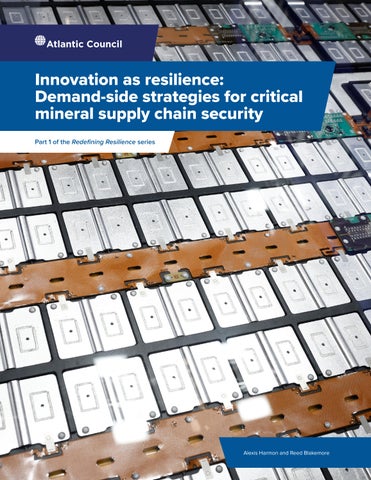
Cover: A lithium-ion battery for electric vehicles.
Atlantic Council 1400 L Street NW, 11th Floor Washington, DC 20005 June 2026
Acknowledgments
The Atlantic Council would like to thank the participants of the Redefining Resilience roundtable and the anonymous reviewers whose insights informed this report. We are also grateful to the broader Redefining Resilience project partners for their engagement, particularly Niron Magnetics for its support of this report.
Executive summary
The Atlantic Council Global Energy Center’s Redefining Resilience series proceeds from a single premise: the dominant policy framework for critical mineral supply chains—securing supply through new mines, processing facilities, and strategic stockpiles—is necessary but no longer sufficient on its own. As supply chains become more technologically complex and geopolitically constrained, resilience increasingly depends on how materials are designed, processed, and used, not just where they are sourced. The series examines four complementary strategies that current policy has underutilized: demand-side innovation, recycling, mine waste recovery, and byproduct optimization. Together, they offer a more complete toolkit for resilience amid accelerating competition over critical materials.
This report, the first in the series, examines demand-side innovation for critical mineral supply chains: the set of strategies that reduce how much of a constrained mineral an economy requires and expand the range of viable supply options. It argues that critical mineral supply chain policy has a structural blind spot. It has been organized around the question of where materials come from while largely ignoring an equally consequential set of questions: how much of these materials economies actually need, how that demand is shaped, and
who shapes demand. Material substitution, material efficiency, and system and product redesign are not substitutes for supply-side investment, but they are essential complements that remain underused.
Drawing on a roundtable convened under the Chatham House Rule by the Atlantic Council Global Energy Center, this report examines two sectors, batteries and permanent magnets, to show how demand-side innovation either reaches deployment or stalls. The barriers are concrete and addressable: financing systems poorly structured for first-of-kind technology, procurement frameworks that privilege incumbent materials, qualification processes that slow substitution, and, overarchingly, a policy architecture focused overwhelmingly on supply.
Closing these gaps requires targeted interventions: demand-pull mechanisms that bolster markets for alternative technologies, standards reform that enables substitution, and better coordination that brings manufacturers and system designers into supply chain policy alongside miners and processors. The goal is not to replace supply-side interventions but to build the complementary demand-side infrastructure needed to strengthen and de-risk mineral supply chains.
I. Introduction: The demand-side blind spot
The past several years have produced an unprecedented mobilization of policy attention and public capital around critical mineral supply chains. Governments across the industrialized world have mapped vulnerabilities, published strategies, launched financing vehicles, and signed agreements. The United States has committed many billions of dollars to domestic mining, processing, and stockpiling. The logic is straightforward: concentrated supply chains, dominated at nearly every stage by a small number of countries—in many cases by a single one, China—represent an untenable strategic vulnerability. In this framing, the answer is more supply from more places. That logic is correct but incomplete. Systematic reviews of supply chain resilience literature find a persistent imbalance: resilience strategies in both policy and research focus primarily on upstream disruptions and underrepresent the role of technological innovation in circumventing supply chain concentration.1 This is not a minor gap; it reflects a structural feature of how supply chain policy has been organized around the question of where materials come from, not how much is needed or for what they are used. Those latter questions have answers, and the answers have policy implications. After all, the amount of dysprosium in an electric motor is not dictated by geology; it is determined by an engineering decision made inside a manufacturing firm,
shaped by performance needs, constrained or enabled by qualification standards and procurement requirements, and influenced by the financing environment for alternative technologies.2 Similar decisions are made across supply chains by designers, procurement officers, standards bodies, and original equipment manufacturers (OEMs).3 Together, they determine the demand profile supply chains are built to serve, yet they sit largely outside current policy frameworks.
This is the demand-side blind spot. Closing it requires elevating strategies such as material substitution, material efficiency, and system and product redesign from technical considerations to policy-relevant instruments of supply chain resilience.4 That is the purpose of this report.
A clarification is warranted at the outset. The argument here is not that demand-side innovation will solve the critical minerals challenge or that supply-side investment should be deprioritized. Mine development, processing capacity, and strategic stockpiles remain essential. The argument of this paper is narrower: that the demand-side innovation of the supply chain equation is underinvested and under-institutionalized relative to its potential contribution, and that specific, targeted policy interventions could accelerate deployment in ways that meaningfully complement supply-side efforts. Ultimately, the goal is a more diversified toolkit of supply chain strategies.
1. Mehrnoosh Heydari, et al., “A Systematic Review of Resilience in the Critical Minerals Supply Chains, Needed for the Low-Carbon Energy Transition,” Renewable and Sustainable Energy Transition 8 (2025), https://www.sciencedirect.com/science/article/pii/ S2667095X25000261?via%3Dihub.
2. Wouter Boon and Jakob Edler, “Demand, Challenges, and Innovation. Making Sense of New Trends in Innovation Policy,” Science and Public Policy 45, 4 (2018), 435–447, https://academic.oup.com/spp/article/45/4/435/4915393.
3. Unless specified, this report uses “OEM” to refer broadly to manufacturers of end-use systems, including automotive, defense prime contractors, wind turbine manufacturers, and industrial equipment producers.
4. “Demand-side Innovation Policies,” Organisation for Economic Co-operation and Development, May 7, 2011, https://www.oecd.org/ content/dam/oecd/en/publications/reports/2011/05/demand-side-innovation-policies_g1g12ddf/9789264098886-en.pdf.
II. Three pathways: Substitution, efficiency, and redesign
Demand-side innovation in critical mineral supply chains operates through three distinct mechanisms. They differ in maturity, deployment timelines, policy requirements, and the actors responsible for implementation. These distinctions matter: collapsing them into a generic category of “innovation” tends to produce equally generic policy responses.
Material substitution involves replacing a constrained or geopolitically exposed input with a functionally similar alternative. In batteries, the progression from mid-nickel to high-nickel chemistries, and later toward lithium iron phosphate (LFP) batteries, to reduce cobalt exposure represents perhaps the clearest large-scale example of material substitution reshaping critical mineral demand. In permanent magnets, ferrite, iron nitride, and other rare-earth-free magnet alternatives aim to reduce or eliminate dependence on rare earths such as neodymium, praseodymium, dysprosium, and terbium.
Substitution does not always mean equivalent performance. The limited use of LFP in premium vehicle markets underscores the accompanying energy density trade-offs, and rare-earth-free magnets still generally require compromises in magnetic performance, size, or temperature tolerance. In electrical systems, aluminum is increasingly substituting for copper in transmission, offering a lower-cost and more abundant alternative. However, aluminum is substantially less conductive than copper, meaning aluminum conductors must be 1.6 times thicker, taking up more space and adding weight.5 For nearly all substitute technologies, there are genuine trade-offs in performance, durability, and cost that vary by application and context.
Thus, the policy question is twofold: when trade-offs are acceptable given the resilience benefits, and whether the policy environment allows decision-makers to evaluate them on their merits to determine acceptable trade-offs. In practice, qualification standards, procurement rules, switching costs, and emerging policy interventions often favor incumbent materials, leading to classic lock-in challenges and limiting adoption even where alternatives are viable or superior.6
Material efficiency focuses on using less of a constrained input to achieve the same output—in other words, not replacing it, but reducing how much is required. Advances in grain boundary diffusion and magnet design optimization have lowered the dysprosium and terbium required in neodymium-iron-boron magnets while maintaining high-temperature performance. In batteries, better electrolyte formulations and cell architectures have reduced the lithium required per unit of storage capacity. In solar, improvements in metallization have reduced silver use per cell.
This pathway, sometimes called thrifting, is frequently underestimated in policy discussions partly because it lacks the narrative appeal of a breakthrough alternative. A 20 percent reduction in dysprosium per magnet does not generate headlines, but incremental gains compound.7 Applied across the millions of motors produced annually for electric vehicles, wind turbines, and industrial applications, the aggregate demand reduction is comparable to a significant expansion of supply and achieved without a single additional mine, processing facility, or international agreement. As one roundtable participant observed, material efficiency improvements often do not require policy change at all. A manufacturer making process improvements or switching to a different existing supplier can reduce material intensity while potentially remaining broadly compatible with existing qualification, certification, and procurement frameworks. The constraint is frequently not primarily technical but organizational and economic.8 Efficiency gains are often diffuse, incremental, and embedded in processes rather than products, making them harder to measure, finance, and prioritize. Firms have limited incentive to share process-level improvements that reduce material intensity, particularly where those gains are difficult to patent and instead function as proprietary know-how. At the same time, downstream buyers often lack visibility into material efficiency at earlier stages of the value chain and rarely reward it explicitly in procurement, weakening incentives for adoption. As a result, even when efficiency improvements are technically straightforward and, in some cases, already demonstrated, they can remain unevenly diffused and under-deployed in practice.
5. “Aluminium Versus Copper,” Nexans, last visited May 20, 2026, https://www.nexans.nl/en/business/Building-Territories/Building/ Distributors/Aluminium-versus-Copper.html.
6. Paul A. David, “Clio and the Economics of QWERTY,” American Economic Review 75, 2 (1985), 332–337, https://www.jstor.org/ stable/1805621.
7. Reported reductions vary widely across applications and magnet grades, with some experimental approaches reducing heavy rare earth requirements by more than 70 percent while maintaining high-temperature coercivity.
8. Julian M. Allwood, et al., “Material Efficiency: A White Paper,” Resources, Conservation and Recycling 55, 3 (2010), 362–381, https:// web.mit.edu/ebm/www/Publications/MEWP_Res_Cons_Recycl_2011.pdf.
Fig. 1: Three demand-side innovation pathways
Different types of innovations reduce critical minerals supply chain exposure at different levels.
Pathway
MATERIAL EFFICIENCY
Use less of a constrained material.
Examples in practice
Grain boundary diffusion reduces heavy rare earths in permanent magnets*
Conventional HREE doping With grain boundary diffusion
Shift from high-nickel to lownickel battery chemistries
Lower silver loading in solar cells
Switch from rare earth permanent magnets to ferrite alternatives
MATERIAL SUBSTITUTION
Replace a constrained input with an alternative.
SYSTEM & PRODUCT REDESIGN
Redesign the system to avoid dependence on constrained inputs.
NdFeB magnet (rare earth-dependent)
Ferrite magnet (rare-earth free)
Aluminum wiring replacing copper
Silver-free solar cell metallization pathways
Switch to permanent magnet-free motor architecture in EVs
Permanent magnet synchronous motor
Flow batteries replacing lithium-ion for grid storage
Electromagnetic synchronous motors
Geared wind turbines instead of direct-drive systems
*Grain boundary diffusion is a process that concentrates heavy rare earths at key locations inside a permanent magnet (i.e., along grain boundaries) rather than distributing it evenly throughout.
System and product redesign is the most structural of the three pathways. It involves rethinking how a product or system is designed from the ground up to require fewer critical inputs across its lifecycle. Examples include motor designs that avoid permanent magnets altogether (such as induction or switched reluctance systems), alternative architectures for grid-scale energy storage (such as flow batteries), and wind turbine designs that reduce rare earth use by shifting away from direct-drive permanent magnet systems (such as geared drivetrains). These shifts can also be social (e.g., a shift away from individual cars toward mass transit), but this paper focuses on technological interventions.9
This pathway operates on the longest timeline. Decisions about material architecture are made early in product development with consequences that persist for the product’s commercial lifetime. They are also concentrated within firms among engineers, product managers, and executives, rather than at the level of raw material sourcing. This makes common policy levers more indirect: procurement incentives, performance standards, and research partnerships can shape the design environment but act at a distance from the decision itself. Policy interventions therefore need to be deployed earlier in the design cycle to influence outcomes.
9. Thea Riofrancos, et al., “Achieving Zero Emissions with More Mobility and Less Mining,” Climate and Community Institute, January 2023, http://www.climateandcommunity.org/more-mobility-less-mining.
Rare earth samples from the Mountain Pass mine, the only operating rare earth mine in the United States. Rare earth elements are critical inputs for the high-performance permanent magnets used in a wide range of energy, defense, automotive, and other advanced technologies. REUTERS/David Becker
III. Two contrasting cases: Mechanisms in practice
The strategic value of demand-side innovation is most clearly seen in specific sectoral cases. The following two cases each illuminate a distinct deployment dynamic. The first on batteries shows what demand-side substitution looks like when market conditions align with resilience outcomes; the second on permanent magnets shows what happens when they do not and what policy would need to supply instead. Together, they frame the central challenges the report’s recommendations are designed to address.
Case 1: Lessons from batteries’ success
The battery sector offers the clearest available demonstration that demand-side substitution can shift global material demands at speed and at scale. The displacement of cobalt-intensive battery chemistries by lithium iron phosphate is one of the most significant supply chain resilience developments of the past decade. LFP cathode chemistry eliminates cobalt and nickel entirely, trading some energy density for a dramatic difference in supply chain exposure.
LFP chemistry succeeded not because of a deliberate decision to reduce supply chain concentration but because it was cheaper to manufacture, required no cobalt (a material associated with price volatility, concentrated supply chains in the Democratic Republic of the Congo, and growing geopolitical and sourcing risks), and has a lower fire risk and longer cycle life. It proved particularly well suited to stationary storage and mass-market and standard-range electric vehicle (EV) segments in which energy density tradeoffs were acceptable.
At the same time, LFP’s rapid scale-up was not purely market driven. Chinese industrial policy, manufacturing subsidization, and coordinated deployment accelerated the expansion of LFP production and deployment at a pace and scale that market forces alone would not have achieved. Even so, the resilience gains were largely a free rider on a market-driven cost and performance transition. As one roundtable participant put it, demand-side innovation is often “a response rather than a choice.” In this case, cobalt was simply no longer the most affordable option so markets rewarded the trade-off, firms had strong incentives to switch, and the result was a structural change in global cobalt demand that no amount of supply-side investment could have produced as quickly.
This is the demand-side timing advantage. Supply chains for critical minerals are inherently slow to respond: the International Energy Agency (IEA) estimates an average of sixteen years from mineral discovery to first production.10 Brownfield expansions can help expand constrained supply faster but do not contribute to geographic diversification. Demand-side substitution and chemistry diversification, when conditions are right, can respond in years rather than decades.
However, the battery case is more complicated than it first appears. First, the diversification benefits of LFP adoption have been uneven across markets. While LFP has rapidly expanded in China and in stationary battery energy storage systems, US automakers have generally continued to favor nickel-rich chemistries because larger vehicles and consumer preferences for longer driving ranges place a premium on energy density.11 As a result, the United States has participated less fully in the cobalt-reducing potential of battery chemistry diversification and China maintains a virtual monopoly on LFP production, suggesting that the resilience benefits of demand-side innovation depend not only on technological availability but also on how consumer preferences shape performance trade-offs.
Second, LFP eliminates cobalt and nickel dependence but maintains exposure to lithium and graphite, both of which are highly concentrated in China. The further evolution of the chemistry landscape, such as toward sodium-ion batteries (which do not require lithium or graphite but use nickel and manganese), follows the same basic pattern of reducing one risk while introducing or deepening others.12 Chemistry choices also alter exposure to different forms of the same material: nickel-rich chemistries typically rely on lithium hydroxide whereas LFP uses lithium carbonate, which is cheaper, less chemically reactive, and easier to stockpile over long periods.
Whether these shifts represent a net resilience gain depends on which concentration risks are weighted most heavily, particularly when considering the demand-side potential of innovation. The introduction of LFP chemistries demonstrates that when cost incentives and resilience outcomes point in the same direction, material substitution can move quickly and at enormous scale. Whether or not policy can reliably engineer those conditions in the name of supply chain security absent motivating market conditions remains a fundamental question.
10. “Promoting Exploration, Production and Innovation,” International Energy Agency, 2022, https://www.iea.org/reports/introducing-the-critical-minerals-policy-tracker/promoting-exploration-production-and-innovation.
11. “Share of Four Wheelers Electric Vehicle Battery Sales by Chemistry and Region, 2023–2025,” International Energy Agency, last updated February 5, 2026, https://www.iea.org/data-and-statistics/charts/share-of-four-wheelers-electric-vehicle-battery-salesby-chemistry-and-region-2023-2025.
12. Teo Lombardo, et al., “Sodium-Ion Battery Momentum Grows, but Challenges Remain,” International Energy Agency, February 17, 2026, https://www.iea.org/commentaries/sodium-ion-battery-momentum-grows-but-challenges-remain.
Fig. 2: Innovation can outpace supply expansion
Battery chemistry shifts reshaped critical minerals demand within less than a single greenfield mine development cycle.
2021-2022: Chinese automakers and Tesla rapidly scaled LFP amid nickel and cobalt volatility.
2018-2020: LFP remained concentrated in China as global EV markets favored higher-range nickel chemistries.
2023-2025: LFP has saturated mass-market EVs; further growth depends on premium and Western markets.
Discovery to feasibility study
*Data is drawn from the IEA Global EV Outlook reports.
**Extrapolations from IEA analysis based on the top 35 mining projects between 2010-2019. Timelines vary significantly between minerals (e.g. 20 years for nickel laterite vs. 4 years for Australian lithium projects), and the listed processes often occur concurrently with overlapping timelines.
Prior examples of policy-driven material substitution, such as lead-based paint and chlorofluorocarbons, succeeded because they combined regulatory mandate with the straightforward goal of eliminating a harmful substance, typically toward alternatives that performed comparably at acceptable cost. Substitution for resilience is structurally harder; there is no visible harm to regulate against, and firms operating in competitive markets cannot unilaterally absorb cost premiums for strategic materials without losing ground to competitors who do not. The battery transition happened precisely because it did not require anyone to absorb those costs; the alternative was cheaper. That condition cannot be assumed in most other sectors.
This is the policy frontier that the battery case’s success has left largely unexplored. Lithium-ion batteries were pioneered
in the United States, but the manufacturing scale, chemistry evolution, and supply chain integration that made them strategically significant were built in China.13 This was a direct consequence of sustained industrial policy investment at a moment when US policy offered no equivalent signal. Demand-side signals that have been introduced (such as the EV tax credit) have proven difficult to sustain, and the toolkit needed to prevent a similar outcome in the next generation of critical material technologies is still under development. The strategic question now is whether emerging battery technologies that can potentially ease supply chain strain and enable technological leapfrogging, such as lithium manganese-rich (LMR) and solid-state batteries, will follow the same pattern or whether demand-side policy can help anchor portions of the next generation value chain domestically.14
13. Suvrat Kothari, “‘Arrogance’: How U.S. Battery Inventions Supercharged China’s EVs,” Inside EVs, May 16, 2025, https://insideevs. com/news/759852/us-ev-battery-innovation-powered-china-rise/.
14. Srikant Jayanthan, “LMR Battery Technology: The Next Rival to LFP?” S&P Global, July 9, 2025, https://www.spglobal.com/automotive-insights/en/blogs/2025/07/lmr-battery-technology-the-next-rival-to-lfp.
Case 2: Permanent magnets and the lock-in problem
The permanent magnet case offers an interesting example in which technically viable, cost-competitive alternatives exist across the full spectrum of demand-side options but institutional barriers prevent them from deploying at scale. Permanent magnets are magnets that retain magnetization for long periods of time, making them critical for technologies that require constant magnetic fields. Rare earth permanent magnets (specifically the neodymium-iron-boron family (NdFeB), frequently enhanced with dysprosium and terbium for high-temperature performance) exhibit the highest magnetic performance per unit volume of any commercially available permanent magnet. Due to these exceptional qualities, they are embedded in a wide range of systems that require high levels of performance in compact and lightweight components, including electric vehicle motors, wind turbines, precision industrial equipment, and an expanding range of defense systems.
China dominates every stage of their production: mining, separation, processing, and finished magnet manufacturing.15 The strategic vulnerability is acute and well documented, and it has generated a substantial policy response across administrations focused on developing alternative supply. Many of the Trump administration’s most ambitious interventions focus on rare earths and permanent magnets, including its first equity stake in a private critical minerals company, a price floor for neodymium-praseodymium (NdPr) oxide, and a swath of Department of Energy (DOE) funding for rare earth processing. These are supply-side responses to a supply-side vulnerability, and they are necessary.
That response leaves largely unaddressed two parallel and equally important questions. Why, given that technically viable alternatives exist across the full spectrum of demand-side options, does rare earth dependence persist so stubbornly? And how can policy broaden the solution set without fragmenting policy objectives and diluting the impact of interventions?
The alternatives are real and span all three demand-side pathways—substitution, efficiency, and redesign—but face different barriers to adoption.16 At the substitution end, iron nitride
magnets’ remarkable magnetic strength makes them a candidate for replacing rare earth-based equivalents in some applications. Ferrite magnets already serve lower-performance uses and could serve more with design accommodation. At the material efficiency end, advances in grain boundary diffusion have demonstrated meaningful reductions in the dysprosium and terbium content needed to maintain high-temperature performance in NdFeB magnets.17 Wider adoption of these techniques would reduce the rare earth intensity of existing magnet architectures without replacing them or the incumbent systems in which they are utilized. At the redesign end, induction motors and switched reluctance motors eliminate permanent magnets entirely, demonstrating how system-level design choices can remove material dependencies rather than simply mitigating them. Each involves genuine performance trade-offs, but the portfolio of options is broader than the current rate of adoption would suggest. Reflecting this latent flexibility, the IEA estimates that further constrained rare earth supply could theoretically force technology shifts that lower neodymium demand by 40 percent and dysprosium by 32 percent by 2040 relative to a base case.18
Slow uptake has been structural. While the aforementioned battery shift occurred because battery manufacturers had direct and immediate exposure to cobalt price volatility and supply risk, an equivalent dynamic did not exist in the magnet sector. Automotive and wind OEMs set performance requirements that effectively shaped magnet architecture and created demand, but rare earth supply risk was largely mediated through supplier networks, reducing direct incentives to redesign or requalify alternative systems.
Even so, as supply chain security gained geopolitical salience, automotive OEMs in particular began hedging against rare earth dependence through early-stage magnet partnerships and alternative motor architectures beginning in the early 2020s.19 China had taken incremental steps to leverage its minerals dominance for years, but its 2025 rare earth export restrictions materially increased urgency by translating supply risk into an operational constraint at the OEM level, including production slowdowns and halts in downstream assembly due
15. Daniel J. Cordier, “Mineral Commodity Summaries: Rare Earths,” US Geological Survey, January 2025, https://pubs.usgs.gov/periodicals/mcs2025/mcs2025-rare-earths.pdf.
16. Claudiu C. Pavel, et al., “Role of Substitution in Mitigating the Supply Pressure of Rare Earths in Electric Road Transport Applications,” Sustainable Materials and Technologies 12 (2017), 62–72, https://www.sciencedirect.com/science/article/pii/S2214993716300641.
17. Applying grain boundary diffusion to NdFeB magnets concentrates placement of dysprosium and terbium, which improve resistance to demagnetization at high temperatures. This approach maintains performance while using substantially less of each element. Performance impacts are generally modest but application specific. However, the process requires specialized processing capacity (e.g., sputtering or vapor-based techniques) and technical know-how, adding capital costs and introducing exposure to concentrated magnet-processing equipment supply chains, in which China is the low-cost leader.
18. “Mineral Requirements for Clean Energy Transitions,” International Energy Agency, 2021, https://www.iea.org/reports/the-role-of-critical-minerals-in-clean-energy-transitions/mineral-requirements-for-clean-energy-transitions.
19. Glenn Zorpette, “GM and Stellantis Back Rare-Earth-Free Permanent Magnet,” IEEE Spectrum, November 15, 2023, https://spectrum.ieee.org/permanent-magnet-motor.
to magnet shortages.20 This heightened awareness among the very entities in a position to make decisions around supply-side fixes, invest in the qualification of alternatives, or explore redesign.
However, qualification processes—particularly in automotive and defense applications where component failure carries severe consequences—are long, expensive, and risk-averse by design, and the qualification barrier runs deeper than a reluctance to requalify a single material. Magnet chemistry is not qualified independently but as part of broader architectures optimized around specific performance characteristics. For automakers, changing the magnet means revisiting the motor, which might mean revisiting the broader powertrain architecture. An OEM that has already qualified a specific magnet grade for a given motor and vehicle platform therefore has strong financial and liability-driven incentives against redesign, even when alternatives offer comparable performance with more favorable supply chain characteristics.
Public policy has done relatively little to offset these incentives and sometimes has reinforced them. DOE funding programs and Notices of Funding Opportunity (NOFOs) have been encouragingly technology agnostic for earlier-stage support, including support for rare earth-free and thrifting approaches.
However, major funding for commercial-stage projects, including tax credits, has skewed heavily toward incumbent technologies. Furthermore, DOE’s grant funding is oriented toward product design and bench-scale testing rather than qualification and is not appropriated at sufficient levels to support the latter.
The result is technological and institutional lock-in that operates independently of what is happening in the supply chain. The demand side of the equation continues to default to incumbent materials because the cost of switching falls on individual firms while the resilience benefit is diffuse and public. This is the classic structure of a market failure that policy is meant to address. Yet government interventions intended to strengthen supply chains can also reinforce dependence. Long-term offtake commitments and production support for specific incumbent technologies, however necessary as nearterm supply security measures, can also entrench the very material dependencies they aim to address and crowd out the market signals that would otherwise drive innovation. Governments cannot direct engineering decisions or mandate particular motor architectures, but they can avoid foreclosing alternatives and help shift the cost-benefit calculus that entrenches incumbency.
20. Christina Amann, Nick Carey, and Kalea Hall, “Auto Companies ‘in Full Panic’ over Rare-Earths Bottleneck,” Reuters, June 9, 2025, https://www.reuters.com/business/autos-transportation/auto-companies-in-full-panic-over-rare-earths-bottleneck-2025-06-09/.
IV. Barriers: From technical readiness to market deployment
The cases above illustrate distinct deployment challenges in distinct sectors, but the barriers that prevent demand-side innovation from reaching scale are not sector specific. They recur across the full range of substitution, efficiency, and redesign opportunities this report examines. Understanding them as a set matters because they require different policy instruments and involve different actors. They also have a common root: a policy architecture built almost entirely around the supply side of the supply chain problem.
The supply-side bias of existing policy architecture is the underlying condition from which more specific barriers flow. Federal interventions have been organized almost entirely around the supply side of the critical minerals challenge— speeding up permitting, opening new mines, and ramping up processing. This is understandable; supply concentration is the most visible vulnerability, and supply-side solutions seem more tractable in the near term than the diffuse, distributed decisions of the demand side. Supply-side mining and refining projects also tend to have clearer political constituencies and more organized stakeholders advocating for support. However, as battery supply chains demonstrate, demand-side innovation can move faster to reshape supply chains than the slow process of opening mines and processing plants. When ideas cannot secure capital and deploy in the United States, they go elsewhere. Lithium-ion batteries were largely pioneered in the United States, but the manufacturing scale and cost reductions that made them strategically transformative were driven largely in China, where sustained demand growth, coordinated industrial policy, and patient capital for scaling created conditions for rapid commercialization. By contrast, US support was more fragmented across programs and institutions, with weaker alignment between demand creation, scale-up finance, and the infrastructure needed to move technologies from laboratory validation to industrial production.
The financing gap between the pilot stage and commercial deployment is one of the most consistently cited barriers. It is not a single gap but a series of valleys and micro-valleys of death that make the commercialization path for first-of-kind technologies long, expensive, and failure prone even when the underlying technology is sound.21 Risk-averse capital markets are poorly structured for assets with long development timelines, uncertain revenue streams in early years, and perfor-
mance characteristics that can only be fully validated at commercial scale. The result is a persistent and well-documented underinvestment in the demonstration and early commercial stages of technologies that carry strategic value but have not yet reached the cost and risk profiles that attract private capital at scale. In the critical minerals sector, this dynamic often distorts the traditional linear progression from pilot to demonstration to commercial deployment, as firms attempt to bridge financing constraints through offtake agreements and staged scale-up rather than standalone demonstration facilities. This creates a circular constraint: demonstration plants are difficult to finance without secured offtake, while offtake partners are often unwilling to commit absent commercial-scale validation. As a result, firms can come under pressure to leap directly from pilot-scale validation to full commercial deployment. As one roundtable participant observed, the challenge is not that funders are unwilling to support new technology; they are willing to fund a new project that includes a new technology, but not a new technology project on its own.
Incumbent lock-in through qualification is a structural barrier that receives less policy attention than financing but is equally consequential. Qualification processes—the critical but lengthy processes that certify that a material, component, or technology meets the performance requirements for a given application—are designed around existing materials and architectures. Because product failure carries immense liability, qualification processes are expensive, slow to update, and subject to approval processes that can extend timelines by years. These dynamics reflect a broader phenomenon of switching costs that qualification processes make acute in this context, including the time, capital, and organizational disruption required to redesign products, retool manufacturing processes, and renegotiate supplier relationships. The effect is to tilt the competitive environment systematically toward incumbent technologies, regardless of whether alternative materials offer comparable or superior performance profiles and meaningfully better supply chain characteristics.22
Incumbent lock-in through technology-specific policy is another mechanism through which supply chain diversification is constrained. Despite significant investment in innovative supply chain solutions, legislation and funding opportunities can inadvertently narrow the range of viable
21. Jesse Jenkins and Sara Mansur, “Bridging the Clean Energy Valleys of Death: Helping American Entrepreneurs Meet the Nation’s Energy,” Breakthrough Institute, November 16, 2011, https://thebreakthrough.org/articles/bridging-the-clean-energy-vall.
22. Jill A. Engel-Cox, et al., “Clean Energy Technology Pathways from Research to Commercialization: Policy and Practice Case Studies,” Frontiers in Energy Research 10 (2022), https://www.frontiersin.org/journals/energy-research/articles/10.3389/fenrg.2022.1011990.
responses by specifying particular input materials rather than performance outcomes (e.g., a bill that targets rare earthbased permanent magnet production instead of broader permanent magnet supply chains). Implicitly, the government is currently often picking winners among competing technologies by specifying incumbent solutions. Moving toward performance-based specifications in procurement, tax incentives, and grant programs would open the solution space—though in some cases, resilience objectives might justify going a step further and actively supporting alternatives capable of reducing strategic vulnerabilities altogether.23
Design-stage lock-in is a distinct and underappreciated barrier. Many of the most consequential decisions about material intensity are made early in product development, before supply chain considerations are fully integrated.24 Once a design is finalized and enters production, its material profile is effectively fixed for the duration of that product cycle and often propagated across platforms. This form of lock-in operates upstream of later-stage constraints such as requalification requirements and redesign timelines, and is therefore not captured by discussions that focus only on substitution at the point of procurement. Addressing it requires engaging earlier in the design process, where material choices are first fixed and policy influence is currently weakest.
The OEM participation gap remains among the least-addressed structural barriers and cuts across all three demand-side pathways.25 Historically, OEMs have largely been absent from the critical minerals supply chain policy conversation. Mineral policy frameworks have been built around miners, processors, and, in some cases, battery manufacturers. Since COVID-19 and the elevation of supply chain concerns, OEMs have become far more engaged in upstream sourcing
and supply security discussions. However, the firms whose engineering decisions aggregate into the demand signal these upstream actors are built to serve are not systematically engaged as policy actors. They are not being asked to weigh holistic supply chain resilience as a design criterion. They are not receiving support that would make it economically rational to build resilience into their design choices. Yet OEMs sit at the center of demand-side decision-making: they determine whether substitution is pursued, whether efficiency improvements are adopted and scaled, and whether redesign is undertaken at the product architecture level. Their absence from policy frameworks limits the effectiveness of interventions across the entire demand-side spectrum. Initiatives like the Export-Import Bank’s Project Vault are taking an important step toward closer coordination with OEMs on securing supply chains through stockpiling, but this approach cannot stop at supply-centered solutions.
Policy durability risk is the cross-cutting constraint that makes all of the above harder to address. Demand-side substitution, like most critical minerals interventions, is not a one-time event but an ongoing process of market development requiring sustained private investment across multi-year cycles. That investment is acutely sensitive to policy signals: incentives that create market conditions attracting private capital can be reversed faster than the investment cycles they are meant to support.26 Durability and predictability in the policy signal matter as much as its initial magnitude, and the instruments currently used to support demand-side innovation (e.g., tax credits, discretionary grant programs) are among the least durable available. Building the demand-side infrastructure this report calls for requires instruments designed to last across political cycles.
23. Varun Sivaram, Noah Gordon, and Daniel Helmeci, “Winning the Battery Race: How the United States Can Leapfrog China to Dominate Next-Generation Battery Technologies,” Carnegie Endowment for International Peace, October 21, 2024, https://carnegieendowment.org/research/2024/10/winning-the-battery-race-how-the-united-states-can-leapfrog-china-to-dominate-next-generation-battery-technologies.
24. Ewout Reitsma, Per Hilletofth, and Eva Johansson, “Supply Chain Design during Product Development: A Systematic Literature Review,” Production Planning & Control 34, 1 (2021), 1–18, https://www.tandfonline.com/doi/full/10.1080/09537287.2021.1884763. Again, unless specified, this report uses “OEM” to refer broadly to manufacturers of end-use systems, including automotive, defense prime contractors, wind turbine manufacturers, and industrial equipment producers.
25. Again, unless specified, this report uses “OEM” to refer broadly to manufacturers of end-use systems, including automotive, defense prime contractors, wind turbine manufacturers, and industrial equipment producers.
26. Joelle Noailly, Laura Nowzohour, and Matthias van den Heuvel, “Does Environmental Policy Uncertainty Hinder Investments Towards a Low-Carbon Economy?” National Bureau of Economic Research, August 2022, https://www.nber.org/system/files/working_papers/w30361/w30361.pdf.
V. Policy recommendations: Building demand-side infrastructure
The recommendations that follow represent an attempt to build some of the missing policy infrastructure for demand-side innovation in critical mineral supply chains. They focus on interventions that are tractable in the near term, address gaps not fully covered by existing policy, and would meaningfully change the deployment calculus for demand-side innovations. None require building new institutions from scratch, but rather directing existing authorities, instruments, and relationships toward a part of the supply chain problem they have not yet been asked to solve.
Taken together, these interventions could begin to shift the incentives facing firms making material and design decisions. The objective is not to mandate particular technologies but to make resilience-oriented choices more competitive by reducing the cost, risk, and uncertainty associated with adopting them. Over time, this would allow demand-side innovation to scale through normal market mechanisms, rather than relying on one-off policy interventions.
1. Use federal purchasing power as a demand-pull instrument for alternative technologies.
Government purchasing power is the most direct instrument for reshaping material demand, operating through two complementary channels. The first is procurement specifications: the criteria that define what the government buys and on what terms. Specifications that reward or require technologies with resilience-enhancing supply chains, while explicitly accounting for performance trade-offs, can signal durable demand to manufacturers and investors in ways that research grants alone cannot. Embedding resilience criteria as a weighted factor in source selection would begin to build institutional infrastructure for demand-side resilience.
The second is demand commitments: binding or contingent purchase agreements that make first-of-kind manufacturing financeable before steady commercial demand exists, such as offtake mechanisms or advance market commitments. The Department of Defense–MP Materials deal illustrates this logic in practice: long-term offtake commitments created a guaranteed customer for magnet-making capacity that did not yet exist, enabling investment that private markets would not have supported on their own.27
Together, these tools shift the government from a passive buyer to an active market shaper. What is missing is systematic application to demand-side substitution rather than primarily supply-side expansion. Different agencies are positioned to contribute in different ways. Civilian agencies and procurement bodies are often better suited to shaping broad commercial demand signals, while the Department of Defense (DOD; now sometimes referred to as the Department of War) retains unique advantages through its flexible national security authorities and appropriations mechanisms.
Specific interventions:
• Direct relevant agencies to pilot procurement programs in which supply chain resilience (e.g., concentration risk, geopolitical exposure) is explicitly weighted alongside cost and performance in contract awards. Require standardized disclosure of material dependencies to support consistent evaluation and improve transparency over time.
• Direct relevant agencies to pilot minimum purchasing commitments for qualifying alternative technologies, allocating a defined share of procurement to products that meet performance requirements while reducing critical mineral concentration risk, thereby creating a guaranteed early market for substitution technologies.
• Use Defense Production Act Title III authorities—which already authorize purchase commitments and have been applied to critical minerals projects, including the MP Materials deal—to more systematically support resilience-enhancing technologies such as alternative magnet architectures and next-generation battery chemistries. This would shift existing authorities beyond primarily supply-side production expansion toward demand-side substitution and redesign.
2. Accelerate certification and qualification pathways for resilience-enhancing substitutions.
Before any new material can be used in a car, aircraft, or defense system, it must pass an extensive approval process designed to ensure safety and reliability. However, these processes have developed and evolved around legacy materials and system architectures because those are the systems with established performance histories, failure models, manufactur-
27. “MP Materials Announces Transformational Public-Private Partnership with the Department of Defense to Accelerate U.S. Rare Earth Magnet Independence,” MP Materials, July 10, 2025, https://mpmaterials.com/news/mp-materials-announces-transformational-public-private-partnership-with-the-department-of-defense-to-accelerate-u-s-rare-earth-magnet-independence/; Alexis Harmon and Reed Blakemore, “A Tale of Two Supply Chains: Comparing Trump’s New Copper Tariffs and Rare Earth Investments,” Atlantic Council, August 5, 2025, https://www.atlanticcouncil.org/blogs/new-atlanticist/a-tale-of-two-supply-chains-comparing-trumps-new-copper-tariffs-and-rare-earth-investments/.
ing processes, and liability frameworks. This means that novel materials must demonstrate compliance with evidentiary standards that were not designed with them in mind, generating delays and costs independent of actual performance or supply chain value. The cost and liability burden of qualification falls unevenly: manufacturers bear the primary qualification and liability exposure, while suppliers—particularly smaller entrants offering novel substitutes—must support extensive testing without the balance sheets of incumbents. In this sense, qualification timelines are not neutral: they systematically advantage existing materials by embedding switching costs unrelated to actual performance.
This burden is necessary and cannot be bypassed; however, it can sometimes be eased. One fundamental constraint is the absence of a coordinated qualification infrastructure linking public research and development (R&D), national laboratory testing, standards development, and private certification systems into a coherent and interoperable pathway from discovery to deployment. A critical complication is that different actors test for fundamentally different purposes: laboratories and research institutions characterize material properties and benchmark performance, while manufacturers must re-qualify at the systems integration level to satisfy liability requirements. This means that materials and technologies are tested and re-tested, in part because existing testing infrastructure is not fully integrated or interoperable in ways to make earlier-stage testing legible and transferable across different contexts. Addressing this challenge requires treating qualification not as a series of isolated approval processes but as a system that can be partially standardized, accelerated, and made more interoperable.
Specific interventions:
• Establish cost-sharing and risk-pooling mechanisms for firstof-kind qualification of resilience-enhancing materials and technologies, including government co-funding of testing and limited liability backstops for early adopters in defined applications.
• Create a federal prequalified materials program that funds standardized testing packages for resilience-enhancing alternative materials, aligns outputs with relevant standards bodies, and establishes an expedited review pathway (modeled on the Food and Drug Administration’s Breakthrough Device designation) within defense acquisition systems and equivalent civilian bodies. Materials that meet defined resilience thresholds receive co-funded testing and expedited review, with results directly usable in downstream procurement and certification decisions without duplication across firms.
• Require DOE-funded materials research programs and national laboratory collaborations to produce qualification-oriented data packages developed in coordination with OEMs, certification bodies, and standards authorities and structured for direct incorporation into downstream certification and procurement processes. These efforts could help accelerate early-stage qualification and improve interoperability between research outputs and commercial validation requirements, even if they cannot substitute for final qualification stages. Pair this with standardized intellectual property frameworks for laboratory collaborations that allow qualification-relevant test results to be shared across firms, reducing duplicative testing and closing the gap between research outputs and deployment requirements.
3. Adopt technology-neutral, performance-based language whenever possible in legislation and funding programs.
When the government funds or incentivizes a technology, it should define what that technology must do rather than which specific material or chemistry it must use so that multiple competing approaches can qualify. Language choices in legislation and funding calls can inadvertently constrain the solution set in ways that undermine the resilience outcomes policy is trying to achieve. A tax credit or grant program written around rare earth magnet production supports the incumbent supply chain; one written around permanent magnet performance specifications with defined resilience criteria (e.g., concentration thresholds, geographic diversification requirements) opens the solution space to ferrite, iron nitride, and other alternatives without the government implicitly picking winners.
The Inflation Reduction Act’s Section 45X advanced manufacturing production credits offer a partial model: by attaching credits to defined product categories rather than specific input materials (e.g., general battery components versus LFP-specific chemistries), it created demand pull without locking in specific technologies. Applying that logic consistently across procurement, grant programs, and tax treatment for critical mineral-dependent products would accelerate substitution without the brittleness that input-specific policy creates.
However, this approach is only as effective as the metrics that underpin it. Analysis of recent US industrial policy, such as the CHIPS Act, often highlights how a lack of clearly defined, measurable outcomes can limit implementation and dilute impact.28 For these interventions to function in practice, resilience and performance criteria must be specific, measurable, and comparable across technologies. Vague or poorly defined metrics can be as constraining as input-specific language because program managers cannot evaluate against it and companies cannot plan around it.
28. Vishnu Kannan and Jacob Feldgoise, “After the CHIPS Act: The Limits of Reshoring and Next Steps for U.S. Semiconductor Policy,” Carnegie Endowment for International Peace, November 22, 2022, https://carnegieendowment.org/research/2022/11/after-thechips-act-the-limits-of-reshoring-and-next-steps-for-us-semiconductor-policy.
Specific interventions:
• Direct the National Energy Dominance Council to work with the Office of Management and Budget to issue a guidance memo on performance-based specification standards and resilience criteria for agencies to apply consistently across grants, procurement criteria, and tax incentives.
• Require a portion of future DOE critical minerals notices of funding opportunities (NOFOs) to include dedicated topic areas for demand-side substitution and material efficiency technologies with performance-based eligibility criteria. While DOE has often incorporated technology-neutral criteria into earlier stage R&D solicitations, later-stage demonstration and commercial-scale funding opportunities have fairly consistently converged on specific technologies or chemistries. DOE carefully develops NOFOs based on extensive industry consultation, which leads to technically robust programs; however, it can also mean that incumbent firms have a built-in opportunity to lobby to align program parameters with their existing product roadmaps. As a result, later-stage funding opportunities may converge around established approaches, while substitution and efficiency pathways with comparable performance lack comparable representation in program design. A mandatory set-aside, rather than discretionary program design, is necessary precisely because the political economy of later-stage funding tends to favor established technology trajectories over potentially more resilient alternatives.
4. Bring OEMs and system designers into the supply chain policy conversation more systematically and across sectors.
Critical minerals are fundamentally defined by demand from industry, yet industry engagement in supply chain policy remains uneven and poorly institutionalized. In sectors facing acute supply chain pressure, such as the automotive industry, OEMs have been actively involved in policy conversations since the early 2020s. However, in industrial sectors not yet experiencing acute constraints, participation has been more limited and largely reactive rather than embedded in formal feedback mechanisms. Because material choices are embedded in product design cycles, many of the most consequential decisions about mineral intensity occur upstream of procurement and largely outside the scope of existing policy tools.
Aligning demand-side innovation with supply chain resilience therefore requires engaging OEMs not only as purchasers but as the primary architects of material demand and as key sources of information about how that demand is evolving. More effective policy must both influence design decisions and respond to industry demand signals in real time, rather than treating OEMs as passive endpoints of upstream policy interventions.
Specific interventions:
• Establish a structured OEM demand intelligence and design feedback mechanism within the National Energy Dominance Council or DOE to systematically capture information on emerging bottlenecks. The mechanism should directly inform procurement specifications, qualification pathways, and funding priorities, ensuring that federal demand-side policy reflects real-world design and engineering constraints rather than static assumptions about material use.
• Provide targeted tax incentives or production credits for OEMs that redesign products in ways that reduce exposure to high-risk critical minerals, with eligibility tied to measurable reductions in vulnerable supply chain concentration (e.g., rare earth intensity, cobalt dependence) rather than specific material substitutions.
• Fund a DOE or National Institute of Standards and Technology (NIST)-led voluntary vulnerability self-assessment toolkit that OEMs can use to map mineral exposure in their design and procurement chains. Require structured disclosure of assessment results as a condition of participation in high-value federal programs including DOE loan guarantees, Inflation Reduction Act advanced manufacturing credits, and defense procurement initiatives.
• Expand the NSF Tech Metal Transformation Challenge, developed in partnership with Germany’s Federal Agency for Disruptive Innovation (SPRIND), to include a parallel track focused on OEM-led system architecture redesign and material substitution. This track would fund rapid-turnaround, challenge-based projects (with awards of less than $5 million) that reduce critical mineral intensity at the product design level, in addition to the current program focused on recovery and processing of existing materials.
5. Establish policy continuity mechanisms that insulate demand-side investment from political volatility.
Building new manufacturing capabilities takes years, but many of the demand-side policy signals that support them can shift within a single political cycle. Investors are acutely aware of this, which is why many promising alternative technologies cannot attract long-term capital even if today’s policy environment looks favorable. The result is a durability problem where demand-side industrial policy can generate strong initial signals but those signals are often not sufficiently credible over investment time horizons. Instruments that shape markets must therefore be designed for persistence across administrations, appropriations cycles, and regulatory regimes.
Specific interventions:
• Codify key demand-side industrial policy instruments in statute to reduce exposure to annual appropriations volatility
and strengthen investor confidence in long-horizon demand signals.29
• Structure production tax credits such as 45X for qualifying critical mineral substitution technologies with automatic renewal triggers tied to objective resilience metrics rather than fixed legislative sunsets to reduce policy discontinuity risk while maintaining congressional oversight.
6. Coordinate with allies on shared standards and joint qualification programs.
Allied coordination on critical minerals to date has focused primarily on supply diversification, such as joint investment in mines, processing facilities, and bilateral offtake frameworks. The demand side offers a complementary and underexplored dimension for partnership, shaping markets for alternative technologies at a scale no single country could achieve alone.
The Forum on Resource Geostrategic Engagement (FORGE) offers a natural forum for this shift.30 Beyond supply coordination, allies can align performance standards, pool qualification efforts, and coordinate demand signals through procurement and offtake commitments. Done well, this reduces duplication, lowers market entry costs for new technologies, and creates larger and more credible markets for resilience-enhancing alternatives.
Specific interventions:
• Instruct the State Department and the US trade representative (USTR) to establish a dedicated demand-side innovation track within FORGE, focused on priority sectors such as permanent magnets and battery materials, with a mandate to deliver harmonized qualification protocols and a roadmap for coordinated procurement criteria across member governments within a set timeframe.
• Work with key allies to pilot coordinated demand commitments for qualifying alternative technologies under which participating governments pre-commit to purchasing defined volumes, align on eligibility criteria (performance versus resilience), and pool demand to create a market signal large enough to attract private investment.
• Direct DOD to propose a NATO-level joint qualification fund under which allied defense ministries share the cost and results of qualification testing for alternative materials that meet common resilience criteria, reducing per-country requalification costs and accelerating adoption across allied defense supply chains simultaneously.
29. Arnab Datta, “How Uncertainty Could Kill US Industrial Policy,” Factory Settings, April 16, 2026, https://www.factorysettings.org/p/ policy-uncertainty-will-kill-american.
30. Reed Blakemore and Alexis Harmon, “US Critical Minerals Policy Goes Collaborative with FORGE,” Atlantic Council, February 12, 2026, https://www.atlanticcouncil.org/dispatches/us-critical-minerals-policy-goes-collaborative-with-forge/.
VI. Conclusion: A more complete toolkit
No single technology, policy instrument, or institutional reform will resolve the critical minerals challenge. The argument for demand-side innovation is not that material substitution or product redesign will replace the need for new mines, processing facilities, or allied supply partnerships. It is that a policy framework organized around any one lever—however necessary that lever is—will systematically fail to capture gains that other levers could deliver faster, cheaper, or more durably.
The cases in this report illustrate what those gains look like in practice. Battery chemistry shifted because market conditions aligned with resilience outcomes; the policy lesson is that those conditions can be deliberately reinforced or engineered in sectors where the market will not do it on its own. Permanent magnet dependence persists despite viable alternatives in part because qualification systems, procurement standards, and financing structures were built around incumbents and have not been asked to do otherwise; the policy lesson is that changing those structures is tractable and specific but under-addressed. The binding constraint is sometimes not what the technology can do but the policy environment that makes it rational for firms to choose alternatives.
This report is the first in the Atlantic Council Global Energy Center’s Redefining Resilience series, and the ecosystem logic extends beyond demand-side innovation alone. Recycling, examined in the second report, closes the loop on materials already in circulation. The next two, waste recovery and byproduct optimization, add additional complementary layers of resilience. Each pathway addresses a different part of the supply chain problem, each is underutilized relative to its potential, and each is most powerful not in isolation but as part of a broader strategic posture that expands optionality and builds the kind of flexible, diversified supply chains that geopolitical competition increasingly demands.
The policy choices made in the next several years as countries scramble to secure mineral supply chains—about what gets financed, what gets procured, and what gets designed—will determine the material architecture of energy, defense, and industrial systems for decades. Making those choices deliberately, with supply chain resilience as an explicit criterion alongside cost and performance, is what it means to treat innovation as statecraft. That work begins now.
About the authors
Alexis Harmon is an assistant director at the Atlantic Council’s Global Energy Center, where she focuses on the policy, economics, and geopolitics of critical energy supply chains, from mining to manufacturing.
Prior to joining the Atlantic Council, Harmon worked for the University of Cambridge’s Institute for Manufacturing, where she conducted research on the future of global industrial strategies. Harmon previously served as chief of staff of the Ambassador’s Office at the US embassy of the Islamic Republic of Afghanistan until the embassy’s closure. She has also worked as a diplomatic officer for the refugee resettlement nonprofit Operation Snow Leopard and as a researcher for Georgetown University’s Institute for Women, Peace and Security.
Harmon holds a bachelor’s degree in political science from the University of California, Los Angeles and a master’s degree in international development from the University of Cambridge.
Reed Blakemore is director with the Atlantic Council Global Energy Center, where he is responsible for the center’s research, strategy, and program development. His work focuses on oil and gas markets, critical minerals, trade and geopolitical risk, and the evolution of bilateral relationships in the energy transition. Reed is the author of several Global Energy Center reports, including, The Role of Minerals in US Transportation Electrification Goals, Enhancing US-Japan Cooperation on Clean Energy Technologies, and The Role of Oil and Gas Companies in the Energy Transition. He has spoken in front of the US House of Representatives Committee on Natural Resources, and has been featured in Bloomberg, S&P Global Platts, and Al Jazeera, among others.
Prior to joining the Atlantic Council, Blakemore held positions at the International Institute for Strategic Studies–US and at the United States Senate Foreign Relations Committee. He earned a master’s degree from the George Washington University Elliott School of International Affairs in security policy studies, with emphases in defense analysis and transnational security issues. He received a bachelor’s degree in international relations from the University of Redlands, where he was also a member of Phi Alpha Theta, the national history honor society.