Federal agencies under pressure need smarter systems not tougher people
Federal agencies under pressure need smarter systems, not tougher people
About this issue brief
Written by Caitlin Thompson
Caitlin Thompson, PhD, is a licensed clinical psychologist, former national director of suicide prevention at the Department of Veterans Affairs, and nonresident senior fellow at the Adrienne Arsht National Security Resilience Initiative in the Atlantic Council’s Scowcroft Center for Strategy and Security. A nationally recognized subject-matter expert in veteran mental health, suicide prevention, and veteran care, she provides consultative services to nonprofit, corporate, and government organizations.
Bottom lines up front
The institutions charged with keeping the United States secure operate under chronic strain that can make them prone to failure in moments of crisis.
Many current efforts focus on helping individuals operate effectively within flawed systems.
But it’s only by redesigning the flawed systems that the US government can create the readiness on which national security depends.
The hours are long and the pace rarely eases, including shifts of twelve to fourteen hours that inevitably erode family and social life. In theory, there are guardrails. In practice, the approval processes meant to limit overwork can become a formality: the reality of excessive hours reduced to a signature on a page, without changing the workload or capturing the extent of the time burden. The culture reinforces it. Leadership may say the right things, but the cycle doesn’t break, and in some corners of the institution, burnout is even treated as a point of pride. The quiet signal that this has become normal: the organization celebrates the 2 a.m. email. People are mentally drained, but stepping back to recover can feel professionally risky because there’s a persistent sense that if you can’t do it, someone else will, and asking for help can damage your credibility.
The above vignette is a composite scenario, drawing on multiple examples raised by participants—national security practitioners, psychiatry and health experts, and think tank experts on individual resilience— across a series of roundtables conducted by Atlantic Council researchers in 2025 and held under the Chatham House rule.
Only by adapting those systems can the US government deliver long-term readiness enabling reliable performance under stress that US national security requires.
y Individual resilience is not the solution to chronic strain in national security institutions. It is a signal that reveals where systems, incentives,
The institutions charged with keeping the United States secure—including US military services and combatant commands, the intelligence community (e.g., CIA, National Security Agency), the Department of Homeland Security, and the State Department—operate under chronic strain that can make them dangerously prone to failure in moments of crisis. Many of the “resilience” efforts created to address this problem— wellness training and mindset workshops— focus on helping individuals operate within flawed systems.
Federal
When the organizational answer to overload is “be more resilient,” the system signals that overload is expected and adaptation is the solution.
and workload assumptions are misaligned with human limits.
y In national security roles, moments of surge, uncertainty, and high-consequence decision-making are frequent. When these moments arise, systems need more than just extraordinary individual effort; they need built-in buffers and redundancies.
y Many resilience initiatives are designed to expand coping tools and wellness support programs yet leave the stressors themselves— tempo, staffing, and decision bottlenecks—unchanged. While certainly well-intentioned, these initiatives unintentionally shift the responsibility to overcome the stressors back on the individual. Other incentives then reinforce this overextension as the operating model. A credible systems approach requires measurable leadership accountability, usable leading-indicator data, and explicit tradeoffs about tempo, mission scope, redundancy, and availability norms. The goal is sustained readiness and reliable performance under stress.
y Leadership behavior is key. Ideally, leaders would express their own vulnerabilities by openly expressing uncertainty, acknowledging moments of strain, and modeling both recovery and the soundness of seeking help. This could increase trust among team members, as well as the likelihood that risks are addressed early.
Building individual resilience has become a default response to strain across national security institutions. As organizations confront sustained operational tempo, recurring crises, and prolonged uncertainty, resilience is routinely invoked as a way to preserve individual performance under pressure. In practice, however, the term is often used in ways that misidentify both the source of strain and the locus of responsibility.
This issue brief argues that resilience— which the Adrienne Arsht National Security
Resilience Initiative defines as “the ability of individuals, societies, and systems to anticipate, withstand, recover from, adapt to, and bounce forward from shocks and disruptions”—is not primarily an individual attribute. It is a property of systems that shape, support, and sustain individual resilience over time. Individual resilience matters, but not because it can be strengthened indefinitely or relied upon to compensate for structural misalignment. Human adaptation and resilience do have limitations, and through insights from research and roundtable discussions with national security leaders, practitioners, and subject-matter experts, we have underscored the need for a more deliberate systems design in national security institutions.
People do not enter national security roles with identical baselines, nor do they experience or recover from stress in the same way. Those differences are important, because prolonged exposure to ambiguity, moral complexity, and high-stakes decisions can be a relentless strain on attention and judgment. These demands cannot be carried indefinitely, regardless of an individual’s motivation or commitment. It is simply a matter of human limits.
Many institutions appear resilient, often because of highly committed individuals whose extended availability and personal sacrifice can compensate for system strain in the short term. Over time, however, that compensatory model becomes unsustainable, and the earliest cracks often show up in decision-making. Attention narrows, teams become less flexible in how they think through options, and risk judgment becomes less calibrated. Those effects can accumulate quietly over time, until an organization is less adaptive precisely when adaptation is most needed.
The strategic costs of system strain are significant. In national security work, one frequently sees surge conditions, leadership transitions, and external shocks as recurring features of the operating environment. Systems that depend primarily on individual efforts and resilience often lack the buffers needed to respond effectively when those
Federal agencies under pressure need smarter systems, not tougher people
stressful moments arrive. When an individual starts to feel that inevitable burnout, their performance falters precisely when resilience is most needed. The appropriate response is not to ask people to absorb more. Rather, it is to relocate responsibility from individuals to institutions themselves; to overhaul systems so that they operate within human constraints, protect sound judgment, retain expertise, and remain effective over time.
The problem: Why current resilience models fall short
The concept of resilience is now embedded in the language of national security institutions. Here, “national security” refers to the interconnected ecosystem of defense and security organizations that plan and execute operations, generate intelligence, manage crises, and sustain readiness, as well as the enabling systems that support that work (including the military health system and other readiness services). In these settings, the day-to-day reality is high-consequence decision-making under uncertainty, persistent time pressure, constrained staffing pipelines, and recurring exposure to morally complex and emotionally salient material—including, increasingly, remote operations such as unmanned aircraft systems.1
Faced with persistent crises, extended operational tempo, and mounting uncertainty, leaders routinely invoke resilience as a way to sustain performance.2 In many cases, however, resilience functions less as a strategy than as an expectation: that individuals
will adapt to conditions the system itself does not adequately address.
Most contemporary resilience efforts rest on a quiet assumption that personnel are broadly interchangeable and capable of absorbing increasing demands if given the right tools or training. From this perspective, resilience becomes a personal skill set, something that can be strengthened through workshops, coaching, wellness programming, or mindset interventions. These efforts are often well-intentioned. They are also insufficient in environments where strain is chronic and the stakes remain high.
The predictable result is compensation, where highly motivated people bridge structural gaps through personal sacrifice. They devote longer hours, defer recovery, and suppress their own distress, all in service of the mission. For a time, this preserves output and the system appears functional. But the apparent stability is misleading. It requires extraordinary effort from a finite group of people, while quietly depleting the attention, judgment, and recovery that sustained performance depends on.
The evidence increasingly reflects this pattern. Burnout is a recurring occupational risk among military personnel, with documented links to work environment factors (e.g., workload and shift work), psychological strain, and downstream consequences that matter for readiness and mission effectiveness.3 Within the Military Health System, burnout has also been associated with adverse health outcomes and reduced retention—exactly the kind of expertise loss that
1. Seth Davin Norrholm et al., “Remote Warfare with Intimate Consequences: Psychological Stress in Service Member and Veteran Remotely-Piloted Aircraft (RPA) Personnel,” Journal of Mental Health & Clinical Psychology 7, no. 3 (2023): 37–49, https://doi. org/10.29245/2578-2959/2023/3.1289.
2. NATO Allied Command Transformation, NATO Warfighting Capstone Concept, May 2023, https://www.act.nato.int/wp-content/uploads/2023/06/NWCC-Glossy-18-MAY.pdf.
3. Seyed Morteza Hosseini et al., “Burnout among Military Personnel: A systematic Review,” Iran Journal of Psychiatry 18, no. 2 (2023): 213–236, https://pmc.ncbi.nlm.nih.gov/articles/ PMC10293693/.
Federal agencies under pressure need smarter systems,
“individual resilience” programming cannot offset on its own.4 And concern about chronic psychological risk is not limited to traditional deployment patterns: Recent defense policy has directed the Department of Defense to study mental health impacts among military drone pilots, underscoring the growing recognition that remote and high-tempo operational roles can carry meaningful mental health burden.
important signal. Properly understood, levels of individual resilience give leaders a clearer read on how the system is functioning, where strain is coming from, and what needs to be redesigned. Used this way, resilience does not justify asking individuals to absorb more. It clarifies where institutions are demanding too much and why.
Individual resilience is context-dependent, shaped by the relationships, communities, and institutions we are embedded in.
— Roundtable participant
When depletion shows up, it often does not look like a dramatic failure. It can appear first as degraded decision quality, with narrower thinking, reduced creativity, lower tolerance for ambiguity, and less willingness to challenge assumptions. It can also surface as interpersonal strain, reduced patience, and a diminished ability to adapt quickly when new information changes the picture. These shifts are consequential in national security contexts because the central work of these institutions is making sound judgments in real time, under uncertainty, with high consequences.
Many resilience initiatives inadvertently reinforce the conditions that require resilience in the first place. When the organizational answer to overload is “be more resilient,” the system signals that overload is expected and adaptation is the solution. This normalizes strain and diverts attention away from the real drivers of chronic demand, including sustained operational tempo, understaffing, unclear priorities, and incentives that reward constant responsiveness. It can also create a double bind: The system continues to demand extraordinary individual effort, while the individual is expected to treat strain as a personal shortcoming to be managed privately.
This brief takes a different view of individual resilience. It is not irrelevant, nor is it the solution. Instead, it should be treated as an
This is the point where individual resilience becomes a critical tool, not as a mandate for people to adapt indefinitely, but as a way to see how systems’ choices interact with human limits and where redesign is most urgent.
What individual resilience reveals and why that should force system overhaul
Resilience is ever evolving: It is shaped long before individuals enter national security roles and continues to be influenced by the environments in which they operate. Biology, early development, and cumulative stress exposure contribute to how individuals tolerate and recover from pressure. The point is not to pathologize normal human responses to sustained strain. The point is to be honest about variability and limits.5
Institutions typically treat individual variability in one of two ways. Either they ignore it, designing for an “average” person who does not exist, or they attempt to manage it primarily through individual interventions. Both approaches miss the core insight. Individual resilience is not primarily something systems can manufacture. It is something systems must account for and nurture within people. Thinking seriously about individual resilience makes the system’s assumptions visible, including the ones baked into missions, tempos, staffing models, career pathways, and leadership expectations.
4. Joshua E. Wilk et al., “Associations of health care staff burnout with negative health and organizational outcomes in the U.S. military health system,” Social Science & Medicine (2023): 330:116049, https://doi.org/10.1016/j.socscimed.2023.116049.
5. Camila E. Hostinar and Megan R. Gunnar, “The Developmental Effects of Early Life Stress: An Overview of Current Theoretical Frameworks,” Current Directions in Psychological Science 22, no. 5 (2013): 400-406, https://doi.org/10.1177/0963721413488889.
Federal agencies under pressure need smarter systems, not tougher people
People bring vastly different resilience profiles into roles that demand sustained judgment, adaptability, and high-quality decision-making. Some tolerate prolonged stress with fewer immediate effects. Others experience faster depletion of cognitive reserves. These differences are not moral failures or character defects. They are simply predictable variations in human functioning.6 The systems that assume each per-
son has the same capacity are, in essence, baking inequality into their performance expectations, and then treating individual differences as deficits.
The more consequential issue, however, is not baseline variability. It is the cumulative effect of depletion and what it does to decision-making over time. National security environments place sustained demands on attention and judgment. Under chronic load, the first changes are often subtle: Thinking narrows. People rely more heavily on familiar patterns. Uncertainty becomes harder to sit with.7 Teams may lock in on a conclusion too early or simplify complex choices. They may default to routine when adaptive thinking is required.8 Over time, judgment can become more rigid and less reliable, with people either narrowing or widening their threat interpretation in ways that are not well matched to the situation. The work still gets done, but the quality of analysis and the ability to adjust course can quietly erode, leaving the system less adaptable precisely when conditions shift.
This is why the individual resilience conversation matters, but only if it is used correctly. Individual resilience research does not tell institutions to teach more coping skills and declare success. On the contrary, it tells institutions that the operating environment is placing sustained demands on people in predictable ways, and that these effects compound. If leadership does not manage cumulative demand, decision quality will degrade regardless of how committed individuals are.
Some institutional responses can become counterproductive. Institutions often try to “select for resilience” by screening, hiring,
6. Karl Ebner and Nicole Singewald, “Individual differences in stress susceptibility and stress inhibitory mechanisms, Current Opinion in Behavioral Sciences 14 (2017): 54–64, https:// doi.org/10.1016/j.cobeha.2016.11.016.
7. Amy F. T. Arnsten, “Stress signalling pathways that impair prefrontal cortex structure and function,” Nature Reviews Neuroscience 10 (2009): 410–422, https://www.nature.com/articles/nrn2648.
8. Lars Schwabe et al., “Preventing the stress-induced shift from goal-directed to habit action with a β-adrenergic antagonist,” Journal of Neuroscience 31, no. 47 (2011): 17317–17325, https://doi.org/10.1523/jneurosci.3304-11.2011.
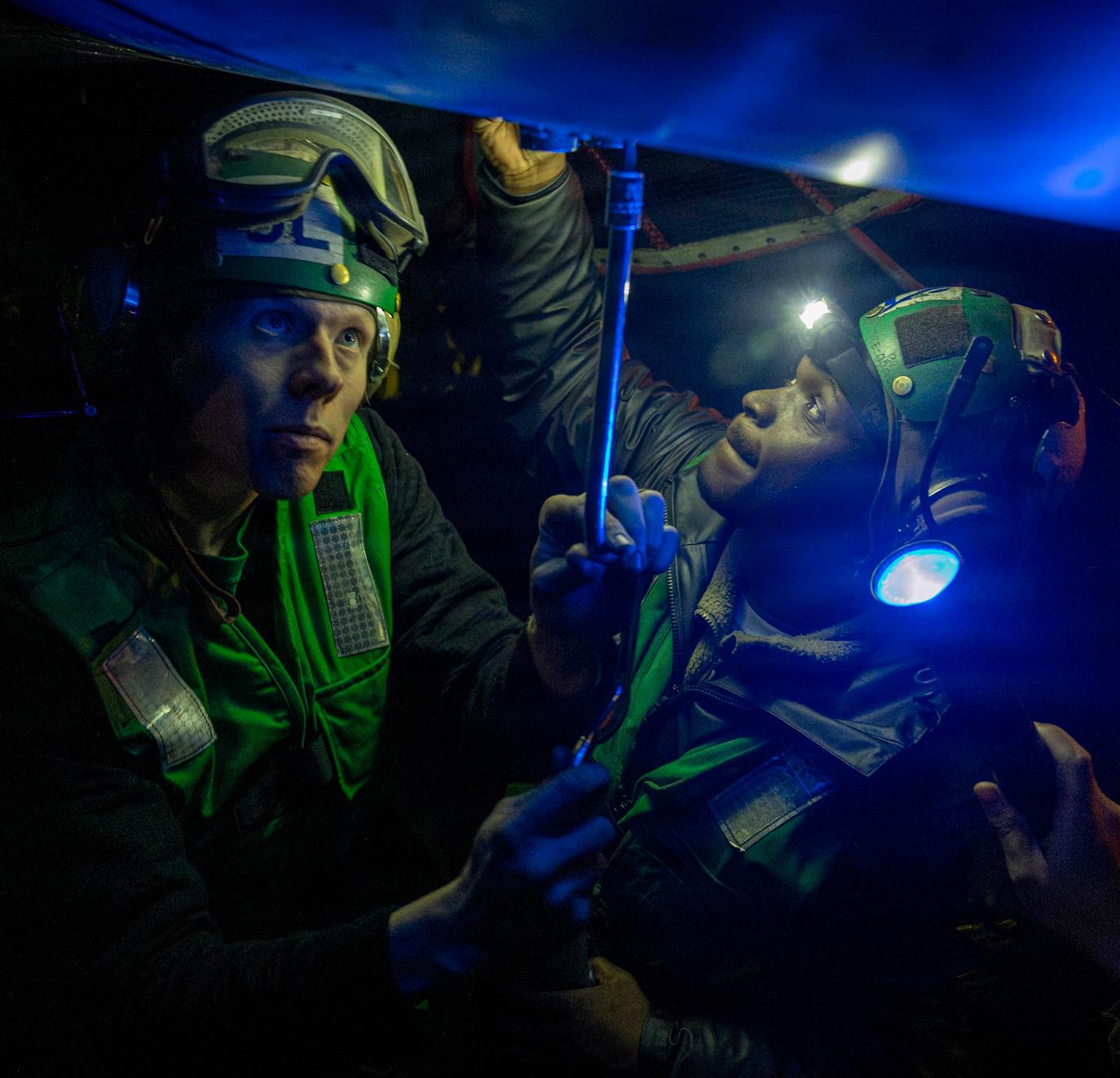
US Navy personnel aboard the USS Gerald R. Ford work on an E/A-18G Growler aircraft as part of Operation Epic Fury. March 3, 2026. VIRIN: 260303-N-LS368-1061M. Credit: US Navy
Federal agencies under pressure need smarter systems, not tougher people
If leadership does not manage cumulative demand, decision quality will degrade regardless of how committed individuals are.
and promoting those who appear to handle stress well, but that does not eliminate human limits. Even the most capable people struggle under sustained load; the difference is the timing and visibility of their strain, not immunity to it. Similarly, short recovery windows do not solve the problem if baseline demand remains high. Recovery is not only about time off. It is about whether systems allow genuine disengagement and whether demand is paced in a way that permits replenishment.
The implication is straightforward: Systems that rely on constant availability, chronic overload, and surge-as-normal operation are not built for long-term effectiveness. They not only put decision-making at risk, but they also erode readiness, retention, trust, and institutional memory over time. Individual resilience should be treated partially as a signal about how the system is functioning and where strain is being generated. Taken seriously, it should drive a rethinking of what “systems approaches” to resilience actually mean in practice. In addition to programs that train individuals to cope, it means redesigning the conditions of work (workload, staffing, priorities, and decision processes) so sustained performance is built into the institution. It also means clarifying decision rights and escalation pathways, and protecting recovery time, so the system is not dependent on extraordinary individual sacrifice.
If individual resilience helps identify where strain accumulates, the next question is why many systems approaches fail to correct it. Participants at the three Atlantic Council roundtables pointed repeatedly to a familiar pattern: Even when supports are added, the underlying drivers and incentives remain unchanged.
Why systems approaches often fail and shift the burden onto individuals
Many systems approaches to resilience fail because they stop short of redesign. They add support without changing assumptions. They layer resources without recalibrating expectations. In practice, they still rely on individual adaptation to keep the system running.
This is the central weakness of many resilience initiatives: They look like systems interventions but function as burden-shifting by making chronic demand more tolerable rather than making demand sustainable. Too often, they treat coping as the solution by expanding training, wellness resources, and self-management expectations, while the structural drivers of overload, including tempo, staffing, and decision bottlenecks, remain unchanged.9 Roundtable participants described this dynamic directly: The organization “puts resources forward,” but the underlying cycle doesn’t change, and resilience becomes a required module to complete rather than a redesign of how the work is structured.
Incentives then reinforce the underlying dysfunction. Leaders may endorse sustainability while still rewarding constant responsiveness, and organizations may speak about boundaries while promoting those who violate them. In practice, incentives foster behavior or action more quickly than policies, and they can lock in a model of success that depends on continual overextension.
The result is a system that appears robust but is structurally fragile. It performs because individuals compensate, stretching time, attention, and availability to keep the mission moving. Over time, the costs show
9. “Psychological Health Program,” Military OneSource, Military Community and Family Policy, US Department of Defense, accessed March 4, 2026, https://www.militaryonesource. mil/resources/millife-guides/psychological-health-program/; “My Military Health: Improving Mental Health Access and Readiness,” Defense Health Agency, May 29, 2025, https:// www.dha.mil/News/2025/05/30/12/18/My-Military-Health-Improving-Mental-Health-Access-and-Readiness; “Work-Life,” Defense Civilian Personnel Advisory Service, US Department of Defense, accessed March 4, 2026, https://www.dcpas.osd.mil/policy/worklife.
Federal
Systems that rely on constant availability, chronic overload, and surge-as-normal operation are not built for long-term effectiveness.
up in quieter but consequential ways: Decision-making becomes less reliable, teams lose range, and experienced personnel disengage or leave, taking hard-won knowledge with them. When surge conditions, leadership transitions, or external shocks hit, there is often little remaining slack to absorb the shock, and systems without real buffers struggle to adapt quickly enough.
True systems resilience is not achieved by adding more support to an unchanged structure. It requires making deliberate choices about how demand is created, prioritized, and resourced, including how tempo is set, how work is handed off, where redundancy is built in, and what leaders are rewarded for. The goal is not comfort. The goal is sustained readiness and reliable performance under stress.
What an overhaul requires
If resilience is to be treated seriously in national security contexts, then systems approaches must be overhauled, not layered. This begins with acknowledging that many current efforts focus on helping individuals operate effectively within flawed systems rather than redesigning those systems.
First, institutions must address cumulative demand directly by treating operational tempo as a design choice, not a fact of life. That means defining what qualifies as a true surge, setting guardrails so that surge mode does not become the baseline, and building real slack into staffing and schedules. High-tempo periods should then be absorbed by the system rather than by individual overextension. Leaders can put this into practice through workload triage and explicit lists of things employees should stop doing during a period of high demand. They can set clearer thresholds for what gets paused during surges and lead routine after-action reviews that examine not only operational outcomes but the cost in capacity. The goal is straightforward: Create pacing, redundancy, and decision space so readiness is protected even when the environment remains demanding.
Second, leadership accountability must extend beyond crisis performance to include
sustainability, which must be measurable. Leaders should be evaluated on whether they manage workload and tempo responsibly, protect decision space, and retain and develop talent over time. That means making incentives explicit: rewarding leaders who build redundancy, delegate authority, and normalize handing off work and scheduling time for recovery. Alternatively, it is essential to correct leaders who rely on constant responsiveness and chronic overextension as their operating model.
In addition, leadership behavior matters in a more human, immediate way than institutions often acknowledge. Roundtable participants emphasized that when leaders are willing to show up as humans, including naming uncertainty, acknowledging strain, and modeling both the action of seeking help and recovery without stigma, it can reset the temperature of an entire team. That kind of credible vulnerability builds trust, widens the space for honest upward feedback, and makes it more likely that problems are surfaced early rather than managed privately until they become crises. In practice, it is one of the fastest ways leaders can shift culture without launching a new program.
Third, training should be used to reinforce sound system design, not to compensate for its absence. Institutions can keep resilience training, but they should pair it with concrete changes that reduce avoidable strain. Training should focus on the skills that improve team and mission performance under stress. Examples of these skills include communication under pressure, decision-making in uncertainty, escalation and delegation norms, and how leaders recognize early signs of overload (aided by data, as discussed below) and make appropriate changes. Most importantly, training should come with a feedback loop. What trainees report about friction points and recurring strain should be treated as operational data that informs redesign, not as an individual coping gap.
Fourth, measurement needs to shift from documenting damage to preventing it, and the roundtables made it clear that good
Federal agencies under pressure need smarter systems,
About the center
The Scowcroft Center honors the legacy of service of General Brent Scowcroft. The Center embodies his ethos of nonpartisan commitment to the cause of security, support for US leadership in cooperation with allies and partners, and dedication to the mentorship of the next generation of leaders.
The Adrienne Arsht National Security Resilience Initiative, housed within the Scowcroft Center for Strategy and Security, works to advance resilience as a core tenet of US and allied national security policy and practice.
Resilience—the ability of individuals, societies, and systems to anticipate, withstand, recover from, adapt to, and bounce forward from shocks and disruptions—is a national security imperative in an increasingly contested world. To help the United States and its allies better prepare for and succeed amid twenty-first-century challenges, the Initiative examines sources of and develops strategies for enhancing resilience across the individual, community, national, and global levels.
data is one of the few levers that reliably alters behavior. Attrition and burnout rates are lagging indicators. By the time they move, the system has already been drawing down its people and its capacity for a while. A more serious approach is to track leading indicators of strain that leaders can act on, including workload distribution, surge frequency and duration, after-hours expectations, backlogs, approval bottlenecks, vacancy and coverage gaps, and the amount of time teams are operating in “urgent” mode.
Equally important, though, is the usability of data. Leaders need a small set of metrics that can be reviewed routinely, not an elaborate dashboard that no one trusts or uses. The goal is to make strain visible early and tie it to decision points. When surge becomes the baseline, something needs to be paused, rescoped, or resourced. When bottlenecks appear, authority and process need to be adjusted. When certain roles show chronic after-hours load, something needs to be redesigned such as staffing, handoffs, and coverage.
In addition, measurement should be paired with accountability and action. Teams should be able to surface what the data means in plain language, and leaders should be expected to respond with a corrective plan, not a wellness reminder. Over time, this creates an institutional habit of using data to manage tempo and protect readiness, rather than using data only to explain why people are leaving.
Finally, institutions should make trade-offs explicit and operationalize them, rather than leaving them implicit and pushing the costs down to individuals. A genuine overhaul requires leaders to define what “sustainable tempo” means for their mission sets, establish thresholds for when work is rescoped or paused, and build redundancy as a deliberate design feature in critical functions. It also requires resetting norms around constant availability by clarifying what truly constitutes an emergency, creating predictable coverage and handoff models, and rewarding teams that protect continuity without relying on chronic overextension.
The practical question is not whether the work is important. It is how the institution will prioritize, resource, and pace the work so that readiness is preserved when conditions tighten. When those choices are made openly, organizations can align expectations with capacity and reduce the hidden risk created by always-on operating models.
Closing
National security institutions will always operate in environments defined by uncertainty, periodic surge, and high stakes. The question is whether those institutions treat resilience as a personal expectation or as a systems responsibility. The next step is to choose a small set of measurable indicators, align accountability to them, and redesign the points of highest friction, where chronic strain is generated. Done well, this shifts resilience from a story we tell people to a capability that institutions strengthen. This issue brief draws on a series of three Council roundtables with national security practitioners, experts in psychiatry and health, and think tank experts on individual resilience to identify what national security institutions must redesign to sustain readiness under chronic strain.