
However, the ubiquity of lithium-ion batteries has posed obstacles to the energy transition that are likely to become more challenging as net-zero targets demand ever-more expansive energy storage solutions. Accelerat ing demand for lithium-ion batteries is creating a production bottleneck for energy storage as different clean technologies vie for the same mineral and metal inputs, such as lithium, graphite, nickel, and cobalt—at the same time as demand growth for such minerals and materials in other markets, such as steel
To date, the leading technology for those efforts has been the lithium-ion (Liion) battery, having displaced predecessors like lead-acid, nickel-cadmium, and nickel-metal hydride batteries because of their superior performance characteristics. Currently, Li-ion batteries account for roughly 70 percent of electric vehicle (EV) batteries and 90 percent of grid storage batteries.1
Alternative SupplyCleanDiversifyingChemistriesBatteryandEnergyChains
Atlantic Council GLOBAL
ISSUE SEPTEMBERBRIEF2022
he energy transition from fossil fuels to low-carbon energy sources will stimulate great demand for energy storage. Batteries that can enable the clean electrification of light-duty transport and reduce the intermit tency of renewable power on the grid will be a prerequisite for global decar bonization efforts. It is therefore vital that such technologies be deployed at a scale sufficient to meet the growing energy storage needs of the transition.
T
INTRODUCTION
1 Jeff Horowitz, David Coffin, and Brennan Taylor, Supply Chain for EV Batteries: 2020 Trade and Value-added Update, United States International Trade Commission, January, 2021, WILLIAMPADDYREEDwww.eesi.org/papers/view/energy-storage-2019.Environmentalvalue-added_010721-compliant.pdf;usitc.gov/publications/332/working_papers/supply_chain_for_ev_batteries_2020_trade_and_www.andAlexandraZablocki,“FactSheet:EnergyStorage,”andEnergyStudiesInstitute,February22,2019,BLAKEMORERYANTOBIN ENERGY CENTER
ATLANTIC COUNCIL 1
The Global Energy Center promotes energy security by working alongside government, industry, civil society, and public stakeholders to devise prag matic solutions to the geopoliti cal, sustainability, and economic challenges of the changing global energy landscape.
ISSUE BRIEF ALTERNATIVE BATTERY CHEMISTRIES AND DIVERSIFYING CLEAN ENERGY SUPPLY CHAINS ATLANTIC COUNCIL 2
making, continues to grow apace amid broader economic growth. For these materials, there is currently insufficient production to meet projected demand, and existing supply chains are prone to concentration, unfair labor practices, environmental unsustainability, and increasingly, geopolit ical concerns around supply-chain control. Unsurprisingly, prices for lithium-ion batteries are proving vulnerable to commodity-related volatility. For example, Russia in 2019 mined 21 percent of the world’s Class 1 nickel—which is of a high enough purity to be used in EV batteries—making it the world’s largest upstream producer.2 Fears of supply shocks following Russia’s invasion of Ukraine and result ing sanctions were a primary cause for massive volatility on the London Metal Exchange that lifted prices 250 percent within a day, demonstrating the risks inherent in under-de veloped metal markets.3 All things being equal, these chal lenges run the risk of handicapping the urgent deployment of storage solutions to support net-zero targets.
3 Jack Farchy, Alfred Cang, and Mark Burton, “The 18 Minutes of Trading Chaos that Broke the Nickel Market,” Bloomberg, March 14, 2022, https://www.bloomberg.com/news/articles/2022-03-14/inside-nickel-s-short-squeeze-how-price-surges-halted-lme-trading.
4 “Fact Sheet: President Biden’s Plan to Respond to Putin’s Price Hike at the Pump,” White House Briefing Room, March 31, 2022, whitehouse.gov/briefing-room/statements-releases/2022/03/31/fact-sheet-president-bidens-plan-to-respond-to-putins-price-hike-at-the-pump/.https://www.
5 “Fact Sheet: Securing a Made in America Supply Chain for Critical Minerals,” White House Briefing Room, February 22, https://www.whitehouse.gov/briefing-room/statements-releases/2022/02/22/fact-sheet-securing-a-made-in-america-supply-chain-for-critical-minerals/.2022,Giventheimportanceofthesesupplychainstodecarbonizationgoalsandeconomiccompetitivenessintheenergytransition,theUnitedStatesanditsallieshavedesignatedmanyofthesematerialsas“criticalminerals,”highlightingthenewgeopoliticalpressuresemergingfromtheenergytransition.Tosecureareliablesupplyoftheseminerals,Washingtonhasrecentlytakennovelstepstobolstersecurityofsupplyatallstagesofthecriticalmineralvaluechain.InMarch2022,theBidenadministrationinvokedTitleIIIoftheDefenseProductionActtoacceleratedevelopmentofupstreamandmidstreaminfrastructureformineralssuchaslithium,nickel,cobalt,graphite,andmanganese.4Concurrently,amemorandumofunderstandingbetweentheUSDepartmentsofDefense,Energy,andStateproposedcreatingastrategicreserveformineralscriticaltotheenergytransitionthroughtheNationalDefenseStockpile.5Furthermore,$2.91billionhasbeenallocatedunderthebipartisaninfrastructureframeworktosupportbatterymaterialrefin
US President Biden announced new investments in critical mineral supply chains during a virtual roundtable in February 2022. (REUTERS/Kevin Lamarque)
2 Marcelo Azevedo, Nicolas Goffaux, and Ken Hoffman, “How Clean Can the Nickel Industry Become?,” Commentary, McKinsey & Company, September 11, 2020, https://www.mckinsey.com/industries/metals-and-mining/our-insights/how-clean-can-the-nickel-industry-become.

ISSUE BRIEF ALTERNATIVE BATTERY CHEMISTRIES AND DIVERSIFYING CLEAN ENERGY SUPPLY CHAINS ATLANTIC COUNCIL 3
The landmark passage of the Inflation Reduction Act (IRA) of 2022 also contains a long list of relevant provi sions that, at their core, are aimed at incentivizing produc tion of energy storage technology and spurring demand for energy storage products. The IRA intends to foster new domestic manufacturing facilities for energy storage products including EV batteries; incentivize production of battery active materials, cells, and packs; and reduce the cost for producing critical minerals in the United States. The act also includes a stand-alone investment tax credit for energy storage, likely to help foster overall demand. Despite this stimulus, the growth of the energy storage sector remains threatened by limited availability of critical minerals. Resolving these supply constraints will require further Reducingeffort.the
LI-ION BATTERIES, SUPPLY CONSTRAINTS, AND RISK TO THE ENERGY TRANSITION
ithium-ion batteries have three primary advantages over their predecessors that have placed them at the forefront of the energy transition: a much higher energy density, which allows them to hold on to power for longer and to discharge a greater volume of power over a longer period of time without recharging; a relatively high and constant voltage of 3.6 volts, requiring fewer cells to work; and a lighter and more compact construction than alternative battery models, allowing producers to tailor the battery to specific uses for various range and price points.7
ing, recycling, and battery cell manufacturing.6 The devel opment of processes to recycle battery materials will play an important role in strengthening critical mineral supply chains over the long term, but challenges will persist unless even more ambitious actions are taken to increase overall mineral supply to a scale commensurate with demand.
mineral intensity of energy storage by utilizing more-readily available alternatives to lithium-ion batteries could alleviate supply-chain concerns while meeting a wide array of energy storage needs—including utility-scale and distributed energy storage, which are likely to become increasingly important as a result of continued renewable energy deployment.
8 “What is a Lithium-Ion Battery and How Does it Work?,” Clean Energy Institute at the University of Washington, accessed July 18, 2022,https://www.cei.washington.edu/education/science-of-solar/battery-technology/.supply-chain
risk. Weighing the interaction between these three categories, use cases are proposed for each novel technology, in conjunction with an assessment of their overall viability and prospects for entering development at scale as part of an “all of the above” approach for expand ing a sustainable energy storage economy.
L
These advantages are the product of a highly efficient and adaptable chemistry. When charging, lithium in the posi tively charged cathode is separated from other materials as ions, which flow across a liquid electrolyte (typically lithium salt) and are stored in a negative anode (typically made of graphite). At the anode, the ions remain until discharge, a process that creates a current by sending electrons in the opposite direction.8 Lithium is the third-lightest element in the universe, and the lightest solid element at room tem perature. As an oxidizing agent, lithium is highly energy efficient and an ideal lightweight solution for anything that moves at the whole-battery level, be it portable electronics or electric vehicles. It also has a high energy density, car rying a relatively large amount of energy per unit volume compared to other materials.
7 “Lithium Ion Battery Advantages and Disadvantages,” Electronics Notes (website), accessed July 18, https://www.electronics-notes.com/articles/electronic_components/battery-technology/li-ion-lithium-ion-advantages-disadvantages.php.2022,
Nevertheless, despite their myriad advantages over earlier battery technologies based on nickel, lead, and cadmium, raw material supply is a key challenge for the lithium-ion format—and consequently, the energy transition in general. The following mineral inputs are of particular concern.
This paper outlines several alternative battery technologies including new lithium-ion battery designs and sodium-ion, liquid metal, sodium-sulfur, and zinc-ion batteries. It also explores the supply-chain implications of greater shares of minerals like iron, phosphate, silicon, calcium, and anti mony; how these alternatives may reduce the pressure on lithium-ion supply chains, while improving the performance of an ever-widening array of energy storage contexts; and what policies can ensure that the energy transition does not become overly reliant on a single stationary storage technology. Three overarching categories are used for this analysis: battery cost and marketability, performance, and
6 Scooter Doll, “Biden Administration, DOE Announce $3 Billion in New Funding to Support US EV Battery Manufacturing and Recycling,” Electrek, February 11, https://electrek.co/2022/02/11/biden-administration-doe-announce-3-billion-in-new-funding-to-support-us-ev-battery-manufacturing-and-recycling/.2022,
9 International Energy Agency, Mineral Requirements for Clean Energy Transitions (Paris: IEA Publications, Revised Version, March https://www.iea.org/reports/the-role-of-critical-minerals-in-clean-energy-transitions/mineral-requirements-for-clean-energy-transitions.2022),
12 Marta Yugo and Alba Soler, “Outlook for Battery Raw Materials,” Concawe Review 28, No. 1 (2019): 1, https://www.concawe.eu/wp-content/uploads/Battery-raw-materials-article.pdf.
ISSUE BRIEF ALTERNATIVE BATTERY CHEMISTRIES AND DIVERSIFYING CLEAN ENERGY SUPPLY CHAINS ATLANTIC COUNCIL 4
14 Guiyan Zang, Jianan Zhang, Siqi Xu, and Yangchuan Xing, “Techno-economic Analysis of Cathode Material Production Using Flame Assisted Spray Pyrolysis,” Energy 218 (2021): 119504, https://doi.org/10.1016/j.energy.2020.119504.with
A crunch in available lithium supplies has already contrib uted to a steep rise in prices. As of January 2022, prices for lithium carbonate—a base used for lithium compounds in battery cathodes and electrolytes—rose fivefold from the year-earlier levels in China, the world’s leading battery maker.13 This price increase is significant as cathode materials are becoming an increasingly greater portion of lith ium-ion manufacturing costs, from less than 5 percent of costs in 2016 to a quarter in 2021.14 Extreme supply con centration and an illiquid market could create great insta bility for battery prices, presenting a severe threat to the energy transition. In 2022, demand for lithium is projected
Such a supply deficit is likely to be exacerbated by the limited number of geographies playing a role in the lithium supply chain. Lithium production is highly concentrated,
11 “Committed Mine Production and Primary Demand for Lithium,” IEA (webpage), https://www.iea.org/data-and-statistics/charts/committed-mine-production-and-primary-demand-for-lithium-2020-20302021,
10 IEA, The Role of Critical Minerals in Clean Energy Transitions, Executive Summary, https://www.iea.org/reports/the-role-of-critical-minerals-in-clean-energy-transitions/executive-summary.2021,
13 “EV Battery Costs Set to Rise in 2022 as Lithium Price Extends Gains,” Mining.Com, Glacier Media Group, January 3, 2022, https://www.mining.com/ev-battery-costs-set-to-rise-in-2022/.
Given its high conductivity and light weight, the Li-ion bat tery’s namesake mineral is incredibly difficult to substi tute. According to the International Energy Agency, lithium demand will grow by a staggering forty-two times between 2020 and 2040 under a climate scenario compliant with the Paris Agreement—and even more under a 2050 netzero scenario.9 The lion’s share of this rise in demand is expected to go toward clean energy technology—from 30 percent of the lithium demand in 2021 to 90 percent by 2040.10 Under the Paris Agreement scenario, by 2030, global lithium supply may face a deficit of 1.75 million metric tons due to underinvestment in new production.11
Lithium
over 85 percent of production occurring in just three countries: Australia, Chile, and China.12 While constraining current resource availability, extreme geographic concen tration also presents significant risk of supply disruption, whether for political or apolitical reasons.
Batteries will be necessary to balance the intermittency of renewable energy sources, and will consume vast amounts of raw materials. (SHUTTERSTOCK)
16 Rurika Imahashi, “Battery Costs Rise as Lithium Demand Outstrips Supply,” Financial Times, January 11, 2022, www.ft.com/content/31870961-dee4-4b79-8dca-47e78d29b420.
to jump to 641,000 tons, while supply is projected to reach only 636,000 tons.15 Scant abatement of supply-chain woes are forthcoming, with market imbalances and bottle necks caused by the COVID-19 pandemic likely to persist. Due to this stressed supply chain, lithium-ion battery pack prices recently rose for the first time since 2010, and could rise by 2 percent or more over the course of 2022.16 This increase will impose a cost on consumers, which is rising more slowly than manufacturing and procurement costs for battery suppliers—and these costs are likely to persist due to high demand.17 Such a scenario could represent the beginning of a significant roadblock on the way to increas ing the availability of low-cost EV batteries as well as sta tionary storage.
a pillar of electrical storage solu tions to power the energy transition. But there remains a potential for supply and demand mismatch if the scaling of lithium ion-based battery storage outpaces the ability of new supply to come online, given the long lead times that bedevil the international mining industry. Alternatives that can find niche uses alongside lithium, therefore, can prove invaluable for lightening the herculean task that awaits the lithium industry amid the global race to net zero.
Figure 1: Projected lithium demand per year, measured in metric kiloton (kt) of lithium carbonate equivalent (LCE)
Graphite
It is worth noting, however, that difficulties in procuring lithium are not intractable. Despite underinvestment in extraction, lithium resources are abundant. Novel part nerships between automotive and battery manufacturers with lithium extractors to leverage vertical integration are bringing new lithium supply to market quickly and at scale. As these alternative sources of lithium come online, the
ISSUE BRIEF ALTERNATIVE BATTERY CHEMISTRIES AND DIVERSIFYING CLEAN ENERGY SUPPLY CHAINS ATLANTIC COUNCIL 5
Source: “Committed Mine Production and Primary Demand for Lithium, 2020-2030,” International Energy Agency (website), last updated May 6, 2021, https://www.iea.org/data-and-statistics/charts/committed-mine-production-and-primary-demand-for-lithium-2020-2030.
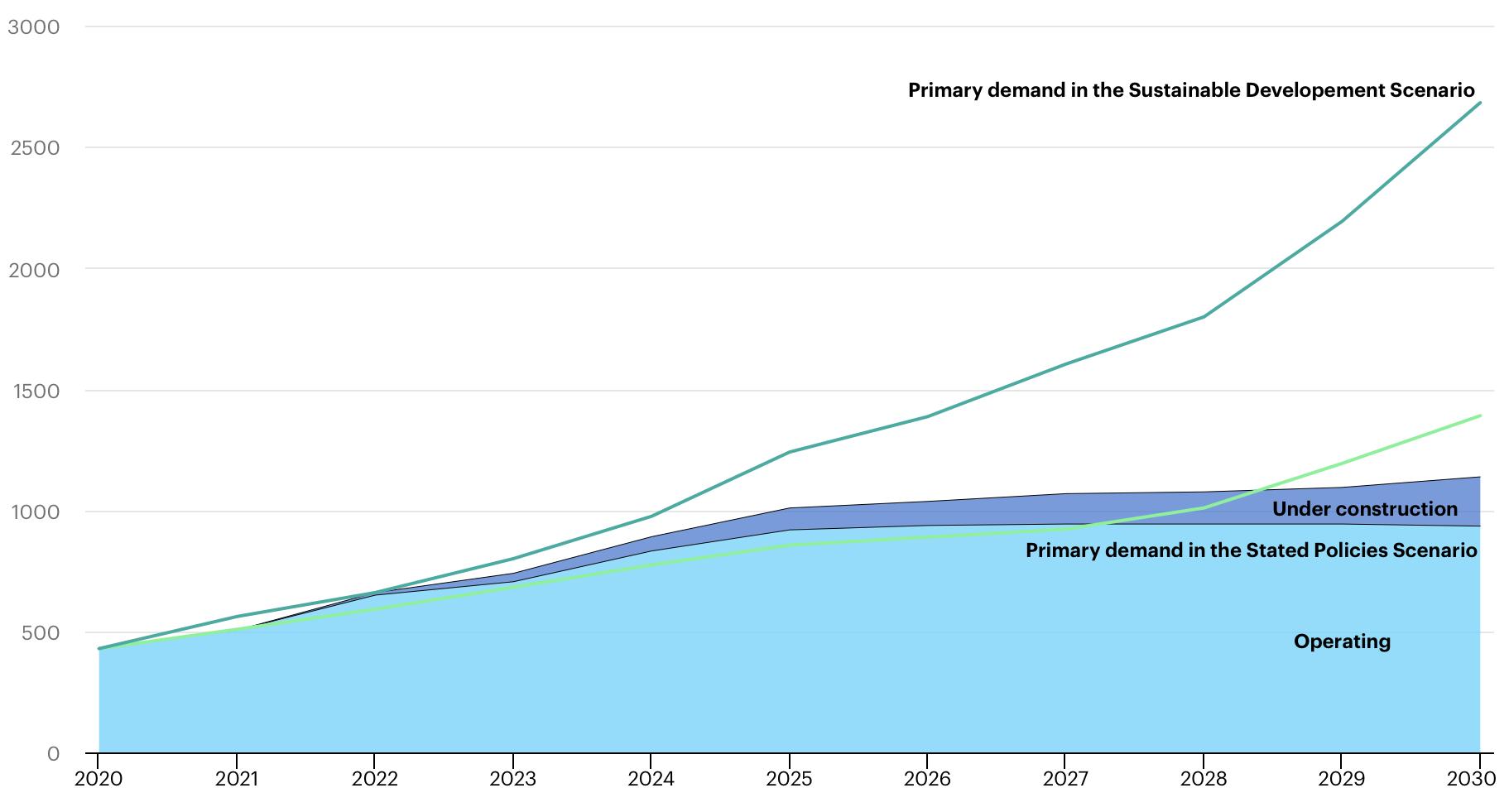
kt of lithium carbonate equivalent
15 Jacqueline Holman and Henrique Ribeiro, “Commodities 2020: Global Lithium Market to Remain Tight,” S&P Global Commodity Insights, December 14, 2021, into-2022.https://www.spglobal.com/platts/en/market-insights/latest-news/energy-transition/121421-commodities-2022-global-lithium-market-to-remain-tight-
17 Robert Rapier, “The Challenges Posed by Rising Lithium Prices,” Forbes, December 31, www.forbes.com/sites/rrapier/2021/12/31/the-challenges-posed-by-rising-lithium-prices/?sh=9d509083af90.2021,metalwillcontinuetobe
Supply concerns for graphite, the key ingredient for the lithium-ion anode, are far more acute than for lithium. The United States currently does not produce any natural graphite and is wholly reliant on imports, with 33 percent of its graphite being sourced from China alone between 2015 and 2018. With only 4 percent of the world’s total graphite reserves being found within North America, the United States will not be able to achieve self-sufficiency in the production of graphite and is likely to encounter geopolitical risk in sourcing graphite for the foreseeable
19 Ana Swanson and Keith Bradsher, “Supply Chain Woes Could Worsen as China Imposes New Lockdowns,” New York Times, January 16, 2022, www.nytimes.com/2022/01/16/business/economy/china-supply-chain-covid-lockdowns.html.
25 Michele McRae, “Nickel,” US Geological Survey, January 2020, https://pubs.usgs.gov/periodicals/mcs2020/mcs2020-nickel.pdf.
and making its retrieval uneconomical if prices are not sufficiently high. As econ omies of scale develop in already-concentrated cobalt supply chains, the prospect of adding alternative sources of supply will face high barriers to entry and little chance of Nickelcost-competitiveness.23isanotherchallenge
Increasing cobalt supply also is a challenge. Cobalt is retrieved as a by-product of copper and nickel mining, con
21 David Roberts, “The Many Varieties of Lithium-ion Batteries Battling for Market Share,” Canary Media, April 21, https://www.canarymedia.com/articles/batteries/the-many-varieties-of-lithium-ion-batteries-battling-for-market-share.2021,
23 David Uren, “How China Wrested Control of the Congo’s Critical Minerals,” Australian Strategic Policy Institute, December 6, 2021, www.aspistrategist. org.au/how-china-wrested-control-of-the-congos-critical-minerals/; and Keith Bradsher and Michael Forsythe, “Why a Chinese Company Dominates Electric Car Batteries,” New York Times, December 22, 2021, www.nytimes.com/2021/12/22/business/china-catl-electric-car-batteries.html.
a significant role across nearly all of these cathodes. The metal improves battery safety by increas ing thermal stability and increases energy density to add to lithium-ion batteries’ lifespan and capacity. These benefits, however, come at the expense of political risks as well as environmental, social, and governance (ESG) reputational risks. Two-thirds of global cobalt production occurs in the Democratic Republic of the Congo (DRC), a country that has historically been susceptible to poor resource governance and the practice of artisanal mining, known for unsafe conditions and the use of child labor. Moreover, Chinese investors control 70 percent of the DRC’s mining sector and China itself refines 80 percent of global cobalt supply, making the metal a significant source of political risk as the geopolitical tensions of the energy transition unfold.22
Cathode Components
18 “Mineral Commodity Summaries 2020,” US Geological Survey, January 31, 2020, https://pubs.usgs.gov/periodicals/mcs2020/mcs2020.pdf.
22 Andrew Fawthrop, “First Cobalt’s Canada Refinery Plans Could Establish a Supply Chain to Rival China,” NS Energy, May 5, 2020, Augustremoved%20from%20the%20earth;nsenergybusiness.com/news/company-news/first-cobalt-refinery-canada-glencore/#:~:text=At%20present%2C%20China%20accounts%20for,is%20https://www.andAaronRossandKarinStrohecker,“CongoReviewing$6BillionMiningDealwithChineseInvestors,”Reuters,30,2021,https://www.reuters.com/world/africa/exclusive-congo-reviewing-6-bln-mining-deal-with-chinese-investors-finmin-2021-08-27/.
26 “Nickel Demand to Outstrip Supply by 2024, Causing Headaches for EV Manufacturers,” Rystad Energy, October 11, https://www.rystadenergy.com/newsevents/news/press-releases/nickel-demand-to-outstrip-supply-by-2024-causing-headaches-for-ev-manufacturers/.2021,
29 Tom Daly and Min Zhang, “China’s Metal Consumers to Feel Supply Sting from Forced Power Cuts,” Reuters, September 29, 2021,https://www.reuters.com/world/china/chinas-metal-consumers-feel-supply-sting-forced-power-cuts-2021-09-29/.tributingtolowlevelsofliquidity
Also of note is manganese, another critical mineral as listed by the US Geological Survey. Manganese, like nickel, is a metal where batteries are an afterthought within primary demand: manganese’s principal use is in steelmaking, accounting for roughly 90 percent of total manganese demand.27 China is dominant in manganese as well, con trolling 93 percent of global refining.28 Power shortages in China at the end of 2021, however, disrupted that supply chain, leaving European manganese users facing an acute supply crunch.29
In sum, despite the triumph of lithium-ion batteries in the electricity storage market, the mineral components of the Li-ion battery are at significant risk of undersupply, dis ruption, and geopolitical gamesmanship. Left unchecked, these risks may manifest themselves in the form of compo nent shortages and high prices, limiting efforts to deploy energy storage solutions to improve renewable energy intermittency and ensure wide availability of low-cost elec trified transport options.
The picture for cathodes is more complex. While all cath odes need lithium, the cathode is stabilized by a number of other metals in various combinations. There are four main types of lithium-ion cathode options on the market today: nickel-manganese-cobalt oxide (NMC), which accounts for 70 percent of the lithium-ion market,21 nickel-cobalt-alumi num (NCA), lithium-iron-phosphate (LFP), and lithium-cobalt oxide
for lithium-ion cathodes, with Tesla CEO Elon Musk calling the metal the “biggest concern” for EV batteries in February 2021.24 Most nickel production is concentrated in three countries—Indone sia, Philippines, and Russia—and unlike cobalt and lithium, energy storage-related demand for nickel is competing against a broad array of other uses, including other clean energy technologies.25 By 2024, Rystad Energy predicts, the supply of battery-grade nickel will fall short of demand.26
ISSUE BRIEF ALTERNATIVE BATTERY CHEMISTRIES AND DIVERSIFYING CLEAN ENERGY SUPPLY CHAINS ATLANTIC COUNCIL 6
28 Frik Els, “Chart: China’s Stranglehold on Electric Car Battery Supply Chain,” Mining.Com, April 16, 2020, https://www.mining.com/chart-chinas-stranglehold-on-electric-car-battery-supply-chain/.
Cobalt(LCO).plays
20 Zhang Yan and Tom Daly, “China EV, Battery Makers Grapple with Graphite Squeeze,” Reuters, December 15, https://www.reuters.com/business/autos-transportation/china-ev-battery-makers-grapple-with-graphite-squeeze-2021-12-15/.2021,
24 “Tesla Partners with Nickel Mine amid Shortage Fears,” BBC, March 5, month.&text=New%20Caledonia%20is%20a%20French,growing%20calls%20for%20its%20independence.https://www.bbc.com/news/business-56288781#:~:text=%22Nickel%20is%20our%20biggest%20concern,said%20on%20Twitter%20last%202021,
27 Priscila Berrera, “Managing Outlook 2022: Expect Price Corrections, Recovery in Supply,” Investing News Network, January 18, 2022, https://investingnews.com/manganese-outlook-2022/; and “US Geological Survey Releases 2022 List of Critical Minerals,” US Geological Survey, February 22, 2022, https://www.usgs.gov/news/national-news-release/us-geological-survey-releases-2022-list-critical-minerals.
future.18 Graphite shortages are projected to be significant in 2022, as the 93 percent of global midstream production that occurs in China has been disrupted by the severe, pandemic-related lockdowns.19 Benchmark Mineral Intel ligence forecasts a 20,000 metric ton shortage of graph ite—about what is needed to produce a quarter-million electric vehicle batteries.20
ISSUE BRIEF ALTERNATIVE BATTERY CHEMISTRIES AND DIVERSIFYING CLEAN ENERGY SUPPLY CHAINS ATLANTIC COUNCIL 7
Reducing Mineral Intensity in the Lithium-ion Supply Chain
The impetus to ”engineer away” nickel and cobalt from the electric vehicle battery supply chain has been gaining momentum. In August 2022, UBS and BloombergNEF pre dicted that the LFP chemistry would comprise 40 percent of the global battery market by 2030—for UBS, this rep resented a 25 percent increase over previous forecasts.31 LFP batteries held only a 17 percent global market share in 2020.32 LFP cathodes have long enjoyed subsidies in China as part of a state-driven push for vertical integration. Consequently, LFP has become the flagship chemistry for CATL and BYD, the world’s largest and fifth-largest electric vehicle battery manufacturers.33
31 Lazzaro, Nick. “UBS Raises LFP Global Battery Market Share Outlook to 40% by 2030.” S&P Global Commodity Insights. S&P Global Commodity Insights, August 16, 2022. battery-market-share-outlook-to-40-by-2030https://www.spglobal.com/commodityinsights/en/market-insights/latest-news/energy-transition/081622-ubs-raises-lfp-global-
o long as electrification, the energy transition, and other battery markets continue to propel demand for energy storage, new technologies that can ease the pressures placed upon the associated materials supply chains can offer immeasurable value. This need is espe cially true as the range of use cases where energy storage will be required expands in a rapidly electrifying energy system—and the size, weight, or energy density advantages of lithium-ion technologies for electric vehicle batteries become less critical in diverse energy-storage use cases. The growing range of use cases presents an opportunity to explore where new technological solutions can sufficiently diversify or reduce mineral inputs to lessen supply risks. In doing so, battery innovations may also improve perfor mance, cost, or safety relative to the prevailing Li-ion bat teries on the market. Key indicators include:
35 Xiuyun Zhao and Vesa-Pekka Lehto, “Challenges and Prospects of Nanosized Silicon Anodes in Lithium-ion Batteries,” Nanotechnology 32, no. 4 (2021): 042002, https://iopscience.iop.org/article/10.1088/1361-6528/abb850#nanoabb850s1.
New cathode materials have the potential to resolve indus try’s most conspicuous supply chain governance and resil ience challenge. Reductions in cobalt intensity for the dominant lithium-ion cathode, nickel-magnesium-cobalt (NMC), are being deployed now. For example, LG’s NMC 811 is a cathode material containing eight parts nickel and one part each of cobalt and magnesium. In contrast, other NMCs contain equal parts of the three metals or three parts nickel and one part each of cobalt and magnesium. NMC 811 is being used in General Motor’s new Hummer EV and Tesla’s Chinese Model 3. Ultium Cells, a joint venture of LG Energy Solutions and GM, makes a battery used in GM’s other EVs that reduces the need for both cobalt and magnesium—another critical mineral—in the cathode even further, with seventeen parts nickel for one part each of cobalt, magnesium, and aluminum, reducing cobalt and magnesium by 70 percent.30 Cobalt-free batteries, such as LFP (lithium-iron-phosphate) batteries, also offer a less min eral-intense version of a lithium-ion configuration and often are less expensive than their NMC counterparts, though at the cost of reduced energy density and therefore storage capacity concerns such as EV driving range.
34 Fred Lambert, “Tesla Confirms Acquisition of New Battery Startup in New Patent,” Electrek, November 5, 2021, https://electrek.co/2021/11/05/tesla-confirms-acquisition-siilion-battery-startup-new-patent/.
36 David Roberts, “The Many Varieties of Lithium-ion Batteries Battling for Market Share,” Canary Media, April 21, https://www.canarymedia.com/articles/batteries/the-many-varieties-of-lithium-ion-batteries-battling-for-market-share.2021,Alternativeanodes,meanwhile,
• Performance: How does a Li-ion alternative offer added value to the performance capabilities of a status quo technology, either in terms of output (capacity or energy density) or function (flexibility or product compatibility)? How do these alternatives impact product safety?
Optimizing existing and deployed technologies in line with supply chain realities can offer the path of least resistance to reduce the critical mineral intensity of lithium-ion batter ies. The most pressing agenda item for the battery indus try will be reducing the intensity of particularly problematic minerals, chiefly cobalt and graphite.
can alleviate dependence on graphite, the primary material used for the negative elec trode in lithium-ion batteries. Silicon in particular has shown great promise at the testing stage. Tesla has been experi menting with increasing the use of silicon in its anodes both for its long-range NMCA and its short-range LFP batteries through a cathode-agnostic silicon-graphite blend.34 There is room to reduce graphite, lower costs, and boost energy density by mixing silicon with graphite or carbon. An allsilicon anode is a possibility as well, although a fully stable, silicon-based anode has as yet proven elusive because of materials science challenges.35 Silicon anodes are also cathode agnostic, allowing them to be deployed with either NMC or LFP cathodes; testing by Tesla has demonstrated that the energy density of the anode can be increased while significantly reducing anode costs by a factor of six to ten. This reduction can lower overall lithium-ion costs per kilowatt-hour by 77 percent if paired with a conver sion-based cathode, rather than intercalation-based ones that currently predominate the market.36
S
30 Andrew Hawkins, “General Motors Announces It Will Build a New Cathode Plant in North America,” Verge, December 1, 2021, https://www.theverge.com/2021/12/1/22811902/general-motors-cathode-factory-ev-battery-posco.
33 Ulrich, Lawrence. “The Top 10 EV Battery Makers.” IEEE Spectrum, August 31, 2021. https://spectrum.ieee.org/the-top-10-ev-battery-makers
32 McKerracher, Colin. “Electric Car Battery Market: Automakers Have Way around Material Shortages.” Bloomberg.com. Bloomberg, August 23, 2022. https://www.bloomberg.com/news/articles/2022-08-23/electric-car-battery-bottlenecks-have-a-way-of-being-worked-out
EVALUATING ALTERNATIVES TO LITHIUM-ION
• Performance: Sodium-ion batteries offer greater longev ity than lithium-based counterparts, with models featuring a life cycle of fifteen years in development or early pro duction, in comparison to lithium-ion’s standard ten-year average life cycle.38 That being said, on performance, sodium-ion batteries are a marked downgrade from lith ium-ion, with lower energy density and longer charging times. Since a fully sodium-ion battery may need as much as twice the volume to achieve the same energy density of a lithium-ion NMC battery, the adoption of a pure sodi um-ion chemistry—with no lithium-ion hybridization—as an EV battery may be somewhat limited.39 Meanwhile, sodium-ion batteries offer several safety benefits com pared to lithium-ion-only batteries, as they can operate in
41 Steve Hanley, “CATL Reveals Sodium-ion Battery with 160 Wh/Kg Energy Density,” CleanTechnica, July 30, Packs&text=The%20cost%20of%20sodium%2Dion,to%20below%20%2440%20per%20kWh.https://cleantechnica.com/2021/07/30/catl-reveals-sodium-ion-battery-with-160-wh-kg-energy-density/#:~:text=Costs%20And%20Hybrid%20Battery%202021,
Option 1: Sodium-ion Chemistries
37 “CATL Unveils Its Latest Breakthrough Technology by Releasing Its First Generation of Sodium-ion Batteries,” Contemporary Amperex Technology Co. Ltd. (CATL), July 29, 2021, https://www.catl.com/en/news/665.html.
• Price and competitiveness: How do the material compo nents of the alternative battery technologies and corre sponding manufacturing costs compare to current Li-ion batteries, particularly in light of the economies of scale and cost reductions that have developed across the Li-ion supply chain?
40 Le Xu and Max Reid, “Will Sodium-ion Battery Cells Be a Game-changer for Electric Vehicle and Energy Storage Markets?,” Wood Mackenzie (consultancy), September 14, https://www.woodmac.com/news/opinion/will-sodium-ion-battery-cells-be-a-game-changer-for-electric-vehicle-and-energy-storage-markets/.2021,
38 Erik David Spoerke, “Advancing Sodium Batteries through the DOE Office of Electricity,” US Department of Energy (DOE), Office of Scientific and Technical Information, September 1, 2020, https://www.osti.gov/servlets/purl/1823389.
42 “Battery Pack Prices Fall to an Average of $132/kWh, but Rising Commodity Prices Start to Bite,” BloombergNEF, November 30, 2021, https://about.bnef.com/blog/battery-pack-prices-fall-to-an-average-of-132-kwh-but-rising-commodity-prices-start-to-bite/.
• Supply security: Do the material components of the alter native battery designs alleviate concerns around current (or projected) material availability?
• Price and competitiveness: Sodium is highly plentiful and raw materials consequently make up a much smaller proportion of manufacturing costs for sodium-ion bat teries. In fact, it is estimated that if the prices of all the metals used to make the sodium-ion cell increased by 10 percent, overall sodium-ion production costs would con sequently increase by less than 1 percent, in comparison with a 3.2 percent rise in LFP costs and a 4.6 percent rise in NMC costs.40 Chinese media have claimed that first-generation battery pack costs will approach $77 per kilowatt-hour, with economies of scale contributing to costs reaching $50 per kilowatt-hour in the near future.41 This cost compares to an average lithium-ion battery pack cost of $132/kWh in late 2021, with pack costs of below $100/kWh not foreseen until at least 2024, accord ing to Bloomberg New Energy Finance (NEF).42
43 “Technology,” Altris, 2022, https://www.altris.se/technology/.
39 Kuzhikalail M. Abraham, “How Comparable Are Sodium-ion Batteries to Lithium-ion Counterparts?,” ACS Energy Letters 5, no. 11 (2020): 3544-3547, https://pubs.acs.org/doi/10.1021/acsenergylett.0c02181.
a wider range of temperatures without incurring thermal runaway, boding well for home and grid-scale uses where weight is less of an issue.
• Supply security: Similar to an LFP lithium-ion battery, sodium-ion batteries offer lower energy density than NMC batteries, in exchange for the absence of cobalt or nickel components, alleviating supply chain risks. Sodium-ion batteries also are incompatible with graph ite anodes, which cannot store the larger sodium ions. These batteries therefore use carbon-based anodes instead. Research efforts have enabled previously favored metal-oxide cathodes to be forgone in favor of polyanion cathodes, which increase security of supply. For instance, sodium-ion cells can be manufactured with a cathode consisting of a material called Fennac (aka “Prussian white”), composed of sodium, iron, carbon, and nitrogen, none of which are critical minerals.43 This chem ical makeup therefore limits supply risk substantially.
With greater resilience against potential fluctuations in metal prices, sodium-ion technologies have potential as a swing battery format in times of high lithium-ion resources costs. Cost considerations aside, the performance limita tions of sodium-ion batteries—particularly relating to energy density—mean the format should be understood as primar ily an even lower-end substitute for LFP batteries, and not necessarily as a practical alternative to high-performance Li-ion chemistries. This limitation does not, however, pre
ISSUE BRIEF ALTERNATIVE BATTERY CHEMISTRIES AND DIVERSIFYING CLEAN ENERGY SUPPLY CHAINS ATLANTIC COUNCIL 8
A sodium-ion battery works similarly to the standard lithi um-ion battery; the former type, however, circulates sodium atoms rather than lithium. During discharge, sodium ions travel from a carbon-based anode across the aqueous sodi um-based electrolyte to be stored in the cathode. The prin cipal difference is the size of the ion; while sodium atoms are bigger and heavier than lithium atoms, sodium is still lighter than nearly every other metal. Nevertheless, sodi um-ion batteries may still be viable for use in heavier elec tric vehicles, representing an even more budget-friendly alternative to LFP lithium-ion batteries by reducing costs while minimizing an increase in weight and diminution in energy density.37
The following sections explore several representative potential use cases for alternative batteries, with particu lar attention to their merit relative to the aforementioned factors.
• Performance: The liquid metal battery uses much heavier components than lithium- or even sodium-ion batteries, particularly given the presence of antimony. As such, liquid metal batteries are far too heavy for practical use in EVs and portable electronics, but they could offer highly cost-effective stationary energy storage for the grid. Compared to a battery with a lithium anode, which is highly reactive, a calcium-antimony battery offers greater stability, a longer lifespan, and less need for external tem perature regulation.45 The greater weight of the liquid metal battery precludes its use for EVs; however, for sta tionary storage, the battery’s response time of less than a second and its twenty-year lifetime with minimal degra dation could make the type a major player in grid-scale applications.46
equal in price to nickel and about 40 percent and 80 percent cheaper than lithium and cobalt, respectively.47 Ambri estimates cost savings of 25 percent to 50 percent versus lithium-ion by 2025, even accounting for projected decreases in lithium-ion costs.48 The newer technology may presently require higher initial capital investment associated with market entry and building economies of scale. In the long-term, however, the company forecasts that input costs will be lower than prevailing lithium-ion technolo gies once brought to scale. Moreover, the lack of a need for temperature regulation and fire suppression for the highly stable battery should lower the life-cycle cost of storage when economies of scale can be achieved.
51 “Infographic: Australia Mining by the Numbers,” S&P Global, February 12, https://www.spglobal.com/marketintelligence/en/news-insights/blog/infographic-australia-mining-by-the-numbers.2022,ruary2022,antimonyisroughly
47 “Antimony Prices,” Argus Media, July 15, 2022, https://www.argusmedia.com/metals-platform/metal/minor-and-specialty-metals-antimony; “LME Nickel,” London Metal Exchange (LME), July 18, 2022, https://www.lme.com/en/metals/non-ferrous/lme-nickel#Trading+day+summary; and “LME Cobalt,” LME, July 18, 2022, https://www.lme.com/en/metals/ev/lme-cobalt#Trading+day+summary.
50 Kateryna Klochko, “Antimony,” US Geological Survey, January 2020, https://pubs.usgs.gov/periodicals/mcs2020/mcs2020-antimony.pdf.
• Price and competitiveness: The liquid calcium electrode and calcium-chloride salt electrolyte proposed by Ambri consist of metals which are highly abundant and afford able. At a price of about $13,000 per metric ton as of Feb
48 “Ambri Value Proposition,” Ambri.
44 Nancy Stauffer, “A Battery Made of Molten Metals,” MIT News, Massachusetts Institute of Technology, January 12, 2016, https://news.mit.edu/2016/battery-molten-metals-0112.
• Supply security: With half of the battery’s estimated cell weight composed of calcium and stainless steel, both of which offer very low supply risk, the primary supply risk for the battery is associated with the use of anti mony, which is used primarily in military technologies. Some 83 percent of the world’s production originates in China.49 However, only 32 percent of the world’s proven reserves are found in China, with significant reserves in Turkey, Bolivia, Australia, and the United States.50 Ambri has sought to mitigate this imbalance in the short term through an antimony production agreement with Per petua Resources, with its mine set for a 2027 opening date in Idaho.51 As the technology is scaled up, alterna tive supplies may also need to be brought online.
49 W. C. Butterman and J. F. Carlin, Mineral Commodity Profiles, US Geological Survey, 2004, https://pubs.usgs.gov/of/2003/of03-019/of03-019.pdf.
45 “Ambri Value Proposition,” Ambri (website), accessed July 2022, https://ambri.com/benefits/.
clude sodium-ion from offering value in contexts where that density is not a prerequisite, such as home or grid storage, where the safety advantages of a sodium-ion or sodium-ion mix would be of paramount importance.
ISSUE BRIEF ALTERNATIVE BATTERY CHEMISTRIES AND DIVERSIFYING CLEAN ENERGY SUPPLY CHAINS ATLANTIC COUNCIL 9
Option 2: Liquid Metal Batteries
Liquid-metal battery solutions such Ambri’s exemplify the benefits of a “big tent” approach to energy storage. While the relatively higher weight of a liquid metal, anti mony-based battery for a given capacity would be a dis advantage for a consumer EV, it would offer stability and performance improvements for other storage applica tions where weight is not a significant factor such as util ity-scale grid storage solutions. These characteristics offer the additional advantage of disconnecting critical pieces of an electrified grid from a highly competitive, lith ium-ion supply chain, at substantial net-cost benefit. While a liquid-metal configuration would replace supply concerns related to lithium, cobalt, and nickel with possible supply risk from antimony, the latter metal presents a more resil ient supply chain given its relative abundance and more limited demand projection.
Liquid metal batteries—also referred to as molten salt bat teries—operate uniquely compared with their lithium-ion and sodium-ion counterparts. The chemistry combines an anode of liquid calcium alloy, a molten salt electrolyte, and a cathode of solid antimony. When the battery dis charges, the lighter calcium alloy anode, which is also in a molten state, releases electrons that flow through the electrical circuit to provide power, and calcium ions that flow through the molten salt electrolyte and form an alloy at the solid antimony cathode. During the charging cycle, the calcium-antimony alloy disassociates and the calcium ions flow back through the electrolyte. Ambri, a Massachu setts company that has pioneered the format, settled on antimony as the cathode and a liquid calcium alloy as the anode, having originally tried magnesium.44 Ambri believes the battery combines the elements of a low-cost, long-last ing chemistry using commonly available materials with little supply constraints.
46 “Technology,” Ambri, (website), accessed July 2022, https://ambri.com/technology/.
57 Amy Tolcin, “Zinc,” US Geological Survey, January 2022, https://pubs.usgs.gov/periodicals/mcs2022/mcs2022-zinc.pdf.
Leigh Collins, “Zinc-ion Batteries: ‘Up to 50 Percent Cheaper than Lithium-ion with No Raw Materials Concern,’ ” Recharge News, January 11, 2021, https://www.rechargenews.com/transition/zinc-ion-batteries-up-to-50-cheaper-than-lithium-ion-with-no-raw-materials-concerns/2-1-939768.
58 “Zinc Recycling,” Galvanizers Association, accessed July 18, 2022, recycling/#:~:text=Zinc%20is%20an%20inherently%20recyclable,of%20physical%20or%20chemical%20properties.https://www.galvanizing.org.uk/sustainable-construction/zinc-is-sustainable/zinc-
Zinc-ion batteries function analogously to the previously described lithium- and sodium-ion technologies, but with a zinc anode that discharges its ions across a water-based electrolyte to be stored in a zinc-based cathode. Zinc is heavy, but lower input costs may allow zinc-ion technology to provide another low-cost option for stationary power storage. Two start-ups are already fulfilling contracts for zinc-ion-based storage in the United States: Eos Energy, which is providing grid-scale storage for the states of Cal ifornia and Texas and for North Carolina-based solar pro vider Blue Ridge Power;52 and Salient Energy, which has received $1.5 million from the California Energy Commis sion to make home-scale batteries in the state.53
52 Andy Colthorpe, “Zinc Battery Storage Maker Eos Has Logged US$137.4 Million of Orders This Year,” Energy Storage News, November 11, 2021, https://www.energy-storage.news/zinc-battery-storage-maker-eos-has-logged-us137-4-million-of-orders-this-year/.
• Performance: In addition to its safety advantages over lithium-ion batteries, zinc-ion batteries can last fifteen to twenty years, with little degradation over that long lifespan. However, they have significantly lower efficiency, at 65 percent, compared with the 90 percent to 100 percent efficiency of liquid metal and lithium-ion batteries.54
53
“Salient Energy Receives $1.5+ Million Grant from California Energy Commission,” Power Magazine, January 26, https://www.powermag.com/press-releases/salient-energy-receives-1-5-million-grant-from-the-california-energy-commission-cec/.2021,
Option 3: Zinc-ion Batteries
In summary, zinc-ion batteries may offer a practical alterna tive to lithium-ion batteries in use cases where the energy density or efficiency may be a less critical performance requirement. This is particularly true given the possible cost benefits of a zinc-ion technology and the potential cost-re siliency against material supply availability. Zinc-ion batter ies, therefore, may be of considerable use as a low-cost option for private stationary storage or as an intermittency solution for smaller-scale, renewable energy production.
ISSUE BRIEF ALTERNATIVE BATTERY CHEMISTRIES AND DIVERSIFYING CLEAN ENERGY SUPPLY CHAINS ATLANTIC COUNCIL 10
54
55 “Average Price for Zinc Worldwide from 2014 to 2035,” Statista, February, https://www.statista.com/statistics/675888/average-prices-zinc-worldwide/.2022,
59 Changgang Li, Xudong Zhang, Wen He, Guogang Xu, and Rong Sun, “Cathode Materials for Rechargeable Zinc-ion Batteries: From Synthesis to Mechanisms and Application,” Journal of Power Sources 449 (2020): https://www.sciencedirect.com/science/article/abs/pii/S0378775319315897.227596,
• Price and competitiveness: Zinc is considerably cheaper than lithium-ion materials, at a projected average of roughly $2,800 per metric ton—12.5 percent the cash price for an equivalent amount of nickel in February 2022—lowering the upfront capital costs for battery pro duction.55 Unlike lithium, zinc is not reactive with water, enabling zinc-ion to use water as a cheap electrolyte and eliminating the need for a costly, hyper-controlled manu facturing environment. The water-based electrolyte also eliminates the risk of fire, increasing safety and preclud ing the need for costly features to prevent overheating, and there is no need for formation cycling at the end of the manufacturing process, allowing for a quicker rollout to consumers. In fact, it is projected that the levelized cost
56 “Zinc Facts,” Government of Canada, February 3, https://www.nrcan.gc.ca/our-natural-resources/minerals-mining/minerals-metals-facts/zinc-facts/20534.2022,
• Supply security: Although zinc has recently been clas sified as a critical mineral by the US Geological Survey, the supply risks for this commonly used element are less acute than for other battery materials. The zinc supply chain is relatively diversified, with one-third of global pro duction coming from the United States, India, Peru, and Australia.56 These countries combined account for half of the known global reserves, suggesting a relatively light level of political risk if overall supply can be brought to market at a scale commensurate with demand.57 More over, due to their material composition, the batteries have better prospects for end-of-life recycling.58 Zinc-ion bat teries typically use a zinc metal anode and an aqueous electrolyte. This design has been prototyped with a variety of cathode materials such as manganese-based oxides, vanadium-based materials, and “Prussian blue” (a ferrous cyanide powder). However, manganese oxide is emerging as a favored variant.59 As previously men tioned, however, manganese is a critical mineral given its importance to steelmaking, suggesting that absent addi tional sourcing, a shortage of battery-grade quality man ganese could develop.60
60 “Manganese Joins the List of 23 Elements Critical to the US Economy,” Cision PR Newswire, February 2, https://www.prnewswire.com/news-releases/manganese-joins-the-list-of-23-elements-critical-to-the-us-economy-672335963.html.2018,ofstoragewillreachtwo-thirdsthatoflithium-ion, and the battery format also offers the potential for a longer lifespan than lithium-ion.
The batteries cost as much as $500 per kilowatt-hour as of 2019, but the Institute of Electrical and Electronics Engineers predicts the cost will fall 75 percent by 2030.64 The simplicity of the battery’s design and the low price of inputs should contribute to cost competitiveness once the operating temperature issue has been resolved.
61 Xiaofu Xu et al., “A Room Temperature Sodium-sulfur Battery with High Capacity and Stable Cycling Performance,” Nature Communications 9 (2018): 3870, https://www.nature.com/articles/s41467-018-06443-3; and “Lithium-ion Battery,” Vilas Pol Energy Research Group (ViPER website), University of Purdue Davidson School of Chemical Engineering, 2022, https://engineering.purdue.edu/ViPER/research.html.
64 Mads Almassalkhi, Jeff Frolik, and Paul Hines, “How to Prevent Blackouts by Packetizing the Power Grid,” IEEE Spectrum, Institute of Electrical and Electronics Engineers, January 29, 2022, https://spectrum.ieee.org/packetized-power-grid#toggle-gdpr.
65 Wallace Bolen, “Salt,” US Geological Survey, January 2020, https://pubs.usgs.gov/periodicals/mcs2020/mcs2020-salt.pdf; and Lori Apodaca, “Sulfur,” US Geological Survey, January 2020, https://pubs.usgs.gov/periodicals/mcs2020/mcs2020-sulfur.pdf.
• Price and competitiveness: The need to maintain a high operating temperature for sodium-sulfur batteries is the biggest current impediment to price competitiveness.
• Performance: As a grid-scale energy storage system, sodium-sulfur batteries pack significant power. They boast an 85 percent efficiency rate, a quick response time, a fifteen-year lifespan, and even have a higher the oretical energy density of 760 watt-hours per kilogram, versus 570 watt-hours per kilogram in lithium-ion.61 Exist ing sodium-sulfur technology already has achieved an energy density of 110 watt-hours per kilogram, which competes with the lithium-ion incumbent’s density of 100 to 265 watt-hours per kilogram.62 The main drawback of sodium-sulfur batteries is that they require high operating temperatures, although novel electrolyte mixtures offer the potential for room-temperature use.63
66 Paul Breeze, “Power System Energy Storage Technologies,” in Power Generation Technologies, Third Edition (Oxford and Boston: Newnes, 2019), 219249, https://doi.org/10.1016/C2017-0-03267-6.
Sodium-sulfur batteries consist of a molten sulfur cathode and a solid ceramic electrolyte consisting of beta-alumina, which despite its name, is made largely from sodium. The construction of the battery is simple, with an outer casing of sulfur that constitutes the cathode, and an inner container that stores the sodium, separated by the beta-alumina solid electrolyte (BASE).
63 Xiaofu Xu et al., “A Room Temperature Sodium-sulfur Battery.”
• Supply security: Salt and sulfur are both highly abun dant and the United States is a leading global producer of both minerals, with a net import reliance in 2020 of 29 percent and 7 percent, respectively.65 The anode, typi cally made of steel, chromium, and molybdenum, is also relatively low risk, although molybdenum is classified as a critical mineral, alongside aluminum.66
Sodium-sulfur offers another variable cost solution that has a history of large-scale grid storage deployment. The plentifulness of both liquid sodium and sulfur as cathode and electrolyte, combined with the ability for sodium-sulfur batteries to utilize a chromium and molybdenum-derived casing as an anode, also reduces the complexity of man ufacturing. While performance at cost remains dependent on the ability to sustain operation at a reasonable tem perature, which currently limits wider commercial deploy ment capacity, sodium-sulfur batteries have the potential to achieve cost competitiveness with lithium-ion for certain technological innovations.
ISSUE BRIEF ALTERNATIVE BATTERY CHEMISTRIES AND DIVERSIFYING CLEAN ENERGY SUPPLY CHAINS ATLANTIC COUNCIL 11
62 Ahmet Aktaş and Yağmur Kirçiçek, “Solar Hybrid Storage and Energy Systems,” in Solar Hybrid Systems (Cambridge, Massachusetts: Academic Press, 2021), 87-125, https://doi.org/10.1016/B978-0-323-88499-0.00005-7.
Option 4: Sodium-sulfur Batteries
Performance: To compare performance among battery chem istries, the GEC has elected to reference gravimetric energy density values as the basis for assigning values for perfor mance. While other metrics, such as C-rate, are relevant to assessing a battery’s performance, the GEC has elected to focus on energy density for consistency and for its centrality for determining power or cycle duration.
Cost-Effectiveness: To represent the relative affordability for each battery chemistry, values were assigned via a comparison of battery pack cost per kilowatt-hour across each chemistry.
Figure 2: The Battery Trilemma: Supply Security, Performance, and Cost
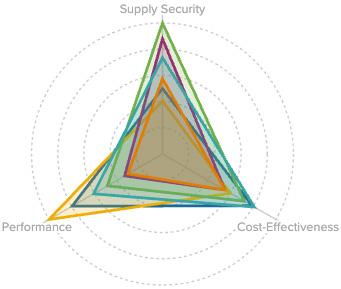
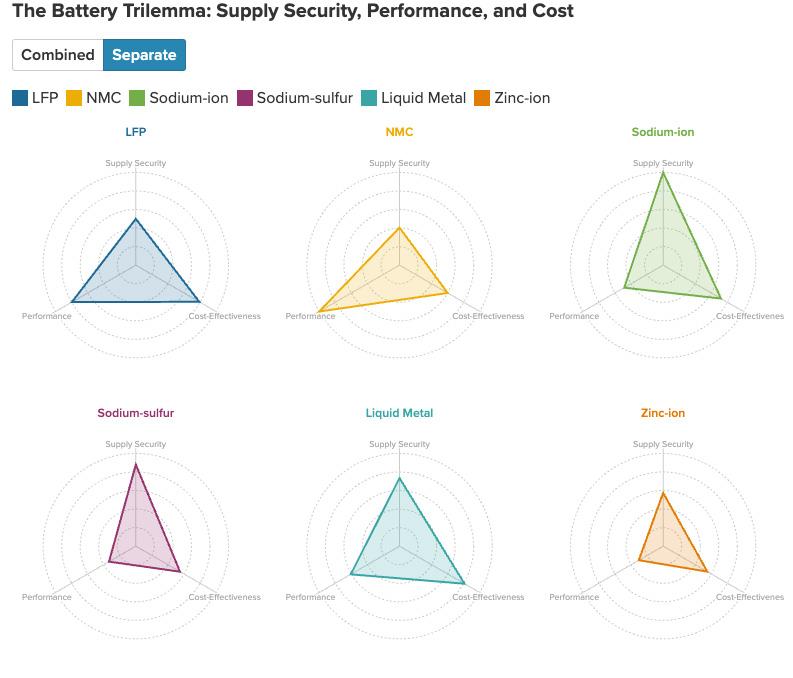
Source: US Geological Survey, BloombergNEF, Institute of Electrical and Electronics Engineers, American Chemical Society, CleanTechnica, PRNewsWire, National Center for Biotechnology Information, and MDPI.

The Atlantic Council Global Energy Center (GEC) devised a set of scored values meant to represent the characteristics of each battery chemistry in terms of its supply security, cost-effectiveness, and performance. The values assigned to each battery are positive and are meant to be interpreted in relation to each other. The methodology by which the values were assigned is described below:
Supply Security: To represent the degree to which each bat tery’s supply chain has been assessed to be secure, these values have been assessed by referencing the US Geological Survey’s Methodology and Technical Input for the 2021 Review and Revision of the US Critical Minerals List. Per GEC analysis, projections regarding future production or geopolitical trends have also informed the final index values.
ISSUE BRIEF ALTERNATIVE BATTERY CHEMISTRIES AND DIVERSIFYING CLEAN ENERGY SUPPLY CHAINS ATLANTIC COUNCIL 12
68 Cris Tuck, “Iron Ore,” US Geological Survey, January 2022, https://pubs.usgs.gov/periodicals/mcs2022/mcs2022-iron-ore.pdf.
71 “Silicon,” Institute for Rare Earths and Metals (website), accessed July 18, https://en.institut-seltene-erden.de/seltene-erden-und-metalle/strategische-metalle-2/silizium/.2022,Itstandstoreason,
ISSUE BRIEF ALTERNATIVE BATTERY CHEMISTRIES AND DIVERSIFYING CLEAN ENERGY SUPPLY CHAINS ATLANTIC COUNCIL 13
Demand for batteries as an energy storage solution will impose particularly acute pressures on these supply chains, given the significant share of overall mineral demand that battery storage is expected to establish over the course of the energy transition. Battery metal supply chains are heavily concentrated, not only in terms of geography, but in the small handful of minerals which are essential to battery deployment; namely, cobalt, graphite, lithium, and nickel.
67 “In Focus: Reducing the EU’s Dependence on Imported Fossil Fuels,” European Commission, April 20, dependence,and%20cost%20%E2%82%AC99%20billion.https://ec.europa.eu/info/news/focus-reducing-eus-dependence-imported-fossil-fuels-2022-apr-20_en#:~:text=REPower%20EU%20to%20cut%202022,
• Silicon, as a potential alternative to graphite in the anode, is also not a critical mineral.70 It is easily extracted from sand and the composition of the earth’s crust is roughly 15 percent silicon by mass.71 Noncobalt cathodes and nongraphite anodes, therefore, can play an even greater role in the diversification of the supply chain.
Diversification of Mineral Inputs
DIVERSIFYING CLEAN ENERGY SUPPLY CHAINS THROUGH ALTERNATIVE BATTERY CHEMISTRIES
The battery alternatives discussed above offer pathways to such diversification by widening the aperture of miner als and materials that can form an effective energy storage chemistry and, in doing so, also diversify the available avenues of production for said minerals—both in terms of resource potential and producing geographies. Examples include:
70 “2022 Final List of Critical Minerals,” 87 Fed. Reg. 10,381, February 24, 2022, https://www.govinfo.gov/content/pkg/FR-2022-02-24/pdf/2022-04027.pdf.
A
• Iron and phosphate, the basis of the LFP cathode, which are both highly abundant. For iron, prices have been stable in the low $90s per ton over the past four years, and the United States is a net exporter of the metal.68 For phosphate rock, the United States is the world’s leading producer and a small net importer, with nearly 90 percent of the imports from fellow Energy Resource Governance Initiative (ERGI) member Peru.69
s demand for a wide array of energy storage solu tions continues to grow as a result of electrification throughout the energy system, battery storage will add to a range of clean energy technologies currently com peting for critical raw materials. The corresponding strain on clean energy technology supply chains—from mines to finished goods—is of growing concern as the supply of key raw materials tightens, technologies become more expensive, and concerns around supply-chain resiliency emerge, prompting national governments to prioritize the sustainability of such supply chains in terms of environ mental stewardship, good governance, and transparency. Such considerations are only growing in relevance, follow ing politically motivated disruptions caused by the 2011 Chinese embargo of rare earth exports to Japan, more recent concerns around nickel supply following Russia’s invasion of Ukraine, continued worries surrounding the sustainability of cobalt mining and rare earth processing in the DRC and China, respectively, and current increases in overall lithium-ion battery costs due to tightening lithium markets. Amid Russia’s explicit weaponization of natural gas, for which it provides 40 percent of the European Union’s total supply, the necessity for diversifying sources for essential commodities has become increasingly appar ent.67 A forward-thinking approach to economic and energy security, as the transition to net-zero emissions continues, will center the diversification of mineral inputs as a vital national interest.
69 Stephen Jasinski, “Phosphate Rock,” US Geological Survey, January 2022, https://pubs.usgs.gov/periodicals/mcs2022/mcs2022-phosphate.pdf. The ERGI, which focuses on best practices in the mining sector, was founded by Australia, Botswana, Canada, Peru, and the United States; see “About ERGI,” https://ergi.tools/about.
therefore, that the variety of solu tions for battery storage should be examined not only as a means by which to more efficiently achieve energy storage goals—through performance and cost-effectiveness and for an increasingly wide range of storage applications—but also as an opportunity to alleviate concerns around mineral pricing, accessibility, and sustainability.
Chief among the benefits of diversifying battery technol ogies is the associated diversification of mineral inputs throughout battery supply chains. By utilizing other miner als for certain flexible use cases, alternative battery materi als may ease the pressure on fragile and underdeveloped supply chains, allowing the energy storage industry to avoid input disruption and cost volatility that could impede the marketability of energy storage.
Sodium-based materials can be produced via the electrolysis of abundant sodium-containing salts.
• Calcium, a key ingredient of the molten salt battery, is the fifth-most abundant element in the earth’s crust.73 It is extracted as lime (calcium oxide and hydroxide) and as crushed stone (calcium carbonate), both of which are plentiful enough for the USGS to decline to quantify their
Silicon
Most iron and phosphate used by US companies come from the United States and Peru.
Potential alternative to graphite anodes
Basis of the LFP cathode
Antimony
• Sulfur, used in combination with sodium in the sodium-sul fur battery, is a waste product and in surplus, stockpiled by fossil fuel producers like Canada, which produces sulfur at a high rate from tar sand oil production, at one point reaching a total stockpile of 12 million metric tons in 2006.75
Silicon is easily extracted from sand without geographic limitations.
Sodium
Calcium
The first US-based antimony mine is scheduled to begin operations in 2027.
• Antimony, the cathode material in Ambri’s liquid-metal battery, is a critical mineral for which no mining activity was reported in the United States in 2021.76 However, Perpetua Resources—which is presently developing an antimony mine in Idaho, which it aims to bring into oper ation by 2027—has secured supply agreements with Ambri, promising the creation of a localized antimony battery supply chain in the United States.
76 Klochko, “Antimony.”
Sulfur
Iron and phosphate
Used as positive electrode in the sodium-sulfur battery
74 Lori Apodaca, “Lime,” US Geological Survey, 2021, https://pubs.usgs.gov/periodicals/mcs2021/mcs2021-lime.pdf; and Jason Willett, “Stone Crushed,” US Geological Survey, 2022, https://pubs.usgs.gov/periodicals/mcs2022/mcs2022-stone-crushed.pdf.
Sulfur is a waste product, and is stockpiled by fossil fuel-producing countries, including Canada.
Cathode material in liquid-metal batteries
ISSUE BRIEF ALTERNATIVE BATTERY CHEMISTRIES AND DIVERSIFYING CLEAN ENERGY SUPPLY CHAINS ATLANTIC COUNCIL 14
72reserves.74WallaceBolen,
Forms the core of alternatives to lithium-ion batteries
Key ingredient (negative electrode) of the molten salt battery
Calcium is sourced from abundant lime (calcium oxide and calcium hydroxide) and crushed stone (calcium carbonate).
“Salt,” US Geological Survey, January 2020, https://pubs.usgs.gov/periodicals/mcs2022/mcs2022-salt.pdf.
75 G. D’Aquin, “Sulfur Output from Oil Sands: Dramatically Changing Alberta’s Sulfur Balance,” Proceedings of the 2 Oil Sands Heavy Oil Technologies Conference (Tulsa, Oklahoma: PenWell, 2008), 1000, summary available at International Nuclear Information System (INIS) 40, no. 13, reference 40030986, International Atomic Energy Agency, https://inis.iaea.org/search/search.aspx?orig_q=RN:40030986.
• Sodium-based materials that form the core of alternatives to lithium-ion batteries, while not abundant in nature, can be produced by the electrolysis of salt, which is highly abundant in seawater, salt mines, and other resources. The US Geological Survey notes that the world’s salt reserves, when including both ground deposits and oceanic salt, are “virtually inexhaustible.”72
73 “Calcium,” Royal Society of Chemistry, 2022, https://www.rsc.org/periodic-table/element/20/calcium.
Alternative Battery Material(s) Usage Supply
Meanwhile, broadening the range of mineral inputs for chemical battery storage will open new opportunities to support the development of clean energy supply chains which meet the criteria increasingly mandated by clean energy stakeholders: environmental sustainability, good governance, and market transparency. Taking advantage of such opportunities will be critical to maintaining the overall health of clean energy supply chains as demands on mineral inputs increase incentives for marginal, and fre quently less sustainable, producers as more mainstream battery materials slowly come online.
A corollary to the sustainability benefits of a wider array of mineral inputs into the battery supply chain is the expan sion of potential sourcing of battery minerals from part ners with stronger mechanisms for market governance and greater sustainability credentials. Here, the easy integra tion of best-in-class mining industries in the United States, Canada, Australia, and others will improve supplies of sus tainably mined minerals—not necessarily on a cost-cost comparison with existing mineral supply chains, but by offering alternative markets in which those supply chains can
S
79 “Sodium-ion and Sodium Metal Batteries for Efficient and Sustainable Next Generation Energy Storage,” European Commission, January 1, 2021, https://cordis.europa.eu/project/id/963542; “Scientists Develop Stable Sodium Battery Technology,” National Science Foundation, January 6, 2022, https://www.nsf.gov/discoveries/disc_summ.jsp?cntn_id=304167&org=NSF&from=news; and Syl Kacapyr, “Engineers Reveal Cause of Key Sodium-ion Battery Flaw,” Cornell University, February 11, 2022, https://news.cornell.edu/stories/2022/02/engineers-reveal-cause-key-sodium-ion-battery-flaw.ferentconcentrationsofkeyminerals—butalsoofferingstrongeropportunitiesforbatterieswithlowmineralintensitiestobebroughttomarketanddeployedatscale.Muchofthisworkisalreadyinprogress,withreductionstothecobaltintensityofNMClithium-ionbatteriesalreadygainingtractionintheEVindustry.Seizingthismomentumtootherstoragecontextswilladdsignificantvaluebyimprovingtheoverallhealthofthecleanenergysupplychain.
An immediate opportunity to improve the sustainability of clean energy value chains will be the expansion of battery material inputs to a range of materials that require less envi ronmentally intensive production processes. Much of this benefit can be achieved courtesy of the wide availability of alternative battery metals such as salt, sulfur, silicon, or calcium—which are not only less of a sustainability concern than traditional battery materials such as cobalt, but also can be more readily integrated into the battery supply chain through their retrieval as by-products from existing mining activity, thereby mitigating land use concerns.
AREAS FOR ACTION
78 “Energy Department Selects 15 Projects to Advance Critical Material Innovations,” US DOE, January 20, https://www.energy.gov/eere/amo/articles/energy-department-selects-15-projects-advance-critical-material-innovations.2021,
sustainability benefit of a “big-tent” approach to alternative battery technologies will be the reduction of mineral intensity. This benefit includes an overall reduc tion of demands on specific minerals throughout the clean energy supply chain—through similar chemistries with dif
For policymakers to further these efforts, actions will produce benefits most efficiently by targeting the following areas of focus:
ISSUE BRIEF ALTERNATIVE BATTERY CHEMISTRIES AND DIVERSIFYING CLEAN ENERGY SUPPLY CHAINS ATLANTIC COUNCIL 15
Finally,develop.akey
However, US public financing in this market has largely centered on fixing the supply chain bottlenecks associated with lithium-ion batteries. In terms of enabling technolo gies which use diversified and abundant inputs, the Euro pean Union has announced funding for developing stable sodium-ion batteries, a complementary effort to the United States’ National Science Foundation partnership with Brus sels via a consortium of academic institutions.79 It remains clear that in addition to supporting lithium-ion supply chains, policymakers must redouble their efforts to invest in an array of material inputs which support a portfolio of diversified battery technologies for tailored use profiles.
77 Jeff St. John, “DOE Backs US Battery Materials Production with $107 Million Loan,” Canary Media, April 18, battery%20materials%20production%20with%20%24107M%20loan,Technologies%20make%20it%20in%20Louisiana.https://www.canarymedia.com/articles/batteries/doe-backs-us-battery-materials-production-with-107m-loan#:~:text=DOE%20backs%20US%202022,
Supporting Sustainable Clean Energy Supply Chains
ecuring the necessary mineral inputs to drive the energy transition will require action on the part of government to steer the market toward a greater diversity of mineral inputs. Such action is already happen ing; for instance, in July 2022, the US Department of Energy (DOE) Loan Programs Office lent $102 million to support Syrah Technologies’ Vidalia project for processing graphite in Louisiana, sourced from mines in Mozambique owned by its Australia-based parent company, Syrah Resources, thereby creating a US-controlled, end-to-end supply chain in a mineral for which the United States is currently wholly reliant on China-based processors.77 Previously, in January 2021, DOE’s Advanced Manufacturing Office unveiled a series of fifteen critical minerals projects slated to receive funds totaling $50 million.78
• Targeting international partners: Fully on-shoring entire supply chains is not always a feasible solution; however, collaboration with trusted partners across the mineral value chain can greatly reduce geopolitical risk. To this end, efforts like the US State Department’s recently announced Minerals Security partnership, aimed at forging a coalition of like-minded economies committed to security of supply and sustainability throughout the mineral supply chain, should also recognize the utility of
81 “Fact Sheet: Securing a Made in America Supply Chain for Critical Minerals”; and Critical Minerals and Materials, US DOE, https://www.energy.gov/sites/prod/files/2021/01/f82/DOE%20Critical%20Minerals%20and%20Materials%20Strategy_0.pdf.2021,
As a corollary, minerals such as antimony, sodium, and iron should receive heightened attention for their role in diversifying the battery economy, and transition mineral supply strategies should be reviewed accordingly.
• Incentives for “mineral switching”: The unmatched per formance of lithium-ion batteries has concentrated inno vation and capitalization into this chemistry, enabling remarkable economies of scale that have brought down prices an astonishing 90 percent between 2010 and 2020.83 Rolling out structured tax credits for diversifying
ISSUE BRIEF ALTERNATIVE BATTERY CHEMISTRIES AND DIVERSIFYING CLEAN ENERGY SUPPLY CHAINS ATLANTIC COUNCIL 16
84 Liam Stocker, “Investment Tax Credit for Energy Storage Systems Over 5kWh in US Budget Proposal,” Energy Storage News, September 14, 2021, https://www.energy-storage.news/investment-tax-credit-for-energy-storage-systems-over-5kwh-in-us-budget-proposal/; and US House Comm. on Ways and Means, “Subtitle F: Infrastructure Financing and Community Development,” https://waysandmeans.house.gov/sites/democrats.waysandmeans. house.gov/files/documents/Section by Section Subtitle F%2C G%2C H%2C %26
83 Timothy Lee, “Battery Prices Have Fallen 88 Percent Over the Last Decade,” Ars Technica, December 18, 2020, https://arstechnica.com/science/2020/12/battery-prices-have-fallen-88-percent-over-the-last-decade/; and “A Rapid Rise in Battery Innovation Is Playing a Key Role in Clean Energy Transitions,” International Energy Agency, September 22, https://www.iea.org/news/a-rapid-rise-in-battery-innovation-is-playing-a-key-role-in-clean-energy-transitions.2020,
• Reduce critical mineral usage: Overall, policymakers should develop incentive structures to reduce reliance on the most supply-constrained mineral inputs. The Infla tion Reduction Act serves as a landmark model for incen tivizing investment in battery storage solutions and large segments of their value chain from mine to battery pack. However, the act places a premium on ensuring that criti cal mineral supply chains reach greater levels of maturity in the United States or certain allied countries. Policymak ers should also develop a structure to incentivize a reduc tion in critical mineral usage overall, especially if such an approach complements the IRA’s efforts to ‘friend-shore’ clean energy supply chains.
batteryJ.pdf.
• Strategic shift on minerals: The renewed US strategy on critical minerals has rightly sharpened focus on the issue of underdeveloped lithium-ion supply chains and the risk of input supply shortages.81 This focus must be expanded, however, to include the development of mining and pro cessing capacity for more abundant minerals to produce alternative battery chemistries, a strategy that is only just beginning to gain momentum within the US govern ment’s efforts to secure critical mineral supply chains.82
• Providing capital to fuel innovation: A major constraint for diversifying battery chemistries at scale is low avail ability of capital to develop the value chain. In the absence of investment from the private sector—which often is hes itant to shoulder risks for novel technologies—the United States and partner governments should leverage financ ing to fill investment gaps through such bodies as the US DOE’s Loan Programs Office. In late 2020, during the Trump administration, the Loan Programs Office expanded its Advanced Technology Vehicles Manufac turing program’s remit to include critical minerals, which facilitated the loan to US graphite producer Syrah Tech nologies in April 2022.80 The DOE should capitalize on this change to accelerate funding to develop alterna tive battery chemistries as a means of reducing reliance on critical minerals. Specifically, the DOE should fund demonstration projects for alternative battery chemis tries such as zinc-ion, which have received insufficient research and development funding.
82 “Addressing the Threat to the Domestic Supply Chain from Reliance on Critical Minerals from Foreign Adversaries and Supporting the Domestic Mining and Processing Industries,” Exec. Order No. 13953, 85 Fed. Reg. 62539 minerals-from-foreign;https://www.federalregister.gov/documents/2020/10/05/2020-22064/addressing-the-threat-to-the-domestic-supply-chain-from-reliance-on-critical-(2020),and“FactSheet:SecuringaMadeinAmericaSupplyChainforCriticalMinerals.”
80 “DOE Issues Notice of Guidance for Potential Loan Applicants Involving Critical Minerals,” US DOE, December 1, 2020, https://www.energy.gov/articles/doe-issues-notice-guidance-potential-loan-applicants-involving-critical-minerals; and Keiron Greenhalgh, “US Critical Minerals Loan Applications Off to Slow Start,” S&P Global, February 3, https://cleanenergynews.ihsmarkit.com/research-analysis/us-critical-minerals-loan-applications-off-to-slow-start.html.2021,
material inputs—at the cell manufacturing stage of the value chain—could tip the scales for deploying alternatives to lithium-ion batteries at scale, such as sodi um-ion batteries marketed for grid storage. Progress has been made in incentivizing growth of the energy storage sector overall, as illustrated in the expansion of tax credits available to stand-alone and commercial energy storage systems under the IRA.84 While broadly useful, such a tax credit wouldn’t necessarily offer incentives to opt for particular battery chemistries with diversified material inputs. Adapting such credits to support battery technologies that can demonstrate supply-side resiliency or target specific storage contexts for which alternative battery products might offer advantages would incentiv ize momentum for mineral switching and the resultant diversification of the battery storage supply base.
alternative battery designs.85 Australia—which recently created a $1.41 billion facility for financing critical mineral resource development and with whom collaboration already exists through the US-Australia Critical Minerals Working Group—could be an invaluable partner in fur thering development of cobalt-reducing batteries; the country could produce over one-quarter of the world’s mined nickel by 2030, according to metals consultancy Roskill, based on the country’s current projects.86 More over, the need to diversify from standard lithium-ion chemistries can be raised within the various fora in which the US Departments of State and Energy collaborate with close strategic allies such as Canada, Japan, and the European Union.87 Technical collaboration could also be pursued with countries such as the United Arab Emirates, which has pioneered large-scale energy storage projects such as a 108 megawatt sodium-sulfur battery installed for grid storage in Abu Dhabi.88 Given the early stage of most alternative battery technologies, sharing engineer ing expertise is likely to be a necessity, not simply an accelerant, toward meeting demands for electrification.
87 Critical Minerals and Materials, DOE.
88 Steve Hanley, “Sodium Sulfur Battery in Abu Dhabi Is World’s Largest Storage Device,” CleanTechnica, February 3, 2019,https://cleantechnica.com/2019/02/03/sodium-sulfur-battery-in-abu-dhabi-is-worlds-largest-storage-device/.Suchinvestmentsneed
to be derisked to provide access to political support, private capital, and public sources of funding. To date, the United States has relied extensively on the Defense Production Act (DPA) to provide some immediate support and financing to mineral supply chain activity in the United States, though it’s highly unlikely that the DPA alone can fully provide the level of gov ernment support needed to sustain extensive domestic supply chain activity in the United States. Policymakers will likely need to go further by streamlining permitting and accelerating the process for supply-chain projects deemed critical to the national interest; and, if necessary, selectively using tariffs to protect against below-cost mineral dumping used by producers overseas to dislodge competitors. Such efforts will be critical to establishing a signal for capital markets to engage more directly in the mineral supply chain by improving certainty within the supply chain. Supply would be further bolstered by additional policy support to unlock ESG-aligned invest ment in the mining sector—likely through a collaboration with industry and environmental stakeholders to estab lish a sustainability taxonomy that can be applied to ongoing modernization of ESG scoring in other sectors.
ISSUE BRIEF ALTERNATIVE BATTERY CHEMISTRIES AND DIVERSIFYING CLEAN ENERGY SUPPLY CHAINS ATLANTIC COUNCIL 17
85 “Minerals Security Partnership,” US Department of State, July 14, 2022, https://www.state.gov/minerals-security-partnership/.
While derisking resource development will positively impact the development of lithium-ion resources, it also will unlock access to minerals present in alternative chemistries such as Ambri’s liquid-metal battery, which relies on the availability of antimony.
86 Critical Minerals and Materials, DOE; and Nickolas Zakharia, “Australia to Produce 25 Percent of the World’s Nickel Supply,” Australian Mining, February 8, 2021, https://www.australianmining.com.au/news/australia-to-produce-25-of-worlds-nickel-supply/.
• Derisking resource development: Core issues for mineral supply chains, such as access to capital, lie down stream of a sluggish permitting process, an ESG-con scious investment environment that is skeptical toward new extractive projects, and cost fundamentals that favor off-shoring upstream and midstream mineral production. In combination, these factors exacerbate the risks asso ciated with investing in domestic mineral development.
the key to a stable battery-storage systems sector will be a diversity of inputs that can enable the industry to continue to build out capacity even in the face of nearly inevitable supply constraints as demand grows in excess of the physical possibilities of new supply, while also protecting the overall sustainability of the battery supply chain. By understanding the variety of batteries that can be made available today, stakeholders can begin to build a resilient, diversified portfolio of mineral inputs that can weather even the worst-case scenario as demands on mineral supply chains continue to grow.
ISSUE BRIEF ALTERNATIVE BATTERY CHEMISTRIES AND DIVERSIFYING CLEAN ENERGY SUPPLY CHAINS ATLANTIC COUNCIL 18
s the energy transition from fossil fuels to low-car bon energy sources accelerates, energy storage will become an increasingly integral part of the equation for reducing the role of fossil fuels in the energy mix. Bringing large-scale energy storage solutions to the market as quickly, affordably, and effectively as possible will determine the success of efforts to decarbonize trans portation and increase the share of wind and solar power in the energy system.
The private sector, as well as governments, must contem plate their energy storage supply chains in a “just in case” scenario, rather than the “just in time” system that dom inated the pre-pandemic world. Such a status quo was defined by older, ready-at-hand technologies rather than those for the energy transition or the mineral supply chains for the full weight of demand in a net-zero scenario. To rectify this, not only must supply chains for critical miner als be brought to a scale commensurate with the rapidly accelerating demands of the energy transition, but new technologies must also be embraced that can account for supply-chain risks, such as supply-chain access, resiliency, and sustainability. This must include an energy-storage sector flexible enough to accommodate different battery technologies for different uses, prioritizing considerations such as weight, energy density, and cost according to dif ferent use cases, such as transportation and stationary Ultimately,storage.
demand. Therefore, the raw material base for a battery sector that will be crucial in delivering an energy transition at scale must be diversified to the greatest extent possible to ensure the minimization of supply-chain bottlenecks.
The supply chains that support battery deployment must therefore be derisked as much as possible to ensure con tinuity for the energy transition. As supply chains cur rently exist, such continuity is far from assured. While the public and private sector must work in concert to ensure secure supplies of critical minerals like lithium, cobalt, and graphite to strengthen economic and energy security in a global economy that aspires to reach net-zero emissions, contingencies must also be made should such supplies be disrupted or fail to match the rapid pace of increasing
CONCLUSION
Batteries show great promise as a deployable and scal able solution that can be invaluable to overcoming the challenges of integrating new power sources into the grid. Battery electric vehicles are decarbonizing private and public transportation now and are poised to accelerate this process in the near future, forming the core of government and private-sector climate action in this vital, energy-inten sive sector. Increasingly, batteries are also being deployed for stationary energy storage to enhance resiliency at the grid scale and for homes, data centers, and other energy consuming facilities that are becoming increasingly reliant on intermittent renewable energy and where power failure is not an option.
A
BIOGRAPHIES
Paddy Ryan is the assistant direc tor for European energy security at the Atlantic Council Global Energy Center. In addition to his work on European energy, he is also active within the center’s portfolio on global critical mineral supply
Reed Blakemore serves as acting director of the Atlantic Council Global Energy Center, where he is responsible for the center’s research, strategy, and program development. His work focuses on oil and gas markets, critical miner als, trade and geopolitical risk, and the evolution of bilateral relation ships in the energy transition. Reed is the author of several Global Energy Center reports, including: The Role of Miner als in US Transportation Electrification Goals, Enhancing US-Japan Cooperation on Clean Energy Technologies, and The Role of Oil and Gas Companies in the Energy Transition. He has spoken in front of the US House of Rep resentatives Committee on Natural Resources, and has been featured in Bloomberg, S&P Global Platts, and Al Jazeera, among others.
Prior to joining the Atlantic Council, Tobin served in the US Department of State at a Regional Environment, Science & Technology, and Health Office. He has also worked in the US House of Representatives.
part of the Atlantic Council’s inaugural Young Global Professionals class of spring 2021. Prior to joining the Council, he wrote for Britain’s The Spectator, where he covered international trade and security and reported from Kazakhstan during its 2019 presidential election. He also served as Europe editor for Federal Network, a Capitol Hill-based press agency, where he led reporting on Euro pean Union institutions. During a brief hiatus from the Council, he worked as an energy and climate editor for London-based Global Risk Insights, and worked as a con sultant on energy, technology, and agriculture in emerg ing and frontier markets. In addition to The Spectator, his work has been published by Defense News, Energy Post, and Eurasianet

Ryan completed a master’s degree in international relations at the London School of Economics, and graduated magna cum laude from the University of California, Los Angeles with a bachelor’s degree in history and philosophy.


William Tobin is a program assis tant at the Atlantic Council Global Energy Center. His work includes energy storage and hydrogen technologies, clean energy supply chains, global commodities trade in the energy transition, and evi dence-based policies to expand energy access in tandem with decarbonization in developing countries.
The Atlantic Council wishes to thank Perpetua Resources and ClearPath for supporting our work.
ISSUE BRIEF ALTERNATIVE BATTERY CHEMISTRIES AND DIVERSIFYING CLEAN ENERGY SUPPLY CHAINS ATLANTIC COUNCIL 19
ACKNOWLEDGMENTS
Tobin graduated from the University of Florida, with a bachelor of science in biology and a minor in innovation.
Ryanchains.was
Michael G. Mullen
List as of July 13, 2022
Robert M. Gates
*Adrienne Arsht
*C. Boyden Gray
Jendayi E. Frazer
Leon E. WilliamHorstCondoleeWilliamPanettaJ.PerryzzaRiceTeltschikH.Webster
*George Lund DIRECTORS
*Frederick Kempe
CHAIRMAN
PRESIDENT AND CEO
TREASURER
*Executive Committee Members
Alan DovMaryGuang*NealMaciejRonaldMichaelCharlesMelanneClyde*GilMaryRichardMichaelChristopherGreggRajivIvanLawrenceGaryThomasAshrafMichaelddd*Daniel*DavidPellegriniH.PetraeusLisaPollinaB.PonemanDinaH.PowellMcCormickPunkeQaziJ.RidgeRieschelDiRitaMichaelJ.RogersCharlesO.RossottiHarrySachinisC.MichaelScaparrottiA.SchlagerShahSherrillAliJehangirSiddiquiKrisSinghWalterSlocombeSmithCliffordM.SobelJamesG.StavridisS.SteeleJ.A.SteeleStreettTenzerFrancesM.TownsendC.TuggleVerveerF.WaldF.WalshWeiserWituckiS.WolinJennyWoodYangC.YatesS.Zakheim
Todd **MichaelMarkStuartThomasRichardJoseph*Dario**Wesley*MichaelMelanieAhmedJohn**Richard*MyronPhilipJohn*TimothyAchillesD.AdamsMichaelAnderssonDavidD.AufhauserBarbaraBarrettColleenBellStephenBiegunLindenP.BlueAdamBoehlerBonsellM.BreedloveBrilliantEstherBrimmerR.BurtTeresaCarlsonJamesE.CartwrightE.ChapotonCharaiChenChertoffGeorgeChopivskyK.ClarkHelimaCroftAnkitN.DesaiDestePaulaJ.DobrianskyF.Dunford,Jr.EdelmanJ.Egan,Jr.E.EizenstatT.EsperFischAlanH.Fleischmann
*Stephen J. Hadley
*John F.W. Rogers
*Robert J. Abernethy
EXECUTIVE VICE CHAIRS
*Kostas Pantazopoulos
*Alexander V. Mirtchev
Meg Jaros*JohnThomasGentleH.GlocerB.GoodmanSherriW.Goodman ław
Ashton B. Carter
ATLANTIC COUNCIL 20

Stéphane Abrial
DIHONORARYRECTORS
James N. Mattis
*James L. Jones
James A. Baker, III
DouglasJanYannLauraFranklin**Deborah*TimMichaelFrankMurathanGrzesiakGünalHaunV.HaydenHoltKarlV.HopkinsKayBaileyHutchisonIanIhnatowyczMarkIsakowitzWolfgangF.IschingerLeeJamesJoiaM.Johnson*MariaPicaKarpAndreKellenersBrianL.KellyHenryA.KissingerJohnE.KleinC.JeffreyKnittelD.KramerLaneLePallecM.LodalLuteJaneHollLuteWilliamJ.LynnMarkMachinMianM.ManshaMarcoMargheriMichaelMargolisChrisMarlinWilliamMarronChristianMarroneGerardoMatoTimothyMcBrideErinMcGrainJohnM.McHughEricD.K.Melby*JudithA.MillerDariuszMioduskiMichaelJ.Morell*RichardMorningstarGeorgetteMosbacherMajidaMouradDambisaF.MoyoVirginiaA.MulbergerMaryClaireMurphyEdwardJ.NewberryFrancoNuscheseJosephS.NyeAhmetM.ÖrenSallyA.PainterAnaI.Palacio
VICE CHAIRS
CHAEXECUTIVEIRMANEMERITUS
ISSUE BRIEF ALTERNATIVE BATTERY CHEMISTRIES AND DIVERSIFYING CLEAN ENERGY SUPPLY CHAINS ATLANTIC COUNCIL 21
The Atlantic Council is a nonpartisan organization that promotes constructive US leadership and engagement in international affairs based on the central role of the Atlantic community in meeting today’s global challenges.
© 2022 The Atlantic Council of the United States. All rights reserved. No part of this publication may be reproduced or transmitted in any form or by any means without permission in writing from the Atlantic Council, except in the case of brief quotations in news articles, critical articles, or reviews. Please direct inquiries to: Atlantic Council 1030 15th Street, NW, 12th Floor Washington, DC 20005 (202) www.AtlanticCouncil.org778-4952